
Marshall Township City Zoning Code
APPENDIX B
GUIDE FOR LANDSCAPING
B-1.- Guide for Protecting Existing Trees.
Chapter 208, Zoning, of the Code of the Township of Marshall provides for the retention and protection of large trees when land is developed. To better ensure the survival of existing trees, the developer should heed the following guidelines:
1.
Protect trees with fencing and armoring during the entire construction period. The fence should enclose an area ten (10) feet square with the tree at the center.
2.
Avoid compaction of the soil around existing trees due to heavy equipment. Do not pile dirt or other materials beneath the crown of the tree.
3.
Keep fires or other sources of extreme heat well clear of existing trees.
4.
Repair damaged roots and branches immediately. Exposed roots should be covered with topsoil. Severed limbs and roots should be painted. Wherever roots are destroyed, a proportional amount of branches must be pruned so the tree doesn't transpire more water than it takes in. Injured trees must be thoroughly watered during the ensuing growing year.
5.
Prune all existing trees that will be surrounded by paving to prevent dehydration.
B-2. - Standards for Street and Parking Lot Trees.
Trees planted in compliance with the requirements of Section 208-213 shall have most or all of the following qualities. The trees recommended in Section B-10 represent the best combinations of these characteristics.
1.
Hardiness.
a.
Resistance to extreme temperatures.
b.
Resistance to drought.
c.
Resistance to storm damage.
d.
Resistance to air pollution.
e.
Ability to survive physical damage from human activity.
2.
Life cycle.
a.
Moderate to rapid rate of growth.
b.
Long life.
3.
Foliage and branching.
a.
Tendency to branch high above the ground.
b.
Wide spreading habit.
c.
Relatively dense foliage for maximum shading.
4.
Maintenance.
a.
Resistance to pests.
b.
Resistance to plant diseases.
c.
Little or no pruning requirements.
d.
No significant litter problems.
B-3. - Formula for Calculating Twenty Percent (20%) Shading of Parking Areas.
The following is an elementary formula for determining the number of shade trees required in and around paved parking lots in order to presumptively satisfy the shading requirements of Section 208-216:
NOTES:
* Existing trees retained in compliance with Article VIII will be credited according
to their actual crown radius. Shaded area may be calculated as follows:
3.14 × (crown radius) 2 = shaded area
Trees planted within the vehicle accommodation area are credited with shading seven hundred seven (707) square feet [based on a crown radius of fifteen (15) feet]. New or existing trees on the perimeter of the parking lot are credited for having only half a crown over the vehicle accommodation area [e.g., new perimeter trees will be credited for shading three hundred fifty-four (354) square feet]. When smaller trees such as dogwoods are planted, the credited shading area will be adjusted downward to three hundred fourteen (314) square feet for interior trees and one hundred fifty-seven (157) square feet for perimeter trees [based on a crown radius of ten (10) feet].
B-4. - Typical Parking Lot Planting Islands.
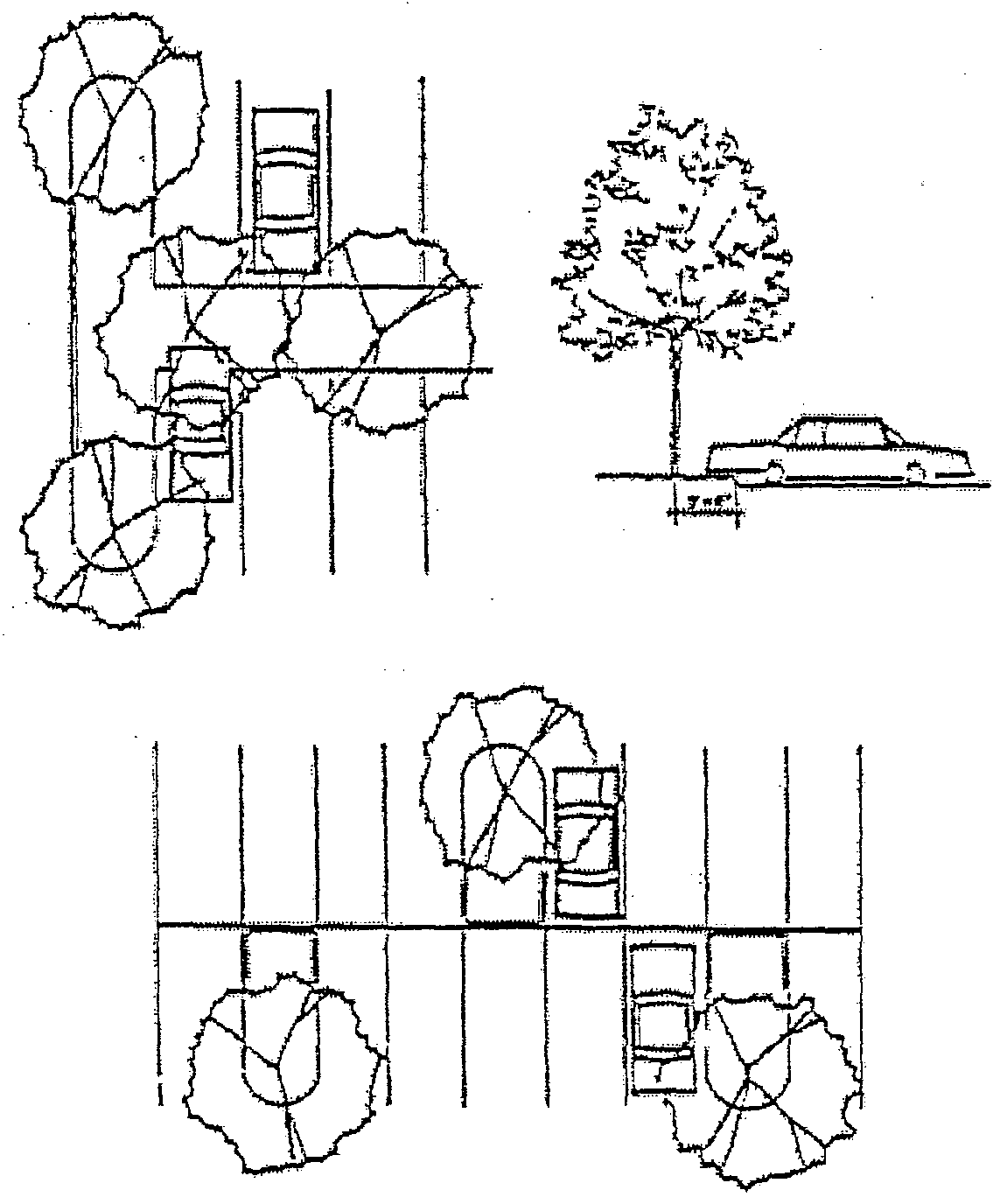
Typical Parking Lot Planting Islands
B-5. - Guide for Planting Trees.
The trees recommended in Section B-10 have minimal maintenance requirements. However, all trees must receive a certain degree of care, especially during and immediately after planting. To protect an investment in new trees, the developer should ensure that the following guidelines are followed when planting:
1.
The best times for planting are early spring and early fall. Trees planted in the summer run the risk of dehydration.
2.
Plant all trees at least four (4) feet from the end of head-in parking spaces to prevent damage from car overhangs.
3.
Dig the tree pit at least one (1) foot wider than the root ball and at least six (6) inches deeper than the ball's vertical dimension.
4.
Especially in areas where construction activity has compacted the soil, the bottom of the pit should be scarified or loosened with a pick ax or shovel.
5.
After the pit is dug, observe subsurface drainage conditions. Where poor drainage exists, the tree pit should be dug at least an additional twelve (12) inches and the bottom should be filled with coarse gravel.
6.
Backfill should include a proper mix of soil, peat moss, or some alternative material, and nutrients. All roots must be completely covered. Backfill should be thoroughly watered as it is placed around the roots.
7.
Immediately after it is planted, the tree should be supported with stakes and guy wires to hold it firmly in place as its root system begins to develop. Staked trees will become stronger more quickly. Remove stakes and ties after one (1) year.
8.
Spread at least three (3) inches of mulch over the entire excavation in order to retain moisture and keep down weeds. An additional three-inch saucer of mulch should be provided to form a basin around the trunk of the tree. This saucer helps catch and retain moisture.
9.
The lower trunks of new trees should be wrapped with burlap or paper to prevent evaporation and sun scald. The wrapping should remain on the tree for at least one (1) year.
10.
Conscientious postplanting care, especially watering, pruning and fertilizing, is a must for street and parking lot trees. Branches of new trees may be reduced by as much as a third to prevent excessive evaporation.
B-6. - Guide for Planting Shrubs.
Shrubs planted for screening purposes should be given a proper culture and sufficient room in which to grow. Many of the guidelines for tree planting listed in Section E-5 also apply to shrubs, However, because specific requirements vary considerably between shrub types, this Appendix does not attempt to generalize the needs of all shrubs. For detailed planting information on individual species, refer to the Manual of Woody Landscape Plants, by Michael Dirr.
B-7. - Typical Opaque Screens.
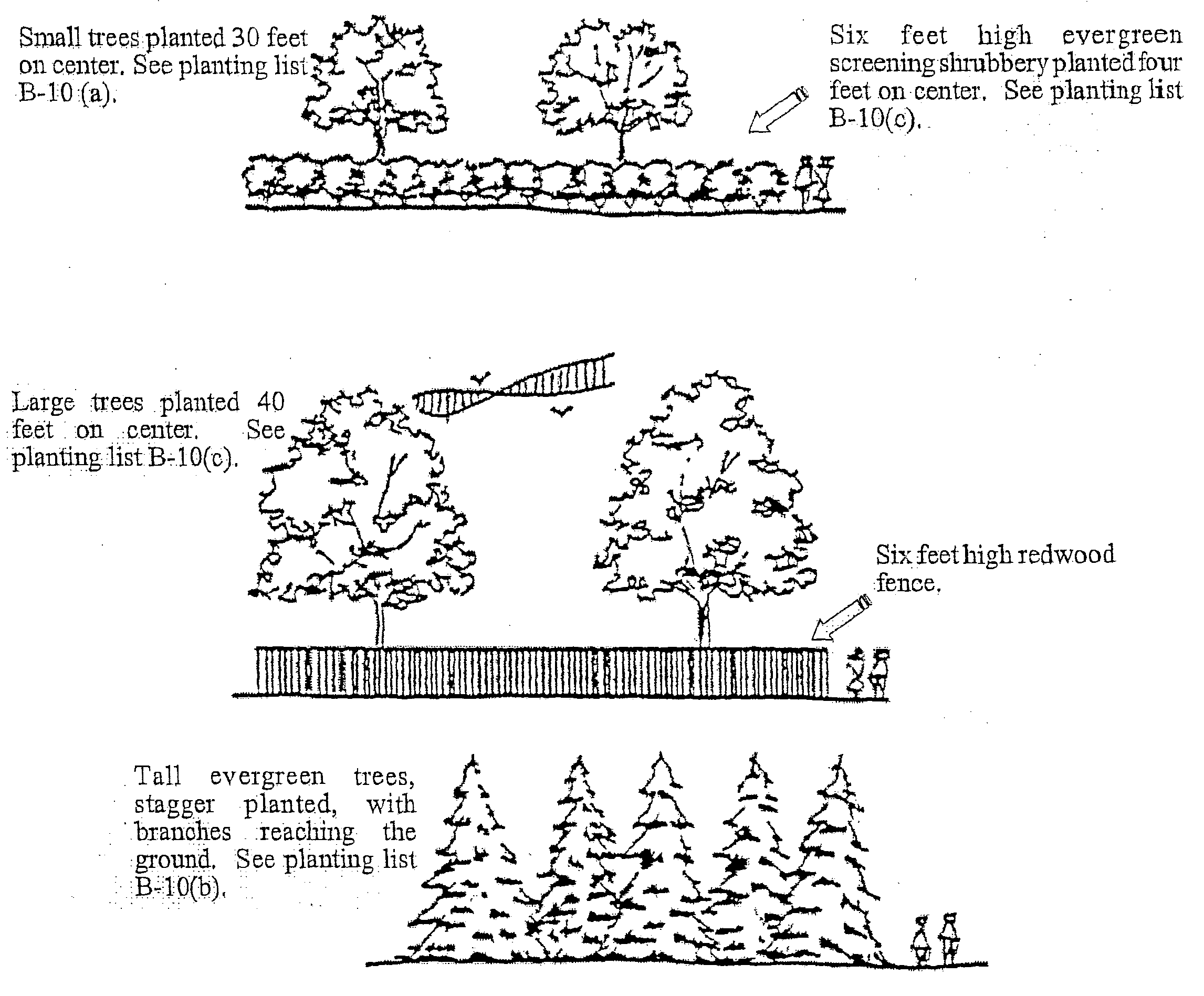
Typical Opaque Screens
B-8. - Typical Semi-Opaque Screens.
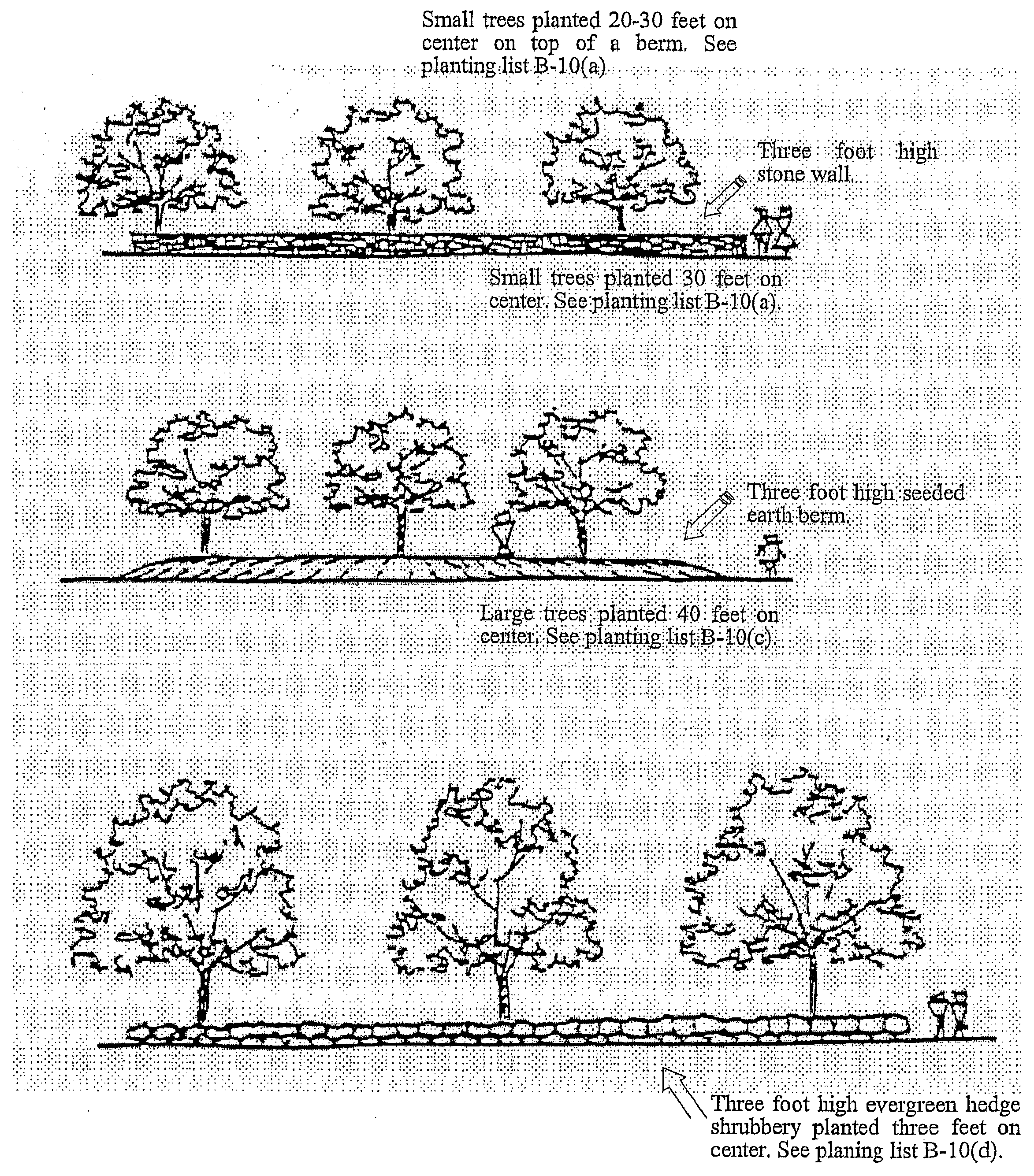
Typical Semi-Opaque Screens
B-9. - Typical Broken Screens.
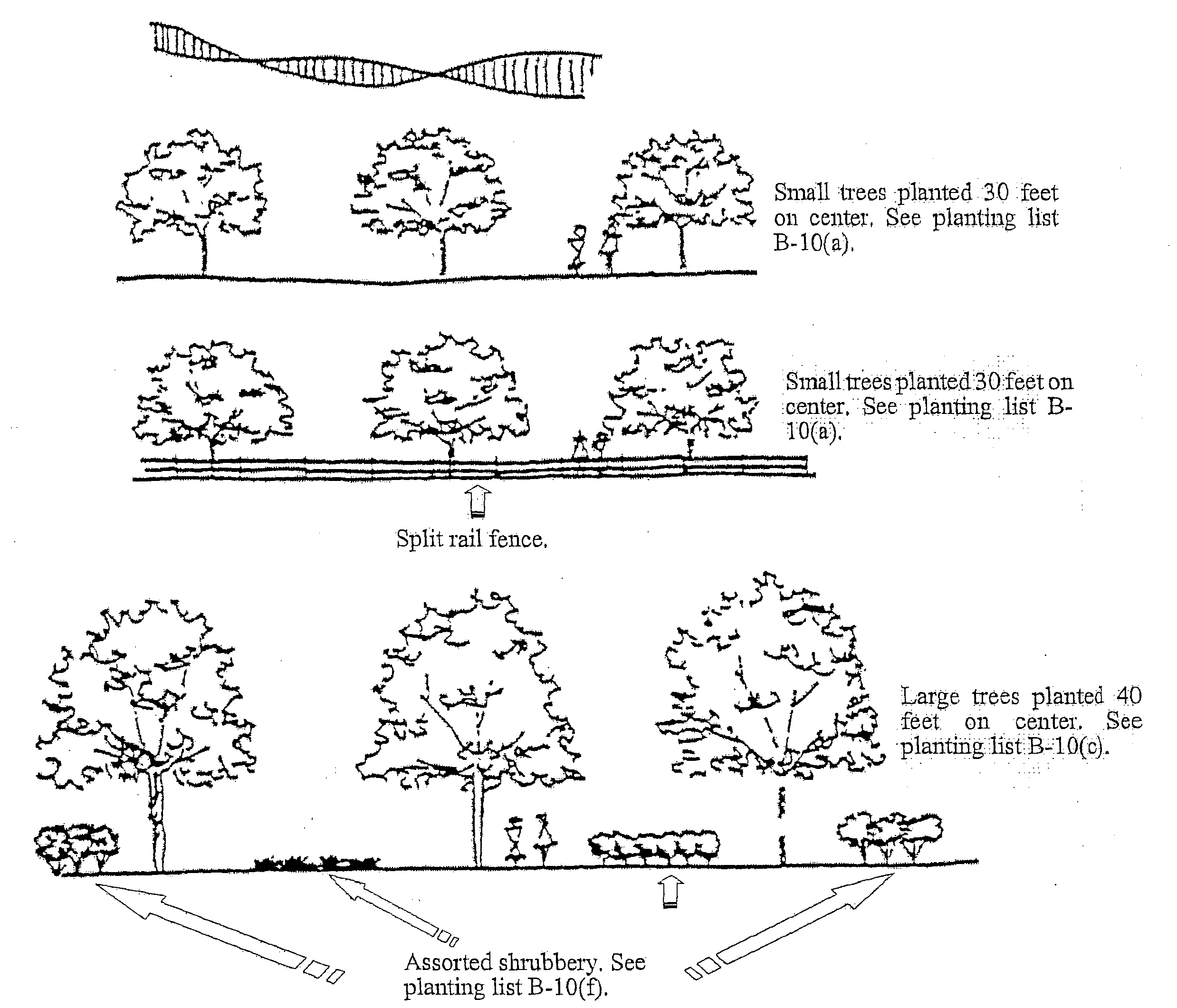
Typical Broken Screens
B-10. - Lists of Recommended Trees and Shrubs.
The following lists indicate plantings which will meet the screening and shading requirements of Sections 208-213 and 208-216 of this Chapter. The lists are by no means comprehensive and are intended merely to suggest the types of flora which would be appropriate for screening and shading purposes. Plants were selected for inclusion on these lists according to four (4) principal criteria: general suitability for the climate and soil conditions of this area; ease of maintenance; tolerance of urban conditions; and availability from area nurseries. When selecting new plantings for a particular site, a developer should first consider the types of plants which are thriving on or near that site as well as availability of plant species for local purchase. However, if an introduced species has proven highly effective for screening or shading in this area, it too may be a proper selection.
Sections B-11 through B-16 contain descriptions of some of the trees and shrubs listed here.
(a)
Small trees for partial screening:
(1)
River birch.
(2)
American hornbeam.
(3)
Eastern redbud.
(4)
Flowering dogwood.
(5)
Washington hawthorn.
(6)
Russian-olive.
(7)
Mountain silverbell.
(8)
American holly.
(9)
Goldenrain tree.
(10)
Crape myrtle.
(11)
Sourwood.
(12)
Caroline cherry laurel.
(13)
Callery pear.
(14)
Flowering cherry.
(15)
Crabapple.
(16)
Bradford pear.
(17)
Japanese black pine.
(b)
Large trees for evergreen screening:
(1)
Deodar cedar.
(2)
Southern magnolia.
(3)
Carolina hemlock.
(4)
Austrian pine.
(5)
Nellie Steers holly.
(c)
Large trees for shading:
(1)
Norway maple.
(2)
Red maple.
(3)
Ginkgo.
(4)
Honey locust (thornless).
(5)
Sweetgum.
(6)
London plane-tree.
(7)
Sycamore.
(8)
Eastern red oak.
(9)
Willow oak.
(10)
Scarlet oak.
(11)
Laurel oak.
(12)
Littleleaf linden.
(13)
Green ash.
(14)
Zelkova,
(d)
Small shrubs for evergreen screening:
(1)
Glossy abelia.
(2)
Warty barberry.
(3)
Wintergreen barberry.
(4)
Dwarf homed holly.
(5)
Little holly.
(6)
Convexa Japanese holly.
(7)
India hawthorn.
(8)
Azaleas/rhododendrons.
(9)
Japanese yew.
(e)
Large shrubs for evergreen screening:
(1)
Thorny elaeangus.
(2)
Burford holly.
(3)
Yaupon holly.
(4)
Laurel or sweet bay.
(5)
Japanese privet.
(6)
Fortune tea olive.
(7)
Red photinia.
(8)
Leatherleaf viburnum.
(f)
Assorted shrubs for broken screens:
(1)
Japanese barberry.
(2)
Fringe-tree.
(3)
Border forsythia.
(4)
Vernal witch-hazel.
(5)
Common witch-hazel.
(6)
Pfitzer juniper.
(7)
Drooping leucothoe.
(8)
Winter honeysuckle.
(9)
Star magnolia.
(10)
Northern bayberry.
(11)
Judd viburnum.
(12)
Doublefile viburnum.
B-11. - Small Trees for Partial Screening.
The following trees are recommended for use in all types of screens. Though smaller than the trees listed in planting lists in Sections B-12 and B-13, each of these trees will reach a height of at least twenty (20) feet.
(1)
River birch (Betulanigra). Height: twenty (20) to forty (40) feet; spread: eight (8) to sixteen (16) feet. The river birch is a native tree which usually grows along stream banks. In landscape design, it is adaptable to either high or low locations, but still requires a lot of moisture. This tree has an interesting papery bark and a graceful branching habitat. It has no special pest or maintenance problems.
(2)
American hornbeam (Carpinus carolinia). Height: twenty (20) to thirty (30) feet; spread: fifteen (15) to twenty (20) feet. This native tree has a natural yet refined appearance. It is slow growing, but at maturity it serves as an excellent small shade tree. Its fluted muscular trunk is an interesting feature. In the wild, the American hornbeam is common in moist rich soil, yet, when used in landscape design, it is soil tolerant and does not require an unusual amount of water. It has no pests and no special maintenance problems.
B-12. - Large Trees for Evergreen Screening.
The following trees are ideal for screening large scale areas such as shopping centers and industrial sites. They are also effective in combination with other smaller screening plants. Both are moderate to fast growers. They are not considered to be shade trees.
(1)
Deodar cedar (Cedrus deodara). Height: forty (40) to one hundred fifty (150) feet; spread: thirty (30) feet or more. The Deodar cedar is a useful and attractive evergreen. It should be allowed plenty of room in order to assume its beautiful natural form. Its pendulous branches should be allowed to touch the ground. It prefers relatively dry soils, grows rapidly and is easy to maintain. True cedars such as the Deodar are not native to North America, but they have become quite popular in the South as a landscape tree.
(2)
Southern magnolia (Magnolia grandiflora). Height: forty (40) to sixty (60) feet; spread: twenty-five (25) feet or more. Magnolias are striking trees which serve well as screens when their branches are allowed to grow to the ground. Generally, this tree does well in city conditions, but it should be planted in quite rich acidic soils and it requires a lot of moisture. Furthermore, magnolias require ample space for growth. If planted in full sunlight, they will grow rapidly. Because it drops large waxy leaves, seed pods and flowers, the magnolia may present a litter problem.
B-13. - Large Trees for Shading.
The following trees may be used for screening, but they are recommended especially for shading streets and parking lots. Unless otherwise noted, they will grow rapidly. Each species will attain a mature spread of at least thirty (30) feet.
(1)
Red maple (Acer rubrum). Height: forty (40) to fifty (50) feet; spread: twenty-five (25) feet or more. This tree is an example of a maple which is not recommended where there will be high concentrations of air pollution. However, with its excellent shading characteristics and beautiful colors, it should not be ignored. This tree grows rapidly, but, unlike the Norway maple, it does not become brittle with age. The red maple is a native tree which is usually found in moist, even swampy areas, but it adapts well to a variety of situations. Although subject to maple insects and diseases, it is usually a long-lived tree.
(2)
Honey locust (Gleditisia triacanthos). Height: fifty (50) to seventy-five (75) feet; spread: twenty-five (25) feet or more. Its open, spreading form and feathery leaves may give the honey locust a frail appearance, but it is, in fact, a quite sturdy tree, notable for its resistance to storm damage. It is a native tree which is drought-resistant and adaptable to city conditions. Grass and shrubs thrive beneath a honey locust because it casts light shade. This tree is especially useful for its ability to be transplanted at a relatively advanced age. Accordingly, it may be used for immediate effect in a landscape design. The honey locust has its pests and diseases, but it is fairly hardy. Thornless and fruitless varieties such as Moraine are recommended.
B-14. - Small Shrubs for Evergreen Screening.
The following shrubs are recommended for informal (unclipped) hedges or screens. Each species grows to a height of less than six (6) feet; therefore, these shrubs are appropriate for semi-opaque screens.
(1)
Glossy abelia (Abelia grandifiora). Height: four (4) to six (6) feet; spread: three (3) to five (5) feet. Abelia is quite common in local nurseries and tends to be less expensive than other shrubs on this list, It bears pale pink flowers throughout the summer. Although it has proven quite popular for informal hedges, it has several drawbacks. Abelia should be pruned and thinned to maintain its best form. It may drop its leaves due to low temperatures, lack of pruning or starvation.
(2)
Warty barberry (Berberis verruculosa). Height: three (3) to four (4) feet; spread: three (3) to four (4) feet. Barberries as a group have proven to be excellent hedge plants. With their dense, spiny limbs, they are effective barriers in public places. The warty barberry is a shrub with a neat, compact habit. It is soil tolerant and has no special maintenance requirements. It grows slowly, but it will reach a height of three (3) to four (4) feet within five (5) years.
B-15. - Large Shrubs for Evergreen Screening.
The following shrubs are recommended for high hedges or screens. Each species grows to a height of more than six (6) feet; therefore, these shrubs are appropriate for opaque screens.
(1)
Hedge bamboo (Bambusa multiplex). Height: ten (10) to twelve (12) feet; spread: four (4) to six (6) feet. Hedge bamboo grows rapidly yet is more easily confined to a limited area than most types of bamboo. It is adaptable to a variety of situations, but requires plenty of water. For best effect as a screen, hedge bamboo should be stagger planted.
(2)
Thorny elaeangus (Elaeangus pungens). Height: eight (8) to ten (10) feet; spread: six (6) to ten (10) feet. This shrub tolerates many adverse conditions. It will grow rapidly in relatively infertile, dry soils. Its dense thorny branches form an excellent natural hedge. It is one of the most common evergreen shrubs in the south.
B-16. - Assorted Shrubs for Broken Screens.
The following is a sampling of shrubbery that would be appropriate in a broken screen. Because many of these plants are deciduous, they are not suitable for opaque and semi-opaque screens. (Note: Many of the evergreen shrubs described in planting lists B-14 and B-15 are also suitable for broken screens.)
(1)
Japanese barberry (Berberis thunbergii). Height: three (3) to five (5) feet; spread: three (3) to five (5) feet. This extremely common deciduous shrub is considered to be one of the toughest members of the barberry family. It survives drought, poor soils, exposure and the worst city conditions. With its many thorns, the Japanese barberry is often used as an impenetrable barrier, but it is attractive enough to stand alone as a specimen plant. It requires no special maintenance and, when planted singly, needs no pruning.
(2)
Fringe-tree (Chionanthus virginicus). Height: ten (10) to thirty (30) feet; spread: eight (8) to ten (10) feet. The fringe-tree is known for its profusion of beautiful flowers. It is considered to be one of the most striking native American shrubs. It is relatively difficult to transplant, but once established, it does well in cities as it endures heavy smoke and dust. The mature fringe-tree's only drawback is that its leaves appear rather late in spring.

