Marshall Township City Zoning Code
APPENDIX A
BUFFERYARD REQUIREMENTS
A-1.- Bufferyard Specifications.
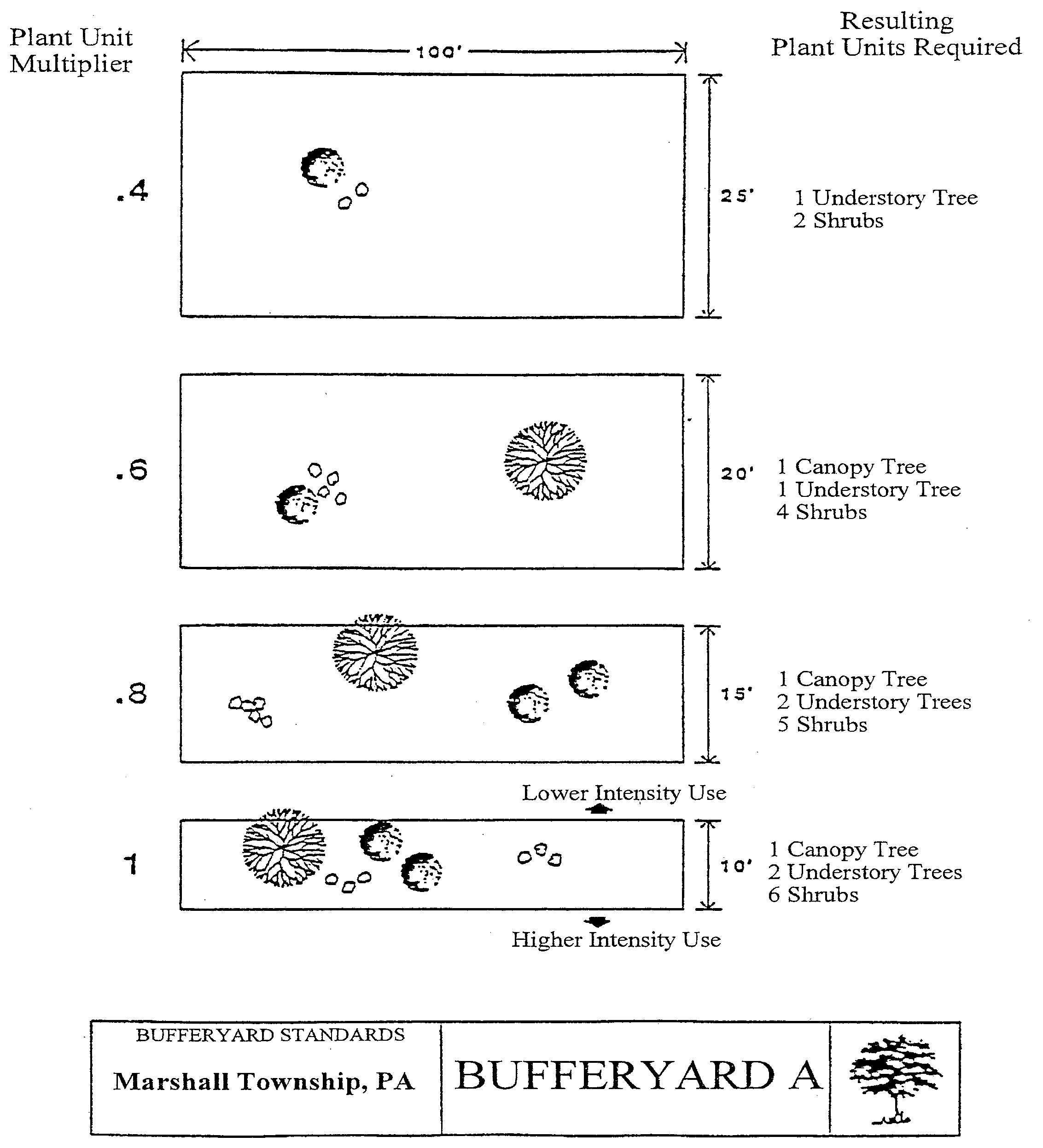
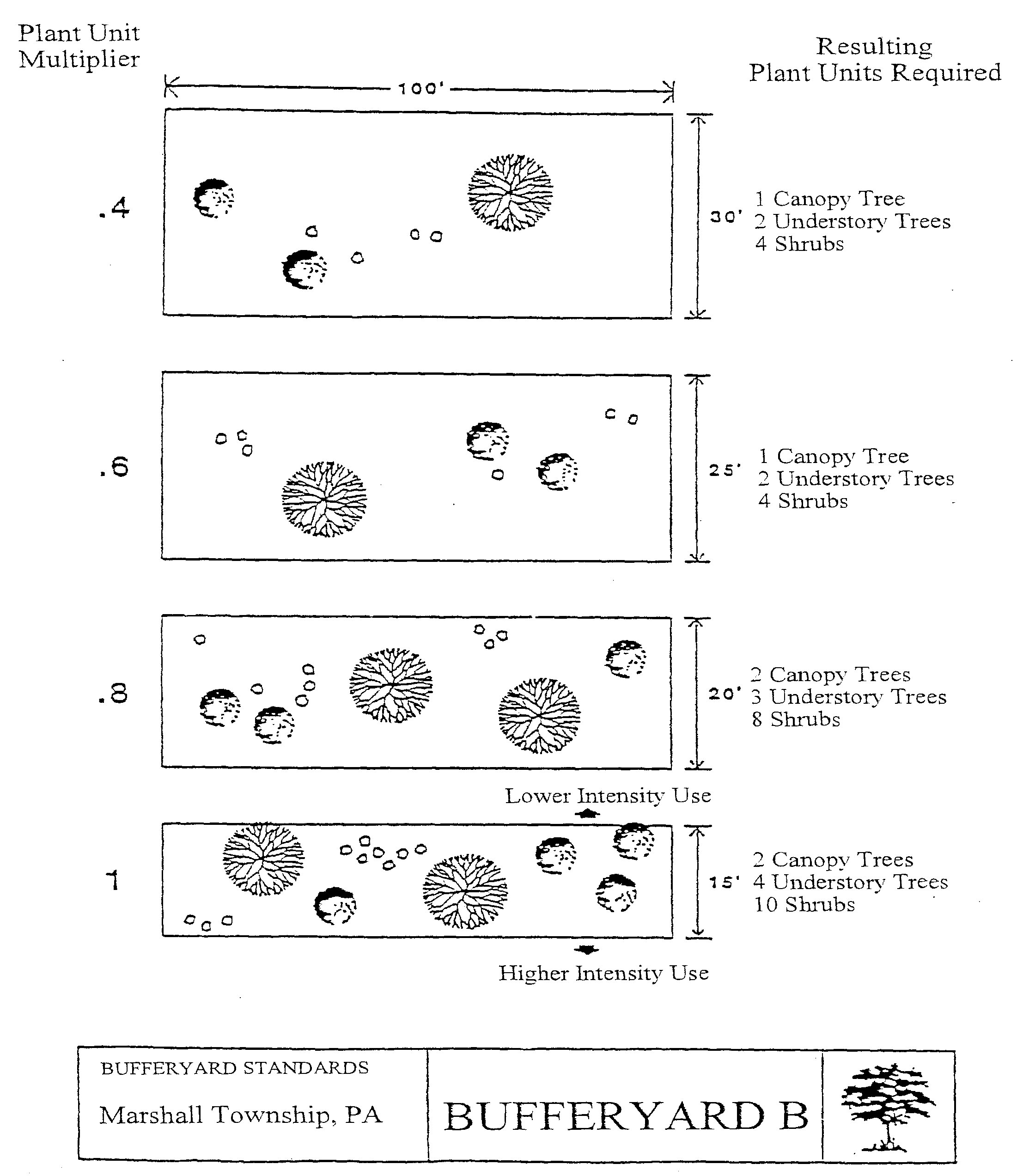
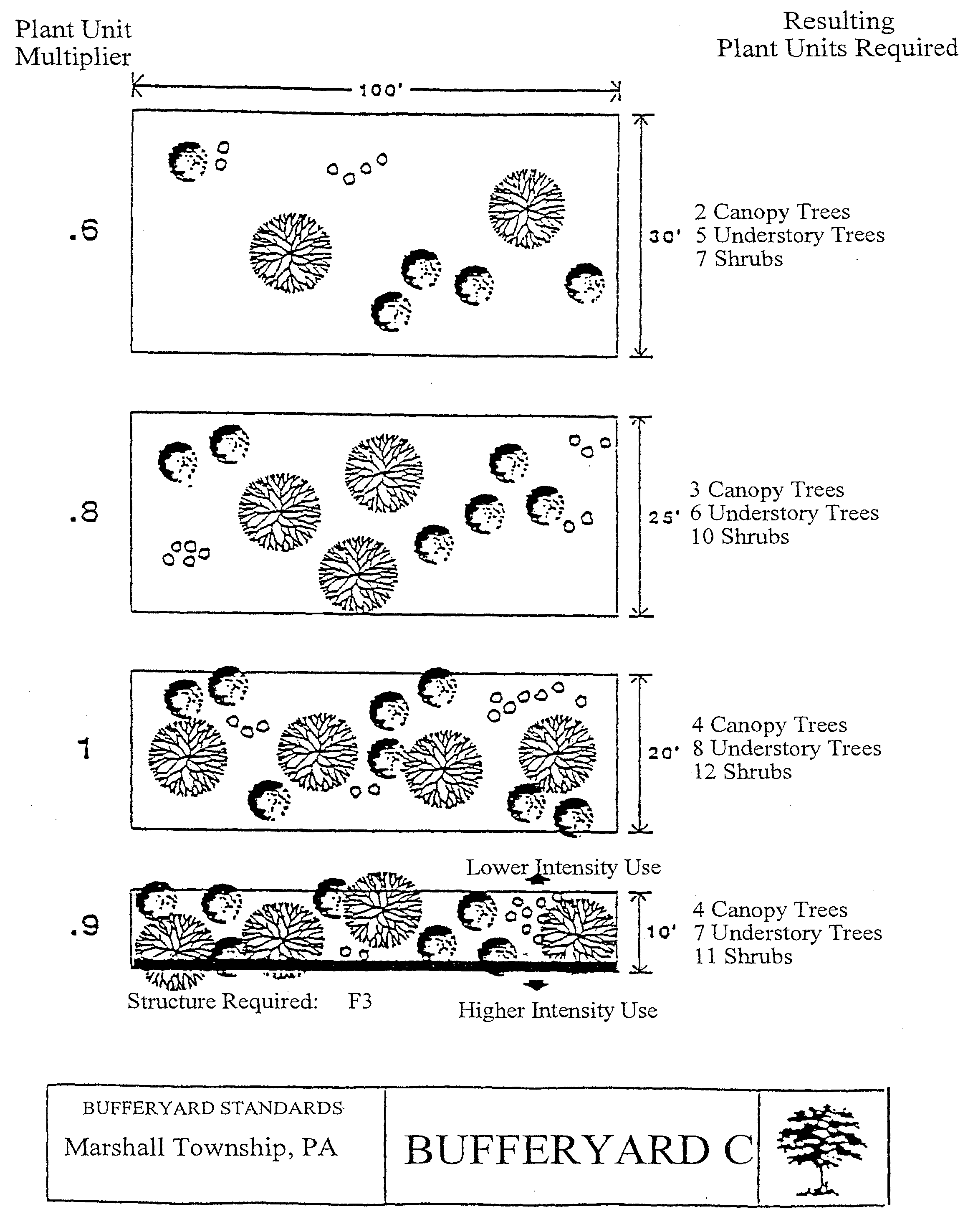
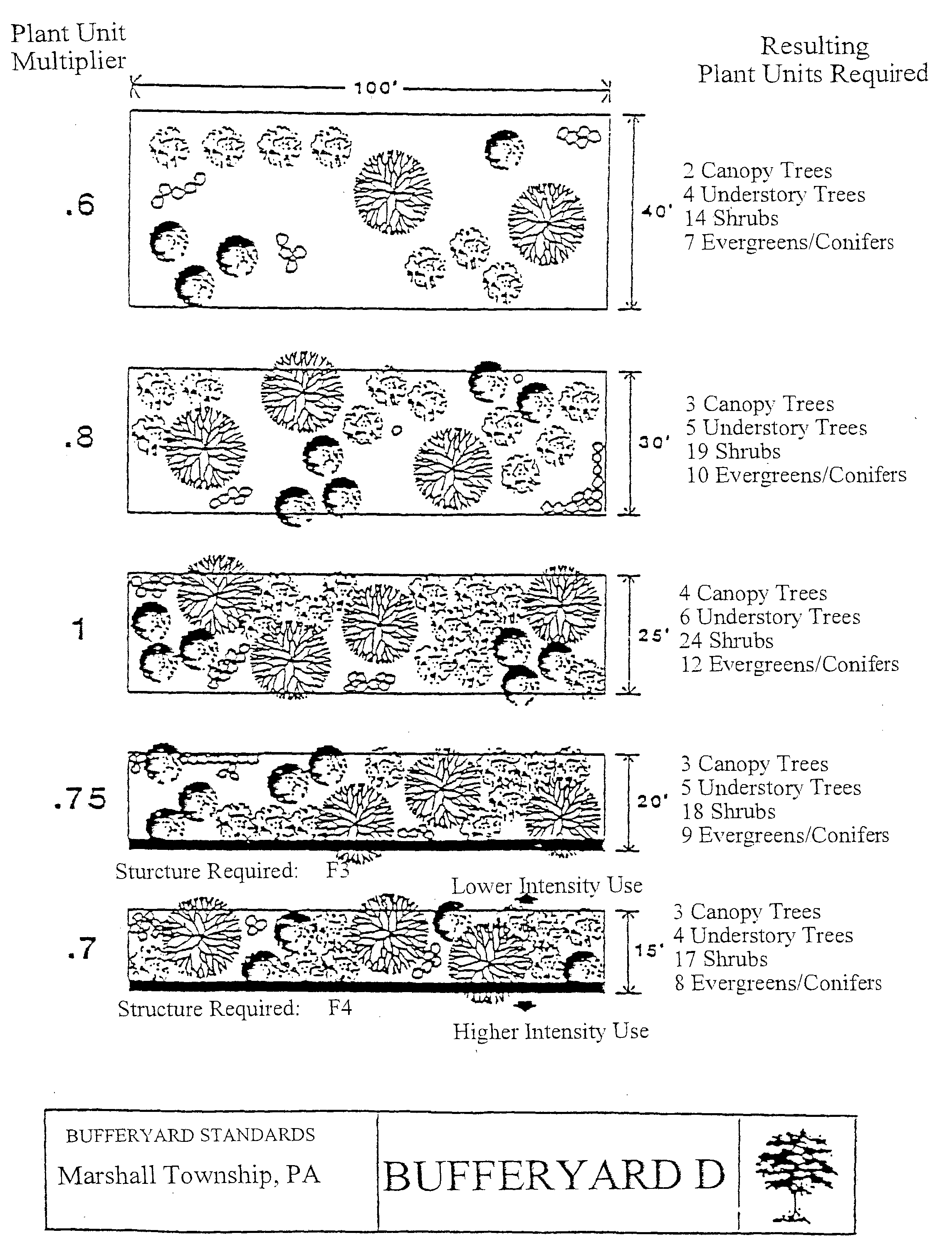
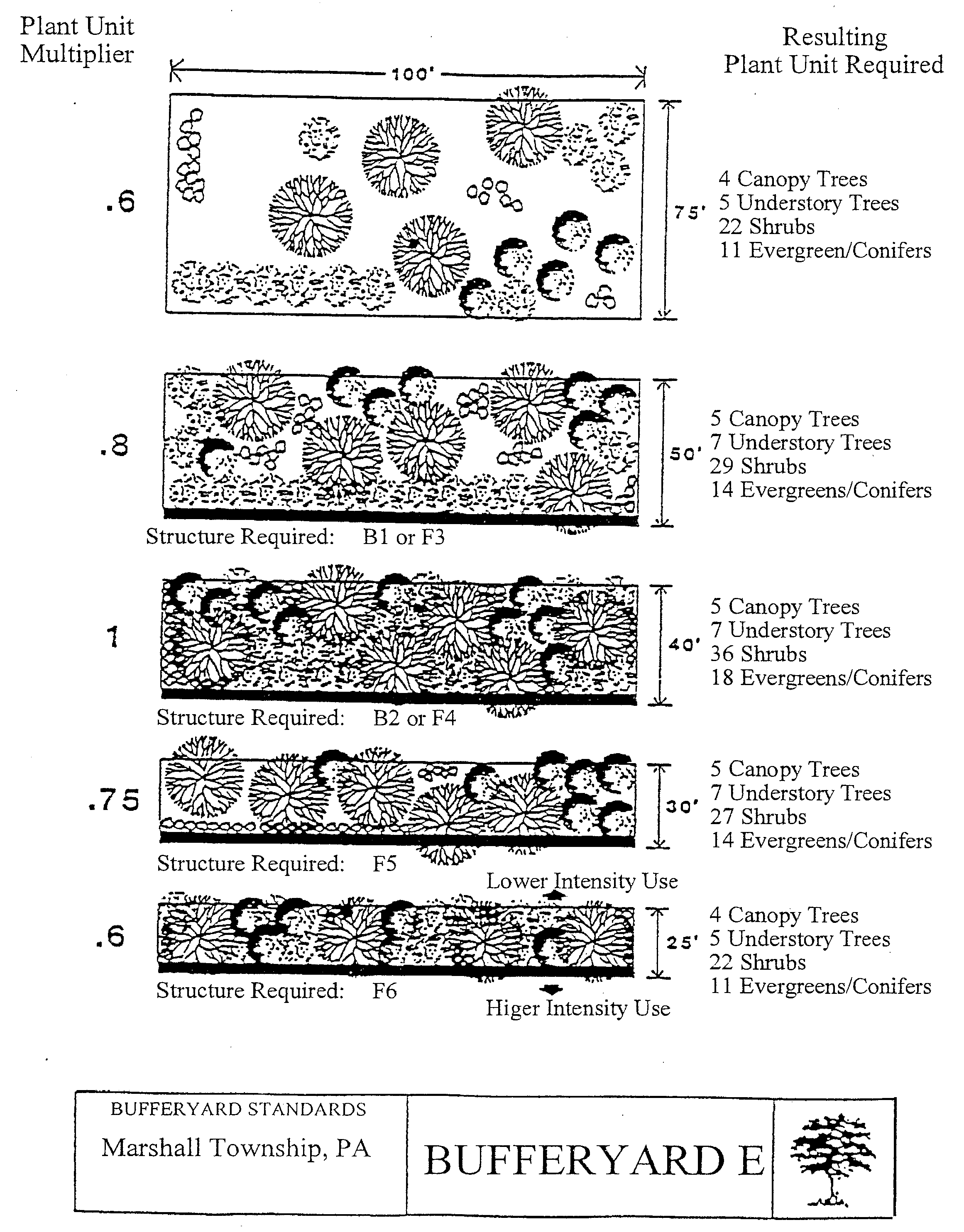
The illustrations in the Appendix [3] graphically indicate the specifications of each bufferyard. Bufferyard requirements are stated in terms of the width of the bufferyard and the number of plant units required per one hundred (100) linear feet of bufferyard. The requirements of a bufferyard may be satisfied by any of the options thereof illustrated. The plant unit multiplier is a factor by which the basic number of plant materials required for a given bufferyard is determined given a change in the width of that yard. The type and quantity of plant materials required by each bufferyard and each bufferyard option are specified in this section. Only those plant materials capable of fulfilling the intended function shall satisfy the requirements of this Chapter.
The options within any bufferyard are designed to be equivalent in terms of their effectiveness in eliminating the impact of adjoining uses. Cost equivalence between options was attempted where possible. Generally, the plant materials which are identified as acceptable are determined by the type(s) of soil present on the site. The illustrations have mathematically rounded the number of plant units required for each option with a given bufferyard. In actual practice, mathematical rounding would be applied to the total amount of plant material required by a bufferyard, not to each 100-foot length of bufferyard. All of the illustrations are drawn to scale and depict the bufferyard according to the average project diameter of plant materials at five (5) years after planting.
Each illustration depicts the total bufferyard located between two (2) uses.
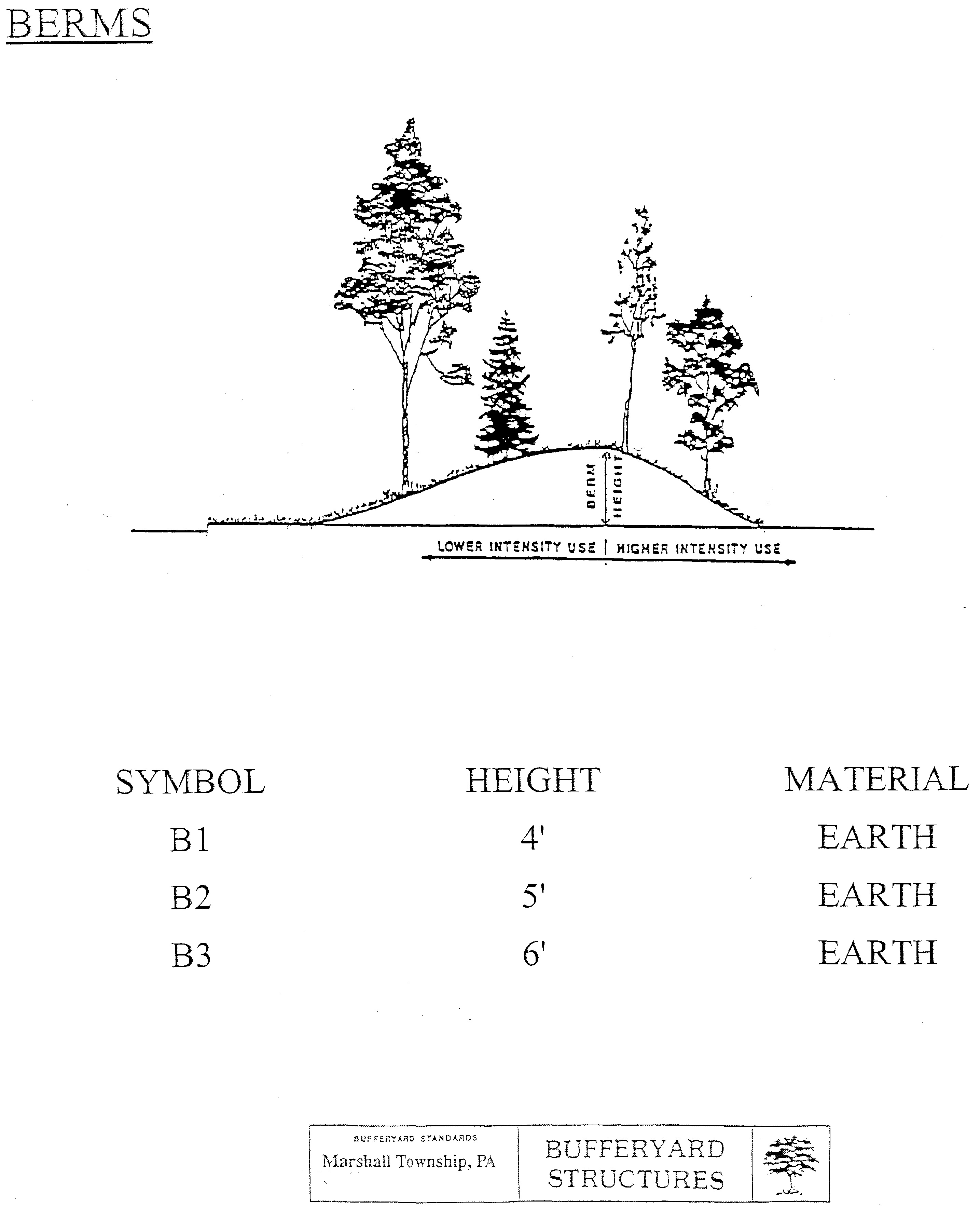
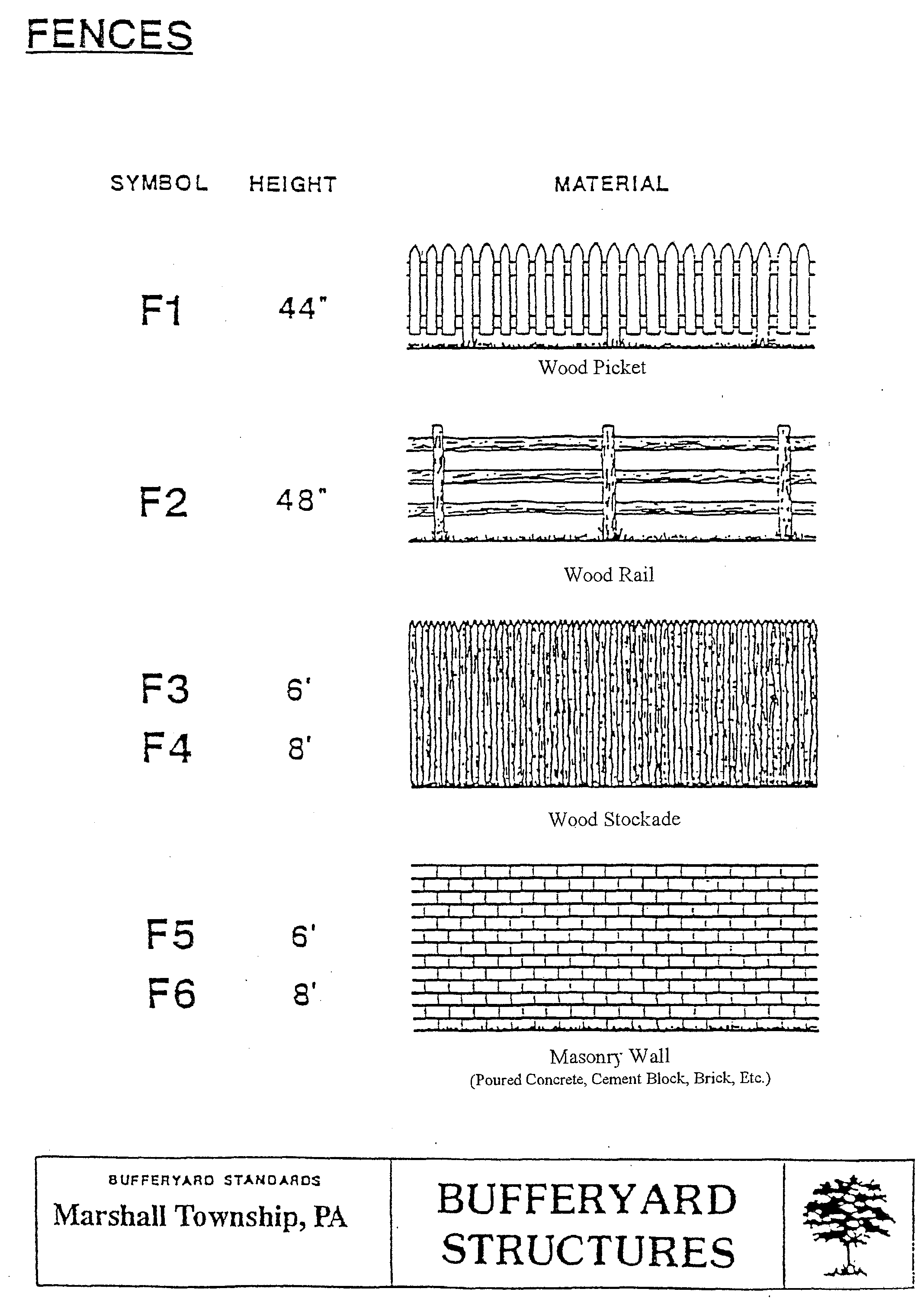
Whenever a wall, fence, or berm is required within a bufferyard, these are shown as structure required" in the following illustrations, wherein their respective, specifications are also shown. All required structures shall be the responsibility of the higher intensity use. Whenever a wall is required in addition to a berm, the wall shall be located between the berm and the higher intensity use in order to provide maximum sound absorption.
Editor's note— Said illustrations are included at the end of Appendix A.
A-2. - Plant Material.
The following plant material substitutions shall satisfy the requirements of this section.
1.
In Bufferyards C, D and E, evergreen canopy or evergreen understory trees may be substituted for deciduous canopy forest trees without limitation.
2.
In Bufferyards A and B, evergreen canopy or evergreen understory trees may be substituted as follows:
a.
In the case of deciduous canopy forest trees, up to a maximum of fifty percent (50%) of the total number of the deciduous canopy trees otherwise required.
b.
In the case of deciduous understory, with limitation.
3.
In all bufferyards, evergreen or conifer shrubs may be substituted for deciduous shrubs without limitation.
4.
In all bufferyards required of public service uses, the public service use may substitute evergreen canopy or evergreen understory plant materials for canopy forest trees and understory plant materials, without limitation.
5.
If the development on the adjoining use is existing, planned or deed restricted for solar access, understory trees may be substituted for canopy trees where canopy trees would destroy solar access.
6.
Any existing plant material which otherwise satisfies the requirements of the Appendix may be counted toward satisfying all such requirements.
7.
The exact placement of required plants and structures shall be the decision of each user except that the following requirements shall be satisfied:
a.
Evergreen (or conifer) Class III and IV plant materials shall be planted in clusters rather than singly in order to maximize their chances of survival.
b.
Berms with masonry walls (BW 1 , BW 2 and BW 3 ) required of Bufferyard D and E options are intended to buffer more significant nuisances from adjacent uses and, additionally, to break up and absorb noise, which is achieved by the varied heights of plant materials between the masonry wall and noise source.
1.
When berms with walls are required, the masonry wall shall be closer than the berm to the higher intensity use.
2.
With a bufferyard, a planting area at least five (5) feet wide containing fifteen percent (15%) of the total plant requirements (based on the multiplier =1) shall be located between the masonry wall and the higher intensity class use. These plants shall be chosen to provide species and sizes to reduce noise in conjunction with the wall. All bufferyard areas shall be seeded with lawn unless ground cover is already established.
A-3. - Structures.
The following structures are equivalent and may be used interchangeably, so long as both structures are specified in the bufferyard illustrations in this Article.