
Marshall Township City Zoning Code
ARTICLE 2600
CONDITIONAL USES
Sec. 208-2601.- Applicability.
The BOARD OF SUPERVISORS shall have the power to approve CONDITIONAL USES when this Chapter specifically requires the obtaining of such approval and for no other USE or purpose.
Sec. 208-2602. - Application and Approval Procedure.
A.
Application Procedure.
1.
An application for conditional USE approval shall be filed with the Zoning Officer, on forms prescribed by the TOWNSHIP, at least twenty-one (21) DAYS prior to the date of the regular meeting of the PLANNING COMMISSION, at noon. A conditional USE application shall not be considered to be administratively complete until all items required by this Chapter, including the application fee and/or deposit, have been received by the TOWNSHIP.
2.
The Zoning Officer shall review the application to determine whether all materials required by this Chapter have been submitted by the applicant. If all such materials have not been submitted by the applicant, then the Zoning Officer shall reject the application as administratively incomplete and shall notify the applicant, in writing, citing the specific deficiencies and the specific requirements of this Chapter that have not been met.
3.
Within five DAYS of receipt of an administratively complete application, the Zoning Officer shall submit one copy of the application and any materials submitted therewith to: the TOWNSHIP Solicitor; the TOWNSHIP Engineer; any TOWNSHIP professional consultant deemed necessary by the TOWNSHIP Manager; and the County Planning Agency or its Designee.
4.
The Zoning Officer shall submit one copy of an administratively complete application and any materials submitted therewith to each member of the TOWNSHIP PLANNING COMMISSION by no later than the Friday prior to the date of the regular meeting of the PLANNING COMMISSION.
5.
The PLANNING COMMISSION shall review the application and forward its recommendation to the TOWNSHIP BOARD OF SUPERVISORS.
6.
The BOARD OF SUPERVISORS shall hold a public hearing, pursuant to PUBLIC NOTICE, within the time periods and procedures required by the MPC. The public hearing shall commence within 60 DAYS of the date of the filing of an administratively complete application. Public hearings shall be conducted and held in accordance with the applicable provisions of the MPC.
7.
The BOARD OF SUPERVISORS shall render a written decision on the conditional USE application within 45 DAYS of the last hearing. Where the application is contested or denied, the BOARD OF SUPERVISORS decision shall be accompanied by findings of fact and conclusions based thereon, together with any reasons therefor. Conclusions based on any provisions of this Chapter or any other rule, regulation, ordinance or statute shall contain a reference to the provision relied upon and the reasons why the conclusion is deemed appropriate in light of the facts found.
8.
In granting a conditional USE pursuant to this Chapter, the TOWNSHIP BOARD OF SUPERVISORS may impose any reasonable conditions it believes are necessary to ensure compliance with this Chapter, Chapter 174, SUBDIVISION and LAND DEVELOPMENT, the Marshall TOWNSHIP Code of Ordinances, as amended, and all other ordinances of the TOWNSHIP, and as it otherwise deems necessary to implement the purposes of this Chapter and the MPC.
9.
A copy of the final decision or, where no decision is called for, of the findings, shall be delivered to the applicant Personally or mailed to him not later than the day following its date.
10.
All DEVELOPMENT, CONSTRUCTION and USE shall be in accordance with the approved conditional USE decision and plan, unless a revised conditional USE application is submitted, approved and filed. The approved conditional USE plan shall consist of the application, as submitted, together with all of its attachments and exhibits, as finally approved by the BOARD OF SUPERVISORS, and the conditions attached by the BOARD OF SUPERVISORS. Any DEVELOPMENT contrary to the approved conditional USE decision and plan shall constitute a violation of this Chapter.
B.
Application Content.
1.
All applications for conditional USE approval shall demonstrate compliance with the: general standards and criteria of this Article; the applicable express standards and criteria of this Article; and the applicable LOT and YARD requirements of the ZONING DISTRICT in which the USE is proposed.
2.
All applications for conditional USE approval shall be submitted to the Zoning Officer, in the form prescribed. The number of copies of each of the following items shall be prescribed by the Planning Director.
(a)
Full scale copies and half-scale copies of all required PLANS, maps and drawings;
(b)
Copies of all other application materials.
3.
An application for conditional USE approval shall not be considered administratively complete until all items required by this Chapter, including the application fee and and/or deposit, have been received by the Zoning Officer.
4.
All applications for conditional USE approval shall contain the following:
(a)
A DEVELOPMENT PLAN, as defined by this Chapter;
(b)
A legal document verifying applicant's legal interest in the subject property (i.e., deed, sales agreement, lease);
(c)
A traffic impact study, as described in Chapter 174, SUBDIVISION and LAND DEVELOPMENT, unless otherwise waived by the BOARD OF SUPERVISORS;
(d)
The application fee and/or deposit in an amount set from time to time by resolution of the BOARD OF SUPERVISORS; and
(e)
CONSTRUCTION PLANS, where renovations or modifications of an existing BUILDING is immediately contemplated, showing the scope, nature and extent of said renovation or modification.
C.
Expiration of Approval. The grant of a conditional USE shall expire two years after the date of the BOARD OF SUPERVISORS written decision unless: (1) the applicant has applied for and obtained a BUILDING PERMIT and commenced CONSTRUCTION; or (2) in a case where the conditional USE does not require the issuance of a BUILDING PERMIT, the applicant has applied for and obtained an occupancy permit and has commenced the USE which is the subject of the conditional USE approval. Expiration of the conditional USE approval under this Article shall require the applicant to re-apply for conditional USE approval.
Sec. 208-2603. - General Standards and Criteria.
A.
Before approving a conditional USE application, the BOARD OF SUPERVISORS shall determine that the proposed USE complies with the following general standards and criteria, which are in addition to any other requirements in this Chapter for a specific type of USE or DEVELOPMENT:
1.
The proposed USE will not alter the established character and USE of the neighborhood or district in which it is located, and will not substantially impair the USE or DEVELOPMENT of adjacent properties.
2.
The establishment, maintenance, location and operation of the proposed USE will not be detrimental to or endanger the public health, safety, morals, comfort or general welfare.
3.
The proposed USE complies with all applicable provisions and requirements for that type of USE contained in this Chapter (unless a variance to any provision has been granted by the ZONING HEARING BOARD) and all other applicable Federal, State, County, and TOWNSHIP laws, statutes, ordinances and regulations, including but not limited to: Chapter 174, SUBDIVISION and LAND DEVELOPMENT; Chapter 165, Stormwater management of the Marshall TOWNSHIP Code of Ordinances, as amended.
4.
The proposed USE is compatible with surrounding land USES. It does not have a negative impact on the existing neighborhood or DEVELOPMENT in terms of air and water quality, noise, illumination and GLARE, restrictions to natural light and air circulation or other hazardous conditions that could endanger surrounding residents or impair the USE of surrounding properties.
5.
The proposed SITE of the conditional USE is suitable in terms of topography, soil conditions and size, based on number of projected users and the frequency of USE of the proposed USE.
6.
The proposed USE and SITE provides for safe, adequate vehicular and pedestrian access. It has access from a STREET capable of handling the traffic generated by the proposed USE, and it will not result in undue traffic congestion and hazardous conditions on adjacent STREETS. The USE provides for safe and efficient internal circulation and sufficient off-STREET parking and loading.
7.
The proposed USE complies with all applicable standards and requirements for providing sanitary sewage disposal, water supply, stormwater management, solid and toxic waste storage and disposal.
8.
The proposed USE provides landscaping, screening and buffer AREAS sufficient to protect the USE, enjoyment and DEVELOPMENT of adjacent properties.
9.
The proposed USE is in general conformity with the TOWNSHIP Comprehensive Plan.
B.
The BOARD OF SUPERVISORS shall grant a CONDITIONAL USE only if it finds adequate evidence presented by the applicant that the proposed CONDITIONAL USE is duly authorized under provisions of this Chapter, that the application falls within the terms of the specific provisions allowing for CONDITIONAL USES and that the proposed USE complies with all other requirements of this Chapter. The BOARD OF SUPERVISORS shall refuse an application for CONDITIONAL USE where opponents to the application establish by a preponderance of evidence that the application is contrary to the health, safety and morals or general welfare of the community at large. The BOARD OF SUPERVISORS, in granting a CONDITIONAL USE, may attach such reasonable conditions and safeguards other than those related to offsite transportation or road improvement, in addition to those expressed in the ordinance, as it may deem necessary to implement the purposes of this act and the zoning ordinance, except that conditions of approval shall not include those related to off-SITE transportation or road improvements pursuant to Section 603(c) (2) of the MPC.
C.
The BOARD OF SUPERVISORS shall, among other things, require that any proposed USE and location be:
1.
In accordance with the Marshall TOWNSHIP Comprehensive Plan and consistent with the spirit, purposes and the intent of this Chapter.
2.
In the best interests of the TOWNSHIP, the convenience of the community and the public welfare and be a substantial improvement to the property in the immediate vicinity.
3.
Suitable for the property in question and Designed, constructed, operated and maintained so as to be in harmony with and appropriate in appearance to the existing or intended character of the general vicinity.
4.
In conformance with all applicable requirements of this Chapter.
5.
Traffic Impact:
(a)
A traffic impact study (TIS) shall be required (unless otherwise waived by BOARD OF SUPERVISORS) as described is Subsection 174-205(D)(14) of the Marshall TOWNSHIP SUBDIVISION and LAND DEVELOPMENT Ordinance.
(Amended 9-29-2008 by Ord. No. 393)
Sec. 208-2604. - Standards for Review for Specified Land USES.
A.
Adult-Oriented ESTABLISHMENTS. In addition to the applicable requirements found in Article 2600 regulating CONDITIONAL USES, the following standards for review shall be applied when considering an application for an ADULT-ORIENTED ESTABLISHMENT in the district.
1.
All ADULT-ORIENTED ESTABLISHMENTS shall be a stand-alone USE situated on a LOT having a minimum area of one (1) acre.
2.
All ADULT-ORIENTED ESTABLISHMENTS shall not be permitted to be located within three thousand (3,000) feet of any other ADULT-ORIENTED ESTABLISHMENT whether such USE is situated in Marshall TOWNSHIP or otherwise.
3.
No permit will be issued for any ADULT-ORIENTED ESTABLISHMENT which intends to be located within the below listed distances of such institutional or residential property lines:
(a)
Church - eight hundred (800) feet.
(b)
Public or private pre-elementary, elementary, or secondary SCHOOL property - eight hundred (800) feet.
(c)
Public library - six hundred (600) feet.
(d)
CHILD DAY CARE or nursery SCHOOL - eight hundred (800) feet.
(e)
Public playground or park - eight hundred (800) feet.
(f)
Child-oriented business - eight hundred (800) feet.
(g)
Commercial recreation USES - six hundred (600) feet.
(h)
RESIDENTIAL USES or ZONES - six hundred (600) feet.
4.
The distance between any two ADULT-ORIENTED ESTABLISHMENTS shall be measured in a straight line, without regard to intervening STRUCTURES, from the closest point on the exterior parcel line of each such ESTABLISHMENT. The distance between any adult-oriented ESTABLISHMENT and a land USE specified in Subsection 208-2604(A)(3)(c) above, shall be measured in a straight line, without regard to intervening STRUCTURES from the closest point on the exterior parcel line of the ADULT-ORIENTED ESTABLISHMENT to the closest point on the exterior parcel line of said specified land USE.
5.
No materials or merchandise of any kind offered for sale, rent, lease, or loan or for view upon the premises of an ADULT-ORIENTED ESTABLISHMENT shall be exhibited or displayed outside of a BUILDING or STRUCTURE.
6.
SIGNS identifying an ADULT-ORIENTED ESTABLISHMENT shall conform to the provisions of Article 2100 of the Zoning Ordinance except as provided herein:
7.
SIGNS for ADULT-ORIENTED ESTABLISHMENTS shall contain no photographs, silhouettes, drawings, or pictorial representations of any manner and may contain only:
(a)
The name of the ESTABLISHMENT, and/or
(b)
One or more of the following phrases:
(i)
ADULT BOOKSTORE;
(ii)
ADULT MOTION PICTURE THEATER;
(iii)
ADULT ENTERTAINMENT studio;
(iv)
Rap studio;
(v)
Exotic dance studio;
(vi)
Sensitivity studio;
(vii)
Massage parlor;
(viii)
Adult modeling studio; or
(ix)
Other term of like import.
(c)
A WALL SIGN for adult movie theaters may contain the additional phrase, "movie titles posted inside premises."
8.
An ADULT-ORIENTED ESTABLISHMENT may be open for business only Monday through Saturday from 10:00 AM to 12:00 Midnight prevailing time. No ADULT-ORIENTED ESTABLISHMENT shall be open at any time on Sunday or on a legal holiday as set forth in the Act of May 31, 1893, P.L. 188 § 1, as amended, 44 P.S. § 11.
9.
It shall be a violation of the Zoning Ordinance if a PERSON causes or PERMITS the operation, ESTABLISHMENT, or maintenance of more than one ADULT-ORIENTED ESTABLISHMENT in the same BUILDING, STRUCTURE, or portion thereof, or the increase of floor AREAS of any ADULT-ORIENTED ESTABLISHMENT in any BUILDING, STRUCTURE, or portion thereof containing another ADULT-ORIENTED ESTABLISHMENT.
B.
AGRICULTURE.
1.
To qualify as agricultural USE or for the production and keeping of FARM animals, the minimum LOT size shall be five (5) acres.
2.
No barn LOT, mushroom house or manure storage shall be established any closer than one hundred (100) feet to any property line.
3.
The number of DWELLINGS permitted on a FARM shall not be limited, provided that density does not exceed one (1) single-FAMILY DWELLING per ten (10) acres and that DWELLINGS shall be separated by a minimum of two hundred (200) feet for USE by resident FARM workers or FAMILY members.
4.
Silos and bulk bins shall be exempted from area and BULK regulations when attached to an existing BUILDING.
5.
FARM BUILDINGS and other STRUCTURES shall not be constructed closer than one hundred (100) feet to any property line.
6.
No DWELLING shall be constructed closer than seventy-five (75) feet to such lines.
7.
All other new CONSTRUCTION, including STRUCTURES for temporary storage of feeds, shall conform to SETBACK requirements.
8.
Display and sale of FARM products shall be permitted, provided that:
(a)
At least fifty percent (50%) of such products shall have been produced on the property on which they are offered for sale.
(b)
PARKING SPACE for at least three (3) cars shall be provided no closer than twenty (20) feet from the highway RIGHT-OF-WAY LINE.
(c)
Sale of FARM products shall be conducted from a portable stand, dismantled at the end of the growing season, or from a permanent BUILDING, under the following conditions:
(i)
Such permanent BUILDING shall be located at least one hundred (100) feet from the RIGHT-OF-WAY LINE of the road or fifty (50) feet if such permanent BUILDING, in the opinion of the Zoning Officer, resembles a FARM outbuilding. Such portable stand shall be located at least twenty-five (25) feet from the edge of the cartway; and
(ii)
PARKING SPACE shall be provided behind the highway RIGHT-OF-WAY LINE at the ratio of one (1) space for each three hundred (300) square feet of BUILDING floor area, but in no case fewer than three (3) SPACES.
C.
Automobile Sales.
1.
Automobile Sales shall be subject to the following standards in the RB ZONING DISTRICT:
(a)
No inventory parking shall be permitted between the PRINCIPAL BUILDING and a public STREET. All off-STREET PARKING AREAS (including all outdoor AREAS devoted to displaying vehicles for sale), shall be located to the side or rear of the PRINCIPAL BUILDING. Customer and perimeter parking shall comply with "off-STREET PARKING AREA standards" contained in Article 1100.
(b)
The total Automobile display and sales area encompass both indoor and outdoor AREAS. A minimum of ten (10%) percent of the automobile display and sales must be contained within the indoor showroom.
(c)
Automobile sales USES shall provide a BUILDING having a minimum GROSS FLOOR AREA of 2,000 square feet for display, sales and service activities.
(d)
Automobile sales USES shall not employ outdoor loudspeaker paging systems.
(e)
All repairs and service shall be conducted in an enclosed BUILDING.
(f)
Verification of compliance with all PA Department of Environmental Protection (DEP) requirements relative to the handling and disposal of oil, battery acid, tires, etc., shall be provided.
(g)
External lighting shall be reduced in intensity by 50 percent at the close of each business day.
2.
Automobile Sales shall be subject to the following standards in the HC ZONING DISTRICT:
(a)
Minimum required LOT size: five acres.
(b)
Automobile sales USES shall provide a BUILDING having a minimum GROSS FLOOR AREA of 2,000 square feet for display, sales and service activities.
(c)
All exterior sales AREAS shall be graded and surfaced with asphalt, concrete or other material that will provide equivalent protection against potholes, erosion and dust.
(d)
All displayed vehicles shall be located at least ten (10) feet from any property line.
(e)
No automobile sales USE shall employ flashing lights, streamers, BANNERS, or similar devices in any of its displays, Signage or BUILDING materials.
(f)
Display vehicles shall not be parked in SPACES required for customers, EMPLOYEES or service parking.
(g)
Automobile sales USES shall not employ outdoor loudspeaker paging systems.
(h)
All repairs and service shall be conducted in an enclosed BUILDING.
(i)
Verification of compliance with all PA Department of Environmental Protection (DEP) requirements relative to the handling and disposal of oil, battery acid, tires, etc., shall be provided.
(j)
External lighting shall be reduced in intensity by 50 percent at the close of each business day.
D.
BED AND BREAKFASTS.
1.
A BED AND BREAKFAST Inn shall be allowed only in a single-FAMILY, detached residential DWELLING. No modification to the external appearances of the BUILDING (except fire and safety requirements), which would alter its residential character shall be permitted.
2.
Accommodations for overnight lodging at a BED AND BREAKFAST Inn shall be limited to no more than five (5) guest rooms. The guest rooms shall be rented to overnight guests on a daily basis.
3.
Accommodations at a BED AND BREAKFAST may include breakfast or brunch prepared on the premises for guests and included in the charge for the room.
4.
Special occasion functions may be conducted on the grounds surrounding the home and in BUILDINGS accessory to a residential home.
5.
Catered food service from a licensed facility is permitted without additional licensing requirements.
6.
No cooking facilities shall be provided or permitted in individual guests rooms.
7.
BED AND BREAKFASTS must conform to the BULK and area regulations of the ZONING DISTRICT in which it is located.
8.
BED AND BREAKFASTS shall comply with the rules and regulations of the Pennsylvania Department of Labor and Industry and shall retain proof of certification of occupancy from the Department and all other applicable building, safety, and fire codes of the federal, state, or local government.
E.
CEMETERY.
1.
A minimum SITE of ten (10) acres is required.
2.
A DRAINAGE plan shall be submitted with the application for the USE showing existing and proposed runoff characteristics.
3.
A ground water study prepared by a hydrologist or registered engineer qualified to perform such studies shall be submitted with the application.
4.
All maintenance equipment shall be properly stored in an enclosed BUILDING when not in USE.
5.
Burial SITES shall comply with the SETBACKS required for principal STRUCTURES in the ZONING DISTRICT and burial STRUCTURES shall not be located within one hundred (100) feet of any property line adjoining RESIDENTIAL USE or Residential ZONING DISTRICT.
F.
CHILD DAY CARE.
1.
Proof of a valid license to operate CHILD DAY CARE facilities issued by the Pennsylvania Department of Public Welfare shall be provided to the TOWNSHIP prior to the issuance of an occupancy permit by the TOWNSHIP for the USE.
2.
All CHILD DAY CARE facilities shall provide a minimum area for indoor play at a ratio of forty (40) square feet per child.
3.
All CHILD DAY CARE facilities shall provide outdoor play space at a minimum ratio of sixty-five (65) square feet per child using the outdoor play facility. Long, linear configurations shall be avoided to assure the functionality of the space as a play area. At no point shall the play area be less than twenty (20) feet in width.
(a)
The outdoor play area shall adjoin the BUILDING where the CHILD DAY CARE facility is located.
(b)
The outdoor play area shall be no closer than thirty (30) feet to a private/public STREET RIGHT-OF-WAY, or ten (10) feet to any other property lines.
(c)
The outdoor play space shall be completely enclosed by a safe and adequate FENCE or wall a minimum of four (4) feet in height, unless a greater height is required by the BOARD OF SUPERVISORS. Any outdoor play area potentially susceptible to encountering vehicles leaving the roadway, travel lanes, or access ways shall be protected by a barrier capable of preventing the vehicle from entering the play area.
(d)
Non-yielding SURFACES, such as concrete, asphalt, gravel, etc., are prohibited beneath any piece of permanently installed play equipment. Certain rubber padding may be permissible over hard SURFACES when approved by the BOARD OF SUPERVISORS. Non-yielding SURFACES shall not exceed one-quarter (¼) of the required outdoor play space.
4.
Within the Highway Commercial (HC) District, a minimum visual buffer BUFFERYARD B shall be installed between the CHILD DAY CARE facility and other NONRESIDENTIAL USES not on the subject property within the district.
5.
Safe vehicular access and off-STREET AREAS for the discharge and pick-up of children shall be provided in the following manner:
(a)
Minimum dimensions of discharge and pick-up AREAS shall measure eight by fifty-five (8 × 55) feet.
(b)
Discharge and pick-up AREAS shall be so located and Designed so that the vehicles intended to USE them can maneuver safely and conveniently to and from a public RIGHT-OF-WAY and complete the discharge and pick-up without obstructing or interfering with the USE of any public RIGHT-OF-WAY, any PARKING SPACE, or PARKING LOT aisle.
(c)
No area allocated as a discharge and pick-up area may be Used to satisfy the area requirements for off-STREET parking, nor shall any portion of any off-STREET PARKING AREA be Used to satisfy the area requirements for discharge and pick-up AREAS. All off-STREET discharge and pick-up AREAS shall be separated from walkways, sidewalks, PARKING LOT aisles, STREETS, and ALLEYS by curbing or other protective devices as approved by the TOWNSHIP Engineer.
G.
USES Not Specifically Listed as Permitted or CONDITIONAL USES.
1.
USES which are not specifically listed as permitted or CONDITIONAL USES in any ZONING DISTRICT may be authorized in the PIP District by the Marshall TOWNSHIP BOARD OF SUPERVISORS as CONDITIONAL USES.
2.
In order to obtain a conditional USE under this section, the applicant bears the burden of establishing the following to the satisfaction of the Board:
(a)
The proposed USE must be fully consistent and in harmony with the purpose of the district in which it will be located.
(b)
The impact of the USE on the environment and adjacent STREETS is equal to or less than any USE specifically permitted as a permitted or conditional USE in the subject district.
(c)
In determining the impact on the environment and adjacent properties, the Board shall consider such DEVELOPMENT characteristics as the number of EMPLOYEES, the floor area of the proposed BUILDING devoted to the proposed USE, the type of products involved, the materials, equipment or services involved, the magnitude of walk-in trade, traffic generation, parking demand, environmental impacts, and any other information that Board determines will aid in determining the impact of the USE.
(d)
The proposed USE shall comply with the expressed standards and criteria of the ZONING DISTRICT in which the USE is to be located and all other requirements of this Chapter and the TOWNSHIP SUBDIVISION and LAND DEVELOPMENT regulations.
(e)
The proposed USE shall be in accordance with the community DEVELOPMENT objectives of this Chapter and the Comprehensive Plan, as adopted and amended.
3.
Prior to the public hearing before the TOWNSHIP BOARD OF SUPERVISORS, the applicant shall submit all studies, documents and testimony which the applicant wishes to be considered in connection with the conditional USE application, for review and recommendation by the TOWNSHIP PLANNING COMMISSION.
4.
When granting a conditional USE pursuant to this section, the Board may impose any reasonable conditions it believes are necessary to ensure compliance with this Chapter and the TOWNSHIP SUBDIVISION and LAND DEVELOPMENT regulations.
H.
CONCENTRATED ANIMAL OPERATIONS.
1.
CONCENTRATED ANIMAL OPERATIONS, subject to:
(a)
Approval for such OPERATIONS from the Pennsylvania Department of Environmental Protection, The Nutrient Management Act Regulations, Title 25, Chapter 83.
(b)
Such USE shall not be located within 500 feet of any property line, nor within 1,000 feet of any occupied DWELLING, public BUILDING, SCHOOL, park, community or institutional BUILDING. These SETBACK requirements shall not apply to STRUCTURES located on the same LOT as the proposed USE.
(c)
The CONSTRUCTION of solid or liquid waste facilities shall not be permitted until such time as compliance with the Title 25, Chapter 83, regulations is demonstrated in writing.
I.
CONTINUING CARE RETIREMENT COMMUNITY.
1.
The CONTINUING CARE RETIREMENT COMMUNITY is Designed primarily for PERSONS aged fifty-five (55) and over.
2.
The following USES shall be permitted as principal USES within the continuing care retirement community.
3.
RESIDENTIAL USES:
(a)
Long-term care nursing centers.
(b)
Assisted living care.
(c)
SINGLE FAMILY DETACHED DWELLINGS.
(d)
SINGLE FAMILY ATTACHED DWELLINGS.
(e)
MULTI-FAMILY DWELLINGS.
4.
Public USES:
(a)
Public park, recreational AREAS and greenways.
(b)
Public libraries.
5.
INSTITUTIONAL USES:
(a)
CHURCHES AND SIMILAR PLACES OF WORSHIP.
6.
The following USES shall be permitted as ACCESSORY USES in the CONTINUING CARE RETIREMENT COMMUNITY for the exclusive USE of residents and their guests. It shall be the burden of the applicant to demonstrate how these USES will be restricted to residents and their guests.
(a)
Medical facilities.
(b)
Common dining facilities.
(c)
Group recreation facilities.
(d)
Adult day care.
(e)
Gift stores.
(f)
Food and beverage stores.
(g)
Personal care services.
7.
Each ACCESSORY USE shall be located in a BUILDING occupied by RESIDENTIAL USES or in a community activities BUILDING.
8.
Each accessory commercial USE shall not exceed two thousand five hundred (2,500) square feet of net floor area (for accessory commercial USES net floor area as defined herein shall also exclude food preparation AREAS and lavatories).
9.
The total area reserved of commercial ACCESSORY USES shall not exceed four (4%) percent of the total land area including BUILDINGS, sidewalks, OPEN SPACE, access drives and parking, and no more than twenty five thousand (25,000) square feet, whichever is less.
10.
Applications for a CONTINUING CARE RETIREMENT COMMUNITY within the CR and SR ZONING DISTRICTS shall follow provisions for Conservation SUBDIVISIONS, in Section 208-1607 of this Chapter for the determination of required greenway preservation area required.
11.
The CONTINUING CARE RETIREMENT COMMUNITY shall meet the following area, density, coverage and YARD requirements.
(a)
Minimum DEVELOPMENT area shall be ten (10) acres.
(b)
Maximum density for residential UNITS shall be six (6) UNITS per acre.
(c)
Maximum IMPERVIOUS SURFACE RATIO shall be fifty (50%) percent.
(d)
YARDS shall meet the following minimum SETBACK requirements:
(e)
FRONT YARD: Fifty (50) feet.
(f)
SIDE YARDS: Forty (40) feet.
(g)
REAR YARD: Fifty (50) feet.
(h)
More than one BUILDING on a single LOT shall meet the following minimum interior YARD spacing requirements:
(i)
Front to front: Seventy (70) feet.
(ii)
Front to side: Fifty (50) feet.
(iii)
Front to rear: Seventy (70) feet.
(iv)
Side to rear: Thirty (30) feet.
(v)
Side to side: Fifteen (15) feet.
(vi)
Rear to rear: Fifty (50) feet.
(vii)
Corner to corner: Twenty (20) feet.
12.
Staging of DEVELOPMENT. When the CONTINUING CARE RETIREMENT COMMUNITY is to be developed in stages, the following criteria must be met:
(a)
The LAND DEVELOPMENT PLAN presented to the TOWNSHIP must show the approximate location and type of USE for each stage of the DEVELOPMENT.
(b)
The percentage of nonresidential DEVELOPMENT of each stage shall not exceed the percentage of residential DEVELOPMENT represented on the staging plan.
13.
Public/community water and public/community sewer shall be required.
14.
The CONTINUING CARE RETIREMENT COMMUNITY shall provide proof that all applicable State, County and TOWNSHIP licenses have been obtained.
J.
Conversion - residential to NONRESIDENTIAL USE. No RESIDENTIAL USE shall be converted to a NONRESIDENTIAL USE, except in accordance with the provisions of this section. The BOARD OF SUPERVISORS may authorize as a CONDITIONAL USE the conversion of any DWELLING existing at the effective date of this Chapter to any NONRESIDENTIAL USE permitted in the DISTRICT, provided that:
1.
The proposed USE shall comply with the YARD, area, off-STREET parking and other requirements that apply to commercial USE in the district insofar as practicable.
2.
No existing YARDS or required OPEN SPACES shall be reduced to less than the requirements of this district governing a permitted USE.
3.
No living accommodation or sleeping quarters shall be authorized, except such ACCESSORY USE as is permitted in the district.
4.
The proposed reconstruction and conversion shall be in keeping with the predominant character of the district and shall not detract from the USE of an adjoining property for any permitted USE.
K.
Conversion - SINGLE-FAMILY to MULTI-FAMILY.
1.
No single-FAMILY DWELLING shall be converted to a MULTI-FAMILY DWELLING, except in accordance with the provisions of this section. The BOARD OF SUPERVISORS may authorize as a conditional USE the conversion of any DWELLING existing at the effective date of this Chapter to multiple-FAMILY USE permitted in the district, provided that:
2.
The proposed USE shall comply with the YARD, area, off-STREET parking and other requirements that apply to the USE in the district insofar as practicable.
3.
No existing YARDS or required OPEN SPACES shall be reduced to less than the requirements of this district governing a permitted USE.
4.
The proposed reconstruction and conversion shall be in keeping with the predominant character of the district and shall not detract from the USE of an adjoining property for any permitted USE.
L.
Drive-Through Facility.
1.
Minimum Stacking Space Requirements.
(a)
All USES which include a drive-up window or which are characterized by patrons remaining in their vehicles to receive service shall provide on-SITE stacking SPACES in order to alleviate traffic congestion.
(b)
Stacking SPACES shall be a minimum of twelve (12) feet in width and twenty (20) feet in length.
(c)
All stacking AREAS shall be separate from other vehicular and pedestrian circulation aisles and PARKING SPACES. It is recommended that stacking lanes be separated through the USE of landscaped islands bounded by concrete curbing.
(d)
The number of stacking SPACES required shall be determined by the following schedule:
(i)
Restaurant, Fast Food: a minimum of five (5) SPACES as measured from the drive-thru window.
(ii)
VEHICULAR WASHES: a minimum of four (4) SPACES per car wash bay as measured from the bay.
(iii)
Financial Institutions: a minimum of four (4) SPACES for one (1) drive-thru window, plus three (3) SPACES for each additional drive-thru window or automated teller machines (ATM).
(iv)
Other USES With Drive-Thru Windows or Similar Characteristics: for USES not provided herein, the PLANNING COMMISSION shall determine the appropriate number of stacking SPACES based on a USE listed above that most closely approximates the proposed USE, or through information provided by the DEVELOPER or OWNER of the proposed USE, or through consultation with other communities containing USES similar to the one proposed, or through a combination of these methods.
2.
Drive-in facilities adjacent to or integrated in a SHOPPING CENTER or cluster of commercial facilities shall USE the common access with other business ESTABLISHMENTS in that center.
3.
Exterior microphone/speaker system shall be arranged or screened to prevent objectionable noise impact on adjoining properties.
4.
All automated teller machines shall be located so that the on-SITE movement of vehicles will not be hampered by those cars belonging to PERSONS using the automated teller machines.
M.
SCHOOL, Colleges, and Universities.
1.
The public and non-public SCHOOLS shall adhere to the following dimensional characteristics:
(a)
Minimum LOT AREA — two (2) acres.
(b)
Minimum set back requirements:
(i)
FRONT YARD — fifty (50) feet.
(ii)
SIDE YARD — fifty (50) feet.
(iii)
REAR YARD — fifty (50) feet.
(iv)
Minimum LOT WIDTH — one hundred (100) feet.
(v)
Maximum IMPERVIOUS SURFACE RATIO — seventy percent (70%).
2.
All off-STREET parking shall be set back at least twenty-five (25) feet and screened from adjoining property lines.
3.
Outdoor play AREAS shall be located in the rear or SIDE YARDS at a minimum of fifty (50) feet from side and rear property lines. When within the CS or SR District outdoor play AREAS shall be buffered in accordance with BUFFERYARD B; Article 2200, to protect the neighborhood from inappropriate noise and other disturbances generally associated with educational facilities.
4.
Off-STREET PARKING LOTS shall not be Used as outdoor play AREAS.
5.
All outdoor play AREAS must provide a means of shade such as a shade tree(s) or pavilion(s).
6.
Passenger "drop-off" and "pick-up" AREAS shall be provided and arranged so that students do not have to cross traffic lanes on or adjacent to the SITE.
N.
FUNERAL HOMES AND MORTUARIES.
1.
The minimum LOT AREA shall be 40,000 square feet.
2.
The SITE shall have frontage on and direct vehicular access to an arterial or collector STREET.
O.
GASOLINE STATION WITH OR WITHOUT CONVENIENCE STORE, VEHICULAR REPAIR GARAGE, or VEHICULAR BODY SHOP.
1.
All minor repair work, vehicle washing, waxing, detailing, lubrication and installation of parts and accessories shall be performed within an enclosed BUILDING.
2.
All accessory car washing AREAS shall discharge into public sanitary sewers.
3.
All vehicle parts, dismantled vehicles and similar materials shall be stored within an enclosed BUILDING or totally screened from view by a solid or privacy FENCE inside of a row of shrubs or evergreens with a minimum height of four (4) feet.
4.
All vehicles awaiting repair shall be stored on the LOT in an approved storage area and, in no case, shall said vehicles be stored on or obstruct access to a public RIGHT-OF-WAY.
5.
All fuel, oil and similar substances shall be stored at least twenty-five (25) feet from any property line.
6.
The handling and disposal of motor oil, battery acid and any other substance regulated by Federal Statute and the Pennsylvania Department of Environmental Protection (PA DEP) shall be in accordance with all PERMITS and requirements of that agency or its successor agency. Any suspension, revocation or violation of the PA DEP PERMITS shall be a violation of this Chapter and shall be subject to the enforcement provisions of Article 2800 of this Chapter.
P.
Commercial Greenhouse, Garden Center, or Plant Nursery.
1.
Commercial greenhouse heating PLANTS shall be at least one hundred (100) feet from any property line.
2.
For commercial greenhouses and garden centers, the retail sales area for a greenhouse shall not exceed twelve hundred (1,200) square feet. The growing area shall not be considered sales area.
Q.
HALFWAY HOUSE.
1.
HALFWAY HOUSE must be licensed where required by an appropriate government agency(ies), and shall be in compliance with all applicable rules and regulations of the licensing body(ies). A copy of any required license must be delivered to the TOWNSHIP prior to beginning the USE.
2.
A half-way house shall be directly affiliated with a parent institution or organization which shall provide full-time supervision and administration to the residents of the house.
3.
A common cooking and eating area must be provided; no cooking or dining facilities shall be provided in individual rooms or suites.
4.
The residents of the HALFWAY HOUSE shall reside on-premises to benefit from the services provided.
5.
Necessary PERMITS for water supply and sanitary waste disposal must be obtained.
6.
The HALFWAY HOUSE shall not be located within one thousand (1,000) feet of any the following USES:
(a)
Amusement park;
(b)
Camp (for MINORS' activity);
(c)
Child care facility;
(d)
CHURCHES AND SIMILAR PLACES OF WORSHIP;
(e)
Community center;
(f)
Library;
(g)
MUSEUM;
(h)
Park;
(i)
Playground;
(j)
SCHOOL;
(k)
Other lands where MINORS congregate;
7.
The HALFWAY HOUSE shall not be located with one thousand (1,000) feet of another HALFWAY HOUSE.
8.
Each application shall be accompanied by a statement describing the following:
(a)
The character of the half-way house;
(b)
The policies and goals of the half-way house, and the means proposed to accomplish those goals;
(c)
The characteristics of the residents and number of residents to be served;
(d)
The operating methods and procedures to be Used; and
(e)
Any other facts relevant to the proposed operation of the half-way house.
9.
Any USE permit granted for the half-way house shall be bound to the type and number of offenders listed on the application.
R.
HOTEL, MOTEL, AND HOTEL-OFFICE COMPLEX.
1.
DEVELOPMENTS related to a HOTEL/MOTEL OR HOTEL-OFFICE COMPLEX shall not exceed sixty (60) feet in height and a HOTEL-OFFICE COMPLEX must be integrated into one (1) contiguous STRUCTURE. In those cases where the LOT or parcel of ground to be developed is irregular in shape and bordered on at least two (2) sides by non-accessible highways, the Board may deviate from otherwise applicable LOT AREA coverage provisions and SETBACK requirements of this Chapter.
2.
Parking shall be as required by the Board and shall be based on the single or combined USE or USES of the property. Requirements for parking shall take into consideration the established number of PARKING SPACES set forth in Article 1900 but such section(s) shall not be binding on the Board.
3.
Fire safety precautions shall be as finally determined by the Board upon recommendation of the Fire Marshal's office.
4.
All entrances to motel or hotel rooms shall be through an interior hallway. No exterior door access shall be permitted from hotel or motel rooms.
5.
HOTELS, MOTELS, AND HOTEL-OFFICE COMPLEXES located in the Planned Industrial Park (PIP) Zoning District shall meet the following additional criteria:
a.
Shall be located east of Brush Creek Road/Commonwealth Drive and west of the Pennsylvania Turnpike.
b.
Shall be located on a lot a minimum of five acres in size.
c.
There shall be walking trail facilities provided.
6.
RECREATION FACILITIES and RECREATION AREAS, OUTDOORS shall be permitted as accessory uses to only HOTEL, MOTEL AND HOTEL-OFFICE COMPLEXES. Any RECREATION FACILITY or RECREATION AREA, OUTDOORS serving as an accessory use to a HOTEL, MOTEL AND HOTEL-OFFICE COMPLEX shall meet the following additional criteria:
a.
Shall be approved and constructed simultaneously with the HOTEL, MOTEL, AND HOTEL-OFFICE COMPLEX.
b.
All parking for any such accessory use shall be provided in addition to parking required for the HOTEL, MOTEL, HOTEL-OFFICE COMPLEX in accordance with the off-street parking schedule in Article 1900, Section 208-1902.
c.
Swimming pools, tennis courts, and other facilities presenting potential dangers to children shall be provided with fencing capable of restricting access to such facilities at times when they are not supervised.
d.
Toilet, shower and dressing facilities shall be provided in locations and capacities appropriate to the proposed recreational use and in accordance with applicable standards of the Allegheny County Health Department.
e.
The use of sound amplifying devices shall be restricted to that necessary for safety purposes.
S.
Junkyard.
1.
Maximum LOT AREA shall be five (5) acres.
2.
The outdoor area devoted to the storage of junk shall be completely enclosed by an eight (8) foot high opaque FENCE which shall be set back at least fifty (50) feet from all property lines and one hundred (100) feet from residentially-zoned or existing residential properties.
3.
The SETBACK area between the FENCE and the LOT LINES shall be kept free of weeds and all scrub growth.
4.
All completely-enclosed BUILDINGS Used to store junk shall be set back at least fifty (50) feet from all property lines.
5.
No material may be stored or stacked so that it is visible from adjoining properties and roads.
6.
All additional Federal and State laws shall be satisfied. The applicant shall provide documentation of compliance to the Zoning Officer from the applicable State or Federal agency.
7.
All junk shall be stored or arranged so as to permit access to firefighting equipment and to prevent the accumulation of water, and with no junk piled to a height greater than eight (8) feet.
8.
No oil, grease, tires, gasoline, or other similar material shall be burned at any time. No hazardous materials as defined by State and Federal regulations shall be stored or burned at any time.
9.
Any junkyard shall be maintained in such a manner as to cause no public or private nuisance, not to cause any offensive or noxious sounds or odors, and not to cause the breeding or harboring of rats, flies, mosquitoes, or other vectors of disease.
10.
No junkyard shall be located on land with a slope in excess of eight (8%) percent, prime agricultural soils, sinkhole prone soils, WETLANDS, WOODLANDS, or FLOODPLAINS.
T.
Kennels, Private or Commercial:
1.
Demonstrate that all animals are confined to the property.
2.
Demonstrate adequate methods for sanitation and sewage disposal.
3.
Outdoor runs shall be located a minimum of 200 feet from any DWELLING not located on the same LOT.
4.
Outdoor runs shall be screened with a solid FENCE to reduce the potential for inciting dogs to bark due to external influences.
5.
A SITE plan, drawn to scale, shall accompany the application indicating the location of existing and/or proposed parking facilities, BUILDINGS, runs and other physical features.
U.
Assisted Care Nursing Facility.
1.
LOT AREA: A minimum LOT size of two acres shall be required.
2.
BUILDING area: The maximum percentage of the LOT covered by BUILDINGS shall not exceed 20%.
3.
IMPERVIOUS SURFACE RATIO: The maximum IMPERVIOUS SURFACE RATIO shall be 50%.
4.
YARDS:
(a)
FRONT YARD 50 feet minimum.
(b)
SIDE YARD; 50 feet minimum.
(c)
REAR YARD: 50 feet minimum.
5.
STREET FRONTAGE: 100 feet
6.
The assisted care nursing facility shall meet all licensing requirements of the Commonwealth of Pennsylvania.
V.
Manufacturing, Light.
1.
All manufacturing USES shall be conducted in an enclosed BUILDING except for parking, LOADING or storage. All BUILDINGS shall be of fireproof CONSTRUCTION to meet the requirements of state and/or national fire codes and any BUILDING, plumbing or other codes for Marshall TOWNSHIP and the state then in effect or thereafter enacted or amended.
2.
No truck/bus YARD shall be closer than 300 feet to a residential DWELLING, public or private SCHOOL, day care center, HOSPITAL, or public park, as measured from the subject SITE'S property line to the nearest property line of the residence(s), SCHOOL, day care center, HOSPITAL or park SITE.
3.
The property on which the USE is conducted shall not exceed three acres in size.
4.
All vehicles on-SITE need to be in operable condition.
5.
The SITE shall be developed with permanent related BUILDINGS. No trailers or temporary modular UNITS are permitted.
6.
Service bays shall be Designed or oriented so as to not to be readily visible from the public RIGHT-OF-WAY.
W.
MEDICAL OFFICE.
1.
Such USE shall be licensed by the appropriate departments and/or agencies of the Commonwealth of Pennsylvania. Said license and all appropriate documentation shall be submitted with the application for such USE.
2.
Such USES shall be conducted in a manner that does not violate any provisions of this Chapter or any other federal, state, county or municipal statute or regulation.
3.
Such USES shall be staffed during all hours of operation by personnel licensed by the Pennsylvania Department of Health.
4.
Such USES shall submit a community impact analysis consisting of the following information:
(a)
Information concerning hours of operation.
(b)
Information concerning patient treatment capacity.
(c)
Information concerning average daily patient visits.
(d)
Information concerning the average number of daily vehicle TRIPS estimated to be generated by such USE, with peak-hour vehicle TRIP ends identified.
(e)
Information concerning any and all public transportation connections that might serve the facility.
(f)
Information concerning the estimated level of emergency (police, fire, ambulance, etc.) calls on a monthly basis generated by such USE.
(g)
Information concerning all personnel licensed by the Pennsylvania Department of Health. Any change in this information to any such permitted USE shall be reported to the TOWNSHIP within 30 DAYS.
(h)
Information concerning all security measures to be instituted within the facility.
(i)
Information concerning any security measures to be instituted on the LOT or parcel.
5.
The BOARD OF SUPERVISORS may impose additional conditions for approval based upon staff review and recommendation of the community impact analysis.
6.
The Zoning Officer shall have the right to inspect such USES periodically to assure compliance with all conditions of approval.
X.
MOBILE HOME PARK.
1.
Mobile/MANUFACTURED HOME PARKS shall meet the requirements of the TOWNSHIP SUBDIVISION and LAND DEVELOPMENT Ordinance, as amended; however, the zoning standards shall apply if they are more stringent than the SUBDIVISION and LAND DEVELOPMENT Ordinance.
2.
MOBILE HOME PARKS shall adhere to requirements of Section 208-1607, Conservation SUBDIVISION to determine the minimum area of greenway required for the DEVELOPMENT.
3.
A MOBILE HOME PARK shall only include MOBILE HOMES of single width or multiple widths, but shall not include travel trailers or motor HOMES.
4.
The TRACT of land to be developed for a MOBILE HOME PARK shall be in single and separate Ownership.
5.
Any parcel to be Used as a MOBILE HOME PARK shall have a minimum size of twenty-five (25) acres.
6.
Any SITE proposed for a MOBILE HOME PARK shall not be subject to any nuisance, such as excessive noise, vibration, smoke, toxic matter, radiation, heat, odors or GLARE.
7.
Every area to be Used as a MOBILE HOME PARK must be served exclusively by an approved public or community water supply system and waste disposal system. In the case of community systems a maintenance and Ownership agreement shall be required.
8.
Density - The total number of LOTS in a MOBILE HOME PARK shall not exceed a maximum density of eight (8) LOTS per acre.
9.
YARD and Area Regulations - The following YARD SETBACK and LOT AREA regulations shall apply to all MOBILE HOME PARKS developed pursuant to this section.
(a)
SETBACK from TRACT Boundary - No MOBILE HOME, auxiliary park BUILDINGS and other park STRUCTURES may be located closer than seventy-five (75) feet to any boundary of a mobile park regardless of whether that boundary abuts a LOT, water body, road or other RIGHT-OF-WAY.
(b)
LOT AREA - All MOBILE HOME LOTS in a MOBILE HOME PARK, regardless of tenure, shall have a minimum LOT size of five thousand (5,000) square feet.
(c)
LOT WIDTH - No individual MOBILE HOME LOT shall be less than fifty (50) feet in width at the BUILDING SETBACK line.
(d)
No individual MOBILE HOME LOT shall be less than twenty-five (25) feet in width at the RIGHT-OF-WAY line or the edge of the pavement of a private STREET, measured fifty (50) feet from the center line of a public or private STREET or RIGHT-OF-WAY, as applicable.
(e)
BUILDING Area - The maximum coverage of any individual MOBILE HOME LOT by all primary and ACCESSORY BUILDINGS and STRUCTURES, including covered patios or decks, shall not exceed forty percent (40%).
(f)
Minimum STRUCTURE SETBACKS:
(i)
FRONT YARD - In no case shall the long side of a MOBILE HOME be located closer than thirty (30) feet from the edge of the STREET RIGHT-OF-WAY; provided, however, that the short side (ends of unit) of a MOBILE HOME may be located no closer to the STREET RIGHT-OF-WAY than twenty-five (25) feet.
(ii)
No more than six (6) MOBILE HOMES in a row shall have the same SETBACK distance; where varied SETBACKS are implemented, the difference shall be at least four (4) feet.
(iii)
Side and REAR YARDS - No MOBILE HOME or ACCESSORY BUILDING may be located closer than ten (10) feet to any side or REAR LOT LINE of an individual MOBILE HOME LOT.
(g)
Distance Between STRUCTURES - MOBILE HOMES and roofed STRUCTURES of AREAS attached thereto shall be separated from each other, and from other BUILDINGS, other than accessory STRUCTURES, at their closest points by a minimum of twenty (20) feet; provided, however, that whenever two MOBILE HOMES have their longer sides parallel or essentially parallel to each other for more than twenty-five percent (25%) of the length of either the minimum distance between the two MOBILE HOMES shall be thirty (30) feet.
Y.
MULTI-FAMILY DWELLINGS, (including TWO-FAMILY DWELLINGS, Triplexes, Quadplexes, TOWNHOUSE DWELLINGS, and APARTMENT DWELLINGS). The provisions contained herein apply to the DEVELOPMENT of multi-FAMILY residential DEVELOPMENTS, whether allowed as a permitted or conditional USE.
1.
General Requirements.
(a)
Area and BULK regulations for MULTI-FAMILY DWELLINGS per Section 208-303.
(b)
Habitable space shall not be less than six-hundred forty (640) square feet.
(c)
Townhouse BUILDINGS shall be limited to a maximum of five (5) UNITS attached.
(d)
Apartment BUILDINGS shall be limited to a maximum of thirty-two (32) UNITS per BUILDING.
(e)
All BUILDINGS shall be oriented to face the STREET and meet the minimum and maximum FRONT YARD SETBACKS for the district.
(f)
The USE of ALLEYS or rear access drives is required for APARTMENT DWELLINGS. In no instance shall off-STREET PARKING AREAS be the focal point for Design. Off-STREET PARKING AREAS shall be located to the side or rear of BUILDINGS.
2.
OPEN SPACE and Recreation Area Requirements for Apartments and other Multi-FAMILY DEVELOPMENTS over five (5) acres in size.
(a)
Intent: Creating AREAS of COMMON OPEN SPACE that are easily accessed by residents provides focal points for community recreation and interaction, as well as preservation of identified environmental features, and adds to the quality of life for residents. Given the environmental and recreational benefits of COMMON OPEN SPACE it should be purposefully integrated into the overall Design of a multi-FAMILY DEVELOPMENT and not merely be residual AREAS left over after BUILDINGS and PARKING LOTS are located. OPEN SPACE requirements are not applicable for multi-FAMILY DEVELOPMENTS containing townhouses, duplexes, Triplexes or Quadplexes, unless the DEVELOPMENT SITE is five (5) acres or greater.
(b)
A minimum of twenty-five percent (25%) of the total TRACT AREAS shall be required to be preserved as OPEN SPACE on the SITE. The required OPEN SPACE shall include, at a minimum, any primary conservation AREAS identified on SITE, including WETLANDS, 100-Year FLOODPLAINS, and STEEP SLOPES twenty-five percent (25%) or greater. Standards contained in Subsection 174-302.D.1 of the TOWNSHIP SUBDIVISION and LAND DEVELOPMENT Ordinance shall be utilized to determine PRIMARY CONSERVATION AREAS.
(c)
A minimum of ten percent of the TRACT or four-hundred (400) square feet per DWELLING UNIT, whichever is greater shall be set-aside as common usable OPEN SPACE in the form of an urban park for the enjoyment of the residents of the DEVELOPMENT. The usable OPEN SPACE (urban park) shall be centrally located and accessible to all residents and be constructed on generally flat land and located on otherwise easily buildable land (net buildable land). The common usable OPEN SPACE shall be counted toward meeting the total COMMON OPEN SPACE requirements indicated in (a) above.
(d)
Acceptable forms of "usable OPEN SPACE" include improvements for a courtyard or plaza, an urban park area Design with benches, shade TREES, pedestrian connections, an open grass area, and may also incorporate a play area for children depending on the anticipated resident group.
(e)
The usable OPEN SPACE area may be calculated as part of the minimum twenty-five percent (25%) required OPEN SPACE to be preserved on the SITE.
(f)
The following AREAS shall not be allowed as part of the calculation of COMMON OPEN SPACE:
(i)
Private YARDS, LOTS, decks, patios dedicated for USE by a specific unit;
(ii)
Public RIGHT-OF-WAY or private STREETS or drives;
(iii)
Land covered by STRUCTURE, except those allowed as part of the usable OPEN SPACE, such as gazebos, picnic shelters, tennis courts or swimming pools;
(iv)
Required perimeter SETBACKS;
(v)
Retention and detention ponds;
(g)
Pedestrian access to COMMON OPEN SPACE shall occur within five hundred (500) feet of every building unit within the DEVELOPMENT.
3.
Building Design Standards:
(a)
The ESTABLISHMENT of building Design standards for MULTI-FAMILY DWELLINGS located within the Marshall TOWNSHIP is intended to benefit the community as a whole by striving for the following goals:
(i)
To preserve, protect and promote the public health, safety and welfare.
(ii)
To protect the TOWNSHIP from unregulated CONSTRUCTION of inferior and unsuitable BUILDINGS that are more prone to damage caused by fire and high winds from tornados or hurricanes that can result in physical injury to residents of those BUILDINGS.
(iii)
To minimize the spreading of a hazard within multi-FAMILY STRUCTURES by utilizing superior materials and Design.
(iv)
To preserve, enhance, and balance the environmental, social, cultural and aesthetic values desirable in a rural-suburban community while promoting the DEVELOPMENT of a variety of high-quality housing choices consistent with the objectives of the adopted Comprehensive Plan.
(v)
To provide protections from negative impacts of highly concentrated DEVELOPMENTS in order to protect property values of adjoining and predominant lower density residential properties.
(vi)
To promote DEVELOPMENT that is compatible with surrounding SITES and preserves the sense of community.
(vii)
To plan for harmonious neighborhoods through higher standards of Design that results in increasing property values within these neighborhoods and requires BUILDINGS that are less prone to deterioration.
(viii)
To increase the overall economic tax base of the TOWNSHIP by attracting quality DEVELOPMENT.
(b)
In addition to the above stated purposes, these building Design standards are intended to create and add to the visual interest of Marshall TOWNSHIP'S STREETS; to ensure quality and consistency in building architectural character and style; to ensure compatibility with adjacent DEVELOPMENT, as applicable; to avoid featureless building massing; to provide building Design details to reduce the visual scale of large multi-FAMILY BUILDINGS; to achieve unity of Design through the USE of similar materials; to ensure USE of building materials that are durable and attractive; and to ensure accessory STRUCTURES are compatible in Design with the primary BUILDINGS they serve.
(c)
All building PLANS for multi-FAMILY DEVELOPMENT in all ZONING DISTRICTS shall be prepared and sealed by an architect and shall meet all provisions of this section.
4.
BUILDING HEIGHT/Massing/Form.
(a)
Intent. These standards are intended to achieve the following purposes:
(i)
Provide a distinctive, quality, consistent, architectural character and style in new multi-FAMILY DEVELOPMENT that avoids monotonous and featureless building massing and Design.
(ii)
Ensure building Design and architectural compatibility within a multi-FAMILY DEVELOPMENT.
(iii)
As applicable, new building Design should respect the context of adjacent residential neighborhoods, including the height, scale, mass, form, and character of surrounding DEVELOPMENT.
(b)
Building Length.
(i)
The maximum length of a multi-FAMILY residential building shall be 200 feet.
(c)
Building Mass and Form.
(i)
Multi-FAMILY building Design should incorporate visually heavier and more massive elements at the building base, and lighter elements above the base. A second STORY, for example, should not appear heavier or demonstrate greater mass than that portion of the building supporting it.
a.
The following common building materials are listed in order from heaviest to lightest: stone, brick, wood, and stucco.
b.
In instances where the same building material is Used in differing colors, darker hues will be considered heavier than lighter hues.
(ii)
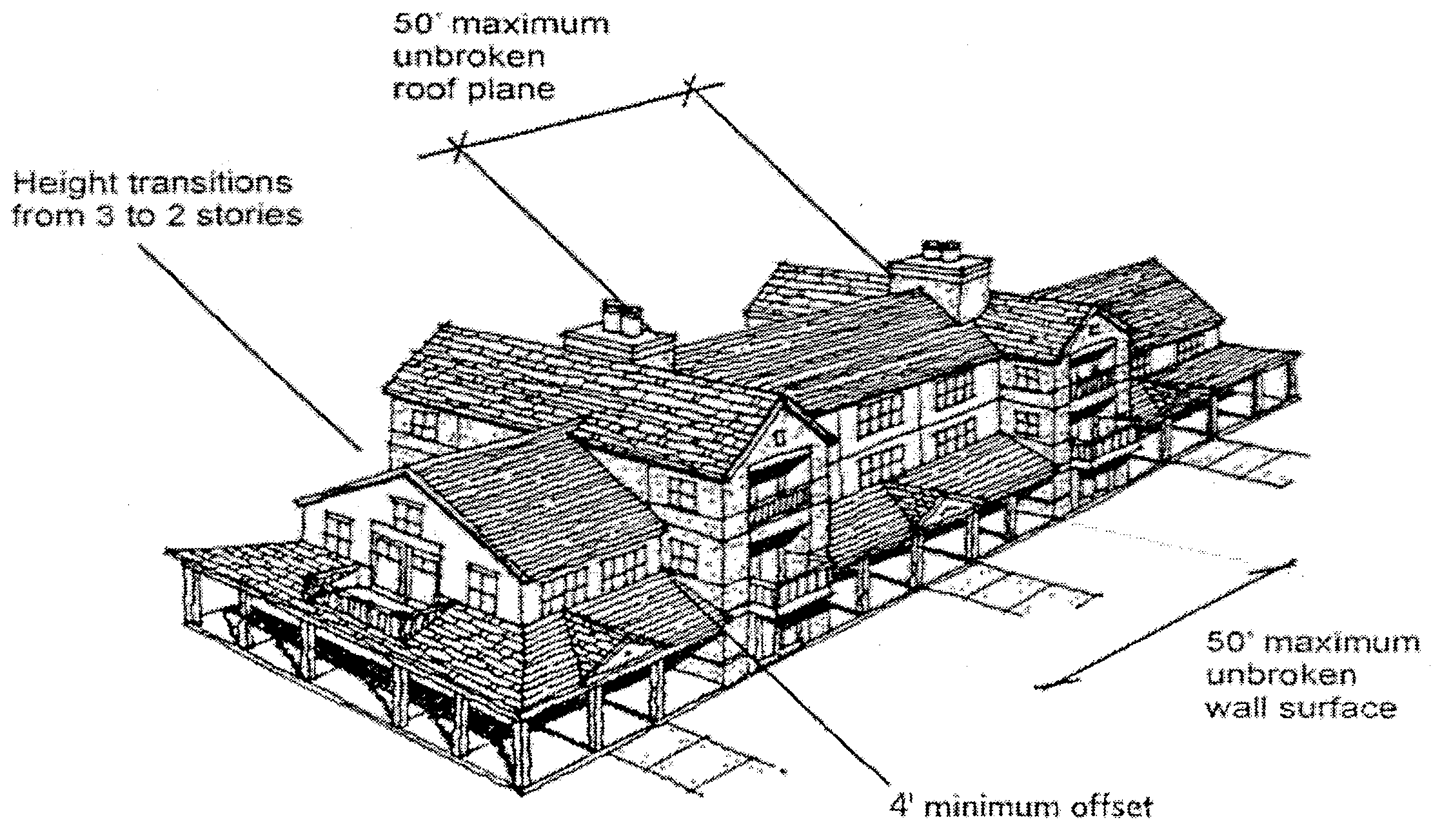
All BUILDINGS shall be Designed to provide complex massing configurations with a variety of different wall planes and roof planes. Plain, monolithic STRUCTURES with long, monotonous, unbroken wall and roof SURFACES of fifty (50) feet or more are prohibited. At least every fifty (50) linear feet, wall and roof planes shall contain offsets or SETBACKS with a differential in horizontal plane of at least four (4) feet. (See Figure 1.)
Figure 1 — Examples of Varied Roof Planes and Wall SURFACES
(iii)
The façades of single-FAMILY attached townhomes should be articulated to differentiate individual UNITS.
(d)
Small Multi-FAMILY BUILDINGS.
(i)
To the maximum extent practicable. the massing and USE of exterior materials on small multi-FAMILY BUILDINGS of four (4) UNITS or less, including duplexes but not including townhomes, should be arranged so as to give the building the appearance of a large single-FAMILY detached home. (See Figure 2.)
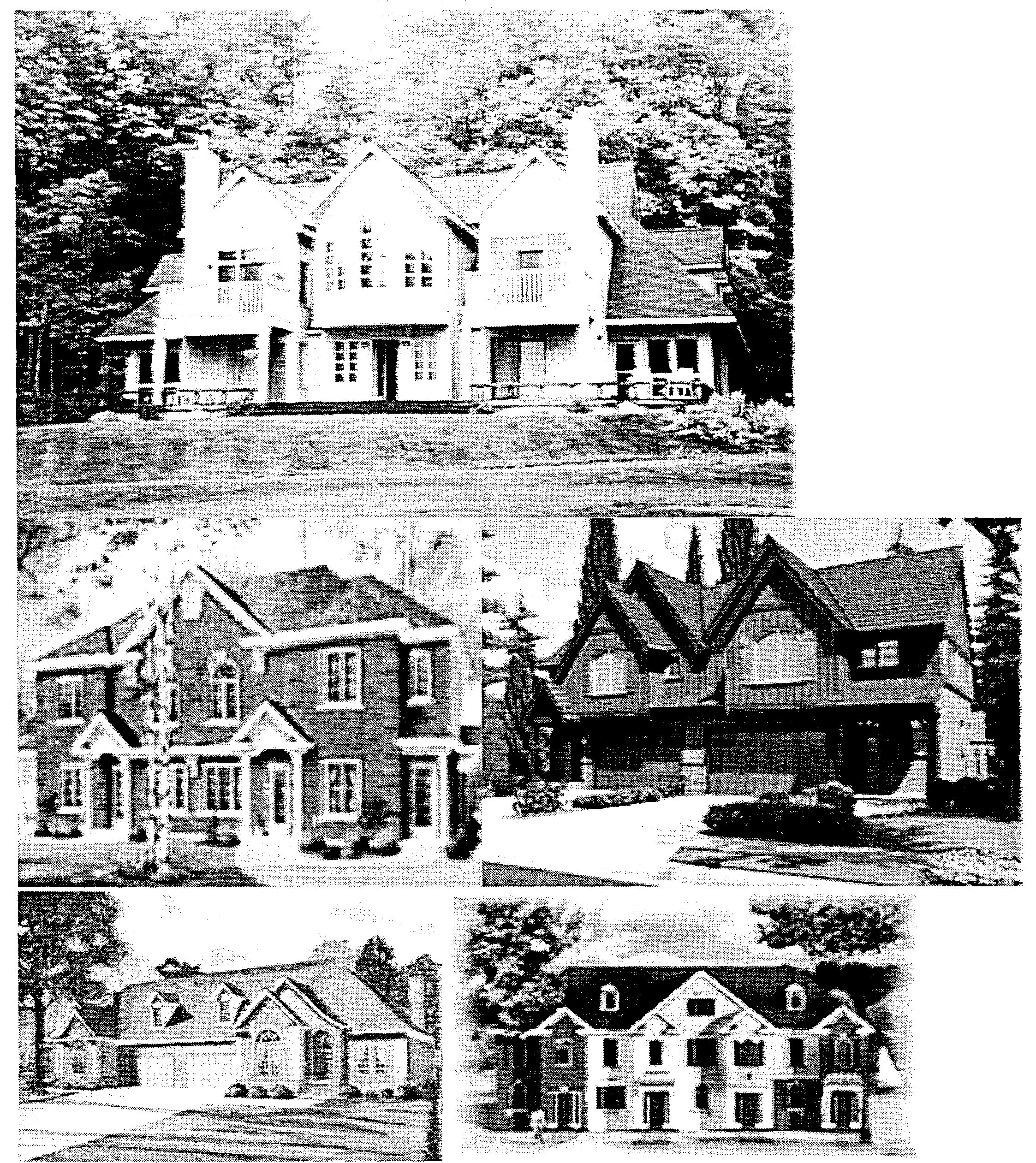
Figure 2 - Examples of Multi-FAMILY BUILDINGS
Resembling Single FAMILY HOMES>
5.
Architectural Detail: Style, Roof Form, Building Facades, Entries, and Windows.
(a)
Intent. The following guidelines and standards governing architectural detail are intended to provide a distinctive, quality, architectural character in new multi-FAMILY DEVELOPMENTS. In particular, architectural details help to reduce the visual scale of large multi-FAMILY BUILDINGS and DEVELOPMENT.
(b)
Consistency in Architectural Style. Each building in a multi-FAMILY DEVELOPMENT should have a definitive, consistent style. Mixing of various architectural styles on the same building dilutes the character of a building and is inappropriate. (see figure 3). These figures are intended to provide guidelines for Design of multi-FAMILY BUILDINGS.
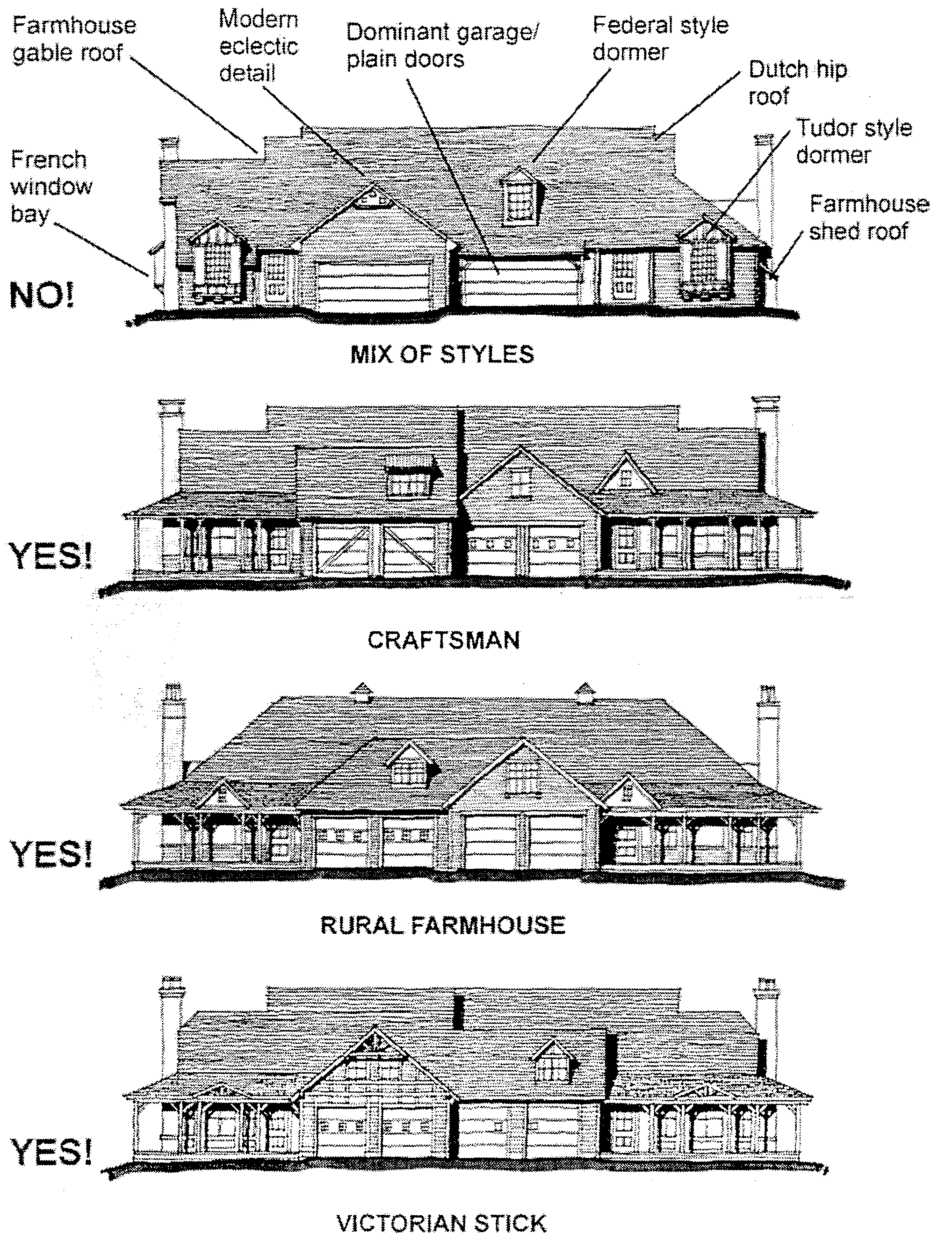
Figure 3—Example of Consistent Styles
(c)
Four-Sided Design Required. All sides of a multi-FAMILY building shall display a similar level of quality and architectural interest. The majority of a building's architectural features and treatments shall not be restricted to a single façade.
(d)
Pedestrian-Scale Entrance Required. All building entries adjacent to a collector or residential (local) public STREET or to a public STREET or private drive with on-STREET parking shall be pedestrian-scaled. Pedestrian-scaled entries are those that provide an expression of human activity or USE in relation to building size. Doors, windows, entranceways, and other features such as corners, SETBACKS, and offsets can be Used to create pedestrian scale.
(e)
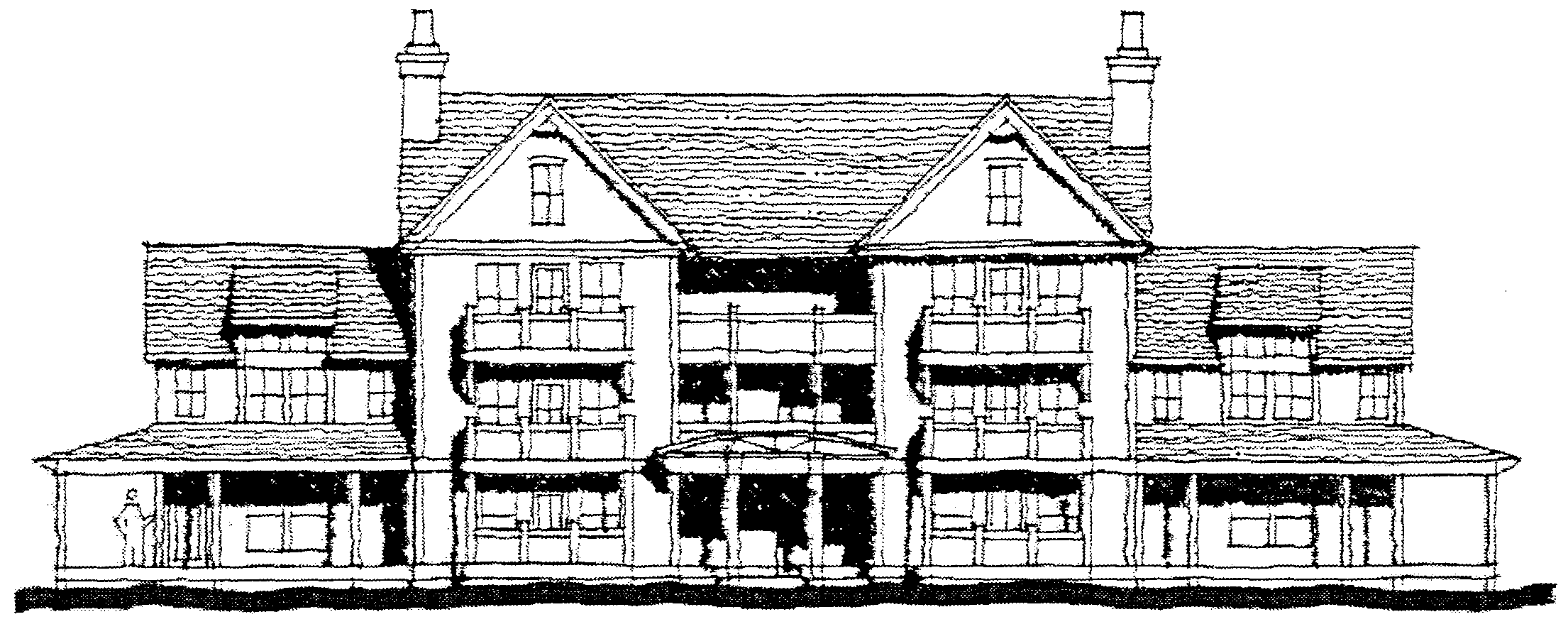
Articulated Building Fronts. Fronts of BUILDINGS should be articulated through the USE of bay windows, insets, balconies, porches, or stoops related to entrances and windows. (see figure 4)
(f)
Windows.
(i)
All multi-FAMILY building elevations shall contain windows, except when necessary to assure privacy for adjacent property OWNERS.
(ii)
At least fifteen (15%) of each STREET facing façade shall be comprised of windows.
(iii)
Windows should be located to maximize the possibility of occupant surveillance of entryways, recreation AREAS, and common AREAS.
(g)
Roofs.
(i)
All multi-FAMILY BUILDINGS with pitched roofs shall have a pitched roof with a minimum slope ratio of 6:12.
(ii)
On BUILDINGS where sloping roofs are the predominant roof type, each building shall have a variety of roof forms. For instance, a gable or hip configuration should be Used with complimentary sheds, dormers, and other minor elements. Other roof forms will be considered on a case-by-case basis.
(iii)
On BUILDINGS where flat roofs are the predominant roof type, parapet walls shall vary in height and/or shape at least one every fifty (50) feet of building wall length.
(iv)
Roof forms shall be Designed to correspond and denote building elements and functions such as entrances and arcades.
6.
Building Materials.
(a)
Intent. The following guidelines and standards are intended to:
(i)
Unify Design through the USE of similar materials throughout multi-FAMILY DEVELOPMENTS.
(ii)
Select high-quality building materials that are durable, attractive, and have low maintenance requirements.
(b)
Submittal Requirements. Applicants shall submit a sample building material board at the time of PRELIMINARY PLAN approval.
(c)
Design Guidelines and Standards.
(i)
Exterior Materials:
a.
For all multi-FAMILY BUILDINGS and single-FAMILY townhomes, an amount equal to fifty (50%) percent of the total net exterior wall area of each building elevation, excluding gables, windows, doors, and related trim, shall be brick, stone, or natural wood.
b.
Brick or stone to grade foundations shall be required for all multi-FAMILY BUILDINGS.
(ii)
Roof Materials.
a.
Predominant roof materials shall be high quality, durable material such as, but not limited to: wood shake shingles, clay or concrete tiles, composition shingles, and asphalt shingles.
(iii)
Design Compatibility Required.
a.
Detached garages and carports and other accessory STRUCTURES, including but not limited to grouped mailboxes, storage and maintenance facilities, recreational facilities, picnic shelters, and gazebos, shall incorporate compatible materials, scale, colors, architectural details, and roof slopes as the primary multi-FAMILY BUILDINGS, except that flat and shed roofs are prohibited.
(iv)
Articulation of Rear Walls.
a.
Rear walls of detached garages and carports that back onto the perimeter STREET shall be articulated through the USE of one or more of the following elements:
Windows;
A trellis; or
A variety of roof planes.
Z.
Personal Storage Facility.
1.
Storage. No storage may take place outside of a Personal enclosed storage unit.
2.
Water or sanitary sewer service. No Personal enclosed storage unit shall have water or sanitary sewer service.
3.
Caretaker. A caretaker may reside on a portion of the Personal storage SITE. The caretaker's residence shall have public water and public sewer service.
4.
Access. Ingress or egress shall be from an arterial or collector STREET only.
5.
Distance from face of building to face of building: thirty (30) feet minimum.
6.
Distance from end of building to end of building: twenty (20) feet minimum.
7.
Maximum facility unit size shall be as defined in Chapter 52, Building CONSTRUCTION. If UNITS are placed back to back, the maximum width of the building shall not exceed sixty (60) feet.
8.
DRIVEWAY width: twenty-two (22) feet minimum.
9.
All DRIVEWAYS shall be paved with an IMPERVIOUS SURFACE.
10.
A landscaping plan shall be submitted with the SITE plan showing the SITE'S buffer area in accordance with Article 2200 and the following standards:
11.
FENCES shall be permitted.
12.
Lighting shall not interfere with surrounding area or distract traffic.
13.
A fire hydrant must be provided on SITE with the location to be determined by the Fire Marshall.
14.
On a Personal storage facility SITE only, there shall be allowed more than one (1) building for housing of the storage UNITS. These BUILDINGS other than for USE of one (1) management office, one (1) caretaker's residence and individual storage shall be Used for no other purpose.
15.
The Personal storage facility shall provide a security system to prevent or discourage criminal activity.
AA.
MUNICIPAL BUILDINGS AND FACILITIES and STATE AND FEDERAL BUILDINGS AND FACILITIES.
1.
The storage of maintenance vehicles and related apparatuses shall be within wholly enclosed BUILDINGS in the CR and SR ZONING DISTRICTS.
2.
All off-STREET parking shall be provided in accordance with Article 1900 and the following requirements:
(a)
Portions of the required FRONT YARD SETBACK may be Used for off-STREET parking when authorized as a conditional USE; however, off-STREET parking shall be set back a minimum twenty-five (25) feet from the STREET RIGHT-OF-WAY.
BB.
PUBLIC UTILITY STRUCTURES, OTHER THAN TELECOMMUNICATIONS TOWERS.
1.
A solid wooden FENCE shall be required to completely screen the STRUCTURE. A six foot high row of shrubs or evergreens shall be planted around the exterior of the FENCE.
2.
Access roads to the STRUCTURE shall be paved with a bituminous surface.
CC.
SHOPPING CENTERS.
1.
The parcel or parcels shall be in single and full Ownership or proof of option shall be furnished at the time of application or joint application shall be filed by separate OWNERS and shall be capable of an integrated Design of a complete SHOPPING CENTER within their boundary.
2.
The property shall front on U.S. Highway 19 as shown on the ZONING MAP the TOWNSHIP.
3.
In the RB ZONING DISTRICT, SHOPPING CENTERS shall meet the following requirements:
(a)
A minimum LOT FRONTAGE of two hundred (200) feet on Route 19 and access to Route 19 via a through STREET to Route 19.
(b)
Maximum GFA for an individual building for occupancy by a single tenant is 45,000 SF.
(c)
Each SHOPPING CENTER is allowed a maximum of two (2), individual 45,000 SF BUILDINGS for occupancy by a single tenant. Additional BUILDINGS are permitted, if the SITE allows, but must comply with the BULK and area standards found in Section 208-303.
(d)
IMPERVIOUS SURFACE RATIO (includes BUILDINGS. paving and ACCESSORY BUILDINGS) is seventy-hundredths (.70) maximum.
(e)
The parcel or parcels shall be in single and full Ownership or proof of option shall be furnished at the time of application or joint application and shall be filed by separate OWNERS and shall be capable of an integrated Design of a complete SHOPPING CENTER within their boundary.
(f)
The DEVELOPER shall submit proof to the effect that any and all NONCONFORMING USES located on the property to be reviewed shall cease their OPERATIONS and remove their STRUCTURES prior to the commencement of SITE preparation and CONSTRUCTION. The BOARD OF SUPERVISORS may waive such requirements, however, whenever the STRUCTURE is of historical Significance.
(g)
All parking and SITE Design standards found in Section 208.1005 shall apply to all SHOPPING CENTERS.
(h)
Any USE listed as a permitted or conditional USE in the ZONING DISTRICT is allowed as a permitted or conditional USE, respectively, in a SHOPPING CENTER. All CONDITIONAL USES shall be subject to the conditional USE standards of Article 2600 of this Chapter.
DD.
SOLID WASTE DISPOSAL FACILITY. No SITE shall be developed as a solid waste disposal SITE and no existing solid waste disposal SITE shall be enlarged, altered or changed in USE except in conformance with the provisions of this Chapter. In addition to the provisions contained in other parts of this Chapter, the following shall apply to such SITES:
1.
Disposal SITES shall be located only on SITES with a minimum one hundred (100) acres in land area. Actively Used disposal AREAS on every such SITE shall be set back from the RIGHT-OF-WAY of every public road at least one hundred (100) feet.
2.
Such disposal AREAS shall not be located nor expanded within three hundred (300) feet of any existing DWELLING, SCHOOL or church or within one hundred (100) feet of any boundaries of the SITE. If a DWELLING, SCHOOL or church is located within three hundred (300) feet of a disposal area after the disposal area has been established, the disposal area shall be moved within twelve (12) months to a minimum of three hundred (300) feet from such DWELLING, SCHOOL or church.
3.
The solid waste disposal SITE shall be effectively screened from public view by dense foliage, topography or fencing. In addition, a surrounding security FENCE at least six (6) feet in height shall be constructed prior to operation of the SITE. Such FENCE shall be of sturdy CONSTRUCTION, shall be unobtrusively painted or finished, shall be maintained in good condition and shall be located a minimum distance of one hundred (100) feet from the SITE'S perimeter.
4.
The operation of the landfill shall comply with all applicable federal, state, county and TOWNSHIP licensing, PERMITS and conditions authorizing the facility. Hours of operation shall not commence prior to 7:00 a.m. and shall cease by 6:00 p.m.
5.
BUFFERYARD E, one hundred (100) feet in width and located outside of the FENCE, shall be provided around the entire perimeter of the SITE.
6.
A traffic and road condition study shall be submitted to determine the adequacy of the road network and the structural elements serving the SITE for truck traffic to be generated by the operation.
7.
Access shall not be derived through any residential SUBDIVISION or DEVELOPMENT and shall be from a collector or arterial road.
8.
The ESTABLISHMENT or annual operation of such disposal SITES shall require a special permit from the TOWNSHIP BOARD OF SUPERVISORS, which special permit may be revoked by the BOARD OF SUPERVISORS for cause after a public hearing thereon has been held in accordance with the procedures required for the original issuance of such special permit. Before issuing the special permit, the BOARD OF SUPERVISORS shall submit the application to the appropriate state approval authorities and the TOWNSHIP PLANNING COMMISSION, either of whom may require the applicant to submit additional information as they may consider necessary for review. After the application has been reviewed by the state authorities and PLANNING COMMISSION, it shall be returned to the BOARD OF SUPERVISORS with their recommendations of whatever regulations, restrictions, etc., they consider essential to the satisfactory operation of the SITE.
EE.
SUPERMARKET. SUPERMARKET shall be subject to the following standards in the RB ZONING DISTRICT:
1.
A minimum LOT FRONTAGE of two hundred (200) feet on Route 19 and access to Route 19 via a through STREET to Route 19.
2.
Maximum GFA for an individual building is 45,000 square feet in the Route 19 Boulevard (RB) district.
3.
IMPERVIOUS SURFACE RATIO (includes BUILDINGS, paving and ACCESSORY BUILDINGS) is seventy-hundredths (.70) maximum.
FF.
WIRELESS COMMUNICATIONS FACILITIES.
1.
Purposes.
(a)
The purpose of this section is to establish uniform standards for the siting, design, permitting, maintenance, and use of WIRELESS COMMUNICATIONS FACILITIES in the Township of Marshall ("Township"). While the Township recognizes the importance of WIRELESS COMMUNICATIONS FACILITIES in providing high-quality communications service to its residents and businesses, the Township also recognizes that it has an obligation to protect public safety and to minimize the adverse visual effects of such facilities through the standards set forth in the following provisions.
(b)
By enacting these provisions, the Township intends to:
(i)
Accommodate the need for WIRELESS COMMUNICATIONS FACILITIES while regulating their location and number so as to ensure the provision for necessary services;
(ii)
Provide for the managed development of WIRELESS COMMUNICATIONS FACILITIES in a manner that enhances the benefits of WIRELESS communication and accommodates the needs of both Township residents and WIRELESS carriers in accordance with federal and state laws and regulations;
(iii)
Establish procedures for the design, siting, construction, installation, maintenance and removal of WIRELESS COMMUNICATIONS FACILITIES in the Township, including facilities both inside and outside the RIGHT-OF-WAY;
(iv)
Address new WIRELESS technologies, including, but not limited to, SMALL WIRELESS COMMUNICATIONS FACILITIES, distributed antenna systems, data collection units, and other WIRELESS COMMUNICATIONS FACILITIES;
(v)
Minimize the adverse visual effects and the number of such facilities through proper design, siting, screening, material, color and finish and by requiring that competing providers of WIRELESS communications services COLLOCATE their commercial communications antennas and related facilities on existing towers; and
(vi)
Promote the health, safety and welfare of the Township's residents.
2.
General requirements for all WIRELESS COMMUNICATIONS FACILITIES.
(a)
The following regulations shall apply to all WIRELESS COMMUNICATIONS FACILITIES located within the Township:
(i)
Noncommercial usage exemption. Township citizens utilizing satellite dishes and antennas for the purpose of maintaining television, phone and/or Internet connections at their respective residences shall be exempt from the design regulations enumerated in this chapter.
(ii)
Standard of care.
(1)
All WCFs shall meet or exceed all applicable standards and provisions of the FAA, the FCC and any other agency of the state or federal government with the authority to regulate WIRELESS COMMUNICATIONS FACILITIES, the latest National Electrical Safety Code (NESC), American National Standards Institute (ANSI) Code, and the structural standards of the American Association of State Highway and Transportation Officials or any other industry standard applicable to the structure. In case of conflict, the most stringent requirements shall prevail. All necessary certifications shall be obtained by the WCF APPLICANT and provided to the Township.
(2)
If such standards or regulations are changed, the owner of the WCF shall bring such WCF into compliance with the revised standards within six (6) months of the effective date of such standards or regulations, unless a different compliance schedule is mandated by the controlling state or federal agency. Failure to bring such WCFs into compliance shall constitute grounds for the removal of the WCF at the owner's expense.
(3)
The WCF APPLICANT shall submit proof of compliance with all applicable federal and state standards, including, but not limited to those established by the Federal Communications Commission, as part of any complete WCF application.
(iii)
Wind and ice. All WCFs shall be designed to withstand the effects of wind gusts and ice to the standard designed by the American National Standards Institute as prepared by the engineering departments of the Electronics Industry Association, and Telecommunications Industry Association (ANSI/TIA-222, as amended), or to the industry standard applicable to the structure.
(iv)
Aviation safety. WCFs shall comply with all federal and state laws and regulations concerning aviation safety.
(v)
Public safety communications. No WCF shall interfere with public safety communications or the reception of broadband, television, radio or other communication services enjoyed by occupants of nearby properties.
(vi)
Signs. All WCFs shall post a sign in a readily visible location identifying the name and phone number of a party to contact in the event of an EMERGENCY. The only other signage permitted on the WCF shall be those required by the FCC or any other federal or state agency.
(vii)
Graffiti. Any graffiti on a WCF, including the WIRELESS SUPPORT STRUCTURE and any RELATED EQUIPMENT, shall be removed at the sole expense of the owner within ten (10) calendar days of notification by the Township.
(viii)
Radio frequency emissions. No WCF may, by itself or in conjunction with other WCFs, generate radio frequency emissions in excess of the standards and regulations of the FCC, including, but not limited to the FCC Office of Engineering Technology Bulletin 65 entitled "Evaluating Compliance with FCC Guidelines for Human Exposure to Radio Frequency Electromagnetic Fields," as amended.
(ix)
Permit fees. The Township may assess appropriate and reasonable permit fees directly related to the Township's actual costs in reviewing and processing an application for approval of a WCF, as well as related inspection, monitoring and related costs.
(x)
Recertification. The owner of a WCF shall submit documentation certifying that the WCF is in operation and remains in compliance with all applicable requirements every five (5) years after issuance of the initial permits for the WCF. If the Township determines that the WCF remains in compliance with all applicable regulations, the WCF permit shall be renewed. If a WCF permit is not renewed as required, the WCF shall be deemed abandoned and may be removed in accordance with the requirements of this Section 208-2604(FF).
(xi)
Indemnification. Each person that owns or operates a WCF shall, at its sole cost and expense, indemnify, defend and hold harmless the Township, its elected and appointed officials, employees and agents at all times against any and all claims for personal injury, including death, and property damage arising in whole or in part from, caused by or connected with any act or omission of the person, its officers, agents, employees or contractors arising out of, but not limited to, the construction, installation, operation, maintenance or removal of the WCF. Each person that owns or operates a WCF shall defend any actions or proceedings against the Township in which it is claimed that personal injury, including death, or property damage was caused by the construction, installation, operation, maintenance or removal of a WCF. The obligation to indemnify, hold harmless and defend shall include, but not be limited to, the obligation to pay judgments, injuries, liabilities, damages, reasonable attorneys' fees, reasonable expert fees, court costs and all other costs of indemnification.
(xii)
Engineer signature. All plans and drawings for a WCF shall contain a seal and signature of a professional structural engineer, licensed in the Commonwealth of Pennsylvania certifying the structural integrity of the proposed WCF and compliance with all local, state and federal laws and regulations applicable to the proposed WCF.
(xiii)
Maintenance. To the extent permitted by law, the following maintenance requirements shall apply:
(1)
The WCF shall be fully automated and unattended on a daily basis and shall be visited only for maintenance or EMERGENCY repair.
(2)
Such maintenance shall be performed to ensure the upkeep of the WCF in order to promote the safety and security of the Township's residents.
(3)
All maintenance activities shall utilize nothing less than the best available technology for preventing failures and accidents.
(xiv)
Timing of Approval. The following table details the applicable timeframe of approval for each type of WCF application:
3.
Specific requirements for NONTOWER WIRELESS COMMUNICATIONS FACILITIES outside the RIGHT-OF-WAY. The following regulations shall apply to NONTOWER WCFs located outside the RIGHT-OF-WAY that do not meet the definition of a SMALL WCF:
(a)
Permitted in all zones subject to regulations. NONTOWER WCFs are permitted in all zones, except the Conservation Residential (CR), Suburban Residential (SR) and Medium Density Residential (MDR) districts, subject to the restrictions and conditions prescribed below and subject to applicable permitting by the Township.
(b)
CONDITIONAL USE Authorization Required. Any WCF APPLICANT proposing the construction of a new NONTOWER WCF, or the modification of an existing NONTOWER WCF, shall first obtain a CONDITIONAL USE authorization from the Township. The CONDITIONAL USE application shall demonstrate that the proposed WCF complies with all applicable provisions in the Marshall Township Zoning Ordinance.
(c)
Application procedures.
(i)
Applications for NONTOWER WCFs shall be submitted to the Township Zoning Officer.
(ii)
All applications for NONTOWER WCFs shall include the following information:
(a)
A cover letter detailing the location of the proposed site, all equipment being proposed as part of the NONTOWER WCF, and a certification that the WCF Applicant has included all information required by this Section 208-2604(FF), signed by a representative of the WCF APPLICANT.
(b)
A site plan, drawn to scale, showing property boundaries, power location, total height of the NONTOWER WCF, the entirety of the structure upon which the NONTOWER WCF will be COLLOCATED, and RELATED locations.
(c)
A copy of the written agreement with the owner of the structure or other evidence showing that the WCF APPLICANT has been granted permission to COLLOCATE its NONTOWER WCF on the structure
(d)
A before-and-after depiction of the proposed site, such as a construction drawing, showing all equipment being proposed as part of the NONTOWER WCF.
(e)
If the NONTOWER WCF is proposed for location on a WIRELESS SUPPORT STRUCTURE that currently supports existing WCFs or other attachments, the depiction shall show the location and dimensions of all such attachments.
(f)
The manufacturer and model, proposed location, and physical dimensions (including volume) of each piece of equipment proposed as part of the NONTOWER WCF.
(g)
An aerial photograph of the proposed site showing the area within five hundred (500) feet of the NONTOWER WCF. The aerial photograph shall identify all structures within such radius.
(h)
Photo simulations depicting the NONTOWER WCF from at least three (3) locations near the proposed site. The photo simulations should reflect the proposed design and location of all equipment associated with the NONTOWER WCF.
(i)
A written certification by a structural engineer licensed in the Commonwealth of Pennsylvania confirming that the proposed NONTOWER WCF and WIRELESS SUPPORT STRUCTURE are structurally sound and shall not endanger public health and safety.
(j)
A report by a qualified engineering expert which shows that the NONTOWER WCF will comply with applicable FCC regulations, including applicable standards for radiofrequency emissions.
(k)
Certificates of insurance as required by Section 208-2604(FF)(3)(h).
(l)
A certification of the application's compliance with all requirements of this Section 208-2604(FF).
(m)
All application fees required by the Township as detailed in the Township fee schedule.
(d)
Development regulations. NONTOWER WCFs shall be COLLOCATED on existing structures, such as existing buildings or TOWER-BASED WCFs, if possible, subject to the following conditions:
(i)
In accordance with industry standards, all NONTOWER WCF APPLICANTS must submit documentation to the Township justifying the total height of the NONTOWER WCF. Such documentation shall be analyzed on an individual basis.
(ii)
The total height of any WIRELESS SUPPORT STRUCTURE and COLLOCATED NONTOWER WCF shall not exceed the maximum height permitted in the underlying zoning district by more than fifteen (15) feet.
(iii)
If the WCF APPLICANT proposes to locate the RELATED EQUIPMENT in a separate ground-mounted building, the building shall comply with the minimum setback and building requirements for the applicable zoning district.
(iv)
A security fence of not less than six (6) feet shall surround any separate COMMUNICATIONS EQUIPMENT BUILDING. Vehicular access to the COMMUNICATIONS EQUIPMENT BUILDING shall not interfere with the parking or vehicular circulations on the site for the principal use.
(v)
NONTOWER WCFs shall employ STEALTH TECHNOLOGY and be treated to match the supporting structure in order to minimize aesthetic impact. The application of the STEALTH TECHNOLOGY chosen by the WCF APPLICANT shall be subject to the approval of the Township.
(e)
Removal, replacement, modification. The removal and replacement of NONTOWER WCFs and/or RELATED EQUIPMENT for the purpose of upgrading or repairing the WCF is permitted by right, so long as such repair or upgrade does not SUBSTANTIALLY CHANGE the dimensions of the WIRELESS support structure. Any modification that constitutes a SUBSTANTIAL CHANGE to a WCF shall require a prior amendment to the original permit or authorization.
(f)
Inspection. The Township reserves the right to inspect any WCF to ensure compliance with the provisions of this chapter and any other provisions found within the Township Code or state or federal law. The Township and/or its agents shall have the authority to enter the property upon which a WCF is located at any time, upon reasonable notice to the operator, to ensure such compliance.
(g)
Timing of approval.
(i)
Within 30 calendar days of the date that an application for a NONTOWER WCF is filed with the Township, the Township shall notify the WCF APPLICANT in writing of any information that may be required to complete such application.
(ii)
Within 90 calendar days of receipt of an application, and subject to applicable tolling procedures as established by federal law, the Board of Supervisors shall make its final decision on whether to approve the application and shall advise the WCF APPLICANT in writing of such decision.
(iii)
If additional information was requested by the Township to complete an application, the time required by the WCF APPLICANT to provide the information shall not be counted toward the Township's review period.
(h)
Insurance. Each person that owns or operates a NONTOWER WCF shall provide the Township with a certificate of insurance evidencing general liability coverage in the minimum amount of $1,000,000 per occurrence and property damage coverage in the minimum amount of $1,000,000 per occurrence covering the NONTOWER WCF.
(i)
Removal. In the event that use of a NONTOWER WCF is to be discontinued, the owner shall provide written notice to the Township of its intent to discontinue use and the date when the use shall be discontinued. Unused or abandoned WCFs or portions of WCFs shall be removed as follows:
(i)
All abandoned or unused WCFs and RELATED EQUIPMENT shall be removed within two (2) months of the cessation of operations at the site unless a time extension is approved by the Township.
(ii)
If the WCF or RELATED EQUIPMENT is not removed within two (2) months of the cessation of operations at a site, or within any longer period approved by the Township, the WCF and/or RELATED EQUIPMENT may be removed by the Township, and the cost of removal assessed against the owner of the WCF.
4.
Specific requirements for TOWER-BASED WIRELESS COMMUNICATIONS FACILITIES outside the RIGHT-OF-WAY. The following regulations shall apply to all TOWER-BASED WIRELESS COMMUNICATIONS FACILITIES located outside the RIGHT-OF-WAY that do not meet the definition of a SMALL WCF:
(a)
Permitted in certain zones subject to regulations. TOWER-BASED WCFs are permitted in the following zones subject to the restrictions and conditions prescribed below and subject to applicable permitting by the Township.
(i)
PORB Planned Office, Research and Business Park
(ii)
PIP Planned Industrial Park
(iii)
OSPC Open Space, Public and Conservation
(b)
CONDITIONAL USE Authorization Required. Any WCF APPLICANT proposing the construction of a new TOWER-BASED WCF, or the modification of an existing NONTOWER WCF, shall first obtain a CONDITIONAL USE authorization from the Township. The CONDITIONAL USE application shall demonstrate that the proposed WCF complies with all applicable provisions in the Marshall Township Zoning Ordinance.
(c)
Notice. Upon submission of an application for a TOWER-BASED WCF and the scheduling of the public hearing upon the application, the WCF APPLICANT shall mail notice to all owners of every property within five hundred (500) feet of the proposed WCF. Such notice shall be provided a minimum of ten (10) days in advance of such public hearing. The WCF APPLICANT shall provide proof of the notification to the Township.
(d)
CONDITIONAL USE authorization required. A CONDITIONAL USE application for a TOWER-BASED WCF shall include the following:
(i)
Prior to the Board of Supervisors' approval of a CONDITIONAL USE authorizing the construction and installation of TOWER-BASED WCF in a zoning district where the same is a permitted CONDITIONAL USE, it shall be incumbent upon the WCF APPLICANT for such CONDITIONAL USE approval to prove to the reasonable satisfaction of the Board of Supervisors that the WCF APPLICANT cannot adequately extend or infill its communications system by the use of ANTENNAS and/or NONTOWER WCFS COLLOCATED on existing structures.
(ii)
The CONDITIONAL USE application shall also be accompanied by documentation demonstrating that the proposed TOWER-BASED WCF complies with all state and federal laws and regulations concerning aviation safety.
(iii)
Where the TOWER-BASED WCF is located on a property with another principal use, the APPLICANT shall present documentation to the Board of Supervisors that the owner of the property has granted an easement for the proposed WCF.
(iv)
The CONDITIONAL USE application shall demonstrate that the proposed WCF complies with all other applicable regulations of the Marshall Township Zoning Code.
(e)
Development regulations.
(i)
No TOWER-BASED WCF shall be located in an area in which utilities are underground, or within one hundred (100) feet of such an area, except as permitted by this chapter.
(ii)
Sole use on a lot. A TOWER-BASED WCF shall be permitted as a sole use on a lot, provided that the underlying lot meets the minimum lots size requirements in the underlying zoning district. The minimum distance between the base of a TOWER-BASED WCF and any adjoining property line or street RIGHT-OF-WAY line shall equal one hundred (100) percent of the proposed WCF structure height.
(iii)
Combined with another use. A TOWER-BASED WCF may be permitted on a property with an existing use, or on a vacant parcel in combination with another use, except residential, subject to the following conditions
(1)
The existing use on the property may be any permitted use in the applicable district, and need not be affiliated with the TOWER-BASED WCF.
(2)
Minimum lot area. The minimum lot shall comply with the requirements for the applicable district and shall be the area needed to accommodate the TOWER-BASED WCF and guy wires, the COMMUNICATIONS EQUIPMENT BUILDING, security fence, and buffer planting if the proposed TOWER-BASED WCF is greater than forty (40) feet in height.
(3)
Minimum setbacks. The minimum distance between the base of a TOWER-BASED WCF and any adjoining property line or street RIGHT-OF-WAY line shall equal one hundred (100) percent of the proposed WCF structure height or the minimum setback of the underlying zoning district, whichever is greater. Where the site on which a TOWER-BASED WCF is proposed to be located is contiguous to an educational use, child day-care facility or residential use, the minimum distance between the base of a TOWER-BASED WCF and any such adjoining uses shall equal one hundred ten (110) percent of the proposed height of the TOWER-BASED WCF unless it is demonstrated to the reasonable satisfaction of the Board that in the event of failure the TOWER-BASED WCF is designed to collapse upon itself within a setback area less than the required minimum setback without endangering such adjoining uses and their occupants.
(f)
Engineer inspection. Prior to the Township's issuance of a permit authorizing construction and erection of a TOWER-BASED WCF, a structural engineer registered in Pennsylvania shall issue to the Township a written certification of the proposed WCF's ability to meet the structural standards offered by either the Electronic Industries Association or the Telecommunication Industry Association and certify the proper construction of the foundation and the erection of the structure.
(g)
Visual appearance. TOWER-BASED WCFs shall employ STEALTH TECHNOLOGY. All WIRELESS COMMUNICATIONS EQUIPMENT BUILDINGs and other RELATED EQUIPMENT shall be aesthetically and architecturally compatible with the surrounding environment and shall maximize the use of a like facade to blend with the existing surroundings and neighboring buildings to the greatest extent possible. In making this determination, the Board of Supervisors shall consider whether its decision will promote the harmonious and orderly development of the zoning district involved; encourage compatibility with the character and type of development existing in the area; benefit neighboring properties by preventing a negative impact on the aesthetic character of the community; preserve woodlands and trees existing at the site to the greatest possible extent; and encourage sound engineering and land development design and construction principles, practices and techniques.
(h)
COLLOCATION and siting. An application for a new TOWER-BASED WCF shall not be approved unless the Township finds that the ANTENNA and RELATED EQUIPMENT planned for the proposed TOWER-BASED WCF cannot be COLLOCATED on an existing or approved structure or building or on Township property. The Board of Supervisors may deny an application to construct a new TOWER-BASED WCF if the WCF APPLICANT has not made a good faith effort to mount the ANTENNA(s) on an existing structure as set forth in this section. The WCF APPLICANT shall demonstrate that it contacted the owners of tall structures capable of supporting a WIRELESS COMMUNICATIONS FACILITY, buildings and towers within a one-quarter (¼) of a mile radius of the site proposed, sought permission to install an ANTENNA on those structures, buildings and towers, and was denied for one (1) of the following reasons:
(i)
The proposed ANTENNA and RELATED EQUIPMENT would exceed the structural capacity of the existing building, structure or tower, and its reinforcement cannot be accomplished at a reasonable cost.
(ii)
The proposed ANTENNA and RELATED EQUIPMENT would cause radio frequency interference with other existing equipment for that existing building, structure or tower, and the interference cannot be prevented at a reasonable cost.
(iii)
Such existing buildings, structures or towers do not have adequate location, space, access or height to accommodate the proposed equipment or to allow it to perform its intended function.
(iv)
A commercially reasonable agreement could not be reached with the owner of such building, structure or tower.
(i)
Design regulations.
(i)
The WCF shall employ the most current STEALTH TECHNOLOGY available in an effort to appropriately blend into the surrounding environment and minimize aesthetic impact. In addition to the other design requirements enumerated in this section, the application of the STEALTH TECHNOLOGY chosen by the WCF APPLICANT shall be subject to the approval of the Township.
(ii)
To the extent permissible by law, any height extensions to an existing TOWER-BASED WCF shall require prior approval of the Township.
(iii)
Any proposed TOWER-BASED WCF shall be designed structurally, electrically, and in all respects to accommodate both the WCF APPLICANT'S ANTENNAS and comparable ANTENNAS for future users.
(iv)
The TOWER-BASED WCF shall be equipped with an anti-climbing device, as approved by the manufacturer, if such anti-climbing device is deemed necessary by the Board of Supervisors.
(j)
Surrounding environs.
(i)
The WCF APPLICANT shall ensure that the existing vegetation, trees and shrubs located within proximity to the WCF structure shall be preserved to the maximum extent possible.
(ii)
The WCF APPLICANT shall submit a soil report to the Township complying with the standards of Appendix I: Geotechnical Investigations, ANSI/EIA-222, as amended, to document and verify the design specifications of the foundation of the TOWER-BASED WCF, and anchors for guy wires, if used.
(k)
Fence/screen.
(i)
A security fence, having a minimum height of six (6) feet, shall completely surround any TOWER-BASED WCF located outside the RIGHT-OF-WAY, as well as guy wires, or any RELATED EQUIPMENT.
(ii)
Landscaping. Bufferyard D shall be required to screen as much of a newly constructed TOWER-BASED WCF as possible. the Board of Supervisors may permit any combination of existing vegetation, topography, walls, decorative fences or other features instead of landscaping, if, in the discretion of the Board of Supervisors, they achieve the same degree of screening. Existing vegetation shall be preserved to the maximum extent possible.
(l)
RELATED EQUIPMENT.
(i)
Ground-mounted RELATED EQUIPMENT associated to, or connected with, a TOWER-BASED WCF shall be underground or screened from public view using stealth technologies, as described in this section.
(ii)
All RELATED EQUIPMENT shall be architecturally designed to blend into the environment in which they are situated and shall meet the minimum setback and building requirements of the underlying zoning district.
(m)
Zoning permit required for Modifications. To the extent permissible under applicable state and federal law, any WCF APPLICANT proposing the modification of an existing TOWER-BASED WCF shall first obtain a zoning permit from the Township.
(n)
Additional ANTENNAS. As a condition of approval for all TOWER-BASED WCFs, the WCF APPLICANT shall provide the Township with a written commitment that it will allow other service providers to COLLOCATE antennas on TOWER-BASED WCFs where TECHNICALLY FEASIBLE. The owner of a TOWER-BASED WCF shall not install any additional ANTENNAS without obtaining the prior written approval of the Township.
(o)
Height. Any TOWER-BASED WCF shall be designed at the minimum TECHNICALLY FEASIBLE height. All TOWER-BASED WCF APPLICANTS must submit documentation to the Township justifying the total height of the structure. The maximum total HEIGHT OF A TOWER-BASED WCF shall not exceed 150 feet.
(p)
Maintenance. The following maintenance requirements shall apply:
(i)
Any TOWER-BASED WCF shall be fully automated and unattended on a daily basis and shall be visited only for maintenance or EMERGENCY repair.
(ii)
Such maintenance shall be performed to ensure the upkeep of the facility in order to promote the safety and security of the Township's residents.
(iii)
All maintenance activities shall utilize nothing less than the best available technology for preventing failures and accidents.
(q)
Historic buildings or districts. No TOWER-BASED WCF may be located on a building or structure that is listed on either the National or Pennsylvania Registers of Historic Places, or is included in the official historic structures and/or historic districts list maintained by the Township.
(r)
Lighting. No TOWER-BASED WCF shall be artificially lighted, except as required by law. If lighting is required, the lighting, to the maximum extent permissible by law, shall be Dark Sky compliant, as defined by the International Dark-Sky Association. The WCF APPLICANT shall provide a detailed plan for sufficient lighting demonstrating as unobtrusive and inoffensive an effect as is permissible under state and federal regulations. The WCF APPLICANT shall promptly report any outage or malfunction of FAA-mandated lighting to the appropriate governmental authorities and to the Township Manager.
(s)
Noise. TOWER-BASED WCFs shall be operated and maintained so as not to produce noise in excess of applicable noise standards under state law and Section 208-2302 of the Marshall Township Code of Ordinances, except in EMERGENCY situations requiring the use of a backup generator, where such noise standards may be exceeded on a temporary basis only.
(t)
Retention of experts. The Township may hire any consultant(s) and/or expert(s) necessary to assist the Township in reviewing and evaluating the application for approval of the TOWER-BASED WCF and, once approved, in reviewing and evaluating any potential violations of the terms and conditions of this chapter. The WCF APPLICANT and/or owner of the WCF shall reimburse the Township for all costs of the Township's consultant(s) in providing expert evaluation and consultation in connection with these activities.
(u)
Timing of approval.
(i)
Within thirty (30) calendar days of the date that an application for a TOWER-BASED WCF is filed with the Township, the Township shall notify the WCF APPLICANT in writing of any information that may be required to complete such application.
(ii)
All applications for TOWER-BASED WCFs shall be acted upon within one hundred fifty (150) days of the receipt of an application for the approval of such TOWER-BASED WCF, and in accordance with applicable tolling procedures as established by federal law, and the Township shall advise the WCF APPLICANT in writing of its decision.
(iii)
If additional information was requested by the Township to complete an application, the time required by the WCF APPLICANT to provide the information shall not be counted toward the one hundred fifty (150) day review period.
(v)
Nonconforming uses. Nonconforming TOWER-BASED WCFs which are hereafter damaged or destroyed due to any reason or cause may be repaired and restored at their former location but must otherwise comply with the terms and conditions of this chapter. COLLOCATION on existing nonconforming WCFs is permitted if approved by the Township.
(w)
Removal. In the event that use of a TOWER-BASED WCF is planned to be discontinued, the owner shall provide written notice to the Township of its intent to discontinue use and the date when the use shall be discontinued. Unused or abandoned WCFs or portions of WCFs shall be removed as follows:
(i)
All unused or abandoned TOWER-BASED WCFs and RELATED EQUIPMENT shall be removed and the site shall be restored to its previous condition within six (6) months of the cessation of operations at the site unless a time extension is approved by the Township.
(ii)
If the WCF and/or RELATED EQUIPMENT is not removed and the site is not restored to its previous condition within six (6) months of the cessation of operations at a site, or within any longer period approved by the Township, the WCF and RELATED EQUIPMENT may be removed by the Township and the cost of removal assessed against the owner of the WCF.
(iii)
Any unused portions of TOWER-BASED WCFs, including ANTENNAS, shall be removed and any unused portions of the site shall be restored to its previous condition within six (6) months of the time of cessation of operations. The Township must approve all replacements of portions of a TOWER-BASED WCF previously removed.
(x)
FCC license. Each person that owns or operates a TOWER-BASED WCF shall submit a copy of its current FCC license, including the name, address and EMERGENCY telephone number for the operator of the facility.
(y)
Insurance. Each person that owns or operates a TOWER-BASED WCF shall provide the Township with a certificate of insurance evidencing general liability coverage in the minimum amount of $5,000,000 per occurrence and property damage coverage in the minimum amount of $5,000,000 per occurrence covering the TOWER-BASED WCF.
(z)
Access road. If deemed necessary by the Board of Supervisors, an access road, turnaround, and parking shall be provided to ensure adequate emergency and service access to a TOWER-BASED WCF. Maximum use of existing roads, whether public or private, shall be made to the extent practicable. Road grades shall closely follow natural contours to assure minimal visual disturbance and minimize soil erosion. Where applicable, the TOWER-BASED WCF owner shall present documentation to the Township that the property owner has granted an easement for the proposed facility. The design of any access road shall be subject to the final approval of the Board of Supervisors, who may require that the access road be wholly or partially paved or otherwise designed to achieve the goals specified in this section.
(aa)
Inspection. The Township reserves the right to inspect any TOWER-BASED WCF to ensure compliance with the provisions of this chapter and any other provisions found within the Township Code or state or federal law. The Township and/or its agents shall have the authority to enter the property upon which a WCF is located at any time, upon reasonable notice to the operator, to ensure such compliance.
5.
Specific requirements for SMALL WIRELESS COMMUNICATIONS FACILITIES. The following regulations shall apply to all SMALL WCFs:
(a)
Permitted locations.
(i)
SMALL WCFs located in the RIGHT-OF-WAY and COLLOCATED SMALL WCFs outside the RIGHT-OF-WAY shall be a permitted use in all Township zoning districts, subject to the requirements of this Section 208-2604(FF) and generally applicable permitting as required by the Township Code. COLLOCATED SMALL WCF's located outside of the RIGHT-OF-WAY are limited to three (3) per building and are prohibited from being placed on any building façade.
(ii)
SMALL WCFs requiring the installation of a new WIRELESS support structure and located outside the RIGHT-OF-WAY shall be a permitted use in the following zoning districts, subject to the requirements of this Section 208-2604(FF) and generally applicable permitting as required by the Township Code:
(1)
PORB Planned Office, Research and Business Park
(2)
PIP Planned Industrial Park
(3)
OSPC Open Space, Public and Conservation
(iii)
SMALL WCFs inside the RIGHT-OF-WAY shall be set back a minimum distance of fifty (50) feet from any residential structure. If such setback is not TECHNICALLY FEASIBLE, and no other suitable location exists for the proposed WCF, the WCF APPLICANT may propose a lesser setback and shall provide evidence that the proposed lesser setback shall not have a material noise impact on adjacent residential structures.
(iv)
SMALL WCFs outside the RIGHT-OF-WAY shall be set back a minimum distance of one hundred (100) feet from any residential structure. If such setback is not TECHNICALLY FEASIBLE, and no other suitable location exists for the proposed WCF, the WCF APPLICANT may propose a lesser setback and shall provide evidence that the proposed lesser setback shall not have a material noise impact on adjacent residential structures.
(b)
Applications for SMALL WCFs shall be submitted to the Township Zoning Officer.
(c)
Applications for SMALL WCFs shall include the following:
(i)
The name and contact information, including phone number, for both the WCF APPLICANT and the owner of the proposed SMALL WCF.
(ii)
A cover letter detailing the location of the proposed site, all equipment being proposed as part of the SMALL WCF, and a certification that the WCF APPLICANT has included all information required by the Township Code, signed by a representative of the WCF APPLICANT.
(iii)
If the proposed SMALL WCF will be attached to a structure or located on property owned by a third party, a copy of the written agreement with the owner of the structure or property, or other evidence showing that the WCF APPLICANT has been granted permission to construct its WCF on the structure or property;
(iv)
A before-and-after depiction of the proposed site, such as a construction drawing, showing all equipment being proposed as part of the SMALL WCF.
(1)
If the SMALL WCF is proposed for location on an existing structure that currently supports existing attachments, or if the replacement of such a structure is proposed, the depiction shall show the location and dimensions of all such attachments.
(2)
If installation of a new or replacement WIRELESS support structure is being proposed, the depiction shall include the color, dimensions, material and type of WIRELESS support structure proposed.
(v)
The manufacturer and model, proposed location, and physical dimensions (including volume) of each piece of equipment proposed as part of the SMALL WCF.
(vi)
An aerial photograph of the proposed site showing the area within 500 feet of the SMALL WCF. The aerial photograph shall identify all structures within such radius.
(vii)
Photo simulations depicting the SMALL WCF from at least three (3) locations near the proposed site. The photo simulations should reflect the proposed design and location of all equipment associated with the SMALL WCF.
(viii)
A written certification by a structural engineer licensed in the Commonwealth of Pennsylvania confirming that the proposed SMALL WCF and WIRELESS support structure are structurally sound and shall not endanger public health and safety.
(ix)
A report by a qualified engineering expert which shows that the SMALL WCF will comply with applicable FCC regulations, including applicable standards for radiofrequency emissions.
(x)
Small WCF shall comply with noise standards established in Section 208-2302 of the Marshall Township Code of Ordinances. All equipment associated with the SMALL WCF shall be designed and configured in a manner so that noise impacts on adjacent properties are minimized to the maximum extent TECHNICALLY FEASIBLE through the use of baffling and/or other noise attenuation techniques. The WCF APPLICANT shall submit documentation of all steps taken to minimize noise impacts on adjacent properties as part of any application for a SMALL WCF.
(xi)
A certificate of insurance as required by Section 208-2604(FF)(5)(m).
(xii)
All application fees required by the Township as detailed in the Township fee schedule.
(d)
Timing of Approval.
(i)
Within ten (10) business days of the date that an application for a SMALL WCF is filed with the Township Zoning Officer, the Township shall notify the WCF APPLICANT in writing of any information that may be required to complete such application. The WCF APPLICANT may then resubmit its application, at which point the applicable timeframe for approval shall restart. Any subsequent notice of incompleteness shall be issued within ten (10) business days of receipt of a resubmitted application and shall toll the applicable timeframe for approval until such time as the application is resubmitted.
(ii)
Within sixty (60) days of receipt of an application for co-location of a SMALL WCF on a preexisting WIRELESS support structure, the Township Zoning Officer shall make a final decision on whether to approve the application and shall notify the WCF APPLICANT in writing of such decision.
(iii)
Within ninety (90) days of receipt of an application for a SMALL WCF requiring the installation of a new or replacement WIRELESS support structure, the Township Zoning Officer shall make a final decision on whether to approve the application and shall notify the WCF APPLICANT in writing of such decision.
(iv)
If the Township denies an application for a SMALL WCF, the Township shall provide the WCF APPLICANT with written documentation of the basis for denial, including the specific provisions of the Township Code on which the denial was based, within five (5) business days of the denial.
(v)
The WCF APPLICANT may cure the deficiencies identified by the Township and resubmit the application within thirty (30) days of receiving the written basis for the denial without being required to pay an additional application fee. The Township shall approve or deny the revised application within thirty (30) days of the application being resubmitted for review.
(e)
Consolidated applications. A single WCF APPLICANT may not submit more than one (1) consolidated or twenty (20) single applications for COLLOCATED SMALL WCFs in a thirty (30) day period. If the Township receives more than one (1) consolidated application or twenty (20) single applications within a forty-five (45) day period,(1) the applicable timeframe under Section 208-2604(FF)(5)(d) shall be extended by fifteen (15) days.
(f)
Applications not required. No application shall be required for:
(i)
Routine maintenance or repair work.
(ii)
The replacement of SMALL WCFs with SMALL WCFs that are substantially similar or the same size or smaller and still qualify as a SMALL WCF.
(iii)
The installation, placement, maintenance, operation or replacement of MICRO WIRELESS FACILITIES that are strung on cables between existing utility poles by or for a COMMUNICATIONS SERVICE PROVIDER authorized to occupy the right-of-way, in compliance with the National Electrical Safety Code.
(g)
Time, Place and Manner. Once approved, the Township shall determine the time, place and manner of construction, maintenance, repair and/or removal of all SMALL WCFs in the RIGHT-OF-WAY based on public safety, traffic management, physical burden on the RIGHT-OF-WAY, and related considerations.
(h)
Attachment to municipal structures. The Township shall allow the COLLOCATION of SMALL WCFs to structures owned by the Township in accordance with the hierarchy detailed in this section. If the WCF Applicant is proposing the COLLOCATION of a SMALL WCF on a lower priority structure, it shall be a condition to the approval of the application that the WCF Applicant provide evidence that COLLOCATION on a higher priority structure or Wireless Support Structure owned by a third-party is not TECHNICALLY FEASIBLE. In order from most preferable to least preferable, the Township's COLLOCATION preferences are as follows.
(i)
Power poles;
(ii)
Traffic signage poles without traffic signals;
(iii)
Traffic signal poles;
(iv)
Decorative light poles.
(i)
Obstruction. SMALL WCFs and RELATED EQUIPMENT shall be located so as not to cause any physical or visual obstruction to pedestrian or vehicular traffic, create safety hazards to pedestrians and/or motorists, or to otherwise inconvenience public use of the RIGHT-OF-WAY as determined by the Township.
(j)
Design standards. All SMALL WCFs in the Township shall comply with the requirements of the Township Small Wireless Communications Facility Design Manual. A copy of such shall be kept on file at the Township Zoning Department.
(k)
Obsolete equipment. As part of the construction, modification or replacement of a SMALL WCF, the WCF APPLICANT shall remove any obsolete or abandoned equipment from the WIRELESS SUPPORT STRUCTURE.
(l)
Relocation or Removal of Facilities. Within ninety (90) days following written notice from the Township, or such longer period as the Township determines is reasonably necessary or such shorter period in the case of an EMERGENCY, an owner of a SMALL WCF in the RIGHT-OF-WAY shall, at its own expense, temporarily or permanently remove, relocate, change or alter the position of any WCF when the Township, consistent with its police powers and applicable Public Utility Commission regulations, shall determine that such removal, relocation, change or alteration is reasonably necessary under the following circumstances:
(i)
The construction, repair, maintenance or installation of any Township or other public improvement in the RIGHT-OF-WAY;
(ii)
The operations of the Township or other governmental entity in the Right-of-Way;
(iii)Vacation
of a street or road or the release of a utility easement; or
(iv)
An EMERGENCY that constitutes a clear and immediate danger to the health, welfare, or safety of the public as determined by the Township.
(m)
Insurance. Each person that owns or operates a SMALL WCF shall provide the Township with a certificate of insurance evidencing general liability coverage in the minimum amount of $1,000,000 per occurrence and property damage coverage in the minimum amount of $1,000,000 per occurrence covering the SMALL WCF.
(n)
Reimbursement for RIGHT-OF-WAY use. In addition to permit fees as described in this chapter, every SMALL WCF in the RIGHT-OF-WAY is subject to the Township's right to fix annually a fair and reasonable compensation to be paid for use and occupancy of the RIGHT-OF-WAY. Such compensation for RIGHT-OF-WAY use shall be directly related to the Township's actual RIGHT-OF-WAY management costs, including, but not limited to the costs of the administration and performance of all reviewing, inspecting, permitting, supervising and other RIGHT-OF-WAY management activities by the Township. The owner of each SMALL WCF shall pay an annual fee to the Township to compensate the Township for the Township's costs incurred in connection with the activities described above.
(o)
Removal of equipment.
(i)
Within sixty (60) days of suspension or revocation of a permit due noncompliance with this Section 208-2604(FF), the WCF APPLICANT shall remove the SMALL WCF and any RELATED EQUIPMENT, including the WIRELESS SUPPORT STRUCTURE if the WCF APPLICANT'S WCF(s) and RELATED EQUIPMENT are the only facilities on the structure, and the site shall be restored to its previous condition, after receiving adequate notice and an opportunity to cure any noncompliance.
(ii)
Within ninety (90) days of the end of a permit term or an extension of the permit term, the WCF APPLICANT shall remove the SMALL WCF and any RELATED EQUIPMENT, including the WIRELESS SUPPORT STRUCTURE if the WCF APPLICANT'S WCF(s) and RELATED EQUIPMENT are the only facilities on the structure, and the site shall be restored to its previous condition.
GG.
VEHICULAR WASH.
1.
All automated washing facilities shall be in a completely enclosed building, as defined by this Article. All other car washing facilities shall be under a roofed STRUCTURE which has at least two (2) walls.
2.
DRAINAGE water from the washing operation shall be controlled so that it does not flow or drain onto berms, STREETS or other property.
3.
A stacking area shall be required on the LOT for automobiles accessible to the end of the washing equipment. Such stacking area shall be able to accommodate the number of vehicles equal to the maximum hourly processing capability of the aforesaid VEHICULAR WASH. Such information shall be provided to the TOWNSHIP as part of the application for the conditional USE.
4.
An area beyond the exit end of the washing equipment sufficiently large enough to accommodate one fourth (¼) of the maximum hourly processing capability provided in above for the aforesaid vehicular car wash.
5.
The facility shall be connected to public sanitary sewer.
6.
Any car wash which also dispenses gasoline shall meet all applicable requirements of Subsection 208-2604(P) governing gasoline stations.
HH.
Assisted Care and Nursing Facilities.
1.
In addition to residential UNITS (living and sleeping quarters with or without kitchen facilities), the following ACCESSORY USES may be provided for the exclusive USE of residents and their guests. These special services may include, but are not limited to the following services:
(a)
Dispensaries.
(b)
Medical facilities.
(c)
Common dining facilities.
(d)
Group recreation facilities.
2.
In addition to residential UNITS, the following accessory commercial USES shall be permitted.
(1)
Adult and CHILD DAY CARE.
(2)
Banks and financial institutions.
(3)
Florists, stationery and gift stores.
(4)
Food and beverage stores.
(5)
Personal care services.
(6)
Restaurants.
(7)
Sporting good, hobby, book, and music stores.
3.
Each ACCESSORY USE shall be located in a building occupied by residential UNITS.
4.
Each accessory commercial USE shall not occupy more the two thousand (2,500) square feet of net floor area (excluding food preparation AREAS and lavatories).
5.
The total space allotted for accessory commercial USES within a single building shall not exceed ten (10) percent of the total gross building area.
6.
The maximum density for residential UNITS shall be twenty (20) UNITS per acre.
7.
The center shall meet the following BULK and area requirements. (1.) Minimum TRACT area shall be eight (8) acres. (2.) YARDS shall meet the following minimum SETBACK requirements:
(a)
FRONT YARD: Thirty (30) feet.
(b)
SIDE YARDS: Fifteen (15) feet.
(c)
REAR YARD: Thirty (30) feet.
8.
BUILDINGS on a single TRACT shall meet the following minimum interior YARD spacing requirements:
(a)
Front to front: Seventy (70) feet.
(b)
Front to side: Fifty (50) feet.
(c)
Front to rear: Seventy (70) feet.
(d)
Side to rear: Thirty (30) feet.
(e)
Side to side: Fifteen (15) feet.
(f)
Rear to rear: Fifty (50) feet.
(g)
Corner to corner: Twenty (20) feet.
9.
Maximum IMPERVIOUS SURFACE RATIO shall be fifty (50%) percent.
10.
Public/community water and public/community sewer shall be required.
11.
The layout and Design of pedestrian level STREET lighting shall be provided throughout the DEVELOPMENT and PARKING AREAS.
II.
HOSPITALS.
1.
The facility operator shall meet all State and Federal rules and regulations for HOSPITAL facilities.
2.
Minimum LOT AREA - five (5) acres.
3.
Minimum STREET FRONTAGE - three hundred (300) feet.
4.
Public/community sewer and public/community water shall be Used.
5.
The subject property shall have frontage along an arterial roadway as defined in the Marshall TOWNSHIP Comprehensive Plan, as amended.
6.
All height, area, SETBACK and coverage standards within the underlying district shall apply.
7.
Separation distances between BUILDINGS - where more than one building occupies a LOT, the following minimum interior YARD spacing shall be required:
(a)
Front to front: Seventy (70) feet.
(b)
Front to side: Fifty (50) feet.
(c)
Front to rear: Seventy (70) feet.
(d)
Side to rear: Thirty (30) feet.
(e)
Side to side: Fifteen (15) feet.
(f)
Rear to rear: Fifty (50) feet.
(g)
Corner to corner: Twenty (20) feet.
8.
Emergency entrances shall be located on a building wall facing away from adjoining residentially zoned properties.
9.
The institution shall submit a copy of its emergency OPERATIONS plan (EOP) to the TOWNSHIP Emergency Management Agency Coordinator. The EOP shall include detailed information regarding solid, medical and hazardous materials and waste handling including a listing of all medical and hazardous materials and wastes Used and generated on SITE and evidence indicating the disposal of all materials and wastes will be accomplished in a manner that compiles with State and Federal regulations. The applicant shall provide documentation of compliance to the Zoning Officer from the applicable State or Federal agency.
JJ.
Golf Courses/Country Club.
1.
The minimum LOT AREA shall be not less than: forty-five (45) acres for a par 3, 18-hole course; sixty (60) acres for a nine hole or executive golf course; and one hundred (100) acres for a regulation 18-hole course.
2.
The course shall be designed so that golf balls will not be driven over or across any building, building LOT, road, access drive, DRIVEWAY or PARKING LOT. In addition, the golf course design shall minimize the cart path crossing of STREETS.
3.
A minimum separation distance shall be maintained between the golf course and adjoining properties. The following minimum distances shall be measured from the centerline of the golf course to the adjacent property line.
(a)
Seventy five (75) feet minimum distance from the centerline of the tee box to the adjacent property line.
(b)
One hundred-fifty (150) feet minimum distance from the centerline of the landing area to the adjacent property line.
(c)
One hundred (100) feet minimum distance from the centerline of the green to the adjacent property line.
4.
The area between the edge of the course and the property line shall be utilized for planting, as appropriate, to preserve and protect adjoining properties and views from and of the golf course. Planting AREAS shall be delineated on the preliminary SUBDIVISION and LAND DEVELOPMENT PLAN. The planting scheme (size, type and location of landscaping) shall be shown on the landscape plan submitted with the final SUBDIVISION and LAND DEVELOPMENT PLAN.
5.
All golf course BUILDINGS and STRUCTURES shall be set back two hundred fifty (250) feet from any exterior LOT LINE.
6.
Any points where the golf course crosses a road shall be signed warning motorists and pedestrians.
7.
No OUTDOOR STORAGE of golf carts or maintenance equipment shall be permitted.
8.
A golf course may include the following ACCESSORY USES:
(a)
A clubhouse with a pro shop, OFFICES, restaurant/snack bar, game room, and childcare room.
(b)
Golf cart maintenance and equipment storage and service facilities.
(c)
Practice putting greens and driving range, without outdoor lighting.
KK.
Churches and Similar Places of Worship.
1.
No minimum LOT size. The LOT must be of adequate size to include required off-STREET parking facilities, access DRIVEWAYS, landscaping and stormwater management facilities.
2.
A DWELLING (such as a manse or parsonage) may be located on the same LOT with a church provided all requirements of this Chapter for single FAMILY DWELLINGS in the ZONING DISTRICT can be met in addition to the minimum LOT AREA, LOT WIDTH and YARD requirements applicable to the church.
3.
The proposed USE shall have direct access to a public STREET with sufficient capacity to accommodate the traffic generated by the proposed USE.
LL.
Oil and Gas Extraction.
In addition to the applicable requirements found in this Article regulating CONDITIONAL USES, the following standards for review shall be applied when considering an application for OIL AND GAS EXTRACTION:
1.
WELL OPERATOR shall comply with any generally applicable bonding and permitting requirements for STREETS that are to be used by overweight vehicles and equipment for EXTRACTION activities including, but not limited to, 67 Pa. Code § 189.4.
2.
WELL OPERATOR shall take the necessary safeguards to ensure that all public STREETS utilized remain free of dirt, mud and debris resulting from EXTRACTION activities and/or shall ensure such STREETS are promptly swept or cleaned if dirt, mud and debris occur.
3.
WELL OPERATOR shall take all necessary precautions to ensure the safety of persons in areas established for STREET crossing and/or adjacent to STREETS (for example, persons waiting for public or school transportation). During periods of anticipated heavy or frequent truck traffic associated with EXTRACTION, WELL OPERATOR shall provide flagmen to ensure the safety of children at or near schools or school bus stops and include adequate signs and/or other warning measures for truck traffic and vehicular traffic.
4.
WELL OPERATOR shall provide an appropriate and adequate off-street area within the development site for vehicles to stand while gaining access to the WELL SITE so that the normal flow of vehicular traffic on nearby PUBLIC STREETS is undisturbed and public safety is maintained.
5.
WELL OPERATOR shall not clear brush or trees by way of burning, and shall chip, grind or remove all tree stumps from properties it clears for EXTRACTION purposes.
6.
Prior to EXTRACTION, WELL OPERATOR shall provide to the Northern Regional Police Department and all Township Fire Companies ("First Responders") and to the Township Zoning Officer, a copy of its Preparedness, Prevention and Contingency (PPC) Plan.
7.
Prior to drilling, the Township shall ascertain whether the Township's First Responders have secured adequate information to deal with any potential dangerous conditions that may result due to EXTRACTION activities. First Responders shall have on-site orientation and be provided adequate awareness information. At least thirty (30) days prior to drilling and at the Township's request, the WELL OPERATOR shall provide an appropriate site orientation for First Responders at its sole cost and expense. Such site orientation shall be made available at least annually during the period when the WELL OPERATOR anticipates drilling activities in the Township.
8.
WELL OPERATOR shall take the necessary safeguards to ensure that effective dust control measures are in place.
9.
WELL OPERATOR shall locate its temporary and permanent operations so as to minimize interference with Township residents' enjoyment of their property and future Township development activities.
10.
Recognizing that adequate and appropriate lighting is essential to the safety of those involved in the EXTRACTION of OIL AND GAS, the WELL OPERATOR shall direct site lighting downward and inward toward the drillsite, wellhead, or other area being developed so as to minimize glare on public STREETS and adjacent property within three hundred (300) feet of the WELL SITE, drill site, wellhead, or other area being used for EXTRACTION.
11.
At least thirty (30) days prior to drilling an OIL AND GAS well or multiple OIL AND GAS wells at a location, the WELL OPERATOR shall provide the following information to each resident, by certified mail, within one thousand (1,000) feet of the planned surface location of the well(s):
(a)
A copy of the well survey plat submitted to the Department of Environmental Protection by OPERATOR with OPERATOR'S permit application.
(b)
A general description of the planned operations at the planned well(s) and associated equipment used in the EXTRACTION of the well(s).
(c)
The contact information for the WELL OPERATOR.
(d)
The availability of the WELL OPERATOR to hold a meeting with such residents to present WELL OPERATOR'S plans for the well(s) and to allow for questions and answers. The meeting(s) shall be held prior to WELL SITE construction.
12.
Upon the filing of an application for CONDITIONAL USE in accordance with this Article, the WELL OPERATOR shall provide:
(a)
A site plan showing the proposed location of all STRUCTURES on the site and in relation to one another, including existing and proposed elevations; traffic circulation features within the site; the location of vehicular access into the site; the height and bulk of STRUCTURES; the provision of automobile parking space; the provision of other open space on the site; the landscaping; all proposed DRAINAGE, paving, fences and walls on the site; the display of SIGNS; and the location of all PROTECTED STRUCTURES. The site plan shall also provide a detailed description of plans for the transportation of materials and equipment to construct, maintain, and operate the WELL SITE and all facilities which are to be located thereon. Such description shall include a map showing the planned vehicular access routes to the WELL SITE on PUBLIC STREETS and indicate all state, county, and local streets, roads, and other transportation infrastructure that may be used. The proposed vehicular access routes shall be designed to minimize the use of and impact upon roads and streets within the Township.
(b)
A proposal and information on the status of bonding of STREETS.
(c)
The WELL OPERATOR'S Erosion and Sedimentation Plan, including Allegheny County Conservation District approval, if applicable.
(d)
The well survey plat showing the planned surface location(s) of the well(s).
(e)
The contact information for the WELL OPERATOR.
13.
Prior to the commencement of any activity on the WELL SITE, the WELL OPERATOR shall enter into a Township roadway maintenance and repair agreement with the Township, in a form acceptable to the Township, regarding maintenance and repair of Township roads that are to be used by vehicles for development activities. The WELL OPERATOR shall conduct an inventory, analysis, and evaluation of existing road conditions on Township roads along the proposed transportation route identified in its site plan, including photography, video recording, and core boring as determined to be necessary by the Township Engineer. The Township roadway maintenance and repair agreement will identify the responsibilities of the WELL OPERATOR to prepare, maintain, and repair Township roads before, during and immediately after construction and drilling operations associated with the OIL AND GAS EXTRACTION. The WELL OPERATOR shall take all necessary corrective action and measures as directed by the Township pursuant to the agreement to ensure the Township's roadways are repaired and maintained during and immediately after construction and drilling operations associated with the OIL AND GAS EXTRACTION.
14.
At least ten (10) days prior to commencement of drilling the WELL OPERATOR shall provide to the Township Zoning Officer a copy of the drilling permit issued by the Pennsylvania Department of Environmental Protection ("DEP").
15.
When any OIL AND GAS well is located within one thousand (1,000) feet of a PROTECTED STRUCTURE, the WELL OPERATOR shall:
(a)
Install temporary safety fencing, at least eight (8) feet in height, around drilling and hydraulic fracturing equipment and install permanent fall protection fencing meeting OSHA requirements around any pits that contain or could contain water or other liquids at depths greater than two (2) feet.
(b)
Install warning signs providing notice of the potential dangers at the WELL SITE.
(c)
Provide at least one security guard at all times when a drilling rig or hydraulic fracturing equipment is on the WELL SITE.
16.
During drilling and hydraulic fracturing:
(a)
Clearly visible warning signs shall be posted at the WELL SITE.
(b)
All equipment shall be locked and/or fenced, as appropriate, to prevent entry or access by unauthorized persons.
(c)
A guard station with twenty-four (24) hour staffing shall be established and maintained at a secured entrance gate of the WELL SITE.
17.
No construction activities involving excavation of, alteration to, or repair work on any access STREET or WELL SITE shall be performed during the hours of 7:00 p.m. to 7:00 a.m.
18.
All EXTRACTION shall be conducted in such a manner to minimize noise, vibration and noxious odors as prescribed in Article 2300 of this Chapter ("Performance Standards") and shall be in accordance with the best accepted practices incident to drilling for oil or gas in urban/suburban areas. All equipment used shall be constructed and operated so that vibrations, dust, odor or other harmful or annoying effects are minimized by the operations carried on at the drill site to avoid injury to or annoyance of persons living in the vicinity.
19.
To the extent reasonably possible, natural screening shall be maintained around WELL SITES and WELL OPERATOR shall not disturb existing trees or root systems.
20.
WELL OPERATOR shall maintain a copy of the approved CONDITIONAL USE application on site at all times and shall make such application available to the Township or its agents upon request.
21.
Revocation of any federal, state, municipal or other permit or approval shall constitute an immediate automatic revocation of the Township's zoning/development permit.
MM.
Natural Gas Processing Plants and Natural Gas Compressor Stations.
In addition to the applicable requirements found in this Article regulating CONDITIONAL USES, the following standards for review shall be applied when considering an application for NATURAL GAS PROCESSING PLANTS and/or NATURAL GAS COMPRESSOR STATIONS:
1.
NATURAL GAS PROCESSING PLANTS and NATURAL GAS COMPRESSOR STATIONS may be authorized by CONDITIONAL USE in the OSPC District in the TOWNSHIP where the conditions contained in this section are met by the applicant.
2.
Upon application for CONDITIONAL USE under this section, applicant shall submit a site plan showing the proposed location of all STRUCTURES on the site and in relation to one another, including existing and proposed elevations; traffic circulation features within the site; the location of vehicular access into the site; the height and bulk of STRUCTURES; the provision of automobile parking space; the provision of other open space on the site; the landscaping; all proposed DRAINAGE, paving, fences and walls on the site; and the display of SIGNS. The site plan shall also show the location of all PROTECTED STRUCTURES.
3.
Applicant shall meet all other conditions and criteria set forth in this Chapter for the OSPC District.
NN.
CLEAN FILL FACILITY.
No site shall be developed as a CLEAN FILL FACILITY and no existing CLEAN FILL FACILITY shall be enlarged, altered or changed in USE except in conformance with the provision of this Chapter. In addition to the provisions contained in other parts of this Chapter, the following shall apply to such sites:
1.
Lighting at the CLEAN FILL FACILITY shall be limited to security lighting only.
2.
A CLEAN FILL FACILITY shall be screened from public view utilizing BUFFERYARD D.
3.
Access to the CLEAN FILL FACILITY shall be secured by a locking gate of at least six (6) feet in height.
4.
Any fence or gate shall not have barbed wire.
5.
The operator shall obtain a Township Grading Permit and place the clean fill in conformance with the Township Grading Ordinance as well as comply with all applicable federal, state, county and TOWNSHIP licensing, permits and conditions authorizing the facility.
6.
Access shall not be derived through any residential SUBDIVISION or DEVELOPMENT.
7.
The operator of the CLEAN FILL FACILITY shall notify by registered mail certain property owners, at least fifteen (15) days prior to the commencement of fill operations, that at the property owner's request and permission, and at the expense of the operator of the CLEAN FILL FACILITY, a flow test and water quality test will be performed by a qualified and reputable testing firm selected by the property owner and agreeable to the operator of the CLEAN FILL FACILITY. The operator of the CLEAN FILL FACILITY shall deliver such notice to those property owners who own habitable buildings on property within six hundred (600) feet of the boundaries of the property on which the CLEAN FILL FACILITY is located and who currently receive their water supply from an existing water or spring. The operator of the CLEAN FILL FACILITY agrees that the notice shall state that if, in the course of placing clean fill at the site, (1) the property owner's flow of water stops, (2) the property owner's rate of water flow is reduced by greater than one (1) gallon per minute of the baseline flow test, or (3) the water quality changes to the extent it is no longer potable (proof to be furnished by property owner), then the operator of the CLEAN FILL FACILITY will provide and cause to be constructed at the operator of the facility's expense and at its choice, either a tap-in to public water authority or the drilling of another well. To be entitled to this remedy, the property owner is required to consent to and provide prompt access to the affected property. Further, the owner or operator of the CLEAN FILL FACILITY hereby agrees and will state in the notice that it will be responsible for an interim water supply until a permanent supply can be installed. The operator of the CLEAN FILL FACILITY shall provide proof of mailing of the registered letters to the Township.
OO.
Business Office, Medical Office, Professional Occupations, and Professional Offices in the TZO District.
1.
Access shall be limited to either a Collector or Arterial Street.
2.
No single building shall be larger than forty thousand (40,000) square feet in Gross Floor Area (GFA).
3.
Non-residential buildings shall be architecturally compatible with the abutting residential units.
4.
Where a non-residential use abuts an existing residential use, then Bufferyard E shall be installed.
5.
No property in the Marshall Township TZO District shall be used to access any property located outside of the Marshall Township TZO District.
PP.
MEDICAL MARIJUANA DISPENSARY is subject to all of the following regulations in addition to the area, bulk and other standards generally applicable to uses in the underlying zoning district:
1.
A MEDICAL MARIJUANA DISPENSARY shall only dispense MEDICAL MARIJUANA in an indoor, enclosed, secure facility.
2.
A MEDICAL MARIJUANA DISPENSARY shall not:
(a)
Have a drive-through service;
(b)
Have an outdoor seating area;
(c)
Have outdoor vending machines;
(d)
Permit the administering of or consumption of MEDICAL MARIJUANA on the premises;
(e)
Offer home delivery service.
3.
A MEDICAL MARIJUANA DISPENSARY may not operate on the same LOT as a MEDICAL MARIJUANA GROWER/PROCESSOR.
4.
A MEDICAL MARIJUANA DISPENSARY shall not be located within one thousand (1,000) feet of the property line of an SCHOOL, SCHOOL (SMALL), CHILD DAY CARE HOME, CHILD DAY CARE CENTER, or GROUP CHILD DAY CARE HOME.
5.
A MEDICAL MARIJUANA DISPENSARY may sell medical devices and instruments that are needed to administer MEDICAL MARIJUANA, or any service approved by the Pennsylvania Department of Health related to the use of MEDICAL MARIJUANA.
6.
The owner or operator of a MEDICAL MARIJUANA DISPENSARY shall provide the Township with a copy of a permit from the Pennsylvania Department of Health permitting the sale of MEDICAL MARIJUANA at the time of application.
QQ.
MEDICAL MARIJUANA GROWER/PROCESSOR is subject to all of the following regulations in addition to the area, bulk and other standards generally applicable to uses in the underlying zoning district:
1.
A MEDICAL MARIJUANA GROWER/PROCESSOR shall only operate in an indoor, enclosed, and secure building, and shall not be located in a trailer, cargo container, mobile or modular unit, mobile home, recreational vehicle or other motor vehicle.
2.
A MEDICAL MARIJUANA GROWER/PROCESSOR shall not emit dust, fumes, vapors or waste into the environment.
3.
MEDICAL MARIJUANA remnants and byproducts shall be secured and properly disposed of in accordance with the policies of the Pennsylvania Department of Health and shall not be placed in any unsecured exterior refuse containers.
4.
A MEDICAL MARIJUANA GROWER/PROCESSOR shall not operate on the same LOT as a MEDICAL MARIJUANA DISPENSARY.
RR.
MOTORCYCLE SALES.
1.
All MOTORCYCLE SALES (including, but not limited to, display, sales and service activities) shall take place within an enclosed BUILDING. No such activities shall take place outdoors.
2.
All BUILDING doors shall be closed, except when persons or vehicles are entering or exiting the BUILDING.
3.
The minimum GROSS FLOOR AREA for MOTORCYCLE SALES shall be two thousand (2,000) square feet.
4.
The maximum GROSS FLOOR AREA for MOTORCYCLE SALES shall be twelve thousand (12,000) square feet.
5.
No test tracks or similar outdoor facilities are permitted.
6.
The area devoted to service and repair shall not exceed thirty (30%) percent of the total GROSS FLOOR AREA for the MOTORCYCLE SALES USE. Body work is prohibited.
7.
MOTORCYCLE SALES USES shall not employ outdoor loudspeaker paging systems.
8.
Verification of compliance with all PA Department of Environmental Protection (DEP) requirements relative to the handling and disposal of oil, battery acid, tires and other materials shall be provided.
9.
No MOTORCYCLE SALES USE shall employ flashing lights, streamer, BANNERS, or similar devices in any of its displays, signage or BUILDING materials.
SS.
INDOOR SHOOTING RANGE.
1.
All activities associated with the INDOOR SHOOTING RANGE shall take place within an enclosed BUILDING. No such activities shall take place outdoors.
2.
Noise testing shall be performed after the construction of the INDOOR SHOOTING RANGE, prior to occupancy to ensure that the facility is in compliance with the Section 208.2302 of this Chapter. If sound levels, in excess of the pre-development level, exceed the Township standard, additional noise abatement will be required.
3.
All INDOOR SHOOTING RANGES shall be designed to adhere to best design practices, including design criteria set forth in the 2012 NRA Range Source Book as amended. Said design criteria shall include, but not be limited to the following minimum standards:
a.
Indoor ventilation: A triple HEPA filtration system that provides complete air exchange every ninety (90) seconds and achieves a Laminar overflow of fifty (50) to one hundred (100) feet per minute is preferred.
b.
The range shall be constructed as a total containment system that minimizes the risk of lead exposure to employees and customers. The total containment trap shall capture the lead and transport it via an auger outside of the building to sealed drums for disposal or recycling. The system also shall contain a dust collection unit to remove lead dust and particles from the air and transport them out of the building into another drum for disposal or recycling. The trap shall be constructed of three-eighths (⅜) inch AR5000 Steel.
c.
All facilities shall be constructed with a concrete slab roof and filled cinder block walls to include steel ceiling baffles to ensure no projectiles may leave the BUILDING.
d.
Walls and partitions between each lane shall be designed to stop all projectiles fired on the range by containing or redirecting bullets to the backstop to ensure projectiles cannot penetrate the walls, floor or ceiling, and ricochets or back splatter cannot harm range users.
4.
The number of shooters shall be limited to the number of firing lanes or stations identified on the site plan.
5.
Rounds shall not exceed .50 caliber, for both pistol and rifle rounds.
6.
Storage of firearms and live ammunition shall be in a fireproof area secured from unauthorized access.
7.
Access to the INDOOR SHOOTING RANGE shall be secured and controlled, with ingress and egress permitted only during the facility's operating hours, except during routine maintenance or other business that does not involve shooting firearms.
8.
Hours of operations shall not exceed 8:00 a.m.—10:00 p.m. Monday—Saturday and 10:00 a.m.—6:00 p.m. on Sunday.
9.
The minimum distance between the BUILDING associated with the INDOOR SHOOTING RANGE USE and the property line or right-of-way shall be fifty (50) feet.
TT.
INDOOR ARCHERY RANGE.
1.
All activities associated with the INDOOR ARCHERY RANGE shall take place within an enclosed BUILDING. No such activities shall take place outdoors.
2.
All INDOOR ARCHERY RANGES shall be designed to adhere to best design practices, including design criteria set forth in the 2012 NRA Range Source Book, as amended.
3.
Barriers should be constructed of a material thick enough to protect the interior walls, floor and ceiling of a facility without damage to the arrow or surface area. Under no circumstances shall rubber curtains be used to contain arrows.
4.
The number of shooters shall be limited to the number of firing lanes or stations identified on the site plan.
UU.
SCHOOL (SMALL). No SCHOOL (SMALL) shall be developed except in conformance with the provisions of this Chapter. In addition to the applicable provisions contained in other parts of this Chapter, the following requirements also shall apply. In the event of a conflict between this subsection and the any other provision of this Chapter, the requirements of this subsection shall apply:
1.
The minimum LOT area shall be twenty thousand (20,000) square feet.
2.
The building shall be a minimum of one thousand five hundred (1,500) square feet.
3.
SCHOOL (SMALL) shall only accommodate grades Kindergarten through 6 th grades and shall be permitted a maximum of twenty-five (25) students.
4.
SCHOOL (SMALL) shall have and meet all licensing and permitting requirements of the Commonwealth applicable to and required for the operation of a SCHOOL.
5.
SCHOOL (SMALL) must conform to the BULK and AREA regulations of the ZONING DISTRICT in which it is located.
6.
SCHOOL (SMALL) shall not be located in a residential subdivision.
7.
The required number of off-STREET PARKING SPACES shall be one (1) for each faculty member plus one (1) for every three (3) students. No off-STREET PARKING SPACES shall be located within the SETBACK from an adjoining LOT containing a single-family dwelling.
8.
The maximum length of a vehicle used to drop-off and pick-up students at a SCHOOL (SMALL) shall be twenty-two and one-half (22.5) feet.
9.
The Applicant shall provide a circulation plan for the drop-off and pick-up of students from the SCHOOL (SMALL). The circulation plan shall be arranged so that students do not have to cross traffic lanes on or adjacent to the site. At no time shall students be released from a vehicle in the public RIGHT-OF-WAY. The Applicant shall provide sufficient stacking of vehicles on the property so as to avoid any car stacking in the public RIGHT-OF-WAY.
10.
Outdoor play areas shall be located in the SIDE and REAR YARDS only. The outdoor play area shall be buffered in accordance with BUFFER YARD B when abutting a residential use. In no instance shall an OFF-STREET PARKING LOT be used as an outdoor play area. Any outdoor play area potentially susceptible to encountering vehicles leaving the roadway, travel lanes, or access ways shall be protected by a barrier capable of preventing the vehicle from entering the play area.
11.
Hours of operation shall be limited to 8:00 a.m.—4:00 p.m., Monday—Friday, unless the BOARD OF SUPERVISORS establishes more or less restrictive hours of operation as a condition of approval.
12.
Signage shall be permitted as per the ZONING DISTRICT in which the SCHOOL (SMALL) is located.
(Amended 5-12-2008 by Ord. No. 389; 9-29-2008 by Ord. No. 393; Added 6-6-2011 by Ord. No. 407; Ord. No. 423, § 3, 4-7-2014; Ord. No. 424, § 3, 6-9-2014; Ord. No. 429, § 3, 12-8-2014; Ord. No. 435, § 4, 6-1-2015; Ord. No. 451, § 3, 5-1-2017; Ord. No. 452, § 2, 6-5-2017; Ord. No. 456, § 3, 1-2-2018; Ord. No. 460, § 3, 10-1-2018; Ord. No. 482 , § I, 8-1-2022)

