
Mauldin City Zoning Code
ARTICLE 10
- NONRESIDENTIAL USE STANDARDS5
The provisions of this article generally apply to conditional or special exception uses as set forth in the Table of Allowed Uses provided in Article 7. Conditional uses shall be subject to the specific standards contained herein, in addition to other applicable standards provided in this Ordinance. Special exception uses shall likewise be subject to the specific standards contained herein and other applicable standards provided in this Ordinance. When reviewing an application to permit a use by special exception, the reviewing authority shall also consider the criteria provided herein in addition to other criteria provided in this Ordinance.
Editor's note—Ord. No. 970, § 7, adopted April 19, 2021, changed the title of Art. 10 from "Conditional Uses" to read as herein set out.
Sec. 10:1 - Bed and Breakfast Inn.
Bed and breakfast inns are subject to the following standards:
1.
Primary residence. The inn operator shall be the property owner of the subject property. The home at the subject property shall be the primary residence of the inn operator.
2.
Single-family character. The inn shall maintain a single-family residential appearance.
3.
Property size. The inn shall be located on a single tract at least one-half (½) acre in size.
4.
Parking. Surface parking areas, excluding driveways, shall not be located between the front façade of the building and the adjacent street.
5.
Residential screening. Screening shall be provided between adjacent residences and parking areas or any outdoor eating areas.
6.
Guest registry. The inn operator shall maintain a guest register including the name(s), home address(es), telephone number(s), and date(s) of occupancy of all guests for a period of two (2) years for inspection and copying by the City of Mauldin, as needed.
7.
Meals. Meals shall only be served to registered guests.
8.
Retail sales. Retail sales shall be limited to postcards, shirts, and other small gift items for purchase by registered guests.
9.
Cooking implements. Cooking implements, including stoves, grills, or ovens, shall not be provided in individual guest rooms.
(Ord. No. 970, § 7, 4-19-2021)
Editor's note— Ord. No. 970, § 7, adopted April 19, 2021, repealed § 10:1 and enacted new provisions to read as herein set out. Former § 10:1 pertained to Acessory Apartment: R-10, R-8, and R-6, RM-1, RM Districts, and derived from Ord. No. 786, amd. 5, adopted March 16, 2015.
Sec. 10:2 - Multi-Family Dwellings: Nonresidential Districts.
This section establishes design standards for multi-family dwellings in nonresidential zoning districts. These standards are not intended to restrict imagination, innovation, or variety, but rather to assist in focusing design principles, which can result in creative solutions that will facilitate mixed-use development opportunities, develop a satisfactory visual appearance, preserve taxable values, and promote the public health, safety, and general welfare. These standards are supplemental to other regulations which would otherwise apply.
A.
Maximum density. The maximum density shall not exceed twenty (20) dwelling units per acre.
B.
Mixed use design.
1.
Multi-family residential development shall create an environment of vitality through the inclusion and careful design of non-residential uses that generate activity.
2.
Principal structures shall be provided along all primary rights-of-way and shall not be set back further than ten (10) feet from the right-of-way line.
3.
The ground floor of structures along the primary rights-of-way shall be entirely occupied or reserved for occupancy by compatible retail or service uses.
C.
Primary right-of-way.
1.
The right-of-way represents an opportunity for activity and liveliness, not just driving. The intent of these standards is to expand the public realm and provide greater opportunity for pedestrian activity and in-person interactions.
2.
Multi-family residential development shall provide a primary right-of-way designed for pedestrian activity. As used herein, a primary right-of-way shall mean an existing right-of-way which abuts the development project and/or a right-of-way environment created internally within the project. Whether existing or created, this primary right-of-way environment shall be linear in design adjacent to the principal structure(s) of the development and shall consist of basic right-of-way features including vehicular lanes of travel and public sidewalks.
3.
Where multi-family residential development abuts an arterial and/or collector street, the existing right-of-way for that arterial and/or collector street shall be considered a primary right-of-way, in addition to any created right-of-way environment.
4.
In addition to any existing primary right-of-way that abuts the project, multi-family residential development projects with at least one hundred (100) dwelling units shall include a primary right-of-way environment created internally within the project along a reasonable extent proportional to the development. This created right-of-way environment shall be located and designed as a focal feature of the development. A right-of-way environment may be created along private drives.
5.
In addition to the vehicular lanes of travel, the primary right-of-way shall at a minimum include the following elements: (1) a pedestrian zone, and (2) an amenity zone.
6.
The pedestrian zone shall consist of a public sidewalk not less than eight (8) feet in width along the entire length of the primary right-of-way.
7.
The amenity zone shall consist of landscape plantings and pedestrian amenities such as benches, bicycle parking, planters, public art, etc. The amenity zone shall not be less than four (4) feet in width.
8.
The Business and Development Services Director may approve alternative designs for the primary right-of-way as well as alternative minimum widths for the pedestrian zone and/or amenity zone where the intent of these standards is still achieved and where normal compliance is impractical or impossible.
D.
Pedestrian walkways.
1.
Pedestrian walkways at least four (4) feet in width shall be provided between buildings, streets, driveways, community spaces, and off-street parking.
2.
Sudden changes of grade or sharp turns resulting in "blind spots" are discouraged.
3.
Walkways shall transect common open space to enhance visual access while minimizing conflicts between vehicles, bicycles, and pedestrians.
4.
Entry points and intersections of pedestrian walkways should be framed by landscaping consisting of plant, lighting, and hardscape materials scaled to the pedestrian context.
E.
Civic space.
1.
Multi-family residential development shall provide an outdoor plaza. Because they provide access to the outdoors and serve as public gathering places, these civic spaces are important to the health and vibrancy of the community.
2.
For the purposes herein, a plaza shall mean an outdoor hardscaped area that is usually framed by buildings and streets and that provides amenities for pedestrians such as seating, shade, and ornamental features like fountains, art, and landscaping.
3.
Plazas shall not be made up of residual space left after buildings are placed on a site (i.e., along sound walls, tucked into corners, or the like). Rather they shall be centrally and prominently located in a manner that is visible and easily accessible, usually adjacent to a primary right-of-way.
4.
Plazas shall generally be regular in shape (i.e., rectangular, square, etc.).
5.
The vibrancy and vitality of a plaza is directly related to the uses in buildings directly adjacent to the space. At least fifty (50) percent of a building's frontage on a plaza shall be occupied by compatible retail or service establishments allowed under the applicable underlying zoning district. These uses may include uses such as restaurants, supermarkets, shopping stores, and personal care services. Certain uses are discouraged because they are incompatible with the goal of providing pedestrian activity. These may include wholesale establishments, automobile sales and services, parking garages and parking lots, contractor and construction services, and manufacturing establishments.
6.
To ensure that a connection between buildings and plazas is maintained, principal building entrances shall be located on the plaza or within ten (10) feet of the space for any building adjacent to the civic space.
7.
All new building walls fronting onto a plaza shall be treated with clear, untinted transparent material at least fifty (50) percent of the surface area below fourteen (14) feet above the plaza level or the ceiling level of the ground floor, whichever is lower. Any non-transparent area of a new or existing building wall shall be treated with a decorative element or material, or screened with planting to a minimum height of fifteen (15) feet above the plaza level.
8.
To facilitate access into plazas from adjacent sidewalks, at least fifty (50) percent of the front of the space that abuts the sidewalk shall be free of obstructions.
9.
Plazas shall provide at least one (1) linear foot of seating for every thirty (30) square feet of plaza.
10.
Plazas shall provide at least two (2) different seating types. Acceptable seating types include: moveable seating, fixed individual seats, fixed benches, seat walls, planter ledges, and seating steps.
11.
In order to make plazas feel safe and inviting, abundant and well-designed lighting at adequate levels shall be provided. A minimum two (2) horizontal foot candles is required for all walkable and seating areas. All light sources shall be shielded from direct view.
12.
Plazas shall provide trash receptacles of sufficient size and quantity. One (1) receptacle shall be provided for every one thousand two hundred (1,200) square feet or fraction thereof. All receptacles shall have a minimum capacity of twenty-five (25) gallons and a minimum opening of twelve (12) inches.
13.
In order to create comfort, shade, and textual variety, plazas shall provide trees and other planted areas. At least fifteen (15) percent of the space shall be comprised of planted areas, in the form of planting beds, groundcover or accessible lawns.
14.
A minimum number of trees shall be provided within the space in accordance with Table 10.2.1. Trees shall be at least three (3) inches in caliper at the time of planting. Trees shall be surrounded by a porous surface at least five (5) feet in width that allows water to penetrate to the tree roots.
15.
The plaza shall be sized accordingly:
Table 10.2.1
F.
Parking location.
1.
Parking areas shall be located and designed to reduce or eliminate visual and operational impacts on surrounding land uses.
2.
Parking structures, when included, shall provide:
a)
Building façade treatments and materials similar to façades with residential units;
b)
Clear sight lines of abutting streets, driveways, and pedestrian pathways;
c)
Light-colored interior walls and ceilings; and
d)
Adequate and uniform interior lighting without glare to surrounding properties.
3.
All off-street parking shall be located within parking structures or in the side or rear yards of multi-family residential buildings. No off-street parking shall be located between the plane of any front wall of a principal structure and any adjacent primary right-of-way.
4.
Garage doors or vehicular entrance points to parking structures shall be located at least ten (10) feet behind the street-facing building façade.
G.
Orientation.
1.
Multi-family residential buildings shall be configured in a manner that activates street fronts and enhances pedestrian activity by orienting buildings and entrances towards adjacent streets, sidewalks, and open spaces.
2.
Principal buildings shall be sited to maximize natural ventilation, solar access, and access to views, to the maximum extent practicable.
H.
Entrances.
1.
All entrances shall be adequately illuminated and oriented to promote natural surveillance.
2.
Street-level, street-facing multi-family dwelling units shall have a street-oriented entrance or, in-lieu thereof, a shared street-oriented entrance for every two (2) street-level, street facing units.
3.
Street-facing entrances for individual dwellings should include at least thirty-six (36) square feet of usable porch or stoop area that is elevated above street level to create a separation of public and private space and to help activate the street.
4.
Shared building entrances shall be pedestrian-scaled and covered with canopies or overhangs.
5.
Exterior open stairways and corridors serving more than one (1) dwelling unit and facing a public street or residential zoning district are prohibited.
I.
Building façades.
1.
Buildings shall incorporate varied massing and design across long façades. Building walls shall be articulated at a minimum of every fifty (50) feet. Articulation may include modulating building elements such as recesses, projections, expressed entries, building form, columns, pilasters, colonnades, arcades, and/or other clearly expressed architectural details. No horizontal section of the building façade shall exceed fifty (50) feet without incorporating visible changes in the façade elevation.
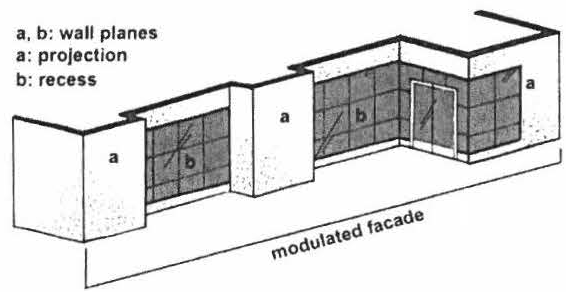
2.
In order to modulate their scale, buildings at least three (3) stories in height shall individually articulate the base, middle, and cap through the use of expression lines, cornices, string cornices, step-backs, or similar articulating feature. For the purposes of this section, the base generally includes the ground floor of the building, including entryways and windows; the middle is generally described as the upper stories of a building and typically features windows and/or balconies; and the cap includes the area from the top floor to the roof of the building.
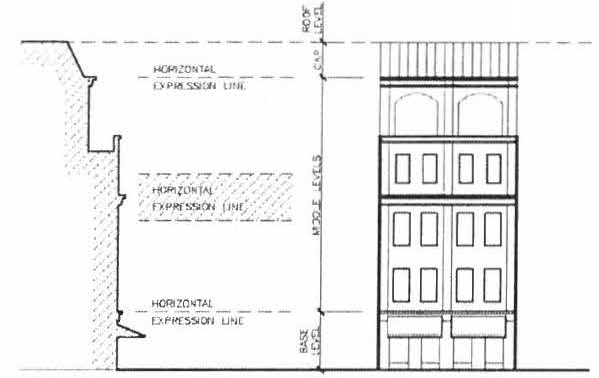
3.
For buildings at least three (3) stories in height, upper story decks or patios should be configured to avoid direct views into the private spaces of adjacent residential uses.
4.
The articulation of buildings pursuant to this section shall include at least three (3) of the following:
a)
Awnings or other weather protection for pedestrians;
b)
Distinct changes in texture and color of wall surfaces;
c)
A covered front porch or other designated gathering area occupying at least twenty-five (25) percent of the front façade width;
d)
Vertical accents or focal points such as towers, spires, cupolas, window walls, or widow walks;
e)
Distinctive window trim including lintels and sills;
f)
Art work or bas relief;
g)
Repetitive ornamentation, including decorative features such as wall-mounted light fixtures, with a maximum spacing of fifty (50) feet; or
h)
Other comparable elements, as approved by the Business and Development Services Director.
5.
Vents, exhaust vents, and downspouts shall be incorporated into the overall design.
6.
Upper-story decks or patios shall be configured to avoid direct views into the private spaces of adjacent single-family dwellings.
J.
Fenestration.
1.
At least forty (40) percent of the area of a ground floor street-facing façade must include windows and/or main entryways. All other building façades shall have a minimum glazed area of twenty (20) percent.
2.
Windows on side façades shall be positioned to avoid direct views into the windows of an existing adjacent residential dwelling.
3.
Windows and doors of proposed dwellings shall allow for casual surveillance of the parking and common open space areas.
4.
Windows shall complement the rhythm, size, proportion, and trim of adjacent residential buildings.
K.
Roof form.
1.
For buildings at least three (3) stories in height, roof lines shall vary and be expressed in a visually interesting manner that complements the composition of the building and the surrounding area. This can be achieved through the use of dormers, varied cornice lines and/or varied parapet lines, and other similar architectural features.
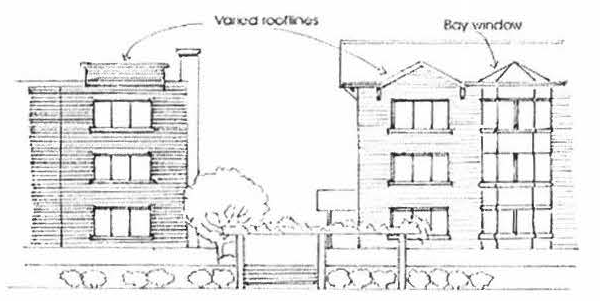
2.
Pitched roofs shall include variation in planes, slopes, and features.
3.
Overhanging eaves and roof rakes on gable ends shall extend at least six (6) inches past the supporting walls.
4.
Flat roofs shall incorporate parapet walls with three-dimensional cornice treatments designed to conceal the roof and roof-mounted mechanical equipment. All parapet walls visible from a public street shall be finished.
5.
The parapet wall shall be similar in color and material to the building and shall not exceed twenty-five (25) percent of the height of the supporting wall.
6.
When adjacent to residential zoning districts, the roof form of multi-family residential buildings shall complement the character of surrounding residential structures.
7.
All roof vents, pipes, antennae and other roof penetrations should be of a color that will minimize their visual impact unless concealed by a parapet, located on the rear elevation, or configured to have a minimum visual impact as seen from the street or existing residential development.
8.
Green roofs, which use vegetation to improve stormwater quality and reduce runoff, may be incorporated as an alternative to the roof forms described in this subsection.
L.
Façade materials.
1.
Building materials shall either be similar to the materials already being used in the immediate area or, if dissimilar materials are being proposed, other characteristics such as scale and proportions, form, architectural detailing, color, and texture shall be utilized to ensure that enough similarity exists for the building to be compatible despite the differences in materials.
2.
Where two (2) or more materials are proposed to be combined on a façade, the heavier and more massive elements shall be located below the lighter elements (e.g., brick shall be located below stucco). Use of a heavier material as a detail on the corner of a building or along cornices or windows is acceptable.
3.
Primary façade materials shall not terminate or change at outside corners, and shall continue a minimum distance of two (2) feet from the front corners along the side façades.
4.
Material changes shall occur along a horizontal line or where two (2) forms meet. It is acceptable, however, that change of materials occur as accents around windows, doors, cornices, or as a repetitive pattern.
5.
The following materials shall not be used in the exterior building finish:
a)
Corrugated metal siding;
b)
Exposed smooth-finished concrete block;
c)
Styrofoam-backed and synthetic stucco within twelve (12) feet of the grade level and within two (2) feet of any exterior door jamb; or
d)
Vinyl siding.
6.
Accessory buildings and structures shall be similar in materials and architectural style to the primary building(s).
M.
Service areas and equipment.
1.
Exterior mechanical equipment, vending machines, service and delivery areas, outdoor storage, trash storage, and accessory uses and structures that may produce noise, odor, glare, vibration, or other nuisances, shall be screened from view of public and common areas and adjacent properties.
2.
Adequate facilities for waste disposal shall be provided and shall be appropriately screened.
N.
Landscaping and screening.
1.
Building foundations shall be landscaped along the full length of each front façade. Landscaping shall wrap around the corners and shall continue around building sides to a logical conclusion point or a minimum distance of ten (10) feet, whichever is less.
2.
Foundation landscaping shall have an average depth of six (6) feet and a minimum depth of four (4) feet. Foundation landscaping depth along a sidewalk may be reduced by up to fifty (50) percent, where needed to provide for adequate pedestrian circulation or pedestrian amenities.
3.
Structures along primary rights-of-way which contain non-residential uses on the ground floor shall be exempt from foundation landscaping requirements.
O.
Exterior lighting.
1.
Exterior lighting shall be compatible with building architecture and scaled (dimension and intensity) to complement its context.
2.
Adjacent to residential zoning districts, exterior lighting, whether pole-mounted or wall-mounted, shall not exceed a maximum height of fifteen (15) feet above grade. Uplighting of building or site features shall be directed away from adjacent properties.
3.
Internally illuminated signage or awnings are prohibited in direct view or any adjacent residential zoning district.
P.
Crime prevention through environmental design. Multi-family residential development is encouraged to adhere to the generally accepted Principles of Crime Prevention Through Environmental Design (CPTED), to the maximum extent practicable. These principles involve the design of walkways, fences, lighting, signage, and landscape to enhance natural site surveillance, control of access, and clear definition of public and private spaces.
Q.
Other applicable standards. All multi-family housing residential developments projects shall be subject to other applicable standards established in the Mauldin Zoning Ordinance and Mauldin Land Development, including, but not limited to, Section 8:1 of the Mauldin Zoning Ordinance. Where other standards may differ from the standards herein, the higher, or more restrictive, standard shall apply.
R.
Prohibited locations. Multi-family residential development shall be prohibited at the following locations: along Brookfield Parkway, Brookfield Boulevard, Brookfield Oaks Drive, Old Stage Road, Greer Drive, Palmetto Drive, Carlisle Drive, Old Mill Road (between Miller Road and Forrester Drive), Ellwood Court, McDougall Court, International Court, Geneva Court, Devonshire Road, Bi-Lo Boulevard, S. Park Drive, and Mourning Dove Lane.
(Ord. No. 834, amd. 5, 9-18-2017; Ord. No. 938, § 1, 3-16-2020; Ord. No. 970, § 7, 4-19-2021)
Editor's note— Ord. No. 970, § 7, adopted April 19, 2021, amended and renumbered former § 10:13, Multi-family Dwellings: C-1, C-2, and S-1 Districts, as § 10:2 to read as herein set out.
Sec. 10:3 - Short-Term Rentals.
10:3.1 Purpose and Findings.
A short-term rental may be allowed as conditional use within each of the established residential districts, including districts R-20, R-15, R-12, R-10, R-8, R-6, R-M1, R-M, and R-O districts, and are subject to the standards contained herein.
These standards shall apply to "unhosted" short-term rentals where the homeowner vacates the property during the rental period. "Hosted" short-term rentals where the homeowner resides at the property during the rental period shall only be permissible as an accessory apartment, where permitted, and shall be subject to the standards in Section 10:1, Accessory Apartment, of this Ordinance.
It is the purpose of this section to: (1) protect the public health, safety and general welfare of individuals and the community at large; (2) monitor and provide reasonable means for citizens to mitigate impacts created by occupancy of short-term rentals; and (3) implement reasonable regulations to protect the integrity of neighborhoods.
10:3.2 General Standards.
A.
Rental of Entire Home. The short-term rental of any property shall be for the home in its entirety. Homes shall not be rented on a "per room" basis.
B.
Townhomes and Apartments. The short-term rental of an attached single-family dwelling, townhome, or a multi-family dwelling unit is strictly prohibited.
C.
Maximum Occupancy. The number of adult guests at any short-term rental shall not exceed two (2) adults per bedroom and in no case shall the rental occupancy exceed six (6) adults total. For the purposes herein, an adult is any person at least eighteen (18) years in age.
D.
Large Gatherings. Large gatherings, including, but not limited to, weddings, reunions, and other gatherings with more than eight (8) persons are prohibited while the property is being used as a short-term rental.
E.
Off-street Parking. The maximum number of motor vehicles that may be parked at the premises while the property is being used as a short-term rental is one (1) vehicle per bedroom or four (4) vehicles total, whichever is less. Occupants shall only park on the driveway or on other delineated areas for parking along the side or rear of the home.
All parking areas shall be surfaced with concrete or asphalt pavement. Parking on unpaved surfaces, including, but not limited to, grass, dirt, or gravel surfaces shall be prohibited while the property is being used as a short-term rental. Additionally, parking on-street shall be prohibited while the property is being used as a short-term rental.
F.
Signage Prohibited. Any sign on the premises advertising a short-term rental is strictly prohibited.
G.
Posting of Business License. A copy of the short-term rental business license shall be posted in a conspicuous location in the unit and shall include the following information:
1.
The name, address and phone number of the owner(s) and the short-term rental agent.
2.
The short-term rental business license number.
3.
The maximum number of adults allowed on the premises during the rental period.
4.
The maximum number of vehicles allowed at the premises during the rental period.
5.
The effective date and expiration date of the business license.
H.
Listing Requirements. The owner(s) and/or short-term rental agent shall list the short-term rental permit number, maximum number of adults, and maximum number of parking spaces on all advertisements, listings with booking services, and marking materials, including without limitation, Airbnb, VRBO/Homeaway, FlipKey, and any other online website and listing or booking platform or service.
I.
Posting of Rental Rules. Rental rules, including use of the sanitation and recycling roll-carts, parking rules, pertinent safety information, and emergency contact information including the police non-emergency number and the short-term rental agent, shall be posted in a conspicuous location in the unit.
J.
Guest Register. The owner(s) and/or short-term rental agent shall keep a guest register including the name(s), address(es), telephone number(s), and date(s) of occupancy of all guests for a period of two (2) years for inspection and copying by the City of Mauldin.
K.
Code Violations. If a short-term rental location has accumulated three (3) code violation convictions within a period of twelve (12) consecutive months, the short-term rental permit and business license at that location shall be suspended for a period of twelve (12) months and any pending licenses or applications shall be rejected at that location for a period of twelve (12) months.
10:3.3 Permits, Licenses, and Other Tax Requirements.
Any person or business who wishes to operate a short-term rental shall obtain a short-term rental permit from the City of Mauldin, a short-term rental business license from the City of Mauldin, and shall comply with the provisions and regulations contained herein.
A.
Required Documentation. Attached to and concurrent with submission of the short-term rental permit application, the property owner(s) shall provide:
1.
Proof of Ownership. Proof of the owner(s)' current ownership of the short-term rental property. Where a property might be owner-financed, bond for title, lease to purchase or similar arrangement, a notarized statement or similar documentation that confirms the arrangement of the property transaction will be acceptable.
2.
Application Fee. An application fee shall not be required except for short-term rentals found to be operating without approval of the City of Mauldin as outlined herein.
3.
Owner Affidavit. The owner(s)' signature of sworn acknowledgement that he or she has received a copy of the City of Mauldin's short-term rental regulations, has reviewed it, and understands its requirements.
4.
Owner Agreement. The owner(s)' agreement to use his or her best efforts to ensure that use of the premises by short-term rental occupants will not disrupt the neighborhood and will not interfere with the rights of neighboring property owners to the quiet enjoyment of their properties.
5.
Proof of Insurance. Proof of property and liability insurance, including any prerequisite short-term rental rider, along with an acknowledgement that property owners are responsible for their own safety and insurance needs, as well as the safety and sanitation of their tenants. By providing a permit and licenses allowing property owners to conduct short-term rentals of their dwelling, the City of Mauldin does not assume responsibility for safety or any other liability related to rental activities.
6.
Agent Contact Information. The name, address, and twenty-four-hour contact information, including a telephone number and an e-mail address, of the short-term rental agent.
7.
Agent Affidavit. A written certification from the short-term rental agent that he or she agrees to perform the duties specified in the City of Mauldin's short-term rental regulations.
8.
Rental Agreement. A written exemplar agreement, which shall consist of the form of the document to be executed between the owner(s) and the occupant(s) and which shall, at a minimum, contain the following provisions:
a.
The occupant(s)' agreement to abide by all of the City of Mauldin's short-term rental regulations, and applicable local, state and federal laws, as well as acknowledgement that his or her rights under the agreement may not be transferred or assigned to anyone else.
b.
Owner(s)' acknowledgement that the occupant(s) has been provided a written copy of the City of Mauldin's noise ordinance.
c.
The owner(s)' and occupant(s)' acknowledgement and agreement that parking shall be maintained pursuant to the provisions herein while the property is being used as a short-term rental.
d.
The occupant(s)' acknowledgement and agreement that they shall conform to the regulations stated in the 2015 International Property Maintenance Code on Overcrowding and Bedroom requirements (IPMC 404.4 and 404.5). In addition to these regulations, there shall not be more than two (2) adults per bedroom and in no case shall the rental occupancy exceed six (6) adults total. For the purposes herein, an adult is any person at least eighteen (18) years in age.
e.
Owner(s)' acknowledgement that the occupant(s) has been provided a written copy of the City of Mauldin Public Works Department's requirements concerning trash disposal and that the occupant(s) has agreed to comply with such requirements.
f.
The occupant(s)' acknowledgement and agreement that large gatherings, including, but not limited to, weddings, reunions, and other gatherings with more than eight (8) persons are prohibited.
g.
The occupant(s)' acknowledgement and agreement that violation of the agreement of the City of Mauldin's short-term rental regulations may result in immediate termination of the agreement and eviction from the short-term rental by the owner(s) or the short-term rental agent, as well as the potential liability for payments of fines levied by the City of Mauldin.
9.
HOA Approval. For properties located in a neighborhood with a property owners' association, written confirmation from the association president or other person(s) authorized by the property owners' association that short-term rentals are permitted in the neighborhood.
10.
Inspections. Agreement to provide access to appropriate City personnel to inspect the short-term rental as may necessary for the enforcement of the provisions of this Ordinance.
B.
Non-transferable. Once issued by the City of Mauldin, the short-term rental permit and business license may not be transferred, assigned, or used by any person other than the property owner to whom it is issued at the location specified.
C.
Annual Renewal. The short-term rental permit and business license shall be renewed annually subject to the deadline for business license renewals.
D.
Additional Taxes and Fees. Owners of short-term rental properties are subject to local, county, and state taxes, including, but not limited to, property, sales, use, and accommodations taxes, and are liable for the payment thereof as established by state and local laws.
E.
Fees for Illegal Operation. For short-term rentals that are found to be operating after January 6, 2020, without approval of the City of Mauldin, the short-term permit application fee shall be $200.00.
10:3.4 Short-term Rental Agent.
The owner(s) of a short-term rental property shall designate a short-term rental agent on their application for a permit. The owner(s) may serve as the short-term rental agent provided that they meet the location and age requirements herein.
A.
Location Requirement. The short-term rental agent shall reside within a twelve-mile radius of the property.
B.
Age Requirement. The short-term rental agent shall be over the age of twenty-one (21) years.
C.
Responsibilities for Care, Maintenance and Monitoring. The short-term rental agent shall be responsible for the care and maintenance of the residence. This agent shall routinely monitor and inspect the premises for compliance with applicable City laws.
D.
Responsibility for Responding to Issues. The short-term rental agent shall be responsible for receiving and responding to notifications from the City of Mauldin for issues related to the short-term rental use or occupancy of the premises. Such issues may include, but are not limited to, notification of overcrowding, unreasonable noise or disturbances, disorderly conduct, or violations of the City's laws. This is not intended to impose a duty on the agent to act as a peace officer or otherwise require the agent to place him or herself in a perilous situation.
E.
Changing Agents. The owner(s) may change their designation of a short-term rental agent temporarily or permanently; however, there shall always be one (1) such agent and only one (1) such agent for a property at a given time. To change the designated agent, the owner(s) shall notify the City of Mauldin Business and Development Services Department of the new agent's identity in writing within seven (7) calendar days of such a change, together with all applicable information and documentation required herein. Until such time as the notification of a change in short-term rental agent has been received by the City of Mauldin, the previous short-term rental agent shall remain responsible for the duties outlined in this section.
(Ord. No. 917, § 3, 9-16-2019; Ord. No. 970, § 7, 4-19-2021)
Editor's note— Ord. No. 970, § 7, adopted April 19, 2021, amended, retitled and renumbered former § 10:14, Short-Term Rentals—All residential districts, as § 10:3 to read as herein set out.
Secs. 10:8 - Reserved.
Editor's note— Ord. No. 970, § 7, adopted April 19, 2021, repealed former § 10:8 which pertained to Dwellings, Cluster: Traditional Urban Neighborhood Housing: R-10, R-8, R-6, RM-1 and RM Districts, and derived from Ord. No. 786, amd. 5, adopted March 16, 2015.
Secs. 10:9 - Reserved.
Editor's note— Ord. No. 970, § 7, adopted April 19, 2021, repealed former § 10:9 which pertained to Dwellings, Two-Family (Duplex): R-10, R-8, R-6, RM-1, and derived from Ord. No. 786, amd. 5, adopted March 16, 2015.
Sec. 10:10 - Adult Day Care Center. [formerly Sec. 10:3]
1.
The minimum lot area requirement for an Adult Care Center shall be 30,000 square feet.
2.
No structure shall be located closer than twenty-five (25) feet to an exterior property line, and no structure shall be located closer than thirty-five (35) feet to a public right-of-way. Interior setbacks are not regulated.
3.
The structure shall have a residential appearance.
4.
When located in a residential district, the maximum number of adults to be cared for shall be limited to sixteen (16).
5.
Off street parking shall be provided at the rate of: One (1) space per staff person and consultative person expected on the premises at any one (1) time, plus one (1) space for each six (6) adults permitted.
6.
Safe and adequate provisions shall be provided on-site to accommodate all drop-off and pick up activities, ensuring a safe route from motor vehicle to the building entrance.
7.
Adult daycare centers located in a designated residential district are limited to those following the social (non-medical) model of care for individuals who need supervision and activities but not extensive personal care or medical monitoring.
8.
Each daycare facility shall provide forty (40) square feet of available activity space per participant, inside the center, not including offices, bathrooms, kitchens, closets, vestibules, and private living space; and also provide a minimum outdoor recreation area of fifty (50) square feet per participant outside of the center. The outdoor space shall afford adequate facilities such as decks, patios, and manicured lawn areas in a manner that allows participants safe access and enjoyment outside.
9.
A fifteen-foot landscape buffer shall be provided and maintained along all exterior property lines that abut a residential use. The landscape buffer shall consist of a mix of evergreen trees and shrubs that will be provide a year round visual screen.
10.
Except as may otherwise be required by state or federal law, nothing herein shall allow or authorize the use of any daycare facility as:
a)
A public or private hospital, retreat, institution, community residence, house or place where a mentally ill person, or a person who is alcoholic dependent or drug-dependent is received or detained as a patient or for treatment or rehabilitation; or
b)
A community residence, halfway house, transitional house or other state or federally regulated facility to which persons are or may be transferred from correctional facilities or institutions.
(Ord. No. 786, amd. 5, 3-16-2015; Ord. No. 970, § 7, 4-19-2021)
Editor's note— Ord. No. 970, § 7, adopted April 19, 2021, repealed former § 10:10 which pertained to Dwellings, Triplex and Quadraplex Structures: RM-1 District, and derived from Ord. No. 786, amd. 5, adopted March 16, 2015. Ord. No. 970 subsequently amended, retitled and renumbered former § 10:3, Adult Care Center—RM-1, and RM residential districts, all Commerical Districts (excluding I-1 District), as § 10:10 to read as herein set out.
Sec. 10:11 - Child Day Care Center. [formerly Sec. 10:5]
1.
When located in a residential zoning district, the maximum number of children to be cared for shall be limited to sixteen (16).
2.
Off street parking shall be provided at the rate of: One (1) space per staff person and consultative person expected on the premises at any one (1) time, plus one (1) space for each six (6) children permitted.
3.
Safe and adequate provisions shall be provided onsite to accommodate all drop-off and pick up activities ensuring a safe route from motor vehicle to the building entrance.
4.
Child daycare facilities shall provide forty (40) square feet of available activity space per participant, inside the center (not including offices, bathrooms, kitchens, closets) and shall also provide a minimum outdoor play area of fifty (50) square feet per participant.
5.
The entire play area shall be enclosed by a fence having a minimum height of four (4) feet, and constructed to provide maximum safety to the children.
6.
A fifteen-foot landscape buffer shall be provided and maintained along all exterior property lines that abut a residential use. The landscape buffer shall consist of a mix of evergreen trees and shrubs that will be provide a year round visual screen.
7.
Except as may otherwise be required by state or federal law, nothing herein shall allow or authorize the use of any daycare facility as:
a)
A public or private hospital, retreat, institution, community residence, house or place where a mentally ill person, or a person who is alcoholic dependent or drug-dependent is received or detained as a patient or for treatment or rehabilitation; or
b)
A community residence, halfway house, transitional house or other state or federally regulated facility to which persons are or may be transferred from correctional facilities or institutions.
(Ord. No. 786, amd. 5, 3-16-2015; Ord. No. 970, § 7, 4-19-2021)
Editor's note— Ord. No. 970, § 7, adopted April 19, 2021, repealed former § 10:11 which pertained to Home Occupation—All residential districts, and derived from Ord. No. 786, amd. 5, adopted March 16, 2015; and Ord. No. 861, amd. 1, adopted Sept. 17, 2018. Ord. No. 970 subsequently amended, retitled and renumbered former § 10:5, Child Day Care Center: RM-1, and RM residential districts; all Commerical Districts (excluding I-1 district), as § 10:11 to read as herein set out.
Sec. 10:12 - Adult Day Care Home. [formerly Sec. 10:4]
Shall be required to obtain a Home Occupation permit and shall be subject to the following provisions:
1.
Adult Day Care Homes (by definition) are limited to providing service to no more than five (5) adults.
2.
Adult Day Care Homes shall only be located within a single family detached dwelling unit that is owner occupied.
3.
The residential character and appearance of the structure shall not be altered to accommodate the use except to provide a suitable means of egress and handicap accessibility.
4.
In addition to the owner, one (1) full time non-resident employee shall be permitted. The employee's position shall be listed on the business license application (as well as the occupant) certifying compliance.
5.
No more than one (1) vehicle may be used in conjunction with the business. Said vehicle must be stored in a carport, garage, or enclosed in an area that is screened from the view of adjacent and/or adjoining properties.
6.
Parking shall not be permitted within any required setback and must be located on premises.
7.
Client drop off and pick up areas shall be located on site so as not to obstruct traffic flow on adjacent public and/or private streets.
8.
Hours of operation shall be limited to the hours of 7:00 a.m. to 7:00 p.m.; and no overnight accommodations shall be permitted.
9.
During the hours of business activity, the total gross floor area of the dwelling unit may be devoted to the use.
10.
All outdoor recreation areas located within fifty (50) feet of a residential use, shall provide a ten-foot landscape buffer consisting of a mix or evergreen trees and shrubs to provide a year round visual screen.
(Ord. No. 786, amd. 5, 3-16-2015; Ord. No. 970, § 7, 4-19-2021)
Editor's note— Ord. No. 970, § 7, adopted April 19, 2021, retitled and renumbered former § 10:4, Adult Day Care Home—All residential districts, as § 10:12 to read as herein set out.
Sec. 10:13 - Child Day Care Home. [formerly Sec. 10:6]
1.
Child Day Care Homes shall only be located within a single family detached dwelling unit that is owner occupied.
2.
The residential character and appearance of the structure shall not be altered to accommodate the use except to provide a suitable means of egress and handicap accessibility.
3.
By definition, a Child Day Care Home is limited to providing care to six (6) or fewer children.
4.
Hours of operation shall be limited to the hours of 7:00 a.m. to 7:00 p.m.; and no overnight accommodations shall be permitted.
5.
During the hours of business activity, the total gross floor area of the dwelling maybe devoted to the use.
6.
The building shall contain a minimum of thirty-five (35) square feet of floor area for each child present.
7.
Client drop-off and pick-up shall be located on site so as not to obstruct traffic flow on adjacent public and/or private streets.
8.
Parking shall not be permitted within any required setbacks and must be located on premises.
9.
At least seventy-five (75) square feet of outdoor play area shall be available for each child present. Outdoor play shall only occur between the hours of 8:00 a.m. to 6:00 p.m.
10.
The entire play area shall be enclosed by a fence having a minimum height of four (4) feet, constructed to provide maximum safety to the children. If the outdoor play area is within fifty (50) feet of another residential structure, a ten-foot landscape buffer shall be required at the rate of one (1) evergreen tree or evergreen shrub per five (5) linear feet of fence line.
(Ord. No. 786, amd. 5, 3-16-2015; Ord. No. 970, § 7, 4-19-2021)
Editor's note— Ord. No. 970, § 7, adopted April 19, 2021, retitled and renumbered former § 10:6, Child Day Care Home—All residential districts, as § 10:13 to read as herein set out.
Sec. 10:14 - Residential Care Facility. [formerly Sec. 7:13]
A residential care facility is subject to the following standards:
1.
Minimum lot size. The minimum lot area for a Residential Care Facility shall be thirty thousand (30,000) square feet.
2.
Minimum setbacks. The minimum building setback requirements shall be the same as for a single-family home in the underlying zoning district.
3.
Building design. The site layout, orientation of the facility, roof design, and façade design shall be consistent with the residential design of the surrounding neighborhood.
4.
Location. The Residential Care Facility shall not be located closer than one thousand (1,000) feet, measured lot line to lot line, from the nearest Residential Care Facility.
5.
Parking. In addition to the parking standards provided in Article 6, surface parking areas, excluding driveways, shall not be located between the front face of the building and the adjacent street.
6.
Screening. A minimum fifteen-foot-wide landscape buffer consisting of a mix of evergreen trees and shrubs forming a year-round screen shall be provided along any property line that is adjacent to a residential district or residential use.
7.
Open space. A minimum of five hundred (500) square feet of open space shall be provided on the property.
(Ord. No. 970, § 7, 4-19-2021)
Sec. 10:15 - Library.
The following criteria shall be considered when reviewing a special exception request for a library:
1.
The compatibility of the scale, form, and design of the facility, including off-street parking, with regard to the character of the surrounding neighborhood.
2.
The availability and capacity of the surrounding infrastructure to support the ultimate size of the facility.
3.
The extent to which the use may pose a direct threat to the health and safety of the neighborhood.
(Ord. No. 970, § 7, 4-19-2021)
Sec. 10:16 - Religious Institution. [formerly Sec. 10:12]
For the purposes of these development standards, Religious Institutions shall be placed in the following categories based upon the number of seats in the sanctuary:
1.
Small place of worship—Not more than three hundred (300) seats in the sanctuary.
2.
Medium place of worship—Three hundred one (301) to eight hundred (800) seats in the sanctuary.
3.
Large place of worship—More than eight hundred (800) seats in the sanctuary.
4.
Minimum lot size: The minimum lot size for places of worship shall be as follows:
a)
Small place of worship—Minimum lot size for the zoning district in which the place of worship is located.
b)
Medium place of worship—Two (2) acres.
c)
Large place of worship—Three (3) acres.
5.
Places of Worship shall comply with the following setbacks:
a)
Small and medium place of worship:
• Front: Same as residential uses in the zoning district.
• Side: Twenty-five (25) feet.
• Rear: Twenty-five (25) feet.
• No parking or other outdoor activities shall be located in any of the required setbacks.
b)
Large place of worship:
• Front: Fifty (50) feet, except that buildings, or portions of buildings, with a width not exceeding fifty (50) feet, may be set back a distance equivalent to the front setback for residential uses in the zoning district in which the place of worship is located.
• Side: Twenty-five (25) feet.
• Rear: Twenty-five (25) feet.
• No parking or other outdoor activities shall be located in any of the required setbacks.
6.
Access points. A Place of Worship whose parcel is accessed from a local residential street shall be limited to a total of two (2) driveway access points.
7.
Parking. Off street parking shall be provided at the following ratio:
a)
Minimum: One (1) space per eight (8) seats in the sanctuary(ies).
b)
Maximum: One (1) space per three (3) seats in the sanctuary(ies).
8.
Landscaping. Landscaping shall be provided as required by Section 6:2, Landscape and Design Standards of this chapter, except as required by the following standards:
a)
Parking and outdoor activity areas shall be buffered from adjacent residential uses with a minimum of a fifteen-foot-wide landscape buffer consisting of a mix of evergreen trees and shrubs necessary to establish a year round screen from view of adjacent properties. The purpose of the landscape buffer is to visually separate the parking and outdoor activity area(s) from adjacent residential uses. Where grade changes or other features of the site make it difficult for a standard buffer to visually separate the parking and outdoor activity area(s) from adjacent residential uses, the buffer shall be developed and/or located as required to create an effective visual separation.
b)
Parking and outdoor activity areas shall be buffered from the street with a planting strip with a minimum width of ten (10) feet which incorporates one (1) large deciduous tree for each thirty (30) feet of street frontage or one (1) small deciduous tree for each twenty (20) feet of street frontage. The planting strip shall also include one (1) evergreen shrub for each five (5) lineal feet of street frontage.
9.
Lighting. Lighting shall be in accordance with Section 6:3, Other Design Requirements.
10.
Height. The height of all buildings shall not exceed fifty (50) feet. Steeples, spires, bell towers, minarets, and similar architectural features shall not be subject to the height limitation.
11.
No commercial activities (selling of items to the general public on an on-going basis) shall be permitted.
12.
Outdoor speaker systems shall be prohibited.
13.
Factory fabricated transportable buildings designed to serve as expansion space for existing places of worship may be utilized subject to requirements in Section 7:3, Temporary Uses and Structures.
14.
Accessory structures. Accessory uses and structures shall be permitted in accordance with the related provisions of this ordinance.
15.
Accessory childcare, pre-school, and after-school activities. Childcare, pre-school, and after-school activities and operations are permitted as an accessory use to religious institutions in accordance with the following standards:
a)
Safe and adequate provisions shall be provided onsite to accommodate all drop-off and pick-up activities ensuring a safe route from motor vehicles to the building entrance;
b)
Parking facilities must be provided in accordance with the minimum standards required in Section 6:1, Off-Street Parking Requirements; and
c)
Childcare operations must comply with all applicable state laws, including Chapter 114, Article 5, of the South Carolina Code of Regulations.
(Ord. No. 786, amd. 5, 3-16-2015; Ord. No. 970, § 7, 4-19-2021; Ord. No. 1053, § 1, 5-19-2025)
Editor's note— Ord. No. 970, § 7, adopted April 19, 2021, retitled, amended and renumbered former § 10:12, Places of Worship—All residential districts, as § 10:16 to read as herein set out.
Sec. 10:17 - College or University.
The following criteria shall be considered when reviewing a special exception request for a college or university:
1.
The compatibility of the scale, form, and design of the facility, including off-street parking, with regard to the character of the surrounding district.
2.
The compatibility of the architectural design of the development with respect to the surrounding district.
3.
The availability and capacity of the surrounding infrastructure to support the ultimate size of the facility.
4.
The adequacy of the illumination that will be provided on all streets, sidewalks, and parking areas to ensure the safety of pedestrians and motorists at night.
5.
The extent to which the development will provide sufficient open space and recreational facilities.
6.
The extent to which the location and design of any athletic or recreational facilities will minimize the impacts, including noise and light, on any surrounding residential property.
7.
The extent to which the use may pose a direct threat to the health and safety of the neighborhood.
(Ord. No. 970, § 7, 4-19-2021)
Sec. 10:18 - Grade School. [formerly Sec. 7:9]
A grade school, whether public, private, or parochial, is subject to the following standards:
1.
Minimum setbacks. All structures shall be set back at least 30 feet from each property line.
2.
Maximum occupancy. The facility shall comply with the maximum occupant load of the current edition of the International Building Code and any other applicable requirements.
3.
Minimum outdoor area. At least seventy-five (75) square feet of outdoor recreation area shall be available for each student enrolled. Such area may be located on another parcel provided it is contiguous to the facility and under the same ownership. The outdoor recreational area shall be enclosed by a fence having a minimum height of four (4) feet.
4.
Screening. A wall, fence, continuous hedge, or other permanent year-round foliage, or combination thereof, which provides a solid, opaque, visual barrier at least six (6) feet in height shall be provided along any property line that is adjacent to a residential district or residential use.
5.
The following criteria shall be considered when reviewing a special exception request for a grade school:
a)
The compatibility of the scale, form, and design of the facility, including off-street parking, with regard to the character of the surrounding neighborhood.
b)
The availability and capacity of the surrounding infrastructure to support the ultimate size of the facility.
c)
The ability of the drop-off and loading practices of the facility to be entirely managed on-site without causing traffic delays.
d)
The extent to which the location and design of any athletic or recreational facilities will minimize the impacts, including noise and light, on any surrounding residential property.
e)
The extent to which the use may pose a direct threat to the health and safety of the neighborhood.
(Ord. No. 970, § 7, 4-19-2021)
Sec. 10:19 - Technical, Trade, or Other Specialty School.
A technical, trade, or other specialty school is subject to the following standards:
1.
Location. Any such facility shall be located along an arterial or collector street.
2.
Operations. All instructional activities shall be performed inside a building.
3.
Activities. Training shall not be permitted in any activity that is not otherwise permitted within the underlying zoning district.
(Ord. No. 970, § 7, 4-19-2021)
Sec. 10:30 - Catering Services.
A catering service, when allowed as a conditional use, shall not entail or use more than two (2) vehicles in connection with the operation of the business, including the delivery of food services.
(Ord. No. 970, § 7, 4-19-2021)
Sec. 10:31 - Fringe Financial Services. [formerly Sec. 7:6]
All fringe financial services including check cashing businesses, payday advance/loan businesses, title loan businesses, debt relief businesses, precious metal dealers, and other similar businesses (excluding retail businesses such as pawnshops or jewelry stores who obtain a precious metal dealer license in the normal course of their retail business) shall comply with the following standards:
1.
Location. The business shall not be located closer than three thousand (3,000) feet, measured lot line to lot line, from the nearest fringe financial service.
2.
Group development/shopping center. The business shall be located within a group nonresidential development, shopping center, or similar center. The development or center shall have a minimum gross floor area of thirty thousand (30,000) square feet.
3.
Color scheme. The business shall conform to the color scheme of the development and use neutral colors.
4.
Legal nonconforming businesses. A fringe financial service that existed and was lawfully constructed, located, and operating by December 15, 2014, and that does not conform to the zoning district and/or separation distance standards adopted herein, shall be deemed a legal nonconforming use and may continue in operation subject to the following provisions:
a)
If a fringe financial service ceases operation at a particular location, a new certificate of occupancy shall not be issued for a new fringe financial service without first complying with all of the requirements of this Ordinance.
b)
The ability to continue a legal nonconforming fringe financial service shall cease and such use shall terminate whenever a certificate of occupancy for a change of owner, occupant, tenant, or business is required.
(Ord. No. 970, § 7, 4-19-2021)
Sec. 10:32 - Motor Vehicle Sales.
Any establishment which sells or rents motor vehicles is subject to the following standards:
1.
Indoor office. A fixed indoor sales or rental office must be located on the site of any motor vehicle sales or rental use.
2.
Display spaces. Vehicles for sale or rent shall be parked in designated display areas/parking spaces as depicted on an approved site plan. Vehicles shall not be parked in any landscaped areas, on top of buildings, in any driveway aisles, or in any location which obstructs visibility for motorists or pedestrians.
3.
Vehicle storage. Except for vehicles for sale or rent parked in designated display areas, vehicles shall not be stored on site.
(Ord. No. 970, § 7, 4-19-2021)
Sec. 10:33 - Motor Vehicle Services.
A motor vehicle service, including a gasoline station, automotive repair and maintenance shop, oil change and lubrication shop, or car wash, when allowed as a conditional use, is subject to the following standards:
1.
Separation requirements. No motor vehicle service shall be located within three thousand (3,000) feet of any other existing motor vehicle service inside or outside the City limits of Mauldin. The required separation distance shall be measured in a straight line from the nearest point on the lot line of the property occupied by an exisitng motor vehicle service to the nearest point on the lot line of the subject property.
2.
Existing businesses. A motor vehicle service that lawfully existed as of May 1, 2021, shall be deemed a legal use and may continue in operation and enjoy all of the rights of any other legal conforming use such as the expansion or transfer of ownership of the business.
3.
Operations. Except for pumping fuel, all service and repair operations shall be conducted within a fully enclosed building.
4.
Service bay doors. Service bay doors shall be oriented away from the public right-of-way.
(Ord. No. 970, § 7, 4-19-2021)
Sec. 10:34 - Bar, Brew Pub or Drinking Place.
A bar, brew pub or drinking place is subject to the following standards:
1.
Prohibitions. A bar, brew pub, or drinking place shall not have a drive-up window.
2.
Food services. A bar, brew pub, or drinking place must also provide food services on-site in addition to the sale of alcoholic beverages for consumption on the premises.
3.
Separation from residences. A bar, brew pub, or drinking place shall not be closer than three hundred (300) feet from any residential use in a residential zoning district, as measured pursuant to the method of measurement used for proximity to schools, churches, and playgrounds provided in Title 61, Chapter 6, of the S.C. Code of Laws and as further clarified in Chapter 7 of the S.C. Code of Regulations.
4.
Compliance with state law. Any such business shall comply with all applicable state laws, including Chapter 7 of the S.C. Code of Regulations and Title 61, Chapter 6, of the S.C. Code of Laws.
(Ord. No. 970, § 7, 4-19-2021; Ord. No. 1062, § 1, 9-15-2025)
Sec. 10:35 - Packaged Alcoholic Beverage Store.
A packaged alcoholic beverage store is subject to the following standards:
1.
Separation from residences. A packaged alcoholic beverage store shall not be closer than three hundred (300) feet from any residential use in a residential zoning district, as measured pursuant to the method of measurement used for proximity to schools, churches, and playgrounds provided in Title 61, Chapter 6, of the S.C. Code of Laws and as further clarified in Chapter 7 of the S.C. Code of Regulations.
2.
Compliance with state law. Any such business shall comply with all applicable state laws, including Chapter 7 of the S.C. Code of Regulations and Title 61, Chapter 6, of the S.C. Code of Laws.
(Ord. No. 970, § 7, 4-19-2021; Ord. No. 1052, § 1, 5-19-2025)
Sec. 10:36 - Small Box Variety Store. [formerly Sec. 10:15]
10:36.1 Applicability and Purpose.
A small box variety store may be allowed as a conditional use within the CRD, C-1, and C-2 districts and is subject to the standards contained herein.
The purpose of these standards is to limit over-concentration of small box variety stores and to allow for more diverse retail options and convenient access to fresh meats, fruits and vegetables.
10:36.2 Separation Requirements.
No small box variety store shall be located within one (1) mile or five thousand two hundred eighty (5,280) feet of any other small box variety store inside or outside the City limits of Mauldin. The required separation distance shall be measured in a straight line from the nearest point on the lot line of the property occupied by a small box variety store to the nearest point on the lot line of the subject property.
(Ord. No. 954, § 3, 8-17-2020; Ord. No. 970, § 7, 4-19-2021)
Editor's note— Ord. No. 970, § 7, adopted April 19, 2021, renumbered former § 10:15 as § 10:36.
Sec. 10:37 - Thrift Store or Consignment Store.
A thrift store or consignment store is subject to the following standards:
1.
Separation from residences. A thrift store or consignment store shall not be closer than 200 feet from any residential use in a residential zoning district, as measured from lot line to lot line.
2.
Multi-tenant shopping center. The store shall be located within a multi-tenant shopping center, or similar center, separately occupied by at least two other non-thrift and non-consignment stores.
3.
Outdoor collection and storage. The outdoor receipt, processing, or storage of used goods or donations is strictly prohibited. The receipt of goods, processing of goods, and disposal of unusable or non-saleable goods must be entirely conducted within a completely enclosed principal structure or at a service bay located at the rear of the store that is entirely screened from any street or adjacent property. Outdoor donation bins, collection boxes, tractor trailers, shipping containers, or similar containers used for collection, storage or processing shall be prohibited.
4.
Outdoor display and sales. The outdoor display and/or sale of merchandise is strictly prohibited.
5.
Donation operations. An appointment or set hours shall be in place for the acceptance of consigned or donated goods.
6.
Directional signage. Sufficient directional signage shall be provided that directs the public about when and where to take consigned or donated goods. Signage shall be provided that expressly states that dropping off and leaving goods after business hours is prohibited.
7.
Loading and unloading. Loading and unloading areas, including vehicle stacking or queuing areas, for consigned and donated goods shall not obstruct any parking areas or other traffic circulation on the site or on any adjacent streets.
8.
Windows and security devices. The view into ground floor windows and doors shall not be obscured or blocked. The use of bars, chains, roll-down shutters, and similar security devices visible from a public street or sidewalk or adjacent property shall be prohibited.
9.
Property maintenance. The property shall be maintained free of trash and debris at all times. Store management shall be responsible for the immediate removal of litter that spills over onto adjacent properties and streets.
(Ord. No. 986, § 3, 10-18-2021)
Sec. 10:50 - Junk/Salvage Yard. [formerly Sec. 7:4]
Junk/salvage yards are subject to the following standards:
1.
Minimum lot size. The size of the property on which it is located must be at least two (2) contiguous acres but not more than ten (10) acres.
2.
Location. A junk or salvage yard shall be located at least one thousand (1,000) from any residential district, residential use, religious institution, child day care, school, public park, or similar use, as measured from lot line to lot line.
3.
Permanent office. A permanent indoor office must be located on the site of any junk or salvage yard.
4.
Outdoor storage. Outdoor storage shall be confined to the side and rear of the site and not closer to the street than the leading edge of the principal structure.
5.
Screening. Outdoor storage shall be enclosed by a continuous, opaque visual screen and maintained along all property lines. The screen shall have a minimum height of at least eight (8) feet and shall consist of a solid, opaque fence or wall (finished face on the outside of the fence or wall) and also supplemented with vegetation planted in a five-foot planting strip along the outer face of the fence or wall. One evergreen tree shall be planted every eight (8) feet, on center, and shall cover a minimum of fifty (50) percent of the face of the fence or wall at the time of planting.
6.
Parking and loading. All commercial vehicles associated with the use shall be parked in an enclosed or screened area and shall not be visible from adjacent properties or from the street. All loading and unloading activities shall be conducted within the enclosed area.
7.
Hours of operation. Hours of operation shall be limited to 7:00 a.m. until 7:00 p.m., Monday through Friday.
8.
Site lighting. Site lighting shall be limited to a maximum height of sixteen (16) feet and shall be full cut-off type fixtures. Lighting shall not produce direct glare onto adjacent properties or street rights-of-way.
(Ord. No. 970, § 7, 4-19-2021)
Sec. 10:51 - Manufacturing.
Manufacturing, when allowed as a conditional use, shall be limited to light industries which in their normal operations would have a minimal effect on adjoining properties. This includes the processing of food and beverage products and the fabrication of cloth, wood, leather, paper, plastic, and metal, provided that no noxious odor, fumes, smoke, dust, or noise is emitted outside the building in which the manufacturing process is conducted.
(Ord. No. 970, § 7, 4-19-2021)
Sec. 10:60 - Clubhouse, Country Club or Private Outdoor Recreation Amenity. [formerly Sec. 7:7]
A clubhouse, country club or private outdoor recreation amenity is subject to the following standards:
1.
Minimum lot size. The size of the property on which it is located shall be at least two (2) acres.
2.
Minimum setbacks. All buildings, game courts, swimming pools, and similar structures shall be set back at least fifty (50) feet from each property line.
3.
Swimming pools and hot tubs. Any swimming pools or hot tubs shall meet the accessory use standards for swimming pools and hot tubs established in this Ordinance.
4.
Food and entertainment. The provision of food and entertainment for members and guests may be permitted provided that such activity shall not cause a nuisance in the residential district.
(Ord. No. 970, § 7, 4-19-2021)
Sec. 10:61 - Stadium or Arena.
The following criteria shall be considered when reviewing a special exception request for a stadium or arena:
1.
The compatibility of the scale, form, and design of the facility, including off-street parking, with regard to the character of the surrounding district.
2.
The availability and capacity of the surrounding infrastructure to support the establishment.
3.
The extent to which the use may pose a direct threat to the health and safety of the neighborhood.
(Ord. No. 970, § 7, 4-19-2021)
Sec. 10:71 - Solid Waste Related Service.
A solid-waste related service is subject to the following standards:
1.
Separation requirements. Any waste-related service shall be located at least one thousand (1,000) feet from any residential district, residential use, school, or park, as measured from lot line to lot line.
2.
Indoor office. A fixed indoor office must be located on the site of any such facility.
3.
Indoor operations. All activities and storage shall be conducted within a fully enclosed building. Doors shall remain closed during operations and there shall be no outdoor storage.
4.
Public facility allowances. Publicly owned and/or operated facilities are allowed to collect and sort any non-hazardous waste on-site and outdoors. All outdoor waste or collection bins must be set back a minimum of fifty (50) feet from the property line.
5.
Screening. The property shall be screened by a wooden fence or masonry wall no less than eight (8) feet in height.
6.
Concrete pavement. All areas adjacent to the transfer point, such as the tipping floor, the turning area, and the area supporting the trailer while it is being packed, shall be paved with concrete.
7.
On-site circulation. Adequate standing and parking facilities shall be provided on the site so that no packers or other collection vehicles at any time stand on a public right-of-way awaiting entrance to the site.
8.
Hazardous substances. Sewage or hazardous substances in quantities considered to be detrimental to the operation of the transfer facility shall be prohibited.
9.
The following criteria shall be considered when reviewing a special exception request for a solid waste related service:
a)
The necessity of the facility for the provision of a beneficial service to the surrounding area.
b)
The threat of danger that the facility may present to public and personal health and safety.
c)
The detriment to neighboring properties or the neighborhood character that may be caused by the visual impact of the facility.
d)
The historic character of the site on which the facility is proposed and the surrounding area.
(Ord. No. 970, § 7, 4-19-2021)
Sec. 10:72 - Telecommunication Tower. [formerly Sec. 7:14]
A.
Purpose and Intent. The purpose of this Ordinance is to protect the health, safety, welfare, and property values of the citizens of Mauldin from potential adverse effects caused by the proliferation of telecommunication towers. The intent is to minimize hazards from tower failure and falling ice, as well as hazards to low-flying aircraft, and personal injury to unauthorized persons scaling these towers. By maximizing the use of existing telecommunication towers and other suitable structures, the natural beauty of the City of Mauldin can be protected.
B.
Standards.
1.
Prohibited at single-family properties. Telecommunication towers shall be prohibited on properties used by single-family residences.
2.
Location. The telecommunication tower shall not be located closer than one thousand five hundred (1,500) feet to another tower, as measured from lot line to lot line. Furthermore, a telecommunication tower shall not be located within two hundred (200) feet of the right-of-way of any designated scenic highway, nor within two hundred (200) feet of a property listed on the National Register of Historic Places except by special exception.
3.
Minimum setbacks. The telecommunication tower shall meet the building setback requirements of the underlying zoning district. When the telecommunication tower is adjacent to a residential district or residential use, the minimum setback along that property line shall be increased by one (1) foot for each foot the height of the tower exceeds forty (40) feet. However, in no case shall the minimum setback requirement exceed two hundred (200) feet.
4.
Maximum height. The maximum height of any freestanding tower shall be two hundred (200) feet. The maximum height of any tower erected on a building shall be fifty (50) percent of the height of the building or forty (40) feet above the roofline of the building, whichever is less.
5.
Screening. A minimum eight-foot-high fence shall be provided around the tower and any associated buildings or equipment. Evergreen trees or shrubs at least five (5) feet high at the time of planting shall be installed around the exterior of the fence and shall not be spaced more than five (5) feet apart. This requirement may be waived in whole or in part by the Business and Development Services Director when he or she determines that existing vegetation will provide adequate screening or the landscaping requirements are not feasible due to physical constraints on the site. Where the physical constraints or characteristics of the site are such that the landscaping cannot be located as prescribed above, the Business and Development Services Director may require that landscaping be placed in a more feasible location on site which would serve to meet the intent of the landscaping requirements.
6.
Access. The telecommunication tower shall be accessible by a road or drive at least twenty (20) feet in width.
7.
Color. Unless otherwise required by the F.C.C. or the F.A.A., the color of the tower shall be a light grey or similar color to blend with the sky.
8.
Signage. A single sign for the purposes of emergency identification may be permitted. The sign shall not exceed two (2) square feet in area and shall be attached to the fence surrounding the tower. Under no circumstances shall any signs for purposes of commercial advertisement be permitted.
9.
NIER certification. The applicant shall submit a statement prepared by a S.C. registered professional engineer certifying that the NIER (non-ionizing electromagnetic radiation) emitted therefrom shall not result in a ground level exposure outside the facility which exceeds the lowest applicable exposure standards by any regulatory agency of the U.S. government or the American National Standards Institute. For roof-mounted towers, the statement regarding the NIER certification shall address habitable spaces within the building on which the tower is mounted.
10.
Building code compliance. Towers and their foundations shall meet the requirements of the International Building Code for winds and seismic loads. The applicant shall submit drawings and calculations prepared and sealed by a S.C. registered professional engineer.
11.
Antenna addition. The addition of an antenna to an existing tower may be approved by the Business and Development Services Director if the antenna would not add to the tower's height and if certification from a structural engineer registered in South Carolina confirms that the tower structure is adequate to accommodate the antenna. The applicant shall also bring the fencing, landscaping, and access up to the minimum standards if it is deficient.
12.
The following criteria shall be considered when reviewing a special exception request for a telecommunication tower:
a)
The extent to which the telecommunication is an ancillary or secondary use of the site.
b)
The proposed number of antennae on the tower.
c)
The integrity of the structure based on the structural analysis submitted by the applicant.
d)
The threat of danger that the tower may present to public and personal health and safety.
e)
The detriment to neighboring properties or the neighborhood character that may be caused by the visual impact of the tower.
f)
The historic character of the site or building on which the tower will be erected.
g)
The necessity of the tower for the provision of a beneficial service.
h)
The availability, or lack thereof, of existing towers or similar structures within the applicant's site search area.
(Ord. No. 970, § 7, 4-19-2021)
Sec. 10:73 - Utility Building or Facility. [formerly Sec. 7:3]
1.
Utility building and facilities, such as sewage lift stations, pump stations, electrical substations, and communication equipment cabinets, shall be enclosed within a building or by a suitable fence or wall providing protection and screening against light, noise, fumes, and unsightliness. Appropriate landscaping shall be provided along the perimeter of the fence or wall.
2.
The following criteria shall be considered when reviewing a special exception request for a major utility building or facility:
a)
Community need. The necessity of the utility or facility to provide a beneficial service to the surrounding area.
b)
Health and safety. The threat of danger that the utility may present to public and personal health and safety.
c)
Visual impact. The detriment to neighboring properties or the neighborhood character that may be caused by the visual impact of the utility.
d)
Historic character. The historic character of the site on which the utility will be constructed.
(Ord. No. 970, § 7, 4-19-2021)
Sec. 10:80 - Accessory Dwellings at Commercial Establishments.
Accessory dwellings at commercial establishments are subject to the following standards:
1.
Maximum number. No more than one accessory dwelling unit shall be permitted for each principal use on a property.
2.
Subordinate. The accessory dwelling unit must be clearly incidental and subordinate to and necessary to the operation of the permitted principal use.
3.
Placement. Except for appropriate live-work arrangements, accessory dwelling units shall only be permitted on stories above the ground floor within nonresidential buildings.
4.
Shared walls and floors. Shared walls and floors between residential and nonresidential uses shall be constructed to minimize the transmission of noise and vibration.
(Ord. No. 970, § 7, 4-19-2021)
Sec. 10:81 - Outdoor Dining.
Outdoor dining areas at commercial establishments are subject to the following standards:
1.
Furniture. Tables and chairs for outdoor dining areas shall be constructed of heavyweight, high-quality materials like metal or wood. Lightweight materials such as plastic or vinyl which may be blown astray by moderate winds shall be prohibited.
2.
Music. Exterior sound systems may be permitted to play soft music to assist in masking the clamor of the street noise and add to the ambiance of the dining experience provided the music does not become so loud that it becomes a nuisance to people on adjacent properties or within the right-of-way.
3.
Trash. Where trash receptacles are used, they shall be frequently emptied and cleaned so that they do not attract pests nor create foul odors.
4.
Extension cords. Extension cords shall not be used in a manner that might create a tripping hazard.
(Ord. No. 970, § 7, 4-19-2021)
Sec. 10:82 - Outdoor Storage.
Outdoor storage at commercial and industrial establishments are subject to the following standards:
1.
Description. Outdoor storage areas include areas in which equipment, unlicensed or inoperable vehicles, materials, supplies, or products not on display, are stored outside for a period exceeding twenty-four (24) hours.
2.
Location. Outdoor storage areas shall not be located any closer to the street right-of-way than the front façade of the principal building nor shall such areas be located within any required buffer yard.
3.
Screening. Outdoor storage areas shall be completely screened from the view of any public or private right(s)-of-way and from any adjacent residential use or residential zoning district. Screening shall be accomplished through the use of evergreen plant materials, fences, walls, or a combination thereof. Fences or walls shall be made of the same or compatible material—with regard to texture, quality, and color—as the principal building. The height of the screening material shall be at least six (6) feet, or twelve (12) inches above the items being screened, whichever is greater.
4.
Relation to other standards. These standards shall not take the place of higher standards that may be in place for particular uses and zoning districts.
5.
Recreational vehicles. Recreational equipment and recreational vehicles shall not be used for living, sleeping, or housekeeping purposes while parked or stored on nonresidential properties.
(Ord. No. 970, § 7, 4-19-2021)

