
Mauldin City Zoning Code
ARTICLE 6
- DEVELOPMENT AND DESIGN STANDARDS
Sec. 6:1 - Off-Street Parking Requirements.
The intent of this section is to allow flexible methods of providing an adequate number of parking and loading spaces, while creating a more pedestrian-oriented community, meeting parking demands for certain types of developments, and reducing excessive paved surfaces which lead to unnecessary heat buildup and stormwater runoff.
Off-street parking in accordance with the requirements of this section shall apply to the following: Any new building constructed, changes of use, or at the time any principal building is enlarged or increased in capacity by adding dwelling units, guest rooms, additional tenant spaces, adding seats, or floor area; or before conversion of one (1) type of use of occupancy to another. In addition, accessible parking for disabled persons shall be verified on all re-striping and re-surfacing projects.
6:1.1.1 Parking Compliance Review Requirements.
A Zoning Permit and site plan shall be submitted in accordance with subsection 6:1.1.3 showing the parking lot design layout including: ingress and egress to the site, the required number of off-street parking and accessible parking spaces and accessible routes for disabled persons, and parking lot aisle widths. This information shall be sufficient to enable the Business and Development Services Director (and their appointed designee) to determine whether or not the requirements of this section are met.
6:1.1.2 Minimum Off-Street Parking Requirement.
Unless otherwise expressly stated in this chapter, off-street parking spaces shall be provided in accordance with Table 6:1.1.2(A). Uses that reference "Director Approved Parking" (DAP) are considered to have widely varying parking and loading demand characteristics, making it difficult to specify a single off-street parking or loading standards. Parking for these uses shall be determined by the Business and Development Services Director in accordance with [subsection] 6:1.1.2(B).
A.
Off-street Parking Requirements.
B.
Director Approved Parking Requirements. Uses that reference "DAP" have widely varying parking and loading demand characteristics, making it difficult to specify a single off-street parking or loading standard. Upon receiving a development application for a use subject to alternate parking standards, the Business and Development Services Director shall apply the off-street parking and loading standard specified for the listed use that is deemed most similar to the proposed use or may establish minimum off-street parking requirements on the basis of: 1) Parking Standard Practices provided for in the American Planning Association Planning Advisory Guide for, "Parking Standards"; or 2) a parking and loading study prepared by the applicant. This study shall include estimates of parking demand based on recommendations of the Institute of Transportation Engineers (ITE), or other acceptable estimates as approved by the Director, and should include other reliable data collected from uses or combinations of uses that are the same as or comparable with the proposed use. Comparability will be determined by density, scale, bulk, area, type of activity, and location. The study shall document the source of data used to develop the recommendations.
C.
Other Parking Alternatives. The Director may approve alternatives to providing the number of off-street parking spaces required by subsection 6:1.1.2(A), in accordance with the following standards:
1.
Shared parking. The Director may approve shared parking facilities for developments or uses with different operating hours or different peak business periods if the shared parking complies with all of the following standards:
a)
Location. If located off-site, the shared parking spaces must be located within 500 feet of the primary entrance of all uses served, unless remote parking shuttle bus service is provided.
b)
Shared parking study. A shared parking study that clearly demonstrates the feasibility of shared parking shall be submitted to the Director. The study must address, at a minimum, the size and type of the proposed development, the composition of tenants, the anticipated rate of parking turnover, and the anticipated peak parking and traffic loads for all uses that will be sharing off-street parking spaces.
c)
Overlap in hours of operation. Based on the review of the Shared Parking Study the Director shall be authorized to grant approval of shared parking amounts.
d)
Agreement for shared parking. A shared parking plan (where the minimum required parking spaces are provided off-site) will be enforced through written agreement among all owners of record and submitted to the Director for review. The agreement must be recorded with the country register of deeds before issuance of a building and/or zoning permit for any use to be served by the shared parking area.
2.
Remote off-site parking. The Director may approve the location of required off-street parking spaces on a separate lot from the lot on which the principal use is located if the off-site parking complies with all of the following standards:
a)
Ineligible activities. Remote off-site parking may not be used to satisfy the required off-street parking standards for residential uses (except for guest parking), convenience stores, or other convenience-oriented uses. Required parking spaces for persons with disabilities shall not be located off-site.
b)
Location. No off-site parking space may be located more than five hundred (500) feet from the primary entrance of the use served unless remote parking shuttle bus service is provided. Remote off-site parking spaces may not be separated from the use served by a street wider than three (3) lanes, unless a grade-separated pedestrian walkway, or other traffic control or remote parking shuttle bus service, is provided.
c)
Agreement for Remote off-site parking. In the event that an off-site parking area is not under the same ownership as the principal use served, a written agreement between the record owners will be required. The agreement must guarantee the use of the off-site parking area for at least ten (10) years. An attested copy of the agreement between the owners of record must be submitted to the Director for review and approval. Recordation of the agreement must take place before issuance of a building and/or zoning permit or certificate of occupancy for any use to be served by the off-site parking area. No use shall be continued if the parking is removed unless substitute parking facilities are provided, and the Director shall be notified at least (sixty) 60 days prior to the termination of a lease for off-site parking.
3.
Other eligible alternatives. The Director may approve other alternatives to providing off-street parking spaces on the site of the subject development if the applicant demonstrates to the satisfaction of the administrator that the proposed plan will protect surrounding neighborhoods, preserve historic or heritage trees, maintain traffic circulation patterns, and promote quality urban design to at least the same extent as would strict compliance with otherwise applicable off-street parking standards.
D.
Computation of Parking Requirements.
1.
Fractions. When measurements of the number of required spaces result in a fractional number, any fraction of less than one-half (½) shall be rounded down to the next lower whole number and any fraction of one-half (½) or more shall be rounded up to the next higher whole number.
2.
Multiple uses. Except as provided in subsection 6:1.1.2(E), Accessible Parking, lots containing more than one (1) use must provide parking and loading in an amount equal to the total of the requirements for all uses.
3.
Gross floor area. With regard to the parking standards in this section, square footage refers to the gross floor area of a building, excluding designated mechanical rooms, and warehouse and storage space which is accessory to the primary use.
4.
Parking for unlisted uses. Parking requirements for uses not specifically listed in Table 6:1.1.2(A) shall be determined by the Director based on the provisions of Director Approved Parking Requirements in subsection 6:1.1.2(B).
E.
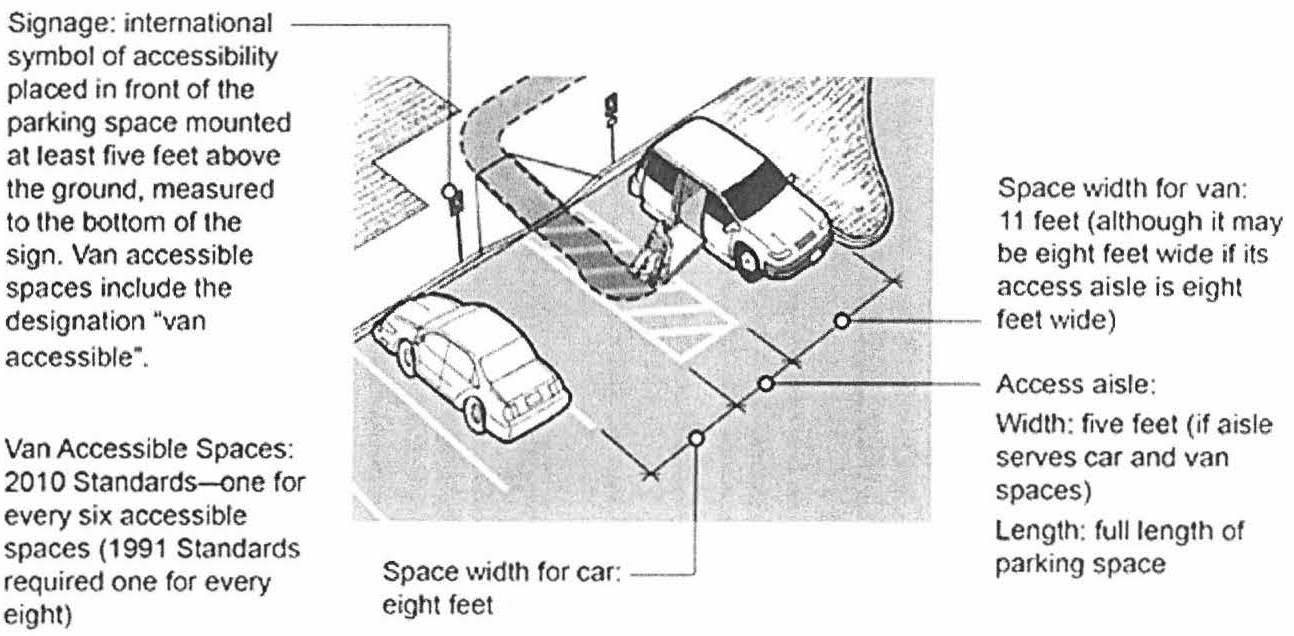
Accessible parking for disabled persons. A portion of the total number of provided off-street parking spaces in each off-street parking area or facility shall be specifically designated, located, and reserved for the use by persons with physical disabilities. Accessible parking required by this section shall count towards the fulfillment of the general off-street parking requirements of Table 6:1.1.2(A).
1.
Number of required accessible spaces. One (1) of every six (6) accessible parking spaces, or fraction thereof, must be "van-accessible." For example: A parking lot with four hundred (400) total spaces needs eight (8) accessible spaces, and two (2) of those eight (8) spaces must be van-accessible. The number and type of accessible parking spaces shall be as follows:
2.
Location of accessible parking spaces. Accessible parking spaces must be located on the shortest accessible route of travel to an accessible facility entrance. Where buildings have multiple accessible entrances with adjacent parking, the accessible parking spaces must be dispersed and located closest to the accessible entrances.
3.
Space Identification and Marking. Parking space identification shall include: pavement marking with the International Symbol of Accessibility, striping of the accessible aisle and installation of ADA compliant signage mounted so that the lower edge of the sign is at least five (5) feet (sixty (60) inches) above the ground.
4.
Surface. The surface of accessible spaces and access aisles must be smooth, stable, and comply with slope and cross slope requirements to ensure safe use for people with disabilities, including those who must load, unload, and use wheeled mobility devices.
5.
Van-accessible spaces, their associated access aisles, and the vehicular routes serving them must provide vertical clearance of at least ninety-eight (98) inches to allow for the height of typical wheelchair lift-equipped vehicles.
6:1.1.3 Parking Design and Location Standards.
The following design standards shall apply to all parking lots:
A.
Surfacing and maintenance. All required parking and vehicular driving surfaces shall be graded for drainage in accordance with the Land Development Regulations. All parking and vehicular driving surfaces required pursuant to minimum spaces required in Table 6:1.1.2(A) shall be surfaced with concrete or asphalt concrete pavement except as required or allowed in subsections 6:1.1.3(B) and (C) of this section. All surfaces shall be maintained in sound condition free of weeds, dust, trash, and debris.
B.
Overflow parking. All parking areas above the maximum number of spaces required in Table 6:1.1.2(A) are considered as overflow parking and shall be turf or an approved pervious paving system. Turf may be used for parking areas and vehicular driving surfaces only for parking areas which are designed not to be used more than ten (10) times per year or for storage lots which generate less than thirty (30) average daily trips. Overflow parking areas shall also be subject to the parking lot landscape requirements of subsection 6:2.2(E), Landscape Requirements.
C.
Paving exemption for assembly uses. The Director may waive the paving requirement for up to fifty (50) percent of the required parking spaces and vehicular driving surfaces for assembly uses (religious institutions, sports facilities, and the like). The waiver may be granted only if evidence is presented to the administrator that these parking spaces and vehicular driving surfaces will be used less than five (5) times per week and are not required for access by emergency vehicles. Parking areas for which paving is waived shall maintain a turf surface and be constructed with proper drainage.
D.
Markings. All paved parking spaces shall be identified by surface markings and shall be maintained in a manner so as to be readily visible at all times. Such markings shall be arranged to provide for orderly and safe loading, unloading, parking, and storage of vehicles. All striping shall be marked with four-inch lines.
E.
Backing movements prohibited. All off-street parking spaces and driveways, with the exception of parking areas for one-family and two-family detached dwellings, shall be arranged to require ingress and egress from the lot to a public street by forward motion of the vehicle. For single-family and two-family residences only, driveways may be used to satisfy minimum off-street parking requirements, provided that sufficient space is available to satisfy the minimum design standards.
F.
Overhang protection. Wheel or bumper guards or curbing shall be provided, located and arranged so that no part of any parked vehicle will extend beyond the boundaries of the parking space and into a pedestrian area, landscape area or beyond the property line of the site.
G.
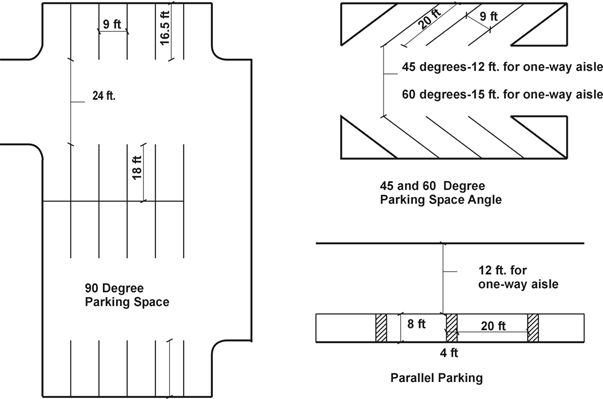
Dimensions of parking stalls and driveways. All required parking spaces shall be designed to comply with the following minimum standards of Table 6:1.1.3(G):
6:1.1.4 Off-Street Loading Requirements.
Unless otherwise approved by the Director, an area shall be provided for loading and unloading delivery vehicles for all institutions, businesses or industries. The spaces shall be arranged so that no vehicle will be required to back onto a public street or way and so that vehicles may maneuver for loading and unloading entirely within the property lines of the premises. Off-street loading spaces shall be provided in the following numbers:
A.
Commercial uses. Each use shall provide one (1) loading space, measuring ten (10) feet by twenty-five (25) feet with overhead clearance of fourteen (14) feet, for each twenty thousand (20,000) square feet of gross floor area or fraction thereof.
B.
Service and industrial uses. Each use shall provide loading spaces that measure ten (10) feet by fifty (50) feet with overhead clearance of fourteen (14) feet, based on the gross floor area as shown below:
C.
Computation of Loading Requirements.
1.
Fractions. When measurements of the number of required spaces result in a fractional number, any fraction of less than one-half (½) shall be rounded down to the next lower whole number and any fraction of one-half (½) or more shall be rounded up to the next higher whole number.
2.
Multiple uses. Lots containing more than one (1) use must provide loading in an amount equal to the total of the requirements for all uses.
6:1.1.5 Vehicle queuing and stacking spaces.
The vehicle queuing and stacking standards of this section shall apply unless otherwise expressly approved by the Director.
A.
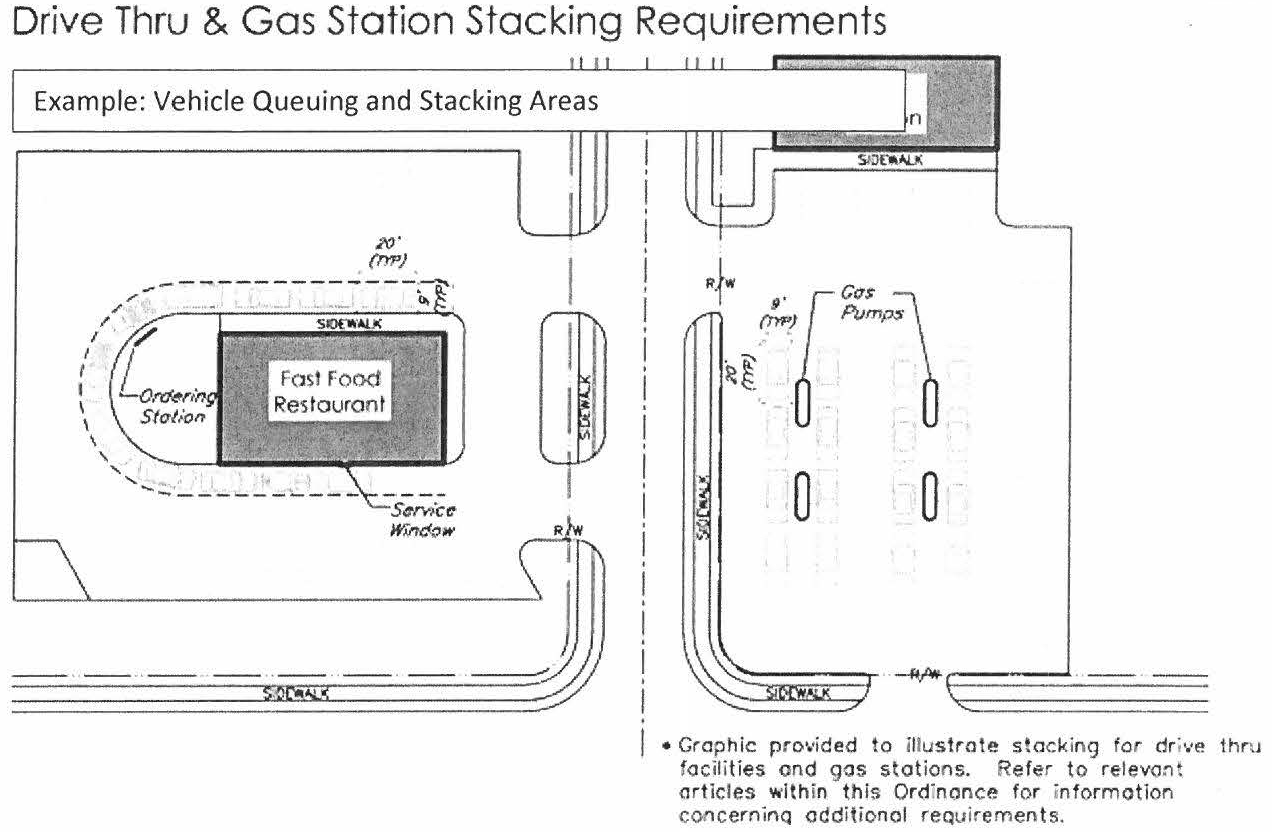
Minimum number of spaces. Off-street queuing spaces shall be provided as follows:
B.
Design and layout. Required queuing spaces are subject to the following design and layout standards:
1.
Size. Queuing spaces shall be a minimum of eight (8) feet by twenty (20) feet in size.
2.
Traffic circulation. Queuing spaces may not impede on-site or off-site traffic movements or movements into or out of off-street parking spaces.
3.
Driveway design. Queuing spaces shall be separated from other internal driveways by raised medians if deemed necessary by the Director for traffic movement and safety.
4.
Pedestrian design. Where pedestrian pathways or routes cross a drive-thru lane, the pedestrian pathway or route shall be raised and made prominent, such as through material changes, to ensure pedestrian visibility and safety.
5.
Architectural design. If covered, the roof over a drive-thru area shall have the same architectural design and materials as the principal structure on site.
6.
On-site location. No appurtenance to the drive-thru facility, including, but not limited to, queuing lanes, drive-in parking spaces, service windows, ordering stations, menu boards, or similar appurtenances, shall be located between the front of the principal structure and the adjacent street right-of-way.
6:1.1.6 Channelized automobile storage.
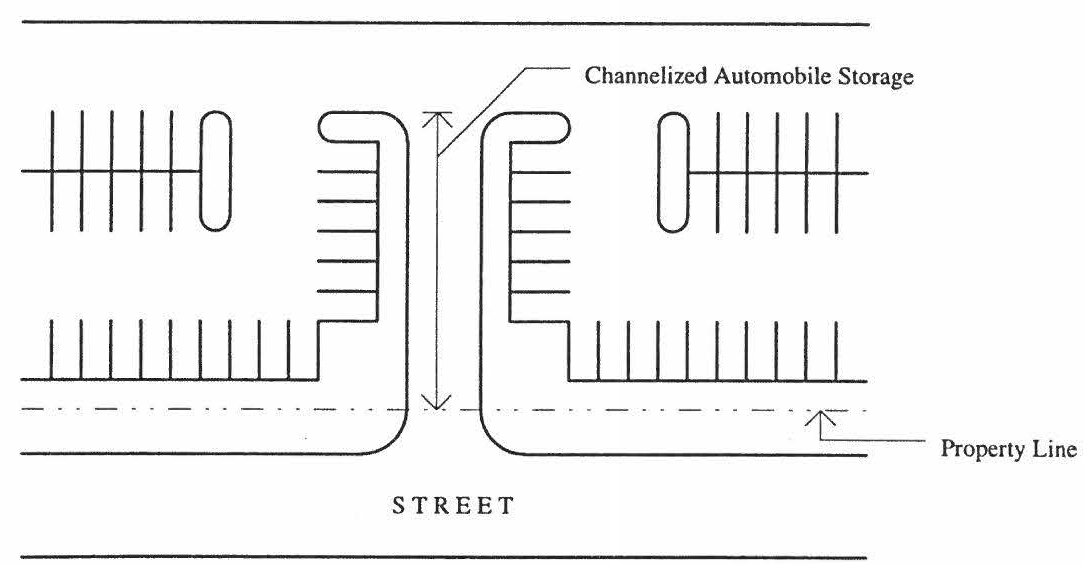
Channelization designs for parking structures are exempt from these standards. Unless otherwise provided for by SCDOT, all other parking lot entrances from public rights-of-way shall provide the minimum channelized automobile storage space as follows:
(Ord. No. 833, amd. 1, 9-18-2017; Ord. No. 882, amd. 2, 1-22-2019; Ord. No. 1014, § 3, 12-19-2022)
Sec. 6:2. - Landscape and Design Standards.
6:2.1 Purpose and Intent. Recognizing that trees and landscaping contribute to the public health, safety and welfare, the City of Mauldin has set standards for landscaping in the city. Among the benefits of trees, shrubs, and other plant materials are: improved air quality, beneficial climate modification, reduction of glare, noise, odors and dust; improved water quality and reduction of stormwater runoff and flooding, screening of undesirable views, provision of buffers between incompatible land uses; and providing an aesthetically pleasing environment for property owners, residents, visitors and the general public.
It is the intent of this section to provide appropriate landscape treatments to all development and redevelopment in the City. Recognizing the diverse nature of properties in the City, standards have been created to not only encourage good practice in design, but to also include provisions that allow creativity and flexibility through alternative methods of compliance to promote orderly development and redevelopment of properties.
6:2.2. Applicability. The standards contained in this section shall apply to all new development and redevelopment of parcels within the City of Mauldin's zoning jurisdiction, with exception to those uses listed as exempt in subsection 6:2.2(C) below. The following types of development shall bring the entire site into full compliance with the requirements set forth in this section.
A.
New Development.
1.
Public and Private Non-residential Development (e.g. Commercial, retail, office, restaurant, service uses, institutional uses, etc.).
2.
Group Residential Developments (e.g. Multi-family, Townhomes, Condominium).
3.
New Residential Subdivisions (also subject to the requirements outlined in the Land Development Ordinance).
4.
Planned Developments and Planned Office Developments (also subject to the requirements outlined in the Land Development Ordinance).
5.
Parking lots and other vehicular use areas including:
a.
New stand-alone parking lots and/or other vehicular use areas.
b.
Existing unpaved parking lots or vehicular use areas that are undergoing paving.
B.
Renovations and/or Improvements that exceeds twenty-five (25) percent of the Taxable Market Value as determined by the Greenville County Tax Collector's office. The value of any expansion, addition, enlargement, or reconstruction of such structures or sites over a three-year period occurring under the same ownership and/or developed by the same developer shall be used when calculating the twenty-five (25) percent threshold.
1.
Building expansions or additions exceeding fifty (50) percent of the pre-expansion floor area.
2.
Existing unpaved vehicular use areas of which fifty (50) percent or more is paved or existing paved vehicular use areas of which fifty (50) percent or more is demolished and repaved.
C.
Exemptions. These requirements of this section shall not apply to:
1.
The construction or renovation of a single-family detached dwelling unit or duplex on an existing lot of record, unless otherwise noted.
2.
Public and private utilities, except when a zoning permit or subdivision approval is required. Such utilities may include but are not limited to: storm drainage installation, street construction, water and sewer construction; and electric, gas, communications and other similar service installations.
D.
Reference made to the Business and Development Services Director is also intended to include an assigned appointee.
STANDARDS OF ORDINANCE
6:2.3. General Requirements for submittal of a Landscaping Plan.
A.
Review for Compliance. Review for compliance with the standards of this section shall occur at the time of submittal of a building, zoning or other applicable permit and/or land development application.
B.
Landscape Plan Submittal. Applicants are advised to meet with the Business and Development Services Department staff prior to submitting a site and landscape plan to discuss applicable landscape requirements, other ordinance requirements, and coordination of plantings with utility plans. A landscape plan drawn using an Engineering Scale at a measurement of no less than one (1) inch being equal to fifty (50) feet (1" = 50') must be submitted with the site plan and prepared in accordance with the checklist requirements established by the department.
C.
Planting Standards Table. Plantings shall comply with the minimum planting size, and height requirements in Table A below:
D.
Calculations. In cases where the calculation used to determine the amount of vegetation needed for compliance results in a fraction, the minimum number shall be rounded upwards to the next highest whole number. Each standard requirement outlines in subsection 6:2.4, Landscape Requirements shall be considered cumulative unless otherwise noted.
E.
Species Variety. To prevent the spread of disease or insect infestation in a plant species, new plantings shall be in the form of genus diversity, as required below:
All new vegetation to be located within a Riparian Buffer zone of designated Special Flood Hazard Area shall be of an appropriate native species as recommended by a Certified Landscape Architect and as approved by the Business and Development Services Director.
6:2.4 Landscape Requirements.
A.
Tree Inventory. Prior to beginning any tree clearing, development work, or land disturbance, the owner of land subject to this section shall prepare and submit an inventory of trees on the parcel, subject to the following requirements:
1.
The inventory shall be prepared at the same scale as the Site and/or Landscape Plan and shall identify any canopy tree two (2) inches or larger in diameter at breast height (DBH).
2.
The survey should depict any individual trees and areas of existing tree canopy that are to be saved in accordance with this section. Known dead or diseased trees shall be identified, where practical. Groups of trees in close proximity (i.e., those within five (5) feet of each other) may be designated as a clump of trees, with the predominant species, estimated number, and average diameter or circumference indicated.
B.
Minimum Tree Density Canopy Coverage. All sites within the City shall provide or maintain a tree density canopy as indicated in subsection 6:2.4(B) Table A, below. The tree density coverage for non-residential developments may be achieved by counting existing trees to be preserved, planting new trees in accordance with the minimum standards or some combination of the two (2). Residential developments shall be required to preserve existing trees or plant new vegetation to meet the Tree Canopy Density requirement.
B1.
Priority Retention Areas. Priority areas for retention of existing trees and vegetation shall include the following (listed in priority order):
a.
Areas containing Heritage Trees, and their associated critical root zones.
b.
Riparian buffers, wetlands, or wellhead protection areas.
c.
Wildlife habitat and other sensitive natural areas.
d.
Designated open space areas.
e.
Areas needed to meet required landscaping (i.e. Transition Buffers, Parking Lot and Vehicular use areas, and Streetscape Landscaping).
6:2.5 Streetscape Landscaping: Street Trees. The street tree requirement is designated to create an attractive streetscape and provide for a pedestrian friendly environment. It also assists in reducing impervious surface areas to improve storm water run-off and provides shade that reduces heat generated from paved surfaces.
A.
Requirement. Street trees are required along all public and private street frontages and shall include only those trees listed in the approved list of tree species unless use of an alternative species is approved by the Business and Development Services Director.
B.
Location. Street trees shall be located in an area no further than ten (10) feet from the existing or proposed street right-of-way line.
C.
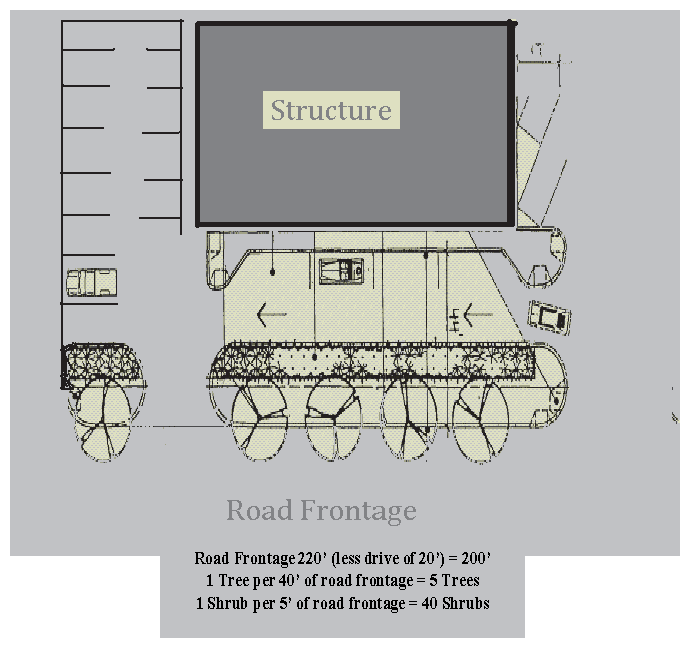
Calculation. One (1) large maturing deciduous tree (greater than thirty-five (35) feet in height at maturity) shall be planted for every forty (40) linear feet of property abutting a street.
D.
Exception: If overhead utilities are present than One (1) small maturing deciduous tree (less than thirty-five (35) feet in height at maturity) shall be planted for every thirty (30) linear feet of property abutting a street.
E.
At the discretion of the Business and Development Services Director, street trees may be clustered, rather than set at regular intervals, to accommodate access drives, and improve building visibility. In no circumstance, however, shall large maturing deciduous trees be located closer than thirty-five (35) feet of another large maturing deciduous tree.
F.
Planting Strip. Trees shall be planted in a planting strip the width of which may vary but shall maintain a minimum of not less than seven (7) feet and an average width of ten (10) feet.
G.
The planting area must be stabilized with ground cover materials, mulch or other approved material to prevent weeds, soil erosion and to allow rainwater infiltration (no soil shall be exposed). Stone mulch shall not be permitted in a street tree-planting strip.
H.
Existing preserved trees located along a street frontage and having a three-inch DBH or greater may be used to satisfy the street tree requirements as long as the vegetation is located within ten (10) feet of the right-of-way. A single existing tree, regardless of its circumference shall not count for more than two (2) tree credits. Preserved trees shall meet all the requirements outlined in subsection 6:2.5, Tree Protection, and be of an acceptable species, alive and healthy at the time of final inspection.
I.
Trees used to comply with the street tree requirement shall not count toward the minimum number of trees required to meet the parking lot landscaping standard.
J.
Residential Subdivision and Townhome Developments. Street trees shall be provided along all existing street frontages and on both sides of any new public or private street serving the development.
a.
Street Tree Calculation: Calculation. One (1) large maturing deciduous tree (greater than thirty-five (35) feet in height at maturity) shall be required for every forty (40) linear feet of street frontage.
b.
Street Tree Placement. Street trees shall be located on private property and in an area located no further than ten (10) feet from the existing or proposed street right-of-way line.
c.
The Business and Development Service Director may consider alternative placement and location of required street trees for Cluster and Open Space Developments and Townhome Developments.
6:2.6 Streetscape Landscaping: Street Buffer (shrubs).
Street buffers are designed to enhance the City's streetscape, provide a separation between vehicular use areas and the street; and to create a more comfortable pedestrian environment. Street buffer shrubs are required in addition to the street tree requirements of subsection 6:2.5(A), and are to be located within the street tree-planting strip.
A.
Requirement. All parking and vehicular use areas shall be buffered from the street.
B.
Calculation. One (1) evergreen shrub shall be planted for every five (5) linear feet of buffer required. Shrub species selected to meet this requirement shall achieve a minimum of three (3) feet in height at maturity.
C.
Exemption. This requirement may be waived if a natural grade change or manmade berm exists and creates a minimum three-foot vertical separation and is completely covered with an approved groundcover.
6:2.7 Parking Lot and Vehicular Use Areas.
A vehicular use area means all driving surfaces including: parking, drive aisles, loading areas and maneuvering areas that are paved and unpaved. Trees and shrubs are required in and around parking lots in order to provide to provide shade to reduce the heat generated by impervious surfaces, provide attractive views from roads and adjacent properties; reduce stormwater run-off and improve water quality, reduce glare from parking lots, and to help filter exhaust from vehicles. Parking lot planting areas shall be designed within parking fields in the following manner: as islands located at the end of parking bays, islands located between parallel rows of cars; and located to visually separate parking areas into rows, and driveway medians.
A.
Applicability. Parking lots with ten (10) or more spaces shall require parking lot landscaping.
B.
Calculating the requirement. One (1) deciduous tree and three (3) shrubs are required for every two thousand five hundred (2,500) square feet of vehicular use area (VUA). At least fifty (50) percent of the required deciduous parking lot trees must be large-maturing canopy trees; and fifty (50) percent of the shrubs shall be evergreen.
C.
Location. Trees and shrubs must be planted within fifteen (15) feet of the vehicular use area to count as parking lot landscaping.
D.
Perimeter parking spaces. All continuous runs of fifteen (15) or more parking spaces shall be interrupted by a tree island.
E.
Interior rows of parking. When more than four (4) parking lot trees are required in a parking field with interior rows, a minimum of fifty (50) percent of the trees and shrubs must be planted in islands or medians located within the parking field.
F.
Canopy coverage. Each parking space shall be located within sixty (60) feet of a tree as measured from the trunk of the tree to the closest point of the parking space.
G.
Minimum island size. The minimum island size shall be one hundred eighty (180) square feet of pervious planting surface per tree. Islands must maintain an average width of ten (10) feet and have a minimum width of five (5) feet.
H.
Protection of trees. Curbing, bollards, or parking barriers shall protect trees and shrubs within five (5) feet of the edge of the pavement. Trees and shrubs in islands should be set back at least three (3) feet from the curb so as not to interfere with car doors opening.
I.
Multiple parking bays. When more than four (4) bays of parking are proposed, an interior island with an average width of twenty (20) feet and a length equivalent to the length of the average parking bay is required. This island must be planted and include a pedestrian walkway no less than five (5) feet wide and placed in a location that enhances pedestrian circulation, preferably leading directly to a building entrance or sidewalk.
J.
Heritage Trees. The Business and Development Services Director may modify the landscaping requirements and/or the parking requirements through the Alternative Landscape Compliance process (subsection 6:2.4) in order to preserve an affected Heritage tree.
6:2.8 Transition Buffers between incompatible uses.
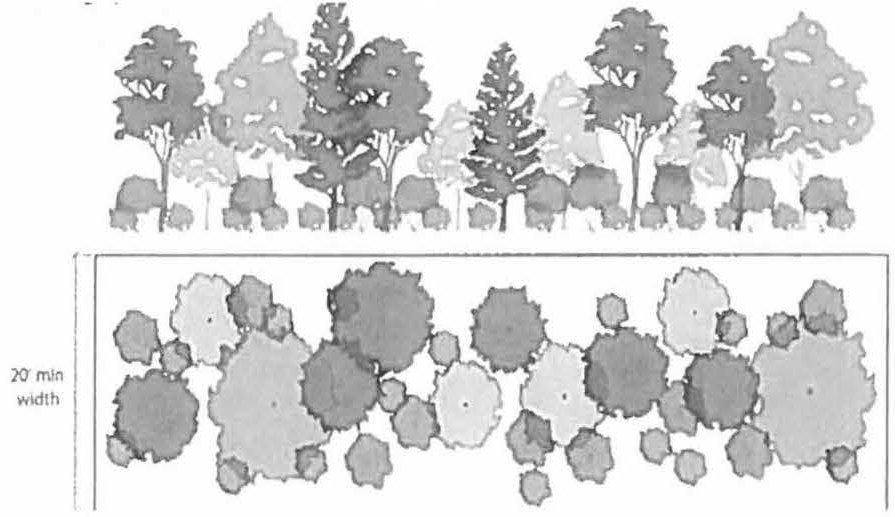
Some land uses may create an adverse impact when developed adjacent to other less intensive land uses commonly found in certain zoning districts. Bufferyards shall be required for proposed developments adjacent to parcels of dissimilar zoning designations to provide a transition between districts of varying intensities. The bufferyard width and number of plantings required will vary depending on the degree of difference between the zoning designations and shall be the responsibility of the property owner developing or changing the land use.
Material should generally be planted in a free form manner to simulate a more natural appearance, while maintaining consistent coverage for visual screening at all plant heights. Plant variety is encouraged, particularly in larger buffers, to reduce the impact of species specific disease or pest problems.
Sample Transition Buffer:
A.
Bufferyard types. The amount of plant material required in a bufferyard area is measured per one-hundred (100) linear feet and is based on the following table.
B.
Buffer determination. The type of buffer required is based on the following table. The table is to be read in one (1) direction only starting from the proposed development site zoning column.
C.
Transition Buffer location. Buffers shall extend along the entire property line that is adjacent to the property of dissimilar zoning designation. Buffers are to be located on the property that is being developed or changing in land use, and between the property line and any vehicular use areas, buildings, storage, service areas, or other area of activity.
D.
Placement of Transition Buffer plantings. The exact placement of the required plants shall be the decision of the developer or designer but shall be approved by the Business and Development Services Director. Plants should be placed in a manner to serve as an effective and attractive screen year-round when viewed from any area accessible to the public or from adjacent properties. Trees or shrubs should be planted at least five (5) feet away from the property line to ensure maintenance access and to avoid encroaching upon neighboring property.
1.
Setbacks. Where a setback and bufferyard are required along the same property line the requirement with the greatest dimensional width shall be applicable. If the setback is greater than the bufferyard, the total number of required plant material shall be distributed throughout the wider setback.
2.
Corner lots and through lots. No buffer will be required along the front property line of any lot. However, a lot with more than one (1) street frontage will require a transition buffer along the secondary street face when it is adjacent to a dissimilar zoning district where a buffer is required. Buffer requirements can be waived in lieu of street trees and street buffers, provided that the development and building façade along the secondary street frontage is pedestrian oriented with functioning pedestrian entrances that open onto public sidewalks.
3.
Encroachments. The following site features may penetrate or encroach into a required buffer area provided that the total number of required plantings is still met: approved driveway openings, pedestrian or bicycle paths, designated greenways or walking trails, utilities (providing that conflicts with vegetation is considered) and walls/fences.
4.
Prohibitions in Transition Buffer. The following are specifically prohibited from encroaching into required buffer areas: loading areas, storage areas, parking areas and drive aisles (unless cross access and/or shared parking with adjacent properties are provided); dumpsters and stormwater retention/detention structures.
5.
Credit for overlapping requirements. Fifty (50) percent of transition buffer plants that are within fifteen (15) feet of a vehicular use area may be counted towards the parking lot landscaping.
6.
Alternative Compliance for existing constrained sites is offered through subsection 6:2.3, Alternative Landscape Compliance.
6:2.9 Additional Screening Requirements:
Outdoor Storage Areas, Utility Structures, and Dumpsters.
A.
All dumpsters, loading docks, utility structures and outside storage yards visible from a public street or adjacent property line shall be screened in accordance with this section unless already screened by an intervening building or an existing vegetated buffer yard that currently provides effective year-round screening.
B.
Acceptable screening materials shall include a fence and/ or wall constructed of solid material made up of wood, vinyl, brick masonry, stone masonry, or architectural masonry finish with no more than a one-half inch gap and with a minimum height of six (6) feet, including, gates that are equal in height with the same characteristics. (Neither fabric, mesh, wind, plastic slat and/or other forms of like material(s), without of without chain link fencing, shall be allowed as a form of screening that is required in this section).
1.
Screening shall be installed with the finished side of the fence and/or wall facing the abutting property and/or the street.
2.
Screening areas that exceed twenty-five (25) linear feet in length shall be required to install a combination of acceptable screening materials and landscaping to soften the appearance of the fence and/or wall. Evergreen trees and/or shrubs shall be planted in a five-foot planting area (except around access areas), and spaced no farther than eight (8) feet apart in order to screen at least fifty (50) percent of the fence and/or wall at maturity.
C.
All cooling towers, air conditioning condensers, and other equipment (whether mounted on the roof of a structure or located on the ground) shall be enclosed inside a wall, fence, or a combination of a fence and evergreen hedge, which hides the equipment from view. Ground units that are less than twenty-five (25) linear feet in length and not visible from the street may shield the equipment from view with evergreen vegetation.
D.
All outdoor storage areas shall be screened by solid fencing, walls, or buildings, or a combination thereof, not less than six (6) feet in height. No merchandise, material, or equipment shall exceed the height of the screening fence, wall, and/or building. If screening of the merchandise, material, or equipment requires a screening height greater than six (6) feet, the storage area and the screening, fencing, walls, and/or building(s) shall be located in the rear yard, and away from any public right-of-way.
E.
The Director of Business and Development Services shall have the authority to consider alternative methods and materials for achieving screening during active building construction, and/or other unique forms of development activity.
6:2.10 Alternative Landscape Compliance.
A.
Applicability. The landscape requirements are intended to set minimum standards for quality development and environmental protection. Conditions associated with individual sites may, under certain circumstances, warrant approval of alternative methods of compliance where normal compliance is impractical or impossible, or where maximum achievement of the purpose and intent of this article can only be obtained through alternative compliance. It is not the intent of this section to allow alternative compliance on the basis of economic hardship. In the event that such conditions are present, the Business and Development Services Director shall have authority to adjust the requirements of this chapter as provided in subsection (C) below.
Alternative plants, materials, location, or installation methods may be justified due to natural conditions, such as streams, wetlands, natural rock formations, topography, easements, lot configuration, and other physical conditions related to the site. A landscape architect or landscape designer may also propose an Alternative Landscape Plan as a method to provide a less traditional plan while still providing an appropriate level of landscape quality that meets the intent of the various requirements of this Ordinance.
B.
Submittal Requirements. The applicant shall submit to the Business and Development Services Director a written explanation as to the need for an Alternative Compliance approval and explain how the proposed landscape plan meets or exceeds the landscape requirements outlined in this section. The proposed landscape plan shall clearly indicate any and all areas for which Alternative Compliance is requested. The plan shall also show all existing site features and any newly proposed features, if applicable.
C.
Allowable Deviations. The Business and Development Services Director is authorized to approve an Alternative Landscape Plan if it meets the purpose and intent of the landscaping standards as outlined in this section. Unless otherwise specifically permitted by this ordinance, the landscape requirements of a specific standard shall not be reduced by more than twenty-five (25) percent. Requests to reduce standards beyond what is authorized under this section will require a variance from the Board of Appeals.
D.
Considerations and Hardships. The Business and Development Services Director may consider Alternative Compliance for the following reasons:
1.
The topography, soil, vegetation, or other site conditions are such that full compliance is impossible or impractical.
2.
The existing site has space limitations or is unusually shaped and full landscape compliance would affect adherence to required off-street parking, loading, or accessibility requirements.
3.
Additional environmental quality improvements would result from the alternative compliance.
4.
Safety considerations make alternative compliance desirable.
5.
An alternative compliance proposal meets the intent and purpose of the Landscape Ordinance in a manner that is equal to or better than compliance with the regulation contained in code.
E.
[Special Consideration.] Special Consideration for Alternative Compliance related to Infill, Change of Use or Adaptive re-use of an existing site where no exterior improvements are required for occupancy of an existing building and the site in its present state is ninety (90) percent or more impervious.
1.
Transition Buffers. Buffer widths may be reduced by fifty (50) percent with the installation of a six-foot tall, opaque privacy fence or wall with the finished face of the fence or wall facing towards the adjacent property. The finished fence or wall shall be planted with evergreen trees and/or large evergreen shrub species spaced every eight (8) feet on center. These plantings shall be located within a seven-foot wide planting area along the exterior of the fence facing the adjacent property. This alternative may not be used when the existing parking area exceeds the minimum number of off-street parking spaces required for the development.
2.
Parking lot and Vehicular Use Landscaping. The requirement for plantings in interior islands may be reduced up to thirty (30) percent.
3.
Alternative Street Tree requirements, Planting Strip Width. The required ten-foot wide planting strip for street trees may be reduced if one (1) or more of the following objective standards apply:
a.
An existing sidewalk, building(s) and/or other permanent infrastructure prevents its installation. In no case shall the planting strip be less than five (5) feet wide or the planting area be less than two hundred (200) square feet per large maturing tree, or one hundred fifty (150) square feet per small maturing tree.
b.
A subsurface structure is used to allow for an aerated area of two hundred (200) square feet per tree. Construction detail must be provided.
c.
An adopted streetscape plan, corridor plan, and/or neighborhood plan calls for a different standard and the development complies with this standard.
F.
Decision. The Business and Development Services Director shall review the performance of the Alternate Compliance plan. The purpose of this review shall be to determine if the alternate plan meets the intent and purpose of this section. This determination shall take into account the land use of adjacent property, the amount and species of plant material, its arrangement and coverage of the lot; the level of screening and the mature height, spread and canopy of the plantings. Upon justification of these findings, a decision of approval or denial shall be rendered.
G.
Appeals. Appeals to a denial of an Alternative Compliance Landscape Plan by the Business and Development Services Director shall be submitted and reviewed by the Building and Zoning Board of Appeals through the Variance procedures outlined in subsection 4:1.3.4, Board Actions to a Variance Required.
6:2.11. Tree Protection and Credits.
A.
Purpose. Protection of existing tree cover is intended to preserve the visual and aesthetic qualities of Mauldin to encourage site design techniques that preserve the natural environment and enhance the developed environment: to control erosion, slippage, and sediment runoff into streams and waterways; to increase slope stability; and, to protect wildlife habitat and migration corridors. Preservation or provision of trees near structures also serves to conserve energy by reducing heating and cooling costs.
B.
Applicability. The requirements of this section shall apply to all existing and new development, except that the following developments and activities shall be exempt from this section:
1.
The removal of trees located on individual lots containing single-family detached dwellings.
2.
The removal of dead or naturally fallen trees, or trees that are found by the Business and Development Services Director to be a threat to the public health, safety, or welfare.
3.
The selective and limited removal of trees or vegetation necessary to obtain clear visibility at driveways or intersections, or for the purpose of performing authorized field survey work.
4.
The selective and limited clearing of utility easements to maintain their intended function.
5.
The removal of trees or vegetation on land zoned or lawfully used for: Agricultural and forestry activities, including tree farms and approved forestry management practices, except that if a site is substantially cleared of trees pursuant to legitimate forestry activities (no development applications shall be accepted for thirty-six (36) months from the date the clearing is completed); or commercial garden centers, greenhouses, or nurseries.
C.
Credits and other incentives to preserve vegetation. Developments intending to preserve existing vegetation in order to receive credit for required landscaping must graphically show the location of each tree In order to receive credit, preserved vegetation must be in good health and condition and must meet the spacing requirements of the standards it is intended to satisfy.
Protective barriers must also be shown on the landscape and grading plans in accordance with the requirements of this section. If a preserved tree dies within twenty-four (24) months of completion of the project, it must be replaced with the total number of trees that were credited to the existing tree. No credit will be given to invasive-exotic species.
Any development that proposes to preserve existing vegetation will receive credit for that vegetation at the rate assigned as follows in Table 6:2.11(C)—A:
D.
Tree Protection during Construction.
1.
Protective fencing. Before grading begins fencing shall be required around the critical root zone and drip line of all trees that are to be preserved. Additional fencing shall be required around the critical root zone of trees on adjacent properties or located in a right-of-way.
2.
Type of fencing. All fencing required by this section shall be a minimum of four (4) feet high and of durable construction; such as wood or metal fencing.
3.
Signs. Signs shall be installed on the protective fence visible on all sides of the fenced-in area (minimum one (1) on each side and/or every three hundred (300) linear feet). The size of each sign must be a minimum of one (1) foot by one and one-half (1.5) feet and shall contain the following: "TREE PROTECTION ZONE: KEEP OUT."
4.
Activity within a fenced tree protection zone. No construction, grading, parking, equipment, or material storage, or any other activity, shall be allowed within the fenced area.
5.
Maintenance of fencing. For existing trees to be counted toward required tree credits, they must be protected during the entire development period, beginning prior to the commencement of site work. Encroachment within the tree protection zone is only permitted to allow the Landscape Contractor access to complete site work.
6.
Encroachments. Encroachments within the critical root zones of any tree being preserved to comply with required tree credits, or within designated tree protection zones, shall occur only in rare instances. If such an encroachment is anticipated, a written request must be made to the Business and Development Services Director for allowance of encroachment. Request must detail preventative measures taken. If approved the following preventative measures shall be employed:
a.
Clearing activities. The removal of trees adjacent to a tree protection zone can cause inadvertent damage to the protected trees. Wherever possible, it is advisable to cut minimum two-foot trenches along the limits of land-disturbance, so as to cut, rather than tear, roots. Trenching is required for the protection Heritage trees.
b.
Soil compaction. Where compaction might occur due to traffic or materials through the tree protection zone, the area must first be mulched with a minimum four-inch layer of processed pine bark or wood chips or a six-inch layer of pine straw. Equipment or materials storage shall not be allowed within tree protection areas.
E.
Protection and removal of Heritage trees.
1.
In order to protect significant trees, the city has established a Heritage tree designation. A Heritage tree is any tree greater than thirty (30) inches in diameter. A Heritage tree shall be further defined as one (1) that is free of major damage, and exhibits the growth habit and superior qualities to be considered a specimen of its species. Heritage trees shall be protected on a development site in accordance with the tree protection standards outlined in subsection 6:2.11(D), Tree Protection during construction.
2.
Heritage trees shall not be cut, removed, pushed over, harmed, trimmed, sprayed, or destroyed without written approval by the Business and Development Services Director.
3.
Removal of a Heritage Tree. Except on lots containing existing single-family detached dwellings, a healthy heritage tree may only be removed if the landowner demonstrates to the Business and Development Director that one (1) of the applicable following standards are met:
a.
The Heritage tree is certified by an arborist or other qualified professional as being severely diseased, high risk, or dying. A severely diseased, high risk or dying heritage tree shall be exempt from replacement.
b.
The required site grading will have an adverse impact on the tree most likely resulting in decline and death of the tree in the near future.
c.
The Heritage tree is not located within a Riparian Buffer Zone.
d.
After significant attempts to design around a Heritage tree, it is determined that the Heritage Tree is located such that preservation significantly affects the ability to develop the site for its approved uses, and hinders compliance with other required site and landscape developments.
e.
Except on lots containing single-family detached dwellings, each healthy Heritage tree removed or destroyed shall be replaced with three (3) replacement trees, measuring at least six (6) inches in diameter by American Nurseryman Standards, and shall be replanted within twelve (12) months of the removal or destruction of the tree; and/or prior to the close-out of a development under construction.
f.
New trees used to comply with Heritage Tree replacement requirements shall not count toward the street tree requirements or parking lot landscaping requirements.
g.
No construction, grading, equipment, or material storage, or any other activity, shall be allowed within the critical root zone of a heritage tree unless steps taken to adequately ensure the health of the tree are submitted to the Business and Development Services Director in writing.
6:2.12 Compliance.
A.
Time for Installation of Required Landscaping. All landscaping, including mulching and seeding or sodding, shall be completed in accordance with the approved Site and Landscape Plan prior to issuance of a Final Certificate of Occupancy. The Business and Development Services Director may grant an exception to this requirement through the issuance of a Temporary Certificate of Occupancy when all Life Safety, Accessibility, and Land Development standards have been satisfied. Temporary Certificates of Occupancy shall be permitted in thirty-day increments, not to exceed one hundred twenty (120) calendar days.
1.
The Business and Development Services Director may grant an extension for a period beyond one hundred twenty (120) calendar days when the applicant provides an acceptable form of Guarantee that ensures that all landscaping standards will be met at a predetermined date. Refer to subsection 6:2.12(B), Performance Guarantees for Landscaping, for what is acceptable.
2.
Exceptions may be granted due to unusual environmental conditions, such as drought, ice, over-saturated soil (deep mud), or inappropriate planting seasons for the plant species.
3.
Exceptions may be granted due to the substitution or unavailability of plant species or acceptable plant size as specified on the Landscape Plan or Alternative Compliance Landscape Plan in cases where such materials are not commercially available within a reasonable time.
4.
Exceptions may be granted due to circumstances beyond the developer's or landowner's control, such as incomplete road construction or utility work to occur in a proposed landscaped area within one hundred eighty (180) days after expected site completion, provided the developer or land owner submits a letter from the responsible party or utility company stating the estimated installation date.
B.
Performance Guarantees for Landscaping. The Business and Development Services Director may allow issuance of a Certificate of Occupancy to allow a developer/owner to delay the installation of required landscaping materials through the provision of a performance guarantee in accordance with the following requirements:
1.
Types of Performance Guarantees for Landscaping. The owner or developer shall furnish a itemized cost estimate prepared by a professional landscape architect or designer and shall also submit a performance guarantee in any of the following acceptable forms:
a.
Cash deposit made to the City of Mauldin;
b.
Irrevocable letter of credit or Surety Bond from a South Carolina banking institution in a form acceptable to the City; or
c.
Any other financial security found acceptable by the City Attorney.
2.
Performance Guarantee Amount. A cost estimate shall be prepared by a professional landscape architect or designer to include landscaping materials, irrigation and installation labor for all improvements. The improvements shall be guaranteed at one hundred twenty-five (125) percent of the cost estimate provided. An additional non-refundable fee may be assessed to cover the cost of additional administration and inspections to accommodate this process.
3.
Time Limit for Installation. The performance guarantee shall include a statement indicating when all required landscaping installation will be completed. In no event shall the installation of all required landscaping be delayed by more than two (2) growing seasons or one (1) year.
4.
Release of Performance Guarantees. Upon the owner or developer's completion of the installation of the required landscaping, the owner/developer shall provide written notice to the Business and Development Services Director requesting an inspection. Upon verification of achieving full compliance the Business and Development Services Director shall release the full amount of the security.
5.
Forfeiture of Security.
a.
Failure to Install Landscaping. If an owner or developer fails to properly install all required landscaping within the time-frames established in accordance with this subsection, the Business and Development Services Director shall give written notice to the owner/developer (if different) by certified mail, after which time the City may draw on the security and use funds to complete the required improvements.
b.
Report of Expenditures. After completing the required landscaping, the City shall provide a complete accounting of the expenditures, including administration and inspection, to the owner/developer (as appropriate) and, as applicable, refund all unused security deposited, without interest, to the party posting the guarantee. If the costs to complete the required landscaping are greater than the amount of the security, the City may assess the additional costs to the affected property owner(s) or responsible association.
6:2.13 Maintenance of Landscaping Materials.
A.
Responsible Party for Maintenance of Landscaping Materials. The owner shall be responsible for the maintenance of all landscape areas located outside of the public or private street right-of-way. Such areas shall be maintained in accordance with the approved Landscape Plan or Alternative Compliance Landscape Plan and shall present a healthy and orderly appearance free from refuse and debris. All plant life shown on an approved Landscape Plan or Alternative Compliance Landscape Plan shall be replaced if it dies, is seriously damaged, or removed.
B.
Damage Due to Natural Occurrence. In the event that any vegetation is severely damaged due to an unusual weather occurrence or natural catastrophe, or other natural occurrence such as damage by wild or domestic animals, the owner or developer will be required to replant if the landscaping standards are not being met. The owner shall have two (2) growing seasons to replace or replant. The Business and Development Services Director shall consider the type and location of the landscape buffer or required vegetation area as well as the propensity for natural re-vegetation in making a determination on the extent of replanting requirements.
C.
Protection during Operations. The owner or developer should take actions to protect trees and landscaping from unnecessary damage during all facility and site maintenance operations. Plants must be maintained in a way that does not obstruct sight distances at roadway and drive intersections, obstruct traffic signs or devices, and/or interfere with the use of sidewalks or pedestrian trails.
D.
Maintain Shape. All required trees (whether canopy, understory, or otherwise) and shrubs shall be maintained in their characteristic natural shape, and shall not be severely pruned, sheared, topped, or shaped as shrubs.
Trees (including but not limited to Crape Myrtles) that have been severely pruned, sheared, topped, or shaped as shrubs and no longer serve the intended landscape requirement function shall be considered a violation as damaged vegetation in need of replacement and shall be replaced during the current or next available growing season.
E.
Natural Death. The natural death of existing vegetation within any required landscape area does not necessarily constitute a violation and would not require re-vegetation to replace the plant material unless the required landscape area no longer achieves the required standards of this section. In no instance shall this provision be construed to prevent re-planting if, in the opinion of the Business and Development Services Director, the required performance standard of the landscaping is not being met.
6:2.14 Monitoring for Compliance with Landscaping Standards.
A.
Inspections Prior to Certificate of Occupancy. The Business and Development Services Director shall inspect the site prior to the issuance of a Final Certificate of Occupancy for the development. The Certificate of Occupancy shall not be issued if a performance guarantee has not been approved, the landscaping is not living or healthy, or is not installed in accordance with the approved Site and Landscape Plan or Alternative Compliance Landscape Plan, and/or other requirement of this ordinance.
B.
Violations. Failure to maintain required landscape areas (trees and shrubs) in accordance with the standards of this section shall constitute a violation and is subject to enforcement in accordance with Article 12 of the Mauldin Zoning Ordinance.
6:2.15 Acceptable Plant Materials.
The Business and Development Services Director reserves the right to accept additional species that are not listed below.
*Denotes Native Species—Native species are preferred because they are best for our soils and climate, attract a variety of wildlife, provide food and shelter for many species, require less care and watering, and thrive with less fertilizer and disease control.
Table B Acceptable Ornamental or Understory Street Tree Species
Prohibited Plant Lists
Species that are listed within the following documents are prohibited from use.
1. "Invasive Plant Pest Species of South Carolina." Clemson Extension.
http://www.clemson.edu/psapublishing/PAGES/FORESTRY/ForLf28.pdf
2. "Roadside Plants to Avoid." SCDOT.
http://www.scdot.org/community/pdfs/plants_to_avoid.pdf
3. "South Carolina EPPC List."
http://www.clemson.edu/psapublishing/PAGES/FORESTRY/ForLf28.pdf
4. "Prohibited Plant List for the South Carolina Upstate Region"
http://www.greenstepschools.com/greensteps/pdf/UPSTATE%20SC%20-%20Prohibited%20Plant%20List%20-%20FINAL%20Update%207-10-9.pdf
(Ord. No. 805, § 3, 5-16-2016; Ord. No. 822, amd. 1, 4-17-2017; Ord. No. 882, amd. 2, 1-22-2019)
Sec. 6:3 - Other Design Requirements.
6:3.1 Lighting Standards.
The following provisions shall apply to all newly developed properties, except for those developed with a one- or two-family dwelling, to reduce night-time glare, light pollution, and light trespass, and to encourage the use of energy efficient lighting sources. These standards shall also apply when new lighting fixtures are being placed at an existing developed property. These provisions shall not apply to street lighting erected by a governmental agency for public safety purposes.
6:3.1.1 General Standards for Outdoor Lighting.
The maximum light level permissible at a residential property line shall not exceed one-half (.05) foot-candles where non-residential uses abut residential uses, and shall not exceed two (2.0) foot-candles at the road right-of-way or at a non-residential property line.
6:3.1.2 Flood Lights.
All flood lights shall be installed with the fixture aimed downward at least forty-five (45) degrees below horizontal. Flood lights shall be oriented or shielded so that the source of the light is not visible from the road right-of-way or from any residential use.
6:3.1.3 Wall Packs, Ground Mounted Lighting, and Sign Lighting.
All wall packs shall be cutoff type fixtures. All external lighting fixtures on a sign or ground mounted luminaries lighting building facades, steeples, trees, billboards, monument signs, flags, and other like items shall not exceed fifteen thousand (15,000) lumens light output. Such lighting fixtures shall be oriented or shielded so that the source of the light is not visible from the road right-of-way or from any residential use. The light output from an illuminated sign shall not exceed the limits of subsection 6:3.1.1 herein.
6:3.1.4 Parking Lots and Outdoor Merchandise on Display Areas.
All parking lot and merchandise display area lighting fixtures, other than floodlights permitted under [subsection] 6:3.1.2 herein, shall be cutoff fixtures and shall be mounted at a height not greater than thirty (30) feet above finished grade. Lighting levels in a parking lot shall not exceed twenty (20) foot-candles. And merchandise display area lighting shall not exceed thirty (30) foot-candles.
6:3.1.5 Vehicular Canopy Lighting.
Lighting fixtures under a vehicular canopy shall be cutoff fixtures or fixtures fully recessed into the canopy. Lighting levels under the canopy shall not exceed thirty (30) foot-candles, and the source of the light shall not be visible from the road right-of-way or from any residential property.
6:3.1.6 Outdoor Playing Field or Performance Area Lighting.
All outdoor playing field or performance area lighting fixtures shall be equipped with louvers, shields, or other devices to control glare and to direct lighting at the playing field or performance area. Lighting fixtures shall be mounted at a height not greater than eighty (80) feet above the playing field or performance area. Lighting of the playing field or performance area shall be extinguished no later than one (1) hour after the event.
6:3.1.7 Permits.
A lighting plan shall be included with all building permit applications for new construction. Such plan shall include specifications of the lighting fixtures to be used, a detailed site plan which shows the location of all existing and proposed improvements, the location of the lighting fixtures, a point-by-point foot-candle array, and a certification by a qualified design professional that the lighting plan complies with all the requirements contained herein. The same plan requirements shall apply when new lighting fixtures are being erected on an existing developed property.
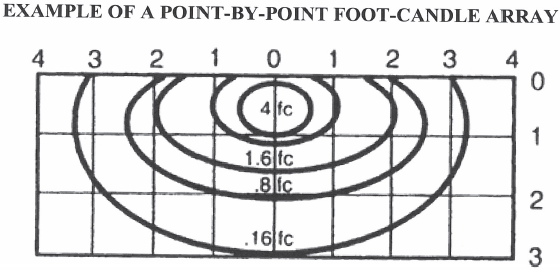
A foot-candle is a quantitative unit measuring the amount of light cast onto any given point, measured a one (1) lumen per square foot.
Commercial to Commercial
The maximum light level permissable on a commercial property that does not abut residential
property shall not exceed two (2.0) foot-candles at the road right-of-way or at a
non-residential property line.
Commercial to Residential
The maximum light level permissable on a commercial property that abuts a residential
property line shall not exceed one-half (0.5) foot-candles.
All External Lighting Fixtures
A lighting plan shall be included with all sign permit applciations. Such plans shall
include specifications of the lighting fixtures to be used, a detailed site plan which
shows the location of all existing and proposed improvements, the location of the
lighting fixtures, a point-by-point foot-candle array, and a certification by a qualified
design professional that the lighting plan complies with all of the requirements contained
herein.
6:3.2 Building Design Standards.
1.
Intent. The purpose of these regulations is to provide specific criteria so that new buildings blend into the historic architectural framework of the City of Mauldin while promoting an improved aesthetic standard for the City. These standards are not intended to restrict imagination, innovation, or variety, but rather to assist in promoting design principles that will contribute to a satisfactory visual appearance, preserve taxable values, and promote the public health, safety, and general welfare within the City of Mauldin.
2.
Applicability. These standards are applicable to all development and redevelopment within the City of Mauldin except for the following:
a)
Any single-family residential use of property; or
b)
Improvements or repairs to existing buildings which do not alter more than fifty (50) percent of the affected roof or façade. Routine maintenance activities shall also be exempt provided the activity does not introduce a new aspect or element that does not conform to these standards such as painting a building a fluorescent color.
Furthermore, only the building color and building finish material standards shall apply to any industrial use of property.
3.
Roof design. Any new roof shall reflect the traditional character of the surrounding community. The roof shall be a type that is commonly found in the surrounding district as determined by the Business and Development Services Director. Roofs shall provide visual interest through the use of varied roof lines and architectural treatments such as dormers, crests, bargeboards, brackets, and decorative cornice lines.
4.
Façade design. Long, monotonous, or uninterrupted horizontal stretches of building façade shall be prohibited. In order to prevent a monolithic edge to the street, facades shall be visually broken up into distinct modules or bays not to exceed 50 feet in length. These modules shall incorporate visual changes in the façade through the use of three-dimensional surface modulations such as wall plane projections, piers, columns, pilasters, colonnades, and arcades.
5.
Building fenestration. Blank, windowless walls shall be prohibited where visible from any public right-of-way. For commercial and office uses, windows and doorways shall constitute at least forty (40) percent of the façade on the ground floor and at least twenty (20) percent of the façade for upper stories on any façade visible from a public right-of-way. For all other uses, windows and doorways shall constitute at least twenty-five (25) percent of the façade on the ground floor and at least twenty (20) percent of the façade for upper stories on any façade visible from a public right-of-way. In no case shall windows and doorways exceed ninety (90) percent of the façade. Where windows are used, they shall be transparent. Windows and doorways shall incorporate decorative elements such as sills, trim, lintels, transoms, and awnings.
6.
Building color. No fluorescent, reflective, metallic, or neon colors shall be used as building colors.
7.
Building finish materials. Exterior building façade materials shall draw upon the finish materials that prevail in the surrounding area, where those materials are allowable, and especially where brick or stone are prevalent. Allowable building materials are specified in the table below. Materials not included in the table below are generally prohibited. Low maintenance materials not allowed herein may be used for trim work not to exceed ten percent of each façade area after excluding doors and windows from the calculation of the façade. The following shall serve as a key to the table below.
a)
Yes (Y): The material is allowable in the listed district(s).
b)
No (N): The material is not allowed in the listed district(s).
c)
Secondary (2nd): The material is only allowable as a secondary material and shall not exceed twenty-five (25) percent of the each façade area after excluding doors and windows from the calculation of the façade area. This standard shall apply to each façade separately and independently. The Business and Development Services Director may accept alternative applications of secondary materials that meet the intent of the design standards and are consistent with or will enhance the surrounding area.
d)
Non-visible (nv): The material may be used as a primary material but only on facades that are not visible from any public right-of-way or are otherwise entirely screened from view.
Table 6.3.2 Allowable Building Materials
(Ord. No. 805, § 3, 5-16-2016; Ord. No. 822, amd. 1, 4-17-2017; Ord. No. 882, amd. 2, 1-22-2019; Ord. No. 970, § 4, 4-19-2021)
Sec. 6:4 - Signs.
6:4.1 Sign Regulations.
6:4.1.1 Purpose and Intent.
The purpose of this section is to create a comprehensive and balanced set of standards for the display of signs in the City of Mauldin that will protect the safety and orderly development of the community, preserve the right of free speech and expression, and provide signs that will enable the public to easily locate goods, services, and facilities within the City. With these purposes in mind, it is the intent of this Ordinance to allow signs that will:
A.
Promote and aid in the economic viability of businesses located in the City of Mauldin by providing an equal and fair opportunity to advertise and promote its products and services without discrimination;
B.
Promote traffic safety and protection of pedestrians, cyclists and motorists from injury and property damage caused by, or which may be partially attributed to cluttered, distracting, and/or illegible signage;
C.
Protect property values, the local economy, and quality of life by ensuring signs are constructed to be structurally sound, aesthetically pleasing, of appropriate scale, and are compatible with the buildings and landscape they identify;
D.
Promote the goals, policies, and objectives of the City of Mauldin's comprehensive plan; and preserve the public health, safety and welfare of the City.
6:4.1.2 Definitions.
Abandoned sign or sign structure: A sign or sign structure which was erected on a property in conjunction with a particular use, said use having been discontinued for a period of one-hundred eighty (180) calendar days or more or a sign of which the contents pertain to a time, event, or purpose which no longer applies or which has occurred. Signs on property shall be considered abandoned when there is clear evidence that a business or activity has vacated the building or grounds.
Advertising device: Any structure or device erected or intended for the purpose of displaying advertising or for which is designed to or attracts attention to the premises, situated upon or attached to real property. For purposes of this Code Section, an advertising device is a "sign."
A-frame Sign (also known as a Sidewalk or Sandwich Board sign): A self-supporting, portable sign with one (1) or two (2) faces that are adjoined at the top and displayed at an angle, which is not permanently anchored or secured.
A-Frame Sign Examples: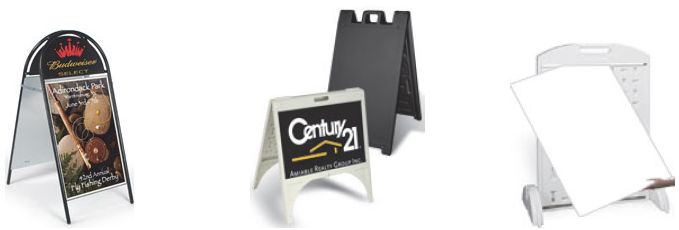
Alteration: Any change to a sign or sign structure because of construction, repair, maintenance.
Animated sign: A sign with action, motion, sound, or changing colors, which accomplishes such action, motion, sound, or changing colors with or without electrical energy. This includes signs with lights or other illuminating devices that blink, flash, fluctuate, or have a changing light intensity, brightness, or color. This definition does not include a time, date and temperature or electronic message signs as defined by this Code Section.
Appurtenance: An accessory, something added to the main structure or land.
Area of sign: The area within a continuous perimeter enclosing the limits of writing, representation, emblem, figure, or character together with any frame, other material, open space, or color forming an integral part of the display or used to differentiate such writing, representation, emblem, figure, or character from the background against which it is placed. For double-faced signs, only the largest display face shall be measured in computing the sign area, or only one (1) face shall be measured in computing sign area if the display faces are the same size. The display of street address on a ground sign, wall, or window shall not be computed in determining the maximum allowable area of a ground, wall, or window sign.
Attached sign: Any sign attached to, applied on, or supported by any part of a building, including but not limited to, a wall, window, projecting sign, or a sign on a canopy or awning.
Awning: An architectural projection or shelter projecting from and supported by the exterior wall of a building and composed of a covering of rigid or non-rigid materials and/or fabric on a supporting framework that may be either permanent or retractable.
Awning sign: An awning that contains letters, numbers, symbols, pictures, logos, or visual display, or other communication, attached, painted on, or made an integral part of an awning. For purposes of this Code Section, "awning signs" shall be considered "wall signs."
Banner: A sign with or without characters, letters, illustrations, or ornamentation applied to cloth, paper, plastic, or natural or synthetic fabric of any kind with only such material for a backing. For purposes of this Code Section, a "banner" is a "sign."
Business Signs on Vehicles: Signs displaying a business name, trademark, or other identifier shall be allowed provided they are moved periodically during the normal course of business and maintain a current and valid registration. When not in use, said vehicles are to be parked in such a manner so as to minimize their visibility from the street and other public property.
Canopy: A permanent attached structure which projects from and is supported by a building, which serves as a cover providing shelter or decoration and which extends beyond the building.
Canopy, attached: A multi-sided structure or architectural projection supported by attachment to a building on one (1) or more sides and also supported by columns at additional points. Signs placed on attached canopies are considered "wall signs" for the purposes of this Code Section.
Canopy, freestanding: A multi-sided structure or architectural projection supported by columns. Signs placed on freestanding canopies are considered "wall signs" for the purposes of this Code Section.
Canopy sign: A sign on a canopy. For purposes of this Code Section, a sign on a canopy is a "wall sign" (see figure, "Types of Attached Signs").
Changeable Copy: Any permanently unframed sign, illuminated or not which is principally devoted to and designed for changeable copy text and graphics, but which specifically excludes time/date/temperature signs and electronic message signs as herein defined. Changeable copy signs may involve either manual or automatic changeable copy. No changeable copy sign may have its copy changed more than two (2) times in a twenty-four-hour period. Any automatic changeable copy sign which changes more than two (2) times in a twenty-four-hour period shall be defined to be an electronic message sign. Portable or moveable signs are not considered changeable copy signs.
Civic Event: An event sponsored by government organization.
Conforming sign: A sign that is legally installed and is in compliance with all applicable local laws and ordinances.
Construction Sign: A sign whose message is limited to identification of architects, engineers, contractors, and other persons involved with the construction project or to the name of the building being constructed, the intended purpose of the building and the expected completion date.
Derelict sign: A sign that is dilapidated or in such condition as to create a hazard or nuisance, or to be unsafe or fail to comply with the Building or Electrical Codes applicable in the jurisdiction.
Development Identification Sign: A sign bearing only the name of the multiple tenant development.
Dimensional Requirements: Those measurements that contain the area, height and spacing requirements for signs.
Directional Sign: A sign or guide whose sole purpose is to direct pedestrian or vehicular traffic on the premises on which it is displayed. Examples include: "in" "out", "entrance", "exit", and "driveway".
Directory sign for multi-tenant development: A sign, distinguished from a project entrance sign, which is allowed on a premises with more than one (1) tenant or occupants of a building. It may be freestanding or a building (wall) sign. Such signs are not usually visible from the public street right-of-way of a development that provides initial access to the property, but rather are located within the development, along a driveway, access way, or parking aisle.
Double-faced sign: A sign which has two (2) display areas against each other or where the interior angle formed by the display areas is sixty (60) degrees or less, where one (1) face is designed to be seen from one (1) direction and the other face from another direction. Only one (1) face shall be used in computing allowable sign area.
Electronic Message Board (EMB's): A permanent sign consisting of text, symbolic imagery, or both, that uses an electronic display created through use of a pattern of lights in a dot matrix configuration allowing the sign face to intermittently change the image without having to physically or mechanically replace the sign face. An EMB message changes more than two (2) times in a twenty-four-hour period, and shall be visible for a minimum of three (3) seconds and shall be kept accurate. These will not be deemed to constitute changeable copy or animated signs.
Erect: To construct, build, raise, assemble, place, affix, attach, create, paint, draw, or in any other way bring into being or establish, but it shall not include any of the foregoing activities when performed as an incident to the change of advertising message or the normal maintenance or repair of a sign structure.
Façade: The exterior wall of a structure or building exposed to public view or that wall viewed by persons not within the building, including parapets walls.
Façade, Primary: A primary façade is a building's principle or face elevation that typically fronts a street. On commercial buildings, the primary façade generally includes the storefront, principle entryway, prominent architectural features, a building cornice and window and door opening. Some commercial buildings may feature multiple primary façades, such as those structures located on a street corner.
Façade, Secondary: A secondary façade has limited architectural features and generally does not have a storefront or other openings. For the purposes of signage, a secondary façade must be architecturally finished with at least one (1) opening (window or secondary entrance) and shall be constructed with similar materials and details as the primary façade.
Flag: A sign with or without characters, letters, illustrations, or ornamentation applied to cloth, paper, plastic, or natural or synthetic fabric of any kind with only such material for a backing. For purposes of this Code Section, except as otherwise provided herein, a "flag" is a "sign."
Flashing Sign: A sign illuminated by direct or indirect artificial light that flashes on and off in regular or irregular sequences, including, but not limited to strobe light.
Freestanding Ground Sign, see also Monument Sign. All freestanding ground signs shall be mounted on a monument structure that is equal to or greater than two-thirds (⅔) the width of a sign itself. Monument structures shall be constructed of brick, stone or stucco materials that have the appearance of brick, stone, or stucco or other durable architectural materials consistent with the design of the primary building on the site.
Freestanding Pole Sign: A sign which is permanently affixed to the ground by a pole or other structure and which is not part of a building. Freestanding poles shall not be permitted.
Frontage, building: The width in linear feet of the front exterior wall of a particular building in which an establishment is located.
Frontage, road: The distance in linear feet of each lot where it abuts the right-of-way of any public street.
Ground sign: A permanently affixed sign which is wholly independent of a building for support (i.e., freestanding). A ground sign must be attached to a monument structure and may consist of more than one (1) sign panel, provided all such sign panels are attached to or integrated into one (1) sign structure.
Handheld Signs or Devices (Also referred to as human signs, sign spinners, living signs and sign walkers:) Signs that are carried, waved, or otherwise displayed by persons either on private or public right-of-way or in a manner visible from a private or public right-of-way and are prohibited.
Height of sign: The distance in vertical feet from the ground at normal grade to the highest point of the sign, whether that highest point is the frame of the sign face or panel or the support of the sign.
Holiday decorations: Displays erected on a seasonal basis in observance of religious, national, or state holidays, which are not intended to be permanent.
Home Occupation Sign: A sign used for a home occupation.
Identification Sign: A sign used to identify, indicate or advertise the name, logo or other identifying symbol of a building, business, profession, institution, service, or entertainment conducted on a lot upon which the sign is located.
Incidental Sign: A single face professional or announcement sign attached wholly to a building, window or door containing information relative to emergencies, store hours, credit cards honored, and other similar accessory information.
Inflatable sign: Any sign that is or can be filled with air or gas.
Internally illuminated sign: Any sign designed to provide artificial light either through exposed lighting on the sign face or through transparent or translucent material from a light source within the sign.
Joint Identification Sign: A sign bearing the name of individual tenants located within a multiple-tenant (multi-tenant) development and which includes the name of the development.
Local Government: Any county, incorporated village, town or city, or any combination of counties, incorporated villages, towns, and cities, acting through a joint program pursuant to provisions of the Act.
Logo: A business symbol or trademark.
Lot for sign regulations: Any number of contiguous lots or portions thereof, upon which one (1) or more main structures for a single use are to be erected.
Marquee Sign: A sign painted in, attached to, or hung from a marquee. For purposes of this Code Section, a marquee shall be considered "wall sign".
Menu Board: A freestanding or wall mounted sign primarily designed for the display of menu items and prices for the purpose of placing orders for such items in conjunction with a restaurant utilizing drive-through or walk up service.
Monument sign: A free-standing ground sign that is supported by a solid base (other than poles) and having no more than twenty-four (24) inches of air space visible within or between any portion of the sign display area and sign structure. All freestanding ground signs shall be mounted on a monument base that is equal to or has a length of at least seventy-five (75) percent of the width of the sign face and supporting structures combined. Monument structures and sign supports shall not have any exposed poles and shall be constructed of durable architectural materials (i.e., brick, stucco, or stone) that are consistent with the design and features of the primary facade of the building on the site.
Examples of a Freestanding Monument Ground Sign (monument structure):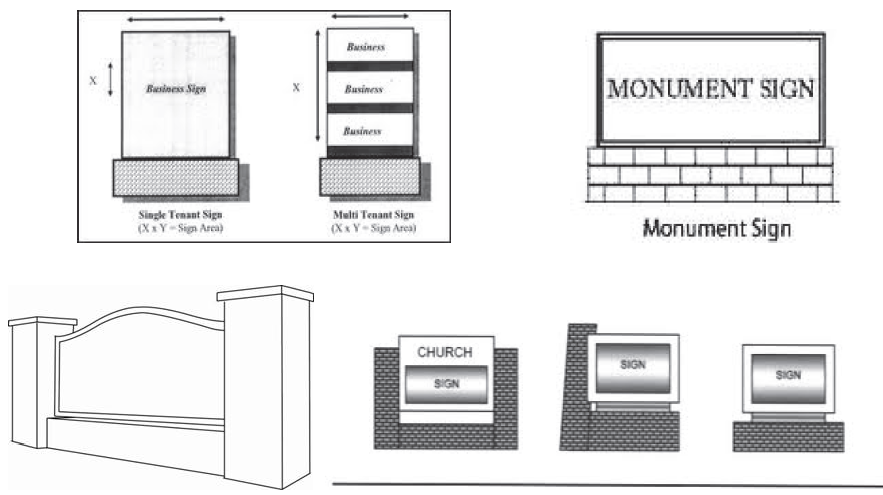
Multiple message sign: A sign, display, or device, which changes the message or copy on the sign electronically by movement or rotation of panels or slats.
Multiple (Multi) Tenant Development (also referred to as Group Development): A development in which there exists a number of individual and separate occupiable spaces and/or buildings and in which there are appurtenant-shared ancillary facilities (such as parking areas, driveways or pedestrian mall areas) with each space having a separate and operable public entrance opening onto or leading to the area of shared facilities.
Nit: A unit of illuminative brightness equal to one (1) candle per square meter, measure perpendicular to the rays of the source.
Off-premises sign: Any sign used for the purpose of displaying, advertising, identifying, or directing attention to business products, operations or services sold or offered at a site other than the site where such sign is displayed.
On-premises sign: Any sign used for the purpose of displaying, advertising, identifying, or directing attention to business products, operations or services sold or offered on the lot site where the sign is located.
Parapet wall: That portion of a building wall that rises above the roofline.
Pennant: A small, triangular or rectangular flag or multiples thereof, made of lightweight plastic, fabric, or other material, individually supported or attached to each other by means of a string, rope, or other material and meant to be stretched across or fastened to buildings, or between poles and/or structures, and which is designed to move in the wind. For purposes of this Code Section, pennants are "signs."
Pole or Pylon Cover: An enclosure for concealing and/or for decorating poles or other structural supports of a ground sign.
Pole or Pylon Sign: A freestanding sign that is affixed, attached or erected on visible pole support structure(s) such that the bottom of the sign face is three (3) feet or more above grade.
Examples of Types of Pole Signs without monument base: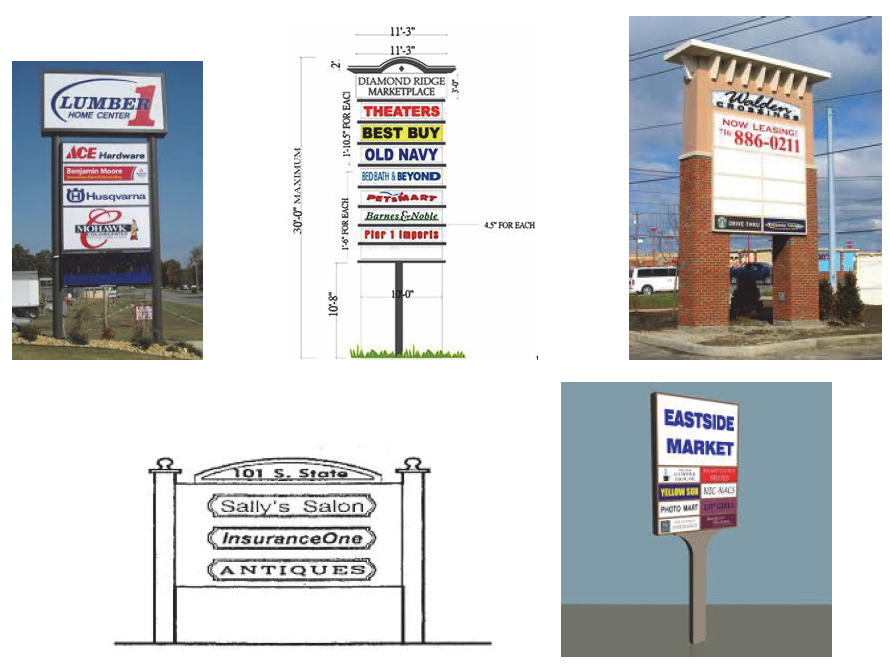
Portable, Mobile and Moveable signs: Any sign that is designed or is intended to be readily relocated and is not permanently affixed to the ground or to a building. This shall include signs on wheels, trailers, truck beds, or otherwise, devices which are designed to be transported from one (1) place to another. It is characteristic of a portable sign that the space provided for advertising messages may be changed at will by the replacement of lettering or symbols (i.e., a changeable copy sign). Even if the wheels or supports of such sign are removed and the sign converted and attached, temporarily or permanently, to the ground or other structure, said sign shall remain a portable sign. In addition, signs mounted or painted upon a parked vehicle that is positioned for the primary purpose of advertising a business or business activity to the public not being used in the normal course of business shall constitute a portable, mobile and/or moveable sign. Portable, mobile and moveable signs shall also include: windblown or air blown devices, wind signs, streamers, snipe signs, animated motion signs, attention seizing devises, decorative flags, and handheld devices which are signs that are expressly prohibited.
Principle Structure: The main or predominant structure(s) in which the primary use occurs. Parcels may support more than one (1) principal structure when said structure does not vary in gross floor area by more than twenty (20) percent.
Principal use sign: Any notice or advertisement, which is permitted in conjunction with (but not necessarily containing copy specifically related to) a single principal use or single principal building located on the property, and which may display a noncommercial, commercial, or other message, the content of which is not regulated by this Code Section.
Projecting sign: A sign projecting more than fourteen (14) inches from the outside wall or walls of any building, or canopy, portico, or awning, upon which it is located (see also figure, "Types of Attached Signs").
Public Agency: Any governmental body (including city, county and state bodies or agencies, and special purpose districts such as fire, water, and sewer districts) that has jurisdiction over property or infrastructure within the City of Mauldin.
Public Awareness Event: An organized, systematic effort through various communications media to alert the general population of a given area to anything of significant interest or concern. Examples include: Paint the Town Teal, Cancer Awareness, Fire Prevention Month, Child Abuse Awareness.
Replacement Cost: Cost of replacing a structure or building at current costs at the time of the loss, identical to the one (1) that was destroyed or is being replaced, without application of depreciation.
Residential Development: A development consisting of buildings for residential uses such as attached and detached single-family dwellings, manufactured homes, apartment complexes, condominiums, townhouses, cottages, etc. and their associated outbuildings such as garages, storage buildings, gazebos, etc.
Roof sign: A sign projecting higher than the front building wall or any sign supported by or attached to said roof.
Examples of Types of Roof Signs: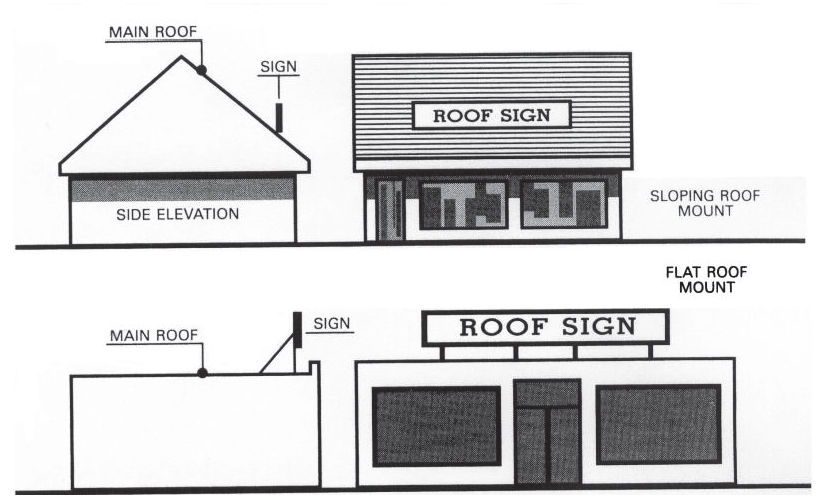
Seasonal Outdoor Sale event: The display and sale of products outside of a building, typically located within a parking area, for a temporary period of time. The following events and similar uses shall qualify as a seasonal sales event: Christmas tree sales, garden sales, produce stands, and pumpkin sales.
Second Tier Development: A development that is located at least one (1) lot back from a major thoroughfare with no direct street frontage and having shared access with adjacent or adjoining parcels and the development consists of more than one (1) structure on the site or within the development. For purposes of signage, this option does not increase square footage allowances or render a single tenant property as a multi-tenant development unless such conditions are met under another definition in this section.
Sign: A lettered, numbered, symbolic, pictorial, illuminated, or colored visual display, device, or communication designed or used for the purpose of identifying, announcing, directing, informing, or bring to the attention of others the subject thereon, that is visible from the public right-of-way, a driveway or parking lot with access to a public right-of-way, or from an adjacent property, except as specifically noted otherwise in this Code Section. For purposes of this Code Section, the term "sign" includes but is not limited to "banners," "balloons," "flags," "pennants," "streamers," "windblown devices," and "advertising devices." Furthermore, the term "sign" includes the sign structure, supports, lighting system, and any attachments, ornaments, or other features used to draw the attention of the observers. This definition shall not include art or works of art provided that the art or works of art does not include logos in their traditional form or the name of the business at whose location the art or works of art are located. The art or works of art shall not be located on the sign or sign panel.
Signable area: In the case of a wall sign, signable area shall be the building face on which the sign is proposed, excluding windows and doors. In the case of canopies, signable area shall be the area of the marquee or canopy wall on which the sign is proposed. For window signs, signable area shall be measured and calculated on the basis of the proportion of area within each individual window frame, not the total window area of all building windows visible from a street.
Sign face: That part of a sign that is or can be used for advertising purposes.
Sign Structure: Any structure that supports, has supported or is capable of supporting a signs, including any decorative cover for said sign structure.
Single Tenant: A single business establishment, or activity or use, which does not share any facilities, such as driveways, parking, storage areas, entrances, etc. with another use. For the purposes of the sign code, a single tenant may also include a use or business that is located on a leased site or individual parcel within a planned development that complies with all development and design codes that are applicable to a stand-alone business located on an individual parcel.
Site visibility triangle: An area that is measured from the curb or edge of pavement, the triangle area created by a line connecting points on the front and side for lines at a distance (as indicated below) from the intersection of said lines or the extensions of said lines.
Example of a Site Triangle: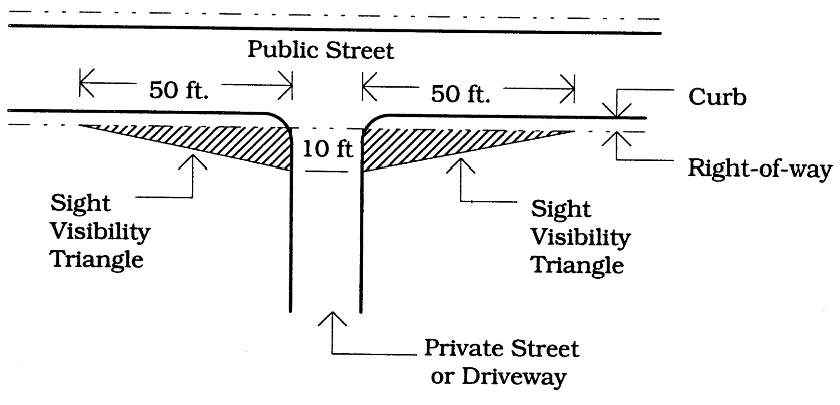
Snipe Sign: A temporary sign which is not permitted or authorized under any provision of this code, and which is tacked, nailed, posted, pasted, glazed, or otherwise affixed to a tree, pole, stake, fence, traffic control device, or another other object or the ground.
Example of Snipe Sign: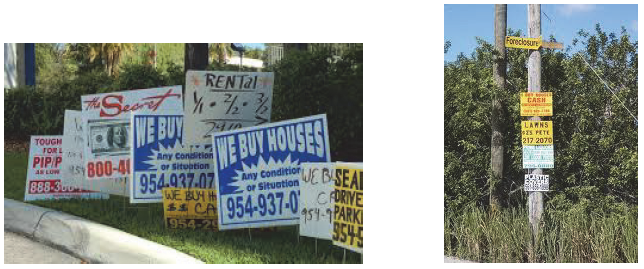
Special Event: A non-routine activity within the City of Mauldin that brings together a number of people including, but not limited to, a performance, exhibition, festivals, concerts, carnivals, arts and craft shows, religious revivals, political rallies, marches, demonstrations, and similarly recognized temporary activities. A "special event" shall not include weddings and funeral ceremonies, elections, private yard sales, charitable fund-raising such as car washes and other similar activities that are otherwise lawfully conducted and which are in accordance with the provisions of the City's Zoning Regulations. A "special event" shall not include minor fund-raising activities of public schools, churches, or other nonprofit organizations that have a minimal impact on surrounding properties. Any organization claiming nonprofit status shall possess a letter or other documentation from the Internal Revenue Service proving nonprofit status. General and temporary retail sales events shall not constitute a "special event".
Static: Characterized by a lack of movement, animation or progression.
Streamers: See "Pennants."
Street frontage: That portion of a lot that adjoins a public street right-of-way and is measured in linear feet. See example of street frontage below.
Example of Street Frontage: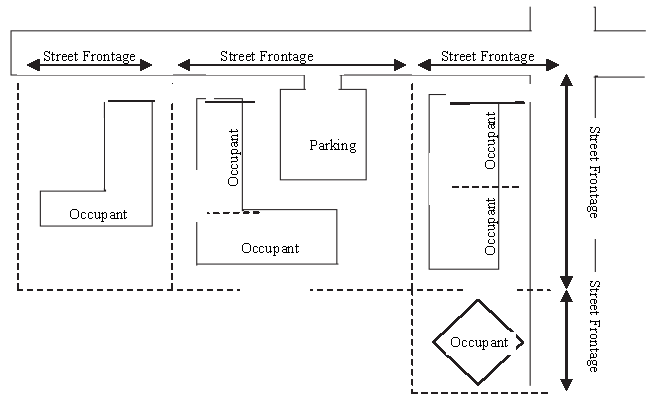
Temporary sign: A sign(s) with or without a frame, not permanently affixed to a building or frame, not permanently attached to a building or structure or the ground and is intended for advertisement of a business or service during a limited period of display. Such temporary signs shall only be permitted in conformance with the provisions set forth in subsection 6:4.1.12B, Temporary Signs.
Examples of Temporary Signs and Temporary Signs with Support Structures:
Time, temperature and date signs: A sign containing numerals or letters, which may be alternately displayed, and which alternating portion only shows the time, date and/or temperature. This sign shall not be considered a flashing or an animated sign.
Trademark: A name, symbol, or other device identifying a product that is officially registered and legally restricted to use by its owner.
Visible: Capable of being seen (whether or not legible) without visual aid by a person of normal visual acuity.
Wall sign: A sign painted or attached flat against and parallel to the exterior wall or surface of a building or other structure and/or which projects from that wall or surface. (see also figure, "Types of Attached Signs").
Windblown or air-blown device: Any device not otherwise specifically defined in this Code Section, that is designed to inform or attract, whether or not such device carries a message, and which all or part of the device is set in motion by wind or mechanically compressed air. For purposes of this Code Section, windblown devices are a considered "signs."
Wind Sign: A suspended or tethered sign made of flexible material such as canvas, sail cloth, plastic or waterproof paper, including but not limited to, banners, pennants, spinners, streamers or balloons.
Window sign: A sign installed on or within two (2) feet of an exterior window or door and intended to be visible from the exterior of the building. Displays which show products or depict services sold on the premises and which are more than two (2) feet from an exterior window or door shall not be classified as window signs (see also figure, "Types of Attached Signs").
6:4.1.3 Applicability.
A.
Protection of First Amendment Rights. Any sign allowed under this ordinance may contain, in lieu of any other copy, any otherwise lawful non-commercial message that does not direct attention to a business, activity conducted, or product sold or offered at a location not on the same premises where such business sign is located.
B.
General. Unless exempted in accordance with this ordinance, no sign allowed by this section shall be erected, repaired, altered, relocated, or displayed without first being issued a Sign Permit and complying with the relevant standards of this section.
C.
Responsibility for Compliance. Review for compliance with the standards is initiated upon submittal of an application for a Sign Permit, Zoning Permit, site plan review, subdivision review, planned development, or formal submittal of another type of application or permit, whichever is appropriate.
D.
License Requirements. When the cost of work for installation, repair of, or maintenance of a sign exceeds five thousand dollars ($5,000.00), a General Contractor with a valid South Carolina State license will be required for the application. For signs that involve electrical work, an electrician with a valid State license is required for the application. All licensed contractors are required to obtain a City Business License.
6:4.1.4 Maintenance.
A.
All signs shall be maintained in sound, structural condition at all times. Signs shall be maintained in accordance with the standards in this section and shall be kept free of weeds, grass or vegetation that obscures the view of the sign message.
B.
The painting and refinishing of the surface of a sign face or sign structure (whether conforming or non-conforming) for the purpose of maintaining an aesthetic appearance for an existing business that is in operation shall be allowed without a sign permit. This provision is not applicable to abandoned signs described in subsection 6:4.1.5, Abandoned Signs.
C.
No sign shall be allowed to deteriorate to a condition in which it requires repairs or renovations in an amount that exceeds fifty (50) percent of its current replacement cost as determined by a licensed sign company. Signs which are defaced, missing some or all illumination or characters, and whose finishes or facings are chipping, peeling, cracking, or broken in any way shall be deemed to be in disrepair.
D.
Signs that are in disrepair or deteriorate to such a condition that they are in violation of this ordinance shall be either removed or replaced within thirty (30) calendar days of receiving notice from the City of Mauldin. If a sign is replaced, the new sign shall comply with the sign standards that are in effect when the sign is removed.
E.
All nonfunctioning bulbs or damaged panels associated with an illumination system shall be replaced or repaired within thirty (30) calendar days of receiving notice from the City.
F.
It shall be the responsibility of the sign owner to maintain the sign and ensure compliance with the provisions of this section. In the event a sign is no longer in use or is considered abandoned, the property owner shall be responsible for maintenance and/or removal of the sign as required in subsection 6:4.1.5, Abandoned Signs.
6:4.1.5 Abandoned Signs.
A.
Nonconforming Signs. When a business vacates a site or a use is discontinued on a site for a period of more than one-hundred eighty (180) calendar days, all existing non-conforming sign(s) and/or off-premise sign(s) associated with the discontinued use shall be considered abandoned and such signs shall be fully removed (including nonconforming support structures) from the property within thirty (30) calendar days from when the site was vacated or upon receiving notification from the City.
B
Conforming Signs. When a business vacates or discontinues the use of a site and the existing sign(s) are deemed to be conforming to the provisions of this section, all sign face(s) and messages used by the previous business shall be considered abandoned and shall be fully removed within thirty (30) calendar days from when the site was vacated or upon receiving notification from the City. The existing freestanding ground (monument) sign may be used to display general information such as "For Lease" or "For Sale" and may reference contact information to assist in leasing or selling the site.
C.
Abandoned signs shall not be leased, rented or sold for any off-site advertising.
D.
The property owner shall be responsible for maintenance and/or removal of an abandoned sign.
6:4.1.6 Prohibited Signs.
The following signs shall not be erected or maintained in any zoning district within the City of Mauldin. The Board of Appeals shall not have the authority or jurisdiction to grant variances so as to allow a prohibited sign to be installed or maintained.
A.
Abandoned or Dilapidated signs. Signs that are abandoned, dilapidated or deteriorated and not maintained in accordance with subsection 6:4.1.4, Maintenance are prohibited.
B.
Animated or Motion Signs. Signs which employs motion in such a manner as to obstruct or interfere with a driver's view of approaching, merging, or intersecting traffic, or traffic signs, device signs or a sign, which would otherwise interfere with a driver's operation of a motor vehicle are prohibited.
C.
Attention-seizing devices. Costumes, characters, mascots, statues, or signs which emit sound, odor, or visible matter and which are displayed in a public or private right-of-way or in a manner visible from the public or private right-of-way, whose purpose is to draw attention to a business, or person for commercial purposes whether holding a sign or not are prohibited.
D.
Decorative Flags (also known as Swooper Flags). Flags that are decorative or otherwise, may not be used in conjunction with a commercial promotion or used as an advertising or attention-getting device for a commercial purpose, or as an integral part of a sign regulated under this section, except as provided for in subsection 6:4.1.12B, Grand Opening Events.
E.
Handheld Signs or Devices (also referred to as human signs, sign spinners, living signs and sign walkers). Signs that are carried, waved, or otherwise displayed by persons either on private or public right-of-way or in a manner visible from a private or public right-of-way are prohibited. This provision is directed towards such displays intended to draw attention for a commercial purpose. It is not intended to limit the display of placards, banners, flags or other signage by persons participating in non-commercial demonstrations, political rallies and other similar non-profit fundraisers or events.
F.
Obscene Materials. Any sign that exhibits statements, words, or pictures of obscene, pornographic or immoral subjects is prohibited.
G.
Off-premises signs. All off-premises signs are prohibited, except as provided for in subsections 6:4.1.7L and M, Temporary Real Estate Signs and subsection 6:4.1.17, Nonconforming Signs, Billboards.
H.
Portable, Mobile and Moveable signs. Any sign that is portable or not securely attached to a building or to the ground is prohibited as defined, except for such signs that are permitted under the provisions of subsection 6:4.1.12B, Temporary Signs.
I.
Pylon and Pole Signs. Pylon or pole-mounted on-premises or off-premises freestanding signs are prohibited. (Only freestanding monument signs are permitted.)
J.
Roof signs. Signs that are not an integral part of the building design but fastened to and supported by (or on) the roof of a building, or projecting over or above the roofline or parapet wall of a building is prohibited.
K.
Signs or Advertisements on Vehicles not Used in the Normal Course of Business. Signs or advertisements placed on vehicles or trailers that are parked or located for the primary purpose of displaying a sign or advertisement of a business or business activity are prohibited. This shall not include permitted overnight or weekend parking of regularly used marked company vehicles in parking lots.
L.
Signs or devices Employing Confusing, Distracting or Intense Illumination. No sign shall be permitted which utilizes intense flashing or strobe-type lights, spot lights, flood lights, flashing or blinking lights, or any types of pulsating or moving lights which may impair the vision, causes glare, or otherwise interfere with any drivers' operation of a motor vehicle.
M.
Signs located in or projecting over a public right-of-way. Signs, whether temporary or permanent, within or projecting over any public right-of-way are expressly prohibited.
N.
Signs Resembling Traffic Signals, and Emergency Lights. No sign shall be permitted which imitates an official traffic sign or signal, or which displays intermittent lights customarily used in traffic signals or on emergency vehicles or on law enforcement vehicles. Nor shall any sign use the word "stop", "danger", or any other words or phrase, or symbol, or character in a manner, which might be misconstrued as a public safety warning or traffic sign.
O.
Signs on roadside appurtenances. On-premises or off-premises signs located on roadside appurtenances, including but not limited to benches, roadside benches, bus stop shelters, planters, utility poles, street signs, trees, parking meter poles, and refuse containers, are prohibited.
P.
Snipe Signs. Snipe signs, bandit signs or other temporary signs that are attached to posts, trees, utility poles, fences or similar support structures for the purpose of advertising an event or product that is not located on the property for which it is advertising or is located within a public or private right-of-way or located in a manner that is visible to a public or private right-of-way are prohibited. This provision shall exclude such signs that are permitted in accordance with subsection 6:4.1.12B, Temporary Signs.
Q.
Wind Signs. Including but not limited to circulars, handbills, banners, inflatable signs and balloons, dirigibles, flags, streamers, spinners, placards, pennants or similar attention seizing, wind-activated devices that are used for a commercial purpose are expressly prohibited, except as provided for in subsection 6:4.1.12B.1) Grand Opening Events.
6:4.1.7 Signs Exempt from Regulations.
Unless otherwise prohibited in this chapter, the following signs are exempt from regulation under this article. Such signs shall not be considered in determining the allowable number of signs on a parcel or determining the maximum square footage allowance; provided, however, that said signs shall comply with all other applicable sections of this ordinance:
A.
American flags flown in accordance with federal guidelines set forth in Title 4, Chapter 1 of the United States Code and not used for commercial purposes.
B.
Merchandise, pictures or models of products or services that are incorporated as an integral part of a window display.
C.
Official flags of a nation, state, county or city, displayed in a dignified manner and not for commercial purposes.
D.
Official governmental notices and notices posted by governmental officers in the performance of their duties; governmental signs, and signs installed under governmental authority which notes the donation of buildings, structures or streetscape materials (such as, but not limited to, benches, trash cans, lampposts and park facilities).
E.
Signs displayed on trucks, buses, trailers, or other vehicles which are being operated in the normal course of business and which are affixed or painted onto moving vans, delivery trucks, contractors' vehicles and equipment are exempt unless such signs are used in a manner prohibited under subsection 6:4.1.6.K. (Use in a normal course of business shall mean driving the vehicle on any street, parking the vehicle at the place of business, or place where business or a service is being conducted.)
F.
Signs required for or specifically authorized for a public purpose by any law, statute or ordinance. These signs may be any law, statue or ordinance. These signs may be of any type, number, area, and height above grade, location, or illumination authorized by law, statute, or ordinance under which such signs are required or authorized.
G.
Signs approved as part of a City adopted wayfinding program.
H.
Temporary or permanent signs erected by government agencies, public utility companies or construction companies to warn of danger or hazardous conditions, including signs indicating the presence of underground cables, gas lines and similar devices or signs providing direction around such conditions.
I.
Trademarks or product names which are displayed as part of vending machines, dispensing machines, and gasoline pumps.
J.
Temporary Residential Advertising Signs used to advertise and promote events and activities within a residential neighborhood shall be exempt from the provisions of the Sign Ordinance; provided that the sign(s) are located a minimum of four (4) feet from the back of curb or street edge on publicly maintained streets; and that such sign(s) do not interfere with ingress and egress points and site lines for vehicular traffic within the neighborhood.
(Ord. No. 777, § 1, 9-15-2014)
6:4.1.8 Signs Exempt from Obtaining a Permit.
The following signs are allowed in all zoning districts and shall not require a sign permit. However, such signs shall conform to the requirements set forth below and to other applicable requirements of this article. In any case where a sign of a certain size is exempted by this section and an applicant desires to erect a larger sign than the area of sign exempted, said sign shall only be permitted upon approval of a variance heard by the Board of Appeals.
A.
Automatic Teller Machines. Signs contained on automatic teller machines that do not exceed fifteen (15) square feet in area per machine.
B.
Civic and Public Awareness Events. Such signs shall be allowed and are subject to the following standards:
1.
One (1) temporary ground mounted sign shall be allowed per parcel with a maximum sign face area of thirty-two (32) square feet and not exceeding six (6) feet in height.
2.
The duration of the event shall not exceed five (5) business days.
3.
Signs shall be set back at least five (5) feet from the street right-of-way and shall not obstruct visibility at ingress and egress points into the site or at street intersections.
C.
Construction Signs. The following types of temporary construction signs shall be allowed and are subject to the following standards:
1.
Temporary Subdivision Signs: Temporary signs announcing a new residential or commercial subdivision development: One (1) temporary sign shall be permitted per principal entrance into the subdivision and must be erected on the land or premises of which is being advertised. Sign(s) shall not be illuminated, and shall not exceed fifty (50) square feet in area and eight (8) feet in height; sign shall be located outside of the street right-of-way and the site visibility triangle and shall be set back at least eight (8) feet from any property line. Sign(s) shall be removed from the premises upon ninety (90) percent completion of the development or upon erection of the permanent subdivision or development ground sign.
2.
Combined Temporary Subdivision Sign. A sign that announces the name of the subdivision or development, and also names other multiple entities associated with the project (i.e. real estate group, contractor, architect and engineer) may be combined on one (1) sign structure per principal entrance into the subdivision and must be erected on the land or premises of which is being advertised. Sign(s) shall not be illuminated, and shall not exceed one hundred (100) square feet in area and twelve (12) feet in height; sign shall be located outside of the street right-of-way and the site visibility triangle and shall be set back at least eight (8) feet from any property line. Sign(s) shall be removed from the premises upon ninety (90) percent completion of the development or upon erection of the permanent subdivision or development ground sign. The use of a combined sign prohibits the development from obtaining other temporary signage listed in this section.
3.
Temporary Construction and Remodeling Signs: Contractor's signs, Craftsmen's signs and other signs pertaining to construction are limited to one (1) construction sign per road frontage. Sign(s) shall not be illuminated and must be erected on the land or premises of where construction is occurring. The following sign(s) may not be erected or displayed prior to the issuance of required construction permits and shall be removed with seven (7) calendar days of completion of the project. Signs must be located outside of the street right-of-way and the site visibility triangle and shall be set back at least eight (8) feet from any property line.
• For attached or detached single family and two-family (duplex) homes: A maximum of four (4) square feet in area and three (3) feet in height is permitted;
• For group residential developments including condominium, townhome and multi-family developments: sixteen (16) square feet in area and six (6) feet in height is permitted;
• For non-residential sites located in O-D, C-1, C-2, CRD and PD-R, PD-C zoning districts: sixteen (16) square feet in area and six (6) feet in height is permitted; and
• For non-residential sites located in S-1 and I-1 zoning districts: thirty-two (32) square feet in area and eight (8) feet in height is permitted.
D.
Directional signs. Directional signs shall be located on the premises or development to which directions are indicated. Directional signs shall not exceed four (4) square feet in area; two (2) faces per sign and shall not exceed three (3) feet in height, if freestanding. These signs may only be internally illuminated. Directional signs shall not be located within the street right-of-way or located on the roof of any structure. The maximum number of directional signs per site shall be four (4).
E.
Incidental informational signs. Information signs bearing only property numbers, post office box numbers, names of occupants of premises, or other identification of premises and not bearing any commercial connotations shall be permitted up to one (1) square feet in sign face area.
F.
Incidental signs. Signs that are not oriented or intended to be legible from a thoroughfare, public right-of-way or private road, or beyond the boundaries of the lot shall be allowed when such sign(s) is attached to a device or structure that is located at least fifteen (15) feet from the street right-of-way and does not exceed four (4) square feet in sign face area each. Examples include but are not limited to the following: lettering, credit card stickers, vending machine signs, pump-topper signs, internal canopy column signs not directed towards the street, inspection certificates and pricing information on gasoline pumps; "flammable or hazard signs on enclosures for fuel canisters, and other similar informational and incidental signs. Signs shall not block or interfere with ADA accessibility nor restrict pedestrian movement.
G.
Oil rack signs. Oil marketed at the pump island shall not exceed three (3) square feet in sign face area.
H.
Outdoor Menu Board. Up to two (2) menu boards are permitted per ordering station for restaurants. The board shall be single-faced and shall not exceed forty-two (42) square feet in area. Lettering and illumination shall be designed so that such sign is not visible from a thoroughfare, street right-of-way or beyond the boundaries of the lot for which said sign is used.
I.
Political Campaign Signs. Signs announcing candidates seeking public office or relating to any election of public referendum shall be permitted in all districts subject to the following provisions:
1.
Signs shall be confined to placement on private property, and shall be set back a minimum of ten (10) feet from the back of the curb, or leading edge of the street pavement.
2.
Such signs shall not impede site visibility at property ingress and egress points or at street intersections.
3.
Signs shall only be posted thirty (30) calendar days prior to the election and shall be removed within seven (7) calendar days after the election or referendum for which they were prepared, is decided. The property owner and the political candidate shall be equally responsible for the removal of the signs.
4.
The regulations of this section do not prohibit the purchase of advertising space on a permitted advertising sign, which shall also be allowed in addition to the signs permitted by this section.
J.
Signs conveying political, ideological, religious, social or governmental messages. Signs that are not related to businesses, services or manufacturing activities or the goods connected therewith, are permitted provided such signs do not exceed four (4) square feet in sign face area and four (4) feet in height. This excludes political campaign signs that are subject to the provisions of subsection 6.4.1.8I, Political Campaign Signs.
K.
Sign Copy changes and maintenance. No permit shall be required for copy changes made to an approved changeable copy sign or menu board, provided that the changes proposed do not change the classification or legal status of the sign under this article.
L.
Temporary real estate signs. One (1) temporary non-illuminated sign for each street frontage, advertising real estate for sale, rental or lease of the property is allowed, provided such sign(s) complies with the following standards:
1.
All real estate signs must be located on the property of which is being advertised.
2.
All real estate signs shall be set back a minimum of five (5) feet from the street right-of-way;
3.
Sign(s) shall not be located in a manner that obstructs visibility at intersections or main entrances into subdivisions or other types of housing developments, or established signage in a multi-tenant development;
4.
Signs shall be removed within seven (7) calendar days after the closing of the sale, rental or lease of the property;
5.
For attached or detached single family and two-family (duplex) homes: A maximum of six (6) square feet in sign face area and six (6) feet in height is permitted;
6.
For group residential developments including condominium, townhome and multi-family developments: sixteen (16) square feet in area and six (6) feet in height is permitted;
7.
For non-residential sites located in O-D, C-1, C-2, CRD and PD-R, PD-C zoning districts: sixteen (16) square feet in area and six (6) feet in height is permitted;
8.
For non-residential sites located in S-1 and I-1 zoning districts: thirty-two (32) square feet in sign face area and eight (8) feet in height is permitted.
M.
Temporary Weekend Real Estate Direction Sign. Provided such signs comply with the following standards:
1.
The number of such signs shall be limited to three (3) signs total, only two (2) of which may be located off-premises and with property owner consent.
2.
Signs shall be located on private property and shall not encroach into the street right-of-way, and shall not obstruct visibility at intersections or main entrances into subdivisions or other types of housing developments;
3.
Signs shall not exceed three (3) feet in height and four (4) square feet in area;
4.
Open house signs shall not be erected before 6:00 p.m. on Friday evening and shall be removed not later than 8:00 a.m. on the following Monday morning.
N.
Temporary Yard Sale and Garage Sale Signs. Provided such signs comply with the following standards:
1.
The number of such signs shall be limited to three (3) signs total, only two (2) of which may be located off-premises and with the property owner's consent for which the sign is placed. All signs shall bear the address and/or location for which the sale is being advertised.
2.
Signs shall be located on private property and shall be set back a minimum of five (5) feet from the street right-of-way line. In no circumstance shall said sign encroach into the street right-of-way; nor shall such sign obstruct visibility at street intersections or main entrances into a subdivision or other form of housing or commercial developments.
3.
Signs shall not exceed three (3) feet in height and four (4) square feet in sign face area (size).
4.
Such signs shall not be erected more than one (1) day before the event and shall be removed not later than 8:00 a.m. the day following the sale date.
O.
Temporary Signs Advertising Employment Opportunities. Provided such signs comply with the following standards:
1.
One (1) professionally lettered sign shall be permitted per each individual business for a period not exceeding thirty (30) calendar days at any given time. Such sign shall be located on the premises or development of which is being advertised.
2.
Such sign shall be professionally designed and lettered and shall be displayed in a neat and orderly manner at all times. Handwritten signs of any form are expressly prohibited.
3.
Such sign shall either be a temporary ground mounted sign or temporary attached wall sign. Temporary ground mounted signs shall be securely attached to a rigid framed structure that is supported on at least two (2) sides. Temporary wall mounted signs shall be secured and held taut across the wall surface to maintain readability and to avoid sagging, tearing and/or and flapping in the wind.
4.
Signs shall be located on private property and shall be set back a minimum of five (5) feet from the street right-of-way line. In no circumstance shall said sign encroach into the street right-of-way; nor shall such sign obstruct visibility at street intersections or main entrances into a subdivision or other form of housing or commercial developments;
5.
Signs shall not exceed three (3) feet in height and four (4) square feet in sign face area (size).
P.
Window Signs. Signs located on the interior side of the window glass advertising merchandise and services provided by the business are permitted. Signs may be hung inside the window, painted, affixed, or etched on the glass and shall comply with the following standards:
1.
Window signage shall not cover more than twenty-five (25) percent of the total window area on the side of the building on which it is displayed. Illuminated window signs shall not exceed four (4) square feet in area.
2.
Tenants in structure that are located less than thirty-five (35) feet from the street right-of-way may increase the amount of window display area to thirty-five (35) percent. Illuminated window signs shall not exceed four (4) square feet in area.
3.
This provision shall not include additional advertisement of the business name or logo. If advertising of the name or logo is used on these signs, it shall be computed as part of the total allowable signage for the lot.
6:4.1.9 Signs Requiring Sign Permits.
A permit shall be required for the erection, alteration, replacement, installation, or change of any sign intended for view from a public or private right-of-way including the following:
A.
Wall Signs.
B.
On-Premises Freestanding Monument Signs.
C.
Permanent Banners (proposal to be replaced with Temporary Banner provision).
D.
Temporary Signs.
E.
Signs with Special Provisions.
F.
Any other sign not specifically exempted herein.
6:4.1.10 General Standards for all Permanent Signs.
All permanent signs shall comply with the following general standards:
A.
Sign Allotment. A development or business is allotted a designated amount of signage based on the standards in this section.
B.
Construction Standards. All signs shall be constructed and installed in accordance with the structural and safety requirements of the International Building Code. Signs with electrical components shall be approved by Underwriters Laboratory (UL) as specified in the National Electrical code. An Underwriters Laboratory label is required on the outside ballast and on the cabinet that seals the sign structure. All sides of a sign must be properly finished with no exposed electrical wires or protrusions.
C.
Responsibility. It shall be the responsibility of the sign owner and/or sign contractor to construct, and maintain the sign and ensure compliance with the provisions of this section.
D.
Materials. All signs shall be constructed of high-quality, permanent materials and shall be designed to complement the related building(s) for which they advertise.
E.
Compatibility. No sign within a commercial district shall be erected within a twenty-five-foot radius from any residential district boundary line unless such sign would meet the sign requirements for nonresidential uses permitted within the residential district to which it is adjacent.
F.
Location. Unless specifically stated otherwise, freestanding ground signs shall be set back a minimum of eight (8) feet from the street right-of-way line.
G.
Visibility. Signs shall adhere to site visibility requirements in Section 3:3 so as not to obstruct visibility at intersections and ingress and egress points onto the premises.
H.
Sign Safety. Signs shall not be placed where they pose a hazard to pedestrians or vehicular traffic.
I.
Sign Lighting. Signs that are illuminated shall comply with standards outlined in subsection 6:4.1.14, Sign Illumination Standards. Signs utilizing external illumination shall be hooded and shielded so that the light source is not visible from any public or private right-of-way, sidewalk, adjacent premises or residence, so as to cause a traffic hazard or nuisance.
J.
Conflict with Other Regulations. Where other regulations affect the size, placement, amount and type of signage, the more restrictive regulation shall apply.
6:4.1.11 Calculation of Display Area for Signage.
A.
[Advertising Display Surface.] The sign face shall be the advertising display surface area of the sign (see figure below. A × B).
B.
Size of Sign Face Area. In the case of freestanding ground signs, the sign face area consists of the entire surface area of the sign on which copy could be placed (see figure below. A x B).
C.
Supporting Structure Not Counted. The supporting structure or bracing of a sign shall not be counted as part of the sign face area unless such structure or bracing is made a part of the sign's message.
D.
Two-sided Signs. Where a sign has two (2) identical display faces back to back, the area of only one (1) face shall be considered the sign face area. Where a sign has more than one (1) display face, all areas that can be viewed simultaneously shall be considered the sign face area as described in Figure 1, Two-Sided Signs:
Figure 1: Two-Sided Signs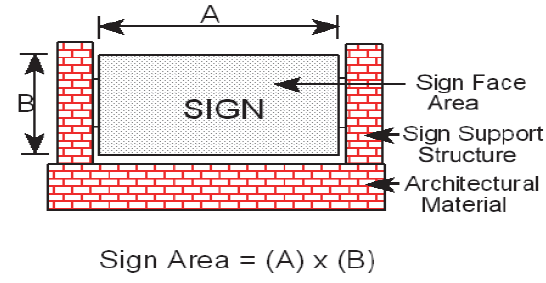
E.
Signs with a Background. In the case of a sign whose message is fabricated together with the background which borders or frames that message, the sign face area shall be the total area of the entire background as depicted in Figure 2, Signs with a Background:
Figure 2: Signs with a Background: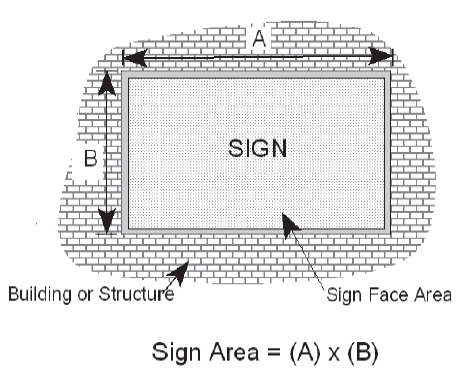
F.
Signs with No Border or Frame. In the case of a sign whose message is applied to a background which provides no border or frame, the sign face area shall be the area of the smallest rectangle that can encompass all words, letters, figures, emblems, logo's and other elements of the sign message as depicted in Figure 3, Signs with No Border or Frame:
Figure 3: Signs with No Border or Frame: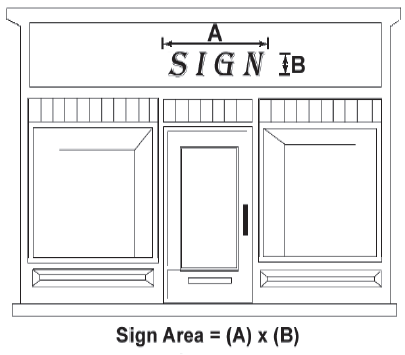
G.
Sign Height. Sign height shall be measured from the base of the sign at normal grade to the highest point of the sign support structure, or sign face, whichever is higher. For the purposes of this subsection, "normal grade" shall mean the newly established grade after construction, not including any filling, berming, mounding, or excavating solely for the purpose of locating the sign. In cases where the normal grade is below the grade of the street to which the sign is oriented, the sign height shall be measured from the adjacent crown of that road as depicted in Figure 5, Sign Height:
Figure 5: Sign Height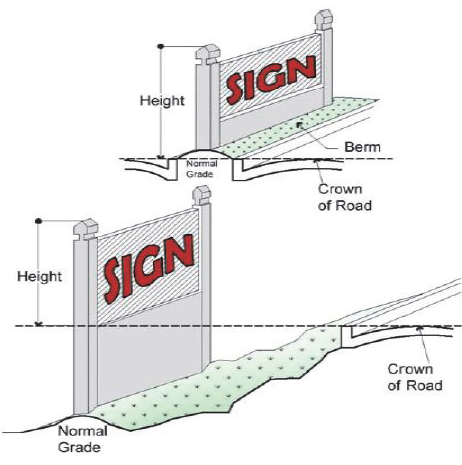
6:4.1.12 Regulations Applying to Specific Types of Signs.
A.
On-Premises Signs Allowed in Non-Residential Zoning Districts. The following signs are allowed in all non-residential zoning districts. The maximum sign allowance for a development is subject to the amount of sign area permitted within the zoning district where the sign or signs are to be located. An illustration of the different types of attached wall signs is illustrated below in Figure 6, Types of attached signs.
1)
Wall Signs. Wall signs are permitted on the primary building façade and architecturally finished secondary facades of the primary structure. Building sides that do not meet the architectural standards described below do not qualify for wall signs. For shopping centers and similar multi-tenant buildings with individual entrances, the wall sign area shall be calculated independently for each individual tenant space. Signs on the wall of a building (including signs attached flat against the wall and painted wall signs) shall meet the following requirements:
a.
Attachment. The maximum projection for a wall sign shall be twelve (12) inches.
b.
Allowable Wall Sign Area: Primary Facade. The maximum sign face allowance for attached wall signs for both single-tenant and multi-tenant developments shall be one and one-half (1.5) square feet per linear foot of said building frontage. In no case shall the sign area exceed the total amount of sign area permitted within the zoning district where the sign or signs are to be located, refer to Table A-1 Walls Signs, below.
c.
Double Frontage, Corner Lots: Secondary Facades. If a building is located on a parcel or lot with more than one (1) street and the façade facing the secondary street is architecturally finished with at least one (1) opening (window or secondary entrance) and is constructed with similar materials and details as the primary façade, an additional wall sign equivalent to the primary façade allowance is permitted.
d.
Projecting Signs. Projecting signs shall count towards the overall sign allotment for the development and shall be permitted in lieu of a freestanding ground sign on any street frontage with a public entrance to the space. Only one (1) projecting sign per tenant shall be permitted and shall comply with the following standards:
1.
A projecting sign may not extend more than five (5) feet above the highest point of the building façade or parapet wall upon which it is mounted;
2.
A projecting sign shall not project more than three (3) feet from the façade of the building and shall not be located any closer than eighteen (18) inches to a vertical plane at the street curb line;
3.
Projecting signs may not extend beyond the property lines, or encroach into a publicly maintained right-of-way unless specifically permitted in another section of this ordinance;
4.
Projecting signs shall maintain an eight-foot clearance above grade or at sidewalk level;
5.
The proposed extension of a projecting sign shall present no physical threat of safety to pedestrians, motor vehicle drivers and passengers; and
6.
A detailed drawing, provided by a licensed sign company that meets the current International Building Codes specification for projecting signs; including the current adopted building code requirements for loading such as snow and wind shall be presented for review and approval prior to the installation of the sign.
e.
Awnings and Canopies. Awnings and Canopies that contain any form of advertisement or signage for the business on which they are located shall count towards the overall sign allotment for the development and shall comply with the following standards:
1.
Awnings. The copy area of an Awning sign shall not exceed an area equal to twenty-five (25) percent of the background area of the awning or awning surface to which such a sign is affixed or applied, or the permitted sign face area for wall signs, whichever is less. Neither the background, color of an awning, nor any graphic treatment or embellishment thereto such as striping, patterns nor valances shall be included in the calculation when determining the maximum of sign face allowance;
2.
Canopy. The permanently-affixed copy area or sign face area of a canopy sign shall not exceed an area equal to twenty-five (25) percent of the face area of the canopy upon which the sign is affixed or applied, or the permitted sign face area for wall signs, whichever is less;
3.
Awnings and Canopies may not extend beyond the boundary of any property line or encroach into a publicly maintained right-of-way unless specifically permitted in another section of this ordinance;
4.
Awnings and Canopies shall maintain an eight-foot clearance above grade or at sidewalk level;
5.
The proposed extension of an awning or canopy sign shall present no physical threat of safety to pedestrians, motor vehicle drivers and passengers; and
6.
A detailed drawing shall be provided by a licensed sign company that meets the current International Building Codes specification for awnings and canopies; including the current adopted building code requirements for loading such as snow and wind shall be presented for review and approval prior to the installation of such sign and/or structure.
Figure 6: Types of Attached Signs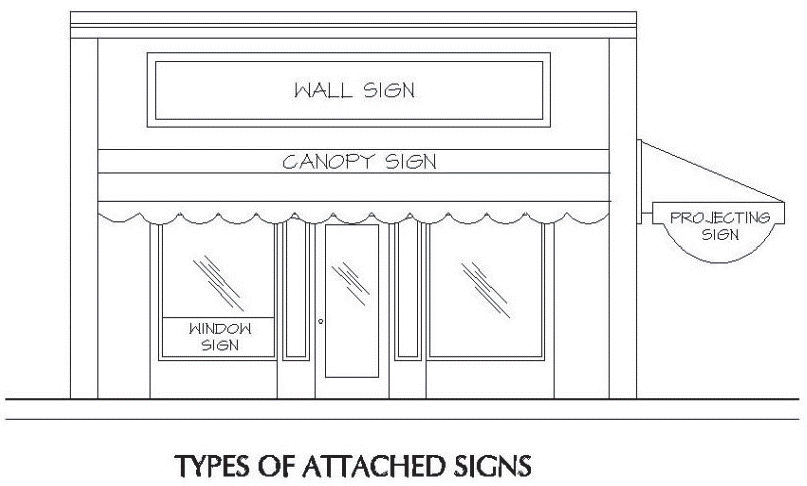
Table: A-1, Wall Signs—Commercial
2)
Freestanding Ground Signs (Monument Signs). Freestanding monument ground signs are allowed in all non-residential districts for both single-tenant and multi-tenant developments with an allowable size not to exceed the maximum square footage limits set forth by the zoning district in which the sign is located. The use of freestanding Pole Signs is prohibited. Refer to Table A-2, Freestanding Ground Signs, below.
a.
Construction and Design. All freestanding ground signs shall be mounted on a monument base that has a length equal to or of at least seventy-five (75) percent of the width of the sign face and supporting structures combined. Monument structures shall be constructed of durable architectural materials (i.e., brick, stucco, or stone) that are consistent with the design and features of the primary facade of the building on the site (refer to definition).
b.
Landscaping. Landscape islands are required to be placed around all new ground signs within thirty (30) days of sign erection. Shrubbery and/or plantings must not exceed a height that would interfere with foot or vehicle traffic or visibility of the sign. At any time an existing sign is altered or improved, not including regular maintenance, the landscaped island must be installed in accordance with the requirements for a new sign within sixty (60) days of completion of the sign.
c.
Location. Unless otherwise, specifically allowed in this code, freestanding ground signs shall be set back a minimum of eight (8) feet from the street right-of-way line. No freestanding ground sign shall extend over any structure or adjoining property line or extend into a public right-of-way. Freestanding ground signs shall not be located within forty (40) lineal feet of another freestanding ground sign.
d.
Single-tenant Development Allowance. The size of the sign face for a freestanding ground sign shall be based on length of street frontage of the lot and the zoning district for which the sign(s) is proposed. Single tenant development signs shall comply with the standards referenced in Table A-2, Freestanding Ground Signs and shall also comply with the following requirements:
a.
Number of Signs. One (1) freestanding ground sign per developed site, lot or parcel is permitted for a single-tenant development. Where a site or parcel fronts on more than one street, one (1) additional freestanding ground sign shall be permitted provided that the signs are located a minimum of one hundred fifty (150) feet from one another; and does not exceed the maximum square footage allowance for the development.
• Incentive: Single-tenant developments located on corner or thru-lots have the option of foregoing two (2) freestanding ground signs and installing one (1) freestanding ground sign that is ten (10) percent larger in size than the permitted freestanding ground sign allowance for the development.
b.
Sign copy. The sign copy for single-tenant development signs shall include the business identification (name, logo) and may also include the principal use or commodity sold or offered on the site. A maximum of forty (40) percent of the sign area may be used for a changeable copy sign, or permitted electronic messaging board (EMB) or LED sign. Such sign shall comply with the standards in subsection 6:4.1.12A.3, Electronic Messaging Boards (EMB).
c.
Height. All single-tenant freestanding ground signs shall have a maximum height of sixteen (16) feet.
e.
Multi-Tenant Development Sign Allowance (including Group Office and Group Commercial Developments). Multi-tenant developments may erect either a freestanding ground Development Identification Sign or freestanding ground Joint Identification Sign. The size of the sign face for a freestanding ground sign shall be based on the length of street frontage of the lot or development, the number of tenants in the development and the zoning district for which the sign(s) is proposed. Multi-tenant development signs shall comply with the standards referenced in Table A-2, Freestanding Ground Signs and shall also comply with the following requirements:
a.
Number of Signs. One (1) freestanding ground Development Identification Sign or freestanding ground Joint Identification Sign is permitted for a multi-tenant development. Where a development fronts on more than one (1) street, one (1) additional freestanding ground sign shall be permitted on that road frontage.
• Incentive: Multi-tenant developments located on corner or thru-lots have the option of foregoing two (2) freestanding ground signs and installing one (1) freestanding ground sign that is twenty (20) percent larger in size than the permitted freestanding ground sign allowance for the development.
b.
Sign copy. The sign copy for a multi-tenant development identifies the name of the development, shopping center, or group commercial development on which the sign is located and also provides identification for some or all individual tenants within the development. Freestanding ground signs for multi-tenant developments shall comply with the maximum size and height standards outlined in Table A-2, Freestanding Ground Signs, and shall also comply with the following requirements:
a)
A minimum of twenty-five (25) percent of the sign area shall be used to identify the name and/or address of the overall development.
b)
A maximum of forty (40) percent of the sign area may be used for a changeable copy sign, or permitted Electronic Messaging Board (EMB) or LED sign. Such sign shall comply with the standards in subsection 6:4.1.12A.3, Electronic Messaging Boards.
c)
The sign copy shall provide a reasonable amount of area for the advertising of individual tenant spaces within the development.
c.
Height. The height of a freestanding ground sign in a multi-tenant development shall be dependent upon the total number of individual tenant spaces in the development, refer to
Table: A-2, Freestanding Ground Signs—Commercial
3)
Changeable Copy, Electronic Messaging Boards (EMB) and Light Emitting Diode (LED). Such signs are permitted in all non-residential zoning districts and are subject the following standards:
a.
No such sign shall be permitted within fifty (50) feet of a residential zoning district, unless specifically allowed under a separate provision of the code.
b.
The images and messages displayed must be complete in subject matter without continuation in content to the next image or message.
c.
The message or image must remain fixed for at least six (6) seconds. The transition to a new message or image shall not include any scrolling, animation flashing, fading or other illusions of motion that are otherwise prohibited.
d.
Only one (1) such sign shall be permitted per developed lot whether installed as a wall sign or part of a freestanding ground sign. EMB's shall only be permitted as a wall sign if the development does not have a freestanding ground sign. EMB's located on a freestanding ground sign shall be permanently attached to and located entirely within the width of the host sign.
e.
Off-premises advertising is prohibited. This section does not pertain to community announcements, and non-profit fundraising information.
f.
No more than forty (40) percent of the sign face area allowed for a freestanding ground sign may be devoted towards an EMB sign. Theaters, auditoriums, stadiums, convention centers, and like public event facilities may exceed this standard to seventy-five (75) percent of the allowed sign face area.
g.
No sign shall be brighter than is necessary for clear and adequate visibility and shall not exceed a maximum of five thousand (5,000) nits during daylight hours and five hundred (500) nits from dusk to dawn.
h.
All signs must be equipped with both a dimmer control and a photocell that automatically adjusts the display's intensity according to natural ambient light conditions.
i.
Prior to the issuance of a sign permit, the applicant shall provide written certification from the sign manufacturer or sign contractor that the light intensity has been factory pre-set not to exceed five thousand (5,000) nits and that the intensity level is protected from end-user manipulation.
4)
Time and Temperature Signs. Time, date and temperature signs that do not exceed ten (10) square feet in sign area shall not count against the allowable sign face area. Signs that exceed ten (10) square feet shall be counted towards the maximum sign face area permitted for the development. Such signs shall only be permitted as a wall sign if there is not an existing freestanding ground sign located on the development.
B.
Temporary Signs. The following temporary signs are allowed in all commercial, service and industrial districts but require the issuance of a sign permit prior to display of such sign(s):
1)
Incidental A-frame Signs. An A-frame sign shall be considered incidental and shall be permitted subject to the following standards:
a.
Such sign must be located on a parcel where the building is set back at least thirty-five (35) feet from the street and the A-frame sign is located no farther than three (3) feet from the store front entrance in which is being advertised.
b.
Such sign shall meet the size and design standards outlined in subsection 6:4.1.12B.4)h. below.
c.
In no case shall an A-frame sign used under this provision be located closer than thirty (30) feet of the street right-of-way.
d.
The use of an A-frame sign under this provision shall disqualify businesses from utilizing the temporary sign allowance provisions outlined below in subsection 6:4.1.12B.4), Temporary Advertising Display Signs for Individual Businesses.
e.
Such signs shall be removed at the end of each business day.
2)
Grand Opening Events. A new business upon opening, may utilize the following advertising signs for a period not to exceed fourteen (14) calendar days:
a.
Two (2) temporary signs are permitted and may be ground mounted or attached to the wall of a structure each with a maximum size of thirty-two (32) square feet, and if ground mounted, a maximum height of six (6) feet. Ground mounted signs shall be set back at least five (5) feet from the street right-of way.
b.
Streamers, pennants, flags, balloons, and similar exhibits that do not exceed a total of ten (10) displays shall be permitted. (Each fifty (50) feet of streamers and pennants shall count as one (1) display. Each inflatable of a non-balloon variety counts as one (1) display. Each balloon or bouquet of balloons counts as one (1) display, etc.)
c.
For businesses that are located in a multi-tenant development, all displays except for the banner shall be displayed immediately adjacent to the business' space or in the adjacent portion of the parking lot of the parcel.
d.
This temporary sign allotment is independent from other permitted temporary sign allowances. The business may elect to begin utilizing the temporary signage allowed under subsection 6:4.1.12B.4, Temporary Banners for Individual Businesses, immediately after terminating use of the Grand Opening banners allowed under this section.
e.
For the purposes of this section, a change in ownership, type of ownership, or of management does not constitute a new business.
f.
A sign permit is required for a grand opening sign package and must be obtained prior to the installation and display of such signs. A simple site plan will be required with the application illustrating the location of all sign elements and the distance from the street right-of-way and driveway locations. A sketch plan will also be required indicating the size of the banner and the method of attachment.
3)
Temporary Banner in Lieu of Permanent Signage. A banner may be used while awaiting installation of permanent signage to temporarily cover existing signage needs in the event of a business name or logo change, or similar circumstance as follows:
a.
The banner meets the sign area requirements of the sign it is designed to temporarily obscure or replace.
b.
The banner is securely fastened to the wall or permanent sign structure to draw the banner material taut and to prevent flapping.
c.
A sign permit for such use may be issued for up to sixty (60) calendar days after the City has issued a zoning permit for the business. As part of the permit application, the applicant shall describe the sign banner details (size, material type, attachment method) and the intended date of installation of the banner signage.
4)
Temporary Advertising Display Signs for Individual Businesses. Each individual business may be issued a permit for a temporary sign for an advertising display period of not more than two (2), fourteen (14) consecutive calendar days per quarter each year. A sign permit shall be required for each advertising event. (For example: Up to two (2) separate sign permits may be issued for an advertising period of not more than fourteen (14) calendar days each during the months of January, February and March; two (2) separate permits may be issued for an advertising period of not more than fourteen (14) calendar days each during the months of April, May and June, and so forth.) A sign permit must be obtained prior to the installation of any temporary sign and all temporary signs shall comply with the following standards:
a.
All temporary signs requiring a sign permit shall be located on the parcel or development on which the business is being advertised; off-premises advertising by use of temporary signage shall not be permitted and is strictly prohibited.
b.
Temporary signs shall not be attached to trees, rocks, other natural features, street signs, utility poles or any other roadside appurtenances.
c.
Temporary signs are subject to the size, height and framing requirements set forth in this section and may be in the form of a professionally designed and lettered A-frame sign, banner, or a sign constructed of corrugated material with a proper support structure. (Refer to the Temporary Sign definition for illustrations of temporary signs and support structures).
d.
All temporary signs shall be displayed in a neat and orderly manner at all times. Handwritten signs in any form are expressly prohibited.
e.
Temporary ground mounted signs shall not exceed thirty-two (32) square feet in sign face area and six (6) feet in height.
f.
Ground mounted signs shall be securely attached to a rigid and framed structure that is supported on at least two (2) sides. Temporary wall mounted signs shall be secured and held taut across the wall surface to maintain readability and to avoid sagging, tearing and/or and flapping in the wind.
g.
All ground mounted temporary signs shall be located a minimum of five (5) feet from the street right-of-way and shall not obstruct site visibility at ingress and egress points onto the premises.
h.
Temporary use of an A-frame sign under this provision shall comply with the following size and design standards:
1.
Dimensions shall not exceed a maximum of 24″ × 36″ in sign copy area and shall not exceed four (4) feet in height.
2.
Materials shall consist of durable, weather resistant materials such as steel, aluminum and PVC. The use of cardboard, paper, fabric and non-rigid materials are prohibited.
3.
A-frame signs shall be constructed to be stable and able to withstand wind and other unpredictable weather elements.
4.
A-frame signs located along business entrances must maintain a minimum of five (5) feet of unobstructed sidewalk between the outer edge of the sign and the edge of pavement/curb. Signs shall not block or interfere with ADA accessibility nor restrict pedestrian movement.
5.
A-frame signs shall not be placed where they interfere with any exit, loading zone, bicycle rack, sidewalk ramp, wheelchair ramp or similar public or private facility.
i.
Single-tenant Developments. A temporary sign may be ground mounted or affixed on the face of the primary façade of a structure. Such signs shall not exceed thirty-two (32) square feet in sign area and if ground mounted shall not exceed a maximum height of six (6) feet.
j.
Multi-tenant Developments. One (1) professionally lettered temporary sign shall be permitted for each individual tenant space within the development. Such sign shall not exceed sixteen (16) square feet in area and shall be affixed on the face of the primary façade of the tenant space. In lieu of a temporary attached wall sign, up to two (2) individual tenants within the development shall be permitted to advertise on a temporary ground mounted sign; not to exceed thirty-two (32) square feet in sign face area, and six (6) feet in height. The developer or owner of the multi-tenant development shall be responsible for governing the use of the temporary ground mounted signs. In no circumstance shall the number of temporary ground mounted signs for a multi-tenant development exceed two (2) signs at any given time; and no more than one (1) temporary sign per tenant (either affixed or located on the ground) shall be permitted at any given time.
k.
A sign permit is required for the use of a temporary sign and shall be approved prior to the installation and display of such sign.
l.
A one-time sign permit fee shall apply at the time the application is submitted. The application shall specify the date of each time period throughout the year for which the sign is to be displayed. The dates specified in the application may be amended without fee with written notification to the Business and Development Services Department at least two (2) weeks in advance of the proposed advertising period.
m.
A simple site plan will be required with the application illustrating the location of the temporary sign and shall note the distance from the street right-of-way and driveway locations. A sketch plan will also be required indicating the size of the banner and the method of attachment.
5)
Temporary Seasonal Sale Sign. A temporary seasonal sale sign shall be permitted in accordance with the design standards for "Temporary Signs" outlined in subsections 6:4.1.12B.3.a—h., and in conformance with the following standards:
a.
One (1) temporary ground mounted sign shall be permitted per parcel upon approval of a temporary use permit for a seasonal sale event. Off-premises advertising by use of temporary signage shall not be permitted and is strictly prohibited.
b.
A seasonal sale sign may be in the form of a professionally designed and lettered A-frame sign, banner, or a sign constructed of corrugated material with a ridged and framed support structure that is supported on at least two (2) sides.
c.
Seasonal sale signs shall not exceed thirty-two (32) square feet in sign face area and a maximum of six (6) feet in height. Signs shall be located a minimum of five (5) feet from the street right-of-way and shall not obstruct site visibility at ingress and egress points onto the site, or other signs structures in the development.
d.
Seasonal temporary signs shall only be permitted for the duration of the seasonal temporary use and shall not exceed the following time limits: Christmas tree Sales: maximum of sixty (60) days, Pumpkin Sales: maximum of forty-five (45) days, Garden Sales: maximum of sixty (60) days, twice per calendar year; Produce and Farmer's Markets: maximum of one hundred eighty (180) days, Ice-cream and Frozen Treat stands: maximum of one hundred eighty (180) days.
e.
Such sign shall only be erected three (3) days prior to the business being opened and shall be removed immediately upon closing.
f.
A sign permit is required for such sign and shall be approved prior to the installation and display of such sign.
g.
A simple sketch plan shall be provided by the applicant showing the location and site layout for the temporary use, the location of the proposed sign and distances from property lines and the street right-of-way.
6)
Temporary Signs for permitted Temporary Uses. With exception to signs permitted for Mobile Food Sales as provided for by subsection 9:1.10B(7), Temporary signs for permitted uses in Section 6:, Temporary Uses and Structures, shall be permitted as follows:
a.
One (1) temporary ground mounted sign shall be permitted per parcel upon approval of a temporary use permit. Off-premises advertising by use of temporary signage shall not be permitted and is strictly prohibited.
b.
A temporary use sign may be in the form of a professionally designed and lettered A-frame sign, banner or a sign constructed of corrugated material with a ridged and framed support structure that is supported on at least two (2) sides.
c.
Temporary use signs may not exceed thirty-two (32) square feet in sign face area and shall not exceed six (6) feet in height. Signs must be setback a minimum of five (5) feet from the street right-of-way and shall not obstruct visibility at ingress and egress points onto the site, or other sign structures in the development.
d.
Temporary use sign shall only be valid for the period prescribed on the temporary use permit. All temporary signs shall be removed at the end of each business day.
C.
Signs permitted in all Residential Districts. The following signs are allowed in all residential districts and are subject to the following standards:
a.
Wall Signs. Wall signs for uses permitted in a residential district shall be non-illuminated. Walls signs are allowed on the primary façade of the principle structure and shall not project above the roofline or parapet wall of any structure.
b.
Home Occupation Sign. One (1) non-illuminated attached sign shall be permitted for a home occupation provided that the sign face area of such sign does not exceed two (2) square feet in area. Such sign shall be mounted flat against the surface of the wall of the building in which such home occupation is being conducted.
c.
Multi-Family and Group residential uses (including Townhome, and Condominium developments and manufactured home parks). One (1) attached wall sign shall be allowed not to exceed forty (40) square feet in sign face area. Attached signs shall not project above the roofline or parapet wall of any structure.
d.
Schools, Places of Worship (churches) and other Public or Institutional Use. The following standards shall apply:
• Such uses on sites of less than three (3) acres shall be permitted one (1) attached wall sign at one-half (0.5) square feet per linear foot of building frontage with a maximum sixty (60) square feet in sign face area, whichever is less.
• Such uses located on sites of three (3) acres or more shall be permitted one (1) attached wall sign at one-half (0.5) square feet per linear foot of building frontage with a maximum of one hundred (100) square feet in sign face are, whichever is less.
• When such use is located on a major thoroughfare, attached signage shall be permitted at a rate of one and one-half (1.5) square feet per linear foot of building frontage, or up to a maximum of three hundred (300) square feet (whichever is less) per street front. When the calculated sign face area allowance exceeds one hundred (100) square feet, a total of two (2) attached wall signs shall be permitted on the primary façade not to exceed three hundred (300) square feet in total area.
e.
Commercial Uses Permitted in Residential Districts. Such uses shall be allowed one (1) attached wall sign at one-half (0.5) square feet per linear foot of building frontage with a maximum forty (40) square feet in sign face area, whichever is less. Attached signs shall not project above the roofline or parapet wall of any structure.
1)
Freestanding Ground Signs (Monument). All freestanding ground signs located in a residential district shall be subject to a maximum height of six (6) feet. Signs shall be located a minimum of eight (8) feet from the street right-of-way, be located on private property and shall adhere to the site visibility requirements in Section 3:3.
a.
Permanent Subdivision Signs (including Townhome Developments). Subdivision signs shall be designed to be part of a permanently constructed and maintained entrance wall, fence or similar feature as required by the Land Development Ordinance. One (1) attached wall sign shall be permitted on each opposite side of the main entrance structure facing the existing roadway. The sign face area of such signs shall not exceed forty (40) square feet and shall not exceed six (6) feet in height. Such sign shall only display the name of the development. Landscape beds are required to be placed around all new ground signs. Shrubbery and/or plantings must not exceed a height that would interfere with foot or vehicle traffic or visibility of the sign. The developer or Home Owner's Association shall maintain the sign and required sign base landscaping.
b.
Multi-family and Group Residential Uses (including Condominium developments and manufactured home parks). Such sign(s) shall be permitted at the main entrances of the development on private property and shall only display the name of the development. One (1) freestanding ground sign shall be permitted with a maximum sign face area of forty (40) square feet each; and maximum of six (6) feet in height. A maximum of two (2) signs are permitted at any one (1) street front entrance into the development. Landscape beds are required to be placed around all new ground signs. Shrubbery and/or plantings must not exceed a height that would interfere with foot or vehicle traffic or visibility of the sign. The sign and required landscaping shall be maintained by either the owner and/or the developer or legally established Home Owner's Association.
c.
Schools, Places of Worship (churches) and other Public or Institutional Uses. Such uses shall be allowed one (1) freestanding ground sign per street front. Signs shall not exceed sixty (60) square feet in sign face area, and ten (10) feet in height. When such use is located on a major thoroughfare, signs shall not exceed two hundred (200) square feet in sign face area and shall not be greater than sixteen (16) feet in height. When such sign is located on a major thoroughfare, an electronic or changeable copy sign shall be permitted in accordance with the standards set forth in subsection 6:4.1.12A.3)b—i, Changeable Copy, Electronic Messaging Boards and Light Emitting Diode (LED).
d.
Commercial Uses Permitted in Residential Districts. Such uses shall be allowed one (1) freestanding ground sign per street front. Signs shall not exceed forty (40) square feet in sign face area, and six (6) feet in height.
e.
Lighting. Freestanding ground signs in residential district may be lit by external illumination only. External illumination shall be by a steady stream of light source, shielded and directed solely at the sign. Light fixtures shall be restricted to one (1) shielded light fixture per sign face. The intensity of the light shall not exceed twenty (20) foot-candles at any point on the sign face. Such light shall not shine or reflect on or into any nearby residential structure.
f.
Construction and Design. Unless otherwise noted in another section of this ordinance, all freestanding ground signs shall be mounted on a monument structure that is equal to or greater than seventy-five (75) percent the width of a sign itself. Monument structures shall be constructed of brick, stone or stucco materials that have the appearance of brick, stone, or stucco or other durable architectural materials consistent with the design of the primary building on the site.
6:4.1.13 Special Provisions for Non-Residential Signs.
The following signs shall be permitted in accordance with the following standards but require the issuance of a sign permit prior to display of such sign(s):
A.
Interstate Frontage Sign Bonus. The following sign standards shall apply only to properties contiguous to I-385 (or located at the I-385 interchange) and also having frontage on the following roads:
Bridges Road, East Butler Road, Highway 417, Old Stage Road, Standing Springs Road and Woodruff Road.
1)
One (1) additional freestanding high-rise "bonus" sign shall be permitted in addition to the standard sign allowance permitted in the current zoning for the parcel.
2)
There shall be a maximum of one (1) freestanding high-rise bonus sign allowed per parcel or business with the exception that up to two (2) additional users may advertise on a single, freestanding high-rise bonus sign structure as long as the user(s) are part of the same development (i.e., planned developments, multi-tenant shopping centers, properties designed to share internal and common access drives, easements, or parking areas, etc.)
3)
Freestanding high-rise bonus signs shall be located along the property closest to the interstate right-of-way and oriented towards the freeway; in addition, the sign shall be set back a minimum of eight (8) feet from the edge of the interstate right-of-way.
4)
The maximum height of a freestanding high-rise bonus sign shall be thirty-five (35) feet as measured from the adjacent road grade. Where there is more than one (1) user advertising on a single freestanding high-rise bonus structure, an additional five (5) feet in height per user shall be allowed for a maximum height of forty-five (45) feet.
5)
Freestanding high-rise bonus signs located on properties or developments with direct interstate frontage may have a total of two (2) sign faces per user with a maximum square footage of two hundred (200) square feet. In no circumstance shall the cumulative total of signage (for multiple users located on a single pole) exceed six hundred (600) square feet.
6)
Illumination of freestanding high-rise bonus signs shall be by internal illumination only. No electronically animated signage and no external illumination of the sign shall be permitted. Interstate signage is also subject to the prohibitions set forth in subsection 6:4.1.6, Prohibited Signs.
7)
All new freestanding high-rise bonus signs shall be located no closer than two hundred fifty (250) feet from the nearest residentially zoned property, as measured from the outermost perimeter of the sign.
8)
All freestanding high-rise bonus signs must be spaced at least one hundred fifty (150) feet from other freestanding high-rise bonus signs that have been permitted on adjacent lots.
9)
Signs existing prior to the adoption of this ordinance and meeting the intent of the freestanding high-rise bonus sign standard shall be exempt from all spacing requirements.
10)
All framing material shall be enclosed with preformed panels; provided; if more than one (1) frame structure is utilized, all areas within the frames must be enclosed with preformed panels.
B.
Gasoline Pricing Signs.
1)
Gasoline pricing signs that do not utilize Electronic Messaging Boards (EMB) to display the prices of fuel shall be permitted an additional fifteen (15) square feet of sign face area for the sole purpose of advertising the price of fuel. The square footage of such sign shall be included when determining the maximum square foot allowance for a freestanding ground sign as referenced in subsection 6:4.1.12A, Table: A-2, Freestanding Ground Signs. Only one (1) such pricing sign shall be permitted per development, lot or parcel.
2)
Gasoline pricing signs that utilize Electronic Messaging Boards (EMB) to display the price of fuel shall incorporate the EMB into the overall design of the sign. Fuel prices displayed on the EMB shall remain static.
C.
(Gasoline) Service Station Structural Canopy and Accessory structure signs. In addition to the wall and ground signs permitted for this use, two (2) additional attached signs for the purpose of advertising on a structural canopy or accessory structure are allowed. No more than one (1) sign face per canopy length or façade of a structure shall be permitted. The maximum size of each sign shall not exceed twenty-five (25) square feet in sign face area. The square footage of such sign(s) shall be included when determining the maximum square foot allowance for the development as referenced in subsection 6:4.1.12A, Table: A-1, Wall Signs.
D.
Second Tier Development Signs. Upon a determination by the Zoning Administrator that a development meets the criteria set forth in the definition of a second tier development, said development shall be permitted signs meeting the standards hereinafter. Following the determination that the development is a second tier development, all structures and uses in the development shall be considered a part of the second tier developments and shall be subject to the following sign standards. Owners of or tenants in structures and uses in the development shall not apply for signs not permitted as part of the second tier development sign package.
1)
Freestanding Collocation Sign for Second Tier Developments. Individual uses within a second tier development may place their individual freestanding signage on a single sign support structure provided the sign meets the following standards:
Figure 1: Freestanding
Collocation Sign: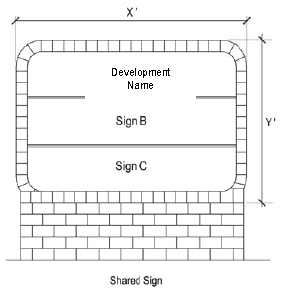
a.
One (1) freestanding collocated ground sign shall be permitted for a second tier development.
b.
The collocated ground sign must be located within one thousand (1,000) feet of the closest point of the second tier development it identifies.
c.
The combined sign face area shall not exceed two hundred (200) square feet area or the maximum size permitted for freestanding ground signs in the zoning district in which the sign is located, whichever is less.
d.
A minimum of twenty-five (25) percent of the sign area shall be used to identify the name and/or address of the overall development.
e.
The use of an Electronic Messaging Board (EMB) or LED sign shall be subject to the general standards for Changeable copy, Electronic Messaging Boards (EMB), and Light Emitting Diode (LED) as outlined in subsections 6:4.1.12A.3)a—c. and g—i.
f.
Use of EMB's and LED on collocated signs shall be limited to thirty (30) percent of the total sign face area and shall not be located within fifty (50) lineal feet of another EMB or LED sign.
g.
The maximum height of collocated ground sign shall be sixteen (16) feet.
h.
All signs that are illuminated shall comply with the standards set forth in subsection 6:4.1.14, Sign Illumination Standards.
i.
All freestanding ground signs shall be mounted on a monument structure that is equal to or greater than two-thirds (⅔) the width of a sign itself. Monument structures shall be constructed of brick, stone or stucco materials that have the appearance of brick, stone, or stucco or other durable architectural materials consistent with the design of the primary building on the site.
j.
Landscape islands are required to be placed around all new ground signs within thirty (30) days of sign erection. Shrubbery and/or plantings must not exceed a height that would interfere with foot or vehicle traffic or visibility of the sign. At any time an existing sign is altered or improved, not including regular maintenance, the landscaped island must be installed in accordance with the requirements for a new sign within sixty (60) days completion of the sign.
k.
The freestanding ground signs shall be set back a minimum of eight (8) feet from the street right-of-way line. No freestanding ground sign shall extend over any structure or adjoining property line or extend into a public right-of-way.
2)
Tenant Identification sign. Identification signs for businesses located in a second tier development shall be permitted for both single tenant developments and multi-tenant developments. Such signs shall meet the following standards:
a.
Wall Sign. Walls signs for individual businesses shall comply with the single-tenant or multi-tenant allowances as outlined in subsection 6:4.1.12A.1), Wall Signs.
b.
On-premises Freestanding Directional Sign. Each single-tenant business within a second tier development shall be permitted one (1) Directory Sign to identify the specific location of that business. Such sign shall be located on the site that is being advertised. The sign face area of the directional sign shall not exceed forty (40) square feet in sign face area and shall be limited to a maximum of ten (10) feet in height.
E.
Light Pole Banners. Banners may be installed on light poles or similar poles only in accordance with the following standards.
1)
Intent. The purpose of allowing banners to be installed on light poles or similar poles is to describe and notify citizens of local community services; announce cultural, education, major sporting and civic events, including City-sponsored and co-sponsored events; and provide information concerning available services or programs sponsored by the City and local non-profit groups. It is also the intent of these provisions to produce a festive appearance along streets in the promotion of cultural and civic events and community pride. This is generally accomplished through the display of multiple banners along the street in a coordinated and consistent manner.
2)
Eligibility.
a.
The City of Mauldin and civic institutions are eligible to display banners on light poles or similar poles in accordance with the standards herein. Civic institutions include local public agencies and local non-profit and charitable groups.
b.
Banners must promote a public activity, event, or program located within the city limits of Mauldin that promotes the corporate interests and welfare of the City.
3)
Permissions.
a.
Banners shall only be placed with the permission of the entity, company, or agency that owns the pole where the banner will be placed.
b.
Banners shall only be placed on private property with the permission of the owner of that property.
4)
Prohibitions.
a.
Banners shall not be placed or displayed in a manner that interferes with the visibility of traffic signals or signs.
b.
Banners shall not attempt to direct or influence street traffic in any way.
c.
Banners shall not be installed on poles that support traffic control signals or pedestrian-crossing signals.
d.
Banners shall not be reflective or emit light.
5)
Size, design, and material.
a.
Banners shall not exceed a width of more than 30 inches.
b.
Banners shall not exceed a length of more than 72 inches.
c.
Sponsorship and corporate name and logo recognition(s) shall not exceed more than 20 percent of the banner size. The name and logo of local public agencies and local non-profit groups are not subject to this standard.
d.
Banner material shall be at least two-ply 12-ounce vinyl banner sheeting sewn together with a minimum 1-½ inch border hem, or a commercial heat sealed hem. Comparable or better material which is durable, fade- and weather-resistant, and will not stretch or distort out of shape, may be considered.
6)
Placement and installation.
a.
Only one banner shall be displayed on any light pole at a time. Notwithstanding, two banners may be displayed on the same light pole provided that the banners are identical in size and dimensions and placed at the same height on the pole on exact opposite sides of the pole. See illustration below.
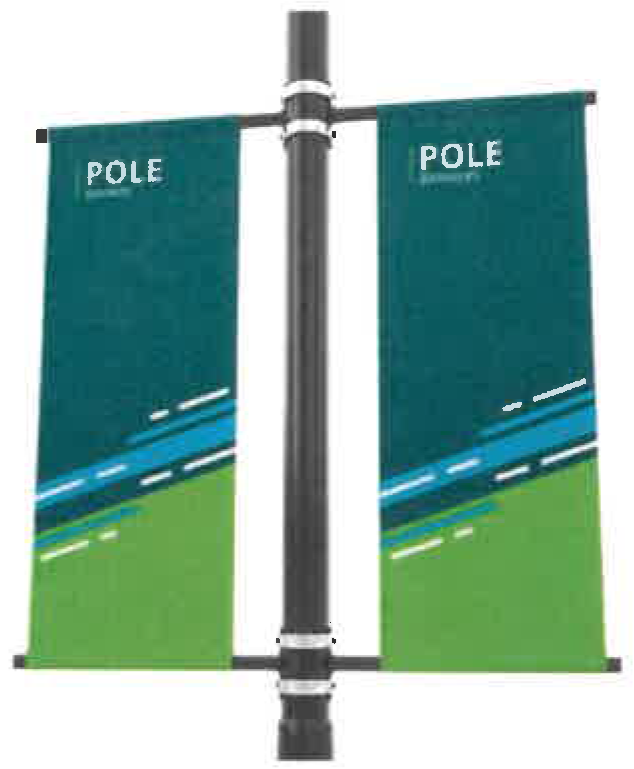
b.
Banners shall be displayed vertically, meaning that the longest edge of the banner shall be parallel to the pole and perpendicular to the ground.
c.
Banners shall maintain a minimum clearance of at least 8 feet between the bottom of the banner and the grade of the land immediately below the sign. Notwithstanding, if the banner is within 18 inches of the face of any street curb, the banner shall maintain a minimum clearance of at least 16 feet between the bottom of the banner and the grade of the land immediately below the sign.
d.
Banners shall be positioned at least 24 inches above any existing sign on the same pole.
e.
Banners shall be positioned at similar heights as other light pole banners in the vicinity.
f.
Banners shall maintain a similar orientation in relation to the street as other light pole banners in the vicinity.
g.
Banners shall be attached to the light pole by a mounting structure or hardware that, at a minimum, shall secure the top and the bottom of the banner. The mounting hardware shall be a similar color to the light pole and shall be positioned below the light arm or light fixture.
7)
Location and display period.
a.
Banners which advertise specific events or activities may be displayed for up to 30 days. Banners must be located on the property where the event will be held or in the portion of the right-of-way directly in front of the property where the event will be held.
b.
Banners which provide community information, promote public programs, or promote civic pride may be permitted for one year at a time. Banners must be located on the property of the agency or organization displaying the banners, or in the portion of the right-of-way directly in front of the property of the agency or organization.
c.
Banners displayed by the City of Mauldin are exempt from these location and display period restrictions.
d.
Nothing herein shall exclude or prevent the Mauldin City Council from approving the display of light pole banners in rights-of-way that are not directly adjacent to the subject property.
8)
Maintenance. Banners shall be maintained in good condition, clean, free of holes, tears, fraying, sagging, or other damage or deterioration. Should a banner become loose or begin to fall, develop holes, become excessively faded, become torn or frayed, or otherwise become defaced, damaged, or impaired during its display, the banner shall be removed within 48 hours upon notice from the City. If the banner is not removed within 48 hours, the City may remove and discard the banner. The City shall not be held liable for any damages to a banner that occur during the removal process. If there is time remaining for the permitted display period, the applicant may be allowed to replace the banner for the remainder of the permitted display period.
6:4.1.14 Sign Illumination Standards.
A.
Lighting fixtures illuminating signs shall be carefully located, aimed and shielded so that light is directed only onto the sign's façade and so that glare is significantly reduced. Exposed bulbs of any form are prohibited.
B.
Signs shall not have light-reflecting backgrounds but may use light-reflecting lettering or halo lighting.
C.
Light sources used to illuminate signs shall not be visible from any street right-of-way, nor cause glare that is hazardous to pedestrians or motorists, or creates a nuisance to adjacent properties.
D.
External illumination shall be by a steady stream of light source, shielded and directed solely at the sign. Light fixtures shall be restricted to one (1) shielded light fixture per side for sign faces up to forty (40) square feet and not more than two (2) shielded light fixtures per side for sign faces over forty (40) square feet.
E.
The maximum light level from sign illumination at any residential property line shall not exceed one-half (.5) foot-candle. Illumination at street rights-of-way and non-residential property lines shall not exceed two (2) foot-candles.
6:4.1.15 Reserved.
6:4.1.16 Sign Package.
A.
Purpose. This section is intended to address the unique signage needs of large development projects. The purpose of which is to encourage and permit creativity in the placement and design of signs for vehicular and pedestrian way-finding purposes. An approved "Signage Plan" may include signs of different sizes, types, locations, placement and height from those otherwise enumerated in the sign ordinance.
B.
Application. Signage plans may be submitted for the following types of development:
1)
Commercial, Industrial, or mixed use developments containing five (5) or more acres in area.
2)
The characteristic of the site demonstrates a need for enhanced visibility and way finding within the development.
3)
The site development plan incorporates the use of pedestrian oriented features and/or design.
C.
Submittal Process. Signage plan applications may be submitted for consideration at the time of the original consideration of the proposed development or separately from the original development proposal. The following information or material shall be required for a signage plan application.
1)
Owner and contact name, address, telephone number, email and signature(s) as applicable.
2)
A signage plan proposal illustrating the proposed signs (design, size, height), their proposed location(s) on a site plan, their proposed purpose, along with a statement as to why the existing sign code cannot or should not be followed in the subject case.
3)
An analysis showing how the proposed signage plan differs from what could be provided under the existing city sign regulations set forth in this article.
4)
Other similar information determined by the Zoning Administrator to be necessary for understanding the purpose and intent of the proposed signage plan.
D.
Review Procedure. The Zoning Administrator shall review the proposed signage plan and upon determining the application is complete shall have fifteen (15) business days to review the application. In reviewing the application, the Zoning Administrator shall review the plan in accordance with the following objectives:
1)
The extent to which the proposed signage plan deviates from the sign allowances otherwise applicable in this article.
2)
The rationale provided by the applicant for the deviations.
3)
The extent to which the signage plan promotes wayfinding, pedestrian-orientation, and business identification.
4)
The degree to which the signage plan creatively and effectively addresses the unique characteristics of the site with regard to signage.
5)
The freestanding ground signs for the development do not exceed the maximum size and height requirements of the district by more than thirty-five (35) percent.
6)
Individual wall signs within the development do not exceed the maximum size requirement of the district by more than twenty (20) percent.
E.
Approval or Denial of Signage Plan. The Zoning Administrator may deny or approve the proposed signage plan in part or in total and may establish conditions regarding approval. Decisions of the Zoning Administrator shall be made in writing and shall describe how each objective was or was not satisfied.
F.
Appeal Process. Decisions by the Zoning Administrator may be appealed to the Board of Appeals by following the procedures for such appeals provided in subsection 4:1,3-8, Appeals and Hearings of the Mauldin Zoning Ordinance.
6:4.1.17 Billboards.
A.
General Provisions for Off-Premises Signs. Notwithstanding any other provision of this chapter, any off-premises sign which was lawfully erected prior to December 9, 1996, shall be deemed nonconforming and shall be subject to the provisions of subsection 6:4.1.17. Off-premises signs may continue in operation and maintenance after the effective date of this Ordinance, provided that such off-premises sign(s) shall be maintained in accordance with the provisions in subsection 6:4.1.4 of this chapter.
B.
Off-Premises Signs Used in Conjunction with On-Premises Signs. Such signs shall not count towards the number of permanent signs allowed on the property on which they are located, and they shall not exceed the maximum display area set forth herein for the type of sign. Billboards and off-premises signs may be relocated in accordance with the provisions of subsection 6:4.1.17K.
C.
Special Provisions for Billboards (and off-premises signs). In addition to the general provisions set forth in this Article, Billboards shall be subject to the following special provisions.
1.
Relocation of Billboards Permitted. Notwithstanding any other provision of this chapter, any billboard, which was lawfully erected prior to December 9, 1996, may be relocated to a new site, provided the relocation meets the provisions of this chapter and except as follows.
2.
Location. Billboards shall only be permitted in S-1 and I-1 districts.
3.
Spacing. On all streets and highways within the jurisdiction of this chapter, no billboards may be established:
a.
Within one thousand (1,000) feet of any other billboard located on the same side of the street;
b.
Within five hundred (500) feet from the vertical point of any other billboard located on the opposite side of the street;
c.
Within five hundred (500) feet of residentially zoned property on the same side of and fronting the street in question;
d.
Within five hundred (500) feet of residentially zoned property on the opposite side of and fronting the street in question;
e.
At intersecting streets, within five hundred (500) feet of any other billboard measured by the curb line or curb line extension. A billboard may be located at this point or at a vertical point on the opposite side of the street, provided all other criteria are met;
f.
Within one thousand (1,000) feet of any historic site, place or district that is recorded on the national register, or any public park, measured by the curb line of the existing streets and in no case within five hundred (500) feet of the boundaries of such locations. A billboard may be located at this point or at a vertical point on the opposite side of the street, provided all other criteria are met;
g.
Within one thousand (1,000) feet from the center of any designated scenic highway when locating a billboard on a street which intersects with a scenic highway.
When determining whether a proposed billboard meets the spacing requirements set forth herein, distances shall be measured from the center of the billboard and shall take into account any billboard, residential property, historic district, public park or scenic highway, regardless of whether it is located in the City of Mauldin or unincorporated area of the county.
4.
Computation of Number:
a.
Double-Faced Sign. Two (2) adjacent signs on a single structure with both faces oriented in the same direction and not more than five (5) feet apart at the nearest point between the two (2) faces. A double-faced sign may be referred to as a side-by-side sign or a double deck sign. A doubled-faced sign shall constitute one (1) Outdoor Advertising Sign.
b.
Back-to-Back Sign. A single structure with two (2) parallel and directly opposite signs with their faces oriented in opposite directions located not more than five (5) feet apart. A back-to-back or a back-to-back double-face sign shall constitute one (1) Outdoor Advertising Sign.
c.
V-Type Sign. Two (2) signs in the shape of the letter "V" when viewed from above with their faces oriented in different directions and with an angle facing the road to which the sign is oriented of no more than sixty (60) degrees. A V-type sign shall constitute one (1) Outdoor Advertising Sign.
5.
Maximum Allowable Display Area:
a.
Double-Faced. Three hundred (300) square feet per face.
b.
Back-to-Back Double-Faced. Three hundred (300) square feet per face.
c.
Back-to-Back. Six hundred seventy-two (672) square feet per face.
d.
V-Type. Six hundred seventy-two (672) square feet per face.
Twenty (20) percent of the six hundred seventy-two (672) square feet allowable for extended copy of "pop-ups".
6.
Maximum Allowable Height:
a.
A billboard shall not exceed thirty-five (35) feet in height.
b.
All measurements shall be taken from the road grade level to which the sign is oriented.
7.
Minimum Setback from Right-of-Way:
a.
Twenty (20) feet for sign dimensions of six hundred seventy-two (672) square feet (fourteen (14) feet by forty-eight (48) feet)
b.
Fifteen (15) feet for sign dimensions of three hundred (300) square feet (twelve (12) feet [by] twenty-five (25) feet).
c.
Ten (10) feet for sign dimensions of seventy-two (72) square feet (six (6) feet by twelve (12) feet).
8.
Abandoned Billboard. A billboard without copy shall either display copy or be removed within ninety (90) days after official notification from the Zoning Administrator.
9.
Scenic Highway. No billboards shall be allowed on the following scenic highways and corridors: I-385 within the city limits, US 276 from I-385 to Highway 417, US 276 from Knollwood Drive to the northern city limits, East Butler Road from Hyde Circle to the city limits east of I-385.
10.
Permit Issuance, Existing Billboards. All billboards existing in the City which were lawfully erected prior to December 9, 1996, shall be required to be repermitted within ninety (90) days after the effective date of this section. In order to obtain the permit, the owner shall furnish the City with the following information on each billboard:
a.
Location.
b.
Color photographs of each face and support structure.
c.
Size description of each face, excluding pop-ups.
11.
Permits for Relocated Billboards. A permit for the relocation of a billboard shall not be issued by the City unless:
a.
An officer of the company applying for a permit to relocate a sign certifies in writing that the company has provided the information required by subsection 6:4.1.7.4(2)I.i[sic] above for all of its existing billboards in the County.
b.
The City has certified that the off-premises sign at the original location has been completely removed.
c.
The City has verified that the proposed billboard and its proposed location meet the criteria set forth in this section.
d.
All other requirements for obtaining a permit have been met, including the payment of a permit fee as charged by the City Codes Department.
e.
No permit for the relocation of a billboard shall be issued if the company requesting such permit is presently in violation of any of the provisions of this chapter.
12.
Posting of Permits. The City Codes Department shall issue all permits required by this section in duplicate, one (1) of which shall be weather resistant. The owner of each billboard in the City shall be responsible for affixing the weather resistant permit to the billboard in a prominent location and for ensuring that such permit is continuously attached at all times thereafter.
13.
Renewal. All permits issued in accordance with this section shall be valid only for the calendar year in which they are issued and shall be renewed not later than January 15 of each calendar year. A renewal fee of seventy-five dollars ($75.00) shall be charged. No renewal permit shall be issued if the company requesting such permit changes an existing sign so it violates any of the provisions of this chapter.
14.
Construction of Relocated Sign:
a.
Any billboard relocated pursuant to the provisions of this chapter must be constructed within twelve (12) months from the date the permit is issued.
b.
A relocated billboard shall have no more faces than it had at its previous location.
c.
The face or faces of a relocated billboard shall have no more display area (square footage) per face than it had at its previous location. In no event shall the face of a relocated billboard exceed the maximum allowable display area set forth in subsection 6:4.1.17K[sic] herein.
6:4.1.18 Administration and Permit Procedures.
An application for a sign permit shall be filed with the Business and Development Services Department on an application form provided by the office.
A.
Applicant and Licenses. Sign Permit applications may be filed by the owner of the property or by an agent specifically authorized by the owner to file such application. When the sign value and cost of work exceeds five thousand dollars ($5,000.00), a General Contractor with a valid South Carolina State License will be required for the application. When electrical work is required for illumination of a sign, an electrician that has a valid State license will be required for the application. In addition, all licensed contractors involved in construction of a sign must also hold a valid City business license.
B.
Information Required. Each application for a sign permit shall contain the information required on the application form including: the Tax Map number and address of the parcel the sign is to be located on, job description and scope of work, the value of the proposed sign and cost of work, contractor's information, sign details and sign measurements; and the type of illumination proposed for the sign, if applicable.
C.
Plan Review. The application shall also include two (2) complete sets of scaled drawings of the sign which depicts and describes the following:
1)
Wall Signs. A scaled façade elevation drawing indicating the length of the building façade and/or tenant space and the location and dimensions of any existing and proposed wall signs; the size of each sign proposed and the calculation used to determine the sign face allowance in square footage shall also be provided.
2)
Freestanding Ground Signs. A simple site plan that is drawn to a scale of not less than 1 inch = 60 feet shall be provided. The plan shall show dimensions of all property lines, the location of abutting street(s) and associated street rights-of-way. The plan shall illustrate the location of all existing structures on the site and the location of all existing and proposed freestanding signs on the parcel. Dimensions shall be provided to illustrate compliance with sign setback requirements from property lines and the street right-of-way line, and also illustrate compliance with site visibility standards outlined in Section 3:3 of this Ordinance. The site plan shall also illustrate compliance with the required sign base landscaping and also show any ground lighting fixtures and/or electrical sources.
3)
Building Permit. Freestanding ground signs that are seven (7) feet in height or greater will require a building plan submittal with footing details that are provided and sealed by an South Carolina Licensed Engineer.
4)
Electrical and Illumination Detail. If a sign is proposed to be internally or externally illuminated, a lighting specification plan shall be provided on the details of the light fixture and shall also provide light levels (foot-candle measurement) emitted from the light source. A licensed electrician may also be required to perform any electrical work required for illumination of the sign.
D.
Restrictive Covenants and Home Owner Association (HOA) documentation. It shall be the sole responsibility of the owner and/or applicant to ensure that all proposed uses, construction, and all other activities requiring a permit are in compliance with any existing lawful restrictive covenant. In the event a permit is issued and a conflict between the restrictive covenant and the zoning ordinance is determined, the more restrictive requirement of the two (2) shall prevail.
E.
Fees. An application review fee as determined by the Permit Fee schedule shall be due and payable when the application is submitted. Work performed without a permit shall be subject to a penalty fee. If a sign permit is denied, the sign permit portion of the application fee shall be refunded.
F.
Staff Review. Provided the application is complete, staff shall have ten (10) business days to review the application for compliance with the provisions of this ordinance.
G.
Issuance. If the proposed plan conforms to the provisions of this Ordinance, the plans will be stamped approved and the sign and other applicable permits will be issued. One (1) copy of the plan approval and permit will be returned to the applicant for display on site during construction; the City will also retain one (1) copy.
H.
Permit Validity. Upon approval and issuance of a sign permit, the applicant shall have six (6) months to complete work on the approved signage, after which the permit shall become null and void. Any unapproved changes in the approved plans shall render the sign permit invalid. Reapplication for sign permits that have expired shall be in accordance with the sign regulations in effect at the time of reapplication.
I.
Sign Inspection. Upon notification that the sign is complete, the City inspector shall conduct an inspection for the purpose of verifying that the sign is in compliance with the requirements of the permit and all other provision of this Article. Prior to the inspection of a freestanding ground sign, the permittee or sign contractor shall locate and identify on site the edge of the street right-of-way and all property lines adjacent to the sign for purposes of verifying the sign location in relation to the setback requirements.
J.
Variance. Requests for variances from the sign standards set forth in this ordinance shall be heard by the Zoning Board of Appeals and subject to the provisions set forth in subsection 4:1.2 of the Mauldin Zoning Ordinance.
6:4.1.19 Variance to Sign Requirements.
Requests for variances from the sign standards set forth in this ordinance shall be heard by the Zoning Board of Appeals and subject to the provisions set forth in subsection 4:1.2 of the Mauldin Zoning Ordinance.
6:4.1.20 Notice of Violation and Citation Procedures.
a)
Notice required before penalty. No penalty shall be assessed unless and until the person alleged to be in violation with the provisions of this Article has been notified of the violation in accordance with this section.
b)
Notice of Violation; opportunity to cure.
1.
Whenever the city official charged with the duty of enforcing the regulations of this article has reasonable cause to believe that a person is violating the provision of this ordinance, that official shall notify that person of the violation via a written warning. Such warning shall include an opportunity to cure the violation within a prescribed period of time.
2.
Upon receipt of a written request from the alleged violator or property owner, a single extension of time, not to exceed a period of thirty (30) days, may be granted to cure or correct the violation. Such request must be received prior to the city issuing a formal citation pursuant to subsection 6:4.1.20.b)3. below.
3.
Any person, who, after being given a written citation warning, does not comply with the provisions of this chapter within the time period allotted for compliance, shall be served a formal written citation with a prescribed date to appear before the Mauldin Municipal Court. Such citation shall also include an assessed penalty for the violation in accordance with the schedule of penalty fees in subsection c) below.
4.
When the person violating the provisions of this ordinance cannot be ascertained, then the notice of violation shall be sent to the owner of the land on which the violation occurs. Such notification shall be delivered by first class, Restricted Certified mail by the U.S. Postal Service.
c)
Sign Penalty Fee Schedule. The following "Table of Penalties for Sign Violations" shall apply for violations of this chapter. Repeat Offenses that occur within one hundred eighty (180) calendar days of the date on the citation for the first offense shall not receive a written warning, but shall be subject to a fine for each subsequent violation in accordance with the penalty schedule.
TABLE OF PENALTIES FOR SIGN VIOLATIONS
(Ord. No. 782, amds. 3, 4, 12-15-2014; Ord. No. 998, § 1, 4-18-2022; Ord. No. 1033, §§ 2, 5, 5-20-2024)

