
Mauldin City Zoning Code
ARTICLE 3
- ZONING DISTRICTS, GENERAL STANDARDS, DEFINITIONS
Sec. 3:1 - Zoning Districts.
The City of Mauldin, as now or hereafter established, is hereby divided into the following districts:
Sec. 3:2 - General Standards.
3:2.1 Application.
The regulations set forth in this Ordinance affect all land, every building, and every use of land and/or buildings and shall apply as follows.
3:2.2 New Uses or Construction.
After the effective date of this Ordinance, any new construction or uses of land shall conform to the use and dimensional requirements for the district in which it is to be located.
3:2.3 Open Space Requirements.
After the effective date of this Ordinance, no part of a yard, court, or other open space, or off-street parking or loading space required for the purpose of complying with the provisions of this Ordinance, shall be included as part of a yard, open space, or parking and loading space required for any other building.
3:2.4 Reduction of Lot and Yard Area Prohibited.
No yard or lot existing at the time of passage of this Ordinance shall be reduced in size or area below the minimum requirements set forth herein. Yards or lots created after the effective date of this Ordinance shall meet at least the minimum requirements established herein.
(Ord. No. 786, amd. 7, 3-16-2015)
Sec. 3:3 - Definitions.
Except where specifically defined herein, all words used in this ordinance shall carry their customary meanings. Words used in the present tense include the future tense; the singular number includes the plural. The word "shall" is mandatory, not directory.
AAN Standards. The American Standard for Nursery Stock, published by the American Association of Nurserymen (AAN), current edition.
Abandoned sign or sign structure. A sign or sign structure which was erected on a property in conjunction with a particular use, said use having been discontinued for a period of one-hundred eighty (180) calendar days or more or a sign of which the contents pertain to a time, event, or purpose which no longer applies or which has occurred. Signs on property shall be considered abandoned when there is clear evidence that a business or activity has vacated the building or grounds.
Accessory Structure. A structure that is clearly incidental and subordinate in area to a principal use and/or structure. An accessory structure shall only be permitted when it is located on a parcel that contains a principal use.
Accessory Use. A use of land or of a building or portion thereof customarily incidental to the principal use of the land or building and located on the same lot with such principal use. For the purpose of this ordinance, accessory uses include swimming pools, game courts, and satellite dish antennas and shall meet the requirements of Section 3:10.
Acre means forty-three thousand five hundred sixty (43,560) square feet.
Adaptive Reuse. Refers to the process of adapting old structures for new purposes while retaining some of the architectural details that make the building unique.
Addition. New construction involving an existing building where the gross floor area of the structure is increased or where a portion of the gross floor area is relocated.
Adjacent. Meeting and touching at some point, or having nothing of the same kind intervening.
Adult Day Care Center. A nonresidential facility in which custodial care is provided for adults, related or unrelated, who are in need of supervision and/or assistance with routine daily functions but who are not in need of regular medical attention, and where the adults are receiving said care on a regular and recurring basis during a part of the twelve-hour period between 7:00 a.m. and 7:00 p.m., for not less than three (3) and not more than twelve (12) hours. Such a facility shall comply with all state and local codes and/or ordinances regarding zoning, building, fire, and health. Adult Day Care Center facilities located in residential districts are limited to providing care for up to sixteen (16) adults. Such a facility shall comply with all state and local codes and/or ordinances regarding zoning, building, fire, and health.
Adult Day Care Home. A home occupation (accessory use) consisting of a private family home in which custodial care is provided for not more than five (5) adults, related or unrelated, who are in need of supervision and/or assistance with routine daily functions but who are not in need of regular medical attention, and where the adults are receiving said care on a regular and recurring basis during a part of the twelve-hour period between 7:00 a.m. and 7:00 p.m., for not less than three (3) and not more than twelve (12) hours. Such a facility shall comply with all state and local codes and/or ordinances regarding zoning, building, fire, and health.
Advertising device. Any structure or device erected or intended for the purpose of displaying advertising or for which is designed to or attracts attention to the premises, situated upon or attached to real property. For purposes of this Code Section, an advertising device is a "sign."
A-frame Sign (also known as a Sidewalk or Sandwich Board sign). A self-supporting, portable sign with one (1) or two (2) faces that are adjoined at the top and displayed at an angle, which is not permanently anchored or secured.
A-Frame Sign Examples: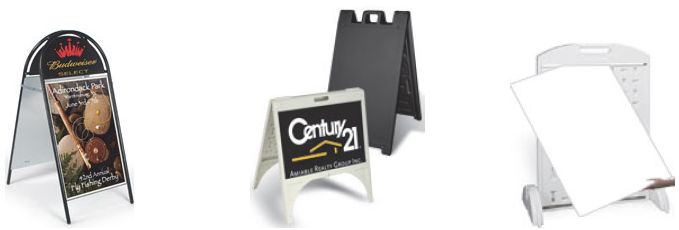
Alteration, sign. Any change to a sign or sign structure because of construction, repair, maintenance.
Alteration, structure. Any change, addition, or modification in construction or occupancy of an existing structure.
Animated sign. A sign with action, motion, sound, or changing colors, which accomplishes such action, motion, sound, or changing colors with or without electrical energy. This includes signs with lights or other illuminating devices that blink, flash, fluctuate, or have a changing light intensity, brightness, or color. This definition does not include a time, date and temperature or electronic message signs as defined by this Code Section.
Antenna. A device, dish or array used to transmit or receive telecommunications signals.
Antique shop. A business principally engaged in the sale or trading of articles which, because of age, rarity, or historical significance, have a monetary value greater than the original value or which, because of age, are recognized by the United States government as entitled to import duties less than those prescribed for similar new merchandise. Under this definition, antique shops do not receive donated goods from the public at the place of business.
Apartment. See "Dwelling, Multifamily."
Approved Plant List. List of trees, shrubs, and ground covers, approved for use in the City of Mauldin for compliance with Section 6:2 and the Mauldin City Code: Chapter 21, Sections 1—8 for tree preservation and planting regulations.
Appurtenance. An accessory, something added to the main structure or land.
Area of sign. The area within a continuous perimeter enclosing the limits of writing, representation, emblem, figure, or character together with any frame, other material, open space, or color forming an integral part of the display or used to differentiate such writing, representation, emblem, figure, or character from the background against which it is placed. For double-faced signs, only the largest display face shall be measured in computing the sign area, or only one (1) face shall be measured in computing sign area if the display faces are the same size. The display of street address on a ground sign, wall, or window shall not be computed in determining the maximum allowable area of a ground, wall, or window sign.
Assisted Living Facility. A structure or structures containing two (2) or more rooming units in occupancy and occupied by persons unable to live independently and may include spouses or partners (except for rooms occupied by resident staff personnel), and which provide indoor, conveniently located, shared food preparation service and major dining areas, and common recreational, social, and service facilities for the exclusive use of all the residents. Such a facility shall comply with all state and local codes and/or ordinances regarding zoning, building, fire, and health.
Attached sign. Any sign attached to, applied on, or supported by any part of a building, including but not limited to, a wall, window, projecting sign, or a sign on a canopy or awning.
Authorized Healthcare Provider. An individual authorized by law and currently licensed in the State of South Carolina to provide specific treatment, care, or services to residents.
Automobile Parts Sales. A wholesale or retail store that only sells automobile parts and may not be involved in any shop-related activities such as parts rebuilding, refurbishing, or installation.
Automobile Parts Sales and Shop. A wholesale or retail store that sells automobile parts and is involved in shop-related activities such as parts rebuilding, refurbishing, or installation.
Automobile Salvage-wrecking yard. A lot or parcel of land on which the dismantling or wrecking of used motor vehicles or the storage, sale or dumping of dismantled or wrecked vehicles or their parts occur. The presence of two (2) or more vehicles on a parcel of land being used for nonresidential purposes which, for a period exceeding forty-five (45) days, have not been capable of operating under their own power or from which parts have been or are to be removed for reuse or sale, constitutes evidence of an automobile salvage-wrecking yard. (This definition does not include Automobile towing service uses that provide for the removal and temporary storage of functioning, inoperable or wrecked vehicles.)
Awning. An architectural projection or shelter projecting from and supported by the exterior wall of a building and composed of a covering of rigid or non-rigid materials and/or fabric on a supporting framework that may be either permanent or retractable.
Awning sign. An awning that contains letters, numbers, symbols, pictures, logos, or visual display, or other communication, attached, painted on, or made an integral part of an awning. For purposes of this Code Section, "awning signs" shall be considered "wall signs."
Banner. A sign with or without characters, letters, illustrations, or ornamentation applied to cloth, paper, plastic, or natural or synthetic fabric of any kind with only such material for a backing. For purposes of this Code Section, a "banner" is a "sign."
Bar. Any establishment including cocktail lounges, taverns, etc., however designated, whose primary function is the sale of alcoholic beverages for consumption on the premises and cannot be licensed as a restaurant under state A.B.C. regulations.
B & B. Roots of plant material which have been balled and burlapped, in accordance with AAN Standards, in preparation for delivery and transplanting.
Berm. An earthen mound formed to shield undesirable views, decrease noise, and/or add topographical interest. The slope of a berm should not exceed a rise of one (1) foot in four (4) horizontal feet, unless approved otherwise.
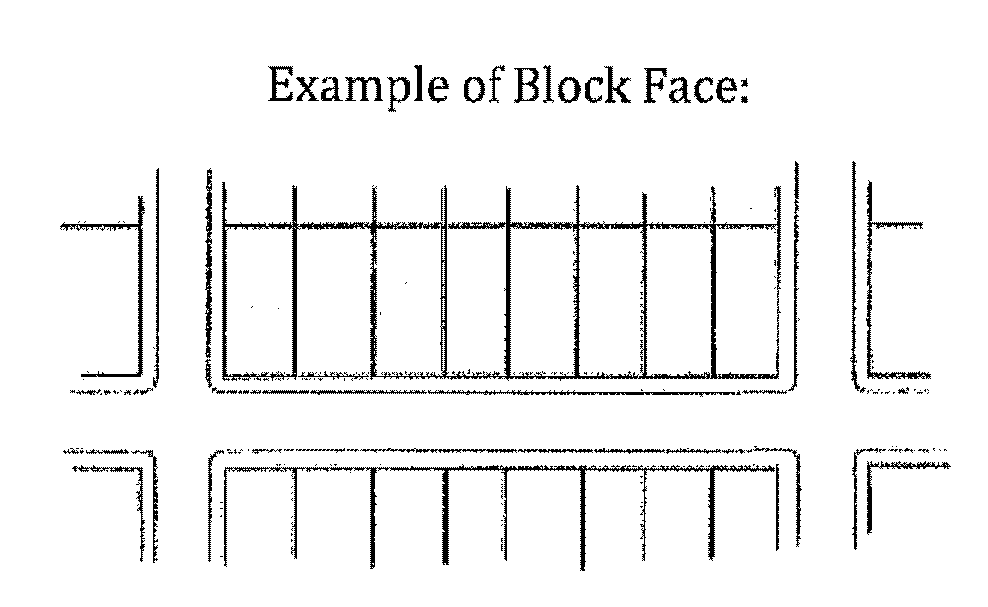
Block Face. The properties abutting on one (1) side of a street and lying between the two (2) nearest intersecting or intercepting street(s), un-subdivided land, watercourse, or city boundary.
Example of Block Face:
Boarding House. An establishment where the owner or manager is a full-time resident of said establishment, and which provides lodging for compensation to three (3) or more tenants; is enclosed within one (1) structure, which shall only have one (1) kitchen, a common dining room or study area, and no dining facilities or kitchens in the lodger's rooms; and where meals may be prepared or served; excludes hotels, motels, bed and breakfast homestays and inns.
Buffer. An area of land used to separate visibly one (1) use from another or which acts as a separation between two (2) land uses of different intensity.
Bufferyard. A linear strip of land combined with a vertical element such as plants, berms, fences, or walls, which physically separates and screens incompatible land uses.
Building. Any structure having a roof supported by columns or walls and intended for the shelter, housing, or enclosure of any person, process, equipment, or goods.
Building, Accessory. A structure attached to or detached from a principal building on the same lot and customarily incidental in use to the principal building.
Building, Principal. A building in which is conducted the principal use of the lot.
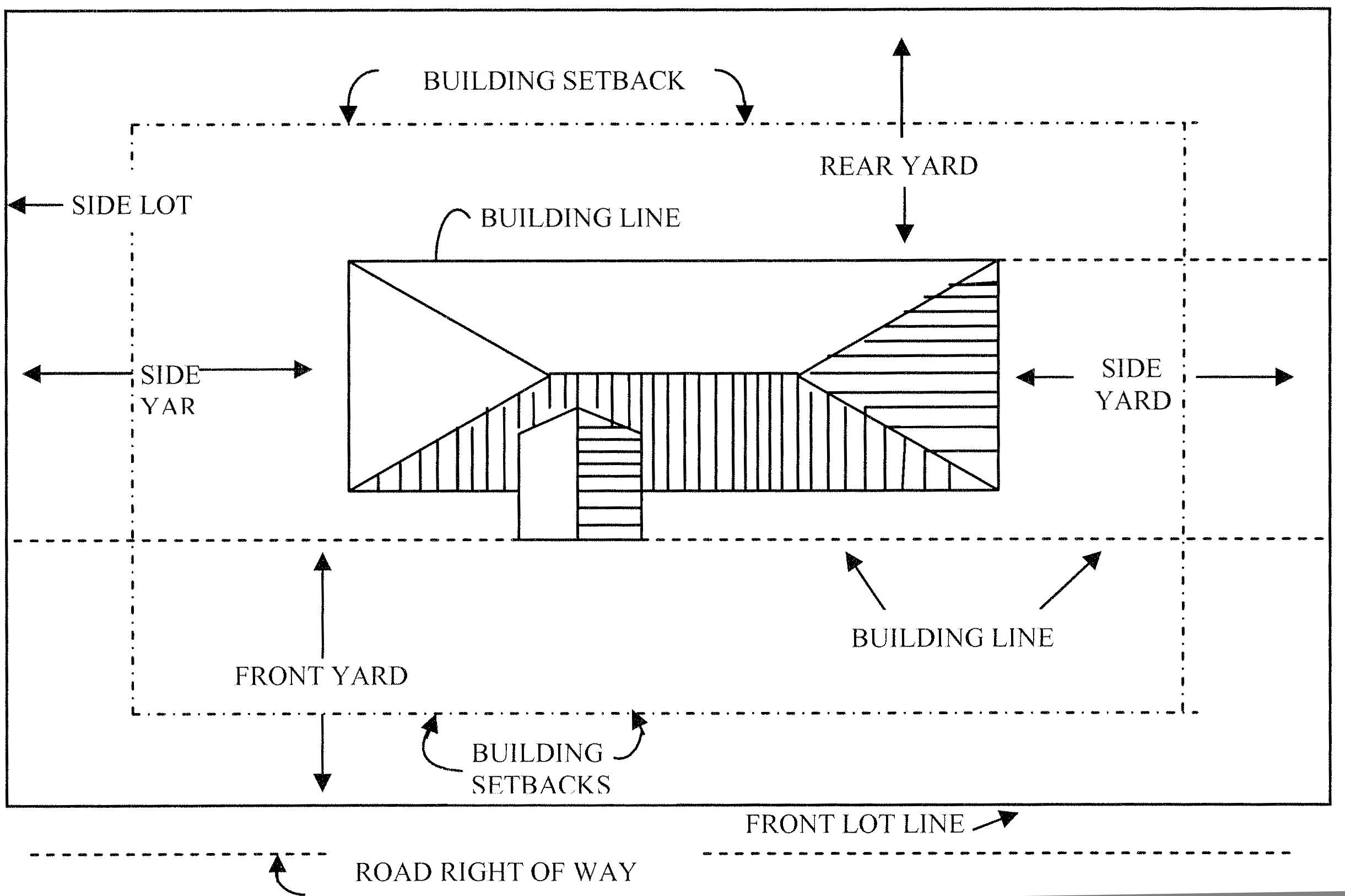
Building Setback Line. A line establishing the minimum allowable distance between the nearest portion of any building excluding steps, gutters, and similar fixtures and the property line when measured perpendicularly thereto.
Business Signs on Vehicles. Signs displaying a business name, trademark, or other identifier shall be allowed provided they are moved periodically during the normal course of business and maintain a current and valid registration. When not in use, said vehicles are to be parked in such a manner so as to minimize their visibility from the street and other public property.
Candela. The unit of luminous intensity equal to one-sixtieth ( 1/60 ) of the luminous intensity per square centimeter of a blackbody radiating at the temperature of solidification of platinum (2,046 degrees Kelvin) also called a candle.
Canopy. A permanent attached structure which projects from and is supported by a building, which serves as a cover providing shelter or decoration and which extends beyond the building.
Canopy, attached. A multi-sided structure or architectural projection supported by attachment to a building on one (1) or more sides and also supported by columns at additional points. Signs placed on attached canopies are considered "wall signs" for the purposes of this Code Section.
Canopy, freestanding. A multi-sided structure or architectural projection supported by columns. Signs placed on freestanding canopies are considered "wall signs" for the purposes of this Code Section.
Canopy sign. A sign on a canopy. For purposes of this Code Section, a sign on a canopy is a "wall sign" (see figure, "Types of Attached Signs").
Car Title Loan Business. An establishment that makes small consumer loans that leverage the equity of a car or other vehicle as collateral where the title to such vehicle is owned free and clear by the loan applicant and any existing liens on the car or vehicle cancel the application. Failure to repay the loan or make interest payments to extend the loan allows the lender to take possession of the car or vehicle.
Catering Truck. A truck, van, or similar vehicle from which the vendor offers for sale food and beverages that are prepackaged.
Certificate of Occupancy. A statement signed by the Zoning Administrator setting forth that the building, structure, or use complies with the Zoning Ordinance and that the same may be used for the purpose stated herein.
Certified Treated Wood. Wood that has been treated with a permanent preservative as defined by the American Wood Preservers Association.
Change of Use. The act of eliminating the type of land use in a structure or on a lot and replacing it with another type of land use; or the act of adding another type of land use in a building or on a lot which did not previously exist there. A change of use may or may not involve any type of new construction or building renovation. Single tenant developments where a use has ceased or is no longer in operation for a period of one hundred eighty (180) calendar days or more shall render the prior use inactive and subsequent uses of the property shall be considered as new development and reviewed, as such. Multi-tenant developments where fifty (50) percent or more of the gross floor area of a structure or lot (accommodating two (2) or more uses) has ceased or is no longer in operation for a period of one hundred eighty (180) calendar days or more shall be considered new development and reviewed as such.
Changeable Copy. Any permanently unframed sign, illuminated or not which is principally devoted to and designed for changeable copy text and graphics, but which specifically excludes time/date/temperature signs and electronic message signs as herein defined. Changeable copy signs may involve either manual or automatic changeable copy. No changeable copy sign may have its copy changed more than two (2) times in a twenty-four-hour period. Any automatic changeable copy sign which changes more than two (2) times in a twenty-four-hour period shall be defined to be an electronic message sign. Portable or moveable signs are not considered changeable copy signs.
Check Cashing Business. An establishment that provides one (1) or more of the following and is regulated pursuant to the provisions of Chapter 41 of Title 34 of the S.C. Code of Laws.
A.
An amount of money that is equal to the face of the check or the amount specified in the written authorization for an electronic transfer of money, less any fee charged for the transaction; or
B.
An agreement not to cash a check or execute an electronic transfer of money for a specified period of time; or
C.
The cashing of checks, warrants, drafts, money orders, or other commercial paper for compensation by any person or entity for a fee.
Child Day Care Center. A facility providing care for more than six (6) children who do not reside in the facility, are present primarily during daytime hours, do not regularly stay overnight, and that may include some instruction. Such a facility shall comply with all state and local codes and/or ordinances regarding zoning, building, fire, and health.
Child Day Care Home. A home occupation (accessory use) in which a permanent occupant of the dwelling provides for the care of up to six (6) children. Those receiving care are not all related to the occupant or to each other by blood or marriage and are not the legal wards or foster children of the attendant adults. Those receiving care and who are not dependents of the occupant do not reside on the site. Such a facility shall comply with all state and local codes and/or ordinances regarding zoning, building, fire, and health.
Civic Event. An event sponsored by government organization.
City Sponsored event means that the city, solely or in partnership with another entity, produces and/or coordinates the event.
Cluster Subdivision. A form of residential subdivision that permits housing units to be grouped on sites or lots with dimensions, frontages, and setbacks reduced from conventional sizes, provided the density of the tract as a whole shall not exceed the density allowed by the zoning district under existing regulations and the remaining land area is devoted to common open space.
Commissary. A commissary is defined as a permitted fixed food establishment that serves as an operating base for a mobile food vehicle. The commissary is where the vehicle will be stored, parked, serviced, cleaned, supplied, and maintained.
Common Open Space. Land and/or water within or related to a cluster residential development, not individually owned, which is designed and intended for the common use or enjoyment of the residents of the development, or the public, which may contain such accessory structures and improvements as are necessary and appropriate for passive recreational purposes and utilities. A condition of the cluster residential development approval shall be that common open space may not be further subdivided.
Communications Tower. A tower, pole, or similar structure of any size which supports communications (broadcast or receiving) equipment utilized by commercial, governmental, or other public and quasi-public users above ground in a fixed location, freestanding, guyed, or on a building. This does not include private home use of satellite dishes and television antennas or amateur radio operators as licensed by the Federal Communications Commission.
Conforming sign. A sign that is legally installed and is in compliance with all applicable local laws and ordinances.
Consignment boutique shop. A business principally engaged in the sale of primarily only one type of non-donated used merchandise where the merchandise is placed for sale with the business by the owner of the merchandise. An example may include a business that primarily sells used clothing and related accessories, or a business that primarily sells used children's apparel, or a business that primarily sells used furniture and related home furnishings, or a business that primarily sells used sporting goods and sporting equipment. Upon sale of the merchandise, the purchase price is customarily divided between the business and the owner of merchandise. This use does not include businesses engaged in the sale of used guns, appliances, mattresses, or motor vehicles.
Consignment store. A business principally engaged in the sale of non-donated used merchandise where the merchandise is placed for sale with the business by the owner of the merchandise. Upon sale of the merchandise, the purchase price is customarily divided between the business and the owner of the merchandise. This use does not include businesses engaged in the sale of used guns, appliances, mattresses, or motor vehicles.
Construction. The erection of any on-site improvements on any parcel of ground whether the site is presently improved, unimproved or becomes unimproved by demolition, destruction of the improvements located thereon by fire, windstorm or other casualty.
Construction Sign. A sign whose message is limited to identification of architects, engineers, contractors, and other persons involved with the construction project or to the name of the building being constructed, the intended purpose of the building and the expected completion date.
Convenience Store. Any retail establishment offering for sale prepackaged food products, household items, and similar products, which meet the convenience shopping needs of its patrons. These establishments may or may not offer gasoline for sale; however, they do not offer any automobile maintenance services or repair.
Critical root zone. The minimum area beneath a tree which must be left undisturbed and protected from construction disturbance in order to preserve a sufficient root mass to give a tree a reasonable chance of survival. The critical root zone is delineated by a concentric circle with the tree trunk as the center. The radius of the critical root zone equals one (1) foot for every one (1) inch of tree diameter. Example: a twenty-inch diameter tree will have a critical root zone radius of twenty (20) feet.
Cutoff Fixture. An outdoor lighting fixture shielded or constructed in such a manner that no more than two and one-half (2½) percent of the total light emitted by the fixture is projected above the horizontal plane of the fixture.
Debt Relief Company. Any establishment that advertises and/or promises to reduce unsecured debt through settlement and accepts any funds, payments or fees in advance of said settlement. This also applies to any firm that offers debt management, consolidation, advice, assistance, elimination, financing, negotiation, payoff, relief, settlement, or other solution that requires discontinuation of legitimate debt payments. This definition shall not apply to depository institutions or attorneys or retail businesses such as pawnshops or jewelry stores who obtain a precious metal dealer license in the normal course of their retail business and that are properly licensed by South Carolina.
Deferred Presentment Lender. A business or use that regularly accepts a check from a borrower drawn on the borrower's bank account to be presented for payment at a later date and that charges a fee for the service such as those regulated under Chapter 39 of Title 34 of the S.C. Code of Laws.
Density. The number of dwelling units per acre of land.
Derelict sign. A sign that is dilapidated or in such condition as to create a hazard or nuisance, or to be unsafe or fail to comply with the Building or Electrical Codes applicable in the jurisdiction.
Developable Acreage. As it pertains to cluster developments, land that is located outside of designated floodplains and has a slope of less than thirty (30) percent.
Development. Any human change or alteration to the unimproved or improved state of land, including, but not limited to changes or alteration to vegetation, soil, geology, hydrology, buildings or other structures for any residential, commercial, industrial, utility, or other uses, including, but not limited to, all areas for vehicular access, circulation, and parking and including, but not limited to, mining, dredging, filling, grading, paving, excavating and drilling operations and any subdivision of land.
Development Identification Sign. A sign bearing only the name of the multiple tenant development.
Diameter at breast height (DBH). Means the standard measure of trees which exist on a site. The diameter of the trunk is measured at four and one-half (4½) feet from the ground. If the tree splits into multiple trunks below four and one-half (4½) feet, the trunk should be measured at its most narrow point beneath the split.
Dimensional Requirements, Sign. Those measurements that contain the area, height and spacing requirements for signs.
Directional Sign. A sign or guide whose sole purpose is to direct pedestrian or vehicular traffic on the premises on which it is displayed. Examples include: "in" "out", "entrance", "exit", and "driveway".
Directory sign for multi-tenant development. A sign, distinguished from a project entrance sign, which is allowed on a premises with more than one (1) tenant or occupants of a building. It may be freestanding or a building (wall) sign. Such signs are not usually visible from the public street right-of-way of a development that provides initial access to the property, but rather are located within the development, along a driveway, access way, or parking aisle.
District, Zoning. Any section of the City of Mauldin in which zoning regulations are uniform.
Double-faced sign. A sign which has two (2) display areas against each other or where the interior angle formed by the display areas is sixty (60) degrees or less, where one (1) face is designed to be seen from one (1) direction and the other face from another direction. Only one (1) face shall be used in computing allowable sign area.
Drainage Plan. A site plan showing contours, drainage structures (including, but not limited to, pipes, ponds, ditches, etc.), anticipated flow calculations, destination of run-off to nearest identifiable drainage way and any other data required to clearly define the proposed drainage system.
Drive-thru facility. The portion of an establishment where goods or services are provided to patrons who remain in motor vehicles. Such facilities are typically distinguished by parking spaces or driveways where patrons may remain inside vehicles while placing or receiving orders at service windows, intercom devices or other electronic devices. These facilities comprise all driveways, queuing lanes and spaces, drive-in parking spaces, ordering stations, menu boards, service windows, intercom devices, and other appurtenances involved with the provision of goods and services to patrons in motor vehicles.
Dwelling. Any building or structure, or part thereof, used and occupied for human habitation or intended to be so used.
Dwelling, multifamily. A dwelling or group of dwellings on one (1) lot containing separate living units for three (3) or more families, but which may have joint services or facilities.
Dwelling, single-family. A residential building containing only one (1) dwelling unit and not occupied by more than one (1) family.
Dwelling, single-family attached. Two (2) or more single-family dwelling units, each with its own outside entrance, which are generally joined together by a common party wall.
Dwelling, single-family detached. A single-family dwelling unit that is not attached to any other dwelling by any means and is surrounded by open space or yards.
Dwelling, two-family. A detached house designed for and occupied exclusively as the residence of not more than two (2) families, each living as an independent housekeeping unit.
Dwelling unit. One (1) or more rooms providing complete living facilities for one (1) family, including kitchen facilities or equipment for cooking or provisions for the same, and including a room or multiple rooms for living, sleeping, bathing, and eating.
Electronic Message Board (EMBs). A permanent sign consisting of text, symbolic imagery, or both, that uses an electronic display created through use of a pattern of lights in a dot matrix configuration allowing the sign face to intermittently change the image without having to physically or mechanically replace the sign face. An EMB message changes more than two (2) times in a twenty-four-hour period, and shall be visible for a minimum of three (3) seconds and shall be kept accurate. These will not be deemed to constitute changeable copy or animated signs.
Erect. To construct, build, raise, assemble, place, affix, attach, create, paint, draw, or in any other way bring into being or establish, but it shall not include any of the foregoing activities when performed as an incident to the change of advertising message or the normal maintenance or repair of a sign structure.
Expansion. Any construction that increases the size of a building or structure in terms of site coverage, height, length, width, or gross floor area.
Expressway. Expressways involve those facilities containing some at-grade intersections but with limited access.
Façade. The exterior wall of a structure or building exposed to public view or that wall viewed by persons not within the building, including parapets walls.
Façade, Primary. A primary façade is a building's principle or face elevation that typically fronts a street. On commercial buildings, the primary façade generally includes the storefront, principle entryway, prominent architectural features, a building cornice and window and door opening. Some commercial buildings may feature multiple primary façades, such as those structures located on a street corner.
Façade, Secondary. A secondary façade has limited architectural features and generally does not have a storefront or other openings. For the purposes of signage, a secondary façade must be architecturally finished with at least one (1) opening (window or secondary entrance) and shall be constructed with similar materials and details as the primary façade.
Family. A person living alone, or a group of people, including domestic employees, living together as a single nonprofit housekeeping unit and sharing common living, sleeping, cooking, eating and sanitary facilities as distinguished from a group occupying a boardinghouse or other group living facility or visitor accommodations.
Family entertainment center. A commercial venue offering a variety of paid amusement attractions, games, and activities for families, children, teenagers, and adults. Common examples of attractions found in family entertainment centers include: arcades, laser tag, bowling alleys, go-karts, trampolines, climbing walls, miniature golf, indoor playgrounds, virtual reality experiences, and similar activities designed to create engaging experiences.
Fencing: Non-opaque. A fence that can be seen through by persons outside its confines and which does not act as a privacy screen.
Fencing: Privacy fence, Screening. A fence and/or wall constructed of solid, opaque materials made up of wood, vinyl, brick, stone and/or other architectural masonry finishes that are intended to block the line of sight into a premises; and/or to screen specific site and/or building features from view.
Flag. A sign with or without characters, letters, illustrations, or ornamentation applied to cloth, paper, plastic, or natural or synthetic fabric of any kind with only such material for a backing. For purposes of this Code Section, except as otherwise provided herein, a "flag" is a "sign."
Flashing Sign. A sign illuminated by direct or indirect artificial light that flashes on and off in regular or irregular sequences, including, but not limited to strobe light.
Flood Light. A form of lighting designed to cast direct its output in a diffused, less specific direction.
Foot-Candle (FC). A quantitative unit measuring the amount of light cast onto a given point, measured as one (1) lumen per square foot.
Freestanding Ground Sign, see also Monument Sign. All freestanding ground signs shall be mounted on a monument structure that is equal to or greater than two-thirds (⅔) the width of a sign itself. Monument structures shall be constructed of brick, stone or stucco materials that have the appearance of brick, stone, or stucco or other durable architectural materials consistent with the design of the primary building on the site.
Freestanding Pole Sign. A sign which is permanently affixed to the ground by a pole or other structure and which is not part of a building. Freestanding poles shall not be permitted.
Freeway. Freeways involve those facilities with complete control of access through the use of grade separation and interchanges.
Fresh or Fresh Frozen Foods. Food for human consumption that is unprocessed, or otherwise in its raw state; food that was quickly frozen while still fresh. This includes unprocessed meat and seafood.
Frontage, building. The width in linear feet of the front exterior wall of a particular building in which an establishment is located.
Frontage, road. The distance in linear feet of each lot where it abuts the right-of-way of any public street.
Full Cutoff Fixtures. An outdoor light fixture shielded or constructed in such a manner that it emits no light above the horizontal plane of the fixture.
Gallon. Unit of physical measure for defining the size of root balls of plant material in a standard container (e.g. three-gallon size), in accordance with AAN Standards, in preparation for delivery and transplanting.
Glare. The effect produced by a light source within the visual field that is sufficiently brighter than the level to which the eyes are adapted, so as to cause annoyance, discomfort, or loss of visual acuity.
Gross Floor Area. The sum of the total horizontal areas of each floor of a building, measured from the exterior faces of exterior walls or in the case of a common wall separating two (2) buildings, from the centerline of such common wall. The term gross floor area shall include any area with a ceiling height of seven (7) feet or greater, all elevator shafts, stairway shafts; and attics and basements. Up to one thousand (1,000) square of floor area used to house mechanical, electrical, and communications equipment may be excluded in the calculation of gross floor area when such devices are located in the basement, first floor, or penthouse of said building. Gross floor area shall also include areas covered by canopies and like structures when an active use is occurring such as: drive-through service, gasoline pumping, loading and/or storage of materials, and similar activities. Gross floor area does not include the floor area in parking structures/decks.
Gross Leasable Area. The total floor area designed for tenant occupancy and exclusive use, including basements, mezzanines, and upper floors, if any, expressed in square feet and measured from the center line of joint partitions and from outside wall faces.
Ground Covers. Ground covers shall be defined as any evergreen plant material, forming a continuous coverage, with a mature height ranging from one (1) inch to eighteen (18) inches.
Ground sign. A permanently affixed sign which is wholly independent of a building for support (i.e., freestanding). A ground sign must be attached to a monument structure and may consist of more than one (1) sign panel, provided all such sign panels are attached to or integrated into one (1) sign structure.
Group and Family Care Center. An establishment where more than five (5) persons, not regularly employed due to age or disability are lodged, kept or temporarily confined, whether such persons be supported by charity or fees charged therefore, as opposed to a rooming house or boardinghouse. A group home is one (1) that provides a support setting for persons, who by reason of mental or physical disability, addiction to drugs or alcohol or family and/or school adjustment problems, require a specialized residential setting. Such a facility shall comply with all state and local codes and/or ordinances regarding zoning, building, fire, and health.
Group and Family Day Care Home. A residential home that serves as a personal care facility for five (5) or less persons. Only those residing in the home may be involved in the day-to-day operation of the adult/child home. (Personal care service: The care of persons who do not require chronic or convalescent medical or nursing care. Personal care involves responsibility of the safety of the persons while at home. Such a facility shall comply with all state and local codes and/or ordinances regarding zoning, building, fire, and health.
Group Development. A planned mix of permitted uses.
Group Non-residential Development. A building or group of buildings which consists of more than one (1) office, commercial, retail or industrial structure erected on one (1) or more parcels of ground developed with a common plan for the protection, maintenance and improvement of the parcels.
Group Residential Development. A building or group of buildings containing three (3) or more dwelling units located on one (1) or more parcels of ground developed with a common plan to protect, maintain and improve the parcels. Where permitted, a group residential development might also include a planned mix of residential uses, and low impact non-residential uses.
Guarantee in lieu of construction of improvements. Cash, irrevocable letters of credit, bonds, or similar financial instruments deposited with and accepted by the City to insure that improvements required as part of a development will be satisfactorily completed.
Handheld Signs or Devices (Also referred to as human signs, sign spinners, living signs and sign walkers.) Signs that are carried, waved, or otherwise displayed by persons either on private or public right-of-way or in a manner visible from a private or public right-of-way and are prohibited.
Hardship. A practical difficulty in carrying out the requirements of this chapter. Unless otherwise indicated, financial difficulties, in and of themselves, do not constitute a hardship.
Height. The vertical distance measured from the finished grade at the front building line to the cornice line. The cornice line as used herein shall mean the horizontal line on the exterior of a building at which the roof system intersects the exterior wall.
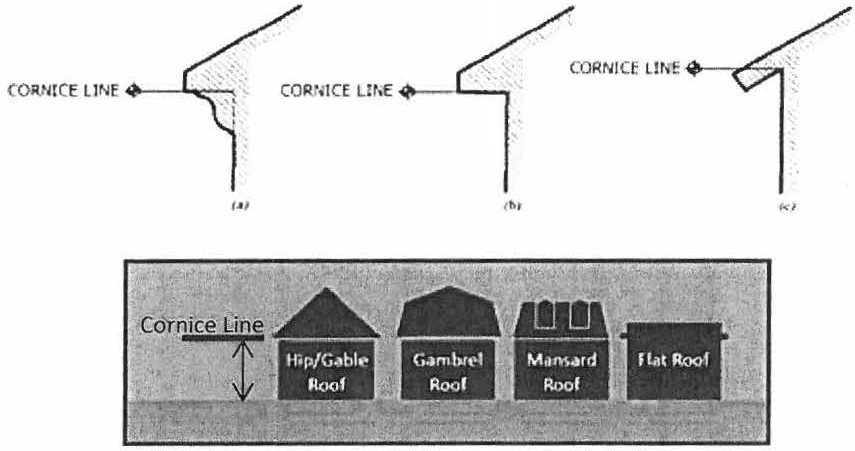
Height of sign. The distance in vertical feet from the ground at normal grade to the highest point of the sign, whether that highest point is the frame of the sign face or panel or the support of the sign.
Holiday decorations. Displays erected on a seasonal basis in observance of religious, national, or state holidays, which are not intended to be permanent.
Home Occupation. Any activity carried out for gain by a resident conducted as an accessory use in the resident's principal dwelling unit.
Home Occupation Sign. A sign used for a home occupation.
Homeowners Association. A private non-profit association which is organized by the developer of a residential development in which individual owners share common interests in open space and/or facilities and are in charge of preserving, managing, and maintaining the common property, and enforces certain covenants and restrictions.
Hotel or Motel. A building or group of buildings containing individual sleeping or living units designed for the temporary occupancy of automobile tourists or transient guests and which has a garage attached or parking space conveniently located to each unit.
Ice Cream Truck. A motor vehicle containing a commercial freezer and from which a vendor sells frozen prepackaged food products such as ice cream, frozen yogurt, frozen custard, flavored frozen water and similar.
Identification Sign. A sign used to identify, indicate or advertise the name, logo or other identifying symbol of a building, business, profession, institution, service, or entertainment conducted on a lot upon which the sign is located.
Impervious surface. Any surface which in whole or in part, restricts or prevents the natural absorption of water into the ground. Such surfaces may include, but not be limited to, compacted earth, traffic-bearing gravel, concrete, asphalt, or other paving material, and all area covered by the footprint of buildings or structures. Uncovered slatted decks and the water area of a swimming pool, pond, or other water body are considered pervious.
Incidental Sign. A single face professional or announcement sign attached wholly to a building, window or door containing information relative to emergencies, store hours, credit cards honored, and other similar accessory information.
Industrial use. Uses that primarily involve the assembly, packaging, processing, production, and manufacturing of goods.
Infill development. New development or redevelopment that occurs within established urban areas where the site or area is either vacant or has previously been used for another urban purpose.
Inflatable sign. Any sign that is or can be filled with air or gas.
Institutional use. Includes but is not limited to religious and charitable organizations, hospitals, and educational institutions.
Interim Temporary Use. A use (and/or structure containing a use), which is located on a property often for periods exceeding one hundred twenty (120) days due to the nature of the use.
Internally illuminated sign. Any sign designed to provide artificial light either through exposed lighting on the sign face or through transparent or translucent material from a light source within the sign.
Island or median. An unpaved area within a parking lot or street, usually surrounded by a curb or other raised element, which is surrounded by a paved or gravel surface on at least three (3) sides.
Joint Identification Sign. A sign bearing the name of individual tenants located within a multiple-tenant (multi-tenant) development and which includes the name of the development.
Junk Yard. Any land or area used in whole or in part for commercial storage and/or sale of waste paper, rags, scrap metal, or other junk, and including storage of vehicles and machinery and/or dismantling of such vehicles or machinery.
Landscaping. Landscaping shall consist of any of the following materials or combination thereof, such as grass, ground covers, shrubs, vines, hedges, or trees, and any commonly used non-living durable material commonly used in landscaping, such as but not limited to rocks, pebbles, mulch, walls or fences, but excluding paving.
Light Industrial use. Uses that primarily involve the assembly, packaging, processing, production, and manufacturing of goods if such activities are conducted wholly within an enclosed building; and if operated in a manner that prevents external effects of the activity such as (but not limited to) smoke, soot, dirt, vibration, odor from being detectable at any property line.
Light Pollution. Excessive illumination that, because of quantitative or directional characteristics, results in annoyance, distraction, or impairment of visual acuity.
Light Trespass. The encroachment of unwanted light from private property onto another private property or onto public property.
Local Government. Any county, incorporated village, town or city, or any combination of counties, incorporated villages, towns, and cities, acting through a joint program pursuant to provisions of the Act.
Logo. A business symbol or trademark.
Lot. A parcel of land designated by number or other symbol as a part of a legally approved and recorded subdivision, or as described by metes and bounds and recorded in the office of Greenville County Register of Mesne Conveyance.
Lot, Corner. A lot located at the intersection of two (2) or more streets.
Lot Depth. The average horizontal distance between the front and rear property lines of a lot.
Lot, Double frontage, through-lot, non-residential parcels. A lot having frontage on two (2) non-intersecting streets as distinguished from a corner lot. Non-residential lots under this classification shall have a front setback applied on both streets as provided for in Section 3:11.1.C., Double Frontage, through-lots, non-residential parcels - setbacks.
Lot, Double frontage, through-lot, residential parcels. A lot having frontage on two (2) non-intersecting streets as distinguished from a corner lot. Structures on residential lots abutting two (2) opposite streets shall be provided with a front setback and a rear setback as provided for in Section 3:11.1.D., Double Frontage, through lots, residential parcels - setbacks.
Lot for sign regulations. Any number of contiguous lots or portions thereof, upon which one (1) or more main structures for a single use are to be erected.
Lot Line, Front: The boundary line of a lot that abuts a public street.
Lot Line, Rear. Ordinarily, the boundary line of a lot that is opposite and does not intersect the front lot line.
Lot Line, Side. The portion of a lot that is not adjacent to a street and also not classified as a front, corner or rear lot line.
Lot of Record. A lot existing before the adoption of the Zoning Ordinance and as shown or described on a plat or deed in the records of the Greenville Register of Mesne Conveyance.
Lot Width. The distance between the side lot lines at the setback line as measured along a straight line parallel to the front lot line or parallel to the chord thereof.
Lot, Zoning. A parcel of land which is indicated by the owner at the time of application for a building or zoning permit as being that land which he proposes to develop under one (1) ownership.
Lumen. The amount of light that falls upon an area of one (1) square meter, every point of which is one (1) meter from a source of one (1) candela (one (1) candela equals 12.57 lumens).
Manufactured Home. See "Sectional Home."
Marquee Sign. A sign painted in, attached to, or hung from a marquee. For purposes of this Code Section, a marquee shall be considered "wall sign".
Menu Board. A freestanding or wall mounted sign primarily designed for the display of menu items and prices for the purpose of placing orders for such items in conjunction with a restaurant utilizing drive-through or walk up service.
Microbrewery. A limited-production brewery, typically producing specialty beers and often selling its products only locally.
Microdistillery. A small-scale, often boutique-style, commercial distillery that produces relatively small quantities of beverage-grade alcohol, typically in single batches.
Mobile Food Sales. The preparation, cooking, serving and/or sale of food from a portable stand, vehicle or trailer.
Mobile Home. A mobile home is a portable unit designed and built to be towed on its own chassis comprised of frame and wheels, connected to utilities, and designed to be used without a permanent foundation for a permanent residence. A unit may contain parts that may be folded, collapsed, or telescoped when being towed and expanded later to provide additional cubic capacity as well as two (2) or more separately towable components designed to be joined into one (1) integral unit capable of being again separated into components for repeated towing. Mobile units can be designed to be used for residential, commercial, educational, or industrial purposes excluding, however, travel trailers, travel motorized homes, pick-up coaches, and camping trailers.
Mobile Home Park. Any place, area, or tract of land maintained, offered, or used for parking of two (2) or more mobile homes used or intended to be used for living or sleeping purposes, regardless of whether or not a charge is made for such accommodations.
Mobile Home Space. That portion of land in a mobile home park allotted to or designed for the accommodation of one (1) mobile home.
Mobile Module. A mobile module is a factory fabricated, transportable building unit designed to be incorporated at a building site into a permanent structure to be used for residential, commercial, educational, or industrial purposes.
Monument sign. A free-standing ground sign that is supported by a solid base (other than poles) and having no more than twenty-four (24) inches of air space visible within or between any portion of the sign display area and sign structure. All freestanding ground signs shall be mounted on a monument base that is equal to or has a length of at least seventy-five (75) percent of the width of the sign face and supporting structures combined. Monument structures and sign supports shall not have any exposed poles and shall be constructed of durable architectural materials (i.e., brick, stucco, or stone) that are consistent with the design and features of the primary facade of the building on the site.
Examples of a Freestanding Monument Ground Sign (monument structure):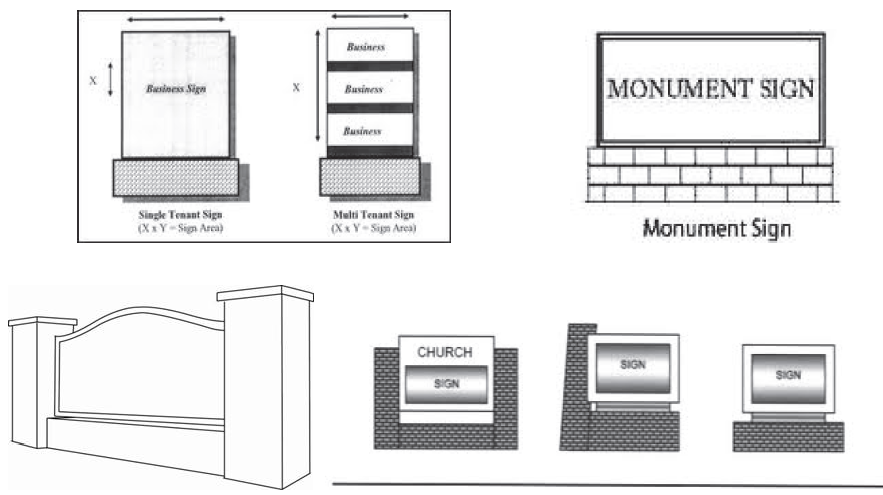
Motel. See "Hotel or Motel."
Mulch. A protective covering (such as pine straw, shredded bark, or other materials) spread evenly around trees, shrubs, and ground covers to reduce evaporation, maintain even root temperatures, prevent erosion, control weeds, and enrich the soil.
Multiple message sign. A sign, display, or device, which changes the message or copy on the sign electronically by movement or rotation of panels or slats.
Multiple (Multi) Tenant Development (also referred to as Group Development). A development in which there exists a number of individual and separate occupiable spaces and/or buildings and in which there are appurtenant-shared ancillary facilities (such as parking areas, driveways or pedestrian mall areas) with each space having a separate and operable public entrance opening onto or leading to the area of shared facilities.
Nit. A unit of illuminative brightness equal to one (1) candle per square meter, measure perpendicular to the rays of the source.
Nonconforming Lot. A lot, the area, dimensions, or location of which was lawful prior to the adoption, revision, or amendment of this Ordinance but, by reason of such adoption, revision, amendment, or right-of-way acquisition, fails to conform to the current standards of this Ordinance.
Nonconforming Sign. A sign which was lawful prior to adoption, revision, or amendment of this Ordinance but, by reason of such adoption, revision, amendment, or right-of-way acquisition, fails to conform to the current standards of this Ordinance.
Nonconforming Structure or Building. A structure or building, the size, dimensions, design, or location of which was lawful prior to the adoption, revision, or amendment of this Ordinance but, by reason of such adoption, revision, amendment, or right-of-way acquisition, fails to conform to the current standards of this Ordinance.
Nonconforming Use. A land use or activity that was lawful prior to the adoption, revision, or amendment of this Ordinance but, by reason of such adoption, revision, or amendment, fails to conform to the current standards and allowed uses of this Ordinance.
Non-Depository Financial Institution. Any check cashing business, payday advance/loan business, or title loan business as defined in this section. This definition excludes a state or federally chartered bank, savings and loan association or credit union.
Off-premises sign. Any sign used for the purpose of displaying, advertising, identifying, or directing attention to business products, operations or services sold or offered at a site other than the site where such sign is displayed.
On-premises sign. Any sign used for the purpose of displaying, advertising, identifying, or directing attention to business products, operations or services sold or offered on the lot site where the sign is located.
Parapet. That portion of a building wall that rises above the roofline.
Parapet wall. That portion of a building wall that rises above the roofline.
Parking Space. That storage space for one (1) automobile of not less than nine (9) feet by twenty (20) feet or as described in subsection 6:1.1.5 and shown on the parking standards, plus the necessary access space, and located outside the dedicated street right-of-way.
Patio House. Same as "Dwelling, Garden Court."
Pawnbroker. Any person engaged in the business of lending money on the security of pledged goods, or engaged in the business of purchasing tangible personal property on condition that it may be redeemed or repurchased by the seller for a fixed price within a fixed period of time. Pledged goods means tangible personal property, other than vehicles required to be registered and licensed pursuant to South Carolina Code Title 56, choses in action, title, securities, or printed evidences of indebtedness, which property is deposited with or otherwise actually delivered into the possession of a pawnbroker in the course of his business in connection with a pawn transaction.
Pawnshop. The location at which or premises in which a pawnbroker regularly conducts business.
Payday Advance/Loan Business. An establishment that makes small consumer loans, usually backed by a postdated check or authorization to make an electronic debit against an existing financial account, where the check or debit is held for an agreed-upon term, or until a customer's next payday, and then cashed unless the customer repays the loan to reclaim such person's check.
Pedestrian Oriented Design. Development designed with an emphasis on pedestrian access and interest from adjoining streets and sidewalks. In pedestrian oriented design, buildings are generally placed close to the street and main entrances are oriented to the street sidewalk; additionally, there are generally windows or display cases along the building facades that face the street. Site characteristics of pedestrian oriented design typically include: site grading that enhances the relationship of the building to the adjoining street(s) and sidewalk(s) from the perspective of the pedestrian; parking facilities placed to the side or rear of the building; and the provision of pedestrian oriented amenities, such as outdoor dining areas, landscaping/hardscaping and seating.
Pennant. A small, triangular or rectangular flag or multiples thereof, made of lightweight plastic, fabric, or other material, individually supported or attached to each other by means of a string, rope, or other material and meant to be stretched across or fastened to buildings, or between poles and/or structures, and which is designed to move in the wind. For purposes of this Code Section, pennants are "signs."
Pervious Surface. A surface that allows water to pass through (i.e. grass, permeable pavers, pervious pavement)
Places of Worship. A building or structure(s) including, but not limited to, sanctuaries, accessory classrooms, meeting rooms, offices and housing quarters for religious leaders that are primarily intended for religious services and which operate as a private, non-profit, tax exempt institution. The term includes, but is not limited to, churches, synagogues, and temples. Child care centers, schools, recreational facilities, and other uses developed as part of a Place of Worship shall meet the standards for these uses as set forth in the zoning district in which they are located.
Planned Shopping Center. A group of commercial establishments, planned, developed, owned, and managed as a unit related in location, size, and type of shops to the trade area that the unit serves; it provides on-site parking in definite relationship to the types and sizes of stores.
Planned Development. For purposes of this ordinance, a planned development shall be a group of detached, semi-detached, attached, groups of attached, clustered, or multi-storied residential structures, or any combination thereof on a parcel of land under single, corporation, firm, partnership, or association ownership planned and developed as an integrated unit in a single development operation or a definitely programmed series of development operations in accordance with an approved development plan.
Pole or Pylon Cover. An enclosure for concealing and/or for decorating poles or other structural supports of a ground sign.
Pole or Pylon Sign. A freestanding sign that is affixed, attached or erected on visible pole support structure(s) such that the bottom of the sign face is three (3) feet or more above grade.
Examples of Types of Pole Signs without monument base: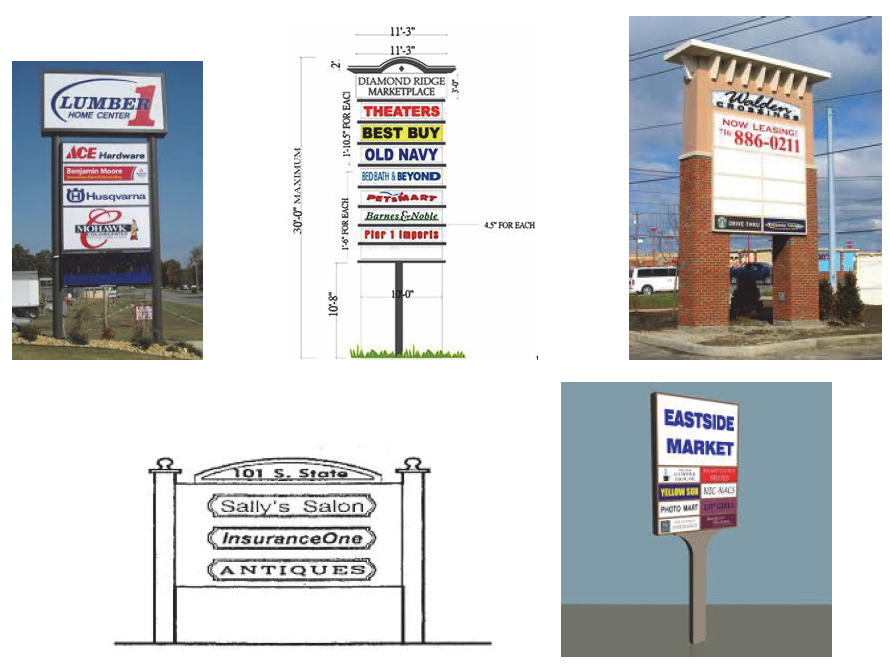
Portable, Mobile and Moveable signs. Any sign that is designed or is intended to be readily relocated and is not permanently affixed to the ground or to a building. This shall include signs on wheels, trailers, truck beds, or otherwise, devices which are designed to be transported from one (1) place to another. It is characteristic of a portable sign that the space provided for advertising messages may be changed at will by the replacement of lettering or symbols (i.e., a changeable copy sign). Even if the wheels or supports of such sign are removed and the sign converted and attached, temporarily or permanently, to the ground or other structure, said sign shall remain a portable sign. In addition, signs mounted or painted upon a parked vehicle that is positioned for the primary purpose of advertising a business or business activity to the public not being used in the normal course of business shall constitute a portable, mobile and/or moveable sign. Portable, mobile and moveable signs shall also include: windblown or air blown devices, wind signs, streamers, snipe signs, animated motion signs, attention seizing devises, decorative flags, and handheld devices which are signs that are expressly prohibited.
Portable Storage Container. A purpose-built, box-like container that is designed for temporary storage of goods, materials, and equipment. Usually these containers are designed for ease of loading to and from a transport vehicle.
Precious Metal. Any article made in whole or in part of gold, silver, or platinum.
Precious Metal Dealer. Any person, corporation, or partnership who buys precious metal or precious or semiprecious stones or gems from the general public, whether in bulk or in manufactured form, with intent to obtain a monetary profit for himself or for a principal. This definition shall not apply to retail businesses such as pawnshops or jewelry stores who obtain a precious metal dealer license in the normal course of their retail business.
Premises. A lot, parcel, tract, or plot of land together with all buildings and structures thereon.
Principal residence. A dwelling unit that constitutes the principal structure on a lot or parcel.
Principle structure. The main or predominant structure(s) in which the primary use occurs.
Principal use sign. Any notice or advertisement, which is permitted in conjunction with (but not necessarily containing copy specifically related to) a single principal use or single principal building located on the property, and which may display a noncommercial, commercial, or other message, the content of which is not regulated by this Code Section.
Private Recreation Area. A recreation area owned and maintained by members and operated as a nonprofit organization.
Private Street. A right-of-way of undetermined width with a roadway of undetermined width, which has not been dedicated, recorded, or publicly accepted by the county.
Projecting sign. A sign projecting more than fourteen (14) inches from the outside wall or walls of any building, or canopy, portico, or awning, upon which it is located (see also figure, "Types of Attached Signs").
Promotional Event. An occasion that draws attention to a particular business, service, or product(s).
Public Agency. Any governmental body (including city, county and state bodies or agencies, and special purpose districts such as fire, water, and sewer districts) that has jurisdiction over property or infrastructure within the City of Mauldin.
Public Awareness Event. An organized, systematic effort through various communications media to alert the general population of a given area to anything of significant interest or concern. Examples include: Paint the Town Teal, Cancer Awareness, Fire Prevention Month, Child Abuse Awareness.
Quorum. The number of members of any deliberative or corporate body as is necessary for the legal transaction of business, commonly a majority.
Recreational Vehicle, Dependent. Any self propelled vehicular unit, motorhome, pop-up or truck camper, or coach designed to be mounted on another vehicle, or motorized dwellings, boat or boat trailer, or buses, designed as a temporary dwelling with sleeping facilities for travel, recreational, and vacation use, not more than twenty-six (26) feet in length, and is dependent upon a separate service building for toilet and lavatory facilities, such vehicles shall be in conformance with all National Highway Traffic Safety Administration (NHTSA) regulations including being manufactured or modified by a dealer who has met or consistently meets the requirements of the Federal Motor Vehicle Safety Standards (FMVSS) established in order to ensure the reduction of death and injuries attributable to failure or inadequate performance of motor vehicle systems.
Recreational Vehicle, Independent. Any self propelled vehicular unit, motorhome, pop-up or truck camper, or coach designed to be mounted on another vehicle, or motorized dwellings, boat or boat trailer, or buses, designed as a temporary dwelling, for travel, recreational, and vacation use and containing toilet, lavatory, and sleeping facilities. Such vehicles shall be in conformance with all National Highway Traffic Safety Administration (NHTSA) regulations including being manufactured or modified by a dealer who has met or consistently meets the requirements of the Federal Motor Vehicle Safety Standards (FMVSS) established in order to ensure the reduction of death and injuries attributable to failure or inadequate performance of motor vehicle systems.
Renovation costs. The following shall be considered when determining the site improvements that may be required by ordinance. For zoning purposes, the total cost of renovation shall include any structural or other trades work, permanent equipment or other fixtures that are necessary for the operation and/or occupancy of the building, and shall also include cosmetic work such as but not limited to painting, carpeting, flooring, cabinet installation, and facade work.
Replacement Cost. Cost of replacing a structure or building at current costs at the time of the loss, identical to the one (1) that was destroyed or is being replaced, without application of depreciation.
Residence. A home, abode, or place where an individual resides.
Residential Development. A development consisting of buildings for residential uses such as attached and detached single-family dwellings, manufactured homes, apartment complexes, condominiums, townhouses, cottages, etc. and their associated outbuildings such as garages, storage buildings, gazebos, etc.
Rest Home. The rooming or boarding of any aged or convalescent persons, whether ambulatory or nonambulatory, for which a license is required by a county, state, or federal agency.
Restaurant. Any establishment, including drive-ins, however designated whose primary function is the sale of food for consumption on the premises and includes any establishment, which has been licensed by the state A.B.C. Board as a restaurant.
Roof sign. A sign projecting higher than the front building wall or any sign supported by or attached to said roof.
Examples of Types of Roof Signs: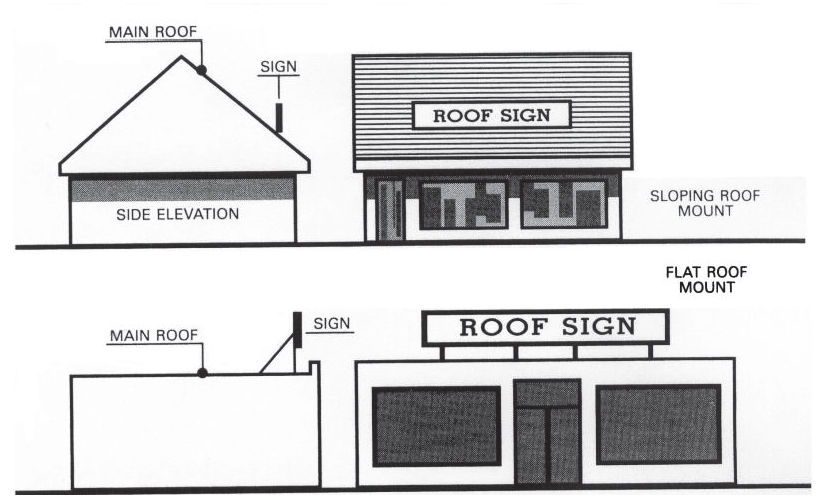
Rooming or Boarding House. A dwelling other than a hotel where lodging and/or meals for three (3) or more persons are provided for compensation.
Rowhouse. Same as "Townhouse."
Satellite Dish Antenna. A device incorporating a reflective surface that is solid, open mesh, or bar configured and is in the shape of a shallow dish, cone, horn, or cornucopia. Such device shall be used to transmit and/or receive ratio or electromagnetic waves between terrestrially and/or orbitally based uses. This definition is meant to include but not be limited to what are commonly referred to as satellite earth stations, TVROs, and satellite microwave antennas.
Screening. A structure or planting that conceals view from public ways or adjacent property.
Seasonal Outdoor Sale event. The display and sale of products outside of a building, typically located within a parking area, for a temporary period of time. The following events and similar uses shall qualify as a seasonal sales event: Christmas tree sales, garden sales, produce stands, and pumpkin sales.
Second Tier Development. A development that is located at least one (1) lot back from a major thoroughfare with no direct street frontage and having shared access with adjacent or adjoining parcels and the development consists of more than one (1) structure on the site or within the development. For purposes of signage, this option does not increase square footage allowances or render a single tenant property as a multi-tenant development unless such conditions are met under another definition in this section.
Sectional Home. A sectional home consists of two (2) or more units factory fabricated and transported to the home site where they are put on a permanent foundation and joined to make a permanent single-family house.
Self-Service Storage Facility. A structure containing separate storage spaces of varying size leased or rented as individual leases. No activities other than rental of storage units and pick up and deposit of stored goods shall be allowed on the premises. No outside storage shall be permitted. Radioactive materials, explosives, and flammable or hazardous chemicals shall be prohibited.
Semi-Cutoff Fixture. An outdoor light fixture shielded or constructed in such a manner that it emits no more than five (5) percent of its light above the horizontal plane of the fixture.
Service Station. An establishment used for the servicing of automobiles including the sale of gasoline, oil, grease, and minor accessories and washing and polishing but excluding the sale of automobiles, body repairing, major motor repairing, and painting.
Setback Line. The minimum distance by which any building or structure must be separated from a street right-of-way or lot line as required by the applicable zoning district.
Shade Tree. Any tree, evergreen or deciduous, whose mature height can be expected to exceed thirty-five (35) feet and whose crown spread can be expected to exceed thirty (30) feet, is considered a shade tree according to standards set forth by the American Association of Nurserymen. The shade tree, existing or planted, shall be at least eight (8) feet in height and six and one-quarter (6¼) inches in circumference, or two (2) inches in diameter, measured at six (6) inches above grade for new trees and measured at four and one-half (4½) feet above grade for existing trees.
Shared Access. The mutual use of one (1) or more points of ingress or egress by establishments on separate lots.
Shared Parking. The development and use of parking areas on two (2) or more separate properties for joint use by the businesses on those properties.
Shielding. A design feature or a device that is applied to a light to prevent its luminous output from being visible from selected locations or from horizontal or vertical angles.
Short-term Rental. An accommodation for transient guests where, in exchange for compensation, a residential dwelling unit, or any portion thereof, is provided for lodging for a period of less than thirty (30) consecutive days.
Shrubs. Shrubs shall be defined as self-supporting woody plants, either deciduous or evergreen, with several stems and a normal mature height of three (3) to twenty (20) feet in Greenville County.
A.
Small Shrub. Any shrub easily maintained at three (3) to eight (8) feet in height in Greenville County. The minimum size at time of planting shall be eigteen- to twenty-four-inch spread, three-gallon container, in accordance with AAN Standards.
B.
Large Shrub. Any shrub easily maintained at eight (8) to twenty (20) feet in height in Greenville County. The minimum size at time of planting shall be eighteen- to twenty-four-inch spread, three-gallon container, in accordance with AAN Standards.
Sight Triangle. Measured from the curb or edge of pavement, the triangle area created by a line connecting points on the front and side for lines at a distance (as indicated below) from the intersection of said lines or extensions of said lines.
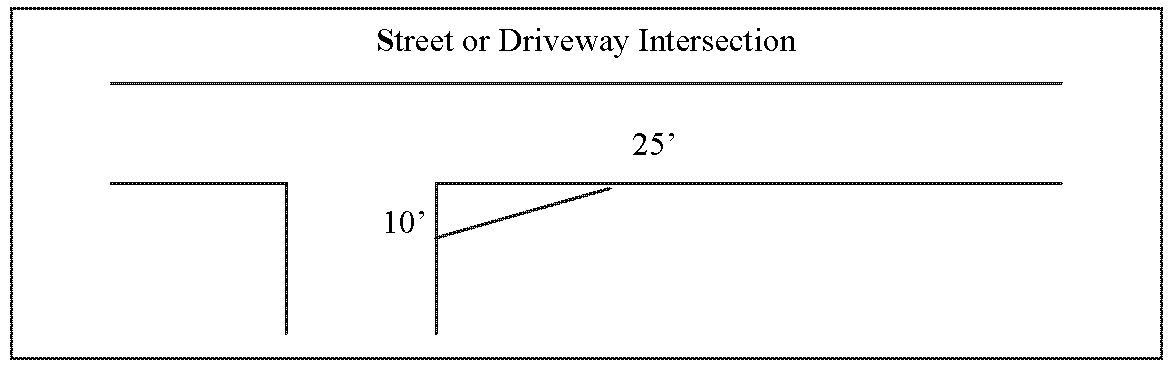
Sight Triangle Illustration
Sign. A lettered, numbered, symbolic, pictorial, illuminated, or colored visual display, device, or communication designed or used for the purpose of identifying, announcing, directing, informing, or bring to the attention of others the subject thereon, that is visible from the public right-of-way, a driveway or parking lot with access to a public right-of-way, or from an adjacent property, except as specifically noted otherwise in this Code Section. For purposes of this Code Section, the term "sign" includes but is not limited to "banners," "balloons," "flags," "pennants," "streamers," "windblown devices," and "advertising devices." Furthermore, the term "sign" includes the sign structure, supports, lighting system, and any attachments, ornaments, or other features used to draw the attention of the observers. This definition shall not include art or works of art provided that the art or works of art does not include logos in their traditional form or the name of the business at whose location the art or works of art are located. The art or works of art shall not be located on the sign or sign panel.
Signable area. In the case of a wall sign, signable area shall be the building face on which the sign is proposed, excluding windows and doors. In the case of canopies, signable area shall be the area of the marquee or canopy wall on which the sign is proposed. For window signs, signable area shall be measured and calculated on the basis of the proportion of area within each individual window frame, not the total window area of all building windows visible from a street.
Sign, Billboard. A permanent freestanding off-premises sign.
Sign Face. That part of a sign that is or can be used for advertising purposes.
Sign, Owner. Shall include the person receiving benefit from the sign and/or the property owner.
Sign, On-Premises. Any sign that disseminates information that directly relates to the use of the property on which it is located and is not a separate and distinct use.
Sign Structure. Any structure that supports, has supported or is capable of supporting a signs, including any decorative cover for said sign structure.
Single Tenant. A single business establishment, or activity or use, which does not share any facilities, such as driveways, parking, storage areas, entrances, etc. with another use. For the purposes of the sign code, a single tenant may also include a use or business that is located on a leased site or individual parcel within a planned development that complies with all development and design codes that are applicable to a stand-alone business located on an individual parcel.
Site Visibility Triangle. An area that is measured from the curb or edge of pavement, the triangle area created by a line connecting points on the front and side for lines at a distance (as indicated below) from the intersection of said lines or the extensions of said lines.
Example of a Site Triangle: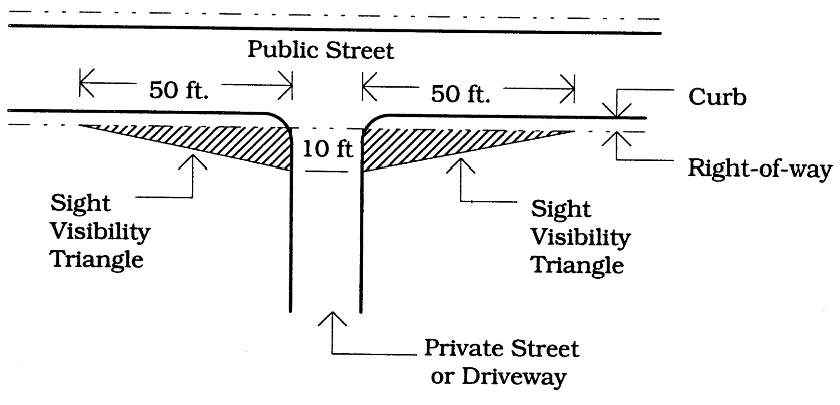
Small Box Variety Store. A retail store typically fifteen thousand (15,000) square feet or less that sells at retail an assortment of physical goods, products, or merchandise directly to the consumer, including food or beverages for off-premises consumption, household products, personal grooming and health products, and other consumer goods. A store that exceeds fifteen thousand (15,000) square feet is not necessarily excluded from this definition if it still coincides with the remaining characteristics described herein and the intent of associated regulations. Small box variety stores do not include small box stores that:
(1)
Contain a prescription pharmacy;
(2)
Sell gasoline or diesel fuel;
(3)
Primarily sell specialty food items (e.g. meat, seafood, cheese, or oils and vinegars);
(4)
Dedicate at least fifteen (15) percent of shelf space to fresh or fresh frozen foods; or
(5)
Dedicate less than five (5) percent of shelf space to food sales.
Snipe Sign. A temporary sign which is not permitted or authorized under any provision of this code, and which is tacked, nailed, posted, pasted, glazed, or otherwise affixed to a tree, pole, stake, fence, traffic control device, or another other object or the ground.
Example of Snipe Sign: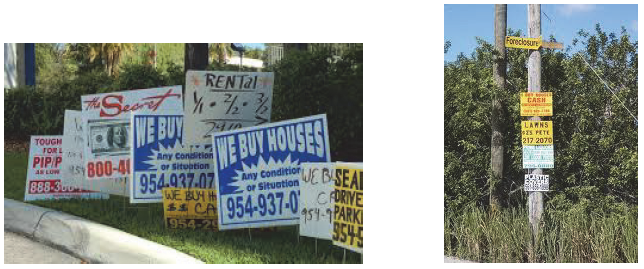
Sports club facility. A physical venue, such as a stadium, field, court, or building, designated and equipped for sports-related activities, including athletic competitions, training, recreation, and spectating.
Static. Characterized by a lack of movement, animation or progression.
Story. A horizontal section of a building defined as the space between the surface of a floor and the surface of a floor or roof directly above it.
Streamers. See "Pennants."
Street. A dedicated public right-of-way which affords the principal means of access to abutting property and which has been accepted for maintenance by the City of Mauldin, Greenville County or the State Highway Department. For the purposes of these regulations, the term street or streets shall also mean avenues, boulevards, roads, lanes and other public ways.
Residential Arterial Street. A Federal or State highway designed primarily for the movement of large volumes of traffic from one (1) area to another.
Residential Collector Street. A public way designed primarily to connect residential service streets with arterial streets or to provide a direct connection between two (2) arterial streets and may be expected to carry a significant volume of traffic having neither origin nor destination on the street.
Residential Service Street. A public or private way used primarily for providing direct access to abutting property.
Street Frontage. That portion of a lot that adjoins a public street right-of-way and is measured in linear feet. See example of street frontage below.
Example of Street Frontage: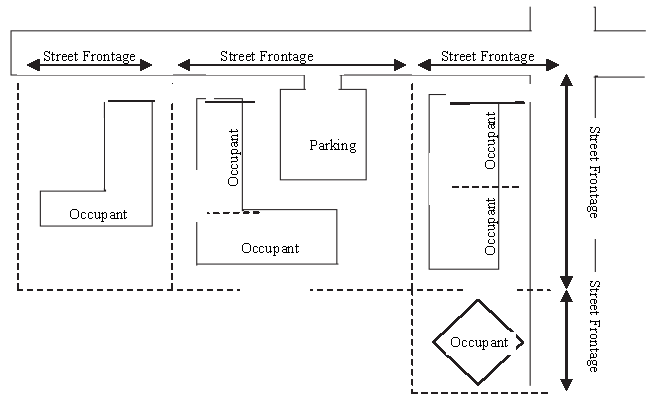
Streetscape. The scene as may be observed along a public street or way composed of natural and manmade components, including buildings, paving, planting, street furnishings, and miscellaneous structures.
Structure. Anything constructed or erected which requires permanent location above grade. For purposes of this ordinance, "structure" does not include landscape features such as ornamental pools, planting boxes, sculpture, bird baths, open terraces, walkways, driveways, walls, or fences; shelters for pets, playhouses, open stairs, recreational equipment, flagpoles, light standard game courts, swimming pools, underground fallout shelters, air conditioning compressors, pump houses or wells, mailboxes, outdoor fireplaces, gate houses, burial vaults, or bus shelters.
Telecommunications. The transmission, between or among points specified by the user, of information of the users choosing, without change in the form or content of the information as sent and received (as defined in the Federal Telecommunications Act of 1996).
Temporary Sign. A sign(s) with or without a frame, not permanently affixed to a building or frame, not permanently attached to a building or structure or the ground and is intended for advertisement of a business or service during a limited period of display. Such temporary signs shall only be permitted in conformance with the provisions set forth in subsection 6:4.1.12B, Temporary Signs.
Examples of Temporary Signs and Temporary Signs with Support Structures: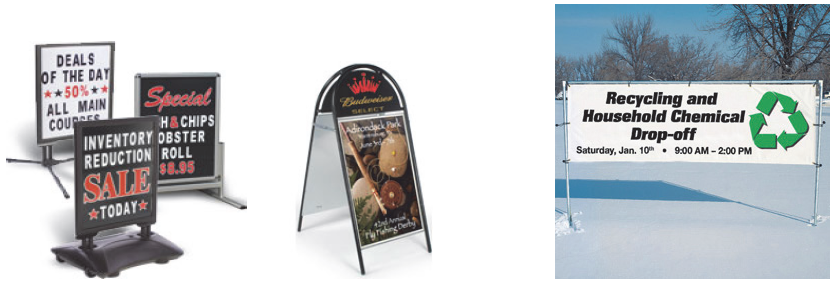
Temporary Structure. A structure that is erected without any foundation or footings and is removed when the designated time period, activity, or use for which the temporary structure was erected has ceased.
Temporary Use. A use established for a limited duration with the intent to discontinue such use upon the expiration of the time period.
Thrift Store. A business principally engaged in the sale of used merchandise usually obtained through bulk-purchases or through donations or gifts. Generally, the donor does not receive any value or profit upon the sale of such merchandise. This use does not include businesses engaged in the sale of used guns or motor vehicles.
Through Lot. A parcel having its front and rear yards each abutting on a street. Excluding single family development, both street sides of a through lot shall be treated as a front lot line.
Time, Temperature and Date Signs. A sign containing numerals or letters, which may be alternately displayed, and which alternating portion only shows the time, date and/or temperature. This sign shall not be considered a flashing or an animated sign.
Tiny home. A residential dwelling with a total gross floor area less than eight hundred (800) square feet and that is usually designed for ergonomics and space efficiency.
Title Loan Lender. A supervised lender which regularly extends short-term secured loans such as those regulated by S.C. Code § 37-3-413, and accepts as security title to motor vehicles. The term does not include supervised lenders, banks, credit unions, savings banks, and like depository institutions, other than those specializing in short-term vehicle secured loans.
Tower Height. The distance from the base of the tower to the top of the structure.
Townhouse. A two-story, single-family attached dwelling with each unit having a separate entrance on the ground floor.
Tract. An area, parcel, site, piece of land, or property which is the subject of a development proposal and applications.
Trademark. A name, symbol, or other device identifying a product that is officially registered and legally restricted to use by its owner.
Traditional Urban Neighborhood Housing. A walkable and pedestrian-oriented neighborhood that offers a range of diverse housing types and is designed with some of the following characteristics: alleys, shaded sidewalks, pedestrian amenities, streets laid out in a grid system, buildings oriented towards the street, front porches on houses, neighborhood village squares and greens.
Transition Buffer. An area of natural or planted vegetation or an area of such vegetation in conjunction with berms, fences, or walls serving as a separation between two (2) areas or land uses.
Travel Trailer. Travel or recreation vehicles, camping trailers, boats and boat trailers, or any vehicular portable unit mounted on or intended to be mounted on wheels, designed, suitably equipped, and intended to serve as short term shelter/temporary living quarters for recreational camping, or travel use and drawn by a separate motorized vehicle, such trailers shall be in conformance with all National Highway Traffic Safety Administration (NHTSA) regulations including being manufactured or mounted by a dealer who has met or consistently meets the requirements of the Federal Motor Vehicle Safety Standards (FMVSS) established in order to ensure the reduction of death and injuries attributable to failure or inadequate performance of motor vehicle systems.
Tree Formed Shrub. Any large deciduous or evergreen multi-stem shrub which has been pruned of its lower limbs and other foliage, to a minimum height of four (4) feet, to reveal three (3) to seven (7) main vertical supporting branches.
Tree. Any living, self-supporting woody perennial plant which normally obtains a trunk diameter of at least two (2) inches and a height of at least ten (10) feet and typically has one (1) main stem and many branches.
Tree, Canopy or Large Maturing. Any tree whose height under average regional growing conditions will exceed thirty-five (35) feet in height at maturity.
Tree, Understory or Small Maturing. Any tree whose height under average regional growing conditions will be less than thirty-five (35) feet in height at maturity.
Useable Wall Area. The exterior wall or surface area of a building or structure including windows and doors.
Uses Permitted by Special Exception. Uses allowable where facts and conditions detailed in this ordinance as those upon which a use may be permitted are found to exist.
Utility, Public. Any agency which, under public franchise or ownership, provides the general public with electricity, gas, heat, steam, communication, rail transportation, water, sewage collection, or other service.
Vacant. The term "vacant" as used herein applies to any property, on which there is no building or structure, or vehicular parking area, within two hundred (200) feet of any common property line shared by the developing property and any adjacent property.
Variance. A variance is a relaxation of the dimensional terms of the Zoning Ordinance where such variance will not be contrary to the public interest and where, owing to conditions peculiar to the property and not the result of actions of the applicant, a literal enforcement of the ordinance would result in unnecessary and undue hardship and does not involve a change in the use of property.
Vehicular Canopy. A roofed, open, drive-through structure designed to provide temporary shelter for customers and their vehicles while at a place of business.
Vehicular Display Area. Any area, paved or unpaved, used to display motorcycles, automobiles, pickup trucks, vans, motor homes, delivery vehicles, passenger buses, transfer trucks, and/or vehicles used for towing other vehicles, for the sole purpose of conducting sales.
Vehicular Parking Area. Any area, paved or unpaved, used to store or park motorcycles, automobiles, pickup trucks, vans, motor homes, delivery vehicles, passenger buses, transfer trucks, and/or vehicles used for towing other vehicles.
Vehicular Use Area (VUA). All driving surfaces including: parking, drive aisles, driveways, loading areas, and maneuvering areas that are paved or gravel.
Veterinary Clinic. A facility for diagnosis, treatment, and care of large and small animals. Animals may be boarded in this facility. All activities related to this facility shall be enclosed in a self-contained, freestanding building wholly occupied by the activities related to the veterinary clinic.
Veterinary Hospital. A facility for diagnosis, treatment, and care of large and small animals. The facility shall be a freestanding building wholly occupied by the activities related to the veterinary hospital. Animals may be boarded in this facility. Activities are not restricted to the interior of the building.
Veterinarian Office. A facility for diagnosis, treatment, and care of small domestic animals. Sick or injured animals may be boarded on a short-term basis. No commercial boarding is allowed in the veterinary office facility. All activities related to this facility shall be enclosed in a self-contained, freestanding building wholly occupied by activities related to the veterinary office.
Visible. Capable of being seen by the unaided eye in the daylight.
Wall. An upright structure of masonry, wood, plaster or other building material serving to enclose, divide or protect an area.
Wall Pack. A type of fixture typically mounted on a vertical wall surface.
Wall Sign. A sign painted or attached flat against and parallel to the exterior wall or surface of a building or other structure and/or which projects from that wall or surface. (see also figure, "Types of Attached Signs").
Windblown or Air-blown Device. Any device not otherwise specifically defined in this Code Section, that is designed to inform or attract, whether or not such device carries a message, and which all or part of the device is set in motion by wind or mechanically compressed air. For purposes of this Code Section, windblown devices are a considered "signs."
Wind Sign. A suspended or tethered sign made of flexible material such as canvas, sail cloth, plastic or waterproof paper, including but not limited to, banners, pennants, spinners, streamers or balloons.
Window Sign. A sign installed on or within two (2) feet of an exterior window or door and intended to be visible from the exterior of the building. Displays which show products or depict services sold on the premises and which are more than two (2) feet from an exterior window or door shall not be classified as window signs (see also figure, "Types of Attached Signs").
Yard, Front. A yard situated between the front lot line and the front of the building line extending the full width of the yard.
Yard, Rear. A yard situated between the rear lot line and the rear of the building line extending the full width of the lot.
Yard, Required. The open space between a lot line and the buildable area within which no structure may be located except as otherwise provided in this ordinance. All yards referred to in this ordinance are minimum required yards.
Yard, Side. A yard situated between the side lot line and the side building line extending from front yard to the rear yard.
Zoning Certificate/Building Permit. A certification by the Zoning Administrator that a proposal to use or occupy a tract of land or a building; or to erect, install, or alter a structure, building, or sign fully meets the requirements of this ordinance.
Zoning Permit. A permit issued by the City of Mauldin stating that a particular development or redevelopment project, change in use or addition, is in compliance with the ordinances of the city pertaining to use of the land on which such use is situated.
(Ord. No. 782, amd. 2, 12-15-2014; Ord. No. 783, amd. 2, 12-15-2014; Ord. No. 786, amd. 2, 3-16-2015; Ord. No. 805, § 2, 5-16-2016; Ord. No. 815, amd. 1, 2-20-2017; Ord. No. 822, amds. 2—4, 4-17-2017; Ord. No. 832, amd. 1, 9-18-2017; Ord. No. 836, amd. 1, 11-20-2017; Ord. No. 863, amd. 1, 10-15-2018; Ord. No. 917, § 1, 9-16-2019; Ord. No. 954, § 1, 8-17-2020; Ord. No. 986, § 1, 10-18-2021; Ord. No. 1014, § 1, 12-19-2022; Ord. No. 1026, § 3, 3-18-2024; Ord. No. 1033, § 4, 5-20-2024; Ord. No. 1070, § 3, 12-15-2025; Ord. No. 1071, § 2, 12-15-2025)
Sec. 3:4 - Relationship of Buildings to Lots.
There shall be not more than one (1) principal building and its accessory buildings on one (1) lot, except group, large-scale and multifamily developments as provided in Section 3:2 and Article 7.
Sec. 3:5 - Public Access to Property.
Every building hereafter erected or moved shall be located on a lot adjacent to and have access to a public street, highway, road, or other public way.
Sec. 3:6 - Projections into Public Streets and Street Rights-of-Way.
No commercial signs or other structures shall project in or over any right-of-way line of any street. No shrubbery shall project into any public street right-of-way.
Sec. 3:7 - Parking and Storage of Certain Vehicles.
3:7.1 Vehicles without Current License Plates.
Automobiles, trucks, or trailers of any kind or type without current license plates or current inspection stickers shall not be parked or stored on any lot zoned for residential use, other than in completely enclosed buildings, except that unlicensed and uninspected vehicles may be stored outside on a residential lot as follows:
A.
Not more than one (1) shall be stored outside per lot.
B.
Parking should be limited to driveways or other off-street parking.
C.
No vehicle shall be parked within ten (10) feet of any property line in the rear yard.
D.
All vehicles so parked will be covered with a close-fitting weatherproof cover maintained in good condition.
3:7.2 Parking, Storage, or Use of Travel Trailers, Dependent or Independent Recreational Vehicles in Residential Districts.
Travel trailers, dependent or independent recreational vehicles (hereafter referred to as units) are permitted to be parked, stored, or used in a residential district subject to the following restrictions:
[A.]
Occupancy.
1.
Not more than one (1) unit shall be permitted for each family living on the lot or premises, except as allowed in subsection A. 3.
2.
The unit shall not be occupied temporarily or otherwise except by obtaining a temporary certificate of occupancy from the Business and Development Services Director to allow limited occupancy by nonresident guests for a period not to exceed fourteen (14) days. Such certificates may be granted no more than two (2) times per calendar year for any one (1) lot, which terms shall not be consecutive.
3.
The total number of units on any residential lot shall be limited to two (2). The second unit will only be allowed as a variance by the Board of Appeals. However, this does not include those units kept in a garage or other totally enclosed building.
[B.]
Setbacks.
1.
Units shall not be parked within a drainage or utility easement, or building, or zoning setback; and
2.
Units must be parked in the rear or side yard, not projecting beyond the front of the building wall nearest to the street of the principle dwelhling on the lot; or
3.
On a corner lot or double frontage lot, the unit must be parked in the rear or side yard, not projecting beyond the building wall nearest to the street of the principle dwelling on the lot. If parked in the rear or side yard, the unit must be completely screened from view by evergreen vegetation from all streets that run along the rear or side yard in which it is parked.
4.
When the unit is parked temporarily for loading and unloading for a period of no more than twenty-four (24) hours, it must be entirely on the residential lot in a safe and orderly condition. If parked on a driveway, it shall not be an impediment or interfere with the visibility of persons or vehicles entering or exiting adjacent driveways, persons passing on the sidewalk, or persons in vehicles passing on any street.
[C.]
Other.
1.
Any utility connections must have a special building permit from the Business and Development Services Director, and sewage dumping shall be only in approved facilities.
2.
The owner of such a unit or of the residential lot on which the unit is parked may not have rental units on the premises.
3.
Units shall not be located on any residential lot without current license plates and proof of liability insurance in accordance with the state insurance laws, and must be able to pass state inspection standards for safety and performance, except those units in completely enclosed buildings.
4.
Units which are not fully operational and in a safe, driveable condition shall not be parked or stored on any lot, except units in completely enclosed buildings.
5.
If there is no reasonable access to the rear or side yard, garage, or carport on a residential lot, the owner may apply to the Board of Appeals for a variance to park one (1) unit on the driveway or other hard surface area (asphalt, paving stones, shell rock, or concrete) on the lot, between the road right-of-way and the principle dwelling on the lot.
6.
If, upon adoption of this Ordinance, there exists any unit in conflict with the provisions of this Ordinance, it shall not be considered a nonconforming use. Any owner may apply to the Board of Appeals for a variance in accordance with the provisions of Section 4:1.2 of the Mauldin Zoning Ordinance.
7.
Maximum lot coverage for all permitted uses, including all permitted and permissible buildings, accessory structures and units, shall be forty (40) percent, except as required to meet other regulations herein.
3:7.3 Commercial Vehicles.
Not more than one (1) commercial vehicle, which does not exceed one and one-half (1½) tons rated capacity, per family living on the premises shall be permitted in a residential district; no commercial vehicles used for hauling explosives, gasoline, hazardous materials, or liquefied petroleum products shall be permitted.
Sec. 3:8 - Height.
The following provisions qualify and supplement the specific height regulations set forth in Article 5, zoning districts.
3:8.1. Building Height Bonuses.
With the exception of single-family detached dwellings, duplexes, and their related accessory structures, the Business and Development Services Director may grant bonuses to buildings to exceed the minimum height of the respective zoning district where the building meets the design criteria outlined below.
A.
Design Criteria.
1.
Roof Design. Roof lines shall vary and be expressed in a visually interesting manner that complements the composition of the building and the surrounding area. This can be achieved through the use of dormers, varied cornice lines and/or parapets, and other similar architectural features. Roofs shall reflect the traditional character of the immediately surrounding area—the roof shall be a type that is commonly found in the surrounding area as determined by the Business and Development Services Director.
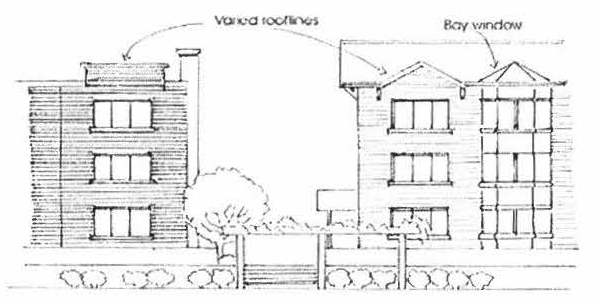
2.
Façade—Horizontal Massing. Buildings shall incorporate varied massing and design across long façades. Building walls shall be articulated at a minimum of every 50 feet. Articulation may include storefront bays with modulating building elements such as recesses, projections, expressed entries, building form, columns, pilasters, colonnades, arcades, and/or other clearly expressed architectural details. No horizontal section of the building façade shall exceed 50 feet without incorporating visible changes in the façade elevation.
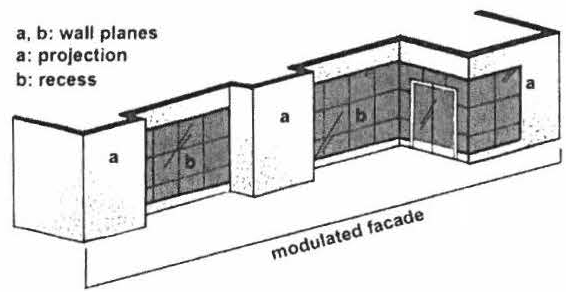
3.
Façade—Vertical Massing. In order to modulate their scale, multi-story buildings shall individually articulate the base, middle, and cap through the use of expression lines, cornices, string cornices, step-backs, or similar articulating feature. For the purposes of this section, the base generally includes the ground floor of the building, including entryways and windows; the middle is generally described as the upper stories of a building and typically features windows and/or balconies; the cap includes the area from the top floor to the roof of the building.
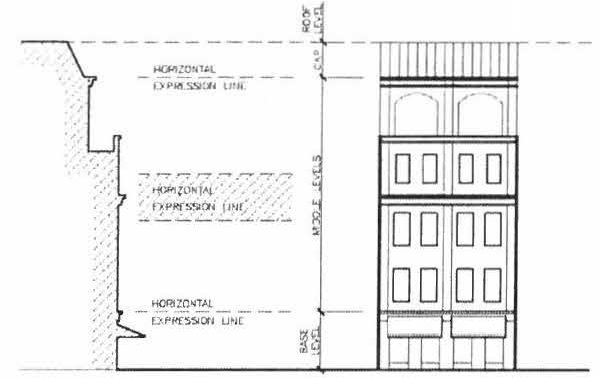
4.
Façade—Fenestration. Blank, windowless walls shall be prohibited where visible from any public right-of-way. Any façade visible from a public right-of-way shall incorporate windows and doorways that account for at least thirty (30) percent of the façade, but not more than ninety (90) percent of the façade. Windows and doorways should incorporate decorative elements such as sills, trim, lintels, transoms, and awnings. Where windows are used, they shall be transparent.
5.
Setback from Residential. Adjacent to any single-family zoning district, the building setback abutting that single-family zoning district shall be increased by one (1) foot for every two (2) feet that the building height exceeds the minimum height of the underlying zoning district.
B.
Height Bonuses.
C.
Special Exception Height Bonuses.
The Board of Zoning Appeals may approve by special exception height bonuses in excess of those prescribed herein where the applicant demonstrates high-quality design above and beyond the minimum criteria set forth herein and where the application meets the appropriate special exception criteria.
3:8.2 Exceptions to the Maximum Height.
A.
Mechanical space for building equipment placed on the building roof may be allowed above the maximum height specified, provided that such mechanical space is set back a minimum of ten (10) feet from any exterior wall, does not exceed fifteen (15) feet in height and is adequately screened from view.
B.
The height limitations generally shall not apply to church spires, steeples, belfries, cupolas, chimneys, smokestacks, fire or parapet walls, flagpoles, water towers, communication towers, transmission lines, or other minor common building appurtenances provided such appurtenances are proportional to the building and are not intended for human occupancy, as determined by the Business and Development Services Director.
(Ord. No. 832, amd. 2, 9-18-2017; Ord. No. 835, amd. 1, 11-20-2017)
Sec. 3:9 - Visibility at Intersections.
On any corner lot on which a front and side yard is required, nothing shall be erected, planted, or allowed to grow which obstructs sight lines between a height of two and one-half (2½) feet above the crown of the adjacent roadway and ten (10) feet within a triangular area formed by measuring from the point of intersection of the front and exterior side lot lines a distance of twenty-five (25) feet along the front and side lot lines and connecting the points so established to form a triangle on the area of the lot adjacent to the street intersection.
Sec. 3:10 - Game Courts, Swimming Pools, and Satellite Dish Antennas.
Game courts, swimming pools, and satellite dish antennas are allowed as accessory uses in residential districts in conjunction with one-family, one-family mobile home, and two-family dwellings, subject to the following provisions:
A.
Game courts, swimming pools, and satellite dish antennas shall be located in the rear yard.
B.
Game courts, swimming pools, and satellite dish antennas shall be set back not less than five (5) feet from any lot line.
C.
Setback requirements for game courts, swimming pools, and satellite dish antennas on corner lots shall be the same as those for accessory buildings.
D.
Game courts shall not occupy more than sixty-five (65) percent of the rear yard, and swimming pools and satellite dish antennas shall not occupy more than fifty (50) percent of the rear yard.
E.
Lighting for game courts and swimming pools shall have proper shielding from glare.
F.
All satellite dish antennas shall employ (to the extent possible) materials and colors that blend with the surroundings.
Sec. 3:11 - Required Setbacks; Allowable Encroachments into Required Setbacks.
Features permitted within required setbacks. Unless otherwise specifically stated, driveways, walkways, on-grade patios, in-ground pools, plants, retaining walls, pergolas, arbors, and other landscape features may be located within any required setback subject to the specific limitations noted in the below table:
3:11.1 Method of Application.
A.
Minimum setback. Minimum setback is the space defined by measuring perpendicularly from and along the entire boundary of the lot (property line) to the building line. Front setbacks shall be measured from the street right-of-way line.
A setback may be the front, rear, or side or a corner side setback. For illustrations of the location of front, rear, or side setbacks, see Figure 3:11.1A, Standard Lot Configuration below. Except as set forth for double frontage, through-lots in subsection 3:11.1C, (Double Frontage, through-lots, non-residential parcels - setbacks) below, there shall be one (1) front setback area that is determined at the time of site plan approval and issuance of the zoning permit.
Figure 3:11.1A, Standard Lot Configuration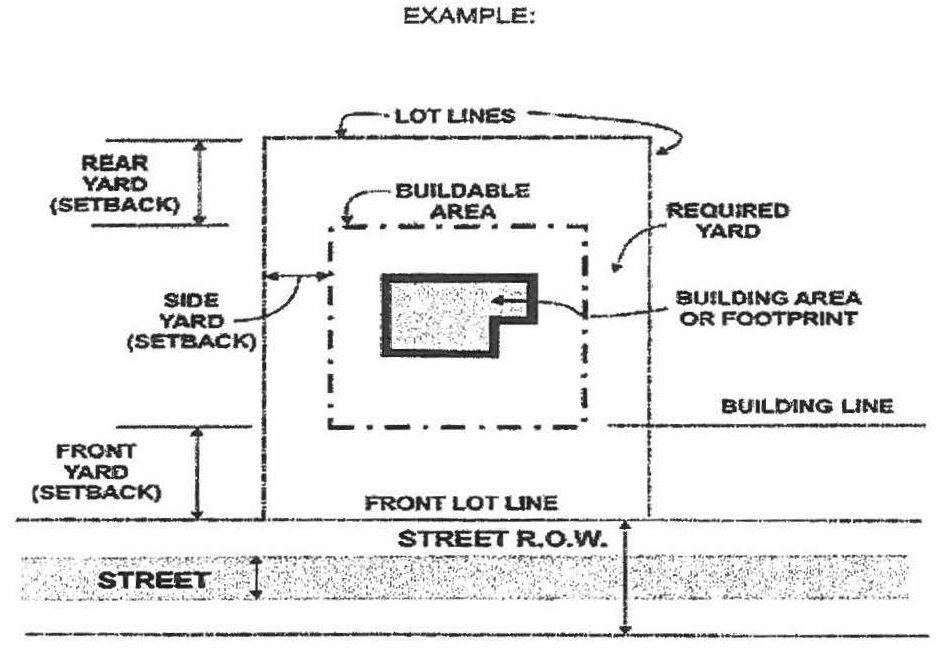
B.
Corner lots - setbacks. Unless otherwise specified in the zoning district or an overlay zoning district, the front and corner side setbacks shall be determined based on the building orientation, architectural front of the building and the street proposed driveway access to the lot. Refer to Figure 3-11.1B, Corner Lot for standard setback application.
Figure 3:11.1B, Corner Lot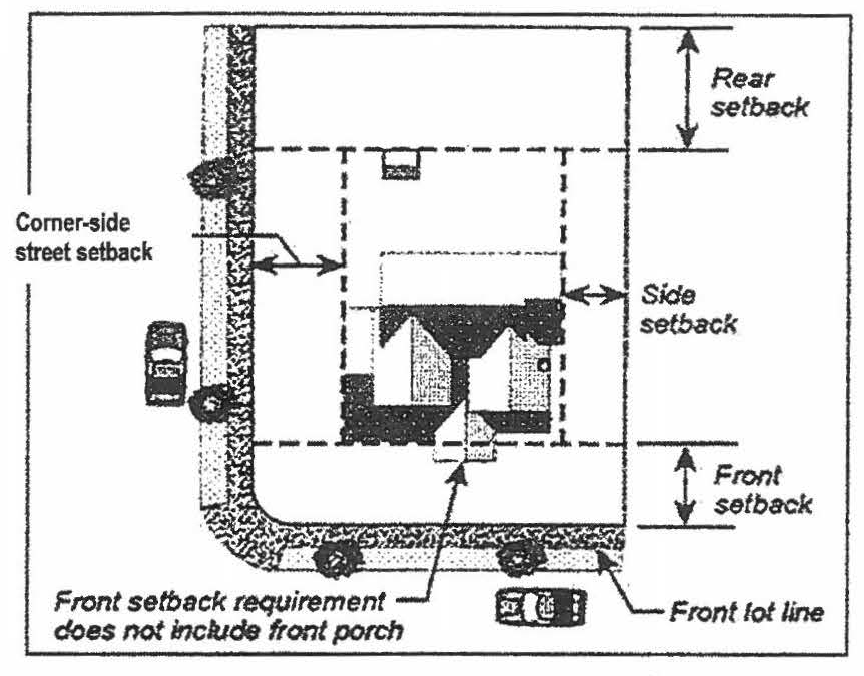
C.
Double Frontage, through-lots, non-residential parcels - setbacks. Unless otherwise specified in the zoning or an overlay district both street sides of a double frontage, through-lot shall be considered a front yard and shall conform to the front setback requirements. Parcels abutting an alley at the rear of the lot are not considered through lots and rear setback requirements would apply along the rear property line. Refer to figure 3:11.1C, Double Frontage, Through-Lot, for application of setbacks.
Figure 3:11.1C, Double Frontage, Through-Lot 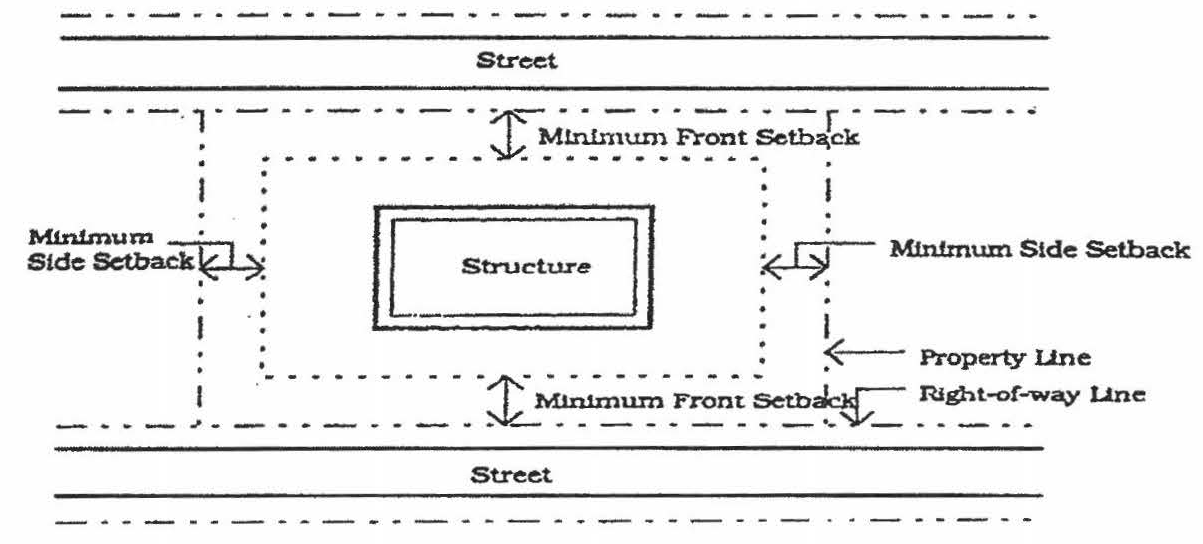
D.
Double Frontage, through-lots, residential parcels - setbacks. As defined, structures located on residential lots abutting two (2) opposite streets shall be provided with a front setback and a rear setback. The Director or their designee shall determine the location of the front and rear setbacks based on the building orientation, architectural front of the building and the proposed street driveway access to the lot, which shall be limited to a single point of access. For purposes of selecting the front, the architectural front of the structure shall be designated as the front yard and a front setback shall apply. Refer to Figure 3:11.1D, Double Frontage, Through-Lot, Residential Parcel below for setback application.
Figure 3:11.1D, Double Frontage, Through-Lot, Residential Parcel 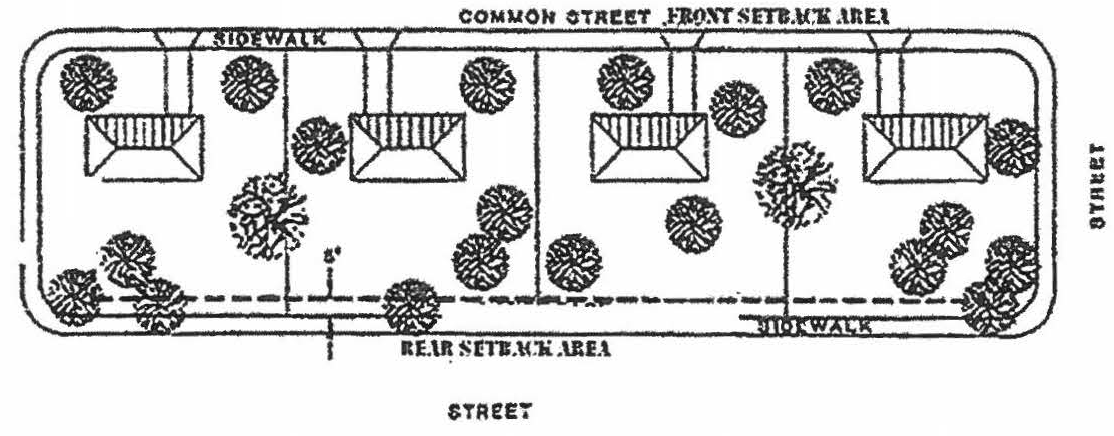
3:11.2 Flexible development standards, Setbacks. The purpose of this section is to provide the Business and Development Services Director with the authority to allow minor deviations from the development standards for setbacks in order to promote the orderly and efficient development of property.
A.
Applicability. The Business and Development Services Director shall have the discretion to reduce the otherwise required front, rear, side and corner side setbacks for residential and nonresidential principal buildings by an amount not to exceed ten (10) percent of the otherwise required minimum setback upon determination that one (1) or more of the following conditions exists:
B.
1.
There are site or structural conditions that preclude strict adherence to the setback requirements, such as, but not limited to: the lot does not meet the dimensional standards established for the zoning district in which it is located; the lot is atypical or unusually shaped, the lot has topographic limitations or other environmental conditions that require placement of the structure into the required setback area; or the structure is physically in line with an existing, legally established wall or walls of a principal structure already within the minimum setback area.
2.
The part of the proposed structure that would encroach into the minimum setback area is less than fifty (50) percent of the width of the affected building façade(s), and provided the part of the structure that would encroach into a front setback is either open (such as a porch or screen room) or not subject to occupancy (such as a chimney).
3.
The part of the proposed structure that encroaches into the minimum setback area is necessitated by a life-safety code, flood hazard reduction, Americans with Disabilities Act or other public safety code requirements.
4.
The proposed structure will allow the preservation of significant existing vegetation. Significant vegetation shall include any trees with a minimum seven (7) inch caliper.
C.
Additional exceptions. Unless otherwise specified in the zoning district or an overlay zoning district, the following exceptions may be applied at the discretion of the Business and Development Services Director:
1.
Residential parcels: The Business and Development Services Director shall have the discretion to establish a different front setback for a residential single-family dwelling that is less, or greater than the otherwise required front setback in order to maintain the existing pattern of front yards established by the principal uses contiguous to, and on either side of, the dwelling. If the front yards of the neighboring uses are not the same, the Director shall establish a setback that represents the average of the two (2) neighboring yards.
2.
Non-residential parcels: On a double frontage, through-lot where one (1) of the front yards that would normally be required is not in charter or in keeping with the prevailing yard pattern established along the street or block, or is inconsistent with adopted plans and/or an overlay zoning district, the Director may waive the requirement for the normal front yard and substitute a special yard requirement, which shall not be less than ten (10) feet. Side and rear setbacks shall be determined based upon both the orientation of the lot and upon the orientation of structures built or to be built on the lot.
(Ord. No. 805, § 4, 5-16-2016; Ord. No. 836, amd. 2, 11-20-2017)
Editor's note— Ord. No. 805, § 4, adopted May 16, 2016, repealed former § 3:11 and enacted new provisions to read as herein set out. Former § 3:11 pertained to additional minimum setback requirements for certain streets, and derived from the original zoning ordinance.
Sec. 3:12 - Reserved.
Editor's note— Ord. No. 1033, § 1, adopted May 20, 2024, repealed § 3:12, which pertained to nonconforming uses, structures, and lots and derived from Ord. No. 783, § 4, 12-15-2014; Ord. No. 835, amd. 2, 11-20-2017; Ord. No. 909, § 1, 5-20-2019; Ord. No. 970, § 1, 4-19-2021; Ord. No. 993, § 1, 1-18-2022; and Ord. No. 1013, § 1, 12-19-2022.

