
Middleton City Zoning Code
ARTICLE I
INTRODUCTION AND DEFINITIONS
10.01.01 - TITLE
This Chapter shall be known, cited, and referred to as the City of Middleton Zoning Ordinance, except whereas referred to herein, where it shall be known as "this Chapter" or "this Ordinance."
10.01.02 - AUTHORITY
This Chapter is enacted pursuant to the authority granted by the State of Wisconsin Statutes. Specific statutory references are provided within the body of this Chapter solely as a means of assisting the reader. Wis. Stat. §§ 62.23(7), 62.231, 87.30.
10.01.03 - PURPOSE AND INTENT
This Chapter is adopted for the purpose of protecting the health, safety, and general welfare of the public. It is designed to implement the City of Middleton Comprehensive Plan, which is best done through zoning approaches, as enabled by Wisconsin Statutes. It is also the intent of this Chapter to:
(1)
Promote activity, safety, and economic viability;
(2)
Promote the appropriate density and intensity of development;
(3)
Regulate the location, construction, reconstruction, alteration, and use of buildings, structures, and land;
(4)
Facilitate the adequate provision of transportation, water, sewerage, schools, parks, and other public facilities;
(5)
Encourage a mix of land uses, at densities that support transit and non-motorized transportation;
(6)
Provide for safe and efficient circulation of all modes of transportation, including transit, pedestrian, and bicycle traffic;
(7)
Control and lessen congestion in the streets;
(8)
Be adaptable to new types, formats, and mixes of land uses to reflect changing preferences, economics, and technologies;
(9)
Reduce Middleton's contribution to climate change and adapt to our changing environment;
(10)
Promote the conservation of energy and utilization of renewable resources;
(11)
Protect and enhance natural resources;
(12)
Protect groundwater resources;
(13)
Avoid undue concentration of population;
(14)
Reduce inequalities of resource allocation and the externalities of the use of land;
(15)
Prevent the overcrowding of land;
(16)
Promote adequate light, air, privacy, and convenience of access to property;
(17)
Preserve, protect, and promote property values;
(18)
Promote property improvements and upkeep;
(19)
Preserve burial sites as defined in Wis. Stat. § 157.70(1)(b); and
(20)
Secure safety from fire, panic, and other dangers.
10.01.04 - SEPARABILITY AND NON-LIABILITY
It is hereby declared to be the intention of the City of Middleton Common Council that provisions of this Chapter are separable in accordance with the following:
(1)
If any court of competent jurisdiction shall adjudge any provision of this Chapter to be invalid, such judgment shall not affect any other provisions of this Chapter not specifically included in said judgment.
(2)
If any court of competent jurisdiction shall adjudge invalid the application of any portion of this Chapter to a particular property, water, building, or structure, such judgment shall not affect the application of said provision to any other property, water, building, or structure not specifically included in said judgment.
(3)
If any requirement or limitation attached to an authorization given under this Chapter is found invalid, it shall be presumed that the authorization would not have been granted without the requirement or limitation and, therefore, said authorization shall also be invalid.
(4)
The City does not guarantee, warrant, or represent that only those areas designated as floodplain will be subject to periodic inundation and hereby asserts that there is no liability on the part of the City, its officers, employees, agents, or representatives for any flood damages, sanitation problems, or structural damages.
10.01.05 - ABROGATION
It is also not intended that this Chapter abrogate, repeal, annul, impair, or interfere with any existing easements, covenants, deed restrictions, agreements, rules, regulations, or permits previously adopted or issued pursuant to law.
10.01.06 - RULES OF INTERPRETATION
(1)
In their interpretation and application, the provisions of this Chapter shall be held to be the minimum requirements for the promotion of the public health, safety, and welfare.
(2)
Where property is affected by the regulations imposed by any provision of this Chapter and by other governmental regulations, the regulations which are more restrictive or which impose higher standards or requirements shall prevail. Regardless of any other provision of this Chapter, no land shall be developed or used, and no structure erected or maintained, in violation of any state or federal regulations. Where there are conflicts between or among regulations within this Chapter, the regulations that are more restrictive or which impose higher standards or requirements shall prevail. In all instances, where there are conflicts between the text of this Chapter and any tables or figures of this Chapter, the text shall prevail.
(3)
No structure, land, water, or air shall hereafter be used and no structure or part thereof shall hereafter be located, erected, moved, reconstructed, extended, enlarged, converted, or structurally altered without a building permit, except structures not requiring a building permit per the Building Code (Chapter 11 of the City of Middleton Municipal Ordinance), and without full compliance with the provisions of this Chapter and all other applicable local, county, and state regulations.
(4)
Nothing herein contained shall require any changes in plans, construction, size, or designated use of any building or part thereof for which a building permit has been issued before the effective date of this Chapter, and the construction of which shall have been started within two (2) years from the date of such permit.
(5)
Except as provided in this Chapter, under provisions for nonconforming uses, nonconforming developments, substandard lots, and nonconforming structures and buildings (see Article V), no building, structure, development, or premises shall be hereinafter used or occupied, and no applicable permit granted, that does not conform to the requirements of this Chapter.
(6)
In cases of mixed occupancy or mixed-use buildings, the regulations for each land use shall apply to the portion of the structure or land so occupied or so used. In the case of buildings containing both residential and nonresidential uses, the density, intensity, and bulk standards for nonresidential buildings shall apply.
(7)
Except for outlots authorized by Chapter 19 Land Division and Subdivision Regulations to contain permanently protected green space area, no yard or other open space area shall be considered as providing a yard or open space for a building or structure on any other lot.
10.01.07 - JURISDICTION
(1)
This Chapter is applicable to all territory located within the corporate limits of the City of Middleton. See Chapter 35 for the Extra-Territorial Zoning Ordinance pertaining to the Town of Westport/City of Middleton Extraterritorial Zoning Ordinance.
10.01.09 - EFFECTIVE DATE
This Chapter became effective on March 1, 2024. All plans approved under previous zoning regulations shall be valid and may be used to obtain permits for a period of not more than one (1) year after the effective date of this Chapter, except where subject to developer agreement provisions such as Planned Developments.
(Ord. No. O1657, § 2, 6-17-2025)
10.01.10 - APPLICABILITY
(1)
All Sections of this Chapter are applied to all properties, all development activity, and all uses of land and property within the City of Middleton. Beyond this Chapter, these kinds of activities are subject to all City, State, and Federal requirements.
(2)
The use of land is generally addressed in Articles II and III. Development activities including redevelopment and structure and site renovations are regulated throughout the ordinance rather than in any one section or article.
(3)
Where questions of applicability arise, the interpretation of applicability falls under the duties of the Zoning Administrator.
10.01.21 - WORD USAGE
The interpretation of this Chapter shall abide by the provisions and rules of this Section, except where the context clearly requires otherwise, or where the result would clearly be inconsistent with the apparent intent of this Chapter.
(1)
Words used or defined in one tense or form shall include other tenses and derivative forms.
(2)
Words in the singular number shall include the plural number, and words in the plural number shall include the single number.
(3)
The masculine gender shall include the feminine, and vice versa.
(4)
The words "shall," "must," and "will" are mandatory.
(5)
The words "may," "can," and "might" are permissive.
(6)
The word "person" includes individuals, firms, corporations, partnerships, associations, trusts, and any other legal entity.
(7)
The word "City" shall mean the City of Middleton, Wisconsin.
(8)
The word "county" shall mean the County of Dane, Wisconsin.
(9)
The word "state" shall mean the State of Wisconsin.
(10)
The words "Plan Commission" shall mean the City of Middleton Plan Commission.
(11)
The word "Council" shall refer to the City of Middleton Common Council.
(12)
The words "Board" or "Board of Appeals" shall refer to the City of Middleton Board of Zoning Appeals.
(13)
The words "Title," "Code," "Ordinance" or "Chapter" refer to the City of Middleton Zoning Ordinance (Chapter 10), unless an alternative numeric reference is provided.
(14)
If there is any ambiguity between the text of this Chapter and any illustration or figure, the text shall control.
10.01.22 - ABBREVIATIONS
The following abbreviations in this Chapter are intended to have the following meanings:
10.01.23 - DEFINITIONS
The following words, terms and phrases, wherever they occur in this Chapter, shall have the meanings ascribed to them by this Section. If a term used in Chapter is not defined in this Section or elsewhere in this Chapter, the definition of said term will be provided by the Zoning Administrator, based on professional sources available including the American Planning Association and Urban Land Institute. For definitions of specific land uses, refer to Article III. For definitions of specific sign types, refer to Chapter 22. Definitions provided by this Section include:
"Access" or "Driveway" means a means of providing vehicular or non-vehicular egress from or ingress to a property, public right-of-way, or private roadway.
"Accessory Dwelling Unit (ADU)." See Section 10.03.28.
"Accessory Structure." See Article III. A structure that: (1) is located on the same lot, tract, or development parcel as the principal structure; (2) is clearly incidental to and customarily found in connection with a principal structure or land use; and (3) is subordinate to and serving a principal structure or land use. Accessory structures may be attached or detached from the principal structure.
"Accessory Structure, Attached" means an accessory structure which is physically connected to the principal structure. Attached accessory structures shall be considered part of the principal structure and are subject to the setback standards for principal structures. Attached defines the relationship between another structure and a dwelling, meaning at least one (1) of the following conditions are present:
(1)
There is a continuous, weatherproof roof between the two (2) structures. Note: The sides are not required to be enclosed with walls.
(2)
There is a continuous, structural floor system between the two (2) structures.
(3)
There is a continuous foundation system between the two (2) structures.
(4)
There is less than three (3) feet of separation between the principal structure and the accessory structure, including projections of either structure that are below roof overhangs or eaves.
"Accessory Structure, Detached" means an accessory structure which is not physically attached to the principal building. A minor connection between structures (outside of anything defined in Accessory structure, attached) does not render an accessory structure attached. Detached accessory structures are subject to setback standards for accessory structures.
"Accessory Use" means a use subordinate to the principal use of a building or lot and serving a purpose customarily incidental to the principal land use. Accessory uses in residential districts shall not involve the conduct of any business, trade, or industry, except as defined as a Home Occupation, and shall not include the boarding of animals or the keeping of fowl or farm animals (except pets or as otherwise permitted by the Municipal Code).
"Acre" means 43,560 square feet.
"Addition" means any construction that increases the size of a building or structure in terms of site coverage, height, length, width, or gross floor area.
"Address" means the number or other designation assigned in accordance with Section 8.10 to a housing unit, business establishment, or other structure or site for purposes of mail delivery, and emergency services.
"Affordable Housing" means households with an income at or below sixty (60) percent area median income limits.
"Agent of Owner" means a person authorized in writing by the property owner to represent and act for a property owner in contacts with City employees, boards, committees, commissions, and the Common Council, regarding matters regulated by the Zoning Ordinance.
"Airport" means any area of land designated, set aside, used, or intended for use, for the landing and take-off of aircraft, and any appurtenant areas designated, set aside, used, or intended for use, for airport buildings or other airport facilities, rights-of-way, or approach zones, together with all airport buildings and facilities located thereon.
"Airport Hazard" means any structure, object, or natural growth, or use of land which obstructs the airspace required for the flight of aircraft in landing or taking off at an airport or which is otherwise hazardous to such landing and taking off.
"Alley" means a minor right-of-way/street or thoroughfare, often public, providing secondary access to a property. Alley access does not constitute frontage for the purposes of minimum lot frontage.
"Alteration" means any change, addition, or modification in construction (other than maintenance), or any change in the structural members of buildings such as load-bearing walls, columns, beams, girders, etc.
"Animal Unit" means a measure which represents a common denominator for the purpose of defining a Husbandry or Intensive Agricultural land use. The animal unit measure relates to the maximum carrying capacity of one (1) acre of land and is related to the amount of feed various species consume, and the amount of waste they produce. The following figure indicates the number of common farm species which comprise a single animal unit:
Figure 10.01.23a: Animal Units
"Appeal" means a means for obtaining review of a decision, determination, order, or failure to act pursuant to the terms of this Chapter as expressly authorized by the provisions of Section 10.10.52.
"Automobile" means a Type 1 or Type 2 motor vehicle as defined in Wis. Stat. § 340.01(4).
"Awning" means a shielding or decorative fixture attached to a structure and extending from the face of the structure that is permanent in nature, which may be fixed or retractable.
"Balcony" means an unenclosed, open platform that is attached to and projects from the wall of a principal or accessory building and is surrounded by a railing or balustrade. This definition is different and separate from a porch, deck, fire escape, etc.
"Basement" means that portion of a building between the floor and ceiling, having at least 1/2 of its height below grade.
"Berm" means an earthen mound designed to provide visual interest on a site, screen undesirable views, reduce noise, or fulfill other such purposes.
"Block" means the property abutting the street between the two (2) nearest intersecting or intercepting streets. A railroad right-of-way, the boundary line of un-subdivided acreage, or a body of water shall be regarded the same as an intersecting or intercepting street for the purpose of defining a "block."
"Boarding House Living Arrangement" means a residential land use where occupancy of a dwelling unit is shared by up to eight (8) unrelated adult individuals (See Section 10.03.06).
"Boat" means a vehicle designed for operation as a watercraft propelled by oars, sails, or engine(s).
"Boathouse" means a structure used for the storage of watercraft and associated materials which has one (1) or more walls or sides.
"Bufferyard" means any permitted combination of distance, vegetation, fencing, and berming which results in a reduction of visual, noise and other interaction with an adjoining property.
"Buildable Area" means the area remaining on a lot after the minimum setback, drainage provisions, and other site constraint requirements of this Ordinance have been met.
"Buildable Depth" means the depth of the lot left to be built upon after the front and rear yards are provided.
"Buildable Width" means the width of the lot left to be built upon after the side yards are provided.
"Building" means a structure with a permanent location on the land, having a roof that may provide shelter, support, protection, or enclosure of persons, animals, or property of any kind.
"Building Coverage" means the percentage of a lot covered by principal and accessory buildings or structures.
"Building Footprint" means the outline of the total area covered by a building's perimeter at the ground level.
"Building Height" means the vertical distance as measured from the established grade immediately adjoining the front of the structure to (a) the highest point of a flat roof; (b) the deck line of a mansard roof; (c) the average height between the highest ridge and its attendant eave for a gable, hip and gambrel roof; or (d) the uppermost point on a round or other arch type roof, or (e) a point on the roof directly above the highest wall of a shed roof. The average height of the façade most closely parallel to the front lot line may not exceed the maximum height allowed by Articles II and IV for the zoning district in which the site is located, and no part of any other façade (other than at a garage entrance below the established grade) shall be more than fifteen percent (15%) higher than the maximum height.
"Building, Principal" means a building in which the main or principal use of the lot is conducted.
"Building Separation" means the narrowest distance between two (2) buildings (See "Minimum Building Separation").
"Bulk" means the size and setbacks of buildings or structures and the location of same with respect to one another, and includes the following:
(1)
Size and height of buildings;
(2)
Location of the perimeter of the building at all levels in relation to lot lines, streets, or to other buildings;
(3)
Gross floor area of buildings in relation to lot area (floor area ratio or FAR);
(4)
All open spaces allocated to buildings;
(5)
Amount of lot area provided per dwelling unit.
"Caliper" means a measurement of the size of a tree equal to the diameter of its trunk measurement four (4) foot above natural grade.
"Canopy" means a structure attached and extending from the face of a building, constructed as a permanent fixture.
"Capacity" means the maximum lawful level of designed use of any structure, or part thereof, as determined by the City's adopted building code and expressed in terms of occupants, seats, persons, employees, or other units specified by the building code.
"Civic Use" means a publicly or quasi-publicly owned and managed facility for meetings, conventions, or exhibitions and other community, social, and multi-purpose uses. Typical uses include those listed under Institutional Land Uses (Section 10.03.12).
"Club" means a structure and facility owned or operated by a corporation, association, person, or persons, for a social, educational, or recreational purpose, but not primarily for profit and not primarily to render a service which is customarily carried on as a business.
"Commercial Vehicle" means any motor vehicle meeting the definition of Wis. Stat. § 340.04(8) or that requires a commercial diver license in Wis. Stat. § 340.04(7m).
"Comprehensive Plan" means the long-range vision for the desirable use and development of land in the City as officially adopted and as amended from time to time by the Plan Commission and certified to the Council.
"Conditional Use" means a use which may be appropriate or desirable in a specific zone but requires special consideration and review prior to approval because if not carefully located or designed, said use may not be deemed compatible with neighborhood uses or may create special problems that impact neighboring lands, public facilities, or the environment or general welfare. All such uses are only allowed under a Conditional Use Permit. See Section 10.10.32 for applicable procedures.
"Condominium" means an estate in real property consisting of an undivided interest in common with other purchasers in a portion of a parcel of real property, together with separate interest in space. A condominium may include, in addition, separate interest in other portions of such property pursuant to Wis. Stat. § 703.
"Court" means an open space within one (1) lot which is surrounded by structures on more than fifty (50) percent of its perimeter.
"Covenant" means a contract between two (2) or more parties which constitutes a restriction of a particular parcel of land.
"Deck" means an uncovered and open platform built above grade, typically supported from the ground by pillars or posts, and accessible from the yard. A deck may be either attached to or separated from a principal or accessory building. When any portion of a deck exceeds a height of 12 inches above established grade, the structure is an "Elevated Deck" and is considered similar to a porch; otherwise, the structure is a "Non-Elevated Deck" and is considered similar to a patio. Setbacks shall be measured from the outermost physical boundary of the deck.
"Density" is a term used to describe the number of dwelling units per acre. Density on a given lot is determined through the bulk dimensional standards such as lot size, height, and setbacks.
"Design Standards" mean a guideline/specification or set of guidelines/specifications regarding the architectural appearance of a building or improvement that governs the alteration, construction, demolition, or relocation of a building or improvement (See Article VII).
"Developed Area" means that area which is made up of physical property improvements including but not limited to structures, parking, drives, signage and utility features that are either above or below ground.
"Development" means the division of a parcel of land into two (2) or more parcels; the construction, reconstruction, conversion, structural alteration, relocation, or enlargement of any buildings; the primary or principal use or change in primary or principal use of any buildings or land; any extension of any use of land; or any clearing, grading, or other movement of land, for which permission may be required pursuant to this Chapter.
"Dormer" means a structural element of a house that protrudes from the plane of a sloping roof surface. Dormers are used to create usable space in the roof of a building by adding headroom and usually also by enabling addition of windows.
"Dwelling" means a building or one (1) or more portions thereof, containing one (1) or more dwelling units, but not including habitations provided in nonresidential uses such as lodging uses and commercial campgrounds.
"Dwelling, Attached" means a dwelling joined to another dwelling at one (1) or more sides by a shared wall or walls.
"Dwelling, Detached" means a dwelling entirely surrounded by open space on the same lot.
"Dwelling Unit" means a single unit providing complete, independent living facilities for one (1) or more persons, including permanent provisions for living, sleeping, eating, cooking and sanitation.
"Easement" means a written authorization, recorded in the Register of Deeds office, from a landowner authorizing another party to use any designated part of the land owner's property for a specified purpose.
"Electric Vehicle" or "EV" means any motor vehicle that is licensed and registered for operation on public and private highways, roads, and streets, and that operates either partially or exclusively, on electrical energy from the grid, or an off-board source, that is stored on-board via a battery for motive purpose. Electric Vehicle does not include an electric bicycle. Electric Vehicle include a battery electric vehicle or a plug-in hybrid electric vehicle.
"Electric Vehicle Charging Facility" means a facility where electricity is provided directly to the public on the premises for purposes of charging electric vehicles at one (1) or more electric vehicle charging stations. An Electric Vehicle Charging Facility may not provide other types of vehicle fuel, such as gasoline.
"Electric Vehicle Charging Station" means a parking space, or parking spaces, that is, or are, equipped with and served by electric vehicle supply equipment for the purpose of transferring electric energy to a battery or other energy storage device in an electric vehicle. The terms Level l, 2, and 3 charging stations are the most common electric vehicle charging levels, and include the following specifications:
(1)
Level l is considered slow charging and operates on a fifteen (15) to twenty (20) ampere breaker on a one hundred twenty (120) volt AC circuit.
(2)
Level 2 is considered medium charging and operates on a forty (40) to one hundred (100) ampere breaker on a two hundred eight (208) or two hundred forty (240) volt dedicated AC circuit.
(3)
Level 3 is considered "fast" or "rapid" charging and typically operates on a sixty (60) amp or higher breaker on a four hundred eighty (480) volt or higher three phase circuit with special grounding equipment. Level 3 stations are primarily for commercial and public applications and are typically characterized by industrial grade electrical outlets that allow for faster recharging of electric vehicles.
"Electric Vehicle Installed Parking Spaces" mean a designated off-street parking space that is served by EVSE at a minimum Level 2 Electric Vehicle Charging Station.
"Electric Vehicle Ready Parking Spaces" mean a designated off-street parking space which is provided with electrical panel capacity and space to support a minimum forty (40) ampere, two hundred eight (208)/two hundred forty (240)-volt branch circuit, and the installation of raceways, both underground and surface mounted, to support the future installation of EVSE to serve the parking space.
"Electric Vehicle Supply Equipment" or "EVSE" means the conductors, including the ungrounded, grounded, and equipment grounding conductors, and the electric vehicle connectors, attachment plugs, and all other fittings, devices, power outlets, or apparatus installed specifically for the purpose of transferring energy between the premises wiring and the electric vehicle.
"Elevation (building)" means the view of any building or other structure from any one of four (4) sides regardless of the configuration or orientation of a building. Each elevation will generally be identified as a north, south, east or west building elevation. Also see "facade."
"Established Grade" means the elevation established for the purpose of measuring the height of buildings. Grade shall be the average level of the ground immediately adjoining a façade exclusive of any filling, berming, mounding, or excavating. Where the finished grade is below the level of the established grade, the established grade shall be used for all purposes of this Ordinance.
"Extraterritorial Jurisdiction" means the area outside of the City limits in which the City of Middleton may exercise extraterritorial powers of planning, land division, and/or zoning review.
"Extraterritorial Zoning" means the area outside of the City limits in which the City of Middleton has exercised extraterritorial powers of zoning. See Chapter 35 of the City of Middleton Municipal Ordinance.
"Façade" means the wall planes of a building which are visible from one side or perspective (e.g. front, side, rear). See "elevation (building)."
"Family" means a person living as an individual or any of the following groups living together as a single nonprofit housekeeping unit and sharing common living, sleeping, cooking and eating facilities:
(1)
Any number of people related by blood, marriage, domestic partnership, legal adoption, guardianship or other duly-authorized custodial relationship. For the purpose of this Section, "children" means natural children, grandchildren, legally adopted children, stepchildren, or a ward as determined in a legal guardianship proceeding;
(2)
Up to five (5) unrelated adult individuals;
(3)
Up to five (5) unrelated persons who have disabilities/are disabled or handicapped under the Fair Housing Amendment Act (FHAA) or the Americans with Disabilities Act (ADA), are living as a single household because of their disability, and require assistance from a caregiver.
(a)
This definition does not include those persons currently illegally using or addicted to a "controlled substance" as defined in the Controlled Substances Act, 21 U.S.C. Section 802 (6).
(4)
Up to two (2) personal attendants who provide services for family members or individuals who are disabled or handicapped under the Fair Housing Amendment Act (FHAA) or the Americans with Disabilities Act (ADA) and need assistance with the activities of daily living shall be considered part of a family. Such services may include personal care, housekeeping, meal preparation, laundry or companionship.
(5)
Functional Family: A group of individuals living together in a single dwelling unit and functioning as the equivalent of a family, whether or not they are related by blood, marriage or other legal relationship. See definition of "family, functional."
(6)
Exceptions: The definition of "family" does not include:
(a)
Any society, club, fraternity/sorority, association, lodge, combine, commune, federation, or similar organization; and
(b)
Any group of individuals whose association is temporary or seasonal in nature.
"Family, Functional" means a group of individuals living together in a single dwelling unit and functioning as the equivalent of a family, whether or not any of the individuals are related by blood, marriage or other legal relationship. Groups of six (6) or more unrelated adult individuals shall be rebuttably presumed not to be a functional family under this definition. In determining whether or not a group of unrelated individuals is a functional family under this definition, the Zoning Administrator shall consider the following criteria:
(1)
Factors to be considered in this determination include whether:
(a)
A lease, sub-lease or other agreement define portions of the dwelling unit granting limited access to portions of the dwelling unit.
(b)
Members of the household have been living together as a functional family unit for a period of one (1) year or more, whether at the current address or other addresses.
(c)
Minor dependent children, if any, share the dwelling as their principal residence and are enrolled in local schools.
(d)
Members of the household engage in group living activities such as shopping, cooking, eating and socializing.
(e)
Members of the household consistently share household expenses or a budget including expenses for food, rent or ownership costs, utilities and other common household expenses.
(f)
Members of the household have established a joint bank account or other similar means to consistently provide for the payment of common expenses.
(g)
Members of the household share common ownership of vehicles, furniture, major appliances, and other significant household resources.
(h)
Members of the household share the address for voter registration, drivers licensing, vehicle registration, tax filing or other similar purposes.
(i)
Members of the household are employed in non-seasonal and non-transient jobs in the local area.
(j)
Any other factors reasonably related to and serving as evidence of the household members' status as a functional family unit.
(2)
Unless sufficiently rebutted by competent evidence, any of the following factors shall indicate the absence of a functional family relationship:
(a)
A lease, sub-lease or other agreement which makes each occupant jointly or severably liable for the performance of the lease or agreement.
(b)
A lease, sub-lease or other agreement which holds a relative or any other person who is not an occupant of the household to be a guarantor of the lease or agreement.
(c)
A lease, sub-lease or other agreement which requires or prohibits occupancy and/or payment for occupancy for a period consistent with the semester schedule of local places of higher education or upon a seasonal basis.
(d)
A majority of members of the household attend any places of higher education in at least a half-time basis.
"Farm Building" means any building, other than a dwelling unit, used for storing agricultural equipment or farm produce or products, having livestock or poultry, or processing dairy products.
"Fence" means any artificially constructed barrier erected to separate, enclose, or screen areas of land.
"Fence, Picket" means a type of fence constructed of evenly-spaced vertical boards that are connected by two (2) or more horizontal rails.
"Fence, Solid" means a fence, including solid entrance and exit gates, that is least ninety (90) percent opaque and that effectively conceals the materials stored and activities or operations conducted behind it from view.
"Fence, Wood Rail" means a type of fence constructed of wooden beams or timber logs (usually split lengthwise into rails) that are arranged in a manner that allows for more than seventy-five (75) percent of the fence's surface area to be open for the free passage of light and air.
"Floor Area" means the sum of the gross horizontal areas of the floors of a building, including interior balconies, mezzanines, basements, and attached accessory buildings, stairs, escalators, unenclosed and enclosed porches, heating and utility rooms, etc. Measurements shall be made from the outside of the exterior walls and to the center of interior walls dividing attached buildings.
"Floor Area Determining Floor Area Ratio" for the purpose of determining the floor area ratio, the floor area of a building is the sum of the gross horizontal area of the several floors of the building measured from the exterior faces of the exterior walls or from the centerline of the walls separating two (2) buildings. The floor area of a building includes basement floor area when more than 1/2 of the basement height is above the established curb level or above the finished lot grade where curb level has not been established, elevator shafts and stairwells at each floor, floor space used for mechanical equipment (except equipment, open or enclosed, located on the roof), penthouses, attic space having head room of seven (7) feet ten (10) inches or more, interior balconies and mezzanines, porches, and floor area devoted to accessory uses. However, any space devoted to off-street parking or loading is not included in floor area.
The floor area of structures devoted to bulk storage of materials, including, but not limited to, grain elevators and petroleum storage tanks, is determined on the basis of height in feet; i.e., ten (10) feet in height shall equal one (1) floor.
"Floor Area Ratio (FAR)" means the floor area of the building or buildings on the zoning lot divided by the area of the zoning lot, or, in the case of planned developments, by the net site area. The floor area ratio requirements, as set forth under each zoning district, shall determine the maximum floor area allowable for the building or buildings (total floor area of both principal and accessory buildings) in direct ratio to the gross area of the zoning lot.
"Foot-candle" means a unit of illumination produced on a surface, all points of which are one (1) foot from a uniform point source of one (1) candle.
"Foster Family" means a group of individuals living together and sharing common living, sleeping, cooking and eating facilities in which one (1) to four (4) children are provided home-like care by licensed foster parents (individuals other than those defined in "Family" above with primary responsibility for the care and supervision of one (1) or more foster children placed in their foster home) and in whose name the foster home is licensed under Wis. Stat. § 48.62.
"Frontage." See "Lot Frontage."
"Garage" means an attached or detached building or structure, or part thereof, used or designed to be used for the parking and storage of vehicles. Garages are also commonly used to store other items associated with the use of a lot such as yard maintenance and children's play equipment.
"Grade, Existing" means the surface elevation of the ground or pavement at a stated location as it exists prior to disturbance in preparation for a project regulated by the ordinance.
"Grade, Finished" means the final elevation of the ground surface after human-made alteration, such as grading, grubbing, filling or excavating have been made and is part of an approved grading and drainage plan by the City of Middleton.
"Green Area" means an area landscaped with shrubs, trees, and other vegetative groundcover.
"Gross Density" means the result of dividing the number of dwelling units located on a site by the gross site area.
"Gross Floor Area" means the total floor area inside the building envelope on all levels of a building.
"Gross Site Area" means the total area of a single lot or the sum of multiple lots in common use.
"Ground Floor" means the floor of a structure that is at or nearest to the level of the site's base elevation around the structure. In most instances this is the floor that is level or almost level with the ground outside of and directly surrounding the structure that serves as the structure's accessible entry point for patrons or residents from the street or sidewalk.
"Group Development." See Section 10.06.02. Any development located on one (1) lot and comprised of any combination of two (2) or more principal buildings on the same lot in any zoning district.
"Habitable Space" means space in a structure used for living, sleeping, eating, or cooking. Bathrooms, toilet compartments, closets, halls, storage or utility spaces, or any space where the floors to ceiling height is less than seven (7) feet, and similar areas, are not considered habitable space.
"Historic Building or Site" means any building or site that meets one (1) or more of the following criteria: buildings or sites listed on the Wisconsin or National Register of Historic Places, either individually or as a contributing building or site to a historic district; buildings or sites with a State Historic Preservation Officer Opinion or Certification that the property is eligible to be listed on the State Register or National Register of Historic Places, either individually or as a contributing building or site to a historic district; or is locally designated as a Local Landmark.
"Impervious Surface or Area" means a surface as measured on a horizontal plane that has been compacted or covered with a layer of material so that it is highly resistant to infiltration by rainwater. It includes, but is not limited to, all areas covered by structures, building extensions, patios, decks, porches, driveways, loading docks, parking lots, sidewalks, permeable pavers and green roof systems (which can become impervious over time), any removal of pervious soil layer that results in the exposure of an impervious soil or rock layer, and compacted clay and gravel which are used as driveways or parking lots. Also see Chapters 9 and 26 of the City of Middleton Municipal Code.
"Impervious Surface Ratio" means a measure of the intensity of land use, determined by dividing the total of all impervious surfaces on a site by the gross site area.
"Individual Family Living Arrangement" means a residential land use in which occupancy of a dwelling unit is by no more than one family or functional family as defined above. See Section 10.03.06.
"Infill Site" means any vacant lot or parcel within developed areas of the City, where at least eighty (80) percent of the land within a three hundred (300) foot radius of the site has been developed; and where water, sewer, streets, schools, and fire protection have already been developed and are provided. Annexed areas located on the periphery of the City limits shall not be considered infill sites.
"Intensity." A term used to describe the amount of gross floor area or landscaped area on a lot or site compared to the gross site area.
"Invasive Plants or Species" mean nonindigenous species whose introduction causes or is likely to cause economic or environmental harm to human health as defined in Wis. Stat. § 23.22(1)(c).
"Landscaped Area" means the area of a site which is planted and continually maintained in vegetation, including grasses, flowers, herbs, garden plants, native or introduced groundcovers, shrubs, bushes, and trees. The landscaped area also includes the area located within planted and continually maintained landscaped planters as well as subordinate accessory use of other landscape elements such as mulch, river rock, etc.
"Large Development." See Section 10.06.02. Any new development containing any single building in which the combined area of the building footprint exceeds fifty thousand (50,000) square feet in any nonresidential zoning district. This does not include new additions of less than fifty thousand (50,000) square feet, or basements and penthouses when used primarily for storage and mechanical equipment.
"Loggia" means a roofed arcade or gallery with open sides stretching along the front or side of a building, often at an upper level.
"Lot" means a parcel of land in one ownership and not divided by a street nor including any land within the limits of a public right-of-way. The term "lot of record " shall mean land designated as a distinct and separate parcel on a legally recorded plat, subdivision, or other instrument permitted by law, in the Register of Deeds office.
"Lot Area" means the computed area contained within the lot lines of a recorded lot, including land over which easements have been established.
"Lot, Corner" means a lot abutting upon two (2) or more streets at their intersection or upon two (2) parts of the same street, such streets or parts of the same street forming an interior angle of less than one hundred thirty-five (135) degrees. The point of intersection of the street lines or their greatest angle is the "corner."
"Lot Depth" means the mean horizontal distance between the front and rear lot lines.
"Lot Frontage" means the horizontal distance between the side lot lines measured at the point where the side lot lines intersect the right-of-way. All sides of a lot that abuts a street shall be considered lot frontage. On curvilinear streets, the distance of the arc between the side lot lines shall be considered the lot frontage.
"Lot, Interior" means a lot other than a corner lot.
Figure 10.01.23b: Regular Lot Descriptions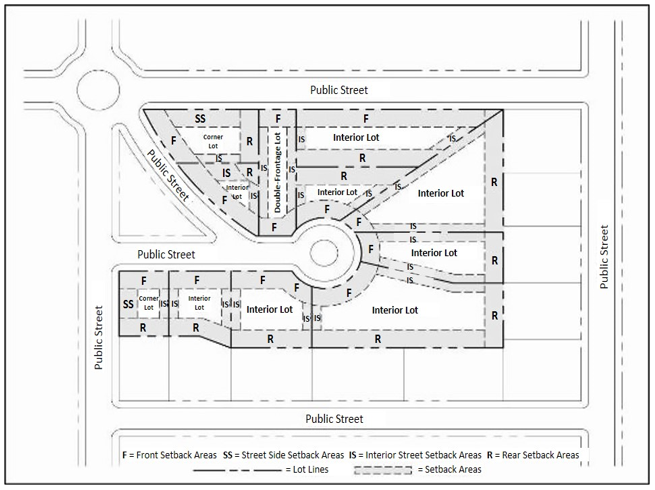
"Lot Line." A lot line is the legal property line (including the vertical plane established by the line and the ground) bounding a lot except that where any portion of a lot extends into the public right-of-way or a proposed public right-of-way, the line of such public right-of-way shall be the lot line for applying this Chapter.
"Lot Line, Front" means a lot line which abuts a public or private street right-of-way. In the case of a lot which has two of more street frontages, the lot line along the street with the shortest frontage distance shall be the front lot line unless that street has a lower functional classification. In the case of a lot which has two or more street frontages and the dimensions of each are within ten percent of being equal, the front lot line shall be the street line designed by the owner and filed in the office of the Zoning Administrator. (See also lot line, street side). See Figure 10.01.23b.
"Lot Line, Rear" means, in the case of rectangular or most trapezoidal shaped lots, that lot line which is parallel to and most distant from the front lot line of the lot. In the case of an irregular, triangular, or gore-shaped lot, a line twenty (20) feet in length, entirely within the lot, parallel to and at the maximum possible distance from the front line shall be considered to be the rear lot line. In the case of lots that have frontage on more than one (1) road or street, the rear lot line shall be opposite the front lot line (shorter of the frontages). See Figure 10.01.23b.
"Lot Line, Side" means any lot line other than a front or rear lot lines. A side lot line separating a lot from a street is called a side street lot line. A side lot line separating a lot from another lot is called an interior side lot line. An interior side lot line can be created with no side yard setback where a building envelope between two (2) lots sharing a single structure is present. This is known as a zero lot line. See Figure 10.01.23b.
"Lot Line, Street Side" means any lot line which abuts a public or private street right-of-way which is not the front lot line (See also "Lot Line, Front"). See Figure 10.01.23b.
"Lot of Record" means a platted lot or lot described in a plat, certified survey map, in a metes and bounds description, or other instrument permitted by law and has been approved by the City of Middleton and/or by Dane County, and has been recorded in the office of the Register of Deeds.
"Lot, Through" means a lot having frontage on two (2) parallel or approximately parallel streets (also known as a "double-frontage lot"). See Figure 10.01.23b.
"Lot Width" means the maximum horizontal distance between the side lot lines of a lot, measured parallel to the front lot line(s) at the required front yard setback (See "Minimum Lot Width").
"Maintenance" means an activity that restores the character, scope, size, or design of a serviceable area, structure, or land use to its previously existing, undamaged condition. Activities that change the character, size, or scope of a project beyond the original design or otherwise alter a serviceable area, structure, or land use are not included in this definition.
"Manufactured Home" means a structure that is designed to be used as a dwelling with or without a permanent foundation and that is certified by the federal department of housing and urban development as complying with the standards established under 42 USC 5401 to 5425. See Section 10.03.06.
"Manufactured Home Community" means any plot or plots of ground upon which three (3) or more manufactured homes that are occupied for dwelling or sleeping purposes are located. A manufactured home community does not include a farm where the occupants of the manufactured homes are the father, mother, son, daughter, brother or sister members of the farm owner or operator or where the occupants of the manufactured homes work on the farm.
"Manufactured Home Park." This land use is a form of residential development which is exclusively reserved for individually sold or rented building pads located on a single parcel containing Manufactured Homes.
"Manufactured Home Subdivision." This land use is a form of residential development which is exclusively reserved for individually sold lots containing Manufactured Homes.
"Maximum Building Size (MBS)" means the largest permitted total gross floor area a building may contain (See "Building Size").
"Minimum Building Separation" means the narrowest permitted building separation.
"Minimum Lot Area" means the minimum size lot permitted within the specified zoning district.
"Minimum Lot Width" means the smallest permissible lot width for the applicable zoning district.
"Minimum Setback" means the narrowest distance permitted from a street, side, or rear property line to a structure.
"Mixed-Use" means some combination of residential, commercial, industrial, office, institutional, and/or other land uses within a district or development.
"Mobile Home" means a vehicle manufactured or assembled before June 15, 1976, designed to be towed as a single unit or in sections upon a highway by a motor vehicle and equipped and used, or intended to be used, primarily for human habitation, with walls of rigid uncollapsible construction, which has an overall length in excess of 45 feet. A mobile home includes the mobile home structure, its plumbing, heating, air conditioning and electrical systems, and all appliances and all other equipment carrying a manufacturer's warranty.
"Modular Home" A structure or component thereof which is intended for use as a dwelling and:
(1)
Is of closed construction and fabricated or assembled on-site or off-site in manufacturing facilities for installation, connection, or assembly and installation, at the building site; or
(2)
Is a building of open construction which is made or assembled in manufacturing facilities away from the building site for installation, connection, or assembly and installation, on the building site and for which certification is sought by the manufacturer.
(3)
A modular home does not mean a manufactured home or any building of open construction which is not subject to par. (2) above.
"Multi-family Residential" means a building or structure designed for three (3) or more separate dwelling units in which one (1) dwelling unit may have a roof, wall, or floor in common with another dwelling unit.
"Native Plants or Species" mean plant types that existed in an area prior to European settlement that are well adapted to the climate, precipitation, soils, insects, and other local conditions and are consequently easier to grow than non-native plant types. See Figure 10.08.40a and the Wisconsin Department of Natural Resources for native planting species best suited for the City of Middleton.
"Navigable Water" means all natural inland lakes, rivers, streams, ponds, sloughs, flowages, and other waters within the territorial limits of Wisconsin, including the Wisconsin portion of boundary waters. All bodies of water with a bed differentiated from adjacent uplands and with levels of flow sufficient to support navigation by a recreational craft of the shallowest draft on an annually recurring basis. For the purposes of this Chapter, rivers and streams will be presumed to be navigable if they are designated as either continuous or intermittent waterways on the United States Geological Survey quadrangle maps until such time that the Wisconsin Department of Natural Resources has made a determination that the waterway is not, in fact, navigable.
"Net Developable Area" means the area of a site which may be disturbed by development activity. Net developable area is the result of subtracting undevelopable area (comprised of surface water, wetlands, 100-year floodplains, floodways, drainageways, wetland buffers, environmental corridors, and steep slopes exceeding twelve (12) percent) from the gross site area.
"Nonresidential Use" means the individual uses including but not limited to "Agricultural Land Uses," "Institutional Land Uses," "Commercial Land Uses," "Industrial Land Uses," "Storage Land Uses," "Transportation Land Uses," "Extraction and Disposal Land Uses," and "Energy Production Land Uses" as listed in Article III.
"Occupancy" means the use of land, buildings or structures. The residing of an individual or individuals overnight in a dwelling unit or the installation, storage, or use of equipment, merchandise, or machinery in any nonresidential structure. Change of occupancy is not intended to include change of tenants or proprietors.
"Occupancy, Change of" means a discontinuance of an existing use and the substitution therefor of a use of a different kind or class. Change of occupancy is not intended to include a change of tenants or proprietors unless accompanied by a change in the type of use.
"Official Map" means the map adopted pursuant to Wis. Stat. § 62.23 which shows existing and proposed streets, highways, parkways, parks and playgrounds, school sites, etc.
"Opacity" means the degree to which vision is blocked by bufferyard. Opacity is the proportion of a bufferyard's vertical plane which obstructs views into an adjoining property, i.e. the screening effectiveness of a bufferyard or fence expressed as the percentage of vision that the screen blocks.
"Open Space" means any area not covered by a structure.
"Ordinary High Water Mark" means a mark delineating the highest water level which has been maintained for a sufficient period of time to leave evidence upon the landscape. The ordinary high water mark is commonly that point where natural vegetation changes from predominately aquatic to predominately terrestrial. In areas where the ordinary high water mark is not evident, setbacks shall be measured from the stream bank of the following water bodies that have permanent flow or open water: the main channel, adjoining side channels, back waters, and sloughs.
"Outdoor Assembly Area" means any theatrical exhibition, public show, display, entertainment, amusement or other exhibition which is held outside of any permanent structure permitted for such use.
"Outdoor Wood Furnace" means an outdoor accessory structure designed to heat water through a wood fire and then transmit that heated water to the principal building for direct use and/or heating the principal building.
"Overlay Zoning District" means a zoning district which imposes uniform restrictions on all properties within its area which are in addition to the restrictions specific to the underlying or base zoning districts.
"Owner" means the person, persons, or entity having the right of legal title to a lot or parcel of land.
"Parapet" means the extension of a false front or wall above the roofline.
"Parcel" means any area of land (lot or contiguous group of lots) in the City under single ownership as shown on the last assessor's roll of the county or the records of the City, whichever is the most recent.
"Parking Space, Designated" means an area of a parking lot, or drive which has been designated for parking on a site plan and is located on a dust-free paved surface per the requirements of Section 10.06.06. On single-family and two-family lots, parts of the driveway, open spaces (outside of front and side yards), and the spaces within a garage may be used as designated parking spaces.
"Patio" means an open, level-surfaced area which is typically impervious and has an elevation of no more than twelve (12) inches, and without walls or a roof, intended for outdoor seating and recreation.
"Pavement Setback" means the area between the nearest right-of-way or lot line and any impervious surfaces on the lot. This setback does not apply to driveways, driveway entrances, public sidewalks, or sidewalks perpendicular to the street right-of-way on private property. See Figure 10.01.23c.
Figure 10.01.23c: Pavement Setbacks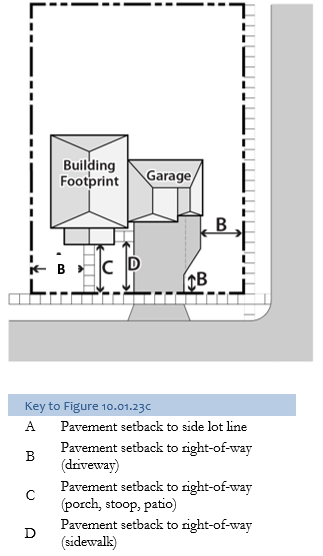
"Performance Standard" means criterion established to control and limit the impacts generated by, or inherent in, uses of land or buildings.
"Permanently Protected Green Space" means permanently protected green space areas that are protected from development such as wetlands, wetland buffers, floodplains, drainage ways, steep slopes, lakeshores, woodlands, native or restored habitat, environmental corridors, and stormwater facilities.
"Person" means any individual, tenant, lessee, owner, operator, or any public, private, nonprofit, or commercial entity including, but not limited to, firm, business, partnership, joint venture, association, corporation, municipality, agency, or governmental agency.
"Pervious Surface" means a surface which allows for precipitation from any source to infiltrate directly into the ground. Undisturbed ground is a pervious surface. Some disturbed ground can be pervious if designed as such.
"Place of Worship" means a structure, together with its accessory structures and uses, where persons regularly assemble for religious worship and is maintained and controlled by an organized religious body organized to sustain public worship, which is exempt from federal income tax as regulated by the Internal Revenue Service Code.
"Plat" means a map or drawing which graphically delineates the boundary of land lots/parcels for the purpose of identification and record title pursuant to Wis. Stat. § 236.
"Pole Building" means a typically metal-clad structure most often utilizing wooden poles and trusses for support with unfinished, uninsulated interiors. Such structures are normally used for agricultural purposes, for construction trade storage, or for general storage, and are not intended for human occupancy.
"Porch" means a covered platform that is attached to the outside of a building, typically at an entrance. A porch is not heated or cooled, not fully enclosed and not used for livable space. The post of the porch closest to a lot line is considered the wall for setback purposes.
"Principal Structure" means the building containing the principal use, including the foundation, basement, and attic. When calculating the area of the principal structure, attached residential accessory structures such as attached garages, attached garden sheds, and attached pool houses are not considered part of the principal structure.
"Principal Use" means the main use to which a parcel is devoted and the main purpose for which the premises exists.
"Public Improvement" means any improvement, facility, or service, together with customary improvements and appurtenances thereto, necessary to provide for public needs, such as: streets, roads, alleys, or pedestrian walks or paths; storm sewers; flood control improvements; water supply and distribution facilities; sanitary sewage disposal and treatment; and public utility and energy services.
"Recreational Equipment" means equipment used by residents of a principal building on-premise including but not limited to swimming pools, swings, slides, climbers, teeter-totters, play-forts, sandboxes, supports for basketball baskets and backboards, badminton nets and similar equipment, but not including recreational vehicles normally utilized off-premise, including but not limited to boats, trailers, campers, travel trailers and snowmobiles.
"Recreational Vehicle" means a term encompassing any type of vehicle used primarily for recreational pleasure. Examples include but are not limited to travel trailers, motor homes, boats, all-terrain vehicles, snowmobiles, etc. Recreational vehicles shall include any mobile structure designed for temporary occupancy, but shall exclude manufactured homes.
"Regional Flood" means a flood determined by the Wisconsin Department of Natural Resources which is representative of large floods known to have occurred generally in Wisconsin and reasonably characteristic of what can be expected to occur on a particular stream. The regional flood generally has an average frequency in the order of the 100-year recurrence interval flood determined from an analysis of floods on a particular stream and other streams in the same general region.
"Residential Use" means the individual uses listed in Section 10.03.06.
"Rummage Sale." See "Garage or Estate Sale" in Article III.
"Scale (of development)." A term used to describe the gross floor area, height, or volume of a single structure or group of structures.
"Setback" means the shortest distance between the exterior of a building or structure and the nearest point on the referenced lot line, excluding permitted projections in accordance with Section 10.04.40.
"Sign." See Chapter 22 of the City Municipal Code.
"Sill" means a horizontal, lower member or bottom of a door or window casing.
"Single-family Dwelling Unit" means a dwelling unit type that consists of a fully detached single family residence which is located on an individual lot. Single family dwelling units are designed for one family (see Family definition) and have no roof, wall, or floor in common with any other dwelling unit. A single-family dwelling that contains an in-family suite (See Section 10.03.28) or accessory dwelling unit is still considered a single-family dwelling.
"Site Area." See "Gross Site Area."
"Site Plan." See Section 10.10.43.
"Slope" means an incline from the horizontal expressed in an arithmetic ratio of horizontal magnitude to vertical magnitude. (Example: 3:1 slope is three (3) feet horizontal and one (1) foot vertical).
"Solar Energy System" means a device, array of devices, or structural design feature, the purpose of which is to provide for generation or storage of electricity from sunlight, or the collection, storage, and distribution of solar energy for space heating or cooling, daylight for interior lighting, or water heating. A solar photovoltaic system that is connected to an electric circuit served by an electric utility company is a "Grid-connected solar energy system." A solar photovoltaic system mounted on a rack that is ballasted on, or is attached to, the roof of a building or structure is a "Roof-mounted solar energy system" (roof-mount systems are accessory to the primary use). A solar photovoltaic system mounted on a rack or pole that is ballasted on, or is attached to, the ground is a "Ground-mounted solar energy system." Ground-mounted systems can be either accessory to the primary use or be the primary land use for the parcel on which it is located, with the primary use system permitted through a discretionary approval process. A solar photovoltaic system that qualifies for a utility-shared solar program is a "Community-scale solar energy system."
"Start of Construction" means the date the building permit is issued, provided the actual start of activity was within three hundred sixty-five (365) calendar days of the permit date. The actual start of activity means the first placement of permanent construction on the site. Permanent construction does not include land preparation, such as clearing, grading and filling; nor does it include the installation of public streets and/or walkways; nor does it include excavation for basement, footings, piers, or foundations; nor does it include the erection of temporary forms.
"Steep Slope." Steep slopes are areas which contain a ratio of horizontal magnitude to vertical magnitude of 8:1 (gradient of twelve (12) percent or greater).
"Stepback" means an architectural design element applied to the upper stories of buildings where any portion of the building above a certain height is moved inside the frame of the building facade toward the center of the property. See Figure 10.01.23d.
Figure 10.01.23d: Building Stepbacks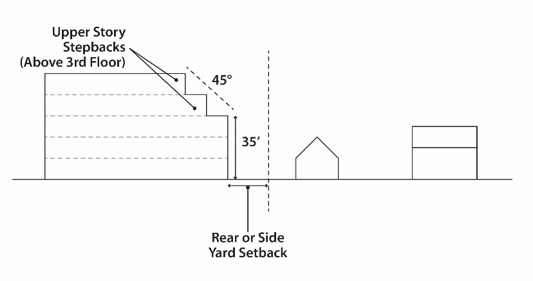
"Street" means a right-of-way for vehicular and pedestrian traffic, whether designated as a street, highway, thoroughfare, parkway, throughway, road, avenue, boulevard, lane, place, or however otherwise designated and includes all of the area between the right-of-way lines. See Chapter 19 of the City of Middleton Municipal Code.
"Street, Arterial" means those streets which provide for rapid movement or concentrated volumes of traffic over relatively long distances. This includes Principal Arterials, Primary Arterials, and Standard Arterials as defined in Chapter 19 of the City of Middleton Municipal Code.
"Street, Collector" means streets which provide moderate speed movement of persons and goods between major arterials and/or activity centers. They are basically local streets which because of directness of routing and higher capacity receive higher volumes of traffic to be distributed or collected toward nearby arterial streets. See Chapter 19 of the City of Middleton Municipal Code.
"Street, Local" means streets designed for low speeds and low volumes which provide access from low traffic generating areas to collector and arterial systems. This includes Industrial Streets and Residential Streets as defined in Chapter 19 of the City of Middleton Municipal Code.
"Street Terrace" means the space between the sidewalk and the curb, or the equivalent space where sidewalk or curb are not installed.
"Story" means that portion of a building, other than a basement, that is between the surface of any floor and the surface of the next floor above it or, if there is not a floor above, then the space between such floor and the ceiling next above it.
"Structure" means anything constructed or erected, the use of which requires a more or less permanent location on the ground, or attached to something having a permanent location on the ground, excluding landscape features, fences, public utilities, and other minor site improvements.
"Structural Alteration." See "Alteration."
"Substandard Lot" means a lot of record which lawfully existed prior to this Chapter, which would not conform to the applicable regulations if the lot were to be created under the current provisions of this Chapter.
"Substantial Evidence" means facts and information, other than merely personal preferences or speculation, directly pertaining to the requirements and conditions an applicant must meet to obtain a Conditional Use Permit and that reasonable persons would accept in support of a conclusion. See Section 10.10.32.
"Temporary Use" means a land use which is present on a property for a limited and specified period of time. See Section 10.03.30.
"Terrace" means a horizontal, external, raised, open, flat area attached or detached to a structure or located on the roof of a structure.
"Transom" means a horizontal bar of stone, wood or glass across the upper opening of a door or window.
"Two-Family Residential" means a building designed for two (2) separate dwelling units in which one dwelling unit may have a roof, wall, or floor in common with another dwelling unit. For the purposes of this Chapter, Duplex, Twin House, and Two Flat dwellings are considered to be two-family residential. A single-family dwelling with an attached accessory dwelling unit is not a two-family dwelling.
"Unnecessary Hardship" means the circumstance where special conditions affecting a particular property, which were not self-created, have made strict conformity with restrictions governing areas, setbacks, frontage, height, or density unnecessarily burdensome or unreasonable in light of the purposes of the ordinance.
"Use" means the purpose for which land or a building or structure is arranged, designed, or intended, or for which it is, or may be, occupied or maintained.
"Variance" means a modification of the terms of this Chapter regulating land uses or bulk regulations where such variance will not be contrary to the public interest and where, owing to conditions peculiar to the property and not the result of the actions of the applicant, a literal enforcement of the Chapter would result in unnecessary and undue hardship. Variances are further defined in Wis. Stat. § 62.23(7)(e)7.a.
"Vision Triangle." See Section 10.06.05.
"Waterfront Setback" means the shortest distance between the exterior of a building or structure and the nearest point on the Ordinary High Water Mark, excluding permitted projections per Section 10.04.40. All lots along a waterway are subject to the provisions of Chapter 24 and 29 of the City of Middleton Municipal Code and Section 10.02.80 of this Ordinance.
Wetland" means an area that is saturated by surface water or groundwater, with vegetation adapted for life under those soil conditions. See also Wis. Stat. § 23.32(1).
"Wharf/Pier" means any structure in navigable waters extending along the shore and generally connected with the uplands throughout its width, built or maintained for the purpose of providing a berth for watercraft or for loading or unloading cargo or passengers onto or from watercraft. Such a structure may include a boat hoist or boat lift, and the hoist or lift may be permanent or may be removed seasonally.
"Woodland" means areas of trees whose combined canopies cover a minimum of eighty (80) percent of an area of one (1) acre or more, as shown on USGS 7.5 minute topographic maps for the City and its environs.
"Yard" means an open space, other than a court, on a lot unoccupied and unobstructed from the ground upward except as otherwise provided in this Chapter.
"Yard, Front" means a yard extending across the full width of the lot, the depth of which is the minimum horizontal distance between the front lot line and the nearest part of the nearest building or structure.
"Yard, Rear" means a yard extending across the full width of the lot, the depth of which is the minimum distance between the rear lot line and the nearest part of the nearest building or structure.
"Yard, Side" means a yard extending from the front yard to the rear yard, the width of which is the minimum horizontal distance between the side lot line and the nearest part of the nearest building or structure.
"Yard, Street Side" means, for corner lots, the yard between the front and rear lot lines, extending from the street side lot line to the nearest part of the nearest building or structure.
"Yard, Transitional" means that yard which must be provided along a zoning district boundary to provide for the required bufferyard on the more intensively zoned side of the lot line.
"Zero-Lot Line Duplex" means a Twin House. See Section 10.03.06(12).
"Zoning Map, Official" means the map adopted and designated by the City as being the "Official Zoning Map."
(Ord. No. O1657, §§ 3—5, 6-17-2025)

