
Middleton City Zoning Code
ARTICLE VII
EXTERIOR BUILDING DESIGN STANDARDS
10.07.01 - PURPOSE AND APPLICABILITY
(1)
Purpose
The purpose of this Section is to regulate the design and materials used for the exterior of buildings and structures within the City so as to maintain and enhance the attractiveness and values of property in the community. This Article is further intended to support the creation of a pedestrian-oriented urban environment that emphasizes architectural and urban design principles of human scale and visual interest. Additionally, this Article is intended to ensure the development of structures that maintain a long-lasting appearance; withstand the effects of time and exposure to the elements; resist damage in areas with high vehicular and pedestrian traffic and in areas where larger equipment that could cause damage is commonly used; that maintain a consistent character of development based on land use and zoning district particular to each development; and that contribute to the long-term economic and social vitality of the City of Middleton.
(2)
Applicability
The standards herein apply to the following. See Section 10.07.10 for the applicability of building design standards to single- and two-family buildings. Manufactured Home, Telecommunication, Extraction and Disposal, Energy Production, and Agricultural land uses are exempt from the exterior design guideline of this Article.
(a)
New Construction
The requirements of this Section shall apply to all structures and buildings within the City constructed after the effective date of this Chapter.
(b)
Additions
Additions to buildings constructed after the effective date of this Chapter shall comply with the standards of this Section.
1.
All additions shall match or be substantially similar to the design and materials of the existing building.
(c)
Alterations
For buildings constructed prior to the effective date of this Chapter, alterations that do not impact the floor area of the building shall comply with the standards of this Section, or shall match or be substantially similar to the existing building design and materials. Ordinary repairs and maintenance are not considered alterations.
(d)
Exceptions and Appeals
1.
Exceptions
Exceptions to the building design standards set forth in this Section may be granted by the Zoning Administrator to permit substitute building materials or construction of comparable quality or design when it can be demonstrated that the provisions of this Section are infeasible and that the granting of such exception is in keeping with the purpose of this Section. Decisions rendered by the Zoning Administrator may be appealed to the Plan Commission.
2.
Appeals
Any person affected by a decision of the Zoning Administrator, may petition for a hearing before the Plan Commission.
3.
Waivers
The Plan Commission is authorized to grant one or more waivers for specific design requirements in this Section and to the minimum parking requirements pursuant to Section 10.06.06(6)(e) when the Plan Commission finds the design to constitute an exemption as described above in subsection 1. or finds an alternative design standard also achieves the Purpose of this Section (10.07.10(1)).
a.
Granting of waivers by the Plan Commission shall be identified within the conditions of approval as part of the design review component of any Site Plan review (Section 10.10.43).
(e)
Beyond the rules in this Section, additional building design standards may apply to:
1.
Group and Large Developments (see Section 10.06.02)
2.
Conditional Use Permits (see Section 10.10.32)
3.
Planned Unit Development Districts (see Section 10.0.2.70)
(3)
Review and Approval
Through the site plan review and building permit processes, the Zoning Administrator shall be responsible and have authority to hear, review, and act upon all proposed exterior architectural plans for all proposed development.
(4)
Exterior Building Materials
The four (4) classes of building materials referenced in this Chapter have the following meanings:
(a)
Class I materials include brick, brick veneer, stone, stone veneer, and glass (curtain/storefront).
(b)
Class II materials include split face or decorative block, and stucco.
(c)
Class III materials include architectural/decorative metal panels, EIFS, residential aluminum siding, and siding made of wood, wood composite, vinyl, or fiber cement.
(d)
Class IV materials include smooth face or non-decorative block; concrete panels (tilt-up or precast); asphaltic, fiberglass, metal, or poly-roofing siding; non-decorative metal panels; corrugated metal; and plywood, chipboard, or other non-decorative wood. Also includes any material not listed in Subsections (a) through (c) above.
Figure 10.07.01a: Exterior Building Material Requirements by Use*
(Ord. No. O1657, § 123, 6-17-2025)
10.07.10 - SINGLE- AND TWO-FAMILY USES
These standards apply to all single-family, duplex, twin house, and two-flat land uses, buildings, and structures constructed after the effective date of Chapter.
(1)
Purpose
The purpose of this Section is to maintain the basic architectural quality of residences within the community, to minimize architectural and building construction practices that may detract from the character and appearance of the neighborhood as a whole, and to ensure compatible design between existing and new homes. These standards apply to all single- and two-family structures within the City of Middleton, with the exception of Manufactured Homes defined in Section 10.01.23.
(2)
Existing Buildings: Changes and Additions
(a)
Changes to Existing Buildings
For the purposes of this Section, a change to an existing principal structure is considered any alteration or demolition to the materials, wall plane, and/or architectural features of any front or side façade.
(b)
Setbacks
See the base zoning district's bulk dimensions table in Article II for all minimum setback requirements.
(c)
Front-loaded, Attached Garages
Front-loaded, attached garages shall comprise no more than the percentage width of the ground floor building façade facing the street as indicated in the base zoning district's bulk dimensions table in Article II.
(3)
New Construction: Principal Structures
(a)
Setbacks
See the base zoning district's bulk dimensions table in Article II for all minimum setback requirements.
(b)
Front-loaded, Attached Garages
Front-loaded, attached garages for new construction on infill sites shall meet the regulations for existing buildings in Subsection (2), above.
(c)
Height
See the base zoning district's bulk dimensions table for all maximum height requirements in Article II.
(Ord. No. O1657, § 124, 6-17-2025)
10.07.20 - MULTI-FAMILY USES
These standards apply to all townhouse, multiplex, and apartment land uses, buildings, and structures constructed after the effective date of Chapter. See Article VIII for landscaping standards.
(1)
Exterior Materials
Multi-family buildings shall be clad in Class I, II or III materials. Class IV materials are prohibited.
(a)
Materials of comparable quality may be substituted for any class of material or be used as a decorative element if the material can be removed or replaced with a permitted exterior material, as determined by the Zoning Administrator.
(b)
Metal roofs and exterior metal walls shall be coated in compliance with the appropriate ASTM standards based on the roof or wall material. The most common materials and standards are galvanized steel (ASTM A 653 G-90), fifty-five (55) percent aluminum-zinc alloy coated steel (ASTM A 792 AZ 50), five (5) percent aluminum alloy-coated steel (ASTM A 875 GF60), aluminum-coated steel (ASTM A 463 T2 65), or pre-painted steel (ASTM A 755).
(c)
Exterior building materials in conjunction with façade articulations listed below in Section 10.07.20(3) shall be used to the create the building's distinct horizontal base, middle, and top.
(2)
Building Entrance
(a)
The primary entrance shall be on the front façade facing the street.
(b)
The primary entrance shall be covered a minimum of three (3) feet from the door. Recessed three (3) foot entries shall be deemed to meet this requirement.
(c)
Exterior entry doors for individual units shall be residential in style and shall include frame and panel (real or decorative).
(d)
Exterior entry doors for multiple units may be residential (as described in Subsection (1) above) or commercial in style (glass).
(3)
Façade Articulation
(a)
Maximum Permitted Building Length
1.
All principal structures on a lot located in the MU-N district shall be limited to a maximum exterior building façade length of one hundred (100) feet.
2.
All principal structures on a lot located in the MR-L, MR-M, MR-H, MU-A, MU-U, and MU-D districts shall be limited to a maximum exterior building façade length of two hundred fifty (250) feet.
(b)
Façade lengths shall not be greater than forty (40) feet without articulation such as:
1.
Recesses or projections that step back or project a portion of the main façade plane.
2.
Recesses or projections of upper floors from the ground floor façade plane.
3.
Vertical division using different textures or materials.
4.
Division of the façade into individual units through the use of windows, entrances, arcades, porches, decks, balconies, lighting, etc.
5.
Roof form variation such as the inclusion of dormers, change in roof lines, or change in roof type.
6.
Public art installations located directly on a facade, such as murals.
(c)
On façades facing the street, windows and/or doors shall be required in order to promote a visual connection to the street.
1.
The total area of windows and doors, including trim, shall comprise a minimum of twenty (20) percent of the total façade area, excluding gables.
2.
Structured in-building vehicle parking or access is permitted on the ground floor of a structure in accordance with the standards below:
a.
Vehicle access is permitted from any façade of the structure to the right-of-way and structured in-building parking shall be fully enclosed on all sides within the structure.
b.
All ground floor facades of the structure that directly face a right-of-way shall not directly adjoin any on-site vehicle parking area within the structure and shall include residential or nonresidential uses, as determined by the Zoning Administrator, on the ground floor of the structure between said façade and the parking area.
(d)
See Article II for zoning district stepback requirements.
(4)
Wall Details, Trim, and Windows
(a)
Exterior windows shall match the architectural character of the building.
(b)
All façade openings shall be articulated or appropriately trimmed through the use of materials such as lintels, sills, surrounds, shutters, etc.
(c)
Natural wood shall be painted or stained unless it is cedar, redwood or other naturally weather-resistant species intended to be exposed.
(d)
Pressure-treated lumber shall be painted or stained after a curing period of no greater than eighteen (18) months.
(5)
Patios, Decks, and Balconies
(a)
Ground-level patios and decks facing the street shall be bordered with landscape treatments, in accordance with Article VIII as depicted and approved on the Site Plan (Section 10.10.43).
1.
Covered porches are exempt from this requirement.
(b)
Exterior stairs leading to a deck or balcony are not permitted on the front or street side of a building.
1.
On corner lots, exterior stairs shall be permitted on the interior side façade.
(c)
Exterior corridors shall be covered by the building roof, shall be located within the footprint of the building foundation, and shall not be visible from the street.
(d)
Upper-story decks and balconies shall be cantilevered, supported by vertical columns, or supported from above.
(6)
Mechanical and Exterior Building Systems
(a)
Drainage pipes and air intakes and exhaust vents for high-energy gas applications and meters on exterior walls shall match or be complementary to the color of the roof and wall onto which they are mounted.
(b)
Facade-mounted Equipment
1.
Window-mounted air conditioning units shall not be permitted in any window that faces a public street and shall not encroach into exterior balconies, porches, decks, or patios.
a.
When no alternative is available, units shall be masked (painted, encased, etc.) in order to blend into the building's exterior finish and shall be flush-mounted so as not to project beyond the main plane of the façade more than necessary.
2.
Building-mounted equipment installed on the façade visible from an adjacent public right-of-way or residential district shall not encroach into exterior balconies, porches, decks, or patios and shall be screened in a manner that is:
a.
Architecturally compatible with the primary structure to which the equipment is attached. Screening materials shall be identical to or substantially similar to the materials used on the building façade to which the equipment is attached.
b.
Incorporated as part of the building wall and/or flush-mounted so as not to project beyond the main plane of the façade.
c.
Consistent with the color of the structure to which the equipment is attached.
(c)
Roof-mounted Equipment
Roof-mounted equipment shall be screened, preferably by parapet walls. Other acceptable screen types shall be:
1.
Architecturally compatible with the primary structure to which the equipment is attached. Screening materials shall be identical to or substantially similar to the materials used on the building façade to which the equipment is attached.
2.
Consistent with the color of the structure to which the equipment is attached.
3.
Designed to be an integral part of the building's architectural design and give the impression that it is something other than a mechanical screen.
(d)
See Section 10.06.21 for screening requirements for ground-mounted mechanical systems.
(7)
Roof Design
A Multi-Family building designed to have a gable, hip, or gambrel roof with a pitch of at least 6/12 may qualify for additional height pursuant to Section 10.04.20(2).
(8)
Wall or Roof-Mounted Lighting
See Chapter 33 of the City of Middleton Municipal Code.
(Ord. No. O1657, §§ 125, 126, 6-17-2025)
10.07.30 - COMMERCIAL, MIXED-USE, AND INSTITUTIONAL USES
These standards apply to all mixed-use, commercial, and institutional land uses, buildings, and structures constructed after the effective date of Chapter. See Article VIII for landscaping standards.
(1)
Orientation
(a)
Buildings shall be oriented so that the front façade faces the road with the highest traffic volumes.
(b)
All façades facing a public right-of-way shall be designed to have the appearance of a front façade, meaning each shall include windows, doors and/or other architectural components typically associated with front façades, as approved by the Zoning Administrator.
(c)
Service or loading areas shall not be permitted between the building and the public street.
(d)
Drive-through windows shall not be located between the building and the public street.
(2)
Exterior Materials
Commercial buildings shall be predominately clad in Class I materials. Class II and Class III materials may be used as accents and trim not to exceed fifty (50) percent of the total building façade. Class IV materials are prohibited.
(a)
Rear building elevations not facing a public street or public parking lot shall be exempt from this requirement.
(b)
Standing seam metal roofs with exposed fasteners shall be prohibited.
(c)
Materials of comparable quality may be substituted for any class of material or be used as a decorative element if the material can be removed or replaced with a permitted exterior material, as determined by the Zoning Administrator.
(d)
Exterior building materials in conjunction with façade articulations listed below in Section 10.07.30(3) shall be used to create the building's distinct horizontal base, middle, and top.
(3)
Façade Articulation
(a)
Maximum Permitted Building Length
1.
All principal structures on a lot located in the MU-N district shall be limited to a maximum exterior building façade length of one hundred (100) feet.
2.
All principal structures on a lot located in the MR-L, MR-M, MR-H, MU-A, MU-U, and MU-D districts shall be limited to a maximum exterior building façade length of two hundred fifty (250) feet.
(b)
Façade lengths shall not be greater than forty (40) feet without articulation such as:
1.
Recesses or projections that step back or project a portion of the main façade plane.
2.
Recesses or projections of upper floors from the ground floor façade plane.
3.
Vertical division using different textures or materials.
4.
Division of the façade into individual components (i.e., storefronts, distinct uses) through the use of architectural elements such as porches, balconies, windows, covered entrances, arcades, awnings, marquees, lighting, signage, etc.
5.
Roof form variation such as the inclusion of dormers, change in roof lines, or change in roof type.
6.
Public art installations located directly on a facade, such as murals.
(c)
Buildings shall be designed so each façade includes at least one (1) design element to break up the flatness of blank walls and shall at a minimum include varied materials or colors, change in texture, expressed joints and details, or surface relief. Flat, unadorned walls shall be avoided.
1.
Additional elements used to break up the façade may include balconies, lintels, sills, headers, belt courses, reveals, pilasters, windows, chimneys, and other ornamental features as deemed appropriate by the Zoning Administrator.
(d)
On façades facing the street, windows and/or doors shall be required in order to promote a visual connection to the street.
1.
The total area of windows and doors, including trim, shall comprise a minimum of twenty (20) percent of the total façade area, excluding gables.
2.
Structured in-building vehicle parking or access is permitted on the ground floor of a structure in accordance with the standards below:
a.
Vehicle access is permitted from any façade of the structure to the right-of-way and structured in-building parking shall be fully enclosed on all sides within the structure.
b.
All ground floor facades of the structure that directly face a right-of-way shall not directly adjoin any on-site vehicle parking area within the structure and shall include residential or nonresidential uses, as determined by the Zoning Administrator, on the ground floor of the structure between said façade and the parking area.
(e)
See Article II for zoning district stepback requirements.
(4)
Building Entrance
(a)
The main entrance shall be clearly defined and accentuated through the use of detailing, distinctive materials, and/or colors, projections or recesses, porticos, covered entrances, stoops, or other features as deemed appropriate by the Zoning Administrator.
(5)
Mechanical and Exterior Building Systems
Mechanical and exterior building systems shall meet the regulations for multi-family buildings in Section 10.07.20(6).
(6)
Roof Design
A Mixed-Use building designed to have a gable, hip, or gambrel roof with a pitch of at least 6/12 may qualify for additional height pursuant to Section 10.04.20(2). This provision does not pertain to Commercial or Institutional uses.
(7)
Wall or Roof-Mounted Lighting
Wall or roof-mounted lighting shall meet the regulations for multi-family buildings in Section 10.07.20(6).
(Ord. No. O1657, §§ 127, 128, 6-17-2025)
10.07.40 - INDUSTRIAL USES
These standards apply to all industrial, storage, and transportation land uses, buildings, and structures constructed after the effective date of Chapter. See Article VIII for landscaping standards.
(1)
Architectural Design
(a)
Buildings shall be designed to include façade articulation; flat, unadorned walls shall be avoided.
(b)
Buildings shall be oriented so as to face the road with the highest traffic volumes. This requirement shall not apply to buildings with frontage on state or federal highways, unless there is direct access from the development to the highway.
1.
If a visitor, office, and/or customer entrance component is included in the building, such space(s) shall be clearly defined and accentuated through the use of detailing, windows, distinctive materials and/or colors, projections or recesses, or other architectural features as deemed appropriate by the Zoning Administrator.
(c)
See Article II of this zoning ordinance for zoning district stepback requirements.
(2)
Exterior Materials
Industrial buildings shall be clad in Class I, II or III materials. Certain Class IV materials are also acceptable as noted.
(a)
For all façades facing a public street, a minimum of fifteen (15) percent of the façade shall be composed of Class I building materials.
1.
This requirement may be reduced to ten (10) percent of the façade provided that other elements are incorporated into the building and site design, such as façade articulation, increased landscaping, or other improvements approved by the Zoning Administrator.
(b)
Smooth-faced/non-decorative block (Class IV materials) may be used if enhanced on all elevations with Class I or II materials in combination with decorative fascia, overhangs, trim, lintels, sills, headers, belt courses, reveals, pilasters, windows, chimney, or other architectural features as deemed appropriate by the Zoning Administrator. In such cases, Class I or II materials shall amount to more than fifteen (15) percent of each façade.
(c)
Concrete panels (tilt-up/precast) (Class IV materials) may be used if they are part of a palette of permitted materials or if they incorporate horizontal and vertical articulation including, but not limited to, changes in color or texture.
(d)
EIFS and similar material shall only be used above the ground floor.
(e)
Non-decorative metal panels (Class IV materials) may be used if enhanced on all elevations with Class I or II materials in combination with decorative fascia, overhangs, trim, lintels, sills, headers, belt courses, reveals, pilasters, windows, chimney, or other architectural features as deemed appropriate by the Zoning Administrator. In such cases, Class I or II materials shall amount to more than fifteen (15) percent of each façade.
1.
In the AGR, I-L, I-M, I-H, IOS, IOC, EXD, and AIR zoning districts, visible exterior fasteners shall be the same color as the attached wall for any principal or accessory building visible from a public street.
2.
In all other zoning districts, exterior wall fasteners shall be fully concealed from view.
(f)
Materials of comparable quality may be substituted for any class of material or be used as a decorative element if the material can be removed or replaced with a permitted exterior material, as determined by the Zoning Administrator.
(3)
Façade Articulation
(a)
Façade lengths shall not be greater than one hundred (100) feet without articulation such as:
1.
Recesses or projections that step back or project a portion of the main façade plane.
2.
Recesses or projections of upper floors from the ground floor façade plane.
3.
Vertical division using different textures or materials.
4.
Division of the façade into individual components (i.e., storefronts, distinct uses) through the use of architectural elements such as porches, balconies, windows, covered entrances, arcades, awnings, marquees, lighting, signage, etc.
5.
Roof form variation such as the inclusion of dormers, change in roof lines, or change in roof type.
6.
Public art installations located directly on a facade, such as murals.
(4)
Mechanical and Exterior Building Systems
(a)
Applicability
See Section 10.06.21 to determine whether screening is required.
(b)
Drainage pipes on exterior walls shall match or be complementary to the color of the roof and wall onto which they are mounted.
(c)
Building-mounted Equipment
1.
Building-mounted equipment installed on the façade visible from an adjacent public right-of-way or residential district shall be disguised or screened in one (1) of the following ways:
a.
Architecturally compatible with the primary structure to which the equipment is attached. Screening materials shall be identical to or substantially similar to the materials used on the building façade to which the equipment is attached.
b.
Incorporated as part of the building wall and/or flush-mounted so as not to project beyond the main plane of the façade.
c.
Consistent with the color of the structure to which the equipment is attached.
(d)
Roof-mounted Equipment
Roof-mounted equipment visible from an adjacent public right-of-way or residential district shall be screened, preferably by parapet walls. Other acceptable screen types shall be:
a.
Architecturally compatible with the primary structure to which the equipment is attached. Screening materials shall be identical to or substantially similar to the materials used on the building façade to which the equipment is attached.
b.
Consistent with the color of the structure to which the equipment is attached.
c.
Designed to be an integral part of the building's architectural design and give the impression that it is something other than a mechanical screen.
10.07.50 - SPECIAL AREAS
(1)
Downtown Design Overlay Zoning District Design Standards
(a)
Purpose
This district is intended to implement the urban design recommendations of the Comprehensive Plan, by preserving and enhancing the historical quality of the downtown, and by attaining a consistent visually pleasing image for the downtown area, as defined by the mapped boundaries of the Downtown Design Overlay zoning district.
(b)
Applicability
The regulations of this Section shall apply to new development and changes to the exterior of any building within the mapped boundaries of the Downtown Design Overlay district (See Section 10.02.84).
(c)
Review and Approval
1.
There are three (3) categories of review in this district:
a.
Renovation Review (renovation of the exterior appearance of a property such as repainting, re-roofing, residing or replacing with identical colors, finishes, and materials).
b.
Design Alteration Review (change only in the exterior appearance of a nonresidential or multi-family property such as painting, roofing, siding, architectural component substitution, fencing, paving, or signage).
c.
Project Review (modification to the physical configuration of a property such as the erection of a new building, the demolition of an existing building, or the addition or removal of bulk to an existing building).
2.
Plan Commission review and approval may be required. The three (3) categories and procedural requirements for review and approval are described fully in Section 10.10.44.
3.
Design standards for changes meeting the criteria for Project Review are found in Section 10.07.50(1)(e), below. Design standards for changes meeting the criteria for Design Alteration Review or Renovation Review are found in Section 10.07.50(1)(f), below.
4.
Designated Historic Structures
These regulations are separate and in addition to requirements related to changes to Local, State, and National Landmarks and properties as regulated by the City of Middleton Landmarks Commission. Prior to taking action, the Plan Commission shall consult with the Landmarks Commission for all properties designated as historic, contributing to a historic district, or considered by a study or survey to be eligible for listing on a local, state, or national register.
(d)
Design Theme
The design theme for the Downtown Design Overlay District is based on its historical, pedestrian-oriented development pattern that incorporates retail, residential, and institutional uses. Building orientation and character includes minimum setbacks at the edge of the sidewalk, multi-story structures, use of alleys for access, and on-street or other off-site parking. The design theme is characterized by a variety of architectural styles popular at the time, including Italianate, Romanesque, and Neoclassical, in a multi-story format with office, storage, or residential located over commercial. The façades of these buildings have a traditional main street storefront appearance, are relatively small in scale, have street yard and side yard setbacks of zero (0) feet, have prominent horizontal and vertical patterns formed by regularly spaced window and door openings, detailed cornice designs, rich detailing in masonry coursing, window detailing and ornamentation, and are predominately brick, stone, or wood. Exterior building materials are of high quality. Exterior appurtenances are minimal. Exterior colors are harmonious, simple, and muted. Exterior signage blends, rather than contrasts, with buildings in terms of coloring (complementary to building), location (on-building), size (small), and number (few).
Figure 10.07.50a: Architectural Components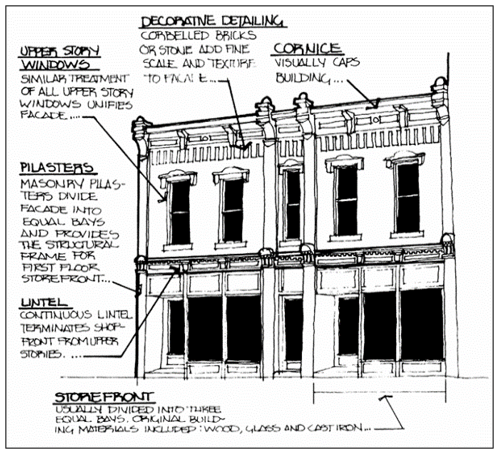
(e)
Design Standards for Project Review (New Construction, Building Additions, and Building Alterations)
1.
The design standards contained in this Subsection shall apply to all changes meeting the criteria for Project Review (including all new buildings, building additions, and new building appurtenances). Such activities shall correspond to the following:
a.
The following requirements for building setback; height; building mass; horizontal rhythms (created by the placement and design of façade openings and related elements such as piers, columns); vertical rhythms (created by the placement and design of façade details such as sills, transoms, cornices and sign bands); roof forms; exterior materials; exterior surface features and appurtenances; exterior colors; exterior signage; on-site landscaping; exterior lighting; parking and loading area design; and the use of screening.
2.
Building Setback
Throughout the district, the setback of buildings from street yard and side yard property lines shall be compatible with existing buildings in the immediate area which conform to the design theme described in Subsection (1)(d) above, as determined by the Plan Commission.
a.
See Article II for zoning district stepback requirements.
3.
Building Height
a.
See Article II for zoning district maximum height requirements.
4.
Building Mass
a.
Throughout the district, the mass of buildings shall be compatible with existing buildings in the immediate area which conform to the design theme described in Subsection (1)(d) above, as determined by the Plan Commission.
b.
The characteristic proportion (relationship between façade height and width) of the design theme shall be maintained.
c.
Building mass for large structures (with a façade area exceeding five thousand (5,000) square feet) shall be disguised through the use of façade articulations, or through the use of exterior treatments which give the impression of directly adjoining individual buildings, as determined by the Plan Commission.
5.
Horizontal Rhythms
The horizontal pattern of exterior building elements formed by patterns of building openings for windows and doors, and related elements such as piers and columns shall be spaced at regular intervals across all visible façades of the building, and shall be compatible with those of existing buildings in the immediate area which conform to the design theme described in Subsection (1)(d) above, as determined by the Plan Commission.
6.
Vertical Rhythms
The floor heights on main façades shall appear visually in proportion to those of adjoining buildings. The rhythm of the ground floor shall harmonize with the rhythm of upper floors. The vertical pattern of exterior building elements formed by patterns of building openings for windows and doors, and related elements such as sills, headers, transoms, cornices and sign bands shall be compatible in design and elevation with those of existing buildings in the immediate area which conform to the design theme described in Subsection (1)(d) above, as determined by the Plan Commission.
7.
Roof Forms
Flat or gently sloping roofs which are not visible from the street shall be used. Mansards or other exotic roof shapes not characteristic of the design theme described in Subsection (1)(d) above, as determined by the Plan Commission, shall not be used. See Figure 10.07.50b.
Figure 10.07.50b: Roof Forms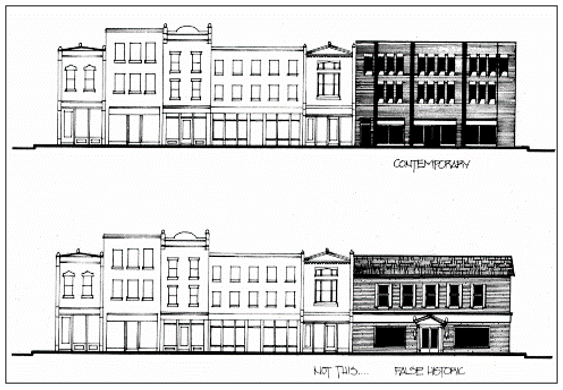
8.
Exterior Materials
Selected building materials shall be compatible with those of existing buildings within the same block-face which conform to the design theme described in Subsection (1)(d) above, a determined by the Plan Commission.
a.
Masonry
Stone or brick facing shall be of even coloration and consistent size. Cinder block, concrete block, concrete slab, or concrete panel shall not be permitted.
b.
Siding
i.
Wood, thin board texture vinyl, fiber cement, or textured metal clapboard siding may be appropriate, particularly if the proposed non-masonry exterior was used on a building which conforms to the design theme described in Subsection (1)(d) above, as determined by the Plan Commission.
ii.
Clapboard or board and batten may be appropriate in certain instances where used on the existing structure within the same block-face which conforms to the design theme described in Subsection (1)(d) above, as determined by the Plan Commission.
iii.
Class IV materials are prohibited.
c.
Glazing
Clear, or slightly tinted glass or related glazing material shall be used. Mirrored glass, smoked glass, or heavily tinted glass shall not be permitted, unless needed in a special situation as determined by the Plan Commission.
9.
Exterior Surface
Exterior surface appurtenances shall be compatible with those of existing buildings in the immediate area which conform to the design theme described in Subsection (1)(d) above, as determined by the Plan Commission.
a.
The traditional storefront design theme (characterized by strong horizontal and vertical rhythms formed by building openings, windows, and transom windows) shall be employed for all new nonresidential buildings. Ground floors consisting entirely of residential or office uses shall be exempt from this requirement.
b.
Throughout the district, avoid cluttering building façades with brackets, wiring, meter boxes, antennae, gutters, downspouts and other appurtenances. Unnecessary signs shall also be avoided. Where necessary, such features shall be colored so as to blend in, rather than contrast, with the immediately adjacent building exterior. Extraneous ornamentation which is inconsistent with the design theme described in Subsection (1)(d) above, as determined by the Plan Commission, is also prohibited.
10.
Awnings and Marquees
Awning and marquee size, color and placement shall complement the architectural character of the building, as determined by the Plan Commission.
a.
Soft, weather-treated canvas or vinyl materials which allow for flexible or fixed installation shall be used for awnings.
b.
Aluminum or suspended metal canopies shall be prohibited.
c.
Signage applied to awnings shall be simple and durable.
d.
Backlit awnings are prohibited.
11.
Exterior Lighting
On-building exterior lighting shall be compatible and harmonious with the design theme described in Subsection (1)(d) above and Chapter 33 of the City of Middleton Municipal Code, as determined by the Plan Commission.
a.
On-Building Lighting
The design, color, height, location, and light quality of all on-building light fixtures shall be consistent for all light fixtures.
b.
Ground-Mounted Lighting
The design, color, height, location and light quality of ground-mounted lighting shall be consistent with the design theme described in Subsection (1)(d) above, as determined by the Plan Commission.
12.
Signage
See Chapter 22 for all signage requirements.
13.
Cleaning
Structural components and exterior materials shall be cleaned when necessary, and with only the gentlest possible methods.
a.
Low-pressure water, steam cleaning, and soft natural bristle brushes are permitted.
b.
Sandblasting and power washing (more than four hundred (400) psi) are prohibited.
c.
Other methods shall be pre-approved by the Plan Commission.
(f)
Design Standards for Design Alteration Review and Renovation Review (Changes to the Exterior Appearance of a Property)
1.
Applicability
The design standards contained in this Subsection shall apply for the following changes to the exterior of a property:
a.
All changes meeting the criteria for Design Alteration Review (including painting, roofing, siding, architectural component substitution, fencing, paving, and signage).
b.
All changes meeting the criteria for Renovation Review (including repainting, re-roofing, residing, or replacing with identical colors, finishes, and materials).
c.
Any other instance in which existing construction is proposed for rehabilitation and/or restoration. (New projects, building additions, and new appurtenances and features shall comply with the Design Standards of Subsection (1)(e), above).
2.
In General
Buildings shall be restored relying on physical evidence (such as photographs, original drawings, and existing architectural details) as much as possible, in keeping with the design theme described in Subsection (1)(d) above, as determined by the Plan Commission.
3.
Exterior Materials and Surface Features
Materials and features identical to the original exterior materials and surface features shall be used. If replacement with identical materials and features is not possible, other features and materials may be used, provided they are compatible with the design and style of the building, as determined by the Plan Commission.
a.
Where such knowledge is lacking, materials and features in common use at the time of building erection shall be used.
b.
Significant architectural features, including cornices, moldings and coursings shall be preserved or replaced with identical features and materials where possible.
4.
Windows and Doors
The size, proportion, and rhythm of original windows and doors shall not be altered.
a.
Original window and door openings shall not be blocked. Where now blocked, blocked window and door openings shall be restored where possible.
b.
Window and door features, including lintels, sills, architraves, shutters, pediments, hoods and hardware, shall be preserved where possible.
i.
If preservation is not possible, as determined by the Plan Commission, window and door features shall be replaced with identical features and materials. If replacement with identical features and materials is not possible, other features and materials may be used, provided they are compatible with the design and style of the building, as determined by the Plan Commission.
ii.
Dark frames (i.e. anodized bronze) shall be used to replace storefront and upper story windows.
iii.
Clear aluminum finishes and mill finish aluminum storm windows are prohibited.
iv.
If shutters are proposed, real, functional shutters or shutters that are the same dimensions as real, functional shutters (as opposed to purely decorative shutters) shall be used.
5.
Storefronts
Storefronts shall fit inside the original shop front in terms of all three (3) dimensions (vertical, horizontal and front to back articulation). See Figure 10.07.50c.
a.
Display windows shall be restored to their original appearance.
b.
The configuration of display windows shall be substantially similar to the original configuration. This provision shall be construed to prohibit garage doors and bay windows when they were not part of the original building design.
6.
Entrances, Porticos, and Porches
Original porches, and steps shall be retained, except as required to meet accessibility standards. Porches, porticos, steps, and related enclosures which do not comply with the architectural design theme, as determined by the Plan Commission, shall be removed. See Section 10.04.40 for ramp requirements.
7.
Roofs
The original roof shape and character of visible materials shall be retained. Original architectural features which give the roof its essential character, including dormer windows, cupolas, cornices, brackets, chimneys and weathervanes, shall be preserved if in keeping with the architectural design theme described in Subsection (1)(d) above, as determined by the Plan Commission.
Figure 10.07.50c: Storefronts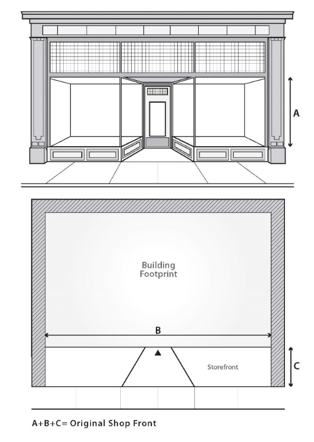
(Ord. No. O1657, § 129, 6-17-2025)

