
Middleton City Zoning Code
ARTICLE VI
PERFORMANCE STANDARDS
10.06.01 - PURPOSE
The purpose of this Article is to indicate the standards and minimum requirements for group and large developments; vehicle, bicycle, and pedestrian access; visibility; off-street parking and traffic circulation; off-street loading; exterior lighting; exterior storage; vibration, noise, air pollutions, odor, glare, fire, toxic/hazardous materials, and noise standards; fencing; swimming pools; vacant buildings; and outdoor recreational space within the jurisdiction of this Chapter.
10.06.02 - GROUP AND LARGE DEVELOPMENT STANDARDS
(1)
Purpose
The purpose of this Section is to establish standards that ensure group developments and large developments are properly located and are compatible with the surrounding area and the overall community character of the City of Middleton.
(2)
Definitions
(a)
"Group Development" means any development located on one (1) lot and comprised of any combination of two (2) or more principal buildings on the same lot in any zoning district.
(b)
"Large Development" means any new development containing any single building in which the area of the building footprint exceeds fifty thousand (50,000) square feet in any nonresidential zoning district. Does not include new additions to structures existing prior to the adoption of this Chapter of less than fifty thousand (50,000) square feet, or basements and penthouses when used primarily for storage and mechanical equipment. Common examples of large developments include big-box commercial uses.
(3)
Exceptions
The following situations are exempt from the requirements of this Section.
(a)
Development in the following zoning districts:
1.
Planned Unit Development District.
2.
Light Industrial District.
3.
Medium Industrial District.
4.
Heavy Industrial District.
5.
Airport District.
6.
Parks and Recreation District.
(b)
Nonresidential buildings where it can be demonstrated to the satisfaction of the Zoning Administrator, that any principal building can be subsequently subdivided with a lot and yards conforming to the requirements of this Chapter.
(4)
Review and Approval
(a)
All group developments and large developments require a conditional use permit (see Section 10.10.32 for review and approval procedure) regardless of whether individual use(s) within the development are permitted by right within the applicable district. For any Large Development, a concept plan review meeting shall be held before both the Plan Commission and Common Council, either jointly or separately, with notice of such meeting provided by regular mail, at the applicant's expense, fourteen (14) days prior to said meeting, to all owners of property within three thousand (3,000) feet of the subject property. Said notice shall, in addition to the nature of the project and time and location of the meeting, provide instructions as to how to receive or view a copy of the application materials.
(b)
Land uses permitted by right in the applicable zoning district shall be permitted by right within an approved group and/or large development, subject to the provisions of this Section, unless otherwise restricted by the conditions of approval imposed during the conditional use approval for the group development and/or large development as a whole.
(c)
Land uses allowed by conditional use permit within the applicable zoning district shall be allowed within the group development and/or large development only with conditional use approval for that land use category. The consideration of the conditional use for the group development and/or large development may occur in conjunction with the review for additional conditional land uses.
(d)
The detailed land use regulations in Article III that pertain to each proposed land use shall also apply within a group development and/or large development, as will all other applicable provisions of this Chapter.
(5)
Changes to an Approved Group and/or Large Development
(a)
Following initial issuance of a conditional use permit for the group development and/or large development, all subsequent changes determined to be significant by the Zoning Administrator, to site design and building design (including addition of structures, additions to structures, and expansions of parking or storage areas) in the group development and/or large development shall require an amendment to the approved conditional use permit regardless of individual land use(s).
(b)
Changes to individual land uses within a group development and/or large development listed as permitted by right uses within the applicable zoning district are allowed without amendment to the group development and/or large development conditional use permit, unless said conditional use permit placed restrictions on change of use.
(c)
Changes to individual land uses within a group development and/or large development listed as conditional uses within the applicable zoning district shall be allowed only by amendment to the conditional use permit, regardless of whether or not said use entails modifications to the building and/or site layout in the group development and/or large development.
(6)
Standards Applicable to Group Developments and/or Large Developments
(a)
Land uses and development shall comply with the applicable requirements of this Chapter, including, but not limited to, density, intensity, bulk, setback, and building separation requirements; building and site design standards; landscaping and green space requirements; access, parking, loading requirements; exterior lighting requirements (Chapter 33); and signage requirements (Chapter 22).
1.
For Multi-Family, Commercial, Mixed Use, and Institutional Land Uses, see Sections 10.07.20(3) and 10.07.30(3) for façade articulation and maximum building façade length standards.
(b)
The applicant shall demonstrate how the proposed development relates to each of the following criteria:
1.
Complements the design and layout of nearby buildings and developments.
2.
Enhances, rather than detracts from, the desired character of the surrounding area.
3.
All buildings within the group and/or large development shall be compatible with one another in terms of architectural quality and design, as determined by the Plan Commission.
(7)
General Layout and Future Divisibility of Group Developments
(a)
Development located within a group development shall be located so as to comply with the intent of this Chapter regarding setbacks of structures and buildings from lot lines. Building envelopes shall be depicted on the site plan required for review of group developments. The use of this approach to designing group developments will facilitate the subdividing of group developments in the future (if such action is so desired).
(8)
Roadway Connections
All nonresidential projects shall have direct access or access through an easement to a collector level street; or to a local street or arterial street if no other access is available, as deemed appropriate by the City.
(9)
Parking
Parking lot designs and number of spaces shall meet the requirements of Section 10.06.06.
(10)
Outdoor Display Areas
Exterior display areas shall be permitted only where clearly depicted on the approved site plan. All exterior display areas shall be separated from motor vehicle routes by a minimum of five (5) feet or by a physical barrier visible to drivers and pedestrians.
(11)
Outdoor Storage Uses and Areas
Exterior storage structures or uses, including the parking or storage of vehicles, trailers, equipment, containers, crates, pallets, merchandise, materials, forklifts, trash, recyclables, and all other items shall be permitted only where clearly depicted and labeled on the approved site plan. Outdoor storage uses and areas shall meet the screening requirements of Section 10.06.21.
(12)
Landscaping
Landscaping shall meet the standards in Article VIII.
(13)
Lighting
On-site exterior lighting shall meet the standards in Chapter 33.
(14)
Signage
Signage shall meet the standards in Chapter 22.
(15)
Additional Rules Applicable to Large Developments (as defined in Subsection (2)(b), above)
(a)
Building Placement and Site Layout
Building placement and orientation shall facilitate appropriate land use transitions and appropriate traffic flow to adjoining roads and neighboring commercial areas and neighborhoods, and shall forward objectives as described in the City's Comprehensive Plan.
(b)
Compatibility Report
The City may require a written Compatibility Report citing adequate evidence that the proposed building and overall development project shall be compatible with the City's Comprehensive Plan and any detailed neighborhood or special area plan for the area. The Compatibility Report shall be paid for by the developer and shall specifically address one (1) or more of the following items:
1.
Compatibility Report Narrative
The City may require a narrative describing how the proposed development meets the building placement and site layout requirements of Subsection (a), above.
2.
Traffic Impact Analysis
The City may require that a traffic impact analysis (TIA) be completed in accordance with Section 10.06.03(15)(c).
(c)
Small Area Plan
The City may require that a detailed small area plan be submitted and approved by the Plan Commission. The detailed small area plan shall be prepared for all areas within one thousand (1,000) feet of the subject property (as measured from the outer perimeter of the subject property or group of properties proposed for development), and any other nearby lands as determined by the Plan Commission to be part of the defined neighborhood or area. The detailed small area plan shall contain the following specific elements, drawn to scale:
1.
Demonstration that the proposed small area plan is in harmony with the land use, multi-modal transportation, utility, stormwater management, community character provisions of the City's Comprehensive Plan.
2.
Proposed land use with specific zoning districts and existing land uses, if present.
3.
Complete transportation network, including pedestrian and bicycle facilities and transit routes and stops, where applicable.
4.
Conceptual stormwater management facilities.
5.
Proposed public facility sites, including parks, schools, conservation areas, public safety facilities and public utility facilities.
6.
Proposed community character themes, including building materials, landscaping, streetscaping, and signage.
7.
Transitional treatments such as berms and/or landscaping between areas with differing land uses or character.
(Ord. No. O1657, § 113, 6-17-2025)
10.06.03 - VEHICLE ACCESS STANDARDS
(1)
Purpose
The purpose of this Section is to promote the safety and general welfare of the public by establishing minimum requirements for the provision of driveways and other points of access to public rights-of-way for various sites and uses.
(2)
Applicability
The requirements of this Section shall apply to each driveway and access point onto a public street or right-of-way in all new developments. Additional regulations relating to driveways can be found within Chapter 19 of the City of Middleton Municipal Code and the Access Management Plan.
(3)
Review and Approval
Through the site plan review process (see Section 10.10.43), the Zoning Administrator and City Engineer shall review and recommend for approval all proposed access points on the subject property. Also, see Chapter 19 of the Middleton Municipal Code.
(4)
Access Limitation by Functional Classification
See the City of Middleton Access Management Plan.
(5)
Number of Access Points
One (1) street access point shall be established per site. In the case of any parcel with street frontage greater than two hundred (200) feet along a street that is not functionally classified as an arterial or collector street, two (2) street access points may be permitted with the approval of a Site Plan (see Section 10.10.43).
(6)
Access near Street Intersections
See the City of Middleton Access Management Plan.
(7)
Driveway Location
Any new driveway access point shall be indicated on the site plan and reviewed by City staff for conformance with the standards of this Ordinance.
(8)
Angle of Intersection with Public Right-of-Way
All driveways and other access points shall intersect with any public right-of-way at an angle of not less than seventy-five (75) degrees, and shall ideally intersect at an angle of ninety (90) degrees.
(9)
Visibility Standards
All driveways and other access points shall comply with the visibility standards of Section 10.06.05.
(10)
Traffic Control
The traffic generated by any use shall be channelized and controlled in a manner that avoids congestion on public streets and other safety hazards.
(a)
Traffic into and out of all off-street parking, loading, and traffic circulation shall be forward-moving, with no backing into public streets. Single- and two-family land uses are exempt from this standard.
(11)
Depiction on Required Site Plan
Any and all proposed driveways and other access points on the subject property shall be depicted as to their location and configuration on the site plan required for the development of the subject property.
(12)
Surfacing
(a)
Driveways shall follow the surfacing requirements of Section 10.06.06(7)(f).
(13)
Nonconforming Driveways
(a)
Nonconforming driveways shall comply with all of the regulations and requirements of Article V for nonconforming structures.
1.
Legally established driveways located on properties containing single- or two-family land uses that do not conform to current performance standards shall be improved to current standards if repair or rehabilitation is greater than fifty (50) percent of its value.
(b)
Shared driveways (driveways located on multiple lots and typically situated over lot lines) that existed prior to the adoption of this Chapter may remain legal driveways. No new or reconstructed shared driveways may be established unless cross-access easements are recorded with the Register of Deeds.
(14)
Design of Single and Two-Family Residential Driveways
(a)
Minimum Driveway Setback
All driveways shall meet all pavement setbacks of the applicable zoning district in Article II and be a perpendicular extension from the street to the garage or primary parking facility.
(b)
Driveway Width
1.
Driveways shall be a minimum width of ten (10) feet. Driveways leading to garages are limited to a maximum width of twenty-four (24) feet at the lot line (see Figure 10.06.03a. label "A"), but may increase to the width of the garage or legal uncovered parking area next to the garage between the side or street side lot line and the outer extent of the garage or parking area. The length of the widened section shall not exceed eighteen (18) feet. See Figure 10.06.03b. label "A," "B," and "C." Where no garage exists, the maximum driveway width shall be twelve (12) feet.
a.
If a ten (10) foot driveway width is unattainable, the Zoning Administrator may reduce the minimum required driveway width to that which is deemed functional. This remedy shall only be implemented if the allowances for small lots of Section 10.04.30 are unattainable.
2.
Where the width of the driveway at the garage or uncovered parking area exceeds the maximum width of the driveway at the lot line, the driveway shall be tapered between the garage or the edge of the uncovered space alongside the garage and the lot line starting a minimum of five (5) feet inside the parcel. See Figure 10.06.03b. label "B." When leading to a legal uncovered space next to the garage, the driveway width shall be the least possible needed and shall not exceed twenty-four (24) feet in width at the property line.
3.
Driveways for two-family uses with adjacent, attached garages are limited to twenty-four (24) feet maximum width at the property line for each driveway leading to each unit. See Figure 10.06.03c. label "A."
Figure 10.06.03a: Driveways up to 24 Feet Wide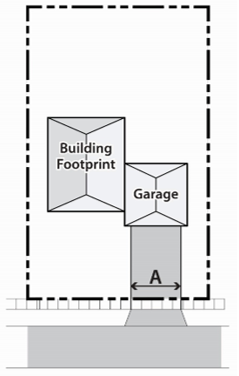
Figure 10.06.03b: Driveways Wider than 24 Feet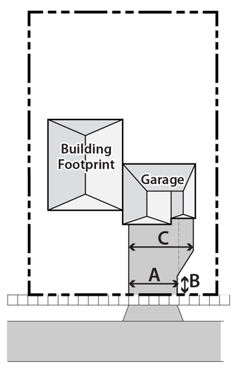
Figure 10.06.03c: Two-Family Dwellings with Two Driveways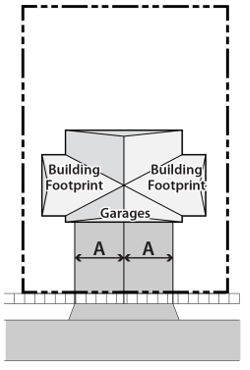
(15)
Design of Multi-Family Residential, Mixed-Use, Institutional, Commercial, and Industrial Use Driveways
(a)
Minimum Driveway Setback
With the exception of interconnected drives and parking areas with an established cross access easement, driveways shall meet the minimum pavement setback as required in Article II for the applicable zoning district.
(b)
Driveway Width
Driveways shall be a minimum width of ten (10) feet. The maximum driveway width shall be thirty (30) feet, unless required to be larger for fire access or large volumes of long-wheelbase vehicles. The design of such larger driveways shall be determined by City staff through the Site Plan review (Section 10.10.43) or a Traffic Impact Analysis.
(c)
Traffic Impact Analysis
The City may require that a traffic impact analysis (TIA) be completed in accordance with the City of Middleton Traffic Impact Analysis Guidelines and Access Management Policy. The Wisconsin Department of Transportation (WisDOT) has TIA requirements that shall be followed if the lot has direct access to the State Trunk Highway System.
10.06.04 - BICYCLE AND PEDESTRIAN ACCESS STANDARDS
(1)
Purpose
The purpose of this Section is to support the use of alternative modes of transportation and promote the safety and general welfare of the public by establishing requirements for pedestrian and bicycle access and bicycle parking.
(2)
Applicability
The requirements of this Section shall apply to all new development or redevelopment.
(3)
Quantity
One (1) pedestrian and bicycle access point is required to at least one (1) street frontage.
(4)
Off-Site Connections
Pedestrian and bicycle access shall include appropriate connections to the existing and planned pedestrian and bicycle facilities in the community and in surrounding neighborhoods.
(5)
On-Site Connections
The entire development shall provide walkways for full and safe pedestrian and bicycle access within the development. A walkway or walkway system may be used by both pedestrians and bicyclists.
(a)
Walkways shall provide pedestrian access through or around off-street parking areas from street sidewalks to building entries. Walkways shall be located and aligned to directly and continuously connect areas or points of pedestrian origin and destination, and walkways shall not be located and aligned solely based on the outline of a parking lot configuration unless such configuration allows for direct pedestrian access.
(b)
Design Requirements
1.
Walkways shall not be less than five (5) feet in width and shall be grade-separated from the parking lot or otherwise delineated with pavement markers, planters, or alternate paving materials. Parked vehicles shall not encroach upon this minimum width.
2.
The entirety of the on-site pedestrian walkway system shall be marked and defined using pavement treatments, signs, lighting, median refuge areas, and landscaping as appropriate, as consistent with the Americans with Disabilities Act and the building code, and as approved by the Zoning Administrator.
3.
Where the pedestrian walkway crosses drive aisles or internal roadways, the pedestrian crossing shall emphasize and place priority on pedestrian access and safety.
4.
The material and layout of the pedestrian walkway shall be continuous throughout the property, outside of areas in which the driveway paving may be different than pedestrian walkway paving.
5.
Walkways shall meet the minimum pavement setback as required in Article II for the applicable zoning district.
10.06.05 - VISIBILITY STANDARDS
(1)
Purpose
The purpose of this Section is to alleviate or prevent congestion of public and private rights-of-way so as to promote the safety and general welfare of the public by establishing minimum requirements for the provision of vehicular visibility.
(2)
Applicability
The requirements of this Section shall apply to all new development or redevelopment.
(3)
Review and Approval
Through the site plan review process (see Section 10.10.43), the Zoning Administrator shall review and approve all development for conformance with this Section and Chapters 22 and 33.
(4)
Vision Triangle at Public Streets
A vision triangle extending fifteen (15) feet from all public street right-of-way intersections shall be maintained for local street intersections and thirty (30) feet when the intersection includes streets functionally classified by the Greater Madison Metropolitan Planning Organization as collector or arterial. If the street intersection is curved, the vision triangle distance shall be maintained as if the right-of-way were extended to create a ninety (90) degree corner. No wall, fence, structure, sign, utility structure or appurtenance, or vegetation shall be permitted within such vision triangle which materially impedes vision between the height of 2-1/2 feet and ten (10) feet above the centerline grade elevations of the intersecting streets, alleys, or railroad tracks with the exception of fencing, which shall be no greater than thirty (30) percent opaque. Development in the MU-D district and development located on streets with signalized intersections may be granted a reduction in the minimum vision triangle requirement through the conditional use process (Section 10.10.32).
(5)
Vision Triangle at Alleys and Driveways
A vision triangle extending ten (10) feet along the property line from alleys and driveways shall be maintained. No wall, fence, structure, utility structure or appurtenance, or vegetation shall be permitted within such vision triangle which materially impedes vision between the height of 2-1/2 feet and ten (10) feet above the centerline grade elevations of the intersecting streets, alleys, or railroad tracks. Development in the MU-D district shall be exempt from this requirement.
Figure 10.06.05a: Visibility Standards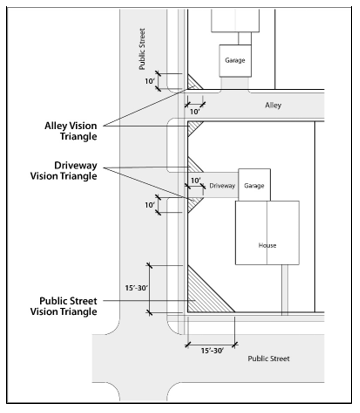
10.06.06 - OFF-STREET PARKING AND TRAFFIC CIRCULATION
(1)
Purpose
The purpose of this Section is to alleviate or prevent congestion of public rights-of-way so as to promote the safety and general welfare of the public by establishing minimum requirements for the provision of off-street parking and circulation in accordance with the use of various sites and types of development. The bicycle parking requirements are intended as a means of reducing dependence on private automobiles, reducing pollution and congestion associated with automobile use, and fostering more compact development patterns which encourage transit, bicycle, and pedestrian circulation.
(2)
Applicability
The requirements of this Section shall apply to all new development and redevelopment.
(3)
Review and Approval
Through the site plan review process (see Section 10.10.43), the Zoning Administrator shall review and approve all development for conformance with this Section.
(4)
Depiction on Required Site Plan
All required elements of the Site Plan (Section 10.10.43) shall be depicted on the submitted Site Plan for off-street parking and traffic circulation.
(5)
Computation
Fractional space requirements of up to 1/2 space shall be rounded down to the next whole number and greater than 1/2 rounded up to the next whole number.
(6)
Parking Quantity Standards
(a)
Minimum Number of Required Off-Street Parking Spaces
Off-street parking requirements for each land use are generally tied to the use's capacity and gross floor area or the number of employees at the subject property during the largest work shift.
1.
The term "capacity" means the maximum number of persons that may be accommodated by the use as determined by its design or by state building code regulations, whichever number is greater.
2.
The term "employees on the largest work shift" means the maximum number of employees working at the facility during a single given day, regardless of the time period during which this occurs, and regardless of whether any such person is a full-time employee. The largest work shift may occur on any particular day of the week or during a lunch or dinner period in the case of a restaurant.
3.
The term "gross floor area" shall mean the total floor area inside the building envelope on all levels of a building.
(b)
A garage stall shall be considered a parking space (see Subsection (7) below).
(c)
One (1) reserved parking space shall be provided for each service vehicle used by the operation during business hours.
(d)
See Figure 10.06.06a for the number of parking spaces required by land use. Also see Figure 10.06.06b for the number of ADA-compliant off-street parking spaces required by land use.
Figure 10.06.06a: Number of Off-Street Parking Spaces Required by Land Use
Figure 10.06.06b: Number of Handicap Off-Street Parking Spaces Required by Land Use*
Per Wis. Admin. Code § COMM 62.1106.
*Any existing parking areas intended to be restriped shall provide accessible parking spaces per the requirements above in accordance with the 2010 ADA Standards for Accessible Design.
(e)
Potential Reduction in Minimum Parking Requirements
The parking requirements listed in Figure 10.06.06a can be reduced or eliminated as determined by the Plan Commission through a Conditional Use Permit, Planned Development, Site Plan review, or Parking Study.
(f)
Electric Vehicle Charging Requirements
Parking facilities shall be designed to meet the following requirements.
1.
Definitions
See Section 10.01.23.
2.
Applicability
The requirements of this subsection shall apply to any new parking facility, or to any parking facility that is expanded by a net gain of ten (10) or more parking spaces being created after the adoption of this ordinance. A parking facility may be maintained or reconstructed without triggering the requirements of this subsection.
a.
Where parking is being provided where people may park vehicles in excess of six (6) hours, as determined by the Zoning Administrator, a minimum of two (2) Level 2 Electric Vehicle Ready Parking Spaces shall be provided and the following standards in Figure 10.06.06c shall be met:
i.
Applicable land uses include: any Residential Land Use (Section 10.03.06, Indoor Institutional, Commercial Indoor Lodging, Office, Transportation (Section 10.03.18), and any other Commercial (Section 10.03.10) or Institutional (Section 10.03.12) land use where people typically park vehicles in excess of six (6) hours.
ii.
Non-applicable land uses include: Personal or Professional Service, Indoor Sales and Service, Food and Beverage Counter Service and Walk-In Pickup, Restaurants, Taverns, and Indoor Commercial Entertainment, Industrial (Section 10.03.14), Storage (Section 10.03.16), Telecommunication (Section 10.03.20), Extraction and Disposal (Section 10.03.22), Energy Production (Section 10.03.24), Agricultural (Section 10.03.26), Accessory (Section 10.03.28), Temporary (Section 10.03.30), and any other Commercial (Section 10.03.10) or Institutional (Section 10.03.12) land use where people typically park vehicles less than six (6) hours.
Figure 10.06.06c Electric Vehicle Parking Requirements
* See Section 10.01.23 for definitions.
(g)
Limit on the Number of Off-Street Parking Spaces Provided
No site plan may be approved for a multi-family, mixed-use, or nonresidential use which contains more than the maximum totals in Figure 10.06.06a of the development's required parking spaces, except as granted through a conditional use permit. Consideration of the following factors shall be given in considering a conditional use permit request:
1.
The proposed development has unique or unusual characteristics (such as high sales volume or low parking turnover) which creates a parking demand that exceeds the maximum ratio and does not typically apply to comparable uses.
2.
The lot is designed to allow for more intensive future site development.
3.
Pedestrian and bicycle connectivity is provided through the lot and connects to adjacent local and regional transit, pedestrian, and bicycle facilities.
4.
The need for additional parking cannot be reasonably met through provision of on-street or shared parking with nearby uses.
(h)
Parking Studies
The Zoning Administrator may require a parking study to determine parking requirements. Where a parking study is required, the study shall contain information on the anticipated number of employees, customers, visitors, clients, shifts, events, or deliveries to the use, and may refer to other studies or similar situations elsewhere.
(i)
Partial or Phased Development of Required Parking Spaces
1.
Any development may seek permission from the Plan Commission to phase-in a portion of its required parking at time of site plan review; however, the site plan shall depict the minimum number of required parking spaces.
2.
Areas required for parking, but not immediately improved, shall be reserved for future parking.
3.
Undeveloped future parking areas shall be seeded with a grass mix or vegetative cover acceptable to the Zoning Administrator until said area is developed into a parking surface.
(j)
Joint Off-Site Parking Facilities
1.
Parking facilities which have been approved by the Plan Commission to provide required parking for one (1) or more uses shall provide a total number of parking spaces which shall not be less than the sum total of the separate parking needs for each use during any peak hour parking period when said joint parking facility is utilized at the same time by said uses.
2.
Joint Use Parking Facility
Up to a thirty (30) percent reduction in the number of required parking spaces for four (4) or more separate uses, ten (10) percent for three (3) separate uses, and five (5) percent for two (2) separate uses may be authorized by the Zoning Administrator, following approval of a plan which provides for a collective parking facility.
3.
Day-Night Use Parking Facility
The Zoning Administrator may authorize the shared day-night use of parking facilities under the following conditions:
a.
Up to fifty (50) percent of the parking facilities by nighttime uses may be supplied by the off-street parking facilities of daytime uses.
b.
Up to fifty (50) percent of the parking facilities of daytime uses may be supplied by the off-street parking facilities of nighttime uses.
4.
The applicant(s) for approval of a joint or day-night use parking facility shall demonstrate to the satisfaction of the Zoning Administrator that there is no substantial conflict in the demand for parking during the principal operating hours of the uses for which the joint parking facility is proposed to serve. Conditions required for joint use shall be as follows:
a.
The building or use for which application is being made to utilize the off-street parking facilities provided by another building or use shall be located within one thousand (1,000) feet of such parking facilities. A walkway shall be provided between joint off-site parking facilities meeting the standards of Section 10.06.04.
b.
A properly drawn legal instrument, executed by the parties concerned for joint use of off-street parking facilities, duly approved as to form and manner of execution by the City attorney, shall be recorded at the Register of Deeds. Said agreement shall cover a period of no less than thirty (30) years. Joint use parking privileges shall continue in effect only so long as such an instrument, binding on all parties, remains in force. If such instrument becomes legally ineffective, then parking shall be provided as otherwise required in this Chapter.
(7)
Design Standards
(a)
Parking Space Design Standards
Other than accessible parking, permitted parking in residential driveways, and where otherwise regulated in this Section, each off-street parking space shall comply with the minimum requirements of Figure 10.06.06d. All parking spaces shall have a minimum vertical clearance of at least seven (7) feet.
Figure 10.06.06d: Parking Layout Dimensions
(b)
Parking Space Design for Single- and Two-Family Uses
1.
Legal Spaces
a.
Parking spaces shall be provided either within a garage, in a driveway, or as uncovered parking spaces meeting the requirements of this Section. See Figures 10.06.06e and 10.06.06f. and Section 10.06.03(14).
2.
Driveway Parking Spaces
A driveway parking space shall be at least ten (10) feet wide and eighteen (18) feet deep. Driveway Parking Spaces may be stacked when each space in the stack is for the same dwelling unit.
3.
Uncovered Parking Spaces (Not Located in Driveways)
a.
No more than four (4) uncovered parking spaces shall be permitted per lot.
b.
Uncovered parking spaces shall meet all setbacks per Section 10.06.06(8) and shall be screened per Section 10.06.06(7)(h). See Figures 10.06.06g and 10.06.06h.
c.
Uncovered parking spaces shall be surfaced in accordance with this Chapter. Uncovered parking spaces shall follow the surfacing requirements of Section 10.06.06(7)(f).
d.
On interior lots, one (1) uncovered parking space is permitted alongside a garage provided said space is not located between the building and the street or the building and the rear lot line and provided said space meets the driveway design standards in Section 10.06.03(8). Parking spaces shall be screened from view per Section 10.06.06(7)(h). See Figure 10.06.06g.
e.
On corner lots, one (1) uncovered parking space is permitted alongside the garage provided said space is not located between the building and the street and provided said space meets the driveway design standards in Section 10.06.03(8). Parking spaces shall be screened from view per Section 10.06.06(7)(h). See Figure 10.06.06h.
4.
Lots shall not exceed maximum the impervious surface ratio for the applicable zoning district.
Figure 10.06.06e: Covered Parking Requirements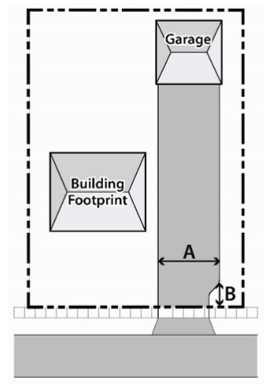
Figure 10.06.06f: Uncovered Parking Requirements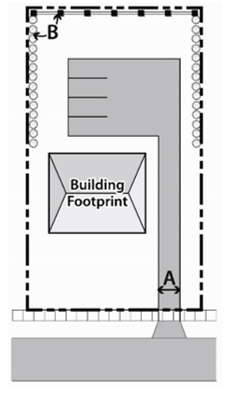
Figure 10.06.06g: Parking Beside Detached Garage - Interior Lots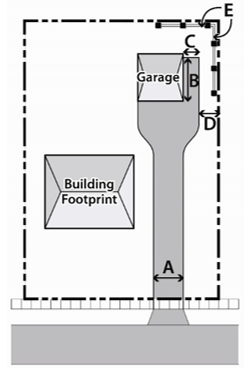
Figure 10.06.06h: Parking Beside Detached Garage - Corner Lots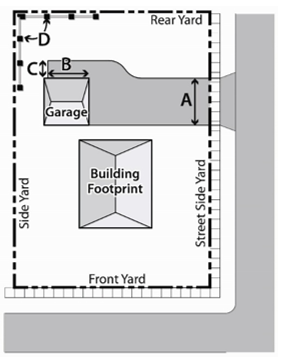
(c)
Parking Space Design for residential uses served by individual driveways (single-family detached, twin house, duplex, townhouse, and multi-plexes served by individual driveways) shall comply with the following standards:
1.
Driveway Parking Spaces
a.
Driveways shall be considered legal, "stacked" (meaning in front of one another) parking spaces for all required stalls.
b.
Required parking spaces may be located in a driveway and/or in a garage. Each space shall be at least ten (10) feet wide and eighteen (18) feet deep.
2.
Off-street parking spaces on small lots (as defined in Sec. 10.04.30) may be stacked for the same building unit.
3.
Parking is not permitted in the front yard, except for driveways leading to legal parking spaces.
4.
Driveway parking spaces are permitted with the following setbacks:
a.
Front Yard Setback: no less than the setback of the front façade of the principal structure.
b.
Side yard setback between the front and rear façades of the principal structure: no less than the minimum pavement setback as required in Article II for the applicable zoning district.
5.
Rear yard parking spaces not contained in a driveway are permitted with the following setbacks:
a.
Side yard setback past the rear façade of the principal structure and the rear lot line: per the side setbacks for accessory structures established in Article II.
b.
Rear yard setback: per the rear setbacks for accessory structures established in Article II.
6.
Uncovered parking spaces situated beyond the rear façade of the principal structure shall be screened with a minimum of five (5) foot tall vegetation, solid fencing, or other material that creates a solid screen, impervious to sight from adjacent properties, excluding views from the side of the lot where access is provided.
7.
Uncovered parking spaces shall follow the surfacing requirements of Section 10.06.06(7)(f). Uncovered parking spaces shall be paved in accordance with this Chapter within three hundred sixty-five (365) days of grading. During the permitted three hundred sixty-five (365) days, a minimum aggregate base of four (4) inches is required.
(d)
Off-Street Parking and Traffic Circulation Standards for Multi-Family and Nonresidential Uses
1.
Circulation
The site shall be designed to provide for the safe and efficient movement of all traffic entering, exiting, and circulating on the site. Circulation patterns shall conform to the general rules of the road. All traffic control measures shall meet the requirements of the Manual of Uniform Traffic Control Devices.
2.
Surfacing
All off-street parking and traffic circulation areas shall follow the surfacing requirements Section 10.06.06(7)(f).
3.
Drainage
All off-street parking and traffic circulation areas shall be designed in such a manner so as not to alter the surface water drainage pattern on adjacent properties nor cause erosion, and to meet the requirements of Chapter 26 of the City of Middleton Municipal Code.
4.
Marking
All off-street parking and traffic circulation areas shall be marked, striped, and maintained in a clear and visible manner which clearly indicates parking spaces, pedestrian walkways, and other designated areas.
5.
Curbing
A 6-inch-high curb shall be installed around all parking areas and internal landscape islands, except as follows:
a.
Where stormwater management facilities are utilized as part of an approved grading and drainage plan, use of curb cuts or other alternatives to the installation of curbing may be considered by the City Engineer, provided that measures are taken to protect the landscaping from vehicular circulation damage. See also landscaping requirements in Section 10.08.30(2).
b.
For industrial uses within industrial zoning districts, curbing is only required adjacent to buildings, planting islands, required front yards, and where necessary to prevent any part of a vehicle from extending over or beyond any pedestrian paths or rights-of-way.
6.
Access
a.
Each off-street parking space shall open directly upon an aisle or driveway that is wide enough to provide a safe and efficient means of vehicular access to the parking space without directly backing or maneuvering a vehicle into any pedestrian way or arterial or collector street.
i.
Parking, loading, and traffic circulation areas serving less than six (6) parking spaces are permitted to connect into local streets, but shall not connect into collector or arterial streets. Refer to the traffic control requirements of Section 10.06.03.
7.
Lighting
See Chapter 33.
8.
Signage
All signage located within, or related to, required off-street parking or traffic circulation shall comply with the requirements of Chapter 22.
9.
Landscaping and Screening
Parking lots shall meet the screening requirements of Section 10.06.06(7)(h). Landscaping used to meet this requirement shall count toward the landscaping required for paved areas in Article VIII.
10.
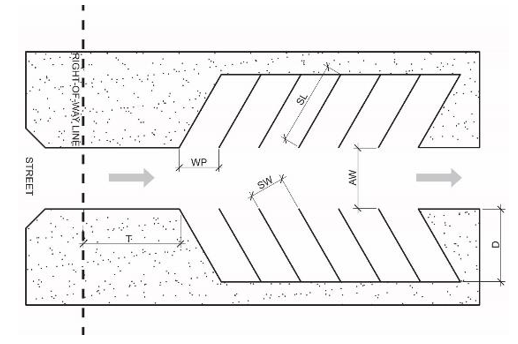
Minimum Permitted Throat Length
a.
Refer to Figure 10.06.06i below to determine the minimum permitted throat length of access drives serving parking lots as measured from the right-of-way line along the centerline of the access drive.
b.
In no case shall the throat length be less than a parking lot's minimum required setback.
Figure 10.06.06i Minimum Permitted Throat Length
(e)
Special Provisions for Nonconforming Parking Lots
1.
Legally established parking facilities constructed prior to the effective date of this Chapter which do not meet the minimum setbacks required by this Chapter shall be permitted to be reconstructed with reduced setbacks, subject to approval of a parking lot layout plan by the Plan Commission. Said parking lot layout plan shall be designed in accordance with the dimensions identified in Figure 10.06.06d of this Chapter. Parking lot setback reductions shall only be provided in the following instances:
a.
To prevent the loss of legal parking spaces as required by this Chapter.
b.
To prevent the loss of required internal circulation aisles.
c.
To retain the functionality of the parking lot.
2.
The remaining setback area shall be devoted to landscape buffer area per the landscape requirements for paved areas described in Section 10.08.30(2). If, in the opinion of the Zoning Administrator, the remaining setback area cannot effectively support any type of vegetation, the parking facility may be reconstructed to the existing setback, with the exception that curbing, decorative masonry wall, and/or wrought iron fence be installed along said parking lot perimeter to prevent vehicles from encroaching over the right-of-way or property lines.
3.
Parking lots with existing curbing installed along perimeter property lines and adjacent to the right-of-way shall be allowed to be reconstructed inside of said curbed area.
4.
The provisions of this Chapter pertaining to the installation of curbing located in Section 10.06.06(7)(d)5. and internal landscaping located in Section 10.08.30(2) shall not apply to the reconstruction of parking lots of fifty (50) stalls or less.
(f)
Surfacing
1.
All off-street parking, loading, and traffic circulation areas shall be graded and surfaced so as to be dust-free and properly drained and shall be paved with a hard, all-weather or other surface.
a.
Paved pads surfaced with concrete and/or asphalt may be used for recreation equipment trailer storage and/or residential utility trailer storage in any provided interior side yard or rear yard.
b.
Paved pads surfaced with concrete or asphalt are required for any motorized vehicles including passenger vehicles, light trucks, recreational vehicles (RVs), and any recreation equipment not on a trailer.
2.
The following shall be exempt from these surfacing requirements:
a.
Driveways in the AGR and CON districts shall be exempt except for the first twenty (20) feet of the driveway closest to the right-of-way, which shall be asphalt or concrete.
b.
All agricultural land uses (Section 10.03.26).
(g)
Installation and Maintenance
1.
Off-street parking and circulation areas and required screening and landscaping shall be continuously maintained in good condition and appearance. Surfacing, lighting, barriers, markings, planting materials, and all other aspects of the off-street parking and circulation facility shall be repaired or replaced in compliance with the provision of this Chapter.
2.
All off-street parking and traffic circulation areas shall be completed prior to building occupancy and shall be maintained in a dust-free condition at all times, except for approved phased development of parking spaces as provided for by Section 10.06.06(6)(i), above. In no instance or manner shall any off-street parking or traffic circulation area be used as a storage area, except as provided for by Section 10.03.16.
(h)
Screening Requirements
The following requirements shall apply to all uncovered parking areas except as otherwise provided for by this Section:
1.
Off-Street Parking Areas Abutting a Public Street
a.
Any off-street parking area shall provide a minimum ten (10) foot green area between the right-of-way and the paved surface of the parking lot along all street frontages. Plant material shall consist of evergreen and deciduous species. The green area shall be well maintained and plantings shall be promptly replaced if dead or diseased.
b.
Non-planted areas of this green area shall not be paved, but shall either be covered with a weed barrier and mulch, planted with ground cover, or both.
2.
Off-Street Parking Areas Abutting Other Off-Street Parking Areas
a.
Except for single-family and two-family dwelling units, any off-street parking area abutting another off-street parking area shall provide a five (5) foot minimum green area between the lot line and the paved surface of the parking lot. This green area shall be landscaped with a combination of shrubs, trees, and ground cover.
3.
Off-Street Parking Areas Abutting Residential Districts
Any off-street parking area shall provide a solid fence or solid wall at least five (5) feet in height and not more than six (6) feet in height along all lot lines abutting a residential district, except the maximum height shall be three (3) feet when located within the required or provided front yard or street yard, whichever is closer to the street. Alternately, a dense hedge/evergreen shrub border at least five (5) feet high may be used to meet this screening requirement. Where the parking area abuts an alley, a ten (10) foot green area, as required in Subsection 1.a., above, may be substituted for the required fence, wall, or hedge.
4.
Landscaping used to meet these requirements shall count toward the landscaping required for paved areas in Article VIII.
(i)
Bicycle Parking Standards
1.
Required provision of bicycle parking areas. Compliance with this Section is required in the case of any change in use or occupancy. See Figure 10.06.06a. Specifications for Bicycle Parking Spaces.
a.
Required short-term bicycle parking spaces (intended for use up to twelve (12) hours) shall be located in a convenient and visible area at least as close as the closest non-accessible automobile parking and within one hundred (100) feet of a principal entrance and shall permit the locking of the bicycle frame and one (1) wheel to the rack and shall support a bicycle in a stable position. Short-term bicycle parking shall be ground mount non-vertical, and have a six (6) foot minimum vertical clearance.
b.
Required long-term bicycle parking spaces (intended for use for more than twelve (12) hours) shall be located in enclosed and secured or supervised areas providing protection from theft, vandalism and weather and shall be accessible to intended users. Required long-term bicycle parking for multi-family residential uses shall not be located within dwelling units or within deck, patio areas, or private storage areas accessory to dwelling units. With permission of the Zoning Administrator, long-term bicycle parking spaces for nonresidential uses may be located off-site within three hundred (300) feet of the site. Up to fifty (50) percent of long-term bicycle parking may be structured parking, vertical parking or wall mount parking, provided there is a five (5) foot access aisle for wall mount parking. Bicycle parking not meeting dimensional or access aisle requirements may be installed but shall not count towards a minimum bicycle parking requirement.
c.
All racks shall permit the locking of the bicycle frame and one (1) wheel to the rack and shall support a bicycle in a stable position. All racks shall accommodate cable locks and "U" locks including removing the front wheel and locking it to the rear fork and frame. The "inverted-U" type bike rack is the preferred bicycle parking rack and means of providing off-street bicycle parking spaces as required in this Section ("wheel-bender" style bike racks do not provide sufficient support). One inverted-U type rack will count as two (2) bicycle parking spaces. Freestanding bicycle parking racks shall be securely fastened to the ground.
d.
Bicycle parking spaces shall be located on a paved or pervious, surface with a slope no greater than three (3) percent. Surfaces shall not be gravel, landscape stone, or wood chips.
e.
Bicycle parking spaces shall be a minimum of two (2) feet by six (6) feet. There shall be an access aisle a minimum of five (5) feet in width. Each required bicycle parking space shall be accessible without moving another bicycle and its placement shall not conflict with pedestrians and motorized traffic. Bicycle racks shall be installed to the manufacturer's specifications, including the minimum recommended distance from other structures. The spaces shall be placed where bicyclists would naturally transition to pedestrian mode.
(8)
Locational Standards
(a)
Locational Prohibitions for Off-Street Parking Areas
1.
On a lot containing a single-family or two-family dwelling unit, off-street parking shall not be located between the principal structure and a street right-of-way, except within residential driveways leading to a legal parking space.
2.
No private parking shall occur on street terraces, sidewalks, or publicly-owned driveways.
(b)
Setbacks
1.
The distance from an off-street parking area to the property line of an abutting property shall meet the required setbacks in Article II.
2.
Existing parking areas that do not meet the requirements of this Chapter may be maintained or repaired at their setback as of the effective date of this Chapter.
(9)
Limitations on Uses of All Off-Street Parking Areas
(a)
All vehicles shall be in condition for safe and legal performance on public rights-of-way, be registered, and display current license plates.
(b)
Under no circumstances shall any vehicle or equipment be used as living quarters, except in approved Campground land uses.
(c)
Outside of active construction activities associated with an approved Building Permit, vehicles or equipment not normally associated with a residential use shall not be parked or stored outdoors on a residential property except for as provided in Subsection (d) below. On a nonresidential property, such vehicles or equipment shall not be parked or stored outdoors, except in areas identified on an approved site plan for the purpose of heavy vehicle parking or an Outdoor Storage land use. Such vehicles or equipment include:
1.
Construction equipment such as bulldozers, backhoes, skid steers, and fork lifts.
2.
Dump and stake body style trucks.
3.
Cube type vans and trucks.
4.
Landscaping business equipment such as tractors, tree spades, graders, and scrapers.
5.
Semi-trailers and tractors.
6.
Concession, vending, and catering trailers.
7.
Commercial/industrial equipment trailers and lifts.
8.
Tow trucks, wreckers, or car carriers except for one (1) light-duty tow truck (not a roll back, flat bed, or carrier type) with a gross vehicle weight not exceeding twelve thousand (12,000) pounds may be parked on a residential lot when on call, operating under the rotating call list established and kept by the City of Middleton Police Department.
9.
Amusement rides and similar vehicles.
(d)
In residential districts and on lots associated with residential uses, accessory off-street parking facilities shall be solely for the parking of motor vehicles, which shall be regulated as follows:
1.
No front yard of any residential district and no front yard of a lot associated with a residential use shall be used for the parking of a motor vehicle except in approved driveways. Motor vehicles parked on any legal driveway shall not be permitted within five (5) feet of any right-of-way line of a street.
2.
A maximum of one (1) commercial vehicle per dwelling unit may be parked outdoors on residential property provided that the vehicle is used by a resident of the dwelling unit, has a manufacturer's gross vehicle weight rating of ten thousand (10,000) pounds or less, and is less than twenty-one (21) feet in length.
3.
No person shall park any motor truck, truck trailer, trailer, semitrailer or any other vehicle or combination of vehicles weighing more than ten thousand (10,000) pounds, except recreational vehicles or motor homes are permitted if parked in a driveway or other legal off-street parking space.
4.
A recreational vehicle (RV) associated with and customary to residential uses may be parked as if a passenger vehicle but shall not be utilized for human occupation, the storage of goods, materials, or equipment other than that which is considered part of the RV or essential to its function.
a.
No person shall park or store any recreational equipment within the front yard or corner side yard of any residential zoning district unless the equipment is parked on a driveway which meets all of the requirements in this Section.
b.
Recreational equipment may be stored on any type of surface in the rear yard or the interior side yard areas. If the rear yard of a corner lot abuts the side yard of an adjacent residence, any recreational equipment stored in said rear yard shall not be closer to the street than the required front yard setback distance for said adjacent residence.
c.
Recreational equipment longer than thirty (30) feet shall not be stored anywhere outdoors in any residential zoning district unless the piece of recreational equipment is being loaded, unloaded, cleaned or otherwise prepared for use or extended storage. The time period that recreational equipment longer than thirty (30) feet may be kept outdoors shall not exceed seven (7) days during any thirty (30) day period. For purposes of this subsection, the length of a piece of recreational equipment shall include any portion of a trailer that the equipment is loaded onto.
(Ord. No. O1657, §§ 114—117, 6-17-2025)
10.06.07 - OFF-STREET LOADING STANDARDS
(1)
Purpose
The purpose of this Section is to promote the safety and general welfare of the public by establishing minimum requirements for the provision of loading facilities on various sites.
(2)
Applicability
All institutional, commercial, industrial, storage, and transportation land uses shall provide off-street loading facilities in accordance with the regulations of this Section. Depending on the land use, off-street loading standards may be waived by the Plan Commission.
(3)
Review and Approval
All developments and redevelopments will be reviewed for conformance with this Section through the site plan review process (see Section 10.10.43).
(4)
Depiction on Required Site Plan
Any and all required loading areas and trailer and container storage areas proposed to be located on the subject property shall be depicted as to its location and configuration on the site plan required for the development of the subject property.
(5)
Location
(a)
Loading areas shall be located on the private lot off an adjacent alley, service drive, or other paved open space on the same lot, shall provide adequate receiving platforms or other facilities per Subsection (6) below, and shall not be located within or interfere with any public right-of-way while in use.
(b)
Loading areas shall be located on the same lot as the use served.
(c)
For development with a gross floor area of greater than ten thousand (10,000) square feet, loading areas shall not be located in a required front yard.
(d)
Loading areas shall be located at least fifty (50) feet from a residential district.
(e)
Loading areas shall be located twenty-five (25) feet or more from the intersection of two (2) street right-of-way lines.
(6)
Size of Loading Area
Structures shall provide functional receiving platforms or other facilities of adequate width, length, and at least fourteen (14) feet of vertical vehicle clearance.
(7)
Access to Loading Area
Each loading area shall be located so as to facilitate access to a public street or alley, shall not interfere with other vehicular or pedestrian traffic, and shall not interfere with the function of parking areas. In no instance shall loading areas rely on backing movements into public rights-of-way while in use.
(8)
Surface
All required loading areas shall follow the surfacing requirements of Section 10.06.06(7)(f).
(9)
Use of Required Loading Areas
Loading areas shall not be used to provide the required number of parking spaces.
(10)
Lighting
See Chapter 33 of the City of Middleton Municipal Code.
(11)
Signage
See Chapter 22 of the City of Middleton Municipal Code.
10.06.20 - EXTERIOR LIGHTING STANDARDS
(1)
See Chapter 33 for Exterior Lighting Standards.
10.06.21 - EXTERIOR STORAGE AND SCREENING STANDARDS
(1)
Purpose
The purpose of this Section is to control the use of exterior storage so as to promote the safety and general welfare of the public. For additional requirements relating to exterior storage for specific uses, refer to Article III of this zoning ordinance.
(2)
Applicability
The requirements of this Section apply to all development.
(3)
Review and Approval
(a)
All developments and redevelopments will be reviewed for conformance with this Section through the site plan review process (see Section 10.10.43).
(b)
Outdoor Storage land uses shall meet the requirements of 10.03.16.
(4)
Requirements for Exterior Storage
(a)
Requirements for Exterior Storage in Multi-Family and Mixed-Use Zoning Districts
1.
All materials and equipment shall be stored within a completely enclosed building except for the following: screened refuse containers, construction materials, landscape materials, and related equipment connected within on-site construction. Materials related to construction and landscaping projects shall not be stored outdoors after the completion of the project.
2.
Such outdoor storage shall not be located within any front yard or required street yard (except for vehicles in designated off-street parking spaces). Outdoor storage shall conform to all setback requirements or shall be located a minimum of five (5) feet from all property lines, whichever is more restrictive.
(b)
Screening for storage land uses shall comply with the requirements of Section 10.03.16. Screening for Incidental Outdoor Storage land uses shall comply with the requirements of Section 10.03.28(14).
(c)
Screening shall be maintained in accordance with the approved Site Plan.
(5)
Exterior Storage of Refuse
(a)
Refuse or Recycling Enclosures
1.
For multi-family, institutional, commercial, mixed-use buildings, and industrial uses, all trash storage areas are recommended within the building, but if such use is located on the exterior of the building, trash storage areas shall be located within an enclosure at least six (6) feet in height that completely screens the view of all trash and trash storage containers. The exterior of said enclosure shall be constructed of solid wood that matches or is complementary to the exterior of the principal building or be one (1) or more of the materials used on the exterior of the main building. A solid gate shall be used to gain access to the storage area; said gate shall be constructed of an opaque material or interwoven slat fencing.
2.
No exterior trash storage or dumpsters shall be located between a building and a public street except if in the opinion of the Zoning Administrator, no other suitable location is available for such purpose, and provided the dumpster area is developed in a manner so as to minimize its appearance from a public street.
(6)
Mechanical Equipment and On-Site Utilities
(a)
Definition
Mechanical equipment is defined as devices installed for a use appurtenant to the property, structures, or principal use. Mechanical equipment includes, but is not limited to, HVAC equipment, transformers, gas and electric meters, utility-related equipment, exhaust fans external to buildings, louvers, vents, and industrial process equipment. The following equipment shall be exempt from screening requirements due to functional concerns: satellite dishes, personal antennas and towers, industrial smoke stacks, and solar or wind energy systems.
(b)
Applicability
The screening of mechanical equipment and utilities shall be required for all uses as regulated in this Chapter, except for single-family and two-family dwelling units and those exempted in other sections of the City of Middleton Municipal Code. Figure 10.06.21a addresses the applicability of the screening requirements for various situations.
Figure 10.06.21a: Applicability of Mechanical Equipment Screening Requirements
Figure 10.06.21b: Mechanical Equipment Screening—Land Use and Zoning District
(c)
Situations which change the status of a conforming mechanical equipment installation to nonconforming status such as a change in zoning or establishment of a use shall be regulated as set forth in Article V.
(d)
Screening Design Standards for Ground-mounted Equipment
Ground-mounted mechanical equipment shall be hidden from view through the use of any of the following methods:
1.
Earth berm(s) with evergreen landscaping at a combined height sufficient to fully screen the equipment from the right-of-way or other users of the site.
2.
A bufferyard with a minimum opacity of 0.4 that completely surrounds the equipment.
3.
Any opaque fence or wall permitted in the zoning district.
(e)
Screening Distance
1.
Mechanical equipment is considered to be screened if it is not visible using an opaque combination of plants and/or permitted exterior materials (See Article VII) that is a minimum of the height of the object being screened, when viewed from any public sidewalk or street or from any point along the property line of the subject property.
2.
Exceptions can be made for elevated roads that are of a considerable higher grade from that of the mechanical equipment, for drastic grade changes, or for other special circumstances as determined by the Zoning Administrator.
(f)
See Article VII of this zoning ordinance for requirements for building-mounted and roof-mounted mechanical equipment.
(g)
On-Site Utilities
All on-site utilities, including but not limited to electrical, telephone, and cable, shall be installed as underground facilities. This shall apply to utilities running from the utility easement or street right-of-way to structures and to utilities supplying service between structures.
10.06.30 - VIBRATION STANDARDS
(1)
Purpose
The purpose of this Section is to regulate the creation of vibration which adversely affects adjoining properties in order to prevent the creation of nuisances and to promote the health, safety, and general welfare of the public.
(2)
Applicability
The requirements of this Section apply to all uses and activities which create detectable vibrations, except that these standards shall not apply to vibrations created during the construction of the principal use on the subject property.
(3)
Review and Approval
Through the site plan review process (see Section 10.10.43), the Plan Commission shall review and approve all development on the subject property.
(4)
Depiction on Required Site Plan
Any activity or equipment which creates detectable vibrations outside the confines of a building shall be depicted as to its location on the site plan required for the development of the subject property.
(5)
Requirements
No activity or operation shall cause or create earthborn vibrations in excess of the displacement values given in Figure 10.06.30a, below.
(6)
Method of Measurement
Measurements shall be made at or beyond the adjacent lot line or the nearest residential district boundary line. Vibration displacements shall be measured with an instrument capable of simultaneously measuring in three (3) mutually perpendicular directions. The maximum permitted displacements shall be determined in each zoning district by the following formula: D = K/f, where D = displacement in inches; K = a constant to be determined by reference to Figure 10.06.30a below; f = the frequency of vibration transmitted through the ground (cycles per second).
Figure 10.06.30a: Vibration Measurement Constant
10.06.31 - NOISE STANDARDS
(1)
Purpose
The purpose of this Section is to regulate the creation of noise which adversely affects adjoining properties in order to prevent the creation of nuisances and to promote the health, safety, and general welfare of the public.
(2)
Applicability
The requirements of this Section apply to all uses and activities which create detectable noise, except that these standards shall not apply to noise created during the construction of the principal use on the subject property, or by incidental traffic, parking, loading, maintenance, or agricultural operations.
(3)
Requirements
All noise shall be muffled so as not be objectionable due to intermittence, frequency, or shrillness. In no event shall the sound-pressure level of noise continuously radiated from a facility exceed the values given in Figure 10.06.31a (as adjusted where applicable in Figure 10.06.31b) and as measured by a Type 2 sound meter that is in compliance with ANSI standard S1.4-1983. The measurement shall be conducted at the lot line of the subject property where said lot abuts property within any residential, mixed-use, or institutional zoning district.
(4)
Nonconforming Noise
Noise that was in effect as of the effective date of this Chapter shall be considered legal nonconforming. The burden of proof to demonstrate that said noises were in effect prior to the effective date of this Chapter is the responsibility of the noise producer.
Figure 10.06.31a: Maximum Permitted Noise Level at Lot Line for Continuous Noise
Figure 10.06.31b: Adjustment Factors for Maximum Noise Levels Measured at Lot Line
10.06.32 - AIR POLLUTION STANDARDS
(1)
Purpose
The purpose of this Section is to regulate the creation of air pollution which adversely affects adjoining properties in order to prevent the creation of nuisances and to promote the health, safety, and general welfare of the public.
(2)
Applicability
The requirements of this Section apply to all land uses and activities, except that these standards shall not apply to air pollution created during the construction of the principal use on the subject property, or by incidental traffic, parking, loading, or maintenance operations.
(3)
Standards
In addition to all applicable state and federal standards, the following shall apply:
(a)
The emission of particulate matter containing a particle diameter larger than forty-four (44) microns is prohibited.
(b)
Emission of smoke or particulate matter of a density equal to or greater than Number 2 on the Ringelmann Chart (US Bureau of Mines) is prohibited at all times.
(c)
Dust and other types of air pollution borne by the wind from such sources as storage areas, yards, and roads within the boundaries of any lot shall be kept to a minimum by appropriate landscaping, paving, oiling, or other acceptable means.
(d)
Outdoor accessory structure wood furnaces are prohibited in the City of Middleton for public health and safety reasons.
(e)
All other applicable state and federal standards.
10.06.33 - ODOR STANDARDS
(1)
Purpose
The purpose of this Section is to regulate the creation of odor which adversely affects adjoining properties in order to prevent the creation of nuisances and to promote the healthy, safety, and general welfare of the public.
(2)
Applicability
The requirements of this Section apply to all land uses and activities, except that these standards shall not apply to odors created during the construction of the principal use on the subject property, or by incidental fertilizer application, traffic, parking, loading, or maintenance operations. Public landfills and public wastewater treatment plants shall be exempted from the requirements of this Section as essential public services.
(3)
Standards
Except for food preparation and cooking odors emanating from residential land uses, and odors associated with property development and maintenance (such as construction, lawn care, and the painting and roofing of structures), no odor shall be created for periods exceeding a total of fifteen (15) minutes per any day which are detectable (by a healthy observer such as the Zoning Administrator or a designee who is unaffected by background odors such as tobacco or food) at the boundary of the subject property, where said lot abuts property within any residential, mixed-use, or Institutional zoning district.
10.06.34 - GLARE AND HEAT STANDARDS
(1)
Purpose
The purpose of this Section is to regulate the creation of glare or heat in order to prevent the creation of nuisances and to promote the health, safety, and welfare of the public.
(2)
Applicability
The requirements of this Section apply to all land uses and activities, except that these standards shall not apply to glare created during the construction of the principal use on the subject property, or by incidental traffic, parking, loading, or maintenance operations.
(3)
Standards
No direct or sky-reflected glare shall be visible at the lot line of the subject property, whether from floodlights or from temperature processes, such as combustion, welding, or otherwise. No glare-producing materials shall be used on the exterior of any structure, including any metal building, which are hazardous to aviation, or result in glare in the eyes of pilots using the Airport. As determined by the Zoning Administrator, there shall be no discernible transmission of heat or heated air at the lot line. Solar systems regulated by Wis. Stat. § 66.0401 shall be entitled to the protection of its provisions.
(4)
Bird-Friendly Design Requirements
The intent of these requirements is to reduce the heightened risk for bird collisions with glass on specified building designs and configurations.
(a)
This Section pertains to all exterior construction and development activity, including the expansion of existing buildings and structures, as specified herein.
(b)
Glass area shall be measured as one (1) continuous panel of glass or other transparent materials, or a set of two (2) or more such panels divided by mullions of six (6) inches in width or narrower. Panels surrounded on all sides by solid walls or mullions wider than six (6) inches shall be considered individual windows. Spandrel or opaque glass with reflectivity of fourteen (14) percent or less shall not be included in the calculation of glass area.
(c)
Bird-Friendly Design Treatment Requirements
Glass areas on the following buildings or structures shall be treated to reduce the risk of bird collisions by incorporating a pattern of visual markers that are either: a) dots or other isolated shapes that are 1/4 inch (or 5 mm) in diameter or larger and spaced at no more than a two (2) inch by two (2) inch pattern; or b) lines that are 1/8 inch in width or greater and spaced no more than two (2) inches apart; low reflectance opaque materials; building-integrated structures like non-glass double-skin facades, metal screens, fixed solar shading, exterior insect screens, and other features that cover the glass surface; or other similar mitigation treatments approved by the Zoning Administrator.
1.
Buildings or structures over ten thousand (10,000) square feet. For any building or structure over ten thousand (10,000) square feet in size (floor area of above-grade stories), bird-safe glass treatment is required as follows:
a.
For building façades where the first sixty (60) feet from grade are comprised of greater than or equal to fifty (50) percent glass:
i.
At least eighty-five (85) percent of the glass shall be treated; and
ii.
All glass within fifteen (15) feet of a building corner shall be treated when see through or fly through conditions exist.
b.
For building façades where the first sixty (60) feet from grade are comprised of less than fifty (50) percent glass:
i.
At least eighty-five (85) percent of the glass, on glass areas fifty (50) square feet or over shall be treated; and
ii.
Of all glass areas over fifty (50) square feet, any glass within fifteen (15) feet of a building corner shall be treated.
c.
All glass railings shall be treated.
d.
All glass on enclosed building connections shall be treated up to sixty (60) feet above-grade.
2.
Sky-bridges
For buildings and structures of any size, all glass on above-ground bridges shall be treated.
3.
At-grade Glass
For buildings and structures of any size, all at-grade glass features such as sound walls or glass screens shall be treated.
10.06.35 - FIRE AND EXPLOSIONS
(1)
Purpose
The purpose of this Section is to regulate the creation of fire and/or explosion hazards which adversely affect adjoining properties in order to prevent the creation of nuisances and to promote the health, safety, and general welfare of the public.
(2)
Applicability
The requirements of this Section apply to all land uses and activities.
(3)
Standards
All activities and storage of flammable and explosive materials at any point shall be provided with adequate safety and firefighting devices in accordance with all fire prevention codes of the State of Wisconsin.
10.06.36 - TOXIC, NOXIOUS, AND WASTE MATERIALS
(1)
Purpose
The purpose of this Section is to regulate the handling of toxic, noxious, or waste material which adversely affects adjoining properties in order to prevent the creation of nuisances and to promote the health, safety, and general welfare of the public.
(2)
Applicability
The requirements of this Section apply to all land uses and activities.
(3)
Standards
No use shall discharge across the boundaries of the subject property, or through percolation into the subsoil, toxic or noxious material in such concentration as to be detrimental to or endanger the public health, safety, comfort, or welfare, or cause injury or damage to private property or business. No use shall discharge at any point into any public or private sewage disposal system or stream, or into the ground, any liquid or solid materials except in accordance with the regulations of the Wisconsin Department of Public Health.
10.06.37 - HAZARDOUS MATERIALS
(1)
Purpose
The purpose of this Section is to provide information to the City regarding the nature of land uses which involve research, production, storage, disposal, handling, and/or shipment of hazardous materials.
(2)
Applicability
The requirements of this Section apply to all land uses and activities involving any one (1) or more of the following:
(a)
Soil and plant additives subject to Wis. Stat. § 94.65.
(b)
Pesticides subject to Wis. Stat. § 94.67.
(c)
Biological products subject to Wis. Stat. § 95.39.
(d)
Hazardous substances subject to Wis. Stat. § 100.37.
(e)
Toxic substances as defined in Wis. Stat. § 101.58(2)(j).
(f)
Infectious agents as defined in Wis. Stat. § 101.58(2)(f).
(g)
Any material for which the State of Wisconsin requires notification of a local fire department.
(h)
Any other uses, activities, or materials which are subject to county, state, or federal hazardous, or related, materials regulations.
(3)
Standards
All land uses involving such hazardous materials shall submit a written description of such materials and the operations involving such materials conducted on their property as part of the required site plan submittal.
10.06.40 - FENCING STANDARDS
(1)
Purpose
The purpose of this Section is to regulate the materials, location, height, and maintenance of fencing, landscaping walls, and decorative posts in order to prevent the creation of nuisances and to promote the general welfare of the public.
(2)
Applicability
The requirements of this Section apply to all fencing, landscape walls, and decorative posts for all land uses and activities.
(3)
Review and Approval
Fences shall be reviewed and approved by the Zoning Administrator and shall require zoning and building permits.
(4)
Temporary Fencing
Permits are not required for temporary fencing. Temporary fencing shall be permitted for the following purposes:
(a)
Garden fencing such as chicken wire or woven wire during the growing season, provided that the fencing is designed to support plants and/or help keep out garden pests.
(b)
The use of wood or plastic snow fences for the purposes of limiting snow drifting between November 1st and April 1st.
(c)
The protection of excavation and construction sites and the protection of plants during grading and construction, in association with an active building permit.
(5)
Design and Materials
(a)
Materials
1.
Fences shall be constructed using the following materials:
a.
Naturally resistant or treated wood, brick or masonry, natural stone, wrought iron, vinyl, galvanized and/or coated chain link, metal cable within a solid frame, or any other material of comparable quality as approved by the Zoning Administrator.
2.
Fences shall not be constructed using the following materials:
a.
Rope, string, wire products, netting, cut or broken glass, paper, metal panels, corrugated metal panels, galvanized sheet metal, plywood, pallets, fiberglass or plastic panels.
3.
Rules Related to Specific Materials
a.
Permanent chicken wire fences or snow fences shall not be used.
b.
Wire mesh and non-coated/non-galvanized chain link fencing is not permitted within front yards in the SR-L, SR-M, SR-H, MH-D, TR-D, TR-F, MR-L, MR-M, and MR-H zoning districts, except when used in conjunction with parks, schools, airports, or other institutional uses.
c.
Non-corrugated, solid metal fences are permitted in the I-L, I-M, I-H, IOS, IOC, AIR, and EXD zoning districts.
d.
Barb wire fencing or similar security fencing shall be permitted only on the top of security fencing when located at least six (6) feet above the ground and shall be permitted only in the I-H, IOS, EXD, and AIR districts. Such fences shall meet the setbacks for the principal structure.
e.
Coated chain link fences shall have a minimum 9-gauge thickness, and a top rail support is required. Coated chain link fences shall not be permitted in front or street yards and shall not extend toward the street beyond the front of the building.
(b)
Design
1.
With the exception of fences used for required screening, any fence located in the front yard shall be a maximum of fifty (50) percent opaque, meaning that the spaces between the pickets are equal to or greater than the width of the pickets. See Figure 10.06.40a.
2.
A fence that includes pre-woven or interwoven privacy fence slats and that is at least ninety (90) percent opaque shall be considered a solid fence.
Figure 10.06.40a: Fencing Standards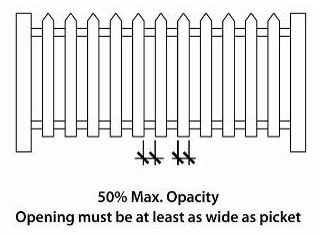
(6)
Height
(a)
Maximum Height
The maximum height of any fence panel, landscape wall, or decorative post shall be the following (also see Figure 10.06.40c.):
1.
In the SR-L, SR-M, SR-H, MH-D, TR-D, TR-F, MR-L, MR-M, MR-H, INST, MU-N, MU-A, MU-U, MU-D, R-P, PR, and CON zoning districts:
a.
Three (3) feet when located within the required front yard, and three (3) feet when located within the required street side yard on a corner lot.
b.
On a lot with lake or pond frontage, three (3) feet when located between the edge of the water and the required rear or side yard facing the lake or pond.
c.
Six (6) feet within the side yard or rear yard, but not in the required front yard or forward of the front façade of the principal building.
2.
In the I-L, I-M, I-H, AGR, IOS, IOC, and EXD zoning districts:
a.
Four (4) feet when located within the required front yard, and four (4) feet when located within the required street side yard on a corner lot.
b.
Eight (8) feet within the side yard or rear yard, but not in the required front yard or beyond the front façade of the principal building.
c.
Where permitted, barb wire fencing or similar security fencing on top of fences shall not extend higher than three (3) feet beyond the top of the fence. See 10.06.40(5)(a)3.
(b)
Height shall be measured from the ground immediately under the fence to the top rail of the fence.
(c)
Height Exceptions
1.
Decorative posts at a minimum spacing of twenty-four (24) inches may extend 8 inches above the maximum height. See Figure 10.06.40b.
2.
To accommodate slopes and/or lawn maintenance, up to four (4) inches of ground clearance shall be allowed which will not contribute to the measurement of maximum fence height.
3.
Berms with slopes less than or equal to a minimum of three (3) feet of horizontal to a maximum of every one (1) foot of vertical (i.e. 3:1) shall not contribute to the measurement of maximum fence height.
Figure 10.06.40b: Fence Measurements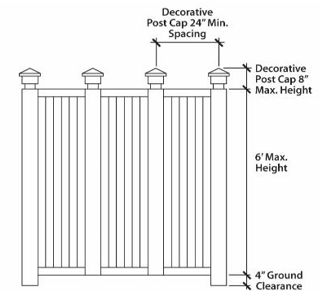
(7)
Location
(a)
Fences shall meet the visibility standards in Section 10.06.05.
(b)
Fences may be located within or on any property line.
(c)
If any portion of a fence is to be located within an easement of which the City is a beneficiary, the City will require an Easement Encroachment Agreement prior to issuance of a building permit. Whether an Easement Encroachment Agreement will be granted shall be determined entirely at the City's discretion in the exercise of its real property rights represented in the easement. Nothing in this section shall be construed as requiring the City to agree to any encroachment.
(8)
Orientation
Any and all fences, landscape walls, or decorative posts shall be erected so as to locate visible supports and other structural components toward the subject property, i.e. with the finished side facing outward.
(9)
Maintenance
Any and all fences, landscape walls, or decorative posts shall be maintained in a structurally sound and attractive manner.
Figure 10.06.40c: Fencing Standards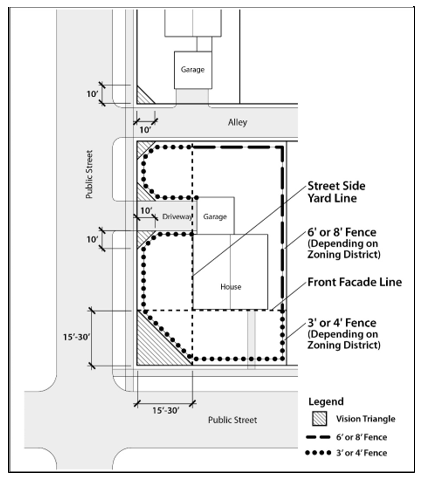
(Ord. No. O1657, §§ 118—120, 6-17-2025)
10.06.41 - ON-SITE RECREATIONAL SPACE REQUIREMENTS
(1)
On-Site Recreational Space Requirements for Multi-Family and Mixed-Use Land Uses
(a)
Each multi-family or mixed-use development containing three (3) or more dwelling units shall provide on-site recreational space suitable for inside gathering space and outdoor recreation such as sitting, sunbathing, grilling, and playing catch. This space could include a children's play area, indoor gathering/community spaces, and/or shared outdoor porch, balcony, or rooftop terrace. On-site recreational space may be provided at ground level, in the building, or other areas including but not limited to communal porches/decks, balconies, and rooftops.
(b)
Minimum Area
A minimum of two hundred (200) square feet per building plus twenty-five (25) square feet per bedroom of usable recreation space shall be provided.
(c)
Required on-site recreational space shall be for the private use of residents and need not be open to the public.
(2)
Buildings shall be organized in relation to open spaces to create a balance of usable open space and efficient circulating and parking. The requirements of this Section shall not override the establishment of an orderly, positive, and urban character of the relationship of buildings to streets.
(3)
Required on-site recreational space may be divided into multiple distinct spaces, provided that no single space is smaller than one hundred (100) square feet or narrower than ten (10) feet in any direction.
(4)
The following will not count toward the total outdoor recreational space requirement:
(a)
Areas in the required front yard or street side yard setbacks.
(b)
Areas used for on-site parking or within two (2) feet of parking stalls (as measured from the face of the curb).
(c)
Areas used for landscaping, stormwater infiltration, bicycle parking, trash and recycling storage, or mechanical equipment.
(5)
Required on-site recreational space shall not count toward land dedication or fee in-lieu of land dedication requirements of City of Middleton Ordinance Fee Schedule.
10.06.42 - SWIMMING POOL STANDARDS
(1)
Purpose
The purpose of this Section is to regulate swimming pools in order to prevent the creation of nuisances and to promote the health, safety, and general welfare of the public.
(2)
Applicability
This Section applies to all swimming pools, defined as an outdoor structure containing a body of water in a receptacle or other container having a depth for water at any point greater than twenty-four (24) inches, used or intended to be used solely by the owner, operator, or lessee thereof and family and guests invited to use it; and including all structural facilities, appliances, appurtenances, equipment, and other items used and intended to be used for the operation and maintenance of a private or residential swimming pool.
(3)
Review and Approval
Any pool requiring excavation below one (1) foot of the existing grade is subject to site plan review. For a pool in an SR-L, SR-M, SR-H, MH-D, TR-D, TR-F zoning district, the site plan may be approved administratively by the Zoning Administrator.
(4)
Permit Required
A building permit shall be secured prior to the commencement of construction or erection of a private or residential swimming pool, or on any alterations, additions, remodeling, or other improvements. Plans, specifications, and pertinent explanatory data shall be submitted to the Building Inspector at the time of application.
(5)
Exempt Pools
Non-filtered storable swimming or wading pools that are so constructed that they may be readily disassembled for storage and reassembled to their original integrity are exempt from the provisions of this Section. Decorative ponds that are less than thirty-six (36) inches in depth are exempt from the provisions of this Section. Spas and hot tubs with lockable tops are also exempt. Lockable tops shall be securely fastened in place at all times when the hot tub is not in actual use.
(6)
Construction Requirements
In addition to such other requirements as may be reasonably imposed by the Building Inspector, the Building Inspector shall not issue a building permit for construction as provided for in Subsection (4), above, unless the following requirements are observed:
(a)
All materials and methods of construction in the construction, alteration, addition, remodeling, or other improvements and pool installation shall be in accord with all state regulations and with any and all ordinances of the City now in effect or hereafter enacted.
(b)
All plumbing work shall be in accordance with all applicable ordinances of the City and all state plumbing codes. Every private or residential swimming pool shall be provided with a suitable draining method, and in no case shall waters from any pool be drained into the sanitary sewer system, onto lands of other property owners adjacent to that on which the pool is located, or in the general vicinity. Provisions may be made for draining the contents of any swimming pool into a storm sewer, but such installation shall be subject to prior approval by the City Engineer.
(c)
All electrical installations, including lighting and heating, which are used in conjunction with a private swimming pool shall be in conformance with the state laws and City ordinances regulating electrical installations.
(7)
Setbacks and Other Requirements
Private swimming pools shall be erected or constructed on rear or side yards only, and only on a lot occupied by a principal building. No swimming pool shall be erected or constructed on an otherwise vacant lot. A lot shall not be considered vacant if the owner owns the contiguous lot and said lot is occupied by a principal building. The water surface and supporting structure of all swimming pools shall be at least eight (8) feet from any lot line, and it shall be at least eight (8) feet from any building unless designed and approved as an addition to a building.
(8)
Enclosure
Pools within the scope of this Section that are not enclosed with a permanent building shall be completely enclosed by a fence of sufficient strength to prevent access to the pool. Such fence or wall shall be a maximum of six (6) feet in height from ground level and a minimum of four (4) feet in height from ground level and a minimum of four (4) feet from the water surface edge, and constructed not to have voids, holes, or openings larger than four (4) inches in one dimension. Gates or doors shall be equipped with self-closing and self-latching devices located at the top of the gate or door on the pool side of the enclosure, except the door of any residence that forms a part of the enclosure.
(a)
Pools shall not be required to have a fence if each side of the pool structure is a minimum of fifty-four (54) inches tall and a removable ladder or gate is provided, or the pool structure is less than fifty-four (54) inches tall but has approved wall height extensions and a removeable ladder or gate is provided, as approved by the Zoning Administrator.
(b)
This Section shall not apply to existing fences on the date of adoption of this Chapter at least forty-eight (48) inches in height that otherwise comply with this Section.
(9)
Compliance
All swimming pools existing at the time of adoption of this Chapter not satisfactorily fenced shall comply with the fencing requirements of Subsection (8) when water is placed in the pool. Enclosures on existing pools shall be inspected by the Building Inspector for compliance.
(10)
Filter System Required
All private swimming pools within the meaning of this Chapter shall have some filtration system to assure proper circulation of the water therein and maintenance of the proper bacterial quality thereof.
(11)
Dirt Bottoms Prohibited
All swimming pools of a permanent nature shall have the sides and bottom of a smooth finish, and no sand or dirt bottom shall be permitted.
(Ord. No. O1657, § 121, 6-17-2025)
10.06.43 - UTILITY ACCESS STANDARDS FOR RESIDENTIAL USES
(1)
Purpose
Occupants of dwelling units need to be able to reasonably access certain aspects of utility services in emergency circumstances for various reasons including the ability to shut down service within the dwelling unit to conveniently address malfunctions or disruptions and to protect property such as may be necessary in situations including, gas leaks, pipe breaks or the need to address electrical malfunctions, minor repairs or reset breaker switches.
(2)
Access to Shut-Off Controls
Occupants of all dwelling units shall have unobstructed access to shut-off controls for gas, electric and water services provided to the unit such that the service can be turned off to the entire dwelling unit.
(3)
Utility Service Lines and Laterals
(a)
All dwelling units in separate ownership shall have separate and independent service lines or laterals for all available utilities requiring a physical connection including sewer, water, gas, electricity and telecommunications facilities. Such service lines shall run on the same property as that on which the dwelling unit exists or shall be extended under a recorded easement or similar instrument such that the owner of the dwelling unit has an individual and enforceable property right to have the line repaired, replaced or installed without the consent of any other person except as may be necessary to comply with governmental regulations, lawful rules and practices of the subject utility or restrictions, rules or covenants recorded against and applicable to the subject property.
(b)
Notwithstanding paragraph (a), above, utility lines and laterals may cross property of, or be owned by, associations of unit owners for condominiums, homeowners associations or similar entities provided recorded declarations, by-laws or similar documents provide an individual right to a property owner to demand reasonable maintenance, repair, replacement or extension of utility services otherwise available to the property.
(4)
Utilities Required
Nothing in this paragraph shall be construed as requiring the provision of or access to any particular utility service, the provision of which is not required by any other statute, ordinance, rule or regulation.
(Ord. No. O1657, § 122, 6-17-2025)

