
Middleton City Zoning Code
ARTICLE IV
BULK REGULATIONS
10.04.01 - PURPOSE
This Article regulates the location and bulk of buildings in both residential and nonresidential developments in order to protect and enhance the desired community character of the City of Middleton. The provisions of this Article interact closely with the density and intensity provisions described in Article II. Any nonconforming situation (lot, use, structure, and/or site) shall adhere to the provisions of Article V.
10.04.10 - BULK STANDARDS
(1)
All structures shall comply with the requirements listed for each zoning district in Article II and the Airport Height Limit Overlay in Section 10.02.83.
(2)
All lots shall abut upon a public street. Refer to additional standards for lots and blocks in Chapter 19 of the Municipal Code.
(3)
On lots fronting two (2) nonintersecting streets, a front yard must be provided on both streets.
(4)
On lots fronting three (3) or more streets, on sharply curved streets, or lots where Figure 10.01.23b (in Article I) does not apply, the determination of the yards and appropriate setbacks shall be made by the Zoning Administrator.
10.04.20 - EXCEPTIONS TO MAXIMUM HEIGHT REGULATIONS
The maximum height regulations listed for residential and nonresidential uses and accessory structures in each zoning district in Article II are the maximum permitted heights for all buildings and structures, except those exempted by this Section.
(1)
Minor Projections
The following are permitted to exceed the maximum height regulations within any district where permitted, outside of the Airport Height Limit Overlay (Section 10.02.83): church spires; belfries; cupolas; penthouses and domes (not used for human occupancy); public monuments; stage towers or scenery lofts; water towers; fire and hose towers; tanks; utility poles; flag poles; chimneys; cooling towers; exhaust pipes; ventilators; skylights; telecommunications towers and antennas; satellite dishes; elevator bulkheads, grain elevators, feed mills, grain and seed mixing bins, concrete mixing bins, and other necessary mechanical appurtenances usually carried above roof level; and similar features. The provisions of this Chapter shall not apply to prevent the erection above the building height limit of a parapet wall or cornice for ornament (and without windows) extending above such height limit not more than five (5) feet. Such features, however, shall be erected only to such height as is necessary to accomplish the purpose they are to serve and subject to the Wisconsin state building code.
(2)
Additional Height for Roof Design or Non-Residential Space on the Ground Level
An Apartment, Multiplex, Townhouse, Live/Work, or Mixed-Use Building may exceed the maximum height regulations by up to a total of six (6) feet within any district where the land use is permitted, outside of the Airport Height Limit Overlay (Section 10.02.83), if either of the following conditions is met:
(a)
The structure is designed with a gable, hip, or gambrel roof with a pitch of at least 6/12.
(b)
A Mixed-Use Building may increase the floor-to-ceiling height of the ground level, but then the building is not eligible for additional height for roof design.
(3)
Additional Height for LURA and/or Net Zero Ready Building
In the MR-M, MR-H, MU-N, MU-A, MU-U, and MU-D zoning districts, an Apartment, Multiplex, Townhouse, Live/Work, or Mixed-Use Building principal structure is permitted to exceed the maximum building height for the zoning district up to the defined height limit as specified within the applicable zoning district as long as it incorporates one or more height exceptions as described herein; meets all other requirements of Articles II, III, VI, and VII; meets the minimum and maximum parking standards in Section 10.06.06 and is outside of the Airport Height Limit Overlay (Section 10.02.83).
Regulations
(a)
Structures with a voluntary contractual Land Use Restriction Agreements (LURA) with the City to provide income- and rent-restricted dwelling units (see subsection 2) or structures designed to be certifiable as a Net Zero Ready Building (see subsection 3) may exceed the base zoning district's maximum building height up to two (2) additional floors twenty-four (24) feet in additional height unless the regulations pertaining to the zoning district identify that only one additional story up to twelve (12) feet in additional height is permitted. When two (2) additional stories are up to twenty-four (24) additional feet is allowed, the additional building height may be achieved through any or all of the approaches. The floor area of said additional floor(s) shall not exceed the area of any other residential floor in the building.
(b)
To exceed the maximum building height, a structure with a Land Use Restriction Agreement with the City shall meet the following requirements:
1.
The cumulative interior square footage of the affordable units shall be greater than or equal to fifty percent of the total interior square footage of all units and common amenity space, such as community rooms and fitness rooms, above the maximum building height in the base zoning district. This calculation shall be based on the floor that has the maximum square footage devoted to dwelling units. Subject to the details in the LURA, the cumulative square footage of the affordable housing units may be distributed throughout the structure.
2.
The affordable units shall be rented to households with an income at or below sixty (60) percent area median income limits and at or below rent limits for sixty (60) percent of area median incomes as specified in the LURA.
3.
The effective period of the LURA must be at least thirty (30) years.
(c)
To exceed the maximum building height, a Net Zero Ready Building shall meet the following requirements:
1.
The structure must be certifiable Zero Energy or higher by either the International Living Future Institute (ILFI) or PHIUS+ from the Passive House Institute US.
2.
The structure must complete an Energy Design Assistance or Energy Design Review with Focus on Energy.
3.
The structure must receive an ENERGY STAR score benchmarked by an ENERGY STAR Portfolio Manager.
(Ord. No. O1657, §§ 105, 106, 6-17-2025)
10.04.30 - YARD SETBACK ADJUSTMENTS
(1)
Lot Size and Minimum Yard Dimensions
No lot, yard, court, parking area, or other space shall be reduced in area or dimension so as to make the area or dimension less than the minimum required by this Chapter. If an existing yard is less than the minimum required, it shall not be reduced further, except where exempted by the provisions of this Section.
(2)
Front Yard Setback Adjustments
(a)
Decrease of Front Yard Setback
1.
In the Single-Family, Two-Family, Multi-Family, and Mixed-Use zoning districts, a front yard setback may be reduced to the mean of the setbacks of the immediately adjoining lots that are on both sides of the subject lot. The following rules apply in calculating the mean setback (see Figure 10.04.30a):
a.
Only the front yard setbacks on five (5) or fewer adjoining lots, which are contiguous to each other in either direction of the subject lot and which are on the same side of the street as each other on the same block, may be used.
b.
Where a lot is vacant, the minimum front yard setback of the zoning district for the proposed use will be applied to the vacant lot and factored into the averaging calculation.
c.
Outliers, defined as yards with a setback that is equal to or greater than twice that of the next largest setback among the adjoining lots and thus which do not fit the established pattern of front yard setbacks, shall be excluded in calculating the mean front yard setback, as determined by the Zoning Administrator.
d.
In residential districts, the minimum front yard and street side yard setback on any lot shall be at least six (6) feet. The minimum setback for an attached or detached accessory building facing the front yard or street side yard shall be at least twenty (20) feet.
Figure 10.04.30a: Front Yard Averaging Example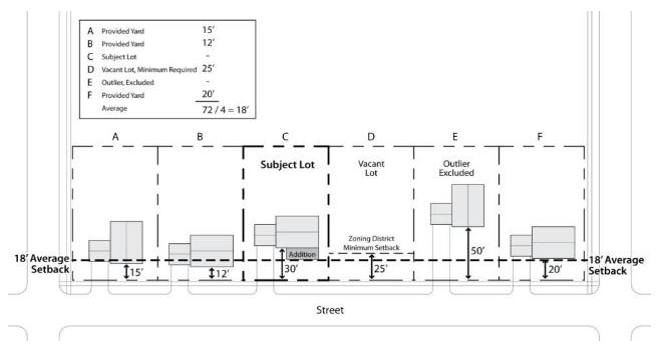
(b)
Increase of Front Yard Setback
1.
In the Single-Family, Two-Family, Multi-Family, and Mixed-Use zoning districts, blocks with mean front yard setback more than five (5) feet over the minimum required front yard setback shall be increased to the mean of the adjoining same type of principal structures on said block or street. This regulation is intended to preserve and maintain the character of established neighborhoods that are typified by front yard setbacks substantially in excess of the minimum required front yard setback.
2.
Outliers, defined as yards with a setback that is equal to or less than half that of the next smallest setback among the adjoining lots and thus which do not fit the established pattern of front yard setbacks, shall be excluded in calculating the mean front yard setback, as determined by the Zoning Administrator.
(c)
Infill Sites
1.
In the Single-Family and Two-Family zoning districts, the front yard setback of a new principal structure on an infill site shall be determined by the existing front yard setbacks of the principal buildings on the two (2) properties abutting the subject property's side yards. The front yard setback shall be no greater than the largest setback of said abutting properties and shall be no less than the smallest setback of said abutting properties.
a.
If either or both said abutting properties are vacant, the minimum front yard setback of the zoning district of the subject property applies.
b.
If a new residential building is being constructed adjacent to an existing nonresidential use, the front yard setback of the new residential building shall be no greater than the setback of the abutting residential property, or no less than the minimum front yard setback of the zoning district of the subject property, whichever is less.
c.
If a new residential building is being constructed between two (2) existing nonresidential uses, the minimum front yard setback of the zoning district of the subject property shall be used.
(3)
Side Yard Setback Adjustments
(a)
Street Side Yard Setback Adjustments (for Corner Lots)
On corner lots in the Single-Family, Two-Family, Multi-Family, and Mixed-Use zoning districts, the street side yard setback may be reduced to eight (8) feet, as may be necessary to attain at thirty (30) foot buildable width. The required interior side yard setback must be maintained.
(a)
Side Yard Adjustments for Bufferyards
In instances where the required bufferyard width (per Article VIII) exceeds the minimum required side setback width, the minimum required bufferyard width shall prevail. Absolutely no intrusions of a building or structure are permitted within the required bufferyard, with the exception of utility boxes/cabinets and other minor accessory structures exempt from the setback requirements of this Chapter.
(b)
Side Yard Adjustments for Small Lots
On lots under separate ownership on the effective date of this Chapter and less than fifty (50) feet in width, the side yard may be reduced to ten (10) percent of the lot width but not less than four (4) feet.
(4)
Rear Yard Setback Adjustments
(a)
Rear Yard Adjustments for Bufferyards
In instances where the required bufferyard width (per Article VIII) exceeds the minimum required rear setback width, the minimum required bufferyard width shall prevail. Absolutely no intrusions of a building or structure are permitted within the required bufferyard, with the exception of utility boxes/cabinets and other minor accessory structures exempt from the setback requirements of this Chapter.
(b)
Rear Yard Adjustments for Small Lots
On lots under separate ownership on the effective date of this Chapter and less than one hundred (100) feet in depth, and where the minimum lot depth is required to be at least one hundred (100) feet, the rear yard may be reduced to twenty (20) percent of the lot depth.
(c)
Rear Yard Setback Adjustment for Lakeshore Lot
A principal building on a lakeshore lot in a Single-Family, Two-Family, Multi-Family, or Mixed-Use zoning district shall have a minimum rear setback of thirty (30) feet measured from the Ordinary High Water Mark. A Patio or Non-Elevated Deck shall have a minimum rear setback of eight (8) feet from the Ordinary High Water Mark.
(Ord. No. O1657, §§ 107, 108, 6-17-2025)
10.04.40 - PROJECTIONS INTO REQUIRED YARDS
The minimum setback requirements of each zoning district establish the minimum required yards for all uses, except those exempted by the provisions of this Section.
(1)
With the exception of fences, minor accessory structures, and the permitted projections described in this Section, no principal or accessory structures shall be permitted within any portion of a front or street side yard.
(2)
Permitted Projections into All Required Yards
(a)
For principal and accessory residential buildings, the ordinary projection of sills, belt courses, cornices, gutters, eaves, overhangs, ornamental features, pilasters, lintels, bay windows, chimneys, egress windows, and flues, provided they do not extend more than two (2) feet into the required yards.
(b)
Fences shall meet the requirements of Section 10.06.40.
(c)
Additions (including vertical additions, additional floors, and architectural features), balconies, terraces, covered porches, or similar appurtenances not extending beyond the setback of the existing façade, may be located in the required or provided yard setback, whichever is more permissive. If the addition is a front-loaded garage or front-loaded garage addition, the minimum setback when facing the front yard or street side yard shall be at least fifteen (15) feet. In no instance shall any new addition be within ten (10) feet of an adjacent principal structure or within two (2) feet of an adjacent property line. See Figure 10.04.40a.
1.
All projection applications must demonstrate that the addition does not negatively impact the solar rights of existing solar panels on neighboring properties on the winter solstice.
Figure 10.04.40a: Permitted Addition in Required Yards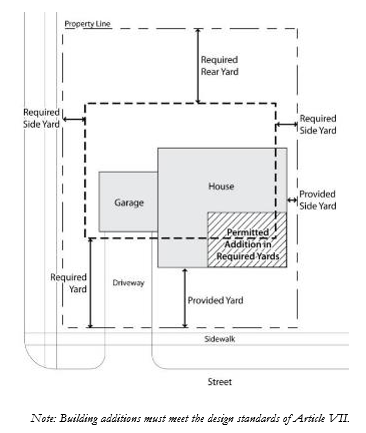
(d)
Handicap Accessible Ramps
1.
Handicap ramps or other devices required to make reasonable accommodation under the Fair Housing Act or the Americans with Disabilities Act are to be permitted in any required setbacks, provided that the maximum encroachment into a required setback is the minimum dimension required by the Wisconsin Commercial Building Code or Wisconsin Uniform Dwelling Code for accessible ramps and that no other location is feasible outside the required setbacks. Only temporary and removable ramps shall be permitted to encroach into the required setbacks.
2.
Handicap Ramp Permit
Handicap ramps proposed for placement within required setback areas shall secure a Building Permit from the Building Inspector prior to construction. An application for a permit shall include a written statement explaining the reasons for the placement of the handicap ramp. The Zoning Administrator may also require a statement from a physician verifying the need for a handicap ramp.
3.
Handicap Ramp Removal
When a handicap ramp is placed within the required setback, the Zoning Administrator, may periodically require verification of the continual need for the handicap ramp. When it has been determined the handicap ramp is no longer needed, the Zoning Administrator, may order its immediate removal.
(e)
Any other provisions identified elsewhere in this Chapter (landscape features, tents, and other features where specific setbacks are established).
(3)
Permitted Projections into Required Front Yards
(a)
All of the permitted projections listed under Subsection (2) above.
(b)
Reference Article II for porch dimensions and Section 10.03.28 for minor accessory structures.
(c)
Uncovered entry platforms and steps necessary to comply with current ingress and egress regulations provided they do not extend more than four (4) feet into the front yard setback and are no more than six (6) feet wide. Steps from the platform may extend into the front setback area for the distance needed to meet minimum building code requirements for risers and treads. Replacement steps for porches may be as wide as the steps being replaced and may extend into the front setback area for the distance needed to meet minimum building code requirements for risers and treads. These exceptions apply only to residential districts.
(4)
Permitted Projections into Required Street Side Yards (for Corner Lots)
(a)
All of the permitted projections listed under Subsection (2) above.
(b)
Reference Article II for porch dimensions and Section 10.03.28 for minor accessory structures.
(5)
Permitted Projections into Required Interior Side Yards
(a)
Reference Article II for porch dimensions and Section 10.03.28 for minor accessory structures.
(b)
Open fire escapes, fireproof outside stairways, and balconies opening upon fire towers may project into a side yard not more than 3-1/2 feet when so placed as not to obstruct light and ventilation.
(c)
Uncovered entry platforms and steps necessary to comply with current ingress and egress regulations provided they do not extend more than four (4) feet into the interior side yard setback and are no more than six (6) feet wide. Steps from the platform may extend into the front setback area for the distance needed to meet minimum building code requirements for risers and treads. Replacement steps for porches may be as wide as the steps being replaced and may extend into the front setback area for the distance needed to meet minimum building code requirements for risers and treads. These exceptions apply only to residential districts.
(6)
Permitted Projections into Required Rear Yards
(a)
Reference Article II for porch dimensions and Section 10.03.28 for minor accessory structures.
(b)
Open fire escapes, fireproof outside stairways, and balconies opening upon fire towers may project into a rear yard not more than 3-1/2 feet when so placed as not to obstruct light and ventilation.
(c)
Uncovered entry platforms, elevated decks, and steps necessary to comply with current ingress and egress regulations may encroach up to four (4) feet into the rear yard setback. Replacement steps for existing structures may be as wide as the steps being replaced and may extend into the rear setback area for the distance needed to meet minimum building code requirements for risers and treads. These exceptions apply only to residential districts.
(7)
Permitted Projections in the Planned Unit Development District (PUD): Per Approved Specific Implementation Plan
See Section 10.02.70.
(8)
Permitted Projections in the Well-Head Protection Overlay District
See Section 10.02.81.
(9)
Permitted Projections in the Shoreland Overlay District
See Section 10.02.82.
(10)
Permitted Projections in the Airport Height Limit Overlay District
See Section 10.02.83.
(11)
Permitted Projections in the Wetland Overlay District
See Chapter 29 of the City of Middleton Municipal Code.
(12)
Permitted Projections in the Floodplain Overlay District
See Chapter 24 of the City of Middleton Municipal Code.
(Ord. No. O1657, § 109, 6-17-2025; Ord. No. 1669, § 1, 1-20-2026)

