
Miramar City Zoning Code
CHAPTER 3
PROCESSES
Sec. 301.- General Procedures.
The following procedures and requirements are generally applicable to the development application types included in this chapter, unless otherwise specified in the subsections for each type.
301.1. Filing. An application for approval of a development permit may be filed only by the owner of the land affected by the development permit, or an agent of the owner specifically authorized by the owner to file such an application. In the case of an amendment to the comprehensive plan or official zoning map or LDC, as well as development permits subject to development review committee (DRC) and community appearance board (CAB) review, an application may be filed by either the property owner or the city. Lessees may initiate or submit an application with valid notice to and/or acknowledgment from the property owner, or lease-holder with a long-term lease of over 25 years, or a citizen with standing.
301.2. Application Requirements. Every application for a development permit shall be in a form specified by the department and shall be accompanied by a fee, and, if applicable, a commitment for cost recovery as established from time to time by the city, to defray the costs of processing and reviewing the application and the required notice. The application shall be completed and accompanied by all required documents specified by the application form(s) or such additional information that may be requested by the director.
301.3. Pre-application Conference. The director shall, upon request of the applicant, schedule and hold pre-application conferences for the purpose of reviewing the proposed development prior to the formal submission of an application for development approval. Formal application or filing of an application and plans with the department is not required for the pre-application conference. Failure of staff to identify any requirements at a pre-application conference shall not constitute waiver of the permit requirement by the decision-making body.
301.4. Filing of Applications. The director shall establish application filing deadlines and a review schedule for all applications. All applications for a development permit filed with the department shall be reviewed to determine whether the application is complete. If an application is deemed incomplete, the department shall notify the applicant in writing of the deficiencies. An application for development approval may not be scheduled for public hearing until all required information has been submitted and the required review agencies have completed their review. The DRC chair shall advise the applicant of the scheduled meeting dates and public hearings, requirements and submittal deadlines.
Generally, the planning and zoning board, DRC and/or CAB serve as recommending bodies for the ultimate city commission consideration of an application or set of related applications. In some cases, applications may be approved by the boards, and/or DRC, as specified later in this chapter. The city commission, planning and zoning board, DRC and CAB may take the following actions on each application for development approval:
(1)
Approval;
(2)
Approval with conditions;
(3)
Continuance or deferral; or
(4)
Denial.
As required by F.S. §166.033, in the event of a denial, the applicant shall be given the reason for the denial in writing.
301.5. Public Hearing and Notice Procedures.
(a)
All public hearing and notice requirements shall be as follows:
(1)
For a textual change to the city's adopted land use plan or a land use plan map amendment, shall be provided in accordance with the provisions of F.S. § 163.3184(11), or in the case of a small-scale amendment as defined by F.S. §163.3187(1), notice shall be given in accordance with the provisions of F.S. §163.3187(2); and
(2)
For the adoption of ordinances and resolutions, shall be provided in accordance with F.S. § 166.041; and
(3)
For the city's quasi-judicial development permits (the procedures outlined within sections 2-96 through 2-105.3 of the City Code), shall be provided in conformance with Sec. 301.11 of this LDC set forth below; and
(4)
For adoption of resolutions to vacate city-operated and maintained easements or rights-of-way or easements, shall be provided in accordance with F.S. § 166.041; and
(5)
For notice of the intent to consider a development agreement shall be advertised in accordance with F.S. § 163.3225(2).
b.
The following types of applications must be reviewed by the following commissions and board as set out in table 1 below:
Table 1
APPROVAL PROCESS FOR DEVELOPMENT APPLICATIONS
1
301.6. Rescheduled Meeting Dates. Meetings may be continued by the city commission, board, DRC chair or CAB chair to a date certain without further notice except as provided for by F.S. §286.011 or other applicable law.
301.7. Examination and Copying of Application and Other Documents. At any time during normal business hours of the city, upon reasonable request, any person may examine an application for development approval and materials submitted in support of or in opposition thereto. Copies of such materials, unless said application or other material is confidential or exempt from disclosure, as provided by federal or Florida law, shall be made available to the public upon payment of the appropriate fee.
301.8. Resubmission of Applications After Denial. The same application for development approval may not be resubmitted for reconsideration to the city commission or planning and zoning board for a period of 365 consecutive days after the date on which an application for the same proposed development has been denied by the commission or board. An application that is significantly different from the previously denied submittal as determined by the director may be submitted at an earlier date.
301.9. Reliance on Information Presented by Applicant. The city and its departments, boards and agencies shall have the right to rely on the accuracy of statements, documents and all other information presented to them by the applicant or the applicant's agent or consultants, in review of an application for development approval issued under this Code. The applicant shall execute an application form which includes the following statement: Under penalties of perjury, I declare that I have read the foregoing application and all attachment thereto, and that the facts stated in it are true," followed by the signature of the applicant making the declaration. The written declaration shall be printed or typed at the end of or immediately below the document being verified and above the signature of the person making the declaration. As provided in F.S. § 92.525(3), a person who knowingly makes a false declaration is guilty of the crime of perjury by false written declaration, a felony of the third degree, punishable as provided in F.S. § 775.082, s. 775.083, or § 775.084.
301.10. Application Annulment. If an applicant fails to act upon a submitted application within a 90-day period after receiving written comments from the department, the application will be deemed withdrawn by the applicant. The director may extend the 90-day requirement if reasonable progress is being made in revising the application. For good cause shown or excusable delay, if a request is made in writing during the 90-day period, the director may extend the 90-day period until a reasonable time that the circumstances dictate.
301.11. Courtesy Notices. The following public notices shall be provided in addition to any legally required notice by state law. These notices are provided as a courtesy to any party which may be affected, as defined by code, by a development application for the purpose of notifying those parties of the application and their ability to review submitted information and participate in public hearings. The failure of a property owner to be furnished with or to receive a courtesy notice shall not be deemed as a failure to furnish or receive legally required written notice pursuant to this Code subsection.
The cost and responsibility of providing the notice as required by this Code shall be the sole responsibility of the property owner or said property owner's designated agent. The department shall approve the text and format for all required posted and mailed notice prior to its completion. Prior to the scheduled hearing, the property owner or agent shall submit a copy of the actual mailed notice and sign text, the list of all property owners notified by mail, and a written affidavit on a form provided by the city which certifies that the requirements of this section have been complied with. Failure to comply with the provisions of this section in a timely manner may result in a postponement of the scheduled hearing until the notice is complete, or imposition by the department that a re-notice by the applicant as required in this Code must be accomplished at the applicant's sole expense.
301.11.1. Affected Development Applications. The following development applications as defined by this Code shall be subject to the notice provisions of these regulations as set forth in table 2 below:
Table 2
REQUIRED NOTIFICATION PROCESS FOR DEVELOPMENT APPLICATIONS
1
301.11.2. Posted Notice/Public Hearing Sign.
(a)
A sign which clearly announces the pending application(s) shall be posted on the property in a prominent location from an adjoining roadway or property line, or at such other location as designated by the city to ensure maximum exposure of the sign(s) to the public. If the subject property abuts more than one roadway, then a sign shall be posted along each of those roadways. A designated outparcel of a larger property which does not abut a roadway, shall have the sign posted near the closest roadway to the larger parcel. The sign shall be a minimum of 12 square feet in area with approximate dimensions of at least three feet by four feet, the bottom of the sign shall be mounted approximately three feet above the adjacent road crown elevation or ground, whichever is higher. The following table 3 provides additional information with regard to signage:
Table 3
NOTIFICATION REQUIREMENTS
(b)
The sign must contain the following information:
(1)
A title stating NOTICE OF PUBLIC LAND USE HEARING;
(2)
The application number(s);
(2)
The planned public hearing and community meeting dates, times and locations;
(3)
The department's contact information;
(c)
The sign shall be posted at least 14 days prior to the first scheduled public hearing, if a community meeting is not required, or 14 days prior to the community meeting, if a community meeting is required.
(d)
The sign shall be removed within 14 days of the application's final hearing.
(e)
Exemption: the foregoing sign-posting requirement shall not apply to development applications for individually-owned single-family and duplex properties.
301.11.3. Mailed Notice.
(a)
A courtesy notice shall be mailed to nearby property owners as specified herein. The notification area shall be from the outer perimeters of the subject property, property to the nearest point of any parcel of land located within the notification area. As stated in section 301.11, the failure of a property owner to be furnished with or to receive a courtesy notice shall not be deemed as a failure to furnish or receive legally required written notice pursuant to this Code subsection. The individuals who must receive notice are detailed in table 3 above.
(b)
All lists of property owners to whom notice must be mailed shall be based upon the most recently updated records available from the Broward County Property Appraiser's Office (BCPA) and be obtained from the BCPA no more than 30 days prior to the date of mailing. A commercially available computerized listing of these records may be used to obtain the current address providing the source of information is at least as up to date as the property appraiser's records. If any part of the common elements, as defined in F.S. § 718.103 of a condominium or any part of the common areas as defined in F.S. § 719.103 of a cooperative building is within the required notice limits, notice shall be sent to the condominium or cooperative association as well as each unit owner in the subject building. If property within an adjacent governmental jurisdiction is within the notice limits, notice shall be sent to the clerk of the affected unit of government; notice shall not be required for each parcel of land within the adjacent jurisdiction. Mailed notice shall at a minimum be mailed by postpaid first class U.S. mail. Envelopes used for mailed notice shall contain the city's return address. Envelopes shall be provided by the city, at cost to the applicant.
(c)
The mailed notice shall contain the following information:
(1)
A title stating NOTICE OF PUBLIC LAND USE HEARING, which shall be at the top of the notice page, conspicuously placed, in bold type;
(2)
A description of the application in layman's English language terms, that is the subject of the hearing, including the type(s) of approval requested, and the application number(s);
(3)
A statement that information regarding the application(s), including community meeting (if required) and planned public hearing dates and times and locations and that a written report may be obtained from the department. The department's contact information shall be included in the notice.
(4)
A graphic representation of the site's location and surrounding area in sufficient detail to clearly locate the property;
(5)
A notice that the public hearing may be continued from time to time;
(6)
The department's contact information; and
(7)
Wording consistent with F.S. § 286.0105 as follows:
Pursuant to F.S. § 286.0105, the City hereby advises you that if you or another person decide to appeal any decision made by the City Commission with respect to any matter considered at its meeting or this hearing that you or said person may need to insure that a verbatim record of the proceedings is made, which record includes the testimony and evidence upon which the appeal is to be based. This notice does not constitute consent by the City for the introduction or admission into evidence of otherwise inadmissible or irrelevant evidence, nor does it authorize challenges or appeals not otherwise allowed by law; and
(8)
Wording consistent with F.S. § 286.26 as follows:
In accordance with the Americans with Disabilities Act and section F.S. § 286.26, persons with disabilities needing special accommodation to participate in this proceeding should contact the city clerk at least 48 hours prior to the proceedings at (954) 602-3011 for assistance.
(d)
The notice shall be postmarked at least fourteen (14) days prior to the first scheduled public hearing, if a community meeting is not required, or 14 days prior to the community meeting if a community meeting is required. One mailed notice may be used to notify all scheduled meetings and hearings.
(e)
Mail notice shall be mailed to all owners of property within the notification area as defined in Table 2 per Sec. 301.11.1 above.
301.11.4. Continuance and Deferrals. The commission and/or board may continue or defer a scheduled public hearing to a date and time certain without further notice; provided that the date and time of the continuance or deferral is announced by the at the originally scheduled hearing.
301.11.5. Community Meetings. All applications for conditional uses, site-specific rezonings, and site-specific land use plan amendments, developments of regional impact and amendments to the county trafficways plan shall be first scheduled for discussion at a community meeting. The meeting shall be held for the applicant to present the plans to city residents and property owners and to the adjacent communities and obtain community input regarding the application. The meeting shall be noticed by the applicant upon verification from the department that the application is complete and that the notice form is acceptable to the department. The community meeting shall be held at a time and place determined by the department to provide adequate notification to the community and report any issues raised. A lack of participation at this meeting by the public shall not prejudice the application in any manner.
(Ord. No. 17-07, § 6, 11-14-16; Ord. No. 18-01, § 3(Exh. B), 11-1-17; Ord. No. 20-08, § 2(Exh. C), 3-18-20)
Sec. 302. - Amendments to the Land Development Code.
302.1. Purpose. The purpose of this article is to provide a uniform procedure concerning the review of proposals for amendments to these regulations, to provide for the continued integrity of these regulations; to adapt to changes in the community; and to allow the public an adequate opportunity to be heard concerning issues arising under or incidental to these regulations and amendments hereto. Whenever the public necessity, convenience, general welfare or good zoning practice and planning techniques require, the city commission may, by ordinance duly adopted in accordance with the procedures set forth herein, amend and/or supplement this Code. All amendments of the code shall be consistent with the adopted comprehensive plan.
302.2. Initiation. An amendment to the text of this Code may be initiated by the city manager or the city commission. Any affected person or persons or interested parties may also petition the city to amend the text of this Code, subject to the payment of an application fee to cover the cost of processing the application.
302.3. Application Requirements. Land Development Code (LDC) text amendment application forms, along with all established and required fees, documents, studies and analysis, shall be submitted to the city by the applicant to the department. All applications shall be processed according to the procedures of this Code and shall address the standards of section 302.7.
302.4. Review by Staff and Development Review Committee (DRC). The department shall review applications for amendment to the text of the code and compile a written report which summarizes the proposed language including all relevant documents, facts, and analysis, and evaluates the proposed amendment with the general purpose and standards set forth in this section. The director shall transmit a copy of the amendment(s) and the staff report to the DRC for consideration of impacts and standards.
302.5. Review by Planning and Zoning Board. The board shall review and consider amendments to the text of the LDC and make recommendations to the city commission.
302.5.1. Public Hearing. The Board shall hold one public hearing on the proposed text amendment. Notice of the public hearing shall be provided in accordance with F.S. Ch. 166, and the public hearing shall be conducted in accordance with the provisions of this Code.
302.5.2. Action by the Board. In considering amendments to the text, the planning and zoning board shall review the proposed language, the general purpose and standards set forth in this section, the report of the department and any oral or written comments received before or at the public hearing. If the board finds that the proposed amendments are in compliance with the general purpose and standards, then they shall recommend approval of the amendment to the city commission. If the board finds that the proposed amendments are not in compliance, then they shall recommend denial of the amendments to the city commission. The board may continue the matter until the requested information or studies have been completed and offered in testimony. The planning and zoning board, acting as the local planning agency, shall also make a recommendation to the city commission whether the proposal is consistent with the comprehensive plan. Any documentation, including all documents, papers, letters, maps, books, tapes, photographs, films, sound recordings, data processing software, or other material, regardless of the physical form, characteristics, or means of transmission, presented to the department prior to the scheduled public hearings or presented at either public hearing by anyone appearing before the planning and zoning board shall automatically be made a part of the record of the public hearing. Additionally, the minutes of the public hearing, city staff memoranda, the City Code, and the comprehensive plan shall automatically be made a part of the record of the public hearing. The board may continue the matter until the requested information or studies have been completed and offered in testimony.
302.6. Review by City Commission. The commission shall review all amendments to the text. The Director shall transmit to the city manager a copy of the complete application and a written staff report summarizing the proposed language including all relevant documents, facts, and analysis and the recommendations of the Planning and Zoning Board. The city manager shall schedule the proposed amendment for the next available commission meeting provided that the required notice procedures are met.
302.6.1. Public Hearing. In order to adopt an ordinance, the city commission shall hold two public hearings on the proposed amendments consistent with the procedures for adoption of an ordinance. Notice of the public hearing shall be provided in accordance with F.S. ch. 166, and the public hearing shall be conducted in accordance with the provisions of this Code. Any documentation, including all documents, papers, letters, maps, books, tapes, photographs, films, sound recordings, data processing software, or other material, regardless of the physical form, characteristics, or means of transmission, presented to the department prior to the scheduled public hearings or presented at either public hearing by anyone appearing before the city commission at the public hearing shall automatically be made a part of the record of the public hearing. Additionally, the minutes of the public hearings, city staff memoranda, the City Code, and the comprehensive plan shall automatically be made a part of the record of the public hearing.
302.6.2. Action by the Commission. In considering text amendments, the commission shall review the proposed amendment, the general purpose and standards, the report of the administration and recommendation of the board, and any oral and written comments received before or at the public hearing. Based upon the record developed at the public hearings, the city commission may:
(1)
Adopt the proposed amendment with or without modifications by ordinance; or
(2)
Reject the proposed amendment; or
(3)
Refer the matter to the board or department for further consideration.
302.7. Standards for Reviewing Proposed Amendments to the Text of this Code. In deciding whether to recommend approval of a proposed amendment, city staff, the department, the planning and zoning board and the city commission shall determine whether or not:
(1)
The proposed amendment is legally required; and
(2)
The proposed amendment is consistent with the goals, objectives, and policies of the comprehensive plan; and
(3)
The proposed amendment is consistent with the authority and purpose of this Code; and
(4)
The proposed amendment furthers the orderly development of the city; and
(5)
The proposed amendment promotes sustainability and efficiency of the city and whether the proposed amendment promotes the public health, safety, welfare, and aesthetics; and
(6)
The proposed amendment improves the administration or execution of the development process.
302.8. Zoning-In-Progress. When a text amendment is being considered, the city commission may impose a hold or stay on any development applications, permits, and licenses pending before the city with respect to the text which is the subject of the proposed amendment. The hold or stay shall continue in effect for a period from the date of the publication of notice of the consideration of the zoning-in-progress by the commission until proposed legislation, with or without amendments, shall have been approved or disapproved, or for a period of 180 days (which may be extended one time for an additional three months by resolution), whichever is sooner, unless such development application would be in conformity with both the existing legislation and the proposed legislation.
(Ord. No. 17-07, § 6, 11-14-16)
Sec. 303. - Comprehensive Plan Text and Map Amendments.
303.1 Purpose and Applicability. The purpose of this section is to establish a uniform procedure for amending the text and maps of the adopted Comprehensive Plan of the City of Miramar. This division shall not be construed to be an attempt by the City to supersede the requirements of the Community Planning Act, as codified in F.S. Ch. 163, Part II, as amended from time to time. If any part of this section conflicts with the Community Planning Act, as amended from time to time, the statutory requirement shall take precedence. Corrections, updates, modifications of current costs, which are set out as a part of the Comprehensive Plan, as well as annual update of the Capital Improvement Schedule of the Comprehensive Plan adopted pursuant to F.S. §166.041(3)(a), as amended from time to time, shall not be deemed to be an amendment to the Comprehensive Plan. This division applies to all other text and map amendments to the Comprehensive Plan, as described below.
303.2 Process for Amendment to the City's Comprehensive Plan and Future Land Use Map. The city shall accept comprehensive plan amendment applications at any time.
A.
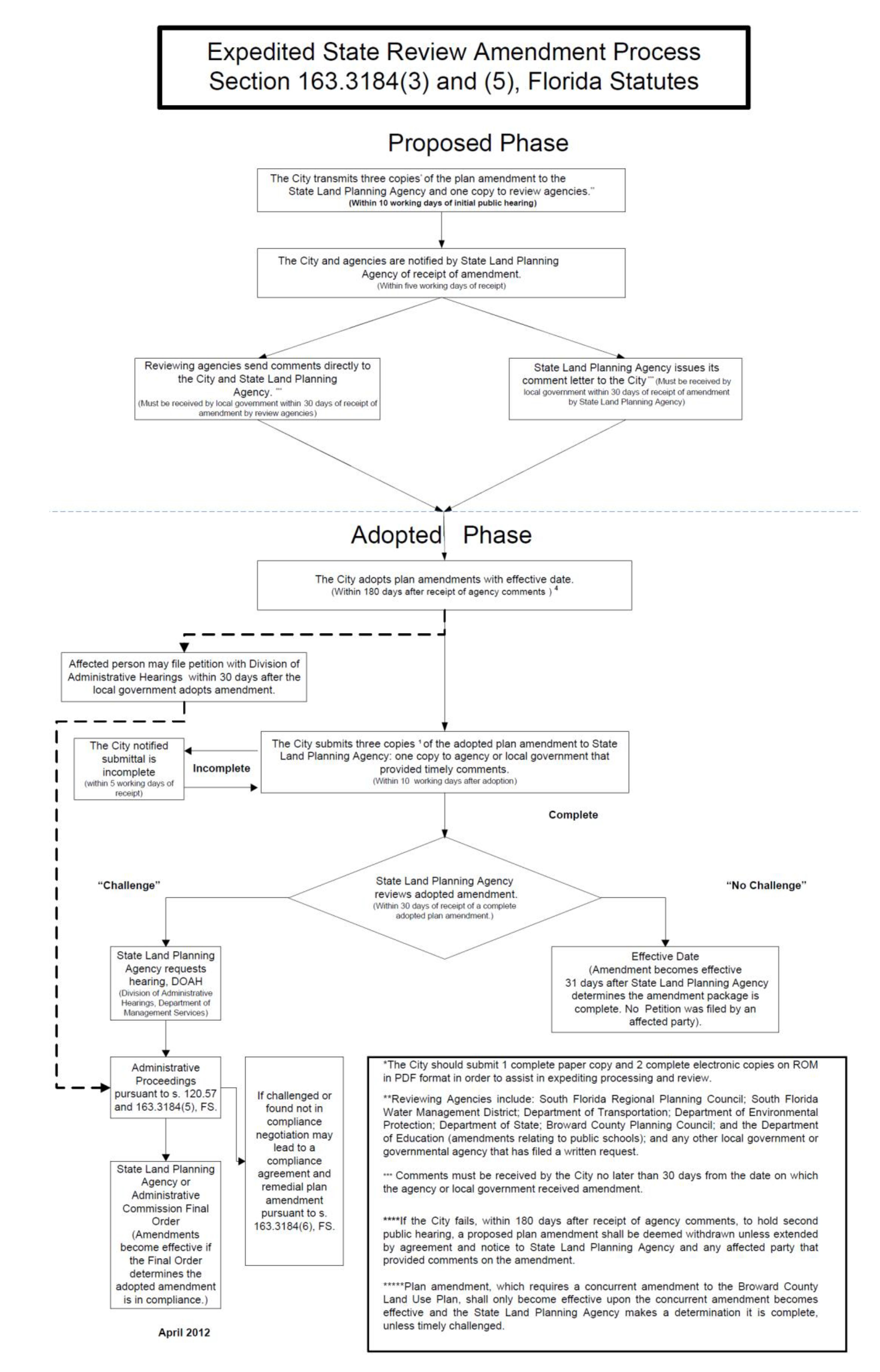
Expedited state review process. This process shall apply to all plan and map amendment applications, except as provided in paragraphs B and C.
B.
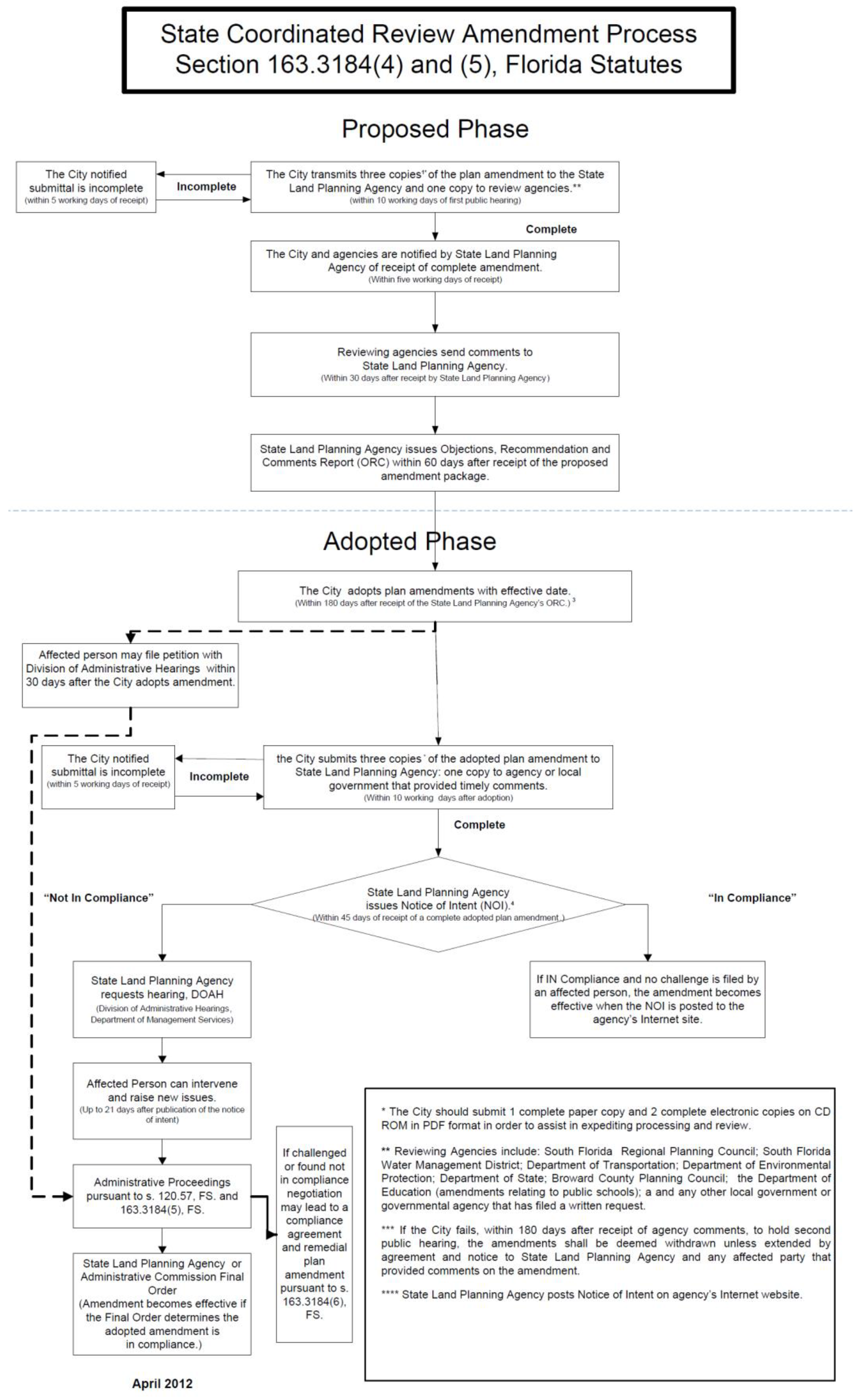
State coordinated review process. The following plan amendments must follow the state coordinated review process established in F.S. §163.3184 (4), as amended from time to time:
a.
Evaluation and Appraisal based update to the city comprehensive plan, pursuant to F.S. §163.3191, as amended from time to time.
b.
Development proposal subject to the requirements of F.S. §380.06, as amended from time to time.
C.
Small-scale review process. Plan amendments that qualify as small-scale development amendments are subject to the small-scale review process established in F.S. §163.3187, as amended from time to time. A small-scale development amendment may be adopted if the proposed amendment:
a.
Involves a use of ten (10) acres or less;
b.
Does not involve a text change to the goals, policies, and objectives of the comprehensive land use plan, but only proposes a land use change to the future land use map for a site-specific small scale development activity; however, text changes that relate directly to, and are adopted simultaneously with, the small scale future land use map amendment shall be permissible; and
c.
The cumulative annual effect of acreage for all small-scale amendments does not exceed one hundred twenty (120) acres.
303.3. Filing. An application to amend the text of the adopted land use plan amendment (LUPA) may be proposed by the city commission, the planning and zoning board, sitting as the local planning agency pursuant to F.S. § 163.3184, as amended from time to time, any department of the city, or any person other than those listed above provided, however, that none other than the city commission or local planning agency shall propose an amendment for a land use designation change for property which the applicant does not own (except as an attorney or duly authorized agent for the owner).
303.4. Application. All applications for plan amendments shall be made in writing upon an application form approved by city staff and shall be accompanied by applicable fees and/or cost recovery amount(s) for peer review(s). In addition, the applicant shall submit all other information determined by city staff and/or external consultants to be necessary to address the comprehensive planning criteria of the city.
303.5 Conditions of Approval.
A.
An applicant may propose additional limitations regarding the use, density or intensity which will be permitted on a parcel proposed for development. Such limitation shall be offered by executed restrictive covenant or declaration of use that is provided to the city in a recordable form that is acceptable to the city attorney, and if the amendment is approved with the restrictive covenant or declaration of use, the recording information shall be set out on the future land use map (FLUM).
B.
Pursuant to F.S. § 163.3184(12), as amended from time to time, at the request of an applicant, the city commission shall consider an application for zoning changes that would be required to properly enact any proposed plan amendment. Approval of such zoning changes by the city commission shall be contingent upon the plan amendment becoming effective.
303.6 City Staff Review, Report and Recommendation.
A.
Upon receipt of an application pursuant to this section, city staff shall review the application in accordance with the applicable provisions of this LDC.
B.
Upon completion of review of an application, the director of community development shall:
a.
Provide a report that summarizes the application and the effect of the proposed amendment, including:
i.
Its effect on the level of service of public infrastructure i.e., potable water, sanitary sewer, solid waste, drainage, recreation and open space, traffic circulation, mass transit, and/or public education. For amendments involving residential units, the applicant is encouraged to contact the growth management section of the School Board of Broward County early in the process for a determination on the impacts of the proposed amendment on public education facilities, as well as their associated review fees;
ii.
Whether the amendment advances or is contrary to any specific goal, objective and policy of the city's comprehensive plan;
iii.
Its effect on the availability of housing that is affordable to people who work in the city, if the amendment involves the addition of 100 or more residential dwelling units to the existing densities approved by the Broward County Land Use Plan (BCLUP) and consideration of how the city intends to cooperate with Broward County to achieve and/or maintain a sufficient supply of affordable housing;
iv.
Its effect on hurricane evacuation, taking into account the number of permanent and seasonal residential dwelling units (including Special Residential Facilities) requiring evacuation, availability of hurricane shelter spaces, and evacuation routes and clearance times for those routes, based on the best available data/modeling techniques as identified by the Broward County Emergency Management Division;
v.
Its impact on natural and historic resources, including:
1.
Historic sites or districts on the National Register of Historic Places or locally designated historic sites;
2.
Archaeological sites listed on the Florida Master Site File;
3.
Wetlands;
4.
Local Areas of Particular Concern as identified within the BCLUP;
5.
"Endangered species," "threatened species," "species of special concern," or "commercially exploited species" as per the Florida Fish and Wildlife Conservation Commission (fauna), the U.S. Fish and Wildlife Service (flora and fauna), or the Florida Department of Agriculture and Consumer Services (fauna);
6.
Plants listed in the Regulated Plan Index for protection by the Florida Department of Agriculture and Consumer Services;
7.
Wellfield protection zone of influence as defined by Broward county Code, Chapter 27, Article 13 "Wellfield Protection," as amended; and
8.
Soils—(whether the amendment will require of alteration of soil conditions or topography);
vi.
Any other effect that city staff determines is relevant to the city commission's decision on the application;
vii.
Any proposed voluntary mitigation, draft restrictive covenant or declaration of use; and
viii.
Whether proposed amendment is internally consistent with the comprehensive plan with an explanation of why it is internally consistent;
b.
Provide a recommendation as to whether the application should be approved, approved with conditions or modifications, or denied;
c.
Provide a proposed ordinance that could be used to adopt the proposed amendment;
d.
Schedule the application for a hearing before the planning and zoning board, the local planning agency (LPA); and
e.
Provide notice of the planning and zoning board/local planning agency hearing pursuant to the notice requirements of this Code and F.S. §§163.3164(40) and 163.3174(4)(a), as amended from time to time.
C.
Upon receipt of the planning and zoning board/local planning agency recommendation, city staff shall:
a.
Schedule the application for hearing before the City Commission;
b.
Forward its report and recommendation, as well as the planning and zoning board/local planning agency recommendation, as applicable, to the city commission; and
c.
Provide notice of the city commission hearing in accordance with the notice requirements of this Code and F.S. §163.3184(11), as amended from time to time.
303.7 Planning and Zoning Board Review and Recommendation. The planning and zoning board, sitting as the LPA, shall:
a.
Review the application at a public hearing that is held before the transmittal hearing to the state and other statutorily designated reviewing agencies, or if no transmittal hearing is required, before the adoption hearing; and
b.
Provide a recommendation to the city commission with regard to whether the proposed amendments should be adopted, adopted with conditions or modifications, or rejected. The recommendation shall include a finding of whether proposed amendment is internally consistent with the comprehensive plan;
c.
Whenever the planning and zoning board votes to recommend approval of a proposed comprehensive plan amendment, the city manager shall issue an administrative order setting forth the proposed amendment and establishing a moratorium during which time any city staff, department or board is prohibited from granting an approval or permit which would be prohibited, or prohibited without variances, in the event that the proposed amendment is enacted by the city commission. The administrative order shall be effective until the proposed amendment is enacted or rejected by the city commission. Any administrative order shall be deemed expired in the event the city commission fails or declines to:
i.
Adopt a small-scale amendment;
ii.
Transmit a proposed amendment to DEO; or
iii.
Reject an amendment within ninety (90) days after a favorable recommendation by the local planning agency; or
iv.
Fails to enact or reject an amendment within 180 days after receiving comments on the proposed amendment from DEO, unless the time limitation is extended by agreement with notice to DEO and any affected parties
Notwithstanding sub-subsection c. above, no administrative order shall affect any project which has a validly issued building permit, zoning approval, or has completed an application meeting all submission requirements for city approval or building permit approval prior to a vote by the planning and zoning board.
303.8 City Commission Review and Adoption. The city commission shall hold at least two (2) advertised public hearings on a proposed LUPA, except as provided herein.
A.
The first public hearing (transmittal hearing) shall be held at the transmittal stage, on a weekday at least 7 days after the day that the first advertisement is published pursuant to the notice requirements of this Code and F.S. §163.3184(11), as amended from time to time. If the city commission approves the LUPA at the transmittal hearing, within 10 city working days the city shall transmit the LUPA, along with the supporting data and analysis, to DEO, and all other reviewing agencies pursuant to F.S. § 163.3184, as amended from time to time, as well as any other unit of local government or government agency that has filed a written request with the city related to the LUPA. Notwithstanding this 10-day limitation of the Florida Statutes, if the LUPA involves an amendment to the BCLUP, the city may elect to transmit the required documents to DEO and the reviewing agencies concurrently with the county transmittal.
B.
The second public hearing (adoption hearing) shall be held at the adoption stage, on a weekday at least 5 days after the second advertisement is published pursuant to the notice requirements of this Code and F.S. §163.3184(11), as amended from time to time. The adoption hearing shall be scheduled within 180 days after receipt of DEO's objections, recommendations and comments (ORC) report if the LUPA is reviewed under the state coordinated review process, or agency comments, unless the time limitation is extended by agreement with notice to DEO and any affected person that provided comments on the amendment, all as provided by F.S.§163.3184(3)(c)1., as amended from time to time. If the LUPA involves an amendment to the BCLUP, the adoption hearing must occur after the county's adoption of the related amendment to the BCLUP. The statutory 180-day limitation shall, in no instance, apply to amendments processed pursuant to F.S. §380.06, as amended from time to time.
At the adoption hearing, the city commission shall, by ordinance, either adopt, adopt with changes that address DEO and review agencies comments, or reject the proposed amendment. Adoption shall require the affirmative vote of not less than the majority of the members of the city commission present at the hearing.
C.
Notwithstanding the provisions of this subsection and F.S. §163.3187, as amended from time to time, the first public hearing on a small-scale development amendment shall be to authorize the submittal of an application for a similar amendment to the BCLUP, if the LUPA involves an amendment to the BCLUP. In all event; it shall be the first reading of the enacting ordinance. Transmittal of any proposed small-scale development amendment to DEO and review agencies for timely agency comments shall not be required. The second public hearing, which shall be held upon adoption of the county application (if applicable), shall be to either adopt, adopt with changes, or reject the small-scale amendment.
D.
Any amendment adopted by ordinance of the city commission shall go into effect:
a.
31 days after DEO notifies the city that that the plan amendment package is complete, if adopted under the expedited state review process and administratively unchallenged as provided in F.S. §163.3184(3)(c)4., as amended from time to time;
b.
Upon a determination by the DEO that the amendment is "in compliance," as defined by state statute, 45 days after the DEO notifies the city that the amendment package is complete if adopted as a part of an evaluation and appraisal report or sector plan amendment and unchallenged, all as provided by F.S. §163.3184(4)(e)4. as amended from time to time; and
c.
31 days after adoption, unless timely challenged, if adopted under the small-scale review process, all as provided by F.S. §163.3189(5)(a) and (c). as amended from time to time.
303.9. Compliance Agreements. The city may voluntarily enter into a compliance agreement with DEO and/or affected persons who have initiated a formal proceeding or have intervened in a formal proceeding, with regard to any proposed or adopted comprehensive plan amendment.
A.
All parties granted intervenor status shall be provided reasonable notice of the commencement of a compliance agreement negotiation process and a reasonable opportunity to participate in such negotiation process.
B.
All negotiation meetings with the DEO and/or the intervenors shall be open to the public.
C.
No compliance agreement shall be executed by the city unless such execution is considered by the city commission at a public hearing advertised at least 10 days before the public hearing in a newspaper of general circulation in the area in accordance with the advertisement requirements of F.S. §§166.041(3)(a) and 163.3184(6)(c), all amended from time to time.
D.
Amendments to portions of the city comprehensive plan other than those that are the subject of a challenge are permitted as long as such amendments are not inconsistent with the compliance agreement.
303.10. Concurrent Zoning. Notwithstanding the requirements of sub-section 303.7c. above, the city shall, at the request of an applicant, consider an application for zoning changes that would be required to properly enact any proposed plan amendment transmitted pursuant to this section. Zoning changes approved by the city shall be contingent upon the comprehensive plan amendment becoming effective.
303.11. Transmittal of Adopted Amendment. Within 10 city working days after the second public hearing or adoption hearing, the city shall transmit all comprehensive plan amendments adopted under the expedited state review or state coordinated review process, along with the supporting data and analysis, to DEO and any other agency or local government that provided timely comments, pursuant to the requirements established in F.S. §163.3184, as amended from time to time. Although transmittal of adopted small-scale amendment is not statutorily required, the city is nevertheless encouraged to transmit a copy of all adopted small-scale amendments to DEO, so that the DEO can maintain a complete and up-to-date copy of the city's comprehensive plan.
303.12. Developments of Regional Impact (DRIs). The city contains several developments of regional impact (DRIs), approved by the state of Florida pursuant to a specified development order. For property located within one of the established DRIs, the development permits must be consistent with the development order, as well as the city's comprehensive plan. DRI and substantial deviation (as defined in F.S. §380.06(19), as amended from time to time), application forms, along with all established and required fees, documents, and plans, shall be submitted to the city by the applicant to the department for review.
An application for substantial deviation for an approved DRI development order shall be reviewed by the DRC. Upon a recommendation from the DRC, the applicant shall conduct a community meeting with regard to the application as per the procedures in section 301. Subsequent to the community meeting, the application shall be considered by the planning and zoning board for a recommendation to the commission, which shall conduct two readings that include statutory state review.
(Ord. No. 17-07, § 6, 11-14-16; Ord. No. 20-08, § 2(Exh. C), 3-18-20)
Sec. 304. - Amendments to the Official Zoning Map (Rezoning).
304.1. Purpose. The purpose of this article is to provide a uniform procedure concerning the review of proposals for amendments to zoning district designations (i.e., rezoning), to provide for the continued integrity of these districts and regulations; to adapt to changes in the community; and to allow the public an adequate opportunity to be heard concerning issues arising under or incidental to these districts and amendments hereto. Whenever the public necessity, convenience, general welfare or good zoning practice and planning techniques require, the commission may, by ordinance duly adopted in accordance with the procedures set forth herein, amend and/or supplement the zoning district boundaries or classifications of property now or hereafter established or by amendment hereto. All amendments of the map must be consistent with the adopted comprehensive plan.
304.2. Initiation. An amendment to the official zoning map may be initiated by the city or by any person(s) owning property within the area proposed for change on the map subject to the payment of an application fee to cover the cost of processing the application. An application for rezoning initiated by the city may be initiated by the city manager, the city commission, or the planning and zoning board.
304.3. Application Requirements. Rezoning application forms, along with all established and required fees, documents, studies, data and analysis and plans, shall be submitted to the city by the applicant to the department. All applications shall be processed according to the code and shall address the standards of Sec. 304.7, as well as the standards for a specific zoning district.
304.4. Review by Staff and DRC. The department shall review applications for rezoning and compile a written report which summarizes the facts of the case including all relevant documents, and together with the DRC shall evaluate the proposed impacts of the amendment with respect to the general purpose and standards. The director shall transmit a copy of the staff report to the board.
304.5. Review by Planning and Zoning Board. The board shall review the proposed rezoning of property and make recommendations to the commission.
304.5.1. Public Hearing. The Board shall hold one public hearing on the proposed rezoning. Notice of the public hearing shall be advertised in a newspaper of general circulation at least ten days prior to the public hearing. The notice shall: state the date, time, and place of the public hearing; include a brief layman's language description of the proposal or present the title of proposed rezoning ordinance; and describe the place within the city where such proposed rezoning application may be inspected by the public. The notice shall also the public advise that interested parties may appear at the meeting and be heard with respect to the proposed rezoning or that the public may submit written comments to the department prior to the public hearing which written comments will be included in the record of the public hearing. The notice shall also include the disclosures described in F.S. §§286.0105 and 286.26. The public hearing shall be conducted in accordance with the provisions of this Code.
304.5.2. Action by the Board. In considering a rezoning, the board shall review the proposed amendment, the general purpose and standards set forth in this section, the report of the department, administration and any oral or written comments received before or at the public hearing. If the board finds that the proposed amendment is in compliance with the general purpose and standards and the comprehensive plan, then they shall recommend approval to the city commission. If the board finds that the proposed amendment is not in compliance with the specified general purpose and standards or the comprehensive plan, then they shall recommend denial of to the city commission. The board may continue the public hearing for its convenience or matter until the requested information or studies have been completed and offered in testimony.
304.6. Review by City Commission. The city commission shall review and consider all amendments to the official zoning map. The director shall transmit to the city manager a copy of the complete application and a written staff report summarizing the facts of the case including all relevant documents, analysis of impacts, and compatibility, and an analysis of consistency with the comprehensive plan, copies of written public comment received, a copy of the board minutes, and the recommendations of the board. The city manager shall schedule the proposed rezoning for the next available city commission meeting for consideration providing, that the required notice procedures are met.
304.6.1. Public Hearing. When the city initiates an amendment to the LDC which changes the list of permitted, conditional, or prohibited uses for a zoning district, or when the city initiates a rezoning or change of the actual zoning map designation of a parcel or parcels of land, the city commission shall hold two public hearings for public input consistent with the procedures and advertising set forth in F.S. §166.041(3)(c), as amended from time to time. In all other cases in order to adopt an ordinance rezoning a parcel or parcels of land, the city commission shall read the title of the ordinance at two separate commission meetings and shall hold one public hearing (first hearing is a reading of the title; second hearing is providing for public input and determination) on the proposed rezoning consistent with the procedures for adoption of an ordinance. Notice of the public hearing shall be provided in accordance with F.S. Ch. 166, and the public hearing shall be conducted in accordance with the provisions of this Code. The commission may continue the public hearing for its convenience or requested information or studies have been completed and offered in testimony.
304.6.2. Action by the City Commission. In considering a rezoning, the commission shall review the proposed amendment, the general purpose and standards, the report of the administration, the application of the comprehensive plan, and the recommendation of the board, and any oral and written comments received before or at the public hearing. Based upon the record developed at the public hearings, the commission may:
(1)
Adopt the proposed rezoning with or without modifications by ordinance; or
(2)
Grant another zoning classification consistent with the land use plan land use plan designation and comprehensive plan and consistent with F.S. §166.031, giving reasons therefore; or
(3)
Reject the proposed amendment and consistent with F.S. §166.031, giving written reasons for the denial; or
(4)
Refer the matter to the board or department for further consideration.
304.7. Standards for Reviewing Proposed Amendments to the Official Zoning Map. In deciding whether to recommend approval of a proposed amendment, city staff, the department, the planning and zoning board and the city commission shall determine whether or not:
(1)
The proposed amendment is consistent with goals, objective, and policies of the city's comprehensive plan including population density such that the demand for water, sewers, streets, recreational areas and facilities, and other public facilities and services; and
(2)
The proposed zoning district is compatible with the surrounding area's zoning designation(s) and existing uses; and
(3)
If applicable, the proposed change will contribute to redevelopment of an area in accordance with an approved redevelopment plan; and
(4)
The proposed change would adversely affect traffic patterns or congestion; and
(5)
Whether the proposed change would have an adverse environmental impact on the vicinity; and
(6)
Whether the proposed change would adversely affect the health, safety, aesthetics, and welfare of the neighborhood or the city as a whole.
304.8. Zoning-in-Progress. When a rezoning of a parcel of land is being considered, the city commission may impose a hold or stay on any development applications pending before the city with respect to the area which is the subject of the proposed amendment. The hold or stay shall continue in effect for a period from the date of the publication of notice of the consideration of the zoning-in-progress by the commission until proposed legislation, with or without amendments, shall have been approved or disapproved, or for a period of 180 days (which may be extended one time for an additional 90 days by resolution), whichever is sooner, unless such development application would be in conformity with both the existing legislation and the proposed legislation.
(Ord. No. 17-07, § 6, 11-14-16; Ord. No. 20-08, § 2(Exh. C), 3-18-20)
Sec. 305. - Conditional and Permitted Uses.
305.1. Purpose and Intent. Permitted uses are considered to be fundamentally appropriate within the district in which they are located and are deemed to be consistent with the comprehensive plan. These uses are permitted as of right subject to the required permits and procedures described in this section. Permitted uses require final site plan review and approval for compliance with the standards applicable to a particular permitted use as provided in the relevant use regulations and development standards. However, an examination of each use on particular properties must be examined to determine whether the proposed use, as applied, is consistent with the comprehensive plan.
Conditional uses are generally not compatible with the other uses permitted in a zoning district, but may be permitted following individual review as to their consistency with the comprehensive plan, compatibility, size, massing, impacts, number, location, design, configuration, and/or methods and hours of operation. To ensure that the particular use is compatible with the surrounding neighborhoods and appropriate at a particular location, consideration of the public need and the possible imposition of individualized conditions to ensure the use is compatible, will be analyzed.
All questions of interpretation relating to the comprehensive plan, the land development code and any regulations promulgated pursuant thereto shall be first presented to the director. Interpretations of the land development code or the comprehensive plan may include, but shall not be limited to, ascertaining the meaning and application of words, terms, and provisions herein and regulations promulgated pursuant hereto. In interpreting the comprehensive plan or the land development code and any regulations promulgated pursuant thereto, the director shall be guided first by the plain meaning of the word and terms in the land development code or the comprehensive plan and the implementing regulations and second by the intent expressed therein, if any. The director shall make interpretations by interpreting the comprehensive plan or the land development code and its implementing regulations, as a whole and not by taking specific words or clauses in isolation. Prior to making an interpretation of the provisions of the comprehensive plan, the land development code and any regulations promulgated pursuant thereto, the director may require the building official, city attorney, or city engineer to provide assistance. Interpretation of the provisions of the comprehensive plan, the land development code and any regulations promulgated pursuant thereto shall be made in writing, shall state the code provision or regulation being interpreted, the interpretation made, the basis for the interpretation, and advise the applicant for said interpretation that appeals may be taken to the commission per procedures noted in section 315. The time within which an appeal must be taken and the manner of filing an appeal shall also be included within the director's letter of interpretation. After the interpretation of the comprehensive plan, the land development code or implementing regulation, copies of the interpretation shall be promptly distributed to the party seeking the interpretation and the department secretary. Upon receipt of the letter of interpretation, the department secretary, or said secretary's designee, shall promptly log in the letter of interpretation, including the date that the letter of interpretation was renders. The department secretary shall keep an index of letters of interpretation indexed by code or implementing regulation section.
305.2. Permits Required for Permitted Uses. Except as explicitly provided herein, no use designated as a permitted use in this Code shall be established until after the person proposing such use has applied for and received all required development permits which may include, final plat approval, final site plan and community appearance approval, a building permit, a zoning certificate of use and a certificate of occupancy all pursuant to the requirements of this Code.
305.3. Application Requirements for Conditional Uses. No use designated as a conditional use in this Code shall be established until after such use has received approval under the provisions of this section 305 and has received all other required permits. Conditional use application forms, along with all established and required fees, documents, and plans, shall be submitted to the city by the applicant to the department. The application shall include, at a minimum:
(1)
A preliminary site plan meeting the technical merits for a final site plan review by the DRC or a final site plan, unless a separate site plan application is simultaneously submitted or a floor plan if a proposed use will be located within an existing space; and
(2)
A written response and graphic summary of the proposed project and its relationship to the general standards of review (i.e., the conditional use criteria) in Sec. 305.4; and
(3)
An ownership affidavit; and
(4)
A sealed, as-built survey showing existing conditions of the property (if applicable). The survey shall be certified to and for reliance by the city and must be prepared by a registered and licensed Florida surveyor and mapper. The survey shall be current, meaning that the survey is no older than 180 days prior to conditional use application (or brought up to date) and depicts current conditions on the subject property. Said survey shall be prepared in accordance with the minimum technical standards of F.S. § 472.027, and F.A.C. Ch. 21HH-6, and attached as an exhibit to the application.
(5)
If applicable, the applicant shall furnish a distance radius survey certified to the city by and from a Florida registered and licensed surveyor and mapper as required in Section 405, as amended from time to time.
305.4. General Standards of Review. In addition to the standards set forth in this Code for the particular use, all proposed conditional uses shall meet each of the following standards:
(1)
The proposed use shall be consistent with the comprehensive plan; and
(2)
The establishment, maintenance, or operation of the conditional use shall not impede the development and improvement of surrounding properties for uses permitted in the zoning district nor be detrimental to or endanger the public health, safety, aesthetics, comfort, or general welfare or have a negative impact on the value of those properties; and
(3)
The use shall be consistent with the existing natural environment, and community character of the immediate neighborhood, hours of operation compatible with adjacent properties, and is appropriate at the particular location; and
(4)
Utilities, roadway capacity, drainage, and other necessary public facilities, including police and fire protection and emergency-rescue services, shall exist at a minimum at the city's adopted level of service, or will be available prior to issuance of any certificate of occupancy; and
(5)
Adequate measures exist or shall be taken by the applicant or the property owner to provide safe ingress and egress to the proposed use, for both vehicles and pedestrians, in a manner that minimizes traffic congestion in the public streets and the use may not result in a significantly greater amount of traffic on local streets than would result from a development permitted by right; and
(6)
The design and configuration of the proposed use shall minimize adverse effects, including noise, light, dust, incompatible height or massing or size, incompatible methods of operation, or other potential nuisances, of the proposed use on adjacent property through the use of building orientation and design, setbacks, buffers, landscaping and other design criteria; and
(7)
The use meets a public need and does not have an adverse impact on the economic stability of the neighborhood; and
(8)
The land area must be sufficient, appropriate and adequate for the proposed use; and
305.5.
Review by DRC. A complete application shall be reviewed by the DRC. The DRC shall determine whether the proposed use complies with the general standards of review and use regulations and development standards and all other applicable development regulations. The DRC chair shall submit a written report, incorporating the findings of the DRC, to the planning and zoning board and city manager.
305.6. Community Meeting. A community meeting shall be held for the applicant to discuss and present the plans to the community in order to obtain the input regarding the application.
305.7. Review by the Planning and Zoning Board. The board shall conduct a public hearing in which they shall review the DRC report and the project proposal, prior to making a recommendation concerning the project to the commission. If the board determines that the proposed use is in compliance with the general standards of review and use regulations and development standards, then the burden of proof shall switch to opponents of the conditional use or the city to demonstrate that the issuance of the conditional use approval will be adverse to the public interest. If the proposed conditional use general standards of review and use regulations and development standards are satisfied, and there has been no showing that the proposed conditional use is adverse to the public interest, then, and in that event, the board shall recommend approval, with or without conditions, as determined appropriate. If the board finds that the proposed conditional use is not in compliance, with the general standards of review, use regulations, and development standards or is adverse to the public interest, the board shall recommend denial of the application. The board may continue the public hearing for its convenience, or when necessary to allow for the presentation of any additional information or studies found necessary to make a decision based on the applicable criteria.
305.8. Review by the City Commission. The commission shall review and consider all conditional use applications. The director shall transmit to the city manager a copy of the complete application and a written staff report summarizing the facts of the case including all relevant documents and the recommendations of the DRC, and the board. The city manager shall schedule the proposed application for the next available commission meeting providing that the required notice procedures are met.
305.8.1. Public Hearing. The city commission shall hold one public hearing on the proposed conditional use.
305.8.2. Action by the City Commission. In considering a conditional use request, the commission shall review the proposed use, the general purpose and standards of review, the development standards, the report of the administration and recommendation(s) of the board, and any oral and written comments received before or at the public hearing. Based upon the record developed at the public hearings, the commission may:
(1)
Adopt the proposed conditional use by resolution with or without conditions; or
(2)
Deny the proposed conditional use by resolution; or
(3)
Refer the matter to the Board or administration for further consideration.
305.8.3. Conditions. The commission may attach such conditions to the approval as it deems necessary to ensure the proposed use conforms to the standards set forth in section 305.4, and to prevent or minimize adverse effects on other property in the neighborhood, including, but not limited to, architectural design guidelines; limitations on size, bulk and location; duration of construction period; requirements for landscaping, signage, outdoor lighting, and the provision or limitation of ingress and egress; safety; security; duration of the approval; hours of operation; and the mitigation of environmental impacts. The site plan submitted shall be a conceptual site plan demonstrating size, intensity, density, massing, approximate number of parking spaces, seating capacity, or other factors, and the conceptual site plan shall be a condition of the issuance of the conditional use. Alternatively, the commission may also require formal approval of a final site plan simultaneous with or prior to the issuance of the conditional use building permits.
305.9. Effect of Approval or Denial.
305.9.1. Eligibility to Apply for Permits. Final approval of the application authorizes the applicant to proceed with any necessary applications for final site plan and/or community appearance approval, building permits, zoning certificates of use, certificates of level of service, and other permits, which the city may require for the proposed development. No permit shall be issued for work that does not comply with the terms of the conditional use approval.
305.9.2. Expiration of Conditional Use Approval. Unless otherwise provided in the approval, the conditional use application shall be deemed void and terminated, if the recipient does not obtain site plan approval or a building permit for the proposed development within 540 days (18 non-calendar months) after the date of the final approval of the conditional use. Once a site plan is approved, the conditional use approval period will run concurrently with the established site plan approval period. An applicant who has obtained conditional use approval may request an extension of this time period by filing with the department, within the 540-day period, a letter stating the reasons for the extension request. Up to a 180-day (6 non-calendar months) extension may be granted administratively by the director, if determined by the director that the extension request is based on just cause and a reasonable justification by the applicant and provided that the application is filed at least 30 days prior to the expiration of the site plan approval. The commission may, at a regular meeting, grant an extension of up to 365 days (12 non-calendar months) for good cause and a reasonable justification shown by the applicant.
305.9.3. Rescinding of Approval by Abandonment of the Use. Any discontinuation of an approved conditional use for a period of 180 consecutive days, as determined by the director, shall constitute an abandonment and shall rescind the approval of the conditional use. Prior to determining an abandonment, the director shall contact the property owner, as shown on the most current ad valorem tax rolls maintained by the Broward County property appraiser, by certified U.S. first class mail, return receipt requested, advising the property owner that the property owner has not more than 15 days to contact the director by setting an appointment with the director to discuss the potential finding of an abandonment. There shall be a rebuttable presumption that the abandonment period commenced upon the termination of electrical or water service for the user, whichever occurs first. Any adversely affected person may appeal the decision of the director pursuant to the appeal process set forth in sections 315.10-315.13 of this Code. Any applicant shall be advised in writing at the time the written decision is rendered, how they may appeal the decision.
305.10. Amendments and Alterations to Approved Conditional Uses.
305.10.1. Any expansion to an approved conditional use and any addition to or expansion of an existing conditional use shall require the same application, review and approval as required for the original approval of the conditional use.
305.10.2. Minor changes in the site plan or design details of an approved conditional use which are consistent with the standards and conditions applying to the conditional use and which do not result in additional external impacts, such as a minor shift in the location of a building or structure, the realignment of parking spaces and drive aisles, the relocation of a driveway, for example, may be approved by the DRC without obtaining additional approvals. No increase in the intensity, density, or change in use shall be considered a minor change for the purposes of this section.
(Ord. No. 17-07, § 6, 11-14-16; Ord. No. 18-01, § 3(Exh. B), 11-1-17; Ord. No. 20-08, § 2(Exh. C), 3-18-20)
Sec. 306. - Amendments to the Trafficways Plan.
An applicant requesting an amendment to the Broward County Trafficways Plan (BCTWP), shall submit the proposal to the department for review. The city must endorse and submit all amendments to the BCTWP. The proposal shall be reviewed and considered by the DRC. After the DRC makes its recommendation, the city will conduct a community meeting regarding the proposal. Subsequent to the community meeting, department staff shall make a recommendation to the city commission. If approved by the commission, the resolution shall be transmitted to Broward County for consideration. BCTWP amendments require one public hearing with the county, unless the proposed amendment is for realignment only. The DRC and commission shall make a determination regarding the amendment based upon the following criteria:
(1)
The goals, objective, policies, and other applicable requirements of the city's comprehensive plan and the Broward County comprehensive land use plan; and
(2)
All applicable codes of the city; and
(3)
Approved and accepted engineering design standards; and
(4)
Mitigation of all traffic impact to both on-site and off-site development.
(Ord. No. 17-07, § 6, 11-14-16)
Sec. 307. - Plats.
307.1. Purpose. The purpose of this section is to ensure that all lands included within subdivisions will be suitable for the various purposes proposed in the request for subdivision approval; that all subdivisions will be served adequately and economically by public facilities and services which may be necessary in each particular case; and to establish the procedures and requirements for obtaining approval of a plat of a subdivision as defined by F.S. part 1, chapter 177, as well as procedures related to amending plats and related instruments. No plat of subdivision lying within the city shall be recorded in the public records of Broward County prior to approval by the city commission. When any subdivision of land is proposed, and before any permit for the erection of a principal structure in such proposed subdivision shall be granted, the subdivider or a duly authorized agent shall secure approval of and record in the official records such proposed subdivision in accordance with established procedures. No plat application shall be considered by the city unless the zoning district of the site is in conformance with the land use designation in the comprehensive plan future land use element.
307.2. Types of Plats Required. The city will consider two types of plats for approval: perimeter subdivision plats and full subdivision plats. The requirements for each type of plat are included below. A property owner/developer may submit either of the two types of plats provided for review and approval. A full subdivision plat or re-plat shall be approved by the city and recorded in Broward County's records for all land with residential fee-simple ownership lots. A perimeter subdivision plat satisfies the requirements for both a plat of nonresidential land and a plat of residential land without fee-simple ownership. Certificates of occupancy shall not be issued for buildings within the property until the plat has been recorded.
307.3. Plat Required. No building permit shall be issued for a principal building unless a plat, including the parcel(s) of land on which the building will be constructed has been approved by the Broward County Commission and recorded in the public records of Broward County subsequent to June 4, 1953, PB 32-15. This section shall not apply to an application for a building permit which meets the criteria for a plat waiver as provided for herein.
307.4. Plat Waivers. In those instances, and only those instances, where Broward County does not require platting or re-platting, the commission may waive any or all of the platting regulations. In granting said plat waiver, the commission may prescribe specific requirements or conditions designed to achieve the objectives of the LDC and the comprehensive plan for each individual case.
307.4.1. Application Required. In all instances when Broward County does not require platting or re-platting, a plat waiver application is required when a parcel of land requires subdivision to more than six parcels. Plat waiver application forms, along with all established and required fees, documents, and plans, shall be submitted by the applicant to the department. The petition shall identify the sections of the LDC from which the waiver is requested and shall state fully the grounds for the application and all facts relied upon by the applicant. A fee as established by the city shall be paid by the applicant. The department shall establish the information necessary to process the application.
307.4.2. Public Hearing and Notice. The public hearing and notice provisions for a plat waiver shall be the same as that for a final plat.
307.4.3. Conditions for Granting a Plat Waiver. A plat waiver shall be granted upon the commission finding that:
(1)
It will not be detrimental to the public health, safety, aesthetics, interest and welfare; and
(2)
It furthers and is consistent with the goals, objectives, and policies of the city's comprehensive plan; and
(3)
It will not violate any provision of the city's comprehensive plan; and
(4)
All land which is necessary to comply with the Broward County trafficways plan and appropriate city plans have been conveyed by deed or easement, at the option of the unit of government; and
(5)
That all subdivided parcels have legal access, utilities and drainage connection and required easements recorded; and
(6)
The subdivision has access from a publicly owned or dedicated right-of-way meeting the city's standards.
307.5. Final Plat Review. An applicant for final plat approval shall submit either a partial subdivision plat or full subdivision plat pursuant to the requirements. Final plats shall be reviewed by the DRC, and approved or denied by the commission. Plat application forms, along with all established and required fees, documents, and plans, shall be submitted by the applicant to the department. The application shall include all of the drawings required in the city's plat submittal requirements document and as required in F.S. §§177.041 through 177.061, 177.081, and 177.091, the requirements set forth in §5-189(a) through (c) in the Broward County Code of Ordinances, as amended from time to time.
307.6. Review by DRC. The DRC shall meet to determine if the proposed plat complies with the submittal requirements and all other applicable land development regulations. The DRC shall review with particular attention to such factors as: width, arrangement, access, location and type of streets; dedications; surface drainage; water supply; sewage disposal; lot sizes and arrangements; requirements for parks, open space, school sites, public building sites; common areas; lot designation, size, and dimensions; proposed stormwater treatment and drainage system; what properties are to be dedicated and to whom the properties will be dedicated; the creation or existence of any easements, the purpose of said easements, the location and size of said easements, and what person or legal entity will hold title to and maintain said easements; the location and size of common properties and what person or legal entity will hold title to and maintain said property; any security for performance or maintenance of properties to be dedicated to the public, including, but not limited to, rights-of-way and utility easements; and the adopted level of service standards. The DRC shall also review any documents relating to the creation of a property or home owners' association and covenants, conditions, easements, and restrictions, common to all or portions of the subdivision. Prior to the final DRC review of the proposed plat and subdivision-related documents, the plat and said documents will be submitted to the city attorney for review and comment. The DRC chairperson shall submit a written report incorporating the findings of the DRC to the applicant and to the city manager.
307.7. Review by City Commission. All final plats must be submitted to the city commission for action at a public hearing, which shall be duly noticed, once the plat and all required supporting documentation have been received by the staff and reviewed under the authority contained in the LDC. The director shall submit the DRC report to the city manager, for transmittal to the city commission. The city commission shall review the final plat application and the recommendations of the DRC and take one of the following actions:
(1)
Approve the final plat as presented if the plat is found to be in conformance with these regulations, and issue a resolution setting forth such approval; or
(2)
Approve the final plat with conditions, and issue a resolution setting forth such approval and conditions; or
(3)
Disapprove the final plat when not found to be in conformance, setting forth the reasons for such disapproval.
No plat shall be approved unless:
(1)
It is consistent with the comprehensive plan; and
(2)
It meets all requirements of the LDC; and
(3)
It meets all requirements of the city's plat submittal requirements document; and
(4)
It meets, or at the time of recording it will meet, all applicable requirements of F.S. §§177.041 through 177.061, 177.081, and 177.091; and
(5)
The requirements set forth in §5-189(a) through (c) in the Broward County Code of Ordinances, as amended from time to time; and
(6)
It furthers the public health, safety, welfare, aesthetics, and interest.
The approval of any plat is conditioned by the payment of: any ad valorem taxes due prior to recording as required from time to time by law, the payment of any impact fees or fair share contributions due at or prior to the time of recording of the plat; and the conveyancing of any tracts or parcels of land or interests in land that the city desires to be conveyed, as opposed to being dedicated, simultaneous with recording of the plat or as otherwise directed in any plat approval.
307.8. Endorsement of the Final Plat. Upon approval of the final plat by the commission, it shall be endorsed by the city engineer and the city manager and attested to by the city clerk. The city engineer shall forward the signed original of the final plat to the applicant for county approval. A plat containing dedications of any interest in property, when properly recorded, shall constitute a sufficient, irrevocable conveyance to vest in all legal and equitable interests in the parcels of land so dedicated, to be held by the city in trust and the approval of the final plat by the commission shall have the force and effect of an acceptance of said legal and equitable interest. However, nothing shall be construed to create any obligation on the part of the city to perform any act of construction or maintenance within a dedicated area unless or until that obligation is voluntarily planned, budgeted and implemented by the city.
307.9. Requirements for Final City Signature. Prior to plat recordation, the property owner and developer shall have satisfied all the conditions of plat approval by the commission, executed approved agreements concerning the payment of the developer's share of required public facilities, impact fees, and any other requirements of the final plat approval. The applicant shall also provide one copy of the final plat, as approved by the city, in digital format deemed acceptable by the city engineer.
307.10. Time Limitations of Final Plat Approval. The burden is on the property owner and the developer to record the plat in the public records within the time specified by Broward County. Failure to record within the time specified by Broward County shall render the approval of said plat terminated, null and void.
307.11. Enforcement Provisions.
307.11.1. Recording of Plat. No plat shall be recorded in the public records of Broward County or have any validity whatsoever until it shall have been approved in a manner prescribed herein and the final plat shall incorporate all changes or modifications required by the commission. In the event any such unapproved subdivision is recorded, it shall be considered invalid and the commission may institute court proceedings to have it stricken from the public records of Broward County, Florida at the applicant or owner's cost. The foregoing requirement is a condition of any plat application.
307.11.2. Permits. The building official shall not issue any building permit for any habitable and occupiable structure to be constructed within the city until the plat is recorded with the county, unless the property owner has entered into a tri-party agreement approved by the city pursuant to Sec. 307.13.1.
307.11.3. Public Improvements. The commission hereby determines it to be public policy that the city shall withhold all public improvements and services of whatsoever nature, including the maintenance of streets and the furnishing of sewerage facilities and water services to all subdivisions or parcels of land which public improvements and utilities along with required easements and deeds, free and clear of all mortgage or other security interests or in the event of an easement, joined in and consented to by the mortgage or other security interest holder, have not been conveyed and accepted by the commission in the manner prescribed by the code. All deed and easement deeds conveyed shall require that the property owner/grantor shall covenant with said the grantee that the property owner/grantor is lawfully seized of said land in fee simple; that the property owner/grantor has good right and lawful authority to sell and convey said land; that the property owner/grantor does hereby fully warrant the title to the said land and will defend the same against the lawful claims of all persons whomsoever; and that said land is free of all encumbrances, except as otherwise described in the conveyance.
307.11.4. Revision of Plat Subsequent to Approval. Prior to recording any plat in the public records of Broward County, the property owner shall provide to the city engineer a copy of the subject plat reflecting all corrections and/or modifications which may have been made subsequent to the plat approval by the commission. The city engineer shall then review the plat to determine if any revisions or modifications have been made that are contrary to or inconsistent with that approval. After review, the city engineer will provide the property owner with a letter which will either authorize recordation of the revised plat or require that the revised plat be returned to the city commission. Any adversely affected person may appeal the decision of the city engineer pursuant to the appeal process set forth in sections 315.10-315.13 of this Code. Any applicant shall be advised in writing at the time the written decision is rendered, how they may appeal the decision.
307.11.5. Failure to Satisfy Conditions of Approval. A failure to satisfy conditions of approval, whether conditions precedent or subsequent to plat recordation, shall be reported to the city manager by the city engineer or the director. If upon written notice by the city manager or said manager's designee, the applicant or property owner fails to correct the failures within the timeframe set by the city manager, the commission shall be notified which shall upon notice to the property owner hold a public hearing. If the commission finds that the conditions have not been satisfied, then the city shall take immediate corrective action to ensure compliance.
307.12. Plat Exemptions. Modifications to recorded plats. A property owner may petition to modify a recorded plat. Plat exemption application forms, along with all established and required fees, documents, and plans, shall be submitted by the applicant to the department, and are subject to DRC review and administrative approval.
The modifications listed below may be accomplished upon a finding by both the city engineer and the DRC Chair that the subject property was platted subsequent to June 4, 1953, and that the regulations have been met. The following types of development shall be deemed to be exempt and not subject to the provisions of the mandatory platting requirements of the LDC:
307.12.1. No change to a recorded plat is created or no development is undertaken except in conformance with the recorded plat or as specifically allowed in this section.
307.12.2. The dedication of land or any interest in land to any governmental agency, entity or political subdivision.
307.12.3. The division of a multi-family residential zoned platted lot to permit individual ownership in conformance with all applicable zoning and Florida Building Code provisions.
307.12.4. The combination of lots and/or portions of lots (i.e., unity of title) in a residential zoning district to create a common building site provided that the property owner presents an instrument recordable in the public records of Broward County, Florida, identifying the boundaries of the building site and the intent to develop and convey as one site or parcel in perpetuity or so long as the proposed use exists said instrument must be presented to the DRC for acceptance or rejection. No combination shall be approved where it would allow violation of any other code provisions. The DRC may require that a bonding lot agreement in form and substance acceptable to the city attorney be executed by the property owners of all portions of the property and joined in and consented to by the holders of all mortgage or other security interests.
307.12.5. The combination of parcels and/or portions of parcels (i.e., unity of title) in a nonresidential or mixed-use zoning district to create a common building site provided that the property owner presents an instrument recordable in the public records of Broward County, Florida, identifying the boundaries of the building site and the intent to develop and convey as one site or parcel in perpetuity or so long as the proposed use. Said instrument must be presented to the DRC for acceptance or rejection. No combination shall be approved where approval would allow violation of any other code provisions. The DRC may require that a bonding lot agreement in form and substance acceptable to the city attorney be executed by the property owners of all portions of the property and joined in and consented to by the holders of all mortgage or other security interests.
307.12.6. The division of a nonresidential or mixed-use zoned platted parcel into not more than six parcels, when the city determines that a new public right-of-way or parcel access is not required. In this instance, the DRC chair and the city engineer may require that any or all of the following items be provided and approved:
(1)
Current property survey showing all the recorded easements, including access, alley, drainage, landscape, maintenance, and utility easements between all the parcels. The survey shall be certified to and for reliance by the city and must be prepared by a registered and licensed Florida surveyor and mapper. The survey shall be current, meaning that the survey is no older than 180 days prior to application (or brought up to date) and depicts current conditions on the subject property. Said survey shall be prepared in accordance with the minimum technical standards of F.S. § 472.027, and F.A.C. ch. 21HH-6, and attached as an exhibit to the application; and
(2)
Sketch plat; and/or
(3)
Master parking plan and shared parking agreement (as approved by the city attorney); and/or
(4)
Secondary access plan and cross-access agreement; and/or
(5)
Paving, grading and drainage plan; and/or
(6)
Water and sewer plans.
307.13. Building Permits Prior to Plat Recordation. Except as provided for in this section, no person or legal entity, shall be eligible for any building permit for a principal building on property located within the city for land which requires platting.
307.13.1. A building permit may be issued for a parcel of land for which plat approval has been given by the board of county commissioners and the city commission, although the plat has not yet been recorded, provided such authorization is granted in a tri-party agreement among the developer, the property owner, the city and the county. The agreement shall be joined in and consented to by any mortgagee or holder of a security interest in the parcel of land or any portion thereof. Such agreements shall, at a minimum, require compliance with the applicable provisions of plat approval and shall prohibit both the issuance of a certificate of occupancy, and the contract for sale, agreement for deed, or lease of any such lot to the ultimate consumer until the plat is recorded. The city and county shall be required to make a finding that facilities and services will be available at the adopted level of service standards concurrent with the issuance of the building permit.
307.13.2. A building permit may be issued for an essential governmental facility after preliminary plat review where the Broward County board of county commissioners and the city commission find that immediate construction of the governmental facility is essential to the health, safety, or welfare of the public and where the county and city determine that public facilities and services will be available at the adopted level of service standards concurrent with the impact of development of the governmental facility. Such a finding shall be made by agreement between the city and county. A certificate of occupancy shall not be issued until recordation in the public records of the plat.
307.14. Plat Note and Non-Vehicular Access Line Amendments Subsequent to Plat Recordation. The city or a petitioner may request approval of an application with Broward County to amend the existing, recorded plat with respect to the text of the adopted plat note or to the restrictions of the non-vehicular access line (NVAL). Such approval would be granted by the county commission and the amendments shall be recorded in the public records of the county.
307.15. Vacation of Easements and Rights-of-Way.
(a)
A property owner may petition to modify an easement or right-of-way on a recorded plat. Vacation of an easement and right-of-way application forms, along with all established and required fees, documents, and plans, shall be submitted to the city by the applicant to the department, and are subject to DRC review, and are subsequently approved or denied by the commission.
(b)
The commission may, of its own motion, or upon petition of any person, adopt a resolution vacating, abandoning, discontinuing, and closing any existing public or private street, alleyway, road, highway or easement, and renouncing and disclaiming any right of the city and the public in and to any land in connection therewith. Prior to the adoption of such resolution, the commission shall hold a public hearing and shall publish one (1) notice, in a newspaper of general circulation at least fourteen (14) days prior to the hearing date. The resolution, as adopted, and the proof of publication of the notice of the adoption of such resolution shall be recorded in the public records of the county.
(c)
The applicant may file an application to vacate or abandon an easement or a right-of-way or portion thereof. The application shall include:
(1)
Location map: a drawing which clearly and legibly identifies the location of the application site in relation to the nearest public rights-of-way, excluding the site of the right-of-way or easement to be vacated, and all affected properties; the location map may be located on the survey provided for below; and
(2)
Abutting property and affected property. The application shall include a map that identifies the boundaries of abutting properties and the name(s) of all property owners of property abutting the right-of-way to be vacated, as depicted on the Broward County ad valorem tax rolls as of the date of the application; and
(3)
Survey. A land survey certified to and for reliance by the city certified to by a State of Florida licensed mapper and surveyor. Said survey shall measure not larger than 8.5 inches by 14 inches and shall be prepared in accordance with the minimum technical standards of F.S. § 472.027, and F.A.C. ch. 21HH-6, and attached as an exhibit to the application. The survey shall be certified to and for reliance by the city and must be prepared by a registered and licensed Florida surveyor and mapper. The survey shall be current, meaning that the survey is no older than 180 days prior to the date of application (or brought up to date) and depicts current conditions on the subject property. Said survey shall be prepared in accordance with the minimum technical standards of F.S. § 472.027, and F.A.C. Ch. 21HH-6, and attached as an exhibit to the application. The survey shall also contain or depict an accurate drawing and legal description of the right-of-way or easement to be vacated, and the boundaries of abutting properties with the identifying designation of those properties;
(4)
In the case of a roadway easement or right-of-way, the application must include a petition executed by 75 percent of the abutting property owners by both number and land area, all as of the date of application for vacation; and
(5)
Completion of an application to be developed by the director and payment of required application fees.
(d)
An easement or right-of-way may be considered for vacation upon the following requirements being satisfied by the applicant:
(1)
The vacation is consistent with the comprehensive plan. Merely showing an easement or right-of-way in a comprehensive plan map shall not be interpreted as mandating that the vacation application is inconsistent with the comprehensive plan; and
(2)
Establishment that the easement or right-of-way is no longer needed or will not be needed in the foreseeable future, by the city, the county, the state, the federal government, the general public, or a utility. Traffic studies may be submitted as supportive evidence to satisfy this criterion; and
(3)
That there is convenient access of property owners on adjoining street rights-of- way and that property owners contiguous with the right-of-way will not be adversely affected.by the vacation; and
(4)
That the city has received written approval or consent from affected utilities to the abandonment of the right-of-way or an easement. If existing utilities or improvements are located in the application site, any provisions for the utilities or improvements to be relocated shall be defined in writing by the affected utility. Written consent of the utility if a new utility easement will be created within or over the original application site for existing or planned utility equipment located in the right-of-way that is being considered for vacation; and
(5)
A determination whether any geographic areas within 1,000 feet may be impacted by the proposed action and the nature and degree of impact; and
(6)
A determination of what other additional property, easements, utility relocations, agreements or other actions may also be required to accommodate the proposed action. The applicant may be required to provide an alternative right-of-way or easement; and
(7)
Identification and evaluation of the nature and degree of any impacts that the proposed action might have on the delivery and provision of service by public service vehicles.
(e)
No right-of-way or public easement giving access to any publicly accessible waters in the city shall be closed, vacated or abandoned except in those instances wherein the applicants offer to trade or give to the city comparable land for a right-of-way or public easement that provides access to the same body of water. Such access shall not create a hardship on the users. A determination on this, as well as the distance and comparable land being offered, shall be left to the discretion of the city commission.
307.16. Encroachment into Platted Easements. Any encroachment such as but not limited to, fences, walls, sheds, signs, landscaping shall not be allowed on a public utility easement adjacent to a roadway right-of-way (either private or public). Notwithstanding anything to the contrary, the city manager or designee may issue a revocable license agreement to encroach into easement on a platted utility easement or any other easement used for utility and/or traffic control purposes provided the following conditions are met:
(1)
The encroachment on the platted utility easement used for utility purposes is de minimis in nature, as determined by the city; and
(2)
The encroachment is a result of a permitted or approved structure or house meeting the city's setback requirements at the time the permit was issued; and
(3)
All utilities having the right to the affected easement consent in writing to the encroachment; and
(4)
The city or utility removing or destroying of any fence, walls, shed, sign, or landscaping for work within the easement, shall not be liable to the property owner or occupant and shall not be responsible for repair or replacement of any fence, walls, shed, sign, or landscaping.
307.17. Schematic Subdivision Improvements Plan.
307.17.1. Filing. Concurrent with the submission of a final subdivision plat, the applicant must submit a schematic subdivision improvements plan for all improvements necessary to bring water, sewer, roads and other required public improvements to the site including all paving, grading and storm drainage facilities required by the plat. Schematic engineering plans shall conform to the final plat and the city's subdivision improvements standards and specifications as established in the City of Miramar Land Development Process and Procedures Manual (Rev. 2016), which may be amended from time to time by resolution of the city commission and is on file with the city engineer. The plan shall be 24 inches times 36 inches size and to a scale of not more than one inch equals 100 feet.
307.17.2. Review and Approval of Schematic Improvement Plans. The city engineer shall review the schematic subdivision improvements plan and shall approve, approve with conditions, or deny said plans. Any denial shall include an explanation of why the schematic subdivision improvements plan was denied.
(Ord. No. 17-07, § 6, 11-14-16; Ord. No. 20-08, § 2(Exh. C), 3-18-20)
Sec. 308. - Level of Service Standards.
308.1. Purpose. This section is intended to ensure that development is consistent and prevents the issuance of development orders which result in a reduction in the level of service, below public facility standards, as provided within the comprehensive plan and this Code.
308.2. Monitoring System. The chairperson of the DRC shall be responsible to develop and maintain a system wherein the public facilities' capacities shall be monitored in an up-to-date manner as reasonably possible. The capacity monitoring system shall also be known as the city's concurrency management system. This system shall track and monitor the facility capacity, usage through existing developments, surplus or reserve capacity both existing and proposed through planned capital improvements projects, and usage through committed development (approved but not constructed). The chairperson shall also use such system to prepare reports to be submitted to the city manager.
308.3. Applicability. Unless exempted under the provisions of section 308.4 below, all development which must receive final plat or final site plan approval and will impact the facilities for which the city monitors level of service compliance shall obtain a final certificate of occupancy upon a determination that all levels of service, design and construction standards have been met.
308.4. Exemptions. The following development shall be exempt from the requirements of this section:
(1)
A valid and approved development order which was final on the effective date of this Code, under the provisions of F.S. §380.06, and which contains conditions which ensure that adequate public facilities will be available consistent with the standards of this section. In such event, application for individual level of service compliance determination shall not be required so long as the terms and conditions of the final adopted development order are met.
(2)
A valid and binding development order under the provisions of F.S. §380.06, which becomes final after the effective date of this Code in which the commission determines and finds level of service compliance for the entire DRI or on a phase-by-phase basis. In such event, application for individual level of service compliance determination shall not be required so long as the terms and conditions of the final adopted development order are met.
308.5. Standards. A DRC determination for approval of the plat or site plan shall not be issued for any development unless it is determined that planned and committed improvements have sufficient capacity to provide the design public facility level of service for all existing, permitted projects and the proposed development.
308.6. Determination of Available Capacity. Except as further defined below, the available capacity of a public facility shall be determined by:
(1)
Adding together:
a.
The total capacity of existing public facilities; and
b.
The total capacity of new public facilities that will become available concurrent with the impact of development. The capacity of new public facilities may be counted only if one or more of the following is shown:
1.
Construction of the new public facilities is under way at the time of the application; or
2.
The new public facilities are the subject of a binding contract for the construction of the facilities or the provision of services at the time the development permit is issued; or
3.
The new public facilities, excluding water, wastewater, or solid waste, have been included in the first three years for initiation of construction and completed in five years of the city, or the Broward County capital improvement program budget or the appropriate capital improvement program budget of the implementing agency. The new public facilities, including water, wastewater, and solid waste, will be complete prior to or simultaneous with the issuance of the first certificate of occupancy for the new development; or
4.
The new public facilities are guaranteed in an enforceable development agreement. An enforceable development agreement may include, but is not limited to, development agreements pursuant to F.S. § 163.3220, or an agreement or development order issued pursuant to F.S. §380.06.
(2)
Subtracting from that number the sum of:
a.
The demand for the public facility service created by existing development; and
b.
The new demand for the public facility service that will be created concurrent with the impacts of the proposed development by the anticipated completion of other presently approved developments.
308.7. Roads. The DRC shall certify compliance with specifications and Level of Service (LOS) standards adopted by the city and Broward County for roadway capacity. Developments shall not be approved unless it is determined that adequate road capacity is available or will be available prior to the granting of a certificate of occupancy. The city engineer shall be responsible for determining road capacity.
308.7.1. Traffic Studies and Analysis.
(a)
The DRC may require an applicant to provide a traffic analysis regarding the potential impact of the proposed development on the road network within the city. All public roads within the city; including local, county, state and federal roads, excluding those roads listed in section 308.7.2 shall be required to operate at a LOS D or better on a peak hour basis. If it is determined that any proposed development would result in any road being over capacity then the DRC shall require improvements to be made in compliance with the adopted standards.
(b)
When a site plan, plat, rezoning or LUPA application has been submitted to DRC, a traffic impact study shall be provided as per the guidelines established by the city engineer. Any roadway impact due to the proposed development must be mitigated by the developer prior to the issuance of the first certificate of occupancy for the development.
(c)
The property owner is responsible for signalizing all full intersections where private roadways within the development intersect with a public right-of-way, when a signal is warranted and approved by the appropriate regulatory agency. The signal warrants study must be paid for by the property owner. A traffic signalization agreement needs to be executed between the city and the property owner that details obligations for the construction of the traffic signal.
308.7.2. The LOS of road segments operating below LOS D, according to the Broward County trips model and those segments operating below LOS D, shall not be permitted to deteriorate below 110 percent of the capacity of the roadway at LOS D on an AADT basis, except as provided for in section 308.7.3.
308.7.3. If road segments are operating below LOS D, a building or engineering permit shall be issued only in the following circumstances:
(1)
The property is not within the compact deferral area for a planning improvement facility operating below LOS D on the Broward County trips model; or
(2)
The property is within the compact deferral area for a planning improvement facility which is operating below LOS D on the Broward County trips model, but one of the following conditions applies:
a.
The approved development would not cause deterioration below the "110 percent maintain" level of service and the traffic generated by the proposed development would not prevent the planned improvement from providing LOS D after construction; or
b.
There is an approved action plan to accommodate the traffic impact of the development; or
c.
The necessary improvements to provide LOS D or better are under construction at the time a permit is issued; or
d.
The necessary improvements to provide LOS D or better are the subject of a binding executed contract for the construction of the roadway facilities; or
e.
The necessary improvements for LOS D or better have been included in Broward County's capital improvement plan annual budget or the appropriate capital improvement program budget of the implementing agency. Said improvements must be shown to begin construction within the first three years with completion scheduled by the fifth year; or
f.
The necessary facilities and services for LOS D or better are guaranteed in an enforceable development agreement. An enforceable development agreement may include, but is not limited to, development agreements pursuant to F.S. § 163.3230, or an agreement or development order issued pursuant to F.S. §380.06, provided that road improvements required by a development order for a DRI shall not be considered for concurrency for property outside the boundaries of the DRI unless provision c. or d. above has been met.
308.7.4. Traffic concurrency determinations for redevelopment shall be based on the net impact of redevelopment.
308.7.5. Transportation Proportionate Fair Share Contributions.
(a)
An applicant may choose to satisfy the transportation concurrency requirement by making a proportionate fair share contribution to an eligible transportation project listed in the Broward County capital improvements element, pursuant to the requirements set forth in Sec. 5-182(a)(5)b) of the Broward County Code of Ordinances.
(b)
In addition to satisfying the requirements of paragraph (a) of this subsection, the applicant may also be required to mitigate its impacts on the city's roadway system within the city by providing for a proportionate fair share contribution to an eligible transportation improvement within the city's five-year schedule of capital improvements.
308.8. Potable Water. Potable water shall be available at the rate of 325 gallons per equivalent residential connection concurrent with demand.
The DRC shall certify compliance with specifications and standards adopted by the city and the adequacy of potable water distribution and transmission systems and water plant capacity to service the proposed development. A development shall not be approved unless it is determined that adequate potable water service is available or will be available prior to the granting of a certificate of occupancy. The city engineer and utilities director shall be responsible for determining potable water capacity.
308.9. Wastewater Treatment Capacity. Wastewater treatment capacity shall be available at the rate of 300 gallons per day per equivalent residential connection.
The DRC shall certify compliance with specifications and standards adopted by the city, and the adequacy of sanitary sewage collection and transmission systems and wastewater treatment and disposal capacity to service the proposed development. A development shall not be approved unless it is determined that adequate wastewater service is available or will be available prior to the granting of a certificate of occupancy. The city engineer and utilities director shall be responsible for determining wastewater treatment capacity.
308.10. Solid Waste Disposal Capacity. The DRC shall certify compliance and adequacy of solid waste disposal capacity. A development shall not be approved unless it is determined that adequate solid waste storage facilities and disposal capacity exist or will exist at the time of the issuance of a certificate of occupancy. The public works department director shall be responsible for determining solid waste disposal capacity. The proposed development shall be designed to provide adequate areas to store solid waste until collection time, at the following levels of service:
308.11. Parks and Recreational Areas. The owner of land who has applied for approvals for residential development containing twenty (20) or more residential dwelling units, and pursuant to the applicable land development regulations shall be required to provide for the park, open space, and recreational needs of the future residents of the developed areas. Parks and recreational areas shall be available at the rate of four (4) acres of parkland per 1,000 residents, concurrent with demand. Residential developments with less than twenty (20) units or located within the City's TOC are exempt from this requirement and instead shall be required to make payment of the established Community Parks Land Dedication impact fees.
The DRC shall certify compliance with specifications and standards adopted by the city and the adequacy of park land conveyed by the developer or property owner and/or park land funds to meet the obligations of the proposed development. A development shall not be approved, unless it is determined that adequate park land area is available or will be available prior to the granting of the first certificate of occupancy for the new developer. The city's director of parks and recreation shall be responsible for determining parks and recreation capacity.
Developers of residential property or residential units within a mixed-use category located within the transit oriented corridor land use designation shall be exempt from the procedures of sections 308.11.1 and 308.11.2 below for land conveyance or entering into a park agreement as provided for in section 308.11.1(2) with the city but shall instead pay the established community parks land dedication impact fee, prior to the issuance of a building permit for the proposed development.
308.11.1. Land Conveyance. In order to provide lands, funds, or a combination thereof to be used by the city as may be appropriate in order to provide additional community and neighborhood parks, or the maintenance and renovation of existing facilities necessary to meet the need for such local level parks created by additional residential demand within the city, a property owner or developer, at the discretion of the city shall either:
(1)
Convey to the city land of suitable size, dimension, topography, soil conditions, and general character to serve as public parks, which will meet local level park needs created by the development. Such park land must be demucked and filled to a grade of at least +5.5 NAVD 88 and must have water, sewer and stormwater connection with paved access to the park site. Local level parks needs are based on a standard of four acres of land for every 1,000 residents. The total amount of land to be conveyed either on or off the development site must equal a ratio of at least four acres of land for every 1,000 potential residents estimated to occupy the development. Land to be conveyed must be located within the city. The city shall reserve the right to refuse any land proposed for dedication due to unsuitability, distance from the area it is intended to serve, or a surplus of land area intended for recreational purposes. If the city should refuse the land area conveyance, the developer/applicant may convey other lands that are deemed acceptable by the city or pay an amount equivalent to the value of the land that is suitable for development. The formula used to calculate the amount of land required to be conveyed shall be as established and amended from time to time by resolution of the commission; or
(2)
Agree to deposit in the city's park development fund an amount of money equal to the fair market value of the land otherwise to be dedicated. The fair market value shall include the value of the improved land for the entire residential development requesting for approval (proposed zoning) which is demucked, filled to at least +5.5 NAVD 88, and has water, sewer, paving and drainage infrastructure available for the proposed public park land. For the purpose of determining land value it will be assumed that the entire site requesting approval will have water, sewer, paving, and drainage infrastructure in place as the park site could be anywhere within the development.
In order to determine the appropriate fair market value, the city shall select a state licensed real estate appraiser, the developer shall select a state licensed real estate appraiser and the average of the values determined by the two said appraisers shall be the fair market value of the property. Appraisers shall be members of the Appraisal Institute. The appraisal shall be based on recent sales of sites of similar zoning of the proposed development, and of comparable location in the tri-county area. The fee for both appraisals shall be paid by the developer. However, if the property required to be conveyed is less than four acres, the city and the developer may mutually agree on a value of the land to be dedicated. Should the city and the developer fail to agree upon the value of the land, the two appraisals, described above, shall be required.
308.11.2. Conveyance of Land or Collection of Fee. Prior to the DRC recommendation to the commission for the proposed development, the applicant shall enter into a park agreement with the city and be required to perform one of the following requirements:
(1)
The park agreement providing for the aforesaid security in favor of the city shall be joined in and consented to by the mortgagee or other holder of security. The agreement shall run with the parcel of land and be enforceable against the property owner. The executed park agreement shall be accompanied by a title opinion in form acceptable to the city attorney and certified to and in favor of the city; and
a.
Convey all required public park lands or pay the required fees as determined, to the city, with said conveyance being by warranty deed in form and substance acceptable to the city attorney. Any conveyance shall be free and clear of any mortgage or other security interest in the parcel of land conveyed. The property owner conveying said parcel of land in the warranty deed of conveyance shall covenant with the grantee city that the property owner grantor is lawfully seized of said land in fee simple; that the property owner grantor has good right and lawful authority to sell and convey said land; that the property owner grantor does hereby fully warrant the title to the said land and will defend the same against the lawful claims of all persons whomsoever; and that said land is free of all encumbrances, except the encumbrance set forth above; or
b.
Post a bond, cash escrow, or irrevocable letter of credit, or other security acceptable to the city for 100 percent of the developer's contribution for local parks, guaranteeing the payment of fees or conveyance dedication of land prior to the issuance of a building permit. The letter of credit drawn on a U.S. banking institution located in the state of Florida which institution is not an institution headquartered in a foreign nation. The cash escrow shall be subject to an escrow agreement in form and substance acceptable to the city attorney. The bond shall be a performance and payment bond required, and the performance and payment bond provisions of all bonds required by this section shall be construed and deemed statutory payment bonds furnished pursuant to this section and such bonds shall not under any circumstances be converted into common law bonds. This alternative shall be subject to a three percent (3%) administrative fee payable within 14 days of execution of the park agreement by the city; however, the park fees or conveyance dedication of land shall be collected or obtained prior to the issuance of a building permit.
(2)
Unless otherwise required by the city commission, the park agreement shall be substantially in the form as set forth in the City of Miramar Land Development Process and Procedures Manual (Rev. July 2016). The manual may be revised from time to time by resolution of the city commission.
308.11.3. Expenditure of Funds. Monies deposited by a developer pursuant to this section shall be expended within a reasonable period of time for the purpose of acquiring, maintaining and negotiating the facilities or land developing necessary to meet the need for city parks which will be available and substantially benefit the residents of the developed area.
308.12. Drainage. The DRC shall certify compliance with specifications and standards adopted by the city, and the adequacy of grading and drainage plans and capacity within the drainage system. The city engineer and public works director shall be responsible for determining drainage capacity. The proposed development shall be designed to provide adequate areas and easements for the construction and maintenance of a stormwater management system for stormwater treatment and drainage which conforms to all regulatory agency requirements. The applicant shall be responsible to secure the approvals of the applicable water management and drainage districts. Prior to the city engineer certifying level of service compliance, the applicant shall provide proof of the water management and drainage district approvals.
308.13.1. Road Protection. The city engineer shall determine compliance of roadway construction with the stormwater management and floodplain standards of section 816.
308.13.2. Buildings. The building official and city engineer shall determine compliance of all buildings and structures in a proposed development with the stormwater management and floodplain standards of section 816.
308.13.3. Off-site Discharge. Off-site discharge shall not exceed the inflow limit of the South Florida Water Management District primary receiving canal or the local conveyance system, whichever is less.
308.13.4. Storm Sewers. The design frequency minimum for storm sewers shall be the three year rainfall intensity of the FDOT zone 10 rainfall curves.
308.13.5. Floodplain Routing. Calculated flood elevations based on the ten-year and 100-year return frequency rainfall of three day duration shall not exceed the corresponding elevations of the ten-year "flood criteria map" and the "100-year flood elevation map," respectively.
308.13.6. Antecedent Water Level. The antecedent water level shall be considered as the higher elevation of either the control elevation or the elevation depicted on the map entitled "average wet season water levels."
308.13.7. On-site Storage. The minimum acceptable capacity above antecedent water level and below the floodplain routing elevations shall be the rainfall volume minimum off-site discharge occurring during a design rainfall.
308.13.8. Best Management Practices. Prior to discharge to surface or groundwater, best management practices will be used to reduce pollutant discharge.
308.14. Adequacy of Fire Protection. The DRC shall certify compliance with specifications and standards adopted by the city regarding the adequacy of fire protection services to meet the demands of the proposed development. The fire-rescue chief shall be responsible for determining fire protection capacity. Development shall not be approved unless it can be determined that adequate fire protection services will be available prior to occupancy. Should it be determined by the fire chief that the fire-rescue department will be unable to adequately serve a proposed development or that the additional development will result in a lessening of fire protection services to the community, then the city shall require the property owner/applicant/developer to provide for or maintain an adequate level of service through a public safety/fire protection service impact fee in addition to the city's existing fire/EMS impact fees. The amount of such fee will be determined by the city manager and the fire-rescue department. The impact assessment will be applied towards the city's operating costs in providing additional fire protection. Any such fees assessed shall be collected in full prior to the issuance of the first building permit unless an agreement is executed with the city that establishes another payment schedule.
308.15. Adequacy of Police Protection. The DRC shall certify compliance with specifications and standards adopted by the city regarding the adequacy of police protection services to meet the demands of the proposed development. The police chief shall be responsible for determining police protection capacity. Development shall not be approved unless it can be determined that adequate police protection services will be available prior to occupancy. Should it be determined by the police chief that the police department will be unable to adequately serve a proposed development or that the additional development will result in a lessening of police protection services to the community, then the city shall require the property owner/applicant/developer to provide for or maintain an adequate level of service through a public safety/police protection service impact fee in addition to the city's existing police impact fees. The amount of such fee will be determined by the city manager and the police department. The impact assessment will be applied towards the city's operating costs in providing additional police protection. Any such fees assessed shall be collected in full prior to the issuance of the first building permit unless an agreement is executed with the city that establishes another payment schedule.
308.16. Adequacy of School Sites and Facilities. Prior to approval of a final plat or site plan, the applicant for a residential development shall submit to the DRC chairperson a letter from the county school board evaluating the adequacy of the facilities needed to service the residents of the proposed development.
308.16.1. Public School Concurrency. Pursuant to the public school facilities element of the comprehensive plan (PSFE) and the amended Interlocal Agreement for public school facility planning (ILA), the city, in collaboration with Broward County and the School Board of Broward County, shall ensure public school facilities will be available for current and future students consistent with available financial resources and adopted level of service standards and that such facilities are available concurrent with the impact of proposed residential development.
(1)
Applications subject to public school concurrency determination. The city shall not approve an application for a residential plat, replat, plat note amendment, findings of adequacy or site plan (an "application"), that generates one or more students or is not exempt or vested from the requirements of public school concurrency, until the school board has reported that the school concurrency requirement has been satisfied.
(2)
Exemptions and vested development.
a.
The following residential applications shall be exempt from the requirements of public school concurrency:
1.
An application which generates less than one student at each level in the relevant concurrency service area (CSA). Such development shall be subject to the payment of school impact fees.
2.
An application for age restricted communities with no permanent residents under the age of 18. Exemption for an aged restricted community shall only be available subject to a recorded restrictive covenant prohibiting the residence of school aged children in a manner not inconsistent with federal, state or local law or regulations.
3.
A Development of Regional Impact (DRI) with a development order issued before July 1, 2005 (the effective date of chapter 2005-290 Laws of Florida) or an application submitted before May 1, 2005.
4.
As may otherwise be exempted by Florida Statutes, including but not limited to, applications within municipalities which meet specific qualifying criteria outlined in the statute and approved by the School Board.
b.
The following application shall be vested from the requirements of public school concurrency:
1.
Any application located within a previously approved comprehensive plan amendment or rezoning which is subject to a mitigation agreement in accordance with the following:
2.
The mitigation to address the impact of the new students anticipated from the development has been accepted by the School Board consistent with School Board Policy 1161, entitled "growth management", as may be amended from time to time, and;
3.
A declaration of restrictive covenant has been properly executed and recorded by the developer, or the development is located within a boundary area that is subject to an executed and recorded tri-party agreement consistent with School Board Policy 1161, as may be amended from time to time. The declaration of restrictive covenants must be joined in and consented to by the mortgagee or holder of a security interest in the parcel of land subject to the declaration of restrictive covenants.
4.
The applicant shall provide a letter from the School Board or other evidence acceptable to the county verifying 1. and 2. above. Other evidence may include documentation as specified in the tri-party agreement.
c.
Any application which is included within a residential plat or development agreement for which school impacts have been satisfied for the dwelling units included in the proposed application. This includes any application approved between February 2, 1979 and March 19, 2008, the effective date of the public school facilities element of the comprehensive plan and this Code, which have not expired. In the transmittal of an application to the school district, the county shall include written information indicating that the units in the application are vested.
d.
Any application that has received final approval, and which has not expired, prior to the effective date of the public school facilities element of the city's comprehensive plan.
e.
To be exempt or vested from the requirements of public school concurrency, an applicant seeking such a determination shall be required to submit documentation with the application which shall include written evidence sufficient to verify that the subject development meets the exemptions stated herein, and as such, is exempt from the requirements of public school concurrency.
(3)
Level of service standards. The Level of Service Standard (LOS) shall be 110 percent of the permanent Florida Inventory of School Housing (FISH) capacity for each Concurrency Service Area (CSA). The LOS shall be achieved and maintained within the period covered by the five-year schedule of capital improvements contained in the effective Five-Year Adopted District Educational Facilities Plan (DEFP).
(4)
Concurrency service areas (CSAs). The areas for the implementation of public school concurrency in Broward County shall be known as concurrency service areas (CSA), and such CSAs shall be the approved school boundaries for elementary, middle and high schools as annually adopted by the school board. For the purposes of public school concurrency, such CSAs shall be effective on the first day of the school year, and end on the last day before the beginning of the next school year.
(5)
Student generation rates. The Broward County adopted student generation rate(s) contained in Broward County Land Development Code section 5-182(m)(6) "Student Generation Rates" shall be utilized to determine the potential student impact anticipated from the residential development proposed in submitted applications.
(6)
Review procedure.
a.
Public school impact application (PSIA). Any applicant submitting an application with a residential component, that is not exempt or vested, is subject to public school concurrency and shall be required to submit a public school impact application (PSIA) for review by the school district. Evidence of acceptance of the PSIA and payment of the applicable application fee to the school district shall be required prior to acceptance of the application by city.
b.
School capacity availability determination letter (SCAD).
1.
No residential application or amendments thereto, shall be approved by the city, unless the residential development is exempt or vested from the requirements of public school concurrency, until a school capacity availability determination (SCAD) letter has been received from the school district confirming that capacity is available, or if capacity is not available, that proportionate share mitigation has been accepted by the school board. The SCAD letter shall be sent to the applicant, the Broward County development management division and the city with jurisdiction over the subject development, no later than 45 days after acceptance of the completed PSIA by the school district.
2.
The school district shall determine the potential student impact from proposed residential development on the applicable CSA by performing the review procedure specified in school board Policy 1161, as amended.
3.
If the school district reviews an application and determines that sufficient permanent capacity is available at the adopted LOS to accommodate students anticipated from the development, the school district shall issue a SCAD letter indicating that adequate school facilities exist to accommodate the student impact and that the proposed development satisfies public school concurrency requirements.
4.
If the SCAD letter states that the development has not satisfied public school concurrency requirements, the SCAD letter shall state the basis for such determination, and the applicant shall have 30 days to propose proportionate share mitigation to the school district.
5.
If the applicant proposes proportionate share mitigation within the 30-day deadline, upon the subsequent acceptance of the proposed mitigation by the school board, and upon the execution of a legally binding document among the school board, the city, if applicable, and the applicant, an amended SCAD letter shall state that adequate capacity anticipated from the accepted proportionate share mitigation will be available to accommodate the student impact anticipated from the proposed development and that the proposed development satisfies public school concurrency requirements. The total amount committed for any mitigation option shall not be less than the school impact fees due for the proposed units as calculated based upon the adopted school impact fee schedule provided in section 5-182 (m)(3) of the Broward County Code of Ordinances. The school impact fee for the development shall be considered included in the total proportionate share mitigation amount due or paid. If the proportionate share mitigation is not accepted by the school board, the amended SCAD letter shall state the basis upon which the mitigation proposal(s) was rejected and why the development is not in compliance with public school concurrency requirements.
6.
An applicant adversely impacted by a SCAD determination may appeal such determination by written request to the school board within the designated 30-day time period. A timely request for an appeal shall stay the requirement for an applicant to propose proportionate share mitigation until the appeal has been resolved.
If an application or approval expires, the SCAD letter will no longer be valid.
(7)
Expiration of concurrency/vesting.
a.
The public school concurrency approval for a residential application shall expire if development does not commence, as outlined in 2) below, within five years following the date of city commission approval.
b.
If a residential application received approval, the development and anticipated students shall be considered vested for up to five years beginning from the date the developer received approval from the city. Vesting of a residential application beyond the five years requires that one of the following conditions are met within the five-year period: 1) the issuance of a building permit for a principal building and first inspection approval or 2) substantial completion of project water lines, sewer lines and the rock base for internal roads. If the development was denied, the district shall deduct from its database, students associated with the development.
308.16.2. Miramar Regional Activity Center (MRAC).
(a)
Educational mitigation requirement for residential development. Any application for a building permit for new residential development in the MRAC is subject to an educational mitigation requirement. As required by Broward County's approvals of the MRAC, by Policy 1161 of the school board, and by interlocal agreement with the county and school board, the applicant shall pay to the school board an amount equal to the cost per dwelling unit (regardless of residential types or bedroom mix) as derived from the cost per student station for each MRAC dwelling unit, as provided below.
(1)
Amount. The student station cost shall be an amount equivalent to at least $2,036.00 or $2,312.00 per residential unit, depending on the location within the MRAC as provided by the inter-local agreement, and shall be determined by the State of Florida's cost per student station schedule in effect at the time of application for building permit.
(2)
County determination of adequacy required. The applicant shall present documentation of the payment and notice to the city prior to submission of an application for a building permit. The city shall not issue a building permit or certificate of occupancy for residential development within the MRAC, without first receiving proof that Broward County has determined that the student station cost was paid as required and that the payment was adequate.
(b)
Notice to school board. The city shall notify the superintendent of schools or said superintendent's designee of approval of any site plan or plat for residential development within the MRAC, which notice shall include the location of the project and the number and type of dwelling units approved.
308.17. Private Utilities and Service Providers. Prior to the final approval of a final plat or final site plan, if no plat is required, the applicant shall provide the DRC chairperson with a letter from the provider of electric, natural gas, if applicable, telephone and cable television services that the proposed development can be adequately serviced.
308.18. Conditions. A level of service determination may be granted by the DRC, subject to conditions intended to ensure compliance with the level of service standards contained in the comprehensive plan and this Code, including, but not limited to, the dedication of land, the construction of public facilities pursuant to a development agreement or the assessment of other fees which may be authorized under the laws the city.
308.19. Appeals of Determinations of Impact. Any person aggrieved by the decision of the DRC may appeal the determination to the city manager and then to the city commission whose decisions shall be final in accordance with the provisions of this Code. Any adversely affected person aggrieved by the decision of the DRC may appeal the decision of the DRC to the city manager. The appeal shall be pursuant to this appeal process. The adversely affected party must file with the city clerk a notice of appeal, together with established and required fees, and plans, stating the name of the applicant for the appeal, applicant's attorney (if any), development permit at issue, decision being appealed, and a brief description of the reasons and basis for the appeal, on a form approved by the city attorney. The notice of appeal must be filed in the office of the city clerk within 15 days of the rendition of the decision by the DRC. An appeal to the city manager stays all proceedings in furtherance of the action appealed from unless the city manager, or the city manager's designee, certifies that by reason of facts stated in the certificate, a stay would, in the city manager's opinion, cause imminent peril to life and property. In such cases, proceedings shall not be stayed other than by a restraining order which may be granted by the city manager or by a court of record on application. Any adversely affected person appealing the decision of the city manager shall file the appeal pursuant to the appeal process set forth in sections 315.10-315.13 of this Code. Any applicant shall be advised in writing at the time the written decision is rendered, how they may appeal the decision.
(Ord. No. 17-07, § 6, 11-14-16; Ord. No. 18-07, § 3, 3-7-18)
Sec. 309. - Development Agreements.
309.1. Purpose. Development agreements may be entered into by a developer and the commission to guarantee that the regulations existing at the time of execution of a development agreement shall govern the development of the land for the duration of the agreement and to govern phased developments and to include other provisions consistent with the authority granted by F.S. § 163.3220. Development agreements specifically do not mean agreements made between the city and other parties where the purpose of the agreement is exclusively to provide or pay for the construction, improvement, maintenance or other alteration of land or personally by third parties where the property in question is owned or is to be owned by the city or some other governmental agency.
309.2. Application. Development agreement application forms, along with all established and required fees, documents, and plans, shall be submitted to the city by the applicant to the department, in conjunction with another application for development approval. The agreement shall include the following:
(1)
A legal description of the subject land and the names of all legal and equitable owners; and
(2)
The duration of the agreement, which shall not exceed 30 years; and
(3)
The development uses permitted on the land, including population and unit densities, building intensities and heights, and square feet of nonresidential development; and
(4)
A description of the public facilities that will service the development, including who shall provide such facilities; the date any new facilities, if needed, will be constructed; and a schedule to assure public facilities are available concurrent with the impacts of the development demonstrating appropriate financial commitments by either a unit of government or private party; and
(5)
A description of any reservation or dedication of land for public purposes; and
(6)
A description of all local development permits approved or required to be approved for the development of land; and
(7)
A finding that the development permitted or proposed is consistent with the city's comprehensive plan and land development regulations; and
(8)
A description of any conditions, terms, restrictions or any other requirements determined to be necessary by the city for the public health, safety, or welfare of its citizens; and
(9)
A statement indicating that failure of the agreement to address a particular permit, condition, term, or restriction shall not relieve the developer of the necessity of complying with the law governing the permitting requirements, conditions, terms or restrictions; and
(10)
A statement that the burdens of the development agreement shall be binding upon and the benefits of the agreement shall inure to all successors in interest to the parties of the agreement; and
(11)
The provision that the entire development and/or any phases, shall be commenced or completed within a specific period of time.
309.3. Preparation of Draft Agreement. The applicant for a development agreement shall meet with the director and city manager and city attorney to discuss the format and conditions of the development agreement and shall prepare a draft agreement, incorporating any comments of the director's and city manager's review, and shall submit the draft to the director, city manager and the city attorney for review. In preparing the agreement, the applicant will be expected to pay for the services of the city attorney, and the applicant must recognize that the city attorney is not representing the applicant.
309.4. Review and Action by the City Commission. There shall be two public hearings prior to approval of a proposed development agreement or a proposed amendment or revocation: one to be held by the planning and zoning board and one to be held by the city commission. Notice of the intent to consider a development agreement shall be advertised in accordance with F.S. § 163.3225(2). A development agreement may be approved if:
(1)
The agreement is consistent with the comprehensive plan; and
(2)
The agreement is consistent with the LDC; and
(3)
The agreement will promote the public health, safety, welfare, aesthetics, and the public interest.
309.5. Action Subsequent to Approval. Subsequent to approval of the application for the development agreement, the applicant shall submit to the city attorney the final development agreement, consistent with the approval granted and incorporating all conditions and requirements of the city commission. The city manager shall execute the agreement on behalf of the city after approval as to form by the city attorney. The applicant must promptly execute the agreement, obtainment the execution of the agreement by any property owner of land subject to the agreement, obtain the execution of the agreement by any developer performing the agreement, and obtain a joinder and consent to any mortgagee or other holder of a security interest in the property subject to the development agreement.
309.6. Recordation. The applicant shall record the development agreement within 14 days after execution by the president and shall provide a certified copy to the city clerk and director, who shall forward a copy to the state land planning agency within 14 days after recordation.
309.7. Periodic Review. The director shall review land subject to a development agreement at least once every 12 months to determine if there has been demonstrated good-faith compliance with the terms of the development agreement. If the city finds, on the basis of review, that there has been a failure to comply with the terms of the agreement, the city manager shall forward to the commission a recommendation that the agreement be revoked or modified.
309.8. Amendment or Cancellation. Agreements may be amended or canceled by mutual consent of all of the parties or their successors in interest.
309.9. Modification or Revocation. The agreement may be modified or revoked by the commission upon the following conditions:
(1)
For failure to comply with the terms of the agreement; or
(2)
In order to apply subsequently adopted local laws pursuant to this section.
Agreements shall be modified as is necessary to comply with relevant state or federal laws enacted after the execution of the agreement which preclude the parties' compliance with the terms of the agreement.
309.10. Application of Subsequently Adopted Local Laws and Policies. The city may apply subsequently adopted laws and policies to a development that is subject to a development agreement only if the commission has held a public hearing and determined that the subsequently adopted laws and policies:
(1)
Are not in conflict with the laws and policies governing the development agreement and do not prevent development of the land uses, intensities, or densities specified in the agreement; or
(2)
Are essential to the public health, safety, or welfare, and expressly state that they shall apply to a development that is subject to a development agreement; or
(3)
Are specifically anticipated and provided for in the development agreement; or
(4)
The city demonstrates that substantial changes have occurred in pertinent conditions existing at the time of approval of the development agreement; or
(5)
The agreement was based on substantially inaccurate information supplied by the developer.
309.11. Enforcement. Any party, any aggrieved or adversely affected person, as defined in F.S. § 163.3215(2), or the state land planning agency may file an action for injunctive relief to enforce the terms of a development agreement.
(Ord. No. 17-07, § 6, 11-14-16; Ord. No. 20-08, § 2(Exh. C), 3-18-20)
Sec. 310. - Site Plans.
310.1. Site Plan Review Required.
(a)
The director shall review applications and determine if they qualify for an exemption from site plan review; for a site plan revision exempt from DRC review; exemption for a site plan amendment exempt from city commission review; or whether to require final site plan review subject to city commission approval. Except as provided in this section, application for site plan approval for all development shall be submitted to the department for review by the DRC. Site plan shall be approved by the appropriate authority as set forth in table 4.
(b)
The city contains several Planned Unit Developments (PUDS), which were adopted prior to 1998 by ordinance through the approval of a Master Development Plan (MDP). Most of them are solely residential in nature, although a few also include nonresidential property. New PUDs are no longer permitted; however, an existing community may apply to amend the existing site plan through the site plan amendment process described below.
310.2. Exempt Development. The following activities as shown in table 4 that are defined as "exempt" shall not require submission of a site plan to the DRC pursuant to this section. Furthermore, the director's determination on exemption status shall be recognized for the following to either be subject to DRC review (Site Plan Amendments) or to Staff Review (Site Plan Revisions) for minor amendments:
Table 4
SITE PLAN APPROVAL PROCESS
Proposed construction for accessory structures that do not violate any specific provision of the LDC may be exempt from site plan review.
310.3. General Site Plan Application Requirements. All site plan submittals shall have drawings prepared by one or more of the following design professionals, as appropriate:
(1)
A planner who is a member of the American Institute of Certified Planners (AICP); and/or
(2)
A landscape architect registered by the State of Florida (RLA); and/or
(3)
An architect registered by the State of Florida (RA); and/or
(4)
A civil engineer registered by the State of Florida (PE); and/or
(5)
A land surveyor registered by the State of Florida.
All surveys and site plans, including design data, calculations, and analysis, shall be certified to and for the reliance of the city by an AICP planner and State of Florida licensed engineer, architect, landscape architect, and mapper and surveyor, according to their professional licensed discipline. No certification shall be older than 180 days prior to the date of application for site plan approval. All surveys and site plans must be current, meaning that the survey or site plan is no older than 180 days prior to site plan or site plan amendment application (or brought up to date) and depicts current conditions on the subject property. Surveys shall be prepared in accordance with the minimum technical standards of F.S. § 472.027, and F.A.C. ch. 21HH-6, and attached as an exhibit to the application.
310.4. Site Plan Submission Requirements. Site plan, site plan amendment, Site Plan Revision and site plan extension request application forms, along with all established and required fees, documents, and plans, shall be submitted to the city by the applicant to the department. An application for site plan review shall include all of the drawings required in the department's Site Plan Submittal Requirements Document, which is a part of the City of Miramar Land Development Process and Procedures Manual (Rev. 2016). The manual may be revised from time to time by resolution of the city commission. All proposals for new construction and amended construction plans will be reviewed by the city engineer and director for a determination of the scope of traffic impact analysis that shall be required for the proposal. If a traffic impact study is deemed to be required, then the applicant shall meet with the city engineer and city planning staff to develop the specific criteria and methodology that shall be required for the analysis of the case. Off-site traffic improvements may be required as determined by the city.
310.5. Final Site Plan Filing. A final site plan shall only be filed following a determination by the DRC that the preliminary site plan is in substantial conformance with the LDC. A final site plan shall be approved by the Commission prior to issuance of any building permit.
310.6. Development Review Committee (DRC).
(a)
The DRC shall require that the proposed development satisfies the following criteria:
The DRC shall evaluate the site plan as it relates to conformance to the requirements of this LDC, and shall consider internal site vehicular circulation, ingress and egress, conformance with the character of the surrounding area, general layout of the site, architectural design of the structures, and whether the development as presented will enhance the quality of life in the city and promote the public health, safety, interest, aesthetics, and welfare of its citizens. The proposed development and site plan must comply with:
(1)
The goals, objectives, policies and other applicable requirements of the city's comprehensive plan and the Broward County comprehensive land use plan; and
(2)
All applicable codes of the city; and
(3)
Approved and accepted architectural and engineering design standards; and
(4)
The aesthetic character of the surrounding properties; and
(5)
Mitigation of all traffic impact to both on-site and off-site development; and
(6)
The requirements of the Site Plan Submittal Requirements document; and
(7)
The requirements and findings of the Guidelines for Traffic Impact Study for Development Approvals.
The Site Plan Submittal Requirements and the Guidelines for Traffic Impact Study for Development Approvals are a part of the city of Miramar Land Development Process and Procedures Manual (rev. 2016.) The manual may be revised from time to time by resolution of the city commission.
(b)
DRC action. After review of the requirements of section 310.6(a), the DRC shall the following action by making a determination:
(1)
That the site plan application meets the requirements of section 310.6. In such circumstance, the DRC shall issue a recommendation to the applicant and the city commission to approve the site plan application; or
(2)
That the application does not meet the requirements of section 310.6, in which case the DRC shall issue a recommendation to the applicant and the city commission to deny the site plan application, which recommendation shall include a statement of the basis for the denial; or
(3)
That the site plan application does not meet the requirements of section 310.6, but that the required changes to the application are of such a minor nature that a resubmittal of the application to the DRC is not warranted, in which case the director, after receiving evidence of revision submitted to the department and conformance to the required changes, shall indicate upon acceptable revision of the proposed site plan, a recommendation to the applicant and the city commission to approve the site plan application.
(c)
Any adversely affected person may appeal the decision of the DRC pursuant to the appeal process set forth in sections 315.10-315.13 of this Code. Any applicant shall be advised in writing at the time the written decision is rendered, how they may appeal the decision.
310.7. City Commission Review. Except for plans qualified for exemption as a site plan amendment, or as a site plan revision, upon a determination by the DRC, or by department's planning staff, respectively, that the site plan complies with the review criteria and all applicable code provisions, the site plan will be scheduled for review by the commission. All site plans will be placed on the quasi-judicial portion of the commission agenda for final commission action. Action by the commission shall consist of one of the following:
(1)
Remand the site plan to the DRC for review and recommendation; or
(2)
Continue or table the site plan in order to obtain additional information; or
(3)
Approve, approve with conditions, or deny the site plan.
The commission must consider the same criteria as the DRC when making the decision.
310.8. Review Procedures for Amendments and Revisions.
310.8.1 Review Procedures for Amendments:
(1)
The DRC may either approve, approve with any reasonable conditions, limitations or requirements, disapprove, or postpone consideration of any application pending submittal of additional information which may be required to make a determination. The DRC shall submit the decision in a written report to the applicant. The report shall be provided to the applicant and kept on file in the department.
(2)
A DRC approval of the plan for development final without commission review and determination, unless appealed by an adversely affected person.
(3)
If the plan is denied by the DRC or the applicant disagrees with conditions set forth on the approval, the applicant may appeal the decision to the commission pursuant to the Appeal process of this chapter.
(4)
Any adversely affected person may appeal the decision of the DRC pursuant to the appeal process of this chapter. The adversely affected party must file a notice of appeal, in a form approved by the city attorney, with the city clerk within 15 days of the DRC determination.
310.8.2 Review Procedures for Revisions. Site plan revisions may be filed with the department for minor modifications to the approved site plan or site plan amendment or to existing construction for alterations that do not affect existing or proposed infrastructure, site access or life safety provisions.
The scope of the proposed revisions is limited to the following:
• Building footprint modifications that do not alter previously approved site functionality
• Addition/elimination/relocation of accessory structures that do not alter previously approved site functionality
• Alteration of landscaping or signage
The department's planning staff will review the application to determine if the proposed revisions do not compromise existing conditions, or a previously approved site layout. If the modifications require review by other disciplines that serve on the DRC, other than planning and landscaping, such as engineering or fire-rescue or public works or utilities, then the application shall be subject to review by the entire DRC as a site plan amendment. The director shall have the discretion based on the above guidelines to determine whether a proposed revision requires full or administrative site plan review. The applicant may appeal the decision of the director to the commission within fifteen (15) days of the decision, pursuant to the appeal procedure. The decision of the city commission shall be final and binding upon the applicant.
The department's planning staff shall either approve or deny the application or approve with conditions or after modifications are implemented. If an applicant is denied such approval, then the applicant may request a review by the full DRC, after paying the fee for a minor site plan amendment application. If the DRC denies the request, then the applicant may appeal to the city commission, pursuant to the appeal procedure. The decision of the city commission shall be final and binding upon the applicant.
310.9. Approved Plans. Revised site plans will be submitted to the department. Upon a finding that the site plan is in conformance with the LDC, the previous commission approval or previous DRC approval as outlined in this section, the site plan shall be signed by all DRC members. All building permit plans shall conform to the approved site plan. Approved plans shall be signed and sealed by the professional preparing them. However, if any applicable building, zoning, or engineering regulation at the time of application for a revised site plan has been changed following site plan approval, the Director may require compliance with these changes. Compliance may be via an administrative approval or City Commission approval.
310.10. Reserved.
310.11. Engineering Plans. A building permit shall not be issued for any approved site plan unless and until all final engineering plans for on and off-site water, sewer, roadway and drainage systems are approved by the city engineer and a permit for same has been issued.
310.12. Crime Prevention Through Environmental Design (CPTED).
310.12.1. Intent and Purpose.
Applications for approval as they relate to plat access to trafficways, access to non-trafficway collector roads, applications for site plan approval and architectural design reviews shall undergo CPTED review for all uses except for one single-family dwelling or one duplex. The CPTED review shall be completed by the DRC representative(s) who shall have successfully completed 40 hours of basic CPTED training and 40 hours of advanced CPTED training. Compliance with the comments noted by the CPTED reviewers shall be mandatory for privately owned properties, as well as all sites owned or leased by the city.
310.12.2. CPTED Review. The CPTED review performed by the individual(s) set forth above shall encompass the following CPTED principles:
(1)
Provision of natural surveillance.
a.
The placement and design of physical features shall maximize visibility which shall include building orientation; windows; building and site entrances and exits; parking lots; walkways; landscaping; fencing, security gates, and walls; signage and other physical obstructions.
b.
The placement of persons, cameras, and/or activities to maximize surveillance possibilities.
c.
Lighting that provides for adequate nighttime illumination of parking lots, walkways, entrances and exits.
(2)
Provision for Natural access control.
a.
The use of sidewalks, pavement, lighting, signage, street furniture, and landscaping to clearly guide the public to and from entrances and exits.
b.
The use of fences, walls and landscaping to prevent and/or discourage public access to or from dark and/or unmonitored areas.
(3)
Provision of territorial reinforcement. The use of pavement treatments, landscaping, art, furniture, signage, screening, walls, and fences to define and outline ownership of property.
(4)
Maintenance. The use of low maintenance landscaping and lighting treatment to facilitate the CPTED principles of natural surveillance, natural access control and territorial reinforcement, and the adoption of a perpetual maintenance plan for the property.
(Ord. No. 17-07, § 6, 11-14-16)
310.13 Administrative Approval and Variances for Development Proposals within the Transit Oriented Corridor (TOC) Land Use.
310.13.1. There shall be two types of authorized deviations from the requirements of this LDC: administrative approvals and variances for developments within the Transit Oriented Corridor land use. The DRC shall have the authority to administratively approve or disapprove a request for an administrative approval. Variances shall be subject to review and approval by the planning and zoning board or city commission, in accordance with the requirements of section 315 "variances" of the LDC.
(a)
An administrative approval is a ruling that would permit a practice that is not in strict conformance with a specific provision of this LDC, but is determined to be consistent with the goals of the applicable TOC in accordance with subsections 310.13 and 715.
(b)
Deviations from this LDC which are authorized for administrative approval are as specifically provided in the TOC code and shall be reviewed, and approved or denied, by the DRC.
(1)
Administrative approvals involving deviations from development standards, except for administrative approvals from table 9A "specific function and use" of section 715 which shall be considered under the criteria provided in subsection b(2) of this section, the applicant shall demonstrate satisfaction of all of the following criteria:
(A)
The strict application of this LDC would prohibit site improvements to bring a TOC development site as close as possible to meeting TOC code requirements;
(B)
The need for the proposed waiver of the applicable TOC standard arises from some condition peculiar to the specific property involved;
(C)
The proposed waiver of the applicable TOC standard would improve the quality and/or safety of the property and will not diminish the use of the property, nor negatively impact surrounding properties and the TOC area; and
(D)
The proposed development meets the requirements of the TOC code as nearly as possible under the unique circumstances.
(2)
Administrative approvals involving specific function and use standards. For administrative approvals provided in table 9A of section 715, specific function and use, the applicant shall demonstrate that all of the following standards have been met:
(A)
The proposed use is appropriate in the area in which it is proposed; and
(B)
The proposed use will be reasonably compatible with surrounding uses; and
(C)
The proposed use will not contaminate the Biscayne Aquifer; and
(D)
Any nuisance or hazardous feature involved is suitably separated and buffered from adjacent uses; and
(E)
The proposed use will not hinder development of the site or nearby vacant property; and
(F)
That the use will not have a detrimental effect on vehicular or pedestrian traffic, or parking conditions, and will not result in the generation or creation of traffic inconsistent with the health, safety and welfare of the community; and
(G)
The land or building which is involved is adequate for the proposed use; and
(H)
The proposed use complies with the comprehensive plan; and
(I)
Drive-thru facilities shall not have direct ingress from or egress to commercial streets.
(3)
Applications for administrative approval shall be submitted to the department, and scheduled for review by the DRC.
(A)
A variance is a ruling on a deviation which is not Qualified for consideration as an administrative approval in accordance with this subsection. Variances shall be available for relief from development standards provided in this LPC, which are not expressly subject to administrative approval. Variances shall not be granted to allow the establishment of a use which is not otherwise allowed in the TOC land use. Variances from the TOC code shall be processed and reviewed in accordance with section 315 "variances, appeals, and zoning relief" of the LPC.
(B)
The request for a variance shall not subject the entire application to public hearing, but only the specific issue requiring the relief.
310.13.2. Site plan submittal and consideration. Site plans for projects within the TOC area that do not require variances shall be processed, and approved or denied, by the DRC. The procedure for site plan filing and submittal shall be as provided for in sections 310.3 through 310.5 of the LPC. However, for applications subject to administrative review by the DRC under this subsection, the DRC shall determine whether the site plan meets the standards of this code, and the general site plan criteria of section 310.6 of the LPC. The requirements of sections 310.9 through 310.11 of the LPC shall apply to all site plans approved under this subsection. Site plan approvals may be subject to conditions as approved by the DRC.
310.13.3. Request for quasi-judicial hearing. An applicant or affected party may request a quasi-judicial city commission hearing on an application subject to an administrative decision of the DRC under this subsection. Within five (5) days of the rendition of the DRC's decision to grant or deny administrative approval of a site plan or other administrative approval under this subsection, the director shall provide posted and mailed notice of the DRC's decision to the applicant and all owners of property located within 500 feet of the property that is subject to the site plan or administrative approval, advising them of their right to request a quasi-judicial hearing of the city commission on the application by filing an application on a form provided by the director. Such request for a hearing of the city commission shall be made within thirty (30) days of the mailing of the notice by the director. An approved administrative site plan or administrative approval shall become effective thirty (30) days following the director's posting and mailing of the notification of the DRC's decision, provided that no request for city commission hearing is filed. If a request for a quasi-judicial hearing is made by the applicant or an affected property owner, it shall be scheduled for a city commission meeting following the director's completion of his or her review of the request. The city commission hearing and decision shall be governed by the standards applicable to site plans and administrative approvals under this section.
310.13.4. Should a violation of the regulating plan or an approved site plan occur during construction, or should any construction, site work, or development be commenced without an approved regulating plan or site plan, the building official shall be authorized to require the owner to stop, remove, and/or mitigate the violation.
(Ord. No. 17-07, § 6, 11-14-16; Ord. No. 18-01, § 3(Exh. B), 11-1-17; Ord. No. 20-08, § 2(Exh. C), 3-18-20)
Sec. 311. - Community Appearance Board.
311.1. Community Appearance Board Review Required.
Applications for site plan approval and site plan amendment approval where buildings and structures and proposed to be built or modified, shall be accompanied by an application for CAB review. CAB and CAB revision application forms, along with all established and required fees and cost recovery deposits, documents, and plans, shall be submitted to the city by the applicant to the department.
While the DRC reviews the proposal for the technical merits of the site plan layout and conformance with the Code and established engineering and life safety standards, the CAB will review the same proposal for its aesthetic merit and its conformance with the established architectural and site design standards. The CAB consulting architect and landscape architect meet with the applicant's design professionals to critique the design of the proposal with respect to its site layout, amenities, architectural design of all buildings and structures, landscaping and hardscape, lighting and signage.
311.2. Exempt Development.
The following activities that are defined as "exempt" shall not require submission of a site plan to the CAB pursuant to this section. Furthermore, the director's determination on exemption status shall be recognized for the following to either be subject to CAB review or to department's staff review (CAB Revisions) for minor amendments:
Proposed construction for accessory structures that do not violate any specific provision of the Land Development Code may be exempt from CAB review, but subject to the established design standards.
311.3. General CAB Application Requirements. Refer to Sec. 310.3.
311.4. CAB Submission Requirements.
CAB-New Construction, CAB-Renovation, and CAB-Revision application forms, along with all established and required fees, documents, and plans, shall be submitted to the city by the applicant to the community and economic development department. An application for CAB review shall include all of the drawings required in the department's Site Plan Submittal Requirements document. The Site Plan Submittal Requirements is a part of the city of Miramar's Land Development Process and Procedures Manual (rev. 2016). The manual may be revised from time to time by resolution of the city commission.
311.5. Final CAB Application Filing. A final site plan shall only be filed following a determination by the CAB that the preliminary site plan is in substantial conformance with the land development code. A final site plan, incorporating the CAB's recommendations, shall be approved by the city commission prior to issuance of any building permit.
TABLE 5
COMMUNITY APPEARANCE APPROVAL PROCESS
311.6. Community Appearance Board (CAB). The CAB shall require that the proposed development satisfies the following criteria:
The CAB shall evaluate the proposal as it relates to conformance to the requirements of this land development code, and shall consider conformance with the character of the surrounding area, general layout of the site, architectural design of the structures, and whether the development as presented will enhance the quality of life in the city. The proposed development shall comply with:
(1)
The goals, objectives, policies and other applicable requirements of the city's comprehensive plan and Community Design Plan (CDP); and
(2)
The established architectural design standards and precedents; and
(3)
The aesthetic character of the surrounding properties.
311.7. City Commission Review. Except for plans qualified for exemption of the companion site plan amendment application, or as a minor community appearance revision, upon a determination by the department's planning staff, that the proposal complies with the review criteria and all applicable code provisions, the CAB application will be scheduled for review by the city commission and will be placed on the quasi-judicial portion of the city commission agenda for final city commission action in tandem with the related site plan application. Action by the Commission shall consist of one of the following:
(1)
Remand the proposal back to the CAB for review and recommendation; or
(2)
Continue or table the plan in order to obtain additional information; or
(3)
Approve, approve with conditions, or deny the plan.
311.8. Review Procedures for Amendments And Revisions.
311.8.1 Review Procedures for Amendments:
(1)
The CAB may either approve, approve with any reasonable conditions, limitations or requirements, disapprove, or postpone consideration of any application pending submittal of additional information which may be required to make a determination. The CAB shall submit the decision in a written report to the applicant. The report shall be provided to the applicant and kept on file in the department.
(2)
A CAB approval of the plan for development final without city commission review and determination, unless appealed by an adversely affected person.
(3)
If the plan is denied by the CAB or the applicant disagrees with conditions set forth on the approval, the applicant may appeal the decision to the city commission pursuant to the appeal process of this chapter.
(4)
Any adversely affected person may appeal the decision of the CAB pursuant to the appeal process of this chapter. The adversely affected party must file a notice of appeal, in a form approved by the city attorney, with the city clerk within fifteen (15) days of the CAB determination.
311.8.2 Review Procedures for Revisions: CAB plan revisions may be filed with the department for minor modifications to the approved plan or to existing construction.
The scope of the proposed revisions is limited to the following:
• Building footprint modifications that do not alter previously approved site functionality
• Addition/elimination/relocation of accessory structures that do not alter previously approved site functionality
• Alteration of landscaping or signage
Department staff will review the application to determine if the proposed revisions do not compromise existing conditions, or a previously approved site layout. The director shall have the discretion based on the above guidelines to determine whether a proposed revision requires full or administrative site plan review. The applicant may appeal the decision of the director to the commission within 15 days of the decision, pursuant to the appeal procedure of this chapter. The decision of the city commission shall be final and binding upon the applicant.
Staff shall either approve or deny the application or approve with conditions or after modifications are implemented. If an applicant is denied such approval, then the applicant may request a review by the full CAB, after paying the fee for a minor site plan amendment application. If the CAB denies the request, then the applicant may appeal to the city commission, pursuant to the appeal procedure of this chapter. The decision of the city commission shall be final and binding upon the applicant.
311.9. Approved Plans. Revised plans will be submitted to the department. Upon a finding that the plans are in conformance with the Code, the previous city commission approval or previous CAB approval as outlined in this section, the plans shall be considered for approved by the CAB. All building permit plans shall conform to the approved plans. Approved plans shall be signed and sealed by the professional preparing them. The issuance of temporary and final certificates of occupancy (TCOs and COs) is subject to zoning approval to ensure conformance with the CAB approved plans, after post-construction, on-site inspections have been completed and approved by department officials.
311.10. Reserved.
311.11 Community Appearance Board (CAB) review approval for development Proposals within the Transit Oriented Corridor (TOC) land use.
311.11.1 All proposed development within the TOC is subject to CAB review and approval. These CAB applications shall be exempt from city commission approval at a public hearing, in accordance with section 310.13.3.
(Ord. No. 17-07, § 6, 11-14-16; Ord. No. 18-01, § 2(Exh. B), 11-1-17; Ord. No. 20-08, § 2(Exh. C), 3-18-20)
Sec. 312. - Compliance Plans.
Compliance plan application forms, along with all established and required fees, documents, and plans, shall be submitted to the city by the applicant to the department.
312.1. Existing Commercial Properties. All non-conforming commercial properties existing as of March 7, 2001, the date of the original enactment of the code provision (ordinance no. 01-23) adopting the overlay district design regulations, for properties located within the state road 7 corridor overlay district/transit oriented corridor (TOC) must be improved to minimize site and building non-conformities. The process by which the non-conforming properties will be brought into compliance is detailed in the provisions below.
312.1.1. Compliance Measures for Existing Commercial Properties. All commercial properties of record as of the date of adoption of this ordinance, March 7, 2001, shall be exempt from complying with the requirements of the SR-7 corridor overlay district/TOC design regulations provided that the building footprint is not increased by more than fifty (50) percent of the ground floor gross square footage, or no improvement is made to the structure that exceeds 50 percent of the costs of replacing the entire structure. Current commercial property owners and/or business owners shall be responsible for compliance with the requirements listed in section 312.1.2.2 within the implementation period as provided for in section 312.1.2.3 of this Code.
312.1.2. State Road 7 Corridor Overlay District/TOC compliance plan approval process.
312.1.2.1. Application Requirements and Processing Procedure. All existing commercial properties, as of the enactment of ordinance no. 01-23, will be required to submit a compliance plan application to address site and building non-conformities.
All applications must be submitted in the same manner described as per section 310 site plan review and section 311 community appearance board. All compliance plan and CAB applications must be submitted to the department and reviewed by the DRC and CAB.
Upon completion of the review and a final decision by the CAB, all compliance plans must then be submitted to the commission for review and approval of funding prior to the issuance of a building permit. Building permit application procedures are as set forth in section 318 review of building permits. The city commission has the discretion to waive any fee or fees related to development review and/or building permit applications within the SR-7 overlay district.
312.1.2.2. Review Criteria. All existing commercial properties must meet the minimum standards as identified below in accordance with the time frame set forth in section 312.1.2.3. The compliance plan application shall be prepared to minimize all non-conformities to the greatest extent feasible recognizing the following criteria, in order of priority: lot functionality and unsafe site and/or structural conditions; physical site limitations; lot functionality for intended use; negative impact to adjacent properties with respect to traffic, noise, pedestrian movement, appearance or intended operations, and economic impact to the applicant. The principal site and building design elements to be reviewed are outlined in section 712 overlay district and section 813, community appearance board.
312.1.3. Implementation. Compliance plans will be in effect for a period of 730 days (two non-calendar years) from the date of approval, with an option for one extension of 180 days (six non-calendar months) with city commission approval. Any extension must be shown by the applicant to be with reasonable justification and for good cause shown for both the reason and time of the extension. Improvements can be phased during this term with site design elements being undertaken in the first non-calendar year (365 days) and building design elements in the second non-calendar year (period of 365 days). Once all the improvements have been completed, the property owner and/or business owner (tenant) will be issued a letter of compliance from the department for recordation in the public records of Broward County.
All non-conforming buildings and sites within the SR-7 corridor overlay district must perform the work necessary to receive a letter of compliance no later than 3,650 days (ten non-calendar years) from the date of the adoption of the SR-7 overlay district design regulations on March 7, 2001. If it can be demonstrated to the city's satisfaction that a building is less than 20 years old at the date of the adoption of the overlay district provisions, the period allowed for compliance shall be ten years plus the difference between the established age of the building and 7,300 days (20 non-calendar years). If, within the period allowed for compliance, the property owner is unable to alter the building to comply with the requirements of the overlay district, it can request an extension of compliance. The property owner must demonstrate to the city commission's satisfaction that it has made all reasonable effort to comply with the requirements of the district. If the commission finds that an extension is warranted, it may grant an increase in the period of compliance by up to 1,095 days (three non-calendar years) from the date that compliance would otherwise have been required.
(Ord. No. 17-07, § 6, 11-14-16)
Sec. 313. - Telecommunication Facilities.
313.1 General Process:
Site plan/site plan amendment/revision, CAB, and, if applicable, conditional use and variance application forms for proposed telecommunication towers and/or antenna facilities, along with all established and required fees, documents, and plans, shall be submitted to the city by the applicant to the department. The applications shall be simultaneously reviewed by the DRC and CAB, respectively.
Applicants for the construction of new tower structures on either private or public property shall be granted final approval by the city commission, upon receiving a recommendation from the DRC and CAB.
Co-location of antennas on existing towers or structures located on city property which require a lease agreement with the city shall require final approval by the Commission for the agreement.
Co-locations of antennas on existing towers or structures located on property not owned by the city and not increasing the height of the existing structure or increase the ground space area are exempt from the DRC and CAB approval process. The applicant is required to submit and obtain a building permit from the department.
Co-locations of antennas on existing towers or structures located on property not owned by the city that are increasing the height of the existing structure or increase the ground space area and meeting the hierarchy for such an approval may be approved administratively by the DRC and CAB, unless a conditional use or variance application is also required to proceed.
313.2 Preservation of city zoning authority:
(a)
General authority. The city shall have authority over the placement, construction, and modification of personal wireless service facilities, subject to all applicable federal and state of Florida regulations.
(b)
Limitations.
(1)
The regulation of the placement, construction, and modification of personal wireless service facilities by the city shall not unreasonably discriminate among providers of functionally equivalent services and shall not prohibit or have the effect of prohibiting the provision of personal wireless services.
(2)
The city shall act on any request for authorization to place, construct, or modify personal wireless service facilities within a reasonable period of time after the request is duly filed with such government or instrumentality, taking into account the nature and scope of such request.
(3)
Any decision by the city to deny a request to place, construct, or modify personal wireless service facilities shall be in writing and supported by substantial competent evidence contained in a written record. For a decision denying a request to place, construct, or modify personal wireless service facilities to be "in writing", it must: (i) be separate from the written record, (ii) describe the reasons for the denial, and (iii) contain a sufficient explanation of the reasons for the denial to allow a reviewing court to evaluate the evidence in the record that supports those reasons. The use of minutes shall not be a substitute for a written order separate from the written record. A "denial" of an application for a personal wireless service must findings of fact, citations to the evidence, or any other explanation as to why application was denied.
(4)
The city may not regulate the placement, construction, and modification of personal wireless service facilities on the basis of the environmental effects of radio frequency emissions to the extent that such facilities comply with the commission's regulations concerning such emissions.
(Ord. No. 17-07, § 6, 11-14-16)
Sec. 314. - Governmental Takings/Cure Plans.
Cure Plan application forms, along with all established and required fees, documents, and plans, shall be submitted to the city by the applicant to the department.
314.1. Structures, Lot Size and Land Use Made Illegal as a Result of Governmental Acquisition. In the event that an acquiring authority acquires private property for a public transportation facility or other public purpose or facility and the acquisition results in the increase of or the creation of nonconformity, such private property shall constitute a non-conforming use unless a variance is granted in accordance with this section.
314.2. Authority to Apply for Variance. The acquiring authority and/or the property owner are each hereby granted the authority to apply for a variance from the LDC to cure non-conformities, pursuant to this section. Application may be made prior to or after the creation of the nonconformity.
314.3. Authority to Grant Variances. The commission shall have the authority to grant variances to cure non-conformities pursuant to this section.
314.4. Standard for Grant or Denial of Variance; Conditions.
314.4.1. Existing lots, parcels, structures or uses which become or will become non-conforming or suffer an increase in nonconformity as a result of governmental acquisition by an acquiring authority, and constitute a deviation from the LDC standards at the time of the proposed taking, may be granted a variance by the commission, provided a determination is made by the commission, after a public hearing that:
314.4.1.1. The requested variance will not adversely affect visual, safety, aesthetic or environmental characteristics of the community;
314.4.1.2. The requested variance will not adversely affect the safety of pedestrians or the safe operation of motor vehicles;
314.4.1.3. The granting of the variance will not be detrimental to the public welfare or injurious to other property or improvements in the vicinity;
314.4.1.4. The requested variance will not cause motor vehicle parking shortages which adversely impact the community; and
314.4.1.5. The requested variance will not encourage or promote the continuation of existing uses of the property which have been or will be rendered unfeasible or impractical due to the impacts of the acquisition and/or construction of the roadway or other public facility including, but not limited to, aesthetic, visual, noise, dust, vibration, safety, land use compatibility and environmental impacts.
314.4.2. The commission may impose conditions upon any variance granted so as to assure compliance with the above listed criteria.
314.5. Status of Lots, Parcels, Structures or Uses after Granting of a Variance. The granting of a variance pursuant to subsection 314.4 shall serve to cure the nonconformity, subject to implementation of the variance in accordance with the specific approval granted and in accordance with any conditions imposed upon the grant of such variance.
314.6. Procedure for Application for Variance.
314.6.1. The acquiring authority and/or property owner may apply in writing to the department director for a variance pursuant to subsection 314.2. The application may request alternative cures. The applicable fee established for review and processing of the application shall be submitted with the application.
314.6.2. If an application for a variance is submitted by the acquiring authority, the property owner shall be notified via U.S. certified mail, return receipt requested, of the application by the director.
314.6.3. If an application for a variance is submitted by the property owner, the acquiring authority shall be notified via U.S. certified mail, return receipt requested, of the application by the director. Notice shall be addressed to the property owner's most current address as depicted in the current ad valorem tax rolls maintained by the county property appraiser.
If the acquiring authority desires to submit an application for a cure or variance in addition to the plan proposed by the property owner, it shall do so within 30 days of such notification, so that the applications of both the property owner and acquiring authority may be considered at the same time. If such application is not timely submitted by the acquiring authority, the application shall not be heard by the city commission unless the commission finds good cause and reasonable justification for the delay by the acquiring authority.
314.6.4. Hearings before the commission shall be conducted in accordance with the city code procedure for quasi-judicial hearings. Public notice shall be provided in accordance with section 501.
314.7. Expedited review; preliminary decision.
314.7.1. The acquiring authority or property owner may request, and the city commission may grant an expedited review of an application in those situations in which the primary purpose of the application is to facilitate the property acquisition by providing input early in the acquiring authority's appraisal process.
314.7.2. Under an expedited review, the application may be advanced for placement on a commission agenda any determination made by the commission shall be preliminary and non-binding.
314.7.3. Thereafter, the applicant may request the application to be processed for final binding consideration pursuant to subsection 314.6 above.
314.7.4. The application fee for an expedited review shall be the same as the fee for a regular variance application.
314.8. Code violations.
314.8.1. The provisions of this Code shall not be interpreted to allow for the continued existence of building or safety code violations that are determined to be an immediate threat to the public health, safety, aesthetics or welfare.
314.8.2. The appropriate building officials and inspectors of the city are hereby authorized to take any necessary steps to enforce all applicable building and safety codes even though the subject property is part of a pending governmental acquisition.
(Ord. No. 17-07, § 6, 11-14-16)
Sec. 315. - Variances, Appeals and Zoning Relief.
315.1. Purpose and Scope of a Variance. The variance process is intended to provide limited relief from the requirements of this Code in those cases where strict application of those requirements will create a practical difficulty or unnecessary hardship, as distinguished from a mere inconvenience, prohibiting the use of land in a manner otherwise allowed under this Code. Variances shall not be granted to allow the establishment of a use (i.e., a use variance) which is not otherwise allowed in a zoning district or which would change the zoning district classification of any or all of the affected property. Use variances are therefore prohibited.
315.2. Application Requirements for a Variance. Variance application forms, along with all established and required fees, documents, and plans, shall be submitted to the city by the applicant to the department.
315.3. Review and Approval Authority for a Variance. Variances from the requirements applicable to and affecting individual single-family or duplex dwelling units shall be granted final consideration by the planning and zoning board. All other variances shall be given final consideration to be granted by the city commission. However, if any applicable building, zoning, or engineering regulation at the time of application for a revised site plan has been changed following site plan approval, the Director may require compliance with these changes. Compliance may require an administrative approval, Planning and Zoning Board, or City Commission approval. Refer to Table 6.
315.4. Staff and DRC Review of a Variance Request. The department shall review the application to evaluate whether the proposed variance complies with the general purpose and standards set forth for the granting of variances. The director shall compile a written staff report summarizing the facts of the case including all relevant documents and plans and an analysis of the applicant's submitted criteria responses. The DRC shall review the request and render a recommendation for all variance cases, except for those that do not affect a building footprint or site layout, such as signs, and for cases affecting individual single-family and duplex homeowner properties. The complete application and staff report shall be prepared and transmitted to the board or commission pursuant to the respective required process noted in section 315.3.
315.5. Review by the Planning and Zoning Board. Applications for variances subject to review and approval by the board shall be scheduled for a public hearing by the director. The board shall hold one public hearing on the proposed variance. Notice of the public hearing and the conduct of the public hearing shall be in accordance with the provisions of this Code. In considering whether to approve or deny the application, the board shall review the application, the general purpose and standards of the Code, staff reports, and any oral and written comments received before or at the public hearing. An applicant may appeal the decision of the board pursuant to the appeals procedure.
315.6. Review by City Commission. Applications for variances subject to review and approval by the commission shall be transmitted to the city manager, with a written staff report. The city manager shall schedule the proposed variance for the next available commission meeting, provided that the required notice requirements are met. The commission shall hold one public hearing on the proposed variance. In considering whether to approve or deny the application, the city commission shall review the application, the general purpose and standards of the Code, staff reports, and any oral and written comments received before or at the public hearing.
315.7. Standards of Review.
(a)
A variance shall be granted only where the preponderance of the evidence presented in the particular case shows that either of the following is met:
(b)
Undue hardship. The following are the requirements for a demonstration of an undue hardship:
(1)
The particular physical surroundings, shape, topographical condition, or other physical or environmental condition of the specific property involved would result in a particular hardship upon the owner, as distinguished from a mere inconvenience, if the regulations were carried out literally; and
(2)
The conditions upon which the request for a variance is based are unique to the parcel and would not be generally applicable to other property within the vicinity; and
(3)
That the special conditions or circumstances do not result from the deliberate actions of the applicant or property owner of the subject property to establish a use or structure which is not otherwise consistent with this Code; and
(4)
That the granting of the variance will not confer on the applicant or the property owner of the subject property any special privilege that is denied by the Code to other similarly situated lands, buildings, or structures in the same zoning district; and
(5)
The granting of the variance will not be detrimental to the public welfare or injurious to other property or improvements in the vicinity; and
(6)
The proposed variance will not substantially increase the congestion in the public streets, or increase the danger of fire, or endanger the public safety, or substantially diminish or impair property values within the vicinity.
(c)
Practical Difficulty. If the application does not meet the undue hardship criteria, the application may be considered under the requirements of practical difficulty, which shall require a vote of at least three quarters of the full commission or board members, whether said members be present or abstain or not. The following are the standards for consideration of whether a practical difficulty exists:
(1)
The variance shall not be substantial in in relation to what is required by the Code;
(2)
The approval of the variance will be compatible with development patterns, and whether a substantial change will be produced in the character of the neighborhood;
(3)
The variance can be approved without causing substantial detriment to adjoining properties;
(4)
The request is due to unique circumstances of the property, the property owner, and/or the applicant which would render conformity with the strict requirements of the Code unnecessarily burdensome;
(5)
The difficulty cannot be obviated by some method feasible for the applicant to pursue other than by a variance; and
(6)
In view of the manner in which the difficulty arose, the interest of justice will be served by allowing the variance.
Administrative Variances.
For owner-occupied, single-family and dual-family residences, a variance from the setback requirements may be granted by the director, utilizing either of the criteria listed above. This request shall only apply to a maximum threshold of twenty (20) percent or five (5) feet of the required setback, whichever is less. Where structures exist or are proposed to be located within easements, in addition to the setback encroachment, such easement encroachments must obtain approval from the city engineer.
Furthermore, as per section 506-18.2, for all property owners, an administrative variance may be granted by the director for a deficiency with respect to the minimum landscaping requirements of section 506, utilizing either of the criteria listed above, provided that the variance is equal to or less than ten percent (10%) of the minimum requirement. An administrative variance may be granted by the DRC for a deficiency with respect to the minimum landscaping requirements of section 506, utilizing either of the criteria listed above, provided that the variance is equal to or less than twenty-five percent (25%) of the minimum requirement. Neither of these cases include a deficiency in the number of required trees where a contribution to the Tree Trust Fund is an alternative or other mitigation options are feasible. For variances exceeding 25% of the requirement, the City Commission would make that determination.
Table 6
315.8. Conditions. In granting a variance, the board or commission may impose such conditions and restrictions upon the premises benefited by a variance as may be necessary to comply with the standards for granting a variance or to prevent or minimize adverse effects on other property in the neighborhood, including, but not limited to: limitations on size, bulk and location; requirements for landscaping, signage, aesthetics, outdoor lighting, and the provision of adequate ingress and egress; hours of operation; and the mitigation of environmental impacts.
315.9. Reserved.
Appeals.
315.10. Purpose and Applicability. This section is intended to provide for a procedure for appeals from the decisions of decision-making and administrative bodies having development approval authority under this Code (i.e., the planning and zoning board, the DRC and/or the CAB) or from any written order, requirement, decision, determination, or interpretation made by an administrative official in the enforcement of these regulations. The right to appeal pursuant to this section shall include the applicant for a development permit as well as an adversely affected person who believes they have been aggrieved by a decision. The authority to decide appeals shall be as specified in this Code.
315.11. Filing of Application and Notice of Appeal.
(a)
Any adversely affected person may appeal the decision of the DRC, CAB, planning and zoning board, the director, or other administrative official if the appeal relates to development. The appeal shall be pursuant to this appeal process. The adversely affected party must file with the city clerk a notice of appeal, together with established and required fees, and plans, stating the name of the applicant for the appeal, applicant's attorney (if any), development permit at issue, decision being appealed, and a brief description of the reasons and basis for the appeal, on a form approved by the city attorney. The notice of appeal must be filed in the office of the city clerk within 15 days of the rendition of the decision by the CAB, DRC, director or other administrative decision-maker.
(b)
Stay of proceeding. An appeal stays all proceedings in furtherance of the action appealed from unless the city manager, or the city manager's designee, certifies to the commission after the notice of appeal is filed, that by reason of facts stated in the certificate, a stay would, in the city manager's opinion, cause imminent peril to life and property. In such cases, proceedings shall not be stayed other than by a restraining order which may be granted by the commission or by a court of record on application.
315.12. Review. Upon receipt of a complete application the city manager shall review the application and schedule a public hearing to be conducted by the commission. The city manager shall forward a copy of the application to the commission together with a report and recommendation summarizing the facts of the case, any relevant documents and any comments received on the application.
315.13. Action by the City Commission. A public hearing shall be held by the commission to consider the application. The applicant shall be advised in writing of the hearing date and time. The commission shall review the application, the report and recommendation of the administration and consider the evidence and testimony provided at the hearing. The appeal hearing shall be de novo. After the public hearing is held, the commission shall issue a written decision and order granting the relief sought in the application, with or without conditions, or denying the appeal.
Zoning Relief Request Procedures.
315.14. Purpose and Applicability. In order to address possible unintended violations of federal and Florida laws, subsequent to implementation of this Code or its related rules, policies, and procedures in advance of costly litigation, zoning relief may be granted pursuant to this section.
315.15. Application. A person or entity shall request relief under this section prior to filing a lawsuit, by completing a zoning relief request form. Zoning relief request application forms, along with all established and required fees, documents, and plans, shall be submitted to the city by the applicant to the department. The form shall contain such questions and requests for information as are necessary for evaluating the relief requested.
315.16. Notice. The city shall display a notice on the city's public notice bulletin board and shall maintain copies available for review in the department and the office of the city clerk. The notice shall advise the public that a request for zoning relief under a federal and Florida law is pending. The location, date and time of the applicable public hearing shall be included in the notice. Mailed notice shall also be provided to property owners within 300 feet of the subject property, if the request for relief is site specific, in accordance with the procedure provided in section 301.11.3.
315.17. Application and Hearing. The commission shall have the authority to consider and act on requests for zoning relief submitted to the department. Prior to this, the planning and zoning board shall hear this item and provide a recommendation on the matter to the city commission within 120 days of receipt by the city of the request for relief. A final public hearing shall be held at the next available commission meeting or within a period not exceeding 90 days of the planning and zoning board public hearing, whichever is less. A written determination shall be issued by resolution no later than thirty days after the conclusion of the final public hearing. The determination may: (a) grant the relief requested; (b) grant a portion of the request and deny a portion of the request, and/or impose conditions upon the grant of the request; or (c) deny the request. Any determination denying the requested relief shall be final, in writing, and shall state the reasons the relief was denied. The final written determination shall be sent to the requesting party by U.S. certified mail, return receipt requested.
315.18. Additional Information. If necessary, prior to the public hearing, the city may request additional information from the requesting party, specifying in sufficient detail what information is required. In the event a request for additional information is made to the requesting party by the city, the 120-day time period to schedule a public hearing shall be extended to ninety (90) days to include the time necessary to seek and review the additional information. The requesting party shall have fifteen (15) days after the date the information is requested to provide the needed information. If the requesting party fails to timely respond with the requested additional information, the city shall notify the requesting party and proceed with scheduling a public hearing and issuing its final written determination regarding the relief requested.
315.19. Criteria. In determining whether the zoning relief request shall be granted or denied, the applicant shall be required to establish:
(1)
The applicant has a claim to relief or damages under a federal and Florida law or combination thereof, which will likely be successful; and
(2)
The applicant believes in good faith that the city through implementation of its LDC has intentionally or unintentionally violated federal and Florida law for the reasons stated in the zoning relief request; and
(3)
The applicant satisfies the standard set forth in the applicable federal or Florida statute(s), or legal precedent interpreting the applicable statute(s).
315.20. Exhaustion Required. Completion of the zoning relief procedures shall be a supplement to and not a substitute for any other pre-litigation dispute resolution processes available by law to the city or the applicant. Completion of the zoning relief procedures shall constitute the exhaustion of all administrative remedies available from the city.
315.21. Effect while Pending. While an application for zoning relief or appeal of a determination of same is pending before the city, the city will not enforce the subject LDC, rules, policies, and procedures against the property owner, except that the city may seek injunctive relief if an imminent threat to the health, safety and welfare of the public is present.
(Ord. No. 17-07, § 6, 11-14-16; Ord. No. 20-08, § 2(Exh. C), 3-18-20; Ord. No. 20-13, § 3(Exh. C), 6-17-20)
Sec. 316. - Engineering Permits, Final Engineering, and Roadway Plans.
316.1. Purpose. The review of engineering and subdivision plans by the city engineer and the issuance of the appropriate permits is required to ensure that all work is performed in conformance with generally accepted engineering standards and practices, and city specifications; and that all work is completed in a timely manner.
316.2. Final Subdivision Improvements Plan.
316.2.1. Filing. Prior to the issuance of an engineering construction permit, the applicant must submit a final detailed subdivision improvements plan in conformance with the city's plan review checklist. These plans shall show all information required for schematic improvements plans and all paving, grading, stormwater, drainage, water and sanitary sewer facilities to be provided by the applicant as part of the development. A final site plan shall be approved prior to approval of the final subdivision improvements plan. The applicant shall submit to the city the required signed and sealed plans which shall conform to the approved final plat and final site plan, the city's subdivision improvement standards and shall be 24 inches by 36 inches in size, to a scale of not more than one inch equals 50 feet, except where a smaller scale is approved by the city engineer. Appropriate security shall be provided for all public improvements. The engineer-of-record shall certify that the plans as submitted are in conformance with the approved site plan. The improvements plan shall include or be accompanied by the following:
(1)
A sealed current survey showing existing topography and existing improvements. The survey, at a scale of not be less than one inch equals 50 feet, shall include:
a.
Existing ground elevations on a grid system having a grid interval appropriate to the overall property; and
b.
Existing buildings, utility poles, underground utilities and other structures within 100 feet of the area included in the proposed plat; and
c.
Perimeter spot grades; and
d.
Certification that no dedications or improvements exist except as shown
e.
The survey shall be certified to and for reliance by the city and must be prepared by a registered and licensed Florida surveyor and mapper. The survey shall be current, meaning that the survey is no older than 180 days prior to the application (or brought up to date) and depicts current conditions on the subject property. Said survey shall be prepared in accordance with the minimum technical standards of F.S. § 472.027, and F.A.C. ch. 21HH-6, and attached as an exhibit to the application.
(2)
Engineering plans including, but not limited to:
a.
Locations, widths, profile elevations and types of all existing pavements, and type of pavement construction, such as rock base course, subgrade, pavers, asphalt, concrete, and pervious materials; and
b.
Locations and widths, centerline grades, and driveway locations of proposed street pavements, sidewalks, walkways and bike paths; and
c.
Location and description of proposed drainage structures, including length of exfiltration trenches, proposed finished floor elevations of building sites, gutters and inlets; and
d.
Direction of flow of gutters, ditches and swales and final disposition of stormwater; and
e.
Water distribution system, sewage collection system, lift stations, mains and the like; and
f.
Data on size and character of drainage area tributary to each inlet; latitude and longitude of all outfalls and culverts; percolation test data and design computations for runoff and sizing of drainage facilities; and
g.
Location and width of all existing and proposed easements for water, sewer, drainage and franchise utilities; and
h.
Typical sections of all proposed street pavements which shall include the following:
1.
Width of pavement and crown slopes; and
2.
Width and grade of gutters; and
3.
Width and slope of shoulders; and
4.
Width and grade of sidewalks; and
5.
Side slopes to natural ground, including side ditches of canals, if any; and
6.
Positions of right-of-way lines indicating existing and proposed dedication; and
7.
Materials of road construction and other dimensions, such as thickness of base and surface course, conforming to city specifications.
(3)
Profile sheets showing proposed grades for street and stormwater drainage construction and water and sewer mains if requested by the city; and
(4)
An estimate of the cost of construction of all improvements shown on the improvements plan, sealed by a professional engineer registered in Florida; and
(5)
Final legal documentation acceptable to the city attorney ensuring perpetual maintenance of private roads, parking areas, drainage systems, common areas and landscaping within the adjacent public right-of-way; and
(6)
Wetland mitigation areas including grades; and
(7)
A plan which shows the relationship of landscaping to utilities and lighting; and
(8)
Any other information deemed necessary by the city engineer, utilities director or fire chief.
316.2.2. Review and Approval of Final Subdivision Improvement Plans. The city engineer shall review and approve the plans and accompanying cost estimate.
316.2.3. Modification of Design of Improvements. If at any time before or during the construction of the required improvements, it is demonstrated to the satisfaction of the city engineer that unforeseen conditions make it necessary or preferable to modify the location or design of such required improvements, the city engineer may approve modifications to the improvements plan. These modifications shall be within the spirit and intent of the commission's approval and shall not extend to the waiver or substantial alteration of the function of any improvements required by the city. Modifications shall substantially comply with an approved final site plan and/or final plat. The city shall issue any authorization in writing. The process for modification of approved plans shall be in the same manner as required by this section for the approval of the original plans.
316.2.4. Posting of Security.
316.2.4.1. Security Required. The applicant shall post a payment and surety bond, letter of credit drawn on a U.S. banking institution located in the state of Florida which institution is not an institution headquartered in a foreign nation, a cash escrow, or other security with the city in a form acceptable to the city attorney in the amount of 125 percent of the final estimated cost of construction of all required public improvements as approved by the city engineer. Improvements shall include, but not be limited to, roads, drainage, landscaping, irrigation, curb and gutter, sidewalks, lighting, and water and sewer utilities. This security shall be posted prior to the issuance of an engineering construction permit. The security shall be a guarantee that the improvements shall be made in accordance with approved plans and specifications.
316.2.4.2. Return of Funds. The original security may be reduced to 25 percent of the original amount, provided that:
(1)
The plat has been recorded; and
(2)
The required improvements are completed and ready for acceptance by the city; and
(3)
The release of liens have been received by the city; and
(4)
All required easements have been dedicated.
The reduced security shall be continued for a period of one year (365 days) from the date of acceptance of the improvements by the commission to cover latent defects, maintenance and repairs. The owner/developer of the project shall in writing also warranty the improvements, and indemnify the city against the costs of removing, repairing, installing, and rehabilitation, all to cover latent defects, maintenance and repairs.
316.2.5. Construction of Improvements.
316.2.5.1. Inspection of Improvements. At least one day prior to commencing construction of required improvements, a pre-construction conference shall be scheduled and the applicant shall notify the city engineer in writing of the time when proposed to commence construction of such improvements. The construction permit shall not be issued until appropriate security, as described in section 316.2.4.1, has been posted by the applicant and accepted by the city, and all other necessary permits have been issued by applicable governmental entities. The developer shall, at its expense, and at no risk or expense to the city, retain the services of a registered and licensed Florida professional engineer for the purposes of providing necessary observation, directly or through an authorized representative, and certification to the city of the construction of public improvements to insure that construction is at all times in compliance with accepted construction practices and in compliance with the approved plans and specifications. The engineer-of-record shall keep accurate records of all required tests and inspection of public improvements. A copy of each field report shall be submitted to the city.
316.2.5.2. Proper Installation of Improvements. If the city finds upon inspection of the improvements that any of the required improvements have not been constructed in accordance with plans approved by the city engineer, the city may take action to stop construction or issuing further development permits. The city shall notify the applicant, and if necessary, the agency securing the applicant's performance, and shall take all necessary steps to preserve the city's rights under the security.
316.2.5.3. Completion of Improvements. The public improvements shown on the approved final subdivision improvements plans for that parcel or phase of construction, with the exception of the final lift of asphalt pavement and the permanent pavement markings, shall be completed and ready for acceptance by the appropriate governmental agencies prior to the first certificate of occupancy being issued by the building official for the parcel or phase of construction.
316.2.6. Engineering Construction Permit. No land development activity shall commence without first obtaining engineering plan approval, an engineering construction permit, and paying the appropriate fee(s) including:
(1)
Clearing and grubbing; and
(2)
Filling or excavation work; and
(3)
Road construction; and
(4)
Underground utility installation and/or rehabilitation; and/or any other related activity.
316.2.7. Engineering Excavation Permit. No excavation shall commence without first obtaining engineering plan approval of the excavation activity, an engineering excavation permit, and paying the appropriate fee.
316.2.8. Annual Permit for Mining, Quarrying or Excavation. An annually renewable engineering permit issued in accordance with the regulations of this Code shall not be transferable and shall be obtained prior to commencing any resource extraction activity pursuant to this Code. Said permit shall be renewed on the first day of each calendar year, subject to full compliance with all city requirements and regulations and the payment of any required fees.
316.2.9. Engineering Right-of-Way Crossing Permits. No right-of-way crossings that involve the cutting or removal of pavements shall commence without first obtaining plan approval, an engineering right-of-way crossing permit, and paying the appropriate fees.
316.2.10. Revocation of Engineering Permits. The city shall revoke any applicable engineering permit pursuant to any of the following situations:
(1)
Final plat approval has expired; or
(2)
The security posted with the city to guarantee the construction of the subdivision improvements is in default or has expired; or
(3)
Failure to commence engineering construction within one year (365 days) of the date of the engineering permit issuance and/or lapse of the engineering work on the site for a period of greater than ninety (90) days, after the one-year period, when there is no active city building construction permit in effect on the site; or
(4)
The absence of a designated developer's engineer-of-record for a period of seven (7) consecutive calendar days. Said engineer shall be as defined in F.S. ch. 471, representing the developer, in responsible charge of the permitted engineering work at all times.
Any successive developer/builder's engineer for the job shall be able to document and produce, upon request, evidence that he or she has, in fact, repeated all the work done by the original engineer, per the requirements of chapter 61G15.27.001 of the Florida Administrative Code.
The city engineer shall notify the developer in writing of the intention to revoke an engineering permit. The developer may appeal the decision to the city manager.
316.2.11. Roadway Plans Review by DRC. Roadway plans, which shall include all civil plans, as well as lighting and landscaping plans, shall be reviewed by the DRC. The city engineer and DRC Chair shall approve the roadway plans upon satisfaction of DRC representatives' comments and the payment of the review fee(s).
(Ord. No. 17-07, § 6, 11-14-16; Ord. No. 20-08, § 2(Exh. C), 3-18-20)
Sec. 317. - Lake Excavation and Resource Extraction Improvements.
317.05. Blasting prohibited. Blasting, in connection with lake excavation or resource extraction, is prohibited anywhere within the city.
317.1. Conditional use approval required. Resource extraction, mining, or the removal of fill from a parcel shall not be permitted without obtaining a conditional use approval from the commission. An application shall be submitted and processed in conformance with this Code. The application shall be processed in conformance with the procedures for a conditional use, except it shall be exempt from planning and zoning board review.
317.2. Conditional use approval is not required for excavations for the purposes set forth in this section. Notwithstanding the exemption from conditional use review, all activity listed in subsections (c) and (d) shall conform to the design specifications in sections 317.6 through 317.15.
(1)
Excavations for structural components such as building footers and pads, swimming pools and accessory structures which have been permitted by the building division.
(2)
Canal rehabilitation activities of the South Broward Drainage District (SBDD) or the South Florida Water Management District (SFWMD).
(3)
Excavation of lakes on residential or nonresidential parcels for the purpose of providing building pads or raising the grade of the site. However, no such activity will be exempted if there is any removal of fill from the site. The excavator is required to show compliance with all other permitting agencies prior to the commencement of lake excavation.
(4)
Excavation to create water hazards on a bona fide 18-hole golf course. However, no such activity will be exempted if there is any removal of fill from the site.
317.3. Submission requirements. Applicants for conditional use approval to permit resource extraction, mining, or the removal of fill from a parcel shall submit to the department, along with the application for conditional use approval, engineering and other data, as set forth below, in sufficient detail to permit the city to evaluate the potential effect of the operation on existing and planned development in the vicinity, to anticipate any adverse effects which might arise from the operational characteristics of the project, the duration of the project, and the finished conditions which will exist at the time the project is terminated. Applicants shall be required to submit the additional information set forth below. A site development and reclamation plan which shall show the proposed use of the property upon completion of the mining or quarrying and shall also include the following:
(1)
A plot plan to show the property owned and controlled by the applicant with reference to streets, highways and contiguous platted areas;
(2)
Cross-sections to show approximate elevation and grades at the final outside boundaries of the mining or quarrying operation. The estimated cubic yards to be removed, and the depths and slopes of voids created, cut and fill calculations must be provided. The plan shall show the ratio of the slope depth to distance from the final lake boundary as specified in section 317.6;
(3)
A final grading plan to show the ground elevations of the land immediately adjacent to the site of the mining or quarrying and all adjacent and contiguous streets and roads;
(4)
The physical layout, with linear dimensions of all proposed lakes, canals or other excavations, arterial and collector roads and development parcel boundaries;
(5)
The plans, maps, elevations and cross sections required by this section shall be made and sealed by a surveyor or engineer registered as such by the state of Florida;
(6)
Proposed and required wetland mitigation areas as provided for in a Florida Department of Environmental Protection (FDEP) dredge and fill permit.
A stormwater management plan shall be designed to prevent contamination of the Biscayne Aquifer and control erosion caused by wind and rain.
317.4. Prior to the granting of conditional use approval, the commission shall attach such conditions and stipulations to ensure that the following standards have been met. The burden of proof shall be upon the applicant to establish that each of the foregoing standards has been met.
(1)
The proposed conditional use approval is appropriate in the area in which it is proposed;
(2)
The proposed conditional use approval will be reasonably compatible with surrounding uses;
(3)
The proposed conditional use will not contaminate the Biscayne Aquifer;
(4)
Any nuisance or hazardous feature involved is suitably separated and buffered from adjacent uses;
(5)
The proposed conditional use approval will not hinder development of the site or nearby vacant property;
(6)
Traffic will not be generated on local streets;
(7)
The land or building which is involved is adequate;
(8)
The proposed conditional use complies with the comprehensive plan;
(9)
The proposed conditional use is consistent with applicable mitigation plans approved by the Army Corps of Engineers and Department of Environmental Protection; and
(10)
The slope to the lake shall have a safe vertical to horizontal ratio.
317.5. In granting a conditional use approval the commission may prescribe any reasonable conditions, restrictions or limitations it deems necessary or desirable in addition to those set forth herein, in order to maintain and be consistent with the city's comprehensive plan for the area. The city commission may revoke, modify or change any resolution adopted granting a conditional use approval, if the city finds that there has been a variation or violation of any imposed conditions, restrictions or limits in any such resolution.
317.6. Lake bank slopes or inclines from the design finished grade shall not be steeper than one foot vertical to four feet horizontal and shall extend downward from the design finished grade into the water to an elevation of three feet below the SBDD's basin control elevation. The slopes below this point may be excavated as vertical downward to the steepest safest slope the soil will bear upon the recommendation of a certified soils engineer. These sloping requirements may be modified in accordance with a wetland mitigation cross-section approved by the U.S. Army Corps of Engineers. However, in no case shall the deep cut line be closer than 18 feet to the water's edge at low water elevation.
317.7. Canal bank slopes or inclines from the design finished grade which are part of a canal system to be dedicated to the SBDD shall not be steeper than one foot vertical to two feet horizontal and shall extend downward from the design finished grade into the water to an elevation of two feet below the average annual low water table elevation established on the SBDD Basin Map, as amended or replaced from time to time. At depths lower than two feet below the low water table, the slope may be increased to the steepest safe slope the soil will bear upon recommendation of a certified soils engineer. Canal banks or inclines from the design finished grade which are not dedicated to the SBDD shall be required to provide and maintain a slope in accordance with this Code.
317.8. The city shall require the dedication of all rights-of-way within or adjacent to the project as shown on the Broward County trafficways plan prior to the granting of a conditional use approval and additional rights-of-way as shown in the city's comprehensive plan.
317.9. The grading, leveling and sloping of the banks shall be on a progressive basis, and the perimeter around the excavation shall be backfilled and graded to meet with the approval of the city engineer and to conform to the accepted site development plan.
317.10. The boundaries and the top of bank slope line in the portion of the final perimeter to which the mining, quarrying or excavation extends shall be staked so as to meet with the approval of the city engineer and said stakes shall be maintained in proper fashion at all times so that the final exterior boundary limits of excavation, slopes and grade levels may be easily determined and verified. Moving of any stake without the written permission of the city engineer shall be a violation of section 1-13, subjecting a violator to both a fine and/or a term in jail.
317.11. An annual inspection will be performed by the city and a report of any deviation from the approved permit shall be reported to the city manager. In conjunction with such inspection, the applicant shall present progress drawings of mining, quarrying and excavations, prepared and sealed by a registered surveyor and mapper, to substantiate their conformity to the approved site development plan. The annual progress drawing must contain or be accompanied by the following data:
(1)
Base line around the perimeter of the lake shall coincide with the top of the four to one slope and shall be clearly referenced to at least one lot line or land line;
(2)
Aerial photographs at a scale of one inch equals 300 feet; and
(3)
In areas where the deep cut line approaches within 100 feet of the baseline, cross section surveys will be required. Said cross sections shall be perpendicular to the baseline at 100 foot stations.
317.12. During the mining or quarrying operations the property shall be suitably posted, at intervals of 200 feet on the perimeter of the excavation-site, with warning signs denoting the operation and of such character as may be adequate to warning the public concerning possible hazards.
317.13. If the area in the surrounding neighborhood becomes substantially developed, as determined by the city, and if, in the opinion of the city engineer, the excavation then becomes hazardous to the surrounding area, the property shall be fenced.
317.14. Security shall be maintained on the premises during all daylight hours, including Saturdays, Sundays and legal holidays, when there are no workers on the premises.
317.15. Any public roads in the vicinity of the project used in connection with the project shall be so designated prior to use and shall be repaired and restored to their original conditions when, in the opinion of the public works director, they have deteriorated beyond normal wear and tear due to the operation of the project. The opinion of the public works director in connection with the repair and restoration of the public roads used in connection with the project shall be final. Use of any other public roads shall be grounds for revoking the conditional use. All access roads shall be continuously well sprinkled to minimize dust, provided such sprinkling shall not be required 500 feet or more from an improved public road.
317.16. Upon completion of the mining or quarrying and also when, in the opinion of the city engineer, there is a question that the excavation being done is not in accordance with the site development plans approved, a certified topographical survey showing elevations and cross-sections of the excavation shall be submitted upon request of the city engineer.
317.17. Muck or marl may be removed from the premises, provided that a sufficient amount is retained to landscape the property around the lake.
317.18. The conditional use approval granted under this section shall be granted only to the applicant, and such approval shall not be transferred to a subsequent owner following a transfer or ownership of the property, unless the commission has approved such transfer.
317.19. The city commission shall determine a starting date and a completion date during which time the mining, quarrying, resource extraction and removal of fill work shall be accomplished.
317.20. If mining, quarrying or excavation is discontinued for a period in excess of 180 days, the body of water created by such mining, quarrying or excavation shall either be fenced or sloped in accordance with the requirements of this Code provision.
317.21. Bonding and insurance is required. In order to insure compliance with all terms and conditions imposed, a cash or performance and payment surety bond shall be posted with the city clerk, payable to the city issued by a Florida licensed surety in a form acceptable to the city attorney, in the amount of $100,000.00. Before commencing the work, the bond or other form of security shall be posted prior to the commencement of any on-site activity or land disturbance. The bonds shall insure that during the operation and after discontinuation of the operation, all public roads shall be repaired and restored, a fence shall be installed if required, all sloping shall conform to the terms of this section and shall insure compliance with the approved site development plan and site reclamation plan. Every applicant or operator of any mining or quarrying operation shall be continuously insured with a commercial general liability insurance policy that does not exclude coverage for lake extraction, mining or quarrying, in an amount not less than $100,000.00 per person and up to $500,000.00 per occurrence against any liability arising from any activity or operation incidental to the operation.
317.22. The city clerk shall record a copy of any resolution granting conditional use approval for the purpose of mining, quarrying, resource extraction or removal of fill. The resolution shall be recorded in the public records of Broward County, Florida, and the applicant shall pay the costs of recordation.
317.23. The minimum distance between a lake and a right-of-way line or property line shall be as provided for in this subsection. These distances may be increased if it is determined through the review of excavation plans that the lake bank slopes will not be stable and the potential shifting of the finished lake banks would affect the development of adjacent property. These minimum distances shall include the required lake bank slopes provided for in this section. The minimum distance between a lake's deep cut line and an existing or planned right-of-way line, or an adjacent property line shall be 50 feet or the distance required to maintain the lake's angle of natural repose, whichever may be greater. If the adjacent road is curvilinear or a dead-end this minimum distance may be increased to provide additional safe recovery area between the lake and road. This minimum distance may be decreased provided the applicant can demonstrate that the reduction meets or exceeds the distance required by the lake's angle of natural repose or FDOT's minimum standards, whichever may be greater.
317.24. The applicants and operators of all mining or quarrying operations shall comply with all applicable federal, state, regional, county, city and other governmental laws, ordinances, rules, policies and regulations.
(Ord. No. 17-07, § 6, 11-14-16)
Sec. 318. - Building Permits.
318.1. Purpose and Applicability. The building or site improvement permit and certificate of occupancy represent the last point in the development review process. All other approvals, permits and certificates required by this Code must be obtained before an application for a building permit may be considered for approval by the city, with the exception of certain zoning permits requested subsequent to construction. The Florida Building Code, Broward County edition, as amended, is hereby adopted as the regulation governing the construction of buildings and structures in the city. Any qualified applicant desiring a permit to be issued by the building official as required, shall file the appropriate application forms, along with all established and required fees, documents, and plans, to the department's building division. No development shall occur until and unless the building division has issued the appropriate building or site improvement permit(s).
318.2. Application Requirements. Each application shall describe the land on which the proposed work is to be done, by legal description and address; shall be accompanied by an up-to-date survey no more than 180 days old (or seven years old for single- or dual-family homeowner owner-occupied properties); shall show the use or occupancy of the building or structure; shall be accompanied by plans and specifications as required; shall state the value of the proposed work; shall give such other information as reasonably may be required by the building official to describe the proposed work; and shall be attested by the qualified applicant. The building official may waive the requirements for such survey when property line stakes are existing and are determined by the building official to be in place, and the work involved is minor in character or is clearly within building lines.
318.3. Action by the Department. The building official or said designee(s) shall review all applications for building permits or certificates of occupancy for compliance with the provisions of this LDC, the City Code and the Florida Building Code, Broward County edition, as amended. The division shall issue a building or site improvement permit if the applicant demonstrates that the proposed development is in compliance with all applicable codes and level of service standards and any other approvals required by this Code.
318.4. Permit Card. Upon approval of plans, specifications and application for permit and the payment of the required fees, the building official shall issue a permit. With each permit, the building official shall issue a permit card which shall bear the description of the property, the nature of the work being done, the name of the owner and contractor and other pertinent information; and such card shall be maintained in a conspicuous place on the front of the premises affected thereby during the hours of work in progress and available on demand for examination by inspectors.
(Ord. No. 17-07, § 6, 11-14-16; Ord. No. 18-07, §§ 4, 5, 3-7-18; Ord. No. 20-08, § 2(Exh. C), 3-18-20)
Sec. 319. - Certificates of Occupancy.
319.1. Purpose and Effect. No new building or structure shall be used or occupied unless and until a certificate of occupancy (CO) has been issued by the building official. No addition or structural alteration to any existing building or structure, other than a single-family detached dwelling, shall be used or occupied until and unless the CO or certificate of completion (CC) has been issued. No new nonresidential use, and no change in the occupancy of an existing nonresidential use, shall be established until and unless a CO has been issued by the building official.
319.2. Standards and Review. A CO shall be issued only after the premises have been inspected and found to comply with all applicable standards and requirements for the zoning district in which they are located, and that the use or structure conforms to the plans and specifications for which the building permit was issued.
319.3. Action by Building Division and Fire Department. The CO shall be issued, or notice shall be given to the applicant specifying the reasons a CO cannot be issued, no later than 14 days after the building division is notified that the building or premises are ready for occupancy. A CO cannot be issued until all inspections have been approved by all required city departments. The CO may be issued in the following forms:
(1)
Partial Certificate of Occupancy. A certificate of occupancy for less than the entire built-out space in any given project may be issued, provided that basic life safety concerns have been provided.
(2)
Conditional/Temporary Certificate of Occupancy. In situations where life-safety concerns have been provided for, a certificate of occupancy may be issued conditioned upon the completion of specific enumerated items.
319.4. Contents of Certificate. Every CO shall be dated, shall state the use or occupancy of the land or structure involved, shall state that the use or occupancy complies with the terms of this Code, and shall be approved by and signed by the building official.
319.5. Posted Notice of Issuance. Every CO required by virtue of a change in use or occupancy in a nonresidential zoning district shall be permanently posted in a prominent place on the premises at all times.
(Ord. No. 18-07, § 6, 3-7-18)
Sec. 320. - Zoning Permits and Planning Services.
Zoning permit application forms, along with all established and required fees, documents, and plans, shall be submitted to the city by the applicant to department, with the exception of those applications and requests originating from another governmental entity as well as building permits originating from the building division. Zoning permits and planning services include, as set forth in table 7 below, the review and determination of:
(Ord. No. 17-07, § 6, 11-14-16; Ord. No. 18-01, § 2(Exh. B), 11-1-17; Ord. No. 20-08, § 2(Exh. C), 3-18-20; Ord. No. 20-13, § 3(Exh. C), 6-17-20)
Sec. 321. - Zoning Certificates of Use.
321.1. Purpose, Intent and Scope.
321.1.1. Generally. This section is intended to protect the city's residents and consumers from the harmful effects of illegal business operations by establishing a zoning certificate of use (ZCU) requirement, which shall provide a review procedure to ensure that new business occupancies and uses, and changes of existing business occupancies and uses, comply with the city's LDC, Code of Ordinances, Building Code and life safety requirements, and other applicable codes and regulations. The director shall administer the ZCU program in coordination with the police chief, fire-rescue chief, code compliance manager, and other personnel of the city.
321.1.2. Zoning Certificate of Use Required. No building, location, or structure used for the purpose of exercising the privilege of doing business in a dedicated or specified space on real property within the city limits shall be used or occupied for any business, profession, or occupation without first obtaining a ZCU pursuant to this LDC. Businesses, professions, or occupations which are subject to the requirement for a business tax receipt (BTR) pursuant to section 11-27 of the Code of Ordinances shall be subject to the ZCU requirement. Home occupations, as defined in section 201 of the LDC, shall not be required to obtain a ZCU. Owner-occupied multi- family residential properties, group homes, and owner-occupied special residential care facilities are not subject to the ZCU requirement.
New commercial establishments proposing to construct interior renovations must file for zoning approval of the use prior to or concurrently with the submittal of the building permit. The ZCU shall be issued along with the Certificate of Occupancy with no additional fee. The ZCU shall be issued along with a Temporary Certificate of Occupancy (TCO)/Certificate of Occupancy (CO) with no additional fee.
A business, profession, or occupation that does not have an established dedicated or otherwise clearly specified space on real property within the city limits shall not be subject to this section.
321.1.3. Requirements. A separate ZCU shall be obtained for each place of business and each separate commercial entity, including those sharing space within the same establishment. It shall be the duty of every person owning, operating, or purchasing any business within the city limits to comply with the requirements prior to opening any business, profession, or occupation within any building, structure, or location within the city. Existing businesses with nonconforming uses shall be required to provide documented evidence of their established date of operation.
321.1.4. Term of Zoning Certificate of Use.
(a)
Once issued, a ZCU shall remain valid until there is a change of the use, business, business ownership, business name, or business location from that specified on the approved ZCU, or in the case of a non-conforming use, an abandonment or change of the use, business, business ownership, business name, or business location from that specified on the approved ZCU.
(b)
When there is a change of the use, business, business ownership, business name, or business location from that specified on the approved ZCU, a new ZCU application shall be required. In the case of a non-conforming use of property, when there is an abandonment of the non-conforming use or a change in the use, business, ownership, business name, or business location from that specified on the approved ZCU, a new ZCU application shall be required.
321.1.5. Due Date for Payment of Zoning Certificate of Use Fee. Payment of the ZCU fee shall be required prior to issuance.
321.1.6. Penalty. Any person or entity engaging in or managing any business without first obtaining a ZCU, if required, shall be subject to a penalty of 25 percent of the fee determined to be due, in addition to any other penalty provided by law or ordinance.
321.1.7. Fees. The director shall collect the ZCU fee, which shall be as provided in the city's adopted fee schedule.
321.1.8. Existing Businesses; Effective Date. All existing businesses, professions, and occupations requiring a ZCU, which hold a valid BTR as of January 27, 2010, the effective date of ordinance no. 10-03 from which this Code provision is derived, shall be considered to have an active ZCU. However, all existing businesses, professions, and occupations requiring a ZCU as of January 28, 2010, shall make an application at the same time as their BTR is renewed. Nothing contained in this Code shall prohibit the revocation of a ZCU for existing businesses which fail to make application within the time period as required or which otherwise fail to comply.
321.1.9. Inspections. Any person applying for or obtaining a ZCU shall be subject to an inspection of the place of business to ensure compliance with all zoning regulations, life safety code requirements, and all applicable local and state regulations. For the purpose of enforcing the provisions, inspectors designated by the director, the building official, or the code compliance manager, shall have the right of inspection, provided that said inspection shall be reasonable and scheduled at the reasonable convenience of the applicant or certificate holder and the inspector. Failure to obtain proper inspection of the premises shall be grounds for denial of a ZCU application or revocation of an existing ZCU.
321.2. Application Procedures.
(a)
Procedures for Issuance. No zoning certificate of use shall be issued or granted to any person to engage in any business, profession, or occupation unless:
(1)
An application is filed; a ZCU application form, along with the established and required fee, documents, and plans, shall be submitted to the city by the applicant to the department; and
(2)
There has been a site inspection of the applicant's business premises; and
(3)
The department has reviewed and approved the zoning use classification; and
(4)
The city has verified compliance with all applicable laws and regulations and has collected all applicable fees due to the city.
(b)
Legality of use. In the event there is a question as to the legality of a use, the director, as appropriate, may require affidavits and such other information s/he may deem appropriate or necessary to establish the legality of the use, before a ZCU shall be issued.
(c)
Obtaining a certificate of occupancy prior to issuance of a zoning certificate of use. All businesses required to obtain a TCO/CO pursuant to the City Code must do so, prior to the issuance of a ZCU.
(d)
State license, certification, registration requirements. All businesses and professions regulated by the state must submit a copy of their current state license, certification, and/or registration, prior to the issuance of a ZCU.
(e)
Grounds for denial. The director, as appropriate, shall have the authority to deny a ZCU application on the following grounds:
(1)
That the applicant has failed to disclose or has misrepresented a material fact or any information required by this chapter in the application; and/or
(2)
That the applicant desiring to engage in the business, profession, or occupation, as described in the application, has selected a proposed site or type of business activity, which does not comply with the city's LDC; and/or
(3)
That the applicant has failed to obtain a CO as required by this Code; and/or
(4)
That the CO for the proposed location has been denied, suspended or revoked for any reason; and/or
(5)
The issuance of a ZCU is based on the applicant's compliance with specific provisions of federal, state, county or city law or ordinance, with respect to the specific use, and the applicant has violated such specific provisions; and/or
(6)
The applicant has violated any provision of the City Code or LDC, and has failed or refused to cease or correct the violation within thirty (30) consecutive days after notification thereof; and/or
(7)
The premises have been condemned by the local health authority for failure to meet sanitation standards or the premises have been condemned by the local authority because the premises are unsafe or unfit for human occupancy; and/or
(8)
The applicant is delinquent in the payment of the applicable ZCU fee, or is delinquent on any code compliance lien, special assessment lien and/or any other debt, fee, or obligation due to the city; and/or
(9)
The applicant has been denied a BTR, or the applicant's BTR has been revoked within the last 12 non-calendar months (365 days); and/or
(10)
The applicant failed to permit the require inspection by the city.
(11)
Any person whose application has been denied as provided herein shall have the right to appeal pursuant to section 315, appeals.
321.3. Issuance and Display of Certificate. Each ZCU issued by the city shall be displayed conspicuously at the place of business and in such a manner as to be viewable to the public and subject to the inspection of all duly authorized officers of the city. Failure to display the ZCU in the manner provided for shall subject the owner/operator to applicable code compliance procedures and penalties and/or any other remedies as permitted by law. A duplicate ZCU shall be issued by the director, as appropriate, to replace any valid and duly issued certificate which has been lost, stolen, defaced or destroyed without any willful conduct on the part of the certificate holder. A duplication fee shall be charged for each duplicate certificate.
The director, in consultation with the police chief, fire-rescue chief, and code compliance manager is granted the authority and charged with the duty to revoke or suspend any ZCU as follows:
(1)
A ZCU of use issued pursuant to this section may be revoked, suspended on any of the following grounds:
a.
The certificate holder has failed to disclose or has misrepresented a material fact or information required by this section in the application; or
b.
The certificate holder does not engage in the use described in the application or has changed the use without authorization through approval of a new certificate for the changed use, as required herein; or
c.
The CO for the business location has been denied, suspended or revoked for any reason; or
d.
In the event of a conviction of any owner, operator, manager, supervisor, or any employee acting at the direction or with the knowledge of the owner, operator, manager, or supervisor, by a court of competent jurisdiction, for the violation of any criminal statute committed in conjunction with the business operation; or
e.
The certificate holder has violated any provision and has failed or refused to cease or correct the violation after notification; or
f.
The premises have been condemned by the local health authority for failure to meet sanitation standards or the premises have been condemned by the local authority because the premises are unsafe or unfit for human occupancy; or
g.
The ZCU holder, or the holder's designated manager, operator, or supervisor, refuses to permit an authorized law enforcement officer or code enforcement officer to inspect the premises during normal business hours for the purpose of investigating a complaint which has been filed against the business operation.
(2)
Procedure.
a.
The director shall issue a written notice of intent to revoke and/or suspend the ZCU, which shall set forth the grounds upon which the notice is issued, the corrections necessary for compliance, and the certificate holder's right to request an administrative hearing in front of the city's special magistrate, and that said appeal must be taken within 30 calendar days of the service of said notice.
b.
The 30 calendar days shall be considered a warning period during which the noticed certificate holder may come into compliance as required herein. If compliance is achieved within said warning period, the director shall void the revocation proceeding and the certificate holder shall dismiss any pending appeal.
c.
The notice shall be sent U.S. certified mail, return receipt requested, to the address provided in the application or the last known address of the applicant. Alternate service may be made by delivery of the notice of hearing to the place of business and/or posting such notice.
d.
The request for an administrative appeal hearing before the special magistrate to appeal the revocation notice shall stay any revocation action, and the ZCU shall remain in effect unless, within the sole discretion of the department, it is determined that the grounds for denial represent an immediate threat to the health, safety, and/or welfare of the public.
(3)
Scheduling and conduct of hearing.
a.
At any time prior to the expiration of 30 days following the service of the notice of intent to revoke and/or suspend the ZCU, the certificate holder may request, in writing, an administrative appeal hearing on the basis that s/he wishes to appeal the pending revocation notice. The hearing shall be conducted by the special magistrate in accordance with the procedures of section 2-338 of the City Code.
b.
Upon the expiration of 30 days following the service of the notice of intent to revoke and/or suspend the ZCU, and no such appeal having been filed, or upon the affirmation of the administrative revocation decision pursuant to the hearing before the special magistrate, the ZCU shall be revoked and a new ZCU shall not be issued. Upon revocation, the certificate holder shall immediately cease doing business in any location listed therein.
321.4. Additional violations. It shall be unlawful for a property owner to allow by lease, license, grant or other written or oral agreement, the use of any real property for the operation of a business without a valid and current ZCU. Violations of this section shall be subject to prosecution and enforcement pursuant to section 2-330 et seq. of the City Code.
(Ord. No. 17-07, § 6, 11-14-16; Ord. No. 18-07, §§ 7—9, 3-7-18; Ord. No. 20-08, § 2(Exh. C), 3-18-20)
Sec. 322. - Temporary Use and Structures.
322.1. Permit Required. All temporary uses and/or structures which are not otherwise treated by this Code as a permitted use or conditional use in a particular zoning district and which are not otherwise prohibited under the terms of this Code shall be conducted or erected after obtaining a temporary use permit (TUP). This section shall not override, and shall not substitute for, any other section of this Code which requires another type of permit, certificate, or approval. Temporary structures and uses shall conform to the fire safety, means of egress, accessibility, light, ventilation and sanitary requirements of this LDC and the FBC Building Section 3103, as found by the building official to be necessary to ensure public health, safety and general welfare.
322.2. Review and Approval. An application for temporary use shall be submitted and reviewed in conformance with the procedures contained in this Code. Notice and public hearing requirements shall not apply to TUPs. TUP application forms, along with all established and required fees, documents, and plans, shall be submitted to the department. All tax-exempt organizations who qualify under section 501 of the internal revenue code are exempt from payment of the TUP fee. Applications for TUPs shall be reviewed and approved by the department, or the city commission, as designated, who may impose reasonable conditions upon the TUPs.
322.2.1. Administrative Approval. The establishment of the following uses indicated in Table 8 shall require a TUP issued by the department, which may attach conditions; including, but not limited to, the duration of the TUP on any of the TUPs approved
322.2.2. DRC Approval. The establishment of the following uses indicated in Table 8 shall require a TUP issued by the department, after approval by the DRC which may attach conditions; including, but not limited to, the duration of the TUP on any of the TUPs approved.
322.2.3. Commission Approval. Applications for the following types of TUPs indicated in Table 8 shall be transmitted to the city manager, who shall schedule the application for review by the city commission. The city commission may approve the application by resolution and may impose reasonable conditions as necessary to ensure public safety and welfare, including, but not limited to, duration of the TUP on any of the TUPs approved:
TABLE 8
322.3. Maximum Time Limit. A maximum time limit shall be established for all TUPs based on the minimum amount of time needed to conduct the permitted activity; provided however, for those uses or structures that are to be permitted for longer than 365 days, every TUP applicant shall be required to pay the fee on an annual basis. TUPs related to real estate development projects shall not be maintained longer than the time necessary to complete the construction of the project (i.e., the issuance of the final certificate of occupancy). Temporary signs shall be limited to the duration provided for in this LDC and shall be submitted for review and approval with the TUP application.
322.4. Revocation of TUPs. Any temporary use or structure which becomes a nuisance, violates the conditions of the permit, endangers the public health, aesthetics, or safety or is in violation of this Code shall be immediately subject to revocation by the city manager.
322.5. Exemption. A TUP is not required when such use or structure is part of a construction project by or for the city; provided however a building permit shall be required.
322.6. General Criteria and Limitations.
322.6.1. The temporary use must be compatible with the surrounding lands uses; provided however, TUPs shall not be issued in developed single-family residential areas, except for community garage sales.
322.6.2. A parking problem must not be created. If off-site parking is to be utilized, permission must be in writing from the subject property owner who must demonstrate that the parking requirement of the temporary use does not cause the loss of legally required parking spaces for the site.
322.6.3. An applicant may receive a TUP on the same property not more than once every 30 days, unless approved by the city manager or said manager's designee, with the following exceptions:
(1)
Farmers' markets may be permitted weekly provided the TUP is renewed annually.
(2)
Sidewalk or parking lot sales by city-licensed businesses (i.e., those having a valid BTR and ZCU) may be permitted on a bi-monthly basis.
(3)
Mobile produce vending may be permitted weekly provided the TUP is renewed annually.
(Ord. No. 17-07, § 6, 11-14-16; Ord. No. 18-01, § 3(Exh. B), 11-1-17; Ord. No. 18-07, §§ 10—12, 3-7-18; Ord. No. 20-08, § 2(Exh. C), 3-18-20)
Sec. 323. - Archaeological and Historical Landmarks.
323.1. Purpose and Intent. The intent of this subsection is to preserve and protect the heritage of the city through the identification, evaluation, and public awareness of the city's archaeological and historical resources. This subsection is further intended to:
(1)
Effect and accomplish the protection, enhancement and perpetuation of archaeological resources which represent distinctive elements of the area's heritage;
(2)
Foster civic pride in the accomplishments of the past;
(3)
Protect and enhance the city's attraction to residents, tourists and visitors, thereby serving as a support and stimulus to the economy;
(4)
Promote the use of archaeological sites for the education, pleasure, and welfare of the people of the city and the community;
(5)
Provide the framework and legal mechanism for identifying and designating those properties that have significance in the city's archaeological heritage; and
(6)
Assure that ground disturbing activity and new construction within designated archaeological sites is compatible with the properties' character.
323.2. Standards for Designation.
Properties may be designated as archaeological sites only if they have significance in the archaeological heritage of the area, state, or nation, and meet one or more of the following criteria:
(1)
Are associated in a significant way with the life of a person important in the past;
(2)
Are the site of a historic event with significant effect upon the community, city, state, or nation;
(3)
Exemplify the historical, cultural, political, economic, or social trends of the community;
(4)
Have yielded, or may be likely to yield, information important in prehistory or history;
(5)
Contains any subsurface remains of historical or archaeological importance or any unusual ground formations or archaeological significance;
(6)
Is designated in the comprehensive plan and/or Florida Master Site File.
323.3. Procedures for Designation.
Procedures for Designation.
Properties which meet the criteria above may be designated as archaeological or historical sites in accordance with the following procedures.
323.3.1. Proposals. Proposals designation may be made by the property owner, commission or the city manager and shall include, but not be limited to, the legal description of the site, photographs of the site, a statement of significance and other information supporting the proposal.
323.3.2. Designation Report. For every proposed archaeological site, the city manager or designated city staff shall prepare a designation report containing the following information:
(1)
Statement of Significance: A statement of the planning and zoning board outlining the significance of the proposed archaeological site, the criteria upon which the designation is based, and a physical description of the property; and
(2)
Boundaries: A map or map series indicating the proposed boundaries. Archaeological site boundaries shall generally conform to natural physiographic features which were the focal points for prehistoric and historic activities or may be drawn along property lines, streets, or geographic features to facilitate efficient management; and
(3)
Recommendation: The designation report shall also contain a recommendation on whether the city commission should designate the property as an archaeological site or historic landmark.
323.3.3. Review by Planning and Zoning Board. The planning and zoning board shall provide public notice and hold a public hearing for the purpose of considering any proposed designation. Based upon the evidence at such hearing and the designation report, the board shall make a recommendation to the commission on whether to approve, approve with conditions, or deny the proposed designation.
323.3.4. Consideration by City Commission. The city commission shall conduct a public hearing to determine whether the proposed archaeological site meets the criteria outlined in section 323.2, for the purpose of considering any proposed designation and shall act to approve, approve with conditions, amend or deny the proposed designation.
323.3.5. Appeals. Appeals from decisions of the city commission may be made to the courts as provided by the Florida rules of appellate procedure. The decision of the commission shall be final and remain in effect during the entire appeal process, unless stayed by a court of competent jurisdiction.
323.4. Effect of Designation. Upon designation, no new construction or ground disturbing activity shall be permitted within the designated archaeological site without the issuance of a development approval by the commission. No permits shall be issued by the city for any work until such approval is granted.
323.5. Procedures for Obtaining Development Approval.
323.5.1. Pre-application Conference. Before submitting an application for a development approval, an applicant is encouraged to confer with the city to obtain information and guidance.
323.5.2. Application for Development Approval. The application shall submit to the city an application together with supporting exhibits and other material as required by the city.
323.5.3. Planning and Zoning Board Public Hearing. When a complete application is received, the planning and zoning board shall hold a public hearing. The purpose of the hearing is to hear all the evidence and formulate and make a recommendation to the commission.
323.5.4. Decision of the City Commission. The decision of the city commission shall be based upon the guidelines, as well as the general purpose and intent of this subsection and any specific design guidelines officially adopted for the particular archaeological site.
323.5.5. Expiration of Development Approval. Any development approval issued pursuant to the provisions of this section shall expire 12 non-calendar months (365 days) from the date of issuance, unless the authorized work is commenced within this time period.
323.6. Guidelines for Issuing Development Approval. No development approval shall be issued by the commission for new construction, excavation, tree removal, or any ground disturbing activity unless there is substantial competent evidence that the work will not alter the character and integrity of the archaeological site. Where it is determined that the character and integrity of the archaeological site will be altered, the commission may grant the development approval if the applicant can demonstrate that a denial of such approval will result in an unreasonable economic hardship. The commission, in granting a development approval, may require one or more of the following:
(1)
Scientific excavation and evaluation of the site at the applicant's expense by an archaeologist approved by the commission.
(2)
An archaeological survey at the applicant's expense conducted by an archaeologist approved by the commission containing an assessment of the significance of the archaeological site and an analysis of the impact of the proposed activity on the archaeological site.
(3)
Mitigation, including protection or preservation of all or part of the archaeological site for green space. Any report or survey shall be prepared by archaeologist with a substantial practical or academic background in historical archaeology, ethnoarchaeology, experimental archaeology, archaeometry or archaeological science and shall be certified to and for reliance by the city.
323.7. Administration, Enforcement, Violations, and Penalties.
323.7.1. Enforcement. The department shall assist the city by making necessary inspections in connection with the enforcement of this section. The department shall be responsible for promptly stopping any work attempted to be done without or contrary to any development approval required under this subsection, and shall further be responsible for ensuring that any work not in accordance with a development approval is voluntarily corrected to comply with said development approval.
323.7.2. Violation and Penalties. Any person who conducts or causes any work in violation of this subsection shall be required to restore the site either to its appearance prior to the violation or in accordance with a development approval by the city.
323.7.3. Conflicts. Where there are conflicts between these requirements and other code provisions regarding the same subject, the most restrictive requirements shall apply.
(Ord. No. 17-07, § 6, 11-14-16)
Sec. 324. - Public Art.
324.1. Purpose. It is the intent and purpose of this section to promote the aesthetic and cultural enrichment development of the city by creating a citywide Public Art Program ("Program") for the integration of public art into both public and private development projects. It is the further intent of this section to use the power of art to reach across age, race, language and class differences to promote the city's identity as a special location, to celebrate its cultural mosaic, and to provide a vital platform for people to engage the world, construct meaning, foster attachment, mediate change, and activate their imagination.
324.2. Definitions. The following words, terms and phrases, when used in this section 324, shall have the meanings ascribed to them herein, unless the context affirmatively designates to the contrary:
Art, artwork or work of art is defined as an original physical work created or produced by a professional artist, including, but not limited to, paintings, sculptures, mosaics, carvings, engravings, frescos, stained glass and glass work, mobiles, mural arts, collages, statues, bas-reliefs, tapestries, photographs, video projections, drawings, fountains (if of unique design), landscape design, artifacts of historical or cultural significance, monuments erected to commemorate a person or event, functional furnishings such as artist-designed seating, dedicated public spaces (such as plaza surfaces), site-specific installations, or other media. Artwork may be free-standing or integrated with the work of other design professionals into a building or site.
For the purpose of this section, artwork shall not be construed to include: directional elements, such as signage except where these elements are integral parts of the original artwork or are executed by artists in unique or limited editions; "art objects," which are mass produced or of standard design, such as playground equipment or fountains; reproductions or unlimited copies of original artwork; decorative, ornamental, architectural or functional elements, which are designed by the building architect as opposed to elements created by an artist commissioned for that purpose; landscape architecture and landscape gardening except where these elements are designed by the artist and are an integral part of the work of art by the artist; and architectural rehabilitation.
Artist or professional artist is defined as a practitioner in the visual arts, generally recognized by critics and peers as a professional of serious intent and ability. Indications of a person's status as a professional artist include, but are not limited to, income realized through the sole commission of artwork, frequent or consistent art exhibitions, placement of artwork in public institutions or museums, receipt of honors and awards, and training in the arts.
Development project or project is defined to include new construction, renovation work, or façade improvements requiring a building permit, where fifty percent (50%) or more of the building exterior is being modified, renovated, expanded, rebuilt or improved by construction. For the purpose of this section, a "project" shall not include the following:
(1)
Repair or reconstruction of structures damaged by fire, or natural disasters;
(2)
Interior renovation;
(3)
Flood protection work items; or
(4)
Fire sprinkler installation work items as defined by the city code.
Eligible project is defined as a project meeting the applicability thresholds of this section, to wit: any project development with five (5) or more residential units and/or with a non-residential gross floor area ("GFA") of 12,500 or more square feet.
Local artist is defined as an artist, as defined in this section, who resides in the City.
Maintenance, with respect to artwork, is defined to include the required repairs or cleaning to keep the artwork in its intended condition, including preventative maintenance at scheduled intervals to curtail future deterioration, as well as ordinary repairs, including painting, repair or replacement, installation of mechanical equipment.
Mechanically produced images is defined as artwork created using processes that involve mechanical reproduction or assistance, such as digital printing, projection, stencils, or screen printing.
Mural art or mural is defined as a hand-produced work of visual art or a mechanically produced image that is painted or affixed directly to an exterior wall of a building.
Percentage for art is defined as one-quarter (¼) of one percent of the total construction cost of a public or private project having five (5) or more residential units and/or a non-residential GFA of 12,500 or more square feet, not to exceed $100,000.
Public art is defined to include original works of art that are accessible to the public and which may possess functional as well as aesthetic qualities that typically reflect an awareness of its site, both physically and socially. Relationship of art work and site shall be considered in terms of the physical dimensions, social dynamics, local character and surrounding urban context of the site, existing or planned. Acquisitions for art in public places shall be of exceptional quality and enduring value.
Public art assessment or fee shall have the same meaning as percent for art.
Public art fund or fund is defined as the collection of public art fee received for the provision of public art from public and private development projects through the program. The fund shall be kept in an interest bearing account, separate from general revenues and all accrued interest shall be deposited into the fund.
Public place is defined as a place, public or private, exposed to public view, including, but not limited to, buildings, parks, right-of-way medians, and open spaces.
Renovation is defined as a project requiring a building permit where fifty percent (50%) or more of the exterior building area is being modified, rebuilt or improved by construction. For the purpose of this section, a "renovation" shall not include repair or reconstruction of structures damaged by fire, flood, wind, earthquake or other casualty.
Total construction value is defined to include construction and site improvement costs as declared on all building permit applications for the project. All construction costs shall be calculated as of the date the contract is executed. For the purpose of this section, "construction and site improvement cost" shall exclude engineering and architectural fees, demolition costs, land acquisition costs, and soil remediation costs,
324.3. Public Art Fund.
(1)
Fund established. There is hereby created a Public Art Fund or Fund, which shall consist of the public art assessment collected pursuant to this section, cash grants to the City for public art projects from governmental or private sources, and all accrued interest from the interest bearing account in which the Fund is to be kept.
(2)
Use of funds. The Fund shall be used by the city for the selection, commission, acquisition and maintenance of artworks in public places anywhere in the city, including private properties exposed to public view. It shall be kept separate from any other city funds and shall, in no instance, be used for artist receptions, dedication art events, promotional materials for the artist, or expenses for the operation or maintenance of public art on private property. The monies in the Fund may only be spent on artworks or art-related costs including, but not limited to:
(a)
Selection. Selection processes for public art including advertising, selection panelist fees, completion stipends, outside consultant fees, and/or travel expenses for artists or experts.
(b)
Acquisition and installation. Artist and engineering design fees, permit fees, purchase price, fabrication, transportation, installation, site preparation and improvement, lighting and other costs directly related to the installation of the public art.
(c)
Relocation or removal. Costs directly associated with the transportation and relocation or removal of public art.
(d)
Maintenance. Fees and costs directly related to the maintenance of City-owned public art, including evaluation fees for professional conservators, costs of repair, cleaning and conservation.
(e)
Insurance and security. The costs for damage and theft insurance for public art owned by the city, and, as appropriate, costs for security for installations or exhibitions.
(f)
Program administration. The city manager shall provide adequate and competent clerical and administrative personnel as may be reasonably required by for the proper performance of the duties under this section, and subject to the availability and prioritization of funding in the fund.
324.4. Public art assessment.
324.4.1. Applicability. The provisions of this section and the public art assessment fee shall apply to the following development activities:
(1)
Private development projects as set forth in Sec. 324.5.
(2)
Public construction projects as set forth in Sec. 324.8.
324.4.2. Exceptions. The requirements of this section shall not apply to the following development or activities:
(1)
Affordable residential housing units as defined by the land development code;
(2)
Projects with funding source that cannot fund public art due to restrictions by public bond covenants; federal, state, or local laws; and/or legal parameters;
(3)
Single-family residences not developed as a planned development, as well as duplex, triplex and quadruplex units;
(4)
Ordinary property maintenance;
(5)
Repairs and restoration due to damage from fire, flood, windstorm or other casualty or natural disaster, as determined by the building official;
(6)
Institutional uses, i.e., religious facilities, and public and non-profit private schools;
(7)
Premises which are owned or leased solely by a non-profit entity certified by the U.S. Internal Revenue Service as meeting the requirements of 26 USC s. 501(c)(3) and used in furtherance of the non-profit 26 USC s. 501(c)(3) purpose.
324.5. Public art assessment for private development.
(1)
Applicability. The public art fee provision of this section shall apply to all private development projects not except pursuant to sub-section 324.4.2, including new construction, or the renovation of an existing building, five (5) or more residential units and/or a non-residential gross floor area of 12,500 or more square feet. All buildings within planned a non-residential gross floor area of 12,500 or more square feet. All buildings within planned developments shall be assessed cumulatively towards this public art requirement, even if the buildings are permitted separately or developed in phases. The provisions of this section shall apply to new development/construction, or renovation within existing developments.
(2)
Requirements. All private development projects meeting the applicability thresholds of this section shall be required to elect one of the following within 90 days of the issuance of the first building permit for any portion of the project:
(a)
Option 1: Submit documentation evidencing the escrow of funds for a work of art or historic or cultural elements valued in an amount not less than one quarter (¼) of one percent of the total construction cost, and submit an application for approval of the work of art or historic or cultural elements, pursuant to this section. If a local artist will be commissioned to provide a work of art, the work of art shall be valued at not less than ninety percent of one quarter (¼) of one percent of the total construction costs; or
(b)
Option 2: Contribute an amount not less than one quarter (¼) of one percent of the total construction cost to be deposited into the Fund; or
(3)
Inclusion of art or elements in the project.
(a)
Historical or cultural elements. The owner or developer of a project may choose to retain or incorporate historically important or culturally significant elements in the project in lieu of or in addition to artwork. Historical or cultural elements may include, but are not limited to, distinctive features, finishes, and construction techniques or examples of craftsmanship that characterize a historic period or culture. The total value of all historical or cultural elements and/or artwork must equal one quarter (¼) of one percent of the total construction cost.
(b)
Location. Artwork and/or historical or cultural elements must be located to be readily visible to the public based on normal traffic of vehicles and pedestrians in the area. Nonresidential development that is not open or accessible to the general public due to the storage or use of hazardous, radiological, or infectious materials, national security reasons, or other reasons related to the health, safety or security of the public shall, pursuant to option 2 of sub-section 324.5(2)(b) above, pay a public art assessment into the fund, which shall be used for the acquisition of public artwork to be placed on public or private property exposed to public view.
(c)
Process. If the owner or developer of a project chooses to provide artwork or historical or cultural elements, the owner or developer shall proceed as follows:
1.
Escrow and accounting of funds for artwork. The owner or developer shall submit documentation to the city not more than ninety (90) days after the issuance of the first building permit showing that a deposit for public art was made with the developer's attorney into an escrow account to be expended or released pursuant to this land development code. Said deposit shall be in an amount equal to one quarter (¼) of one percent of the total construction cost.
2.
Art consultant. If an artwork is to be provided, the owner or developer may use up to 10 percent of the escrowed art deposit to retain an art consultant to assist in the selection and procurement of the artwork. The art consultant shall have no financial or other relationship with the artist, owner, or developer, nor any ownership in the artwork being provided. The artist shall not be entitled to the art consultant fee.
3.
Artist selection. Selection of the artist will be the responsibility of the owner or the developer. The selected artist shall be an artist as defined in this section. The commission of the artist shall be by written contract between the developer or owner and the artist.
4.
Submittal of proposed art or elements. Proposed artwork or elements shall be submitted to the department for approval within 90 days of the issuance of the first building permit. If the department director does not approve the artwork, an appeal may be initiated by the project owner or developer pursuant to section 315.10 through 315.13 of this Code. The submittal shall include:
(i)
Artist's qualifications, including resume and portfolio establishing the artist's credentials;
(ii)
Detailed description and depiction of the work of art and its location on the site;
(iii)
Drawings and renderings of the proposed artwork, in terms of size, scale, color, shape, and materials in sufficient detail to offer a clear understanding of the art or elements proposed;
(iv)
Appraisal of the value of the art or element;
(v)
Documentation showing that a deposit for public art was made into an escrow account;
(vi)
Maintenance program required for the artwork or elements; and
(vii)
Compliance with Americans with Disabilities Act public accessibility requirements.
5.
Review of contribution of art and elements. The department shall review the proposed artwork or historical or cultural elements based on the standards established in this section and shall approve, deny, or approve with conditions the selection and location of the artwork or elements with sensitivity to the aesthetic and cultural traditions and the history of the city and to the character of the surrounding neighborhood.
6.
Appraisal. To establish the value of the artwork to be installed or historical or cultural elements to be installed or retained by owner or developer to comply with this section, the department may employ an independent art appraiser to provide a written appraisal of the artwork(s) submitted or cultural or historic elements. Such appraisal will be paid for by the owner or the developer from the escrowed art deposit.
7.
Construction cost overrun. If the final cost of the total construction for the project is higher than the initial project cost estimate used to calculate the public art assessment or escrowed art deposit, the developer shall either: i) provide additional art for the project valued at one quarter (¼) of one percent of the increase in the total construction cost; or ii) provide an additional deposit to the fund valued at one quarter (¼) of one percent of the increase in the total construction cost. The additional art shall be installed, or the deposit shall be made, prior to issuance of the final certificate of occupancy.
8.
Accounting of escrow. Prior to the issuance of the final certificate of occupancy for a project but no less than thirty (30) days prior to the issuance of the certificate of occupancy, the owner or developer shall submit a revised construction cost affidavit, which shall be submitted whether the owner or developer elected to pay the public art assessment or install artwork.
The owner or developer's attorney, acting as the escrow agent, will provide the city a final written affidavit and accounting of the payment for art and any art consulting fees from the escrowed art deposit at the conclusion of the placement of artwork. This affidavit shall be in a form acceptable to the City. Any surplus balance in the escrow account after the owner or developer has completed the installation of the required art work shall be disbursed to the developer or owner, upon written approval by the city.
324.6. Ownership and maintenance of private art. Artwork installed on private property pursuant to the requirements of this section shall be the property of the property owner. Title and ownership of the artwork shall transfer in whole or in part to any successor in interest of the property. The owner or developer is also strongly encouraged to obtain any artist rights under the Visual Artists Rights Act, 17 U.S.C. §106A, if possible.
The property owner shall be responsible for the continuous maintenance of the artwork in good condition at all times, as determined by the city's code compliance official. The property owner shall be responsible for ensuring that the public's view of the artwork is maintained and free of graffiti, and that no vegetation or additional construction shall obstruct the public's view. Maintenance shall include any associated landscaping or related improvements. In the event of destruction or casualty to the artwork, the property owner shall repair or replace the artwork with art equal in value to the value of the artwork originally installed. If the artwork is to be replaced, the department shall review the proposed artwork and shall approve, deny, or approve with conditions the selection of the artwork in accordance with the provisions of this section.
324.7. Removal or replacement of art.
324.7.1. Artwork or elements installed in accordance with this section shall remain on site in the approved location and cannot be altered, replaced or removed except as provided in this section, or when deemed to be unsafe by the city building official, or necessary replacement due to damage from natural disasters. The seller of any property containing artwork installed in compliance with this section shall include restrictions by deed or other instrument that requires retention and maintenance of the artwork or elements in compliance with this section.
324.7.2. All replacement art and elements shall equal or exceed the value of the original artwork and shall not be less than the original public art assessment requirement. The replacement art shall meet all of the requirements of this section. Removal of existing art and all replacement art and elements must be approved by the department. The replacement art shall be installed and be available for public view not more than 180 consecutive days after the existing artwork is removed, unless this period is extended by the department director.
324.8. Public art assessment for public projects.
324.8.1. Applicability. All appropriations and authorizations for the new construction, renovation or remodeling of eligible public improvements by the city shall include an amount of not less than one quarter (¼) of one percent of the total construction costs to be deposited in the fund.
(1)
Eligible public projects subject to the public art assessment shall be:
(a)
Any public building, facility or structure which permits public occupancy of all or a portion thereof, such as fire stations, police stations, and community centers.
(b)
Any vertical construction within a public park or recreation facility.
(2)
Ineligible public improvements that are not subject to the art assessment are:
(a)
Any public building, facility or structure which is not accessible to the public.
(b)
Any project funded by a revenue source which by law cannot be utilized for the acquisition of works of art.
(c)
Any eligible public project where the city commission determines that the project appropriation cannot accommodate the public art assessment, or the assessment will result in a cost overrun.
(d)
Any affordable housing project or project constructed using governmental funds which cannot be utilized for public art.
(e)
Any public utility project, such as water, wastewater and stormwater projects.
324.8.2. Budget. For eligible public projects, an estimate of the public art assessment shall be calculated, included and detailed in the project budget. The art assessment shall be transferred to the fund at the start of the fiscal year, or after the adoption of a project budget amendment.
324.8.3. Process. For eligible projects, the department shall recommend, for approval by the city commission, whether the project should incorporate public artworks or historic or cultural elements. If approved by the city commission, the department shall, with the assistance of city staff:
(1)
Conduct a call to artists for proposals for artworks to be included in the project within the budget and in compliance with the requirements of this section; or
(2)
Acquire artworks and/or elements of quality and enduring value through a transparent, competitive, quality-based procurement process. In no instance, shall artworks or elements be recommended which cannot be reasonably maintained within the resources allocated by the city.
The final decision of the selection of the artist and/or the selection of the artwork shall rest with the city commission. If the assessment from a project is not sufficient to acquire a work of art which either complies with this section or is appropriate for the city, or if the city commission so decides, the art assessment may be pooled with other such funds for the acquisition of artwork for display at another city facility, pursuant to this section and at the time and place determined by the city commission.
324.8.4. Ownership and Maintenance. Ownership of all artworks acquired by the city under this section is vested in the city. The city manager is charged with the custody, supervision, maintenance and preservation of such artworks. In each instance, the city shall acquire title to each work of art acquired.
324.9. Enforcement.
324.9.1. Certificate of occupancy. Unless an alternative deadline is established in a development order, or a time extension is granted by the director, no certificate of occupancy for the project shall be issued until the artwork is installed, the final revised construction cost affidavit and accounting of the escrowed art funds has been provided; and/or the full art assessment has been paid to the city.
324.9.2. The provisions of this section may also be enforced through any remedy available to the city in law or in equity. Violations may also be enforced through the code compliance provisions of the city code of ordinances; or the city may institute a civil action in a court of competent jurisdiction to seek injunctive or other relief to enforce compliance with the terms of this section, to enjoin and prohibit said violation or to compel the performance of actions which will result in compliance with the terms of this section. The city shall recover its court costs and reasonable attorneys' fees in any legal proceedings commenced to enforce this section. These remedies are cumulative and the use of any appropriate remedy shall not constitute an election of other remedies by the City. The use of one remedy shall not preclude the use of any others.
324.10. Waiver of requirements. The requirements of this section may be waived by resolution of the city commission when and if it appears to city commission that a project covered hereunder is not appropriate for the application of the above requirements.
324.11. Mural art. Mural art projects shall embrace themes that are appropriate to the neighborhood and the City, allowing artists to draw inspiration from local culture, history, and community identity while promoting creative freedom. These artworks are intended to enhance the aesthetic appeal of blank walls and unoccupied buildings, rejuvenating public spaces, and enriching the pedestrian experience within the City. No murals may be placed on any buildings or structures unless compliant with this section and approved by the Building, Planning, and Zoning Director. The following general provisions shall be applicable.
324.11.1. Mural Art Requirements
(1)
Mural art shall be accessible to the public and located in a public place.
(2)
Mural art shall be restricted to buildings or structures supporting commercial, industrial, civic, recreation, cultural, multifamily, or utility uses.
(3)
Mural art shall not be located on a wall within 500 feet of any property line adjacent to a residential parcel unless:
(a)
Oriented to avoid visibility from adjacent residential parcels.
(b)
The adjacent parcel is used for non-residential purposes.
(c)
Screened from view by a building or structure.
(4)
Murals within multifamily buildings or structures must be placed in a public place. Murals near interstate highways shall comply with the Federal Highway Beautification Act as amended.
(5)
Materials and paint used for mural art must ensure longevity and durability.
(6)
Murals must meet standards of artistic quality appropriate for the neighborhood.
(7)
Any illumination must meet city lighting regulations and shall require a separate electrical permit and inspection.
(8)
Illumination of mural signs may be permitted only between the hours of 6 pm and midnight.
(9)
Mural advertising signs are prohibited, including lettering, trademarks, logos, words, or illustrative depictions related to business to include but not limited to colors, or patterns identifying or associated with a business, profession, trade, occupation, or entity
324.11.2. Application form. An application for the installation of mural art under this section shall be made in writing by completion of a mural art application form to be submitted to the Building, Planning, and Zoning Department. The application form shall contain such questions and requests for information as are necessary for processing the request and implement the general policies in this section. Said form shall, at a minimum, require the following information:
(1)
A scaled drawing showing the proposed mural, including colors and materials.
(2)
Site elevations depicting the mural's intended surface.
(3)
A written description and narrative of the mural, detailing its purpose and theme.
(4)
A notarized letter from the property owner:
(a)
Authorizing placement of the mural on the building or structure.
(b)
Agreeing to maintain, repair, or remove the mural if necessary for its longevity. The City of Miramar does not assume responsibility for the upkeep, repair, or preservation of murals unless they are installed on City property. Property owners are accountable for monitoring the mural's condition and ensuring its care and maintenance, covering all associated costs for upkeep, repair, or preservation.
324.11.3. Fees. The city shall impose a fee for processing a mural art application form. Such fee shall be as provided for the Repainting (RPT) fees in the city's adopted schedule of user fees.
324.11.4. Review Process. The review process for mural projects will prioritize a wide range of artistic styles and backgrounds, ensuring that both established and emerging artists have opportunities to contribute. The Building, Planning, and Zoning Director in conjunction with the Cultural Affairs Director shall have the authority to review and make recommendations.
The Building, Planning and Zoning Department shall issue a determination upon a complete review of the mural art application and may (1) approve the mural art application, (2) impose conditions upon the approval of the application, or (3) deny the mural art application. The applicant is required to obtain any and all necessary permits required with the approval of a mural art application.
If necessary to reach a determination on the mural art application, the Building, Planning and Zoning Department, may, request additional information from the applicant, specifying in detail what information is required. The applicant shall have thirty (30) calendar days after the date of the request for additional information to provide the requested information. If the requesting applicant fails to provide the requested additional information within said 30-day period, the mural art application shall be deemed withdrawn and closed. Should the applicant choose to continue the application, a new mural art application shall be completed.
324.11.5. Installation and Inspection. After the approval of an application, the applicant may install and display the mural art. An approved application shall commence within 180 days of approval. Once installed, the City shall inspect the mural art for conformance with the approved application and the standards contained herein.
324.11.6. Funding for Murals. To support the creation of high-quality murals, the City shall allocate additional funding for mural projects. This funding may be sourced from the public art fund established under the City's Public Art Ordinance, private donations, or grants specifically designated for public art initiatives. Applicants seeking funding for mural projects must include a detailed budget in their application, outlining anticipated costs for materials, labor, and maintenance.
(Ord. No. 20-01, § 2, 10-2-19; Ord. No. 25-10, § 4, 5-21-25)
Section 325. - Reasonable Accommodation.
325.1 Purpose. The purpose of this section is to provide reasonable accommodation in the application of the city's Code of Ordinances, LDC, rules, policies, and procedures for persons with disabilities, as provided by Federal Fair Housing Amendments Act (42 U.S.C. 3601, et seq.) ("FHA"), Title II of the Americans with Disabilities Act (42 U.S.C. Section 12131, et seq.) ("ADA"); Civil Rights Act, and the Rehabilitation Act (collectively "Federal Law").
325.2. Definitions. The following words, terms, and phrases, when used in this section 325, shall have the meanings ascribed to them herein, unless the context affirmatively designates to the contrary.
Disabled individual or person. A disabled individual or person shall also have any meaning set forth in Federal Law, as amended. It shall include any individual:
(a)
who has a documented disability from a licensed physician;
(b)
who has a physical or mental impairment that substantially limits one or more major life activities;
(c)
who has a history or record of such an impairment; or
(d)
who is perceived by others as having such an impairment.
Individual or person. Individual shall include, for purposes of this section, multiple people, or multiple qualified entities.
325.3 Application procedures. The following general provisions shall be applicable:
325.3.1 Notice to the public of availability of accommodation. The city shall display a notice on the city's webpage (and shall maintain copies available for review in the city clerk's office) advising the public that disabled individuals (and qualifying entities) may request reasonable accommodation as provided herein.
325.3.2 Eligibility. Any disabled individual may, pursuant to the procedures set forth in this section, request a reasonable accommodation with respect to the city's LDC, and any related rules, policies, practices and/or procedures of the city as provided by federal law. A disabled individual may apply for a reasonable accommodation on his or her own behalf or may be represented at all stages of the reasonable accommodation process by a person designated, in writing, by the disabled person.
325.3.3 City assistance. The city shall provide such assistance as required by Federal Law in connection with a request for reasonable accommodation, including without limitation, assistance with reading application questions, responding to questions, completing the form, filing an appeal, and appearing at a hearing, etc., to ensure the process is accessible.
325.3.4. Reasonable accommodation request form. A request by an individual for a reasonable accommodation under this section shall be made in writing by completion of a reasonable accommodation request form to be submitted to the building, planning, and zoning department. The reasonable accommodation request form shall contain such questions and requests for information as are necessary for processing the reasonable accommodation request and implement the general policies in this section. Said form shall, at a minimum, require the following information:
(a)
Name and contact information for requesting individual;
(b)
Address or location at which accommodation is requested;
(c)
Name and mailing address of subject property owner;
(d)
Proof that the requesting individual is protected under the FHA and/or ADA by demonstrating that he or she is a disabled individual, as defined in federal law, as amended;
(e)
Description of reasonable accommodation requested;
(f)
Description of the specific regulation(s) or procedure(s) from which accommodation is sought;
(g)
Reasons the reasonable accommodation may be necessary for the individual(s) with disabilities to use and enjoy the property or other service;
(h)
Name and contact information for individual's authorized representative, if applicable;
(i)
Signature of individual, or authorized representative.
325.3.5 Fees. The city shall impose a fee for processing a request for reasonable accommodation or an appeal of determination related to such request. Such fee shall be as provided for the variance and zoning relief procedure fees in the city's adopted schedule of user fees. The city has no obligation to pay attorney's fees or costs incurred by an individual in connection with a request or an appeal.
325.4. Medical information confidential information. Should the information submitted by an individual include medical information or other confidential information, the individual may, at the time of submitting such information, request that the city, to the extent permitted by law, treat such information as confidential. The city shall thereafter endeavor to provide written notice to the disabled individual, or their representative, of any request received by the city for disclosure of the medical information or documentation which the disabled person has previously requested be treated as confidential by the city. The city will honor the confidentiality request and will cooperate with the disabled individual, to the extent allowed by law, in actions initiated by such individual to oppose the disclosure of such medical information or documentation.
Notwithstanding anything to the contrary, the city shave have no obligation to initiate, prosecute, or pursue any such action, or to incur any legal or other expense (whether by retention of outside counsel or allocation of internal resources) in connection therewith, and may comply with any judicial order without prior notice to the disabled person. The city will comply with any judicial order related to the records which are the subject of a confidentiality request. This section is subject to local, state, and federal revisions to privacy laws, including, but not limited to, the Health Insurance Portability and Accountability Act ("HIPAA"), as amended.
325.5. Determination process. The building, planning, and zoning department director in conjunction with the city attorney shall have the authority to consider and act on requests for reasonable accommodation.
325.5.1. The city shall issue a written determination within thirty (30) days of the date of receipt of a completed reasonable accommodation request form, except as provided in sub-subsection 325.5.2 below, and may, in accordance with federal law: (1) grant the accommodation request, (2) grant a portion of the request and deny a portion of the request or impose conditions upon the grant of the request, or (3) deny the request. The requesting individual is required to obtain any and all necessary permits required with the granting of a reasonable accommodation request.
The notice of determination shall be sent to the requesting individual or authorized representative by certified mail, return receipt requested. If the request is denied, the determination shall state the grounds therefor. All written determinations shall give notice of the right to appeal.
325.5.2. The city will not make a determination until all necessary information has been received. If reasonably necessary to reach a determination on the request for reasonable accommodation, the city, may, prior to the end of said 30-day period, request additional information from the requesting individual, specifying in detail what information is required. Such additional information may include, but is not limited to, additional medical information from the requesting individual. The requesting individual shall have thirty (30) calendar days after the date of the request for additional information to provide the requested information. In the event a request for additional information is made, the 30-day period to issue a written determination shall no longer be applicable, and the city, shall issue a written determination within thirty (30) calendar days after receipt of the additional information.
If the requesting individual fails to provide the requested additional information within said 30-day period, the city shall issue a written notice advising that the requesting party had failed to timely submit the additional information and therefore the request for reasonable accommodation shall be deemed abandoned or withdrawn and no further action by the city with regard to said reasonable accommodation request shall be required.
325.6. Criteria for determination. In determining whether the reasonable accommodation request shall be granted or denied, the requesting individual shall be required to establish that they are protected under the FHA and/or ADA by demonstrating that they are disabled, as defined in federal law, and amended. For purposes of this section, the disabled individual must demonstrate to the City:
325.6.1.
(a)
A physical or mental impairment which substantially limits one or more major life activities;
(b)
A record of having such impairment; or
(c)
That they are regarded as having such impairment; and
325.6.2. That the proposed accommodation being sought is reasonable and necessary to afford handicapped or disabled persons equal opportunity to use and enjoy housing.
325.7. Required findings. A request for reasonable accommodation pursuant to this chapter shall be approved, with or without conditions, if, based upon all of the evidence presented, the building, planning and zoning director finds that all of the following findings are made:
325.7.1. The property or dwelling that is the subject of the request for reasonable accommodation will be occupied by a disabled person;
325.7.2. The requested accommodation is necessary to provide a disabled person with an equal opportunity to use and enjoy a dwelling;
325.7.3. The requested accommodation will not impose an undue financial or administrative burden on the city; and
325.7.4. The requested modification will not require a fundamental alteration in the nature of a city program or law.
325.8. Conditions of approval. In granting a request for reasonable accommodation, the city may impose conditions of approval deemed reasonable and necessary to ensure that the reasonable accommodation would comply with the findings of this chapter including, but not limited to, the following:
325.8.1. Inspection of the property periodically as specified, to verify compliance with this chapter and any conditions of approval.
325.8.2. Recordation of a deed restriction requiring removal of the improvements when the need for which the accommodation was granted no longer exists, except where the building, planning, and zoning department director finds that removal would constitute an unreasonable financial burden or is physically integrated with the structure and cannot feasibly be removed. If applicable, the restrictive covenant shall provide that the reasonable accommodation does not run with the land and shall terminate upon any sale transfer, lease, or other conveyance of the property.
325.8.3. Time limits or expiration of the approval if the need for which the accommodation was granted no longer exists.
325.8.4. Measures to reduce the impact on surrounding uses.
325.8.5. Measures in consideration of the physical attributes of the property and structures.
325.8.6. Other conditions necessary to protect the public health, safety, and welfare.
325.9. Appeal of determination. Within thirty (30) calendar days from the date of the city determination on a reasonable accommodation request, or revocation, or modification of a reasonable accommodation, individuals have a right to appeal and must do so in writing using the "Application to Appeal Determination on a Request for Reasonable Accommodation." All appeals shall contain a written statement containing sufficient detail of the grounds for the appeal. Appeals pursuant to this chapter shall be to the city commission who shall, after duly noticed public hearing, render a written determination as soon as reasonably practicable, but in no event later than sixty (60) calendar days after an appeal has been filed. Notice of any public hearing hereunder shall be provided to the applicant at least ten (10) calendar days in advance of the public hearing.
Any appeal not timely filed as set forth above shall be waived. Assistance in completion of the Appeal form will be provided by city officials if needed. The city will honor extensions where there is good cause, including when an individual requests additional time as a reasonable accommodation.
325.10. Stay of Enforcement. While a request for reasonable accommodation, or an appeal of a determination, is under review, the city will not enforce the subject LDC's regulations, and/or related rules, policies, practices, and procedures against the requesting individual. However, should the requesting individual proceed with any property purchase, building, construction, or other work associated with establishing a residence housing disabled individuals while the request for reasonable accommodation or appeal of determination is pending, the requesting individual understands that any of these actions are done at the requesting individual's own risk because the request or appeal may be denied.
325.11. Reapplication after Denial of a Reasonable Accommodation Request. No reasonable accommodation request shall be considered by the city if the same or substantially similar reasonable accommodation request was denied, and not overturned by subsequent order, within the previous twelve (12) months, unless there has been a material and substantial change in circumstances. City officials in conjunction with the city attorney shall determine whether such material and substantial change in circumstances has occurred.
325.12. Expiration of approvals. Approvals of requests for reasonable accommodation shall expire in one hundred eighty (180) calendar days, if not implemented, unless a request for extension, showing good cause for such extension, including additional time in connection with the issuance of proper building permits, is received in writing by the building, planning, and zoning department.
325.13. Revocation of an Approved Reasonable Accommodation Request. Should the city find substantial and competent evidence exists to revoke an approved reasonable accommodation request, the city shall cause to be served upon the requesting individual a written notice of intent to revoke, which shall contain the grounds upon which such revocation is proposed. The requesting individual shall have ten (10) calendar days in which to respond. Substantial and competent evidence that may lead to a revocation of an approved reasonable accommodation request includes the following:
325.13.1. The individual provided false or misleading information on the reasonable accommodation request; or
325.13.2. The property subject to the reasonable accommodation request has been found to be in violation of the conditions of approval of the reasonable accommodation request; or
325.13.3. Any applicable state or federal certification has expired or been revoked; or
325.13.4. Since the granting of the request, the reasonable accommodation has become injurious to the health, safety, or welfare of the public.
325.13.5. The individual requiring the reasonable accommodation is no longer residing at the property where the reasonable accommodation was granted.
325.14. Annual Renewal: Approval of a reasonable accommodation request shall be valid for twelve (12) months. An individual may renew the reasonable accommodation request approval by completion of a renewal reasonable accommodation request form, which form is maintained by (and shall be submitted to) the building, planning, and zoning department. The renewal reasonable accommodation request form shall contain such questions and requests for information as are necessary for processing the reasonable accommodation renewal request. Said form must be received by the building, planning, and zoning department no later than the last day of the eleventh month from when the last approval was granted. All forms submitted after that date shall result in a denial, unless a request for extension, showing good cause for such extension, including additional time as reasonable accommodation, is received in writing by the building, planning, and zoning department.
(Ord. No. 24-10, § 4, 5-1-24)

