
Miramar City Zoning Code
CHAPTER 5
STANDARDS
Section 501. - General Provisions.
501.1. Development Standards. All development shall conform to the specific requirements of the appropriate zoning districts and shall comply with the standards contained in this chapter and other regulations outlined in this Code. These standards shall be considered to be minimum requirements. In considering development plans, the development review committee, community appearance board, planning and zoning board and city commission shall be guided by the standards set forth hereinafter.
501.2. Compliance with Comprehensive Plan.
501.2.1. General. The Land Development Code together with other provisions contained in the City Code are designed to be consistent with and to further the goals, objectives and policies of the comprehensive plan.
501.2.2. Compliance. To ensure compliance with the requirements of the comprehensive plan, the following regulations shall apply to all districts:
(a)
Storage, handling, use, or production of hazardous or toxic substances which would violate Broward County's potable water supply wellfield protection ordinance shall not be permitted; and
(b)
Development shall not be permitted unless the required public facilities will be available at the prescribed levels of service concurrent with the impact of the development on those facilities; and
(c)
Within designated local areas of particular concern and urban wilderness areas, development permits issued by the city shall comply with all appropriate regulatory requirements.
501.3. Wetlands Preservation Standards. All development shall conform with applicable wetlands preservation regulations. Prior to the development of land, including land clearing and excavation operations, having wetlands soils as delineated in floodplains and wetlands maps of the city's comprehensive plan or county or state maps, a determination shall be made by the appropriate jurisdictional agencies as to the presence of jurisdictional wetlands. If it is determined that jurisdictional wetlands are present, the property owner shall be required to comply with all agency requirements regarding the protection and mitigation of wetlands on the property as part of any city issued development order.
501.4. Surface Water Management Standards. All structures or land shall be developed, used or occupied such that surface water is managed in conformance with the following laws, rules and regulations:
(a)
Broward County Code of Regulations, as amended, "Management of Stormwater Discharges and Non-Point Sources of Pollution"; and
(b)
Laws of Florida, as amended; and
(c)
Florida Administrative Code, "Rules of the South Florida Water Management District," as amended; and
(d)
South Broward Drainage District rules and regulations, as amended; and
(e)
Florida Building Code, as amended.
501.5. Development Advertising Requirements.
501.5.1. Advertising Requirement. If a location is included in any printed, radio, television, internet, digital, or social media advertisement of an approved real estate development in the city, the City of Miramar shall be noted in the text or map or graphics of said printed or digital advertisement or be included in the description of the location in said advertisement. Advertising of a proposed development prior to official city approval shall also be considered a violation. Each violation of this provision shall be deemed a separate and distinct infraction of the Land Development Code. Each violation of this Code shall be punishable in a court of competent jurisdiction by a fine of no more than $500.00, plus the cost of prosecution.
501.5.2. Zoning Map DisclosureRequirement. All developers of residential property are required to disclose to potential purchasers, the zoning districts of all vacant properties within 1,000 feet of the advertised residential development. Accordingly, the developer shall prominently display at least one full-size and most recent version of the city's zoning map obtained from the city's community development department in all sales model centers. The zoning map shall accurately display the zoning districts and the size and scale of the residential property in relation to the vacant property and include a description of the permitted uses allowed in each zoning category depicted, as well as a statement that the zoning is subject to change upon the passage of an ordinance by the city commission. The developer shall also include a reduced version of said zoning map in all marketing materials used to advertise the residential development. Any violation of this provision shall be subject to the same punishment as stated in section 501.5.1 of this Code.
(Ord. No. 20-13, § 2(Exh. A), 6-17-20)
Section 505. - Accessory Uses and Standards.
505.1. General Purpose. The purpose of this section is to provide clear guidelines and regulations for the use of accessory structures and land within residential, commercial, and industrial properties. The code outlines the acceptable types of accessory uses, establishes standards for their design and construction, and sets limitations on their size, location, and impact on the surrounding properties and community.
This Code aims to strike a balance between the property owners' right to use their land and the need to preserve the safety, health, and welfare of the community. The regulations will help to ensure that accessory uses do not create nuisances, hazards, or other negative impacts on the surrounding properties and environment. No accessory uses shall be permitted in a required yard or bufferyard area, except as set forth in the code. In addition, no accessory use shall be authorized to permit a use not otherwise permitted in the district where the principal use is located and that no accessory use can be established prior to the principal use to which it is accessory. Permanent structures are also not allowed in utility easements without the written approval of the appropriate utilities and the concurrence of the city.
By providing clear and concise regulations for accessory uses, this Code will promote orderly and efficient land use and development and protect the quality of life in the community. It will also provide property owners with the certainty they need to make informed decisions about the use of their land and accessory structures.
505.2 Other Accessory Uses. This Code provides guidelines for the majority of accessory uses that are permitted. However, there may be instances where accessory uses not specifically delineated in this Code section may be deemed acceptable. In these cases, approval of the accessory use may be granted by the Director of Planning or their designee.
The Director will consider the specific circumstances of each case and make a determination based on the principles and similar uses outlined in this Code section, including compatibility with the surrounding properties, public health and safety, and preservation of the community's quality of life. Property owners seeking approval of an accessory use not specifically described in this Code section should submit a request in writing to the Director, along with any relevant information or plans.
505.3 Accessory Use Table and Specific Standards. The following table "TABLE 505-1" provides regulations for each accessory use permitted within the city limits. Some uses and structures require additional regulations which may be found in the corresponding sections stated within the table.
TABLE 505-1
ACCESSORY USES
1
Drainage provision. Rainwater runoff must be maintained on the property. Rainwater
shall not be allowed to flow onto or across any adjoining property or sidewalk, either
public or private. Exception: Rainwater may flow into a street gutter, storm sewer,
or storm sewer catch basin if first approved by the engineering department.
2
;hg;Screen enclosures with a solid roof shall be 15' or the same as the structural
setback, whichever is less.
3
;hg;Except for RL, E and RS1 zoning districts, setbacks a minimun of 25'.
4
;hg;No screen enclosure may be converted to an enclosed structure unless the proposed
conversion complies with all standards of the applicable zoning district.
5
;hg;The maximum width of the walkway for a residential home shall be no greater than
5 feet.
505.4 Antennas, Antenna Towers and Dish Antennas:
505.4.1 HAM radio antennas and towers. Antenna towers or antenna masts for use by amateur (HAM) radio operators who are licensed by the Federal Communications Commission shall be constructed in accordance with the following provisions:
(a)
The height of any such permitted tower or mast and antenna shall not exceed 55 feet when fully extended.
(b)
The height of any such push-up mast and antenna shall not exceed 35 feet when fully extended.
(c)
The maximum permitted width of a tower shall not exceed 18 inches on a square or triangular tower.
(d)
The maximum permitted diameter of a mast or push-up mast shall not exceed nine inches.
(e)
The antenna and all support structures and cables shall be located in the rear yard and meet the same setback requirements as the principal structure.
(f)
Shall comply with National Electric Code and Federal regulations governing amateur radio.
(g)
Must maintain an eight-foot clearance from pole lines.
505.4.2 Citizens' radio station. All antennas and supporting structures associated or used in conjunction with a citizens' radio station, licensed by the Federal Communications Commission, operated from a fixed location, must comply with one of the following provisions:
(a)
A ground mounted antenna and its supporting structure shall not exceed 20 feet in height above ground level.
(b)
An antenna attached to a man-made structure shall not be higher than 20 feet above the structure. No citizens' radio station antenna shall exceed a height of 40 feet from ground level.
(c)
The antenna and all support structures and cables shall be located in the rear yard and meet the same setback requirements as the principal structure.
(d)
Shall comply with National Electric Code and Federal regulations governing amateur radio.
(e)
Must maintain an eight-foot clearance from pole lines.
505.4.3 Dish antennas in residential zoning districts. Dish antennas shall be permitted in all residential zoning districts subject to the following criteria:
(a)
Location and setbacks. Except for roof-mounted antennas, all dish antennas shall be located to the rear of the principal building and shall not encroach into the following setbacks: (measured from edge of dish in the horizontal position).
i.
Rear yard. For ground mounted antennas the rear yard setback shall be equivalent to the height of the antenna or the structural setback applicable to the property, whichever is less.
ii.
Side yard. For all antennas, the minimum setback to a side lot line shall be the same as for a principal building in the district in which the antenna is located.
(b)
Maximum size. The maximum diameter of any dish antenna in a residential zoning district shall be 12 feet.
(c)
Maximum height. The maximum height of the various permitted antenna types shall be as follows.
i.
Roof mounted. The maximum height of any roof mounted dish antenna shall be no higher than the diameter of the dish. No residential structure under three stories in height shall mount an antenna on the roof.
ii.
Pole mounted. All pole mounted antennas shall be directly adjacent to and connected to the main structure, and shall extend no higher than six feet above the roof line.
iii.
Ground mounted. The maximum height of a ground mounted antenna shall be equal to the diameter of the dish.
(d)
Screening, ground mount. For ground mounted dish antennas, a fence, wall, hedge, trees, berm, or any combination thereof shall be provided as specified below to obscure the view of the antenna from adjacent parcels. Fences or walls used as screening shall be installed at a minimum height of five feet except where such height would interfere with the satellite signals to the extent of causing deterioration in reception quality. When screening material is provided on a property line or otherwise within normal required setback areas, the maximum height of the screening, except for trees, shall be six feet. When vegetative material other than trees is provided, the height at time of planting shall be a minimum of two feet and must attain opacity and a minimum height of three feet within one year from date of planting under normal growing conditions.
(e)
Number permitted. One dish antenna shall be permitted per single-family or duplex unit. For all other multi-family dwelling unit types only one dish antenna shall be permitted per unified development project, additional antennas may be permitted through conditional use approval.
(f)
Anchorage. Dish antennas shall be anchored securely to the ground or building and otherwise installed in conformance with the requirements of the South Florida Building Code, Broward County Edition.
(g)
Maintenance. Following installation, dish antennas and related appurtenances must be maintained in good operable condition and surrounding landscaping shall be maintained in good, healthy condition so as to provide maximum opacity.
505.4.4 Dish antennas in non-residential zoning districts. Dish antennas shall be permitted uses in all non-residential zoning districts subject to the criteria of this section. Dish antennas which do not meet the criteria of this section shall require conditional use approval.
(a)
Location and setbacks. Except for roof-mounted antennas, all dish antennas shall be located to the rear or side of the principal building and shall not encroach into the setbacks established herein.
i.
Rear yard. For ground mounted antennas the rear yard setback shall be equivalent to the height of the antenna or the structural setback applicable to the property, whichever is less.
ii.
Side yard. For all antennas, the minimum setback to a side lot line shall be the same as for a principal building in the district in which the antenna is located.
(b)
Maximum size. The maximum diameter of any dish antenna in a non-residential zoning district shall be 30 feet. If the antenna is proposed to be located on land adjacent to property designated residential on the land use plan or residentially zoned property, the maximum diameter of the dish shall be 12 feet.
(c)
Maximum height. The maximum height of ground mounted dish antennas shall be no higher than the dish's diameter or the height of a structure, whichever is less. The maximum height of a roof or pole mounted antenna shall be no higher than one and one-half times the height of a structure measured from the ground.
(d)
Screening, ground mount. Ground mounted antennas shall be screened around the base of the structure with a five-foot wide continuous landscape buffer. The minimum height of vegetation shall be three feet.
(e)
Number permitted. Only one antenna per united development or parcel of land shall be permitted. Additional antennas may be permitted through conditional use approval.
(f)
Anchorage. Dish antennas shall be anchored securely to the ground or building and otherwise installed in conformance with the requirements of the South Florida Building Code, Broward County Edition.
(g)
Maintenance. Following installation, dish antennas and related appurtenances must be maintained in good operable condition and surrounding landscaping shall be maintained in good, healthy condition to provide maximum opacity.
505.5 Awnings and Canopies. Except for single-family and duplex residences, awnings and canopies are subject to Community Appearance Board (CAB) approval. The accessory shall be architecturally integrated into the building's design and color.
505.6 Docks. The following section outlines the regulations for docks. These regulations are intended to ensure the safety of waterfront structures and maintain the aesthetic and environmental quality of the waterways. These regulations build upon existing guidelines while also taking into account the unique characteristics of the city's canal ways and lakes.
1.
Location and Size: Docks may be permitted in any residential or commercial district on any waterway as an accessory use to a property. No boat landing, dock, pier, or mooring pile shall be constructed on a parcel of land which abuts or adjoins a body of water, the width of which body of water is less than 100 feet between the mean water's edge when measured perpendicular to the lot at any point of construction. No boat landing, dock, pier, or mooring pile shall be constructed on a lot which abuts or adjoins a body of water so that it extends as follows:
(a)
Into the body of water more than 25% of the width of the body of water, when the width of the body of water is measured between the mean water's edge perpendicular to the lot at any point of construction.
(b)
More than 20 feet beyond the mean water's edge, whichever of one or two is more restrictive and provides for the smaller dock.
2.
Width and Height: No boat landing, dock, pier, or mooring pile shall be more than 20 feet in width, running parallel to the shoreline, and in no case shall the total area of the dock exceed 200 square feet. The dock height shall not exceed 5 feet above the mean water level.
3.
Construction: No boat landing, dock, pier, or mooring pile shall be constructed without a permanent connection to the land. All docks shall be constructed of materials that are durable, weather-resistant, and non-polluting. The construction of all docks shall meet applicable engineering standards and the Florida Building Code.
4.
Permitting: Prior to the construction of a dock, the owner shall obtain a permit from the community development department and appropriate drainage district. The permit shall include a survey as described in Section 318, a detailed site plan showing the location of the dock, its dimensions, the materials to be used, and any proposed lighting or other features.
5.
Maintenance: Docks shall be kept in a constant state of repair by the owner. Any dock not properly constructed or maintained must be removed at the direction of the community development department within 15 days of receipt of notice.
6.
Lighting: Any lighting associated with docks shall be designed and installed so as to minimize glare and light spillage onto adjacent properties and the waterway.
7.
Easements: Approval must be obtained from applicable drainage districts for docks located in a maintenance or drainage easement.
8.
Multiple Docks on non-residential parcels: Only on non-residential parcels, on lots having more than one building, no more than one dock shall be erected for each building fronting on a waterway. No more than two docks shall be permitted on any lot or adjacent thereto.
9.
Environmental Protection: Docks shall be designed and constructed in a manner that minimizes adverse impacts to the waterway, including shoreline erosion, sedimentation, and water quality degradation. The owner shall comply with all applicable federal, state, and local laws and regulations related to environmental protection.
505.7 Dumpster and Compactor Enclosures. The following are land development regulations that apply to dumpster and compact enclosures not integrated within a principal structure:
(a)
Location. Dumpster and compact enclosures shall be placed on the side and rear of the property to minimizes their impact on adjacent properties and the surrounding environment. In no event shall the enclosure be less than 25 feet from a residential structure.
(b)
Size and Capacity. Each enclosure shall provide sufficient clear space between each side of each dumpster (including lifting flanges) and the adjacent surface of that enclosure or other containers within that same enclosure to properly service the container. The height of each enclosure shall be 12 inches greater than the highest part of any dumpster or container therein. The size and capacity of dumpster and compact enclosures must be appropriate for the waste and recycling needs of the site as approved by the Public Works department.
(c)
Design. Dumpster, compactor, and mechanical equipment enclosures shall have a concrete slab, shall be composed of a finished masonry wall with colors and trim details to match the principal building color, and shall be designed with gates composed of opaque materials, such as PVC or prefabricated metal, painted in an approved color; wood and chain-link gates with or without slats are prohibited.
(d)
Landscaping. All dumpsters and trash handling areas shall have hedges planted on the outside of the walls which do not have the gated opening, as well as trees, whenever feasible.
(e)
Screening. Dumpster and compact enclosures must be screened from view from adjacent properties and public rights-of-way, using fencing, walls, or other appropriate means as approved by the Community Appearance Board.
(f)
Maintenance. Dumpster and compact enclosures must be maintained in a clean and orderly manner, free from overflowing waste and litter, and must be properly secured to prevent unauthorized access.
(g)
Access. Adequate access for waste collection and removal must be provided, and the enclosure must be designed to minimize the impact of waste collection and removal on adjacent properties and the surrounding environment. Access to indoor or outdoor collection stations shall be such that the removal vehicle need not make unnecessary turning or backing movements.
(h)
Drainage. The design of dumpster and compact enclosures must include provisions for proper drainage to prevent the buildup of water and to minimize the impact of stormwater runoff on adjacent properties and the surrounding environment.
(i)
Building Integration. Dumpster enclosure or compactor that are integrated with a primary structure are exempt from the setback and design standards of this section. Community Appearance Board approval shall still be required for the principal structure.
(j)
Compliance with Health and Safety Regulations. Dumpster and compact enclosures must comply with all applicable local, state, and federal health and safety regulations, including regulations related to fire safety, hazardous waste storage, and air quality.
505.8 Fences and Walls.
(a)
Fences on residential lots. Fences on a residential lot shall be limited to six feet in height. Barbed wire and other similar material shall not be permitted on a fence or wall within a residential district. Only pressure treated pine, redwood, cypress, black locust and cedar wood shall be acceptable for wood fence construction. All wood fencing shall have a nominal thickness of one inch.
A fence or wall may be permitted within a required front yard only within the Rural (RL), Estate (E), and Residential Single-family 1 (RS1) zoning districts and not to exceed a height of six feet subject to the requirements of the clear sight triangles contained in this Code.
(b)
Residential parcel perimeter and entry walls. Uniform walls may be erected within a required bufferyard and at the access driveway entrances to residential development parcels. The wall shall be located at the interior edge of a bufferyard. Typical elevations, materials and the location of the wall shall be shown on a final site plan. Barbed wire and other similar material shall not be permitted. Walls shall be designed to discourage graffiti.
(c)
Walls and fences on non-residential parcels. Walls shall be permitted within a required bufferyard at the perimeter of non-residential parcels, they shall not be permitted within a required front yard. Fences within non-residential zoning districts adjacent to residential property shall not exceed eight feet in height. Fences and walls within non-residential property adjacent to non-residential property shall not exceed ten feet in height. Barbed wire and other similar material may be placed on a fence which secures a storage or freight area; however, this material shall not be permitted at the perimeter of a property visible from a right-of-way. Typical elevations, materials and the location of the fence shall be shown on a final site plan.
(d)
Fences within easements. Fences, walls and landscaping shall not be permitted within a utility easement prior to the issuance of a permit. To locate a fence or wall in any easement an encroachment agreement shall be required. Said encroachment agreement shall only apply to properties platted after January 1, 1996. If a permit is issued, access to any easements shall be granted when required by any utility. A utility company or franchise shall not be responsible for damage to a fence, wall or landscaping within an easement.
(e)
Maintenance. Fence or wall shall be finished and maintained in good condition and appearance. The finished side of all shadowbox and stockade fences shall face outward to the abutting property or right-of-way; exceptions may be granted for the side and rear yard portions of the fence, which are not facing a right-of-way, if there is an existing fence on the adjacent property.
505.9 Pergolas and Gazebos. Pergolas, trellises, and similar structures that have the ability to open and close the roof, whether it be manual or mechanical, and whether its freestanding or attached to the main structure, shall be regulated as a Gazebo consistent with the requirements of Table 505-1. Overhangs may not encroach any more than two (2) feet into the required structural setback and in no case extend past the property line.
Pergolas and Gazebos for non-residential and multifamily developments with four (4) or more dwelling units shall be exempt from the area requirements of Table 505-1.
505.10 Play equipment. Play equipment shall be permitted in any residential district, subject to the following:
(a)
No permanently installed play equipment, except basketball hoops, shall be permitted within the front setback, ten feet of a right-of-way, or within utility, drainage or access easements.
(b)
No play equipment shall use street right-of-way as part of playing area.
(c)
Permanently installed play equipment shall be of a common playground type designed for children.
(d)
All basketball hoops and backboards in front yard areas shall be permitted on the front of the building or on a pole in the driveway only. Basketball poles shall be located no closer than ten feet to any property line.
505.11 Pools and spas. Swimming pools and spas shall be subject to the following:
(a)
All residential swimming pools (including above-ground pools and spas which exceed 24 inches in height) must meet all setback requirements as provided in Table 505-1.
(b)
Any pool for a non-residential development shall meet the structural setbacks for the district in which it is located, and all required governmental agency standards.
(c)
Safety barrier required, specifications. Swimming pools shall be required to have a permanent non removable safety barrier as provided in this section in addition to the Florida Building Code, as amended from time to time.
i.
Specifications. No swimming pool final inspection and approval shall be given by the Building, Planning & Zoning department unless there has been erected a safety barrier. The safety barrier shall take the form of a screened-in patio, a fence, a concrete block wall or other method as deemed appropriate by the city's building official. The minimum height of the safety barrier shall be not less than four (4) feet. The safety barrier shall be erected either around the swimming pool or around the premises on which the swimming pool is erected; in either event, it shall enclose the area entirely, prohibiting unrestrained admittance to the enclosed area. Gates shall be of the spring lock type, so that they shall automatically be in a closed position at all times. Gates shall also be equipped with a self-latching lock and shall be locked when the swimming pool is not in use. Water bodies including, but not limited to, lakes and canals may not be considered or utilize as a safety barrier. Other safety requirements may apply based on the current Florida Building Code.
ii.
Permits required. Before any work is commenced, permits shall be secured for all swimming pools and for the safety barriers. Plans shall contain all details necessary to show compliance with the terms and conditions of these regulations. No swimming pool permit shall be issued unless simultaneously therewith a permit is secured for the erection of the required safety barrier; if the premises are already enclosed, as herein before provided, a permit for the safety barrier shall not be required, if, upon inspection of the premises, the existing barrier is proven to be satisfactory.
iii.
Construction specifications of walls and fences. In the wooden type fence, the boards, pickets, louvers, or other such members, shall be spaced, constructed, and erected, so as to make the fence non-climbable and impenetrable. Walls, whether of the rock or block type, shall be so erected to make them non-climbable.
iv.
Authority to disapprove barriers. It shall be within the discretion of the building inspector to refuse approval of any barrier which does not furnish the safety requirements of this regulation, i.e., that it is high enough and so constructed to keep the children of pre-school age from getting over or through it.
v.
Maintenance of safety barrier; duty of owner, occupant. It shall be the responsibility of the owner and/or occupant of the premises containing the swimming pool to maintain and keep in proper and safe condition at all times the safety barrier required and erected in accordance with this article.
vi.
Maintenance of pool; duty of owner, occupant. It shall be the responsibility of the owner and/or occupant of the premises containing a swimming pool to keep such pool from becoming a health hazard to the community by becoming a breeding ground for mosquitoes, or by any other means. In the event any person owning or occupying the premises containing a swimming pool permits the safety barrier to become in an improper and unsafe condition, or permits the swimming pool to become a health hazard to the community, the city may direct a letter by certified mail to the owner or occupant of such premises, advising such owner or occupant that the city will have such safety barrier put in a proper and safe condition or correct the health hazard of the swimming pool within a period of ten days from receipt of such letter. The city shall be authorized to place a lien on the property not in compliance with this section in order to recover the costs associated with enforcement of this section.
vii.
Temporary fence to enclose swimming pools while under construction. No person shall construct or cause to be constructed any swimming pools unless such swimming pool is completely enclosed by a fence with a minimum height of not less than four (4) feet. Such fence may be of a temporary nature but in lieu of a permanent fence, a temporary fence must be erected either around the swimming pool or around the premises on which the swimming pool is under construction; in either event, it shall enclose the area entirely, prohibiting unrestrained admittance to the enclosed area. However, the swimming pool need not be completely enclosed during those periods when an adult person is present on the site and actual construction is in process. This section shall only affect those pools under construction within 140 feet of any residence upon which a certificate of occupancy has been issued. The 140 feet shall be measured from the edge of the swimming pool to the closest property line containing such residence by straight line measure.
viii.
Utilization of adjacent fencing and other similar barriers. A property owner may elect to use an existing neighboring fence as part of their swimming pool safety barrier, provided the following requirements are met:
i.
The fence/barrier must be at least four feet in height and shall not have any gaps, holes, or openings larger than four inches in any dimension, with a self-latching gate.
ii.
The owner of the pool utilizing a neighboring fence as a safety barrier shall execute a restrictive covenant, recorded in the Broward County Public Records, indicating in the event that the adjacent barrier is damaged or removed, the owner of the pool shall replace the barrier within 30 days to ensure that the replacement barrier continues to comply with the requirements of this section.
iii.
The swimming pool safety barrier, including any portion that is part of a neighboring fence, shall be subject to inspection by the building inspector to ensure that it meets the requirements of this section.
505.12 Rooftop Photovoltaic Solar Systems.
(a)
Intent. The provisions contained herein are intended to promote the health, safety, and general welfare of the citizens by removing barriers to the installation of alternative energy systems and encourage the installation of rooftop photovoltaic solar systems pursuant to the U.S. Department of Energy Rooftop Solar Challenge Agreement Number DE-EE0005701 ("Go SOLAR—Broward Rooftop Solar Challenge") on buildings and structures within municipal limits. The provisions and exceptions contained herein are limited to rooftop photovoltaic solar systems permitted through web-based applications for pre-approved rooftop photovoltaic solar system installations that utilize the Go SOLAR-Broward Rooftop Solar Challenge permitting process.
(b)
Permitted accessory equipment. Rooftop photovoltaic solar systems installed pursuant to this subsection shall be deemed permitted accessory equipment to residential and commercial conforming and nonconforming buildings and structures in all zoning categories. Nothing contained in this Land Development Code, including design standards or guidelines included or referenced herein, shall be deemed to prohibit the installation of such rooftop photovoltaic solar systems as accessory equipment to conforming and nonconforming buildings, including buildings containing nonconforming uses.
(c)
Height. In order to be deemed permitted accessory equipment, the height of rooftop photovoltaic solar systems shall not exceed the roof line, as defined in Chapter 2. For flat roofs with or without a parapet, in order to be deemed accessory equipment, the rooftop photovoltaic solar system shall not be greater than five feet above the roof.
(d)
Permits. Prior to the issuance of a permit, the property owner(s) must acknowledge, as part of the permit application, that:
i.
If the property is located in a homeowners' association, condominium association, or otherwise subject to restrictive covenants, the property may be subject to additional regulations or requirements despite the issuance of a permit by the city; and
ii.
The issuance of said permit for a rooftop photovoltaic solar system does not create in the property owner(s), its, his, her, or their successors and assigns in title, or create in the property itself a right to remain free of shadows and/or obstructions to solar energy caused by development adjoining on other property or the growth of any trees or vegetation on other property or the right to prohibit the development on or growth of any trees or vegetation on another property.
(e)
Tree maintenance and removal. To the extent that the city has discretion regarding the removal or relocation of trees, solar access shall be a factor taken into consideration when determining whether and where trees may be removed or relocated.
(f)
Maintenance. The rooftop photovoltaic solar system shall be properly maintained and be kept free from hazards, including, but not limited to, faulty wiring, loose fastenings, being in an unsafe condition or detrimental to public health, safety, or general welfare.
505.13 Utility/Mechanical Equipment. Utility and mechanical used for a building's operation which is located outside the building shall only be located in a rear or side yard. The equipment shall not be located within a utility easement unless it is equipment serving that specific easement. All equipment shall be screened from view by landscape materials as provided for in this Code. These requirements shall not apply to municipal or franchise utilities such as power, phone, cable, communication or drainage equipment which is located within a public utility easement.
(Ord. No. 24-02, §§ 4(Exh. C), 5(Exh. D), 11-1-23)
Section 506. - Landscaping Standards.
506.1. Purpose. The purpose of this chapter is to provide regulations for: the installation, maintenance, protection and conservation of landscaping and landscaped open space and trees; to utilize landscaping, landscaped open space and trees as an effective means of conserving energy; to preserve open space; and to maintain and improve the aesthetic quality of the City of Miramar, thereby promoting the health and general welfare of the citizenry. In addition, it is the policy of the City Commission that every effort shall be made to preserve and maintain natural vegetation within the City of Miramar, as identified in the City's Comprehensive Plan and this LDC.
506.1.5. Applicability. The terms and provisions of this article shall apply to real property as follows:
(1)
All vacant and undeveloped property.
(2)
All property in all zoning classifications that is intended to be redeveloped.
(3)
The yard areas of all developed property.
506.2. Landscape Definitions. In construing the provisions of this article, the clarifications of terms used in this section may be found in Chapter 2, Section 202.5.
506.3. Landscape Plan Requirements
506.3.1. For all site plan submittals (refer to Chapter 3, Section 310), the applicable planting plans, landscape data tables, tree disposition plans and/or tree survey, irrigation plans, etc., shall be provided on the landscape plans. Plans shall be drawn and signed and sealed by a registered landscape architect, licensed in the State of Florida.
506.4. Issuance of Certificate of Occupancy:
506.4.1. A landscape permit is required for all landscape installations including new single-family homes that are not part of planned community.
506.4.2. The developers of all planned residential communities must obtain a landscape permit for plant material on the individual lots, and a separate landscape permit for the common areas, including the street trees.
506.4.3. The city has the right to inspect all properties to ensure that landscape has been installed, maintained, and irrigated in accordance with the landscape plan approved by the city and the provisions of this chapter and require the property owner to make all appropriate corrections.
506.4.4. The landscape architect of record shall provide a certification letter to the city certifying that the landscaping was installed in accordance with the plans and specifications before the landscape inspector makes the final inspection for all non-residential and planned residential community projects.
506.4.5. With respect to landscape material for a newly developed or redeveloped site undergoing construction, a final certificate of occupancy (CO) shall be issued by the Building Official once all landscape material has been planted to the satisfaction of the city, in accordance with the approved landscaping plans and certified by the Landscape Architect-of-Record. A temporary certificate of occupancy (TCO) may be issued by the Building Official in accordance with Section 319.3, until all pending issues are addressed.
506.5. Implementation Standards:
506.5.1. Plant Material Design and Installation standards
1.
All areas not covered by main and accessory structures, walks and vehicular use areas shall be fully landscaped with living plant material. Non-living landscape material shall not be considered as substitution for living plant material unless specifically approved on the landscape plan.
2.
Landscape material shall extend to any abutting street pavement edge and to the mean water line of any abutting canal, lake or waterway.
3.
Landscaped areas shall be constructed with no more than ten percent (10%) of the total area of gravel, stone, concrete, asphalt, artificial turf, or other similar material, excepting necessary walks and vehicular use areas.
4.
Trees or other plant material may not be planted in public rights-of-way (swale areas) without a permit from the city. Shrub species with a mature height of up to thirty (30) inches may be planted on the property edge but not within the swale area.
5.
It shall be the duty of a property owner that all plant material and non-living durable landscaping material shall be installed and perpetually maintained in a manner consistent with proper horticultural practices found in the most recent editions of the following:
(a)
Grades and Standards for Nursery Plants from the Florida Department of Agriculture Division of Plant Industry;
(b)
Florida Friendly Best Management Practices for Protection of Water Resources by the Green Industries from the Florida Department of Environmental Protection;
(c)
Selecting and Planting Trees for the South Florida Urban Forest from the Florida Urban Council;
(d)
The Right Tree in the Right Place brochure from Florida Power and Light;
(e)
American National Standards Institute A-300 and Z-133; and
(f)
Principles and Practices of Planting Trees and Shrubs by Gary W. Watson and E.B. Himelick.
6.
All plants installed shall conform to, or exceed, the minimum standards for Florida Number 1 as provided in the most current edition of "Grades and Standards for Nursery Plants," prepared by the State of Florida Department of Agriculture and Consumer Services.
7.
All guys and staking material should be removed when the tree is stable and established, but in no case more than one year after initial planting of the tree. Stabilization shall be in accordance with ANSI A-300 and Z-133. Trees shall be re-staked in the event of blow over or other failures of the staking and guying.
8.
For non-residential properties, trees staked with an at-grade root ball securing system is encouraged. The system shall securely anchor the root ball while allowing the trunk and crown to move naturally. The system shall not use materials and methods that penetrate or damage the root ball.
9.
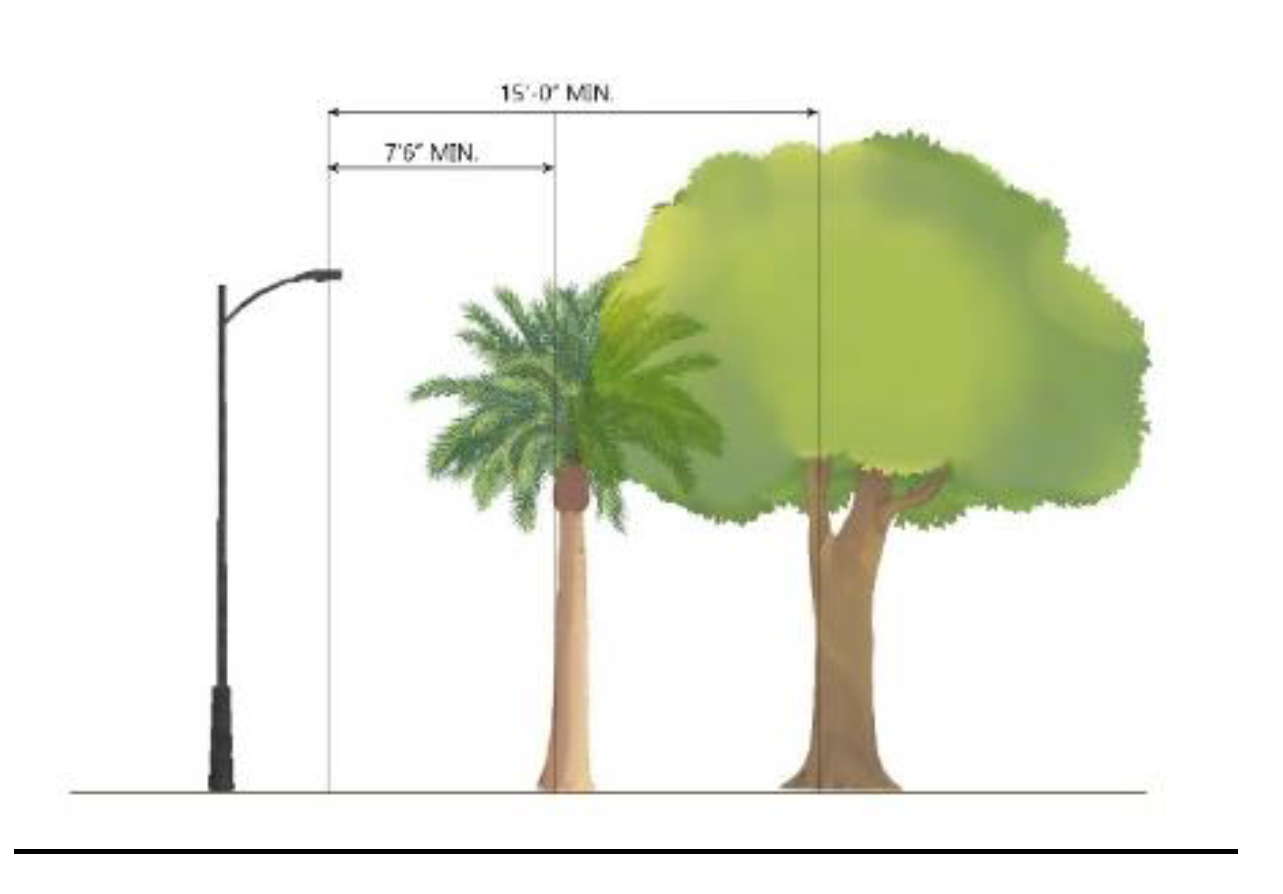
Growth of plant material at maturity shall be considered prior to planting, where future conflicts such as views, signs, overhead, above-ground and underground utilities, security lighting, fire access, drainage easements and traffic circulation, might arise. All shade trees must be located a minimum of fifteen (15) feet from street lights, and palms and small trees must be located a minimum of seven and one-half feet (7'-6").
10.
All shade trees installed within six (6) feet of public infrastructure shall utilize a root barrier system, as approved by the city.
11.
The community development department may grant written permission to allow the planting of trees or shrubs less than the required sizes outlined in this chapter upon written request from the Landscape Architect-of-Record. Written permission may be granted if the following is met:
(1)
Quality plants, such as Florida Department of Agriculture "Florida Fancy" grade, are used; or
(2)
A greater number of plants than the minimum number required by the ordinance are planted; however, the increased number of trees that may be required shall not exceed 25 percent of those otherwise required by this chapter.
12.
All property other than the required landscaped strip lying between the right-of-way and off-street parking area or other vehicular use area shall be landscaped with at least grass or ground cover.
13.
Turfgrass installation shall be completed by sodding and shall supply 100% coverage immediately upon installation.
14.
Wherein sod installation is impractical, the community development department may allow seeding or sprigging with prior written approval. Grass seed shall be clean and at least 90% weed free and free of noxious pests or diseases. The grass seed bags shall have Florida Department of Agriculture tags indicating compliance with the state's quality control program.
15.
The eradication of invasive and nuisance vegetation existing on site is required prior to the issuance of a certificate of occupancy. Ficus hedges may not be planted within utility easements.
16.
Ground cover may be used in lieu of sod and shall provide a minimum of 75 percent coverage immediately upon planting and 100 percent coverage within one growing season after planting.
17.
Vines shall be a minimum of thirty (30) inches in supported height immediately after planting and may be used in conjunction with fences, visual screens or walls.
18.
Shrubs shall be installed with a minimum height of 24 inches and spread of 18 inches immediately upon planting.
19.
Hedges, where required for screening purposes, shall be planted so as to be tip-to-tip within six months of planting and maintained so as to create a continuous visual screen with no visual spaces between plants at that time. Plant spacing may be adjusted according to plant sizes so long as the preceding is achieved.
20.
Small/ornamental trees shall be of eight feet overall planting height at time of installation. Trees with a multiple trunk growth characteristic shall have no more than three main trunks. All small trees shall have a minimum of 30 inches of clear trunk at the time of planting.
21.
Shade trees shall be a minimum of 12 feet overall planting height at time of installation. Only those shade trees specifically indicated as street trees on the City's preferred species list are permitted for street tree use.
22.
Hurricane-pruned Sabal palms are prohibited.
23.
All palms that have significant gray wood characteristics at maturity shall have a minimum of eight (8) feet of gray wood. All other palms must have an installed height of 16 feet overall.
24.
50% of the trees required shall be water-conserving, native plant material indigenous to Southern Florida. 50% of shrubs required shall be installed as native plant material.
25.
Trees in excess of five shall have no more than 30% of a single species.
26.
Utility equipment, utility structures, and garbage and refuse areas shall be screened with landscape material so areas are not visible from adjacent property or right-of-way.
27.
All elements of landscaping shall be installed to meet all other applicable City Code requirements and ordinances.
506.5.2. Non-living Landscape Material and Installation Standards
1.
A minimum of three-inch depth of approved organic mulch shall be installed around all trees and planting beds surrounding groundcover, shrubs, and hedges.
2.
Each tree shall have a ring of organic mulch at the perimeter of the root ball. No mulch shall be installed on top of the root ball.
3.
Cypress mulch shall not be allowed for installation. The use of mulch obtained from Melaleuca, Eucalyptus, or other invasive plant species, is encouraged to preserve native plant communities and reduce the impact on the environment.
4.
Topsoil shall be clean and free of construction debris, weeds, rocks, noxious pests, and diseases, and exhibit a pH of 6.5 to 7.0. The topsoil for planting areas shall be amended with horticulturally acceptable organic material. All soils used shall be suitable for the intended plant material. The source of the topsoil shall be known to the applicant and shall be acceptable to the city.
5.
The minimum planting soil depth shall be six (6) inches for ground covers, flowers, shrubs and hedges.
6.
Trees shall receive 12 inches of planting soil around the root ball.
7.
Native topsoil on the site shall be retained on-site and used when there is sufficient quantity to cover at least some of the on-site landscaped areas.
8.
Clean sand shall be used to backfill arid climate palms.
9.
If berms are utilized outside of the designated Miramar Parkway Scenic Corridor area, they shall meet the following standards:
(a)
Berms without hedges shall be a minimum of two feet in height and have a minimum slope of three-to-one (3:1).
(b)
Berms shall be smooth, transitional, without awkward grade changes, and shall be both undulating and meandering.
(c)
The height of a berm shall be measured from the grade of the adjacent paving on the public side (i.e., sidewalk, or road crown).
506.5.3. Irrigation
1.
All landscaped areas, including adjacent rights-of-way and street medians where they exist, shall be provided with an automatically operating underground irrigation system. The irrigation system must be designed to have a minimum of 100 percent coverage, with 50 percent minimum overlap.
2.
Irrigation systems shall be maintained to eliminate water loss due to damaged, missing or improperly operating sprinkler heads, emitters, pipes and all other portions of the irrigation system and shall not be installed or operated to overspray onto roads or pedestrian walkways.
3.
All irrigation systems shall install rain sensors which must be maintained in operable condition.
4.
All irrigation shall utilize non-potable water and shall include a treatment system to prevent rust stains/rust inhibitor. Irrigation heads near building facades and freestanding walls shall have sprinkler shields installed.
5.
All new developments and site improvement projects shall be required to connect with the city's water reuse distribution system where available.
6.
Exemptions: Properties planned and maintained as a Xeriscape landscape may be exempt from providing an automatically operating irrigation system with a waiver from the Community Development Department. As part of any such request, the applicant shall provide a 1-year temporary watering plan in a manner acceptable to the City and subject to quarterly inspections for 1 year.
506.6. Minimum Requirements - All properties
506.6.1. Street Trees. Street trees are required in addition to all other landscaping requirements and shall be planted at a minimum of 12 feet overall height with a spread of six (6) feet and a minimum of four and one-half (4-1/2) feet clear trunk immediately after installation.
a.
One tree shall be required for every 40 feet of street frontage less driveway openings and shall be a shade tree.
b.
The spacing of trees from electric utility lines must follow those guidelines established by the latest edition of the Florida Power and Light publication "Right Tree, Right Place." Trees shall be planted no further apart than 60-foot intervals and no closer than 15 feet apart.
c.
All street trees are to be placed in a location in accordance with the requirements of the city engineer in order to accommodate location of utilities and street widening and will require the use of root barriers to protect the sidewalk(s) and utilities from root damage or whenever trees are located within six feet from a paving edge. The root barriers shall be installed per manufacturer's recommendations.
d.
If insufficient rights-of-way exist or insufficient clear recovery zones exist for street tree installation, these requirements may be handled with an application from the Community Development Department.
As part of any such request, the applicant shall provide an alternative consisting of one or more of the following:
(1)
Donate an equivalent dollar value for the trees not planted to the city's tree trust fund for the landscaping of public property in the City of Miramar, which equivalent value shall include the cost of the trees and installation. This value is established at $450.00 for two and a half-inch caliper as amended from time to time.
(2)
Donate an equivalent number of trees to be installed on public property in the city of Miramar, which equivalent value shall include the trees and cost of installation and irrigation.
506.6.2. Perimeter Landscaping
1.
All properties shall comply with perimeter buffer yard width requirements provided in Table 506-1. Exceptions may apply to development within the Traditional Neighborhood Development (TND) and Transit Oriented Corridor mixed-use and special district zoning districts, as designated in this chapter.
2.
All properties shall provide perimeter landscaping to consist of three trees (one shade, 2 ornamental) for every 40 lineal feet.
3.
Distinct "view windows" may be created within the perimeter landscaping where significant public view is present. View windows are not to exceed 60' maximum spacing and shall not be within 100 feet of another view window. The remainder of the perimeter landscaping is to be planted at regular intervals to create a continuous streetscape pattern incorporating the view windows.

4.
A hedge, wall, or other durable landscape barrier shall be placed along the perimeter of the property planted a minimum of 3 feet in height where abutting an adjacent property and a minimum of 2 feet in height adjacent to rights-of-way. The remainder of the perimeter landscaping shall be covered with grass, ground cover, or other living landscape material.
5.
If the durable landscape barrier is of nonliving material, such as a wall or fence, then a hedge, vine or other living material shall screen the street side of the barrier.
6.
Perimeter landscape buffering requirements shall not apply to single-family and dual-family lots.
7.
Such perimeter buffers may not be counted toward interior landscape requirements.
Table 506-1: Perimeter Bufferyard width requirements1,2
1
Exception may apply to development within the Traditional Neighborhood Development
(TND) and Transit Oriented Corridor (TOC) mixed-use zoning districts, as noted below.
2
Except where the perimeter is subject to the terms of the Miramar Parkway Scenic Corridor
requirements.
506.6.3. Parking lots and Vehicular Use Areas. Parking lot landscaping shall be installed in landscaped areas designed and arranged for the purposes of controlling traffic, providing shade, screening unnecessary views into and within the vehicular use areas, and separating the parking circulation and service areas.
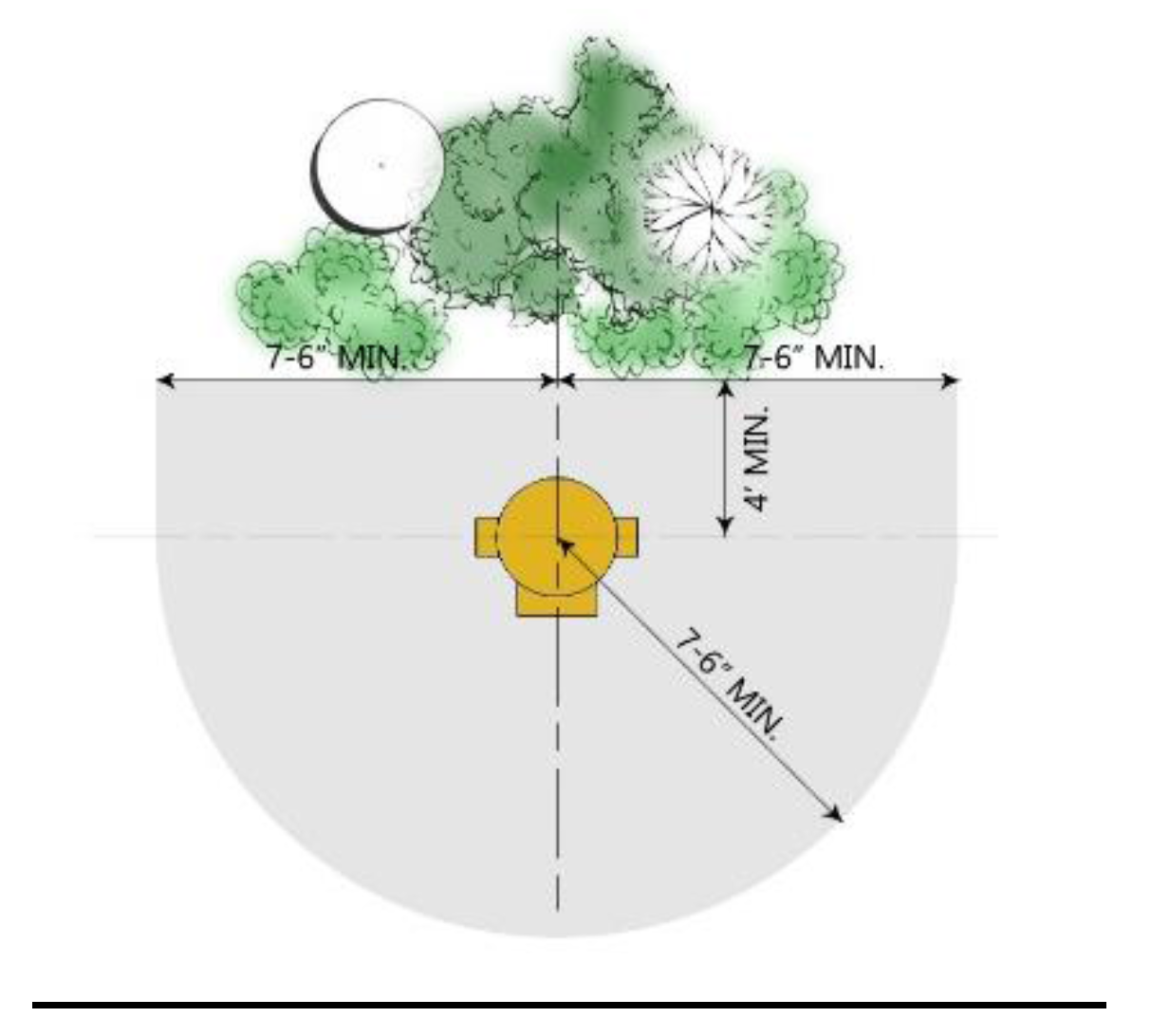
506.6.3.1. Landscape islands shall be as specified below and located at the ends of all parking rows and interspersed within the rows as required. Landscape islands shall not be located more than ten parking spaces apart but may vary if the average spacing for the entire parking lot of the property is ten parking spaces. Landscape islands shall measure a minimum of 10 feet wide from inside of curb to inside of curb. Additionally, islands are not required in truck yards.
(a)
Each landscape island shall contain at least one shade tree in the outer half of the landscape island. Islands created to accommodate utilities and fire safety equipment such as fire hydrants, Siamese connections, fire department connections and six-inch or larger double check valves must be at least 16 feet wide measured from back-of-curb to back-of-curb, and the water line to the appurtenance must be routed immediately behind the curb to accommodate the tree planting.
(b)
Islands shall be excavated to 36 inches and filled with clean fill and topsoil at least to the top of the curb.
(c)
A minimum of 75 percent of trees installed in parking islands or landscaped parking bay dividers shall be shade trees.
(d)
Required shade trees in parking lots must be planted in landscape islands which are a minimum of 12 feet wide, and 16 feet in depth as measured from back of curb to back of curb, except where they are located contiguous with a perimeter buffer or landscaped parking bay divider, in which case they may be ten feet in width as measured from inside curb to inside curb.
(e)
Landscaped areas abutting front-end parking and landscape islands shall be protected by continuous curbing type "D" or "F." Wheel stops may be used at perimeter parking at least two feet from the edge of such landscaped areas but are not required if the bumper overhangs of vehicles do not obstruct vegetation or pedestrian traffic within a 2-foot zone.
506.6.3.2. Fifteen percent (15%) of the total paved vehicular use area, not including truck yards or entry/exit drives or driveway openings, must be landscaped green space. Credit may be granted for landscaped green space located adjacent to the parking lot and not counted towards the minimum requirement for plot or perimeter bufferyards for the interior parking lot landscaped area requirement for small parking lots consisting of one double-loaded drive aisle or less.
506.6.3.3. Ten-foot wide landscaped parking bay dividers are required for every third bay for all parking lots containing 300 or more cars and may be provided to help meet the 15 percent interior parking lot green space requirement for smaller parking lots. However, if trees are planted in the divider to meet the tree requirement, the bottom of the landscape divider shall be not less than six (6) inches below the adjacent paving edge.
506.6.3.4. No landscaped area shall have any dimension less than five (5) feet with the exception of trees planted in paved areas with the use of a suspended pavement system.
506.6.3.5. All vehicular use areas shall be screened from the adjacent property with a continuous hedge except at points of vehicular and pedestrian ingress and egress. All landscaping shall be kept in a healthy growing condition at all times.
506.6.3.6. Other vehicular use areas shall conform to the minimum landscaping requirements herein provided, including areas used for parking or other vehicular uses and parking areas serving residential dwellings.
506.6.3.7.Temporary real estate sales structures and related parking area(s) requirements. The plot area(s) to be landscaped shall be the area of the sales structure and associated parking area plus the following:
(a)
Fifteen (15) feet on the sides, rear, and front of the proposed sales location, as measured from the side of the building or perimeter of the parking lot
(b)
Minimum plot size shall be 5,000 square feet
(c)
Three (3) trees and ten (10) shrubs shall be planted for every 1,000 square feet of plot area or fraction thereof.
506.6.4. Pedestrian Landscape Zones.
(a)
Principal buildings shall contain a pedestrian landscape zone along the full length of each building facade that fronts parking, drive aisles or other vehicular use areas (excluding truck courts/loading areas, and drive-thru and escape lanes).
(b)
The minimum required pedestrian landscape zone width is 10 feet and the maximum required width is 25 feet. Zone widths exclude any sidewalks parallel to the building.
(c)
Reserved.
(d)
The width of a pedestrian landscape zone, except for uses as indicated in Table 506-2, shall be 50 percent of the height of the building, or 10 feet, whichever is greater. Height for this purpose shall be measured to the top of a parapet wall or one-half of the roof height for a pitched roof.
(e)
Pedestrian landscape zones are not required in Rural, Single-Family Residential, Conservation or Utility zoning districts, as defined in section 401.
Table 506-2
1 Use of green walls, suspended pavement system, or alternative method may be used to meet the intent of the pedestrian landscape zone with approval from the Community Development Department.
(f)
One shade tree (or group of three palms, or one palm tree that qualifies for 1:1 usage), 15 shrubs, and 40 groundcover plants are required for every 60 lineal feet of the pedestrian zone.
(g)
Installed minimum amounts and sizes of trees and shrubs shall relate to the building height as per Table 506-3.
Table 506-3
1
One shade tree (or group of three palms, or one palm tree that qualifies for 1:1 usage)
is required along the frontage and sides that abut public parking. These trees can
be grouped where appropriate.
2
Unless there is an arcade or colonnade adjacent to the building façade.
506.6.5. Common Areas.
(a)
Common areas within residential zoning districts, such as amenity centers, project entries, and miscellaneous open spaces, including, but not limited to, tot lots and recreational areas, shall have a minimum of one shade tree and 20 shrubs for each 2,000 square feet of site area or portion thereof, not utilized for structures or vehicular use areas.
(b)
Active recreation play courts must be screened on all sides visible from adjacent property with a contiguous hedge at least two feet in height at time. Such plantings shall be outside the fence enclosure (where one exists) or a minimum of six feet off the court outside edge.
(c)
All ground-mounted equipment, including, but not limited to, electrical/mechanical equipment, storage areas, walls, fences, and common trash receptacles shall be screened from view using trees, shrubs, and/or hedges in addition to the common area requirement noted above.
(d)
Perimeter landscaping, street trees, irrigation, and sod, at a minimum, is required for all demolition projects in the city. All unbuilt parcels and outparcels must be treated with such landscaping prior to issuance of the first certificate of occupancy (C.O.) on the site or within 30 days of a completed demolition on land cleared for retail or office development. Retail and office outparcels which are not anticipated to be developed within one year may be sodded with Bahia sod without irrigation.
506.7. Minimum Requirements - Non-residential properties
506.7.1. Accessway landscaping. The intent of this section is to provide an enriched landscape at the public entrances to non-residential projects including industrial, office, and retail projects. The street tree requirement may be combined with the accessway planting requirements in the entryways to provide well-integrated design solutions. The following requirements are in lieu of the perimeter bufferyard requirement of three trees per 40 lineal feet with at least one being a shade tree, and a continuous hedge.
506.7.1.1. Accessway zone: The accessway zone extends from the paving edge of the entry drive (not radius) for a distance equal to half the right-of-way width of the roadway on both sides of the entry. The zone also extends perpendicularly 25 feet from the right-of-way of the adjacent roadway along the entry drive and includes medians where provided. A minimum zone length of 40 feet per side is required for rights-of-way of less than 80 feet wide.
506.7.1.2. Accessways affected: All accessways designed for public entry are included. Service drives used exclusively for service access are exempted from this regulation.
506.7.1.3. Planting requirements: The accessway zone requires two shade trees and four small trees per 40-foot section of the zone. The use of premium (1:1) palms is encouraged. Large shrubs may be substituted for the small tree requirement in the accessway zones. Entryway medians require three trees, as well shrubs or groundcovers which cover the entire zone. A minimum ten-foot wide planting bed containing low shrubs and/or ground cover must also be provided fronting the taller plantings in the accessway zone and must extend a minimum of five feet beyond the small tree/large shrub mass. Alternate design schemes that meet the intent of this section may be approved at the discretion of the Community Development Director.
506.8. Minimum Requirements - Residential properties
506.8.1. Single family Residential Properties. Shade trees are required per single family residential lot in addition to all other landscaping requirements and shall be a minimum of 12 feet overall height with a spread of six feet and a minimum of four and one-half feet clear trunk immediately after installation. The following requirements shall apply.
506.8.1.1. A cluster of 3 palm trees may be used to equal 1 shade tree. No more than 50% of required trees shall be palm trees to meet minimum shade tree requirements.
506.8.1.2. Minimum number of planting shall be determined by Table 506-4.
506.8.1.3. Fruit trees reaching a mature canopy spread of 30 ft. or greater may be used to meet minimum shade tree requirements with written permission from the Community Development Department.
Table 506-4
506.8.2. Multi-family Residential Properties. Shade trees are required in accordance with the pedestrian landscape zone requirements and Table 506-3. In addition, within play lots and passive recreational areas, 1 shade tree shall be planted per 250 square feet.
506.9. Minimum Requirements - Mixed-Use properties
506.9.1. TND. Landscaping in a TND is intended to reinforce community identity, minimize visual blight and noise, maintain building and property values, prevent soil erosion, reduce stormwater runoff, reduce air pollution, increase ground water recharge, create shade and reduce solar overheating. Landscaping requirements shall adhere to the requirements of this Chapter unless otherwise specified below.
(a)
A cohesive planting theme should emanate throughout the TND. Plantings layout and style should not conflict within the TND.
(b)
Shade trees are required in the planting areas along all streets, particularly in the absence of colonnades or awnings that provide shade directly over a sidewalk. It is desirable for street trees opposite each other to have their branches grow into each other to create a canopy effect over the street.
(c)
Bufferyards shall not be required adjacent to areas that would offer a natural extension of the TND or that are compatible with the TND as determined by the Community Development Director. This is meant to facilitate the interconnectedness of compatible uses.
506.9.2 TOCD. Development within the TOCD shall be exempt from full compliance of planting requirements of this chapter and required planting shall mainly be governed by this subsection.
(a)
Public Planting. Specifically, sites shall incorporate the design intent of the standards, but do not have to meet the particular planting requirements for accessways (Section 506.7.1), street trees (Section 506.6.1, other than noted in this section), pedestrian landscape zone (Section 506.6.4) and bufferyard width requirements (Section 506.6.2 and Table 506-1). If building setbacks of a minimum of 8 feet in width are achievable for perimeters other than the primary frontage, then bufferyard planting requirements shall apply. Building setbacks less than 8 feet in width shall not require shade trees. Shade trees shall be a minimum of 12 feet overall height, three inches of caliper, and six feet of clear trunk height at time of planting. Trees and landscape shall be required for streets, medians, squares, plazas, and private property in accordance with the following:
1.
Street trees shall be planted on both sides of the street except for a street on the undeveloped edge of the TOCD district. Depending on the street type, the planting area may contain the required landscaping, the required street trees, or a combination of both.
2.
Street trees shall be placed at a maximum average spacing of thirty-five (35) feet on center. Street trees shall have a minimum caliper of three (3) inches and a minimum clear trunk height of eight (8) feet at the time of planting. Palms require a maximum average spacing of twenty-five (25) feet. Street trees shall be planted in one or more of the following methods of installation:
(a)
Tree Grates: Trees shall be planted within openings in the sidewalk, which shall be covered by permanently installed grates perforated to permit natural irrigation and shall be flush with the surrounding sidewalk.
(b)
Tree Planters: Trees planted within a raised planter located on the sidewalk, shall be defined on all sides by a permanent masonry structure to consist of a minimum six-inch raised curb. The area within the planter, in addition to the required trees, shall be planted with ground cover, shrubs and other appropriate plant material.
(c)
Continuous Planting Strips: Trees planted in the area between the curb or roadway edge and the sidewalk shall include grass and ground cover. This option is not permitted along frontages where the ground story of buildings is occupied by storefronts. Street trees shall not be required where colonnades are provided and the swale area is less than eight (8) feet in width; however, if at least five (5) feet are provided, then planters and trellises may be substituted.
3.
Median Trees: Median trees shall have a minimum caliper of three inches and a minimum clear trunk height of eight feet at the time of planting and shall provide 100% canopy coverage within two years of installation.
4.
The required planting area width may be combined with the required sidewalk to expand the sidewalk beyond the required width. In this scenario, the street trees must be placed in tree grates with a suspended paver system specified for trees directly abutting the paved areas.
5.
At-Grade Parking Lots: Parking areas not covered by a parking structure shall meet the landscaping requirements of Section 506.6.3.
6.
All landscaped areas shall be continuously maintained in a good, healthy condition and sprinkler systems of sufficient size and spacing shall be installed to serve all required landscape areas, consistent with Section 506.12.
506.10. Minimum Requirements - Miramar Parkway Scenic Corridor
506.10.1. Intent and Purpose. The intent and purpose of the Miramar Parkway Scenic Corridor is to create an aesthetically pleasing transportation corridor. The ultimate goal of the Miramar Parkway Scenic Corridor is to create a greenbelt through the city. In recognizing the local and regional importance of Miramar Parkway as a major east-west transportation route in southwest Broward County, the city believes it is important to develop a scenic corridor which will be a distinct and aesthetically pleasing component of the City of Miramar Comprehensive Plan.
506.10.2. Dedication of Landscape Easements. Dedications for the landscape easement shall be shown on all plats, and designated on-site plans and developments of regional impact plans. The easement shall be dedicated in perpetuity for the purpose of landscaping. Said easement may include a drainage easement or utility easement, or both if such easement will not interfere with the requirements of the landscape easement as set forth herein.
506.10.3. Landscape Easement Development Standards. The following standards shall apply to the landscape easement. The requirements of this section shall supersede the requirements of the landscape standards of this Code. The minimum corridor width shall be thirty (30) feet along Miramar Parkway from Palm Avenue to Southwest 196 th Avenue. The requirements of this section shall be in addition of the required perimeter landscaping and street tree requirements.
506.10.3.1. Earth berm standards: Earth berms shall be employed to the extent possible within the landscape easement. In no instances shall less than 75 percent of the lineal frontage of the landscape easement along Miramar Parkway be devoted to berming.
506.10.3.2. The minimum height of the low point at the center of all berms shall be two feet as measured from the adjacent paving edge on the public side, and a minimum of four feet to the top. Berms shall be smooth, transitional, meandering, undulating, and large in scale.
506.10.3.3. Alternatives to Berming. In certain special circumstances and upon approval of the community development director, the aforementioned berming requirements may be reduced and replaced with low cement block structure walls, durable ornamental fences, or other appropriate landscape elements. Such alternatives should be designed to present a compatible appearance with the bermed areas. Walls, fences, or other approved landscape components shall be a minimum height of four feet above the ground adjacent to the landscape component and shall extend, singly or in combination with berming, along a minimum of 75 percent of the lineal frontage of the landscape easement on Miramar Parkway.
506.10.3.4. Minimum Planting Requirements:
(a)
Tree Requirement. The minimum number of trees shall be calculated based upon one tree for each 30 lineal feet, or a fraction thereof, of the landscape easement along Miramar Parkway. The width of accessways which intersect the easement shall be included in the calculation of lineal dimensions.
(b)
Spacing of Trees. Trees in the landscape easement may be planted singly or in clusters. The maximum spacing of trees shall be 75 feet between planted trees or clusters, except where a vista to a significant architectural or scenic amenity or signage is appropriate, in which case a wider spacing may be approved by the community development director.
(c)
Planting Standards for Trees. Trees shall be a minimum of 12 feet in height at the time of planting. Trees shall also have a minimum crown spread of six (6) feet and a minimum caliper diameter of two (2) inches at a height of four (4) feet above the ground.
(d)
Tree Types: A minimum of 75 percent of all trees required within the landscape easement shall be shade trees. A maximum of 25 percent of all trees required may be ornamental.
(e)
Native Trees: A minimum of 75 percent of all trees required within the landscape easement shall be of a native species to generally reduce water and maintenance needs.
(f)
Palms: Palms shall be installed in groups of no less than three palms. For the purposes of this section, each group of three palms shall be considered one tree. In the case of species of palms which characteristically grow in clumps, each clump shall be considered to be one tree.
(g)
Shrubs: Shrub clusters or hedges shall be required with the minimum number of shrubs calculated based upon one (1) shrub for each ten (10) lineal feet.
(h)
Shrub Spacing: Shrubs shall be planted either in clusters or in hedge formation, with a minimum of 8 shrubs in a group. Individual shrubs within clusters or hedges shall be spaced at a maximum of 30 inches on center and a minimum of 24 inches in height at the time of planting.
(i)
Landscape Treatment of the Ground:
(a)
Ground cover may be used within planting beds around trees and shrubs and shall provide a minimum of 50 percent coverage immediately upon planting and 100 percent coverage within two growing seasons after planting.
(b)
Mulch may be used within planting beds in lieu of, or in conjunction with, ground cover, and shall be renewed and maintained as required.
(c)
Areas not used for trees, shrubs, ground cover, mulch, or other landscape elements shall be planted with solid sod of a suitable species, such as Argentine Bahia or St. Augustine Floratam grass.
506.10.3.5. General Standards for Planting and Maintenance:
(a)
Quality of Plant Material: plants installed pursuant to this section shall conform with, or exceed, the minimum standards for Florida Number 1, as provided in the most current edition of "Grades and Standards for Nursery Plants, Parts I and II," prepared by the State of Florida Department of Agriculture and Consumer Services.
(b)
Continuing Maintenance: the property owner, homeowner's association or the owner's successors in interest, assignees or agents, shall be jointly and severally responsible for maintaining all landscaping in the easements in good condition and in a manner that presents a healthy, neat and orderly appearance.
(c)
Irrigation: All landscaped areas shall be provided with an automatically operating underground irrigation system designed to have a minimum of 100 percent coverage, with 50 percent minimum overlap in grass and groundcover areas and 50 percent minimum overlap in shrub areas.
(d)
Where the landscape easement abuts onsite vehicular use areas such as traffic lanes, it shall be separated from the traffic lanes by mountable, reinforced concrete curbing. Extruded curbing which has not been reinforced shall be prohibited.
(e)
Where the landscape easement abuts onsite parking spaces, it shall be separated from the parking spaces by anchored, concrete wheel stops or non-mountable, reinforced concrete curbing.
506.10.3.6. Setbacks and Width Variances: Setbacks shall be calculated from the ultimate right-of-way line of Miramar Parkway. The City Commission may vary the width of the landscape easement; however, no variance shall be granted that breaks the continuous nature of the landscape easement. The commission may grant a variance only after it finds existing site conditions which would make it a hardship for the landowner to strictly comply with the terms of this section. Existing site conditions which may warrant a variance include: the presence of water bodies; size limitations caused by an extraordinarily narrow lot depth or width; or other unique physical characteristics not created by the landowner. In no event, shall a variance be granted which reduces the width of the scenic easement by greater than 50 percent of that which is required in this section. The commission may grant a variance pursuant to this section only if the landowner provides additional landscape amenities, such as substantial increases in the minimum planting requirements within the landscape easement; additional landscaping in the roadway median along the Scenic Corridor on Miramar Parkway where needed, as determined by the city; or special landscape components, such as artistic elements or unique design features.
506.11 Minimum Requirements - Monument Signs
All monument signs shall be sufficiently landscaped to conceal the base and enhance the aesthetic value of the sign, not to obstruct its visibility or readability. Applicants are encouraged to exceed the minimum monument sign landscaping requirements required Table 506-5. The following requirements shall apply.
506.1.1. A minimum of one tree or three palms shall be provided per monument sign.
506.1.2. A combination of shrubs, ground cover, and/or annuals shall be used to enhance the design.
Table 506-5
1. For each additional 20 square feet, add one tree
506.12. Tree Care and Maintenance Standards - All Properties
506.11.1. All landowners, or their agents, shall be responsible for the maintenance of all landscaping including abutting rights-of-way, swales, lakes and canal banks. It shall be the responsibility of the adjacent property owner to maintain the swale area. Landscaping shall be maintained in accordance with the following standards:
(1)
Landscaping shall be free of debris and maintained in a good condition so as to present a healthy, neat and orderly appearance at least equal to the original installation and shall be mowed or trimmed in a manner and at a frequency so as not to detract from the appearance of the general area.
(2)
Landscaping shall be maintained to minimize property damage and public safety hazards, including removal of living, dead or decaying plant material, removal of low hanging branches and those obstructing street lighting and maintenance of clear sight distance standards.
(3)
Landscaping shall be kept free of visible signs of insects and disease and appropriately irrigated and fertilized to enable landscaping to be in a healthy condition.
(4)
Landscaping shall be maintained free of invasive and nuisance species. Privately owned natural areas shall be included in this requirement.
(5)
Grass and/or weeds cut no higher than six inches and all roadways, curbs, and sidewalks shall be edged to prevent encroachment from the adjacent turfed areas. Line trimmers shall not be used to trim turf abutting trees or other plant material.
(6)
In no case shall grass clippings, vegetative material, and/or vegetative debris be washed, swept, or blown off into stormwater drains, ditches, conveyances, water bodies, wetlands, or sidewalks or roadways. Any material that is accidentally so deposited shall be immediately removed to the maximum extent practicable.
(7)
Shrubs shall be kept trimmed to a height not to exceed three feet and provide unrestricted visibility at driveways and street intersections.
(8)
All developers, developer agents or contractors or their agents, and homeowners, must prune trees in accordance with standards set forth in American National Standards Institute (ANSI) A-300, and Z-133, current edition. If the pruning is tree abuse and causes tree removal, a permit for tree removal shall be required from the city and may be subject to fines as noted in section 506.19.
(9)
Tree root barriers shall be installed at the sidewalk edge in those circumstances where tree roots are causing or potentially causing a trip hazard because of lifting of some portions of a public sidewalk.
(10)
Removal of root systems which show evidence of destroying public or private property is required. Root barriers of appropriate depth shall be utilized in lieu of removal where upheavals do not create safety problems or structural damage to buildings.
(11)
It shall be the duty of the property owner to maintain the current approved landscape plan for the property including, but not limited to, replacing dead and poorly performing plant and other landscape material. Preserved vegetation which dies following the issuance of the certificate of occupancy shall be replaced with equivalent living material or trees. The city has the right to inspect all properties to ensure that landscaping has been properly installed, maintained, and irrigated in accordance with the approved landscape plan and require the property owner to make all appropriate corrections. Nuisance tree species are not required to be replaced.
(12)
The property owner has 90 days to replace all substandard and missing landscaping to ensure compliance with this section upon notice from the city. If unable to achieve scope of work within a 90-day period, an extension may be granted based on significant progress and communication with city landscape personnel.
506.13. Improper Maintenance and Tree Abuse - All properties
506.13.1. Any pruning performed without conformance to ANSI A-300 and Z-133 Standards shall be subject to enforcement by the city. Live palm fronds initiating above the horizontal plane, as defined in the above noted reference, shall not be removed. All tree pruners which provide services in Miramar shall hold a valid tree trimmer's license from Broward County, and a certified arborist must be onsite at all times.
506.13.2. The city may request that Broward County revoke a local business tax receipt (LBTR) in the event standards set this chapter are not met by the tree maintenance provider within the City of Miramar.
506.13.3. The removal of diseased or dead portions (such as palm fronds) of a tree or the removal of an interfering, obstructing or weak branch of a tree which is a threat to public safety or to adjacent property is allowed. Pruning to reduce or eliminate interference with or obstruction of street lights, stop signs or traffic signals is an example of an allowed pruning activity, provided tree abuse does not occur.
506.13.4. Lifting may be performed to eliminate a hazard to pedestrians or to protect the tree from vehicular damage only, not for visibility to signage in lieu of crown thinning. What is regarded as excessive is species dependent, however under no circumstances may the middle one-third of the overall height of the tree contain less than 50 percent of the foliage.
506.13.5. Failure to remove or properly prune a tree damaged by a natural disaster within 30 days shall be a violation.
506.13.6. The developer shall have trees damaged by construction repaired by a professional arborist in a manner acceptable to the city. The monetary value of the tree(s) before the damage and after the damage will be determined using the methodology established by the Council of Tree and Landscape Appraisers "Guide for Plant Appraisal," current edition. An additional fine equal to the difference in valuation between the before and after condition using the above noted methodology will be assessed in addition to the standard violation fine which does not exceed $500.00.
(a)
Immediate notification of city. The Community Development Department must be notified immediately after any damage to any tree damaged by construction operations.
(b)
Prompt repair. Such repairs as necessary shall be made promptly after damage occurs to prevent progressive deteriorations of damaged trees.
(c)
Removal and replacement of damaged trees. The developer shall remove trees which are determined by the Community Development Department to be incapable of restoration to normal growth pattern. Such trees shall be subject to replacement under the provisions of this code.
(d)
Any tree designated for preservation which is damaged by development activities in violation of this code (not including bonded trees in a dripline encroachment plan) and which dies as a result of this damage shall be subject to the tree replacement or removal requirements contained herein.
506.14. Tree Removal - All properties
506.14.1. Owing to the many benefits provided by trees, it is the intent of the City to protect this valuable resource through permitting for land clearing and tree removal. While the destruction of one tree may not have a significant environmental impact, there can be a significant deterioration of the quality of life with the removal of trees. In the evaluation of a tree removal permit, priority shall be given to protected trees for the preservation or relocation, replacement, and/or payment into the tree trust fund.
506.14.2. A tree removal/relocation permit (TRP) shall be required prior to any person, natural or corporate, cutting down, destroying, removing, relocating, destructively damaging, or causing any tree to be encroached upon (within the tree's dripline) for any tree two inches or larger in caliper, regardless of location. In the event that any tree shall be determined to be in a hazardous or dangerous condition so as to endanger the public health, welfare or safety, and requires immediate removal without delay, written authorization by email may be given by the Community Development Department and the tree removed prior to obtaining an issued permit as herein required.
506.14.3. Prior to the removal of any protected tree or any land clearing activity (to include potential wetlands area as designated on the City's "Floodplains and Wetlands" map of the Comprehensive Plan), a property owner or their designated agent shall obtain a permit from the community development department subject to the conditions of this Code and shall be responsible for obtaining the necessary permits from all jurisdictional agencies in addition to the permit required by this Code. Protected vegetation includes street trees, perimeter vegetation, vegetation in parking and vehicular use areas, historical trees, any tree in a city area of particular concern, any special status category tree, and any specimen tree.
506.14.4. Application for a TRP or land clearing permit shall be made to the city and shall include a legal description of the property and a map showing the size and location of the site where the tree removal or land clearing activities are to be conducted. A tree survey designating all trees over three inches in caliper which are proposed to be preserved, relocated, or removed shall be required.
506.14.5. A TRP shall not be issued for land clearing or tree removal unless one of the following conditions exists:
(1)
A site plan submitted by the applicant shows that a proposed structure, permissible under all applicable laws and regulations, can be situated on the subject parcel only if specific trees are removed or relocated; or
(2)
The tree is in such proximity to existing or proposed structures that the utility or structural integrity of such structures is materially impaired; or
(3)
The tree materially interferes with the location, servicing or functioning of public utility lines or service; or
(4)
The tree obstructs views of oncoming traffic or otherwise creates a substantial traffic hazard; or
(5)
The tree is diseased, injured, or in danger of falling; or
(6)
Any law or regulation requires removal of the tree.
506.14.6. Approved TRPs shall be granted for a maximum of 90 days, with an extension granted based on significant progress and communication with city landscape personnel.
506.14.7. The city has adopted a fee schedule that establishes the permit fees associated with the implementation of this section.
506.14.8. Exemptions: in accordance with State law, a permit shall not be required for the removal of a tree on residential property if and only if the property owner obtains documentation from an arborist certified by the International Society of Arboriculture or a Florida-licensed landscape architect that the tree presents a danger to persons or property and shall be exempt from replacement trees in accordance with this chapter.
506.15. Mitigation/Replacement All Properties
506.15.1. Credit for Existing Landscaping Materials. Existing trees may be credited as provided below in Table 506-6 toward required landscaping provided that they are designated for preservation on the final site plan and approved by the city. In no case shall trees located within areas required to be preserved by law be credited toward required landscaping.
506.15.2. Replacement Trees. A removed tree shall be replaced with its equivalent diameter inches at breast height (DBH). The replacement tree(s) shall be a species that has shade potential and other positive values at least equal to that of the tree being removed, and a native tree species must be replaced with a native tree species. Replacement trees shall be a minimum of 12 feet in height and two and one-half inches in caliper when planted. The value of specimen trees shall be established by the methodology contained in The Council of Tree and Landscape Appraisers "Guide for Plant Appraisal," current edition.
Table 506-6
506.15.3. On lots to be developed, trees within the building pad including areas reserved for driveways, shall be replaced on a caliper-for-caliper basis.
506.15.4. Optional Cash Payment. An optional cash payment equal to the fair market value of the required replacement tree(s) paid by the applicant after approval from the community development department staff that replacement of trees on-site pursuant to this subsection is not feasible.
506.15.5. If the trees are to be removed to facilitate construction or development activities, said relocation or replacement must be completed prior to the issuance of certificate of occupancy on the construction, development site or phase of development, as applicable. The trees to be relocated or replaced on-site or off-site on private property must be maintained in a healthy growing condition and guaranteed for a period of at least one year. Trees to be relocated or replaced on public property must be guaranteed. The guarantee period shall end one year from the date of acceptance by city staff.
506.16 Tree Trust Fund
506.16.1. Establishment. A tree trust line item (hereinafter referred to as the Miramar Tree Preservation Account or the "trust") is hereby established as a depository for tree removal fees and penalty money. Such money shall be utilized solely for the purpose of funding tree replacement on public property within the City of Miramar.
506.16.2. Term of Existence. The Miramar Tree Preservation Account shall be self-perpetuating from year-to-year, unless specifically terminated by the city commission.
506.16.3. Trust Assets. All money received pursuant to the provisions of this section from public or private concerns shall be placed in trust for the use and benefit of the City of Miramar and its successors and assigns in interest.
506.16.4. Trust Administration. Trust funds shall be expended, utilized and disbursed only for the purpose designated by the budget of the City of Miramar to administer the tree preservation program pursuant to this code.
506.16.5. Disbursal of Assets. Trust funds shall be used to obtain trees, landscaping, sprinkler systems and any other items or materials necessary and proper for the preservation, maintenance, relocation or restoration of tree ecosystems, on any public land in the City of Miramar. This money may also be utilized to engage support elements, such as landscape architects and may also be used to cover the expense of relocation of trees in the City of Miramar.
506.16.6. Exceptions. Disbursement of Miramar Tree Preservation Account funds may be used for the preservation, maintenance, or restoration of tree ecosystems on owner-occupied, single-family residential properties and right-of-way within the City of Miramar that meet criteria for the City's tree trimming program. The purpose of the tree trimming program is to assist residents with maintaining potentially hazardous trees and roots encroaching on existing infrastructure, power lines, homes or pavement.
506.17. Standards for Tree Protection During Development. The following are minimum standards necessary to protect trees designated for preservation from damage during development activities after the tree permit has been approved.
506.17.1. Protection of Existing Trees. Prior to any clearing of improved, vacant or unimproved land, unless specifically exempted from this section (including land designated for conservation by Broward County and/or the City of Miramar), existing trees shall have barriers constructed around them by the developer to prevent physical damage from heavy equipment and other activities incidental to development. Required barriers shall be subject to inspection by the city as a condition of permit approval and prior to any such clearing. The barriers or barricades shall be:
(a)
Large enough to include the entire area inside the outer edge or the dripline of the tree; and
(b)
Conspicuous and high enough to be seen easily by operators of trucks and other equipment; and
(c)
Constructed of sturdy, orange, plastic barricading as approved by the community development director based on professional judgment that the intent of this provision will be met.
(d)
Constructed as a condition of the issuance of any land clearing, building or other development permit and prior to any construction or other development activities and required to remain in place throughout the construction period. Barriers or barricades shall be completely removed from the site at the end of the construction period (immediately prior to the issuance of a certificate of occupancy by the city), unless otherwise stipulated in the approved tree preservation plan.
506.17.2. Clearing Trees and Vegetation.
(a)
Within the dripline of trees designated for preservation, only clearing by hand is permissible, unless otherwise stipulated in the approved tree permit.
(b)
Trees and vegetation cleared during construction or other development activities shall be stored in an area designated by the city with such area noted on the clearing and grubbing permit application.
(c)
All trees and vegetation cleared and stored pursuant to this section shall be removed within two weeks after completion of the clearing.
506.17.3.Other Required Protection of Trees and Understory. The developer shall protect the trees and understory plants designated for preservation in the approved tree permit from chemical poisoning, excavation and grade changes to at least the following minimum standards:
(a)
Utility line trenches shall be routed away from trees to an area outside the dripline to the maximum extent possible.
(b)
Retaining walls and dry wells shall be utilized, where needed, to protect trees from severe grade changes. For shallow fills, the fill material shall be gently sloped down to the level of the tree roots leaving the tree in a depression larger than the spread of its crown.
(c)
Parking, vehicle maintenance, storage of construction materials or debris, or cleaning of equipment shall not take place within areas marked for preservation specifically including, but not limited to, within the dripline of any individual trees. The developer or contractor shall establish regular parking and storage areas under the supervision of the city to facilitate compliance with the above standard.
(d)
Encroachment into any barricaded area is prohibited, with the exception of activities specifically permitted by the approved tree permit, including a dripline encroachment plan as established herein.
506.17.4. The developer shall be permitted to cut, or prune branches and roots of trees designed for preservation only under the supervision of a certified arborist in accordance with the standards for pruning, as established by the American National Standards Institute (Publication ANSI A-300 and Z-133).
506.17.5. Root System Protection. The root systems of trees shall be protected as follows:
(a)
Excavation within the Dripline: the community development department may approve a dripline encroachment plan (a request to excavate within the dripline of a tree) when included as part of a tree permit.
(b)
Standards for Root Protection: the city may establish additional standards for root protection consistent with this code. If roots are exposed, the developer shall provide temporary earth cover mixed with peat moss and wrapped with burlap to prevent exposed roots from drying out before permanent backfill is placed. The developer shall also water, maintain in moist condition, and otherwise temporarily support and protect the tree or root from damage until the tree or root is permanently covered with earth.
(c)
Protection of the Tree Root System: the developer shall protect tree root systems from damage due to noxious materials in solution caused by runoff, or spillage during mixing and placement of construction materials, or drainage from stored materials. The developer shall also protect root systems from flooding, erosion or excessive wetting resulting from dewatering operations.
506.17.6. Trees Damaged During Construction: The developer shall have trees damaged by construction repaired by a professional arborist in a manner acceptable to the city. The standard violation fine not to exceed $500.00 will be assessed for each tree damaged on site.
(a)
The community development department must be notified immediately after any damage to any tree damaged by construction operations.
(b)
Such repairs as necessary shall be made promptly after damage occurs to prevent progressive deteriorations of damaged trees.
(c)
Removal and Replacement: the developer shall remove trees which are determined by the city to be incapable of restoration to normal growth pattern. Such trees shall be subject to replacement under the provisions of this code.
(d)
Any tree designated for preservation which is damaged by development activities in violation of this code (not including bonded trees in a dripline encroachment plan) and which dies as a result of this damage shall be subject to the tree replacement or removal requirements contained herein.
506.17.7. Exemptions:
(a)
Licensed plant and/or tree nurseries shall be exempt from the terms and provisions of this article only in relation to those trees planted and growing on site for wholesale and/or retail sale purposes in the ordinary course of said licensee's business.
(b)
All governmental and private nurseries, with respect to trees which have been planted and are growing for future relocation, are exempt from this section.
(c)
During emergency conditions caused by a hurricane or other natural disaster, or to protect the public safety, the provisions of this section may be suspended by direction of the city manager.
(d)
Nuisance trees, as defined herein, are exempt from the provisions of this section except for pruning standards and the requirement to obtain a permit prior to their removal. However, no fee shall be assessed for this removal permit.
(e)
Trees destructively damaged or destroyed by an act of God or an act of war as well as small trees which are less than three inches in caliper are exempt from this section.
(f)
Trees already planted on vacant residential property may be relocated but not subjected to dripline encroachment. A TRP is required for relocation of all trees with a DBH of 3 inches or larger. All tree removal shall require a permit pursuant to this section.
506.18. Appeals and Variances
506.18.1. Appeals. Appeals from the decision of the Community Development Director regarding compliance with any landscaping provisions, other than those in sections 506.6, 506.7, 506.9, or 506.10 shall be filed in accordance with procedures established in subsection 315.11-13.
506.18.2. Variances. Variances from provisions in sections 506.6, 506.7, 506.9, or 506.10 shall be filed in accordance with procedures established in subsection 315.1-9, unless the request may be resolved by mitigation methods through the DRC process or addressed through an administrative variance procedure in subsection 315.7.
506.19 Fines
506.19.1. Permits. Landscape permits are required for all landscaping done in the City of Miramar with the exception of existing single-family homes that are not part of a planned community on individual lots. All planned residential developments must obtain a landscape permit for the individual lots, and a separate landscape permit for the common areas including the street trees.
506.19.2. Enforcement. City staff enforces the terms of this chapter by making necessary inspections. This includes promptly stopping any work attempted to be done without, or contrary to, any development approval required under this code, and ensuring that any work not performed in accordance with a development approval is corrected to comply.
506.19.3. Violations and Penalties. Each violation of this code, or any of its subsections, is deemed a separate and distinct infraction of the Land Development Code. Each violation of this code shall be punishable by a fine of $500.00 plus the cost of replacement of the trees removed from the site, the costs associated with investigation and prosecution, together with the cost of replacement tree(s) as established in section 506.6. The removal, relocation or destruction, including dripline encroachment, of each tree in violation of this code shall constitute a separate offense under this code. Each tree to be protected may be the subject of individual enforcement. The owner of any property where a tree or trees have been cut down, destroyed, removed, relocated or destructively damaged shall be held strictly liable for a violation of this code unless it can be proven that the damage was caused by:
(a)
An act of God;
(b)
An act of war;
(c)
Development activities on the property pursuant to an approved tree permit; or
(d)
The owner alleges that the damage was caused by vandals or trespassers and the owner of the property has filed a police report for the incident and had taken reasonable security measures to prevent unauthorized access to the property.
506.19.4. Stop-work Order. The city reserves the right to issue an order to cease and desist any work being performed in violation of this chapter or any permit conditions established under this code. Upon notice of such violation, no further work shall take place until appropriate remedial action is instituted, as determined by the city.
506.19.5. Withholding or Revocation of City Permits. Failure of any party to follow the procedures as required by this code shall constitute grounds for withholding or revoking development approval(s), building permits, occupancy permits or any other city approvals necessary to continue development. Such extraordinary sanctions, however, shall be instituted immediately upon the direction of the city manager and with the approval of the city commission at its next regular or special meeting. This approval shall be considered a public hearing and be subject to the applicable procedural requirements. All interested parties shall have notice and an opportunity to be heard and to be represented by legal counsel.
(Ord. No. 20-13, § 2(Exh. A), 6-17-20; Ord. No. 20-14, § 2(Exh. A), 6-17-20)

