
Miramar City Zoning Code
CHAPTER 8
DEVELOPMENT STANDARDS OF GENERAL APPLICABILITY
Sec. 801.- Development Standards.
All development shall conform to the specific requirements of the appropriate zoning districts and shall comply with the standards contained in this chapter and other regulations outlined in this Code. These standards shall be considered to be minimum requirements. In considering development plans, the development review committee, community appearance board, planning and zoning board and city commission shall be guided by the standards set forth hereinafter.
(Ord. No. 20-13, § 6(Exh. E), 6-17-20)
Sec. 802. - Subdivision Design Standards.
In considering plans for the subdivision of land, the appropriate review bodies shall be guided by the standards set forth hereinafter. These standards shall be considered to be minimum requirements.
802.1. General.
802.1.1. Character of land. Land to be subdivided shall be of such character after development that it can be used safely for the intended purposes without danger to health or peril from fire, flood or other menace.
802.1.2. Conformity to the trafficways plan, and the comprehensive plan. Subdivisions shall conform to the Broward County Trafficways Plans and shall be in harmony with the city's comprehensive plan. Trafficways shall conform to the criteria and characteristics established by and shown on the Broward County Trafficways Plan.
802.1.3. Specifications for required improvements. All required subdivision improvements shall be constructed or installed to conform to the city specifications, a copy of which is on file with the director of public works/utilities.
802.1.4. Street capacities. Street capacities shall be determined by standards established by the Florida Department of Transportation, the basis of which is the Highway Capacity Manual prepared by the Transportation Research Board of the National Research Council, Washington, D.C. and shall provide a L.O.S. adopted by the Miramar Comprehensive Plan.
802.1.5. Sidewalks. Sidewalks shall be provided on both sides of public or private street right-of-way. Within areas zoned Industrial sidewalks shall not be required. All interior private sidewalks shall connect with the sidewalks in the right-of-way. Handicap ramps not exceeding a slope of one foot vertical to 12 feet horizontal shall be provided at all intersections.
802.1.6. Traffic engineering standards. The more stringent of either the Florida Department of Transportation or Broward County Traffic Engineering Division Regulations shall apply in all cases.
802.2. Street Layout.
802.2.1. Width, location and construction. Streets shall be of sufficient width, suitably located, and adequately constructed to accommodate the prospective traffic at the adopted level of service identified in the city's comprehensive plan, and to afford access for fire fighting and road maintenance equipment.
802.2.2 Arrangement. The arrangement of streets shall be such so as to compose a functional system which provides safe and adequate access to and from private property and which causes no undue hardship to adjoining property. The arrangement of streets in the subdivision shall provide for the continuation of arterial and collector streets of adjoining subdivision, and for proper projection of arterial and collector streets into adjoining properties which are not yet subdivided, in order to take into account possible necessary fire protection, movement of traffic and the construction or extension of needed utilities and public services.
802.2.3. Access to streets. Development projects shall be designed to maintain a hierarchy of street access so that the interior of development parcels are served by local streets or parking lots, local streets and parking lots shall be connected to collector streets or arterial streets where permitted, and collector streets shall be connected to arterial streets or other collector streets as provided for herein.
802.2.4. Driveway access. Residential lot driveways shall only access local streets. Residential parking lots may access local, collector or arterial streets provided adequate turn lanes and vehicle storage areas are provided and the street being accessed has sufficient capacity to accommodate the traffic. Nonresidential development shall only access collector and arterial streets. The minimum spacing between driveways shall be as provided for in section 804, Driveway Standards.
802.2.5. Local streets. Local streets shall be so laid out that their use by through traffic will be discouraged.
802.2.6. Street connections. Nonresidential development with parking for 20 or more vehicles and residential property with 20 lots or more shall have connections with at least two publicly accessible streets which shall exist prior to the issuance of certificates of occupancy. In lieu of the two required connections, one connection may be permitted if adequate provision for emergency and service vehicles is provided.
802.3. Minimum Intersection Spacing
802.3.1. Local street intersections with collector and arterial streets. Local street or cul-de-sac openings into collector streets shall be a minimum distance of 660 feet from another intersection, or in the case of a T-type intersection, a minimum distance of 330 feet from any other intersection. Local streets and local dead-end streets may not intersect an arterial unless unavoidable in which case the local street may intersect an arterial only if aligned with and extending an existing local street which intersects the arterial or is a minimum of 660 feet from another minor or collector street intersection with the arterial, and is a minimum of 760 feet from the intersection of two arterial streets.
802.3.2. Collector street intersections with arterial streets. A collector street or collector dead-end street may intersect an arterial if aligned with and extending an existing or planned collector which intersects the arterial or is a minimum distance of 1,320 feet from the intersection of an existing collector and the arterial, and is a minimum distance of 1,420 feet from the intersection of two arterial trafficways.
802.3.3. Intersection of two collector streets. A collector street may intersect another collector but only if aligned with and extending an existing or planned collector or is a minimum distance of 660 feet from any other intersection of the collector.
802.3.4. Intersection of two arterial streets. The spacing requirements for the intersection of two arterial streets shall be as provided for by the Broward County Land Development Code, as amended.
802.4. Street Design.
802.4.1. Geometric design of street. The geometric design of streets shall conform to the minimum standards established by the Manual of Uniform Minimum Standards for Design, Construction and Maintenance for Streets and Highways, prepared by the Florida Department of Transportation and A Policy on Design of Urban Highways and Arterial Streets prepared by the American Association of Street Highway and Transportation Officials (AASHTO).
802.4.2. Street jogs at intersections. Street jogs with centerline offsets of less than 125 feet shall not be permitted.
802.4.3. Angle of intersection. In general, all streets shall join each other so that for a distance of at least 100 feet the street is approximately at right angles to the street it joins. This requirement may be modified for the intersection of two local streets if it can be shown that an alternate design will meet minimum safe site distance requirements.
802.4.4. Widths of rights-of-way. Streets shall have the minimum widths as specified in Table 802-1. When not indicated functionally classified by the FDOT, the classification of streets shall be determined by the community development director. The actual width of a right-of-way shall be determined based on the ultimate cross section design needed to accommodate the projected level of traffic at the adopted level of service. Additional right-of-way may be required for a bicycle lane, in compliance with a city or county bicycle circulation plan.
TABLE 802-1
Widths of Public and Private Rights-of-Way
1 A pedestrian/bicycle path which is a minimum of six (6) feet wide and constructed within the right-of-way, or an easement adjacent to the right-of-way, may be used in lieu of the required sidewalk on that side of the right-of-way within private residential developments. The back of sidewalk shall coincide with the right-of-way line for public or private roadways.
2 Applicable only to site developments greater than five (5) acres.
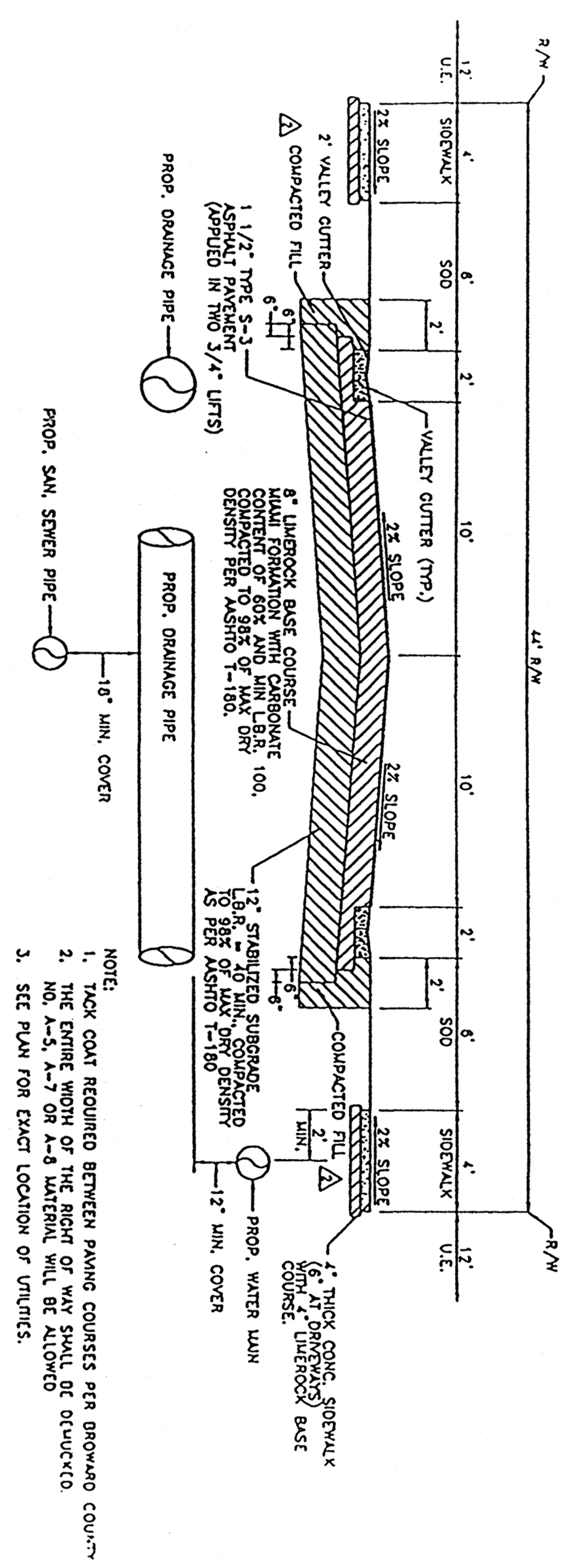
Drainage Pipe Image
802.4.5. Public utility easements. Where conditions are such as to make impractical for the inclusion of utilities within the street right-of-way, perpetual easements with satisfactory width and access, as determined by the city, shall be required. Wherever possible, easements shall be continuous from block to block and shall present as few irregularities as possible. Side yard easements containing underground pipes are discouraged. However, in such cases when necessary said easements shall be 20 feet wide minimum or greater as determined by the public works/utilities director. Such easements shall be cleared, demucked, and graded where required.
802.4.6. Underground utilities. All facilities for the distribution of electricity, telephone, and cable television shall be installed underground in new subdivisions. Appurtenances such as transformer boxes, pedestal mounted terminal boxes and meter cabinets may be placed above ground on a level concrete slab and shall be located in such a manner to minimize noise effects upon the surrounding properties. Such appurtenances shall be landscaped in accordance with the landscape requirements outlined in this Code. Street lighting poles and fixtures may be placed above ground. Primary transmission lines carrying in excess of 7,000 volts single phase or 12,000 volts three phase may be suspended above the surface.
New pole lines located within or adjacent and parallel to a road right-of-way which serve new developments shall be constructed of reinforced concrete. At the time of development the city shall require replacement of existing wood poles with concrete poles. The city manager may waive this requirement if an undue hardship would result from this requirement.
802.4.7. Grades. Longitudinal slopes of all streets shall conform in general to the department of transportation standards for arterial, collector or local streets. Grades shall be approved by the director of public works/utilities.
802.4.8. Curve radii at local street intersections. All local street right-of-way lines at intersections shall be rounded by curves of at least 25-feet radius.
802.4.9. Dead-end streets (culs-de-sac). Dead-end streets exceeding 150 feet, shall have a turning area and be of a type and size approved by the DRC. Dead-end streets exceeding 300 feet shall terminate in a circular turn-around having a minimum right-of-way radius of 60 feet and pavement radius of 40 feet. At the end of temporary dead-end streets a temporary turnaround with a pavement radius of 35 feet shall be provided, unless the director of public works/utilities approves an alternate arrangement.
802.4.10. Watercourses. When a street is proposed to abut any canal, or a water body, provision shall be made for adequate safe vehicular recovery area between the ultimate edge of right-of-way and the edge of water. The distance from the outside edge of the ultimate right-of-way to the edge of water shall be no less than 50 feet for roads with a design speed of 50 mph or greater and 40 feet for roads with a design speed less than 50 miles per hour. A guardrail shall be required for lakes and canals where it is not possible to maintain these required minimum distances.
802.4.11. Curve radii. In general, street lines within a block, deflecting from each other at any one point by more than ten degrees, shall be connected with a curve, the radius of which for the centerline of street shall not be less than 400 feet on arterial streets, 200 feet on collector streets and 100 feet on local streets.
802.4.12. Half streets. The platting of half streets along the edge of a subdivision shall occur only in accordance with the trafficways plan and shall be a minimum of 50 feet in width. Platting of a narrow reserve strip (spite strip) along the edge of a subdivision shall not be permitted.
802.4.13. Private streets. Private local streets may be permitted by the city when the design and construction of such streets meets or exceeds the minimum standards and specifications as outlined or referred to herein for public streets; and when a method suitable to the city is established for the perpetual maintenance of said private streets by developer or by the development's homeowners association and with the provision of a permanent access easement for service and emergency vehicles, maintenance and repair of public and semi-public utilities and common area improvements. Sidewalks and setbacks along private streets shall be from the theoretical right-of-way line. Notwithstanding anything to the contrary in this Code, no private streets shall be permitted by the city unless the owner of the private streets executes an agreement with the city whereby the city is authorized to enforce the city's traffic and parking ordinances and regulations over the private roads.
802.4.14. Street lights. Installation of street lights shall be required in accordance with design standards of Florida Power and Light and an approved site plan and shall be approved by the director of public works/utilities.
802.4.15. Inverted crowns. Inverted crown roadways shall not be permitted on public or private streets. This limitation shall not apply to private parking lots or private driveways within multifamily development.
802.5. Addresses.
802.5.1. Type of name. All streets shall be numbered in accordance with a numbering system approved by the U.S. Post Office and community development director. All streets shall have a sign displaying the street number. Street signs shall have reflective type lettering meeting Broward County standards.
802.6. Lots.
802.6.1. Lots in conformance with zoning district. Lots shall be subdivided in conformance with the applicable zoning district's development standards.
802.6.2. Side property lines. All side property lines of lots shall be at right angles to straight street lines and radial to curved street lines.
802.6.3. Driveway access. Driveway grades and access shall conform to city specifications and the requirements of this section.
802.6.4. Frontage on curve or cul-de-sac. The minimum arc frontage for lots abutting the turnaround of a cul-de-sac shall be 25 feet for residential uses and 60 feet for nonresidential uses.
802.7. [Reserved.]
(Ord. No. 13-15, § 3, 8-21-13; Ord. No. 18-07, § 19, 3-7-18; Ord. No. 20-09, § 3(Exh. B), 3-18-20)
Sec. 803. - Architectural Design Standards.
803.1. Design Concepts. The principles set out below are not intended to limit innovative architecture, but to establish a meaningful design guide for development and redevelopment in the City of Miramar. All development shall be designed in accordance with the fundamental concepts described in this section. The fundamental design concepts shall include:
(a)
The design of architecturally varied structures within planned developments through the use of building massing, varied roofscapes, varied window design, ornamentation and color; and
(b)
The linkage of landscaped exterior spaces (courtyards, loggias, arcades and plazas) to buildings; and
(c)
The linkage of separate development parcels by pedestrian and vehicular connections; and
(d)
The recognition of the South Florida climate which should influence building shape and orientation, nature of roofs and overhangs and the location and size of windows; and
(e)
The identification of individual subdivisions by utilizing signage; and
(f)
The use of private common open space as a community design feature.
803.2. Pedestrian Orientation. All nonresidential and multifamily development shall contribute to the creation of a pedestrian oriented community by providing the following:
(a)
Emphasis on the buildings' street facades as major elements of the overall street-scape; and
(b)
Street level architectural treatment including colonnades, arcades, awnings, and other shade producing elements should be provided along all pedestrian-oriented frontages.
(c)
Pedestrian oriented frontages shall be adjacent to building entrances and integrated with adjacent properties.
803.3. Minimum Design Standards.
803.3.1. Nonresidential Development. All nonresidential development shall be consistent with the traditional architecture and design themes of South Florida including the following:
(a)
New buildings shall be designed in a manner that is compatible with and respects the adjacent building(s) in height and scale.
(b)
Recognition of the scale and character of adjacent structures or developments, including continuation of existing facade treatment or expression lines, and the use of similar finish materials, where appropriate.
(c)
Minimum roof standards: Pitched roofs shall be constructed of durable materials consistent with Florida Building Code requirements and compatible with the architectural design of the building(s). Cedar shingle and asphalt shingle roofs are not permitted on any principal non-residential structure permitted after the effective date of this Code.
(d)
All mechanical equipment (including roof-mounted equipment) shall be screened with materials consistent and architecturally compatible with those used in the construction of the building. The screening shall be high enough so that the equipment is not visible from a point 5.5 feet above the crown of any adjacent public right-of-way or waterway.
(e)
Pedestrian circulation systems shall be barrier-free and provide alternative ramps in addition to steps consistent with American Disabilities Act (ADA) requirements.
(f)
All sides of any nonresidential structure shall have compatible facade and roof treatments.
(g)
All dumpsters and trash handling areas shall have a concrete slab, and an enclosure composed of a finished masonry wall with opaque gates, and shall have hedges planted on the outside of the walls which do not have the gated opening, as well as trees, whenever feasible. Dumpsters shall be oriented in a logical fashion so as to minimize truck maneuvers. All such facilities shall be a minimum of 25 feet from a residential structure. Exemptions from the design standards noted here are permitted only when compliance with the Code is not feasible due to space requirements and physical impediments.
803.3.2. Residential Development. All residential development shall adhere to the following standards:
(a)
Minimum Roof Standards: Pitched roofs shall have a minimum pitch of 2:12. Pitched roofs shall be constructed of durable materials consistent with Florida Building Code requirements and compatible with the architectural design of the building(s). Cedar shingle and asphalt shingle roofs are not permitted on any principal residential structure permitted after the effective date of this Code, except for single-family and duplex dwellings located within plats recorded prior to March 1996, or within the unrecorded subdivision of Tropical Valley. Flat roofs may be permitted if the flat roof area does not comprise over 25 percent of the total roof area. Such flat roofs may be permitted over porches, Florida rooms, and utility rooms located to the rear of the dwelling unit. Homeowners are hereby advised that new roofs on buildings that are located within a homeowner or condominium association may be subject to that association's approval for a different roof material.
(b)
New and replacement of existing driveways within all RS and RM zoning districts shall be constructed of Portland concrete at a minimum. Asphalt is not permitted; however, for lots platted before March 1996 or lying within the unrecorded subdivision of Tropical Valley, which may have an original asphalt driveway may pave to asphalt as part of normal maintenance, but must be removed and repaved with a hard, dust-free paving material if said driveway is enlarged, altered or replaced, and provided that the driveway meets current side setback requirements.
(c)
Anti-monotony provision: No two houses having the same elevation in any residential single (RS) family zoning district shall be built side by side or directly across the street from each other, nor have an identical exterior color package.
(d)
Architecture and site development should incorporate consideration of the subtropical characteristics of the area. The provision of sun-control devices, shaded areas, vegetation, roof terraces, and similar features characteristic of subtropical design is encouraged.
(e)
Open space for multi-family dwelling units should be located and designed to maximize its utility to the dwelling units.
(f)
All multi-family buildings which abut or are separated by a street or water body from an existing or proposed single-family district shall have hip or gable roofs or a flat roof with raised parapet that adequately screens any rooftop equipment.
(g)
All dumpsters and trash handling areas shall have a concrete slab, and an enclosure composed of a finished masonry wall with opaque gates, and shall have hedges planted on the outside of the walls which do not have the gated opening, as well as trees, whenever feasible. Dumpsters shall be oriented in a logical fashion so as to minimize truck maneuvers. All such facilities shall be a minimum of 25 feet from a residential structure Exemptions from the design standards noted here are permitted only when compliance with the Code is not feasible due to space requirements and physical impediments.
803.3.3. Pedestrian/bicycle paths. Pedestrian/bicycle paths incorporated into a plan shall have six feet of pavement width within a minimum 20-foot landscape easement. The path shall be a minimum of ten feet from a right-of-way, except where it transitions and crosses an intersecting street. The path shall not be incorporated into a residential lot. The path shall connect all the residential parcels to park(s) and school(s).
(Ord. No. 03-22, § 3, 9-17-03; Ord. No. 18-07, § 20, 3-7-18; Ord. No. 20-09, § 3(Exh. B), 3-18-20)
Sec. 804. - Driveway Standards.
804.1. Design. Driveway locations, cross-sections and grades shall be in accordance with this section, approved engineering plans, Chapter 23 of the Code of the City of Miramar, and the South Florida Building Code (Broward edition) as amended from time to time. Driveway access to the street system shall be according to the subdivision design standards, street layout contained in this Code.
804.2. Intersection with Streets. Driveways for residential lots shall not encroach into the street corner radius of two intersecting streets, or be closer than 25 feet to the intersection of extended right-of-way lines. Driveways for multi-family and nonresidential parking lots shall not intersect a street corner radius, or be closer than 50 feet to the intersection of extended right-of-way lines.
804.3. Separation between Driveways.
804.3.1. Residential Lots. Driveways for single-family residential lots shall be separated by the minimum distance required in section 804.6, Proximity to Property Lines.
804.3.2. Multi-Family and Nonresidential Parcels. Driveways for multi-family residential parcels and nonresidential parcels on collector roads shall be separated by no less than 150 feet of landscaped frontage. Driveways for multi-family residential parcels and nonresidential parcels on arterial roads shall be separated by no less than 330 feet of landscaped frontage or the distance required by the Broward County Land Development Code, section 5-192(b) as may be amended, whichever may be greater.
804.4. Maximum Width. The maximum width of pavement in a swale is provided for in section 23-5 of the Code of the City of Miramar, as amended. The maximum width of any driveway measured at the right-of-way line shall not exceed the following:
(a)
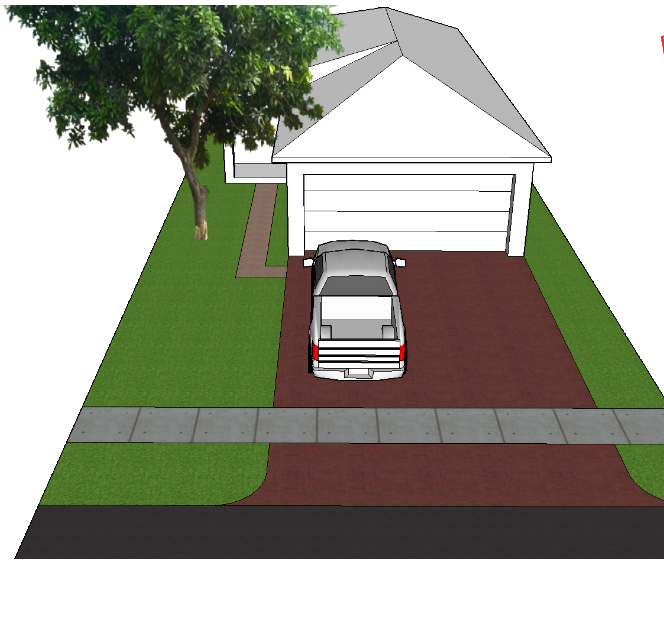
Single-Family and Duplex Residential Property. The maximum width of any driveway - measured at the right-of-way line - shall not exceed the regulations in Table 804-1. Circular driveways must have a minimum width of 8 feet and must not exceed 15 feet of width. The interior arc of a circular driveway may be an irregular shape but shall have a minimum diameter of 10 feet. The interior arc shall be landscaped with living plant material, including a shade tree as per the Landscape section of this code. (a) A second straight-in driveway may be permitted on single family and duplex residential lots located on a corner parcel or a lot with access to a secondary right-of-way. However, the combined total width on both driveways shall be limited to the maximum driveway width, as per Table 804-1.
(b)
Multifamily Residential and Nonresidential Property. The total number of driveways allowed and width of those driveways shall be limited to the number allowed by the plat or the approved site plan.
TABLE 804-1
804.5. Minimum Size. Driveways for single-family and duplex structures in all residentially zoned districts shall have minimum paved dimensions per parking space of eight feet in width and 18 feet in length (clear of sidewalk).
804.6. Proximity to property lines. Except for fee simple attached residential and joint use accessways, driveways shall not be located closer to a property line than the following:
(a)
Single-Family and Duplex Residential Property. 5 feet (rectangular lots); 2.5 feet (pie-shaped lots).
(b)
Multifamily Residential Property. 10 feet or the minimum bufferyard requirement contained in this Code, whichever is greater.
(c)
Nonresidential Property. The width of a required bufferyard, or if no bufferyard is required, 10 feet to another nonresidential parcel or 15 feet to a residential parcel.
(d)
Zero-Lot Line Property. 10-foot separation between driveways.
804.7. Paving. Except as provided for below, driveways shall be paved with a hard, dust-free paving material complying with the Florida Building Code. All new single-family and two-family residential dwellings shall use concrete, brick pavers, pervious materials, or similar non-asphalt material. All other uses shall provide concrete driveway connections (aprons).
Exceptions:
• Uses permitted to provide grass overflow parking.
• Single-family lots over one acre in area.
• Lots platted before March 1996 or lying within the unrecorded subdivision of Tropical Valley.
804.8. Clear Sight Triangles. All driveways and street intersections shall provide clear sight triangles in both directions as follows:
804.8.1. Measurement. Clear sight triangles on both sides of all driveways, medians and at all street intersections shall be measured as follows:
(a)
Two major streets. 30 feet along the right-of-way line from the intersection of two major streets.
(b)
Major street/local street. 25 feet along the right-of-way line from the intersection of a major street with a local street.
(c)
Two local streets. 25 feet along the right-of-way line from the intersection of two local streets.
(d)
Driveway/major street. 25 feet along the right-of-way line from the intersection of a driveway with a major street.
(e)
Driveway/local street. Ten feet along the right-of-way line from the intersection of a driveway with a local street.
(f)
No parking areas shall be permitted within clear sight triangles.
(g)
Spacing of Driveways from Intersections. Single-family and duplex residential driveways shall be spaced a minimum of 25 feet from the intersection of a street or alley. This distance shall be measured from the intersection of the property lines or their extensions to the nearer edge of the driveway along the property line.
804.8.2. Landscaping and Above-Ground Infrastructure. The area within any clear sight triangle shall be planted and maintained in a way that provides clear visibility from a height of 30 inches to a height of eight feet above the crown of the street. Vegetation shall be trimmed so that no limbs or foliage extend into the required visibility area. Above-ground infrastructure, such as catch basins, light posts, fire hydrants, and so forth, as well as healthy canopy and palm trees, shall be avoided when enlarging, altering or replacing a driveway. Healthy canopy or palm trees should be avoided when enlarging, altering or replacing a driveway.
(Ord. No. 02-06, § 3, 12-12-01; Ord. No. 03-15, § 3, 5-21-03; Ord. No. 20-09, § 3(Exh. B), 3-18-20)
Sec. 805. - Outdoor Lighting Standards.
805.1. General. No structure or land shall be developed, used or occupied unless all outdoor lighting conforms to the requirements of this section. The terms used in this section shall have the definition use by the Illuminating Engineers Society. Lighting shall be designed and placed to illuminate the ground, a vehicular use area, a building, a street, or a sign. All lighting shall be concentrated on the ground, building, street, or sign it is intended to illuminate. Lighting which is designed to illuminate the building roof area shall be prohibited.
805.2. Preparation of Site Lighting Plan. A plan which shows the photometrics of the site's lighting for vehicular use areas, outside building areas, signs and streets shall be prepared by a registered professional engineer. The plan shall incorporate all existing and proposed sources of artificial light used on the site, including adjoining outparcels for nonresidential development. The lighting plan shall be submitted with the final building plans, prepared at the same scale. The plan must indicate and be certified for compliance with the standards of this section.
805.3. Minimum Illumination. All multi-family, shopping centers and office buildings shall illuminate parking lots and pedestrian areas to a minimum maintained average of 1.0 footcandle and a maximum to minimum ratio of 12 to 1, with no area below the illumination of 0.5 footcandle.
805.4. Maximum Illumination. All lighting for parking areas, buildings and signs shall be located, screened, or shielded so that adjacent property, structures, and rights-of-way are not directly illuminated. All lighting for parking areas, buildings and signs shall either be shaded or screened in a manner that will limit spillover of lighting onto adjacent property and public rights-of-way. Spillover shall not exceed 0.5 footcandles measured vertically along the property line at the perimeter of the property.
805.5. Lighting Height Standards. All private outdoor lighting shall be designed, located and mounted at heights no greater than:
(a)
12 feet above grade for non-cut-off type luminaries, and
(b)
30 feet above grade for cut-off type luminaries.
805.6. Exceptions. Public facilities including but not limited to parks; lighted recreation and athletic areas, courts and fields; and water and wastewater treatment facilities shall be exempted from these standards.
805.7. Street Lighting. A street lighting system shall be provided in all land development projects with public or private streets. All street lighting shall be installed according to standards established by Broward County Engineering Division.
Sec. 806. - Reserved.
Editor's note— Ord. No. 20-13, § 6(Exh. E), adopted June 17, 2020, repealed § 806 which pertained to wetlands preservation standards. Similar provisions can be found in Chapter 5, Section 501.3.
Sec. 807. - Reserved.
Editor's note— Ord. No. 20-13, § 6(Exh. E), adopted June 17, 2020, repealed § 807 which pertained to surface water management standards. Similar provisions can be found in Chapter 5, Section 501.4.
Sec. 808. - Off-Street Parking and Loading Standards.
808.1. General. Every building, use or structure, instituted or erected after the effective date of this article shall be provided with off-street parking facilities in accordance with the provisions of this section for the use of occupants, employees, visitors or patrons. Such off-street parking facilities shall be maintained and continued as an accessory use as long as the main use is continued.
808.1.1. Existing Buildings. Where a building existed at the effective date of this article, such building may be modernized, altered or repaired, provided there is no increase in floor area or capacity and there is no change of occupancy, without providing the required parking facilities.
Where a building or use, which existed at the effective date of this article, is enlarged in floor area, volume, capacity or space occupied, off-street parking facilities as specified herein shall be provided for the additional floor area, volume, capacity or space so created or so occupied.
Where a building or use, which existed at the effective date of this article, is changed in use or occupancy, additional off-street parking facilities shall be provided to the extent that the off-street parking required by this section for the new use or occupancy exceeds the off street parking which would have been required for the previous use or occupancy had the regulations of this section been applicable thereto. For the purposes of this section a change of use or occupancy shall mean a change from one category of off-street parking requirements to another such category.
It shall be unlawful for an owner or operator of any building, structure or use affected by this section to discontinue, change or dispense with, or to cause the discontinuance or reduction of the required parking facilities apart from the discontinuance, sale or transfer of such structure or use, without establishing alternative vehicle parking facilities which meet the requirements of this section. It shall be unlawful for any person to utilize such building, structure or use without providing the off-street parking facilities to meet the requirements of and be in compliance with this article.
808.1.2. Proximity of Off-Street Parking. Required off-street parking spaces shall be located on the same parcel they are intended to serve. As an alternative, they may be located on a separate parcel not more than 300 feet from the use they are intended to serve provided the owner of said parking areas shall enter into a written agreement with the city of whereby the land providing the parking area shall be joined with the primary site and shall not be sold or disposed of except in conjunction with the sale of the building the parking area serves so long as these parking facilities are required. Said agreement shall be recorded at the expense of the owner and shall run with the land and shall bind the heirs, successors, and assigns of said owner. Said agreement may be voided by the City of Miramar if other provisions are made for off-site parking facilities pursuant to the requirements of this section. In approving off-site parking, the city commission must find that the off-site parking facility is reasonably located in relation to the use it is intended to serve, based upon such factors as the type of facility, likely purpose of the trip to the facility, distance from the use intended to be served, and any physical barriers which must be crossed to reach the use to be served. Parking spaces backing into a main drive aisle adjacent to the front of buildings shall be discouraged.
808.1.3. Parking Plan Required. A parking plan shall be provided with all applications for development approval which shall clearly and accurately designate the required parking spaces, required landscaped areas and planter islands, access aisles and driveways and the relationship of the parking to the uses or structures the spaces are intended to serve.
808.1.4. Required Handicapped Spaces. Parking spaces for disabled persons shall be provided in accordance with Chapter 553, Part II, of the Florida Statutes, as amended from time to time.
808.1.5. Size and Character or Required Parking. The following design requirements shall be observed for off-street parking:
(a)
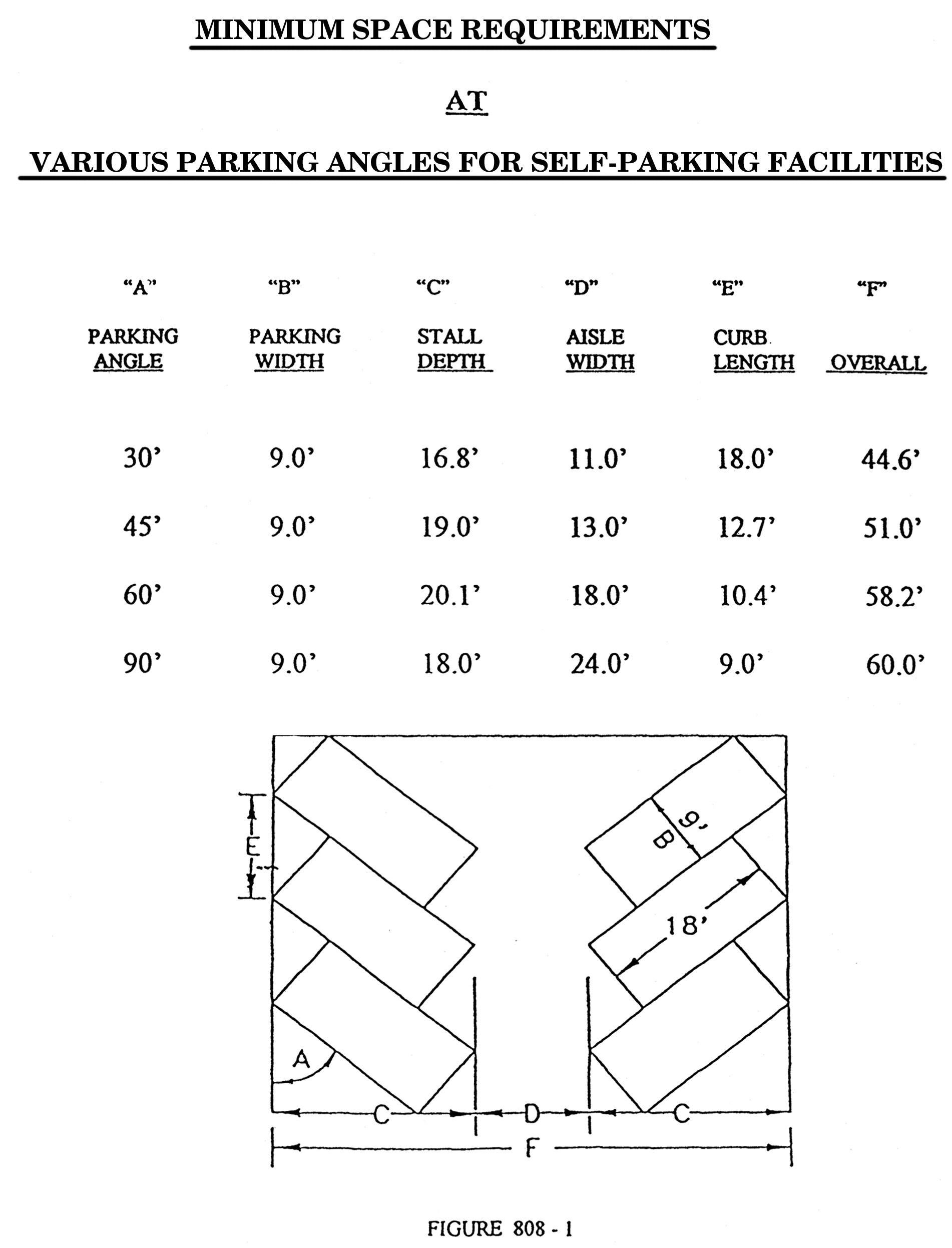
Size. Each parking space required and provided pursuant to the provisions of this article shall be not less than nine feet in width and 18 feet in length. See figure 808-1.
(b)
Striping. All parking spaces shall be divided with single painted lines.
(c)
Accessibility. In all zoning districts, the width of access aisles and driveways shall be in conformance with the standards set forth in Figure 808-1. Each space shall be accessible without driving over or through another parking space. Back-out parking onto any public right-of-way is only permitted in RS zoned properties, and then only onto public rights-of-way of less than 80 feet in width. Parking stalls abutting the same continuous drive aisle shall have the same angle and orientation. Drive aisles shall be one-way only which are less than 24 feet wide or which abut parking stalls with angles less than 90 degrees. Parking stall angles and drive aisle direction of flow may change only when the drive aisle is interrupted by a circulation drive or structure.
(d)
Composition. Parking facilities, including access aisles and driveways shall be surfaced with brick, asphalt or concrete surfacing (required in RS zoning districts) maintained in a smooth, well-graded condition with standards set-forth according to the office of the city engineer, provided, however, that the following exceptions shall apply.
(e)
Drainage. All off-street parking facilities may not be drained to adjacent parcels without the recordation of appropriate drainage easements and agreements. Such drainage facilities shall be arranged for convenient access and safety of pedestrians and vehicles with standards set forth in this Code.
808.1.6. Parking Setback. The edge of all parking pavement and access roads (not including driveway connections to a street) shall be set back a minimum of 20 feet from the right-of-way of all major streets, and a minimum of 12.5 feet from the right-of-way of all other streets and shall be landscaped in conformance with this Code.
808.1.7. Landscaping of Off-Street Parking. Parking structures and surface parking lots shall be landscaped in accordance with the provisions of this Code.
808.2. Grassed Overflow Parking. For the following specified uses up to 20 percent of the required off-street parking facilities may be provided through the utilization of a grass or lawn alternate parking surface:
Eighty percent of the required off-street parking facilities may be provided through the utilization of a grass or lawn parking surface area when the use of the property for which the off-street parking is required is for the following:
Religious institutions
Funeral home
Stadium or other sports facility
808.3. Amount of Off-Street Parking. The minimum number of parking spaces to be provided and maintained for each use or occupancy shall be as follows:
808.3.1. Residential Uses:
(a)
* Dwelling, one-family and two-family:
Lots platted before March 1996 or lying within the unrecorded subdivision of Tropical Valley: Two spaces per dwelling unit, except dwelling units with four or more bedrooms shall provide three spaces.
Lots platted after March 1996: Two spaces per dwelling unit, with one space provided by a garage, except dwelling units with four or more bedrooms shall provide four spaces, with two spaces provided by a garage.
* All one car garages shall provide a single parking space with a minimum of nine feet by 18 feet, free of obstructions. All two-car garages shall provide two parking spaces with a minimum of 18 feet by 18 feet, free of obstructions.
(b)
* Dwelling, multiple-family:
1.5 spaces for each one-bedroom unit; 2 spaces for each two bedroom unit; and 0.5 spaces for each additional bedroom, plus an additional ten (10) percent of the total required residents' spaces shall be provided for visitors, which shall include parking required for clubhouse, swimming pool and other common amenities.
*Editor's Note: Unless exempt pursuant to Section 103.3, Vested Rights.
(c)
Dormitories, fraternities: One parking space for each bed.
(d)
Hotels and motels, including clubs: One parking space for each sleeping room. If, in addition to sleeping rooms, there are other uses operated in conjunction with and/or as part of the hotel/motel, additional off-street parking spaces shall be provided for such other uses as would be required by this section if such uses were separate from the hotel/motel to the extent of 35 percent of the off-street parking specified in this article for retail stores, offices, services, establishments, bars, restaurants, dining rooms, night clubs, cabarets, ballrooms, banquet halls meeting rooms, auditoriums.
(e)
Housing for elderly: One parking space for each unit.
(f)
Residential care facility, Category 2 and 3: One parking space for each sleeping room.
808.3.2. Commercial Uses: One parking space is required per square footage indicated in each category:
100 square feet:
Bars
Beer gardens
Cafeterias
Call centers
Cocktail lounges
Night clubs
150 square feet:
Bakery
Butcher shop
Delicatessens
Dry cleaning
Grocery
Ice cream shop
Laundry
Liquor store
Package store
Self-service laundry
Take out foods
200 square feet:
Amenity centers
Animal hospitals
Auction galleries
Auto repair shop
Auto service station
Bank and savings and loan
Barbershop
Business school
Car wash
Child care center
Civic clubs
Community centers (non-governmental)
Dancing school
Dental clinic
Drugstores
Financial institutions
Health institutions
Indoor display area for vehicle sale or rental
Kennel
Library
Medical and dental offices
Medical clinic
Pharmacies
Pool (surface area)
Post office
Trade school
Veterinarians
Vocational school
250 square feet
Convenience stores (stand-alone)
Convenience stores at fuel service stations
300 square feet:
Building supplies
Business and professional offices
Contractor shops:
General electrical plumbing roofing air conditioning etc.
Financial companies
Governmental offices
Household equipment
Household repairs
Hardware
Marine supplies
Personal service shops
Pet grooming
Retail stores
Swimming and pool supplies
Travel agencies
Wholesale medical supplies
Wholesale stores
500 square feet:
Art gallery
Carpet and flooring materials retail stores
Furniture store
Outdoor display area for vehicle sale or rental
Printing and engraving
Research and testing laboratories
Sign shop
Telephone exchange housing automatic equipment only.
800 square feet:
Industrial uses
Manufacturing uses
Storage buildings and warehouses.
2,000 square feet:
Self-storage warehouse facilities
808.3.3. Miscellaneous uses:
(a)
Hospitals: One and one-half parking spaces for each bed. Bassinets do not count as beds.
(b)
Places of public assembly:
(1)
Places of public assembly with fixed seats, exhibition halls, dance halls, skating rinks, libraries, museums, or amusement centers. One parking space for each four (4) fixed seats or one parking space for each 200 square feet of gross area; whichever is greater. The exemptions provided pursuant to Section 808.3.4(d) shall apply to this subsection.
(2)
Places of public assembly without fixed seats. One parking space for each 200 square feet of gross area.
(3)
Places of public assembly which include accessory uses. A place of public assembly which includes - uses such as an elementary school, university or college, senior high school, middle school, public or private school, or another use which is accessory to the place of public assembly shall provide the cumulative number of parking spaces required for the public assembly use and accessory uses.
(c)
[Reserved.]
(d)
Funeral homes: One parking space for each four fixed seats in public rooms, plus one parking space for 90 square feet in public rooms with movable seat.
(e)
Bowling centers: Six parking spaces for each lane.
(f)
University or college level educational facilities: One parking space for each classroom, plus one parking space for each five students or one-half of the additional parking spaces for rooms used for public assembly as otherwise required by this section, whichever may be greater.
(g)
Kindergarten through 12th grade schools, public or private: Minimum parking requirements shall be calculated as follows:
(1)
Faculty and staff: One space for each member;
(2)
Visitor: One space for every 100 students;
(3)
Schools which include student enrollment for students in grades 11 through 12: One space for every ten students in grades 11 and 12.
(h)
Private clubs, lodges, fraternal buildings, union halls: One parking space for each 100 square feet of assembly hall and auditorium, or one parking space for each 50 square feet of gross floor area occupied by guests, customers, patrons, members or other occupants, whichever may be greater.
(i)
Sanitariums, asylums, orphanages, convalescent homes, home for infirms: One parking space for each five beds for patients.
(j)
Stadiums and sports arenas: One parking space for each five seats.
(k)
Restaurants: One parking space for every 100 square feet of building area (1:100). Required parking for open air seating shall be calculated at 50 percent of the above rate. Open air seating area shall be defined as follows:
1.
Any seating-area without a heating or cooling system, and
2.
Seating area with or without a roof where two sides are open or consist of a substantially non rigid material such as, but not limited, to canvas or screening.
(l)
Shopping centers:
1.
One parking space for each 225 square feet of gross floor area in shopping centers with less than 200,000 square feet of gross leasable area. One parking space for each 200 square feet of gross leasable area in shopping centers with 200,000 square feet or more of gross leasable area.
2.
Shopping centers which have gross floor areas over 40,000 square feet of gross leasable area and under 200,000 square feet shall not have more than ten percent of its gross leasable area occupied by any one or any combination of the following uses:
Bars,
Beer gardens,
Cafes,
Cafeterias,
Cocktail lounges,
Convenience stores,
Night clubs,
Restaurants,
Taverns,
Theaters
3.
Shopping centers which have a gross floor area of 40,000 square feet or more and are owned by a single entity or subject to a cross access/cross parking agreement, may petition the city commission for approval of shared parking. The petition for shared parking shall include an independent parking study in a form acceptable to the city, which includes but is not limited to, information indicating that the shopping center uses are such that a sufficient disparity in peak demand for parking spaces exists to support the concept of shared parking.
4.
Parking requirements for shopping centers not meeting these criteria shall be calculated on a use by use basis.
(m)
Private court club: Five spaces per court.
(n)
Movie theaters: One space per three seats.
(o)
Golf course: Eight spaces per playing hole, two spaces per practice driving tee, plus any parking necessary to satisfy requirements for other facilities on-site.
(p)
Outdoor recreational courts:
1.
Basketball court: Five spaces per court.
2.
Volleyball court: Five spaces per court
3.
Tennis court: Two spaces per court
4.
Other: As determined by community development department.
These requirements shall be applied in full per any portion of a court.
(q)
Flex buildings in planned industrial developments (PIDs): Parking requirements shall be based on the amount of gross square footage devoted to each use within the building. Any office uses accessory to permitted light industrial use as defined in section 405.25 or office uses which are less than 25 percent of an industrial building's gross square footage shall count as industrial uses for the purposes of parking calculations; except that, within previously approved developments of regional impact, any such office uses which are less than 35 percent of an industrial building's gross square footage shall count as industrial uses for the purposes of parking calculations.
808.3.4. Calculating required parking spaces.
(a)
Uses not specifically mentioned: The requirements for off-street parking for any unspecified uses in this section shall be determined by the community development department. It is the intent to require all uses except agricultural to provide off-street parking.
(b)
Fractional spaces: When units or measurements determining number of required off-street parking spaces result in requirement of fractional space, any such fraction equal to or greater than one-half shall require a full off-street parking space.
(c)
Mixed uses: In the case of mixed uses, the total requirements for off-street parking shall be the sum of the requirements of the various uses computed separately, and off-street parking space for one use shall not be considered as providing the required off-street parking for any other use; however, when a business which has been issued a zoning certificate of use conditioned upon the operation of the business only between the hours of 5:00 p.m. and 8:00 a.m., excluding all day holidays and weekends: said business may utilize up to 60 percent of the parking spaces required for the building in which the business is located.
(d)
Measurements:
1.
For the purposes of this chapter, gross floor area shall mean the floor area inside of the exterior walls excluding elevators, stair wells, common corridors, trash rooms, common lobbies, common rest rooms, meter rooms ancillary power equipment rooms. In hospitals, bassinets shall not count as beds. In stadiums, sport arenas, places of worship and other places of assembly in which occupants utilize benches, pews or other similar seating facilities, each 20 lineal inches of such seating shall be counted as one seat for the purpose of computing off-street parking requirements.
2.
In outdoor display areas for vehicle sales or rental, only areas designated for vehicle parking shall be measured. Driveway aisles and landscaped medians are not intended to be included in the measured area.
808.4. Use of Permitted Facilities.
808.4.1. Permitted use. Parking spaces approved in accordance with this chapter may be used for the intermittent parking of licensed motor vehicles of employees, occupants, owners, tenants or customers utilizing the building or use served by said required parking space. Supplemental parking (parking facilities provided but not required) may be used for any purpose related to the use of the building it serves, subject to the conditions hereinafter set forth. Parking may be used for any purpose related to the use of the building it serves, subject to the conditions hereinafter set forth.
808.4.2. Limitations on use of required parking facilities. The following uses and activities shall not be permitted in required parking facilities:
(a)
Parking to serve an off-site building unless in accordance with a unity of title approved by the city in accordance with this chapter.
(b)
Storage, repair or display of any vehicles, equipment or merchandise, except as may be approved by the city through a temporary use permit.
(c)
Parking of vehicle, which, due to its size, shape, contents or location creates an obstruction or public safety hazard, or which cannot be contained within a single designated parking space.
(d)
Vehicles shall be required to park on paved or stabilized alternative parking surfaces. Parking shall be prohibited in all other areas.
808.5. Off-Street Loading.
808.5.1. General provisions. Adequate space for loading and unloading of materials, goods or things, and for delivery and shipping, shall be provided and maintained on the same plot as the building which it serves.
Where any structure is enlarged or any use is extended so that the size of the resulting occupancy comes within the scope of this section, the full amount of off-street loading space shall be supplied and maintained for the structure or use in its enlarged or extended size. Where the use of a structure or land or any part thereof is changed to a use requiring an off-street loading space, such space shall be supplied and maintained to comply with this section.
For the purposes of this section, an off-street loading space shall be an area at the grade level at least ten feet wide by 25 feet long with fourteen foot vertical clearance. Each off-street loading space shall be directly accessible from a street or alley without crossing or entering any other required loading space, and shall be arranged for convenient and safe ingress and egress by motor truck and/or trailer combination. Such loading space shall also be accessible from the interior of any building it is intended to serve.
808.5.2. Specifications. The following minimum conditions shall apply; additional conditions may be imposed as part of a conditional use or final site plan approval. Off-street loading spaces shall be provided and maintained in accordance with the following schedule:
(a)
For each retail store, storage warehouse, wholesale establishment, industrial plant, factory, freight terminal, market, restaurant, funeral home, laundry, dry cleaning establishment or similar building or use which has an aggregate gross floor area of:
Up to 25,000 square feet—1 space
25,000 square feet to 100,000 square feet—2 spaces
Over 100,000 square feet—4 spaces
Plus for each additional 90,000 square feet over 290,000 square feet or major fraction thereof—1 space.
(b)
Convenience store—1 space
(c)
For each hotel or motel:
1 space per building
(d)
For each auditorium, convention hall, exhibition hall, museum, hotel, office building, sports arena, stadium, hospital or similar use which has an aggregate gross floor area of:
Over 20,000 square feet but not over 50,000 square feet—1 space
Over 50,000 square feet—2 spaces
The loading requirements for any unspecified use shall be that which is required for similar specified uses.
(e)
Off-street loading facilities supplied to meet the needs of one use shall not be considered as meeting off-street loading needs of any other use.
(f)
No area or facilities supplied to meet the required off-street parking facilities for a use shall be for, or be deemed to meet, the requirements of this article for off-street loading facilities.
(g)
Nothing in this section shall prevent the collective, joint or combined provision of off-street loading facilities for two or more buildings or uses, provided that such off-street loading facilities are equal in size and capacity to the combined requirements of the several buildings or uses and arranged as to be usable thereby.
(h)
Plans for buildings or uses requiring off-street loading facilities under the provisions of this section shall clearly indicate the location, dimensions, clearances, operational provisions and access of all such required off-street loading facilities.
808.6. Drive-Through Service. Businesses that provide a drive-through service are required to provide drive-through service lane or lanes, whether for stacking or queuing, as separate and distinct lanes from the circulation lanes necessary for entering or exiting the property. Each drive-through lane shall be separated from other on-site lanes. Each such drive-through lane shall be curbed striped, marked or otherwise distinctly delineated. A separate and distinct escape lane of at least 8-foot width shall be provided. Neither a lane otherwise necessary for site circulation nor a public street or alley shall be counted as an escape lane. Drive-through lanes and escape lanes shall not conflict, or otherwise hamper access, to or from any parking space. Pedestrian walkways shall be clearly separated from drive-through lanes.
808.6.1. Specifications. Stacking spaces necessary for the provisions of drive-through lanes shall be determined using the following table:
A stacking space is hereby defined as being 22 feet in length. Inbound stacking requirements shall be counted from the first stopping point. Out-bound stacking requirements shall be counted from the last stopping point.
808.7. Electric Vehicles
808.7.1 Electric Vehicle Charging Stations Except for individual single-family residences, duplexes, triplexes, and apartment and townhouse communities of less than 10 units, electric vehicle charging stations and infrastructure is required for new construction as provided below.
1.
Reserved Electric Vehicle Parking When at least twenty (20) off-street parking spaces are required, a minimum of 1 space shall be reserved for electric vehicle parking; when at least seventy five (75) or more off-street parking spaces are required, a minimum of 4 spaces shall be reserved for electric vehicle parking, and provide an electric charging station for each space, and a further two percent (2%) of the required off-street parking spaces shall be electric vehicle ready, with a minimum of one (1) space reserved for electric vehicle parking, subject to the following:
a.
The electric vehicle charging station shall have a minimum charging level of AC Level 2.
b.
All components of the electric vehicle charging station shall be located entirely within the confines of the building and not visible from outside any portion of the structure.
c.
All components shall be located above the minimum flood elevation.
d.
The charging station shall contain a retraction device, coiled cord, or a place to hang cords and connectors above the ground surface.
e.
Signage shall be posted at the charging station stating, "Charging Station." Signs shall have a maximum length of eighteen (18) inches.
f.
All new multi-family, mixed-use, or hotel development with twenty (20) or more units shall also provide access to 240-volt capability throughout the garage to offer charging opportunities to residents and guests.
g.
If a calculation of required parking spaces results in a fractional space, the number of required parking spaces shall be rounded up to the next whole number.
2.
Electric Vehicle Infrastructure Readiness In addition to subsection 1. above, when twenty (20) or more off-street parking spaces are required, a minimum of three percent (3%) of the required off-street parking spaces shall have Electric Vehicle Supply Equipment infrastructure installed for the future installation of Electric Vehicle Charging Stations ("EV-Ready"), subject to the following:
a.
Each required parking space shall include make-ready infrastructure with a minimum of 40-Amps on an independent 240-volt AC circuit for every electric vehicle Space.
b.
If a calculation of required parking spaces results in a fractional space, the number of required parking spaces shall be rounded up to the next whole number.
3.
Electric Vehicle Infrastructure Capability In addition to subsections. 1. and 2. above, when twenty (20) or more off-street parking spaces are required, a minimum of fifteen percent (15%) of the required off-street parking spaces shall have listed raceway (conduit) and electrical capacity (breaker space) allocated in a local subpanel to accommodate future EVSE installations ("EV-Capable"), subject to the following:
a.
All conduits and subpanels installed throughout the new construction shall be sized to accommodate 60A or 40A breakers for each parking space.
b.
If a calculation of required parking spaces results in a fractional space, the number of required parking spaces shall be rounded up to the next whole number.
4.
Per Florida Statutes Section 366.94, and as it may be amended from time to time, it is unlawful for a person to stop, stand or park a vehicle that is not capable of using an electrical recharging station within any parking space specifically designated for charging an electric vehicle.
(Ord. No. 03-15, § 3, 5-21-03; Ord. No. 07-07, § 11, 11-29-06; Ord. No. 11-10, § 8, 9-21-11; Ord. No. 12-07, § 7, 11-30-11; Ord. No. 15-05, § 5, 11-24-14; Ord. No. 18-05, § 4, 11-27-17; Ord. No. 20-09, § 3(Exh. B), 3-18-20; Ord. No. 24-02, § 2(Exh. F), 11-1-23)
Sec. 809. - Reserved.
Editor's note— Ord. No. 24-02, § 2(Exh. A), adopted November 1, 2023, repealed § 809. Former § 809 pertained to accessory uses and standards and derived from Ord. No. 03-21, § 3, adopted September 17, 2003; Ord. No. 05-03, § 2, adopted November 17, 2004; Ord. No. 06-05, § 3, adopted November 16, 2005; Ord. No. 13-02, § 2, adopted October 3, 2012; Ord. No. 14-15, § 2, adopted July 2, 2014; Ord. No. 16-05, § 8, adopted January 27, 2016; Ord. No. 18-07, §§ 21, 22, adopted March 7, 2018; and Ord. No. 20-09, § 3(Exh. B), adopted March 18, 2020. Similar provisions can now be found in § 505.
Sec. 810. - Reserved.
Editor's note— Ord. No. 20-13, § 6(Exh. E), adopted June 17, 2020, repealed § 810 which pertained to compliance with comprehensive plan. Similar provisions can be found in Chapter 5, Section 501.2.
Sec. 811. - Reserved.
Editor's note— Ord. No. 20-13, § 6(Exh. E), adopted June 17, 2020, repealed § 811 which pertained to Miramar Parkway Scenic Corridor. Similar provisions can be found in Chapter 5, Section 501.10.
Sec. 812. - Reserved.
Editor's note— Ord. No. 20-13, § 6(Exh. E), adopted June 17, 2020, repealed § 812. Former § 812 pertained to development advertising requirements and derived from Ord. No. 03-02, § 2, adopted November 20, 2002. Similar provisions can be found in Chapter 5, Section 501.5.
Sec. 813. - Community Appearance Board.
813.1. Preamble. This board has been established by the City of Miramar in recognition of the fact that beautiful communities enhance the health, safety and welfare of the citizenry and improve the value of the properties within the community. This goal can be created only through a deliberate search for proper design in all elements of the city on the part of the community leadership, architects, planners, realtors and the building industry, backed by an appreciation of the visual work by the people.
Public action for improving community appearance, as embodied through the community appearance board, will provide the ultimate designers of individual structures within the larger contexts in which their particular works will be viewed. Since the beauty of a community involves the aesthetic quality of all one sees in moving about, it goes far beyond the design of individual architectural facades.
Zoning is the single most powerful legal enforcement of an overall urban concept, but it does not fully plan building locations, traffic movement or parklands; it does not create beauty, aesthetic order, or amenity. The task of this board is therefore to preserve various elements of urban beauty and require that new projects enhance the existing.
It is the intent of this board to achieve a pleasant and comprehensible cohesiveness in our community development. The method of achieving this goal is by the use of a community design plan "the larger contexts" referred to above which would indicate for the various parts of the municipality the aesthetic character to be encouraged and the means by which aesthetic character is to be attained and protected. The community appearance board is composed of persons with experience in judging three dimensional forms and their interrelationships, who have the ability to meet any particular designer on the grounds of his own aesthetic understanding. The board acts in review of specific projects to ascertain whether proposals would enhance the community design plan or violate its spirit. The enabling legislation for the board defines the objectives and procedures by which the aesthetic intentions are actually embodied in proposed projects, and to comply with the architectural design standards described herein.
The standards must be understandable and definitive while still leaving sufficient room for variety and innovation. The City Commission of the City of Miramar has determined that all new construction as well as remodeling and renovation, should exhibit Spanish, Italian and French Mediterranean Revival Style Architecture to create a cohesive and attractive identity for the city; however other architectural design styles may be permitted, subject to CAB approval.
The community design plan and architectural design standards have been approved by the city commission officials representing the citizenry. By their action the local elected officials thus determine the basic aesthetic character to be the community design plan, as has been approved by the city commission officials representing the citizenry achieved in the development of the community.
813.2. Jurisdiction and application of standards. All buildings and structures except single-family detached and duplex residences shall be subject to the requirements of this ordinance and no building permit for such building or structure or remodeling or renovation thereof shall be issued without obtaining approval pursuant to the procedures set forth herein.
813.2.1. Scope. The standards set forth herein shall apply to all applications to construct a building or structure, other than a single-family or dual-family residence. All new construction as well as remodeling and renovation of existing structures, should exhibit Spanish, Italian, and/or French Mediterranean Revival Style Architecture, unless specifically approved by the CAB to exhibit alternative architectural design features and characteristics.
This board, by the nature of its function, will require certain information from an application for a permit within the City of Miramar over and above that required by the building and planning and redevelopment divisions of the community and economic development department, the engineering service department, and fire-rescue department. This information shall be submitted prior to an application for a permit for any building, group of buildings, site development, alterations affecting their exterior, parking lots and vehicular use areas on a form prescribed by the department of community development. The CAB shall review all plans to ensure they comply with the architectural design standards described herein.
813.2.2 [Reserved.]
813.2.2.1. [Reserved.]
813.2.2.2. [Reserved.]
813.2.3 [Reserved.]
813.2.3.1. [Reserved.]
813.2.3.2. [Reserved.]
813.2.3.2.2. [Reserved.]
813.2.3.2.3. [Reserved.]
813.2.3.2.4. Time restrictions.
(a)
Code enforcement action. Structures that are issued a notice of violation by the City of Miramar Code Compliance Division for noncompliance with design or aesthetic standards shall have ten working days from the date of notice to submit a complete application to the community and economic development department for community appearance board review. A citation shall not be issued while the project/property is undergoing review, which will enable the owner/applicant to consider steps to address and correct the problem(s) within a reasonable amount of time. The owner/applicant shall have a 30-day period after obtaining the required approval in which to apply for and be granted building or exterior painting permits in order to proceed with the project. The community and economic development department may grant additional time for the property owner to apply for and receive a building permit if it is determined that there has been reasonable progress made in the effort to obtain the permit. If, at any time, the community and economic development department determines that the applicant is not making such progress, then the code enforcement citation shall be issued. In the case of painting of the structure(s), the owner/applicant must commence the project within 30 days after receiving approval for the colors and material finishes and permission to paint. The community and economic development department may grant additional time for the property owner to commence the painting project, if it is determined that there has been reasonable progress made in the effort to bring the structure into compliance. Failure to comply with these procedures and with the design standards shall result in the issuance of a citation to the owner.
(b)
Resubmitted plans. Applicants for projects that have made a compete formal submittal to the CAB shall have a 90-day period following a written request for additional information in which to revise plans or applications in order to make corrections. The community and economic development director may waive the 90-day requirement, if requested by the applicant, with proof that reasonable progress is being made in revising the application.
813.2.3.3. [Reserved.]
813.2.3.4. Exemptions.
(a)
The following applications for development or building permit shall be exempt from the application of this ordinance:
(1)
Single-family, duplex and triplex residences and accessory structures located completely on their lots such as fences, private walls, etc.
(2)
Any building or structure for which final site plan approval has been obtained prior to April 2, 1997; plat or any other master plan approval do not qualify.
(3)
Any of the following must submit an application or written request to the community and economic development department on a project-by-project basis for a determination for exemption or exception from the requirements of this ordinance if the applicant demonstrates that it satisfies one or more of the following criteria:
(i)
Documented (written and/or graphic) evidence of a previously existing, acceptable and ongoing unified design requirement or architectural scheme within a DRI, PUD, PID or similar master plan.
(ii)
A project that can demonstrate that no portion of the building facades would be visible from any perimeter of the project.
(iii)
A project is determined to be of a temporary nature such that meeting the full spirit and intent of the ordinance would not be practical.
(4)
Existing buildings undergoing renovation to repair damage to structures caused by fire, flooding, windstorm, or similar circumstance.
(b)
Application procedures for the exemptions set forth in 1(b), (c) or (d) will be established by the community development director, as necessary. This shall include, but not be limited to, filing variance or appeal applications for ultimate approval by the city commission or waivers for administrative approval.
(c)
The city commission may grant the exemption, deny the request or allow for variance from certain sections of this ordinance, based on a case by case review of previous approvals within the development based upon the city commission's determination of the degree of compliance with the criteria for exemption.
813.3. The Community Design Plan (CDP).
813.3.1. Scope. The overall community design plan is a single, unified three-dimensional impression of the community in its existing state and in consideration of its development potential. It consists of a general description of the City's attributes, followed by the treatment of specific areas, buildings and exterior space. It is intended that everything stated - the general descriptions as well as the specific recommendations - shall be considered a part of the design plan and as such shall constitute the basis of review by this board.
In general, our community possesses an evident geometric order derived for the directional influence of natural topographic features. These are made more pleasing, are softened, and are enlivened through variety among their component parts. This same variety carries through into manmade features of roads and canals whose curves and bends result in the change that produces interest instead of monotony.
813.3.2. General requirements. The general requirements outlined in this section are minimum aesthetic standards for all site development, buildings, structures or alterations within the corporate limits of Miramar, Florida, except for single-family residences.
It is required that all new site development, structures, buildings or alterations to site development, structures, or buildings show proper design concepts, express honest design construction and be appropriate to its surroundings.
813.3.2.1. Buildings/structures.
813.3.2.1.1. General criteria.
(a)
New buildings or structures that are a part of a present or future group or complex shall have a unity of character and design. This relationship of forms and the use, texture and color of material shall be such as to create a harmonious whole. When the area involved forms an integral part of, is immediately adjacent to, or otherwise clearly affects the future of any established section of the city, the design, scale and location on the site shall enhance rather than dominate or detract from the character, value and attractiveness of the surroundings. All new buildings shall comply with the architectural design standards described herein.
(b)
New buildings or structures located along strips of land or on single sites and not a part of a unified multi-building complex shall strive to achieve visual harmony with the surroundings. If they are built in underdeveloped areas, the primary requirements shall:
(1)
Express honest design.
(2)
Show proper design concepts.
(3)
Be appropriate to the City of Miramar.
(c)
Existing buildings undergoing remodeling and minor renovations (with a construction value 50 percent or less of the assessed value) which affect the exterior aesthetics (including painting as defined in Section 813.3.4) must comply with the intent of the architectural design standards as described herein, unless the project entails the repair of damage as outlined in section 813.2.3.4(1)(d), with special adherence to exterior and roof finish materials and colors. Building form may not necessarily have to comply. Window replacement must be consistent with the standards and comply for the entire facade.
(d)
Existing buildings undergoing major renovation (with construction value exceeding 50 percent of assessed value) must conform with the architectural design standards described herein, unless the project entails the repair of damage as outlined in section 813.2.3.4(1)(d).
(e)
It is not to be inferred that buildings must look alike to be harmonious. Harmony can be achieved through the proper consideration of scale, proportions, site planning, complimentary design elements, landscaping, materials, repeating shapes, and forms, accents and color.
(f)
"Look alike" buildings are not allowed unless, in the opinion of the city, there is sufficient separation to preserve the aesthetic character of the present or evolving neighborhood, or it is necessary to create a unified theme that is deemed visually attractive, identifiable and unique. This is not to be construed to prohibit duplication of floor plans and exterior treatment in a planned development where, in the opinion of the city, the aesthetics of the development depend upon or are enhanced by the look alike buildings and their relationship to each other. Prototypical or "corporate" designs for buildings are not permitted, without respecting the requirements and intent of this ordinance, particularly as a repetitious design proposed to be located in various parts of the city. The proposals must adhere to achieving compatibility and harmony with their surrounding environment through the use of design tools described in (e) above.
(g)
Buildings that are of symbolic design for reasons of advertising and marketing and buildings which are not compatible to the aesthetics or atmosphere of Miramar will not be approved by the city. Symbols attached to buildings will not be allowed unless they are secondary in appearance to the buildings and landscape and are an aesthetic asset to the building project and neighborhood.
(h)
Exterior lighting may be used to illuminate a building and its grounds for public safety purposes, but in an aesthetically pleasing manner. Lighting is not to be used as a form of advertising in a manner that is not compatible to the neighborhood or in a manner that draws considerably more attention to the building(s) or grounds at night than in the day. Lighting following the form of the building or part of the building or structure or sign will not be allowed, if, in the opinion of the city, the overall effect will be garish or detrimental to the environment. All fixtures used in exterior lighting are to be selected for functional and aesthetic value.
(i)
Building surfaces, walls, and roofs that are considered garish by the city will be denied approval.
(j)
"Take-out" or "pick-up" windows of retail or whole sale establishments shall not be located on the building facade that faces a public right-of-way, unless they are designed in such a manner as to be an aesthetic asset to the building and neighborhood.
(k)
All exterior forms, attached or not, to buildings shall be in conformity to and secondary to the building. They shall be an asset, both to the aesthetics of the site and to the neighborhood.
(l)
Industrial, commercial, institutional, utility, and civic buildings (including shopping centers, wholesale and retail centers, outparcels, warehouses and light industrial) must be strictly controlled and must conform to the overall image of Miramar as set forth herein. These buildings must, of necessity, reflect the manufacturing, commercial, or civic activity, but they shall be designed in accordance with proper design concepts and honest design construction. Wherever possible, imagery reflecting the spirit of the community design plan and the architectural design standards must be incorporated. Design emphasis shall be placed on all facades visible to the public or from adjacent properties. That is not to say that facades that are not directly visible to the public shall not comply with the spirit of the Architectural Design Standards because the intent is to create a built environment that is aesthetically pleasing to frequent users of the building/site as well as to the public-at-large. The grounds surrounding the building, although they must also reflect the appropriate activity, shall be planned to present a sense of aesthetic and geometric order. There shall be definite boundaries to storage, loading, pedestrian and bicycle activity and parking areas. Screening shall be used to shield parking and/or truck use yards, storage and activity areas from the public view. Landscaping is to be employed on the site, not only to enhance the building or buildings, but also to create a pleasing atmosphere throughout the site. Accessory buildings and structures shall be harmonious with the main building(s).
(m)
Outside equipment, including hoppers, cranes, mechanical apparatus, playground apparatus, street furniture, bollards, bicycle racks, and so forth, shall be painted a pleasing color that will blend with the whole. Vibrant or bright colors as a base color are not permitted.
(n)
All telephones, vending machines, or any facility dispensing merchandise or a service on private property shall be confined to a space built into the building or buildings or enclosed in a separate structure compatible with the main building.
(o)
No advertising will be allowed on any exposed amenity or facility, such as benches and trash containers.
(p)
Symbolic color of the exterior facades or roofs may not be used unless they are harmonious with the atmosphere of the neighborhood and in compliance with the architectural design standards described herein. Such symbolic colors are considered to be signs depicting corporate identity that does not reflect the values of Miramar's CDP.
813.3.2.1.2. Signs. Signage shall be incorporated into proposed plans to be approved by the city. The city sign regulations are amended to allow the city commission or their designee to modify signage to meet the spirit and intent of the city's community design plan, especially as it relates to colors, materials, size and location. Monument signs larger than 20 square feet in area shall incorporate a landscaping design around the base of the sign in accordance with LDC section 1005.7 at a minimum. Applicants are encouraged to exceed the minimum monument sign landscaping requirements with an attractive landscaping design. All signs, whether permanent, temporary, or exempt, as defined by Chapter 10 of the LDC, shall comply with the design criteria and community appearance standards and shall be used to enhance, not detract from, the buildings or site. Traffic signs, particularly handicapped accessible signs, since they are notably visible near a primary facade or adjacent to a building or site entrance, must be designed to have a decorative pole, frame or form. Such signs shall reflect the character of the land use. In industrial use areas, for example, galvanized steel or fluted metallic poles are acceptable. In commercial and residential use areas, on the other hand, decorative wooden or metallic poles are appropriate. Standard "U-channel" or solid metal poles are prohibited.
813.3.2.1.3. Lighting. Lighting shall be incorporated into proposed plans to be approved by the city. Site lighting shall be designed to meet the spirit and intent of the city's community design plan, especially as it relates to pole heights, fixture and lighting colors, lamp and pole design, and location. The CAB will determine appropriate areas of the site in which to incorporate pedestrian oriented lighting fixtures during the preliminary review stages. Parking lot pole fixtures shall be limited to 25 feet in height and designed to meet the photometric requirements of the site. The non-cutoff decorative pole fixtures shall be no higher than 12 feet high to the top of the fixture. Lighting fixtures attached to the walls of the buildings shall harmonize with the architectural character of the buildings and are restricted to traditional "Mediterranean-style" sconces to be located on all visible facades. Typical wall pack fixtures may be used only within truck yards and loading areas on facades that are not visible from the perimeter roads of the site, unless additional landscaping is provided to screen such fixtures, as approved by the CAB.
813.3.2.1.4. Landscaping. Landscaping shall be incorporated into proposed plans to be approved by the city. Landscaping shall be designed to exceed the minimum code requirements provided in LDC Chapter 5, Section 506 and to meet the spirit and intent of the city's community design plan, especially as it relates to plant material selections and heights, locations and buffer design. Sustainable plant materials shall be used as much as possible. Flowering shrubs, trees, ground cover and annuals are encouraged wherever possible to enhance the site design. The CAB will determine appropriate areas of the site in which to incorporate additional landscaping to enhance the pedestrian experience, during the preliminary review stages.
813.3.3. Specific architectural design standards. In addition to the general criteria, the following specific architectural standards shall apply:
813.3.3.1. Design concepts. The principles set out below are not intended to limit innovative architecture, but to establish a meaningful design guide for development and redevelopment in the City of Miramar. All development shall be designed in accordance with the fundamental concepts described in this section. The fundamental design concepts shall include:
(a)
The design of architecturally varied structures within planned developments through the use of varied building massing, juxtaposition of vertical and horizontal planes, roofscapes, window and door design, ornamentation, materials, and colors. All designs shall comply with the spirit and objectives of the community design plan and the minimum architectural design standards.
(b)
The linkage of landscaped exterior spaces (courtyards, loggias, pergolas, arcades squares, and plazas) to buildings.
(c)
The linkage of separate development parcels by adequate and accessible pedestrian, bicycle, and vehicular connections.
(d)
The recognition of the South Florida climate which should influence building shape and orientation, the nature of roofs and overhangs and the location and size of windows and doors.
(e)
The identification of individual subdivisions by utilizing appropriately designed and scaled signage and pedestrian amenities.
(f)
The use of private common open space as a community design feature to encourage public gathering spaces.
813.3.3.2. Pedestrian orientation. All proposed nonresidential and multi-family residential development shall contribute to the creation of a pedestrian oriented community by providing the following:
(a)
Emphasis on the building's street facades as major elements of the overall streetscape; and
(b)
Street-level architectural treatment, including colonnades, arcades, balconies, awnings, canopies, and other shade producing elements, should be provided along all pedestrian-oriented frontages.
(c)
Pedestrian oriented frontage shall be adjacent to building entrances and integrated with adjacent properties.
813.3.3.3. Minimum architectural design standards. All new construction, as well as remodeling and renovation of existing buildings and structures, within the city should exhibit Spanish, Italian and French Mediterranean Revival style architecture. Strong unifying characteristics include Spanish "S" or barrel tile roofs, pale pastel-colored washed walls, simple uncluttered detailing and trimming, and the appearance of thick walls and columns and prominent entrances.
The emphasis on open architecture such as balconies, courtyards and verandas is suited for Miramar's subtropical climate. The selected architectural styles, Spanish, Italian and French Mediterranean Revival, will be described herein. Appropriate variations or interpretations of styles are permitted only when approved by the city commission. These regulations shall apply to all developments except single-family and dual-family residences. Where the scale may not harmonize with these standards, the design will create similar imagery consistent with that set forth herein.
The design standards contained herein are either mandatory or discretionary. The terms "required" and "prohibited" are mandatory. The terms "preferred" and "discouraged" are discretionary. These terms are defined below:
Required
• Required items are design elements that are necessary in order to maintain the desired character and quality.
• Compliance is mandatory for project approval.
Preferred
• Preferred items are design elements that, whenever possible, should be used in order to maintain the desired character and quality. Preferred items are intended to promote the following goals with respect to desired character and quality:
• Consistency of neighborhood character.
• Consistency of architectural style.
• Consistency of building form and mass.
• Consistency of materials and colors.
• Consistency of location of elements.
• Incorporating preferred items into a design increases the probability of, but does not assure, project approval.
Discouraged
• Discouraged items are design elements that should not be used in order to maintain the desired character and quality. The use of discouraged elements in rehabilitation or new construction is often inconsistent with desired zoning district character and quality goals:
• Consistency of neighborhood character.
• Consistency of architectural style.
• Consistency of building form and mass.
• Consistency of materials and colors.
• Consistency of location of elements.
• Incorporating discouraged items into a design decreases the probability of project approval and may result in project denial if, in the reasonable discretion of the city, the incorporation of such items causes the project to be inconsistent with the design goals set forth herein.
Prohibited
• Prohibited items are design elements that do not maintain the desired character or quality.
• Use of prohibited elements mandates project denial.
Not Applicable
• Refers to items that have not been reviewed and/or do not apply to conformance with standards.
• Use of these items may or may not affect project approval.
813.3.3.3.1. Building form. Distinguished by simple and strong configurations, Spanish, Italian and French Mediterranean Revival style developments are typically less than four stories in height. Where feasible, four story or taller structures shall use imagery to comply with the spirit of these regulations. Spanish, Italian and French Mediterranean Revival style buildings often exhibit symmetrical or asymmetrical facades with varying roofs. Wall planes predominate on primary surfaces (windows, doors, and other design features shall be integrated within and shall enhance the facade development). Usually one or more predominant arches are incorporated into the exterior design. They are typically semicircular and in regular series with columns as supports or walls. Stucco columns should be square, rectangular or round, and appear massive in thickness. The column height should be four to five times the width of the column. Balconies, porches, canopies, awnings and verandas may be integrated into the building form to add articulation to the design.
Preferred
• Simple, strong rectilinear forms.
• Wall planes predominate.
• Semicircular arches.
• Column height four to five times column width.
• Capitals and column bands.
• Balconies, porches, verandas, courtyards.
• Wrought iron or wood railings.
• Appearance of "thick walls."
Discouraged
• Complex or angular building forms.
• Excessive large windows with irregular placement on the facades.
• Flat or parabolic arches.
813.3.3.3.2. Roofs. Spanish, Italian and French Mediterranean Revival roofs exhibit a combination of gable and hip roofs.
Preferred
• Hip or gable roofs.
• Traditional red barrel tiles, tapered or "S" shaped tile (clay or cement) on all hip or gable roofs.
• Simple short overhangs.
• Exposed rafter tails.
• Decorative chimney or bell tower.
• Gutters and downspouts designed as a continuous architectural feature.
• Exposed gutters and downspouts painted to match adjacent roof or wall material.
• Flashing, vent stacks and pipes painted to match adjacent building surface(s).
• 4:12 to 8:12 pitched roofs.
Discouraged
• Large areas of flat roofs except where appropriate (e.g. storage/distribution centers and office buildings)
Prohibited
• Gambrel roofs.
• Non-earth tone colored tile.
• Shingles.
• Very low pitched roofs (slopes less than 4:12)
813.3.3.3.3. Windows. Windows typically exhibit rectangular or round-headed openings. They have several small panes in each window rather than one large pane of glass. A large window area may be used as an accent on only one or two elevations. If proposed, roll-down hurricane shutters shall be built-in recessed window heads and jambs.
Preferred
• Large window areas as accent only.
• Fenestration separated and "broken up" by building elements or trims.
• Small, multi-paned windows.
• Round-headed windows.
• Recessed openings.
• Roll-down shutters (recessed).
• Removable hurricane panels.
• Bahama shutters where appropriate.
Discouraged
• Large windows except when used as accents.
• Continuous, unbroken expanses of glazing.
• Metal or aluminum awnings, unless they are complimentary to the building facade.
Prohibited
• Glass block.
• Jalousie windows.
• Picture windows.
• Accordion shutters.
813.3.3.3.4. Entrances. Like windows, doors in Spanish, Italian and French Mediterranean Revival architecture are rectangular or round-headed. The doorway should be fully recessed in order to convey the appearance of thick, protective exterior walls. Doors are traditionally made of a "heavy" look, as well as being highly detailed.
Required
• Appropriate scale and proportion.
Preferred
• Recessed entry design.
• Fan light or fenestration above and/or next to door.
• French doors.
• Articulated and ornamental door design.
• Entrance well-articulated and dominant from street-side.
Discouraged
• Solid, unarticulated doors.
• Stained glass sidelights.
• Entrance behind a porte cochere.
Prohibited
• Overdramatic, out-of-scale and/or proportion entrances.
• Entrance not visible from street side.
• Entrance dominated by garage doors.
Required
• Appropriate scale and proportion.
813.3.3.3.5. Garages and accessory buildings and structures. Garages, storage sheds, enclosures, masonry walls, perimeter walls, signs, poles, fences, decks and other ancillary structures are elements which should be integrated with the principal building in color and architectural style. Garage doors and loading overhead doors shall not be visible from a straight-on elevation from street-side whenever possible unless adequately screened or buffered from adjacent properties.
Required
• Same or complimentary color and materials as the principal building.
Preferred
Spanish, Italian and French Mediterranean Revival style architecture. Same color and materials as the principal building.
• Dumpster, compactor, and mechanical equipment enclosures shall have colors and trim details to match the principal building color and design with gates composed of opaque materials, such as PVC or prefabricated metal, painted in a secondary approved color; wood and chain-link gates with or without slats are prohibited.
• Black or white aluminum, wrought iron, or white picket fencing in the most visible and pedestrian oriented areas of the site.
• Fencing or gates painted in primary colors as accent, if deemed appropriate.
• Chain-link fencing and gates with black or green vinyl coating, where appropriate, and especially in less visible locations as determined by the city.
• Uniform perimeter fencing types along major roadways, especially within single-family residential parcels.
• Appropriate landscaping, such as hedges, as required by code to be adjacent to the accessory structures and equipment to provide additional screening.
Discouraged
• Different color or material than principal building.
• Shadowbox fencing, except for within single-family and duplex residential parcels, notwithstanding the creation of a uniform perimeter fence along a major roadway. Shadowbox fencing will be permitted in planned industrial development districts (PIDs) around lift stations and similar outdoor utility facilities provided that the wood pickets are painted to match the adjacent buildings.
• Prefabricated walls or structures, unless approved by the city.
Prohibited
• Metal storage sheds.
• Uncoated, galvanized chain-link fencing.
• Chain-link gates with slats.
• Carports.
• Garages facing street.
813.3.3.3.6. Exterior materials/colors. Stucco is the primary Spanish, Italian and French Mediterranean type wall surface material. A smooth or light textured stucco finish is required. Accent materials and colors used to complement the stucco are encouraged in moderation. To the extent feasible, the use of tile, wood, brick and finished concrete should be used as design accents only. Buildings, accessory structures, perimeter walls, and signs are required to have at least two colors, but may be encouraged to have up to three colors or more when deemed appropriate. When using more than two colors, there shall be one or two base colors and one or two trim colors. Base colors and materials shall be warm pastels, light pastels, or shades of white selected in compliance with the pre-approved color palette. The trim/fascia colors shall be tones or shades of cream or off-white. Accent materials and colors are not limited to the pre-approved color palette, however, they must be approved by the CAB. Whereas the pre-approved color palette may be used as a guide for color selection, final CAB color approval shall only be given once the CAB reviews the selected color combinations shown as part of the design submittal package.
Required
• The principal building color(s) selected shall be approved by the CAB.
• Smooth or light textured stucco finish.
• Trim/fascia colors shall be shades of cream or off-white.
Preferred
• Any color tile, wood, brick or finished concrete as accent material where feasible.
• Warm, light pastel or off-white principal color.
• Light pastel or white window trim to harmonize with principal building color.
• The principal building and trim color colors selected from the palette
• Greens or reds used as accents approved by the CAB, but not as fascia colors.
Discouraged
• More than four colors (principal building and trim).
• Principal building color not representative of architectural style.
• Trim/accent color(s) not compatible with principal building and trim.
• Trim/accent color(s) not compatible with architectural style.
Prohibited
• Any material other than stucco as the primary building material.
• Primary color trims for windows and doors.
• Non-approved colors for principal building and trim.
• Blacks, yellows, reds, purple, blues, greens, as principal building color.
• Blacks, yellows, reds, purple, blues, greens, as fascia colors.
• Shades of purples, red (excluding doors), yellow and fluorescent colors as trim or accent.
• Stain as principal building color.
813.3.3.3.7. Pedestrian/bicycle paths. Pedestrian/bicycle paths incorporated into a plan, shall have a minimum of six feet of pavement width. The path shall connect all the residential parcels to park(s) and school(s), recreational areas, and whenever possible, commercial parcels. The use of brick pavers or specialty paving materials is encouraged.
813.3.3.3.8. Supplemental development element regulations. Other elements which affect the overall community character and quality are as follows.
(a)
Mechanical equipment.
Required
• All roof-mounted equipment must be screened by compatible materials equal to the height of the equipment, other than roof-mounted photovoltaic systems.
Preferred
• Screened from view.
• Insulated for sound attenuation.
• Located in attic or backyard with appropriate landscaping.
Discouraged.
• Located other than in attic or backyard.
• Ground-mounted equipment higher than four feet above grade, other than solar energy systems.
Prohibited
• Roof-mounted equipment visible from abutting properties.
• Yard-mounted equipment visible from street-side.
(b)
Front yard accouterments.
Preferred
• Ornaments and objects d'art visible from street only when approved by the CAB and the community development department.
Prohibited
• Ornaments and objects d'art visible from street and not approved by the CAB and the community development department.
813.3.4. Definitions/glossary of architectural terms. While many of these terms do not appear in this manual, they may appear on architectural drawings and are included to facilitate a better understanding of building design. Additional terms can be found in "Construction Dictionary" by Greater Phoenix, Arizona Chapter 98, The National Association of Women in Construction, Library of Congress Catalog Card #73-83758. Definitions are found in Chapter 2 Definitions Section 202.6 Architectural Terms.
(Ed. Note: The words "city council" as they appear in Ordinance No. 97-14 and Ordinance No. 97-25 have been changed to "city commission" throughout the chapter).
(Ord. No. 00-36, § 3, 7-5-00; Ord. No. 16-04, § 5, 1-27-16; Ord. No. 17-07, § 12, 11-14-16; Ord. No. 20-09, § 3(Exh. B), 3-18-20; Ord. No. 20-13, § 6(Exh. E), 6-17-20)
Sec. 814. - Wireless Telecommunications Towers and Antennas.
814.1. Intent. The regulations and requirements set forth herein establish general guidelines for the siting of wireless telecommunications towers and antennas and are intended to accomplish the following purposes:
A.
Protect and promote the public health, safety and general welfare of the residents of the city;
B.
Provide for the appropriate location and development of wireless communications facilities within the municipal limits, excluding the siting of any facilities within any rights-of-way;
C.
Minimize residential areas and land uses from potential adverse impacts of towers and antennas;
D.
Encourage the location of towers in nonresidential areas and to the extent possible, in areas where the adverse impact on the community is minimal;
E.
Minimize the total number of towers throughout the community by strongly encouraging the co-location of antennas on new and pre-existing towers and other structure sites as a primary option rather than construction of additional single-use telecommunications towers;
F.
Encourage users of telecommunications towers and antennas to configure them in a way that minimizes the adverse visual impact of the telecommunications towers and antennas through careful design, siting, landscape screening, and innovative camouflaging techniques;
G.
Minimize potential damage to property from telecommunications towers and facilities by requiring such structures be soundly designed, constructed, modified and maintained; and
H.
Enhance the ability of the providers of telecommunications services to provide such services to the community through an efficient and timely application process. In furtherance of these goals, the city shall at all times give due consideration to the city's comprehensive plan, zoning map, existing land uses, and environmentally sensitive areas, including hurricane preparedness areas, in approving sites for the location of telecommunications towers and antennas.
814.2. Applicability and administration.
A.
Except as otherwise provided by Section 365.172, Florida Statutes, Section 6409 of the Middle Class Tax Relief and Job Creation Act of 2012 and other applicable state and federal law, all new telecommunications facilities and repairs or modifications to existing telecommunications facilities in the city shall be subject to the regulations in this section to the full extent permitted under applicable state and federal law. This section shall not apply to wireless telecommunications towers, antennas and other facilities including DAS systems, placed or maintained in any rights-of-way, which is regulated by Chapter 23, Article IV of the City's Code of Ordinances. This section shall not apply to new and existing telecommunications facilities owned by the city and used for the city's public safety and communications purposes. Construction and maintenance of such city facilities may be subject to the development standards contained herein, and to other provisions of the City Code and the City's Land Development Code.
B.
Pre-existing telecommunications towers or antennas shall not be required to meet the requirements of this section, other than the specific requirements set forth herein.
C.
Broadcasting facilities/amateur radio station operators/receive only antennas. This section shall not govern any broadcasting facility or a telecommunications facility owned and operated by a federally-licensed amateur radio station operator or is used exclusively for receive only antennas.
D.
Pending applications. This section shall apply to applications for telecommunications facilities, telecommunications towers, and antennas as defined herein unless prohibited by applicable law. This section shall not apply to wireless telecommunications towers, antennas and other facilities including DAS systems, placed or maintained in any rights-of-way, which is regulated by Chapter 23, Article IV of the City's Code of Ordinances.
E.
Not essential services. The providing of personal wireless services and the siting and construction of telecommunications facilities shall be regulated and permitted pursuant to this section and shall not be regulated or permitted as essential services or public safety telecommunications as defined herein.
F.
Except for matters herein specifically reserved to the city commission, the city manager shall be the principal city official responsible for the administration of this section. The city manager may delegate any or all of the duties hereunder unless prohibited by applicable law.
814.3. Application requirements.
A.
The city may create an application form as may be amended from time to time, for a person to apply for the construction, installation, or placement of a telecommunications facility, telecommunications tower, or antenna on private property or government owned, leased or controlled property within the city consistent with the terms of this section.
(1)
Upon application by service provider, the city reserves the right to negotiate for space on any new telecommunications tower at a rate to be determined by service provider and the city.
B.
The following information must be included in an application.
(1)
Whether the proposed facility is the principal or accessory use. Antennas and towers may be considered either principal or accessory uses. A different existing use of an existing structure on the same lot shall not preclude the installation of an antenna or telecommunications tower on such lot.
(2)
Lot size. For purposes of determining whether the installation of a telecommunications tower or antenna complies with the zoning provisions, including, but not limited to, setback requirements, lot coverage requirements, and other such requirements, the dimensions of the entire lot shall control, even though the antenna or telecommunications tower may be located on leased parcels within such lot.
(3)
Specific information about the proposed location, height, and design of the proposed telecommunications facilities.
(4)
An inventory of existing sites.
(a)
Each applicant shall provide the city with an inventory of its pre-existing telecommunications towers and antennas within the city, and the pre-existing sites of other service providers' telecommunications towers within a one mile radius from the proposed site. This inventory shall separately categorize wireless telecommunications towers, antennas and other facilities located, placed or maintained in any right-of-way, including DAS systems, from those located, placed or maintained on private property, or government owned, leased or controlled property.
(b)
For applications for new telecommunications towers, the applicant must provide information to demonstrate, pursuant to the procedures listed within this subsection, that no pre-existing telecommunications tower, structure, or state of the art technology that does not require the use of new telecommunications towers or new structures, can accommodate or be modified to accommodate the applicant's proposed telecommunications tower. Evidence submitted to demonstrate that no existing telecommunications tower, structure or state of the art technology is suitable may consist of the following:
(1)
An affidavit demonstrating that pre-existing towers or structures located within the geographic search area as determined by a licensed engineer do not have the capacity to provide reasonable technical service consistent with the applicant's technical system, including but not limited to, applicable FCC requirements.
(2)
An affidavit that pre-existing towers or structures are not of sufficient height to meet applicable FCC requirements, or engineering requirements of the applicant.
(3)
An affidavit that pre-existing towers or structures do not have sufficient structural strength to support applicant's proposed antenna and related equipment.
(4)
An affidavit that the applicant's proposed antenna would cause electromagnetic/radio frequency interference with antennas on pre-existing towers or structures, or the antenna on the pre-existing towers or structures would cause interference with the applicant's proposed antenna.
(5)
An affidavit that the applicant's proposed antenna on a pre-existing tower or structure would cause interference with public safety telecommunications.
(6)
An affidavit demonstrating that the applicant made diligent efforts but was unable to permission to install or co-locate the applicant's telecommunications facilities on pre-existing telecommunications towers or usable antenna support located within a one mile radius from the proposed site.
(7)
An affidavit demonstrating that there are other limiting factors that render pre-existing towers and structures unsuitable.
(5)
An engineering report, certified by a qualified radio frequency engineer licensed to practice in the State of Florida or by an engineer exempt from such requirement under Florida law, which shall include:
(a)
Information for site plan and community appearance board review, including without limitation, a legal description of the parent tract and leased parcel if applicable, on-site and adjacent land uses, master plan classification of the site, a visual impact analysis and photo digitalization and landscaping embellishment and/or methods used for concealment or camouflage of the proposed telecommunications facilities viewed from the property line, as well as at a distance of 250 feet and 500 feet from all properties within that range, or at other points agreed upon by city staff. Due consideration must be given to potential construction details, including preliminary structural analysis for any proposed structures, such as equipment screen walls.
(b)
If applicable based on the application, current wind-loading capacity and a projection of wind-loading capacity using different types of antennas as contemplated by the applicant. No telecommunications tower or other structure shall be permitted to exceed its wind loading capacity as provided for by the Florida Building Code, and all other applicable codes and standards, as amended from time to time.
(c)
A statement of compliance with this section and all applicable building codes, associated regulations and safety standards as provided herein. For all telecommunications facilities attached to existing structures, the statement shall include certification that the structure can support the load superimposed from the telecommunications facility.
(d)
A certification from a qualified radio frequency engineer that the proposed facility including reception and transmission functions, is not expected to interfere with or obstruct transmission to and from existing public safety telecommunications facilities;
(e)
A remedial action plan, subject to the city's approval, that includes, but is not limited to, procedures to rectify any interference or obstruction with public safety telecommunications, its plans to make all necessary repairs and/or accommodations to alleviate the interference or obstruction, and a period of compliance; and
(6)
Additional information that the city may request consistent with this section and applicable law to process the application. In the event the city requests any additional information, the time in which an application is processed shall be tolled pending receipt and further evaluation.
C.
Applications for a telecommunications facility on any property owned, leased or otherwise controlled by the city shall require a lease agreement approved by the city commission and executed by the city and the owner of the proposed telecommunications facility. The city may require, as a condition of entering into a lease agreement with a service provider, the dedication of space on the facility for public safety telecommunications purposes, as well as property improvement on the leased space. Any dedications and improvements shall be negotiated prior to execution of the lease. This requirement does not apply to city rights-of-way.
(1)
No lease granted pursuant to this section shall convey the exclusive right, privilege, permit or franchise to occupy or to use the public lands of the city for delivery of telecommunications services or any other purpose.
(2)
No lease granted pursuant to this section shall convey any right, title or interest in the public lands other than a leasehold interest, and shall be deemed only to allow the use of the public lands for the limited purposes and term stated in the lease. No lease shall be construed as a conveyance of a title interest in the property.
D.
Filing fee.
(1)
An application shall be accompanied by a cost recovery deposit as set and amended by resolution of the City Commission.
The cost recovery deposits are in addition to the required non-refundable application fees imposed by the city's Code, such as those for site plan and community appearance review. The city commission may amend the amount of the filing fees and deposits from time to time by resolution.
(2)
Cost recovery. The purpose of the cost recovery deposit is to defray the city's costs in processing the application. All reasonable expenses incurred by the city in considering and processing the application, including, but not limited to, consulting and legal costs, shall be off-set from the cost recovery deposit. If, however, the expenses exceed the amount of the cost recovery deposit, to the extent not prohibited by applicable law, the applicant shall pay the difference within 30 days of the date it receives notice of such additional expenses. If the additional fees are not received by the city within 30 days of the date of notice, the city shall notify such applicant and the applicant shall pay an additional late fee at the rate of 18 percent per annum of the amount unpaid or underpaid, provided, however, that such rate does not exceed the maximum amount allowed under the applicable law. In such case, the rate will be the maximum allowed by law. If the city does not receive said fee in total within 60 days of the date of notice, the city shall notify the applicant in writing and may revoke any approval.
814.4. Review process.
A.
Unless otherwise authorized by state or federal law, no person shall construct, install or maintain a telecommunications facility on private property or government owned, leased or controlled property, within the city without the city's approval pursuant to this section. The city shall review and respond to an application within the time dictated by the nature and scope of the individual application, subject to the generally applicable time frames and consistent with the intent of the Telecommunications Act. This requirement shall not apply to city rights-of-way, which are regulated at Chapter 23, Article IV of the City of Miramar Code of Ordinances.
B.
The community development department shall review the application for consistency with the city's comprehensive plan, land development regulations and compatibility of the proposed telecommunications facility with the surrounding neighborhood. For applications that are not subject to the city commission's approval pursuant to this section, the community development department shall issue a written decision either approving or denying an application. The city shall not approve an application for a proposed telecommunications facility that will interfere with any public safety telecommunications, or is otherwise not in compliance with this section. In the event the city denies an application, the reasons for denial in shall be in writing. An applicant may appeal as provided for in Section 515 of the Land Development Code.
C.
For applications that are subject to the city commission's approval, the community development department shall issue a written recommendation to the city commission. The city commission shall consider any part of the application, the community development department's recommendation, and any additional evidence presented by the applicant and the public.
D.
The city commission's decision either approving or denying an application shall be by resolution. Any decision of the city commission to deny an application shall authorize the city to set forth in writing the city commission's reasons for the denial. It is the intent of this section to establish a procedure for compliance with the "written decision" and "substantial evidence" requirements of the Telecommunications Act, 47 U.S.C. § 332(c)(7)(B)(iii).
(1)
The city commission's written reasons for denial of an application may include, but are not limited to, compatibility with the surrounding neighborhood or lack thereof, compliance or noncompliance with the comprehensive plan, this section or any other provision of the City Code.
(2)
The city commission's written reasons shall incorporate by reference the complete application, minutes of public hearings, and any recommendations and findings by the city manager and/or the city commission.
(3)
If an application is denied because the proposed facility does not meet the requirements of section 814.5 or 814.6, the applicant may file an application for an exception pursuant to section 814.7.
814.5. Development standards.
A.
General regulations. Except as otherwise provided by Section 365.172, Florida Statute, Section 6409 of the Middle Class Tax Relief and Job Creation Act of 2012, and other applicable state and federal law, the standards listed in this section apply specifically to all antennas, towers and telecommunications facilities located on property owned, leased, or otherwise controlled and approved by the city (excluding rights-of-way) or located on private property. The city reserves the right to modify or waive the requirements on public property. The city shall provide access to city property.
B.
Local, state or federal requirements. The construction, maintenance and repair of telecommunications facilities are subject to the supervision of the city to the full extent permitted by applicable law, and shall be performed in compliance with all laws, ordinances and practices affecting such facility including, but not limited to, zoning codes, building codes, and safety codes, and as provided herein. The construction, maintenance, and repair shall be performed in a manner consistent with applicable industry standards, including the electronic industries association. All telecommunication towers and antennas must meet current standards and regulations of the FAA, the FCC, including emissions standards, and any other agency of the local, state or federal government with the authority to regulate towers and antennas. If such applicable standards and regulations are revised and require that existing facilities adhere to such revised standards, then the owners of telecommunications towers and antennas within the city shall bring such towers and antennas into compliance with such revised standards and regulations within six months of the effective date of such standards and regulations, unless a different compliance schedule is mandated by the controlling state or federal agency. Failure to comply with applicable standards and regulations shall constitute grounds for the removal of the telecommunications tower or antenna at the owner's expense.
C.
Co-location. It is the intent of the city to encourage co-location of antennas by more than one service provider on pre-existing telecommunications towers and structures. Except as provided herein, all towers shall have the capacity to permit multiple users. At a minimum, monopole towers shall be able to accommodate two users and, at a minimum, lattice or guyed towers shall be able to accommodate three users.
(1)
Co-location incentive. To encourage such co-location, the community development department may approve an application submitted to co-locate antennas on an existing structure, pre-existing telecommunications tower, or a stealth facility, consistent with this section. The community development department may review such applications and submit a recommendation to the city commission for final approval or denial.
(2)
All other applications shall be subject to approval or denial by the city commission.
D.
Hierarchy of siting alternatives. Development of a telecommunications facility shall be in accordance with the following siting alternatives hierarchy.
(1)
The order of ranking is from highest (a) to lowest (j). Where a lower ranked alternative is proposed, the applicant must demonstrate in its application that higher ranked options are not available in the manner described in section 814.3(b). The availability of a less expensive lease on a lower ranked site is not sufficient in and of itself to justify using the lower ranked alternative where a higher ranked alterative is otherwise available.
a.
Co-location on existing stealth tower on city-owned property.
b.
Co-location on existing telecommunications tower on city-owned property.
c.
Attached telecommunications facility on city-owned property.
d.
Co-location on existing structures on city-owned property.
e.
Co-location on existing stealth tower on privately owned property.
f.
Attached telecommunications facility on privately owned property.
g.
New stealth tower on city-owned property.
h.
New stealth tower on privately owned property.
i.
New telecommunications tower on city-owned property.
j.
New telecommunications tower on privately owned property.
(2)
For siting of new telecommunications towers on privately owned property, the following secondary hierarchy of zoning districts from highest (i) to lowest (viii) is applicable. Where a lower ranked alternative is proposed, the applicant must demonstrate in its application that the higher ranked zoning alternative is not available pursuant to section 814.3(b). The availability of a less expensive lease on a lower ranked site is not sufficient in and of itself to justify using the lower ranked alternative where a higher ranked alterative is otherwise available.
(i)
M-1 or PID Industrial Districts.
(ii)
U Utilities Districts.
(iii)
CF Community Facilities District.
(iv)
EC Employment Center.
(v)
B-1, B-2, or B-3 Business Districts.
(vi)
OP Office Park District.
(vii)
OS Recreation/Open Space District.
(viii)
All other districts are least favored.
To minimize the visual impact of telecommunications facilities in these other districts, only stealth facilities may be permitted.
E.
Interference with public safety telecommunications. To the extent not inconsistent with applicable federal law, all providers of telecommunications services and telecommunications facilities, towers, and antennas shall comply with the following:
(1)
Any telecommunications facility, tower, or antenna that causes interference with the operations of public safety telecommunications services, shall, after receiving notice, rectify the interference immediately.
(2)
In the event that the telecommunications facility, tower, or antenna interferes with public safety telecommunications, it shall be the responsibility of the service provider that creates the interference to make all necessary repairs and/or accommodations to alleviate the problem at its expense. The city shall be held harmless in this occurrence.
(3)
In the event that the service provider interferes with public safety telecommunications, once it rectifies the interference, it shall, within 30 days, file a report with the city by a qualified radio frequency engineer that includes, but is not limited to, the source of the interference, how the interference was rectified, and service provider's plans on preventing such interference from occurring in the future.
(4)
To the extent not inconsistent with applicable law, if the service provider refuses to rectify interference within 24 hours of receiving notice, the city may, in addition to the remedies provided in section 814.11 herein, file a complaint with the FCC for resolution and/or seek an injunction against the service provider pursuant to Florida Statute § 843.025 that makes it unlawful for any person to deprive a law enforcement officer of his or her radio or to otherwise deprive the officer of the means to summon assistance, or pursue any other remedy authorized by applicable law. Any person who is found to have violated this section shall be punished as provided by applicable law.
F.
Aesthetics. It is the intent of this section to provide for appropriate screening to minimize the visual impact of all telecommunications facilities located within the city.
(1)
Telecommunications facilities and towers that are located within 300 feet of a residential district shall be of stealth design.
(2)
Towers and antennas shall meet the following requirements:
(a)
Towers shall either maintain a galvanized steel finish or, subject to any applicable standards of the FAA, be painted a neutral color so as to reduce visual obtrusiveness.
(b)
At a telecommunications tower site, the design of the equipment facilities and related structures shall, to the extent possible, use materials, colors, textures, screening, and landscaping that will blend them into the natural setting and surrounding buildings to minimize the visual impact yet maintaining standards as set forth by the City Code.
(c)
The equipment facilities shall be completely surrounded by a decorative concrete block and stucco or pre-cast concrete wall, designed in a "Mediterranean Revival" architectural style. This decorative wall shall be designed at the minimum height necessary to completely screen the equipment facilities so as not to be visible from abutting public streets.
(d)
Architectural embellishment to the decorative wall shall be integrated into the design. Adequate access shall be provided by opaque gates, such as finished solid aluminum or corrugated metal panels. Gates composed of wood or galvanized or vinyl-coated chain link material with or without slats are not permitted. The colors of the wall, gates and accessory structures shall meet the standards provided for in the community appearance board approved color palette in Section 813.3.3.3.6 of the City Code. The wall shall be designed by an architect registered in the State of Florida that is familiar with local building codes.
(e)
This decorative wall must be surrounded by a ten-foot wide landscape buffer to include three tiers of plant material, designed by a landscape architect registered in the State of Florida. The three tiers shall include, at a minimum, native shade trees planted one tree per 30 feet on center with 14-foot minimum heights; a continuous hedge broken only where access gates are required; and groundcover including annuals. Palm trees are to be used as accent plant material. Proper irrigation must be provided and maintained for long-term maintenance of the site or parcel. The overall aesthetic appeal and relationship with the architectural design of the wall and the site will be judged by the community appearance board for compliance with these design criteria.
(f)
Telecommunications tower sites must comply with any landscaping requirements of the City Code and all other applicable aesthetic and safety requirements of the city, and the city may require landscaping in excess of those requirements to enhance compatibility with adjacent land uses. All landscaping shall be properly maintained to ensure good health and viability at the owner's expense. Telecommunications facilities shall be landscaped as required by the city.
(g)
If an antenna is installed on a structure other than a telecommunications tower, the antenna and supporting equipment facility shall be of a neutral color that is identical to, or closely compatible with, the color of the supporting structure so as to make the antenna and related equipment as visually unobtrusive as possible.
(h)
No more than one telecommunications tower shall be located on a single lot or single building site.
G.
Rooftop mounted telecommunications towers.
(1)
The height, including the base pad and other support structures, shall not extend more than 30 feet above the height of the roofline;
(2)
The height of the building shall be at least 30 feet;
(3)
If a tower is installed on a building it shall be of a neutral color that is identical to, or closely compatible with, the color of the supporting building and shall be screened as required by the city so as to make the tower and related equipment as visually unobtrusive as possible.
H.
Antennas on pre-existing structures.
(1)
Any antenna which is attached to any structure other than a pre-existing telecommunications tower may be approved by the city as an accessory use to any commercial, industrial, professional, institutional, or multi-family structure provided:
(a)
The antenna does not extend more than 30 feet above the highest point of the structure;
(b)
The antenna complies with all applicable FCC and FAA regulations and all applicable building codes; and
(c)
To minimize adverse visual impacts, antennas shall be selected based upon the following priority:
i.
Any stealth antenna (whether panel, whip or dish)
ii.
Panel;
iii.
Whip; or
iv.
Dish.
(d)
The applicant shall demonstrate, in order of priority as outlined above and in a manner acceptable to the city, why each choice cannot be used for a particular application.
(2)
Antennas on pre-existing telecommunications towers. An antenna attached to a pre-existing telecommunications tower shall be consistent with the following:
(a)
A telecommunications tower that is modified or reconstructed to accommodate the co-location of an additional antenna shall be of the same telecommunications tower type as the existing telecommunications tower, unless the city allows reconstruction as a monopole pursuant to this section.
(b)
Height. An existing telecommunications tower may be modified or rebuilt to a taller height to accommodate the co-location of an additional antenna, only if the modification or reconstruction is approved by the city manager and is in full compliance with this section. The additional height referred to above shall not require an additional setback or distance separation as set forth in this section. The tower's pre-modification height shall be used to calculate such setback and distance separations.
(c)
An antenna may be mounted on an existing light, utility or power pole provided the height of the antenna does not extend more than the top of such pole. An existing light, utility and power pole may be modified, replaced or rebuilt to accommodate an antenna so long as the height of such pole is not increased by more than its existing height.
(d)
Onsite location. A telecommunications tower that is being rebuilt to accommodate the co-location of an additional antenna may be moved onsite within 50 feet of its existing location. After the telecommunications tower is rebuilt to accommodate co-location, only one telecommunications tower may remain on the site. A relocated onsite telecommunications tower shall continue to be measured from the original telecommunications tower location for purposes of calculating separation distances between towers pursuant to this section. The relocation of a telecommunications tower pursuant to this section shall not be deemed to cause a violation of the separation requirements contained herein.
(e)
Microwave dish antennas located below 65 feet above the ground may not exceed six feet in diameter. Microwave dish Antennas located 65 feet and higher above the ground may not exceed eight feet in diameter. Ground-mounted dish antennas must be located as required by the city and screened, at a minimum, by 20-foot landscape buffer with one tree per 30 feet as well as understory trees, plus a continuous dense hedge, so as not to be visible from abutting public streets.
I.
Lighting. No signals, artificial lights, or illumination shall be permitted on any antenna or telecommunications tower unless required by the FAA or other applicable authority. If lighting is required, the lighting alternatives and design chosen must cause the least disturbance to the surrounding views. Lighting design, if required or proposed, is also under the purview of the community appearance board. Light fixtures types, if visible, shall be designed in accordance with the architectural design. Industrial type lighting such as wall packs shall be minimized, especially at a visible location.
J.
Setbacks. Telecommunications towers must be set back from the property line a minimum distance of 110 percent of the height of the telecommunications tower or as otherwise approved by the city. For purposes of measurement, telecommunications tower setback distances shall be calculated and applied to facilities located in the city irrespective of municipal and county jurisdictional boundaries.
K.
Separation. Any telecommunications tower shall be separated from any other telecommunications tower by a distance of no less than one mile as measured by a straight line between the bases of the towers. For purposes of measurement, telecommunications tower separation distances shall be calculated and applied to facilities located in the city irrespective of municipal and county jurisdictional boundaries.
L.
Height. Telecommunications towers in excess of 90 feet shall have an alternative tower structure or stealth tower design and shall not be constructed at any heights in excess of those provided below:
(1)
For a single user, up to 90 feet in height;
(2)
For two users, up to 120 feet in height;
(3)
For three or more users, up to 150 feet in height;
(4)
For the purpose of determining compliance with all requirements of this section, telecommunications tower height shall be measured from grade to the highest point on the telecommunications tower or other structure, including the base pad and any antenna which may extend more than ten feet over the top of the telecommunications tower structure itself.
M.
Modification of existing telecommunications facility. Minor modification of a telecommunications facility, including alteration of the antenna array shall not require an additional approval so long the modification does not change the height of the telecommunications tower, enlarge the antenna array, or enlarge the equipment facility. All other modifications shall require city manager approval.
N.
Building codes, safety standards and inspections.
(1)
To ensure the structural integrity of telecommunications towers installed, the owner shall construct and maintain telecommunications tower in compliance with the Florida Building Code, and all other applicable codes and standards, as amended from time to time. A statement shall be submitted to the city by a licensed engineer certifying compliance with this section upon completion of construction and/or subsequent modification. Where a pre-existing structure, including light and power poles, is requested as a stealth facility, the facility, and all modifications thereof, shall comply with all requirements as provided in this section and all other applicable standards as may be amended from time to time. Following the issuance of a building permit, the city shall require an analysis of a soil sample from the base of the telecommunications tower site.
(2)
The city reserves the right to conduct periodic inspection of telecommunications facilities, towers, and antennas at the owner's expense, to ensure structural and electrical integrity and compliance with this section. The owner of the telecommunications facilities, towers, or antennas may be required by the city to have more frequent inspections should there be an emergency, extraordinary conditions or other reason to believe that the structural and electrical integrity of the telecommunications facility, tower, or antenna is jeopardized. There shall be a maximum of one inspection per year unless emergency or extraordinary conditions warrant additional inspections. If, upon inspection, the city concludes that a telecommunications facility, tower, or antenna fails to comply with such codes and standards and constitutes a danger to persons or property, then upon notice being provided to the owner, the owner shall commence work within 30 days to bring such telecommunications facility, tower, or antenna into compliance with such standards. Failure to bring such telecommunications tower into compliance within 60 days of notice shall constitute grounds for the removal of the telecommunications tower, facility, or antenna at the owner's expense.
O.
Warning signs. Notwithstanding any contrary provisions of the city's land development regulations, the following shall be utilized in connection with any telecommunications facility, tower or antenna site, as applicable.
(1)
If high voltage is necessary for the operation of the telecommunications tower or any accessory structures, "HIGH VOLTAGE—DANGER" warning signs shall be permanently attached to the fence or wall surrounding the structure and spaced no more than 40 feet apart.
(2)
"NO TRESPASSING" warning signs shall be permanently attached to the fence or wall and spaced no more than 40 feet apart.
(3)
The height of the lettering of the warning signs shall be at least 12 inches in height. The warning signs shall be installed at least five feet above the finished grade.
(4)
The warning signs may be attached to freestanding poles if landscaping may obstruct the content of the signs.
(5)
The face of the warning signs shall be consistent with federal and state law. The trim or framing around the face of the warning signs must be designed to have a decorative appeal.
P.
Licenses. Owners and/or operators of towers or antennas shall certify that all business tax receipts required by law for the construction and/or operation of a wireless communication system in the city have been obtained and shall file a copy of all required business tax receipts with the city.
Q.
Public notice. For purposes of this section, with regard to public notice, the applicant must comply with the procedures and requirements of the city's land development regulations, specifically section 501.11. If approved, upon the city's request, the owner of any telecommunications tower approved for shared use shall provide notice of the location of the telecommunications tower and the tower's load capacity to other service providers. All costs related to the public notice shall be paid by the applicant.
R.
Signs. No signs, including commercial advertising, logo, political signs, flyers, flags, or banners, whether or not posted temporarily, shall be allowed on any part of an antenna telecommunications facility, or telecommunications tower unless required by applicable law.
S.
Parking. Each telecommunications facility site may provide parking only for use by maintenance personnel. No vehicle storage shall occur.
T.
Outdoor storage. No outdoor storage of vehicles or maintenance equipment is permitted on-sites approved for telecommunications facilities.
814.6. Equipment facilities.
A.
Equipment facilities for a telecommunications tower and antennas mounted on a tower shall not exceed 1,000 square feet of gross floor area not including the surrounding concrete pad, or be more than ten feet in height and shall be located in accordance with the minimum yard requirements of the zoning district in which located.
B.
Antennas mounted on structures or rooftops. Equipment facilities used in association with antennas mounted on structures or rooftops shall comply with the following:
(1)
All equipment facilities for an array shall not exceed 600 square feet of gross floor area or be more than ten feet in height or as otherwise allowed by the city. This ten-foot height limitation shall be measured from the roofline to the highest point of the equipment facility. The base pad shall be considered part of the facility for purposes of measuring the height. In addition, for buildings and structures which are less than four stories in height, the related unmanned equipment facility, if over 100 square feet of gross floor area or six feet in height, including base pad, shall be located on the ground and shall not be located on the roof of the structure unless the building or structure is completely screened from site pursuant to the requirements of subsection F.
(2)
Providers shall place equipment facilities inside the building or structure where technically feasible. If the equipment facility is located on the roof of a building, the area of the equipment facility and all other equipment and structures shall not occupy more than 50 percent of the roof area. Once 50 percent of the roof area has been occupied by telecommunications equipment and all other equipment and structures, additional applications for the placement of telecommunications Facilities on that particular rooftop must be approved as an exception.
(3)
The city may require that equipment facilities installed on a building shall be of a neutral color that is identical to, or closely compatible with, the color of the supporting building and shall be screened as required by the city so as to make the equipment facility as visually unobtrusive as possible.
C.
Equipment facilities shall comply with all applicable zoning and building codes, including minimum setback requirements as provided herein.
D.
Mobile or immobile equipment not used in direct support of a telecommunications tower shall not be stored or parked on the site of the telecommunication tower, except while repairs or inspections of the telecommunications tower are being made.
E.
All buildings and equipment cabinets shall be unoccupied at all times except for routine maintenance.
F.
Equipment facilities used in association with antennas mounted on utility, telephone, electric or light poles shall not be allowed in the public rights-of-way unless located on the utility or light pole itself, and shall be located in accordance with the following:
(1)
In residential districts, the equipment facility may be located:
(a)
In a side yard setback provided the equipment facility is no greater than six feet in height, including base pad, 16 square feet of gross floor area and the equipment facility is located a minimum of five feet from all lot lines. The equipment facility shall be screened as required by the city.
(b)
In a rear yard setback, provided the equipment facility is no greater than six feet in height, including base pad, 16 square feet in gross floor area, and the equipment facility is located a minimum of five feet from all lot lines. The equipment facility shall be screened as required by the city.
(2)
In commercial or industrial districts, the equipment facility shall be no greater than five feet in height, including base pad, and 25 square feet in gross floor area. The equipment facility shall be screened as required by the city.
(3)
In all other instances, the location of equipment facility for antennas mounted on utility or light poles must be approved by the city manager or designee and shall be screened from view of all residential properties that abut or are directly across the street from the equipment facility or as may be required by city.
814.7. Exceptions.
A.
Nothing in this section may prohibit or have the effect of prohibiting the ability of a service provider to provide personal wireless services in violation of the Telecommunications Act. The provisions listed in this section apply only where an application for the placement of a telecommunications tower, telecommunications facility or antenna does not meet the criteria for approval as provided in sections 814.5 and 814.6 of this section. An applicant for an exception shall submit information described in section 814.3 and any other reasonable information the city may require. The city may deny the application if it does not comply with the requirements of this section. In the event of any conflict between the review provisions of section 503 of the City's Land Development Code and this section, the provisions of section 503 shall control. The following provisions shall govern the issuance of permits as exceptions:
(1)
In the event that the applicant files for an exception, the applicant must comply with the procedures and requirements of conditional uses as stated in the City's Code, specifically section 503 of the Land Development Code, and as required in this section.
(2)
In the event that the applicant files for an exception, the applicant shall file the appropriate application fee pursuant to this section.
B.
Factors considered in granting an exception. In addition to any standards for consideration of permit applications pursuant to section 503 of the City's Land Development Code, the city may consider the following factors in determining whether to grant an exception:
(1)
Availability of suitable existing telecommunications towers, other structures, or state of the art technologies not requiring the use of towers or structures.
(2)
Height of the proposed telecommunications tower or facility;
(3)
The setback and separation distances between the proposed telecommunications tower or facility and the nearest residential units or residentially zoned properties.
(4)
Proximity of the telecommunications tower or facility to residential structures and residential district boundaries;
(5)
Nature of uses on adjacent and nearby properties;
(6)
Surrounding topography;
(7)
Surrounding tree coverage and foliage;
(8)
Design of the telecommunications tower or facility, with particular reference to design characteristics that have the effect of reducing or eliminating visual obtrusiveness;
(9)
Proposed ingress and egress; and
(10)
Any other factors the city determines to be relevant.
C.
In granting a permit for an exception, the city may impose conditions to the extent the city concludes such conditions are necessary to minimize any adverse effects of the proposed telecommunications tower, telecommunications facility, or antenna on adjoining properties or to protect the health, safety and welfare of the city and the residents.
814.8. Removal of abandoned antennas and towers. Any antenna, equipment facility, or telecommunications tower that is not operated for a continuous period of 12 months shall be considered abandoned, and the owner of such antenna, equipment facility, or telecommunications tower shall remove the same within 90 days of receipt of notice from the city. Failure to remove an abandoned antenna, equipment facility, or telecommunications tower within the 90 days shall be grounds for the city to remove the telecommunications tower, equipment facility antenna at the owner's expense. If there are two or more users of a single telecommunications tower or facility, then this provision shall not become effective until all users cease using the telecommunications tower or facility.
814.9. Protection of the city and residents.
A.
Indemnification. The city shall not enter into any lease agreement for city owned property until and unless the city obtains an adequate indemnity from such provider. The indemnity must at least:
(1)
Release the city from and against any and all liability and responsibility in or arising out of the construction, operation or repair of the telecommunications facility.
(2)
Indemnify and hold harmless the city, its trustees, elected and appointed officers, agents, servants and employees, from and against any and all claims, demands, or causes of action of whatsoever kind or nature, and the resulting losses, costs, expenses, reasonable attorneys' fees, liabilities, damages, orders, judgments, or decrees, sustained by the city or any third party arising out of, or by reason of, or resulting from or of each telecommunications facility operator, or its agents, employees, or servants negligent acts, errors, or omissions.
(3)
Provide that the covenants and representations relating to the indemnification provision shall survive following the term of any agreement and continue in full force and effect for at least one year following the termination of the party's agreement as to the party's responsibility to indemnify.
B.
Insurance. The city may not enter into any lease agreement for city owned property until and unless the city obtains assurance that such lessee (and those acting on its behalf) has adequate insurance. At a minimum, the following requirements must be satisfied:
(1)
A telecommunications facility owner shall not commence construction or operation of the facility without obtaining all insurance required under this section and approval of such insurance by the city manager, nor shall a telecommunications facility operator allow any contractor or subcontractor to commence work on its contract or sub-contract until all similar such insurance required of the same has been obtained and approved. The required insurance must be obtained and maintained for the entire period the telecommunications facility is in existence. If the operator, its contractors or subcontractors do not have the required insurance, the city may order such entities to stop operations until the insurance is obtained and approved.
(2)
Certificates of insurance, reflecting evidence of the required insurance, shall be filed with the city. For entities that are entering the market, the certificates shall be filed prior to the commencement of construction and once a year thereafter, and as provided below in the event of a lapse in coverage.
(3)
These certificates shall contain a provision that coverage afforded under these policies will not be canceled until at least 30 days prior written notice has been given to the city. Policies shall be issued by companies authorized to do business under the laws of the State of Florida. The city may amend its requirements pertaining to insurance from time to time and may require additional provisions pertaining to such insurance in a lease.
(4)
In the event that the insurance certificate provided indicates that the insurance shall terminate or lapse during the period of the lease agreement with the city, then in that event, the telecommunications facility operator shall furnish, at least 30 days prior to the expiration of the date of such insurance, a renewed certificate of insurance as proof that equal and like coverage for the balance of the period.
C.
Comprehensive general liability. A telecommunications facility operator and its contractors or subcontractors engaged in work on the operator's behalf, shall maintain adequate insurance to cover liability, bodily injury and property damage in the amount to be determined by the city at the time of application. Exposures to be covered include premises, operations, and those certain contracts relating to the construction, installation or maintenance of the telecommunications facility. Coverage shall be written on an occurrence basis and shall be included, as applicable, in the lease agreement between the city and the telecommunications facility operator. Certificates of insurance reflecting evidence of the required insurance shall be filed with the city.
814.10. Security fund.
A.
Prior to any construction, every service provider, whether on public or private property within the city, shall establish a cash security fund, or provide the city with an irrevocable letter of credit or security bond subject to the city attorney's approval, in the amount specified in an agreement, permit, or other authorization as necessary to ensure the provider's faithful performance of construction and compliance with this section. The minimum amount of the security fund for each telecommunications tower shall be $25,000.00 and the minimum amount for each antenna shall be $1,000.00.
B.
In the alternative, at the city's discretion, a provider operator may, in lieu of a cash security fund or letter of credit, file and maintain with the city a bond in the same amounts as required in subsection A. The provider and the surety shall be jointly and severally liable under the terms of the bond. The bond shall be issued by a surety having a minimum rating of A-1 in Best's Key Rating Guide, Property/Casualty Edition; shall be subject to the approval of the city attorney; and shall provide that:
"This bond may not be canceled, or allowed to lapse, until 60 days after receipt by the city, by certified mail, return receipt requested, of a written notice from the issuer of the bond of intent to cancel or not to renew."
C.
The rights reserved by the city with respect to any security fund or bond established pursuant to this section are in addition to all other rights and remedies the city may have under this section, a lease, or at law or equity.
814.11. Penalties.
A.
Any person, firm or corporation who breaches any provision of this section shall upon receipt of written notice from the city be given a time schedule to cure the violation. Failure to commence to cure the violation within 30 days and to complete cure, to the city's satisfaction, within 60 days, or such longer time as the city may specify, shall result in revocation of any permit or license and the city shall seek any remedy or damages to the full extent of the law.
B.
In addition to revoking any permit or license for violation of this section, the city may enforce this section pursuant to the Local Government Code Enforcement Act, Chapter 162, F.S., as amended. The city may notify any person, firm or corporation of its of noncompliance with this section. Any person, firm or corporation shall have 30 calendar days after receipt of such notification to cure the violation or to respond with a plan satisfactory to the city to cure the violation. If the person, firm or corporation does not cure the violation or provide a satisfactory plan to cure the violation within such time-period, the city may fine that person, firm or corporation for violation of this section a maximum of $500.00 for each violation with each day of a continuing violation constituting a separate violation. The fines shall begin to accrue on the first business day after the 30-day cure period has terminated. The city may collect fines owed through any means allowed by law.
C.
Enforcement may also be by suit for declaratory, injunctive or other appropriate relief in a court of competent jurisdiction.
(Ord. No. 03-01, § 3, 10-2-02; Ord. No. 14-11, § 2(Exh. A), 2-5-14; Ord. No. 14-15, § 2, 7-2-14)
Sec. 815. - Reserved.
Editor's note— Ord. No. 24-07, § 4, adopted March 6, 2024, repealed § 815. Former § 815 pertained to Minimum Criteria for All Signs in City and derived from Ord. No. 12-05, § 2, adopted November 30, 2011.
Sec. 816. - Storm Drainage, Water Management Design and Floodplain Management Standards.
816.1. General administration.
816.1.1. Title. These regulations shall be known as the Floodplain Management Ordinance of the City of Miramar, hereinafter referred to as "this section."
816.1.2. Scope. The provisions of this section shall apply to all development that is wholly within or partially within any flood hazard area, as defined in subsection 816.9.2, and as specifically provided in section 816.10.1.2, including but not limited to the subdivision of land; filling, grading, and other site improvements and utility installations; construction, alteration, remodeling, enlargement, improvement, replacement, repair, relocation or demolition of buildings, structures, and facilities that are exempt from the Florida Building Code; placement, installation, or replacement of manufactured homes and manufactured buildings; installation or replacement of tanks; placement of recreational vehicles; installation of swimming pools; and any other development.
816.1.3. Intent. The purposes of this section and the flood load and flood resistant construction requirements of the Florida Building Code are to establish minimum requirements to safeguard the public health, safety, and general welfare and to minimize public and private losses due to flooding through regulation of development in flood hazard areas to:
1.
Minimize unnecessary disruption of commerce, access and public service during times of flooding;
2.
Require the use of appropriate construction practices in order to prevent or minimize future flood damage;
3.
Manage filling, grading, dredging, mining, paving, excavation, drilling operations, storage of equipment or materials, and other development which may increase flood damage or erosion potential;
4.
Manage the alteration of flood hazard areas, watercourses, and shorelines to minimize the impact of development on the natural and beneficial functions of the floodplain;
5.
Minimize damage to public and private facilities and utilities;
6.
Help maintain a stable tax base by providing for the sound use and development of flood hazard areas;
7.
Minimize the need for future expenditure of public funds for flood control projects and response to and recovery from flood events; and
8.
Meet the requirements of the National Flood Insurance Program for community participation as set forth in the Title 44 Code of Federal Regulations, Section 59.22.
816.1.4. Coordination with the Florida Building Code. This section is intended to be administered and enforced in conjunction with the Florida Building Code. Where cited, ASCE 24 refers to the edition of the standard that is referenced by the Florida Building Code.
816.1.5. Warning. The degree of flood protection required by this section and the Florida Building Code, as amended by the city, is considered the minimum reasonable for regulatory purposes and is based on scientific and engineering considerations. Larger floods can and will occur. Flood heights may be increased by man-made or natural causes. This section does not imply that land outside of mapped special flood hazard areas, or that uses permitted within such flood hazard areas, will be free from flooding or flood damage. The flood hazard areas and base flood elevations contained in the Flood Insurance Study and shown on Flood Insurance Rate Maps and the requirements of Title 44, Code of Federal Regulations, Sections 59 and 60 may be revised by the Federal Emergency Management Agency, requiring the city to revise these regulations to remain eligible for participation in the National Flood Insurance Program. No guaranty of vested use, existing use, or future use is implied or expressed by compliance with this section.
816.1.6. Disclaimer of liability. This section shall not create liability on the part of the City Commission of the City of Miramar or by any officer or employee thereof for any flood damage that results from reliance on this section or any decision lawfully made thereunder.
816.2. Applicability.
816.2.1. General. Where there is a conflict between a general requirement and a specific requirement, the specific requirement shall be applicable.
816.2.2. Areas to which this section applies. This section shall apply to all flood hazard areas within the City of Miramar, as established in section 816.2.3, and to other areas as specifically provided in section 816.10.1.2.
816.2.3. Basis for establishing flood hazard areas. The Flood Insurance Study for Broward County, Florida and Incorporated Areas dated October 2, 1997, and all subsequent amendments and revisions, and the accompanying Flood Insurance Rate Maps (FIRM), and all subsequent amendments and revisions to such maps, are adopted by reference as a part of this section and shall serve as the minimum basis for establishing flood hazard areas. Studies and maps that establish flood hazard areas are on file at the community development department.
816.2.3.1. Submission of additional data to establish flood hazard areas. To establish flood hazard areas and base flood elevations, pursuant to section 816.3, the floodplain administrator may require submission of additional data. Where field surveyed topography prepared by a Florida licensed professional surveyor or digital topography accepted by the city indicates that ground elevations:
1.
Are below the closest applicable base flood elevation, even in areas not delineated as a special flood hazard area on a FIRM, the area shall be considered as flood hazard area and subject to the requirements of this section and, as applicable, the requirements of the Florida Building Code.
2.
Are above the closest applicable base flood elevation, the area shall be regulated as special flood hazard area unless the applicant obtains a Letter of Map Change that removes the area from the special flood hazard area.
816.2.4. Other laws. The provisions of this section shall not be deemed to nullify any provisions of local, state or federal law.
816.2.5. Abrogation and greater restrictions. This section supersedes any ordinance in effect for management of development in flood hazard areas. However, it is not intended to repeal or abrogate any existing ordinances, including but not limited to land development regulations, zoning ordinances, stormwater management regulations, or the Florida Building Code. In the event of a conflict between this section and any other ordinance, the more restrictive shall govern. This section shall not impair any deed restriction, covenant or easement, but any land that is subject to such interests shall also be governed by this section.
816.2.6. Interpretation. In the interpretation and application of this section, all provisions shall be:
1.
Considered as minimum requirements;
2.
Liberally construed in favor of the governing body; and
3.
Deemed neither to limit nor repeal any other powers granted under state statutes.
816.3. Duties and powers of the floodplain administrator.
816.3.1. Designation. The engineering services director is designated as the floodplain administrator. The floodplain administrator may delegate performance of certain duties to other employees.
816.3.2. General. The floodplain administrator is authorized and directed to administer and enforce the provisions of this section. The floodplain administrator shall have the authority to render interpretations of this section consistent with the intent and purpose of this section and may establish policies and procedures in order to clarify the application of its provisions. Such interpretations, policies, and procedures shall not have the effect of waiving requirements specifically provided in this section without the granting of a variance pursuant to section 816.7.
816.3.3. Applications and permits. The floodplain administrator, in coordination with other pertinent offices of the city, shall:
1.
Review applications and plans to determine whether proposed new development will be located in flood hazard areas;
2.
Review applications for modification of any existing development in flood hazard areas for compliance with the requirements of this section;
3.
Interpret flood hazard area boundaries where such interpretation is necessary to determine the exact location of boundaries; a person contesting the determination shall have the opportunity to appeal the interpretation;
4.
Provide available flood elevation and flood hazard information;
5.
Determine whether additional flood hazard data shall be obtained from other sources or shall be developed by an applicant;
6.
Review applications to determine whether proposed development will be reasonably safe from flooding;
7.
Issue floodplain development permits or approvals for development other than buildings and structures that are subject to the Florida Building Code, including buildings, structures and facilities exempt from the Florida Building Code, when compliance with this section is demonstrated, or disapprove the same in the event of noncompliance; and
8.
Coordinate with and provide comments to the building official to assure that applications, plan reviews, and inspections for buildings and structures in flood hazard areas comply with the applicable provisions of this section.
816.3.4. Substantial improvement and substantial damage determinations. For applications for building permits to improve buildings and structures, including alterations, movement, enlargement, replacement, repair, change of occupancy, additions, rehabilitations, renovations, substantial improvements, repairs of substantial damage, and any other improvement of or work on such buildings and structures, the floodplain administrator, in coordination with the building official, shall:
1.
Estimate the market value, or require the applicant to obtain an appraisal of the market value prepared by a qualified independent appraiser of the building or structure before the start of construction of the proposed work; in the case of repair, the market value of the building or structure shall be the market value before the damage occurred and before any repairs are made;
2.
Compare the cost to perform the improvement, the cost to repair a damaged building to its pre-damaged condition, or the combined costs of improvements and repairs, if applicable, to the market value of the building or structure;
3.
Determine and document whether the proposed work constitutes substantial improvement or repair of substantial damage; and
4.
Notify the applicant if it is determined that the work constitutes substantial improvement or repair of substantial damage and that compliance with the flood resistant construction requirements of the Florida Building Code and this section is required.
816.3.5. Modifications of the strict application of the requirements of the Florida Building Code. The floodplain administrator shall review requests submitted to the building official that seek approval to modify the strict application of the flood load and flood resistant construction requirements of the Florida Building Code to determine whether such requests require the granting of a variance pursuant to section 816.7.
816.3.6. Notices and orders. The floodplain administrator shall coordinate with appropriate local agencies for the issuance of all necessary notices or orders to ensure compliance with this section.
816.3.7. Inspections. The floodplain administrator shall make the required inspections as specified in section 816.6 for development that is not subject to the Florida Building Code, including buildings, structures and facilities exempt from the Florida Building Code. The floodplain administrator shall inspect flood hazard areas to determine if development is undertaken without issuance of a permit.
816.3.8. Other duties of the floodplain administrator. The floodplain administrator shall have other duties, including but not limited to:
1.
Establish, in coordination with the building official, procedures for administering and documenting determinations of substantial improvement and substantial damage made pursuant to section 816.3.4;
2.
Require that applicants proposing alteration of a watercourse notify adjacent communities and the State of Florida Division of Emergency Management; notify the Floodplain Management Office, and submit copies of such notifications to the Federal Emergency Management Agency (FEMA);
3.
Require applicants who submit hydrologic and hydraulic engineering analyses to support permit applications to submit to FEMA the data and information necessary to maintain the Flood Insurance Rate Maps if the analyses propose to change base flood elevations, flood hazard area boundaries, or floodway designations; such submissions shall be made within six months of such data becoming available;
4.
Review required design certifications and documentation of elevations specified by this section and the Florida Building Code and this section to determine that such certifications and documentations are complete; and
5.
Notify FEMA when the corporate boundaries of the City of Miramar are modified.
816.3.9. Floodplain management records. Regardless of any limitation on the period required for retention of public records, the floodplain administrator shall maintain and permanently keep and make available for public inspection all records that are necessary for the administration of this section and the flood resistant construction requirements of the Florida Building Code, including Flood Insurance Rate Maps; Letters of Change; records of issuance of permits and denial of permits; determinations of whether proposed work constitutes substantial improvement or repair of substantial damage; required design certifications and documentation of elevations specified by the Florida Building Code and this section; notifications to adjacent communities, FEMA, and the state related to alterations of watercourses; assurances that the flood carrying capacity of altered watercourses will be maintained; documentation related to appeals and variances, including justification for issuance or denial; and records of enforcement actions taken pursuant to this section and the flood resistant construction requirements of the Florida Building Code. These records shall be available for public inspection at the Building Division.
816.4. Permits.
816.4.1. Permits required. Any owner or owner's authorized agent (hereinafter "applicant") who intends to undertake any development activity within the scope of this section, including buildings, structures and facilities exempt from the Florida Building Code, which is wholly within or partially within any flood hazard area shall first make application to the floodplain administrator, and the building official if applicable, and shall obtain the required permit(s) and/or approval(s). No such permit or approval shall be issued until compliance with the requirements of this section and all other applicable codes and regulations has been satisfied.
816.4.2. Floodplain development permits or approvals. Floodplain development permits or approvals shall be issued pursuant to this section for any development activities not subject to the requirements of the Florida Building Code, including buildings, structures and facilities exempt from the Florida Building Code. Depending on the nature and extent of proposed development that includes a building or structure, the floodplain administrator may determine that a floodplain development permit or approval is required in addition to a building permit.
816.4.2.1. Buildings, structures and facilities exempt from the Florida Building Code. Pursuant to the requirements of federal regulation for participation in the National Flood Insurance Program (44 C.F.R. Sections 59 and 60), floodplain development permits or approvals shall be required for the following buildings, structures and facilities that are exempt from the Florida Building Code and any further exemptions provided by law, which are subject to the requirements of this section:
1.
Railroads and ancillary facilities associated with the railroad;
2.
Nonresidential farm buildings on farms, as provided in F.S. § 604.50;
3.
Temporary buildings or sheds used exclusively for construction purposes;
4.
Mobile or modular structures used as temporary offices;
5.
Those structures or facilities of electric utilities, as defined in F.S. § 366.02, which are directly involved in the generation, transmission, or distribution of electricity;
6.
Chickees constructed by the Miccosukee Tribe of Indians of Florida or the Seminole Tribe of Florida. As used in this paragraph, the term "chickee" means an open-sided wooden hut that has a thatched roof of palm or palmetto or other traditional materials, and that does not incorporate any electrical, plumbing, or other non-wood features;
7.
Family mausoleums not exceeding 250 square feet in area which are prefabricated and assembled on site or preassembled and delivered on site and have walls, roofs, and a floor constructed of granite, marble, or reinforced concrete;
8.
Temporary housing provided by the department of corrections to any prisoner in the state correctional system; and
9.
Structures identified in F.S. § 553.73(10)(k), are not exempt from the Florida Building Code if such structures are located in flood hazard areas established on Flood Insurance Rate Maps.
816.4.3. Application for a permit or approval. To obtain a floodplain development permit or approval, the applicant shall first file an application in writing on a form furnished by the city. The information provided shall:
1.
Identify and describe the development to be covered by the permit or approval;
2.
Describe the land on which the proposed development is to be conducted by legal description, street address or similar description that will readily identify and definitively locate the site;
3.
Indicate the use and occupancy for which the proposed development is intended;
4.
Be accompanied by a site plan or construction documents as specified below;
5.
State the valuation of the proposed work;
6.
Be signed by the applicant or the applicant's authorized agent; and
7.
Give such other data and information as required by the floodplain administrator.
816.4.4. Validity of permit or approval. The issuance of a floodplain development permit or approval pursuant to this section shall not be construed to be a permit for, or approval of, any violation of this section, the Florida Building Code, or any other ordinance of this city. The issuance of permits based on submitted applications, construction documents, and information shall not prevent the floodplain administrator from requiring the correction of errors and omissions.
816.4.5. Expiration. A floodplain development permit or approval shall become invalid unless the work authorized by such permit is commenced within 180 days after its issuance, or if the work authorized is suspended or abandoned for a period of 180 days after the work commences. Extensions for periods of not more than 180 days each shall be requested in writing and justifiable cause shall be demonstrated.
816.4.6. Suspension or revocation. The floodplain administrator is authorized to suspend or revoke a floodplain development permit or approval if the permit was issued in error, on the basis of incorrect, inaccurate or incomplete information, or in violation of this section or any other ordinance, regulation or requirement of this city.
816.4.7. Other permits required. Floodplain development permits and building permits shall include a condition that all other applicable state or federal permits be obtained before commencement of the permitted development, including but not limited to the following:
1.
The South Florida Water Management District; F.S. § 373.036;
2.
Florida Department of Health for onsite sewage treatment and disposal systems; F.S. § 381.0065 and Chapter 64E-6, F.A.C.;
3.
Florida Department of Environmental Protection for activities subject to the Joint Coastal Permit; F.S. § 161.055;
4.
Florida Department of Environmental Protection for activities that affect wetlands and alter surface water flows, in conjunction with the U.S. Army Corps of Engineers, section 404 of the Clean Water Act;
5.
South Broward Drainage District (SBDD) for activities that affect floodways; and
6.
Federal permits and approvals.
816.5. Site plans and construction documents.
816.5.1. Information for development in flood hazard areas. The site plan or construction documents for any development subject to the requirements of this section shall be drawn to scale and shall include, as applicable to the proposed development:
1.
Delineation of flood hazard areas, floodway boundaries and flood zone(s), base flood elevation(s), and ground elevations if necessary for review of the proposed development;
2.
Where base flood elevations, or floodway data are not included on the FIRM or in the Flood Insurance Study, they shall be established in accordance with section 816.5.2(2) or (3);
3.
Where the parcel on which the proposed development will take place will have more than 50 lots or is larger than five acres and the base flood elevations are not included on the FIRM or in the Flood Insurance Study, such elevations shall be established in accordance with section 816.5.2(1);
4.
Location of the proposed activity and proposed structures, and locations of existing buildings and structures;
5.
Location, extent, amount, and proposed final grades of any filling, grading, or excavation;
6.
Where the placement of fill is proposed, the amount, type, and source of fill material; compaction specifications; a description of the intended purpose of the fill areas; and evidence that the proposed fill areas are the minimum necessary to achieve the intended purpose; and
7.
Existing and proposed alignment of any proposed alteration of a watercourse.
The floodplain administrator is authorized to waive the submission of site plans, construction documents, and other data that are required by this section but that are not required to be prepared by a registered design professional if it is found that the nature of the proposed development is such that the review of such submissions is not necessary to ascertain compliance with this section.
816.5.2. Information in flood hazard areas without base flood elevations (approximate Zone A). Where flood hazard areas are delineated on the FIRM and base flood elevation data have not been provided, the floodplain administrator shall:
1.
Require the applicant to develop base flood elevation data prepared in accordance with currently accepted engineering practices;
2.
Obtain, review, and provide to applicants base flood elevation and floodway data available from a federal or state agency or other source or require the applicant to obtain and use base flood elevation and floodway data available from a federal or state agency or other source;
3.
Where base flood elevation and floodway data are not available from another source, where the available the data is deemed by the floodplain administrator to not reasonably reflect flooding conditions, or where the available data is known to be scientifically or technically incorrect or otherwise inadequate:
a.
Require the applicant to include base flood elevation data prepared in accordance with currently accepted engineering practices; or
b.
Specify that the base flood elevation is at least 18 inches above the highest point of the adjacent crown of road.
4.
Where the base flood elevation data is to be used to support a Letter of Map Change from FEMA, advise the applicant that the analyses shall be prepared by a Florida licensed engineer in a format required by FEMA, and that it shall be the responsibility of the applicant to satisfy the submittal requirements and pay the processing fees.
816.5.3. Additional analyses and certifications. As applicable to the location and nature of the proposed development activity, and in addition to the requirements of this section, the applicant shall have the following analyses signed and sealed by a Florida licensed engineer for submission with the site plan and construction documents:
1.
For development activities proposed to be located in a regulatory floodway, a floodway encroachment analysis that demonstrates that the encroachment of the proposed development will not cause any increase in base flood elevations; where the applicant proposes to undertake development activities that do increase base flood elevations, the applicant shall submit such analysis to FEMA as specified in section 816.5.4 and shall submit the Conditional Letter of Map Revision, if issued by FEMA, with the site plan and construction documents.
2.
For development activities proposed to be located in a riverine flood hazard area for which base flood elevations are included in the Flood Insurance Study or on the FIRM and floodways have not been designated, hydrologic and hydraulic analyses that demonstrate that the cumulative effect of the proposed development, when combined with all other existing and anticipated flood hazard area encroachments, will not increase the base flood elevation more than one foot at any point within the community. This requirement does not apply in isolated flood hazard areas not connected to a riverine flood hazard area or in flood hazard areas identified as Zone AO or Zone AH.
3.
For alteration of a watercourse, an engineering analysis prepared in accordance with standard engineering practices which demonstrates that the flood-carrying capacity of the altered or relocated portion of the watercourse
4.
Will not be decreased, and certification that the altered watercourse shall be maintained in a manner which preserves the channel's flood-carrying capacity, the applicant shall submit the analysis to FEMA as specified in section 816.5.4.
816.5.4. Submission of additional data. When additional hydrologic, hydraulic or other engineering data, studies, and additional analyses are submitted to support an application, the applicant has the right to seek a Letter of Map Change from FEMA to change the base flood elevations, change floodway boundaries, or change boundaries of flood hazard areas shown on FIRMs, and to submit such data to FEMA for such purposes. The analyses shall be prepared by a Florida licensed engineer in a format required by FEMA. Submittal requirements and processing fees shall be the responsibility of the applicant.
816.6. Inspections.
816.6.1. General. Development for which a floodplain development permit or approval is required shall be subject to inspection.
816.6.1.1. Development other than buildings and structures. The floodplain administrator shall inspect all development to determine compliance with the requirements of this section and the conditions of issued floodplain development permits or approvals.
816.6.1.2. Buildings, structures and facilities exempt from the Florida Building Code. The floodplain administrator shall inspect buildings, structures and facilities exempt from the Florida Building Code to determine compliance with the requirements of this section and the conditions of issued floodplain development permits or approvals.
816.6.1.2.1. Buildings, structures and facilities exempt from the Florida Building Code, lowest floor inspection. Upon placement of the lowest floor, including basement, and prior to further vertical construction, the owner of a building, structure or facility exempt from the Florida Building Code, or the owner's authorized agent, shall submit to the floodplain administrator:
1.
If a design flood elevation was used to determine the required elevation of the lowest floor, the certification of elevation of the lowest floor prepared and sealed by a Florida licensed professional surveyor; or
2.
If the elevation used to determine the required elevation of the lowest floor was determined in accordance with section 816.5.3(3)(b), the documentation of height of the lowest floor above highest adjacent grade, prepared by the owner or the owner's authorized agent.
816.6.1.2.2. Buildings, structures and facilities exempt from the Florida Building Code, final inspection. As part of the final inspection, the owner or owner's authorized agent shall submit to the floodplain administrator a final certification of elevation of the lowest floor or final documentation of the height of the lowest floor above the highest adjacent grade; such certifications and documentations shall be prepared as specified in section 816.6.1.2.1.
816.6.1.3. Manufactured homes. The floodplain administrator shall inspect manufactured homes that are installed or replaced in flood hazard areas to determine compliance with the requirements of this section and the conditions of the issued permit. Upon placement of a manufactured home, certification of the elevation of the lowest floor shall be submitted to the floodplain administrator.
816.7. Variances and appeals.
816.7.1. General. The city commission shall hear and decide on requests for appeals and requests for variances from the strict application of this section. Pursuant to F.S. § 553.73(5), the city commission shall hear and decide on requests for appeals and requests for variances from the strict application of the flood resistant construction requirements of the Florida Building Code.
816.7.2. Appeals. The city commission shall hear and decide appeals when it is alleged there is an error in any requirement, decision, or determination made by the floodplain administrator in the administration and enforcement of this section. Any person aggrieved by the decision of city commission may appeal such decision to the Circuit Court, as provided by Florida Statutes.
816.7.3. Limitations on authority to grant variances. The city commission shall base its decisions on variances on technical justifications submitted by applicants, the considerations for issuance in section 816.7.6, the conditions of issuance set forth in section 816.7.7, and the comments and recommendations of the floodplain administrator and the building official. The city commission has the right to attach such conditions as it deems necessary to further the purposes and objectives of this section.
816.7.3.1. Restrictions in floodways. A variance shall not be issued for any proposed development in a floodway if any increase in base flood elevations would result, as evidenced by the applicable analyses and certifications required in section 816.5.3.
816.7.4. Historic buildings. A variance is authorized to be issued for the repair, improvement, or rehabilitation of a historic building that is determined eligible for the exception to the flood resistant construction requirements of the Florida Building Code, Existing Building, Chapter 11 Historic Buildings, upon a determination that the proposed repair, improvement, or rehabilitation will not preclude the building's continued designation as a historic building and the variance is the minimum necessary to preserve the historic character and design of the building. If the proposed work precludes the building's continued designation as a historic building, a variance shall not be granted and the building and any repair, improvement, and rehabilitation shall be subject to the requirements of the Florida Building Code.
816.7.5. Functionally dependent uses. A variance is authorized to be issued for the construction or substantial improvement necessary for the conduct of a functionally dependent use, as defined in this section, provided the variance meets the requirements of section 816.7.3.1, is the minimum necessary considering the flood hazard, and all due consideration has been given to use of methods and materials that minimize flood damage during occurrence of the base flood.
816.7.6. Considerations for issuance of variances. In reviewing requests for variances from this section, the city commission shall consider all technical evaluations, all relevant factors, all other applicable provisions of the Florida Building Code, this section, and the following:
1.
The danger that materials and debris may be swept onto other lands resulting in further injury or damage;
2.
The danger to life and property due to flooding or erosion damage;
3.
The susceptibility of the proposed development, including contents, to flood damage and the effect of such damage on current and future owners;
4.
The importance of the services provided by the proposed development to the community;
5.
The availability of alternate locations for the proposed development that are subject to lower risk of flooding or erosion;
6.
The compatibility of the proposed development with existing and anticipated development;
7.
The relationship of the proposed development to the comprehensive plan and floodplain management program for the area;
8.
The safety of access to the property in times of flooding for ordinary and emergency vehicles;
9.
The expected heights, velocity, duration, rate of rise and debris and sediment transport of the floodwaters and the effects of wave action, if applicable, expected at the site; and
10.
The costs of providing governmental services during and after flood conditions, including maintenance and repair of public utilities and facilities such as sewer, gas, electrical and water systems, streets and bridges.
816.7.7. Conditions for issuance of variances. Variances shall be issued only upon:
1.
Submission by the applicant of a showing of good and sufficient cause that the unique characteristics of the size, configuration, or topography of the site limit compliance with any provision of this section or the required elevation standards;
2.
Determination by the city commission that:
a.
Failure to grant the variance would result in exceptional hardship due to the physical characteristics of the land that render the lot undevelopable; increased costs to satisfy the requirements or inconvenience do not constitute hardship;
b.
The granting of a variance will not result in increased flood heights, additional threats to public safety, extraordinary public expense, nor create nuisances, cause fraud on or victimization of the public or conflict with existing local laws and ordinances; and
c.
The variance is the minimum necessary, considering the flood hazard, to afford relief;
3.
Receipt of a signed statement by the applicant that the variance, if granted, shall be recorded in the office of the clerk of the court in such a manner that it appears in the chain of title of the affected parcel of land; and
4.
If the request is for a variance to allow construction of the lowest floor of a new building, or substantial improvement of a building, below the required elevation, a copy in the record of a written notice from the floodplain administrator to the applicant for the variance specifying the difference between the base flood elevation and the proposed elevation of the lowest floor, stating that the cost of federal flood insurance will be commensurate with the increased risk resulting from the reduced floor elevation (up to amounts as high as $25.00 for $100.00 of insurance coverage), and stating that construction below the base flood elevation increases risks to life and property.
816.8. Violations.
816.8.1. Violations. Any development that is not within the scope of the Florida Building Code but that is regulated by this section that is performed without an issued permit, that is in conflict with an issued permit, or that does not fully comply with this section, shall be deemed a violation of this section. A building or structure without the documentation of elevation of the lowest floor, other required design certifications, or other evidence of compliance required by this section or the Florida Building Code is presumed to be a violation until such time as that documentation is provided.
816.8.2. Authority. For development that is not within the scope of the Florida Building Code but that is regulated by this section and that is determined to be a violation, the floodplain administrator is authorized to serve notices of violation or stop work orders to owners of the property involved, to the owner's agent, or to the person or persons performing the work.
816.8.3. Unlawful continuance. Any person who shall continue any work after having been served with a notice of violation or a stop work order, except such work as that person is directed to perform to remove or remedy a violation or unsafe condition, shall be subject to penalties as prescribed by law.
816.9. Definitions.
816.9.1. General.
816.9.1.1. Scope. Unless otherwise expressly stated, the following words and terms shall, for the purposes of this section, have the meanings shown in this section.
816.9.1.2. Terms defined in the Florida Building Code. Where terms are not defined in this section and are defined in the Florida Building Code, such terms shall have the meanings ascribed to them in that code.
816.9.1.3. Terms not defined. Where terms are not defined in this section or the Florida Building Code, such terms shall have ordinarily accepted meanings such as the context implies.
816.9.2. Definitions. The following definitions shall apply within this section:
Alteration of a watercourse. A dam, impoundment, channel relocation, change in channel alignment, channelization, or change in cross-sectional area of the channel or the channel capacity, or any other form of modification which may alter, impede, retard or change the direction and/or velocity of the riverine flow of water during conditions of the base flood.
Appeal. A request for a review of the floodplain administrator's interpretation of any provision of this section or a request for a variance.
ASCE 24. A standard titled Flood Resistant Design and Construction that is referenced by the Florida Building Code. ASCE 24 is developed and published by the American Society of Civil Engineers, Reston, VA.
Base flood. A flood having a one percent chance of being equaled or exceeded in any given year. [Also defined in FBC, B, Section 1612.2.] The base flood is commonly referred to as the "100 year flood" or the "one percent-annual chance flood."
Base flood elevation. The elevation of the base flood, including wave height, relative to the National Geodetic Vertical Datum (NGVD), North American Vertical Datum (NAVD) or other datum specified on the Flood Insurance Rate Map (FIRM). [Also defined in FBC, B, Section 1612.2.]
Basement. The portion of a building having its floor subgrade (below ground level) on all sides. [Also defined in FBC, B, Section 1612.2.]
Critical facility. A structure and other improvement that, because of its function, size, service area, or uniqueness, has the potential to cause serious bodily harm, extensive property damage, or disruption of vital socioeconomic activities, if it is destroyed or damaged or if its functionality is impaired. Critical facilities include:
1.
Health and safety facilities, including hospitals nursing homes, blood banks, and health care facilities (including those storing vital medical records) likely to have occupants who may not be sufficiently mobile to avoid injury or death during a flood;
2.
Government facilities, including police stations, fire stations, critical vehicle and equipment storage facilities, and emergency operation centers needed for flood response activities, before, during, and after a flood;
3.
Schools and day care centers, if designated as shelters or evacuation centers;
4.
Power generating stations and other public and private utilities vital to maintaining or restoring normal services to flooded areas before, during, and after a flood;
5.
Drinking water and wastewater treatment plants;
6.
Structures or facilities that produce, use or store hazardous, highly volatile, flammable, explosive toxic, and/or water-reactive materials; and
7.
Facilities that are assigned Risk Category III and Risk Category IV pursuant to the Florida Building Code.
Design flood. The flood associated with the greater of the following two areas: [Also defined in FBC, B, Section 1612.2.]
1.
Area with a floodplain subject to a one percent or greater chance of flooding in any year; or
2.
Area designated as a flood hazard area on the community's flood hazard map, or otherwise legally designated.
Design flood elevation. The elevation of the "design flood," including wave height, relative to the datum specified on the community's legally designated flood hazard map. In areas designated as Zone AO, the design flood elevation shall be the elevation of the highest existing grade of the building's perimeter plus the depth number (in feet) specified on the flood hazard map. In areas designated as Zone AO where the depth number is not specified on the map, the depth number shall be taken as being equal to two feet. [Also defined in FBC, B, Section 1612.2.]
Development. Any man-made change to improved or unimproved real estate, including but not limited to buildings or other structures, tanks, temporary structures, temporary or permanent storage of equipment or materials, mining, dredging, filling, grading, paving, excavations, drilling operations or any other land disturbing activities.
Encroachment. The placement of fill, excavation, buildings, permanent structures or other development into a flood hazard area which may impede or alter the flow capacity of riverine flood hazard areas.
Existing building and existing structure. Any buildings and structures for which the "start of construction" commenced before December 1, 1977 [Also defined in FBC, B, Section 1612.2.]
Existing manufactured home park or subdivision. A manufactured home park or subdivision for which the construction of facilities for servicing the lots on which the manufactured homes are to be affixed (including, at a minimum, the installation of utilities, the construction of streets, and either final site grading or the pouring of concrete pads) is completed before December 1, 1977.
Expansion to an existing manufactured home park or subdivision. The preparation of additional sites by the construction of facilities for servicing the lots on which the manufactured homes are to be affixed (including the installation of utilities, the construction of streets, and either final site grading or the pouring of concrete pads).
Federal Emergency Management Agency (FEMA). The federal agency that, in addition to carrying out other functions, administers the National Flood Insurance Program.
Flood or flooding. A general and temporary condition of partial or complete inundation of normally dry land from: [Also defined in FBC, B, Section 1612.2.]
1.
The overflow of inland or tidal waters.
2.
The unusual and rapid accumulation or runoff of surface waters from any source.
Flood damage-resistant materials. Any construction material capable of withstanding direct and prolonged contact with floodwaters without sustaining any damage that requires more than cosmetic repair. [Also defined in FBC, B, Section 1612.2.]
Flood hazard area. The greater of the following two areas: [Also defined in FBC, B, Section 1612.2.]
1.
The area within a floodplain subject to a one percent or greater chance of flooding in any year.
2.
The area designated as a flood hazard area on the community's flood hazard map, or otherwise legally designated.
Flood Insurance Rate Map (FIRM). The official map of the community on which FEMA has delineated both special flood hazard areas and the risk premium zones applicable to the community. [Also defined in FBC, B, Section 1612.2.]
Flood Insurance Study (FIS). The official report provided by FEMA that contains the Flood Insurance Rate Map, the Flood Boundary and Floodway Map (if applicable), the water surface elevations of the base flood, and supporting technical data. [Also defined in FBC, B, Section 1612.2.]
Floodplain administrator. The office or position designated and charged with the administration and enforcement of this section (may be referred to as the floodplain manager).
Floodplain development permit or approval. An official document or certificate issued by the community, or other evidence of approval or concurrence, which authorizes performance of specific development activities that are located in flood hazard areas and that are determined to be compliant with this section.
Floodway. The channel of a river or other riverine watercourse and the adjacent land areas that must be reserved in order to discharge the base flood without cumulatively increasing the water surface elevation more than one foot. [Also defined in FBC, B, Section 1612.2.]
Floodway encroachment analysis. An engineering analysis of the impact that a proposed encroachment into a floodway is expected to have on the floodway boundaries and base flood elevations; the evaluation shall be prepared by a qualified Florida licensed engineer using standard engineering methods and models.
Florida Building Code. The family of codes adopted by the Florida Building Commission, including: Florida Building Code, Building; Florida Building Code, Residential; Florida Building Code, Existing Building; Florida Building Code, Mechanical; Florida Building Code, Plumbing; Florida Building Code, Fuel Gas.
Functionally dependent use. A use which cannot perform its intended purpose unless it is located or carried out in close proximity to water, including only docking facilities, port facilities that are necessary for the loading and unloading of cargo or passengers, and ship building and ship repair facilities; the term does not include long term storage or related manufacturing facilities.
Highest adjacent grade. The highest natural elevation of the ground surface prior to construction next to the proposed walls or foundation of a structure.
Historic structure. Any structure that is determined eligible for the exception to the flood hazard area requirements of the Florida Building Code, Existing Building, Chapter 11 Historic Buildings.
Letter of Map Change (LOMC). An official determination issued by FEMA that amends or revises an effective Flood Insurance Rate Map or Flood Insurance Study. Letters of Map Change include:
1.
Letter of Map Amendment (LOMA): An amendment based on technical data showing that a property was incorrectly included in a designated special flood hazard area. A LOMA amends the current effective Flood Insurance Rate Map and establishes that a specific property, portion of a property, or structure is not located in a special flood hazard area.
2.
Letter of Map Revision (LOMR): A revision based on technical data that may show changes to flood zones, flood elevations, special flood hazard area boundaries and floodway delineations, and other planimetric features.
3.
Letter of Map Revision Based on Fill (LOMR-F): A determination that a structure or parcel of land has been elevated by fill above the base flood elevation and is, therefore, no longer located within the special flood hazard area. In order to qualify for this determination, the fill must have been permitted and placed in accordance with the community's floodplain management regulations.
4.
Conditional Letter of Map Revision (CLOMR): A formal review and comment as to whether a proposed flood protection project or other project complies with the minimum NFIP requirements for such projects with respect to delineation of special flood hazard areas. A CLOMR does not revise the effective Flood Insurance Rate Map or Flood Insurance Study; upon submission and approval of certified as-built documentation, a Letter of Map Revision may be issued by FEMA to revise the effective FIRM.
Light-duty truck. As defined in 40 C.F.R. 86.082-2, any motor vehicle rated at 8,500 pounds Gross Vehicular Weight Rating or less which has a vehicular curb weight of 6,000 pounds or less and which has a basic vehicle frontal area of 45 square feet or less, which is:
1.
Designed primarily for purposes of transportation of property or is a derivation of such a vehicle, or
2.
Designed primarily for transportation of persons and has a capacity of more than 12 persons; or
3.
Available with special features enabling off-street or off-highway operation and use.
Lowest floor. The lowest floor of the lowest enclosed area of a building or structure, including basement, but excluding any unfinished or flood-resistant enclosure, other than a basement, usable solely for vehicle parking, building access or limited storage provided that such enclosure is not built so as to render the structure in violation of the non-elevation requirements of the Florida Building Code or ASCE 24. [Also defined in FBC, B, Section 1612.2.]
Manufactured home. A structure, transportable in one or more sections, which is eight feet or more in width and greater than 400 square feet, and which is built on a permanent, integral chassis and is designed for use with or without a permanent foundation when attached to the required utilities. The term "manufactured home" does not include a "recreational vehicle" or "park trailer." [Also defined in 15C-1.0101, F.A.C.]
Manufactured home park or subdivision. A parcel (or contiguous parcels) of land divided into two or more manufactured home lots for rent or sale.
Market value. The price at which a property will change hands between a willing buyer and a willing seller, neither party being under compulsion to buy or sell and both having reasonable knowledge of relevant facts. As used in this section, the term refers to the market value of buildings and structures, excluding the land and other improvements on the parcel. Market value may be established by a qualified independent appraiser, Actual Cash Value (replacement cost depreciated for age and quality of construction), or tax assessment value adjusted to approximate market value by a factor provided by the property appraiser.
New construction. For the purposes of administration of this section and the flood resistant construction requirements of the Florida Building Code, structures for which the "start of construction" commenced on or after December 1, 1977 and includes any subsequent improvements to such structures.
New manufactured home park or subdivision. A manufactured home park or subdivision for which the construction of facilities for servicing the lots on which the manufactured homes are to be affixed (including at a minimum, the installation of utilities, the construction of streets, and either final site grading or the pouring of concrete pads) is completed on or after December 1, 1977.
Park trailer. A transportable unit which has a body width not exceeding 14 feet and which is built on a single chassis and is designed to provide seasonal or temporary living quarters when connected to utilities necessary for operation of installed fixtures and appliances. [Defined in F.S. § 320.01]
Recreational vehicle. A vehicle, including a park trailer, which is: [Defined in F.S. § 320.01(b)]
1.
Built on a single chassis;
2.
400 square feet or less when measured at the largest horizontal projection;
3.
Designed to be self-propelled or permanently towable by a light-duty truck; and
4.
Designed primarily not for use as a permanent dwelling but as temporary living quarters for recreational, camping, travel, or seasonal use.
Special flood hazard area. An area in the floodplain subject to a one percent or greater chance of flooding in any given year. Special flood hazard areas are shown on FIRMs as Zone A, AO, A1—A30, AE, A99, AH, V1—V30, VE or V. [Also defined in FBC, B Section 1612.2.]
Start of construction. The date of issuance for new construction and substantial improvements to existing structures, provided the actual start of construction, repair, reconstruction, rehabilitation, addition, placement, or other improvement is within 180 days of the date of the issuance. The actual start of construction means either the first placement of permanent construction of a building (including a manufactured home) on a site, such as the pouring of slab or footings, the installation of piles, the construction of columns. Permanent construction does not include land preparation (such as clearing, grading, or filling), the installation of streets or walkways, excavation for a basement, footings, piers, or foundations, the erection of temporary forms or the installation of accessory buildings such as garages or sheds not occupied as dwelling units or not part of the main buildings. For a substantial improvement, the actual "start of construction" means the first alteration of any wall, ceiling, floor or other structural part of a building, whether or not that alteration affects the external dimensions of the building. [Also defined in FBC, B Section 1612.2.]
Substantial damage. Damage of any origin sustained by a building or structure whereby the cost of restoring the building or structure to its before-damaged condition would equal or exceed 50 percent of the market value of the building or structure before the damage occurred. [Also defined in FBC, B Section 1612.2.]
Substantial improvement. Any repair, reconstruction, rehabilitation, addition, or other improvement of a building or structure, the cost of which equals or exceeds 50 percent of the market value of the building or structure before the improvement or repair is started. If the structure has incurred "substantial damage," any repairs are considered substantial improvement regardless of the actual repair work performed. The term does not, however, include either: [Also defined in FBC, B, Section 1612.2.]
1.
Any project for improvement of a building required to correct existing health, sanitary, or safety code violations identified by the building official and that are the minimum necessary to assure safe living conditions.
2.
Any alteration of a historic structure provided the alteration will not preclude the structure's continued designation as a historic structure.
Variance. A grant of relief from the requirements of this section, or the flood resistant construction requirements of the Florida Building Code, which permits construction in a manner that would not otherwise be permitted by this section or the Florida Building Code.
Watercourse. A river, creek, stream, channel or other topographic feature in, on, through, or over which water flows at least periodically.
816.10. Flood resistant development.
816.10.1. Buildings and structures.
816.10.1.1. Design and construction of buildings, structures and facilities exempt from the Florida Building Code. Pursuant to section 816.4.2.1, buildings, structures, and facilities that are exempt from the Florida Building Code, including substantial improvement or repair of substantial damage of such buildings, structures and facilities, shall be designed and constructed in accordance with the flood load and flood resistant construction requirements of ASCE 24. Structures exempt from the Florida Building Code that are not walled and roofed buildings shall comply with the requirements of section 816.10.7.
816.10.1.2. Specific methods of construction and requirements.
816.10.1.2.1. Elevation requirements in all areas of special flood hazard.
1.
Residential construction. New residential buildings and substantial improvements of any residential buildings (including manufactured homes) shall have the lowest floor, including basement, elevated to or above the elevation required in the Florida Building Code, the base flood elevation plus one foot, or 18 inches above the highest point of the road crown elevation of the centerline of the adjacent street as established in section 816.10.1.2.3, whichever is higher. Should solid foundation perimeter walls be used to elevate a structure, for those enclosed areas below the base flood elevation there must be a minimum of two openings on different sides of each enclosed area sufficient to facilitate automatic equalization of flood hydrostatic forces in accordance with standards of section 816.10.1.2.3. Mechanical equipment and utilities shall be waterproofed or elevated to or above the elevation required in the Florida Building Code, the base flood elevation plus one foot, or 18 inches above the highest point of the road crown elevation of the centerline of the adjacent street as established in section 816.10.1.2.3, whichever is higher.
2.
Nonresidential construction. New nonresidential buildings and substantial improvement of nonresidential buildings (including manufactured homes) proposed to be dry floodproofed shall be designed to be protected to or above the elevation required in the Florida Building Code, the base flood elevation, or six inches above the highest road crown elevation of the centerline of the adjacent street, as established in section 816.10.1.2.3, whichever is higher. Mechanical equipment and utilities shall be waterproofed or elevated to or above the elevation required in the Florida Building Code, the base flood elevation, or six inches above the highest point of the road crown elevation of the centerline of the adjacent street as established in section 816.10.1.2.3, whichever is higher.
816.10.1.2.2. Elevation requirements outside of flood hazard areas. The minimum elevation of the lowest habitable floor outside the flood hazard areas identified by FEMA in its flood insurance study and flood insurance rate maps shall be elevated as follows:
1.
Residential construction. New construction or substantial improvement of any residential structure shall have the lowest floor, including basement, elevated 18 inches above the highest point of the road crown elevation of the centerline of the adjacent street, as established in section 816.10.1.2.32. Nonresidential construction. New construction or substantial improvement of any commercial, industrial or nonresidential structure shall have the lowest floor, including basement, elevated six inches above the highest point of the road crown elevation of the centerline of the adjacent street, as established in section 816.10.1.2.3.
816.10.1.2.3. Establishment of minimum elevation (centerline of adjacent street). In those areas west of University Drive and in the boundaries of the South Broward Drainage District, the minimum elevation (centerline of street) shall be as established by the design of the major drainage facilities for the particular area by the engineer for the developer, as required by South Broward Drainage District standards, and subject to approval of the Engineering Services Director. In areas east of University Drive, the minimum elevation (centerline of street) shall be as established in compliance with the city's floodplain management criteria. In no case shall the minimum elevation be lower than the elevation required by this section.
816.10.1.2.4. Elevated buildings. New construction or substantial improvements of elevated buildings that include fully enclosed areas formed by foundation and other exterior walls below the lowest floor elevation shall be designed to preclude finished living space for the enclosed areas, and shall be designed to allow for the entry and exit of floodwaters to equalize hydrostatic flood forces on exterior walls.
1.
Designs for complying with this requirement must either be certified by a professional engineer or architect or meet or exceed the following minimum criteria:
a.
Provide a minimum of two openings on different sides of each enclosed area having a total net area of not less than one square inch for every square foot of enclosed area;
1.
The bottom of all openings shall be no higher than one foot above adjacent interior grade (which must be equal to or higher in elevation than the adjacent exterior grade);
2.
Openings may be equipped with screens, louvers, valves, or other coverings or devices provided they provide the required net area of the openings and permit the automatic flow of floodwaters in both directions;
3.
Electrical, plumbing and other utility connections are prohibited below the base flood elevation; and
4.
The interior portion of such enclosed area shall not be partitioned or finished into separate rooms.
b.
Fully enclosed areas below the base flood elevation shall be used solely for parking of vehicles, storage, and building access. Access to the enclosed area shall be the minimum necessary to allow for parking of vehicles (garage door), limited storage of maintenance equipment used in connection with the premises (standard exterior door), or entry to the living area (stairway, foyer or elevator);
c.
A non-conversion agreement will be required to be signed by the property owner for all new construction that includes enclosed areas below the base flood elevation. This agreement shall include but not be limited to the following: "I hereby understand and agree as the owner of this property that enclosed areas that are below the base flood elevation are to be used only for parking, access and storage. I agree not to improve, finish or otherwise convert any enclosed areas below the required elevation to habitable or living space. I understand and agree that the City of Miramar reserves the right to inspect such enclosures for compliance with this provision. I understand that this Agreement will be recorded with the Broward County Clerk of Courts."
816.10.1.2.5. Stormwater management. All stormwater drainage systems shall be designed in accordance with the requirements of the South Broward Drainage District's publication entitled "Stormwater Management Regulations, Standards, Procedures," latest edition, the South Florida Water Management District's Permit Manual "Management and Storage of Surface Waters," latest edition, and the city's floodplain management criteria.
816.10.2. Subdivisions.
816.10.2.1. Minimum requirements. Subdivision proposals, including proposals for manufactured home parks and subdivisions, shall be reviewed to determine that:
1.
Such proposals are consistent with the need to minimize flood damage and will be reasonably safe from flooding;
2.
All public utilities and facilities such as sewer, gas, electric, communications, and water systems are located and constructed to minimize or eliminate flood damage; and
3.
Adequate drainage is provided to reduce exposure to flood hazards; in Zones AH and AO, adequate drainage paths shall be provided to guide floodwaters around and away from proposed structures.
816.10.2.2. Subdivision plats. Where any portion of proposed subdivisions, including manufactured home parks and subdivisions, lies within a flood hazard area, the following shall be required:
1.
Delineation of flood hazard areas, floodway boundaries and flood zones, and design flood elevations, as appropriate, shall be shown on preliminary plats and final plats;
2.
Where the subdivision has more than 50 lots or is larger than five acres and base flood elevations are not included on the FIRM, the base flood elevations determined in accordance with section 816.5.2(1) or (2); and
3.
Compliance with the site improvement and utilities requirements of section 816.10.3.
816.10.3. Site improvements, utilities and limitations.
816.10.3.1. Minimum requirements. All proposed new development shall be reviewed to determine that:
1.
Such proposals are consistent with the need to minimize flood damage and will be reasonably safe from flooding;
2.
All public utilities and facilities such as sewer, gas, electric, communications, and water systems are located and constructed to minimize or eliminate flood damage; and
3.
Adequate drainage is provided to reduce exposure to flood hazards; in Zones AH and AO, adequate drainage paths shall be provided to guide floodwaters around and away from proposed structures.
816.10.3.2. Sanitary sewage facilities. All new and replacement sanitary sewage facilities, private sewage treatment plants (including all pumping stations and collector systems), and on-site waste disposal systems shall be designed in accordance with the standards for onsite sewage treatment and disposal systems in Chapter 64E-6, F.A.C. and ASCE 24 Chapter 7 to minimize or eliminate infiltration of floodwaters into the facilities and discharge from the facilities into flood waters, and impairment of the facilities and systems.
816.10.3.3. Water supply facilities. All new and replacement water supply facilities shall be designed in accordance with the water well construction standards in Chapter 62-532.500, F.A.C. and ASCE 24 Chapter 7 to minimize or eliminate infiltration of floodwaters into the systems.
816.10.3.4. Limitations on sites in regulatory floodways. No development, including but not limited to site improvements, and land disturbing activity involving fill or regrading, shall be authorized in the regulatory floodway unless the floodway encroachment analysis required in this section demonstrates that the proposed development or land disturbing activity will not result in any increase in the base flood elevation.
816.10.3.5. Limitations on placement of fill. Subject to the limitations of this section, fill shall be designed to be stable under conditions of flooding including rapid rise and rapid drawdown of floodwaters, prolonged inundation, and protection against flood-related erosion and scour. In addition to these requirements, if intended to support buildings and structures (Zone A only), fill shall comply with the requirements of the Florida Building Code.
816.10.4. Manufactured homes.
816.10.4.1. General. All manufactured homes installed in flood hazard areas shall be installed by an installer that is licensed pursuant to F.S. § 320.8249, and shall comply with the requirements of Chapter 15C-1, F.A.C. and the requirements of this section. Manufactured homes and replacement manufactured homes shall be placed only in an existing manufactured (mobile home) park or subdivision.
816.10.4.2. Foundations. All new manufactured homes and replacement manufactured homes installed in flood hazard areas shall be installed on permanent, reinforced foundations that are designed in accordance with the foundation requirements of the Florida Building Code Residential Section R322.2 and this section.
816.10.4.3. Anchoring. All new manufactured homes and replacement manufactured homes shall be installed using methods and practices which minimize flood damage and shall be securely anchored to an adequately anchored foundation system to resist flotation, collapse or lateral movement. Methods of anchoring include, but are not limited to, use of over-the-top or frame ties to ground anchors. This anchoring requirement is in addition to applicable state and local anchoring requirements for wind resistance.
816.10.4.4. Elevation. Manufactured homes that are placed, replaced, or substantially improved shall be elevated such that the bottom of the frame is at or above the elevation required, as applicable to the flood hazard area, in the Florida Building Code, Residential Section R322.2 (Zone A).
816.10.4.5. Enclosures. Enclosed areas below elevated manufactured homes shall comply with the requirements of the Florida Building Code, Residential Section R322 for such enclosed areas.
816.10.4.6. Utility equipment. Utility equipment that serves manufactured homes, including electric, heating, ventilation, plumbing, and air conditioning equipment and other service facilities, shall comply with the requirements of the Florida Building Code, Residential Section R322.
816.10.5. Recreational vehicles and park trailers.
816.10.5.1. Temporary placement. Recreational vehicles and park trailers placed temporarily in flood hazard areas shall:
1.
Be on the site for fewer than 180 consecutive days; or
2.
Be fully licensed and ready for highway use, which means the recreational vehicle or park model is on wheels or jacking system, is attached to the site only by quick-disconnect type utilities and security devices, and has no permanent attachments such as additions, rooms, stairs, decks and porches.
816.10.5.2. Permanent placement. Recreational vehicles and park trailers that do not meet the limitations in section 816.10.5.1 for temporary placement shall meet the requirements of section 816.10.4 for manufactured homes.
816.10.6. Tanks.
816.10.6.1. Underground tanks. Underground tanks in flood hazard areas shall be anchored to prevent flotation, collapse or lateral movement resulting from hydrodynamic and hydrostatic loads during conditions of the design flood, including the effects of buoyancy assuming the tank is empty.
816.10.6.2. Above-ground tanks, not elevated. Above-ground tanks that do not meet the elevation requirements of section 816.10.6.3 shall be permitted in flood hazard areas provided the tanks are anchored or otherwise designed and constructed to prevent flotation, collapse or lateral movement resulting from hydrodynamic and hydrostatic loads during conditions of the design flood, including the effects of buoyancy assuming the tank is empty and the effects of flood-borne debris.
816.10.6.3. Above-ground tanks, elevated. Above-ground tanks in flood hazard areas shall be attached to an elevated to or above the design flood elevation on a supporting structure that is designed to prevent flotation, collapse or lateral movement during conditions of the design flood. Tank-supporting structures shall meet the foundation requirements of the applicable flood hazard area.
816.10.6.4. Tank inlets and vents. Tank inlets, fill openings, outlets and vents shall be:
1.
At or above the design flood elevation or fitted with covers designed to prevent the inflow of floodwater or outflow of the contents of the tanks during conditions of the design flood; and
2.
Anchored to prevent lateral movement resulting from hydrodynamic and hydrostatic loads, including the effects of buoyancy, during conditions of the design flood.
816.10.7. Other development.
816.10.7.1. General requirements for other development. All development, including man-made changes to improved or unimproved real estate for which specific provisions are not specified in this section or the Florida Building Code, shall:
1.
Be located and constructed to minimize flood damage;
2.
Meet the limitations of section 816.10.3.4 if located in a regulated floodway;
3.
Be anchored to prevent flotation, collapse or lateral movement resulting from hydrostatic loads, including the effects of buoyancy, during conditions of the design flood;
4.
Be constructed of flood damage-resistant materials; and
5.
Have mechanical, plumbing, and electrical systems above the design flood elevation, except that minimum electric service required to address life safety and electric code requirements are permitted below the design flood elevation provided it conforms to the provisions of the electrical part of building code for wet locations.
816.10.7.2. Fences in regulated floodways. Fences in regulated floodways that have the potential to block the passage of floodwaters, such as stockade fences and wire mesh fences, shall meet the limitations of section 816.10.3.4.
816.10.7.3. Retaining walls, sidewalks and driveways in regulated floodways. Retaining walls and sidewalks and driveways that involve the placement of fill in regulated floodways shall meet the limitations of section 816.10.3.4.
816.10.7.4. Roads and watercourse crossings in regulated floodways. Roads and watercourse crossings, including roads, bridges, culverts, low-water crossings and similar means for vehicles or pedestrians to travel from one side of a watercourse to the other side, that encroach into regulated floodways shall meet the limitations of section 816.10.3.4. Alteration of a watercourse that is part of a road or watercourse crossing shall meet the requirements of section 816.5.3(3).
816.10.7.5. Critical facilities. New critical facilities shall, to the extent feasible, be located outside of the special flood hazard area and outside of the 0.2 percent annual chance flood hazard area (500-year floodplain). If documentation is provided that feasible sites outside of the special flood hazard that satisfy the objectives of a proposed critical facility are not available, then the critical facility shall:
1.
Have the lowest floor elevated or protected to at least the base flood elevation plus 3.0 feet or the elevation required by ASCE 24, whichever is higher;
2.
Have floodproofing and sealing measures taken to ensure that toxic substances will not be displaced by or released into floodwaters; and
3.
Have access routes elevated to or above the base flood elevation to the maximum extent possible.
(Ord. No. 13-15, § 4, 8-21-13; Ord. No. 21-02, § 2, 11-16-20)

