
Modesto City Zoning Code
CHAPTER 2
DEFINITIONS
10-2.101 - Purpose and Intent.
The words and phrases used in Title 10 shall have the meanings respectively ascribed to them in this Article unless otherwise apparent from the context. Words not listed in this Article shall be interpreted as defined in a dictionary or other standard reference manual.
10-2.102 - Accessory Building, Structure, and Use.
A building, structure, or use that is subordinate to, and the use of which is incidental to, that of the main building, structure or use on the same lot. An accessory building or structure is detached from the main building on the lot. Examples of an accessory building or structure include but are not limited to: work shop, storage shed, garage, carport, shade structure, gazebo, freestanding sign, and antenna. The description of an accessory use is provided in Section 10-3.201.
(Ord. No. 3704-C.S., effective 11-7-2019)
10-2.103 - Alley.
A public right-of-way for the use of pedestrians and vehicles which serves or is designed to serve as the secondary means of access to abutting property.
10-2.104 - Amusement Machine Center.
A business that has nine (9) or more amusement machines as defined in Sections 4-1.103 and 4-1.104 of the Municipal Code.
10-2.105 - Assisted Living Facility.
This type of housing is defined as a residence that provides 24-hour assistance with activities of daily living, meals, laundry, and dispensing of medications.
10-2.106 - Bed and Breakfast Home.
A single-family dwelling in which overnight lodging and breakfast are provided for a fee.
10-2.107 - Board.
The Board of Zoning Adjustment of the City of Modesto.
10-2.108 - Boarding.
The provision of meals for compensation on not less than a weekly basis.
10-2.109 - Building.
A structure having a roof usually supported by walls and attached to a foundation is used or intended to be used for supporting or sheltering any use or occupancy. Storage shed, garage, carport, shade structure, and gazebo are included in this definition.
(Ord. No. 3704-C.S., effective 11-7-2019)
10-2.110 - Building, Main.
The principal building on a lot designed or used to accommodate the primary use to which the premises are devoted; where a permissible use involves more than one (1) building designed or used for the primary purpose, each building on the lot shall be a main building.
10-2.111 - Camper.
A structure used as temporary housing which may contain cooking facilities, is designed for transport by a pickup truck, and has no wheels or foundation.
10-2.112 - City.
The City of Modesto.
10-2.113 - Commission.
The Planning Commission of the City of Modesto.
10-2.114 - Community Garden.
A site used for growing plants for food, fiber, herbs, flowers, and others, which is shared and maintained by community residents.
10-2.115 - Construction, Completion of.
Construction shall be complete when the final required building inspection has been completed and approved by the Chief Building Official.
10-2.116 - Construction, Start of.
Construction shall be started when all of the following have been completed by the developer:
(a)
Filing of full sets of building plans with the Chief Building Official and issuance of a building permit including electrical, plumbing, and mechanical permits.
(b)
Performance of all conditions of approval specifying "prior to the issuance of a building permit" as found in any applicable resolutions adopted by the Council, Commission, or Board.
(c)
Payment of all required fees, including building permit fees, and the posting and acceptance of all public improvement securities, if applicable.
(d)
Compliance with any environmental review procedures of the City.
10-2.117 - Density (Net Residential).
The number of dwelling units per acre on a property, exclusive of public and private streets.
10-2.118 - Department.
The Community and Economic Development Department of the City of Modesto.
10-2.119 - Director.
The Community and Economic Development Director of the City of Modesto. The responsibilities of the Director may be carried out by a designee.
10-2.120 - Disability.
"Disability" means a person with: (1) a physical or mental impairment that substantially limits one (1) or more of a person's major daily living activities, (2) a record of having, or being perceived as having, a physical or mental impairment, but not including current illegal use of, or addiction to, a controlled substance (as defined by Section 102 of the Federal Control Substance Act, at 21 U.S.C. Sec. 802).
10-2.121 - Downtown Area.
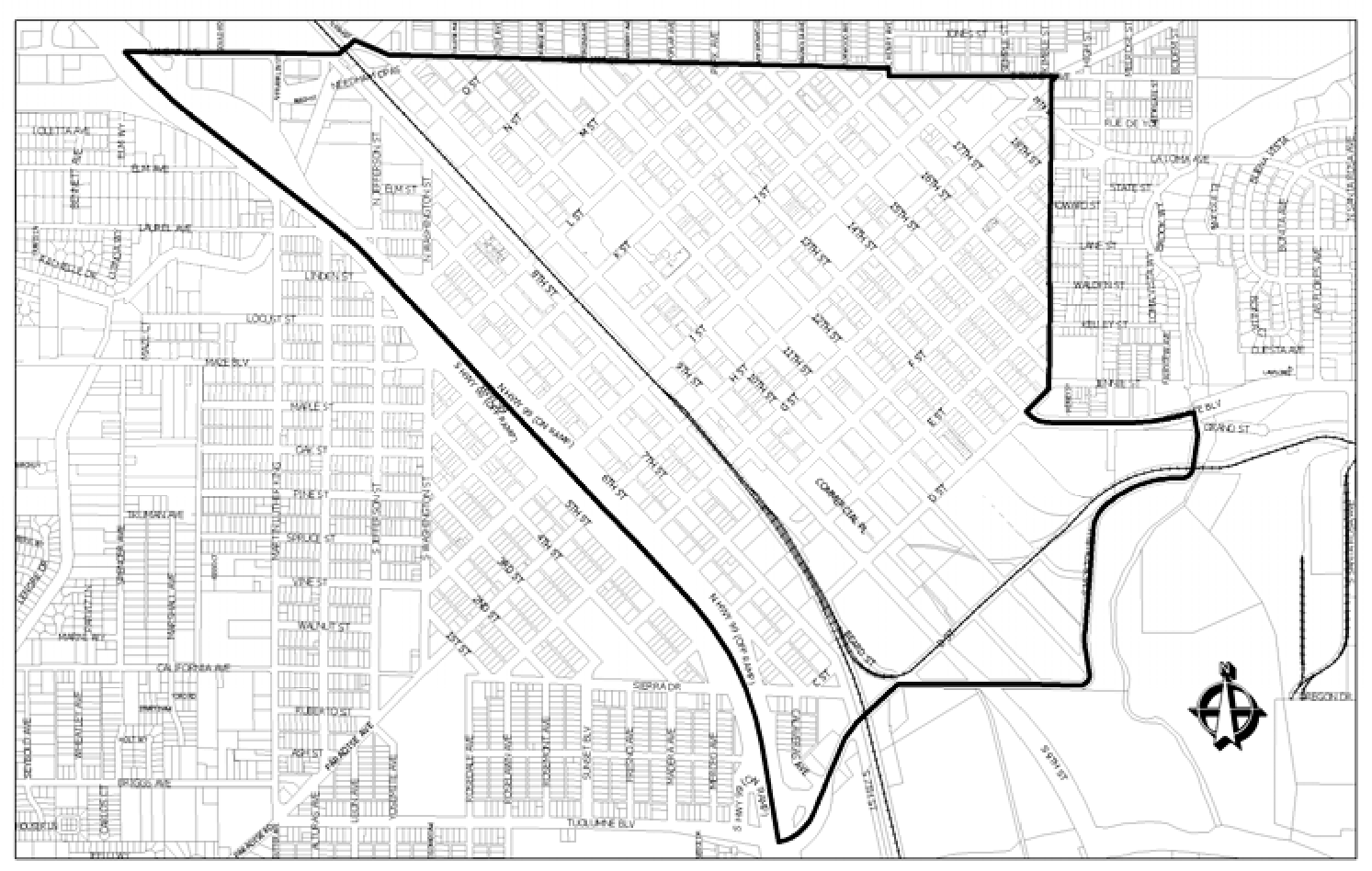
The "Downtown Area" is that area bounded by Needham Avenue, Downey Avenue, Burney Avenue, Grand Street-D Street, Yosemite Boulevard, South Morton Boulevard, B Street, Tuolumne Boulevard, Freeway 99, and Kansas Avenue, and the extension thereto across the Union Pacific RR tracks back to Needham Avenue. See Figure 2.1-1. The purpose of this definition is intended for determining required parking in the area shown below, pursuant to Section 10-5.102.
Figure 2.1-1
DOWNTOWN AREA
10-2.121(B) - Duplex.
Two (2) primary single-family dwelling units on a single parcel that have separate entrances. A duplex is not a multiple-family dwelling as defined in Section 10-2.122 even if the two (2) units share walls or are otherwise connected.
(Ord. No. 3797-C.S, § 2, effective 6-24-25)
10-2.122 - Dwelling, Multiple-Family.
A building designed for and/or occupied by two (2) or more families.
10-2.123 - Dwelling, Single-Family.
A detached building designed for and/or occupied by one (1) family.
10-2.124 - Dwelling Unit.
A single unit providing complete, independent living facilities for one (1) or more persons including permanent provisions for living, sleeping, eating, cooking, and sanitation.
10-2.125 - Emergency Shelter.
Any structure or facility, the primary purpose of which is to provide housing or temporary shelter, with minimal supportive services for homeless persons that is limited to occupancy of six (6) months or less by homeless persons. No individual or household may be denied emergency shelter because of an inability to pay. This definition includes other interim interventions, including but not limited to a navigation center, bridge housing, and respite or recuperative care.
(Ord. No. 3771-C.S., § 1, effective 12-14-23)
10-2.126 - Entertainment.
A single event, a series of events, or an ongoing activity which the public is invited or allowed to watch, listen, or participate or that is conducted for the purposes of holding the attention, gaining the attention or diverting or amusing guests or patrons. Entertainment may be provided indoors or outdoors, on a temporary or ongoing basis, on private property or on or adjacent to public property or roadways, and with or without a fee. Entertainment activities are mostly passive where the public is watching and listening but can be active where the public is physically involved such as dancing. Examples of entertainment include but are not limited to: carnivals, circus acts, comedy acts, concerts, contests, dance acts, dancing to live or recorded music exhibitions, musical song acts, plays, rodeos, sporting events, and talent shows. See Article 4 of Chapter 1 of Title 4 of the Modesto Municipal Code regarding Entertainment Establishments and Special Events. Title 10 does not address entertainment activities on roadways.
10-2.127 - Entertainment Establishment.
An establishment where entertainment is provided for the public as an ongoing activity, either independent or in conjunction with any other use. Examples of entertainment establishments are dance halls, night clubs, performing arts auditoriums, and theaters. See Article 4 of Chapter 1 of Title 4 of the Modesto Municipal Code regarding Entertainment Establishments and Special Events to determine when an Entertainment Permit is required.
10-2.128 - Exotic animal.
An animal that is not usually domesticated, and of a species that, due to size, wild nature or other characteristic, is dangerous to humans. The term includes animals the keeping of which are licensed by the state or federal government, such as wolves, raptors and pheasants. Exotic animals include but are not limited to: eagles, ocelots, jaguars, cougars, weasels, ferrets, badgers, monkeys, chimpanzees, coyotes, wolves, and snakes.
10-2.129 - Family.
An individual or two (2) or more persons living together as a single household unit in a dwelling unit. Family does not include larger institutional group living situations including, but not limited to, fraternities and sororities nor does it include commercial group living arrangements including, but not limited to, boarding houses and lodging houses.
10-2.130 - Garage Sale.
The retail sale of used or secondhand merchandise at dwellings and on residentially zoned property, also commonly known as patio sales or yard sales, etc.
10-2.131 - Grade.
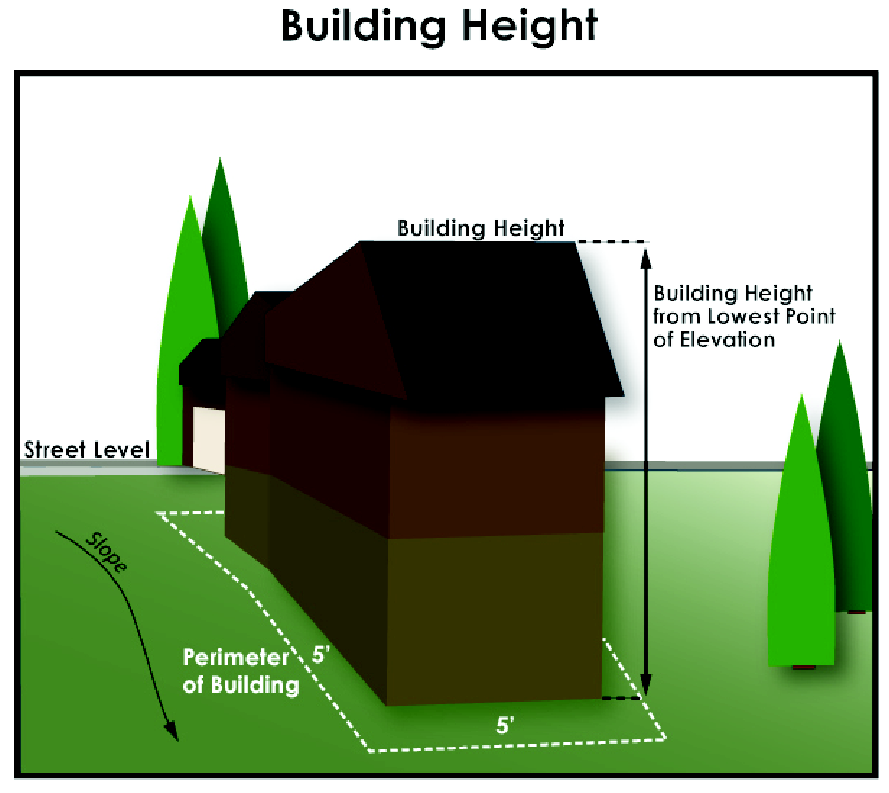
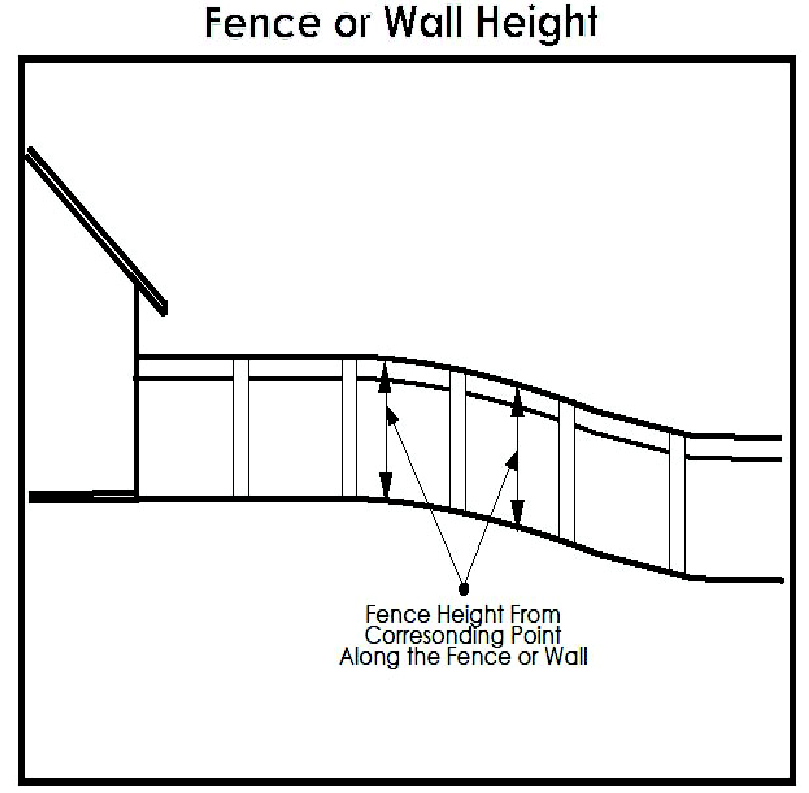
The lowest point of elevation on the finished graded surface of the ground, paving or sidewalk within that area which is no more than five (5) feet from the perimeter of the structure or building footprint, or in the case of a fence or wall, within one (1) foot perpendicular from the corresponding point along the fence or wall. See Figures 2.1-2 and 2.1-3. The footprint of a building or structure, as described herein, shall include the supporting posts for any unenclosed portion of the structure, such as for a porch, patio cover, or canopy structure.
Figure 2.1-2 Figure 2.1-3
10-2.132 - Height.
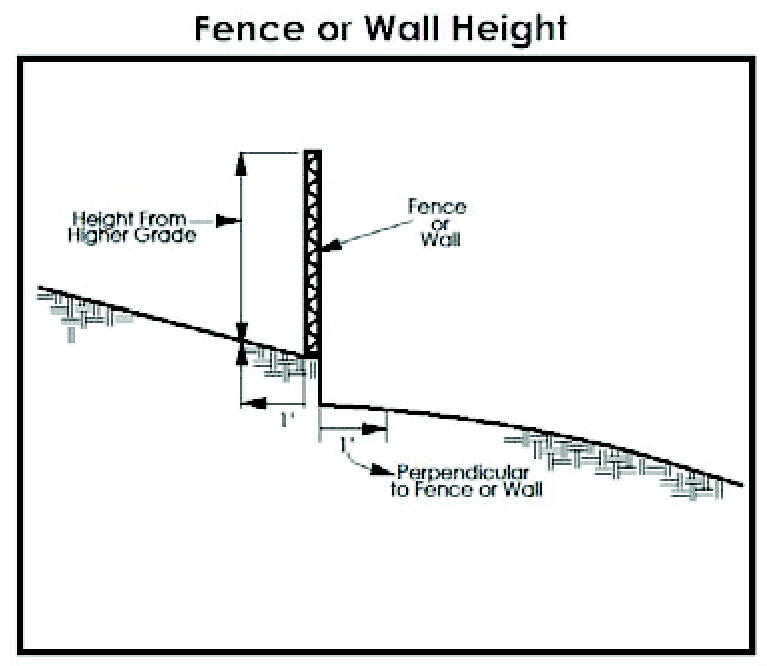
The vertical distance above grade to the highest point of a building or structure, fence or wall. Where the grade differs on each side of a fence or wall, the height of the fence or wall shall be measured from the higher grade. See Figure 2.1-4.
Figure 2.1-4
10-2.133 - Homeless Shelter.
A homeless shelter means any of the following:
(a)
Any facility, the primary purpose of which is to provide a temporary shelter for the homeless in general or for specific populations of the homeless and which does not require occupants to sign leases or occupancy agreements; or
(b)
An emergency shelter, as defined in Section 10-2.125; or
(c)
A navigation center is a housing first, low-barrier, service-enriched shelter focused on moving homeless individuals and families into permanent housing that provides temporary living facilities while case managers connect individuals experiencing homelessness to income, public benefits, health services, shelter, and housing.
(Ord. No. 3771-C.S., § 1, effective 12-14-23)
10-2.134 - Household Pets.
Animals or fowl ordinarily kept in a house for company or pleasure and not for profit.
10-2.135 - Kennel.
A place where three (3) or more dogs of five (5) months of age or four (4) or more cats of four (4) months of age or older are kept.
10-2.136 - Lodging.
The provision of sleeping accommodations for compensation on not less than a weekly basis.
10-2.137 - Lot.
A recorded parcel of real property lawfully created as required by applicable Subdivision Map Act and City requirements.
10-2.138 - Lot Area.
The total horizontal area within the boundaries of a lot.
10-2.139 - Lot, Back-Up.
A through lot where access is not allowed along one of the fronting streets.
10-2.140 - Lot, Corner.
A lot situated at the intersection or interception of two (2) or more streets, which streets have an angle of intersection or interception of not more than one hundred thirty-five (135) degrees.
10-2.141 - Lot, Coverage.
The portion of a lot occupied by structures including patios, porches, garages, and covered parking spaces. The area of a structure is measured from exterior walls or support posts. Accessory recreational and decorative structures such as gazebos, pergolas, and wood decks, as well as impervious surfaces such as driveways, uncovered parking spaces, swimming pools, retaining walls are not counted towards lot coverage.
10-2.142 - Lot, Flag.
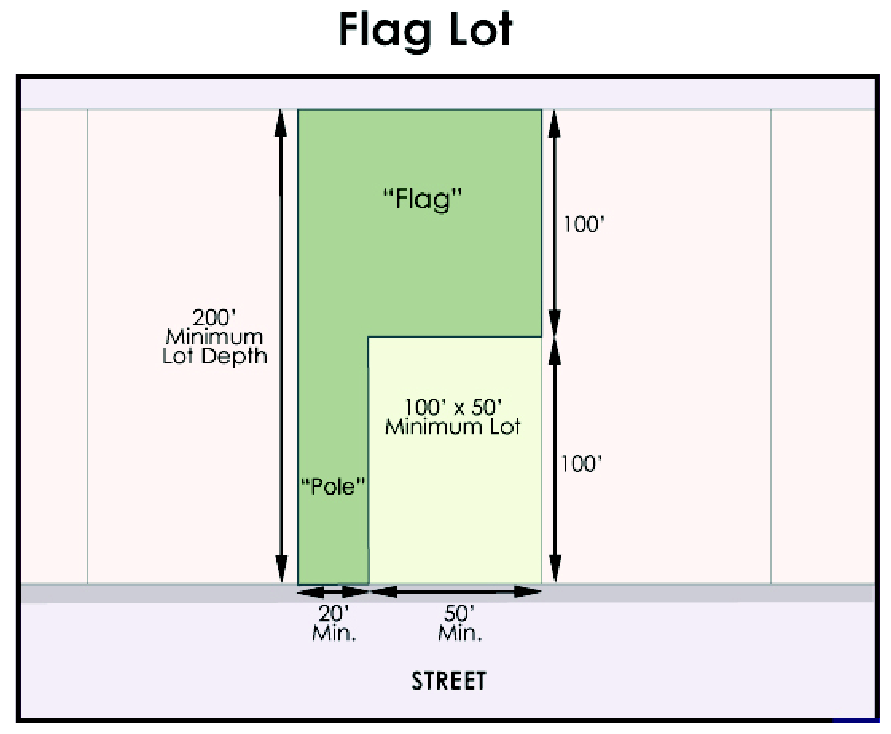
A lot that does not satisfy the standard minimum lot width requirement for the zone at the front lot line and consists of two (2) distinct parts: the "flag" (which is the buildable portion of the lot) located generally behind another lot; and the "flag pole" which provides the only access from the street to the buildable portion of the lot. See Figure 2.1-5.
Figure 2.1-5
10-2.143 - Lot, Interior.
A lot with single street frontage as opposed to a lot with more than one (1) street frontage such as a through lot or corner lot.
10-2.144 - Lot, Through.
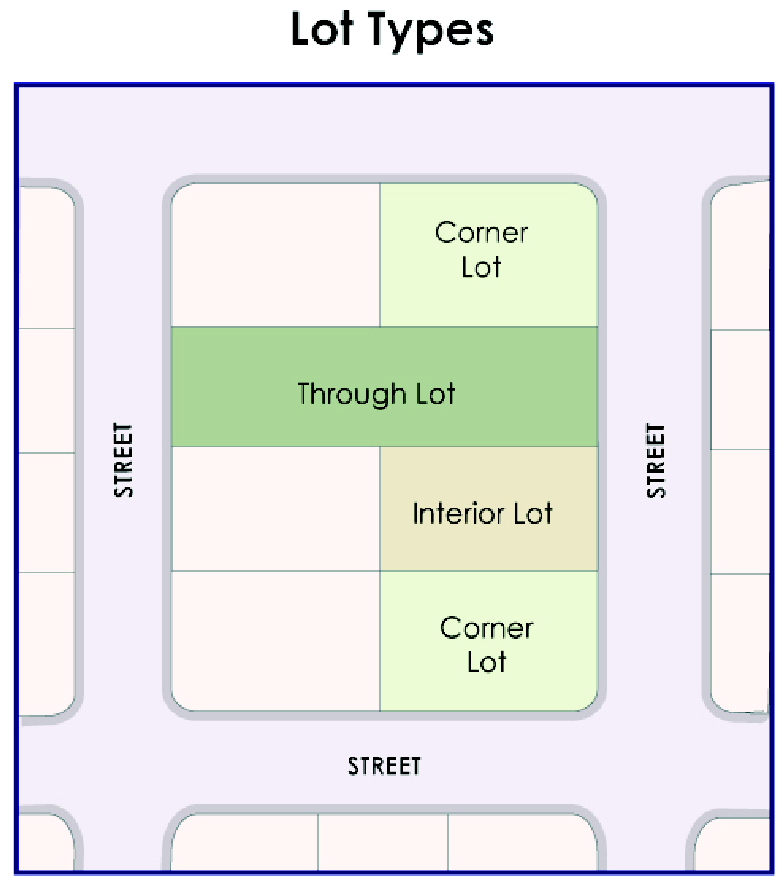
A lot located between two (2) parallel streets, with frontage on both streets. See Figure 2.1-6.
Figure 2.1-6
10-2.145 - Lot Line, Front.
For an interior lot, a line separating the lot from the street. For a corner lot, the front lot line shall be the line separating the narrowest street frontage of the lot from the street.
10-2.146 - Lot Line, Rear.
A lot line which is opposite and most distant from the front lot line. Any lot line which has an angle of more than forty-five (45) degrees from a side lot line in the rear one-third (⅓) of the lot shall be considered a rear lot line.
10-2.147 - Lot Line, Side.
A lot line along the boundary of a lot between the front and rear lot lines.
10-2.148 - Lot Line, Street-Side.
On a corner lot, the street-side lot line shall be the line separating the widest street frontage of the lot from the street.
10-2.149 - Lot Width.
The horizontal distance between the side lot lines measured parallel to the front lot line at any point between the front and rear lot lines.
10-2.149.1 - Low Barrier Navigation Center.
A housing first, low-barrier, service-enriched shelter focused on moving people into permanent housing that provides temporary living facilities while case managers connect individuals experiencing homelessness to income, public benefits, health services, shelter, and housing. "Low Barrier" means best practices to reduce barriers to entry, and may include, but is not limited to, the following:
(1)
The presence of partners if it is not a population-specific site, such as for survivors of domestic violence or sexual assault, women, or youth.
(2)
Pets.
(3)
The storage of possessions.
(4)
Privacy, such as partitions around beds in a dormitory setting or in larger rooms containing more than two (2) beds, or private rooms.
(Ord. No. 3771-C.S., § 2, effective 12-14-23)
10-2.150 - Manufacturing, Heavy.
Manufacturing of products from raw or unprocessed materials, where the finished product may be combustible or explosive. Heavy manufacturing may include any establishment or facility using large outdoor structures such as conveyor belt systems, cooling towers, cranes, storage silos, or similar equipment that cannot be integrated into the building design, or those engaging in large scale outdoor storage. Any industrial use that generates noise, odor, vibration, illumination, or airborne particulates that may be offensive or obnoxious adjacent land uses, or that requires a significant amount of on-site hazardous chemical storage, shall be classified under this land use. This use shall include any packaging of the product being manufactured on-site. Light Manufacturing uses are permitted.
Examples include, but are not limited to, the production of the following products: asphalt, ceramics, glass, clay, concrete (no rock crushing), gas, metal (including foundries, forge shops, open air welding), oil and grease products, petroleum products, plastics, and vehicles (includes automobiles, boats, and recreation vehicles).
10-2.151 - Manufacturing, Light.
Manufacturing of products from processed or unprocessed raw materials, where the finished product is non-combustible and non-explosive. Light manufacturing includes product assembling or mixing, where previously processed components or manufactured parts produced on-site or off-site are fitted or blended together to form a product. Light manufacturing shall include any packaging of the product being manufactured on-site or off-site. Light manufacturing may also include any establishment or facility using large unscreened outdoor structures such as conveyor belt systems and storage silos. Light manufacturing uses may produce noise, vibrations, illumination, or airborne particulates perceptible to adjacent land users, which are not offensive or obnoxious. Odors produced on-site shall not have a significant negative effect on other businesses or properties in the area.
Examples of packaging include facilities for bottling, canning, wrapping, and boxing of products assembled or manufactured on-site or off-site. Examples of the products include, but are not limited to, beverages, electronic components, food products including meats.
Examples of assembling include, but are not limited to, the production of the following: clothes, computer software, electric or electronic components, furniture (where wood is milled off-site), hardware, mechanical components, pharmaceuticals, toys, and small vehicle assembly.
Examples of manufacturing include, but are not limited to, the production of the following: apparel products, beverages, candy and other confectionery products, ceramics (small products such as figurines, stoneware, porcelain, wall and floor tiles), computer hardware, cosmetics, dairy products, electronics, food and beverage products, jewelry, leather products, musical instruments, metal products (fabricated) made from semi-finished metals, office and artist materials, paper and cardboard products (converted but excluding burning operations), pharmaceuticals, plastic or resin, rubber products, seeds, signs, sporting goods, textiles, tobacco, toys, and wood products (cabinets, desks, other furniture, lumber but excluding burning operations).
10-2.152 - Medical Marijuana Dispensaries.
"Dispensaries" shall mean any facility, building, structure, delivery service, vehicle or location whether fixed or mobile, where medical marijuana (cannabis), medical marijuana (cannabis) products, or devices for the use of medical marijuana (cannabis) or medical marijuana (cannabis) products are offered, either individually or in any combination, for retail sale, transmittal, or otherwise provided to any of the following: a primary caregiver, a qualified patient, or a person with an identification card, in accordance with Health & Safety Code Section 11362.5, et seq. "Dispensary" shall also include a cooperative/collective. The terms "primary caregiver" and "qualified patient" shall be as defined in Health & Safety Code Section 11362.7.
A "dispensary" shall not include the following uses, as long as the location of such uses are otherwise regulated by this Code or applicable law: a clinic licensed pursuant to Chapter 1 of Division 2 of the Health & Safety Code, a health care facility licensed pursuant to Chapter 2 of Division 2 of the Health & Safety Code, a residential care facility for persons with chronic life-threatening illness licensed pursuant to Chapter 3.01 of Division 2 of the Health & Safety Code, a residential care facility for the elderly licensed pursuant to Chapter 3.2 of Division 2 of the Health & Safety Code, a residential hospice or a home health agency licensed pursuant to Chapter 8 of Division 2 of the Health & Safety Code, as long as any such use complies strictly with applicable law including, but not limited to, Health & Safety Code Section 11362.5, et seq.
(Amended by Ord. 3641-C.S., § 2, effective 2-26-16)
10-2.153 - Microbrewery.
A microbrewery produces less than fifteen thousand (15,000) barrels per year that sell directly to the consumer through a tap room, attached restaurant, or attached bar (known as a "brewpub").
10-2.154 - Mobile Recycling Unit.
An automobile, truck, trailer or van, licensed by the Department of Motor Vehicles which is used for the collection of recyclable materials. A mobile recycling unit includes the bins, boxes or containers transported by trucks, vans, or trailers, and used for the collection of recyclable materials.
10-2.155 - Model Home.
A residential structure within a residential subdivision (including a condominium project) used for the purposes of display, advertising, promotion, or sales of homes and not used as a dwelling.
10-2.156 - Motor Home.
A self-propelled motor vehicle which is designed for human habitation and which may contain plumbing, heating or electrical equipment.
10-2.157 - Nonconforming Structure and Site.
A structure or site that was lawfully established and maintained but which, because of the application of the site development standards in this Title, including coverage, setbacks, parking, landscaping, walls, and fences, no longer conforms to the regulations of the zone in which it is located.
10-2.158 - Nonconforming Use.
A use which was lawfully established and maintained but which, because of the application of this Title, no longer conforms to the use regulations of the zone in which it is located.
10-2.159 - Office, General.
Offices occupied by accountants, architects, attorneys, counseling services, government agencies, engineers, insurance agents, public agencies, realtors, stockbrokers, surveyors, travel agents, utility companies, or other similar uses. General offices exclude retail and wholesale sales as a primary use, banks, credit unions and other similar financial institutions.
10-2.160 - Office, Medical.
Offices occupied by acupuncturists, chiropractors, clinics, dentists, laboratory technicians, massage therapists, medical doctors, optometrists, physical therapists, skin care therapists (estheticians) or other similar uses.
10-2.161 - Pet Store.
A shop for the sale of small animals and other household pets which may include services such as grooming, but excludes exterior runs or other outdoor uses.
10-2.162 - Prezoned Land.
Land outside the City with a City zoning classification.
10-2.163 - Proprietor.
An owner, lessee, or occupant who has legal control or responsibility over the entire premises.
10-2.164 - Racing Homer Pigeon.
A pigeon trained to return home from a distance and which is identified by a nonremovable seamless leg band issued by a nationally recognized Racing Homer Association.
10-2.165 - Recreation Facility, Indoor.
Active indoor recreation activities that include, but are not limited to, amusement machine centers (arcades), bingo, bowling alleys, gymnasiums, pool halls, shooting ranges, simulated shooting games (laser tag), skating rinks, and slot car racing.
10-2.166 - Recreation Facility, Outdoor.
Active outdoor recreation activities that include, but are not limited to, amusement parks, bumper cars, driving ranges, golf courses, miniature golf, paint ball facilities, skateboard parks, sports complex and stadiums, swimming pools, and tennis clubs. Outdoor recreation facilities may include indoor recreation facilities.
10-2.167 - Recreational Vehicle.
A collective term which may refer to any or all of the following: airplane, boat, boat trailer, camper, motor home, motorcycle trailer, travel trailer and similar vehicles.
10-2.168 - Recyclable Material.
Recyclable material is reusable material including but not limited to metals, glass, plastic and paper, which are intended for reuse, remanufacture, or reconstitution for the purpose of using the altered form. Recyclable material does not include refuse or hazardous materials. Recyclable material may include used motor oil collected and transported in accordance with Sections 25250.11 and 25143.2(b)(4) of the California Health and Safety Code.
10-2.169 - Recycling Collection Facility.
A collection facility is a recycling facility for the acceptance by donation, redemption, or purchase, of recyclable materials from the public. Such a facility does not use power-driven processing equipment except for equipment in a scale used in reverse vending machines. Such facilities may operate in permanent structures. Collection facilities may include the following:
(a)
Reverse vending machine(s);
(b)
Small collection facilities which occupy an area of not more than five hundred (500) square feet, and may include:
(1)
A mobile recycling unit;
(2)
Bulk reverse vending machines or a grouping of reverse vending machines occupying more than fifty (50) square feet;
(3)
Kiosk-type units;
(4)
Unattended containers placed for the donation of recyclable materials.
(c)
Large collection facilities which may occupy an area of more than five hundred (500) square feet.
10-2.170 - Recycling Facility.
A recycling facility is a center for the collection and/or processing of recyclable materials. A certified recycling facility or certified processor means a recycling facility certified by the California Department of Conservation as meeting the requirements of the California Beverage Container Recycling and Litter Reduction Act of 1986. A recycling facility does not include storage containers or processing activity located on the premises of a residential, commercial, or manufacturing use and used solely for the recycling of material generated by that residential property, business or manufacturer.
10-2.171 - Recycling Processing Facility.
A processing facility is a recycling facility in a building or enclosed space or in a screened outdoor area used for the collection and processing of recyclable materials. "Processing" means the preparation of material for efficient shipment, or to an end-user's specifications, by such means as baling, briquetting, compacting, flattening, grinding, crushing, mechanical sorting, shredding, cleaning, and remanufacturing. Processing facilities include the following:
(a)
A light processing facility occupies an area of under forty-five thousand (45,000) square feet of gross collection, processing and storage area and has up to an average of two (2) outbound truck shipments per day. Light processing facilities are limited to baling, briquetting, crushing, compacting, grinding, shredding and sorting of source-separated recyclable materials and repairing of reusable materials sufficient to qualify as a certified processing facility. A light processing facility shall not shred, compact, or bale ferrous metals other than food and beverage containers.
(b)
A heavy processing facility is any processing facility other than a light processing facility.
10-2.172 - Residential Care Facility.
"Residential care facility" means a single-family dwelling unit which provides 24-hour non-medical care of persons who are in need of personal service, supervision, or assistance essential for sustaining the activities of daily living or for the protection of the individual in a family-like environment, in a facility licensed by the State of California. A residential care facility does not include family day care, foster care or any medical services, including nursing services, beyond that required by the residents of the residential care facility for sustaining the activities of daily living. A residential care facility specifically includes a community care facility, residential care facility, alcoholism or drug abuse recovery facility, or family care home, foster home, or group home for mentally disordered or otherwise handicapped persons or dependent or neglected children, as defined by California Health and Safety Code Section 1502 and licensed by the State of California.
10-2.173 - Residential Service Facility.
"Residential service facility" means a single-family dwelling unit which provides 24-hour non-medical care of persons who are in need of personal service, supervision, or assistance essential for sustaining the activities of daily living or for the protection of the individual in a family-like environment, in a facility not licensed by the State of California. A residential service facility does not include family day care, foster care or any medical services, including nursing services, beyond that required by the residents of the residential service facility for sustaining the activities of daily living.
10-2.174 - Retail, General.
Retail sales of a variety of merchandise including that allowed under Neighborhood Retail and larger-scaled stores including, but not limited to, appliance stores, department stores, farm supply stores, floor covering stores, home improvement centers, medical supply stores and supercenters.
10-2.175 - Retail, Neighborhood.
Smaller-scale retail sales of a variety of merchandise that are compatible with nearby residential areas. The maximum size of one (1) store is eighty thousand (80,000) square feet in floor area. Examples of these stores and the lines of merchandise include but are not limited to: antiques, appliances (small scale), art supplies, art (art gallery and studio), bakery, bicycles, books, cameras, clothing, computers, drugs (drugstore or pharmacy), electronics, fabric (including upholstery material), flowers (includes florist and nursery), food, furniture, gifts, hardware, housewares, jewelry, liquor, luggage, musical instruments, office supplies, paints, pets, photographic supplies, shoes, sporting goods, tobacco, toys, variety goods, and wallpaper.
10-2.176 - Reverse Vending Machine(s).
A reverse vending machine is an automated mechanical device which accepts at least one (1) or more types of empty beverage containers including, but not limited to metal cans, glass and plastic bottles, and issues a cash refund or a redeemable credit slip with a value not less than the container's redemption value as determined by the State. A reverse vending machine may sort and process containers mechanically provided that the entire process is enclosed within the machine.
10-2.177 - Secretary.
The Secretary of the Planning Commission and Board of Zoning Adjustment of the City of Modesto. The responsibilities of the Secretary may be carried out by a designee.
10-2.178 - Services, Business.
Services intended to meet the business needs of individuals and businesses. Examples of these establishments include but are not limited to: banks, credit unions and other similar financial institutions, express mailing, printing and duplicating services.
10-2.179 - Services, Personal.
Services intended to meet personal needs of individuals. Examples of these establishments and personal services include but are not limited to: barber shops, beauty shops, body art studios (tattoos, piercings), dry cleaners (limited equipment), instructional studios (art, dance, drama, gymnastics, martial arts, music), interior decorators, laundromats, lock smiths, pet grooming, photography studios, spas (may include massage, facials, body treatments, indoor baths service and hot tub use), and tailors.
10-2.180 - Services, Major Repair.
Repair services on a variety of larger products. Examples of the products include, but are not limited to: appliances (large scale), electric motors, furniture, gas motors (lawn mowers), upholstery. Does not include vehicle repair.
10-2.181 - Services, Minor Repair.
Repair services on a variety of smaller products that can be hand carried and do not include gas motors. Examples of the products include, but are not limited to: appliances (small scale), bicycles, cameras, electronics, guns, musical instruments, shoes, and tools.
10-2.182 - Services, Trade.
Services intended to improve or repair buildings and equipment where there may be limited inventory on the site within a building. Examples of trade services include plumbers, electricians, heating and air contractors, and general contractors.
10-2.183 - Setback.
"Setback" is the minimum required distance that buildings, structures, and parking areas must be separated from any lot line.
(a)
"Front setback" is measured from the front lot line.
(b)
"Rear setback" is measured from the rear lot line.
(c)
"Side setback" is measured from the side lot line(s).
(d)
"Street side setback" is measured from the street side lot line.
10-2.184 - Shipping Container.
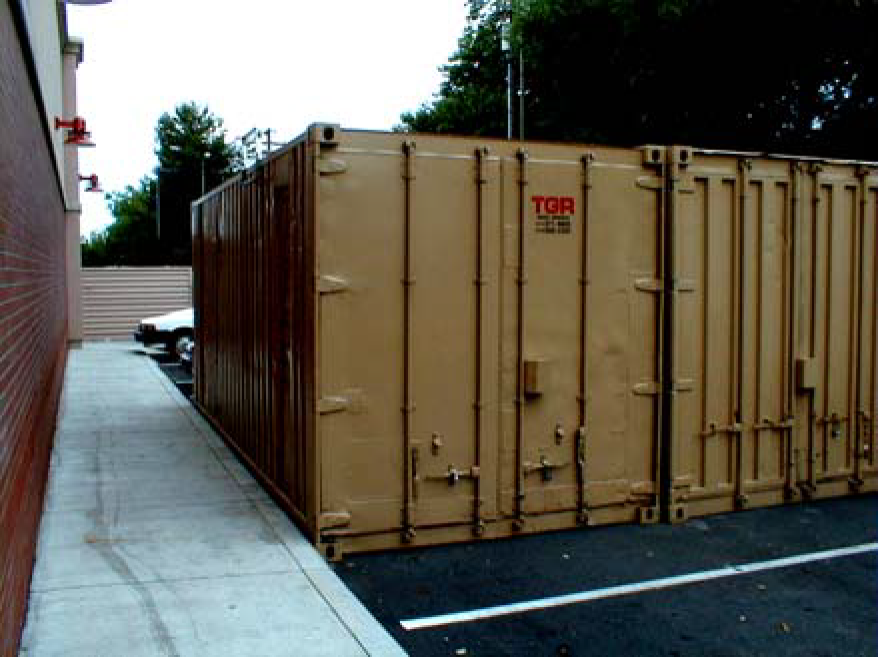
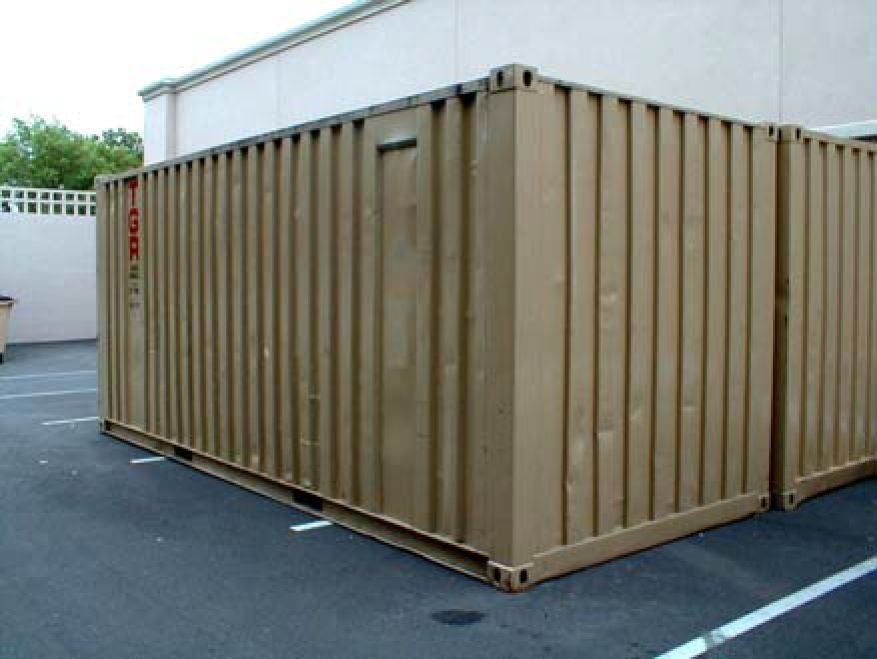
Structure designed and intended for the movement of materials over long distances, typically constructed of corrugated steel, and commonly associated with ship, train or tractor-trailer shipping. See Figure 2.1-7 below.
Figure 2.1-7
10-2.185 - Sign.
Signs are as defined in Chapter 6 of this Title.
10-2.186 - Solar Energy Farm.
A large scale solar energy system used for the primary purpose of wholesale or retail sales of the generated electrical power.
10-2.187 - Solar Energy System.
A solar energy system is a solar collector or other solar energy device along with its ancillary equipment, whose primary purpose is to provide for the collection, storage, and distribution of solar energy for space heating, space cooling, electric generation, or water heating.
10-2.188 - Story.
A story is that portion of a building included between the upper surface of any floor and the upper surface of the floor next above, except that the topmost story shall be that portion of a building included between the upper surface of the topmost floor and the ceiling or roof above. If the finished floor level directly above a basement or unused underfloor space is more than six (6) feet above grade as defined herein for more than fifty (50) percent of the total perimeter or is more than twelve (12) feet above grade as defined herein at any point, such basement or unused underfloor space shall be considered as a story.
10-2.189 - Street.
A right-of-way which has been dedicated to or acquired by the public and which is the principal means of access to abutting property. Easements, walkways and alleys shall not be considered "streets" for the purpose of this Title.
10-2.190 - Street, Side.
Street bordering a corner lot adjacent to the street side lot line.
10-2.191 - Structure.
That which is built or constructed, or any piece of work artificially built up or composed of parts joined together in some definite manner attached to the ground in a permanent nature. For the purposes of this Title, the term structure includes building, freestanding sign, antenna, a deck 30 inches or higher but does not include walls or fences seven (7) feet or less in height shall not be considered a structure for the purposes of this Title.
(Ord. No. 3704-C.S., effective 11-7-2019)
10-2.192 - Supportive Housing.
Housing that does not have a limit on the length of stay, that is occupied by a target population as defined in the Health and Safety Code Section 53260 (i.e., low income persons with mental disabilities, AIDS, substance abuse and chronic health conditions or persons whose disabilities originated before the person turned eighteen (18)), and that is linked to on-site or off-site services that assist the supportive housing occupants in retaining permanent housing, improving his or her health status, and maximizing his or her ability to live and, when possible, work in the community.
10-2.193 - Swimming Pool.
A structure designed to contain water in excess of eighteen (18) inches in depth, located above or below grade or ground surface, commonly constructed of concrete, metal, wood, fiberglass, and/or plastic, and designed and used for recreation or therapy.
10-2.194 - Transitional Housing.
Housing that provides supportive services for up to two (2) years that is exclusively designated and targeted for recently homeless persons. Transitional housing includes self-sufficiency development services, with the ultimate goal of moving recently homeless persons to permanent housing as quickly as possible, and limits rents and service fees to an ability-to-pay formula reasonably consistent with the United States Department of Housing and Urban Development's requirements for subsidized housing for low-income persons. Rents and service fees paid for transitional housing may be reserved, in whole or in part, to assist residents in moving to permanent housing.
(Ord. No. 3771-C.S., § 1, effective 12-14-23)
10-2.195 - Truck.
(a)
A motor vehicle, including a commercial vehicle or truck tractor as defined in the Vehicle Code of the State of California, designed or used for the transportation of persons, commodities or materials that operates with a declared gross or combined gross vehicle weight that exceeds ten thousand (10,000) pounds.
(b)
Notwithstanding the provisions of paragraph (a) herein, this definition shall not include any passenger vehicle with a capacity of fewer than ten (10) passengers.
10-2.196 - Truck, Light.
A light truck is a non commercial vehicle with a bed intended to transport materials and supplies with a declared gross or combined gross vehicle weight of less than ten thousand (10,000) pounds.
10-2.197 - Use.
The purpose for which either land or a structure is or may be occupied or maintained.
10-2.198 - Vehicle, Heavy.
These vehicles include buses, farm equipment, trucks, and other similar large vehicles.
10-2.199 - Vehicle, Light.
These vehicles include automobiles, boats, light trucks, motorcycles, recreational vehicles, vans, and other similar small vehicles.
(a)
Major Vehicle Repair and Service. These establishments provide repair and service to light vehicles that include body work, dismantling, engine rebuilding, radiator rebuilding, painting services, tire recapping, towing, and upholstery repair.
(b)
Minor Vehicle Repair and Service. These are minor facilities providing limited repair and maintenance services to light vehicles. Examples include: detailing services, engine repair, general vehicle repair, radiator and muffler replacement, and tire and battery sales and installation (not including recapping).
10-2.1100 - Veterinary Hospital, Large Animal.
A business for the care and treatment of livestock and other commercial animals.
10-2.1101 - Veterinary Hospital, Small Animal.
A business for the care and treatment of household pets.
10-2.1102 - Windmill.
A device designed to convert wind power to another form of energy such as electricity or heat.
10-2.1103 - Yard.
An open space on a lot, unoccupied and unobstructed from the ground upward, except (vegetation) as permitted in this Title.
10-2.1104 - Yard, Front.
An area extending across the full width of the lot between the front lot line and the front of buildings, structures, and parking area.
10-2.1105 - Yard, Rear.
An area extending the full width of the lot between a rear lot line and the rear of buildings, structures, and parking area.
10-2.1106 - Yard, Side.
An area between an interior-side lot line and the buildings, structures, and parking area extending between the front and rear yards.
10-2.1107 - Yard, Street-Side.
An area extending across the full lot depth between the street-side lot line and the buildings, structures, and parking area.

