
Modesto City Zoning Code
CHAPTER 6
SIGNS
10-6.101 - Purpose.
This article establishes uniform regulations for signs within the City of Modesto. These sign regulations are intended to provide minimum standards to safeguard life, health, property and public welfare in keeping with the character of the City of Modesto, by regulating and controlling the size, height, structural design, quality of materials, construction, location, lighting and maintenance of all signs and sign structures. The purposes of these sign regulations are also to:
(a)
Encourage signs which are well designed and pleasing in appearance, and to provide incentive and latitude for variety, good design relationship, spacing and location;
(b)
Provide a reasonable and comprehensive system of controls of signs;
(c)
Encourage a desirable urban character which has a minimum of overhead clutter;
(d)
Attract and direct persons to various activities and enterprises in order to provide for commerce and the maximum public convenience;
(e)
Enhance the economic value of the community and each area of it through the regulation of size, location, design and illumination of signs;
(f)
Protect and enhance the character of residential neighborhoods and property values by prohibiting obtrusive and incompatible signs; and
(g)
Promote and maintain healthy commercial centers and property values, to effectively communicate the nature of goods and services, and to avoid wasteful, ugly and unsightly competition in signs.
10-6.102 - Definitions.
(a)
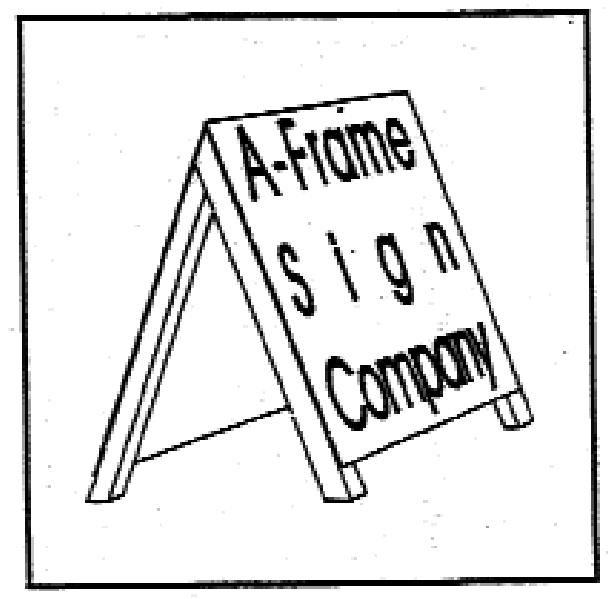
A-frame sign. A temporary, freestanding sign, consisting of two (2) message panels attached by a hinge or similar device along their top edge, which is placed on the ground with the base of each panel separated by a sufficient distance to allow the sign to stand upright without other support. For the purposes of this definition, A-frame signs include single message panels that are mounted on a wood or metal base which provides the stability and support necessary for the sign to stand upright without attachment to a structure. See Figure 6.1-1.
FIGURE 6.1-1
A-FRAME SIGN
(b)
Area of a sign. See Section 10-6.106(a).
(c)
Balloon. For the purposes of this chapter, a round, inflated object with a diameter not exceeding twenty-four (24) inches used as a promotional decoration. Larger inflated objects are not regulated by this article, but are instead subject to Section 6.108(b)(4) of Code. See also "Promotional Decorations."
(d)
Banner. A temporary sign consisting of a piece of fabric or plastic carrying an advertising message, usually hung on a wall or suspended between two (2) poles, buildings, or other structures.
(e)
Bench sign. A City-franchised outdoor bus bench to which an advertising message is applied.
(f)
Billboards. A freestanding sign providing off-premise advertising as defined in Section 10.6.102(jj) with a display in easily changeable copy but is not digital. A billboard is located along a freeway, highway, or major street and is of a large size typically ranging from ten (10) feet by twenty-five (25) feet to fourteen (14) feet by forty-eight (48) feet. Billboards are regulated under the off-premise sign regulations provided in Section 10-6.108 (j).
(g)
Block frontage. A block frontage is an area of one (1) or more privately owned parcels along a public street that is bounded by two (2) streets, or a street and a MID or TID canal, railroad right-of-way, or the Hetch Hetchy Right-of-Way.
(h)
Bulletin board. A sign used to announce a coming event or attraction, or used to convey a specific message related to the site where the bulletin board is located.
(i)
Business monument sign. A monument sign for a business or businesses on a single parcel that is not a shopping center.
(j)
Canopy. A roof of a building or a fixed overhead shelter used as a roof, which may or may not be attached to a building and which does not encroach into nor overhang a public street or alley right-of-way.
(k)
Canopy sign. A sign attached to or hung from a canopy. See Figure 6.1-3.
(l)
Combined business monument sign. A monument sign for businesses on multiple parcels that is not a shopping center in lieu of several business monument signs. The multiple parcels have shared property lines and common access.
(m)
Construction sign. A sign with the names of the architects, engineers, contractors, subcontractors and financing agencies of buildings and structures being constructed upon the site on which the sign is located.
(n)
Corporate flag. A flag identifying a business or firm.
(o)
Digital Freeway Billboard. A freestanding sign with one (1) or more digital display areas located along a freeway. A digital billboard meets the following criteria:
(1)
A freestanding sign which is used for the display of off-premise advertising as defined in Section 10-6.102(jj);
(2)
A freestanding sign which constitutes a principal, separate, or an accessory use, of the parcel on which it is located; and
(3)
A freestanding sign on which display space is made available to either the owner or parties other than the owner or operator of the sign or occupant of the parcel for no cost or in exchange for a rent, fee, lease, or other consideration.
(p)
Directional sign. One (1) of two (2) types of signs located on the same site the sign is intended to serve:
(1)
An exterior directional sign is oriented to a street and used to direct and control pedestrian or vehicular traffic; and
(2)
An interior directional sign is a directional, warning, or informational sign not bearing any advertising message readable from any street right-of-way.
(q)
Electronic Message Board Sign. A sign capable of displaying words, symbols, figures, or images that can be electronically or mechanically changed by remote or automatic means. No sign shall display animated messages, including flashing, blinking, fading, rolling, shading, dissolving, or any other effect that gives the appearance of movement.
(r)
Fee Resolution. A resolution of the City Council establishing fees for the filing and processing of sign permits, as it may be amended from time-to-time.
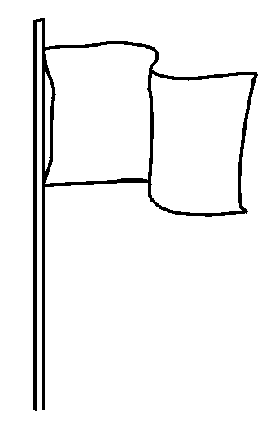
FIGURE 6.1-2
FLAG
(s)
Flag. A generally rectangular piece of fabric, normally attached to a support along one (1) of its edges, and marked with distinctive colors or designs, and/or text. See Figure 6.1-2. See also "Streamer."
(t)
For sale or rent sign. A sign advertising that the subject building, site or portions of the building or site are for sale, rent or lease.
(u)
Freestanding sign. A sign detached from any building or structure, with its structural supports permanently attached to the ground usually supported by one (1) or more columns, uprights, braces, other support structures, or a support base. Freestanding signs include monument signs but not a portable sign.
(v)
Freestanding use. A land use or occupancy that does not attract customers by its proximity to other businesses and is not part of a shopping center or any group of businesses that jointly attract customers through their proximity or through common advertising.
(w)
Freeway-oriented sign. A freestanding sign intended to attract motorists traveling on Freeway 99 to a site within six hundred (600) feet of the freeway.
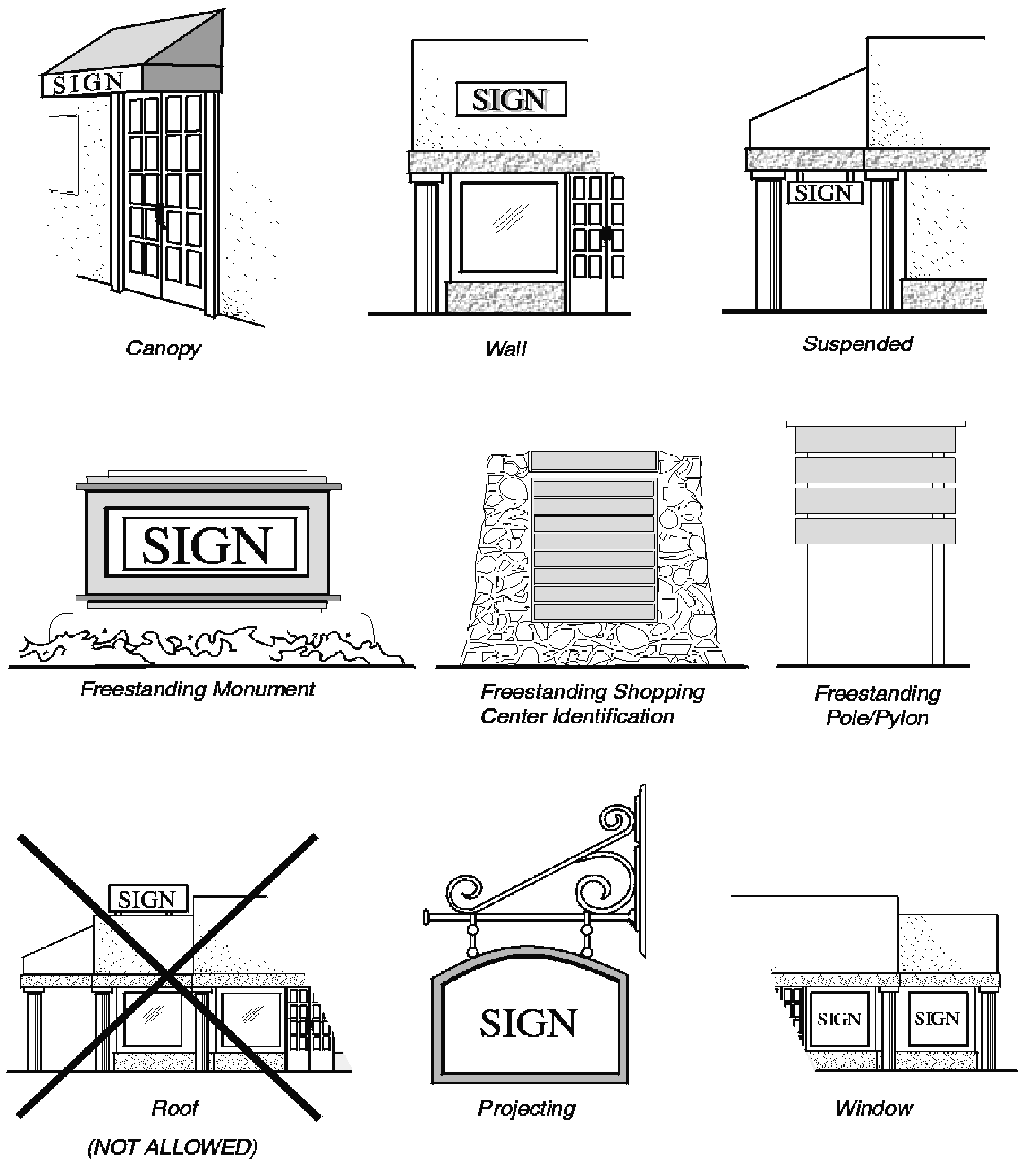
FIGURE 6.1-3
SIGN TYPES
(x)
Garage sale sign. A sign that is used to advertise the sale of used or secondhand goods or merchandise at dwellings and on residentially zoned property; these sales may also be known as patio sales, yard sales, etc.
(y)
Gateway sign. A permanent, freestanding sign identifying a subdivision or other housing project, placed adjacent to a street or driveway providing primary vehicle access to the site.
(z)
Height. See Section 10-6.106(a) and Section 10-2.132.
(aa)
Historic sign. An existing sign, or refurbishing of an existing sign, or re-creation of sign that once existed on the subject site at least fifty (50) years ago, and is designated as a State or Federal historic sign or landmark.
(bb)
Hot air balloon. A balloon that is filled with heated air, has a gondola, and is capable of rising and floating in the atmosphere with people aboard.
(cc)
Identification sign. Any sign that is used to identify or advertise the occupant of a building, lot or premises or the merchandise or activity available at the building, lot or premises where the sign is located.
(dd)
Installed, installation. The establishment of a sign at its intended location, through construction, erection, painting, attachment, or other means.
(ee)
Lighted sign. Any sign that is illuminated either directly or indirectly by artificial light.
(ff)
Marquee. A fixed overhead shelter used as a roof, which may or may not be attached to a building.
(gg)
Marquee sign. A sign attached to or hung from a marquee and which:
(1)
Is mounted in a vertical plane;
(2)
Is mounted parallel to the leading edge of a marquee, except for an under marquee sign which may be mounted at an angle to the leading edge of a marquee; and
(3)
Does not project higher than the wall of the building to which the marquee is attached.
(hh)
Monument sign. An independent, freestanding sign supported on the ground by a solid support base at least as wide as the sign; as opposed to being supported by poles or other open support structure.
(ii)
Open house directional sign. A sign with the words "open house," which may include an arrow or other directional symbol and real estate office name.
(jj)
Off-premise advertising sign. Off-premise advertising signs include any of the following:
(1)
Commercial. Any sign, excepting a bench sign, that directs attention to a business, profession, product, commodity, or mercantile-oriented service that is not the primary business, profession, product, commodity or mercantile-oriented service sold, manufactured, conducted, or offered on the site on which the sign is located.
(2)
Noncommercial. Any sign, excepting a bench sign, which does not direct attention to a business, profession, product, commodity or mercantile-oriented service. This includes but is not limited to any sign expressing a personal, political, religious or social message, idea or point of view.
(kk)
Placard. A temporary sign consisting of a rectangle of cardboard, masonite, or similar material, mounted on a wood or metal stake, which is driven into the ground.
(ll)
Political sign. Any impermanent sign or advertising device or display, with or without letters, words, numbers or figures thereon, which is designed to advertise a candidate for political office, a political party, or a measure scheduled for an election.
(mm)
Principal frontage. That wall of a building or structure which has frontage on a public street, highway, parking lot, walkway or mall, and which is designated by the owner or occupant of the structure as the principal frontage.
(nn)
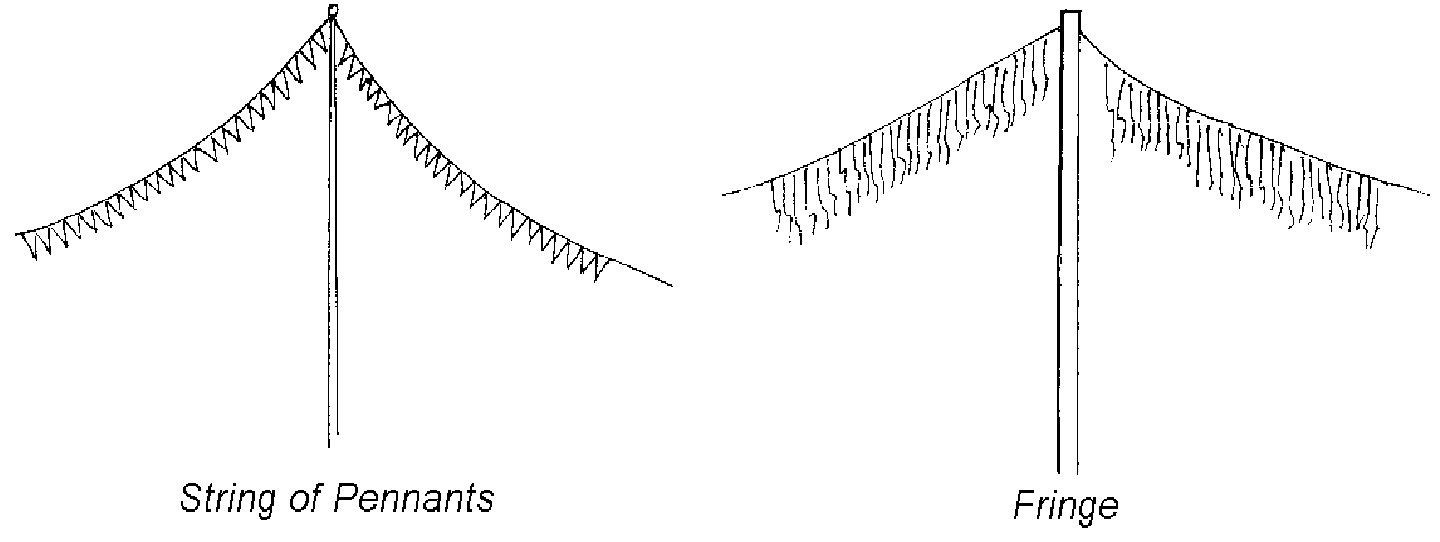
Promotional decorations. Temporary promotional decorations consisting of a string of pennants, fringe, balloons, or other decorative materials that are either suspended from poles, hung on walls to outline buildings, or placed on outdoor merchandise displays. Promotional decorations do not include flags or streamers, which are separately defined. See Figure 6.1-4.
FIGURE 6.1-4 PROMOTIONAL DECORATIONS
(oo)
Projecting sign. A projecting sign includes any of the following:
(1)
A sign attached to and projecting from the face of a wall, canopy, or marquee; and
(2)
A sign mounted on a canopy roof or building roof that has a slope flatter than a 45-degree angle (one (1) horizontal to one (1) vertical).
(pp)
Real estate sign. A sign advertising residential or commercial buildings or property for sale, lease, or rent, either located on the available property or off-site.
(qq)
Review authority. The individual or official City body (the Planning Commission, Board of Zoning Adjustments (Board), Director, or Chief Building Official) identified by this article as having the responsibility and authority to review, and approve or disapprove the signs and permits described in this article.
(rr)
Ridgeline. The peak of the roof, top of a parapet, or top of the wall of a building.
(ss)
Shopping Center. One (1) or more buildings occupied by two (2) or more businesses consisting of one (1) or more parcels of adjacent real property with at least five (5) acres, under a single ownership or operated under a property owners association that share common amenities (parking, driveways, easements, etc.)
(tt)
Sign. Any structure, device, display, balloon or graphic on or attached to any land, building or structure, which is used to communicate any message, or which advertises or promotes any business, product, activity, person or interest. Signs include, but are not limited to, letters, numbers, words, illustrations, decorations, decals, emblems, trademarks, logos and lights. (see Figure 6.1-3). However, a sign shall not include the following:
(1)
Official notices authorized by a court, public body or public officer;
(2)
Directional, warning or informational signs authorized by federal, state or municipal authority or public utility;
(3)
A properly displayed official flag of a government, school, religious group, or nonprofit organization;
(4)
A memorial plaque, tablet or cornerstone indicating the name of a building and date of construction, when cut or carved into any masonry surface or when made of bronze or other incombustible material and made an integral part of the building or structure, not to exceed four (4) square feet in area;
(5)
Signs within a building except window or wall signs as defined in this section;
(6)
Christmas decorations and Christmas lights, from November 15 to January 15; or
(7)
Inflatable devices when utilized in compliance with Section 10-6.108(b)(4).
(uu)
Site. A parcel or adjoining parcels under single ownership or single control, considered a single unit for the purposes of development or other use.
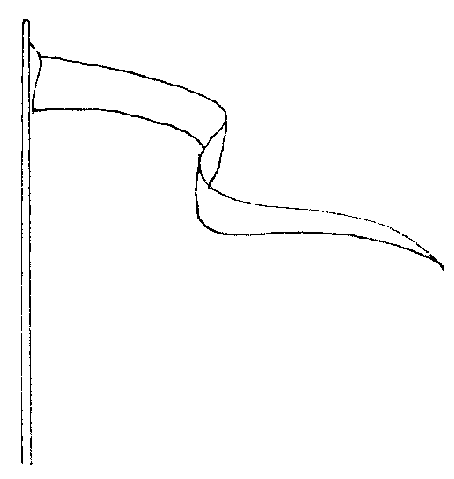
FIGURE 6.1-5 STREAMER
(vv)
Streamer. A long, narrow flag. See Figure 6.1-5. See also "Flag."
(ww)
Street address sign. The numerals of a street address for a given use or uses in a given building or buildings.
(xx)
Subdivision sign. A sign indicating the name of a recorded subdivision, the name of the contractor or subdivider, the name of the owner or agent, and/or giving information regarding directions, price and/or terms.
(yy)
Subdivision directional sign. A sign indicating the name of a recorded subdivision and information regarding location. The name of the contractor or subdivider, the name of the owner or agent and/or information regarding price and/or terms may also be noted.
(zz)
Suspended sign. A sign oriented to pedestrians which is hung from the underside of a canopy.
(aaa)
Temporary sign. A sign placed for a limited duration of time. Paper signs attached to a building, bulletin board, or outside a window are temporary signs unless enclosed in a frame with a glass, plexiglass, or equivalent cover. The sign area will be subject to the wall and canopy sign standards.
(bbb)
Theater. A large room or hall with fixed seats used for film shows, plays, concerts, operas, lectures and other performances.
(ccc)
Video Display Sign. A sign capable of and used for the display of full-motion or animated imagery.
(ddd)
Wall. Any wall or element of a wall or any member or group of members, which defines the exterior boundaries or courts of a building or structure and which has a slope steeper than one (1) horizontal to two (2) vertical, with the horizontal plane.
(eee)
Wall sign. Any sign painted on, attached to or erected against the wall of a building with the exposed face of the sign in a place approximately parallel to the plane of the wall and which does not project beyond the top or ends of the wall. Wall sign shall also mean any sign permanently displayed on the inside or outside of a window that identifies the business.
(fff)
Window sign. Any sign temporarily displayed on the inside of a window or temporarily painted on a window and facing a street, highway, parking lot, walkway or mall.
(ggg)
Zone. One (1) of the various zoning districts into which the City has been divided by this chapter.
(Amended by Ord. No. 3669-C.S., § 2(Exh. A) Code-16-001, effective 5-25-17)
10-6.103 - Applicability.
The sign regulations provided in this article shall apply to all signs within the City of Modesto. It shall be unlawful for any person to install or maintain any sign within the City in violation of the requirements of this article.
(a)
Sign permits required. No person shall install, alter, or relocate any sign within the City without first obtaining a sign permit in compliance with Section 10-6.105 (Sign Permit Requirements and Procedures).
(b)
Conflicting provisions. Where a sign may be subject to multiple provisions of this article because it may be considered to fall within more than one (1) of the sign type definitions of Section 10-6.102 (Definitions), the sign shall comply with the most restrictive requirements.
10-6.104 - Administration of Sign Regulations.
(a)
Enforcement authority. The provisions of this article shall be enforced by the Chief Building Official and the Director.
(b)
Inspections. No sign shall be installed within the City of Modesto without the prior approval of the Chief Building Official and the Director, to ensure compliance with all provisions of this article, and all other laws and ordinances of the City.
(c)
Appeals. Any person aggrieved or affected by any decision of an administrative official of the City which involves the application of any of the provisions of this article may appeal the decision to the Board in compliance with the provisions of Article 3 of Chapter 9 of Title 10 of this Code.
10-6.105 - Sign Permit Requirements and Procedures.
(a)
General permit requirements and exemptions. No person shall install, alter, or relocate any sign within the City without first obtaining a sign permit from the Chief Building Official, except as follows.
(1)
Exempt signs - No permit or fee required. The following signs are not required to have sign permits or pay sign permit fees, but shall comply with all other applicable requirements of this article:
(i)
Bench signs on public property under a franchise granted by the City;
(ii)
Construction signs;
(iii)
Flags, in compliance with Section 10-6.108;
(iv)
Garage sale signs, in compliance with Section 10-6.107;
(v)
Interior directional, warning, or information signs, unlighted;
(vi)
Nameplates, with a one (1) square foot maximum size, in compliance with Section 10-6.107;
(vii)
Political signs, in compliance with Section 10-6.107;
(viii)
Real estate signs, including for sale or rent and open house directional signs in compliance with Section 10-6.107, and subdivision signs in compliance with Section 10-6.108;
(ix)
Signs for fireworks stands, pumpkin sales, Christmas tree sales lots, and temporary certified farmers markets; and
(x)
Signs within buildings, not attached directly to the interior of a window.
(2)
Exempt signs - No fee required. Noncommercial off-premise advertising signs are required to obtain a sign permit, but shall not be required to pay sign permit fees. These signs shall meet all other requirements of this article.
(3)
Exemption for copy changes. Changes in sign copy with no other alterations to the sign shall not require a sign permit, provided that the copy changes also comply with Section 10-6.111 regarding sign maintenance, and Section 10-6.112 regarding nonconforming signs.
(b)
Application preparation and filing. An application for a sign permit shall include the forms provided by the Chief Building Official, and shall include all additional information and materials described in the City's Sign Permit Application Instructions. A completed application shall be filed with the Chief Building Official, and shall be accompanied by the filing fee established by the City Fee Resolution.
(c)
Application review and approval. The Chief Building Official and Director shall review each sign permit application filed with the Department, except where this article assigns the responsibility for sign permit review to the Board of Zoning Adjustments (Board). If the review authority determines that the proposed sign is in compliance with all the requirements of this article, applicable design guidelines, and all other laws and ordinances of the City, the review authority shall issue the sign permit.
(d)
Sign permit issuance and expiration. Sign permit issuance, expiration, and allowed extensions shall comply with the requirements of the California Building Code applicable to building permits.
(e)
Issuance in error. If a sign permit is issued in error by the Chief Building Official and the sign does not comply with all applicable provisions of this article and all other laws and ordinances of the City, the sign permit shall be void and shall confer no rights or privileges upon the permittee. All sign permits shall include a notice that the issuance of the permit does not grant any right or privilege to install a sign in violation of this article or of any other laws or ordinances of the City.
10-6.106 - Sign Area, Height and Placement.
(a)
Measurement of sign area and height. For the purposes of determining compliance with this article, the area and height of signs shall be measured as provided by this section.
(1)
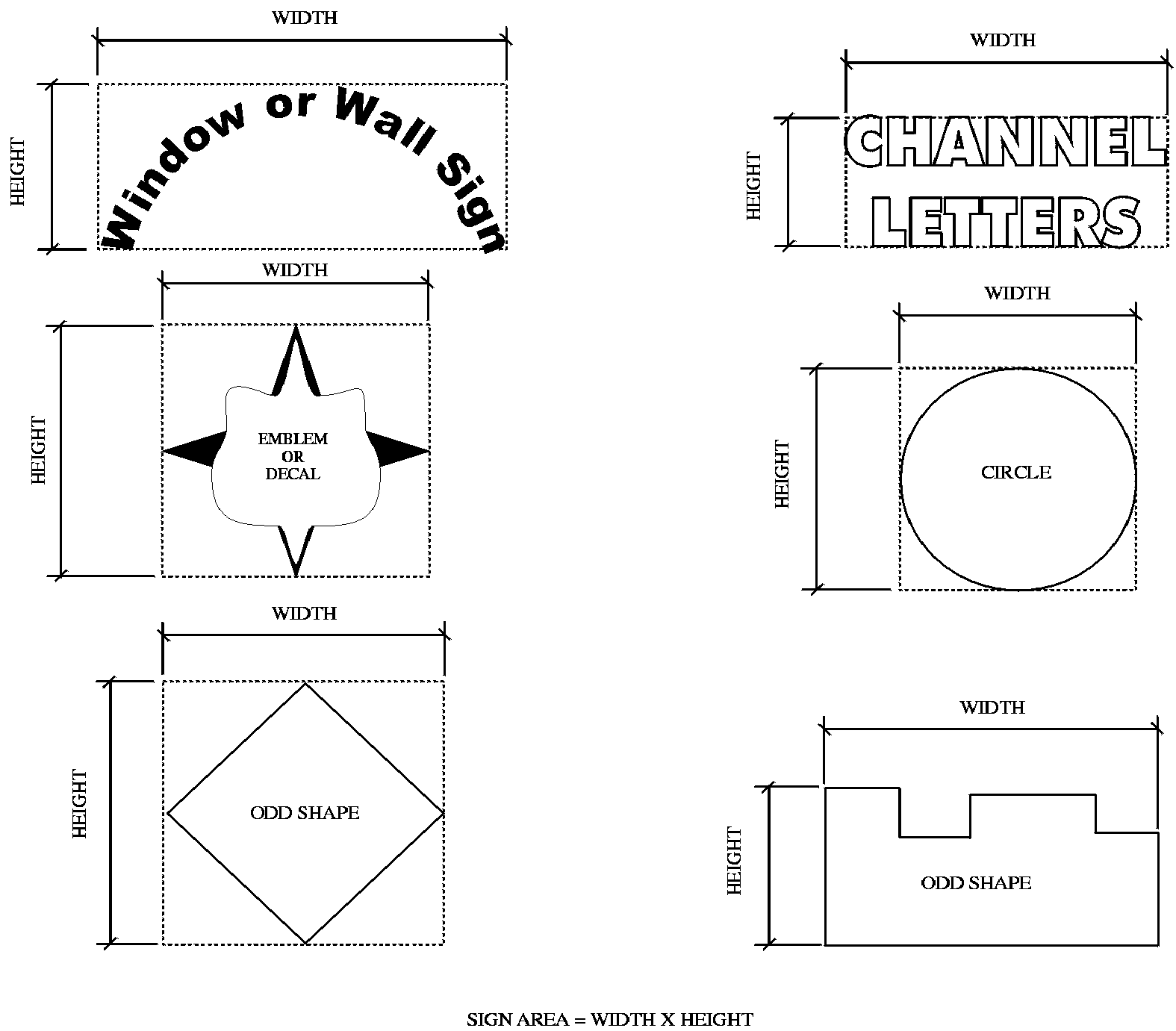
Sign area. Sign area shall be measured as the area in square feet of the smallest simple geometric shape within which a single sign face can be enclosed. The total area of the sign shall include all sign faces, except where two (2) faces are placed back-to-back and are at no point more than two (2) feet from one another, the area of the sign shall be taken as the area of one (1) face if the two (2) faces are of equal area, or as the area of the larger face if the two (2) faces are of unequal area. See Figure 6.1-6.
(2)
Sign height. Sign height shall be measured in accordance to the Height definition in Section 10-2.132.
FIGURE 6.1-6
MEASUREMENT OF SIGN AREA
(b)
Maximum sign area requirements. The maximum allowable area for signs is determined by Sections 10-6.107, and 10-6.108. No freestanding sign of any type or class, subject to this article shall exceed one hundred fifty (150) square feet in area, except as specified in Section 10-6.108(h) and Table 6.1-2.
(c)
Sign height limitations. All signs shall comply with the following requirements.
(1)
Maximum sign height. No wall, canopy, marquee or projecting sign located on a building shall project higher than the ridgeline of the roof, parapet or wall of which the sign is to be affixed. The maximum height of other signs shall be as specified by Sections 10-6.107 and 10-6.108, as applicable.
(2)
Minimum sign height. No sign shall be less than eight (8) feet above a public or private sidewalk, or fourteen and one-half (14.5) feet above ground level in areas open to vehicular traffic, except wall signs not exceeding three (3) inches in thickness.
(d)
Sign placement on buildings. Signs for tenants within buildings that have multiple tenants shall be placed on the portion of the building where the business being advertised is located, except that:
(1)
Where the business tenant space has no street frontage, the Director may grant a sign permit for sign placement on an exterior building wall determined to provide adequate visibility, and where the sign will be compatible in design and scale with the building architecture and the design and placement of other signs; and
(2)
The Director may grant placement on other portions of the building, and/or the clustering of allowed signs on one (1) building wall, where the Director determines that the adjusted sign placement is necessary to provide adequate identification of the subject businesses from the street, and that placement of the sign at the tenant location will unreasonably limit sign visibility.
(e)
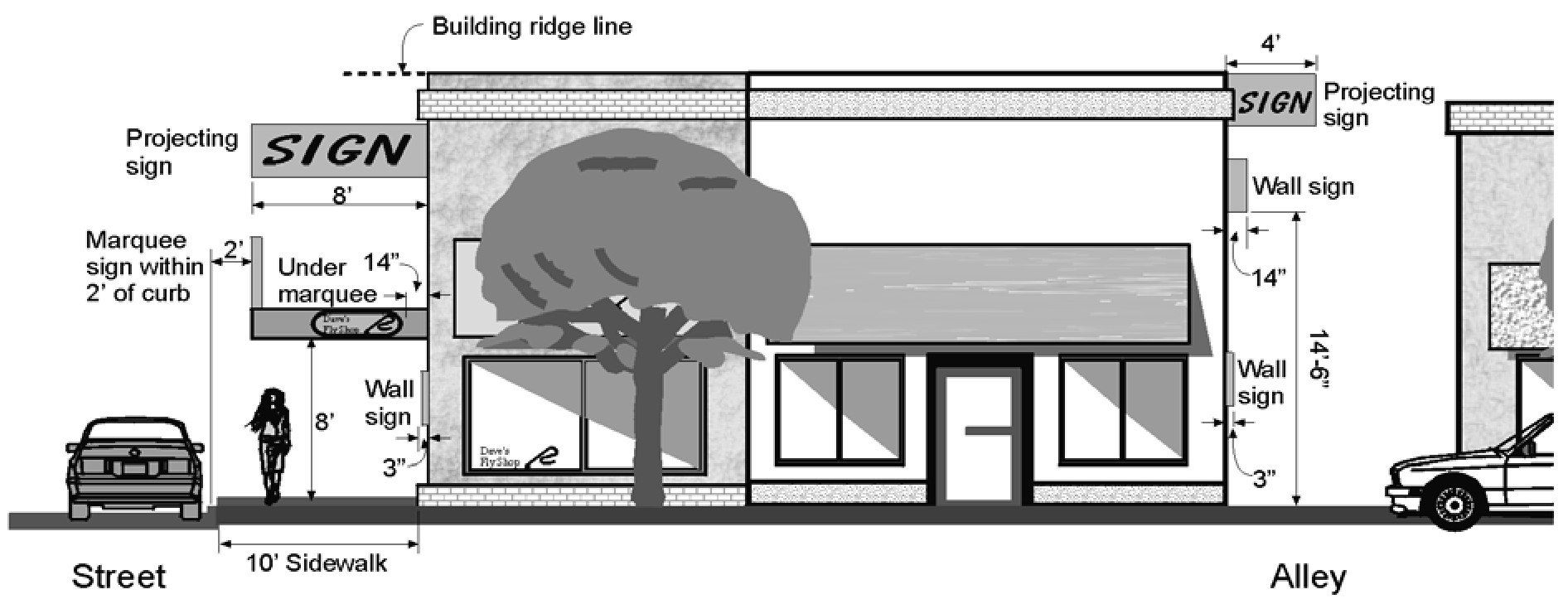
Projection of signs. Signs may project into required front, side, and rear yards as approved by the review authority. A sign may project into a street or alley right-of-way only as follows: See Figure 6.1-7.
(1)
Bus bench sign. May be located entirely within a right-of-way.
(2)
Freestanding signs. Freestanding or exterior identification signs may project into a public right-of-way only if a specific encroachment permit is granted.
(3)
Marquee signs. May project into a right-of-way to a point two (2) feet from the face of the curb.
(4)
Projecting signs. May project up to eight (8) feet into a street right-of-way and up to four (4) feet into any alley right-of-way, but not closer than two (2) feet from the face of the curb.
(5)
Wall signs. May project into a right-of-way up to fourteen (14) inches in thickness, provided that:
(i)
No display or messages shall be permitted on the edges of the sign; and
(ii)
Any portion of the sign which projects more than three (3) inches is located in compliance with the vertical clearance requirements of subsection (c)(4) above.
(f)
Signs creating obstructions. No sign shall be installed or maintained so that it may block access to any door, window, fire escape or exit way.
FIGURE 6.1-7
EXAMPLES OF ALLOWED SIGN PROJECTIONS
10-6.107 - Sign Requirements by Zone.
Only the signs listed in this section are permitted in the applicable zoning districts.
(a)
Residential zones. Any sign installed within the R-1, R-2, R-3, or P-O zoning districts shall comply with the maximum sign area and height, number of signs allowed, and additional requirements shown in Table 6.1-1.
(b)
Commercial and industrial zones. Any sign installed within the C-1, C-2, C-3, C-M, M-1, and M-2 zoning districts shall comply with the maximum sign area and height, number of signs allowed, and additional requirements shown in Table 6.1-2.
(c)
Planned Development (P-D) zone. Any sign installed within the P-D zoning district shall comply with the maximum sign area and height, number of signs allowed, and additional sign requirements established as a condition of the applicable P-D zone, which shall be based on the provisions of the zoning classification most closely approximating the uses proposed in the specific P-D zone.
TABLE 6.1-1
SIGNS PERMITTED IN RESIDENTIAL AND OFFICE ZONES (R-1, R-2, R-3)
TABLE 6.1-2
SIGNS PERMITTED IN NON-RESIDENTIAL ZONES (P-O, C-1, C-2, C-3, C-M, M-1, AND M-2)
(Ord. No. 3734-C.S., § 1, effective 10-7-21)
10-6.108 - Standards for Specific Types of Signs and Land Uses.
The specific types of signs covered by this section shall comply with the following provisions, in addition to the standards of Section 10-6.106, 10-6.107. These signs shall also comply with the sign permit requirements of Section 10-6.105, except where this section establishes other permit requirements.
(a)
A-frame signs for business identification. A-frame (sandwich board) signs are allowed only in compliance with the requirements of this subsection, and subject to the approval of a sign permit. A-frame signs are intended to be allowable only when the Director determines that a property owner has taken advantage of all permanent signs allowed by this article, and individual business visibility remains seriously impaired.
(1)
Where allowed. A-frame signs may be approved within the commercial zoning districts, only on sites where the Director determines that street visibility of the business to be served by the sign is seriously impaired, as follows:
(i)
The business is within a structure that is located more than thirty (30) feet from a public street frontage, the site is developed with all other signs allowed by this section, and the business entry and the other exterior signs allowed for the business by this article are not visible from the public street; or
(ii)
The space occupied by the business within a building has no exterior wall adjacent to or visible from a public street, and any exterior walls of the building that are adjacent to a public street are occupied by the signs of other businesses, at the maximum number and area of signs allowed by this article.
(2)
Sign standards. An approved A-frame sign shall comply with all the following requirements.
(i)
Size limitations. Each panel of the A-frame sign shall not exceed a width of twenty-four (24) inches and a height of thirty-six (36) inches. The total height of the sign shall not exceed forty-eight (48) inches when the A-frame panels are in place, including the message panels and any legs or other supports.
(ii)
Design and construction standards. The Director shall approve an A-frame sign only when it first determines that the design and appearance of the sign, including any graphics and/or text, will reflect attractive, professional design, and that the sign will be durable and stable when in place.
(iii)
;hg;Placement requirements. An approved A-frame sign shall be placed only on private property, at the single location specified by the sign permit. The permit shall specify an approved location for the sign that will maintain a walkway with an adequate and safe width for pedestrians. The location specified by the permit shall also be selected to prevent the undue concentration of A-frame signs in the vicinity.
(b)
Banners and promotional decorations. Banners and promotional decorations are allowed only as provided by this subsection subject to a permit by the Neighborhood Preservation Unit. (See also subsection (f) regarding flags and streamers.)
(1)
Time limits. Except where other time limits are established by this section, the placement of banners and promotional decorations shall be limited to a total of twelve (12) times per year, for a maximum of ten (10) days for each occasion. The resulting 120-day total may be divided at the discretion of the applicant into any increment that would be a multiple of ten (10) days, where the specific increments are requested in the sign permit application and noted on the issued permit. (For example, the total allowed one hundred twenty (120) days could be divided into two (2) periods of sixty (60) days each, four (4) periods of thirty (30) days each, etc.)
(2)
Banners.
(i)
Where allowed. Banners may be permitted in any commercial zoning district; banners may be permitted in residential zoning districts only for churches, schools, and for model home complexes and apartment projects with vacancies.
(ii)
Maximum number. One (1) banner may be permitted for each street frontage of the business.
(iii)
Size limitations. Each banner shall not exceed seventy-two (72) square feet in area, and thirty-five (35) feet in height, or the ridgeline of the roof of the building, whichever is lower. A banner placed on a freestanding structure shall not exceed twenty (20) feet in height.
(3)
Promotional decorations.
(i)
Where allowed. Promotional decorations shall be permitted only within the commercial zoning districts for land uses which are authorized by this Code to display merchandise outdoors.
(ii)
Limitation on type of decorations allowed. The promotional decorations that may be allowed in compliance with this section shall be limited to balloons. The use of strings of pennants, fringe, and/or promotional decorations other than balloons shall be prohibited.
(iii)
Placement requirements. No promotional decoration shall extend above the roof line of any building on the site.
(4)
Inflatable Devices. Use of an inflatable device for a promotion or event shall be limited to six (6) times in number, of nine (9) days maximum during any 12-month period for each business, and to a single inflatable device per promotion or event.
(c)
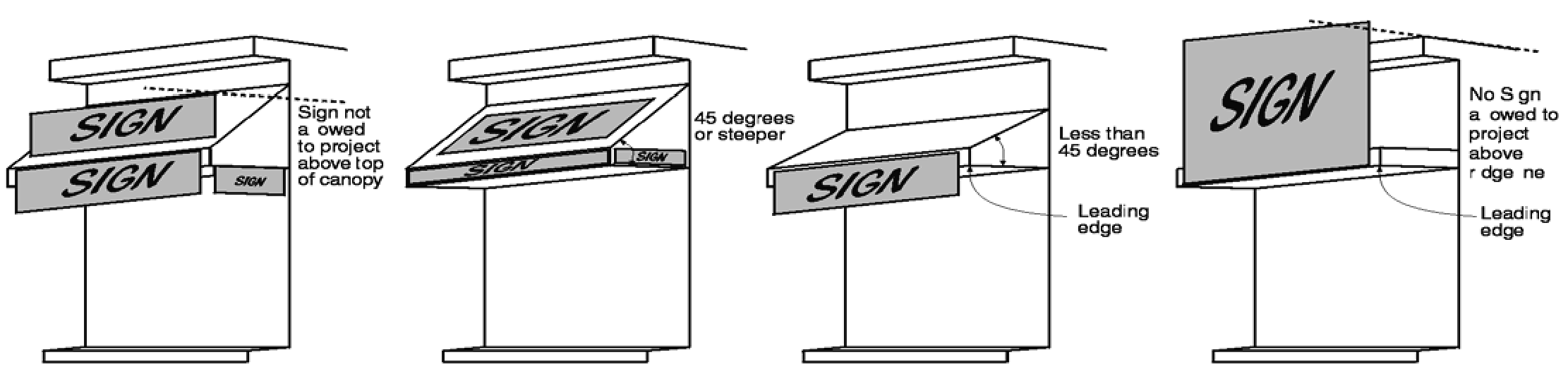
Canopy signs. Canopy signs shall comply with the following requirements (see Figure 6.1-8):
(1)
The sign shall be mounted in a vertical plane;
(2)
The sign shall be mounted parallel to the leading edge of a canopy, except for a suspended sign which may be mounted at an angle to the leading edge of a canopy;
(3)
The sign shall not project above the top of a canopy with a slope of forty-five (45) degrees (one (1) horizontal to one (1) vertical) or steeper, but may be mounted anywhere on the slope of the canopy;
(4)
The sign shall not project above the leading edge of a canopy with a slope flatter than forty-five (45) degrees; and
(5)
The sign may project above the top of a flat (no slope) canopy, but shall not project higher than the wall of the building to which the canopy is attached.
FIGURE 6.1-8
CANOPY SIGN REQUIREMENTS
(d)
Church signs. Churches or places of worship are allowed the following temporary placard signs in addition to those allowed by Section 10-6.107.
(1)
Temporary signs. The following placard signs are allowed for churches or places of worship conducting services in temporary locations, without limitation on number. These signs are exempt from sign permit requirements, provided that the signs:
(i)
Are in place on weekends only, no longer than from 5:00 p.m. on Friday, to 12:00 a.m. on Monday;
(ii)
Are placed on the church site, outside of a public right-of-way, with the permission of the property owner;
(iii)
Do not exceed six (6) square feet in area or a height of thirty-six (36) inches; and
(iv)
Are completely removed when not in use, including all stakes and any other mounting materials.
(2)
Banners. Banners are allowed in compliance with subsection (b) of this section, except that their use shall be limited to a maximum of six (6) times per year, for a maximum of ten (10) days for each time of use.
(e)
Combined Business Monument Signs. Businesses on multiple parcels may have a combined business monument sign under the following provisions:
(1)
All affected property owners must agree to share the monument sign(s).
(2)
The monument sign(s) may be located on one (1) of the affected parcels.
(3)
No business monument sign(s) for single parcels will be permitted.
(f)
Electronic Message Board, Video Signs, and Digital Freeway Billboards.
(1)
Electronic Message Boards. Electronic Message Boards are allowed only in compliance with this subsection.
(i)
Uses. Electronic Message Boards may be permitted only for the following uses:
a)
Automobile dealer.
b)
Theaters with a minimum of two hundred fifty (250) fixed seats.
c)
Convention centers owned by a public agency.
d)
The following uses when located on an arterial or expressway or freeway, as designated in the City of Modesto General Plan: Shopping center of five (5) acres or more, churches, synagogues, temples, mosques, and other similar places of religious worship, community centers owned by a public agency, stadiums, and high schools and colleges having a minimum campus of twenty (20) acres.
(ii)
Requirements and limitations. For all uses allowed to have electronic message board as identified in Section 10-6.108(f)(1)(i), all electronic message board shall be subject to the following requirements and limitations:
a)
Conditional Use Permit. Conditional Use Permit by the Board is required.
b)
Sign Type. A single Electronic Message Board may only be allowed as one (1) of the signs permitted by Section 10-6.107, including Freeway-Oriented Signs pursuant to Section 10-6.108(h).
c)
Size Limitation. Electronic Message Boards shall be limited in size as follows:
1)
Freestanding Sign. The Electronic Message Board portion of the allowable freestanding sign may not exceed seventy-five (75) percent of the total sign area and must be integrated with the remainder of the sign to form a cohesive design unit.
2)
Wall, Canopy and Marquee Signs. Electronic Message Board Wall, Canopy and Marquee signs in the Residential (R-1, R-2 and R-3) and Professional Office (P-O) Zones may not exceed one-half (0.5) square-foot per linear foot of the wall on which the sign is located and in the Commercial and Industrial Zones (C-1, C-2, C-3, C-M, M-1, M-2, D-C) Zone may not exceed one (1) square-foot per linear foot of the wall on which the sign is located.
d)
Movement. No sign shall display animated messages, including flashing, blinking, fading, rolling, shading, dissolving, or any other effect that gives the appearance of movement.
e)
Audio. No sign shall include an audio message.
f)
Duration. No message shall be displayed for a period of time less than eight (8) seconds; however, the Board may increase the minimum required display time if the sign is located within one hundred (100) feet of another Electronic Message Board Sign, traffic signal, flashing warning signs, school crosswalk, train crossings, fire stations, or other situations where a demanding driving environment is deemed to exist.
g)
Transition. Transition from one (1) message to another message shall be instantaneous as perceived from the human eye. Each sign message shall be complete in itself and shall not continue on a subsequent sign message.
h)
On-premises signage. Signs may only be used for advertising the business, profession, product, commodity or mercantile-oriented service sold, manufactured, conducted, or offered on the site on which the sign is located. Noncommercial Off-Premise Advertising is allowed. Commercial Off-Premise Advertising is prohibited.
i)
Sign Placement.
1)
Signs allowed in accordance with Section 10-6.108(f)(1)(i)d) shall be located on an arterial, expressway or freeway as designated in the City of Modesto General Plan.
2)
Signs shall not be placed to obstruct, or otherwise physically interfere with, an official traffic sign, signal or other devise, or physically interfere with the vision of drivers in approaching, merging or intersecting traffic to the satisfaction of the Traffic Engineer.
3)
Signs shall not be located in the Clear Vision Triangle.
j)
Brightness. Signs shall utilize automatic dimming technology to adjust the brightness of the sign relative to ambient light so that at no time shall a sign exceed a brightness level of three-tenths (0.3) foot candles above ambient light, as measured using a foot candle (Lux) meter and in conformance with the following process:
1)
Light measurements shall be taken with the meter aimed directly at the sign message face, or at the area of the sign emitting the brightest light if that area is not the sign message face, at the following distances:
i)
A sign that is zero (0) to one hundred (100) square feet in area shall be measured at a distance of one hundred (100) feet from the sign area being measured;
ii)
A sign that is one hundred one (101) to three hundred fifty (350) square feet in area shall be measured at a distance of one hundred fifty (150) feet from the sign area being measured;
iii)
A sign that is three hundred fifty (350) to six hundred fifty (650) square feet in area shall be measured at a distance of two hundred (200) feet from the sign area being measured;
iv)
A sign that is six hundred fifty-one (651) to one thousand (1,000) square-feet in area shall be measured at a distance of two hundred fifty (250) feet from the sign area being measured.
2)
An ambient light measurement shall be taken using a foot candle meter at some point between the period of time between thirty (30) minutes past sunset and thirty (30) minutes before sunrise with the sign turned to black screen.
3)
Immediately following the ambient light measurement taken in the manner required by this subsection, an operating sign light measurement shall be taken with the sign turned on to full white copy.
4)
The brightness of the sign conforms with the brightness requirements of this subsection, if the difference between the ambient light measurement and the operating sign light measurement is three-tenths (0.3) foot candles or less.
5)
An application for a building permit shall include calculations by a lighting engineer to demonstrate compliance with requirements specified above.
6)
Malfunction. All signs shall contain a default mechanism that will cause the sign to revert immediately to a black screen if the sign malfunctions.
(2)
Video Display Signs. Video Display Signs are allowed only in compliance with this subsection.
(i)
Uses. Video Display Signs may be permitted only for the following uses:
a)
Performing Arts Center located at 1000 I Street.
b)
Convention Center located at 1000 L Street.
(ii)
Requirements and limitations. All Video Display Signs shall be subject to the following requirements and limitations:
a)
Conditional Use Permit by the Board of Zoning Adjustment is required.
b)
Sign Type. A Video Display Sign may only be allowed as one (1) of the sign permitted by Section 10-7.509(e).
c)
Audio. No sign shall include an audio message.
d)
Duration. Any portion of the message that uses a full-motion (animated) video display shall have a minimum duration of two (2) seconds and a maximum duration of five (5) seconds. Calculation of the duration shall not include the number of frames per second used in a video display.
e)
Transition. There shall be twenty (20) seconds of still image or blank screen following every message using a video display.
f)
On-premises Signage. Video display signs may only be used for advertising the business, profession, product, commodity or mercantile-oriented service sold, manufactured, conducted, or offered on the site on which the sign is located. Noncommercial off-premise Advertising is allowed in accordance with Section 10-6.108(j). Commercial off-premise Advertising is prohibited.
g)
Brightness. Signs shall utilize automatic dimming technology to adjust the brightness of the sign relative to ambient light so that at no time shall a sign exceed a brightness level of three-tenths (0.3) foot candles above ambient light, as measured using a foot candle (Lux) meter and in conformance with the following process:
1)
Light measurements shall be taken with the meter aimed directly at the sign message face, or at the area of the sign emitting the brightest light if that area is not the sign message face, at the following distances:
2)
A sign that is zero (0) to one hundred (100) square feet in area shall be measured at a distance of one hundred (100) feet from the sign area being measured;
3)
A sign that is one hundred one (101) to three hundred fifty (350) square-feet in area shall be measured at a distance of one hundred fifty (150) feet from the sign area being measured;
4)
A sign that is three hundred fifty (350) to six hundred fifty (650) square-feet in area shall be measured at a distance of two hundred (200) feet from the sign area being measured;
5)
A sign that is six hundred fifty-one (651) to one thousand (1,000) square-feet in area shall be measured at a distance of two hundred fifty (250) feet from the sign area being measured.
6)
An ambient light measurement shall be taken using a foot candle meter at some point between the period of time between thirty (30) minutes past sunset and thirty (30) minutes before sunrise with the sign turned to black screen.
7)
Immediately following the ambient light measurement taken in the manner required by the subsection, an operating sign light measurement shall be taken with the sign turned on to full white copy.
8)
The brightness of the sign conforms with the brightness requirements of this subsection, if the difference between the ambient light measurement and the operating sign light measurement is three-tenths (0.3) foot candles or less.
9)
An application for a building permit shall include calculations by a lighting engineer to demonstrate compliance with requirements specified above.
h)
Malfunction. All signs shall contain a default mechanism that will cause the sign to revert immediately to a black screen if the sign malfunctions.
(3)
Digital Freeway Billboards.
(i)
Purpose and Designation. Digital billboards may be permitted along Freeway 99 only as billboard relocations or as conversions of an existing billboard in place.
(ii)
Conditional Use Permit. Digital freeway billboards must obtain a conditional use permit approval which requires a recommendation by the Planning Commission to the City Council and final approval authority by the City Council. If the Planning Commission recommends denial or the City Council denies final approval of a conditional use permit, an applicant shall be provided with a written decision regarding the reason(s) for the denial. The Planning Commission shall recommend approval of a conditional use permit for a digital freeway billboard when the following criteria are met:
a)
The proposed digital freeway billboard will meet the findings provided in Section 10-9.703 Required Findings for a Conditional Use Permit.
b)
The proposed digital freeway billboard will not create a hazard to vehicular or pedestrian traffic.
c)
All advertising on the digital freeway billboard will conform with the Outdoor Advertising Act in the California Business and Professions Code and other applicable state and federal rules and regulations.
d)
The development of the digital freeway billboard will result in a public benefit to the City in the form of increasing aesthetics, safety and/or economic revitalization efforts for the City's commercial centers through signage. The public benefit must outweigh any adverse impacts, such as light pollution or visual impact, that might be caused by the advertising display.
(iii)
Development Standards.
a)
A new digital freeway billboard may be allowed or a legally existing billboard may be refurbished to become a digital freeway billboard, subject to the development standards below.
1)
Location. A digital freeway billboard shall be located within 660 feet of State Highway 99 but shall not be located on any parcel with a residential zone or use, and shall be a minimum of 300 feet from any parcel with a residential zone or use.
2)
Number of Faces. A digital freeway billboard may consist of, at most, two (2) digital display areas, each positioned to be visible only by opposing directions of traffic. Double-faced signs shall not have an interior angle between the face of the panels greater than 45 degrees.
3)
Height. The maximum height shall be 60 feet for a new digital freeway billboard. Any existing legal nonconforming billboard may maintain its existing height if it is converted to or replaced with a digital freeway billboard.
4)
Area. The maximum area of each digital display area is 700 square feet.
4.5)
Maximum Number of Digital Freeway Billboards. There shall be a maximum of seven (7) digital freeway billboards within the City limits located on either side of State Highway 99.
5)
Distance between Signs. No digital freeway billboard shall be located within 2,500 feet of any other digital freeway billboard within the City limits located on either side of State Highway 99.
6)
Billboard Structure. The billboard structure supporting and surrounding the digital display area shall be as small as feasibly possible so as to avoid any unnecessary height or width to the sign so as to not call further attention to the sign..
7)
Pole Cladding. Decorative pole covering is required for newly constructed digital freeway billboards as well as any existing traditional billboard that is converted to a digital freeway billboard. Such covering shall be simple and streamlined in material and design so as to not call further attention to the sign.
8)
Message Display. Digital freeway billboards shall display static messages only, and shall not have animation, movement, or the appearance or optical illusion of movement in or on any part of the sign structure, design, or pictorial segment of the sign. Each static message shall not include flashing or scintillating lighting, or varying light intensity.
9)
Minimum Display Time. Each message on the sign must be displayed for a minimum of eight (8) seconds.
10)
Illumination. Digital freeway signs shall operate at brightness levels consistent with Section 10-6.108 (f) (1) (ii) j).
11)
Aesthetics. The sign will not require substantial trimming or reduction of existing vegetation and landscaping. The sign will not obstruct or obscure on-site signs on the same or adjacent properties resulting in the adjacent signs being ineffective.
12)
Traffic Safety. The sign shall not create a visibility hazard to traffic on adjacent streets, freeways, or parking areas. The sign will not reduce parking availability below that required by the standards under this title or pursuant to permits issued under this title. The sign will not interfere with on-site vehicular circulation.
13)
Future Technologies. There may be alternate, preferred, or superior technology available in the future to illuminate digital freeway signs. These alternate technologies may be incorporated into existing legally permitted digital freeway signs in the future without additional permissions from the City Council so long as (i) the requisite maximum brightness standards are met and (ii) no exterior physical change to the digital display area will occur. The owner is responsible for obtaining any required ministerial permits for technology improvements as required by applicable code standards. The City will prioritize any such required approvals for technology that is superior in energy efficiency over previous generations or types.
14)
Community Messaging. The City shall be provided with access to a minimum of eight (8) seconds of time per display cycle (or 10% of time on an hourly basis if display cycles are not utilized) to allow the City to present messages regarding public safety and City Sponsored Events and Activities. For purposes of this section, City Sponsored Events and Activities are events or activities that meet the following criteria: (1) the event or activity must be held on City property; (2), the City must participate in an official capacity in the planning, preparation or promotion of the event or activity; and (3) the City must be an official sponsor. Access for public safety messages shall be given to public agencies (including the City) for the purpose of displaying public safety messages such as "Amber Alert" messages and emergency-disaster communications.
15)
Quality and Maintenance Plan. The applicant must establish a quality and maintenance plan in order to ensure implementation of all above-listed development standards and to assure the proper maintenance and repair of the digital freeway sign as needed.
16)
Consistency with State and Federal Law. In addition to the other requirements set forth herein, the digital freeway billboards shall comply with the requirements of the Outdoor Advertising Act and Regulations, California Business and Professions Code Secs. 5200 et seq., and other state and federal statutes. To the extent of any conflict between the provisions of this section and state and federal law, state and federal law shall prevail.
b)
Billboard Removal. For every one digital freeway billboard installed, the applicant must permanently remove at least four legally existing billboard structures (each of which may have more than one billboard sign face) within the City of Modesto's Sphere of Influence prior to operation of the digital freeway billboard. An existing billboard being refurbished as a digital freeway billboard may count as one of the four required permanent removals.
c)
Operating Agreement. At the applicant's request, the City and applicant may enter into an operating agreement in conjunction with the issuance of a conditional use permit for a digital freeway billboard. The City and applicant may use the operating agreement, on a case-by-case basis, to deviate from the development standards in subsection (3) (iii) (a) of this section or reduce the required billboard removals under subsection (3) (iii) (b) of this section. The City Council will only approve an operating agreement if it determines that the operating agreement achieves community benefits that are equivalent to those that would be achieved through strict compliance with subsection (3) (iii) (a) or (3) (iii) (b) of this section. These community benefits may include: safety improvements resulting from such things as the reduction of old and outmoded billboards; using revenue earned under an operating agreement for graffiti abatement, City signage programs or other programs with safety or aesthetic benefits to the City; or economic revitalization of the City's commercial centers through signage and signage agreements.
(g)
Flags and streamers.
(1)
Where allowed. Flags and streamers may be permitted within any zoning district, in compliance with the requirements of this subsection.
(2)
Corporate flags. One (1) corporate flag is allowed per use or occupancy in nonresidential zoning districts, and is exempt from sign permit requirements. The flag shall not exceed a maximum area of twenty-four (24) square feet, and its dimensions shall not exceed a ratio of 2:1. The flag shall be flown only from a flagstaff or flagpole. The maximum height of a freestanding pole is the height requirement in the zoning district or fifty (50) feet whichever is less. The maximum height of a pole on a building is the height requirement in the zoning district
(3)
Decorative flags and streamers. Decorative flags and streamers without advertising copy or corporate or product identification are allowed as follows:
(i)
Residential zoning districts. One (1) decorative flag or streamer is allowed per parcel, and is exempt from sign permit requirements.
(ii)
Nonresidential zoning districts. Six (6) decorative flags or streamers are allowed per business, and are exempt from sign permit requirements. Additional flags and streamers may be allowed with a sign permit, in compliance with the time limits established by subsection (b)(1), above.
(4)
National and state flags. Flags of nations or states are allowed without limitation on their number or size, and are exempt from sign permit requirements.
(5)
Height Limitation. The maximum height of a freestanding pole is limited to the height requirement in the zoning district in which the pole is located or fifty (50) feet whichever is less. The maximum height of a pole is on a building is limited to the height requirement in the zoning district in which the pole is located.
(h)
Freeway-Oriented Signs. A freeway-oriented sign may be approved in compliance with the following provisions.
(1)
Where Allowed. A freeway-oriented sign may be authorized for the following uses that are located within six hundred (600) feet of the Freeway 99 right-of-way:
(i)
A hotel, motel, service station or restaurant, as a freestanding use; or
(ii)
Shopping centers of at least five (5) acres in size. A freeway-oriented sign for a shopping center may advertise the shopping center name, and/or any tenants. One (1) freeway-oriented sign shall be allowed per shopping center.
(2)
Permit Requirement. A sign permit is required for a freeway-oriented shopping center freestanding sign; conditional use permit approval by the Board shall be required for all other freeway-oriented signs, and for any freeway-oriented sign with a height greater than thirty-five (35) feet for freestanding uses, or fifty (50) feet for shopping centers.
(3)
Required Findings for Freestanding Uses. The approval of a conditional use permit for a freeway-oriented sign for a hotel, motel, restaurant, or service station shall require that the Board first find that:
(i)
The use or occupancy is a freestanding use; and
(ii)
The use or occupancy cannot be adequately identified from Freeway 99 by other signs permitted within the applicable zone.
(4)
Approval of Additional Height. The Board may grant a conditional use permit authorizing a freeway-oriented sign higher than thirty-five (35) feet for freestanding uses, or fifty (50) feet for shopping centers, as follows:
(i)
Criteria for Approval. A sign with a height greater than thirty-five (35) feet for freestanding uses, or fifty (50) feet for shopping centers, may be approved if the Board determines that the applicant has demonstrated that an overcrossing of Freeway 99, or its ramps, or trees or vegetation will obstruct the visibility of the proposed sign from the northbound or southbound lanes of Freeway 99.
(ii)
Procedure for Determining Allowed Height. The Board shall approve a sign in compliance with subsection (h)(4)(i) above, at a height no more than the minimum necessary to clear the identified visual obstruction. The determination of maximum height by the Board shall be based on the following procedure, which shall occur prior to the Board public hearing.
a)
The applicant shall arrange for a boom truck with a sign target to be on the site at the location of the proposed sign, with a tape measure attached to the top of the target so that an accurate ground reading of height can be determined.
b)
On the Board field trip, the Board will go to the site, pick up the applicant or applicant's representative, and drive Freeway 99 north and south of the target on the site. The purpose will be to visually verify that the target is set at the minimum height necessary to clear the visual obstruction.
c)
At the public hearing and in their deliberations, the Board shall consider the visual observations from the field trip to be the primary testimony.
(5)
Sign Area Requirements. The maximum sign area for a freeway-oriented sign shall be as provided in Table 6.1-2 plus the following requirements:
(i)
For shopping centers, no individual tenant panel shall be more than one hundred fifty (150) square feet in area. The area of the shopping center name must be at least as large as any individual tenant panel.
(ii)
For shopping center signs advertising a single tenant or only the shopping center name, the maximum sign area shall be one hundred fifty (150) square feet.
(i)
Historic signs. A historic sign may be modified in any zone subject to the following requirements:
(1)
Permit requirement. Conditional use permit approval by the Board shall be required in compliance with Article 7 of Chapter 9 of Title 10 of this Code.
(2)
Permit review considerations. Any deviation from the sign regulations of the zone applicable to the site of a proposed historic sign should be noted in the Board agenda report. The Board should determine if each deviation is insignificant to the compatibility with other uses in the area and deny or impose conditions deemed necessary for any deviations that are not compatible.
(3)
Criteria for approval. The Board may approve a conditional use permit for a historic sign which deviates from the sign standards of the applicable zone only where:
(i)
The Board determines that the existence of the sign at the given site fifty (50) or more years ago has been adequately proven;
(ii)
The Board determines that the design modification of the sign is historically authentic, based on adequate proof of authenticity provided by photographs or plans furnished by the applicant; and
(iii)
The Landmark Preservation Committee has reviewed the proposed sign and has provided findings that the sign meets the above two (2) criteria.
(j)
Off-premise advertising signs. Off-premise advertising signs are prohibited in all zones other than those listed in subsections (j)(1) and (j)(2), below:
(1)
C-2, C-3, C-M, M-1 and M-2 zones. Only the following off-premise advertising signs may be permitted in the C-2, C-3, C-M, M-1 and M-2 zones.
(i)
A directional off-premise advertising sign may be authorized with conditional use permit approval for hotels, motels, and restaurants only, provided that the sign does not exceed forty-eight (48) square feet in area and eight (8) feet in height. The Board may grant the conditional use permit only after first finding that:
a)
The use or occupancy is a freestanding use.
b)
The combined total of all approved directional off-premise advertising signs for a motel, hotel or restaurant is necessary for the public welfare and will not excessively promote the specific motel, hotel or restaurant.
(ii)
Noncommercial off-premise advertising signs may be permitted with a maximum area of forty-eight (48) square feet and a height of eight (8) feet, limited to one (1) per site.
(2)
C-1 zone. Noncommercial off-premise advertising signs may be permitted in the C-1 zone with a maximum area of forty-eight (48) square feet and a maximum height of eight (8) feet.
(k)
Service station signs. The following sign requirements apply to service stations in addition to the provisions of Table 6.1-2 except where otherwise limited by this subsection.
(1)
Pump island signs. Signs shall be permitted on pump islands, canopy uprights, and nonmovable structures on the pump islands provided the combined area of these signs and all other wall and canopy signs do not exceed the total sign area permitted in Table 6.1-2 for the service station building, and do not project beyond the canopy roof or raised pump island. These signs shall not exceed ten (10) feet in height if there is no canopy. For self-service stations with small attendant booths less than ten (10) feet on any side, the total wall and canopy sign area shall not exceed one hundred sixty (160) square feet.
(2)
Freestanding Price signs.
(i)
Sign copy. The sign copy shall be limited to specifying the prices and grades of motor fuel, self-service or full service, and brand name of the motor fuel, as required by the California Business and Professions Code. The price sign may be a digital display.
(ii)
Maximum sign area. Maximum allowable area for fuel price signs shall be twenty-five (25) square feet for the portion of the sign identifying self- or full-service prices, and six (6) square feet for a discount for cash portion of the sign; in addition to the sign area allowed for a freestanding business or shopping center sign as provided in Table 6.1-2.
(iii)
Maximum sign height. Maximum sign height shall be no greater than fourteen (14) feet. When a freestanding fuel price sign is combined with a freestanding business sign as required in Section 10-6.108(k)(2)(v) below, the maximum height is based on the property frontage as provided in Table 6.1-2 or fourteen (14) feet, whichever is greater.
(iv)
Maximum number of signs. One (1) per street frontage of the site with a maximum of two (2) signs.
(v)
Combined Signs. A service station on a single parcel must combine the freestanding fuel price sign with any proposed freestanding business sign. A service station that is part of a combined business freestanding sign proposal or shopping center may have a separate freestanding fuel price sign pursuant to the provisions of this subsection.
(l)
Shopping center freestanding signs. A shopping center freestanding sign allowed by Section 10-6.107 shall also comply with the following requirements.
(1)
Limitation on copy. The copy on a shopping center sign shall be limited to an optional reader board or a listing of uses within the center and may include the shopping center name. The lettering for the reader board or the listing of uses shall be of the same or smaller size than the lettering of the shopping center name.
(2)
Removal of existing signs required. Any nonconforming freestanding or projecting signs shall be removed prior to the issuance of a building permit for the installation of a shopping center sign.
(3)
Limitation on other signs. After the installation of a shopping center sign, no additional freestanding or projecting sign shall be installed for any use or occupancy within the center, even in cases where the existing signs were installed prior to this Code provision. No business or combined business freestanding sign is permitted
(m)
Street address signs. Each building or group of buildings assigned a street address shall display the street address on a wall of the building, as follows.
(1)
Location. The street address shall be visible from the street upon which the building is addressed.
(2)
Size of numerals. The minimum height, width, and maximum area of the street address numerals shall be as follows:
(i)
Residential uses. Each numeral shall have a minimum height of three (3) inches and a minimum stroke width of one-fourth (¼) inch. The total area of all the numerals which comprise the street address shall not exceed one (1) square foot.
(ii)
Nonresidential and conditional uses. Each numeral shall have a minimum height of six (6) inches and a minimum stroke width of one-half (½) inch. The total area of all the numerals which comprise the street address shall not exceed four (4) square feet.
(n)
Subdivision sales signs. Residential subdivisions are permitted the following signs during the marketing of the lots/homes within the subdivision.
(1)
Sales/identification sign. One (1) subdivision identification sign is allowed on the site of each recorded subdivision during lot sales, with a maximum area of sixty-four (64) square feet, and a maximum height of ten (10) feet.
(2)
Directional signs. Each recorded subdivision is allowed directional signs to guide potential customers to the site and its model homes or other sales facility, as follows.
(i)
Allowed location of signs. Subdivision sales directional signs shall be located as follows.
a)
Within the boundaries of the subdivision, one (1) directional sign shall be permitted per block.
b)
Outside the boundaries of the subdivision, directional signs on private property shall be permitted as follows:
1)
One (1) at each street intersection where a change in direction (left turn, right turn) is required; and
2)
Three (3) where no change in direction is required. No subdivision directional sign shall be closer than one thousand (1,000) feet to another subdivision directional sign for the same subdivision.
(ii)
Sign area and height. The signs shall not exceed sixteen (16) square feet and six (6) feet in height.
(3)
Temporary directional placards. Temporary directional placard signs are allowed without limitation on number, and are exempt from sign permit requirements, provided that the signs:
(i)
Are in place on weekends only, no longer than from 5:00 p.m. on Friday, to 12:00 a.m. on Monday;
(ii)
Are placed on private property outside of a public right-of-way, with the permission of the property owner;
(iii)
Do not exceed three (3) square feet in area or a height of thirty-six (36) inches; and
(iv)
Are completely removed when not in use, including all stakes and any other mounting materials.
(4)
Subdivision banners, flags, and promotional decorations. These devices are subject to the requirements of Sections 10-6.108(b), and 10-6.108(g).
(5)
Time limits. The subdivision sales signs allowed by this subsection shall be removed not later than three (3) years from the date the subdivision map is recorded, except as follows:
(i)
Where building permits have been issued by the City for more than fifty (50) percent but less than sixty-five (65) percent of the lots in the subdivision at the end of three (3) years, the sign may remain for an additional one (1) year;
(ii)
Where building permits have been issued by the City for fifty (50) percent or less of the lots in the subdivision at the end of three (3) years, the sign may remain for an additional two (2) years; and
(iii)
Temporary directional placards shall be removed in compliance with subsection (m)(3), above.
(Amended by Ord. No. 3669-C.S., § 2(Exh. A) Code-16-001, effective 5-25-17)
10-6.109 - Sign Design and Construction Standards.
All signs shall be designed, constructed, and installed in compliance with the provisions of this section and the maximum area and height requirements of Section 10-6.106.
(a)
Freestanding Signs. Where a freestanding sign is allowed by these sign regulations, the use of a monument sign rather than a sign with an open support structure is encouraged. When considering any freestanding sign, the Director shall apply the principles and specifications in the Commercial and Industrial Design Guidelines for signs. The base of a monument sign or other support structure of a freestanding sign should be architecturally compatible with the architecture of site buildings and enclosed or clad in architecturally compatible materials. Where signs are allowed by these regulations, sign owners shall be advised that the City will not trim or remove any street tree within a public right-of-way solely to improve the visibility of a sign which has been obscured by tree growth.
(b)
Sign Construction Standards. All signs, sign components, and sign support structures shall be manufactured and installed in compliance with applicable Building, Electrical and Fire Prevention Codes of the City.
(c)
Sign Illumination. All fixtures or lighting devices used to illuminate signs shall only emit light of constant intensity; and no sign shall be illuminated by, or contain flashing, intermittent, rotating or moving light, except for electronic message boards in compliance with Section 10-6.108(f). No sign lighting device shall be installed or used that will cause glare or reflection that may constitute a traffic hazard or nuisance.
(d)
Noncommercial Use of Commercial Signs. Notwithstanding any other provisions of this article to the contrary, any sign or portion of a sign which is otherwise legally permitted as a result of the commercial use or occupancy of a building or site may contain noncommercial messages in compliance with the definition of " off-premise sign—noncommercial" in Section 10-6.102. When the commercial use or occupancy of the building or site ceases, the sign shall comply with the applicable provisions of this article relating to the removal of obsolete signs and outdoor advertising signs.
10-6.110 - Prohibited Sign Types and Materials.
The following types of signs and sign materials shall be prohibited within the City. It shall be unlawful and punishable as an infraction for any person to place or cause to be placed any sign not in conformity with this section.
(a)
Animated Signs. No sign shall have any moving, rotating, or otherwise animated part, or any flashing, blinking, fluctuating or otherwise animated light, except that the following shall be allowed.
(1)
A conventional clock face.
(2)
A sign showing digital time with changes in time not more often than once a minute.
(3)
A sign showing digital temperature with changes in temperature only when there is a rise or fall of one (1) degree or more. Changes from Fahrenheit readings to Centigrade readings shall occur not more frequently than five-second intervals.
(4)
A sign showing time and temperature, which changes no more frequently than five-second intervals.
(5)
An on-premises barber pole of traditional design with a maximum length of thirty (30) inches, which shall revolve only during the time that the barber shop is open for business. The pole shall not exceed ten (10) feet in height.
(6)
An electronic message board in compliance with Section 10-6.108(f).
(b)
Bench Signs. Bench signs are prohibited, except on public property under a franchise granted by the City.
(c)
Building Outlining. The outlining of a building or its roof by permanent lighting with exposed neon tubing, exposed incandescent lighting or other artificial lighting, or an equivalent effect, is allowed only with conditional use permit approval. "Outlining" means delineation, with a row or band of lights, of the edges of a roof or wall surface. This provision does not prohibit floodlighting or generally illuminating buildings and their roofs, nor temporary Christmas displays.
(d)
Hazardous Signs. No sign shall be installed at any street intersection, railroad grade crossing, or driveway in a manner that will obstruct the vision of motor vehicle operators, or at any location where, the position, shape or color of the sign may interfere with, obstruct the view of or be confused with any authorized traffic sign, signal or device; or which makes use of the words "STOP," "DANGER," or any other word, phrase, symbol or character in such manner as to interfere with, mislead or confuse motorists.
(e)
Off-premise Advertising Signs. Off-premise advertising signs are prohibited, except in compliance with Section 10-6.108(j).
(f)
Signs on Street Trees, Utility Poles, or Structures in Rights-of-Way. No sign shall be attached to any City street tree, or any poles such as utility poles, street signals, street lights, street name signs, or traffic warning signs, or on any bus shelter.
(g)
Temporary Signs. Temporary signs are prohibited, except A-frame signs, and banners, flags, and promotional displays, in compliance with Section 10-6.108.
10-6.111 - Sign Maintenance Standards.
(a)
Maintenance of Signs. The owner of any sign shall maintain the sign and all supporting structures in a presentable condition at all times. Banners, flags, and promotional decorations shall be removed or replaced when tattered or sun bleached. All painted signs and all supporting structures shall be repainted to keep them in good condition whenever repainting is requested in writing by the Chief Building Official or the Director.
(b)
Removal of Sign Copy. Within ten (10) days after written notification from the Building Official, the owner of an affected sign shall remove, paint over, or cover the copy of any sign which no longer advertises a business conducted on the site, or a product available for purchase by the public. The method of sign copy removal shall be approved by the Chief Building Official or the Director. If the owner fails to comply with the notice within ten (10) days, the Chief Building Official or Director is hereby authorized to remove, paint over, or cover the sign or sign copy. Any expense incurred by the City in removing, painting over, or covering the sign copy shall be paid by the owner of the building or structure to which such sign is attached, or by the owner of the sign.
10-6.112 - Nonconforming, Unsafe, and Illegal Signs.
(a)
Applicability—Nonconforming Signs Defined. For the purpose of this article, a "nonconforming sign" does not conform with the provisions of this article, but lawfully existed and was in use:
(1)
Within the City on March 1, 1977, including signs installed in compliance with use permits and variances granted by the City prior to March 1, 1977;
(2)
On property outside of the City on the date when the annexation of the property to the City was completed, including signs installed in compliance with use permits and variances granted by the County of Stanislaus;
(3)
Within the City on the effective date of an amendment to the Zoning Map of the City of Modesto for the property on which the sign is located; or
(4)
Within the City on the effective date of any amendment of this article which makes the sign nonconforming.
(b)
Allowable Changes and Repairs. A nonconforming sign shall not be replaced, altered, reconstructed, relocated or expanded in any manner unless it is made to conform with all the provisions of this article. However, other nonconforming signs on the same property need not be made to conform as a result.
(1)
Copy Changes. Changes in copy shall be permitted if no structural changes in the sign are necessary, except that no change in copy shall be permitted for nonconforming painted wall signs.
(2)
Maintenance and Repairs. Ordinary maintenance and minor repairs which will not increase the normal life of the sign and which are required for safety purposes shall be permitted. Structural alterations to a nonconforming sign are prohibited.
(c)
Discontinued Use. If the use identified by a nonconforming sign is discontinued, the sign shall be removed within thirty (30) days, unless within that time it is made to conform to the provisions of this article. If the sign is not made to conform, it shall thereafter be unlawful. "Discontinue" in this subsection shall mean cessation of operation or change of use. "Discontinue" shall not mean an ownership change or a name change as long as there is no cessation of operation and the use is not changed.
(d)
Nonconforming Sign Abatement. Each nonconforming sign shall be removed or made to conform to the provisions of this article at the sole cost of the sign owner, before the expiration of the time limit established for the particular type of sign by this article or in the following table, whichever is the shorter period.
TABLE 6.1-3
NONCONFORMING SIGN ABATEMENT REQUIREMENTS
(e)
Abatement of Unsafe or Illegal Signs.
(1)
Unsafe and Illegal Signs Declared a Nuisance. The Council hereby determines that the public health, safety, and welfare require that all signs previously installed in violation of any applicable law or ordinance of the City of Modesto shall be subject to the provisions of this article, and shall comply with the requirements of this article forthwith. The Council further determines and declares that all signs which do not comply, and all signs that are hereafter installed in violation of the provisions of this article shall be and they are hereby declared public nuisances, to be removed and abated as follows:
(2)
Unsafe Sign Abatement. Unsafe signs are subject to abatement as follows:
(i)
Notice to Permittee/Owner. The Chief Building Official or the Director shall give notice to the sign permittee or owner where he or she determines that any sign subject to this article is unsafe or insecure, or is a menace to the public, or is in a dilapidated, decayed, or neglected state, or has been installed or is being maintained in violation of the provisions of this article.
(ii)
Correction by City. If the permittee or owner fails to remove or alter the structure or sign to comply with this article within ten (10) days after notice, or within three (3) days for temporary signs, the sign may be removed or altered to comply by the Chief Building Official or the Director. Any expense incurred by the City in altering the sign to comply shall be paid by the permittee or owner of the property upon which it is located. No permit shall be issued thereafter to any permittee or owner who has not paid these costs.
(iii)
Immediate Removal. The Chief Building Official may remove summarily and without notice, any sign which is an immediate peril to persons or property.
(f)
Enforcement Procedures. The administrative remedies set forth in Chapter 6 of Title 1 of this Code may be used to address violations pertaining to nonconforming, unsafe and illegal signs.

