
Modesto City Zoning Code
CHAPTER 5
PARKING REQUIREMENTS
10-5.101 - Applicability.
Every public or private off-street parking area shall be developed and maintained in accordance with the following regulations except as follows:
(a)
None of the regulations shall apply to a building which existed on July 7, 1955, except as additional parking demand is created by expansion, reconstruction or change in use. If such a building, though, has off-street parking, the number of spaces shall not be reduced below the requirements of this article.
(b)
Any reconstruction or change in use shall not result in the requirement for additional parking in the Downtown Area, as defined in Section 10-2.121.
(c)
When approving a parking district, the requirement for parking spaces may be waived or reduced by the Council.
10-5.102 - Number of Required Spaces.
Except as otherwise provided in this chapter, or by the Council, Commission or Board as part of rezoning, use permits or other similar applications, the minimum number of required off-street parking spaces shall be provided as shown in Table 5.1-1:
Table 5.1-1 Parking Requirements
1 For new development in Downtown Zones, see Article 5 of Chapter 7 for required parking spaces.
2 See Section 10-2.121 for Downtown Area Map
(Amended by Ord. No. 3618-C.S., § 2(Exh. A), effective 6-25-15; Ord. No. 3734-C.S., § 1, effective 10-7-21)
10-5.103 - General Parking Provisions.
(a)
General Requirements. The following requirements apply when implementing the parking regulations:
(1)
For existing shopping centers that occupy a site of five (5) or more acres, no parking analysis will be required when there is a change of business or tenant. Proposed new development that displaces existing parking on a site of any size must be evaluated in the context of parking availability for the entire shopping center. In no case shall the number of parking stalls provided be less than one (1) parking stall for every 300 square feet of development on the site, except as otherwise provided for in this chapter (5. Parking Requirements).
(2)
When the required number of spaces results in a fractional space, it shall be counted as a space if it is one-half (0.5) space or more.
(3)
When a parking requirement is based on square footage, it shall mean gross square footage of the building.
(4)
When a parking requirement is based on number of seats, number of beds or other similar formula, the number shall be as determined by the Director.
(5)
Where there are mixed uses, the requirement for spaces shall be the sum of the requirements for each use unless approved for shared use of spaces as set forth below in Section 10-5.104.
(6)
When a building is removed, any new building on the site shall have spaces provided in accordance with this article
(7)
When the parking requirement for a use is not listed above, or if the procedure for determining the requirement is not specified, the Director shall determine the applicable requirement or procedure.
(b)
Compact Spaces. A maximum of thirty (30) percent of the spaces in a lot may be designated for parking compact cars. Compact spaces shall be identified with the words "Compact" painted on the pavement. Compact spaces shall be distributed throughout a parking area.
(c)
Location. All parking shall be located on the site it serves, unless otherwise approved per Section 10-5.104.
(d)
Bicycle Parking. Bicycle racks or other secure bicycle parking shall be provided in accordance with the California Green Building Code.
(Ord. No. 3734-C.S., § 1, effective 10-7-21)
10-5.104 - Off-Site, Shared, and Reduced Parking.
(a)
The Board, Commission and Council may approve off-site parking, reduction in parking, or shared parking facilities for nonresidential buildings or uses in conjunction with a discretionary action that requires Board, Commission, or Council approval. Any request for off-site, reduced, or shared parking with a non-discretionary action such as a development plan review shall be reviewed by the Director. In no case shall the parking requirements be reduced where, based on substantial evidence, there is insufficient off-street parking to meet the needs of the building(s) or use(s). The Board, Commission, Council and/or staff shall be guided by the following criteria in making its determination:
(1)
The applicant shall submit sufficient information to indicate the normal hours of operation of such uses or activities do not substantially coincide or overlap with each other and/or the peak hour parking demand;
(2)
The adjacent or nearby properties will not be adversely affected relative to parking;
(3)
The traffic and pedestrian circulation resulting from the off-site or shared parking approval will not be detrimental to the public health, safety and welfare;
(4)
The development is located near available on-street parking or other public parking areas;
(5)
Transit alternatives are available near the development;
(6)
Mixed-use developments that includes residential and retail or office.
(Ord. No. 3734-C.S., § 1, effective 10-7-21)
10-5.105 - Parking Lot Design Standards.
All parking lots or areas shall conform to the following requirements:
(a)
Space dimensions.
(1)
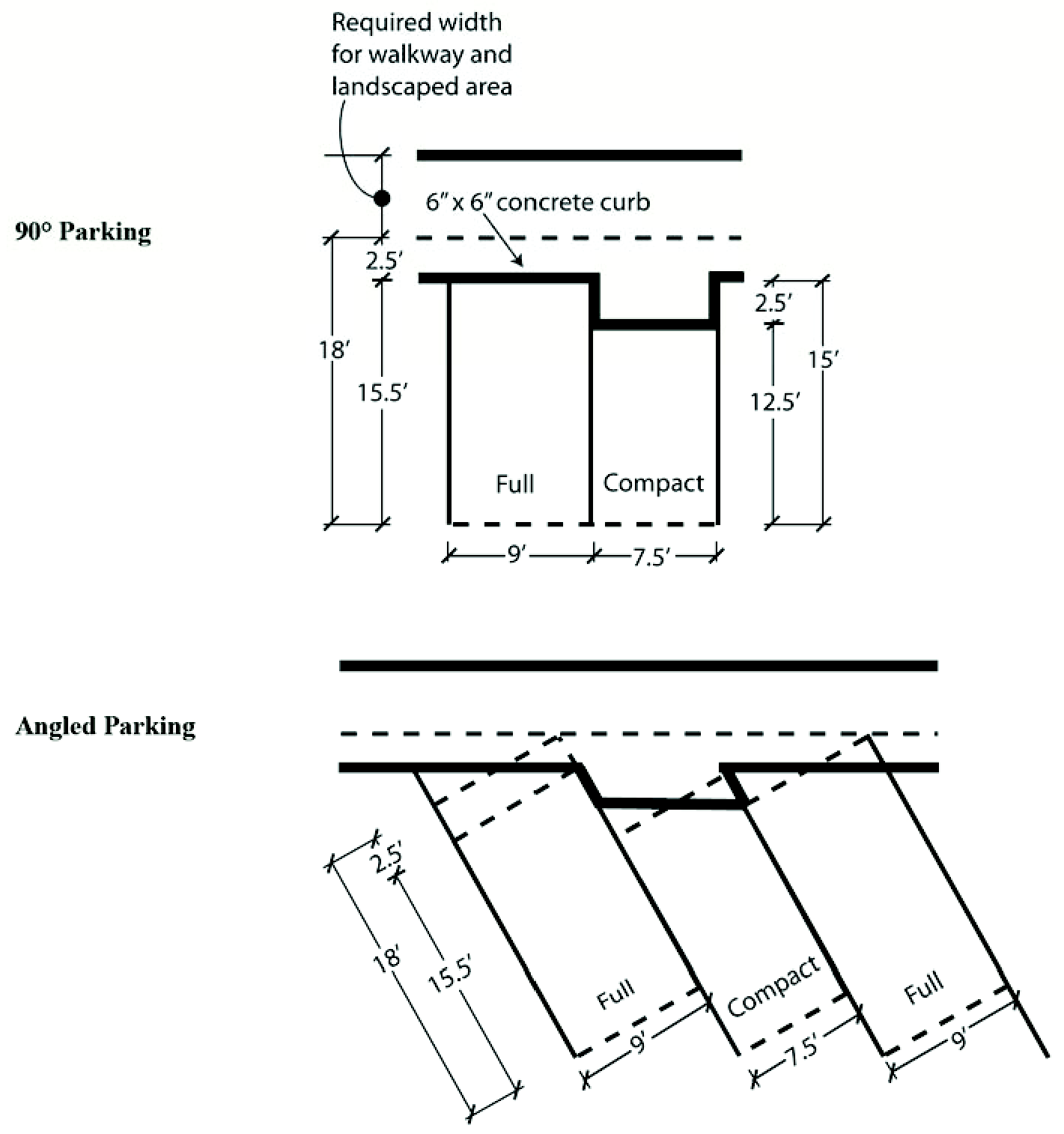
Full Size: Each space shall be a minimum of nine (9) feet wide by eighteen (18) feet long, including any overhang. See Figure 5.1-1.
(2)
Compact: Each compact space shall be a minimum of seven and one-half (7.5) feet wide by fifteen (15) feet long, including any overhang.
(3)
Parallel: Each parallel space shall be eight (8) feet wide by twenty-two (22) feet long.
(4)
Residential Development, four (4) or fewer units: Each space shall be a minimum of ten (10) feet wide and nineteen (19) feet long when not in a garage or covered by a carport.
(b)
Curbing/Overhang. Curbing is required as follows:
(1)
Curbing. Continuous concrete curbing at least six (6) inches high by six (6) inches wide shall be provided where necessary to protect buildings and structures.
(2)
Overhang. Every parking space adjacent to a landscaped area or walkway shall utilize an overhang of two and one-half (2.5) feet. Full size spaces may be reduced to a dimension of nine (9) feet by fifteen and one-half (15.5) feet with a two and one-half (2.5) foot overhang. Compact spaces may be reduced to a dimension seven and one-half (7.5) feet by twelve and one-half (12.5) feet with a two and one-half (2.5) foot overhang. All overhang shall be added to the width of any required landscaped area or walkways.
(c)
Wheel Stops. Wheel stops may only be used when it is deemed by the Director, Board, Commission or Council that the use of a continuous concrete curbing is not practical. If wheelstops are used, they shall be set back two and one-half (2.5) feet.
(d)
Fence/Wall Protection. A fence or wall must be provided appropriate protection and separation from parking spaces and aisles used for backing up to a fence or wall.
Figure 5.1-1
(e)
Other dimensions.
(1)
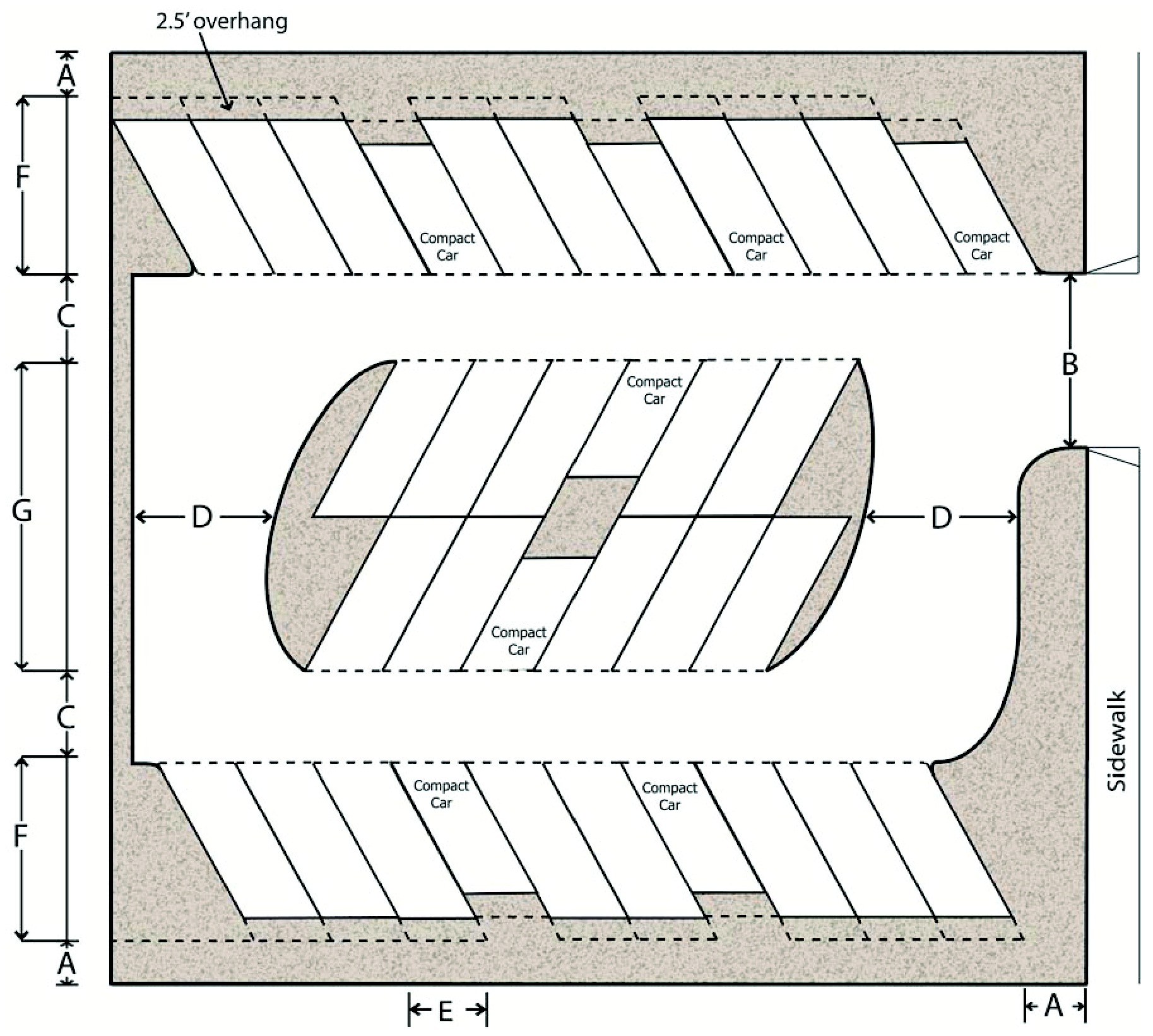
For any given parking angle between forty-five (45) degrees and ninety (90) degrees not specifically listed in Table 5.1-2, use a table angle nearest the given angle.
(2)
Any parking plan showing parking spaces at an angle less than forty-five (45) degrees to the driveway or any other plan for which Table 5.1-2 is not applicable must be approved by the Director.
(3)
The minimum aisle width (C) at any parking stall angle less than forty-five (45) degrees including parallel stalls, is eight and eight-tenths (8.8) feet.
(4)
When two (2) rows of spaces use the same aisle for access, requiring two-way traffic because of the layout, the aisle shall either be a minimum of twenty (20) feet in width or that which is called for in the table below, whichever is greater.
Table 5.1-2
Figure 5.1-2
(f)
Circulation. All parking areas shall have internal circulation in which no backing movement, except that required to leave a parking space, is permitted. It shall also be possible to maneuver within a parking area without use of street right-of-way. No parking area design shall require an exiting vehicle to back onto a street, except for parking serving single-family houses, duplexes or triplexes.
(g)
Accessible Parking. Parking for persons with disabilities shall be provided as required by the California Building Code.
10-5.106 - Improvement Standards.
The following improvement standards are applicable to all parking areas:
(a)
Surface of Parking Area. Parking areas shall be paved in accordance with requirements of the City Engineer.
(b)
Striping of Parking Area. All parking areas of five (5) or more spaces shall be marked by striping to delineate
spaces.
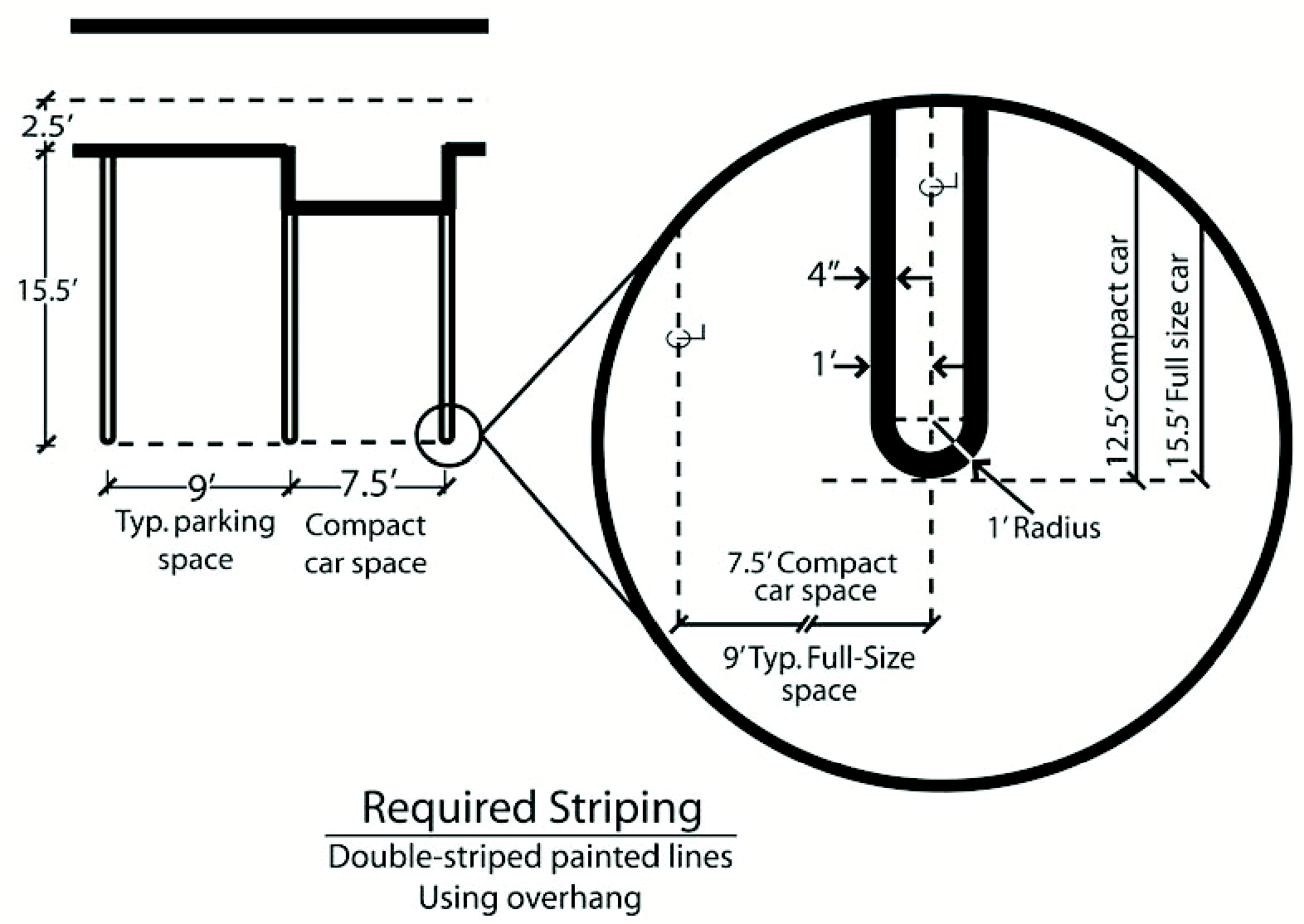
The spaces shall be double-striped as shown in the Figure 5.1-3. Painted line width
shall be four (4) inches. The lines shall be laid parallel to, and one (1) foot within
each stall, fifteen and one-half (15.5) feet in length for a full-sized space and
twelve and one-half (12.5) feet in length for a small car space, including semicircular
cap as shown in Figure 5.1-3.
Figure 5.1-3
(c)
Lighting. All parking areas of five (5) of more spaces shall provide and maintain a minimum of one-third (⅓) foot candle illumination per square foot over the entire parking area during the hours of darkness. Wiring for illumination shall be underground unless existing overhead lines can serve the need without any additional overhead lines. Lights provided to illuminate a parking area shall be arranged so as to reflect the light away from any area upon which a dwelling is located.
10-5.107 - Landscaping.
All parking area landscaping shall be designed to the following standards:
(a)
Whenever a parking area abuts a street, a perimeter landscape strip shall be provided pursuant to the landscape setback provisions of the base zoning district in conformance with Chapter 1, Landscaping and Irrigation Standards of Title 12 (MMC Sections 12-1.01—12-1.09). There shall be a minimum of a four-foot by five-foot planting area for each tree planted in a landscaped planter. Dimensions are measured from the interior side of the curb or permanent border as approved by the Parks, Recreation and Neighborhoods Director. Planter landscaping shall provide a visual landscape screen to a minimum height of three (3) feet and a maximum height of four (4) feet. Visual screening may be accomplished solely by landscaping or in conjunction with a decorative masonry wall. All screening shall conform to the clear vision triangle regulations (Section 10-4.404 of this Code).
(b)
In the interior of a parking area, areas shall be designated for tree planting. Each tree planting area shall contain a minimum of one (1) deciduous tree planted with a minimum of 15-gallon sized stock. The Street Tree Plan, Appendix E, "General Tree Species List," a copy of which is on file in the City Clerk's office, shall be used for recommendations. Trees selected shall be approved by the Parks, Recreation and Neighborhoods Director. There shall be (a minimum of) one (1) tree planted for every eight (8) parking spaces. Tree planting areas shall be distributed throughout the parking area to achieve a fifty (50) percent surface shading within ten (10) years of issuance of the Certificate of Occupancy. For parking areas with only one (1) aisle parking lot shade trees may be planted along the periphery. To qualify as a parking lot shade tree, the tree must be located within seven and one-half (7.5) feet of a parking space.
10-5.108 - Plans Required.
Plans for all parking areas shall be submitted to the chief building official for approval. The plans shall clearly indicate the location and design of the area including surfacing, lighting, drainage and landscaping.
10-5.109 - Expansion of Existing Parking Areas.
The provisions of this chapter do not apply to the reconstruction of existing parking areas. Existing parking areas which do not conform to the provisions of this article may be expanded as follows:
(a)
For those expansions in any 12-month period which cumulatively add less than fifty (50) percent additional spaces, the requirements of this article as to parking lot design, improvement standards and landscaping shall apply to the new or reconstructed area only.
(b)
For those expansions in any 12-month period which cumulatively add fifty (50) percent or more additional spaces, the requirements of this article as to parking lot design, improvement standards, and landscaping shall apply to the entire parking area.

