
Modesto City Zoning Code
CHAPTER 7
OTHER ZONES
Article 5. - Downtown Zones[2]
Editor's note— Ord. No. 3618-C.S., § 2(Exh. A), effective June 25, 2015, amended Art. 5, §§ 10-7.501—10-7.510, in effect repealing and reenacting said article, §§ 10-7.501—10-7.516, as set out herein. Former Art. 5 pertained to the Downtown Core (DC) Zone. See Code Comparative Table for historical derivations.
10-7.101 - Purpose and Intent.
The purposes of the P-D Zone are:
(a)
To encourage creative and efficient land uses.
(b)
To encourage mixed or multiple use projects.
(c)
To permit variations from the density, height and other standards in the various zones where needed to accomplish unique development.
(d)
To permit development based on a high standard of performance and design.
10-7.102 - Applicability.
The regulations in this chapter shall apply in all P-D zones, except that where conflict in regulations occurs, the regulations in this Article shall apply.
10-7.103 - Permitted Uses.
The following are permitted uses:
(a)
Any use specified in the ordinance establishing a P-D Zone.
(b)
The following uses are permitted only in a P-D Zone:
(1)
Residential condominiums, community apartment projects and stock cooperatives.
(2)
Mobilehome Parks
(3)
Cemeteries
(c)
Similar uses that are less intense than the uses specified in the ordinance that established the P-D Zone may be allowed as determined by the Director.
10-7.104 - Applications.
(a)
A complete application for a P-D Zone shall at a minimum contain:
(1)
An application form as prescribed by the Director.
(2)
A development plan and any elevations, perspectives or floor plans necessary for project evaluation as determined by the Director.
(3)
A development schedule indicating the anticipated dates for start and completion of construction.
(4)
Other information that the Commission, Council or Director may require for project evaluation.
(5)
A filing fee as established by the Council.
(b)
All applications for condominiums, community apartment projects and stock cooperatives shall also include a tentative subdivision map.
10-7.105 - Adoption of the P-D Zone.
All applications for P-D zones shall be processed as zone boundary changes and P-D zones, if adopted, shall be adopted by ordinance and will become part of the Zoning Map of the City. The development plan, conditions and development schedule for a P-D Zone shall be adopted by resolution.
10-7.106 - Conditions of Approval.
In granting any P-D Zone the Commission and Council may impose conditions deemed necessary or desirable to maintain neighborhood compatibility and to protect the public health, safety or welfare. Examples of conditions are height, signs, lot coverage, yards, density and parking requirements.
10-7.107 - Development Schedule.
(a)
In granting any P-D Zone involving new development, the Commission and Council shall establish a development schedule.
(b)
From time to time the Secretary may review P-D zones. Those with expired development schedules which have not been completed may be referred to the Commission. The Commission either may grant an extension to the schedule, or may initiate proceedings to rezone the property to the zone classification which it held immediately prior to being zoned P-D.
(c)
Expiration of development schedules can be found in Section 10-9.108.
10-7.108 - P-D Zone Amendments.
(a)
Major Amendments. Amendments to P-D Zones that involve new uses determined by the Director to be inconsistent with the approved uses or, revisions with substantial impacts on adjacent property shall be processed the same as a zone boundary change (rezone) which require a recommendation by the Commission and decision by the Council after a public hearing by each.
(b)
Minor Amendments. Amendments to the P-D Zone that involve significant site redesign or require a change in the conditions of approval in the Council resolution require Commission approval after a public hearing.
(c)
Administrative Amendments. Amendments to the P-D Zone that do not involve new uses, substantial impacts on adjacent property or significant site redesign may be approved by the Secretary or referred to the Commission for decision without a public hearing.
10-7.109 - Designation of P-D Zoning Map.
Each P-D Zone shall be numbered, the first adopted being shown on the Zoning Map as P-D (1) and each zone subsequently adopted being numbered successively.
10-7.201 - Purpose and Intent.
The Airport Zone (A-P) regulates and restricts the height of structures and objects of natural growth and otherwise regulates the use of property in the vicinity of the Modesto City-County Airport/Harry Sham Field to serve the public health, safety, and general welfare and to safeguard the utility of the airport and the public investment therein.
10-7.202 - Definitions.
For the purpose of this Article, the following words and phrases shall have the meanings respectively ascribed to them by this section.
(a)
Airport. The Modesto City-County Airport/Harry Sham Field.
(b)
Airport elevation. The highest point of the airport's usable landing areas.
(c)
Airport hazard. Any structure, object or natural growth, source of electrical interference, or light source located on or in the vicinity of the airport, or any use of land near the airport, which is in violation of these regulations and which obstructs the airspace required for the flight of aircraft in landing or takeoff or which is otherwise hazardous to such landing or takeoff of aircraft.
(d)
Airport Zone. The land area underneath the approach, transitional, horizontal, and conical surfaces as described in this Article.
(e)
Approved airport layout plan. That certain airport layout plan adopted by Council resolution from time to time and on file in the office of the City Clerk of the City of Modesto.
(f)
Nonprecision instrument runway. A runway having an existing instrument approach procedure utilizing air navigation (avigation) facilities with only horizontal guidance, or area-type avigation equipment, for which a straight-in nonprecision instrument approach procedure has been approved or planned, and for which no precision approach facilities are planned or indicated on the approved airport layout plan. This is the north runway at the airport, but only for aircraft approaching from the west and designated Runway 10L.
(g)
Person. An individual, firm, partnership, corporation, company, association, joint stock association, or governmental entity, or a trustee, receiver, assignee, or similar representative of any of the foregoing.
(h)
Precision instrument runway. A runway having an existing instrument approach procedure utilizing an Instrument Landing System (ILS) or a Precision Approach Radar (PAR). It also means a runway for which a precision approach system is planned and is so indicated on the approved airport layout plan. This is the north runway at the airport but only for aircraft approaching from the east and designated as Runway 28R.
(i)
Primary surface. The surface longitudinally centered on each runway which extends two hundred (200) feet beyond each end of each runway. The elevation of any point on the primary surface is the same as the elevation of the nearest point on the runway center line. The width of the primary surface of a runway shall be that width prescribed in Part 77 of the Federal Aviation Regulations (FAR) dated May 1, 1965, as may be amended from time to time.
(j)
Runway. A defined area on the airport prepared for landing and takeoff of aircraft along its length.
(k)
Tree. Any object of natural growth.
(l)
Utility runway. A runway that is constructed for and intended to be used by propeller driven aircraft of twelve thousand five hundred (12,500) pounds' maximum gross weight and less. This is the south runway at the airport designated 10R for aircraft approaching from the west and 28L for aircraft approaching from the east.
(m)Visual Runway. A runway intended solely for the operation of aircraft using visual approach procedures with no straight-in instrument approach procedure and no instrument designation indicated on the approved airport layout plan.
10-7.203 - Airport Zone Surfaces and Height Limitations.
In order to carry out the provisions of this Article, there are hereby created and established certain surfaces, which include the approach surfaces, transitional surfaces, horizontal surfaces, and conical surfaces as they apply to the airport. Such surfaces are shown on the adopted Modesto City-County Airport Layout Plan (ALP), on file at the City of Modesto Airport offices. Said ALP, and all notations, references, and other information shown therein, is hereby made a part of this Article. Except as otherwise provided in this Article, no structure or tree shall be erected, altered, allowed to grow, or be maintained in the Airport Zone created by this Article to a height in excess of the surfaces herein established. An area located beneath more than one of the following surfaces is subject only to the more restrictive height limitation.
(a)
Utility runway visual approach surfaces. The utility runway visual approach surfaces are located at each end of the primary surface of the south runway. Each surface width is two hundred fifty (250) feet wide where it adjoins the primary surface. These approach surfaces expand outward uniformly from each end of the primary surface to a width of one thousand two hundred fifty (1,250) feet at a horizontal distance of five thousand (5,000) feet, the center line being the continuation of the center line of Runway 10R/28L. These approach surfaces slope upward one-foot vertically for each twenty (20) feet horizontally, beginning at each end of and at the same elevation as the primary surfaces.
(b)
Nonprecision instrument approach surface. The nonprecision instrument approach surface is located at the west end of the primary surface of the north runway. This approach surface width is one thousand (1,000) feet wide where it adjoins the primary surface. This approach surface expands outward uniformly from the west end of the primary surface to a width of three thousand five hundred (3,500) feet at a horizontal distance of ten thousand (10,000) feet, its centerline being the continuation of the center line of Runway 10L. This approach surface slopes upward one-foot vertically for each thirty-four (34) feet horizontally beginning at the end of and at the same elevation as the primary surface.
(c)
Precision instrument approach surface. Precision instrument runway approach surface is located at the east end of the primary surface of the north runway. This approach surface width is one thousand (1,000) feet wide where it adjoins the primary surface. This approach surface expands outward uniformly from the east end of the primary surface to a width of sixteen thousand (16,000) feet at a horizontal distance of fifty thousand (50,000) feet, its center line being the continuation of the center line of Runway 28R. This approach surface slopes upward one-foot vertically for each fifty (50) feet horizontally beginning at the end of and at the same elevation as the primary surface and extending to a horizontal distance of ten thousand (10,000) feet along the extended runway center line; it then slopes ten thousand (10,000) feet along the extended runway center line; it then slopes upward one-foot vertically for each forty (40) feet horizontally to an additional horizontal distance of forty thousand (40,000) feet along the extended runway center line.
(d)
Transitional surfaces. The transitional surfaces extend outward from the primary surfaces and the approach surfaces at a 90-degree angle to the runway center lines to where the transitional surfaces intersect the horizontal surface. The transitional surfaces adjacent to that portion of the precision instrument approach surface beyond the limit of the conical surface, extend a distance of five thousand (5,000) feet measured from the edge of said approach surface at a 90-degree angle to the extended runway centerline. The transitional surfaces slope upward one-foot vertically for each seven (7) feet horizontally beginning at the sides of and at the same elevation as the primary surfaces and the approach surfaces.
(e)
Horizontal surface. The periphery of the horizontal surface is located by swinging arcs of ten thousand (10,000) feet radii from the center of each end of the primary surface of Runway 10L/28R and connecting the adjacent arcs by drawing lines tangent thereto and parallel to the runway center line. The inner edge of the horizontal surface is defined by its intersection with the transitional surfaces. The horizontal surface is one hundred fifty (150) feet above the airport elevation.
(f)
Conical surface. The conical surface commences at the periphery of the horizontal surface and extends outward therefrom a horizontal distance of four thousand (4,000) feet. The conical surface slopes upward one-foot vertically for each twenty (20) feet horizontally beginning at the periphery of the horizontal surface.
(g)
Exception to height limitations. Nothing in this Article shall be construed as prohibiting the growth, construction, or maintenance of any tree or structure to a height up to thirty-five (35) feet above the land beneath any surface in the Airport Zone. This exception does not apply to any land over which the City of Modesto owns an avigation easement.
10-7.204 - Use Restrictions.
Notwithstanding any other provisions of this Article, no use may be made of land or water within the Airport Zone in such a manner as to create electrical interference with avigational signals or with radio communication between the airport and aircraft, to make it difficult for pilots to distinguish between airport lights and others, to result in glare in the eyes of pilots using the airport, to impair visibility in the vicinity of the airport or otherwise in any way to create a hazard or endanger the landing, takeoff, or maneuvering of aircraft intending to use the airport.
10-7.205 - Nonconforming Uses.
(a)
Regulations not retroactive. The regulations prescribed by this Article shall not be construed to require the removal, lowering, or other change or alteration to any structure or tree not conforming to these regulations as of July 1, 1977, or otherwise to interfere with the continuance of a nonconforming use. Nothing contained herein shall require any change in the construction, alteration, or intended use of any structure, the construction or alteration of which was begun prior to said date, if such construction or alteration is diligently pursued.
(b)
Marking and lighting. Notwithstanding the provisions of subparagraph (a) of this section, the owner of any existing nonconforming structure or tree is hereby required to permit the installation, operation, and maintenance thereon of such markers and lights as be deemed necessary by the Airport Manager. Such markers and lights shall be installed, operated, and maintained at the expense of the City of Modesto.
10-7.206 - Enforcements.
(a)
Proposed uses. No building permit shall be issued for a use of land or to erect, alter, install, or otherwise establish any structure or other object which would not conform to the regulations herein prescribed.
(b)
Existing uses. No building permit shall be issued that would allow the establishment or creation of an airport hazard or permit a nonconforming use or structure to become a greater hazard to air avigation than it was on July 1, 1977, or on the effective date of any amendment thereto.
(c)
Height limit for trees. Any person owning or in possession of real property shall keep all trees trimmed to a height not exceeding any of the height limits set forth herein. Nonconforming trees in existence on July 1, 1977, shall be kept trimmed at their existing height, and if removed or cut back shall not be allowed to grow above said height or the applicable height limit, whichever is higher.
(d)
Variances. Any person desiring to erect or increase the height of any structure, or permit the growth of any tree, or use property contrary to the provisions of this Article may apply to the Board for a variance from such regulations pursuant to the provisions of Chapter 9, Article 6. Any variance granted may be conditioned to require the owner of the structure or tree in question to permit the City of Modesto, at its own expense, to install, operate, and maintain thereon such markers and lights as may be necessary to indicate to pilots the presence of an airport hazard.
(e)
Abatement. Every airport hazard shall be deemed to be a dangerous building or structure subject to the abatement procedure set forth in the Dangerous Building Code adopted by Section 9-8.01 of this Code, except that every airport hazard which is an immediate danger to flying aircraft may be summarily abated. The provisions of this Article may be enforced by either the Airport Manager or the Chief Building Official.
10-7.301 - Purpose and Intent.
Specific plans are established to enable land to be planned and developed as coordinated, comprehensive projects providing for systematic implementation of the General Plan, and provide a means to plan for specific areas, providing land use pattern, development standards, design guidelines, and development processes for these areas. The purpose and intent of the SP Zone is to permit various land uses including residential, industrial, and commercial development through Specific Plans, pursuant to Government Code Section 65450, et seq. The intent of this is to implement policies regarding certain uses, standards, and development review processes adopted through the Specific Plan process.
10-7.302 - Application of the SP Zone.
The SP Zone shall be applied on the zoning map, in the manner specified by, and appropriate to, the relevant Specific Plan which it is intended to implement. Once the SP Zone is applied to the zoning map, the general public shall be guided to the appropriate Specific Plan, which shall determine the means to comply with the SP Zone.
10-7.303 - Effect of the SP Zone.
Once property is rezoned to an SP Zone all subsequent development shall comply with the uses, standards, and development review procedures of the adopted Specific Plan, including all implementation actions thereof.
10-7.304 - Adoption and Amendment of Specific Plans.
Procedures for adoption and amendment of Specific plans shall be as established by California Government Code Section 65450 et seq.
10-7.305 - Specific Plan Format and Content/Process for Preparation.
Preparation of Specific Plans, their format and content, shall be in accordance with Specific Plan Preparation Guidelines as established by the City Council by resolution from time to time.
10-7.401 - Purpose and Intent.
The purposes of the SP-H zone are to:
(a)
Assist in the orderly transition of property from long-term agricultural use to urban development in areas to be developed as a part of the City's Specific Plan process;
(b)
Provide reasonable opportunities to use property that has been annexed to the City of Modesto prior to full implementation of an adopted Specific Plan.
10-7.402 - Permitted Uses.
The following are permitted uses:
(a)
The growing of fruit and nut trees, vines, row crops and horticultural stock, and the maintenance of livestock and other farm animals excluding pig farming, dairies, and feed lots.
(b)
One (1) single-family dwelling per lot.
(c)
The provision of lodging and/or boarding to a maximum of three (3) persons by a proprietor who lives on the premises. Lodgers and boarders may use the proprietor's kitchen, but shall not be permitted separate eating, cooking or food storage facilities.
(d)
The operation of a bed and breakfast home, provided that not more than two (2) bedrooms may be used for the lodging of guests and that the property owner shall reside on the premises.
(e)
Adult day care for three (3) or fewer persons in addition to members of the family.
(f)
Twenty-four (24) hour care for six (6) or fewer persons in addition to members of the family. Twenty-four (24) hour care is not permitted where there are two (2) dwellings on a lot except as allowed by a conditional use permit.
(g)
Child day care for twelve (12) or fewer children in addition to members of the family. Only one (1) day care business is permitted per lot.
(h)
Parks owned and operated by a governmental agency.
(i)
Signs subject to the provisions of the R-1 zone specified in Chapter 6.
(j)
Accessory uses and structures customarily incidental to the above permitted uses. Use of shipping containers as defined is not permitted.
10-7.403 - Conditional Uses.
The following uses are permitted upon securing a conditional use permit from the Board:
(a)
Church.
(b)
Public buildings or grounds operated by any governmental agency which are not a permitted use.
(c)
Buildings, facilities or grounds operated by a utility company.
(d)
Private recreational grounds and facilities not open to the general public and to which no admission charge is made.
(e)
Storm drainage basins and related facilities.
(f)
Adult day care for four (4) or more persons in addition to members of the family.
(g)
Twenty-four (24) hour care for seven (7) or more persons in addition to members of the family.
(h)
Child day care for thirteen (13) or more children in addition to members of the family.
(i)
The provision of lodging and/or board to four (4) or more persons by a proprietor who lives on the premises. Lodgers and boarders may use the proprietor's kitchen, but shall not be permitted separate eating, cooking or food storage facilities.
10-7.404 - Finding for Approval of Conditional Use Permit, Subdivision, or Parcel Map.
In approving a conditional use permit, subdivision map, or parcel map, the Board, Planning Commission, or City Council shall make the following findings:
(a)
The conditional use permit, subdivision map, or parcel map is consistent with the Modesto General Plan; and
(b)
The conditional use permit, subdivision map, or parcel map would not inhibit the full implementation of the adopted Specific Plan which covers this development approval.
10-7.405 - Home Business.
(a)
Conducting a business in or from a dwelling is a permitted use of an accessory nature which is subject to the following conditions:
(1)
The person conducting the business shall reside on the premises on a regular full-time basis, and the business shall be clearly incidental and secondary to the residential use.
(2)
The residential appearance of the premises shall not be altered through remodeling or new construction so as to give the appearance of other than normal residential premises or to call attention to the premises.
(3)
The business shall be conducted entirely within buildings designed and built for normal residential use and there shall be no outside activity, storage or display.
(4)
No parking or traffic shall be generated by the business in greater volumes than would normally be expected for a residence.
(5)
No trucks or construction equipment shall be parked or stored on or near the premises.
(6)
No more than one (1) business vehicle shall be parked or used in connection with the business on or near the premises. All business pickups and deliveries to and from the premises shall be only by the one (1) allowed business vehicle. "Business vehicle" means a car, pickup or small van used for home business purposes and driven by a person living on the premises.
(7)
Employees shall not work at or be dispatched from the premises nor otherwise be on or about the premises for business purposes.
(8)
There shall be no delivery of merchandise to customers at the premises other than that incidental to a service conducted on the premises.
(9)
Sales or services conducted away from the premises may be advertised in any commercial telephone directory (yellow pages), newspaper, circular or other commercial media, including radio and television.
(10)
Sales or services conducted on the premises shall not be listed in any commercial telephone directory (yellow pages) nor be advertised in any newspaper, circular or other commercial media, including radio and television.
(11)
Signs shall not be used to identify the business, its products or services.
(12)
The business shall not create a disturbance or nuisance by reason of noise, odor, fumes, dust, vibration, smoke, electrical interference or other causes.
(13)
Notwithstanding the above limitations, any person who is severely impaired or handicapped as defined by State law may employ a maximum of two (2) people on the premises who do not reside there and may advertise in any commercial telephone directory (yellow pages), newspaper, circular or other commercial media, including radio and television.
(b)
All businesses conducted in and from a dwelling shall comply with the licensing requirements for businesses in the City.
(c)
Prior to receipt of a license to conduct a business in or from a dwelling, a permit shall be obtained from the Director.
(d)
It shall be unlawful and punishable as an infraction for any person to conduct a home business not in compliance with the provisions of this section.
10-7.406 - Garage Sales.
Garage sales are permitted uses subject to these conditions:
(a)
No garage sale shall be conducted on the same premises for more than three (3) consecutive days.
(b)
Not more than two (2) garage sales may be conducted on the same premises in any calendar year.
(c)
Failure to comply with the provisions of this section shall be unlawful and punishable as an infraction.
10-7.407 - Animals and Fowl.
(a)
There shall be a minimum of forty (40) feet between the window or door of any building used for human habitation and pens, coops, cages or similar housings where animals and fowl, except household pets, are kept.
(b)
There shall be a minimum separation equal to the required side yard between any property line and any pens, coops, cages or similar housings for animals and fowl.
(c)
All animals and fowl shall be kept in conformance with all other laws, ordinances and regulations governing them, including licensing regulations.
(d)
Failure to comply with the provisions of this section shall be unlawful and punishable as an infraction.
10-7.408 - Height.
(a)
No structure shall exceed two (2) stories or thirty (30) feet whichever is the lesser height, and no wall or fence shall exceed eight (8) feet except when permitted by a conditional use permit.
(b)
Any second-story portion of any dwelling or accessory building, including additions or alterations to the exterior portions of an existing dwelling or accessory building, shall be subject to development plan review by the Director or designee in accordance with Chapter 9, Article 10, except as hereinafter specifically excepted. In conducting the plan review, the Director shall consider:
(1)
The relationship of second-story windows, doors, exterior stairways, exterior balconies, sundecks, etc. with the privacy of the neighbors.
(2)
The relationship of building mass with the neighbors' views and use and enjoyment of their yards.
(3)
The relationship of building mass with the neighbors' accessories such as solar collectors and satellite antennas.
(c)
A second-story development is not subject to second-story plan review if at least one (1) of the following two (2) conditions is met:
(1)
A building permit is issued on the subject lot within ten (10) years of the recordation of the final subdivision map creating the subject lot, and providing that each adjacent residential lot meets at least one (1) of the following criteria:
(a)
The adjacent residential lot was created by a final subdivision map recorded within the past ten (10) years.
(b)
The adjacent residential lot is greater than one (1) acre in size and contains no dwelling units within forty (40) feet of any lot line abutting the subject lot.
(2)
All second-story portions of any dwelling unit on the subject lot meet the following setback provisions in relation to any adjacent residential lot:
(a)
Twelve (12) feet where no glazing other than fixed, translucent type is proposed.
(b)
Forty (40) feet where any clear glazing or decks/balconies are proposed. This 40-foot setback shall be measured from the outside edge of the deck or balcony to the respective property line.
(3)
The term "adjacent residential lot" as used in this subsection (c) means each lot zoned or used residentially, even if separated by an alley, that abuts the side or rear lot line of the subject lot, including those which touch only at a corner.
10-7.409 - Front Setback.
(a)
Every building shall have a minimum front setback of fifteen (15) feet except for garages, carports and required parking spaces opening onto the front street, which shall have a minimum setback of twenty (20) feet.
(b)
On through lots every building shall have a front setback as required above on both frontages. If vehicular access is denied and a minimum six-foot wall is maintained across one (1) frontage, necessary structures no higher than the wall are permitted in the setback area adjacent to that frontage.
(c)
Front setback areas shall be unobstructed unless otherwise provided, except that walls and fences outside the clear vision triangle are permitted a maximum of forty-two (42) inches in height.
(d)
A trash enclosure up to fifty-two (52) inches in height serving individual cans may be permitted in the front setback where there is no practical alternative, subject to the approval of the Director. Such enclosures shall be located as far from the front property line as feasible and shall fully screen the trash cans.
10-7.410 - Side Setbacks.
(a)
The minimum side setback for a garage, carport, required parking space or accessory structure shall be five (5) feet except when located to the rear and at least five (5) feet from the dwelling(s), in which case no side setback is required. This minimum five-foot area between a dwelling and accessory building or use shall be unobstructed from the ground upward. In no case shall any portion of a building overhang a property line.
(b)
Street side setbacks shall be unobstructed except that walls and fences outside the clear vision triangle are permitted a maximum of forty-two (42) inches in height.
(c)
On corner lots, the street side setback shall be a minimum of fifteen (15) feet for a dwelling or accessory building except for lots legally existing or on an approved tentative subdivision map prior to July 7, 1955, which shall have a minimum street side setback of seven and one-half (7.5) feet. Garages, carports and required parking spaces opening onto a street shall have a minimum 20-foot setback.
(d)
If a legally existing lot has less than the required lot width, the side setback shall be a minimum of ten (10) percent of the lot width; but in no case shall an interior side setback be less than three (3) feet and a street side setback be less than seven and one-half (7.5) feet.
10-7.411 - Rear Setback.
Rear setbacks are not required except as follows:
(a)
A reversed corner lot shall have a minimum rear setback of five (5) feet.
(b)
Any building used for human habitation shall have a minimum rear setback equal to the required side setback for a dwelling.
10-7.412 - Street Frontage.
Every lot shall have frontage on a street.
10-7.413 - Area.
Every lot shall have a minimum area of ten (10) acres except that those lots existing as of date of annexation shall not be deemed nonconforming by virtue of lot size alone
10-7.414 - Lot Width.
(a)
Every interior lot shall have a minimum width of fifty (50) feet at the front setback line and forty (40) feet at the front lot line.
(b)
Every corner lot shall have a minimum width of sixty (60) feet at the front setback line and fifty (50) feet at the front lot line.
10-7.415 - Lot Coverage.
All buildings and required parking spaces shall not cover more than fifty (50) percent of the area of an interior lot and fifty-five (55) percent of a corner lot.
10-7.501 - Purpose and Intent.
This article establishes a form-based code as the mechanism for development review and entitlement within Downtown. The form based code focuses on the form of the built environment as primary and the uses contained within the built environment as secondary. Downtown consists of six (6) form-based code zones with distinct development criteria. Portions of Downtown consist of conventional zones that are focused more on land use rather than form and are not regulated under this Article. The six (6) Downtown Zones are delineated on the Zoning Map and defined in the Planning Zones Purpose Section 10-7-505. Downtown Zones are intended to:
(a)
Implement policies of the Modesto Urban Area General Plan by promoting higher density, mixed-use development to create a balanced, vibrant downtown and active neighborhood centers;
(b)
Preserve and enhance downtown's historic buildings and sites;
(c)
Ensure development is convenient and safe for pedestrians and bicycle riders;
(d)
Provide additional housing choices and opportunities;
(e)
Reduce dominance of off-street parking areas and parking structures; and,
(f)
Encourage useable private open spaces.
(Ord. No. 3618-C.S., § 2(Exh. A), effective 6-25-15)
10-7.502 - Administration.
(a)
Applicability. The provisions of this article shall supersede any standards, provisions or regulations of all other articles of Title 10 that are in conflict with its provisions. All other standards, provisions or regulations of Title 10 that are not in conflict with this article shall remain in effect. When applying other provisions of Title 10 to the Downtown Zones, the Downtown Zones shall be considered as the equivalents to the following zones provided in Table 7.5-1 below:
This article shall apply to new development within the Downtown Zones except as specified below.
(1)
All development requires Development Plan Review. Development Plan Reviews, Conditional Use Permits, and Variances shall be reviewed in accordance with the processes established by Chapter 9 of Title 10 of the Municipal Code.
(Ord. No. 3618-C.S., § 2(Exh. A), effective 6-25-15)
10-7.503 - Exceptions.
(a)
Existing Development Exception. All legally established development (buildings, parking and other physical site improvements) in existence prior to June 25, 2015 is subject to the following provisions:
(1)
Development Standards.
(i)
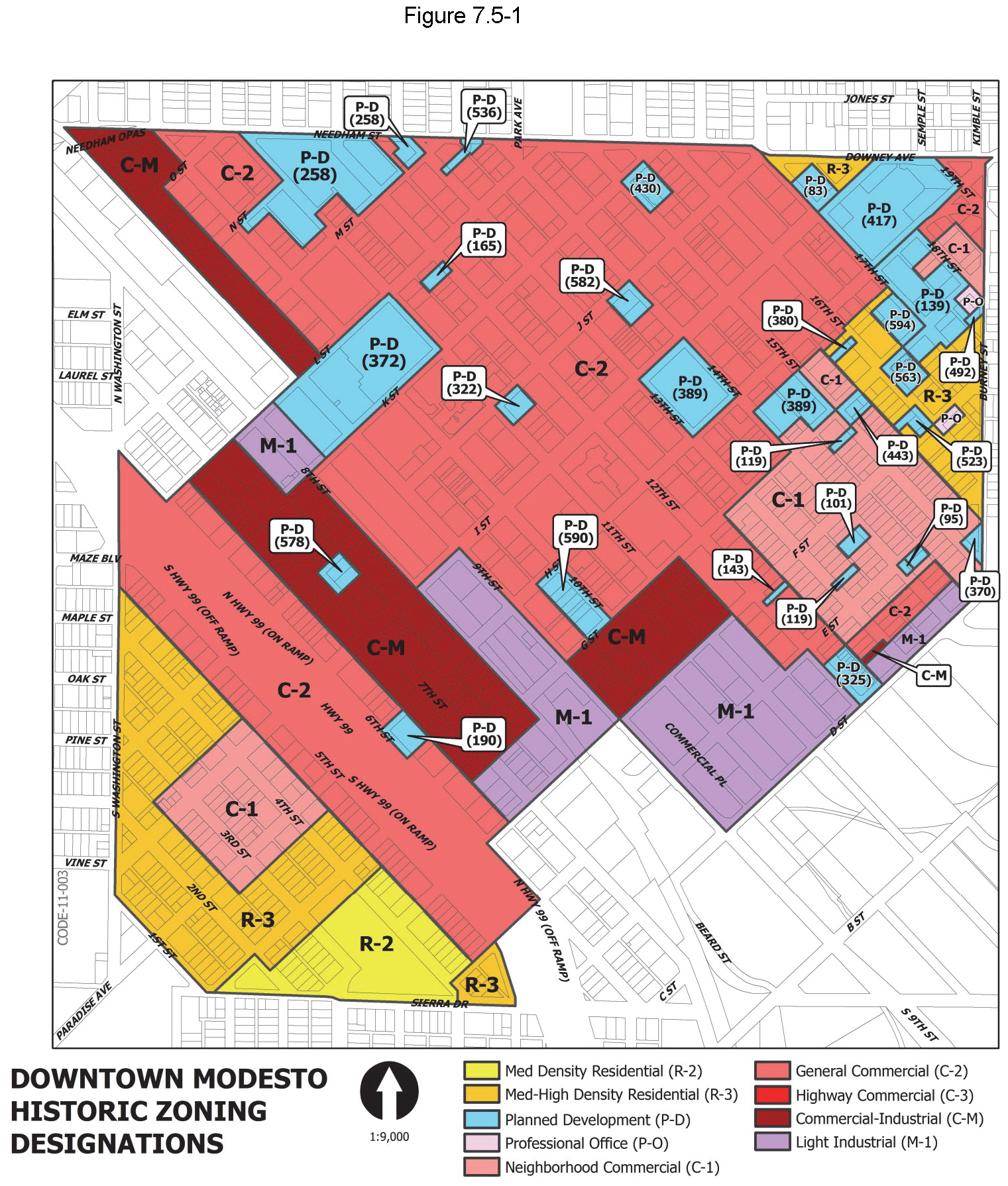
Remodels and repairs of existing buildings and expansions up to 25% of the existing total building gross floor area, may utilize the development standards applicable to the Downtown Modesto Historic Zoning Designation (see definition in Section 10-7.516) that applied to the parcel, as shown on Figure 7.5-1.
(ii)
Repairs and changes to site improvements and expansions up to 25% of the existing total land area, may utilize the development standards applicable to the Downtown Modesto Historic Zoning Designation that applied to the parcel, as shown on Figure 7.5-1.
(iii)
Expansions of more than twenty-five (25) percent are subject to the development standards of this article unless an administrative exception is granted by the Director to allow using applicable development standards to the Downtown Modesto Historic Zoning Designation that applied to the parcel, as shown on Figure 7.5-1. In granting an exception, the Director shall utilize the criteria provided in Section 10-7.503 (a) (3).
(iv)
The Traditional Neighborhood Downtown Zone shall be considered equivalent to the R-2 Zone when applying the development standards for expansions authorized under Sections (i)—(iii) above.
(v)
Alternatively, expansions of buildings and land area may utilize the development standards applicable to the parcel by the provisions of this Article.
(2)
Use Types. All uses in the Downtown Zones shall be in accordance with this article, except as provided below:
(i)
All permitted uses legally established prior to June 25, 2015 may continue to operate and may be replaced by a non-conforming use of the same type and expanded by up to twenty-five (25) percent. Replacement uses shall be limited to uses permitted by the previous zoning (Figure 7.5-1). Once a new use permitted by this article replaces a use not permitted by this article, then all future uses shall be in accordance with this article.
(ii)
No use existing on the date of the adoption of this article may be expanded more than twenty-five (25) percent in area unless the use is in full conformance with the provisions of this article unless an administrative exception is granted by the Director to allow the expansion of the existing use. In granting an exception, the Director shall utilize the criteria provided in Section 10-7.503 (a) (3).
(3)
Criteria for Expansion. Expansions of existing development include building and use expansions on the subject property. Expansions not consistent with this article may occur onto adjacent properties subject to a Conditional Use Permit. Use and building expansions of more than twenty-five (25) percent shall meet at least three (3) of the following criteria.
(i)
The expansion is not detrimental to the implementation of the Downtown Zone in which the expansion is located.
(ii)
The expansion maintains compatibility with neighboring properties.
(iii)
The expansion promotes economic development and revitalization of the downtown area.
(iv)
The expansion allows adaptive reuse of buildings and/or land.
(b)
New Development Exception. It is recognized that there exists in the Downtown area many older lots and buildings that pre-exist current regulations and that it may not be feasible for development on these sub-standard parcels or buildings to meet all of the standards of this article. Consequently, the Director may grant an administrative exception to allow for minor deviations from the development standards of this article, with or without conditions, only after determining that:
(1)
No practical alternative exists;
(2)
The development would still achieve the purpose and objectives of the subject Downtown Zone set forth in Section 10-7.505;
(3)
No detrimental impact would result to the project site or neighboring properties;
(4)
The proposed project would otherwise be in compliance with all applicable standards and requirements; and,
(5)
The deviation granted is the minimum deviation necessary to make possible the development of the property in a manner that otherwise complies with the provisions of this article.
(c)
Previously Approved Project Exception. All unexpired development approvals granted in the Downtown Zones approved prior to June 25, 2015, but not yet constructed, shall be allowed to develop in accordance with the previous approval.
(d)
Warrants for Central and Transition Downtown Zones. A warrant is a minor deviation in the setback or stepback provisions that under limited circumstances still achieves the objectives specified in the purpose and intent of the Central and Transition Downtown Zones sections found in Section 10-7.505. Deviations from the following development provisions may be approved by the Director where the following findings are made:
(1)
Minimum 15-foot stepback from street property line(s) above the sixth floor within the Central and Transition Downtown Zones:
(i)
The building occupies a corner lot;
(ii)
No other deviations of this nature exist within buildings fronting on street sections extending one (1) block from the associated intersection;
(iii)
The width of the building along any public street is no more than one hundred (100) feet, and
(iv)
The building is no more than ten (10) stories tall in the Central Downtown Zone or eight (8) stories tall in the Transition Downtown Zone; and,
(v)
The building maintains a setback of at least five (5) feet above the sixth floor.
(2)
Minimum 30-foot stepback from the interior property line above the sixth floor within the Central and Transition Downtown Zones:
(i)
The width of the subject parcel is less than one hundred ten (110) feet;
(ii)
No more than two (2) other buildings constructed above six (6) stories exist within the subject block frontage; and
(iii)
The building maintains a setback of at least twenty (20) feet above the sixth floor.
(3)
Maximum zero-foot setback from interior property line at floors 1—6 within the Central and Transition Downtown Zones:
(i)
The area is provided for a paseo or a plaza; and
(ii)
No more than one (1) other paseo or plaza exists within the subject block frontage; and,
(iii)
A minimum ten-foot wide, unobstructed pedestrian access/circulation area is provided.
(e)
Civic Buildings. Deviations for civic buildings from the provisions of this article that are not provided for by warrant may be approved by Board of Zoning Adjustment provided the following findings can be made:
(1)
The property is proposed to be used for civic building(s)/grounds that provide a regional amenity by furthering cultural opportunities, or the subject property is proposed to be used for governmental civic building(s)/grounds that provide a necessary service or particular societal amenity; and,
(2)
The nature of the civic building(s)/grounds is such that application of the provisions of this article would preclude its use for the intended purpose.
(f)
Landmark Buildings Deviations for landmark buildings from the provisions of this article that are not provided for by warrant may be approved by Board of Zoning Adjustment provided the following findings can be made:
(1)
The property is proposed to be developed with a building or structure that employs a form and architectural style that is of high quality and will serve as a landmark attraction that is uniquely recognizable as being associated with Modesto; and,
(2)
The form and architectural style cannot be achieved without a deviation from the provisions of this article.
(Ord. No. 3618-C.S., § 2(Exh. A), effective 6-25-15)
10-7.504 - Organization.
(a)
Downtown Zones. The Downtown Zones provide the primary development standards that regulate building placement, building height, land use types, and parking. Building placement regulations are based on Frontage Types. Building height and land use type regulations are based on Building Types. Building Types and Frontage Types are further described below. Downtown includes six (6) zones based on form-based coding principles. Each zone has unique characteristics and regulations.
(b)
Building Types. Building Types identify specific regulations for the building and site development addressing important characteristics of the built form. The standards include defining the building form, compatible Frontage Types, building size and massing, lot access, parking details and accessory structures. There are nine (9) Building Types and only specified Building Types are allowed in each Downtown Zone.
(c)
Frontage Types. Frontage Types address the site and design features of the building frontage focusing on the interface between the private and public spaces. There are six (6) Frontage Types provided and specified Frontage Types are permitted with certain compatible Building Types.
(d)
Use Types. Allowed land use types are identified for each Downtown Zone.
(e)
Using This Code. In utilizing this Code, the first step is to determine in which Downtown Zone the property lies. The second step is to review the applicable Downtown Zone section. The next step is to review the applicable Building Type and Frontage Type sections. The Use Type section contains further information about permitted land uses.
(Ord. No. 3618-C.S., § 2(Exh. A), effective 6-25-15)
10-7.505 - Downtown Zones Purpose.
The Zoning Map identifies six (6) form-based code zones in the downtown area. Each Downtown Zone is different in terms of purpose, development standards, intensity, and allowed uses. The Downtown Zones are similar to conventional zones in that they address development standards and land uses. Where they differ is that the Downtown Zones address building and lot form and allow mixed land uses on individual parcels.
(a)
Central Downtown (CD). This zone is intended to foster the most intensive and active urban environment in the Downtown, while ensuring an overall human scale to development. This is accomplished with large, but unobtrusive building envelopes that accommodate a mixture of uses, including residential, with an interface that promotes a very strong public/private connection and lively streetscape.
The district contains Historic Preservation sites that are included on the landmark preservation list in the General Plan. Special considerations for these sites are provided in the general provisions section of this article.
(b)
Transition Downtown (TD). This zone is intended to foster an intensive and active urban environment, but at a reduced scale from what is found in the Central District. This is accomplished with medium-large building envelopes that accommodate a mixture of uses, including residential, with an interface that promotes a strong public/private connection and lively streetscape.
In addition to Historic Preservation sites, the zone contains the site of a future passenger rail station. The future station is intended to accommodate associated regional rail and future high speed rail service within the Downtown.
(c)
Urban General Downtown (UGD). The Urban General Downtown Zone is intended to create space for more urban activities. New housing is highly desirable because residents help ensure that street life is safe and because residents provide passive nighttime security for day uses. This zone links the Central Downtown Zone to the outer districts and areas of downtown.
(d)
Main Street Downtown (MSD). This zone is intended to promote and enhance a vibrant "main street" commercial environment within walking distance of the surrounding neighborhood. The Main Street Downtown Zone is intended to be the commercial focus of the surrounding neighborhood but at a smaller scale than the Central Downtown Zone. The focus of this district is on commercial uses but it also accommodates residential uses.
(e)
East Neighborhood Downtown (END). The purpose of this zone is to facilitate the continuing transition of the east area of downtown that was originally developed as a residential neighborhood but is in the process of changing to commercial and office uses. This zone would allow a mixture of uses where new development would include a variety of housing types and commercial uses.
(f)
Traditional Neighborhood Downtown (TND). This zone is intended to allow new residential development that is compatible with the traditional single family residential character of the neighborhood. This objective is accomplished by addressing certain provisions such as frontage types, setbacks, building envelope, building height, building type, and yard areas to be compatible with the historical and existing characteristics of this residential neighborhood.
(Ord. No. 3618-C.S., § 2(Exh. A), 6-25-15)
10-7.506 - Central Downtown (CD) Zone.
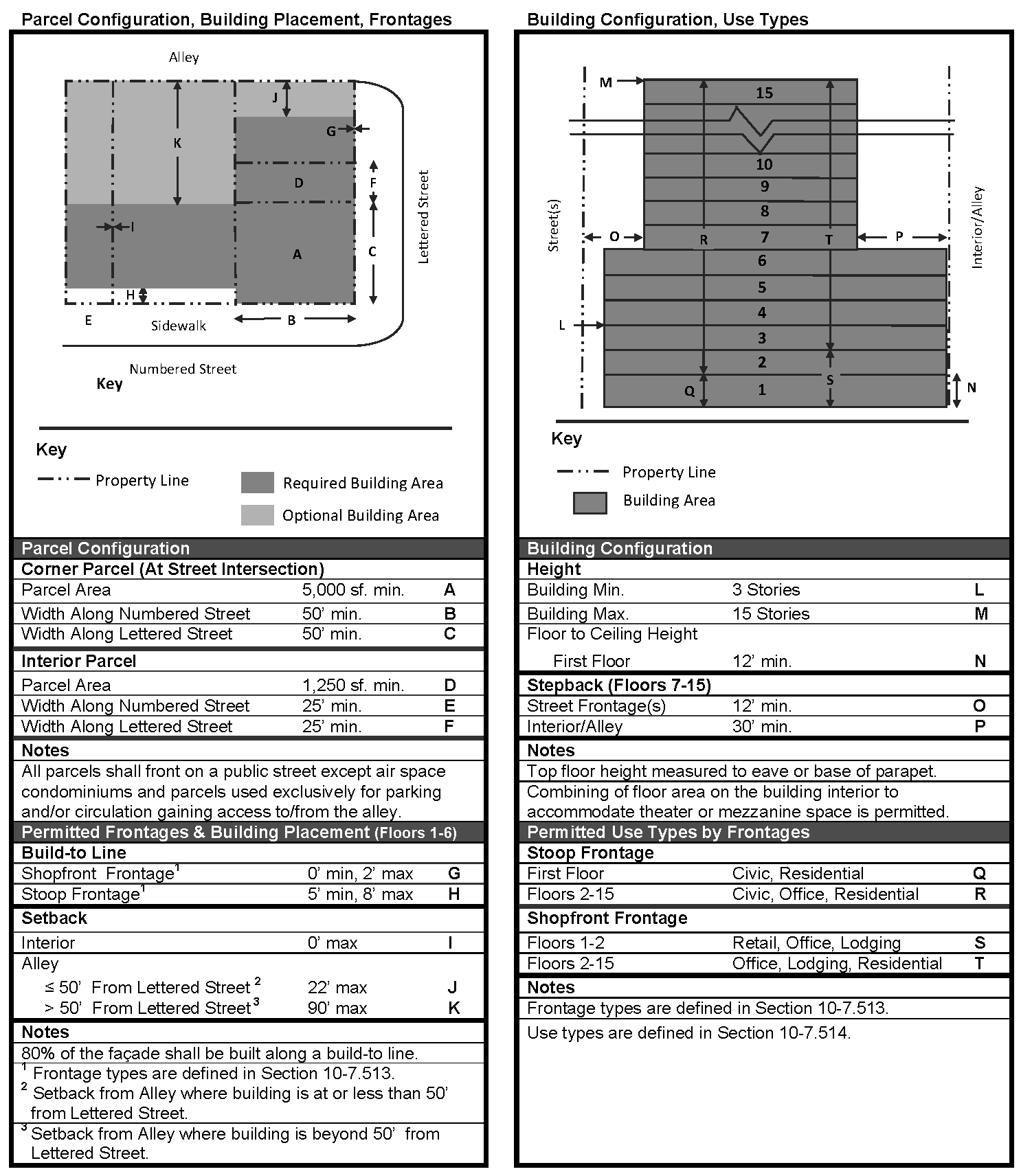
10-7.506. Central Downtown (CD) Zone.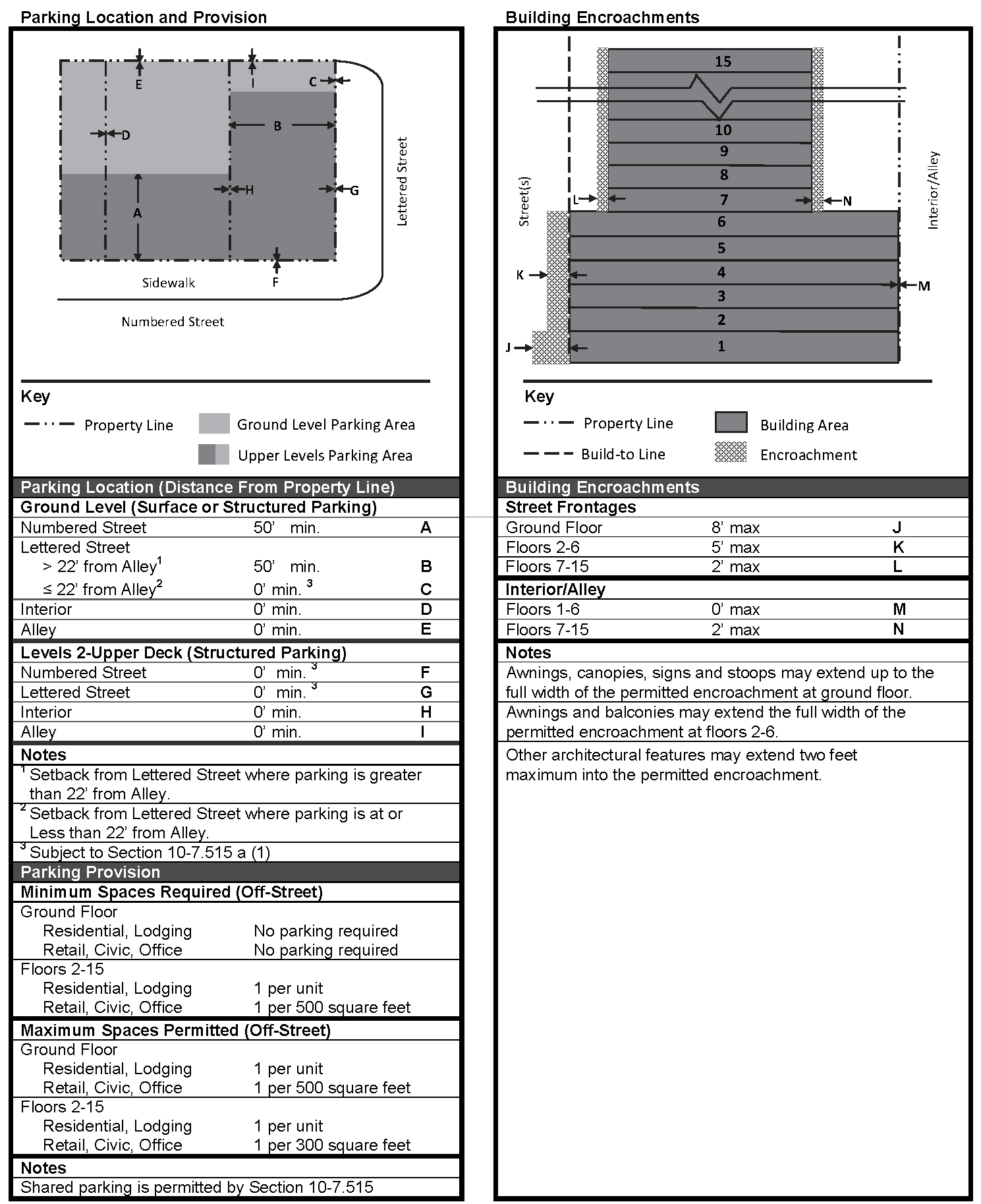
(Ord. No. 3618-C.S., § 2(Exh. A), effective 6-25-15)
10-7.507 - Transition Downtown (TD) Zone.
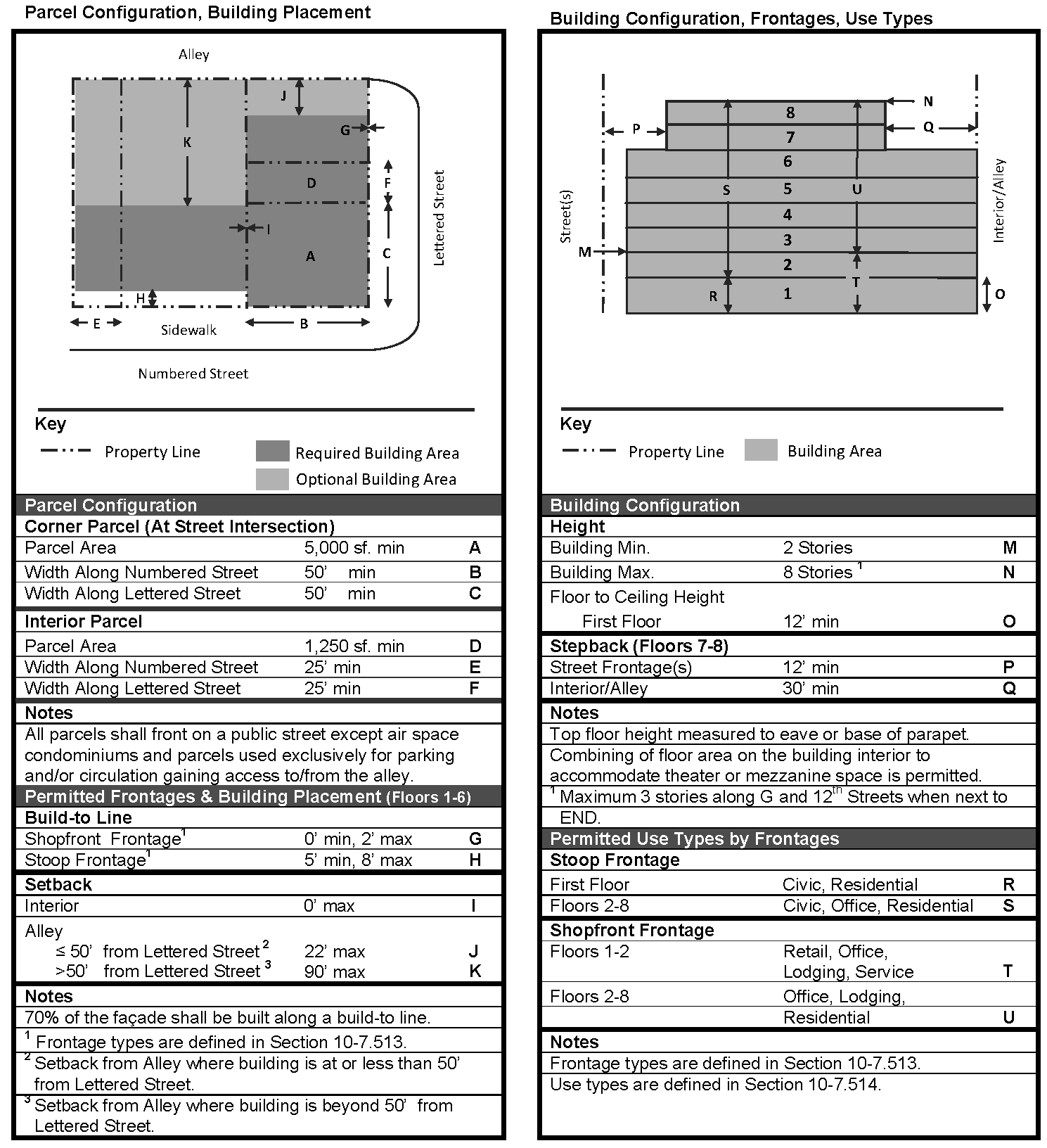
10-7.507. Transition Downtown (TD) Zone.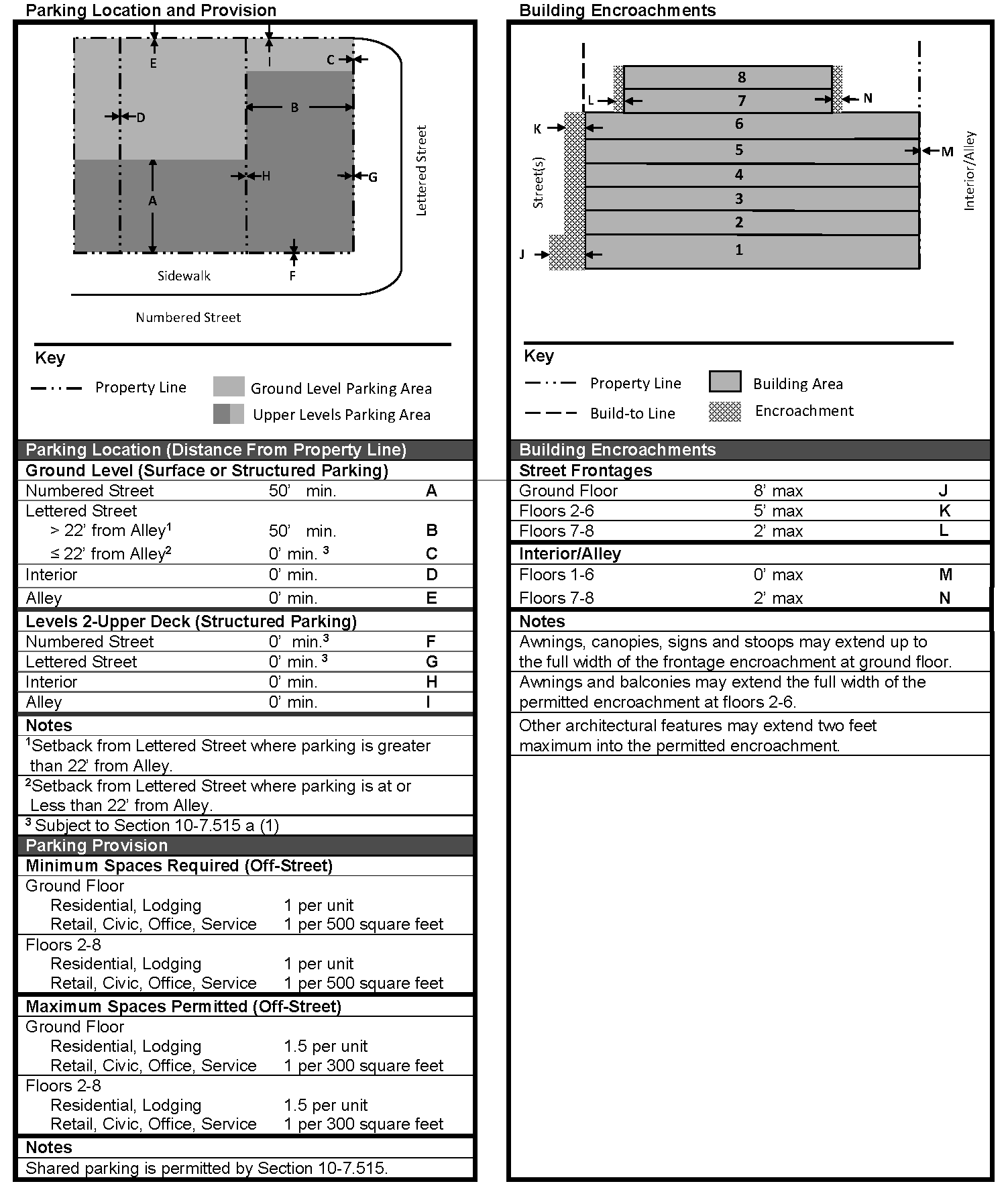
(Ord. No. 3618-C.S., § 2(Exh. A), effective 6-25-15)
10-7.508 - Urban General Downtown (UGD) Zone.
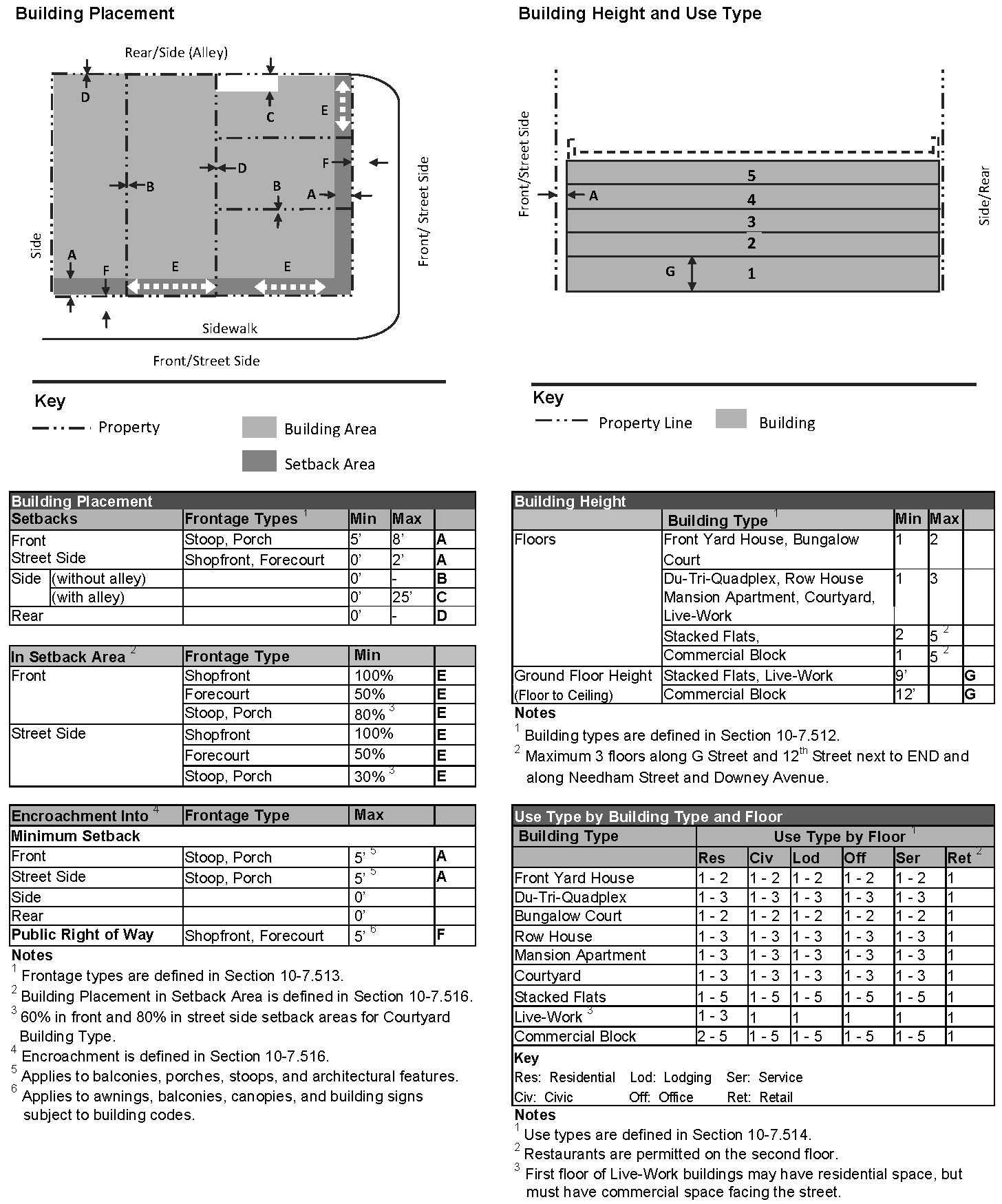
10-7.508. Urban General Downtown (UGD) Zone.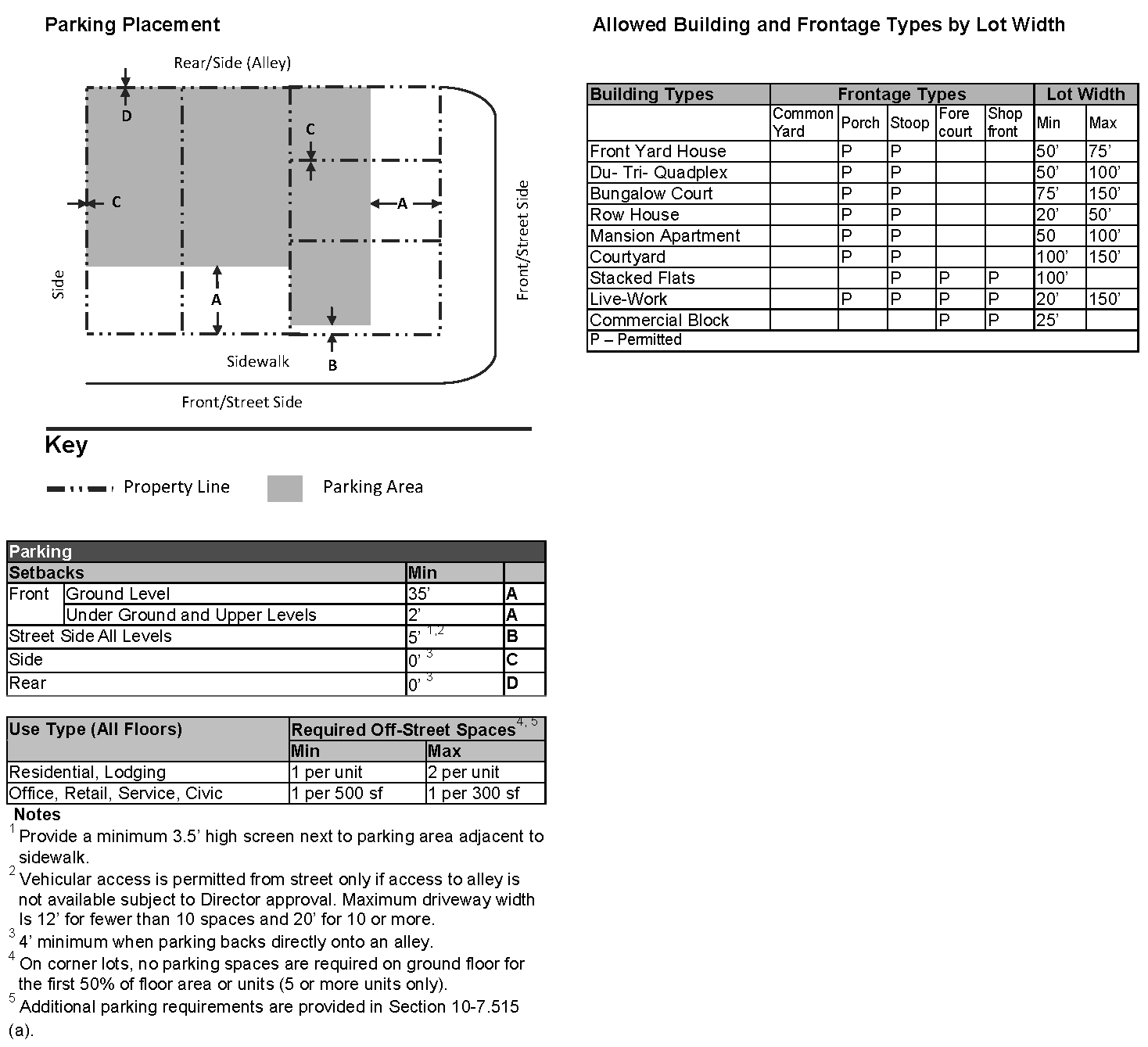
(Ord. No. 3618-C.S., § 2(Exh. A), effective 6-25-15)
10-7.509 - Main Street Downtown (MSD) Zone.
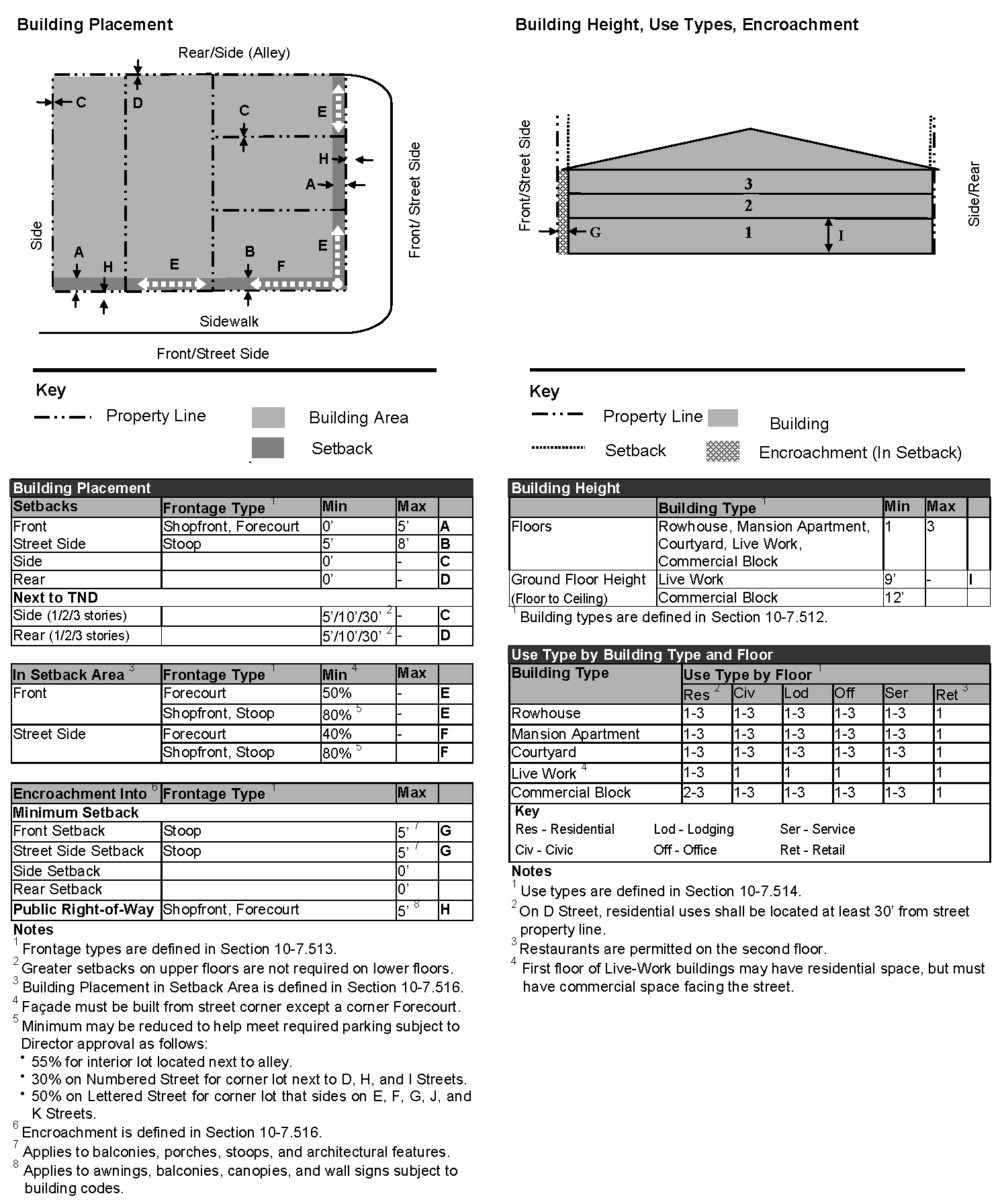
10-7.509. Main Street Downtown (MSD) Zone.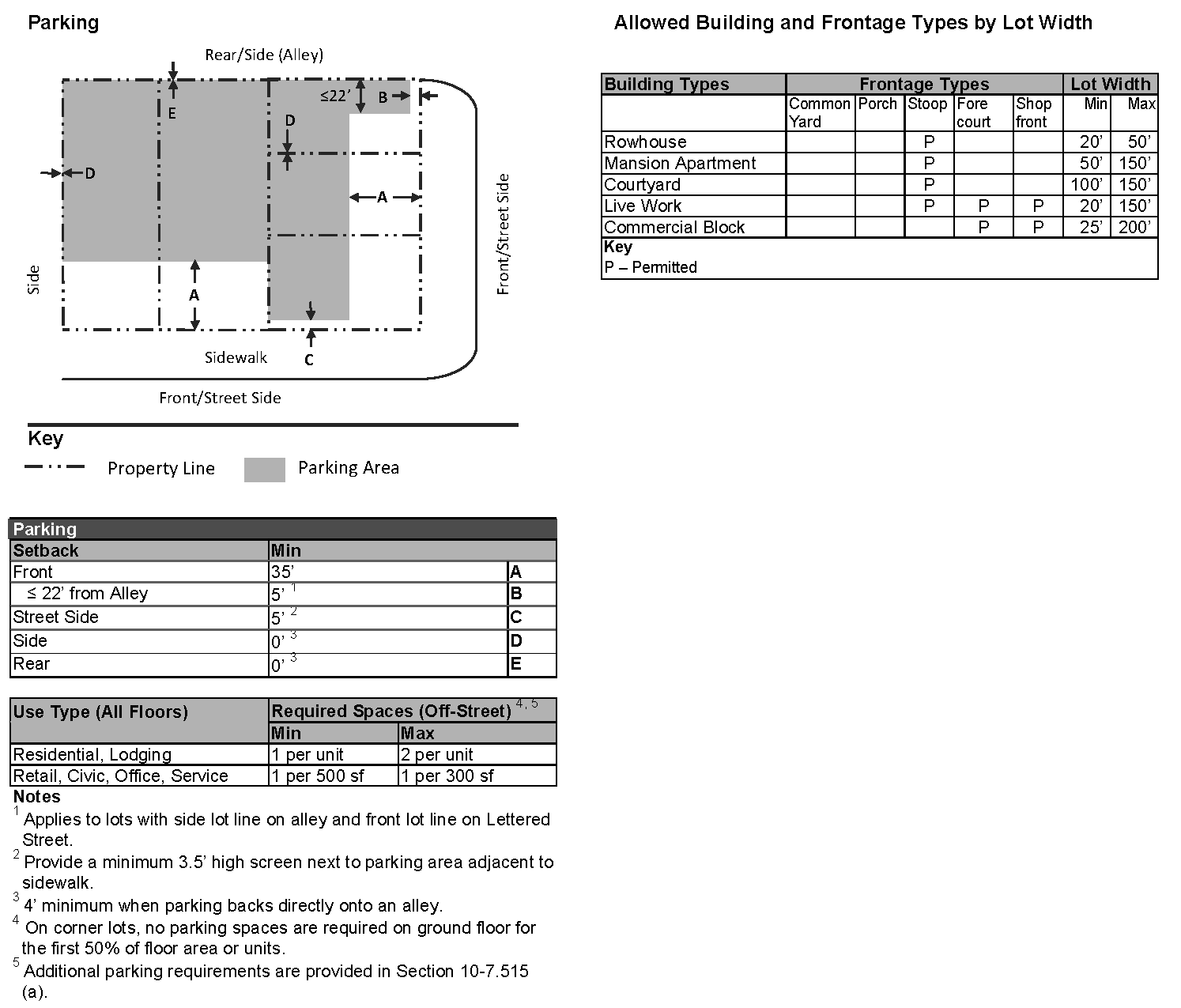
(Ord. No. 3618-C.S., § 2(Exh. A), effective 6-25-15)
10-7.510 - East Neighborhood Downtown (END) Zone.
10-7.510. East Nieghborhood Downtown (END) Zone.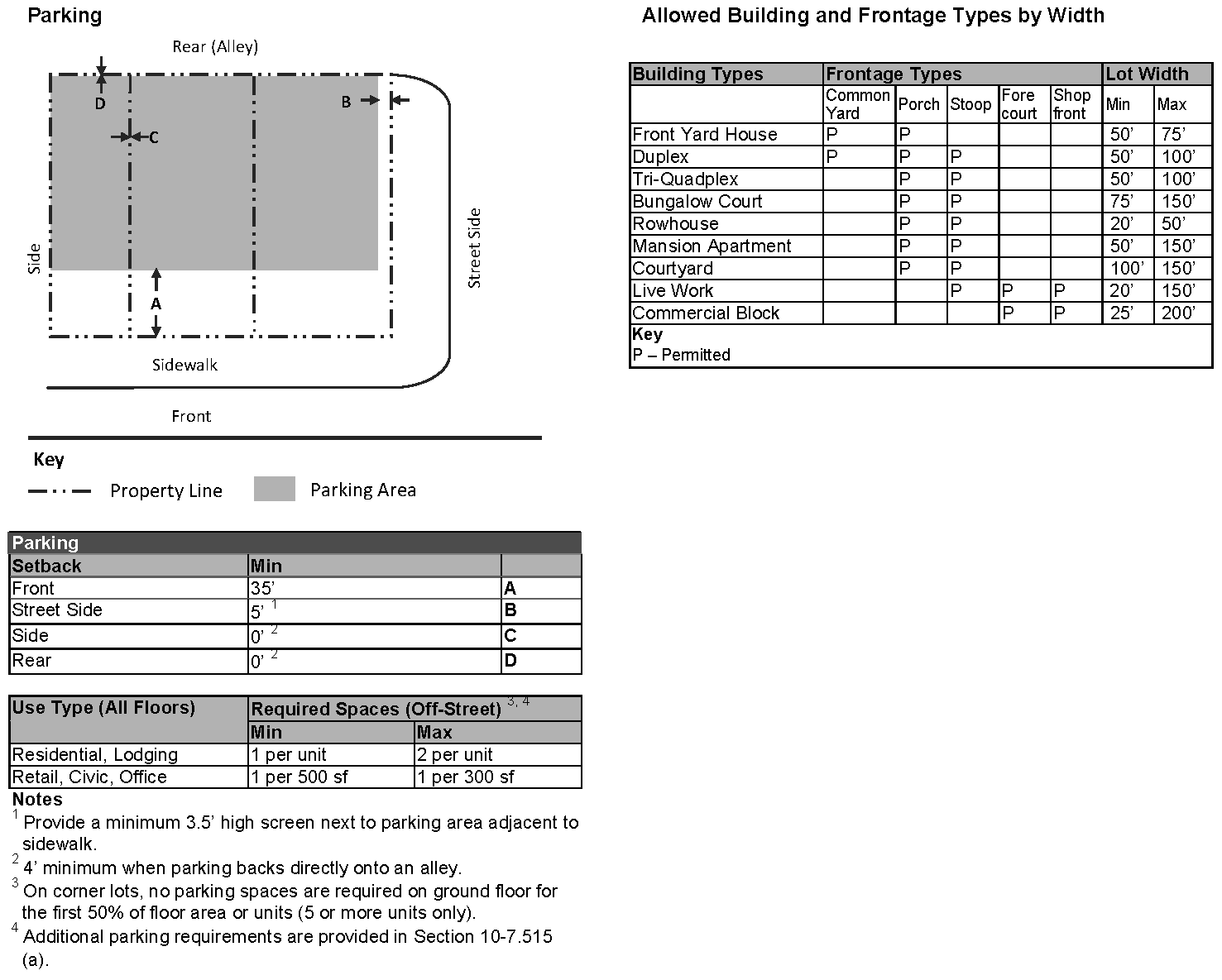
(Ord. No. 3618-C.S., § 2(Exh. A), effective 6-25-15)
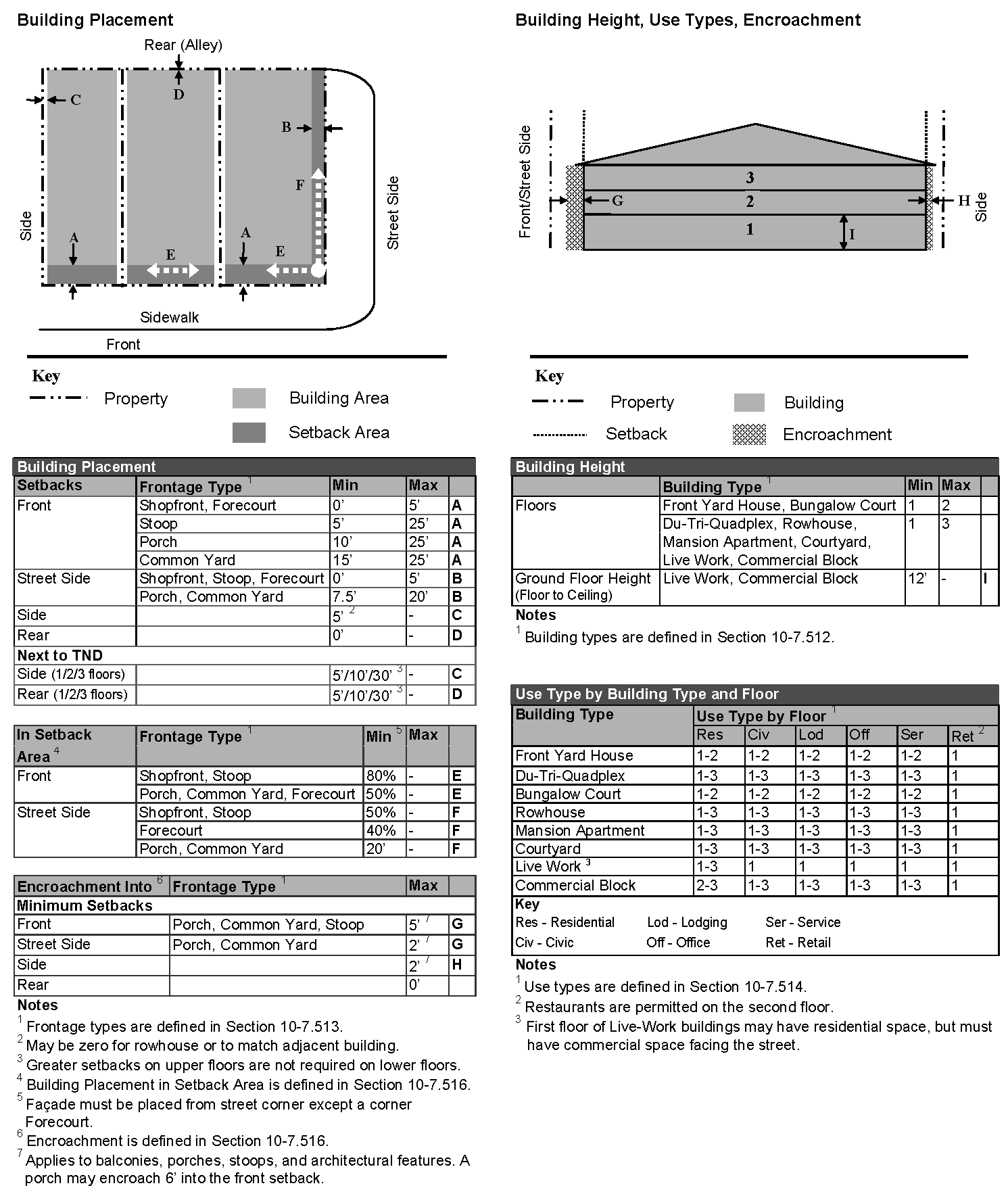
10-7.511 - Traditional Neighborhood Downtown (TND) Zone.
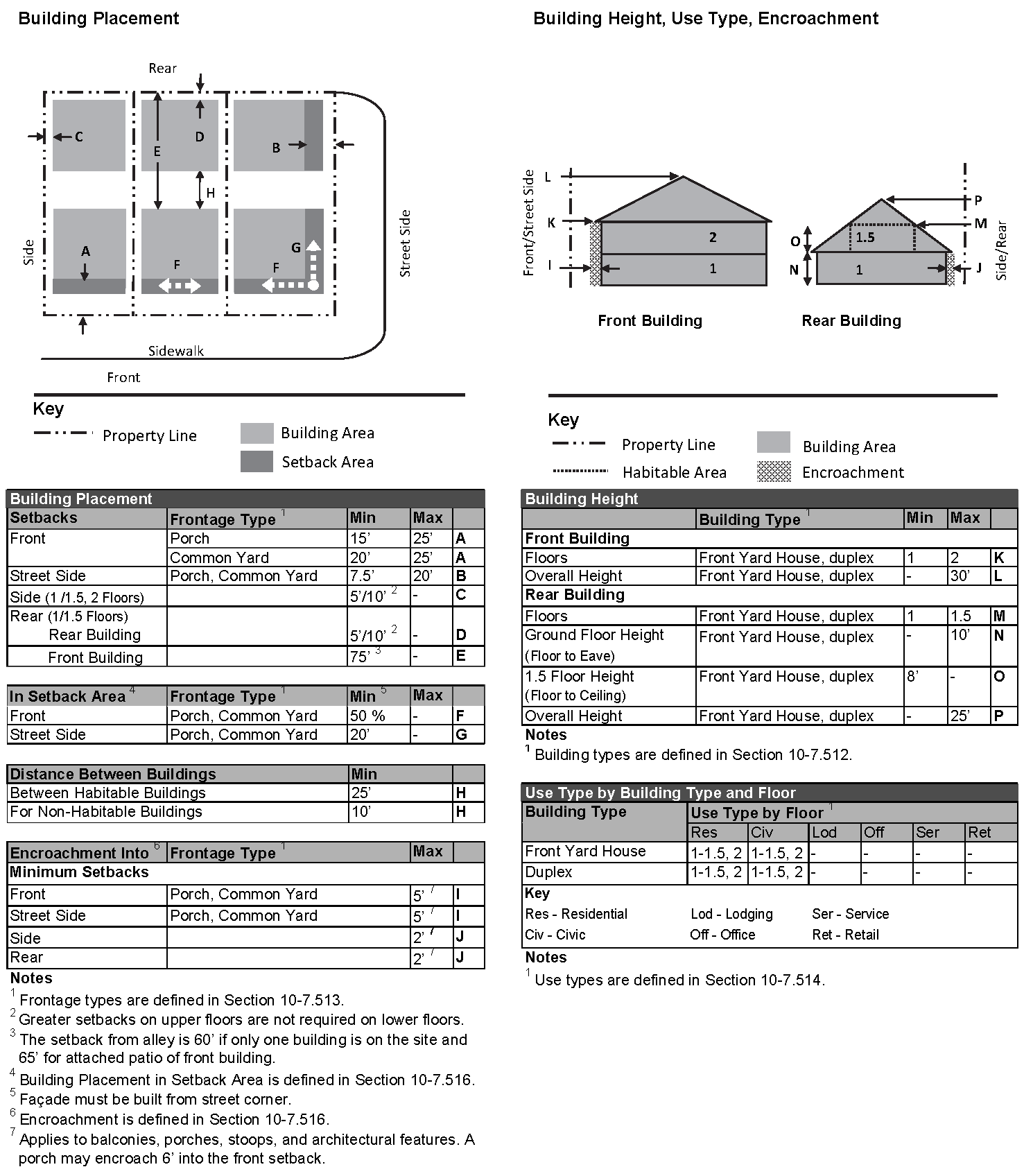
10-7.511. Traditional Neighborhood downtown (TND) Zone.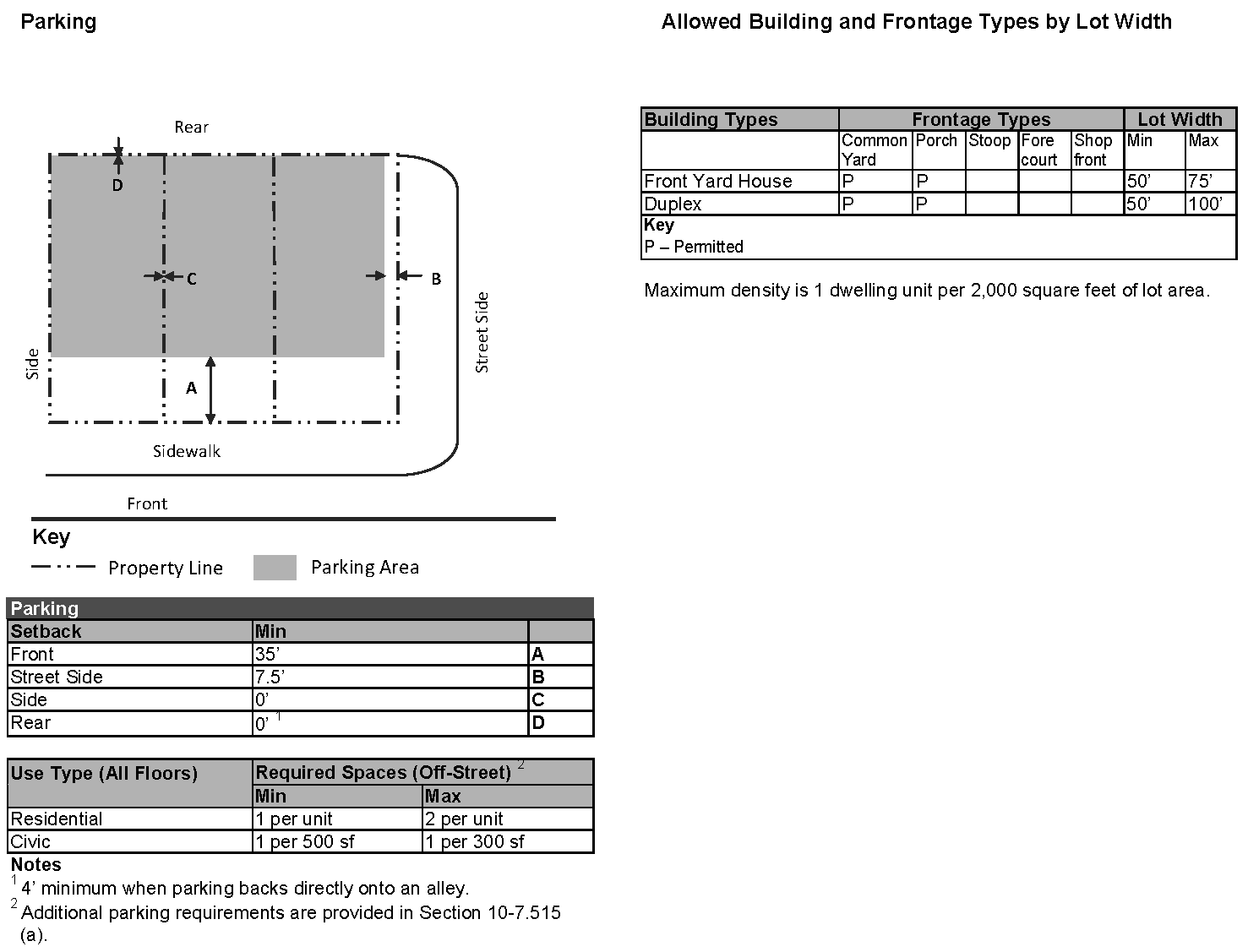
(Ord. No. 3618-C.S., § 2(Exh. A), effective 6-25-15)
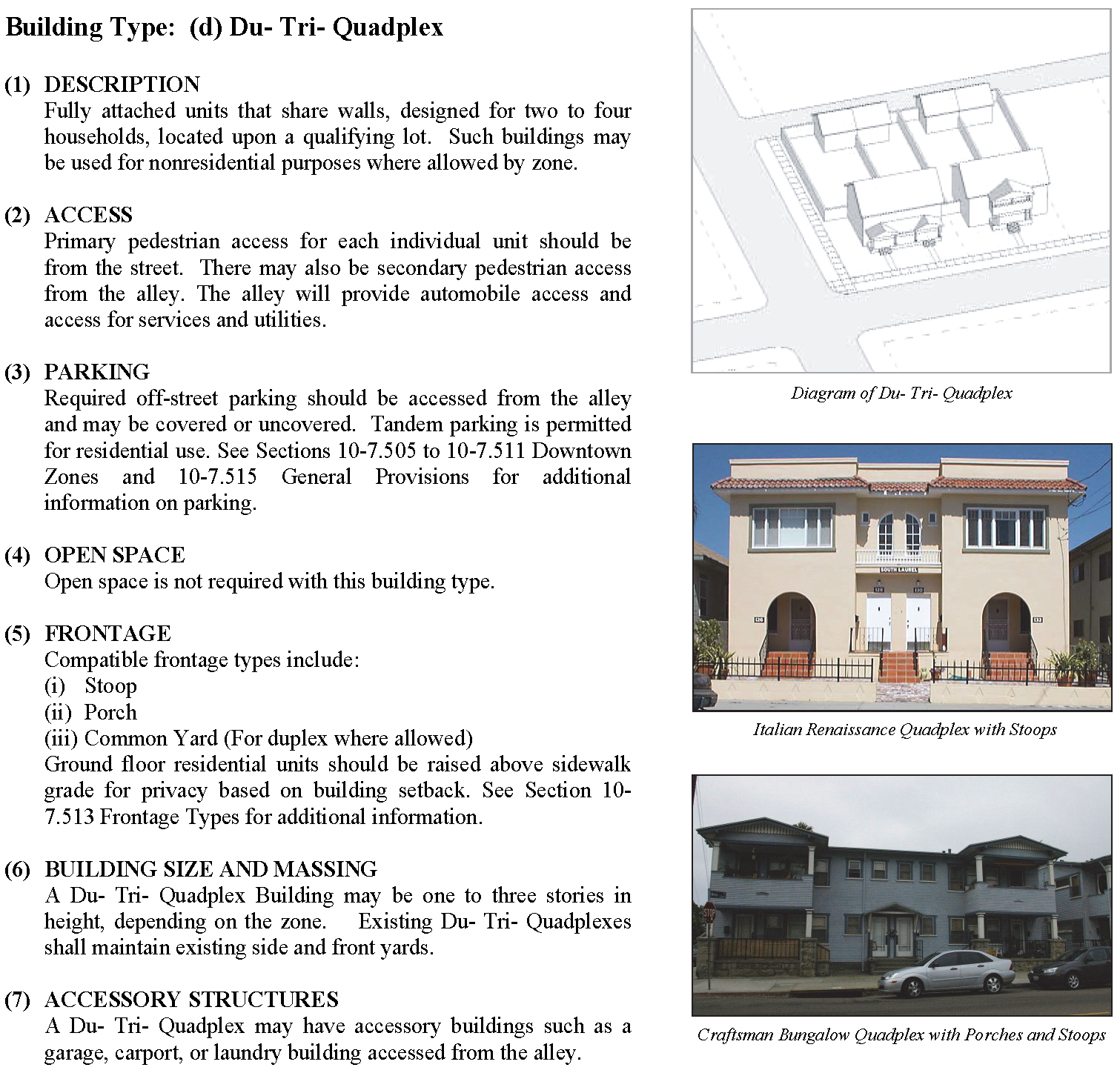
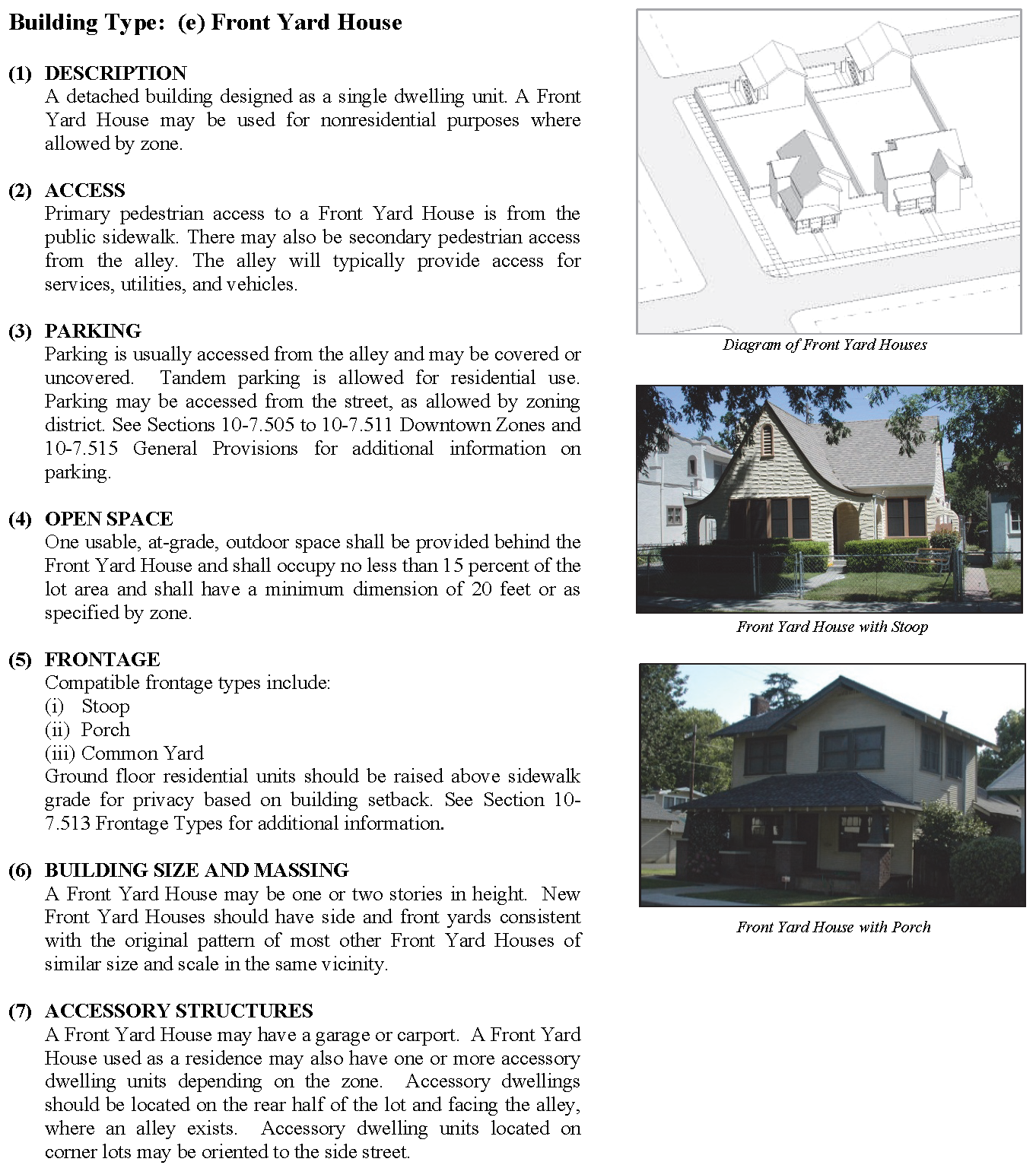
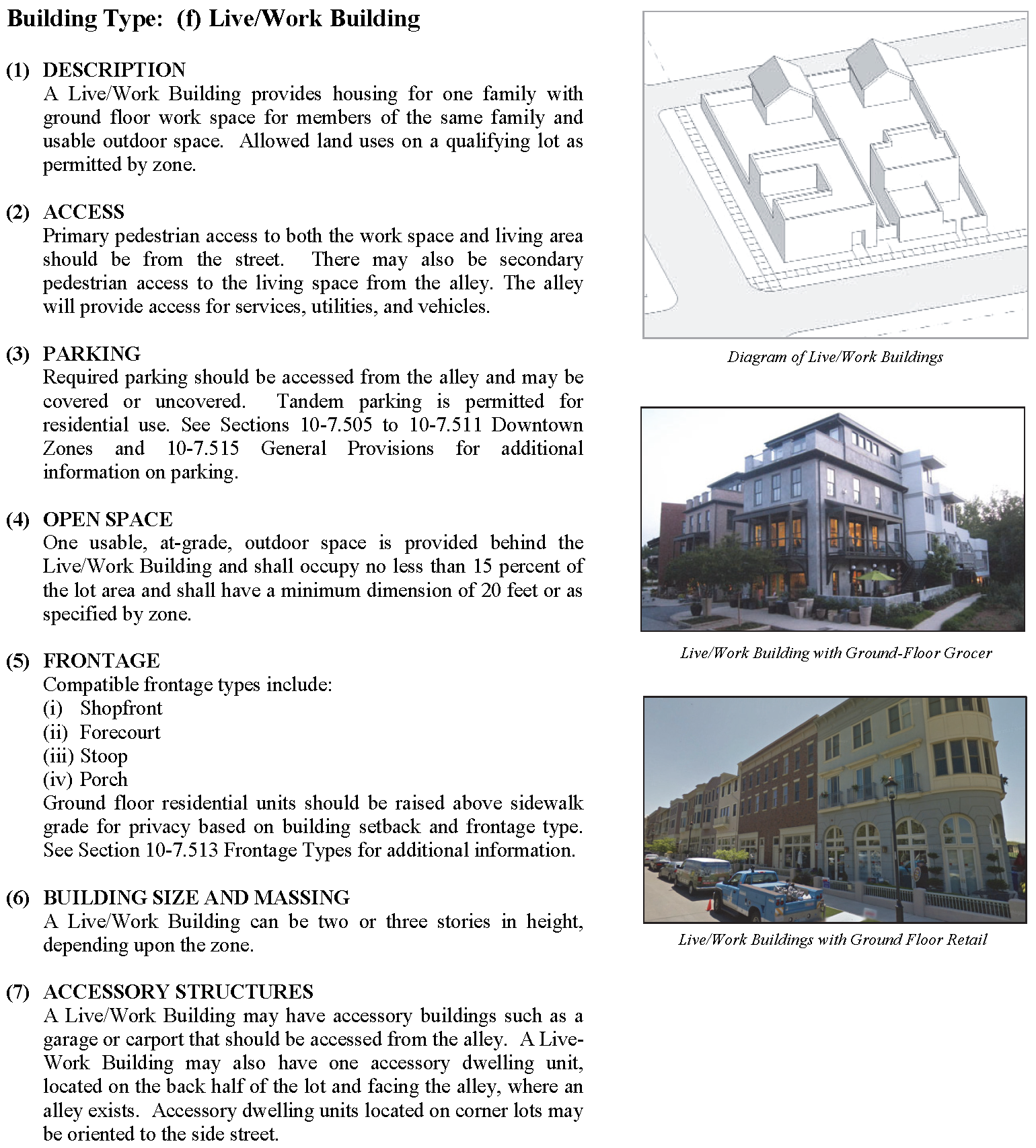
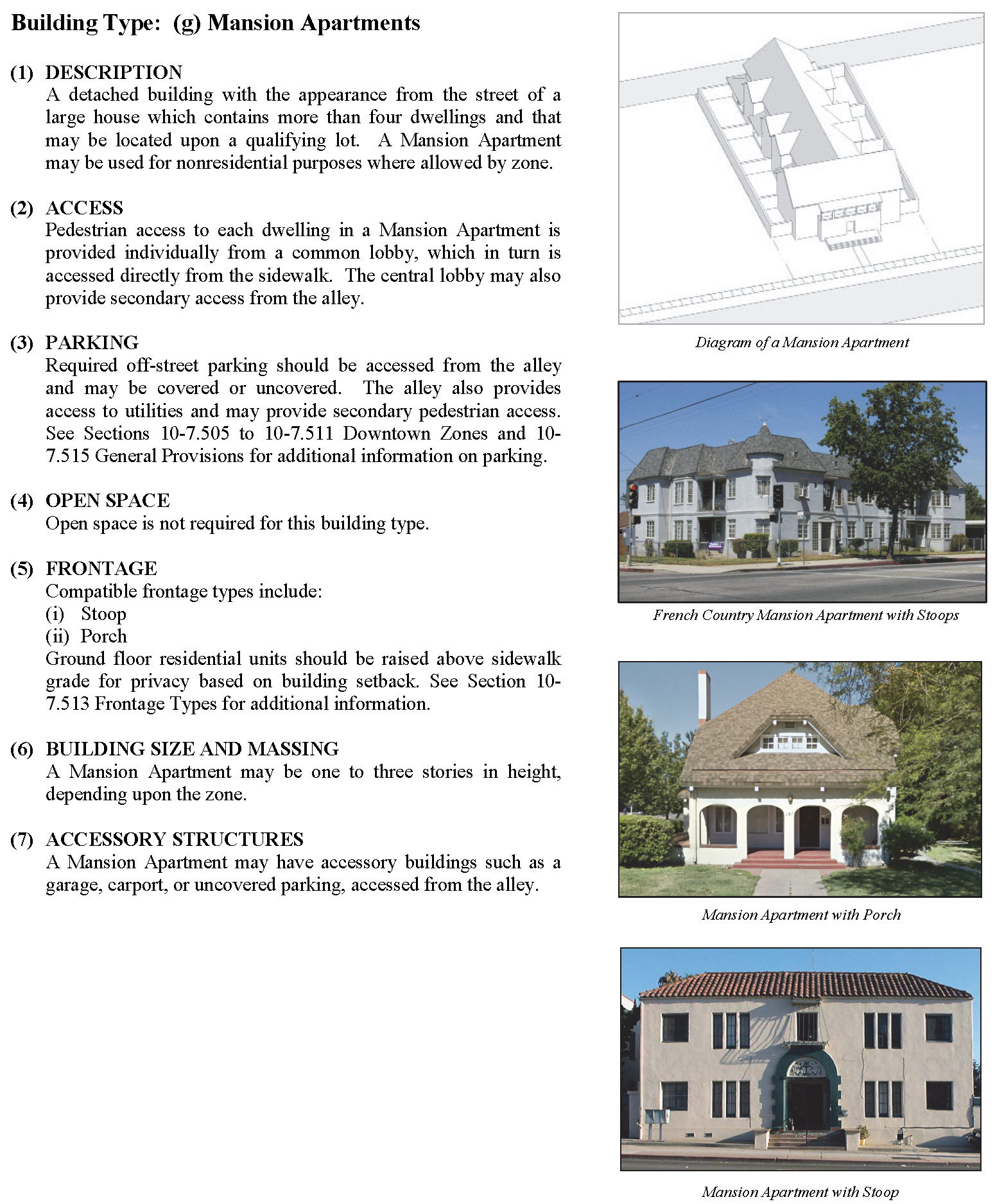
10-7.512 - Building Types.
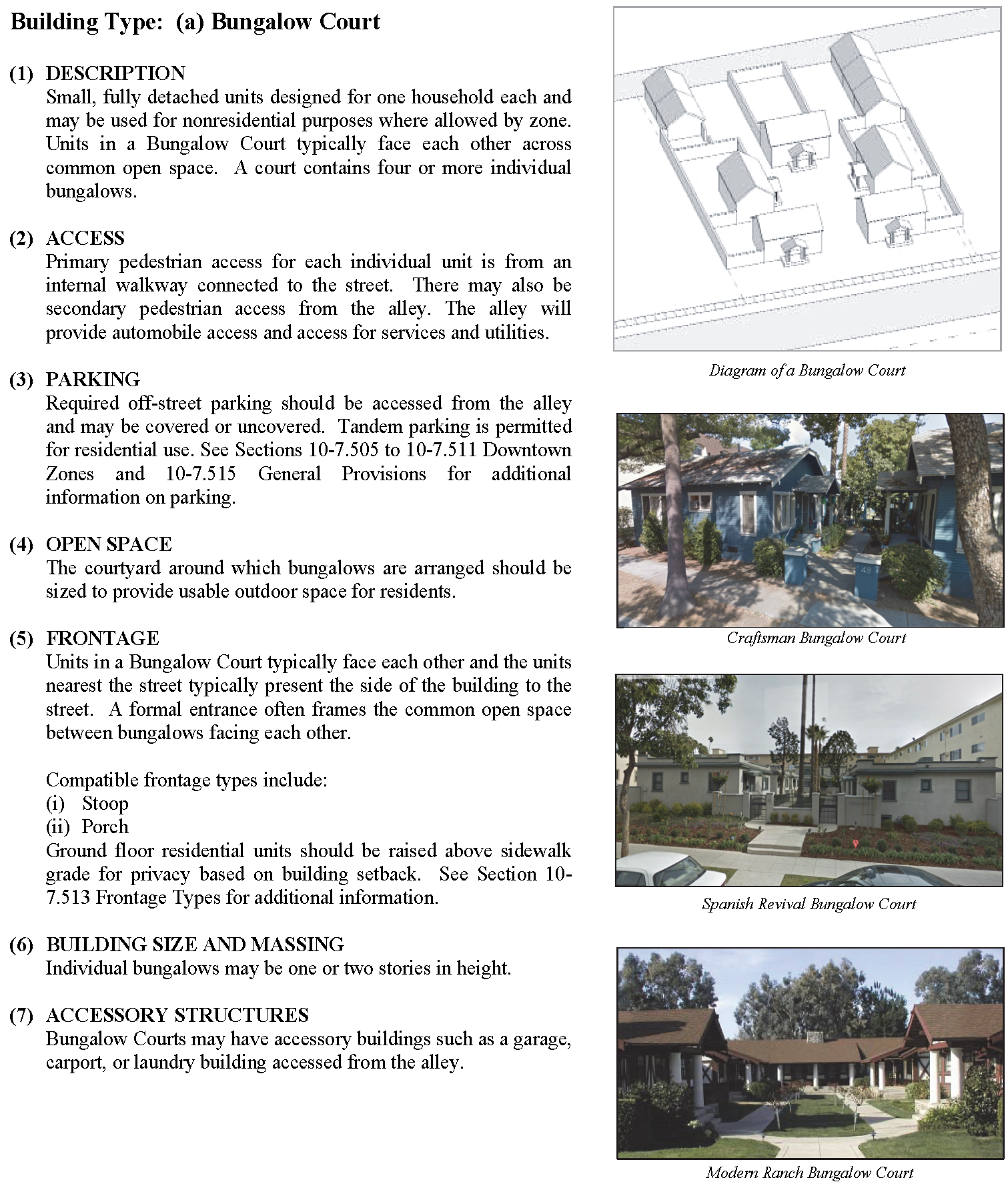
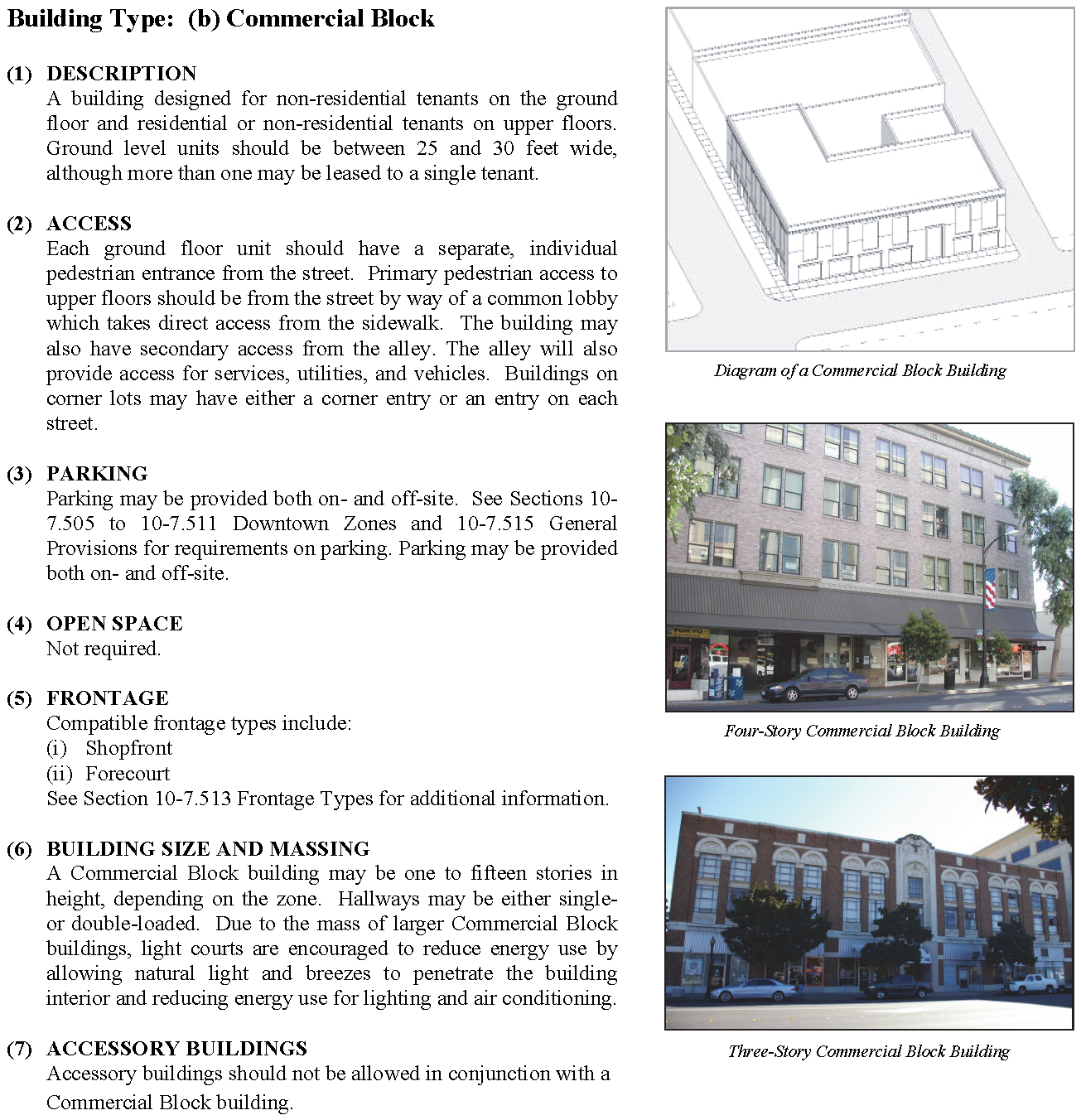
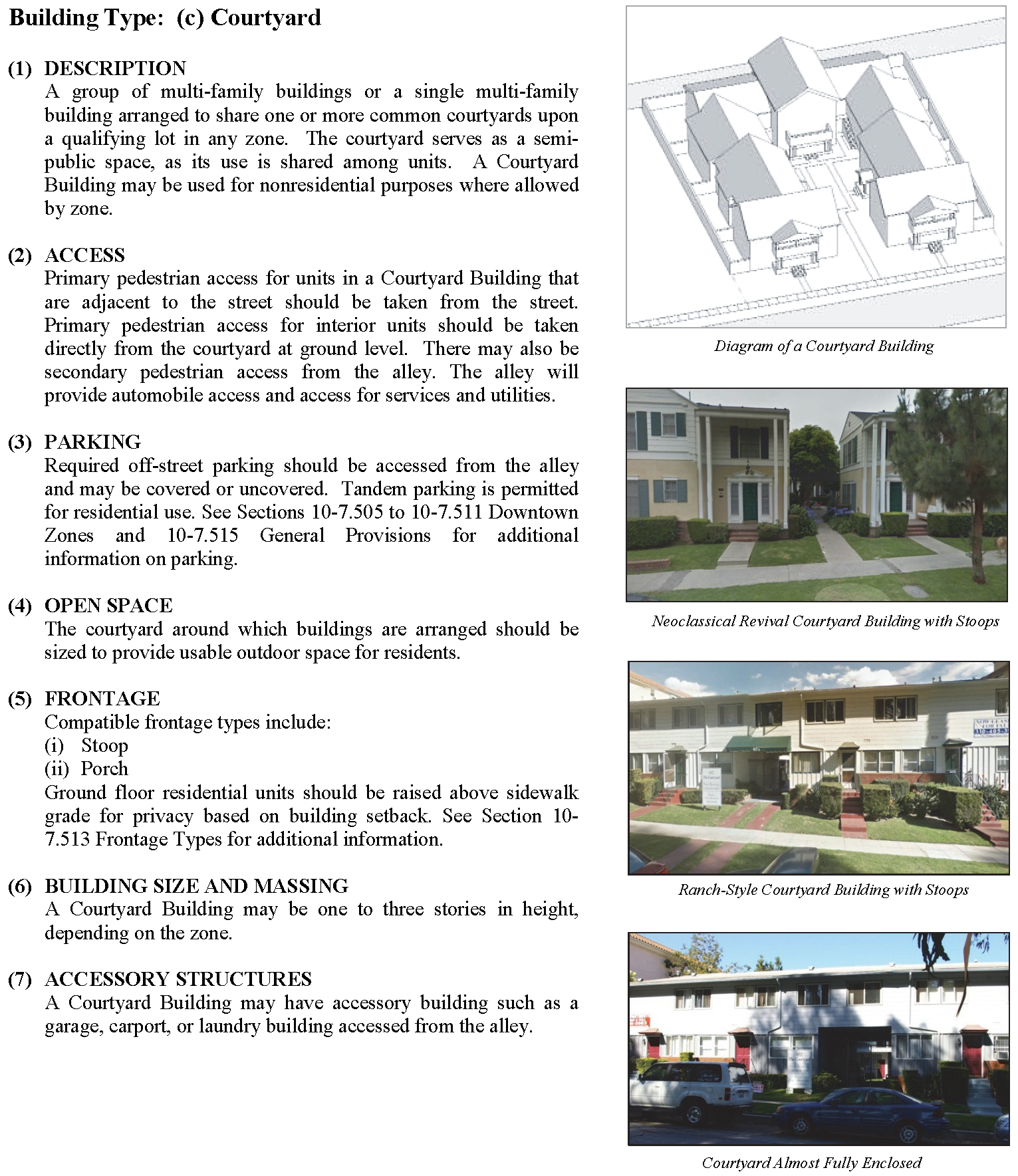
Building Types help achieve the desired built form and pedestrian orientation in the Downtown. The following Building Types are allowed in the Downtown are described in the following pages:
(a)
Bungalow Court
(b)
Commercial Block
(c)
Courtyard
(d)
Du-Tri-Quadplex
(e)
Front Yard House
(f)
Live Work
(g)
Mansion Apartment
(h)
Row House
(i)
Stacked Flats
(Ord. No. 3618-C.S., § 2(Exh. A), effective 6-25-15)
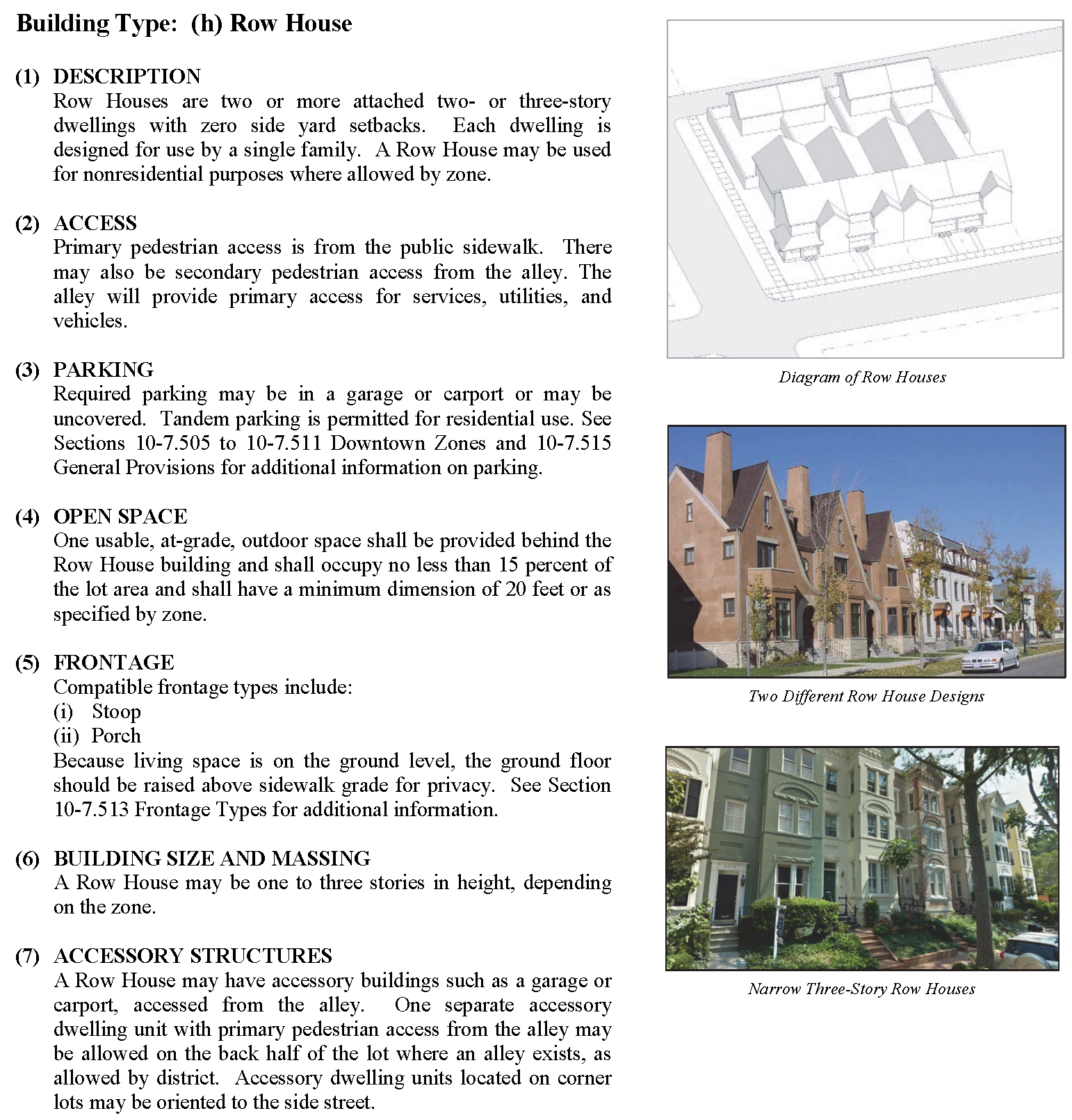
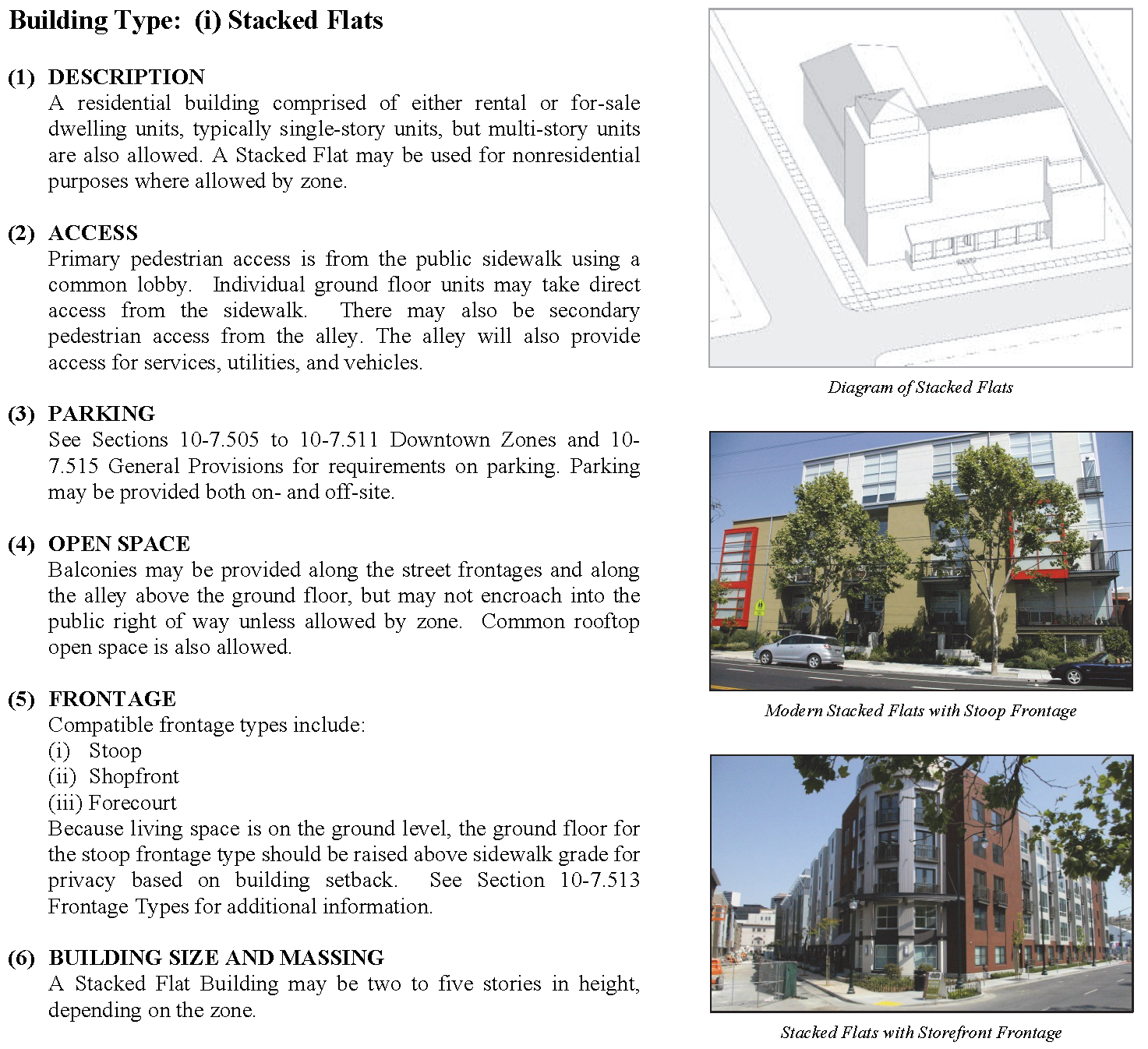
(Ord. No. 3618-C.S., § 2(Exh. A), effective 6-25-15)
10-7.513 - Frontage types.
Frontage Types address the features of the building frontage focusing on the interface between private and public spaces. The following Frontage Types are described in the following pages:
(a)
Common Yard
(b)
Forecourt
(c)
Porch
(d)
Shopfront
(e)
Stoop
(Ord. No. 3618-C.S., § 2(Exh. A), effective 6-25-15)
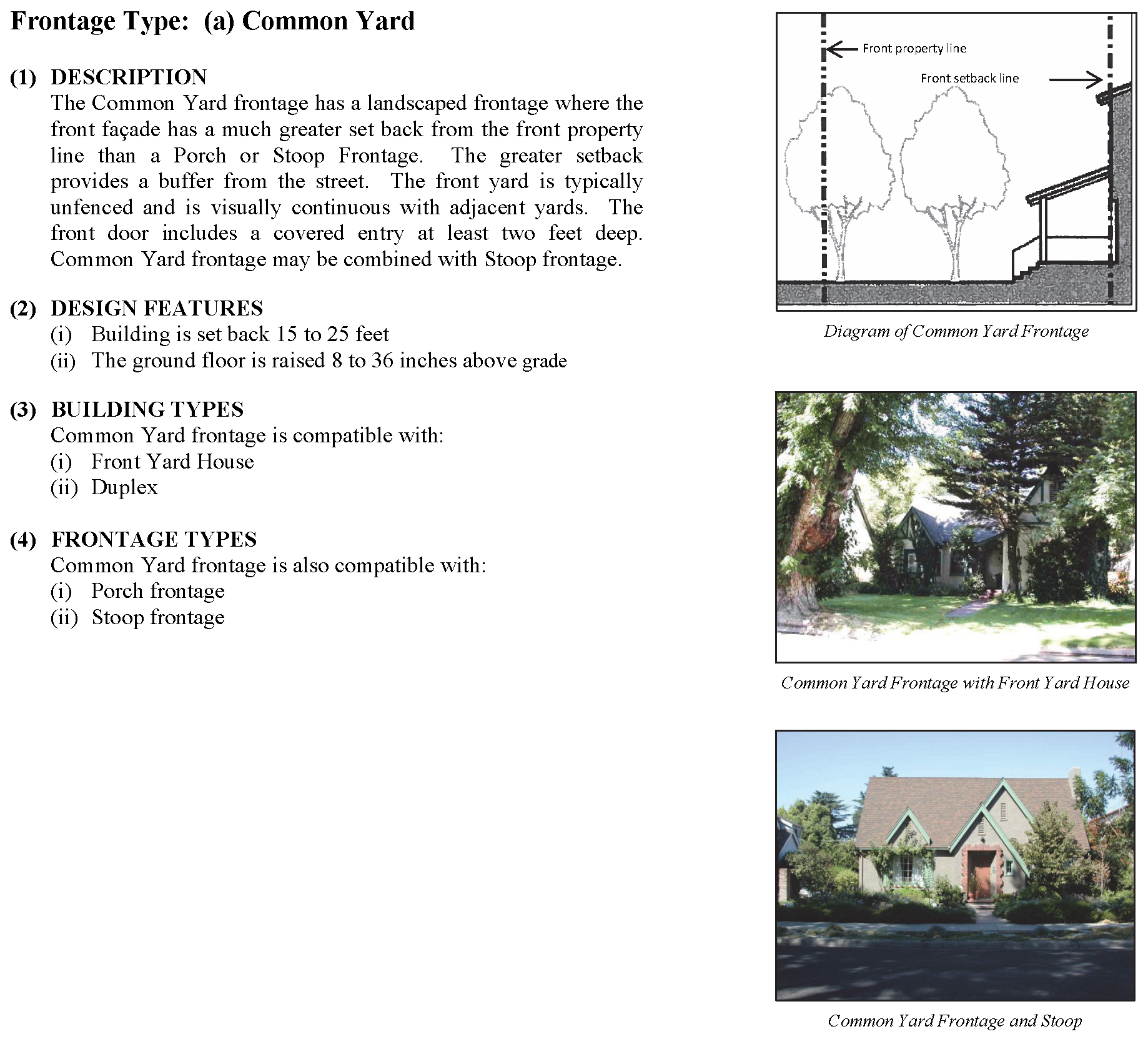
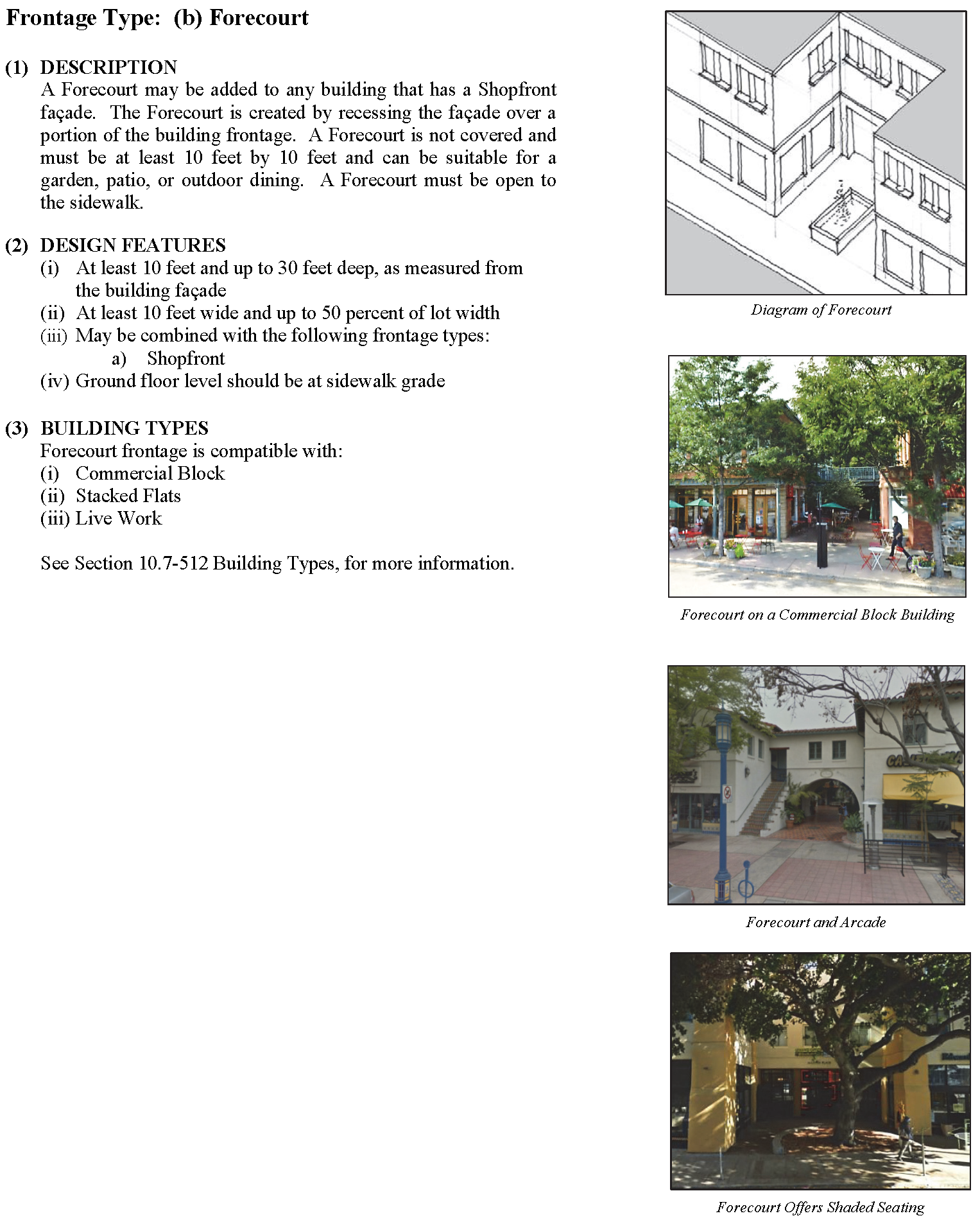
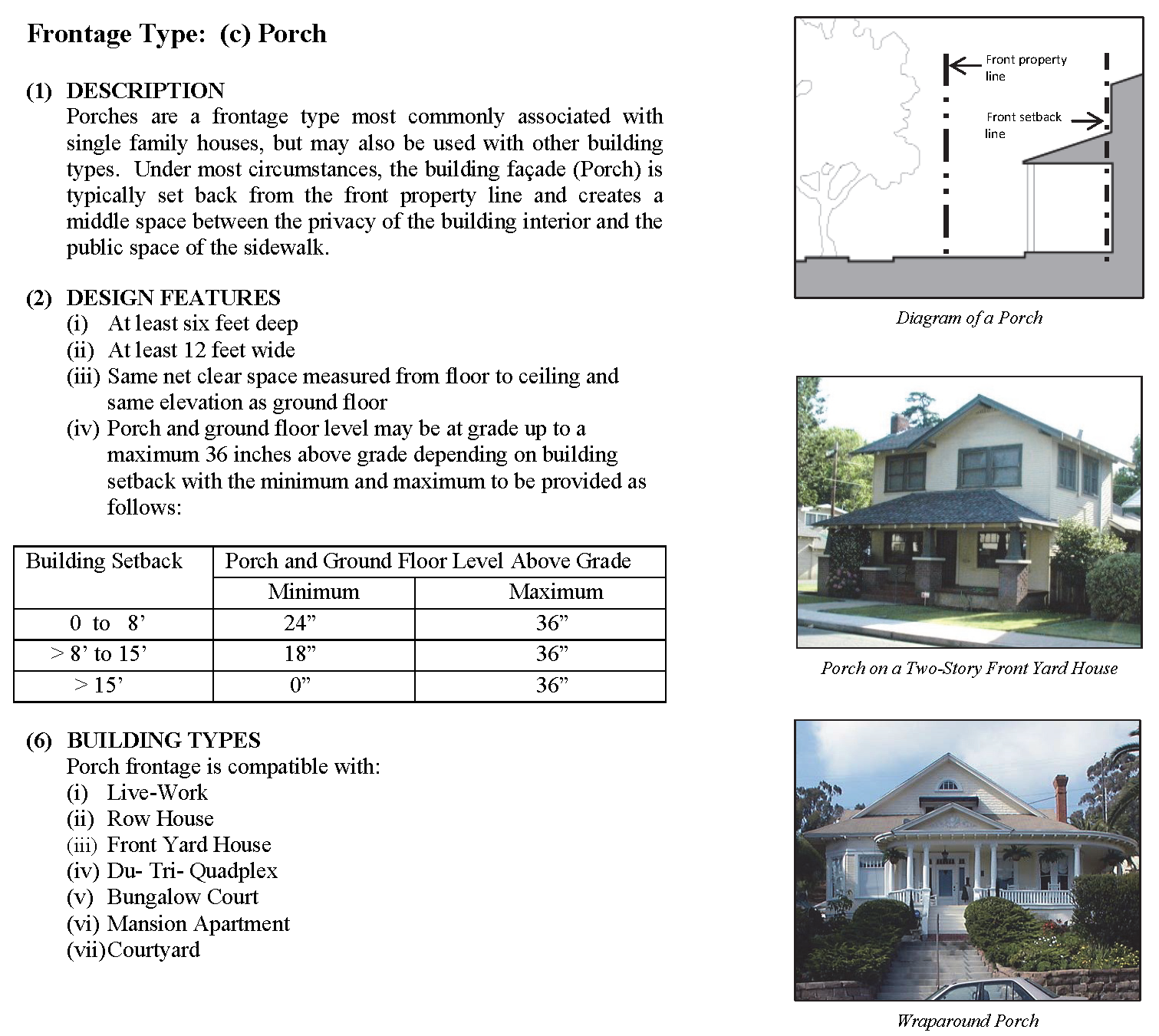
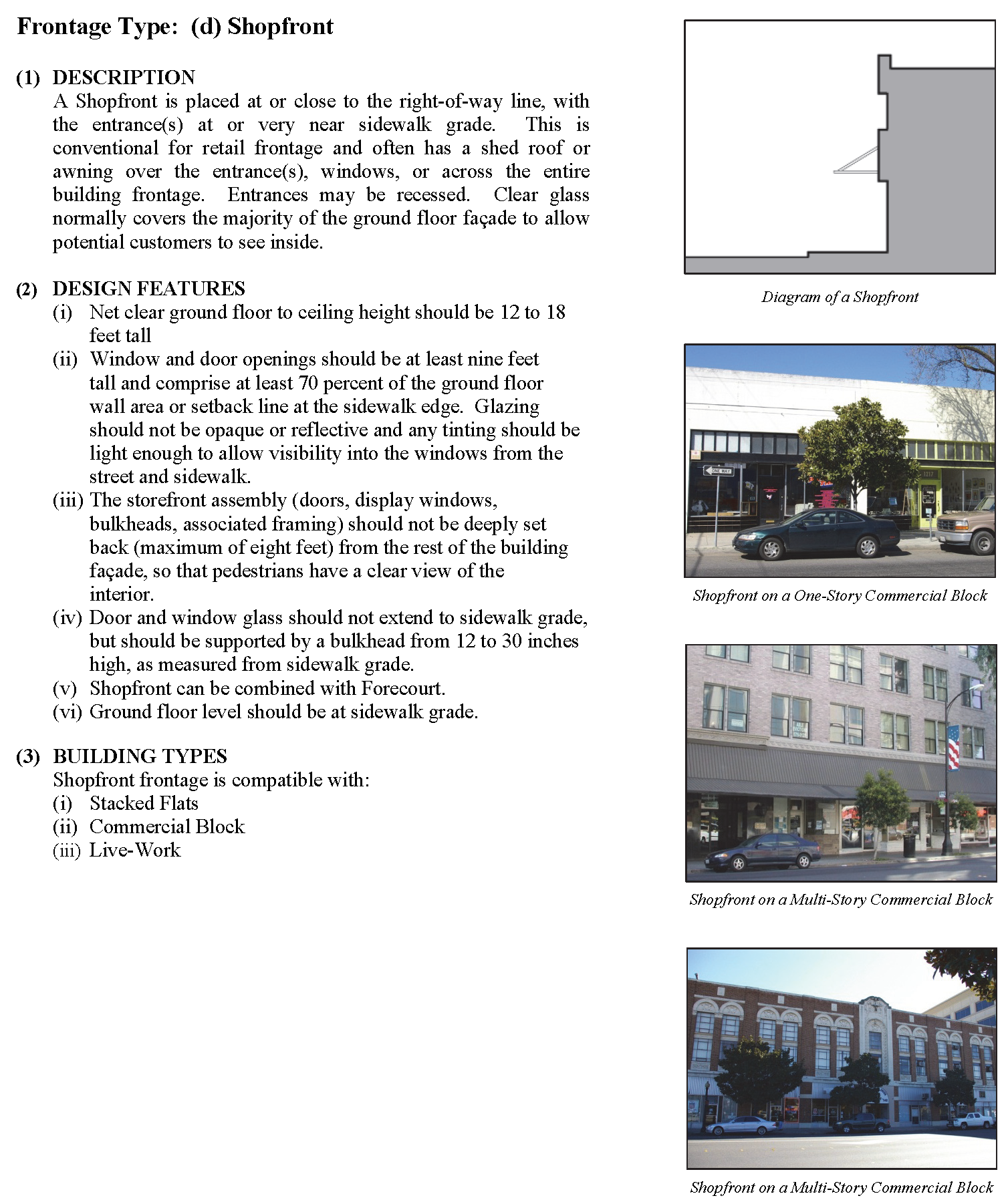
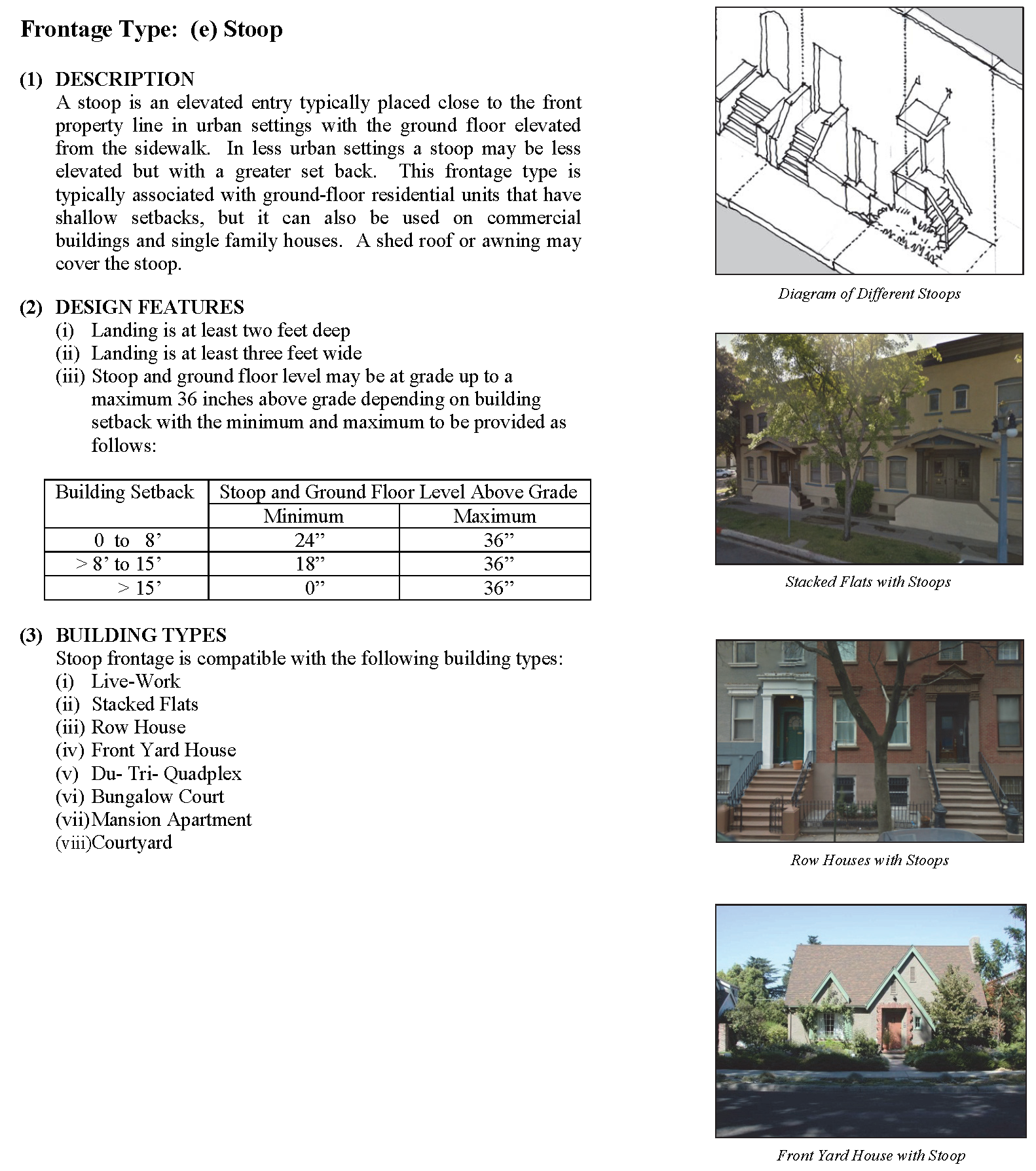
10-7.514 - Use Types.
Use type categories and examples of each category are described in Table 7.5-2 Use Types below. Sections 10-7.506 to 10-7.511 provide development standards for the Downtown Zones and they identify permitted Use Types by Building Type and floor.
Table 7.5-2 Use Types
10-7.515 - General Provisions.
(a)
Parking.
(1)
Design.
(i)
Except where in conflict with the provisions of this article, all parking areas shall be designed in accordance with Section 10-5.105 of the Modesto Municipal Code.
(ii)
Parking structures shall not exceed six (6) levels, plus an upper deck, in the Central and Transition Downtown Zones and two (2) levels, plus an upper deck, in the other Downtown Zones.
(iii)
Parking structures in the requisite building placement area not concealed behind a habitable liner shall conform to all building placement and building configuration requirements of the respective Downtown Zone and provide a facade that gives the appearance of being habitable.
(iv)
In the Central and Transition Downtown Zones, where surface parking occurs within fifty (50) feet of a lettered street and twenty-two (22) feet of the alley, a minimum three and one-half-foot (3.5) high streetscreen shall be provided along a line co-planer with the adjoining building's facade.
(2)
Access in the Central and Transition Downtown Zones.
(i)
Vehicular access to and from parking areas shall occur through the alley.
(ii)
Pedestrian access to and from parking areas shall occur within buildings, paseos, plazas or the area along lettered streets designated for ground level parking.
(3)
Access in the Urban General, Main Street and East Neighborhood Downtown Zones.
Vehicular access to and from parking areas shall occur through the alley except as follows:
(i)
On corner lots, parking may be accessed through the street side to help meet required parking subject to Director approval.
(ii)
Where alley access is not available or feasible, street access shall be subject to Director approval.
(iii)
Where street access is approved, the maximum driveway width is twelve (12) feet for less than ten (10) spaces and twenty (20) feet for ten (10) or more spaces.
(iv)
A continuous drive aisle may extend a maximum one hundred forty (140) feet from the street.
(v)
Parking may back onto a street in the East Neighborhood Downtown Zone for one (1) Front Yard House building type serving up to two (2) spaces with a maximum driveway width of twelve (12) feet. If the parking is approved to back onto the street side of a corner lot, the minimum setback is twenty (20) feet.
(4)
Access in the Traditional Neighborhood Downtown Zone.
(i)
Where alley access is not available or feasible, then one (1) street access is permitted with a maximum driveway width of twelve (12) feet subject to Director approval.
(ii)
Where street access is approved, a single-family dwelling may have up to two (2) spaces that back onto the street.
(iii)
If the parking is approved to back onto the street side of a corner lot, the minimum setback is twenty (20) feet.
(5)
Shared Parking. The minimum number of required parking spaces may be reduced when a building contains different use types. Parking may also be reduced between buildings with different use types that are located within immediately adjacent blocks.
(i)
When parking is shared between buildings located on different sites, a parking agreement is required as approved by the Director.
(ii)
The reduction in parking shall be determined by dividing the sum of the parking required by two (2) use types occupying the same amount of building floor area (square footage) by the associated factor from Table 7.5-3.
(6)
Off-Site Parking. Off-site parking may be used to meet the parking requirements of this article.
(i)
Off-site parking shall be located within one thousand four hundred sixty (1,460) feet of the building it serves, as measured along streets, alleys and sidewalks from the nearest point of the parking area to the nearest point of the building. Off-site parking shall be provided through a long-term lease as approved by the Director.
(7)
Required Spaces for Church or Place Worship. The required parking spaces for a church or place of worship are provided in Section 10-5.102, Table 5.1-1, Parking Requirements.
Table 7.5-3 Shared Parking
Example: A building that is comprised of an office use type occupying one hundred thousand (100,000) square feet and a residential use type occupying fifty thousand ( 50,000) square feet may divide the sum of the parking required for fifty thousand ( 50,000) square feet of office use type (one hundred (100) spaces) and 50,000 square feet of residential use type (e.g., seventy-five (75) spaces) by 1.4 (one and four tenths) resulting in the requirement for one hundred twenty-five (125) parking spaces (175/1.4 = 125). Then add the minimum parking required for the remaining fifty thousand (50,000) square feet of office use type (one hundred (100) spaces) to determine the total parking requirement for the building (125 + 100 = 225 total parking spaces).
(b)
Public/Private Transition Area.
(1)
Outdoor Dining and Display.
(i)
Where there is at least ten (10) foot wide continuous sidewalk and safe path of travel for all users of the sidewalk remaining after the following temporary uses are installed or established, use of public right-of-way adjoining the street property line(s) for the following purposes shall be allowed:
a)
Outdoor dining, subject to obtaining the requirements of Articles 1 and 2 of Chapter 15 of Title 4;
b)
Display of public art;
c)
Display of merchandise;
d)
Display of sidewalk signs;
e)
Display of seasonal items;
f)
Display of removable planters/flower pots.
(ii)
Outdoor dining, merchandise display and sidewalk signs shall relate to the commercial activity taking place within the adjoining ground floor business.
(iii)
All merchandise display, sidewalk signs, outdoor dining and associated enclosures shall be removed during non-business hours.
(iv)
Sidewalk signs are limited to one (1) per parcel per public street frontage.
(v)
Display of merchandise is limited to fifty (50) percent of the lineal width of the associated business along the street(s).
(c)
Special Areas.
(1)
Historic Preservation Sites.
(i)
Relocation or demolition of buildings that are on the National Register of Historic Places, California Register of Historic Resources, or designated as a Landmark Preservation Site is not permitted, except in accordance with Modesto Municipal Code, Title 9, Chapter 10 and California Code Regulations, Title 14, Division 6, Chapter 3, Section 15000 - 15387.
(ii)
Development adjoining historic preservation sites shall be no greater than two (2) stories higher or lower than the historic building.
(d)
Miscellaneous Design Issues.
(1)
Design Guidelines.
(i)
All development within the Downtown Zones is subject to the City of Modesto Design Guidelines for Commercial and Industrial Development, where applicable.
(2)
Wireless Telecommunications.
(i)
Wireless facilities are subject to the provisions of Article 4 of Chapter 3 as they apply to the C-1 Zone (CD, TD, UGD, MSD) and R-1 Zone (END, TND).
(3)
Rooftop Utilities.
(i)
All building utilities and mechanical equipment located on rooftops shall be screened within penthouses or attics.
(4)
Ground-Level Utilities.
(i)
All ground-level building utilities and mechanical equipment not contained within buildings shall be located within the area designated for ground-level parking.
(5)
Blocks Without Alleys.
(i)
In the Central and Transition Downtown Zone, development occurring on lots without alleys shall assume an alley parallel to and one hundred forty (140) feet behind the numbered street(s) property line(s) for the purposes of complying with the development provisions.
(ii)
Developments that comprise an entire block may build over the alley following an abandonment of the subject alley.
(6)
Properties Containing Multiple Planning Districts.
(i)
Where one (1) property contains two (2) Downtown Zones, the boundary between the zones shall be treated in the same manner as a property line for the purposes of complying with the associated development provisions of the respective Downtown Zones.
(e)
Signs. Except where in conflict with the provisions of this article, all signs shall conform with Chapter 6, as they apply to the equivalent zones specified in Section 10-7.502(a).
(1)
Downtown Zone Sidewalk Signs. (See Section 10-7.516(i))
(i)
Downtown Zone sidewalk signs of a size, design and materials as approved by the City Council and as administered by the Downtown Improvement District are permitted in the locations specified in Section 10-7.515(b) of this article.
(2)
Wall Signs.
(i)
Permitted subject to the provisions of Section 10-6.107, Table 6.1-2 of the Modesto Municipal Code, except maximum sign area shall be one (1) square foot per linear foot of width of the wall upon which the sign is placed (CD, TD, UGD, MSD only).
(3)
Projecting Signs (CD, TD, UGD, MSD Zones only).
(i)
One (1) projecting sign per building, size limited to one (1) square foot per linear foot of building frontage up to a maximum of forty-eight (48) square feet, and advertising a single message or use.
(ii)
In addition to the projecting sign allowed in subsection (3)(i), individual tenants in a multi-tenant building shall be allowed one (1) projecting sign, with a maximum sign area limited to twenty-four (24) square feet.
(iii)
Projecting signs shall be located at least ten (10) feet from other projecting signs. Projecting signs may not project more than five (5) feet from the facade of the building and shall be a minimum eight (8) feet above a pedestrian walkway and fourteen (14) feet above a vehicular access way or as provided by zone. Projecting signs shall not be higher than the ridgeline of the roof, parapet, or wall.
(4)
Projecting Marquee Signs.
(i)
Permitted subject to the provisions of Section 10-6.107, Table 6.1-2 of the Modesto Municipal Code, except the sign may only project eight (8) feet beyond the building façade or as provided by zone, and the sign shall only be permitted for theaters (CD, TD, UGD, MSD only).
(5)
Canopy Signs.
(i)
Permitted subject to the provisions of Section 10-6.107, Table 6.1-2 of the Modesto Municipal Code, except maximum sign area shall be one (1) square foot per liner foot of width of the wall upon which the canopy is affixed (CD, TD, UGD, MSD only).
(f)
Outdoor Storage.
(1)
Outdoor storage shall only occur within the optional building area and is limited to items relating to business being conducted within the building on the same property (CD and TD only).
(Ord. No. 3618-C.S., § 2(Exh. A), effective 6-25-15; Ord. No. 3686-C.S., § 2, effective 3-29-18)
10-7.516 - Definitions.
(a)
Adjacent. Sharing a common property line or Downtown Zone line, even if separated by a street or alley. Properties that are separated by a street are considered adjacent even if they are located diagonally across an intersection.
(b)
Adjoining. Sharing a common boundary.
(c)
Architectural Feature. An accessory exterior building feature including awnings, roofs, windows, doors, cornices, canopies, eaves, chimneys, down spouts, bulkheads, or similar design elements.
(d)
Attic. An area above the top floor of a building that is typically residential in nature with a pitched roof, which is designed to house utilities and/or equipment and provide insulation.
(e)
Block Frontage. A frontage area running along one (1) street, between the nearest two (2) transecting streets.
(f)
Build-to Line. A linear plane paralleling the street property lines along which the building facade must be placed.
(g)
Building Placement in Setback Area. Percentage of the front building width to be placed along the street frontage within the setback area.
(h)
Co-Planer. Even with the surface of a building.
(i)
Downtown Modesto Historic Zoning Designation. The zoning in effect prior to September 3, 2010, for properties located in the Central Downtown and Transition Downtown Zones, and the zoning in effect prior to June 25, 2015 for properties located in the Urban General Downtown, Main Street Downtown, East Neighborhood Downtown, and Traditional Neighborhood Downtown, is as shown in Figure 7.5-1
(j)
Downtown Zone Sidewalk Sign. An A-frame sign designed in accordance with provisions approved by the City Council and administered by the Downtown Improvement District that is available to businesses in the Downtown Zone through the Downtown Improvement District.
(k)
Encroachment. Extension of building elements beyond the build-to line, minimum setback, minimum stepback, or right-of-way. The building elements are secondary building features including a porch, stoop, balcony, wall sign, and architectural features.
(l)
Facade. The plane of the building and its architectural elements facing the public street. The "face" of the building.
(m)
Floor to Ceiling Height. The net clear internal building space from finished floor to finished ceiling.
(n)
Frontage. The area between the facade of a building and the street property line.
(o)
Habitable Liner. A relatively shallow building area that is conditioned and intended for human activities (residence, office, etc.), which separates a parking structure from the public realm.
(p)
Historic Preservation Site. See Section 10-7.515(c).
(q)
Paseo. A 15-foot to 30-foot wide, open-air area for pedestrian passage between the public sidewalk and parking or other uses to the rear of property, which provides storefronts along one (1) or both sides.
(r)
Penthouse. An area above the top story of a building, which is used to store mechanical equipment, building utilities, etc. Penthouses are either well-integrated into the architecture of the building they serve or are set back from the building's edges and designed to be inconspicuous.
(s)
Plaza. An open air area greater than thirty (30) feet wide that is used for public meeting space or passive open space.
(t)
Setback. The minimum or maximum dimension from property line that a building, parking, or other development structure must be placed with the exception of specifically permitted encroachments to the minimum setback.
(u)
Setback Area. The area between the minimum and maximum setbacks along the street frontage.
(v)
Single Room Occupancies. Rooms that can be leased or rented for extended periods of time or as a primary residence without the provision of either separate or common food preparation and consumption facilities.
(w)
Stepback. The minimum dimension from property line that the tower element or upper levels of a building must be placed.
(x)
Story. A level within a building or structure measured from the finished floor to the finished floor above, or to the eave or base of the parapet in the case of the top floor, that is generally accessible and used by patrons of the building. Enclosures for mechanical equipment above the top floor, and attics in the case of a pitched roof, are not considered a building story for the purposes of this Code.
(y)
Streetscreen. A wall built along a line co-planer with the adjoining building's façade used to screen a parking area or other areas not otherwise screened by a building from the adjoining street.
(z)
Upper Deck. The highest level or "roof" of a parking structure.
(Ord. No. 3618-C.S., § 2(Exh. A), effective 6-25-15)
10-7.601 - Purpose and intent.
(a)
This Article establishes the following Mixed Use Zone:
(1)
Mixed Use Pedestrian Oriented (MU-P) zone. The MU-P zone is intended to promote and guide the development of pedestrian-oriented, multi-family residential infill on lots or portions of lots that are currently developed or underdeveloped with General Commercial uses. The Mixed Use Pedestrian Oriented (MU-P) zone is intended for areas located adjacent to streets that are not more than two (2) travel lanes in each direction.
(Ord. No. 3772-C.S., § 1, effective 12-14-23)
10-7.602 - Applicability.
The provisions of this article shall supersede any standards, provisions, or regulations of all other articles of Title 10 that are in conflict with its provisions. All other standards, provisions, or regulations of Title 10 not in conflict with this article shall remain in effect.
When applying other provisions of Title 10 to the Mixed Use Pedestrian Oriented (MU-P) zone, the MU-P zone shall be considered as the equivalent to the C-2 (General Commercial) for commercial uses; and as the equivalent to the R-3 (Medium-High Density Residential) for high density residential uses, as modified herein.
(Ord. No. 3772-C.S., § 1, effective 12-14-23)
10-7.603 - Permitted Uses.
Table 7.6-1
(Ord. No. 3772-C.S., § 1, effective 12-14-23)
10-7.604 - Mixed-Use Zone Development Standards.
Table 7.6-2 Mixed Use - Pedestrian Oriented (MU-P) Development Standards
In addition to the following development standards, the Development Standards in Chapter 4 (Development Standards), Article 4 (General Development Standards) shall apply to the Mixed Use - Pedestrian Oriented (MU-P) zone.
1 Adjacent to residential zone includes R-1, R-2, R-3, or residential P-D zones in the City or County. Note: Except as modified herein, Multi-family development shall comply with R-3 development standards.
(Ord. No. 3772-C.S., § 1, effective 12-14-23)
10-7.605 - Upper Story Provisions for Multi-family Development in a Mixed Use Zone.
(a)
Where a multi-story residential building is proposed on a lot abutting a low-density residentially zoned lot, any walls of the multi-story residential building that could provide unobstructed views (from windows or balconies) of a rear yard or actively used side yard on a low-density residentially zoned lot, the following shall apply:
(1)
The multi-story residential building shall have either no windows or windows with a bottom sill located at least five (5) feet eight (8) inches from the finished floor of a sond (or higher) story; and
(2)
No balconies shall face the low-density residentially zoned parcel.
(b)
The requirement in part (a) does not apply to windows required by the Building Code to be usable for accessible emergency access.
(1)
Windows required for emergency access shall be frosted or otherwise altered to provide additional privacy, as approved by the director, if those windows are located on walls that could provide unobstructed views of a rear yard or actively used side yard on a low-density residentially zoned lot.
(Ord. No. 3772-C.S., § 1, effective 12-14-23)
10-7.606 - General Parking Provisions
Unless otherwise provided in this article, the parking requirements shall be as specified in Chapter 5 - Parking Requirements.
(Ord. No. 3772-C.S., § 1, effective 12-14-23)
10-7.701 - Purpose and intent.
(a)
This Article establishes the following Mixed Use Zone:
(1)
Mixed Use Highway Oriented (MU-H) zone. The MU-H zone is intended to promote and guide the development of multi-family residential infill on lots (or portions of lots) in areas that are currently developed with General Commercial or Highway Commercial uses. The Mixed Use Highway Oriented (MU-H) zone is intended for areas located adjacent to streets that are more than two (2) travel lanes in each direction.
(Ord. No. 3773-C.S., § 1, effective 12-14-23)
10-7.702 - Applicability.
The provisions of this article shall supersede any standards, provisions, or regulations of all other articles of Title 10 that are in conflict with its provisions. All other standards, provisions, or regulations of Title 10 not in conflict with this article shall remain in effect.
When applying other provisions of Title 10 to the Mixed Use Highway Oriented (MU-H) zone, the MU-H zone shall be considered as the equivalent to the C-3 (Highway Commercial) for commercial uses; and as the equivalent to the R-3 (Medium-High Density Residential) for high density residential uses, as modified herein.
(Ord. No. 3773-C.S., § 1, effective 12-14-23)
10-7.703 - Permitted and Conditional Land Uses.
Table 7.7-1
(Ord. No. 3773-C.S., § 1, effective 12-14-23)
10-7.704 - Mixed-Use Zone Development Standards
Table 7.7-2 Mixed Use - Highway Oriented (MU-H) Zone Development Standards
In addition to the following development standards, the Development Standards in Chapter 4 (Development Standards), Article 4 (General Development Standards) shall apply to the Mixed Use - Highway Oriented (MU-H) zone.
1 Adjacent to residential zone includes R-1, R-2, R-3, or residential P-D zones in the City or County. Note: Except as modified herein, Multi-family development shall comply with R-3 development standards.
(Ord. No. 3773-C.S., § 1, effective 12-14-23)
10-7.705 - Upper Story Provisions for Multi-family Development in a Mixed Use Zone
(a)
Where a multi-story residential building is proposed on a lot abutting a Low-Density Residentially zoned lot, any walls of the multi-story residential building that could provide unobstructed views (from windows or balconies) of a rear yard or actively used side yard on a Low-Density residentially zoned lot, the following shall apply:
(1)
The Multi-story residential building shall have either no windows or windows with a bottom sill located at least five (5) feet eight (8) inches from the finished floor of a second (or higher) story; and
(2)
No balconies shall face the low-density residentially zoned parcel.
(b)
The requirement in part (a) does not apply to windows required by the Building Code to be usable for accessible emergency access.
(1)
Windows required for emergency access shall be frosted or otherwise provide additional privacy, as approved by the Director, if those windows are located on walls that could provide unobstructed views of a rear yard or actively used side yard on a Low-Density residentially zoned lot.
(Ord. No. 3773-C.S., § 1, effective 12-14-23)
10-7.706 - General Parking Provisions
Unless otherwise provided in this article, the parking requirements shall be as specified in Chapter 5 - Parking Requirements.
(Ord. No. 3773-C.S., § 1, effective 12-14-23)

