
Modesto City Zoning Code
CHAPTER 4
DEVELOPMENT STANDARDS
Article 4. - General Development Standards
The following general development standards apply to all zones unless otherwise specified. Where conflict between standards occur, the standards in this article apply.
10-4.101 - Purpose and Intent.
(a)
The Purpose of the Residential Zoning Districts is to ensure that development will result in neighborhoods of stable, desirable character that are well integrated within the fabric of the City, and that are consistent with the goals, objectives and policies of the General Plan. The development regulations contained herein are further established to:
(1)
Implement General Plan policy by facilitating residential development and neighborhoods throughout appropriate portions of the City;
(2)
Encourage the continued vitality of existing neighborhoods and, where appropriate, encourage the revitalization of neighborhoods through use of appropriate standards and incentives;
(3)
Preserve a high degree of compatibility between adjacent residential uses, and between residential and adjacent non-residential uses;
(4)
Ensure adequate light, air, privacy and open space for Residential uses;
(5)
Encourage a wide variety of residential product types and densities that meet the diverse economic and social needs of all residents;
(6)
Implement the policies of the Housing Element of the General Plan by providing areas specifically for the purpose of medium and medium high density multi-family residential housing.
(b)
The Intent of each Residential Zoning District is as follows:
(1)
The R-1 (Low-Density Residential) zoning district is intended to accommodate lower-density residential development, including accessory structures and uses;
(2)
The R-2 (Medium-Density Residential) zoning district is intended to accommodate medium-density residential development, including accessory uses and structures; and,
(3)
The R-3 (Medium-High-Density Residential) zoning district is intended to accommodate relatively higher-density residential development, including accessory structures and uses.
10-4.102 - Development Standards.
The development standards for the residential zones are found in Table 4.1-1. The specific residential development standards provided after the table apply to all residential zones unless otherwise specified.
Table 4.1-1 Residential Development Standards
(Ord. No. 3704-C.S., effective 11-7-19; Ord. No. 3722-C.S., § 2, effective 11-5-20; Ord. No. 3762-C.S., § 1, effective 5-11-23; Ord. No. 3787-C.S. , § 1, effective 1-2-25)
10-4.103 - Area.
(a)
In the R-1 zone, a larger minimum lot area may be required where necessary to maintain compatibility with the existing lots of an established neighborhood, in accordance with the Neighborhood Compatibility Guidelines.
10-4.104 - Density.
(a)
In the R-1 zone, there shall be a maximum density of 10.9 dwelling units per net acre.
(b)
In the R-2 zone, there shall be a minimum density of 10.9 dwelling units per net acre, and a maximum density of twenty-two (22) dwelling units per net acre.
(c)
In the R-3 zone, there shall be a minimum density of 22 units per net acre, and a maximum density of forty-five (45) dwelling units per net acre.
(d)
In the R-2 and R-3 zones, the minimum density shall be provided unless the applicant demonstrates and the Director makes the following findings:
(1)
The proposed development is on an existing lot where the lot cannot accommodate a development of the minimum density due to configuration of existing buildings or shape or size of the lot, or
(2)
A lower density will not adversely affect the City's ability to accommodate and provide its remaining share of the Regional Housing Needs Allocation for very-low and low-income households based on the remaining acreage of Medium Density Residential (R-2) or Medium-High Density Residential (R-3) zoned land at the time of application, provided, that if an adverse impact as described could otherwise occur, that such impact will be mitigated by one (1) of the following means:
(i)
An equivalent parcel of land of the same or greater acreage is provided by the applicant and rezoned to the same or greater density simultaneously, or
(ii)
The applicant agrees to construct and covenant for affordable units on the subject site or another site in a number sufficient to ensure no net loss of units based on the minimum density set forth herein.
(Ord. No. 3734-C.S., § 1, effective 10-7-21; Ord. No. 3797-C.S, § 5, effective 6-24-25)
10-4.105 - Lot Width.
(a)
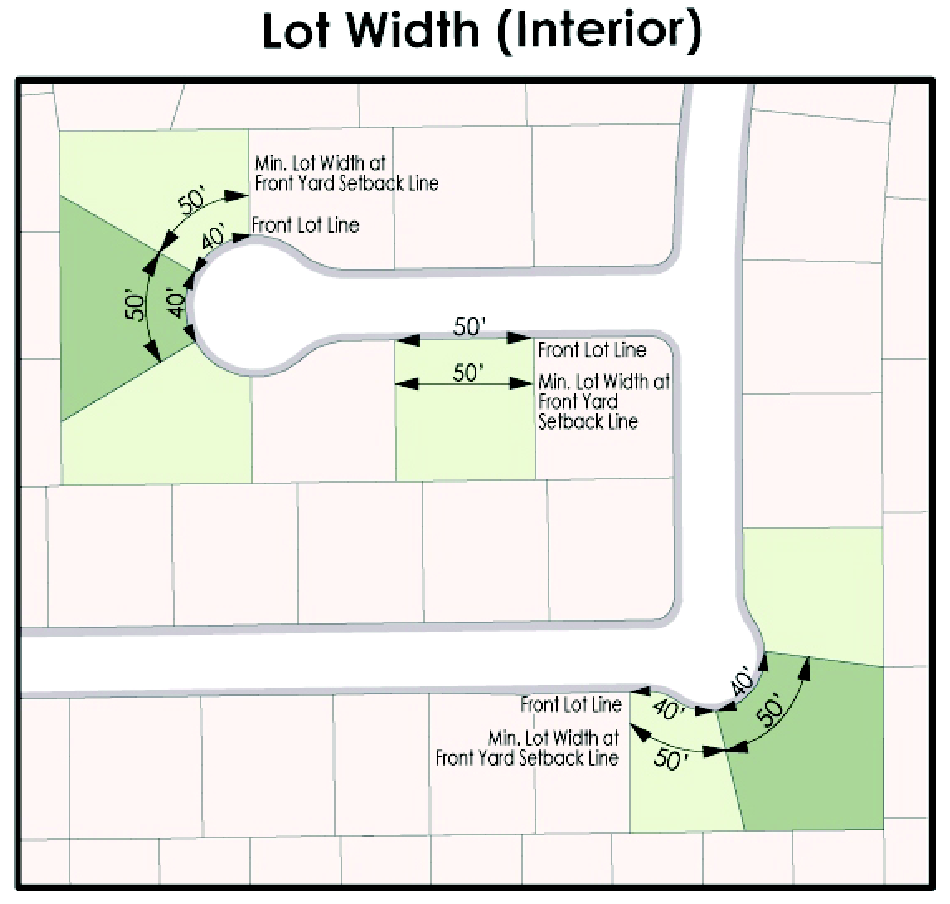
Interior lot width may be reduced to a minimum of forty (40) feet in the R-1 zone and a minimum of fifty (50) in the R-2 and R-3 zones at the front lot line where the front lot line is curved (i.e. lots on cul-de-sacs, elbows, or curvilinear streets), but the minimum width from the front setback line to the rear lot line shall be fifty (50) feet in the R-1 zone (See Figure 4.1-1) and a minimum of sixty (60) in the R-2 and R-3 zones. See Figure 4.1-1. The lot width may also be reduced as allowed in subsection (c) of this section.
(b)
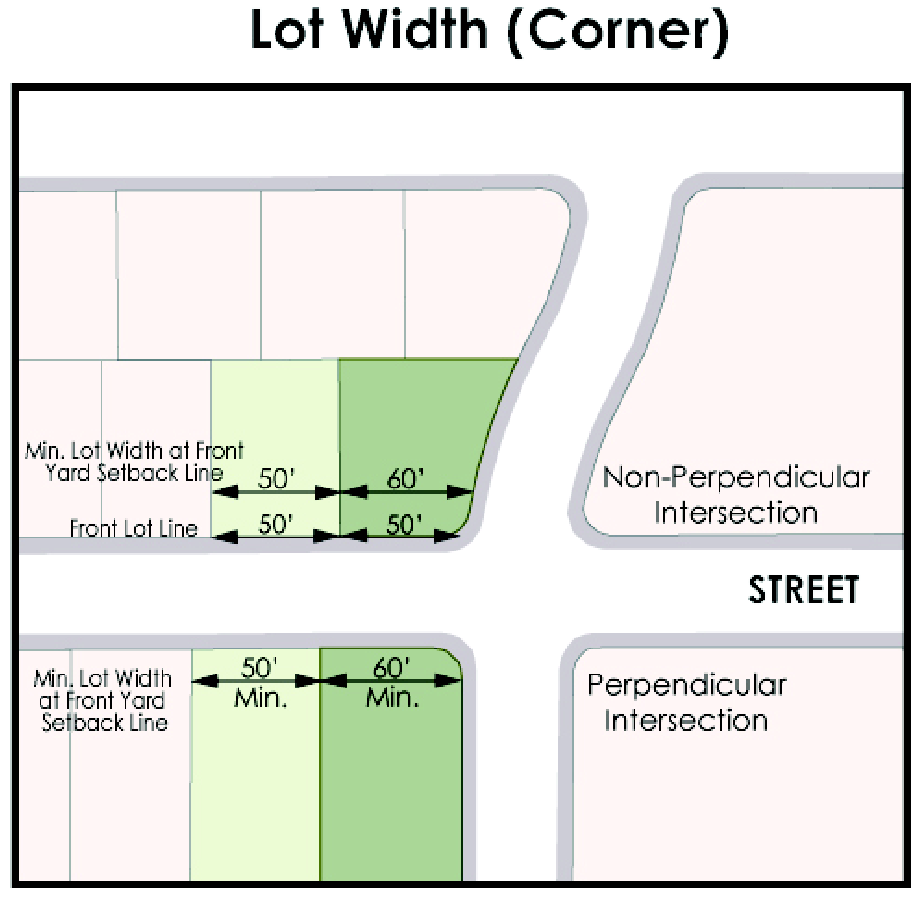
Corner lot width may be reduced to a minimum of fifty (50) feet at the front lot line in the R-1 zone for lots on non-perpendicular intersections or when the front lot line is curved, but the minimum width from the front setback line to the rear lot line shall be sixty (60) feet. See Figure 4.1-2.
(c)
Flag lots with a minimum width of twenty (20) feet at both the front lot line and front yard setback line may be approved with two (2) findings:
(1)
Creation of the lot(s) will enable use of an existing parcel to permitted density.
(2)
The existing parcel is of a size and shape that does not allow the creation of standard shaped lots, as determined in accordance with the Neighborhood Compatibility Guidelines.
(d)
No building permit shall be issued for a lot approved under subsection (c) above without a recorded subdivision or parcel map.
Figure 4.1-1 Figure 4.1-2
10-4.106 - Front and Street-Side Setback.
(a)
On through lots, buildings shall maintain the minimum required front setback on both frontages.
(b)
Front yard areas shall be unobstructed with the exception of landscaping unless otherwise provided by this Title.
(c)
A trash enclosure up to fifty-two (52) inches in height screening individual cans may be permitted in the front or street side setback where there is no practical alternative, subject to the approval of the Director. Such enclosures shall be located as far from the front or street side property line as feasible and shall fully screen the trash cans.
(d)
On corner lots legally created prior to July 7, 1955, the minimum street side setback for a dwelling, accessory building, or fencing is seven and one-half (7.5) feet.
10-4.107 - Side Setback.
(a)
In the R-1 zone, a minimum ten (10) foot setback shall be required for two-story portions of a new dwelling or second-story additions to an existing dwelling where located adjacent to an existing single-story dwelling, and subject to development plan review pursuant to Section 10-4.110. The ten (10) foot setback does not apply where the subject lot and adjacent lot were created by a final map within the past ten (10) years. The required ten (10) foot setback may be reduced to a minimum of five (5) feet if it can be demonstrated that the additional setback is infeasible due to physical constraints and that the reduced setback is consistent with the Neighborhood Compatibility Guidelines as determined by the Director.
(b)
Use of a side yard by an adjacent property owner is permitted only in subdivisions where a permanent side yard use easement is granted from one (1) parcel to the adjacent parcel creating a de facto zero lot line subdivision. An example of a de facto zero lot line subdivision is Walnut Tree Estates, located at Walnut Tree Drive and Merle Avenue, the final map for which was filed on May 20, 1981, in Volume 29 of Maps, Page 90, Stanislaus County Records, the special provisions for permanent use of the side yard which were specified in Ord. No. 2286-C.S. approved on September 4, 1984.
(Ord. No. 3704-C.S., effective 11-7-19; Ord. No. 3722-C.S., § 2, effective 11-5-20; Ord. No. 3787-C.S. , § 2, effective 1-2-25)
10-4.108 - Rear Setback.
(a)
The minimum rear setback shall be fifteen (15) foot for any building that backs up to a Major Collector, Arterial Street or Expressway.
(b)
The minimum rear setback shall be five (5) feet for any garage, carport, or parking space with access off an alley. The garage or carport may be detached or attached.
(c)
The minimum rear setback for patio covers opened on three sides shall be five (5) feet, except where the lot backs up to a Major Collector, Arterial Street or Expressway, where the setback shall be ten (10) feet.
(Ord. No. 3704-C.S., effective 11-7-19; Ord. No. 3722-C.S., § 2, effective 11-5-20; Ord. No. 3787-C.S., § 2, effective 1-2-25)
10-4.109 - Height.
(a)
Exceeding the maximum height may be permitted by a conditional use permit for structures occupied by the following uses: church, building or facility operated by a governmental agency, building or facility operated by a utility company. See Section 10-4.401 for height exceptions.
(b)
In the R-2 and R-3 zones, all proposed uses or development involving structures which include a second-story component that are subject to development plan review shall be evaluated for compliance with the Multi-Family Residential Design Guidelines and the Neighborhood Compatibility Guidelines.
10-4.110 - New Two-Story Dwellings and Accessory Buildings, and Second-Story Additions.
The following regulations apply to lots located in the R-1 zone and to lots in R-2 and R-3 zones adjacent to the R-1 zone:
(a)
All new two-story dwellings and accessory buildings, and all second-story additions to an existing dwelling, balcony, or accessory building, including exterior alterations (such as a new window) to second-story portions of an existing dwelling or accessory building, shall be subject to development plan review by the Director pursuant to Chapter 9, Article 10, for compliance with the Neighborhood Compatibility Guidelines as adopted and amended from time to time by City Council. A proposed project shall be subject to second-story development plan review if the proposed project has any of the following characteristics, as determined by the Director:
(1)
The height above grade to top plate line is at any point equivalent to two-stories or sixteen (16) feet or more.
(2)
Windows or balconies are provided at a height from which views of a neighboring rear yard and actively used side yard areas are readily visible.
(b)
Notwithstanding Section 10-4.110(a), above, projects that meet the following criteria are exempt from second-story development plan review.
(1)
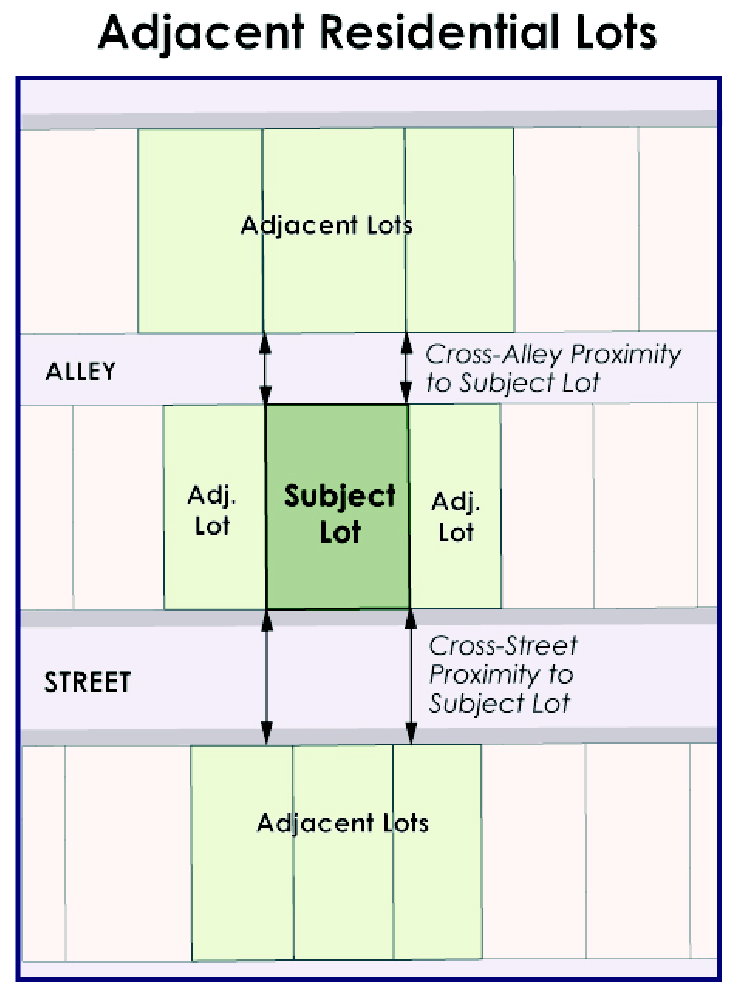
The subject lot and adjacent residential lots were created by (a) final subdivision map(s) recorded within the past ten (10) years. The term "adjacent residential lot" in this subsection means each lot zoned or used residentially that share a common property line or is separated by an alley including those which touch only at a corner. See Figure 4.1-3. This may include additional lots if deemed appropriate by the Director.
(2)
The proposed second story addition, two-story dwelling, or accessory building will have minimal impact on the privacy and use of neighboring rear yard areas and building massing is consistent with the neighboring dwellings, as determined by the Director.
(3)
At least 50 percent of the adjacent lots (see Figure 4.1-4) are occupied by two-story houses.
(c)
In the R-2 and R-3 zones, any development of multiple family dwellings adjacent to property zoned R-1 that exceeds one (1) story shall be subject to development plan review by the Director in accordance with Section 10-4.110 (a), except as specifically excepted therein.
Figure 4.1-4
(Ord. No. 3704-C.S., effective 11-7-2019)
10-4.111 - Street Frontage.
Every lot shall have frontage on a street.
10-4.112 - Lots with Existing Units.
If a dwelling(s) is added to a lot with an existing dwelling(s), the existing dwelling(s) shall comply with the Building and Maintenance code prior to occupancy of the additional dwelling(s). The main unit is exempt from this requirement if the added dwelling(s) is an accessory dwelling unit or junior accessory dwelling unit.
(Ord. No. 3722-C.S., § 2, effective 11-5-20)
10-4.113 - Design.
When considering any building permit or administrative approval, development plan review, conditional use permit, or similar application the Director, Board or Commission, as applicable, shall apply the principles and specifications of the adopted Design Guidelines to the proposed project.
10-4.114 - Accessory Buildings.
The following regulations provided in Table 4.1-2 apply to accessory buildings in the R-1 Zone or any residential zone where the lot contains only an existing single-family dwelling (SFD). These regulations do not apply to ADUs:
(Ord. No. 3704-C.S., effective 11-7-19; Ord. No. 3722-C.S., § 2, effective 11-5-20; Ord. No. 3787-C.S., § 3, effective 1-2-25)
10-4.115 - Repealed.
Editor's note— Ord. No. 3762-C.S., § 2, effective May 11, 2023, repealed § 10-4.115, which pertained to accessory dwelling units and derived from Ord. No. 3704-C.S., effective 11-7-19; Ord. No. 3722-C.S., § 2, effective 11-5-20; Ord. No. 3734-C.S., § 1, effective 10-7-21.
10-4.116 - Repealed.
Editor's note— Ord. No. 3762-C.S., § 2, effective May 11, 2023, repealed § 10-4.116, which pertained to parking, accessory dwelling units and derived from Ord. No. 3722-C.S., § 3, effective 11-5-20.
10-4.201 - Purpose and Intent.
(a)
The Purpose of the Commercial Zoning Districts is to ensure that a variety of goods and services will be available to consumers, that development will be compatible with surrounding land uses and zoning, and that commercial development will be consistent with the goals, objectives and policies of the General Plan. The development regulations contained herein are further established to:
(1)
Implement General plan policy by facilitating commercial development at strategic and appropriate locations;
(2)
Provide opportunities for well-designed office development in appropriate locations, such as between residential and non-residential uses to provide a buffer;
(3)
Reserve certain areas of the City consistent with the General Plan, that allow the full range of retail uses, business and professional offices, and personal and business services, scaled to meet the needs of customers from both within and from outside the City;
(4)
Establish appropriate standards meant to facilitate compatibility between nearby residential and non-residential land uses, helping to foster neighborhood cohesion and reducing the need for vehicle trips to obtain goods and services;
(5)
Encourage functional and attractive office and commercial development at strategic locations throughout the City consistent with the General Plan;
(6)
Ensure that commercial development provides adequate on-site parking, accessibility, loading and landscaping; and,
(7)
Provide a strong economic and financial base and to increase employment opportunities.
(b)
The Intent of each Commercial Zoning District is as follows:
(1)
The P-O (Professional Office) zoning district is intended to provide appropriate sites for administrative, professional and business service offices that can also be used as a buffer between residential areas and more intense commercial uses and districts;
(2)
The C-1 (Neighborhood Commercial) zoning district is intended to allow commercial development typically found in neighborhood shopping centers serving the day-to-day shopping and service needs of local residents;
(3)
The C-2 (General Commercial) zoning district is intended to accommodate the full range of retail stores, offices and service establishments across the City, in appropriate locations and with appropriate access; and,
(4)
The C-3 (Highway Commercial) zoning district is intended to allow sites for highway-oriented businesses and transportation-related service establishments, which serve City-wide and regional needs.
10-4.202 - Development Standards.
The development standards for the commercial zones are found in Table 4.2-1. The specific commercial development standards provided after the table apply to all commercial zones unless otherwise specified.
Table 4.2-1 Commercial Development Standards
10-4.203 - Side and Rear Setbacks.
When adjacent to property zoned R-1, R-2, R-3, or residential P-D zones in the City or County the following setbacks apply:
(a)
In the C-1, C-2, and C-3 zones, the minimum building side and rear setback shall be ten (10) percent of lot width for side setback and lot depth for rear setback with a minimum of ten (10) feet for the first story and twenty (20) feet for the second story, and a maximum of forty (40) feet.
(b)
If a public alley separates C-1, C-2, or C-3 property from the adjacent residential zone, the alley width may be counted as part of the setback, but no parking or driveways shall be permitted off the alley.
(c)
In the C-1, C-2, and C-3 zones, residential development shall have side and rear setbacks as required in the R-2 and R-3 zones.
(d)
In the P-O zone, if a legally existing lot has less than the required lot width, the side setbacks shall each be a minimum of ten (10) percent of the lot width, except that for lots adjacent to residentially zoned property as noted above, the minimum setback for any second-story portion shall be twenty (20) feet. In no case shall an interior lot side setback be less than three (3) feet and a street side setback be less than seven and one-half (7.5) feet.
10-4.204 - Access.
(a)
Driveways and Accessways.
(1)
Joint use of driveways and accessways, between adjacent parcels, shall be encouraged to minimize driveways on the arterial street.
10-4.205 - Design.
When considering any building permit or administrative approval, development plan review, conditional use permit, or similar application the Director, Board or Commission, as applicable, shall apply the principles and specifications of the adopted Design Guidelines to the proposed project.
10-4.301 - Purpose and Intent.
(a)
The Purpose of the Industrial Zoning Districts is to ensure that opportunities exist for development of industry, job creation and economic growth, consistent with the goals, objectives and policies of the General Plan. The development regulations contained herein are further established to:
(1)
Reserve appropriate areas in the community consistent with the General Plan for a full range of industrial uses, grouped in such a manner to achieve compatibility with respect to the characteristics of the various types of industrial activities and processes;
(2)
Strengthen the City's economic base and to increase employment opportunities for residents of the City and surrounding areas;
(3)
Encourage the development of a variety of industrial uses in a manner that is consistent with standards of public health and safety;
(4)
Allow certain types of light industrial uses that are relatively free of nuisance or hazardous features that may be located in areas nearer to residential, office, and commercial areas, while providing land area for industrial uses with more severe impacts in locations farther from other use types; and,
(5)
Protect areas appropriate for industrial development from intrusion by residences and other potentially incompatible uses.
(b)
The Intent of each Industrial Zone District is as follows:
(1)
The C-M Zone is intended to promote, facilitate and maintain land use compatibility by providing land area to accommodate specified commercial and light industrial uses not otherwise permitted in the commercial zoning districts;
(2)
The M-1 Zone is intended to accommodate light industrial, assembly, storage, warehouse and similar uses in terms of industrial activity, all of which may be located relatively near residential areas without causing adverse impacts; and,
(3)
The M-2 Zone is intended to provide suitable sites for a wide range of industrial, manufacturing, business park and other similar uses that are further from non-industrial and potentially incompatible uses.
10-4.302 - Development Standards.
The development standards for the industrial zones are found in Table 4.3-1. The specific industrial development standards provided after the table apply to all industrial zones unless otherwise specified.
Table 4.3-1 Industrial Development Standards
10-4.303 - Side and Rear Setbacks.
When adjacent to property zoned R-1, R-2, R-3, or residential P-D zones in the City or County the following setbacks apply:
(a)
In the C-M, M-1, and M-2 zones, the minimum building side and rear setback shall be ten (10) percent of lot width for side setback and lot depth for rear setback with a minimum of ten (10) feet for the first story and twenty (20) feet for the second story and a maximum of forty (40) feet. Uncovered parking spaces are exempt from this setback except along a side street.
(b)
If a public alley separates C-M, M-1, or M-2 property from the adjacent residential zones, the alley width may be counted as part of the setback, but no parking or driveways shall be permitted off the alley.
10-4.304 - Height.
In the M-1 and M-2 zones, there are no limitations on the height of structures except as contained in the Airport Zone, or when adjacent to a Residential zone.
10-4.305 - Design.
When considering any building permit or administrative approval, development plan review, conditional use permit, or similar application the Director, Board or Commission, as applicable, shall apply the principles and specifications of the adopted Design Guidelines to the proposed project.
10-4.401 - Height Exceptions.
The following are exceptions to the height limits required by this chapter:
(a)
Roof structures or equipment required to operate and maintain a building such as chimneys, elevator housings, mechanical equipments, stairways, vents, or similar equipment or structures may exceed the height limits as limited by the California Building Codes (CBC) or by ten (10) feet, whichever is less. In the event of a conflict the CBC requirement controls.
(b)
Architectural features of a building such as towers, spires, cupolas, and flag poles may be erected to a height up to twenty-five (25) percent above the height limit, or no more than ten (10) feet above the height limit, whichever is less.
(c)
Public and utility facilities such as water towers, city owned and operated communication facilities, transmission and distribution poles and towers for public utilities are not subject to the height limits of this chapter.
(d)
Height regulations for roof mounted wireless communication facilities are provided in Section 10-3.406c.
(e)
Any request for a height greater than provided in this section may be considered with a conditional use permit from the Board.
10-4.402 - Landscaping.
(a)
Landscape Plans and Maintenance. Whenever landscaping or a landscape plan is required by this Code or as a condition of a zone, variance, use permit, development plan review or similar action, landscape and irrigation system design and plan specifications as determined by the Parks, Recreation, and Neighborhoods Director shall apply. Landscaping and irrigation systems shall be installed and maintained in accordance with the approved plans. Whenever "screen landscaping" is specified in conditions or on approved plans, such landscaping shall be selected to create and maintain a view obscuring "plant mass" at least fifteen (15) feet high within five (5) years.
10-4.403 - Setbacks.
(a)
Automobile-Oriented Structures. Notwithstanding any other provisions in this Title, no building or structure that serves automobiles or automobile occupants, such as gasoline-dispensing facilities, air- and water-dispensing facilities, and drive-up windows, shall be closer than ten (10) feet from any property line or fifteen (15) feet from any other building or structure. A canopy or extended roof may extend to the setback lines as permitted by the California Building Code.
(b)
Building Across Property Line. When a building crosses a property line, the two (2) lots shall constitute a single building site and required side and rear setbacks shall not apply to the common boundary.
(c)
Projections into Setbacks.
(1)
Eaves and awnings and other ornamental architectural features may project into a required setback as permitted by the California Building Code.
(2)
Chimneys may project into a required setback a maximum of two (2) feet.
(3)
Ground-mounted air conditioners may encroach into a minimum five-foot side setback provided there remains a net two-foot clear adjoining passageway and only if there is maintained a clear minimum thirty-two-inch wide passageway on the alternate gated side yard.
10-4.404 - Vision Obstructions (Clear Vision Triangle).
(a)
In zones requiring a front setback, there shall be a clear vision triangle on all corner lots. The triangle is an area bounded by the front and street-side property lines and a line connecting them twenty-five (25) feet from their intersection. Within the triangle, the area between three (3) and eight (8) feet in height measured from the top of the curb adjacent to the front yard shall be clear. Trees may penetrate the clear area as long as there are no branches lower than eight (8) feet and the trunk does not constitute a hazard to vehicular or pedestrian traffic as determined by the Traffic Engineer. If no curb exists, the City Engineer shall establish curb grade.
(b)
In addition to obstructions in subsection (a) of this section above, the Traffic Engineer may require the removal of landscaping or structures on any lot which in his/her opinion constitute a hazard to vehicular or pedestrian traffic.
10-4.405 - Screening.
(a)
Outdoor Storage and Loading Areas.
All outdoor storage and loading areas shall be screened from public view using a variety
of methods including walls, fences, landscaping, and building and site design as determined
by the Director.
10-4.406 - Walls and Fences.
(a)
Purpose. The purpose of this section is to establish regulations governing the location and maximum height of wall and fences within all zoning districts in order to help maintain compatibility between dissimilar uses.
(b)
Location and Maximum Height.
(1)
No wall or fence shall exceed eight (8) feet in height, unless additional height is required as a condition of a zone, variance, use permit, development plan review, parcel map, subdivision map, noise mitigation, or other similar action.
(2)
No wall or fence shall exceed forty-two (42) inches within the front and street side yard areas. In the R-1 zone, the street side setback required for fences taller than forty-two (42) inches is ten (10) feet.
(3)
Any fence located along the front of any property zoned P-O, C-1, C-2, C-3, C-M, M-1, M-2 or P-D with commercial or industrial underlying zoning, shall meet the applicable front-yard and street-side-yard setback requirements and be constructed of decorative wrought iron or other similar material as authorized by the Director. Any exceptions for existing development may be authorized by the Director.
(4)
All walls and fences shall comply with the clear vision triangle requirements provided in 10-4.404.
(c)
Required Walls and Fences.
(1)
Parcels Abutting Property Zoned R-1, R-2, R-3 and Residential P-D. For zones and uses abutting property zoned R-1, R-2, R-3 and Residential P-D walls and fences shall be required as listed in Table 4.4-1 below (even if the properties are separated by an alley). The Director may grant an exception to this requirement for new development in existing neighborhoods where no other similar walls and fences exist.
(2)
Back-up Lot. A minimum seven (7) foot tall solid decorative masonry wall shall be required along the rear yard property line of any single-family residential lot that backs up to an arterial street or expressway where vehicular access to the street is not allowed.
Table 4.4-1 Fence and Wall Requirements
(Ord. No. 3681-C.S., § 2(B), effective 1-11-2018; Ord. No. 3734-C.S., § 1, effective 10-7-21)
10-4.501 - Purpose and intent.
This article implements the requirements of Government Code Section 66310 et seq.
(Ord. No. 3762-C.S., effective § 3, effective 5-11-23; Ord. No. 3787-C.S., § 4, effective 1-2-25)
10-4.502 - Accessory Dwelling Units—General.
(a)
Accessory dwelling units (ADUs) may be created in any zone that allows single-family residential, multi-family residential, or mixed-use, or as expressly permitted in this article.
(b)
Junior accessory dwelling units (JADUs) may be created only in zones that allow single-family residential on a lot with an existing or proposed single-family dwelling.
(c)
ADUs and JADUs may only be rented in increments of thirty (30) days or more.
(d)
An ADU includes an efficiency unit as defined in Section 17958.1 of the Health and Safety Code.
(e)
An ADU includes a manufactured home, as defined in section 18007 of the Health and Safety Code.
(f)
These regulations may be applicable to lots zoned for single-family residential uses and built with units in compliance with Senate Bill No. 9 (Chapter 162, Statues of 2021).
(g)
An accessory dwelling unit (ADU) or junior accessory dwelling unit (JADU) conforming to the standards of this article shall:
(1)
Be deemed to be an accessory use or accessory building.
(2)
Be deemed a residential use that is consistent with the existing General Plan and zoning designation for the lot.
(3)
Not be considered in the application of any local ordinance, policy, or program to limit residential growth.
(4)
Not be considered to exceed the allowable density for the lot upon which the ADU or JADU is located.
(5)
Except as provided in Government Code Section 66310 et. seq., an accessory dwelling unit may be rented separate from the primary residence but may not be sold or otherwise conveyed separate from the primary residence.
(Ord. No. 3762-C.S., effective § 3, effective 5-11-23; Ord. No. 3787-C.S., § 4, effective 1-2-25)
10-4.503 - Application Filing, Processing, and Review.
(a)
Ministerial Approval Only. A local agency shall ministerially approve an application for a building permit for an ADU or JADU.
(1)
Timeframe for Review. If there is an existing single-family or multi-family dwelling on the lot, the permitting agency shall either approve or deny the application within sixty (60) days from the date the permitting agency receives the completed application.
(i)
If the applicant requests a delay, the sixty (60)-day time period shall be tolled for the period of the delay.
(2)
If the local agency has not approved or denied the completed application within sixty (60) days, the application shall be deemed approved.
(3)
If a building permit for an ADU or JADU is submitted with a permit application for a new single-family or multi-family dwelling on the lot, the permitting agency may delay approval or denial of the ADU or JADU application until the permitting agency either approves or denies the application to create the new single-family or multi-family dwelling.
(4)
A demolition permit for a detached garage that will be replaced with an ADU, shall be reviewed with the application for the ADU and issued at the same time.
(i)
Written notice or the posting of a placard for the demolition of a detached garage, per subparagraph (4), above, shall not be required, unless the subject property is located within an architecturally and historically significant historic district, or is listed on a local, statewide, or national register of historically significant structures.
(5)
If the permitting agency denies an application for an ADU or JADU, the permitting agency shall, within the sixty (60) daytime-period, return in writing a full set of comments to the applicant with a list of items that are defective or deficient and a description of how the application can be remedied by the applicant.
(b)
Fire Sprinklers. An ADU shall not be required to provide fire sprinklers if they are not required for the primary residence; and the construction of an ADU shall not trigger a requirement for fire sprinklers to be installed in the existing primary dwelling.
(c)
An ADU shall not be required to provide a passageway in conjunction with the construction of an ADU.
(d)
An ADU shall not be required, as a condition for ministerial approval, to correct nonconforming zoning conditions.
(e)
Local building code requirements that apply to detached dwellings shall apply to ADUs, except that the construction of an ADU shall not constitute a Group R occupancy change under the local building code, as described in Section 310 of the California Building Code (Title 24 of the California Code of Regulations), unless the building official or enforcement agency of the local agency make a written finding based on substantial evidence in the record that the construction of the ADU could have a specific, adverse impact on public health and safety.
(1)
Nothing in this clause shall be interpreted to prevent a local agency from changing the occupancy code of a space that was unhabitable space or was only permitted for nonresidential use and was subsequently converted for residential use pursuant to this section.
(f)
No other local ordinance, policy, or regulation shall be the basis for the delay or denial of a building permit or use permit under this subdivision.
(g)
Fees charged for the construction of accessory dwelling units shall be determined in accordance with Government Code Section 66324, as amended and renumbered from time to time.
(h)
An ADU shall not be considered to be a new residential use for the purposes of calculating connection fees or capacity changes for utilities, including water and sewer service, unless the ADU was constructed in conjunction with a new single-family dwelling. The City may require a new or separate utility connection, as well as a corresponding connection fee or capacity charge, in accordance with Government Code Section 66324.
(i)
The City shall not impose any impact fee upon the development of an ADU less than seven hundred fifty (750) square feet in floor area.
(j)
An impact fee charged for an ADU of seven hundred fifty (750) square feet or more in floor area shall be charged proportionately in relation to the square footage of the primary dwelling unit.
(k)
For an ADU of eight hundred (800) square feet or less, lot coverage as shown on Table 4.1-1 (Residential Development Standards) shall not apply.
(Ord. No. 3762-C.S.,§ 3, effective 5-11-23; Ord. No. 3787-C.S., § 4, effective 1-2-25)
10-4.504 - Types and Locations of Accessory Dwelling Units (ADUs).
(a)
Attached. An ADU may be attached to a proposed or existing single-family dwelling or multi-family dwelling.
(b)
Detached. An ADU may be detached (free-standing) from a proposed or existing single-family or multi-family dwelling on a lot, (e.g., a new-construction, detached ADU).
(c)
Converted. An ADU may be located within a proposed or existing single-family dwelling (e.g., an existing attached garage), or other living space to be converted to an ADU (e.g., master bedroom suite); or an existing detached accessory structure to be converted to an ADU.
(1)
For multi-family dwellings, an ADU may be located in areas currently not used for living spaces, (e.g., storage room, laundry room), or in an existing (free-standing) accessory building on the lot.
(d)
Junior ADU (JADU). A JADU is a special type of ADU that is not more than five hundred (500) square feet in size and is contained entirely within the walls of an existing or proposed single-family residence. JADUs may only be created in single-family zones.
(Ord. No. 3762-C.S., effective § 3, effective 5-11-23; Ord. No. 3787-C.S., § 4, effective 1-2-25)
10-4.505 - Number and Type of Accessory Dwelling Units Permitted.
(a)
Lots with a Single-family Dwelling or Duplex. On a lot developed with an existing or proposed single-family dwelling or duplex, an applicant may choose from any of the following ADU types (i.e., attached, detached, converted) or a JADU, or a combination thereof not to exceed two (2) additional units beyond the primary single-family residence.
(1)
An attached (new construction) ADU meeting the requirements of this chapter.
(2)
A detached (new construction) ADU:
(i)
Minimum four (4) foot side and four (4) foot rear yard setbacks are required.
(3)
A converted ADU may be located within an existing single-family dwelling (i.e., in living space to be converted to an ADU, e.g., a master bedroom suite), or within an existing detached accessory structure (e.g., a detached garage).
(i)
The ADU located within an existing or proposed single-family dwelling must have exterior access.
(ii)
The side and rear setbacks of the existing accessory structure to be converted must be sufficient for fire and safety.
(4)
One (1) junior accessory dwelling unit (JADU) is allowed per lot zoned for single-family residential, where there is only one (1) existing or one (1) proposed single-family dwelling.
(i)
Junior accessory dwelling units shall conform to the requirements in Section 10-4.509, below.
(b)
Lots with Multi-family Residential Dwellings.
(1)
Multiple accessory dwelling units are allowed within the portions of existing multi-family dwelling structures that are not used as livable space, including but not limited to, storage rooms, boiler rooms, passageway, attics, basements, or garages, if each unit complies with state building standards for dwellings.
(2)
The number of ADUs shall not exceed twenty-five (25) percent of the existing multi-family units, except that at least one (1) ADU is allowed.
(3)
Not more than two (2) detached ADUs may be added to a lot that has a proposed multi-family dwelling, and not more than eight (8) detached ADUs may be added to a lot that has an existing multi-family dwelling.
(c)
ADUs Developed on a Lot With an Existing or Proposed Place of Worship.
(1)
An ADU may be developed on a lot, meeting the following requirements:
(i)
Zoned Residential or Commercial, and excluding the Industrial Zones (C-M, M-1, and M-2);
(ii)
Developed with an existing or proposed place of worship; and
(iii)
Where the church or place of worship meets the Internal Revenue Service (IRS) requirements for tax exempt status under Internal Revenue Code (IRC) Section 501 (c)(3).
(2)
Not more than two (2) detached ADUs may be built.
(3)
Each ADU may not exceed twelve hundred (1,200) square feet in floor area.
(4)
Each ADU shall meet the required front setbacks of the respective zoning district.
(5)
Each ADU shall meet the required street-side setbacks of the respective zoning district.
(6)
Each ADU shall have a minimum four (4) foot interior side and rear yard setbacks.
(7)
No additional off-street parking is required for the ADUs, if at least one (1) existing off-street parking space is reserved for tenants in each proposed ADU.
(8)
The ADUs shall have a maximum height of sixteen (16) feet.
(Ord. No. 3762-C.S., effective § 3, effective 5-11-23; Ord. No. 3787-C.S., § 4, effective 1-2-25; Ord. No. 3787-C.S., § 4, effective 1-2-25; Ord. No. 3797-C.S, § 6, effective 6-24-25)
10-4.506 - Accessory Dwelling Units (ADUs): Maximum Sizes.
(a)
Attached ADUs. The total floor area of an attached accessory dwelling unit shall not exceed fifty (50) percent of the primary dwelling. For a duplex, the total floor area of an attached accessory dwelling unit shall not exceed fifty (50) percent of the primary unit or units that the accessory dwelling unit is proposed to be attached to. This limitation shall not preclude development of an attached ADU of up to eight hundred (800) square feet.
(b)
Detached ADUs.
(1)
The total floor area for a detached ADU shall not exceed twelve hundred (1,200) square feet.
(2)
A detached ADU shall not exceed the square footage (in floor area) of the existing or proposed single-family dwelling.
(c)
Converted ADUs.
(1)
When an existing detached accessory structure is converted to an ADU, a maximum one-hundred-fifty (150) square-foot expansion beyond the dimensions of the existing accessory structure is allowed, provided the expansion is used solely for accommodating ingress and egress.
(2)
Any expansion to an existing structure that is nonconforming as to its setbacks, shall provide a minimum four (4) foot interior side yard and four (4) foot rear yard setbacks.
(Ord. No. 3762-C.S., effective § 3, effective 5-11-23; Ord. No. 3787-C.S., § 4, effective 1-2-25; Ord. No. 3797-C.S, § 7, effective 6-24-25)
10-4.507 - Accessory Dwelling Unit: Height Limits.
(a)
Lots with a Single-family Dwelling.
(1)
A height limit of sixteen (16) feet for a detached accessory dwelling unit on a lot with an existing or proposed single-family; or
(2)
A height limit of eighteen (18) feet for a detached accessory dwelling unit on a lot with an existing or proposed single-family dwelling that is within one-half (0.5) of one (1) mile walking distance of a major transit stop or a high-quality transit corridor, as those terms are defined in Section 2115 of the Public Resources Code.
(3)
An additional two (2) feet of height is allowed to accommodate a roof pitch on an accessory dwelling unit that is aligned with the roof pitch of the primary dwelling.
(4)
For an ADU that is attached to a primary dwelling, a maximum height of twenty-five (25) feet or the height limitation in the zone that applies to the single-family dwelling, whichever is lower. Notwithstanding the foregoing, an ADU shall not exceed two (2) stories.
(b)
Lots with Multi-family Dwellings.
(1)
A height limit of sixteen (16) feet for a detached accessory dwelling unit on a lot with an existing or proposed multi-family dwelling; or
(2)
A height of eighteen (18) feet for a detached accessory dwelling unit on a lot with an existing or proposed, multi-family dwelling unit, that is within one-half of one mile walking distance of a major transit stop or high quality transit corridor, as those terms are defined in Section 2115 of the Public Resources Code.
(3)
An additional two (2) feet of height is allowed to accommodate a roof pitch on the accessory dwelling unit that is aligned with the roof pitch of the primary multi-family dwelling unit.
(4)
A height of eighteen (18) feet on a lot with an existing or proposed multi-family, multi-story, dwelling.
(Ord. No. 3762-C.S., effective § 3, effective 5-11-23; Ord. No. 3787-C.S., § 4, effective 1-2-25)
10-4.508 - Parking, Accessory Dwelling Units.
(a)
No more than one (1) off-street parking space shall be required for an accessory dwelling unit.
(1)
Parking may be tandem in an existing driveway.
(2)
An uncovered off-street parking space, for an accessory dwelling unit, may be located, on a paved surface, in either a required front setback (existing driveway) or (if a lot has alley access) in a required rear setback.
(b)
When a garage, carport, or other covered parking structure is demolished in conjunction with the construction of an accessory dwelling unit or is converted to an accessory dwelling unit, the lost off-street parking is not required to be replaced.
(c)
No parking is required for an ADU or a JADU unit if:
(1)
The unit is within one-half (0.5) mile walking distance of public transit.
(2)
The accessory dwelling unit is within an architecturally and historically significant district.
(3)
The accessory dwelling unit is part of the proposed or existing primary residence or an accessory structure.
(4)
When on-street parking permits are required but not offered to the occupant of the accessory dwelling unit.
(5)
When there is a car share vehicle located within one (1) block of the accessory dwelling unit.
(6)
When a permit application for an ADU (in compliance with these requirements) is submitted as part of a permit application to create a new single-family, or new multi-family dwelling on the same lot.
(Ord. No. 3762-C.S., effective § 3, effective 5-11-23; Ord. No. 3787-C.S., § 4, effective 1-2-25)
Editor's note— Ord. No. 3787-C.S., § 4, adopted December 3, 2024, effective 1-2-25, renumbered the former §§ 10-4.508, 10-4.509 as §§ 10-4.509, 10-4.508, respectively and enacted amended §§ 10-4.508, 10-4.509 as set out herein. The historical notation has been retained with the amended provisions for reference purposes.
10-4.509 - Junior Accessory Dwelling Units (JADU).
(a)
A junior accessory dwelling unit (JADU) shall be contained within the walls of the existing or proposed single-family residence.
(1)
For the purposes of this section, contained within, a single-family residence includes the conversion of an attached garage.
(b)
A JADU shall not exceed five-hundred (500) square feet in area.
(c)
The JADU shall include a separate entrance from the main entrance to the existing or proposed single-family dwelling.
(d)
A (JADU) may include separate sanitation facilities or may share sanitation facilities with the existing single-family residence. If a JADU does not include a separate bathroom, the JADU shall include a separate entrance from the main entrance to the structure, with an interior entry to the main living area.
(e)
A JADU unit shall have an efficiency kitchen which includes all of the following:
(1)
A cooking facility with appliances;
(2)
A food preparation counter; and
(3)
Storage cabinets of a reasonable size in relation to the size of the JADU.
(f)
Prior to final inspection of a JADU, the property owner shall record a notice of condition (deed restriction), which shall run with the land, specifying that owner shall occupy either the JADU or the remaining portion of the single-family residence at all times, unless the owner is a governmental agency, land trust, or housing organization.
(g)
Prior to final inspection of a JADU, the property owner shall record with the City a deed restriction, which shall run with the land, that shall include both of the following:
(1)
A prohibition on the sale of the JADU unit separate from the sale of the single-family residence, including a statement that the deed restriction may be enforced against future purchasers.
(2)
A restriction on the size and attributes of the JADU unit that conforms with Government Code Section 66310 et seq.
(h)
A JADU shall not be sold separately from the single-family residence.
(Ord. No. 3762-C.S., effective § 3, effective 5-11-23; Ord. No. 3787-C.S., § 4, effective 1-2-25)
Editor's note— See editor's note at 10-4.508.
10-4.510 - General Development Standards.
(a)
The maintenance of a single-family dwelling appearance is encouraged through means such as:
(1)
For an attached ADU or JADU, locating the second unit entrance to the side or rear of the main building so it is not readily visible from the street.
(2)
Employing construction materials and architectural styles which blend the units so they appear as a single residence (if attached) or as single residence and accessory building, if detached.
(b)
Where a second story accessory dwelling unit (ADU) is built adjacent a rear or side yard of a lot developed with a one (1) story, single-family residential dwelling, any walls of the accessory dwelling unit that could provide unobstructed views of a neighboring rear yard or actively used side yard shall have either no windows or windows with a bottom sill located at least five (5) feet eight (8) inches from the finished floor of the second story. This does not apply to a window required by the Building Code to be usable for accessible emergency access. This limitation shall not preclude the development of an ADU.
(c)
The City Council may designate, from time to time, by resolution, areas within which accessory dwelling units will not be permitted due to infrastructure constraints relating to water and sanitary sewer.
(Ord. No. 3762-C.S., effective § 3, effective 5-11-23; Ord. No. 3787-C.S., § 4, effective 1-2-25)
10-4.511 - By-right ADUs.
Notwithstanding anything in this article to the contrary, the City shall ministerially approve the types of ADUs specified in Government Code Section 66323.
(Ord. No. 3787-C.S., § 4, effective 1-2-25)
10-4.512 - Compliance with State Law.
In the event of a conflict between this Code and the requirements of Government Code Section 66310 et seq., as amended and renumbered from time to time, the requirements of State law shall apply.
(Ord. No. 3787-C.S., § 4, effective 1-2-25)

