
Modesto City Zoning Code
CHAPTER 3
LAND USE REGULATIONS
10-3.101 - Land Use Table.
The following Land Use Table identifies those uses that are permitted, conditional, and not permitted for each listed zoning district.
(a)
The land use symbols shown on Table 3.1-1 have the following meaning:
(1)
"P" indicates that the use is permitted
(2)
"C" indicates that the use is conditional (A conditional use permit is required)
(3)
"-" indicates that the use is not permitted
(4)
The zoning district symbols and corresponding zoning district names are as follows:
See Chapter 4, Land Use Regulations, for the definition and purpose and intent of the zoning districts.
(b)
Refer to the Chapter 9, Administration, to determine the required application and process for permitted and conditional uses.
(c)
Refer to the notes column for additional information.
Table 3.1-1 Permitted and Conditional Land Uses
(Added by Ord. 3562-C.S., § 1(Exh. A), effective 5-24-12; amended by Ord. 3599-C.S., § 2, effective 2-28-14; amended by Ord. 3641-C.S., § 3, effective 2-26-16; Ord. No. 3683-C.S., § 1, effective 1-16-18; Ord. No. 3684-C.S., § 3, effective 2-15-18; Ord. No. 3704-C.S., effective 11-7-19; Ord. No. 3722-C.S., § 1, effective 11-5-20; Ord. No. 3734-C.S., § 1, effective 10-7-21; Ord. No. 3739-C.S., § 1, effective 12-2-21; Ord. No. 3771-C.S., § 3, effective 12-14-23; Ord. No. 3797-C.S, § 3, effective 6-24-25)
10-3.201 - Accessory Uses and Buildings.
(a)
Accessory uses and buildings customarily incidental to permitted and conditional uses are permitted.
(1)
Examples of accessory uses in non-residential uses include: pharmacies, gift shops, and cafes within hospitals and clinics; convenience stores and food service establishments within hotel and office complexes; bank tellers and automated teller machines within grocery stores; a caretaker residence within mini-storage facility; barber and beauty shops within residential care facilities; and, accessory commercial uses for a residential development approved in a commercial zone.
(2)
Examples of accessory uses in residential uses include: accessory dwelling unit, home business and day care within a residence.
(3)
Accessory buildings are detached from the main building. Examples of residential accessory buildings include accessory dwelling units, storage sheds, carports, and garages.
(i)
In the R-1 zone or a residential zone where the lot contains only a single-family dwelling, an accessory dwelling unit is allowed in accordance to Section 10-4.115.
(ii)
In the R-1 zone or a residential zone where the lot contains only a single-family dwelling, an accessory building is allowed in accordance to Section 10-4.114.
(4)
The use of shipping containers as defined is not permitted in the R-1, R-2, and R-3 zones.
(b)
For the C-1, C-2, C-3, and C-M Zones, incidental manufacturing, processing, packaging or storing of materials at wholesale is permitted subject to these conditions:
(1)
Not more than twenty-five (25) percent of the gross building area and twenty-five (25) percent of the remaining lot area may be used for these purposes.
(2)
All manufacturing, processing, packaging or storing of materials shall be in the same line of merchandise as the retail business on the premises and shall only be for the purpose of retail sale on the premises or other commercial premises operated by the same retail business.
(c)
Legal nonconforming uses are allowed permitted accessory uses. For example, a legal nonconforming grocery store in a residential zone may include a bank teller, and a dwelling unit in a commercial zone may operate a home business or day care home.
(Ord. No. 3704-C.S., effective 11-7-2019)
10-3.202 - Animals and Fowl.
(a)
The keeping of the following animals and fowl is a permitted use in the residential zones:
(1)
A maximum of two (2) dogs, five (5) months or older, per dwelling unit.
(2)
A maximum of three (3) cats, three (3) months or older, per dwelling unit.
(3)
A maximum of twelve (12) domestic fowl (hens only), rabbits, hares, or domestic animals customarily considered to be household pets per dwelling unit.
(4)
A maximum of two (2) pygmy goats or other small domesticated animals that are compatible with residential uses, three (3) months or older, per dwelling unit.
(5)
A maximum of two (2) miniature potbellied pigs, excluding boars, three (3) months or older, per dwelling unit.
(6)
A maximum of thirty (30) racing homer pigeons maintained in pens or lofts on a lot which contains at least one (1) dwelling unit.
(b)
The following animals and fowl are permitted upon securing a conditional use permit from the Board:
(1)
A maximum of two (2) exotic pets.
(2)
Additional numbers of the animals and fowl permitted in (a)(3) above.
(c)
There shall be a minimum of forty (40) feet between the window or door of any building used for human habitation and pens, coops, cages or similar housings where animals and fowl, except household pets, are kept.
(1)
All animals, fowl, and birds, except household pets, that are not kept in habitable buildings shall be contained in pens, coops, or cages.
(d)
There shall be a minimum separation equal to the required side yard between any property line and any pens, coops, cages or similar housings for animals and fowl.
(e)
All animals and fowl shall be kept in conformance with all other laws, ordinances and regulations governing them, including licensing regulations.
(f)
Failure to comply with the provisions of this section shall be unlawful and punishable as an infraction.
10-3.203 - Bars, Restaurants, and Other Establishments Serving Alcohol.
A bar, restaurant, and other establishment where alcohol is consumed on the premises with or without a meal in the C-1 Zone, C-2 Zone, C-3 Zone, and industrial zones are subject to a conditional use permit if the following applies:
(a)
The establishment is within one hundred (100) feet of a residential zoned or developed property unless there is a sufficient buffer provided by a building, major street, or other physical separation as determined by the Director, and
(b)
Alcohol is served after 11:00 p.m.
The conditional use permit requirement does not apply to the Downtown Core Zone. If an Entertainment Permit is required pursuant to Article 4 of Chapter 1 of Title 4, a conditional use permit must be approved prior to submittal of an Entertainment Permit application.
10-3.204 - Child Day Care Facilities.
(a)
Day care homes are permitted in the residential zones as follows:
(1)
A small family day care home as defined by California Health and Safety Code Section 1596.78(c) and provided by Section 1597.45. Only one (1) day care business is permitted per lot.
(2)
A large family day care home as defined by California Health and Safety Code Section 1596.78(b) and provided by Section 1597.46 subject to development plan review as provided in Chapter 9, Article 10. Review of a large family day care home shall be limited to a determination that required parking has been provided and that the site plan will preclude undue noise impacts on neighboring properties and provide for appropriate pick-up and drop-off not impacting the traffic level of service or safety characteristics of the streets in the vicinity.
(3)
Child day care for fifteen (15) or more children in a home in addition to members of the family. Only one (1) conditional use permit for child day care is permitted per lot.
(b)
A child day care center provides child day care in a commercial building and not in a home is a conditional use in the residential and professional office zone and permitted use in the commercial and industrial zones. Examples of a child day care center include infant centers, preschools, extended day care facilities, and school aged child care centers.
10-3.205 - Emergency and Homeless Shelters.
(a)
Emergency and homeless shelters shall be allowed as a permitted use, subject to a ministerial development plan review process, in the C-3 (Highway Commercial) zone subject to the following standards:
(1)
Number of Beds. The maximum number of beds or persons permitted to be served nightly by an emergency or homeless shelter shall be determined and as allowed by Building and Fire Codes.
(2)
Required Parking. An emergency or homeless shelter shall provide off-street parking at a ratio of one (1) space per employee.
(3)
Waiting Area. An emergency or homeless shelter shall provide an on-site, client intake, waiting area to prevent queuing on public sidewalks.
(4)
Onsite Management. An emergency or homeless shelter shall have an manager on-site during operating hours.
(5)
Proximity. Emergency or homeless shelters shall not be less than 300-feet apart from other emergency or homeless shelter, as measured from the nearest property lines.
(6)
Length of Stay. The maximum length of stay at an emergency or homeless shelter shall be 180-days in a consecutive 365-day period, or not longer than the time frame established by the California Health and Safety Code for Emergency Shelters, whichever is greater.
(7)
Lighting. Sites with an emergency or homeless shelter shall provide lighting in all parking, pedestrian, and entry areas. Lighting shall be in compliance with Title 24, California Code of Regulations.
(8)
Security. Emergency or homeless shelters shall provide on-site security during hours that the emergency shelter is in operation.
No other development standards than the above standards shall be applied to emergency or homeless shelters.
(Ord. No. 3771-C.S., § 4, effective 12-14-23)
10-3.206 - Garage Sales.
Garage sales are permitted uses in the residential zones subject to these conditions:
(a)
No garage sale shall be conducted on the same premises for more than three (3) consecutive days.
(b)
Not more than two (2) garage sales may be conducted on the same premises in any calendar year.
(c)
Notwithstanding Section 1-2.01 of the Modesto Municipal Code or any other provisions of this Code a failure to comply with the provisions of this section shall be punishable as an infraction.
10-3.207 - Home Business.
(a)
Conducting a business in or from a dwelling is a permitted use of an accessory nature which is subject to the following conditions:
(1)
The person conducting the business shall reside on the premises on a regular full-time basis and the business shall be clearly incidental and secondary to the residential use.
(2)
The residential appearance of the premises shall not be altered through remodeling or new construction so as to give the appearance of other than normal residential premises or to call attention to the premises.
(3)
The business shall be conducted entirely within buildings designed and built for normal residential use and there shall be no outside activity, storage or display.
(4)
No parking or traffic shall be generated by the business in greater volumes than would normally be expected for a residence. No required parking shall be displaced by business activities.
(5)
No trucks or construction equipment shall be parked or stored on or near the premises.
(6)
No more than one (1) business vehicle shall be parked or used in connection with the business on or near the premises. All business pickups and deliveries to and from the premises shall be only by the one (1) allowed business vehicle. "Business vehicle" means a car, pickup or small van used for home business purposes and driven by a person living on the premises.
(7)
Employees shall not work at or be dispatched from the premises nor otherwise be on or about the premises for business purposes.
(8)
There shall be no delivery of merchandise to customers at the premises other than that incidental to a service conducted on the premises.
(9)
Ancillary sales may occur on the premises.
(10)
Sales or services conducted away from the premises may be advertised in any commercial telephone directory (yellow pages), newspaper, circular or other commercial media, including radio and television.
(11)
Sales or services conducted on the premises shall not be advertised in any commercial telephone directory (yellow pages) nor be advertised in any newspaper, circular or other commercial media, including radio and television.
(12)
Signs shall not be used to identify the business, its products or services.
(13)
The business shall not create a disturbance or nuisance by reason of noise, odor, fumes, dust, vibration, smoke, electrical interference or other causes.
(14)
Notwithstanding the above limitations, any person who is severely impaired or handicapped as defined by State law may employ a maximum of two (2) people on the premises who do not reside there and may advertise in any commercial telephone directory (yellow pages), newspaper, circular or other commercial media, including radio and television.
(b)
The following are not permitted as home occupations:
(1)
On site vehicle repair.
(2)
On site massage therapy pursuant to Section 5-2.204 of the Modesto Municipal Code.
(c)
All businesses conducted in and from a dwelling shall comply with the licensing requirements for businesses in the City.
(d)
Prior to receipt of a license to conduct a business in or from a dwelling, a permit shall be obtained from the Director.
(e)
Notwithstanding Section 1-2.01 of the Modesto Municipal Code or any other provisions of this Code a failure to comply with the provisions of this section shall be punishable as an infraction.
10-3.208 - Lodging and Boarding.
(a)
The following lodging and boarding uses are permitted in the residential zones unless otherwise specified:
(1)
The provision of lodging and/or boarding to a maximum of three (3) persons by a proprietor who lives on the premises. Lodgers and boarders may use the proprietor's kitchen, but shall not be permitted separate eating, cooking or food storage facilities. Lodging or boarding is not permitted where there are two (2) dwellings on a lot in the R-1 Zone.
(2)
The provision of lodging and/or boarding to four (4) or more persons by a proprietor who lives on the premises. Lodgers and boarders may use the proprietor's kitchen, but shall not be permitted separate eating, cooking or food storage facilities. A conditional use permit approval is required in the R-1 and R-2 zones. Lodging or boarding shall not be permitted where there are two (2) dwellings on a lot in the R-1 Zone.
10-3.208.1 - Low Barrier Navigation Centers.
(a)
The provisions in this section, related to low barrier navigation centers are repealed as of January 1, 2027, unless the provisions of Article 12 of Chapter 3 of Division 1 of Title 7 of the Government Code are extended by the State beyond that date. Subsequent to that day, unless the provisions are extended by the State, low barrier navigation centers shall be permitted with the approval of a conditional use permit in the commercial and industrial zones.
(b)
A low barrier navigation center shall be subject to the following requirements:
(1)
It offers services to connect people to permanent housing through a services plan that identifies services staffing; and,
(2)
It is linked to a coordinated entry system, so that staff in the interim facility or staff who co-locate in the facility may conduct assessments and provide services to connect people to permanent housing; and,
i.
"Coordinated entry system" means a centralized or coordinated assessment system developed pursuant to Section 576.400(d) or Section 578.7(a)(8), as applicable, of Title 24 of the Code of Federal Regulations, as those sections read on January 1, 2020, and any related requirements, designed to coordinate program participant intake, assessment, and referrals.
(3)
It complies with Chapter 6.5 (commencing with Section 8255) of Division 8 of the Welfare and Institutions Code; and,
(4)
It has a system for entering information regarding client stays, client demographics, client income, and exit destination through the local homeless management information system as defined by Section 578.3 of Title 24 of the Code of Federal Regulations.
(c)
The City shall notify an applicant for a low barrier navigation center within thirty (30) days of receipt of an application whether the application is complete. The City shall act on an application for a low barrier navigation center within sixty (60) days of the receipt of a complete application.
(Ord. No. 3771-C.S., § 5, effective 12-14-23)
10-3.209 - Manufactured Homes.
(a)
Purpose and Intent. Manufactured homes are meant to:
(1)
Provide an alternative type of housing for persons desiring an alternative to conventional housing types;
(2)
Assist in providing a diversity of housing in the community, regarding housing choices, types and prices;
(3)
Ensure the compatibility of such dwellings with surrounding uses and properties and to avoid any impacts associated with such dwellings.
(b)
Definitions.
(1)
"Manufactured home" shall mean a house constructed in a factory according to the National Manufactured Housing Construction and Safety Standards of June 15, 1976. It is transportable in one (1) or more sections, built on a permanent chassis and designed to be used as a dwelling with or without a permanent foundation when connected to the required utilities, and the plumbing, heating, air conditioning, and electrical systems are contained within the structure.
(2)
"Permanent foundation" shall mean assembly of materials constructed below, or partially below grade, not intended to be removed from its installation site, which is designed to support a manufactured home structure and engineered to resist the imposition of external natural forces, as defined by the California Health and Safety Code or the California Building Code, whichever is more restrictive.
(c)
Development Standards.
(1)
Eligibility. A manufactured home is eligible for installation in the residential zones if:
(i)
It was constructed after June 15, 1976, and was issued a label of approval by the United States Department of Housing and Urban Development; and
(ii)
It has not been altered in violation of applicable federal and state codes.
(iii)
All other mobile and manufactured homes shall be prohibited, unless the person proposing to install a mobile or manufactured home can demonstrate the unit is able to meet the requirements of the California Health and Safety Code and California Building Code, to the satisfaction of the Chief Building Official.
(2)
Use. Manufactured homes may only be occupied only as a residential use type.
(3)
Foundation. Manufactured homes shall be attached to a permanent foundation in compliance with all applicable regulations in the California Building Code, and of the Health and Safety Code.
(4)
Siding material. Manufactures homes shall include siding materials that are in keeping with the character of the neighborhood, permitted by the California Building Code and customarily used on conventional residential dwellings, such as wood, vinyl, masonry or similar materials. The siding materials shall extend to finished grade. Shiny, metallic surfaces are prohibited.
(5)
Roof pitch and material. Manufactured Homes shall maintain a roof pitch of not less than two (2) inch vertical rise for each twelve (12) inch of horizontal run and include roof materials that are in keeping with the character of the neighborhood, permitted by the California Building Code and customarily used on conventional residential dwellings such as asphalt shingles, concrete or clay tiles or equivalent material.
(6)
Roof overhang. A minimum roof overhang of at least one (1) foot shall be provided for each manufactured home.
(7)
Utility connections. All manufactures homes shall have standard utility connections. The housing unit electrical, gas, water and drain connections shall be made permanent in a manner applicable to permanent buildings. Gas shutoff valves, meters and regulators shall not be located beneath the manufactured home.
(8)
Municipal Code. Manufacture homes shall be subject to all provisions of the Municipal Code applicable to conventional residential structures and meet all development and design standards for the zone in which they are to be installed.
(d)
Building Permit.
(1)
Prior to installation of a manufactured home on a permanent foundation, the owner or a licensed contractor shall obtain a building permit from the City.
10-3.210 - Mobile Food Facilities.
(a)
Purpose. The general purpose of these regulations is to promote the health, safety, comfort, convenience, prosperity and general welfare by requiring that new and existing mobile food facilities operate on private property(ies) zoned for commercial or industrial uses and provide the community and customers with a minimum level of cleanliness, quality, safety and security.
(b)
Definitions.
(1)
"Commissary" means a food facility that services mobile food facilities, mobile support units, or vending machines where any of the following occur:
(i)
Food, containers or supplies are stored.
(ii)
Food is prepared or prepackaged for sale or service at other locations.
(iii)
Utensils are cleaned.
(iv)
Liquid and solid wastes are disposed, or potable water is obtained.
(2)
"Mobile Food Facility" means any vehicle used in conjunction with a commissary or other permanent food facility upon which food is sold or distributed at retail. Mobile food facilities include the vending and sales of any food product(s) from a vehicle, trailer, or structure that is not affixed to a permanent foundation and any person(s) conducting mobile food vending business activities.
(3)
"Persons" means any person, firm, partnership, association or corporation, and includes but is not limited to owners, operators, drivers, workers, employees, lessors and lessees of mobile food facilities.
(4)
"Vend" or "vending" means the sale of prepared, prepackaged, unprepared and/or unpackaged food or foodstuffs in the context of mobile food facility as defined herein. Vending generally has the following characteristics:
(i)
Food is ordered and served from a take-out counter that is integral to the mobile food facility, as applicable;
(ii)
Food is paid for prior to consumption; and,
(iii)
Food and beverages are served in disposable wrappers, plates or containers for off-site consumption.
(5)
"Vendor" or "operator" means any person who drives, operates, vends, and/or otherwise participates in mobile food vending as described herein.
(c)
Permit. A person desiring to engage in mobile food facility operations, as defined by this section, shall submit a written application on a form(s) acceptable to and provided by the City. Such application shall be accompanied by a nonrefundable, nontransferable application fee in an amount as established by resolution of the City Council. Vendors must have a valid permit in their possession when vending. There must be at least one (1) vendor with a valid permit where vending operations occur. Documentation of property owner consent shall be required prior to permit issuance. A City business license shall also be required, subsequent to mobile food facility permit issuance. The application for a mobile food facility permit shall include, but not be limited to:
(1)
The name, address and telephone number of the applicant.
(2)
Copy of a government issued photo identification.
(3)
Copy of the State of California seller's permit number issued by the California Department of Tax and Fee Administration.
(4)
A description of the type of food to be sold, including whether such foods are prepared on site, whether such foods will require a heating element inside the mobile food facility for food preparation, and the type of heating element, if any.
(5)
The location at which the mobile food facility is to operate and the proposed dates and times of operation, the physical dimensions of the intended equipment displays, shade covers, tables and chairs, carts, kiosk or other items.
(6)
A photo of the proposed mobile food facility location, and a legible site plan sketch of the intended setup.
(7)
The name and location of the commissary or permanent food facility used by the mobile food facility.
(8)
Agreement by the applicant to indemnify and hold harmless the City, its officers and employees from any and all damages or injury to persons or property proximately caused by the act or neglect of the applicant, or by hazardous or negligent conditions maintained at the applicant's sales or vending location.
(9)
Any such further information that the City deems reasonably necessary.
(d)
Review Procedure.
(1)
Upon filing of any mobile food facility application subject to review under this article, planning staff within the Community and Economic Development Department shall make a determination as to completeness of the application and associated information. Planning staff may refer the application and all accompanying maps, drawings, plans, elevations, tabulations and other information to various City departments for review and comment.
(2)
Following a determination that the application is complete, the Director shall review the application for compliance relative to the Modesto Municipal Code and shall, following completion of such review, provide written notice of the decision to the applicant, which may include conditions and corrections required to establish conformance with applicable rules and regulations. A copy of this decision shall be mailed to the owner, if different than the applicant.
(3)
The administrative decision shall be final and effective fifteen (15) days following the date of approval or denial, unless the decision is appealed in writing to the Planning Commission within the fifteen (15) day period pursuant to Section 10-9.301.
(e)
Requirements. In approving a mobile food facility application, the following requirements apply.
(1)
The use shall be conducted entirely upon private property, on a paved or all-weather surface, and not within any public right-of-way.
(2)
The use shall not create any demand for additional parking that cannot be safely and efficiently accommodated by existing parking areas.
(3)
The use shall not interfere with pedestrian and vehicular traffic and circulation on the site and public sidewalk.
(4)
The use shall maintain site circulation for pedestrians and access consistent with the Americans for Disabilities Act.
(5)
The use shall conform to all applicable building, electrical, fire, plumbing, engineering, solid waste, wastewater, and water quality requirements.
(6)
No permanent structure(s) may be constructed.
(7)
No signs, balloons, banners, or flags may be displayed to promote the mobile food facility except those affixed to the mobile food facility vehicle/trailer/cart.
(8)
No outdoor music, amplified sound, horns, nor any other excessive noise is permitted.
(9)
Temporary canopies smaller than one hundred (120) square feet may be used, to protect customers from sun or rain, and must be removed at the end of each business day.
(10)
No more than two (2) small tables and ten (10) chairs may be available for dining and must be removed at the end of each business day.
(11)
The site shall be continuously maintained to be free of weeds, litter, trash and/or debris.
(12)
The mobile food facility business operator shall maintain a valid City of Modesto business license, and a formal agreement for use of properly operating restrooms within two hundred (200) feet of the mobile food facility business operation.
(13)
A health permit issued by the Stanislaus County Department of Environmental Resources is required prior to any mobile food facility business operations.
(14)
The use shall not adversely affect any adjacent property, its owners or occupants, nor the surrounding neighborhood.
(15)
Any additional limitations, restrictions, or conditions as required by the Director.
(f)
Suspension, Revocation. Any approved mobile food facility permit may be suspended or revoked at the Director's discretion based on lack of compliance with conditions of approval or other applicable regulations or requirements. The permit shall be automatically suspended and may be revoked when the operator's health permit issued by the Stanislaus County Department of Environmental Resources is suspended or revoked for any reason.
(Ord. No. 3740-C.S., § 2, effective 12-23-21)
Editor's note— Ord. No. 3684 C.S., § 2, effective February 15, 2018, repealed § 10-3.210, which pertained to medical marijuana uses and derived from Ord. No. 3641-C.S., § 4, effective 2-26-16; Ord. No. 3683-C.S., § 2, effective January 16, 2018.
10-3.211 - Mobile Living Quarters.
(a)
The following are definitions for the purpose of this section:
(1)
The term "mobile living quarters" shall mean any motor vehicle, whether operable or not, and any transportable structure including, but not limited to, a camper shell, mobile home, travel trailer, tent, camp car, camp trailer, recreational vehicle, bus, boat or aircraft that has been designed or equipped to permit human habitation or shelter.
(2)
The term "occupy" shall mean to exhibit the intent to live in mobile living quarters for more than seventy-two (72) hours whether or not their actual occupancy is continuous, as evidenced by such example indices as: sleeping, eating, cleaning, utilizing public utilities, keeping personal goods, or other domestic activities undertaken within and about the mobile living quarters.
(b)
It shall be unlawful for any person to occupy or permit the occupancy of any mobile living quarters on property subject to their control, within the City of Modesto, for more than seventy-two (72) consecutive hours, except as provided below:
(1)
Except as specifically permitted by a provision of this Code.
(2)
Except where fire or natural disaster causes a property owner's permanent home to be uninhabitable, that individual may take up temporary residence in "mobile living quarters" on that individual's property, if they have obtained a building permit to repair or rebuild their home, and the mobile living quarters have been approved for such habitation by the Director. All such approvals shall be in writing. No such approval shall permit any emergency occupancy for more than one hundred twenty (120) consecutive days.
10-3.212 - Outdoor Sales and Activities (Commercial).
All uses in the commercial zones shall be conducted wholly within a building except such uses as are permitted outdoors as listed in this section. A use shall be deemed within a building if, at a minimum, it is under a permanent roof that in nonoperating hours is fully secured on all sides at the wall line of the building from ceiling to floor.
Purpose. Visual community character is directly influenced by the built-environment and will be impacted by the degree of permissiveness of outdoor sales, and permitted activities. Outdoor activities include displays and promotions. The regulations that follow are based on the premise that the visual clutter of outdoor sales and activities on an ongoing basis is not the desired visual community character of the City of Modesto. Consequently, commercial outdoor sales, and activities on properties are limited to:
(a)
Certified Farmers' Market. A Certified Farmers' Market is permitted in an existing parking lot in the commercial or industrial zone subject to administrative decision by the Director and the following conditions:
(1)
A detailed plan with dimensions showing the Certified Farmers' Market must be provided.
(2)
The Certified Farmers' Market will not adversely effect parking, vehicular and pedestrian circulation on the site.
(3)
The Certified Farmers' Market operation shall comply with minimum setback requirements.
(4)
A certificate shall be provided to verify it is a Certified Farmers' Market.
(b)
Food and Drink Vendors (Stands). Food and drink vendors incidental to a retail or industrial establishment are permitted subject to the following conditions:
(1)
A site plan showing the location of the equipment must be provided with the business license.
(2)
The equipment does not encroach into required vehicular and pedestrian circulation routes.
(3)
The equipment does not displace required parking spaces.
(c)
Fund Raisers. Outdoor fund-raising sales by schools, charitable or not-for-profit organizations are permitted if the sale is carried on wholly by the organization and it will derive, both directly and indirectly, any and all profits to be derived from the sale. Such sales are not permitted solely by reason of sponsorship by a school, charitable or not-for-profit organization. Outdoor fund-raising sales are limited to twelve (12) times per calendar year for a maximum duration of ten (10) days each for each such organization.
(d)
Outdoor Dining. Outdoor dining on private property incidental to a public eating establishment or a retail establishment is permitted subject to administrative decision by the Director and the following conditions below. Outdoor dining in the public right-of-way requires an encroachment permit. See the Downtown Core Zone Section 10-7.509(b)(1) for outdoor dining requirements in the downtown core area.
(1)
A detailed plan with dimensions showing the outdoor dining area must be provided.
(2)
The outdoor dining area is completely separated from residentially zoned property by a non-residential building or by a minimum distance of fifty (50) feet inclusive of a public street unless determined by the Director to be infeasible.
(3)
The outdoor dining area does not encroach into required vehicular and pedestrian circulation routes.
(4)
The outdoor dining area does not displace required parking spaces.
(5)
The outdoor dining area shall comply with minimum setback requirements.
(e)
Outdoor Display. There are two (2) levels of outdoor display.
(1)
Minor outdoor display are products customarily and continually displayed outdoors on a 24-hour basis such as vending machines, plants and nursery stock, including bag goods and garden equipment, service stations, inventories, unattended containers/reverse vending machines are permitted in limited scale.
(2)
Major outdoor display includes building materials and farm supplies that are screened so as not to be visible from a public street or parking lot, or in the case of vehicle display for sales and small recycling collection facilities that are not required to be screened.
(f)
Outdoor Sales. The display or sale of goods, merchandise or services which are customary indoor uses is allowed outdoors, limited to twelve (12) times in number during any calendar year for each business, subject to the following conditions:
(1)
All sales are conducted by a business located on the property.
(2)
All merchandise or services displayed outdoors shall be of the same types ordinarily sold indoors at the business conducting the sale.
(3)
Each display or sale shall be limited to a maximum of ten (10) consecutive days. Sales may be run consecutively.
(4)
No display shall encroach on a public right-of-way.
(5)
Each display or sale shall be subject to the sign regulations of this Title.
(6)
Prior to any display or sale, a permit for such shall be obtained from the Director.
(g)
Promotions. Outdoor promotions or events are permitted by a licensed business, merchant association, school, charitable or not-for-profit organization. Promotions or events shall not promote or display the goods or services of any business on the premises and shall be subject to all other limitations in the Modesto Municipal Code, including those governing carnivals, circuses, dances and outdoor sound equipment and noise. Examples of such promotions or events are carnivals, circuses, animal rides, car shows, sporting events, and other exhibitions.
(h)
Seasonal Sales. Sales of seasonal products such as fireworks, pumpkins, and Christmas trees are permitted on a temporary basis on an existing parking lot in any commercial zone or on any lot fronting on an Arterial Street as shown on the General Plan subject to the following conditions:
(1)
All sales items, sales equipment, and temporary structures shall comply with minimum building setback requirements.
(2)
The proposed seasonal sales conform with all provisions of this Title and can be conducted in a manner which would be compatible with surrounding land uses and traffic patterns.
(3)
Animals provided for rides and petting shall have a 40-foot setback from adjacent residential uses.
(4)
Seasonal sales, except for fireworks stands, on a vacant lot are permitted subject to administrative decision by the Director subject to the following conditions below.
(i)
A site plan showing the proposed vehicular circulation pattern, parking layout, and location of structures must be provided with the business license.
(ii)
The proposed operation shall provide adequate and safe access and circulation.
(iii)
The three (3) conditions listed above for seasonal sales on a exiting parking lot.
(i)
Mobile Food Facility. Food vendors from a truck, vehicle or trailer are permitted, with an approved mobile food facility permit (see Section 10-3.210, above), in the C-1, C-2, C-3, C-M, M-1 and M-2 zones. Ordinance No. 3724-C.S., which is related to sidewalk vendors, does not apply to mobile food facilities.
(j)
General provisions for Outdoor Sales and Activities.
(1)
Outdoor display or sale of goods or services by itinerant vendors as defined by the Modesto Municipal Code is prohibited except for itinerant vendors expressly permitted in this article.
(2)
Outdoor display or sale of any items on vacant or unimproved land is prohibited. This prohibition shall not apply to sales of fireworks, Christmas trees, pumpkins, or other seasonal items as permitted under this article.
(3)
Notwithstanding Section 1-2.01 of the Modesto Municipal Code or any other provisions of this Code failure to comply with the provisions of this section shall be punishable as an infraction.
(Ord. No. 3740-C.S., § 3, effective 12-23-21)
10-3.213 - Outdoor Sales and Activities (Industrial).
(a)
C-M Zone. Any indoor sales and activities are also permitted outdoors provided they are screened so as not to be visible from a street or parking lot.
(b)
M-1 and M-2 Zones. Outdoor storage and display or sale of goods or services are permitted. Outdoor display or sale of goods or services by itinerant vendors as defined by the Modesto Municipal Code is prohibited.
(c)
Failure to comply. Notwithstanding Section 1-2.01 of the Modesto Municipal Code or any other provisions of this Code failure to comply with the provisions of this section shall be punishable as an infraction.
10-3.214 - Recreational Vehicles, Permitted Locations.
It shall be unlawful and punishable as an infraction for any person to place, keep or maintain or permit to be placed, kept or maintained any recreational vehicle upon any lot, except as follows:
(a)
Within a residential zone:
(1)
Any number wholly within a structure lawfully existing on the premises.
(2)
A maximum of two (2) recreational vehicles in addition to those kept pursuant to subsection (a)(1) hereof upon any lot, provided all of the following:
(i)
No portion of the recreational vehicle overhangs any portion of the public sidewalk or lacking a public sidewalk, no portion of the recreational vehicle is within five (5) feet of the curbline.
(ii)
No portion of the recreational vehicle is closer than three (3) feet to any building used for human habitation.
(iii)
No portion of the recreational vehicle is within a clear vision zone of a corner lot as defined in Section 10-4.404.
(3)
Any number within a mobile home park or a trailer park.
(b)
Within a nonresidential zone:
(1)
Any number within a mobile home park or a trailer park;
(2)
Any number for storage, sale or business use as permitted in such zone.
(c)
A motor home or mounted camper which is not more than seventy-eight (78) inches in height and seventy-two (72) inches in width shall be exempt from the provisions of this section.
10-3.215 - Recycling Collection Facilities.
(a)
Residential Zones. Unattended containers placed for the donation of recyclable paper or beverage containers, not exceeding fifty (50) square feet per installation, in conjunction with and on the same site as a church, school, or governmental use shall be subject to development plan review as provided in Chapter 9, Article 10.
(b)
Commercial Zones. A small recycling collection facility not exceeding five hundred (500) square feet in area shall be subject to development plan review as provided in Chapter 9, Article 10. In conducting the plan review, the Director shall consider the following:
(1)
The recycling collection facility may not reduce parking below that required by this Code for the site.
(2)
The recycling facility shall maintain compatibility with any residential use adjacent to the site through means such as screening.
(3)
The recycling facility shall be designed to ensure that all recyclable materials will be kept inside covered containers or structures.
(4)
The recycling facility may not impair any landscaping otherwise required for the site.
10-3.216 - Residential Care Facilities.
Two (2) or more residential care facilities occupying a property in one (1) ownership, or any combination of twenty-four (24) hour care and day care is a conditional use in the residential zones.
10-3.217 - Duplexes in the R-1 Zone.
(a)
A duplex is allowed on any lot in the R-1 Zone subject to all other standards of the R-1 zone including but not limited to lot coverage, setbacks, height, parking, and fencing but not including density. If the lot has access to an alley, one (1) or both driveways may access the alley.
(b)
A lot in the R-1 zone that has an existing or proposed duplex is eligible for Accessory Dwelling Units as per Section 10-4.505(a), Lots with a Single-family Dwelling.
(Ord. No. 3797-C.S, § 4, effective 6-24-25)
Editor's note— Ord. No. 3797-C.S, § 4, effective June 24, 2025, amended § 10-3.217 and enacted a new § 10-3.217, as herein set out. The former § 10-3.217 pertained to Corner Lots in the R-1 Zone and derived from Ord. No. 3704-C.S., effective 11-7-19; Ord. No. 3722-C.S., § 1, effective 11-5-20.
10-3.218 - Temporary Construction Buildings.
Temporary construction buildings at a building site are permitted. The buildings shall be removed at the end of construction or once all lots or houses in a subdivision are sold.
10-3.219 - Temporary Sales Offices and Model Homes.
One (1) temporary sales office may be located in any new subdivision, multi-family project or non-residential project provided that such office shall be used only for the sale of property, service or merchandise in which such office is located and shall be removed at the end of two (2) years from the date of the recording of the map of the subdivision or at the end of construction for multi-family or non-residential project upon which said office is located, except that where fewer than half of the lots in such subdivision or have been sold at the end of such two (2) year period or fewer than half of the units in a multi-family project have been sold at the end of construction, a conditional use permit may be granted by the Board for the extension of the time of establishment and removal of such office. Model homes may be utilized as temporary real estate offices as above and may also serve adjacent subdivisions by the same developer and marketed under the same name. The number of model homes on an undivided parcel shall be limited to the lesser of twenty (20) percent of the total dwelling units identified on the Tentative Subdivision Map or seven (7) units per subdivision.
10-3.220 - Trucks and Trailers, Permitted Locations.
It shall be unlawful for any persons to place, keep or maintain, or permit to be placed, kept or maintained, any truck or trailer in any residential zone, except for pickup or delivery service, public agency or utility company vehicle while used on official business, or as part of the operation of a legally existing nonconforming use. In no case shall such truck or trailer be parked at any location in the residential zone longer than required for pickup of delivery service or official business, other than within the grounds of a legally existing nonconforming use located within the residential zone and of which operation the truck or trailer is a part.
10-3.221 - Utilities and Railroads.
The provisions of this Title shall not apply to:
(a)
The poles, lines or similar facilities, whether above ground or underground, whose sole purpose is non-wireless transmission of electricity or communications. This exclusion does not apply to the antennas, uni-poles, monopoles, towers, or any similar or related facilities of wireless communication services.
(b)
Railroad rights-of-way used solely for the purpose of accommodating the tracks, signals and other operating devices for controlling the movement of rolling stock, and the poles, wires, pipelines, communication circuits and similar facilities of other utilities, including only those wireless communication facilities associated with and required for the operation of the railroad.
10-3.222 - Vehicle Related Services.
An establishment that provides vehicle related services including a car wash, minor and major repair and service, minor maintenance, and installation of stereo systems or components, is subject to a conditional use permit if the establishment is within one hundred (100) feet of a residential zoned or developed property unless there is a sufficient buffer provided by a building, major street, or other physical separation as determined by the Director. The vehicle related service use shall be designed to minimize impacts to adjacent residential uses through means such as orienting vehicle bays away from adjacent residential properties.
10-3.301 - Purpose.
It is the intent of this article to prevent community wide adverse economic impacts, increased crime, decreased property values, and the deterioration of neighborhoods which can be brought about by the concentration of adult entertainment businesses in close proximity to each other or proximity to other incompatible uses such as schools for minors, churches, and residentially zoned districts or uses. The City Council finds that it has been demonstrated in various communities that the concentration of adult entertainment businesses causes an increase in the number of transients in the area, and an increase in crime, and in addition to the effects described above can cause other businesses and residents to move elsewhere. It is, therefore, the purpose of this article to establish reasonable and uniform regulations to prevent the concentration of adult entertainment businesses or their close proximity to incompatible uses, while permitting the location of adult businesses in certain areas.
10-3.302 - Definitions.
In addition to any other definitions contained in the Municipal Code, the following words and phrases shall, for the purpose of this article, be defined as follows, unless it is clearly apparent from the context that another meaning is intended. Should any of the definitions be in conflict with any current provisions of the Municipal Code, these definitions shall prevail for purposes of this article.
(a)
"Adult arcade" shall mean a business establishment to which the public is permitted or invited and where coin, card or slug operated or electronically, electrically or mechanically controlled devices, still or motion picture machines, projectors, videos, holograms, virtual reality devices or other image-producing devices are maintained to show images on a regular or substantial basis, where the images so displayed are distinguished or characterized by an emphasis on matter depicting or describing "specified sexual activities" or "specified anatomical areas." Such devices shall be referred to as "adult arcade devices."
(b)
"Adult booth/individual viewing area" shall mean a partitioned or partially enclosed portion of an adult-oriented business used for any of the following purposes:
(1)
Where a live or taped performance is presented or viewed, where the performances and/or images displayed or presented are distinguished or characterized by their emphasis on matter depicting, describing, or relating to "specified sexual activities" or "specified anatomical areas;" or
(2)
Where "adult arcade devices" are located.
(c)
"Adult-oriented business" is synonymous with "adult entertainment business" and shall mean:
(1)
A business establishment or concern that as a regular and substantial course of conduct operates as an adult retail store, adult motion picture theater, adult arcade, adult cabaret, adult motel or hotel, adult modeling studio; or
(2)
A business establishment or concern which as a regular and substantial course of conduct offers, sells or distributes "adult-oriented material" or "sexually oriented merchandise," or which offers to its patrons materials, products, merchandise, services or entertainment characterized by an emphasis on matters depicting, describing, or relating to "specified sexual activities" or "specified anatomical areas" but not including those uses or activities which are preempted by State law.
(d)
"Adult cabaret" shall mean a business establishment (whether or not serving alcoholic beverages) that features "Adult live entertainment."
(e)
"Adult cabaret dancer" shall mean any person who is an employee or independent contractor of an "Adult cabaret" or "Adult business" and who, with or without any compensation or other form of consideration, performs as a sexually oriented dancer, exotic dancer, stripper, go-go dancer or similar dancer whose performance on a regular and substantial basis focuses on or emphasizes the adult cabaret dancer's breasts, genitals, and/or buttocks, but does not involve exposure of "specified anatomical areas" or depicting or engaging in "specified sexual activities." "Adult cabaret dancer" does not include a patron.
(f)
"Adult hotel/motel" shall mean a "hotel" or "motel" (as defined in the Municipal Code) that is used for presenting on a regular and substantial basis images through closed circuit television, cable television, still or motion picture machines, projectors, videos, holograms, virtual reality devices or other image-producing devices that are distinguished or characterized by the emphasis on matter depicting or describing or relating to "specified sexual activities" or "specified anatomical areas."
(g)
"Adult live entertainment" shall mean any physical human body activity, whether performed or engaged in, alone or with other persons including, but not limited to, singing, walking, speaking, dancing, acting, posing, simulating, wrestling or pantomiming, in which: (1) the performer (including, but not limited to, topless and/or bottomless dancers, go-go dancers, exotic dancers, strippers, or similar performers) exposes to public view, without opaque covering, "specified anatomical areas;" and/or (2) the performance or physical human body activity depicts, describes, or relates to "specified sexual activities" whether or not the specified anatomical areas are covered.
(h)
"Adult modeling studio" shall mean a business establishment which provides for any form of consideration, the services of a live human model, who, for the purposes of sexual stimulation of patrons, displays "specified anatomical areas" to be observed, sketched, photographed, filmed, painted, sculpted, or otherwise depicted by persons paying for such services. "Adult modeling studio" does not include schools maintained pursuant to standards set by the Board of Education of the State of California.
(i)
"Adult motion picture theater" shall mean a business establishment, with or without a stage or proscenium, where, on a regular and substantial basis and for any form of consideration, material is presented through films, motion pictures, video cassettes, slides, laser disks, digital video disks, holograms, virtual reality devices, or similar electronically-generated reproductions that is characterized by the depiction or description of "specified sexual activities" or "specified anatomical areas."
(j)
"Adult-oriented material" shall mean accessories, paraphernalia, books, magazines, laser disks, compact discs, digital video disks, photographs, prints, drawings, paintings, motion pictures, pamphlets, videos, slides, tapes, holograms or electronically generated images or devices including computer software, or any combination thereof that is distinguished or characterized by its emphasis on matter depicting, describing or relating to "specified sexual activities" or "specified anatomical areas." "Adult oriented material" shall include "sexually oriented merchandise."
(k)
"Adult retail store" shall mean a business establishment having as a regular and substantial portion of its stock in trade, "Adult-Oriented material."
(l)
"Church" as used in this article shall mean a structure which is used primarily for religious worship and religious related activities and shall be synonymous with the definition of "religious facility."
(m)
"Establishment of an adult-oriented business" shall mean any of the following:
(1)
The opening or commencement of any "adult-oriented business" (as defined above) as a new business;
(2)
The conversion of an existing business, whether or not an "adult-oriented business," to any "adult-oriented business;"
(3)
The addition of any "adult-oriented business" to any other existing "adult-oriented business;"
(4)
The relocation of any "adult-oriented business;" or
(5)
Physical changes that expand the square footage of an existing "adult-oriented business" by more than ten (10) percent.
(n)
"Non-performer" shall mean a person who is an employee or independent contractor of an adult-oriented business who works in that adult-oriented business during regular business hours. This shall not include after-hours workers providing janitorial, trash or similar after hours services.
(o)
"Owner/permit holder" shall mean any of the following: (1) the sole proprietor of an adult-oriented business; (2) any general partner of a partnership that owns and operates an adult-oriented business; (3) the owner of a controlling interest in a corporation or L.L.C. that owns and operates an adult-oriented business; or (4) the person designated by the officers of a corporation or the members of an L.L.C. to be the permit holder for an adult-oriented business owned and operated by the corporation.
(p)
"Performer" shall mean a person who is an employee or independent contractor of an adult-oriented business or any other person who, with or without any compensation or other form of consideration, provides "adult-oriented live entertainment" for patrons of an "adult-oriented business."
(q)
"Religious facility" shall mean a structure or facility that is used primarily for religious worship and related religious activities.
(r)
"School" shall mean any institution of learning for minors, whether public or private, offering instruction in those courses of study required by the California Education Code and/or which is maintained pursuant to standards set by the Board of Education of the State of California. This definition includes a nursery school, kindergarten, elementary school, middle or junior high school, senior high school, or any special institution of education under the jurisdiction of the California Department of Education. For the purposes of this chapter, "school" does not include a vocational or professional institution of higher education, including a community or junior college, college, or university.
(s)
"Sexually oriented merchandise" shall mean sexually oriented implements, paraphernalia, or novelty items such as, but not limited to: dildos, auto sucks, sexually oriented vibrators, benwa balls, inflatable orifices, anatomical balloons with orifices, simulated and battery operated vaginas, and similar sexually oriented devices which are designed or marketed primarily for the stimulation of human genital organs or sado-masochistic activity or distinguished or characterized by their emphasis on matter depicting, describing or relating to "specified sexual activities" or "specified anatomical areas."
(t)
"Specified anatomical areas" shall mean and include any of the following:
(1)
Less than completely and opaquely covered, and/or simulated to be reasonably anatomically correct, even if completely and opaquely covered human:
(i)
Genitals, pubic region;
(ii)
Buttocks, anus; or
(iii)
Female breasts below a point immediately above the top of the areola; or
(2)
Human male genitals in a discernibly turgid state, even if completely or opaquely covered.
(u)
"Specified sexual activities" shall mean and include any of the following, irrespective of whether performed directly or indirectly through clothing or other covering:
(1)
Human genitals in a state of sexual stimulation or arousal; and/or
(2)
Acts of human masturbation, sexual stimulation or arousal; and/or
(3)
Use of human or animal ejaculation, sodomy, oral copulation, coitus or masturbation; and/or
(4)
Masochism, erotic or sexually oriented torture, beating, or the infliction of pain, or bondage and/or restraints; and/or
(5)
Human excretion, urination, menstruation, vaginal or anal irrigation; and/or
(6)
Fondling or other erotic touching of human genitals, pubic region, buttock, or female breast.
(Ord. 3778-C.S, § 7, effective 6-6-24)
10-3.303 - Minimum Proximity Requirements.
No adult entertainment business shall be established or located in any zone in the City other than Light Industrial (M-1) Zone or Heavy Industrial (M-2) Zone, or within certain distances of certain specified land uses or zones as set forth below:
(a)
No such business shall be established or located in any zone in the City other than Light Industrial (M-1) Zone or Heavy Industrial (M-2) Zone, or within five hundred (500) feet of any other adult entertainment business.
(b)
No such business shall be established or located in any zone in the City other than Light Industrial (M-1) Zone or Heavy Industrial (M-2) Zone, or within three hundred (300) feet from any existing residential zone or use, park, church, school.
(c)
The distances set forth above shall be measured as a radius from the primary entrance of the adult business to the property lines of the property so zoned or used without regard to intervening structures.
10-3.304 - Amortization of Nonconforming Adult Business Uses.
Any use of real property existing on November 2, 1995, which does not conform to the provisions of Section 10-3.303, but which was constructed, operated, and maintained in compliance with all previous regulations, shall be regarded as a nonconforming use which may be continued until November 3, 1996. (One (1) year after the effective date of the ordinance codified in this article.) On or before such latter date, all such nonconforming uses shall be terminated unless an application for extension of time has been approved in accordance with the provisions of Section 10-3.305.
(a)
Abandonment. Notwithstanding the above, any discontinuance or abandonment of the use of any lot or structure as an adult entertainment business shall result in a loss of legal nonconforming status of such use.
(b)
Amortization—Annexed Property. Any adult entertainment business which was a legal use at the time of annexation of the property and which is located in the City, but which does not conform to the provisions of Section 10-3.303 shall be terminated within one (1) year of the date of annexation unless an application for extension of time has been approved in accordance with the provisions of Section 10-3.305.
10-3.305 - Extension of Time for Termination of Nonconforming Use.
The owner or operator of a nonconforming use as described in Section 10-3.304 may apply under the provisions of this section to the Director for an extension of time within which to terminate the nonconforming use.
(a)
Time and Manner of Application. An application for an extension of time within which to terminate a use made nonconforming by the provisions of Section 10-3.303, may be filed by the owner of the real property upon which such use is operated, or by the operator of the use. Such an application must be filed with the Community Development Director at least ninety (90) days but no more than one hundred eighty (180) days prior to the time established in Section 10-3.304 for termination of such use.
(b)
Content of Application; Fees. The application shall state the grounds for requesting an extension of time. The filing fee for such application shall be the same as that for a variance as is set forth in the schedule of fees established by resolution from time to time by the City Council.
(c)
Hearing Procedure. The City Manager shall appoint a hearing officer to hear the application. The hearing officer shall set the matter for hearing within forty-five (45) days of receipt of the application. All parties involved shall have the right to offer testimonial, documentary and tangible evidence bearing on the issues; may be represented by counsel; and shall have the right to confront and cross-examine witnesses. Any relevant evidence may be admitted that is the sort of evidence upon which reasonable persons are accustomed to rely in the conduct of serious affairs. Any hearing under this section may be continued for a reasonable time for the convenience of a party or a witness. The decision of the hearing officer shall be final and subject to judicial review pursuant to Code of Civil Procedure Section 1094.6.
(d)
Approval of Extension; Findings. An extension under the provisions of this section shall be for a reasonable period of time commensurate with the investment involved, and shall be approved only if the hearing officer makes all of the following findings or such other findings as are required by law:
(1)
The applicant has made a substantial investment (including but not limited to lease obligations) in the property or structure on or in which the nonconforming use is conducted; such property or structure cannot be readily converted to another use; and such investment was made prior to July 5, 1994;
(2)
The applicant will be unable to recoup said investment as of the date established for termination of the use; and
(3)
The applicant has made good faith efforts to recoup the investment and to relocate the use to a location in conformance with Section 10-3.303.
10-3.401 - Purpose and Intent.
(a)
The purpose of this chapter is to provide for wireless telecommunication ("telecom") facilities on public and private property consistent with federal and State law while ensuring public safety, reducing the visual effects of telecom equipment on public streetscapes and neighborhoods, protecting scenic views, and otherwise mitigating the impacts of such facilities while ensuring adequate service to the community.
(b)
It is the objective of the City that all telecom facilities be as unobtrusive as possible and that the number of freestanding telecom facilities be minimized. The standards and policies established by this article are intended to ensure that telecom facilities within the City are developed in harmony with the surrounding environment through regulation of location and design.
(c)
The provisions of this chapter are not intended and shall not be interpreted to prohibit or to have the effect of prohibiting telecom services. This chapter shall not be applied in such a manner as to unreasonably discriminate among providers of functionally equivalent telecom services.
10-3.402 - Definitions.
For the purposes of this article, certain terms shall have meanings as follows:
(a)
"Antenna" means a device used to transmit and/or receive radio or electromagnetic waves between Earth and/or satellite-based systems, including without limitation reflecting discs, panels, microwave dishes, whip antennas, direction and non-direction antennas consisting of one (1) or more wires or elements, multiple antenna configurations, or other similar electromagnetic wave transmission and/reception devices.
(b)
"Antenna array" shall mean two (2) or more antennas having active elements extending in one (1) or more directions, and directional antennas mounted upon and rotated through a vertical mast or tower interconnecting the beam and antenna support, all of which elements are deemed to be part of the antenna.
(c)
"Camouflage" or "camouflaged facility" means a telecom facility in which the antenna, monopole, uni-pole, and/or tower, and sometimes the support equipment, are hidden from view, or effectively disguised as may reasonably be determined by the Director or Board as applicable, in a false tree, monument, cupola, or other concealing structure which either mimics, or which also serves as, a natural or architectural feature in a compatible environment. Concealing telecom facilities which do not mimic or appear as a natural or architectural feature to the average observer are not within the meaning of this definition.
(d)
"Co-location" means an arrangement whereby multiple telecom facilities owned or operated by different telecom operators share the same structure or site.
(e)
"FCC" means the Federal Communications Commission.
(f)
"Feasible" means capable of being accomplished in a successful manner within a reasonable period of time, taking into account environmental, physical, legal, costs and technological factors.
(g)
"Lattice tower" or "tower" means an open framework freestanding structure used to support one (1) or more antennas, typically with three (3) or four (4) support legs on main vertical load-bearing members.
(h)
"Monopole" means a single freestanding pole used to act as or support an exposed antenna or antenna arrays.
(i)
"Non-Residential Use" includes uses such as churches, schools, residential care facilities that are not a residential use but may be allowed in a residential zone typically with a conditional use permit.
(j)
"Operator" or "telecom operator" means any person, firm, corporation, company, or other entity that directly or indirectly owns, leases, runs, manages, or otherwise controls a telecom facility or facilities within the City.
(k)
"Radio Frequency" means electromagnetic waves in the frequency range of three hundred (300) kHz (three hundred thousand (300,000) cycles per second) to three hundred (300) Ghz (three hundred (300) billion cycles per second).
(l)
"Radome" means a visually opaque, radio frequency transparent material which may be flat or cylindrical in design, and is used to visually hide antennas.
(m)
"Support equipment" means the physical, electrical and/or electronic equipment included within a telecom facility used to house, power, and/or process signals from or to the facility's antenna or antennas.
(n)
"Structure" means any structure consistent with the definition provided in Section 10-2.191 but focusing on a structure that can be used for a telecom facility such as a monopole, uni-pole or tower, buildings, steeples, clock towers, park playfield lighting standards, water tanks, and signs.
(o)
"Telecommunication(s) facility, telecom facility, wireless telecommunications facility," or simply "facility" means an installation that sends and/or receives wireless radio frequency signals or electromagnetic waves, including, but not limited to, directional, omni-directional and parabolic antennas, structures or towers to support receiving and/or transmitting devices, supporting equipment and structures, and the land or structure on which they are all situated. The term does not include mobile transmitting devices, such as vehicle or hand held radios/telephones and their associated transmitting antennas.
(p)
"Uni-pole" is a monopole that does not have antenna elements other than the pole itself or the antenna elements are concealed inside a radome of the same diameter as the pole, or exceeding the pole diameter by no greater than six (6) inches.
(q)
"Utility tower" shall mean an open framework structure or steel pole used to support electric transmission facilities (see Lattice Tower).
10-3.403 - Applicability.
These regulations are applicable to telecom facilities providing voice and/or data transmission such as, but not limited to, mobile telephone services, fixed microwave services, and mobile data services.
(a)
Exempt facilities. Amateur radio antennas, antennas used solely for the purpose of receiving local broadcast stations, and satellite dish antennas of one (1) meter in diameter or smaller and City owned/operated communication facilities, radio and television broadcasting facilities, are exempt from the provisions of this chapter.
10-3.404 - Facility Type Priorities.
(a)
Facility Type Priorities. When reviewing proposed facility types for telecom facilities the Community and Economic Development Director (Director) or Board of Zoning Adjustment (Board), as applicable, shall utilize the following priority order provided in Table 3.4-1:
Priority Table 3.4-1 - Facility Type Priorities
10-3.405 - Review Process.
(a)
By Zoning Districts. Telecom facilities shall be allowed in the residential, office, commercial, and industrial zoning districts subject to the review process as provided in Table 3.4-2. Telecom facilities on public buildings and public property are provided for in subsection (b) below:
Table 3.4-2 - Telecom Facility Requirement
(b)
On Public Buildings and Public Property. All telecom facilities that are camouflaged are permitted on public buildings and public property. Non-camouflaged telecom facilities that are co-located on an existing structure may be approved by the Director pursuant to development plan review. A conditional use permit as approved by the Board is required for a new non-camouflaged uni-pole or monopole.
(c)
Replacement Provisions. Replacement of an existing telecom facility with a new similar facility may be permitted as determined by the Director.
(Amended by Ord. No. 3618-C.S., § 2(Exh. A), effective 6-25-15)
10-3.406 - Development Standards.
(a)
Fall Zone Setbacks. All new monopole, uni-pole, lattice tower, or any other freestanding or guyed tower telecom facilities shall maintain a setback from any residentially zoned property that is at least one hundred ten (110) percent of the maximum height of the facility, including any Antenna or Antenna Array attached thereto. All new telecom facilities shall also meet the minimum setback requirements of the underlying zone. In approving such telecom facilities, the Director or Board, as applicable, shall consider maximizing adjacent setbacks from streets and residential properties to minimize the visual obtrusiveness of telecom facilities.
(b)
Separation Requirement. Except on public buildings and public property, all non-camouflaged monopole, uni-pole, or tower telecom facilities shall maintain a minimum one thousand (1,000) feet separation from all other non-camouflaged monopole, uni-pole, or tower telecom facilities. Consideration for a separation of less than one thousand (1,000) feet for non-camouflaged monopole, uni-pole, or tower would be pursuant to Section 10-3.407(e).
(c)
Height. In general, for a given location, the facility shall be at the lowest possible height consistent with the radio frequency coverage requirements of the applicant, which shall be disclosed to the City as prescribed by the Director.
(1)
Maximum Height. The maximum height limits are as set forth in Tables 3.4-3. Requests for Facilities exceeding the height limits set forth in Tables 3.4-3 shall be made as a variance, and subject to the findings for a variance for Telecom Facilities provided in Municipal Code Section 10-3.407(d).
(2)
Roof Mounted Facilities. For roof mounted facilities, antennas and support structures shall not exceed the allowable height limit for the zoning district in which it is located by more than ten (10) feet or exceed the primary roof parapet height by more than six (6) feet, whichever is less.
Table 3.4-3—Telecom Facility Maximum Allowed Height (measured in feet)
(d)
Projection.
(1)
Building Mounted Antennas. The antenna and mountings shall not project more than eighteen (18) inches from the building surface to which it is mounted to the farthest point on the antenna or antenna mounting, whichever is farther, measured horizontally from the building surface.
(e)
Co-location requirements.
(1)
Co-location potential required. To limit the adverse visual effects of a proliferation of telecom sites in the City, the proposed construction of new telecom facilities shall be designed to accommodate co-location of two (2) or more service providers. Any new telecom facility may be required to co-locate with another existing or new facility, unless it can be demonstrated to be technically or economically infeasible.
(2)
Co-location limitations. Except on public buildings and public property, no more than three (3) non-camouflaged telecom facilities on buildings or structures, or the number of antennas on a non-camouflaged monopole, uni-pole, or tower may co-locate at a single site unless findings can be made pursuant to Section 10-3.407(f) can be made. More than three (3) non-camouflaged telecom facilities on public buildings and public property require approval by the Director.
(3)
Co-location on existing large towers. Co-location of more than three (3) telecom facilities on existing large towers (one hundred (100) feet or higher) may be approved by the Director pursuant to development plan review if the new telecom facility is determined to result in minimal increase on the visual intrusiveness to the surrounding area.
(f)
Screening criteria. Telecom facilities must be visually compatible with surrounding buildings and vegetation through the use of techniques such as color and materials. In addition to the other design standards of this section, the following criteria shall be applied by the Director or Board, as applicable, in connection with the processing of any permit.
(1)
On a Roof. Roof-mounted antennas shall be screened from view from adjacent properties and the public right-of-way. The screening may include parapets, walls, or similar architectural elements provided that they are designed, colored and textured to integrate with the existing architecture of the building.
(2)
On a Building Facade. Building-mounted antennas shall be flush mounted and covered with an RF-transparent and visually opaque material of a color and texture to match the existing building, or be effectively disguised or screened as may be reasonably determined by the Director or Board as applicable.
(3)
On Other Structures. Antennas mounted on or within structures such as a clock tower, steeple, park playfield light or water tank shall be integrated with the structure or effectively screened from public view.
(4)
Monopole, Uni-pole, or Tower. A monopole or tower facility shall be concealed, screened, or camouflaged by existing or proposed new vegetation, buildings, or other structures and blend into the surrounding environment to the greatest extent possible as may be reasonably determined by the Director or Board as applicable.
(5)
Support Equipment. Support equipment shall be screened from public view by decorative fence, wall, parapet, landscaping, berming or any combination thereof as approved by the Director or Board, or shall be located within a building, enclosure, or underground vault, which is designed, colored, textured, and landscaped to match the adjacent architecture or blend in with the surrounding environment. For ground-mounted installations, support equipment may be required to be screened in a security enclosure consistent with the design provisions. Chain link fencing including barbed wire and razor wire may be allowed if it is not visible from the public.
(g)
Within the Public Right-of-Way. Telecom facilities and/or support equipment proposed to be located in the public right-of-way shall comply with the provisions of the Modesto Municipal Code. Telecommunications support equipment located in the public right-of-way shall be placed within flush-to-grade enclosures utilizing flush-to-grade venting systems except in those cases where the Director or Board, as applicable determines that it is not technically feasible to do so, in which case proper screening, as approved by the Director or Board as applicable, shall be required. In addition, ground-mounted equipment in the public right-of-way shall comply with all requirements of the Americans With Disabilities Act (ADA), and shall not interfere with drivers' sight lines for roadways, sidewalks, and driveways.
(h)
Building Code. Wireless telecommunications facilities, including, but not limited to, antennas, support structures, equipment structures, and related structures and equipment shall be designed, constructed, and maintained in accordance with the most current California Building Code and other applicable codes, laws, and regulations, as enforced by the Division of Building Safety, to assure that all such facilities will maintain their structural integrity despite the efforts of the elements.
(i)
Night Lighting. Telecom facilities shall not be lighted except:
(1)
For City-approved security lighting at the lowest intensity necessary for that purpose; and
(2)
As necessary for the illumination of the flag of the United States or the flag of the State of California, when such flag(s) are attached to or associated with the telecom facility. Such lighting shall be shielded so that direct illumination does not shine on nearby properties.
(3)
Any lighting which may be required by State or Federal law.
(j)
Signs and Advertising. No advertising signage or identifying logos shall be displayed on any telecom facility except for small identification, address, warning, and similar information plates not exceeding one (1) square foot or the minimum requirement by State or Federal law.
(Amended by Ord. No. 3618-C.S., § 2(Exh. A), effective 6-25-15)
10-3.407 - Findings.
(a)
Development Plan Review. Telecom facilities may be approved by the Director pursuant to development plan review subject to all of the following findings:
(1)
The proposed new telecom facility results in the least intrusive visual impact to the area.
(2)
The proposed site will close a significant gap in coverage or service.
(3)
The proposed telecom facility conforms with the provisions of this article.
(b)
Conditional Use Permit. In considering any conditional use permit pursuant to Table 3.4-1 above, the Board shall determine that the applicant has demonstrated all of the following:
(1)
Other locations or type of telecom facilities not requiring such approval are either not available or not feasible.
(2)
The proposed telecom facility will not adversely impact the use of the property, other buildings and structures on the property, or the surrounding area or neighborhood.
(3)
The proposed new telecom facility results in the least intrusive visual impact to the area.
(4)
The proposed site will close a significant gap in coverage or service.
(5)
The proposed telecom facility confirms with the provisions of this article.
(c)
Variance for Wireless Telecommunication Facilities. The applicant for a variance shall have the burden of proof of showing that:
(1)
There are special radio frequency technology circumstances or conditions applicable to the property or building in question which do not exist for other properties or buildings within a radius of two thousand (2,000) feet from the proposed facilities site;
(2)
The special radio frequency technology circumstances or conditions are such that strict application of the provisions of this chapter would deprive the applicant of his ability to close a demonstrated significant gap in coverage or service in its own network coverage using the least intrusive means; and,
(3)
Granting the variance will be consistent with the intent and purpose of this chapter and the Federal Communications Act of 1996 (Public Law 104-104).
(d)
Maximum Height. Consideration to exceed the maximum height pursuant to Table 3.4-3 located in Section 10-3.406 may occur upon approval of a variance application based on making all of the following findings of Municipal Code Section 10-3.407(c).
(e)
Separation Requirement. Consideration to reduce the one thousand (1,000) feet separation requirement located in Section 10-3.406 for non-camouflaged monopole, uni-pole, or tower telecom facilities from another non-camouflaged monopole, uni-pole, or tower telecom facilities may occur upon approval of a conditional use permit based on making both of the following findings:
(1)
The visual impacts of the less than one thousand (1,000) feet separation are not significant.
(2)
Requiring the one thousand (1,000) feet separation would result in a significant gap in coverage or service.
(f)
Co-location. Consideration for more than three (3) non-camouflaged telecom facilities on buildings or structures, or the number of antennas on a non-camouflaged monopole, uni-pole, or tower may co-locate at a single site may be approved by the Director pursuant to a development plan review based on making the following finding.
(1)
The net visual effect of locating an additional facility at a co-location site will be less than establishing a new location.
10-3.408 - Application Submittal Requirements and Initial Review.
(a)
Submission Requirements. Applications for telecom facilities shall be accompanied by the following minimum documentation, in such form and on such form as required by the Director. These are in addition to the usual zoning application submittal requirements for site plan review. The Director shall make changes to the form as necessary. The form shall be used to obtain required information to include in the City's administrative file for each project as required by federal law to base decisions on these projects on substantial evidence contained in the administrative file.
(1)
Justification. A brief narrative, accompanied by written documentation where appropriate, that explains the purpose of the facility and validates the applicant's efforts to comply with the design, location, and co-location standards of this chapter.
(2)
Coverage and Location Maps of Current and Future Facilities. As required by the Director, a map or maps showing the geographic areas to be served by the facility by area and radio frequency information. Maps and other supporting documentation demonstrating the need for the facility to close a significant gap in coverage or service, if such a gap is claimed by the applicant. In order to facilitate planning and reduce the need for future stand-alone telecom facilities, the Director may also require the applicant to submit a comprehensive plan of the operator's existing and future facilities that are or may be placed within the City limits of Modesto. The Director may waive this submittal requirement if it is determined unnecessary.
(3)
Visual Simulations. Visual simulations showing "before" and "after" views of the proposed facility, unless the Director determines that such simulations are not necessary for the application in question. Consideration shall be given to views from both public areas and private residences. Such photos, simulations or other accurately scaled representations shall include all proposed antenna structures, antennas, and related accessory equipment including, without limitation, all related physical structures to be placed on any new or existing equipment or support device.
(4)
Emission Standards. The Director may require documentation showing the specific frequency range that the facility will use upon and throughout activation, certification that the facility will continuously comply with FCC radio frequency emissions safety standards.
(5)
Radio Frequency Compliance and RF Emissions Safety Report and Project Technology and Design Review. At its discretion, the City may engage outside consultants to evaluate and/or verify compliance with FCC radio frequency (RF) emissions safety requirements in FCC Office of Engineering and Technology Bulletin 65 (or revisions or replacements thereto), as well as to conduct a project technology and design review. Estimated fees for the outside consultants shall be deposited with the City in advance.
(6)
Supporting Materials. Additional supporting materials deemed necessary by the reviewing Director in order to complete review of the proposal. Supporting materials may include, but are not limited to, color and material sample boards, proposed informational signage, landscaping plans, and other radio frequency related information.
(7)
Supplemental Telecom Site Application Form. The City may require the use of a City-developed supplemental antenna site application form to solicit information in support of the development of a comprehensive administrative record.
(8)
Fee. Applications shall be accompanied by a fee, as adopted by Resolution of the City Council, to defray all estimated reasonable costs and expenses incidental to review and processing of the application.
10-3.409 - Removal of Telecom Facilities.
(a)
Discontinued Use. Any operator who intends to abandon or discontinue use of a telecom facility must notify the Director by certified mail no less than thirty (30) days prior to such action. The operator or owner of the affected real property shall have ninety (90) days from the date of abandonment or discontinuance, or a reasonable time as may be approved by the Director, within which to complete one (1) of the following actions:
(1)
Reactivate use of the telecom facility;
(2)
Transfer the rights to use the telecom facility to another entity and the entity immediately commences use;
(3)
Remove the telecom facility and restore the site at the permittee's sole expense.
(b)
Abandonment. Any telecom facility that is not operated for a continuous period of one hundred eighty (180) days or whose operator did not remove the telecom facility in accordance with subsection (a) shall be deemed abandoned. Upon a finding of abandonment, the City shall provide notice to the telecom carrier last known to use such facility and, if applicable, the owner of the affected real property, providing thirty (30) days from the date of the notice within which to complete one (1) of the following actions:
(1)
Reactivate use of the telecom facility;
(2)
Transfer the rights to use the telecom facility to another owner;
(3)
Remove the telecom facility and restore the site at the permittee's sole expense.
(c)
Removal. The City may remove any telecom facility on City owned property where service provider has not responded to the 30-day notice as provided in (a) and (b) above. The cost of the removal shall be paid by the service provider.
10-3.501 - Applicability.
The following provisions shall apply only to those uses, structures and sites, and lots lawfully existing in the City on July 7, 1955, or those made nonconforming by rezoning, annexation or amendment of this chapter.
10-3.502 - Nonconforming Uses.
(a)
Continuance of Nonconforming Use. A nonconforming use may be continued in accordance with the provisions of this section but, except as provided in subsection (b) and (c) of this section, no nonconforming use may be enlarged within the building it occupies, nor shall it be enlarged or increased to occupy a greater area of land than that occupied by such use, nor shall any nonconforming use be moved in whole or in part to any other portion of the lot or parcel of land occupied by such nonconforming use.
(b)
Minor Expansion. Minor Expansion of a nonconforming use resulting in an increase in area occupied of less than twenty (20) percent may be permitted only if approved by the Director. In order to approve a minor expansion, the Director must find the expansion will not significantly impede the transition of a non-conforming use to a conforming use at a later date and will have no greater impact on surrounding properties in terms of noise, traffic, parking, hours of operation and visual compatibility.
(c)
Major Expansion. Major Expansion of a nonconforming use resulting in an increase in area occupied by more than twenty (20) percent may be permitted only if a conditional use permit is approved by the Board. In order to approve a major expansion, the Board must find the expansion will not significantly impede the transition of a non-conforming use to a conforming use at a later date and will have no greater impact on surrounding properties in terms of noise, traffic, parking, hours of operation and visual compatibility.
(d)
Replacement. Replacement of one (1) nonconforming use for another shall require approval by the Director. In order to approve the replacement, the Director must find the new use will have no greater impact on surrounding properties in terms of noise, traffic, parking, hours of operation and visual compatibility.
(e)
Discontinuance. If a nonconforming use is discontinued for a continuous period of one (1) year, all future uses shall conform to the provisions of this chapter except that the Director may grant an approval for another nonconforming use as provided for in Section (d) above. Discontinuance of use shall be deemed to have occurred whenever any of the following apply:
(1)
The non-conforming use of a structure is discontinued for a period of twelve (12) or more consecutive calendar months.
(2)
No business receipts or records are available for the twelve-month period.
(3)
A non-conforming use is replaced by a conforming use.
10-3.503 - Nonconforming Structures And Sites.
The following provisions apply to structures and sites that are not conforming to development standards:
(a)
Conformity to laws and regulations. All work performed on a non-conforming structure or site shall be pursuant to a building permit, meet all the requirements of this chapter and all City Codes, and conform to any other health or safety regulations or laws imposed by local, County, State, regional, or Federal agencies in effect at the time of the work and shall not expand any non-conformity except as allowed in Subsection (c) of this section.
(b)
Maintenance. A nonconforming structure or site, or a structure or site devoted to a nonconforming use, may be maintained. Maintenance may include interior remodels and such repair work as necessary to keep the structure or site in sound condition, but maintenance shall not include the replacement of a structure, except as allowed in Subsection (d) of this section.
(c)
Additions, enlargements and relocations. A nonconforming structure or site may not be added to, enlarged, or relocated, unless the addition, enlargement or relocation conforms to all the regulations of the zone in which it is located.
(d)
Damage or destruction. Any structure(s) or site(s), damaged or destroyed by accidental or natural causes may be reconstructed up to the legal non-conforming size, placement, or number of dwelling units. The Director may require changes to the plans if necessary to meet the California Building and Fire Codes. Reconstruction shall commence within one (1) year after the date the damage or destruction occurred and shall be diligently pursued to completion.
10-3.504 - Nonconforming Lot.
(a)
Definition. All lots recorded or part of an approved tentative subdivision on July 7, 1955, shall be deemed to comply with applicable area and width requirements.
(b)
Non conforming residential lots. All residentially zoned nonconforming lots are entitled to at least one (1) single-family dwelling and additional units may be permitted per the minimum density requirements of the zone in which the lot is located.
10-3.505 - Termination of Nonconforming Uses.
(a)
Violation of Title. Any of the following violations of this Title shall immediately terminate the right to operate a nonconforming use, except as otherwise provided in this Title:
(1)
Increasing or enlarging the area, space, or volume occupied by or devoted to such nonconforming use except as provided in Section 10-3.502(b) and (c).
(2)
Changing a nonconforming use to a use not permitted in the zone except as provided in Section 10-3.502(d);
(3)
Addition to a nonconforming use of another use not permitted in the zone.
(b)
Discontinuance. Discontinuance of a nonconforming use pursuant to Section 10.3.502(e) shall result in the termination of any rights to continue the nonconforming use.
(c)
Amortization of Nonconforming Uses.
(1)
Notwithstanding Section 10-3.502, any and all uses of real property which become nonconforming uses by reason of an amendment to this Title and/or to the City of Modesto Zoning Map adopted by the City Council of the City of Modesto on or after January 1, 2022, shall be allowed to continue for a period of not more than six (6) months after the effective date of the ordinance rendering such use a nonconforming use. On or before such date, all such nonconforming uses shall be terminated unless an application for extension of time has been approved in accordance with the provisions of Section 10-3.506.
(2)
Exemptions.
a.
Historical Structures. Nonconforming structures that have been certified to be a historic resource by the City, County of Stanislaus, the State of California, or in the National Register of Historic Places are exempt from this section.
b.
Nonconforming Due to Lack of a conditional use permit.
(i)
Conformity of Uses Requiring Conditional Use Permits. A use that becomes nonconforming only because it is a use that would be required by amendment to this Title or to the Zoning Map to have conditional use permit approval shall be deemed conforming.
(ii)
Previous Conditional Use Permits in Effect. A use that was authorized by a conditional use permit prior to adoption of an amendment to this Title, but is identified by the amendment as a use that is not allowed in its current location, may continue, but only in compliance with the original conditional use permit.
c.
Religious Institutions. Religious Institutions of a permanent nature which became nonconforming at the time of adoption of an amendment to this Title or to the Zoning Map may be continued, reconstructed, structurally altered, extended, or enlarged subject to plans approved by the Community Development Director or his or her designee for any reconstruction, alteration, extension, or enlargement and provided such reconstruction, alteration, extension, or enlargement conforms with all other provisions of this title; and provided, further, that said extension, reconstruction, alteration or enlargement shall not be extended to additional property beyond the parcel(s) upon which the nonconforming use exists.
d.
Residential Units. Residential Units which became nonconforming uses at the time of adoption of an amendment to this Title or to the Zoning Map may be continued, reconstructed, structurally altered, extended, or enlarged in conformance to the previous residential zone.
(3)
Failure to terminate a nonconforming use constitutes a public nuisance. Failure to terminate a nonconforming use within the time periods provided in this section shall constitute a violation of this Code and is a public nuisance subject to abatement in accordance with the provisions of this Code.
(d)
Unlawful Uses and Structures. Uses and structures that did not comply with the applicable provisions of this Code or prior planning and zoning regulations when established are violations of this Code and are subject to the provisions of this Code regarding the administration and enforcement of this Code. This section does not grant any right to continue unlawful use of property containing an illegal use or structure.
(Ord. No. 3750-C.S., § 1, effective 11-3-22)
Editor's note— Ord. No. 3750-C.S., § 1, effective November 3, 2022, amended the title of § 10-3.505 to read as herein set out. The former § 10-3.505 title pertained to amortization of nonconforming prohibited uses.
10-3.506 - Extension of Time for Termination of Nonconforming Use.
The owner or operator of a nonconforming use as described in Section 10-3.505 may apply under the provisions of this section to the Community and Economic Development Director for an extension of time within which to terminate the nonconforming use.
(a)
Time and Manner of Application. An application for an extension of time within which to terminate a nonconforming use as described in Section 10-3.505, may be filed by the owner of the real property upon which such use is operated, or by the operator of the use. Such an application must be filed with the Community and Economic Development Director at least ninety (90) days but no more than one hundred eighty (180) days prior to the time established in Section 10-3.505 for termination of such use.
(b)
Content of Application; Fees. The application shall state the grounds for requesting an extension of time. The filing fee for such application shall be the same as that for a variance as is set forth in the schedule of fees established by resolution from time to time by the City Council.
(c)
Hearing Procedure. The City Manager shall appoint a hearing officer to hear the application. The hearing officer shall set the matter for hearing within forty-five (45) days of receipt of the application. All parties involved shall have the right to offer testimonial, documentary and tangible evidence bearing on the issues; may be represented by counsel; and shall have the right to confront and cross-examine witnesses. Any relevant evidence may be admitted that is the sort of evidence upon which reasonable persons are accustomed to rely in the conduct of serious affairs. Any hearing under this section may be continued for a reasonable time for the convenience of a party or a witness. The decision of the hearing officer shall be final and subject to judicial review pursuant to Code of Civil Procedure Section 1094.6.
(d)
Factors to be Considered by the Hearing Officer. In determining whether an extension of time under the provisions of this section shall be approved, the hearing officer shall consider the following:
(1)
The applicant's investment in the property or structure on or in which the nonconforming use is conducted;
(2)
The applicant's lease obligations in the property or structure on or in which the nonconforming use is conducted;
(3)
Whether such property or structure can be readily converted to another use;
(4)
Whether the applicant's investment in the property or structure on or in which the nonconforming use is conducted was made prior to the effective date of the ordinance codified in this article;
(5)
Whether the applicant will be able to recoup the applicant's investment in the property or structure on or in which the nonconforming use is conducted as of the date established for termination of the nonconforming use; and
(6)
Whether the applicant has made good faith efforts to recoup the applicant's investment and to relocate the nonconforming use to a location outside the City of Modesto.
(e)
Approval of Extension; Findings. An extension under the provisions of this section shall be for a reasonable period of time commensurate with the investment involved, and shall be approved only if the hearing officer makes all of the following findings:
(1)
The applicant has made a substantial investment (including but not limited to lease obligations) in the property or structure on or in which the nonconforming use is conducted; such property or structure cannot be readily converted to another use; and such investment was made prior to the effective date of the ordinance codified in this article;
(2)
The applicant will be unable to recoup said investment as of the date established for termination of the use; and
(3)
The applicant has made good faith efforts to recoup the investment and to relocate the use to a location outside the City of Modesto.
(Ord. No. 3750-C.S., § 2, effective 11-3-22)
Editor's note— Ord. No. 3750-C.S., § 2, effective 11-3-22, amended the title of § 10-3.506 to read as herein set out. The former § 10-3.506 title pertained to extension of time for termination of nonconforming prohibited use.
10-3.601 - Purpose and Authority.
(a)
The purpose of this Ordinance is to allow marijuana (cannabis) to be cultivated inside a private residence or inside an accessory structure, subject to certain reasonable regulations, in all zones of the City.
(b)
The City has the power to regulate permissible land uses throughout the City and to enact regulations for the preservation of the public health, safety and welfare of its residents and community. This Ordinance is also consistent with the General Plan of the City which promotes safe neighborhoods and communities.
(c)
This Ordinance is intended to acknowledge that the cultivation and use of cannabis is illegal under the Controlled Substances Act. Based upon the Department of Justice's James A. Cole Memo, the City has determined that this Ordinance will sufficiently meet the enforcement priorities described in the Cole Memo. This Ordinance will, among other things, safeguard minors from cannabis while granting limited immunity from local prosecution to cannabis cultivation that does not violate the restrictions and limitations set forth in this Ordinance.
(d)
This Ordinance is adopted consistent with the City's police power provided by Article XI, section 7 of the California Constitution. The purpose of this Ordinance is to require that cannabis be cultivated only in appropriately secured, enclosed structures, so as not to be visible to the general public, to provide for the health, safety, and welfare of the public, to avoid nuisance odor created by cannabis plants from impacting adjacent properties, to ensure that cannabis remains secure and does not find its way to minors, illicit markets, and to prevent crime associated with cannabis.
(e)
It is the purpose of this section: to require that the indoor cultivation of cannabis occur only in appropriately secured, enclosed, and ventilated structures so as not to be visible to the general public; to provide for the health, safety and welfare of the public; to prevent odor created by cannabis plants from impacting adjacent properties; and to ensure that cannabis grown for medical and nonmedical purposes remains secure and does not find its way to persons under the age of twenty-one (21) or to illicit markets. Nothing in this section is intended to impair any defenses available to qualified patients or primary caregivers or recreational use of cannabis under the applicable State law. Nothing in this section is intended to authorize the cultivation, possession, or use of cannabis in violation of state or federal law.
(Ord. No. 3683-C.S., § 3, effective February 15, 2018)
10-3.602 - Definitions.
For purposes of this article, the following definitions shall apply, unless the context clearly indicates otherwise:
"Abatement" means the removal of cannabis plants and improvements that support cannabis cultivation which are in excess of the number of plants allowed to be cultivated under this article.
"Bedroom" means a room inside a residential building being utilized by any person primarily for sleeping purposes or a room primarily designed for sleeping purposes.
"Cannabis" means all parts of the plant Cannabis sativa Linnaeus, Cannabis indica, or Cannabis ruderalis, whether growing or not, or any other strain or varietal of the genus Cannabis that may exist or be discovered, or developed, that has psychoactive or medical properties, whether growing or not, including but not limited to the seeds thereof; the resin, whether crude or purified, extracted from any part of the plant; and every compound, manufacture, salt, derivative, mixture, or preparation of the plant, its seeds, or resin. "Cannabis" also means the separated resin, whether crude or purified, obtained from cannabis. "Cannabis" also means cannabis as defined by California Health and Safety Code section 11018 and Business and Professions Code section 26001(f), as both may be amended from time to time. Any reference to cannabis or cannabis products shall include medical and nonmedical cannabis and medical and nonmedical cannabis products, unless otherwise specified. Cannabis or cannabis product does not mean industrial hemp as defined by Health and Safety Code section 11018.5. Cannabis does not include the mature stalks of the plant, fiber produced from the stalks, oil or cake made from the seeds of the plant, any other compound, manufacture, salt, derivative, mixture, or preparation of the mature stalks (except the resin extracted therefrom), fiber, oil or cake, or the sterilized seed of the plant which is incapable of germination.
"Cannabis cultivation" means any activity involving the planting, growing, harvesting, drying, curing, grading, or trimming of cannabis.
"Cultivation site" means a location where cannabis is planted, grown, harvested, dried, cured, graded, or trimmed, or a location where any combination of those activities occurs.
"Fully enclosed and secure structure" means a space within a building, greenhouse or other legal structure which has a complete roof enclosure supported by connecting walls extending from the ground to the roof, which is secure against unauthorized entry, provides complete visual screening, and which is accessible only through one (1) or more lockable doors and inaccessible to minors. Fully enclosed and secure structure does not include temporary or non-secure structures such as a hoop house or tents.
"Indoors" means within a fully enclosed and secure structure.
"Marijuana" shall have the same meaning as cannabis, as defined in this -article.
"Outdoors" means any location within the City of Modesto that is not within a fully enclosed and secure structure.
"Parcel" means property assigned a separate parcel number by the Stanislaus County assessor.
"Premises" means a single, legal parcel of property. Where contiguous legal parcels are under common ownership or control, such contiguous legal parcels shall constitute a single "premises" for purposes of this article.
"Primary caregiver" means a "primary caregiver" as defined in Section 11362.7(d) of the Health and Safety Code, as may be amended from time to time.
"Private residence" means any house, apartment unit, mobile home, or other similar dwelling.
"Qualified patient" means a "qualified patient" as defined in Section 11362.7(f) of the Health and Safety Code, as may be amended from time to time.
"Rear yard" means the rear open space portion of any premises, whether fenced or unfenced.
"Residential structure" means any building or portion thereof legally existing which contains living facilities, including provisions for sleeping, eating, cooking, and sanitation on a premises or legal parcel located within a zoning district that allows residential uses.
"Sale" or "sell" means any transaction whereby, for any consideration including trades, barters, or exchanges, title to cannabis or cannabis products is transferred from one (1) person to another.
(Ord. No. 3683-C.S., § 3, effective January 16, 2018)
10-3.603 - Outdoor Cultivation of Cannabis.
All outdoor cultivation of cannabis within the City is prohibited. It is hereby declared to be unlawful and a public nuisance for any person owning, leasing, occupying, or having charge or possession of any parcel within any zoning district in the City of Modesto to cause or allow such parcel to be used for the outdoor cultivation of cannabis, regardless of whether such cultivation is for medical, recreational or personal uses.
(Ord. No. 3683-C.S., § 3, effective January 16, 2018)
10-3.604 - Indoor Cultivation of Cannabis.
(a)
It is hereby declared to be unlawful and a public nuisance for any person owning, leasing, occupying, or having charge or possession of any parcel in the City of Modesto to cause or allow such parcel to be used for the cultivation of cannabis plants except as provided in subsections (b) and (c) of this section.
(b)
Who is permitted to cultivate cannabis indoors.
(1)
Only a person who is at least eighteen (18) years of age and either a qualified patient or a primary caregiver, or an adult who is at least twenty-one (21) years of age, may engage in indoor cultivation of cannabis.
(2)
Residency requirement. The person cultivating the cannabis shall reside full-time on the premises where the indoor cultivation of cannabis occurs.
(3)
Permission of owner. Tenants or anyone cultivating shall obtain the written permission and signature of the property owner(s) prior to cultivating cannabis. A notarized signature from the owner of the property consenting to the cultivation of cannabis at the premises on a form acceptable to the City shall be made available to the City upon request by any City official.
(c)
Indoor Cultivation Standards. Cannabis cultivated indoors, within the City of Modesto, shall be in conformance with the following standards:
(1)
Indoor cultivation of cannabis is permitted only within a private residence or within a fully enclosed and secure structure to a private residence that meets the requirements of this article;
(2)
Cannabis cultivation and the cultivation area must be inaccessible to minors. A fully enclosed and secure structure used for the cultivation of cannabis that is separate from the main residential structure on a premises must maintain a minimum ten (10) foot setback from any property line;
(3)
Cannabis cultivation may not occur in both a detached structure and inside a residence on the same parcel. Only one (1) indoor cultivation area is allowed per private residence;
(4)
Cannabis cultivation areas shall not be accessible to persons under eighteen (18) years of age. Cultivation areas shall be secured by lock and key or other security device which prevents unauthorized entry;
(5)
Indoor cultivation of cannabis shall not exceed six (6) cannabis plants per private residence, regardless of how many qualified adults, qualified patients, or primary caregivers are residing at the private residence;
(6)
Cannabis cultivation shall not occur on any carpeted area;
(7)
Cannabis cultivation lighting shall not exceed twelve hundred (1,200) watts and shall comply with the California Building, Electrical and Fire Codes as adopted by the City;
(8)
The use of gas products (CO2, butane, etc.) or generators for cannabis cultivation or processing is prohibited;
(9)
Cannabis cultivation for sale is prohibited;
(10)
From a public right-of-way, there shall be no exterior evidence of cannabis cultivation;
(11)
The residence shall be occupied and is required to maintain a functioning kitchen and bathroom(s), and the use of the primary bedrooms are for their intended purpose;
(12)
Any cannabis cultivation area located within a residence shall not create a humidity or mold problem in violation of Title 9 of the Modesto Municipal Code and State Health and Safety Codes;
(13)
Any structure used for the cultivation of cannabis must have proper ventilation to prevent mold damage and to prevent cannabis plant odors or particles from becoming a public nuisance to surrounding properties or the public. A public nuisance may be deemed to exist if the cultivation produces odors which are disturbing to people of normal sensitivity residing or present on adjacent or nearby property or areas open to the public;
(14)
The cannabis cultivation area shall not adversely affect the health or safety of the nearby residents by creating dust, glare, heat, noise, smoke, traffic, vibration, or other impacts, and shall not be hazardous due to use or storage of materials, processes, products or wastes;
(15)
Any modification to existing structures or plumbing, electrical or mechanical systems shall require a permit from the Building Official, or his or her designee.
(Ord. No. 3683-C.S., § 3, effective January 16, 2018)
10-3.605 - Public Nuisance.
It is hereby declared to be unlawful for any person owning, leasing, occupying, or having charge or possession of any parcel within the City of Modesto to create a public nuisance in the course of cultivating cannabis. A public nuisance may be deemed to exist if such activity produces:
(a)
Odors which are disturbing to people of normal sensitivity residing or present on adjacent or nearby property and/or areas open to the public;
(b)
Repeated responses (more than three (3) times in a one (1) year time period from the date of the initial violation) to the parcel from law enforcement or code enforcement officers;
(c)
Repeated disruption (more than three (3) times in a one (1) year time period from the date of the initial violation) to the free passage of persons or vehicles in the neighborhood;
(d)
Excessive noise in violation of applicable City noise standards in the general plan or municipal code;
(e)
Any other impacts on the neighborhood which are disruptive of normal activity in the area.
(Ord. No. 3683-C.S., § 3, effective January 16, 2018)
10-3.606 - Sale of Cannabis Prohibited.
It shall be unlawful for any person cultivating cannabis pursuant to this article to sell or offer for sale the cannabis permitted to be grown under this article.
(Ord. No. 3683-C.S., § 3, effective January 16, 2018)
10-3.607 - Enforcement.
(a)
The violation of this article is hereby declared to be a public nuisance. The City may pursue any and all legal and equitable remedies related to the enforcement of the provisions of this code, including criminal, civil, and administrative remedies and penalties and any related cost recovery authorized pursuant to this code and State law in accordance with Title 1 of the Modesto Municipal Code.
(b)
Criminal. Any person violating any provision of this article may be prosecuted criminally.
(c)
Civil. A violation of this article may be abated by the City Attorney by the prosecution of a civil action for injunctive relief and by the abatement procedure set forth in Title 1 of the Modesto Municipal Code.
(d)
Administrative. Whenever any authorized personnel, pursuant to Modesto Municipal Code Section 1-6.103, determines that a violation of any of the provisions of any of the ordinances of the City has occurred, that personnel has the authority to issue an administrative citation to the person responsible for the violation.
(Ord. No. 3683-C.S., § 3, effective January 16, 2018)
10-3.608 - Appeal from Administrative Citation.
An appeal of an administrative citations for violations of this chapter shall follow the procedures set forth in Modesto Municipal Code Section 1-6.501 et seq., or such other appeal process designated by the enforcement officer.
(Ord. No. 3683-C.S., § 3, effective January 16, 2018)
10-3.609 - Penalty for Violation.
(a)
In addition to any other remedy allowed by law, any person who violates a provision of this article is subject to criminal sanctions, civil actions, and administrative penalties pursuant to Title 1 of the Modesto Municipal Code.
(b)
Any person convicted of a misdemeanor under the provisions of this article shall be punishable by a fine of not more than one thousand dollars ($1,000.00), or by imprisonment in the County Jail of the County of Stanislaus for a period not more than one (1) year, or by both such fine and imprisonment.
(c)
Notwithstanding the foregoing, an administrative civil penalty may be imposed pursuant to Modesto Municipal Code section 1-6.301 et seq., for violation of Section 10-3.604(c)(5) in an aggregate amount calculated at one thousand dollars ($1,000.00), per plant in excess of six (6) plants.
(d)
The remedies and penalties provided herein are cumulative, alternative and nonexclusive. The use of one (1) does not prevent the use of any others and none of these penalties and remedies prevent the City from using any other remedy at law or in equity which may be available to enforce this article or to abate a public nuisance.
(Ord. No. 3683-C.S., § 3, effective January 16, 2018)
10-3.610 - Abatement.
(a)
Any cannabis cultivation in violation of this article is a public nuisance and is subject to nuisance abatement pursuant to Modesto Municipal Code Section 1-6.603, including the summary abatement provisions of Modesto Municipal Code Section 1-6.604.
(b)
Any cannabis cultivation in violation of this article is also subject to the California Uniform Controlled Substances Act (Division 10 of the California Health and Safety Code), including the provisions of chapter 8 (commencing with section 11469) relating to seizure, forfeiture, and destruction of property.
(Ord. No. 3683-C.S., § 3, effective January 16, 2018)
10-3.701 - Purpose.
(a)
The purpose of this section is to identify and establish standards for commercial cannabis uses that are permitted or conditionally permitted in some or all districts, but which have the potential to create significant effects on the community and surrounding properties. Furthermore, it is the purpose and intent of this section to:
(1)
Assist law enforcement agencies in performing their duties effectively and in accordance with California law.
(2)
Acknowledge that the cultivation of medical and nonmedical cannabis is illegal under federal law while granting limited immunity from local prosecution to those medical and nonmedical cannabis activities that do not violate the restrictions and limitations set forth in this section or California law.
(3)
Ensure that cannabis grown for medical and nonmedical purposes remains secure and does not find its way to minors or illicit markets.
(b)
These provisions are supplemental standards and requirements to minimize the effects of these uses and activities and to protect the health, safety, and welfare of individuals and the general public in accordance with the goals, objectives, policies, and implementation programs of the general plan. Article 7 of Chapter 3 is a permissive ordinance and therefore does not confer any rights or permitted uses related to commercial cannabis uses unless expressly stated as an allowed right or use in this section or other provision of the Modesto Municipal Code.
Standards and regulations set forth in this section apply to all commercial cannabis uses unless otherwise specified.
(Ord. No. 3684-C.S., § 4, effective 2-15-18)
10-3.702 - Definitions.
(a)
"Cannabis" means all parts of the plant Cannabis sativa Linnaeus, Cannabis indica, or Cannabis ruderalis, or any other strain or varietal of the genus Cannabis that may exist or be discovered, or developed, that has psychoactive or medical properties, whether growing or not, including but not limited to the seeds thereof; the resin, whether crude or purified, extracted from any part of the plant; and every compound, manufacture, salt, derivative, mixture, or preparation of the plant, its seeds, or resin. "Cannabis" also means the separated resin, whether crude or purified, obtained from cannabis. "Cannabis" also means marijuana as defined by California Health and Safety Code section 11018 and Business and Professions Code section 26000(f), as both may be amended from time to time. Any reference to cannabis or cannabis products shall include medical and nonmedical cannabis and medical and nonmedical cannabis products unless otherwise specified. Cannabis or cannabis products does not mean industrial hemp as defined by Health and Safety Code section 11018.5, or the weight of any other ingredient combined with cannabis to prepare topical or oral administrations, food, drink, or other product. Cannabis does not include the mature stalks of the plant, fiber produced from the stalks, oil or cake made from the seeds of the plant, any other compound, manufacture, salt, derivative, mixture, or preparation of the mature stalks (except the resin extracted therefrom), fiber, oil or cake, or the sterilized seed of the plant which is incapable of germination.
(b)
"Cannabis cultivation" means any activity involving the planting, growing, harvesting, drying, curing, grading, or trimming of cannabis, including nurseries.
(c)
"Cannabis cultivation area" means the total aggregate area(s) of cannabis cultivation on a single premise as measured around the outermost perimeter of each separate and discrete area of cannabis cultivation at the drip-line of the canopy expected at maturity and includes, but is not limited to, the space between plants within the cultivation area, the exterior dimensions of garden beds, garden plots, hoop houses, greenhouses, and each room or area where cannabis plants are grown, as determined by the review authority.
(d)
"Cannabis cultivation indoor" means the cultivation of cannabis using exclusively artificial lighting.
(e)
"Cannabis cultivation mixed-light" means the cultivation of cannabis using any combination of natural and supplemental artificial lighting. Greenhouses, hoop houses, hothouses and similar structures, or light deprivation systems are included in this category.
(f)
"Cannabis cultivation outdoor" means the cultivation of cannabis using no artificial lighting conducted in the ground or in containers outdoors with no covering. Outdoor cultivation does not include greenhouses, hoop houses, hot houses or similar structures.
(g)
"Cannabis cultivation site" means the premise(s), leased area(s), property, location or facility where cannabis is planted, grown, harvested, dried, cured, graded, or trimmed, or a location where all or any combination of those activities.
(h)
"Cannabis dispensary" or "dispensary" means a facility, whether fixed or mobile, operated in accordance with state and local laws and regulations, where cannabis and/or cannabis products are offered for retail sale, including an establishment that delivers cannabis and/or cannabis, products as part of a retail sale.
(i)
"Cannabis distribution facility" means the location or a facility where a person conducts the business of procuring cannabis from licensed cultivators or manufacturers for sale to licensed dispensaries or delivery operations, and the inspection, quality assurance, batch testing by a Type 8 licensee, storage, labeling, packaging and other processes, prior to transport to licensed dispensaries or delivery operations. This facility requires a Type 11 license pursuant to the Medicinal and Adult-Use Cannabis Regulation and Safety Act ("MAUCRSA") or a state cannabis license type subsequently established.
(j)
"Cannabis license" means a state license issued pursuant to MAUCRSA.
(k)
"Cannabis licensee" means a person issued a state license under MAUCRSA to engage in commercial cannabis uses or activity.
(l)
"Cannabis manufacturer" means a person that produces, prepares, propagates, or compounds manufactured cannabis or cannabis products, either directly or indirectly or by extraction methods, or independently by means of chemical synthesis or by a combination of extraction and chemical synthesis at a fixed location that packages or repackages cannabis or cannabis products or labels or re-labels its container, that holds a valid state Type 6 or 7 license, or a state cannabis license type subsequently established, and that holds a valid local license or permit.
(m)
"Cannabis manufacturing" means a facility, whether fixed or mobile, that produces, prepares, propagates, or compounds manufactured cannabis or cannabis products, directly or indirectly, by extraction methods, independently by means of chemical synthesis, or by a combination of extraction and chemical synthesis, and is owned and operated by a licensee for these activities.
(n)
"Cannabis nursery" means a licensee that produces only clones, immature plants, seeds, and other agricultural products used specifically for the planting, propagation, and cultivation of cannabis.
(o)
"Cannabis products" means cannabis that has undergone a process whereby the plant material has been transformed into a concentrate, including, but not limited to, concentrated cannabis, or an edible or topical product containing cannabis or concentrated cannabis and other ingredients.
(p)
"Cannabis testing service" or "cannabis testing laboratory" means a laboratory, facility, or entity that offers or performs tests of cannabis or cannabis products, including the equipment provided by such laboratory, facility, or entity.
(q)
"Child care center" shall have the same meaning as "day care center" in Health and Safety Code section 1596.76, as may be amended from time to time: means any child day care facility other than a family day care home, and includes infant centers, preschools, extended day care facilities, and school age child care centers.
(r)
"Commercial Cannabis Permit" or "Cannabis Permit," shall mean a permit issued by the City pursuant to this article for the operation of a commercial cannabis business within the City.
(s)
"Commercial cannabis uses" means any commercial cannabis activity licensed pursuant to the Medicinal and Adult-Use Cannabis Regulation and Safety Act ("MAUCRSA"), including but not limited to, cultivation, possession, distribution, laboratory testing, labeling, retail, delivery, sale or manufacturing of cannabis or cannabis products. "Commercial cannabis uses also means any cannabis activity licensed pursuant to additional State laws regulating such businesses. Commercial cannabis uses shall not include legal medical cannabis or cannabis activities carried out exclusively for one's personal use that does not involve commercial activity or sales.
(t)
"City Manager" means the City Manager or his or her designee.
(u)
"Dispensary" means any commercial cannabis facility, whether fixed or mobile, engaged in the retail sale of cannabis or cannabis products to customers under a state cannabis license Type 10, 9, or 12, or a state cannabis license type subsequently established.
(v)
"Distributor" means any commercial cannabis operation that distributes cannabis or cannabis products under a valid state Type 11, or a state cannabis license type subsequently established.
(w)
"Electronic age verification device" means a device capable of quickly and reliably confirming the age of the cardholder of a government issued identification card using computer processes.
(x)
"Manufacture" means to compound, blend, extract, infuse, or otherwise make or prepare a cannabis product.
(y)
"Manufactured cannabis" means raw cannabis that has undergone a process whereby the raw agricultural product has been transformed into a concentrate, an edible product, or a topical product.
(z)
"Medical cannabis" or "medicinal cannabis" means cannabis that is intended to be used for medical cannabis purposes in accordance with the Compassionate Use Act ("CUA," Health and Safety Code section 11362.7 et seq.), the Medical Marijuana Program Act ("MMPA," Health and Safety Code section 11362.7 et seq.) and the Medical Cannabis Regulation and Safety Act ("MCRSA," Business and Professions Code section 19300 et seq.) and the Medicinal and Adult-Use Cannabis Regulation and Safety Act ("MAUCRSA").
(aa)
"Microbusiness" means a commercial cannabis facility operating under a state Type 12 license, or a state cannabis license type subsequently established, and meeting the definition of microbusiness Business and Professions Code section 26070(a)(3)(A), as may be amended from time to time, which cultivates less than ten thousand (10,000) square feet of cannabis and acts as a licensed distributor, Level 1 manufacturer, and retailer.
(bb)
"Person" means an individual, firm, partnership, joint venture, association, corporation, limited liability company, estate, trust, business trust, receiver, syndicate, tribe, or any other group or combination acting as a unit and includes the plural as well as the singular number.
(cc)
"Premise(s)" means a legal parcel, or a leasehold interest in land, or a leased or owned space in a building where the commercial cannabis use or activity is or will be conducted.
(dd)
"Primary caregiver" shall have the same meaning as set forth in Health and Safety Code section 11362.7, as the same may be amended from time to time.
(ee)
"Public place" means any publicly owned property or property on which a public entity has a right-of-way or easement. Public place also means any private property that is readily accessible to the public without a challenge or barrier, including but not limited to front yards, driveways, and private businesses.
(ff)
"Qualifying patient" or "qualified patient" shall have the same meaning as set forth in Health and Safety Code section 11362.7, as the same may be amended from time to time.
(gg)
"Operator" means the natural person or designated officer responsible for the operation of any commercial cannabis use.
(hh)
"Review authority" means the individual or official City body (the City Manager, Director, Council, Commission, or Board) and others as identified in the Modesto Municipal Code as having the responsibility and authority to review and approve or deny land use permit applications.
(ii)
"Sale," "sell," and "to sell" shall have the same meaning as set forth in Business and Professions Code section 26001(aa), as the same may be amended from time to time: any transaction whereby, for any consideration, title to cannabis is transferred from one (1) person to another, and includes the delivery of cannabis or cannabis products pursuant to an order placed for the purchase of the same and soliciting or receiving an order for the same, but does not include the return of cannabis or cannabis products by a licensee to the licensee from whom such cannabis or cannabis product was purchased.
(jj)
"School" means any public or private school providing instruction to students in kindergarten or any grades 1 through 12.
(kk)
"Volatile solvent" means volatile organic compounds, including but not limited to: (1) explosive gases, such as Butane, Propane, Xylene, Styrene, Gasoline, Kerosene, 02 or H2; and (2) dangerous poisons, toxins, or carcinogens, such as Methanol, Methylene Chloride, Acetone, Benzene, Toluene, and Tri-chloro-ethylene as determined by the Fire Marshall.
(ll)
"Youth center" shall have the same meaning as in Section 11353.1 of the Health and Safety Code, as may be amended from time to time: any public or private facility that is primarily used to host recreational or social activities for minors, including, but not limited to, private youth membership organizations or clubs, social service teenage club facilities, video arcades, or similar amusement park facilities.
(Ord. No. 3684-C.S., § 4, effective 2-15-18; Ord. No. 3720-C.S., § 1, effective 10-22-20)
10-3.703 - Location and Minimum Proximity Requirements.
(a)
Commercial Cannabis Uses Table 3.7-1 identifies which commercial cannabis uses are permitted in the City and in which zones. No commercial cannabis use is permitted unless Table 3.7-1 indicates that the use is permitted with a Commercial Cannabis Permit (CCP). No home-based commercial cannabis businesses are permitted.
Table 3.7-1 Commercial Cannabis Uses. "CCP" indicates that a Commercial Cannabis Permit is required. A blank space indicates the use is not permitted. Only uses listed below, in the zones listed, are permitted.
(b)
Additionally, the following location and proximity requirements shall apply:
(1)
No commercial cannabis use shall be located within six hundred (600) feet of a school, child care center, or youth center, as measured from the nearest property lines.
(2)
No commercial cannabis use shall be located within one hundred(100) feet of any residential use; this distance shall be measured from any building or structure containing a commercial cannabis use to an existing residential structure used for residential purposes.
(3)
No commercial cannabis use shall be located within two hundred (200) feet of a park or library, as measured from the nearest property lines.
(4)
All commercial cannabis uses listed in Table 3.7-1 except Retailer, Types 10 and 9 (storefront and non-storefront) and Type 12 (microbusiness with a retail component) licenses are allowed within the Business Park Land Use Designation of all applicable adopted Specific Plans, subject to all requirements of this article.
(5)
All commercial cannabis uses are prohibited in the Downtown Cannabis Prohibition Overlay, regardless of a property's zoning designation. The Downtown Cannabis Prohibition Overlay is that area shown in Figure 3.7-1 below, and further described as the area including all properties that front either side of or are within the area bound by the following streets: Kansas Avenue, from Highway 99 to 9 th Street; Needham Street; Downey Avenue, from McHenry Avenue to Burney Street; Burney Street, from Downey Avenue to Jennie Street; D Street, from Jennie Street to Highway 99; and the area fronting Highway 99 within the boundary. If any parcel is partially within the Downtown Cannabis Prohibition Overlay, all commercial cannabis uses shall be prohibited on the entire parcel.
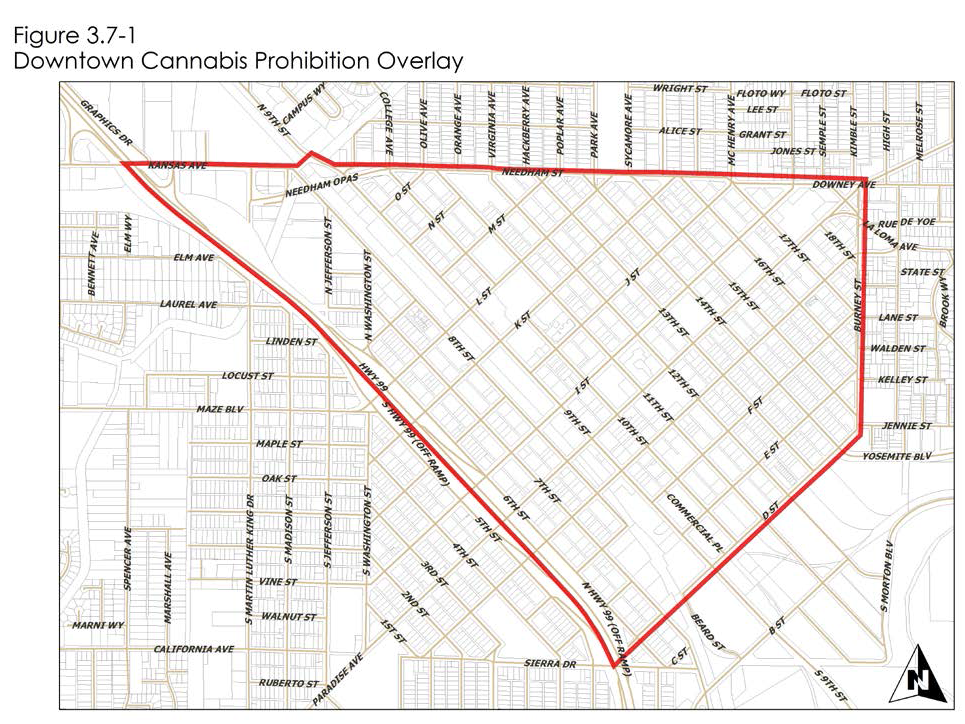
(c)
The proximity requirements above may be waived by the decision-maker when the applicant can show that an actual impassible physical separation exists between land uses or parcels, such as a building, sound wall, major street or highway, such that no negative off-site impacts could occur that would result in harm or likely harm to the public health, safety, or welfare or the health, safety, or welfare of nearby resident or tenant, unless otherwise prohibited under State law.
(Ord. No. 3684-C.S., § 4, effective 2-15-18)
10-3.704 - Application and Permit Procedures.
(a)
All commercial cannabis uses, except with respect to Commercial Cannabis Delivery Permits, which shall be governed by Section 10-3.713, must obtain a City business license, a City Commercial Cannabis Permit, and a state license prior to commencing commercial operations. Additional permits or entitlements may be required depending on construction or improvements necessary to a building or site.
(b)
The total number of Commercial Cannabis Permits granted for each state license type may be established by City Council Resolution or within this chapter.
(c)
The City may refuse to issue any discretionary or ministerial permit, license, variance or other entitlement, which is sought pursuant to this article, including zoning clearance for a building permit, where the property upon which the use or structure is proposed is in violation of the Modesto Municipal Code, or any other local, state or federal law.
(d)
No property interest, vested right, or entitlement to receive a future permit to operate a commercial cannabis use shall ever inure to the benefit of such permit holder as such permits are revocable. Permits issued pursuant to this article are not transferable to another individual or as to another physical location without City approval.
(e)
Operator/Permit/Employee Holder Qualifications. All Cannabis permit holders and cannabis business operators must meet the following minimum qualifications. The City reserves the right to require additional qualifications through the Cannabis Permit application procedure.
(1)
Commercial Cannabis Permit holders, business operators, and employees must be twenty-one (21) years of age or older.
(2)
Commercial Cannabis Permit holders, business operators, and employees shall be subject to background checks by the California Department of Justice, Federal Bureau of Investigations, and local law enforcement.
(3)
Permits for commercial cannabis uses shall not be permitted for operators with felony convictions, as specified in subdivision (c) of Section 667.5 of the Penal Code, and subdivision (c) of Section 1192.7 of the Penal Code. Permits for commercial cannabis uses shall not be permitted for operators with criminal convictions that substantially relate to the qualifications, functions, or duties of the business or profession, including a felony conviction involving fraud, deceit, or embezzlement or a criminal conviction for the sale or provision of illegal controlled substances to a minor.
(4)
Commercial Cannabis Permit holders must meet the minimum qualifications established by the state for the applicable state license type.
(f)
Commercial Cannabis Permits.
(1)
Commercial Cannabis Permits shall require City Council approval or the approval of a Cannabis Program and Permit Review Committee made up of three (3) City Council members appointed by a majority of the entire Council, except with respect to Commercial Cannabis Delivery Permits, which shall be governed by Section 10-3.713. Permit applicants must meet all operator and application requirements to be considered for permit issuance by the City Council or Cannabis Program and Permit Review Committee.
(2)
City staff shall provide notice in accordance with Section 10-9.201 at least ten (10) days prior to the City Council's or Cannabis Program and Permit Review Committee's consideration of the permit.
(3)
Findings for denial of permit. A commercial cannabis permit may be denied if any of the following findings are made:
(i)
The application does not meet all requirements of this article.
(ii)
Approval would very likely result in harm to public safety, health, or welfare.
(iii)
Potential negative impacts of the use cannot be mitigated with conditions or through this article's requirements.
(4)
Appeals.
(i)
If a Cannabis Program and Permit Review Committee is appointed, applicants may appeal its decisions on Cannabis Permits to the full City Council in writing in accordance with Section 10-9.302. The City Council's decision on such appeals shall be final.
(ii)
If no Cannabis Program and Permit Review Committee is appointed, City Council decisions on Cannabis Permits shall be final.
(5)
Commercial Cannabis Permits shall be valid for two (2) years, although the City may require an annual permit fee.
(6)
No Commercial Cannabis Permit holder may commence commercial operations until the necessary state license(s) is obtained. "Commercial operations" does not include tenant improvements or other necessary pre-operational activities. "Commercial Operations" means participating in commercial cannabis activities which require a state license. Commercial Cannabis Permits may contain additional conditions.
(7)
Commercial Cannabis Permit fees shall be set by Resolution of the City Council.
(8)
Conditions of approval may be placed on commercial cannabis permits, including a requirement to comply with design guidelines related to cannabis uses.
(g)
Cannabis Permit Application Procedure.
(1)
The City Manager, or his or her designee, may design application forms and procedures specific to each permitted license type, including online permitting, and require inspections of proposed facilities before issuing a permit under this article. Such procedures may include a request for proposal (RFP) process for certain license types where deemed necessary.
(2)
Applications shall be reviewed by City staff or qualified consultants, as designated by the City Manager. Such review may include a scoring or ranking system. Applications failing to meet minimum qualifications or scoring requirements may not be submitted to the City Council or Cannabis Program and Permit Review Committee for consideration.
(3)
Applicants providing false or misleading information in the permitting process will result in rejection of the application and/or nullification or revocation of any issued permit.
(4)
Applications shall require, at a minimum, the following:
(i)
All necessary information related to the business its operators, including names, birth dates, addresses, social security or tax identification numbers, relevant criminal history, relevant work history, names of businesses owned or operated by the applicant within the last ten (10) years, investor and/or partner information, and APN number of the parcel upon which the business will be located. Such private information will be exempt from disclosure to the public, pursuant to applicable law, to protect an individual's privacy interests and public health and safety.
(ii)
Written (and notarized) permission from the property owner and/or landlord to operate a commercial cannabis use on the site.
(iii)
Operating Plan.
(iv)
Security Plan as required under Section 10-3.706.
(v)
Site Plans.
(vi)
Air Quality Information. When deemed necessary by City staff for purposes of compliance with CEQA or state cannabis regulations, the applicant shall provide a calculation of the businesses anticipated emissions of air pollutants. The applicant shall also provide assurance that the business will comply with all Best Management Practices established by the San Joaquin Valley Air Pollution Control District ("SJVAPCD"). No Cannabis Permit shall be issued to any business that would exceed the thresholds of significance established by the SJVAPCD for evaluating air quality impacts under the California Environmental Quality Act for either operation or construction. Applicants are encouraged to design their project so as to minimize or avoid air pollutant emissions.
(vii)
Greenhouse Gas Emissions. When deemed necessary by City staff for purposes of compliance with CEQA, the applicant shall provide calculations of the anticipated greenhouse gas emissions for the operation of the business and, where applicable, the operation of the business. The applicant shall further demonstrate compliance with any applicable state, regional, or local plan for the reduction of greenhouse gas emissions. No cannabis permit shall be granted for any business that would violate any state, regional, or local plan for the reduction of greenhouse gases, nor shall any cannabis permit be issued where the construction and/or operation of the business would exceed any applicable threshold of significance for greenhouse gas emissions under the California Environmental Quality Act.
(viii)
Hazardous Materials Information. To the extent that the applicant intends to use any hazardous materials in its operations, the applicant shall provide a hazardous materials management plan that complies with all federal, state, and local requirements for management of such substances. "Hazardous materials" includes any hazardous substance regulated by any federal, state, or local laws or regulations intended to protect human health or the environment from exposure to such substances.
(ix)
Water Supply Information. When deemed necessary by the City Engineer, the applicant shall demonstrate to the satisfaction of the City Engineer that sufficient water supply exists for the use.
(x)
Wastewater Information. When deemed necessary by the City Engineer, the applicant shall demonstrate to the satisfaction of the City Engineer that sufficient wastewater capacity exists for the proposed use.
(xi)
Signed Affidavit. The property owner and applicant, if other than the property owner, shall sign the application and shall include affidavits agreeing to abide by and conform to the conditions of the permit and all provisions of the Modesto Municipal Code pertaining to the establishment and operation of the commercial cannabis use, including, but not limited to, the provisions of this article. The affidavit(s) shall acknowledge that the approval of the Commercial Cannabis Permit shall, in no way, permit any activity contrary to the Modesto Municipal Code, or any activity which is in violation of any applicable laws.
(xii)
Signed indemnity provision, as established in Section 10-3.711(e) of this article.
(Ord. No. 3684-C.S., § 4, effective 2-15-18; Ord. No. 3720-C.S., §§ 2, 3, 4, effective 10-22-20; Ord. No. 3742-C.S., § 1, effective 4-7-22)
10-3.705 - Permit Revocation and Suspension.
(a)
Any Commercial Cannabis Permit issued under this article may be immediately suspended or not renewed for any of the reasons listed in (1) through (9) below. Any permit issued under this article may be revoked by the City, following notice and opportunity for a hearing, upon any of the following:
(1)
An operator ceases to meet any of the minimum qualifications listed in this article, fails to comply with the requirements of this article or any conditions of approval of the permit.
(2)
An operator/permit holder's state license for commercial cannabis operations is revoked, terminated, or not renewed.
(3)
The commercial cannabis operation fails to become operative within eighteen (18) months of obtaining its Commercial Cannabis Permit.
(4)
Once operational, the business ceases to be in regular and continuous operation for three (3) consecutive months.
(5)
State law permitting the use for which the permit was issued is amended or repealed resulting in the prohibition of such use, or the City receives credible information that the federal government will commence enforcement measures against such businesses and/or local governments that permit them.
(6)
Circumstances under which the permit was granted have significantly changed and the public health, safety, and welfare require the suspension, revocation, or modification.
(7)
The permit was granted, in whole or in part, on the basis of a misrepresentation or omission of a material statement in the permit application.
(8)
The operator/permit holder/business is not current on City taxes or fees.
(9)
The permit holder/operator's state license for commercial cannabis operations is suspended. The City shall not reinstate the permit until documentation is received showing that the state license has been reinstated or reissued. It shall be up to the City's discretion whether the City reinstates any permit.
(b)
Notice of Revocation or Nonrenewal. If the City proposes to revoke or not renew a permit, written notice of the proposed revocation or nonrenewal must be served on the permit holder at least fifteen (15) days prior to the date of the proposed revocation or nonrenewal becomes effective. The notice shall be served personally or sent via certified mail and contain:
(1)
A statement explaining the grounds for the revocation or nonrenewal.
(2)
A statement that the permit holder may appeal the action according to section (c) below, and that the failure to appeal the notice of revocation or nonrenewal will constitute a waiver of all rights to an appeal hearing and the revocation will be final.
(c)
Appeal of Proposed Revocation or Nonrenewal. Any applicant or permit holder may appeal a proposed permit revocation or nonrenewal by filing a written appeal with the City Manager's office within ten (10) days from the date of the notice of revocation or nonrenewal. The written appeal must contain the following:
(1)
A brief clear statement, including material facts, to support the appellant's position and the relief sought;
(2)
The signature of the permit holder with verification under penalty of perjury of the truth of the statements in the written appeal; and
(3)
Any required appeal fee, which may be approved via Resolution of the City Council.
(d)
Appeal Hearing Procedure.
(1)
Upon receipt of a valid written appeal, the City Manager shall schedule an appeal hearing no earlier than twenty (20) days from the receipt of the appeal.
(2)
A Hearing Officer, appointed by the City Manager, will conduct the appeal hearing.
(3)
The Hearing Officer may only consider evidence that is relevant to whether the permit should be revoked or not renewed. However, the formal rules of evidence shall not apply to the hearing.
(4)
The person contesting the action will be given the opportunity to testify and present witnesses and evidence concerning the action. Unless requested in advance by the person contesting the action, a representative of the City is not required to attend the hearing, provided that any such appearance may be made at the discretion of the City Manager.
(5)
The Hearing Officer may continue the hearing and request additional information from either party prior to issuing a written decision.
(6)
After considering all of the testimony and evidence submitted at the hearing, the Hearing Officer must issue a written decision within a reasonable time after the hearing to uphold or deny the recommended action and must list in the decision the reasons for that decision. The Hearing Officer will use the preponderance of evidence as the standard of evidence in deciding issues. The decision of the Hearing Officer will be final.
(7)
If the Hearing Officer determines that the action should not be upheld, the City will promptly refund the applicable amount of the appeal hearing fee.
(8)
The City shall serve the recipient of the notice of appeal or nonrenewal with a copy of the Hearing Officer's written decision by certified mail.
(Ord. No. 3684-C.S., § 4, effective 2-15-18)
10-3.706 - Security Requirements.
(a)
Security Requirements - Dispensaries.
(1)
Floor Plan. A dispensary shall have a lobby waiting area at the entrance to receive persons to verify that the person meets the criteria of a valid qualified patient or primary caregiver, or in the case of nonmedical dispensary, whether they are at least twenty-one (21) years of age. A dispensary shall also have a separate and secure area designated for distributing cannabis. The main entrance shall be located and maintained clear of barriers, landscaping, and similar obstructions so that it is clearly visible from public streets or sidewalks.
(2)
Storage. A dispensary shall have adequate locked storage on the dispensary property, identified and approved as a part of the security plan, for after-hours storage of cannabis. Cannabis shall be stored at the dispensary property in secured rooms that are completely enclosed or in a safe that is bolted to the floor.
(3)
Security Plans. A dispensary shall comply with a security plan that is approved by the City Manager, in consultation with the police department, that includes, but is not limited to, building security specifications, lighting, cameras, alarms, and adequate state-licensed security personnel to patrol the dispensary area in order to preserve the safety of persons and to protect the dispensary from theft, including employee theft. The plan shall include storage and transportation information, which describes in detail the procedures for safely and securely storing and transporting all cannabis, cannabis products, and any currency. The plan should also include bollards where necessary to prevent vehicle entrance into the facility. The plan shall include detailed information regarding limited-access areas. The City may require minimum standards beyond those in this article for: all alarm and security-related equipment, staff training related to security equipment and procedures, and maintenance and contract requirements for all security equipment and personnel.
(4)
Security personnel shall be on-site twenty-four (24) hours a day or alternative security as authorized by the Police Chief or his/her designee(s), so long as such alternative plan meets minimum state regulations. Security personnel must be licensed by the State of California Bureau of Security and Investigative Services personnel and shall be subject to the prior review and approval of the Chief of Police or his/her designee(s), with such approval not to unreasonably withheld.
(5)
Security Cameras. Security surveillance cameras and a video recording system shall be installed to monitor the interior, main entrance, all entries and exists (from both the inside and outside of building) and exterior dispensary area to discourage loitering, crime, and illegal or nuisance activities. The camera and recording system must be of adequate quality (at least HD), color rendition, and resolution to allow the identification of any individual present in the dispensary area. At each point-of-sale location, camera coverage must enable recording of the customer(s) and employee(s) facial features with sufficient clarity to determine identity. In addition, remote and real-time, live access to the video footage from the cameras shall be provided to the Chief of Police or his/her designee(s). The commercial cannabis business shall be responsible for ensuring that the security surveillance camera's footage is remotely accessible by the Chief of Police or his/her designee(s), and that it is compatible with the City's software and hardware. All surveillance equipment, records, and recordings must be stored in a secured area that is only accessible to management staff. Operators must keep a current list of all authorized employees who have access to the surveillance system and/or alarm system.
(6)
Security Video Retention. Video from the security surveillance cameras shall be maintained for a period of not less than forty-five (45) days and shall be made available to the City upon request.
(7)
Alarm System. Professionally and centrally-monitored fire, robbery, and burglar alarm systems shall be installed and maintained in good working condition.
(8)
Concealed. A dispensary shall not allow or permit cannabis to be visible from the building exterior.
(9)
Police Notification. A commercial cannabis dispensary shall notify the Chief of Police or his/her designee(s) within twenty-four (24) hours after discovering any of the following:
(i)
Significant discrepancies identified during inventory. The level of significance shall be determined by the regulations promulgated by the Chief of Police or his/her designee(s).
(ii)
Diversion, theft, loss, or any criminal activity involving the commercial cannabis business or any agent or employee of the commercial cannabis business.
(iii)
The loss or unauthorized alteration of records related to cannabis, registering qualifying patients, primary caregivers, or employees or agents of the commercial cannabis business.
(iv)
Any other breach of security.
(10)
Emergency Contact. A dispensary shall provide the City Manager with the current name and primary and secondary telephone numbers of at least one (1) twenty-four (24) hour on-call manager to address and resolve complaints and to respond to operating problems or concerns associated with the dispensary. The dispensary shall make good faith efforts to encourage neighborhood residents to call this person to solve operating problems, if any, before any calls or complaints are made to the City.
(11)
Weapons and firearms are prohibited on the property, unless legally carried by city-approved security personnel and/or a business owner.
(b)
Security Requirements—All Other Commercial Cannabis Uses. Dispensaries shall include requirements in this section if no similar requirement is listed in subsection (a) above.
(1)
Security Plans. A commercial cannabis business comply with a security plan that is approved by the City Manager, in consultation with the police department, that includes, but is not limited to, building security specifications, lighting, cameras, and alarms to preserve the safety of persons and to protect the business from theft, including employee theft. The plan shall include storage and transportation information, which describes in detail the procedures for safely and securely storing and transporting all cannabis, cannabis products, and any currency. The plan should also include bollards where necessary to prevent vehicle entrance into the facility.
(2)
A permitted commercial cannabis business shall implement sufficient security measures to deter and prevent the unauthorized entrance into areas containing cannabis or cannabis products, and to deter and prevent the theft of cannabis or cannabis products at the commercial cannabis business. Except as may otherwise be determined by the Chief of Police or his/her designee(s), these security measures shall include, but shall not be limited to, all of the following:
(i)
Preventing individuals from remaining on the premises of the commercial cannabis business if they are not engaging in an activity directly related to the permitted operations of the commercial cannabis business.
(ii)
Establishing limited access areas accessible only to authorized commercial cannabis business personnel.
(iii)
Except for live growing plants which are being cultivated at a cultivation facility, all cannabis and cannabis products shall be stored in a secured and locked room, safe, or vault. All cannabis and cannabis products, including live plants which are being cultivated, shall be kept in a manner as to prevent diversion, theft, and loss.
(iv)
Installing twenty-four (24) hour security surveillance cameras of at least HD-quality to monitor all entrances and exits to and from the premises, all interior spaces within the commercial cannabis business which are open and accessible to the public, all interior spaces where cannabis, cash, or currency, is being stored for any period of time on a regular basis and all interior spaces where diversion of cannabis could reasonably occur. The commercial cannabis business shall be responsible for ensuring that the security surveillance camera's footage is remotely accessible by the Chief of Police or his/her designee(s), and that it is compatible with the City's software and hardware. In addition, remote and real-time, live access to the video footage from the cameras shall be provided to the Chief of Police or his/her designee(s). Video recordings shall be maintained for a minimum of forty-five (45) days, and shall be made available to the Chief of Police or his/her designee(s) upon request. Video shall be of sufficient quality for effective prosecution of any crime found to have occurred on the site of the commercial cannabis business. All surveillance equipment, records, and recordings must be stored in a secured area that is only accessible to management staff. Operators must keep a current list of all authorized employees who have access to the surveillance system and/or alarm system.
(v)
Sensors shall be installed to detect entry and exit from all secure areas.
(vi)
Panic buttons shall be installed in all commercial cannabis businesses.
(vii)
Having a professionally installed, maintained, and monitored alarm system.
(viii)
Any bars installed on the windows or the doors of the commercial cannabis business shall be installed only on the interior of the building.
(ix)
Each commercial cannabis business shall have the capability to remain secure during a power outage and shall ensure that all access doors are not solely controlled by an electronic access panel to ensure that locks are not released during a power outage.
(x)
Each commercial cannabis business shall identify a designated security representative/liaison to the City, who shall be reasonably available to meet with the Chief of Police or his/her designee(s) regarding any security-related measures or/and operational issues.
(xi)
The commercial cannabis business shall cooperate with the City whenever the Chief of Police or his/her designee(s) makes a request, upon reasonable notice to the commercial cannabis business, to inspect or audit the effectiveness of any security plan or of any other requirement of this title.
(xii)
A commercial cannabis business shall notify the Chief of Police or his/her designee(s) within twenty-four (24) hours after discovering any of the following:
(A)
Significant discrepancies identified during inventory. The level of significance shall be determined by the regulations promulgated by the Chief of Police or his/her designee(s).
(B)
Diversion, theft, loss, or any criminal activity involving the commercial cannabis business or any agent or employee of the commercial cannabis business.
(C)
The loss or unauthorized alteration of records related to cannabis, registering qualifying patients, primary caregivers, or employees or agents of the commercial cannabis business.
(D)
Any other breach of security.
(3)
Weapons and firearms are prohibited on the property, unless legally carried by city-approved security personnel and/or a business owner.
(Ord. No. 3684-C.S., § 4, effective 2-15-18)
10-3.707 - Development and Operational Standards.
(a)
Building Requirements. All structures used in commercial cannabis uses shall be located in structures designed for that occupancy, per MMC Chapter 1, Article 9 of Title 9 and shall comply with all applicable sections of the Modesto Municipal Code. Commercial cannabis uses that provide access to the public including, but not limited to, employees, vendors, contractors, business partners, members, customers or patients shall meet Modesto Municipal Code and state requirements for accessibility including accessible parking, accessible path of travel, restrooms, and washing facilities.
(b)
Emissions Control. All commercial cannabis uses shall utilize appropriate measures in construction and, where applicable, operations to prevent the emissions of dust, smoke, noxious gases, or other substances that have the potential to impact local or regional air quality.
(c)
Hours of Operation. Hours of operation for commercial cannabis uses may be established in permit conditions.
(d)
Odor Control and Ventilation. Commercial cannabis uses shall comply with all current and future State laws and regulations related to odor control and ventilation, in addition to any specific requirements for the particular use established in this article. No commercial cannabis use may operate in a manner whereby cannabis odors are detectable from adjacent and nearby properties. All commercial cannabis uses must install a ventilation system that adequately controls for odor, humidity, and mold. Conditions of approval may include a schedule related to changing filters.
(e)
Lighting. All lighting shall be fully shielded, downward casting and not spill over onto structures, other properties or the night sky. All indoor and mixed light cultivation operations shall be fully contained so that little to no light escapes. Light shall not escape at a level that is visible from neighboring properties between sunset and sunrise.
(f)
Runoff and Stormwater Control. Runoff containing sediment, or other waste or by-products, shall not be allowed to drain to the storm drain system, waterways, or adjacent lands. Prior to beginning grading or construction, the operator shall prepare and implement a Stormwater Management Plan and an Erosion and Sediment Control Plan, approved by the City. The plan must include best management practices for erosion control during and after construction, and permanent drainage and erosion control measures pursuant to City requirements.
(g)
Energy Use. Use of renewable resources for indoor cultivation and mixed light operations is encouraged, and the City's Commercial Cannabis permit application procedures may award credit for use of renewable resources.
(h)
All outdoor and mixed light cultivation sites shall be screened by vegetation and fenced with locking gates consistent with height limitations of the base zoning district to screen cultivation operations from public view. Fencing shall be consistent with the surrounding area and shall not diminish the visual quality of the site or surrounding area. Razor wire, chain-link, and similar fencing shall not be permitted.
(i)
Required Signage. The following signs, in measurements of not less than eight by ten (8x10) inches, shall be clearly and legibly posted in a conspicuous location inside the dispensary where they will be visible to customers in the normal course of a transaction, stating:
(1)
"The sale of cannabis without a state license and local permit is illegal."
(2)
"Smoking cannabis on this property, within twenty (20) feet of the dispensary, or in any public place is illegal under California law."
(3)
For medical cannabis dispensaries: "No one under the age of eighteen (18) shall be allowed on the premises, unless they are a qualified patient or a primary caregiver."
(4)
For nonmedical cannabis dispensaries: "No one under the age of twenty-one (21) shall be allowed on the premises."
(5)
For all cannabis dispensaries: "This business is under surveillance accessible by the Modesto Police Department."
(j)
Record keeping, audits, and inspections. All commercial cannabis permit holders must comply with any and all record keeping, audit, and inspection requirements of the city's cannabis business tax ordinance. The following requirements shall also apply:
(1)
As part of the permitting process, the cannabis permit holder shall provide written consent for the inspection and copying by the City of any recordings and records required to be maintained under this chapter without the requirement of a search warrant, subpoena, or court order.
(2)
As part of the permitting process, the cannabis permit holder shall provide written consent for the inspection of the location and premises by the City at any time and without notice during hours of operation and at any other time upon reasonable notice, without the requirement of a search warrant or court order.
(3)
Records from at least the prior five (5) years to be maintained by all permit holders include, but are not limited to:
(i)
Name, birth date, and telephone numbers for all managers and staff at the business, as well as hire date and the nature of each staff member's role;
(ii)
A written accounting of all income and expenditures of the business, including all cash and in-kind transactions;
(iii)
All retail sales transaction information for at least the five (5) prior years;
(iv)
"Seed to sale" track and trace documentation that produces historical transactional data for all cannabis and cannabis products received and at and taken from the premises; and
(v)
Copies of all insurance policies, including the commercial general liability policy.
(4)
At the request of the City Manager, all records required by this section shall be made available in standard electronic format which shall be compatible with Microsoft Office programs and which can easily be imported into either Excel, Access, or any other contemporary software program designated by the City Manager.
(k)
No cannabis or cannabis products shall be consumed on the premises of any commercial cannabis business.
(Ord. No. 3684-C.S., § 4, effective 2-15-18; Ord. No. 3720-C.S., § 5, effective 10-22-20)
10-3.708 - Health and Safety.
(a)
Commercial cannabis uses shall not create a public nuisance or adversely affect the health or safety of the nearby residents or businesses by creating dust, light, glare, heat, noise, noxious gasses, odor, smoke, traffic, vibration, unsafe conditions or other impacts, or be hazardous due to the use or storage of materials, processes, products, run off or wastes.
(Ord. No. 3684-C.S., § 4, effective 2-15-18)
10-3.709 - Taxes.
(a)
Commercial cannabis uses shall comply with additional taxes that may be enacted by the voters or any additional regulations that may be promulgated in addition to all current applicable state and local taxes.
(Ord. No. 3684-C.S., § 4, effective 2-15-18)
10-3.710 - Employees.
(a)
All employees of commercial cannabis businesses must be at least twenty-one (21) years of age.
(b)
All employees of commercial cannabis businesses shall be subject to background search by the California Department of Justice and local law enforcement. Permits for commercial cannabis uses shall not be permitted for operators with felony convictions, as specified in subdivision (c) of Section 667.5 of the Penal Code, and subdivision (c) of Section 1192.7 of the Penal Code. Permits for commercial cannabis uses shall not be permitted for operators with criminal convictions that substantially relate to the qualifications, functions, or duties of the business or profession, including a felony conviction involving fraud, deceit, or embezzlement or a criminal conviction for the sale or provision of illegal controlled substances to a minor.
(c)
Each owner or operator of a commercial cannabis business shall maintain onsite a current register of all the employees currently employed by the commercial cannabis business, and shall produce such register to the Chief of Police, designee, or any other City official authorized to enforce the Modesto Municipal Code for purposes of determining compliance with this article.
(d)
The Police Chief is authorized to implement an employee permit system, whereby any employee or volunteer of a commercial cannabis business, must obtain a work permit from the City of Modesto.
(1)
At a minimum, such program shall require the issuance of a permit that must be visibly displayed at all times by the employee or volunteer when he or she is working and contains a recent photograph of the individual and the name of the commercial cannabis business where he or she works or volunteers.
(2)
The Police Chief may establish a fee for the cost of issuing such permit.
(Ord. No. 3684-C.S., § 4, effective 2-15-18)
10-3.711 - Miscellaneous.
The following standards and regulations apply to all commercial cannabis uses:
(a)
Weights and measures. All scales used for commercial transactions shall be registered for commercial use and sealed by the Department of Agriculture/Weights and Measures.
(b)
Tracking. Commercial cannabis operators shall comply with any track and trace program established by the City or state agencies. Commercial cannabis operators must maintain records tracking all cannabis production and products and shall make all records related to commercial cannabis activity available to the City upon request. The City Manager may require commercial cannabis operators to comply with a County track and trace system if deemed appropriate.
(c)
Inspections. Commercial cannabis uses and operations shall be subject to inspections by appropriate local and state agencies, including but not limited to, the Departments of Health Services, Agriculture/Weights & Measures, the Modesto Police Department and City Management. Cannabis operations shall be inspected at random times for conformance with the Modesto Municipal Code and permit requirements. If interference in the performance of the duty of the agency having jurisdiction occurs, the agency may temporarily suspend the permit and order the cannabis operation to immediately cease operations.
(d)
Restrictions on alcohol sales and consumption. No alcoholic beverages may be sold, dispensed, or consumed on or about the premises of any commercial cannabis business
(e)
Liability and Indemnification. To the fullest extent permitted by law, any actions taken by a public officer or employee under the provisions of this article shall not become a personal liability of any public officer or employee of the City. To the maximum extent permitted by law, the permittees under this article shall defend (with counsel acceptable to the City), indemnify and hold harmless the City of Modesto, the Modesto City Council, and its respective officials, officers, employees, representatives, agents and volunteers (hereafter collectively called "City") from any liability, damages, actions, claims, demands, litigation, loss (direct or indirect), causes of action, proceedings, or judgment (including legal costs, attorneys' fees, expert witness or consultant fees, City Attorney or staff time, expenses or costs) (collectively called "action") against the City to attack, set aside, void or annul, any cannabis-related approvals and actions and strictly comply with the conditions under which such permit is granted, if any. The City may elect, in its sole discretion, to participate in the defense of said action and the permittee shall reimburse the City for its reasonable legal costs and attorneys' fees. Permittees shall be required to agree to the above obligations in writing.
(Ord. No. 3684-C.S., § 4, effective 2-15-18)
10-3.712 - Enforcement.
(a)
Violations.
(1)
Any activity performed contrary to the provisions of this article is hereby declared to be a public nuisance.
(2)
Any violation of a term, condition, or the approved plans and specifications of any permit issued pursuant to this article shall constitute a violation.
(3)
Each and every day during any portion of which any violation is committed, continued, or allowed to continue shall be a separate offense.
(b)
Remedies. In addition to the revocation and suspension provisions in this article and any all available remedies under the law, the following remedies shall be available to the City or other enforcement agency regarding violations of this article.
(1)
Administrative enforcement pursuant to this Municipal Code.
(2)
Civil enforcement pursuant to this Municipal Code.
(3)
Criminal enforcement if allowed under State law.
(c)
City Council may, by Resolution, adopt specific fines, fees, costs, and penalty amounts for violations and enforcement costs related to this article. Fines, fees, costs, and penalty amounts within Modesto Municipal Code Sections 1-6.305 and 1-6.306 may be applied in the absence of a council approved resolution establishing specific amounts related to this article.
(d)
In any enforcement action brought pursuant to this article, whether by administrative or judicial proceedings, each person who causes, permits, suffers, or maintains the unlawful cannabis use shall be liable for all costs incurred by the City, including, but not limited to, administrative costs, and any and all costs incurred to undertake, or to cause or compel any responsible person to undertake, any abatement action in compliance with the requirements of this section. In any action by the agency having jurisdiction to abate unlawful cannabis uses under this section, whether by administrative or judicial proceedings, the prevailing party shall be entitled to a recovery of the reasonable attorney's fees incurred. Recovery of attorneys' fees under this subdivision shall be limited to those actions or proceedings in which the City elects, at the initiation of that action or proceeding, to seek recovery of its own attorney's fees. In no action, administrative proceeding, or special proceeding shall an award of attorneys' fees to a prevailing party exceed the amount of reasonable attorney's fees incurred by the City in the action or proceeding.
(Ord. No. 3684-C.S., § 4, effective 2-15-18)
10-3.713 - Regulation of Cannabis Deliveries.
The City Manager shall have responsibility for administering Cannabis Delivery Permits in the City of Modesto. All cannabis delivery services, and the retail businesses that control them, shall as an express condition of any delivery permit issued by the City of Modesto remain in compliance with all applicable state regulations contained in Sections 5415 through 5421 of Title 16, Division 42 of the California Code of Regulations.
(a)
Operating Requirements for Retail Businesses Operating Delivery Services Within the City Limits. Prior to commencing operations, any licensed commercial cannabis retail operation conducting deliveries within the City of Modesto shall comply with the following requirements:
(1)
Obtain from the City Manager a permit authorizing the delivery of cannabis and cannabis products within the City limits. A copy of this permit shall be retained by all drivers.
(2)
Provide the City Manager, with evidence of a valid state license for a commercial cannabis retail business on whose authorization the delivery service is performing the delivery function.
(3)
Provide the City Manager the year, make, model, license plate number, and Vehicle Identification Number (VIN) for any and all vehicles that will be used to deliver cannabis or cannabis goods.
(4)
Provide the City Manager proof of ownership or a valid lease for all vehicles that will be used to deliver cannabis or cannabis goods.
(5)
Provide the City Manager proof of insurance coverage for all vehicles that will be used to deliver cannabis or cannabis goods.
(6)
Provide the City Manager with evidence of the completion of criminal background checks for all delivery drivers, as required by Section 10-3.710.
(7)
Provide the City Manager with written notice of any changes in the composition of its delivery vehicle fleet within thirty (30) calendar days.
(b)
Identity and Age Verification of Customers. Commercial cannabis retail operations and their delivery employee drivers are required to verify the identity and age of each customer via necessary documentation. In the case of medical customers, drivers must verify that the customer is not under the age of eighteen (18) years, and that the potential customer has a valid doctor's recommendation. Doctor recommendations are not to be obtained or provided at the retail location. In the case of recreational or adult use customer, drivers must verify that the customer is not under the age of twenty-one (21).
(c)
Permissible Delivery Locations and Times. Cannabis delivery businesses permitted to engage in delivery of cannabis and cannabis products within the City of Modesto are subject to the following requirements:
(1)
A licensed cannabis business shall not deliver cannabis goods to an address located on publicly owned land or any address on land or in a building leased by a public agency.
(2)
Cannabis deliveries shall be limited to the hours of 8:00 a.m. to 8:00 p.m. unless otherwise specified in writing by the City Manager.
(d)
Delivery Facilitated by kiosk or other technology platform. Any delivery by kiosk, i-Pad, tablet, smartphone, fixed location or technology platform, whether manned or unmanned, other than a retail location permitted by the city, that facilitates, directs, or assists the retail sale or delivery of cannabis or cannabis products is prohibited and shall be in violation of this chapter.
(e)
Delivery Vehicles: Compliance with State Regulations. All delivery vehicles delivering cannabis and cannabis products to locations within the City of Modesto shall comply at all times with the signage and security requirements contained in Title 16, Division 42, Section 5417 of the California Code of Regulations.
(f)
Revocation and Suspension of Delivery Permits. Once issued, any commercial cannabis delivery permit may be revoked by the City Manager for failure to comply with any of the provisions of this Article, or for any of the reasons enumerated in Section 10-3.705.
(g)
Promulgation of Regulations, Standards, and other Legal Duties.
(1)
In addition to any regulations adopted by the City Council, the City Manager or his/her designee is authorized to establish any additional rules, regulations and standards governing the issuance, denial or renewal of commercial cannabis delivery permits, the ongoing operation of commercial cannabis delivery services and the City's oversight, or concerning any other subject determined to be necessary to carry out the purposes of this chapter.
(2)
Regulations shall be published on the City's website.
(3)
Regulations promulgated by the City Manager shall become effective upon date of publication. Commercial cannabis delivery services and the retail businesses that control them shall be required to comply with all state and local laws and regulations, including but not limited to any rules, regulations or standards adopted by the City Manager or his/her designee.
(Ord. No. 3720-C.S., § 6, effective 10-22-20)
10-3.801 - Purpose.
The purpose of this Article is to regulate the locations in the City where Smoke Shops may be established in order to preserve and protect public health, safety, and welfare.
(Ord. No. 3801-C.S., § 3, effective 9-11-25)
10-3.802 - Definitions.
(a)
"Existing Smoke Shop" shall mean any Smoke Shop lawfully established with a City business license and all other required permits, licenses, and/or land use entitlements as of October 8, 2024.
(b)
"Hookah Lounge" shall mean a business establishment that qualifies as a smokers' lounge, as defined in California Labor Code section 6404.5(e), and in which the entire premises is dedicated exclusively to the Smoking of Shisha or Shisha Tobacco, and which does not sell Tobacco Products for off-site consumption.
(c)
"Premium Cigar Retailer" shall mean a retailer that sells no tobacco products other than premium cigars and looseleaf tobacco as defined under California Health and Safety Code section 104559.5.
(d)
"Smoke Shop" shall mean a retailer or any person that primarily sells, offers for sale, or offers to exchange for any form of consideration Tobacco Products and/or Tobacco Paraphernalia. A retailer or person who is primarily engaged in such activities includes, but is not limited to, a retailer or person that has fifteen (15) percent or more of the square feet in the establishment, or more than fifteen (15) linear feet of display area projected to the floor (whether contiguous or non-contiguous), used for the sale, distribution, delivery, furnishing, marketing display, or storage of Tobacco Products or Tobacco Paraphernalia. Smoke Shop, for purposes of this Article, does not include a Premium Cigar Retailer, Hookah Lounge, or establishments operating as a Cannabis Dispensary under Title 10, Chapter 3, Article 7. Nothing herein is intended to permit a Premium Cigar Retailer, Hookah Lounge, or Cannabis Dispensary, except as otherwise authorized by Title 10 of this Code.
(e)
"Smoke Shop Permit" shall mean a permit to operate a Smoke Shop issued by the Chief of Police pursuant to Chapter 4-24 of the Modesto Municipal Code.
(f)
"Tobacco Paraphernalia" shall mean any device, product, equipment, or material of any kind that is intended or designed for use for smoking, inhaling, or ingesting tobacco, notwithstanding that the device, product, equipment, or material may also be used for smoking, inhaling, or ingesting cannabis or and any controlled substance. Tobacco paraphernalia includes, but is not limited to, all of the following: (i) metal, ivory, wooden, acrylic, glass, stone, plastic, or ceramic pipes with or without screens, permanent screens, hashish heads, or punctured bowls; (ii) water pipes; (iii) bongs; (iv) chillums; (v) ice pipes or chillers; (vi) cigarette papers or wrappers; (vii) cigarette rolling machines; (viii) blunt wraps, as defined in Section 308 of the Penal Code; (ix) hookahs and similar devices constructed with a receptacle or container in which water or some other liquid may be placed into which smoke passes and is cooled in the process of being inhaled or ingested; and (x) any electronic device that delivers nicotine or other vaporized liquids to the person inhaling from the device, including, but not limited to an electronic cigarette, cigar, pipe, or hookah. Tobacco Paraphernalia shall include any component, part, or accessory of the foregoing, whether or not sold separately.
(g)
"Tobacco Product" shall mean any product containing, made, or derived from tobacco or nicotine that is intended for human consumption, whether smoked, heated, chewed, absorbed, dissolved, inhaled, snorted, sniffed, or ingested by any other means, including, but not limited to, cigarettes, an electronic device that delivers nicotine or other vaporized liquids to the person inhaling from the device, including an electronic cigarette, cigar, pipe, or hookah (with or without flavoring), cigars, little cigars, chewing tobacco, pipe tobacco, or snuff, or vaping accessories. Tobacco Product shall include any component, part, or accessory of the foregoing, whether or not sold separately. Tobacco Product does not include a product that has been approved by the United States Food and Drug Administration for sale as a tobacco cessation product or for other therapeutic purposes, where the product is marketed and solely for such an approved purpose.
(h)
"Youth facility or center" shall have the same meaning as in Health and Safety Code section 11353.1, as may be amended from time to time: any public or private facility that is primarily used to host recreational or social activities for minors, including, but not limited to, private youth membership organizations or clubs, social service teenage club facilities, video arcades, or similar amusement park facilities.
(Ord. No. 3801-C.S., § 3, effective 9-11-25)
10-3.803 - Location and Minimum Proximity Requirements.
(a)
Smoke Shops are permitted in the zones identified in Table 3.8-1 and prohibited in all other zones.
(b)
Additionally, the following location and proximity requirements shall apply:
(1)
No Smoke Shop shall be located within one thousand (1,000) feet, as measured from the nearest property lines, of the following locations:
(i)
A public or private State-licensed or accredited school providing instruction to students in kindergarten or any grades 1 through 12;
(ii)
State-licensed childcare center;
(iii)
Public park, playground, or recreational area, including a trail that is immediately adjacent to a public park or public library;
(iv)
Youth facility or center; or
(v)
An alcohol or other drug abuse recovery or treatment facility.
(2)
No Smoke Shop use shall be located within one thousand (1,000) feet of any Commercial Cannabis Uses or another Smoke Shop, as measured from the nearest property lines.
(3)
No Smoke Shop use shall be located within one hundred (100) feet of any residential use; this distance shall be measured from any building or structure containing a Smoke Shop use to an existing residential structure used for residential purposes.
(4)
Smoke Shops are prohibited in the Downtown Cannabis Prohibition Overlay, regardless of a property's zoning designation. The Downtown Cannabis Prohibition Overlay is that area shown in Figure 3.7.1 under Title 10, Chapter 3, Article 7 of this Code, and further described as the area including all properties that front either side of or are within the area bound by the following streets: Kansas Avenue, from Highway 99 to 9th Street; Needham Street; Downey Avenue, from McHenry Avenue to Burney Street; Burney Street, from Downey Avenue to Jennie Street; D Street, from Jennie Street to Highway 99; and the area fronting Highway 99 within the boundary. If any parcel is partially within the Downtown Cannabis Prohibition Overlay, Smoke Shops shall be prohibited on the entire parcel.
(Ord. No. 3801-C.S., § 3, effective 9-11-25)
10-3.804 - Smoke Shop Permit Required.
(a)
All Smoke Shops permitted by Section 10.3.803 must, prior to establishing and operating any such Smoke Shop use, obtain and maintain at all times a valid Smoke Shop Permit from the City pursuant to Chapter 4-24 of the Modesto Municipal Code.
(Ord. No. 3801-C.S., § 3, effective 9-11-25)
10-3.805 - Existing Smoke Shops
(a)
Notwithstanding Section 10-3.803, any existing and lawfully operating Smoke Shop that holds a City business license and all other required permits, licenses, and/or land use entitlements as of October 8, 2024, may continue to lawfully operate subject to the requirements of this Section.
(b)
All Existing Smoke Shop shall apply for a Smoke Shop Permit pursuant to Chapter 4-24 of the Modesto Municipal Code and comply with all related requirements no later than November 14, 2025. An Existing Smoke Shop that fails to timely obtain a Smoke Shop Permit and comply with all related requirements shall cease to be an Existing Smoke Shop under Subsection (a) and shall be subject to all requirements of Section 10-3.803.
(c)
Notwithstanding anything in Section 10-3.502, "nonconforming uses," to the contrary, any Existing Smoke Shop that ceases to operate for a period of sixty (60) consecutive days shall be discontinued, except that the Director of Community Economic and Development may extend this period by ninety (90) days if the Director determines that the cessation of the business is due to a cause outside of the preexisting Smoke Shop's reasonable control, such as a natural disaster or declared emergency.
(d)
Notwithstanding anything in Section 10-3.502, "nonconforming uses," to the contrary, an Existing Smoke Shop shall not expand the square footage of the establishment or display area dedicated to tobacco products or tobacco paraphernalia as of July 22, 2025, without first complying with Section 10-3.803.
(Ord. No. 3801-C.S., § 3, effective 9-11-25)

