
Mukwonago Town City Zoning Code
ARTICLE X
- LANDSCAPING AND BUFFERYARDS
Sec. 36-1401. - Legislative findings.
The town board makes the following legislative findings:
(1)
A healthy environment is an indication of a healthy community.
(2)
Landscaping helps to maintain and increase property values, which helps to protect public and private investment in a community.
(3)
Landscaping provides lasting social, economic, environmental, and aesthetic benefits to the community.
(4)
Landscaping helps to reduce the "heat-island" effect by shading parking lots, streets, and other hard-surfaced areas.
(5)
Flexible standards allow alternative design options that may better fit the needs of the landowner and that may be needed to address unique site characteristics.
(6)
Xeriscape planting techniques help promote water and energy conservation.
(7)
A variety of landscape plants is needed to ensure that the effect of a single disease (e.g., Dutch elm disease) or pest (e.g., emerald ash borer) on landscape plants is minimized.
(Ord. No. 2020-O-48, § 1(Exh. A), 9-16-2020)
Sec. 36-1402. - Purpose.
This article is established to promote the public health, safety, and welfare and is intended to accomplish the following purposes:
(1)
Make the developed areas of the town more attractive and aesthetically pleasing;
(2)
Provide flexible standards where possible, rather than overly prescriptive requirements;
(3)
Promote and improve public health and safety through the abatement of noise, the glare of lights, dust, and air pollution;
(4)
Improve the aesthetic appearance of the built environment;
(5)
Promote economic development by providing a high quality of life;
(6)
Enhance ambient environmental conditions by providing shade, air purification, oxygen regeneration, groundwater recharge, storm water runoff retardation, and noise, glare, and heat abatement; and
(7)
Encourage the preservation, expansion, protection, and proper maintenance of the community forest.
(Ord. No. 2020-O-48, § 1(Exh. A), 9-16-2020)
Sec. 36-1403 - Landscape plan
A landscape plan shall consist of a completed worksheet as may be used by the zoning administrator and a plan view drawing that shows where the required plants will generally be planted. Such drawing shall be drawn at the same scale as the site plan drawing. A landscape plan should be prepared or reviewed by a landscape professional to ensure compliance with this article.
(Ord. No. 2020-O-48, § 1(Exh. A), 9-16-2020)
Sec. 36-1404. - Description of landscape points and classification of plant species.
(a)
Generally. The required level of landscape plants is stated in terms of landscape points. As shown in exhibit 10-1, a different number of points are assigned to each of the plant categories depending upon its typical growth rate, its mature height, and whether it is a deciduous or evergreen species. Species generally suitable for use in southern Wisconsin are listed and those native to the state are denoted.
(b)
Plants not listed. The species list in exhibit 10-1 is not meant to be exhaustive. Therefore, the zoning administrator shall review proposals for, and the applicability of, species not contained in this list, and is authorized to approve appropriate similar species using the most current edition of "A Guide to Selecting Landscape Plants for Wisconsin" as a guide.
(c)
Prohibited plants. Plants specifically designated as invasive by the state department of natural resources or other state agency shall not be planted and shall not be used to meet the requirements of this article. The town reserves the right to prohibit any plant listed in exhibit 10-1 upon a determination that it is susceptible to infection (e.g., emerald ash borer).
(d)
Plant hardiness. Selected plants should be hardy in the area where they are planted (zone 4).
Exhibit 10-1. Classification of Plants
Notes:
1.
Native to Wisconsin.
2.
Only those species that are not susceptible to the emerald ash borer may be used.
3.
See "A Guide to Selecting Landscape Plants for Wisconsin," E.R. Hasselkus, University of Wisconsin-Extension, Publication A2865 for more plants.
4.
The above table may include plants that are not suitable for zone 4.
(Ord. No. 2020-O-48, § 1(Exh. A), 9-16-2020)
Sec. 36-1405. - Specifications for landscaping materials.
(a)
Generally. All plant material shall be healthy, vigorous, and free of disease and insects.
(b)
Minimum planting size. Trees and shrubs shall meet the minimum planting size established in exhibit 10-2. Further, trees and shrubs shall meet the specifications contained in the most current edition of "American Standard for Nursery Stock" for the corresponding planting size.
Exhibit 10-2. Minimum Planting Size
(c)
Turf. Turf areas may be sodded or seeded. In areas subject to erosion, sod shall be used. Sod shall be commercially grown and clean and free of weeds, noxious pests, and diseases.
(d)
Mulch. Where mulch is used as a ground treatment, it shall be applied to a maximum depth of four inches. A landscape fabric may be placed between the soil and mulch to impede weed growth.
(Ord. No. 2020-O-48, § 1(Exh. A), 9-16-2020)
Note— This publication is published by the American Nursery and landscape Association and is an approved American National Standard (ANSI Z60.1-2004).
Sec. 36-1406. - Credit for preserving trees and shrubs.
(a)
Generally. Landscape plantings as required by this article may be satisfied in whole, or in part, by preserving existing trees and shrubs on the subject property.
(b)
Allocation of credits. An existing tree shall be credited based on its size as shown in exhibit 10-3. An existing shrub shall be credited on a one-for-one basis regardless of size.
Exhibit 10-3. Allowable Tree Credits
(c)
Location of trees and shrubs. A tree eligible for credit shall be located within ten feet of the location where the tree credit is to be applied. A shrub eligible for credit shall be located within the area to which the credit is to be applied.
(d)
Condition of trees to be used as credit. In order to use an existing tree or shrub as credit, the following conditions shall be satisfied:
(1)
The area within the drip line or six feet away from the tree trunk, whichever is greater, shall be preserved in its natural state or covered with pervious landscape material and shall be retained at original grade with no trenching, cutting of any roots, or compaction of soil.
(2)
During construction, a temporary barrier shall be placed around the tree at the drip line or six feet away from the tree trunk, whichever is greater.
(3)
The existing stock shall not be damaged from skinning, barking, and the like.
(4)
The existing stock shall be healthy and free from disease, damage, and active insect infestation potentially lethal to the tree.
(Ord. No. 2020-O-48, § 1(Exh. A), 9-16-2020)
Sec. 36-1407. - Design and placement guidelines.
(a)
Public safety. Landscaping shall not result in the creation of a safety or visibility hazard.
(b)
Random placement. To the extent possible, plants shall be randomly placed so as to give a natural appearance.
(c)
Planting beds. Where required, shrubs shall be placed in planting beds with mulch.
(d)
Proximity to overhead utility lines and the like. Trees and shrubs shall not be placed where they will require frequent pruning in order to avoid interference with overhead utility lines, buildings, or other structures.
(e)
Integration with natural amenities. When a site abuts a natural amenity such as a stream, park, or other open space, the landscape plan shall integrate with, and respect the natural integrity of the amenity.
(f)
Integration with stormwater facilities. Detention and retention ponds shall be designed to be physically, functionally, and visually integrated into adjacent landscape areas.
(g)
Landscaping in relation to berms and fences. Where plant materials are used in conjunction with a berm or a fence to meet the requirements or guidelines of this article, the fence or berm shall be located toward the interior of the subject property and the plant material shall be located toward the exterior of the subject property.
(h)
Utility easements. Landscaping materials, fences, and berms that are located within a duly-recorded utility easement and/or a pedestrian easement shall not count toward meeting a landscape requirement.
(i)
All disturbed areas shall be seeded with lawn or native ground cover unless such vegetation is already fully established.
(j)
Storage of landscape materials. Landscape debris and topsoil and gravel piles shall be removed from the site 60 days after occupancy, unless it was reviewed and approved by the plan commission as part of a site plan and plan of operations review. This includes, but is not limited to piles of topsoil, gravel, stone, sand, dead vegetation, branches, stumps, leaves, brush and similar materials.
(Ord. No. 2020-O-48, § 1(Exh. A), 9-16-2020)
Sec. 36-1408. - Plant diversity.
(a)
Tree species. The maximum number of required trees in the same genus shall comply with the proportions established in exhibit 10-4. For example, if three tree species are required, a species in three different genuses must be used (e.g., Quercus—oaks, Acer—maples, Pinus—pines).
Exhibit 10-4. Plant Diversity Requirements and Recommendations
(b)
Shrub species. It is recommended that the proportion of required shrubs and ground cover follow the standards established in exhibit 10-4, except that different species within the same genus may be used.
(Ord. No. 2020-O-48, § 1(Exh. A), 9-16-2020)
Sec. 36-1409. - Maintenance.
(a)
Generally. All landscaping shall be maintained in good condition so as to present a healthy, neat, and orderly appearance, free from refuse, weeds, and debris.
(b)
Responsibilities. The current landowner shall be responsible for maintaining the vegetation and other landscape components as may be required by this article.
(c)
Maintenance practices. Maintenance shall consist of regular and normal maintenance practices of landscaping including weeding, irrigation, fertilizing, pruning, and mowing. Plant materials that exhibit significant levels of insects, pests, diseases, or damage shall be treated as appropriate.
(d)
Replacement, generally. Plant materials which were planted as required by this article or which were used as a credit and which die or are irreparably damaged shall be removed and replaced with living plant materials consistent with the approved landscape plan or as required by this article.
(e)
Replacement following a natural disaster. Plant materials that were planted as required by this article or which were used as a credit and which die or are irreparably damaged due to a natural disaster, such as area-wide flooding or high wind, shall, within two years of such event, be removed and replaced with plant materials consistent with the approved landscape plan or as required by this article. With just cause, the plan commission may on a case-by-case basis grant an extension of two additional years upon written request, or pass a resolution granting a blanket extension to all affected properties in the town.
(f)
Staking. It is recommended that stakes and cables used to support a tree be removed within 24 months of planting.
(Ord. No. 2020-O-48, § 1(Exh. A), 9-16-2020)
Sec. 36-1410. - Timing for installation of landscape materials.
All required landscaping materials shall be installed prior to issuance of a permanent occupancy permit for any building on the subject property. However, if the subject property is to be occupied prior to the installation of all required landscaping material, the property owner shall only receive a temporary occupancy permit from the building inspector for up to six months provided the property owner provides a financial guarantee subject to the requirements in article IV in an amount acceptable to the building inspector to ensure the installation of the landscaping materials.
(Ord. No. 2020-O-48, § 1(Exh. A), 9-16-2020)
Sec. 36-1411. - Berms.
(a)
Maximum slope and form. In order to facilitate maintenance and efficient irrigation water usage, a berm shall not exceed a slope of 3:1 (i.e., for every three feet of horizontal run the vertical height is one foot). A berm shall be graded to appear as a curvilinear, naturalistic form.
(b)
Construction. A berm shall be compacted during the construction process so as to minimize settling.
(c)
Stabilization. A berm shall be covered with turf or mulch along with required plant materials.
(d)
Effect on stormwater flow. A berm may not be designed or placed so as to divert the normal flow of stormwater to the detriment of surrounding properties.
(e)
Placement with respect to existing trees and shrubs. No portion of a berm shall be placed within the critical root zone (one and one-half feet for every diameter inch) of a tree.
(f)
Placement within vision triangle. Placement of a berm within a vision triangle shall be consistent with the standards as may be established.
(Ord. No. 2020-O-48, § 1(Exh. A), 9-16-2020)
Sec. 36-1412. - Stockpile of topsoil.
An earth materials stockpile is subject to the requirements in appendix B.
(Ord. No. 2020-O-48, § 1(Exh. A), 9-16-2020)
Sec. 36-1441. - Applicability.
The requirements and guidelines contained in this article apply to the:
(1)
Construction of a new institutional, commercial, and industrial building;
(2)
Expansion of an existing institutional, commercial, or industrial building when such improvement costs exceed 25 percent of the assessed value of the building; and
(3)
Construction or expansion of a parking lot for an institutional, commercial, or industrial use.
(Ord. No. 2020-O-48, § 1(Exh. A), 9-16-2020)
Sec. 36-1442. - Street frontage landscape requirements.
(a)
Minimum amount required. A minimum of 60 landscape points shall be provided along a public street right-of-way on a prorated basis for every 100 linear feet of frontage.
(b)
Placement on lot. Plants required by this section shall be located within ten feet of the public right-of-way. In no instance shall such landscaping be located within a public right-of-way.
(c)
Use of various plant types. Only tall trees may be used for street frontage plantings. The following trees shall not be used as street trees because of undesirable traits (e.g., weak wood, form, fruit/nut litter):
(1)
Silver maple.
(2)
Box elder.
(3)
Butternut.
(4)
Black walnut.
(5)
Any other tree so designated by the zoning administrator.
(Ord. No. 2020-O-48, § 1(Exh. A), 9-16-2020)
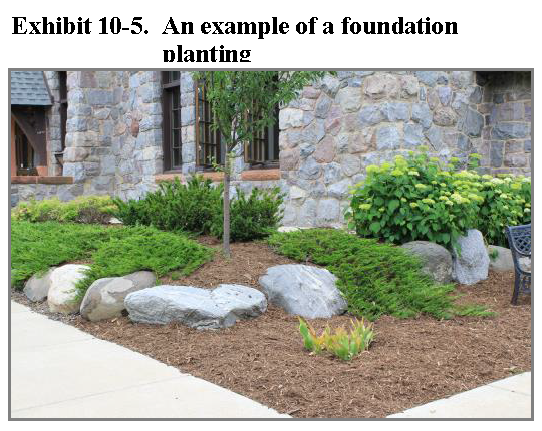
Sec. 36-1443 - Building foundation landscape requirements
(a)
Minimum amount required. A minimum of 25 landscape points shall be provided on a prorated basis for every 100 feet of building foundation perimeter. For example, a building with a perimeter of 180 feet must provide a minimum of 45 landscape points ((180/100)*25)=45.
(b)
Placement on lot. Plants required by this section shall be placed so that, at maturity, the dripline of each plant is generally located within ten feet of the building foundation. As a general rule, plants shall be distributed around the entire perimeter of the building. Such landscaping shall not be located in those areas required for landscaping as street frontages or parking areas.
(c)
Use of various plant types. Tall and medium trees shall not be used to meet building foundation landscape requirements. The intent of this section is to require a visual break in the mass of buildings and to require a visual screen of a minimum of five feet in height for all exterior perimeter appurtenances, such as ground-mounted HVAC units and utility boxes.
(d)
Anticipated future development. Where an approved site plan depicts a future building extension, the foundation landscaping requirement shall be calculated by measuring the length of the total perimeter. However, foundation plantings need only be installed based on the landscape points calculated from the portions of the building perimeter that will not be affected by building extension. If this results in point requirements which are not met through the initial planting, then such requirement shall be met within five years of building permit issuance, or as extended in writing by the zoning administrator.
(Ord. No. 2020-O-48, § 1(Exh. A), 9-16-2020)
Sec. 36-1444. - Parking lot landscape requirements.
(a)
Minimum amount required. A minimum of 120 landscape points shall be provided on a prorated basis for every 10,000 square feet of paved area. For example, a minimum of 264 landscape points are required within a parking area consisting of 22,000 square feet (approximately 64 stalls) as follows: ((22,000/10,000)*120)=264.
(b)
Use of various plant types. A minimum of 60 percent of all landscape points shall be devoted to tall trees and a minimum of 20 percent of all points shall be devoted to shrubs.
(c)
Placement within a landscaped area. A minimum of 325 square feet of landscaped area shall be located within ten feet of the perimeter of the paved area for the placement of every 100 landscape points, or fraction thereof. A landscape island consisting of a minimum of 380 square feet shall be located at the end of a parking isle (i.e., two rows of stalls). In addition, an intermediate island consisting of a minimum of 180 square feet per row of stalls shall be used to separate a continuous run of 20 parking stalls in a single row.
(d)
Bioretention areas. Bioretention areas that are used to treat stormwater runoff from parking areas should be integrated into landscape areas as may be required in this section.
(Ord. No. 2020-O-48, § 1(Exh. A), 9-16-2020)
Sec. 36-1445. - Lot interior landscape requirements.
(a)
Minimum amount required. A minimum of ten landscape points shall be provided within the interior of the lot on a prorated basis for every 1,000 square feet of building floor area. For example, a minimum of 23 landscape points are required on the interior of a lot having a building floor area of 2,300 square feet ((2,300/1,000)*10)=23.
(b)
Placement on lot. Plants required by this section shall be located away from required landscaping for building foundations, street frontages, and parking lot areas.
(Ord. No. 2020-O-48, § 1(Exh. A), 9-16-2020)
Sec. 36-1446. - Landscaping around exterior features.
Exterior perimeter appurtenances, such as HVAC/utility boxes, standpipes, storm water discharge pipes and other pipes, shall be screened from sight by landscape plantings of a minimum of five feet in height.
(Ord. No. 2020-O-48, § 1(Exh. A), 9-16-2020)
Sec. 36-1447. - Landscaping for outdoor storage areas.
When a permitted land use includes an outdoor storage area, such area shall be screened from view from public streets and public use areas on adjoining properties. Such screening may consist of a berm, non-metallic fencing, a decorative wall, landscaping, or any combination, as determined by the plan commission.
(Ord. No. 2020-O-48, § 1(Exh. A), 9-16-2020)
Sec. 36-1461. - General description.
A bufferyard consists of a strip of undeveloped land with landscaping or other visual screening and is intended to provide a physical and visual separation between different land uses as more particularly described herein.
(Ord. No. 2020-O-48, § 1(Exh. A), 9-16-2020)
Sec. 36-1462. - Applicability.
(a)
Generally. A bufferyard shall be required at the time of development along the side and rear lot lines of the lot being developed when it abuts another lot in a different zoning district and when the lot being developed was:
(1)
Created by a land division of any type approved after January 1, 2020,
(2)
Rezoned to another zoning classification after January 1, 2020.
(b)
Conditional use. As a condition of approving a conditional use, the plan commission may require that a bufferyard be incorporated into the project's overall design. The standard imposed shall be based on the degree of incompatibility between the adjoining use and the conditional use.
(c)
Dual responsibility. When two adjoining parcels are vacant and they are located in different zoning districts, one half of the required bufferyard shall be located on each parcel (i.e., one half of the required width and one half of the required plants).
(d)
Single responsibility. When a vacant parcel adjoins a developed parcel and each are located in different zoning districts, the bufferyard shall be located on the vacant parcel.
(Ord. No. 2020-O-48, § 1(Exh. A), 9-16-2020)
Sec. 36-1463. - General provisions.
(a)
Relationship of fencing and plantings. When a fence or berm is used in conjunction with plantings, one-half of the required number of landscape points shall be planted between the fence or berm and the property line.
(b)
Use of bufferyard. A bufferyard shall be undeveloped, except that the zoning administrator may allow the following in a bufferyard:
(1)
An unpaved fire lane;
(2)
Utility boxes and cabinets when necessary;
(3)
A paved bicycle/pedestrian path or a paved sidewalk when necessary to allow for proper on-site and off-site pedestrian circulation;
(4)
A paved vehicular access between the adjoining parcels provided it is located in the least intrusive location and is located generally perpendicular to the property boundary line;
(5)
Stormwater management facilities; and
(6)
Other structures and features deemed compatible by the administrator.
If a utility easement is located along the property boundary line where a bufferyard is also required, the width of the easement may be used to satisfy the width requirement of the bufferyard, in whole or in part, provided none of the required landscaping and/or fencing is located within the utility easement.
(c)
Multi-use developments and mixed use. For multi-use developments on a single lot, the use nearest the property line shall determine the bufferyard requirement for that area. For mixed uses (two or more uses in the same structure), the higher intensity use shall be used to determine the bufferyard requirement.
(d)
Recording of easement. The bufferyard shall be shown on the face of the final plat or certified survey map (CSM) with the following narrative:
"The bufferyard(s) shown on the face of this [plat/certified survey map] was established to comply with the Town of Mukwonago's zoning code in effect at the time of approval. A bufferyard shall not be developed or used, except in conformance with Article X of the zoning code, and the property owner shall be responsible for maintaining a level of landscaping that meets the bufferyard requirements in effect at the time of filing of this [plat/certified survey map]. This bufferyard may only be removed by the Town of Mukwonago consistent with Article X."
(e)
Longevity. Bufferyards shall be maintained in perpetuity. However, the plan commission may terminate a bufferyard when:
(1)
The parcel containing the bufferyard is rezoned to the same zoning classification as the adjoining parcel; or
(2)
When the adjoining parcel is rezoned to the same zoning classification as the parcel with the bufferyard. Such termination shall reference the original document depicting the bufferyard and be recorded with the register of deeds for the county.
(f)
Ownership. When a bufferyard is required in a subdivision, it shall be held in common by a homeowners association or shall be incorporated into the adjoining lots.
(Ord. No. 2020-O-48, § 1(Exh. A), 9-16-2020)
Note— A number of products have been introduced in recent years that allow grass to grow in a plastic-type mesh that is capable of supporting a fire truck
Sec. 36-1464. - Required bufferyard.
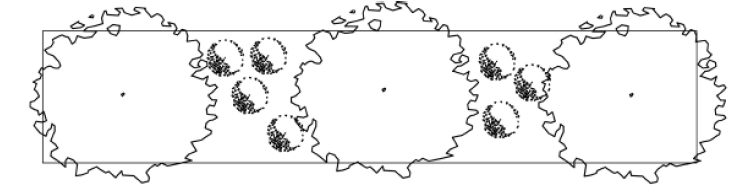
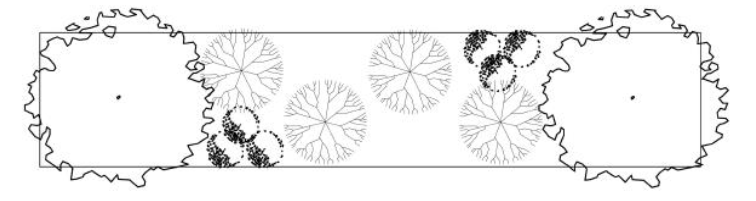
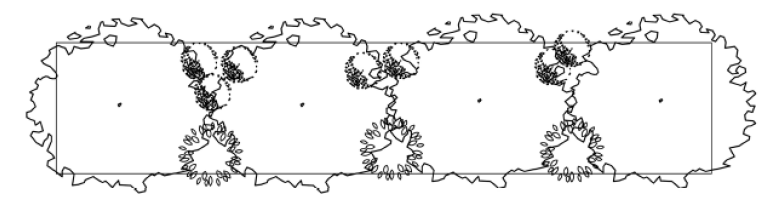
When a B-2 parcel abuts a parcel designated as RH, SE, R-1, or R-2, a type A bufferyard shall be provided as set forth in this article (exhibit 10-7).
Exhibit 10-7. Detailed Bufferyard Requirements
| A | Width | Points per 100 feet | Required fence or berm [1] | Example schematic [2] | |
|---|---|---|---|---|---|
| A-1 | 8' | 150 | Fence [3,4] |
A-4
 | |
| A-2 | 10' | 200 | |||
| A-3 | 15' | 150 | |||
| A-4 | 20' | 125 | |||
| B | |||||
| B-1 | 15' | 100 | Fence [3,4] |
B-3
 | |
| B-2 | 15' | 300 | |||
| B-3 | 20' | 200 | |||
| B-4 | 25' | 150 | |||
| B-5 | 30' | 125 | |||
| C | |||||
| C-1 | 15' | 100 | Fence [3,4] |
C-3
 | |
| C-2 | 15' | 350 | |||
| C-3 | 20' | 250 | |||
| C-4 | 25' | 200 | |||
| C-5 | 30' | 175 | |||
| C-6 | 30' | 125 | 4' berm | ||
Notes:
1.
A dash "-" means not applicable.
2.
All schematics are intended to be illustrative.
3.
When a fence is used, at least 50 percent of the required plant materials shall be located on the exterior side (the side away from the center of the subject property) of the fence. If at the time of development, there is a fence on the adjoining property, this planting requirement shall not apply.
4.
When a fence is used to enclose an activity or storage area, a fence may not be used in the bufferyard.
(Ord. No. 2020-O-48, § 1(Exh. A), 9-16-2020)

