
Mukwonago Town City Zoning Code
ARTICLE XI
NONCONFORMITIES
Sec. 36-1501.- Legislative findings.
The town board makes the following legislative findings relating to nonconformities:
(1)
There may exist lots, structures, and uses in the town that were lawfully established but that do not now comply with one or more provisions of the district in which they are located.
(2)
It is reasonable to generally allow, but not encourage, legal nonconforming uses to continue until such time as they are removed or discontinued.
(3)
State law permits the reconstruction of legal nonconforming structures under certain circumstances.
(Ord. No. 2020-O-48, § 1(Exh. A), 9-16-2020)
Sec. 36-1502. - Official registry of legal nonconforming lots, structures, signs, and uses.
(a)
Content of registry. The zoning administrator is authorized to develop and maintain a registry of:
(1)
Lots known by him or her to be considered legal nonconforming;
(2)
Structures known by him or her to be considered legal nonconforming;
(3)
Signs known by him or her to be considered legal nonconforming; and
(4)
Land uses registered as a legal nonconforming use consistent with the requirements in article V.
(b)
Form of registry. At the discretion of the zoning administrator, the registry may consist of either a written list or digital records.
(c)
Disclaimer. Given the nature of the registry, the town does not warrant that such information is complete and/or accurate in all respects.
(Ord. No. 2020-O-48, § 1(Exh. A), 9-16-2020)
Sec. 36-1503. - Legal nonconforming lots.
(a)
Generally. A legal nonconforming lot may be used for an allowable use, provided such use complies with all other development standards of the zoning district in which the lot is located.
(b)
Alteration of property boundary lines. The location of a property boundary line of a legal nonconforming lot shall not be modified by any means, except as follows. When the new property boundary line location will make the legal nonconforming lot to be conforming or lessen the nonconformity, any such change in a property boundary location, may be approved upon application of the property owner to the town board, if the town board finds the change to be consistent with the intent of this chapter after first having received a recommendation of the plan commission. All requirements of the town's land division regulations shall also be followed, which may be more restrictive. If the boundary change is made and the resulting lot still does not conform to the requirements of this chapter, the lot shall continue to be legal nonconforming.
(Ord. No. 2020-O-48, § 1(Exh. A), 9-16-2020)
Sec. 36-1504. - Legal nonconforming structures.
(a)
Generally. A legal nonconforming structure may be used for any conforming use.
(b)
Enlargement. A legal nonconforming structure that is used for a conforming use may be enlarged consistent with the requirements in division 21 of article V provided the expansion complies with all other requirements of this chapter.
(c)
Building addition within offset.
(1)
The plan commission may grant a special exception, pursuant to the procedures outlined in division 11 of article V, authorizing the construction of a building addition within an offset area provided:
a.
The building to which it is attached is located within an offset area;
b.
The existing building was legally established;
c.
The use of the building is legal conforming;
d.
The addition is in compliance with the height limitations of the zoning district in which it is located, and is not greater in height than the contiguous portion of the existing building;
e.
The addition does not extend closer to the side or rear lot line than the existing building to which it is attached;
f.
The addition does not extend into an offset area the building does not currently encroach upon;
g.
The addition is not within an area of a shore setback or a setback from the C-1 zoning district; and
h.
The addition complies with all other dimensional standards that may apply.
(2)
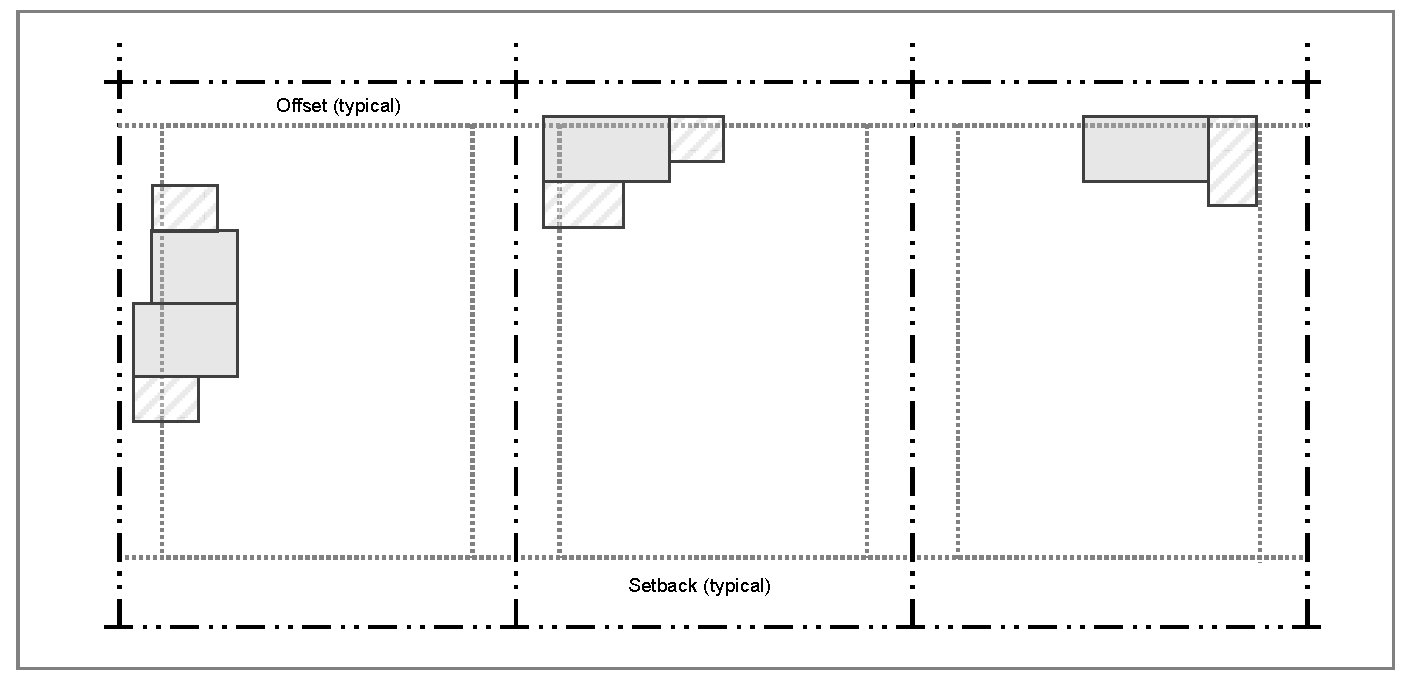
See figure 11-1 for examples of permissible additions. In making its decision, the plan commission should consider the following factors, in addition to those factors listed in subsection 36-424.
a.
The size and location of the existing legal non-conforming structure.
b.
The size and location of any other structure on the subject property.
c.
The size and location of the proposed expansion.
d.
The necessity of constructing the addition within the offset.
e.
The proximity of buildings and other structures on adjoining properties.
Figure 11-1. Examples of permissible expansions within an offset area
(d)
Reconstruction following damage. A legal nonconforming structure that is damaged by violent wind, vandalism, fire, flood, ice, snow, mold, or infestation on or after March 2, 2006, may be restored to its condition (size, location, and use) prior to the damage, except the structure may be larger when necessary to comply with state or federal requirements.
(e)
Unsafe conditions, ordinary maintenance, and remodeling. Nothing in this article shall be deemed to prevent the strengthening or restoring to a safe condition of any structure or part thereof, ordinary repair and maintenance, or remodeling that does not change any exterior physical dimension to the structure provided that the work conforms to the provisions in this chapter.
(Ord. No. 2020-O-48, § 1(Exh. A), 9-16-2020)
State Law reference— Wis. Stats. § 62.23(7)(hc).
Sec. 36-1505. - Legal nonconforming uses.
(a)
Generally. A legal nonconforming use may continue to exist so long as it remains otherwise lawful, subject to the provisions in this section.
(b)
Conditional use. Any conditional use approval granted pursuant to conditional use authority that has since been repealed and that was in effect, and the use was in operation on the date of such repeal, that is no longer an allowed use of the property, shall be allowed to continue as a conditional use subject to all conditions stated in the conditional use approval. Any such conditional use approval that requires compliance with a section of the town's zoning regulations that has since been repealed, shall continue to require compliance with the referenced code section as it existed immediately prior to such repeal and the repeal of such provision is stayed solely for such existing conditional use permit(s). These continuation provisions are intended to preserve the status quo for all rights and responsibilities incurred or accrued prior to the adoption of any ordinance that changes a conditional use to a prohibited use. Nothing herein shall be interpreted to prevent existing conditional use permit holders from applying to amend their conditional use pursuant to all laws in effect at the time of the application, or as set forth in the conditional use permit including those amendments requiring a public hearing.
(c)
Cessation of use. If a legal nonconforming use ceases for any reason, whether intentional or otherwise, for more than 12 continuous months such use shall not be reestablished. A business of a seasonal nature shall not be deemed to be discontinued during periods in which it is normally inactive (e.g., marinas, summer camps). If the zoning administrator determines that a legal nonconforming use has ceased to operate for more than the aforementioned time period, he or she may initiate the process established under article V to terminate the legal nonconforming use. Regardless of whether the town formally terminates the use, however, the use shall not be reestablished if the use has ceased to operate for more than the aforementioned time period. If a temporary structure houses a legal nonconforming use, such use shall terminate when the temporary structure is removed.
(d)
Change in extent. Except as may be provided in this article or in state law, a legal nonconforming use shall not be enlarged, increased, or expanded and shall not occupy a greater area than what existed on the effective date of this chapter or any amendment thereto that created the nonconforming use.
(e)
Limitation on structural alterations. Structural alterations to a structure housing a legal nonconforming use shall not exceed, on an accumulative percentage basis, 50 percent of the assessed value of such structure. For example, if a property owner makes structural alterations, the cost of which equals 40 percent of the current assessed value of the structure, any additional structural alterations are limited to 10 percent of the assessed value at the time of the work.
(f)
Damage to structure housing nonconforming use. If a structure housing a legal nonconforming use is damaged beyond 50 percent of its present assessed value, such structure shall be razed and removed, and not be rebuilt.
(g)
Change of location. A legal nonconforming use shall not be moved in whole or in part to any other portion of the lot or to another structure than what was occupied on the effective date of this chapter or any amendment thereto that created the nonconforming use.
(h)
Casual, occasional, accessory, or incidental use. Casual, occasional, accessory, or incidental use after the primary legal nonconforming use has terminated, shall not be deemed to perpetuate a nonconforming use.
(i)
Change of production. A change in the method or quantity of production and the incorporation of new technology into a legal nonconforming use is permitted provided the original character of the use remains the same.
(j)
Termination due to effects on public health, safety and welfare. In the event the zoning administrator determines that a legal nonconforming use, regardless of its duration, is harmful to the public health, safety, or welfare, or creates a public nuisance, he or she shall follow the procedure outlined in article V relating to termination of a use.
(k)
Unsafe conditions. Nothing in this chapter shall be deemed to prevent the strengthening or restoring to a safe condition of any structure or part thereof, provided that such work conforms to the provisions in this chapter and the cost of such work does not exceed the limits established in (d) or (e) above.
(l)
Licensing. The operator of a legal nonconforming use shall obtain such licenses as may be required by the state, or its designated agent; the county; or the town, and maintain such licenses for the life of the use or until the entity no longer requires such license.
(m)
Other limitations. If a property contains a nonconforming use, no new land uses are allowed, including those that are otherwise permitted by right in the zoning district, except with the approval of the town board.
(Ord. No. 2020-O-48, § 1(Exh. A), 9-16-2020)
State Law reference— Wis. Stats. § 62.23(7)(h).
Case Law reference— Town of Delafield v. Sharpley, 212 Wis. 2d 332, 568 N.W.2d 779 (Ct. App. 1997, 96-2458).
Sec. 36-1506. - Conversion of a legal nonconforming use.
(a)
Generally. Subject to the requirements in division 9 of article V, a legal nonconforming use may be converted to a different nonconforming use.
(b)
Effect of conversion approval. Any legal nonconforming use that has been converted shall continue to be subject to all applicable provisions related to legal nonconforming uses and to the conversion order as approved by the town board.
(Ord. No. 2020-O-48, § 1(Exh. A), 9-16-2020)

