
Mukwonago Town City Zoning Code
APPENDIX B
LAND USES
1 Agriculture
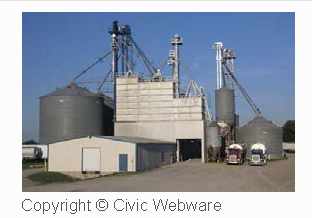
1.01 Agriculture support services
Description: A place primarily involved in (1) providing agricultural supplies, agricultural equipment, agricultural inputs, or agricultural services; (2) storing, processing, or handling raw agricultural commodities; (3) slaughtering livestock; (4) marketing livestock; and/or (5) processing agricultural byproducts or wastes. Examples include (1) a grain warehouse, potato warehouse, or other warehouse that stores raw agricultural commodities received from farms; (2) a dairy plant that processes or handles milk from farms; (3) a meat slaughter establishment; (4) a food processing plant that processes raw agricultural commodities received from farms; (5) a feed mill that processes raw agricultural commodities or agricultural by-products received directly from farms, or supplies animal feed directly to farms; (6) communal manure digester, pelletizing plant, or other facility that processes raw agricultural commodities, agricultural by-products or agricultural wastes (received directly from farms) to produce fuel or other products; (7) a facility that provides farm inputs such as fertilizer, pesticides, seed, or feed directly to farms; and (8) a facility that is primarily engaged in providing agronomic or veterinary services to farms. The term does not include a sawmill, an ethanol plant, a rendering plant, or a bio-diesel plant.
Parking Requirements: 1 space for each employee on the largest work shift.
Supplemental Standards:
(a) Location. Such use shall not be located in, or adjacent to, an existing or platted residential subdivision. If such use is established prior to September 16, 2020, the adjoining lands may be platted for residential subdivisions after that date.
(b) Long-term use. This use shall be located in an area of the town that is anticipated to remain commercially viable for agricultural land uses over the long term.
(c) Offsets. All buildings, structures, and outdoor storage areas shall be located at least 100 feet from all side and rear lot lines.
(d) Screening. When allowed as a conditional use, there must be a type "B" bufferyard along any adjoining parcel in a residential zoning district. The plan commission may waive this requirement, defer the requirement to a later date, or lessen the standard when deemed unnecessary given the location of the use on the subject property and/or proximity to other existing and potential land uses.
(e) Application fee. This use is classified as a Type 2 conditional use in the fee schedule.

1.02 Animal production, general
Description: An agricultural operation where animals not exceeding 500 animal units are kept.
Parking Requirements: 1 space for each employee on the largest work shift.
Supplemental Standards:
(a) Not in a subdivision. The parcel with this use shall not be located in a platted subdivision.
(b) Number of animals. The number of livestock and fowl is based on the lot area, but not exceeding 500, as follows: 1 head for the first 3 acres and 1 head for each additional acre over 3 and 10 fowl for the first 3 acres and 10 fowl for each additional acre over 3.
(c) Location of new buildings. A building that houses domestic livestock, poultry, or horses shall not be located within a floodplain or closer than 50 feet to any existing dwelling unit or any lot line.
(d) Fencing. Any area where poultry, domestic livestock, or horses are allowed to pasture or run shall be adequately fenced to keep them confined to such area.
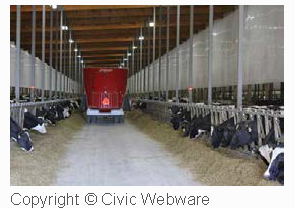
1.03 Animal production, intensive
Description: An agricultural operation where animals, 500 animal units or more, are kept.
Parking Requirements: 1 space for each employee on the largest work shift.
Supplemental Standards:
(a) Legislative findings. The town board makes the following legislative findings regarding livestock facilities:
(1) The state legislature adopted Wis. Stats. § 93.90, (Livestock Facility Siting Law) to govern livestock facilities, which is implemented by administrative rule under Wis. Admin. Code ch. ATCP 51.
(2) The Livestock Siting Law gives local jurisdictions the authority to review livestock facilities with 500 animal units or more as a conditional use.
(b) Minimum lot area. The facility shall only occur on a parcel of land that is 40 acres or larger. Once this use is established, the parcel shall not be made smaller through a lot line relocation or other means, except as may be approved by the plan commission as a special exception consistent with the procedures and requirements in article of this chapter.
(c) Not in a subdivision. The parcel with this use shall not be located in a platted subdivision.
(d) Road access. The property shall front on and have direct vehicle access to a major road as depicted on the zoning map.
(e) Location of livestock structures, except livestock waste storage structures. A livestock structure approved after September 16, 2020, except livestock waste storage structures, shall comply with the standards in Table 1 based on the number of animal units associated with the facility.
Table 1. General siting standards
(e) Location of livestock waste storage structures. A livestock waste storage structure approved after September 16, 2020, shall be located at least 350 feet from a property boundary. If any portion of an existing structure is closer than 350 feet from a lot line, such structure may be expanded, provided the expansion is not located any closer to the lot line than the existing structure. A single new livestock waste storage structure may be constructed closer than 350 feet if such structure (1) is located on the same tax parcel as a livestock waste storage structure in existence before May 1, 2006, (2) is not larger than the existing structure, (3) is no further than 50 feet from the existing structure, and (4) is no closer to the lot line than the existing structure. An existing structure that does not meet the setback standards in this subsection may be expanded provided such expansion is not located any closer to the lot line than the existing structure.
(f) Wells. All water wells located within a livestock facility shall comply with Wis. Admin. Code chs. NR 811 and 812.
[1] New or substantially altered livestock structures shall be separated from existing wells by the distances required in Wis. Admin. Code chs. NR 811 and 812, regardless of whether the livestock facility operator owns the land on which the wells are located. A livestock structure in existence on May 1, 2006 may be altered as long as the alteration does not reduce the distance between the livestock structure and an existing well.
(g) Application fee. This use is classified as a Type 2 conditional use in the fee schedule.
[1] Commentary: These administrative rules include standards for water well placement and construction.
1.04 Aquaculture
Description: A place where fish, bait, and other aquatic animals are produced for a commercial purpose.
Parking Requirements: 1 space for each employee on the largest work shift.
Supplemental Standards:
(a) Not in a subdivision. The parcel with this use shall not be located in a platted subdivision.
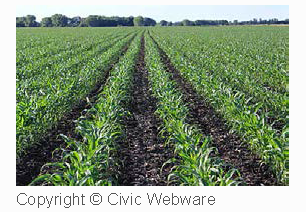
1.05 Crop production
Description: A place where fruit, vegetables, agricultural crops and forage, and other plants are grown out of doors.
Parking Requirements: On-site parking is not required.
Supplemental Standards:
(a) Location. The raising of crops may occur within setbacks and/or offsets.
(b) Buildings. A building related to the raising of crops shall only be allowed in an agricultural zoning district.
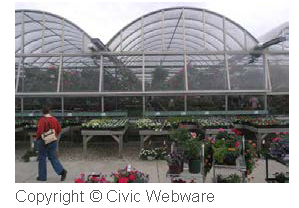
1.06 Greenhouse
Description: A place where fruit, vegetables, flowers, and other types of plants are grown within an enclosed building for commercial purposes, whether using sunlight or artificial lighting. Plants grown on site may be sold at retail along with other related merchandise provided the sale of such merchandise is clearly subordinate to the sale of plants.
Parking Requirements: 1 space for each employee on the largest work shift.
Supplemental Standards:
(a) Not in a subdivision. The parcel with this use shall not be located in a platted subdivision.
(b) Light shades. When a greenhouse uses supplemental lighting for growing purposes, shades must be used from sundown to sunrise to prevent sky glow.
1.07 Horticulture
Description: A place where trees, shrubs, vegetables, and flowers are grown out of doors for commercial purposes.
Parking Requirements: 1 space for each employee on the largest work shift.
Supplemental Standards: There are no supplemental development standards that apply to this specific land use.
_____
2 Agri-Tourism
2.01 Agro-ecology center
Description: A facility designed for the purpose of providing training in the techniques of agro-ecology, sustainable agricultural systems, and similar disciplines. An agro-ecology center generally conducts (theoretical and applied) research and community outreach while offering academic education, practical experience/training, and public service/instruction opportunities for audiences ranging from local school children to international agencies. Such a facility may provide meals and overnight lodging facilities for faculty, staff, and/or students/apprentices.
Parking Requirements: Established by the Plan Commission on a case-by-case basis.
Supplemental Standards:
(a) Minimum lot size. The minimum lot size for an agro-ecology center is 40 acres.
(b) Not in a subdivision. The parcel with this use shall not be located in a platted subdivision.
(c) Limitation on guest rooms. An agro-ecology center is limited to a maximum of 20 guest rooms.
(d) Limitations on other uses. A property with an agro-ecology center shall not include any other type of overnight accommodation.
(e) Proximity. A building housing guest rooms shall not be located closer than 150 feet to any perimeter boundary line and in no case located closer than 300 feet to an existing dwelling on an adjoining parcel of land.
(f) Parking. Parking areas shall be located and configured to minimize potential conflicts with surrounding properties.
(g) Screening. When allowed as a conditional use, there must be a type "B" bufferyard along any adjoining parcel in a residential zoning district. The plan commission may waive this requirement, defer the requirement to a later date, or lessen the standard when deemed unnecessary given the location of the use on the subject property and/or proximity to other existing and potential land uses.
(h) Buildings. Any building associated with an agro-ecology center shall not be located in a C-1 district.
(i) Road access. The property must front on and have direct vehicle access to a major road as depicted on the zoning map.
(j) On-site access drive. The facility shall be served by an on-site access drive that meets the design and construction standards for a town road (e.g., two lanes each 12 feet wide). The plan commission may waive the requirement for a two-lane drive and allow a single-lane drive when the commission deems the wider drive unnecessary given the location of the use on the subject property, the number and type of vehicles using the drive, and other related considerations. If the plan commission allows a single-lane drive, the commission reserves the right to require a two-lane drive at a later date and may require intermediate turnarounds/turnouts every 1,200 feet and impose other design features it deems necessary to ensure public safety.
(k) Application fee. This use is classified as a Type 2 conditional use in the fee schedule.
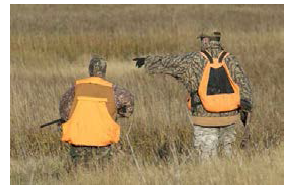
2.02 Bird hunting preserve
Description: A place where game birds are released into the wild for commercial hunting purposes.
Parking Requirements: Established by the Plan Commission on a case-by-case basis.
Supplemental Standards:
(a) Minimum lot area. The minimum lot area for bird hunting preserve is 60 acres. The acreage of adjoining parcels, which are part of a single farm entity as determined by the Plan Commission, may be combined for the purpose of meeting the minimum lot size requirements.
(b) Not in a subdivision. The parcel with this use shall not be located in a platted subdivision.
(c) Other approvals. The operator shall obtain and maintain all approvals as may be required by the state of Wisconsin.
(d) Location of hunting areas. Areas open to hunting must be at least 300 feet from surrounding properties and otherwise configured to minimize potential conflicts with surrounding properties.
(e) Parking. Parking areas shall be located and configured to minimize potential conflicts with surrounding properties.
(f) Buildings. Any building associated with a bird hunting preserve shall not be located in a C-1 district.
(g) Application fee. This use is classified as a Type 1 conditional use in the fee schedule.
2.03 Craft brewery, winery, or distillery
Description: An establishment where beer, malt beverages, wine and/or spirits are made on the premises in comparatively small batches and then sold onsite and/or distributed off-site.
Parking Requirements: Established by the Plan Commission on a case-by-case basis.
Supplemental Standards:
(a) Minimum lot area. If the operator resides on the premises, the minimum lot area for a craft brewery, winery, or distillery is 10 acres. If the operator does not reside on the premises, the minimum lot area for a craft brewery, winery, or distillery is 20 acres.
(b) Not in a subdivision. The parcel with this use shall not be located in a platted subdivision.
(c) Other licenses/approvals. The property owner shall obtain all required liquor licenses/permits from the Town of Mukwonago and all necessary permits and approvals from the state of Wisconsin as may be required.
(d) Tasting room. A craft brewery, winery, or distillery may also include a tasting room as may be specified in an approval by the town board.
(e) Parking areas. Parking areas shall be located and configured to minimize potential conflicts with surrounding properties.
(f) Screening. When allowed as a conditional use, there must be a type "B" bufferyard along any adjoining parcel in a residential zoning district. The plan commission may waive this requirement, defer the requirement to a later date, or lessen the standard when deemed unnecessary given the location of the use on the subject property, proximity to other existing and potential land uses.
(g) Road access. The property shall front on and have direct vehicle access to a major road as depicted on the zoning map.
(h) On-site access drive. The facility shall be served by an on-site access drive that meets the design and construction standards for a town road (e.g., two lanes each 12 feet wide). The plan commission may waive the requirement for a two-lane drive and allow a single-lane drive when the commission deems the wider drive unnecessary given the location of the use on the subject property, the number and type of vehicles using the drive, and other related considerations. If the plan commission allows a single-lane drive, the commission reserves the right to require a two-lane drive at a later date and may require intermediate turnarounds/turnouts every 1,200 feet and impose other design features it deems necessary to ensure public safety.
(i) Application fee. This use is classified as a Type 2 conditional use in the fee schedule.
2.04 Farm education
Description: A place where farm tours and how-to clinics or classes are conducted which are directly related to farming, farm life, or food (e.g., gardening, cooking, canning produce, jam-making, candle making, soap making, flower arranging, quilting).
Parking Requirements: Established by the Plan Commission on a case-by-case basis.
Supplemental Standards:
(a) Validity of use. Farm education must be operated as an ancillary use in conjunction with an active farm operation.
(b) Minimum lot area. The minimum lot area for farm education is 10 acres. The acreage of adjoining parcels, which are part of a single farm entity as determined by the Plan Commission, may be combined for the purpose of meeting the minimum lot size requirements.
(c) Not in a subdivision. The parcel with this use shall not be located in a platted subdivision.
(d) Subordinate to other farm uses. Any buildings that are constructed to house clinics or classes shall be clearly subordinate to the other farm buildings on the property.
(e) Parking. Parking areas shall be located and configured to minimize potential conflicts with surrounding properties.
(f) Screening. When allowed as a conditional use, there must be a type "B" bufferyard along any adjoining parcel in a residential zoning district. The plan commission may waive this requirement, defer the requirement to a later date, or lessen the standard when deemed unnecessary given the location of the use on the subject property and/or proximity to other existing and potential land uses.
(g) Buildings. Any building associated with farm education shall not be located in a C-1 district.
(h) Application fee. This use is classified as a Type 1 conditional use in the fee schedule.
2.05 Farm inn
Description: A place where guest rooms are offered to agri-tourists who are able to observe or participate in farm chores and learn how a farm functions through practical day-to-day experience. Guests may work on the farm, for recreational purposes, in exchange for free or discounted accommodations. A farm inn may also include a common dining area for overnight guests and non-guests.
Parking Requirements: 1 space for each guest room.
Supplemental Standards:
(a) Validity of use. A farm inn must be operated as an ancillary use in conjunction with an active farm operation.
(b) Minimum lot size. The minimum lot size for a farm inn is 40 acres. The acreage of adjoining parcels, which are part of a single farm entity as determined by the Plan Commission, may be combined for the purpose of meeting the minimum lot size requirements.
(c) Not in a subdivision. The parcel with this use shall not be located in a platted subdivision.
(d) Limitation on guest rooms. A farm inn is limited to a maximum of 4 guest rooms.
(e) Length of stay. The maximum stay for any occupant is 14 consecutive days.
(f) Limitations on other uses. A property with a farm inn shall not include any other type of overnight accommodation.
(g) Proximity. A building housing guest rooms shall not be located closer than 150 feet to any perimeter boundary line and in no case located closer than 300 feet to an existing dwelling on an adjoining parcel of land.
(h) Parking. Parking areas shall be located and configured to minimize potential conflicts with surrounding properties.
(i) Application fee. This use is classified as a Type 2 conditional use in the fee schedule.
2.06 Farm recreation
Description: One or more of the following or similar activities: sleigh/hay rides, corn maze, haunted house, ropes course, pumpkin cannons, zip lines, paint ball courses, and obstacle courses.
Parking Requirements: Established by the Plan Commission on a case-by-case basis.
Supplemental Standards:
(a) Validity of use. Farm recreation must be operated as an ancillary use in conjunction with an active farm operation.
(b) Minimum lot area. The minimum lot area for farm recreation is 20 acres. The acreage of adjoining parcels, which are part of a single farm entity as determined by the Plan Commission, may be combined for the purpose of meeting the minimum lot size requirement.
(c) Not in a subdivision. The parcel with this use shall not be located in a platted subdivision.
(d) Activity areas. Activity areas shall be located and configured to minimize potential conflicts with surrounding properties.
(e) Parking. Parking areas shall be located and configured to minimize potential conflicts with surrounding properties.
(f) Screening. When allowed as a conditional use, there must be a type "B" bufferyard along any adjoining parcel in a residential zoning district. The plan commission may waive this requirement, defer the requirement to a later date, or lessen the standard when deemed unnecessary given the location of the use on the subject property and/or proximity to other existing and potential land uses.
(g) Road access. The property must front on and have direct vehicle access to a major road as depicted on the zoning map.
(h) Application fee. This use is classified as a Type 2 conditional use in the fee schedule.
2.07 Farm restaurant
Description: A place where food and beverages are offered for retail sale primarily for on-site consumption, and where the on-site consumption of fermented malt beverages, wine, or liquor, if any, is clearly secondary and subordinate to the sale of food and nonalcoholic beverages. A farm restaurant may also prepare food as part of a catering business.
Parking Requirements: Established by the Plan Commission on a case-by-case basis.
Supplemental Standards:
(a) Validity of use. A farm restaurant must be operated as an ancillary use in conjunction with an active farm operation.
(b) Minimum lot area. The minimum lot area for a farm restaurant is 20 acres. The acreage of adjoining parcels, which are part of a single farm entity as determined by the Plan Commission, may be combined for the purpose of meeting the minimum lot size requirements.
(c) Not in a subdivision. The parcel with this use shall not be located in a platted subdivision.
(d) Subordinate to other farm uses. Any building that is constructed for a farm restaurant shall be clearly subordinate to the other farm buildings on the property.
(e) Road access. The property must front on and have direct vehicle access to a major road as depicted on the zoning map.
(f) Parking areas. Parking areas shall be located and configured to minimize potential conflicts with surrounding properties.
(g) Screening. When allowed as a conditional use, there must be a type "B" bufferyard along any adjoining parcel in a residential zoning district. The plan commission may waive this requirement, defer the requirement to a later date, or lessen the standard when deemed unnecessary given the location of the use on the subject property and/or proximity to other existing and potential land uses.
(h) Application fee. This use is classified as a Type 2 conditional use in the fee schedule.
2.08 Farm store
Description: A retail outlet that features agricultural products and goods derived from the farm on which the farm store is located and other farms in the region. Non-agriculturally related products such, as T-shirts, other clothing, and knick-knacks, may be offered so long as such products are clearly subordinate in number and scale to the featured agricultural products and goods.
Parking Requirements: Established by the Plan Commission on a case-by-case basis.
Supplemental Standards:
(a) Validity of use. A farm store must be operated as an ancillary use in conjunction with an active farm operation.
(b) Minimum lot area. The minimum lot area for a farm store is 20 acres. The acreage of adjoining parcels, which are part of a single farm entity as determined by the Plan Commission, may be combined for the purpose of meeting the minimum lot size requirements.
(c) Not in a subdivision. The parcel with this use shall not be located in a platted subdivision.
(d) Subordinate to other farm uses. Any building that is constructed for a farm store shall be clearly subordinate to the other farm buildings on the property.
(e) Parking areas. Parking areas shall be located and configured to minimize potential conflicts with surrounding properties.
(f) Road access. The property shall front on and have direct vehicle access to a major road as depicted on the zoning map.
(g) Screening. When allowed as a conditional use, there must be a type "B" bufferyard along any adjoining parcel in a residential zoning district. The plan commission may waive this requirement, defer the requirement to a later date, or lessen the standard when deemed unnecessary given the location of the use on the subject property and/or proximity to other existing and potential land uses.
(h) Application fee. This use is classified as a Type 2 conditional use in the fee schedule.

2.09 Fee fishing
Description: An operation that provides the opportunity for anglers to pay a fee for the right to fish on a farm.
Parking Requirements: Established by the Plan Commission on a case-by-case basis.
Supplemental Standards:
(a) Minimum lot area. The minimum lot area for fee fishing is 5 acres.
(b) Not in a subdivision. The parcel with this use shall not be located in a platted subdivision.
(c) Buildings. Any building that is constructed for a fee fishing operation shall be clearly subordinate to the other farm buildings on the property.
(d) Activity areas. Activity areas shall be located and configured to minimize potential conflicts with surrounding properties.
(e) Parking areas. Parking areas shall be located and configured to minimize potential conflicts with surrounding properties.
(f) Application fee. This use is classified as a Type 1 conditional use in the fee schedule.
2.10 Glamorous camping (Glamping)
Description: A facility that is an integral part of an ongoing agricultural operation that provides the opportunity for agri-tourists to rent, on a nightly basis, fully furnished tents and/or rustic cabin sites that are characterized by furnishings, amenities, and comforts typically offered in a luxury hotel room. Furnishings, amenities, and comforts may include luxurious décor, beds, linens, baths, veranda, spa services, concierge, dining, and chef.
Parking Requirements: 1 space for each site.
Supplemental Standards:
(a) Validity of use. Glamping must be operated as an ancillary use in conjunction with an active farm operation.
(b) Minimum lot area. The minimum lot area for glamping is 40 acres. The acreage of adjoining parcels, which are part of a single farm entity as determined by the Plan Commission, may be combined for the purpose of meeting the minimum lot size requirements.
(c) Not in a subdivision. The parcel with this use shall not be located in a platted subdivision.
(d) Limitations on other uses. A property with glamping shall not include any other type of overnight accommodation.
(e) Maximum number of tents or cabins. The maximum number of tents or cabins is limited to 12, plus 2 for each 10 acres in excess of 40 acres.
(f) Maximum occupancy. Occupancy shall not exceed 6 persons per tent or cabin.
(g) Length of stay. The maximum stay for any occupant is 14 consecutive days.
(h) Meals. Meals, if provided by the operator, shall only be served to overnight guests.
(i) Location of tents and cabins. Tents and cabins shall (1) be completely screened from street view, (2) not located closer than 300 feet to any perimeter boundary line, and (3) not located in a C-1 district.
(j) Buildings. Any building associated with a glamorous camping operation shall not be located in a C-1 district.
(k) State permit. Prior to the establishment of a glamping operation, the operator shall obtain a permit from the Wisconsin Department of Health and Family Services, or the department's agent, as required by state law and maintain such permit for the life of the use or until the state no longer requires such permit. [1]
(l) Application fee. This use is classified as a Type 2 conditional use in the fee schedule.
[1] Commentary: See Wis. Admin. Code ch. DHS 178.
2.11 Health spa
Description: A facility offering proactive health and wellness education and/or physical exercise and diet regimens that can, in a rural environment, improve one's quality of life. Health and wellness opportunities may consist of general and specialized exercise, wellness, and nutritional classes/consultations, organic cooking classes/workshops, yoga, meditation, and massage. A health spa may include overnight lodging and may serve meals only when served to participating clientele.
Parking Requirements: Established by the Plan Commission on a case-by-case basis.
Supplemental Standards:
(a) Minimum lot area. The minimum lot area for a health spa is 40 acres.
(b) Not in a subdivision. The parcel with this use shall not be located in a platted subdivision.
(c) Limitation on guest rooms. A health spa is limited to a maximum of 10 guest rooms.
(d) Limitations on other uses. A property with a health spa shall not include any other type of overnight accommodation.
(e) Length of stay. Any guest is limited to a maximum of overnight stays 14 in a calendar year.
(f) Proximity. A building housing guest rooms shall not be located closer than 150 feet to any perimeter boundary line and in no case located closer than 300 feet to an existing dwelling on an adjoining parcel of land.
(g) Buildings. Any building associated with a health spa shall not be located in a C-1 district.
(h) Activity areas. Activity areas shall be located and configured to minimize potential conflicts with surrounding properties.
(i) Parking areas. Parking areas shall be located and configured to minimize potential conflicts with surrounding properties.
(j) Screening. When allowed as a conditional use, there must be a type "B" bufferyard along any adjoining parcel in a residential zoning district. The plan commission may waive this requirement, defer the requirement to a later date, or lessen the standard when deemed unnecessary given the location of the use on the subject property and/or proximity to other existing and potential land uses.
(k) Road access. The property must front on and have direct vehicle access to a major road as depicted on the zoning map.
(l) Application fee. This use is classified as a Type 2 conditional use in the fee schedule.
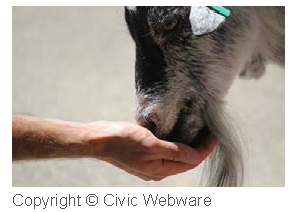
2.12 Petting farm
Description: An operation where the public is invited to pet and touch farm animals, but not exotic animals.
Parking Requirements: Established by the Plan Commission on a case-by-case basis.
Supplemental Standards:
(a) Validity of use. A petting farm must be operated as an ancillary use in conjunction with an active farm operation.
(b) Minimum lot size. The minimum lot size for a petting farm is 20 acres.
(c) Not in a subdivision. The parcel with this use shall not be located in a platted subdivision.
(d) Location of buildings. A building that houses animals shall be located at least 50 feet from any lot line.
(e) Parking areas. Parking areas shall be located and configured to minimize potential conflicts with surrounding properties.
(f) Screening. When allowed as a conditional use, there must be a type "B" bufferyard along any adjoining parcel in a residential zoning district. The plan commission may waive this requirement, defer the requirement to a later date, or lessen the standard when deemed unnecessary given the location of the use on the subject property and/or proximity to other existing and potential land uses.
(g) Application fee. This use is classified as a Type 1 conditional use in the fee schedule.
2.13 U-Cut Christmas tree operation
Description: A place where customers can harvest their own Christmas tree.
Parking Requirements: Established by the Plan Commission on a case-by-case basis.
Supplemental Standards:
(a) Minimum lot size. The minimum lot size for a U-cut Christmas tree operation is 5 acres.
(b) Not in a subdivision. The parcel with this use shall not be located in a platted subdivision.
(c) Parking areas. Parking areas shall be located and configured to minimize potential conflicts with surrounding properties.
(d) Application fee. This use is classified as a Type 1 conditional use in the fee schedule.

2.14 U-Pick operation
Description: A farm operation where customers can pick or harvest fruits, flowers, and vegetables directly from the plants grown on the premises.
Parking Requirements: Established by the Plan Commission on a case-by-case basis.
Supplemental Standards:
(a) Minimum lot area. The minimum lot area for a u-pick operation is 5 acres.
(b) Not in a subdivision. The parcel with this use shall not be located in a platted subdivision.
(c) Parking areas. Parking areas shall be located and configured so as to minimize potential conflicts with surrounding properties.
(d) Application fee. This use is classified as a Type 1 conditional use in the fee schedule.
_____
3 Resource-based Uses
3.01 Dam
Description: An artificial barrier in or across a navigable watercourse which has the primary purpose of impounding or diverting water. A dam may include appurtenant works, such as dikes, canals, and a powerhouse.
Parking Requirements: 1 space for each employee on the largest work shift.
Supplemental Standards:
(a) State and federal compliance. A dam shall comply with all state and federal rules and regulations.
(b) Removal. A dam may be removed, provided the standards and requirements of Wis. Stats. ch. 31, are met.
(c) Safety. The owner of the dam shall comply with the safety measures required in Wis. Admin. Code § NR 33.07(3).
(d) Unsafe conditions. If it is determined that a dam is unsafe or otherwise defective, the administrator shall follow the procedure outlined in article 5 of this chapter relating to unsafe conditions.
(e) Termination of use. If the zoning administrator determines that a dam has not been operational for a continuous period of 12 months, the administrator shall follow the procedure outlined in article 5 of this chapter relating to the termination of an approval.
(f) Application fee. This use is classified as a Type 1 conditional use in the fee schedule.
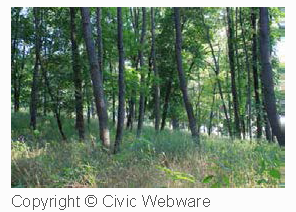
3.02 Forestry
Description: The harvesting, thinning, and planting of trees and related forest management activities whether for commercial or noncommercial purposes. The term includes temporary skidding yards necessary to store and sort logs harvested on the premises. The term does not include on-site processing and permanent skidding yards.
Parking Requirements: On-site parking is not required.
Supplemental Standards:
(a) Generally. Forest management operations shall be consistent with generally accepted forestry management practices as described in the most recent version of "Wisconsin Forest Management Guidelines," published by the Wisconsin Department of Natural Resources and identified as publication number PUB-FR-226.
(b) Removal of a tree or shrub within a defined open space area in a development project. Trees and shrubs within an area set aside as open space as part of a development project shall not be removed except as follows:
(1) A dead or dying tree or shrub may be removed when it poses a threat to public health and safety.
(2) The removal of trees and shrubs is done consistent with a landscape management plan as prepared by a registered landscape architect, an arborist, or a forester and as approved by the zoning administrator.
(3) Vegetation listed by the Wisconsin Department of Natural Resources as an invasive species under Wis. Admin. Code ch. NR 40 may be removed without prior approval.
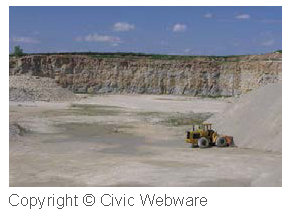
3.03 Limited nonmetallic mine
Description: A place where nonmetallic minerals are removed from the ground by any method for use on-site or off-site for no more than 5 years. The following activities may be associated with a nonmetallic mine: excavating and transporting nonmetallic minerals, stockpiling of nonmetallic minerals, blending of nonmetallic minerals, blasting, grading, crushing, screening, scalping, and dewatering. The term does not include (i) operations affecting less than 5 acres and for the exclusive on-site use of the property owner; (2) pre-mining activities, such as site surveying, coring, mapping and other functions necessary solely for proper preparation of the permit application; (3) excavation in conjunction with a utility installation, which is to be backfilled; (4) excavation within the limits of a public right-of-way in conjunction with road construction or reconstruction, when construction plans have been approved by the Wisconsin Department of Transportation or other governmental authority; (5) excavation which by nature is of limited duration, such as graves, septic tanks, and swimming pools; (6) agricultural drainage work incidental to agricultural operations and irrigation/stock watering ponds, if no material is removed from the property; (7) excavation for structures and parking areas; (8) stripping of up to 1.5 feet of topsoil for the development of subdivisions, following subdivision approval; (9) regrading of property for aesthetic purposes that does not affect existing drainage, if no material is removed from the property; (10) dredging operations under the jurisdiction of the U.S. Army Corps of Engineers or other governmental authority; (11) ponds developed for wildlife purposes in conjunction with the Natural Resources Conservation Service or the Waukesha County Land and Water Conservation Department; (12) excavation related to sod farming; (13) any mining operation, the reclamation of which is required in a permit obtained under Wis. Stats. §§ 144.80—144.94, pertaining to metallic mining; (14) activities conducted at a solid or hazardous waste disposal site required to prepare, operate, or close a solid waste disposal facility under Wis. Stats. §§ 144.435—144.445, or a hazardous waste disposal facility under Wis. Stats. §§ 144.60—144.74, for the exception of mineral extraction operations conducted for the purpose of lining, capping, or covering such disposal site; and (15) any other use determined to be exempt by the plan commission.
Parking Requirements: 1 space for each employee on the largest work shift.
Supplemental Standards:
(a) Not in a subdivision. The parcel with this use shall not be located in a platted subdivision.
(b) Air quality. The operator of a limited nonmetallic mine shall comply with Wis. Admin. Code ch. NR 415, with regard to particulate emissions.
(c) Blasting. Blasting is prohibited.
(d) Reclamation. The operator shall comply with chapter 20 of the general code of Waukesha County (Non-metallic mining reclamation).
(e) Minimization of noise, dust, and vibrations. Roads, machinery, and equipment shall be located, constructed, and used in such a manner as to minimize noise, dust, and vibrations.
(f) Hours of operation. A limited nonmetallic mine shall not be operated on Sunday and may be operated Monday through Saturday during the standard hours of operation specified below based on the proximity of the site to a residence or commercial establishment open to the public. Upon written request, the plan commission may authorize specific activities past the standard hours or operation but no later than the hour specified for limited or temporary periods taking into account the proximity and nature of adjoining uses and the extent of noise, dust, and vibration associated with the activity. Such approval shall be in writing and shall specify the time period the extended hours of operation are in effect, the activities that are permitted, and conditions, if any, the commission may impose to address off-site effects.
Permissible hours of operation for a nonmetallic mine.
(g) Locational requirements. A nonmetallic mine shall comply with the following distance requirements:
(1) 1,000 feet minimum from any dwelling
(2) 500 feet minimum from a residential zoning district
(3) 200 feet minimum from all other zoning districts
(4) 100 feet minimum from all access roads, parking, and office buildings
(5) 200 feet from all property boundary lines
(6) 50 feet minimum from all on-site access roads, parking areas, and office buildings
(h) Plan of operation. A nonmetallic mine, including those that existed before September 16, 2020, shall prepare a plan of operation for the site that includes the following:
(1) A statement of ownership of the parcel and control of the operations.
(2) A site plan, drawn to scale, showing the lateral extent of existing and proposed excavations; the location and width of all easements and right-of-way on or abutting the site; existing water bodies, water courses and drainageways and proposed modifications; estimated direction of flow or groundwater; the location of existing and proposed buildings, structures, machinery and equipment; and the location of all existing and proposed storage and stockpiling areas.
(3) Cross sections of the site, drawn to scale, that show the vertical extent of existing and proposed excavations.
(i) Transfer of permit. When an operator succeeds to the interest of another in an uncompleted site, the town board shall release the present operator of the responsibilities imposed by the permit only if:
(1) Both operators are in compliance with the requirements and standards of this section, and
(2) The new operator assumes the responsibility of the former operator's permit requirements.
(j) Financial guarantee. Prior to the establishment of a limited non-metallic mine, the property owner shall submit a financial guarantee to the town pursuant to the requirements in article 4 of this chapter in an amount equal to 110 percent of the estimated cost of site restoration identified in the restoration plan that is approved for the project.
(k) Berm. There must be a berm along any adjoining parcel in a residential zoning district. The plan commission may waive this requirement, defer the requirement to a later date, or lessen the standard when deemed unnecessary given the location of the use on the subject property and/or proximity to other existing and potential land uses.
(l) Application fee. This use is classified as a Type 2 conditional use in the fee schedule.
3.04 Open lands
Description: Land generally not in forestry or in agricultural production and may include wetland complexes and land kept undeveloped for conservation purposes. Land may be enrolled in a federal agricultural commodity payment program or in a state or federal agricultural land conservation payment program, or a similar program.
Parking Requirements: On-site parking is not required.
Supplemental Standards: There are no supplemental development standards that apply to this specific land use.
_____
4 Residential
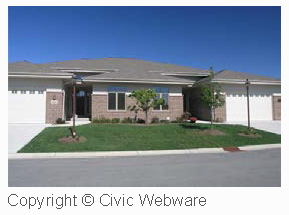
4.01 Duplex
Description: A building containing 2 dwelling units that is situated on one lot. The units may be rented or owned as in a condominium.
Parking Requirements: 2 spaces for each dwelling unit.
Supplemental Standards:
(a) Minimum lot area. The minimum lot area for a duplex is double the minimum lot size for the zoning district in which the property is located.
(b) Number of principal dwellings per parcel. No more than one duplex shall occupy any single parcel of land except as allowed under this chapter.
(c) Occupancy. A dwelling unit shall be occupied by no more than one family.
(d) Design and construction. A duplex shall meet the following standards:
(1) The roof shall have a minimum pitch of 4 to 12, except when a flat roof is integral to the architectural style of the building.
(2) Suitable roof coverings include slate, concrete, clay, or ceramic tiles; wood shingles or shakes; or metal, fiberglass, or asphalt shingles; or standing seam panels.
(3) Exterior wall surfaces shall be covered with stucco, wood siding, cement-fiber siding, vinyl siding, metal horizontal lap siding, wood shingles, or a masonry veneer.
(4) An overhang shall extend at least 12 inches beyond the face of the exterior wall, except when integral to the architectural style of the dwelling (e.g., saltbox).
(5) The building shall be set on and anchored to a continuous permanent foundation that extends around its perimeter.
The plan commission may approve a special exception, consistent with the procedures and requirements of article 5 of this chapter, to authorize the use of an exterior material not specifically allowed in this subsection.
(e) Additional offset. The minimum offset is twice the offset requirement for the zoning district in which this use is located.
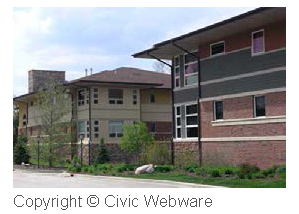
4.02 Multifamily housing
Description: A building with three to five dwelling units. The units may be rented or owned as in a condominium.
Parking Requirements: 2 spaces for each dwelling unit.
Supplemental Standards:
(a) Minimum lot area. The minimum lot area for a multifamily dwelling is equal to the minimum lot size for the zoning district in which the property is located times the number of dwelling units.
(b) Number of principal dwellings per parcel. No more than one principal residential building shall occupy any single parcel of land except as allowed under this chapter.
(c) Occupancy. A dwelling unit shall be occupied by no more than one family.
(d) Design and construction. A multifamily building shall meet the following standards:
(1) The roof shall have a minimum pitch of 4 to 12, except when a flat roof is integral to the architectural style of the building.
(2) Suitable roof coverings include slate, concrete, clay, or ceramic tiles; wood shingles or shakes; or metal, fiberglass, or asphalt shingles; or standing seam panels.
(3) Exterior wall surfaces shall be covered with stucco, wood siding, cement-fiber siding, vinyl siding, metal horizontal lap siding, wood shingles, or a masonry veneer.
(4) An overhang shall extend at least 12 inches beyond the face of the exterior wall, except when integral to the architectural style of the dwelling (e.g., saltbox).
(5) The building shall be set on and anchored to a continuous permanent foundation that extends around its perimeter.
The plan commission may approve a special exception, consistent with the procedures and requirements of article 5 of this chapter, to authorize the use of an exterior material not specifically allowed in this subsection.
(e) Garage required. A garage containing at least 240 square feet for each dwelling unit shall be built at the same time the principal building is being constructed. Such garage may be attached or detached.
(f) Access drive. The developer shall provide a two-lane road, built to town road standards, from the public road to the multi-family building.
(g) Additional offset. The minimum offset is twice the offset requirement for the zoning district in which this use is located.
(h) Application fee. This use is classified as a Type 2 conditional use in the fee schedule.
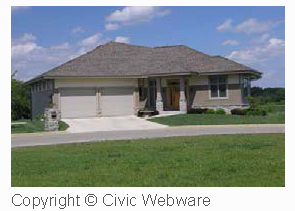
4.03 Single-family dwelling
Description: A building containing one dwelling unit that is situated on one lot and is not attached to any other dwelling unit by any means. The term includes manufactured homes, modular homes, panelized homes, pre-cut homes, and site-built homes, but excludes mobile homes.
Parking Requirements: 2 spaces for each dwelling unit
Supplemental Standards:
(a) Number of principal dwellings per parcel. No more than one principal residential building shall occupy any single parcel of land except as allowed under this chapter.
(b) Occupancy. A dwelling unit shall be occupied by no more than one family.
(c) Design and construction. A single-family dwelling shall meet the following standards:
(1) The roof shall have a minimum pitch of 4 to 12, except when a flat roof if integral to the architectural style of the dwelling.
(2) Suitable roof coverings include slate, concrete, clay, or ceramic tiles; wood shingles or shakes; or metal, fiberglass, or asphalt shingles; or standing seam panels.
(3) Exterior wall surfaces shall be covered with stucco, wood siding, cement-fiber siding, vinyl siding, metal horizontal lap siding, wood shingles, or a masonry veneer.
(4) An overhang shall extend at least 12 inches beyond the face of the exterior wall, except when integral to the architectural style of the dwelling (e.g., saltbox).
(5) The building shall be set on and anchored to a continuous permanent foundation that extends around its perimeter.
The plan commission may approve a special exception, consistent with the procedures and requirements of article 5 of this chapter, to authorize the use of an exterior material not specifically allowed in this subsection.
(d) Garage required. A garage containing at least 240 square feet shall be built at the same time the single-family dwelling is being constructed. Such garage may be attached or detached.
_____
5 Special Care Facilities
5.01 Adult family home
Description: A place licensed by the state under Wis. Stats. § 50.033(1m).
Note: An adult family home can either be a principal use or an accessory use. If the operator does not live in the residence with the adults, it is considered a principal use.
Parking Requirements: 1 space for each 2 adults the facility is licensed by the state to accommodate; plus 1 space for each employee on the largest work shift.
Supplemental Standards:
An adult family home described in Wis. Stats. § 50.01(I)(b), shall not be established within 2,500 feet of another such facility or any community living arrangement. An agent of a proposed adult family home may apply for an exception to this requirement, and the town board at its discretion may grant the exception.[1] An adult family home certified under Wis. Stats. § 50.032(1m)(b), is exempt from this provision.[2]
[1] Commentary: See Wis. Stats. § 56.69(15)(br)(1).
[2] Commentary: See Wis. Stats. § 59.69(15)(br)(2).
5.02 Community living arrangement, 8 or fewer residents
Description: Any one of the following facilities with 8 or fewer residents (1) residential care centers for children and youth, as defined in Wis. Stats. § 48.02(15d), operated by a child welfare agency licensed under Wis. Stats. § 48.60; (2) group homes for children, as defined in Wis. Stats. § 48.02(7); and (3) community-based residential facilities, as defined in Wis. Stats. § 50.01(Ig). The term does not include adult family homes, as defined in Wis. Stats. § 50.01.
Parking Requirements: 3 spaces.
Supplemental Standards:
(a) State license. Prior to the establishment of a community living arrangement, the operator must obtain a license from the state as may be required by state law and maintain such license for the life of the use or until the state no longer requires such license. [1]
(b) Occupancy. All residents of the adult family home, other than the operator or care provider and the operator or care provider's immediate family, must be disabled persons as indicated in the required state license application.
(c) Advisory committee. Prior to initial licensure of the community living arrangement by the state of Wisconsin, the applicant shall make a good faith effort to establish an ad hoc advisory committee consisting of representatives from the community living arrangement, the neighborhood in which the proposed facility will be located, and a local unit of government, in accordance with Wis. Stats. § 48.68(4), or Wis. Stats. § 50.03(4)(g), as applicable.
[1] Commentary: See Wis. Stats. subch. VII of chapter 254, and Wis. Admin. Code ch. DHS 197.
5.03 Community living arrangement, 9 to 15 residents
Description: Any one of the following facilities with 9 to 15 residents (1) residential care centers for children and youth, as defined in Wis. Stats. § 48.02(15d), operated by a child welfare agency licensed under Wis. Stats. § 48.60; (2) group homes for children, as defined in Wis. Stats. § 48.02(7); and (3) community-based residential facilities, as defined in Wis. Stats. § 50.01(Ig). The term does not include adult family homes, as defined in Wis. Stats. § 50.01.
Parking Requirements: 4 spaces.
Supplemental Standards:
(a) State license. Prior to the establishment of a community living arrangement, the operator must obtain a license from the state as may be required by state law and maintain such license for the life of the use or until the state no longer requires such license. [1]
(b) Occupancy. All residents of the adult family home, other than the operator or care provider and the operator or care provider's immediate family, must be disabled persons as indicated in the required state license application.
(c) Advisory committee. Prior to initial licensure of the community living arrangement by the state of Wisconsin, the applicant shall make a good faith effort to establish an ad hoc advisory committee consisting of representatives from the community living arrangement, the neighborhood in which the proposed facility will be located, and a local unit of government, in accordance with Wis. Stats. § 48.68(4), or Wis. Stats. § 50.03(4)(g), as applicable.
(d) Application fee. This use is classified as a Type 1 conditional use in the fee schedule.
[1] Commentary: See Wis. Stats. subch. VII of chapter 254, and Wis. Admin. Code. ch. DHS 197.
5.04 Foster home/treatment foster home
Description: A place licensed by the state for the care of foster children and which is operated by a corporation, child welfare agency, church, or other such entity.
Note: See Wis. Stats. § 48.62. A foster home and treatment foster home can either be a principal use or an accessory use. If the operator lives in the residence with the children, it is considered an accessory use.
Parking Requirements: 1 space for each employee on the largest work shift.
Supplemental Standards:
(a) State license. Prior to the establishment of a foster home or treatment foster home, the operator shall obtain a license from the state as provided for in Wis. Stats. § 48.75, and maintain such license for the life of the use or until the state no longer requires such license.
(b) Proximity to other such facility. A foster home or treatment foster home that is operated by a corporation, a child welfare agency, a religious association, as defined in Wis. Stats. § 157.061(15), an association, or a public agency, shall not be established within 2,500 feet of another such facility. An agent may apply for an exception to this requirement, and the town board at its discretion may grant the exception. [1]
[1] Commentary: See Wis. Stats. § 59.69(15)(bm).
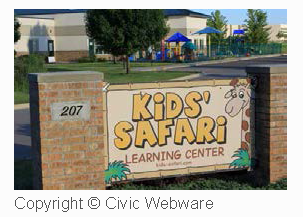
5.05 Group day care center
Description: A place licensed as a day care by the state where care is provided for 9 or more children. This use may include outdoor play areas, playhouses, and related recreational equipment, such as swings, slides, basketball hoops, and jungle gyms.
Note: A family day care home (4—8 children) is considered an accessory use and is therefore listed in the 14 series.
Parking Requirements: 1 space for each 2 children the facility is licensed by the state to accommodate; plus 1 space for each employee on the largest work shift.
Supplemental Standards: An outdoor activity area associated with a group day care center shall not be located within 20 feet of an adjoining property in a residential zoning district.
5.06 Hospice care center
Description: A place licensed by the state that provides palliative and supportive care and a place of residence to individuals with terminal illness and provides or arranges for short-term inpatient care as needed.
Note: See Wis. Stats. § 50.90(1).
Parking Requirements: 1 space for each 2 residents at capacity; plus 1 space for each employee on the largest work shift.
Supplemental Standards:
(a) License. Prior to the establishment of a hospice care center, the operator shall obtain a license from the state as provided for in Wis. Stats. § 50.92, and maintain such license for the life of the use or until the state no longer requires such license.
(b) Minimum lot size. If this use is not located in a business zoning district, the minimum lot area is 5 acres.
5.07 Nursing home
Description: A place where 5 or more persons who are not related to the operator or administrator reside, receive care or treatment and, because of their mental or physical condition, require 24-hour nursing services, including limited nursing care, intermediate level nursing care, and skilled nursing services. The term does not include (1) a convent or facility owned or operated exclusively by and for members of a religious order that provides reception and care or treatment of an individual, (2) a hospice as defined in state law, or (3) a residential care apartment complex as defined in state law.
Note: See Wis. Stats. § 50.01(3).
Parking Requirements: 1 space for each 3 beds; plus 1 space for each employee on the largest work shift.
Supplemental Standards:
(a) Required green space. If a nursing home is not located in a business zoning district, a minimum of 30 percent of the parcel shall remain undeveloped (i.e., landscaped).
(b) Parking lot screening. When an off-street parking lot is located within 20 feet of a parcel in a residential zoning district, a type "A" bufferyard must be used to screen the parking area from the residential property. The plan commission may waive this requirement, defer the requirement to a later date, or lessen the standard when deemed unnecessary given the location of the use on the subject property and/or proximity to other existing and potential land uses.
(c) On-site access drive. The facility shall be served by an on-site access drive that meets the design and construction standards for a town road (e.g., two lanes each 12 feet wide). The plan commission may waive the requirement for a two-lane drive and allow a single-lane drive when the commission deems the wider drive unnecessary given the location of the use on the subject property, the number and type of vehicles using the drive, and other related considerations. If the plan commission allows a single-lane drive, the commission reserves the right to require a two-lane drive at a later date and may require intermediate turnarounds/turnouts every 1,200 feet and impose other design features it deems necessary to ensure public safety.
5.08 Retirement home
Description: A place where individuals, generally 60 years of age or older, may occupy independent dwelling units. The units may be rented or owned as in a condominium. This use may include limited on-site commercial and medical facilities for the exclusive use of residents.
Parking Requirements: 0.5 space for each dwelling unit, plus 1 space for each employee on the largest work shift.
Supplemental Standards:
(a) Required green space. If a retirement home is not located in a business zoning district, a minimum of 30 percent the parcel shall remain undeveloped (i.e., landscaped).
(b) Parking lot screening. When an off-street parking lot is located within 20 feet of a parcel in a residential zoning district a type "A" bufferyard must be used to screen the parking area from the residential property. The plan commission may waive this requirement, defer the requirement to a later date, or lessen the standard when deemed unnecessary given the location of the use on the subject property and/or proximity to other existing and potential land uses.
(c) Road access. The property must front on and have direct vehicle access to a major road as depicted on the zoning map.
(d) On-site access drive. The facility shall be served by an on-site access drive that meets the design and construction standards for a town road (e.g., two lanes each 12 feet wide). The plan commission may waive the requirement for a two-lane drive and allow a single-lane drive when the commission deems the wider drive unnecessary given the location of the use on the subject property, the number and type of vehicles using the drive, and other related considerations. If the plan commission allows a single-lane drive, the commission reserves the right to require a two-lane drive at a later date and may require intermediate turnarounds/turnouts every 1,200 feet and impose other design features it deems necessary to ensure public safety.
(e) Application fee. This use is classified as a Type 2 conditional use in the fee schedule.
_____
6 Group Accommodations
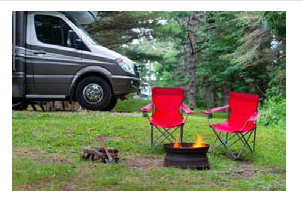
6.01 Campground
Description: A place where members of the general public may set up tents, campers and trailers of all types, and recreational vehicles for camping and sleeping purposes. Accessory uses may include individual cabins, a dwelling unit for the manager of the campground, and one or more buildings to house a laundromat and retail sales for the convenience of campground guests, an office, maintenance equipment, supplies, and related materials.
Parking Requirements: 1 space at each camping space; plus 1 space at the office, if one is provided, for each 15 camping spaces.
Supplemental Standards:
(a) Minimum lot size. The minimum lot size for a campground is 10 acres.
(b) Not in a subdivision. The parcel with this use shall not be located in a platted subdivision.
(c) Continuing maintenance. The owner of the campground shall maintain the campground in a clean and sanitary manner.
(d) Accessory facilities. Accessory facilities (e.g., laundry and food sales) may be allowed as a service to the occupants of the campground but shall be designed, operated, and located to inhibit use by nonoccupants.
(e) Density. The density shall not exceed 2.5 campground spaces per acre (gross).
(f) On-site recreation. At least 8 percent of the gross site area or 2,500 square feet, whichever is greater, shall be dedicated for on-site recreational purposes and shall be accessible from all camping spaces.
(g) Setback from lot line. A campground space shall be no closer than 40 feet to the perimeter lot line of the site.
(h) Design considerations. Campground spaces shall be arranged to permit the safe and practical placement and removal of vehicles from a private roadway internal to the development.
(i) Solid waste collection. An off-street area for the collection of solid waste (trash) shall be provided within a campground.
(j) Screening. When allowed as a conditional use, there must be a type "B" bufferyard along any adjoining parcel in a residential zoning district. The plan commission may waive this requirement, defer the requirement to a later date, or lessen the standard when deemed unnecessary given the location of the use on the subject property and/or proximity to other existing and potential land uses.
(k) Limitation on addition of features. Storage sheds, decks, patios, and similar structures within a camping space, whether permanent or temporary, are prohibited. Structural additions to a recreational vehicle within a camping space, whether permanent or temporary, are prohibited. Tent platforms are permitted.
(k) State permit. Prior to the establishment of a campground, the operator shall obtain a permit from the Wisconsin Department of Health and Family Services, or the department's agent, as required by state law and maintain such permit for the life of the use or until the state no longer requires such permit. [1]
(l) Road access. The property must front on and have direct vehicle access to a major road as depicted on the zoning map if the number of campsites is 100 or more.
(m) Application fee. This use is classified as a Type 2 conditional use in the fee schedule.
[1] Commentary: See Wis. Admin. Code ch. DHS 178.
6.02 Group recreation camp
Description: A place where members of an association or other similar group, which operates the premises, and their invited guests may set up tents, campers and trailers of all types, and recreational vehicles for camping and sleeping purposes or stay overnight in a lodge, cabin, or other similar accommodation. Accessory uses may include a dwelling unit for the manager of the camp, sleeping accommodations for resident staff, and one or more buildings to house guest services, administrative offices, recreational facilities, maintenance equipment, supplies, and related materials. The term includes youth camps and church camps.
Parking Requirements: 1 space at each camping space; plus 1 space at the office, if one is provided, for each 15 camping spaces.
Supplemental Standards:
(a) Minimum lot size. The minimum lot size for a group recreation camp is 10 acres.
(b) Not in a subdivision. The parcel with this use shall not be located in a platted subdivision.
(c) Continuing maintenance. The owner of the group recreation camp shall maintain the group camp in a clean and sanitary manner.
(d) Accessory facilities. Accessory facilities (e.g., laundry and food sales) may be allowed as a service to the occupants of the group recreation camp but they shall be designed, operated, and located to inhibit use by nonoccupants.
(e) Density. If campground spaces are provided, the density shall not exceed 2.5 campground spaces per acre (gross).
(f) Access. If campground spaces are provided, they shall be arranged to permit the safe and practical placement and removal of vehicles from a private roadway internal to the development.
(g) Setbacks from lot line. If campground spaces are provided, they shall be no closer than 40 feet to the perimeter lot line of the site.
(h) Solid waste collection. An off-street area for the collection of solid waste (trash) shall be provided within a group recreation camp.
(i) Screening. When allowed as a conditional use, there must be a type "B" bufferyard along any adjoining parcel in a residential zoning district. The plan commission may waive this requirement, defer the requirement to a later date, or lessen the standard when deemed unnecessary given the location of the use on the subject property and/or proximity to other existing and potential land uses.
(j) Limitation on addition of features. Storage sheds, decks, patios, and similar structures within a camping space, whether permanent or temporary, are prohibited. Structural additions to a recreational vehicle within a camping space, whether permanent or temporary, are prohibited. Tent platforms are permitted.
(k) State permit. Prior to the establishment of a group recreation camp, the operator shall obtain a permit from the Wisconsin Department of Health Services, or the department's agent, as required by state law and maintain such permit for the life of the use or until the state no longer requires such permit. [1]
(l) Road access. The property must front on and have direct vehicle access to a major road as depicted on the zoning map if the capacity of the camp is 200 guests or more.
(m) On-site access drive. The facility shall be served by an on-site access drive that meets the design and construction standards for a town road (e.g., two lanes each 12 feet wide). The plan commission may waive the requirement for a two-lane drive and allow a single-lane drive when the commission deems the wider drive unnecessary given the location of the use on the subject property, the number and type of vehicles using the drive, and other related considerations. If the plan commission allows a single-lane drive, the commission reserves the right to require a two-lane drive at a later date and may require intermediate turnarounds/turnouts and impose other design features it deems necessary to ensure public safety.
(n) Application fee. This use is classified as a Type 2 conditional use in the fee schedule.
[1] Commentary: See Wis. Admin. Code ch. DHS 175.
6.03 Overnight lodging
Description: A place where individual guest rooms with private bathrooms are offered to transient guests for rent. This use may also include (1) recreational/fitness rooms and a food service area for the exclusive use of guests and (2) banquet facilities for meetings and other gatherings. The term includes hotels and motels but does not include bed and breakfasts.
Parking Requirements: 1 space for each guest room and 1 space for each employee on the largest work shift, plus any required spaces for other uses such as restaurants or banquet facilities.
Supplemental Standards:
(a) Minimum lot size. The minimum lot size for overnight lodging is 3 acres.
(b) Setbacks. No building shall be closer than 50 feet to the lot line of an adjoining lot in a district permitting a residential use or the setback established for the zoning district, whichever is greater.
(c) Location of customer entrance. No customer entrance to the building shall be located within 75 feet of a parcel in a residential zoning district.
(d) Local license. Prior to the establishment of overnight lodging, the operator shall obtain a license from the Waukesha County Health Department and maintain such license for the life of the use or until the department no longer requires such license.
(d) Application fee. This use is classified as a Type 1 conditional use in the fee schedule.
_____
7 Food and Beverage Sales
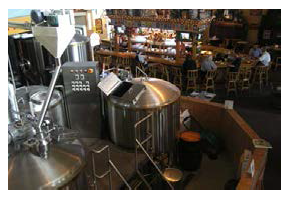
7.01 Brewpub
Description: A place where fermented malt beverages are manufactured and those beverages, along with other beverages and food, are offered for retail sale and on-site consumption.
Parking Requirements: 1 space for each 3 patron seats or 1 space for each 300 square feet of gross floor area devoted to patron service, whichever is greater; plus 1 for each employee on the largest work shift.
Supplemental Standards:
(a) Lot requirements. When a brewpub is allowed in a nonbusiness zoning district, the minimum lot area is 3 acres with at least 200 feet in minimum average width.
(b) Special dimensional standards. The building housing this principal use shall be no closer than 50 feet to an agricultural or residential zoning district.
(c) On-site parking. On-site parking shall be provided within 200 feet of the building housing this principal use. No portion of the parking area shall be located closer than 20 feet to a parcel in any agricultural or residential zoning district.
(d) Local license. Prior to the establishment of a brewpub, the operator shall obtain a license from the county, as may be required, and maintain such license for the life of the use or until the county no longer requires such license.
(e) State license. Prior to the establishment of a brewpub, the operator shall obtain a license from the state, as may be required, and maintain such license for the life of the use or until the state no longer requires such license.
(f) Limitation on floor area devoted to production. No more than 40 percent of the floor area shall be devoted to the production of fermented malt beverages, including storage of raw materials and finished products.
(g) Limitation on production. Not more than 10,000 barrels (310,000 gallons) of fermented malt beverages may be manufactured in a calendar year.
(h) Application fee. This use is classified as a Type 1 conditional use in the fee schedule.
7.02 Restaurant
Description: A place where food and beverages are offered for retail sale for on-site or off-site consumption, and where the on-site consumption of fermented malt beverages, wine, or liquor, if any, is clearly secondary and subordinate to the sale of food and nonalcoholic beverages. A restaurant may also prepare food as part of a catering business. The term does not include a grocery store with a food service section.
Parking Requirements: 1 space for each 3 patron seats or 1 space for each 300 square feet of gross floor area devoted to patron service, whichever is greater; plus 1 for each employee on the largest work shift.
Supplemental Standards:
(a) Lot requirements. When a restaurant is allowed in a nonbusiness zoning district, the minimum lot area is 3 acres with at least 200 feet in minimum average width.
(b) Special dimensional standards. The building housing this principal use shall be no closer than 50 feet to any residential zoning district.
(c) On-site parking. On-site parking shall be provided within 200 feet of the building housing this principal use. No portion of the parking area shall be located closer than 20 feet to a parcel in an agricultural or residential zoning district.
(d) Local license. Prior to the establishment of a restaurant, the operator shall obtain a license from the Waukesha County Health Department and maintain such license for the life of the use or until the department no longer requires such license.
(e) Application fee. This use is classified as a Type 1 conditional use in the fee schedule.

7.03 Tavern
Description: A place where fermented malt beverages, wine, or liquor are offered for retail sale for on-site consumption and where food consumption, if any, is clearly secondary and subordinate to the sale of alcoholic beverages. The term includes bars, drinking establishments, sports bar, and lounges.
Parking Requirements: 1 space for each 3 patron seats or 1 space for each 300 square feet of gross floor area devoted to patron service, whichever is greater; plus 1 for each employee on the largest work shift.
Supplemental Standards:
(a) Lot requirements. When a tavern is allowed in a nonbusiness zoning district, the minimum lot area is 3 acres with at least 200 fee in minimum average width.
(b) Special dimensional standards. The building housing this principal use shall be no closer than 50 feet to any residential zoning district.
(c) On-site parking. On-site parking shall be provided within 200 feet of the building housing this principal use. No portion of the parking area shall be located closer than 20 feet to a parcel in an agricultural or residential zoning district.
(d) Local license. Prior to the establishment of a tavern, the operator shall obtain an alcohol license from the town and maintain such license for the life of the use or until the license is no longer required.
(e) Compliance with state requirements. A tavern shall comply with requirements as may be adopted by the state of Wisconsin.
(f) Application fee. This use is classified as a Type 1 conditional use in the fee schedule.
_____
8 Vehicle Rental, Sales, and Service
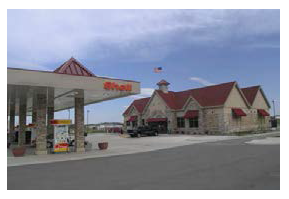
8.01 Vehicle fuel station
Description: A place where fuels for cars, motorcycles, and light trucks are offered for retail sale. Ancillary uses are limited to the retail sale of food and beverages and light maintenance activities, such as engine tune-ups, lubrication, and minor repairs. The term does not include truck stops or similar uses.
Parking Requirements: 1 space for each 300 square feet of gross floor area.
Supplemental Standards:
(a) Restroom facilities. If a vehicle fuel station provides restroom facilities, the door to each restroom shall be accessed from within the interior of the building in which they are located.
(b) Pump island canopies. Pump island canopies shall not exceed 22 feet in height.
(c) Special setbacks. The following setbacks shall apply to a vehicle fuel station:
(1) A fuel pump shall be located at least 50 feet from a parcel in a residential zoning district and at least 30 feet from a parcel in a nonresidential zoning district.
(2) A fuel pump shall be located at least 15 feet from the base setback line.
(3) A pump island canopy shall be located at least 18 feet from all lot lines.
(d) Outdoor lighting. Outdoor lighting shall not create a hazard to traffic or be a nuisance to surrounding property, as determined by the plan commission.
(e) Application fee. This use is classified as a Type 1 conditional use in the fee schedule.
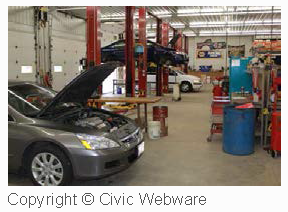
8.02 Vehicle repair shop
Description: A place where motor vehicles, such as cars, motorcycles, and light trucks, are typically left overnight for maintenance, service, or repair. Typical services include transmission repair, body work and painting, vehicle upholstery, engine repair and overhauls, and similar activities.
Parking Requirements: 2.5 spaces for each service bay; plus 1 for each employee on the largest work shift.
Supplemental Standards:
(a) Work area. Motor vehicles shall not be serviced or repaired outside of the principal structure intended for such use, except when this use is located in an industrial zoning district.
(b) Vehicle storage. When a vehicle repair shop is located in a business zoning district, no more than 10 motor vehicles shall be stored out-of-doors overnight. When located in an industrial zoning district, there is no limitation on the number of motor vehicles that can be stored overnight. Storage of unlicensed vehicles is prohibited.
(c) Application fee. This use is classified as a Type 1 conditional use in the fee schedule.
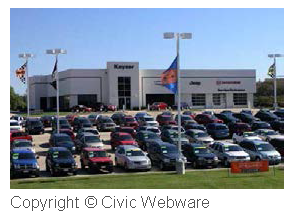
8.03 Vehicle sales and rental
Description: A place where new and used cars, light trucks, motorcycles, mopeds, snowmobiles, recreational vehicles, and all-terrain vehicles (ATVs) are offered for rent, sale, lease, or exchange, or are taken on consignment. This use may include the repair of such vehicles as a subordinate use.
Parking Requirements: 1 space for each 300 square feet of gross floor area, plus 1 space for each employee on the largest work shift.
Supplemental Standards:
(a) Show room. An indoor vehicle display area shall be provided that is at least 12 feet by 20 feet. If only motorcycles are sold, the indoor vehicle display area shall be large enough to display at least 3 motorcycles. [1]
(b) State license. Prior to the establishment of this use, the operator shall obtain a license from the state as required by state law and maintain such license for the life of the use or until the state no longer requires such license.
(c) Setback for display area. Display areas and other activity areas shall be located at least 30 feet from a parcel in a residential zoning district and 10 feet from a parcel in a business zoning district.
(d) Application fee. This use is classified as a Type 1 conditional use in the fee schedule.
[1] Commentary: See Wis. Admin. Code § TRANS 138.03(a).
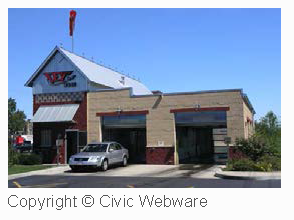
8.04 Vehicle service shop
Description: A place where motor vehicles, such as cars, motorcycles, and light trucks, are serviced while the owner waits and typically are not left overnight. Examples include quick lube/oil change facilities, tire stores, car washes, and vehicle detailing.
Parking Requirements: 1 space for each service bay; plus 1 for each employee on the largest work shift.
Supplemental Standards:
(a) Use restriction. Motor vehicles shall not be serviced or repaired outside of the principal structure intended for such use, except when this use is located in an industrial zoning district.
(b) Application fee. This use is classified as a Type 1 conditional use in the fee schedule.
_____
9 General Sales and Services
9.01 Administrative services
Description: A place where employees primarily perform administrative functions and where customers are infrequent. The term includes data processing centers, customer service centers via telecommunications, architectural firms, and engineering firms.
Parking Requirements: 1 space for each 300 square feet of gross floor area.
Supplemental Standards: There are no supplemental development standards that apply to this specific land use.
9.02 Adult-oriented establishment
Description: A place where no more than one of the following are located: adult arcade, adult bath house, adult body painting studio, adult book/video store, adult cabaret, adult massage parlor, adult modeling studio, or adult theater.
Parking Requirements: 1 space for each 300 square feet of gross floor area.
Supplemental Standards:
(a) Legislative findings. The town board makes the following legislative findings regarding adult-oriented establishments:
(1) Negative secondary effects associated with adult, sexually-oriented establishments have been confirmed by the United States Supreme Court in its decisions in, for example, City of Renton v. Playtime Theatres, Inc. (475 U.S. 41 (1986)) and by the United States Court of Appeals in its decisions in, for example, Hang On, Inc. v. City of Arlington (65 F.3d 1248 (5th Cir., 1995)), Fantasy Ranch v. City of Arlington Texas (459 F.3d 546 (5th Circuit, 2006)), and Andy's Restaurant and Lounge, Inc. v. City of Gary (466 F.3d 550 (7th Cir., 2006)) and such negative secondary effects include, for example, personal and property crimes, prostitution, lewd behavior, assault, public indecency, obscenity, illicit drug use and drug trafficking, potential spread of disease, negative impacts on surrounding properties, urban blight, litter, and sexual assault and exploitation.
(2) The decisions issued by the appellate courts constitute reliable sources of information that may be reasonably relied upon by the Town Board.
(3) Each of the foregoing negative secondary effects constitutes a harm that the Town has a substantial governmental interest in preventing and/or abating.
(4) Continued regulation of adult-oriented establishments is necessary to limit the aforementioned negative secondary effects associated with adult-oriented establishments and thereby promote the health, safety, and welfare of the Town of Mukwonago.
(5) The Town Board intends, via this chapter, to establish reasonable regulations on adult-oriented establishments, while preserving free speech pursuant to the First Amendment to the United States Constitution and Article I, Section 3 of the Wisconsin Constitution.
(b) Purpose. This section is intended to regulate adult-oriented establishments in order to promote the health, safety, and general welfare of citizens of the town, and to establish reasonable and uniform regulations to prevent the deleterious location and concentration of adult-oriented establishments within the town. The provisions of this section have neither the purpose nor effect of imposing a limitation or restriction on the content of any communicative materials, including sexually-oriented materials. Similarly, it is neither the intent nor effect of this section to restrict or deny access by adults to sexually-oriented materials protected by the First Amendment of the United States Constitution, or to deny access by the distributors and exhibitors of adult-oriented entertainment to their intended market. Neither is it the intent nor effect of this section to condone or legitimize the distribution of obscene material.
(c) Applicability. Upon any of the following events, an adult-oriented establishment shall comply with the provisions of this section:
(1) The opening or commencement of an adult-oriented establishment;
(2) The conversion of an existing business, whether or not a adult-oriented establishment, to an adult-oriented establishment;
(3) The addition of a new adult-oriented establishment to an existing adult-oriented establishment;
(4) The relocation of an adult-oriented establishment;
(5) The sale, lease, or sublease of an adult-oriented establishment;
(6) The transfer of securities which constitute a controlling interest in an adult-oriented establishment, whether by sale, exchange, or similar means; or
(7) The establishment of a trust, gift, or other similar legal device that transfers the ownership or control of an adult-oriented establishment, except for transfer by bequest or other operation of law upon the death of the person possessing the ownership or control.
(d) Exclusions. The provisions of this section do not apply to the following:
(1) Any business operated by or employing a licensed psychologist, licensed physical therapist, licensed masseuse, licensed vocational nurse, registered nurse, licensed athletic trainer, licensed cosmetologist, or licensed barber provided such licensed individual is only engaged in performing the normal and customary functions authorized under the license held;
(2) Any business operated by, or employing a licensed physician or licensed chiropractor while engaged in practicing the healing arts;
(3) Any retail establishment whose principal business is the offering of wearing apparel for sale to customers and that does not exhibit merchandise on live model(s); or
(4) An activity sponsored by a school licensed by the State of Wisconsin or a college, junior college or university supported entirely or partly by taxation; or a private college or university that maintains or operates educational programs in which credits are transferable to a college, junior college, or university supported entirely or partly by taxation.
Any activity conducted or sponsored by an entity identified in subsection (4) above must meet all of the following requirements:
(1) The activity must be situated in a structure that has no sign or other advertising visible from the exterior of the structure indicating a nude person is available for viewing; and
(2) All students participating in the class must be enrolled at least 3 days in advance of the class; and
(3) Not more than one (1) nude model is on the premises at any one time.
(e) Proximity to another adult-oriented establishment. An adult-oriented establishment shall not be located within 500 feet of another adult-oriented establishment.
(f) Proximity to other specified land uses. An adult-oriented establishment shall not be located within 600 feet of any of the following:
(1) Public library;
(2) Public playground or park, including nature trails, pedestrian/bicycle paths, or other public lands open for recreational activities;
(3) Educational facility, including K-12 and post-secondary, but not including facilities used primarily for another purpose and used only incidentally at a school;
(4) State-licensed family day care home, group day care home, or day care center;
(5) Worship facility;
(6) Any youth-oriented establishment;
(7) Tavern; or
(8) Any commercial business, other than a tavern, holding a valid liquor license.
If one of these specified uses locates within this area of separation after the adult-oriented establishment has been granted a building permit or occupancy permit, the adult-oriented establishment shall not be required to relocate. This provision only applies to a renewal of a valid permit or other license. It does not apply when a license or permit expires or when the town terminates this use due to a violation of this chapter.
(g) Measurement of distances. For the purpose of this section, specified distances are measured in a straight line, without regard to intervening structures or objects, from the nearest portion of the building or structure containing the adult-oriented establishment, to the nearest lot line of the parcel with the specified use or to the specified zoning district. If an adult-oriented establishment is located on the first floor of a multi-tenant building (e.g., shopping center), the measurement shall be taken from the outer boundary of such space (i.e. from the outer edge of the party wall or the outer wall). If an adult-oriented establishment is located above the first floor of a multi-tenant building (e.g., shopping center), the measurement shall be taken from the exterior door on the first floor that is nearest to the adult-oriented establishment, excluding emergency exists. The presence of a city, county, or other political subdivision boundary shall be irrelevant for purposes of applying the separation requirements of this section.
(h) Licensing. Adult-oriented establishments shall comply with any licensing requirements established by the Town of Mukwonago.
(i) Application fee. This use is classified as a Type 2 conditional use in the fee schedule.
9.03 Artisan shop
Description: A place where handmade craft items or works of art are made on a small-scale and offered for retail sale. Examples of such items include paintings, textiles, photography, sculptures, pottery, leather products, handmade paper, jewelry, hand-blown glass, small wooden items, candles, soaps, and lotions.
Parking Requirements: 1 space for each 300 square feet of display area; plus 1 space for each employee on the largest work shift.
Supplemental Standards:
(a) Indoor operation. All materials and activities, except loading and unloading, shall be conducted entirely within the confines of a building.
(b) Not in a subdivision. The parcel with this use shall not be located in a platted subdivision.
(c) Limitation. If this uses is not located in a business zoning district, it must be located on a property with a single-family residence of the operator.
(d) Special events. Special events related to this use may be allowed if otherwise permitted by the Town.
(e) Screening. When allowed as a conditional use, there must be a type "B" bufferyard along any adjoining parcel in a residential zoning district. The plan commission may waive this requirement, defer the requirement to a later date, or lessen the standard when deemed unnecessary given the location of the use on the subject property and/or proximity to other existing and potential land uses.
(f) Road access. The property must front on and have direct vehicle access to a major road as depicted on the zoning map.
(g) Application fee. This use is classified as a Type 1 conditional use in the fee schedule.
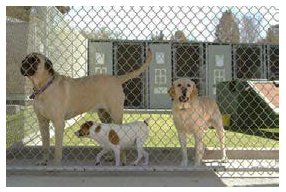
9.04 Commercial kennel
Description: A place not qualifying as a private kennel where dogs, cats, or other domesticated animals over 6 months of age are housed for the purpose of boarding, breeding, training, or sale. The term includes boarding kennels, dog motels, and dog training centers. The term does not include animal hospitals, animal grooming parlors, or pet shops.
Parking Requirements: 1 space for each 300 square feet of gross floor area.
Supplemental Standards:
(a) Minimum lot size. The minimum lot size for a commercial kennel is 3 acres.
(b) Location. No building housing a commercial kennel shall be closer than 100 feet to the lot line of an adjoining lot in a district permitting residential use except as follows. The plan commission may approve a special exception, consistent with the procedures and requirements of article of this chapter, to allow a lesser offset, but not less than 50 feet or the minimum offset established for the zoning district, whichever is greater. In making such decision, the plan commission shall consider the following factors along with those enumerated in article:
(1) The maximum number and type of animals to be kept in the building.
(2) The nature of the building including type of construction and measures taken to contain noise associated with the commercial kennel.
(3) The presence and type of vegetation between the building and the adjoining property that will help to ameliorate noise associated with commercial kennel.
(4) Any other factor reasonably related to the purposes of this zoning code.
(c) Special events. Special events related to a commercial kennel, such as dog shows, exhibitions, field trials, and contests, may be allowed if otherwise permitted by the town.
(d) Application fee. This use is classified as a Type 2 conditional use in the fee schedule.
9.05 Commercial stable
Description: A place where horses, donkeys, and other similar domesticated animals are kept for boarding, instructional purposes, or hire on trail rides.
Parking Requirements: 1 space for each 4 stable stalls (or equivalent).
Supplemental Standards:
(a) Minimum lot size. The minimum lot size for a commercial stable is 20 acres.
(b) Not in a subdivision. The parcel with this use shall not be located in a platted subdivision.
(c) Number of animals. The number of livestock is based on the lot area as follows: 1 head for the first 3 acres and 1 head for each additional acre over 3.
(d) Buildings. Nonresidential buildings and other structures related to a commercial stable, such as barns, stables, riding arenas, and sheds, are allowed subject to compliance with all other requirements of this chapter.
(e) Location of buildings. A building that houses livestock shall be located at least 100 feet from any lot line of any adjoining lot in a district permitting a residential use.
(f) Manure management plan. The property owner shall submit a manure management plan to the plan commission for review and obtain approval of the same.
(g) Special events. Special events related to a commercial stable, such as horse shows, exhibitions, and contests, may be allowed if otherwise permitted by the Town.
(h) Application fee. This use is classified as a Type 2 conditional use in the fee schedule.
9.06 Equipment rental
Description: A place where equipment is offered for rent and related supplies are offered for retail sale or rent. Items for rent or sale are predominantly stored indoors and may include hand tools, party equipment, and lawn and yard equipment.
Parking Requirements: 1 space for each 300 square feet of gross floor area, plus 1 space for each employee on the largest work shift.
Supplemental Standards:
Outdoor display and storage areas and other activity areas shall be located at least 50 feet from a residential zoning district and 10 feet from a business zoning district.
9.07 Financial services
Description: A place where financial and banking services are offered. The term includes banks, savings and loan institutions, other lending institutions, auto title loan businesses, and payday loan businesses.
Parking Requirements: 1 space for each 300 square feet of gross floor area.
Supplemental Standards:
A payday loan business or auto title loan business shall not be located within 5,000 feet of another payday loan business or auto title loan business or within 150 feet of a residential zoning district. For the purpose of this section, such distance shall be measured in a straight line, without regard to intervening structures or objects, from the nearest portion of the exterior wall of the building containing the payday loan business or auto title loan business to the outer wall of the building containing the other specified land use or, as appropriate, to the nearest lot line of a parcel in the specified zoning district. The presence of a city, county, or other political subdivision boundary shall be irrelevant for purposes of applying the separation requirements of this section. If a payday loan business or auto title loan business is operating on January 1, 2011 and does not comply with the locational standards in this section, such business may continue to operate at that location. [1]
[1] Commentary: See Wis. Stats. § 59.69(4h).
9.08 Funeral home
Description: A place where the deceased may be prepared for burial or cremation and people may gather for visitation or funeral ceremonies. The indoor display of funeral equipment may also occur. The term includes mortuaries.
Parking Requirements: 1 space for each 3 patron seats at the maximum capacity; plus 1 space for each employee on the largest work shift.
Supplemental Standards: The parcel with this use shall not be located in a platted subdivision.
9.09 Garden center
Description: A place where nursery stock, plants, and lawn and garden supplies are sold at retail. A garden center may also offer the following provided they are collectively incidental to the primary use: lawn furniture, playground equipment, garden tractors, utility vehicles, lawn mowers, and similar powered lawn and garden equipment. This use may also include servicing of motorized equipment sold on the premises is allowed as a subordinate use.
Parking Requirements: 1 space for each 300 square feet of gross floor area, plus 1 space for each employee on the largest work shift.
Supplemental Standards:
(a) Minimum lot size. The minimum lot size for a garden center is 10 acres.
(b) Not in a subdivision. The parcel with this use shall not be located in a platted subdivision.
(c) Setbacks. Outdoor work areas, parking areas, and storage of equipment and materials related to a landscape business shall not be located within the setbacks established for the zoning district in which the use is located.
(d) Screening. Outdoor work areas and equipment and materials stored out of doors shall be screened from view from any adjoining parcel in a residential zoning district with a type "B" bufferyard. The plan commission may waive this requirement, defer the requirement to a later date, or lessen the standard when deemed unnecessary given the location of the use on the subject property and/or proximity to other existing and potential land uses.
(e) Application fee. This use is classified as a Type 2 conditional use in the fee schedule.
9.10 General repair
Description: A place where consumer goods such as shoes, bicycles, appliances, and business equipment are repaired. The term does not include repair of motor vehicles or industrial equipment.
Parking Requirements: 1 space for each 450 square feet of gross floor area.
Supplemental Standards: All activities related to this use shall occur within a building, except when the parcel of land is located in an industrial zoning district.
9.11 General services
Description: A place where services not otherwise included in any other service type category are offered. The term includes photography studios, weight loss centers, commercial postal services, beauty shops, pet grooming shops, photocopying and printing services, linen services, dry cleaning services, and diaper services.
Parking Requirements: 1 space for each 300 square feet of gross floor area.
Supplemental Standards: There are no supplemental development standards that apply to this specific land use.
9.12 Health care center
Description: A place where medical treatment, or nursing, rehabilitative, or preventative care is offered. The term includes ambulatory surgical facilities, hospitals, kidney treatment centers, long-term care facilities, medical assistance facilities, mental health centers, outpatient facilities, public health centers, and rehabilitation facilities.
Parking Requirements: 1 space for each 1.5 patient beds; plus 1 space for each employee on the largest work shift; plus 1 space for each doctor on the largest work shift.
Supplemental Standards:
(a) Road access. The property shall front on and have direct vehicle access to a major road as depicted on the zoning map.
(b) Transition when allowed as a conditional use. When a health care center is allowed as a conditional use, an appropriate transition shall be required between this use and an adjoining use.
(c) Application fee. This use is classified as a Type 2 conditional use in the fee schedule.
9.13 Health care clinic
Description: A place where medical services are offered and patients do not stay overnight. The term includes dental clinics, medical offices, chiropractic offices, acupuncture centers, and sports medicine facilities. The term does not include those uses as classified as a health care center.
Parking Requirements: 1 space for each examination room or equivalent; plus 1 space for each 300 square feet of gross floor area not devoted to examinations.
Supplemental Standards: There are no supplemental development standards that apply to this specific land use.
9.14 Instructional services
Description: A place where instruction, training, or tutelage is offered in such areas as gymnastics, dance, art, music, and martial arts.
Parking Requirements: 1 space for each student during the largest period of attendance; plus 1 space for each employee on the largest work shift.
Supplemental Standards: There are no supplemental development standards that apply to this specific land use.
9.15 Landscape business
Description: A place where a landscape contractor may establish a base of operation, which may include one or more of the following: office space; indoor and outdoor storage of materials, equipment, and machinery, such as trucks and heavy equipment; and shops for the repair of machinery and equipment owned by the operator. The retail sale of plant and landscape materials is strictly prohibited.
Parking Requirements: 1 space for each employee on the largest work shift; plus 1 space for each fleet vehicle parked on site.
Supplemental Standards:
(a) Minimum lot size. The minimum lot size for a landscape business is 20 acres.
(b) Not in a subdivision. The parcel with this use shall not be located in a platted subdivision.
(c) Setbacks. Outdoor work areas, parking areas, and storage of equipment and materials related to a landscape business shall not be located within the setbacks established for the zoning district in which the use is located.
(d) Screening. Outdoor work areas and equipment and materials stored out of doors shall be screened from view from any adjoining parcel in a residential zoning district with a type "B" bufferyard. The plan commission may waive this requirement, defer the requirement to a later date, or lessen the standard when deemed unnecessary given the location of the use on the subject property and/or proximity to other existing and potential land uses.
(e) Application fee. This use is classified as a Type 2 conditional use in the fee schedule.
9.16 Professional services
Description: A place where services involving predominantly professional, clerical, or similar operations are preformed and where customers may or could come on a regular basis. The term includes law offices, real estate offices, insurance offices, and travel agencies.
Parking Requirements: 1 space for each 300 square feet of gross floor area.
Supplemental Standards: There are no supplemental development standards that apply to this specific land use.
9.17 Retail sales, convenience
Description: A place where a limited product line of frequently needed personal items is offered for retail sale. The term includes convenience stores and small grocery stores.
Parking Requirements: 1 space for each 300 square feet of gross floor area.
Supplemental Standards: There are no supplemental development standards that apply to this specific land use.
9.18 Retail sales, general
Description: A place where a diverse product line is offered for retail sale. The term includes grocery stores, retail outlets, comparison shopping stores, full-line department stores, and dollar stores.
Parking Requirements: 1 space for each 300 square feet of gross floor area.
Supplemental Standards: There are no supplemental development standards that apply to this specific land use.
9.19 Specialty retail sales
Description: A place where specialty gifts and/or antiques are offered for retail sale.
Parking Requirements: 1 space for each 300 square feet of gross floor area.
Supplemental Standards:
(a) Not in a subdivision. The parcel with this use shall not be located in a platted subdivision.
(b) Road access. The property shall front on and have direct vehicle access to a major road as depicted on the zoning map.
(c) Screening. When allowed as a conditional use, there must be a type "B" bufferyard along any adjoining parcel in a residential zoning district. The plan commission may waive this requirement, defer the requirement to a later date, or lessen the standard when deemed unnecessary given the location of the use on the subject property and/or proximity to other existing and potential land uses.
(d) Application fee. This use is classified as a Type 2 conditional use in the fee schedule.

9.20 Veterinary clinic
Description: A place where medical services for small and large animals are offered. This use may include office space, medical labs, appurtenant facilities, and indoor and outdoor enclosures for animals under the immediate medical care of a veterinarian.
Parking Requirements: 1 space for each 300 square feet of gross floor area.
Supplemental Standards:
(a) Minimum lot size. The minimum lot size for a veterinary clinic is 3 acres.
(b) Not in a subdivision. The parcel with this use shall not be located in a platted subdivision.
(c) Location. No building housing a veterinary clinic shall be closer than 100 feet to the lot line of an adjoining lot in a district permitting residential use except as follows. The plan commission may approve a special exception, consistent with the procedures and requirements of article 5 of this chapter, to allow a lesser offset, but not less than 50 feet or the minimum offset established for the zoning district, whichever is greater. In making such decision, the plan commission shall consider the following factors along with those enumerated in article 5:
(1) The maximum number and type of animals to be kept in the building.
(2) The nature of the building including type of construction and measures taken to contain noise associated with the veterinary clinic.
(3) The presence and type of vegetation between the building and the adjoining property that will help to ameliorate noise associated with the veterinary clinic.
(4) Any other factor reasonably related to the purposes of this zoning code.
(d) Operations. All animals must be kept inside of the enclosed building from sundown to sunrise.
(e) Screening. When allowed as a conditional use, there must be a type "B" bufferyard along any parcel in a residential zoning district. The plan commission may waive this requirement, defer the requirement to a later date, or lessen the standard when deemed unnecessary given the location of the use on the subject property and/or proximity to other existing and potential land uses.
(f) Application fee. This use is classified as a Type 2 conditional use in the fee schedule.
_____
10 Recreation and Entertainment
10.01 Driving range
Description: A place where golfers practice driving golf balls from a fixed central location. This use may include one or more buildings and other structures directly related to the operation of this use, such as an office, snack bar, and buildings for housing maintenance equipment, supplies, and related materials.
Parking Requirements: 1 space for each driving station.
Supplemental Standards:
(a) Minimum lot size. The minimum size for a driving range is 15 acres.
(b) Not in a subdivision. The parcel with this use shall not be located in a platted subdivision.
(c) Outdoor lighting. The use of outdoor lighting is prohibited.
(d) Application fee. This use is classified as a Type 1 conditional use in the fee schedule.
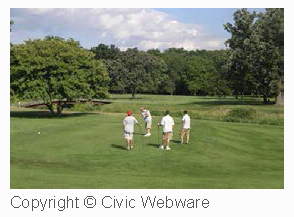
10.02 Golf course
Description: A place where individuals, for a fee or other consideration, play golf outdoors. A golf course may be a standalone facility in an A-1, B-2, or P-1 zoning district or integrated with a residential subdivision in an RH, SE, or R-1 zoning districts. This use may include one or more buildings and other structures directly related to the operation of this use, such as an office, game room with snack bar, and buildings for housing maintenance equipment, supplies, and related materials. The term does not include miniature golf.
Parking Requirements: 36 spaces for each 9 holes of golf; plus 1 space for each employee on the largest work shift. If a tavern or restaurant Is also part of the golf course facility, the parking requirements of such use shall be 50 percent of the requirement.
Supplemental Standards:
(a) Location of buildings. Club houses and maintenance buildings with a floor area exceeding 1,200 square feet shall be located at least 300 feet from a parcel in a residential zoning district.
(b) Application fee. This use is classified as a Type 2 conditional use in the fee schedule.
10.03 Indoor entertainment
Description: A place where indoor entertainment is offered. The term includes theaters, movie theaters, dance halls, and theaters for performing arts. The term does not include adult-oriented establishments.
Parking Requirements: 1 space for each 3 patron seats; plus 1 for each employee on the largest work shift
Supplemental Standards: There are no supplemental development standards that apply to this specific land use.
10.04 Indoor recreation
Description: A place where indoor recreational activities are offered. The term includes bowling alleys, skating rinks, billiard and pool halls, and arcades.
Parking Requirements: 1 space for each 3 patron seats; plus 1 for each employee on the largest work shift
Supplemental Standards: There are no supplemental development standards that apply to this specific land use.
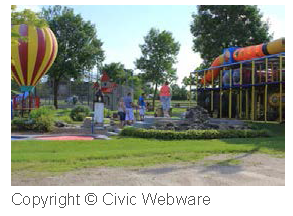
10.05 Outdoor recreation
Description: A place where outdoor recreational activities are offered. The term includes miniature golf, batting cages, water parks, sports arenas, archery ranges (but no guns), and amusement parks. The term does not include driving ranges and golf courses, parks, shooting ranges, and recreational trails.
Parking Requirements: 1 space for each 3 patrons at design capacity; plus 1 for each employee on the largest work shift
Supplemental Standards:
(a) Hours of operation. The plan commission may recommend and the town board may establish hours of operation for this use when the operation may negatively affect surrounding properties.
(b) Site design considerations. The site shall be designed to minimize the effects of outdoor lighting and noise on surrounding properties.
(c) Application fee. This use is classified as a Type 2 conditional use in the fee schedule.
_____
11 Government and Community Services
11.01 Administrative government center
Description: A place where government employees perform administrative functions on behalf of the public. The term includes administrative offices, post offices, and courthouses.
Parking Requirements: 1 space for each 300 square feet of gross floor area
Supplemental Standards:
(a) Application fee. This use is classified as a Type 2 conditional use in the fee schedule.
11.02 Cemetery
Description: A place where human remains may be buried or interned. Accessory uses may include columbariums, crematories, mausoleums, and mortuaries when operated in conjunction with and within the boundaries of such area.
Parking Requirements: 1 space for each 3 patron seats at the maximum capacity for a funeral home; plus 1 space for each employee on the largest work shift
Supplemental Standards:
(a) Minimum size. The minimum lot size for a cemetery is 3 acres.
(b) Not in a subdivision. The parcel with this use shall not be located in a platted subdivision.
(c) Location of burial plots. Burial plots shall not be located within 20 feet of a public street right-of-way or a proposed right-of-way so designated on an adopted highway width map, in a designated floodplain, or in a wetland area, nor shall internment occur below the groundwater table.
(d) Marker required. A permanent marker stating the name of the deceased and the birth and death dates, if known, shall identify the location of each occupied burial plot unless the zoning administrator allows an unmarked grave due to exceptional circumstances.
(e) Casket required. The deceased shall be enclosed in a casket or other durable container or buried at a depth below the ground surface to prevent scavenging.
(f) Name required. The cemetery shall have a formal name, which shall be placed on a permanent sign located by the main entrance to the cemetery.
(g) Financial guarantee. Prior to the establishment a cemetery, the property owner shall submit a financial guarantee to the town, consistent with any requirement the town board may adopt. This financial guarantee shall relate to the long-term upkeep of the cemetery.
(h) Application fee. This use is classified as a Type 2 conditional use in the fee schedule.
11.03 Community center
Description: A place where short-term and intermittent meetings or gatherings of individuals are held for purposes of sharing information, entertainment, social service, or similar activities. The term includes senior centers; neighborhood recreational centers; fraternal, social, or civic clubs; lodges; and union halls.
Parking Requirements: 1 space for each 250 square feet of gross floor area or 1 space for each 4 patrons at maximum design capacity, whichever is greater; plus 1 space for each employee on the largest work shift
Supplemental Standards:
(a) Road access. The primary access to a community center with 600 seats or more shall be off of a road classified as a major road as depicted on the zoning map.
(b) Application fee. This use is classified as a Type 2 conditional use in the fee schedule.
11.04 Community cultural facility
Description: A place where people may gather for studying, reading, personal education, or viewing the visual arts. The term includes libraries, museums, art galleries, and observatories. The term does not include performing arts.
Parking Requirements: 1 space for each 250 square feet of gross floor area or 1 space for each 4 patrons at maximum capacity, whichever is greater; plus 1 space for each employee on the largest work shift
Supplemental Standards: The primary access to a community cultural facility with 600 seats or more shall be off of a major road as depicted on the zoning map.
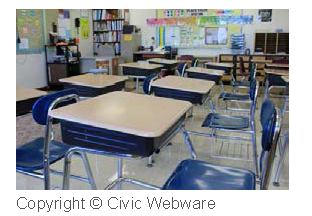
11.05 Educational facility, pre-K through 12
Description: A place where primary and secondary educational opportunities are offered. The term includes preschools, elementary schools, junior high schools, and high schools.
Parking Requirements: 0.5 space for each (K-8) classroom; 1 space for each 8 students (grades 9-12) at maximum design capacity; plus 1 space for each employee on the largest work shift
Supplemental Standards:
(a) Minimum lot size. The minimum lot size for an educational facility, pre-K through 12 is 10 acres.
(b) Road access. The property shall front on and have direct vehicle access to a major road as depicted on the zoning map.
(c) On-site access drive. The facility shall be served by an on-site access drive that meets the design and construction standards for a town road (e.g., two lanes each 12 feet wide). The plan commission may waive the requirement for a two-lane drive and allow a single-lane drive when the commission deems the wider drive unnecessary given the location of the use on the subject property, the number and type of vehicles using the drive, and other related considerations. If the plan commission allows a single-lane drive, the commission reserves the right to require a two-lane drive at a later date and may require intermediate turnarounds/turnouts and impose other design features it deems necessary to ensure public safety.
(d) Application fee. This use is classified as a Type 2 conditional use in the fee schedule.
11.06 Maintenance garage
Description: A place where a municipal government maintains administrative offices, equipment, and supplies necessary for maintaining public roadways, parks, and other types of public facilities.
Parking Requirements: 1 space for each employee on the largest work shift
Supplemental Standards:
(a) Outdoor storage. Outdoor storage areas and other activity areas shall be located at least 50 feet from a parcel in a residential zoning district and 25 feet from a parcel in a business zoning district.
(b) Application fee. This use is classified as a Type 2 conditional use in the fee schedule.
11.07 Park
Description: A place where primarily outdoor recreational activities may occur. A park may be operated by a public entity for the benefit of the general public or by a homeowners association for a subdivision for the benefit of its members. A park may be developed with recreational facilities or undeveloped. The term includes dog parks and neighborhood recreation centers.
Parking Requirements: 1 space for each 3 patrons at the peak use period
Supplemental Standards:
(a) Application fee. This use is classified as a Type 2 conditional use in the fee schedule.
11.08 Public safety facility
Description: A place where public safety services are offered. The term includes ambulance services, fire stations, police stations, and jails. The term does not include correctional facilities.
Parking Requirements: 1 space for each 500 gross square feet of office area; 1 space for each employee on the largest work shift; plus 1 space for each vehicle normally parked on the premises
Supplemental Standards:
(a) Application fee. This use is classified as a Type 2 conditional use in the fee schedule.
11.09 Recreation trail
Description: A place where a linear path may be dedicated to a single recreational use or multiple uses. Examples include hiking trails, bike trails, cross-country ski trails, and horse trails.
Parking Requirements: On-site parking is not required
Supplemental Standards: There are no supplemental development standards that apply to this specific land use.
11.10 Worship facility
Description: A place where people can regularly assemble for religious worship and associated activities and which is operated by an entity with tax-exempt status. The term includes sanctuaries, chapels, cathedrals, churches, synagogues, and temples and other onsite accessory buildings such as parsonages, friaries, convents, fellowship halls, and rectories. The term does not include day care centers, community recreation facilities, dormitories, private educational facilities, emergency shelters, and health care facilities.
Parking Requirements: 1 space for each 4 patrons at maximum design capacity; plus 1 space for each employee on the largest work shift
Supplemental Standards:
(a) Floor area ratio. The maximum floor area ratio for a worship facility is 50 percent.
(b) Road access. The property shall front on and have direct vehicle access to a major road as depicted on the zoning map if there is 600 seats or more.
(c) Application fee. This use is classified as a Type 2 conditional use in the fee schedule.
_____
12 Telecommunications and Utilities

12.01 Radio broadcast facility
Description: A free-standing tower with or without an equipment compound and other structures that is intended for the regular provision of a commercial or noncommercial service involving the transmission, emission, or reception of radio waves for the transmission of sound or images in which the transmissions are intended for direct reception by the general public.
Note: This definition is based on provisions in Wis. Stats. § 66.0406.
Parking Requirements: 1 space for each employee on the largest work shift
Supplemental Standards:
(a) Legislative findings. The town board makes the following legislative findings with regard to radio broadcast facilities:
(1) The state legislature passed 2013 Wisconsin Act 20 (Section 1269(K)) that imposed limits on local municipalities with respect to regulating radio broadcast facilities within their jurisdictions.
(2) The regulations in this section are intended to promote the public health, safety, and welfare, while at the same time not unduly restricting the development of needed radio broadcast facilities.
(3) The regulations in this section are intended to accomplish the following purposes, to the fullest extent permitted by law: (i) protect the visual character of the town from the potential adverse effects of radio broadcast facilities; and (ii) avoid damage to adjoining properties by establishing setback standards.
(b) Not in a subdivision. The parcel with this use shall not be located in a platted subdivision.
(c) Federal requirements. A radio broadcast facility shall comply with all applicable requirements of the Federal Communications Commission, the Federal Aviation Administration, and any other federal agency with authority to regulate radio broadcast facilities. In the event of a conflict between federal law and this section, federal law shall prevail.
(d) Single parcel. The fall zone and all structures related to the radio broadcast facility shall be located on a single parcel, including the tower, equipment compound, and anchor points for a guyed tower.
(e) Fall zone and other setbacks. To ensure the fall zone for the tower is located entirely on the subject property, the center of the tower shall not be located closer to a property boundary line than height of the tower. If an applicant submits an engineering certification with the application that show the fall zone is smaller than this distance, the fall zone shall be the smaller calculated area, unless the town provides the applicant with substantial evidence that the engineering certification is flawed. In all cases, the tower and equipment compound and any related buildings shall be located no closer to a property boundary line than 50 feet or the setback requirements for the zoning district, whichever is greater. The fence around anchor points for a guyed tower shall be located at least 25 feet from a property boundary line.
(f) Security fencing. A tower and related equipment compound (but not buildings for offices or production), shall be enclosed by a security fence (height and material to be established through the site plan review process). If the tower is a guyed tower, each of the anchor points shall be enclosed by a security fence.
(g) Lighting. A tower or any attachment shall not be artificially lighted, except when specifically required by a state agency, the Federal Aviation Administration, or another federal authority. Such required lighting shall be the least obtrusive to the surrounding views.
(h) Equipment buildings. The exterior of equipment buildings, shelters, and cabinets exceeding 1,500 cubic feet shall be covered with building materials typically used on buildings found in the area.
(i) Emergency power system. A backup generator may be placed within the equipment compound.
(j) Landscaping. A type "B" bufferyard, shall be placed around the equipment enclosure and anchor points for guyed towers consistent with a landscaping plan as approved by the plan commission. After reviewing the location of the facility and the visibility of the facility from public rights-of-way and adjoining properties, the plan commission may waive this landscape requirement or defer the requirement to a later date.
(k) Lease agreement. If the operator of the radio broadcast facility does not own the land where the facility is to be located, the property owner and the operator shall execute a lease agreement prior to any land-disturbing activity. Such agreement shall be binding on future property owners and future operators and shall address the rights and responsibilities of each party with respect to subs. (I) and (m) of this section.
(l) Ongoing maintenance. The subject property shall be maintained and kept in a good condition, so as not to become a nuisance as determined by the plan commission. Proper maintenance includes regular lawn and landscaping care, and painting and regular care of building(s), fences, towers, and other improvements. Additionally, the site shall be kept clear of junk and debris.
(m) Termination of approval. If the zoning administrator determines that the radio broadcast facility is unsafe or otherwise defective or that the radio broadcast facility has not been operating a for a continuous period of 12 months, the administrator shall follow the procedure outlined in article 5 relating to termination of the approval. Within 90 days after the date of termination, the property owner shall remove the radio broadcast facility and restore the site to the satisfaction of the zoning administrator. In the event such work is not done within the specified period, the town shall have the right to use the financial guarantee as required by this section to pay for such work.
(n) Financial guarantee. Prior to issuance of a building permit authorizing construction of a radio broadcast facility, the applicant shall submit a financial guarantee in the amount of $20,000.00 to the town subject to the requirements in division 5 of article 4 of this chapter. [1] The financial guarantee shall be held until the radio broadcast facility is removed and the site restored to the satisfaction of the zoning administrator.
(o) Third-party consultant. The zoning administrator may, at the applicant's expense, hire a third party consultant to conduct an objective analysis of the submitted materials including the application and calculation of the fall zone. The third party consultant may not charge the applicant for any travel expenses incurred in such review.
(p) Duration of approval. The approval authorizing a radio broadcast facility shall run with the land and shall be binding on successors in interest.
(q) Application fee. This use is classified as a Type 2 conditional use in the fee schedule.
[1] Commentary: See Wis. Stats. § 66.0404(4)(f).
12.02 Stormwater management facility
Description: A natural or manmade feature that collects, conveys, channels, holds, infiltrates, inhibits, or diverts the movement of stormwater.
Parking Requirements: On-site parking is not required
Supplemental Standards:
(a) Application fee. This use is classified as a Type 1 conditional use in the fee schedule.
12.03 Telecommunication collocation (class 1)
Description: The placement of a new mobile service facility on an existing support structure which constitutes a substantial modification.
Note: This definition is based on the corresponding definition in Wis. Stats. § 66.0404.
Parking Requirements: On-site parking is not required
Supplemental Standards: There are no supplemental development standards that apply to this specific land use.
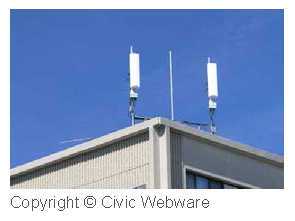
12.04 Telecommunication collocation (class 2)
Description: The placement of a new mobile service facility on an existing support structure which does not constitutes a substantial modification.
Note: This definition is based on the corresponding definition in Wis. Stats. § 66.0404.
Parking Requirements: On-site parking is not required
Supplemental Standards: There are no supplemental development standards that apply to this specific land use.
12.05 Telecommunication tower
Description: A free-standing tower with or without an equipment compound that is intended for the placement of one or more mobile service facilities.
Note: This definition is based on the corresponding definition in Wis. Stats. § 66.0404.
Parking Requirements: 1 space
Supplemental Standards:
(a) Legislative findings. The town board makes the following legislative findings with regard to telecommunication towers providing mobile telecommunication services:
(1) The state legislature passed 2013 Wisconsin Act 20 (Section 1269(1)) that imposed limits on local municipalities with respect to regulating telecommunication facilities within their jurisdictions.
(2) The federal government adopted the Telecommunications Act of 1996 which established various requirements relating to telecommunication facilities. [1]
(3) The regulations in this section are intended to promote the public health, safety, and welfare, while at the same time not unduly restricting the development of needed telecommunications facilities.
(4) The regulations in this section are intended to accomplish the following purposes, to the fullest extent permitted by law:
(i) Protect the visual character of the town from the potential adverse effects of telecommunication facilities;
(ii) Ensure that a competitive and broad range of telecommunications services and high quality telecommunications infrastructure are provided;
(iii) Create and preserve telecommunication facilities that will serve as an important and effective part of the town's emergency response network;
(iv) Minimize the number of towers by requiring collocation; and
(v) Avoid damage to adjoining properties by establishing setback standards.
(b) Federal requirements. A telecommunication tower shall comply with all applicable requirements of the Federal Communications Commission, the Federal Aviation Administration, and any other federal agency with authority to regulate telecommunication facilities. In the event of a conflict between federal law and this section, federal law shall prevail.
(c) Single parcel. The fall zone and all structures related to the telecommunication facility shall be located on a single parcel, including the tower, equipment compound, and anchor points for a guyed tower.
(d) Setbacks. The center of the tower shall not be located closer to a property boundary line than the height of the tower. If the lot hosting the proposed tower is not located adjacent to a parcel where a single-family residence may be located and the applicant submits an engineering certification with the application that show the fall zone is smaller than this distance, the fall zone shall be the smaller calculated area, unless the town provides the applicant with substantial evidence that the engineering certification is flawed. [2] The fence around anchor points for a guyed tower shall be located at least 25 feet from a property boundary line.
(e) Security fencing. A tower and related equipment compound consisting of equipment buildings, shelters, and cabinets, shall be enclosed by a security fence (height and material to be established through the site plan review process). If the tower is a guyed tower, each of the anchor points shall be enclosed by a security fence.
(f) Lighting. A tower or any attachment shall not be artificially lighted, except when specifically required by a state agency, the Federal Aviation Administration, or another federal authority. Such required lighting shall be the least obtrusive to the surrounding views.
(g) Aesthetic requirements. All users of the town right-of-way shall comply with the following aesthetic standards:
(1) In areas where facilities are currently nonexistent or underground, undergrounding is required.
(2) No new above ground structures, including co-locations on existing structures, shall be placed within 500 feet of historic structures or historic districts designated by the National Register of Historic Places in Wisconsin or listed on the State Register of Historic Places. The 500-foot separation is waived for installations that are completely concealed from view, or are not visible from locations where the historic structure can be observed.
(3) Attachments to existing structures shall be designed to be flush with the existing structure as much as can reasonably be done, shall be a color that matches the existing structure and shall be the smallest size possible to reasonably accommodate the intended purpose. If the structure to which the attachment is made changes color due to repainting, resurfacing or other means, the attachment shall be modified to match the new color.
(4) Any party objecting to the requirements of this subsection shall have an opportunity to demonstrate that the requirement constitutes an effective prohibition in violation of State or Federal law as set forth in section 36-301.
(h) Equipment buildings. The exterior of equipment buildings, shelters, and cabinets exceeding 1,500 cubic feet shall be covered with building materials typically used on buildings found in the area.
(i) Emergency power system. A backup generator may be placed within the equipment compound. [3]
(j) Identification sign. An identification sign no larger than 18 inches by 24 inches shall be placed in a visible location near the base of the tower that lists (1) the name of the tower owner, (2) the Federal Communications Commission identification number, and (3) a telephone number to contact in case of an emergency.
(k) Accommodation of other users on new towers (co-location). A tower over 150 feet in height, along with the tower site and all support facilities and appurtenances, shall accommodate at least two additional users, unless the zoning administrator determines that evidence presented by the tower operator demonstrates it is not technically feasible to do so. Further, the tower operator and their successors in interest shall allow other users to use the tower, the tower site, support facilities, and appurtenances at fair market rates as negotiated by those parties. If the plan commission determines the tower operator has made access to the tower and tower site unfeasible, the zoning administrator shall notify the tower operator via registered mail of such determination. If the tower operator does not take corrective action within 45 days of such determination, the permit for that tower shall become null and void and the tower shall be removed and the site restored within 90 days of such determination.
(l) Requirement for collocation. A new tower shall only be permitted if the applicant demonstrates with a sworn statement that collocation on an existing or planned tower within the applicant's search ring would not result in the same mobile service functionality, coverage, and capacity; is technically infeasible; or is economically burdensome to the mobile service provider. [4] If the applicant does not provide such analysis and sworn statement, the application for a new tower shall be denied. [5]
(m) Collocation review. The collocation of an antenna or antenna array on an existing tower is permitted subject to site plan, building plan, and plan of operation review.
(n) Landscaping. A type "B" bufferyard must be placed around the equipment enclosure and anchor points for guyed towers consistent with a landscaping plan as approved by the plan commission. The plan commission may waive this requirement, defer the requirement to a later date, or lessen the standard when deemed unnecessary given the location of the use on the subject property and/or proximity to other existing and potential land uses.
(o) Lease agreement. If the operator of the telecommunication tower does not own the land where the facility is to be located, the property owner and the operator shall execute a lease agreement prior to any land-disturbing activity. Such agreement shall be binding on future property owners and future operators and shall address the rights and responsibilities of each party with respect to subs. (p) and (q) of this section. If it is located on Town property, the agreement shall be in the form of a license that is subject to the approval of the town attorney.
(p) Ongoing maintenance. The subject property shall be maintained and kept in a good condition, so as not to become a nuisance as determined by the plan commission. Proper maintenance includes regular lawn and landscaping care, and painting and regular care of building(s), fences, towers, and other improvements. Additionally, the site shall be kept clear of junk and debris.
(q) Termination of approval. If the zoning administrator determines that the tower is unsafe or otherwise defective or that the tower has not hosted an operational antenna for a continuous period of 12 months, the administrator shall follow the procedure outlined in article 5 relating to termination of the approval. Within 90 days after the date of termination, the property owner shall remove the tower, equipment cabinets, and all related equipment and improvements that are part of its communication facilities and restore the site to the satisfaction of the zoning administrator. In the event such work is not done within the specified period, the town shall have the right to use the financial guarantee as required by this section to pay for such work.
(r) Financial guarantee. Prior to issuance of a building permit authorizing construction of a tower, the applicant shall submit a financial guarantee in the amount of $20,000.00 to the town subject to the requirements in division 5 of article 4 of this chapter. [6] The financial guarantee shall be held until the tower and related improvements are removed and the site restored to the satisfaction of the zoning administrator.
(s) Third-party consultant. The zoning administrator may, at the applicant's expense, hire a third-party consultant to conduct an objective analysis of the submitted materials including the application, calculation of the fall zone, and certification that collocation is not possible. The third-party consultant may not charge the applicant for any travel expenses incurred in such review. [7]
[1] Commentary: In particular see § 704 of the Act.
[2] Commentary: See Wis. Stats. § 66.0404(2)(g).
[3] Commentary: See Wis. Stats. § 66.0404(4)(j).
[4] Commentary: See Wis. Stats. § 66.0404(2)(b)6.
[5] Commentary: See Wis. Stats. § 66.0404(2)(e).
[6] Commentary: See Wis. Stats. § 66.0404(4)(i).
[7] Commentary: See Wis. Stats. § 66.0404(4)(f).
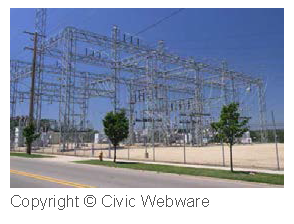
12.06 Utility installation, major
Description: A place, building, and/or structure, or portion thereof, whether public or private, used or is intended for providing basic infrastructure or utility services and which could potentially have a moderate to high impact on neighboring property. The term includes pipeline pumping stations, sewage treatment plants, electric substations, water towers, electric transmission lines with a design capacity of 110 kilowatts or more, and underground pipelines.
Parking Requirements: 1 space for each on-site employee on the largest work shift
Supplemental Standards:
(a) Building. If a major utility installation involves a building of any type and is located in a residential zoning district or a planned development district that allows residential uses, such building shall be compatible with residential buildings in regard to design and exterior materials.
(b) Screening. If a major utility installation involves a building of any type and is located in a residential zoning district or a planned development district that allows residential uses, a type "A" bufferyard must be provided on all sides of the building. The plan commission may waive this requirement, defer the requirement to a later date, or lessen the standard when deemed unnecessary given the location of the use on the subject property and/or proximity to other existing and potential land uses.
(c) Application fee. This use is classified as a Type 2 conditional use in the fee schedule.
12.07 Utility installation, minor
Description: A utility installation generally having low impact on neighboring property. The term includes public water system wells, without a tower; below ground sewer lift stations; and stormwater pumping stations. The term does not include utility cabinets, which are classified as an accessory use (Series 14).
Parking Requirements: 1 space, although the Zoning Administrator may grant a waiver
Supplemental Standards: There are no supplemental development standards that apply to this specific land use.
_____
13 Accessory Uses
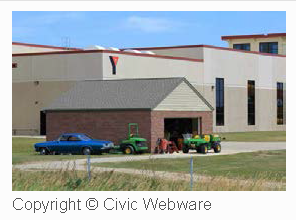
13.01 Accessory building, nonresidential
Description: A building intended to house motor vehicles, yard equipment, and/or items related to the principal use of the premises. The term includes detached garages, storage sheds, and the like.
Parking Requirements: On-site parking is not required
Supplemental Standards:
(a) Number and floor area. The number of nonresidential accessory buildings and the floor area must comply with the standards set forth in Appendix C.
(b) Type of construction. A garage shall be of conventional wood-frame, metal-frame, or masonry construction. Soft-sided structures and canopies are specifically prohibited.
(c) Exterior materials. Exterior materials shall be the same as, or substantially the same as, those used on the principal building.
13.02 Accessory building, residential
Description: A detached building customarily found with a residential use as an accessory use. The term includes greenhouses, detached garages, sheds, gazebos, pool cabanas, and the like.
Parking Requirements: On-site parking is not required
Supplemental Standards:
(a) Number and floor area. The number of residential accessory buildings and the floor area must comply with standards set forth in Appendix C.
(b) Exterior materials. Exterior materials for a residential accessory building with a floor area of more than 192 square feet (but not greenhouses) shall be the same as, substantially the same as, or complement those materials used on the principal building.
(c) Prohibition on specific materials. Soft-sided structures and canopies are specifically prohibited.
(d) Rooflines. The roof lines of a residential accessory building with a floor area of more than 192 square feet (but not greenhouses) shall match the roof lines of the principal building to the greatest practical extent.
(e) Plumbing fixtures. A residential accessory building may include a single compartment bar sink and a half bath (e.g., sink and toilet). A pool house may include a standup shower provided access to the shower is via an exterior door.
13.03 Adult family home
Description: A private residence licensed by the state under Wis. Stats. § 50.032 (1m).
Note: An adult family home can either be a principal use or an accessory use. If the operator lives in the residence with the adults, it is considered an accessory use.
Parking Requirements: On-site parking is not required
Supplemental Standards: Prior to the establishment of an adult family home, the operator shall obtain a license from the state as required by state law and maintain such license for the life of the use or until the state no longer requires such license.
13.04 Amateur radio and citizens band antenna
Description: An antenna and related support structure used to send and receive telecommunications for noncommercial purposes.
Parking Requirements: On-site parking is not required
Supplemental Standards:
(a) Legislative findings. The town board makes the following legislative findings regarding amateur radio antennas: The placement of amateur radio antennas and support structure of unregulated height and type could have a negative impact on surrounding properties and especially on the smallest of lots allowed in the town. Pursuant to Wis. Stats. § 59.69(4f), the regulations in this section constitute the least restrictive measures needed to promote community aesthetics, public health, and safety while allowing amateur radio communications.
(b) Number. Antennas shall be placed on no more than 2 support structures, such as a tower or on top of a building.
(c) Type of tower. An antenna may be placed on a monopole or lattice tower.
(d) Anti-climbing measures required. If a tower is used to support the antenna, the tower shall have anti-climbing measures to prevent unauthorized climbing.
(e) Setback. An antenna shall not be located in a front yard.
(f) Setback requirements. The center of the antenna shall be no closer than 110 percent of the total height of the antenna to a lot line and overhead electric lines.
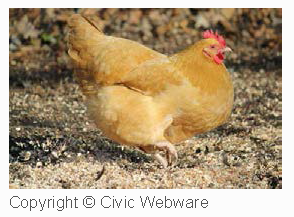
13.05 Backyard chickens
Description: A place where chickens are kept for the use and enjoyment of those living on the premises.
Note: Also see household livestock, which is considered a separate and distinct accessory use.
Parking Requirements: On-site parking is not required
Development Requirements:
(a) Legislative intent. Legislative intent. The keeping of chickens on residential lots in the Town of Mukwonago is consistent with the Town's rural character and desire to foster sustainable agriculture while addressing issues related to public health, safety, and welfare.
(b) Generally. Backyard chickens are allowed as an accessory use to a single-family residence on lots that are 3 acres or smaller.
(c) Number. No more than 5 female chickens may be kept. The keeping of roosters is prohibited.
(d) Enclosure requirements. Chickens shall be provided with a covered enclosure that is (1) predator-proof; (2) thoroughly ventilated; (3) of sufficient size to allow the free movement of the chickens; and (4) designed to be easily accessed, cleaned, and maintained by the owners. Chickens must be kept in the covered enclosure or a fenced enclosure at all times.
(e) Enclosure considered a structure. A covered enclosure is considered a structure and is subject to all applicable restrictions in this chapter.
(f) Setback requirements. The covered enclosure housing chickens shall be located at least 25 feet from all property boundary lines and shall not be located in the front yard. In addition, the covered enclosure shall be located at least 50 feet from all existing dwelling units on adjoining properties. In the event a dwelling unit is constructed on an adjoining property after the covered enclosure is established under this chapter and the new dwelling is less than 50 feet from the enclosure, the enclosure is not required to be moved.
(g) General care and maintenance. The keeping of chickens shall not cause any nuisance or unhealthy condition, or otherwise interfere with the normal use of any property.
(h) Registration required. The owner, operator, or tenant shall register the premise where chickens are kept with the Wisconsin Department of Agriculture, Trade and Consumer Protection as required by state law and maintain such registration for so long as may be required.
(i) Storage of feed. Feed for the chickens shall be kept indoors or in a sealed container if kept out of doors.
(j) Licensing. The keeping of chickens under this section shall comply with any licensing requirements established by the Town of Mukwonago.
(k) Status as a building. One free-standing chicken coop with a roof not exceeding 48 square feet shall not be counted as an accessory building.
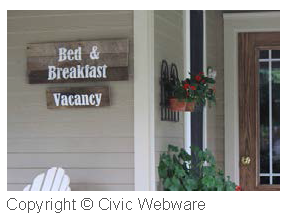
13.06 Bed and breakfast
Description: A single-family residence that offers overnight accommodations for a daily charge and that also serves as a primary residence of the operator or owner.
Parking Requirements: 1 space for each guest room
Supplemental Standards:
(a) Not in a subdivision. The parcel with this use shall not be located in a platted subdivision.
(b) State license. Prior to the establishment of a bed and breakfast, the operator shall obtain a license from the state as may be required by state law and maintain such license for the life of the use or until the state no longer requires such license. [1]
(c) Type of dwelling. A bed and breakfast shall only occur within a single-family dwelling.
(d) Number of allowable guest rooms. No more than 6 guest rooms shall be offered.
(e) Residency requirement. The operator of a bed and breakfast shall reside within the single-family dwelling during the time period when one or more of the rooms are occupied.
(f) Exterior character of the dwelling unit. The exterior appearance of the building shall not be altered from its single-family appearance.
(g) Food preparation. No food preparation or cooking shall be allowed in guest rooms.
(h) Meals. Meals shall only be offered to overnight guests.
(i) Maximum stay. The maximum stay for any occupant shall be 14 consecutive days.
(j) Record of guests. The operator shall keep a listing showing the names of all guests. This list shall be kept on file for a period of one year. Such list shall be available for inspection by town officials at any time upon request.
[1] Commentary: See Wis. Stats. subch. VII of chapter 254, and Wis. Admin. Code ch. HFS 197.
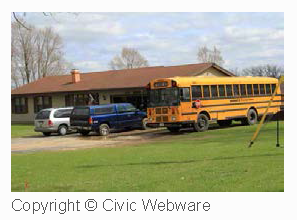
13.07 Bus parking
Description: The parking of a school bus on a residential parcel overnight as an accessory use.
Parking Requirements: On-site parking is not required
Supplemental Standards:
(a) Not in a subdivision. The parcel with this use shall not be located in a platted subdivision.
(b) Ownership. The school bus shall be operated by an occupant of the premises. The school bus may be owned or leased by the occupant of the premises or owned or leased by a business for which the occupant of the premises is an employee or is otherwise contracted to provide such services.
(c) Vehicle requirements. The school bus shall be licensed by the state of Wisconsin and fully operational.
(d) Road access. The parcel shall front on and have access to a major road as depicted on the zoning map.
(e) On-site movement. The school bus operator must be able to turn the school bus around on the premises so that it is not backed into the road or backed into the driveway. This standard does not obligate the jurisdiction with access control over the roadway to permit more than one access point to meet this requirement.
(f) Number. No more than one (1) school bus shall be allowed to be parked or stored on the occupant's property.
(g) Location. A school bus shall not be parked or stored closer than 50 feet to any adjacent lot line and closer than 100 feet to the base setback line.
(h) Limitations when not in use. The bus shall not be parked or stored on the occupant's property when school is not in session for four or more cumulative days (e.g., over Christmas vacation or summer break).
(i) Limitation on other land uses. If a parcel is allowed to have this use, the parcel may not also obtain approval for commercial truck parking.
(j) Periodic review. The conditional use permit shall be reviewed every two years by the plan commission in order to determine conformance with the terms of the permit and its compatibility with the adjacent land uses. Failure to conduct such review shall not invalidate any subsequent review or any enforcement proceeding. If it is determined that the conditional use permit is no longer compatible, or that the provisions of the permit have not been complied with, the conditional use permit may be revoked or amended in accordance with the procedures set forth in article 5.
(k) Application fee. This use is classified as a Type 1 conditional use in the fee schedule.
13.08 Commercial truck parking
Description: The parking and the storage of commercial type vehicles such as dump trucks, construction vehicles, and semi-trailers and tractors, and related equipment on a parcel as an accessory use.
Parking Requirements: On-site parking is not required
Supplemental Standards:
(a) Generally. Commercial vehicles include those vehicles not otherwise allowed under section 82-656 such as dump trucks, construction vehicles, semi trailers and tractors and other unspecified vehicles as determined by the plan commission.
(b) Not in a subdivision. The parcel with this use shall not be located in a platted subdivision.
(c) Ownership requirements. The commercial vehicle must be owned or leased and operated by an occupant of the premises.
(d) Vehicle and equipment requirements. All commercial motor vehicles and related equipment authorized under this section shall be licensed, if required by the state of Wisconsin or federal government; fully operational; and in active use. Where considered appropriate, one trailer may be allowed but in no case may there be more than one semi-tractor or cab unit.
(e) Road access. The parcel shall front on and have direct vehicle access to a major road as depicted on the zoning map.
(f) Weight limits. The owner/operator must comply with all applicable weight limits imposed by the state, county, and/or town.
(g) On-site movement. The operator must be able to turn the commercial vehicle around on the premises so that it is not backed into the road or backed into the driveway. This standard does not obligate the jurisdiction with access control over the roadway to permit more than one access point to meet this requirement.
(h) Number. No more than one such vehicle shall be allowed to be parked or stored on the occupant's property and no more than two additional construction vehicles (e.g., backhoes, front-end loaders, grading equipment) shall be allowed. Such vehicles shall be fully operational and in active use. Where considered appropriate, one trailer may be allowed but in no case may there be more than one semi-tractor or cab unit.
(i) Location. No such vehicle shall be allowed to be parked or stored closer than 50 feet to any adjacent lot line, and not closer than 100 feet from the base setback line. In the case of a refrigerator truck, the refrigeration unit may not be operated in the open if said truck is parked closer than 500 feet to the nearest neighboring residential property line.
(j) Limitation on other land uses. If a parcel is allowed to have this use, the parcel may not also obtain approval for bus parking.
(k) Periodic review. The conditional use permit shall be reviewed every two years by the plan commission in order to determine conformance with the terms of the permit and its compatibility with the adjacent land uses. Failure to conduct such review shall not invalidate any subsequent review or any enforcement proceeding. If it is determines that the conditional use permit is no longer compatible, or that the provisions of the permit have not been complied with, the conditional use permit may be revoked or amended in accordance with the procedures in article 5.
(l) Application fee. This use is classified as a Type 1 conditional use in the fee schedule.
13.09 Exterior communication device
Description: An antenna used to capture wireless telecommunication signals.
Parking Requirements: On-site parking is not required
Supplemental Standards: A ground-mounted radio/television antenna shall not exceed a height of 25 feet as measured from the ground surface. A building-mounted radio/television antenna shall not extend more than 15 feet above the roofline.
13.10 Family day care home
Description: A private residence licensed as a day care center by the state where care is provided for 4 to 8 children.
Note: See Wis. Stats. § 66.1017, A group day care (9 or more children) is considered a principal use and is therefore listed as a special care facility (4.0 series).
Parking Requirements: On-site parking is not required
Supplemental Standards: Prior to the establishment of a family day care home, the operator shall obtain a license from the state as may be required by state law and maintain such license for the life of the use or until the state no longer requires such license.
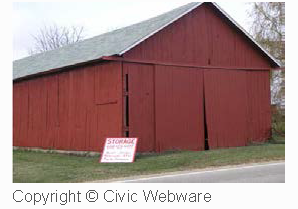
13.11 Farm building for non-farm storage
Description: A building once used for agricultural purposes in which motor vehicles, construction equipment and vehicles, recreational vehicles, boats, and other related items not owned by the property owner may be stored, with or without a fee. Minor repair and maintenance of those objects in storage is permitted, provided such activity is for noncommercial purposes.
Parking Requirements: On-site parking is not required
Supplemental Standards:
(a) Minimum lot size. The minimum lot size for this use is 10 acres.
(b) Not in a subdivision. The parcel with this use shall not be located in a platted subdivision.
(c) Location. A building housing this use shall be at least 50 feet from side and rear lot lines.
(d) Road access. The property must front on and have direct vehicle access to a major road as depicted on the zoning map.
(e) Expansion. The building housing this use may not be enlarged to increase the storage area.
(f) Exterior storage prohibited. All storage shall occur within the farm building (i.e., no outside storage).
(g) Alteration of building. The building may not be altered to accommodate this use, except as may be specifically permitted by the reviewing authority as part of the review process.
(h) Signs. There shall be no signs associated with this use.
(i) Offices prohibited. There shall be no office permitted on such premises, nor shall the building be occupied for any reason other than periodic pickup and return of equipment on a seasonal basis.
(j) Application fee. This use is classified as a Type 1 conditional use in the fee schedule.
13.12 Federal firearms license
Description: Any activity regulated under a federal firearms license when accessory to a single-family residential use.
Parking Requirements: On-site parking is not required
Development Requirements:
(a) License required. The operator shall obtain a federal firearms license (FFL) from the U.S. Department of Justice, Bureau of Alcohol, Tobacco, Firearms, and Explosives, and maintain such license for the duration of the use. Upon issuance, the operator shall provide a copy of the license to the town clerk.
(b) Compliance with FFL. The operator shall comply with all requirements related to the federal firearms license. Any violation of such license constitutes a violation of this zoning code.
(c) Employees. Employees working under the federal firearms license on the premises shall be limited to the petitioner. One non-resident employee may be approved on a case-by-case basis as part of the review process.
(d) Hours of operation. The hours of operation shall be by appointment only. There shall be no appointments before 8:00 am or after 8:00 pm.
(e) Test firing. On-site test firing is prohibited, except that a commercially available indoor bullet trap may be approved on a case-by-case basis as part of the review process.
(f) Transfer of approval prohibited. An approved conditional use is personal to the person or the business listed on the federal firearms license and is therefore not transferrable to a subsequent property owner.
(g) Conditions of approval. Although a federal firearms license issued by U.S. Department of Justice, Bureau of Alcohol, Tobacco, Firearms, and Explosives allows for certain activities to occur under said license, the plan commission may recommend and the town board may restrict or place conditions on the activities allowed under the license. For example, the town may establish a limit on the number of number of transactions occurring on the premises (i.e., to address customer traffic) to ensure the use is in keeping with the character of the surrounding area. If the town board does not establish such a limit at the time of approval, the town board reserves the right to establish a limit at any time with written notice to the operator. Additionally, the town board reserves the right to change any such limitation with written notice to the operator if it determines that the amount of customer traffic is having a detrimental effect on the surrounding area.
(h) Periodic review. The conditional use permit shall be reviewed every year by the plan commission in order to determine conformance with the terms of the permit and its compatibility with the adjacent land uses. Failure to conduct such review shall not invalidate any subsequent review or any enforcement proceeding. If it is determined that the conditional use permit is no longer compatible, or that the provisions of the permit have not been complied with, the conditional use permit may be revoked or amended in accordance with the procedures set forth in article 5.
(i) Storage. All guns kept under the federal firearms license must be stored in a locked gun safe.
(j) Signage. Outdoor signage related to this use is prohibited.
(k) Type of guns. All types of legal firearms may be sold without restriction.
(l) Sale of ammunition. The sale of ammunition is limited to 500 rounds per calendar month.
(m) Limitation on retail sales. Retail sales are limited to 5 per month.
(n) Limitation on buying of guns. Buying of guns on site may be allowed on a case-by-case basis as part of the review process.
(o) Limitation on customer drop offs. Customer drop offs may be allowed on a case-by-case basis as part of the review process.
(p) Notice. Prior to establishing this use, the property owner shall notify the local fire department of the proposed use.
(q) Knox box. The property owner shall install a Knox box if requested by the local fire department.
(r) Application fee. This use is classified as a Type 1 conditional use in the fee schedule.
(Ord. No. 2021-O-56, § 1, 11-3-2021)
13.13 Foster home and treatment foster home
Description: A facility licensed by the state for the care of foster children and which is operated by a foster parent who lives with the children.
Note: See Wis. Stats. § 48.62. A foster home and treatment foster home can either be a principal use or an accessory use. If the operator lives in the residence with the children, it is considered an accessory use.
Parking Requirements: On-site parking is not required
Supplemental Standards: Prior to the establishment of a foster home or treatment foster home, the operator shall obtain a license from the state as provided for in Wis. Stats. § 48.75, and maintain such license for the life of the use or until the state no longer requires such license.
13.14 Home occupation
Description: An occupation, profession, enterprise, or similar commercial activity that is conducted by a person residing on the residential premises as accessory use with no more than one non-resident worker. The term does not include hobbies or similar noncommercial activities.
Parking Requirements: 1 space for a company vehicle, as may be permitted, and one space for each non-resident employee as may be permitted
Supplemental Standards:
(a) Validity of use. The individual primarily responsible for operation of the home occupation shall reside in the dwelling unit on the parcel.
(b) Location and space limitation. The home occupation shall only occur within the dwelling unit. The space specifically designated for use of the home occupation shall occupy no more than 20 percent of the total floor area of the dwelling unit.
(c) Exterior character of building. The exterior character of the building housing the home occupation shall not be altered to accommodate such use.
(d) Limitation on number of on-site workers. The number of individuals working on-site shall be limited to those individuals living in the dwelling unit and one individual not living in the dwelling unit.
(e) On-site sales. On-site sales of merchandise are prohibited.
(f) Prohibited uses. The following uses do not qualify as a home occupation: veterinary services; medical offices; animal boarding or grooming; barber or hair care with 2 or more chairs; restaurant; vehicle repair; motor vehicle body work; removal of sand, gravel, or stone for commercial purposes; or other similar activities.
(g) Nuisance. Such permitted use shall not include the use of any machinery tools or other appliances which can reasonably be construed as creating an abnormal nuisance to the surrounding residential area.
(h) Special exception for an operator with a disability. The plan commission may approve a special exception, consistent with the procedures and requirements of article 5 of this chapter, for any of the requirements in this section when the operator has a temporary or permanent disability and the home occupation is or would be his or her primary livelihood and such deviation is needed to facilitate the operation of the home occupation in a reasonable manner.
(i) Multiple home occupations. Multiple home occupations may be permitted on a single lot provided all of the general requirements set forth in this section can be met based on an accumulation of activities.
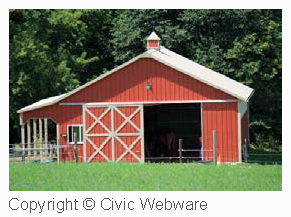
13.15 Household livestock
Description: A place where livestock are kept primarily for the use and enjoyment of those living on the premises and occasional commercial purposes.
Note: Also see backyard chickens, which is considered a separate and distinct accessory use.
Parking Requirements: On-site parking is not required
Development Requirements:
(a) Not in a subdivision. The parcel with this use shall not be located in a platted subdivision.
(b) Number of animals. On parcels smaller than 20 acres, the number of livestock shall not exceed one head for each full acre over 2 acres of land the number of poultry shall not exceed 20 fowl for each full acre over 2 acres. This means that there must be at least 3 acres to have any household livestock.
(c) Prohibited animals. The following are not permitted on parcels smaller than 20 acres: roosters, pigs, male goats, or fur-bearing animals.
(d) Buildings. Nonresidential buildings and other structures for the keeping of household livestock, such as barns, stables, riding arenas, and sheds, are allowed subject to compliance with all other requirements of this chapter.
(e) Location of buildings. A building that houses livestock and/or poultry shall be located at least 50 feet from any lot line.
(f) Manure management plan. The property owner shall submit a manure management plan to the plan commission for review and obtain approval of the same, if so requested by the plan commission.
(g) Buildings not a structure. A loafing shed is not counted as an accessory building, provided (1) the floor area is not more than 240 square feet, (2) it is located within a fenced enclosure, (3) it is constructed so it can be easily moved to another location (i.e., its moveable), (4) it is constructed of exterior building materials similar to the barn/stable, and (5) the number of loafing sheds is limited to the following: 3 to 5 acres: 1; 5.1 to 10 acres: 2; 10.1 to 20 acres: 3; and 20.1 to 35 acres: 4. In the event there are no livestock kept on the property for 6 consecutive months or more, all loafing sheds must be moved off the subject property.
13.16 In-law dwelling unit
Description: A room or suite of rooms having a separate kitchen facility, located in a single-family dwelling, occupied by not more than two persons related by blood or marriage to the family occupying the primary portion of the dwelling.
Parking Requirements: 1 space
Supplemental Standards:
(a) Compliance with sanitation requirements. Prior to the establishment of an in-law dwelling unit, the Waukesha County Health Environmental Resource Department shall certify that the existing on-site sewage disposal system can accommodate the proposed use in accordance with county sanitation requirements.
(b) Compliance with building codes. Prior to establishment of an in-law dwelling unit, the town building inspector shall certify that the single-family dwelling meets all applicable building codes.
(c) Limitation on floor area and bedrooms. The maximum living area in an in-law unit shall not exceed 800 square feet for a one-bedroom unit and 900 square feet for a two-bedroom unit.
(d) Exterior appearance. The architecture of the residence shall be compatible with the adjacent residential neighborhood and appear to be a single-family residence.
(e) Exterior doors. An in-law dwelling unit shall not have a primary exterior door. A patio-type door is allowed as a secondary exterior door if it opens onto a deck or patio and does not face the front of the lot.
(f) Interior door between units. The plan commission may determine that it is appropriate to have an interior door between the living units.
(g) Deed restriction. Prior to the establishment of an in-law dwelling unit, the property owner shall file a deed restriction in the Waukesha County register of deeds office, acceptable to the town planner, that includes a statement that the living unit is for family members of the principal dwelling unit only and the approval of an in-law dwelling unit is not transferable to another property owner without formal approval of the plan commission, and other provisions deemed appropriate by the reviewing authority.
(h) Required actions following termination of use. At such time as the in-law dwelling unit is no longer occupied by a person that is related by blood or marriage to the family occupying the primary portion of the single-family dwelling, the property owner shall remove the stove and/or oven in the in-law dwelling unit or in the other dwelling unit and the interior door separating the two units, if allowed, shall be removed.
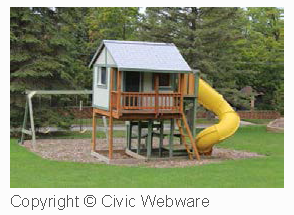
13.17 Play structure
Description: A playhouse and recreational equipment, such as swings, slides, basketball hoops, and jungle gyms, normally found in a residential setting or with a group day care center.
Parking Requirements: On-site parking is not required
Development Requirements:
(a) Status as a building. One play structure with a roofed area not exceeding 64 square feet shall not be counted as an accessory building.
13.18 Pond
Description: A manmade body of water with a surface area observed or recorded within the last ten years of at least 5,000 square feet that is not otherwise required to meet stormwater requirements of a development project.
Parking Requirements: On-site parking is not required
Supplemental Standards:
(a) Minimum lot size. The minimum lot size for a pond is 3 acres.
(b) County review authority. A pond may also be subject to the Waukesha County Shoreland and Floodland Protection Ordinance.
(c) Pond design. A pond shall not create flooding, concentrated runoff, inadequate drainage, or unfavorable topography, or restrict navigation in navigable waters.
(d) Placement. A pond shall be located at least 50 feet from the lot line.

13.19 Private kennel
Description: A place where dogs or other pets are kept for the occupant's private, non-commercial purposes. The term also includes the sale and training of up to 2 litters per year.
Parking Requirements: On-site parking is not required
Development Requirements:
(a) Limitation. The number of dogs is limited based on the parcel size as follows: Less than one acre - 2 dogs; one acre or more but less than 3 acres - 3 dogs; three acres or more but less than 5 acres - 4 dogs; five or more acres - 6 dogs.
(b) Status as a building. One free-standing dog enclosure with a roof not exceeding 48 square feet shall not be counted as an accessory building.
13.20 Retaining wall, major
Description: A single retaining wall that is more than 5 feet in height above finished grade, a series of retaining walls that are more than 8 feet in total height and the distance between the top of the lower wall and the base of the next higher wall is less than twice the height of the higher wall, or a series of retaining walls that are more than 12 feet in total height. (verify)
Parking Requirements: On-site parking is not required
Supplemental Standards:
(a) Offset. The base of a major retaining wall must be setback from the side or rear lot line a distance that is equal to or greater than twice the height of the retaining wall. For example, if a retaining wall is 3 feet in height, it must be at least 6 feet from the lot line. If an existing retaining wall does not comply with this setback requirement, it may be reconstructed provided it is not enlarged.
(b) Setback. A major retaining wall located in the front yard must be setback from the front lot line at least 6 inches. If an existing retaining wall does not comply with this offset requirement, it may be reconstructed provided it is not enlarged.
13.21 Retaining wall, minor
Description: A single retaining wall that is 5 feet or less in height above finished grade, a series of retaining walls that are 8 feet or less in total height and the distance between the top of the lower wall and the base of the next higher wall is at least two times the height of the second wall, or a series of retaining walls that are 12 feet or less in total height.
Parking Requirements: On-site parking is not required
Supplemental Standards: A minor retaining wall must comply with the standards for a major retaining wall as set forth in Appendix B.
13.22 Rural accessory building
Description: A structure so designated consistent with Division 17 of Article 5 of this chapter.
Parking Requirements: On-site parking is not required
Supplemental Standards: The property owner shall comply with those requirements in division 17 of article 5 of this chapter and each of the conditions of approval as may be imposed.
13.23 School dormitory
Description: A building and related facilities to house students associated with a school and/or employees of such school.
Parking Requirements: Established by the Plan Commission on a case-by-case basis
Supplemental Standards:
(a) Not in a subdivision. The parcel with this use shall not be located in a platted subdivision.
(b) On-site access drive. The facility shall be served by an on-site access drive that meets the design and construction standards for a town road (e.g., two lanes each 12 feet wide). The plan commission may waive the requirement for a two-lane drive and allow a single-lane drive when the commission deems the wider drive unnecessary given the location of the use on the subject property, the number and type of vehicles using the drive, and other related considerations. If the plan commission allows a single-lane drive, the commission reserves the right to require a two-lane drive at a later date and may require intermediate turnarounds/turnouts every 1,200 feet and impose other design features it deems necessary to ensure public safety.
(c) Application fee. This use is classified as a Type 2 conditional use in the fee schedule.
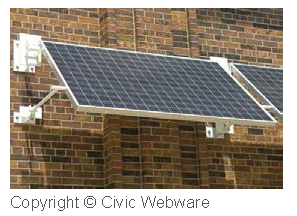
13.24 Solar energy system, building-mounted
Description: An installation that is attached to the roof or walls of a building that uses sunlight to produce electricity or provide heat or hot water to a building.
Parking Requirements: On-site parking is not required
Supplemental Standards:
(a) Maximum surface area. No portion of a panel used to collect solar energy may extend beyond the roof surface or the wall surface to which it is attached.
(b) Maximum height. A building-mounted solar energy system shall comply with the maximum height requirements of the zoning district in which the building is located.
(c) Placement on a flat roof. The panels of a solar energy system that are mounted on a flat roof may be either fixed or movable and may be placed at an angle to optimize efficiency of the system.
(d) Placement on a pitched roof. A solar energy system mounted on a pitched roof shall be designed and installed to match the shape, proportion, and slope of the roof.
(e) Placement on a façade. A solar energy system may be mounted on the façade of a commercial building if integrated into the overall design of the building. Such installations shall not project more than 4 feet from the face of the wall.
(f) Certification. A solar panel shall be certified by one of the following: Underwriters Laboratories, Inc.; National Renewable Energy Laboratory; Solar Rating and Certification Corporation; or other recognized body as approved by the zoning administrator. The building inspector may approve the use of a homemade panel.
(g) Approval by electric utility company. If the solar energy system is designed to produce electricity, the property owner shall submit documentation acceptable to the building inspector indicating that the system meets all applicable regulations and requirements of the affected electric utility company.
(h) Termination of use. If the zoning administrator determines that more than 50 percent of the panels (measured by total area) have not been operational for a continuous period of 12 months, the administrator shall follow the procedure outlined in article 5 of this chapter relating to the termination of an approval.
(i) Compliance with state law. The provisions in this section are intended to satisfy the requirements of Wis. Stats. § 66.0401(1m). On a case-by-case basis, if the restrictions of this subsection are found not to comply with the authority of Wis. Stats. § 66.0401(1m), they shall not be required. The Plan Commission shall have the ability to add additional restrictions on a case-by-case basis, provided they are within the authority of the Town pursuant to Wis. Stats. § 66.0401(1m), and in particular the restriction must satisfy one of the following conditions:
(1) Serves to preserve or protect the public health or safety.
(2) Does not significantly increase the cost of the system or significantly decrease its efficiency.
(3) Allows for alternative system of comparable cost and efficiency.
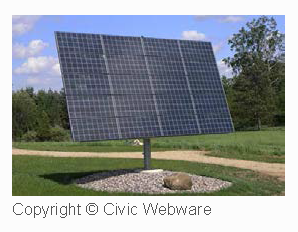
13.25 Solar energy system, free-standing
Description: An installation that is mounted on the ground and uses sunlight to produce electricity or provide heat or hot water to a building.
Parking Requirements: On-site parking is not required
Supplemental Standards:
(a) Surface area. The surface area of a free-standing solar energy system must not exceed the area needed to accommodate 120 percent of the site's anticipated power demand.
(b) Number. There shall be no more than one free-standing solar energy system on a parcel of land.
(c) Maximum height. A free-standing solar energy system in any position shall not exceed 15 feet in height as measured from the surrounding grade.
(d) Setback. A free-standing solar energy system in any position shall not extend into the setback of a front yard, side yard, shore yard, or rear yard as established for the zoning district in which the parcel is located. The plan commission may approve a special exception, consistent with the procedures and requirements of article 5 of this chapter, to allow a free-standing solar energy system to extend into a setback or offset when no other location on the parcel is acceptable and the encroachment is the least necessary to allow the system to operate.
(e) Placement in yards. A free-standing solar energy system located in a residential or business zoning district shall only be located in the rear or side yard. The plan commission may approve a special exception, consistent with the procedures and requirements of article 5 of this chapter, to allow a free-standing solar energy system in the front yard when no other location on the parcel is acceptable and the encroachment is the least necessary to allow the system to operate. A solar panel in an agricultural or industrial zoning district may be located in any yard area.
(f) Certification. A free-standing solar energy system shall be certified by one of the following: Underwriters Laboratories, Inc.; National Renewable Energy Laboratory; Solar Rating and Certification Corporation; or other recognized body as approved by the zoning administrator. The building inspector may approve the use of a homemade panel.
(g) Approval by electric utility company. If the solar energy system is designed to produce electricity, the property owner shall submit documentation acceptable to the building inspector indicating that the system meets all applicable regulations and requirements of the affected electric utility company.
(h) Termination of use. If the zoning administrator determines that a free-standing solar energy system has not been operational for a continuous period of 12 months, the administrator shall follow the procedure outlined in article 5 of this chapter relating to the termination of an approval.
(i) Compliance with state law. The provisions in this section are intended to satisfy the requirements of Wis. Stats. § 66.0401 (1m). On a case-by-case basis, if the restrictions of this subsection are found not to comply with the authority of Wis. Stats. § 66.0401 (lm), they shall not be required. The Plan Commission shall have the ability to add additional restrictions on a case-by-case basis, provided they are within the authority of the Town pursuant to Wis. Stats. § 66.0401(lm), and in particular the restriction must satisfy one of the following conditions:
(1) Serves to preserve or protect the public health or safety.
(2) Does not significantly increase the cost of the system or significantly decrease its efficiency.
(3) Allows for alternative system of comparable cost and efficiency.
(Ord. No. 2022-O-57, § 3, 3-2-2022)
13.26 Swimming pool
Description: A structure placed on the ground surface or below-ground that is filled with water for swimming. The term does not include those pools that are less than 15 feet in diameter and which are taken down and stored in the off-season.
Parking Requirements: On-site parking is not required
Supplemental Standards:
(a) Use. The pool must be intended to be used solely by the occupants of the principal use of the property on which the pool is intended to be located and their guests.
(b) Location. A pool, together with its surrounding walks, patios, diving platforms, bathhouses, and accessory structures, shall comply with the setback and offset requirements of the zoning district in which located. A swimming pool shall not be located in a front yard or closer than 10 feet to the principal building. A swimming pool shall have a horizontal separation distance of at least 15 feet from any septic tank or soil absorption field. The inside wall of the pool shall be located at least 10 feet from the vertical plane formed by the electrical wire perpendicular to the ground surface. Pumps and filter equipment shall be located at least 20 feet from a lot line.
(c) Walls or fences. Walls or fences of at least 4 feet, but not more than 6 feet, in height shall be provided to restrict access by children. All gates shall be equipped with self-closing and self-latching devices placed at the top of the gate.
(d) Draining of water. Water that is drained out of a swimming pool shall not flow onto adjoining property, into a wetland, or into a sanitary sewer without the approval of the public works director or equivalent.
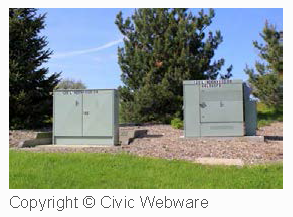
13.27 Utility cabinet
Description: A ground-mounted pedestal, junction box, cabinet, or similar feature that a service provider uses to provide telephone, electric, natural gas, cable television, cable Internet, or similar public service to properties in the area. A utility cabinet may be located within a public right-of-way or on private property.
Parking Requirements: Determined on a case-by-case basis
Supplemental Standards:
(a) Location. A utility cabinet may be placed (1) within a town road right-of-way in compliance with right-of-way regulations in chapter 62, article II, of the municipal code; (2) within a public road right-of-way under the jurisdiction of the county or the state in compliance with all applicable laws and subject to obtaining all necessary approvals as required by the governing bodies having jurisdiction; (3) within a private road right-of-way with the proper lease or easements; or (4) on private property within a leased area.
(b) Offsets and setbacks. Utility cabinets will not have to meet the offset and setback requirements of the zoning district in which it is located, but shall be subject to vision corner easement requirements, and must not interfere with safe sight distances from public streets accesses.
(c) Screening. A type "A" bufferyard must be provided. The plan commission may waive this requirement, defer the requirement to a later date, or lessen the standard when deemed unnecessary given the location of the use on the subject property and/or proximity to other existing and potential land uses.
_____
14 Temporary Uses
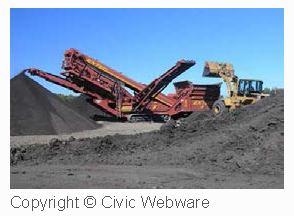
14.01 Earth materials stockpile
Description: A place where an earth material, such as topsoil and gravel, is piled and temporarily stored for no more than 5 years. The earth material must be derived from an on-site land development project and/or be used on site.
Parking Requirements: On-site parking is not required
Supplemental Standards:
(a) Hours of operation. When the earth materials stockpile is located in a residential zoning district, equipment used to load, move, or process materials shall only be used between the hours of 7:00 a.m. and 7:00 p.m.
(b) Term of use. The plan commission may grant a special exception to allow the use to operate an additional 2 years (beyond the 5-year term) if the operation has complied will all applicable terms of the approval, the zoning code, and any other rule or regulation.
(c) Application fee. This use is classified as a Type 1 conditional use in the fee schedule.
14.02 Farmers market
Description: A place where agricultural producers gather on a regular basis to offer their agricultural products directly to retail consumers. This use must be operated on public property, or with a school, worship facility, public library, or other similar principal use.
Parking Requirements: 1.5 space for each vendor space when sufficient on street parking is not available
Supplemental Standards:
(a) Hours of operation. The display of products and sales shall only occur between the hours of 8:00 a.m. and 30 minutes past sunset.
(b) Removal and clean up. Within 24 hours following the close of the farmers market, all features solely associated with the farmers market shall be removed and all trash and debris shall be removed.
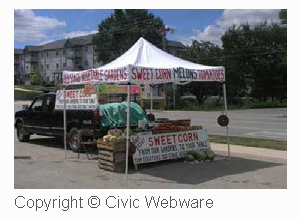
14.03 Farmstand, off-site
Description: A place where agricultural products not produced on the premises are offered for sale at retail.
Parking Requirements: 2 spaces
Development Requirements:
(a) Not in a subdivision. The parcel with this use shall not be located in a platted subdivision.
(b) Location. An off-site farmstand shall be located at least 30 feet from the base setback line and at least 20 feet from any other lot line.
(c) Hours of operation. If this use is located in a residential zoning district or a planned unit development district that allows residential uses, the hours of operation are limited to sunrise to sunset.
(d) Number. No more than one stand is allowed on any one premises.
(e) Size limitation. If a structure or building is used, the ground area shall not exceed 100 square feet.
(f) Road access. The parcel shall front on and have direct vehicle access to a major road as depicted on the zoning map.
(g) Removal and clean up. Within 24 hours following the close of the off-site farmstand, all features solely associated with the off-site farmstand shall be removed and all trash and debris shall be removed.
(h) Status as a building. One free-standing building with a roof not exceeding 100 square feet shall not be counted as an accessory building.
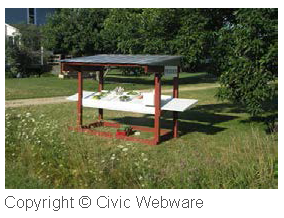
14.04 Farmstand, on-site
Description: A place where agricultural products produced exclusively on the premises are offered for sale at retail.
Parking Requirements: 2 spaces
Development Requirements:
(a) Limitation on sales. Products offered for sale shall be produced on the premises.
(b) Location. An on-site farmstand shall be located at least 30 feet from the base setback line and at least 20 feet from any other lot line.
(c) Hours of operation. If this use is located in a residential zoning district or a planned unit development district that allows residential uses, the hours of operation are limited to sunrise to sunset.
(d) Number. No more than one stand is allowed on any one premises.
(e) Use of structure. A structure may be used to store or display products and for sales, provided the following conditions are met:
(1) Term of use. The structure is only used from April 1 through November 30 and is removed no later than December 10.
(2) Floor area. The floor area of the structure shall not exceed 500 square feet.
(3) Structure height. The height of the structure shall not exceed 12 feet.
(f) Removal and clean up. Within 24 hours following the close of the on-site farmstand, all features solely associated with the on-site farmstand shall be removed and all trash and debris shall be removed.
(g) Status as a building. One free-standing building with a roof not exceeding 100 square feet shall not be counted as an accessory building.
14.05 Livestock for vegetation management
Description: Keeping of sheep and/or goats on a temporary basis for controlling undesirable plant species such as buckthorn, honeysuckle, wild rose, garlic mustard, and reed canary grass.
Parking Requirements: On-site parking is not required
Supplemental Standards:
(a) Vegetation management plan. A vegetation management plan must be prepared and approved by the zoning administrator which describes the areas to be treated, the number of livestock being used, the time periods when livestock will be used, the type of fencing used, and other operating characteristics.
(b) Buildings. No permanent buildings may be erected or installed on the subject property for housing the livestock.
(c) Fencing. Fencing may be temporarily installed while livestock are kept on the subject property.
14.06 Off-site construction yard
Description: A place where construction materials and equipment may be stored, prepped, or staged for an off-site construction project (e.g., highway reconstruction project or construction of an electric transmission line or pipeline) for no more than 12 consecutive months.
Parking Requirements: 1 space for each employee on the largest work shift; plus 1 space for each fleet vehicle parked on site
Supplemental Standards:
(a) Not in a subdivision. The parcel with this use shall not be located in a platted subdivision.
(b) Setback requirements. Outdoor storage areas and other activity areas shall be located at least 40 feet from a parcel in a residential zoning district and 20 feet from a parcel in a business zoning district.
(c) Site restoration. As part of the review process, the applicant shall prepare and submit a restoration plan and obtain the approval of the same. Such restoration plan shall identify those areas of the parcel that will be disturbed and how those areas will be restored following the cessation of this temporary use.
(d) Financial guarantee. Prior to the establishment of an off-site construction yard, the property owner shall submit a financial guarantee to the town pursuant to the requirements in article 4 of this chapter in an amount equal to 110 percent of the estimated cost of site restoration identified in the restoration plan that is approved for the project.
(e) Application fee. This use is classified as a Type 2 conditional use in the fee schedule.
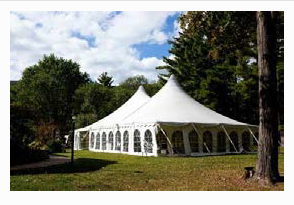
14.07 Party tent
Description: A nonpermanent tent that is associated with a temporary event that is permitted under this chapter.
Parking Requirements: On-site parking is not required
Supplemental Standards:
(a) Generally. A party tent permitted under this chapter does not count as a building.
(b) Duration. A party tent shall not be erected for more than a cumulative total of 7 days in any calendar year.
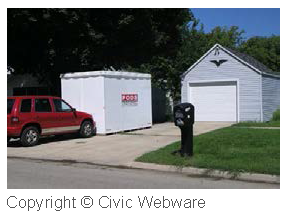
14.08 Portable storage container
Description: An enclosed metal container that is used to temporarily store household items and similar goods.
Parking Requirements: On-site parking is not required
Supplemental Standards:
(a) Duration. A portable storage container shall not be located on a parcel of land for more than 90 days during any 9-month period.
(b) Location. A portable storage container shall not be located in the front or side yard setback established for the zoning district in which this use occurs, except when placed in a driveway.
(c) Maximum floor area. The cumulative floor area of one or more portable storage containers shall not exceed 250 square feet. [1]
(d) Limitation on use. When located in a residential zoning district, a portable storage container shall only be used to store household goods during an on-site construction/remodeling project or when used to move household goods to another location.
[1] Commentary: Although portable storage containers come in different sizes, units are generally 10 feet by 10 feet and 10 feet by 15 feet.
14.09 Relocatable building (school)
Description: A portable building or enclosed trailer temporarily placed on a parcel that may be used in conjunction with the principal use of the property. For example, relocatable buildings are used to house students during a construction project or accommodate enrollment in excess of the principal building's design capacity. A mobile home or manufactured home is not considered a relocatable building.
Parking Requirements: Established by the Plan Commission on a case-by-case basis
Supplemental Standards:
(a) Required principal use. A relocatable building may only occur with a governmental or institutional use, such as worship facility, library, or school.
(b) Location. A relocatable building shall conform to all setback requirements for the zoning district in which it is located.
(c) Building code. A relocatable building shall conform to all applicable building code requirements.
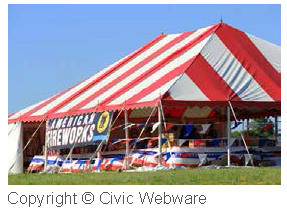
14.10 Seasonal product sales
Description: An outdoor area where merchandise typically associated with a seasonal holiday or festival is displayed and offered for sale at retail immediately before the event. Examples of such merchandise include Christmas trees and wreaths for Christmas and pumpkins for Halloween.
Parking Requirements: Determined on a case-by-case basis, but not less than 2 when on street parking is not available
Supplemental Standards:
(a) Not in a subdivision. The parcel with this use shall not be located in a platted subdivision.
(b) Duration. Merchandise shall not be sold any sooner than 45 days prior to the date of the seasonal event. Cleanup and removal of all related items shall be completed within 2 days following the date of the seasonal event.
(c) Removal and clean up. Within 24 hours following the termination of the sale, all features associated with the sale and trash and debris of all kinds shall be removed from the site.
(d) Application fee. This use is classified as a Type 1 conditional use in the fee schedule.
14.11 Wind test tower
Description: A temporary tower on which equipment is attached that measures parameters needed to assess the site's suitability for a wind energy system.
Parking Requirements: On-site parking is not required
Supplemental Standards: Pursuant to Wis. Stats. § 66.0401(3), there are no standards or requirements for the establishment of a wind test tower or similar testing facility. If the plan commission and/or town board determines that the anticipated or actual testing is detrimental to the public health, safety, or welfare, such bodies may, individually or jointly, submit a written petition to the Public Service Commission requesting the imposition of reasonable restrictions on such use.
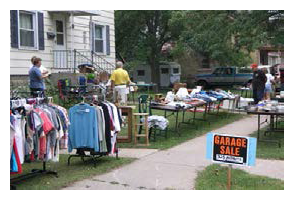
14.12 Yard sale
Description: A temporary event where used household items are offered for sale.
Parking Requirements: On-site parking is not required
Supplemental Standards:
(a) Required principal use. A yard sale shall only occur with a principal residential use or with a governmental or institutional use, such as a worship facility, library, or school.
(b) Duration. A yard sale shall not be operated for more than 4 consecutive days. There shall be at least 30 days between the last day of a yard sale and the first day of a subsequent yard sale.
(Ord. No. 2020-O-48, § 1(Exh. A), 9-16-2020; Ord. No. 2021-O-55, §§ 1—6, 7-14-2021; Ord. No. 2021-O-56, § 1, 11-3-2021)

