
Mukwonago Town City Zoning Code
ARTICLE V
- SPECIFIC PROCEDURAL REQUIREMENTS
Sec. 36-221.- Generally.
From time to time, it may be necessary or desirable to amend the text of this chapter and the zoning map as established in division 2 of article VI. This division describes the procedures and requirements to amend this chapter and the zoning map.
(Ord. No. 2020-O-48, § 1(Exh. A), 9-16-2020)
Sec. 36-222. - Initiation.
Any of the following may submit an application to amend the text of this chapter or the zoning map as established in division 2 of article VI:
(1)
A property owner in the area to be affected by the proposed amendment;
(2)
The zoning administrator;
(3)
The plan commission; and
(4)
The town board.
(Ord. No. 2020-O-48, § 1(Exh. A), 9-16-2020)
Sec. 36-223. - Review procedure.
The general steps outlined below shall be used to amend the text of this chapter and the zoning map.
(1)
Submittal of application materials. The applicant shall submit a complete application to the zoning administrator along with the application fee as may be established by the town board.
(2)
Determination of completeness. The zoning administrator reviews the submittal to make sure it is complete and ready for further review. If it is not complete, the zoning administrator will notify the applicant in writing of such deficiencies and that the applicant has three months from the date of the notice to resubmit the application or forfeit the application fee. The zoning administrator will take no further steps to process the application until the deficiencies are remedied. The incomplete application is retained as a public record. A determination that an application is complete means the application is ready for formal review and does not suggest the applicant has provided sufficient information in all regards or preclude the reviewing authority from requesting additional information it deems appropriate.
(3)
Review date. When the zoning administrator determines the application is complete, he or she schedules the review with the plan commission consistent with its adopted calendar.
(4)
Special notice to airport. If the application is for any change in an airport affected area, as defined in Wis. Stats. § 62.23(6)(am)1.b., the zoning administrator mails a copy of the notice by regular mail to the owner or operator of the airport bordered by the airport affected area.
(5)
Special notice to county supervisor. If the application would revise the town's zoning map, the zoning administrator sends one copy of the application to each county supervisor whose district would be affected by a revision to the zoning map.
(6)
General notice by type of application. If a proposed amendment would revise the text of this chapter, the zoning administrator provides for class 2 public notice, distribution list notice, and meeting agenda notice consistent with division 2 of article IV. If a proposed amendment would revise the zoning map and is initiated by a property owner, the zoning administrator provides for class 2 public notice, property owner notice, distribution list notice, and meeting agenda notice consistent with division 2 of article IV. If a proposed amendment would revise the zoning map and is initiated by the town, the zoning administrator provides for class 2 public notice, distribution list notice, and meeting agenda notice consistent with division 2 of article IV.
(7)
Staff report preparation and distribution. The zoning administrator may prepare a written staff report as described in this division and provide a copy of it to each member of the plan commission and town board, the applicant, and any other interested person upon request.
(8)
Joint public hearing. Allowing for proper notice, the plan commission and the town board conduct a joint public hearing to review the application consistent with division 3 of article IV. Prior to the close of the public hearing, the applicant, the plan commission, or the town board may request a continuance consistent with division 3 of article IV. The plan commission shall not render its recommendation at this meeting, unless the plan commission, by majority vote, determines that preparation of an updated staff report is not needed.
(9)
Recommendation. At a subsequent meeting of the plan commission, but no more than 60 days after the public hearing, the plan commission, after considering the comments and the staff report, if any, makes a recommendation to the town board based on the decision criteria listed in this division to:
a.
Approve the amendment;
b.
Approve the amendment with conditions; or
c.
Deny the amendment.
(10)
Transmittal of recommendation. If the plan commission action is favorable, the zoning administrator drafts an ordinance effectuating its determination. If the plan commission action is not favorable, the plan commission reports its determination to the town board including its reasons for denial.
(11)
Decision. After considering the plan commission's recommendation, the town board makes a decision based on the decision criteria listed in this division to:
a.
Approve the amendment;
b.
Approve the amendment with conditions; or
c.
Deny the amendment.
(12)
Required vote with downzoning. An amendment must be approved by at least two-thirds of the members-elect if the amendment would decrease the development density of the land to be less dense than was allowed under its previous usage or that would reduce the number of permitted uses of the land to fewer uses than were allowed under its previous usage. If the person who owns the land affected by the amendment agrees to the amendment, the ordinance may be enacted by a simple majority of the members-elect.
(13)
Required vote with protest of airport. If a proposed amendment would make any change in an airport affected area, as defined under Wis. Stats. § 62.23(6)(am)1.b., and the owner or operator of the airport bordered by the airport affected area files a protest against the proposed amendment, no ordinance which makes such change may be approved except by the affirmative vote of two-thirds of the members of the town board present and voting.
(14)
Preparation of decision notice. Based on the action of the town board, the zoning administrator prepares a decision notice consistent with this division, subject to the direction provided to the zoning administrator from the town board.
(15)
Applicant notification. Within a reasonable time following the town board's decision, the zoning administrator mails the decision notice to the applicant by regular mail.
(16)
County notification. If the town board approves the amendment, the town clerk, within a reasonable time following the town board's decision, sends three copies of the decision notice to the county clerk for approval of the county board.
(17)
Preparation of new zoning map. The zoning administrator prepares a new zoning map to be prepared consistent with division 2 of article VI, if the amendment involves a change to the zoning map and the county board approves the amendment.
(Ord. No. 2020-O-48, § 1(Exh. A), 9-16-2020)
State Law reference— Wis. Stats. §§ 62.23(7)(d), 66.10015(3), 62.23(7)(d)(2m)(b).
Sec. 36-224. - Effective date of adopted ordinance.
An adopted ordinance shall take effect only after the county board approves the amendment or on the date specified in the ordinance, if any, whichever is later.
(Ord. No. 2020-O-48, § 1(Exh. A), 9-16-2020)
Sec. 36-225. - Basis of decision.
(a)
Text amendment. If a proposed amendment would revise the text of this chapter, the plan commission in making its recommendation and the town board in making its decision shall consider the following factors:
(1)
Whether the amendment is consistent with the town's comprehensive plan;
(2)
Whether the amendment is consistent with other planning documents adopted by the town board;
(3)
Whether the code with the amendment is internally consistent;
(4)
Whether the amendment is the least restrictive approach to address issues of public health, safety, and welfare;
(5)
The extent to which the text amendment will likely increase or decrease the number of nonconforming uses and structures;
(6)
Whether the proposed amendment is needed to comply with a new or revised state or federal law; and
(7)
Any other factor not specifically or generally listed, but deemed appropriate by the plan commission or board given the particular circumstances.
(b)
Zoning map amendment. If a proposed amendment would revise the zoning map, the plan commission in making its recommendation and the town board in making its decision shall consider the following factors:
(1)
Whether the amendment is consistent with the town's comprehensive plan, including any future land use maps or similar maps;
(2)
Whether the amendment is consistent with other planning documents adopted by the town board;
(3)
The extent to which the amendment will likely increase or decrease the number of nonconforming uses and structures; and
(4)
Any other factor not specifically or generally listed, but deemed appropriate by the plan commission or board given the particular circumstances.
(Ord. No. 2020-O-48, § 1(Exh. A), 9-16-2020)
Sec. 36-226. - Imposition of conditions.
(a)
Generally. The plan commission may recommend and the town board may impose one or more conditions of approval as may be necessary to grant approval.
(b)
Mandatory conditions of approval relating to certain existing land uses. If a proposed amendment would revise the zoning map and is initiated by a property owner and the subject property hosts a land use that at the time of application is not permitted in the proposed zoning district, such use shall be removed as a condition of approval. If the subject property hosts a land use that at the time of application is classified as a conditional use in the proposed zoning district, the property owner shall as a condition of approval submit a conditional use application and obtain approval for that land use or, if conditional use approval is not granted, remove such use.
(Ord. No. 2020-O-48, § 1(Exh. A), 9-16-2020)
Sec. 36-227. - Application content.
(a)
Landowner-initiated map amendment. An application for a landowner-initiated zoning map amendment shall include the following:
(1)
An application form as used by the town;
(2)
A project map prepared at an appropriate scale depicting the information listed in appendix f; and
(3)
Other supporting information the applicant deems appropriate.
(b)
Other amendments. For all other types of amendments, the application shall include the following:
(1)
An application form as used by the town, and
(2)
Other supporting information the applicant deems appropriate.
(Ord. No. 2020-O-48, § 1(Exh. A), 9-16-2020)
Sec. 36-228. - Staff report content.
The staff report should include the following:
(1)
Information related to the decision criteria listed in this division;
(2)
Proposed revisions, if appropriate; and
(3)
Other information deemed necessary.
(Ord. No. 2020-O-48, § 1(Exh. A), 9-16-2020)
Sec. 36-229. - Appeal.
An aggrieved person may appeal a final decision made pursuant to this division by filing an appeal with a court of competent jurisdiction within 30 days of the final decision.
(Ord. No. 2020-O-48, § 1(Exh. A), 9-16-2020)
Sec. 36-241.- Generally.
From time to time, cities and villages adjoining the town may annex lands. This division describes the procedures and requirements to amend the zoning map following an annexation.
(Ord. No. 2020-O-48, § 1(Exh. A), 9-16-2020)
Sec. 36-242. - Initiation.
Following the approval of an ordinance annexing land into a city or village, any of the following may initiate the process to amend the zoning map as described in this division:
(1)
The person owning the annexed land;
(2)
The municipality that annexed the subject property;
(3)
The zoning administrator;
(4)
The plan commission; and
(5)
The town board.
(Ord. No. 2020-O-48, § 1(Exh. A), 9-16-2020)
Sec. 36-243. - Review procedure.
The general steps outlined below shall be used to amend the zoning map following an annexation.
(1)
Preparation of draft ordinance. The zoning administrator shall prepare a draft ordinance that if adopted would remove the annexed lands from the town's zoning map.
(2)
Schedule date of review. The town board shall schedule the date the board will review the draft ordinance and take action on the same.
(3)
General notice. Notice for this review shall consist of meeting agenda notice.
(4)
Town board meeting. Allowing for proper notice, the town board shall review the draft ordinance at a regular or special meeting.
(5)
Decision. The town board shall make a decision based on the decision criteria listed in this division to remove the annexed lands from the town's zoning map or not remove the annexed lands from the town's zoning map. The town board may render its decision at the same meeting the matter was initially considered or at a subsequent meeting.
(6)
Preparation of new zoning map. If the town board adopts an ordinance removing annexed lands from the town's zoning map, the zoning administrator shall cause a new zoning map to be prepared consistent with division 2 of article VI.
(Ord. No. 2020-O-48, § 1(Exh. A), 9-16-2020)
Sec. 36-244. - Basis of decision.
The town board in making its decision shall determine whether a city or village has annexed the subject property. Such determination does not constitute a legal determination, but merely reflects the city's or village's action.
(Ord. No. 2020-O-48, § 1(Exh. A), 9-16-2020)
Sec. 36-245. - Appeal.
An aggrieved person may appeal a final decision made pursuant to this division by filing an appeal with a court of competent jurisdiction within 30 days of the date of the final decision.
(Ord. No. 2020-O-48, § 1(Exh. A), 9-16-2020)
Sec. 36-251.- Generally.
A planned development district is a zoning district that allows for more flexibility in the development of land while ensuring compliance with the basic intent of this chapter and the town's comprehensive plan. As set forth in article VIII, there are two different types of planned development districts (conventional planned development district and conservation subdivision design).
(Ord. No. 2020-O-48, § 1(Exh. A), 9-16-2020)
Sec. 36-252. - Initiation.
The owner of the subject property may submit an application for the establishment of a planned development district.
(Ord. No. 2020-O-48, § 1(Exh. A), 9-16-2020)
Sec. 36-253. - Where allowed.
A planned development district is allowed in any zoning district as set forth in article VIII.
(Ord. No. 2020-O-48, § 1(Exh. A), 9-16-2020)
Sec. 36-254. - Ownership.
At the time of establishment, all land within a planned development district shall be under single ownership or control.
(Ord. No. 2020-O-48, § 1(Exh. A), 9-16-2020)
Sec. 36-255. - Minimum size.
A planned development district at the time of approval shall contain at least 20 acres.
(Ord. No. 2020-O-48, § 1(Exh. A), 9-16-2020)
Sec. 36-256. - Development agreement.
Depending on the nature of the planned development district, the developer and town shall enter into a development agreement that specifies the duties and obligations of both parties with respect to the development project.
(Ord. No. 2020-O-48, § 1(Exh. A), 9-16-2020)
Sec. 36-257. - Allowable uses.
(a)
Generally. Land uses allowed in the underlying (i.e., original) zoning district(s) may be allowed in a planned development district as specified in a general development plan, except as provided below.
(b)
Exceptions. When the underlying (i.e., original) zoning district is a residential or business district, a combination of residential, recreational, and/or business uses may be allowed.
(c)
Prohibited development. No buildings are allowed in the C-1 district.
(Ord. No. 2020-O-48, § 1(Exh. A), 9-16-2020)
Sec. 36-258. - Review procedure.
Establishment of a planned development district involves a two-step process. The review of a proposed project begins with a general development plan. If the general development plan is approved, a precise implementation plan for all or a part of the project is reviewed. If the precise implementation plan is approved, the project is officially approved. The general steps outlined below shall be used in the review of an application for the establishment of a planned development district.
Step one—General development plan.
(1)
Pre-submittal meeting with zoning administrator. The applicant or the applicant's agent meets with the zoning administrator to review (i) applicable regulations and procedures, (ii) applicable sections of the town's comprehensive plan, and (iii) the proposal. Upon request, the zoning administrator may waive the requirement to hold a pre-submittal meeting when he or she determines such meeting is not necessary given the nature of the project and/or the extent to which the applicant understands the town's zoning requirements.
(2)
Submittal of application materials. The applicant submits a completed application and other required materials to the zoning administrator along with the application fee as may be established by the town board.
(3)
Determination of completeness. The zoning administrator reviews the submittal to make sure it is complete and ready for further review. If it is not complete, the zoning administrator will notify the applicant in writing of such deficiencies and that the applicant has three months from the date of the notice to resubmit the application or forfeit the application fee. The zoning administrator will take no further steps to process the application until the deficiencies are remedied. The incomplete application is retained as a public record. A determination that an application is complete means the application is ready for formal review and does not suggest the applicant has provided sufficient information in all regards or preclude the reviewing authority from requesting additional information it deems appropriate.
(4)
Review date. When the zoning administrator determines the application is complete, he or she schedules the review with the plan commission consistent with its adopted calendar.
(5)
General notice. Consistent with division 2 of article IV, the zoning administrator shall provide for class 2 public notice, property owner notice, and meeting agenda notice.
(6)
Staff report preparation and distribution. The zoning administrator may prepare a written staff report as described in this division and provide a copy of it to each member of the plan commission and town board, the applicant, and any other interested person upon request.
(7)
Joint public hearing. Allowing for proper notice, the plan commission and the town board shall conduct a joint public hearing to review the application consistent with division 3 of article IV. Prior to the close of the public hearing, the applicant, the plan commission, or the town board may request a continuance consistent with division 3 of article IV. If the public hearing is adjourned, the plan commission may direct the zoning administrator, the town engineer, and/or town attorney to conduct additional research related to the proposed district and to prepare such documents it deems necessary, including a preliminary decision document.
(8)
Staff follow-up. After the close of the public hearing, the plan commission may direct the zoning administrator, town engineer, and/or the town attorney to prepare a preliminary decision document.
(9)
Recommendation. At a subsequent meeting of the plan commission, but no more than 60 days after the public hearing, the plan commission shall make a recommendation to the town board based on the decision criteria listed in this division to (i) approve the general development plan, subject to approval of a precise implementation plan; (ii) approve the general development plan with conditions, subject to approval of a precise implementation plan; or (iii) deny the general development plan.
(10)
Decision. After considering the plan commission's recommendation, the town board shall make a decision based on the decision criteria listed in this division to (i) approve the general development plan, subject to approval of a precise implementation plan; (ii) approve the general development plan with conditions, subject to approval of a precise implementation plan; or (iii) deny the general development plan.
(11)
Preparation of decision notice. Based on the action of the town board, the zoning administrator shall prepare a decision notice consistent with this division.
(12)
Applicant notification. Within a reasonable time following the town board's decision, the zoning administrator shall mail the decision notice to the applicant by regular mail.
(13)
Acceptance by property owner required if approved. The property owner must sign the decision notice to acknowledge the terms of the approval and return the same to the zoning administrator within two months of the decision. Prior to the expiration of the previously specified time period, the property owner may submit a petition to the town clerk requesting an extension and the town board may, with cause, extend the period within which the decision notice must be signed. If the signed decision notice is not returned within the initial or extended time period, if any, the decision shall automatically become null and void without any further action by the town at the expiration of such time limit. The decision notice shall only become effective when all required signatures have been obtained and the original signature copy is returned to the town clerk.
Step two—Precise implementation plan.
(1)
Submittal of precise implementation plan. The applicant shall submit a precise implementation plan and other required materials to the zoning administrator along with the application fee as may be established by the town board. At the discretion of the applicant, such materials may be submitted concurrently with the review of the general development plan.
(2)
Determination of completeness. The zoning administrator reviews the submittal to make sure it is complete and ready for further review. If it is not complete, the zoning administrator will notify the applicant in writing of such deficiencies and that the applicant has three months from the date of the notice to resubmit the application or forfeit the application fee. The zoning administrator will take no further steps to process the application until the deficiencies are remedied. The incomplete application is retained as a public record.
(3)
Review date. When the zoning administrator determines the application is complete, he or she schedules the review with the plan commission consistent with its adopted calendar.
(4)
General notice. Consistent with division 2 of article IV, the zoning administrator shall provide for a meeting agenda notice.
(5)
Staff report preparation and distribution. The zoning administrator may prepare a staff report that evaluates whether the precise implementation plan is consistent with the approved general development plan and the suitability of the proposed plan given the additional information provided in the plan and supplemental materials. The zoning administrator shall provide a copy of it to each member of the plan commission and town board, the applicant, and any other interested person upon request.
(6)
Joint meeting. Allowing for proper notice, the plan commission and the town board shall jointly review the precise implementation plan and the staff report, if any.
(7)
Determination of consistency. The plan commission shall determine whether the precise implementation plan is generally consistent with the approved general development plan with respect to density/intensity and permissible land uses. If the plan commission determines that the precise implementation plan is not generally consistent, the plan commission shall render that decision in writing and take no further action on the precise implementation plan.
(8)
Recommendation. If the precise implementation plan is deemed to be consistent, the plan commission shall make a recommendation to the town board based on the decision criteria listed in this division to (i) approve the precise implementation plan, (ii) approve the precise implementation plan with conditions, or (iii) deny the precise implementation plan.
(9)
Decision. After considering the plan commission's recommendation, the town board shall make a decision based on the decision criteria listed in this division to (i) approve the precise implementation plan, (ii) approve the precise implementation plan with conditions, or (iii) deny the precise implementation plan.
(10)
Preparation of decision notice. Based on the action of the town board, the zoning administrator shall prepare a decision notice consistent with this division.
(11)
Applicant notification. Within a reasonable time following the town board's decision, the zoning administrator shall mail the decision notice to the applicant by regular mail.
(12)
Acceptance by property owner required if approved. The property owner must sign the decision notice to acknowledge the terms of the approval and return the same to the zoning administrator within two months of the decision. Prior to the expiration of the previously specified time period, the property owner may submit a petition to the town clerk requesting an extension and the town board may, with cause, extend the period within which the decision notice must be signed. If the signed decision notice is not returned within the initial or extended time period, if any, the decision shall automatically become null and void without any further action by the town at the expiration of such time limit. The decision notice shall only become effective when all required signatures have been obtained and the original signature copy is returned to the town clerk.
(Ord. No. 2020-O-48, § 1(Exh. A), 9-16-2020)
Sec. 36-259. - Imposition of conditions.
(a)
Generally. The plan commission may recommend and the town board may impose conditions as may be necessary to grant approval. Such conditions may relate to any of the factors it considered in reaching its decision. In addition, the plan commission may recommend and the town board may require the provision of off-site exactions that may be necessary to approve the establishment of the planned development district project.
(b)
Effect on contracts with another party. The town board shall not condition or withhold approval based upon the property owner entering into a contract or discontinuing, modifying, extending, or renewing any contract, with a third party under which the third party is engaging in a lawful use of the property.
(Ord. No. 2020-O-48, § 1(Exh. A), 9-16-2020)
State Law reference— Wis. Stats. § 62.23(7)(gm). The town, for example, could not require an applicant to terminate an existing contract with another party that is engaged in a lawful use of the property.
Sec. 36-260. - Application form and content.
(a)
General development plan. The application submittal for a general development plan shall include the following:
(1)
An application form as used by the town;
(2)
A general development plan prepared at an appropriate scale depicting the information listed in appendix F;
(3)
A preliminary draft of covenants if any are to be imposed; and
(4)
A development schedule, if the project is to be constructed in phases, which includes the anticipated beginning date and ending date of each phase and a description of those project-related elements to be completed in each phase.
(b)
Precise implementation plan. The application submittal for a precise implementation plan shall include the following:
(1)
An application form as used by the town;
(2)
A precise implementation plan prepared at an appropriate scale depicting the information listed in appendix F;
(3)
A final draft of covenants if any are to be imposed;
(4)
Homeowners association documents, if required;
(5)
A development agreement, if required; and
(6)
A development schedule, if the project is to be constructed in phases, which includes the anticipated beginning date and ending date of each phase and a description of those project-related elements to be completed in each phase.
(Ord. No. 2020-O-48, § 1(Exh. A), 9-16-2020)
Sec. 36-261. - Staff report content.
The staff report should include the following:
(1)
Information related to the decision criteria listed in this division;
(2)
A preliminary list of recommended conditions of approval; and
(3)
Other information deemed necessary.
(Ord. No. 2020-O-48, § 1(Exh. A), 9-16-2020)
Sec. 36-262. - Effect of approval.
If the town approves a planned development district, the approval shall run with the land and is binding on all subsequent property owners.
(Ord. No. 2020-O-48, § 1(Exh. A), 9-16-2020)
Sec. 36-263. - Effect of approved planned development district on land division standards.
Development in a planned development district is subject to the town's land division regulations to the extent applicable, except that the plan commission/town board may waive a development standard in the land division regulations as provided therein.
(Ord. No. 2020-O-48, § 1(Exh. A), 9-16-2020)
Sec. 36-264. - Review of actual development within an approved planned development district.
If the town approves a planned development district, proposed development in the district is reviewed consistent with the requirements of this article as may apply (e.g., building, site plan, and plan of operation).
(Ord. No. 2020-O-48, § 1(Exh. A), 9-16-2020)
Sec. 36-265. - Amendment of an approved planned development district.
If the town approves a planned development district, the plan commission and town board shall review all proposed changes to the project plan that was approved at the time of approval. If in the opinion of the town board, the proposed change constitutes a minor alteration, the town board may approve the requested change at a regular or special meeting of the town board. If the proposed change constitutes a major alteration, the review procedure in this division must be followed.
(Ord. No. 2020-O-48, § 1(Exh. A), 9-16-2020)
Sec. 36-266. - Revocation or modification of a prior approval.
Following a public hearing, the town board may revoke or modify an approval issued pursuant to this division if it is determined that information in the application or otherwise provided by the applicant or the applicant's agent was incomplete, false, misleading, or inaccurate and such information would have altered its decision to approve the application or the conditions of approval which were or were not imposed.
(Ord. No. 2020-O-48, § 1(Exh. A), 9-16-2020)
Sec. 36-267. - Expiration of approval.
If any area of a planned development district that can be developed remains substantially undeveloped and/or unplatted three years after final approval, the town board shall have the authority to unilaterally rescind the approval, in whole or in part, following a public hearing. Upon written petition and with good cause, the town board may grant an extension. In the event the town board rescinds an approval, the town board shall at that time reclassify undeveloped lands in the district based on the zoning regulations in effect at that time. Developed portions of the planned development district may either be allowed to retain the planned development district designation or reclassified based on the zoning regulations in effect at that time.
(Ord. No. 2020-O-48, § 1(Exh. A), 9-16-2020)
Sec. 36-268. - Appeal.
An aggrieved person may appeal the final decision of the town board to a court of competent jurisdiction within 30 days of the final decision.
(Ord. No. 2020-O-48, § 1(Exh. A), 9-16-2020)
Sec. 36-281.- Generally.
Although each zoning district is primarily intended for a predominant type of land use, there are a number of uses that may be appropriate under certain conditions. These are referred to as conditional uses and are addressed in division 3 of article VI. This division describes the requirements and procedures for reviewing an application to establish a conditional use, renew an existing conditional use, if so required; and amend an existing conditional use.
(Ord. No. 2020-O-48, § 1(Exh. A), 9-16-2020)
Sec. 36-282. - Initiation.
The owner of the subject property may submit an application for the establishment of a conditional use.
(Ord. No. 2020-O-48, § 1(Exh. A), 9-16-2020)
Sec. 36-283. - Applicability and restrictions.
(a)
General applicability. Those land uses designated as a conditional use in the land-use matrix (appendix A) must comply with the requirements in this article, along with other sections of this chapter as applicable.
(b)
Conditional uses on a nonconforming lot. In the event a lot is classified as a nonconforming lot (e.g., lot area, lot width), all conditional uses are prohibited, unless the plan commission determines, on a case-by-case basis, that the nature of the nonconformity does not affect the appropriateness of the lot for the conditional use. Any such determination in the affirmative shall have no bearing on the plan commission's recommendation or the town board's decision made under this division.
(c)
Conditional uses on a lot with a nonconforming use. In the event a lot has a nonconforming use all conditional uses are prohibited, unless the plan commission determines, on a case-by-case basis, that the nonconforming use and proposed conditional use are compatible. Any such determination in the affirmative shall have no bearing on the plan commission's recommendation or the town board's decision made under this division.
(d)
Conditional uses on a lot with an existing conditional use. In the event a lot has an approved conditional use, all conditional uses are prohibited, unless the plan commission determines, on a case-by basis, that the existing and proposed conditional uses are compatible. Any such determination in the affirmative shall have no bearing on the plan commission's recommendation or the town board's decision made under this division.
(Ord. No. 2020-O-48, § 1(Exh. A), 9-16-2020; Ord. No. 2022-O-57, § 1, 3-2-2022)
Sec. 36-284. - Review procedure.
The general steps outlined below shall be used in the review of an application for a conditional use.
(1)
Pre-submittal meeting. Before submitting an application, the applicant or the applicant's agent shall meet with the zoning administrator to review applicable regulations and procedures and the proposal. Upon request, the zoning administrator may waive the requirement to hold a pre-submittal meeting when he or she determines such meeting is not necessary given the nature of the project and/or the extent to which the applicant understands the town's zoning requirements.
(2)
Submittal of application materials. The applicant shall submit a completed application and other required materials to the zoning administrator along with the application fee as may be established by the town board.
(3)
Determination of completeness. The zoning administrator reviews the submittal to make sure it is complete and ready for further review. If it is not complete, the zoning administrator will notify the applicant in writing of such deficiencies and that the applicant has three months from the date of the notice to resubmit the application or forfeit the application fee. The zoning administrator will take no further steps to process the application until the deficiencies are remedied. The incomplete application is retained as a public record. A determination that an application is complete means the application is ready for formal review and does not suggest the applicant has provided sufficient information in all regards or preclude the reviewing authority from requesting additional information it deems appropriate.
(4)
Review date. When the zoning administrator determines the application is complete, he or she schedules the review with the plan commission and town board consistent with its meeting calendar and allowing for proper notice.
(5)
General notice. Consistent with division 2 of article IV, the zoning administrator provides for a class 2 public notice, property owner notice, and meeting agenda notice.
(6)
Staff report preparation and distribution. The zoning administrator may prepare a written staff report as described in this division and provide a copy of it to each member of the plan commission and town board, the applicant, and any other interested person upon request.
(7)
Joint public hearing. Allowing for proper notice, the plan commission and town board will conduct a joint public hearing to review the application and to hear from the applicant, town staff, and the public on the application's compliance with the standards of the code. The applicant and each interested person will be given the opportunity to present substantial evidence to rebut or offer countervailing evidence. The purpose of the hearing is to gather the record, for the petitioner to prove with substantial evidence they meet the standards of the code or the public to prove they don't and to address concerns from the public and/or plan commission/town board. At the summation of the public hearing (i.e., not the close of the public hearing) the plan commission/town board may give the following direction to the petitioner and to the public:
a.
The remaining questions/standards that need to be proved/responded to.
b.
Additional conditions to include in the conditional use order that the plan commission and/or town board deems appropriate. The petitioner will need to prove they can meet those at the adjourned public hearing date.
In addition, the plan commission may direct staff to prepare a draft conditional use order authorizing the conditional use. Such draft is intended to form the basis for the ongoing review of the conditional use and in no way binds the plan commission/town board in making their recommendation or decision.
(8)
Adjourned public hearing. At the adjourned public hearing date if the public hearing was extended for additional evidence collection, the plan commission will hear from the applicant, town staff, and the public on evidence in support or opposition to items from (7)a. and (7)b. above and to the conditional use order itself if one was prepared. The purpose of the hearing is to gather the record on any additional standards imposed by the plan commission/town board from the first public hearing and to gather evidence on the conditional use order itself, if one was prepared. At the summation of the public hearing the plan commission will give direction requesting additional evidence and adjourn the public hearing to a date certain or close the public hearing.
(9)
Recommendation. After the public hearing has been closed, the plan commission will make a recommendation to the town board for approval or denial. The recommendation shall state the terms of the approval or reasons for denial as set forth in a draft conditional use order. The burden of proof is on the applicant to prove they have met the standards of the chapter and those set forth by the plan commission/town board during the process.
(10)
Town board meeting. Allowing for proper notice, the town board considers the application at a regular or special meeting.
(11)
Decision. After considering all of the information submitted by the applicant, public comments received at the public hearing, the staff report, if any, the plan commission's recommendation, the town board makes a decision based on the decision criteria listed in this division to (i) approve the conditional use, (ii) approve the conditional use with conditions, or (iii) deny the conditional use.
(12)
Applicant notification. Within a reasonable time following the town board's decision, the zoning administrator will provide the decision notice to the applicant by regular mail and/or email.
(13)
Acceptance by property owner required if approved. If the application is approved, the property owner must sign the conditional use order to acknowledge the terms of the approval and return the same to the zoning administrator within six months of the decision. Prior to the expiration of the previously specified time period, the property owner may submit a petition to the town clerk requesting an extension and the zoning administrator may, with cause, extend the period within which the decision notice must be signed. If the signed decision notice is not returned within the initial or extended time period, if any, the decision shall automatically become null and void without any further action by the town at the expiration of such time limit. The decision notice shall only become effective when all required signatures have been obtained and the original signature copy is returned to the town clerk.
(14)
Public record copy. A duplicate copy of the decision notice is retained as a public record.
(15)
Recording of decision notice. If the application is approved and the property owner signs the decision notice within the time periods established above, the town clerk or the zoning administrator will record such document in the county register of deeds office.
(Ord. No. 2020-O-48, § 1(Exh. A), 9-16-2020)
Sec. 36-285. - Basis of decision.
The plan commission in making its recommendation and the town board in making its final decision shall consider whether the proposal complies with (i) each of the special conditions of approval set forth in section 36-286, (ii) each of the performance standards set forth in article VI, (iii) each of the development standards prescribed for the requested conditional use set forth in appendix B, (iv) all other applicable sections of the zoning code, and (v) all other applicable sections of the Municipal Code or other adopted ordinance.
In addition, the plan commission in making its recommendation and the town board in making its decision must determine whether the proposed conditional use is compatible with surrounding properties, whether in the same or different zoning districts. In making this determination, the plan commission and town board must determine whether the petitioner has demonstrated there are no adverse effects on surrounding properties or that potentially adverse effects have been eliminated or reduced to an acceptable level. Approaches that could be employed to mitigate potentially adverse effects will depend on the particular circumstances but may include (1) adjusting the location of the use, or parts thereof, on the subject property; (2) limiting hours of operation; (3) limiting the size or scope of the use, or parts thereof; (4) controlling how the use is managed on an on-going basis; (5) providing additional landscaping; (6) providing additional screening; and (7) limiting operations conducted out-of-doors, if otherwise allowed.
The recommendation of the plan commission and the decision by the town board must be based on substantial evidence.
(Ord. No. 2020-O-48, § 1(Exh. A), 9-16-2020)
Sec. 36-286. - Imposition of special conditions of approval.
(a)
Generally. Based on substantial evidence, the plan commission may recommend and the town board may impose one or more conditions of approval as may be necessary to grant approval. Such conditions and restrictions may relate to the establishment, location, construction, maintenance, operation of the use, off-site impacts, and any other aspect of the use that impacts the public health, safety, or general welfare. Examples of such conditions are listed below.
(b)
Limitation on imposing conditions. A condition of approval shall not lessen a development standard or other requirement in this chapter.
(c)
Effect on contracts with another party. The town board shall not condition or withhold approval based upon the property owner entering into a contract or discontinuing, modifying, extending, or renewing any contract, with a third party under which the third party is engaging in a lawful use of the property.
(Ord. No. 2020-O-48, § 1(Exh. A), 9-16-2020)
State Law reference— Wis. Stats, § 62.23(7)(gm). The town, for example, could not require an applicant to terminate an existing contract with another party that is engaged in a lawful use of the property.
Sec. 36-288. - Standard terms for an approved conditional use.
The terms and conditions listed below are automatically incorporated into a conditional use order authorizing a use, unless otherwise stated in the conditional use order.
(1)
Any use not specifically listed as permitted shall be considered to be prohibited except as may be otherwise specifically provided herein. In case of a question as to the classification of use, the question shall be submitted to the plan commission for determination.
(2)
No use is hereby authorized unless the use is conducted in a lawful, orderly, and peaceful manner. Nothing in this order shall be deemed to authorize any public or private nuisance or to constitute a waiver, exemption or exception to any law, ordinance, order or rule of either the municipal governing body, the Waukesha County of, the State of Wisconsin, the United States of America or other duly constituted authority, except only to the extent that it authorizes the use of the subject property above described in any specific respects described herein. This order shall not be deemed to constitute a building permit, nor shall this order constitute any other license or permit required by town ordinance or other law.
(3)
This conditional use hereby authorized shall be confined to the subject property described, without extension or expansion other than as noted herein, and shall not vary from the purposes herein mentioned unless expressly authorized in writing by the plan commission as being in compliance with all pertinent ordinances.
(4)
All buildings and grounds shall be maintained in a neat, attractive and orderly way.
(5)
The property shall comply with all rules and regulations of the town and the local fire department, including submission to routine inspections by the town staff and fire department staff.
(6)
Prior to the execution of the conditional use permit, the applicant must obtain any and all approvals that must be obtained before the use may be established or the commencement of any land-disturbing activity related to the approved conditional use.
(7)
Should the permitted conditional use be abandoned in any manner, or discontinued in use for 12 months, or continued other than in strict conformity with the conditions of the original approval, or should the petitioner be delinquent in payment of any monies due and owing to the town, or should a change in the character of the surrounding area or the use itself cause it to be no longer compatible with the surrounding area or for similar cause based upon consideration of public health, safety or welfare, the conditional use may be terminated by action of the plan commission, pursuant to the enforcement provisions of this conditional use order, and all applicable ordinances.
(8)
Any change, addition, modification, alteration and/or amendment of any aspect of this conditional use, including but not limited to an addition, modification, alteration, and/or amendment to the use, premises, structures, lands or owners, other than as specifically authorized herein, shall require a new permit and all procedures in place at the time must be followed.
(9)
Unless this conditional use order expressly states otherwise, plans that are specifically required by this conditional use order may be amended upon the prior approval of the plan commission if the plan commission finds the plan amendment to be minor and consistent with the conditional use permit. Any change in any plan that the plan commission feels, in its sole discretion, to be substantial shall require a new permit, and all procedures in place at the time must be followed.
(10)
As a condition precedent to the issuance of the conditional use permit, the owner of the subject property shall approve the issuance of this conditional use order upon the terms and conditions described herein in writing, and the petitioner is required to accept the terms and conditions of the same in its entirety in writing.
(11)
Petitioner shall, on demand, reimburse the town for all costs and expenses of any type that the town incurs in connection with this application, including the cost of professional services incurred by the town (including engineering, legal, planning and other consulting fees) for the review and preparation of the necessary documents or attendance at meetings or other related professional services for this application, as well as for any actions the Town is required to take to enforce the conditions in this conditional approval due to a violation of these conditions.
(12)
Any unpaid bills owed to the town by the subject property owner or his or her tenants, operators or occupants, for reimbursement of professional fees (as described above); or for personal property taxes; or for real property taxes; or for licenses, permit fees or any other fees owed to the town; shall be placed upon the tax roll for the subject property if not paid within 30 days of billing by the town, pursuant to Wis. Stats. § 66.0627. Such unpaid bills also constitute a breach of the requirements of this conditional approval that is subject to all remedies available to the town, including possible cause for termination of this approval.
(13)
The petitioner is obligated to file with the town clerk a current mailing address and current phone number at which the petitioner can be reached, which must be continually updated by the petitioner if such contact information should change, for the duration of this conditional use. If the petitioner fails to maintain such current contact information, the petitioner thereby automatically waives notice of any proceedings that may be commenced under this conditional approval, including proceedings to terminate this conditional use.
(14)
Should any paragraph or phrase of this conditional use order be determined by a court to be unlawful, illegal or unconstitutional, said determination as to the particular phrase or paragraph shall not void the rest of the conditional use order and the remainder shall continue in full force and effect.
(15)
If any aspect of this conditional use order or any aspect of any plan contemplated and approved under this conditional use is in conflict with any other aspect of the conditional use or any aspect of any plan of the conditional use, the more restrictive provision shall be controlling as determined by the plan commission.
(16)
If the property owner/operator is a business entity, such as a limited liability company or a corporation, such entity shall for the life of the conditional use continuously maintain a registered office in the state as evidenced by registration with the state department of financial institutions.
(17)
The property owner shall not change the size and/or shape of the subject property by any means without the approval of the town board. If the town board determines that a proposed change is substantial with regard to the overall size of the parcel and/or configuration, such change shall require issuance of a new conditional use approval pursuant to the requirements in effect at the time of application.
(18)
This approval is given under the town's zoning code and is not to be, in any way, interpreted to abrogate any private rights other property owners may have pursuant to deed restrictions or restrictive covenants.
(19)
If this conditional use terminates for any reason, the property owner is obligated to remove any improvements specifically related to the conditional use and which cannot be utilized for an approved use (i.e., a use permitted by right or a different conditional use as approved).
(Ord. No. 2020-O-48, § 1(Exh. A), 9-16-2020)
Sec. 36-289. - Application form and content.
The application submittal shall include an application form as used by the town and a project map depicting the information listed in appendix F.
(Ord. No. 2020-O-48, § 1(Exh. A), 9-16-2020)
Sec. 36-290. - Staff report content.
The staff report should include information related to the decision criteria listed in this division and other information deemed appropriate.
(Ord. No. 2020-O-48, § 1(Exh. A), 9-16-2020)
Sec. 36-291. - Content of decision notice.
(a)
Approval. If the application for a conditional use is approved, the decision notice should include the following:
(1)
A statement that the application is approved;
(2)
A description of the conditional use;
(3)
A description of where the conditional use will occur on the subject property;
(4)
Reasons for the decision based on the decision criteria listed in this division;
(5)
A list of conditions of approval that must be satisfied prior to the establishment of the conditional use or complied with during the life of the conditional use, or both;
(6)
A statement indicating that the property owner must sign the decision notice and return it to the zoning administrator to acknowledge acceptance of the same;
(7)
A statement that the applicant may appeal the decision to a court of competent jurisdiction;
(8)
A statement that an aggrieved person, other than the applicant, may appeal the decision to a court of competent jurisdiction and that any work done by the applicant as authorized by the approval is done at the applicant's risk;
(9)
A statement indicating the nature of the approval (i.e., personal to the property owner or runs with the land);
(10)
Other information the town board or zoning administrator deems appropriate;
(11)
The signature of the town board chair; and
(12)
The date of the decision.
(b)
Denial. If the application for a conditional use is denied, the decision notice should include the following:
(1)
A statement that the application is denied;
(2)
A description of the project, including acreage and proposed use characteristics;
(3)
Reasons for the decision based on the decision criteria listed in this division;
(4)
A statement indicating that the denial does not limit the applicant's ability to resubmit a revised application for consideration;
(5)
A statement that the decision may be appealed as provided for in this division;
(6)
Other information the town board or zoning administrator deems appropriate;
(7)
The signature of the town board chair; and
(8)
The date of the decision.
(Ord. No. 2020-O-48, § 1(Exh. A), 9-16-2020)
Sec. 36-292. - Effect of approval.
Unless otherwise specified in the conditional use order, approvals are personal to the property owner meaning the approval automatically lapses when the property owner ceases to own the property.
(Ord. No. 2020-O-48, § 1(Exh. A), 9-16-2020)
Sec. 36-293. - Term for an approval.
A conditional use order authorizing a conditional use shall generally have five-year terms unless otherwise specified in the conditional use order. The order shall describe an administrative renewal process to allow for streamlined renewal of the conditional use order with a provision that allows the plan commission and/or the town board to remove the conditional use order from automatic renewal if there are concerns with compliance with the conditional use order or concerns raised by the public about the applicant's operations. If the plan commission or the town board pulls the conditional use order from automatic approval the conditional use order shall remain in effect while the plan commission provides due process to the applicant in reviewing the conditional use order and its potential renewal.
(Ord. No. 2020-O-48, § 1(Exh. A), 9-16-2020)
Sec. 36-294. - Revocation or modification of a prior approval.
Following a public hearing, the plan commission may revoke or modify an approval issued pursuant to this division if it is determined that information in the application or otherwise provided by the applicant or the applicant's agent was incomplete, false, misleading, or inaccurate and such information would have altered its decision to approve the application or the conditions of approval which were or were not imposed.
(Ord. No. 2020-O-48, § 1(Exh. A), 9-16-2020)
Sec. 36-295. - Expiration of approval.
(a)
Non-establishment of use. If the zoning administrator determines that substantial work as authorized by a conditional use approval did not commence within 12 months of the date of approval or if substantial work did commence within 12 months of the date of approval but has not continued in good faith to completion, he or she shall initiate the process to terminate the approval pursuant to division 8 of this article. Upon written petition and with cause, the zoning administrator may grant a one-time extension not to exceed six months.
(b)
Cessation of use. If the zoning administrator determines that a conditional use has ceased to operate for any reason, whether intentional or otherwise, for more than 12 continuous months, he or she shall initiate the process to terminate the approval pursuant to division 8 of this article.
(Ord. No. 2020-O-48, § 1(Exh. A), 9-16-2020)
Sec. 36-296. - Amendment of an approved conditional use.
Following approval of a conditional use, the plan commission shall review all proposed changes to the approval. If in the opinion of the plan commission, the proposed change constitutes a minor alteration, the plan commission may approve the requested change in writing at a regular or special meeting of the plan commission without following the review procedure in this division. If the proposed change constitutes a major alteration, the review procedure in effect at the time of submittal shall be followed.
(Ord. No. 2020-O-48, § 1(Exh. A), 9-16-2020)
Sec. 36-297. - Violation of a condition of approval.
If a property owner does not comply with the terms of an approval, such action constitutes a violation of this chapter and cause for termination of the approval consistent with division 6 of this article.
(Ord. No. 2020-O-48, § 1(Exh. A), 9-16-2020)
Sec. 36-298 - Appeal
An aggrieved person may appeal the final decision of the town board to a court of competent jurisdiction within 30 days of the final decision.
(Ord. No. 2020-O-48, § 1(Exh. A), 9-16-2020)
Sec. 36-301.- Review procedure.
(a)
New telecommunication tower and class 1 collocation. The general steps outlined below shall be used to review an application for a new telecommunication tower and a class 1 collocation as designated in the land-use matrix (appendix A).
(1)
Submittal of application materials. The applicant submits a completed application to the zoning administrator along with the application fee as may be established by the town board.
(2)
Determination of completeness. The zoning administrator reviews the application and determines whether the application is complete. If the application includes all of the required information, the application shall be found to be complete. The zoning administrator notifies the applicant in writing within ten days of receiving the application if it is found not to be complete, and such notice shall specify in detail the required information that was incomplete. Applicants are allowed to resubmit their application as often as necessary until it is complete. A determination that an application is complete means the application is ready for formal review and does not suggest the applicant has provided sufficient information in all regards or preclude the reviewing authority from requesting additional information it deems appropriate.
(3)
Review date. When the zoning administrator determines the application is complete, he or she schedules the review with the plan commission consistent with its adopted calendar.
(4)
General notice. Consistent with division 2 of article IV, the zoning administrator provides for a class 2 public notice, property owner notice, and meeting agenda notice.
(5)
Staff report preparation and distribution. The zoning administrator may prepare a written staff report and provide a copy of it to each member of the plan commission and town board, the applicant, and any other interested person upon request.
(6)
Public hearing. Allowing for proper notice, the plan commission conducts a public hearing to review the application consistent with division 2 of article IV. Prior to the close of the public hearing, the applicant or the plan commission may request a continuance consistent with division 3 of article IV.
(7)
Staff follow-up. If the plan commission does not render a decision immediately following the public hearing, the plan commission may direct the zoning administrator to prepare a preliminary decision document.
(8)
Recommendation. After considering all of the information submitted by the applicant, public comments received at the public hearing, and the staff report, if any, the plan commission, no more than 40 calendar days after the public hearing, makes a recommendation to the town board to:
a.
Approve the application;
b.
Approve the application with conditions; or
c.
Deny the application.
(9)
Transmittal of recommendation. If the plan commission action is favorable, the zoning administrator prepares a draft decision document effectuating its determination. If the plan commission action is not favorable, the plan commission reports its determination to the town board including its reasons for denial.
(10)
General notice. Consistent with division 2 of article IV, the zoning administrator places the matter on the meeting agenda of the town board.
(11)
Town board meeting. Allowing for proper notice, the town board considers the application at a regular or special meeting.
(12)
Decision. After considering all of the information submitted by the applicant, public comments received at the public hearing, the staff report, if any, and the plan commission's recommendation, the town board makes a decision to:
a.
Approve the application;
b.
Approve the application with conditions; or
c.
Deny the application.
(13)
Preparation of final decision document. Based on the action of the town board, the zoning administrator prepares a final decision document, subject to the direction provided to the zoning administrator from the town board.
(14)
Applicant notification. Within a reasonable time following the town board's decision, the zoning administrator mails the decision document to the applicant by regular mail. Final action including written notification must be taken within 90 days of the date the application is deemed complete, unless the time is extended by the applicant.
(15)
Acceptance by property owner. If the application is approved, the property owner must sign the decision document to acknowledge the terms of the approval and return the same to the zoning administrator within 6 months of the decision. Prior to the expiration of the previously specified time period, the property owner may submit a petition to the town clerk requesting an extension and the town board may, with cause, extend the period within which the decision document must be signed. If the signed decision document is not returned within the initial or extended time period, if any, the decision shall automatically become null and void without any further action by the town at the expiration of such time limit. The applicant shall not proceed until all required signatures have been obtained and the original signature copy is returned to the zoning administrator.
(16)
Public record copy. A duplicate copy of the decision document is retained as a public record.
(17)
Recording of decision document. If the property owner returns the decision document within the required time period with the required signatures, the zoning administrator records the decision document against the subject property in the county register of deeds office.
In the event an applicant believes the town has exceeded its authority as set forth in Wis. Stats. § 66.0404, and other such laws as may apply which may include 47 USCA s. 1455, the applicant shall notify the zoning administrator in writing and the reviewing authority reserves the right to reconsider the matter, to ensure that applicable laws are followed.
(b)
Class 2 collocation. The general steps outlined below shall be used to review an application for a class 2 collocation which is allowed in all zoning districts.
(1)
Submittal of application materials. The applicant submits a completed application to the zoning administrator along with the application fee as may be established by the town board.
(2)
Determination of completeness. The zoning administrator reviews the application and determines whether the application is complete. If the application includes all of the required information, the application shall be found to be complete. The zoning administrator must notify the applicant in writing within five days of receiving the application if it is found not to be complete, and such notice shall specify in detail the required information that was incomplete. Applicants are allowed to resubmit their application as often as necessary until it is complete.
(3)
Decision. The zoning administrator makes a decision on the application and notifies the applicant within 45 days of the date the application is deemed complete, unless the time is extended by the applicant. The decision shall be stated in writing. If approval is not granted, the reasons therefor must be stated.
(4)
Public record copy. A duplicate copy of the decision document is retained as a public record.
In the event an applicant believes the town has exceeded its authority as set forth in Wis. Stats. § 66.0404 and other such laws as may apply which may include 47 USCA s. 1455, the applicant shall notify the zoning administrator in writing and the reviewing authority reserves the right to reconsider the matter, to ensure that applicable laws are followed.
(Ord. No. 2020-O-48, § 1(Exh. A), 9-16-2020)
Sec. 36-302. - Application form.
(a)
New telecommunication tower and class 1 collocation. An application form for a new telecommunication tower or a class 1 collocation shall include all of the following information as appropriate:
(1)
The name and business address of, and the contact individual for, the applicant.
(2)
The location of the proposed tower or affected tower.
(3)
The location of the proposed mobile service facility.
(4)
If an application is to substantially modify an existing telecommunication tower, a construction plan which describes the proposed modifications to the tower, and equipment and network components, including antennas, transmitters, receivers, base stations, power supplies, cabling, and related equipment associated with the proposed modifications.
(5)
If an application is to construct a new telecommunication tower, a construction plan which describes the proposed tower and equipment and network components, including antennas, transmitters, receivers, base stations, power supplies, cabling, and related equipment to be placed on or around the new tower.
(6)
If an application is to construct a new telecommunication tower, an explanation as to why the applicant chose the proposed location, and why the applicant did not choose collocation, including a sworn statement from the responsible party attesting that collocation within the applicant's service area would not result in the same mobile service functionality, coverage, and capacity; is technically infeasible; or is economically burdensome.
(b)
Class 2 collocation. An application form for a class 2 collocation shall include the following information:
(1)
The name and business address of, and the contact individual for, the applicant.
(2)
The location of the proposed tower or affected tower.
(3)
The location of the proposed mobile service facility.
(Ord. No. 2020-O-48, § 1(Exh. A), 9-16-2020)
Sec. 36-303. - Imposition of conditions.
(a)
Generally. The reviewing authority may impose one or more conditions of approval as may be necessary to grant approval. Such conditions may relate to any aspect of the use that impacts the public health, safety, or general welfare, subject to subsection (b) below.
(b)
Limitations. The reviewing authority may not impose conditions prohibited by Wis. Stats. § 66.0404(4).
(Ord. No. 2020-O-48, § 1(Exh. A), 9-16-2020)
Sec. 36-304. - Expiration of an approval.
(a)
Non-establishment of use. If the zoning administrator determines that substantial work as authorized by the approval did not commence within 12 months of the date of approval or if substantial work did commence within 12 months of the date of approval but has not continued in good faith to completion, he or she shall initiate the process to terminate the approval pursuant to division 8 of this article. Upon written petition and with cause, the zoning administrator may grant a one-time extension not to exceed six months provided:
(1)
The permit holder requests the extension prior to the expiration of the approval;
(2)
The permit holder clearly demonstrates that circumstances beyond his or her control prevented the start of construction and the continuation of the same; and
(3)
The project complies with this chapter in effect at the time the extension is granted.
(b)
Cessation of use. If the zoning administrator determines that a conditional use has ceased to operate for any reason, whether intentional or otherwise, for more than 12 continuous months, he or she shall initiate the process to terminate the approval pursuant to division 8 of this article.
(Ord. No. 2020-O-48, § 1(Exh. A), 9-16-2020)
Sec. 36-305. - Amendment of an approval.
Following approval, the plan commission shall review all proposed changes to the approval. If in the opinion of the plan commission, the proposed change constitutes a minor alteration, the plan commission may approve the requested change in writing at a regular or special meeting of the plan commission without following the review procedure in this division. If the proposed change constitutes a major alteration, the review procedure in effect at the time of submittal shall be followed.
(Ord. No. 2020-O-48, § 1(Exh. A), 9-16-2020)
Sec. 36-321.- Generally.
This division describes the procedural requirements relating to the review of new or expanded livestock operations that will have 500 or more animal units.
(Ord. No. 2020-O-48, § 1(Exh. A), 9-16-2020)
Sec. 36-322. - Initiation.
The owner of the subject property may submit an application for the establishment of a livestock operation.
(Ord. No. 2020-O-48, § 1(Exh. A), 9-16-2020)
Sec. 36-323. - Review procedure.
The general steps outlined below shall be used in the review of an application for a special use permit for a new or expanded livestock operation.
(1)
Pre-submittal meeting. Before submitting an application, the applicant or the applicant's agent may meet with the zoning administrator to review applicable regulations and procedures and the proposed livestock operation.
(2)
Submittal of application materials. The applicant submits four copies of the completed application form and worksheets prescribed by Wis. Admin Code § ATCP 51.30, to the zoning administrator along with the application fee as may be established by the town board.
(3)
Determination of completeness. Within 45 days of submittal, the zoning administrator determines whether the application is complete or incomplete. If the zoning administrator determines that the application is incomplete, he or she sends the applicant a written notice that describes the reason or reasons why the application is incomplete. If the zoning administrator determines that the application is complete, he or she sends a written notice to the applicant within 14 days of such determination. A determination that an application is complete means the application is ready for formal review and does not suggest the applicant has provided sufficient information in all regards or preclude the reviewing authority from requesting additional information it deems appropriate.
(4)
Review date. When the zoning administrator determines the application is complete, he or she schedules the review with the plan commission consistent with its adopted calendar.
(5)
Staff report preparation and distribution. The zoning administrator may prepare a written staff report as described in this division and provide a copy of it to each member of the plan commission and town board, the applicant, and any other person upon request.
(6)
Notice to adjacent property owners. Within 14 days of a determination of completeness, the zoning administrator mails a completed notice as in Wis. Admin. Code ch. ATCP 51, appendix C, to the recorded owner of each parcel of land that is adjacent to the proposed livestock facility. Such notices are mailed by first class mail. Failure to comply with the notice requirement under this subsection does not invalidate the approval of a proposed livestock facility, or create a cause of action by a property owner against the town or any town committee, board, employee, or other agent.
(7)
General notice. Consistent with division 2 of article IV, the zoning administrator provides for meeting agenda notice in addition to the special notice sent to the adjoining property owners in the previous step.
(8)
Plan commission meeting. Allowing for proper notice, the plan commission considers the application at a regular or special meeting.
(9)
Recommendation. The plan commission makes a recommendation to the town board based on the decision criteria in this division to:
a.
Approve the application;
b.
Approve the application with conditions; or
c.
Deny the application.
(10)
Town board meeting. Allowing for proper notice, the town board considers the application at a regular or special meeting.
(11)
Decision. After considering the plan commission's recommendation, the town board makes a decision based on the decision criteria in this division to (i) approve the application, (ii) approve the application with conditions, or (iii) deny the application. The town board may render its decision at the same meeting the matter was initially considered or at a subsequent meeting, but no later than 90 days after the zoning administrator determines the application is complete unless the applicant agrees to an extension of a specified duration. The town board may, with or without the consent of the applicant, extend the review period with good cause, including a determination that (i) it needs more time to obtain additional information needed to act on the application, (ii) the applicant materially modified the application following a determination of completeness, or (iii) the applicant requested an extension. If the review period is extended, the zoning administrator provides the applicant with a written notice of such decision that includes a date by which the town board will act on the application.
(12)
Preparation of decision notice. Based on the action of the town board, the zoning administrator prepares a decision notice consistent with this division, subject to the direction provided to the zoning administrator from the town board, and gives a copy to the applicant.
(13)
Recording of approval. If the application is approved, the applicant may record such decision in the county register of deeds office.
(14)
DATCP notification of decision. The zoning administrator sends a copy of the decision notice, within 30 days of such decision, to the state department of agriculture, trade and consumer protection by mail or fax as follows:
Failure to comply with this notice requirement shall not invalidate such decision.
(15)
Compilation of public record. The zoning administrator compiles all of the materials specified in section 36-333.
(Ord. No. 2020-O-48, § 1(Exh. A), 9-16-2020)
State Law reference— Wis. Admin. Code §§ ATCP 51.30(5), ATCP 51.30(6), ATCP 51.32, Wis. Admin. Code, ATCP 51.34(5).
Sec. 36-324. - Basis of decision.
The plan commission in making its recommendation and the town board in making its decision shall consider whether the application complies with the supplemental standards for this use in appendix B and other provisions of this chapter as may be applicable.
(Ord. No. 2020-O-48, § 1(Exh. A), 9-16-2020)
Sec. 36-325. - Imposition of conditions.
The plan commission may recommend and the town board may impose one or more conditions of approval provided they are limited to those actions required to comply with the standards related to livestock operations.
(Ord. No. 2020-O-48, § 1(Exh. A), 9-16-2020)
Sec. 36-326. - Application form and content.
The application submittal shall include the application shown in Wis. Admin. Code, ch. ATCP 51, appendix A, along with any related worksheets, maps, or other material.
(Ord. No. 2020-O-48, § 1(Exh. A), 9-16-2020)
State Law reference— Wis. Admin. Code § ATCP 51.30(1).
Sec. 36-327. - Staff report content.
The staff report should include the following:
(1)
Information related to the decision criteria listed in this division;
(2)
A recommendation to approve the application, approve the application with conditions, or deny the application; and
(3)
Other information deemed necessary.
(Ord. No. 2020-O-48, § 1(Exh. A), 9-16-2020)
Sec. 36-328. - Content of decision notice.
(a)
Approval. If the application for a livestock operation is approved, the decision notice should include the following:
(1)
A statement that the application is approved;
(2)
Conditions of approval as described in this division, if any;
(3)
Written findings of fact supported by evidence in the record that the approval is warranted;
(4)
A statement that an aggrieved person may appeal the decision to the zoning board of appeals or the state livestock facility siting review board and that any work done by the applicant as authorized by the approval is done at the applicant's risk;
(5)
Other information the town board or zoning administrator deems appropriate;
(6)
The signature of the zoning administrator on behalf of the town board;
(7)
The date of the decision; and
(8)
A duplicate copy of the approved application, including all worksheets, maps, and other documents (other than engineering specifications) included in the application, marked "approved."
(b)
Denial. If the application for a livestock operation is denied, the decision notice should include the following:
(1)
A statement that the application is denied;
(2)
Written findings of fact supported by evidence in the record that the denial is warranted;
(3)
Reasons for the decision based on the decision criteria listed in this division;
(4)
A statement indicating that the denial does not limit the applicant's ability to resubmit a revised application for consideration;
(5)
A statement that the decision may be appealed as provided for in this division;
(6)
Other information the town board or zoning administrator deems appropriate;
(7)
The signature of the zoning administrator on behalf of the town board; and
(8)
The date of the decision.
(Ord. No. 2020-O-48, § 1(Exh. A), 9-16-2020)
State Law reference— Wis. Admin. Code ch. 51, § ATCP 51.34(3)(a).
Sec. 36-329. - Effect of approval.
An approval granted under this division shall run with the land and is binding on all subsequent property owners.
(Ord. No. 2020-O-48, § 1(Exh. A), 9-16-2020)
Sec. 36-330. - Revocation or modification of a prior approval.
(a)
Generally. Following a public hearing, the town board may revoke or modify an approval issued pursuant to this division if it is determined that information in the application or otherwise provided by the applicant or the applicant's agent was incomplete, false, misleading, or inaccurate and such information would have altered the decision to approve the application or the conditions of approval which were or were not imposed.
(b)
Notification required for termination of approval. If an approval is terminated under this section, the zoning administrator shall send a copy of the notice, within 30 days of such decision, to the state department of agriculture, trade and consumer protection by mail or fax as follows:
Failure to comply with this requirement shall not invalidate such decision.
(Ord. No. 2020-O-48, § 1(Exh. A), 9-16-2020)
State Law reference— Wis. Admin. Code §§ ATCP 51.34(4)(b)(1), ATCP 51.34(5).
Sec. 36-331. - Expiration of approval.
If the zoning administrator determines that the livestock operator has not begun to populate the approved livestock facility within two years of approval and the operator has not begun construction on every new or expanded livestock housing structure and every new or expanded waste storage structure proposed in the application within two years of approval, he or she shall initiate the process to terminate the approval pursuant to division 9 of this article. Termination of an approval does not prevent a livestock operator from submitting a new application for review. If an aggrieved person appeals an approval, the date of approval shall be the date the appeal is concluded if the court does not overturn the approval.
(Ord. No. 2020-O-48, § 1(Exh. A), 9-16-2020)
State Law reference— Wis. Admin. Code §§ ATCP 51.08(2), ATCP 51.08(3).
Note— So long as the livestock operator begins the establishment of the authorized use, the approval remains in effect even if the expansion occurs over a period of time chosen by the operator or if the operator does not expand to the full amount of livestock units as authorized by the approval.
Sec. 36-332. - Amendment of an approval.
(a)
Generally. At anytime following approval of a livestock operation, the livestock operator may submit a written request to the zoning administrator proposing an amendment to the approval. So long as the proposed amendment complies with the required standards, the plan commission may allow the amendment without following the review procedures in this division. If the plan commission approves the proposed amendment, such decision shall be documented in writing and contain the signature of the chairperson of the plan commission or the zoning administrator. Each approved amendment shall be sequentially identified (i.e., "first amendment," etc.).
(b)
Recording of decision notice. If the amendment is approved, the livestock operator may record the decision document in the county register of deeds office.
(Ord. No. 2020-O-48, § 1(Exh. A), 9-16-2020)
State Law reference— Wis. Admin. Code § ATCP 51.34(4)(b)(2).
Sec. 36-333. - Record of decision-making.
The zoning administrator shall compile the following materials and retain them for at least seven years after the date the town board makes a decision to approve or deny an application:
(1)
The application and all subsequent additions or amendments to the application which were made by the applicant prior to the town board's final decision.
(2)
A copy of the notice sent to the applicant stating that the application was deemed incomplete or complete.
(3)
Copies of any other notices or correspondence that the zoning administrator or town board issued in relation to the application.
(4)
A record of any public hearing related to the application. The record may be in the form of an electronic recording, a transcript prepared from an electronic recording, or a direct transcript prepared by a court reporter or stenographer. The record shall also include any documents or evidence submitted by hearing participants.
(5)
Copies of any correspondence or evidentiary material that the plan commission and board considered in relation to the application.
(6)
Minutes of all meetings when the application was considered.
(7)
The written decision as required under this division.
(8)
Other documents that the town board prepared to document its decision or decision-making process.
(9)
A copy of any local ordinance cited in the town board's final decision.
(Ord. No. 2020-O-48, § 1(Exh. A), 9-16-2020)
State Law reference— Wis. Admin. Code § ATCP 51.36.
Sec. 36-334. - Violation of a condition of approval.
(a)
Generally. If a property owner does not comply with the terms of the approval, such action constitutes a violation of this chapter and cause for termination of the approval consistent with division 8 of this article.
(b)
Considerations in pursuing enforcement. The zoning administrator and the town board should exercise sound judgment in deciding whether to take compliance action under this section. The following factors should be considered: whether adverse weather conditions may have affected an operator's ability to comply, the nature and seriousness of the violation, whether the violation was intentional or accidental, the operator's compliance history, consistency of enforcement, and whether the problem can be resolved without formal enforcement. Before taking compliance action, the town should give the operator notice and a reasonable opportunity to demonstrate compliance.
(Ord. No. 2020-O-48, § 1(Exh. A), 9-16-2020)
State Law reference— Wis. Admin. Code § ATCP 51.34(4).
Sec. 36-335. - Appeal.
(a)
Appeal to zoning board of appeals. Because the decision of the plan commission to approve or deny an application is considered an administrative matter, an aggrieved person, as defined in this section, may appeal the final decision of the plan commission to the zoning board of appeals within 30 days of such decision.
(b)
Appeals to livestock facility siting review board. As provided under the Wisconsin Livestock Siting Law, an aggrieved person may appeal the decision of the plan commission to approve or deny an application to the state livestock facility siting review board within 30 days of such decision. An aggrieved person may appeal the decision of the zoning board of appeals to the state livestock facility siting review board within 30 days of such decision.
(c)
Definition of aggrieved person. For the purpose of this division, an "aggrieved person" includes the applicant and any person who resides or owns land within two miles of the proposed livestock facility.
(Ord. No. 2020-O-48, § 1(Exh. A), 9-16-2020)
Note— The Wisconsin Livestock Facility Siting Review Board has the authority to overturn the decision of the plan commission and the zoning board of appeals. The town, however, has the right to appeal such decision to a court of competent jurisdiction within the time period specified by state law.
Sec. 36-341.- Generally.
There may be instances where a land use has become unsafe through neglect or lack of maintenance and has become a threat to the public health, safety, or welfare. This division describes the requirements and procedures for terminating an unsafe situation.
(Ord. No. 2020-O-48, § 1(Exh. A), 9-16-2020)
Sec. 36-342. - Initiation.
Any of the following may submit an application for a determination of unsafe conditions:
(1)
The zoning administrator;
(2)
The plan commission, or any member thereof; or
(3)
The town board, or any member thereof.
(Ord. No. 2020-O-48, § 1(Exh. A), 9-16-2020)
Sec. 36-343. - Review procedure.
The general steps outlined below shall be used in the review of an application to terminate an unsafe land use authorized under this chapter.
(1)
Submittal of application materials. The applicant submits a completed application and other required materials to the zoning administrator.
(2)
Completeness determination. The zoning administrator reviews the submittal within ten days of receiving the application and other required materials to make sure it is complete and ready for further review. If it is not complete, the zoning administrator will notify the applicant in writing of such deficiencies and that the applicant has three months from the date of the notice to resubmit the application or forfeit the application fee. The zoning administrator will take no further steps to process the application until the deficiencies are remedied. The incomplete application is retained as a public record. A determination that an application is complete means the application is ready for formal review and does not suggest the applicant has provided sufficient information in all regards or preclude the reviewing authority from requesting additional information it deems appropriate
(3)
Review date. When the zoning administrator determines the application is complete, he or she schedules the review with the plan commission consistent with its adopted calendar.
(4)
Special notice to property owner. The zoning administrator mails a written notice to the property owner by certified mail at least 30 days prior to the date of the public hearing. Such notice must state:
a.
The reason for the public hearing;
b.
The reasons why the zoning administrator believes the conditions are unsafe;
c.
The date and time of the public hearing;
d.
Contact information for the zoning administrator, including telephone number; and
e.
Other information deemed appropriate by the zoning administrator.
(5)
General public notice. Consistent with division 2 of article IV, the zoning administrator provides for a class 2 public notice, property owner notice, and meeting agenda notice.
(6)
Public hearing. Allowing for proper notice, the town board conducts a public hearing consistent with division 3 of article IV. Prior to the close of the public hearing, the applicant or the town board may request a continuance consistent with division 3 of article IV.
(7)
Decision. After the public hearing has been closed, the town board will either approve or deny the application. The town board may render its decision at the same meeting the public hearing is conducted or at a subsequent meeting, but no later than 40 days after the public hearing.
(8)
Preparation of decision notice. Based on the action of the town board, the zoning administrator prepares a decision notice consistent with this division, subject to the direction provided to the zoning administrator from the town board.
(9)
Applicant notification. Within a reasonable time following the town board's decision, the zoning administrator mails the decision notice by regular mail to the property owner.
(10)
Public record copy. A duplicate copy of the decision notice is retained as a public record.
(11)
Administrative steps. If the application is approved, the zoning administrator updates any town records to indicate that the use as specified in the application has been terminated because of unsafe conditions.
(Ord. No. 2020-O-48, § 1(Exh. A), 9-16-2020)
Sec. 36-344. - Basis of decision.
The town board in making its decision shall consider the following factors:
(1)
The type and nature of unsafe conditions;
(2)
Potential remedies to correct unsafe conditions; and
(3)
Any other factor that relates to the purposes of this chapter as set forth in section 36-5 or as allowed by state law.
(Ord. No. 2020-O-48, § 1(Exh. A), 9-16-2020)
Sec. 36-345. - Staff report content.
The staff report should include the following information:
(1)
The type and nature of the unsafe conditions;
(2)
Potential remedies to correct the unsafe conditions; and
(3)
Other information deemed necessary.
(Ord. No. 2020-O-48, § 1(Exh. A), 9-16-2020)
Sec. 36-346. - Content of decision notice.
If a permit or other approval is revoked or suspended, the decision notice should include the following:
(1)
A statement that the permit or other approval is revoked or suspended;
(2)
Reasons for the revocation or suspension;
(3)
Conditions that must be satisfied to reinstate the approval if the permit or other approval is suspended;
(4)
Requirements for the removal of the feature that is determined to be unsafe;
(5)
A statement that the decision may be appealed as provided for in this division;
(6)
The signature of the zoning administrator on behalf of the town board;
(7)
Other information the plan commission or zoning administrator deems appropriate;
(8)
The date of the decision; and
(9)
Other information deemed necessary.
(Ord. No. 2020-O-48, § 1(Exh. A), 9-16-2020)
Sec. 36-347. - Compliance with requirements of zoning district.
If the town board revokes a permit or other approval under this division, the property owner shall remove the feature determined to be unsafe. The town board shall establish a timeframe it determines appropriate to comply with this requirement. In making such determination, the town board should consider the type of actions the property owner will need to take to remove the feature and weather conditions. In no event, shall the compliance period be less than 30 days or more than nine months.
(Ord. No. 2020-O-48, § 1(Exh. A), 9-16-2020)
Sec. 36-348. - Appeal.
The person having a development interest in the original development order may appeal a final decision made pursuant to this division by filing an appeal with a court of competent jurisdiction within 30 days of the final decision.
(Ord. No. 2020-O-48, § 1(Exh. A), 9-16-2020)
Sec. 36-349. - Other remedies.
In addition to the revocation or modification of the development order, the town board may seek other remedies allowed by law.
(Ord. No. 2020-O-48, § 1(Exh. A), 9-16-2020)
Sec. 36-361.- Generally.
There are certain situations when the approval for a land use may be terminated. This division describes the requirements and procedures for terminating an approved use. The procedures set forth in this division are optional. Failure to initiate such procedures does not waive any termination by operation of law and the town is not foreclosed from asserting such termination.
(Ord. No. 2020-O-48, § 1(Exh. A), 9-16-2020)
Sec. 36-362. - Initiation.
(a)
Voluntary termination of a conditional use approval by property owner. The property owner, and no other, is authorized to submit an application to voluntarily terminate a conditional use approval for his or her property, except as authorized in this section.
(b)
Involuntary termination of a conditional use approval due to cessation. The zoning administrator or the town board may submit an application to terminate a conditional use approval when there is reason to believe the land use authorized by such approval has ceased to operate for more than 12 months.
(c)
Involuntary termination of a conditional use approval due to violation. The zoning administrator or the town board may submit an application to terminate a conditional use approval when there is reason to believe the property owner has violated one or more conditions of approval and action has not been taken to correct the violation.
(d)
Involuntary termination of a specified land use due to cessation. The zoning administrator or the town board may submit an application to terminate an approved land use when there is reason to believe such use is no longer in use for the time period specified for such use.
(e)
Termination of a legal nonconforming use. The zoning administrator or the town board may submit an application to terminate a legal nonconforming use when there is reason to believe that such use is having a significant harmful effect on the public health, safety, and welfare and/or is causing a public nuisance.
(Ord. No. 2020-O-48, § 1(Exh. A), 9-16-2020)
Sec. 36-363. - Review procedure.
The general steps outlined below shall be used in the review of an application to terminate the approval of a land use authorized under this chapter.
(1)
Submittal of application materials. The applicant submits a completed application and other required materials to the zoning administrator along with the application fee as may be established by the town board.
(2)
Completeness determination. The zoning administrator reviews the submittal within ten days of receiving the application and other required materials to make sure it is complete and ready for further review. If it is not complete, the zoning administrator will notify the applicant in writing of such deficiencies and that the applicant has three months from the date of the notice to resubmit the application or forfeit the application fee. The zoning administrator will take no further steps to process the application until the deficiencies are remedied. The incomplete application is retained as a public record. A determination that an application is complete means the application is ready for formal review and does not suggest the applicant has provided sufficient information in all regards or preclude the reviewing authority from requesting additional information it deems appropriate
(3)
Review date. When the zoning administrator determines the application is complete, he or she schedules the review with the plan commission consistent with its adopted calendar.
(4)
Special notice to property owner. If the zoning administrator is the applicant, he or she mails a written notice to the property owner by certified mail at least 30 days prior to the date of the public hearing. Such notice must state:
a.
The reasons why the zoning administrator has submitted an application to terminate the specified use;
b.
The date and time of the public hearing;
c.
Contact information for the zoning administrator, including telephone number; and
d.
Other information deemed appropriate by the zoning administrator.
If the action is intended to terminate a conditional use for a violation, the notice must state the alleged violation along with supporting evidence. If the action is intended to terminate an inactive land use, the notice must state the time period when the land use was not in use along with supporting evidence.
(5)
General public notice. Consistent with division 2 of article IV, the zoning administrator provides for a class 2 public notice, property owner notice, and meeting agenda notice.
(6)
Public hearing. Allowing for proper notice, the town board conducts a public hearing consistent with division 3 of article IV. Prior to the close of the public hearing, the applicant or the town board may request a continuance consistent with division 3 of article IV.
(7)
Decision. After the public hearing has been closed, the town board will either approve or deny the application. The town board may render its decision at the same meeting the public hearing is conducted or at a subsequent meeting, but no later than 40 days after the public hearing.
(8)
Preparation of decision notice. Based on the action of the town board, the zoning administrator prepares a decision notice consistent with this division, subject to the direction provided to the zoning administrator from the town board.
(9)
Applicant notification. Within a reasonable time following the town board's decision, the zoning administrator mails the decision notice by regular mail to the property owner.
(10)
Public record copy. A duplicate copy of the decision notice is retained as a public record.
(11)
Administrative steps. If the application is approved, the zoning administrator updates any town records to indicate that the use as specified in the application has been terminated.
(Ord. No. 2020-O-48, § 1(Exh. A), 9-16-2020)
Sec. 36-364. - Basis of decision.
The town board in making its decision shall consider the following factors:
(1)
The nature of those buildings or other structures, if any, on the subject property that relate to the use and the extent to which they are or are not otherwise permitted in the district in which the subject property is located;
(2)
Effects of the existing use on surrounding properties, including detriment to the full and complete use of such properties and potential for concerns related to possible nuisances;
(3)
Effects of the existing use on the normal and orderly development and improvement of the surrounding properties for those uses permitted in the zoning district in which they are located; and
(4)
Any other factor that relates to the purposes of this chapter as set forth in section 36-5 or as allowed by state law.
(Ord. No. 2020-O-48, § 1(Exh. A), 9-16-2020)
Sec. 36-365. - Application form and content.
The application submittal shall include an application form as used by the town. The application form shall request the following information:
(1)
The subject property location;
(2)
A description of the original approval, including conditions of approval, if any;
(3)
Verification that the property owner is voluntarily seeking termination of a conditional use approval or evidence supporting the assertion that the use may be involuntarily terminated consistent with this division;
(4)
A description of those buildings or other structures, if any, on the subject property that relate to the use and the extent to which they are or are not otherwise permitted in the district in which the subject property is located; and
(5)
Other information deemed necessary.
(Ord. No. 2020-O-48, § 1(Exh. A), 9-16-2020)
Sec. 36-366. - Content of decision notice.
(a)
Approval. If the application to terminate an approval is approved, the decision notice should include the following:
(1)
A statement that the specified use is terminated,
(2)
A description of the land use being terminated,
(3)
Reasons for the decision based on the decision criteria listed in this division,
(4)
Requirements for the removal of any building or other structure, if any, on the subject property that are related to the terminated use and that are not otherwise permitted in the zoning district in which the subject property is located,
(5)
A statement that the decision may be appealed as provided for in this division,
(6)
Other information the town board or zoning administrator deems appropriate,
(7)
The signature of the zoning administrator on behalf of the town board, and
(8)
The date of the decision.
(b)
Denial. If the application to terminate an approval is denied, the decision notice should include the following:
(1)
A statement that the specified use continues to be an approved use,
(2)
A description of the land use,
(3)
Reasons for the decision based on the decision criteria listed in this division,
(4)
A statement that the decision may be appealed as provided for in this division,
(5)
Other information the town board or zoning administrator deems appropriate,
(6)
The signature of the zoning administrator on behalf of the town board, and
(7)
The date of the decision.
(Ord. No. 2020-O-48, § 1(Exh. A), 9-16-2020)
Sec. 36-367. - Compliance with requirements of zoning district.
If the town board terminates an approval under this division, the property owner shall bring the subject property into conformity with the permitted use regulations of the zoning district in which the property is located. The town board shall establish a timeframe it determines appropriate to bring the property into compliance. In making such determination, the town board should consider the type of actions the property owner will need to take to bring the property into compliance and weather conditions. In no event, shall the compliance period be less than 30 days or more than nine months.
(Ord. No. 2020-O-48, § 1(Exh. A), 9-16-2020)
Sec. 36-368. - Appeal.
The property owner or other person having a development interest in the terminated use may appeal a final decision made pursuant to this division by filing an appeal with a court of competent jurisdiction within 30 days of the final decision.
(Ord. No. 2020-O-48, § 1(Exh. A), 9-16-2020)
Sec. 36-381.- Generally.
Upon written petition, the town board may, on a case-by-case basis, allow the conversion of a legal nonconforming use to another nonconforming use.
(Ord. No. 2020-O-48, § 1(Exh. A), 9-16-2020)
Sec. 36-382. - Initiation.
The owner of the subject property may submit an application for a conversion of a legal nonconforming use, but only when the legal nonconforming use has been registered as a nonconforming use pursuant to this article.
(Ord. No. 2020-O-48, § 1(Exh. A), 9-16-2020)
Sec. 36-383. - Review procedure.
The general steps outlined below shall be used in the review of an application for a conversion of a legal nonconforming use.
(1)
Pre-submittal meeting. Before submitting an application, the applicant or the applicant's agent must meet with the zoning administrator to review:
a.
Applicable regulations and procedures;
b.
Applicable sections of the town's comprehensive plan; and
c.
The proposal.
Upon request, the zoning administrator may waive the requirement to hold a pre-submittal meeting when he or she determines such meeting is not necessary given the nature of the project and/or the extent to which the applicant understands the town's zoning requirements.
(2)
Submittal of application materials. The applicant submits a completed application and other required materials to the zoning administrator along with the application fee as may be established by the town board.
(3)
Determination of completeness. The zoning administrator reviews the submittal to make sure it is complete and ready for further review. If it is not complete, the zoning administrator will notify the applicant in writing of such deficiencies and that the applicant has three months from the date of the notice to resubmit the application or forfeit the application fee. The zoning administrator will take no further steps to process the application until the deficiencies are remedied. The incomplete application is retained as a public record. A determination that an application is complete means the application is ready for formal review and does not suggest the applicant has provided sufficient information in all regards or preclude the reviewing authority from requesting additional information it deems appropriate.
(4)
Review date. When the zoning administrator determines the application is complete, he or she schedules the review with the plan commission consistent with its adopted calendar.
(5)
Staff report preparation and distribution. The zoning administrator may prepare a written staff report as described in this division and provide a copy of it to each member of the plan commission and town board, the applicant, and any other interested person upon request.
(6)
General notice. Consistent with division 2 of article IV, the zoning administrator places the matter on the meeting agenda of the plan commission.
(7)
Plan commission meeting. Allowing for proper notice, the plan commission considers the application at a regular or special meeting. The plan commission may direct the zoning administrator, town engineer, and/or the town attorney to submit a follow-up report to the plan commission and/or direct the zoning administrator to prepare such documents it deems necessary, including a preliminary decision document.
(8)
Recommendation. At the initial meeting or at a subsequent meeting, the plan commission makes a recommendation to the town board based on the decision criteria listed in this division to:
a.
Approve the application;
b.
Approve the application with conditions; or
c.
Deny the application.
(9)
Town board meeting. Allowing for proper notice, the town board considers the application at a regular or special meeting.
(10)
Decision. After considering the plan commission's recommendation, the town board makes a decision to:
a.
Approve the application;
b.
Approve the application with conditions; or
c.
Deny the application.
(11)
Preparation of decision notice. Based on the action of the town board, the zoning administrator prepares a decision notice consistent with this division, subject to the direction provided to the zoning administrator from the town board, and a conversion order if approved.
(12)
Applicant notification. If the application is denied, the zoning administrator, within a reasonable time following the town board's decision, mails the decision notice to the applicant by regular mail.
(13)
Acceptance by property owner required. If the application is approved, the property owner must sign the conversion order and return the same to the zoning administrator within six months of the decision. If the signed decision document is not returned within the aforementioned time period, the decision shall automatically become null and void without any further action by the town at the expiration of such time limit.
(14)
Recording of decision notice. If the application is approved and the property owner signs the decision notice, the town clerk or the zoning administrator records the conversion order in the county register of deeds office.
(Ord. No. 2020-O-48, § 1(Exh. A), 9-16-2020)
Sec. 36-384. - Basis of decision.
The plan commission in making its recommendation and the town board in making its decision shall compare the known and anticipated impacts of the existing legal nonconforming use on properties in the area and those of the proposed nonconforming use. The town board shall not approve a conversion when the new nonconforming use would be more of a nonconformity than the existing legal nonconforming use.
(Ord. No. 2020-O-48, § 1(Exh. A), 9-16-2020)
Sec. 36-385. - Imposition of conditions.
(a)
Generally. In approving a conversion, the plan commission may recommend and the town board may impose one or more conditions deemed necessary to further the intent and purposes of this chapter. Such conditions, for example, may relate to landscaping and screening, outdoor lighting, and hours of operation.
(b)
Effect on contracts with another party. The town board shall not condition or withhold approval based upon the property owner entering into a contract or discontinuing, modifying, extending, or renewing any contract, with a third party under which the third party is engaging in a lawful use of the property.
(Ord. No. 2020-O-48, § 1(Exh. A), 9-16-2020)
State Law reference— Wis. Stats. § 62.23(7)(gm).
Note— The town, for example, could not require an applicant to terminate an existing contract with another party that is engaged in a lawful use of the property.
Sec. 36-386. - Application form and content.
The application submittal shall include an application form as used by the town and a site plan depicting the information listed in appendix F.
(Ord. No. 2020-O-48, § 1(Exh. A), 9-16-2020)
Sec. 36-387. - Staff report content.
The staff report should include the following:
(1)
A description of the requested conversion;
(2)
Information related to the decision criteria listed in this division;
(3)
A recommendation to approve the application, approve the application with conditions, or deny the application;
(4)
A preliminary list of conditions whether the staff recommendation is for approval or denial; and
(5)
Other information deemed necessary.
(Ord. No. 2020-O-48, § 1(Exh. A), 9-16-2020)
Sec. 36-388. - Content of decision notice.
(a)
Approval. If the application for a conversion is approved, the decision notice should include the following:
(1)
A statement that the application is approved;
(2)
A statement indicating that the property owner must sign the conversion order and return it to the zoning administrator;
(3)
A statement that the applicant may appeal the decision to a court of competent jurisdiction;
(4)
A statement that an aggrieved person, other than the applicant, may appeal the decision and that any work done by the applicant as authorized by the approval is done at the applicant's risk;
(5)
Other information the town board or zoning administrator deems appropriate;
(6)
The signature of the zoning administrator on behalf of the town board;
(7)
The date of the decision; and
(8)
The copy of the conversion order described in section 36-389.
(b)
Denial. If the application for a conversion is denied, the decision notice should include the following:
(1)
A statement that the application is denied;
(2)
A description of the proposed conversion;
(3)
Reasons for the decision based on the decision criteria listed in this division;
(4)
A statement indicating that the denial does not limit the applicant's ability to resubmit a revised application for consideration;
(5)
A statement that the decision may be appealed as provided for in this division;
(6)
Other information the town board or zoning administrator deems appropriate;
(7)
The signature of the zoning administrator on behalf of the town board; and
(8)
The date of the decision.
(Ord. No. 2020-O-48, § 1(Exh. A), 9-16-2020)
Sec. 36-389. - Content of conversion order.
If the conversion is approved, a conversion order shall be prepared and adopted that includes the following:
(1)
A description of the subject property's location (e.g., address, tax key number, reference to a parcel in a certified survey map or subdivision plat);
(2)
A description of the existing and of the new nonconforming use;
(3)
Conditions of approval, if any; and
(4)
Other provisions deemed necessary given the nature of the approval.
(Ord. No. 2020-O-48, § 1(Exh. A), 9-16-2020)
Sec. 36-390. - Effect of approval.
If the town board approves the conversion, such approval shall run with the land and is binding on all subsequent property owners.
(Ord. No. 2020-O-48, § 1(Exh. A), 9-16-2020)
Sec. 36-391. - Revocation or modification of a prior approval.
The town board may revoke or modify the approval of a conversion if it determines that information in the application or otherwise provided by the applicant or the applicant's agent was incomplete, false, misleading, or inaccurate and such information would have altered its decision to approve the application or the conditions of approval which were or were not imposed.
(Ord. No. 2020-O-48, § 1(Exh. A), 9-16-2020)
Sec. 36-392. - Expiration of approval.
If the zoning administrator determines that substantial work as authorized by a conversion approval did not commence within 12 months of the date of approval or if substantial work did commence within 12 months of the date of approval but has not continued in good faith to completion, he or she shall initiate the process to terminate the approval pursuant to division 8 of this article. Upon written petition and with cause, the zoning administrator may grant a one-time extension not to exceed six months.
(Ord. No. 2020-O-48, § 1(Exh. A), 9-16-2020)
Sec. 36-393. - Violation of approval.
If a property owner does not comply with the terms of an approval, such action constitutes a violation of this chapter.
(Ord. No. 2020-O-48, § 1(Exh. A), 9-16-2020)
Sec. 36-394. - Appeal.
An aggrieved person may appeal a final decision of the town board that is made pursuant to this division by filing an appeal with a court of competent jurisdiction within 30 days of the final decision.
(Ord. No. 2020-O-48, § 1(Exh. A), 9-16-2020)
Sec. 36-421.- Generally.
Upon written petition, the plan commission may, on a case-by-case basis, grant a special exception for those development standards specifically noted as special exceptions in this chapter.
(Ord. No. 2020-O-48, § 1(Exh. A), 9-16-2020)
Sec. 36-422. - Initiation.
The owner of the subject property may submit an application for a special exception.
(Ord. No. 2020-O-48, § 1(Exh. A), 9-16-2020)
Sec. 36-423. - Review procedure.
The general steps outlined below shall be used in the review of a special exception application.
(1)
Submittal of application materials. The applicant submits a completed application and other required materials to the zoning administrator along with the application fee as may be established by the town board.
(2)
Completeness determination. The zoning administrator reviews the submittal within ten days of receiving the application and other required materials to make sure it is complete and ready for further review. If it is not complete, the zoning administrator will notify the applicant in writing of such deficiencies and that the applicant has three months from the date of the notice to resubmit the application or forfeit the application fee. The zoning administrator will take no further steps to process the application until the deficiencies are remedied. The incomplete application is retained as a public record. A determination that an application is complete means the application is ready for formal review and does not suggest the applicant has provided sufficient information in all regards or preclude the reviewing authority from requesting additional information it deems appropriate.
(3)
Review date. When the zoning administrator determines the application is complete, he or she schedules the review with the plan commission consistent with its adopted calendar.
(4)
Staff report preparation and distribution. The zoning administrator may prepare a written staff report as described in this division and provide a copy of it to each member of the plan commission and the applicant prior to the meeting at which the matter will be considered. The zoning administrator shall also provide a copy to interested people upon request.
(5)
General notice. Consistent with division 2 of article IV, the zoning administrator places the matter on the meeting agenda of the plan commission.
(6)
Plan commission meeting. Allowing for proper notice, the plan commission considers the application at a regular or special meeting.
(7)
Recommendation. The plan commission makes a recommendation to the town board based on the decision criteria in this division to
a.
Approve the application;
b.
Approve the application with conditions; or
c.
Deny the application.
The plan commission may render its decision at the same meeting the matter was initially considered or at a subsequent meeting, but no later than 40 days after the initial public meeting unless the applicant agrees to an extension of a specified duration.
(8)
Town board meeting. Allowing for proper notice, the town board considers the application at a regular or special meeting.
(9)
Decision. After considering the plan commission's recommendation, the town board makes a decision based on the decision criteria in this division to:
a.
Approve the application;
b.
Approve the application with conditions; or
c.
Deny the application.
The town board may render its decision at the same meeting the matter was initially considered or at a subsequent meeting.
(10)
Preparation of decision notice. Based on the action of the town board, the zoning administrator prepares a decision notice consistent with this division, subject to the direction provided to the zoning administrator from the town board.
(11)
Applicant notification. Within a reasonable time following the town board's decision, the zoning administrator mails the decision notice to the applicant by regular mail.
(12)
Acceptance by property owner required. If an approval includes one or more condition of approval, the property owner must sign the decision notice to acknowledge the terms of the approval and return the same to the zoning administrator within six months of the decision. Prior to the expiration of the previously specified time period, the property owner may submit a petition to the town clerk requesting an extension and the town board may, with cause, extend the period within which the decision notice must be signed. If the signed decision notice is not returned within the initial or extended time period, if any, the decision shall automatically become null and void without any further action by the town at the expiration of such time limit. The decision notice shall only become effective when all required signatures have been obtained and the original signature copy is returned to the town clerk.
(13)
Public record copy. A duplicate copy of the decision notice is retained as a public record.
(Ord. No. 2020-O-48, § 1(Exh. A), 9-16-2020)
Sec. 36-424. - Basis of decision.
The plan commission in making its decision shall consider the following factors:
(1)
The size of the subject property in comparison to other properties in the area;
(2)
The extent to which the issuance of the special exception permit would be in keeping with the overall intent of this chapter;
(3)
Whether there are any unique circumstances and the nature of those circumstances that warrant the issuance of the special exception permit;
(4)
The nature and extent of anticipated impacts to the natural environment that could potentially occur if the special exception permit was granted;
(5)
The nature and extent of anticipated positive and negative effects on properties in the area;
(6)
Actions the applicant will undertake to mitigate the negative effects, if any, of the proposed special exception;
(7)
A factor specifically listed under a section of this chapter authorizing the issuance of a special exception permit; and
(8)
Any other factor that relates to the purposes of this chapter as set forth in section 36-5 or as allowed by state law.
(Ord. No. 2020-O-48, § 1(Exh. A), 9-16-2020)
Sec. 36-425. - Imposition of conditions.
(a)
Generally. In approving a special exception, the plan commission may recommend and the town board may impose one or more conditions deemed necessary to further the intent and purposes of this chapter. Such conditions, for example, may relate to landscaping and screening, outdoor lighting, and hours of operation.
(b)
Effect on contracts with another party. The town board shall not condition or withhold approval based upon the property owner entering into a contract or discontinuing, modifying, extending, or renewing any contract, with a third party under which the third party is engaging in a lawful use of the property.
(Ord. No. 2020-O-48, § 1(Exh. A), 9-16-2020)
State Law reference— Wis. Stats. § 62.23(7)(gm).
Note— The town, for example, could not require an applicant to terminate an existing contract with another party that is engaged in a lawful use of the property.
Sec. 36-426. - Limitations on issuing a special exemption permit.
A special exception shall only be approved in those instances where issuance is specifically authorized in this chapter.
(Ord. No. 2020-O-48, § 1(Exh. A), 9-16-2020)
Sec. 36-427. - Application form and content.
The application submittal shall include an application form as used by the town and a site plan depicting the information listed in appendix F.
(Ord. No. 2020-O-48, § 1(Exh. A), 9-16-2020)
Sec. 36-428. - Staff report content.
The staff report should include the following:
(1)
A description of the requested special exception;
(2)
Information related to the decision criteria listed in this division;
(3)
A recommendation to approve the application, approve the application with conditions, or deny the application;
(4)
A preliminary list of conditions whether the staff recommendation is for approval or denial; and
(5)
Other information deemed necessary.
(Ord. No. 2020-O-48, § 1(Exh. A), 9-16-2020)
Sec. 36-429. - Content of decision notice.
(a)
Approval. If the application for a special exception is approved, the decision notice should include the following:
(1)
A statement that the application is approved;
(2)
A description of the special exception;
(3)
Reasons for the decision based on the decision criteria listed in this division;
(4)
Conditions of approval, if any;
(5)
If one or more conditions of approval are imposed, a statement indicating that the property owner must sign the decision notice and return it to the zoning administrator to acknowledge acceptance of the same;
(6)
A statement that the applicant may appeal the decision to a court of competent jurisdiction;
(7)
A statement that an aggrieved person, other than the applicant, may appeal the decision and that any work done by the applicant as authorized by the approval is done at the applicant's risk;
(8)
Other information the town board or administrator deems appropriate;
(9)
The signature of the zoning administrator on behalf of the town board; and
(10)
The date of the decision.
(b)
Denial. If the application for a special exception is denied, the decision notice should include the following:
(1)
A statement that the application is denied;
(2)
A description of the special exception;
(3)
Reasons for the decision based on the decision criteria listed in this division;
(4)
A statement indicating that the denial does not limit the applicant's ability to resubmit a revised application for consideration;
(5)
A statement that the decision may be appealed as provided for in this division;
(6)
Other information the town board or zoning administrator deems appropriate;
(7)
The signature of the zoning administrator on behalf of the town board; and
(8)
The date of the decision.
(Ord. No. 2020-O-48, § 1(Exh. A), 9-16-2020)
Sec. 36-430. - Effect of approval.
If the town board approves the special exception, such approval shall run with the land.
(Ord. No. 2020-O-48, § 1(Exh. A), 9-16-2020)
Sec. 36-431. - Revocation or modification of a prior approval.
The town board may revoke or modify the approval of a special exception if it determines that information in the application or otherwise provided by the applicant or the applicant's agent was incomplete, false, misleading, or inaccurate and such information would have altered its decision to approve the application or the conditions of approval which were or were not imposed.
(Ord. No. 2020-O-48, § 1(Exh. A), 9-16-2020)
Sec. 36-432. - Expiration of approval.
If the zoning administrator determines that substantial work as authorized by a special exception approval did not commence within 12 months of the date of approval or if substantial work did commence within 12 months of the date of approval but has not continued in good faith to completion, he or she shall initiate the process to terminate the approval pursuant to division 8 of this article. Upon written petition and with cause, the zoning administrator may grant a one-time extension not to exceed six months.
(Ord. No. 2020-O-48, § 1(Exh. A), 9-16-2020)
Sec. 36-433. - Violation of a condition of approval.
If a property owner does not comply with the terms of an approval such action constitutes a violation of this chapter.
(Ord. No. 2020-O-48, § 1(Exh. A), 9-16-2020)
Sec. 36-434. - Appeal.
An aggrieved person may appeal a final decision of the town board that is made pursuant to this division by filing an appeal with a court of competent jurisdiction within 30 days of the final decision.
(Ord. No. 2020-O-48, § 1(Exh. A), 9-16-2020)
Sec. 36-441.- Generally.
Recognizing that there may be situations where a zoning regulation that if enforced would cause unnecessary hardship to individual landowners, the state legislature established a mechanism to allow a town to issue a variance in those instances where a minor deviation would be appropriate to alleviate such hardship without circumventing or undermining the intent of the town's zoning regulations. This division describes the requirements and procedures for reviewing variance applications.
(Ord. No. 2020-O-48, § 1(Exh. A), 9-16-2020)
Sec. 36-442. - Initiation.
The owner of the subject property may submit an application for a variance.
(Ord. No. 2020-O-48, § 1(Exh. A), 9-16-2020)
Sec. 36-443. - Review procedure.
The general steps outlined below shall be used in the review of a variance application.
(1)
Submittal of application materials. The applicant submits a completed application and other required materials to the zoning administrator along with the application fee as may be established by the town board.
(2)
Determination of completeness. The zoning administrator reviews the submittal to make sure it is complete and ready for further review. If it is not complete, the zoning administrator will notify the applicant in writing of such deficiencies and that the applicant has three months from the date of the notice to resubmit the application or forfeit the application fee. The zoning administrator will take no further steps to process the application until the deficiencies are remedied. The incomplete application is retained as a public record. A determination that an application is complete means the application is ready for formal review and does not suggest the applicant has provided sufficient information in all regards or preclude the reviewing authority from requesting additional information it deems appropriate.
(3)
Review date. When the zoning administrator determines the application is complete, he or she schedules the review with the zoning board of appeals consistent with its adopted calendar.
(4)
General notice. Consistent with division 2 of article IV, the zoning administrator provides for class 2 public notice, property owner notification, and meeting agenda notice.
(5)
Staff report preparation and distribution. The zoning administrator may prepare a written staff report as described in this division and provide a copy to each member of the zoning board of appeals and the applicant. The zoning administrator will also provide a copy to interested people upon request.
(6)
Public hearing. Allowing for proper notice, the zoning board of appeals holds a public hearing consistent with division 3 of article IV. Prior to the close of the public hearing, the applicant or the board may request a continuance consistent with division 3 of article IV.
(7)
Decision. After the public hearing has been closed, the zoning board of appeals after considering the comments and the staff report, if any, makes a decision based on the decision criteria listed in this division to:
a.
Approve the variance;
b.
Approve the variance with conditions; or
c.
Deny the variance.
The zoning board of appeals may render its decision at the same meeting the public hearing is conducted or at a subsequent meeting, but no later than 40 days after the public hearing.
(8)
Preparation of decision notice. Based on the action of the zoning board of appeals, the zoning administrator prepares a decision notice consistent with this division, subject to the direction provided to the zoning administrator from the zoning board of appeals.
(9)
Applicant notification. Within a reasonable time following the zoning board of appeal's decision, the zoning administrator mails the decision notice to the applicant by regular mail.
(10)
Acceptance by property owner required. If the zoning board of appeals grants the variance with one or more condition of approval, the property owner must sign the decision notice to acknowledge the terms of the approval and return the same to the zoning administrator within six months of the decision. Prior to the expiration of the previously specified time period, the property owner may submit a petition to the town clerk requesting an extension and the town board may, with cause, extend the period within which the decision notice must be signed. If the signed decision notice is not returned within the initial or extended time period, if any, the decision shall automatically become null and void without any further action by the town at the expiration of such time limit. The decision notice will only become effective when all required signatures have been obtained and the original signature copy is returned to the town clerk.
(11)
Public record copy. A duplicate copy of the decision notice is retained as a public record.
(12)
Additional procedural steps. If the zoning board of appeals grants the variance, the applicant must follow other review procedures as may be required.
(Ord. No. 2020-O-48, § 1(Exh. A), 9-16-2020)
Sec. 36-444. - Basis of decision.
When making its decision, the zoning board of appeals shall base its decision upon the standard for a variance described in Wis. Stats. § 62.23(7)(e)(7), and applicable judicial interpretations of such statute.
(Ord. No. 2020-O-48, § 1(Exh. A), 9-16-2020)
Sec. 36-445. - Limitations on issuing a variance.
(a)
Prohibitions. The following actions shall not be allowed by a variance:
(1)
Expansion of a legal nonconforming use (e.g., expansion of area, increase in operational characteristics, etc.); or
(2)
Modification to lot size density requirements so as to increase the permitted density or intensity of use.
(b)
Use variance. The zoning board of appeals may not issue a variance to allow a use not otherwise permitted under this chapter.
(c)
Variance type. In the event there is a question as to whether a variance constitutes a dimensional variance or a use variance, the zoning board of appeals shall have the authority to make a final determination. If a provision contains a number that is the basis for a variance application, the board should consider whether the number is used to control the scope of a land use (i.e., use variance) or to control the location of an otherwise permissible improvement on a property (i.e., dimensional variance).
(Ord. No. 2020-O-48, § 1(Exh. A), 9-16-2020)
Note— Although a municipality in Wisconsin may have the implicit authority to issue a use variance, the Town of Mukwonago has determined that use variances should not be issued.
Sec. 36-446. - Imposition of conditions.
In approving a variance, the zoning board of appeals may impose such conditions and restriction as may be necessary to grant approval to preserve the general and specific purposes of this chapter as set forth in section 36-5 and as allowed by law.
(Ord. No. 2020-O-48, § 1(Exh. A), 9-16-2020)
Sec. 36-447. - Application form and content.
The application submittal shall include an application form as used by the town and a project map depicting the information listed in appendix F.
(Ord. No. 2020-O-48, § 1(Exh. A), 9-16-2020)
Sec. 36-448. - Staff report content.
The staff report should include the following:
(1)
Information related to the decision criteria listed in this division;
(2)
A recommendation to approve the application, approve the application with conditions, or deny the application;
(3)
A preliminary list of conditions whether the staff recommendation is for approval or denial; and
(4)
Other information deemed necessary.
(Ord. No. 2020-O-48, § 1(Exh. A), 9-16-2020)
Sec. 36-449. - Content of decision notice.
(a)
Approval. If an application for a variance is approved, the decision notice should include the following:
(1)
A statement that the variance is approved;
(2)
A description of the variance;
(3)
Reasons for the decision based on the decision criteria listed in this division;
(4)
Conditions of approval, if any;
(5)
If one or more conditions of approval are imposed, a statement indicating that the property owner must sign the decision notice and return it to the zoning administrator to acknowledge acceptance of the same;
(6)
A statement that the approval will automatically expire 12 months after the date of approval unless substantial work as authorized by the approval has commenced and continues in good faith to completion and that the zoning board of appeals may, with cause, grant a one-time extension not to exceed six months;
(7)
A statement that the applicant may appeal the decision to a court of competent jurisdiction;
(8)
A statement that an aggrieved person, other than the applicant, may appeal the decision and that any work done by the applicant as authorized by the approval is done at the applicant's risk;
(9)
Other information the zoning board of appeals or zoning administrator deems appropriate;
(10)
The signature of the chairperson of the zoning board of appeals; and
(11)
The date of the decision.
(b)
Denial. If the application for a variance is denied, the decision should include the following:
(1)
A statement that the variance request is denied;
(2)
A description of the proposed variance;
(3)
Reasons for the decision based on the decision criteria listed in this division;
(4)
A statement indicating that the denial does not limit the applicant's ability to resubmit a revised application for consideration provided there is a substantial change in the circumstances relating to the application;
(5)
A statement that the decision may be appealed as provided for in this division;
(6)
Other information the zoning board of appeals or zoning administrator deems appropriate;
(7)
The signature of the chairperson of the zoning board of appeals; and
(8)
The date of the decision.
(Ord. No. 2020-O-48, § 1(Exh. A), 9-16-2020)
Sec. 36-450. - Effect of approval.
An approved variance merely sets aside the rule or regulation from which relief is sought. All other rules and regulations not part of the variance decision must be followed. The variance runs with the land.
(Ord. No. 2020-O-48, § 1(Exh. A), 9-16-2020)
Sec. 36-451. - Revocation or modification of a prior approval.
Following a public hearing, the zoning board of appeals may revoke or modify a variance approval if it determines that information in the application or otherwise provided by the applicant or the applicant's agent was incomplete, false, misleading, or inaccurate and such information would have altered its decision to approve the application or the conditions of approval which were or were not imposed.
(Ord. No. 2020-O-48, § 1(Exh. A), 9-16-2020)
Sec. 36-452. - Effect of denial.
If the zoning board of appeals denies a variance application, the board may not rehear the same, or essentially the same, application unless there has been substantial change in the circumstances relating to the application.
(Ord. No. 2020-O-48, § 1(Exh. A), 9-16-2020)
Case Law reference— Tateoka v. City of Waukesha Bd. of Zoning Appeals, 220 Wis. 2d 656, 583 N.W. 2d 871 (Ct. App. 1998)
Sec. 36-453. - Expiration of approval.
If the zoning administrator determines that substantial work as authorized by a variance did not commence within 12 months of the date of approval or if substantial work did commence within 12 months of the date of approval but has not continued in good faith to completion, he or she shall initiate the process to terminate the approval pursuant to division 8 of this article. Upon written petition and with cause, the zoning board of appeals may grant a one-time extension not to exceed six months.
(Ord. No. 2020-O-48, § 1(Exh. A), 9-16-2020)
Sec. 36-454. - Appeal.
An aggrieved person may appeal a final decision made pursuant to this division by filing an appeal with a court of competent jurisdiction within 30 days of the final decision.
(Ord. No. 2020-O-48, § 1(Exh. A), 9-16-2020)
Sec. 36-461.- Generally.
Recognizing that there may be situations where a property owner or another party believes that the zoning administrator made an error in administering a zoning code, the state legislature established a mechanism to allow the zoning board of appeals to review alleged administrative errors. This division describes the requirements and procedures for reviewing an alleged administrative error.
(Ord. No. 2020-O-48, § 1(Exh. A), 9-16-2020)
Sec. 36-462. - Initiation.
Any person aggrieved by a final decision of the zoning administrator may file an appeal with the zoning board of appeals consistent with this division.
(Ord. No. 2020-O-48, § 1(Exh. A), 9-16-2020)
Sec. 36-463. - Review procedure.
The general steps outlined below shall be used in the review of an administrative appeal.
(1)
Submittal of appeal. The applicant submits a written appeal to the town clerk within 30 days of the date of the administrative decision being appealed, except that an appeal of an interpretation issued under the authority of this chapter may be appealed at any time without limitation.
(2)
Notification of appeal. The town clerk provides a duplicate copy of the appeal to the zoning board of appeals and the zoning administrator.
(3)
Compilation and submittal of record. The zoning administrator compiles a complete and accurate record relating to the action being appealed and transmits it to the zoning board of appeals in a timely manner.
(4)
Special notice. The chairperson of the zoning board of appeals gives notice for the public hearing to the parties in interest, including the applicant and the zoning administrator.
(5)
General notice. The chairperson of the zoning board of appeals provides a class 2 public notice and meeting agenda notice consistent with division 2 of article IV.
(6)
Public hearing. Allowing for proper notice, the zoning board of appeals conducts a public hearing consistent with division 3 of article IV. Prior to the close of the public hearing, the applicant or the zoning board of appeals may request a continuance consistent with division 3 of article IV.
(7)
Decision. After the public hearing has been closed, the zoning board of appeals makes a decision to:
a.
Affirm the zoning administrator's decision;
b.
Set aside the decision; or
c.
Modify the decision.
The zoning board of appeals may render its decision at the same meeting the matter was initially considered or at a subsequent meeting, but no later than 40 days after the date of the initial meeting unless the applicant agrees to an extension of a specified duration.
(8)
Notification of decision. Within a reasonable time following the zoning board of appeals' decision, the clerk mails the decision notice to the applicant by regular mail and provides a duplicate copy of the same to the zoning administrator and the plan commission.
(9)
Public record copy. A duplicate copy of the decision notice is retained as a public record.
(Ord. No. 2020-O-48, § 1(Exh. A), 9-16-2020)
Sec. 36-464. - Basis of decision.
(a)
Generally. The zoning board of appeals shall determine if the zoning administrator made an error in judgment as applied to the instance being appealed.
(b)
Historic property. In an action involving a historic property, as defined in Wis. Stats. § 1(3), the zoning board of appeals shall consider any suggested alternatives or recommendations submitted by the landmarks commission, if one has been established, or the plan commission.
(Ord. No. 2020-O-48, § 1(Exh. A), 9-16-2020)
Sec. 36-465. - Effect of appeal.
An appeal shall stay all legal proceedings in furtherance of the action from which the appeal is made, unless the zoning administrator certifies in writing to the zoning board of appeals that a stay would, in his or her opinion, cause imminent peril to life or property. In such case, proceedings shall not be stayed otherwise than by a restraining order, which may be granted by the zoning board of appeals or by a court of competent jurisdiction, with notice to the zoning administrator from whom appeal is made.
(Ord. No. 2020-O-48, § 1(Exh. A), 9-16-2020)
Sec. 36-466. - Appeal.
An aggrieved person may appeal a final decision made pursuant to this division by filing an appeal with a court of competent jurisdiction within 30 days of the final decision.
(Ord. No. 2020-O-48, § 1(Exh. A), 9-16-2020)
Sec. 36-471.- Permit required.
A zoning permit is required prior to the establishment of the land uses specifically listed in the land-use matrix (appendix A).
(Ord. No. 2020-O-48, § 1(Exh. A), 9-16-2020)
Sec. 36-472. - Initiation.
The owner of the subject property may submit an application for a zoning permit.
(Ord. No. 2020-O-48, § 1(Exh. A), 9-16-2020)
Sec. 36-473. - Review procedure.
The general steps outlined below shall be used in the review of an application for a zoning permit.
(1)
Submittal of application materials. The applicant submits a completed application and other required materials to the zoning administrator along with the application fee as may be established by the town board.
(2)
Completeness determination. The zoning administrator reviews the submittal within ten days of receiving the application and other required materials to make sure it is complete and ready for further review. If it is not complete, the zoning administrator will notify the applicant in writing of such deficiencies and that the applicant has three months from the date of the notice to resubmit the application or forfeit the application fee. The zoning administrator will take no further steps to process the application until the deficiencies are remedied. The incomplete application is retained as a public record. A determination that an application is complete means the application is ready for formal review and does not suggest the applicant has provided sufficient information in all regards or preclude the reviewing authority from requesting additional information it deems appropriate.
(3)
Decision. The zoning administrator makes a decision to:
a.
Approve the application;
b.
Approve the application with conditions; or
c.
Deny the application.
(4)
Applicant notification. Within a reasonable time following his or her decision to approve or deny the application, the zoning administrator mails the decision notice to the applicant by regular mail.
(5)
Public record copy. A duplicate copy of the decision notice is retained as a public record.
(Ord. No. 2020-O-48, § 1(Exh. A), 9-16-2020)
Sec. 36-474. - Basis of decision.
In determining whether to issue a zoning permit or deny the permit, the zoning administrator shall determine whether the proposed use is consistent with this chapter and other town ordinances.
(Ord. No. 2020-O-48, § 1(Exh. A), 9-16-2020)
Sec. 36-475. - Expiration of approval.
(a)
Project involving construction. For a project involving any construction, a zoning permit shall automatically expire 12 months after the date of issuance unless substantial work has commenced under the permit and continues in good faith to completion. Upon petition and with cause, the zoning administrator may grant a one-time extension not to exceed 12 months provided:
(1)
The permit holder requests the extension prior to the expiration of the permit;
(2)
The permit holder clearly demonstrates that circumstances beyond his or her control prevented the start of construction and the continuation of the same; and
(3)
The project complies with this chapter in effect at the time the extension is granted.
(b)
Change in use. For a change in use, the zoning permit shall automatically expire six months after the date of issuance if the applicant does not move into the vacant space.
(Ord. No. 2020-O-48, § 1(Exh. A), 9-16-2020)
Sec. 36-476. - Appeal.
An aggrieved person may appeal a final decision made pursuant to this division by filing an administrative appeal with the zoning board of appeals within 30 days of the final decision.
(Ord. No. 2020-O-48, § 1(Exh. A), 9-16-2020)
Sec. 36-491.- Generally.
Because certain land uses have the potential to negatively affect properties in the area they must be reviewed with regard to the layout of such use, design of buildings, and operational characteristics of such use. This division describes the procedural requirements and applicable requirements.
(Ord. No. 2020-O-48, § 1(Exh. A), 9-16-2020)
Sec. 36-492. - Applicability.
Those land uses designated as requiring approval in the land-use matrix (appendix A) for a building plan "BP," site plan "SP," and/or plan of operation "PO" must comply with the requirements in this division.
(Ord. No. 2020-O-48, § 1(Exh. A), 9-16-2020)
Sec. 36-493. - Initiation.
The owner of the subject property may submit a building, site plan, and operation plan application.
(Ord. No. 2020-O-48, § 1(Exh. A), 9-16-2020)
Sec. 36-494. - Review procedure.
The general steps outlined below shall be used in the review of a building, site plan, and operation plan application.
(1)
Pre-submittal meeting. Before submitting an application, the applicant or the applicant's agent may meet with the zoning administrator to review applicable regulations and procedures and the proposal.
(2)
Submittal of application materials. The applicant submits a completed application and other required materials to the zoning administrator along with the application fee as may be established by the town board.
(3)
Determination of completeness. The zoning administrator reviews the submittal to make sure it is complete and ready for further review. If it is not complete, the zoning administrator will notify the applicant in writing of such deficiencies and that the applicant has three months from the date of the notice to resubmit the application or forfeit the application fee. The zoning administrator will take no further steps to process the application until the deficiencies are remedied. The incomplete application is retained as a public record. A determination that an application is complete means the application is ready for formal review and does not suggest the applicant has provided sufficient information in all regards or preclude the reviewing authority from requesting additional information it deems appropriate.
(4)
Review date. When the zoning administrator determines the application is complete, he or she schedules the review with the plan commission consistent with its adopted calendar.
(5)
Staff report preparation and distribution. The zoning administrator may prepare a written staff report as described in this division and provide a copy of it to each member of the plan commission and the applicant prior to the meeting at which the matter will be considered. The zoning administrator will also provide a copy to interested people upon request.
(6)
General notice. Consistent with division 2 of article IV, the zoning administrator places the matter on the meeting agenda of the plan commission.
(7)
Meeting. Allowing for proper notice, the plan commission considers the application at a regular or special meeting.
(8)
Decision. The plan commission makes a decision to:
a.
Approve the application;
b.
Approve the application with conditions; or
c.
Deny the application.
The plan commission may render its decision at the same meeting the matter was initially considered or at a subsequent meeting, but no later than 40 days after the public hearing unless the applicant agrees to an extension of a specified duration.
(9)
Preparation of decision notice. Based on the action of the plan commission, the zoning administrator prepares a decision notice consistent with this division, subject to the direction provided to the zoning administrator from the plan commission.
(10)
Applicant notification. Within a reasonable time following the plan commission's decision, the zoning administrator mails the decision notice to the applicant by regular mail.
(11)
Acceptance by property owner required. If an approval includes one or more condition of approval, the property owner must sign the decision notice to acknowledge the terms of the approval and return the same to the zoning administrator within six months of the decision. Prior to the expiration of the previously specified time period, the property owner may submit a petition to the town clerk requesting an extension and the town board may, with cause, extend the period within which the decision notice must be signed. If the signed decision notice is not returned within the initial or extended time period, if any, the decision shall automatically become null and void without any further action by the town at the expiration of such time limit. The decision notice shall only become effective when all required signatures have been obtained and the original signature copy is returned to the town clerk.
(12)
Public record copy. A duplicate copy of the decision notice is retained as a public record.
(Ord. No. 2020-O-48, § 1(Exh. A), 9-16-2020)
Sec. 36-495. - Basis of decision.
The plan commission in making its decision shall consider the following factors:
(1)
Effects of the project on traffic safety and efficiency and pedestrian circulation, both on-site and off-site;
(2)
Effects of the project on the natural environment;
(3)
Effects of the project on surrounding properties, including operational considerations relating to hours or operation and creation of potential nuisances;
(4)
Compliance with the site design principles and architectural standards enumerated in division 8 of article VI;
(5)
compliance with other applicable requirements in this chapter; and
(6)
any other factor that relates to the purposes of this chapter as set forth in section 36-5 or as allowed by state law.
(Ord. No. 2020-O-48, § 1(Exh. A), 9-16-2020)
Sec. 36-496. - Imposition of conditions.
The plan commission may impose one or more conditions of approval as may be necessary to grant approval. Such conditions and restrictions may relate to the establishment, location, construction, maintenance, operation of the use, off-site impacts, and any other aspect of the use that impacts the public health, safety, morals, comfort, or general welfare.
(Ord. No. 2020-O-48, § 1(Exh. A), 9-16-2020)
Sec. 36-497. - Application form and content.
The application submittal shall include an application form as used by the town and a site plan depicting the information listed in appendix F.
(Ord. No. 2020-O-48, § 1(Exh. A), 9-16-2020)
Sec. 36-498. - Content of decision notice.
(a)
Approval. If the application for a building, site plan, and operation plan is approved, the decision notice should include the following:
(1)
A statement that the application is approved;
(2)
A description of the project, including acreage and proposed use characteristics;
(3)
Reasons for the decision based on the decision criteria listed in this division;
(4)
Conditions of approval, if any;
(5)
If one or more conditions of approval are imposed, a statement indicating that the property owner must sign the decision notice and return it to the zoning administrator to acknowledge acceptance of the same;
(6)
A statement that the approval will automatically expire 12 months after the date of approval unless substantial work as authorized by the approval has commenced and continues in good faith to completion and that the zoning administrator may, with cause, grant a one-time extension not to exceed 12 months;
(7)
A statement that the applicant may appeal the decision to a court of competent jurisdiction;
(8)
A statement that an aggrieved person, other than the applicant, may appeal the decision to a court of competent jurisdiction, and that any work done by the applicant as authorized by the approval is done at the applicant's risk;
(9)
Other information the plan commission deems appropriate;
(10)
The signature of the zoning administrator on behalf of the plan commission; and
(11)
The date of the decision.
(b)
Denial. If the application for a building, site plan, and operation plan is denied, the decision notice should include the following:
(1)
A statement that the application is denied;
(2)
A description of the project, including acreage and proposed use characteristics;
(3)
Reasons for the decision based on the decision criteria listed in this division;
(4)
A statement indicating that the denial does not limit the applicant's ability to resubmit a revised application for consideration;
(5)
A statement that the applicant may appeal the decision to a court of competent jurisdiction;
(6)
Other information the plan commission deems appropriate;
(7)
The signature of the zoning administrator on behalf of the plan commission; and
(8)
The date of the decision.
(Ord. No. 2020-O-48, § 1(Exh. A), 9-16-2020)
Sec. 36-499. - Effect of approval.
If the plan commission approves the building, site plan, and operation plan, the approval shall run with the land and is binding on all subsequent property owners.
(Ord. No. 2020-O-48, § 1(Exh. A), 9-16-2020)
Sec. 36-500. - Revocation or modification of a prior approval.
The plan commission may revoke or modify an approval issued pursuant to this division if it is determined that information in the application or otherwise provided by the applicant or the applicant's agent was incomplete, false, misleading, or inaccurate and such information would have altered its decision to approve the application or the conditions of approval which were or were not imposed.
(Ord. No. 2020-O-48, § 1(Exh. A), 9-16-2020)
Sec. 36-501. - Expiration of approval.
The approval of a building, site plan, and operation plan shall automatically expire 12 months after the date of issuance unless substantial work as authorized by the approval has commenced and continues in good faith to completion. Upon written petition and with cause, the zoning administrator may grant a one-time extension not to exceed 12 months.
(Ord. No. 2020-O-48, § 1(Exh. A), 9-16-2020)
Sec. 36-502. - Amendment of an approved building, site plan, and operation plan.
Following approval of a building, site plan, and operation plan, the zoning administrator shall review all proposed changes to the approval. If in the opinion of the zoning administrator, the proposed change constitutes a minor alteration, he or she may approve the requested change in writing without following the review procedure in this division. If the proposed change constitutes a major alteration, the review procedure shall be followed.
(Ord. No. 2020-O-48, § 1(Exh. A), 9-16-2020)
Sec. 36-503. - Appeal.
Following the final decision of the plan commission, an aggrieved person may appeal such decision to a court of competent jurisdiction within 30 days of such decision.
(Ord. No. 2020-O-48, § 1(Exh. A), 9-16-2020)
Sec. 36-511.- Generally.
As more fully described in this division, the town board is authorized to designate certain existing accessory buildings as a "rural accessory building" in those zoning districts listed in appendix A. If a building is so designated, it is not counted towards the allowable number of accessory buildings permitted on a lot or towards the allowable building square footage permitted on a lot with approval of the town board. This division describes the procedures and requirements for a rural accessory building determination.
(Ord. No. 2020-O-48, § 1(Exh. A), 9-16-2020)
Sec. 36-512. - Initiation.
The owner of the subject property may submit an application for a rural accessory building determination.
(Ord. No. 2020-O-48, § 1(Exh. A), 9-16-2020)
Sec. 36-513. - Review procedure.
The general steps outlined below shall be used in the review of a rural accessory building determination application.
(1)
Pre-submittal meeting. Before submitting an application for formal consideration, the applicant or the applicant's agent may meet with the zoning administrator to review applicable regulations and procedures and the proposal.
(2)
Submittal of application materials. The applicant submits a completed application and other required materials to the zoning administrator along with the application fee as may be established by the town board.
(3)
Determination of completeness. The zoning administrator reviews the submittal to make sure it is complete and ready for further review. If it is not complete, the zoning administrator will notify the applicant in writing of such deficiencies and that the applicant has three months from the date of the notice to resubmit the application or forfeit the application fee. The zoning administrator will take no further steps to process the application until the deficiencies are remedied. The incomplete application is retained as a public record. A determination that an application is complete means the application is ready for formal review and does not suggest the applicant has provided sufficient information in all regards or preclude the reviewing authority from requesting additional information it deems appropriate.
(4)
Review date. When the zoning administrator determines the application is complete, he or she schedules the review with the plan commission consistent with its adopted calendar.
(5)
Staff report preparation and distribution. The zoning administrator may prepare a written staff report as described in this division and provide a copy of it to each member of the plan commission and the applicant prior to the meeting at which the matter will be considered. The zoning administrator will also provide a copy to interested people upon request.
(6)
General notice. Consistent with division 2 of article IV, the zoning administrator places the matter on the meeting agenda of the plan commission.
(7)
Meeting. Allowing for proper notice, the plan commission considers the application at a regular or special meeting.
(8)
Recommendation. The plan commission makes a recommendation to the town board based on the decision criteria listed in this division to:
a.
Approve the application;
b.
Approve the application with conditions; or
c.
Deny the application.
The plan commission may render its decision at the same meeting the matter was initially considered or at a subsequent meeting, but no later than 40 days after the initial meeting unless the applicant agrees to an extension of a specified duration.
(9)
Town board meeting. Allowing for proper notice, the town board considers the application at a regular or special meeting.
(10)
Decision. After considering the plan commission's recommendation, the town board makes a decision based on the decision criteria listed in this division to:
a.
Approve the application;
b.
Approve the application with conditions; or
c.
Deny the application.
(11)
Preparation of decision notice. Based on the action of the town board, the zoning administrator prepares a decision notice consistent with this division, subject to the direction provided to the zoning administrator from the town board.
(12)
Applicant notification. Within a reasonable time following the town board's decision, the zoning administrator mails the decision notice to the applicant by regular mail.
(13)
Acceptance by property owner required. The property owner must sign the decision notice to acknowledge the terms of the approval and return the same to the zoning administrator within six months of the decision. Prior to the expiration of the previously specified time period, the property owner may submit a petition to the town clerk requesting an extension and the town board may, with cause, extend the period within which the decision notice must be signed. If the signed decision notice is not returned within the initial or extended time period, if any, the decision shall automatically become null and void without any further action by the town at the expiration of such time limit. The decision notice will only become effective when all required signatures have been obtained and the original signature copy is returned to the town clerk.
(14)
Public record copy. A duplicate copy of the decision notice is retained as a public record.
(Ord. No. 2020-O-48, § 1(Exh. A), 9-16-2020)
Sec. 36-514. - Basis of decision.
(a)
In making its decision, the plan commission shall initially determine whether the building meets at least one of the following criteria:
(1)
The building is set apart from other buildings as being distinct, due to its construction technique, construction materials, age, local historic significance, or design.
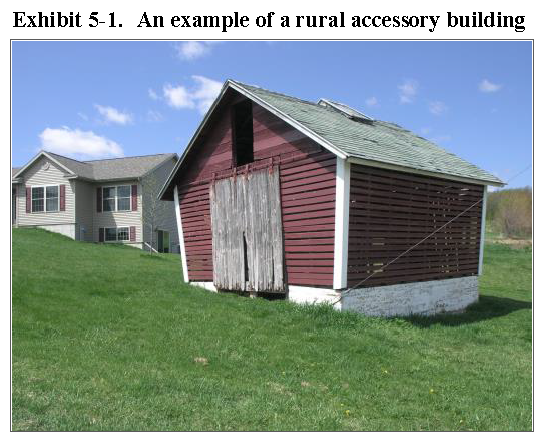
(2)
The building is characteristic of past agricultural practices or rural life, whether presently utilized or not for agricultural practice.
(3)
The building is associated with a person of historic significance or with important historical events.
(4)
The building represents a notable work of a master builder, designer, or architect who influenced their age.
(b)
If the plan commission determines that the building meets one of the above criteria, it shall then consider the following factors in making its final decision:
(1)
Effects of the building on the natural environment;
(2)
Effects of the building on surrounding properties;
(3)
The overall appearance of the building; and
(4)
Any other factor that relates to the purposes of this chapter as set forth in section 36-5 or as allowed by state law.
(c)
No building shall be designated a rural accessory building if it is not structurally sound to meet minimum safety requirements for the proposed use, as determined by the building inspector, provided that such determination shall not relieve the property owner of any responsibility or liability as to the building and shall not form a basis of liability against the building inspector or any other governmental official or entity.
(Ord. No. 2020-O-48, § 1(Exh. A), 9-16-2020)
Sec. 36-515. - Imposition of conditions.
The plan commission may impose one or more conditions of approval as may be necessary to grant approval.
(Ord. No. 2020-O-48, § 1(Exh. A), 9-16-2020)
Sec. 36-516. - Application form and content.
The application submittal shall include an application form as used by the town and a site plan depicting the information listed in appendix F.
(Ord. No. 2020-O-48, § 1(Exh. A), 9-16-2020)
Sec. 36-517. - Content of decision notice.
(a)
Approval. If the application for a rural accessory building determination is approved, the decision notice should include the following:
(1)
A statement that the application is approved;
(2)
A description of the building or buildings;
(3)
Reasons for the decision based on the decision criteria listed in this division;
(4)
Conditions of approval, if any;
(5)
A determination as to whether additional buildings are allowed and under what circumstances;
(6)
A statement indicating that the property owner must sign the decision notice and return it to the zoning administrator to acknowledge acceptance of the same;
(7)
A statement that the applicant may appeal the decision to a court of competent jurisdiction;
(8)
A statement that an aggrieved person, other than the applicant, may appeal the decision to a court of competent jurisdiction, and that any work done by the applicant as authorized by the approval is done at the applicant's risk;
(9)
Other information the plan commission or the zoning administrator deems appropriate;
(10)
The signature of the zoning administrator on behalf of the plan commission;
(11)
The date of the decision;
(12)
Any other information deemed appropriate.
(b)
Denial. If the application for a rural accessory building determination is denied, the decision notice should include the following:
(1)
A statement that the application is denied;
(2)
A description of the building or buildings;
(3)
Reasons for the decision based on the decision criteria listed in this division;
(4)
A statement indicating that the denial does not limit the applicant's ability to resubmit a revised application for consideration;
(5)
A statement that the applicant may appeal the decision to a court of competent jurisdiction;
(6)
Other information the plan commission or the zoning administrator deems appropriate;
(7)
The signature of the zoning administrator on behalf of the plan commission;
(8)
The date of the decision;
(9)
Any other information deemed appropriate.
(Ord. No. 2020-O-48, § 1(Exh. A), 9-16-2020)
Sec. 36-518. - Effect of approval.
If the plan commission designates a building as a rural accessory building, such designation shall run with the land and is binding on all subsequent property owners.
(Ord. No. 2020-O-48, § 1(Exh. A), 9-16-2020)
Sec. 36-519. - Revocation or modification of a prior approval.
The plan commission may revoke or modify an approval issued pursuant to this division if it is determined that information in the application or otherwise provided by the applicant or the applicant's agent was incomplete, false, misleading, or inaccurate and such information would have altered its decision to approve the application or the conditions of approval which were or were not imposed.
(Ord. No. 2020-O-48, § 1(Exh. A), 9-16-2020)
Sec. 36-520. - Appeal.
An aggrieved person may file an administrative appeal with the zoning board of appeals within 30 days of such decision.
(Ord. No. 2020-O-48, § 1(Exh. A), 9-16-2020)
Sec. 36-531.- Generally.
There may be now or in the future certain uses of land that are not in compliance with this chapter, but which were legally established. These uses are referred to as "legal nonconforming uses," and consistent with the provisions of article XI are allowed to continue to operate. For this reason, it is necessary to document those uses that are considered legal nonconforming. Registration of a use as a legal nonconforming use provides documentary evidence establishing:
(1)
When the use was first established;
(2)
That the use at the time of establishment was done consistent with the rules and regulations in effect at the time, if any;
(3)
That it has continued continuously, without cessation of more than 12 continuous months; and
(4)
The nature of the use.
The procedures and requirements in this division are intended to comply with Wis. Stats. § 60.61(5)(d).
(Ord. No. 2020-O-48, § 1(Exh. A), 9-16-2020)
Sec. 36-532. - Initiation.
Any of the following may submit an application to register a specific land use as a legal nonconforming use:
(1)
A person having a financial interest in the subject property or in the use occurring on the property;
(2)
The zoning administrator;
(3)
The plan commission, or any member thereof; or
(4)
The town board, or any member thereof.
(Ord. No. 2020-O-48, § 1(Exh. A), 9-16-2020)
Sec. 36-533. - Review procedure.
The general steps outlined below shall be used in the review of an application for the registration of a legal nonconforming use.
(1)
Submittal of application materials. The applicant submits a completed application and other required materials to the zoning administrator along with the application fee as may be established by the town board.
(2)
Determination of completeness. The zoning administrator reviews the submittal to make sure it is complete and ready for further review. If it is not complete, the zoning administrator will notify the applicant in writing of such deficiencies and that the applicant has three months from the date of the notice to resubmit the application or forfeit the application fee. The zoning administrator will take no further steps to process the application until the deficiencies are remedied. The incomplete application is retained as a public record. A determination that an application is complete means the application is ready for formal review and does not suggest the applicant has provided sufficient information in all regards or preclude the reviewing authority from requesting additional information it deems appropriate.
(3)
Review date. When the zoning administrator determines the application is complete, he or she schedules the review with the plan commission consistent with its adopted calendar
(4)
General notice. Consistent with division 2 of article IV, the zoning administrator places the matter on the meeting agenda of the plan commission.
(5)
Plan commission meeting. Allowing for proper notice, the plan commission considers the application at a regular or special meeting.
(6)
Recommendation. The plan commission makes a recommendation to the town board based on the decision criteria listed in this division to:
a.
Approve the application;
b.
Approve the application with conditions; or
c.
Deny the application.
The plan commission may render its decision at the same meeting the matter was initially considered or at a subsequent meeting, but no later than 40 days after the date of the initial meeting unless the applicant agrees to an extension of a specified duration.
(7)
Town board meeting. Allowing for proper notice, the town board considers the application at a regular or special meeting.
(8)
Decision. After considering the plan commission's recommendation, the town board makes a decision based on the decision criteria listed in this division to:
a.
Approve the application;
b.
Approve the application with conditions; or
c.
Deny the application.
(9)
Preparation of decision notice. Based on the action of the town board, the zoning administrator prepares a decision notice consistent with this division, subject to the direction provided to the zoning administrator from the town board.
(10)
Applicant notification. Within a reasonable time following the town board's decision, the zoning administrator mails the decision notice to the applicant by regular mail.
(11)
Public record copy. A duplicate copy of the decision notice is retained as a public record.
(12)
Inclusion in registry. If the application is approved, the zoning administrator includes the legal nonconforming use in the registry authorized in article XI.
(Ord. No. 2020-O-48, § 1(Exh. A), 9-16-2020)
Sec. 36-534. - Basis of decision.
The plan commission in making its recommendation and the town board in making its decision shall determine whether there is sufficient evidence to show that:
(1)
The use in question was legally established;
(2)
Such use is not now allowed in the zoning district in which it is located either by right or as a conditional use; and
(3)
Such use has continued from the date, or approximate date, of establishment to the current date without an interruption of more than 12 continuous months.
(Ord. No. 2020-O-48, § 1(Exh. A), 9-16-2020)
Sec. 36-535. - Application form and content.
(a)
The application submittal shall include an application form as used by the town and scaled drawing of the subject property and the location of the land use on the property. At a minimum, the application shall request the following information:
(1)
The date, or approximate date, the use was first established or believed to be first established;
(2)
Evidence showing that the use at the time of establishment was legally established;
(3)
The date, or approximate date, when the use became nonconforming;
(4)
The section of the zoning regulation causing the use to be nonconforming;
(5)
Evidence showing that the use has continued from the date, or approximate date, of establishment to the current date without an interruption of more than 12 continuous months; and
(6)
The nature of the use and location on the property.
(b)
Sources of such information may be derived from any of the following:
(1)
Written document (e.g., business license, meeting minutes, reports, planning documents, or a permit or other authorization) maintained by a local, state, or federal governmental body;
(2)
A newspaper article;
(3)
A dated photograph;
(4)
An aerial photograph;
(5)
A sworn affidavit supplied by the applicant or any other person; and
(6)
Any other authoritative source deemed acceptable by the town board.
(Ord. No. 2020-O-48, § 1(Exh. A), 9-16-2020)
Sec. 36-536. - Content of decision notice.
(a)
Approval. If the application for registering a legal nonconforming use is approved, the decision notice should include the following:
(1)
A statement that the use is a legal nonconforming use as of the date of such determination,
(2)
A description of the use,
(3)
Reasons for the decision based on the decision criteria listed in this division,
(4)
A statement that the applicant may appeal the decision to a court of competent jurisdiction,
(5)
Other information the town board or zoning administrator deems appropriate,
(6)
The signature of the zoning administrator on behalf of the town board, and
(7)
The date of the decision.
(b)
Denial. If the application for registering a nonconforming use is denied, the decision notice should include the following:
(1)
A statement that the use cannot be classified as a legal nonconforming use;
(2)
A description of the use;
(3)
Reasons for the decision based on the decision criteria listed in this division;
(4)
A statement indicating that the denial does not limit the applicant's ability to resubmit a revised application for consideration;
(5)
A statement that the applicant may appeal the decision to a court of competent jurisdiction;
(6)
Other information the town board or zoning administrator deems appropriate;
(7)
The signature of the zoning administrator on behalf of the town board; and
(8)
The date of the decision.
(Ord. No. 2020-O-48, § 1(Exh. A), 9-16-2020)
Sec. 36-537. - Effect of decision.
(a)
Generally. If the town board determines that a land use meets the criteria for a legal nonconforming use, such decision constitutes documentary evidence establishing the legitimacy of the use as a legal nonconforming use as of the date of such determination.
(b)
Expansion not authorized. If a use was legally established and has been operated without interruption, but has been illegally expanded over time (i.e., area, extent, mode of operation, or other parameter) such expansion must be removed in keeping with a timeline established by the town board.
(Ord. No. 2020-O-48, § 1(Exh. A), 9-16-2020)
Sec. 36-538. - Revocation or modification of a prior approval.
The town board may revoke or modify an approval issued pursuant to this division if it is determined that:
(1)
Information in the application or otherwise provided by the applicant or the applicant's agent was incomplete, false, misleading, or inaccurate;
(2)
New or additional information shows the use does not meet the decision criteria established in this division; or
(3)
The section of the zoning code creating the nonconforming use no longer exists.
(Ord. No. 2020-O-48, § 1(Exh. A), 9-16-2020)
Sec. 36-539. - Appeal.
An aggrieved person may file an appeal with a court of competent jurisdiction within 30 days of such decision.
(Ord. No. 2020-O-48, § 1(Exh. A), 9-16-2020)
Sec. 36-551.- Generally.
From time to time, there may be instances where a person may have a question concerning a provision of this chapter or the application of a provision of this chapter. To ensure this chapter is consistently interpreted, a mechanism is needed to issue written interpretations. This division describes the procedures and requirements to issue such interpretations.
(Ord. No. 2020-O-48, § 1(Exh. A), 9-16-2020)
Sec. 36-552. - Initiation.
Any person, including the zoning administrator, may submit a question for interpretation.
(Ord. No. 2020-O-48, § 1(Exh. A), 9-16-2020)
Sec. 36-553. - Responsibility for interpretation.
The zoning administrator shall be responsible for rendering a written interpretation, or the plan commission on appeal.
(Ord. No. 2020-O-48, § 1(Exh. A), 9-16-2020)
Sec. 36-554. - Limitations on interpretations.
The responsibility for interpretation shall not be construed as overriding the responsibilities specifically given to any commission, board, or official named in other parts of this chapter.
(Ord. No. 2020-O-48, § 1(Exh. A), 9-16-2020)
Sec. 36-555. - Review procedure.
(a)
Initial review. The general steps outlined below shall be used to render an interpretation.
(1)
Submittal of question. The individual requesting the interpretation submits the question in writing to the zoning administrator and the application fee as may be established by the town board.
(2)
Decision. In consultation with the town attorney, the zoning administrator makes a written decision within 60 business days of the date of receipt of the application.
(3)
Notification of decision. Within a reasonable time following completion of the interpretation, the zoning administrator mails a duplicate copy of the interpretation by regular mail to the individual requesting the interpretation and provides a copy of the same to the plan commission, the town attorney, and those town employees and agents involved in the administration of this chapter, as appropriate.
(4)
Public record copy. A duplicate copy of the interpretation is retained as a public record.
(b)
Review by plan commission on appeal. If a final decision of the zoning administrator is appealed as provided for in this division, the general steps outlined below shall be used to render an interpretation.
(1)
Submittal of application materials. The zoning administrator forwards the application and other required materials the applicant initially submitted to the plan commission along with the decision document.
(2)
General notice. Consistent with division 2 of article IV, the zoning administrator places the matter on the meeting agenda of the plan commission.
(3)
Meeting. Allowing for proper notice, the plan commission considers the appeal at a regular or special meeting.
(4)
Decision. In consultation with the town attorney, the plan commission makes a written decision within 60 business days of the date when the appeal was submitted to the town clerk.
(5)
Notification of decision. Within a reasonable time following completion of the interpretation, the town administrator mails a duplicate copy of the interpretation by regular mail to the individual requesting the interpretation and provides a copy of the same to the zoning administrator, the town attorney, and those town employees and agents involved in the administration of this chapter, as appropriate.
(6)
Public record copy. A duplicate copy of the interpretation is retained as a public record.
(Ord. No. 2020-O-48, § 1(Exh. A), 9-16-2020)
Sec. 36-556. - Basis of decision.
In consultation with the town attorney and others as appropriate, the zoning administrator, and the plan commission on appeal, shall consider the section of this chapter in question and those which are related, consider the purposes of this chapter as set forth in section 36-5 along with applicable legislative findings in this chapter, and consider other applicable interpretations that have previously been made and make a decision consistent with this division giving this chapter its most reasonable application. If the zoning administrator, or the plan commission on appeal, cannot make a reasonable interpretation, a determination shall not be issued.
(Ord. No. 2020-O-48, § 1(Exh. A), 9-16-2020)
Sec. 36-557. - Repeal or revision of an interpretation.
The zoning administrator and the plan commission may rescind or modify an interpretation if such interpretation is deemed to be incorrect in whole or in part.
(Ord. No. 2020-O-48, § 1(Exh. A), 9-16-2020)
Sec. 36-558. - Interpretation content.
An interpretation shall be in writing and contain the following:
(1)
The name of the person posing the question;
(2)
The section number of this chapter in question;
(3)
The question or alleged ambiguity;
(4)
The factors that were considered in making the interpretation;
(5)
The interpretation;
(6)
Other information the zoning administrator deems appropriate;
(7)
The signature of the zoning administrator; and
(8)
The date of decision.
(Ord. No. 2020-O-48, § 1(Exh. A), 9-16-2020)
Sec. 36-559. - Effect of interpretation.
An interpretation once rendered shall have full effect as if set forth in this chapter. Where appropriate, interpretations should be addressed through the amendment process. If the zoning administrator determines that it is not possible to make a reasonable interpretation, such decision shall not affect the validity of any section of this chapter.
(Ord. No. 2020-O-48, § 1(Exh. A), 9-16-2020)
Sec. 36-560. - Compilation of interpretations.
The zoning administrator shall keep a written record of all interpretations in effect and make them available for public inspection.
(Ord. No. 2020-O-48, § 1(Exh. A), 9-16-2020)
Sec. 36-561. - Appeal.
An aggrieved person may, without time constraint, appeal an interpretation made pursuant to this division by filing an appeal with the zoning board of appeals as provided for in this article.
(Ord. No. 2020-O-48, § 1(Exh. A), 9-16-2020)
Sec. 36-581.- Generally.
A legal nonconforming building with a conforming use may be expanded provided the expansion complies with all other requirements in this chapter that apply. This division describes the procedures and requirements to allow such expansion.
(Ord. No. 2020-O-48, § 1(Exh. A), 9-16-2020)
Sec. 36-582. - Initiation.
The owner of the subject property may submit an application to expand a legal nonconforming building.
(Ord. No. 2020-O-48, § 1(Exh. A), 9-16-2020)
Sec. 36-583. - Review procedure.
The general steps outlined below shall be used in the review of an application to expand a legal nonconforming building.
(1)
Pre-submittal meeting. Before submitting an application, the applicant or the applicant's agent may meet with the zoning administrator to review applicable regulations and procedures and the proposal.
(2)
Submittal of application materials. The applicant submits a completed application and other required materials to the zoning administrator along with the application fee as may be established by the town board.
(3)
Determination of completeness. The zoning administrator reviews the submittal to make sure it is complete and ready for further review. If it is not complete, the zoning administrator will notify the applicant in writing of such deficiencies and that the applicant has three months from the date of the notice to resubmit the application or forfeit the application fee. The zoning administrator will take no further steps to process the application until the deficiencies are remedied. The incomplete application is retained as a public record. A determination that an application is complete means the application is ready for formal review and does not suggest the applicant has provided sufficient information in all regards or preclude the reviewing authority from requesting additional information it deems appropriate.
(4)
Review date. When the zoning administrator determines the application is complete, he or she schedules the review with the plan commission consistent with its adopted calendar.
(5)
Staff report preparation and distribution. The zoning administrator may prepare a written staff report as described in this division and provide a copy of it to each member of the plan commission and the applicant prior to the meeting at which the matter will be considered. The zoning administrator will also provide a copy to interested people upon request.
(6)
General notice. Consistent with division 2 of article IV, the zoning administrator places the matter on the meeting agenda of the plan commission.
(7)
Meeting. Allowing for proper notice, the plan commission considers the application at a regular or special meeting.
(8)
Decision. The plan commission makes a decision to:
a.
Approve the application;
b.
Approve the application with conditions; or
c.
Deny the application.
The plan commission may render its decision at the same meeting the matter was initially considered or at a subsequent meeting, but no later than 40 days after the initial meeting unless the applicant agrees to an extension of a specified duration.
(9)
Preparation of decision notice. Based on the action of the plan commission, the zoning administrator prepares a decision notice consistent with this division, subject to the direction provided to the zoning administrator from the plan commission.
(10)
Applicant notification. Within a reasonable time following the plan commission's decision, the zoning administrator mails the decision notice to the applicant by regular mail.
(11)
Acceptance by property owner required. If an approval includes one or more condition of approval, the property owner must sign the decision notice to acknowledge the terms of the approval and return the same to the zoning administrator within six months of the decision. Prior to the expiration of the previously specified time period, the property owner may submit a petition to the town clerk requesting an extension and the town board may, with cause, extend the period within which the decision notice must be signed. If the signed decision notice is not returned within the initial or extended time period, if any, the decision shall automatically become null and void without any further action by the town at the expiration of such time limit. The decision notice shall only become effective when all required signatures have been obtained and the original signature copy is returned to the town clerk.
(12)
Public record copy. A duplicate copy of the decision notice is retained as a public record.
(Ord. No. 2020-O-48, § 1(Exh. A), 9-16-2020)
Sec. 36-584. - Basis of decision.
The plan commission in making its decision shall consider the following factors:
(1)
The degree of the existing nonconformity (i.e., one foot into the setback area or one foot from the property boundary line);
(2)
The size and configuration of the lot;
(3)
Whether the lot conforms to the dimensional standards of the zoning district in which it is located;
(4)
The size and location of the existing legal nonconforming building;
(5)
The size and location of other existing structures and those structures reasonably anticipated on the lot;
(6)
The impact, if any, that the expansion may have on adjoining properties;
(7)
Whether the proposed expansion would violate the intent of this chapter; and
(8)
Any other factor that relates to the purposes of this chapter as set forth in section 36-5 or as allowed by state law.
(Ord. No. 2020-O-48, § 1(Exh. A), 9-16-2020)
Sec. 36-585. - Imposition of conditions.
(a)
Generally. In approving an expansion of a legal nonconforming building, the plan commission may impose one or more conditions of approval deemed necessary to further the intent and purposes of this chapter as set forth in section 36-5 and as allowed by law. Such conditions, for example, may relate to landscaping, screening, and the maximum size of the building(s).
(b)
Effect on contracts with another party. The plan commission shall not condition or withhold approval based upon the property owner entering into a contract or discontinuing, modifying, extending, or renewing any contract, with a third party under which the third party is engaging in a lawful use of the property.
(Ord. No. 2020-O-48, § 1(Exh. A), 9-16-2020)
State Law reference— Wis. Stats. § 62.23(7)(gm)
Note— The town, for example, could not require an applicant to terminate an existing contract with another party that is engaged in a lawful use of the property.
Sec. 36-586. - Application form and content.
The application submittal shall include an application form as used by the town and a site plan depicting the information listed in appendix F.
(Ord. No. 2020-O-48, § 1(Exh. A), 9-16-2020)
Sec. 36-587. - Content of decision notice.
(a)
Approval. If the application for an expansion of a legal nonconforming building is approved, the decision notice should include the following:
(1)
A statement that the application is approved;
(2)
A description of the use;
(3)
Reasons for the decision based on the decision criteria listed in this division;
(4)
A statement that the applicant may appeal the decision to a court of competent jurisdiction;
(5)
A statement that an aggrieved person, other than the applicant, may appeal the decision to a court of competent jurisdiction, and that any work done by the applicant as authorized by the approval is done at the applicant's risk;
(6)
Other information the plan commission or zoning administrator deems appropriate;
(7)
The signature of the zoning administrator on behalf of the plan commission; and
(8)
The date of the decision.
(b)
Denial. If the application for expansion of a legal nonconforming building is denied, the decision notice should include the following:
(1)
A statement that the application is denied;
(2)
A description of the use;
(3)
Reasons for the decision based on the decision criteria listed in this division;
(4)
A statement indicating that the denial does not limit the applicant's ability to resubmit a revised application for consideration;
(5)
A statement that the applicant may appeal the decision to a court of competent jurisdiction;
(6)
Other information the plan commission or zoning administrator deems appropriate;
(7)
The signature of the zoning administrator on behalf of the plan commission; and
(8)
The date of the decision.
(Ord. No. 2020-O-48, § 1(Exh. A), 9-16-2020)
Sec. 36-588. - Effect of decision.
If the plan commission approves the expansion of a legal nonconforming building, the approval runs with the land and is binding on all subsequent property owners.
(Ord. No. 2020-O-48, § 1(Exh. A), 9-16-2020)
Sec. 36-589. - Revocation or modification of a prior approval.
The plan commission may revoke or modify an approval issued pursuant to this division if it is determined that information in the application or otherwise provided by the applicant or the applicant's agent was incomplete, false, misleading, or inaccurate and such information would have altered its decision to approve the application or the conditions of approval where were or were not imposed.
(Ord. No. 2020-O-48, § 1(Exh. A), 9-16-2020)
Sec. 36-590. - Appeal.
An aggrieved person may appeal a final decision made pursuant to this division by filing an appeal with a court of competent jurisdiction within 30 days of the final decision.
(Ord. No. 2020-O-48, § 1(Exh. A), 9-16-2020)
Sec. 36-601.- Generally.
In certain circumstances, a permit is needed to alter the topography of a site. This division describes the procedures and requirements to issue change in topography permits.
(Ord. No. 2020-O-48, § 1(Exh. A), 9-16-2020)
Sec. 36-602. - Applicability.
(a)
This division applies to each of the following:
(1)
Increasing or decreasing existing ground surface elevation greater than four feet at any point where the top or bottom of the proposed slope is within ten feet of any existing property boundary or within 50 feet of an environmental corridor;
(2)
Increasing or decreasing existing ground surface elevation steeper than two horizontal to one vertical or a total elevation change of six feet or greater at any point;
(3)
Bringing in fill or removing excavated material from a site in quantities greater than 1,000 cubic yards, unless otherwise part of an approved master grading plan for a development project;
(4)
Increasing or decreasing existing ground surface elevation greater than four feet at any point within 50 feet of a floodplain or wetland boundary at any point;
(5)
Ponds as denoted in the land-use matrix (appendix A); and
(6)
Major retaining walls.
Material that is excavated for a basement and is taken off-site is not included in the threshold specified in subsection (3) above.
(b)
The following are exempt:
(1)
Any wetland enhancement or restoration project approved by the state department of natural resources where the top or bottom of a proposed slope is 15 feet or greater from the nearest existing property boundary at any point; and
(2)
Any stormwater management practice permitted under the county's stormwater ordinance if the top or bottom of the proposed slope is located 15 feet or greater from the nearest existing property boundary or environmental corridor at any point. However, if a proposed berm for a storm water management practice is greater than four feet in height at any point, the applicant may be required to complete an additional engineering review or meet more restrictive berm design requirements, depending on the county's determination of risk for downstream damages.
(Ord. No. 2020-O-48, § 1(Exh. A), 9-16-2020)
Sec. 36-603. - Initiation.
The owner of the subject property may submit an application to modify the topography of a site.
(Ord. No. 2020-O-48, § 1(Exh. A), 9-16-2020)
Sec. 36-604. - Review procedure.
The general steps outlined below shall be used to review an application to modify the topography of a site.
(1)
Pre-submittal meeting. Before submitting an application, the applicant or the applicant's agent may meet with the zoning administrator to review applicable regulations and procedures and the proposal.
(2)
Submittal of application materials. The applicant submits a completed application and other required materials to the zoning administrator along with the application fee as may be established by the town board.
(3)
Determination of completeness. The zoning administrator reviews the submittal to make sure it is complete and ready for further review. If it is not complete, the zoning administrator will notify the applicant in writing of such deficiencies and that the applicant has three months from the date of the notice to resubmit the application or forfeit the application fee. The zoning administrator will take no further steps to process the application until the deficiencies are remedied. The incomplete application is retained as a public record. A determination that an application is complete means the application is ready for formal review and does not suggest the applicant has provided sufficient information in all regards or preclude the reviewing authority from requesting additional information it deems appropriate.
(4)
Review date. When the zoning administrator determines the application is complete, he or she schedules the review with the plan commission consistent with its adopted calendar.
(5)
Staff report preparation and distribution. The zoning administrator may prepare a written staff report as described in this division and provide a copy of it to each member of the plan commission and the applicant prior to the meeting at which the matter will be considered. The zoning administrator will also provide a copy to interested people upon request.
(6)
General notice. Consistent with division 2 of article IV, the zoning administrator provides for a class 2 public notice, property owner notice, and meeting agenda notice.
(7)
Staff report preparation and distribution. The zoning administrator may prepare a written staff report and provide a copy of it to each member of the plan commission, the applicant, and any other interested person upon request.
(8)
Public hearing. Allowing for proper notice, the plan commission conducts a public hearing consistent with division 3 of article IV. Prior to the close of the public hearing, the applicant or the plan commission may request a continuance consistent with division 3 of article IV. If the public hearing is adjourned, the plan commission may direct the zoning administrator, the town engineer, and/or town attorney to conduct additional research and to prepare such documents it deems necessary, including a preliminary decision document.
(9)
Decision. The plan commission shall make a decision to:
a.
Approve the application;
b.
Approve the application with conditions; or
c.
Deny the application.
The plan commission may render its decision at the same meeting the matter was initially considered or at a subsequent meeting, but no later than 40 days after the initial meeting unless the applicant agrees to an extension of a specified duration.
(10)
Preparation of decision notice. Based on the action of the plan commission, the zoning administrator prepares a decision notice consistent with this division, subject to the direction provided to the zoning administrator from the plan commission.
(11)
Applicant notification. Within a reasonable time following the plan commission's decision, the zoning administrator mails the decision notice to the applicant by regular mail.
(12)
Acceptance by property owner required. If an approval includes one or more condition of approval, the property owner must sign the decision notice to acknowledge the terms of the approval and return the same to the zoning administrator within six months of the decision. Prior to the expiration of the previously specified time period, the property owner may submit a petition to the town clerk requesting an extension and the town board may, with cause, extend the period within which the decision notice must be signed. If the signed decision notice is not returned within the initial or extended time period, if any, the decision shall automatically become null and void without any further action by the town at the expiration of such time limit. The decision notice shall only become effective when all required signatures have been obtained and the original signature copy is returned to the town clerk.
(13)
Public record copy. A duplicate copy of the decision notice shall be retained as a public record.
(Ord. No. 2020-O-48, § 1(Exh. A), 9-16-2020)
Sec. 36-605. - Basis of decision.
The plan commission in making its decision shall consider the following factors:
(1)
The stability of the proposed slope;
(2)
The aesthetic impact;
(3)
The potential for adverse drainage;
(4)
The potential impact upon neighboring properties;
(5)
The potential impact upon environmentally sensitive areas;
(6)
The potential impact upon existing wetlands, lakes and streams;
(7)
The potential impact on roadways and other infrastructure;
(8)
Public safety;
(9)
The length, height, design, and location of any retaining walls or berms;
(10)
Whether a retaining wall is needed to stabilize the grade or control soil erosion based on existing topography;
(11)
How the proposed activity fits with the master grading plan, if applicable;
(12)
Proposed landscaping and screening;
(13)
The materials used and source for fill, landscaping, and retaining walls;
(14)
The amount of land disturbance in relation to the size of the subject property;
(15)
Proposed pond size, use, location, design, landscaping, and water source; and
(16)
Any other factor that relates to the purposes of this chapter as set forth in section 36-5 or as allowed by state law.
(Ord. No. 2020-O-48, § 1(Exh. A), 9-16-2020)
Sec. 36-606. - Imposition of conditions.
(a)
Generally. In approving a change in topography, the plan commission may impose one or more conditions of approval deemed necessary to further the intent and purposes of this chapter. Such conditions, for example, may relate to landscaping, screening, preservation of existing vegetation, engineering considerations for excessively steep or unstable slopes, and erosion control.
(b)
Effect on contracts with another party. The plan commission shall not condition or withhold approval based upon the property owner entering into a contract or discontinuing, modifying, extending, or renewing any contract, with a third party under which the third party is engaging in a lawful use of the property.
(Ord. No. 2020-O-48, § 1(Exh. A), 9-16-2020)
State Law reference— Wis. Stats. § 62.23(7)(gm).
Note— The town, for example, could not require an applicant to terminate an existing contract with another party that is engaged in a lawful use of the property.
Sec. 36-607. - Application form and content.
The application submittal shall include an application form as used by the town and a site plan depicting the information listed in appendix F.
(Ord. No. 2020-O-48, § 1(Exh. A), 9-16-2020)
Sec. 36-608. - Content of decision notice.
(a)
Approval. If the application for a change in topography is approved, the decision notice should include the following:
(1)
A statement that the application is approved;
(2)
A description of the use;
(3)
Reasons for the decision based on the decision criteria listed in this division;
(4)
A statement that the applicant may appeal the decision to a court of competent jurisdiction;
(5)
A statement that an aggrieved person, other than the applicant, may appeal the decision to a court of competent jurisdiction, and that any work done by the applicant as authorized by the approval is done at the applicant's risk;
(6)
Other information the plan commission or zoning administrator deems appropriate;
(7)
The signature of the zoning administrator on behalf of the plan commission; and
(8)
The date of the decision.
(b)
Denial. If the application for a change in topography is denied, the decision notice should include the following:
(1)
A statement that the application is denied;
(2)
A description of the use;
(3)
Reasons for the decision based on the decision criteria listed in this division;
(4)
A statement indicating that the denial does not limit the applicant's ability to resubmit a revised application for consideration;
(5)
A statement that the applicant may appeal the decision to a court of competent jurisdiction;
(6)
Other information the plan commission or zoning administrator deems appropriate;
(7)
The signature of the zoning administrator on behalf of the plan commission; and
(8)
The date of the decision.
(Ord. No. 2020-O-48, § 1(Exh. A), 9-16-2020)
Sec. 36-609. - Effect of decision.
If the plan commission approves a change in topography, the approval runs with the land and is binding on all subsequent property owners.
(Ord. No. 2020-O-48, § 1(Exh. A), 9-16-2020)
Sec. 36-610. - Revocation or modification of a prior approval.
The plan commission may revoke or modify an approval issued pursuant to this division if it is determined that information in the application or otherwise provided by the applicant or the applicant's agent was incomplete, false, misleading, or inaccurate and such information would have altered its decision to approve the application or the conditions of approval where were or were not imposed.
(Ord. No. 2020-O-48, § 1(Exh. A), 9-16-2020)
Sec. 36-611. - Appeal.
An aggrieved person may appeal a final decision made pursuant to this division by filing an appeal with a court of competent jurisdiction within 30 days of the final decision.
(Ord. No. 2020-O-48, § 1(Exh. A), 9-16-2020)

