
Nashville City Zoning Code
CHAPTER 17
24 - LANDSCAPING, BUFFERING AND TREE REQUIREMENTS3
Editor's note—Ord. BL2018-1416, § 4, adopted July 17, 2019, amended the title of Ch. 17.24 to read as herein set out. Formerly, said chapter was entitled "Landscaping, Buffering and Tree Replacement."
Article II. - Parking Area Screening and Landscaping[4]
Editor's note—Ord. BL2022-1122 § 10, passed May 17, 2022, repealed Art. II, §§ 17.24.090—17.24.120, and renumbered Arts. III and IV as Arts. II and III. The former Art. II pertained to tree protection and replacement and derived from Ord. 96-555 § 6.3(A)—(D), 1997, as amended. See the Ordinance List and Disposition Table for complete derivation. The user's attention is directed to § 17.28.065.
17.24.010 - Purpose and intent.
The general purpose of this chapter is to set standards for landscaping, buffering, and tree requirements in order to implement the precepts of the general plan and the associated subarea plans, as well as the requirements of the various zone districts set out previously, including properties zoned DTC district as set forth in Chapter 17.37. This chapter further establishes standards for screening and landscaping parking areas to reduce their impact on adjacent properties and public thoroughfares, as well as to mitigate the environmental impacts of large areas of unbroken pavement; establishes standards for buffering between different zone districts or selected land uses to mitigate the results of differing activities; and sets standards for plant materials, maintenance of required plants, planning in scenic easements and standards for the screening of unsightly areas.
(Ord. BL2022-1122 § 6, 2022; Ord. BL2018-1416 § 4, 2019; Ord. BL2009-586 § 1(Exh. A, § 37), 2010; Ord. 96-555 § 6.1, 1997)
17.24.020 - Landscape plan required.
A landscape plan shall accompany any application for final site plan approval under Section 17.40.170, unless exempted by Section 17.24.050, Exceptions. The plan shall show location, size, spacing, species, form and quality of all existing and proposed materials intended to fulfill the requirements of this chapter. The plan shall also show topography, location of all utilities, and either an under-ground sprinkler system or hose bib attachments. The plans and specifications submitted pursuant to this section shall be prepared by, or under the direction of, and bear the seal of a professional landscape architect registered in Tennessee for all developments which include five thousand square feet or more of permanent structures. Plans and specifications submitted pursuant to this section for developments with less than five thousand square feet of permanent structures shall be exempt from the landscape architect seal requirement.
(Ord. BL2018-1416 § 5, 2019; Ord. BL2008-328 § 5, 2009; Ord. 2001-750 § 1, 2001; Ord. 96-555 § 6.2(A), 1997)
17.24.030 - Plant standards.
A.
Minimum Quality and Size Standards.
1.
Newly planted landscape plant materials shall conform to the latest version of the American Standard for Nursery Stock, ANSI Z60.1-2014.
2.
Type 1, 2, and 3 Trees, shall meet the planting and size requirements as defined in ANSI Z60.1.
a.
Canopy trees shall be a minimum of two inches in caliper at the time of planting, as determined in the American Standard for Nursery Stock, ANSI Z60.1-2004.
b.
Understory trees shall have a caliper of two inches in caliper at time of planting, as determined in the American Standard for Nursery Stock, ANSI Z60.1. For multi-stem varieties caliper shall be determined by taking one-half of the caliper of the three largest required trunks.
c.
Evergreen trees shall be a minimum of six feet in height and a minimum of two inches in caliper at the time of planting.
d.
Except where required to be taller, shrubs shall be a minimum of eighteen inches in height above ground level at the time of planting and shall typically grow to a minimum height of thirty inches for perimeter shrubs and five to six feet for buffer shrubs within four years.
3.
Plant material used to meet the requirements of this Code shall be selected from the Urban Forestry Recommended and Prohibited Tree and Shrub List, unless otherwise approved by the planning or codes departments, as applicable.
4.
Plants listed on the current edition of the Invasive Exotic Pest Plants of Tennessee, as published by the Tennessee Exotic Pest Plant Council, shall not be planted nor credited toward the minimum requirements of this Code.
B.
Plant Diversity.
1.
To maintain forest health, engender climate adaptation, and provide protection against disease and blight, tree plantings shall meet the following requirements:
a.
Tree diversity:
i.
Native species incorporation: Approximately fifty-one percent of the trees planted (excluding ground cover and shrubs) shall be native species of the Southeastern USA Plains Level II Ecoregion.
ii.
Plantings required by adopted streetscape plans or sites located along an Arterial Boulevard as defined by the Major and Collector Street Plan may adjust diversity requirements as approved by planning or codes staff, as applicable.
C.
Stabilization. Landscape planting areas shall be stabilized and maintained with seed, sod, ground covers, mulches, or other approved materials to prevent soil erosion and allow rainwater infiltration. When possible, native ground cover shall be utilized.
D.
Planting in Easements.
1.
Groundcover may be planted or installed within any utility or drainage easement. Trees and shrubs may require approval by the easement holder.
2.
In areas that require canopy trees where overhead utilities prevent the use of canopy trees, understory trees may be substituted. Multi-stemmed understory trees may be used provided they meet the minimum size at time of planting.
E.
Planting Near Light Poles and Transformers. Trees shall be a minimum of fifteen feet from light poles and transformers. Trees may be clustered or moved to a more appropriate location if light poles or transformers conflict with tree locations, as long as all other tree location requirements are met.
F.
Planting Near Fire Hydrants. Tree locations near fire hydrants shall comply with the Fire Code, as applicable. Shrubs shall be a minimum of five feet from a fire hydrant.
(Ord. BL2024-683 § 1, 2025; Ord. 2001-750 § 2 (part), 2001; Ord. 96-555 § 6.2(C), 1997)
17.24.040 - Spacing standards.
Unless specific minimums or maximums are set out in the following articles, landscape plantings required under this chapter may appear to be irregularly planted and spaced at random.
(Ord. 2001-750 § 2 (part), 2001; Ord. 96-555 § 6.2(D), 1997)
17.24.050 - Exceptions.
The requirements of this chapter shall not apply to:
A.
Improvements or repairs to interior and exterior features of existing structures, including the conversion of a non-residential building to residential use either in whole or in part, as provided by this title.
B.
Construction previously authorized by a building permit, a final site plan of a planned unit development approved by the planning commission, or an approved subdivision construction plan, any one of which remains valid on the effective date of the ordinance codified in this title. Any development whose permit or approval expires shall not be exempt.
C.
Reserved.
D.
In the event of emergencies, which may include but are not limited to snow, ice and rain storms, tornadoes, floods, and similar natural disasters which cause excessive tree damage throughout the community, the mayor may invoke additional exceptions as necessary to deal with the emergency.
E.
The interior planting requirements of Section 17.24.160 shall not apply to service loading areas or to tractor trailer staging, loading and parking areas.
(Ord. BL2008-328 § 1, 2009; Ord. BL2004-492 § 4, 2005; Ord. 2001-750 § 2 (part), 2001; Ord. BL99-117 § 1 (part), 2000; Amdt. 1 (part), with Ord. 99-1754 § 5, 1999; Ord. 98-1268 § 1 (part), 1998; Ord. 96-555 § 6.2(B), 1997)
17.24.060 - Special screening requirements.
Screening of unsightly areas shall be accomplished as follows:
A.
Dumpsters and other trash receptacles for all structures other than single-family and two-family residences shall be screened by an enclosure from public streets and from properties which are zoned or policied for residential use. The following design standards shall apply:
1.
Receptacles shall be placed on a concrete pad, constructed from steel reinforced concrete and a minimum of eight inches thick.
2.
Enclosures shall consist of a fence or wall constructed of opaque-type materials, such as wood, masonry, or other permanent materials, which prevent direct visibility of the receptacle. Evergreen plants may be used in part to meet the requirement of opacity.
3.
Enclosures shall be constructed to a minimum height of one foot higher than the height of the enclosed receptacle, or six feet in height, whichever is higher.
4.
Enclosures shall be constructed in such a manner that all structural members, including braces, posts, poles, and other projections, are located within the interior of the enclosure.
5.
Unless the service opening is oriented away from adjacent public streets and residential properties, enclosures shall have a service access gate meeting the following design standards:
a.
Access gates shall be of sufficient size to remove the receptacle from the enclosure.
b.
Access gates shall be constructed of opaque-type materials which prevent direct visibility of the receptacle.
c.
Access gates shall be constructed with a latch to keep the access gate closed when the receptacle is not in use.
d.
Access gates shall not open directly onto public streets or sidewalks.
6.
Enclosures may have an additional side door for accessing the receptacle. This additional side door may be up to three feet in width and may be secured or unsecured.
7.
Receptacles shall be located in the rear of the building or structure which they service. If a receptacle cannot be placed behind the building or structure it services, the location shall be determined by the department of codes administration.
8.
Receptacles must remain readily accessible to the Nashville Fire Department.
9.
When used as an alternative to traditional dumpsters or other trash receptacles, below grade (deep well) refuse collection and recycling systems shall be screened by a decorative wall, solid fence, or year-round landscaping. The wall, fence, or plantings must be of a height equal to or greater than the height of the refuse collection and recycling equipment being screened.
B.
On sites which are developed at the time of adoption of the ordinance codified in this chapter which are subsequently upgraded, dumpsters shall be screened to meet the standards set out in this subsection if:
1.
Any single expansion of the site increases the total building area by twenty-five percent or more;
2.
Multiple expansions within a five-year period increase the total building area by twenty-five percent or more;
3.
The value of any single expansion is more than twenty-five percent of the existing value of improvements;
4.
The total value of all improvements increases by fifty percent or more as a result of multiple expansions over a five year period.
C.
Landscape Buffer Yard Required for Double Frontage Lot. In cases where residential lots are developed with frontage and access to a street within the subdivision and the rear of the lot is oriented toward a public right-of-way, the rear of such double frontage lots shall be screened from the public right-of-way by a landscape buffer yard according to the following standards:
D.
Mechanical equipment, antennae or satellite dishes exceeding eighteen inches in diameter shall not be located within required landscape buffer yards or required front or side setbacks. Mechanical equipment or satellite dishes exceeding eighteen inches in diameter located atop a building shall be screened from all abutting public streets and residential properties by enclosure within the roof form of the building or a screen.
E.
Parking areas servicing multifamily and non-residential uses which have ten or more parking spaces and are located adjacent to residentially zoned properties with-out an intervening street shall be screened by a permanent opaque fence or wall at least six feet in height, in addition to the parking area perimeter landscaping or landscape buffer yards required.
F.
The exterior service area of a commercial or industrial building, if oriented toward a public street, shall be screened as follows:
1.
When oriented to a minor local, local or collector street, screen with a Standard A landscape buffer yard.
2.
When oriented to an arterial street on the adopted major street plan, screen with a Standard B landscape buffer yard.
G.
In addition to the requirements imposed by Sections 17.24.130 through 17.24.170 and Sections 17.24.180 through 17.24.240 of this chapter, areas used for the temporary or permanent storage of inoperable or damaged vehicles shall be screened from properties zoned residential and from public streets by means of an opaque fence or wall not less than six feet in height.
H.
Limitation on Outdoor Storage in all Shopping Center and Mixed-Use Districts. In all shopping center and mixed-use districts, outside display and sales shall be limited to the incidental display of goods for sale or rent by an establishment having activities that occur principally within a building on the same lot, or to the display of new or used vehicles (where permitted by the district).
I.
Outdoor Recreational Facility. An outdoor recreational facility, including swimming pools, tennis or basket-ball courts (golf course fairways excepted), when located adjacent to property with a residential zoning classification, shall provide a Standard C landscape buffer yard to shield the adjacent property.
(Ord. BL2020-405 § 1, 2020; Ord. BL2018-1316 § 1, 2018; Amdt. 1 with Ord. 2001-750 § 3, 2001; Ord. 99-1643 § 3, 1999; Ord. 98-1268 § 1 (part), 1998; Ord. 96-555 § 6.2(E), 1997)
17.24.070 - Scenic landscape easements.
Property abutting a street designated a scenic arterial by the major street plan shall comply with the following requirements:
A.
The area of a lot located within ten feet of the right-of-way of a designated scenic arterial shall be designated as a "scenic landscape easement" and shall be planted with a Standard A landscape buffer yard. Existing vegetation may be used, in part or in whole to meet this requirement.
B.
No grading, cutting of trees or brush exceeding one inch in diameter, or disturbance of prominent natural features shall be performed within a scenic landscape easement except for minimal disturbance necessary to permit streets, driveways or utility corridors. Only those improvements allowed in a landscape buffer yard shall be permitted within the scenic arterial easement.
(Ord. 96-555 § 6.2(F), 1997)
17.24.075 - Plans for street trees and streetscape.
Upon creation of a plan for street trees and streetscape for a specific geographic area within Davidson County, the metropolitan planning commission shall adopt the plan.
A.
Review and enforcement. Compliance with a street tree/streetscape plan shall be reviewed and enforced by the urban forester according to the provisions of this section. Where street trees required by an adopted plan are to be located within the public right-of-way, the urban forester shall consult with the director of public works and/or the director of water services, or their designees, in review and enforcement of the plan. A street tree/streetscape plan shall be designated as a layer in GIS and mapping systems, and all parcels affected by a street tree/streetscape plan shall be flagged on all permitting.
B.
Applicability.
1.
Multi-family or non-residential development or redevelopment. All provisions of this section shall apply to the development or redevelopment of multi-family or non-residential property which includes one or more of the following:
a.
Construction of a new structure on a vacant lot, including lots on which all structures have been or are planning to be demolished; or
b.
The cost of any one renovation equal to or greater than fifty percent of the current appraised value of all structures on the lot, or the value of multiple renovations during any five-year period equal to or greater than seventy-five percent of the current appraised value of all structures on the lot; or
c.
The cost of any one expansion equal to or greater than twenty-five percent of the current appraised value of all structures on the lot, or the value of multiple renovations during any five-year period equal to or greater than fifty percent of the current appraised value of all structures on the lot; or
d.
The total building square footage of any one expansion is equal to or greater than twenty-five percent of the total square footage of all structures on the lot, or the total building square footage of multiple expansions during any five-year period is equal to or greater than fifty percent of the total square footage of all the structures on the lot.
2.
Single-family or two-family construction. All provisions of this section shall apply to the construction of new single-family or new attached or detached two-family structure(s) on a vacant lot, including lots on which all structures have been or are planned to be demolished.
C.
Installation and maintenance.
1.
Trees shall be installed according to the provisions of the Metro Nashville Street Tree Specifications prepared and maintained by Metro Water Services in conjunction with Metro Public Works, Planning and Codes.
2.
The owner of the property frontage along with the street trees are installed shall maintain the trees installed per this title according to the provisions of the Metro Nashville Street Tree Specifications. The owner of the property frontage shall execute and record a restrictive covenant agreeing to these maintenance responsibilities.
3.
Trees installed pursuant to this section shall be eligible for credit toward the tree density required by Section 17.28.065 Trees.
D.
Modifications and amendments. The urban forester shall have the authority to grant minor modifications to the adopted street tree plan including, but not limited to, adjustments in spacing or planting location that do not alter the overall concept of the adopted street tree/streetscape plan. Minor modifications may be granted based on existing physical site conditions such as utilities, a ditch or drainage ditch, historic wall(s) or stone wall(s), existing trees, or steep topography. Modifications that alter the overall concept of the adopted plan shall be considered major and require amendment of the plan by the metro planning commission.
E.
Waivers and compliance. The zoning administrator may waive, in whole or in part, the requirements of this section upon request by the property owner or its agent due to existing physical features on the property such as utilities, a ditch or drainage ditch, historic wall(s) or stone wall(s), existing trees, steep topography, or other hardship. In addition to the urban forester, the zoning administrator shall consult with the executive director of the planning department, or their designee, and where appropriate the director of public works and/or the director of water services, or their designees, prior to making any final determination.
F.
Appeals to the board of zoning appeals. The provisions of this section may be varied or interpretations appealed in conformance with Chapter 17.40, Administration and Procedures. The board of zoning appeals may require a contribution to the tree bank, as provided for in Section 17.40.480 of this title, or other appropriate mitigation for the loss of the trees required by the street tree/streetscape plan as a condition of the variance. The board of zoning appeals shall not accept an application until the zoning administrator has made a determination on the requirement as set forth in this chapter.
(Ord. BL2022-1122 § 7, 2022; Amdt. 1 to Ord. BL2021-619 § 1, 2021; Ord. BL2021-619 § 1, 2021)
17.24.080 - Maintenance of required landscape materials.
The property owner shall maintain landscaping required by this chapter in accordance with the following standards:
A.
Use of Required Landscape Area. No required landscape area shall be used for accessory structures, garbage or trash collection, parking, or any other functional use contrary to the intent and purpose of this article.
B.
Watering. All required landscaping, excluding trees planted or preserved on residential property in accordance with Section 17.28.065.C of this title, shall be watered by one of the following methods:
1.
An underground sprinkler system;
2.
An outside hose attachment within one hundred feet of all landscaping.
C.
Replacement of Dead Materials. The property owner shall replace required plants which die. Replacements shall be installed at the earliest possible time within a planting season, and replacements shall be as shown on the approved landscape plan.
(Ord. BL2022-1122 § 8, 2022; Ord. BL2008-328 § 2, 2009; Ord. 2001-750 § 4, 5, 2001; Ord. 98-1268 § 1 (part), 1998; Ord. 96-555 § 6.2(G), 1997)
17.24.130 - Purpose and intent.
The purpose of this article is to lessen the visual and environmental effects that large parking areas can have on the community through the use of minimum landscaping standards. To those ends, this article establishes the minimum standards by which parking areas will be screened from adjacent public streets or from adjacent properties. In addition, this article delineates standards for landscaping within the interiors of parking areas.
(Ord. 96-555 § 6.4(A), 1997)
17.24.140 - Applicability.
The following requirements are cumulative, not exclusive.
A.
Perimeter Parking Area Landscaping Required. The perimeter parking area landscaping requirements of this article shall apply to all off-street parking facilities adjacent to a public street or to a property line which:
1.
Have five or more parking spaces; or
2.
Are larger than one thousand seven hundred fifty square feet in area.
Within the urban zoning overlay district, parking areas within the CF and CF-NS zoning districts shall be exempt from the side property line planting requirements of this article. Perimeter parking area landscaping may be waived along interior property lines for property located within an approved planned unit development (PUD) district or within a unified plat of subdivision if the planning commission finds that any potential negative impacts of the parking area will be mitigated through other means.
B.
Interior Parking Area Landscaping Required. The interior parking area landscaping requirements of this article shall apply to all off-street parking facilities which:
1.
Have ten or more parking spaces; or
2.
Are over three thousand five hundred square feet in area.
Principal use parking areas located in the CF and CF-NS districts on properties with less than one hundred feet of public street frontage or with less than twelve thousand square feet in total area shall be exempt from the interior planting requirements of this title.
C.
All trees planted or preserved to satisfy the requirements of this article shall count towards the tree density requirements of Article II.
D.
Required parking area screening and landscaping shall not be permitted in utility or drainage easements unless approved by the affected utility and, if approved, the property owner shall execute and record a restrictive covenant agreeing to full replacement of plant materials which may be removed by the utility in the exercise of its rights within the easement.
(Ord. BL2019-111 § 1(Exh. A, § 32), 2020; Ord. 2001-750 § 11, 2001; Ord. BL2000-364 § 1 (part), 2000; Ord. 96-555 § 6.4(B), 1997)
17.24.150 - Perimeter screening requirements.
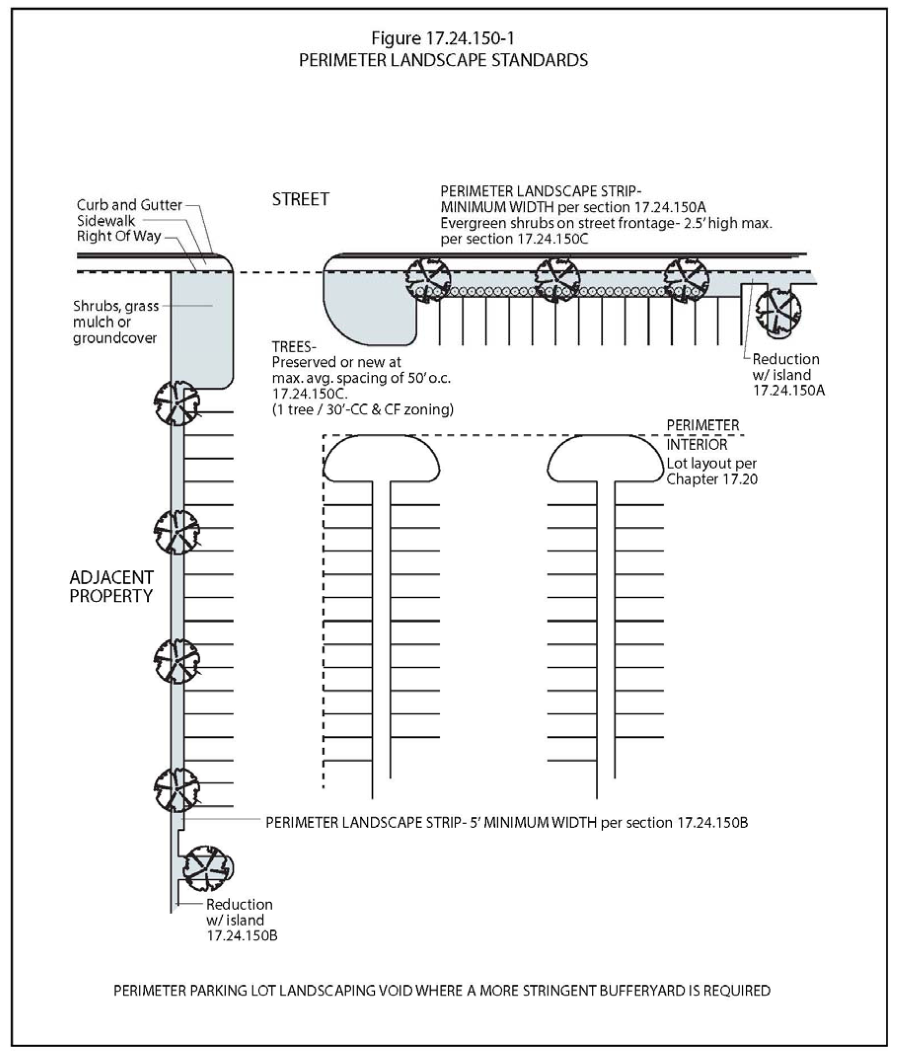
Unless supplanted by more stringent standards in Article IV of this chapter, Landscape Buffer Yard Requirements, the perimeters of parking lots shall be landscaped as follows (See Figure 17.24.150-1):
A.
Parking Areas Adjacent to Public Streets. Parking areas adjacent to public streets shall be separated from the edge of the right-of-way by a perimeter landscape strip which shall be landscaped per the standards set out in subsection C of this section. The public right-of-way and areas reserved for future rights-of-way in compliance with the adopted major street plan shall not be used to satisfy the requirements of this article. Perimeter landscape strips shall be continuous and unbroken except for driveways or sidewalks required to access the parking area. No single driveway/sidewalk penetration shall exceed thirty-five feet.
1.
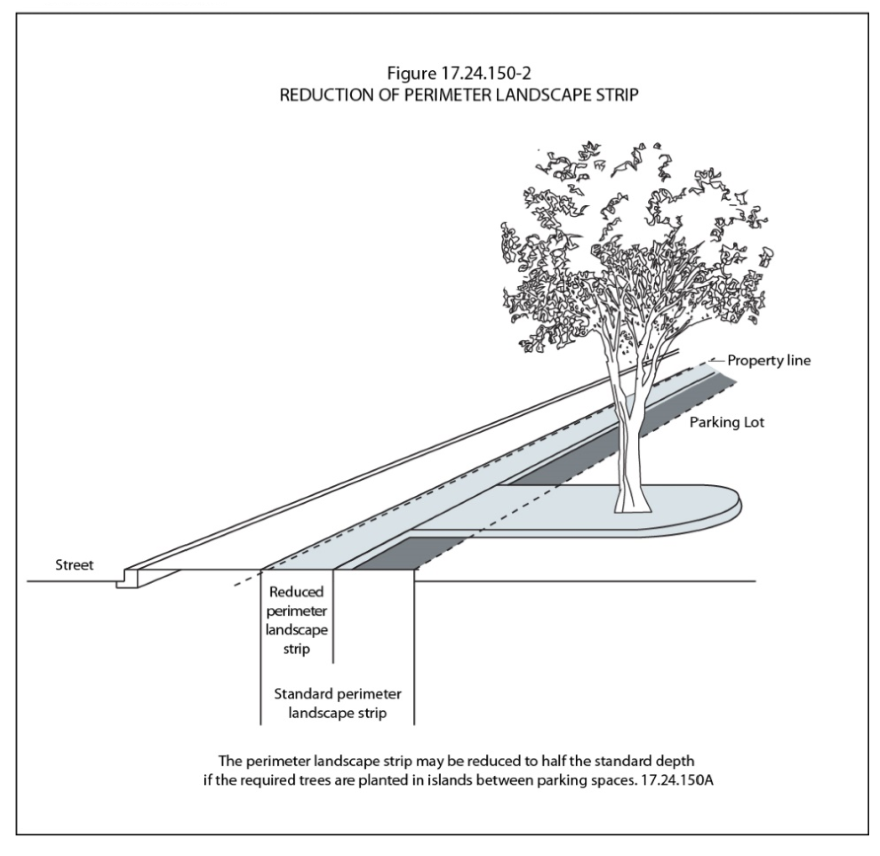
Perimeter landscape strips adjacent to public streets with four or more travel lanes (as classified by the major street plan) shall be a minimum of ten feet in width, unless: (a) the strip includes a permanent finished wall no less than thirty inches in height; or (b) the required trees are planted in islands between the parking spaces. In such cases the perimeter landscape strip may be reduced to five feet in width. (See Figure 17.24.150-2)
2.
Perimeter landscape strips adjacent to public streets with less than four travel lanes (as classified by the major street plan) shall be a minimum of five feet in width, unless: (a) the strip includes a permanent finished wall no less than thirty inches in height; or (b) the required trees are planted in islands between the parking spaces. In such cases the perimeter landscape strip may be reduced to two and one-half feet in width. (See Figure 17.24.150-2)
3.
Permanent landscape strips which use walls or earthen berms are desirable for the reliability of the screening effect they provide. Berms shall not have slopes steeper than 2:1 (horizontal to vertical). Berms with slopes flatter than 4:1 may be stabilized with lawn grasses, and berms with slopes in the range 2:1 to 4:1 shall be stabilized by a continuous perennial plant groundcover which does not require mowing in order to maintain a neat appearance. The wall or combination of berm and perennial groundcover shall be a minimum of two and one-half feet in height.
B.
Parking Areas Adjacent to Side Property Lines. A perimeter landscape strip shall separate a driveway or parking area from an adjacent side property line by one of the following standards: (a) a five-foot (minimum) wide planting strip shall be provided if required trees are to be planted within the strip; (b) a two and one-half foot (minimum) planting strip may be provided to accommodate shrubs if all required trees are planted within tree islands located adjacent to the property line; or (c) two adjacent properties may share equally in the establishment of a seven-foot (minimum) planting strip along the common property line. In instances where the common perimeter planting strip is part of plan for shared access, each owner may count the respective area contributed toward that common planting strip toward the interior planting requirements for the lot. All landscaping strips shall be planted to satisfy the planting requirements of subsection C of this section.
C.
Landscape Materials. A minimum of one tree shall be preserved or planted for each fifty feet of parking area perimeter, or portion thereof; for principal use parking areas located with the DTC, and CF, and CF-NS zoning districts, street trees shall be installed at a rate of one tree per thirty feet of street frontage. Trees planted to meet this requirement shall measure a minimum of two inches in caliper, and six feet in height, as applicable for the type of material specified. The remaining area within the perimeter landscape strip which fronts on a street right-of-way shall be planted with one continuous row of evergreen shrubs which shall be expected to mature at a height not greater than two and one-half feet, except as modified for berms or walls. The remainder of the area within all perimeter strips not occupied by trees or shrubs shall be covered by organic or mineral mulches, other shrubs, groundcover plants or grassed lawns. The use of concrete, asphalt or other impervious surfaces shall be prohibited.
D.
Corner Visibility. Trees and other landscaping required in the perimeter strip shall be maintained to assure unobstructed corner visibility pursuant to Section 17.20.180, Visibility.
E.
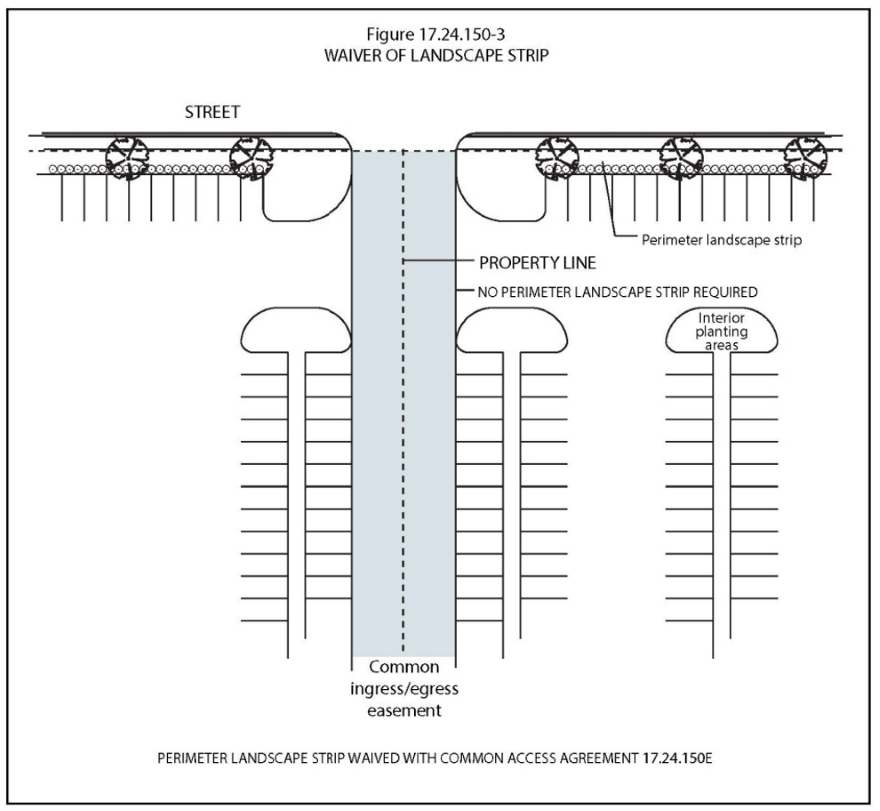
Adjacent Parking Areas with Shared Access. Parking areas on adjacent properties, which are designed to share a common access from the public right-of-way and a vehicular travelway along their common property line shall be exempt from the requirement for a parking area perimeter landscape strip along their common property line, upon the recording of an easement agreement which provides for the mutual right of ingress and egress for both property owners. (See Figure 17.24.150-3)
(Ord. BL2019-111 § 1(Exh. A, § 33), 2020; Ord. BL2018-1416 § 9, 2019; Ord. BL2000-364 § 1 (part), 2000; Ord. 98-1323 § 1, 1998; Amdt. 1 with Ord. 98-1268 § 1 (part), 1998; Ord. 96-555 § 6.4(C), 1997)
17.24.160 - Interior planting requirements.
A.
General Requirements. Except for parking lots containing fewer than thirty spaces within the urban zoning overlay district, at least eight percent of the gross area of the parking area shall be landscaped and interior planting areas are to be located within or adjacent to the parking area as tree islands, at the end of parking bays or inside seven foot wide or greater medians (where the median area is to be included as a part of the calculations for the interior planting area). Parking lots containing fewer than thirty parking spaces within the urban zoning overlay district shall be exempt from the eight per-cent landscaping requirement and the seven foot median requirement, but shall be required to install trees as described below. Interior planting areas shall be located so as not to impede stormwater runoff and provide shade in large expanses of paving and contribute to orderly circulation of vehicular and pedestrian traffic.
1.
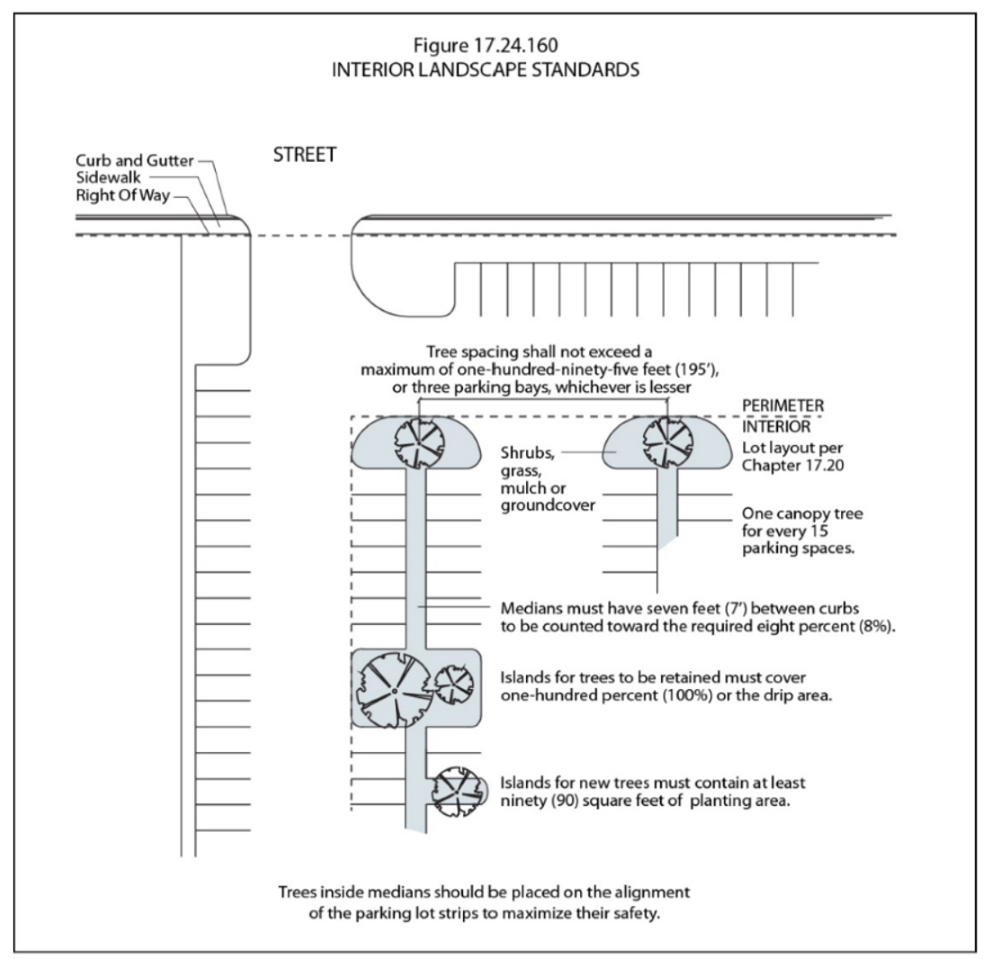
Trees shall be required at the minimum of one canopy tree for every fifteen parking spaces. All vehicular use areas located within the same block which serve one or more businesses or uses of land or share unified ingress and egress shall be considered as a single vehicular use area for the purpose of computing the required rate of trees, notwithstanding ownership. Required trees shall be at least six feet in height and two inch caliper. (See Figure 17.24.160) For principal use parking areas located in the CF and CF-NS districts not otherwise exempt from the interior planting requirements, street frontage trees planted to satisfy the requirements of Section 17.24.150 shall count towards the interior planting requirements of this section.
B.
Minimum Size of Interior Planting Areas.
1.
Outside the urban zoning overlay district, and for parking lots containing thirty or more parking spaces within the urban zoning overlay district, a minimum of ninety square feet of planting area shall be required for each new canopy tree (See Figure 17.24.160), and a minimum planting area of one hundred percent of the drip line area of the tree shall be required for all existing trees to remain. If the applicant can demonstrate that conditions allow that the tree will be preserved with an area less than one hundred percent, lesser area may be approved by the urban forester. (See Figure 17.24.160)
2.
For parking lots containing fewer than thirty parking spaces within the urban overlay zoning district, a minimum planting or tree grate area of one hundred percent of the drip line area of the tree shall be required for all new and existing trees. If the applicant can demonstrate that the tree can remain healthy with an area less than one hundred percent, lesser area may be approved by the urban forester. (See Figure 17.24.160)
(Ord. BL2019-111 § 1(Exh. A, § 34), 2020; Ord. BL2018-1416 § 10, 2019; Ord. BL2009-586 § 1(Exh. A, § 38), 2010; Amdt. 1 with Ord. 2001-750 § 32, 2001; Ord. BL2000-364 § 1 (part), 2000; Ord. 98-1323 § 2, 1998; Amdt. 1 with Ord. 98-1268 § 1 (part), 1998; Ord. 96-555 § 6.4(D), 1997)
17.24.170 - Nonconforming parking areas.
When the gross area of a nonconforming parking area is increased, compliance with this article and the DTC is required as follows:
A.
Expansion by Twenty-Five Percent or Less. When a parking area is expanded by not more than twenty-five percent, only the expanded area must be brought into compliance with this article and the DTC.
B.
Expansion by More than Twenty-Five Percent. When a parking area is expanded by more than twenty-five percent, the entire parking area (pre-existing and expanded) shall be brought into compliance with this article and the DTC.
C.
Repeated Expansions. Repeated expansions of a parking area over a period of time commencing with the effective date of the ordinance codified in this title shall be combined in determining whether the twenty-five percent threshold has been reached.
(Amdt. 3 to Ord. BL2009-586 § 1(Exh. A, § 37.A), 2010; Ord. 96-555 § 6.4(E), 1997)
17.24.180 - Purpose and intent.
The purpose of this article is to protect the value and integrity of property from the potential adverse effects of noncompatible land uses. To that end, this article requires that landscape buffer yards be provided at the boundaries of selected zoning districts. The landscape buffer yard standards of this article are also employed by other chapters of this title to accomplish special screening and buffering objectives. The width of the landscape buffer yard and the intensity of plantings required may vary depending upon the relative intensities of the abutting zone districts or the activity itself. In most cases, the property owner may choose among a number of buffer yard widths and plantings to satisfy the requirement.
(Ord. 96-555 § 6.5(A), 1997)
17.24.190 - Exemptions.
No landscape buffer yard shall be required in the following situations:
A.
When a zoning boundary falls along a public street containing four or more travel lanes, or along an elevated railroad bed, utility line easement of fifty feet wide or greater, navigable river, or controlled access highway.
B.
When a zoning boundary falls along a public street or alley within the urban zoning overlay district.
C.
When a zoning boundary falls along an alley in the urban zoning overlay district and uses on both sides of the alley are residential. In all other situations, a minimum B-5 buffer may be substituted for the required buffer.
(Ord. BL2009-586 § 1(Exh. A, § 39), 2010; Amdt. 2 to Ord. BL2005-712, 2005; Ord. BL2005-712 § 2, 2005; Ord. 2002-1020 § 1, 2002; Ord. 98-1268 § 1 (part), 1998)
17.24.200 - Determination of landscape buffer yard requirements.
Generally, a landscape buffer yard shall be located at the perimeter of the building site along zoning district boundaries, or otherwise coincident with the edge of a specified facility that is to be screened, and shall not be located in any portion of a public right-of-way. When a zoning district boundary falls along a public street of less than four travel lanes, a B-2 landscape buffer yard may be substituted in lieu of the standard buffer required by Table 17.24.230. In applying the buffer standards of Table 17.24.230, the zoning administrator may take into consideration the future zoning designation of the abutting property as envisioned by the general plan to the extent that existing land uses are reasonably protected by an effective buffer. When the gross floor area of a building legally existing on the effective date of the ordinance codified in this section is enlarged by more than twenty-five percent, that perimeter portion of the property in proximity to the area of expansion shall be brought into conformance with the landscaping buffer yards standard of this code to the greatest extent considered reasonable by the zoning administrator. When incremental expansions occur over time, the total of all expansions shall be used by the zoning administrator in applying the provisions of this section. The following procedure shall be followed to determine the standard of landscape buffer yard required along a zoning district boundary:
A.
Identify the zone district for the proposed site as well as for the abutting site(s);
B.
Determine the landscape buffer yard standard required on each building site boundary (or portion thereof) by referring to Table 17.24.230;
C.
Select the desired width/screening option from those listed in Section 17.24.240, landscape buffer yard standards. Any of the listed width or screening variations shall satisfy the requirement between abutting zone districts.
(Ord. 98-1268 § 1 (part), 1998; Ord. 96-555 § 6.5(C), 1997)
17.24.210 - Landscape buffer yard design and materials.
A.
Existing Native Plant Material. The use of existing plant material is strongly encouraged in landscape buffer yards. Existing natural groundcover should be retained where possible by avoiding scraping, grading and sodding within the landscape buffer yard. Where the planting requirements of Section 17.24.240, landscape buffer yard standards, require additional trees or shrubs to be installed in an existing natural area, installation should minimize disturbances to native species.
B.
Trees. Where the planting requirements of Section 17.24.240 indicate that additional trees shall be installed, required trees shall be a minimum of six feet in height or two inches in caliper, as appropriate. At least one-half of the required trees shall be locally adapted natural evergreen species. Trees shall be distributed throughout the yards, so that there are no horizontal gaps between trees greater than thirty feet as measured parallel to the property line. Required canopy trees shall have an expected mature height of thirty feet or greater. Required understory trees shall have an expected mature height of at least fifteen feet. All trees shall count towards satisfying the tree density requirements of Article II of this chapter.
C.
Shrubs. Shrubs planted to meet the minimum standards of this article shall be a minimum of one and one-half feet in height when planted and at least one-half shall be expected to reach five feet or greater in height within five years of planting. At least one-half of the required shrubs shall be locally adapted evergreen species. Shrubs planted on berms may have a lesser mature height provided that the combined height of the berm and plantings after five years is at least five feet. Shrubs shall be planted in such a way as to form continuous coverage with no shrub being greater than five feet from another as measured parallel to the property line. Shrubs may be planted in staggered rows or any other pattern which still achieves the desired continuous coverage. Pedestrian areas and other places where surveillance for the purpose of preventing crime is a design objective may be planted with the smaller of the required shrubs, but at least fifty percent of the shrubs installed to meet the requirements of this title shall be capable of attaining five feet in height at maturity.
D.
Utility and Drainage Easements. Required landscape buffer yards shall not be permitted in utility or drainage easements unless approved by the affected utility and, if approved, the property owner shall execute and record a restrictive covenant agreeing to full replacement of plant materials which may be removed by the utility in the exercise of its rights within the easement.
E.
Parking Area Landscaping. Perimeter plantings required for parking area landscaping may be counted toward satisfying landscape buffer yard requirements when the perimeter planting area coincides with the yard.
F.
Compatibility of Landscaping Materials. Supple-mental plantings should be chosen to enhance the existing vegetation within the landscape buffer yard. The species used in the supplemental plantings should be species that occur naturally in the landscape, and should be selected for their noninvasive properties.
G.
Opaque Fences.
1.
Outside of the urban zoning overlay district, when utilized to satisfy a screening requirement of this title, opaque fences shall be constructed of permanently affixed materials that comprise an integral part of the fence itself. The use of nonrigid plastic or fabric material shall not qualify as an opaque fence.
2.
Within the urban zoning overlay district, when walls or fences are used as part of landscape buffer yards, the following materials shall be used and the landscaping shall be installed on the side of the wall facing the less intensive use:
a.
Fences provided in Landscape Buffer Yards A and B may only be constructed of natural wood. Sheet plastic, sheet metal, corrugated metal, and plywood fencing shall not be allowed. The finished side of fences shall face the lower intensity use.
b.
Walls provided in Landscape Buffer Yards B, C, and D may only be constructed of brick, stone, stucco over concrete block, split-faced or fluted block. Walls shall not be constructed of industrial waste materials (tires, pallets, etc.).
(Ord. 2001-750 §§ 12—14, 2001; Ord. BL2000-364 § 1 (part), 2000; Ord. 96-555 § 6.5(D), 1997)
17.24.220 - Other uses within landscape buffer yards.
A.
Trails. Sidewalks or bike trails may occur within landscape buffer yards provided that the required effect of the yard is not compromised. In no event, however, shall the following uses be permitted in landscape buffer yards: playfields, stables, swimming pools, golf courses, tennis courts, and other recreational facilities; parking areas and other vehicular use areas; dumpsters, equipment storage and other open storage; buildings or overhangs.
B.
Stormwater Retention/Detention Facilities. Surface stormwater retention/detention facilities shall not be permitted to encroach into landscape buffer yards. Subterranean facilities which are designed in a manner so as not to interfere with the proper installation and maintenance of the yard are allowed.
C.
Buffer yards shall be continuous and unbroken except for driveways or sidewalks required to access parking areas or streets. Driveway/sidewalk penetrations shall cross the buffer yard as close to perpendicular as possible and shall not exceed twenty-five percent of the entire buffer yard, with no single penetration to exceed thirty-five feet.
(Amdt. 1 with Ord. 98-1268 § 1 (part), 1998; Ord. 96-555 § 6.5(E), 1997)
17.24.230 - Table of landscape buffer yard requirements.
Landscape buffer yards shall be provided along zoning district boundaries to standards established by Table 17.24.230.
Table 17.24.230 TABLE OF LANDSCAPE BUFFER YARD REQUIREMENTS
Note 1: The zoning administrator may allow a necessary adjustment to the landscape buffer
yard located along a rear property line to provide for necessary building area after
determining an adjustment to a required build-to zone is necessary as permitted by
Table 17.12.020.D. The zoning administrator may allow a necessary adjustment to the
landscape buffer yard based on the nature of the existing and future land uses and
site conditions in the general vicinity after receiving a written recommendation from
the planning department.
Note 2: Per district standards, these apply only to Townhouse Court, Manor House, Multiplex,
Low-rise Courtyard, and Low-rise Flats that share a side and/or rear property line
with R- and RS-zoned land.
(Ord. BL2025-1005 § 1(Exh. A), 2025; Ord. BL2019-111 § 1(Exh. A, § 35), 2020; Ord. BL2018-1416 § 12, 2019; Ord. BL2015-1153 § 15, 2015; Ord. BL2013-567 § 2, 2013; Ord. BL2011-898 § 11, 2011; Amdt. 2 (part) with Ord. 98-1323 § 3, 1998; Amdt. 1 with Ord. 98-1268 § 1 (part), 1998; § 1(11) of Amdt. 1 with Ord. 96-555 § 6.5(F), 1997)
17.24.240 - Landscape buffer yard standards.
A.
Application of Landscape Buffer Yard Standards. The specifications contained in Figures 17.24.240A through 17.24.240D, set out at the end of this chapter, shall be used to select the desired landscape buffer yard option for the building site. These yard requirements are stated in terms of minimum yard width and the density of required plant material per linear foot of yard. To determine the total number of plants required, the length of each side of property requiring a landscape buffer yard shall be divided by one hundred and multiplied by the number of plants shown in the illustration.
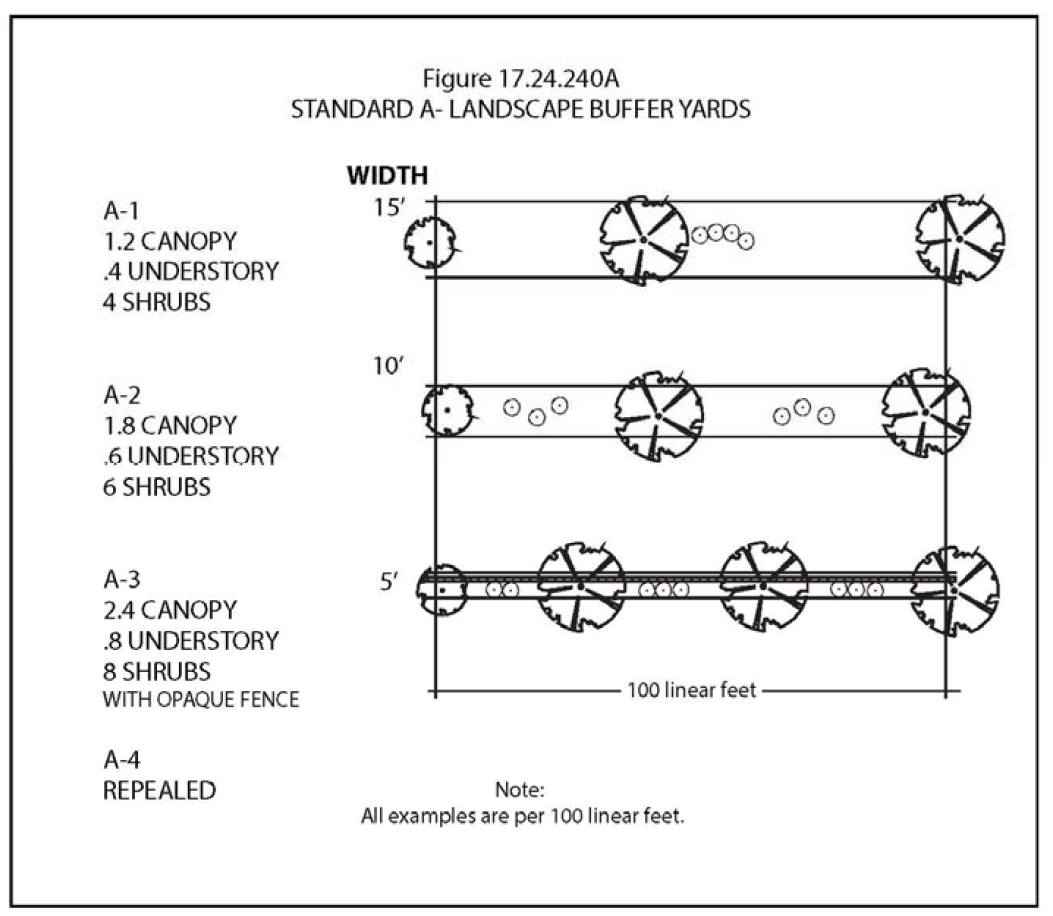
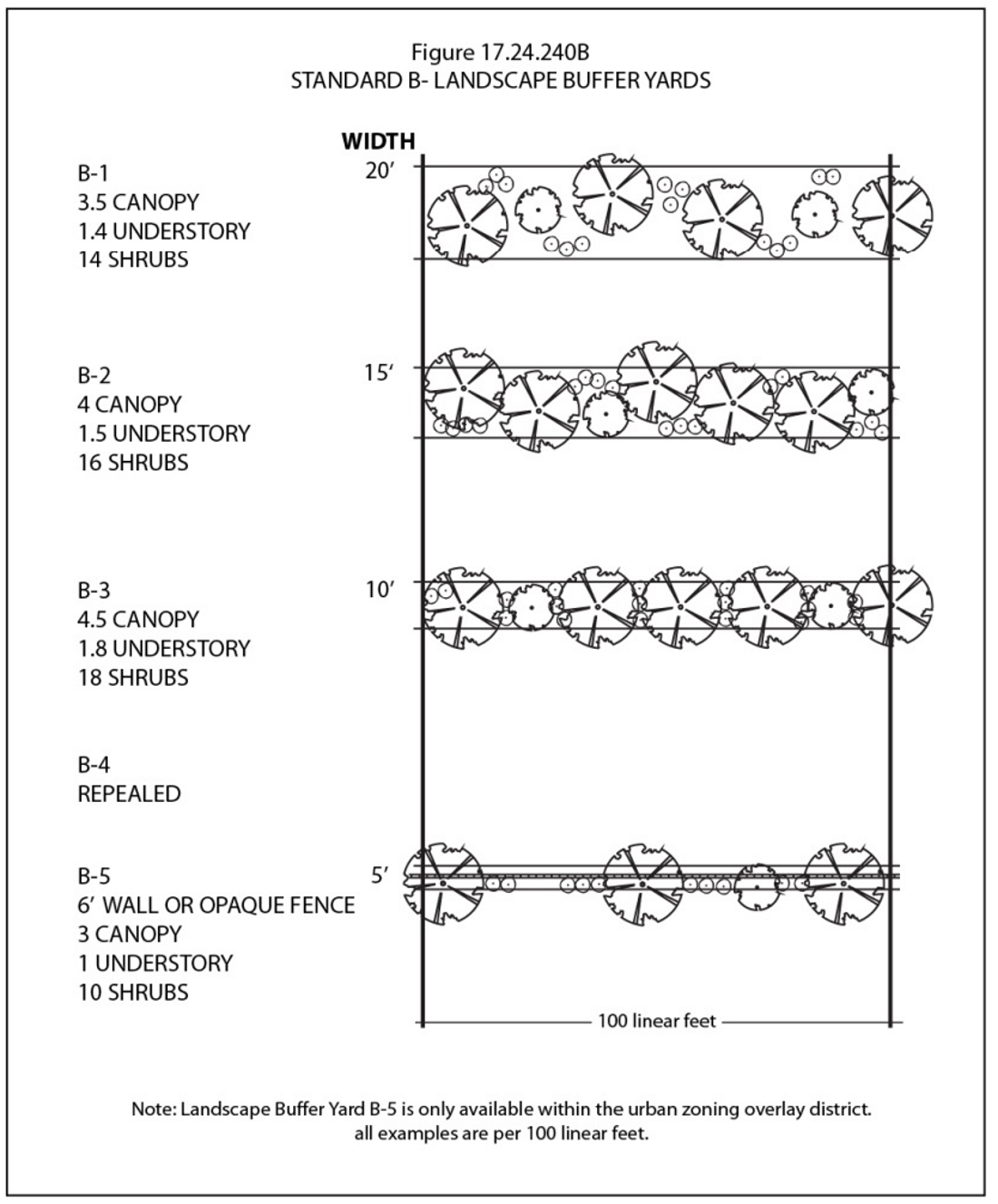
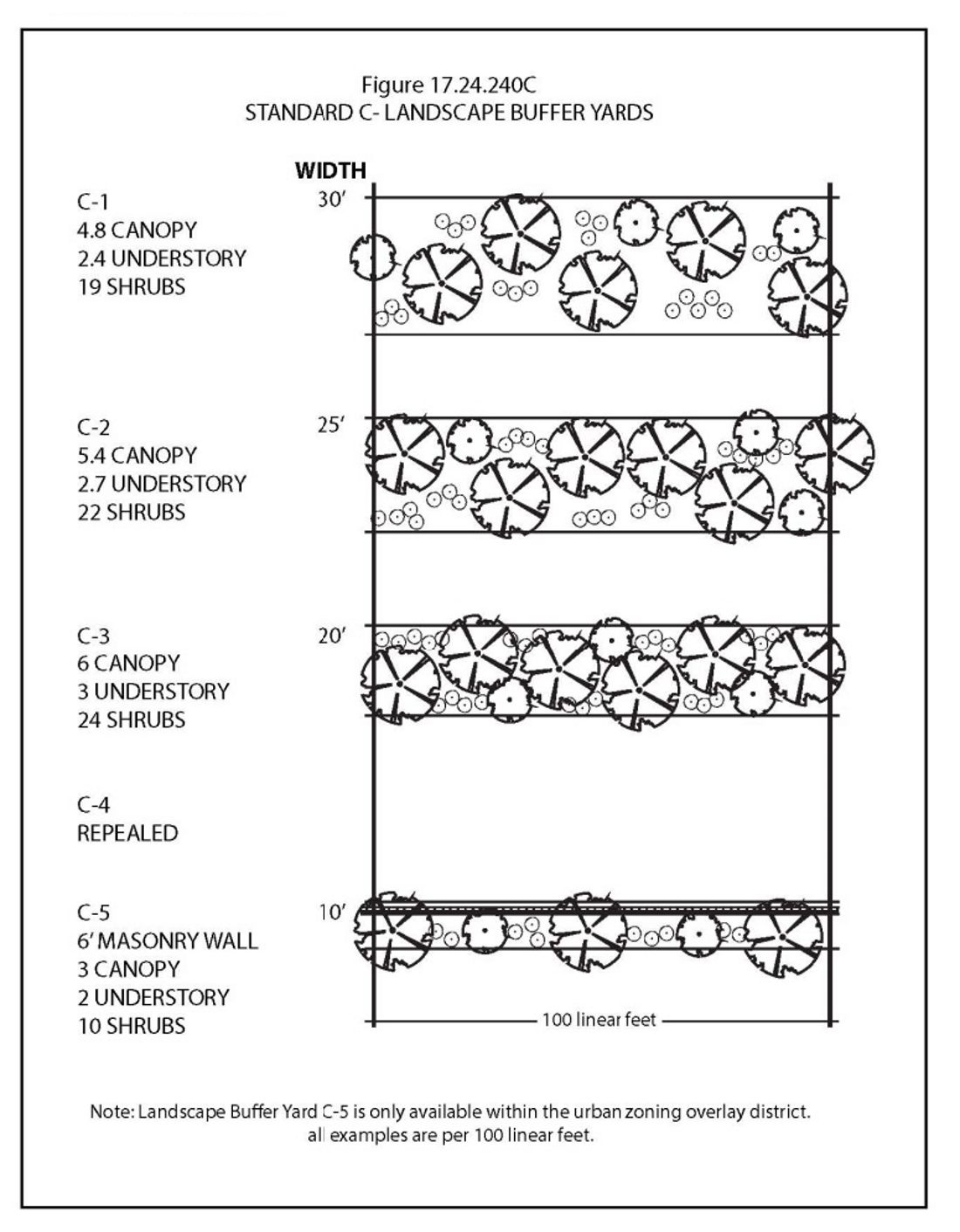
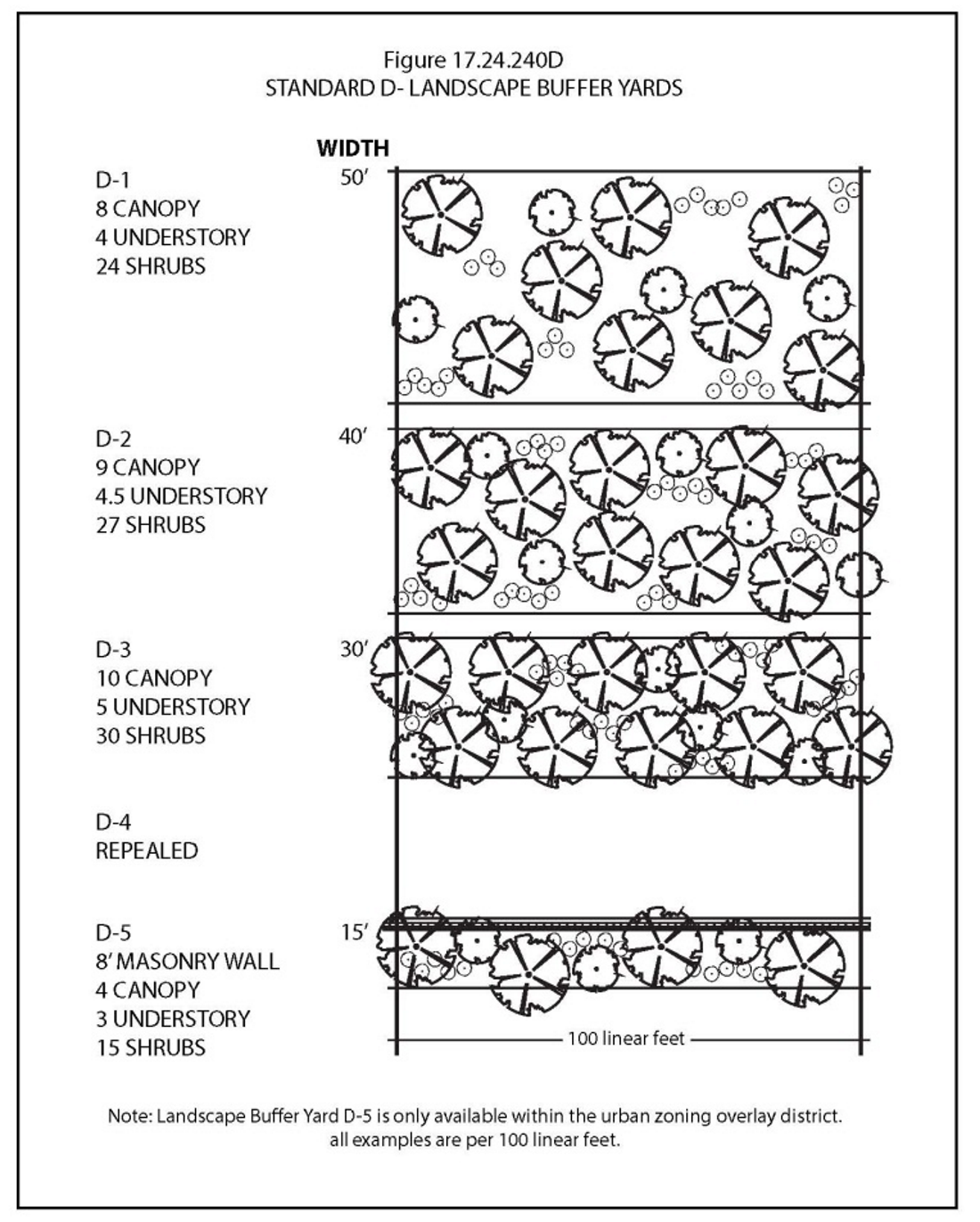
B.
Allowable Design Variations. The landscape buffer yard is normally calculated as parallel to the property line. However, design variations, especially when used to incorporate native vegetation into the yard area, shall be considered. The edges of the landscape buffer yard may meander provided that:
1.
The total area of the yard is equal to or greater than the total area of the required landscape buffer yard; and
2.
The yard measures no less than the minimum width permitted by the applicable landscape buffer yard standard at all points along the perimeter of the property line requiring a landscape buffer yard.
C.
Fractional Requirements. When the requirements of this article result in a fractional number of plantings, the fraction shall be rounded to one.
D.
Planned Unit Development Districts. Notwithstanding any other provision of this title to the contrary, the landscaping buffer yard requirements for a PUD originally approved by the metropolitan council under a previous Zoning Code shall be provided as required by this code or as required in the originally approved PUD, whichever is greater. If a PUD approved under a previous Zoning Code provides for commercial and/or industrial uses within such PUD, and the underlying base zoning of the property on which the PUD district exists is an agricultural or residential zoning district, then the commercial and/or industrial zoning district which best accommodates the land uses permitted within the PUD shall be the "Zoning District Providing Buffer Yard" for the purposes of Table 17.24.230.
E.
Yard Exceeds Twenty Percent of Lot Area. In circumstances where the ground area required for the landscape buffer yard exceeds twenty percent of the total lot area, the width and the number of trees and shrubs within the yard may be reduced up to fifty percent provided that a solid wall or closed wooden fence at least six feet in height is provided along the length of the reduced landscape buffer yard.
F.
Grading and Use of Berms. Proposals for grading within a landscape buffer yard shall demonstrate superior enhancement of the buffer function compared to retention of the existing grades. Grading should not endanger or remove existing trees which occur within a landscape buffer yard, unless the proposal clearly demonstrates an enhanced buffer. The use of earthen berms within a landscape buffer yard is encouraged when disturbance to existing vegetation can be minimized. Where berms are incorporated into the yard, the required plantings may have a lesser mature height, provided that the combined height of the berm and plantings will equal the required mature heights of plantings as set forth in Section 17.24.210B and C.
G.
Waiver of Landscape Buffer Yard. Landscape buffer yard requirements may be waived by a demonstration of unusual site grade conditions which would clearly negate the effects of the required yard. The applicant shall furnish sections or profiles (drawn to scale) through the property line along the yard which is proposed for waiver. These drawings shall demonstrate the existing and proposed grades on both sides of the property line, as well as the principal structures on both properties. The sections or profiles shall show the line of sight for a pedestrian (taken at four and one-half feet above grade) from principal entrances and from the highest point on the site to be buffered. Such profiles or sections shall clearly demonstrate that the effect of the change in grade would negate the effect of a mature landscape buffer yard thirty feet in height.
(Ord. BL2018-1416 § 11, 2019; Ord. 2001-750 §§ 15—31, 2001; Ord. BL2000-364 § 1 (part), 2000; Amdt. 2 (part) with Ord. 98-1323 § 4, 1998; Amdt. 1 with Ord. 98-1268 § 1 (part), 1998; Ord. 96-555 § 6.5(G), 1997)

