
Nashville City Zoning Code
CHAPTER 17
32 - SIGN REGULATIONS5
Editor's note—Ord. BL2016-309, § 5(Exh.), passed August 16, 2016, repealed the former Ch. 17.32, §§ 17.32.010—17.32.160, and enacted a new Ch. 17.32 as set out herein. The former Ch. 17.32 pertained to similar subject matter and derived from Ord. 96-555, 1997, as amended. See the Ordinance List and Disposition Table for complete derivation.
17.32.010 - Purpose and intent.
A.
Safety. Construct and display signs in a manner that allows pedestrians and motorists to identify, interpret and respond in an efficient and discerning manner to the following:
1.
Information related to public traffic control, directions and conditions;
2.
Movement of all other pedestrians and vehicles that impact traffic on a given travelway; and
3.
Information other than public traffic related when displayed in a manner which is clear, concise and noncompeting with public traffic information.
B.
Protection of Minors. Prohibit the location of signs that are harmful, or potentially harmful, to minors that include nudity or sexual activity through the exposure and/or exaggerated representation of genitals, buttocks and/or breasts.
C.
Graphic Continuity and Aesthetics. Organize signs in a manner that reduces visual clutter and integrates signs with all other elements of the site and environs by limiting the size, location and design of signs so that pedestrians and motorists have an equal right to view buildings, structures and natural features in the foreground and background.
D.
Protection of Future Public Right-of-Way. Limit the location of signs so that reasonable expansion of the public right-of-way can occur in conformance with the capital improvements program and without disturbance of existing conforming signs.
E.
Activities and Services Identification. Based on a communities need to know, provide for signs that identify the marketplace and the opportunities provided by the community.
(Ord. BL2016-309 § 5(Exh.), 2016)
17.32.020 - General provisions.
A.
Interpretation. These sign regulations are intended to complement the various codes and ordinances of the metropolitan government. Wherever there is inconsistency between these sign regulations and other regulations of the metropolitan government, the more stringent shall apply. Reference is made but not limited to the following regulations:
1.
Building code;
2.
Electrical code;
3.
Major street plan;
4.
Zoning title and performance standards;
5.
Metropolitan Code Section 13.08.050 (sign in public right-of-way);
6.
Metropolitan Code Section 12.48.090A (Bus benches and signs);
7.
Metropolitan Code Section 17.04.060 (specified anatomical areas);
8.
Historic district regulations;
9.
State of Tennessee Outdoor Advertising Regulations;
10.
Traffic and parking code.
B.
Design, Construction and Maintenance. All signs shall be designed, constructed and maintained in accordance with the following standards:
1.
Compliance with Codes. All signs must comply with all the provisions of the Metropolitan Code.
2.
Permanency Required. All signs shall be constructed of permanent materials and shall be permanently affixed to the ground or building unless otherwise exempted in this chapter.
3.
Maintenance. All signs shall be maintained in good surface and structural condition, with all panels in place, complete, and intact, and in compliance with all building and electrical codes.
(Ord. BL2023-1858 § 1, 2023; Ord. BL2016-309 § 5(Exh.), 2016)
17.32.030 - Rationale, definition, system for regulation and overall use.
A.
Rationale. The word "sign" is chosen to signify all nonverbalized communication in public viewed areas because of its traditional use. The word "graphic" is synonymous with sign and the two may be used interchangeably within the context of this sign code. An on-premises sign shall not be a principal use.
B.
Definition. The definition of "sign" as provided hereinafter is all-inclusive. A sign is any writing (including letter, work or numeral), pictorial representation (including illustration or decoration); emblem (including device, symbol or trademark); flag (including banner or pennant); inflatable structure; or any other figure of similar character, which is:
1.
A structure or any part thereof, or is attached to, painted on, or in any other manner represented on a building or other structure; and
2.
Used to announce, direct attention to, or advise.
C.
System for Regulation. Regulation of signs is based on size, location, method of attachment, duration and design/lighting. The following distinctions apply to the regulation of signs:
1.
Regulation based on size;
2.
Regulation based on location;
3.
Regulation based on method of attachment:
a.
On-premises ground sign,
b.
On-premises building sign;
4.
Regulation based on duration:
a.
On-premises temporary sign,
b.
On-premises permanent sign;
5.
Regulation based on design/method of lighting:
a.
Illuminated sign,
b.
Nonilluminated sign.
Regulations apply to signs with respect to specific permissiveness and provisions in each use district or group of related districts. Regulations are generally more restrictive in residential districts than in commercial and industrial. Additional regulations may further apply to areas of special design control such as, but not limited to:
1.
Airport district;
2.
Historic districts;
3.
Floodplain districts;
4.
Redevelopment districts;
5.
Urban design overlay districts.
D.
Overall Use. The use of on-premises temporary signs is permitted wherever there is a need to display information for a limited period of time. The use of permanent on-premises ground or on-premises building signs is permitted wherever there is a need to display information as provided for in this chapter, where there is a principal use.
(Ord. BL2016-309 § 5(Exh.), 2016)
17.32.040 - Exempt signs.
The following on-premises signs are exempt from the operation of these sign regulations provided they are not placed or constructed to be in violation of Section 17.20.180, Visibility, or so as to create a hazard of any kind through the obstruction of vision by motorists and pedestrians.
A.
Within nonresidential districts, signs that are displayed for the safe direction of the public on the property, such as signs which identify entrances, exits, drive-thru windows, or signs of a similar nature. Such signs shall not exceed six square feet in area, provided that such sign, or combination of such signs, does not constitute a sign prohibited by Section 17.20.180 of this title and shall adhere to the height and setback provisions for permanent, on-premises ground signs;
B.
Signs necessary to promote health, safety and welfare, and other regulatory, statutory, traffic control or directional signs erected on public property with permission as appropriate from the state, the United States of America, or the Metropolitan Government of Nashville and Davidson County;
C.
Legal notices and official instruments;
D.
Holiday lights and decorations;
E.
Public warning signs to indicate the dangers of trespassing, swimming, animals or similar hazards for nonresidential uses;
F.
Works of art that do not constitute advertising;
G.
Signs carried by a person when the person does not receive any financial compensation;
H.
In districts other than commercial and industrial districts, non-commercial flags of eight square feet or less in size when mounted on permanent poles attached to the ground or building;
I.
In commercial and industrial districts flags of eight square feet or less in size that are mounted on individual poles. The poles shall be separated by a minimum distance of twenty-five feet, except that four poles may be clustered at one location per street frontage. If the option to cluster is exercised no other poles shall be erected along that street frontage. The flags may contain a logo and shall be subject to the height and front setback requirements for the respective district;
J.
Temporary signs which do not exceed twelve square feet in area, up to 120 days prior to an election, and removed within seven days after the election;
K.
Flags and bunting, up to thirty days prior to and removed within seven days following the celebration, convention or commemoration type event;
L.
Temporary displays and signs behind storefront windows which are not affixed permanently to the glass, nor intended for permanent display, and non-illuminated, provided that such temporary signs do not cover more than twenty-five percent of the total surface area of the storefront window;
M.
Memorial signs or tablets when cut into any masonry surface or when constructed of bronze or other incombustible materials and attached to the surface of a building;
N.
Signs incorporated into machinery or equipment by a manufacturer or distributor, such as those customarily affixed to vending machines, newspaper racks, telephone booths, fee collection boxes, and gasoline pumps;
O.
In residential districts, any non-commercial sign of a type described below which does not exceed one square foot in area:
1.
A sign located on the front of house itself, one sign per lot,
2.
A mailbox sign (one sign per dwelling unit).
P.
Temporary or permanent signs identifying safety or traffic-control measures on private property, such as "stop," "yield," and similar signs, the face of which meet the standards of the "Manual for Uniform Traffic Control Devices" and which do not exceed six square feet in area per sign;
Q.
Temporary signs which do not exceed six square feet in area, are limited to one per lot, which are erected no sooner than four days before any yard sale event, and are removed within two days after the event;
R.
Temporary signs on active construction sites in residential districts which do not exceed six square feet in area and six feet in height, which are limited to one per lot, and which are installed after issuance of a building permit and removed prior to the issuance of a certificate of compliance. If a sign is displayed pursuant to this section, but construction is discontinued for a period of more than sixty days, the message shall be removed, pending continuation of construction activities;
S.
Temporary signs on active construction sites in nonresidential districts which are equal to or less than thirty-two square feet in area and ten feet in height, which must be spaced at least one hundred feet apart, and which are installed after issuance of a building permit and removed prior to the issuance of a certificate of compliance. Construction-related signs that are thirty-two square feet or more in area and ten feet in height must comply with the district requirements for a permanent sign. If a sign is displayed pursuant to this section, but construction is discontinued for a period of more than sixty days, the message shall be removed, pending continuation of construction activities;
T.
Temporary signs on real property that is for sale or will be for sale within thirty days, in residential districts which do not exceed six square feet in area per sign, which do not exceed six feet in height for ground signs, and which are limited to one ground sign per street frontage and one building sign with wall attachment per dwelling unit;
U.
Temporary signs on real property that is for sale or will be for sale within thirty days, in nonresidential districts which are less than thirty-two square feet in area per sign, which do not exceed ten feet in height for ground signs, and which are limited to one ground sign per street frontage and one building sign with wall attachment per building facade if the entire building is for sale or lease or one building sign with wall attachment per leasable area if subunits of the building are for lease or rent;
V.
Temporary signs, less than thirty-two square feet in area and limited to one sign on the site of an event, may be erected no sooner than fourteen days before an event held by a public or nonprofit organization, and must be removed within seven days after the event;
W.
An on-premises ground or on-premises building sign oriented toward a drive-through lane. The total sign area shall not exceed sixty square feet and a maximum height of ten feet. The sign shall be located within thirty feet of the point at which orders are taken from the motor vehicle;
X.
Signs located within a building that are not oriented so as to be viewed from the exterior of the building. Signs located within a ten acre lot, that are not visually oriented toward a public right-of-way;
Y.
Signs located on athletic fields, if oriented toward the field of play;
Z.
Temporary signs to be erected no longer than seventeen days prior to an auction and to be removed within twenty-four hours after an auction. Any such sign shall not exceed twenty-four square feet in size in residential districts and thirty-two square feet in all other districts.
AA.
In commercial districts, inflatable moving figures made to resemble the human form used to draw attention to an event or business, provided such inflatable figures are attached to a fixed base, do not exceed twenty feet in height from the ground, are not located within one thousand feet of a residential structure, are only used/displayed during daylight hours, and area kept in a good state of repair with a properly-functioning blower motor and material that is not worn or tattered. In addition, a maximum of one inflatable figure shall be allowed on any parcel regardless of its size or the number of businesses located or operating on that same parcel. The foregoing exemption for inflatable moving figures shall not apply for commercial properties with frontage along Lebanon Road, McGavock Pike, Elm Hill Pike, or Donelson Pike.
BB.
In the agricultural districts, signs erected during the time that agricultural products are for sale that do not exceed sixteen square feet in area, are not illuminated, and are not a prohibited sign as set forth in Section 17.32.050.
(Amdt. 1 to Ord. BL2016-309 § 5, 2016; Ord. BL2016-309 § 5, 2016)
17.32.050 - Prohibited signs.
It is unlawful to erect, cause to be erected, maintain or cause to be maintained, any sign not expressly authorized by, or exempted from, this title. Any prohibited sign(s) may be removed by the zoning administrator or his designee after notice to the property owner or occupant to remove such sign(s) within three days. The following signs are expressly prohibited:
A.
Signs that are in violation of any other code adopted by the metropolitan government as stipulated in Section 17.32.020;
B.
Signs or sign structures that interfere in any way with free use of any fire escape, emergency exit or standpipe, or that obstruct any window to such an extent that light or ventilation is reduced to a point below that required by any provision of this title or other ordinance of the Metropolitan Code;
C.
Signs that resemble any official sign or marker erected by any governmental agency, or that by reason of position, shape or color, would conflict with the proper functioning of any traffic sign or signal, or be of a size, location, movement, content, color or illumination that may be reasonably confused with or construed as, or conceal, a traffic-control device;
D.
Signs that contain any lighting or control mechanism that causes unreasonable interference with radio, television or other communication signals;
E.
Signs placed upon benches, bus shelters or waste receptacles, except as may be authorized pursuant to Metropolitan Code Section 12.48.090;
F.
Signs erected on public property, or on private property (such as private utility poles) located on public property, other than signs erected by public authority for public purposes or as otherwise authorized by the metropolitan council;
G.
1. Signs with any copy, graphics, or digital displays that change messages by electronic or mechanical means, where the copy, graphics, or digital display does not remain fixed, static, motionless, and non-flashing for a period of eight seconds with all copy changes occurring instantaneously without any special effects.
2.
Signs with any copy, graphics, or digital displays that change messages by electronic or mechanical means, other than tri-face billboards, shall not be permitted in the CA, CA-NS, CS, CS-NS, CF, CF-NS SCR, SCR-NS, IWD, IR and IG districts unless the following distance requirements are satisfied, based upon the overall height of the sign:
a.
Signs four feet or less in height shall not be less than one hundred feet from any agriculturally or residentially-zoned property.
b.
Each additional foot in height, or portion thereof, above four feet shall be setback an additional twenty-five feet from any agriculturally or residentially-zoned property. For example, a sign between five and six feet in height shall not be less than one hundred fifty feet from any agriculturally or residentially-zoned property.
3.
Sign display areas with varying light illumination and/or intensity, blinking, bursting, dissolving, distorting, fading, flashing, oscillating, rotating, scrolling, sequencing, shimmering, sparkling, streaming, traveling, tracing, twinkling, simulated movement, or convey the illusion of movement.
4.
Free-standing and wall-mounted digital display billboards, including the conversion of existing billboards to digital billboards, less than two thousand feet apart. The spacing distance shall be measured along the roadway that the billboard is located and shall be measured from billboard to billboard regardless of the side of the roadway on which the billboard is located, the billboard's orientation on that roadway or the public street classification.
5.
Notwithstanding the foregoing provisions of this subsection, any digital billboards not in compliance with the applicable provisions of Section 17.32.150 are also prohibited.
6.
Notwithstanding the foregoing provisions of this subsection signs with any copy, graphics, or digital displays that change messages by electronic or mechanical means shall not be permitted in the CS zoning district for uses classified as Automobile repair, Automobile sales, used; Car wash and Vehicular sales and services limited.
H.
1. Video, continuous scrolling messages, and animation signs, except in the commercial attraction (CA and CA-NS) districts.
2.
LED message boards and digital display signs in the AG, AR2a, R, R-A, RS, RS-A, RM, RM-NS, RM-A, RM-A-NS, MUN, MUN-NS, MUN-A, MUN-A-NS, MUL, MUL-NS, MUL-A, MUL-A-NS, MUG, MUG-NS, MUG-A, MUG-A-NS, MUI, MUI-NS, MUI-A, MUI-A-NS, MHP, ON, OL, OG, OG-NS, OR20, OR20-NS, OR20-A, OR20-A-NS, OR40, OR40-NS, OR40-A, OR40-A-NS, ORI, ORI-NS, ORI-A, ORI-A-NS, CN, CN-NS, CN-A, CN-A-NS, CL, CL-NS, CL-A, CL-A-NS, CS- A, CS-A-NS, SCC, SCC-NS, SCN, and SCN-NS districts, provided that this prohibition shall not apply to signs existing as of January 1, 2014, that are located on property zoned MUI-A or MUI-A-NS along an arterial street within the urban zoning overlay district and have a surface area in excess of 1,200 square feet.
I.
Signs that incorporate projected images, emit any sound that is intended to attract attention, or involve the use of live animals;
J.
Signs that emit audible sound, odor or visible matter such as smoke or steam;
K.
Signs, within ten feet of public right-of-way or one hundred feet of traffic-control lights, that contain red or green lights that might be confused with traffic-control lights;
L.
Signs that are of such intensity or brilliance as to cause glare or impair the vision of any motorist, cyclist or pedestrian using or entering a public way;
M.
Blank on-premises temporary signs;
N.
Strings of incandescent light bulbs with wattage in excess of ten watts per bulb that are used on commercially developed parcels for commercial purposes other than temporary holiday decorations;
O.
Signs, commonly referred to as wind signs, consisting of one or more flags which are not otherwise exempted, pennants, ribbons, spinners, streamers or captive balloons which are less than ten feet in their greatest dimension, or other objects or material fastened in such a manner as to move upon being subjected to pressure by wind;
P.
Signs that are painted, pasted, or printed on any curbstone, flagstone, pavement, or any portion of any sidewalk or street, except house numbers and traffic-control signs;
Q.
Signs attached to, suspended from or painted on any motor vehicle, trailer or other equipment in:
1.
Residential Districts. Signs attached to, suspended from or painted on any motor vehicle, trailer or other equipment, including but not limited to trucks, recreational vehicles, boats, automobiles, truck campers, travel trailers, mobile homes, motorcycles, lawn implements, implements of husbandry, etc., parked on any street or on any private or public property and which are marked to attract the attention of the public for the purpose of selling, advertising, displaying or other commercial purposes are prohibited.
2.
Nonresidential Districts. All motor vehicles, trucks, trailers and other types of equipment which have company logos or business signs attached to, suspended from or painted thereon and which are regularly parked on the premises shall be confined to the portion of the property behind the front line of the building except while being actively loaded or unloaded, unless parking on the property behind the front line is not possible, in which event such vehicles, trailers and equipment shall be parked in as remote a location as possible away from the public streets and public view. The parking of such vehicles to augment tenant identification or to attract the attention of the public for the purpose of selling, advertising, displaying, demonstrating or for any other purpose related to the promotion of business or other activity on the premises is prohibited;
R.
Signs displaying copy that is harmful to minors as defined by this title;
S.
Portable signs as defined by this title.
(Ord. BL2019-111 § 1(Exh. A, §§ 39, 40), 2020; Ord. BL2016-309 § 5(Exh.), 2016)
17.32.060 - Permitted on-premises temporary signs.
On-premises temporary signs are allowed throughout Nashville and Davidson County, subject to the restrictions imposed by this section and other relevant parts of this title.
A.
Sign Types Allowed. A temporary sign may be an on-premises ground or on-premises building sign, but may not be constructed of or operated by electrical, electronic or mechanical parts. Banners are defined as being temporary signs.
B.
Removal of Illegal On-Premises Temporary Signs. Any temporary sign not complying with the requirements of this section is illegal and subject to immediate removal.
C.
Restrictions on On-Premises Temporary Signs. Any on-premises temporary sign may display any message so long as it is:
1.
Not harmful to minors as defined by this title;
2.
Posted during, or up to thirty days prior to, a period in which:
a.
An owner, either personally or through an agent, is actively attempting to sell, rent or lease the property on which the sign is located,
b.
A business in a nonresidential district is opening, changing use, changing location,
or going out of business.
Such message may be displayed for a period of not more than sixty days or until installation
of permanent signs, whichever shall occur first;
3.
Posted during, or up to thirty days prior to, a period in which: the property is hosting an event such as a fair, carnival, circus, revival, sporting event, flea market, or any public, charitable, educational or religious event or function. Such message shall be erected no sooner than fourteen days before the event, and removed within seven days after the event;
4.
Posted during, or up to thirty days prior to, a period in which a vacant lot, or a temporary structure, such as a tent, is being used to offer goods for sale. Such message may be displayed for a period not exceeding thirty days, and not more than once a quarter on a yearly basis.
D.
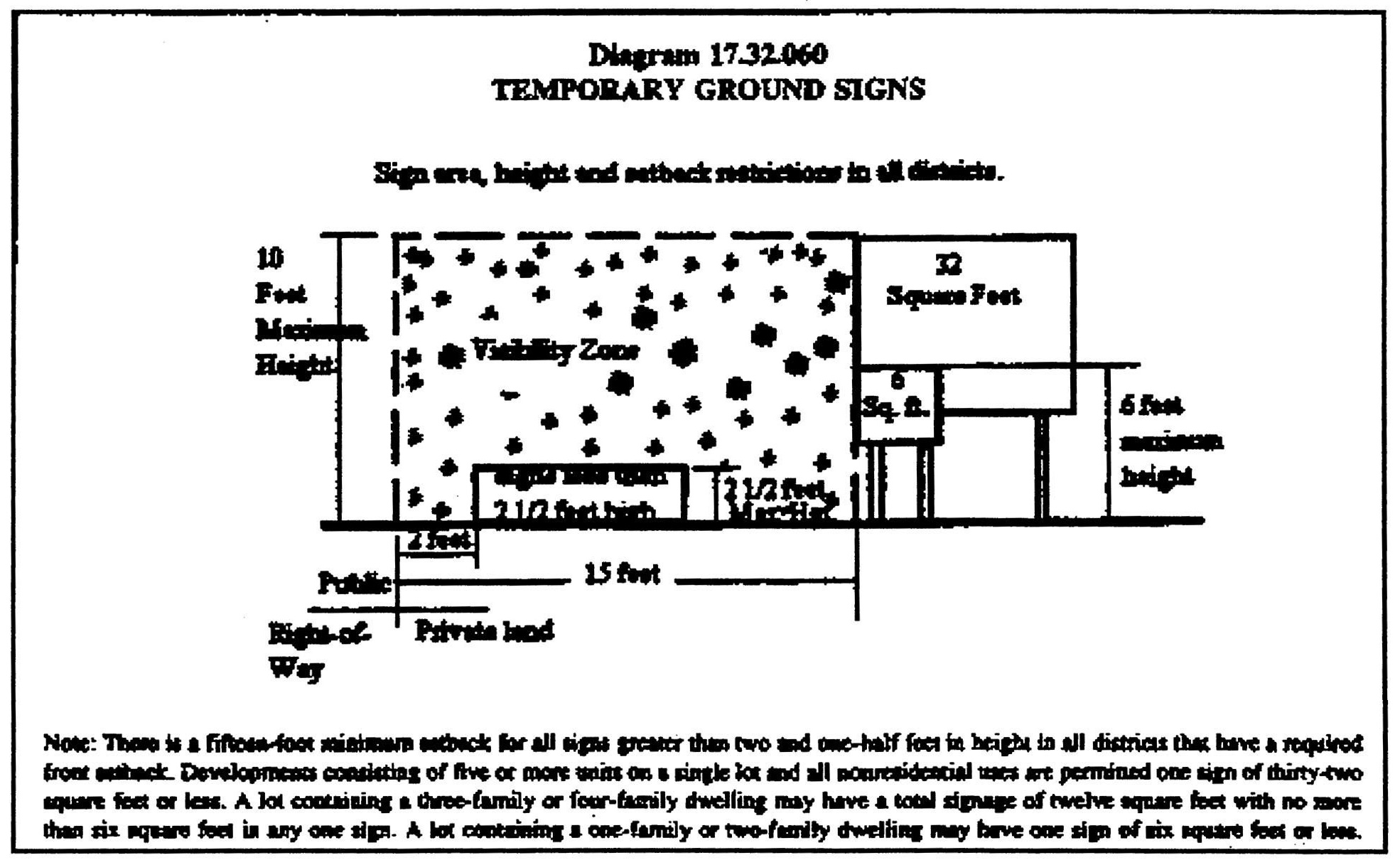
Open Space Requirements for On-Premises Temporary Signs. On-premises temporary signs shall comply with the front yard requirements, as illustrated in Diagram 17.32.060 and shall not be permitted in a required side or rear setback.
E.
Permissible Size, Height and Number.
1.
Single-Family and Duplex Residences. Any lot occupied by a one-family or two-family residence may display one on-premises temporary sign with a maximum sign area of six square feet and a maximum height of six feet.
2.
Triplex and Quadruplex Residences. Any lot occupied by a three-family or four-family residence may display not more than two on-premises temporary signs with an aggregate sign area of not more than twelve square feet. No individual sign shall exceed six square feet in area nor six feet in height.
3.
All Other Uses. All other lots may display one square foot of on-premises temporary signage per ten feet of frontage to a maximum of thirty-two square feet. Lots with frontage on more than one side may apply this provision to one additional side. No on-premises sign shall exceed ten feet in height.
(Ord. BL2016-309 § 5(Exh.), 2016)
17.32.070 - Permanent on-premises signs.
A.
Sign Types Allowed. A permanent on-premises sign may be permitted as a ground or building sign subject to the restrictions imposed by this section and other relevant restrictions imposed by this title.
B.
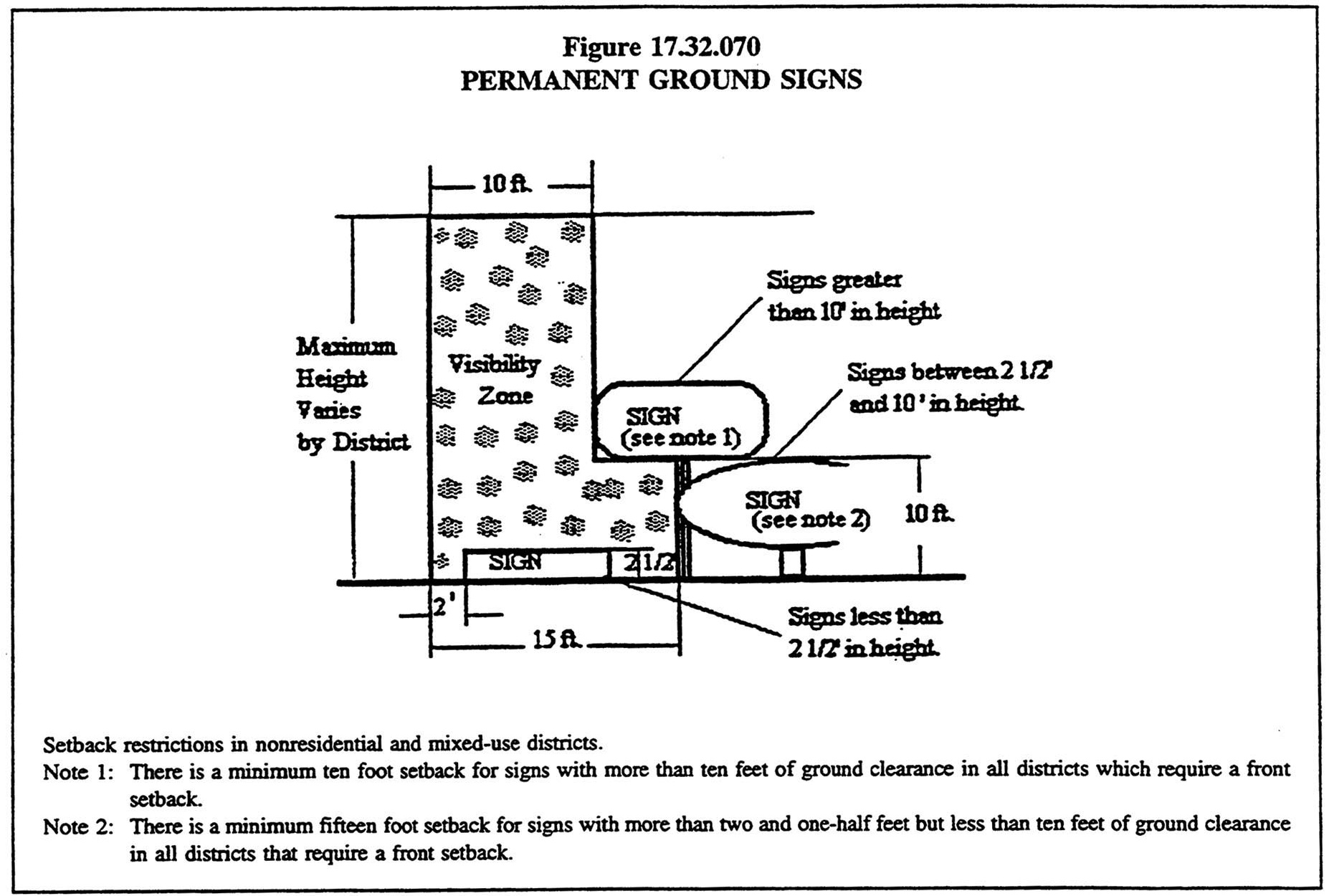
Setback and Height Restrictions. The maximum height and street setback requirements for signs in nonresidential and mixed-use districts shall be as established by Figure 17.32.070, Permanent Ground Signs.
C.
Sign construction materials. All permanent on-premises signs shall be constructed of a rigid, weatherable material such as hard plastic, wood, MDO plywood, aluminum, steel, PVC, and/or Plexiglas. On-premises permanent signs shall not be constructed of non-rigid materials including, but not limited to, vinyl, fabric, canvas, or corrugated plastic. The provisions of this subsection shall not apply to approved, permitted canopies, awnings, and porticoes.
D.
Guidance for the Use of Signs.
1.
An on-premises sign is for the purpose of conveying information in clear, concise, safe and compatible units to general motorists and pedestrians on travelways and within each site.
2.
Size, location, method of attachment and design/lighting are regulated in general based on districts and the type of activity therein. Permanent on-premises signs are subject to the common signage plan requirements.
3.
On-premises building signs shall not extend above the roof line of the structure. On-premises wall signs shall not extend above the top of the wall or parapet more than twenty-five percent of the height of such sign, to a maximum of eighteen inches for a solid panel sign, or fifty percent of the height of the letter for individual mounted letters. The above restrictions shall not apply to the commercial amusement (CA and CA-NS) districts provided that the sign(s) is not readily visible from a public street external to the development or residentially zoned property abutting the subject property.
4.
No permanent on-premises ground sign may be located in a required rear setback.
5.
With regard to multiple frontage (frontage on more than one street) the amount of on-premises ground signage is computed by adding all of the frontage along each street and applying the total to the table under the appropriate district; the total on-premises ground sign area that is oriented toward a particular street may not exceed the portion of the lot's total ground sign area allocation that is derived from that street. No on-premises ground sign on one street frontage on the same lot shall be closer than one hundred feet to an on-premises sign fronting on another street, computed as the sum of distance measured continuously along the rights-of-way through a common point or points. On-premises ground signs in excess of two hundred eighty-eight square feet shall require even greater spacing as specified under each district or group of districts. On-premises building signage does not require additional computation for multiple frontage since the signage area is based solely on number of principal buildings, number of occupants and percent of building facade.
6.
A single tenant or multitenant sign may be considered an on-premises sign when located within the boundaries of the same approved master development plan or unified plat of subdivision.
(Ord. BL2019-111 § 1(Exh. A, § 41), 2020; Ord. BL2016-309 § 5(Exh.), 2016)
17.32.080 - On-premises signs in residential districts.
Permanent on-premises ground and on-premises building signs at the entrance to a residential development are permitted subject to the following restrictions:
A.
Each residential development containing three through fifteen dwelling units and approved under one plat shall be permitted one on-premises identification sign, with a maximum size of six square feet, at the development entry from a public street. The provisions of subsection B of this section, subdivisions (4), (5), (6) and (7) shall apply.
B.
Each residential development containing at least sixteen units and approved under one plat shall be permitted up to thirty-two square feet per development entry, to a maximum of three, from a public street. The on-premises signage at each development entry may be one of the following:
1.
A double-sided sign located perpendicular to the public street and containing up to thirty-two square feet for the one sign face;
2.
A single-sided sign located parallel to the public street and containing up to thirty-two square feet for the one sign face. Displaying a sign on the opposite face, if the total number permits, will be counted as one additional sign;
3.
A flared wall, or similar, to which two single-sided signs are attached or imbedded and each sign does not exceed sixteen square street;
4.
The leading edge or face of the sign or any building or other structure to which the sign is attached must be set back from the public right-of-way a minimum of fifteen feet;
5.
No residential identification sign may exceed six feet in height;
6.
All residential identification signs may be illuminated by direct and steady means only;
7.
Each residential identification sign shall be maintained perpetually by the developer, sign owner, owners' association or some other person who is legally accountable under an approved maintenance agreement. Signs that are not maintained shall be removed by the developer or owner.
C.
One flat-mounted on-premises building sign of a maximum of thirty-two square feet in area, for each street frontage, may be placed on the street facing facade of a building that contains a minimum of sixteen units, provided that it is:
1.
Illuminated by direct and steady means only;
2.
Does not extend more than six inches from the facade of the building.
(Ord. BL2016-309 § 5(Exh.), 2016)
17.32.090 - Community facility on-premises signs.
A.
Signs located at community facilities in residential districts shall conform to the size provisions applicable to the ON district. The maximum height of a ground sign shall be eight feet; the minimum street setback shall be fifteen feet; the sign shall not encroach required side setbacks of the district; and only one such ground sign shall be permitted per street frontage.
B.
All Other Districts. Community facilities shall be permitted the signage of the district occupied by the community facility.
(Ord. BL2016-309 § 5(Exh.), 2016)
17.32.100 - Informational signs for large sites.
A.
Sites larger than five acres shall be allowed an additional informational sign, in addition to other on-premises signs. An informational sign may convey non-commercial information, directions or instructions for the safety, convenience and need to know for the use, or restriction of use, of a lot on a permanent basis.
B.
All signs of this nature shall be designated on the common signage plan for the property.
C.
The provisions of Section 17.32.050, Prohibited signs, shall apply to prohibited signs.
D.
Sign Types Allowed. A sign of this nature may be a ground or building sign, and shall be permitted in addition to other on-premises signs.
E.
Permissible Number, Size and Height. The following standards shall apply to all such signs except for those utilized in the commercial attraction (CA and CA-NS) districts when not readily visible from a public street external to the development or residentially zoned property abutting the subject property:
1.
Developments with improved land area of five acres or more shall be permitted two informational signs per five acres of improved area. Any fractional values shall be discarded.
2.
The maximum size of any one informational sign shall be thirty-two square feet.
3.
The maximum height of any informational ground sign above grade shall be ten feet.
4.
Copy height shall be limited to a maximum of six inches.
5.
Copy may include one logo per face provided that the logo does not exceed twenty percent of the total sign area.
F.
Required Setbacks.
1.
An informational sign shall not be located within fifty feet of a side or rear lot line.
2.
An informational sign shall not be located within one hundred feet of a front lot line.
(Ord. BL2019-111 § 1(Exh. A, § 42), 2020; Ord. BL2016-309 § 5(Exh.), 2016)
17.32.110 - On-premises signs—MUN, MUN-NS, MUN-A, MUN-A-NS, MUL, MUL-NS, MUL-A, MUL-A-NS, ON, OL, OG, OG-NS, OR20, OR20-NS, OR20-A, OR20-A-NS, OR40, OR40-NS, OR40-A, OR40-A-NS, CN, CN-NS, CN-A, CN-A-NS, CL-A, CL-A-NS, CS-A, CS-A-NS, SCN, SCN-NS districts.
A.
Based on whether an on-premises sign is an on-premises ground or on-premises building sign, refer to the subsection under the appropriate type for computation of sign area.
B.
All on-premises ground and on-premises building signs must be approved under an overall signage plan.
C.
The number, area, spacing and height of permanent on-premises ground signs shall be determined according to Table 17.32.110, except that land uses classified as Car wash shall be further restricted as specified in Section 17.16.070.
Table 17.32.110
Note 1: Where a side lot line abuts a street or a controlled access highway the minimum side setback shall be ten feet.
D.
Each multitenant principal building may display not more than two on-premises building signs with a combined sign area of not more than thirty-two square feet.
E.
In addition to the principal building signage each occupant of a multiple occupancy complex may display not more than two on-premises building signs on any exterior viewed portion of the complex that is part of the occupant's unit. The total sign area shall not exceed fifteen percent of the facade area for the public entry side or a maximum of one hundred ninety-two square feet, whichever is less. Occupants with a second public entry may divide their permitted signage, but a signage bonus is not given for an additional entry.
F.
Where there is only one occupant of a principal building, or where the owner of a multitenant building so chooses, not more than two on-premises building signs may be displayed on any exterior viewed portion of the building, not to exceed a combined sign area equal to fifteen percent of the facade area upon which the sign(s) is displayed to a maximum of one hundred ninety-two square feet. If the owner of a multitenant building chooses this option then no building signage shall be allowed under subsection E of this section.
(Ord. BL2019-111 § 1(Exh. A, § 43), 2020; Ord. BL2016-309 § 5(Exh.), 2016)
17.32.120 - On-premises signs—ORI, ORI-NS, ORI-A, ORI-A-NS, MUG, MUG-NS, MUG-A, MUG-A-NS, MUI, MUI-NS, MUI-A, and MUI-A-NS districts.
A.
Based on whether an on-premises sign is an on-premises ground or on-premises building sign, refer to the subsection under the appropriate type for computation of sign area.
B.
All on-premises ground and on-premises building signs must be approved under an overall signage plan.
C.
The number, area, spacing and height of permanent on-premises ground signs shall be determined according to Table 17.32.120, except that land uses classified as Car wash shall be further restricted as specified in Section 17.16.070.
Table 17.32.120
Note: Where a side lot line abuts a street or a controlled access highway the minimum side setback shall be ten feet.
D.
Each multitenant principal building may display not more than two on-premises building signs with a combined sign area of not more than forty-eight square feet.
E.
In addition to the principal building signage each occupant of a multiple occupancy complex may display not more than two on-premises building signs on any exterior viewed portion of the complex that is part of the occupant's unit (not including common or jointly owned area). The total on-premises sign area shall not exceed fifteen percent of the facade area of such exterior portion.
F.
Where there is only one occupant of a principal building, or where the owner of a multitenant building so chooses, not more than two on-premises building signs may be displayed on any exterior viewed portion of the building, not to exceed a combined sign area equal to fifteen percent of the facade area upon which the sign(s) is displayed to a maximum of two hundred eighty-eight square feet. If the owner of a multi-tenant building chooses this option then no building signage shall be allowed under subsection E of this section.
(Ord. BL2019-111 § 1(Exh. A, § 44), 2020; Ord. BL2016-309 § 5(Exh.), 2016)
17.32.130 - On-premises signs—CL, CL-NS, CS, CS-NS, CA, CA-NS, CF, CF-NS, SCC, SCC-NS, SCR, SCR-NS, IWD, IR and IG districts.
A.
Based on whether an on-premises sign is an on-premises ground or on-premises building sign, refer to the subsection under the appropriate type for computation of sign area.
B.
Any lot may have some or all of its permitted area for on-premises ground signage transferred to on-premises building signage and the individual on-premises sign size increased accordingly.
C.
All on-premises ground and on-premises building signs must be approved under an overall signage plan.
D.
The number, area, spacing and height of permanent on-premises ground signs shall be determined according to Table 17.32.130.D, except that land uses classified as Automobile repair, Automobile sales, used; Car wash and Vehicular sales and services limited shall be further restricted as specified in Section 17.16.070.
Table 17.32.130D
Note 1: Where a side lot line abuts a street or a controlled access highway the minimum side setback shall be ten feet.
Note 2: The CL and CL-NS districts any lot within one thousand feet of a controlled access highway interchange may have one additional on-premises ground sign of not more than two hundred eighty-eight square feet with a maximum height of fifty feet provided:
a. The additional on-premises ground sign is oriented to the controlled access highway and adheres to all other provisions of this title; and
b. The other on-premises ground sign is oriented to the street of principal access, is spaced at least one hundred feet from any other ground sign on the lot, and is restricted to the maximum height permitted in the CS and CS districts; and
c. Further, that up to forty square feet of the ground sign oriented to the street of principal access may be transferred to this sign area when noted on the signage plan; and
d. This additional on-premises sign is available only at interchanges when a highway logo sign is not present.
Note 3: In addition to the number of ground signs permitted by Table 17.32.130D. [formerly 8.13], properties directly abutting a controlled access highway may install an additional on-premise ground sign along the frontage of that highway at the rate of one sign per one thousand feet of highway frontage. Such signs shall be spaced a minimum of one thousand feet apart. A sign oriented to a controlled access highway may be as large as the greater of (1) the maximum size of a sign otherwise permitted by Table 17.32.130D, or (2) the maximum size of a sign otherwise permitted by Table 17.32.130D as determined by substituting "Controlled Access Highway Footage Frontage in Feet," in lieu of "Lot Frontage in Feet." The maximum height of a highway oriented sign shall be, fifty feet as measured from the average grade of the sign foundation, or thirty feet above the finished elevation of the nearest travel lane of the highway, whichever is greater. In the commercial attraction district, the maximum area of any one sign shall be nine hundred square feet, the maximum total area of all signs shall be two thousand square feet, and the maximum height of a highway oriented sign shall be eighty feet as measured from the average grade of the sign foundation, or sixty feet above the finished elevation of the nearest travel lane of the highway, whichever is greater.
E.
On-Premises Ground Signs Based on Ground Floor Area. The chart below offers an option to utilizing frontage to calculating the square footage for one on-premises ground sign to be located only at the primary entrance. On-premises ground signs located on other frontage must be determined by Table 17.32.130D.
Table 17.32.130E
No on-premises ground sign whose display surface area is generated by ground floor area shall exceed four hundred eighty square feet in area.
F.
On-Premises Building Signs. On-premises building signs shall be subject to the following restrictions:
1.
Each facade of a principal building shall be restricted to a maximum building signage of fifteen percent of the area of the facade.
2.
This area may be increased by transferring all or part of the permitted on-premises ground sign area to on-premises building signage. A twenty percent bonus of the amount transferred may also be applied to the total on-premises building signage.
(Ord. BL2019-111 § 1(Exh. A, §§ 45, 46), 2020; Ord. BL2016-309 § 5(Exh.), 2016)
17.32.140 - On-premises signs—DTC district.
See Section 17.37 (Downtown Code) for standards on signage within the DTC district.
(Ord. BL2016-309 § 5(Exh.), 2016)
17.32.145 - Landmark signs.
A.
A landmark sign must meet all of the following criteria:
1.
Materials, technology, and design: Representative of excellence in a particular period of construction; and/or is unique in that it demonstrates extraordinary aesthetic quality, creativity or innovation.
2.
Integrity: Retains the majority of its character-defining features (materials, technologies, structure, colors, shapes, symbols, text, and/or art) that have historical significance, or are integral to overall sign design, or convey historical or regional context. If character-defining features have been altered or removed, the majority are potentially restorable to their historic function and appearance.
3.
Safety: Structurally safe or can be made safe without substantially altering its historical appearance.
4.
Location: The sign is not an off-site sign or billboard, as defined in the Zoning Code.
5.
Regionalism: The sign is unique, or was originally associated with a chain or franchise business that is either a local or regional chain or franchise only found in Nashville or the southeastern United States; or there is national interest or scholarly documentation to support its preservation.
B.
An historic sign must be constructed more than fifty years before the date of application and must meet all of the criteria for landmark sign designation and must meet all of the following criteria:
1.
An historic sign may be repaired, restored, and/or adaptively reused if there is sufficient surviving fabric or sufficient historical documentation (photographs, postcards, permits, or other records) on which to base the treatment concept. An existing historic sign may be repaired, restored, or rehabilitated either in place, or off-site and then re-erected on site.
2.
An historic sign may be repaired or restored to any past appearance prior to fifty years before the date of application. If the owner of an historic sign can provide documentation or physical evidence that the original design included intermittent lighting features (e.g., flashing, blinking, chasing or sequentially lit elements which create the appearance of movement) or moving parts, those sign elements may be repaired and restored.
3.
An historic sign that will be adaptively reused must retain, repair, or restore the majority of the character-defining features (e.g., materials, technologies, structure, colors, shapes, symbols, text, typography and/or artwork) that have historical significance, or are integral to the overall design of the sign, or convey historical or regional context. Changes to character-defining text are not allowed; any or all text that is not character defining can be changed. Changes to text must either match or be compatible with existing text or the text being replaced, in terms of materials, letter size, font, and color.
C.
A vintage sign must meet all of the criteria for landmark sign designation and must meet all of the following criteria:
1.
Age: Constructed between fifty and twenty-five years before the date of application. Applications for signs constructed within twenty-five years of the date of application may be considered on the cultural and iconic contribution to the surroundings.
D.
Replica sign:
1.
A replica sign is permissible when based on sufficient historical documentation of the sign and its location. A sign can be replicated only once. Replicas of replicas are not permitted. A replica sign must use historical materials and technologies, or use contemporary materials and technologies that visually match historical ones.
E.
Guidelines for relocating a landmark sign:
1.
A designated landmark sign may be relocated as follows:
a.
To another location on the premises.
b.
To another location that houses the same or similar business.
c.
To an area of similar character within a one mile radius of the present location.
d.
To the original location.
2.
A designated landmark sign shall not be relocated to a R, R-A, RS, RS-A, RM, RM-NS, RM-A, or RM-A-NS zoned property.
3.
A designated landmark sign shall not be relocated within one hundred fifty feet of a primary structure on R, R-A, RS, RS-A, RM, RM-NS, RM-A, or RM-A-NS zoned property.
4.
All relocations are subject to the following:
a.
The sign must be located no less than twenty feet from the face of the curb or edge of pavement. Where there is no curb, the measurement shall be taken from the street property line.
b.
Projecting signs that project into the public right-of-way shall follow the rules and procedures of metro government, and shall follow the sign permitting process.
F.
Sign calculations for a landmark sign:
1.
Where the landmark sign does not identify the business occupying the premises, and is not used by an owner or occupant of the premises to advertise a business currently occupying the premises, the landmark sign shall not count against the total allowable sign area for the premises and shall not count against the number of signs allowed for the premises.
2.
Where the landmark sign does identify the business occupying the premises or is used or adaptively reused by an owner or occupant of the premises to advertise a business currently occupying the premises, fifty percent of the square footage of the landmark sign shall count toward the total allowable sign area and shall count against the number of signs allowed for the premises.
3.
One hundred percent of the square footage of a replica sign shall count toward the total allowable sign area for the premises and shall count against the number of signs allowed for the premises.
(Ord. BL2019-111 § 1(Exh. A, §§ 47, 48), 2020; Ord. BL2016-309 § 5(Exh.), 2016)
17.32.150 - Billboards.
A.
Districts Permitting Billboards. Billboards shall be permitted in the CL, CL-NS, CS, CS-NS IWD, CF, CF-NS, IR, and IG districts subject to the provisions of this chapter and this title. However, billboards are prohibited on any property within a planned unit development (PUD) overlay district, regardless of the underlying zoning district, unless expressly permitted as part of an approved development plan by the metropolitan council; and in the CS and CS-NS districts for uses classified as Automobile repair, Automobile sales, used; Car wash and Vehicular sales and services limited. Type I billboards are prohibited in the CL and CL-NS districts. Type II billboards in the CL and CL-NS districts shall be limited to those areas of a lot which are within three hundred feet of the right-of-way of a controlled access highway, and all billboards shall be oriented towards that highway.
B.
Regulations. Billboards are permitted in addition to other signs authorized by this title subject to the following restrictions:
1.
There shall be two types of billboards based on the display surface area of the billboard:
a.
Type I with a display surface area of seventy-five square feet or less; and
b.
Type II with a display surface area of more than seventy-five square feet and less than six hundred seventy-five square feet.
2.
The maximum display surface area for each type may be exceeded by thirty percent for embellishments to the standard rectangular sign, provided the embellishments do not project more than five feet above the top nor more than three feet beyond the sides and two feet beyond the bottom of the standard rectangular sign.
3.
A billboard face shall consist of a single panel. Multiple panel faces, such as stacked or side-by-side, are not permitted.
4.
One face of two back-to-back billboards of the same shape and dimensions, excluding embellishments, shall be used in computing the total display surface area when the signs are no more than fifteen feet apart when parallel to one another or are placed at an angle between signs that does not exceed twenty degrees. No copy shall be permitted between the back-to-back faces.
5.
Minimum yards shall be provided as established by this table in all districts:
6.
There is established a maximum height limit of fifty feet above grade either at the base of the billboard or the nearest curb level of the surface street to which the billboard is oriented, whichever provides the greatest height. If the billboard is oriented to, and located within three hundred feet of a controlled access highway, a height of thirty feet above the elevation of the nearest travelway of the controlled access highway shall be permitted.
For Type I displays: There is established a maximum height limit of twenty feet above grade either at the base of the display or the nearest curb level of the surface street to which the display is oriented, whichever provides the greatest height.
7.
Spacing between billboards located on the same side of a public street or controlled access highway shall be as indicated in the following table:
Note: The spacing between any Type I (freestanding) or Type II (freestanding) billboard and an existing Type II (wall-mounted) billboard shall be one thousand feet.
a.
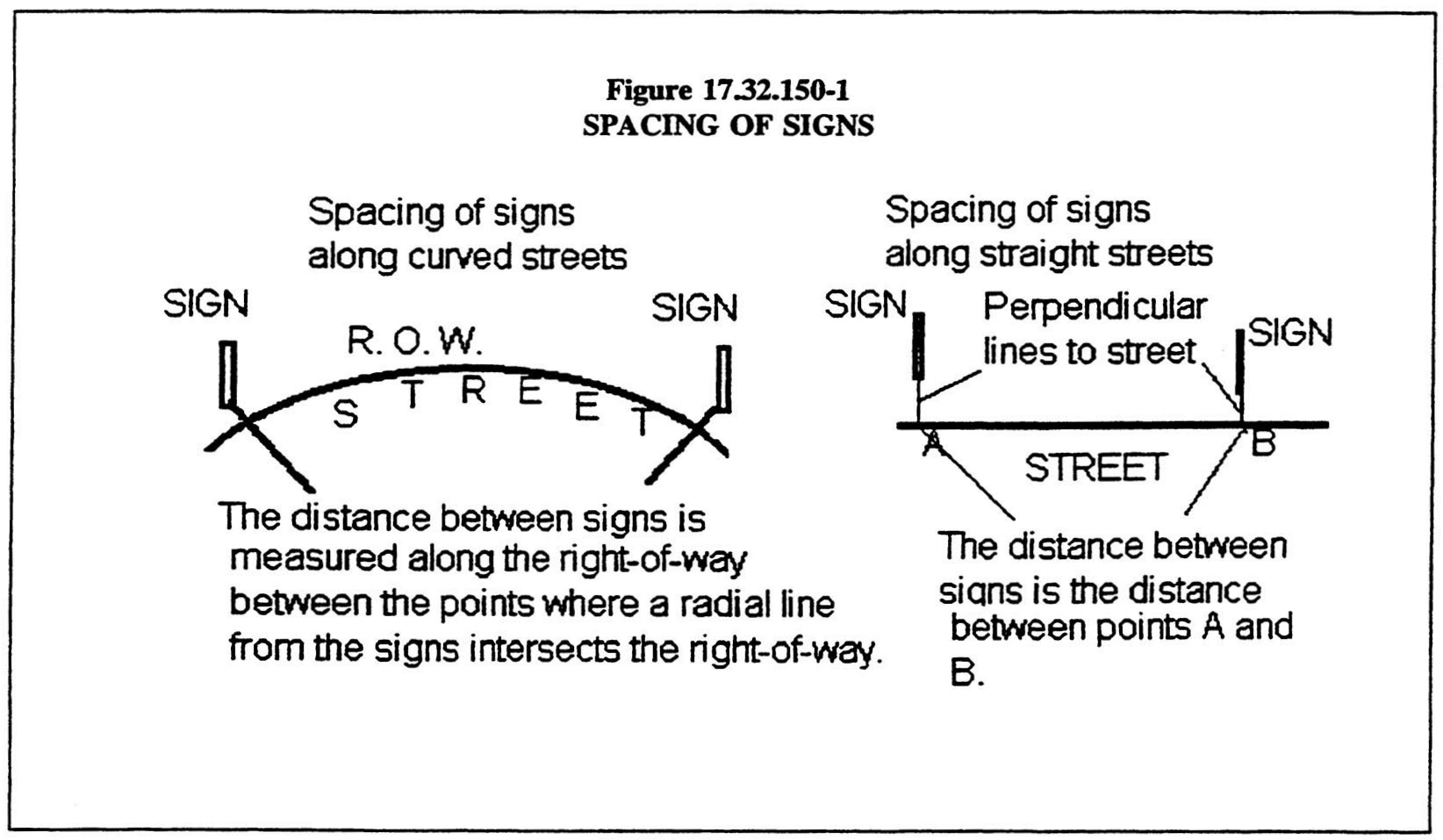
The spacing requirements shall be applied separately to each side of a public street, but continuously along the side of a street to all signs oriented toward that street in either direction whether the signs are in the same block or are in different blocks separated by an intersecting side street. (See Figure 17.32.150-1)
b.
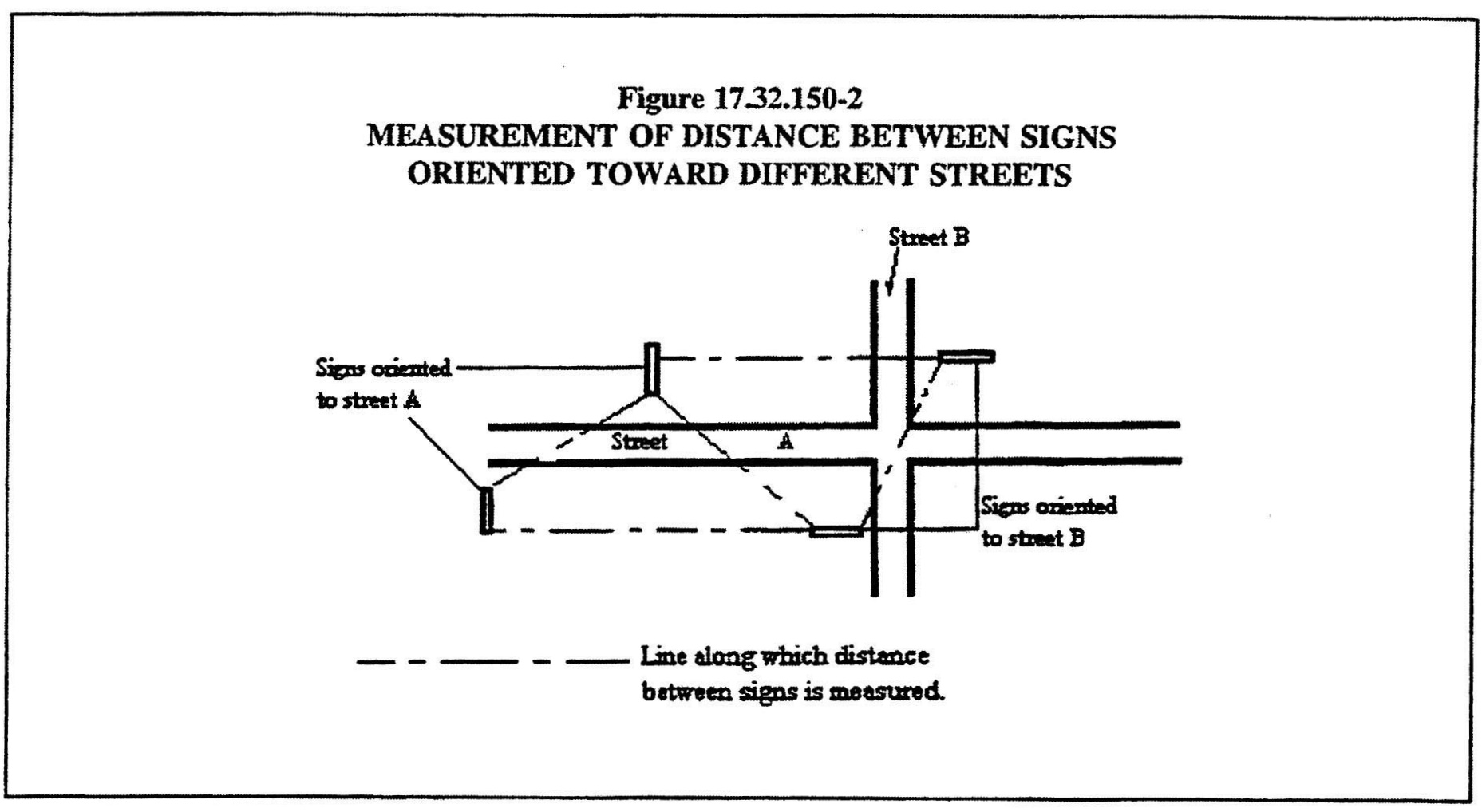
No billboard shall be closer than two hundred fifty (250) feet from any other billboard regardless of location. (See Figure 17.32.150-2)
c.
No minimum spacing shall be required between any two wall-mounted signs placed on opposite sides of a building.
d.
Type I billboards shall not be located within twenty feet of an on-premises ground sign on the same lot.
8.
No Type II billboard located along a particular street shall be closer than five hundred feet from the nearest property line of any property that is zoned residential and has frontage on either side of such street. The distance for Type I billboards shall be two hundred fifty feet.
9.
No billboard located along a particular street shall be closer than two hundred feet from the nearest property line of any residentially zoned property that does not front on said street.
10.
No billboard shall be permitted whenever property zoned residential would be between the billboard and the roadway toward which it is oriented.
11.
Type I billboards shall be permitted a spacing of two hundred fifty feet, measured airline distance, to a structure listed on the National Register of Historic Places. Type II billboards shall be permitted a spacing of five hundred feet, measured airline distance, to a structure listed on the National Register of Historic Places.
12.
Type II billboards shall be located only on lots that have frontage on public streets with four or more travel lanes or that are located within three hundred feet and oriented to a limited access highway. Paired one-way streets with a minimum of two travel lanes in each direction shall be considered a four-lane road in applying this provision.
13.
No billboard shall be permitted along any public street or highway that has been designated as a scenic route in the adopted major street plan of the metropolitan government.
14.
Billboards shall be subject to the provisions contained in Section 17.32.050, Prohibited signs.
15.
All billboards shall be of monopole-type construction. Type II billboards shall not be attached to the walls of buildings. Billboards shall not be located on the roofs of buildings.
16.
The brightness and surface illumination shall not exceed two hundred-foot lamberts for a billboard having internal illumination or seventy-five footcandles for a billboard having indirect illumination. Billboards located within five hundred feet of property classified in a residential district shall not be illuminated between the hours of twelve a.m. and six a.m.
(Ord. BL2019-111 § 1(Exh. A, § 49), 2020; Ord. BL2019-1635 § 1, 2019; Ord. BL2016-309 § 5(Exh.), 2016)
17.32.160 - Computations.
The following determinants shall control the calculation of sign area, height, and placement.
A.
Distance Between Signs. The minimum required distance between signs shall be measured along street rights-of-way from the closest parts of any two signs.
B.
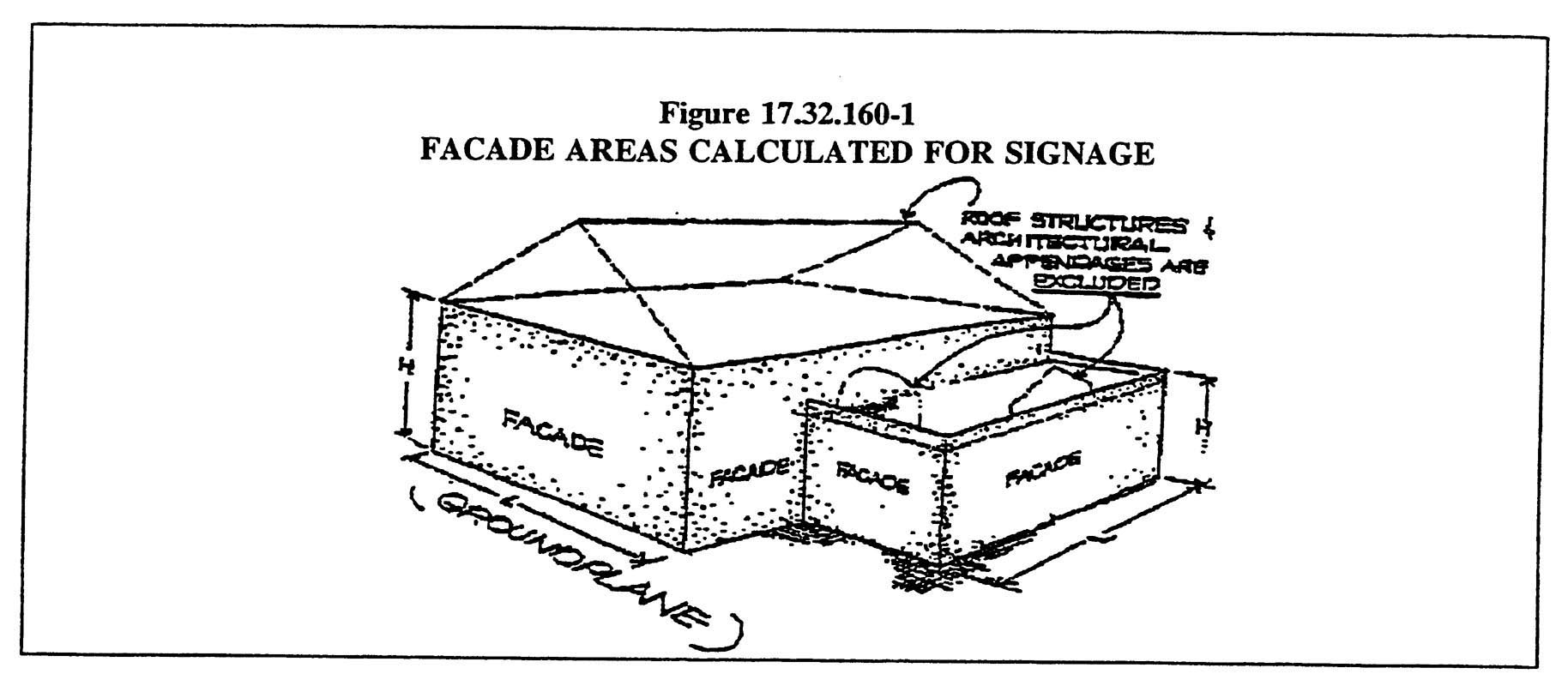
Facade Area. The facade area for the purpose of calculating permitted on-premises building sign area may be determined as follows:
1.
When architectural elevations are provided that accurately and to scale depict the facade of the structure, the area of the facade shall be calculated as the true structural building facade exclusive of roofs, parapets, and false facia. Parapets of a uniform height on three sides of a structure and of a similar and uniform building material may be included in the facade areas, but decorative parapet extensions of irregular height are excluded.
2.
When architectural plans are not provided, it shall be assumed that the height of
the facade of the first floor is twelve feet, and that the height of the facade of
all stories above the first floor is ten feet per floor. Facade area shall be calculated
based on the following formula:
[Facade length × 12 ft. (first floor)] + [facade length × 10 ft. per each additional floor] = facade area
C.
Sign Area. The area of a sign shall be computed by means of the smallest square, circle, rectangle, triangle or combination thereof which will encompass the extreme limits of the writing, representation, emblem, or other display, together with any material or color forming an integral part of the background of the display or used to differentiate the sign from the backdrop or structure against which it is placed, but not including any supporting framework, bracing, or decorative fence or wall, when such fence or wall otherwise meets the provisions of this title, and is clearly incidental to the display itself.
D.
Building-Mounted Letters and Pictures. Where a sign is composed of letters or pictures attached directly to a facade, window, door or marquee, and the letters or pictures are not enclosed by a border or trimming, the sign area shall be the area within the smallest rectangle, parallelogram, triangle, circle or semicircle or combination thereof, the sides of which touch the extreme points of the letters or pictures.
E.
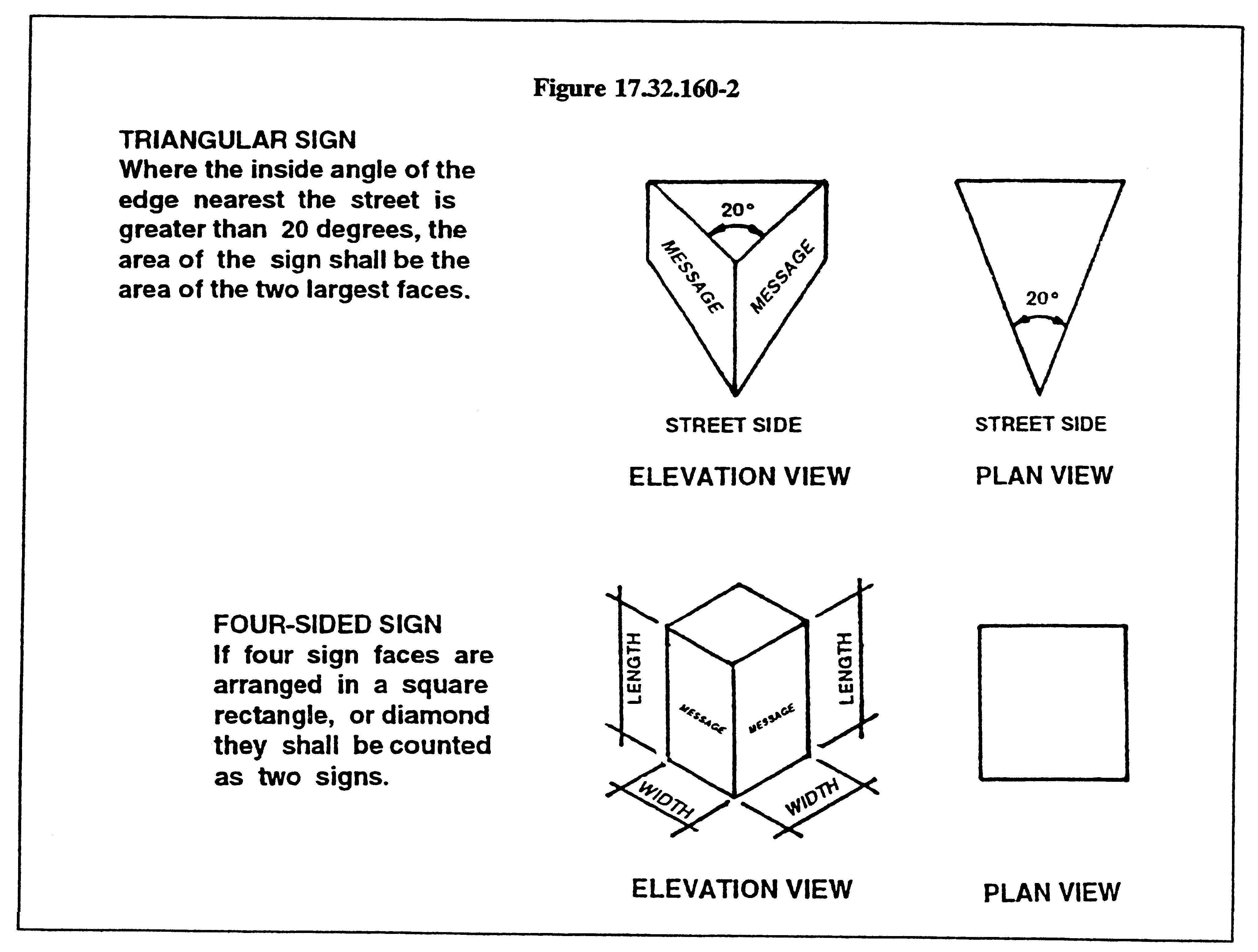
Four-Sided On-Premises Sign. Where four sign faces are arranged in a square, rectangle or diamond, the area of the on-premises sign shall be the area of the two largest faces.
F.
Triangular On-Premises Sign. Where the inside angle of the edge nearest the street is greater than twenty degrees, the area of the sign shall be the area of the two largest faces.
G.
Multiple-Face On-Premises Sign. For a multiple-faced on-premises sign, the sign area shall be computed by including all sign faces visible from any one point. When two identical sign faces are placed back to back so that both faces cannot be viewed from any point at the same time, and when such signs are part of the same sign structure and not more than forty-two inches apart, the sign area shall be computed by the measurement of one of the faces. If the forty-two inch space is used for any message, it will be counted as a sign face.
H.
Height. Sign height shall be computed as the distance from the base of the sign at the normal grade to the top of the highest attached component of the sign, or the nearest curb level of the surface street providing access to the site, whichever provides the greatest height. Normal grade shall be construed to be the existing grade prior to construction or the newly established grade after construction exclusive of any filling, berming, mounding or excavating solely for the purpose of locating the sign.
I.
Maximum On-Premises Sign Area. The permitted sum of the area of all individual on-premises signs on a lot shall be computed by applying the formula under each district to the lot frontage or ground floor area, and building facade, as appropriate, for the zoning district in which the lot is located. Lots fronting on two or more streets are allowed the permitted on-premises ground sign area for each street frontage; however, the total on-premises ground sign area that is oriented toward a particular street may not exceed the portion of the lot's total on-premises ground sign area allocation that is derived from that street or from the total ground floor area.
(Ord. BL2016-309 § 5(Exh.), 2016)

