
Nassau County Unincorporated
City Zoning Code
City Zoning Code
ARTICLE 45
TIMBER TO TIDES DESIGN OVERLAY COMMUNITY BASED DESIGN STANDARDS
45.01.01. - Purpose and intent.
The intent and purpose of the Timber to Tides Design Overlay (T2TDO) is to implement the provisions of the Nassau County Comprehensive Plan (Policy FL.02.06). The T2TDO under the Nassau County Comprehensive Plan must comply with the community-based design standards (CBDS) of this Code. The provisions of this section are intended to assist in reshaping the development pattern within this area over time to a more walkable form that functions as a sustainable development configuration that connects people to places where they can live, work, play, and stay. The design standards apply to all development regardless of whether they are rezoned to a transect or retain in their current future land use Map and zoning classifications, unless expressly exempted in this article.
The transect-based system of spatial and land use organization is a specific type of CBDS and is the preferred method of achieving the desired development pattern of a community based design overlay (CBDO). Transect zones are used to create new sustainable and walkable mixed-use built environments and are used to provide gradual transition from rural to urban densities. It is the expressed intent of this Code to ultimately convert the zoning designation of lands within a CBDO to a transect-based zoning designation through the processes and incentives established in both the comprehensive plan and this Land Development Code (LDC).
Article 45 establishes the CBDS for the T2TDO.
45.01.02. - Timber to Tides Design Overlay (T2TDO).
The boundary of the Timber to Tides Design Overlay is illustrated in Figure 45-01.
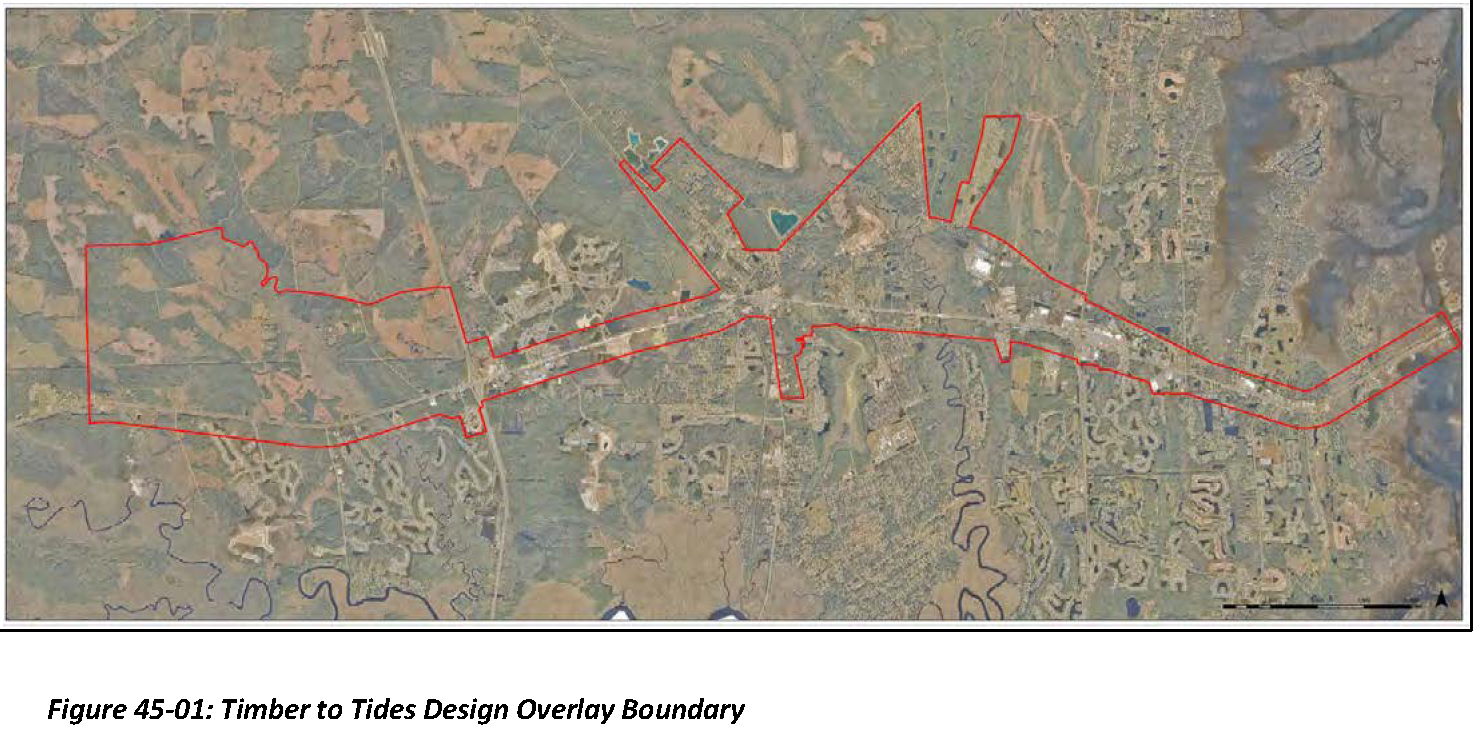
(Ord. No. 2025-012, § 3(Exh. B), 6-23-25)
45.02.01. - Applicability of design standards.
All development, including redevelopment or a change of use, located within the Timber to Tides Design Overlay (T2TDO) shall be consistent with the regulatory standards of article 44 and the CBDS established under article 45 of this Code, unless expressly exempted. These standards and regulations shall apply to both private and public lands within the T2TDO. Redevelopment in this context means any combination of repairs, reconstruction, addition, alteration, or improvement to a structure, that takes place during the life of the structure, the cumulative cost of which equals or exceeds fifty percent (50%) of the fair market value of the structure as defined in article 44. Additionally, a change of use shall be defined as any modification to the primary function or occupancy classification of a building or site that results in a substantial shift in its physical characteristics, operational requirements, or impact on surrounding properties. This includes, but is not limited to, transitions that alter parking demand, pedestrian access, building form, or required infrastructure. Any change of use that affects building form or site layout shall require conformance with article 44 and article 45 to ensure consistency with the intended character and functionality of the area.
A.
The construction or replacement of a single-family dwelling and mobile homes on an individual parcel of land existing prior to adoption of the T2TDO, shall not be subject to the CBDS. This exemption shall not apply to lands that have been the subject of a rezoning or FLUM amendment subsequent to that date, except for properties identified as having a conflict as shown in Attachment C who opt to participate in the department sponsored conflict resolution within the seven-month timeframe following adoption of this legislation. New single-family dwelling and mobile homes building sites created by the approval of a family hardship, parent tract lot split, or open rural homestead exemption shall not be subject to the CBDS.
B.
Any planned unit development (PUD) with a PUD development order (PUD DO) executed by the Board of County Commissioners (BOCC) prior to the adoption of the T2TDO shall be subject to the standards defined in the approved PUD DO and nothing within the CBDS shall supersede any existing provision in a valid PUD DO approved as of that date, with the exception of section 45.03.02.F, Access Management Standards. Any future amendment or modification of a PUD DO will be subject to the T2TDO.
C.
When this article is silent or ambiguous as to a certain design element or standard within the T2TDO, provisions in the Land Development Code (LDC) shall control. In the event of a conflict between T2TDO standards and the LDC, the stricter standard shall control.
45.02.02. - Nonconforming development.
Nonconforming developments are those land uses, buildings, structures and/or other improvements which are in existence on the effective date of the Timber to Tides Design Overlay (T2TDO) and which by use, design, construction, or arrangement, do not comply with the provisions of the T2TDO. A complete site engineering plan application received prior to the effective date of the T2TDO shall be considered a nonconforming development for the purposes of this section. Nonconforming development may remain in a nonconforming state subject to the following restrictions:
A.
Public hazard. The nonconforming development must not constitute a threat to the general health, safety, or welfare of the public.
B.
Ordinary repair and maintenance. Normal and ordinary maintenance and repair necessary to continue a nonconforming development shall be deemed an authorized activity.
C.
Expansions or extensions. The gross floor area of nonconforming buildings or structures shall not be expanded, modified, enlarged, or extended by more than ten (10) percent, or more than four thousand (4,000) square feet, whichever is less. Repeated expansion of a development constructed over any period of time, commencing with the effective date of these regulations, shall be combined in determining whether this threshold has been reached.
D.
Abandonment or discontinuance. Where nonconforming development is abandoned or a nonconforming use is discontinued or abandoned for a period of twelve (12) consecutive months, the existence of the nonconforming use or development shall terminate, and any further use or development of the premises shall comply with the provisions of this Code.
E.
Damage or destruction. Where nonconforming development is substantially damaged or destroyed, reconstruction of such development shall comply with the provisions of the T2TDO. A structure shall be considered substantially damaged or destroyed if the cost of reconstruction or repair is fifty percent (50%) or more of the fair market value of the structure or improvement at the time of the damage or destruction. If the nonconforming development is comprised of multiple structures or improvements, the cost of reconstruction shall be measured against the combined fair market value of all of the structures in determining the issue of substantial damage. The county shall have the authority to request an appraisal be performed, at the property owner's expense, if there is reasonable suspicion the nonconforming development has been damaged beyond fifty percent (50%) of the fair market value. Nassau County reserves the right to have a second appraisal performed at the county's expense.
F.
Change of ownership. Change of ownership or other transfer of an interest in real property on which a nonconforming use is located shall not, in and of itself, terminate the nonconforming status of the premises.
G.
Change in use. Should a nonconforming use be converted in whole or in part to a conforming use, that portion of the nonconforming use so converted shall lose its nonconforming status.
H.
Removal from property. Should a nonconforming development be removed from the real property for any reason, it shall be replaced by development which complies with applicable law.
45.02.03. - Rezoning and comprehensive plan amendments.
A.
Existing zoning and FLUM. Existing parcels within the T2TDO may choose to develop and/or redevelop according to the existing zoning classification and future land use map (FLUM) designation subject to compliance with all applicable standards defined in articles 44 and 45. In other words, whether a property is developed and/or redeveloped under the existing zoning classification and FLUM designation or the Transect Based Zoning Designation, the standards defined in articles 44 and 45 shall apply to new development and redevelopment.
1.
If a property is developed and/or redeveloped under the existing zoning and FLUM designation, then:
a.
The project shall not be eligible to utilize the density and intensity standards defined in Policy FL.02.06. The density and intensity standards associated with the existing FLUM designation shall control.
b.
The project shall use only the permitted uses identified in the existing zoning district.
c.
The CBDS and lot parameters defined by the underlying transect designation from FLUMS-11 shall apply.
2.
Rezoning and FLUM amendment. No rezoning or FLUM amendment shall be approved except to the corresponding transect defined in the T2TDO regulating plan or another transect consistent with the standards found in article 44.
a.
A request to change the zoning classification or to amend the FLUM designation of a land area to any zoning category or FLUM designation other than to one of the transects defined in article 44 shall not be processed.
b.
This provision shall not apply to new building sites created by a family hardship developments, parent tract split, or open rural homestead exemption.
3.
It is the expressed intent of Nassau County to convert the zoning and FLUM designation of all lands within the T2TDO to the Transect based plan defined in article 44.
4.
Properties with existing zoning or future land use map (FLUM) designations that conflict with the adopted land development code and Comprehensive Plan, as identified in Attachment "C" of this land development code amendment, shall be allowed a transition period of seven (7) months from the effective date of this article. During this transition period, property owners may voluntarily submit applications to bring their zoning and/or FLUM designation into compliance with the current land development code and comprehensive plan. After the conclusion of this period, any application for rezoning or FLUM amendment within the T2TDO shall only be considered if it proposes a transect zoning and FLUM designation consistent with article 44 and 45, and as identified on the T2TDO regulating plan, unless expressly exempted.
5.
It is the expressed intent of Nassau County to prevent property owners and development entities from incrementally entitling lands. As such, a request for a rezoning or FLUM amendment shall not be processed for a portion of land area that is:
a.
Subject to a unified development plan, or;
b.
Subject to a master development plan, or;
c.
Under a shared/common marketing plan, or;
d.
Subject to a development plan divided in to phases, whether approved or not approved by Nassau County.
The division of land into multiple tax parcels and/or between multiple development entities does not negate reviewing the land area in totality for application of this provision or for potential impacts of development. The term 'common ownership' in the T2TDO shall have the meaning to include any corporation, subsidiary, limited liability company, limited partnership, general liability partnership, limited liability partnership, or any other entity doing business in Nassau County with a common parent corporation, company, or partnership, or, whose manager(s), managing agent(s), officer(s) is(are) the same person, group of persons, entity, or group of entities.
6.
Incremental development may occur when the zoning and FLUM have been amended to the assigned transect and the project demonstrates compliance with the standards of article 44 and 45.
7.
Special districts. A T-7 special district (T-7SD) is considered the same as a planned unit development (PUD) and shall follow the review/process procedures defined in article 25 LDC. A property requesting a change in zoning classification and FLUM designation to T-7SD shall have a gross area of at least 5 acres. Each proposed T-7SD (PUD) shall demonstrate consistency with article 25 LDC, as amended from time to time, and the regulatory controls of articles 44 and 45.
a.
A T-7SD shall only be approved upon a finding of consistency with the intent of the T2TDO, the adopted vision plan, the adopted comprehensive plan and article 25 LDC.
b.
The T-7SD is not intended to be used as a means to subvert the standards defined in articles 44 and 45. In other words, the T-7SD shall not be used as a means to obtain a "blanket variance" from the standards of the T2TDO. The T-7SD is only intended for use to support unique development scenarios beneficial to Nassau County that cannot otherwise be realized through the primary T2TDO transect spectrum.
8.
Transect modifications. If a property owner wishes to change the transect designated on the T2TDO regulating plan, he/she shall submit a rezone application and FLUM amendment request based on the following process:
a.
In addition to the general criteria for review of an application to change the zoning classification of a land area as defined in Section 5.02 of the Land Development Code and associated application form, all such rezoning applications within the T2TDO shall also comply with the following:
i.
All rezoning applications proposed within the T2TDO shall be compatible with the surrounding transects as depicted on the T2TDO regulating plan.
ii.
A rezoning request shall be submitted with a companion application for a FLUM amendment to the corresponding transect.
iii.
A rezoning application that is not submitted with a companion application for a FLUM amendment shall not be processed.
b.
In addition to the general criteria for review of an application to amend the FLUM designation of a land area as defined in Policy FL.01.04 of the adopted comprehensive plan, all applications for a FLUM amendment within the T2TDO shall also comply with the following:
i.
All FLUM amendment applications within the T2TDO shall be compatible with the surrounding transects as depicted on the T2TDO regulating plan.
ii.
A request to amend the FLUM designation of a land area shall be submitted with a companion application for rezoning to the corresponding transect.
iii.
An application to amend the FLUM designation that is not submitted with a companion application to change the zoning classification shall not be processed.
c.
Prior to a rezoning or FLUM amendment, requests for modifications within transect T4, T4.5, and T5 may transition up or down in half-step zoning increments (e.g., T4 to T4.5, or T4.5 to T5) to accommodate the nuanced similarities in form, intensity, and complexity of these zones. Such transitions shall be permitted where the proposed development maintains the intended character of the new transect zone and aligns with the comprehensive urban design framework. Any such adjustments shall be subject to administrative review to ensure compatibility with adjacent properties and the overall intent of the T2TDO. These decisions are subject to appeal through the Planning And Zoning Board pursuant to article 5 of the land development code.
9.
Certain properties located within one thousand (1,000) feet of each side of SR 200/A1A—extending from the west side of the Thomas J. Shave Bridge to Police Lodge Road—are subject to the access management regulations of the Timber to Tides Design Overlay (T2TDO) by geographic inclusion only. These properties:
a.
Were not evaluated during the T2TDO planning and visioning process and are not assigned a transect designation on the regulating plan;
b.
May not apply for or be rezoned to a transect designation unless formally studied and incorporated into the T2TDO through a future amendment initiated by the county;
c.
Shall retain their current zoning classification and future land use map (FLUM) designation for the purposes of development and redevelopment;
d.
Are subject solely to the access management standards established in section 45.03.02.F;
e.
Are not required to comply with the community-based design standards (CBDS), transect regulations, or design-based provisions in articles 44 and 45; and
f.
May apply for rezoning or a FLUM amendment to any zoning district or future land use category currently allowed in the county's land development code or comprehensive plan, provided the request is consistent with the county's adopted planning framework and does not rely on a transect designation.
45.02.04. - Transfer of development rights.
A.
Properties within the T2TDO that have been properly classified as a transect consistent with the T2TDO may transfer residential densities from lands in the T-1.5, T-2, and T-2.5 transects (sending zones) to lands in the T-3, T-3.5, T-4, T-4.5, T-5 and T-7 SD transects (receiving zones) if:
1.
Both the sending and receiving properties are held in common ownership, or;
2.
Both the sending and receiving properties are part of a unified master development plan, and/or development order approved by Nassau County.
B.
Where lands are dedicated for public use, such as parks, schools, rights-of-way, or to accommodate other similar public uses and infrastructure, the residential densities associated with those lands may be reallocated to lands in the T-3, T-3.5, T-4, T-4.5, T-5 and T-7 SD transects if:
1.
Both the sending and receiving properties are held in common ownership, or;
2.
Both the sending and receiving properties are part of a unified master development plan and/or development order approved by Nassau County.
C.
When residential densities are transferred from one property to another, the residential density within the receiving zone (property receiving the additional dwelling units) shall not exceed the aggregate of the allowable density for the sending and receiving zones (the property sending and the property receiving the dwelling units).
D.
All transfer of residential densities shall be memorialized in an agreement approved by the county.
45.02.05. - Vesting.
A.
This section clarifies when development rights are vested and which set of standards apply during development, redevelopment, or a change of use.
B.
The requirements of article 45 apply to all development, redevelopment, and changes of use within the T2TDO boundary unless explicitly exempted.
C.
Vesting criteria. A development shall be considered vested and not subject to article 45 if any of the following apply:
1.
An approved preliminary binding site plan (PBSP) or site engineering plan (SEP) exists prior to the effective date of article 45 and remains valid.
2.
The property is subject to an approved final development plan (FDP) that remains active.
3.
A valid building permit was issued prior to the effective date of article 45.
4.
A recorded and valid development agreement is in place that establishes separate standards from article 45.
5.
A planned unit development (PUD) application that has been approved prior to the effective date of article 45.
D.
Pending applications. SEP, PUD, and FDP applications deemed complete prior to the effective date of article 45 may proceed under the prior standards unless the applicant elects to conform to the T2TDO.
E.
Substantial modifications to vested projects. A vested project may continue under the standards in effect at the time vesting was established. However, a vested development is subject to article 45, if it undergoes a substantial modification, as determined by the Planning Director in accordance with the criteria listed below.
1.
A modification shall be considered substantial if it includes any of the following:
a.
An increase in approved density or intensity, such as additional square footage, dwelling units, or impervious area.
b.
A significant change to site configuration, including the relocation of buildings, circulation, or access that alters site functionality or public realm conditions.
c.
A reduction or relocation of required open space, buffers, or pedestrian facilities.
d.
Expansion beyond the approved development boundary.
2.
The following shall not be considered substantial modifications:
a.
Construction of accessory structures consistent with approved use and placement.
b.
Renovations or tenant changes that do not alter site layout or building footprint.
c.
Minor adjustments to landscaping or parking layout within approved bounds.
d.
Modifications required to meet applicable federal, state, or local law.
3.
The Planning Director shall issue a written determination on substantial modification requests. Applicants may submit a vesting and modification determination request for confirmation.
45.02.06. - Exemptions for religious institutions and historic sites.
The purpose of this section is to preserve and protect religious institutions and historically significant sites located within the boundaries of the Timber to Tides Design Overlay (T2TDO). These properties serve as vital cultural and community landmarks and often reflect architectural traditions significant to the County's heritage. In accordance with Objective FL.05 of the comprehensive plan, exemptions are provided to ensure that these sites may continue their functions without being subject to design standards that may alter their historic or religious character. For the purposes of this section, a religious institution is defined as a building or group of buildings lawfully used for nonprofit purposes by a recognized or established religion as its primary place of worship. This may include, but is not limited to, churches, sanctuaries, chapels, temples, synagogues, mosques, and associated structures such as a residence for clergy, educational or fellowship facilities, religious schools or daycares, and other accessory uses that support the religious mission of the institution. A historic site is defined as a property, structure, or place within the T2TDO that holds architectural, cultural, or historical significance and is either (1) listed on the National Register of Historic Places, or (2) documented in the Florida Master Site File maintained by the Florida Department of State, Division of Historical Resources.
A.
Applicability and general exemption.
1.
Religious institutions and historic sites, as defined herein, shall not be considered nonconforming uses or structures under article 45.
2.
These properties may remain in active use, undergo repair, or be reconstructed without being subject to the community-based design standards (CBDS), provided the original religious or cultural function and historic vernacular are maintained.
B.
Repair, reconstruction, and replacement.
1.
In the event of partial or complete destruction due to fire, act of God, or similar event, religious institutions and historic sites may be repaired or rebuilt in their prior form.
2.
The following criteria shall apply:
a.
The structure may be rebuilt in its original location and footprint;
b.
Building height, architectural detailing, and exterior materials shall replicate the previous design including massing, materials, and architectural style;
c.
Modernization that alters the historic appearance or character of the structure shall not be permitted.
C.
Expansion and site modifications.
1.
Expansion or modification of a protected religious or historic site shall be permitted under the property's existing Euclidean zoning designation, provided such expansion:
a.
Does not increase the degree of nonconformity;
b.
Maintains compatibility with the historic character of the site and surrounding context.
2.
Expansion that introduces modern architectural forms or seeks greater intensity shall require rezoning to a transect district and full compliance with article 45.
D.
Optional transition to transect zoning.
1.
Property owners may voluntarily request rezoning to a transect district.
2.
Upon rezoning, all applicable design, use, and form standards of the assigned transect shall apply.
3.
No religious institution or historic site shall be required to transition to a transect district in order to continue operating.
E.
Eligibility determination.
1.
A site shall be considered eligible for this exemption if it meets one (1) or more of the following criteria:
a.
Verified listing on the National Register of Historic Places;
b.
Documented inclusion in the Florida Master Site File;
c.
Demonstrated use as a religious institution prior to the adoption of the T2TDO.
2.
Determination of eligibility shall be made by the Planning Director or designee upon submission of sufficient documentation. The burden of establishing eligibility rests with the applicant.
F.
Adaptive reuse of religious institutions and historic sites.
1.
Adaptive reuse of a religious institution or historic site may be permitted when the proposed use:
a.
Is functionally similar to the original use (e.g., community assembly, education, cultural center);
b.
Preserves the historic integrity of the site's architecture, materials, and vernacular;
c.
Does not introduce external changes that would alter the character-defining elements of the building or site layout, such as significant changes to massing, entrances, or parking orientation.
2.
Adaptive reuse proposals that result in:
a.
A change in site circulation (e.g., added curb cuts, traffic volume, or parking expansion);
b.
A substantial change in use (e.g., religious assembly converted to commercial or institutional use with different operational demands); or
c.
Alterations inconsistent with the historic record shall require rezoning to a transect district and full compliance with the provisions of article 45.
3.
Any adaptive reuse proposal shall be reviewed by the Planning Director or designee to determine consistency with the intent of this section and Objective FL.05 of the comprehensive plan.
45.02.07. - Appeals and severability.
A.
Administrative appeals regarding the application of the regulatory controls of the T2TDO shall be consistent with section 1.05 of the land development code.
B.
If any section, subsection, paragraph, sentence, clause or phrase of the T2TDO is for any reason held by any court of competent jurisdiction to be unconstitutional or otherwise invalid, the validity of the remaining portions of T2TDO shall continue in full force and effect.
(Ord. No. 2025-012, § 3(Exh. B), 6-23-25)
45.03.01. - Transportation network CBDS introduction.
The transportation network CBDS, as listed in this section, shall apply to all new development and redevelopment within the Timber to Tides Design Overlay (T2TDO). It is the intent of this section to create a safe, convenient, and efficient network for all users, mitigate transportation impacts, and minimize conflicts with all users and activities. For the purpose of the regulations in this article, a thoroughfare is any right-of-way, as defined in article 32 LDC, and is not tied to a specific functional classification.
Transportation network CBDS within the T2TDO is regulated through a system of framework streets and thoroughfares, cross sections, edge types, traffic calming techniques, and access management standards as follows:
A.
Timber to Tides Design Overlay (T2TDO) transportation network
1.
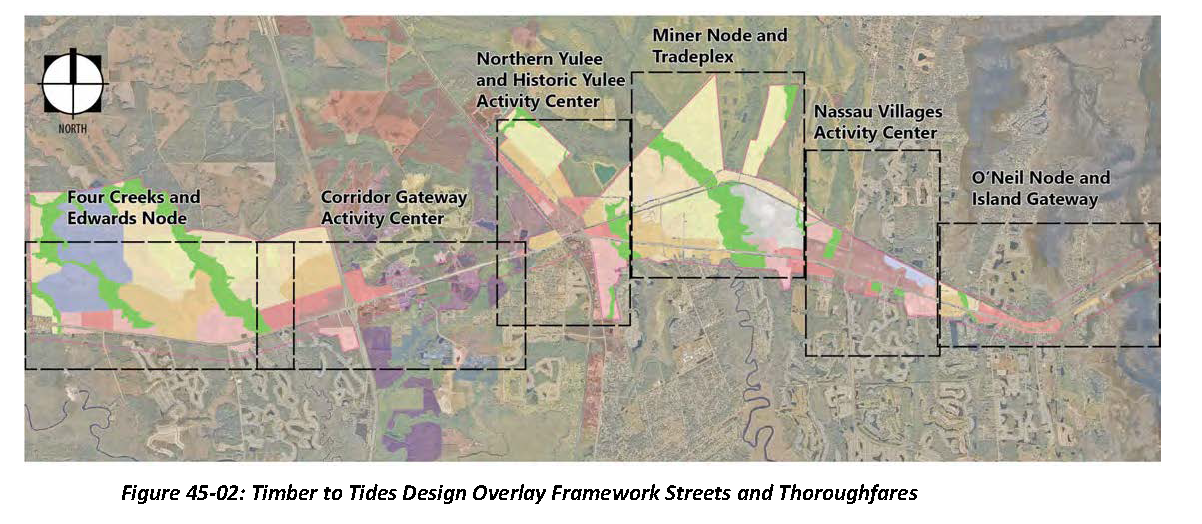
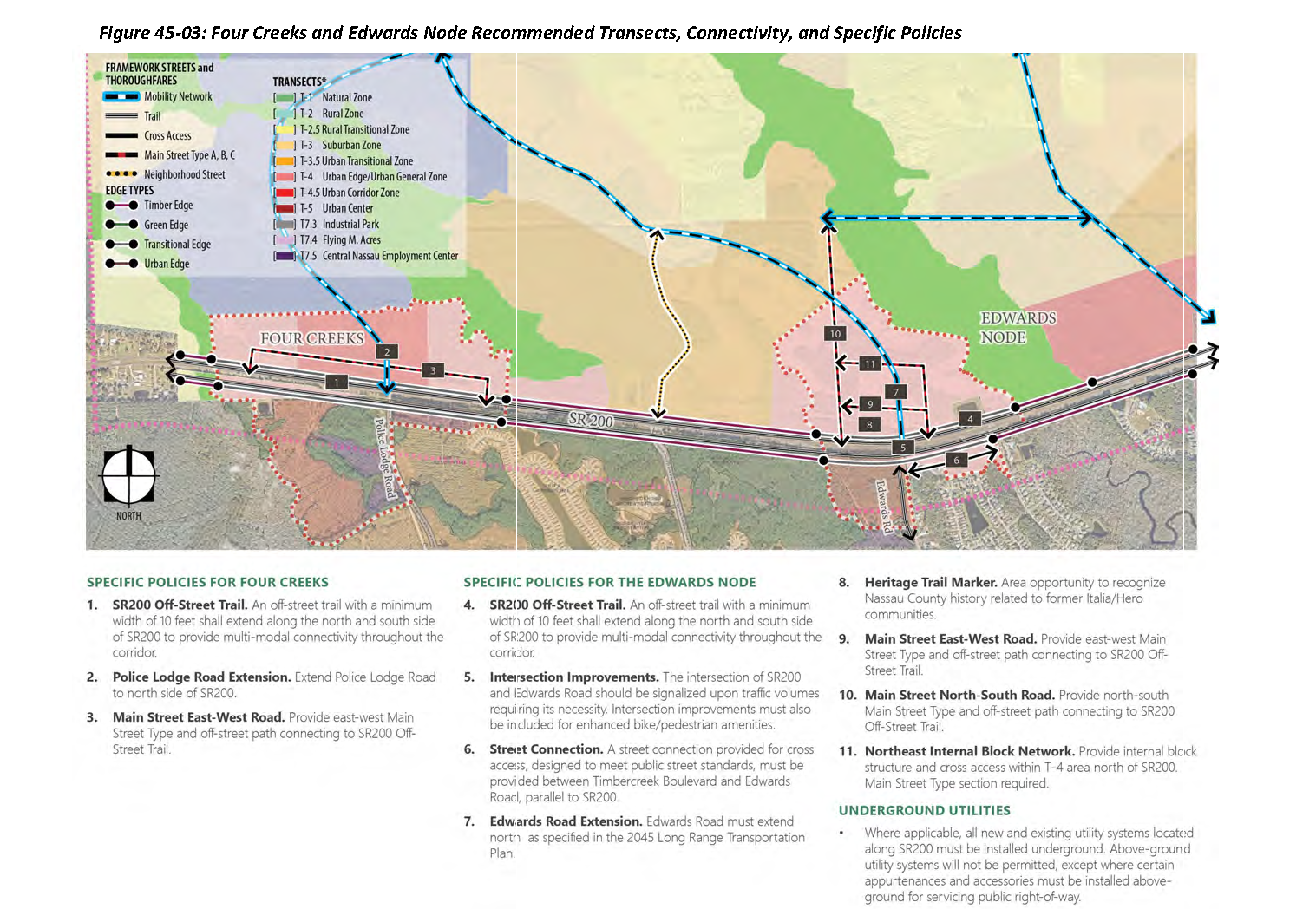
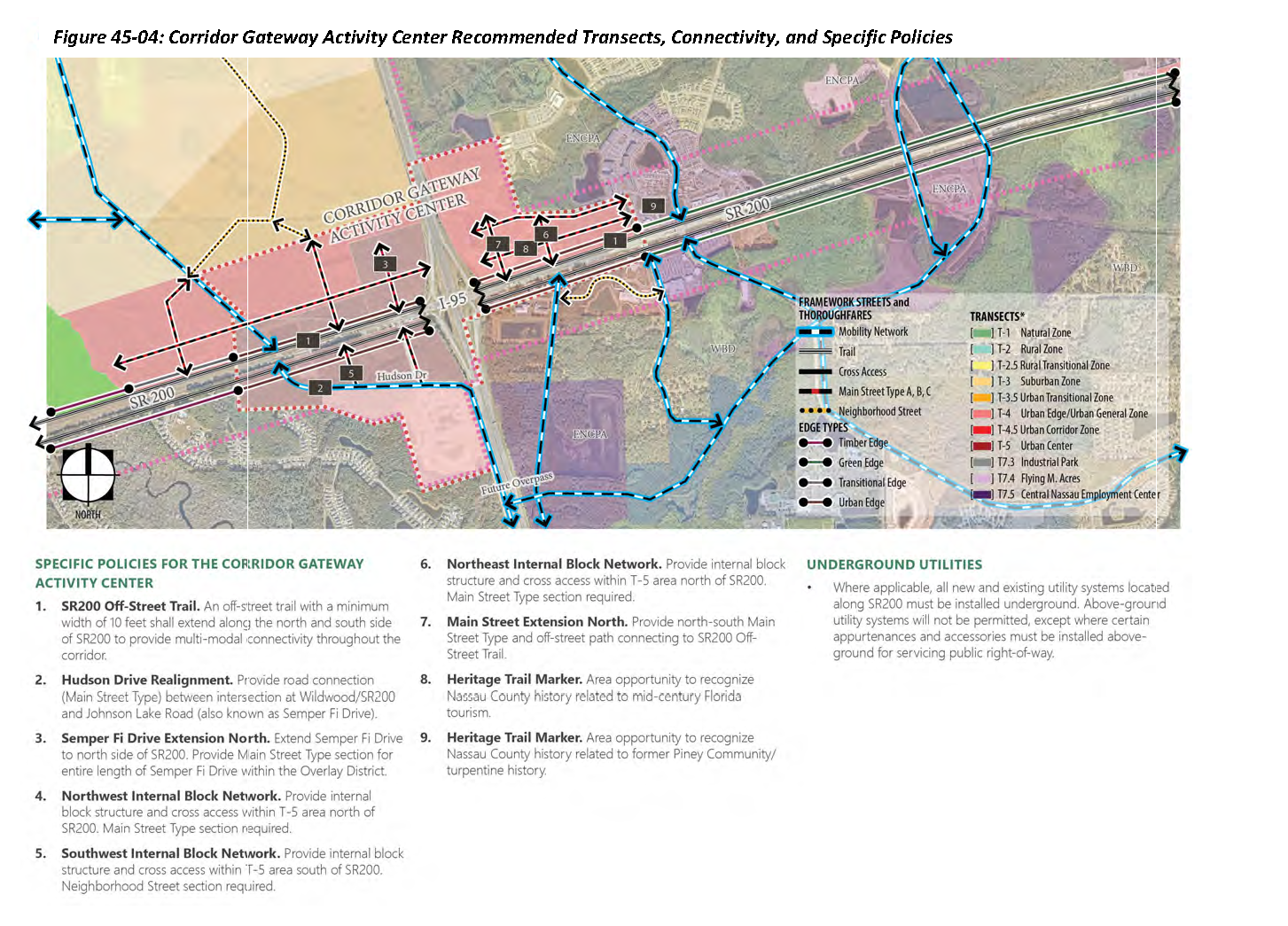
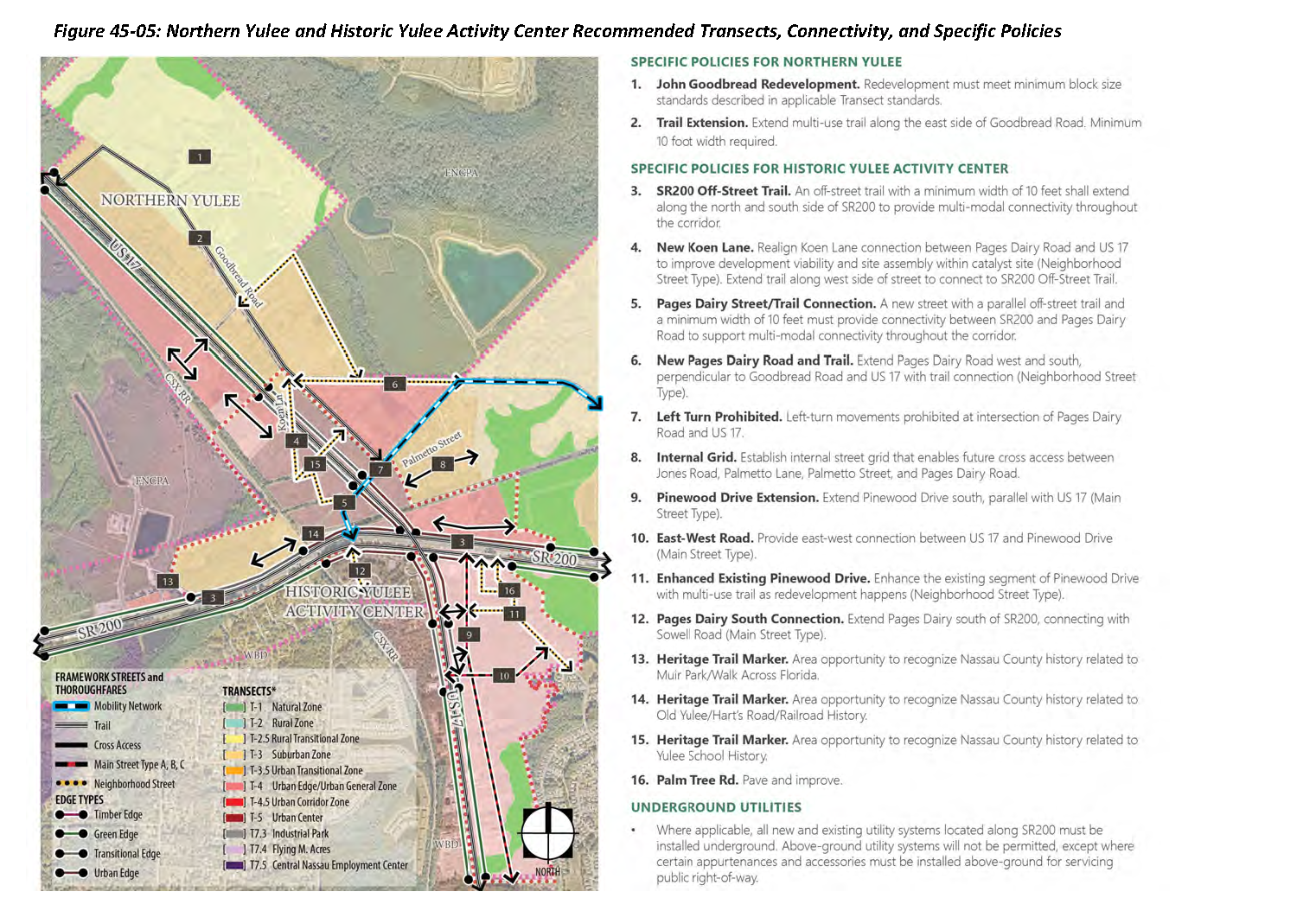
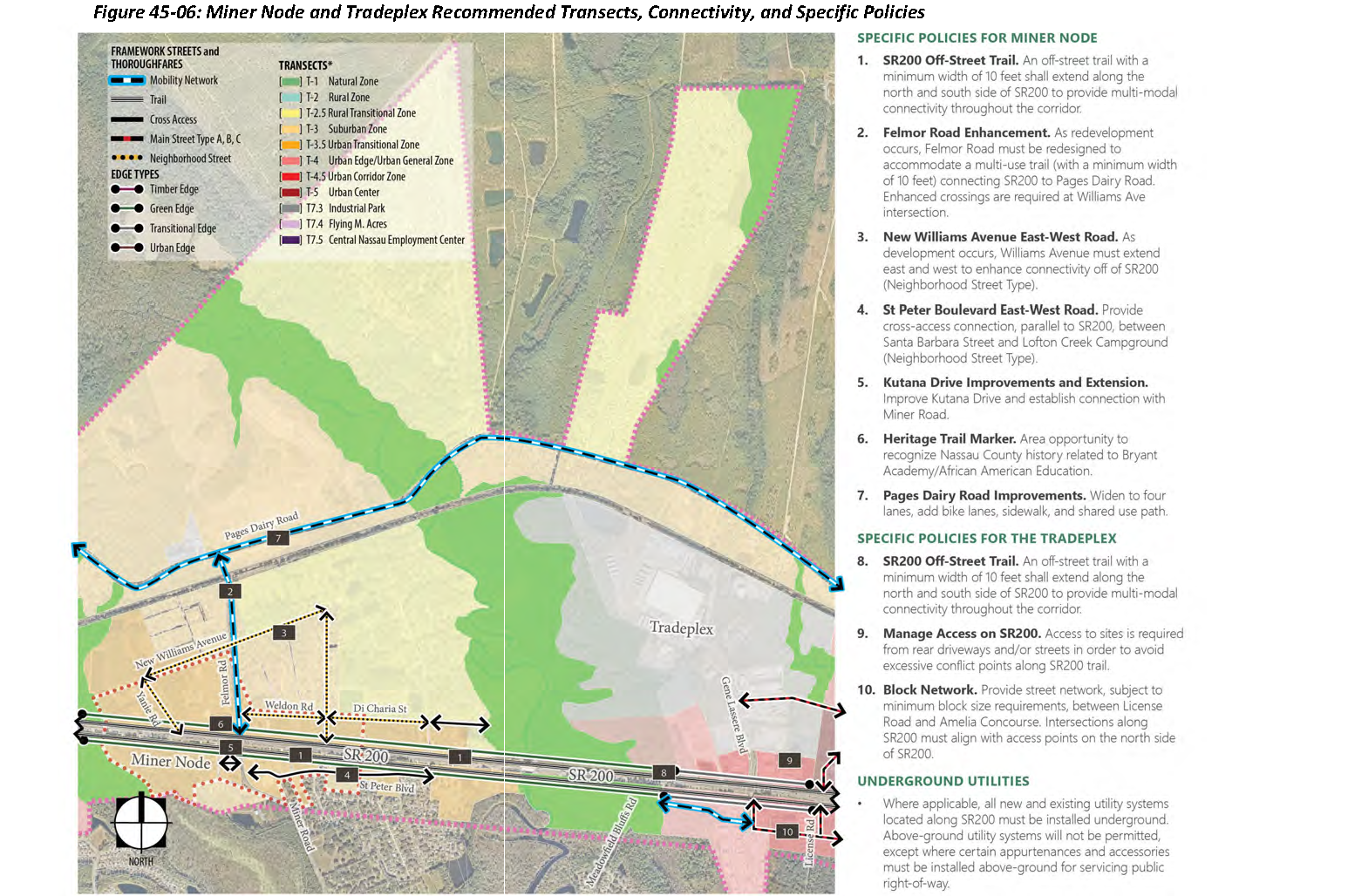
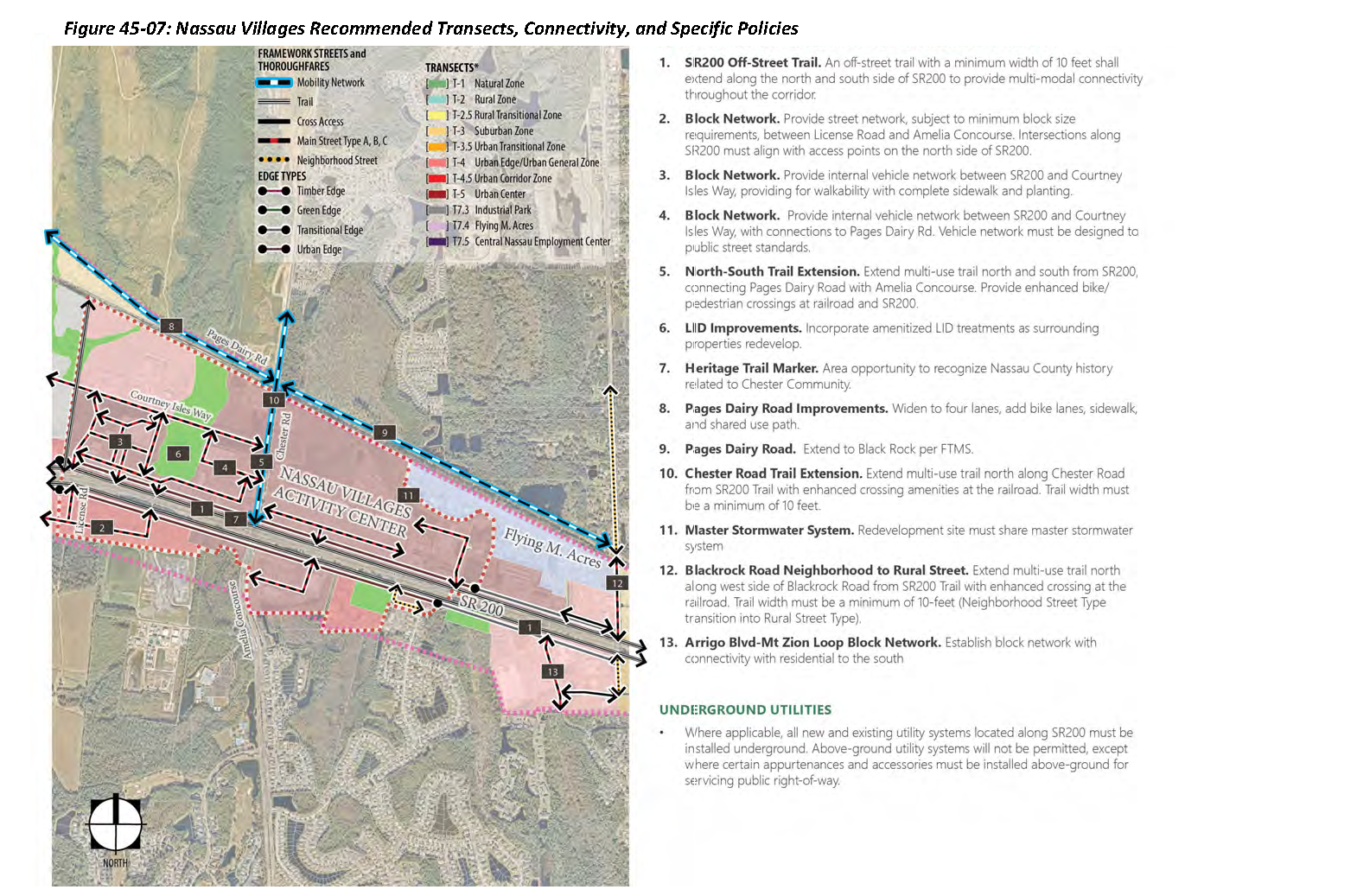
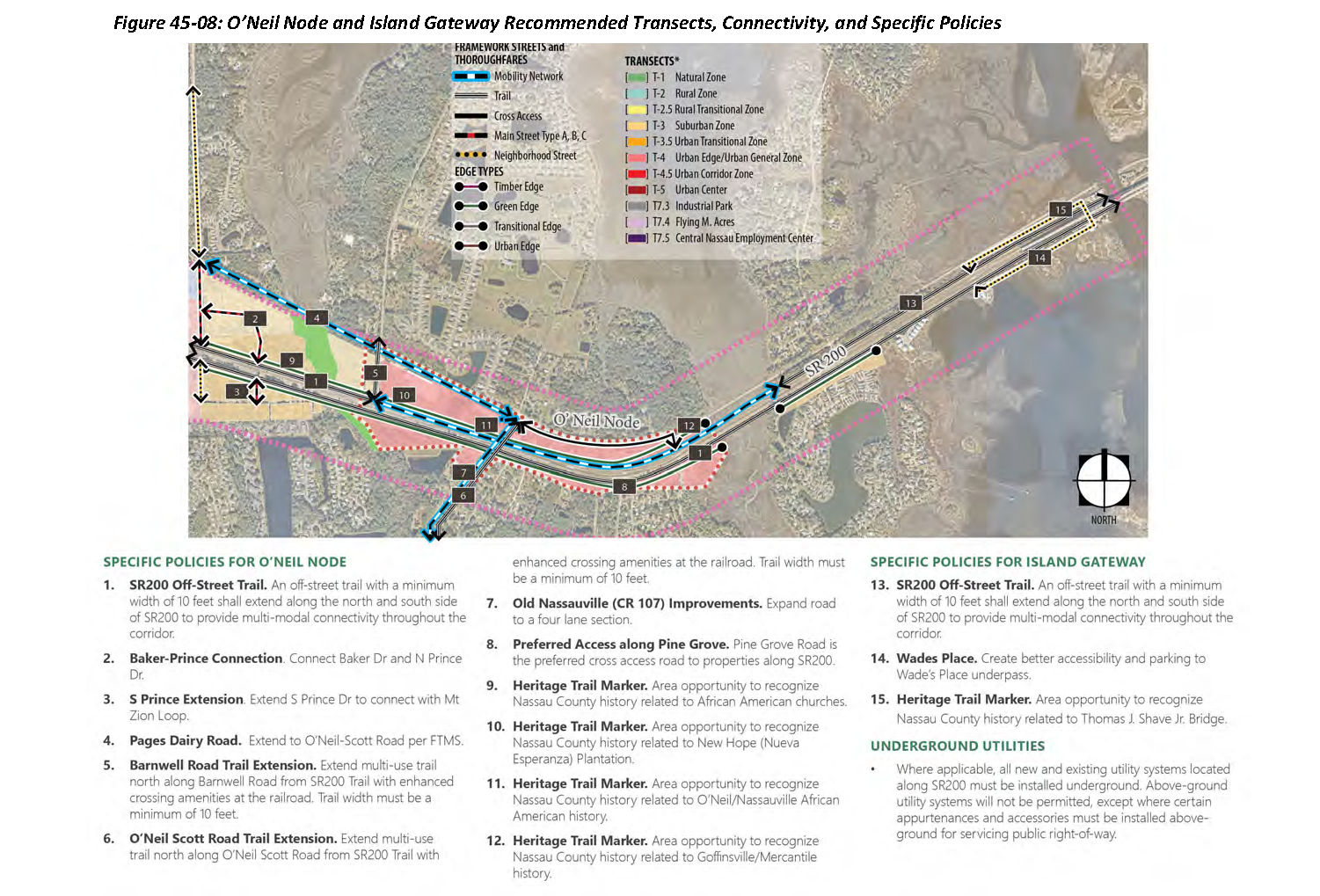
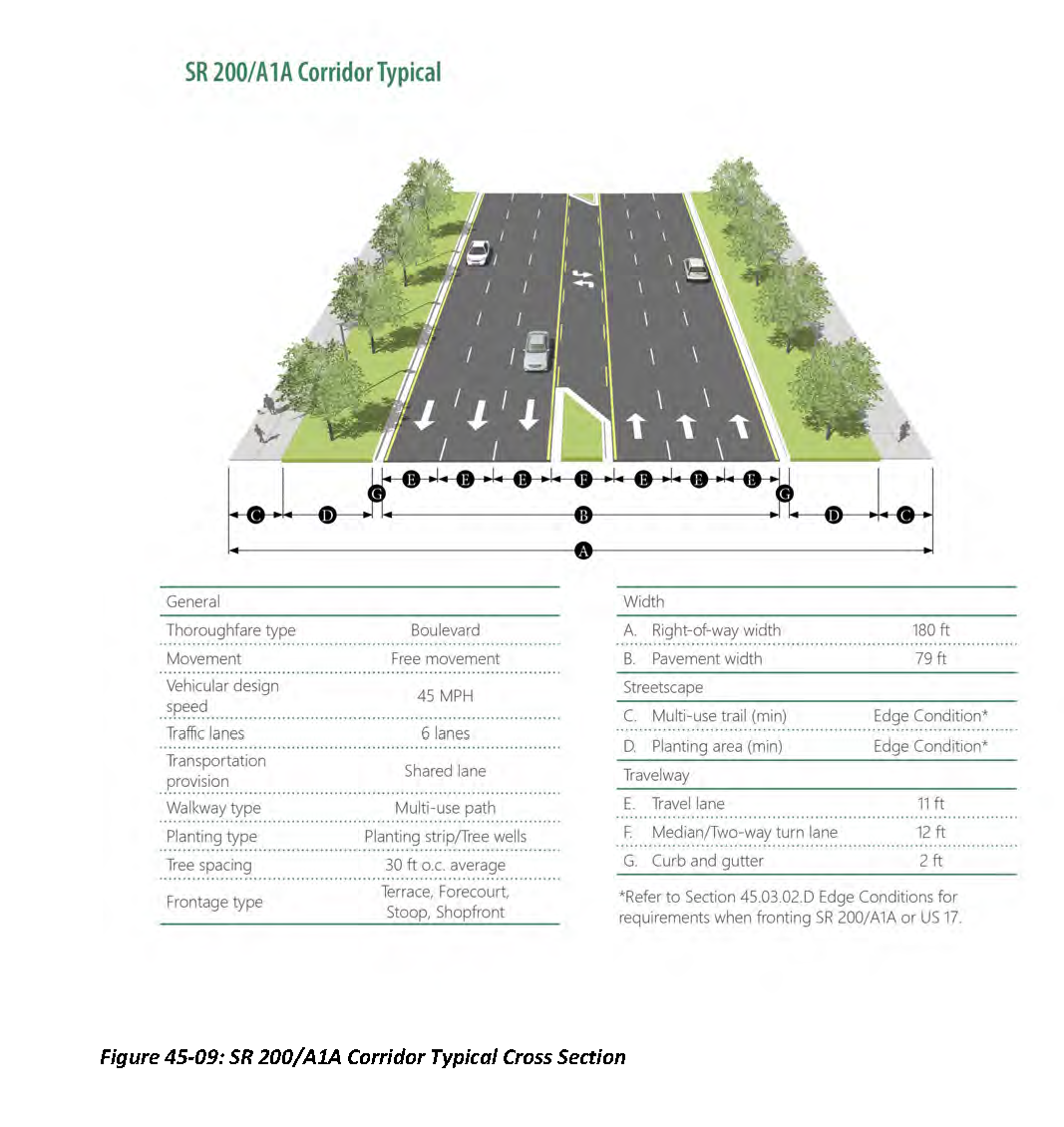
Framework streets, thoroughfares, and edge types provided in Figure 45-02 through Figure 45-8.
2.
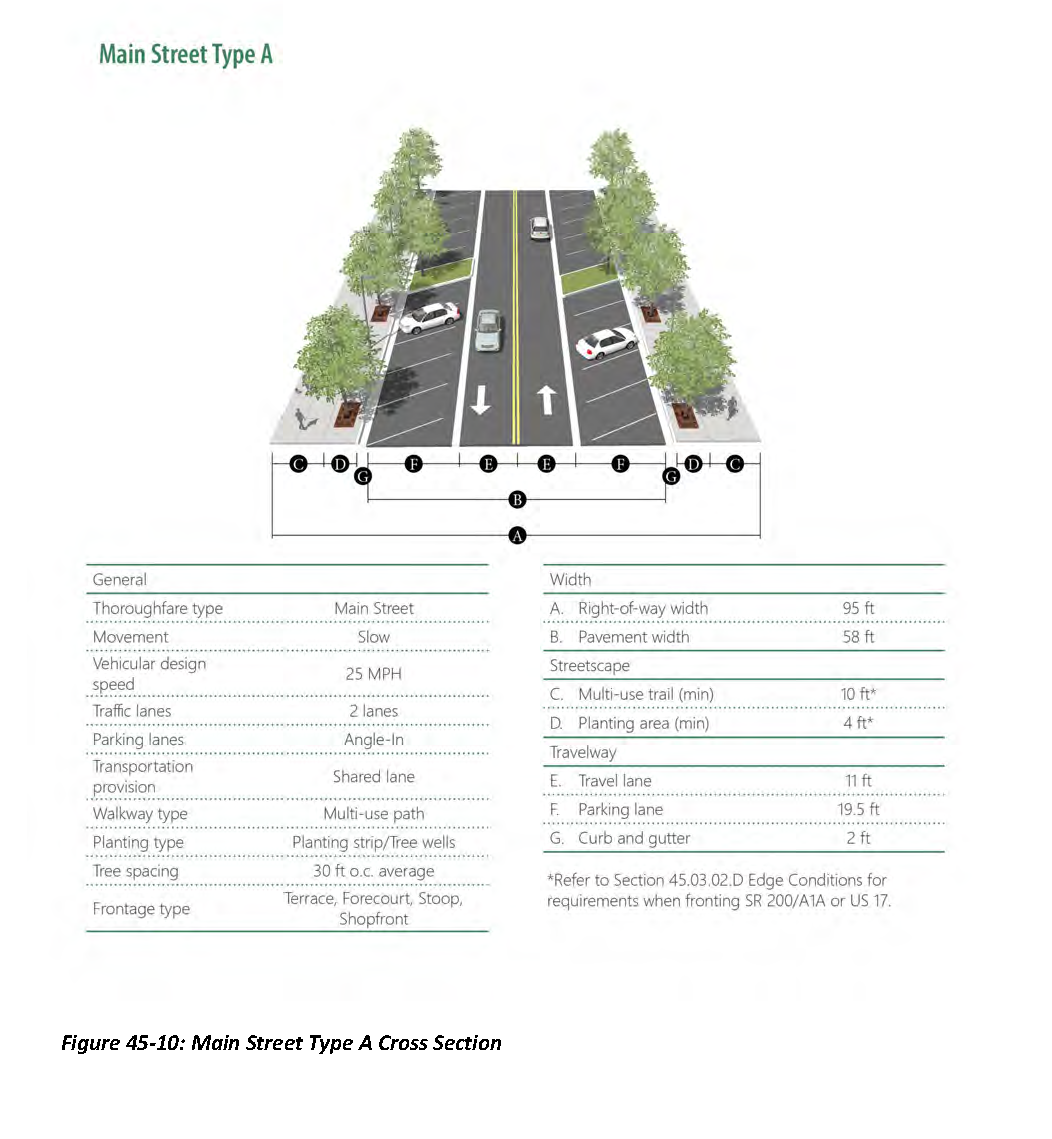
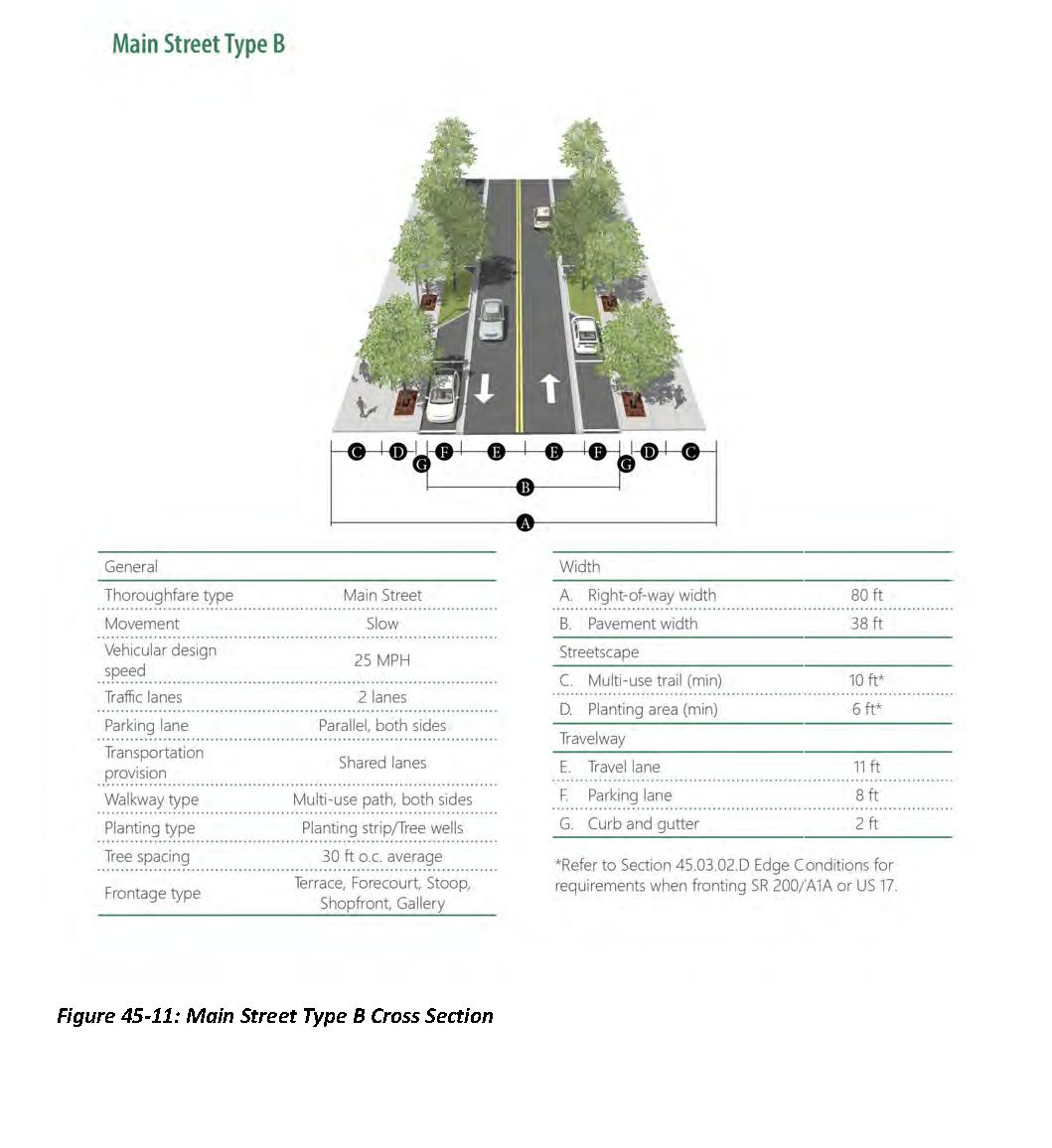
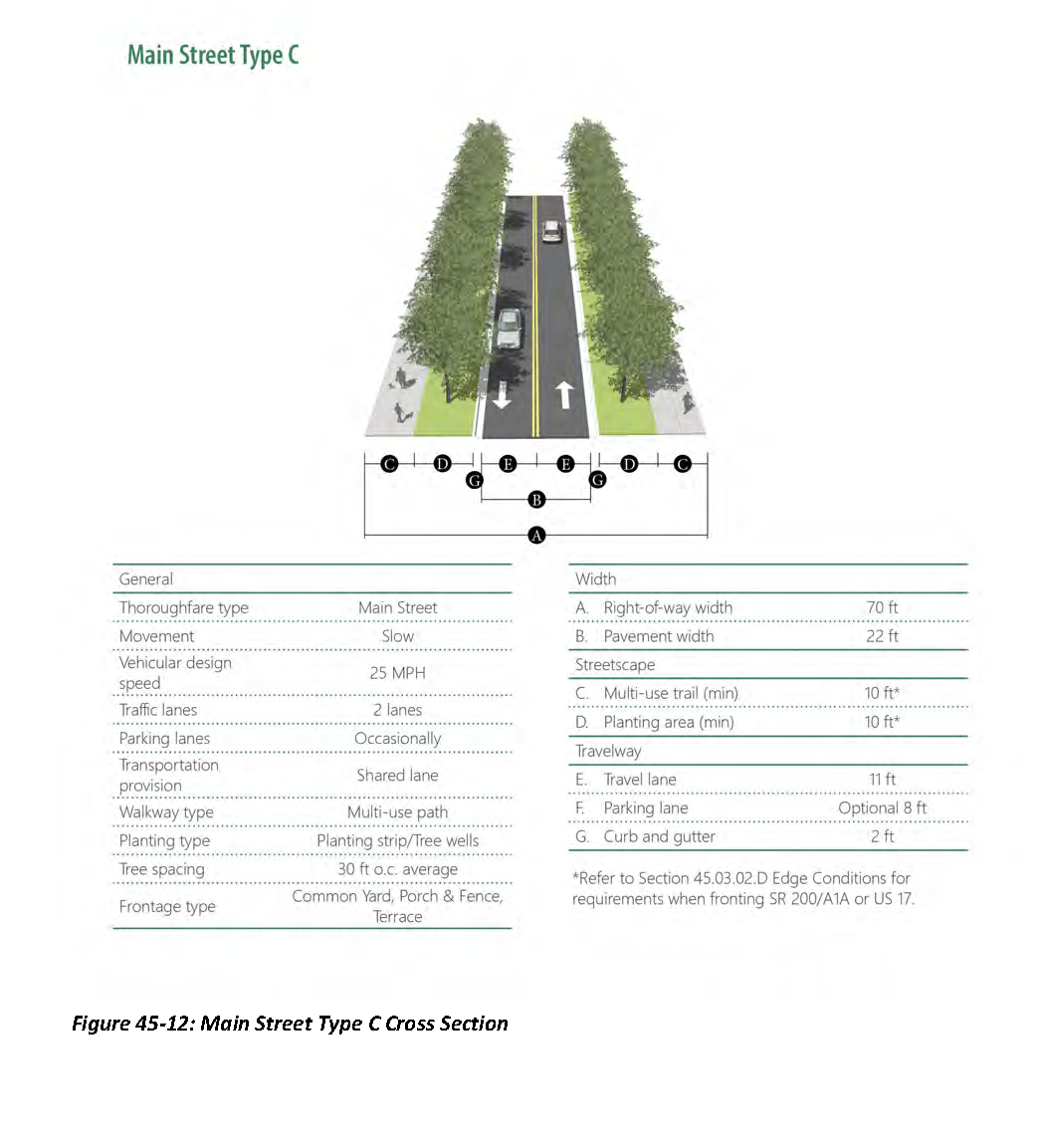
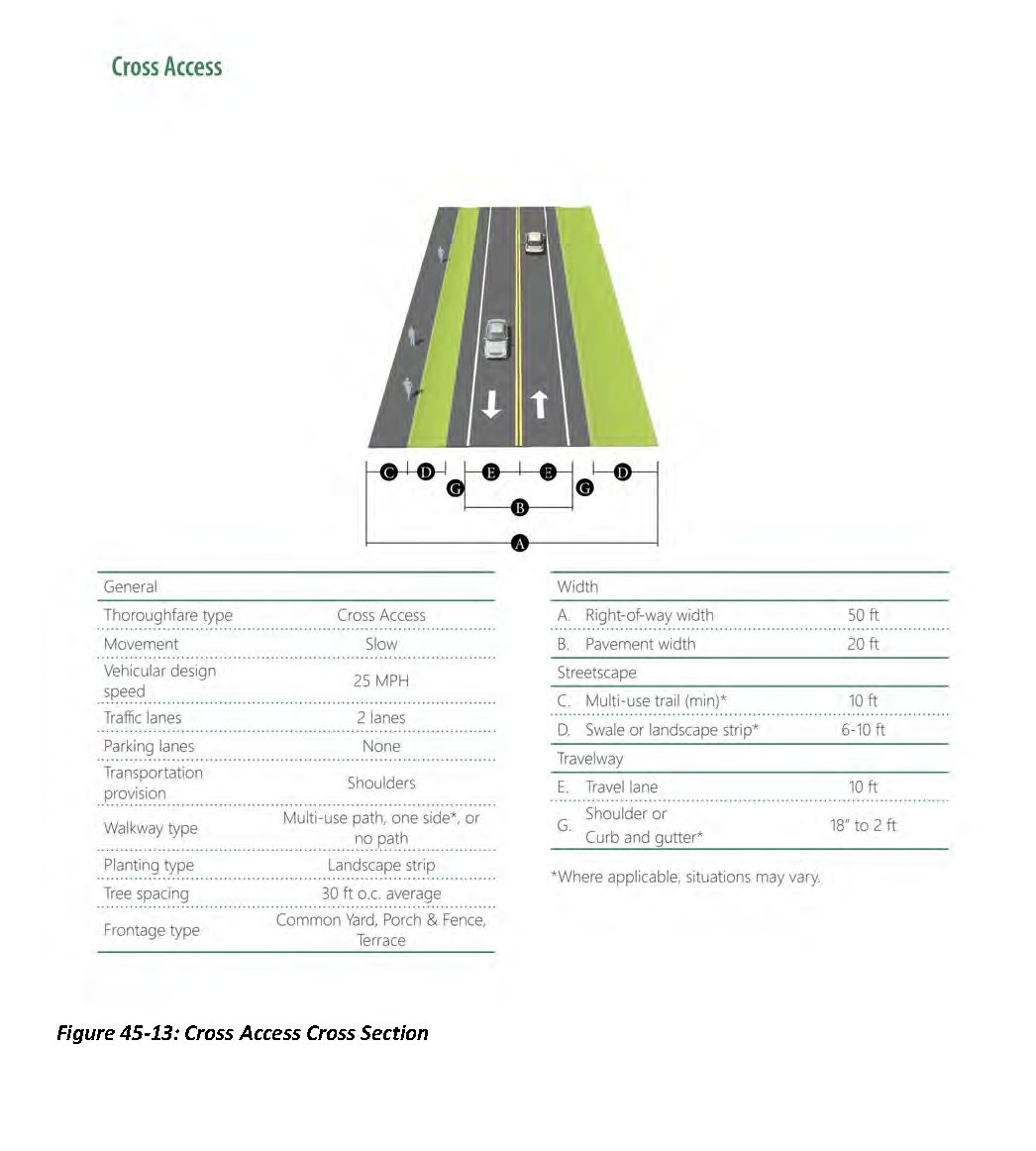
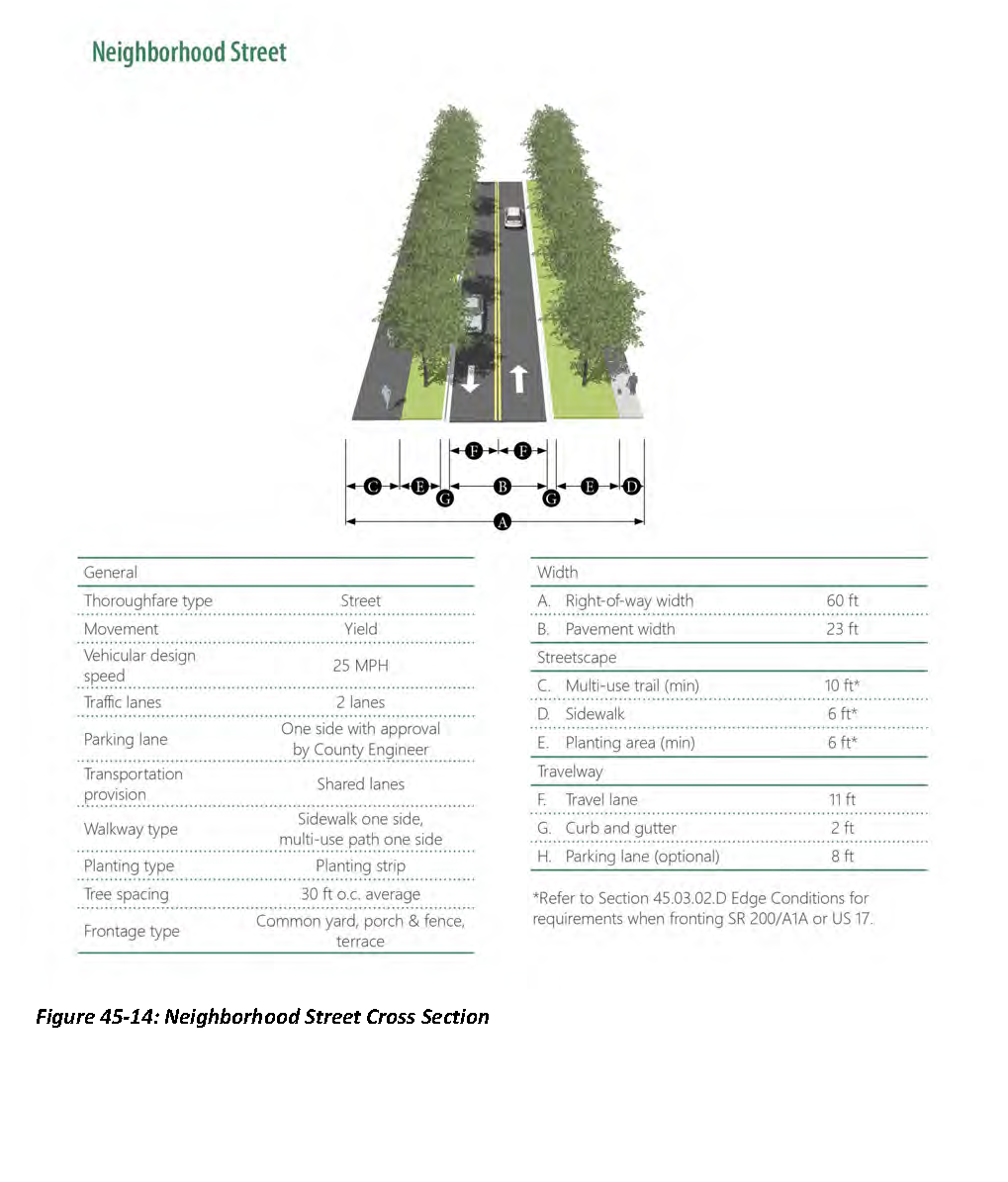
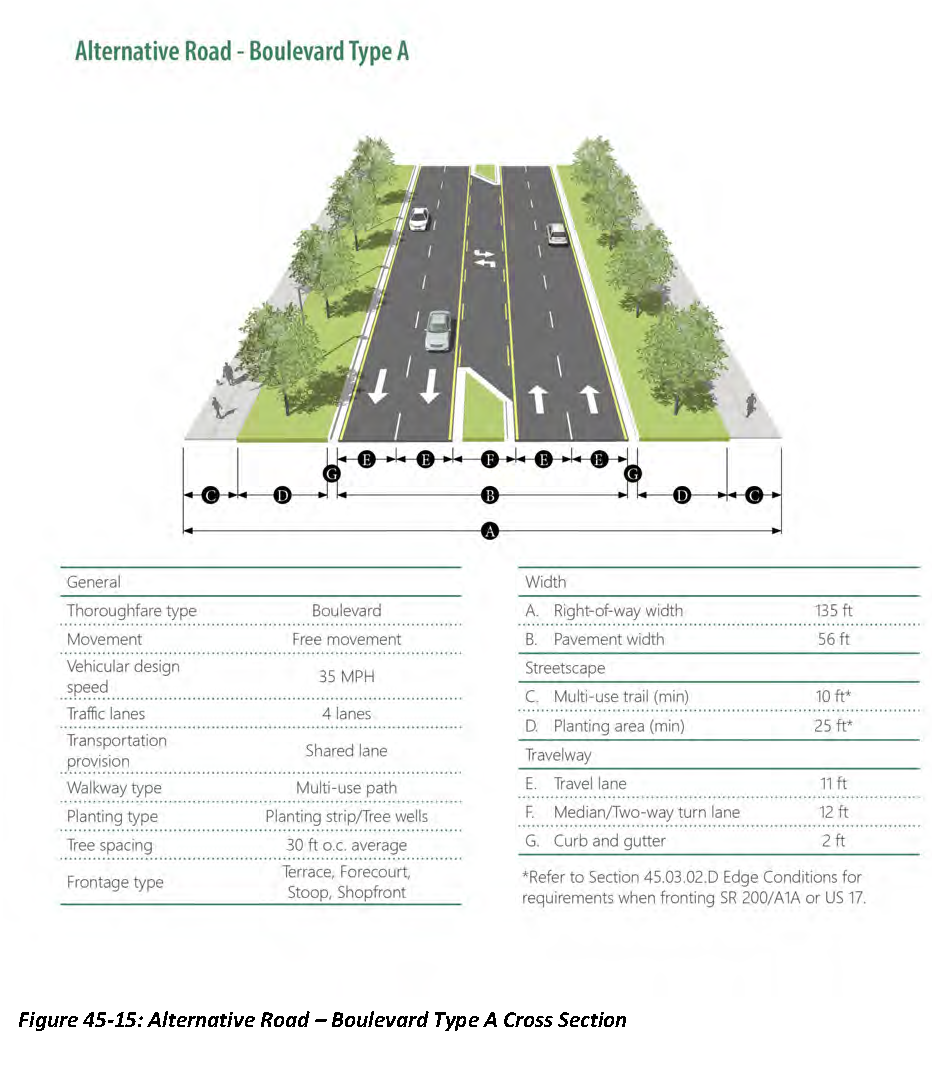
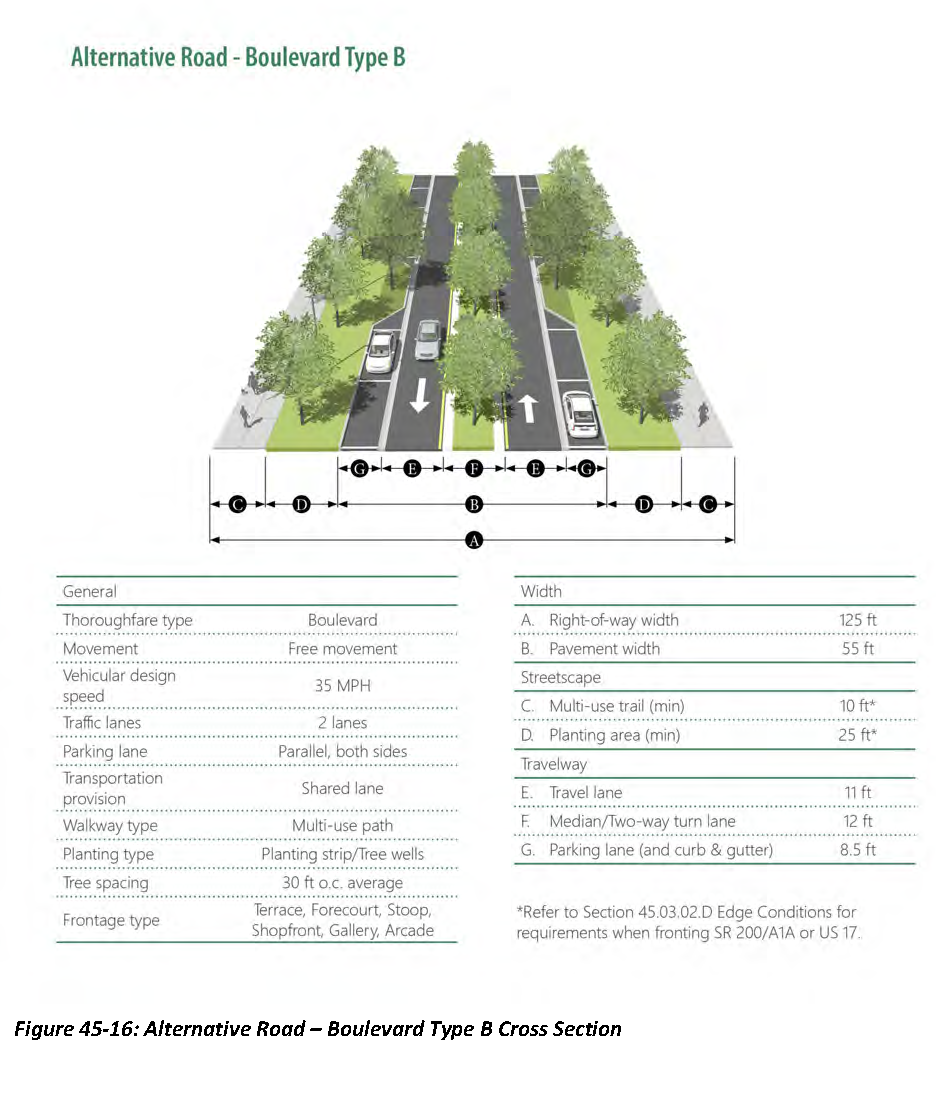
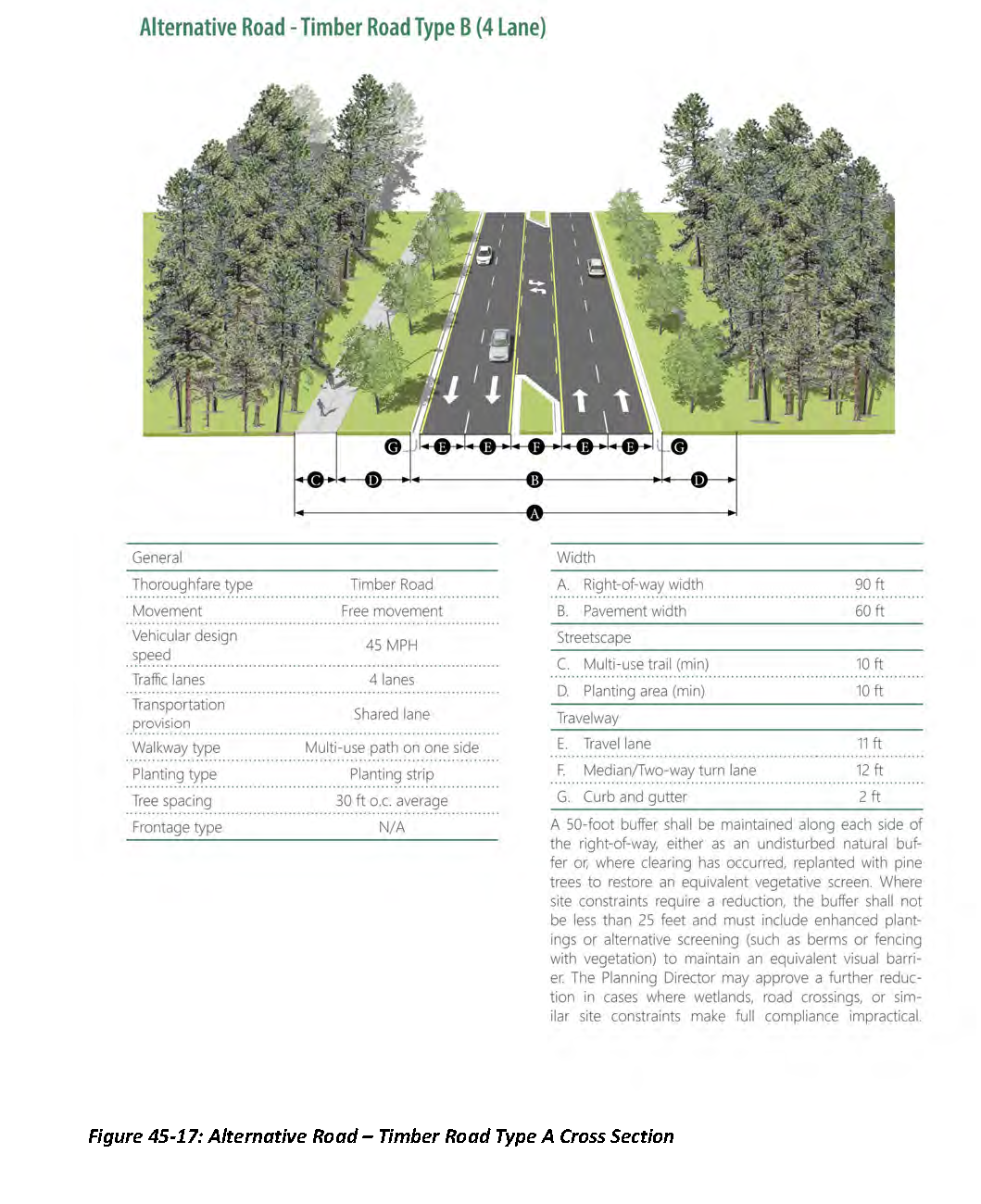
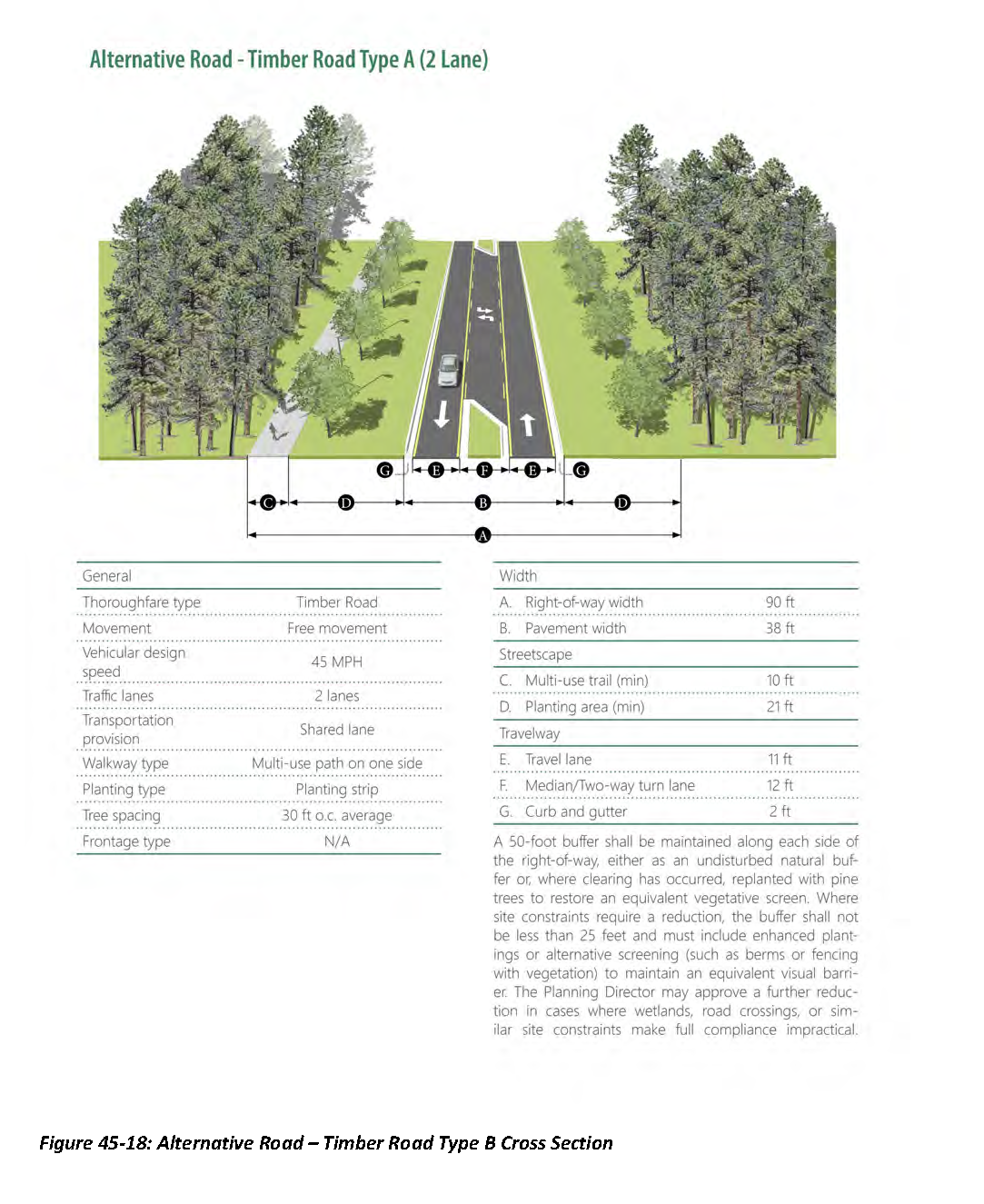
Cross sections provided in Figure 45-09 through Figure 45-18.
3.
Edge type typical sections provided in Figure 45-19 through Figure 45-24.
4.
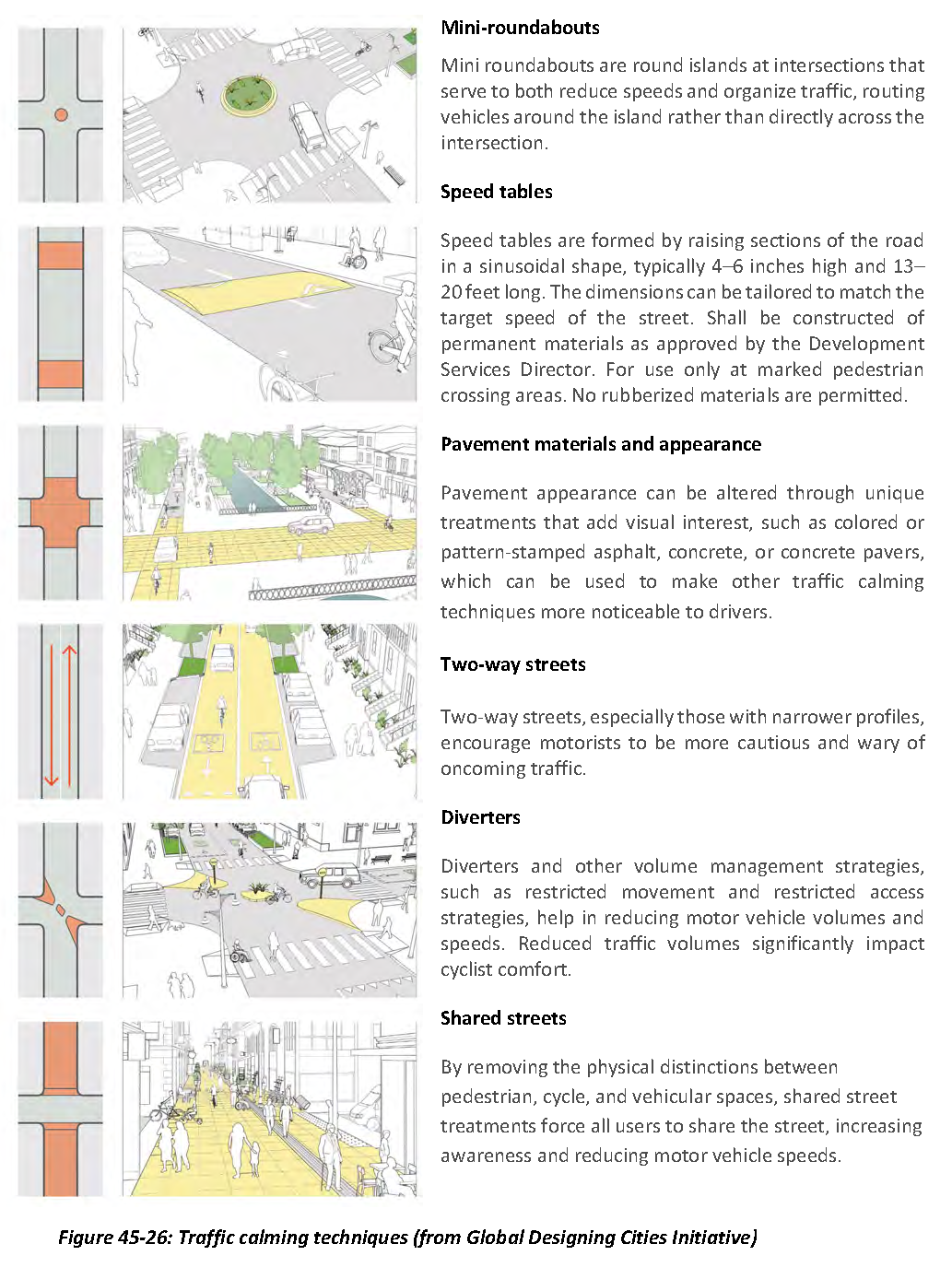
Traffic calming techniques as provided in Figure 45-25 and Figure 45-26.
5.
Access management standards as provided in Figure 45-27 through Figure 45-30.
45.03.02. - Transportation network CBDS.
A.
Framework streets and thoroughfares.
1.
As new development and redevelopment occurs, the applicant shall make improvements to a thoroughfare abutting the project and accessed by the project to bring the thoroughfare into conformance with the standards and cross-sections herein and the Nassau County Roadway and Drainage Standards.
2.
As framework streets and thoroughfares within the T2TDO are built or rebuilt, they shall conform to the framework street and thoroughfare assignments listed in this section. For thoroughfares assigned a main street cross-section, the developer shall select from the list of provided main streets or boulevard cross-sections, subject to approval by the Nassau County Development Review Committee (DRC).
3.
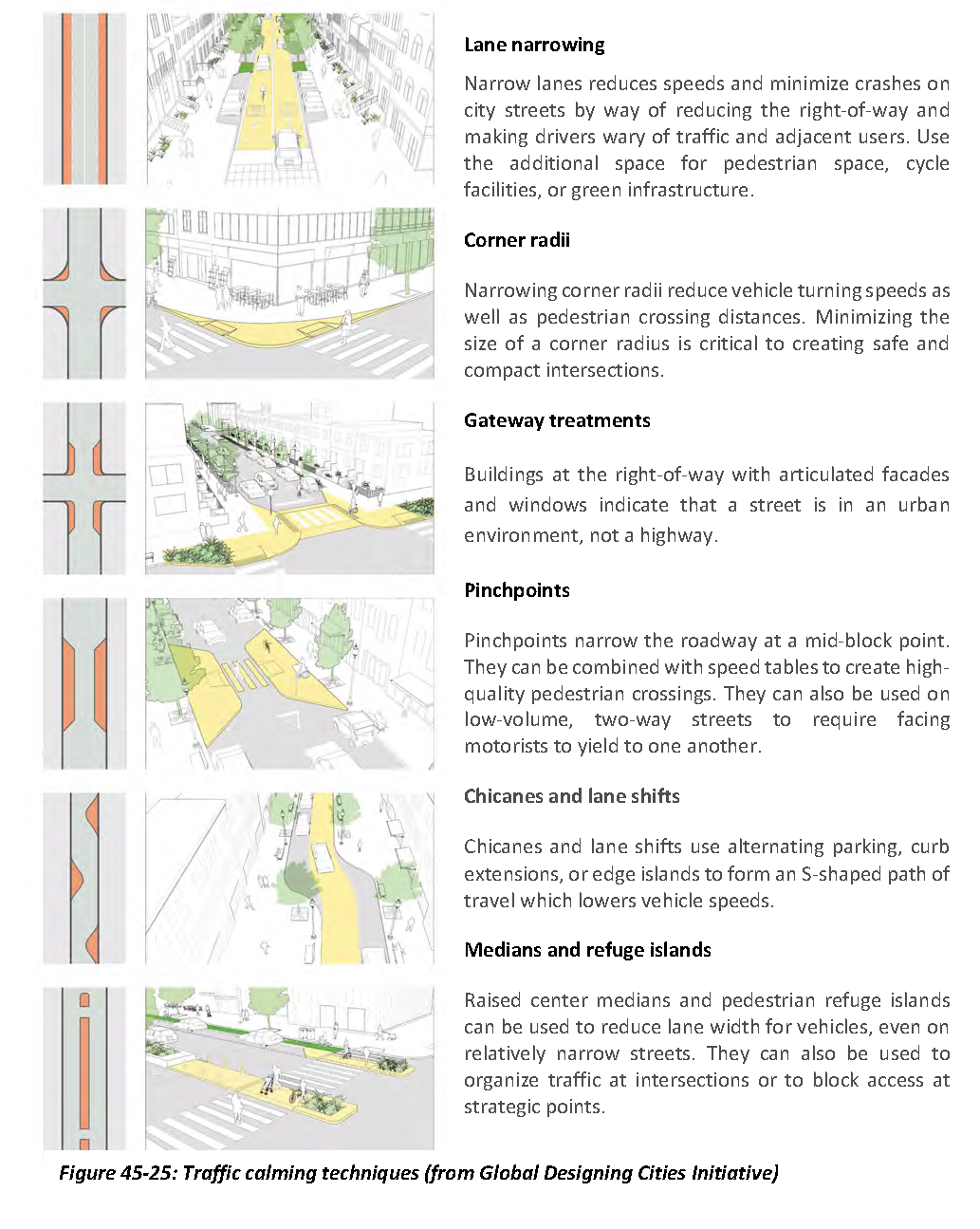
As approved by the development Services Department and Nassau County Fire and Rescue, streets may utilize traffic calming techniques as provided in this article to promote form and walkability.
4.
All thoroughfares shown within the development's parcel boundary on the figures and cross-sections herein shall be constructed at the time of site development. For phased developments, framework streets and thoroughfares may be constructed incrementally in accordance with an approved phasing plan, provided that each phase includes the portion of the street network necessary to support access, connectivity, and emergency service requirements.
5.
Final location, design and connectivity of framework streets and thoroughfares shall be determined during site engineering plan approval. Minor changes shall be made in consultation with Nassau County Development Services Department. Where the proposed framework street and thoroughfare network is determined to be unfeasible due to environmental, topographic, or infrastructure constraints, the county engineer or their designee may authorize adjustments or realignments as appropriate.
6.
Figure 45-02 provides an overview of the snapshot areas that are further analyzed in the subsequent figures. Area specific policies are listed below each figure and shall be adhered to.
These figures include the following identified areas:
a.
Four Creeks and Edwards Node.
b.
Corridor Gateway Activity Center.
c.
Northern Yulee and Historic Yulee Activity Center.
d.
Miner Node and Tradeplex.
e.
Nassau Villages Activity Center.
f.
O'Neil Node and Island Gateway.
B.
Multi-use trails.
1.
All new development and redevelopment located within the Timber to Tides Design Overlay (T2TDO) shall be required to complete the portion of any multi-use trail identified in the figures provided in this Section and/or within an assigned cross-section if that trail runs parallel and adjacent to, or within, the development property at the time of site development. For phased developments, trail construction may occur incrementally in accordance with an approved phasing plan, provided each phase includes the trail segment necessary to support public access, pedestrian connectivity, and network continuity.
2.
All new development and redevelopment located within the T2TDO shall be required to connect to existing neighboring cross-connectivity facilities and/or provide such cross-connectivity facilities for future neighboring development per the figures and cross-sections herein.
3.
Multi-use trails shall be integrated into new development and redevelopment of residential subdivisions, master planned communities, civic or institutional facilities, activity centers, retail or service centers, and recreational facilities. All multi-use trails shall be designed to provide for the safe travel of pedestrians and people on bicycles. Multi-use trails shall be a minimum of ten (10) feet wide.
4.
If a trail segment is identified as a mobility network trail, then the trail must be located within an easement or right-of-way granting public access or use in perpetuity.
5.
For the construction of trails included within the mobility network, the owner or developer shall be eligible to receive mobility or impact fee credits, as applicable, pursuant to the Mobility Fee Ordinance or Comprehensive Impact Fee Ordinance as appropriate.
C.
Cross-sections.
1.
The standards provided herein shall apply to all framework streets and thoroughfares within the T2TDO.
D.
Edge conditions.
1.
The standards provided herein shall apply to all new development and redevelopment within the T2TDO that fronts on SR 200/A1A and US 17.
2.
All properties fronting SR 200/A1A or US 17 shall treat these thoroughfares as the primary frontage for the purposes of building orientation, architectural design, and streetscape treatment. The primary building entrance, principal façade, and required edge condition elements shall be oriented to face these corridors, regardless of parcel shape, access point location, or internal circulation design. Rear or service-oriented façades shall not front SR 200/A1A or US 17 under any circumstances. Where site constraints exist, buildings shall be designed with dual frontages or incorporate architectural treatments on all sides visible from public rights-of-way to ensure continuity of character and pedestrian-scale interest along the corridor.
3.
All new development and redevelopment shall submit a streetscape plan consistent with this section. In cases where design constraints exist due to limits in the right-of-way, wetlands, or similar restrictions, developers shall collaborate with county staff during the site engineering plan review process to identify suitable solutions. Priority shall be given to maintaining the integrity of the public frontage zone.
4.
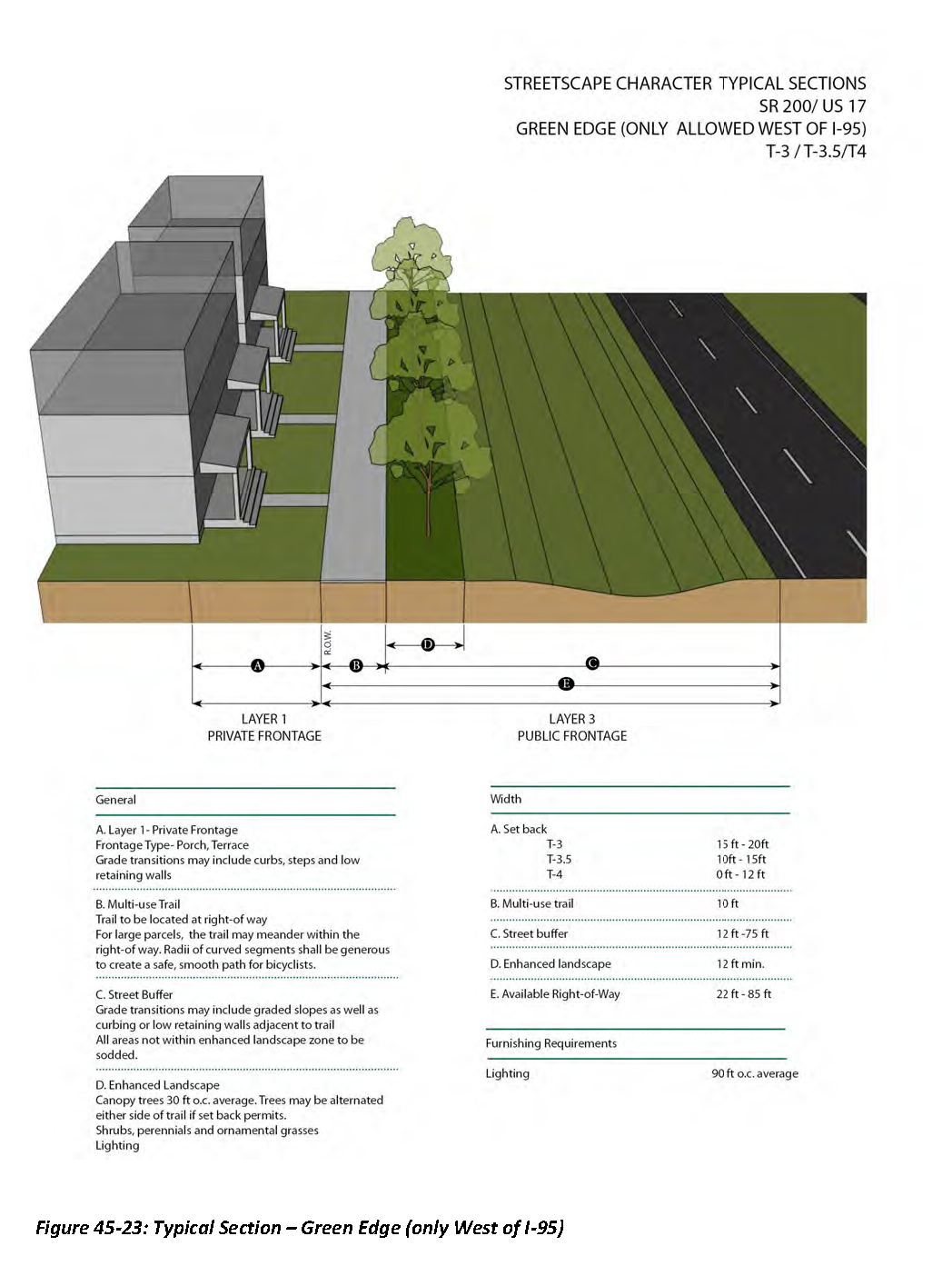
For properties located west of I-95, developments with phased implementation may utilize the green edge streetscape standards as an interim condition until density and intensity warrant a transition to transitional edge or urban edge. When sixty percent (60%) or more of the linear frontage along a block face is built out, or once the cumulative FAR of development along the block reaches 1.0, the green edge shall transition to the applicable transitional or urban edge standard. Edge transitions shall be coordinated during the site development review process to ensure continuity and connectivity across parcels.
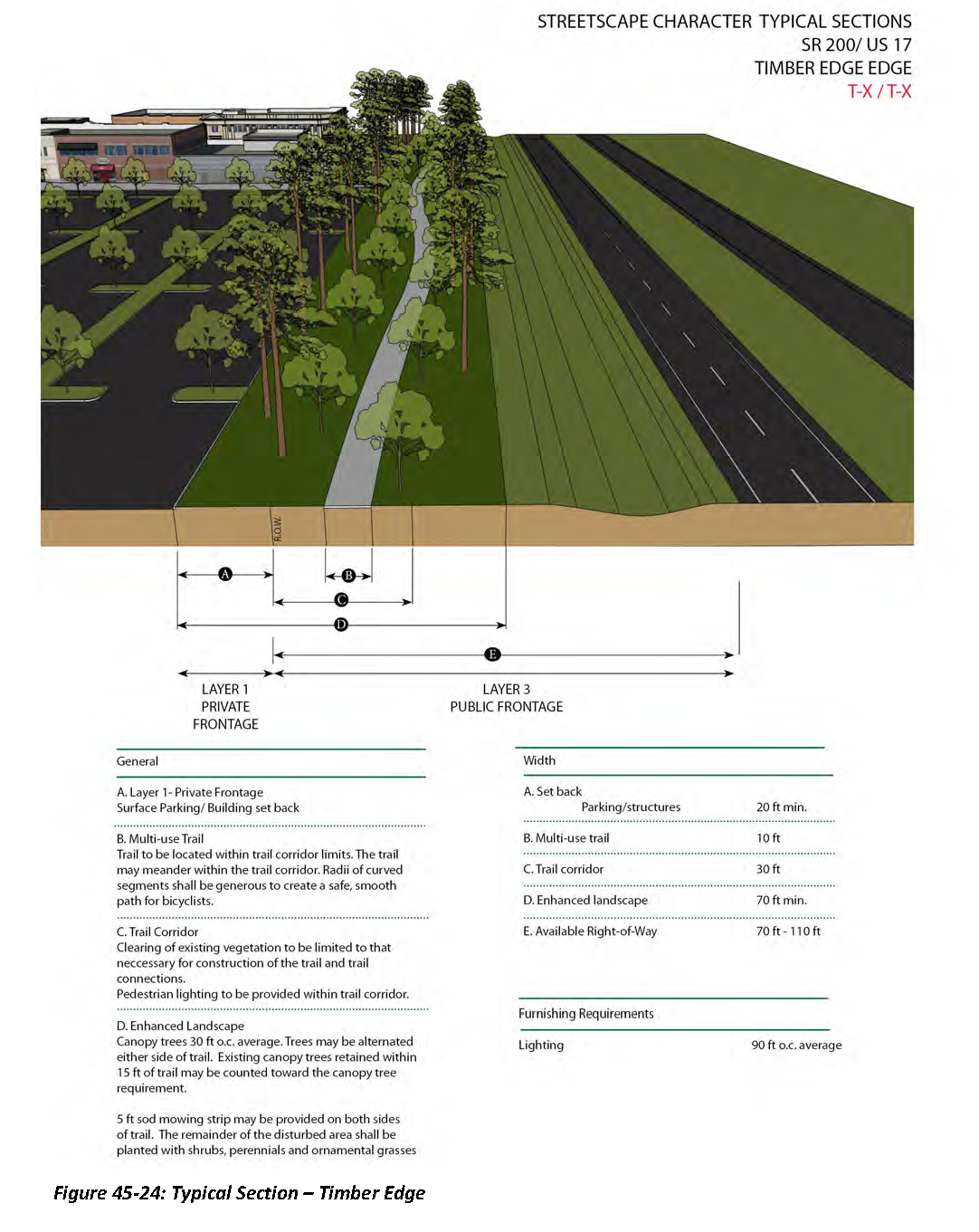
5.
The timber edge shall only be used where identified on the regulating plan.
6.
Properties west of I-95 with vehicle traveling speeds greater than forty-five (45) miles per hour shall not require curbing.
7.
The county engineer or their designee shall make the final determination on applicable requirements in cases where right-of-way constraints or existing infrastructure do not align with the specified edge type, subject to approval by the Florida Department of Transportation (FDOT).
8.
The following edge types shall be used in accordance with the regulating plan:
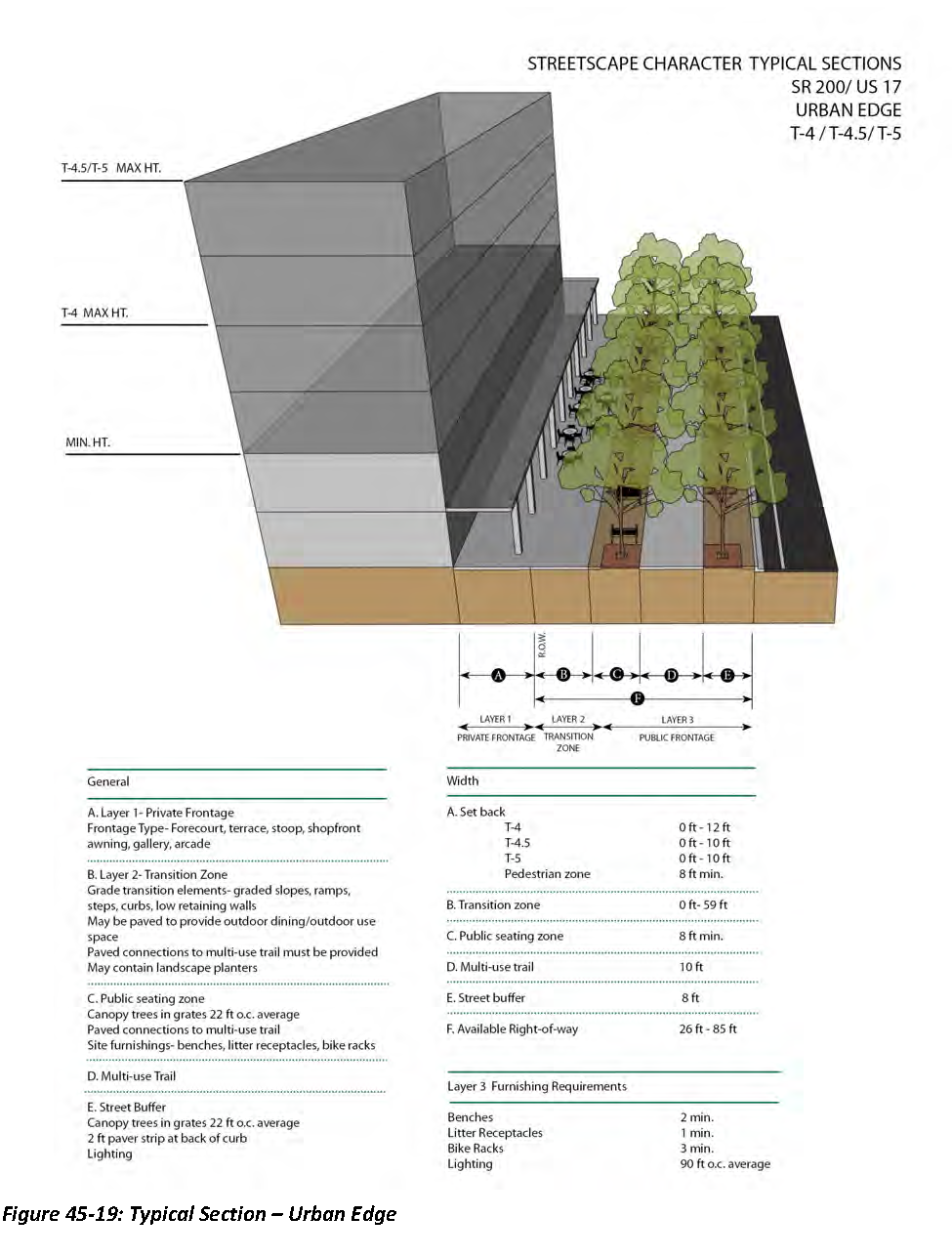
| Urban Edge (T4, T-4.5, T-5) The Urban Edge characterizes high-activity areas. The public frontage of this zone is fully paved, with trees planted in tree pits with grates, to maintain a consistent and durable streetscape. | 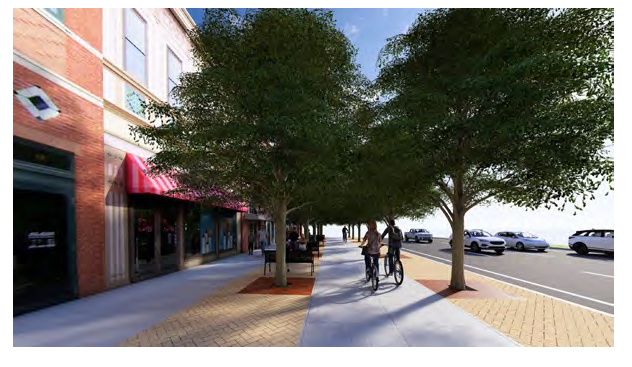 |
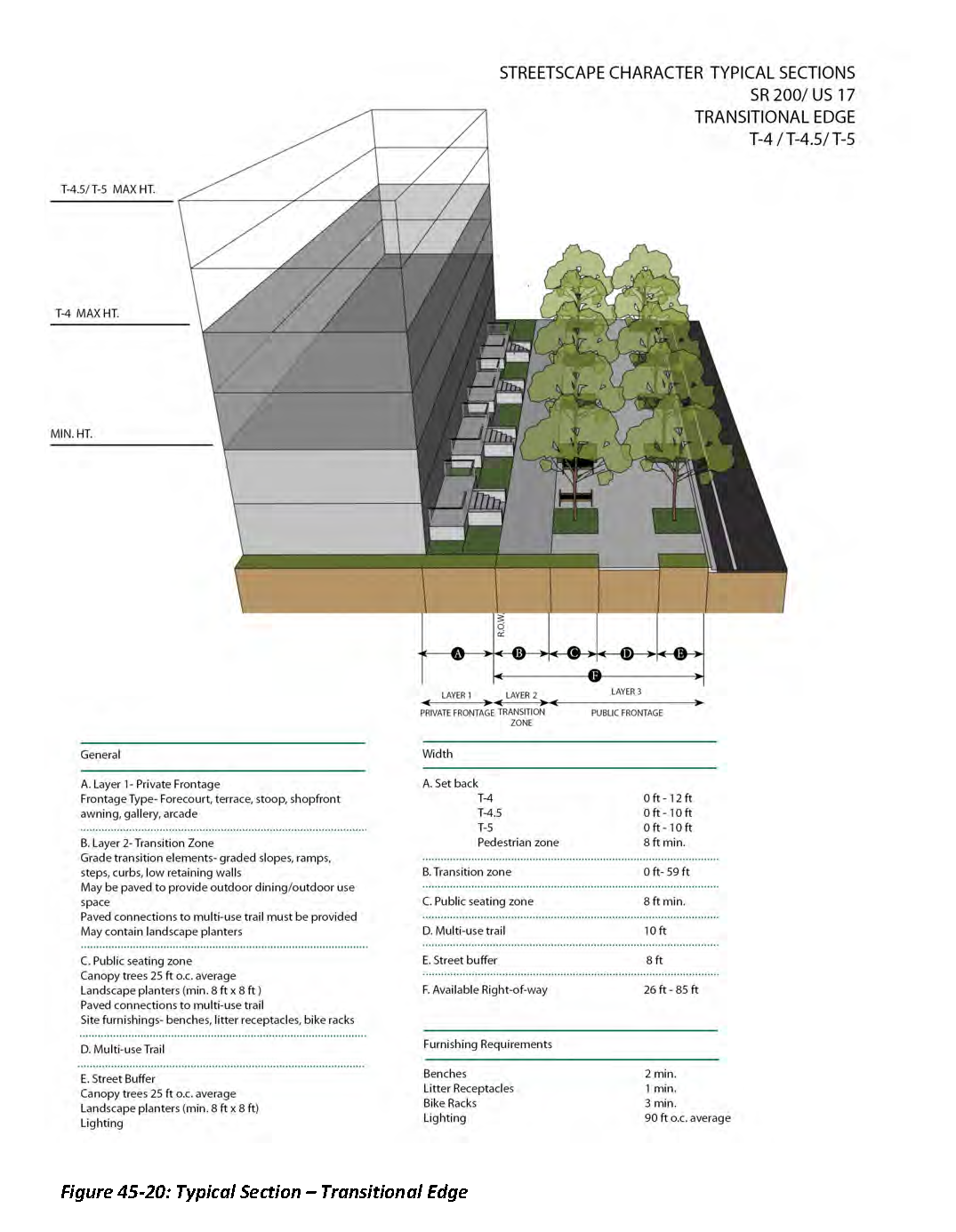
| Transitional Edge (T-4, T-4.5, T-5) The Transitional Edge serves as a design bridge between Green Edge and Urban Edge segments, providing a smooth shift in scale and character. It is also used for activity nodes in lower-density areas. The Transitional Edge incorporates generous landscape planters within a paved matrix, blending landscape and hardscape elements. | 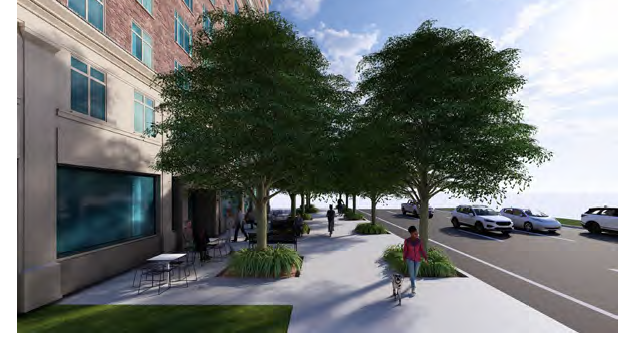 |
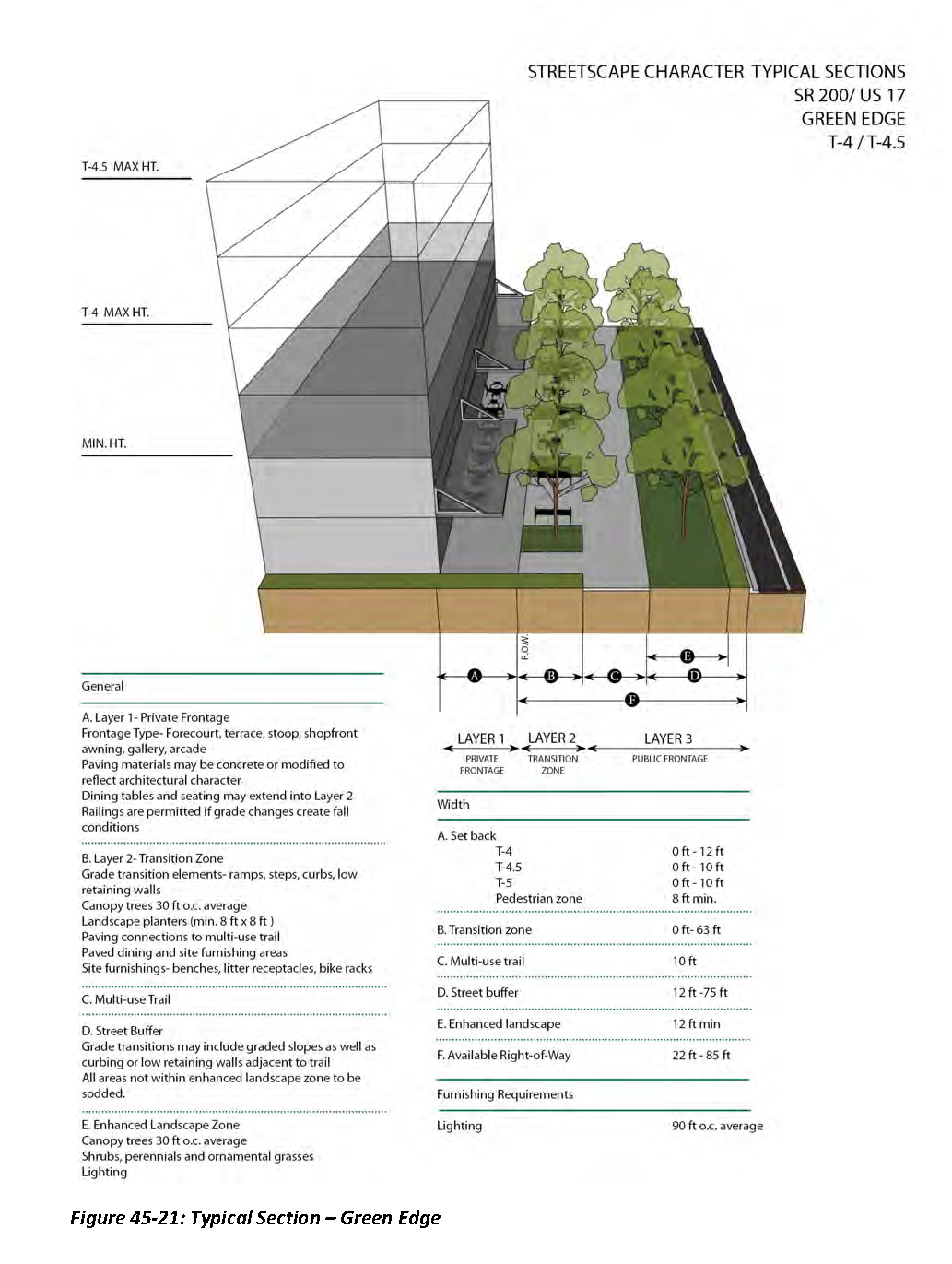
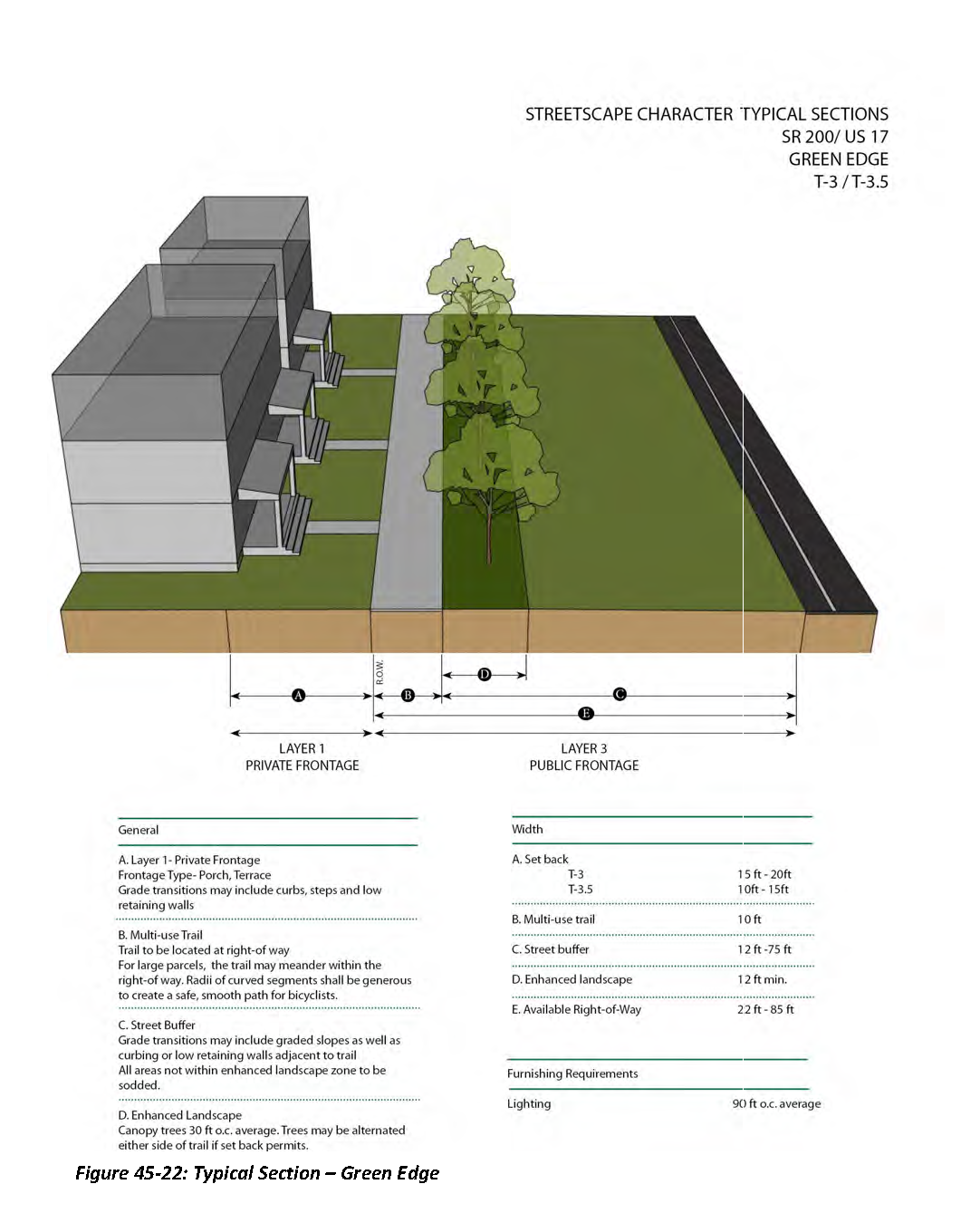
| Green Edge (T-3, T-3.5, T-4, T-4.5) Green Edge segments make up the majority of the T2TDO. The Green Edge maximizes planting areas to create a robust roadway buffer and a pleasant, shaded pedestrian zone. | 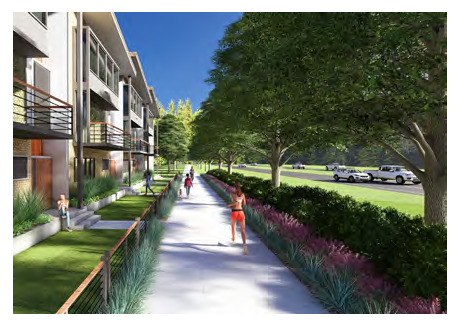 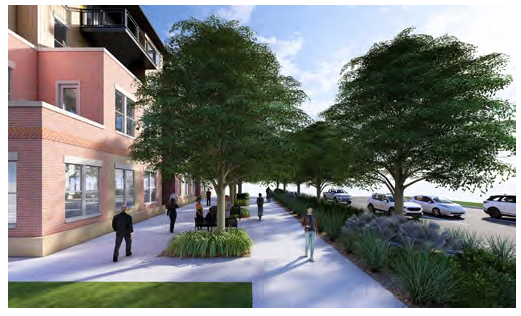 |
| Timber Edge (T-unspecified) Timber Edge utilizes existing tree cover supplemented by canopy trees to create a meandering trail within a generous natural buffer. Timber Edge shall only be used West of I-95. | 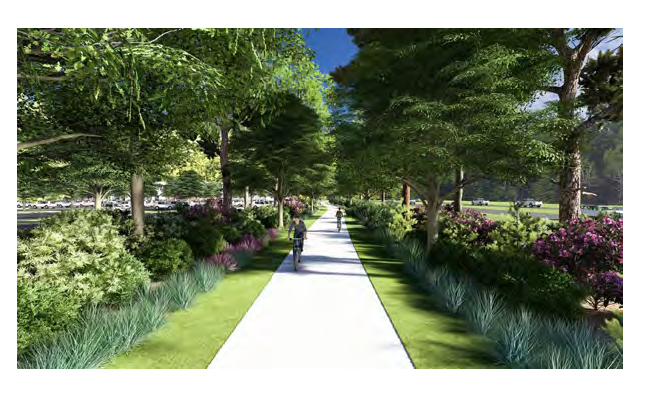 |
9.
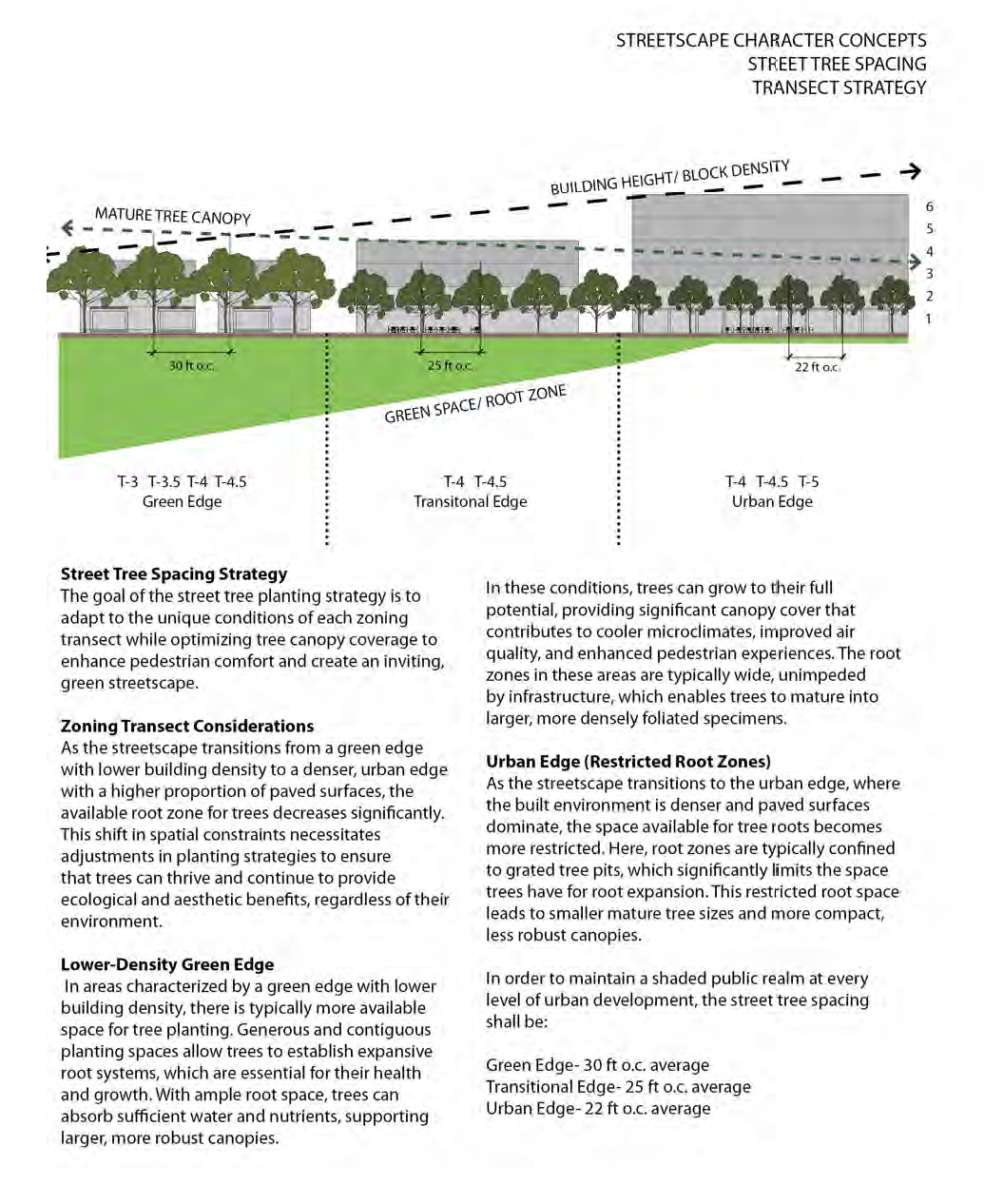
All new development and redevelopment within the T2TDO shall adhere to streetscape layers to maintain a balance of public and private space while allowing flexibility for development constraints.
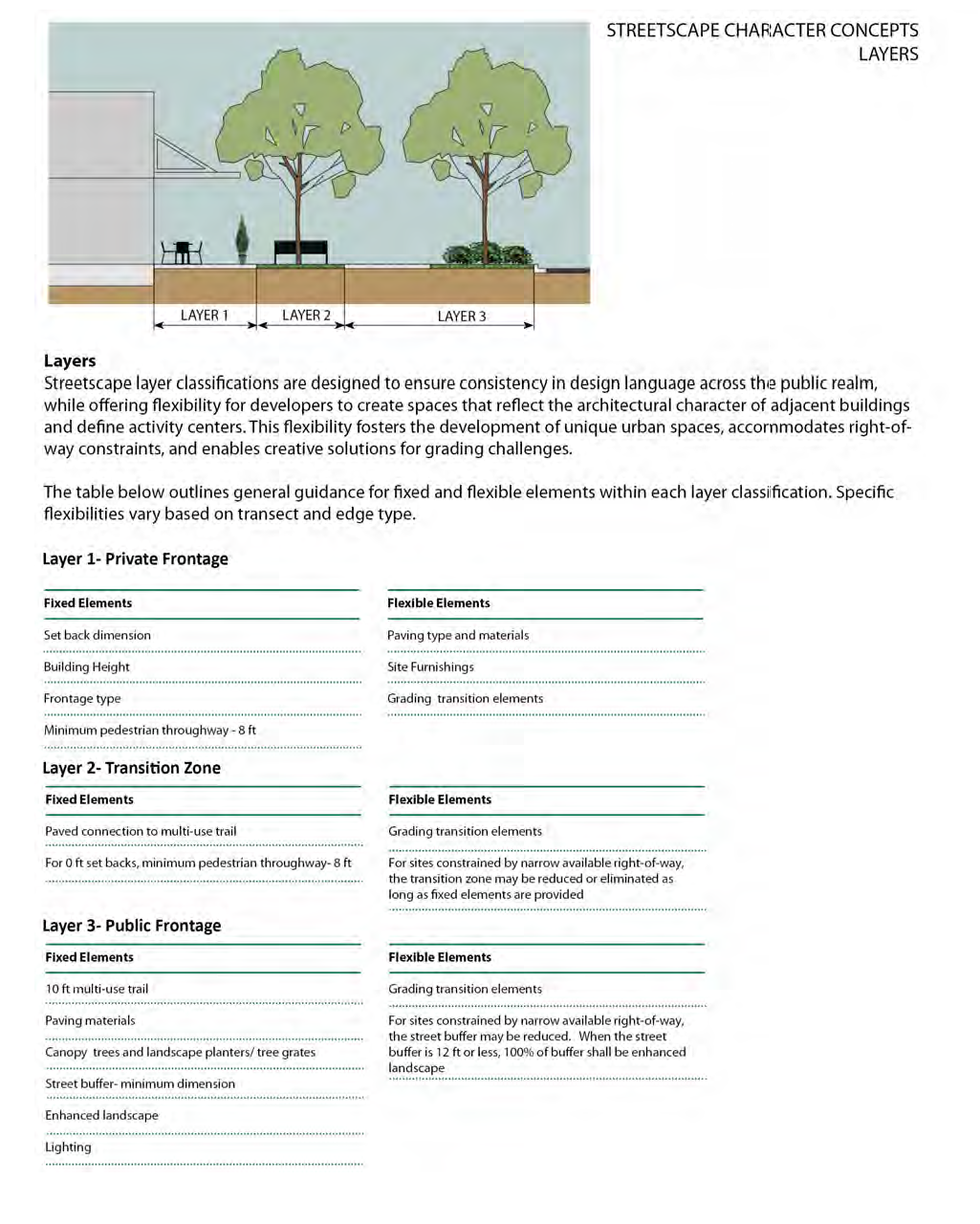
10.
All new development and redevelopment within the T2TDO shall adhere to the tree spacing requirements for each edge type.
11.
All new development and redevelopment within the T2TDO shall adhere to the assigned edge condition as found on the regulating plan. The following typical sections are provided to illustrate the requirements for each edge type.
E.
Traffic calming techniques.
1.
Traffic calming techniques shall be utilized for main streets, boulevards, and other street types in the T2TDO as required by the county engineer for safety purposes.
F.
Access Management standards.
1.
Applicability. These regulations apply to the creation and development of all outparcels and new parcels within the T2TDO. In addition, these regulations shall apply to all lands within one thousand (1,000) feet of each side of SR 200/A1A stretching from the west side of the Thomas J. Shave Bridge at the Intercoastal Waterway to Police Lodge Road. For the purpose of these regulations, an outparcel is defined as property that is located between a nonresidential development, mixed-use development, multi-family development, or residential subdivision and SR 200/A1A, that is created from a parent tract either by subdivision, lot split, metes and bounds, or, in the case of a single owner, site plan approval and is intended for nonresidential, mixed-use, or multi-family developments. For the purposes of these regulations, new parcel shall mean any parcel of land created from a parent tract or existing parcel of land either by subdivision, lot split, metes and bounds, or, in the case of a single owner, site plan approval.
2.
Access. Limitations on number of driveways and curb cuts are essential in preserving the long-term operational capacity of the SR 200/A1A corridor. In addition, controlling the number of driveways and curb cuts promotes the public health, safety, and welfare.
a.
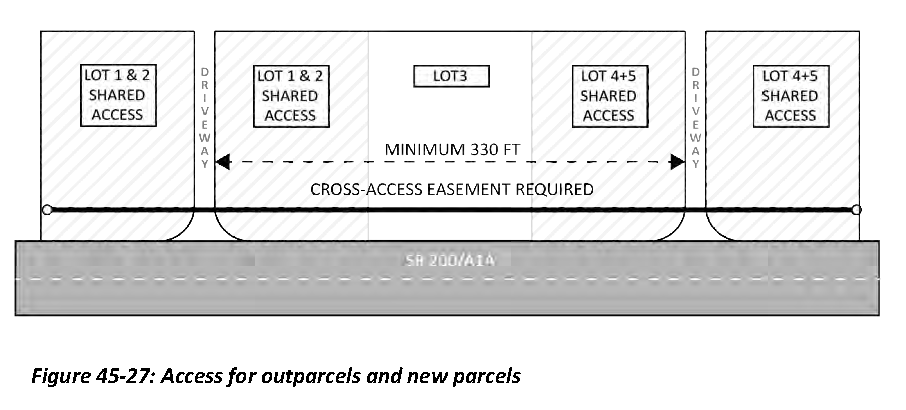
Outparcels and new parcels created and developed pursuant to these regulations shall not have direct access to SR 200/A1A, unless there is shared access with an adjacent property and such access is not located within three hundred thirty (330) feet of another driveway (on the same side of the right-of-way of SR 200/A1A).
b.
Access to outparcels and new parcels shall be provided via a driveway to the parent tract, or by frontage roads or alleys with priority and focus on alleys, whenever possible. The county has no obligation to provide such roads.
c.
The county shall regulate access pursuant to these regulations in site plan review or at time of new parcel or outparcel creation, as applicable.
d.
As part of the county's site plan review, all applicants shall be required to dedicate a cross-access easement in a manner that connects to adjacent cross-access easements or public rights-of-way.
e.
It shall be the responsibility of the development services director or his/her designee to ensure that cross-access easements are dedicated as part of the site plan review process, and that such easements connect or will connect to similar easements on adjacent property.
3.
Access management standards. The following standards are intended to balance private property rights, long-term real estate values, and corridor function. The following regulations are for development fronting SR 200/A1A within the T2TDO:
a.
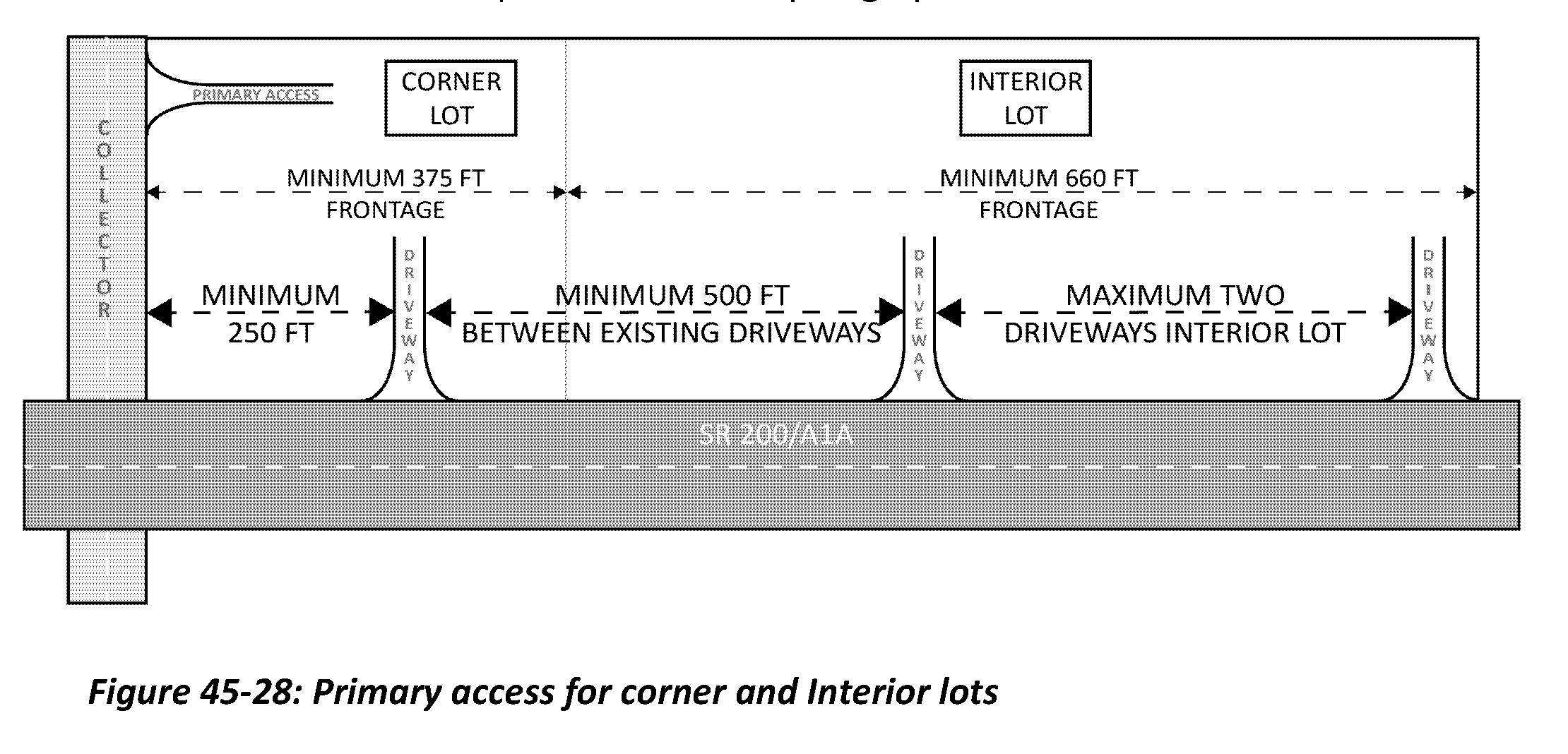
Primary access. For lots having frontage on SR 200/A1A, primary access shall be from SR 200/A1A, an intersecting public street, or provided through the use of parallel roads side streets, joint access driveways, and cross-access easements connecting adjacent developments as acceptable to the county, with priority and focus on alleys, where possible.
i.
Corner lots. The following standards apply to corner lots where the corner is formed by SR 200/A1A and a side street that is functionally classified as a collector street or arterial road:
(A)
the primary driveway access shall be from the side street;
(B)
a corner lot exceeding three and one-half (3½) acres in size, and having at least three hundred seventy-five (375) feet of frontage on SR 200/A1A, may have primary access on SR 200/A1A provided that said primary access is located as far from the intersecting corner roads as possible with a minimum distance of two hundred fifty (250) feet; and
(C)
driveway access shall meet the upstream spacing criteria of these driveway regulations.
ii.
Interior lots. The following standards apply to interior lots:
(A)
new driveway access points shall be limited to one (1) for every six hundred sixty (660) feet of frontage along SR 200/A1A. Regardless of total frontage length, no more than two (2) access points shall be allowed;
(B)
new driveway access points shall not be allowed within five hundred (500) feet of any other existing driveway access on that property;
(C)
in the event that the spacing criteria does not allow for the necessary driveway access, the property may be accessed by frontage roads, alleys, or by cross-access easements; and
(D)
the development services director or his/her designee may allow a waiver of the requirements of this paragraph in writing if the requirements cannot be met based upon configuration of the property or a determination that the alley, frontage road, or cross-access easement cannot be provided. The director of development services or his/her designee may also propose to the Board of County Commissioners an alternative to the requirements of this paragraph.
iii.
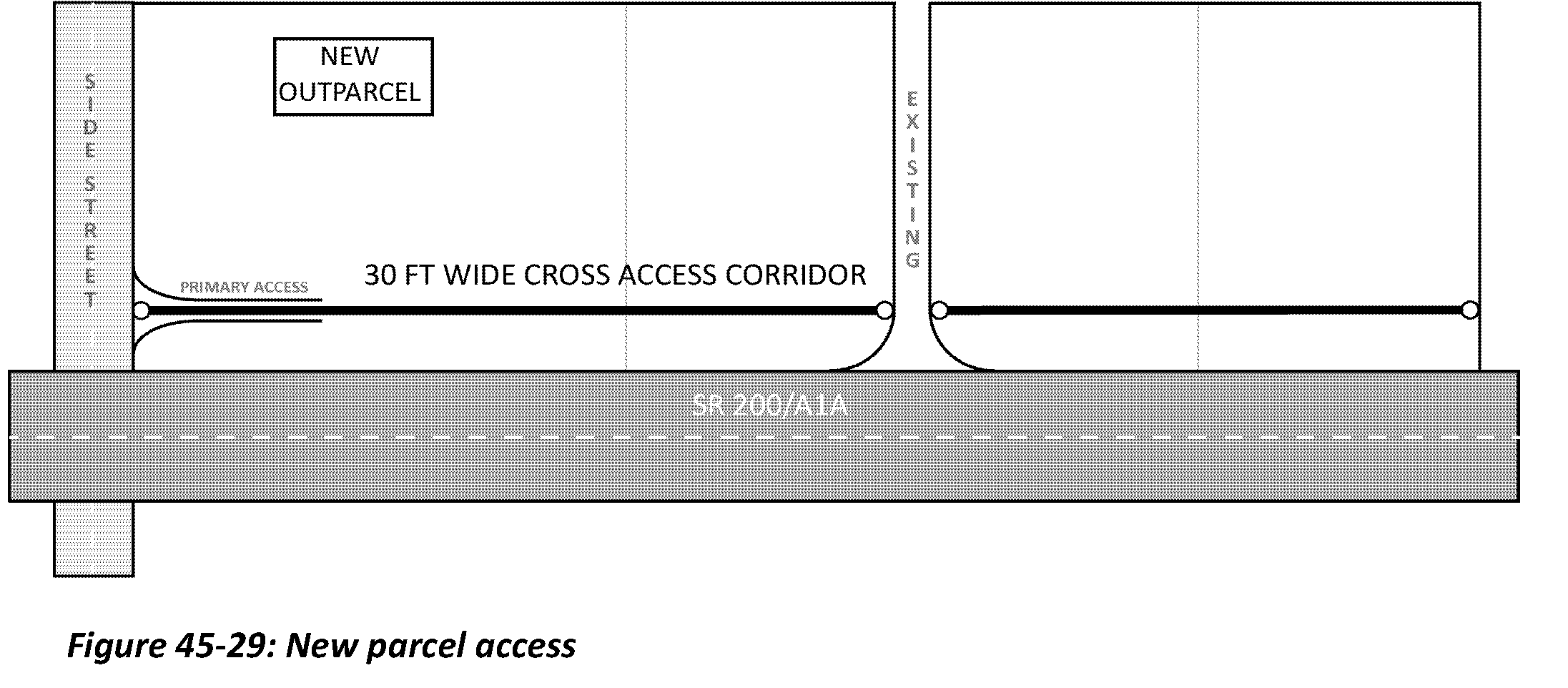
New lots. To preserve the safety and operational efficiency of the SR 200/A1A Corridor, it is the intent of the county to carefully limit the number of driveway access points that are constructed in the future. However, to balance access management with reasonable use of property, while maintaining the functional importance of the SR 200/A1A Corridor, the county shall apply the following requirements:
In designing nonresidential, mixed-use or multi-family developments, the creation of outparcels or new parcels is prohibited unless access to said outparcel(s) or new parcel(s) is not directly abutting SR 200/A1A, but rather a rear road, an alley, direct access to a parent tract, or by a minimum thirty (30) foot wide cross-access corridor. It shall be the responsibility of the applicant to convey any such access-way through dedication or grant of easement and to construct the interconnecting access facility in a manner acceptable to the county.
b.
Secondary access.
i.
Corner lots. Secondary access, other than primary access, may be provided to corner lots on a permanent or temporary basis in the following manner:
(A)
a right-in/right-out may be allowed on SR 200/A1A only if the FDOT approves such access;
(B)
a right-in/right-out may be allowed on SR 200/A1A only if there is no other driveway of any type within six hundred sixty (660) feet of the proposed driveway, of if there is no other practical point of ingress/egress, such as a frontage or alley, or a cross-access easement; and
(C)
a right-in/right-out may be allowed on SR 200/A1A only if such access does not interfere with the safe operation, as determined by the development services director or his/her designee, of existing or planned turn acceleration/deceleration lanes existing along SR 200/A1A.
ii.
Internal lots. Secondary access for interior (non-corner) lots shall be either from SR 200/A1A, provided that the minimum spacing criteria can be met, or by frontage roads, alleys, or by a cross-access corridor. New driveway access points shall be limited to no more than one (1) per every six hundred sixty (660) feet of frontage. Under no circumstances shall an internal lot be approved for more than two (2) access points (one (1) primary and one (1) secondary). Outparcels shall not be granted a secondary access point on SR 200/A1A.
c.
SR 200/A1A median openings. All development plans submitted to the county that seek any access connection to SR 200/A1A require FDOT approval. The general policy of the county is to support the spacing standards recognized by the FDOT, provided they are implemented and upheld in a fair, reasonable, and pragmatic fashion. Thus, minor deviations in the spacing dimensions may be accommodated if the intent of the regulations is otherwise being met.
ii.
The FDOT has primary authority to allow or provide for median crossing movements on the SR 200/A1A Corridor.
d.
Cross-access. Within the T2TDO, all nonresidential, multi-family and mixed-use projects with frontage on SR 200/A1A shall construct vehicular cross-access to adjacent nonresidential, multi-family, and mixed-use properties, public rights-of-way, and streets. Where there are stub-outs on adjoining properties, the site under review shall complete the physical connection with the cross-access, drive aisle or parking area of the adjacent property. Where a vacant lot/tract of land with a commercial, industrial, high density residential or multi-use FLUM designation is adjacent to the site under review, the cross-access stub-out shall be constructed to the property boundary with the initial site development or appropriate phase of the project as determined by the development review committee. It shall be the responsibility of the applicant to grant a cross-access easement in a format acceptable to Nassau County allowing for vehicular and pedestrian cross-access in perpetuity.
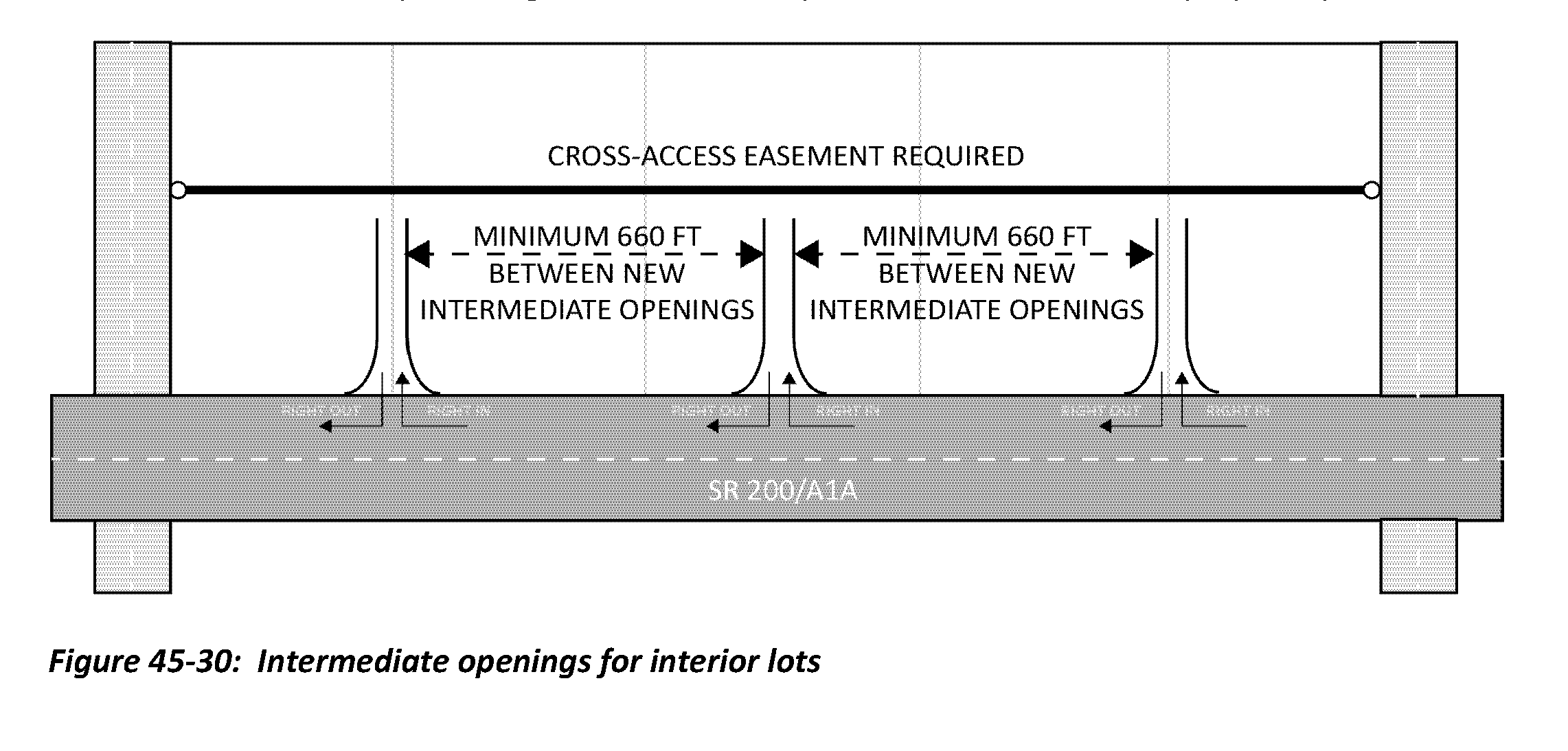
(Ord. No. 2025-012, § 3(Exh. B), 6-23-25)
45.04.01. - Site engineering plan CBDS introduction.
A.
Site engineering plan community based design standards, as listed in this section, shall apply to all new development and redevelopment in the Timber to Tides Design Overlay (T2TDO), whether being developed according to an existing zoning and FLUM designation, or the transect zone and FLUM designation.
1.
Where this section fails to address a particular standard, the Land Development Code (LDC) shall control.
2.
In the event of a conflict between this section and the LDC, this section shall control.
3.
This section provides guidance and standards as to the design and geometric arrangement of development sites in order for all development to be consistent with the objectives of the T2TDO.
4.
All development shall meet Americans with Disabilities Act (ADA) standards.
45.04.02. - General development and activity center standards.
A.
General development standards. All new development and redevelopment in the T2TDO shall utilize the following techniques in creating a more walkable, urban environment:
1.
Compact density. Higher densities and intensities are encouraged to support walkability and transit readiness. Compact development patterns help ensure efficient land use and contribute to a vibrant public realm.
2.
Mix of uses and building types. A variety of building types and uses—including residential, commercial, civic, and recreational—should be integrated within a walkable network. These uses should be accessible by foot within each development and interconnected to adjacent developments and public spaces.
3.
Framing the street. Buildings are set close to the street, helping to define its width extents, which works to slow traffic while creating a sense of place.
4.
Internal circulation. A combination of public streets and private drive aisles establish an internal network of streets, complete with sidewalks that help distribute vehicle movements across a greater area while enabling walkable access to all buildings.
5.
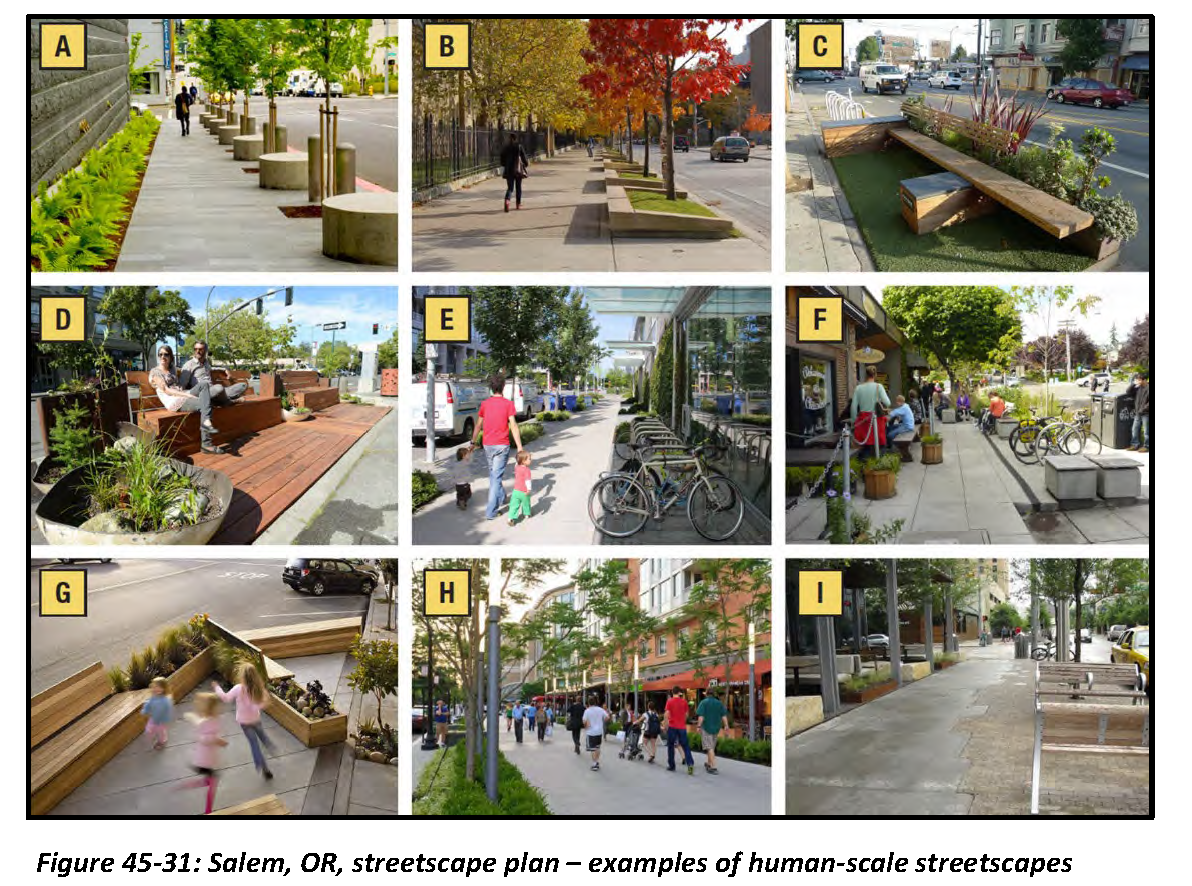
Human-Scale streetscape. The streetscape along SR 200/A1A should include elements that help transition from the large, vehicle-oriented right-of-way into an environment geared toward people. Landscape of developments fronting SR 200/A1A should include broad tree canopy and active building facades, such as windows and front porches, that help make walking feel comfortable and safe. Shade trees and structures should be regularly provided for refuge from the elements.
6.
Diversity of built form. Buildings generally have a consistent scale and architectural style, but differ in form and use. Mixed-use commercial, apartment, townhome, duplex, and detached single-family typologies should be distributed within neighborhoods and centers.
7.
Pedestrian first design. A system of alleys and parking areas set behind buildings help to prioritize walking and biking along building faces by limiting conflict points with automobiles.
8.
Extensive tree canopy. Significant tree canopy along sidewalks, park spaces, and in plazas substantially enhance the comfort and visual interest of the development. Trees preserved or planted to the south and west of buildings achieve substantive energy conservation.
9.
Chain of parks. A series of parks with pedestrian connections to building courtyards helps establish a cohesive network green and open spaces that greatly reinforce social interaction.
B.
Activity center standards. Activity centers within the T2TDO serve as key focal points for higher-density development, fostering community interaction and a distinctive urban character. Their boundaries are defined in the regulating plan, ensuring that each center contributes to a cohesive and connected corridor. Three (3) distinct activity centers anchor the T2TDO, each with a unique role in shaping the region's growth and development:
• Corridor Gateway—Positioned at I-95 and SR 200/A1A, this center functions as the primary entrance to the corridor. It is designed to support regional-scale mixed-use development, emphasizing hospitality, office, and commercial uses that leverage highway accessibility while maintaining a walkable environment.
• Historic Yulee (Center)—Located at US-17 and SR 200/A1A, this center preserves the historic fabric of the community while integrating modern amenities. Redevelopment efforts should focus on adaptive reuse, reinforcing the area's cultural and historic significance through thoughtful placemaking and architectural preservation.
• Nassau Villages (Center)—Centered at Amelia Concourse and SR 200/A1A, this suburban activity center is envisioned as a transformation of existing commercial areas into a more pedestrian-oriented, mixed-use environment. Infill development, improved walkability, and enhanced public spaces will support a more vibrant and connected community.
To ensure these centers function as dynamic, high-quality urban nodes, developments within them shall exceed general standards by incorporating the following:
1.
Mixed-Use development.
a.
Activity centers must incorporate a diverse mix of uses, including residential, office, retail, and civic spaces.
b.
Ground floors shall include commercial or civic uses that provide visual or physical engagement with the street and pedestrian realm, contributing to an active and inviting streetscape.
2.
Engaging ground-level uses.
a.
Ground-floor uses shall prioritize pedestrian-friendly businesses, such as cafes, retail shops, and services, with residential or office spaces above.
b.
Storefronts shall feature higher transparency, minimal setbacks, and inviting entrances to encourage foot traffic.
3.
Integrated streetscape and public spaces.
a.
Activity centers shall comply with the edge types specified in the regulating plan when fronting SR 200 or US 17.
b.
Public spaces, including plazas, pocket parks, and greenways, shall be incorporated to foster community interaction.
c.
Green corridors and pedestrian linkages shall connect parks, civic buildings, and key destinations.
4.
Walkable and connected urban design.
a.
Activity centers shall maximize connections to the street grid, ensuring shorter block lengths that enhance walkability.
b.
Alleyways and rear access lanes shall be incorporated to reduce curb cuts and improve frontage continuity.
5.
High-Quality architecture and character.
a.
Buildings shall feature distinct architectural styles as designated within this article to reinforce a sense of place.
b.
Facades shall incorporate architectural detailing, varied rooflines, and active frontages to enhance visual appeal.
6.
Strategic and context-sensitive parking.
a.
Surface parking lots must be placed behind or to the side of buildings to maintain an active and pedestrian-friendly street edge.
b.
Shared parking arrangements are encouraged to optimize space utilization and minimize excessive paved areas.
45.04.03. - Pedestrian design standards.
A.
Pedestrian connectivity.
1.
A pedestrian circulation plan shall be provided at the time of site engineering plan review that demonstrates both internal pedestrian access and connectivity to adjacent developments and rights-of-way.
2.
A pedestrian circulation plan shall provide linkages between the internal pedestrian circulation facilities and existing or planned sidewalks or multi-use trails along the ROW.
3.
All sidewalks shall be a minimum of six (6) feet wide.
4.
All multi-use trails shall be a minimum of ten (10) feet wide.
5.
Sidewalks and trails shall be shaded by canopy trees as specified in section 45.04.05.B.
B.
Sidewalk zones.
1.
The sidewalk zone is the portion of the public realm which is dedicated to the pedestrian. It has five (5) distinct sub-zones.
|
a. Frontage zone: the area adjacent to the property line where transitions between
the public sidewalk and the space within the buildings occur. This area can be used
for outdoor restaurant/cafe seating, overhanging elements, planters, or other furnishings.
The typical width of this zone is at least two (2) feet, however, it can be greater
to accommodate seating. Throughway zone: the portion of the sidewalk zone for pedestrian
travel along the street. This zone is accessible and free of obstacles. The minimum
width to accommodate the multi-use trails is ten (10) feet, however, it can be greater.
b. Furnishing zone: the portion of the sidewalk used for street trees, landscaping, transit stops, fire hydrants, streetlights, and site furnishings. This zone shall be no less than four (4) feet, with an extra foot for every five (5) miles per hour increment over twenty-five (25) miles per hour. If adjacent to a transit stop, it should be between six (6) feet to eight (8) feet wide. c. Edge zone: the area used by people getting in and out of vehicles parked at the curbside. This zone varies from six (6) inches to two (2) feet to six (6) inches. | 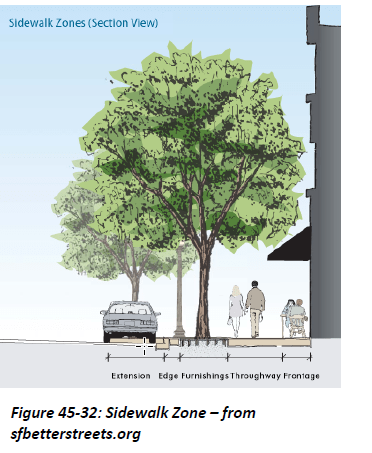 |
d.
Extension zone: the area where pedestrian space may be extended into the parking lane, via features such as bulb-outs with mid-block plazas, or parklets. This zone is applicable when there is on-street parking, and the width is that of the parking lane, typically eight (8) feet.
e.
The frontage zone and furnishing zone can be further widened to include additional cafe seating, kiosks, or similar uses, so long as the throughway zone remains un-obstructed.
f.
This section 45.04.03.b shall not be applicable to the edge conditions found in section 45.03.02.d.
45.04.04. - Vehicular design standards.
A.
Parking areas in general.
1.
On-street parking shall be inset with bulb-outs used to define the street, provide for vegetation, encourage slower vehicular speeds, and provide locations for mid-block pedestrian crosswalks. A bulb-out shall be required for every five (5) consecutive on-street parallel parking spaces that are developed. An interior landscape island shall be required for every ten (10) consecutive on-street nonparallel parking spaces that are developed.
2.
Parking standards, as defined in article 31 of the LDC shall be used.
3.
Parking material: Pavement systems shall be maintained in a smooth, well-graded, and drained condition. Parking materials may consist of standard paving, pavers, or alternate paving systems. Use of grass or alternate lawn surface as parking material may be considered for up to one-third (⅓) of the required off-street parking when determined by development services to be appropriate. All accessible spaces must comply with all requirements set by the Americans with Disabilities Act (ADA).
B.
Non-residential, mixed-use, multi-family.
1.
On-site parking shall not exceed the maximum permitted for each transect as shown in Table 45-01. Where no maximum is specified in Table 45-01, the on-site parking shall not exceed one hundred ten percent (110%) of the minimum parking requirement established in article 31.12 of the LDC. Reductions to minimum parking requirements as provided in Table 45-01 may not be combined with the shared parking reductions allowed under article 31.14 of the LDC.
Table 45-01: Parking Standards
2.
The Planning Director may approve an additional fifteen percent (15%) reduction in the minimum required parking may be permitted for vertically integrated mixed-use development that includes residential units constructed above ground-floor non-residential uses. This incentive is intended to support compact, walkable development and encourage the inclusion of live-work and mixed-use building types consistent with the vision of the T2TDO.
3.
The Planning Director may approve up to a one hundred percent (100%) reduction in the amount of on-site, off-street parking for parcels less than one (1) acre in area upon the demonstration that the minimum number of required parking spaces are being provided for through off-site alternative parking solutions, including on-street parking adjacent to the parcel, a shared parking agreement or structured parking.
4.
In transect T-4.5 and T-5, the maximum parking allowed shall not exceed one hundred percent (100%) of the article 31.12 requirements unless structured parking is provided.
5.
Parking areas shall be separated and screened from public streets, sidewalks or rights-of-way using a landscaped area at least ten (10) feet wide that includes a hedge that upon establishment is maintained at a height between three (3) and four (4) feet, or a three-foot-high wall or fence, and canopy trees planted on average of thirty-foot spacing to screen and shade public parking lots and service areas. Walls and fences over three (3) feet in height shall be at least fifty percent (50%) transparent and shall not exceed six (6) feet in height. Chain link fences are prohibited. Parking areas adjacent to the rear yards of single-family detached homes shall provide a ten-foot-wide buffer with a six-foot-tall privacy fence or hedge.
6.
Parking lots shall be accessed from a side street or alley. When a side street is not accessible, one (1) driveway entrance may be allowed on the primary road, provided that all access management standards are met, and the new access provides an alley to the parcels surrounding it. It is the intent of the county to limit, to the maximum extent possible, individual driveways.
7.
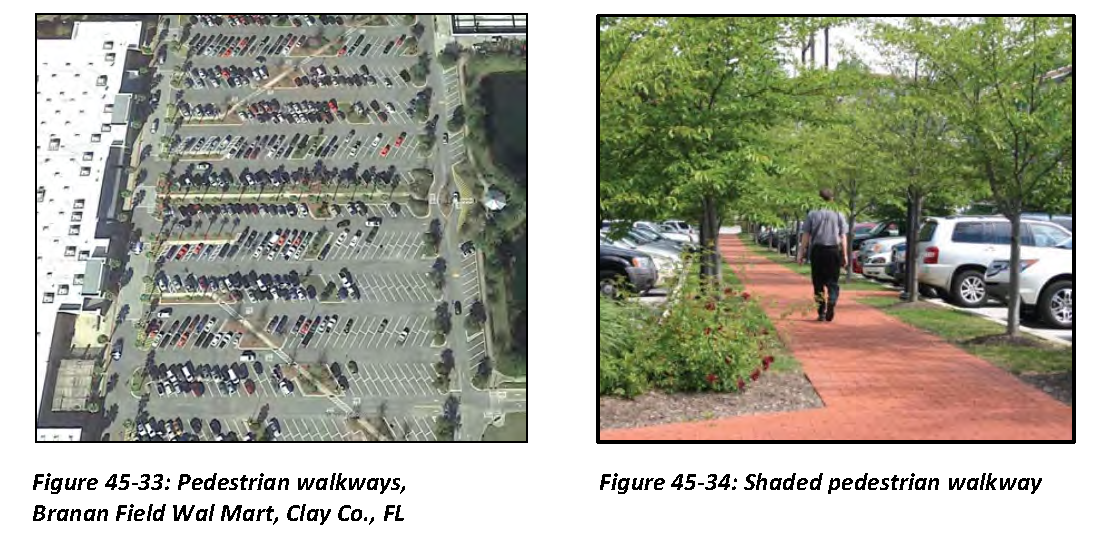
Parking areas shall include a minimum of six-foot-wide pedestrian walkway, which can be a traditional sidewalk or on or near pavement grade. Such sidewalks shall connect parking with building entrance(s), and be provided with at least every other parking row. The pavements of such walkways shall be differentiated from parking area pavement through a change in surface texture, material, style, elevation, and/or color. See landscaping requirements in section 45.04.05.13.
8.
Parking areas shall be interconnected or designed to interconnect in the future. Where a parking lot is connected, or designed to connect, an easement for ingress and egress to adjacent lots shall be recorded by the property owner in the Nassau County official records book.
9.
Minimum parking requirements can be further reduced through the provision of on-street parking and shared parking facilities or shared parking agreements, consistent with the provisions of section 31.14 (D) of the Land Development Code; and
10.
All on-site parking shall be located behind a primary structure or ten (10) feet behind the front wall of a primary structure and screened from the street. Parking shall not be located between the street and a primary building that is used to meet the maximum front setback requirement. Parking lots shall not be located in any required yard setback, except for side yard setbacks.
C.
Parking areas—Single family residential.
1.
Within a single family residential development located in the T2TDO the following standards shall apply:
a.
Required parking may be accommodated on the surface lot, in a carport, or in a garage;
b.
Parking shall not be allowed in a required front or side yard, except on the driveway; and
c.
Designated on-street parking is allowed.
D.
Bicycle parking.
1.
Bicycle parking shall be required for all non-residential, multi-family, condominium, and mixed-use developments in the T2TDO.
2.
All bicycle parking shall be placed in a usable location and shall not block pedestrian throughways.
3.
Bicycle parking shall be provided at a minimum ratio of one (1) space per two thousand (2,000) square feet of non-residential use up to a maximum of ten (10) bicycle spaces for non-residential use.
4.
Bicycle parking shall be provided at a minimum ratio of one (1) space per every ten (10) units of residential use up to a maximum of ten (10) bicycle spaces for residential use.
45.04.05. - Landscaping requirements.
A.
Introduction.
1.
Landscaping plays a critical role in defining the character of the built environment, improving aesthetics, creating wildlife habitat, and ensuring functional and safety benefits. The standards in this section establish elevated landscaping requirements to align with the higher aesthetic, pedestrian-oriented, and mixed-use principles of form-based codes.
2.
These standards reinforce a cohesive, visually appealing streetscape by integrating public and private frontage landscaping to create a seamless transition between buildings, sidewalks, and thoroughfares. They establish layered vegetation to define outdoor spaces, soften hardscapes, and create inviting pedestrian experiences. Additionally, they incorporate vertical landscaping elements, such as green walls, and trellises, to enhance facades and mitigate blank walls, while also encouraging landscaping in civic spaces to promote community engagement and sustainability.
3.
Landscaping should actively contribute to public comfort and well-being by utilizing high-canopy trees to provide continuous shade along sidewalks and pedestrian areas, improving thermal comfort and reducing the urban heat islands effect. Vegetative buffers between vehicular areas and pedestrian pathways are required to increase safety and air quality. Biodiversity-supportive plantings should be incorporated to attract pollinators, birds, and wildlife.
4.
The standards shall support ecological resilience and environmental through the use of native plantings and tree canopies that capture rainfall. Rain gardens, bioswales, or other green infrastructure elements are encouraged in landscaping design. On-site water retention and filtration should be maximized through strategic planting and grading.
B.
Planting standards.
1.
Baseline requirements. Landscaping shall meet or exceed the minimum requirements of section 37.05 LDC unless otherwise specified. The buffering requirements found in section 37.06 LDC shall not be applicable.
2.
This section 45.04.05 shall not be applicable to the edge conditions found in section 45.03.02.d.
3.
Native and climate-appropriate vegetation. A minimum of eighty percent (80%) of all trees and sixty percent (60%) of shrub and groundcover plantings shall be native species. Monoculture planting is prohibited; diversity in species selection is required to improve resilience.
4.
Tree canopy and placement. Trees must be planted below sidewalk and street grade using structural soil cells or suspended pavement systems to ensure adequate root growth. Tree plantings shall provide at least sixty percent (60%) canopy coverage of the sidewalk zone as depicted in Figure 45-32 and as demonstrated by the maturity of the species chosen and size. Canopy trees shall be spaced at a maximum of thirty (30) feet on center along streets and pedestrian paths for continuous shade.
5.
Irrigation and soil management. Permanent irrigation is required for Class II-IV development, with smart, water-efficient irrigation systems. Reclaimed water connection is mandatory where available within two hundred fifty (250) feet.
6.
Ground coverage and mulching. No bare soil shall be exposed—all non-paved and non-built areas must be covered with groundcover, turf alternatives, or organic mulch. Mulching and soil amendments shall be required to improve soil structure and water retention.
7.
Tree and landscape bed integration. Trees located in landscape beds within pedestrian environments shall incorporate native shrubs, ornamental grasses, or groundcover plantings to enhance soil health and aesthetics. Landscape beds shall have a minimum radius of two (2) feet from the tree trunk, ensuring that root flare remains visible and free of excess mulch or plant material.
8.
Development projects must submit a streetscape plan that integrates landscaping with pedestrian and bicycle facilities, public seating, and shading elements.
9.
Minimum separation standards for trees and infrastructure are shown below in Table 45-02.
Table 45-02: Tree Separation Standards
10.
Greening parking areas. Tree canopy must provide at least sixty percent (60%) shade coverage over parking areas as demonstrated by the maturity of the species chosen and size.
11.
Interior landscaping islands. One (1) interior landscaped island shall be required per ten (10) parking spaces. Each island must contain at least one (1) canopy tree per each row of parking, with additional plantings to provide visual interest.
12.
For all required plantings in the right-of-way shall be installed by the developer.
13.
For vehicle parking walkways, canopy trees shall be planted at a minimum of fifty (50) feet on center on either side of the walkway.
14.
For all dumpsters and service areas (including loading zones) the minimum landscaping shall include one (1) shrub for every two (2) linear feet of wall. The shrubs shall be planted and maintained at a minimum of four (4) feet in height. One (1) canopy tree or understory tree per ten (10) linear feet of wall or fence is required.
15.
For a back flow preventer(s), if required to be in the front yard, it shall be screened with shrubs with a minimum height of four (4) feet at planting maintaining an opacity of eighty (80) percent.
16.
All sidewalks and trails shall be shaded by canopy trees as planted with a maximum spacing of thirty (30) feet, located between the sidewalk or trail and adjacent street, or if there is no adjacent street located generally to the south and west of the sidewalk or trail, an orientation that will provide more shade.
45.04.06. - General site requirements.
A.
Signage.
1.
All permanent signs affixed to private property shall require compliance with county sign permitting requirements, except for exempt signs, public directional or information signs, and street number signs.
2.
Signage standards within the T2TDO shall comply with article 30, of the Land Development Code.
3.
Signage concept plan. A signage concept plan that conforms to the standards established within the Land Development Code must be submitted as part of each development application within the T2TDO.
B.
Lighting.
1.
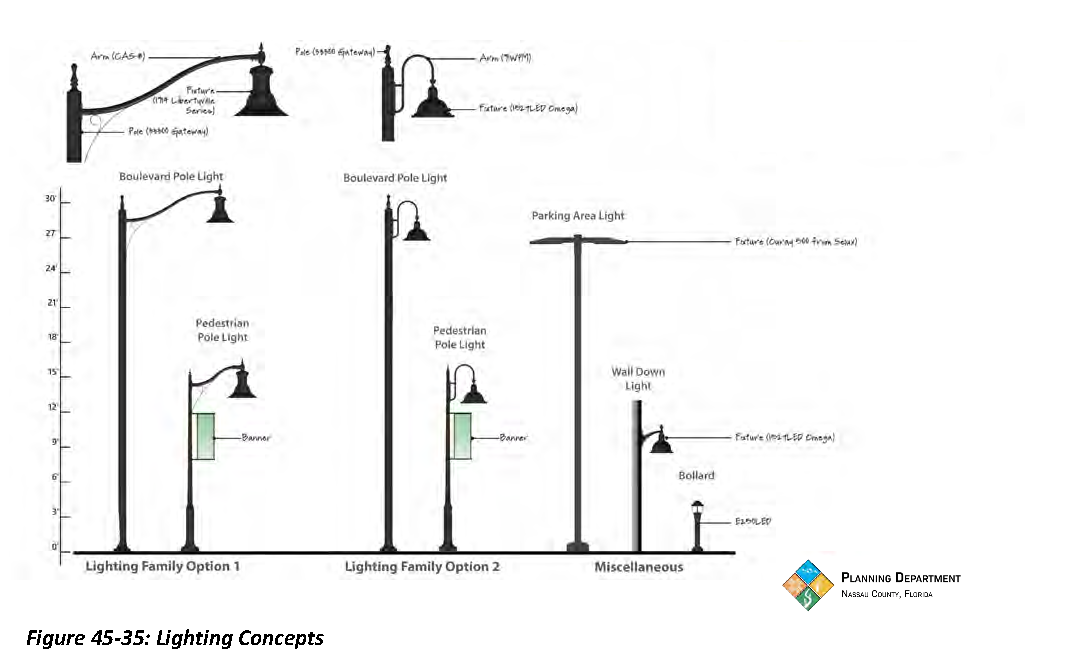
All thoroughfare lighting, public and private, shall be consistent with the T2TDO lighting concepts as developed by VHB and included in Figure 45-35 or as approved by the Nassau County Planning Director. The style of lighting fixtures is to capture the essence of Nassau County's history while having dark-sky friendly shielding and directional LED bulbs to reduce light pollution. The lighting utilized shall be consistent along the length of each individual thoroughfare.
2.
Lighting on building facades shall be required in a complimentary design to the T2TDO lighting concepts along the length of each thoroughfare, or each activity center, when the building is fronting on a public thoroughfare.
3.
Bollards shall be installed along pedestrian facilities when other street lighting has not been provided to protect pedestrians.
4.
The lighting of public areas, including parking lots and public plazas, is important for the safety and comfort of the user. Lighting of public areas should be designed to provide the minimum lighting necessary to ensure adequate vision and comfort while being arranged so as not to cause visual interference on public thoroughfares or encroach on the visual privacy of adjacent building occupants.
5.
Lighting along sidewalks and on connections between multi-family or non-residential developments and parking lots, public rights-of-way, and transit stops shall be designed to provide for pedestrian safety.
6.
The latest edition of the IES Lighting Handbook, published by the Illuminating Engineering Society of North America, shall be used as a guide for the design and testing of parking facility and development lighting.
7.
All lighting shall be required to have dark-sky friendly shielding and directional LED bulbs to reduce light pollution. The lighting utilized shall be consistent along the length of each individual thoroughfare as defined within these regulations. Lighting shall be an approved fixture as specified by Dark Sky International.
8.
The specific provisions in this article shall take precedence where conflicts arise within the county Land Development Code.
C.
Dumpsters, mechanical equipment, and services areas.
1.
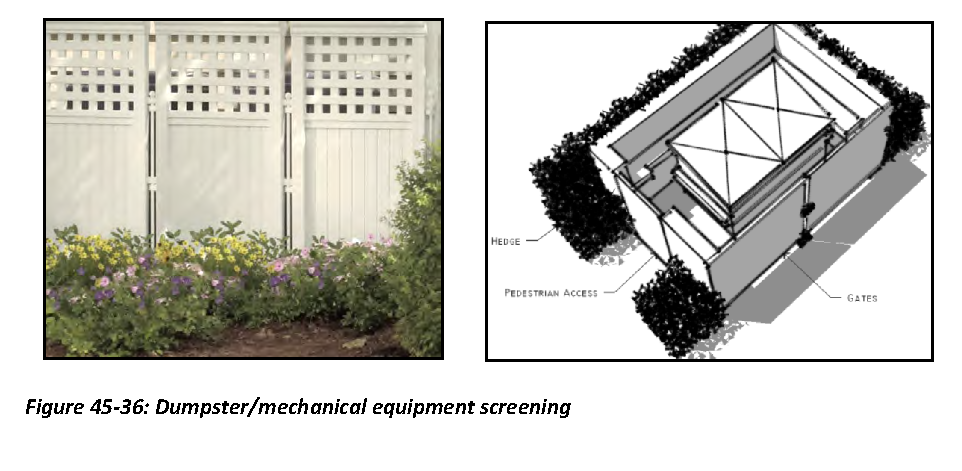
All dumpsters and service areas (including loading zones) shall be at the rear or side of a building and shall be screened through the use of a wall or a durable fence, which is one hundred (100) opaque, in addition to landscaping requirements in section 45.04.05.14.
2.
Mechanical equipment shall be at the side or rear of the building and screened from all rights-of-ways, or placed on a flat roof, screened by a parapet or similar architectural feature and with shrubbery with a minimum height of four (4) feet at planting to shield it from public views.
3.
Back flow preventer(s) shall be to the side or rear of a building.
D.
Fences.
1.
Front yards are as defined in article 32 of the Land Development Code (LDC). Fences located within a front yard shall not exceed four (4) feet in height. Front yard fences shall be at a minimum fifty percent (50%) transparent. Chain link fences are prohibited.
2.
Side and rear yards are defined in article 32 of the LDC. Side and rear yard fences shall not exceed six (6) feet in height, except for non-residential and multifamily uses that require site engineering plan approval by the development review committee.
3.
Retention and detention facilities shall either be sloped as to not require fencing or be bulkheaded. If fencing is utilized, only picket, wrought iron, or similar fence types are permitted. The facility shall be incorporated into site design as an amenity through circumference trails and the creation of vistas.
E.
Utilities.
1.
All development within the T2TDO, except for new and replacement single-family dwelling or mobile homes on an individual building site that exists as of the effective date of these regulations, shall connect to public water and public sanitary sewer when deemed available pursuant to Chapter 381, Florida Statutes. This provision does not pertain to new single-family dwelling or mobile homes building sites created through a parent tract split, open rural homestead exemption, or family hardship development.
2.
Overhead utility lines shall be located or, if existing, relocated underground.
a.
Any extension of electric, cable, telephone, or other utility typically located above ground shall be placed underground. This provision does not apply to new and replacement single-family dwelling or mobile homes within the T2TDO on an individual building site that exist as of the effective date of these regulations, or to new single-family dwelling or mobile homes building sites created through a parent tract split, open rural homestead exemption, or family hardship development.
b.
Any redevelopment of a roadway as required to serve new development or redevelopment shall be the trigger to place existing overhead utilities within or adjacent to the ROW underground. As it relates to this provision, redevelopment of a roadway includes any widening, lane addition, median addition, round-a-bout construction, addition of on-street parking, conversion from a rural roadway cross-section to an urban roadway cross-section, or conversion from a dirt road to a paved road. Resurfacing shall not constitute roadway redevelopment.
c.
Nassau County may, at the sole discretion of the Board of County Commissioners, establish a program to collect payment of monies in lieu of individual property owners placing portions of utilities underground on a parcel by parcel basis, along US-17 and SR-200. If a program is created, the fee-in-lieu payment shall be equal to the proportionate share cost of Nassau County to place the utilities underground, based on linear feet of lines.
d.
These provisions shall not apply to high voltage electric transmission lines. When conflict exists as to identifying high voltage electric transmission lines, the determination of Nassau County shall control.
45.04.07. - Stormwater management standards.
A.
Introduction.
1.
This code establishes stormwater management guidelines for the T2TDO district, prioritizing natural drainage systems, amenity stormwater facilities, and low-impact development (LID) techniques to mitigate flood hazards and protect wetlands.
B.
Stormwater management.
1.
All development within the T2TDO district shall comply with article 10, Stormwater Management, of the Nassau County Roadway and Drainage Standards, and this section.
2.
Stormwater facilities may be designed as site amenities that provide recreational, educational, social, or aesthetic benefits. Section 45.04.07.E details these elements.
C.
Stormwater management facilities.
1.
Master planned stormwater systems are required for unified developments to accommodate multiple blocks and development nodes, reducing on-site retention needs, unless otherwise approved by the county engineer. Non-residential, mixed-use, and residential developments (excluding single-family homes) shall demonstrate efforts to coordinate stormwater planning with adjacent properties.
2.
All new development and redevelopment, after the county has established a stormwater utility, are required to connect to the stormwater system unless otherwise approved by the county engineer.
3.
Retention areas shall integrate with public spaces and parks, supporting recreational or environmental functions.
4.
Underground storage areas may be approved beneath paved or landscaped areas for stormwater storage and infiltration.
5.
Retention and detention facilities shall be properly sloped to eliminate fencing requirements, except where bulkheads or decorative fencing enhance the site design.
D.
Natural drainage standards.
1.
Detention and retention ponds shall be integrated as landscape features with native vegetation. Plants in frequently submerged areas shall be hydrophilic.
2.
Where vegetative solutions are infeasible, porous pavement may be used for sidewalks, trails, parking lots, and plazas to enhance infiltration.
3.
Wetland buffers shall be protected from pesticide and herbicide use, except for invasive species removal.
E.
Flood hazard mitigation standards.
1.
Development in flood hazard areas shall comply with Chapter 10½, Floodplain Management of the Nassau County Code of Ordinances, including FEMA NFIP and Florida Building Code requirements.
2.
Site plans shall include all required floodplain management provisions.
3.
Areas in Zone A with no base flood elevation shall comply with section 10. ½-72, and applicants may be required to provide additional engineering data.
(Ord. No. 2025-012, § 3(Exh. B), 6-23-25)
45.05.01. - Built environment CBDS applicability.
A.
Non-residential, mixed-use, and multi-family development in the timber to Tides Design Overlay (T2TDO) shall be required to adhere to the standards defined in section 45.05.02. General architectural standards, architectural enhancements, exterior treatment and finishes, and architectural styles shall be required for all development and redevelopment in the T2TDO. In the event of a conflict between T2TDO standards and the LDC, the stricter standard shall control.
B.
Regarding single-family detached, single-family attached, and two-family dwellings within the T2TDO, in order for transect-zoned properties to qualify for the density and intensity incentives of the overlay, these types of developments shall be required to adhere to the standards defined in section 45.05.03.
C.
A project that is submitted for review pursuant to these standards defined herein shall be compared to new development or redevelopment that has occurred after the adoption of the T2TDO and not existing development that does not comply with these standards.
D.
The following modified standards are permitted for any building that is locate more than eight hundred (800) feet from, and is not visible from, a county, state, or federal roadway:
1.
For building facades facing a street, a minimum of twenty percent (20%) shall be transparent. The second story above the ground floor, a minimum of fifteen percent (15%) of the façade shall be transparent. This modified standard does not apply to buildings that are three-story or higher, or an equivalent height.
2.
The façade articulation interval shall be increased to eighty (80) feet.
45.05.02. - Architectural standards for non-residential, mixed-use, and multi-family development.
A.
General architectural standards.
1.
Building orientation. Buildings shall be oriented so as to improve the appearance of the street by creating engaging street level facades. The street, landscape areas, and sidewalk zone shall relate to buildings and shall be utilized as comfortable public space. This requirement shall be met by incorporating the following techniques into project design:
i.
The building's primary entrance shall face the street and orient to the sidewalk zone.
ii.
Buildings located at street intersections shall be designed to define the corner and address both streets. This may be accomplished through an angled entrance, a corner projection, tower element, or other prominent architectural feature. Where topographic or site constraints prevent angled or corner-oriented entries, entrances shall be provided on both intersecting street-facing façades.
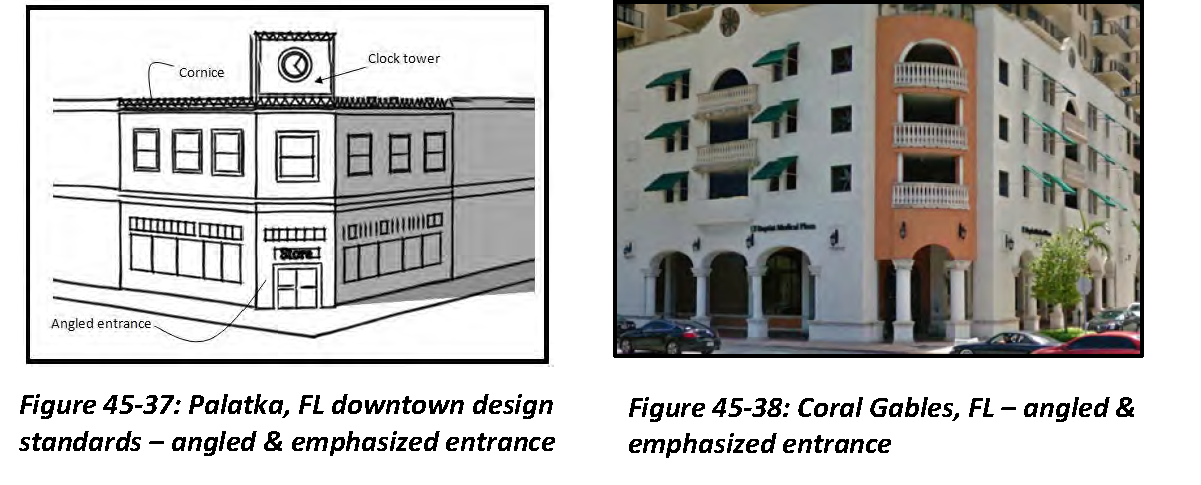
iii.
In the event that access is provided by two (2) or more streets, but not at an intersection of streets, the building's primary facade shall face the street determined by the Planning Director to be the major street.
iv.
Entryways shall be differentiated from the remainder of the facade through the use of color, change in materials, application of architectural features (arches, columns, colonnades, etc.), setbacks, offsets, arcade, or gallery.
v.
Buildings shall be configured so there is an interactive relationship between the public and private realms for the purpose of creating an active and pedestrian-friendly streetscape.
vi.
Building orientation shall be such that service areas are located out of view or screened from the street and adjacent properties. Blank walls or service areas are not allowed on frontages.
vii.
Automobile-oriented uses such as, but not limited to, banks with drive through tellers, carwashes, automobile service stations, drive through restaurants, and similar, shall be oriented in a manner such that the vehicular drive-through areas, gas pumps, bay entrances, and other similar site components are located to the rear of, or to the side ten (10) feet behind the front wall of the building, and not between the building and the street.
2.
Building transparency. All facades shall incorporate fenestrations when facing a right-of-way. For building facades fronting a street with non-residential uses on the ground floor, a minimum of sixty percent (60%) of the wall area between two ((2) feet and eight (8) feet vertical above grade shall be clear, non-reflective, transparent glazing. For restaurant uses, a minimum of forty percent (40%) transparency shall be provided between two (2) and eight (8) feet above grade, with at least twenty-five percent (25%) transparency required across the entire ground floor façade facing a public right-of-way. For stories above the ground floor with non-residential uses, a minimum of twenty-five percent (25%) of the facade shall be transparent in the form of symmetrically arranged vertical windows.
3.
For multifamily development, building facades fronting a street, a minimum of twenty-five percent (25%) shall be transparent on the ground floor. For stories above the ground floor, a minimum of twenty percent (20%) of the façade shall be transparent.
4.
Architectural treatments. Each facade that is visible from a public right-of-way or public area of adjoining properties shall be designed with full architectural treatment oriented towards the scale of the pedestrian and engaged with the sidewalk zone. Such treatments shall be consistent with the design requirements of this article and shall incorporate door and window placements, architectural enhancements, roof design and building material applications necessary to give the appearance that each visible facade is a primary facade oriented towards the pedestrian and/or public space.
5.
Height transitions. Height and scale of a new development and redevelopment shall be compatible with that of surrounding development, provided such surrounding development complies with the standards set forth in this section. The following transitional techniques shall be applied to new development and redevelopment when within three hundred (300) feet of an existing building.
|
i. Where a building is twice the height or greater than an adjacent existing structure,
a transition zone shall be provided along the shared frontage. This transition may
include stepped-back upper floors, varied rooflines, or massing breaks that moderate
the perceived height difference within the first thirty (30) to sixty (60) feet of
the new structure from the lower-scale building. See figure 45-39 for reference.
ii. The pattern of placement, proportions, and materials of windows and doors shall be harmonious with surrounding structures. The ratio of wall surface to openings and the ratio of width and height of windows and doors shall be consistent and compatible with surrounding structures. | 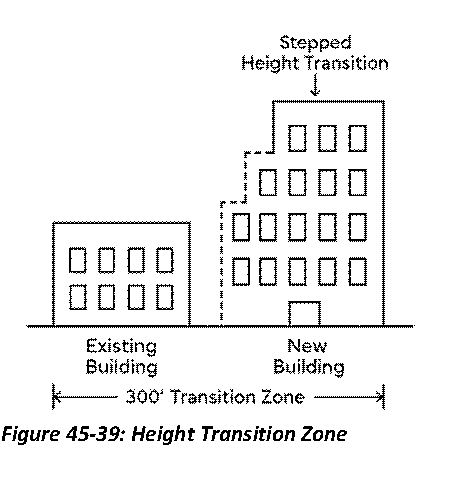 |
6.
Roofs. Roofs shall be designed and constructed to add interest to and reduce the massing of buildings. Roofs shall incorporate the design elements listed below.
i.
The design of roof structures shall be consistent with their architectural style and shall be extended to all sides of the structure. Roof-like appurtenances such as false roofs, parapets and other similar features may be allowed only if such features are required for mechanical equipment screening or acoustical control that cannot be accomplished through utilization of approved roof styles.
ii.
Application of such roof-like features shall be accomplished in such a manner as to minimize the appearance of a flat roof design. Roofs shall be designed to be of such height, bulk and mass so as to appear structural even when the design is non-structural.
iii.
If flat roofs are utilized, the roof shall be surrounded on all sides by a continuous parapet wall and shall have the bulk and mass so as to appear structural in nature. In no instance shall the parapet height exceed one-third (⅓) of the supporting wall height.
iv.
The roof edge, where visible from any street, shall have, at a minimum of two (2) locations, a vertical change from the dominant roof-line. Such change shall be a minimum of three (3) feet.
7.
Symbols. Buildings which are of symbolic design for reasons of advertising, unless otherwise consistent with the criteria herein, shall not be allowed. All permanent outdoor identification features which are intended to call attention to a proposed development or structures shall be designed and located in such a manner as to be an integral part of the development.
8.
To preserve the architectural integrity and pedestrian-scale character of the built environment, building façades that incorporate non-functional upper stories (also known as "false" or "decorative" second stories) must be designed to appear as fully integrated, occupiable space when viewed from the public realm. Architectural continuity shall be achieved through consistent use of materials, window patterns, and detailing that visually align with the ground floor. The façade must incorporate realistic articulation and depth to avoid the appearance of a false front, and any window treatments shall include transparent or visually convincing glazing to reinforce the perception of an active second story. Proposals to use a non-functional second story to meet minimum height requirements shall be clearly identified in architectural plans and elevations and are subject to review and approval by the Planning Director or designee to ensure compliance with these standards.
9.
Recognizing the essential role that schools and religious institutions play in serving the community and supporting civic life, to accommodate their unique spatial and operational needs, schools and religious institutions may exceed the maximum Floor area ratio (FAR) and impervious surface ratio (ISR) otherwise permitted in transects T-1.5 through T-3. Specifically, in transects T-1.5, T-2, T2.5, and T-3, schools and religious institutions may utilize the maximum FAR (1.5) and ISR (sixty-five (65) percent), provided the development or redevelopment complies with all other applicable Community-Based Design Standards set forth in article 45. In areas where the functional use of the building limits the ability to meet required transparency standards—such as sanctuaries, gymnasiums, cafeterias, or other large assembly spaces—architectural transparency may be satisfied through the use of faux windows or other architectural treatments that replicate the scale, proportion, and articulation of true fenestration. These treatments must be consistent with the architectural character of the building and maintain the intent of a pedestrian-oriented, visually engaging streetscape as required by the built environment standards of the overlay.
B.
Architectural enhancements. Facade articulation shall be required to add architectural interest and variety to the massing of a building to prevent monotonous facades. A variety of features shall be incorporated into the design of the buildings to provide sufficient articulation of the facades. This shall be achieved by incorporating the use of vertical or horizontal reveals, stepbacks, modulation, projections, roof detailing, and three-dimensional details between surface planes to create shadow lines and break up flat surface areas. The "articulation interval" at which the repetitive architectural enhancements repeat should not be greater than fifty (50) feet in length measured horizontally as shown in Figure 45-40. This interval may be adjusted by the Planning Director as needed to comply with additional design standards. A minimum of four (4) of the following architectural enhancements or other similar treatments shall be integrated into building facades which front sidewalks and streets:
1.
Horizontal modulation. The stepping back or extending forward of building stories or horizontal building elements, the depth (extension out or set back from the building facade) of the modulation shall be at least two (2) feet when tied to a change in the roofline and at least five (5) feet in other situations;
2.
Vertical modulation. The extension or stepping back of vertical elements of a building, the minimum depth of modulation is eighteen (18) inches and minimum width for each modulation is fifteen (15) feet;
3.
Storefront, porch, stoop, patio, deck or covered entry at each articulation interval;
4.
Distinctive window patterns (varied sizing, groupings, and alignment) repeated at intervals less than the articulation interval;
5.
Incorporation of projections such as windows, porch additions, stair enclosures, chimneys, balconies, recesses at windows, entryways, doors or other openings, and other minor projecting masses;
6.
Inclusion of ornamental features such as gable vents or windows, decorative brackets or corbels, architectural trim and moldings, proportional window shutters, detailed cornices and arches, and other artistic façade elements;
7.
Change in materials with a change in building plane; or
8.
Use of materials and colors to emphasize both major and minor changes in building scale to introduce sense of detail and create distinctions between structures.
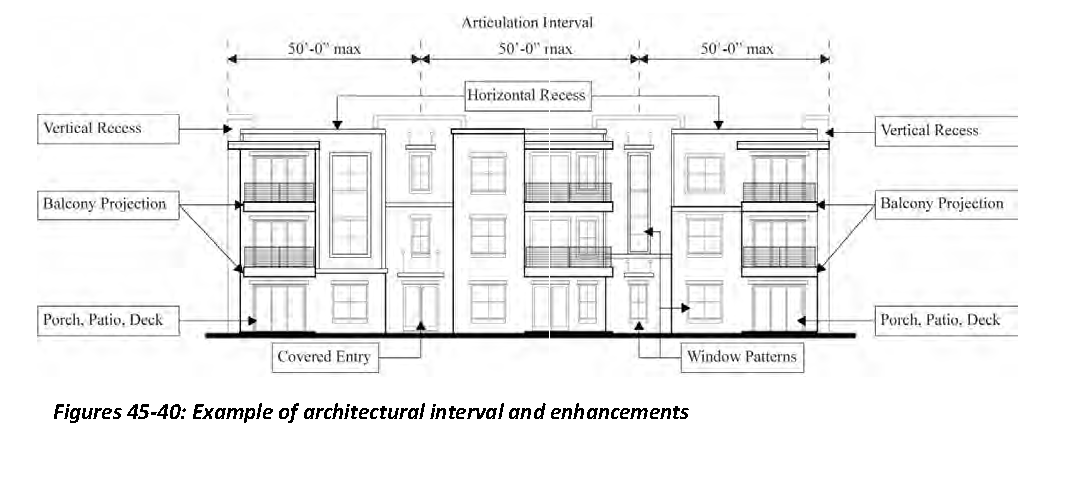
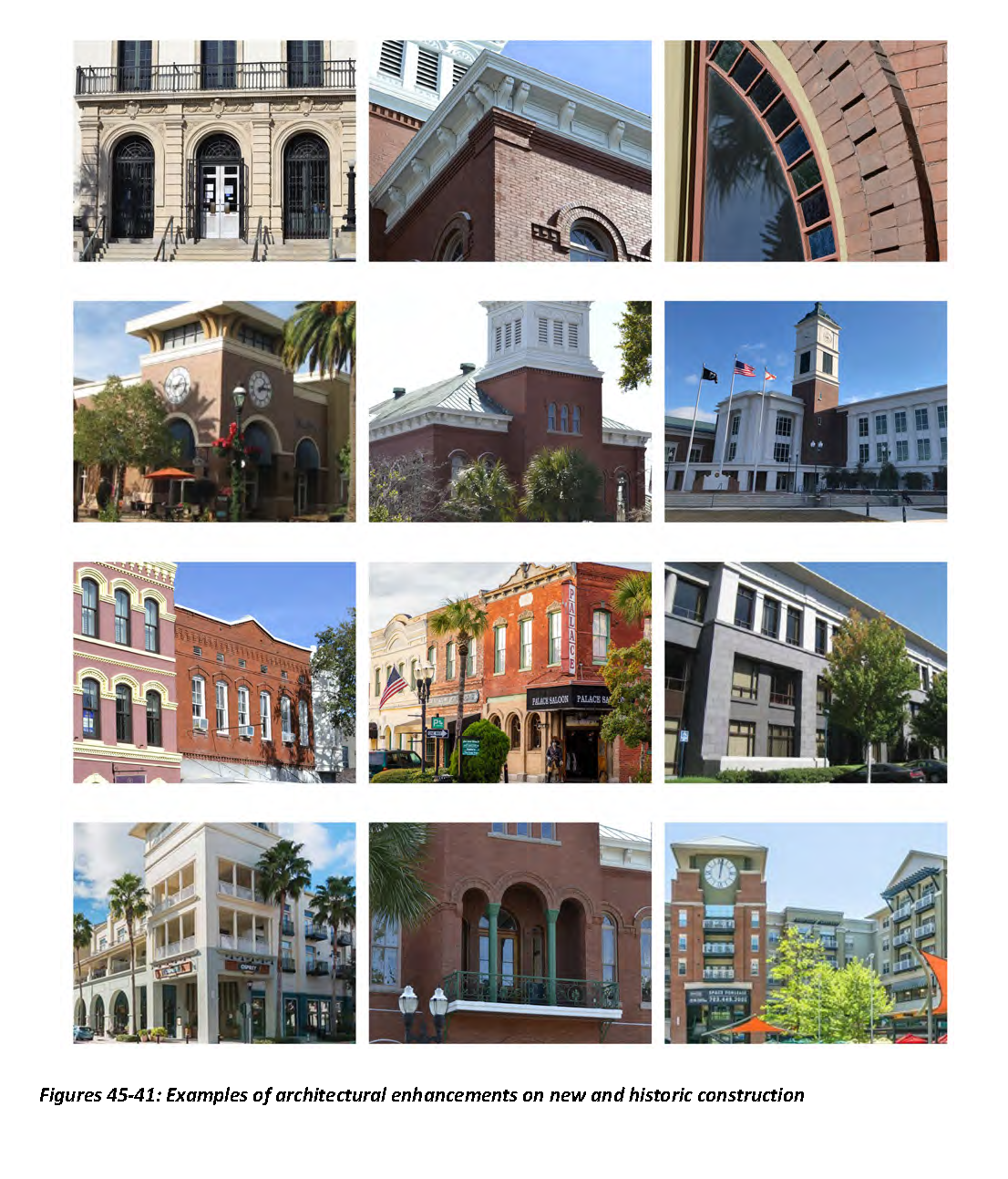
C.
Exterior treatment and finishes in the T2TDO.
1.
Exterior building treatments and finishes shall be limited to the following:
a.
Brick or masonry brick veneer;
b.
Manufactured or natural stone or stone veneer to include granite and marble;
c.
True three (3) coat cement stucco;
d.
Cementitious siding including lap siding and board and batten;
e.
Architectural grade metal wall panels;
f.
Natural wood siding and cementitious shakes and shingles;
g.
Tabby;
h.
Porcelain tile;
i.
Split face (accent only), pre-formed, or textured masonry block; or
j.
Exterior insulation and finish system (EIFS). If within three (3) feet of grade or within six (6) feet of grade adjoining a public right-of-way or a parking area, the finish shall be compliant with impact resistance standards set by ASTM.
2.
The use of the following treatments and finishes is prohibited for the exterior of buildings:
a.
Plywood and oriented strand board (OSB);
b.
Vinyl siding and other polymeric siding;
c.
Mirrored glass;
d.
Corrugated metal or R-panel;
e.
Corrugated fiberglass; and
f.
Unfinished or painted concrete block (this does not apply to public art).
3.
To allow for flexibility in materials for specific architectural styles and recognizing that technologies change over time, the Planning Director may approve the use of other treatments and finishes not listed or listed as prohibited.
4.
Exterior building materials and colors contribute significantly to the visual impact of a building on a community, which, individually and collectively reflect upon the visual character and quality of the community. Building materials and colors shall conform to the following requirements:
a.
The exterior design of all new structures must incorporate at least three (3) of the following elements:
i.
Color change;
ii.
Texture change;
iii.
Material change;
iv.
Pattern change; or
v.
Architectural banding.
b.
Building materials and colors shall be consistent around the entire building. Exceptions to this provision may be made for portions of a structure that are not exposed to the general public.
c.
Materials shall wrap around at outside building corners at a continuous height until they reach an interior corner or another architectural feature.
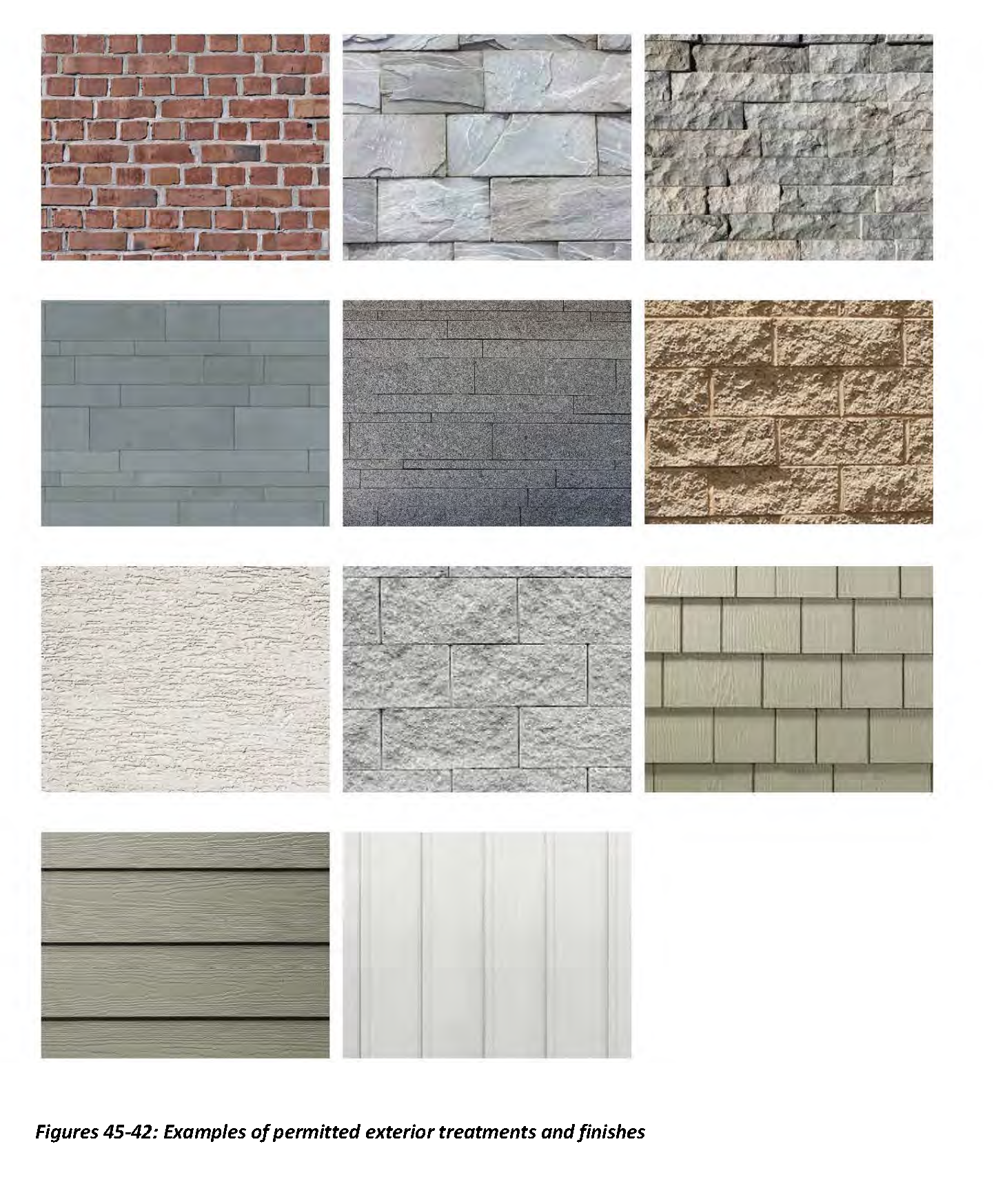
D.
Architectural styles.
1.
The following table, Table 45-03, shows architectural styles which shall be required for properties located within activity centers. Properties located outside of an activity center may choose to utilize the styles listed below.
2.
All categories could be interpreted for residential or commercial use. All categories are intended for architectural guidance and are not inclusive of all elements of represented architectural styles. It is recommended that as part of the site plan review process, applicants review additional information regarding included architectural styles and consult with planning staff for additional resources.
Table 45-03: T2TDO Activity Center Architectural Styles
3.
Historical mercantile.
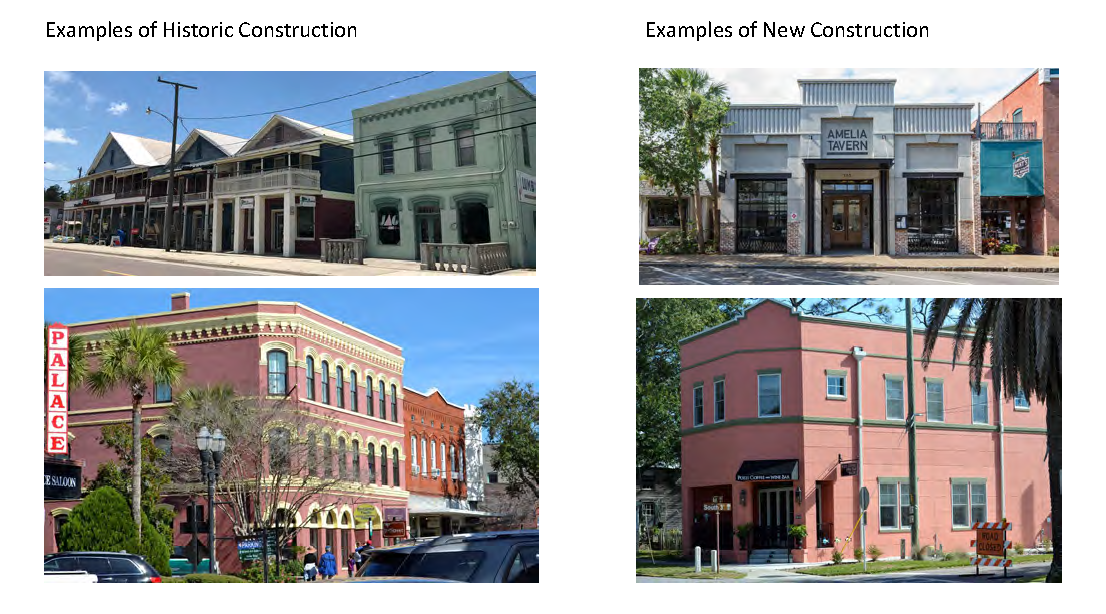
4.
Nassau vernacular.
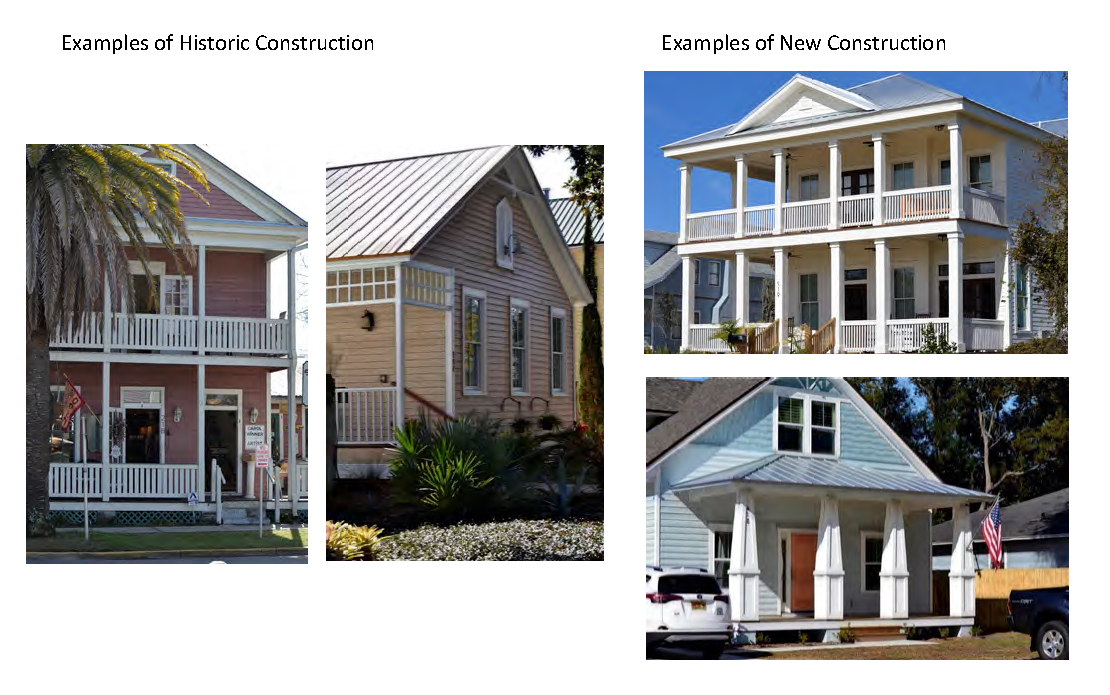
5.
Vintage Florida railroad.
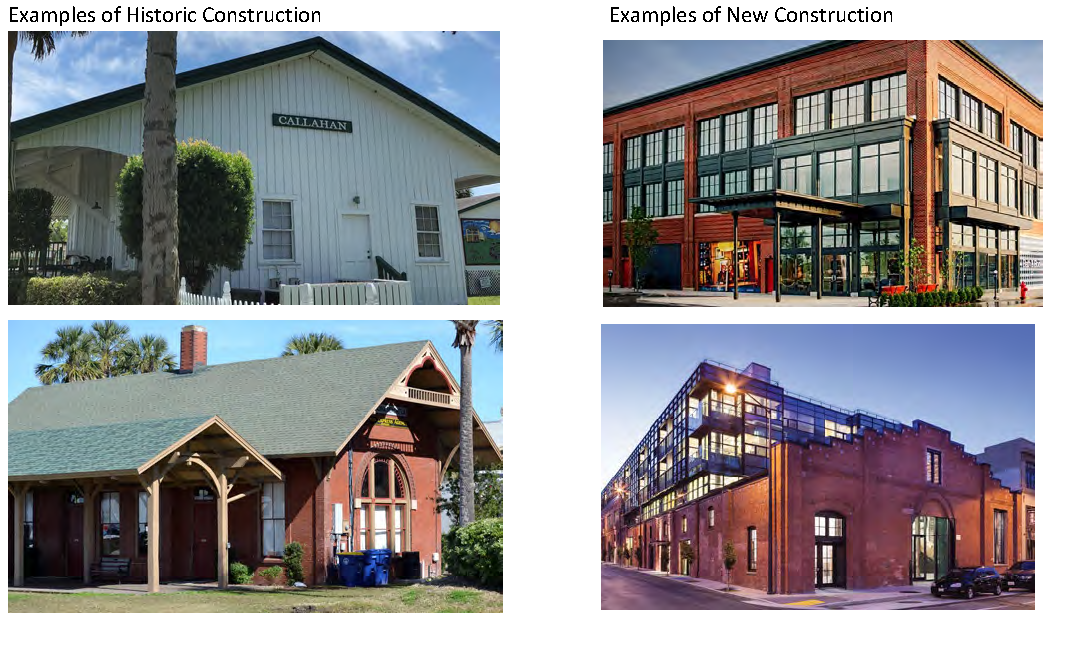
6.
Mid-century Florida.
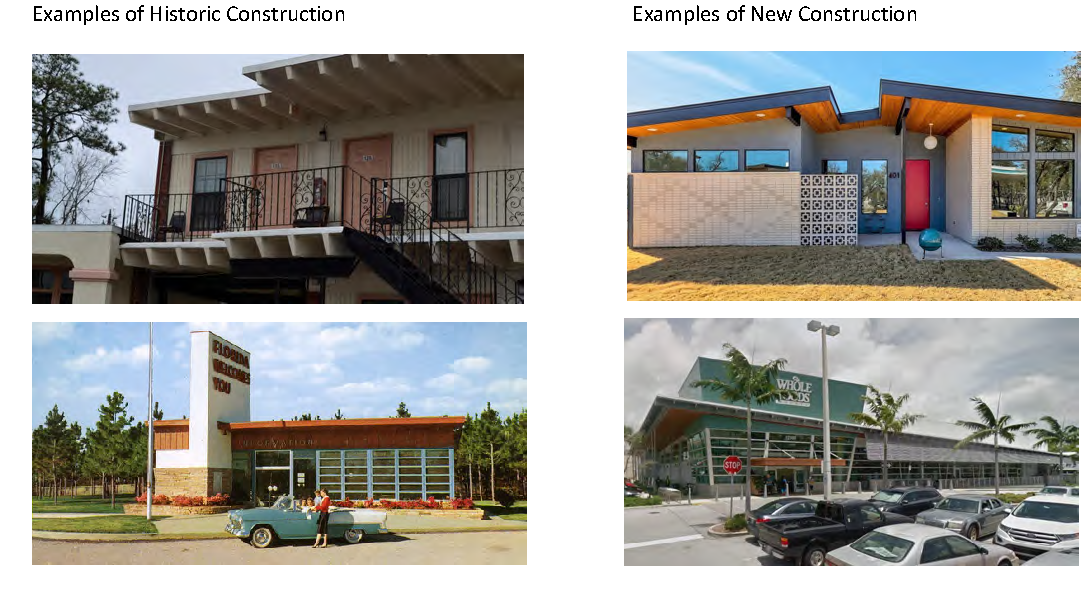
7.
Corridor gateway contemporary.
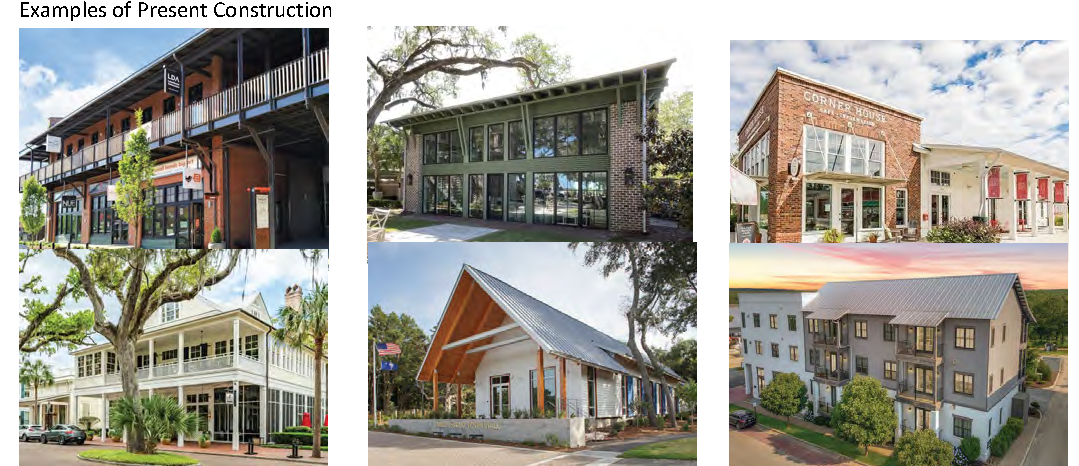
8.
Nassau Villages contemporary.
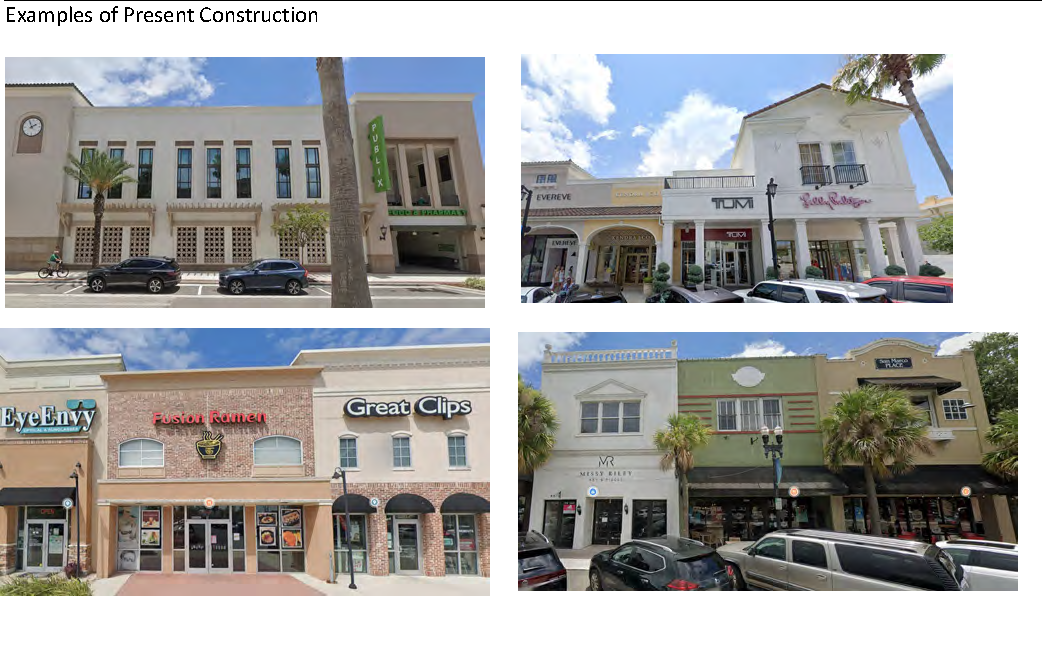
E.
Anchor buildings.
1.
An anchor building is a prominent structure located at a critical location within a block that serves as a focal point for pedestrian and vehicular circulation. These buildings are typically mixed-use or high-visibility structures.
2.
Anchor buildings may be used to facilitate building frontage requirements defined by the transect during incremental development. As an example, the north block face length fronting a main street may require ninety percent (90%) building frontage in transect 5. Provided there are two (2) anchor buildings at the corners of the defined block on the north block face, screened parking may be permitted. Parking shall not be located in the space between the anchor buildings, which is designated for future outparcels. These outparcel areas must be clearly identified on the site plan and reserved for phased development, ensuring cohesive site integration as the area builds out.
3.
Anchor buildings shall be located at each corner of a defined block.
a.
The corner is defined as the intersection of two (2) streets or rights-of-way, where the block boundary is established.
b.
At least one (1) anchor building must be placed at each corner of a defined block.
c.
Anchor buildings shall be positioned at the street frontage at the intersection, extending vertically to provide visible presence at the corner.
4.
Anchor buildings shall be designed to engage pedestrians and create visual interest along the streetscape. The ground floor shall create an active pedestrian realm through uses such as retail, cafes, or similar storefronts. Emphasis shall be placed on promoting street level interaction through the use of large windows, transparent facades, and public entrances. The architectural design of the anchor building should reflect the character and styles of the surrounding area while maintaining consistency with the urban aesthetic.
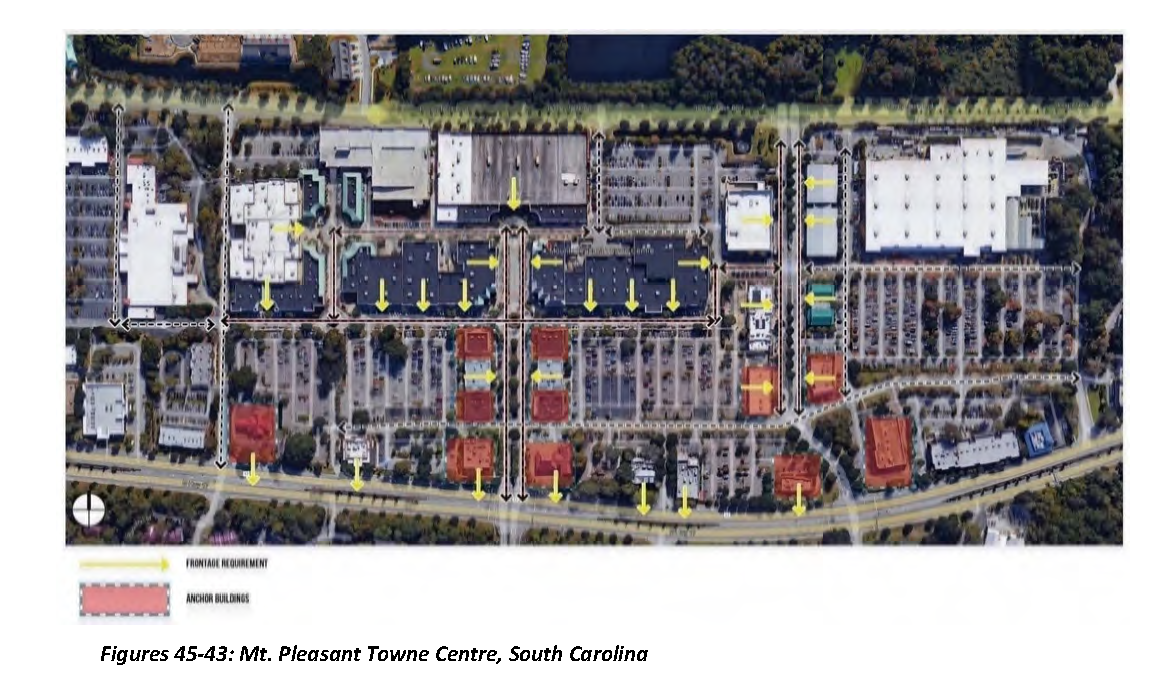
45.05.03. - Architectural standards for single-family detached, single-family attached, and two-family dwellings.
A.
Building orientation and streetscape integration.
1.
Primary pedestrian entrances shall face a street or public space and be clearly defined with porches, stoops, or architectural detailing.
2.
Corner lots and homes on highly visible sites, such as those adjacent to main roads, shall incorporate enhanced architectural treatments on both street-facing facades. Wrap-around porches, bay windows, varied rooflines, or additional fenestration shall be used to avoid blank walls.
B.
Building transparency and facade articulation.
1.
Front facades shall include a minimum of twenty percent (20%) transparency to ensure visual interest and pedestrian engagement.
2.
A combination of facade articulation techniques, including, but not limited to, changes in material, projections, recesses, and balconies, shall be used at intervals no greater than thirty (30) feet.
C.
Architectural treatments for all publicly visible facades.
1.
Any facade visible from a public street or right-of-way, including side and rear elevations facing a main road, park, or other public space, shall comply with the following:
a.
A minimum of fifteen percent (15%) transparency shall be required on all side and rear facades facing a public right-of-way. For side and rear elevations only, up to fifty percent (50%) of this transparency requirement may be satisfied through the use of architectural treatments that simulate transparency, such as faux windows, shuttered frames, or other elements that reinforce the rhythm, scale, and articulation of the façade. These features must be dimensionally consistent with the size and placement of functional window openings on the building.
b.
Homes with rear elevations facing a main road shall incorporate architectural elements such as extended rooflines, trellises, covered porches, or enhanced window treatments to avoid the appearance of a "back-of-house" condition.
c.
Blank walls exceeding twenty (20) feet in width are prohibited. Facades visible from the public realm shall incorporate a minimum of two (2) of the following elements:
i.
Additional transparency, such as windows or decorative openings.
ii.
Changes in material, color, or texture.
iii.
Vertical or horizontal articulation, such as pilasters, columns, or step-backs.
iv.
Roofline variations, such as dormers, gables, or parapets.
D.
Roof design and massing.
1.
Roof designs shall incorporate gables, hips, dormers, or parapets to create variation and avoid monotonous rooflines.
2.
Flat roofs are prohibited unless designed with a parapet and cornice treatment that enhances the building's architectural style.
3.
Where three-stories or higher structures abut existing one-story homes, a transitional step-down in height or an increased side setback shall be incorporated to ensure compatibility.
E.
Front porches and entry features.
1.
A covered front porch or stoop shall be provided for each dwelling unit, with a minimum depth of six (6) feet.
2.
Porch columns, railings, and balustrades shall be appropriately scaled and consistent with the architectural style of the home.
F.
Garage and driveway placement.
1.
Garages shall not occupy more than fifty percent (50%) of the width of the front façade.
2.
Garages, where provided, shall be recessed at least five (5) feet behind the front façade or located at the rear of the lot, accessed by an alley where feasible. Per section 44.06.01.B.3.b, measurement of the front façade shall be from a covered porch.
3.
For lots less than fifty (50) feet in width, rear or side-loaded garages are required unless an alternative driveway configuration is approved.
4.
Per section 44.06.01.F, supplemental standards for T-3.5 and T-4, on-site parking for single-family detached and attached, including a garage, shall only be accessed from a rear road or alley, or shall have a detached garage meeting the minimum setback requirements. Front and side-loaded garages are not permitted in these transects unless consistent with section 44.06.01.C.4.
5.
Shared driveways and alley-loaded garages are encouraged to reduce curb cuts and enhance pedestrian streetscapes.
G.
Fencing and landscaping.
1.
Front yard fences shall be constructed of wood, wrought iron, or similar decorative materials; chain-link fencing is prohibited.
2.
A minimum of one (1) canopy tree per lot shall be planted in the front yard to reinforce a tree-lined streetscape.
H.
Neighborhood consistency and contextual compatibility.
1.
New homes shall be designed to complement the character of surrounding development, ensuring continuity in scale, proportion, and materials.
2.
Architectural variety shall be encouraged within new developments by requiring a minimum of three (3) distinct elevations per block.
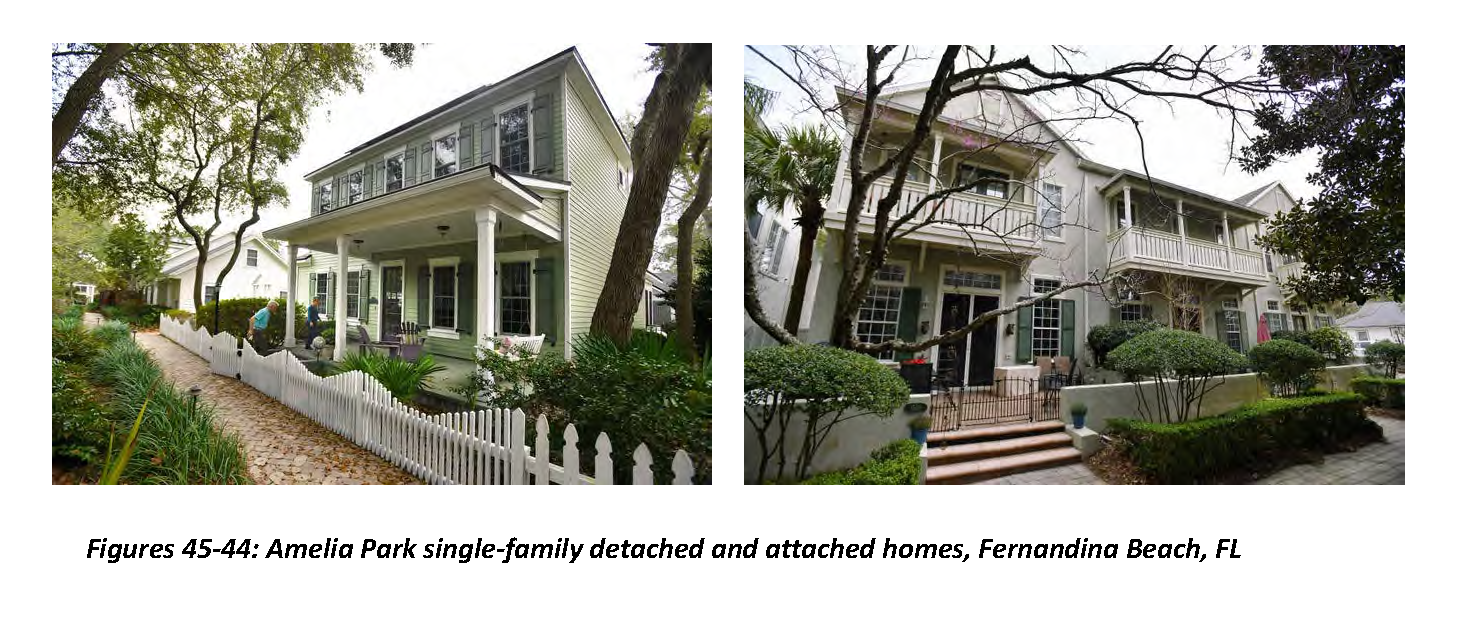
(Ord. No. 2025-012, § 3(Exh. B), 6-23-25)

