
New Smyrna Beach City Zoning Code
ARTICLE XII
ARCHITECTURAL DESIGN STANDARDS
1200.00.- Architectural design standards.
1200.01. City architectural design standards.
1200.01.1. Purpose and intent. It is the purpose of this section to provide general standards relating to the architectural design of development and redevelopment in the city.
1200.01.2. Applicability. These architectural standards shall apply to new development and redevelopment of multi-family, commercial, industrial, and PUD properties. Waivers may be granted to the applicable development provided that the structure(s) conform to the general standards contained herein.
1200.01.3. Enforceability. The planning director or designee shall act as the design reviewer for review of applications subject to the architectural standards.
1200.01.4. Submittals. The applicant shall submit, with the appropriate applications, elevation drawings and a site development plan or site improvement plan with enough detail to ensure that the intent of this section is met.
1200.01.5. Architectural standards.
Facades and elevations:
(1)
All primary facades of a building shall be designed with consistent architectural style, detail, and trim features. Facades attached to a primary facade shall incorporate features of the primary facade for a minimum of 33 percent of the overall wall length measured from the attached primary facade. In the case of outparcel buildings, all exterior facades shall adhere to the requirements of this section with respect to architectural design treatments for primary facades.
(2)
Buildings or structures which are part of a present or future group or complex shall have a unity of character and design. The relationship of forms and the use, texture, and color of materials shall be such as to create a harmonious whole. When the area involved forms an integral part of, is immediately adjacent to, or otherwise clearly affects the future of any established section of the city, the design, scale, and location on-site shall enhance rather than detract from the character, value, and attractiveness of the surroundings.
(3)
Buildings or structures located along strips of land or on single sites and not a part of a unified multi-building complex shall strive to achieve visual harmony with the surroundings. If the buildings are in undeveloped areas, three primary requirements must be met: proper design concepts, honest design construction, and appropriateness to surroundings.
(4)
All facades visible to public or adjacent property shall be designed to create a harmonious whole. Materials shall express their function clearly and not appear as a material foreign to the rest of the building.
(5)
It is not to be inferred that buildings must look alike to be of the same style or to be harmonious. Harmony can be achieved through the proper consideration of scale, proportions, site planning, materials, and color.
(6)
Look-alike buildings are not allowed unless, in the opinion of the Design Reviewer, there is sufficient separation to preserve the aesthetic character of the present or evolving neighborhood. This is not to be construed to prohibit duplication of floor plans and exterior treatment in a planned development or developments which depend upon or are enhanced by the look-alike buildings and their relationship to each other.
(7)
Buildings which are of symbolic design for reasons of advertising and buildings which are not compatible to the surroundings will not be approved. Symbols attached to buildings will not be allowed unless they are secondary in appearance to the building and landscape and are an aesthetic asset to the building project and neighborhood.
(8)
Exterior lighting may be used to illuminate a building and its grounds for safety purposes but in an aesthetic manner. Lighting is not to be used as a form of advertising in a manner that is not compatible to the neighborhood or in a manner that draws considerably more attention to the building or grounds at night than in the day. Lighting following the form of the building or part of the building will not be allowed if the overall effect will be garish or detrimental to the environment. All fixtures used in exterior lighting are to be selected for functional and aesthetic value.
(9)
All exterior forms, attached or not attached to buildings, shall be in conformity to and secondary to the building. They shall be an asset both to the aesthetics of the site and the neighborhood.
(10)
The following architectural features shall be considered of primary importance when reviewing for consistency and are intended to be general in nature. They shall provide flexibility to the applicant in providing structure(s) which are in keeping with the architectural styles of the neighborhoods in which they are located:
a.
Open air front or wrap around porches;
b.
Gable, hipped, or mansard type roofs;
c.
Second story balconies;
d.
Decorative roof treatments, including but not limited to, pediments, dormers, ridge cresting, entablature, decorative bridgeboard, decorative shingles, etc.
e.
Decorative window treatments, including but not limited to, louvered shutters, double-hung windows, arched windows, transoms, stained glass, etc.
Building design:
(1)
This section provides standards to maintain and enhance the attractiveness of the streetscape and the desired architectural design of the community.
(2)
Buildings shall have architectural features and patterns that provide visual interest from the perspective of the pedestrian, reduce the massing aesthetic, recognize local character, and are site responsive.
(3)
Facades shall be designed to reduce the mass/scale and uniform monolithic appearance of large unadorned walls, while providing visual interest that will be consistent with the community's identity and character, depending on the neighborhood, through the use of detail and scale.
(4)
Articulation of buildings shall be accomplished by varying the buildings' mass in height and width so that they appear to be divided into distinct massing elements and details that can be perceived at the scale of the pedestrian (See Illustration 1).
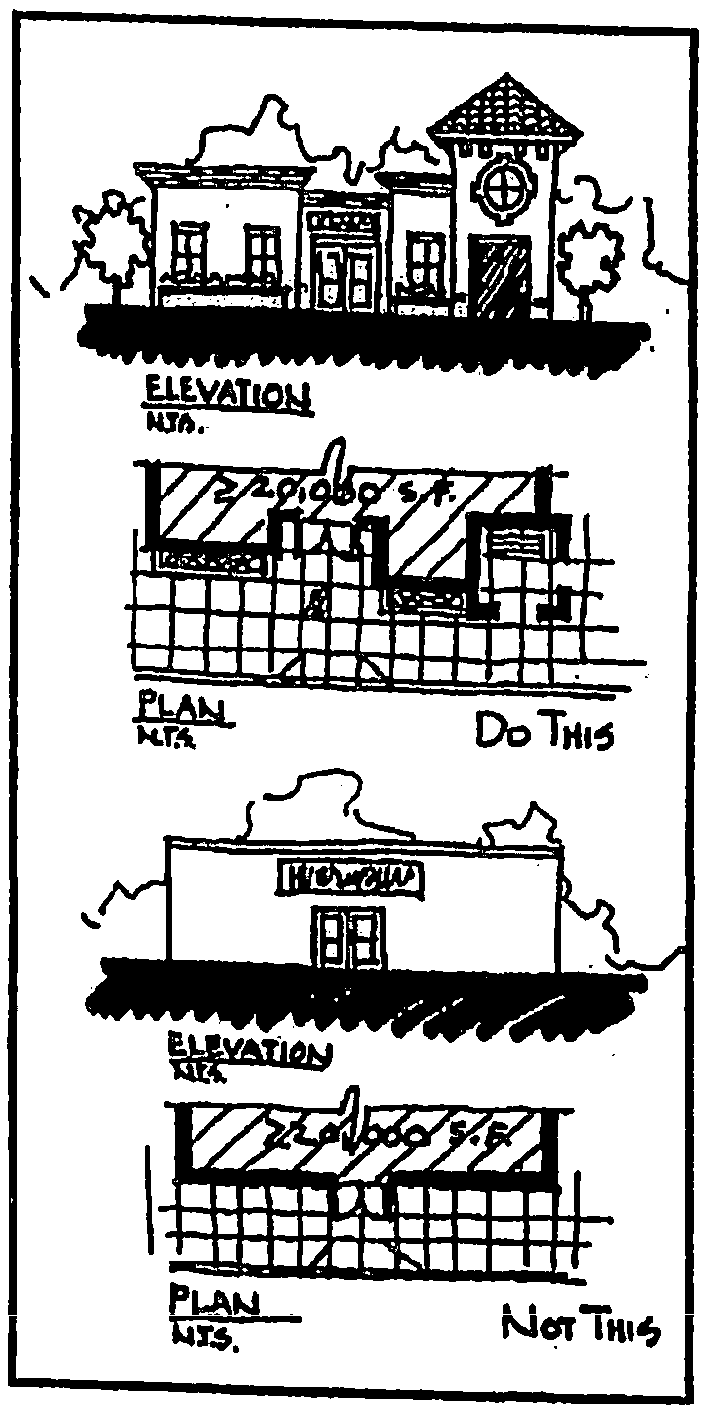
Illustration 1
(5)
Buildings and structures on corner lots at an intersection of two or more arterial or major collector roads shall be designed with additional architectural embellishments such as corner towers or other such design features, to emphasize their location as gateways and transition points within the community.
(6)
Signage may not be located upon or within these additional architectural embellishments.
Building orientation standards: Buildings with facades facing a public street shall have two of the following design features:
a.
Windows comprising a minimum of 33 percent of the affected facade.
b.
Projected covered public entry with a minimum of 20 percent of the wall space devoted to windows.
c.
Covered walkway (excluding canvas type unless provided with six-inch columns or better) attached to the building, with a minimum width of six feet and a 50 percent minimum coverage for the affected facade.
Window standards: Windows shall not appear to be false or applied.
Awning standards:
(1)
These standards apply to awnings associated with and attached to a building/structure. (See Illustration 2)
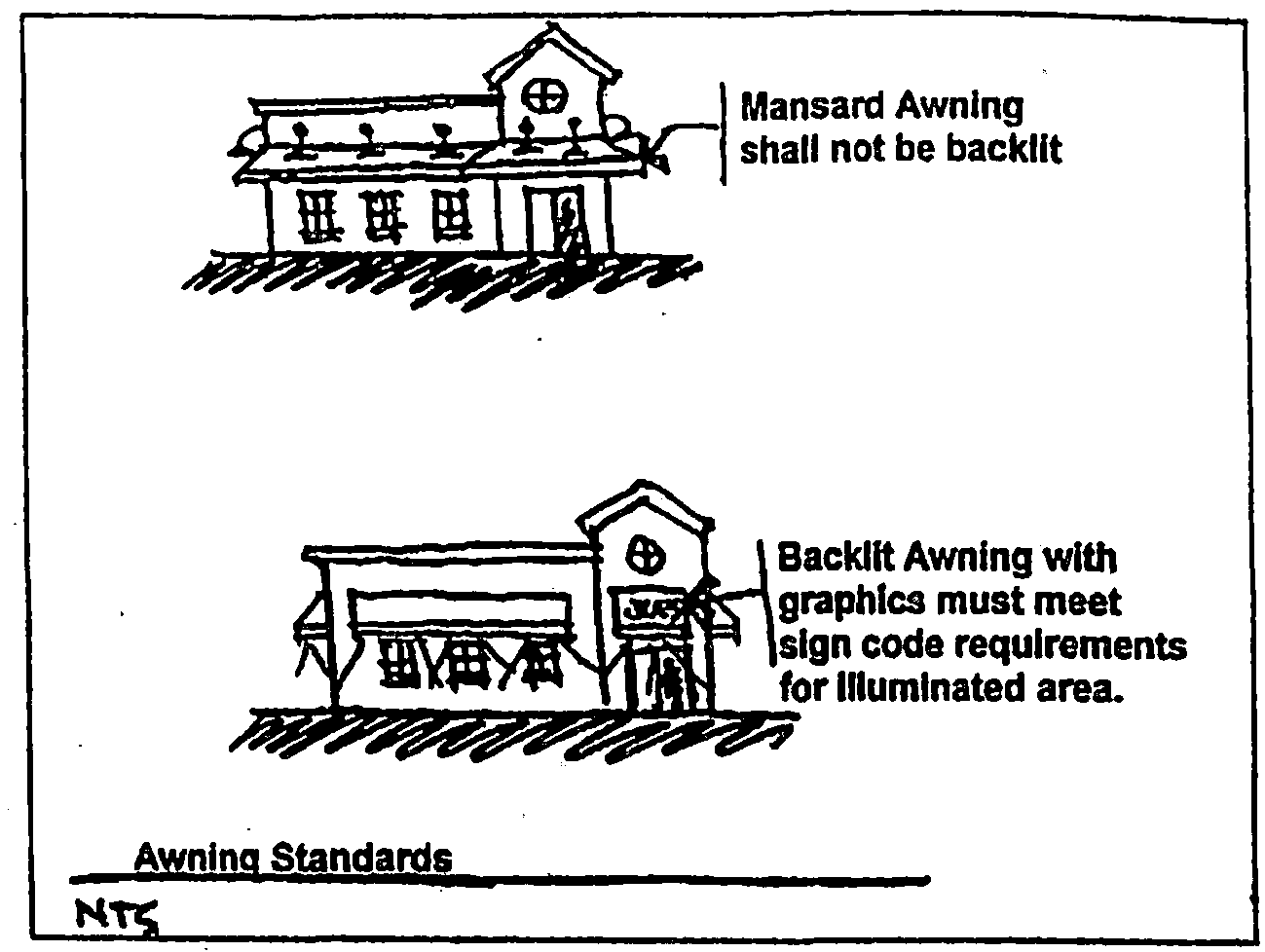
Illustration 2
(2)
Mansard awnings are permitted provided they do not extend above the roofline of the building and are not backlit.
(3)
All other awnings shall adhere to the following standards:
a.
Awnings may be backlit provided the illuminated portion of the awning with graphics does not exceed the size limitations and standards of this code.
b.
Automobile sales parking lot awnings. Shade awnings may be erected in automobile sales parking lots subject to the following requirements and standards:
1.
No shade awning structure shall be constructed within 75 feet of any public or private street.
2.
No one shade awning structure may exceed an area sufficient to provide cover for more than 20 automobiles. The total width of all shade structures combined cannot exceed 50% of the parcel road frontage.
3.
The minimum separation between shade awning structures shall be 100 feet.
4.
Multi-colored shade awning structures are prohibited and the use of black, gray, florescent, primary and/or secondary colors is prohibited. Earth-tone colors are encouraged.
Overhead door standards: Overhead doors facing one another may be treated as interior space provided that the buildings meet all other requirements of section 15.04 of this Code. (See Illustration 3)
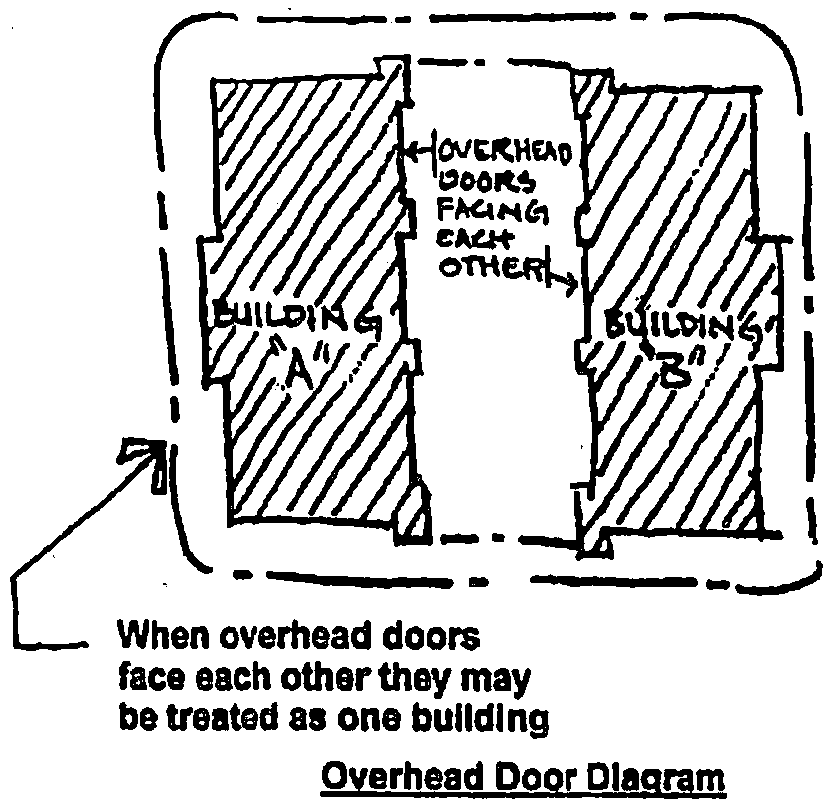
Illustration 3
Massing standards: Exterior facades shall be designed to employ the following design treatments:
a.
No horizontal length or uninterrupted curve of any primary facade shall exceed 50 feet. Arcaded facades shall have no horizontal length or uninterrupted curve that exceeds 80 feet, with varied lengths being desirable. Projections and recesses shall have a minimum depth of two feet. (See Illustration 4)
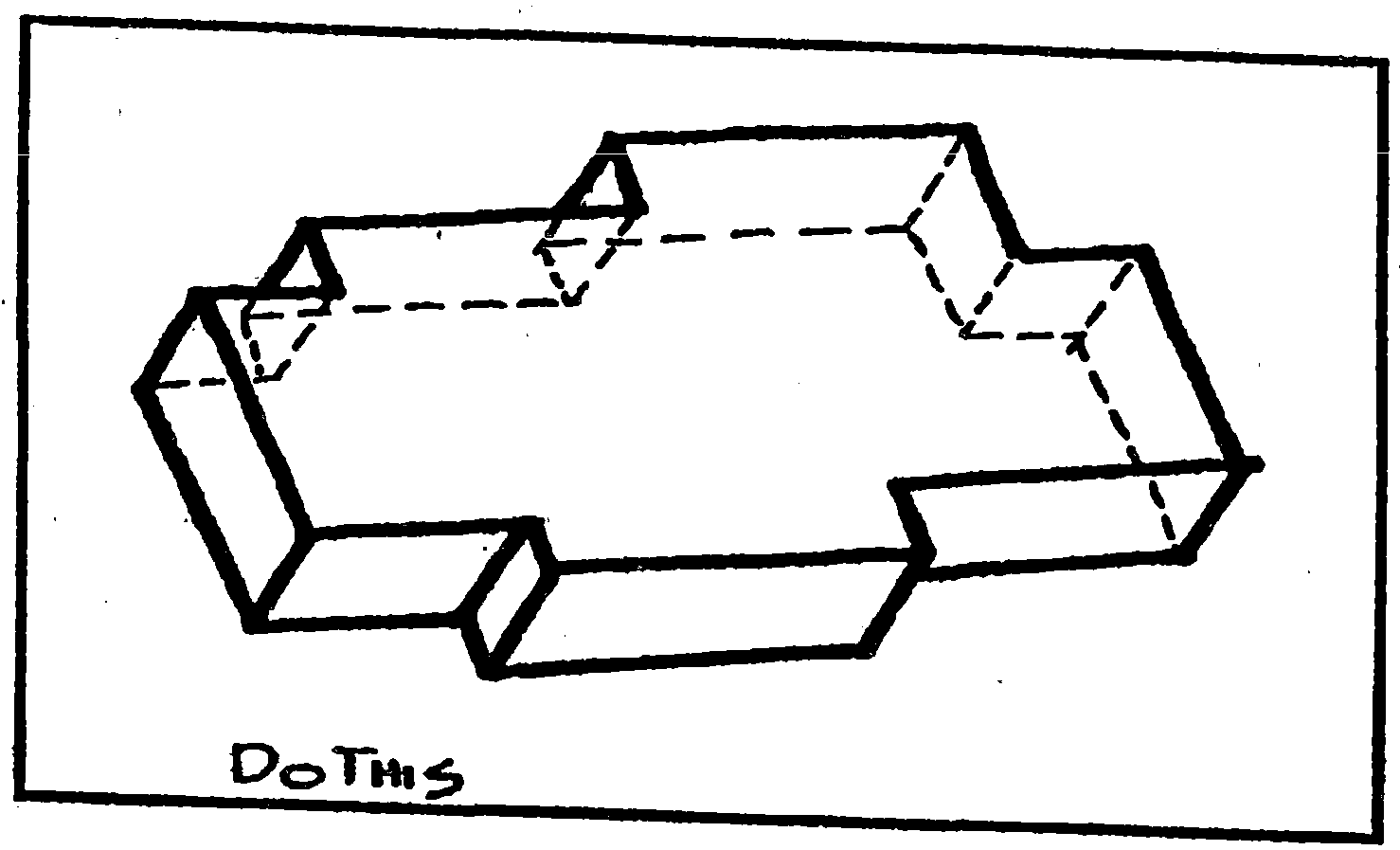
Iluustration 4
b.
Exterior wall planes shall not constitute more than 50 percent of each affected facade.
c.
Primary facades on the ground floor shall have features along a minimum of 33 percent of their horizontal length per affected side. These features include, but are not limited to: Arcades, a minimum of six feet clear in width; display windows; entry areas; or other such design elements. Awnings are included in this calculation at 1.5 times the window width when associated with windows/doors and are in increments of 10 feet in length or less.
d.
All buildings shall provide a minimum of one offset per public street or navigable waterway.
Exterior materials and exterior color standards. Exterior building materials contribute significantly to the visual impact of a building on the community. They shall be well-designed and integrated into a comprehensive design style for the project.
a.
Predominant exterior building colors that are prohibited:
1.
Florescent or day glow colors;
2.
Corporate colors or colors used in the marketing of the business occupying the space which are not earth tone shall be calculated towards the allowable signage copy area provided for under section 604.12 of the land development regulations. In such case, a sign permit is required. This section is intended to provide corporations, franchises, and corporate chains, the opportunities to use other exterior colors (other than earth tone), but these colors be considered signage.
b.
Predominant exterior building materials that are prohibited:
1.
Plastic or vinyl siding;
2.
Corrugated or reflective metal panels;
3.
Tile;
4.
Smooth or rib faced concrete block; and
5.
Applied stone in an ashlar or rubble look.
c.
Automotive and other special type service buildings may utilize prefabricated metal buildings under the following conditions:
1.
Metal buildings are more than 250 feet from any right-of-way;
2.
Metal buildings are located directly behind the main showroom/sales center (or primary structure) so as not to be a dominant facade along the street;
3.
At least 80 percent of the front elevation of any such building and accompanying showroom/sales center must be the elevation of the accompanying showroom/sales center.
1200.01.6 Interpretations and exceptions.
A.
Illustrations. Illustrations provided in this section are intended to provide a graphic example of a specific provision or provisions set forth herein. Variations from these illustrations which nonetheless adhere to the provisions of this section, are allowed.
B.
Interpretations. During the course of review, should an applicant and staff be unable to concur on the application of a specific provision or provisions of this section, the planning director shall be authorized to make a final determination. All appeals of the planning director's determination must follow the procedures set forth in section 301.05 of the land development regulations.
C.
Exceptions. Exceptions to the provisions of this section may be granted by the planning director when it can be demonstrated that such exceptions are necessary to allow for innovative design which, while varying from one or more of the provisions of this section, nonetheless are deemed to meet the overall purpose and intent set forth herein. In the case of individual commercial buildings or projects, where site specific factors may impact the ability to meet these standards, variance from one or more of the provisions of this section may be requested pursuant to the procedures set forth in section 305.05 of the land development regulations.
(Ord. No. 26-18, § 1(Exh. A), 6-12-2018)

