
New Smyrna Beach City Zoning Code
ARTICLE III
ADMINISTRATION AND ENFORCEMENT
301.00.- Administrative officials and departments.
301.01.Administration. City manager/city planner/planning and zoning department.
A.
City manager. In accordance with Chapter 4, Section 31 of the Municipal Charter, the city manager is responsible to the city commission for the proper enforcement of all laws and ordinances. As such, the city manager is the chief administrative official of the city. Therefore, in accordance with [sub]section 301.05 of this LDR, interpretations rendered by city staff may be reviewed by appeal of interpretation.
B.
City planner. The city planner is the responsible administrative official for administering and interpreting the provisions of this LDR, unless specifically indicated otherwise. He/she shall be provided with the assistance of the building official, city engineer, fire marshal and any other city official designated by the city commission and/or city manager to assist the city planner in administering this LDR.
C.
Planning and zoning department. The planning and zoning department shall consist of the city planner and a staff assigned to assist the city planner in administering this LDR.
301.02. Building official and inspection department.
A.
Building official.
(1)
The building official shall be responsible for enforcing the provisions of this LDR. If the building official or his/her designee shall find that any of the provisions of this LDR are being violated, he shall notify, in writing, the person responsible for such violations, indicating the nature of the violation and ordering the action necessary to correct it. He shall order discontinuance of illegal use of land, buildings, or structures; removal of illegal buildings or structures or of illegal additions, alterations, or structural changes; discontinuance of illegal work being done; or shall take any other action authorized by this LDR, to ensure compliance with, or to prevent violation of, its provisions.
(2)
Should there be a question as to the intent or interpretation of this LDR, the building official shall refer to the city planner for clarification or interpretation. The building official shall enforce the city planner's interpretation of this LDR. If an appeal is made to the city manager or city commission, then the city building official shall enforce the city manager's or city commission's interpretation of this LDR.
B.
Inspection department. The inspection department shall consist of the building official and a staff assigned to assist the building official in enforcing this LDR.
301.03. City engineer and engineering department.
A.
City engineer. The city engineer shall be responsible for ensuring that all developments within the city, whether existing or proposed, abide by all city, state, and federal minimum engineering requirements including stormwater management, landscaping, tree preservation, wetlands, and improvement specifications.
B.
Engineering department. The engineering department shall consist of the city engineer and a staff assigned to assist the city engineer in performing his/her duties.
301.04. Chief fire marshal and division of fire safety management.
A.
Chief fire marshal. The chief fire marshal shall be responsible for ensuring that all development within the city, whether existing or proposed, abide by all city, state, and federal minimum fire safety and prevention regulations including hazardous waste management.
B.
Division of fire safety management. The division of fire safety management shall consist of the chief fire marshal and a staff assigned to assist the chief fire marshal in performing his/her duties.
(Ord. No. 50-10, § 1, 11-30-2010; Ord. No. 55-24, § 1, 1-14-2025)
Editor's note— Ord. No. 55-24, § 1, adopted Jan. 14, 2025, repealed § 304.05, which pertained to city manager and derived from Ord. No. 50-10, § 1, adopted Nov. 30, 2010.
302.00. - City boards.
302.01. Planning and zoning board.
A.
Responsibilities of the planning and zoning board.
(1)
The planning and zoning board is hereby established to review and approve unconditionally, approve with conditions or deny:
a.
Class III site plans; class II site plans when referred to by the administrative official or the applicant;
b.
Final subdivision plats; and
c.
Appeals for a variance from the requirements of the Land Development Regulations where owing to special conditions the literal enforcement of the provisions of the Land Development Regulations would result in unnecessary hardship.
d.
Appeals of interpretations made by the city planner. The board may, at its discretion, affirm, reverse, or modify, any final decision of the city planner relating to the city's planner's interpretation of a land development regulation. The applicant requesting an appeal of the city planner's interpretation must submit its appeal to the development services department with 30 days of the interpretation. The appeal shall be in the form of a written submission outlining the bases of appeal. The city planner must then create a corresponding memorandum outlining the pertinent regulations and staff's interpretation. The applicant's submission and staff memorandum shall then be presented to the board at the next available board meeting. At the meeting, the board shall consider the written submission, as well as any oral presentations, and either affirm, reverse, or modify, the interpretation in accordance with any and all applicable city ordinances, state statutes, and federal law.
(2)
The planning and zoning board is hereby established to review and make recommendations to the city commission on:
a.
Street vacations;
b.
Special exceptions; and
c.
Any other matters referred to them by the city commission.
(3)
The planning and zoning board is hereby established as the city local planning agency which is responsible for reviewing and making recommendations to the city commission on:
a.
Comprehensive plan amendments;
b.
Land development regulation amendments; and
c.
Annexations.
(4)
Other duties of the planning and zoning board, whether or not they are acting as the local planning agency, include:
a.
To acquire and maintain information and perform studies relating to land use and development within the city limits and areas surrounding the city which may be annexed into the city;
b.
To prepare and recommend to the city commission other ordinances and resolutions promoting orderly development consistent with the comprehensive plan for the growth and improvement of the area;
c.
To determine whether specific proposed developments conform to the goals, objectives and policies of the comprehensive plan for the growth and improvement of the area;
d.
To conduct such public hearings as may be required to gather information necessary for the establishment and maintenance of the comprehensive plan and such additional public hearings as deemed necessary;
e.
To keep the city commission and the general public informed and advised as to these matters;
f.
To perform any other duties which may be lawfully assigned to it by the city commission of the City of New Smyrna Beach, Florida;
g.
To insure all recommendations and formal actions of the planning and zoning board are consistent with the Local Government Comprehensive Planning and Land Development Regulation Act of 1985 adopted by the state legislature; and
h.
To ensure coordination between the City of New Smyrna Beach and the Volusia County School Board as required in F.S. § 163.31777.
B.
Rules.
(1)
Membership. The planning and zoning board and local planning agency (LPA) shall consist of the following:
a.
The planning and zoning board and local planning agency (LPA) shall consist of seven voting members appointed by the city commission and one nonvoting member appointed by the Volusia County School Board.
b.
The seven voting members appointed by the city commission shall be electors of the City of New Smyrna Beach. The terms for the voting members appointed by the city commission shall be for three years; these terms shall be staggered. All voting members appointed by the city commission shall serve without compensation. Should a member move his/her place of residence outside the corporate limits of the City of New Smyrna Beach, he shall automatically be disqualified from further service on the planning and zoning board and local planning agency. Any appointment made to replace a voting member who does not complete his/her term for any reason, shall be appointed by the city commission for the unexpired term. The planning and zoning board and local planning agency members appointed by the city commission shall serve at the pleasure of the city commission.
c.
One member of the board shall be appointed by the Volusia County School Board and shall serve at the pleasure of the Volusia County School Board. This member shall be a nonvoting member of the board and will serve without compensation from the City of New Smyrna Beach. The school board member shall have the right to sit with the board and participate in all matters coming before the board. The school board member shall not be subject to city attendance requirements, residency requirements, or any other rules or regulations of the city relating to membership on appointive boards. The school board member shall be required to comply with the procedural rules of the board. See, F.S. § 163.3174(1).
(2)
Chairperson, vice-chairperson and staff. The planning and zoning board/local planning agency shall elect a chairperson and a vice-chairperson from among its members. The term of the chairperson and vice-chairperson shall be one year with eligibility for reelection. The chairperson and vice-chairperson shall be elected annually at the first meeting in January of each year. The vice-chairperson shall serve in the capacity and assume all the powers and authority of chairperson in the event of illness, death, absence from the county, or resignation of the chairperson. In the event of death or resignation of both the chairperson and vice-chairperson the board shall elect a new chairperson and vice-chairperson from among the board's membership. The vice-chairperson shall chair the meetings of the board in the absence of the chairperson regardless of the reason for the absence of the chairperson. In the absence of both the chairperson and vice-chairperson of a meeting of the board, the board shall select from among its membership a member to chair the meeting. The City of New Smyrna Beach, shall, by appointment, provide the planning and zoning board/local planning agency with the services of a qualified, competently trained city planner with an educational background in city and urban planning and zoning. The secretary of the planning and zoning department shall serve as secretary to the board to provide necessary administrative services, maintenance of files, papers, books, and records of the board, and make written report of its meetings and activities to the city commission as may be required from time to time by the chairperson of the planning and zoning board/local planning agency. Any references in the Land Development Regulations to chairman shall mean chairperson and any references to vice-chairman shall mean vice-chairperson for the purposes of the city's Land Development Regulations.
(3)
Recording. All proceedings and meetings of the planning and zoning board/local planning agency shall be recorded. All meetings shall be public and the board is subject to F.S. ch. 286, the Sunshine Law of the State of Florida.
(4)
Majority vote. The concurring vote of a majority of all members of the planning and zoning board and local planning agency present at the planning and zoning board and local planning agency meeting when a vote is taken is necessary to approve a subdivision sketch, preliminary or final plat, a site plan or a recommendation to any other city board.
(5)
Quorum. A majority of the voting members assigned to the planning and zoning board and LPA must be present to hold a planning and zoning board and LPA meeting.
(6)
Official planning and zoning board and local planning agency meeting schedule. The planning and zoning board/LPA shall adopt an official planning and zoning board/LPA meeting schedule for the upcoming year at every December planning and zoning board/LPA meeting. The meeting schedule shall be strictly adhered to except that the schedule may be deviated from if the planning and zoning board/LPA shall decide to do so or a special meeting is called for by the city planner or chairman of the planning and zoning board/LPA.
(7)
Planning and zoning board meetings. The regular meeting of the planning and zoning board/LPA shall be held at least once each calendar month on a date and a time decided upon by majority vote of the planning and zoning board/LPA. The meeting shall be held at the New Smyrna Beach City Hall commission room unless another location is decided upon by a majority vote of the planning and zoning board/LPA. If a regularly scheduled meeting falls on a legal holiday, the meeting shall be held on the following Monday unless otherwise designated by a majority vote of the board. Members of the public desiring to do business with the planning and zoning board/LPA shall do so in accordance with the official planning and zoning board/LPA meeting schedule prepared annually by the planning and engineering department and approved by the planning and zoning board/LPA.
(8)
Inform applicant. All persons who have applied for a planning and zoning board and LPA review and approval or recommendation shall be informed in writing of the board's decision and reasons for the decision.
(9)
Bylaws. The planning and zoning board and LPA shall adopt and abide by bylaws. The bylaws shall be amended whenever the board shall deem necessary.
(10)
Granting variances. The planning and zoning board shall have the power to hear and decide on applications to allow variations from the regulations of this LDR where by reason of unnecessary hardship or practical difficulty the literal enforcement of the requirements of this LDR would not carry out the spirit and purpose of this LDR. For example, an individual may own a lot with a stream or pond so located on it that he/she simply cannot comply with the yard or setback requirements of this LDR. A request for a variance is the proper instrument to enable him/her to build a house on the lot.
(11)
Granting special exceptions. The planning and zoning board shall have the power to hear and make recommendations to the city commission on applications to allow special exception uses in zoning districts which have the special exception uses listed. Such uses shall only be allowed if in conformance to this LDR.
(12)
Any decision of the Planning and Zoning Board shall constitute final administrative action and appeals must be filed with 30 days of the board's written order of rendition with the circuit court of Volusia County.
302.02. Reserved.
302.03. Reserved.
302.04 Plan review by technical review staff.
A.
Responsibilities. City technical review staff will provide technical review for the following applications and grant final approval for development plans when authorized by this Code:
(1)
Site plans.
(2)
Preliminary and final subdivision plats.
(3)
Planned unit development (PUD) master development agreements and conceptual development plans.
B.
Meetings with applicants. In order to assist applicants and coordinate the review process, city technical review staff shall be available to meet collectively with applicants on a regular schedule at least once a month. These meetings are open to the public and an agenda will be posted on the city website.
C.
City technical review staff present will include representatives from the following city departments or divisions: Building, engineering, planning, fire, police, and public works. The planning director or a person designated by the planning director will head the city technical review staff. a representative from the utilities commission shall also have membership on the city technical review staff.
(Ord. No. 15-02, § 1, 3-12-2002; Ord. No. 01-03, § 1, 1-28-2003; Ord. No. 02-03, § 1, 1-28-2003; Ord. No. 09-03, § 1, 5-27-2003; Ord. No. 27-03, § 1, 5-27-2003; Ord. No. 59-10, § 1, 12-14-2010; Ord. No. 35-11, § 3, 6-28-2011; Ord. No. 19-18, § 1, 3-13-2018; Ord. No. 55-24, § 1, 1-14-2025)
Editor's note— Ord. No. 55-24, § 1, adopted Jan. 14, 2025, repealed § 302.03, which pertained to city commission and derived from Ord. No. 15-02, § 1, adopted Mar. 12, 2002; Ord. No. 01-03, § 1, adopted Jan. 28, 2003; Ord. No. 02-03, § 1, adopted Jan. 28, 2003; Ord. No. 09-03, § 1, adopted May 27, 2003; Ord. No. 27-03, § 1, adopted May 27, 2003; Ord. No. 59-10, § 1, adopted Dec. 14, 2010; Ord. No. 35-11, § 3, adopted June 28, 2011; Ord. No. 19-18, § 1, adopted Mar. 13, 2018.
303.00. - Reserved.
Editor's note— Ord. No. 57-11, § 1, adopted Aug. 9, 2011, repealed § 303.00, which pertained to procedures for reviewing and approving developments, and derived from Ord. No. 35-00, § 1, 8-22-2000; Ord. No. 53-01, § 1, 9-18-2001; Ord. No. 04-04, § 1, 1-27-2004; Ord. No. 20-07, § 1, 2-27-2007; Ord. No. 80-07, § 2, 11-13-2007; Ord. No. 09-08, § 1, 2-12-2008; Ord. No. 50-08, § 1, 9-9-2008; Ord. No. 72-08, § 2, 12-9-2008; Ord. No. 53-10, § 1, 10-12-2010; Ord. No. 35-11, § 1, 6-28-2011; Ord. No. 38-11, § 2, 6-28-2011)
303.01. Reserved.
Editor's note— Ord. No. 57-11, § 1, adopted Aug. 9, 2011, repealed subsection 303.01, which pertained to site plan review and approval.
303.02. Reserved.
Editor's note— Ord. No. 35-11, § 1, adopted June 28, 2011, repealed subsection 303.02, which pertained to subdivision review and approval.
303.03. Reserved.
Editor's note— Ord. No. 35-11, § 1, adopted June 28, 2011, repealed subsection 303.03, which pertained to approval of minor subdivision.
303.04. Reserved.
Editor's note— Ord. No. 35-11, § 1, adopted June 28, 2011, repealed subsection 303.04, which pertained to penalties for illegal subdivision.
304.00. - Permitting required prior to development.
[The following are the permitting required prior to development:]
A.
General. Prior to any construction, remodeling, erecting, or any other work to any building, accessory or incidental structure, a building permit must be obtained. The exception to permitting requirements are any activities that do not require inspections as determined by the city building official. No building permit shall be issued by the building official unless in conformity with the provisions of this LDR. If a permit is denied, reasons for the denial shall be stated.
B.
Concurrency evaluation. Prior to the approval of any site plan or subdivision, a concurrency evaluation (CE) must be issued by the city planner or his/her designee. A CE shall be issued only after a proposed project meets the concurrency test as indicated in article IV of this LDR.
C.
Permit to construct required improvements. Once an applicant has approval to begin installing required improvements for a subdivision or site plan, a land clearing/water management (site construction) permit is required from the planning and engineering department. The following are the procedural requirements to obtain a land clearing/water management (site construction) permit:
(1)
The land clearing/water management permit applicant must first receive a certificate of zoning (CZ) from the planning and engineering department. The CZ is obtained by providing the planning and engineering department two copies of the site plan or subdivision blue line prints. The planning and engineering department shall compare the planning and zoning board or city technical review staff approved prints with those submitted by the applicant. If the prints are identical, a CZ will be issued. If the prints do not match, then the applicant must change the prints to match the approved prints or apply for an amendment to the approved plans.
(2)
Once a CZ is issued, the land clearing/water management Permit applicant must present the engineering department with five sets of subdivision or site plan improvement construction drawings, all permits required by any governmental agencies, a CZ, administration fee receipt, and any other items as required by the engineering department. A preconstruction meeting, coordinated by the engineering department, is then held. Upon a successful completion of a preconstruction meeting, the city engineer shall issue a land clearing/water management (site construction) permit. A land clearing/water management (site construction) permit shall expire one year from issuance.
D.
Permit to construct building(s) or structure(s). Once an applicant has site plan approval or a subdivision improvement certificate of completion, a building permit is required prior to any building construction. The following are the procedural requirements to obtain a building permit:
(1)
The building permit applicant must first receive a certificate of zoning (CZ) from the planning and zoning department. The CZ is obtained by providing the planning and zoning department two copies of an approved site plan. The site plan will be reviewed to determine consistency with the city land development regulations and the comprehensive plan. If the proposed construction is associated with a class II or III site plan, the two sets of plans will be compared to the previously approved site plan. If the site plans conform to the land development regulations and comprehensive plan, a CZ will be issued by the planning and zoning department. If the site plans do not conform to the land development regulations, no CZ shall be issued and the building permit application procedure shall stop.
(2)
Once a CZ is obtained, the applicant must receive engineering approval. Engineering approval shall be in the form of a land clearing/water management (site construction) permit for all projects except single-family and duplex dwellings. A stormwater management permit is required for single-family and duplex dwellings and shall constitute engineering approval.
(3)
Once a CZ and engineering approval is obtained, the applicant must apply for a building permit with the inspection department. In order to obtain the building permit, the applicant must present, to the inspection department, the following information:
a.
Certificate of concurrency;
b.
Certificate of zoning;
c.
Engineering approval;
d.
Receipts indicating that all utility and impact fees are paid;
e.
Building plans and application package as required by the building official; and
f.
Building permit fee receipt.
Once a building permit is obtained, construction of the proposed building or structure may commence.
(4)
A building permit[ee] may be allowed to construct model homes within a platted subdivision prior to the issuance of a certificate of completion if the fire marshal indicates, in writing, that adequate fire protection improvements are constructed and operational.
E.
Certificates of zoning for new, altered, or nonconforming uses. It shall be unlawful to use or occupy or permit the use or occupancy of any building or premises, or both, or part thereof hereafter created, erected, changed, converted, or wholly or partially altered or enlarged in its use or structure, until a certificate of zoning has been issued by the city planner, or a person so designated by the city planner, stating that the proposed use of the building or land conforms to the requirements of this LDR. No permit for erection, alteration, moving or repair of any building, shall be issued until an application has been made for a certificate of zoning, and the certificate shall be issued in conformity with the provisions of this LDR upon completion of the work. A temporary certificate of zoning may be issued by the city planner for a period not exceeding six months during alterations or partial occupancy of a building pending its completion, provided that such temporary certificate may include such conditions and safeguards as will protect the safety of the occupants and the public. The city planner shall maintain a record of all certificates of zoning, and a copy shall be furnished upon request to any person. Failure to obtain a certificate of zoning shall be a violation of this LDR and punishable under this LDR. A CZ shall expire within six months of the day of issuance unless a building permit or occupational license has been issued. An additional CZ shall be required if an additional building permit is required.
F.
Expiration of building permit. If the work described in any building permit has not begun within six months from the date of issuance there of, the permit shall automatically expire. If there has not been substantial performance of the work described in any building permit within two years of the date of issuance thereof, said permit shall expire and be canceled by the enforcement official, and written notice thereof shall be given to the persons affected, together with notice that further work as described in the canceled permit shall not proceed unless, and until, a new building permit has been obtained. Substantial performance would require the holder of the permit to have, in good faith, complied with the requirements of the permits and development orders, and have substantially done so. Substantial performance is defined by one of the following:
(1)
During the two-year period, substantial performance associated with a Class I site plan review shall have been accomplished when all of the essential components necessary to allow issuance of a certificate of occupancy or certificate of completion have been constructed or installed. Exemptions may be allowed for slight and unintentional defects which can be readily remedied.
(2)
During the two-year period, substantial performance associated with a Class II or Class III site plan review shall have been accomplished when the exterior envelope of the structure has been completed.
G.
Construction and use to remain the same. Building permits or certificates of zoning issued on the basis of plans and applications approved by the building official and the city planner, or a person so designated by the city planner, authorize only the use, arrangement and construction set forth in such approved plans and applications, and no other use, arrangement, or construction. Use, arrangement, or construction at variance with that authorized, shall be deemed a violation of this LDR, and punishable as provided in section 304.00 J. of this LDR.
H.
Buildings under construction, outstanding permits. Any building or structure for which a building permit has been issued, and the construction of which has started prior to the adoption of this LDR, may be completed in accordance with the plans and specifications as outlined in the building permit, provided all construction is completed within one year after the effective date of this LDR. Where, at the adoption of this LDR, there are outstanding valid building permits, authorizing the construction of buildings, structures, additions, or alterations, the use of construction of which do not conform to the requirements of this LDR, such permits shall be void unless actual construction work, excluding grading or excavation is underway within 60 days of the effective date of this LDR. When, at the adoption of this LDR, there are outstanding valid building permits authorizing the use of land or buildings without construction work, and where such use is not permissible under the terms of this LDR, such permit shall be void unless the use is actually in operation on that date.
I.
Certificate of occupancy. No building shall be occupied, no business shall be operated out of any building or structure, and no home shall be lived in, until a certificate of occupancy has been issued by the building official. No certificate of occupancy shall be issued by the building official for an individual building or structure until all required improvements needed to serve the building or structure are completely constructed, operational and approved by the city officials. No certificate of occupancy shall be issued by the building official for any homes within a subdivision until all amenities proposed in the subdivision are completed. As an exception, a temporary certificate of occupancy may be issued prior to completing amenities for model homes for the purpose of walk-through tours and not habitation.
J.
Penalties. Any person, firm, or corporation, who violates any provisions of the LDR, or any lawful order of the city commission, planning and zoning board, or enforcement official, pursuant thereto, shall be punished by a fine not exceeding $300.00 or imprisonment for a term not exceeding 60 days, or both. Each day during which such violation shall be permitted to exist shall be deemed a separate offense. In addition, nothing herein contained shall prevent the city from taking such other lawful action as is necessary to prevent or remedy any violation.
(Ord. No. 53-10, § 1, 10-12-2010; Ord. No. 59-10, § 1, 12-14-2010; Ord. No. 19-18, § 1, 3-13-2018)
305.00. - Amendment application procedures for zoning future land use map, land development regulations, comprehensive plan, street and alley vacations, special exceptions review and approval, variances, and annexations.
305.01. Application and review for rezoning and future land use map changes. The following are the procedural requirements for rezoning property and future land use map changes:
A.
Preapplication meeting. Any person proposing to rezone property and change the future land use map must meet with the city planner or his/her designee prior to applying for the rezoning and changing the future land use map. The purpose of the preapplication meeting is to acquaint the applicant with the rezoning and future land use map change application, review, and approval process, and to acquaint the city planner with the proposed rezoning and future land use map changes.
B.
Application procedures. After the preapplication meeting and prior to the planning and zoning board cutoff date as indicated on the official planning and zoning board meeting schedule, the applicant shall submit to the city planner a rezoning and future land use map change application package. The application package shall consist of the following information:
(1)
Completed application form;
(2)
Receipt of administration fee payment. The administration fee shall be $200.00 for zone change applications alone and $650.00 if the zone change is associated with a future land use map change. Fees shall be adjusted periodically by the city commission;
(3)
Legal description and acreage of the property proposed for rezoning;
(4)
Survey of the property proposed to be rezoned;
(5)
Map containing the following information:
a)
Boundaries of the area proposed to be rezoned;
b)
Existing land use of area proposed to be rezoned and surrounding area within 150 feet of boundary line; and
c)
Existing zoning and future land use designation of surrounding area within 150 feet of boundary line;
(6)
Names and addresses of all property owners within the boundaries of the area proposed for rezoning and future land use map change and those property owners within 150 feet of the affected area; and
(7)
Any other information that may be deemed necessary by the city planner or other city official.
C.
Review process.
(1)
Upon receipt of a completed application package in the planning and zoning department before the cutoff date as indicated on the official planning and zoning board meeting schedule, the city planner shall review the application package for consistency with the city comprehensive plan and land development regulations. The city planner shall then, in a written report, make a recommendation to the local planning agency (LPA) to approve or deny the application.
(2)
Upon receipt of the city planner's recommendation, the local planning agency shall review the application package and the city planner's recommendation and vote to recommend to the city commission, either approval or denial of the application.
(3)
Upon receipt of the local planning agency and city planner's recommendations, the city commission shall consider the application and either approve or deny said application at two public hearings. Should the city commission approve the rezoning, one copy each of support documents will be forwarded to the Volusia County growth management commission pursuant to obtaining a certificate of consistency and to the department of community affairs for approval.
D.
Supplementary.
(1)
Changes or amendments may be initiated by the city planner, city commission, local planning agency, or by one or more owners or lessee[s] of property within the area proposed to be changed or affected.
(2)
An application for any change or amendment shall be made on a form prescribed by the planning and zoning department.
(3)
Administration fees are for the purpose of processing applications, notifying affected residents and advertising proposed action. No fees shall be refunded except when an application is withdrawn prior to any processing, notifying or advertising. If the city commission finds the imposition of a fee to be creating an unreasonable hardship to any person or entity, the city commission may waive said fee.
(4)
The applicant shall notify by mail ten days prior to the planning and zoning board meeting at which the rezoning is to be considered. The owners of properties adjacent to the property proposed for rezoning, and the applicant shall submit proof of such notice to the city planner.
(5)
Whenever the city commission has taken action to deny a petition or application for rezoning of property, or a request for a future land use map change, the commission shall not again consider a petition for the same rezoning or future land use map change request for any part of the same property for a period of two years from the date of denial or for any other kind of rezoning or future land use map change request for any part of the same property for a period of one year from the date of denial. The above time limits for city commission consideration may be waived by the city commission by the affirmative vote of four commissioners, when the city commission deems such action necessary to prevent an injustice or to facilitate the proper development of the city.
(6)
When an application for rezoning or future land use change has been placed on the city commission agenda but is withdrawn at the request of the applicant prior to its consideration by the city commission, then unless the application is again placed on the agenda within 60 days and the adjacent property owners notified or advertisement published in accordance with this ordinance, as the case may be, the applicant shall be required to prepare and pay the fee for a new application and the said application shall be processed as though it were an initial application. If an application is twice withdrawn by the applicant after it has been scheduled as an agenda item for a city commission meeting, then it shall be considered and taken as a denied petition or application for rezoning of the subject property.
305.02. Application for land development regulation or comprehensive plan text amendment. The following are the procedural requirements for a land development regulation or comprehensive plan text amendment:
A.
Preapplication meeting. Any person proposing to amend the text of the land development regulations or comprehensive plan must meet with the city planner or his/her designee prior to applying for the amendment. The purpose of the preapplication meeting is to acquaint the applicant with the text amendment application, review, and approval process, and to acquaint the city planner with the proposed text amendment.
B.
Application procedures. After the preapplication meeting and prior to the cutoff date as indicted on the official planning and zoning board meeting schedule, the applicant shall submit to the city planner a completed text amendment application package. The application package shall consist of the following information:
(1)
Completed application form;
(2)
Receipt of administration fee payment. The administration fee shall be set by city commission resolution; and
(3)
Letter from applicant to city planner indicating the portion of the land development regulations or comprehensive plan the applicant proposes to amend and the wording of the proposed amendment.
C.
Review process.
(1)
Upon receipt of a completed application package in the planning and zoning department before the cutoff date as indicated on the official planning and zoning board meeting schedule, the city planner shall review the application package for consistency with the city comprehensive plan and land development regulations. The city planner shall then, in a written report, make a recommendation to the local planning agency to approve or deny the application.
(2)
Upon receipt of the city planner's recommendation, the local planning agency shall review the application package and the city planner's recommendation and vote to recommend to the city commission, either approval or denial of the application.
(3)
Upon receipt of the local planning agency and city planner's recommendations, the city commission shall review the recommendations and application and either approve or deny said application at two public hearings. Should the city commission approve the amendment, the planning and zoning department shall amend the land development regulations or comprehensive plan to reflect the amendment. One copy each of support documents will be forwarded to the Volusia County growth management commission pursuant to obtaining a certificate of consistency and to the department of community affairs for approval.
305.03. Application and review for street and alley vacation. The following are the procedural requirements for a street or alley vacation:
A.
Preapplication meeting. Any person proposing to vacate a publicly owned or dedicated street or alley must meet with the city administrative official or his/her designee prior to applying for the vacation. The purpose of the preapplication meeting is to acquaint the applicant with the procedures for vacating a street or ally and to acquaint the city administrative official with the proposed vacation.
B.
Application procedures. After the preapplication meeting and prior to the cut-off date as indicated on the official planning and zoning board meeting schedule, the applicant shall submit to the city administrative official a completed street or alley vacation application package. The application package shall consist of the following information:
(1)
Completed application form;
(2)
Receipt of application fee payment;
(3)
Plat of survey, including legal description and acreage of street or alley proposed to be vacated;
(4)
List of all abutting property owners;
(5)
Letter from Utilities Commission indicating:
a.
No objection to the vacation;
b.
No utilities are within the right-of-way proposed to be vacated; or
c.
If utilities exist within right-of-way then letter must indicate what utilities are located in the right-of-way;
d.
If utilities exist in right-of-way, then letter must indicate easements required; and
(6)
Letter from applicant explaining how the vacation is in the interest of the public good.
C.
Review process.
(1)
Upon receipt of a completed application package, the city administrative official shall review the application package for consistency with the city comprehensive plan and land development regulations. In addition, the city administrative official shall determine whether or not the proposed vacation would be in the interest of the public good. The city planner administrative official shall then, in a written report, make a recommendation to the planning and zoning board to unconditionally approve, approve with conditions, or deny the requested vacation.
(2)
The applicant shall notice all property owners whose property abuts the right-of-way that is requested to be vacated. Such notification shall be sent at least 15 days prior to the public hearing via one of the following methods:
a.
Certified mail (return receipt requested);
b.
Federal Express or United Parcel Service; or
c.
Other courier service that is capable of tracking the notice and providing a receipt of delivery.
Copies of the certified mail return receipts or receipts from other delivery services shall be provided to the planning and engineering department secretary a minimum of two days before the public hearing.
In the event the receipts have not been received by the applicant so they can be given to the planning and engineering department secretary, the applicant, as an alternative, may provide the secretary with a notarized affidavit indicating that all adjacent property owners were notified.
Should a condominium abut the right-of-way proposed to be vacated, the condominium association or condominium manager shall be notified and the association manager shall notify the individual condominium owners.
(3)
Upon receipt of the city administrative official's recommendation, the planning and zoning board shall review the application and the city administrative official's report and recommendation and recommend the city commission either approve, approve with conditions, or deny the requested vacation. The planning and zoning board may attach any conditions to the recommendation of approval including, but not limited to, access and utility easements, construction of any facilities, or exchange of other property for the vacation.
(4)
Upon receipt of the planning and zoning board and city administrative official recommendations, the city commission, at a public hearing, shall review the recommendations and application for consistency with the comprehensive plan and land development regulations. The city commission shall also determine whether the requested vacation would be in the interest of the public good. The city commission shall then unconditionally or conditionally approve the requested vacation if such action is in the interest of the public good. The city commission shall deny the request if there is no evidence that the vacation would be in the interest of the public good. The request shall not be approved for the sole reason of providing a benefit for the applicant or adjacent property owners. The city commission may attach any conditions to an approval including, but not limited to, access and utility easements, construction of any facilities or exchange of other property for the vacation.
The city commission first shall pass a resolution declaring its intention to vacate the public right-of-way. Notice shall be served by publication once in a newspaper of general circulation in the city.
305.04. Special exception review and approval. The following are the procedural requirements for a special exception:
A.
Preapplication meeting. Any person wishing to obtain special exception approval must meet with the planning manager or his/her designee prior to submitting an application package with the planning and engineering department. The purpose of the preapplication meeting is to determine whether the proposed use will be allowed as a special exception, to acquaint the applicant with the procedures to obtain special exception approval, and to acquaint the city planning manager with the proposed special exception.
B.
Application procedures. After the preapplication meeting and prior to the cutoff date as indicated on the official planning and zoning board meeting schedule, the applicant shall submit, to the planning and engineering department, a completed special exception application package. The application package shall consist of the following:
(1)
Completed application form;
(2)
Receipt of application fee payment;
(3)
Legal description of property proposed to contain special exception use;
(4)
List of names and addresses of property owners within 150 feet of the affected property. List must be provided by the Volusia County Property Appraiser's Office;
(5)
Tax number of parcel proposed to contain special exception use;
(6)
Plot plan or site plan, drawn to scale, indicating present and proposed structures; and
(7)
Certification from landowners of record that applicant has authorization to make application for the requested special exception (if applicant and landowner are not the same).
C.
Review process.
(1)
Upon receipt of a completed application package in the planning and engineering department before the cutoff date as indicated on the official planning and zoning board meeting schedule, the planning manager shall review the application package for consistency with the city comprehensive plan and land development regulations. In addition, the planning manager shall determine if:
a.
The requested use is listed among the special exceptions in the district for which application is made;
b.
The requested use will not impair the character of the surrounding or adjoining districts, nor be detrimental to the public health, morals, or welfare; and
c.
Adequate utilities, access roads, drainage, sanitation, and/or other necessary services and facilities are, or will be, available or provided for the proposed use.
The planning manager or his/her designee shall then, in a written report, make a recommendation to the planning and zoning board to recommend to the city commission to unconditionally approve, conditionally approve, or deny the requested special exception.
(2)
Upon receipt of the planning manager's recommendation, the planning and zoning board shall review the request and the planning manager's report and recommendation. The planning and zoning board shall determine if the proposed special exception use conforms to the comprehensive plan, land development regulations and criteria listed in [sub]section 305.04C.(1) above. The planning and zoning board shall then make a recommendation to the city commission to either unconditionally approve, conditionally approve, or deny, the requested special exception.
(3)
Upon receipt of the planning and zoning board's and planning manager's recommendations, the city commission, at a regularly scheduled public hearing, shall review the recommendation and application for consistency with the comprehensive plan and land development regulations. In addition, the city commission shall determine if:
a.
The requested use is listed among the special exceptions in the district for which application is made;
b.
The requested use will not impair the character of the surrounding or adjoining districts, nor be detrimental to the public health, morals, or welfare; and
c.
Adequate utilities, access roads, drainage, sanitation, and/or other necessary services and facilities are, or will be, available or provided for the proposed use.
The city commission shall then unconditionally approve, conditionally approve, or deny, the requested special exception. The city commission shall only approve the special exception if the use is consistent with the comprehensive plan, land development regulations, and criteria [listed in subsections] a.—c. above. The city commission may attach any conditions to an approval in order to accomplish the above criteria. Such conditions may include, but not be limited to: setting time limitations on length of special exception validity and hours of operation; additional buffer requirements; building size limitations; and the applicant providing additional facilities and services for the area surrounding the proposed special exception site. Violators of the conditions shall void the special exception approval and [it] shall be deemed a violation of this LDR.
D.
Supplementary.
(1)
In any case where a special exception has not been exercised within the time limit set by the city commission, or within one year if no specific time limit has been set, then without further action, the special exception shall be null and void. An applicant may request one extension of one year from the date of expiration of his special exception. "Exercised" as used in this section shall mean that the main building is under construction to a substantial degree; or the prerequisite conditions involving substantial investment are contracted for, in substantial development, or completed (sewerage, drainage, etc.). When construction is not a part of the use, "exercised" shall mean that the use is in operation in compliance with the conditions set forth in the permit.
(2)
In any case where the conditions of a special exception have not been, or are not being complied with, the enforcement official shall give the permittee notice of intention to revoke such permit at least ten days prior to a city commission review. After conclusion of the review, the city commission may revoke the permit.
(3)
The city commission does not possess the power to grant a special exception, permitting a use of land or building that is not permitted as a special exception in the district involved.
(4)
Applications for a special exception shall be signed by the applicant on forms prescribed by the planning and engineering department and delivered to the planning and engineering department with the remaining application package.
(5)
The application shall be scheduled for public hearing at the next available city commission meeting following rendering of the planning and zoning board's recommendation. The city clerk shall prepare and deliver the notice of public hearing to the local newspaper. The applicant shall notice all property owners whose property is within 150 feet of the property involving the special exception request. Such notification shall be sent certified mail "return receipt requested" at least 15 days prior to the public hearing. The public notice advertisement cost presented in the newspaper, together with the certified mail costs notifying property owners shall be borne by the applicant. A list of property owner names and addresses for properties within 150 feet of the property involving the special exception request, together with copies of the certified mail return receipts, shall be provided to the city clerk two days before the public hearing. In the event the receipts have not been received by the applicant, the applicant, as an alternative, may provide the city clerk with a notarized affidavit indicating that all property owners within 150 feet of the subject property were notified. Should a condominium be located within 150 feet of the subject property, the condominium association or condominium manager shall be notified and the association manager shall notify the individual condominium owners. The city planning manager or his/her designee shall also post notice on the property involving the special exception request for a period of one calendar week prior to the hearing.
(6)
The application for special exception shall become final 15 days from the date the city commission renders its decision, unless the fifteenth day is a Saturday, Sunday, or legal holiday, in which event the decision of the city commission shall become final the next day which is not a Saturday, Sunday, or legal holiday.
(7)
No application package shall be accepted unless, and until, completed and containing all items as indicated in [sub]section 305.04B of this LDR.
(8)
When the city commission has taken action on a petition for a special exception, and, as a result of said action, the applicant fails to obtain approval of the requested special exception, the city commission may again consider the same requested special exception for a period of one year from the date of such action. Administrative res judicata shall not apply.
(9)
Any building use which is allowed at a location by special exception approval may be added onto without another special exception approval provided the addition or additions comprise less than 20 percent of the floor area (of all floors) of the building as of the effective date of this ordinance or the addition is no greater than 1,500 square feet. This section shall not be construed to allow piecemeal construction to avoid special exception approval (e.g. if one addition is 15 percent of the building floor area as of the effective date of this ordinance and a second addition is ten percent of the building floor area as of the effective date of this ordinance then special exception approval is required for the second addition and any subsequent additions but not the first addition.
305.05. Variance. The following are the procedural requirements to obtain a variance from the land development regulations:
A.
Preapplication meeting. Any person wishing to obtain a variance from the land development regulations must meet with the planning manager or his/her designee prior to submitting an application package with the planning and zoning department. The purpose of the preapplication meeting is to determine if a variance could be granted, to acquaint the applicant with the procedures to obtain a variance, and to acquaint the planning manager with the proposed variance.
B.
Application procedures. After the preapplication meeting and prior to the cutoff date as indicated on the official planning and zoning board meeting schedule, the applicant shall submit, to the planning and engineering department, a completed variance application package. The application package shall consist of the following:
(1)
Completed application form;
(2)
Receipt of application fee payment;
(3)
Copy of survey showing proposed activity;
(4)
Legal description;
(5)
List of names and addresses of property owners within 150 feet of the affected property. List must be provided by the Volusia County Property Appraiser's Office;
(6)
Tax number of the property;
(7)
Plot plan or site plan, drawn to scale, indicating present and proposed structures;
(8)
Certification from landowner of record that applicant has authorization to make application for the requested variance (if applicant and landowner are not the same); and
(9)
Letter of response from the applicant to the planning manager addressing the following:
(a)
Special circumstances exist which are peculiar to the applicant's land, structure, or building, and do not generally apply to the neighboring lands, structures, or buildings, in the same district or vicinity.
(b)
Strict application of the provisions of this LDR would deprive the applicant of reasonable rights commonly applicable to other properties in the same district or may preclude a benefit to the community in general.
(c)
The special circumstances and conditions do not result from the actions of the applicant.
(d)
That granting of the variance will not cause substantial detriment to the public welfare or impair the purposes and intent of this LDR.
(e)
That granting of the variance will not constitute a grant of special privilege that is denied by this LDR to other lands, structures, or buildings, in the same district.
C.
Review process.
(1)
Upon receipt of a completed application package in the planning and engineering department before the cutoff date as indicated on the official planning and zoning board meeting schedule, the planning manager shall review the application package for consistency with the city comprehensive plan and land development regulations. In addition, the planning manager shall determine whether the following criteria for granting a variance have been met:
(a)
Special circumstances exist which are peculiar to the subject property owner's land, structure, or building, and do not generally apply to the neighboring lands, structures, or buildings, in the same district or vicinity.
(b)
Strict application of the provisions of this LDR would deprive the subject property owner of reasonable rights commonly applicable to other properties in the same district or may preclude a benefit to the community in general.
(c)
The special circumstances and conditions exist that do not result from the direct or indirect actions of the present property owner(s) or past property owner(s). This criterion shall not be satisfied if the present or past property owner created, to any degree, the hardship that is the subject of the variance request.
(d)
That granting of the variance will not cause substantial detriment to the public welfare or impair the purposes and intent of this LDR.
(e)
That granting of the variance will not constitute a grant of special privilege that is denied by this LDR to other lands, structures, or buildings, in the same district.
The planning manager shall then, in a written report, make a recommendation to the planning and zoning board to unconditionally approve, conditionally approve, or deny the requested variance.
(2)
Upon receipt of the planning manager's written recommendation, the planning and zoning board shall review the request and the planning manager's report and recommendation. The planning and zoning board shall determine if the requested variance conforms to the comprehensive plan, land development regulations and criteria listed in [sub]section 305.05C.(1) above. The planning and zoning board shall either unconditionally approve, conditionally approve, or deny, the requested variance. The planning and zoning board shall only approve a variance if the request is consistent with the comprehensive plan, land development regulations, and criteria [listed in subsections] (a)—(e) above. The planning and zoning board may attach any conditions and safeguards it deems necessary or desirable in furthering the purpose of this LDR. Violations of the conditions or safeguards shall void the variance and be deemed a violation of this LDR.
D.
Supplementary.
(1)
Financial disadvantages to the property owner shall not constitute conclusive proof of unnecessary hardship within the purpose of zoning.
(2)
The planning and zoning board does not possess the power to grant a variance permitting a use of land or building that is not permitted as a principal use or structure or accessory use or structure, in the district involved.
(3)
Unless otherwise specified at the time the variance is granted, the variance applies to the subject property and not to the individual who applied. Consequently, the variance is transferable to any future owner of the subject property, but cannot be transferred by the applicant to a different site.
(4)
A variance applies for an indefinite period of time unless otherwise specified at the time the variance is granted. If an expiration time is designated, the applicant may request one extension of one year from the expiration date.
(5)
Applications for variances shall be signed by the applicant on forms prescribed by the planning and engineering department and delivered to the planning and engineering department with the remaining application package.
(6)
No application package shall be accepted unless and until completed and containing all items as indicated in [sub]section 305.05B. of this LDR.
(7)
The planning and zoning board shall schedule a public hearing for the next available meeting date from the receipt of the application. The city clerk shall prepare and deliver the notice of public hearing to the local newspapers. The applicant shall notice all property owners whose property is within 150 feet of the property involving the variance request. Such notification shall be sent certified mail "return receipt requested" at least 15 days prior to the public hearing. The public notice advertisement cost presented in the newspaper, together with the certified mail costs notifying property owners, shall be borne by the applicant. A list of property owner names and addresses for properties within 150 feet of the property involving the variance request, together with copies of the certified mail return receipts, shall be provided to the planning and engineering department secretary two days before the public hearing. In the event the receipts have not been received by the applicant so they can be given to the planning and engineering department secretary, the applicant, as an alternative may provide the secretary with a notarized affidavit indicating that all property owners within 150 feet of the subject property were notified. Should a condominium be located within the 150 feet, the condominium association or condominium manager shall be notified and the association manager shall notify the individual condominium owners. The planning manager or his/her designee shall also post notice on the property involving the variance request for a period of one calendar week prior to the hearing.
(8)
When the planning and zoning board has taken action on a petition for a variance, and, as a result of said action, the applicant fails to obtain approval of the requested variance, the board may not again consider the same requested variance for a period of one year from the date of such action.
E.
Administrative variances. The following are the procedural requirements to obtain an administrative variance from the land development regulations:
(1)
Pre-application meeting. Any person wishing to obtain an administrative variance from the land development regulations must meet with the planning manager or his/her designee prior to submitting an application package with the planning and engineering department. The purpose of the pre-application meeting is to determine if an administrative variance could be granted, or if a standard variance request would be required.
(2)
Application procedures. The application package shall consist of the following:
(a)
Completed application form;
(b)
Receipt of application fee payment;
(c)
Survey less than two years old showing existing improvements and proposed activity;
(d)
Legal description;
(e)
Tax ID number;
(f)
Certification from landowner of record that applicant has authorization to make application for the requested administrative variance (if applicant and landowner are not the same); and
(g)
Letter outlining request and explaining hardship.
(3)
Review process.
(a)
Upon receipt of a completed application package in the planning and engineering department the planning manager or his/her designee shall review the application package for consistency with the city comprehensive plan and land development regulations. In addition, the planning manager or his/her designee shall determine whether the following criteria for granting an administrative variance have been met:
i.
The applicant has demonstrated that a hardship related to the land or structure exists. Economic considerations shall not be a reason to justify granting a variance.
ii.
The request does not exceed ten percent of the required setback.
iii.
Special circumstances exist which are peculiar to the subject property owner's land, structure, or building, and do not generally apply to the neighboring lands, structures, or buildings, in the same district or vicinity.
iv.
Strict application of the provisions of this LDR would deprive the subject property owner of reasonable rights commonly applicable to other properties in the same district or may preclude a benefit to the community in general.
v.
The special circumstances and conditions exist that do not result from the direct or indirect actions of the present property owner(s) or past property owner(s). This criterion shall not be satisfied if the present or past property owner created, to any degree, the hardship that is the subject of the variance request.
vi.
That granting of the variance will not cause substantial detriment to the public welfare or impair the purposes and intent of this ordinance.
vii.
That granting of the variance will not constitute a grant of special privilege that is denied by this ordinance to other lands, structures, or buildings in the same district.
If the planning manager or his/her designee determines the applicant has demonstrated a hardship that would justify granting an administrative variance, the planning manager or his/her designee shall then approve the administrative variance request and provide the applicant with a written letter of approval. If the administrative variance is denied, the applicant can appeal the decision to the planning and zoning board. The administrative variance fee will be applied to the cost of the regular variance application.
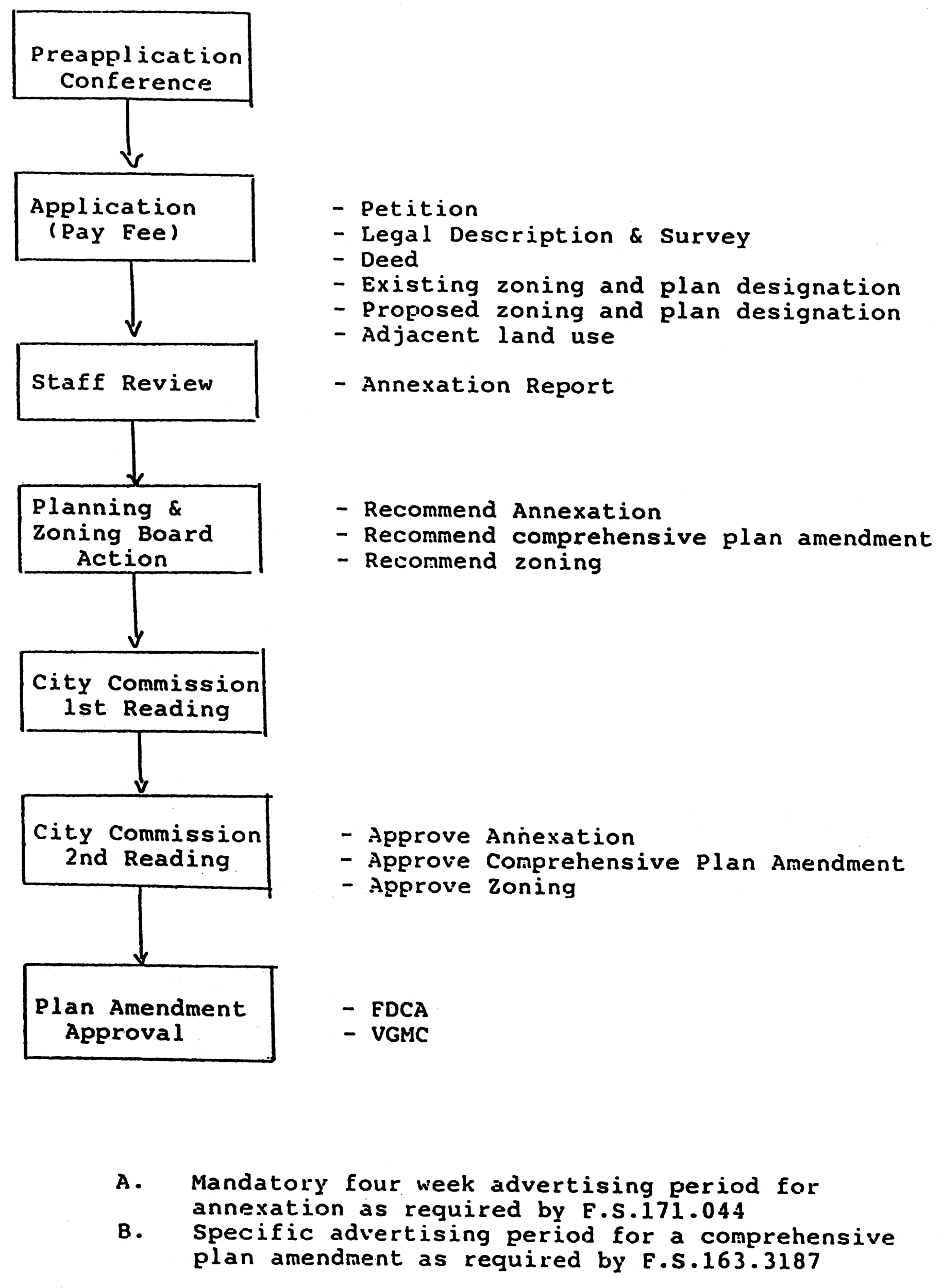
305.06. Annexations. The following sections set forth the procedural requirements to annex property into the City of New Smyrna Beach:
A.
Preapplication meeting. Any person proposing to voluntarily annex property into the city must meet with the city planner prior to submitting an application. The purpose of the preapplication meeting is to acquaint the applicant with the annexation procedures and to inform the city about the property to be annexed.
B.
Application for annexation. The application for annexation shall include the items listed below and provide any other information material to the annexation decision:
(1)
A petition for annexation signed by all owners of the property to be annexed.
(2)
A boundary survey and legal description identifying the site acreage, any easements and the portion of the property contiguous with the city limits.
(3)
A copy of the warranty deed for all properties to be annexed.
(4)
The existing zoning and comprehensive plan designation under the Volusia County regulations.
(5)
The proposed zoning and comprehensive plan designation under the New Smyrna Beach regulations.
(6)
Adjacent land use bordering the property to be annexed.
C.
Annexation review process.
(1)
Staff review. Upon receipt of the application, the staff shall prepare an annexation report which addresses the following issues:
a.
Consistency of the proposed annexation with the goals, objectives and policies of the comprehensive plan.
b.
Availability of municipal services to the property consistent with the city's adopted levels of service and plans for the extension of these services.
c.
Other impacts expected from annexation of the property and any other issues which have a bearing on the annexation.
(2)
Planning and zoning board review. The board, in its capacity as the local planning agency, shall hold a public hearing on the annexation petition and make a recommendation to the city commission which includes the following items:
a.
To approve, conditionally approve or deny the requested annexation.
b.
To amend the comprehensive plan to include the proposed parcel in the future land use element and amend any other elements of the plan which may be affected by the annexation.
c.
To assign the proper zoning to the parcel to be annexed.
(3)
City commission action. Upon receipt of the recommendation of the planning and zoning board, the city commission shall prepare an annexation ordinance and schedule a public hearing to consider the following actions:
a.
To approve, conditionally approve or deny the requested annexation.
b.
To amend the comprehensive plan to include the proposed parcel in the future land use element and amend any other elements of the plan which may be affected by the annexation.
c.
To assign the proper zoning to the parcel to be annexed.
(4)
Comprehensive plan amendment. Upon adoption of the annexation ordinance, the city shall initiate the comprehensive plan amendment approval procedures as required by F.S. § 163.3187 and the Volusia Growth Management Commission.
D.
Fees. The city commission shall establish by resolution, a schedule of fees for annexation and comprehensive plan amendment. The applicant for annexation shall pay the required fees at the time the application is filed. See Annexation Procedure Flow Chart attached hereto, marked as Exhibit "A."
EXHIBIT "A"
ZERO LOT LINE
(Ord. No. 26-03, §§ 1, 2, 5-27-2003; Ord. No. 51-04, § 1, 9-29-2004; Ord. No. 03-05, § 1, 2-22-2005; Ord. No. 54-10, § 1, 10-12-2010; Ord. No. 59-10, § 1, 12-14-2010; Ord. No. 73-12, § 1, 9-11-2012; Ord. No. 35-15, § 2, 4-14-2015; Ord. No. 19-18, § 1, 3-13-2018; Ord. No. 55-24, § 1, 1-14-2025)

