
New Smyrna Beach City Zoning Code
ARTICLE II
DEFINITIONS
Except where specific definitions are used within a specific article or section of this LDR for the purpose of such sections, the following terms, phrases, words, and their derivations shall have the meaning given herein when not inconsistent with the context.
Any words not specifically defined within this LDR shall assume the meaning as indicated in "Merriam-Webster's Collegiate Dictionary, Eleventh Edition, Copyright 2014, by Merriam-Webster, Inc.
201.00.- General definitions.
The following definitions shall apply to these regulations in general unless superseded by a definition pertaining to a specific article as indicated in sections 202.00 through 207.00 of these regulations:
Accessory building or structures. A subordinate building or structure which is located on the same lot as the principal building, the use of which building is clearly incidental to the use of the principal building.
Accessory use. A use customarily subordinate to the principal use or building and located on the same lot with such principal use or building. Accessory uses shall include patios, or porches enclosed by screening, and swimming pools.
Accommodations. Any hotel, motel, tourist court, roominghouse or rental unit intended to be used for transient persons or tourists for overnight lodging, or longer.
Administrative official. The municipal official appointed by the city manager to administer the Land Development Regulations.
Administrative variance. A modification of, or a deviation from, non-safety related land development regulations when project is utilizing established city design guidelines up to 15 percent of the required regulation, for residential and commercial properties.
Adult bookstore. A place which sells, or offers for sale, for any form of consideration, any one or more of the following:
(1)
Books, magazines, periodicals, or other printed matter, or photographs, films, motion pictures, videocassettes, slides or other visual representations or recordings, novelties and devices, which has as their primary or dominant theme matter depicting, illustrating, describing or relating to specified sexual activities or sexually related anatomical areas; or
(2)
Instruments, devices, or paraphernalia, which are designed for use in connection with specified sexual activities; and an adult bookstore includes a place with only a portion or section of its area set aside for the display or sale to adults of materials listed in subsection[s] (1) and (2) above except that any place, otherwise included within this definition, that derives not more than ten percent of its gross income from the sale of materials listed in subsection[s] (1) and (2) above, shall be exempt from the provisions of this definition so long as such material is kept in a location where it is not visible to the customers of such place. The burden shall be on the owner/operator of such premises to establish the "not more than ten percent gross income" threshold.
Adult congregate living/assisted living facility. Any institution, building, or buildings, residence, private home, boarding home, home for the aged, or other place, whether operated for profit or not, licensed with the state as an adult congregate living facility, which undertakes through its ownership or management, to provide for a period exceeding 24 hours, one or more personal services for four or more ambulatory persons, not related to the owner or administrator by blood, or marriage, who require such services. Personal services means services in addition to housing and food services, which include, but are not limited to, personal assistance with bathing, dressing, ambulation, housekeeping, supervision, eating, supervision of self administered medication, and assistance with securing health care from appropriate sources.
Adult day care center. Any building or buildings, or other place, whether operated for profit or not, licensed with the state as an adult day care center, which undertakes, through its ownership or management, to provide for a part of the 24-hour day, basic services to three or more adults, not related by blood or marriage, who require such services. These basic services are (1) a protective setting; (2) social activities; (3) leisure time activities; (4) self-care training; (5) rest or periods of relaxation; (6) nutritional services; and (7) physical and speech therapy; when possible and needed.
Adult entertainment establishment means that as defined in article IX of the LDR. The application of this term as a permitted use for purposes of this Code, shall include the definitions provided within article IX of the LDR.
Adult motion picture booth. An area within an adult motion picture theater designed for, or used for, the viewing by one or two persons of motion pictures which have, as their dominant or primary theme, matters depicting, describing or relating to specified sexual activities.
Adult motion picture theater. An establishment or premises which shows or displays to the general public or specific public (such as a club), movies or films which have as their primary or dominant theme, matter depicting and illustrating specified sexual activities or sexually related anatomical areas.
Affordable housing. Housing in which monthly rents or payments do not exceed 30 percent of the gross household income for people in the very low income category. "Very low income" category shall mean a household having a medium income of less than 50 percent median income within the Daytona Beach Metropolitan Statistical Area (MSA).
Alcoholic beverage. All beverages containing more than one percent of alcohol by weight. The percentage of alcohol by weight shall be determined in accordance with F.S. § 561.01(4)(b).
Alley. Any public right-of-way set aside for public travel at least ten but no more than 30 feet in width, intended to be used only as a secondary means of access for service to abutting properties and not intended for general traffic circulation.
Altered. Any change or rearrangement in the supporting members of an existing building, such as bearing walls, columns, beams, girders or interior partitions, as well as any change in doors or windows, or any enlargement to or diminution of a building or structure, whether horizontally or vertically, or the moving of a building or structure from one location to another.
Apartment. An apartment shall mean a customarily renter-occupied dwelling unit constructed as part of a group of three or more units which are attached by a common wall and located on land which is owned by others or the apartment management.
Apartment-garage: An attached or detached building containing a storage area designed for one or more motor vehicles and one single-family dwelling and shall not exceed two stories in height. Accessory building height restrictions must meet article VIII, section 803.01.
Apartment-garden. A garden apartment shall mean a customarily renter-occupied dwelling unit as part of a group of three, but not more than eight dwelling units, all of which are attached to the adjacent dwelling unit by common wall.
Applicant. Any person who submits to any city department plans, letters, or forms, for the purpose of obtaining approval of proposed development or action. The owner may designate an authorized applicant, if not same, to make application on behalf of the owner.
Arcade. An amusement center having more than six coin- or token-operated games which may have up to four pool or billiard tables and may have refreshments available but does not sell alcoholic beverages.
Area, building. The total area taken on a horizontal plane at the main grade level of the principal building and all accessory buildings exclusive of uncovered porches and steps.
Artificial light. Any source of light emanating from a manmade device, including, but not limited to, incandescent mercury vapor, metal halide, or sodium lamps, spotlights, street lights, construction or security lights.
Assembly, place of. An area with or without designated seating in which groups of people come together for a purpose.
Auditorium. A place of assembly whether entrance money is collected or not collected.
Automotive sales: The sale of new or used motor vehicles that includes all vehicles that are two or more wheels, trailer sales, and recreation vehicle sales.
Automotive sales area: An area used for display, sale or the rental of new or used motor vehicles and any vehicles with two or more wheels, trailers, and recreation vehicles in operable condition, and where no repair work is done. Automotive sales area cannot be located in the public right-of-way or required landscape buffer.
Automobile wrecking. The dismantling or disassembling of used motor vehicles or travel trailers or the storage, sale, or dumping of dismantled, partially dismantled, obsolete or wrecked vehicles or travel trailers.
Ballpark. A field with or without spectator seats or player seats in which baseball, softball, football, soccer, rugby, lacrosse, polo, field hockey, or any other field sport is played.
Bank or lending institution. A business establishment in which money is kept for savings or commercial purposes, or is invested, supplied for loans, or exchanged. This term shall include credit unions and similar establishments which typically include automatic teller machines (ATMs) and drive-through facilities.
Bar. Any place devoted primarily to the retailing and drinking of malt, vinous or other alcoholic beverages, or any place where any sign is exhibited or displayed indicating that alcoholic beverages are obtainable for consumption on the premises. The word "bar" shall include the words "saloon," "tavern," "pub," and "bar room."
Beach. That area of unconsolidated material along the Atlantic Ocean that extends landward from the mean low water line to the place where there is a marked change in material or physiographic form, or to the line of permanent vegetation (usually the effective limit of storm waves).
Beachside. All areas east of the intracoastal waterway including Bouchelle Island.
Bed and breakfast homes. A home or majority of a home that is at least 50 years old, with a kitchen and a central gathering area, not including a hotel, motel, lodge, or inn; wherein sleeping accommodations and at least one fresh meal prepared on site per day are provided for the lodgers. The sleeping accommodations must have interior egress through the home.
Beginning of construction. The incorporation of labor and material within the foundation of the building or buildings.
Billiard hall. An establishment with the primary purpose of playing pool or billiards and having more than three pool or billiard tables. Said establishment may also have electronic or other types of amusement games and/or a lounge.
Block. A tract of land bounded by streets or by a combination of streets and public parks, cemeteries, railroad right-of-way, shore lines of waterways, or boundary lines of a municipality.
Boarding kennel. An establishment for the breeding or shelter of domesticated animals for not more than six months.
Boat livery. A boat livery is a premises or site used as a commercial establishment for the provision of charter fishing boats, rental of covered or uncovered boat slips or dock space, or enclosed dry storage space, rental and/or sale of boats and boat motors, repair and maintenance of boats and boat motors, marine fuel and lubricants, bait and fishing equipment, on-shore restaurants, and small boat hauling or launching facilities. (Such premises or site shall not include boat and/or motor manufacturing as an incidental use.)
Boathouse, private. An accessory building on the same lot with a residence designed for the protection or storage of boats which shall not be used for temporary or permanent dwelling purposes.
Bowling center. An establishment which contains any of several games in which balls are rolled on a green or down an alley at an object or group of objects. The establishment may have any number of alleys and may also contain game rooms, restaurants and lounges, and meeting rooms.
Buildable area. That area within, and bounded by, the building lines established by the required yards and setbacks.
Building. Any structure having a roof supported by columns, or walls, and intended for use for a residence, business, industry, or other public or private purpose. For the purpose of this ordinance, mobile homes shall not be considered as a building.
Building coverage. That percentage of the lot area covered or occupied by principal and accessory buildings.
Building, front of. The side of a building, or structure, where the main entrance is located.
Building height: The vertical distance measured from the average elevation of the minimum required finished 1st floor grade along the front of the building to the highest point of the building or roof, excluding accessory operation equipment enclosed within the roof line. Stairways and elevator penthouses are excluded. Also, a screen to conceal facilities on the roof is excluded, provided the screen is not under roof, and is less than ten feet in height. The minimum required finished grade will be determined by the city engineer or their designee.
Building line. The line established by yard or setback requirements outside of which no principal building may be erected.
Building, manufactured. A closed structure, building assembly, or system of subassemblies, which may include structural, electrical, plumbing, heating, ventilating, or other service systems manufactured in manufacturing facilities for installation or erection, with or without other specified components, as a finished building or as part of a finished building, which shall include, but not be limited to, residential, commercial, institutional, storage, and industrial structures. This part does not apply to mobile homes. Manufactured building may also mean, at the option of the manufacturer, any building of open construction made or assembled in manufacturing facilities away from the building site for installation, or assembly and installation, on the building site.
Building, principal. The building in which the principal use conducted on a lot is situated.
Building setback line. The area within which a structure other than an incidental structure is allowed to be located.
Bulkhead line. An imaginary line established in, or along, the Atlantic Ocean, a river, watercourse, or other body of water, in order to fix and establish the maximum distance from the shoreline within which filling may be permitted.
Cafeteria. A place where food is obtained by self-service and eaten on the premises.
Carport. A covered structure used to protect automobiles or other vehicles and open on at least two sides, one of which, shall be used for vehicle entry. Any structure not falling under this definition shall be considered to be a garage and shall be equipped with a garage door.
Carwash. A building or portion thereof containing apparatus and facilities other than a faucet and hose for washing automobiles.
Change of occupancy. The term "change of occupancy" shall mean a discontinuance of an existing use and the substitution of a use of a different kind or class. Change in occupancy is not intended to include a change in tenants, or proprietors, unless accompanied by a change of use.
Change of use: The term "change of use" shall mean a change of permitted use as described by the land development regulation or when determined to be a change of use by the planning director or his or her designee.
Charter boat. A watercraft which is hired by a party for a specific purpose such as fishing and which is operated by an employee of the company which owns or leases the watercraft.
Chief building official. The city official designated as the chief building official for the City of New Smyrna Beach. The chief building official shall have the responsibility and authority to enforce this LDR.
City planner. The city planner shall have the responsibility and authority to administer this LDR.
Club, bottle. A place where alcoholic beverages are not for sale, but are served and consumed on the premises, to members and guests.
Club, country. A semipublic club which has a golf course.
Club/courts, tennis/racquetball. An establishment having tennis or racquetball courts. The establishment may also contain sports or health club facilities.
Club, night. A commercial establishment retailing alcoholic beverages for consumption on the premises, and in which, customer dancing is permitted, and where floor shows or entertainment, is provided for the customers.
Club, semipublic. An association of persons for some recreational, literary, political, or social purpose, or the like, catering exclusively to members and their guests, but not including groups organized to render a service customarily carried on as a business or groups organized for religious purposes. The term "semipublic club" shall include the terms "lodge," "service and fraternal orders," and "societies."
Club, sports or health. Facilities offering numerous types of fitness activities, including weight training, aerobics, jazzercise, saunas, running, and body building.
College level and adult educational facility. A state-supported institution of higher education which offers work above the public school level, authorized and established by law together with all activities and services authorized by law to be administered by or through said institution.
Commercial establishment. An operation having financial profit as the primary aim by the exchange or buying and selling of commodities or services with the general public.
Commercial vehicle. Any vehicle designed, intended, or used for transportation of people, goods, or things, other than private transportation of goods, and boats.
Commission, city. The city commission shall mean the city commission of New Smyrna Beach, Florida.
Comprehensive plan. A document including text, maps, tables, and goals, objectives and policies intended to guide the city's future growth and development. This document shall meet the requirements of F.S. ch. 163.
Conditional use. A use permitted in a particular zoning district when it is shown that such use in a specified location will comply with all the conditions and standards for the location or operation of the use as specified in the zoning ordinance and authorized by the approving authority.
Condominium. A condominium is a form of ownership from the inside wall inward and is customarily constructed as part of a group of three or more units which are attached by a common wall and located on land that is owned by the condominium management.
Condominium garage. A condominium structure consisting of one or more units, the principal purpose of said structure being for the storage of automobiles and not associated with a residential building on the same site.
Conforming. Term used in conjunction with lots, uses, and structures that are in accordance with, or meet, the minimum requirements of the regulations contained herein.
Container or shipping container building. Any building, home, or office which has been constructed from an intermodal container or shipping container. These type of buildings are prohibited as permanent structures within the city limits of New Smyrna Beach.
Convenience store. A one-story, retail store containing less than 2,000 square feet of gross floor area that is designed and stocked to sell primarily food, beverages and other household supplies to customers purchasing only a relatively few items (in contrast to "supermarkets"). It is designed to attract and depends upon large volume stop and go traffic. Illustrative examples of convenience stores are those operated by "7-11," "Circle K," and "Jiffy." This definition includes convenience market.
Crosswalk. A right-of-way within a block dedicated to public use and intended for pedestrians.
Day care center. A premises where more than five children, other than members of the immediate family occupying the premises are kept under supervision. The term "day care center" includes child day care centers, day nurseries, kindergartens, day care services, day care agency, nursery school, play school, preschool, or any other terms indicating that children are under day care control. This term does not include family day care homes as defined in F.S. § 402.302.
Developer. Any person engaged in developing or improving a lot or group of lots for use or occupancy.
Development. The division of a parcel of land into three or more parcels; the construction, reconstruction, relocation, additions, or structures accessory to an existing structure provided said addition or accessory structure exceeds 500 square feet; any clearing, mining, excavation, landfill disturbance, stormwater alteration, and any use or extension of the use of land. A lot prepared for open space shall also constitute development. However, erecting a fence and cutting the grass, planting flora or trimming vegetation to keep a good appearance of a lot, shall not constitute development.
Development order. Permission from a governing agency with or without conditions, to begin development of property.
District. A portion of the territory of the City of New Smyrna Beach in which certain uniform regulations and requirements, or various combinations thereof, apply under the provisions of this LDR.
Driveway. A private roadway providing access for vehicles to a parking space, garage, dwelling, or other structure.
Dwelling. A house, apartment, or building, primarily designed for human habitation and containing housekeeping and cooking facilities. The word "dwelling" shall not include units in a "hotel," "motel," "tourist court," "roominghouse," "cabin," "tent," or "bed and breakfast home."
Dwelling, attached. One or more dwelling units attached to a nonresidential use.
Dwelling, detached. A dwelling unit which is entirely surrounded by open space on the same lot.
Dwelling, manufactured. A dwelling fabricated in a manufacturing facility and bearing a seal certifying it is constructed to standards as adopted under the authority of F.S. part IV, ch. 553 and rules adopted by the Florida Department of Community Affairs under F.A.C. ch. 9B-1 et seq.
Dwelling, multi-family. A building containing three or more dwelling units. The word "multi-family dwelling" includes, but is not limited to, apartments, single-family attached, and townhouses. The word "multi-family dwelling" does not include the word "transient lodging."
Dwelling, single-family. A detached dwelling unit designed for, or occupied by, one family, and having one housekeeping and cooking facility for one family.
Dwelling, single-family attached. A dwelling unit designed for, or occupied by, one family with housekeeping and cooking facilities for one family, which is separately wired and metered, and is attached or joined structurally to another dwelling, and may be sold separately from other dwellings in the same structure, including townhouses, and patio homes.
Dwelling, two-family. A dwelling designed for, or occupied by two families, and having one housekeeping and cooking facility for each family. The word "two-family dwelling" includes the word "duplex."
Dwelling unit. A building, or portion of a building, designed for, or occupied by, one family and having one housekeeping and cooking facility for the exclusive use of the family.
Easement. A grant by a property owner for the use of land for a specific purpose.
Eaves. That part of a roof which projects over the side wall; a margin or lower part of a roof hanging over the wall.
Enclosed. A portion of a building having walls whether the walls extend partially or wholly from the floor to the ceiling or roof. Screening of any type, whether moveable or collapsible, shutter and shades shall be considered walls.
Erect. Erect shall mean to build, construct, reconstruct, move upon or make any physical operations required for building on the premises. Excavations, fill, drainage, and the like, shall be considered a part of erection.
Essential services. The erection, construction, alteration or maintenance, by public utilities or municipal or other governmental agencies of underground or overhead gas, electrical, steam, or water transmission or distribution systems, collection communications, supply or disposal systems, including poles, wires, mains, drains, sewers, pipes, conduits, cables, fire alarm boxes, police call boxes, traffic signals, hydrants and other similar equipment and accessories in connection therewith, reasonably necessary for the furnishing or adequate service by such public utilities or municipal or other governmental agencies or for the public health, safety or general welfare.
Family. One or more persons related by blood, marriage, adoption, or guardianship, or not more than four persons not so related, living in one household.
Fence. A structure that encloses an area, typically outdoors, and is usually constructed from posts that are connected by boards, split rail, chain link, picket, vinyl, wrought iron, or rails. A fence differs from a wall in not having a contiguous solid foundation along its whole length. Prohibited materials: No such fence shall be constructed of electrically charged materials, barbed wire (except as approved by city commission), rubble, scrap iron, bottles, junk and any other like materials.
Fence side. All solid fences that have a structural component such as cross bracing tension rods, support members, etc. as part of the fence structure, the structural component must face inward to the applicant's property.
Fence/wall height. The vertical distance measured from the finished grade of the property located immediately outside of the fence. In case a fence is located in a yard setback or on a property line, the height will be measured from the existing (unaltered) finished grade of the neighboring parcel or lot. Property with elevations varying greater than one foot vertical, measured height is relative to the finish grade in immediate area.
Financial services. An establishment engaged in the management of money and credit, and may include but not be limited to accounting, bookkeeping, investment securities, money transfer, mortgage loans, pension plans, stock and bond brokerage, and tax planning. This term would not include the term "bank."
Flag. Any material, usually made of fabric, which usually contains a symbol (such as a business or jurisdiction).
Floodlight. Reflector-type light fixture which is attached directly to a building and which is unshielded.
Floor area, residential. The sum of the gross horizontal areas of the several floors of a building excluding cellar and basement floor area not devoted to residential use, porches, patios, breezeways, carports, sun porches, or other similar structural additions that are unenclosed or enclosed with mesh screen. Floor area shall be measured from the exterior faces of exterior walls and shall exclude attic areas having less vertical distance than seven feet, unenclosed stairs, fire escapes, elevator structures or other accessory apparatus.
Food, prepared. Items intended to be eaten on or off the premises in which they are served and which are altered in some way on the premises in which they are served. Altered shall mean cooked, warmed, wrapped, assembled, seasoned, mixed with other edible items, baked, fried, barbecued, broiled, or a combination of the above. Prepared food shall not include popping popcorn; previously wrapped candy, potato chips, pretzels, or similar food; or any food sold in a convenience type market or gas station.
Fortune telling. A business providing prediction, psychic, paranormal, augury, or divination services through any means.
Frontage, building. The width of a building along a roadway whether the portion of the building is the front facade, side, or rear of the building.
Frontage, street. The length of the front property line of the lot, lots, or tract of land abutting a public or private street, road, highway, or other right-of-way.
Future land use map. A map contained within the comprehensive plan which indicates the generalized future land use designation of land within the city.
Garden wedding venue. An outdoor landscaped and/or natural area which may include patios or decks, gazebos, and other covered spaces, which is used to accommodate weddings, parties and other social events.
Golf course. An area of land laid out for the game of golf with a series of nine or 18 holes each including tee, fairway, and putting green, and often one or more natural or artificial hazards such as a sand trap or pond.
Grade. The slope of a road, street, or other public way, specified in percent.
Grade, finished. The completed surface of lawns, walks, and driveways brought to grade as shown on the plans or designs relating thereto.
Gross acreage. The total acreage of a site which is above the mean high water or mean high tide line of any natural water body.
Gross leasable area. The total area within a building including all floors, restrooms, offices, showrooms, storage areas, meeting rooms, restaurant areas, and hallways. Uncovered or partially covered ancillary areas shall be included as gross leasable area.
Home occupation. An accessory use permitted in residential districts as provided in the supplementary regulations.
Hospital. An institution where the sick or injured are given medical or surgical care. Patients may stay at the institution for extended periods of time such as weeks or months.
Hotel. A building designed to provide sleeping room accommodations for transient guests and licensed by the Florida Department of Business Regulation, Division of Hotels and Restaurants, Bureau of Hotels and Restaurants, as a hotel. This definition shall not include bed and breakfast establishments.
House of worship. A body of persons associated together for the purpose of maintaining religious worship, and/or the building in which persons habitually assemble for religious purposes and public worship and including customary accessory uses.
Housekeeping and cooking facility. A kitchen containing an oven, stove, refrigerator, and sink.
Impervious materials. Materials which do not allow free flow of water. Impervious materials include asphalt, cement, and roofed structures. For the purposes of calculating the amount of impervious area, porous cement, porous paver blocks, and other porous materials approved by the city engineer shall be assumed to be 80 percent impervious.
Improvement. See Development.
Improvement, public. Any sanitary sewer, storm sewer, drainage ditch, water main, roadway, parkway, sidewalk, pedestrian way, planting strip, off-street parking area, or other facility for which the city may ultimately assume the responsibility for maintenance and operation.
Improvements, required. Any utility system, water management structure, trafficway, whether pedestrian or vehicular, site construction, or any other nonbuilding improvements associated with a subdivision or site plan.
Incidental uses, nonresidential. Accessory structures located on a nonresidential lot which may or may not be permanently fixed in the ground but can be removed. Incidental uses include outdoor light poles, trellises, mail boxes, flag poles, minor steps, planters, park type benches, tables and chairs for refreshments or dining, fences or walls, statues, landscaping or lawn sprinklers, signs, newspaper boxes, telephone stands, and similar objects. Storage sheds, garages, porches, gazebos, patios, and other large structures shall not be construed as incidental uses.
Incidental uses, residential. Accessory structures located on a residentially used lot which may or may not be permanently fixed in the ground but can be removed. Incidental uses include park type benches, bird baths, clothes line poles, outdoor light poles, trellises, mail boxes, planters, flag poles, minor steps, fences or walls, statues, lawn or landscaping sprinklers, signs identifying occupant and address, and similar objects. Incidental uses may be located within required yard areas unless deemed inappropriate to locate in a required yard by the city planner. Gazebos, doghouses, porches, swimming pools, storage sheds, patios, garages, fixed outdoor grills, major steps, and other large structures shall not be construed as incidental uses.
Industry. Any activity involving the manufacturing or treatment of any commodity including the assembly, packaging, canning, bottling, or processing of any item. To change any commodity in composition for size, shape, texture, or appearance, is deemed to be an industrial process.
Industry, light. Light manufacturing, assembly, processing raw materials, repairing, research, storage, wholesaling and distributions, retailing of permitted uses, and closely related light industrial uses, in which all operations, other than transportation are performed entirely within enclosed buildings, and are not obnoxious because of dirt, smoke, odor, noise, vibration, radioactivity, or explosive capability.
Industry, heavy. Heavy manufacturing, assembly, processing raw materials, repairing, research, storage, wholesaling and distribution, retailing of permitted uses, and closely related having industrial uses, in which all operations, other than transportation, may be performed within enclosed buildings or in open storage areas subject to performance standards imposed by all applicable governmental agencies.
Industry, industrial park. Planned manufacturing developments, assembly, processing, raw materials, repairing, research, airports, wholesaling, and distribution, retailing of permitted uses and closely related supportive industries, in which all operations may be performed within the enclosed buildings or in open storage areas, subject to restrictive covenants and performance standards applying specifically to industrial park operations and performance standards imposed by all other applicable governmental agencies. Open storage areas are screened to minimize adverse visual impact to other industrial park operations and/or community. Hazardous, noxious, or offensive conditions are not permitted. This definition includes industrial subdivisions.
Intermediate care facility. A facility designed to care for persons often nonambulatory and/or mentally or physically handicapped. Said facility must be licensed by the department of health.
Intoxicating beverage. Any alcoholic beverage, including beer and wine, containing more than 3.2 percent of alcohol by weight.
Junkyard. A lot or land area where used or secondhand materials are bought, sold, exchanged, stored, baled, packaged, packed, disassembled or handled including, but not limited to, scrap iron and other metals, cloths, paper, rags, plumbing fixtures, rubber tires, and bottles. The word "junkyard" includes the words "automobile wrecking yard" and "salvage operations or yard."
Kennel. An establishment or building used to temporarily board domesticated animals which are normally considered pets, and which may provide any or all of the following related accessory uses:
(1)
Overnight pet boarding. The short or long-term keeping and caring for pets in a commercial facility not associated with an animal or veterinary clinic, with an outdoor controlled environment for exercise and play, accessible to the pets between the hours of 7:00 a.m. and 9:00 p.m.
(2)
Pet daycare. A place where pets are exercised, socialized, trained, or groomed on a daily basis.
(3)
Pet training. The process of training pets for skills including obedience, agility, hunting, protection, or socialization,
(4)
Pet grooming. Bathing, clipping, combing pets for the purpose of maintaining their health, while enhancing their aesthetic value.
Library. A place in which literary, musical, artistic, or reference materials such as books, manuscripts, recordings, or film, are kept for use but not for sale.
Livable area. The area within a dwelling unit excluding the garage, storage shed, or screen enclosure.
Location. Any lot, premises, building, wall, or any place whatsoever upon which a sign or any other structure is located.
Long-term rental. Rental of a dwelling unit for 30 days or more.
Lot. A parcel or tract of land officially recorded in Volusia County which has been designated as a part of a recorded subdivision or has been described by metes and bounds description. No part under water or within the limits of street right-of-way shall be used when determining lot area.
Lot, atypical. A lot within a recorded subdivision where, as a result of subdivision design, the lot abuts a public right-of-way at one end and any of the following at the opposite end: (a) the Atlantic Ocean; (b) a waterway or waterbody at least 50 feet in width; (c) a golf course fairway or green; and (d) an open space area which by itself, or when combined with other open space areas within the same subdivision, comprises at least 15 percent of the total land area in said subdivision, and where an undivided interest is conveyed on each lot.
Lot, corner. A lot abutting two or more streets at their intersections.
Lot, depth. The average horizontal distance between the front and rear property line measured perpendicular to the front property line.
Lot, improved. A lot that has been developed.
Lot line. A line of record bounding a lot which divides one lot from another lot or from a public or private street or any other public space.
Lot line, front. The lot line separating a lot from a street way.
Lot line, rear. The lot line opposite and most distant from the front lot line; or in the case of triangular or otherwise irregularly shaped lots, a line ten feet in length entirely within the lot, parallel to and at a maximum distance from the front lot line.
Lot of record. A lot of record is (1) a lot designated as a part of a recorded subdivision, or (2) a lot or parcel described by metes and bounds, the description of which has been recorded. In either instance, the lot must have been recorded in the Office of the clerk of the circuit court of Volusia County on or before November 9, 1971, which is the effective date of Ord. 832.
Lot, through (double frontage). A lot which has a pair of opposite lot lines along two substantially parallel streets, and which is not a corner lot. On a "through lot" or "double frontage lot" both street lines shall be deemed front lot lines.
Lot width. The perpendicular distance between the side property lines of a lot measured along the front and rear setback lines or the chord distance of the arc measured on a cul-de-sac or road curve at the front yard setback line.
Low profile luminaire. Light fixture set on a base which raises the source of the light no higher than 48 inches off the ground, and designed in such a way that light is directed downward from a hooded light source.
Mainland. All areas west of the intracoastal waterway including the north causeway.
Major tenant. A tenant that serves as a major store (anchor) in a shopping center and occupies more gross leasable area than supplementary tenants. Major tenants are generally placed at each end of a strip or mall so that to reach them shoppers must walk past the store fronts to supplementary tenants.
Manufacturing. See Industry.
Marina. A marina is a commercial establishment with a waterfront location for docking pleasure boats or providing services to pleasure boats and the occupants thereof; including servicing and repair to boats; sale of fuel and supplies and providing for food and beverages as accessory uses. A hotel, motel, or similar use, with docking boats and provision of services thereto, shall not be considered a marina, nor shall boat docks accessory to a residential project where no boat related sales or services are rendered be considered a marina. (Such premises or site shall not include boat and/or motor manufacturing as an incidental use.)
Master planned unit development (PUD) development agreement (MDA). An agreement between the city and owners of a land which will be developed under the planned unit development (PUD) zoning regulations.
Miniature golf course. A golf course which has no fairway, is intended for putting only, and has no less than nine holes. A private golf course in which no charge whether credit or cash is required to enter does not constitute a miniature golf course.
Mobile food dispensing vehicles. Means any vehicle that is a public food service establishment and that is self-propelled or otherwise movable from place to place and includes self-contained utilities, including, but not limited to, gas, water, electricity, or liquid waste disposal.
Mobile home. A structure, transportable in one or more sections, which is eight or more feet in width and 35 or more feet in length, is built on an integral chassis, and designed to be used as a dwelling when connected to the required utilities including plumbing, heating, air-conditioning, and electrical systems contained therein. This definition shall not include a manufactured dwelling.
Mobile home park. A land area of at least five acres in size which is divided into mobile home spaces that are rented or leased to owners or possessors of mobile homes.
Mobile home space. An area within a mobile home park which is leased or rented to a mobile home occupant.
Mobile home subdivision. A land area which has been subdivided according to the MH-2 district requirements and is intended for mobile home or manufactured building placement on individually owned lots.
Motel. One or more buildings containing sleeping units for transients, with automobile parking spaces provided in connection therewith, and with individual access to the outside parking area. The word "motel" includes the following: motor court, motor hotel, motel lodge, and tourist court.
Motorcycle safety instruction. An instructional program that teaches adults to ride street-legal motorcycles through hands-on practice and field instruction.
Net acreage. Net acreage consists of the total acreage within a site, excluding the following:
(1)
Acreage below the mean high water or mean high tide line of any natural water body;
(2)
Lands within the beach/dune system;
(3)
Wetlands as they exist prior to development or mitigation;
(4)
Public rights-of-way in existence prior to development;
(5)
Acreage to be dedicated or reserved for public use, such as parks and public facilities (e.g., utility sites, schools), but not including public roads, stormwater ponds, and related public site infrastructure lands; and
(6)
Acreage to be dedicated to other uses (commercial, office, industrial, institutional).
New development. Shall include new construction and remodeling of existing structures when such remodeling includes alteration to the exterior of the building.
Nonconforming lot. A lot which does not meet the minimum size requirements of this LDR except as provided in section 504.01J. of this LDR.
Nonconforming structures. A structure or portion thereof, existing at the effective date of this ordinance or any amendment thereto, which was occupied, designed, erected, intended, or structurally altered, for a use not permitted at its location by the provisions of this ordinance, and/or for a new use which does not conform to all of the regulations applicable to the district in which it is located.
Nonconforming use. The use of a structure or premises existing at the effective date of this ordinance, or any amendment thereto, for any purpose not permitted for a new use in the district in which it is located.
Nursing homes. A home for aged, chronically ill, or indigent people, licensed with the state as a nursing home, in which persons not of the immediate family of the occupant are received, kept, or provided with food and shelter or care for compensation and where registered or practical nurses are on duty 24 hours each day to provide nursing care and administer medicines, but not including hospitals, clinics, or similar institutions devoted primarily to the diagnosis and treatment of the acutely ill.
Office building, general. A structure which contains individual working areas for professional, technical, or clerical employees, but not medical or dental employees.
Office building, government. An office building for persons whose employer is a federal, state, county, or municipal entity.
Office building, medical/dental/psychology/psychiatry. An office building for persons in the medical, dental, psychological, and psychiatric fields.
Official zoning map. A map which graphically illustrates the boundaries of each zoning district and is officially adopted as the official zoning map by the city commission.
Off-street loading space. A space for loading or unloading located on the same lot with a building, or contiguous to a group of buildings, for the temporary parking of a commercial vehicle while loading or unloading merchandise or materials which abuts upon a street, alley, or other appropriate means of access.
Off-street parking space. A permanently surfaced area for the parking of a motor vehicle. Such space shall have a minimum width of ten feet and a minimum length of 20 feet. No parking space which requires backing into a public or private right-of-way shall be considered an off-street parking space.
Open space. That portion of net land area not used for street right-of-way; off-street automobile parking and driveways; off-street loading; and maximum building lot coverage. Bicycle, walking and jogging paths, and other recreational facilities, plazas, undevelopable lot areas and stormwater management areas outside of rights-of-way shall be considered open space.
Open space, common. A commonly owned area of land reserved primarily for the leisure or recreational use of the owners of a residential development. Community pools, golf courses, parks and other outdoor spaces intended for use by the residents of a PUD shall be considered common open space.
Operable condition: Where the condition of a motor vehicle, recreation vehicle, vehicle with two wheels or more, and a trailer of any kind is in a condition where that said vehicle or trailer is mobile, with inflated tires and can be operated on a street or highway.
Owner. Any person, group of persons, firm or firms, corporation or corporations, or any other legal entity having legal title to the land sought to be developed or redeveloped under this ordinance.
Package store. A place of business where at least 51 percent of the gross revenue is derived from the sale of alcoholic beverages sold only in sealed containers for consumption off the premises. For the purposes of this definition, a place of business that sells only beer and/or wine shall not be considered a package store.
Pain management clinic. Any publicly or privately owned facility:
(1)
That advertises in any medium for any type of pain-management services; or
(2)
Where in any month a majority of patients are prescribed opioids, benzodiazepines, barbiturates, or carisoprodol for the treatment of chronic nonmalignant pain.
Expressly exempted from this definition are hospitals, nursing homes, ambulatory surgical care centers, hospice or intermediate care facilities for the disabled, and clinics which are affiliated with an accredited medical school at which training is provided for medical students, residents and/or fellows.
Parking lot. A lot where motor vehicles are parked or stored temporarily but not including the wrecking of automobiles or storage of new or used cars for sale, services, rental, or any other purpose other than specified.
Penthouse. An enclosed area upon a roof of a building occupying not more than an aggregate area of 30 percent of the roof and not used for purposes other than sheltering mechanical equipment, elevators, stairways, or other accessory equipment.
Person. Any individual, firm, association, joint venture, partnership, estate, trust, syndicate, fiduciary, corporation, group, or unit of federal, state, county, or municipal government.
Personal enrichment establishments. Businesses which are neither retail sales nor retail services but are engaged in bettering one's ability in a specialized field such as health clubs, martial arts studios, aerobics or jazzercise studios, dance studios or businesses which teach a specialized trade or art such as computer operation, musical instrument lessons, typing lessons or similar businesses.
Personal services. An establishment which provides for the care of a person or a person's apparel, and may include, but not be limited to, beauty/barbershop, nail salon, tanning salon, laundry, dry cleaning (retail store), garment service, and shoe repair.
Pet grooming. Any place or establishment, public or private, where animals are bathed, clipped, or combed for the purpose of enhancing their aesthetic value or health and for which a fee is charged.
Pet shop. A retail sales establishment primarily involved in the sale of domestic animals. such as dogs, cats, fish, birds, and reptiles, excluding exotic animals and farm animals such as horses, goats, sheep and poultry.
Place of assembly use. A place of assembly is an event location or facility permitted to have different events including art shows, concert halls, theatrical play or musical, dance studio including instruction and competition, wedding venue, or other public or private events. This use is a special exception use in the I-1, Light Industry and MU, Mixed Use zoning districts.
Pharmacy. A location where medicinal drugs are compounded, dispensed, stored, or sold or where prescriptions are filled or dispensed on an outpatient basis.
Planned unit development. A tract of land which is developed as an integrated unit under single ownership or control, which may include a mixing of residential building types ranging from single-family to multifamily dwellings and supporting related land uses comprised of institutional, business, office, industrial, or recreational facilities. Or, a planned unit development may consist of a combination of any of these land uses or only one land use.
Planning and zoning board. Planning and zoning board shall mean the New Smyrna Beach Planning and Zoning Board.
Plat. A map or drawing depicting the division of land into lots, blocks, parcels, tracts, sites, or other divisions.
Pole lighting. Light fixture set on a base or pole which raises the source of the light higher than 48 inches off the ground.
Premises. A parcel or lot of property, or any combination of parcels or lots; except that in the case of a business having in excess of 250 feet of continuous road frontage, in which such case, each 250 feet of road frontage shall constitute one premises for the purpose of this ordinance. For example. A new car dealership with 500 feet of road frontage would constitute two premises for the purpose of this ordinance.
Public body. Any government or governmental agency of the City of New Smyrna Beach, Volusia County, the State of Florida, or the United States.
Public use. The use of any land, water, or buildings by a municipality, public body, or board, commission or authority, county, state, or federal government, or any agency thereof for a public service or purpose.
Recreation, active. A leisure activity in which a considerable amount of physical energy is exerted and which capital facilities are required. Active recreation includes, but is not limited to, playing field sports such as baseball, soccer and football, playing court sports such as tennis, basketball, racquetball, or shuffleboard, swimming in a public or semipublic pool, jogging or exercising on an improved jogging trail, and exercising stations.
Recreation center. A building for which sporting events, social events, fund raising events, educational classes, and exercise classes are held.
Recreation complex. An area within a subdivision which usually contains a pool, clubhouse, shuffleboard courts, limited parking, sun deck, and may contain other recreational facilities. The complex is usually intended for residents and guests of a particular residential development. The complex is nonprofit and paid for by association fees.
Recreation, passive. A leisure activity in which little physical energy is exerted and few capital facilities are provided. Passive recreation includes, but is not limited to, walking on an improved trail, sitting on park benches, picnicking on picnic tables, enjoying various flora and fauna, and fishing from a boat or from shore.
Recreational equipment, major. Boats and boat trailers, travel trailers, pickup campers or coaches (designed to be mounted or towed on automotive vehicles), motorized dwellings, tent trailers, and similar equipment.
Recreation[al] equipment, minor. Swing sets and other playground equipment, court related equipment such as tennis, racquetball, volleyball and basketball courts, horseshoe pit equipment, canoes and other small boats less than 15 feet in length and not requiring a trailer for transport, bicycles, motorcycles, surfboards, and other smaller lightweight equipment, generally used for enjoyment in the out-of-doors.
Remodel. An interior or exterior alteration, structural alteration, conversion of a structure, additions, or accessory structures to existing structure provided said addition or accessory structure is less than 500 square feet would not constitute a development.
Research center. Buildings or groups of buildings devoted nearly exclusively to research and development of various subjects and products. Said buildings contain some offices and some light fabrication but the primary function is research and development.
Residential density, gross. The total number of residential dwelling units divided by the gross residential acreage of the project (see section 504.01, general regulations, for density calculation methodology).
Residential density, net. The total number of residential dwelling units divided by the developable/net residential acreage of the project (see section 504.01, general regulations, for density calculation methodology).
Residential development. Any multifamily or single-family housing project that is approved by the planning and zoning board. Phasing of a project shall not constitute a separate residential development for the purpose of sign standards, unless the phase shall bear a separate name.
Restaurant. A building or room, not operated as a dining room in connection with a hotel, where meals, or prepared food, including beverages and confections, are served to customers. Restaurants are hereby classified as follows:
Type A. Restaurants with dining tables and counter stools having all service indoors and providing no service to persons in vehicles or at walkup windows.
Type B. Restaurants dispensing food from service windows for consumption on or off of the premises which specializes in short order foods and beverages.
Type C. Restaurants serving food and/or beverages to persons in their vehicles for consumption in their vehicles on the premises.
Type D. Restaurants serving food and beverages to persons sitting at tables or bars which are located outside of the principal structure. Type D restaurants may also serve to persons inside the principal or accessory structure.
Restaurant, family. A restaurant which may serve beer and wine but which does not serve liquor and has no bar or lounge. These restaurants are intended for the entire family, and have service directly at the table.
Restaurant, fast food. A type A, B, C, or D restaurant which usually does not serve customers at the table but serves at a counter which customers walk to pay for packaged food items, and either seat themselves or take the food out. This is a high volume restaurant which requires more seating then family or quality restaurants.
Restaurant, quality. A restaurant which serves beer, wine, and liquor, and has a lounge or bar. Quality restaurants require more parking than family restaurants but less parking than fast food restaurants.
Retail, big box. A retail sales establishment (including retail department stores, retail discount stores, retail hardware/paint/home improvement stores, and retail shopping center, as defined herein) consisting of a single tenant building of 80,000 square feet or more of total gross floor area.
Retail, department store. A retail establishment which devotes certain areas to a particular type of retail item such as automotive, mens clothes, shoes, lingerie, etc. department stores are typically chains such as K-Mart, Wal-Mart, J.C. Penneys, etc.
Retail, discount store. A freestanding retail establishment having a theme of low priced merchandise, either food items or appliances. Said stores include but are not limited to Service Merchandise, Discount City, etc. Parking requirements for discount stores are greater than regular retail establishments.
Retail, hardware/paint/home improvement store. A retail establishment selling items intended to improve the home such as plumbing.
Retail, planned shopping center. A shopping center containing at least one anchor store such as a department store, discount store, or a supermarket and containing greater than 20,000 square feet of gross leasable area.
Retail sales and services. The duly licensed selling of general or specialized merchandise directly to the consumer from the store, shop, or similar building. The maintenance, repair, installation, servicing, and minor manufacturing of that merchandise is allowed as an accessory use to the permitted sales. Said minor manufacturing shall be conducted without the use of significant industrial equipment and in a manner that will not produce significant amounts of noise, vibration, odor, smoke, or fumes. Retail items sold may also be rented or leased. Services are useful forms of labor that do not produce a tangible commodity such as maintenance and repair, a cleaning establishment, a laundromat, or a facility that provides some public demand as parcel packaging, shipping and delivery, notary public, mail forwarding and holding, and similar functions. This definition does not include a flea market or curb market. Pet grooming businesses that occupy 25 percent or less of an individual leased floor area of a unit, with the capacity of ten pets or less, using soundproofing and/or sound absorbing material to completely block sounds coming from the pet grooming businesses, that meet the requirements of Chapter 1207 of the Florida Building Code and ASTME90, will be considered a retail service.
Right-of-way. A strip of land occupied or intended to be occupied by a street, crosswalk, railroad, electric transmission line, oil or gas pipeline, watermain, sanitary or storm sewer main, or for another special use. The usage of the term "right-of-way" for land platting purposes shall mean that every right-of-way hereafter established and shown on a plat is to be separate and distinct from the lots or parcels adjoining such right-of-way, and not included within the dimensions or areas of such lots or parcels. Rights-of-way intended for streets, crosswalks, watermains, sanitary sewers, storm drains, or any other use involving maintenance by a public agency shall be dedicated to public use by the maker of the plat on which such right-of-way is established.
Right-of-way line. A line designated as the boundary of a right-of-way.
Roller/ice skating rink. An establishment containing an area which is intended for ice or roller skating. Said establishment may also dispense refreshments and contain amusement games and a lounge.
Roof line. The juncture of the roof and the perimeter wall of the structure.
Roominghouse. A residential building used, or intended to be used as a place where sleeping or housekeeping accommodations are furnished or provided for pay to transient or permanent guests or tenants in which less than ten and more than three rooms are used for the accommodations of such guests or tenants which may maintain a dining room in the same building servicing only residents and regular boarders. The word "roominghouse" includes the words "boardinghouse" and "lodginghome."
Screen pool enclosure. A structure constructed over a swimming pool and surrounding pool deck which has walls and a roof composed of screen. Enclosure with a solid roof shall be considered a screen room.
Seawall. A retainer wall or structure designed to prevent the erosion of land by water action or acts of nature.
Self-service laundry. A business rendering a retail service by making available to retail customers, for a charge at a fixed location and structure, equipment for washing and drying laundry.
Semipublic body. Any organization operating as a nonprofit activity and serving a public purpose or service including such organizations as noncommercial clubs, lodges, theater groups, recreational and neighborhood associations, cultural organizations, schools, and churches.
Service station, type A. A business primarily engaged in servicing motor vehicles, but limited to:
(1)
Sales of automotive fuels, lubricants, and accessories.
(2)
Sales, service and maintenance of spark plugs and batteries.
(3)
Maintenance of lubrication systems including replacement of lubricants and filters.
(4)
Replacement of minor part items such as light bulbs, fuses, floor mats, seat covers, windshield wipers and wiper blades.
(5)
Washing, polishing, and detailing services, sales of automotive washing and polishing materials, but not car washes.
Service station, type B. A business primarily engaged in servicing motor vehicles, but limited to:
(1)
All activities allowed by a type A service station.
(2)
Tire servicing, installation and repair, but not recapping or regrooving.
(3)
Windshield repair and replacement.
(4)
Mechanical repair that does not require the removal of the transmission, engine, heads, or crankcase. This includes, but is not limited to, engine tune ups and repairs to: exhaust, HVAC, brakes, cooking system, alignment, electrical system, and fueling systems.
Service station, type C. A business primarily engaged in servicing motor vehicles, but limited to:
(1)
All activities allowed by a type B service station.
(2)
Tire servicing including recapping and regrooving.
(3)
Transmission repair involving the removal, disassembly or reassembly of the transmission.
(4)
Engine rebuilding, reconditioning, or repair involving the removal of the engine, heads, crankcase.
(5)
Collision service including body, frame or fender straightening or repair.
(6)
Painting or paint shop.
(7)
Repairs requiring welding.
(8)
Work involving undue noise, vibration, glare, fumes and smoke.
Setback. The minimum distance between the property lines and the front, rear, or side line of the building, or any projections thereof, excluding projections specifically permitted.
Setback, waterfront. Setbacks on waterfront property shall be as follows:
(1)
Bulkheaded and seawalled lots not on the oceanfront. Setbacks or property lines shall be measured from the bulkhead or seawall regardless if the fee simple property line extends into the water or is upland from the bulkhead or seawall.
(2)
Bulkheaded and seawalled lots on the oceanfront. Setbacks shall be at the City Coastal Construction Setback Line (see [sub]section 703.02 in this LDR) if the fee simple ownership extends to the east of the City Coastal Construction Setback Line. If ownership does not extend east of the City Coastal Construction Setback Line, the setback shall be as required in the upland zoning district from the property line.
(3)
Non-bulkheaded and non-seawalled lots on the oceanfront. Setbacks shall be at the Coastal Construction Setback Line (see [sub]section 703.02 in this LDR) if the fee simple ownership extends east of the Coastal Construction Setback Line or to the Coastal Construction Setback Line. If ownership does not extend east of the Coastal Construction Setback Line, the setback shall be at the east property line.
(4)
Non-bulkheaded and non-seawalled lots not on the ocean and not adjacent to jurisdictional wetlands. The setback or property line shall be measured from the mean high water line.
(5)
Property adjacent to jurisdictional wetlands. Setbacks shall be measured from the jurisdictional wetland line. Structures may be placed at the setback line or wetland buffer line, whichever is greater.
Shed structure. A small accessory structure under 200 square feet, enclosed with four walls and a roof, used for storage or as a small workshop. This structure is an accessory to a primary structure and may have a maximum height of 12 feet. This structure may be wired for electricity but may not have plumbing or be used as a living space.
Shopping center. A group of commercial establishments planned, developed, owned, and managed as a unit.
Short-term rental. Rental of a dwelling unit for less than 30 days.
Sidewalk. That portion of a street or cross-walkway, paved or otherwise surfaced, intended for pedestrian use.
Sound absorbing material. The use of materials that are fluffy and porous to trap sound energy.
Soundproofing. The process of using dense, mass loaded materials as part of a soundproof assembly in order to block the transmission of sound from one space to another space to another space.
Special exception. A special exception is a use that would not be appropriate generally or without restriction throughout the zoning district, but which, if controlled as a number, area, location, or relation to the neighborhood, would promote the public health, safety, welfare, morals, order, comfort, convenience, appearance, prosperity, or general welfare. Such uses may be permitted in a zoning district as a special exception in accordance with this LDR.
Specified sexual activities. Any one or more of the following: (1) depiction of human genitals in a state of sexual stimulation, arousal, or turgidity; (2) acts of human anilingus, bestiality, buggery, cunnilingus, coprophilia, fellatio, flagellation, masochism, masturbation, necrophilia, pederasty, pedophilia, sadism, sadomasochism, sapphism, sexual intercourse and sodomy; (3) fondling or other erotic touching of human genitals, pubic region, buttock or female breasts; (4) excretory functions as part of, or in connection with, any of the activities set forth in (1) through (3) above.
Sports bar. A bar which contains numerous televisions, whether large screen or regular screen, used primarily for entertaining the patrons with professional or college sports.
Sports facility. A public or private facility used for sporting activities such as archery ranges, golf driving ranges, boxing, batting cages, skating rinks, and other similar activities. This term does not include ballparks, bowling centers, golf courses or stadiums.
Stadium. A ballpark having tiered seats or bleachers on which spectators sit.
Statutory development agreement. An agreement entered into pursuant the Florida Local Government Development Agreement Act. See, F.S. §§ 163.3220—32432.
Steps, major. Four or more steps extending more than four feet horizontally from a principal or accessory structure and extending 28 or more inches in height.
Steps, minor. Less than four steps extending four or less feet horizontally from a principal or accessory structure and extending less than 28 inches in height.
Story. The portion of a building included between the upper surface of a floor and the upper surface of the floor or roof next above. An elevator or stairway penthouse on the roof of a building shall not constitute a story.
Story, half. A story under a gabled, hipped or gambrel roof, the wall plates of which, on at least two opposite exterior walls are not more than two feet above the finished floor of such story.
Street. A public right-of-way which affords a primary means of vehicular access to abutting properties, whether designated as a street, avenue, highway, road, boulevard lane, throughway, or however otherwise designated, but excepting driveways to buildings.
Street, arterial. A high capacity roadway designed to carry large volumes of intracity and intercity traffic as well as interstate and intrastate traffic.
Street, collector. A medium capacity roadway designed to carry traffic from numerous local streets to arterial streets.
Street, cul-de-sac. A low capacity roadway having a turnaround or bulb at the end of a dead-end street designed to carry traffic from individual lots to a collector or local street.
Street line. A line between a street and the abutting lot which defines the edge of the legal width of a street right-of-way.
Street, local. A low capacity roadway designed to carry traffic from individual lots to collector streets or other local roadways.
Street, marginal access. A street which parallels a collector street or arterial street and which provides access to abutting properties and protection from through traffic.
Street, private. Any roadway or street constructed to city specifications and owned and maintained by a private entity.
Structure. A combination of materials to form a construction for use, occupancy, for ornamentation whether installed on, above, or below the surface of land or water.
Subdivider. Any person, group of persons, corporation, or duly authorized agent, who undertakes the subdivision of land as defined herein.
Subdivision. The platting of real property into three or more lots, parcels, tracts, tiers, blocks, sites, units, or any other division of land; and includes establishment of new streets and alleys, additions, and resubdivisions; and when appropriate to the context, relates to the process of subdividing or to the lands or area subdivided.
Subdivision final plat. The detailed drawing of the property to be divided. This drawing shall be submitted to the Volusia County Clerk of the Circuit Court for recording upon approval by the city commission.
Subdivision, minor. The division of real property into two lots, parcels, or tracts which front on an existing street and has available utilities.
Subdivision plat construction drawings. The detailed drawings of the improvements proposed to be constructed within and in the vicinity of the respective property to be divided.
Subdivision preliminary plat. A preliminary drawing indicating the proposed layout of a subdivision and containing all the information as required herein.
Supermarket. A retail establishment selling food and containing greater than 20,000 square feet of gross leasable area.
Surveyor. A land surveyor registered with the Florida Department of Agriculture and Consumer Services as a professional surveyor and mapper.
Swimming pool, private. Any pool or open tank, not located within a completely enclosed building, and containing or capable of containing, water to a depth at any point of greater than one and one-half feet. The sundeck area if above grade, diving boards, slides, and other related types of swimming pool equipment, and all appurtenances thereto, are included as a part of a private swimming pool.
Tattoo parlor. A business engaged in any method of placing designs, letters, scrolls, figures, symbols or any other marks under the skin of a person with pigment, ink or color by the aid of needles or other instruments. An establishment providing for the application of only permanent makeup either as an accessory use or as a primary use shall not be considered a tattoo parlor.
Terminated use: The term "terminated use" shall mean the discontinuing of a permitted or non-permitted use for a period of six months or longer. Terminated use can be construed as one or more of the following:
1.
Non renewed business tax receipt;
2.
Disconnect utility;
3.
Vacant building;
Theater. A structure that is used for dramatic, motion pictures, or other performances for admission to which entrance money is collected.
Timeshare unit. An accommodation of a timeshare plan which is divided into timeshare periods. A room or rooms in any timeshare unit in which a door or doors connecting two or more separate rooms are capable of being locked to create two or more private dwellings shall each constitute a timeshare unit for purposes of this Code.
Tour boats. A watercraft used for the specific purpose of entertaining people with leisurely cruises and sight-seeing. This definition shall include water taxis and water ferries.
Townhouse. A dwelling unit constructed as part of a group of at least three, but not more than eight dwelling units in one building, all of which are (a) attached to the adjacent dwelling unit by common walls; (b) customarily owner occupied; and (c) situated on individually owned parcels of land.
Traditional city area. The area located approximately east of the Turnbull Bay/Turnbull Creek waterway north of State Road 44 and approximately east of Mission Road south of State Road 44.
Transient lodging. A facility providing sleeping quarters to the general public for a fee, such that the facility must be licensed by the State of Florida for a rooming house, boarding house, hotel, motel, timeshare resort, executive suite or similar use. This does not include the terms "bed and breakfast" or "multi-family dwelling," nor shall this term be construed to mean any form of residential dwelling as defined by this Code.
Transient lodging rooms, deluxe. Larger units within a transient lodging facility that may contain housekeeping and cooking facilities.
Transient lodging rooms, standard. Units within a transient lodging facility that may not contain housekeeping and cooking facilities.
Travel trailers. A vehicular, portable structure, built on a chassis designed to be used as a temporary dwelling for travel, recreational and vacation purposes, and permanently identified as a travel trailer by the manufacturer of the trailer. The word "travel trailer" shall not include the word "mobile home."
Use. The purpose for which land or a structure thereon is designed, arranged, or intended to be occupied or utilized, or for which it is occupied or maintained.
Use, permitted. A use which is permitted in a particular zoning district.
Use, principal. The primary use of the lot as distinguished from accessory uses.
Utilities. Includes, but is not limited to, potable and nonpotable water systems, electrical power systems, gas systems, wastewater systems, stormwater management systems, telephone systems, and television cable systems. Household appliances such as water heaters, air conditioning/heating units, pool maintenance equipment, and yard irrigation pumps, shall not be construed as utilities.
Valet parking. The service of parking vehicles for patrons of a business.
Variance. A modification of, or a deviation from, the regulations of this ordinance which is authorized and approved by the planning and zoning board after it finds that the literal applications of the provisions of this LDR would cause unnecessary hardship in the use or development of a specific lot or building.
Walkway. That portion of a yard, on private property or common area, not within a dedicated utility or drainage easement, which has been improved with concrete, pavers, asphalt, or stabilized material that is intended for pedestrian use only. The maximum width of a walkway is five feet or the walkway will be considered a patio.
Wall, retaining. A structure used to prevent the collapse of soil which has irregular topography.
Warehouse, mini. An enclosed storage area containing individual rented or owned compartments or stalls and intended to store items other than vehicles.
Waterfront dining and entertainment establishment. An establishment serving food or refreshments located on a lot adjacent to the Indian River Lagoon system, its tributaries, or another body of water at least 50 feet wide, and intending to use the water as an amenity for the dining or refreshment activity.
Wrecker. Any motor vehicle that is used to tow, carry, or otherwise transport motor vehicles, and that is equipped for that purpose with a boom, winch, car carrier, or other similar equipment.
Yard. A required open space unoccupied and unobstructed by any principal or accessory structure or portion of a principal or accessory structure except those structures specified in [sub]section 804.03.
Yard, front. A space extending the full width of the lot between any building and the front lot line, and measured perpendicular to the building at the closest point to the front lot line. Such front yard is unoccupied and unobstructed from the ground upward except as may be permitted elsewhere in the ordinance. See [following] drawing, [Typical Yard Arrangements].
Yard, rear. A yard which does not front on, or is not adjacent to, a street, which is typically in the center of a block and to the rear of a structure or building and is not a side yard: Depth of required rear yards shall be measured along a line drawn perpendicular to the rear lot line. See [following] drawing, [Typical Yard Arrangements].
Yard, side. A yard which extends perpendicular, or generally perpendicular, to a front yard: See [following] drawing, [Typical Yard Arrangements].
Zoning, certificate of. A document issued by the administrative official authorizing buildings, structures, or use consistent with the terms of this LDR and to be used by the enforcement official when enforcing its provisions.
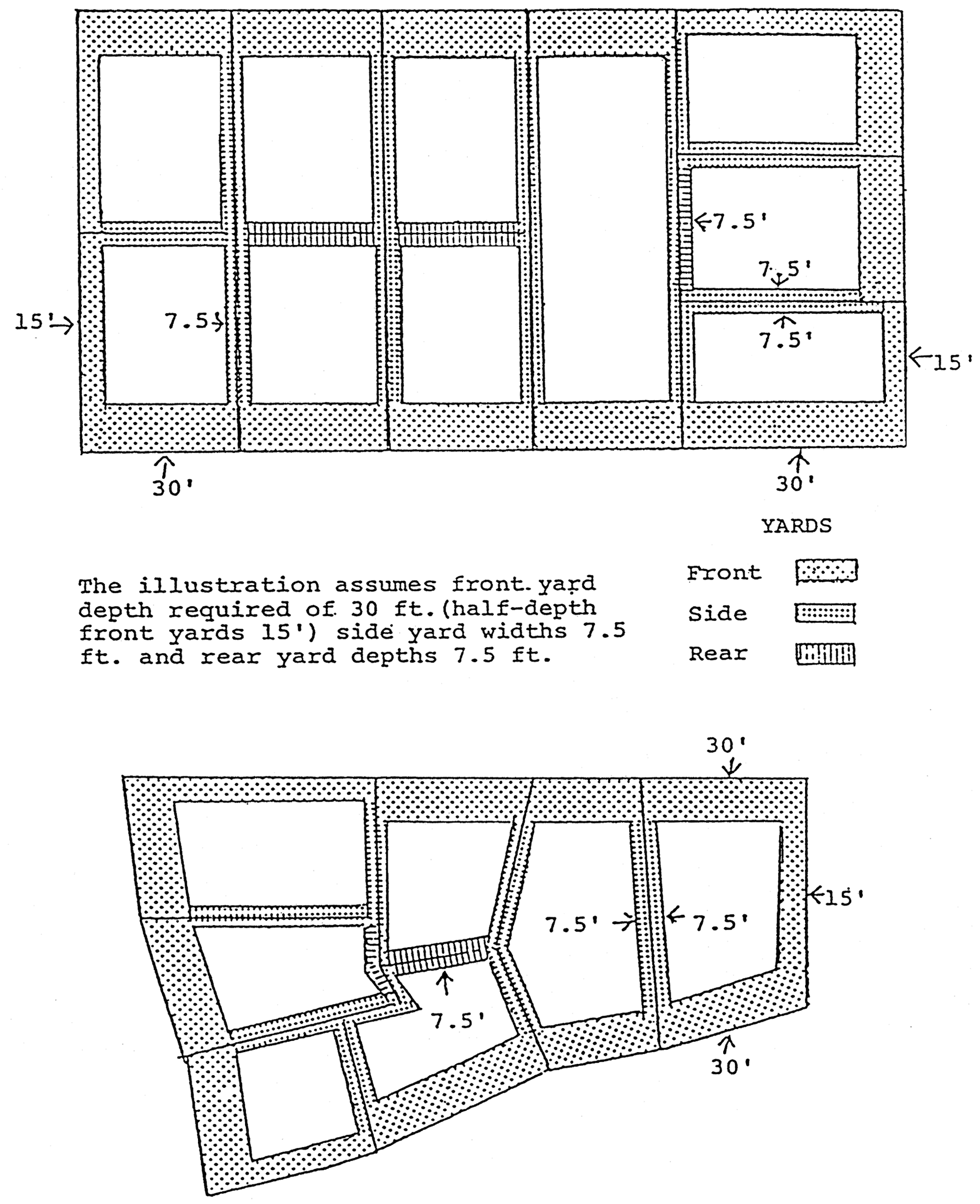
Typical Yard Arrangements
(Ord. No. 40-02, § 1, 8-21-2002; Ord. No. 07-05, § 6, 3-17-2005; Ord. No. 02-06, § 1, 3-27-2006; Ord. No. 121-06, § 1, 12-12-2006; Ord. No. 80-07, § 1, 11-13-2007; Ord. No. 38-08, § 1, 6-10-2008; Ord. No. 53-08, § 1, 9-9-2008; Ord. No. 62-08, § 1, 11-11-2008; Ord. No. 69-08, § 1, 11-25-2008; Ord. No. 72-08, § 1, 12-9-2008; Ord. No. 05-09, § 1, 3-23-2009; Ord. No. 21-10, § 1, 5-11-2010; Ord. No. 22-10, § 1, 5-11-2010; Ord. No. 54-10, § 1, 10-12-2010; Ord. No. 59-10, § 1, 12-14-2010; Ord. No. 08-11, § 1, 2-8-2011; Ord. No. 35-11, § 2, 6-28-2011; Ord. No. 38-11, § 1, 6-28-2011; Ord. No. 60-11, § 1, 8-9-2011; Ord. No. 68-11, § 1, 10-11-2011; Ord. No. 01-12, § 1, 1-24-2012; Ord. No. 62-12, § 1, 8-28-2012; Ord. No. 68-12, § 1, 8-28-2012; Ord. No. 218-13, § 1, 10-10-2013; Ord. No. 56-16, § 1, 9-27-2016; Ord. No. 43-17, § 1, 6-27-2017; Ord. No. 19-19, § 1, 5-14-2019; Ord. No. 77-19, § 1, 12-10-2019; Ord. No. 34-20, § 1, 5-26-2020; Ord. No. 111-20, § 1, 1-12-2021; Ord. No. 22-21, § 1, 5-11-2021; Ord. No. 12-22, § 1, 4-26-2022; Ord. No. 50-22, § 1, 9-27-2022; Ord. No. 43-24, § 1, 8-27-2024)
202.00. - Concurrency management system definitions.
For purposes of the concurrency management system, article IV, the following terms shall have the meanings set forth below:
Accepted engineering principles. The engineering concepts generally accepted by the broad base of professionals in the particular engineering discipline for which a concurrency evaluation is being conducted.
Adequate school capacity. The circumstance where there is sufficient school capacity by school type, based on adopted level of service (LOS) standards, to timely accommodate the demand created by a proposed residential development.
Affected local government. Each local government within a school attendance zone of an individual school.
Ancillary facility. Non-instructional buildings and/or sites utilized for such facilities as vehicle maintenance, warehouses, maintenance, or administrative buildings necessary to provide support services to an educational program.
Annual average daily traffic (AADT). An average daily traffic count adjusted using appropriate FDOT seasonal adjustment factors and truck axle adjustment factors.
Applicant. Any person having an ownership or leasehold interest, whether legal or equitable, in a parcel of land in the city, or said person's attorney-in-fact, who applies for a development order.
Assured construction. The construction improvements to a public facility scheduled to be made to a roadway segment, wastewater treatment facility, potable water supply facility, stormwater management system, public school facility, parks and recreation system, or solid waste disposal facility, or construction or obtaining one of the foregoing by one or more of the following means:
A.
Planned facilities identified within the first three years of the school district's capital improvement plan.
B.
The first three years of the adopted five-year schedule of capital improvements in the city or county capital improvements element or in the state's five-year schedule of capital improvements of a funded improvement; provided that the aforementioned schedule is financially feasible, based on available revenue sources, and contains estimated project completion dates for the affected public facility; or
C.
Construction of the facility must be complete, and the facility must be operable and able to supply all capacity needed for a particular proposed project or phase thereof, all prior to issuance of a certificate of occupancy for structures within the proposed project or phase thereof.
For any programmed construction to be considered to be assured construction pursuant hereto, the necessary right-of-way or property needed for the public facility and service must have been obtained prior to the issuance of the development order or at a minimum, subject to a binding contract for purchase, currently filed and pending condemnation lawsuit, or binding, uncontested agreement or condition of development approval.
Auxiliary spaces. Non-instructional spaces within an educational facility.
Available. A particular public facility and service will be provided as follows:
A.
The public facility and service is in place to serve a proposed project at the time a development order is granted;
B.
The necessary public facility is under construction at the time a development order is issued;
C.
The necessary public facilities and services are the subject of a binding executed contract for their construction at the time the development order is issued;
D.
The necessary public facilities and services are guaranteed in an enforceable development agreement including but not limited to a developer's agreement or agreement or development order issued pursuant to F.S. chs. 163 and 180; or
E.
Construction of the public facility is assured construction.
Average daily traffic (ADT). A daily traffic count taken at one or more locations and divided by the FDOT weekly adjustment factor.
Background traffic. The existing traffic counts shall be adjusted by a growth factor up to the project's buildout date and include all vested trips.
Building permit. A development order issued pursuant to ch. 26 of the City Code.
Buildout period. The time between the issuance of the first building permit and completion of a proposed project. The buildout period of the proposed project shall be subject to the review and approval of the city planner based on the following criteria:
A.
The size, type and location of the proposed project;
B.
Customary buildout periods for projects of similar size, type, and location; and
C.
Any other factors or conditions relevant to the specific project, including special market conditions and schedules of assured construction.
Capacity. The number of students that may be housed in a facility at any given time based on a utilization percentage of the total number of existing satisfactory student stations.
Capacity enhancement agreement. An agreement entered into by the City of New Smyrna Beach, Volusia County School Board and applicant for a comprehensive plan amendment or rezoning which increases residential densities in order for a finding of adequate school capacity to be issued by the Volusia County School District.
Capacity projects. New school construction or any project that adds necessary improvements to accommodate additional permanent student stations or auxiliary facilities needed for the educational program of each type of school based on the requirements of state requirements for educational facilities (SREF).
Captured trips. The trips not generated by a proposed project which are passing trips already on the roadway on which the proposed project is to be located.
Certificate of capacity. A document certifying that sufficient public facility capacity is available to serve the project.
Cities. All cities (aka municipalities) in Volusia County, except those that are exempt from participating in the school concurrency program pursuant to F.S. § 163.3180.
City commission. The five duly constituted members of the City of New Smyrna Beach, Florida.
Class size reduction. Article IX, Section 1 of the Florida Constitution, which was ratified by voters in November 2002 and was implemented by F.S. § 1003.03. This amendment dictates the maximum class sizes as follows: 18 students per classroom for pre-K through grade 3; 22 students per classroom for grades 4—8; and 25 students per classroom for grades 9—12.
Community park. A park, which is either active or passive, that generally serves up to 10,000 people and is generally ten to 20 acres in size.
Completion of a project. The issuance of the certificates of occupancy for structures in a project. In the case of a commercial or industrial project, certificates of occupancy for interior tenant improvements for 80 percent of the gross leasable area shall constitute the completion of the proposed project. In the case of a residential subdivision project, issuance of certificates of occupancy for 75 percent of the units, or structures on 75 percent of the lots in the project shall constitute completion of the project.
Comprehensive plan. The New Smyrna Beach Comprehensive Plan adopted by the city commission pursuant to Ord. 6-90 in compliance with the requirements of the Local Government Comprehensive Planning and Land Development Regulations Act, F.S. § 163.3161 et seq., as amended.
Concurrency. The necessary public facilities and services to maintain the adopted level of service standards are available when the impacts of development occur.
Concurrency/development order evaluation. The term used to ensure that public facilities and services needed to support development proposed in a site plan, subdivision preliminary plat, or subdivision final plat are available at the same time the impacts of such development occur.
Concurrency service area (CSA). The specific geographic unit within the school district in which school concurrency is applied and measured.
Concurrency service area level of service standards. The maximum acceptable percentage of school utilization determined by dividing the total number of students for all schools of each type in each CSA by the total number of permanent student stations for that type of school in each CSA.
Consistency. The condition of not being in conflict with and in furtherance of the goals, objectives and policies of the comprehensive plan elements and the interlocal agreement.
Constrained thoroughfare. A state, county, or city roadway upon which adding two or more through lanes to meet current or future traffic needs is not possible because of physical or policy barriers.
County of Volusia. A political subdivision of the State of Florida (aka county).
Deficit road. A local road that is not a major thoroughfare or a major thoroughfare segment that is operating below the adopted level of service standard set forth in the comprehensive plan.
De minimis project. Development of any land use that would not affect more than one percent of the maximum volume at the adopted level-of-service of the affected transportation facility. No project will be de minimis if the sum of existing roadway volumes and the projected volumes from approved projects on a transportation facility would exceed 110 percent of the maximum volume at the adopted level-of-service of the affected transportation facility; provided however, that an impact of a single family home on an existing lot will constitute a de minimis impact on all roadways regardless of the level of the deficiency of the roadway. Further, no impact will be de minimis if it would exceed the adopted level-of-service standard of any affected designated hurricane evacuation routes.
Developer's agreement. An agreement entered into pursuant to F.S. § 163.3220 or F.S. ch. 380, which the city is a party to and that may assure construction or provision of a public facility and service.
Development order. Any order granting, denying or granting with conditions, an application for a building permit, site plan, subdivision preliminary plat approval or subdivision final plat approval.
Development permit. Includes any building permit, zoning permit, subdivision approval, PUD rezoning, certification, special exception, variance, or any other official action of the City of New Smyrna Beach having the effect of permitting the development of land.
Development services director. The individual city employee appointed to said position or the city manager's designee who serves in a similar capacity.
Directly accessed. The segment(s) that serve as the project's immediate and direct access or means of ingress and egress. Each access point of a project shall be considered to have access to at least one segment; provided that the access points of a project may be considered to share a common segment. If a given access point is not immediately connected to a segment, the first segment connected to the proposed project shall be the segment for the purposes of this article. If a project access point is connected to more than one segment, project trips shall be assigned to the segments in accordance with accepted engineering principles.
DOT guidelines. Peak hour traffic or average daily traffic level-of-service maximum volumes for Florida's urban/urbanized areas in the Quality/Level of Service Handbook published in 2002 by the Florida Department of Transportation, all as subsequently amended and updated.
Educational facilities. The buildings and equipment, structures and special educational use areas that are built, installed, or established to serve educational purposes only.
Educational plant survey. A systematic study of educational and ancillary plants and the determination of future needs to provide appropriate educational programs and services for each student.
ERU. The term used to refer to equivalent residential units. An ERU is the amount of wastewater generated or potable water utilized by a facility.
Existing traffic. The peak hour traffic or average daily traffic.
Final development order. The approval of a subdivision or final plat under a local government land development regulation which authorizes construction to take place.
Financially feasible facilities plan. A plan which demonstrates the ability to finance capital improvements from existing and reasonably anticipated revenue sources and funding mechanisms to correct deficiencies and meet future needs based on achieving and maintaining the adopted level-of-service for each year of the five-year planning period for all schools of each type in each CSA and each individual school, and for the long range planning period.
First FTE student count. A first semester county of all "full time equivalent" students. The date of the first FTE count is determined by the Florida Department of Education each school year, pursuant to F.S. § 1011.62.
FISH-Florida inventory of school houses. An official inventory report of all district owned facilities.
Five-year work plan. The School District of Volusia County five-year district facilities work program adopted pursuant to F.S. § 1013.35.
FTE. Full time equivalent.
Functional equivalent. That point in the process of residential site plan approval or subdivision approval under a local government's land development regulation where the concurrency management system requires a test to be made for concurrency.
Land development regulation. Any aspect of development, including any city zoning, rezoning, subdivision, building construction, site planning, sign regulation, landscaping, or other regulations controlling the development of land.
Land use. The development that has occurred on the land, the development that is proposed by a developer on the land, or the use that is permitted or permissible on the land under an adopted comprehensive plan or element or portion therefor, land development regulations, or a land development code, as the context may indicate.
Level of service. The term means levels of service as adopted in the comprehensive plan with regard to the following: (a) the measure of the functional and operational characteristics of a roadway based upon traffic volume in relation to road capacity; (b) the amount of potable water available for consumption by occupants or others within a residential, commercial, industrial, or other type of project in relation to the amounts consumed by a project; (c) the amount of wastewater generated by a residential, commercial, industrial, or other type of unit, and the capacity that is available in a wastewater treatment facility or on-site disposal system to effectively treat wastewater in compliance with all governmental standards; (d) the amount of solid waste generated by a project in relation to the capacity of a solid waste disposal facility; (e) the amount of active or passive recreational property necessary to serve a development project within a specific radius of development influence in relation to the capacity of parks and recreational facilities available to serve the project; (f) the term refers to the amount of stormwater run-off generated by a proposed project for which there is retention and capacity or conveyed by a stormwater management system; (g) the maximum measure of the utilization, expressed as a percentage, which is the result of comparing the number of students with the permanent student capacity at a given location within a designated area.
Local governments. Volusia County and the municipalities (aka cities).
Major roadways. All existing collector and above classified roadways per the latest, adopted Volusia County Metropolitan Planning Organization (MPO) Federal Functional Classification Map; and those collector and above classified roadways scheduled for construction within the first three years in the latest adopted Volusia County Five Year Capital Improvement Program; latest, adopted Volusia County MPO Transportation Improvement Program (TIP), latest, adopted City of New Smyrna Beach Capital Improvement Element (CIE) and/or major thoroughfares under construction by a development.
Major thoroughfares. All existing collector and above classified roadways and future roadways identified in the City of New Smyrna Beach Comprehensive Plan.
Maximum utilization capacity. Utilization of facilities to ensure the adopted LOS for all schools of each type in each CSA and each individual school is not exceeded.
Mitigation agreement. An agreement entered into by the City of New Smyrna Beach, school board and applicant for a final development order which serves to provide the necessary school capacity to meet the level of service requirements within the school board's five year work program.
Municipalities. All municipalities (aka cities) in Volusia County, except those that are exempt from participating in the school concurrency program pursuant to F.S. § 163.3180.
Neighborhood park. A park, which is either active or passive, that can generally serve up to 5,000 people and is generally no greater than five acres in size.
Newspaper of general circulation. A newspaper published at least on a weekly basis and printed in English, but does not include a newspaper intended primarily for members of a particular occupational or professional group, a newspaper whose primary function is to carry legal notices, or a newspaper that is given away primarily to distribute advertising.
Parcel of land. Any quantity of land capable of being described with such definiteness that its locations and boundaries may be established, which is designated by its owner or developer as land to be used or developed as a unit or which has been developed as a unit.
Peak hour traffic (PHT). The highest hour of traffic during a daily 24-hour period.
Performance security. The sufficient funds irrevocably committed by written instrument to secure complete performance of a contract or condition of a development order or developer's agreement in a form as approved by the city attorney of a:
A.
Letter of credit issued by a Florida banking institution;
B.
Escrow agreement wherein funds are held by an escrow agent located in Florida;
C.
Surety bond;
D.
Cash or bond;
E.
Tri-party agreement executed by the city, the developer, and a Florida lending institution; or
F.
Any other method of comparable security as set forth in A.—E. approved by the city manager and city attorney.
Permanent student capacity. The estimated number of students that can be satisfactorily housed in an educational facility at any given time based upon a percentage of satisfactory permanent student stations. In Volusia County portables are not included in permanent student capacity.
Permanent student station. The net square footage requirements per student based on the instructional program to be housed in the educational facility. Permanent student stations in Volusia County do not include student stations in portables.
Person. A human being, partnership corporation, trust, or other legal entity.
Potable water supply facilities. A publicly owned water supply works.
Previously issued development order/previously approved development order. A development order issued prior to the effective date of this LDR.
Project. A development on a parcel of land or expansion of any development of a project.
Proposed new residential development. Any application for residential development or amendment to a previously approved residential development that increases the number of housing units. This shall include any request for any approval of the type that establishes a density of development and which approves a site specific development order on a specific parcel of property.
Proposed project. A project for which an applicant seeks or intends to seek the issuance of city approval, which project is unbuilt, or which project involves expansion of an existing developed project.
Public facilities and services or public facility. The term used to describe public transportation, roadways, drainage/stormwater management, potable water, solid waste disposal, wastewater treatment, schools, parks, recreation, and open space facilities and services.
Public school facility. A land use and attendant buildings operated by the Volusia County School District, and containing grades pre-K through 12th grade. Ancillary facilities such as administrative, transportation, and maintenance facilities are not included.
Radius of development influence. The area surrounding a proposed project. Transportation concurrency shall be based on the radius of development influence set forth in Table 1 herein and impacted major roadway segments and intersections, as set forth herein. Parks/recreation concurrency shall be based on the radius of development influence set forth in Table 6. The radius of development influence shall be measured in miles from all boundaries of the parcel of land as a geometric radius.
Regional park. A park, which is either active or passive, that can generally serve over 100,000 people and is generally greater than 250 acres in size.
Rendition letter or letter of determination. The development services director reviews the application for a concurrency evaluation/development order and evaluates whether the proposed project complies with this article as set forth in [sub]section 401.07. A letter is provided the applicant stating the project is either in compliance or not in compliance, and giving the reasons if not in compliance.
Retention. The prevention of the discharge of a given volume of stormwater runoff into a public drainage system by complete on-site storage in accordance with the city stormwater management and conservation regulations. Retention shall include detention. Detention shall mean the collection, temporary storage, and discharge of stormwater in such a manner as to provide for conformance to water quality standards as determined from time to time in F.A.C. chs. 40C-4 and 40C-42 and the city stormwater management and conservation regulations.
Required school replacements. A comprehensive upgrading of schools to "like new" school standards. This requires a comprehensive evaluation of schools which have been determined to need rehabilitation, remodeling or replacement of the facility.
Residential development. Any development that is comprised in whole, or part, of dwelling units for permanent human habitation.
School attendance area boundary. The geographic area by which the school board determines student membership at specific schools.
School board. The governing body of the school district, a body corporate pursuant to F.S. § 230.21.
School district. The district for Volusia County created and existing pursuant to Section 4, Article IX of the State Constitution.
School district five-year facilities work program. The school district of Volusia County five-year work plan and capital budget as authorized by F.S. § 1013.35.
School district of Volusia County capital improvement schedule. A table of expenditures and revenues from the capital outlay budget and five-year facilities work program detailing how the school district shall achieve and maintain the level of service for public school facilities.
Segment. The portion of a roadway between two intersections, between an intersection and the end of the roadway, or between an intersection or end of the roadway and the city limits.
Site plan or subdivision. A residential site plan approval or subdivision approval or a functional equivalent under a local government land development regulations which authorizes construction to begin.
Solid waste. The garbage, refuse, yard trash, clean debris, white goods, special waste, ashes, sludge, or other discarded material, including solid, liquid, semisolid, or contained gaseous material, resulting from domestic, industrial, commercial, mining, agricultural, or governmental operations.
Solid waste disposal facility. Any facility which is the final resting place for solid waste, including transfer stations, landfills, and incineration facilities that produce ash from the process of incinerating solid waste.
SREF (state requirements for education facilities). Dictates the standards for school construction pursuant to Florida Department of Education.
Stormwater management plan. A plan for stormwater management prepared consistent with the requirements contained in this article and the New Smyrna Beach stormwater management and conservation regulations.
Stormwater management system. A public or private system which collects, conveys and stores stormwater runoff.
Stormwater retention facility. A structure designed to collect and prevent the release of a given volume of stormwater by complete on-site storage for a given storm event.
Subdivision. A final subdivision approval consistent with this LDR and any amendments thereto.
Timely planned and constructed. Adequate educational facilities are planned for on the district education facilities plan and are on a financially feasible five-year work plan at a time to meet the needs of new development.
Total traffic. Traffic during the buildout period of residential projects comprised of the sum of existing traffic, existing traffic adjusted by a growth factor up to the project's buildout date, traffic generated by the proposed project, and traffic generated from previously approved but incomplete projects.
Transportation impact analysis. A study prepared to determine compliance with the transportation concurrency requirements and to evaluate the transportation systems' ability to accommodate the additional traffic generated by a proposed development. This study includes but is not limited to: determination of trip generation; trip distribution; traffic assignment; intersections; capacity analyses; and improvements to the roadway system necessitated by the development, such as required new roads, additional lanes, and signalization.
Type of school. Schools in the same categories of education, i.e., elementary, middle or high school.
Vested trips. Trip generation from previously approved but incomplete projects on thoroughfare roads as shown on the project map.
Wastewater treatment facilities (WWTF). The utilities commission wastewater treatment facilities.
(Ord. No. 108-07, § 1, 5-13-2008; Ord. No. 21-09, § 1, 4-14-2009; Ord. No. 09-11, § 1, 2-8-2011)
203.00. - Stormwater management and conservation regulations definitions.
For the purposes of [sub]section 604.02 of this LDR, the following definitions shall apply:
Agricultural lands. Those lands in any agricultural use including forestry.
Applicant. Any person applying for or who has been granted a permit to proceed with a project.
Aquifer. An underground formation, group of formations or part of a formation that is permeable enough to transmit, store, or yield usable quantities of water.
Artificial drainage system. Any canal, ditch, culvert, dike, storm sewer or other manmade facility which tends to control the surface flow of water.
As-built plans. The amended site plans specifying the locations, dimension, elevations, capacities, and capabilities of structures or facilities as they have been constructed.
Authorized enforcement agency. The City of New Smyrna Beach.
Best management practices (BMPs). The schedule of activities, prohibitions of practices, general good housekeeping practices, pollution prevention and educational practices, maintenance procedures, and other management practices to prevent or reduce the discharge of pollutants directly or indirectly to stormwater, receiving waters, watercourses, or the MS4. BMPs also include treatment practices, operating procedures, and practices to control site run-off, spillage or leaks, sludge or water disposal, or drainage from raw materials storage.
City. The City of New Smyrna Beach, Florida.
City engineer. A registered professional engineer employed by the city.
City separate storm sewer system (MS4). The system of conveyances (including sidewalks, roads with drainage system, municipal streets, catch basins, curbs, gutters, ditches, natural and man-made or altered channels, piped storm drains, pumping facilities, retention and detention basins, reservoirs, and other drainage structures) owned and operated by the City of New Smyrna Beach and designed or used for collecting or conveying stormwater and not used for collecting or conveying sewage.
Clean Water Act. The federal Water Pollution Control Act (Title 33, United State Code, Section 1251 et seq.) and any subsequent amendments thereto.
Clearing. The removal of trees and brush from a substantial part of the land but shall not include mowing.
Commission. The City Commission of the City of New Smyrna Beach.
Construction activity. All activities subject to the National Pollution Discharge Elimination System (NPDES) Construction Permits, pursuant to Chapter 62-620 and 62-621, Florida Administrative Code and F.S. § 403.0885. These include construction projects resulting in land disturbance of one acre or more. Such activities include but are not limited to clearing and grubbing, grading, excavating and demolition.
Discharge, discharge point. The outflow of water from a project site, aquifer, drainage basin or facility.
Drainage system, natural drainage system. Surface streams or swamps which convey water to natural points of discharge.
Enforcement official. The city engineer or his duly appointed deputy responsible for enforcing the provisions of this article and ensuring plan adherence during construction phases.
Existing. The average condition immediately before development or redevelopment commences.
Groundwater. Water beneath the surface of the ground, whether or not flowing through known and definite channels.
Hazardous materials. Any material, including any substance, waste or combination thereof, which because of its quantity, concentration, or physical, chemical, or infectious characteristics may cause or significantly contribute to a substantial present or potential hazard to human health, safety, property, or the environment when improperly treated, stored, transported, disposed of, or otherwise managed.
Hydrograph. A graph of discharge versus time for a selected outfall point.
Hydrologic cycle. The movement of water through the environment on, above and below the surface of the earth.
Illicit connections. An illegal connection, defined as either of the following:
(1)
Any drainage or conveyance, whether on the surface or subsurface, that allows a discharge to enter the MS4, including but not limited to any conveyances that allow any non-stormwater discharge including sewage, processed wastewater, and wash water to enter the MS4, and any connections to the MS4 from indoor drainage and sinks, regardless of whether said drain or connection had been previously allowed, permitted or approved by an authorized enforcement agency; or
(2)
Any drainage or conveyance connection from a commercial or industrial land use to the MS4 that has not been documented in plans, plats, maps, or equivalent records and approved by the authorized enforcement agency.
Illicit discharge. Any direct or indirect non-stormwater discharge to the MS4, except as exempted in [sub]section 604.02 of this LDR.
Industrial activity. Any activity subject to NPDES Industrial Stormwater Permits as defined in Title 40, Code of Federal Regulations, Section 122.26(b)(14), Chapters 62-620 and 62-621, Florida Administrative Code, and F.S. § 403.0885.
Land. The earth, air above, water below or on the surface, and includes any vegetation, improvements or structures customarily regarded as land.
National Pollutant Discharge Elimination System (NPDES) Stormwater Discharge Permit. A permit issued by the Florida Department of Environmental Protection (FDEP) that authorizes the discharge of pollutants to waters of the United States, whether the permit is applicable on an individual, group, or general area-wide basis.
Natural flow pattern. The rate, volume and direction of the surface or groundwater flow occurring under natural conditions for any given portion of the City of New Smyrna Beach.
Non-stormwater discharge. Any discharge to the city's MS4 that is not composed entirely of stormwater.
Person. An individual, association, organization, corporation, governmental agency, business trust, estate, trust, partnership, association, two or more persons having a joint or common interest, or any other legal entity.
Pollutant. Anything which causes or contributes to pollution. Pollutants may include, but are not limited to paints, varnishes, and solvents; oil and other automotive fluids; non-hazardous liquid and solid wastes and yard wastes; refuse, rubbish, garbage, litter, or other discarded or abandoned objects, and accumulations that may cause or contribute to pollution; floatables; pesticides, herbicides, and fertilizers; hazardous substances and wastes; sewage, fecal coliform and pathogens; dissolved and particulate metals; animal wastes; wastes and residues that result from construction of a building or structure; and noxious or offensive matter of any kind.
Premises. Any building, lot, parcel of land, or portion of land, whether improved or unimproved, including adjacent sidewalks and parking areas.
Project. The particular structures and improvements proposed by the applicant on a particular land area, which are part of a common plan of development and shall include the subdivision of land.
Project initiation. All acts antecedent to actual construction activities, and includes but is not limited to land clearing, utility construction and the like.
Rate. Volume per unit of time.
Recharge. The inflow of water into a project, site, aquifer, drainage basin or facility.
Site plan. The plan required to acquire a development, construction, building or stormwater permit which shows the means by which the developer will conform with applicable provisions of this article and other applicable ordinances.
Stormwater management plan (SWMP). A document which describes the best management practices and activities to be implemented by a person or business to identify sources of pollution or contamination at a site and the action to eliminate or reduce pollutant discharges to stormwater, the MS4, other stormwater conveyance systems, watercourses, and receiving water to the maximum extent practicable.
Structure. That which is built or constructed, an edifice or building of any kind, or any piece of work artificially built up or composed of parts joined together in some definite manner but shall not include fences or signs.
Volume. Occupied space and is measured in cubic units.
Wastewater. Any water or other liquid, other than uncontaminated stormwater, discharged from premises.
Water. All water on or beneath the surface of the ground or in the atmosphere, including natural or artificial watercourses, lakes, ponds or diffused surface water, and water standing, percolating or flowing beneath the surface of the ground, as well as all coastal waters within the City of New Smyrna Beach.
Water detention structure, water management structure. A facility which provides for storage of stormwater runoff and the controlled release of such runoff during and after a flood or storm.
Water retention structure. A facility which provides for storage of storm water runoff.
Wetlands. Fresh or salt water marshes, swamps, bogs, and wet woodlands, characterized by specific vegetational types and plant communities, whether:
(1)
Flooded at all times;
(2)
Flooded only seasonally; or
(3)
Having a water table within six inches of the ground surface for at least three months of the year.
(Ord. No. 12-11, § 1, 4-12-2011)
204.00. - New Smyrna Beach tree protection regulations definitions.
For the purposes of subsection 604.05A. of this LDR, the following definitions shall apply:
City horticulturist. The person responsible for administering and enforcing the provisions contained herein or a person designated by the city horticulturist.
DBH. Tree diameter at breast height, measured at 4.5 feet above ground level.
Drip line. A vertical line running through the outermost portion of the tree crown extending to the ground.
Historic tree. Any tree, exclusive of those found on the Florida Exotic Pest Plan Council list, 36 inches DBH or greater or tree in the city selected and duly designated a Florida State Champion, United States Champion or a World Champion by the American Forestry Association shall likewise be considered an historic tree, or any other tree designated by the city commission to be of such unique and intrinsic value to the general public because of its size, age, historic association, or ecological value as to justify classification as a historic tree.
Lot, developed. A parcel of land occupied by one main building and its accessory buildings with such open and parking space as required and having its principal frontage upon a street.
Lot, unimproved. An undeveloped parcel of land.
Person, applicant, subdivider/developer. Shall include an individual, partnership, corporation, association, group, company, firm, society or other legal entity of human beings, whether natural or artificial, including the city, and all other municipal state and federal governments, and shall include the plural as well as the singular.
Remove or removal. Remove or removal shall include actual removal and effective removal through killing, damaging or destroying.
Specimen tree. The following species of trees with the minimum specified diameter at breast height (DBH) are determined to be specimen trees. When a specimen tree reaches 36 inches DBH, it shall be considered a Historic tree for purposes of removal under Section 604.051(f) of these LDRs.
Tree. Any self-supporting woody plant which normally grows to an overall height of a minimum of 15 feet, with one main trunk.
(Ord. No. 58-01, § 2, 10-9-2001; Ord. No. 09-19, § 1, 4-2-2019)
205.00. - Sign regulations definitions.
The following definitions shall apply to [sub]section 604.12 of this LDR:
Altering. Changing a sign to the extent that the structural components of the pole or copy area is replaced, repaired, or changed so that the shape, size, or appearance of the sign is different than previously. Painting a sign, rearranging letters or replacing the plastic copy area without any structural or frame changes shall not constitute altering.
Anchor store. The major tenant within a shopping center used to draw patrons to the shopping center and containing at least 25,000 square feet of gross leasable area.
Chief building official. The city official designated as the chief building official for the city. The chief building official shall have the responsibility and authority to enforce these sign regulations.
Copy area. Surface area encompassed within any regular geometric figure which forms the informational component of a sign, when such sign is viewed from one direction on the adjacent right-of-way. The frame which decorates or structurally supports the copy area shall be included when calculating area. The pole associated with a pole sign shall not be included when calculating copy area. The entire area of a ground sign shall be used in calculating the area of a ground sign.
Erect. To build, construct, attach, hang, place, suspend or affix, and shall include the painting of wall signs.
Location. Any lot, premises, building, structure, wall, or any place whatsoever upon which a sign is located.
Person. Any persons, firm, partnership, association, corporation, company, or organization, singular or plural, of any kind.
Premises. A parcel or lot of property, or any combination of parcels or lots, on which a business or residential use is located; except that in the case of a business having in excess of 250 feet of continuous road frontage each 250 feet of road frontage shall constitute one premise for the purpose of this LDR. For example: a new car dealership with 500 feet of road frontage would constitute two premises for the purpose of this LDR.
Public body. Any government or governmental agency of the City of New Smyrna Beach, Volusia County, the State of Florida, or the United States.
Residential development. Any housing project that is approved by the planning and zoning board. Phasing of a project shall not constitute a separate residential development for the purpose of sign standards, unless the phase shall bear a separate name.
Roof line. The juncture of the roof and the perimeter wall of the structure.
Semipublic body. Any organization operating as a nonprofit activity and serving a public purpose or service including such organizations as noncommercial clubs, lodges, theater groups, recreational and neighborhood associations, cultural organizations, schools and churches.
Sign. Any surface, fabric, device or display, designed to advertise, inform, identify, or to attract the attention of persons not on the premises on which the [device] or display is located.
A sign shall be construed to be a single display surface or device containing elements organized, related, and composed to form a single unit. In cases where material is displayed in a random or unconnected manner, or where there is reasonable doubt as to the intended relationship of such components, without organized relationship of such components, each component or element shall be considered to be a single sign.
A projecting or ground sign with sign surface on both sides of such sign shall be construed as a single sign, and the total area of such sign shall be the area computed on a single sign.
For purposes of this LDR, the term "sign" shall include all structural members. A sign shall be construed to be a display surface or device containing organized and related elements composed to form a single unit. This definition shall not include bumper stickers on cars.
Within the sign definition are the following sign types:
(a)
Awning sign. A sign located on the vertical face of an awning.
(b)
Banner signs. Any sign intended to be hung, either with or without frames, possessing characters, letters, illustrations, or ornamentations applied to paper, plastic, or fabric of any kind, including such signs stretched across or hung over any public right-of-way. Flags shall not be considered banners for the purpose of the article.
(c)
Beacon light sign. Any sign or device which includes any light with one or more beams, capable of being directed in any direction or directions, or capable of being revolved automatically.
(d)
Bench signs. A sign located on any part of the surface of a bench or seat placed on a public right-of-way or other public area.
(e)
Billboard: An outdoor sign which advertises a firm, organization, goods, products, or services which are not located on the same premises as the sign, and that is sold, rented, owned, or leased for the display of advertising messages.
(f)
Changeable copy sign: A sign that is designed so that characters, letters, or illustrations can be changed or rearranged either manually or mechanically.
(g)
Electronic message center: A variable message sign that utilizes computer-generated messages or some other electronic means of changing copy. These signs include displays using incandescent lamps, LEDs, LCDs or a flipper matrix.
(h)
Flag. A device made of cloth, plastic, or natural or synthetic fabric, with or without characters, letters, illustrations, or ornamentation applied to the surface, typically attached to a pole and which is designed to move in the wind. For purposes of this article, flags are defined separately from moving signs.
(i)
Flashing sign. Any sign with a lighting device or devices which go on and off alternately.
(j)
Ground sign or freestanding sign: A sign where the foundation and supporting structure are visually an integral part of the sign creating a continuous form from the ground to the top of the sign.
(k)
Illuminated sign. Any sign illuminated in any manner by an artificial light source.
(l)
Integral sign. Signs or tablets cut into any masonry surface or constructed of bronze or other non-combustible materials in the form of a plaque mounted on the side or face of a building, bench, or other permanent structure.
(m)
Marquee sign. Any projecting sign attached to and made a part of a marquee. A marquee is defined as a permanent roof-like or awning type structure projecting beyond and supported by a building wall at an entrance to a building or extending along and projecting beyond the building's wall and generally designed and constructed to provide protection against the weather.
(n)
Moving sign: A fluttering sign or a balloon type sign that is filled with air or a lighter than air gas, including wind operated devices. All balloons (including plastic or reusable balloons and balloon clusters, and all inflatables), dirigibles, airships, and kites located on, or tethered to, commercial property, or for the purpose of advertising a business or profession, are moving signs within the meaning of the land development regulations. The items enumerated in the preceding sentence are moving signs even if no advertising appears on the item. Dirigibles and airships at airports shall not be moving signs within the meaning of the land development regulations.
(o)
Nonconforming sign. Any sign which does not conform to the regulations of this Ordinance.
(p)
Off-site sign: Any sign located on property other than the premises to which the sign relates.
(q)
Pennants shall include the terms "ribbons" and "streamers" and shall mean pieces of cloth, flexible plastic, or other flexible material, intended to attract attention because of their bright colors and/or flapping caused by action of the wind, commonly strung in series along a line. This term includes a single pennant, ribbon, or streamer, or a series of such pennants, ribbons, or streamers, but shall not include flags as defined herein.
(r)
Pole sign. Any freestanding sign that does not meet the definition of ground or portable sign. These signs are composed of the sign cabinet or base and the sign pole or pylon by which it connects to the ground.
(s)
Portable sign. A sign that is mounted on a trailer or trailer-like chassis which is capable of being moved on wheels, legs, or skids as an entire unit, but is placed temporarily in one location as outlined in section 604.12. Signs pulled behind a vehicle for the purpose of mobile advertising are not considered portable signs (see trailer signs).
(t)
Projecting sign. Any sign other than a wall sign affixed to any building or wall, any edge of which, extends more than 12 inches beyond such building or wall.
(u)
Roof sign. Any sign erected or constructed wholly upon and over the roof of any building and supported solely on the roof structure.
(v)
Shingle sign. A projecting or wall sign not over one and one-half square feet in area.
(w)
Snipe sign. Any sign of any material whatsoever that is attached in any way to a utility pole, tree, or any object located or situated on public or private property, or any temporary sign placed in the right-of-way.
(x)
Temporary sign. Any sign or advertising display intended for temporary use and designed and constructed in accordance with this intention.
(y)
Trailer/mobile sign. Any sign placed on a vehicle or on a trailer attached to a vehicle that projects more than one inch and that is displayed on public rights-of-way as a mobile sign, not intended to be permanent and not in compliance with the definition of portable sign or temporary sign.
(z)
Traveling lights sign. Any sign which includes a series of lights, or lighting device, which appears to move or travel in automatic sequence on the display surface of the sign.
(aa)
Vintage sign. Any sign 30 years old or older that is designated as such by the Historic New Smyrna Beach Preservation Commission.
(bb)
Wall sign. Any sign containing one advertising surface other than a projecting sign that is attached to and erected parallel with the face of any building wall, any edge of which extends beyond such building wall.
(cc)
Window sign. Any sign placed inside or upon a window facing the outside and which is intended to be seen from the exterior.
(Ord. No. 17-01, § 1, 4-10-2001; Ord. No. 45-08, § 1, 10-28-2008; Ord. No. 108-11, § 1, 11-29-2011; Ord. No. 73-12, § 1, 9-11-2012; Ord. No. 33-18, § 1(Exh. A), 6-12-2018; Ord. No. 74-19, § 1, 12-10-2019)
206.00. - Wetland protection regulations definitions.
Altered wetland. Wetlands which have been substantially affected by man, but which continue to be dominated by wetland or transitional vegetation.
Best management practices (BMP). Management practices as found in "Silviculture Best Management Practices Manual," Florida Department of Agriculture and Consumer Services, Division of Forestry.
Buffer. Upland areas adjacent to wetlands which are necessary to protect the wetlands and wetland species from the detrimental impacts of development or alteration. The buffer shall include canopy, understory and groundcover which consists of preserved existing vegetation or planted native species.
Clearing. The removal of trees, brush, and other groundcover from the land.
Code enforcement officer (CEO). An employee of the City of New Smyrna Beach responsible for enforcing city LDRs as designated by the city manager.
Creation. A human activity bringing a wetland into existence at a site at which it did not formerly exist.
Dredging. Excavation by any means in water or wetland. It also means the excavation or creation of a water body which is, or is to be connected to waters, directly or via excavated water bodies or a series of excavated water bodies.
Environmental management director (EMD). The city manager or his/her duly authorized representative.
Environmental officer (EO). The city engineer, or a person designated by the city manager to act as the environmental officer.
Filling. The deposit or burial of materials, such as land clearing debris, soil, rock or other solid minerals, onto any land, water or wetlands. Does not include landfilling with garbage or other similar waste matter.
Hydroperiod. A measure of the time (usually in days per year) that water is at or above solid surface under normal hydrologic conditions.
Isolated wetland. Wetlands that have no hydrological or vegetative connections with "waters of the state" as defined in F.S. § 403.031(3).
Mitigation. Actions including, but not limited to, restoration, enhancement, or creation of wetlands, required to be taken by a person to off-set environmental impacts of permitted activities.
Restoration. A human activity that returns a wetland or former wetland from a disturbed or altered condition with lesser acreage or functions to a previous condition with greater wetland acreage or functions.
Volusia County Environmental Management Department (VCEMD). Refers to the agency administered by the environmental management director (EMD) who is responsible for performing certain services identified herein.
Wetland management plan. Refers to detailed analysis and information related to wetlands required to be submitted to the city.
Wetland vegetation. As defined in F.A.C. 17-3.022.
Wetlands. Per F.S. § 373.019, as may be amended from time to time, wetlands are those lands which are identified by being inundated or saturated by surface water or groundwater at a frequency and duration sufficient to support, and that under normal circumstances do or would support, a prevalence of vegetation typically adapted for life in saturated soil conditions. The definition includes all contiguous and noncontiguous or isolated wetlands to waters, water bodies, and watercourses. Wetlands include, but are not limited to, swamp hammocks, hardwood hybrid hammocks, riverine cypress, cypress ponds, bayheads, bogs, wet prairies, freshwater marshes, tidal flats, salt marshes, mangrove swamps and marine meadows. Dominant wetland vegetation shall be determined as provided in Section 62-340, F.A.C.
(Ord. No. 19-18, § 1, 3-13-2018; Ord. No. 19-19, § 1, 5-14-2019)
207.00. - Wellfield protection regulations definitions.
The following definitions shall apply to section 705.00 of this LDR:
EPA. United States Environmental Protection Agency.
Hazardous substance. Those materials specified in:
A.
F.A.C. ch. 38F-41 (the Florida Substance List).
B.
Title 40 of the Code of Federal Regulations Part 261 Identification and Listing of Hazardous Wastes.
C.
Title 40 of the Code of Federal Regulations Part 302.4 (Table 302.4) (List of Hazardous Substances and Reportable Quantities).
D.
Title 40 of the Code of Federal Regulations Part 355, Appendix A and B (List of Extremely Hazardous Substances).
A hazardous substance, as defined herein includes any solution, mixture, or formulation containing such materials, and also includes any material which, due to its chemical or physical characteristics, as determined by the fire marshal which poses a substantial threat to the life, health, or safety of persons or property or to the environment.
Nonresidential activity. Any activity occurring on any described parcel of land, whether or not within a structure, with the exception of residential activity as defined herein.
Potable water. Water that is satisfactory for drinking, culinary and domestic purposes meeting current state and federal drinking water standards.
Potable water supply well. A potable water well to supply water which has been permitted for consumptive use by the St. Johns River Water Management District and the casing diameter is six inches or greater.
Primary containment. The first level of product-tight containment, i.e., the inside portion of that container which comes into immediate contact on its inner surface with the hazardous substance being contained.
Primary wellfield protection zone. The land area immediately surrounding any potable water supply well and extending a radial distance of 200 feet.
Product-tight. Impervious to the hazardous substance which is or could be contained so as to prevent the seepage of the hazardous substance from the containment system. To be product-tight, the containment system shall be made of a material that is not subject to physical or chemical deterioration by the hazardous substance being contained.
Residential activity. Any building or structure or portion thereof that is designed for or used for residential purposes and any activity involving the use or occupancy of a lot for residential purposes. Residential activity shall include those customary and accessory residential activities associated with the principal permitted use of a lot for residential purposes as set out in the zoning regulations or other appropriate ordinance of the local government.
Secondary containment. The level of product-tight containment external to and separate from the primary containment.
Secondary wellfield protection zone. The land area surrounding the primary wellfield protection zone, and extending a radial distance of 800 feet from said primary wellfield protection zone.
Spill. The release or escape of a hazardous substance, directly or indirectly to soils, surface waters or groundwaters.
Storage system. Any one or combination of tanks, sumps, wet floors, waste treatment facilities, pipes, vaults, or other portable or fixed containers used, or designed to be used, for the storage of hazardous substances at a facility.
Well. Any excavation that is drilled, cored, bored, washed, driven, dug, jetted, or otherwise constructed when the intended use of such excavation is for the location, acquisition, development, or artificial recharge of groundwater, but such term does not include any well for the purpose of obtaining or prospecting for oil, natural gas, minerals, or products of mining or quarrying, for inserting media to dispose of oil brines or to repressure oil bearing or natural gas-bearing formations or for storing petroleum or natural gas or other products or for temporary dewatering or subsurface formations for mining, quarrying or construction purposes.
Wellfield. An area of land which contains or is designated for future use for one or more potable water supply wells.
Wellfield protection zone permit. That permit issued by the fire marshal authorizing the activities provided in [sub]section 705.05 of this LDR.
208.00. - Boat slip allocations.
Boat facility. A public or private structure or operation within the municipal boundaries of the city where boats are moored and/or launched, including commercial, recreational, industrial and residential marinas, boat ramps, dry storage and private docks. Boat facility shall also mean boat trailer parking, boat valet service and other boat and trailer storage facilities located within a one-mile radius of the closest public boat launch. Single-family residential docks with two or fewer wet and/or dry slips are not considered boat facilities.
Dry slip. A space designed for the storage of single watercraft in an upland location.
Excess slips. Any slip that has previously not been allocated, reserved or accounted for and subtracted from the maximum allowed slips. The number of excess slips shall be calculated by subtracting from the total aggregate number of slips (1,480) the number of slips already allocated (113). and then subtracting the total number of slips reserved to the city for future purposes (740). This results in a total of 627 excess slips.
Multi-family facility. Community facility of three or more slips serving condominiums or other multi-family developments. No fueling or repair facilities shall be associated with these facilities.
New or expanded boat facility. A marine facility that is proposed to be built, restored, revitalized, renovated or otherwise increased in size and scope.
Public access. Any boat dock, boat ramp or related facility available to the public that is consistent with applicable state and local trespass laws.
Reserved slip. Boat slips set aside for future changes and/or evolutions in the boating industry that cannot be foreseen today; for public use; for city projects; or as an incentive for economic development in targeted areas of the city. Reserve pool slips represent 50 percent of the slips for possible future allotment (1,480), or 740 slips.
Shared facility. A private structure within the municipal boundaries of the city accessory to a single-family or two-family residentially zoned and used property where boats are moored and/or launched. This structure may include boat slips, boathouses, mooring poles, and terminal platforms. The maximum number of slips, mooring poles, and boat ramps is a combination of any four total, with the maximum of any two counted for each parcel.
Slip pool. The combined total of excess and reserved slips make up the slip pool. The total slip pool allocation for the City of New Smyrna Beach is 1,480. These slips are physically distributed as follows: 1,204 slips north of the North Causeway; 276 slips south of the South Causeway; and an unlimited number of slips between the North and South Causeways.
Standard facility. A private structure within the municipal boundaries of the city accessory to a single-family or two-family residentially zoned and used property where boats are moored and/or launched. This structure includes boat slips, boathouses, mooring poles, and terminal platforms. The maximum number of slips, mooring poles, and boat ramps is a combination of any two.
Transient slips. Temporary docking or mooring space which may be used by the general public for short periods of time, including overnight, days or weeks, but less than 30 days. Transient slips are not boat slips available for rental term of less than 30 days with rental agreements which contain automatic renewal rights or other similar conditions.
Wet slip. A space designed for the mooring of a single watercraft in water. Such spaces may extend from a dock or shoreline but shall not be allowed to project from a pier.
(Ord. No. 77-11, § 1, 9-13-2011; Ord. No. 78-19, § 1, 11-19-2019)

