
New Smyrna Beach City Zoning Code
ARTICLE V
- ZONING DISTRICTS
501.00.- Establishment of districts.
The City of New Smyrna Beach, Florida, is divided into the following districts within which the uses of land are regulated as provided by this LDR. Each district is listed below with its accompanying abbreviation:
(Ord. No. 23-12, § 1, 2-28-2012; Ord. No. 61-12, § 1, 6-12-2012; Ord. No. 176-13, § 1, 8-27-2013; Ord. No. 182-13, § 1, 9-24-2013; Ord. No. 06-15, § 1, 1-27-2015; Ord. No. 70-15, § 1, 9-8-2015; Ord. No. 11-16, § 1, 2-9-2016)
502.00. - Official zoning map.
502.01. Identification of official map. The official zoning map shall be identified by the signature of the mayor, attested by the city clerk, and bearing the seal of the city under the following words: "This is to certify that this is the official zoning map referred to in article V of the land development regulations of the City of New Smyrna Beach, Florida adopted January 22, 1991."
502.02. Map changes. Where changes are made in district boundaries or other matters portrayed by the official zoning map, the city planner shall enter those changes on the official zoning map promptly after the change has been approved by the city commission and becomes effective. All changes made to the official zoning map shall conform to the requirements and procedures of this LDR. The city planner shall keep a log of all changes made to the official zoning map, beginning with the date of adoption of the map, which includes a copy of each ordinance requiring a change to the map.
502.03. Official map, final authority. Regardless of the existence of purported copies of the official zoning map which may, from time to time, be made or published, the official zoning map, which shall be located in the office of the planning and zoning department, shall be the final authority as to the current zoning status of land and water areas, buildings, and other structures in the city.
502.04. Replacement of official zoning map. In the event the official zoning map becomes damaged, destroyed, lost or difficult to interpret because of the nature or number of changes and additions, the city commission may adopt a new official zoning map, which shall supersede the prior official zoning map. The new official zoning map may correct drafting or other errors or omissions in the prior official zoning map, but no such corrections shall have the effect of amending the original official zoning map or any subsequent amendment thereof. The new official zoning map shall be identified by the signature of the mayor, attested by the city clerk, and bearing the seal of the city under the following words: "This is to certify that this official zoning map supersedes and replaces the official zoning map adopted (date of adoption of map being replaced) as part of the land development regulations of the City of New Smyrna Beach, Florida." Unless the prior official zoning map has been lost, or has been totally destroyed, the prior map or any significant parts thereof remaining shall be preserved, together with all available records pertaining to its adoption or amendment.
503.00. - Interpretation of district boundaries.
Where uncertainty exists as to the boundaries of districts as shown on the official zoning map, the following rules shall apply:
503.01. Boundaries approximately following streets, highways, or alleys. Boundaries indicated as approximately following the centerlines of streets, highways, or alleys, shall be construed to follow such centerlines. Streets, highways, or alleys, which serve as dividing lines between zoning districts, vacated by ordinance of the city commission shall be assigned a zoning district classification(s), at the time of vacation by the city commission. The city commission, in assigning said classification(s), shall assign to the vacated street, highway or alley, the same zoning district classification(s) of at least one adjacent property.
503.02. Boundaries approximately following platted lot lines. Boundaries indicated as approximately following platted lot lines shall be construed as following such lot lines.
503.03. Boundaries approximately following city limits. Boundaries indicated as approximately following city limits shall be construed as following such city limits.
503.04. Boundaries approximately following railroad lines. Boundaries indicated as following railroad lines shall be construed to be midway between the railroad right-of-way.
503.05. Boundaries approximately following shorelines, stream beds, or other water bodies. Boundaries indicated as following shorelines shall be construed to follow such shorelines, except where bulkhead lines have been established, the boundary lines shall follow the bulkhead lines. In the event of change in the shoreline, the boundary shall be construed as moving with the actual shoreline; boundaries indicated as approximately following the centerlines of streams, rivers, canals, lakes or other bodies of water, shall be construed to follow such centerlines. Any change in the shoreline must be the result of natural erosion and/or accretion of the land thereby causing the shoreline to be located in a different site than shown on the official zoning map. The movement of the shoreline must not be the result of unnatural means, such as filling, excavation, or alteration of the grade of the land.
503.06. Conflicts between platted lot line and shoreline of a water body. In the event that a zoning district boundary line follows both the platted lot line as provided for in [sub]section 503.02, and the shoreline of a water body as provided for in [sub]section 503.05, the zoning district boundary line shall be interpreted to follow the shoreline of a water body as set forth in [sub]section 503.05.
503.07. Annexation or removal of territory from city. Areas annexed into the city shall be assigned a zoning classification as approved by the city commission, and such classification may be established prior to, but made subject to, successful annexation of the area. In the event of changes in the city limits removing territory from the city, district boundaries shall be construed as moving with the city limits.
503.08. Boundaries approximately parallel of extension of above features. Boundaries indicated as parallel to, or extensions of features indicated in subsections 503.01 through 503.05 above, shall be so construed. Distances not specifically indicated on the official zoning map shall be determined by the scale of the map using the center of the line drawn on the official zoning map.
504.00. - District regulations and requirements.
504.01. General regulations.
A.
No building, structure, or land, shall hereafter be used or occupied, and no building or structure or part thereof shall hereafter be erected, constructed, reconstructed, moved or structurally altered except in conformity with all of the regulations herein specified for the district in which it is located.
B.
Uses not designated as permitted by right or subject to additional conditions in a district shall be prohibited from that district. Special exceptions are permitted subject to additional regulations imposed. The special exceptions may be approved only by the city commission following proper application as described within this LDR. Additional uses may be added to this LDR by amendment.
C.
In any business district, more than one structure housing a permitted principal use may be erected on a single commercial lot, provided that yard and other requirements of this LDR shall be met for each structure and the total lot.
D.
The maximum density on a residential project shall be computed by multiplying the Net Acreage of the site, as defined in Section 201.00, by the number of allowable units per acre. In addition, on sites containing wetlands, the total number of allowable residential units on a project may be increased by one dwelling unit per 10 acres of wetlands.
E.
Where the density calculation results in a fraction that is 0.50 or greater, the number is rounded up (e.g. 12.6 = 13 units). Fractions lower than 0.50 are rounded down (e.g. 12.4 = 12 units).
F.
The density calculation described above provides the maximum number of dwelling units that may be built on a site. However, the development is not guaranteed to attain that maximum density. The application of other development standards may substantially decrease the lot yield for a specific site.
G.
No yard or lot existing at the time of passage of this LDR shall be reduced in dimension or area below the minimum requirements set forth herein. Yards or lots created after the effective date of this LDR shall meet at least the minimum requirements established by this LDR.
H.
No part of a yard, or other open space, or off-street parking or loading space required about or in conjunction with any building for the purpose of complying with this LDR shall be included as part of a yard, open space, or off street parking or loading space similarly required for any other building.
I.
All buildings shall be placed on lots or mobile homes on lots or spaces, in a manner that provides safe and convenient access for servicing, fire protection and required off-street parking.
J.
The height limitations contained in the schedule of district regulations do not apply to spires, belfries, cupola, antennas, water tanks, ventilators, chimneys or other appurtenances usually required to be placed above the roof level and not intended for human occupancy.
K.
Lots platted or created prior to the effective date of this LDR having less width, depth and area than required in their zoning district but having no less than 90 percent of the width, depth and area shall be considered conforming with the requirements of this LDR.
L.
Any lot platted or created prior to the effective date of this LDR which meets two of the three size requirements of width, depth and area and which meet no less than 85 percent of the third requirement shall be considered a nonconforming lot but shall be considered buildable.
M.
The number of residential and hotel/motel units and the percentage of building coverage and impervious lot coverage allowed on oceanfront property shall be calculated by using only the land zoned for residential or hotel/motel use. The applicant must demonstrate, by evidence of clear title, that the upland property is under its control and has not been dedicated or reserved for a public use including, but not limited to, recreational, right-of-way or park use; is not submerged by ocean, natural lake, natural pond or other natural waters, and is not subject to a deed restriction.
N.
Short term rental (less than 30 days) of a dwelling unit is permitted only in the designated areas and zoning districts indicated below:
East of the Intracoastal Waterway Zoning districts: R-3A east of Atlantic Avenue, R-4, R-5, R-6, B-4, M-U, and BBH
East of the Intracoastal Waterway and south of Third Avenue Zoning districts: R-2A
West of the Intracoastal Waterway Zoning districts: M-U, BBH
O.
Front yard setbacks shall be calculated from the future right-of-way line as indicated in the Traffic Circulation Element, Table III-2, for property located along the rights-of-way listed in Table III-2 of the comprehensive plan or the setback required in the respective district, whichever is greater.
P.
No single-family residential lot may contain more than one principal structure and no residential lot may contain more than one principal use.
Q.
Walkways on private property that are five feet in width or less may be located as close as one foot from side and rear property lines, such that there is no dedicated drainage easement present or negative impacts to drainage.
R.
It is the responsibility of the property owner, renter, lessee, or agent, adjacent to the right-of-way to maintain all areas within the right-of-way which do not contain the road, curb, or sidewalk to maintain the sod or other approved materials approved by the city engineer.
S.
Reserved. [2]
504.02. Specific regulations by district. The regulations for each zoning district are set forth in the following schedule. No lot shall be developed except to conform to the respective district requirements unless a variance has been granted in conformance with this LDR.
A-1, PRIME AGRICULTURE DISTRICT
Intent. The purpose and intent of the A-1, Prime Agriculture District is to preserve valuable agricultural land for intensive agricultural uses, and to protect land best suited for agricultural uses from the encroachment of incompatible land uses.
Permitted principal uses and structures. In the A-1, Prime Agriculture District, no land shall be used except for the following uses and their customary accessory uses or structures:
Agriculture, except for those permitted special exceptions listed hereunder, all agricultural pursuits, including the processing, packaging, storage and sale of agricultural products raised on the premises
Animal hospitals, veterinary clinics
Essential utility services
Fire stations
Humane society/animal shelters
Kennels
Parks and recreation areas
Pisciculture
Riding stables
Single-family standard or manufactured dwelling
Conditional uses:
Wedding venues subject to the following conditions:
(1)
Applicants shall be limited to homestead resident(s) living on the premises.
(2)
The property shall be at least 5 acres in size.
(3)
Overnight stays or camping activities shall be prohibited.
(4)
The hours of operation will be limited to the following periods:
(a)
Thursday from 12:00 p.m. to 10:00 p.m.
(b)
Friday and Saturday from 4:00 p.m. to Midnight.
(c)
Sunday from 2:00 p.m. to 8:00 p.m.
(5)
All artificial lights shall be directed away from adjoining properties.
(6)
Applicant shall submit a parking plan showing the location of all off-street parking spaces, including information regarding the materials used for the parking spaces and whether any additional landscaping will be installed. The parking plan shall be reviewed and approved by planning and engineering staff.
(7)
Venues that provide 25 or fewer parking spaces shall require Major Class I site plan approval. If the number of proposed parking spaces exceeds 25, Class II site plan approval shall be required.
Special exception uses.
Excavations (See Section 801.15 of this LDR)
Farm supply stores
Farm worker-living facility associated with a bona fide agricultural use provided:
(a)
The minimum floor area per dwelling shall be 720 square feet.
(b)
No detached dwelling used in the farm worker living facility shall be closer than 50 feet to any other detached dwelling.
(c)
No dwelling used as a farm worker living facility shall be closer than 100 feet to any property line of the premises on which it is placed.
(d)
If not already in existence, a visual screen of natural plant materials meeting the requirements of [sub]section 604.05 F., located between the dwellings and all adjoining property lines, shall be constructed and maintained.
(e)
Potable water and sewage disposal facilities shall be in compliance with all applicable provisions of Florida law and the city's comprehensive plan.
(f)
The area between the ground and the floor of a mobile home dwelling used as a farm worker living facility shall be enclosed with skirting.
(g)
No subsequent expansion of a farm worker living facility as shown on the approved site plan for the special exception shall be allowed unless another special exception for the expansion is approved. However, subsequent decreases of the approved sites are permitted.
(h)
The applicant shall provide information to the enforcement official as to the kind of agricultural operation existing on the premises at the time of application for the farm worker living facility.
(i)
Dwellings may be arranged in a cluster fashion on the premises. The maximum number of dwellings authorized will be based on the size of the premises as follows:
Fishing, hunting, or nonprofit organization camps
Mobile homes dwellings with a minimum floor area of 480 square feet as a temporary residence while building a standard manufactured dwelling (maximum duration of 18 months)
Nonexempt excavations
Processing, packaging, storage, retail or wholesale sales of agricultural products not raised on the premises
Sawmills and planing mills
Dimensional requirements.
Minimum lot size.
Area: 10 acres
Width: 150 feet
Minimum yard size.
Front: 50 feet
Rear yard: 50 feet
Side yard: 25 feet
Waterfront yard: 50 feet
Maximum building height: 95 feet.
Screen enclosures. As an exception to the maximum building coverage provision any parcel may be allowed an additional ten percent building coverage for only a screen pool enclosure if the following conditions are met:
1.
A screen pool enclosure shall only cover the swimming pool and surrounding pool deck and shall have a roof and walls consisting entirely of screening; and
2.
There shall be no variances granted to exceed the maximum building coverage or additional coverage allowed for screen enclosures.
Maximum lot coverage. The total lot area covered with principal and accessory buildings shall not exceed 35 percent.
Minimum floor area. 750 square feet of livable area.
Off-street parking and loading requirements. Off-street parking shall be provided as required in this part.
Skirting requirements for mobile home dwelling. The area between the ground and floor of the mobile home dwelling shall be enclosed with skirting.
A-2, AGRICULTURE DISTRICT
Intent. The purpose and intent of the A-2, Agriculture District, is to preserve and protect rural areas of the city that have some agricultural value, but which are also suitable for rural single-family living.
Permitted principal uses and structures. In the A-2, Agriculture District, no premises shall be used except for the following uses and their customary accessory uses or structures:
Apiaries
Essential utility service
Fire stations
Fish, hunting, or nonprofit organization camps
Hobby breeder
Home occupation
Open agricultural uses such as field crops, tree crops, fern crops, grazing land, grass land, and pastures
Parks and recreation areas
Pisciculture
Public uses not listed as a permitted principal use
Public utility uses and structures
Single family standard or manufactured dwelling
Riding stables (minimum parcel size requirement of five acres)
Wormraising
Permitted accessory uses.
Fruit and vegetable stands
Garages
Gazebos
Incidental uses
Nonresidential agricultural buildings and recreation facilities related to the permitted use
Storage sheds
Conditional uses:
Wedding venues subject to the following conditions:
(1)
The property shall be at least five acres in size.
(2)
Overnight stays or camping activities shall be prohibited.
(3)
The hours of operation will be limited to the following periods:
(a)
Thursday from 12:00 p.m. to 10:00 p.m.
(b)
Friday and Saturday from 4:00 p.m. to Midnight.
(c)
Sunday from 2:00 p.m. to 8:00 p.m.
(4)
All artificial lights shall be directed away from adjoining properties.
(5)
Applicant shall submit a parking plan showing the location of all off-street parking spaces, including information regarding the materials used for the parking spaces and whether any additional landscaping will be installed. The parking plan shall be reviewed and approved by planning and engineering staff.
(6)
Venues that provide 25 or fewer parking spaces shall require Major Class I site plan approval. If the number of proposed parking spaces exceeds 25, Class II site plan approval shall be required.
(7)
Must meet Florida Fire Prevention Code, unless determined by the fire marshal to be exempt from the fire code by Florida Administrative Code 69A-67. As amended.
Permitted special exceptions.
Animal hospitals, veterinary clinics
Excavations (See [sub]section 801.15 of this part)
Farm supply stores
Farmworker living facility associated with a bona fide agricultural use provided:
(a)
The minimum floor area per dwelling shall be 720 square feet.
(b)
No detached dwelling used in the farmworker living facility shall be closer than 50 feet to any other detached dwelling.
(c)
No dwelling used as a farmworker living facility shall be closer than 100 feet to any property line of the premises on which it is placed.
(d)
If not already in existence, a visual screen of natural plant materials meeting the requirements of [sub]section 604.05E.(1) located between the dwellings and all adjoining property lines, shall be constructed and maintained.
(e)
Potable water and sewage disposal facilities shall be in compliance with all applicable provisions of Florida law and the city's comprehensive plan.
(f)
The area between the ground and the floor of a mobile home dwelling used as a farmworker living facility shall be enclosed with skirting.
(g)
No subsequent expansion of a farmworker living facility as shown on the approved site plan for the special exception shall be allowed unless another special exception for the expansion is approved. However, subsequent decrease of the approved sites is permitted.
(h)
The applicant shall provide information to the enforcement official as to the kind of agricultural operation existing on the premises at the time of application for the farmworker living facility.
(i)
Dwellings may be arranged in a cluster fashion on the premises. The maximum number of dwellings authorized will be based on the size of the premises, as follows:
Houses of worship and cemeteries provided no principal or accessory building shall be located less than 50 feet from any property line.
Humane Society/animal shelters provided that no building is located closer than 50 feet from the property line.
Kennels
Sawmills and planing mills
Dimensional requirements.
Minimum lot size.
Area: 5 acres
Width: 150 feet
Minimum yard size.
Front: 50 feet
Rear yard: 50 feet
Side yard: 25 feet
Waterfront yard: 50 feet
Maximum building height. 95 feet
Screen enclosures. As an exception to the maximum building coverage provision any parcel may be allowed an additional ten percent building coverage for only a screen pool enclosure if the following conditions are met:
1.
A screen pool enclosure shall only cover the swimming pool and surrounding pool deck and shall have a roof and walls consisting entirely of screening; and
2.
There shall be no variances granted to exceed the maximum building coverage or additional coverage allowed for screen enclosures.
Maximum lot coverage. The total lot area covered with principal and accessory buildings shall not exceed 35 percent.
Minimum floor area. 750 square feet of livable area
Off-street parking and loading requirements. Off-street parking shall be provided as required in this part.
Skirting requirements for mobile home dwelling. The area between the ground and floor of the mobile home dwelling shall be enclosed with skirting.
A-3, TRANSITIONAL AGRICULTURE DISTRICT
Purpose and intent. The purpose and intent of the A-3, Transitional Agriculture District is to preserve and protect small farms for personal and limited agricultural production or to provide a transitional agricultural zone between more intensive agricultural use areas and residential areas. It is intended that this classification be applied to properties which are within a designated rural community, to preserve existing agricultural uses in urban areas as depicted by the comprehensive plan, or to properties so as to coincide with the existing character of an area in a manner consistent with the comprehensive plan.
In order to ensure the long-term vitality of agricultural uses and natural resources, all agricultural uses are encouraged to utilize the natural resource conservation service (formerly the soil conservation service) best management techniques and other agricultural best management practices.
Permitted principal uses and structures. In the A-3, Transitional Agriculture District, no premises shall be used except for the following uses and their customary accessory uses or structures:
Except for those permitted special exceptions listed hereunder, all agricultural pursuits, including the processing, packaging, storage and sale of agriculture products which are raised on the premises.
Apiaries
Aquaculture operations in which there are no associated excavations
Aviaries
Communication towers not exceeding 70 feet in height above ground level
Essential utility services
Exempt excavations
Exempt landfills
Fire stations
Hobby breeder
Parks and recreation areas accessory to residential developments
Public schools
Publicly owned parks and recreational areas
Publicly owned or regulated water supply wells
Silvicultural operations which follow the most up to date state-prescribed best management practices
Single-family standard or manufactured modular dwellings
Tailwater recovery systems
Worm raising
Permitted special exceptions:
Animal shelters
Aquaculture operations in which there are nonexempt excavations
Cemeteries
Communication towers exceeding 70 feet in height above ground level
Dairies and dairy products (minimum parcel size requirement of five acres)
Equestrian/livestock event facility
Excavations only for stormwater retention ponds for which a permit is required by this section
Garage apartments
Group home
Hog farms (minimum parcel size requirement of 2.5 acres)
Houses of worship
Kennels
Livestock feed lots (minimum parcel size requirement of five acres
Off-street parking areas
Poultry farms (minimum parcel size requirement of 2.5 acres)
Processing, packaging, storage, retail or wholesale sales of agricultural products no raised on the premises
Public uses not listed as a permitted principal use
Public utility uses and structures
Recreational areas
Riding stables
Schools, parochial and private
Single-family mobile home dwelling with a minimum floor area of 480 square feet as a temporary residence while building a standard or manufactured dwelling (maximum duration of 18 months)
Temporary campsites for three days before, during and three days after any regularly scheduled racing event at the Daytona Beach International Speedway for Speedweeks, Biketoberfest, the Pepsi 400, and Bike Week, on condition that security, portable toilets, garbage disposal and potable water facilities sufficient to accommodate all occupants and other relevant conditions are provided. Related special events and sales are allowed, if approved as part of the special exception.
Wholesale or retail fertilizer sales
Dimensional requirements:
Minimum lot size:
Area: One Acre
Width: 150 feet
Minimum yard size:
Front yard: 40 feet
Rear yard: 40 feet
Side yard: 25 feet
Waterfront yard: 40 feet
Maximum building height: 55 feet
Maximum lot coverage: The total lot area covered with principal and accessory buildings shall not exceed 35 percent.
Minimum floor area: 1,000 square feet.
Off-street parking and loading requirement: Off-street parking and loading areas meeting the requirements of this LDR shall be constructed.
Skirting requirement for mobile home dwelling: The area between the ground and floor of the mobile home dwelling shall be enclosed with skirting.
A-4 TRANSITIONAL AGRICULTURE CLASSIFICATION
Purpose and intent: The purpose and intent of the A-4 Transitional Agriculture Classification is to preserve and protect small farms for personal and limited agricultural production or to provide a transitional agricultural zone between more intensive agricultural use areas and residential areas. It is intended that this classification be applied to preserve existing agricultural uses in urban and rural areas as depicted by the comprehensive plan, or to properties so as to coincide with the existing character of an area in a manner consistent with the comprehensive plan.
In order to ensure the long-term vitality of agricultural uses and natural resources, all agricultural uses are encouraged to utilize the natural resource conservation service (formerly the soil conservation service) best management techniques and other agricultural best management practices.
Permitted principal uses and structures: In the A-4 Transitional Agriculture Classification, no premises shall be used except for the following uses and their customary accessory uses or structures:
Apiaries
Aquaculture operations in which there are no associated excavations
Aviaries
Communication towers not exceeding 70 feet in height above ground level
Essential utility services
Fire stations
Hobby breeder
Parks and recreation areas accessory to residential developments
Public schools
Publicly owned parks and recreational areas
Publicly owned or regulated water supply wells
Silvicultural operations which follow the most up to date state-prescribed best management practices
Single-family standard or manufactured modular dwelling
Tailwater recovery systems
Worm raising
Permitted special exceptions:
Animal shelters
Aquaculture operations in which there are nonexempt excavations
Cemeteries
Communication towers exceeding 70 feet in height above ground level
Dairies and dairy products (minimum parcel size requirement of five acres)
Day care centers
Equestrian/livestock event facility
Excavations only for stormwater retention ponds for which a permit is required by this article
Garage apartments
Group home
Hog farms (minimum parcel size requirement of 2.5 acres)
Houses of worship
Kennels
Landfills
Livestock feed lots (minimum parcel size requirement of five acres)
Off-street parking areas
Poultry farms (minimum parcel size requirement of 2.5 acres). Processing, packaging, storage, retail or wholesale sales of agricultural products not raised on the premises
Public uses not listed as a permitted principal use
Public utility uses and structures
Recreational areas
Riding stables
Schools, parochial and private
Single-family mobile home dwelling with a minimum floor area of 480 square feet as a temporary residence while building a standard or manufactured dwelling (maximum duration of 18 months)
Temporary campsites for three days before, during and three days after any regularly scheduled racing event at the Daytona Beach International Speedway for Speed weeks, Biketoberfest, the Pepsi 400, and Bike Week, on condition that security, portable toilets, garbage disposal and potable water facilities sufficient to accommodate all occupants and other relevant conditions are provided. Related special events and sales are allowed, if approved as part of the special exception.
Wholesale or retail fertilizer sales
Dimensional requirements:
Minimum lot size:
Area: Two and one-half acres
Width: 150 feet
Minimum yard size:
Front yard: 40 feet
Rear yard: 40 feet
Side yard: 25 feet
Waterfront yard: 40 feet
Maximum building height: 55 feet
Maximum lot coverage: The total lot area covered with principal and accessory buildings shall not exceed 35 percent
Minimum floor area: 1,000 square feet
Off-street parking and loading requirement: Off-street parking and loading areas meeting the requirements of this LDR shall be constructed.
Skirting requirement for mobile home dwelling: The area between the ground and floor of the mobile home dwelling shall be enclosed with skirting.
FR, FORESTRY RESOURCE DISTRICT
Intent. The purpose and intent of the FR, Forestry Resource District is to preserve land that is suited for multiple-use resource management. It is further intended that this zoning district will permit limited agricultural activities. In addition, all agricultural uses should be encouraged to utilize Natural Resource Conservation Service (formerly the Soil Conservation Service) best management techniques and other agricultural best management practices.
Permitted uses.
Essential utility services
Fish, hunting or nonprofit camps
Fishing, hunting, forestry and wildlife management areas
Government buildings
Home occupations
Public uses not listed as a permitted principal use
Public utility uses and structures
Publicly owned parks and recreational areas
Publicly owned or regulated water supply wells
Silviculture operations which follow state-prescribed best management practices
Single-family standard, manufactured, or mobile home dwellings
Permitted accessory uses.
Garages
Gazebos
Incidental uses
Storage sheds
Swimming pools, private, provided a principal structure exists and the pool is located behind the front plane of the principal structure. Corner lots will be considered to have two front planes, one on each street. If a structure is not constructed squarely on a parcel, the swimming pool must be located at or behind the most restrictive front plane of the principal structure.
Uses customarily associated with the permitted principal uses
Special exceptions. Special exception uses shall be located at least 25 feet from all property lines, and off-street parking areas abutting residential property shall be screened by a buffer meeting the requirements of this part.
Animal hospital, veterinary clinics
Humane societies/animal shelters
Kennels
Riding stables
Sawmills and planing mills
Dimensional requirements.
Minimum lot size.
Area: 20 acres
Depth: No minimum
Width: No minimum
Minimum yard size.
Front yard: 100 feet
Rear yard: 50 feet
Side yards:
Abutting any lot: 50 feet
Abutting any street: 100 feet
Corner lots:
(1)
Parcels which front on two streets shall provide a 20-foot front yard on the street frontage with driveway access and a ten-foot front yard on the other street, or as required per [sub]section 504.01M. of this part.
(2)
Parcels fronting on three streets shall provide a 20-foot front yard on the street frontage with driveway access and a ten-foot front yard on the remaining streets, or as required per [sub]section 504.01M. of this part.
Minimum floor area. 750 square feet
Maximum principal building height. 45 feet
Maximum building coverage. The total area covered with buildings on any lot shall not exceed ten percent of the total lot area.
Screen enclosures. As an exception to the maximum building coverage provision any parcel may be allowed an additional ten percent building coverage for only a screen pool enclosure if the following conditions are met:
1.
A screen pool enclosure shall only cover the swimming pool and surrounding pool deck and shall have a roof and walls consisting entirely of screening; and
2.
There shall be no variances granted to exceed the maximum building coverage or additional coverage allowed for screen enclosures.
Off-street parking and loading requirements. Off-street parking and loading areas meeting the requirements of the land development regulations shall be constructed.
Skirting requirements for mobile home dwellings. The area between the ground and floor of the mobile home dwelling shall be enclosed with skirting.
C, CONSERVATION DISTRICT
Intent. The C, Conservation District, is designed to:
(1)
Protect persons and private property from the hazards of flood water inundation and to protect the community from costs which are incurred when urban development occurs in flood plains; and
(2)
Conserve important natural and historic resources for ecological purposes and for the enjoyment and education of future residents.
Permitted uses.
Fishing and picnicking
Nature trails and exhibits
Park ranger residence, State of Florida or Volusia County. The structure may be occupied by only one State of Florida or Volusia County Park Ranger and his family. Said ranger must be a state certified law enforcement officer. The structure shall be built in accordance with the requirements of the R-2, Single-Family Residential District in this LDR.
Public and private parks
Public utility lines and utility facilities
Silvicultural operations which follow state-prescribed best management practices
Permitted accessory uses.
Incidental uses
Recreation facilities related to the permitted uses
Special exceptions.
Fishing, hunting or nonprofit organizations camps
Riding stables
Dimensional requirements.
Minimum lot size.
Area: 20,000 square feet
Depth: 200 feet
Width: 100 feet
Minimum yard size.
Front yard: 40 feet, or as required per [sub]section 504.01M. of this LDR
Rear yard: 30 feet
Side yard: Ten feet
Minimum setback from wetlands.
Any jurisdictional wetland line: 25 feet towards upland
Maximum building coverage. The total area covered with buildings on any lot shall not exceed 30 percent of the total lot area.
Maximum impervious coverage. The total area covered with impervious materials on any lot shall not exceed 35 percent of the total lot area.
Maximum principal building height. 35 feet above finished grade.
Landscaping. Landscaped buffer area(s) as defined in this LDR shall be required at property lines as follows:
(1)
All front property lines; and
(2)
Along side or rear lot line abutting a residentially zoned lot.
Visibility at intersections. Visibility at intersections shall be provided as required in this LDR.
Off-street parking. Off-street parking shall be provided as required in this LDR.
Building projections. There shall be no building projections into any required yard except for eaves with a maximum projection of 42 inches, but no closer than five feet to a property line; and those structures allowed in [sub]section 804.03.
RA, RURAL AGRICULTURE ESTATE
Intent. The intent of the RA, Rural Agriculture Estate District is to provide for low density development, personal agricultural production consistent with the comprehensive plan in rural areas of the city.
Permitted principal uses and structures. In the RA, Rural Agriculture Estate district no premises shall be used except for the following uses and their customary accessory uses or structures:
Communication towers not exceeding 70 feet in height above ground level
Excavations (refer to subsection 801.15 of this LDR)
Exempt landfills (refer to subsection 801.20 of this LDR)
Essential utility services
Fire stations
Hobby breeder
Home occupations
Houses of worship
Parks and recreation areas accessory to residential developments
Public schools
Publicly owned parks and recreational areas
Publicly owned or regulated water supply wells
Raising of crops and keeping of animals, including aviaries, pisciculture, apiaries and worm raising for personal use (not for resale), accessory to a single-family dwelling. The personal use restriction is not intended to apply to 4-H, FFA or similar educational projects
Single-family standard or manufactured modular dwelling
Permitted special exceptions. Additional regulations/requirements governing permitted special exceptions are located in subsections 801.21 through 801.27 of this LDR.
Animal shelters
Bed and Breakfast (refer to subsection 801.21)
Cemeteries (refer to subsection 801.22)
Communication towers exceeding 70 feet in height above ground level
Day care center (refer to subsection 801.23)
Excavations only for stormwater retention ponds for which a permit is required by this LDR
Garage apartments
Group home (refer to subsection 801.24)
Kennels
Off-street parking areas (refer to subsection 801.25)
Public uses not listed as a permitted principal use
Public utility uses and structures (refer to subsection 801.26)
Recreational areas (refer to subsection 801.27)
Schools, parochial or private (refer to subsection 801.22)
Dimensional requirements.
Minimum lot size:
Area: Two and one-half acres
Width: 150 feet
Minimum yard size:
Front yard: 45 feet
Rear yard: 45 feet
Side yard: 25 feet
Waterfront yard: 45 feet
Maximum building height: 35 feet
Maximum lot coverage: The total lot area covered with principal and accessory buildings shall not exceed 35 percent.
Minimum floor area: 1,000 square feet.
Off-street parking and loading requirements: Off-street parking and loading areas meeting the requirements of subsection 604.09 of this LDR shall be constructed.
R, RECREATION DISTRICT
Intent. The R, Recreation District is intended to limit the use of specified properties to noncommercial (except for golf courses and tour boats) and indoor and outdoor recreation for the general public.
Permitted uses.
Active recreations areas
Boat ramps/launches
Bridle paths
Golf courses
Gymnasium
Parks
Passive recreation areas
Pavilion/amphitheater
Playgrounds
Public buildings
Public stadium
Recreation club buildings and activities
Recreational complex
Skateboard ramps
Swimming pools, public
Tennis, basketball and other courts for sports
Trails for jogging/walking
Utility facilities
Permitted accessory uses.
Caretaker home
Concession building
Maintenance buildings
Mobile homes for security, caretaker, or office purposes on lands owned or operated by the City of New Smyrna Beach, Volusia County, State of Florida, U.S. Government, or other governmental body
Restroom/locker room facility buildings
Special exceptions:
Facilities owned and/or operated by federal, state, county or municipal government except country clubs and golf courses
Restaurants, lounges and pro shops associated with a golf course
Conditional uses.
Tour boats, subject to the following conditions:
(1)
If the property is publicly owned, documentation that the government owning the property has approved the proposed tour boat; and
(2)
Documentation that all required facilities, including but not limited to parking, restroom facilities, lighting and trash disposal are provided as needed to serve the proposed tour boat passengers.
Farmers markets, subject to the following conditions:
(1)
The planning manager determines that adequate parking is available;
(2)
There is adequate space on-site to accommodate all vendors without utilizing public rights-of-way;
(3)
Vendors shall not block pedestrian ways;
(4)
Products offered for sale shall be limited to the following:
a.
Fresh fruits and vegetables.
b.
Herbs and spices.
c.
Farmstead products including but not limited to cheese, meats, fish/seafood, poultry, eggs, baked goods, canned goods, honey, maple syrup, and preserves.
d.
Bedding plants, hanging and potted plants, and cut flowers.
e.
Dried flowers or plants.
f.
A maximum of 50 percent of the total area used for the market shall be allowed for handicrafts.
g.
Prepared food and beverages.
h.
Flea market and yard sale items are prohibited.
(5)
The farmers market organization must obtain a business tax receipt from Volusia County and from the City of New Smyrna Beach.
(6)
Each vendor operating within the farmers market must obtain a business tax receipt from Volusia County and from the City of New Smyrna Beach.
(7)
Informational booths for 501(c)3 non-profit organizations shall be permitted.
(8)
The city commission must approve a memorandum of understanding detailing the responsibilities of each party.
Approval of a conditional use.
At the time the applicant applies for a business tax receipt with the city, the applicant shall also submit all documentation required as conditions of approval. Based upon the criteria listed above, the planning manager or designee shall approve or deny the application for a conditional use.
Transfer or abandonment of a conditional use.
Conditional uses are approved for a specific location and are assigned to the property. If the location of the use is changed, new conditional use approval must be obtained.
Violation of conditional use terms or conditions.
It is a violation of this LDR for any person to violate or to refuse or fail to comply with any term or condition of a conditional use. Violations may be prosecuted or enforced as provided by law for prosecution or enforcement of municipal ordinances.
Prohibited uses. Commercial recreation establishments not associated with a golf course
Dimensional requirements.
Minimum lot size.
Area: 1,000 square feet*
Depth: 25 feet
Width: 25 feet
* Minimum lot depth multiplied by minimum lot width does not equal the minimum required lot area.
Minimum yard size.
Front yard: 20 feet, or as required per [sub]section 504.01M. of this LDR
Rear yard: Ten feet
Side yard: Ten feet
Minimum yard sizes may be reduced for structures constructed by a federal, state or local government on land owned by a federal, state or local government. Such projects must receive approval from the city commission and must demonstrate that the project will result in an overall public good and that the project will not be detrimental to the public.
Maximum building coverage. The total area covered with buildings on any lot shall not exceed 30 percent of the total lot area.
Maximum principal building height. 35 feet above finished grade.
Landscaping. Landscaped buffer areas as defined in this LDR shall be required at all property lines, for new parking areas proposed within seven feet of those boundaries, and any new other type above- ground improvements if proposed within 15 feet of that property line. Otherwise, perimeter areas will require no specific landscape buffer area requirements provided that area is pervious and/or landscaped in some manner.
No less than 25 percent of the lot area shall be left in natural landscaping or planted with landscaping if no natural landscaping exists.
Building projections. There shall be no building projections into any required yard except for eaves with a maximum projection of 42 inches, but no closer than five feet to a property line; and those structures allowed in [sub]section 804.03.
RE, RESIDENTIAL ESTATE
Intent. The RE, Residential Estate District is intended to be a single-family residential district for low population densities and relatively large homes.
Permitted principal uses.
Single-family dwelling units
Recreation buildings and complexes for exclusive use by residents and guests of a residential development.
Permitted accessory uses.
Gazebos
Garages
Incidental uses
Permitted home occupations
Storage sheds
Swimming pools, private, provided a principal structure exists and the pool is located behind the front plane of the principal structure. Corner lots will be considered to have two front planes, one on each street. If a structure is not constructed squarely on a parcel, the swimming pool must be located at or behind the most restrictive front plane of the principal structure.
Uses customarily associated with the permitted uses
Prohibited uses.
Businesses (except home occupations)
Manufacturing facility
Offices (except home occupations)
Restaurants
Retail activity
Special exceptions.
Country clubs and golf courses
Garden wedding venues, subject to the following:
(1)
Applicants for the special exception shall be limited to homesteaded resident(s) living on the premises.
(2)
The property shall be at least 1.5 acres in size.
(3)
Overnight stays or camping activities associated with the special exception use shall be prohibited.
(4)
The hours of operation will be limited to the following periods:
(a)
Thursday from 12:00 p.m. to 10:00 p.m.
(b)
Friday and Saturday from 4:00 p.m. to 10:00 p.m.
(c)
Sunday from 2:00 p.m. to 8:00 p.m.
(5)
All artificial lights shall be directed away from adjoining properties.
(6)
A plan detailing how off-street parking areas will be provided must be included with the special exception application. The parking plan shall show the location of all off-street parking spaces, and shall include information regarding the materials used for the parking spaces and whether any additional landscaping will be installed. The parking plan shall be reviewed by planning and engineering staff as well as the planning and zoning board. The parking plan must be approved by the city commission. On-street parking shall be prohibited.
(7)
Venues that provide 25 or fewer parking spaces shall require Major Class I site plan approval. If the number of proposed parking spaces exceeds 25, Class II site plan approval shall be required.
(8)
Covered outdoor patios and decks, gazebos, and other covered areas shall be permitted. However, fully enclosed buildings that have air conditioning and/or heat shall not be permitted as part of the garden wedding venue. Accessory buildings constructed to support the wedding/event shall not exceed 60 percent of the building footprint area of the primary structure.
Schools and or a house of worship, provided all structures are located at least 45 feet from all property lines and off-street parking areas abutting residential property are screened by a buffer meeting the requirements of this LDR except that the buffer shall be a minimum of 15 feet in width.
Dimensional requirements.
Minimum lot size.
Area: 40,000 square feet*
Width: 100 feet
Depth: 150 feet
*Minimum lot depth multiplied by minimum lot width does not equal the minimum required lot area.
Minimum yard size.
Front: 45 feet or as required per [sub]section 504.01M. of this LDR
Rear: 40 feet
Side: 25 feet
Maximum building coverage. The total area covered with buildings on any lot shall not exceed 20 percent of the total lot area.
Screen enclosures. As an exception to the maximum building coverage provision any parcel may be allowed an additional ten percent building coverage for only a screen pool enclosure if the following conditions are met:
1.
A screen pool enclosure shall only cover the swimming pool and surrounding pool deck and shall have a roof and walls consisting entirely of screening; and
2.
There shall be no variances granted to exceed the maximum building coverage or additional coverage allowed for screen enclosures.
Maximum impervious coverage. The total area covered with impervious ground cover shall not exceed 40 percent of the total lot area.
Maximum principal building height. 35 feet; three stories.
Minimum floor area requirements. 1,700 square feet of livable area per dwelling unit.
Off-street parking. Parking shall be required entirely on the lot for a minimum of two automobiles. There is no required backup area.
Corner lots.
(1)
Parcels which front on two streets shall provide a 45-foot front yard on street frontage with driveway access and a 22.5-foot front yard on the other street, or as required per [sub]section 504.01M. of this LDR.
(2)
Parcels fronting on three streets shall provide two 45-foot front yards including one with driveway access and a 22.5-foot front yard on the remaining street, or as required per [sub]section 504.01M. in this LDR.
Through lots. Shall provide a 45-foot front yard on each street, or as required per [sub]section 504.01M. of this LDR.
Atypical lot. Visibility triangles shall be established at the rear corners of an atypical lot. The visibility triangles shall be those areas formed by a line connecting the points 30 feet from the intersection of the side and rear lot line along the side lot line and 30 feet from the intersection of the side and rear lot line along the rear lot line; no principal or accessory structure having a height over four feet, except for incidental uses, shall protrude into the area of a visibility triangle.
Building projections. Except for eaves with a maximum projection of 36 inches, there shall be no building projections into any required yard.
Visibility at intersections. Visibility at intersections shall be provided as required in this LDR.
Site plan approval for special exceptions. Site plans approval for special exceptions is required.
R-1, SINGLE-FAMILY RESIDENTIAL DISTRICT
Intent. The R-1, Single-Family (zero lot line) Residential District is intended to be a single-family residential district for low population densities. Existing development and usage has resulted which is being preserved in order to stabilize the neighborhood. The nature of the residential use of the property throughout the district will enhance the prospects for orderly future residential development.
Permitted uses.
Playfields
Playgrounds
Public parks
Recreation buildings and complexes intended for exclusive use by residents and guests of a residential development.
Single-family dwelling units
Permitted accessory uses.
Garages
Gazebos
Incidental uses
Open front porches, up to ten feet into the district required front yard setback, subject to the following conditions:
Open front porch shall not be enclosed in any manner.
Open front porch must be open wall construction without screen.
Open front porch shall have a similar roofing material as the primary structure.
Open front porch front building line shall be measured from the vertical support column.
Permitted home occupations
Storage sheds
Swimming pools, private, provided a principal structure exists and the pool is located behind the front plane of the principal structure. Corner lots will be considered to have two front planes, one on each street. If a structure is not constructed squarely on a parcel, the swimming pool must be located at or behind the most restrictive front plane of the principal structure.
Uses customarily associated with the permitted principal uses
Special exceptions.
Facilities owned and/or operated by federal, state, county or municipal government except country clubs and golf courses
Schools and or a house of worship, provided all structures are located at least 35 feet from all side or rear property lines and off-street parking areas abutting residential property are screened by a buffer meeting the requirements of this LDR.
Child day care on a house of worship property, subject to the following additional conditions:
(1)
The house of worship property shall be located on and be accessible by an arterial or collector roadway.
(2)
Play areas shall be fenced and landscaped. The landscaping shall have a vegetative hedge that will reach six feet in height within two years that is planted a minimum of three feet on center.
(3)
Play areas shall be located within all applicable setback dimensions.
(4)
The house of worship property shall have a vehicular drop off and pickup area with a minimum [of] 100 feet of drive lane outside of the public right-of-way, or sufficient parking area to provide enough space to fit the required parking and provided space for drop off and pick up.
Dimensional requirements.
Minimum lot size.
Area: 12,000 feet
Depth: 120 feet
Width: 100 feet
Minimum yard size.
Front yard: 35 feet, or as required per [sub]section 504.01M. of this LDR
Rear yard: Ten feet
Side yard: 20 feet total, no side less than 8 feet
Maximum building coverage. The total area covered with buildings on any lot shall not exceed 40 percent of the total lot area.
Screen enclosures. As an exception to the maximum building coverage provision any parcel may be allowed an additional ten percent building coverage for only a screen pool enclosure if the following conditions are met:
1.
A screen pool enclosure shall only cover the swimming pool and surrounding pool deck and shall have a roof and walls consisting entirely of screening; and
2.
There shall be no variances granted to exceed the maximum building coverage or additional coverage allowed for screen enclosures.
Maximum impervious lot coverage. The total area of the lot that may be covered with impervious material is 60 percent.
Maximum principal building height. 35 feet; three stories.
Minimum floor area requirement. 1,200 square feet per dwelling unit.
Off-street parking. Off-street parking shall be provided as required in this LDR.
Corner lots.
(1)
Parcels which front on two streets shall provide a 35-foot front yard on one street frontage and a 17.5-foot front yard on the other street or as required per [sub]section 504.01M. of this LDR.
(2)
Parcels fronting on three streets shall provide two 35-foot front yards and a 17.5-foot front yard on the remaining street or as required per [sub]section 504.01M. in this LDR.
Driveway access. the minimum driveway length shall be 20 feet excluding [that] portion of the driveway within the public right-of-way.
Through lots. Shall provide a 35-foot front yard on each street or as required per [sub]section 504.01M. of this LDR.
Atypical lot. Visibility triangles shall be established at the rear corners of an atypical lot. The visibility triangles shall be those areas formed by a line connecting the points 30 feet from the intersection of the side and rear lot line along the side lot line and 30 feet from the intersection of the side and rear lot line along the rear lot line; no principal or accessory structure having a height over four feet, except for incidental uses, shall protrude into the area of a visibility triangle.
Building projections. There shall be no building projections into any required yard except for eaves with a maximum projection of 42 inches, but no closer than five feet to a property line; and those structures allowed in [sub]section 804.03.
Visibility at intersections. Visibility at intersections shall be provided as required in this LDR.
R-2, SINGLE-FAMILY RESIDENTIAL DISTRICT
Intent. The R-2, Single-Family Residential District is intended to be a single-family residential district for low population densities. Existing development and usage has resulted which is being preserved in order to stabilize the neighborhood. The nature of the residential use of the property throughout the district will enhance the prospects for orderly future residential development.
Permitted uses.
Playfields
Playgrounds
Public parks
Recreation buildings and complexes for exclusive use by residents and guests in a residential development
Single-family dwelling units
Permitted accessory uses.
Garages
Gazebos
Incidental uses
Open front porches, up to ten feet into the district required front yard setback, subject to the following conditions:
Open front porch shall not be enclosed in any manner.
Open front porch must be open wall construction without screen.
Open front porch shall have a similar roofing material as the primary structure.
Open front porch front building line shall be measured from the vertical support column.
Permitted home occupations
Storage sheds
Swimming pools, private, provided a principal structure exists and the pool is located behind the front plane of the principal structure. Corner lots will be considered to have two front planes, one on each street. If a structure is not constructed squarely on a parcel, the swimming pool must be located at or behind the most restrictive front plane of the principal structure.
Uses customarily associated with the permitted principal uses
Special exceptions.
Facilities owned and/or operated by federal, state, county or municipal government except country clubs and golf courses
Schools and or a house of worship, provided all structures are located at least 35 feet from all side or rear property lines and off-street parking areas abutting residential property are screened by a buffer meeting the requirements of this LDR.
Child day care on a house of worship property, subject to the following additional conditions:
(1)
The house of worship property shall be located on and be accessible by an arterial or collector roadway.
(2)
Play areas shall be fenced and landscaped. The landscaping shall have a vegetative hedge that will reach six feet in height within two years that is planted a minimum of three feet on center.
(3)
Play areas shall be located within all applicable setback dimensions.
(4)
The house of worship property shall have a vehicular drop off and pickup area with a minimum [of] 100 feet of drive lane outside of the public right-of-way, or sufficient parking area to provide enough space to fit the required parking and provided space for drop off and pick up.
Dimensional requirements.
Minimum lot size.
Area: 8,625 square feet
Depth: 115 feet
Width: 75 feet
Minimum yard size.
Front yard: 30 feet or as required per [sub]section 504.01M. of this LDR
Rear yard: 7.5 feet
Side yard: 7.5 feet
Maximum building coverage. The total area covered with buildings on any lot shall not exceed 40 percent of the total lot area.
Screen enclosures. As an exception to the maximum building coverage provision any parcel may be allowed an additional ten percent building coverage for only a screen pool enclosure if the following conditions are met:
1.
A screen pool enclosure shall only cover the swimming pool and surrounding pool deck and shall have a roof and walls consisting entirely of screening; and
2.
There shall be no variances granted to exceed the maximum building coverage or additional coverage allowed for screen enclosures.
Maximum impervious lot coverage. The total area of the lot that may be covered with impervious material is 60 percent.
Maximum principal building height. 35 feet; three stories.
Minimum floor area requirements. 750 square feet of livable area for one and two-bedroom dwelling units; 1,200 square feet of livable area for a three-bedroom dwelling unit; and 1,300 square feet of livable area for a four-bedroom dwelling unit.
Corner lots.
(1)
Parcels which front on two streets shall provide a 30-foot front yard on one street frontage and a 15-foot half depth front yard on the other street, or as required per [sub]section 504.01M. of this LDR.
(2)
Parcels fronting on three streets shall provide two 30-foot front yards and a 15-foot half depth front yard on the remaining street or as required per [sub]section 504.01M. of this LDR.
Driveway access. The minimum driveway length shall be 20 feet (excluding [that] portion of a driveway within the public right-of-way).
Through lots. Through lots shall provide a 30-foot front yard on each street, or as required per [sub]section 504.01M. of this LDR.
Atypical lots. Visibility triangles shall be established at the rear corners of an atypical lot. The visibility triangles shall be those areas formed by a line connecting the points 30 feet from the intersection of the side and rear lot line along the side lot line and 30 feet from the intersection of the side and rear lot line along the rear lot line; no principal or accessory structure having a height over four feet, except for incidental uses, shall protrude into the area of a visibility triangle.
Building projections. There shall be no building projections into any required yard except for eaves with a maximum projection of 42 inches, but no closer than five feet to a property line; and those structures allowed in [sub]section 804.03.
Visibility at intersections. Visibility at intersections shall be provided as required in this LDR.
R-2A, SINGLE-FAMILY DETACHED AND SINGLE-FAMILY ATTACHED RESIDENTIAL
DISTRICT
Intent. The R-2A, Single-Family Detached and Single-Family Attached Residential District is intended to be a medium density single-family residential district.
Permitted uses.
Attached and detached single-family units
Playfields
Playgrounds
Public parks
Recreation buildings and complexes for exclusive use by residents and guests in a residential development
Permitted accessory uses.
Garages
Gazebos
Incidental uses
Permitted home occupations
Storage sheds
Swimming pools, private, provided a principal structure exists and the pool is located behind the front plane of the principal structure. Corner lots will be considered to have two front planes, one on each street. If a structure is not constructed squarely on a parcel, the swimming pool must be located at or behind the most restrictive front plane of the principal structure.
Uses customarily associated with the permitted principal uses
Special exceptions.
Facilities owned and/or operated by federal, state, county or municipal government except country clubs and golf courses
Off-street parking areas abutting residential property shall be screened by a buffer meeting the requirements of this LDR
Schools and or a house of worship, churches provided all structures are located at least 25 feet from property lines and 35 feet from project boundary lines.
Child day care on a house of worship property, subject to the following additional conditions:
(1)
The house of worship property shall be located on and be accessible by an arterial or collector roadway.
(2)
Play areas shall be fenced and landscaped. The landscaping shall have a vegetative hedge that will reach six feet in height within two years that is planted a minimum of three feet on center.
(3)
Play areas shall be located within all applicable setback dimensions.
(4)
The house of worship property shall have a vehicular drop off and pickup area with a minimum [of] 100 feet of drive lane outside of the public right-of-way, or sufficient parking area to provide enough space to fit the required parking and provided space for drop off and pick up.
Dimensional requirements.
Single-family detached and single-family attached dwellings.
Minimum project site size. Five acres
Maximum dwelling unit density. Eight dwelling units per gross acre.
Maximum number of attached dwelling units per structure. Four dwelling units.
Minimum building separation. All unattached buildings shall be spaced a minimum of 20 feet apart.
Minimum project boundary line setback distance. 35 feet.
Minimum yard size.
Front yard: 20 feet or as required per [sub]section 504.01M. of this LDR
Side yard: Ten feet.
Rear yard: Ten feet.
Minimum floor area. 650 square feet of livable area for one and two-bedroom dwelling units; 1,200 square feet of livable area for a three-bedroom dwelling unit; and 1,300 square feet of livable area for a four-bedroom dwelling unit.
Maximum principal building height.
Three stories.
Maximum height: 35 feet.
Maximum building coverage. The total area covered with buildings on any lot shall not exceed 40 percent of the total lot area.
Screen enclosures. As an exception to the maximum building coverage provision any parcel may be allowed an additional ten percent building coverage for only a screen pool enclosure if the following conditions are met:
1.
A screen pool enclosure shall only cover the swimming pool and surrounding pool deck and shall have a roof and walls consisting entirely of screening; and
2.
There shall be no variances granted to exceed the maximum building coverage or additional coverage allowed for screen enclosures.
Maximum impervious lot coverage. The total area of the lot that may be covered with impervious material is 60 percent.
Corner lot.
(1)
Parcels which front on two streets shall provide a 20-foot front yard on the street frontage with driveway access and a ten-foot front yard on the other street, or as required per [sub]section 504.01M. of this LDR.
(2)
Parcels fronting on three streets shall provide a 20-foot front yard on the street frontage with driveway access and a ten-foot front yard on the remaining streets, or as required per [sub]section 504.01M. of this LDR.
Through lots. Through lots shall provide a 20-foot front yard on each street or as required per [sub]section 504.01M. of this LDR.
Atypical lots. Visibility triangles shall be established at the rear corners of an atypical lot. The visibility triangles shall be those areas formed by a line connecting the points 30 feet from the intersection of the side and rear lot line along the side lot line and 30 feet from the intersection of the side and rear lot line along the rear lot line; no principal or accessory structure having a height over four feet, except for incidental uses, shall protrude into the area of a visibility triangle.
Building projections. There shall be no building projections into any required yard except for eaves with a maximum projection of 42 inches, but no closer than five feet to a property line; and those structures allowed in [sub]section 804.03.
Off-street parking. A minimum of 1.5 parking spaces per dwelling unit.
Buffers. A landscaped buffer shall be provided as required in this LDR along the project boundary line shown on the plat where double frontage lots are served by interior streets and back on adjacent streets.
Landscaping. A landscape plan is required as described in this LDR.
Visibility at intersections. Visibility at intersections shall be provided as required in this LDR.
Deed covenant. The developer shall supply, in writing, all covenants and restrictions that will govern the maintenance of the common open space and other aspects of the single-family detached or attached dwelling project that are necessary for the welfare of the project and consistent with the best interests of New Smyrna Beach. Such legal instruments shall be submitted and approved by the city legal department prior to the issuance of a building permit by the building official.
R-3, SINGLE-FAMILY AND TWO-FAMILY RESIDENTIAL DISTRICT
Intent. The R-3, Single-Family and Two-Family Residential District permits single-family and two-family residences and is intended to provide a choice in medium density residential housing.
Permitted uses.
Playfields
Playgrounds
Public parks
Recreation buildings and complexes for use by residents and guests in a residential development
Single-family and two-family dwellings
Permitted accessory uses.
Garages
Gazebos
Incidental uses
Permitted home occupations
Storage sheds
Swimming pools, private, provided a principal structure exists and the pool is located behind the front plane of the principal structure. Corner lots will be considered to have two front planes, one on each street. If a structure is not constructed squarely on a parcel, the swimming pool must be located at or behind the most restrictive front plane of the principal structure.
Uses customarily associated with the permitted principal uses
Special exceptions.
Facilities owned and/or operated by federal, state, county or municipal government except country clubs and golf courses
Schools and or a house of worship, provided all structures are located at least 25 feet from all property lines and off-street parking areas abutting residential property are screened by a buffer meeting the requirements of this LDR.
Child day care on a house of worship property, subject to the following additional conditions:
(1)
The house of worship property shall be located on and be accessible by an arterial or collector roadway.
(2)
Play areas shall be fenced and landscaped. The landscaping shall have a vegetative hedge that will reach six feet in height within two years that is planted a minimum of three feet on center.
(3)
Play areas shall be located within all applicable setback dimensions.
(4)
The house of worship property shall have a vehicular drop off and pickup area with a minimum [of] 100 feet of drive lane outside of the public right-of-way, or sufficient parking area to provide enough space to fit the required parking and provided space for drop off and pick up.
Dimensional requirements.
Minimum lot size.
Single-family dwellings (outside Historic Westside Neighborhood).
Area: 5,750 square feet
Depth: 115 feet
Width: 50 feet
Single-family dwellings (within Historic Westside Neighborhood).
Area: 5,000 square feet
Depth: 100 feet
Width: 50 feet
Two-family dwellings (outside Historic Westside Neighborhood).
Area: 11,500 square feet
Depth: 115 feet
Width: 100 feet
Two-family dwellings (within Historic Westside Neighborhood).
Area: 7,500 square feet
Depth: 100 feet
Width: 75 feet
Minimum yard size (outside Historic Westside Neighborhood).
Front yard: 20 feet or as required per [sub]section 504.01N. of this LDR
Rear yard: 7.5 feet
Side yard: 7.5 feet
Minimum yard size (within Historic Westside Neighborhood).
Lots less than 50 feet in width:
Front yard: 20 feet or as required per section 504.01(N) of this LDR; if a front porch covering at least 50 percent of the front facade is provided, the front yard setback may be reduced to five feet
Rear yard: 5 feet
Side yard: 5 feet
Lots 50 feet in width or wider:
Front yard: 20 feet or as required per Section 504.01 N. of this LDR; if a front porch covering at least 50 percent of the front facade is provided, the front yard setback may be reduced to five feet.
Rear yard: 7.5 feet
Side yard: 7.5 feet
Corner lots.
(1)
Parcels which front on two streets shall provide a 20-foot front yard on the street frontage with driveway access and a ten foot front yard on the other street or as required per [sub]section 504.01 N. of this LDR. For properties within the Historic Westside Neighborhood, the front yard setback may be reduced to five feet along one street frontage if a front porch covering at least 50 percent of the front facade is provided.
(2)
Parcels fronting on three streets shall provide a 20-foot front yard on the street frontage with driveway access and a ten-foot front yard on the remaining street or as required per [sub]section 504.01 N. of this LDR. For properties within the Historic Westside Neighborhood, the front yard setback may be reduced to five feet along one street frontage if a front porch covering at least 50 percent of the front facade is provided.
Minimum floor area. 650 square feet of livable area for one and two-bedroom dwelling units; 1,200 square feet of livable area for a three-bedroom dwelling unit; and 1,300 square feet of livable area for a four-bedroom dwelling unit.
Maximum principal building height.
Three stories.
Maximum height: 35 feet.
Maximum building coverage. The total area covered with buildings on any lot shall not exceed 40 percent of the total lot area.
Screen enclosures. As an exception to the maximum building coverage provision any parcel may be allowed an additional ten percent building coverage for only a screen pool enclosure if the following conditions are met:
1.
A screen pool enclosure shall only cover the swimming pool and surrounding pool deck and shall have a roof and walls consisting entirely of screening; and
2.
There shall be no variances granted to exceed the maximum building coverage or additional coverage allowed for screen enclosures.
Maximum impervious lot coverage. The total area of the lot that may be covered with impervious material is 60 percent.
Through lots. Through lots shall provide a 20-foot front yard on each street, or as required per [sub]section 504.01 N. of this LDR. For properties within the Historic Westside Neighborhood, the front yard setback may be reduced to five feet along one street frontage if a front porch covering at least 50 percent of the front facade is provided.
Atypical lots. Visibility triangles shall be established at the rear corners of an atypical lot. The visibility triangles shall be those areas formed by a line connecting the points 30 feet from the intersection of the side and rear lot line, along the side lot line, and 30 feet from the intersection of the side and rear lot line; no principal or accessory structure having a height over four feet, except for incidental uses, shall protrude into the area of a visibility triangle.
Building projections. There shall be no building projections into any required yard except for eaves with a maximum projection of 42 inches, but no closer than five feet to a property line; and those structures allowed in [sub]section 804.03.
Off-street parking. Off-street parking shall be provided as required in this LDR.
Visibility at intersections. Visibility at intersections shall be provided as required in this LDR.
R-3A, SINGLE-FAMILY AND TWO-FAMILY (ZERO LOT LINE) RESIDENTIAL DISTRICT
Intent. The R-3A, Single-Family and Two-Family (zero lot line) Residential District is intended to be a medium-density residential district that increases useable lot space by employing zero lot line development and reducing yard sizes. Greater flexibility in building design is permitted.
Permitted uses.
Playfields
Playgrounds
Public parks
Recreation buildings and complexes for residents and guests in a residential development
Single-family and two-family dwellings
Permitted accessory uses.
Garages
Gazebos
Incidental uses
Permitted home occupations
Storage sheds
Swimming pools, private, provided a principal structure exists and the pool is located behind the front plane of the principal structure. Corner lots will be considered to have two front planes, one on each street. If a structure is not constructed squarely on a parcel, the swimming pool must be located at or behind the most restrictive front plane of the principal structure.
Uses customarily associated with the permitted principal uses
Special exceptions.
Child day care facilities, subject to the following additional conditions:
(1)
The house of worship property shall be located within 500 feet of an arterial or collector roadway.
(2)
Play areas shall be fenced and landscaped. The landscaping shall have a vegetative hedge that will reach four feet in height within two years. The hedge plants must be planted three fee apart, on center.
(3)
Play areas shall be located outside all applicable setback dimensions.
(4)
The house of worship property shall have a separate vehicular drop off and pickup area with a minimum 100-foot long drive lane outside of the public right-of-way, or sufficient parking area to provide enough space to fit the required parking and provided space for drop off and pick up.
(5)
Play areas shall be located to the side or rear of the building, outside of the required setbacks.
Facilities owned and/or operated by federal, state, county or municipal government except country clubs and golf courses.
Garage apartments on parcels east of Atlantic Avenue.
Schools and or a house of worship, provided all structures are located at least 25 feet from all property lines and off-street parking areas abutting residential property are screened by a buffer meeting the requirements of this LDR.
Dimensional requirements.
Single-family dwellings.
Minimum lot size.
Area: 5,000 square feet
Depth: 100 feet
Width: 50 feet
Minimum yard size.
Front yard: 20 feet or as required per [sub]section 504.01M. of this LDR
Rear yard: Ten feet
Side yard: One side yard must be at least ten feet where the residence abuts the zero lot line. Where the residence does not abut the zero lot line, each side yard must be a minimum of five feet and abut another side yard of five feet on the adjoining lot with a residence.
Zero lot line development requirements. Restrictions and covenants based on the following requirements must be recorded on the face of the subdivision plat and on any deed for property delineated in the plat. Final legal form for restrictions and covenants must be approved by the city legal department.
(1)
Only one side lot line of the same lot may be used for zero lot line buildings that are built on adjacent lots. See Illustration No. 1.
(2)
Windows or doors shall not have direct exposure or access on the zero lot line wall except where recessed within the zero lot line wall. Also, a fence must be erected coterminous with the zero or five-foot setback lot line where the zero or five-foot setback lot line wall has been recessed and such fence shall be no less than five feet in height. See Illustration No. 2 and Exhibit A.
(3)
A six-foot maintenance easement shall be provided appurtenant to the adjoining lot on which the residence abuts the zero lot line. No buildings or permanent structures including, but not limited to, permanent barbecue grills, permanent barbecue pits, storage sheds, garages, carports, etc., other than concrete or similar surfaced driveways or patios, shall be located within this easement except for roof eaves not exceeding a maximum projection of 24 inches, and fences, located as shown on Illustration No. 2 and Exhibit A. Roof eaves shall be provided with guttering and downspouts where roofs drain onto the easement. Shrubs, trees, flowers, and other vegetation plantings, may be used for landscaping the easement. Fences are permitted in accordance with [sub]section 803.03, providing no fence is permitted above the height of four feet. In addition, fences erected perpendicular to the zero lot line, on the zero lot line, or on side property lines, if the residence does not abut the zero lot line, shall be constructed as follows:
(a)
A lot owner may construct and maintain a fence perpendicular to the zero lot line provided the fence penetrates the maintenance easement at no more than one point and connects two zero lot line residences. Said fence may connect the two residences at a point no closer to the front of a residence than the rear wall of the residences closest to the front setback line. A gate or opening of not less than three feet is required within the section of a fence erected on the maintenance easement to afford maintenance access to the owner of the residence that abuts the zero lot line. See Illustration No. 2 and Exhibit A;
(b)
A lot owner may construct a fence on the zero lot line or five-foot setback lot line between the building and the rear property lines. A gate or opening of not less than three feet is required within each section of fence erected on the zero lot line that connects the building and the rear property line to afford maintenance access to the owner of the residence that abuts the zero lot line. See Illustration No. 2 and Exhibit A; and
(c)
Where the five-foot side yard setback requirement is used, no fence may be constructed any closer to the front setback of a residence than the rear wall of said residence or adjoining residence, whichever is closer to the front yard setback. See Exhibit B.
(4)
No zero lot line development is permitted at the outer perimeter property line shown on the plat. Therefore, single-family zero lot line development is permitted only at the side lot line opposite the outer perimeter property line or two-family dwellings as provided for in this district.
Two-family dwellings.
Minimum lot size.
Area: 10,000 square feet
Depth: 100 feet
Width: 100 feet
Minimum yard size.
Front yard: 20 feet or as required per [sub]section 504.01M. of this LDR
Rear yard: 10 feet
Side yard: 10 feet
Two-family dwellings—East of Atlantic Avenue.
Minimum lot size.
Area: 7,500 square feet
Depth: 100 feet
Width: 75 feet
Minimum yard size.
Front yard: 20 feet or as required per [sub]section 504.01M. of this LDR
Rear yard: 10 feet
Side yard: 7.5 feet
Requirements for single-family and two-family dwellings.
Minimum project site size. Five acres.
Maximum building coverage. The total area covered with buildings on any lot shall not exceed 40 percent of the total lot area.
Screen enclosures. As an exception to the maximum building coverage provision any parcel may be allowed an additional ten percent building coverage for only a screen pool enclosure if the following conditions are met:
1.
A screen pool enclosure shall only cover the swimming pool and surrounding pool deck and shall have a roof and walls consisting entirely of screening; and
2.
There shall be no variances granted to exceed the maximum building coverage or additional coverage allowed for screen enclosures.
Maximum impervious lot coverage. The total area of the lot that may be covered with impervious material is 60 percent.
Maximum principal building height.
Three stories.
Maximum height: 35 feet.
Minimum floor area requirements. 650 square feet of livable area for one and two-bedroom dwelling units; 1,200 square feet of livable area for a three-bedroom dwelling unit; and 1,300 square feet of livable area for a four-bedroom dwelling unit.
Maximum dwelling unit density. Eight dwelling units per gross acre.
Parking. Parking shall be provided as required in this LDR except that space requirements may be met as follows: On-site parking is permitted in required yards including the maintenance easement area; off-site parking is permitted between the front property line and the edge of pavement or travel lane.
Corner lots.
(1)
Parcels which front on two streets shall provide a 20-foot front yard on the street frontage with driveway access and a ten-foot front yard on the other street, or as required per [sub]section 504.01M. of this LDR.
(2)
Parcels fronting on three streets shall provide a 20-foot front yard on the street frontage with driveway access and a ten-foot front yard on remaining streets, or as required per [sub]section 504.01M. of this LDR.
Through lots. Through lots shall provide a 20-foot front yard on each street, or as required per [sub]section 504.01M. of this LDR.
Atypical lots. Visibility triangles shall be established at the rear corners of an atypical lot. The visibility triangles shall be those areas formed by a line connecting the points 30 feet from the intersection of the side and rear lot line, along the side lot line, and 30 feet from the intersection of the side and rear lot line along the rear lot line; no principal or accessory structure having a height over four feet, except for incidental uses, shall protrude into the area of a visibility triangle.
Building projections. There shall be no building projections into any required yard except for eaves with a maximum projection of 42 inches, but no closer than five feet to a property line; and those structures allowed in [sub]section 804.03.
Buffers. A landscaped buffer shall be provided as required in this LDR along the outer perimeter property line shown on the plat where double frontage lots are served by interior streets and back on adjacent streets.
Landscaping. A landscape plan is required as described in this LDR.
Visibility at intersections. Visibility at intersections shall be provided as required in this LDR.
ILLUSTRATION NO. 1
ZERO LOT LINE DEVELOPMENT
Only one side lot line of the same lot may be used for zero lot line buildings that are built on adjacent lots.
Therefore, the building practice illustrated below is prohibited.
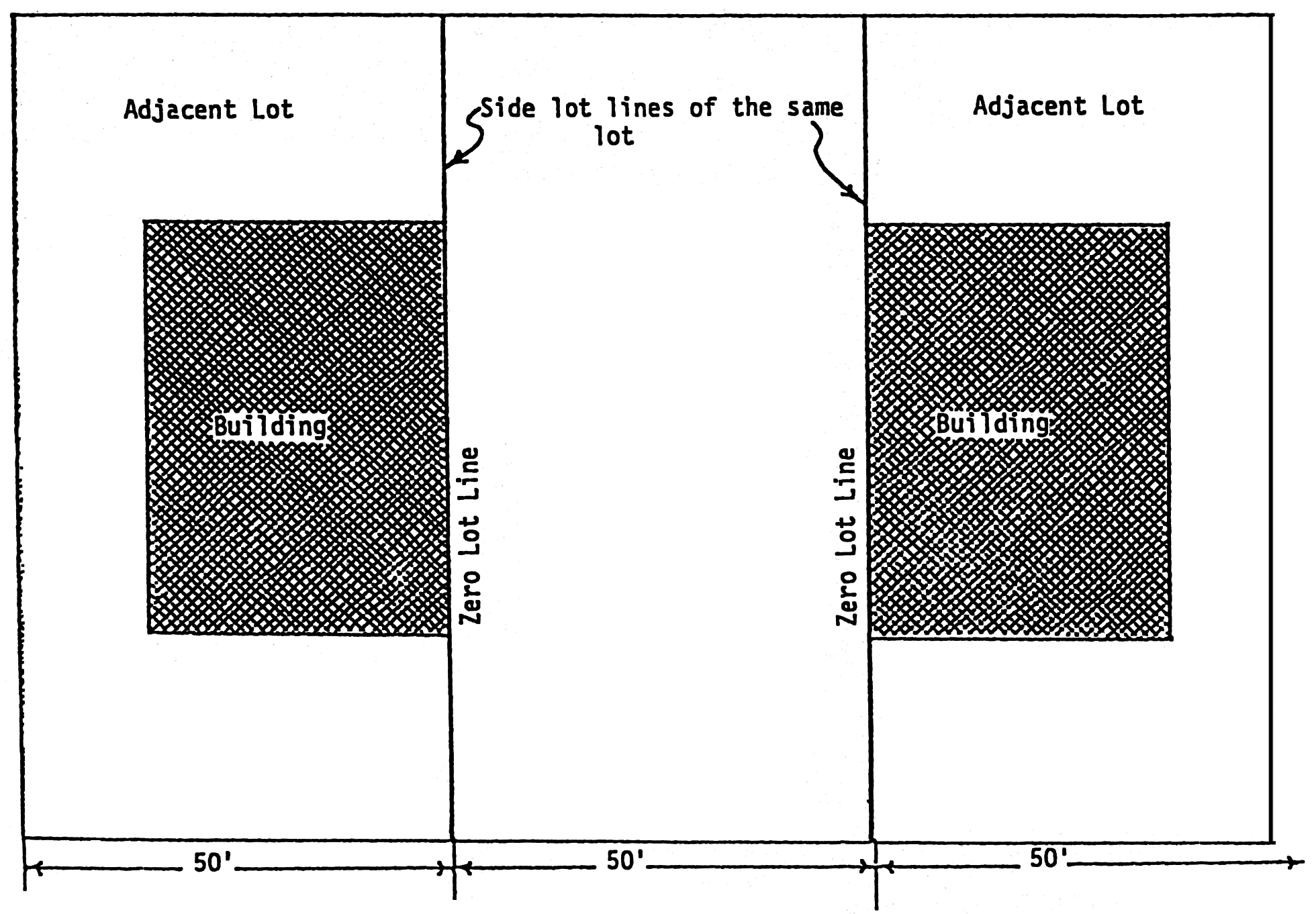
ILLUSTRATION NO. 1 ZERO LOT LINE DEVELOPMENT
ILLUSTRATION NO. 2
ZERO LOT LINE DEVELOPMENT
Required side yard of ten feet includes maintenance easement of six feet.
Maintenance Easement of Six Feet
Windows or doors shall not have direct exposure or access on the zero lot line wall
except where recessed within the zero lot line wall. Also, a fence must be erected
coterminous with the zero lot line where the zero lot line wall has been recessed
and such fence shall be no less than five feet in height.
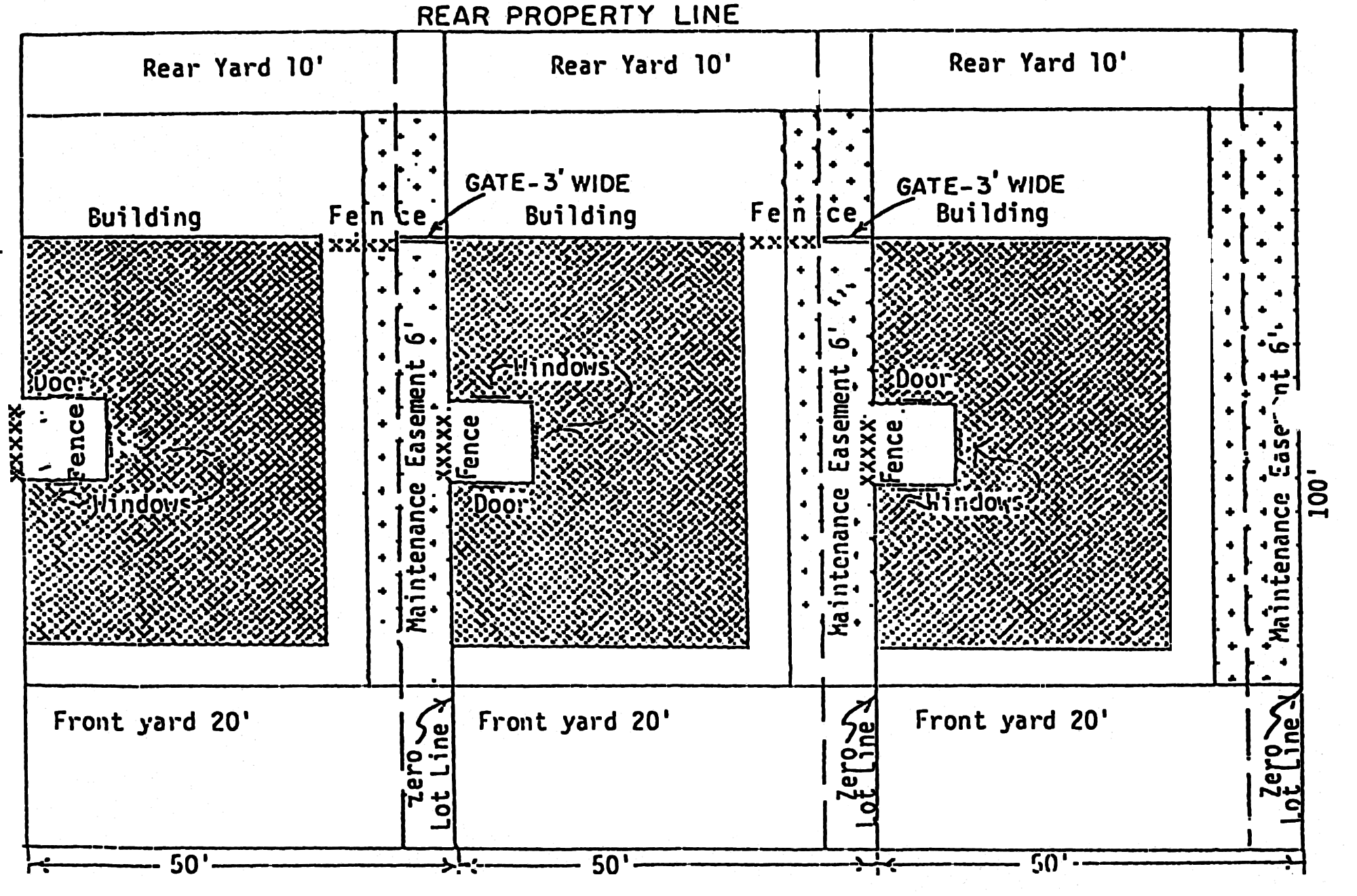
ILLUSTRATION NO. 2
A six-foot maintenance easement shall be provided appurtenant to the adjoining lot on which the residence abuts the zero lot line. No buildings or permanent structures including, but not limited to, permanent barbecue grills, permanent barbecue pits, storage sheds, garages, carports, etc., other than concrete or similar surfaced driveways or patios, shall be located within this easement except for roof eaves not exceeding a maximum projection of 24 inches. Roof eaves shall be provided with guttering and downspouts where roofs drain onto the easement.
EXHIBIT A
ZERO LOT LINE
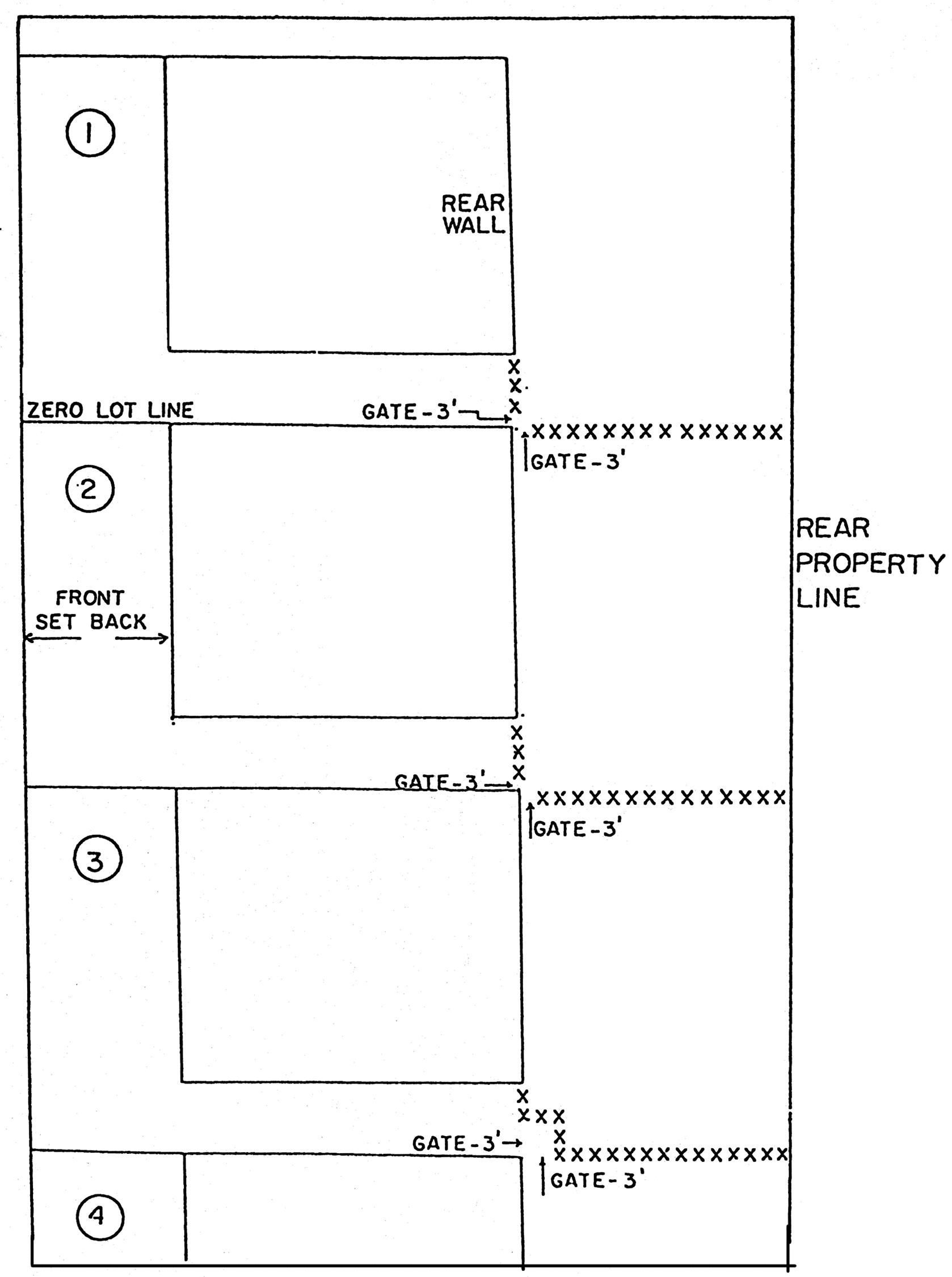
EXHIBIT A ZERO LOT LINE
EXHIBIT B
ZERO LOT LINE
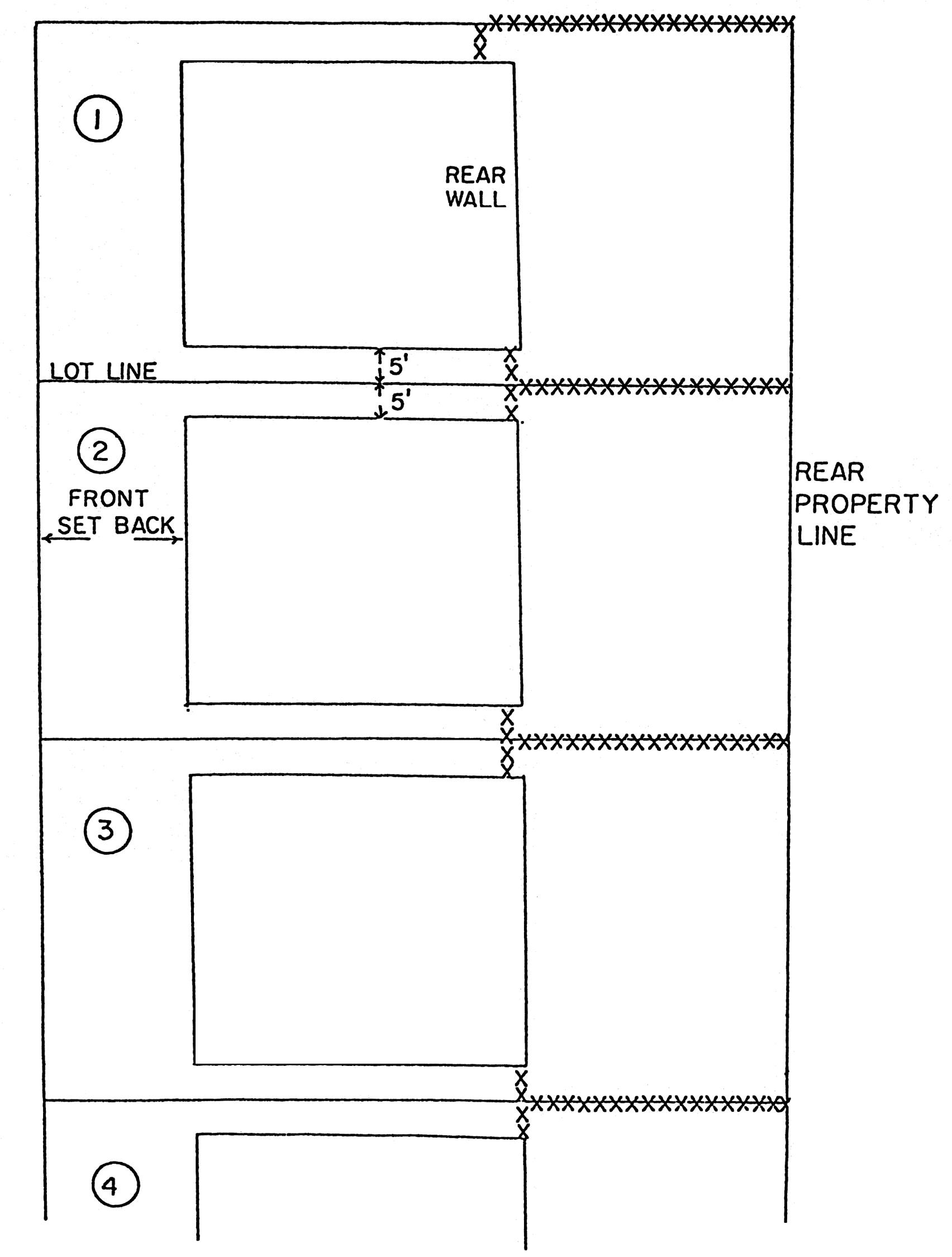
EXHIBIT B ZERO LOT LINE
R-3B, SINGLE-FAMILY RESIDENTIAL
DISTRICT
Intent. The R-3B, Single-Family Residential District is intended to allow medium density single-family residences. Lot width is reduced to increase the range of lot width available for single-family residential development.
Permitted uses.
Playfields
Playgrounds
Public parks
Recreation buildings and complexes for residents and guests in a residential development
Single-family dwelling units
Permitted accessory uses.
Garages
Gazebos
Incidental uses
Permitted home occupations
Storage sheds
Swimming pools, private, provided a principal structure exists and the pool is located behind the front plane of the principal structure. Corner lots will be considered to have two front planes, one on each street. If a structure is not constructed squarely on a parcel, the swimming pool must be located at or behind the most restrictive front plane of the principal structure.
Uses customarily associated with the permitted principal uses
Special exceptions.
Facilities owned and/or operated by federal, state, county, or municipal government, except country clubs and golf courses
Schools and or a house of worship, provided all structures are located at least 25 feet from all property lines and off-street parking areas abutting residential property are screened by a buffer meeting the requirements of this LDR.
Child day care on a house of worship property, subject to the following additional conditions:
(1)
The house of worship property shall be located on and be accessible by an arterial or collector roadway.
(2)
Play areas shall be fenced and landscaped. The landscaping shall have a vegetative hedge that will reach six feet in height within two years that is planted a minimum of three feet on center.
(3)
Play areas shall be located within all applicable setback dimensions.
(4)
The house of worship property shall have a vehicular drop off and pickup area with a minimum [of] 100 feet of drive lane outside of the public right-of-way, or sufficient parking area to provide enough space to fit the required parking and provided space for drop off and pick up.
Dimensional requirements.
Single-family dwellings.
Area: 5,750 square feet
Depth: 115 feet
Width: 50 feet
Minimum yard size.
Front yard: 20 feet or as required per [sub]section 504.01M. of this LDR
Rear yard: 7.5 feet
Side yard: 7.5 feet
Corner lots.
(1)
Parcels which front on two streets shall provide a 20-foot front yard on the street frontage with driveway access and a ten-foot front yard on the other street, or as required in [sub]section 504.01M. of this LDR.
(2)
Parcels fronting on three streets shall provide a 20-foot front yard on the street frontage with driveway access and a ten-foot front yard on the remaining streets, or as required per [sub]section 504.01M. of this LDR.
Minimum floor area. 650 square feet of livable area for one and two-bedroom dwelling units; 1,200 square feet of livable area for a three-bedroom dwelling unit; and 1,300 square feet of livable area for a four-bedroom dwelling unit.
Maximum principal building height.
Three stories.
Maximum height: 35 feet.
Maximum building coverage. The total area covered with buildings on any lot shall not exceed 40 percent of the total lot area.
Screen enclosures. As an exception to the maximum building coverage provision any parcel may be allowed an additional ten percent building coverage for only a screen pool enclosure if the following conditions are met:
1.
A screen pool enclosure shall only cover the swimming pool and surrounding pool deck and shall have a roof and walls consisting entirely of screening; and
2.
There shall be no variances granted to exceed the maximum building coverage or additional coverage allowed for screen enclosures.
Maximum impervious lot coverage. The total area of the lot that may be covered with impervious material is 60 percent.
Through lots. Through lots shall provide a 20-foot front yard on each street or as required per [sub]section 504.01M. of this LDR.
Atypical lots. Visibility triangles shall be established at the rear corners of an atypical lot. The visibility triangles shall be those areas formed by a line connecting the points 30 feet from the intersection of the side and rear lot line, along the side lot line, and 30 feet from the intersection of the side and rear lot line; no principal or accessory structure having a height over four feet, except for incidental uses, shall protrude into the area of a visibility triangle.
Building projection. There shall be no building projections into any required yard except for eaves with a maximum projections of 42 inches, but no closer than five feet to a property line; and those structures allowed in [sub]section 804.03.
Off-street parking. Off-street parking shall be provided as required in this LDR.
Visibility at intersections. Visibility at intersections shall be provided as required in this LDR.
R-4, MULTIFAMILY RESIDENTIAL DISTRICT
Intent. The R-4, Multifamily Residential District is a high density multiple-family residential district that permits mixed housing and encourages new development concepts. It is appropriate for developing large and small land parcels and as a buffer between single-family and business districts. Building height limitations are imposed to preserve lower building profiles in outlying residential areas.
Permitted uses.
Playfields
Playgrounds
Public parks
Recreation buildings and complexes for residents and guests in a residential development
Single-family dwellings detached and attached
Duplex and multifamily dwellings including townhouses, apartments and condominiums
Permitted accessory uses.
Attached dwelling
Garages
Gazebos
Incidental uses
On-site rental or manager's office for community association members' properties. "Community association" means a residential homeowners association in which membership is a condition of ownership of a unit in a planned unit development, or of a lot for a home or mobile home, or of a townhouse, villa, condominium, cooperative, or other residential unit which is part of a residential development scheme and which is authorized to impose a fee which may become a lien on the parcel. The following limitations shall be placed on the aforesaid rental or manager's office:
(1)
Said rental or manager's office may not be used in any way to promote the rental of or conduct transactions for the rental of noncommunity association members' properties;
(2)
The aforesaid rental or manager's office may only be used to rent or manage community association members' properties that are located on the same site that the rental or manager's office is located;
(3)
Said rental or manager's office staffing be limited to two persons either working full or part time to handle rental of association members' properties and one person working full or part time to act as clerical assistant;
(4)
Said rental or manager's office shall be allowed to erect a sign to comply with F.S. § 475.22.
On-site temporary sales and brokerage offices and display models for residential dwelling units that are newly constructed, that have never been occupied for residential purposes, and have never been sold.
On-site temporary sales and brokerage structures to be used as a sales office for dwelling units planned to be constructed or under construction. The following limitations and regulations shall be placed on the aforedescribed on-site sales and brokerage offices and temporary sales and brokerage structures:
(1)
Said sales and brokerage offices shall only be used to promote the sales of newly constructed dwelling units (to wit: units that have never previously been occupied for residential purposes or never sold by the developer) and part of an approved site plan located on the same site as the office;
(2)
Said sales and brokerage offices shall only be used to sell residential dwelling units located on the same site as the sales office;
(3)
Said sales and brokerage offices shall only have one sign not to exceed ten square feet in area in addition to the allowable signs indicated in [sub]section 604.14 of this LDR;
(4)
Said sales and brokerage offices shall be allowed within a development upon issuance of a certificate of occupancy for the offices by the development division director or his/her designee and said sales office must be removed from the site upon the issuance of a certificate of occupancy for the last building to be constructed within a development; and
(5)
The following additional limitations and regulations shall be placed on the aforedescribed on-site temporary sales and brokerage structures:
(a)
Said sales and brokerage structures shall have a minimum floor area of 300 square feet and shall not have been formerly a travel trailer, camper, recreational vehicle or tractor-trailer trailer;
(b)
The perimeter of the area between the ground and floor level of the sales and brokerage structures shall be enclosed with ornamental skirting;
(c)
Said sales and brokerage structures must be located on the site such that it meets the minimum setback requirements;
(d)
A minimum of three parking spaces must be provided for the sales and brokerage structures or the minimum number of parking spaces required for an office, whichever is greater. Said parking spaces and access aisle must meet the requirements of [sub]section 604.10 within this LDR except an alternate surfacing agent, such as shell or mulch, may be used;
(e)
A minimum ten-foot-wide and six-foot-high natural vegetative buffer shall be maintained along the front, side and rear of the sales and brokerage structure, parking area and any accessory structures. Should no buffer exist, a ten-foot-wide buffer, meeting the requirements of [sub]section 604.05 E.(1) must be planted along the front, sides and rear of the sales and brokerage structure, parking area and accessory structures. Buffer areas are not required to be irrigated with an underground automatic system but must be regularly irrigated to maintain the vegetation;
(f)
No sales and brokerage structure shall be allowed on a site until all permits as required by all federal, state, and county agencies have been secured and the site plan for the proposed permanent use has been approved and a class I site plan has been approved for the use of a temporary sales and brokerage structure; and
(g)
Said sales and brokerage structures shall not remain on a site longer than one year from the date a certificate of occupancy is issued for said sales office or until a certificate of occupancy is issued for the first building within the development, whichever comes first. Upon removal of the sales and brokerage structure, the developer may maintain an on-site temporary sales and brokerage office within the dwelling unit(s).
Permitted home occupations
Storage sheds
Swimming pools, private, provided a principal structure exists and the pool is located behind the front plane of the principal structure. Corner lots will be considered to have two front planes, one on each street. If a structure is not constructed squarely on a parcel, the swimming pool must be located at or behind the most restrictive front plane of the principal structure.
Uses customarily associated with the permitted principal uses
Special exceptions. Special exception uses shall be located at least 25 feet from all property lines, and off-street parking areas abutting residential property, shall be screened by a buffer meeting the requirements of this LDR
Adult congregate living facilities
Child day care on house of worship property, subject to the following additional conditions:
(1)
The house of worship property shall be located on and be accessible by an arterial or collector roadway.
(2)
Play areas shall be fenced and landscaped. The landscaping shall have a vegetative hedge that will reach six feet in height within two years that is planted a minimum of three feet on center.
(3)
Play areas shall be located within all applicable setback dimensions.
(4)
The house of worship property shall have a vehicular drop off and pickup area with a minimum [of] 100 feet of drive lane outside of the public right-of-way, or sufficient parking area to provide enough space to fit the required parking and provided space for drop off and pick up.
Day care centers subject to compliance with F.A.C. Child Care Standards and any amendments adopted thereto
Facilities owned and/or operated by federal, state, county, or municipal government, except country clubs and golf courses
House of worship
Nursing homes
Public and private schools
Semipublic and public clubs including halls and lodges
Dimensional requirements.
Single-family dwellings detached and duplexes.
Minimum lot size.
Single-family dwellings detached.
Area: 5,000 square feet
Depth: 100 feet
Width: 50 feet
Duplex.
Area: 7,500 square feet
Depth: 100 feet
Width: 75 feet
Minimum yard size.
Front yard: 20 feet or as required per [sub]section 504.01M. of this LDR
Rear yard: 7.5 feet
Side yard: 7.5 feet
Corner lots.
(1)
Parcels which front on two streets shall provide a 20-foot front yard on the street frontage with driveway access and a ten-foot front yard on the other street, or as required per [sub]section 504.01M. of this LDR.
(2)
Parcels fronting on three streets shall provide a 20-foot front yard on the street frontage with driveway access and a ten-foot front yard on the remaining streets, or as required per [sub]section 504.01M. of this LDR.
Minimum floor area.
600 square feet of liveable area for single-family dwellings detached
1,100 square feet of liveable area for duplexes
Maximum principal building height.
Three stories.
Maximum height: 35 feet.
Maximum building coverage. The total area covered with buildings on any lot shall not exceed 40 percent of the total lot area.
Screen enclosures. As an exception to the maximum building coverage provision any parcel may be allowed an additional ten percent building coverage for only a screen pool enclosure if the following conditions are met:
1.
A screen pool enclosure shall only cover the swimming pool and surrounding pool deck and shall have a roof and walls consisting entirely of screening; and
2.
There shall be no variances granted to exceed the maximum building coverage or additional coverage allowed for screen enclosures.
Maximum impervious lot coverage. The total area of the lot that may be covered with impervious material is 60 percent.
Multifamily dwellings.
Minimum project site dimensions.
Width: 100 feet
Depth: 100 feet
Maximum dwelling unit density for all dwelling units. Twelve dwelling units per acre beachside and 18 units per acre mainland. No less than 3,630 square feet of lot area for each beachside dwelling unit and 2,420 square feet of lot area for each mainland dwelling unit.
Minimum building separation. Where two or more multifamily dwellings, single-family dwellings attached or detached, duplexes, apartments, condominiums, townhouses are built on one parcel, there shall be a separation of at least 20 feet between the buildings plus 1.5 additional feet for each five feet of building height over 20 feet, when buildings vary in height, said distance to be based on the highest building. (For example: if there is a 20-foot-tall building and a 25-foot-tall building, the separation must be 21.5 feet.)
Streets. Public and private streets shall be constructed in accordance with city subdivision regulations and design standards.
Minimum yard requirements.
Front: 20 feet, plus 1.5 feet for each five feet over 30 feet in building height, or as required per [sub]section 504.01M. of this LDR
Rear: 20 feet, plus 1.5 feet for each five feet for over 30 feet in building height
Side:
(1)
For projects with six or fewer units, the minimum side setback shall be ten feet on each side, plus 1.5 feet for each five feet over 30 feet in building height;
(2)
For projects with more than six units but fewer than 12, the minimum side setback shall be 15 feet on each side, plus 1.5 feet for each five feet over 30 feet in building height; and
(3)
For projects with 12 or more units, the minimum side setback shall be 20 feet on each side, plus 1.5 feet for each five feet over 30 feet in building height.
Waterfront: 20 feet on river or canal measured from bulkhead or mean high water line.
Any yard in project over ten acres: 25 feet plus 1.5 feet for each five feet over 30 feet in building height or as required per [sub]section 504.01M. of this LDR.
Minimum requirements for townhouses and townhouse lots.
1.
All lots shall be adjacent to a public right-of-way or common area.
2.
Lots shall have a minimum width of 20 feet where a living unit is to be located.
3.
Lot frontage along a right-of-way or common area shall be a minimum of ten feet.
4.
Front setback shall be 20 feet or as required per [sub]section 504.01M. of this LDR.
5.
Side setbacks shall be zero feet.
6.
Rear setbacks shall be 20 feet except if there is a landscaped common area behind the townhome and there is a minimum distance of 20 feet from the project boundary line and the dwelling unit or accessory structures.
Minimum floor area for all dwelling units subject to multifamily development requirements.
Single-family dwellings detached. 600 square feet of livable area for one and two-bedroom dwelling units; 1,200 square feet of livable area for a three-bedroom dwelling unit; and 1,300 square feet of livable area for a four-bedroom dwelling unit.
Duplexes (combined units). 1,100 square feet of livable area.
Townhouses, apartments, and condominiums.
450 square feet of livable area for a one-bedroom unit;
550 square feet of livable area for a two-bedroom unit; and
700 square feet of livable area for a three-bedroom unit.
Maximum building length and width. Building facades parallel to the street upon which the building fronts, or parallel to the oceanfront, shall not exceed 150 feet in length. No building constructed after the effective date of this LDR shall have a dimension that exceeds 200 feet.
Maximum principal building height.
Single-family dwellings detached and attached and duplexes.
Three stories.
Maximum height: 35 feet.
Multifamily dwellings.
Four stories.
Maximum height: 45 feet.
Maximum lot coverage by all buildings. The coverage of a lot or total project by all principal and accessory buildings shall not exceed 35 percent.
Maximum impervious lot coverage. The total area of the property that may be covered with impervious material is 60 percent.
Through lots. Through lots shall provide a 20-foot front yard on each street or as required per [sub]section 504.01M. of this LDR.
Atypical lots. Visibility triangles shall be established at the rear corners of an atypical lot. The visibility triangles shall be those areas formed by a line connecting the points 30 feet from the intersection of the side and rear lot line and 30 feet from the intersection of the side and rear lot line along the rear lot line; no principal or accessory structure having a height over four feet, except for incidental uses, shall protrude into the area of a visibility triangle.
Building projections. There shall be no building projections into any required yard except for eaves with a maximum projection of 42 inches, but no closer than five feet to a property line; and those structures allowed in [sub]section 804.03.
Off-street parking. Multifamily projects which include different zoning districts, and where the multifamily portion of the development constitutes the principal use of the overall project, may utilize property in the nonmultifamily zoning district for accessory major recreational equipment parking, as long as such property is located within the project boundaries. The parking shall be developed in accordance with all applicable requirements of the land development regulations.
Covered off-street garage parking. Covered off-street garage parking may be provided either within or outside of the principal building(s). If the entire first story of the principal building(s) is used only for covered off-street garage parking, the principal building(s) may be four stories, but shall not exceed a maximum building height of 45 feet. If covered off-street garage parking is provided outside the outer walls of the principal building(s), it may be considered open landscaped area if it has a landscaped periphery and the roof is used for recreational purposes. Covered off-street garage parking located outside the principal building(s) and considered open landscaped area, is not included in the maximum percentage lot coverage calculation for solid roofed areas. Landscaping shall be provided as required in this LDR.
Visibility at intersections. Visibility at intersections shall be provided as required in this LDR.
Buffers for multifamily development. Landscaped or natural vegetative buffers shall be provided as indicated in [sub]section 604.05 and as follows:
(1)
Along front, rear, and side lot lines where off-street parking areas are located, the buffer shall be a minimum of seven feet wide; and
(2)
[Adjacent] Accent to or facing a single-family residential district or use, the buffer shall be a minimum of 20 feet wide from the property line.
Landscaping. A landscape plan is required as described in this LDR.
Deed covenants. The developer shall supply in writing all covenants and restrictions that will govern the maintenance of the common open space and other aspects of the project that are necessary for welfare of the project and consistent with the best interest of New Smyrna Beach. Such legal instruments shall be submitted with the site plan and approved by the city legal department prior to the issuance of a building permit by the chief building official.
Use of recreational amenities and/or commonly-owned facilities incidental to commercial and residential living accommodations. Use of all recreational amenities and/or commonly-owned facilities by the owner, the owner's guests, lessees, or invitees, shall be limited to that period of time concurrent with the owner's exclusive right of use, possession and occupancy of the residential unit. It shall be unlawful for any person to represent by contract for purchase, promotional material, advertising or any other public statement, that amenities and/or commonly-owned facilities may be used contrary to the requirements of the New Smyrna Beach land development regulations. This subsection does not prohibit the establishment of permitted accessory uses at commonly-owned facilities if such uses are in compliance with all the other requisites required by the New Smyrna Beach land development regulations.
R-5, MULTIFAMILY RESIDENTIAL DISTRICT
Intent. The R-5, Multifamily Residential District is a high density multiple-family residential district that permits mixed housing. It is suitable for large and small land parcels and is a buffer between single-family and business districts and for older residential areas. In addition, the district is designed to preserve ocean views and breezes, enhance roadside appearance and encourage well-planned projects.
Permitted uses.
Playfields
Playgrounds
Public parks
Recreation buildings and complexes for residents and guests of a residential development single-family dwellings detached and attached
Duplex and multifamily dwellings including townhouses, apartments, and condominiums
Permitted accessory uses.
Garages
Gazebos
Incidental uses
On-site rental or manager's office for community association members' properties. Community association means a residential homeowners association in which membership is a condition of ownership of a unit in a planned unit development, or of a lot for a home or mobile home, or of a townhouse, villa, condominium, cooperative, or other residential unit which is part of a residential development scheme and which is authorized to impose a fee which may become a lien on the parcel. The following limitations shall be placed on the aforesaid rental or manager's office:
(1)
Said rental or manager's office may not be used in any way to promote the rental of or conduct transactions for the rental of noncommunity association members' properties;
(2)
The aforesaid rental or manager's office may only be used to rent or manage community association members properties that are located on the same site that the rental or manager's office is located;
(3)
Said rental or manager's office staffing be limited to two persons either working full- or part-time to handle rental of association members' properties and one person working full- or part-time to act as clerical assistant;
(4)
Said rental or manager's office shall be allowed to erect a sign to comply with F.S. § 475.22.
On-site temporary sales and brokerage offices and display models for residential dwelling units that are newly constructed, that have never been occupied for residential purposes, and have never been sold.
On-site temporary sales and brokerage structures to be used as a sales office for dwelling units planned to be constructed or under construction. The following limitations and regulations shall be placed on the aforedescribed on-site sales and brokerage offices and temporary sales and brokerage structures:
(1)
Said sales and brokerage offices shall only be used to promote the sales of newly constructed dwelling units (to wit: units that have never previously been occupied for residential purposes or never sold by the developer) and part of an approved site plan located on the same site as the office;
(2)
Said sales and brokerage offices shall only be used to sell residential dwelling units located on the same site as the sales office;
(3)
Said sales and brokerage offices may only have one sign not to exceed ten square feet in area in addition to the allowable signs indicated in [sub]section 604.14 of this LDR;
(4)
Said sales and brokerage offices shall be allowed within a development upon issuance of a certificate of occupancy for the offices by the development division director or his/her designee and said sales office must be removed from the site upon the issuance of a certificate of occupancy for the last building to be constructed within a development; and
(5)
The following additional limitations and regulations shall be placed on the aforedescribed on-site temporary sales and brokerage structures:
(a)
Said sales and brokerage structures shall have a minimum floor area of 300 square feet and shall not have been formerly a travel trailer, camper, recreational vehicle or tractor-trailer trailer;
(b)
The perimeter of the area between the ground and floor level of the sales and brokerage structures shall be enclosed with ornamental skirting;
(c)
Said sales and brokerage structures must be located on the site such that it meets the minimum setback requirements;
(d)
A minimum of three parking spaces must be provided for the sales and brokerage structures or the minimum number of parking spaces required for an office, whichever is greater. Said parking spaces and access aisle must meet the requirements of [sub]section 604.10 within this LDR except an alternate surfacing agent, such as shell or mulch, may be used;
(e)
A minimum ten-foot-wide and six-foot-high natural vegetative buffer shall be maintained along the front, side and rear of the sales and brokerage structure, parking area and any accessory structures. Should no buffer exist, a ten-foot-wide buffer, meeting the requirements of [sub]section 604.05 E.(1) must be planted along the front, sides and rear of the sales and brokerage structure, parking area and accessory structures. Buffer areas are not required to be irrigated with an underground automatic system but must be regularly irrigated to maintain the vegetation;
(f)
No sales and brokerage structure shall be allowed on a site until all permits as required by all federal, state, and county agencies have been secured; and the site plan for the proposed permanent use has been approved; and a class I site plan has been approved for the use of a temporary sales and brokerage structure; and
(g)
Said sales and brokerage structures shall not remain on a site longer than one year from the date a certificate of occupancy is issued for said sales office or until a certificate of occupancy is issued for the first building within the development, whichever comes first. Upon removal of the sales and brokerage structure, the developer may maintain an on-site temporary sales and brokerage office within the dwelling unit(s).
Permitted home occupations
Storage sheds
Swimming pools, private, provided a principal structure exists and the pool is located behind the front plane of the principal structure. Corner lots will be considered to have two front planes, one on each street. If a structure is not constructed squarely on a parcel, the swimming pool must be located at or behind the most restrictive front plane of the principal structure.
Uses customarily associated with the permitted principal uses
Special exceptions. Special exception uses shall be located at least 25 feet from all property lines and off-street parking areas abutting residential property shall be screened by a buffer meeting the requirements of this LDR.
Adult congregate living facilities
Child day care on house of worship property, subject to the following additional conditions:
(1)
The house of worship property shall be located on and be accessible by an arterial or collector roadway.
(2)
Play areas shall be fenced and landscaped. The landscaping shall have a vegetative hedge that will reach six feet in height within two years that is planted a minimum of three feet on center.
(3)
Play areas shall be located within all applicable setback dimensions.
(4)
The house of worship property shall have a vehicular drop off and pickup area with a minimum [of] 100 feet of drive lane outside of the public right-of-way, or sufficient parking area to provide enough space to fit the required parking and provided space for drop off and pick up.
Day care centers subject to compliance with the F.A.C. Child Care Standards and any amendments adopted thereto
Facilities owned and/or operated by federal, state, county or municipal government, except country clubs and golf courses
Garage apartments
House of worship
Nursing homes
Public and private schools
Schools
Semipublic and public clubs including halls and lodges.
Dimensional requirements.
Single-family dwellings detached and duplexes.
Minimum lot size.
Single-family dwelling detached.
Area: 5,000 square feet
Depth: 100 feet
Width: 50 feet
Duplex.
Area: 7,500 square feet
Depth: 100 feet
Width: 75 feet
Minimum yard size.
Front yard: 20 feet or as required per [sub]section 504.01M. of this LDR
Rear yard: 7.5 feet
Side yard: 7.5 feet
Corner lots.
(1)
Parcels which front on two streets shall provide a 20-foot front yard on the street frontage with driveway access and a ten-foot front yard on the other street or as required per [sub]section 504.01M. of this LDR.
(2)
Parcels fronting on three streets shall provide a 20-foot front yard on the street frontage with driveway access and a ten-foot front yard on the remaining streets or as required per [sub]section 504.01M. of this LDR.
Minimum floor area.
600 square feet of livable area for single-family dwellings detached.
1,100 square feet of livable area for duplexes.
Maximum principal building height.
Three stories.
Maximum height: 35 feet.
Maximum building coverage. The total area covered with buildings on any lot shall not exceed 40 percent of the total lot area.
Screen enclosures. As an exception to the maximum building coverage provision any parcel may be allowed an additional ten percent building coverage for only a screen pool enclosure if the following conditions are met:
1.
A screen pool enclosure shall only cover the swimming pool and surrounding pool deck and shall have a roof and walls consisting entirely of screening; and
2.
There shall be no variances granted to exceed the maximum building coverage or additional coverage allowed for screen enclosures.
Maximum impervious lot coverage. The total area of the lot that may be covered with impervious material is 60 percent.
Multifamily dwelling.
Minimum project site dimensions.
Width: 100 feet
Depth: 100 feet
Maximum dwelling unit density for all dwelling units. Twelve dwelling units per acre beachside and 18 units per acre mainland. No less than 3,630 square feet of lot area for each beachside dwelling unit and 2,420 square feet for each mainland dwelling unit.
Minimum building separation. Where two or more multifamily dwellings, single-family dwellings attached or detached, duplexes, apartments, condominiums, [or] townhouses are built on one parcel there shall be a separation of at least 20 feet between the buildings plus 1.5 additional feet for each five feet of building height over 20 feet. When buildings vary in height, said distance to be based on the highest building. (For example: The distance between a 20-foot-tall and 25-foot-tall building shall be 21.5 feet.)
Streets. Public and private streets shall be constructed in accordance with city subdivision regulations.
Minimum yard requirements.
Front: 20 feet, plus 1.5 feet for every five feet over 30 feet in building height, or as required per [sub]- section 504.01M. of this LDR
Rear: 20 feet, plus 1.5 feet for every five feet over 30 feet in building height
Side:
(1)
For projects with six or fewer units, the minimum side setback shall be ten feet on each side, plus 1.5 feet for each five feet over 30 feet in building height;
(2)
For projects with more than six units but fewer than 12, the minimum side setback shall be 15 feet on each side, plus 1.5 feet for each five feet over 30 feet in building height; and
(3)
For projects with 12 or more units, the minimum side setback shall be 20 feet on each side, plus 1.5 feet for each five feet over 30 feet in building height.
Waterfront: 20 feet on river or canal measured from bulkhead or mean high water line
Any yard in 25 in project over ten acres: 25 feet plus 1.5 feet for each five feet over 30 feet in building height or as required per [sub]section 504.01M. of this LDR
Minimum requirements for townhouses and townhouse lots.
All lots shall be adjacent to a public right-of-way or common area.
Lots shall have a minimum width of 20 feet where a living unit is to be located.
Lot frontage along a right-of-way or common area shall be a minimum of ten feet.
Front setback shall be 20 feet or as required per [sub]section 504.01M. of this LDR.
Side setbacks shall be zero feet.
Rear setbacks shall be 20 feet except if there is a landscaped common area behind the townhome and there is a minimum distance of 20 feet from the project boundary line and the dwelling unit or accessory structures.
Minimum floor area for all dwelling units subject to multifamily development requirements.
Single-family dwellings detached. 600 square feet of livable area for one and two-bedroom single-family dwelling units; 1,200 square feet of livable area for a three-bedroom single-family dwelling unit; and 1,300 square feet of livable area for a four-bedroom single-family dwelling unit.
Duplexes (combined units). 1,100 square feet of livable area.
Townhouses, apartments, and condominiums.
450 square feet of livable area for a one-bedroom unit;
550 square feet of livable area for a two-bedroom unit; and
700 square feet of livable area for a three-bedroom unit.
Maximum building length and width. Building facades parallel to the street upon which the building fronts, or parallel to the oceanfront, shall not exceed 150 feet in length. No building constructed after the effective date of this LDR shall have a dimension which exceeds 200 feet.
Maximum principal building height.
Eight stories.
Maximum building height: 80 feet.
Nine stories, provided all of the first story of the building, or that portion of the first story of a building containing nine stories, is used for off-street parking, excluding elevator shafts; maintenance, and utility equipment rooms; laundry rooms; and storage rooms, restricted to owner or tenant usage.
Maximum building height with garage parking: 95 feet.
Maximum lot coverage by all buildings.
Maximum impervious lot coverage. The total area of the lot that may be covered with impervious material is 60 percent.
Through lots. Through lots shall provide a 20-foot front yard on each street or as required per [sub]section 504.01M. of this LDR.
Atypical lots. Visibility triangles shall be established at the rear corners of an atypical lot. The visibility triangles shall be those areas formed by a line connecting the points 30 feet from the intersection of the side and rear lot line, along the side lot line, and 30 feet from the intersection of the side and rear lot line along the rear lot line; no principal or accessory structure having a height over four feet, except for incidental uses, shall protrude into the area of a visibility triangle.
Building projections. There shall be no building projections into any required yard except for eaves with a maximum projection of 42 inches, but no closer than five feet to a property line; and those structures allowed in [sub]section 804.03.
Off-street parking. Multifamily projects which include different zoning districts, and where the multifamily portion of the development constitutes the principal use of the overall project, may utilize property in the nonmultifamily zoning district for accessory major recreational equipment parking, as long as such property is located within the project boundaries. The parking shall be developed in accordance with all applicable requirements of the land development regulations.
Covered off-street garage parking. Covered off-street garage parking may be provided either within or outside of the principal building(s). If the entire first story of the principal building(s) is used only for covered off-street garage parking, the principal building(s) may be nine stories but shall not exceed a maximum building height of 95 feet. If covered off-street garage parking is provided outside the outer walls of the principal building(s), it may be considered open landscaped area if it has a landscaped periphery and the roof is used for recreation purposes. Covered off-street garage parking located outside the principal building(s) and considered open landscaped area is not included in the maximum percentage lot coverage calculation for solid roofed areas. Landscaping shall be provided as required in this LDR.
Visibility at intersections. Visibility at intersections shall be provided as required in this LDR.
Buffers for multifamily development. Landscaped or natural vegetative buffers shall be provided as indicated in [sub]section 604.05 and as follows:
(1)
Along the front, rear, and side lot lines where off-street parking areas are located, the buffer shall be a minimum of seven feet wide; and
(2)
Adjacent to or facing a single-family residential district or use, the buffer shall be a minimum of 20 feet wide from the property line.
Landscaping. A landscape plan is required as described in this LDR.
Deed covenants. The developer shall supply, in writing, all covenants and restrictions that will govern the maintenance of the common open space and other aspects of the project that are necessary for welfare of the project and consistent with the best interest of New Smyrna Beach. Such legal instruments shall be submitted with the site plan and approved by the city legal department prior to the issuance of a building permit by the chief building official.
Use of recreational amenities and/or commonly-owned facilities incidental to commercial and residential living accommodations. Use of all recreational amenities and/or commonly-owned facilities by the owner, the owner's guests, lessees, or invitees, shall be limited to that period of time concurrent with the owner's exclusive right of use, possession, and occupancy of the residential unit. It shall be unlawful for any person to represent by contract for purchase, promotional material, advertising, or any other public statement that amenities and/or commonly-owned facilities, may be used contrary to the requirements of the New Smyrna Beach Land Development Regulations. This subsection does not prohibit the establishment of permitted accessory uses at commonly owned facilities if such uses are in compliance with all the other requisites required by the New Smyrna Beach land development regulations.
R-6, MULTIFAMILY RESIDENTIAL DISTRICT
Intent. The R-6, Multifamily Residential District is a high density residential district with ocean frontage. Density requirements permit intermixing of dwelling types and considerable flexibility in project design. Innovative site planning is essential to assure buildings are placed in such a manner that maximum benefits are derived from ocean views and breezes.
Permitted uses.
Playfields
Playgrounds
Public parks
Recreation buildings and complexes for residents and guests of a residential development
Single-family dwellings detached and attached
Duplex and multifamily dwellings including townhouses, apartments, and condominiums
Permitted accessory uses.
Garages
Gazebos
Incidental uses
On-site rental or manager's office for community association members' properties. Community association means a residential homeowners association in which membership is a condition of ownership of a unit in a planned unit development, or of a lot for a home or mobile home, or of a townhouse, villa, condominium, cooperative, or other residential unit which is part of a residential development scheme and which is authorized to impose a fee which may become a lien on the parcel. The following limitations shall be placed on the aforesaid rental or manager's office:
(1)
Said rental or manager's office may not be used in any way to promote the rental of or conduct transactions for the rental of noncommunity association members' properties;
(2)
The aforesaid rental or manager's office may only be used to rent or manage community association members' properties that are located on the same site that the rental or manager's office is located;
(3)
Said rental or manager's office staffing be limited to two persons either working full- or part-time to handle rental of association members' properties and one person working full- or part-time to act as clerical assistant;
(4)
Said rental or manager's office shall be allowed to erect a sign to comply with F.S. § 475.22.
On-site temporary sales and brokerage offices and display models for residential dwelling units that are newly constructed, that have never been occupied for residential purposes, and have never been sold.
On-site temporary sales and brokerage structures to be used as a sales office for dwelling units planned to be constructed or under construction. The following limitations and regulations shall be placed on the aforedescribed on-site sales and brokerage offices and temporary sales and brokerage structures:
(1)
Said sales and brokerage offices shall only be used to promote the sales of newly constructed dwelling units (to wit: units that have never previously been occupied for residential purposes or never sold by the developer) and part of an approved site plan located on the same site as the office;
(2)
Said sales and brokerage offices shall only be used to sell residential dwelling units located on the same site as the sales office;
(3)
Said sales and brokerage offices may only have one sign not to exceed ten square feet in area in addition to the allowable signs indicated in [sub]section 604.14 of this LDR;
(4)
Said sales and brokerage offices shall be allowed within a development upon issuance of a certificate of occupancy for the offices by the development division director or his/her designee and said sales office must be removed from the site upon the issuance of a certificate of occupancy for the last building to be constructed within a development; and
(5)
The following additional limitations and regulations shall be placed on the aforedescribed on-site temporary sales and brokerage structures:
(a)
Said sales and brokerage structures shall have a minimum floor area of 300 square feet and shall not have been formerly a travel trailer, camper, recreational vehicle or tractor-trailer trailer;
(b)
The perimeter of the area between the ground and floor level of the sales and brokerage structures shall be enclosed with ornamental skirting;
(c)
Said sales and brokerage structures must be located on the site such that it meets the minimum setback requirements;
(d)
A minimum of three parking spaces must be provided for the sales and brokerage structures or the minimum number of parking spaces required for an office, whichever is greater. Said parking spaces and access aisle must meet the requirements of [sub]section 604.10 within this LDR except an alternate surfacing agent, such as shell or mulch, may be used;
(e)
A minimum ten-foot-wide and six-foot-high natural vegetative buffer shall be maintained along the front, side and rear of the sales and brokerage structure, parking area and any accessory structures. Should no buffer exist, a ten-foot-wide buffer, meeting the requirements of [sub]section 604.05 E.(1) must be planted along the front, sides and rear of the sales and brokerage structure, parking area and accessory structures. Buffer areas are not required to be irrigated with an underground automatic system but must be regularly irrigated to maintain the vegetation;
(f)
No sales and brokerage structure shall be allowed on a site until all permits as required by all federal, state, and county agencies have been secured; and the site plan for the proposed permanent use has been approved; and a class I site plan has been approved for the use of a temporary sales and brokerage structure; and
(g)
Said sales and brokerage structures shall not remain on a site longer than one year from the date a certificate of occupancy is issued for said sales office or until a certificate of occupancy is issued for the first building within the development, whichever comes first. Upon removal of the sales and brokerage structure, the developer may maintain an on-site temporary sales and brokerage office within the dwelling unit(s).
Permitted home occupations
Storage sheds
Swimming pools, private, provided a principal structure exists and the pool is located behind the front plane of the principal structure. Corner lots will be considered to have two front planes, one on each street. If a structure is not constructed squarely on a parcel, the swimming pool must be located at or behind the most restrictive front plane of the principal structure.
Uses customarily associated with the permitted principal uses
Special exceptions. Special exception uses shall be located at least 25 feet from all property lines and off-street parking areas abutting residential property shall be screened by a buffer meeting the requirements of this LDR.
Adult congregate living facilities
Child day care on house of worship property, subject to the following additional conditions:
(1)
The house of worship property shall be located on and be accessible by an arterial or collector roadway.
(2)
Play areas shall be fenced and landscaped. The landscaping shall have a vegetative hedge that will reach six feet in height within two years that is planted a minimum of three feet on center.
(3)
Play areas shall be located within all applicable setback dimensions.
(4)
The house of worship property shall have a vehicular drop off and pickup area with a minimum [of] 100 feet of drive lane outside of the public right-of-way, or sufficient parking area to provide enough space to fit the required parking and provided space for drop off and pick up.
Facilities owned and/or operated by federal, state, county, or municipal government, except country clubs and golf courses.
Garage apartments
House of worship
Nursing homes
Rooming houses, provided, that no more than 60 percent of the total floor area in one dwelling is devoted to guest occupancy
Semipublic and public clubs, including halls and lodges
Dimensional requirements.
Single-family dwellings detached and duplexes.
Minimum lot size.
Single-family dwelling detached.
Area: 5,000 feet
Depth: 100 feet
Width: 50 feet
Duplex.
Area: 7,500 feet
Depth: 100 feet
Width: 75 feet
Minimum yard size.
Front yard: 20 feet or as required per [sub]section 504.01M. of this LDR
Rear yard: 7.5 feet
Side yard: 7.5 feet
Corner lots.
(1)
Parcels which front on two streets shall provide a 20-foot front yard on the street frontage with driveway access and a ten-foot front yard on the other street or as required per [sub]section 504.01M. of this LDR.
(2)
Parcels fronting on three streets shall provide a 20-foot front yard on the street frontage with driveway access and a ten-foot front yard on the remaining streets or as required per [sub]section 504.01M. of this LDR.
Minimum floor area.
600 square feet of livable area for single-family dwellings detached.
1,100 square feet of livable area for duplexes.
Maximum principal building height.
Three stories.
Maximum height: 35 feet.
Maximum building coverage. The total area covered with buildings on any lot shall not exceed 40 percent of the total lot area.
Screen enclosures. As an exception to the maximum building coverage provision any parcel may be allowed an additional ten percent building coverage for only a screen pool enclosure if the following conditions are met:
1.
A screen pool enclosure shall only cover the swimming pool and surrounding pool deck and shall have a roof and walls consisting entirely of screening; and
2.
There shall be no variances granted to exceed the maximum building coverage or additional coverage allowed for screen enclosures.
Maximum impervious lot coverage. The total area of the lot that may be covered with impervious material is 60 percent.
Multifamily.
Minimum project site dimensions.
Width: 100 feet
Depth: 100 feet
Maximum dwelling unit density for all dwelling units. 12 dwelling units per acre. No less than 3,630 square feet of lot area for each dwelling unit.
Minimum building separation. Where two or more multifamily dwellings, single-family dwellings attached or detached, duplexes, apartments, condominiums, [or] townhouses are built on one parcel, there shall be a separation of at least 20 feet between the buildings plus 1.5 additional feet for each five feet of building height over 20 feet. When buildings vary in height, said distance shall be based on the tallest building. (For example. The distance required between a 20-foot-[high] and 25-foot-high building is 21.5 feet.)
Minimum yard requirements.
Front: 20 feet, plus 1.5 feet for each five feet of building height over 30 feet
Side:
(1)
For projects with six or fewer units, the minimum side setback shall be ten feet on each side, plus 1.5 feet for each five feet over 30 feet in building height;
(2)
For projects with more than six units but fewer than 12, the minimum side setback shall be 15 feet on each side, plus 1.5 feet for each five feet over 30 feet in building height; and
(3)
For projects with 12 or more units, the minimum side setback shall be 20 feet on each side, plus 1.5 feet for each five feet over 30 feet in building height.
Rear: 20 feet, plus 1.5 feet for each five feet of building height over 30 feet. However, buildings may be built to the City Coastal Construction Setback Line where property ownership extends east of City Coastal Construction Setback Line.
Any yard in project over ten acres: 25 feet plus 1.5 feet for each five feet over 30 feet in building height or as required per [sub]section 504.01M. of this LDR.
Streets. Public and private streets shall be constructed in accordance with city regulations and design standards.
Minimum requirements for townhouses and townhouse lots.
1.
All lots shall be adjacent to a public right-of-way or common area.
2.
Lots shall have a minimum width of 20 feet where a living unit is to be located.
3.
Lot frontage along a right-of-way or common area shall be a minimum of ten feet.
4.
Front setback shall be 20 feet or as required per [sub]section 504.01M. of this LDR.
5.
Side setbacks shall be zero feet.
6.
Rear setbacks shall be 20 feet except if there is a landscaped common area behind the townhome and there is a minimum distance of 20 feet from the project boundary line and the dwelling unit or accessory structures.
Minimum floor area for all dwelling units subject to multifamily development requirements.
Single-family dwellings detached. 600 square feet of livable area.
Duplexes (combined units). 1,100 square feet of livable area.
Townhouses, apartments, and condominiums.
450 square feet of livable area for a one-bedroom unit;
550 square feet of livable area for a two-bedroom unit; and
700 square feet of livable area for a three-bedroom unit.
Maximum building length and width. Building facades parallel to the street upon which the building fronts, or parallel to the oceanfront, shall not exceed 150 feet in length. No building constructed after the effective date of this LDR shall have a dimension which exceeds 200 feet.
Maximum principal building height.
Eight stories.
Maximum building height: 80 feet.
Nine stories, provided, all of the first story of the building, or that portion of the first story of a building containing nine stories, is used for off-street parking, excluding elevator shafts; maintenance, and utility equipment rooms; laundry rooms; and storage rooms, restricted to owner or tenant usage. Maximum building height with garage parking: 95 feet.
Maximum lot coverage by all buildings.
Maximum impervious lot coverage. The total area of the lot that may be covered with impervious material is 60 percent.
Through lots. Through lots shall provide a 20-foot front yard on each street or as required per [sub]section 504.01M. of this LDR.
Atypical lots. Visibility triangles shall be established at the rear corners of an atypical lot. The visibility triangles shall be those area[s] formed by a line connecting the points 30 feet from the intersection of the side and rear lot line along the side lot line and 30 feet from the intersection of the side and rear lot line along the rear lot line; no principal or accessory structure having a height over four feet, except incidental uses, shall protrude into the area of a visibility triangle.
Building projections. There shall be no building projections into any required yard except for eaves with a maximum projection of 42 inches, but no closer than five feet to a property line; and those structures allowed in [sub]section 804.03 there shall be no building projections into any required yard.
Off-street parking. Multifamily projects which include different zoning districts, and where the multifamily portion of the development constitutes the principal use of the overall project, may utilize property in the nonmultifamily zoning district for accessory major recreational equipment parking, as long as such property is located within the project boundaries. The parking shall be developed in accordance with all applicable requirements of the land development regulations.
Covered off-street garage parking. Covered off-street garage parking may be provided either within or outside of the principal building(s). If the entire first story of the principal building(s)is used only for covered off-street garage parking, the principal building(s) may be nine stories but shall not exceed a maximum building height of 95 feet. If covered off-street garage parking is provided outside the outer walls of the principal building(s), it may be considered open landscaped area if it has a landscaped periphery and the roof is used for recreational purposes. Covered off-street garage parking located outside the principal building(s) and considered open landscaped area if not included in the maximum percentage lot coverage calculation for solid roofed areas. Landscaping shall be provided as required in this LDR.
Visibility at intersections. Visibility at intersections shall be provided as required in this LDR.
Buffers for multifamily development. Landscaped or natural vegetative buffers shall be provided as indicated in [sub]section 604.05, and as follows:
(1)
Along the front, rear, and side lot lines where off-street parking areas are located, the buffer shall be a minimum of seven feet wide; and
(2)
Adjacent to or facing a single-family residential district or use, the buffer shall be a minimum of 20 feet wide from the property line.
Landscaping. A landscape plan is required as described in this LDR.
Deed covenants. The developer shall supply in writing all covenants and restrictions that will govern the maintenance of the common open space and other aspects of the project that are necessary for the welfare of the project and consistent with the best interest of New Smyrna Beach. Such legal instruments shall be submitted with the site plan and approved by the city legal department prior to the issuance of a building permit by the chief building official.
Use of recreational amenities and/or commonly-owned facilities incidental to commercial and residential living accommodations. Use of all recreational amenities and/or commonly-owned facilities by the owner, the owner's guests, lessees, or invitees, shall be limited to that period of time concurrent with the owner's exclusive right of use, possession and occupancy of the residential unit. It shall be unlawful for any person to represent by contract for purchase, promotional material, advertising, or any other public statement, that amenities and/or commonly-owned facilities may be used contrary to the requirements of the New Smyrna Beach Land Development Regulations. This subsection does not prohibit the establishment of permitted accessory uses at commonly-owned facilities if such uses are in compliance with all the other requisites required by the New Smyrna Beach land development regulations.
R-1CO, URBAN SINGLE-FAMILY
RESIDENTIAL DISTRICT
Purpose and intent. The purpose and intent of the R-1CO, Urban Single-Family Residential District is to provide low-density residential developments, preserving the character of existing or proposed residential neighborhoods.
Permitted principal uses and structure. In the R-1CO, Urban Single-Family District, no premises shall be used except for the following uses and their customary accessory uses or structures:
Cluster and zero lot line subdivisions
Communication towers not exceeding 70 feet in height above ground level
Essential utility services
Exempt excavations
Exempt landfills
Fire stations
Parks and recreation areas accessory to residential developments
Public schools
Publicly owned parks and recreational areas
Publicly owned or regulated water supply wells
Single-family standard or manufactured modular dwelling
Permitted special exceptions.
Animal shelters
Cemeteries
Communication towers exceeding 70 feet in height above ground level
Day care center
Excavations only for stormwater retention ponds for which a permit is required by this article
Garage apartments
Houses of worship
Off-street parking areas
Public uses not listed as a permitted principal use
Public utility uses and structures
Recreational areas
Schools, parochial or private
Dimensional requirements.
Minimum lot size:
Area: 20,000 square feet
Width: 100 feet
Minimum yard size:
Front yard: 30 feet
Rear yard: 20 feet
Side yard: 20 feet combined, minimum of eight feet on any one side
Waterfront yard: 25 feet
Maximum building height: 35 feet
Maximum lot coverage: The total lot area covered with principal and accessory buildings shall not exceed 35 percent.
Minimum floor area: 1,500 square feet.
Off-street parking and loading requirements: Off-street parking shall be provided as required in this LDR.
R-3CO, URBAN SINGLE-FAMILY
RESIDENTIAL
Purpose and intent. The R-3CO, Urban Single-Family Residential Zoning District is to provide medium-wow-density residential developments, preserving the character of existing or proposed residential neighborhoods.
Permitted principal uses and structure. In the R-3CO, Urban Single Family Residential Zoning District, no premises shall be used except for the following uses and their customary accessory uses or structures:
Cluster and zero lot line subdivisions
Communication towers not exceeding 70 feet in height above ground level
Essential utility services
Exempt excavations
Exempt landfills
Fire stations
Home occupations
Parks and recreational areas accessory to residential developments
Public schools
Publicly owned parks and recreational areas
Publicly owned or regulated water supply wells
Single-family standard or manufactured modular dwelling
Permitted special exceptions.
Cemeteries
Communication towers exceeding 70 feet in height above ground level
Day care centers
Excavations only for stormwater retention ponds for which a permit is required by this article.
Garage apartments
Horses, accessory to a single-family residence, provided the lot is a minimum of 2.5 acres
Houses of worship
Off-street parking areas
Public uses not listed as a permitted principal use
Public utility uses and structures
Recreational areas
Schools, parochial or private
Dimensional requirements:
Minimum lot size:
Area: 10,000 square feet
Width: 85 feet
Minimum yard size:
Front yard: 30 feet
Rear yard: 20 feet
Side yard: 20 feet combined, minimum of 8 feet on any one side
Waterfront yard: 25 feet
Corner lots:
(1)
Parcels which front on two streets shall provide a 30 foot front yard on the street frontage with driveway access and a 15 foot front yard on the other street or as required per Section 504.01(N) of this LDR.
(2)
Parcels fronting on three streets shall provide a 30 foot front yard on the street frontage with driveway access and a 15 foot front yard on the remaining streets, or as required per Section 504.01(N) of this LDR.
Maximum building height: Three (3) stories. 35 feet.
Maximum building coverage: The total lot area covered with principal and accessory buildings shall not exceed 40 percent.
Screen enclosures: As an exception to the maximum building coverage provision any parcel may be allowed an additional ten percent (10%) building coverage for only a screen pool enclosure if the following conditions are met:
(1)
A screen pool enclosure shall only cover the swimming pool and surrounding pool deck and shall have a roof and walls consisting entirely of screening; and
(2)
There shall be no variances granted to exceed the maximum building coverage or additional coverage allowed for screen enclosures.
Maximum impervious lot coverage: The total area of the lot that may be covered with impervious material is 60 percent.
Through lots: Through lots shall provide a 30 foot front yard on each street, or as required per Section 504.01(N) of this LDR.
Minimum floor area: 1,000 square feet.
Atypical lots: Visibility triangles shall be established at the rear corners of an atypical lot. The visibility triangles shall be those areas formed by a line connecting the points 30 feet from the intersection of the side and rear lot line, along the side lot line, and 30 feet from the intersection of the side and rear lot line; no principal or accessory structure having a height over 4 feet, except for incidental uses, shall protrude into the area of a visibility triangle.
Building projections: There shall be no building projections into any required yard except for eaves with a maximum projection of 42 inches, but no closer than 5 feet to a property line; and those structures allowed in Section 804.03 of this LDR.
Visibility at intersections: Visibility at intersections shall be provided as required in this LDR.
Off-street parking and loading requirements: Off-street parking shall be provided as required in this LDR.
MH-1, MOBILE HOME PARK DISTRICT
Intent. The MH-1, Mobile Home Park District is intended to apply to areas to be used for mobile home parks. No building or structure, or part thereof, shall be erected, altered, or used, or land or water used in whole or in part, for other than mobile home parks, provided that these district requirements and all requirements of the New Smyrna Beach mobile home park regulations are met.
Permitted uses.
Mobile homes on lease or rental lots in mobile home parks
Recreation building and complexes for residents and guests
Building containing laundry facilities
Single family detached dwellings
Permitted accessory uses.
Awnings
Cabanas
Carports
Porches or
Similar type uses
Utility sheds
Windbreaks
All accessory uses and structures shall be considered to be part of the mobile home.
Special exceptions.
Child day care on house of worship property, subject to the following additional conditions:
(1)
The house of worship property shall be located on and be accessible by an arterial or collector roadway.
(2)
Play areas shall be fenced and landscaped. The landscaping shall have a vegetative hedge that will reach six feet in height within two years that is planted a minimum of three feet on center.
(3)
Play areas shall be located within all applicable setback dimensions.
(4)
The house of worship property shall have a vehicular drop off and pickup area with a minimum [of] 100 feet of drive lane outside of the public right-of-way, or sufficient parking area to provide enough space to fit the required parking and provided space for drop off and pick up.
House of worship
Retail and personal service stores, provided that:
(1)
The mobile home park has 40 or more mobile homes;
(2)
Such uses are conducted for the convenience of occupants of the mobile home park; and
(3)
No signs or displays are visible from any street indicating such use.
Dimensional requirements. (new mobile home parks only)
Minimum site size. Five acres.
Minimum rental or lease lot size.
Lot area: 2,400 square feet
Lot width: 30 feet
Lot length: 80 feet
Minimum spacing requirements. (new mobile home parks only)
(1)
All mobile homes should be located at least 20 feet from any mobile home park property boundary line abutting upon a public street (or as required per [sub]section 504.01M. of this LDR), highway, and at least 15 feet from any other property boundary.
(2)
There shall be a minimum distance of ten feet between the mobile home stand and any abutting mobile home park street.
(3)
Mobile homes shall be separated from each other and from other buildings and structures by at least ten feet.
(4)
There shall be a minimum distance of five feet from any rental or lease lot line and any mobile home.
Maximum principal building height. 22 feet.
Length of residential occupancy. No space shall be rented for residential use of a mobile home in any such park except for periods of 60 days or more.
Off-street parking. Two off-street parking spaces shall be provided for each mobile home. Back up areas are not required.
Landscaping. Landscaped buffer area(s) as defined in this LDR shall be required at all mobile home park property lines.
Visibility at intersection. Visibility at intersections shall be provided as required in this LDR.
MH-1CO, MOBILE HOME PARK DISTRICT
Purpose and intent. The purpose and intent of the MH-1CO Mobile Home Park Classification is to provide areas for the use and development of mobile home parks.
Permitted principal uses and structure. In the MH-1CO, Mobile Home Park District no premises shall be used except for the following uses and their customary accessory uses or structures:
Communication towers not exceeding 70 feet in height above ground level
Essential utility services
Exempt excavations
Exempt landfills
Fire stations
Home occupations
Mobile home parks and accessory laundry buildings, commissary, swimming pools and recreational facilities
Public schools
Publicly owned parks and recreational areas
Publicly owned or regulated water supply wells
Permitted special exceptions. Additional regulations/requirements governing permitted special exceptions are located in Article VIII of this code.
Excavations only for stormwater retention ponds for which a permit is required by this article
Houses of worship
Mobile homes sales accessory to a mobile home park
Off-street parking areas
Public uses not listed as a permitted principal use
Public utility uses and structures
Dimensional requirements for mobile home parks:
Minimum project size: Ten acres
Maximum spaces per net acre of land: Seven
Minimum mobile home space size:
Space area: 5,000 square feet
Space width: 50 feet
Space depth: 50 feet
Minimum yard size:
Front yard: 10 feet
Rear yard: 7.5 feet
Side yard:
Abutting any space: 7.5 feet
Waterfront yard: 25 feet
Minimum floor area: 480 square feet
Final site plan requirements: Final site plan approval meeting the requirements of Article III of the Land Development Code is required.
Off-street parking and loading requirements: Off-street parking and loading areas meeting the requirements of this LDR shall be constructed.
Landscape buffer requirements: A landscaped buffer area meeting the requirements of this LDR shall be constructed.
Skirting requirement: The area between the ground and floor level of the mobile home dwelling shall be enclosed with block or decorative skirting.
MH-2CO, MOBILE HOME PARK AND RECREATIONAL VEHICLE PARK CLASSIFICATION
Purpose and intent: The purpose and intent of the MH-2CO Mobile Home Park and Recreational Vehicle Park Classification is to provide areas for the use and development of combined or separate mobile home parks or recreational vehicle parks.
Permitted principal uses and structures: In the MH-2CO Mobile Home Park and Recreational Vehicle Park Classification, no premises shall be used except for the following uses and their customary accessory uses or structures:
Communication towers not exceeding 70 feet in height above ground level
Essential utility services
Exempt excavations
Exempt landfills
Fire stations
Home occupations
Mobile home parks and accessory laundry buildings, commissary, swimming pools and recreational facilities
Park trailer
Public schools
Publicly owned parks and recreational areas
Publicly owned or regulated water supply wells
Recreational vehicle parks
Permitted special exceptions: Additional regulations/requirements governing permitted special exceptions are located in Article VII of this LDR.
Excavations only for storm water retention ponds for which a permit is required by this article.
Houses of Worship
Mobile home sales accessory to mobile home park
Off-street parking areas
Public uses not listed as a permitted principal use
Public utility uses and structures
Dimensional requirements for mobile home park:
Minimum project size: Ten acres
Maximum spaces per acre: Seven
Minimum mobile home space size:
Space area: 5,000 square feet
Space width: 50 feet
Space depth: 50 feet
Minimum yard size:
Front yard: Ten feet
Rear yard: Seven and one-half feet
Side yard: Seven and one-half feet
Abutting any space: Seven and one-half feet
Waterfront yard: 25 feet
Minimum floor area: 480 square feet
Dimensional requirements for recreational vehicle park:
Minimum project size: Ten acres
Minimum recreation vehicle space size:
Space area: 1,500 square feet
Space width: 30 feet
Project perimeter setback: No recreational vehicle space, campsite or structure shall be located within 30 feet of the project perimeter including waterfront
Maximum building height: 35 feet
Site built cabins: One unit per 20 recreational vehicle space or campsite spaces. In addition, the following requirements shall apply: Said cabins shall contain no plumbing, cooking, or sanitary facilities and contain a maximum of 220 square feet
Park trailers are permitted and must comply with F.S. § 320.8325. Park trailers shall provide a minimum space setback requirements of: Front, ten feet from an interior drive; side and rear, 7½ feet and waterfront, same as project perimeter setback
No accessory structures shall be permitted on any recreational vehicle park space or attached to any mobile recreation shelter or vehicle
Final site plan requirements: Final site plan approval meeting the requirements of Article XI of this LDR.
Off-street parking and loading requirements: Off-street parking and loading areas meeting the requirements of Article VI of this LDR.
Landscape buffer requirements: A landscaped buffer area meeting the requirements of Article VI of this LDR.
Skirting requirement: The area between the ground and floor level of the mobile home dwelling shall be enclosed with block or decorative skirting.
MH-2, MANUFACTURED HOUSING SUBDIVISION DISTRICT
Intent. The MH-2, Manufactured Housing Subdivision District permits subdivisions for manufactured housing. It provides an opportunity for people to enjoy the comforts of single-family home ownership at a modest cost.
Permitted uses.
Playfields
Playgrounds
Public parks
Recreation buildings and complexes for residents and guests
Single-family detached manufactured dwellings (structures with F.S. ch. 553, Florida Department of Community Affairs Manufactured Housing Insignia)
Single-family doublewide mobile homes (any double-wide mobile home that meets the definition of F.A.C. 9B-1.002(21) and that consists of two or more sections which, when assembled, create a living area with a combined width of at least 24 feet)
Permitted accessory uses and accessory structures.
Garages
Incidental uses
Permitted home occupations
Storage sheds
Swimming pools, private, provided a principal use exists and the pool is located to the rear of the principal structure and out of required rear and side yards
Uses customarily associated with the permitted principal uses
Special exceptions.
Facilities owned and/or operated by federal, state, county or municipal government except country clubs and golf courses.
Schools, private, provided all structures are located at least 35 feet from all property lines. Off-street parking areas abutting residential property shall be screened with plant materials as described in [sub]sections 604.05 D.—F. Plant materials shall be maintained in accordance with [sub]section 604.05.
Dimensional requirements.
Minimum site size. Ten acres.
Minimum lot size.
Lot area: 5,000 [square] feet
Lot width: 50 feet
Lot length: 100 feet
Minimum livable area. 600 square feet excluding accessory structures.
Maximum principal building height. 25 feet from finished grade.
Minimum yard requirements.
Front: 20 feet, or as required per [sub]section 504.01M. of this LDR.
Side: Five feet
Rear: Five feet
Corner lots.
(1)
Parcels which front on two streets shall provide a 20-foot front yard on the street frontage with driveway access and a ten-foot front yard on the other street or as required per [sub]section 504.01M. of this LDR.
(2)
Parcels fronting on three streets shall provide a 20-foot front yard on the street frontage with driveway access and a ten-foot front yard on the remaining streets or as required per [sub]section 504.01M. of this LDR.
Through lots. Through lots shall provide a 20-foot front yard on each street, or as required per [sub]section 504.01M. of this LDR.
Atypical lots. Visibility triangles shall be established at the rear corners of an atypical lot. The visibility triangles shall be those areas formed by a line connecting the points 30 feet from the intersection of the side and rear lot lines, along the side lot line, and 30 feet from the intersection of the side and rear lot line along the rear lot line; no principal or accessory structure having a height over four feet, except incidental uses, shall protrude into the area of a visibility triangle.
Maximum building coverage. The coverage of a lot, or total project site by all principal and permitted accessory uses, shall not exceed 40 percent. Awnings, other than window awnings, cabanas, utility sheds, carports, roofed porches, stairways, or similar type uses under roof, shall be considered when calculating maximum building coverage.
Screen enclosures. As an exception to the maximum building coverage provision any parcel may be allowed an additional ten percent (10%) building coverage for only a screen pool enclosure if the following conditions are met:
1.
A screen pool enclosure shall only cover the swimming pool and surrounding pool deck and shall have a roof and walls consisting entirely of screening; and
2.
There shall be no variances granted to exceed the maximum building coverage or additional coverage allowed for screen enclosures.
Maximum impervious lot coverage. The total area of the lot that may be covered with impervious material is 60 percent.
Exceptions to minimum yard or lot coverage requirements. Window awnings, roof overhangs, and unenclosed stairways may project into any yard for 3½ feet. Driveways, sidewalks, incidental uses, and utility installations such as poles, transformers, and meters, are permitted in any yard.
Perimeter enclosure requirements. The perimeter of the area between the ground and floor level of the manufactured dwelling shall be enclosed with ornamental block skirting, or the same exterior wall surfacing, as on the dwelling. Such skirting shall be appropriately ventilated.
Building projections. There shall be no building projections into any required yard except for eaves with a maximum projection of 42 inches, but no closer than five feet to a property line; and those structures allowed in [sub]section 804.03.
Off-street parking. Two off-street parking spaces shall be provided for each manufactured dwelling. Said parking spaces need not have backup areas, however, all required parking shall be on a driveway within property boundaries.
Visibility at intersections. Visibility at intersections shall be provided as required in this LDR.
Manufactured home hitch and wheels. Manufactured dwelling shall be installed on each lot in accordance with the following Florida requirements and any amendments thereto:
(1)
F.S. § 320.8285 (on-site inspection).
(2)
F.S. § 320.823 (establishment of uniform mobile home standards).
(3)
F.S. § 320.8325 (mobile home tiedown requirements).
(4)
Chapter 15C-1 (rule of Department of Highway Safety and Motor Vehicles).
(5)
All wheels, axles, and hitches, shall be removed from the dwelling when it is placed on the permanent site.
(6)
Dwellings shall be permanently affixed to the land as improvements thereon and "RP" series stickers attached thereto as prescribed by F.S. § 320.0815.
A certificate of occupancy will be issued for a manufactured dwelling only after the building department has determined that all of the above requirements have been complied with.
MH-4, RURAL MOBILE HOME DISTRICT
Purpose and intent. The purpose and intent of the MH-4, Rural Mobile Home District is to provide for development, in a manner with is consistent with the comprehensive plan, in rural areas of the city and to accommodate existing areas that are predominantly a mixture of single-family and mobile home dwellings.
Permitted principal uses and structure. In the MH-4, Rural Mobile Home District no premises shall be used except for the following uses and their customary accessory uses or structures:
Communication towers not exceeding 70 feet in height above ground level
Essential utility services
Exempt excavations
Exempt landfills
Fire stations
Hobby breeder
Parks and recreation areas accessory to residential developments
Public schools
Publicly owned parks and recreational areas
Publicly owned or regulated water supply wells
Raising of crops and keeping of animals, including aviaries, apiaries, pisciculture and worm raising for personal use (not for resale), accessory to a single-family dwelling. The personal use restriction is not intended to apply to 4-H, FFA or similar educational projects
Single-family standard, manufactured or mobile home dwelling
Permitted special exceptions.
Animal shelters
Cemeteries
Communication towers exceeding 70 feet in height above ground level
Day care center
Excavations only for stormwater retention ponds for which a permit is required by this article
Garage apartments
Houses of worship
Kennels
Off-street parking areas
Public uses not listed as a permitted principal use
Public utility uses and structures
Recreational areas
Schools, parochial or private
Dimensional requirements.
Minimum lot size.
Area: One acre
Width: 100 feet
Minimum yard size.
Front yard: 40 feet
Rear yard: 40 feet
Side yard: 15 feet
Waterfront yard: 40 feet
Maximum building height. 35 feet
Maximum lot coverage. The total lot area covered with principal and accessory buildings shall not exceed 35 percent.
Minimum floor area: 720 square feet.
Off-street parking and loading requirements. Off-street parking shall be provided as required in this LDR.
Skirting requirement. The area between the ground and floor level of the mobile home dwelling shall be enclosed with block or decorative skirting.
MU, MIXED USE DISTRICT
(CENTRAL BUSINESS DISTRICT)
Intent. The MU, Mixed Use District forms the metropolitan center for commercial, financial, professional, governmental, and cultural activities. Uses are permitted which require a central location convenient to the general citizenry and provide a supportive relationship to each other. Retail goods and services together with accommodations for tourists, transients, and permanent guests or tenants are permitted. Intermixing of business, professional, and multifamily for new residential uses permit people to live and work in or near the downtown area if they so desire.
Permitted uses.
Advertising companies
Art studios
Assisted living facilities
Bakeries, nonmanufacturing
Bed and breakfast homes
Billiard halls
Charter boat business
Club, sports or health
College level and adult educational facilities
Communication facilities, such as radio, television, telephone, and telegraph buildings
Convenience market with or without gas pumps
Dancing establishments
Day care centers, adult
Delicatessens
Funeral homes
Government buildings and offices
Grocery stores
House of worship
Laboratories
Newspaper offices and printing shops
Night clubs
Offices, general, professional and real estate
Package stores
Parking lots
Pawn shops
Personal services
Pet grooming
Pet shop
Recreational buildings and complexes
Residential, attached dwelling unit
Residential, duplex
Residential, multi-family
Residential, single-family
Restaurants, type "A," "B," and "D"
Retail sales and services
Rooming houses
Schools with no more than 250 students
Service stations, types "A" and "B"
Taverns
Taxicab and bus stands and terminals
Theaters
Tour boat business
Transient lodging:
• "Transient lodging rooms, standard," as defined by this LDR, shall be a maximum of 500 square feet.
• "Transient lodging rooms, deluxe," as defined by this LDR, shall be a maximum of 750 square feet.
• The maximum room size does not include any balcony, porch or deck area connected to the unit.
• No more than 30 percent of the units may be deluxe.
Truck and trailer rentals (for properties in the district that front along U.S. Highway 1 and meet the conditions in [sub]section 801.18.
Permitted accessory uses.
All those uses customarily associated with the permitted principal uses.
Attached dwelling units that are structurally part of the principal commercial use.
Sidewalk cafes that comply with [sub]section 801.14 of the LDR.
Swimming pool, private, in conjunction with apartments, condominiums, hotels, motels, residential developments, bed and breakfast homes, and recreational buildings and complexes subject to the following:
(1)
It is located in the yard area between the rear wall of the residential structure and the rear lot line; or
(2)
It is located at the front or side of the building, but not in required yards, and a six-foot high solid opaque wall or fence totally encloses the pool area.
Conditional uses.
Farmers markets, subject to the following conditions:
(1)
The planning manager or designee determines that adequate parking is available.
(2)
There is adequate space on-site to accommodate all vendors without utilizing public rights-of-way unless city commission approval has been received to utilize the public rights-of-way.
(3)
Vendors shall not block pedestrian ways.
(4)
Products offered for sale shall be limited to the following:
a.
Fresh fruits and vegetables.
b.
Herbs and spices.
c.
Farmstead products including but not limited to cheese, meats, fish/seafood, poultry, eggs, baked goods, canned goods, honey, maple syrup and preserves.
d.
Bedding plants, hanging and potted plants, and cut flowers.
e.
Dried flowers or plants.
f.
A maximum of 50 percent of the total area used for the market shall be allowed for handicrafts.
g.
A farmers market shall be limited to a maximum of three mobile food trucks or trailers.
h.
Flea market and yard sale items are prohibited.
i.
A farmers market shall be limited to a maximum of eight vendors located in booths that may perform on-site food preparation, including cooking, heating, cooling, mixing, or any other form of food preparation needed to make food ready for immediate consumption.
j.
There is no limitation on the sale of foods that are prepared off-site and require no on-site preparation prior to consumption.
(5)
The farmers market organization must obtain a business tax receipt from Volusia County and from the City of New Smyrna Beach.
(6)
Each vendor operating within the farmers market must obtain a business tax receipt from Volusia County and from the City of New Smyrna Beach.
(7)
Informational booths for 501(c)3 non-profit organizations shall be permitted.
Outdoor displays, subject to the following conditions:
(1)
Any outdoor display must maintain the Americans with Disabilities Act (ADA) continuous three feet of clear sidewalk width. This clear area of three feet in width must also be maintained to building entries. If this standard cannot be met, outdoor display for the business is prohibited.
(2)
No outdoor display of merchandise is permitted unless there is a permitted principal development on the parcel, located in full compliance with all standards and requirements of this chapter. Merchandise is limited to products sold in the primary business.
(3)
Vehicles for rent, scooters, low speed vehicles, bicycles, shall not be considered outdoor display if:
a.
All vehicles are stored or displayed solely on the private property associated with the business.
b.
Vehicles for rent are not stored or displayed in required parking spaces.
c.
Vehicles for rent do not impede Americans with Disabilities Act access along the public way or to the business.
(4)
All outdoor business displays shall be temporary and easily moved. The displays shall be placed outside only while the primary business is open.
(5)
All outdoor displays shall be located in a manner which does not cause an obstruction for sight distance problems for vehicles.
(6)
Hanging displays over the pedestrian right-of-way are prohibited.
(7)
Wind drive or motion devices, such as flags beyond those permitted by the sign ordinance or pinwheels that may impede or strike pedestrians are prohibited.
(8)
The outdoor business display shall be placed adjacent to and parallel to the subject business storefront. These displays shall not be placed adjacent to the street curb or perpendicular to the subject business building. An outdoor business display shall not encroach upon the building frontage of an adjacent business.
(9)
The outdoor display area may be calculated at a rate of one-half (0.5) linear foot of outdoor display area per linear foot of storefront to a maximum of 50 linear feet of outdoor display area. The outdoor display area may be broken into clusters so long as the total length of all outdoor business display areas does not exceed permitted maximum as measured in linear feet. The total display area may be as much as five feet in length when 50 percent of the storefront would be less than five feet.
(10)
The outdoor displays may not exceed five feet in height.
(11)
The outdoor display area may not extend beyond the front of the building by more than three feet.
(12)
The outdoor business displays must be stable and constructed to withstand overturning by wind or contact. The display shall not be permanently affixed to any object, structure or the ground.
(13)
All outdoor business displays shall be continuously maintained in a state of order, security, safety and repair.
(14)
All outdoor business displays shall be neat, orderly and otherwise conducive to creating a top-quality shopping environment. No display shall contain obscene, indecent or immoral matter.
(15)
These business displays shall not contain any information which would routinely be placed on a business sign located on the building such as the name or type of business, hours of business operation, business logo, brand name information, etc.
(16)
If a business has a sandwich board sign in front of the business, the outdoor display area shall be reduced in size equal to the size of the sandwich board sign.
(17)
Nothing herein is intended to be an abandonment of any dedicated or prescriptive sidewalk or rights-of-way and the temporary displays on the public sidewalk or right-of-way may be removed at the discretion of the city manager or designee if determined that the display interferes with pedestrian traffic or otherwise determines that the display creates a safety hazard.
Approval of a conditional use. At the time the applicant applies for a business tax receipt with the city, the applicant shall also submit a conceptual plan to the planning department. The conceptual plan shall show the general location of the vendor stalls on the site. Based upon the criteria listed above, the planning manager or designee shall approve or deny the application for a conditional use.
Transfer or abandonment of a conditional use. Conditional uses are approved for a specific location and are assigned to the property. If the location of the use is changed, new conditional use approval must be obtained.
Violation of conditional use terms or conditions. It is a violation of this Code for any person to violate or to refuse or fail to comply with any term or condition of a conditional use. Violations may be prosecuted or enforced as provided by law for prosecution or enforcement of municipal ordinances.
Special exceptions.
Arcades, subject to the following conditions:
(1)
The city commission shall specify the hours of operation to ensure that the operation does not interfere with the operation of an adjacent business or businesses;
(2)
Smoking shall be prohibited within the establishment and an interior "No Smoking" sign shall be posted in a conspicuous area within the establishment;
(3)
Consumption of alcoholic beverages shall be prohibited within the establishment and an interior "No Consumption of Alcoholic Beverages" sign shall be posted in a conspicuous area within the establishment; and
(4)
The establishment shall be attended by an adult employee during the hours of operation.
Automobile Sales, Recreation Vehicle Sales, and Trailer Sales New and Used including all vehicles with two or more wheels subject to the following conditions:
1.
Windows shall maintain a minimum transparent area of 65%.
2.
Sales display area is required to provide a lighting plan that meets Section 604.13.
3.
If temporary shell parking lot is proposed, City Commission approval is required by separate application.
4.
Site plan shall be submitted as per Article XI of the City Land Development Regulation to City Planning Director for review.
5.
Must meet all other City Land Development Regulations.
Beach concession vehicles parked at a business, beachside only. See [sub]section 801.10.
Beach concession vehicle parking lots. See subsection 801.09.
Day care center, child, subject to the following additional conditions:
(1)
The child day care center shall be located on and be accessible by an arterial or collector roadway.
(2)
Play areas shall be fenced and landscaped. The landscaping shall have a vegetative hedge that will reach six feet in height within two years that is planted a minimum of three feet on center.
(3)
Play areas shall be located within all applicable setback dimensions.
(4)
The child day care center property shall have a vehicular drop off and pickup area with a minimum [of] 100 feet of drive lane outside of the public right-of-way, or sufficient parking area to provide enough space to fit the required parking and provided space for drop off and pick up.
Horse drawn carriage tour operations, subject to the following conditions:
(1)
Overnight boarding of horses used to pull the carriages is prohibited within the city limits;
(2)
Hours of operation shall be limited from 9:00 a.m. to 10:00 p.m. on weekdays and 9:00 a.m. to 11:00 p.m. on weekends;
(3)
All horses used to pull the carriages shall be bagged or diapered to prevent animal waste from littering the public rights-of-way;
(4)
All horses used to pull the carriages shall be fully attended at all times unless confined within a stable;
(5)
All carriages must be equipped with an operating rear flashing red light and reflective decals must be placed on all remaining sides of the horse and carriage when on the public rights-of-way;
(6)
The base of operation shall be cleaned of all animal waste at the close of each business day to the extent that any offensive odor will not create a recognizable nuisance to neighboring properties;
(7)
Any stable or animal storage area that is outside of a building must be screened by a six-foot high opaque fence; and
(8)
All tour routes and customer pick up and drop off locations shall require city commission approval based upon compatibility with neighborhoods and safety for other vehicles and the horse and carriage operation.
In order to obtain an occupational license, all horse drawn carriage tour operations must provide proof of the following:
(1)
A veterinarian certification for all horses to be used in the business operations. The certification shall be based on a treatment for internal parasites and an inspection of teeth, hoofs, shoes and any other indicators of general physical condition.
(2)
Proof of liability insurance with a minimum value of $1,000,000.00.
Place of assembly, provided:
(1)
The event location or facility is for an art show or exhibit, concert hall, theatrical play or musical, dance studio including instruction and competition, wedding venue, or other public or private event.
(2)
All of the following requirements are met:
a.
One parking space per every four attendees shall be provided: reductions or waivers of parking requirements are prohibited for properties located in a special parking district or overlay district, unless approved by the city commission; and
b.
Recorded or live music shall comply with Chapter 38, City Code; and
c.
A site plan shall be submitted and approved by the city technical review staff, consistent with the requirements of Article XI of the City Land Development Regulation; and
d.
Alcohol may only be supplied and served by a State of Florida alcohol licensed caterer or pursuant to a State of Florida special event alcohol permit; and
e.
Any proposed temporary parking lot must be approved by separate application to the city commission after review by the city engineer.
Tattoo parlor, subject to the following conditions:
(1)
Shall not operate on any parcel with frontage on the following streets:
a.
Flagler Avenue.
b.
3rd Avenue.
c.
Canal Street.
d.
U.S. 1.
(2)
Shall not operate on any parcel adjacent to or across the street from a single-family residential zoning district.
(3)
Shall not operate between the hours of 12:00 a.m. and 8:00 a.m.
(4)
Shall not be established within 300 feet of a church, daycare, private school, or public school.
(5)
Shall not be established within 1,000 feet of an existing tattoo parlor.
(6)
The business shall be subject to all requirements of F.S. ch. 877.
(7)
Tattooing areas shall not be visible from the public right-of-way.
(8)
Windows shall maintain a minimum transparent area of 65 percent.
Waterfront dining and entertainment establishments
Prohibited uses. The following uses shall be prohibited throughout the entire mixed use zoning district:
Automobile Sales, Recreation Vehicle Sales, and Trailer Sales New and Used east of Riverside Drive, and on Canal Street between Riverside Drive and the FEC railroad tracks.
Outdoor storage (except operable vehicles, solid waste in an enclosed structure and propane gas tanks to the rear of a principal structure).
Uses not listed in permitted uses.
The following uses shall be prohibited in the Historic Westside Neighborhood:
Package stores
Nightclubs
Taverns
Dimensional requirements.
Minimum lot size.
Area: None
Depth: None
Width: 50 feet
Minimum yard size.
Front yard build-to lines:
Washington Street and intersecting streets one block north & south: 10—15 feet.
Canal Street and intersecting streets one block north and south: 0—5 feet.
Flagler Avenue: 2—10 feet. Streets intersecting with Flagler Avenue within one block north and south of Flagler Avenue excluding corner lots fronting on the street parallel to Flagler Avenue: 2—10 feet. Streets intersecting Flagler Avenue where lot also fronts on the street parallel to Flagler Avenue: 7—12 feet.
Other streets: 0—20 feet based on the average setback of buildings that were constructed before 1950 on both sides of the street in the same block. The build-to line may exceed 20 feet but may be no greater than the average setbacks of existing principal pre-1950 buildings within the block on both sides of the street.
Side yard setback: Washington Street: Four feet if access is provided by a rear alley or from a side street; or a total of ten feet combined if a driveway is required to access rear parking.
Canal Street: None.
Flagler Avenue: Three feet if access is provided by a rear alley or from a side street; or a total of ten feet combined if a driveway is required to access rear parking.
Other streets: Five feet if access is provided by a rear alley or from a side street; or a total of ten feet combined if a driveway is required to access rear parking.
Rear yard setback: Ten feet
Encroachment into required yards.
There shall be no encroachment into required front yard areas except for the following accessory structures:
Eaves, sidewalk/patios/decks at adjacent public sidewalk elevation, planters, signs conforming to city regulations, benches/tables/chairs, other incidental uses may be located up to the front property line. Balconies, awnings, canopies and hanging signs may encroach upon the right-of-way provided there is a minimum vertical clearance of eight feet and a minimum horizontal setback of two feet from the face of the curb or if no curb exists, four feet from the edge of street pavement.
There shall be no encroachment into required side and rear yard areas except eaves may encroach a maximum of 18 inches into the side yard and 42 inches into the rear yard.
Visibility triangle for corner lots.
A visibility triangle shall remain clear of any obstructions on corner lots. The visibility triangle shall be measured as follows:
Commence at the point of two intersecting curbs, or if no curbs exist at the point of two intersection edges of pavement and measure 20 feet in each direction and connect the points with a line.
Maximum principal building height.
Beachside: Three stories or 42 feet maximum
Mainland: 72 feet maximum
Minimum residential building separation. Where two or more residential buildings are built on one parcel, there shall be a separation of at least 20 feet between the buildings, plus 1.5 additional feet for each five feet of building height over 20 feet. When buildings vary in height, said distance to be based on the tallest building. (Example: If there is a 20-foot-tall building and a 25-foot-tall building, the separation must be 21.5 feet.)
Maximum building coverage. None.
Screen enclosures. As an exception to the maximum building coverage provision any parcel may be allowed an additional ten percent building coverage for only a screen pool enclosure if the following conditions are met:
1.
A screen pool enclosure shall only cover the swimming pool and surrounding pool deck and shall have a roof and walls consisting entirely of screening; and
2.
There shall be no variances granted to exceed the maximum building coverage or additional coverage allowed for screen enclosures.
Minimum floor area. Minimum floor area of an apartment dwelling unit or attached dwelling unit shall be:
450 square feet of livable area for a one-bedroom unit;
550 square feet of livable area for a two-bedroom unit;
700 square feet of livable area for a three-bedroom unit.
Minimum floor area. Minimum floor area of a rented sleeping room in a hotel, motel, or rooming house shall be 150 square feet.
Buffers. Landscaped buffer area shall be required as follows:
(1)
As defined in this LDR at property lines abutting or facing a residentially zoned lot; and
(2)
A minimum width of five feet at property lines of off-street parking areas, whether requiring class II or III site plan approval or not (new construction expansion or replacement only).
Off-street parking and loading. Off-street parking and loading shall be provided as required in this LDR.
Maximum unit density for all dwelling units. 12 units per acre beachside, 18 units per acre mainland. No less than 3,630 square feet of lot area for each beachside dwelling unit. 2,420 square feet of lot area for each mainland dwelling unit.
Maximum unit density for transient lodging units.
Hospitality future land use designation: 48 units per acre.
Southeast Volusia Activity Center future land use designation: 60 units per acre.
Marina future land use designation: 24 units per acre. Density may be increased up to 48 units per acre if the following conditions are met:
(1)
A minimum of 20 percent of the total usable land area is preserved by deed or easement for public access and/or public recreation; and
(2)
The public use area shall comprise at least 40 percent of the total linear footage of shoreline available to the property.
All other future land use designations permitting transient lodging units: 24 units per acre.
Minimum requirements for townhouses and townhouse lots.
All lots shall be adjacent to a public right-of-way or common area.
Lots shall have a minimum width of 20 feet where a living unit is to be located.
Lot frontage along a right-of-way or common area shall be a minimum of ten feet.
Front setbacks shall be 20 feet or as required per [sub]section 504.01M. of this LDR.
Side setbacks shall be zero feet.
Rear setbacks shall be 20 feet except if there is a landscaped common area behind the townhome and there is a minimum distance of 20 feet from the project boundary line and the dwelling unit or accessory structures.
B-2, NEIGHBORHOOD BUSINESS DISTRICT
Intent. The B-2, Neighborhood Business District is intended to provide goods and services for the frequent needs of residents, and to assure that the operation of neighborhood businesses are not detrimental to adjoining residential uses.
Permitted uses.
Animal clinic, out-patient care only, and no overnight boarding
Appliance and repair shops
Attached dwellings
Bakeries, nonmanufacturing
Barber and beauty shops
Billiard halls
Bowling centers
Ceramic shops
Clubs, semipublic
Communication facilities: buildings for radio, television, telephone, and telegraph
Convenience market with gas pumps
Dry cleaning establishments
Florists
Funeral homes
Gift shops
Government buildings and offices
Grocery stores
Hardware stores
Hobby/craft shops
House of worship
Income tax services
Jewelry stores
Laundries, including self-service
Lending agencies
Men's and women's figure salons
Multifamily residential developments
Newspaper offices and printing shops
Night clubs
Office and household equipment sales
Parking lots
Pet grooming
Pet shop
Pharmacy
Professional offices, including accountants, architects, consultants, dentists, engineers, financial, insurance, lawyers, medical, and stockbrokers
Real estate brokers
Restaurants, type "A," "B," "C" and "D"
Retail sales and services
Shoe repair shops
Taverns
Taxicab and bus stands and terminals
Travel agents
Video tape rental
Conditional uses.
Farmers markets, subject to the following conditions:
(1)
The planning manager determines that adequate parking is available.
(2)
There is adequate space on-site to accommodate all vendors without utilizing public rights-of-way unless city commission approval has been received to utilize public rights-of-way.
(3)
Vendors shall not block pedestrian ways.
(4)
Products offered for sale shall be limited to the following:
a.
Fresh fruits and vegetables.
b.
Herbs and spices.
c.
Farmstead products including but not limited to cheese, meats, fish/seafood, poultry, eggs, baked goods, canned goods, honey, maple syrup and preserves.
d.
Bedding plants, hanging and potted plants, and cut flowers.
e.
Dried flowers or plants.
f.
A maximum of 50 percent of the total area used for the market shall be allowed for handicrafts.
g.
A farmers market shall be limited to a maximum of three mobile food trucks or trailers.
h.
Flea market and yard sale items are prohibited
i.
A farmers market shall be limited to a maximum of eight vendors located in booths that may perform on-site food preparation, including cooking, heating, cooling, mixing, or any other form of food preparation needed to make food ready for immediate consumption.
j.
There is no limitation on the sale of foods that are prepared off-site and require no on-site preparation prior to consumption.
(5)
The farmers market organization must obtain a business tax receipt from Volusia County and from the City of New Smyrna Beach.
(6)
Each vendor operating within the farmers market must obtain a business tax receipt from Volusia County and from the City of New Smyrna Beach.
(7)
Informational booths for 501(c)3 non-profit organizations shall be permitted.
Approval of a conditional use. At the time the applicant applies for a business tax receipt with the city, the applicant shall also submit a conceptual plan to the planning department. The conceptual plan shall show the general location of the vendor stalls on the site. Based upon the criteria listed above, the planning manager or his/her designee, shall approve or deny the application for a conditional use.
Transfer or abandonment of a conditional use. Conditional uses are approved for a specific location and are assigned to the property. If the location of the use is changed, new conditional use approval must be obtained.
Violation of conditional use terms or conditions. It is a violation of this Code for any person to violate or to refuse or fail to comply with any term or condition of a conditional use. Violations may be prosecuted or enforced as provided by law for prosecution or enforcement of municipal ordinances.
Permitted accessory uses. Any accessory use customarily incidental to a permitted principal use.
Special exceptions.
Beach concession vehicles parked at a business, beachside only. See [sub]section 801.10.
Beach concession vehicle parking lots
Carwashes
Child day care on house of worship property, subject to the following additional conditions:
(1)
The house of worship property shall be located on and be accessible by an arterial or collector roadway.
(2)
Play areas shall be fenced and landscaped. The landscaping shall have a vegetative hedge that will reach six feet in height within two years that is planted a minimum of three feet on center.
(3)
Play areas shall be located within all applicable setback dimensions.
(4)
The house of worship property shall have a vehicular drop off and pickup area with a minimum [of] 100 feet of drive lane outside of the public right-of-way, or sufficient parking area to provide enough space to fit the required parking and provided space for drop off and pick up.
Condominium garages
Miniature golf courses, subject to the following conditions:
1.
Any miniature golf course abutting or facing a residential district or use shall provide a minimum landscaped buffer of 15 feet wide. This landscaped buffer shall not be used for stormwater management.
2.
The city commission may require as a condition for granting the special exception that a fence or wall be constructed to provide additional buffering for residentially zoned or used property.
3.
All miniature golf greens, including associated sidewalks, park benches, and other facilities, shall be set back from front property lines ten feet and seven feet from side or rear property lines. At ten feet, a structure can be a maximum of four feet high with the maximum allowable height increasing at a ratio of ten percent to a distance of 35 feet from the property line. All buildings shall comply with the B-2 setbacks.
4.
The site shall be designed such that existing flora and topography are used as much as reasonably possible.
5.
Miniature golf courses shall be accessed from a major arterial roadway of four or more lanes as shown on the comprehensive plan.
6.
Site and automobile lighting from the miniature golf course shall not illuminate adjacent properties.
7.
The minimum lot size for a miniature golf course is 65,000 square feet.
Outdoor displays, subject to the following conditions:
1.
The display area shall not exceed 200 square feet.
2.
No display shall be located in any required parking area, nor obstruct vehicular or pedestrian traffic flow.
3.
No display shall be located on the public right-of-way. No display shall be located either in required buffer areas or on public rights-of-way.
4.
All outdoor displays must be removed from the display area and brought inside at the close of business.
5.
No sales or other commercial activity other than displaying the merchandise shall be allowed in the display area.
6.
Items allowed to be displayed shall be limited to outdoor merchandise; holiday trees and plants; and decorative plants and trees. Examples of items allowed shall include lawn mowers, lawn furniture, basketball nets, volleyball equipment, Christmas trees, pumpkins at Halloween, etc. Examples of items not allowed shall include indoor furniture, stoves, ranges, bathroom fixtures, sod, tomato plats, and harvested fruits and vegetables.
7.
The specific area in which the outdoor display is to be located shall be depicted on a scaled drawing showing the display's location and the location of all other structures on the lot and their relationship to the property lines.
8.
Displays shall conform to the side and rear yard setback requirements. Displays may encroach upon the required front yards.
9.
Displays shall not obstruct visibility triangles at intersections or at points of ingress to the business.
10.
The city commission shall not grant a special exception permitting an outdoor display that is aesthetically incompatible with a neighborhood's or business district's development pattern.
Preschools, subject to the following conditions:
(1)
A vehicular dropoff and pickup traffic lane is provided on-site that has a stacking lane capacity that is at least 100 feet long, or adequate off-street parking is provided so that pickup and dropoff will not be within a public right-of-way; and
(2)
Adequate fencing of play areas is provided to prevent the children from running into traffic.
Service stations, types "A" and "B"
Theaters, provided:
(1)
Off-street parking requirements of this LDR are met;
(2)
There is a minimum seating capacity for 300 people; and
(3)
The proposed theater will not be detrimental to property in the immediate vicinity or to the community as a whole.
Waterfront dining and entertainment establishments
Dimensional requirements.
Minimum lot size.
Area: None
Depth: None
Width: 50 feet
Minimum yard size.
Front yard: 35 feet or as required per [sub]section 504.01M. of this LDR
Side yard: Ten feet
Rear yard: Ten feet
Corner lots.
(1)
Parcels which front on two streets shall provide a 35-foot front yard on one street and a 17.5-foot front yard on the other street. The 35-foot front yard shall be adjacent to the major or most traveled roadway.
(2)
Parcels which front on three streets shall provide a 35-foot front yard on one street and a 17.5-foot front yard on the other two streets. The 35-foot front yard shall be adjacent to the major or most traveled roadway.
Maximum principal building height. 35 feet or three stories.
Maximum building coverage. On any lot, the total area covered with buildings when including accessory buildings, shall not exceed 35 percent of the total area of the lot.
Maximum impervious lot coverage. The total area of the lot that may be covered with impervious material is 75 percent.
Buffers.
Landscaped buffer area(s) as defined in this LDR shall be required at property lines of nonresidential developments as follows:
(1)
All front property lines;
(2)
Along side or rear lot lines abutting residentially zoned lots except the buffer shall be 25 feet wide; and
(3)
Along side and rear lot lines not abutting residentially zoned lots, the buffer shall be seven feet wide.
Landscaped or natural vegetative buffers for multifamily development shall be provided as indicated in [sub]section 604.05 and as follows:
(1)
Along front, rear, and side lot lines where off-street parking areas are located, the buffer shall be a minimum of seven feet wide; and
(2)
Adjacent to or facing a single-family residential district or use, the buffer shall be a minimum of 20 feet wide from the property line.
Visibility at intersections. Visibility at intersections shall be provided as required in this LDR.
Maximum dwelling unit density. 12 dwelling units per acre beachside and 18 units per acre mainland. No less than 3,630 square feet of lot area for each beach side dwelling unit and 2,420 square feet of lot area for each mainland dwelling unit.
Landscaping. A landscaping plan is required as described in this LDR for class II and III site plans.
Off-street parking and loading. Off-street parking and loading space shall be provided as required in this LDR.
Building projections. There shall be no building projections into any required yard except for eaves with a maximum projection of 42 inches, but no closer than five feet to a property line; and those structures allowed in [sub]section 804.03.
Multifamily residential standards.
Minimum floor area.
450 square feet of livable area for a one-bedroom unit
550 square feet of livable area for a two-bedroom unit
700 square feet of livable area for a three-bedroom unit
Maximum building length and width. Building facades parallel to the street upon which the building fronts or parallel to a waterfront shall not exceed 150 feet. No building constructed after the effective date of the LDR shall have a dimension that exceeds 200 feet.
Minimum building separation. Where two or more multifamily dwellings, single-family dwellings attached or detached, duplexes, apartments, condominiums, or townhouses are built on one parcel, there shall be a separation of at least 20 feet between the buildings plus 1.5 additional feet for each five feet of building height over 20 feet. When buildings vary in height, said distance is to be based on the highest building. (For example: The distance between a 20-foot-tall building and a 25-foot-tall building shall be 21.5 feet.)
Minimum requirements for townhouses and townhouse lots.
All lots shall be adjacent to a public right-of-way or common area.
Lots shall have a minimum width of 20 feet where a living unit is to be located.
Lot frontage along a right-of-way or common area shall be a minimum of ten feet.
Front setbacks shall be 20 feet or as required per [sub]section 504.01M. of this LDR.
Side setbacks shall be zero feet.
Rear setbacks shall be 20 feet except if there is a landscaped common area behind the townhome and there is a minimum distance of 20 feet from the project boundary line and the dwelling unit or accessory structures.
B-3, HIGHWAY SERVICE BUSINESS DISTRICT
Intent. The B-3, Highway Service Business District is intended for application along highways carrying large volumes of traffic where establishments may locate to serve large sections of the city and the persons traveling in vehicles.
Permitted uses.
Adult congregate living facility
Ambulance service
Animal clinics (outpatient care only and no overnight boarding)
Attached dwellings
Bakeries
Banks
Boat, motor, and boat trailer sales and service
Bowling alley
Business and communications systems
Bus station
Car rental and leasing
Carwashes
Club, semi-public
College level and adult educational facilities
Convenience stores with gas pumps
Financial services
Funeral homes
Furniture showrooms
Government buildings and offices
Grocery stores
Hospitals
House of worship
Mobile home sales
Multi-family dwelling units
Offices, general, professional and real estate
Offices, medical
Parking lots
Pawn shops
Personal enrichment establishments
Personal services
Pet grooming
Pet shop
Restaurants, types "A," "B," "C," and "D"
Retail sales and services
Service stations, types "A" and "B"
Sport facilities
Taverns
Taxicab stands
Theaters
Transient lodging:
• "Transient lodging rooms, standard," as defined by this LDR, shall be a maximum of 500 square feet.
• "Transient lodging rooms, deluxe," as defined by this LDR, shall be a maximum of 750 square feet.
• The maximum room size does not include any balcony, porch or deck area connected to the unit.
• No more than 30 percent of the units may be deluxe.
Truck and trailer rentals (for properties in the district that front along U.S. Highway 1 and meet the conditions in [sub]section 801.18)
Permitted accessory uses. Any accessory use customarily incidental to a permitted principal use.
Conditional uses.
Pharmacy, only on parcels adjacent to Dixie Freeway (US 1).
Special exceptions.
Automobile Sales, Recreation Vehicle Sales, and Trailer Sales New and Used including all vehicles with two wheels or more subject to the following conditions:
1.
Windows shall maintain a minimum transparent area of 65%.
2.
Sales display area is required to provide a lighting plan that meets Section 604.13.
3.
If temporary shell parking lot is proposed, City Commission approval is required by separate application.
4.
Site plan shall be submitted as per Article XI of the City Land Development Regulation to City Planning Director for review.
5.
Must meet all other City Land Development Regulations.
Building material sales and/or building material yards, provided all building materials that are stored shall be buffered by a screen designed to block the view of the building materials. The screen may include fences, walls, or vegetative landscaping. Building materials shall not project higher than the screen. Walls that are part of a building structure may substitute for the screen buffer.
Child day care facilities, subject to the following additional conditions:
(1)
The property shall be located within 500 feet of an arterial or collector roadway.
(2)
Play areas shall be fenced and landscaped. The landscaping shall have a vegetative hedge that will reach four feet in height within two years. The hedge plants must be planted three feet apart, on center.
(3)
Play areas shall be located outside all applicable setback dimensions.
(4)
The property shall have a separate vehicular drop off and pickup areas with a minimum 100-foot long drive lane outside of the public right-of-way, or sufficient parking area to provide enough space for drop off and pick up.
(5)
Play areas shall be located to the side or rear of the building, outside of the required setbacks.
Fortune telling, subject to the following condition: Shall not be established within 500 feet of an existing fortune telling establishment.
Kennels, subject to the following conditions:
1.
No kennel shall be located within 250 feet of any residence, transient lodging, hotel, motel, townhouse, timeshare unit, and any other building place where people are permitted to live. The 250 feet shall be measured from the nearest property line on the property where a kennel is proposed to the nearest part of the residential building.
2.
No kennel shall be located within 225 feet of any residentially zoned property. The distance shall be measured from the nearest property line of the proposed kennel site to the nearest property line of the residentially zoned property.
3.
Outdoor controlled environments or pet play areas shall not be used between the hours of 9:00 p.m. and 7:00 a.m.
Mini warehouse storage facilities shall require, as a condition, a frontage landscape buffer of no less than 20 feet for site boundaries fronting a thoroughfare to be extensively landscaped as an appropriate visual screening between the use and the road frontage, City staff shall have the authority to determine compliance with the thoroughfare frontage landscape design requirements provided herein. A landscaped buffer area shall be provided on all boundaries facing a residential district.
Outdoor display, storage, or sale of vehicles, or other equipment or material, provided that in the interest of safety to children and adjacent property, outdoor storage areas will be encompassed by a fence or wall at least six feet high, the bottom four feet being solid and the top two feet being open. Operative automobiles and mobile homes for sale shall be exempt from this requirement.
Schools, private, subject to the following conditions:
1.
Any proposed outdoor play area or recreation area shall require a six-foot high fence to surround the proposed play area or recreation area.
2.
Parking lots must meet required landscape buffer for the B-3 zoning district.
3.
Must meet requires parking under subsection 604.09.
4.
Maximum number of students is 250.
Tattoo parlor, subject to the following conditions:
(1)
Shall not operate on any parcel with frontage on the following streets:
a.
Flagler Avenue
b.
3rd Avenue
c.
Canal Street
d.
U.S. 1
(2)
Shall not operate on any parcel adjacent to or across the street from a single-family residential zoning district.
(3)
Shall not operate between the hours of 12:00 a.m. and 8:00 a.m.
(4)
Shall not be established within 300 feet of a church, daycare, private school, or public school.
(5)
Shall not be established within 1,000 feet of an existing tattoo parlor.
(6)
The business shall be subject to all requirements of Chapter 877, Florida Statutes.
(7)
Tattooing areas shall not be visible from the public right-of-way.
(8)
Windows shall maintain a minimum transparent area of 65 percent.
Waterfront dining and entertainment establishments
Dimension requirements.
Minimum yard size. (Properties along Canal Street and State Road 44)
Front yard: 40 feet or as required per [sub]section 504.01M. of this LDR
Side yard: Ten feet
Rear yard: Ten feet
Corner lots.
(1)
Parcels which front on two streets shall provide a 40-foot front yard on one street and a 20-foot front yard on the other street. The 40-foot front yard shall be adjacent to the major or most traveled roadway.
(2)
Parcels which front on three streets shall provide a 40-foot front yard on one street and a 20-foot front yard on the other two streets. The 40-foot front yard shall be adjacent to the major or most traveled roadway.
Minimum yard size. (Properties within U.S. 1 Corridor)
Front yard: Five feet
Side yard: Five feet
Rear yard: Ten feet
Corner lots. Parcels which front on two or more streets shall provide a minimum five-foot front yard along each street frontage.
Maximum principal building height. 35 feet.
Maximum building coverage. The total area covered with buildings shall not exceed 35 percent of the total lot area.
Maximum impervious lot coverage (Properties along Canal Street and State Road 44). The total area of the lot that may be covered with impervious material is 75 percent.
Maximum impervious lot coverage (Properties along U.S. 1 Corridor). The total area of the lot that may be covered with impervious material is 80 percent. City staff may permit up to five percent additional impervious surface coverage for the redevelopment of sites within the U.S. 1 Community Redevelopment District.
Buffers.
Properties along Canal Street and State Road 44. Landscaped buffer area(s) as defined in this LDR shall be required at property lines of nonresidential developments as follows:
(1)
All front property lines;
(2)
Along side or rear lot line abutting a residentially zoned lot, the buffer shall be 25 feet wide; and
(3)
Along side and rear lot lines not abutting residentially zoned lots, the buffer shall be seven feet wide.
Landscaped or natural vegetative buffers for multifamily development shall be provided as indicated in [sub]section 605.05 and as follows:
(1)
Along front, rear, and side lot lines where off-street parking areas are located, the buffer shall be a minimum of seven feet wide; and
(2)
Adjacent to or facing a single-family residential district or use, the buffer shall be a minimum of 20 feet wide from the property line.
Properties within U.S. 1 Corridor. Landscaped buffer area(s) as defined in this LDR shall be required at property lines of multi-family and non-residential developments as follows:
(1)
Front property lines: Five feet
(2)
Side and rear property lines (not adjacent to residentially-zoned properties): Three feet
(3)
Side and rear property lines (adjacent to residentially-zoned properties): Five feet. A ten-foot wide buffer will be required for taverns, outdoor seating areas and type "B" service stations.
(4)
In cases of a change of use or activation of a terminated use where there is no change to the building footprint, a property shall be exempt from meeting the landscape buffer requirements of this section, except that all existing on-site landscaped areas shall be maintained in good condition with a finished appearance and complete ground coverage.
The landscape buffer adjacent to residentially-zoned property must include a six-foot tall masonry wall or fence.
Building projections. There shall be no building projections into any required yard except for eaves with a maximum projection of 42 inches, but no closer than five feet to a property line; and those structures allowed in [sub]section 804.03.
Maximum unit density for transient lodging units.
Hospitality future land use designation: 48 units per acre.
Southeast Volusia Activity Center future land use designation: 60 units per acre.
Commercial future land use designations permitting transient lodging units: 24 units per acre.
Maximum dwelling unit density. 12 dwelling units per acre beachside and 18 units per acre mainland. No less than 3,630 square feet of lot area for each beachside dwelling unit and 2,420 square feet of lot area for each mainland dwelling unit.
Multifamily residential standards.
Minimum floor area.
450 square feet of livable area for a one-bedroom unit
550 square feet of livable area for a two-bedroom unit
700 square feet of livable area for a three-bedroom unit
Maximum building length and width. Building facades parallel to the street upon which the building fronts or parallel to a waterfront shall not exceed 150 feet. No building constructed after the effective date of the LDR shall have a dimension that exceeds 200 feet.
Minimum building separation. Where two or more multifamily dwellings, single-family dwellings attached or detached, duplexes, apartments, condominiums, or townhouses are built on one parcel, there shall be a separation of at least 20 feet between the buildings plus 1.5 additional feet for each five feet of building height over 20 feet. When buildings vary in height, said distance is to be based on the highest building. (For example: The distance between a 20-foot tall building and a 25-foot tall building shall be 21.5 feet.)
Minimum requirements for townhouses and townhouse lots.
All lots shall be adjacent to a public right-of-way or common area.
Lots shall have a minimum width of 20 feet where a living unit is to be located.
Lot frontage along a right-of-way or common area shall be a minimum of ten feet.
Front setbacks shall be 20 feet or as required per [sub]section 504.01M. of this LDR.
Side setbacks shall be zero feet.
Rear setbacks shall be 20 feet except if there is a landscaped common area behind the townhome and there is a minimum distance of 20 feet from the project boundary line and the dwelling unit or accessory structures.
B-4, OCEAN COMMERCIAL DISTRICT
Intent. The B-4, Ocean Commercial District provides oceanfront living accommodations and related uses for visitors and permanent residents.
Permitted uses.
Multi-family dwelling units
Parking garages
Parking lots
Real estate offices
Restaurants, type "A," "B," "C" and "D"
Single-family residential
Transient lodging:
• Maximum size 1,200 square feet of interior living space.
Permitted accessory uses.
All those uses customarily associated with the permitted principal uses, including but not limited to central and sales offices, confectionery shops, gift shops, newsstands, nightclubs with bars, or bars separately, and snack bars designed to serve guests of the hotel or motel when accessible only from an interior court lobby, or corridor.
On-site temporary sales and brokerage offices and display models for residential dwelling units that are newly constructed, that have never been occupied for residential purposes, and have never been sold.
On-site temporary sales and brokerage structures to be used as a sales office for dwelling units planned to be constructed or under construction.
The following limitations and regulations shall be placed on the aforedescribed on-site sales and brokerage offices and temporary sales and brokerage structures:
(1)
Said sales and brokerage offices shall only be used to promote the sales of newly constructed dwelling units (to wit. units that have never previously been occupied for residential purposes or never sold by the developer) and part of an approved site plan located on the same site as the office;
(2)
Said sales and brokerage offices shall only be used to sell residential dwelling units located on the same site as the sales office;
(3)
Said sales and brokerage offices may only have one sign not to exceed ten square feet in area in addition to the allowable signs indicated in [sub]section 604.14 of this LDR;
(4)
Said sales and brokerage offices shall be allowed within a development upon issuance of a certificate of occupancy for the offices by the development division director or his/her designee and said sales office must be removed from the site upon the issuance of a certificate of occupancy for the last building to be constructed within a development; and
(5)
The following additional limitations and regulations shall be placed on the aforedescribed on-site temporary sales and brokerage structures:
(a)
Said sales and brokerage structures shall have a minimum floor area of 300 square feet and shall not have been formerly a travel trailer, camper, recreational vehicle or tractor-trailer trailer;
(b)
The perimeter of the area between the ground and floor level of the sales and brokerage structures shall be enclosed with ornamental skirting;
(c)
Said sales and brokerage structures must be located on the site such that it meets the minimum setback; and
(d)
A minimum of three parking spaces must be provided for the sales and brokerage structures or the minimum number of parking spaces required for an office, whichever is greater. Said parking spaces and access aisle must meet the requirements of [sub]section 604.10 within this LDR except an alternate surfacing agent, such as shell or mulch, may be used;
(e)
A minimum ten-foot-wide and six-foot-high natural vegetative buffer shall be maintained along the front, side and rear of the sales and brokerage structure, parking area and any accessory structures. Should no buffer exist, a ten-foot-wide buffer, meeting the requirements of [sub]section 604.05 E.(1) must be planted along the front, sides and rear of the sales and brokerage structure, parking area and accessory structures. Buffer areas are not required to be irrigated with an underground automatic system but must be regularly irrigated to maintain the vegetation;
(f)
No sales and brokerage structure shall be allowed on a site until all permits as required by all federal, state, and county agencies have been secured; and the site plan for the proposed permanent use has been approved; and a class I site plan has been approved for the use of a temporary sales and brokerage structure; and
(g)
Said sales and brokerage structures shall not remain on a site longer than one year from the date a certificate of occupancy is issued for said sales office or until a certificate of occupancy is issued for the first building within the development, whichever comes first. Upon removal of the sales and brokerage structure, the developer may maintain an on-site temporary sales and brokerage office within the dwelling unit(s).
Special exceptions. Barber and beauty shops (multi-family only)
Dimensional requirements.
Minimum lot size.
Area: 5,000 feet
Depth: 100 feet
Width: 50 feet
Minimum building separation. Where two or more buildings are built on one parcel, there shall be a separation of at least 20 feet between the buildings, plus 1.5 additional feet for each five feet of building height over 20 feet. When buildings vary in height, said distance to be based on the tallest building. (Example: if there is a 20-foot-tall building and a 25-foot-tall building, the separation must be 21.5 feet.)
Minimum yard size for multi-family residential/transient lodging.
Front yard: 30 feet, or as required per [sub]section 504.01M. of this LDR.
Side yard: Lots with a street frontage of 100 feet or less, the side yard shall be ten feet plus three additional feet for each story over two stories. Lots with a street frontage of over 100 feet, the side yard shall be ten feet plus five additional feet for each story over two stories. In no event, shall a side yard be required to exceed 45 feet.
Rear yard: 25 feet, plus three additional feet for each story over two stories.
Minimum yard size for single-family residential.
Front yard: 20 feet
Side yard: 7.5 feet
Rear feet: 7.5 feet
Corner lots
Parcels which front on two streets shall provide a 20-foot front yard on the street frontage with driveway access and a ten-foot front yard on the other street or as required per subsection 504.01 N. of this LDR.
Minimum floor area for multi-family. Minimum floor area of an apartment or condominium dwelling unit shall be:
450 square feet of livable area for a one-bedroom unit;
550 square feet of livable area for a two-bedroom unit;
700 square feet of livable area for a three-bedroom unit;
Minimum floor area of a rented sleeping room in a hotel, motel, or roominghouse, shall be 150 square feet.
Minimum floor area for single-family.
650 square feet of livable area for one and two-bedroom dwelling units;
1,200 square feet of livable area for a three-bedroom dwelling unit;
1,300 square feet of livable area for a for dwelling unit.
Maximum unit density for all dwelling units. 12 units per acre. No less than 3,630 square feet of lot area for each dwelling unit.
Maximum unit density for transient lodging.
Hospitality future land use designation: 48 units per acre.
Commercial future land use designations permitting transient lodging units: 24 units per acre.
Maximum building length and width. Building facades parallel to the street upon which the building fronts, or parallel to the oceanfront, shall not exceed 150 feet in length. Also, no building, constructed after the effective date of this LDR, shall have a dimension which exceeds 200 feet in length or width.
Maximum principal building height, multi-family.
Four (4) stories.
Maximum building height: 45 feet, or 52 feet if a pitched roof or other architectural features are used to articulate the roof line of the building. Habitable space cannot extend more than 45 feet in height.
Building heights on properties already developed with a building taller than four stories in height at the effective date of this ordinance shall be allowed to rebuild at the same number of stories and building height as the previously existing building. This shall be designated by affixing a number after the zoning classification, which will indicate the maximum number of stories allowed. These designations shall be as follows:
B-4(5): Five stories—55 feet
B-4(6): Six stories—66 feet
B-4(7): Seven stories—77 feet
B-4(8): Eight stories—88 feet
B-4(9): Nine stories, provided all of the first story of the building, or that portion of the first story of a building containing nine stories, is used for off-street parking, excluding elevator shafts; maintenance, and utility equipment rooms; laundry rooms; and storage rooms restricted to owner or tenant usage. Maximum building height with garage parking: 95 feet.
Maximum principal building height single-family
Three (3) stories—35 feet
Maximum lot coverage by all buildings.
Maximum impervious lot coverage multi-family. The total area of the property that may be covered with impervious material is 75 percent.
Maximum impervious lot coverage single-family. The total area of the lot that may be covered with impervious material is 60 percent.
Through lots multi-family. [Through lots] shall provide a 30-foot front yard on each street or as required per [sub]section 504.0lM. of this LDR.
Through lots single-family. [Through lots] shall provide a 20-foot front yard on each street or as required per sub section 504.0lM. of this LDR.
Atypical lots. Visibility triangles shall be established at the rear corners of an atypical lot. The visibility triangles shall be those areas formed by a line connecting the points 30 feet from the intersection of the side and rear lot line, along the side lot line, and 30 feet from the intersection of the side and rear lot line, along the rear lot line; no principal or accessory structure having a height over four feet, except incidental uses, shall protrude into the area of a visibility triangle.
Off-street parking and loading. Off-street parking and loading space shall be provided as required in this LDR. Off-street parking areas may be located within ten feet of a side or front lot line where such lot lines are landscaped to screen the vehicles as required in this LDR and the parking lot is landscaped as required in this LDR.
Covered off-street garage parking. Covered off-street garage parking may be provided either within or outside of the principal building(s). If the entire first story of the principal building(s) is used only for covered off-street garage parking, the principal building(s) may be five stories but shall not exceed a maximum building height of 60 feet. If covered off-street garage parking is provided outside of the principal building(s), it may be considered open landscaped area if it has a landscaped periphery and the roof is used for recreation purposes. Covered off-street garage parking located outside the outer wall of the principal building(s) and considered open landscaped area is not included in the maximum percentage lot coverage calculation for solid roof areas. Landscaping shall be provided as required in this LDR.
Building projections. There shall be no building projections into any required yard except for eaves with a maximum projection of 42 inches, but no closer than five feet to a property line; and those structures allowed in [sub]section 804.03.
Visibility at intersections. Visibility at intersections shall be provided as required in this LDR.
Buffers, multi-family. Landscaped buffer area(s) as defined in this LDR, shall be required at property lines as follows:
(1)
All front property lines; and
(2)
Along side or rear lot line abutting a residentially zoned lot.
Landscaping. A landscaping plan is required as described in this LDR.
Deed covenants. The developer shall supply in writing all covenants and restrictions that will govern the maintenance of the open space and other aspects of the project that are necessary for welfare of the project and consistent with the best interest of New Smyrna Beach. Such legal instruments shall be submitted with the site plan and approved by the city legal department prior to issuance of a building permit by the chief building official.
Use of recreational amenities and/or owned facilities incidental to commercial and residential living accommodations. Use of all recreational amenities and/or commonly-owned facilities by the owner, the owner's guests, lessees or invitees, shall be limited to that period of time concurrent with the owner's exclusive right of use, possession and occupancy of the residential unit. It shall be unlawful for any person to represent by contract for purchase, promotional material, advertising or any other public statement that amenities and/or commonly owned facilities may be used contrary to the requirements of the New Smyrna Beach land development regulations. This subsection does not prohibit the establishment of permitted accessory uses at commonly owned facilities if such uses are in compliance with all the other requisites required by the New Smyrna Beach land development regulations.
B-5, PLANNED SHOPPING CENTER DISTRICT
Intent. The B-5, Planned Shopping Center District is intended for the establishment of retail shopping facilities which will provide goods and services for the people to be served, minimize traffic congestion on thoroughfares and public streets in its vicinity, and shall conform to the policies of the New Smyrna Beach land use map.
Permitted uses.
Antique shops
Apparel shops
Art galleries
Automotive parts sales
Barbershops
Book stores
Bowling alleys
Branch banks
Camera supply and photography shops
Catalog stores
Coin/gold and silver exchange
College-level and adult education facilities
Cosmetic shops
Dairy shops
Delicatessens
Department stores
Dry cleaning establishments (limited only to pickup stations)
Dry cleaning facilities, type 4, limited to 1,500 square feet or less, self-contained with no vents (other than steam vents) to the exterior of the premises; dry cleaning machines shall not have a drum capacity in excess of 35 pounds, and they shall be a refrigerated/closed circuit design with no supplemental solvent recovery device in accord with the regulation of the Florida Department of Environmental Regulation [Protection] and the Federal Environmental Protection Act. One steam boiler on the premises and said steam boiler shall be three horsepower or less.
Fabric and sewing supply shops
Financial institutions
Floor covering shops
Florist shops
Furniture and appliances
Garden supplies and equipment stores
Gift stores
Hobby stores
Home improvement supply stores (no outside storage)
House of worship
Ice cream and/or yogurt shops
Interior decoration shops
Jewelry stores
Key and lock shops
Liquor stores
Laundries (coin operated)
Medical and dental clinics
Music supply stores
Office supplies and business machines
Paint stores
Pastry stores
Personal enrichment establishments
Pet shop
Pharmacy
Professional offices, including accountants, architects, consultants, dentists, engineers, financial, insurance, lawyers, medical, real estate, and stockbrokers
Restaurants, type "A," "B," and "D"
Retail sales and services
Service stations, class "A" and "B" only
Shoe repair shops
Shoe stores
Specialty food shops
Sporting goods stores
Stamp redemption center
Stationary shops
Supermarkets
Tobacco shops
Travel agencies
Variety stores
Videotape rental shops
Permitted accessory uses. Any use customarily accessory to permitted uses, however, the storage outside of buildings shall not be permitted. Sidewalk sales shall be allowed.
Conditional uses.
Farmers markets, subject to the following conditions:
(1)
The development services director determines that adequate parking is available.
(2)
There is adequate space on-site to accommodate all vendors without utilizing public rights-of-way unless city commission approval has been received to utilize the public rights-of-way.
(3)
Vendors shall not block pedestrian ways.
(4)
Products offered for sale shall be limited to the following:
a.
Fresh fruits and vegetables.
b.
Herbs and spices.
c.
Farmstead products including but not limited to cheese, meats, fish/seafood, poultry, eggs, baked goods, canned goods, honey, maple syrup and preserves.
d.
Bedding plants, hanging and potted plants, and cut flowers.
e.
Dried flowers or plants.
f.
A maximum of 50 percent of the total area used for the market shall be allowed for handicrafts.
g.
A farmers market shall be limited to a maximum of three mobile food trucks or trailers.
h.
Flea market and yard sale items are prohibited.
i.
A farmers market shall be limited to a maximum of eight vendors located in booths that may perform on-site food preparation, including cooking, heating, cooling, mixing, or any other form of food preparation needed to make food ready for immediate consumption.
j.
There is no limitation on the sale of foods that are prepared off-site and require no on-site preparation prior to consumption.
(5)
The farmers market organization must obtain a business tax receipt from Volusia County and from the City of New Smyrna Beach.
(6)
Each vendor operating within the farmers market must obtain a business tax receipt from Volusia County and from the City of New Smyrna Beach.
(7)
Informational booths for 501(c)3 non-profit organizations shall be permitted.
Approval of a conditional use. At the time the applicant applies for a business tax receipt with the city, the applicant shall also submit a conceptual plan to the development services department. The conceptual plan shall show the general location of the vendor stalls on the site. Based upon the criteria listed above, the development services director, or his/her designee, shall approve or deny the application for a conditional use.
Transfer or abandonment of a conditional use. Conditional uses are approved for a specific location and are assigned to the property. If the location of the use is changed, new conditional use approval must be obtained.
Violation of conditional use terms or conditions. It is a violation of this Code for any person to violate or to refuse or fail to comply with any term or condition of a conditional use. Violations may be prosecuted or enforced as provided by law for prosecution or enforcement of municipal ordinances.
Special exceptions.
Arcades, subject to the following conditions:
(1)
The city commission shall specify the hours of operation to ensure that the operation does not interfere with the operation of an adjacent business or businesses;
(2)
Smoking shall be prohibited within the establishment and an interior "No Smoking" sign shall be posted in a conspicuous area within the establishment;
(3)
Consumption of alcoholic beverages shall be prohibited within the establishment and an interior "No Consumption of Alcoholic Beverages" sign shall be posted in a conspicuous area within the establishment; and
(4)
The establishment shall be attended by an adult employee during the hours of operation.
Billiard halls, subject to the following conditions:
(1)
The planning and zoning board shall specify the hours of operation to ensure that the operation does not interfere with the operation of adjacent business(es) or nearby residential uses;
(2)
Smoking shall be prohibited within the establishment and an interior "No Smoking" sign shall be posted in a conspicuous area within the establishment;
(3)
The establishment shall be attended by an adult employee during the hours of operation; and
(4)
No other billiard hall shall be located within 1,000 feet of another existing billiard hall.
Child day care, subject to the following additional conditions:
(1)
The property shall be located on and be accessible by an arterial or collector roadway.
(2)
Play areas shall be fenced and landscaped. The landscaping shall have a vegetative hedge that will reach six feet in height within two years that is planted a minimum of three feet on center.
(3)
Play areas shall be located within all applicable setback dimensions.
(4)
The property shall have a vehicular drop off and pickup area with a minimum 100 feet of drive lane outside of the public right-of-way, or sufficient parking area to provide enough space to fit the required parking and provided space for drop off and pick up.
Tattoo parlor, subject to the following conditions:
(1)
Shall not operate on any parcel with frontage on the following streets:
a.
Flagler Avenue
b.
3rd Avenue
c.
Canal Street
d.
U.S. 1
(2)
Shall not operate on any parcel adjacent to or across the street from a single-family residential zoning district.
(3)
Shall not operate between the hours of 12:00 a.m. and 8:00 a.m.
(4)
Shall not be established within 300 feet of a church, daycare, private school, or public school.
(5)
Shall not be established within 1,000 feet of an existing tattoo parlor.
(6)
The business shall be subject to all requirements of Chapter 877, Florida Statutes.
(7)
Tattooing areas shall not be visible from the public right-of-way.
(8)
Windows shall maintain a minimum transparent area of 65 percent.
Theaters, provided:
(1)
Off-street parking requirements of this LDR are met;
(2)
There is a minimum seating capacity for 300 people;
(3)
The proposed theater will not be detrimental to property in the immediate vicinity or to the community as a whole.
Waterfront dining and entertainment establishments.
Dimensional requirements.
Minimum site size: Five acres for entire project; 40,000 square feet for an outparcel.
Building location: No building within the primary B-5 parcel shall be located within 50 feet of any property line abutting a public right-of-way and 25 feet to any other property line. Buildings within outparcels shall be located a minimum of 40 feet from any public right-of-way, ten feet from any lot lines internal to the same B-5 Shopping Center Project, and 25 feet to any other property line.
Buffer strips. Landscaped buffer area(s) as defined in [sub]section 604.05 of this LDR shall be required at property lines as follows:
(1)
All front property lines except the depth shall be 15 feet instead of seven feet;
(2)
A buffer strip of at least 25 feet instead of seven feet shall be provided along any property line which abuts residential property.
Maximum principal building height. 45 feet.
Building projections. There shall be no building projections into any required yard except for eaves with a maximum projection of 42 inches, but no closer than five feet to a property line; and those structures allowed in [sub]section 804.03.
Visibility at intersections. Visibility at intersections shall be provided as required in this LDR.
Landscaping. A landscape plan is required as described in this LDR.
Entrance drives. Entrance drives into and out of a shopping center must be separated from major street intersections by a minimum distance of 100 feet. Entrance drives shall also provide an easy and efficient means of access to the site. Along collector and arterial public streets as delineated on the New Smyrna Beach Future Land Use Plan, left and right turn deceleration lanes may be required with length and width as appropriate to the flow of traffic. Whether required or provided voluntarily, such deceleration lanes may be included as part of the required buffer strip adjacent to such collector or arterial street; except no such lane or entrance or exit shall extend through any part of a buffer strip adjacent to a required residential front or side yard.
Frontage. All B-5 zoning districts shall front on or have direct access to an arterial or collector roadway.
Ownership. All shopping centers shall remain under ownership of a single person or entity.
B-6, MEDICAL-PROFESSIONAL DISTRICT
Intent. The B-6, Medical-Professional District is intended to provide an area where medical and professional uses, health care uses, and adult congregate living facilities (ACLF) may be grouped together for purposes of convenience and compatibility to promote high standards as to location and appearance of buildings and the treatment of the land in which the district occurs.
Permitted uses.
Adult congregate living facility
College level and adult educational facility
Executive and administrative offices not engaged in retail sales
Hospital, including animal hospitals
House of worship
Laboratories, biological, dental, medical, optical, and x-rays, but not including the manufacturing of pharmaceuticals for distribution or sale
Pharmacy
Professional offices of accounting, architecture, brokerage, insurance, law, and real estate
Professional offices of chiropractors, dentists, medical (including animal) and dental clinics, opticians, optometrists, osteopaths, physicians, surgeons, and other offices of similar nature
Rest and convalescent homes
Permitted accessory uses. Any accessory use customarily incidental to a permitted principal use.
Special exceptions.
Attached dwelling (1) is allowed for each principal commercial use when attached by common walls or floors as part of the principal commercial use structure subject to the following:
(a)
Off-street parking shall be provided in accordance with parking requirements for apartments as required in this LDR.
(b)
Minimum floor area shall be:
One-bedroom unit: 450 square feet
Two-bedroom unit: 550 square feet
Three-bedroom unit: 700 square feet
(c)
Other conditions may be required as the city commission deems necessary.
Child day care on a house of worship property, subject to the following additional conditions:
(1)
The house of worship property shall be located on and be accessible by an arterial or collector roadway.
(2)
Play areas shall be fenced and landscaped. The landscaping shall have a vegetative hedge that will reach six feet in height within two years that is planted a minimum of three feet on center.
(3)
Play areas shall be located within all applicable setback dimensions.
(4)
The house of worship property shall have a vehicular drop off and pickup area with a minimum [of] 100 feet of drive lane outside of the public right-of-way, or sufficient parking area to provide enough space to fit the required parking and provided space for drop off and pick up.
Day care centers, subject to compliance with the F.A.C. Child Care Standards and any amendments adopted thereto.
Pain management clinics, subject to the following conditions:
(a)
Have a reception and waiting area.
(b)
Have an administrative area, including room for storage of medical records, supplies and equipment.
(c)
Have private patient examination rooms.
(d)
Have treatment rooms, if treatment is being provided to the patients.
(e)
Provide documentation that the business is registered with the Florida Department of Health or documentation that the business is exempt from registering with the Florida Department of Health.
Travel agents, provided the following criteria is complied with:
(a)
Window signs shall be prohibited.
Dimensional requirements.
Minimum lot size.
Area: 10,000 square feet
Width: 75 feet
Depth: None
Minimum yard size.
Front yard: 30 feet or as required per [sub]section 504.01M. of this LDR
Side yard: 10 feet
Rear yard: 15 feet
Corner lots: 30 feet from both streets or as required per [sub]section 504.01M. of this LDR
Adult congregate living facilities: 30 feet from all streets or as required per [sub]section 504.01M. of this LDR
Minimum floor area.
Adult congregate living facilities:
One-bedroom unit: 500 square feet of livable area
Two-bedroom unit: 700 square feet of livable area
Other buildings or structures: No requirements
Maximum principal building height.
35 feet except adult congregate living facilities.
Adult congregate living facilities: Eight stories, not to exceed 92 feet.
Maximum building coverage.
On any lot, other than an adult congregate living facility, the total area covered with buildings, when including accessory buildings, shall not exceed 35 percent of the total lot area.
Adult congregate living facilities: the total area coverage with buildings, when including accessory buildings, shall not exceed 30 percent of the total lot area.
Maximum impervious lot coverage. The total area of the lot that may be covered with impervious material is 70 percent, except that adult congregate living facilities shall have a maximum impervious lot coverage of 60 percent.
Buffers. Landscaped buffer area(s) as defined in this LDR shall be required at property lines as follows:
(1)
All front property lines; and
(2)
Along side or rear lot line abutting a residentially zoned lot.
Landscaping. A landscape plan is required as described in this LDR. Adult congregate living facilities: In addition to the [sub]section 604.05 requirements, 25 percent of the yard shall be covered with grass or other vegetation. Vegetation or plants other than grass shall be approved by the city horticulturist.
Visibility at intersections. Visibility at intersections shall be provided as required in this LDR.
Underground parking. Adult Congregate Living Facility: No underground parking facilities shall be allowed.
Building projections. There shall be no building projections into any required yard except for eaves with a maximum projection of 42 inches, but no closer than five feet to a property line; and those structures allowed in [sub]section 804.03.
B-6A, LIMITED MEDICAL-PROFESSIONAL
DISTRICT
Intent. The B-6A, Limited Medical/Professional District is intended to provide an area where medical and professional uses may be grouped together for purposes of convenience and operating under high standards as to location and appearance of buildings and the treatment of the land in which the district occurs.
Permitted uses.
Barber and beauty shops (north causeway only)
College level and adult educational facility
Communication facilities (north causeway only)
Executive and administrative offices not engaged in retail sales
General office buildings (north causeway only)
Hospital, including animal hospitals
House of worship
Laboratories, biological, dental, medical, optical, and x-rays, but not including the manufacturing of pharmaceuticals for distribution or sale
Lending agencies (north causeway only)
Nursing homes
Personal enrichment establishments (north causeway only)
Professional offices of accounting, architecture, brokerage, insurance, law, and real estate
Professional offices of chiropractors, dentists, medical (including animal) and dental clinics, opticians, optometrists, osteopaths, physicians, surgeons, and other offices of similar nature
Rest and convalescent homes
Permitted accessory uses. Any accessory use customarily incidental to a permitted principal use.
Special exceptions.
Attached dwelling (1) is allowed for each principal commercial use when attached by common walls or floors as part of the principal commercial use structure subject to the following:
(a)
Off-street parking shall be provided in accordance with parking requirements for apartments as required in this LDR;
(b)
Minimum floor area shall be 450 square feet for a one-bedroom unit; 550 square feet for a two-bedroom unit; and 700 square feet for a three-bedroom unit; and
(c)
Other conditions may be required as the city commission deems necessary.
Child day care on a house of worship property, subject to the following additional conditions:
(1)
The house of worship property shall be located on and be accessible by an arterial or collector roadway.
(2)
Play areas shall be fenced and landscaped. The landscaping shall have a vegetative hedge that will reach six feet in height within two years that is planted a minimum of three feet on center.
(3)
Play areas shall be located within all applicable setback dimensions.
(4)
The house of worship property shall have a vehicular drop off and pickup area with a minimum [of] 100 feet of drive lane outside of the public right-of-way, or sufficient parking area to provide enough space to fit the required parking and provided space for drop off and pick up.
Pain management clinics, subject to the following conditions:
(a)
Have a reception and waiting area.
(b)
Have an administrative area, including room for storage of medical records, supplies and equipment.
(c)
Have private patient examination rooms.
(d)
Have treatment rooms, if treatment is being provided to the patients.
(e)
Provide documentation that the business is registered with the Florida Department of Health or documentation that the business is exempt from registering with the Florida Department of Health.
Travel agents, provided, the following criteria is complied with: Window signs shall be prohibited.
Dimensional requirements.
Minimum lot size.
Area: 10,000 square feet
Width: 75 feet
Depth: None
Minimum yard size.
Front yard: 30 feet or as required per [sub]section 504.01M. of this LDR
Side yard: Ten feet
Rear yard: 15 feet
Corner lots: 30 feet from both streets or as required per [sub]section 504.01M. of this LDR
Maximum principal building height. 35 feet.
Maximum building coverage. On any lot the total area covered with buildings when including accessory buildings, shall not exceed 35 percent of the total lot area.
Maximum impervious lot coverage. The total area of the lot that may covered with impervious material is 70 percent.
Buffers. Landscaped buffer area(s) as defined in this LDR shall be required at property lines as follows:
(1)
All front property lines; and
(2)
Along side or rear lot line abutting a residentially zoned lot.
Landscaping. A landscape plan is required as described in this LDR.
Visibility at intersections. Visibility at intersections shall be provided as required in this LDR.
Off-street parking and loading. Off-street parking and loading space shall be provided as required in this LDR.
Building projections. There shall be no building projections into any required yard except for eaves with a maximum projection of 42 inches, but no closer than five feet to a property line; and those structures allowed in [sub]section 804.03.
CM, COMMERCIAL MARINA DISTRICT
Intent. The purpose and intent of the CM, Commercial Marina District is to provide appropriate locations for pleasure and charter boats and other accessory water oriented facilities. Its application is primarily intended along the Indian River and other inland water bodies.
Permitted uses.
Boat and marine engine sales and displays
Boat and marine motor service
Boat docks, slips, piers, wharves, and moorings for charter boats, yachts and pleasure boats
Boat dry storage
Boat fuel sales
Boat livery
Boat ramps
Boat sales and rental
House of worship
Marina
Restaurants, type "A," "B," and "D"
Retail sale or rental of boating, fishing, diving, water skiing and bathing supplies and equipment
Transient lodging:
• "Transient lodging rooms, standard," as defined by this LDR, shall be a maximum of 500 square feet.
• "Transient lodging rooms, deluxe," as defined by this LDR, shall be a maximum of 750 square feet.
• The maximum room size does not include any balcony, porch or deck area connected to the unit.
• No more than 30 percent of the units may be deluxe.
Yacht clubs
Permitted accessory uses. Any accessory use customarily incidental to a permitted principal use.
Special exceptions.
Child day care on a house of worship property, subject to the following additional conditions:
(1)
The house of worship property shall be located on and be accessible by an arterial or collector roadway.
(2)
Play areas shall be fenced and landscaped. The landscaping shall have a vegetative hedge that will reach six feet in height within two years that is planted a minimum of three feet on center.
(3)
Play areas shall be located within all applicable setback dimensions.
(4)
The house of worship property shall have a vehicular drop off and pickup area with a minimum [of] 100 feet of drive lane outside of the public right-of-way, or sufficient parking area to provide enough space to fit the required parking and provided space for drop off and pick up.
Docking and unloading of commercial fishing boats and the sale of their products provided:
(1)
In the opinion of the New Smyrna Beach harbormaster that the docking and unloading of commercial fishing boats will not generate an undue amount of waterway congestion which would tend to create a hazard or danger to other craft docked or moored in the vicinity or create a public nuisance.
(2)
The docking and unloading of commercial fishing boats will not materially alter the character of the surrounding development or adversely affect the value of surrounding lands, buildings or natural resources, or give rise to any pollution of the air, land, or water, or cause unnecessarily injurious heat, noise, or odor.
(3)
A site plan drawn to scale be approved by the planning and zoning board indicating. Location of buildings, unloading areas, docks, parking areas, refuse and service areas with particular reference to [above subsection] (2), and screening and buffering with reference to dimension and character.
(4)
No seafood canning, packaging, processing, smoking or airing is in operation.
Waterfront dining and entertainment establishments
Dimensional requirements.
Minimum lot size.
Area: 20,000 square feet
Width: 100 feet measured in a straight line along the waterfront between the points at which the said property lines intersect the shoreline
Minimum yard size.
Front yard: 30 feet, or as required per [sub]section 504.01M. of this LDR
Rear yard: Ten feet
Side yard: 20 feet, except the side shall be 50 feet when it abuts upon a residentially zoned district
Waterfront yard: None
Maximum principal building height. Three stories or 45 feet.
Maximum building coverage. 50 percent.
Maximum impervious lot coverage. The total area of the lot that may be covered with impervious material is 75 percent.
Off-street parking and loading. Off-street parking and loading space shall be provided as required in this LDR. Off-street parking areas may be located within ten feet of a side or front lot line where such lot lines are landscaped to screen the vehicles as required in this LDR and the parking lot is landscaped as required in this LDR.
Landscaping. Landscaped buffer area(s) as defined in this LDR shall be required at property lines as follows:
(1)
All front property lines;
(2)
Along side or rear lot line abutting a residentially zoned lot.
Visibility at intersections. Visibility at intersections shall be provided as required in this LDR.
Building projections. There shall be no building projections into any required yard except for eaves with a maximum projection of 42 inches, but no closer than five feet to a property line; and those structures allowed in [sub]section 804.03.
Maximum unit density for transient lodging.
Hospitality future land use designation: 75 units per acre.
Activity center future land use designation: 40 units per acre.
Marina future land use designation: 24 units per acre. Density may be increased up to 48 units per acre if the following conditions are met:
(1)
A minimum of 20 percent of the total usable land area is preserved by deed or easement for public access and/or public recreation; and
(2)
The public use area shall comprise at least 40 percent of the total linear footage of shoreline available to the property.
All other future land use designations permitting transient lodging units: 24 units per acre.
I-1, LIGHT INDUSTRIAL DISTRICT
Intent. This district is intended for light manufacturing, assembly, processing raw materials, repairing, research, storage, wholesaling and distribution, retail associated with a principal manufacturing use, and closely related light industrial uses in which all operations other than transportation are performed entirely within enclosed buildings, and are not obnoxious because of dirt, smoke, odor, vibration, radio-activity, or explosive capability. Light manufacturing and light industrial uses are compatible one to another and industrially compatible with nearby residential districts. This district also includes uses that are not compatible with residential or commercial uses.
Permitted uses.
Adult entertainment establishment (subject to restrictions herein)
Animal hospitals, kennels, provided that no hospitals, structures, pens or kennels are located closer than 50 feet to any residential property line.
Automobile leasing and rentals
Automobile repair (indoors only)
Banks or related banking facilities
Boat building, repair and sales
Building material sales for buildings and yards
Cabinet, woodworking shops
Ceramic shops
Cold storage and freezer locker plants
Contractor and construction offices and equipment storage
Farm machinery sales and services
Food and beverage processing and distribution, except the slaughter of animals
Heating, air-conditioning, plumbing equipment
Hydroponic gardening
Industry, light
Machine shops
Medical or dental laboratories
Mobile food dispensing vehicles, located on private property
Mobile homes for security and/or office purposes
Municipal or governmental buildings
Paint and body shops
Printing, photoengraving, photostating, blueprinting, bookbinding, and publishing establishments
Professional offices
Recycling centers
Retail sales (subject to restrictions herein)
Retail sales of portable lawn buildings
Service station, type "C"
Sheet metal shops
Upholstery shops
Warehousing and storage facilities
Welding shops
Adult entertainment establishment restrictions. In addition, said use shall be subject to the restrictions imposed on adult entertainment establishments in article IX of this LDR.
Retail sales restrictions. In addition, said use shall be limited to a maximum floor area of 40,000 square feet per tenant. Furthermore, the amendment allowing retail sales as a permitted use shall stand repealed on December 31, 2008 unless reviewed and saved from repeal through reenactment by the city commission. Upon automatic repeal by this provision, retail sales shall no longer be permitted except as accessory uses as described below. Places of business that are used for the purpose of retail sales shall be allowed to continue said use as a nonconforming use subject to the conditions that the nonconforming use is not discontinued and a city business tax receipt for the nonconforming use is continuously maintained. In the event that the nonconforming use shall be discontinued for a period of more than six months or the nonconforming use shall fail to maintain a city business tax receipt, the nonconforming use as a place of business that is used for the purpose of retail sales shall be automatically terminated upon the happening of either event and the nonconforming use shall no longer be allowed as a permitted nonconforming use.
Accessory uses.
Any accessory use customarily incidental to a permitted use.
Retail sales, provided the retail sales area does not occupy more than 15 percent of the building footprint, and the retail sales area is used to display products manufactured wholly, or in part, on the site.
Special exceptions. One attached dwelling is allowed for each principal commercial use when attached by common walls or floors as part of the principal commercial use structure, subject to the following:
(a)
Off-street parking shall be provided in accordance with parking requirements for apartments as required in this LDR;
(b)
Minimum floor area shall be 450 square feet of livable area for a one-bedroom unit; 550 square feet of livable area for a two-bedroom unit; and 700 square feet of livable area for a three-bedroom unit;
(c)
Other conditions may be required as the city commission deems necessary.
Place of assembly, provided:
(a)
The event location or facility is for an art show or exhibit, concert hall, theatrical play or musical, dance studio including instruction and competition, wedding venue, or other public or private event.
(b)
All of the following requirements are met:
(1)
One parking space per every four attendees shall be provided;
(2)
Recorded or live music shall comply with section 38-72, City Code;
(3)
Appropriate site plan shall be submitted and approved by the City Technical Review Staff, per Article XI of the City Land Development Regulation;
(4)
Alcohol shall be supplied and served by a State of Florida alcohol licensed caterer or by a State of Florida special event alcohol permit; and
(5)
Any proposed temporary parking lot must be approved by separate application to the city commission after review by the city engineer.
Recreational vehicles and boat storage, provided:
(a)
Such areas shall be secured and screened by a six-foot fence or barrier.
(b)
No other use shall be permitted with the facility.
(c)
A landscaped buffer area shall be required at property lines, as follows:
(1)
All front property lines;
(2)
Alongside or rear lot lines abutting residentially zoned lots, except the buffer shall be 25 feet wide; and
(3)
Alongside and rear lot lines not abutting residentially zoned lots, the buffer shall be seven feet wide.
Prohibited uses.
Home improvement stores
Retail uses not associated with on-site manufacturing
Dimensional requirements.
Minimum lot size.
Area: None
Depth: None
Width: 75 feet
Minimum yard size.
Front yard: 25 feet or as required per [sub]section 504.01M. of this LDR.
Side yard: Ten feet, except where the lot abuts a residentially zoned lot. In such instance, the abutting side yard shall be 25 feet.
Rear yard: 15 feet, except where the lot abuts a residentially zoned lot. In such instance, the abutting rear yard shall be 25 feet.
Reduction of side and rear yard requirements: A five-foot side or rear yard is required adjacent to a railroad right-of-way, provided the site plan shows sufficient access for fire protection.
Maximum principal building height. 50 feet; all structures over 35 feet in height shall be set back from all yard requirements by one foot for each two feet over 35 feet.
Maximum building coverage. On any lot the total area covered with buildings including accessory buildings shall not exceed 50 percent of the total lot area.
Maximum impervious lot coverage. The total area of the lot that may be covered with impervious material is 75 percent.
Buffers. Landscaped buffer area(s) as defined in this LDR shall be required at property lines as follows:
(1)
All front property lines; and
(2)
Along side or rear lot line abutting a residentially zoned lot.
Visibility at intersections. Visibility at intersections shall be provided as required in this LDR.
Landscaping. A landscaping plan is required as described in this LDR.
Outdoor storage. No outdoor storage of bulk items shall be allowed (except parking of commercial vehicles licensed to travel public streets, screened solid waste containers, and above ground storage containers). Outdoor storage of all commercial vehicles shall be allowed provided no access is blocked and no required parking spaces are blocked. Aboveground tanks storage shall be allowed with a landscaped buffer meeting the requirements of this LDR.
Off-street parking and loading. Off-street parking and loading shall be provided as required in this LDR.
Performance standards. It is the intent of these regulations to prevent land or buildings, including those permitted by right or special exception, from being used or occupied, in any manner so as to create any dangerous, injurious, noxious or other hazardous condition; noise or vibration; smoke, dust or other form of air pollution; electrical or other disturbances; glare or heat; liquid or solid refuse or wastes; condition conducive to the breeding of rodents or insects; or other substance, condition or elements (all referred to herein as "dangerous or objectionable elements") in a manner or amount as to adversely affect the surrounding area. Any use permitted under the permitted use section may be undertaken and maintained if it conforms to all district regulations including the regulations of this section referred to herein as "performance standards." No site plan in this district shall be approved without a signed and sealed report from an appropriately qualified certified engineer stating that all performance standards will be met. Specifically, all uses shall operate in conformance with the limitations set forth in each subsection below:
1.
Vibration. No vibration shall be produced which is transmitted through the ground and is discernable without the aid of instruments at or at any point beyond the lot line; nor shall any vibration produced exceed 0.0028g peak measured at or beyond the lot line using either seismic or electronic vibration measuring equipment.
2.
Noise. Sound level measurements shall be made in accordance with article III, chapter 38, part II, Code of Ordinances. In no event, shall noise emissions exceed the standards set forth in article III, chapter 38, part II, Code of Ordinances.
3.
Air pollution.
a.
Visible emissions. There shall not be discharged into the atmosphere, from any source, any air pollution in excess of the darkness limitations listed below. This shall include emissions of air pollutant of such opacity as to obscure an observer's view to a degree equal to, or greater than, do the visible emissions described below. In addition to the foregoing, visible emissions of any kind at ground level past the lot line of the property on which the source of the emissions is located are prohibited. The darkness and/or opacity limitations are as follows. No. 1 on the Ringelmann Chart at all times, except upon determination that the emission contains less than one-tenth pound of dry gases, adjusted to 12 percent carbon dioxide or 50 percent excess air.
b.
Materials handling. No person shall cause or permit any material to be handled, transported, or stored in a manner which allows or may allow particulate matter to become airborne.
c.
Particulate matter. There shall not be discharged into the atmosphere any particulate matter in excess of the quantities shown below:
(1)
From refuse-burning equipment, per 1,000 pounds of dry gases, adjusted to 12 percent CO 2 or 50 percent excess air, 65/100 pound for capacities over 200 pounds per hours. In any one hour period this shall not exceed 250 pounds. Refuse shall not be burned in fuel-burning equipment.
(2)
From fuel-burning equipment, six-tenths pound per million BTU input for installation using less than ten million BTU per hour total input. For installations using more than ten million BTU per hour total input, the allowable particulate emission, in pounds per million BTU is determined by multiplying 8.58 times the input, in BTU per hour, raised to the minus 0.165 power (E=8.58I -0.165 ).
d.
Threshold values. There shall not be discharged into the atmosphere any contaminant for which threshold limit values are listed for working atmosphere by the American Conference of Governmental Industrial Hygienists in such quantity that the concentration of the contaminant at ground level at any point beyond the boundary of the property shall, at any time, exceed the threshold limit.
4.
Odors. Any condition of operation which results in the creation of odors of such intensity and character as to be detrimental to the health and welfare of the public or which interferes unreasonably with the comfort of the public shall be removed, stopped or so modified as to remove the odor.
5.
Electromagnetic radiation. The following standard shall apply:
a.
General. It shall be unlawful to operate or cause to be operated, any planned or intentional source of electromagnetic radiation for such purposes as communication, experimentation, entertainment, broadcasting, heating, navigation, therapy, vehicle velocity measurement, weather survey, aircraft detection, topographical survey, personal pleasure, or any other use directly or indirectly associated with these present purposes which does not comply with the then current regulations of the Federal Communications Commission regarding such sources of electromagnetic radiation except that for all governmental agencies and government owned plants; the regulations of the interdepartment radio advisory committee shall take precedence over the regulations of the Federal Communications Commission regarding such sources of electromagnetic radiation. Further, said operation in compliance with the Federal Communications Commission or the interdepartmental radio advisory committee regulations shall be unlawful if such radiation causes an abnormal degradation in performance of other electromagnetic radiators or electromagnetic receptors of quality and proper design because of proximity, primary field, blanketing, spurious re-radiation, harmonic content, modulation or energy conducted by power or telephone lines. The determination of "abnormal degradation in performance" and "of quality and property design" shall be made in accordance with good engineering practices as defined in the latest principles and standards of the American Institute of Electrical Engineers, the Institute of Radio Engineers, and the Electronic Industries Association.
b.
Electromagnetic interference. For the purpose of these regulations, electromagnetic interference shall be defined as electromagnetic disturbances which are generated by the use of electrical equipment other than planned and intentional sources of electromagnetic receptors of quality and proper design. It shall be unlawful to operate, or to cause to be operated, any source of electromagnetic interference where the radiation or transmission from same violates the provisions of section 22-8(a), part II, Code of Ordinances.
6.
Fire and explosion. All activities and storage of flammable and explosive materials at any location shall be provided with adequate safety and fire fighting devices in accordance with the Fire Prevention Code and other technical codes adopted by the City of New Smyrna Beach, State of Florida, and other appropriate governmental agencies.
7.
Radioactive materials. The handling of radioactive materials, the discharge of such materials into the air and water, and the disposal of radioactive wastes, shall be in conformance with the regulations of the Atomic Energy commission as set forth in the Title 10, chapter 1, part 20, Standards for Protection Against Radiation, as amended, from time to time, and all applicable regulations of the state of Florida, and other appropriate governmental agencies.
8.
Glare and heat. No direct or sky-reflected glare, whether from floodlights, or from high temperature processes such as combustion or welding or otherwise, so as to be visible at the lot line, shall be permitted. There shall be no emission or transmission of heat or heated air so as to be discernible at the lot line and shall not exceed applicable governmental agency standards. In addition, all applicable requirements set forth in chapter 22, part II, Code of Ordinances.
I-2, HEAVY INDUSTRIAL DISTRICT
Intent. This district is intended for heavy manufacturing, assembly, processing raw materials, repairing, research, storage, wholesaling, distribution, retail associated with a principal manufacturing use, and closely related heavy industrial uses, in which all operations other than transportation may be performed within enclosed buildings or in open storage areas subject to performance standards imposed by all applicable governmental agencies. Heavy manufacturing and heavy industrial uses are compatible and open storage areas are screened to minimize adverse visual impact to surrounding community development.
Permitted uses.
All uses permitted in the I-1 District
Automobile wrecking
Construction-heavy equipment and supplies
Facilities owned and/or operated by federal, state, county, or municipal governments, except country clubs, and golf courses
Greenhouses and nurseries
Industry, heavy
Manufacturing plants engaged in producing the following products: asphalt, concrete moving and storage companies
Open storage, not including junk yards, when screened, as required under accessory uses
Paint and body shops
Recreational vehicles and boat storage, provided such areas are screened as required under accessory uses
Truck freight terminal
Truck and trailer rental agencies
Wrecker services
Adult entertainment establishment restrictions. In addition, said use shall be subject to the restrictions imposed on adult entertainment establishments in article IX of the LDR.
Accessory uses.
Any accessory use customarily incidental to a permitted use.
Retail sales, provided the retail sales area does not occupy more than 15 percent of the building footprint, and the retail sales area is used to display products manufactured wholly, or in part, on the site.
Storage yards, provided they are screened from vision by a six-foot fence or barrier.
Conditional uses.
Tattoo parlor, subject to the following conditions:
(1)
Shall not operate on any parcel with frontage on the following streets:
a.
Flagler Avenue
b.
3rd Avenue
c.
Canal Street
d.
U.S. 1
(2)
Shall not operate on any parcel adjacent to or across the street from a single-family residential zoning district.
(3)
Shall not operate between the hours of 12:00 a.m. and 8:00 a.m.
(4)
Shall not be established within 300 feet of a church, daycare, private school, or public school.
(5)
Shall not be established within 1,000 feet of an existing tattoo parlor.
(6)
The business shall be subject to all requirements of F.S. ch. 877.
(7)
Tattooing areas shall not be visible from the public right-of-way.
(8)
Windows shall maintain a minimum transparent area of 65 percent.
Approval of conditional use. At the time the applicant applies for a business tax receipt with the city, the applicant shall also submit all required documentation. Based upon the criteria listed above, the planning manager, or designee, shall approve or deny the application for a conditional use.
Transfer or abandonment of a conditional use. Conditional uses are approved for a specific location and are assigned to the property. If the location of the use is changed, new conditional use approval must be obtained.
Violation of conditional use terms or conditions. It is a violation of this Code for any person to violate or to refuse or fail to comply with any term or condition of a conditional use. Violations may be prosecuted or enforced as provided by law for prosecution or enforcement of municipal ordinances.
Special exceptions. One attached dwelling is allowed for each principal commercial use when attached by common walls or floors as part of the principal commercial use structure subject to the following:
(a)
Off-street parking shall be provided in accordance with parking requirements for apartments as required in this LDR;
(b)
Minimum floor area shall be 450 square feet of livable area for a one-bedroom unit; 550 square feet of livable area for a two-bedroom unit; and 700 square feet of livable area for a three-bedroom unit; and
(c)
Other conditions may be required as the city commission deems necessary.
Prohibited uses.
Home improvement stores
Retail uses not associated with on-site manufacturing
Dimensional requirements.
Minimum lot size.
Area: None
Depth: None
Width: None
Minimum yard size.
Front yard: 25 feet or as required per [sub]section 504.01M. of this LDR.
Side yard: 15 feet, except where the lot abuts a residentially zoned lot. In such instance, the abutting side yard shall be at least 25 feet wide.
Rear yard: 15 feet, except where the lot abuts a residentially zoned lot. In such instances, the abutted rear yard shall be at least 25 feet wide.
Reduction of side and rear yard requirements. A five-foot side or rear yard is required adjacent to a railroad right-of-way provided the site plan shows sufficient access for fire protection.
Maximum principal building height. Fifty feet, none for nonbuilding structures; all structures over 35 feet in height shall be set back from all yard requirements by one foot for each two feet over 35 feet.
Maximum building coverage. On any lot the total area covered with buildings including accessory buildings shall not exceed 50 percent of the total lot area.
Maximum impervious lot coverage. The total area of the lot that may be covered with impervious material is 75 percent.
Buffers. Landscaped buffer area(s) as defined in this LDR shall be required at property lines as follows:
(1)
All front property lines; and
(2)
Along side or rear lot line abutting a residentially zoned lot.
Visibility at intersections. Visibility at intersections shall be provided as required in this LDR.
Landscaping. A landscape plan is required as described in this LDR for class II and III site plans.
Off-street parking and loading. Off-street parking and loading shall be provided as required in this LDR.
Outdoor storage. Outdoor storage of any kind shall be allowed.
Performance standards. It is the intent of these regulations to prevent land or buildings, including those permitted by right or special exception, from being used or occupied, in any manner so as to create any dangerous, injurious, noxious or other hazardous condition; noise or vibration; smoke, dust or other form of air pollution; electrical or other disturbances; glare or heat; liquid or solid refuse or wastes; condition conducive to the breeding of rodents or insects; or other substance, condition or elements (all referred to herein as "dangerous or objectionable elements") in a manner or amount as to adversely affect the surrounding area. Any use permitted under the permitted use section may be undertaken and maintained if it conforms to all district regulations including the regulations of this section referred to herein as "performance standards." No site plan in this district shall be approved without a signed and sealed report from an appropriately qualified certified engineer stating that all performance standards will be met. Specifically, all uses shall operate in conformance with the limitations set forth in each subsection below:
1.
Vibration. No vibration shall be produced which is transmitted through the ground and is discernable without the aid of instruments at or at any point beyond the lot line; nor shall any vibration produced exceed 0.0028g peak measured at or beyond the lot line using either seismic or electronic vibration measuring equipment.
2.
Noise. Sound level measurements shall be made in accordance with article III, chapter 38, of part II, Code of Ordinances.
3.
Air pollution.
a.
Visible emissions. There shall not be discharged into the atmosphere, from any source, any air pollution in excess of the darkness limitations listed below. This shall include emissions of air pollutant of such opacity as to obscure an observer's view to a degree equal to, or greater than, do the visible emissions described below. In addition to the foregoing, visible emissions of any kind at ground level past the lot line of the property on which the source of the emissions is located are prohibited. The darkness and/or opacity limitations are as follows. No. 1 on the Ringelmann chart at all times, except upon determination that the emission contains less than one-tenth pound of dry gases, adjusted to 12 percent carbon dioxide or 50 percent excess air.
b.
Materials handling. No person shall cause or permit any material to be handled, transported, or stored in a manner which allows or may allow particulate matter to become airborne.
c.
Particulate matter. There shall not be discharged into the atmosphere any particulate matter in excess of the quantities shown below:
(1)
From refuse-burning equipment, per 1,000 pounds of dry gases, adjusted to 12 percent CO 2 or 50 percent excess air, 65/100 pound for capacities over 200 pounds per hour. In any one-hour period this shall not exceed 250 pounds. Refuse shall not be burned in fuel-burning equipment.
(2)
From fuel-burning equipment, six-tenths pound per million BTU input for installation using less than ten million BTU per hour total input. For installations using more than ten million BTU per hour total input, the allowable particulate emission, in pounds per million BTU is determined by multiplying 8.58 times the input, in BTU per hour, raised to the minus 0.165 power (E=8.58I -0.165 ).
d.
Threshold values. There shall not be discharged into the atmosphere any contaminant for which threshold limit values are listed for working atmosphere by the American Conference of Governmental Industrial Hygienists in such quantity that the concentration of the contaminant at ground level at any point beyond the boundary of the property shall, at any time, exceed the threshold limit.
4.
Odors. Any condition of operation which results in the creation of odors of such intensity and character as to be detrimental to the health and welfare of the public or which interferes unreasonably with the comfort of the public shall be removed, stopped or so modified as to remove the odor.
5.
Electromagnetic radiation. The following standard shall apply:
a.
General. It shall be unlawful to operate or cause to be operated, any planned or intentional source of electromagnetic radiation for such purposes as communication, experimentation, entertainment, broadcasting, heating, navigation, therapy, vehicle velocity measurement, weather survey, aircraft detection, topographical survey, personal pleasure, or any other use directly or indirectly associated with these present purposes which does not comply with the then current regulations of the Federal Communications commission regarding such sources of electromagnetic radiation except that for all governmental agencies and government owned plants; the regulations of the interdepartment radio advisory committee shall take precedence over the regulations of the Federal Communications Commission regarding such sources of electromagnetic radiation. Further, said operation in compliance with the Federal Communications Commission or the interdepartmental Radio Advisory Committee regulations shall be unlawful if such radiation causes an abnormal degradation in performance of other electromagnetic radiators or electromagnetic receptors of quality and proper design because of proximity, primary field, blanketing, spurious reradiation, harmonic content, modulation or energy conducted by power or telephone lines. The determination of "abnormal degradation in performance" and "of quality and property design" shall be made in accordance with good engineering practices as defined in the latest principles and standards of the American Institute of Electrical Engineers, the Institute of Radio Engineers, and the Electronic Industries Association.
b.
Electromagnetic interference. For the purpose of these regulations, electromagnetic interference shall be defined as electromagnetic disturbances which are generated by the use of electrical equipment other than planned and intentional sources of electromagnetic receptors of quality and proper design. It shall be unlawful to operate, or to cause to be operated, any source of electromagnetic interference where the radiation or transmission from same violates the provisions of section 22-8(a), part II, Code of Ordinances.
6.
Fire and explosion. All activities and storage of flammable and explosive [materials] at any location shall be provided with adequate safety and fire fighting devices in accordance with the Fire Prevention Code and other technical codes adopted by the City of New Smyrna Beach, State of Florida, and other appropriate governmental agencies.
7.
Radioactive materials. The handling of radioactive materials, the discharge of such materials into the air and water, and the disposal of radioactive wastes, shall be in conformance with the regulations of the Atomic Energy Commission as set forth in the title 10, chapter 1, part 20, Standards for Protection Against Radiation, as amended, from time to time, and all applicable regulations of the State of Florida, and other appropriate governmental agencies.
8.
Glare and heat. No direct or sky-reflected glare, whether from floodlights, or from high temperature processes such as combustion or welding or otherwise, so as to be visible at the lot line, shall be permitted. There shall be no emission or transmission of heat or heated air so as to be discernible at the lot line and shall not exceed applicable governmental agency standards. In addition, all applicable requirements set forth in chapter 22, part II, Code of Ordinances, shall also apply.
I-3, INDUSTRIAL PARK DISTRICT
Intent. This district is intended to provide attractive sites for planned manufacturing developments. Manufacturing assembly, processing, repairing, research, retailing of permitted uses and closely related supportive industries are permitted where all operations are performed within enclosed buildings or in open storage areas. Uses permitted in this district are subject to performance standards applying specifically to industrial park and airport operations and performance standards imposed by all other applicable governmental agencies. Open storage areas are screened to minimize adverse visual impact to other industrial park and airport operations and/or the community.
Permitted uses.
Administrative, professional and business offices associated with and/or accessory to a permitted use
Adult entertainment establishment (subject to restrictions herein)
Aerial advertising services
Airmen's clubs and societies (not permitted in industrial park)
Airports, aircraft sales, maintenance and servicing
All uses allowed in the I-1 district
Architectural, engineering, consulting and/or contracting firm offices and headquarters
Banks and related banking facilities
Blueprinting, photostating, photoengraving, photographic service, printing, publishing, bookbinding
Cafeteria or restaurant accessory to a permitted use
Facilities owned and/or operated by federal, state, county, or municipal governments, except country clubs and golf courses
Manufacturing, research, assembly, testing and repair of components, devices, equipment and systems, and parts and components as follows:
Biomedical instrumentation
Coils, tubes, semiconductors
Communication, navigation control, transmission and reception equipment, control equipment and systems
Data processing equipment and systems
Graphics, art equipment, printing and printing equipment
Guidance equipment and systems
Metering instruments and control devices
Optical devices
Phonographs, audio units, radio and television equipment
Radar, infrared and ultraviolet equipment and systems
Scientific and mechanical instruments
Testing equipment, including nondestructive types
Manufacturing, other:
Aircraft and related components
Automobile and related components
Boats and marine products and related components
Ceramic products
Clocks and watches
Electrical appliances
Farm equipment
Heating, ventilating, air-conditioning equipment
Humidifying and dehumidifying equipment
Light machinery and machine tools
Musical instruments
Optical goods
Refrigeration equipment
Screw machine products
Sheet metal products
Signs
Sporting goods
Toys
Products made from the following materials:
Aluminum
Bags, except burlap bags or sacks
Batteries
Boxes, paper-corrugated
Brass
Cans
Copper
Glass
Iron
Steel
Tin
Tools
Compounding, processing or treatment of the following:
Chemicals, noncorrosive, nontoxic
Cigarettes - cigars
Detergents
Disinfectants
Food products
Lubricating oils
Pharmaceuticals
Plastics, fiberglass
Specialty paper products
Toiletries, cosmetics, perfumes
Vitamin products
Waxes and polishes
Woodworking shops including:
Boxes
Cabinets
Custom items
Furniture
(These uses provided that if a planer, router, stitcher or moulder is operated, all doors and windows in the outside walls of the room(s) in which said machinery is located shall be kept closed while machinery is in use.)
Motorcycle safety instruction—Provided the location of such activities complies with all regulations outlined in the City Code, Chapter 22, Aviation, Article III, Airport and Airspace Training, shall be conducted wholly on Municipal Airport property, and Federal Aviation Administration approval for the use and location is granted prior to leasing of space on Municipal Airport property
Moving and storage companies
Recreational vehicles and boat storage, provided such areas are screened as required under Accessory Uses
Regional, executive or home offices accessory to a permitted use
Research and development laboratories and manufacturing as follows:
Biochemical
Chemical
Development facilities for national welfare on land, sea, and air film and photography
Medical or dental
Metallurgy
Pharmaceutical
Prohibited uses.
Abattoir
Contractors bulk materials storage yard
Fuel bulk storage yard
Grist mill
Home improvement stores
Lumber yard
Recreational or entertainment establishments of a commercial nature
Retail uses not associated with on-site manufacturing
Saw mill
Stockyard
Stonework
Adult entertainment establishment restrictions. In addition, said use shall be subject to the restrictions imposed on adult entertainment establishments in article IX of the LDR.
Accessory uses.
Any accessory use customarily incidental to a permitted principal use.
Retail sales, provided the retail sales area does not occupy more than 15 percent of the building footprint, and the retail sales area is used to display products manufactured wholly, or in part, on the site.
Storage yards, provided they are screened from vision by a six-foot fence or barrier.
Special exceptions.
Crematorium
Restaurant, type "A," "B," "C," and "D"
Development requirements. All development in an I-3, Industrial Park District, shall conform to the requirements as set forth hereinafter. For purposes of the I-3, Industrial Park District, the following definitions shall apply: The area hereinafter referred to as the "Municipal Airport" shall be defined as that certain area depicted on the Airport Property Map defined as Exhibit A under ADAP project no. 01 and 02, and any subsequently approved Airport Property Maps, and, that certain area being identified on said map as parcels A2, B2, C2, D2, and all runway, taxiway, and other adjoining setback areas otherwise not identified by cross hatching on said map. The area hereinafter referred to as the "Airport Industrial Park" shall be defined as that certain area depicted on the Airport Property Map as aforesaid and being identified as portions of parcels C1 and B1 as follows:
(1)
That portion of parcel C1 as shown on that certain subdivision plat described as "Airport Industrial Park II" approved by the planning and zoning board of the City of New Smyrna Beach on March 7, 1983; and
[(2)]
The easterly 800 feet of parcel B1 lying north of Turnbull Bay Road consisting of approximately 30 acres more or less.
The I-3, Industrial Park District includes additional real properties which are not included in the Municipal Airport nor the Airport Industrial Park as defined herein. These additional real properties shall hereinafter be referred to as "other I-3 properties."
NEW SMYRNA BEACH AIRPORT
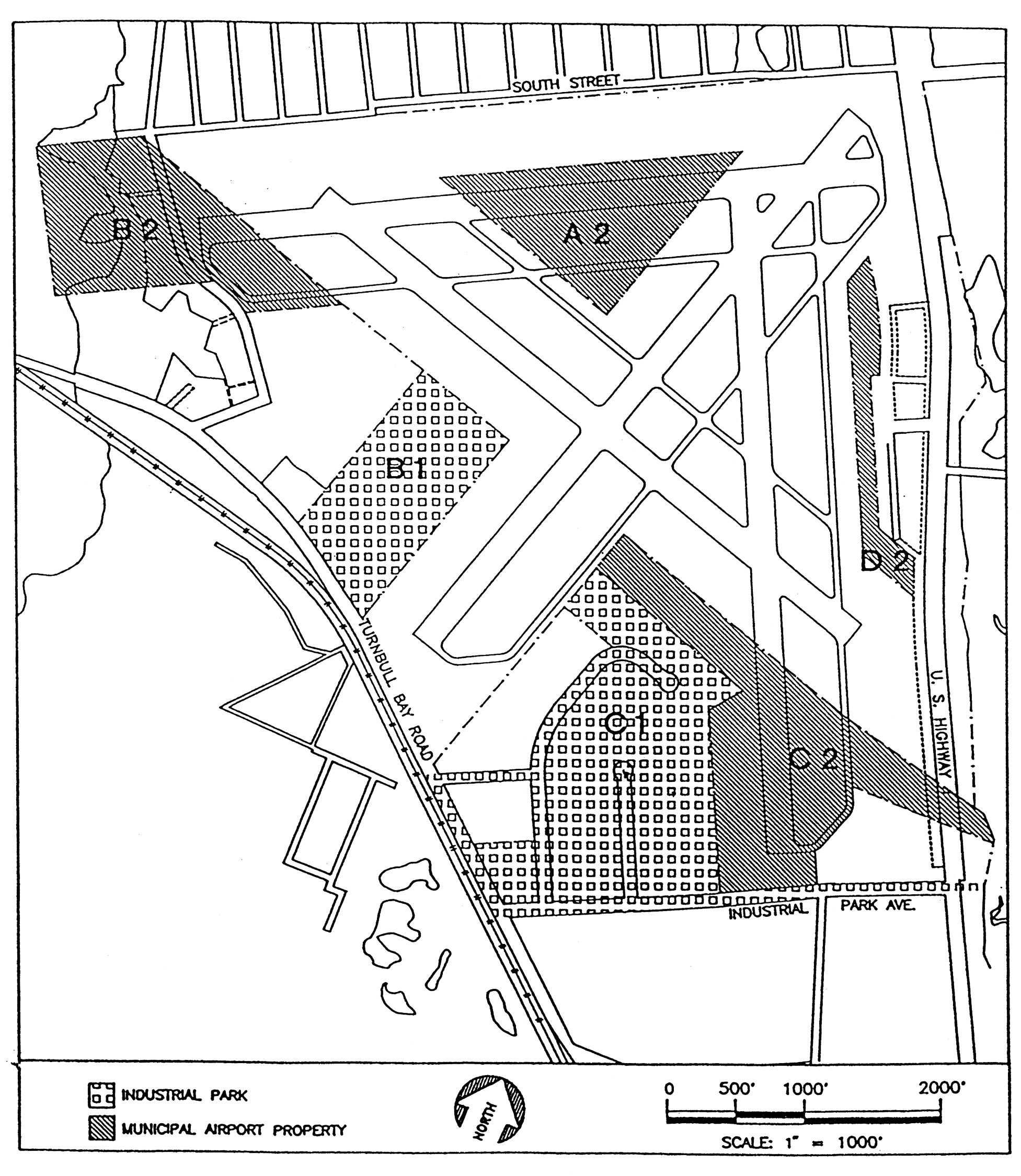
New Smyrna Beach Airport
Dimensional requirements.
Minimum lot size for all I-3 (except municipal airport).
Area: 37,500 square feet.
Depth: 250 feet.
Width: 150 feet.
Minimum lot size for municipal airport. Area requirements defined in chapter 22 of part II, Code of Ordinances shall be required.
Minimum yard size.
Front yard: 30 feet or as required per [sub]section 504.01M. of this LDR.
Side yard: 15 feet.
Rear yard: 15 feet.
Maximum principal building, structure, or tree height. Not to exceed height restrictions established in section 22-91 et seq., part II, Code of Ordinances and in no case more than 45 feet.
Maximum principal building coverage. 50 percent.
Maximum impervious lot coverage. The total area of the lot that may be covered with impervious material is 70 percent.
Buffers. Landscaped buffer area(s) as defined in [sub]section 604.05 shall be required at property lines as follows:
(1)
All front property lines or property lines parallel or nearly parallel to nearby public roads; and
(2)
Along side or rear lot lines abutting a residentially zoned lot.
Trees are not to be planted in the area defined as the municipal airport.
Off-street parking and loading. Off-street parking and loading space shall be provided as required in this LDR.
Storage areas, outdoor. All outdoor storage shall be visually screened from access streets, and adjacent properties. Screening shall form a complete opaque screen of no less than six feet in vertical height. Outdoor storage shall be meant to include parking of all company owned and operated motor vehicles, with the exception of passenger vehicles. No storage will be permitted between a frontage street and the building line.
Visibility at intersections. Visibility at intersections shall be provided as required in this LDR.
Performance standards for the I-3 District.
Performance standards. It is the intent of these regulations to prevent land or buildings, including those permitted by right or special exception, from being used or occupied, in any manner to as to create any dangerous, injurious, noxious or other hazardous condition; noise or vibration; smoke, dust or other form of air pollution; electrical or other disturbances; glare or heat; liquid or solid refuse or wastes; condition conducive to the breeding of rodents or insects; or other substance, condition or elements (all referred to herein as "dangerous or objectionable elements") in a manner or amount as to adversely affect the surrounding area. Any use permitted under the permitted use section may be undertaken and maintained if it conforms to all district regulations including the regulations of this section referred to herein as "performance standards." Specifically, all uses shall operate in conformance with the limitations set forth in each subsection below, excepting aircraft operations at the Municipal Airport. No site plan in this district shall be approved without a signed and sealed report from an appropriately qualified certified engineer stating that all performance standards will be met.
1.
Vibration. No vibration shall be produced which is transmitted through the ground and is discernable without the aid of instruments at or at any point beyond the lot line; nor shall any vibration produced exceed 0.0028g peak measured at or beyond the lot line using either seismic or electronic vibration measuring equipment.
2.
Noise. Sound level measurements shall be made in accordance with article III, chapter 38, part II, Code of Ordinances. In no event, shall noise emissions exceed the standards set forth in article III, chapter 38, part II, Code of Ordinances.
3.
Air pollution.
a.
Visible emissions. There shall not be discharged into the atmosphere, from any source, any air pollution in excess of the darkness limitations listed below. This shall include emissions of air pollutant of such opacity as to obscure an observer's view to a degree equal to, or greater than, do the visible emissions described below. In addition to the foregoing, visible emissions of any kind at ground level past the lot line of the property on which the source of the emissions is located are prohibited. The darkness and/or opacity limitations are as follows. No. 1 on the Ringelmann chart at all times, except upon determination that the emission contains less than one-tenth pound of dry gases, adjusted to 12 percent carbon dioxide or fifty percent excess air.
b.
Materials handling. No person shall cause or permit any material to be handled, transported, or stored in a manner which allows or may allow particulate matter to become airborne.
c.
Particulate matter. There shall not be discharged into the atmosphere any particulate matter in excess of the quantities shown below:
(1)
From refuse-burning equipment, per 1,000 pounds of dry gases, adjusted to 12 percent CO 2 or 50 percent excess air, 65/100 pound for capacities over 200 pounds per hours. In any one-hour period this shall not exceed 250 pounds. Refuse shall not be burned in fuel-burning equipment.
(2)
From fuel-burning equipment, six-tenths pound per million BTU input for installation using less than ten million BTU per hour total input. For installations using more than ten million BTU per hour total input, the allowable particulate emission, in pounds per million BTU is determined by multiplying 8.58 times the input, in BTU per hour, raised to the minus 0.165 power (E=8.58 I -0.165 ).
d.
Threshold values. There shall not be discharged into the atmosphere any contaminant for which threshold limit values are listed for working atmosphere by the American Conference of Governmental Industrial Hygienists in such quantity that the concentration of the contaminant at ground level at any point beyond the boundary of the property shall, at any time, exceed the threshold limit.
4.
Odors. Any condition of operation which results in the creation of odors of such intensity and character as to be detrimental to the health and welfare of the public or which interferes unreasonably with the comfort of the public shall be removed, stopped or so modified as to remove the odor.
5.
Electromagnetic radiation. The following standard shall apply:
a.
General. It shall be unlawful to operate or cause to be operated, any planned or intentional source of electromagnetic radiation for such purposes as communication, experimentation, entertainment, broadcasting, heating, navigation, therapy, vehicle velocity measurement, weather survey, aircraft detection, topographical survey, personal pleasure, or any other use directly or indirectly associated with these present purposes which does not comply with the then current regulations of the Federal Communications Commission regarding such sources of electromagnetic radiation except that for all governmental agencies and government owned plants; the regulations of the Interdepartment Radio Advisory Committee shall take precedence over the regulations of the Federal Communications Commission regarding such sources of electromagnetic radiation. Further, said operation in compliance with the Federal Communications Commission or the interdepartmental Radio Advisory Committee regulations shall be unlawful if such radiation causes an abnormal degradation in performance of other electromagnetic radiators or electromagnetic receptors of quality and proper design because of proximity, primary field, blanketing, spurious reradiation, harmonic content, modulation or energy conducted by power or telephone lines. The determination of "abnormal degradation in performance" and "of quality and property design" shall be made in accordance with good engineering practices as defined in the latest principles and standards of the American Institute of Electrical Engineers, the Institute of Radio Engineers, and the Electronic Industries Association.
b.
Electromagnetic interference. For the purpose of these regulations, electromagnetic interference shall be defined as electromagnetic disturbances which are generated by the use of electrical equipment other than planned and intentional sources of electromagnetic receptors [radiation] of quality and proper design. It shall be unlawful to operate, or to cause to be operated, any source of electromagnetic interference where the radiation or transmission from same violates the provisions of section 22-8(a), part II, Code of Ordinances.
6.
Fire and Explosion. All activities and storage of flammable and explosive [materials] at any location shall be provided with adequate safety and fire fighting devices in accordance with the Fire Prevention Code and other technical codes adopted by the City of New Smyrna Beach, State of Florida, and other appropriate governmental agencies.
7.
Radioactive materials. The handling of radioactive materials, the discharge of such materials into the air and water, and the disposal of radioactive wastes, shall be in conformance with the regulations of the Atomic Energy Commission as set forth in the title 10, chapter 1, part 20, Standards for Protection Against Radiation, as amended, from time to time, and all applicable regulations of the State of Florida, and other appropriate governmental agencies.
8.
Glare and heat. No direct or sky-reflected glare, whether from floodlights, or from high temperature processes such as combustion or welding or otherwise, so as to be visible at the lot line, shall be permitted. There shall be no emission or transmission of heat or heated air so as to be discernible at the lot line and shall not exceed applicable governmental agency standards. In addition, all applicable requirements set forth in chapter 22, part II, Code of Ordinances.
9.
Airport land use and fixed base operator requirements. All requirements set forth in chapter 22, New Smyrna Beach Code of Ordinances shall apply to all areas and activities defined as fixed base operators, as set forth in chapter 22, New Smyrna Beach Code of Ordinances. In the event the land use is a fixed base operator, and a conflict exists between chapter 22, part II, Code of Ordinances and the I-3, Industrial District Requirements, then chapter 22, part II, Code of Ordinances shall control.
Additional airport industrial park requirements. In addition to the provisions of the I-3 District set forth heretofore, the following development requirements apply to the Airport Industrial Park and shall not apply to the Municipal Airport or other I-3 properties. Airport Industrial Park requirements as defined hereafter shall prevail where there is a conflict between such requirements and I-3 district requirements set forth heretofore.
1.
Building design. It is the intent of this requirement to assure that all buildings in the Airport Industrial Park be of sound, safe, and permanent construction, using durable, easy to maintain materials, presenting exterior facades of quality and tasteful architectural design. Thus, buildings shall be constructed of masonry or other strong, fireproof materials. All block construction shall be painted. Metal-side buildings shall be permitted, providing front of buildings and all sides which face public right-of-way are given architectural treatment of such nature as will assure the attractiveness of the building. Architectural treatment shall be defined as the use of color combinations, and structural styles which include trim and facade systems of wood, stone, brick, and/or glass.
2.
Landscaping. All unpaved lot areas shall be tastefully landscaped with an effective combination of trees, shrubbery, and ground cover. Decorative plazas, pools, flower beds, rock gardens, and other decorative treatments, may be incorporated. landscaping is to be accomplished using quality materials and workmanship.
3.
Loading areas. Dock wells, loading platforms, and other loading facilities, will be situated at [the] rear of buildings, or at building sides, provided such facilities are set back a minimum of 70 feet from the street right-of-way line, or 120 feet from the street centerline, whichever is greater. Steel railings or fencing will be required along the full graded length of the sides of dock-wells which border driveways or walks and as otherwise required by appropriate governmental agencies.
4.
Paving. Parking areas, driveways, and walks, must be of hard-surface paving materials of sufficient thickness and structural properties as will provide and sustain the load-bearing qualities demanded by their intended use. Should damage or cracking of pavement ever occur, it will be the responsibility of the owner or lessee to accomplish immediate repair, thus preventing hazards to public safety.
5.
Refuse collections areas. All outdoor refuse collection areas shall be visually screened from access streets, and adjacent property by a complete opaque screen. No refuse collection areas shall be permitted between a frontage street and the building line.
I-4, WATERFRONT INDUSTRIAL DISTRICT
Purpose and intent. The purpose and intent of the I-4 Waterfront Industrial District is to provide for and preserve land in appropriate locations for industrial use which require or are particularly adapted to a water [front] location.
Permitted principal uses and structures.
Boat building and repairing
Boat and marine engine sales and displays
Boat and marine motor service
Boat sales, service, and rental
Boat storage
Commercial and public boat docks, wharves, and piers
Fueling necessary for marine operations
Manufacturing of boat parts, accessories, and equipment not involving drop forging, stamping, automatic screw machines or a foundry
Marina
Marine railways
Marine shop, woodworking shop, electrical repair, and maintenance of boats
Marine warehouse
Restaurants, type "A," "B" and "D"
Retail sale or rental of boating, fishing, diving, water skiing and bathing supplies and equipment
Ship chandlery, sail maker
Yacht clubs
Permitted accessory uses and structures. Accessory uses and structures customarily incidental to the permitted principal uses and structures.
Special exceptions. Fish, shrimp, oysters, and other seafood processing, except scallops. Processing shall include freezing, packing, storage, and wholesaling, and shall not include other types of processing.
Dimensional requirements.
Minimum lot size.
Area: 20,000 square feet.
Width: 100 feet.
Minimum yard size.
Front yard: 30 feet or as required per [sub]section 504.01M. of this LDR.
Side yard: 20 feet.
Rear yard: 20 feet from mean high water line or bulkhead whichever is farther upland.
All yards abutting upon a residential district shall be 50 feet.
Maximum principal building, structure, or tree height. Not to exceed height restrictions established in section 22-91 et seq., part II, Code of Ordinances and in no case more than three stories or 45 feet.
Maximum building coverage. 50 percent.
Maximum impervious lot coverage. The total area of the lot that may be covered with impervious material is 75 percent.
Landscaping. Landscaped buffer area(s) as defined in this LDR shall be required at property lines as follows:
(1)
All front property lines;
(2)
Along side or rear lot line abutting a residentially zoned lot.
Visibility at intersections. Visibility at intersections shall be provided as required in this LDR.
Performance standards. It is the intent of these regulations to prevent land or buildings, including those permitted by right or special exception, from being used or occupied, in any manner to as to create any dangerous, injurious, noxious or other hazardous condition; noise or vibration; smoke, dust or other form of air pollution; electrical or other disturbances; glare or heat; liquid or solid refuse or wastes; condition conducive to the breeding of rodents or insects; or other substance, condition or elements (all referred to herein as "dangerous or objectionable elements") in a manner or amount as to adversely affect the surrounding area. Any use permitted under the permitted use section may be undertaken and maintained if it conforms to all district regulations including the regulations of this section referred to herein as "performance standards." Specifically, all uses shall operate in conformance with the limitations set forth in each subsection below. No site plan in this district shall be approved without a signed and sealed report from an appropriately qualified certified engineer stating that all performance standards will be met.
1.
Vibration. No vibration shall be produced which is transmitted through the ground and is discernable without the aid of instruments at or at any point beyond the lot line; nor shall any vibration produced exceed 0.0028g peak measured at or beyond the lot line using either seismic or electronic vibration measuring equipment.
2.
Noise. Sound level measurements shall be made in accordance with article III, chapter 38, part II, Code of Ordinances. In no event, shall noise emissions exceed the standards set forth in article III, chapter 38, part II, Code of Ordinances.
3.
Air pollution.
a.
Visible emissions. There shall not be discharged into the atmosphere, from any source, any air pollution in excess of the darkness limitations listed below. This shall include emissions of air pollutant of such opacity as to obscure an observer's view to a degree equal to, or greater than, do the visible emissions described below. In addition to the foregoing, visible emissions of any kind at ground level past the lot line of the property on which the source of the emissions is located are prohibited. The darkness and/or opacity limitations are as follows. No. 1 on the Ringelmann chart at all times, except upon determination that the emission contains less than one-tenth pound of dry gases, adjusted to 12 percent carbon dioxide or 50 percent excess air.
b.
Materials handling. No person shall cause or permit any material to be handled, transported, or stored in a manner which allows or may allow particulate matter to become airborne.
c.
Particulate matter. There shall not be discharged into the atmosphere any particulate matter in excess of the quantities shown below:
(1)
From refuse-burning equipment, per 1,000 pounds of dry gases, adjusted to 12 percent CO 2 or 50 percent excess air, 65/100 pound for capacities over 200 pounds per hours. In any one-hour period this shall not exceed 250 pounds. Refuse shall not be burned in fuel-burning equipment.
(2)
From fuel-burning equipment, six-tenths pound per million BTU input for installation using less than ten million BTU per hour total input. For installations using more than ten million BTU per hour total input, the allowable particulate emission, in pounds per million BTU is determined by multiplying 8.58 times the input, in BTU per hour, raised to the minus 0.165 power (E=8.58 I -0.165 ).
d.
Threshold values. There shall not be discharged into the atmosphere any contaminant for which threshold limit values are listed for working atmosphere by the American Conference of Governmental Industrial Hygienists in such quantity that the concentration of the contaminant at ground level at any point beyond the boundary of the property shall, at any time, exceed the threshold limit.
4.
Odors. Any condition of operation which results in the creation of odors of such intensity and character as to be detrimental to the health and welfare of the public or which interferes unreasonably with the comfort of the public shall be removed, stopped or so modified as to remove the odor.
5.
Electromagnetic radiation. The following standard shall apply:
a.
General. It shall be unlawful to operate or cause to be operated, any planned or intentional source of electromagnetic radiation for such purposes as communication, experimentation, entertainment, broadcasting, heating, navigation, therapy, vehicle velocity measurement, weather survey, aircraft detection, topographical survey, personal pleasure, or any other use directly or indirectly associated with these present purposes which does not comply with the then current regulations of the federal Communications commission regarding such sources of electromagnetic radiation except that for all governmental agencies and government owned plants; the regulations of the Interdepartment Radio Advisory committee shall take precedence over the regulations of the federal Communications commission regarding such sources of electromagnetic radiation. Further, said operation in compliance with the federal Communications commission or the interdepartmental Radio Advisory committee regulations shall be unlawful if such radiation causes an abnormal degradation in performance of other electromagnetic radiators or electromagnetic receptors of quality and proper design because of proximity, primary field, blanketing, spurious reradiation, harmonic content, modulation or energy conducted by power or telephone lines. The determination of "abnormal degradation in performance" and "of quality and property design" shall be made in accordance with good engineering practices as defined in the latest principles and standards of the American Institute of Electrical Engineers, the Institute of Radio Engineers, and the Electronic Industries Association.
b.
Electromagnetic interference. For the purpose of these regulations, electromagnetic interference shall be defined as electromagnetic disturbances which are generated by the use of electrical equipment other than planned and intentional sources of electromagnetic receptors of quality and proper design. It shall be unlawful to operate, or to cause to be operated, any source of electromagnetic interference where the radiation or transmission from same violates the provisions section 22-8(a), part II, Code of Ordinances.
6.
Fire and explosion. All activities and storage of flammable and explosive [materials] at any location shall be provided with adequate safety and firefighting devices in accordance with the Fire Prevention Code and other technical codes adopted by the City of New Smyrna Beach, State of Florida, and other appropriate governmental agencies.
7.
Radioactive materials. The handling of radioactive materials, the discharge of such materials into the air and water, and the disposal of radioactive wastes, shall be in conformance with the regulations of the Atomic Energy commission as set forth in the title 10, chapter 1, part 20, Standards for Protection Against Radiation, as amended, from time to time, and all applicable regulations of the State of Florida, and other appropriate governmental agencies.
8.
Glare and heat. No direct or sky-reflected glare, whether from floodlights, or from high temperature processes such as combustion or welding or otherwise, so as to be visible at the lot line, shall be permitted. There shall be no emission or transmission of heat or heated air so as to be discernible at the lot line and shall not exceed applicable governmental agency standards. In addition, all applicable requirements set forth in chapter 22, part II, Code of Ordinances, shall also apply.
BBH, BED AND BREAKFAST HOMES DISTRICT
Intent. The BBH, Bed and Breakfast Homes District is an overlay zone in which bed and breakfast homes are allowed as a conditional use. This district seeks to promote historic preservation and restoration through providing new uses for old structures and to promote small scale lodging establishments as an alternative form of resort accommodations.
Conditional uses. Bed and breakfast homes.
Overlay zone. This is an overlay zone in which bed and breakfast homes are allowed as a conditional use. Underlying this overlay zone exists the base zoning districts. All regulations applicable in the underlying base districts shall be applicable in the overlay zone except for bed and breakfast homes being allowed as a conditional use and any other exceptions specifically set forth in the zoning ordinance.
Limitation on the duration of guest stays in bed and breakfast homes. Registered lodger(s) may reside within a "bed and breakfast home" for no more than 14 cumulative days in any one month and no more than 30 cumulative days within any 180-day calendar period; measured from the initial date of registration.
Regulations.
The proposed bed and breakfast home must be at least 50 years old, with a kitchen and a central gathering area, not including a hotel, motel, lodge, or inn; wherein sleeping accommodations and at least one fresh meal prepared on site per day are provided for the lodgers. The bed and breakfast home must also serve as the residence of the property owner or operator. Each room or suite that is rented in the bed and breakfast home may have a bedroom, bathroom, and partial kitchen, but may not have an oven, stove, or range that requires a 220-volt electric, propane, or natural gas connection.
All establishments operating as a bed and breakfast home requesting signage must use the title "Bed and Breakfast" on the allowable signage. The bed and breakfast home must be operated out of a home that has been preserved, restored, and maintained, in a manner that promotes the home's historic architecture, following the city's Historic Preservation Design Standards.
All proposed bed and breakfast homes are required to apply for a major class I site plan with the planning and engineering departments. Approval of the major class I site plan is required before the conditional use is granted. An approved conditional use is transferable and runs with the property.
NOTE:
See [sub]section 201.00 for definition.
See [sub]section 604.9F. for parking requirements.
See [sub]section 604.12G.(7) for signs.
See Code of Ordinances, article V sections 74-146 through 74-154 for local business tax requirements.
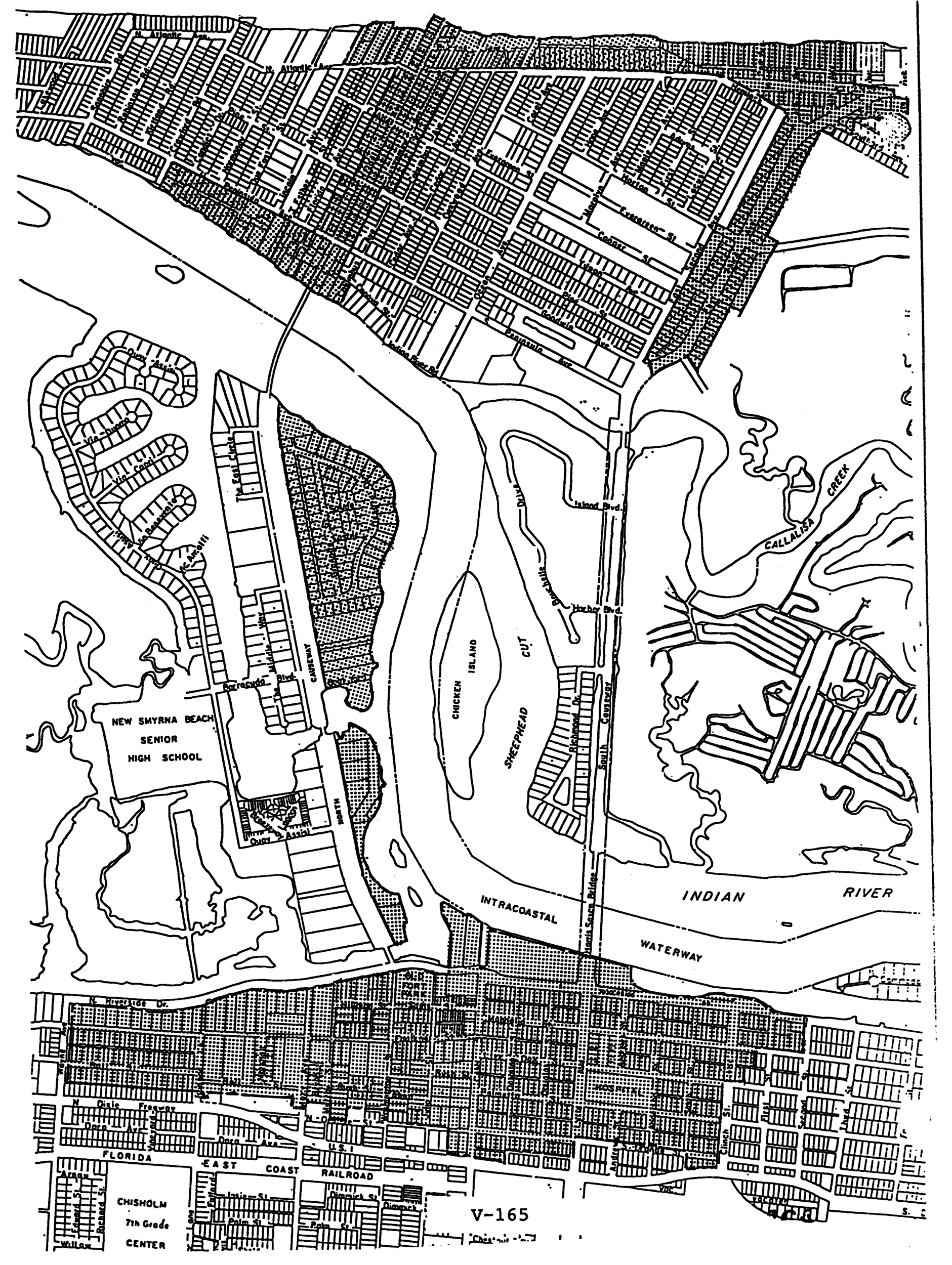
New Smyrna Map
COZ, CORRIDOR OVERLAY ZONE
1.
Arterial Corridor Overlay Zone (COZ) established. An Arterial Corridor Overlay Zone (COZ) is hereby established and the regulations of this section shall apply in said zone. Said zone shall apply to all zoning classifications established in Article VI of this LDR and the Official Zoning Map shall identify said overlay zone. All properties or projects partially contained within this corridor are considered wholly contained within the COZ. These regulations apply to properties along the following roadways:
- SR 44 from Myrtle Avenue west to the New Smyrna Beach corporate boundary, excluding properties in the Activity Center, as shown on the City's comprehensive plan future land use map, and
- US-1 from Art Center Avenue to the northern City boundary line.
The width of the COZ is 330 feet north and 330 feet south of the center line of SR 44 and US-1.
2.
Purpose and intent. The purpose of this section is to establish regulations to ensure safe ingress to and egress from proposed development along arterial transportation corridors by:
a.
Reducing the number of indiscriminate driveways;
b.
Maintaining the integrity of the corridor by assuring that traffic generation is consistent with the corridor's designed capacity;
c.
Lessening the possibility of hazardous traffic conditions and traffic congestion;
d.
Establishing development standards, including additional buffer and landscaping regulations that will preserve and enhance the natural character of the corridor, which serves as a gateway into the city; and
e.
Screen parked vehicles from view of the traveling public.
As commercial development expands along arterial transportation corridors, conflicts result between the corridor's function and its ability to move high volumes of traffic through an area. This congestion is intensified where commercial growth is permitted adjacent to the corridor disproportionate to the corridor's designed limitations.
3.
Applicability. The increased commercial growth that has occurred along these gateway corridors in recent years has started changing the character of the corridors. What were once tree-lined corridors have gradually and often rapidly begun to exhibit characteristics of uncontrolled strip commercial development. Once this pattern is established it is difficult to encourage alternative types of development (e.g. residential) along these corridors. Therefore, these regulations apply to the arterial corridors listed above, which:
a.
Move large volumes of through traffic in addition to significant volumes of everyday local traffic; and
b.
Do not contain significant amounts of strip commercial development.
These arterial corridor regulations are intended to supplement the applicable regulations of the underlying zoning classifications present within the COZ. The underlying zoning district shall determine the permitted and special exception uses allowed but the site design, signage, building location, and the dimensional requirements contained in this section shall supersede the standards of the zoning district.
4.
Dimensional requirements.
a.
Lot width: No premises shall be divided for the purpose of development or sale such that the width of each, or any premises, is less than 300 feet measured along the right-of-way line, except that if vehicle access is provided by means other than directly onto an arterial, then the minimum lot width requirement may be reduced to 150 feet, and direct vehicle access to a major arterial shall be prohibited.
b.
Building setbacks within the COZ:
i.
Front yard setback (inclusive of landscape buffer and utility commission easement):
US-1: 45 feet minimum; 65 feet maximum.
SR 44: 70—75 feet minimum from the west city limits to Eddie Road; 50-55 feet minimum from Eddie Road to Myrtle Avenue.
ii.
Rear yard setback: 25 feet minimum.
iii.
Side yard setback: 25 feet minimum.
iv.
Lots with multiple frontages:
(a)
Parcels which front on two streets shall meet the above building setbacks for the corridor frontage and a 25-foot setback on the other street or as required per section 504.01(0) of this LDR.
(b)
Parcels fronting on three streets shall provide the above building setback for the corridor frontage and a 25-foot setback on the remaining streets or as required per section 504.01(0) of this LDR.
c.
Principal building height: Three stories maximum, not to exceed 35 feet.
d.
Building coverage: The total area covered with buildings on any lot shall not exceed 35 percent of the total lot area. This calculation does not include any other paved areas.
5.
Minimum buffer depth and landscaping. The required landscaping within the corridor buffer along SR 44 within the COZ boundaries shall be as follows. No additional buffering is required along the US-1 corridor within the COZ.
a.
Landscape buffer depth and tree requirement:
Figure 1. Example 50' Landscape Buffer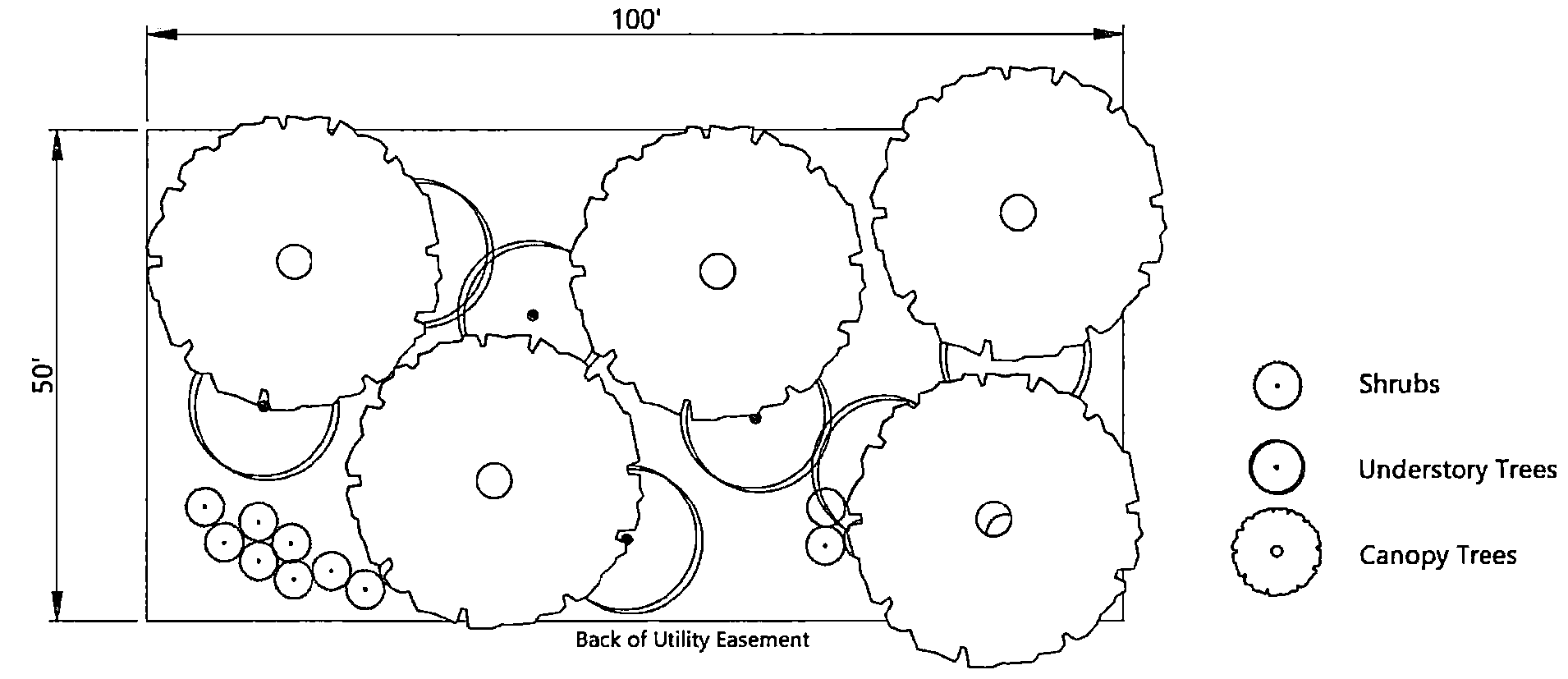
Figure 2. Example of 35' Landscape Buffer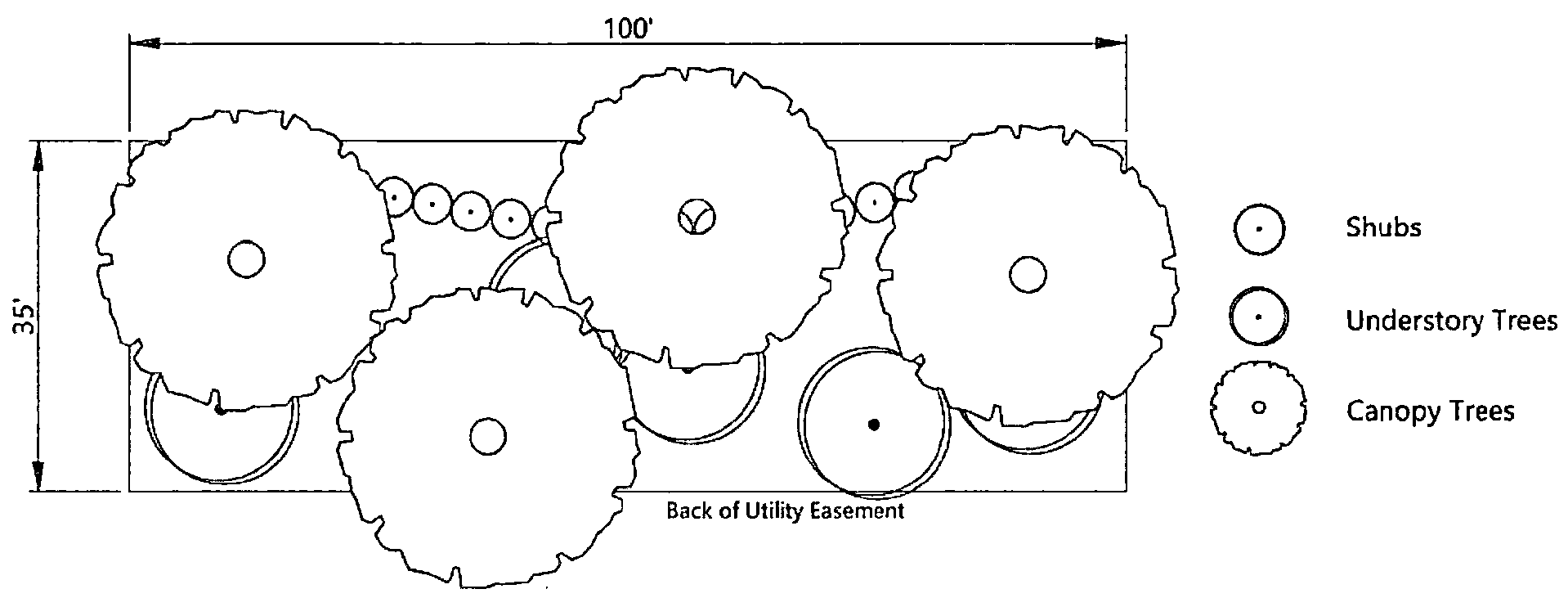
b.
New trees and shrubs shall meet the following standards:
i.
Canopy trees:
• Height: 12 feet minimum.
• Trunk diameter: Four inches measured four and one-half feet above ground level.
• Spacing: 100 feet maximum from the nearest canopy tree, and a minimum of 30 feet on center.
• Species: A minimum of three different species of canopy trees selected from the New Smyrna Beach Tree List (as adopted by Ordinance #58-01) shall be used. Palm tree and Palmetto trees are not allowed for use as canopy trees.
ii.
Understory trees:
• Height: Nine feet minimum.
• Trunk diameter: Two and one-half inches measured four and one-half feet above ground level.
• Spacing: 50 feet maximum from the nearest new understory tree, and a minimum of 25 feet on center.
• Species: A minimum of three different species of understory trees selected from the New Smyrna Beach Tree List (as adopted in Ordinance #58-01) shall be used.
iii.
Shrubs:
• Height: At least three feet tall at maturity and a minimum of two feet in height, immediately after planting.
• Species: A minimum of three differing species of shrubs native to Florida shall be used.
6.
Landscaping and tree preservation standards. The requirements presented in sections 604.04 (landscaping requirements) and 604.051 (tree preservation) shall apply except that more stringent requirements described for landscape buffering herein shall supersede.
a.
Existing trees with a minimum height of nine feet and a minimum diameter of two inches, when measured four and one-half feet above ground level, shall be retained within the landscaped buffer. Existing shrubs with a minimum height of two feet shall be retained within the landscape buffer.
b.
The existing trees and vegetation within the required corridor landscape buffer shall be retained, if healthy, as determined by a certified arborist or landscape architect, and shall count toward the minimum landscaping requirements of subsection 5.a. However, if the buffer area does not already contain sufficient vegetation to meet the minimum required by subsection 5.a, new trees and shrubs meeting the standards of subsection 5.b shall be planted.
c.
The landscaped buffer area shall count toward the development's minimum required open space.
d.
The landscape buffer area shall not be disturbed the purposes of using the area for stormwater management.
e.
The applicant shall submit to the city a tree survey and a tree report of the site prepared by a certified arborist. The survey shall show the location and size of all existing trees two inches in diameter or greater measured at four and one-half feet above ground level to be saved or removed. The report shall address the current disposition (health) of the trees within the site and identify trees within the buffer area that are dead, dying, or diseased to the extent they cannot be saved. Affected tree(s) may be removed if any one of these conditions is verified by the city. Potential removal of dead, dying or diseased trees shall be in accordance with section 604.051 (tree preservation) requirements.
f.
Fences, walls, or berms are not allowed within any landscape buffer, but may be located just outside the boundary of the buffer within the site. No grade changes or fill shall be allowed within the landscape buffer.
g.
Development along SR 44 within the COZ boundaries shall be designed to prevent the need for fill material or such other treatment which would remove or harm existing trees within required buffer areas. Access driveways are exempt from this requirement.
h.
If retaining walls are used as part of the development, they shall be placed behind the landscape buffer adjacent to the development. No grade changes or fill shall be allowed within the landscape buffer.
7.
Irrigation. Required buffers that contain existing dense vegetation with existing trees left in undisturbed conditions shall not be required to be irrigated. However, when natural vegetation is disturbed, the buffer shall be irrigated as required in article VI development design and improvement standards.
8.
Parking lot landscaping.
a.
Off-street parking and loading areas shall not be permitted in any required landscaped buffer areas.
b.
Vehicle use areas located between the building and SR 44 or US-1, within the COZ, shall meet the following:
i.
A minimum of 30 percent of the vehicular use area shall be landscaped. All other interior vehicular use areas shall meet a 20 percent landscaping requirement. "Vehicle use area" refers to the area used for parking or displaying vehicles, and includes all parking/display spaces, driveways, driving aisles, landscape strips and landscape islands (see figure below).
ii.
Landscape islands shall have a minimum width of ten feet.
Figure 3. Vehicular Use Area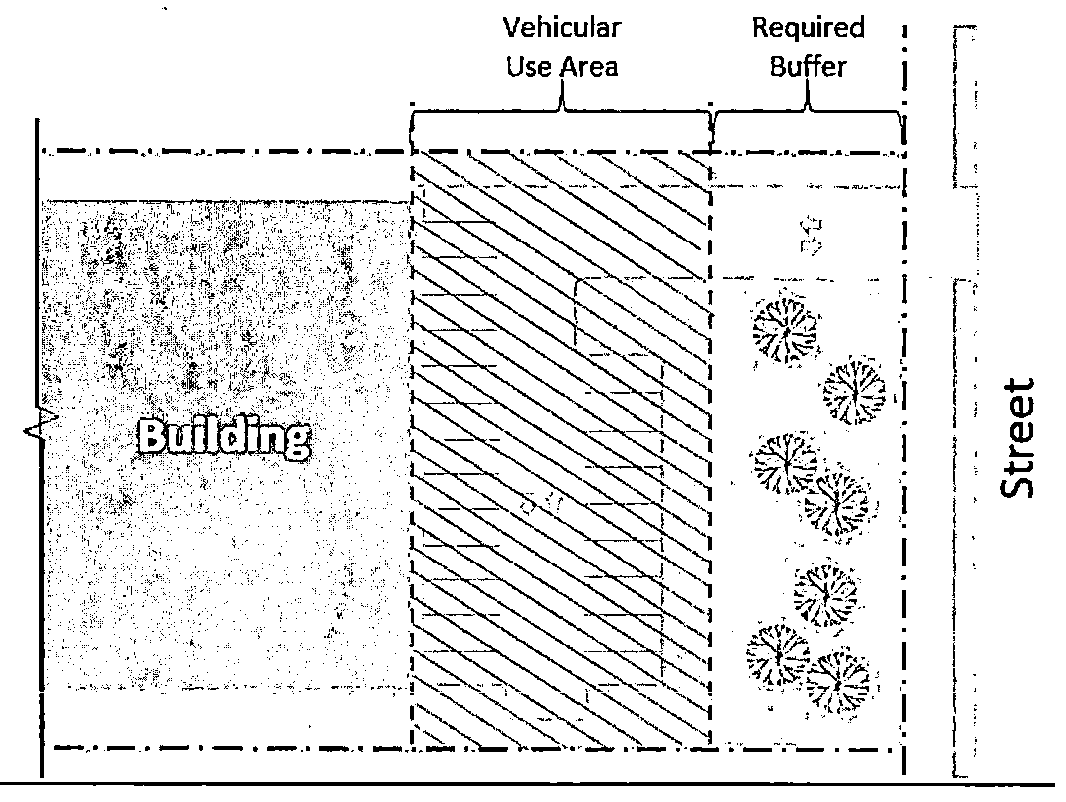
9.
Clearing of easements. Preserved vegetation within required easements does not count towards the required buffer landscape requirements. All required landscape buffer plantings shall be placed outside the utility easement. However, required drainage and utility easements shall not be cleared of existing vegetation until the city or the utility company is ready to install infrastructure within the affected easement at which point clearing of existing vegetation within the easement will only be to the extent necessary to accommodate the installation of the infrastructure as determined by the agency installing it. The city and utility companies shall utilize trenchless technology where applicable in order to minimize disturbance to existing landscaping within the buffer. Required easements shall comply with LDR section 1007.00, plat requirements, part D.
10.
Site development plan review requirements. Development within the COZ district shall follow the site plan review requirements stated in this LDR. The technical review staff shall review proposed development plans to assure compliance and consistency with the standards of this section.
11.
Variances. Development shall comply with the landscape buffer requirements provided herein. All variances to the application of this section shall only be approved by the city commission, after review and recommendation by the planning and zoning board.
12.
Tree replacement. No variances or modification of the city's tree replacement provisions are allowed within the COZ boundaries.
13.
Landscaping maintenance. The landscape material within the required landscape buffer shall be maintained in good condition in perpetuity. Failure to maintain required landscaped areas or to replace, within a reasonable period of time, required landscaping which is dead, irreparably damaged, or fails to meet the standards of this section, shall be deemed a violation of the LDR.
14.
Penalty and violations. The removal of any trees from the landscape buffer without a permit shall be subject to the provisions of section 304.00.J of the LDR.
PUD, PLANNED UNIT DEVELOPMENT
Purpose and intent. The purpose of the PUD zoning classification is to provide for the flexible development of integrated retail, office, and/or residential developments that provide high-quality development for the city and that would otherwise not be permitted by this Code. Notwithstanding the specific criteria identified herein, proposals should accomplish the following purposes to the greatest extent possible:
(1)
Provide a variety of housing types with a broad range of housing costs allowing for the integration of differing age groups and socioeconomic classes;
(2)
Promote innovative site and building design, including traditional neighborhood developments;
(3)
Provide efficient location and utilization of infrastructure through orderly and economical development, including a fully integrated network of streets and pedestrian/bicycle facilities;
(4)
Establish open areas set aside for the preservation of natural resources, significant natural features and vistas, and listed species habitats;
(5)
Create usable and suitably located civic spaces, recreational facilities, open spaces and scenic areas;
(6)
Provide for a coherent and visually attractive physical environment through the creation of focal points and vistas, as well as coordination and consistency of architectural styles, landscaping designs and other elements of the built environment;
(7)
Provide for other limitations, restrictions and requirements as deemed necessary by the city to ensure compatibility with adjacent neighborhoods and effectively reduce potential adverse impacts;
(8)
Provide for mixed use residential, commercial, office and/or industrial development such as commercial nodes, town centers, office parks, and industrial parks; and
(9)
Promote innovative site and building design.
Permitted principal uses and structures. The following land uses and their customary accessory uses and structures shall be allowed in the PUD zoning districts except in the Corridor Overlay Zone.
Art, dance, modeling, music, etiquette, or any other personal enrichment schools or studios having scheduling or costs associated which are not typically found in a public or private elementary or high school curriculum
Auction parlors, indoor
Automobile service station, type A, B, or C
Bars and liquor stores
Beauty shops, barbershops
Bowling alleys
Cafeterias
Child care centers
Employment agencies
Entertainment and recreational uses and structures
Essential utility services
Excavations only for lakes or stormwater retention ponds
Exercise and health spas
Financial institutions
Game rooms or arcades for pool, billiards, pinball machines, juke boxes or other coin-operated amusements
General offices
Home occupations
Hospitals
Houses of worship and cemeteries
Laundry and dry cleaning establishments
Medical and dental clinics
Multiple-family and single-family standard or manufactured dwellings
Nightclubs
Nursing homes, assisted living facilities, and adult congregate living facilities approved and licensed by the appropriate state agency
Pharmacies
Printing and publishing establishments
Professional or trade schools related to permitted uses
Public uses
Public utility uses and structures
Recovery homes
Restaurants, type A, B, C, and D
Retail sales and services
Retail specialty shops
Schools, parochial and private
Tailor shops
Taxicab stands
Theaters
Transient lodging:
• Maximum size 1,200 square feet of interior living space.
Travel agencies
Other uses approved by the city commission
Permitted principal uses and structures in the corridor overlay zone. The following land uses and their customary accessory uses and structures shall be allowed in the PUD Corridor Overlay Zone zoning district.
[The following are permitted uses.]
Art, dance, modeling, and music schools
Beauty shops, barber shops
Child care facilities
Essential utility services
Exercise and health spas
Financial institutions
Funeral homes
General offices
Hospitals, nursing homes, adult congregate living facilities, assisted living facilities
Houses of worship
Laundry and dry cleaning establishments (no coin operation)
Medical and dental clinics
Multiple-family standard dwellings, provided the following requirements are met:
(1)
Sixty percent of the commercial development must be completed prior to the start of residential construction, unless an alternate phasing plan is approved; and
(2)
The maximum permitted density will be 18 units per acre.
Pharmacies
Public uses
Restaurants (class "A")
Retail printing shops
Retail specialty shops
Schools, parochial and private
Single-family residences
Tailor shops
Taxicab stands
Theaters (no drive-ins)
Transient lodging:
• Maximum size 1,200 square feet of interior living space.
Travel agencies
Two-family residences
Other uses and structures of a nature similar to those listed, after determination by the city commission at the time of overall development plan approval that such uses and structures are compatible with the PUD development and the surrounding area.
Permitted principal uses and structures within the activity center and west of Interstate 95. Permitted uses of land and their customary accessory uses and structures shall be as allowed in the written development agreement approved by the city commission.
Permitted accessory uses.
On-site temporary sales and brokerage offices and display models for residential dwelling units that are newly constructed, that have never been occupied for residential purposes, and have never been sold.
On-site temporary sales and brokerage structures to be used as a sales office for dwelling units planned to be constructed or under construction.
The following limitations and regulations shall be placed on the aforedescribed on-site sales and brokerage offices and temporary sales and brokerage structures:
(1)
Said sales and brokerage offices shall only be used to promote the sales of newly constructed dwelling units (to wit: units that have never previously been occupied for residential purposes or never sold by the developer) and part of an approved site plan located on the same site as the office;
(2)
Said sales and brokerage offices shall only be used to sell residential dwelling units located on the same site as the sales office;
(3)
Said sales and brokerage offices may only have one sign not to exceed ten square feet in area in addition to the allowable signs indicated in [sub]section 604.14 of this LDR;
(4)
Said sales and brokerage offices shall be allowed within a development upon issuance of a certificate of occupancy for the offices by the development division director or his/her designee and said sales office must be removed from the site upon the issuance of a certificate of occupancy for the last building to be constructed within a development; and
(5)
The following additional limitations and regulations shall be placed on the aforedescribed on-site temporary sales and brokerage structures:
(a)
Said sales and brokerage structures shall have a minimum floor area of 300 square feet and shall not have been formerly a travel trailer, camper, recreational vehicle or tractor trailer;
(b)
The perimeter of the area between the ground and floor level of the sales and brokerage structures shall be enclosed with ornamental skirting;
(c)
Said sales and brokerage structures must be located on the site such that it meets the minimum setback requirements;
(d)
A minimum of three parking spaces must be provided for the sales and brokerage structures or the minimum number of parking spaces required for an office, whichever is greater. Said parking spaces and access aisle must meet the requirements of [sub]section 604.10 within this LDR except an alternate surfacing agent, such as shell or mulch, may be used;
(e)
A minimum ten-foot-wide and six-foot-high natural vegetative buffer shall be maintained along the front, side and rear of the sales and brokerage structure, parking area and any accessory structures. Should no buffer exist, a ten-foot-wide buffer, meeting the requirements of [sub]section 604.05 E.(1) must be planted along the front, sides and rear of the sales and brokerage structure, parking area and accessory structures. Buffer areas are not required to be irrigated with an underground automatic system but must be regularly irrigated to maintain the vegetation;
(f)
No sales and brokerage structure shall be allowed on a site until all permits as required by all federal, state, and county agencies have been secured; and the site plan for the proposed permanent use has been approved; and a class I site plan has been approved for the use of a temporary sales and brokerage structure; and
(g)
Said sales and brokerage structures shall not remain on a site longer than one year from the date a certificate of occupancy is issued for said sales office or until a certificate of occupancy is issued for the first building within the development, whichever comes first. Upon removal of the sales and brokerage structure, the developer may maintain an on-site temporary sales and brokerage office within the dwelling unit(s).
Conditional uses.
Farmers markets, subject to the following conditions:
(1)
The development services director determines that adequate parking is available.
(2)
The farmers market is located in the business portion of the PUD.
(3)
There is adequate space on-site to accommodate all vendors without utilizing public rights-of-way unless city commission approval has been received to utilize the public rights-of-way.
(4)
Vendors shall not block pedestrian ways.
(5)
Products offered for sale shall be limited to the following:
a.
Fresh fruits and vegetables.
b.
Herbs and spices.
c.
Farmstead products including but not limited to cheese, meats, fish/seafood, poultry, eggs, baked goods, canned goods, honey, maple syrup and preserves.
d.
Bedding plants, hanging and potted plants, and cut flowers.
e.
Dried flowers or plants.
f.
A maximum of 50 percent of the total area used for the market shall be allowed for handicrafts.
g.
Prepared food and beverages.
h.
Flea market and yard sale items are prohibited.
(6)
The farmers market organization must obtain a business tax receipt from Volusia County and from the City of New Smyrna Beach.
(7)
Each vendor operating within the farmers market must obtain a business tax receipt from Volusia County and from the City of New Smyrna Beach.
(8)
Informational booths for 501(c)3 non-profit organizations shall be permitted.
Approval of a conditional use. At the time the applicant applies for a business tax receipt with the city, the applicant shall also submit a conceptual plan to the development services department. The conceptual plan shall show the general location of the vendor stalls on the site. Based upon the criteria listed above, the development services director, or his/her designee, shall approve or deny the application for a conditional use.
Transfer or abandonment of a conditional use. Conditional uses are approved for a specific location and are assigned to the property. If the location of the use is changed, new conditional use approval must be obtained.
Violation of conditional use terms or conditions. It is a violation of this Code for any person to violate or to refuse or fail to comply with any term or condition of a conditional use. Violations may be prosecuted or enforced as provided by law for prosecution or enforcement of municipal ordinances.
Special exceptions.
Automobile Sales, Recreation Vehicle Sales, and Trailer Sales New and Used including all vehicles with two wheels or more subject to the following conditions:
1.
Windows shall maintain a minimum transparent area of 65%.
2.
Sales display area is required to provide a lighting plan that meets Section 604.13.
3.
If temporary shell parking lot is proposed, City Commission approval is required by separate application.
4.
Site plan shall be submitted as per Article XI of the City Land Development Regulation to City Planning Director for review.
5.
Must meet all other City Land Development Regulations.
Pain management clinics, subject to the following conditions:
(a)
Have a reception and waiting area.
(b)
Have an administrative area, including room for storage of medical records, supplies and equipment.
(c)
Have private patient examination rooms.
(d)
Have treatment rooms, if treatment is being provided to the patients.
(e)
Provide documentation that the business is registered with the Florida Department of Health or documentation that the business is exempt from registering with the Florida Department of Health.
Dimensional requirements.
Minimum PUD parcel size—Traditional City Area (excluding properties within the Corridor Overlay Zone): 0.75 acres. At the discretion of the city commission, the size of the parcel may be reduced if the project involves work force housing or preservation of a historic building(s).
Minimum PUD parcel size—All other areas (including properties within the Corridor Overlay Zone):
A PUD shall be considered residential if 50 percent or more of developed land or 50 percent or more of the proposed building square footage is designated for residential uses. Residential uses include, but are not limited to single-family, duplex, multi-family (including townhomes, apartments, condominiums), and live-work units.
The Traditional City Area shall be as defined in article II of this LDR.
Minimum lot size. If all or a portion of the PUD is subdivided, the minimum lot size shall be described in the proposed master planned unit development agreement.
Minimum yard size. Minimum yard size shall be described in the proposed master planned unit development agreement. In determining yard size, the city commission shall consider whether or not the proposed PUD will have adverse effects upon adjoining properties.
Off-street parking and loading requirements. Off-street parking and loading spaces shall be required as indicated in [sub]section 604.10 of this LDR and in addition shall meet the following: off-street parking and loading areas shall not be permitted in any required landscaped buffer area. All parking areas shall contain a minimum of 20 percent interior landscaping excluding any required landscaped buffer areas.
Transportation impact analysis. The contents of the transportation impact analysis shall meet the requirements of [sub]section 402.02.
Density. The maximum residential density allowed in a PUD is 18 units per acre on the mainland and 12 units per acre on beachside. The maximum transient lodging density allowed is:
Hospitality future land use designation: 48 units per acre.
Southeast Volusia Activity Center future land use designation: 60 units per acre.
Marina future land use designation: 24 units per acre. Density may be increased up to 48 units per acre if the following conditions are met:
(1)
A minimum of 20 percent of the total usable land area is preserved by deed or easement for public access and/or public recreation; and
(2)
The public use area shall comprise at least 40 percent of the total linear footage of shoreline available to the property.
All other future land use designations permitting transient lodging units: 24 units per acre.
Landscape buffer requirements—Traditional City Area.
Requirements presented in [sub]section 604.05 shall apply except that more stringent requirements described for landscape buffering shall supersede.
A minimum 5-foot wide landscaping buffer is required around the perimeter of all parking areas. Only driveways may be located within this buffer.
Except for access driveways, it is intended that development shall be designed to prevent the need for fill material or such other treatment which would remove or harm existing trees within required yards or buffers.
Existing trees shall remain in low areas and may be included in stormwater retention areas because they are accustomed to an environment where their root system is periodically inundated.
Existing trees with a minimum height of nine feet and diameter of two inches when measured four feet above ground level shall remain in landscaped buffer areas. If a tree is dead, dying, or is diseased to the extent it cannot be saved, it may be removed if any one of these conditions is verified by a horticulturist with credentials approved by the development services director or his/her designee.
Required buffers that contain dense vegetation with existing trees shall be left natural and shall not be required to be irrigated if undisturbed.
Required landscape buffers shall contain the following number of plantings for every 100 linear feet of the buffer:
When natural vegetation is disturbed, the buffer shall be irrigated as required in [sub]section 604.05 of this LDR.
Landscape buffer requirements—All other areas.
Requirements presented in [sub]section 604.05 shall apply except that more stringent requirements described for landscape buffering herein shall supersede.
A minimum of 20-foot wide landscaping buffer is required around the perimeter of the project site except where a larger landscaped buffer is required within this LDR. Only driveways, sidewalks and bike paths may be located within this buffer.
Properties required to provide a 25-foot utility easement per [sub]section 604.03 of this LDR shall overlap the landscape buffer with the utility easement by ten feet, with the utility easement being adjacent to the right-of-way and the landscape buffer being interior to the utility easement. All required buffer plantings shall be placed outside the easement, with the exception that those species of trees that will not exceed 20 feet in height at maturity may be placed within the ten-foot overlap area. Permitted trees in the overlap area are listed in [sub]section 604.04. Properties must comply with the minimum 20-foot landscape buffer requirements as provided in this paragraph, but may negotiate less of the buffer overlapping the utilities easement, thus providing a greater amount of buffer outside of the utilities easement area.
A minimum of 30 percent of the area of the site shall be covered by existing dense vegetation with trees or by additional shrubs and trees as referenced herein (for buffers) to create dense vegetative growth.
Except for access driveways, it is intended that development shall be designed to prevent the need for fill material or such other treatment which would remove or harm existing trees within required front and corner yards.
Existing trees shall remain in low areas and may be include din stormwater retention areas because they are accustomed to an environment where their root system is periodically inundated.
Existing trees with a minimum height of nine feet and diameter of two inches when measured four feet above ground level, shall remain in landscaped buffer areas. If a tree is dead, dying, or is diseased to the extent it cannot be saved, it may be removed if any one of these conditions is verified by a horticulturist with credentials approved by the development services director or his/her designee.
Required buffers that contain dense vegetation with existing trees shall be left natural and shall not be required to be irrigated if undisturbed.
If the buffer area has sparse vegetative growth, or is devoid of significant vegetation and trees, additional shrubs and trees shall be planted as noted thereafter.
Shrubs. Plants shall be placed no more than three feet apart measured from center to center and a minimum of two feet in height, immediately after planting.
Trees. One tree shall be provided for each 100 square feet thereof. Tree species shall be a minimum of nine feet in height and have a minimum diameter of two inches when measured four feet above ground level. Also, trees planted within 12 feet of publicly maintained streets or other improvements shall be selected from the New Smyrna Beach Tree List that can be obtained from the city horticulturist.
When natural vegetation is disturbed, the buffer shall be irrigated as required in [sub]section 604.05 of this LDR.
Supplementary regulations. The following regulations apply to all PUD zoning classifications unless a specific classification is referenced:
(1)
Unified ownership. All land within the PUD shall be under the ownership of one person, either by deed, agreement for deed, or contract for purchase. PUD applicants shall present either an opinion of title by an attorney licensed in Florida, or a certification by an abstractor or a title company, authorized to do business in Florida, that, at the time of application, unified ownership of the entire area within the proposed PUD is in the applicant, or contract seller. Unified ownership shall thereafter be maintained until after the recording of the overall development plan or final plat.
(2)
Retail uses within a PUD with more than one use. When retail uses or structures are approved as part of a PUD containing more than one type of use, the retail operation shall not begin until certificates of occupancy have been issued for all residential, industrial and/or office units in the total project, unless otherwise provided in the development agreement.
(3)
Utility system. All utilities within a PUD shall be located underground. However, appurtenances requiring above ground installations may be exempted by a majority vote of the city commission if the location and approximate size of the appurtenances requiring an above ground location is specified on sketch plans.
(4)
Open space requirements.
a.
Property designated on the city's comprehensive plan future land use map as activity center shall have a minimum open space requirement of 40 percent for a residential PUD project and 30 percent for a non-residential or mixed-use PUD project;
b.
Property in the Traditional City Area (east of the Turnbull Bay/Turnbull Creek waterway, north of State Road 44 and east of Mission Road, south of State Road 44 and excluding properties in the Corridor Overlay Zone) shall have a minimum open space requirement of 30 percent for a residential PUD project and 20 percent for a non-residential or mixed-use PUD project;
c.
Property located west of Interstate 95, within the West New Smyrna Beach Urban Overlay Zone, shall have a minimum open space requirement of 50 percent for all PUDs;
d.
Property east of Interstate 95 and west of the Traditional City Area (east of the Turnbull Bay/Turnbull Creek waterway north of State Road 44 and east of Mission Road south of state Road 44) and within the city's Corridor Overlay Zone (COZ), but excluding property located in the activity center, shall have a minimum open space requirement of 60 percent for a residential PUD project and 50 percent of a non-residential or mixed-use PUD project.
A minimum of 35 percent of the open space shall be designated as common open space for a residential PUD. Common open space shall meet the following standards:
a.
It shall be accessible to and usable by all residents of the PUD;
b.
Its location, shape, size, character and use shall be illustrated on the overall development plan; and
c.
Maintenance guarantees shall be approved by the city commission.
Procedure for rezoning to PUD.
(1)
Preapplication stage. A pre-application meeting with the development services director or his/her designee is required before a PUD rezoning application can be accepted. This meeting is intended to provide an opportunity for an informational exchange between the applicant and the planning staff. During this meeting the applicant shall provide a conceptual plan indicating the layout and land uses within the proposed PUD. No fee shall be charged for this meeting.
(2)
Application Stage: The applicant may submit an application package to the Planning and Engineering Department at any time. Applications for PUD rezonings will be reviewed in the order in which received. The application package shall consist of the following items:
a.
Completed application form;
b.
Application administration fee as approved by the city commission;
c.
Two copies of a plat of survey indicating property boundaries, legal description, acreage, and limits of the jurisdictional wetlands;
d.
Names and addresses of property owners within 150 feet of the affected property. This distance shall be measured in an air line at the closest points between two properties;
e.
Certification from landowner of record that applicant has authorization to make application for the requested zoning action;
f.
Two copies of the traffic impact analysis;
g.
Boundary survey and legal description;
h.
Opinion of title;
i.
Three paper copies and two electronic versions of the written development agreement; and
j.
Three paper sets and two electronic versions of the Conceptual Development Plans of the area to be rezoned at a scale no smaller than 1" = 200' indicating the following:
1.
Adjoining land uses and zoning classifications;
2.
Locations and dimensions of proposed land uses;
3.
Location of proposed buildings and off-street parking lots;
4.
Density of residential dwellings;
5.
Total acreage and location of open space by type;
6.
Total acreage and location of common open space by type;
7.
Proposed right-of-way width and layout;
8.
Proposed front, side, and rear setbacks;
9.
Locations, dimensions, and contents of buffer areas;
10.
Locations, dimensions, and types of existing easements;
11.
Proposed phasing of the development;
12.
Location of surrounding streets, driveway, rights-of-way, walkways, water courses, and buildings on adjacent property within 75 feet perpendicular to subject property lines;
13.
Proposed lot sizes and arrangement;
14.
Sites for schools;
15.
Location, width, and approximate depth of waterways within the project site;
16.
Proposed number of lots by size;
17.
Existing character of the land (e.g. wooded, marsh);
18.
Title, date, north arrow, scale and legend;
19.
Any other additional information requested by development services department or other reviewing agencies deemed necessary to adequately review the proposal;
20.
General feasibility plans for potable water, sewage disposal, stormwater drainage, and solid waste management;
21.
General plans for stormwater drainage and solid waste management;
22.
General topography at two-foot contours;
23.
General soil and vegetation types;
24.
Natural drainage patterns; and
25.
List of threatened or endangered species.
k.
Such additional materials, maps, studies, or reports subsequently deemed necessary by any reviewing department or agency.
(3)
Written development agreement. A written development agreement shall be prepared by the developer or his/her authorized representative. The contents of the development agreement shall conform to the conditions of approval of the city commission. The development agreement, along with the conceptual development plan, shall govern the development of the PUD and shall regulate the future use of the land. However, site plan and/or platting of subdivided land shall also be required prior to developing any land. The development agreement shall include the following:
a.
Evidence of unified ownership and control;
b.
Statement agreeing to:
1.
Proceed with the proposed development according to all regulations;
2.
Provide appropriate performance and maintenance guarantees; and
3.
Follow all other provisions of this ordinance to the extent not expressly inconsistent with the master planned unit development agreement, and bind the applicant's successors in title to his commitments;
c.
The acreage and percentage of total land area devoted to each of the proposed land uses;
d.
Maximum density for each type of dwelling;
e.
Maximum building heights;
f.
Minimum building spacing and floor areas;
g.
Lot sizes, yard areas, percentage of interior landscaping in the parking lot and buffer areas, including perimeter buffers;
h.
Statement regarding the disposition of sewage and stormwater, and arrangements for potable water;
i.
When the PUD is planned for phase development, a schedule of the phases;
j.
The proposed language of any covenants, easements, or other restrictions;
k.
Any additional information or statements subsequently deemed necessary by any reviewing department or agency;
l.
A copy of the conceptual development plan as an appendix.
(4)
Review procedure.
a.
City technical staff review: Upon receipt of a completed application package, city technical review staff will meet with the applicant as provided in section 302 to review the proposed rezoning to PUD. At the meeting, city technical review staff may provide the applicant with written and verbal comments about the written development agreement and conceptual development plan, including any actions required to conform the plan to City code and any actions that might be taken to improve the quality of the proposed development.
b.
After receiving comments from the city technical review staff, the applicant shall revise the proposed agreement and supporting documents and submit revised documents to the planning and engineering department. City technical review staff shall review the revised documents to ensure that all comments have been addressed. If all of the comments have not been addressed, staff shall submit a list of remaining outstanding comments to the applicant. The applicant shall then revise the agreement and supporting documents to address all the technical review staff comments.
When all comments have been addressed, the item shall be scheduled for the next available planning and zoning board meeting. Planning and engineering department staff shall then prepare a written report and recommendation to the planning and zoning board. Said recommendation shall be either denial, approval, or approval with conditions.
c.
Planning and zoning board review. Upon receipt of the development services department staff recommendation, the planning and zoning board, at a regularly scheduled meeting, shall review and make a recommendation to the city commission pertaining to the proposed zone change. Said recommendation shall be either denial, approval, or approval with conditions.
d.
City commission review. Upon receipt of the planning and zoning board recommendation, the city commission, at a regularly scheduled meeting, shall review and either deny, approve, or approve with conditions, the proposed zone change.
Should the city commission deny the request, the developer shall not pursue developing the subject property in the proposed manner for a minimum of one calendar year. Should the city commission approve the zone change, the official zoning map shall then be changed to reflect the rezoning and the developer may proceed with subdivision or site plan review. Should the city commission approve the zone change with conditions, the official zoning map change and subdivision or site plan review can commence once the conditions have been met.
All planned unit developments shall be approved by the city commission by ordinance approving the PUD in the same manner as required for a rezoning and in accordance with the procedures set forth in this section.
e.
Subdivision and/or site plan review. No property zoned PUD shall be developed without site plan and/or subdivision review and approval with the exception of developing single-family and two-family dwellings on individual lots previously and properly subdivided. An applicant may request a PUD rezoning concurrently with subdivision and/or site plan review and approval. Should an applicant request concurrent PUD rezoning and subdivision and/or site plan review and approval, the site plan and/or subdivision, which obtains final approval by the planning and zoning board, is automatically made contingent upon any conditions the city commission makes. The applicant hereby assumes the risk of receiving concurrent PUD rezoning approval and subdivision and/or site plan approval. All site plans and subdivisions must be consistent with approved PUD rezonings.
f.
Amendments to PUD site plans and subdivision proposals after PUD rezoning approval. No site plan or subdivision may deviate from approved PUD rezoning without another development services department staff and planning and zoning board review and recommendation and city commission review and approval. An exception to the above is minor changes such as the location of buildings, drainage systems, and parking lots, and the lowering of densities, intensities and impacts of the development may be approved by the planning and zoning board during subdivision or site plan review and approval.
g.
Issuing building permits. Building permits shall be issued on any PUD zoned land with an approved site plan or subdivision and a certificate of zoning prior to the beginning of construction.
(5)
Non-delegation of police powers and legislative authority.
a.
The entry into a master planned unit development (PUD) development agreement (MDA) by the city shall in no way whatsoever limit or modify any legislative power by the city to adopt ordinances, resolutions, regulations, or to make executive, administrative or legislative decisions of any kind which it had the power to make prior to the entry of such master planned unit development (PUD).
b.
The submission of a request for consideration of a master planned unit development (PUD) development agreement (MDA), the city commission's willingness to pursue discussions, the resultant negotiations regarding a master planned unit development (PUD) development agreement (MDA), the payment of any application fees for the submission of any applications, engineering plans, surveys, and any other expenditures or efforts in prosecution of the master planned unit development (PUD) development agreement (MDA) provided for herein by a parcel of land owner, shall not vest any rights whatsoever in any zoning or land use designation in such parcel of land owner, or other individual, nor shall it in any manner whatsoever limit the city commission from undertaking any zoning or land use plan amendments that it would otherwise legally be entitled to undertake.
c.
To the extent that any provision of any development agreement shall be inconsistent with the city's vested right's ordinance, the city's vested rights ordinance shall control over the inconsistent provision in the development agreement. See, New Smyrna Beach, Fla., Ordinance 36-96 (January 8, 1997).
d.
To the extent that any provision of any development agreement shall be inconsistent with the city's adopted comprehensive plan that was in force at the time the development agreement was approved, the city's adopted comprehensive plan that was in force at the time the development agreement was approved shall control over the inconsistent provision in the development agreement.
e.
The city shall take into account before approving any amendment to any development agreement any and all changes in conditions that have occurred on the subject property and surrounding area between the time the agreement was first approved and time the amendment has been requested. See generally, City of New Smyrna Beach v. Andover Development Corp., 672 So.2d 618 (5th DCA 1996).
HBOD, HISTORIC BUILDING OVERLAY DISTRICT
Intent. The intent of the HBOD, Historic Building Overlay District is to provide re-use opportunities for significant historic structures located in zoning districts wherein the evolution of zoning use restrictions and other zoning regulations have over the years either rendered the historic structures completely unusable, or significantly limited any practical uses of the historic structures. This overlay district seeks to promote the preservation, restoration and reuse of historic and architecturally significant structures by exempting these historic structures from the underlying zoning district's use and district regulations, so long as, these structures are redeveloped under plans for redevelopment that insure that these structures are compatible with their surrounding neighborhoods.
District regulations. Buildings listed on the National Register of Historic Places, buildings eligible for listing on the National Register of Historic Places, properties containing a structure identified as a contributing structure in the city's historic districts, and properties that have been designated as local landmarks in this overlay district are exempt from all of the underlying zoning district's land use and other district regulations, so long as, each deviation from the normally applicable land use and other district regulations is consistent with the city's comprehensive plan, compatible with the surrounding neighborhood, and reasonably necessary to preserve the historic resource. No property in this overlay district may deviate from the underlining [underlying] zoning district's regulations without first submitting a plan for the development of the property to the city and obtaining a determination from the city commission that each proposed deviation from the underlying zoning district's land use and other district regulations as shown on the plan for the development of the property is consistent with the city's comprehensive plan, compatible with the surrounding neighborhood, and is reasonably necessary to preserve the historic resource. The city commission shall approve the establishment of historic overlay districts and plans for the development of the properties by ordinance in the same manner it approves rezonings. A historic overlay district and plan for the development of the property once approved may only be amended by ordinance in the same manner as a rezoning. All development on properties within this district shall be in accordance with the approved plan for the development of the property, or comply with the underlying zoning district's regulations.
Application. Persons seeking approval of a historic building overlay district zoning and a plan for the development of the property shall make application to the development services department. The application shall be on forms provided by the development services department and shall include all of the below information and any other information the applicant feels is relevant:
(1)
Plan for development of the property.
(2)
Legal description.
(3)
Proposed use.
(4)
Statement as to why the proposed use cannot be accommodated under the existing zoning.
(5)
A site plan showing property boundaries, the location of all existing and proposed buildings, parking, buffers, and any other essential elements of the proposed site use.
(6)
An elevation of the building showing the building height, how the structure is to be preserved and how any proposed additions will continue the historic character of the structure.
(7)
A schedule showing the timing of proposed improvements.
The development services department shall review the application and determine if the application is complete. Once the development services department has determined the application is complete, it shall transmit the application to the planning and zoning board and the historic preservation commission for their reviews and recommendations to the city commission. The planning and zoning board shall provide recommendations on the physical development of the site and the expected impact on adjacent properties and the neighborhood. The historic preservation commission shall provide its recommendation as to the historic and architectural significance of the building and site. Upon the planning and zoning board and the historic preservation commission completing their reviews and recommendations, the application shall be transmitted to the city commission for its consideration.
Approval of the historic overlay district and plan for development. The city commission shall approve the ordinance establishing the historic overlay district and plan for the development of the property if both the district and plan are consistent with the city's comprehensive plan, compatible with the surrounding neighborhood, and are reasonably necessary to preserve the historic resource. The property's approved plan for the development of the property shall constitute the property's zoning district's regulations. The city commission shall not establish a historic overlay district without at the same time approving a plan for the development of the property. The city commission shall establish a time certain for completion of development on the property in accordance with the approved plan for the development of the property. The historic overlay district shall be automatically repealed and the approved plan for the development of the property shall automatically expire without requiring any further action by the city in the event that the property owner fails to complete the redevelopment of the property and secure a certificate of occupancy for the property prior to the date set by the city commission for completion of the development of the property.
WHOD, WORKFORCE HOUSING OVERLAY DISTRICT
Purpose and intent. The intent of the Workforce Housing Overlay District is to provide regulatory incentives for developers to construct single-family, two-family and multi-family dwelling units that are affordable to eligible purchasers whose household income is at or below 120 percent of the median income for Volusia County. It is suitable for large and small infill projects. The WHOD is also suitable as a buffer between single-family and multi-family developments and non-residential districts. This overlay district seeks to promote the construction of housing affordable to the city's workforce by (1) exempting workforce housing developments from the underlying zoning district's dimensional requirements, with the exceptions noted below, and (2) by allowing additional affordable housing bonus units to be constructed in compliance with provisions in the city's comprehensive plan. The city commission, with a recommendation from the planning and zoning board, shall make the final determination as to whether an individual development proposal is compatible with the surrounding neighborhood.
District regulations. Persons seeking approval within a Workforce Housing Overlay District and a plan for the development of the property shall make application to the development services department. The application shall be on forms provided by the development services department and shall include all of the below information and any other information required by staff. Information marked with an asterisk (*) must be provided in the form of a development agreement between the property owner and the city.
1.
Zoning of the property*;
2.
Number of affordable housing units*;
3.
Survey of the property;
4.
Legal description*;
5.
Conceptual elevation drawings of the proposed building*;
6.
Conceptual floor plans for the proposed units*;
7.
Draft homeowners' association documents;
8.
Information on homeowners' association fees;
9.
Information on the construction costs per unit*;
10.
Information on the sales price per unit*;
11.
Information on who will oversee the sale and resale of the units and who will be responsible for verifying income of potential buyers*;
12.
A statement that the unit may not be resold for more than five percent above its initial purchase value per year, and that such increase may be prorated over the course of a year*;
13.
A statement indicating that the income and resale restrictions shall remain in place for the life of the unit*;
14.
Draft copies of the proposed covenants and restrictions that will govern the maintenance of the common open space and other aspects of the project that are necessary for welfare of the project and consistent with the best interests of New Smyrna Beach. Such legal instruments shall be submitted with the site plan and approved by the city legal department prior to the issuance of a building permit by the chief building official. At a minimum, these documents should include the following information:
a.
A statement that the unit may not be resold for more than five percent above its initial purchase value per year, and that such increase may be prorated over the course of a year; and
b.
A statement indicating that the income and resale restrictions shall remain in place for the life of the unit;
15.
A conceptual plan showing proposed setbacks, building footprints and proposed parking and storm water retention areas*;
16.
A schedule showing the timing of proposed improvements and project*; and
17.
The required application fee as determined by resolution of the city commission.
The development services department shall review the application and determine if the application is complete. Once the development services department has determined the application is complete, it shall transmit the application to the planning and zoning board for its review and recommendation to the city commission. The planning and zoning board shall provide recommendations on the physical development of the site, the expected impact on adjacent properties, and compatibility with the surrounding neighborhood. Upon the planning and zoning board completing its review and recommendation, the application shall be transmitted to the city commission for its consideration.
Public notification procedures shall be the same as those outlined in section 305.01 of this code for rezoning of property.
Maximum density. The maximum density shall be calculated adding the number of units allowed by the base density to the number of affordable housing bonus units allowed. The number of units shall be calculated as follows:
Base Density: The number of units allowed by multiplying the size of the subject property by the maximum density allowed by the underlying Future Land Use designation.
Bonus Density: If the property is 1.0 acres or less in size, only one affordable housing bonus unit may be built. If the property is greater than one acre, the developer may construct up to an additional 20 percent of the number of base density units as affordable housing bonus units.
Example: The subject property is two acres in size and has a Future Land Use designation of high density residential, which allows up to 18 units/acre on the mainland. The applicant's base density would be 36 units (18 units/acre × 2 acres). In addition to the base density, the applicant would be entitled to a bonus density of up to seven affordable housing bonus units (36 base density units × 20 percent).
Approval of the Workforce Housing Overlay District and Plan for Development.
The city commission shall approve the ordinance establishing the Workforce Housing Overlay District and plan for the development of the property if both the district and plan are consistent with the city's comprehensive plan, compatible with the surrounding neighborhood, and will provide housing affordable to future residents earning up to 120 percent of the median income of Volusia County. The property's approved plan for development shall constitute the property's zoning district regulations. The city commission shall not establish a Workforce Housing Overlay District without at the same time approving a plan for the development of the property. The city commission shall establish a time certain for completion of development on the property in accordance with the approved plan for the development of the property. The Workforce Housing Overlay District shall be automatically repealed and the approved plan for the development of the property shall automatically expire without requiring any further action by the city in the event that the property owner fails to complete the development of the property; to provide housing within the approved price range; or to secure a certificate of occupancy for the property prior to the date set by the city commission for completion of the development of the property.
Following issuance of a certificate of occupancy, the developer must submit to the development services department an annual report detailing the following information:
(1)
The number of units that were sold;
(2)
The household income of the purchaser(s) of the unit(s);
(3)
The sale or resale price of the unit(s);
(4)
Verification that all units were owner-occupied.
Expiration of the Workforce Housing Overlay District. This ordinance shall expire two years from the date of approval by the city commission unless the city commission approves an extension.
Permitted uses.
Single-family attached and detached, duplex and multifamily dwellings including townhouses, apartments, and condominiums.
Permitted accessory uses.
Garages
Gazebos
Incidental uses
Permitted home occupations
Storage sheds
Uses customarily associated with the permitted principal uses
Dimensional requirements.
Minimum yard size.
Front yard: Consistent with the average front yard setback of other structures on both sides of the street within the same block. If there are no existing buildings on either side of the street within the same block, a minimum front yard setback of ten feet shall be required.
Corner lots:
(1)
Parcels which front on two streets shall provide a front yard setback on the primary street equal to that described above. A five-foot front yard shall be provided on the other street.
(2)
Parcels fronting on three streets shall provide a front yard setback on the primary street equal to that described above. A five-foot front yard shall be provided on the remaining streets.
Accessory structures: Accessory structures must meet the setbacks required by the underlying zoning district, as stated in this LDR.
Minimum floor area.
Duplex: 500 square feet of livable area per duplex unit townhouses, apartments and condominiums
450 square feet of livable area for a one-bedroom unit;
550 square feet of livable area for a two-bedroom unit; and
700 square feet of livable area for a three-bedroom unit.
Maximum building height. Maximum building height shall be regulated by the maximum height restrictions stated in the underlying zoning district.
Maximum density. Maximum density shall be regulated by the underlying Future Land Use designation of the property, with the exception that one additional affordable housing bonus unit may be constructed.
Off-street parking. Multifamily projects shall provide a minimum of one off-site parking space per unit. Where rights-of-way are of adequate width to support on-street parking, any on-street parking that is directly in front of the property may be counted toward this requirement.
Visibility at intersections. Visibility at intersections shall be provided as required in this LDR.
ARTS OVERLAY DISTRICT
Purpose and intent. The purpose of the Arts Overlay District is to encourage a desired mix of appropriate business uses oriented toward or supporting the visual, performing, cultural, literary, decorative, and culinary arts theme. While any business listed in the underlying zoning district is permitted, only those business uses related and contributing directly to the arts theme shall be eligible for the incentives detailed below. Determination of whether a proposed business is eligible shall be determined by the administrative official or designee.
Eligible businesses:
Bakeries
Cafes
Coffee shops
Galleries
Retail sales and services associated with the visual, performing, cultural, literary, decorative, or culinary arts
Restaurants
Theatres
Incentives (commercially zoned properties): Eligible businesses located on a parcel that is commercially zoned shall be permitted the following incentives:
Parking waiver. On-site parking requirements shall be waived for all eligible businesses.
Storage. Outdoor storage is generally prohibited; however, temporary display and limited activities pertinent to the business that contribute to the character of the arts overlay district shall be permitted. Such displays shall be directly in front of the business and shall be removed daily at the close of business. All displays shall be placed to maintain a minimum 36-inch clearance, as required by the Americans with Disabilities Act.
Special events. Special events may include, but are not limited to images art show, art fiesta, and monthly gallery walks. Additional special events may be permitted by the city commission within a specifically defined area of the arts overlay district. All proposed special events shall be reviewed by the special events committee and approved by the city commission if public property will be utilized for the event.
Sales of alcoholic beverages for consumption on premises. Eligible businesses shall be exempt from the distance requirements of the city's Code of Ordinances and Land Development Regulations.
Incentives (Residentially zoned properties): Eligible businesses located on a parcel that is residentially zoned may be permitted the following incentives as part of a special exception use that is reviewed by the planning and zoning board and approved by the city commission:
Parking waiver. On-site parking requirements may be waived for all eligible businesses.
Storage. Outdoor storage is generally prohibited; however, temporary display and limited activities pertinent to the business that contribute to the character of the arts overlay district shall be permitted. Such displays shall be directly in front of the business and shall be removed daily at the close of business. All displays shall be placed to maintain a minimum 36-inch clearance, as required by the Americans with Disabilities Act.
Special events. Special events may include, but are not limited to images art show, art fiesta, and monthly gallery walks. Additional special events may be permitted by the city commission within a specifically defined area of the arts overlay district. All proposed special events shall be reviewed by the special events committee and approved by the city commission if public property will be utilized for the event.
Sales of alcoholic beverages for consumption on premises. Eligible businesses may be exempt from the distance requirements of the city's Code of Ordinances and Land Development Regulations.
All special exception uses must meet the special exception criteria outlined in section 305.04 of this LDR. In addition, all special exception uses shall meet the following criteria in order to protect the residential character of the surrounding area:
The business location must also be the primary residence of the business owner.
One non-illuminated sign shall be permitted. The maximum allowed sign area shall not exceed ten square feet of copy area.
The business shall only be allowed to operate between the hours of 9:00 a.m. to 7:00 p.m. Monday—Saturday, and from 10:00 a.m. to 5:00 p.m. on Sunday. The hours of operation may be extended if the home-based business is participating in a special event approved by the special events committee or city commission.
(Ord. No. 4-00, § 1, 2-22-2000; Ord. No. 13-00, § 1, 2-22-2000; Ord. No. 2-00, § 1, 3-14-2000; Ord. No. 23-00, § 1, 4-11-2000; Ord. No. 19-00, § 1, 4-24-2000; Ord. No. 24-00, § 1, 6-13-2000; Ord. No. 18-01, § 1, 4-10-2001; Ord. No. 58-01, § 4, 10-9-2001; Ord. No. 16-02, § 2, 4-9-2002; Ord. No. 40-02, § 3, 8-21-2002; Ord. No. 61-02, § 1, 11-12-2002; Ord. No. 37-03, § 1, 6-24-2003; Ord. No. 07-05, §§ 2—4, 3-17-2005; Ord. No. 53-05, § 1, 6-14-2005; Ord. No. 40-06, § 1, 5-9-2006; Ord. No. 41-06, § 1, 6-13-2006; Ord. No. 121-06, § 2, 12-12-2006; Ord. No. 122-06, § 1, 12-12-2006; Ord. No. 61-07, § 1, 5-22-2007; Ord. No. 66-07, § 1, 6-12-2007; Ord. No. 82-07, § 1, 8-28-2007; Ord. No. 80-07, § 3, 11-13-2007; Ord. No. 105-07, § 1, 11-27-2007; Ord. No. 38-08, § 2, 6-10-2008; Ord. No. 50-08, § 2, 9-9-2008; Ord. No. 37-08, § 1, 8-26-2008; Ord. No. 62-08, § 2, 11-11-2008; Ord. No. 68-08, § 1, 11-11-2008; Ord. No. 69-08, § 2, 11-25-2008; Ord. No. 72-08, § 3, 12-9-2008; Ord. No. 03-09, § 1, 1-27-2009; Ord. No. 10-09, § 1, 2-10-2009; Ord. No. 14-09, § 1, 3-10-2009; Ord. No. 05-09, § 2, 3-23-2009; Ord. No. 21-09, § 1, 4-14-2009; Ord. No. 08-09, § 1, 2-10-2009; Ord. No. 21-10, § 2, 5-11-2010; Ord. No. 22-10, § 2, 5-11-2010; Ord. No. 30-10, § 1, 6-22-2010; Ord. No. 52-10, § 1, 10-12-2010; Ord. No. 59-10, § 1, 12-14-2010; Ord. No. 08-11, § 2, 2-8-2011; Ord. No. 10-11, § 1, 2-8-2011; Ord. No. 38-11, § 3, 6-28-2011; Ord. No. 68-11, § 2, 10-11-2011; Ord. No. 01-12, §§ 1, 2, 1-24-2012; Ord. No. 23-12, § 1, 2-28-2012; Ord. No. 37-12, § 1, 3-13-2012; Ord. No. 42-12, § 1, 4-10-2012; Ord. No. 61-12, § 1, 6-12-2012; Ord. No. 62-12, § 2, 8-28-2012; Ord. No. 73-12, § 1, 9-11-2012; Ord. No. 77-12, § 1, 9-11-2012; Ord. No. 09-13, § 1, 2-26-2013; Ord. No. 41-13, § 1, 5-28-2013; Ord. No. 174-13, § 1, 8-26-2013; Ord. No. 175-13, § 1, 8-26-2013; Ord. No. 176-13, § 1, 8-26-2013; Ord. No. 181-13, § 1, 9-24-2013; Ord. No. 182-13, § 1, 9-24-2013; Ord. No. 218-13, § 2, 10-10-2013; Ord. No. 226-13, § 2, 1-14-2014; Ord. No. 57-14, § 2, 9-9-2014; Ord. No. 86-14, § 1, 1-13-2015; Ord. No. 06-15, § 1, 1-27-2015; Ord. No. 29-15, § 1, 3-10-2015; Ord. No. 70-15, § 1, 9-8-2015; Ord. No. 11-16, § 1, 2-9-2016; Ord. No. 22-16, § 1, 5-24-2016; Ord. No. 52-16, § 1, 9-27-2016; Ord. No. 75-16, § 1, 12-13-2016; Ord. No. 43-17, § 1, 6-27-2017; Ord. No. 56-17, § 1, 8-8-2017; Ord. No. 58-17, § 1, 8-22-2017; Ord. No. 65-17, § 1, 9-12-2017; Ord. No. 79-17, § 1, 10-10-2017; Ord. No. 93-17, § 1, 12-12-2017; Ord. No. 19-18, § 1, 3-13-2018; Ord. No. 49-18, § 1, 9-25-2018; Ord. No. 07-19, § 1, 2-26-2019; Ord. No. 19-19, § 1, 5-14-2019; Ord. No. 22-19, § 1, 5-14-2019; Ord. No. 25-19, § 1, 6-11-2019; Ord. No. 46-19, § 1, 8-27-2019; Ord. No. 77-19, § 2, 12-10-2019; Ord. No. 10-20, §§ 1—3, 2-11-2020; Ord. No. 34-20, § 2, 5-26-2020; Ord. No. 111-20, § 2, 1-12-2021; Ord. No. 53-21, § 1, 12-14-2021; Ord. No. 12-22, § 2, 4-26-2022; Ord. No. 33-22, § 1, 8-23-2022; Ord. No. 36-22, § 1, 6-28-2022; Ord. No. 50-22, § 2, 9-27-2022; Ord. No. 15-24, § 1, 3-12-2024; Ord. No. 43-24, § 2, 8-27-2024; Ord. No. 21-25, § 1, 5-15-2025)
Editor's note— Ord. No. 65-17, § 1, adopted September 12, 2017, previously added subsection S, which pertained to the prohibition of medical marijuana treatment center dispensing facilities within the boundaries of the city, and § 6 of the same provided that the same shall stand repealed January 31, 2018. Ergo, subsection S has been removed at the city's direction.
505.00. - Nonconformance.
505.01. Types of nonconforming status. Within the districts established by this LDR or amendments that may later be adopted there may exist:
A.
Lots;
B.
Uses of land and structures; and
C.
Structures;
which were lawful before this LDR was passed or amended, but which would be prohibited, regulated or restricted, under the terms of this LDR or future amendment. It is the intent of this LDR to permit these nonconformities to continue in their present condition subject to the following requirements.
505.02. Nonconforming lots of record.
A.
In any district in which single-family dwellings are permitted, a single-family dwelling and customary accessory buildings may be erected on any single lot of record at the effective date of adoption of this LDR provided such lot meets the intent of [sub]section 505.01 above. This provision shall apply even though such lot fails to meet the requirements for area, width or depth, as generally applicable in the district; however, the lot shall conform to all other regulations for the district in which such lot is located, and the minimum width shall be 50 feet or more.
B.
Any lot platted as part of a recorded subdivision shall be considered buildable, provided that the requirements for pervious; impervious; building setbacks; and all other regulations for the district are met.
505.03. Nonconforming uses. Where, at the effective date of adoption of amendment of this LDR, lawful use of land or buildings exists which would not be permitted under the regulations imposed by this LDR such uses may be continued so long as they remain otherwise lawful, provided:
A.
No such nonconforming use shall be enlarged or increased, nor extended to occupy a greater area of land than was occupied at the effective date of adoption or amendment of this LDR;
B.
No such nonconforming use shall be moved in whole or in part to any portion of the lot or parcel other than that occupied by such use at the effective date of adoption or amendment of this LDR;
C.
No additional structure, not conforming to the requirements of this LDR shall be erected in connection with such nonconforming use of land.
505.04. Existing single-family residential uses. Where, at the adoption of ordinance 832 (November 9, 1971), a single-family residential use existed as the principle use on a platted lot of record, and said single-family residential use has not, since the adoption of this LDR, been abandoned, as evidenced by demolition of the structure, or conversion to any other use defined and recognized under this LDR, said aforedescribed single-family residential use is, and shall hereafter, remain lawful notwithstanding any provisions to the contrary in this LDR and shall be considered conforming.
505.05. Nonconforming structures. Where a lawful permitted structure exists at the effective date of adoption or amendment of this LDR that could not be built under the terms of this LDR by reason of restrictions on area, lot coverage, height, yards, its location on the lot, or other requirements concerning the structure, such structure may be continued so long as it remains otherwise lawful, subject to the following provisions:
A.
No such nonconforming structure may be altered or enlarged, except that where an enlargement or alteration is proposed in required yard space which contains an existing nonconforming structure, and where the existing setback is five feet or greater, the enlargement or alteration of the said nonconforming structure may be permitted so long as the existing setback is not further reduced by the enlargement or alteration, and provided all other applicable district regulations are complied with.
B.
Should such nonconforming structure, or nonconforming portion of structure, be destroyed by any means other than deterioration through time, to an extent of more than 50 percent of its appraised value at time of destruction, it shall not be reconstructed except in conformity with the provisions of this LDR.
C.
Should such structure be moved for any reason for any distance whatever, it shall thereafter conform to the regulations of the district in which it is located after it is moved.
D.
A structure having a nonconforming setback may be added onto providing the addition is not proposed on the side of the structure having a nonconforming setback or the addition is on the side of the structure having the nonconforming setback and the addition maintains the required setback.
505.06. Change in use.
A.
If no structural alterations are made, any nonconforming use of a structure, or of a structure and premises in combination, may be changed to another nonconforming use of the same character, or to a more restrictive but nonconforming use, provided the planning and zoning board shall find, after public notice and hearing, that the proposed use is equal or more appropriate to the district than the existing nonconforming use, and that the relation of the structure to surrounding properties, is such that adverse effects on occupants and neighboring properties will not be greater than if the existing nonconforming use is continued. In permitting such change, the planning and zoning board may require appropriate conditions and safeguards in accordance with the intent and purpose of this LDR. The planning and zoning board shall not be limited in the number of times it may consider the same application. Administrative res judicata shall not apply to decisions of the planning and zoning board under this provision.
B.
Upgrade of site improvements for existing development. The following activities shall require the upgrade of existing site improvements to satisfy current code requirements. Such upgrade shall include, but not be limited to, the provision of paved, curbed and expanded parking facilities, stormwater retention, landscaping and buffers, irrigation, signage and architectural design as prescribed by this Code. The administrative official may waive some or all of these required improvements based upon the extent of the proposed activity and the condition of the existing site development.
(1)
Change of use as described by the building code, the Standard Industrial Classification Manual or when determined to be of significance by the administrative official.
(2)
Re-use of any site development which has been abandoned as described by this Code.
(3)
Substantial improvement to the property which requires class II or class III site plan approval.
(4)
As a condition for granting approval of a special exception, variance or change of one non-conforming use to another non-conforming use for existing site developments when appropriate.
505.07. Repairs and maintenance. On any nonconforming structure, or portion of a structure, containing a nonconforming use, repairs and modernization are permitted provided that the cubic content or area existing when it became nonconforming shall not be increased. Nothing in this LDR shall be deemed to prevent the strengthening or restoring to a safe condition of any building, or part thereof declared to be unsafe, by any public official charged with protecting the public safety upon order of such official.
505.08. Abandonment of nonconforming uses. Whenever a nonconforming use has been discontinued for a period of one year, such use shall not thereafter be re-established, and any future use, shall be in conformity with the provisions of this LDR. For the purposes of this section, discontinued shall mean no occupational license is, or has been, active or paid for or no resident has lived in a dwelling unit.
505.09. Uses under special exception provisions not nonconforming uses. Any use which is permitted as a special exception in a district under the terms of this LDR shall not be deemed a nonconforming use in such district, but shall without further action, be considered a conforming use.
505.10. Nonconforming front yard setback. The front yard setback requirements of this LDR shall not apply on any lot where the average setback of existing buildings located wholly, or in part, within 100 feet on each side of such lot within the same block and zoning district, and fronting on the same side of the street, is less than the minimum required setback. In such cases, the setback on such lot may be less than the required setback, but no less than the average of the setbacks of the aforementioned existing buildings. [Sub]section 504.01M. shall override this provision.
(Ord. No. 26-03, § 3, 5-27-2003; Ord. No. 59-10, § 1, 12-14-2010; Ord. No. 38-11, § 3, 6-28-2011; Ord. No. 02-11, § 1, 10-11-2011)

