
New Smyrna Beach City Zoning Code
ARTICLE VIII
SUPPLEMENTARY REGULATIONS
801.00.- Additional regulations for specified uses.
801.01. Prohibited uses within the city limits.
A.
Scallop processing, off-loading, or any accessory related activity associated with the scallop industry, is prohibited within the jurisdiction of the City of New Smyrna Beach.
B.
Any business selling items not within a building, such as mobile food dispensing vehicles, hot dog stands, art sales, ice cream stands, etc. except for a special event. Mobile food dispensing vehicles are allowed as a permitted use, on private property in the I-1, Light Industrial zoning district and as a conditional use in the B-2, B-5, and MU zoning districts as part of an approved farmers market. This shall not be construed to prohibit properly licensed travelling ice cream truck businesses and beach concession businesses.
C.
Businesses engaged in freak or curiosity shows, exhibits for profit or closely related businesses.
D.
Skateboard ramps unless specifically allowed as a permitted or accessory use in the zoning district.
E.
Non Incidental structures that do not meet the Florida Building Code for wind load including but limited to canopies, gazebos, elevated tarps, etc. for use of more than 90 days in a calendar year.
801.02. Special conditions for condominium garages permitted as a principal use by special exception approval only.
A.
Landscape buffer areas, as defined in [sub]section 604.05 are to be provided along all property lines, except that said buffer shall be a minimum of ten feet along the front and rear property lines, and shall be a minimum of four feet along the side property lines rather than seven feet as provided in [sub]section 604.05.
B.
To ensure the structure is residential in appearance, it shall have either a pitched or hip roof; the exterior finish shall be made of a decorative material such as stucco, brick, wood (stained or painted), clapboard, dropsiding, weatherboard, board and batten, or glass block and shall not be made of aluminum, steel, vinyl siding or other similar materials.
C.
No overnight outdoor storage of vehicles.
D.
No refuse storage areas shall be provided. Individual garage owners or tenants shall remove refuse from the site.
E.
Each individual unit must have a paved access driveway with minimum dimensions of 26 feet in length by the width of the door opening.
F.
Condominium garages shall be allowed by special exception only on the beachside [the land (barrier island) mass within the City of New Smyrna Beach east of the intracoastal waterway].
G.
Each unit shall have the minimum interior dimensions of 12 feet in width by 22 feet in depth with a minimum doorway dimension of nine feet in width by eight feet in height; and a maximum interior dimension of 24 feet in width by 27 feet in depth with a maximum doorway dimension of 24 feet in width by 13 feet in height.
H.
The dimensions for a garage door opening for a recreational vehicle shall be ten feet in width by 13 feet in height (maximum to be road legal).
I.
All lights shall be shielded to prevent illumination of adjacent property. In addition, lights must be in accordance with [sub]section 604.15B. where applicable.
J.
No auction may be conducted on the premises.
K.
No commercial sales or other business activity may be conducted on the premises by the owner or tenant of a unit. Notwithstanding the foregoing, one office of 1,200 square feet or less, no more than two stories, with one sign less than three square feet attached to the structure shall be permitted on the premises.
801.03. Distance requirements for places of business where alcoholic beverages are served to customers for consumption on the premises.
A.
Distance limitations.
1.
General separation requirements. No location shall be approved for a place of business where alcoholic beverages are served to customers for consumption on the premises unless such location is at least more than 1,000 feet away from any other location where there exists a current place of business serving alcoholic beverages to customers for consumption on the premises. Businesses identified as exempt under subsection 801.03C. shall not be included in determining compliance with aforedescribed separation requirements. Businesses located in the West Canal Street neighborhood shall be exempt from this provision.
2.
West Canal Street neighborhood. No location shall be approved for a place of business where alcoholic beverages are served to customers for consumption on the premises in the West Canal Street neighborhood unless such location is at least 200 feet away from any other location where there exists a current place of business serving alcoholic beverages to customers for consumption on the premises. The West Canal Street neighborhood is an area bounded on six sides by: first, the south side of Washington Street between Dimmick Street and the Florida East Coast Railway right-of-way; second, the west side of the Florida East Coast Railway right-of-way between Washington Street and Canal Street; third, the north side of Canal Street between the Florida East Coast Rail Way right-of-way and Lewis Street; fourth, the east side of Lewis Street between Canal Street and Julia Street, fifth, the south side of Julia Street between Lewis Street and Dimmick Street; and sixth, the east side of Dimmick Street between Julia Street and Washington Street (said area more particularly described in exhibit "A" attached to Ordinance No. 71-02, adopted January 14, 2003, and by reference made a part of this section). Businesses identified as exempt under subsection 801.03C. shall not be included in determining compliance with aforedescribed separation requirements. Businesses located in the West Canal Street neighborhood shall be exempt from the general separation requirements for the city as set forth in subsection 801.03C.A.1. above.
The aforesaid subsection 801.03A.2. above allowing places of business where alcoholic beverages are served to customers for consumption on the premises within 200 feet in the West Canal Street neighborhood shall stand repealed on January 14, 2005 unless reviewed and saved from repeal through reenactment by the city commission. Upon automatic repeal by this provision a place of business where alcoholic beverages are served to customers for consumption on the premises in the West Canal Street neighborhood shall not be allowed within 1,000 feet of another place of business where alcoholic beverages are served to customers for consumption on the premises. Places of business where alcoholic beverages are served to customers for consumption on the premises established in the West Canal Street neighborhood between January 14, 2003 and January 14, 2005 and located less than 1,000 feet and more than 200 feet of another place of business where alcoholic beverages are served to customers for consumption on the premises shall be allowed to continue said use as a nonconforming use subject to the conditions that the nonconforming use is not discontinued and a city occupational license for the nonconforming use is continuously maintained. In the event that the nonconforming use shall be discontinued or the nonconforming use shall fail to maintain a city occupational license, the nonconforming use as a place of business where alcoholic beverages are served to customers for consumption on the premises shall be automatically terminated upon the happening of either event and the nonconforming use shall no longer be allowed as a permitted nonconforming use.
B.
Measurement of distances. The distance between the location for a proposed place of business where alcoholic beverages are to be sold to customers for consumption on the premises, and a location where such a place of business currently exists, shall be measured by following a straight line from the nearest point of the building or portion of a building which is the proposed premises, to the nearest point of the building or portion of a building which is the existing premises. Said distance shall be verified by a plat of survey prepared by a Florida registered land surveyor. The platted survey shall be prepared at the property owner's expense and submitted to the city prior to opening for business.
C.
Exempt businesses. The following businesses serving alcoholic beverages to customers for consumption on the premises shall be exempt from distance limitations as set out in [subsection] A. above:
(1)
Any bonafide hotel, motel, or motor court, of not fewer than 50 rooms; or any bonafide hotel or motel of fewer than 50 guest rooms which derives at least 51 percent of its gross revenues from the rental of hotel/motel rooms, which is licensed as a public lodging establishment by the Division of Hotels and Restaurants, and which is listed on the National Register of Historic Places pursuant to the National Historic Preservation Act of 1966, or is within or contributes to a registered historic district pursuant to 26 USC 48(g)(3)(B), or has been found to meet the criteria of historical significance of the Division of Archives, History and Records Management, Department of State, as certified by the division, or by locally established historic preservation board or commission, or like body which has been granted the authority to designate historically significant properties by the jurisdiction within which the hotel or motel is located.
(2)
Any residential condominium accommodation which is licensed under the provisions of F.S. ch. 509.
(3)
Any restaurant having a service area equipped to serve 150 persons at one time; however, no restaurant shall operate as a package store.
Any business operating under this provision shall, as a condition of commencing operation, and thereafter every 12 months, provide the city manager of New Smyrna Beach, or official designated by the city manager, either:
a.
A letter or other acceptable documentation from the State of Florida Division of Alcoholic Beverages and Tobacco stating that the business is (or will be) licensed to sell alcoholic beverages only under F.S. § 561.20(2)(a)3, and that the business holds no other license (or will hold no other license) to sell alcoholic beverages; or
b.
An affidavit from a Florida licensed certified public accountant stating that he or she has examined the books and records of said business, and on the basis of the examination, has determined that the business is equipped to serve 150 persons at one time, and it is reasonable to anticipate that for a newly licensed business, it will derive at least 51 percent of its gross revenue from the sale of food and non-alcoholic beverages, or for an established business that in the last 12 months has derived at least 51 percent of its gross revenue from the sale of food and non alcoholic beverages. The affidavit must be made under oath and attested before a Florida notary public.
Any business failing to provide the city manager or official designated by the city manager with either a letter or other acceptable documents from the Division of Alcoholic Beverages and Tobacco, or an affidavit from a verified public accountant shall be ineligible for an exemption under this provision and shall remain ineligible until the business complies with this provision.
(4)
Any restaurant having a service area equipped to serve less than 150 persons at one time, so long as, and provided that, said restaurant operates in a manner consistent with the operating requirements and prohibitions listed below.
a.
Operating requirements.
1. Table service by waiters or waitresses;
2. Menus listing at least five entrees;
3. Complete place settings including tableware and flatware for each seat in the restaurant;
4. Full-time cook on the premises;
5. Kitchen equipped in a manner consistent with the property's use as a restaurant, to wit: cooking equipment, exhaust fans, fire extinguishers, adequate refrigeration; food preparation areas, and other items normally found in a restaurant kitchen. All of the above kitchen equipment must be connected and in good working order.
b.
Operating prohibitions.
1. Pool table(s);
2. Dart boards;
3. Video games;
4. Glass door refrigeration equipment displaying alcoholic beverages;
5. Operating as a package store.
(5)
A bowling establishment having 12 or more lanes and the necessary equipment to operate them.
(6)
Any facility either owned or operated by the City of New Smyrna Beach, Volusia County, or the United States government.
(7)
Airport terminal as defined by F.S. § 561.01(13).
(8)
Fairgrounds or civic center owned or operated by the City of New Smyrna Beach, Volusia County, State of Florida, or the United States government.
(9)
Subordinate lodges or clubs of national fraternal or benevolent associations.
(10)
Golf clubs, tennis clubs, and beach or cabana clubs which are municipally or privately owned or leased.
(11)
Nonprofit corporations or clubs devoted to promoting community, municipal, or county development, or any phase of community, municipal, or county development.
(12)
Clubs assisting, promoting, and developing subordinate lodges or clubs of national fraternal or benevolent associations.
(13)
Any chartered or incorporated club owning or leasing and maintaining any bonafide regular standard golf course consisting of at least nine holes, with clubhouse, locker room and attendant golf facilities, and comprising in all, at least 35 acres of land owned or leased by such club, provided that said club maintains the golf course and golf facilities in a manner consistent with a use as a golf course.
(14)
Any chartered or incorporated club owning or leasing and maintaining a bonafide tennis club or four-wall indoor racquetball club consisting of not fewer than six regulation-size tennis courts or six regulation-size four-wall indoor racquetball courts, or a combination of such courts totaling in the aggregate, not fewer than six courts with clubhouse facilities, pro shop, locker rooms and attendant tennis or racquetball facilities, all located on a contiguous tract of land owned or leased by such a club; provided that such a club maintains the courts and facilities in good working condition.
(15)
Any charter or incorporated club which owns or leases and which maintains a bonafide beach or cabana club consisting of beach facilities, swimming pool, locker rooms with facilities for at least 100 person, and a restaurant with seats at tables for at least 100 persons, and a restaurant with seats at tables for at least 100 persons, comprising in all, an area of at least 5,000 square feet located on a contiguous tract of land of at least two acres.
(16)
Any billiard hall within the B-5 Planned Shopping Center zoning district.
D.
Existing conditions. Places of business where alcoholic beverages are sold to customers for consumption on the premises which had a current valid liquor license in existence on August 1, 1987, shall not in any manner be affected by this part so long as said use is not abandoned for a period longer than six months, nor shall any right of renewal of such licenses be changed by the distance limitations or any provisions of this part.
801.04. Distance requirements for package stores.
A.
Distance limitations. No location shall be approved for a package store unless such location is at least more than 1,000 feet from any other package store or other business which provides on-site consumption of alcoholic beverages. Businesses identified as exempt under subsection 801.04C. shall not be included in determining compliance with the aforedescribed separation requirement.
B.
Measurement of distances. Same as [sub]section 801.03B. except for package stores only.
C.
Exempt business. The following package stores shall be exempt from distance limitations as set out in [sub]section 801.04A.
(1)
Any package store which held a current valid liquor license and municipal business license in existence on January 22, 1991, shall not in any manner be affected by this part so long as said use maintains itself open and in operation and said use shall not cease to be active and in operation for a period not to exceed two years, nor shall said operation have an expired liquor license or business occupational license for a period not to exceed two years. Failure to maintain both criteria shall constitute abandonment, nor shall any right of renewal of such licenses be changed by distance limitations or any provisions of this part.
(2)
Any package store developed as a part of a retail facility, where such retail facility (operation) is under single ownership; where the square footage of the package store does not exceed 20 percent of the total retail operation; where the retail operation (including the package store) operates under a single business identification; and where the adjoining retail operation engages in the sale of products, services, and commodities other than alcoholic.
(3)
Any package store developed as part of an existing retail establishment (collectively, "retail operation"), both of which are under single ownership and located within a retail, planned shopping center as defined in Section 201.00 of this Code, provided that, for purposes of this subsection (3), such retail, planned shopping center must contain at least 20,000 square feet of gross leasable area; where the square footage of the package store does not exceed 20 percent of the retail operation; where the retail operation operates under a single corporate ownership; and where the existing retail establishment engages in the sale of products, services, and commodities, including the sale of alcoholic beverages, which sales shall represent not more than 20 percent of the total gross revenue of the existing retail establishment.
801.05. Service station businesses. The following regulations shall apply to type A, B, and C service stations in whatever district they are permitted.
A.
No public street, parking, sidewalk or alley shall be used for the storage or parking of motor vehicles in connection with the activities of type A, B, and C service stations, except for normal permitted parking by individuals, private owners, or operators of such vehicles.
B.
No operation in connection with type A, B, and C service stations shall be conducted in a manner which impedes free flow of vehicular or pedestrian traffic using public ways.
C.
A canopy shall not be subject to the front yard setback requirements if adjacent to an arterial roadway as identified in the comprehensive plan. However, no canopy shall be located less than 15 feet from any front property line.
D.
All motor vehicles being handled, stored, or repaired by type A, B, or C service stations, or in connection with such operations, shall be maintained in such condition that they may be moved under their own power at any time, except such vehicles as may be stored or under repair in a garage or other buildings as provided below.
E.
No repair of motor vehicles or parts thereof shall be made except within a structure provided for such purpose and no storage of motor vehicle parts shall be other than in an enclosed building.
F.
No permit shall be issued for the erection of a service station having more than five service bays or garage for storage of more than five motor vehicles or for any portion of any lot or plot which is within 200 feet of any portion of any lot on which is located a school, a church, a theater or auditorium, a public library, a hospital, or a sanitarium.
G.
A type A, B, or C service station lot shall be no less than 100 feet in width and 8,000 square feet in area.
H.
There shall be a minimum distance of 750 feet between the nearest points on any two lots occupied or to be occupied for type A or B service stations. This requirement shall not apply in B-3, Highway Commercial Districts.
I.
Gasoline pumps shall be located not less than 12 feet from any street right-of-way line, and not less than ten feet, from any property line. Where a gas pump is located within 25 feet of the street right-of-way line, there shall be an installed curb of not less than six inches high along the street right-of-way line between the entrance drives.
J.
No building or gasoline pump shall be located within 25 feet of any property which is residentially zoned.
K.
A buffer shall be installed along all property lines, other than the street right-of-way lines, around type A, B, and C service stations consistent with the requirements of [sub]section 604.05.
801.06. Home based businesses. Home based businesses must comply with all provisions of Section 559.955, F.S., as may be amended. The provisions of Section 559.955 F.S., are incorporated into this section as if fully laid out herein and shall prevail in the event of a conflict with this section.
A.
A home based business shall be permitted as an accessory use in all residential districts, provided that:
(1)
The activities of the home based business must be secondary to the property's use as a residential dwelling;
(2)
The business employees who work at the residential dwelling must also reside in the residential dwelling, except that up to two employees or independent contractors who do not reside at the residential dwelling may work at the business;
(3)
As viewed from the street, the residential property must be consistent with the uses of the residential areas surrounding the property. Any external modifications to a home-based business must conform to the residential character and architectural aesthetics of the neighborhood. The home-based business may not conduct retail transactions on site at a separate structure located on the property other than the residential dwelling; however, incidental business uses and activities may be conducted at the residential property;
(4)
Parking related to the business activities of the home-based business must comply with local zoning requirements. The business may not generate a need for parking greater in volume than a similar residence where no business is conducted. Vehicles and trailers used in connection with the business must be parked in legal parking spaces that are not located within the right-of-way, on or over a sidewalk, or on any unimproved surfaces at the residence. Heavy equipment or vehicles greater than one ton, may not be parked or stored on the property unless it is completely screened from view from the street or neighboring property;
(5)
All business activities must comply with any relevant local or state regulations concerning signage and equipment or processes that create noise, vibration, heat, smoke, dust, glare, fumes, or noxious odors. However, such regulations on a business, may not be more stringent than those that apply to a residence where no business is conducted;
(6)
All business activities must comply with any relevant local, state, and federal regulations concerning the use, storage, or disposal of corrosive, combustible, or any hazardous or flammable materials or liquids. However, such regulations on a business may not be more stringent than those that apply to a residence where no business is conducted. Any residential zoned property being used in association with a home based business, must comply will all other applicable regulations for that zoning district;
(7)
No home based business shall interfere with the residential uses of adjoining property;
(8)
A home based business shall be required to have a city business tax receipt;
(9)
One sign not to exceed three square feet attached only in a window or on a door is permitted per parcel.
B.
Exception: The application of section A does not supersede:
(1)
Any current or future declaration or declaration of a condominium adopted pursuant to Chapter 718, F.S., a cooperative document adopted pursuant to chapter 719, F.S. or declaration or declaration of covenant adopted pursuant to chapter 720 F.S.
(2)
This section does not supersede, amend, or modify regulations, restrictions, or prohibitions related to transient public lodging establishments such as hotel/motel/, bed and breakfast, and short term rentals that are not otherwise preempted under chapter 509 F.S.
801.07. New and used automotive sales.
A.
All automotive sales area must be located outside of the required front, side, and rear landscape buffer.
B.
All automotive sales area in zoning districts that do not require a front, or side landscape buffer, the display area must be setback 5 feet from front property line.
C.
No automotive sales areas shall be located within the required visibility triangle.
801.08. Outdoor restaurants (class D restaurants).
A.
Outdoor restaurants shall be allowed in zoning districts which include class D restaurants as a permitted, accessory, or special exception use as indicated in article V.
B.
No outdoor restaurants shall extend into public right-of- way.
C.
No paper or light plastic plates, napkins, cups or eating utensils capable of being windblown shall be allowed in an outdoor restaurant area.
D.
All outdoor restaurants shall provide parking as required within this LDR.
E.
No alcoholic beverages shall be allowed in an outdoor restaurant area unless the establishment has obtained appropriate governmental licensing and approvals.
F.
No alcoholic beverages shall be allowed off the premises of an outdoor restaurant establishment.
G.
Outdoor restaurants are subject to the noise regulations contained within chapter 21, part II, Code of Ordinances.
801.09. Special conditions for beach concession vehicle parking lots by special exception approval only.
A.
Parking spaces shall be a minimum of 12 feet wide and 40 feet deep.
B.
Each space shall be accessed by an aisle having a minimum width of 30 feet.
C.
All parking lots shall be lighted with shielded nonglare light fixtures having a maximum height of 20 feet and a minimum height of eight feet.
D.
The perimeter of each parking lot shall have buffering, either landscaping or fencing.
E.
Electrical hookups shall be provided for all beach concession vehicles requiring electricity. The electric fixtures must be installed by a licensed electrical contractor.
F.
The parking lots shall be surfaced with shell or some other surfacing agent approved by the city engineering department. Stormwater management shall be provided.
G.
The entrances and exists to the parking lots shall be as approved by the city planner and shall provide safe traffic flow.
801.10. Special conditions for parking beach concession vehicles at a business by special exception approval only. Beach concession vehicles owned or operated by the same party whose name(s) appears on a valid annual beach concession license, may be parked at any business permitted in the district located on beachside only. Said vehicle shall not be parked in or obstruct any required off-street parking space, off-street loading space, driveway entrance, parking space, access aisle, refuse loading space adjacent to a garbage collection area, or any other designated vehicular or pedestrian access. If the planning and zoning board determines there is sufficient space available at the petitioned permitted place of business, based on the aforementioned parking limitations, a maximum number of three beach concession vehicles may be parked on the business premises. Each beach concession vehicle parking space must have special exception approval. Such approval may be granted separately for one parking space or collectively for two or three parking spaces. Time limitations may be imposed establishing when a beach concession vehicle can be parked on the business premises based on peak hour traffic generation of each business and hours of operation. Other conditions may be required as the planning and zoning board deems necessary.
801.11. Carwashes. Proposed carwash developments shall have pollution control facilities or a waiver of pollution control facilities from the Department of Environmental Regulation [Protection] (DER) prior to issuance of certificate of occupancy.
801.12. Regulations pertaining to convenience markets (convenience stores). [Reserved.]
Editor's note— This section 801.12 was repealed by Ordinance No. 57-93, October 12, 1993.
801.13. Telecommunications towers and antennas.
A.
Purpose and intent.
(1)
To encourage the location of towers in nonresidential areas and minimize the total number of towers and their adverse impact on the community;
(2)
To protect the city's open space views which are critical to the economic well-being of New Smyrna Beach as a resort community;
(3)
To encourage joint use of new and existing tower sites;
(4)
To encourage owners of towers to locate their towers, to the extent possible, in areas where the towers will not block the scenic views that are the cornerstone of the city's tourism and residential property values;
(5)
To encourage configuration of towers and antennas in a manner that will minimize adverse visual impact;
(6)
To enhance the ability of providers of telecommunications services to furnish such services to the community in an effective manner; and
(7)
To avoid potential damage to adjacent properties through tower failure by careful siting of tower structures.
B.
Definitions.
(1)
Alternative support structure shall mean structures other than communication towers which may include, but are not limited to, buildings, water towers, light poles, power poles, telephone poles, etc.
(2)
Antenna shall mean any exterior apparatus attached to a tower or other structure and designed for telephonic, radio or television communications through the sending and/or receiving of electromagnetic waves.
(3)
Base station shall mean the equipment and non-tower supporting structure at a fixed location that enable Commission-licensed or authorized wireless communications between user equipment and a communications network. A "non-tower support structure" means any structure (whether built for wireless purposes or not) that supports wireless transmission equipment under a valid permit at the time the applicant submits its application.
(4)
Collocation shall mean the mounting or installation of transmission equipment on an eligible support structure for the purpose of transmitting and/or receiving radio frequency signals for communications purposes.
(5)
FAA shall mean the Federal Aviation Administration.
(6)
FCC shall mean the Federal Communications Commission.
(7)
Preexisting towers and antennas shall have the meaning set forth in [subsection] C(3) below.
(8)
Height shall mean, when referring to a tower or other structure, the distance measured from ground level to the highest point on the tower or other structure, even if said highest point is an antenna.
(9)
Modification shall mean collocation, removal, or replacement of an antenna or any other transmission equipment associated with the supporting structure.
(10)
Tower shall mean any structure that is designed and constructed primarily for the purpose of supporting one or more antennas, including self-supporting lattice towers, guy towers or monopole towers. The term includes radio and television transmission towers, microwave towers, common-carrier towers, cellular telephone towers, and the like.
a.
Monopole. A single self-supporting communication tower of spin-cast concrete, concrete, steel or similar materials containing no guy wires.
b.
Self-support lattice. A communications tower which is self-supporting and has three or more sides of open-framed supports.
c.
Guyed. A communication tower which is anchored by guy wires.
(11)
Temporary towers shall mean mobile wireless communication units which are intended to provide communication or broadcast services for a period not to exceed 24 hours.
(12)
Transmission equipment shall mean any equipment that facilitates transmission for any Commission-licensed or authorized wireless communication service, including, but not limited to, radio transceivers, antennas and other relevant equipment associated with and necessary to their operation, including coaxial or fiber-optic cable, and regular and backup power supply. Florida law does not define "transmission equipment" and while it includes antennae and other equipment associated with the location and operation of the antennae. It may not include backup power supply.
(13)
Wireless means any FCC-authorized wireless communications service.
(14)
Wireless tower means any structure built for the sole or primary purpose of supporting any FCC-licensed or authorized antennas and their associated facilities.
C.
Applicability.
(1)
District height limitations. The requirements set forth in this section of the land development regulations shall govern the location of towers that exceed, and antennas that are installed at a height in excess of, the height limitations specified for each zoning district. The height limitations applicable to buildings and structures in the city's land development regulations shall not apply to towers and antennas.
(2)
Amateur radio, receive-only antennas. The requirements set forth in this section of the city's land development regulations shall govern the location of amateur radio and shortwave antennas and receive-only antennas to the extent that it conforms with "Amateur Radio Preemption, 101 FCC2d 952 (1985)" as issued by the Federal Communications Commission, F.S. § 166.0435.
(3)
Preexisting towers and antennas. All towers existing on the effective date of this section of the land development regulations shall be allowed to continue their usage as they presently exist. Routine maintenance shall be permitted on such existing towers. Replacement or new construction other than routine maintenance on an existing tower shall comply with the requirements of this section of the city's land development regulations.
(4)
Temporary towers. Communications towers may be approved for temporary placement in conjunction with a special event. Approval may be granted by the city commission in response to an application submitted in a format provided by the city.
(5)
Prohibited locations. Communications towers may not be placed in the following locations:
a.
Canal Street Historic District.
b.
Coronado Beach Historic District.
c.
Corridor Overlay Zone.
d.
The north-south view corridor centered on the Indian River Lagoon Estuary system extending from U.S. 1 eastward to the Atlantic Ocean, with the exception of approved tower site #2.
D.
Provisions applicable to all towers. The following provisions shall be applicable to all towers approved for replacement or new construction:
(1)
Each provider located on a tower shall obtain an occupational license to operate at that location. If the tower owner is different than the providers located on the tower, the tower owner shall be required to obtain a license as well.
(2)
Each tower owner shall provide an inspection report at least every five years, signed and sealed by a structural engineer licensed by the State of Florida, certifying that the tower is in good operating condition and meets all FCC and ANSI specifications. This report shall be provided at the time the occupational license is renewed.
(3)
Each tower and all antennas shall meet all requirements of the Federal Aviation Regulations, 14 CFR 77; F.S. ch. 333, airport and zoning; and the City of New Smyrna Beach Airport Zoning Regulations.
(4)
Each tower and all antennas shall meet all requirements of the Federal Communications Commission.
(5)
Each structure and all appurtenances (i.e., guy wires) shall meet the setback requirements of the respective zoning district.
(6)
Every tower exceeding 35 feet in height shall be designed and certified by a professional engineer licensed by the State of Florida.
(7)
Towers and antennas shall meet the following aesthetic and lighting standards:
a.
Towers shall either maintain a galvanized-steel finish or, subject to any applicable FAA standards, be painted a neutral color so as to reduce visual obtrusiveness.
b.
Buildings and related structures at a tower site shall, to the extent possible, incorporate materials, colors, textures, screening and landscaping that enable the tower facilities to blend with the natural setting and built environment.
c.
If an antenna is installed on a structure other than a tower, the antenna and supporting electrical and mechanical equipment must be of a neutral color identical to or closely compatible with the color of the supporting structure in order that they may be as visually unobtrusive as possible.
d.
Towers shall not be artificially illuminated unless artificial lighting is required by the FAA or other applicable authority. If lighting is required, the governing authority may review available lighting alternatives and approve the design that will cause the least obstruction to surrounding vistas.
e.
No commercial signage or advertising shall be permitted on a communications tower unless otherwise required by law or the signage pertains only to the posting of the property relative to trespassing.
f.
All new towers constructed after April 8, 1997, shall be designed to accommodate multiple providers according to the following schedule:
The number of providers shown above are the minimum number required for accommodation. These numbers may be exceeded so long as the applicable design standards are met.
g.
Each service provider shall identify the land line carrier to be used in support of the broadcast communication. If the land line carrier does not hold a right-of-way access agreement from the city, issuance of such an agreement must be obtained prior to issuing a certificate of occupancy for a tower or issuance of a building permit for installation of an antenna.
E.
Permitted uses.
(1)
General. Communications towers and antennas are deemed to be permitted uses in the locations cited below. Approval of towers and antennas in these locations shall be according to the city's established site plan and permit procedures. A different existing use or an existing structure on the same lot shall not preclude the installation of an antenna or tower on such lot. For purposes of determining whether the installation of a tower or antenna complies with district development regulations, including but not limited to setback requirements, lot-coverage requirements, and other such requirements, the dimensions of the entire lot shall control, even though the antennas or towers may be located on leased parcels within such lots. For purposes of implementing this section, an AM array, consisting of one or more tower units and supporting ground system which functions as one AM broadcasting ground antenna, shall be considered one electronics-transmission tower. Setback and separation distances shall be measured from the outer perimeter of the towers included in the AM array. Additional tower units may be added within the perimeter of the AM array by right.
(2)
Specified permitted uses.
a.
Towers may be located in any industrial zoning district except those within areas defined as prohibited locations. Any such tower shall be set back from any existing off-site residence a distance equal to the height of the tower.
b.
The city commission may adopt by ordinance a list of additional approved tower sites in other zoning districts. The city commission may periodically amend this list by ordinance, taking into account the provisions of this section of the city's land development regulations, existing and proposed land use for the proposed sites, and the possible impact of towers on the character of the neighborhood.
1.
Approved Tower Site #1.
i. Approved Tower Site #1 is in the A-2, agriculture zoning district in an area generally described as bounded by Field Street on the north, Chisholm Street on the east, Cavedo Street on the south, and Ingham Road on the west, containing approximately 0.23 acre. The site is more particularly described as:
A 100.00 feet by 10.00 feet leased premises lying within the following described parent tract:
Lots 23 thru 26, inclusive, the Model Land Co. at New Smyrna, as recorded in plat book 4, page 9 of the Public Records of Volusia County, Florida.
More particularly described as follows:
Begin at a one-half-inch iron road (#4596) located at the Northwesterly corner of a 100.00 feet × 100.00 feet area, said point of beginning lies 50.00 feet easterly of the westerly line of said parent tract, and 232.03 feet southerly of the northerly right-of-way line of said parent tract, said point of beginning is further referenced as follows:
1. A one-half-ton rod (#2043), located at the monumented Northwesterly corner of said Lot 23, lies N 29°34′57″ W, 237.65 feet from said point of beginning.
2. A five-eighths-inch iron rod (#2599) located at the monumented Northeasterly corner of said Lot 23, lies N 49°50′42″ E, 592.60 feet from said point of beginning.
Thence, leaving said northwesterly corner and said point of beginning, run N 72°33′46″ E, 100.00 feet to a one-half-inch iron rod (#4596); Thence run S 17°26′14″ E, 100.00 feet to a one-half-inch iron rod (#4596); Thence run S 72°33′46″ W, 100.00 feet to a one-half-inch iron road (#4596); Thence run N 17°26′14″ W, 100.00 feet to the point of beginning. Containing 10,000 square feet or 0.23 acre more or less.
ii. Tower Site #1 special conditions:
(a) A guarantee acceptable to the city commission shall be provided that the tower will be removed in the event it is abandoned.
(b) Access shall be provided via an officially opened, publicly dedicated right-of-way.
(c) The tower shall be lighted with a flashing strobe light during the day and a red light at night as required by the city airport manager.
(d) The tower shall be set back a distance equal to one-half of the height of the tower to the property line.
(e) The tower shall maintain a minimum separation of 500 feet from any existing residence.
2.
Approved Tower Site #2.
i. Approved Tower Site #2 is in the CM, Commercial Marina District, in an area generally described as bounded by Barracuda Boulevard on the east, Middle Way on the south, and Quay Assisi to the north and west, containing approximately 0.0039 acres. The site is more particularly described as:
A 13.00 feet × 13.00 feet leased premises lying within the following described parent tract:
Lot 45, Venezia Unit 1, Map Book 23, Page 212, Public Records of Volusia County, Florida, together with a 10' access easement.
ii. Tower Site #2 special conditions:
(a) A guarantee shall be provided to the city commission that the tower will be removed in the event that the associated radio station use is abandoned.
(b) The city shall be allowed to install a repeater antenna and supplemental equipment on the tower in order to operate during an emergency.
(c) WSBB 1230 AM radio shall continue to provide emergency broadcasts on behalf of the city.
c.
Communications antennas may be collocated on existing facilities as follows:
1.
Existing communication towers. The addition of antennas to an existing nonconforming tower shall not be considered expansion of a nonconforming use.
2.
Existing high-rise buildings in the R-5, R-6, B-4 and MU districts. Any such antenna may not increase the height of the existing building by more than 20 percent.
3.
[Other tall structures.] Other tall structures, provided the antenna and supporting equipment building are fully integrated into the design of the structures. In the case of existing structures, the height of the structure shall not be increased by more than 20 percent.
4.
[Historic district.] Within the city's historic districts, provided that a certificate of appropriateness is issued by the historic preservation commission.
F.
Permitted accessory uses.
(1)
Communications antennas clearly incidental to the principal use shall be allowed in commercial and industrial districts under the following conditions:
a.
The antenna does not exceed the maximum height allowed in the zoning district or 50 feet, whichever is less.
b.
The antenna is located in the side or rear yard.
c.
The provisions of all sections applicable to antennas are met.
(2)
Amateur radio or shortwave antennas shall be permitted as a permitted accessory use in any zoning district subject to the condition that the height of said radio antennas shall be the minimum necessary to reasonably accommodate amateur radio or shortwave communications. 47 CFR 97.15(e) (1990). All amateur radio or shortwave antennas must comply with the following conditions:
a.
The antenna must be placed in the side or rear yard and meet all required setbacks.
b.
The provisions of all sections applicable to antennas must be met.
(3)
Receive-only antennas (television antennas and dishes) shall be allowed in any zoning district as provided for in [sub]section 504.02 of this LDR.
G.
Special exception uses.
(1)
[Communications towers and antennas.] Communications towers and antennas not allowed as permitted or accessory uses may be allowed as special-exception uses in commercial or industrial districts in accordance with the procedures established in [sub]section 305.04 of this LDR. Each tower shall satisfy all of the general conditions applicable to special exceptions and shall meet all of the following additional conditions.
(2)
General. The following provisions shall govern the issuance of special use permits:
a.
If the tower or antenna is not a permitted use under [sub]section E. above, a special-exception permit shall be required for the construction of a tower or the placement of an antenna in all zoning districts.
b.
In granting a special-exception permit, the governing authority may impose conditions that it deems necessary to minimize any adverse effect of the proposed tower on adjoining properties.
c.
Any information of an engineering nature which is submitted by the applicant, whether civil, mechanical or electrical, shall be certified by an appropriately licensed professional engineer.
d.
Each applicant requesting a special-exception permit under this section of the city's land development regulations shall submit a scaled site plan, a scaled elevation view and other supporting drawings, calculations and other documentation, signed and sealed by appropriate licensed professionals, showing the location and dimensions of all improvements, including information concerning topography, radio-frequency coverage, tower-height requirements, setbacks, drives, parking, fencing, landscaping, adjacent uses, and other information which the governing authority deems necessary to assess compliance with this section of the city's land development regulations.
(3)
Factors considered in granting special-use permits. The governing authority shall consider the following factors in determining whether to issue a special-use permit, although the governing authority may waive or reduce one or more of these criteria if the governing authority concludes that the goals of this section of the city's land development regulations are better served thereby:
a.
Height of the proposed tower;
b.
Proximity of the tower to residential structures and residential-district boundaries;
c.
Nature of uses on adjacent and nearby properties;
d.
Surrounding topography;
e.
Surrounding tree coverage and foliage;
f.
Design of the tower, with particular reference to design characteristics that reduce or eliminate visual obtrusiveness;
g.
Proposed ingress and egress; and
h.
Availability of suitable existing towers and other structures as discussed in [sub]section H below.
H.
Collocation with existing towers.
(1)
The City shall approve and not deny all eligible facilities requests that do not "substantially change the physical dimensions of the existing wireless tower or base station."
(2)
Collocation may not increase the height of the existing structure, measured from the highest point of the structure or any existing antenna attached to the structure.
(3)
Collocation may not increase the ground space area, otherwise known as the compound.
(4)
The City shall approve applications for applicable collocations within 60 days. The 60-day review period begins to run when the application is filed, and may be tolled only by mutual agreement with the applicant.
(5)
In the event the City fails to approve or to deny a request seeking approval within the timeframe for review, the request shall be deemed granted. The deemed grant does not become effective until the applicant notifies the local government in writing after the review period has expired.
I.
Availability of suitable existing towers or other structures. No new tower shall be permitted unless the applicant demonstrates by reasonable proof to the city that no existing tower or structure can accommodate the applicant's proposed antenna. Such evidence may consist of any of the following:
(1)
That no existing towers or structures are located within the geographic area essential to meet the applicants engineering requirements.
(2)
That existing towers or structures are of insufficient height to meet the applicant's engineering requirements.
(3)
That existing towers or structures lack sufficient structural strength to support the applicant's proposed antenna and related equipment.
(4)
That the applicant's proposed antenna would cause electromagnetic interference with the antenna on the existing towers or structures, or the antenna on the existing towers or structures would cause interference with the applicant's proposed antenna.
(5)
That the fees, costs or contractual provisions required by the owner of an existing tower or structure to share or adapt the existing tower or structure are unreasonable. Any such costs which exceed the cost of new tower development are presumed to be unreasonable.
(6)
That the applicant demonstrates that there are other limiting factors that render existing towers and structures unsuitable.
J.
Setbacks and separation. The following setback and separation requirements shall apply to all towers and antennas for which a special-use permit is required; provided, however, that the governing authority may reduce the standard setback and separation requirements if the goals of this section of the city's land development regulations would be better served thereby:
(1)
The tower must be set back from any official residential structure a distance equal to the height of the tower.
(2)
For a tower located within a planned unit development (PUD), the setback requirements for the parcel upon which the tower is located shall be as required by the PUD.
(3)
Tower separation shall be measured from the base of the tower to the closest point of off-site uses and/or designated areas as specified in the table set forth in [sub]section L. below.
K.
Security fencing. Towers shall be enclosed by security fencing not less than six feet in height and shall also be equipped with an appropriate anticlimbing device; provided, however, that the governing authority may waive such requirements as it deems appropriate. Access to the tower shall be through a locked gate.
L.
Landscaping. The adverse visual impact of a tower shall be mitigated through landscaping or other screening materials at the base of the tower and ancillary structures. The following are landscaping and buffering requirements for towers and accessory structures, except that the standards may be waived by the planning and zoning board for those sides of the proposed tower that are located adjacent to undevelopable lands and lands not within public view. Landscaping shall be installed on the outside of fences. Further, existing vegetation shall be preserved and may be incorporated to meet these landscaping requirements:
(1)
A row of trees meeting the city's minimum standards placed a maximum of ten feet apart shall be planted around the perimeter of the fence.
(2)
A continuous hedge meeting minimum city standards shall be planted in front of the tree line referenced above.
(3)
All landscaping shall be of the evergreen variety.
(4)
All landscaping shall be xeriscape-tolerant or irrigated and properly maintained to ensure good health and viability.
Any request to deviate from any of the requirements of this section shall require variance approval from the planning and zoning board.
M.
Separation distances between communication towers.
N.
Removal of abandoned antennas and towers. If a tower is unused for a period of 180 consecutive days, the tower shall be deemed abandoned. Determination of the date of abandonment shall be made by the development services director, who shall have the right to request documentation and/or affidavits from the tower owner regarding its usage. Upon such abandonment, the owner/operator of the tower shall have an additional 180 days within which to reactivate the use of the tower or transfer the tower to another owner/operator who makes actual use of the tower, or to dismantle and remove the tower. One hundred eighty days from the date of abandonment with reactivation or upon completion of dismantling and removal, whichever occurs first, any approval for the tower shall automatically expire.
801.14. Sidewalk cafes.
A.
Purpose. Traditional commercial areas that exhibit high amounts of pedestrian activity can support pedestrian activity and the vitality of the commercial district by incorporating the sidewalk area into selected commercial activities. Granting the privilege of using the right-of-way for commercial activity is consistent with the city's comprehensive plan and redevelopment plan.
B.
Procedure for approval.
(1)
Permission to utilize the right-of-way for a sidewalk cafe shall be provided under the terms of a license agreement approved by the city commission.
(2)
The applicant shall submit an application including a scaled, dimensioned and legible drawing of the area proposed for use as a sidewalk cafe. The drawing and any necessary supporting documentation shall provide all information needed to verify compliance with the minimum criteria, design standards, and operating standards established for this use.
(3)
Once the application is complete, the staff shall review the request and provide a report and proposed license agreement for consideration by the city commission. If the proposed location is in the Community Redevelopment Agency District, the report shall include recommendations based on the applicable CRA design standards.
(4)
The city commission shall conduct a public hearing on the license request and shall approve, approve with conditions, or deny the license. The city commission in reviewing an application for a sidewalk cafe license shall consider the applicant's moral character, the applicant's history of criminal offenses and compliance with city codes, the applicant's financial responsibility, the degree that the proposed sidewalk cafe will impede pedestrian traffic, whether the proposed sidewalk cafe will promote the purposes of this section, and any and all other relevant factors that may lawfully be considered. Said licenses shall be granted on a first-in-line, first-in-right basis without discrimination on the basis of a prospective licensee's age, sex, race, or national origin. It is the policy of the city to encourage all qualified applicants desiring a sidewalk cafe license to apply. Any conditions arising from the public hearing and approval shall be incorporated in the license agreement.
(5)
The license agreement shall be valid for a period of one year and may be renewable annually with the business occupational license. Each sidewalk cafe license is considered temporary in nature. No permanent approval is granted for any improvement or use, and no grandfathering of any type is accorded.
C.
Minimum criteria. The following minimum criteria must be met to establish a sidewalk cafe:
(1)
Sidewalk cafes shall only be permitted as an accessory use in the MU, Mixed Use District.
(2)
The sidewalk cafe must be an extension of a restaurant permitted in the district.
(3)
The sidewalk cafe area is limited to the sidewalk area directly adjacent to the restaurant frontage.
(4)
No additional parking is required if the outdoor seating area does not exceed 30 percent of the restaurant floor area.
(5)
The license holder shall provide adequate liability coverage for the sidewalk cafe area. This coverage shall name the city as an additional insured.
D.
Design criteria. The following design criteria have been established for sidewalk cafes:
(1)
The design of the sidewalk cafe shall provide for a free flow of pedestrian traffic around the sidewalk cafe area. A minimum clear pedestrian area of five feet shall be maintained.
(2)
The sidewalk cafe area may be contiguous to the restaurant building or opposite the building (see sketch 801.14). If seating area is provided adjacent to the curb, adequate safeguards must be provided to protect patrons from vehicles.
(3)
The sidewalk cafe area must be clearly delineated from the area to remain open for pedestrian traffic.
(4)
Umbrellas shall be allowed provided that the umbrellas are contained within the sidewalk cafe area and do not impede pedestrian traffic or vision at intersections.
(5)
Additional signs are limited to one additional sign on an outdoor menu board and the restaurant name or advertising on any umbrellas. The outdoor menu board may be two-sided, not to exceed four square feet per side.
(6)
Outdoor lighting, if provided, must be permanently installed in accordance with the city code and be approved as part of the application. The license holder shall take necessary precautions, including illumination, for protection of the public with particular emphasis on the period from sunset to sunrise.
E.
Operating standards. The following operating standards have been established for sidewalk cafes:
(1)
All food preparation shall be done inside the restaurant, and all food service shall comply with local and state laws.
(2)
No paper plates, napkins, or other paper products may be used for outdoor service.
(3)
Alcoholic beverages may be served within the license area consistent with any alcoholic-beverage license in effect for the restaurant.
(4)
The hours of operation for the sidewalk cafe may not exceed the operating hours of the restaurant.
(5)
Tables, chairs, and other furniture shall be brought inside when the sidewalk cafe is not in operation.
(6)
The license area shall be kept in a clean condition and the sidewalk area shall be periodically cleaned to remove any stains or other dirt resulting from the sidewalk cafe operation.
F.
Public's right of use. The sidewalk cafe shall be open for use by the public and such use shall not be restricted to patrons of the licensee. Neither the use of the licensee's seating area nor the tables and chairs the licensee places on the public sidewalk shall be limited to the exclusive use of the licensee's patrons. All members of the public shall have the right to use the sidewalk cafe's seating area and the tables and chairs that the licensee places on the public sidewalk without charge.
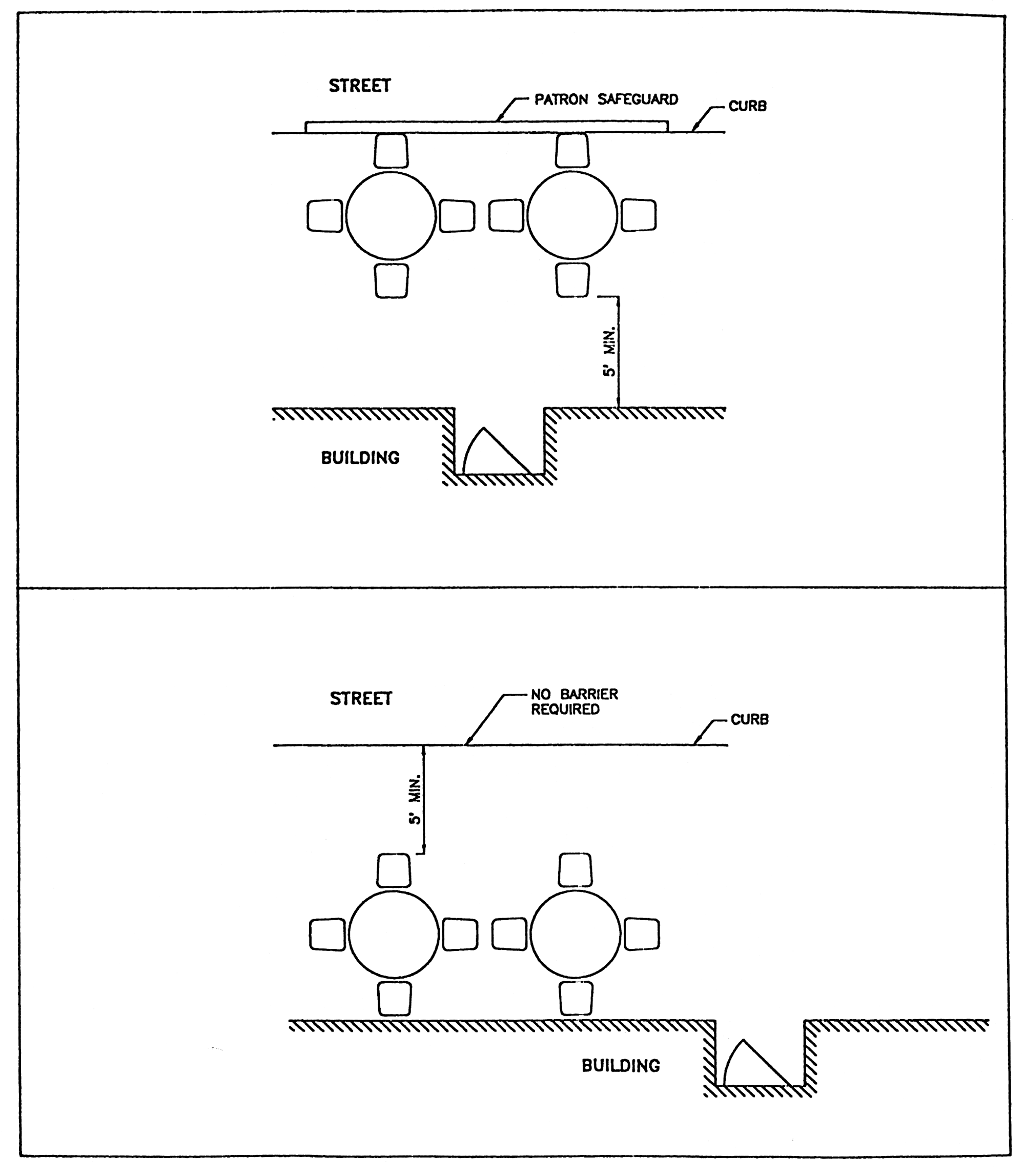
Sketch 801.14 Sidewalk Cafe
801.15. Pits, quarries, excavations.
A.
Purpose. The city commission of the City of New Smyrna Beach hereby finds that the regulation of the opening and the operation of pits, quarries and excavations in the city is necessary for the protection of the health, safety and welfare of the people, and further, that such regulation is necessary to minimize soil erosion, possible flooding, air pollution, ground subsidence, deterioration of public streets, and preemption of preferred land use.
B.
Definitions. The following definitions shall be applicable to this section:
(1)
Agricultural use. Includes but is not limited to the use of land in horticulture, floriculture, viticulture, forestry, dairy, livestock, poultry, beekeeping, pisciculture, and all forms of farm products and farm production.
(2)
Development services director. The city official, employee and staff or development services department staff that has been designated by the city commission as the planning staff for the city.
(3)
Excavation. This term shall be defined to include the hollowing out, removal by digging, or leveling of any land, dirt, sand, clay, soil, rock, solid materials or other soil materials.
(4)
Excavator. This term shall mean any person who sells, or offers for sale, whether directly or indirectly, any materials excavated within the city, or any person who excavates within the city any material and transfers such excavated material from one parcel of land to any noncontiguous parcel.
(5)
Person. Any person, partnership, limited partnership, sole proprietorship, corporation, joint venture, trust or estate or other group of persons acting as a single unit.
(6)
Zoning authority. The duly constituted planning board of the city.
C.
License requirements. No person may engage in the business of being an excavator until such person has secured an occupational license in accordance with the city ordinances.
D.
Open excavations prohibited. Open excavations are prohibited within the city unless specifically authorized by permit as provided for herein, except as follows:
(1)
Installation of utilities;
(2)
Foundations of any building or structure or other on-site leveling or excavation where approved under a valid building permit;
(3)
Excavations relating to the accessory use of land and designed to be filled upon completion of excavation, such as septic tanks, graves, etc.;
(4)
Swimming pools when a building permit has been issued for construction of such pool;
(5)
Borrow pits designated or controlled by any governmental agency or operation or other entity created by law providing for mosquito control or drainage or by any drainage district created pursuant to F.S. ch. 298;
(6)
Excavation in conjunction with agricultural use of lands, where no excavated materials are sold, whether directly or indirectly, or transferred from one parcel of land to any noncontiguous parcel;
(7)
Subdivisions complying with the city subdivision regulations;
(8)
Where not otherwise governed by the city zoning ordinance, any leveling of land within the confines of a single tract of land where the plans for such leveling are approved by the public works director. If such plans are disapproved by the public works director, the applicant may, upon application, appeal such decision to the city manager and the city commission;
(9)
Excavations or leveling for private drives to provide ingress or egress.
E.
Permits required. No excavator may excavate or level a parcel of land until first obtaining an excavation permit issued by the chief building official in the manner herein prescribed prior to any excavation being made on the property to be excavated. Applications for excavation permits shall be submitted to the chief building official and shall contain the following information plus any specific information requested by the chief building official:
(1)
The name and address of the person seeking the permit;
(2)
The legal description of the property;
(3)
A map showing the location and boundaries of the tract of land in question;
(4)
Drawings to scale showing the length and width of the proposed excavation to be undertaken;
(5)
Where the United States Geological Surveys or other topographical information is not available to the city, the applicant shall provide an informal statement of the topography, including the location of watercourses or water bodies, of the portion of the property proposed to be excavated;
(6)
The location and means of vehicular ingress and egress to the proposed excavation;
(7)
The application shall include a statement for the proposed reclamation, if any, of the property at the conclusion of the excavation operation;
(8)
The plans shall be accompanied by a general statement indicating the nature, purpose and method of the proposed excavation.
F.
Change in zoning. In the event that the process of excavation is not in compliance with prescribed land use in accordance with the zoning ordinance, the applicant shall be required to obtain a change in zoning or a variance pursuant to the zoning ordinance prior to the issuance of the excavation permit.
G.
General requirements and setbacks.
(1)
All sides of the excavated area shall be no greater than a one-foot vertical drop for each two feet of horizontal distance to the maximum depth of the excavation as indicated on the approved plan. Any excavation in excess of the aforementioned slope shall be enclosed by a fence at least four feet high, which fence enclosure shall include a gate that shall be closed and locked at all times during which the excavation pit is not in use. This fence requirement may be waived by the public works director if it is apparent that there is no public hazard with regard to the excavation operation.
(2)
Pits, quarries, artificial lakes or other uses of land excavated and designed to be left open upon completion shall be excavated within the following setback lines, as measured from the right-of-way line to the top of the beginning of the slope. To conform with the requirements of the State of Florida, department of Transportation, if any, but not less than the following:
(a)
One hundred fifty feet from the right-of-way line of any state or federal numbered highway;
(b)
Fifty feet from the right-of-way line of any other public street, road or highway;
(c)
Fifty feet from the side, rear or abutting property lines;
(d)
Where the proposed excavation site abuts residentially zoned property, the setback from the abutting property line shall be 150 feet.
(3)
Whenever the public works director determines that the use of any city street designated by the applicant for ingress and egress to and from the excavation site will be subject to excessive deterioration resulting in the breakdown of the subsurface and base of such street, the applicant shall be required to agree to maintain the street free of any safety hazards during the excavation operation, which hazards are caused by such operation, and shall further agree that upon completion of the excavation operation he shall place the street in the same condition as it was prior to the beginning of said operation. In furtherance of this agreement, the excavator may be required by the city manager to post an acceptable bond in the amount of 100 percent of the estimated reconditioning costs, as estimated by the public works director, conditioned upon meeting the requirements of this subsection.
(4)
Whenever it is determined that reclamation of the excavation pit is required at the termination of the project in order to prevent soil erosion, adverse effects on city-maintained rights-of-way, or the natural drainage patterns, or to protect the natural environment surrounding the excavation pit, or to protect the character and value of surrounding property, the city manager may require an acceptable bond in an amount not less than $1,000.00 or more than $10,000.00, which amount shall be computed at a rate of $0.50 per cubic yard of material proposed to be removed by the excavation, which bond shall be conditioned upon the excavation and reclamation being made in accordance with the plans as approved by the planning board and city manager.
H.
Presently existing excavation. All persons excavating from pits, quarries or landfills presently in existence shall be required to obtain a permit from the chief building official or his duly appointed agent within 90 days from the effective date of this chapter. Permits shall be issued for continuing operation of such excavations after the chief building official or his appointed agent finds that the applicant for the permit has obtained conditional use approval from the planning board for the excavation project, or evidence of a legal nonconforming use, and that the applicant has submitted plans to the chief building official, which plans shall include the following information:
(1)
A map showing the location and boundaries of the tract of land in question.
(2)
The length and width of the proposed excavation.
(3)
Existing gradients of the sides of the excavation. Said plans must be approved by the public works director prior to issuance of the permit.
The permit shall be approved only after the applicant demonstrates an intent and ability to comply with the requirements of subsection G.(1) and compliance with subsections G.(3) and (4).
I.
Conflicting laws of regulations. This subsection shall be supplemental to any and all other laws or regulations, whether county, state or federal, and in the event of any conflict between this subsection and any other law or regulation, the more strict provisions shall apply. If any part of this subsection is held to be unconstitutional, it shall be construed to have been the legislative intent to pass this subsection without such unconstitutional part and the remainder of this subsection as to the exclusion of such part shall be held to be valid as if such part had not been included herein. If this section or any provision hereof is held to be inapplicable to any person, group of persons, property, kind of property, circumstances or set of circumstances, such holding shall not affect the applicability hereof to any other person, property or circumstances.
J.
Penalties. The violation of any provision of this subsection shall be punishable by a fine not exceeding $500.00 or by imprisonment not exceeding 60 days or both fine and imprisonment.
801.16. Street excavations.
A.
Purpose. The purpose of this subsection is to provide for the proper maintenance and repair of the city's streets, roads and alleys by persons excavating or doing work in and upon the city's streets, roads or alleys that involves the alteration of any portion of the street, road or alley.
B.
Definitions. For purposes of this subsection, the following terms shall have the following meaning:
Emergency repair means the repair or replacement of existing underground facilities, equipment or appurtenances which is required to correct an immediate hazard to life, health or property; or to restore services vital to the community.
Major new construction means the installation of underground facilities, equipment and appurtenances in locations where they did not exist previously which requires roadbed excavation in two or more locations, or which requires excavation along a roadway for a distance in excess of 100 feet.
Major repair, maintenance or restoration means the repair or replacement of existing underground facilities, equipment or appurtenances which requires roadway excavation in two or more locations, or which requires excavation along a roadbed for a distance in excess of 100 feet.
Minor new construction means the installation of underground facilities, equipment and appurtenances in locations where they did not exist previously which requires roadbed excavation in only one location for a distance of less than 100 feet.
Minor repair, maintenance or restoration means the repair or replacement of existing underground facilities, equipment or appurtenances which requires roadbed excavation in only one location for a distance of less than 100 feet.
Street shall be construed to include roads, sidewalks, alleys, highways and other ways open to travel by the public, including the roadbed, right-of-way and all culverts, drains, sluices, ditches, water-storage areas, waterways, embankments, slopes, retaining walls, bridges and viaducts necessary for the maintenance of travel, but shall not include private streets, roads or drives.
C.
Applicability. This section and its provisions shall be applicable to and binding upon any person, firm, corporation, governmental body or agency that does any work upon any street within the city that involves excavation or alteration of any portion of the city's streets. It shall likewise be binding upon any contractors, subcontractors, materialmen, laborers, or agents of the above.
D.
Plans, permits and permit fees; when required. In cases of new construction and for major repair, maintenance or restoration, before any person, firm, corporation or governmental agency alters any street, plans and time schedules for said work shall be submitted to the city engineering department and approval for said work must be obtained from the city engineer or designated personnel. Along with the plans submitted to the city, application for a permit to do the contemplated work shall be made on forms furnished by the city. For franchised utilities and governmental agencies, submission of construction plans shall be considered as a permit application. A permit fee in the amount of $50.00 shall be charged for the issuance of an excavation permit under this subsection which shall be in addition to all other fees for permits or charges relative to any proposed new construction work. Franchisees and governmental agencies shall be exempt from the permit fee when said work involved is for minor construction or minor repair, maintenance or restoration. Work performed at the request of the city shall be exempt from the permit fee.
E.
Bond and insurance required for new construction and major repair, maintenance or restoration. Plans for new construction or for major repair, maintenance or restoration required by this subsection shall be accompanied by either a cash deposit or a bond payable to the city, conditioned upon the prompt, faithful and efficient performance of the contract according to the plans and specifications and within the time period specified, and further conditioned upon the work being done in such a manner that the street is not injured thereby or placed in a poorer condition than the said street was prior to the commencement of the work. The bond or cash deposit shall be in an amount as specified by the city engineer or designated personnel. Any surety on the bond required herein shall be provided by a surety company authorized to do business in the State of Florida. A surety company shall not be relieved of its obligation under the surety bond unless and until written release has been obtained from the city engineer or designated personnel. Likewise, the city shall not have any obligation to return the cash deposit, or any portion thereof, until a written release has been executed by the city engineer or designated personnel. The requirement of the posting of a cash deposit or the furnishing of a bond shall not be required of any franchisee of the city or governmental agency. The bond or cash deposit shall be in an amount according to the schedule to be formulated by the city engineer and to be approved by the city commission.
F.
Notification of the city and preconstruction conference. In all cases involving major new construction or major repair, maintenance or restoration, the person, firm, corporation or governmental agency proposing to do the work shall notify the city manager of said intention and shall schedule a preconstruction conference or conferences with the city engineer or designated personnel for the purpose of reviewing the scope of the proposed work and formulating time schedules, with the objective of minimizing the inconvenience and hazardous conditions to the general public. In those cases involving minor construction or minor repair, maintenance or restoration, even though a permit may not be required, the city engineer shall be notified of any roadway excavation within one working day of initiation and prior to completion of pavement or surface restoration. Similarly, where emergency repairs need to be made, the city engineer shall be notified within one working day. If the emergency repair falls within the category of major repair, maintenance or restoration, a permit application shall be made within one working day.
G.
Responsibility of permittee, franchisee or governmental agency. As the excavation progresses, all streets and abutting private property shall be thoroughly cleaned of all rubbish, excess earth, rock and other debris resulting from such work. All cleanup operations at the location of such excavation shall be accomplished at the expense of the permittee, franchisee or governmental agency and shall be completed to the satisfaction of the city engineer, but shall be limited to the original condition of the street at the time of excavation. It shall be the duty of the permittee, franchisee or governmental agency to guarantee and maintain the site of the excavation for a period of two years after restoring it to its original condition.
H.
Right of city to use bond or cash deposit to restore surface of street. If the permittee shall have failed to restore the surface of the street to its original and proper condition upon the expiration of the time fixed by such permit or shall otherwise have failed to complete the excavation work covered by such permit, the city engineer, if he deems it advisable, shall have the right to do all work and things necessary to restore the street and to complete the excavation work. The permittee shall be liable for the actual cost thereof and 25 percent of such cost in addition thereto for general overhead and administrative expense. By application for the permit, the permittee hereby expressly authorizes the city to use such portions or all of any bond or cash deposit to pay the cost of such work the city performs to restore or maintain the street as herein provided in the event the permittee fails to perform such work.
I.
Inspections and authority of the city engineer. The city engineer shall make such inspections as are reasonably necessary in the enforcement of this section. In addition, the city engineer shall have the authority to require off-street dirt storage, to determine the size and length of the cut, and to prohibit cuts on new pavement. If unusual traffic conditions or excavation of a major artery requires that the excavation work be performed as emergency work, the city engineer and/or city manager shall have the power and authority to order, at the time the permit is granted, that a crew and adequate facilities be employed by the permittee 24 hours a day to the end that such excavation work may be completed as soon as possible. In the event that emergency conditions create an immediate hazard to life or property, corrective procedures may be commenced without such permit as required by this section provided that such permit is secured at the earliest practicable time after commencement of the work and that the contemplated work is approved in writing by the city engineer. The city engineer shall have the authority to issue a stop work order for noncompliance with this section or if a situation is found by him to pose a great and present danger to the public health, welfare and safety.
J.
Barricades and warning lights. Building materials, machinery, disabled motor vehicles, excavation and objects on the street shall be illuminated by lanterns, flashing lights or torches between the hours of sunset and sunrise and shall be spaced not more than five feet apart across any street, or 15 feet lengthwise on any street, together with other adequate barricades. It shall be the responsibility of the permittee to see that this requirement is met.
801.17. Tennis courts in required yards.
A.
A tennis court and its fence shall be allowed in required yard areas by special exception on property zoned R-4, R-5, R-6 or B-4 if associated with a multifamily project or hotel/motel provided:
(1)
All the general criteria as listed in [sub]section 305.04 are met.
(2)
The tennis-court lighting has a functioning timer which automatically shuts off lighting.
(3)
Lighting does not illuminate adjacent properties.
(4)
The planning and zoning board in approving a special exception under this provision may impose reasonable limitations on the hours the tennis court may be used.
(5)
The planning and zoning board in approving a special exception under this provision may determine if a windscreen may be installed on a fence that encroaches into a required yard:
(6)
No fence which encroaches upon a required setback may exceed ten feet in height.
(7)
As much as possible, the tennis court and fencing must meet the required setbacks.
(8)
Tennis courts and their fences shall not be allowed in required front yards adjacent to arterial roads as defined in the comprehensive plan.
801.18. Truck and trailer rentals.
A.
No public street, required driveway or parking area, sidewalk or alley or any landscaped area shall be used for the display or storage of the rental trucks or trailers.
B.
No operation of the rental business shall be conducted in a manner that impedes free flow of vehicular or pedestrian traffic using public ways.
C.
No cleaning or repair of trucks or trailers or parts thereof shall be made except within a structure provided for such purposed and no storage of parts shall be other than in an enclosed building.
D.
Washing of vehicles shall be done only with all necessary permits and in accordance with city, county, state and federal ordinances, laws, rules and regulations.
801.19. Waterfront dining and entertainment establishments by special exception. Waterfront dining and entertainment establishments may encroach upon a waterfront yard setback if all of the following conditions and criteria are met:
A.
All of the general criteria for a special exception use are, or will be, met once the use is initiated.
B.
A deck or promenade extends over the water and is able to be used by the public or patrons of the associated waterfront dining and entertainment establishment.
C.
No principal or accessory structure having a height over four feet above the finished grade of the principal building, except for incidental uses, shall protrude into the area of a visibility triangle. The visibility triangles shall be the areas formed by a line connecting the points 30 feet from the intersection of the waterfront lot line and the lot line perpendicular to the waterfront lot line along the waterfront line, and 30 feet from the intersection of the two lines along the lot line perpendicular to the waterfront line. The area extending into the water from the base of the triangle is included in the visibility triangle. See Illustration 801.19.
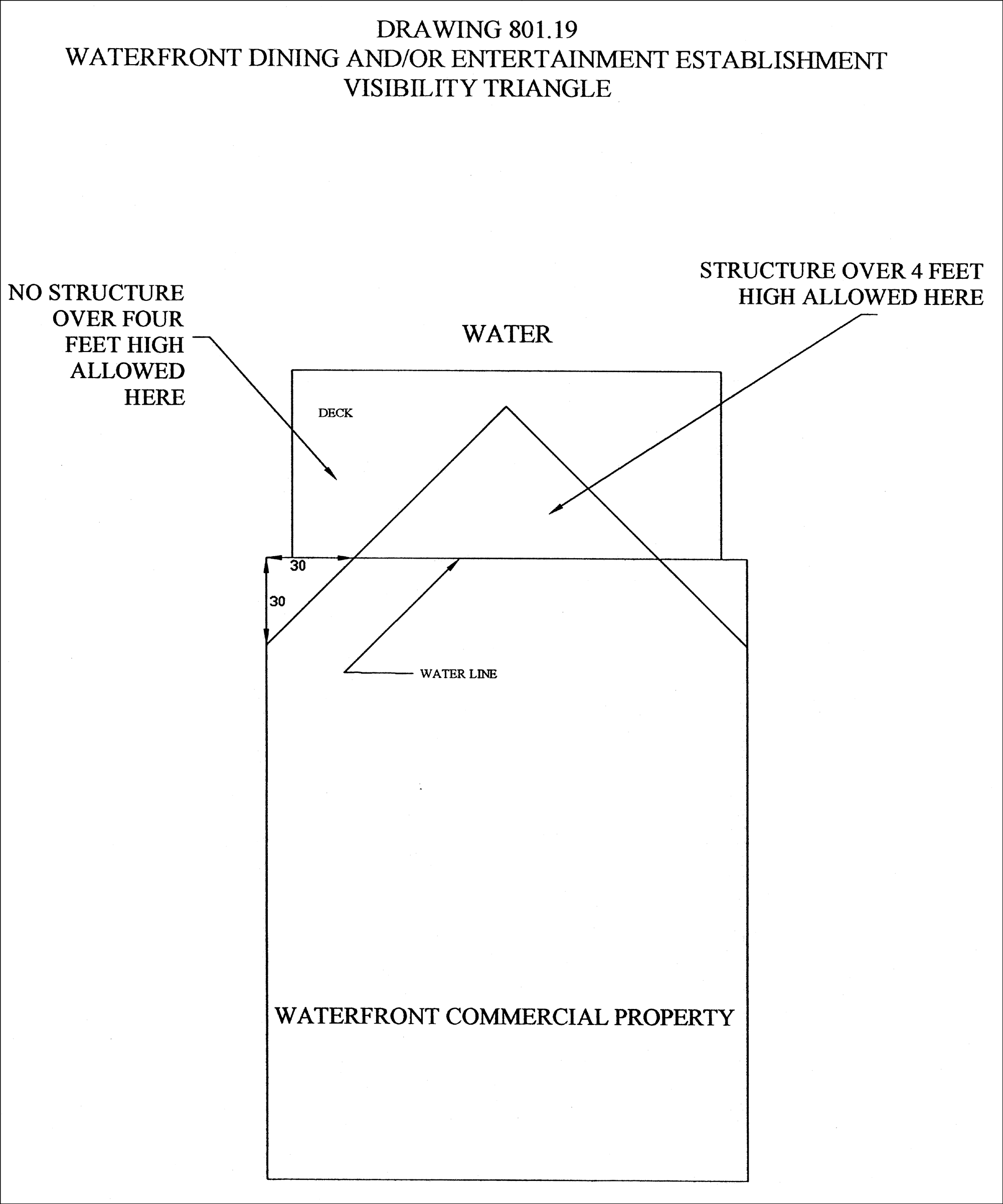
D.
The deck and other buildings on the property adjacent to the deck shall not be allowed to exceed the maximum building coverage allowed on the adjacent upland lot. The deck shall not be impervious and shall not be included as impervious area.
E.
Decks shall have a minimum ten-foot setback from the property line perpendicular to the water line and extending out into the water and 20 feet if adjacent to residentially zoned property.
801.20. Landfills, construction and demolition debris disposal facility, materials recovery facility, recovered materials facility or off-site disposal of land clearing debris facility.
A.
No special exception for the deposit of material is required by this article for the following activities provided that the activity does not violate any federal or state laws, rules, regulations or orders:
(1)
Normal farming operations/agricultural use.
(2)
Grading, filling and moving of earth in conjunction with commercial, industrial or subdivision construction provided a development order or permit has been obtained.
(3)
Foundations and buildings pads for any building or structure, provided that a valid building permit has been issued by the building department.
(4)
Minor landscaping projects provided they do not encroach in flood-prone areas as depicted on the flood insurance rate maps promulgated by the Federal Emergency Management Agency, or change the natural drainage patter of the ground surface at the property line.
(5)
Exemptions contained in Rule 62-701.320(2), F.A.C.
B.
The following requirements and conditions shall be met for landfills or other facilities as provided herein, subject to Florida Department of Environmental Protection permit approval:
(1)
Each application for a special exception shall be accompanied by plans, drawings, and information prepared by a Florida registered engineer depicting at a minimum:
(a)
Existing and proposed topography at one-foot contour intervals. Such topography shall extend a minimum of 150 feet beyond the toe of slope of the landfill or facility.
(b)
Wet and dry season water elevations and the existing surface drainage pattern.
(c)
Notwithstanding any other minimum yard size requirements of this article, the sides of a landfill or facility shall be set back the following minimum distances:
1.
One hundred twenty-five feet from the right-of-way of any public street, road or highway.
2.
One hundred twenty-five feet from abutting residential or mobile home classified property.
3.
One hundred twenty-five feet from any other abutting property.
4.
One hundred twenty-five feet from any natural surface water body, watercourse or wetlands.
(d)
Perimeter landscape buffers shall be established prior to initiation of the activity and shall be a minimum of 50 feet adjacent to all boundaries.
(e)
A description of the area and volume of material to be filled.
(f)
A description of the time, duration, planning and proposed work schedule of the project.
(g)
A detailed reclamation plan, and program to be performed upon completion of the project. As a minimum, the plan of reclamation shall include:
1.
Time, duration, phasing and proposed work schedule.
2.
Depiction of finished, stabilized sides.
3.
Landscape plan for portion of property disturbed by landfill and associated activities, including an inventory of plant/tree species.
The reclamation plan must be approved by city technical review staff.
(h)
The proposed location of access roads to the sites and proposed haul routes for material to be deposited. Vehicular access to and from the landfill or facility shall be designated by the city commission at the time of approval of the special exception.
(i)
Proposed plans for fencing and signs. All proposed signs shall be consistent with subsection 604.12 of this LDR. All proposed fencing shall be consistent with subsection 803.03 of this LDR.
(j)
A report prepared by a qualified engineer of the proposed landfill or facility site. Such a report shall at a minimum provide a detailed discussion of the environmental impacts of the proposed landfill or facility and a recommendation of the necessity to install monitoring wells.
(k)
Evidence that the applicant has contacted the Florida Department of Environmental Protection by certified mail with a copy of the return receipt to the planning and engineering department, and all other appropriate state and substate agencies, for the requisite permit. Such a landfill or other facility, as a condition of approval of the special exception, shall obtain a permit from the Florida Department of Environmental Protection.
(2)
Whenever the city engineer determines that the use of any public right-of-way designated by the applicant for ingress and egress to and from the site will be subject to excessive deterioration resulting in the breakdown of the subsurface and base of such right-of-way, the applicant may be required to provide the city with funds in the amount necessary to mitigate the adverse impact upon the right-of-way which is caused by the operation and to ensure that said roadway is maintained in a satisfactory condition. In furtherance of this agreement, the operator may be required by the city commission to post an acceptable performance bond, irrevocable letter of credit, or funds in escrow in the amount up to 100 percent of the estimated reconditioning costs, as estimated by the city engineer.
(3)
If upon completion of the public hearings the special exception is approved, final site plan approval as specified by Article III of the land development regulations is required.
(4)
The city commission as a condition of the approved special exception may further limit the types of materials that may be deposited in a landfill or facility.
(5)
Notwithstanding anything to the contrary within this article, no landfill or facility shall exceed 25 feet in height above the existing grade.
801.21. Bed and breakfast homes (RA zoning district).
A.
Maximum number of guest rooms for bed and breakfast use in the home: Five.
B.
Owner must reside in the building.
C.
Separate cooking facilities are not permitted in the guest room.
D.
Each guest room shall have private toilet and shower facilities, except where the building is designated as historically significant by the city or is listed on the National Register of Historic Places, in which cases a minimum of one bathroom shall be provided exclusively for use by the guests.
E.
Minimum bedroom area shall be 150 square feet.
801.22. Cemeteries, parochial or private schools.
Cemeteries, parochial or private schools are permitted, provided:
A.
No principal or accessory building shall be located less than 50 feet from any property line.
B.
Off-street parking areas meeting the requirements of subsection 604.09 and landscaped buffer areas meeting the requirements of subsections 604.04 and 604.051 shall be constructed. Off-street parking and loading areas shall be surfaced with brick, asphalt, bituminous, concrete or packed shell or marl material and shall be maintained in a smooth, well-graded condition.
C.
Cemeteries shall comply with F.S. ch. 497, including the minimum acreage requirements and any other applicable governmental regulations.
D.
All schools must meet the requirements of Title XLVIII, F.S., or obtain a variance under Article III of this LDR.
801.23. Day care centers.
Day care centers designed and constructed according to the applicable state standards and the following:
The intensity of the facility (i.e., number of residents) shall be compatible with the density and character of the surrounding residential area.
801.24. Group homes and nursing homes, boarding houses.
A.
The scale of the facility (i.e., number of residents) shall be compatible with the density and character of the surrounding residential area.
B.
No principal or accessory building shall be located less than 45 feet from any property line.
C.
Unless waived by the city commission, off-street parking and loading areas meeting the requirements of subsection 604.09 and landscaped buffer areas meeting the requirements of subsection 604.04 and 604.051 shall be constructed.
801.25. Off-street parking areas.
Off-street parking areas are permitted as indicated in the zoning district as a special exception on vacant lots that are contiguous to or lie directly across the street from lots zoned commercial, providing the following conditions are met:
A.
The off-street parking area shall be used to serve only an existing conforming commercial use.
B.
The off-street parking area shall be used exclusively for additional off-street parking spaces that exceed the minimum off-street parking space requirements of subsection 604.09 of this LDR. Access to the off-street parking area shall comply with the requirements of this LDR.
C.
If the off-street parking area is contiguous to the premises on which the principal commercial use is located, motor vehicles shall only enter or exit the parking area through that premises.
D.
If the off-street parking area is across the street from the premises on which the principal commercial use is located, all entrance and exit drives shall be located directly across from the premises.
E.
The parking area shall meet the requirements for materials, lighting, landscaping and stormwater retention outlined in this LDR.
F.
Each application for a special exception shall be accompanied by a parking plan meeting the requirements of the Land Development Regulations and a landscape plan that meets the criteria of subsections 604.04, 604.051 and 604.09 A.(9) of this LDR.
G.
A landscape plan meeting the following requirements shall be submitted:
(1)
The parking lot shall be planned and designed to retain the maximum amount of natural vegetation and shade trees. In the event that natural vegetation cannot be used, supplemental plant material shall be provided.
(2)
All buffers and screening shall be provided in accordance with subsections 604.04, 604.051 and 604.09 A.(9) of this LDR. The screening shall be erected within five feet of the off-street parking area and be maintained in a neat and orderly manner at all times. Landscaped berms may be used in place of a fence. The berms shall be constructed to a height of four feet with inside slopes not exceeding a three to one ratio. Plant material shall be planted on top of the berm and shall be a minimum of two feet in height with a planting interval of at least three feet on center.
H.
A workable underground irrigation system shall be installed in order to provide the means to water any planted landscape materials.
I.
All landscaping shall be maintained in accordance with subsection 604.04 of this LDR.
J.
The parking area shall not be used until the parking area has been constructed in accordance with the plans approved pursuant to the special exception.
801.26. Public utility uses and structures.
A.
Unless waived by the city commission, a landscape buffer meeting the requirements meeting the subsections of 604.04 and 604.051 is required.
B.
A final site plan meeting the requirements of Article III of the LDR is required.
801.27. Recreational areas.
Golf courses, country clubs, swim clubs, tennis clubs, and similar uses are permitted provided:
A.
The total lot area covered with principal and accessory buildings shall not exceed 15 percent.
B.
No dwelling units shall be provided on the premises except for living quarters for a resident manager, watchman or caretaker. Those living quarters, if any, shall be constructed as part of the principal building.
C.
No principal or accessory building, swimming pool or tennis court shall be located less than 50 feet from any lot line.
D.
No outdoor loudspeaker or call system shall be audible on adjoining property.
E.
All artificial lights shall be directed away from adjoining properties.
F.
Unless waived by the city commission, off-street parking areas meeting the requirements of subsection 604.09 and landscaped buffer areas meeting the requirements of subsections 604.04 and 604.051 shall be constructed.
801.28. Change of use.
A.
All Business Tax applications that include a Change of Use from one permitted use to another permitted use, the new permitted use must meet all current Land Development Regulations including but not limited to required landscaping, parking, and accessibility regulations.
B.
All Business Tax applications that include a Change of Use are require to submit a site plan to the Planning Director or their designee. The planning Director or their designee will determine which classification of site plan to be submitted.
801.29. Terminated use.
A.
All commercial or industrial zoned parcels that have a terminated use, must comply with the current Land Development Regulations including but not limited to the required landscaping, parking, and ADA regulations before a new permitted use can be approved.
B.
All Business Tax applications that include a Change of Use from a terminated Use are require to submit a site plan to the Planning Director or their designee. The planning Director or their designee will determine which classification of site plan to be submitted.
801.30. Property maintenance standards.
A.
All commercial, industrial, and residential developed properties must maintain the following minimum standards within ninety (90) days of notification of deficiency from the City:
1.
All buildings and walls shall present a neat and clean appearance and be free of all peeling paint, mildew, rust, graffiti and deteriorated or mismatched roofing material.
2.
Nonfunctional elements on any building structure, or premises such as unused sign poles, empty electrical conduit, etc., shall be removed and the remaining surface shall, if damaged, be repaired or rebuilt to match adjacent surfaces and to the original condition. All loose materials shall be secured.
3.
All roofs and gutter systems shall be maintained to prevent damage to the structure and adjoining properties.
4.
Awnings shall be properly maintained. Awnings shall be deemed non-maintained if any or part is broken, tattered, torn, faded, or otherwise in disrepair.
5.
All paved or concrete parking areas shall be kept free of weeds, trash, and debris. Potholes and broken pavement or concrete shall be repaired. Paving and striping shall be maintained to a neat and clean appearance.
6.
Landscaping shall be maintained to the original approved landscape plan. All properties without an approved landscape plan shall maintain landscaping in a healthy condition, including but not limited to sufficient watering and trimming. Landscaping shall be reasonably free of weeds.
7.
All grass and turf shall be maintained in a healthy condition, including but not limited to sufficient watering and trimming.
8.
The premises shall be free of any condition that tends to or could hamper or interfere with the suppression of fire or emergency vehicles upon the premises or adjacent premises. This would include required parking lot entry, exits, and movability points.
9.
All retaining walls, landscaping walls, dumpster enclosures, lighting devises, fences, curbs, walkways, parking lots, outdoor seating areas, building facades, roof coverings, and gates shall be maintained to a neat, clean, and functioning condition with a clean appearance.
10.
All signs including but not limited to wall signs, projecting signs, monument or ground signs and legal conforming pole signs must be maintained to a neat, clean, non-faded, and functioning condition with a clean appearance.
11.
Grass height may not be allowed to be taller than ten inches in height for developed residential parcels and 12 inches in height for developed commercial and industrial parcels.
B.
All commercial, industrial, and residential un-developed properties that are cleared not including wooded must maintain the following minimum standards within 90 days of notification of deficiency from the City:
1.
The parcel must be keep clear of trash.
2.
Grass height may not be allowed to be taller than 12 inches in height for undeveloped residential, commercial, and industrial parcels.
801.31. Pharmacy. A pharmacy may not be located within 500 feet of the real property that comprises a public park, recreation center or recreation facility on lands within the City or on lands within the Interlocal Service Boundary Agreement.
(Ord. No. 53-00, § 1, 12-12-2000; Ord. No. 16-02, § 1, 4-9-2002; Ord. No. 71-02, § 1, 1-14-2003; Ord. No. 07-05, § 5, 3-17-2005; Ord. No. 94-06, § 1, 9-12-2006; Ord. No. 12-10, § 1, 3-9-2010; Ord. No. 59-10, § 1, 12-14-2010; Ord. No. 08-11, § 3, 2-8-2011; Ord. No. 108-11, § 4, 11-29-2011; Ord. No. 23-12, § 1, 2-28-2012; Ord. No. 62-12, § 3, 8-28-2012; Ord. No. 73-12, § 1, 9-11-2012; Ord. No. 97-15, § 1(Exh. A), 11-17-2015; Ord. No. 43-17, § 1, 6-27-2017; Ord. No. 93-17, § 1, 12-12-2017; Ord. No. 19-18, § 1, 3-13-2018; Ord. No. 111-20, § 3, 1-12-2021; Ord. No. 61-25, § 2, 9-15-2025)
802.00. - Storage on residential lots.
802.01. No lot which is zoned for a residential purpose shall be used for the storage of building materials or construction equipment except when incidental to a construction operation for which a building permit is in effect.
802.02. Automotive vehicles or trailers of any kind or type without current license plates shall not be parked or stored on any residentially zoned property other than in completely enclosed buildings.
802.03. In residentially zoned districts, trucks, or commercial vehicles shall not be parked on private property except as follows:
A.
A commercial vehicle not over one-ton rated capacity may be parked on a lot whose principal use is residential and where the commercial vehicle is used by a resident of the premises.
B.
A commercial vehicle of not over 1.5-ton rated capacity may be parked in an enclosed garage on a lot whose principal use is residential and where the commercial vehicle is used by a resident of the premises.
C.
Permitted nonresidential uses may utilize and park on their premises such commercial or other vehicles as may be necessary and customary for such uses, but this provision shall not be construed to permit the parking of school buses utilized by private or parochial schools on lots occupied by such schools.
D.
No commercial vehicle over one-ton rated capacity shall be parked in any residentially zoned district, except when said vehicle is in the process of delivery or pick up of materials to a residential premises. In such case, this section shall not apply to the parking of any vehicles on any residential premises, designated as a construction site, where a valid construction permit has been issued and is in effect.
802.04. No more than two pieces of major recreational equipment, not exceeding 35 feet in overall combined length (meaning boat on trailer when referring to boats and trailers), may be parked or stored in the rear yard of the dwelling unit provided, however, that:
A.
An unlimited number of pieces of major recreational equipment may be located anywhere on a premises provided they are parked inside a fully enclosed structure;
B.
Two pieces of major recreational equipment may be parked anywhere on the residential premises for a period not to exceed 24 hours during loading and unloading; and
C.
No Major recreational equipment may be parked less than 3 feet from any side and/or rear property line.
802.05. As an exception to [subsection] 802.04 above, one piece of major recreational equipment, not exceeding 35 feet in overall combined length (measuring boat on trailer when referring to boats and trailers), may be parked in the front driveway or side yard provided:
A.
There is no access to the rear yard without crossing over another parcel;
B.
Access to the rear yard cannot reasonably be created (reasonably created shall mean moving a small tree four inches in diameter or less or a shrub, putting a gate in a fence or relocating a small shed), and it shall not mean the purchase of additional property, removal of a medium or large tree (in excess of four inches in diameter) or major changes to a structure;
C.
The major recreational equipment is located a minimum of three feet from any side or rear property line and as far from the street right of-way as is possible; and
D.
Determination as to whether or not access to side or rear yards can reasonably be created shall be made by the chief building official after consideration of all factors involved.
802.06. No major recreational equipment shall be used for living, sleeping, or housekeeping purposes when parked or stored on a residential lot, or in any location not approved for such use.
802.07. Trailer storage.
A.
Boat trailers, enclosed trailers, or open trailers of any kind that are stored on property zoned for residential use shall be maintained in an operable condition.
B.
Boat trailers, enclosed trailers, or open trailers of any kind that are stored on property zoned for residential use may be stored on an approved driveway or along the side of the single-family or duplex structure or in a rear yard subject to the following conditions:
1.
No boat trailers, enclosed trailers, or open trailer of any kind can be stored in the City right-of-way.
2.
The ground beneath the boat trailer, enclosed trailer, or open trailer of any kind shall be maintained including mowing of grass.
3.
No boat trailers, enclosed trailers, or open trailers of any kind can be stored in a front yard other than on an approved driveway.
4.
No boat trailers, enclosed trailers, or open trailers of any kind shall be stored on a vacant residential zoned property, unless a valid permit for construction for a primary use has been issued by the Building Department, then construction trailers and material trailers would be allowed to park on-site.
(Ord. No. 59-10, § 1, 12-14-2010; Ord. No. 43-17, § 1, 6-27-2017)
803.00. - Regulations pertaining to accessory buildings and incidental uses.
803.01. Accessory buildings and structures shall not:
A.
Be erected within five feet of any other building;
B.
Exceed the height of a conforming principal building or 25 feet, whichever is less in height. However, parcels or lots that are two and a half acres in size or greater may have accessory structures that exceed 25 feet in height, provided the side and rear building setbacks are doubled if the proposed accessory structure is taller than the primary structure;
C.
Exceed 60 percent of the area of the principal building or maximum lot coverage, wherever is less. This includes all accessory buildings on a lot. Parcels or lots that are two and one-half acres in size or greater are exempt from the 60 percent area limitation but must still meet required maximum lot coverage;
D.
Be located in required yard area;
E.
Be without a tiedown to the ground or sufficiently anchored to a concrete slab or foundation in case of high winds;
F.
Be erected, installed, placed, or constructed without a permit; and
G.
Be allowed on a lot until a principal use exists on said lot or parcel with the following exceptions:
(1)
A boat dock and terminal platform, a boathouse, and mooring poles, for the sole use of the property owner, may be constructed on, or adjacent to, a lot prior to the construction of a principal structure; and
(2)
An on-site temporary sales or brokerage office may be located on a lot prior to the construction of a principal structure; and
(3)
Fences, walls, and hedges subject to section 803.03.
803.02. Incidental uses.
A.
Incidental uses shall not be subject to setback requirements but shall not be located closer than three feet from any property line (except fences and mailboxes).
B.
Incidental uses shall not be located within the visibility triangle if greater than three feet in height and eight inches in diameter or width (except see through fences such as chain-link or wire fences).
C.
The portion of major steps that is no more than four feet horizontally and 28 inches vertically shall be considered an incidental use and shall be allowed in the required yard.
803.03. Regulations pertaining to fences, walls, and hedges.
A.
Typical lots.
Properties zoned residential.
Maximum height:
• Within required front yard setback: Four feet. See illustration 803.03A and 803.03B.
• Outside required front yard setback: Six feet. See illustration 803.03A and 803.03B.
• Corner lots: On corner lots, fences can be six foot tall within the secondary front property setback, provided that property frontage does not have a driveway. Six foot tall fences along property frontages with driveway are prohibited.
• Tennis court fences taller than four feet in height may be permitted within the required front yard setback by special exception, as outlined in [sub]section 801.17.
• Fences, walls, and hedges shall conform to visibility triangle requirements for corner lots, as outlined in [sub]section 804.01.
Properties zoned non-residential.
Maximum height: Six feet.
• Fences, walls and hedges shall conform to visibility triangle requirements for commercial and industrial lots as outlined in [sub]section 804.01;
• Chain link and wire fences taller than three feet in height may be allowed in the visibility triangle, provided that slats or other opaque materials are not inserted in or placed on the fence; and
• Tennis court fences taller than four feet in height may be permitted within the required front yard setback by special exception, as outlined in [sub]section 801.17.
Illustration 803.03A
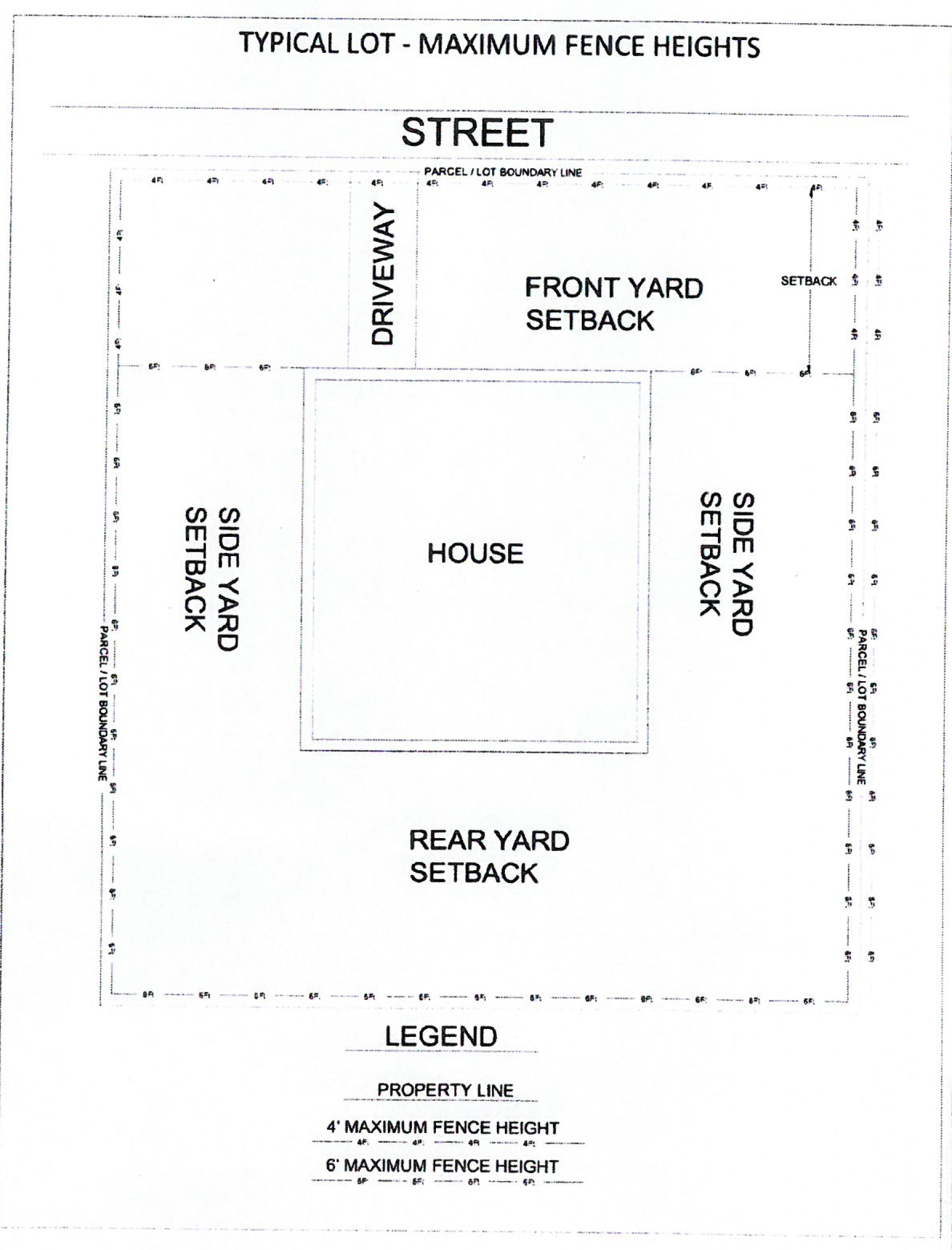
Illustration 803.03B
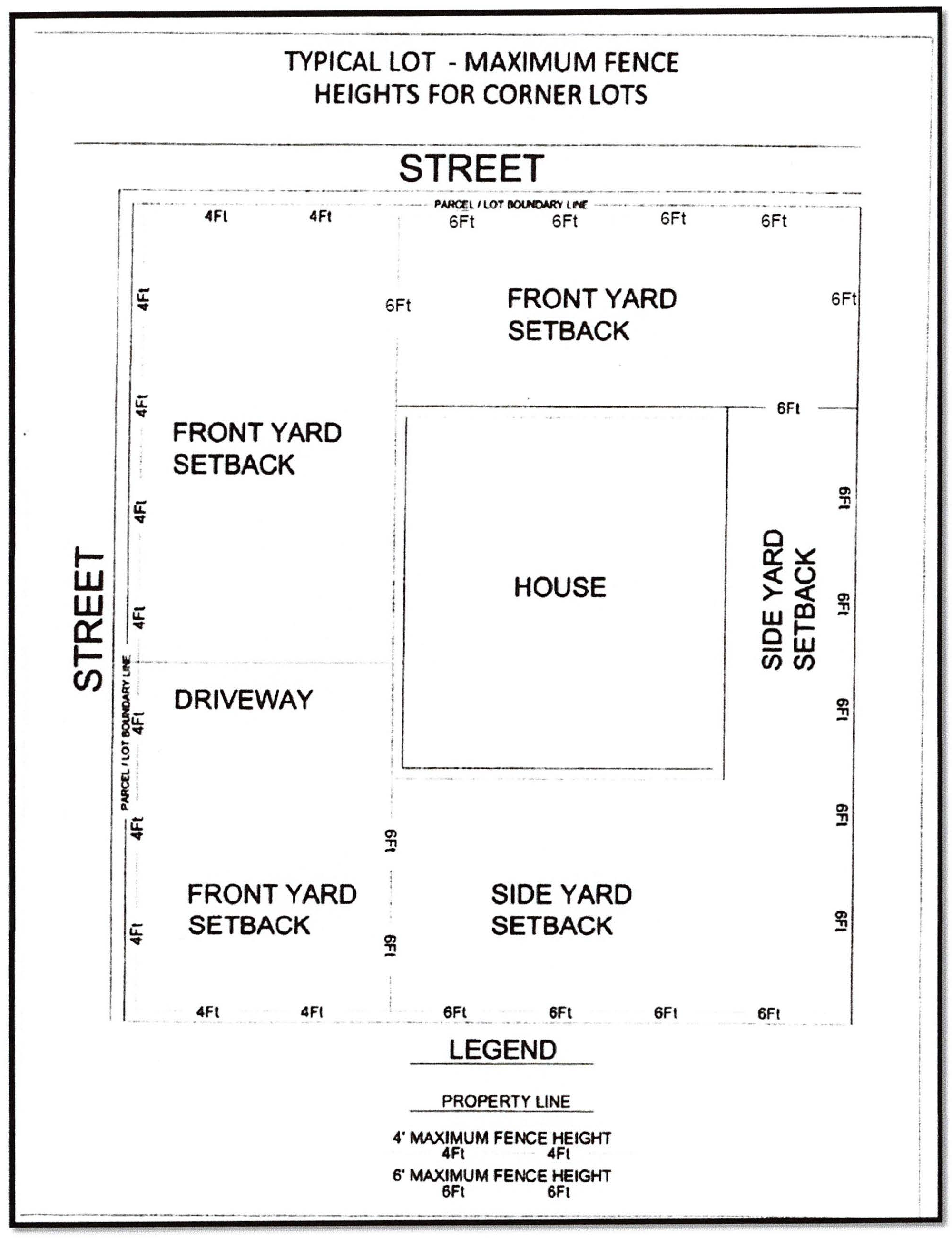
B.
Atypical lots.
Maximum height:
• Within required front or rear setback: Four feet see illustration 803.03C.
• Outside required front or rear setback: Six feet see illustration 803.03C.
• Tennis courts fences taller than four feet in height may be permitted within the required front or rear setbacks by special exception, as outlined in [sub]section 801.17.
• Fences shall conform to visibility triangle requirements on corner and commercial lots as outlined in [sub]section 804.01.
Illustration 803.03C
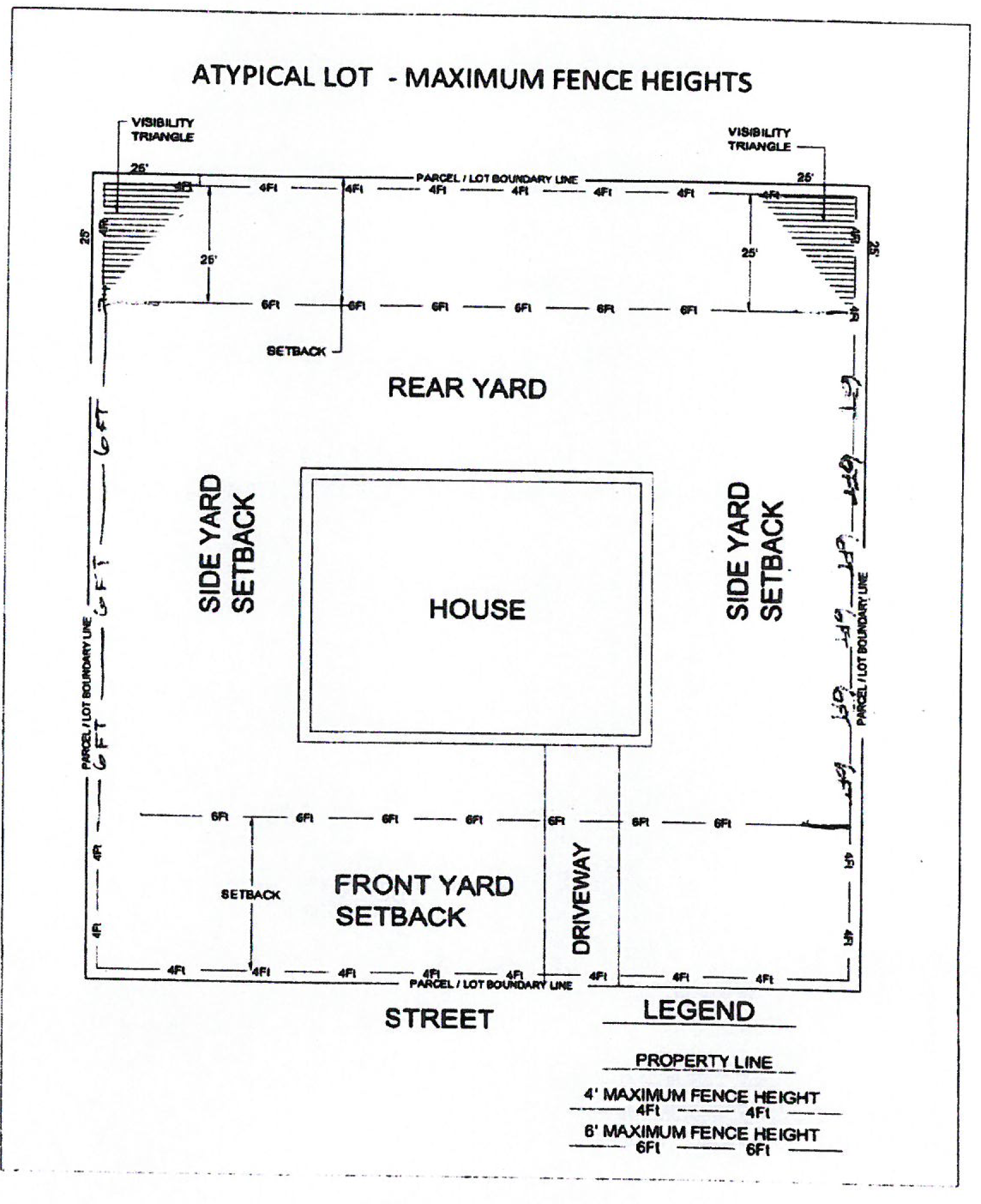
C.
Through lots.
Properties zoned residential.
Maximum height:
• Within required front setbacks: Four feet see illustration 803.03D.
• Outside required front setbacks: Six feet see illustration 803.03D.
• Tennis courts fences taller than four feet in height may be permitted within the required front setbacks by special exception, as outlined in section 801.17.
• Fences shall conform to visibility triangle requirements on corner and commercial lots as outlined in section 804.01.
Properties zoned non-residential.
Maximum height: Six feet.
• Fences walls and hedges shall conform to visibility triangle requirements for commercial and industrial lots as outlines in subsection 804.01;
• Chain link and wire fences taller than three feet in height may be allowed in the visibility triangle, provided that slats or other opaque materials are not inserted in or placed on the fence; and
• Tennis court fences taller than four feet in height may be permitted within the required front yard setbacks by special exception, as outlined in subsection 801.17.
Illustration 803.03D
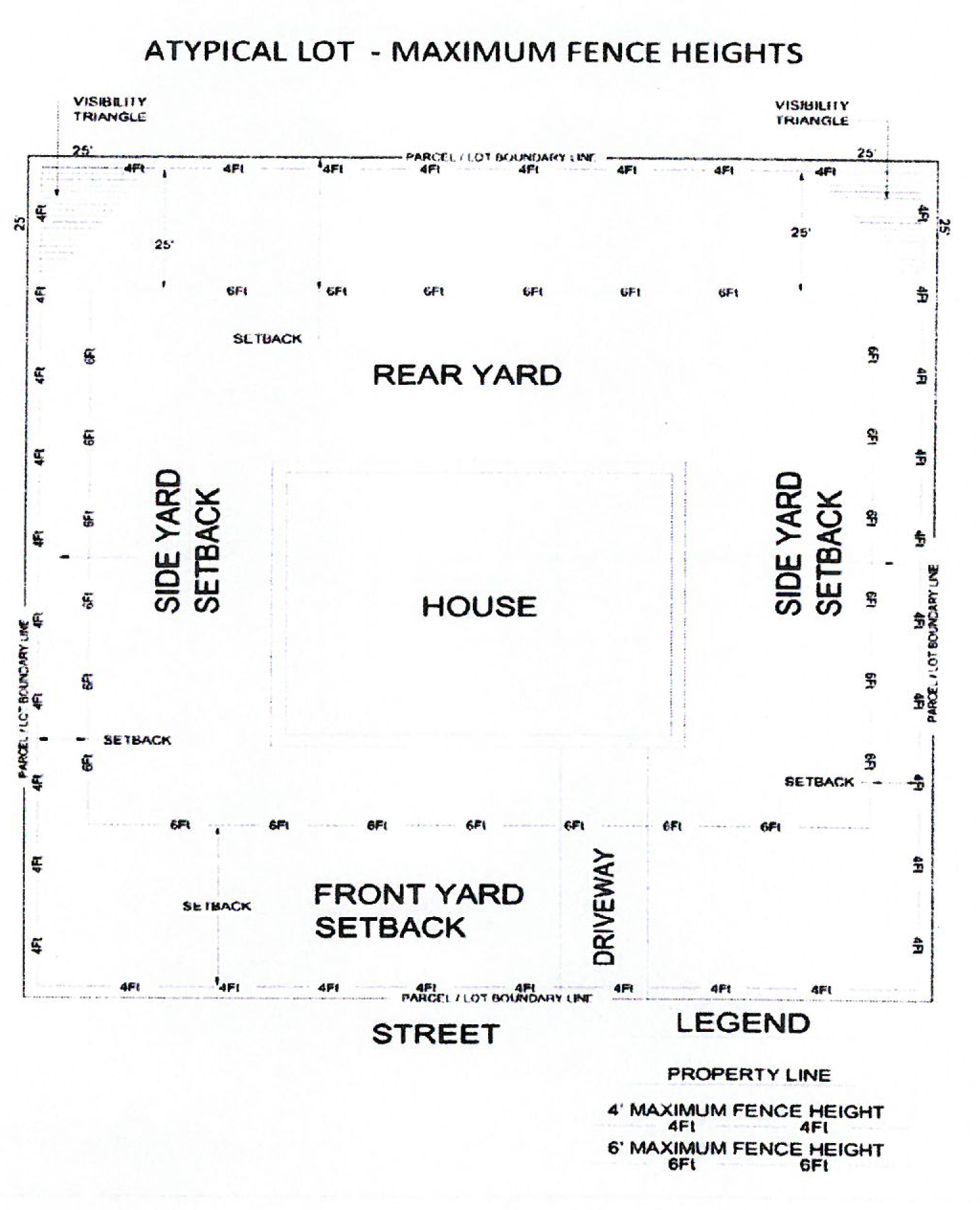
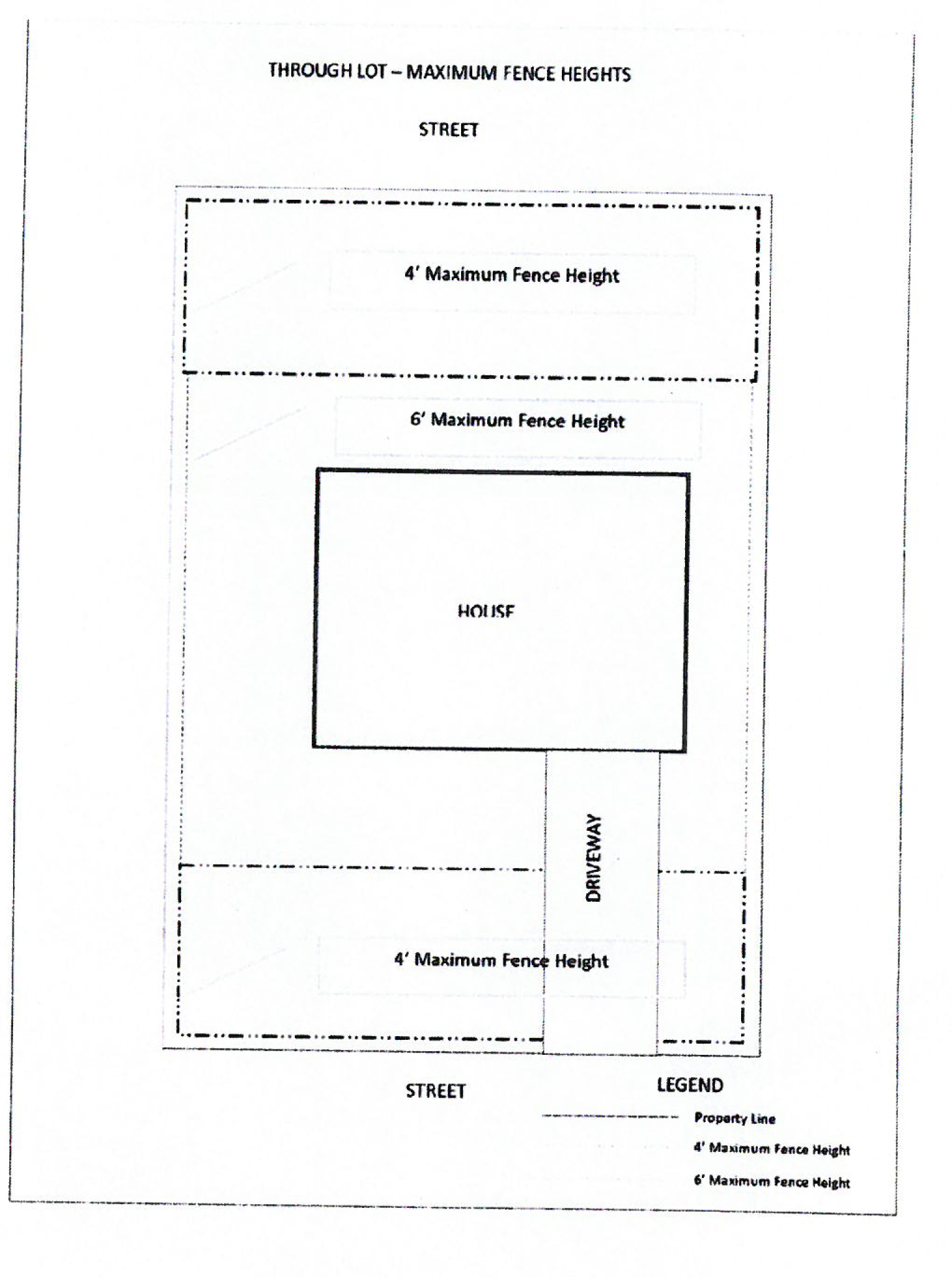
D.
Barbed-wire fences. No fence made of barbed wire, or any other material whereby persons passing by day or night might be maimed or injured, shall hereafter be constructed alongside of any street or sidewalk or property line within the city limits unless the placement is such that the city commission shall decide that it may be permitted without danger. In the event the city commission permits such a fence, it shall not be less than six feet in height as measured from the finished grade.
E.
Fences east of the Coastal Construction Setback Line (CCSL). Fences four feet in height or less shall be allowed to encompass the area surrounding the perimeter of the pool and decking when required by the Florida Building Code to address life safety concerns. City commission approval shall not be required provided the fence does not exceed the height or setback requirements for fences on atypical lots.
F.
Chain-link fences. No fence made of chain-link material is permitted in the front yard of any residentially zoned property. Chain-link fences in existence as of August 23, 2022, may remain until such time as the provisions of section 505.05. Nonconforming structures, become applicable to the fence.
803.04. Regulations pertaining to boats, boat docks, and boat docks with terminal platforms, covered boat slips (boathouses), mooring poles, and other boat storage and docking facilities.
A.
Boat docks, terminal platforms, boat slips, covered boat slips or boathouses, mooring poles, boat ramps, and docking facilities for non-commercial watercraft shall be permitted in accordance with Volusia County's Manatee Protection Plan, as amended, on a non-oceanfront waterfront lot in any residential zoning district, excluding multifamily residential zoning districts, as an accessory use to the single family or two-family use. These would be deemed standard facilities, and are subject to the following restrictions:
(1)
No more than two boat slips shall be allowed per parcel, whether covered or not covered. Single boat slips, whether covered or not, shall be limited to no more than 360 square feet, while double boat slips shall not exceed 600 square feet; and
(2)
In lieu of a second boat slip, a parcel can have one boat ramp not exceeding 13 feet in width.
B.
Any two non-oceanfront waterfront lots within a single and two-family residential zoning district are allowed to erect the following structures in the adjacent waterway that constitute a shared facility that can accommodate up to four boats in accordance with Volusia County's Manatee Protection Plan, as amended, (but would eliminate the right of either property to construct a separate dock or slip facility):
(1)
Boat docking, a terminal platform, and a boat lift associated with either a boathouse or mooring poles; any of the above accommodating a maximum of four boats per two non-oceanfront lots; or
(2)
No more than four uncovered boat slips, or a minimum of two single or double covered slips/boathouses, with an area of no more than 360 square feet per single covered slip or 600 square feet per double covered slip.
(3)
Two boat ramps that do not exceed 13 feet in width, with no more than one per property. Each proposed boat ramp would be in lieu of one boat slip.
C.
Any non-oceanfront waterfront common area within a platted subdivision, multi-family development, or a commercial marina is allowed to erect the following "typical" structures in the adjacent waterway in accordance with Volusia County's Manatee Protection Plan, as amended, and may be subject to the city slip pool:
(1)
Boat docks, boat lifts, terminal platforms, boathouses, mooring poles, access piers and access walkways;
(2)
Covered boat slips/boathouses none of which exceed 300 square feet;
(3)
One boat ramp not exceeding 13 feet in width.
The number of dock facilities allowed and location of the facilities shall be approved by the city commission in a hearing open to the public. The city commission shall approve the number of dock facilities and location of the facilities based on the following criteria:
(1)
There is adequate maneuvering room for the boats to access the proposed boat dock facilities;
(2)
The location of the boat dock facilities does not block navigation for other boaters using the same waterway on adjacent parcels;
(3)
The subdivision common area shall have direct water frontage;
(4)
The docks shall be owned and maintained by individual homeowners within the subdivision;
(5)
The docks shall not be rented or used by non-residents of the subdivision;
(6)
The land used to access the docks shall be owned and maintained by the homeowners association and shall remain as common area;
(7)
All setbacks for docks shall be the same as the setbacks applied to other single-family docks throughout the remainder of the city; and
(8)
The boat facilities shall conform to all other applicable federal, state, county or city regulations.
D.
The following regulations shall apply to all structures permitted pursuant to [subsection] 803.04 A., B., and C. above:
(1)
The maximum allowed height of a structure is 15 feet above the mean high waterline; for a second story deck the maximum allowed height is measured from the second floor and not the required handrails.
(2)
No "standard" structure, including mooring poles, boathouses, boat docks, terminal platforms, access piers and walkways, boat lifts, and other boat storage and docking facilities, shall be closer than ten feet from the side lot lines and Florida Department of Environmental Protection DEP interpreted extensions of side lot lines waterward from the property water frontage line unless the structure is permitted or required to be located there as the result of a valid court order equitably prorating a basin among upland property owners. Such prohibition shall also apply to the storage, anchorage, or mooring of any boat.
(3)
A second story deck is allowed so long as subsections (1) and (2) above are met, the second story does not exceed the maximum allowed square footage for covered boat slips as outlined in [subsection] 803.04 A., B., and C above, a guardrail complying with the current approved edition of the Florida Building Code, as amended, is provided with the following additional requirements:
(a)
"Rails" between the floor and the top railing are to be constructed of stainless steel cables;
(b)
Posts to which the cable is attached shall be no closer than four feet apart;
(c)
The bottom cable shall be no more than two inches above the floor;
(d)
The guardrail shall be in compliance with the current Florida Building Code, as amended, concerning "guards," to include the requirement that the top of the rail must be at least 36 inches in height as measured from the deck of the second floor;
(e)
Stairs accessing the second floor shall comply with the current Florida Building Code, as amended, concerning "stairways."
(f)
The square footage for a covered deck either over a slip or a platform is not an additional square footage of roof coverage for purposes of calculation of allowable square footage of covered slips/boathouses. The maximum allowed square footage of 600 square feet must be shared between a covered slip/boathouse and a covered platform.
(4)
Terminal platforms may be covered by a roof so long as the area under the roof does not exceed the maximum allowed square footage for covered boat slips as outlined in [subsection] 803.04 A., B., and C., above.
(5)
The maximum footprint of a single family dock structure, not including a walkway, gangway, or access pier five (5) feet in width or less, cannot exceed 1,000 square feet.
(6)
All applicants must submit a copy of the DEP/Army Corp of Engineers permit or self-certification and Volusia County Manatee Protection Plan approval prior to commencement of construction.
(7)
Any existing structures that were permitted before the enactment of this ordinance can exist as legal non-conforming accessory structures. If over 50 percent of the value of the structure is removed or damaged, all new or replacement structures must met the current regulations.
E.
No boats or structures, including mooring poles, shall be allowed to be erected in the waterway beyond the following distances when measured from the mean high water line or the seawall at the point of the lot line where the dock is to be located, to the mean high waterline or the seawall at the nearest opposite shore:
(1)
The point where the length of the structure is more than 25 percent of the width of the waterway when there are platted, buildable lots on the opposite shore; and
(2)
The point where the length of the structure is more than 30 percent of the width of the waterway when there are no platted or buildable lots on the opposite shore.
This provision shall be subject to the following exemption: This provision shall not apply to construction on properties located along, and the construction is to occur in, the water bodies known as the Intracoastal Waterway, Indian River, Callalisa Creek, and Indian River Lagoon. Said water bodies are more particularly described on Exhibit "A" to this ordinance, attached hereto and by reference made a part hereof.
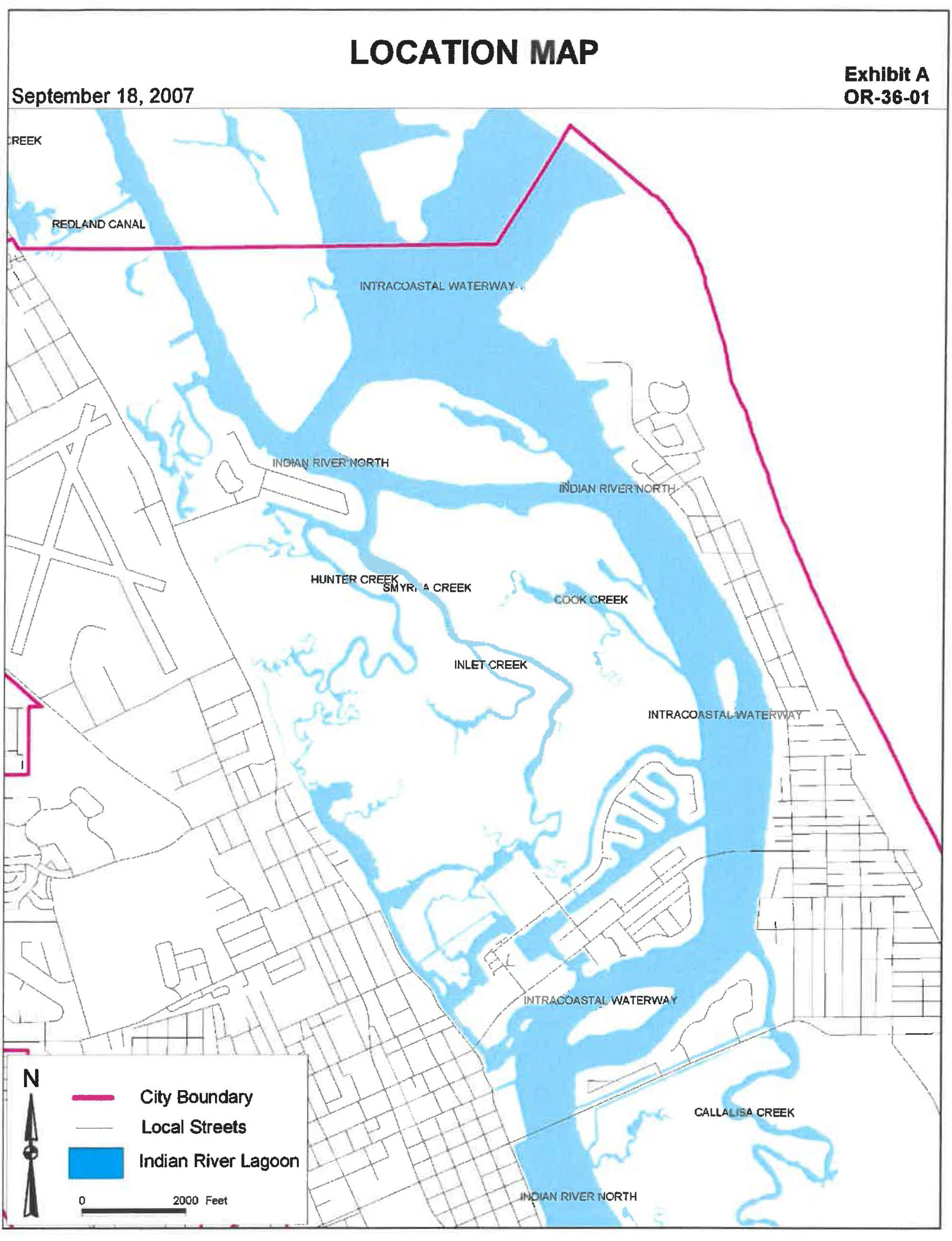
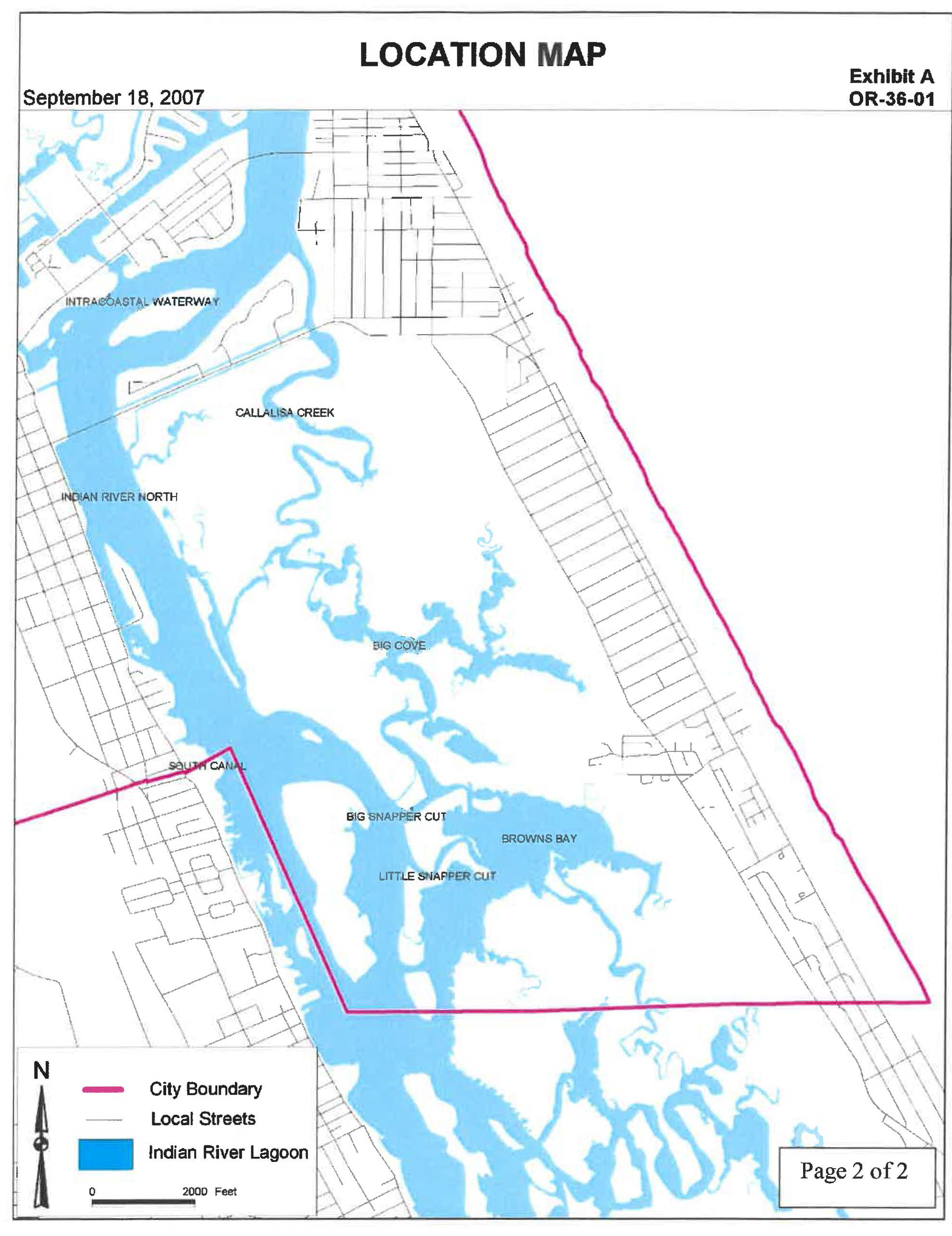
F.
No structure located within a natural or man-made waterway shall be allowed to be erected in the waterway without obtaining the required permits, certifications, or exceptions, from the Department of Environmental Protection, Volusia County Manatee Protection Plan, and the Army Corps of Engineers.
G.
No boat or vessel shall be used or maintained as a dwelling unit which is not sound, seaworthy, and equipped with sanitary facilities that are either:
(1)
Connected to a public sewer system, or
(2)
Have a self-contained waste treatment system.
H.
Prior to issuing a building permit for construction of the facilities in A. and B. above, a plan drawn to scale no smaller than 1" = 30' must be submitted to, and approved by, the city manager or his or her designee. The plan shall contain the following information:
(1)
A survey prepared by a registered land surveyor with the State of Florida depicting the mean high waterline or mean high elevation;
(2)
Depth soundings at three feet vertical intervals measured from the property water frontage line to the opposite shore;
(3)
Legal description;
(4)
Lot boundary lines;
(5)
Bulkhead location (if existing);
(6)
Facility height above the mean high waterline;
(7)
Facility dimensions (total length, width, and depth);
(8)
Percentage facility represents of total waterway width (not required for dock to be constructed along the Intracoastal Waterway, Indian River, Callalisa Creek, and Indian River Lagoon);
(9)
Distance facility is located from all side property lines or extensions of side property lines waterward from the property water frontage line;
(10)
Type of facility (floating dock or non-floating dock);
(11)
Construction material proposed; and
(12)
Boat mooring or docking position(s).
I.
Prior to issuing a building permit for construction of the facilities in subsections A., B, and C. above, a copy of all permits, exemptions, or approvals required from county, state, and federal agencies shall be submitted to the city manager or his or her designee.
J.
Any property zoned commercial marina or recreational is allowed to have docks (whether for boat mooring or not) provided all county, state, and federal permits are secured prior to construction. Slips, boat storage, boat ramps, mooring poles, dry storage, and trailer parking may require application to the city commission for receiving slips from the city slip pool.
K.
Permits required from county, state, and federal agencies shall be submitted to the building department when requesting a building permit. Copies of the required permits shall be attached to the building permit application.
If a county, state, or federal agency requires the dock projection length be less than permitted in these regulations, then the agency's requirement applies.
L.
Any variance from the requirements of section 803.04 requires Planning and Zoning Board approval at a public hearing after adjacent property owners have been notified by certified mail by the applicant. The criteria the planning and zoning board is to use in granting or denying the variance are as follows:
(1)
Special circumstances exist which are peculiar to the property or the waterway in question, making boat mooring or waterway access difficult;
(2)
Strict application of the requirements set forth in section 803.04 would deprive the property owner of reasonable rights presently enjoyed by other nearby property owners;
(3)
Special circumstances and conditions exist that do not result from the direct or indirect actions of the present property owner(s) or past property owner (s). This criterion shall not be satisfied if the present or past property owner created, to any degree, the hardship that is the subject of the variance request;
(4)
Granting a variance from requirements of section 803.04 will not cause substantial detriment to the public welfare, safety, navigation or convenience;
(5)
Granting a variation from requirements of section 803.04 will not constitute a grant of special privilege denied to other property owners.
A property owner desiring a variance must submit an application to the Planning and Engineering Department in the form prescribed by the Planning and Engineering Department, which clearly describes the reasons why the Planning and Zoning Board should approve the variance request. The letter of request must explain how the circumstances pertaining to the property in question meet the criteria listed in subsection 803.04 L.
Upon receipt of a complete application for a variance, the planning and engineering department shall schedule and notice the matter for a quasi-judicial variance hearing before the planning and zoning board within 30 days. An application shall be complete when the planning and engineering department receives an application that contains all the information required by regulations.
All other regulations and procedures for variance applications not covered under section 803.04 shall follow section 305.05, including supplementary regulations.
803.045. Boat slip allocations.
A.
Purpose. The excess boat slip allocation procedure is provided to allow for a fair and reasonable means of authorizing development of the limited number of boat slips allocated to the city, in accordance with the Volusia County's Manatee Protection Plan, as amended.
B.
Procedure.
(1)
Requests for excess boat slip allocation shall be submitted to the city in accordance with the general application requirements and procedures set forth in this section.
(2)
The city commission may grant requests for excess boat slip allocations at a public hearing.
C.
Criteria. The city commission shall evaluate the number of slips remaining in the city's inventory and allocate additional slips based on a finding of net public benefit to be derived from the project. The finding of net public benefit shall be based on the effect the project has on public use and access to the water, including but not limited to the following factors:
(1)
The number of slips in the project that will be made available for purchase, lease or use by the general public.
(2)
Construction, expansions or improvements to new or existing public spaces, parks, plazas, walkways, or other features providing access to the waterfront for the general public on or off-site.
(3)
Construction, expansions, or improvement of a public dock or boat ramp and related facilities on or off-site.
(4)
Redevelopment of upland uses in a redevelopment area consistent with the adopted area plan.
(5)
Preservation of upland historic properties or structures.
(6)
Parking spaces associated with a boat ramp, marina or other boat facilities, as defined in article II of this LDR, designed to accommodate a boat trailer and vehicle used to tow the trailer shall be considered a boat slip for allocation purposes. Such space must have direct access to the Indian River within the New Smyrna Beach municipal boundaries.
(7)
Construction or allocation of slips designed to benefit an under-served segment of the boating public.
(8)
Acquisition of upland for public use.
(9)
Improvements to existing water-related facilities for use by the general public.
(10)
Activities such as dredging that improve access to or navigability of the waterway.
(11)
Financial contribution toward a project as described above, or any public project which will enhance public use of and access to the waterway and riparian lands within the city.
(12)
Construction, expansion or improvement of stormwater management facilities for existing streets that dead-end into the river.
D.
Effect of approval.
(1)
Reservation. Upon approval by the city commission, the allocated boat slip(s) shall be reserved for three years from the date of approval. Any reserved slips shall be removed from the excess slip pool and held in reserve during that three year period. Any number of slips the applicant does not build during the above-referenced reservation period shall be returned to the excess slip pool.
(2)
Construction. The applicant has three years from the date of city commission approval to begin construction of the allocated boat slip(s). If construction does not begin within three years, the right to develop the slips shall cease and the reserved slips shall be released and placed back into the excess slip pool.
(3)
Extensions to slip reservation period. Reservation of boat slips may be extended for a period of one additional year by the city manager or his or her designee, providing the applicant demonstrates significant good faith efforts in moving toward construction permitting approval. The administrative official or designee will determine good faith effort based on the applicant's attempts to secure required permits. These attempts should be initiated at the commencement of the reservation period and evidence of continuous effort and progress throughout the three year reservation period must be shown.
E.
Exemptions. Single-family residential lots with riparian rights that were in existence on or before November 21, 2005, shall have the right to and shall be allocated no more than two boat slips without applying for excess slips. Any single-family residential lot with riparian rights created after November 21, 2005, shall be subject to boat slip allocation.
803.05. Air conditioners/heating, ventilation equipment, generators, and irrigation pumps.
A.
Air conditioning/heating ventilation components, generators, and irrigation pumps are not allowed to the side or rear of a dwelling opposite habitable portions of adjacent property owner's dwelling, such as a bedroom, dining room, or living room, unless the component is set back from the opening of the habitable areas a minimum distance of twice the required yard width. Such equipment must be placed as close to the outer wall of the dwelling as possible. Air conditioning/heating, ventilation components, generators, and irrigation pumps may be placed in required yard areas opposite non habitable portions of the adjacent property owner's dwelling, such as a garage, a carport or a storage area provided the component is as close to the outer wall of the dwelling as possible. This provision does not apply to replacement air conditioner/heating, and ventilation components, generators, and irrigation pumps for equipment placed or installed prior to the effective date of the new land development regulations.
B.
Air conditioning/heating, ventilation components, generators, and irrigation pumps which create noise, are located within 100 feet of residential property and are located on commercial or multi-family zoned property shall be baffled so as to reduce noise.
C.
Air conditioners, heating, ventilation, and generators or other accessory equipment located on the roof of buildings shall be screened from view.
803.06. Regulations pertaining to accessory structures required by governmental agencies. Accessory structures required by local, state, or federal agencies relating to handicapped accessibility, such as handicapped ramps or elevators, may protrude into a required yard, provided there is no practical alternative to locate the structure outside of the required yards, and provided the structure will not be detrimental to the public health, safety, and general welfare.
(Ord. No. 36-01, § 1, 8-28-2001; Ord. No. 51-04, § 2, 9-29-2004; Ord. No. 65-05, § 1, 9-13-2005; Ord. No. 64-08, § 1, 11-25-2008; Ord. No. 55-10, § 1, 11-9-2010; Ord. No. 59-10, § 1, 12-14-2010; Ord. No. 34-11, § 1, 6-14-2011; Ord. No. 77-11, § 1, 9-13-2011; Ord. No. 77-15, § 1, 9-8-2015; Ord. No. 56-16, § 1, 9-27-2016; Ord. No. 78-19, § 2, 11-19-2019; Ord. No. 95-20, § 1, 9-8-2020; Ord. No. 96-20, § 1, 9-8-2020; Ord. No. 30-21, § 1, 8-24-2021; Ord. No. 49-22, § 1, 10-11-2022; Ord. No. 09-23, § 1, 1-24-2023)
804.00. - Miscellaneous supplemental regulations.
804.01. Visibility on corner, commercial and industrial lots.
A.
No plant, tree, shrubbery, or any other obstruction, shall be placed, planted, or allowed, to grow in a manner that materially impedes vision over a height of three feet above the centerline grade of the nearest street within triangular shaped visibility areas described below:
(1)
Commence at the point of intersection of street right-of-way lines of a corner lot and measure 25 feet along each street right-of-way line and connect the points with a line;
(2)
Commence at the point of intersection of street and alley right-of-way lines, and measure 25 feet along the street right-of-way line and the alley right-of-way line, and connect these points with a line;
(3)
Where commercial or industrial zoned property is within 12 feet of any portion of an existing driveway on adjoining property, commence at the point of intersection of the common property line and the street right-of-way line, then measure 25 feet along the street right-of-way line that is also the commercial or industrial zoned property line and along the common property line, then connect these points with a line. See Illustration 804.01.
B.
A chainlink or wire fence shall not be considered to materially impede vision provided battens are not inserted in the chainlink or wire fence.
C.
Sign poles shall be allowed within the visibility triangle provided they are no wider than eight inches or have a diameter no greater than eight inches, and provided the copy area is no less than eight feet in height above the ground elevation.
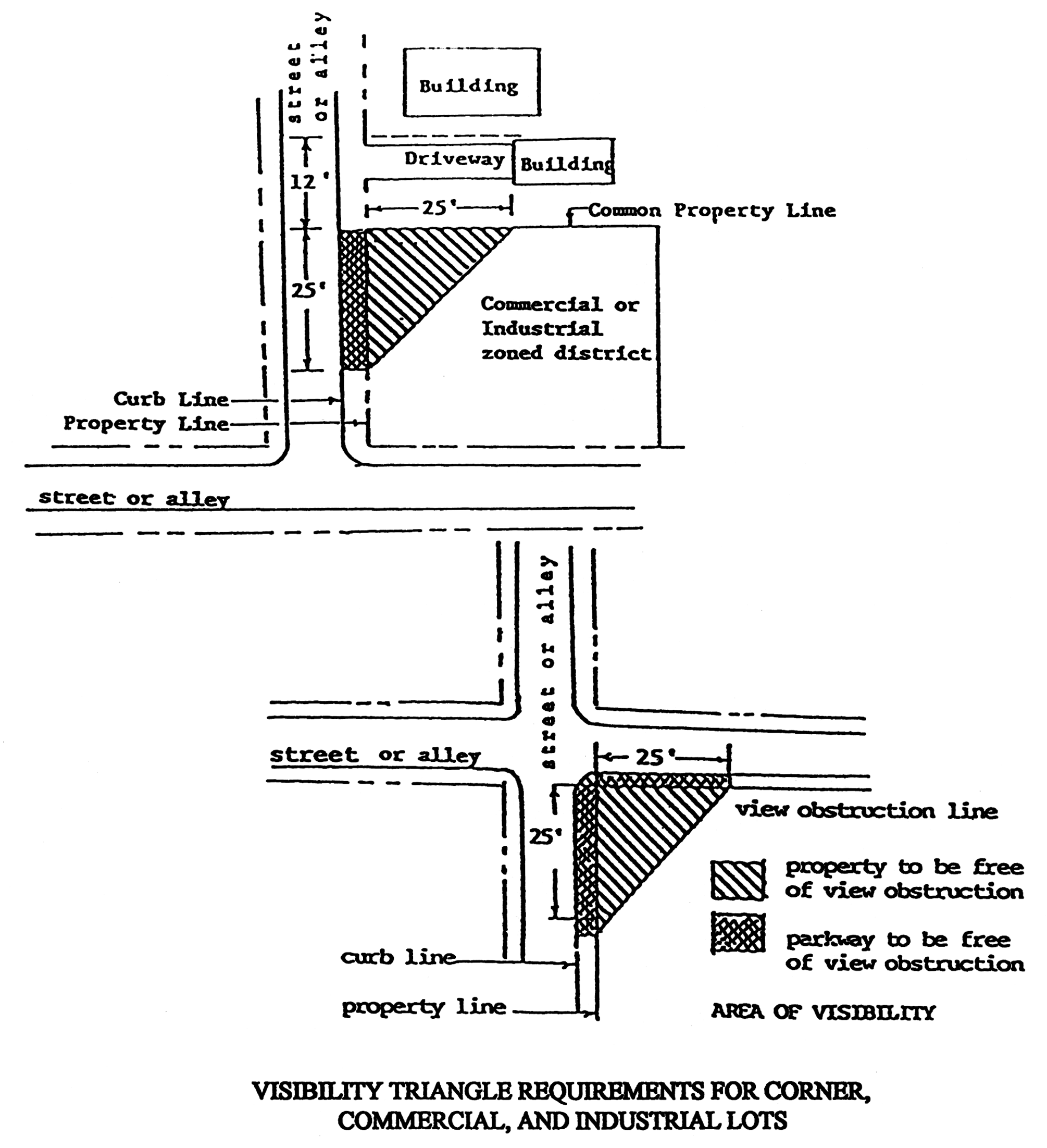
Illustration 804.01
804.02. Affordable housing incentives. The following list of affordable housing incentives have been provided in the land development regulations as expressed or implied in the goals, objectives, and policies of the Future Land Use and Housing Elements contained in the 1990 comprehensive plan:
_____
A.
Floor area requirements have been reduced to the amount of square feet indicated in the districts identified below:
_____
B.
Adopted zoning regulations (R-3A) that allow zero lot line development on small lots (50 feet by 100 feet).
C.
Adopted incentives to mixed use projects that will increase the number of units from 12 units to 18 units for units located on the mainland west of the intracoastal waterway.
D.
The city will consider full or partial waiver of permit fees for developers providing affordable housing.
E.
Waiver of required project paving of parking lots; sidewalks for residential development on infill lots; and landscape buffering requirements subject to city approval.
F.
Provided for a broader distribution and location choice for constructing affordable housing.
G.
Developed procedures in the land development regulations to streamline requirements for housing construction in an attempt to lower housing costs.
804.03. Structures in required yard areas.
A.
No structures shall be allowed in the required yard area except as follows:
(1)
A reduced side and rear setback of five feet is established for the following accessory structures:
i.
Patios;
ii.
Swimming pools;
iii.
Pool decks;
iv.
Gazebos;
v.
Sheds; and
vi.
Porches
However, accessory structures shall not be allowed within visibility triangles on atypical lots, as detailed in [sub]section 804.02 herein.
(2)
Driveways, parking spaces and loading spaces having a height no greater than six inches above the grade.
(3)
Incidental uses as provided in [sub]section 803.02.
(4)
Fences, wall and hedges as included in [sub]section 803.03 herein.
(5)
Structures or portions of structures, completely under the ground surfaces and not visible from above the ground surface.
(6)
Solid waste storage areas adjacent to an alley.
(7)
Utility facilities extending three feet or less aboveground.
(8)
Chimneys and bay windows shall be allowed to encroach 24 inches into the required yards.
(9)
Air-conditioning/heating and ventilation components are allowed in required yard areas opposite non-habitable portions of adjacent property owner's dwelling, such as a garage, carport, or storage area.
(10)
Tennis courts having special-exception approval according to [sub]section 801.17.
(11)
Any other structure deemed appropriate in the required yard by the planning manager.
B.
No swimming pools shall be allowed between a public or private street and the principal structure on a lot.
1.
For Through Lots; swimming pools shall be allowed in the front yard that is not used for addressing and vehicle access and can have a reduced setback to 5 feet from the property line for the pool and pool deck. If a pool screen enclosure is used, the reduced pool and pool deck setback would be 7 ½ feet from property line.
(Ord. No. 51-10, § 1, 10-21-2010; Ord. No. 43-17, § 1, 6-27-2017)

