
Northfield City Zoning Code
ARTICLE 6
- SIGNAGE
6.1 - Purpose and Intent.
Regulating the location, size, placement, and physical characteristics of signs is necessary to enable the public to locate goods, services, and facilities and to receive a wide variety of other messages, commercial and noncommercial, without difficulty and confusion, to encourage the general attractiveness of the community, to enhance public safety, and to protect property values. Accordingly, this section establishes regulations governing the display of signs that will:
(A)
Promote and protect the public health, safety, comfort, morals, and convenience;
(B)
Enhance the economy and the business and industry of the city by promoting the reasonable, orderly, and effective display of signs and, thereby, encourage increased communication with the public;
(C)
Restrict signs and lights that will increase the probability of traffic congestion and accidents by distracting attention or obstructing vision;
(D)
Reduce conflict among signs and light and between public and private information systems; and
(E)
Promote signs that are compatible with their surroundings.
6.2 - Scope.
(A)
This section shall regulate the height, area, location, graphics, color, materials, content and other visual aspects of signs and sign structures. It does not regulate public informational and safety signs, or signs required by law.
(B)
The owner of any sign which is allowed by this sign ordinance may substitute non-commercial copy in lieu of any other commercial or non-commercial copy. This substitution of copy may be made without any additional approval or permitting. The purpose of this provision is to prevent any inadvertent favoring of commercial speech over non-commercial speech, or favoring of any particular non-commercial message over any other non-commercial message. This section prevails over any more specific section to the contrary.
6.3 - Zoning Certificate and Compliance Required.
(A)
Unless otherwise provided by this section, all signs shall require a zoning certificate and a payment of fees. Exceptions to the certificate requirement are as follows:
(1)
If any sign is removed and replaced on the same supports, provided the size or type of sign is not changed.
(2)
No zoning certificate is required for the maintenance of a sign or for a change of copy on changeable copy signs.
(3)
Signs identified in Section 6.5, Exemptions.
(4)
General maintenance, painting, repainting, cleaning and other normal maintenance and repair of a sign or any sign structure unless a structural change or copy change, on a non-changeable copy sign, is made that results in anything more than a minor modification.
(B)
The relocation of a sign from one area of a lot to another location on the same lot shall require a zoning certificate (See Section 8.5.1, Zoning Certificate).
(C)
The alteration or enlargement of any sign shall require a zoning certificate.
(D)
All wiring, fittings, and materials used in the construction, connection and operation of electrically illuminated signs shall be in accordance with the provisions of the State Electrical Code in effect.
(E)
No sign of any classification shall be installed, erected, or attached to a structure in any form, shape, or manner that is in violation of Northfield's or the state's building or fire codes.
6.4 - Computations.
The following principles shall control the computation of sign area and sign height:
(A)
The area of a sign face, which is also the sign area of a wall sign or other sign with only one face, shall be computed by means of the smallest square, circle, rectangle, triangle, or combination thereof that shall encompass the extreme limits of the writing, representation, emblem, or other display. This does not include any supporting framework, bracing, or decorative fence or wall when such fence or wall otherwise meets the regulations of this LDC and is clearly incidental to the display itself (See Figure 6-1).
(B)
The sign area for a sign with more than one face (multi-faced signs) shall be computed by adding together the sign area of all sign faces. Even in cases where two identical sign faces are placed back-to-back, the sign area shall be computed by adding together the sign area of each sign face.
(C)
The height of a sign shall be computed as the distance from the base of the sign at normal grade to the top of the highest attached component of the sign.
(D)
Unless otherwise specifically stated, when a calculation is based on street frontage, the longest single street frontage shall be used and not the total of all street frontages.
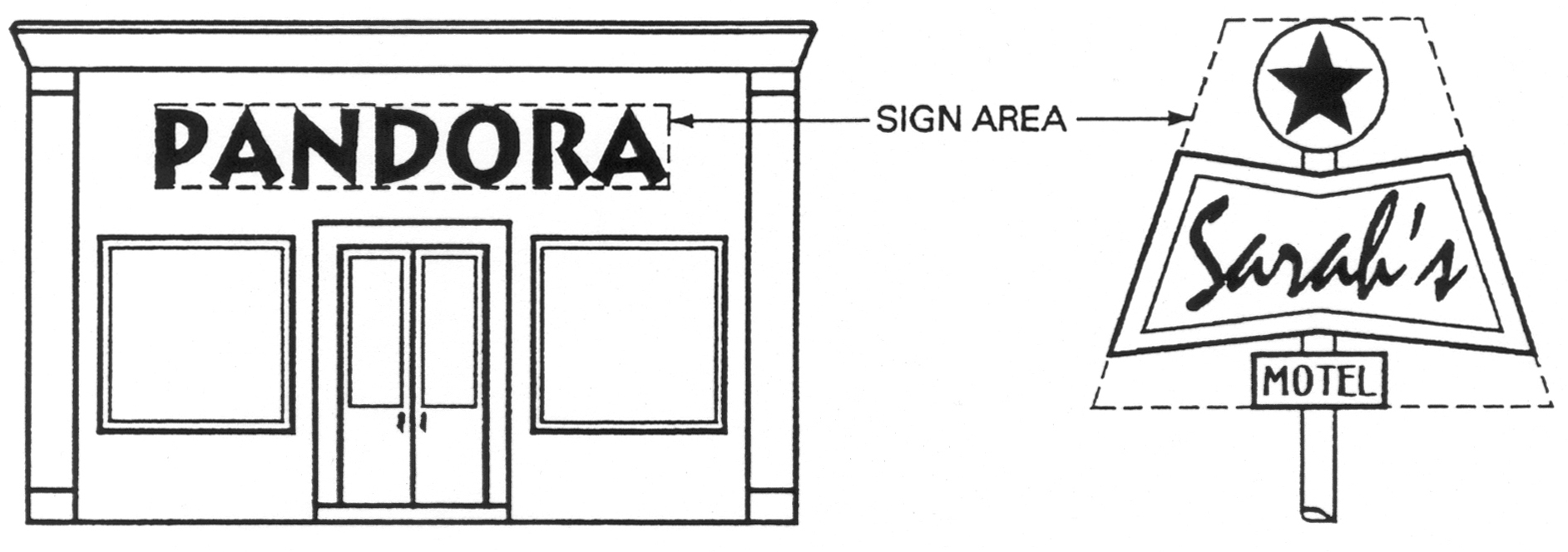
Figure 6-1: Illustration of how sign area is calculated.
6.5 - Exemptions.
The following types of signs are exempted from all the requirements of this section, except for construction and safety regulations and the requirements set forth:
(A)
Public Signs. Public signs with a noncommercial message, erected by or on the order of a public officer in the performance of his/her public duty, such as traffic signs, trespassing signs, memorial plaques, signs of historic interest and the like.
(B)
Integral Information. Integral names of buildings, dates of erection, monumental citations, commemorative tablets and the like when carved into stone, concrete, or similar material or made of bronze, aluminum, or other permanent-type construction and made an integral part of the structure.
(C)
Private Traffic Direction.
(1)
Signs directing traffic movement onto premises or within premises, not exceeding four square feet (per side) in area and six square feet (per side) for industrial uses for each sign. Illumination of these signs shall be permitted in accordance with Section 6.9 (E), Illumination. Horizontal directional signs on and flush with paved areas are exempt from these standards.
(2)
Private traffic direction signs that contain a commercial message shall not be exempt.
(D)
Vehicle Signs. Signs on vehicles of any kind, provided the sign is painted or attached permanently or magnetically to the body of the original vehicle and does not project or extend beyond the original manufactured body proper of the vehicle, except as specifically prohibited in Section 6.6.8, Prohibited Signs.
(E)
Flags. Flags identifying the emblem of government, school, or religious organization shall be exempt from this section with the exception that Section 6.10(B)(1) and Section 6.9(E), Illumination shall apply in all zoning districts.
(F)
Window Signs. Except as otherwise restricted in Section 6.10 (F)(12), signs that are painted or attached to the inside of a window that do not cover more than 50 percent of the window shall be exempt.
(G)
Temporary Signs. Temporary signs as allowed in Section 6.11, Temporary Signs.
(Ord. No. 1045, § 1, 10-18-2022)
6.6 - Multiple-Use Buildings.
Any building that is designed to contain multiple principal uses and/or multiple tenants shall be considered a multiple-use building for the purposes of these sign regulations.
(A)
Any property owner who owns a multiple-use building shall be required to submit a signage plan for each such building.
(B)
The signage plan shall state the total allowable signage for the building and shall identify the allowable signage that will be allocated to each business space.
(C)
Such plan shall be filed with the city planner prior to any sign permit review.
(D)
Only one pylon sign is allowed for each multiple-use building.
6.7 - Liability for Damages.
This section shall not be construed to relieve or to limit in any way the responsibility or liability of any person who erects or owns any sign, for personal injury or property damage caused by the sign, nor shall this section be construed to impose upon the city, its officers, or its employees any responsibility or liability because of the approval of any sign under this section.
6.8 - Prohibited Signs.
All signs are prohibited which are described as follows:
(A)
Signs that contain or are an imitation of an official traffic sign or signal or contain the terms "stop," "go slow," "caution," "danger," "warning," or similar words.
(B)
Signs that may be confused with or construed as a traffic control device; that may hide any traffic sign, street sign or signal from view; or that may cause danger to traffic because of their size, location, movement, content, coloring, or manner of illumination.
(C)
Signs, that are not temporary, that move in any manner or have a major moving part.
(D)
Billboard signs or structures which are designed and erected for the purpose of selling advertising space or identifying a business not located on the property on which the sign is located.
(E)
Signs that are temporarily placed or attached on any part of a relatively stationary vehicle.
(F)
Portable changeable-copy signs, unless used as a temporary promotional sign, as allowed under Section 6.11, Temporary Signs.
(G)
Signs that are placed upon trees, public property, or utility poles.
(H)
Signs that display obscene language or actions.
(I)
Searchlights.
(J)
Inflatable signs.
(K)
Snipe signs.
(L)
Any sign attached to a roof that does not meet the definition of a "roof sign" in Article 9: Definitions.
(M)
Vehicles whose primary purpose is advertising.
6.9 - Design Guidelines.
The following standards are intended to direct the design elements of signage outside the downtown historic district. Each guideline shall be applied for each sign application based upon review by the city planner:
(A)
Neon lights are permitted for messages and symbols, but shall not flash.
(B)
Signs on multiple-use buildings must be coordinated in the use of colors, materials, and shapes.
(C)
Landscaping Area Required.
(1)
Ground and pylon signs shall have plantings at and around the base that serve to:
(a)
Screen the sign base and/or any lighting installed at ground level; and
(b)
Tie such signage to the principal use by using plantings that are similar to those used on the rest of the site.
(2)
Such plantings shall be of the type and size specified in Section 3.5.4, General Landscaping Material Standards.
(3)
A landscape plan indicating the location and type of plantings to be used in screening the base of the sign must be submitted prior to the issuance of a sign permit by the city.
(4)
A certified check or irrevocable letter of credit in favor of the city and in a form satisfactory to the city in the amount of 110 percent of the cost of the proposed plantings, as determined by a certified landscape professional, shall be held in escrow by the city until the plantings as indicated on the landscape plan approved in conjunction with the sign permit request are complete as determined by the city planner.
(5)
If the cost of plantings is not determined by a certified landscape professional, the city planner shall determine the appropriate amount. The escrow or letter of credit shall be released to the applicant when all landscaping approved in conjunction with the sign permit application is installed to the satisfaction of the city planner.
(6)
If required plantings are not installed by the applicant within one year of issuance of a sign permit, the city shall have the right to install such plantings and to use the escrowed funds or to draw on the letter of credit to pay for such installation of plantings.
(D)
Changeable-Copy Signs.
(1)
Generally.
(a)
All changeable-copy signs shall be subordinate to the main signage permitted on the property. The sign area of changeable-copy signs shall be counted as part of the total sign area permitted for the property. All permanent changeable-copy signs are strictly prohibited except for uses described in subsections (2), (3) and (4) below.
(b)
Changeable-copy signs may include signs that are manually changed by a person or electronic/digital changeable-copy signs. Electronic/digital changeable-copy signs, where permitted, shall be static and shall not flash or move. Such copy may be changed as often as every one minute.
(2)
Public and Institutional Uses.
(a)
Only one changeable-copy sign is permitted for each use or parcel of land unless such signs are separated by a distance of 500 feet or more.
(b)
The sign face, which shall be limited to two faces, shall not exceed 30 square feet per face and shall have a minimum letter height of six inches for capital letters, 4.5 inches for lowercase letters and have a minimum negative space of 60 percent.
(c)
Electronic/digital changeable-copy signs shall not be permitted immediately adjacent to residential uses.
(3)
Theaters.
(a)
A maximum of two manual or electronic/digital changeable-copy signs are permitted.
(b)
The total changeable-copy signage shall not exceed 50 percent of the total signage allowed.
(4)
Signs Associated with Gasoline Stations.
(a)
One price information sign is permitted per building frontage. Each sign shall not exceed 12 square feet per face and shall have no more than two faces.
(b)
Each sign must be permanently installed.
(E)
Illumination.
(1)
Illumination for signs, if used, shall not blink or fluctuate. Light rays shall shine only upon the sign or upon the property within the premises and shall not spill over the property lines, in any direction, except by indirect reflection.
(2)
Section (1) above shall not apply to the following:
(a)
Lighting systems owned or controlled by any public agency for the purpose of directing of traffic or for highway or street illumination;
(b)
Aircraft warning lights; or
(c)
Temporary lighting used for repair or construction as required by governmental agencies.
(Ord. No. 978, § 1, 5-3-2016)
6.10 - Standards for Permanent Signs by Zoning District.
(A)
Signs in the R1, R2, R3, R4, N1, and N2 Districts.
(1)
Two permanent ground-mounted signs may be allowed for each major subdivision with 50 or more lots, or multi-family development in the N1-B and N2-B districts provided that the signs meet the following requirements:
(a)
Signs may be permitted, at each development entrance along a city, county or state road;
(b)
The signs shall be setback 15 feet from the public right-of-way and five feet from any adjacent property lines;
(c)
Each sign may have a maximum sign area of 32 square feet not including any fence or wall on which the sign is located;
(d)
The base of all signs shall be constructed of the same building materials used for any multi-family building or other material approved by the city planner;
(e)
No such sign or any portion of the structure shall exceed five feet in height; and
(f)
Only concealed external light illumination may be permitted.
(2)
Signage for permitted uses on residential lots may not exceed six square feet and may not exceed two sides. Signage shall be setback five feet from the public right-of-way and from adjacent property lines.
(3)
Public and institutional uses may have one wall sign and one ground-mounted sign totaling a maximum of 60 square feet in area.
(a)
The signs shall be setback 15 feet from the public right-of-way and five feet from any adjacent property lines;
(b)
The sign may include a changeable copy sign provided that it does not comprise more than 20 percent of the total sign area of the sign;
(c)
No such sign or any portion of the structure shall exceed five feet in height; and
(d)
Only concealed external light illumination may be permitted.
(4)
Larger signs for public and institutional uses may be considered as part of a conditional use permit.
(5)
Commercial or office uses that are permitted in the N1-B district shall comply with the sign standards established for the NC-F district in Section 6.10(C), Standards for the C1, C2 and NCF District, below.
(B)
General Requirements for Signs in the C1, C2, I1, NC-F, and ED-F Districts.
(1)
No pylon sign shall exceed 20 feet in height above the average grade at the centerline of the street in front of the property. All ground-mounted flag poles, banners and pennants are also restricted by this height limitation. Non-commercial flags are exempt from this height limit.
(2)
Illumination of signs is permitted, but in accordance with the restrictions stated under Section 6.9 (E), Illumination.
(3)
Sidewalk Signs.
(a)
Sidewalks signs are permitted in the C1 and C2 districts only.
(b)
All sidewalk signs shall be limited to two feet in width and three and one-half feet in height, including the support members.
(c)
No sign shall have more than two faces.
(d)
The sign shall be placed only in front of the business near the curb, and in compliance with the Americans with Disabilities Act.
(e)
One sign is permitted for each business, and it shall be removed from the sidewalk at the end of each business day.
(f)
No sidewalk sign shall be illuminated.
(g)
No zoning certificate shall be required.
(C)
Standards for the C1, C2, and NC-F Districts.
(1)
Size.
(a)
A total of one and one-half square feet of signage for each lineal foot of building frontage shall be permitted. One additional square foot of signage shall be permitted for each lineal foot of land frontage.
(b)
If a building has multiple frontages, one additional square foot of signage (for the total allotted sign area) shall be permitted for each lineal foot of building frontage, not to exceed 100 square feet except as limited by paragraphs (c) and (d) below.
(c)
Not more than ten percent of each façade in the C1-B, C2-B, or NC-F districts may be used for wall signage. The façade area shall be determined by multiplying the total building width by the height of the wall or surface area (See Figure 6-2).
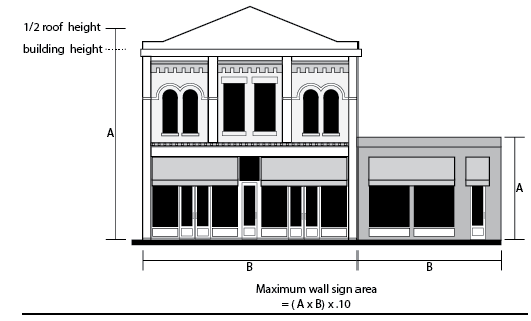
Figure 6-2 Calculation of maximum wall sign area.
(d)
Either one pylon or one ground sign may be permitted for each building frontage and shall not exceed 100 square feet per face and shall not have more than two faces.
(e)
The total area of all signs shall not exceed allotted sign area.
(f)
Freestanding signs in the NC-F district shall be limited to one ground sign with a maximum height of three feet and a maximum square footage of 12 square feet.
(2)
Location.
(a)
Signs may be wall signs and located anywhere on the wall surface of the building. Signs may be projecting signs and may project not more than 36 inches beyond the face of the building and must have a minimum clearance of eight feet above a sidewalk and 15 feet above driveways or alleys.
(b)
A pylon or ground sign may be located anywhere back of the street right-of-way lines, subject to other restrictions in this section.
(c)
Signs may be on the vertical faces of awnings and may project below the lower edge of the awning not more than 12 inches. The bottom of awning signs shall be no less than eight feet above the sidewalk or grade at any point. No point of the sign shall project above the vertical awning face.
(3)
Pylon and Ground Mounted Signs Adjacent to Residential Uses.
(a)
Internally lit pylon and ground mounted signs shall be permitted provided that the background of the sign display area shall be of a dark color that prohibits light from being emitted to adjacent property. Only the letters and business image may be of a lighter color.
(b)
Externally lit pylon or ground mounted signs shall be of a lighting design where external lighting is downcast and does not extend to adjacent property.
(D)
Signs in the I1 and ED-F Districts.
(1)
Size.
(a)
For each industrial property, a maximum of one square foot for each lineal foot of building frontage or one-half square foot for each lineal foot of land frontage is permitted, whichever is greater, as a total allotted sign area.
(b)
No wall sign shall exceed 200 square feet per wall.
(c)
One ground or pylon sign may be permitted for each building frontage. The sign shall not exceed 100 square feet per face and shall not have more than two faces.
(d)
The total area of all signs shall not exceed the allotted sign area.
(2)
Location.
(a)
Signs may be wall signs and located anywhere on the surface of the building. Signs may be pylon or ground signs. Signs may be projecting signs and may project no more than 36 inches beyond the face of the building and must have a minimum clearance of eight feet above a sidewalk and 25 feet above driveways or alleys.
(E)
Signs in the CD-S and PI-S Districts.
(1)
Height.
(a)
Ground and kiosk signs may not exceed eight feet in height above the center line of the street in front of the property.
(b)
Pylon signs are prohibited.
(2)
Size.
(a)
Square footage for ground and kiosk signs shall be approved pursuant to an approved signage plan. A ground sign shall not exceed 100 square feet per face and shall not have more than two faces. A kiosk sign shall not exceed 20 square feet per face and shall not have more than four faces. Not more than ten percent of the building elevation area may be used for wall signage.
(3)
Signage Plan for the CD-S District.
(a)
For colleges wishing to install additional on-campus signage, except for wall signage identifying the name of the building, a signage plan shall be submitted to the city planner for review and approval. The signage plan shall include locations, sizes, dimensions, materials, height, and color of all existing and proposed ground and kiosk signs of the college. Except as otherwise provided for in this section, all new wall, ground and kiosk signs shall be subject to the zoning certificate approval process (See Section 8.4.4, Type 1 Review Procedure (City Planner Decision without Development Review Committee Review)) and all other applicable provisions of this section.
(4)
Location.
(a)
Signs may be wall signs located anywhere on the surface of the building.
(b)
Signs may be projecting signs and may project not more than 36 inches beyond the face of the building, and must have a minimum clearance of eight feet above a sidewalk and 15 feet above a driveway or alley.
(c)
Signs may be ground or kiosk signs.
(d)
With written permission from staff, signs may be placed within the boulevard or on other public property provided they do not present a public safety hazard and are not placed adjacent to a residential use.
(e)
Signs shall be subject to sight distance triangle setbacks (See Section 3.1.6(E), Height Limit at Street Corners (Traffic Safety Visibility Triangle), as defined in this LDC).
(F)
Signs in the H-O District and on Heritage Preservation Sites.
(1)
This subsection applies to the H-O district and other sites that have been designated as heritage preservation sites.
(2)
Sign computations shall follow the guidelines for the base zoning district.
(3)
Signage shall be designed to enhance and complement the historic character of buildings within the downtown district. Wherever possible, sign review shall be informed by historic photographs or visual records of the building or site.
(4)
Before receiving a zoning certificate, the applicant shall be required to apply for, and receive, a Certificate of Appropriateness for any proposed sign.
(5)
City staff shall review the sign permit application per the following guidelines:
(a)
All sign permits for property within the H-O District shall comply with both the C1 and H-O District requirements of this section.
(b)
Temporary signs meeting the requirements of clauses 6, Placement and Attachment, and 9, Illumination, do not require review by the Heritage Preservation Commission and can be approved by the City Planner following Section 6.11 Temporary Signs.
(c)
Pylon signs are prohibited.
(d)
Signage should meet the Northfield Downtown Preservation Design Guidelines and the Secretary of the Interior's Standards for the Treatment of Historic Properties.
(6)
Placement and Attachment. Signs must be located and attached so they do not destroy or cover architectural details such as stone arches, glass transom panels, or decorative brickwork. Signs must not be anchored into masonry or stone and may be anchored to mortar or other material. Signs must be placed as follows:
(a)
At or above the horizontal lintel, storefront cornice, or beltcourse, or above the storefront windows;
(b)
Projecting from the building;
(c)
Applied to or painted on canvas/fabric awnings;
(d)
In areas where signs were historically attached (see Figure 6-3 for examples); or
(e)
Wall signs for first floor businesses shall be beneath the second floor windows.
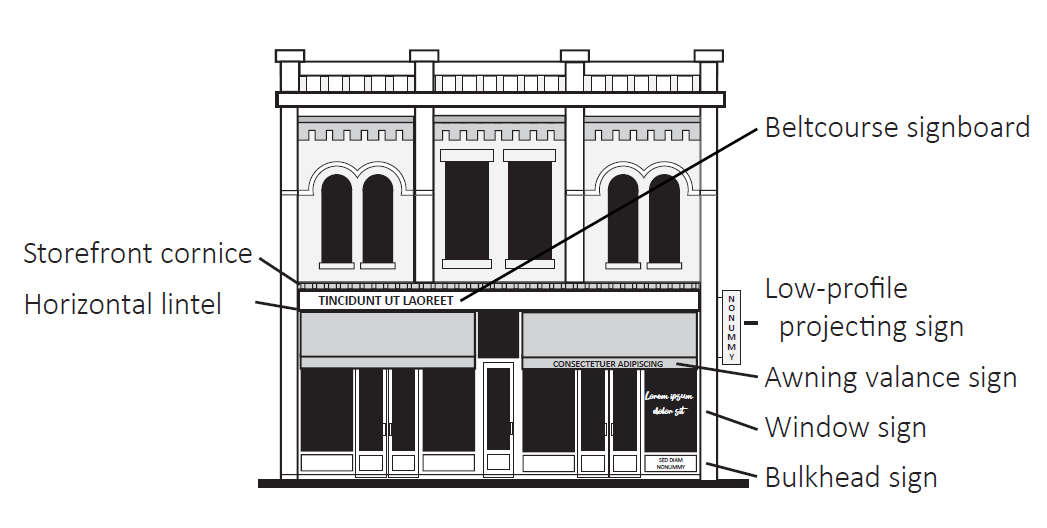
Figure 6-3: Illustration of where signs are historically attached to buildings in
the downtown historic district.
(7)
Sign Shape. Wall and projecting signs must use physical relief in their design through one or more of the following:
(a)
A raised or recessed border;
(b)
Raised or recessed lettering, graphics, logos, or other features related to the nature of the business;
(c)
When the sign is set apart from the building surface, unique or ornate sign shapes (not simply a rectangle, circle, square, or oval);
For this section, the physical relief must have a minimum depth of one-quarter (1/4) inch, and a maximum depth of six (6) inches measured from the surface it is set against, either the sign surface or the building surface. Sculptural elements may project up to twelve (12) inches, provided they are secondary to the primary message and related to the business or entity identified by the sign. Projections on wall signs greater than twelve (12) inches will be considered projecting signs.
(8)
Colors. Sign colors must not detract from the building facade to which the sign is attached. Bright or vibrant colors may be approved subject to the following conditions:
(a)
They are used in moderation; and
(b)
The overall effect does not detract from the district, the building, adjacent buildings, or the primary message of the sign; or
(c)
They serve a legitimate communication purpose, including as trademarked logos or branding or relate directly to the goods, services, or function of the business.
(9)
Material. Signs must be made of wood, metal, or other weatherproof material. When contemporary materials are used for signs, they must be painted and/or made to simulate the texture and depth of traditional downtown sign materials, such as wood, metal, glass, tile, stone, or masonry. Signs that appear to be made of plastic are prohibited. Sign brackets must appear to be made of metal.
(10)
Telephone Numbers and Websites. If telephone numbers and websites are desired, the Heritage Preservation Commission encourages them to be located on window and door signs. Telephone numbers and websites may be included on other sign types, provided they are clearly secondary (<50%) to the primary message of the sign.
(11)
Illumination.
(a)
External illumination for signs will not blink or fluctuate. Light will shine only upon the sign.
(b)
Internally illuminated signs are prohibited.
(c)
Flashing, intermittent, rotating signs or signs that create the illusion of movement are prohibited. Exceptions to this guideline shall be allowed for public and institutional uses, time/temperature, and theater signs.
(12)
Historic Building Names/Years. Permanent historic names and years, on buildings shall not be removed and shall be reviewed by the Heritage Preservation Commission when changed or painted. These signs are not subject to the standard sign area requirement.
(13)
Ghost Signs. Ghost signs on buildings will not be removed and must be maintained and reviewed by the city planner. Any additional proposed changes beyond maintenance must be reviewed by the Heritage Preservation Commission. These signs are not subject to the standard sign area requirement.
(G)
Signs in the PD-O District. Signs approved as part of a previously approved PUD shall be allowed to continue under the PD-O district. Any changes to a sign, other than copy changes and general maintenance, in the PD-O district shall be subject to the applicable standards of the underlying base zoning district.
(Ord. No. 1006, § 1, 7-23-2019; Ord. No. 1045, § 3, 10-18-2022; Ord. No. 1067, § 1, 10-15-2024)
6.11 - Temporary Signs.
The following signs shall be permitted anywhere within the city provided they meet the established standards:
(A)
Temporary Signs on Properties for Rent or Sale. Temporary signs with a commercial message may be located on properties for sale, lease, or rent in all zoning districts, without a zoning certificate, as follows:
(1)
Signs in commercial and industrial districts shall have a maximum sign area of 64 square feet (equivalent to one double sided four feet by eight feet sign) and a maximum height of eight feet.
(2)
Signs in all other zoning districts shall have a maximum sign area of 12 square feet and a maximum height of five feet.
(3)
Such signs shall be removed within seven days of the sale, rental, or lease or within two years, whichever occurs first.
(B)
Temporary Signs with Noncommercial Speech. Temporary signs that have no commercial message are permitted in all districts as follows:
(1)
Zoning certificates and fees shall not be required; and
(2)
Signs shall be setback a minimum of 12 feet from the edge of pavement on any street to provide for visibility.
(C)
Project Signs.
(1)
Project signs are allowed up to a total of one-half square foot for every lineal foot of land frontage along a public right-of-way up to a maximum of 250 square feet. One-sided signs only are allowed. Location shall be generally parallel to the public right-of-way and shall be on the tract they identify. Project signs must be removed when 75 percent of the tract is sold or leased or after ten years has elapsed from erection of the sign, whichever shall come first.
(2)
Temporary signs may be permitted during the construction of a development under the following provisions:
(a)
The owner of the property where the sign will be located applies for and receives a zoning certificate for the sign;
(b)
There shall be a limit of one sign per premises and such sign shall not exceed 32 square feet per side with a maximum of two sides; and
(c)
The temporary sign may be posted during construction and/or development of the subject property without a specific time limit. The sign shall be removed within 14 days of completion of construction or development.
(D)
Promotional Signs.
(1)
Signage for promoting events shall be permitted for a period not to exceed fourteen days prior to the event and shall be removed within 24 hours after the event. The sign may be allowed for a maximum of 28 days within any single 12-month period.
(2)
Promotional signs shall require a Zoning Certificate (See Section 8.5.1, Zoning Certificate).
(E)
Garage/Yard Sale Signs.
(1)
On-site garage or yard sale signs shall not exceed six square feet and be located at least five feet from the sidewalk or street in the absence of a sidewalk.
(2)
Such signs may be erected up to three days before and up to one day after the dates of the garage or yard sale.
(F)
Other Temporary Signs.
(1)
Other temporary signs intended to be used until a permanent sign may be obtained and erected can be approved by the city planner for a period not to exceed 30 days.
(2)
Such sign shall not exceed the sign area permitted within the appropriate zone.
(3)
Such sign shall require a zoning certificate (See Section 8.5.1, Zoning Certificate).
6.12 - Nonconforming Signs.
Standards for nonconforming signs are as follows:
(A)
A legal nonconforming sign shall immediately lose that status if the sign is altered in any way in structure or copy, except for changeable-copy signs and normal maintenance, which makes the sign comply less with the requirements of this section than it did before the alteration.
(B)
If a sign loses its legal nonconforming status pursuant to paragraph (A) above, a new zoning certificate shall be required or the sign shall be removed.
(C)
Nonconforming sign areas shall be governed by the area requirements of the zoning district into which they would normally be placed.
(D)
Nothing in this subsection shall relieve the owner or user of the property on which a nonconforming sign is located from the sections regarding safety, maintenance, and repair of signs. If, however, any repainting, cleaning, and other normal maintenance or repair of the sign or sign structure modifies the sign structure or copy in any way which increases its nonconformity, the sign shall lose its legal nonconforming status.
6.13 - Abandoned Signs.
(A)
Except as otherwise provided in this section, any sign that is located on property which becomes vacant and unoccupied for a period of three months or more or any sign which pertains to a time, event, or purpose that no longer applies shall be deemed to have been abandoned.
(B)
Permanent signs applicable to a business temporarily suspended because of a change of ownership or management of such business shall not be deemed abandoned unless the property remains vacant for a period of six months.
(C)
An abandoned sign is prohibited and shall be removed by the owner of the sign or owner of the property.
6.14 - Maintenance and Repair.
(A)
Every sign shall be maintained in a safe, presentable and good structural condition at all times, including the replacement of defective parts, painting, repainting, cleaning and other acts required for the maintenance of the sign. If the sign is not made to comply with adequate safety standards, the city planner shall require its removal in accordance with this section.
(B)
No person shall maintain or permit to be maintained on any premises owned or controlled by them any sign which is in a dangerous or defective condition. Any such sign shall be removed or repaired by the owner of the sign or the owner of the premises.
6.15 - Repair or Removal by City Planner.
(A)
The city planner shall cause to be repaired or removed any sign that does not conform to the standards of this section or that endangers the public safety such as an abandoned sign, a dangerous sign, an electrical sign or a structurally defective sign or a sign for which no permit has been issued. The city planner shall prepare a notice that shall describe the sign and shall specify the violation involved and shall state that, if the sign is not repaired or removed or the violation is not otherwise corrected within 30 days, the sign shall be repaired or removed in accordance with this section.
(B)
All notices mailed by the city planner shall be sent by certified mail to the property owner. Any time periods provided in this section shall be deemed to commence on the date of the receipt of the certified mail.
(C)
Notwithstanding subsections (A) and (B) above, in an emergency the city planner may cause the immediate repair or removal of a dangerous or defective sign that poses a hazard to public safety, without notice.
(D)
The notice given by the city planner shall state the remedial action required to be taken and that, if such action is not taken within the time limits set forth in this section, the city may do the work and assess the cost thereof against the property on which the sign is located, together with an additional five percent of the cost of the remedial action for inspection and incidental costs, and an additional ten-percent penalty for the cost of collection, which shall be collected in the same manner as real estate taxes against the property.
(E)
If the owner of the property shall fail, neglect, or refuse to comply with the notice to repair, rehabilitate or remove the sign declared to be unlawful, they may be prosecuted for violation of this section.
(F)
Upon receipt of such certification, the city planner shall mail a notice to the owner of the premises as shown by the tax rolls, at the address shown upon the tax rolls, by certified mail, postage prepaid, notifying such owner that the work has been performed pursuant to this section. Such notice shall state the date of performance of the work, the nature of the work, and shall demand payment of the cost thereof, as certified by the city planner, together with five percent for inspection and other incidental costs in connection therewith. Such notice shall also state that if the amount is not paid within 30 days of mailing of the notice, it shall become an assessment upon and a lien against the property of the owner, describing the property, and shall be certified as an assessment against the property, together with a ten percent penalty, for collection in the same manner as the real estate taxes upon the property.
(G)
If the city planner shall not receive payment within a period of 30 days following the mailing of such notice, the city planner shall inform the city council of such fact. A hearing to confirm the costs shall be held before the city council. At such hearing the owner of the property or other interested persons may appear and object to the proposed assessment. Notice of the hearing shall be given at least ten days prior to the date of the hearing to the property owner by mailing a notice of the hearing to the address of the property owner as shown on the last equalized assessment roll. The council may thereupon enact a resolution assessing the whole cost of such work, including the five percent for inspection and other incidental costs in connection therewith, upon the lots and tracts of land upon which the sign is or was located, together with a ten percent penalty for the cost of collection.
(H)
Following passage of such resolution the City Planner shall certify the resolution to the county auditor, who shall collect the assessment, including the ten percent penalty, in the same manner as other taxes are collected. Each such assessment shall be a lien against each lot or tract of land assessed, until paid, and shall have priority over all other liens except general taxes and prior special assessments.
6.16 - Interpretation.
When there is any ambiguity or dispute concerning the interpretation of this division, the decision of staff shall prevail, subject to appeal as provided in Section 8.5.17.
6.17 - Board of Appeals.
The Board of Appeals for this Section shall be the Zoning Board of Appeals, and as directed in 8.5.17 Appeals.

