
Northfield City Zoning Code
ARTICLE 8
- DEVELOPMENT PROCEDURES
8.1 - Purpose.
The purpose of this Article is to establish standard decision-making procedures that will enable the city, the applicant, and the public to reasonably review applications and participate in the local decision-making process in a timely and effective way. This article outlines the criteria, procedures, and information necessary to obtain development approvals from the city, including permit approval.
8.2 - Applicability.
8.2.1
All land use and development permit applications, except building permits, shall be governed by the procedures contained in this article.
8.2.2
There are seven different types of procedural reviews with different variations on the review bodies. These seven procedures are defined in Section 8.4, Summary of Application and Review Procedure Types.
8.2.3
Specific procedures and decision criteria for each type of permit, certificate, and review are contained in Section 8.5, Specific Development Review Procedure Requirements.
8.2.4
In addition to the requirements of this LDC, certain development permit applications shall be subject, as applicable, to additional standards outside of this LDC, including, but not limited to the following:
(A)
The Surface Water Management Plan;
(B)
The Comprehensive Sanitary Sewer Plan;
(C)
The Comprehensive Water Plan;
(D)
The Greater Northfield Area Greenway System Action Plan;
(E)
The Natural Resources Inventory;
(F)
The Parks, Open Space, and Trail System Plan; and
(G)
The Comprehensive Transportation Plan Update.
8.3 - Common Development Review Requirements.
The requirements of this section shall apply to all development review applications and procedures subject to development review under this article, unless otherwise stated.
8.3.1
Authority to File Applications.
(A)
Unless otherwise specified in this LDC, development review applications may be initiated by:
(1)
The planning commission or city council, where applicable; or
(2)
The owner of the property that is the subject of the application; or
(3)
The owner's authorized agent.
(B)
Unless otherwise specified in this LDC, development review application shall be submitted to and filed with the city planner.
(C)
When an authorized agent files an application under this LDC on behalf of a property owner(s), the property owner(s) shall be required to sign the application.
8.3.2
Application Submission Schedule. The schedule for the submission of applications in relation to scheduled meetings of the review bodies shall be established by the city planner and made available to the public.
8.3.3
Application Contents.
(A)
Applications required under this LDC shall be submitted using the application form established by the city. The materials and quantities to be submitted with each application are listed on each application form.
(B)
Applications shall be accompanied by a fee as established by the city council and pursuant to Section 8.3.6, Fees.
(C)
The city planner shall review and make decisions on the completeness of an application as provided for in Minn. Stat. § 15.99, subd. 3. Any time limits established for a review procedure in this LDC shall begin when the city planner notifies the applicant that the application is complete.
8.3.4
Effect of Preapplication Meetings and Preliminary Review. Discussions that occur during a preapplication meeting or preliminary review with the planning commission or heritage preservation commission are not binding on the city and do not constitute official assurances or representations by the city or its officials regarding any aspects of the plan or application discussed (See Section 8.4.6(C), Review by the Development Review Committee).
8.3.5
Neighborhood Meetings.
(A)
Where an applicant is required to facilitate a neighborhood meeting under this LDC, such meeting shall be held prior to submitting the application for the applicable procedure.
(B)
The applicant shall provide appropriate notice to the neighborhood and include a vicinity map of the project, the purpose of the neighborhood meeting, and the time, date, and location of the meeting within the notice with a copy of the notice being sent to the city planner;
(C)
The applicant shall conduct the neighborhood meeting within proximity of the location of the proposed development. If it is not possible to hold the meeting in proximity to the location of the proposed development, due to a lack of public facilities, the meeting shall be held in a nearby convenient location;
(D)
The applicant shall provide the city planner with a written summary or transcript of the meeting as part of their application. This summary or transcript shall include any testimony or written material prepared by representatives from the neighborhood;
(E)
The applicant shall identify, in writing, the changes made to the plans to address the concerns of the neighboring property owners. Such information shall be required at the time of their application; and
(F)
If an applicant fails to hold a required neighborhood meeting or does not demonstrate a reasonable effort was made in the notification of such meeting, such failure may be just cause for denial of the application.
8.3.6
Fees.
(A)
Establishment of Fees. The city council shall establish by resolution a schedule of fees for all permits and applications required by this LDC in amounts necessary to defray administrative costs. In so doing, the city council shall consider the recommendations of the city planner with respect to actual administrative costs.
(B)
Fees to be Paid. No application shall be processed or considered complete until the established fee(s) have been paid.
(C)
Refund of Fees. Application fees are not refundable except where the city planner determines that an application was accepted in error, or the fee paid exceeds the amount due, in which case the amount of the overpayment will be refunded to the applicant.
8.3.7
Decisions. All decisions shall be made in accordance with the Charter of the City of Northfield, city ordinances, individual board or commission's bylaws, and state law. In cases of conflict, the provisions of the city charter shall apply first if not in conflict with state law, followed by state law.
8.3.8
Public Notice. For applications for development review subject to public notice requirements under this LDC or other applicable law, the city planner shall prepare and provide to the public the required notice in compliance with the following requirements:
(A)
Content. Notices for public hearings, whether by publication or mail (written notice), shall, at a minimum:
(1)
Identify the address or location of the property subject to the application and the name of the applicant or the applicant's agent.
(2)
Indicate the date, time, and place of the public hearing.
(3)
Describe the land involved by street address or, legal description, and, if applicable, the nearest cross street and project area (size).
(4)
Describe the nature, scope, and purpose of the application or proposal.
(5)
Identify the location (e.g., the offices of the city planner) where the public may view the application and related documents.
(6)
Include a statement that the public may appear at the public hearing, be heard, and submit evidence and written comments with respect to the application.
(7)
Include a statement describing where written comments will be received prior to the public hearing.
(8)
The notice will clarify that if the application is forwarded to the city council, the applicant will not receive a notification of the review date by the city council.
(B)
Constructive Notice.
(1)
Minor defects in any notice shall not impair the notice or invalidate proceedings pursuant to the notice if a bona fide attempt has been made to comply with applicable notice requirements. Minor defects in notice shall be limited to errors in a legal description, typographical or grammatical errors, or errors of actual acreage that do not impede communication of the notice to affected parties. Failure of a party to receive written notice shall not invalidate subsequent action. In all cases, however, the requirements for the timing of the notice and for specifying the time, date, and place of a hearing shall be strictly construed. If questions arise at the hearing regarding the adequacy of notice, the city planner shall make a formal finding as to whether there was substantial compliance with the notice requirements of this LDC, and such finding shall be made available prior to final action on the request.
(2)
When the records of the city document the publication, mailing, and posting of notices as required by this section, it shall be presumed that notice of a public hearing was given as required by this section.
(C)
Timing of the Notice. Unless otherwise expressly provided in the Minnesota Statutes or this LDC, notice, when required, shall be postmarked or published at least ten days prior to the hearing or action.
(D)
Published Notice. When the provisions of this LDC require that notice be published, the city planner shall be responsible for preparing the content of the notice and publishing the notice in the official newspaper of general circulation that has been selected by the city. The published notice may also be conveyed electronically. The content and form of the published notice shall be consistent with the requirements of Section 8.3.8(A), Content, and state law.
(E)
Written (Mailed) Notice.
(1)
When the provisions of this LDC require that written or mailed notice be provided, the city planner shall be responsible for preparing and mailing the written notice as follows:
(a)
Written notice for planning commission hearings for environmental review consideration as outlined in Section 8.3.9, Environmental Review Consideration, below, and development review applications as outlined in Section 8.5, Specific Development Review Procedure Requirements, shall be given to property owners within 350 feet of the outer boundaries of the subject property.
(b)
Written notice for zoning board of appeals hearings for variances or appeals shall be given to property owners within 350 feet of the outer boundaries of the subject property.
(c)
Written notice for city council heritage preservation site designation hearings shall be given to property owners within 350 feet of the outer boundaries of the subject property.
(2)
The notification of property owners shall apply only to the initial presentation of the application for the public hearing in front of the planning commission or zoning board of appeals.
(3)
Written notice shall be postmarked no later than ten days prior to the meeting at which the item will be considered.
8.3.9
Environmental Review Consideration.
(A)
Purpose. The purpose of this section is to describe the city procedures to determine whether certain projects have or may have the potential for significant environmental effects, and should undergo special procedures of the Minnesota Environmental Review Program as set forth by the Minnesota Environmental Quality Review Board (EQB).
(B)
General Provisions.
(1)
No development project shall be approved prior to review by the city planner to determine the necessity for completion of an environmental assessment worksheet (EAW) or environmental impact statement (EIS). The city also may use the Alternative Urban Areawide Review Process (AUAR) as described in Minn. Rules 4410.3610.
(2)
Procedures for EAWs and EISs are set forth in the Minnesota Environmental Quality Review Board (EQB) regulations for the Environmental Review Program authorized by Minn. Stat. § 116D.04 and 116D.04S and specified in Minn. Rules Parts 4410.0200 to 4410.7800.
(3)
Environmental reviews (EAWs and EISs) shall be conducted as early as practical in the processing of a development project. Time delays in the normal permit process caused by the filing and review of the EAW or EIS shall not be considered part of the development review approval time requirements set forth in this LDC and in Minn. Stat. § 15.99. Such delays shall be considered as additional required time for each required development review approval. The development review approval process for the proposed project may be continued from the point it was interrupted by the EAW/EIS process. No decision on granting a zoning certificate or other approval required to commence the project may be issued until the EAW/EIS process is completed.
(C)
Environmental Assessment Worksheet (EAW).
(1)
Purpose. The purpose of an EAW is to rapidly assess, in a worksheet format, whether or not a proposed action has the potential for significant environmental effects.
(2)
Mandatory EAW. The preparation of an EAW shall be mandatory for those projects that meet or exceed the thresholds contained in the state Environmental Review Program regulations, Minn. Rules 4410.4300, as may be amended.
(3)
Discretionary EAW. A discretionary EAW may be required when it is determined that, because of the nature or location of a proposed project, the project may have the potential for significant environmental effects. The city council may require the preparation of a discretionary EAW if it is determined that a development project may have some significant environmental impact or when there is a perception of such, provided that the project is not specifically exempted by Minn. Rules 4410.4600, as may be amended.
(4)
Procedures. EAW's shall be subject to the Type 4 review procedure as established in Section 8.4.7, Type 4 Review Procedure (Planning Commission or Heritage Preservation Commission Recommendation and City Council Decision).
(a)
Preparation and Distribution.
(i)
If it is determined that an EAW shall be prepared, the proposer of the project shall submit an application along with the completed data portions of the EAW. The applicant shall agree in writing, as a part of the application, to reimburse the city for all reasonable costs, including legal and consultants' fees, incurred in preparation and review of the EAW.
(ii)
Pursuant to Minn. Rules 4410.1400, the city planner, along with other city staff as necessary at a development review committee meeting, shall promptly review the submittal for completeness and accuracy. If the city planner determines that the submittal is incomplete, the submittal shall be returned to the proposer for completion of the missing data. If the city planner determines that the submittal is complete, the proposer shall be notified of the acceptance of the submittal.
(iii)
The city planner shall distribute copies of the EAW to the EQB for publication of the notice of availability of the EAW in the EQB Monitor. Copies shall be distributed at the same time to the official EAW distribution list maintained by the EQB staff, and the Northfield environmental quality commission. The city planner shall provide a press release to the city's official newspaper, containing notice of availability of the EAW for public review.
(b)
Neighboring Property Owner Notification. Upon completion of the EAW for distribution, the city planner shall provide mailed notice of the availability of the EAW and the information about the planning commission meeting as to where it will be heard to all property owners within at least 350 feet of the boundaries of the property that is the subject of the EAW. Said notice shall be mailed according to the requirements of this section and Section 8.3.8, Public Notice.
(c)
Review by Planning Commission. During the 30-day comment period that follows publication of the notice of availability of the EAW in the EQB Monitor, the planning commission shall review the EAW. The planning commission shall make a recommendation to the city council regarding potential environmental impacts that may warrant further investigation before the project is commenced and the need for an EIS on the proposed project.
(d)
Decision by the City Council. The city council shall make its decision on the need for an EIS for the proposed project after the close of the comment period. The city council shall base its decision on the need for an EIS and the proposed scope of an EIS on the information gathered during the EAW process and on the comments received on the EAW, and in deciding whether a project has the potential for significant environmental effects, shall consider the factors listed in Minn. Rules 4410.1700, subd. 7, as the same may be amended. (e) After the city council's decision on the need for an EIS, notice shall be provided to all persons on the EAW distribution list, to all persons who commented in writing during the 30 day comment period, to the EQB staff for publication of the decision in the EQB Monitor and to any person upon written request.
(5)
Mitigation Measures. Any measures for mitigating that are considered by the city council in making their EIS need decision may be incorporated as conditions for approval of any development review application.
(D)
Environmental Impact Statement (EIS).
(1)
Purpose. The purpose of an EIS is to provide information for governmental units, the proposer of the project and other persons to evaluate proposed projects which have the potential for significant environmental effects, to consider alternatives to the proposed projects and to explore methods for reducing adverse environmental effects.
(2)
Mandatory EIS. An EIS shall be prepared for any project that meets or exceeds the thresholds of any of the EIS categories listed in Minn. Rules 4410.4400, as may be amended.
(3)
Discretionary EIS. An EIS shall be prepared when the city council determines that, based on the EAW and any comments or additional information received during the EAW comment period, the proposed project has the potential for significant environmental effects, or when the city council and/or the proposer of the project agree that an EIS should be prepared.
(4)
Procedures. All projects requiring an EIS must have an EAW on file with the city, which will be used to determine the scope of the EIS. All EISs shall be prepared according to the procedures and requirements of the state Environmental Review Program, Rules 4410.2100-4410.3000, as may be amended. The costs of preparation of an EIS shall be assessed to the project proposer in accordance with Minn. Rules Parts 4410.6000 to 4100.6500, as may be amended.
(5)
Mitigation Measures. Any measures for mitigating that are considered by the city council in making their EIS need decision may be incorporated as conditions for approval of any development review application.
8.4 - Summary of Application and Review Procedure Types.
8.4.1
General Provisions.
(A)
The development review procedure type assigned to each permit governs the decision-making process for that permit or review. There are seven types of decision-making procedures that are described in detail within this section.
(B)
Applications may be reviewed by the planning commission informally in a regularly scheduled work session prior to the planning commission's required formal meeting as appropriate. Such preliminary reviews and discussions shall be subject to Section 8.3.4, Effect of Preapplication Meetings and Preliminary Review.
(C)
Unless otherwise indicated within this LDC, all applications for permits or other approvals shall be submitted to the city planner.
8.4.2
Summary Table of Development Review Procedures by Type of Review. Table 8.4-1 summarizes the type of development review procedures permitted under this LDC. The subsequent sections of this article define the applicable approval procedures, criteria, and submittal requirements.
8.4.3
Review Procedures.
[Graph on Next Page]
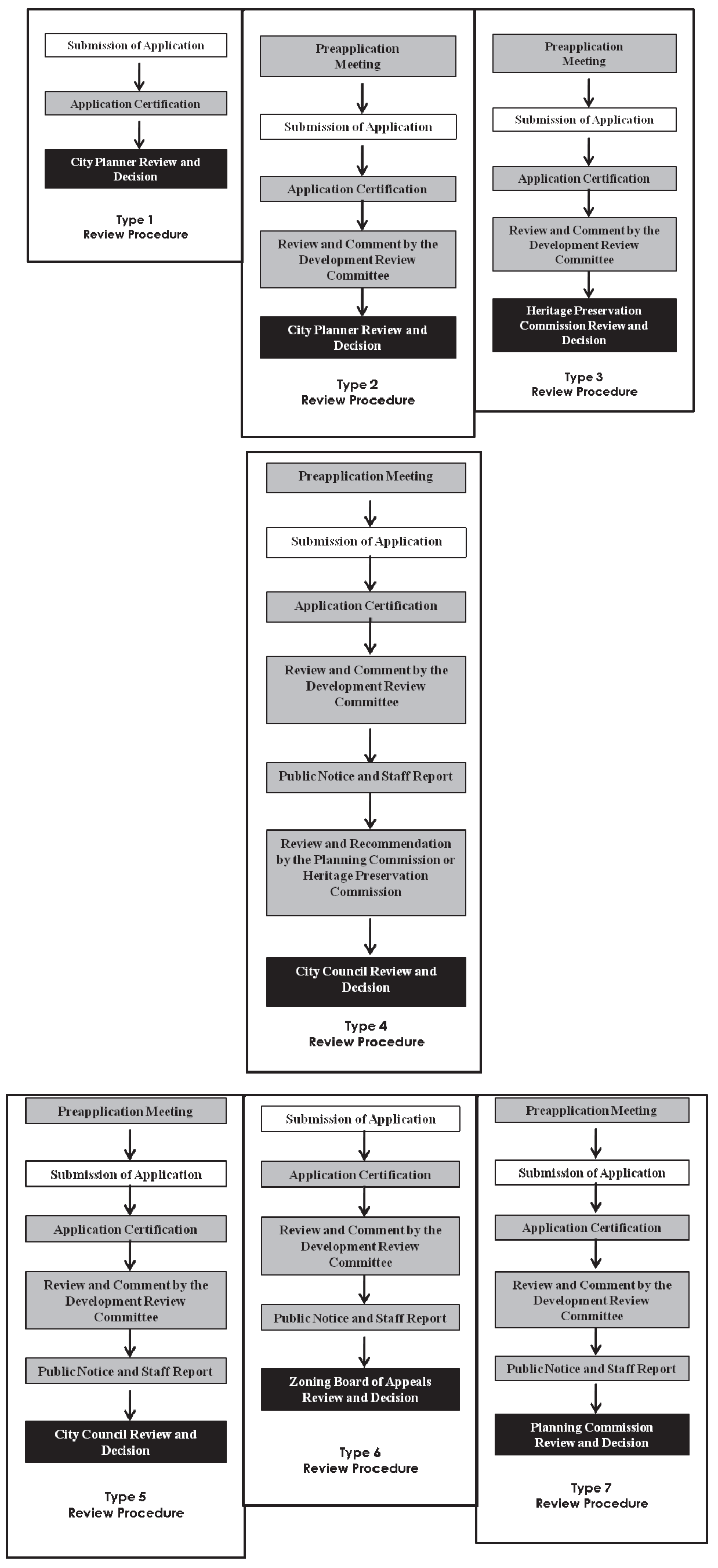
REVIEW PROCEDURES
8.4.4
Type 1 Review Procedure (City Planner Decision without Development Review Committee Review). Type 1 review procedure decisions are made by the city planner without public notice and without a public hearing.
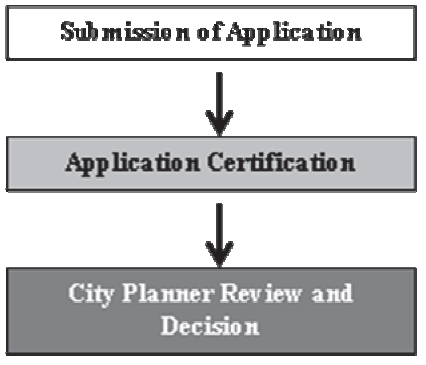
Type 1 Review Procedure
(A)
Application Submittal. The applicant shall submit an application to the city planner in accordance with Section 8.3, Common Development Review Requirements.
(B)
Action by the City Planner.
(1)
Within 15 days of the date when an application is certified (See Section 8.3.3(C)), the city planner shall render a decision to approve or deny an application. The written decision shall be communicated through the issuance of a zoning certificate or a letter to the applicant citing the reasons for denial.
(2)
The decision shall be final on the date it is mailed or otherwise provided to the applicant, whichever occurs first.
(C)
Appeal. The decision by the city planner may be appealed to the zoning board of appeals within 30 days from the date of the action in accordance with Section 8.5.17, Appeals, except that appeals of a decision of the city planner on a certificate of appropriateness shall be as provided in Section 8.5.8 (E), Appeals.
(Ord. No. 1046, § 1, 10-18-2022)
8.4.5
Type 2 Review Procedure (City Planner Decision with Development Review Committee Review). Type 2 review procedure decisions are made by the city planner, with consultation from the development review committee, without public notice and without a public hearing.
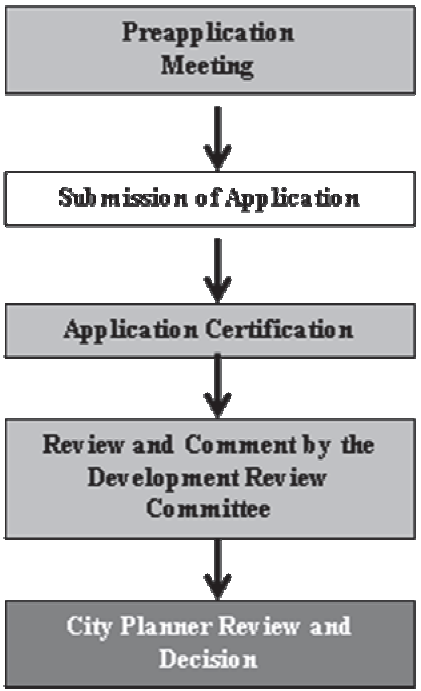
Type 2 Review Procedure
(A)
Preapplication Meeting. The applicant shall be required to meet with the city planner prior to submitting an application to discuss the proposal at a preapplication meeting unless such requirement is waived by the city planner. This meeting will provide the applicant an opportunity to meet with the city planner and other members of city staff who can provide initial feedback regarding applicable standards and requirements.
(B)
Application Submittal. The applicant shall submit an application to the city planner in accordance with Section 8.3, Common Development Review Requirements.
(C)
Review by the Development Review Committee.
(1)
Upon submittal of a certified application (See Section 8.3.3(C)), the city planner shall transmit copies of the application to members of the development review committee for review and comment.
(2)
After the development review committee meeting, the city planner shall provide the applicant with comments and changes that are required to be in compliance with the provisions of this LDC. The applicant shall be required to submit revised plans and documents incorporating the required changes.
(D)
Action by the City Planner.
(1)
The city planner shall make a decision to approve or deny an application in a timely manner, in accordance with state law (See Minn. Stat. § 15.99).
(2)
If approved, the city planner shall issue a zoning certificate or letter of approval depending on the specific application.
(3)
If denied, the city planner shall send a letter to the applicant listing the reasons for the denial.
(4)
The decision shall be final on the date it is mailed or otherwise provided to the applicant, whichever occurs first.
(E)
Appeal. The decision by the city planner may be appealed to the zoning board of appeals within 30 days from the date of the action in accordance with Section 8.5.17, Appeals.
8.4.6
Type 3 Review Procedure (Heritage Preservation Commission Decision). Type 3 review procedure decisions for certificates of appropriateness are made by the heritage preservation commission as discussed in Section 8.5.8, Heritage Preservation Commission's Certificate of Appropriateness.
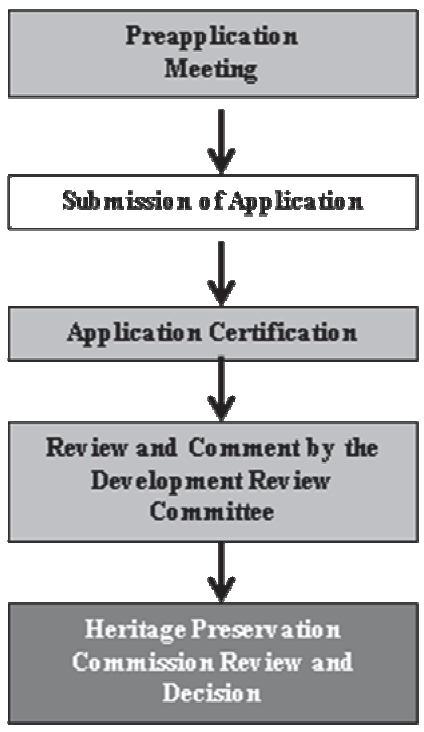
Type 3 Review Procedure
(A)
Preapplication Meeting. The applicant shall be required to meet with the city planner prior to submitting an application to discuss the proposal at a preapplication meeting unless such requirement is waived by the city planner. This meeting will provide the applicant an opportunity to meet with the city planner and other members of city staff who can provide initial feedback regarding applicable standards and requirements.
(B)
Application Submittal. The applicant shall submit an application to the city planner in accordance with Section 8.3, Common Development Review Requirements.
(C)
Review by the Development Review Committee.
(1)
At the city planner's discretion, the application may be forwarded to the development review committee for review after the city planner certifies the application is complete (See Section 8.3.3(C)).
(2)
If the development review committee is asked to review an application, the committee reviews the application and provides comments back to the city planner.
(3)
After the development review committee meeting, the city planner shall provide the applicant with comments and suggested changes. The applicant shall be required to submit revised plans and documents incorporating the required changes prior to the heritage preservation commission meeting.
(D)
Preparation of Staff Report.
(1)
The city planner shall prepare a staff report providing an analysis of the proposal and a recommendation. The city planner shall consider comments from the development review committee, as applicable, in formulating the recommendation.
(2)
A written staff report shall be forwarded to the heritage preservation commission and the contact person listed on the application form at least three days prior to the meeting at which the commission will consider the application.
(E)
Action by Heritage Preservation Commission. The heritage preservation commission shall consider the application at its meeting according to Section 8.5.8, Heritage Preservation Commission's Certificate of Appropriateness.
(F)
Appeal. The decision by the heritage preservation commission is appealable to city council (See Section 8.5.8 (E), Appeals).
(Ord. No. 1046, § 2, 10-18-2022)
8.4.7
Type 4 Review Procedure (Planning Commission or Heritage Preservation Commission Recommendation and City Council Decision). Type 4 review procedure decisions are made by the city council after a recommendation is made by the planning commission at a public hearing. Type 4 review procedure decisions for heritage preservation site designations are made by the city council at a public hearing after a recommendation by the heritage preservation commission and the planning commission. Type 4 review procedure decisions require both published and mailed notice as required in Section 8.3.8, Public Notice.
(A)
Preapplication Meeting. The applicant shall be required to meet with the city planner prior to submitting an application to discuss the proposal at a preapplication meeting unless such requirement is waived by the city planner. This meeting will provide the applicant an opportunity to meet with the city planner and other members of city staff who can provide initial feedback regarding applicable standards and requirements.
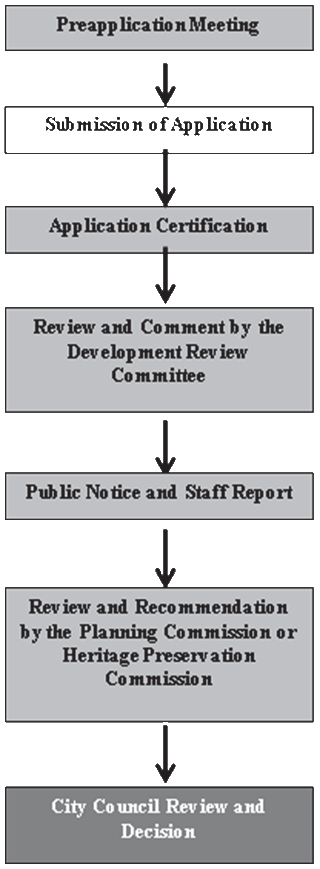
Type 4 Review Procedure
(B)
Neighborhood Meeting.
(1)
A neighborhood meeting will be required for any major subdivision that will create 50 or more lots.
(2)
A neighborhood meeting will be required for any zoning map amendment that encompasses more than 100 acres.
(3)
A neighborhood meeting will be required for all development in the PTA sub-zone as established in Section 2.4.2(C)(2).
(4)
At the discretion of the city planner, other applications for a Type 4 review procedure may be required to meet with property owners within 350 feet of the proposed property and any city recognized neighborhood associations in the immediate area prior to submitting their application in order to solicit input and exchange information about the proposed development (See Section 8.3.5, Neighborhood Meetings).
(C)
Preliminary Review by the Planning Commission. The applicant may request a preliminary review with a quorum of the planning commission prior to submitting an application, except that a preliminary review meeting with the planning commission shall be required if the project contains environmentally significant areas as described in the comprehensive plan, Chapter 5, or park plan components as described in the comprehensive plan, Chapter 8. The purpose of the work session is to provide feedback to the applicant regarding the proposal (See Section 8.3.4, Effect of Preapplication Meetings and Preliminary Review). At the applicant's request, the city planner will place the preliminary proposal on the work session agenda and send a copy of the agenda to the relevant boards and commissions.
(D)
Application Submittal. The applicant shall submit an application to the city planner in accordance with Section 8.3, Common Development Review Requirements.
(E)
Review by the Development Review Committee.
(1)
At the city planner's discretion, the application may be forwarded to the development review committee for review after the city planner certifies the application is complete (See Section 8.3.3(C)). The development review committee shall include the town architect for development applications proposed in the PTA sub-zone of the CD-S district.
(2)
If the development review committee is asked to review an application, the committee shall review the application and provide comments back to the city planner.
(3)
After the development review committee meeting, the city planner shall provide the applicant with comments and changes that are required to be in compliance with the provisions of this LDC. The applicant shall be required to submit revised plans and documents incorporating the required changes prior to the planning commission meeting.
(F)
Public Hearing and Notice by the City Planner. After determining that an application contains all the necessary and required information (See Section 8.5.3(C)), the city planner shall place the application on the planning commission agenda, schedule a public hearing on the proposed request, and notify the public pursuant to Section 8.3.8, Public Notice. For heritage preservation site designations, the city planner shall place the application on the city council agenda, schedule a public hearing on the proposed request, and notify the public pursuant to Section 8.3.8, Public Notice.
(G)
Preparation of Staff Report.
(1)
The city planner shall prepare a staff report providing an analysis of the proposal and a recommendation. The city planner shall consider comments from the development review committee in formulating the recommendation.
(2)
A written staff report shall be forwarded to the planning commission and the contact person listed on the application form at least three days prior to the meeting at which the planning commission will consider the application.
(H)
Recommendation by Planning Commission.
(1)
The planning commission shall consider the application at its formal public hearing. It shall consider comments by staff as appropriate, a presentation by the applicant, and comments by interested parties.
(2)
The planning commission shall consider this information and make a recommendation at the public hearing. If necessary, the planning commission can table and continue the public hearing or review of the application in accordance with Minn. Stat. § 15.99, at which time it shall make a recommendation.
(3)
The planning commission shall also consider the applicable decision criteria of this LDC and shall recommend approval, recommend approval with conditions (where allowed by law), or recommend denial of an application.
(I)
Action by the Heritage Preservation Commission. The heritage preservation commission shall consider the application for any heritage preservation site designation at its meeting in accordance with Section 8.5.7, Heritage Preservation Site Designation.
(J)
Action by the City Council.
(1)
After the planning commission's recommendation is made, the city council shall approve the request, approve with conditions (where allowed by law), or deny the request.
(2)
The city council may adopt by a two-thirds vote of all members of the city council amendments to this article or the zoning map, in relation both to land uses within a particular district or to the location of the district line.
(3)
The city council shall adopt findings and shall act upon the application in accordance with Minn. Stat. § 15.99.
(K)
Appeals. The decision by the city council is appealable to the district court within 30 days after receipt of notice of the decision.
8.4.8
Type 5 Review Procedure (Decision by City Council with No Review by Planning Commission). Type 5 review procedure decisions are made by the city council at a public meeting that does not require a public hearing.
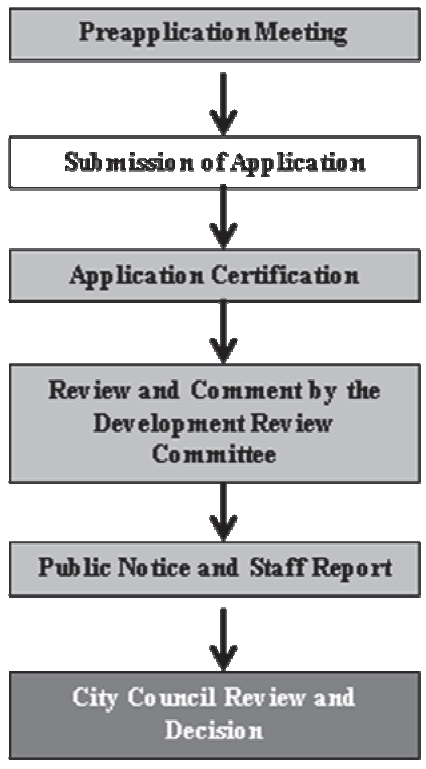
Type 5 Review Procedure
(A)
Preapplication Meeting. The applicant shall be required to meet with the city planner prior to submitting an application to discuss the proposal at a preapplication meeting unless such requirement is waived by the city planner. This meeting will provide the applicant an opportunity to meet with the city planner and other members of city staff who can provide initial feedback regarding applicable standards and requirements.
(B)
Application Submittal. For minor subdivision and major subdivision final plat review, the applicant shall submit an application in accordance with Section 8.3, Common Development Review Requirements.
(C)
Review by the Development Review Committee.
(1)
The application shall be forwarded to the development review committee for review after the city planner certifies the application is complete (See Section 8.3.3(C)).
(2)
The development review committee shall review the application and provide comments back to the city planner.
(3)
After the development review committee meeting, the city planner shall provide the applicant with comments and suggested changes. The applicant shall be required to submit revised plans and documents incorporating the required changes prior to the city council meeting.
(D)
Preparation of Staff Report.
(1)
The city planner shall prepare a staff report providing an analysis of the proposal and a recommendation from staff. The city planner shall consider comments from the development review committee in formulating the recommendation.
(2)
A written staff report shall be forwarded to city council, and the contact person listed on the application form, at least three days prior to the meeting at which the city council will consider the application.
(E)
Action by City Council. The city council shall approve the request, approve with conditions, or deny the request.
(F)
Appeals. The decision by the city council is appealable to the district court within 30 days after receipt of notice of the decision.
8.4.9
Type 6 Review Procedure (Quasi-Judicial Decision by the Zoning Board of Appeals). Type 6 review procedure decisions are made by the zoning board of appeals at a public meeting that requires a public hearing with published and mailed notice as required in Section 8.3.8, Public Notice.
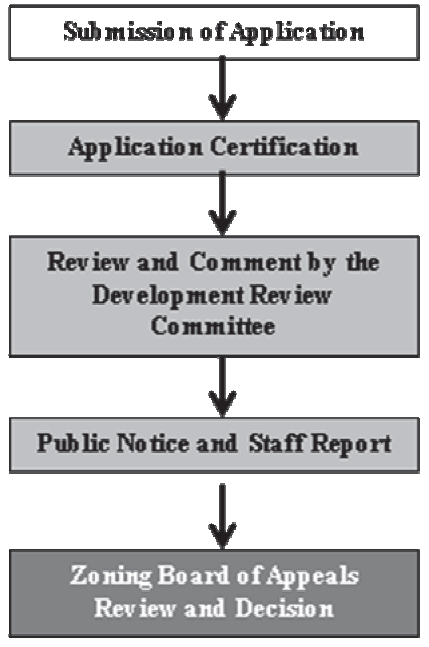
Type 6 Review Procedure
(A)
Application Submittal. The applicant shall submit an application in accordance with Section 8.3, Common Development Review Requirements.
(B)
Review by the Development Review Committee.
(1)
At the city planner's discretion, the application may be forwarded to the development review committee for review after the city planner certifies the application is complete (See Section 8.3.3(C)).
(2)
If the development review committee is asked to review an application, the committee shall review the application and provide comments back to the city planner.
(3)
After the development review committee meeting, the city planner shall provide the applicant with comments that are required to be in compliance with the provisions of this LDC.
(C)
Public Hearing and Notice by the City Planner. After determining that an application contains all the necessary and required information, the city planner shall place the application on the zoning board of appeals agenda, schedule a public hearing on the proposed request, and notify the public according to published and written mailed notice procedures (See Section 8.3.8, Public Notice).
(D)
Preparation of Staff Report.
(1)
The city planner shall prepare a staff report providing an analysis of the proposal and a recommendation. The city planner shall consider comments from the development review committee in formulating the recommendation.
(2)
A written staff report shall be forwarded to the zoning board of appeals and the contact person listed on the application form, at least three days prior to the meeting at which the board will consider the application.
(3)
In the case of appeals, the city planner shall forward all records related to the appealed decision as part of a staff report and a summary of their findings in the making of the original decision that is being appealed.
(E)
Zoning Board of Appeals Hearing and Decision. The zoning board of appeals shall review the application and decide that the request be granted as requested, be granted as modified by the zoning board of appeals, or be denied. The zoning board of appeals shall indicate the specific reasons(s) for its decision.
(F)
Appeals. The decision by the zoning board of appeals is appealable to the district court within 30 days after receipt of notice of the decision.
8.4.10
Type 7 Review Procedure (Planning Commission Decision). Type 7 review procedure decisions for zoning certificates are made by the planning commission as required in Section 8.5.1, Zoning Certificate.
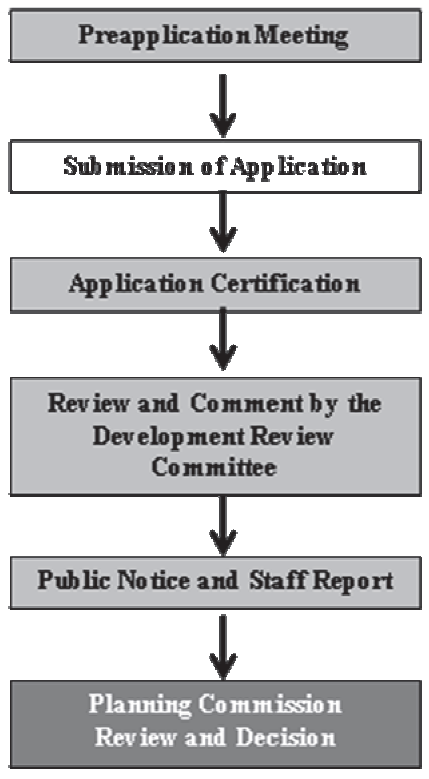
Type 7 review Procedure
(A)
Preapplication Meeting. The applicant shall be required to meet with the city planner prior to submitting an application to discuss the proposal at a preapplication meeting unless such requirement is waived by the city planner. This meeting will provide the applicant an opportunity to meet with the city planner and other members of city staff who can provide initial feedback regarding applicable standards and requirements.
(B)
Application Submittal. The applicant shall submit an application in accordance with Section 8.3, Common Development Review Requirements and all information necessary to indicate compliance with architectural design objectives and standards in Article 3.
(C)
Review by the Development Review Committee.
(1)
The city planner shall forward the application to the development review committee for review after the city planner certifies the application is complete (See Section 8.3.3(C)). The development review committee shall include the town architect and others as provided for in Section 7.7.3, Membership.
(2)
If the development review committee is asked to review an application, the committee reviews the application and provides comments back to the city planner.
(3)
The city planner shall provide the applicant with comments and suggested changes. The applicant shall be required to submit revised plans and documents incorporating the required changes prior to the commission meeting.
(D)
Preparation of Staff Report.
(1)
The city planner shall prepare a staff report providing an analysis of the proposal and a recommendation. The city planner shall consider comments from the development review committee in formulating the recommendation.
(2)
A written staff report shall be forwarded to the heritage preservation commission and the contact person listed on the application form at least three days prior to the meeting at which the commission will consider the application.
(E)
Action by Planning Commission. The planning commission shall consider the application at its meeting and shall either approve the request, approve with conditions, or deny the request.
(F)
Appeal. The decision by the planning commission is appealable to the city council (See Section 8.4.8(D), Preparation of Staff Report through Section 8.4.8(F), Appeals).
8.5 - Specific Development Review Procedure Requirements.
8.5.1
Zoning Certificate.
(A)
Applicability. No building or other structure shall be erected, constructed, re-constructed, enlarged, moved or structurally altered, nor shall any land be used, excavated, or improved until a zoning certificate is issued.
(B)
Approval Procedure. The zoning certificate application shall be submitted to the city planner in accordance with Section 8.3, Common Development Review Requirements, and may be subject to one of four review procedure types based on the size and scope of the project. The following are the established thresholds for review for each procedural type. The city planner shall have the authority to determine how the zoning certificate application shall be reviewed based on these thresholds.
(1)
Type 1 Review Procedure. The following zoning certificate application types shall be subject to the Type 1 review procedure as established in Section 8.4.4, Type 1 Review Procedure (City Planner Decision without Development Review Committee Review):
(a)
Accessory uses regulated by Section 2.10, Accessory Uses and Structures.
(b)
Changes of use within an existing structure where the use is substantially similar to the existing use or another permitted use under the existing zoning district classification as indicated on the official zoning map and where no expansion of the building is included in the application.
(c)
New single-family and two-family dwellings or additions and modifications of such uses.
(d)
Additions to nonresidential structures of less than 500 square feet.
(e)
The city planner may consult with the town architect to be sure the compatibility standards in Section 3.4, Neighborhood Compatibility Standards, have been met.
(f)
Signs.
(g)
Registration of pre-existing uses as defined in Section 2.7.2(B)(3), Pre-Existing Uses (PE).
(2)
Type 2 Review Procedure. The following zoning certificate application types shall be subject to the Type 2 review procedure as established in Section 8.4.5, Type 2 Review Procedure (City Planner Decision with Development Review Committee Review):
(a)
New multi-family dwellings of three units or more.
(b)
Any additions or modifications to multi-family dwellings of three units or more.
(c)
Additions to nonresidential structures of 500 square feet or more.
(d)
Parking structures and facilities and parking lots.
(3)
Type 3 Review Procedure. Applications for certificates of appropriateness shall be reviewed by the heritage preservation commission through a Type 3 review procedure prior to review for a zoning certificate or site plan review in accordance with Section 8.4.6, Type 3 Review Procedure (Heritage Preservation Commission Decision).
(4)
Type 7 Review Procedure. Applications for zoning certificates shall be reviewed by the planning commission through a Type 7 review procedure for any additions to existing structures or the construction of any new structure on property that is zoned C2 in accordance with Section 8.4.10, Type 7 Review Procedure (Planning Commission Decision).
(5)
Uses Not Classified. The city planner shall have the authority to determine what review type shall be applied to a zoning certificate application for a use or structure not addressed in the above subsections. The decision of the city planner may be appealed to the zoning board of appeals in accordance with Section 8.5.17, Appeals.
(C)
Approval Criteria.
(1)
All of the following criteria shall be considered and met in the review of a zoning certificate application subject to a Type 1 or Type 2 review procedure.
(a)
The application shall demonstrate full compliance with the applicable requirements of this LDC;
(b)
Approval of the application must result in safe conditions for pedestrians or motorists and prevents the dangerous arrangement of pedestrian and vehicular ways; and
(c)
Approval of the application must result in safe ingress and egress for emergency services.
(2)
Zoning certificate applications that are subject to the Type 3 review procedure as established above shall be subject to the review requirements and approval criteria of Section 8.5.6, Site Plan Review.
(D)
Effect of Zoning Certificate Approval. The zoning certificate must be issued prior to the city's issuance of building permit.
(E)
Expiration.
(1)
A zoning certificate shall become void after one year from the date of issuance if a building permit has not been issued. If the use has changed within one year of the date of issuance of the zoning certificate, a new application and certificate shall be required. Construction is deemed to begin when all necessary excavation and piers or footings of one or more principal buildings included in the plan have been completed.
(2)
Extensions may be granted if a modified timeline is requested and approved by the city planner.
(Ord. No. 1067, § 3, 10-15-2024)
8.5.2
Temporary Use Permit.
(A)
Applicability. A temporary use permit may be issued for the following reasons:
(1)
To allow a use for a brief period of time until a permanent location is obtained or while the permanent location is under construction.
(2)
To allow a use that is presently judged acceptable by the city council, but that with anticipated development or redevelopment, will not be acceptable in the future or will be replaced in the future by a permitted or conditional use allowed within the respective district.
(3)
To allow a use that is reflective of an anticipated long range change to an area and which is in compliance with the comprehensive plan provided that said use maintains harmony and compatibility with surrounding uses.
(B)
Approval Procedure. Temporary use permit applications shall be submitted to the city planner in accordance with Section 8.3, Common Development Review Requirements and shall be subject to the Type 1 review procedure as established in Section 8.4.4, Type 1 Review Procedure (City Planner Decision without Development Review Committee Review).
(C)
Approval Criteria. Criteria (1) and (2) below shall be met and all circumstances applicable to criterion (3) shall be considered in the review of temporary permit applications:
(1)
The use must be allowed as a temporary use in the respective zoning district and complies with all of the applicable standards of Section 2.11, Temporary Uses and Structures.
(2)
The date or event that will terminate the use must be able to be identified with certainty.
(3)
The use must not impose additional unreasonable costs on the public.
(D)
Termination. A temporary use shall terminate on the happening of any of the following events, whichever occurs first:
(1)
The expiration date stated in the permit.
(2)
Upon violation of conditions under which the permit was issued.
(3)
Upon change in the city's Land Development Code which renders the use nonconforming.
(4)
The redevelopment of the use and property upon which it is located to a permitted or conditional use as allowed within the respective zoning district.
(5)
Noncompliance with the removal of the temporary use would make the property owners subject to the penalties listed in Section 7.8, Enforcement and Penalties.
8.5.3
Construction Drawings.
(A)
Applicability. Construction drawings shall be required for all major subdivisions and for some zoning certificate procedures where the city engineer determines that certain stormwater improvements require the submittal and approval of construction drawings.
(B)
Approval Procedure:. Construction drawings shall be submitted to the city engineer and shall be subject to the Type 1 review procedure as established in Section 8.4.4, Type 1 Review Procedure (City Planner Decision without Development Review Committee Review), except that the city engineer will be responsible for review and a decision instead of the city planner.
(C)
Approval Criteria. The city engineer shall consider the following in the review of construction drawings:
(1)
That the proposed subdivision and related improvements are in full compliance with the provisions of this LDC as it relates to infrastructure, stormwater management, transportation, and other infrastructure improvements; and
(2)
That the proposed improvements are in full compliance with the city's plans, standards, and specifications of the city's comprehensive transportation plan update and other infrastructure standards adopted by the city, including, but not limited to the comprehensive sanitary sewer plan, comprehensive water plan, and surface water management plan
(D)
Effect of the City Engineer's Decision.
(1)
No grading shall take place on the site until the final plat and development agreement are approved by city council, or a grading permit, as provided for in Northfield Municipal Code, Section 22-231, has been issued.
(2)
No construction or other development activities shall take place on the site until the final plat and development agreement are approved by the city council.
(3)
For stormwater improvements that are not part of a subdivision application and that require construction drawing approval, no grading, construction, or other development activities shall occur until the construction drawings are approved.
(E)
Expiration.
(1)
Approved construction drawings shall become void after one year from the date of issuance unless construction has begun on the improvements. If no construction has begun, approval of a new set of construction drawings shall be required.
(2)
Extensions may be granted if a modified timeline is requested and approved by the city engineer.
8.5.4
Flood Plain Permit.
(A)
Applicability.
(1)
A flood plain permit shall be required prior to the issuance of any building permit and/or zoning certificate in the FP-O district or applicable flood plain/special flood hazard area as determined by the Federal Emergency Management Administration (FEMA).
(2)
A flood plain permit shall also be required in conjunction with any conditional use permit or variance in the FP-O district or applicable flood plain/special flood hazard area as determined by the Federal Emergency Management Administration (FEMA).
(B)
Approval Procedure. Flood plain permit applications shall be submitted to the city planner in accordance with Section 8.3, Common Development Review Requirements and shall be subject to the Type 2 review procedure as established in Section 8.4.5, Type 2 Review Procedure (City Planner Decision with Development Review Committee Review), modified as follows:
(1)
Prior to granting a zoning certificate or processing an application for a conditional use permit or variance, the city planner shall determine that the applicant has obtained all necessary state and federal permits.
(2)
It shall be unlawful to use, occupy, or permit the use or occupancy of any building or premises or part thereof hereafter created, erected, changed, converted, altered, or enlarged in its use or structure until a zoning certificate is issued by the city planner stating that the use of the building or land conforms to the requirements of this section.
(3)
Zoning certificates, building permits, conditional use permits issued on the basis of approved plans and applications authorize only the use, arrangement, and construction set forth in such approved plans and applications, and no other use, arrangement, or construction. Any use, arrangement, or construction at variance with that authorized shall be deemed a violation of this section, and punishable as provided by Section 7.8, Enforcement and Penalties.
(4)
The applicant shall be required to submit certification by a registered professional engineer, registered architect, or registered land surveyor that the finished fill and building elevations were accomplished in compliance with the provisions of this section. Flood proofing measures shall be certified by a registered professional engineer or registered architect.
(5)
The city planner shall maintain a record of the elevation of the lowest floor (including basement) of all new structures and alterations or additions to existing structures in the flood plain. The city planner shall also maintain a record of the elevation to which structures or alterations and additions to structures are flood proofed.
(6)
The city planner shall notify, in watercourse alteration situations, adjacent communities and the commissioner of the department of natural resources prior to the city authorizing any alteration or relocation of a watercourse. If the applicant has applied for a permit to work in the beds of public waters pursuant to Minn. Stat., ch. 103G, this shall suffice as adequate notice to the commissioner of natural resources. A copy of said notification shall also be submitted to the Chicago Regional Office of the Federal Emergency Management Agency (FEMA).
(7)
As soon as is practicable, but not later than six months after the date such supporting information becomes available, the city planner shall notify the Chicago Regional Office of FEMA of the changes to a watercourse described in (6) above by submitting a copy of the technical or scientific data.
(C)
Variances of Flood Plain Permit Requirements. Variances of the standards of this section may be heard by the zoning board of appeals pursuant to the variance application procedure established in Section 8.5.16 (Variance), but no variance shall have the effect of permitting a lower degree of flood protection than the regulatory flood protection elevation for the particular area, or permit standards lower than those required by state law. The following additional variance criteria of the Federal Emergency Management Agency (FEMA) must be satisfied:
(1)
Variances shall not be issued by the city within any designated regulatory floodway if any increase in flood levels during the base flood discharge would result.
(2)
Variances shall only be issued by the city upon:
(a)
A showing of good and sufficient cause;
(b)
A determination that failure to grant the variance would result in exceptional hardship to the applicant; and
(c)
A determination that the granting of a variance will not result in increased flood heights, additional threats to public safety, extraordinary public expense, create nuisances, cause fraud on or victimization of the public, or conflict with existing local laws or ordinances.
(3)
Variances shall only be issued upon a determination that the variance is the minimum necessary, considering the flood hazard, to afford relief.
(4)
The city planner shall notify the applicant for a variance that:
(a)
The issuance of a variance to construct a structure below the base flood level will result in increased premium rates for flood insurance up to amounts as high as $25.00 for $100.00 of insurance coverage; and
(b)
Such construction below the 100-year or regional flood level increases risks to life and property. Such notification shall be maintained with a record of all variance actions. The city shall maintain a record of all variance actions, including justification for their issuance, and report such variances issued in its annual or biennial report submitted to the administrator of the National Flood Insurance Program.
(D)
Conditional Uses.
(1)
The city council shall hear and decide applications for conditional uses permissible under this section. Applications shall be submitted to the city planner who shall forward the application to the planning commission for a public hearing pursuant to the conditional use permit review procedure established in Section 8.5.9, Conditional Use Permit.
(2)
In granting a conditional use permit the city council may prescribe appropriate conditions and safeguards, in addition to those specified in Section 2.9, Use-Specific Standards, which are in conformity with the purposes of this section. Violations of such conditions and safeguards, when made a part of the terms under which the conditional use permit is granted, shall be deemed a violation of this section, punishable under Section 7.8, Enforcement and Penalties.
(3)
A copy of all decisions granting conditional use permits shall be forwarded by mail to the commissioner of natural resources within ten days of such action.
(4)
Procedures to be followed by the city in passing on conditional use permit applications within all flood plain districts are as follows:
(a)
The applicant shall submit the following information and additional information to the city planner in accordance with Section 8.3, Common Development Review Requirements and additional information as deemed necessary by the city planner for determining the suitability of the particular site for the proposed use:
(i)
Plans in triplicate drawn to scale showing the nature, location, dimensions, and elevation of the lot, existing or proposed structures, fill, storage of materials, flood proofing measures, and the relationship of the above to the location of the stream channel; and
(ii)
Specifications for building construction and materials, flood proofing, filling, dredging, grading, channel improvement, storage of materials, water supply and sanitary facilities.
(b)
Transmit one copy of the information described in Subsection 8.5.4(D)(4)(a) above to a designated engineer or other expert person or agency for technical assistance, where necessary, in evaluating the proposed project in relation to flood heights and velocities, the seriousness of flood damage to the use, the adequacy of the plans for protection, and other technical matters.
(c)
Based upon the technical evaluation of the designated engineer or expert, the city shall determine the specific flood hazard at the site and evaluate the suitability of the proposed use in relation to the flood hazard.
(5)
In passing upon conditional use permit applications, the city council shall consider all relevant factors specified in other subsections of this section, the standards of Section 2.5.1, Floodplain Overlay District (FP-O), and:
(a)
The danger to life and property due to increased flood heights or velocities caused by encroachments.
(b)
The danger that materials may be swept onto other lands or downstream to the injury of others or they may block bridges, culverts or other hydraulic structures.
(c)
The proposed water supply and sanitation systems and the ability of these systems to prevent disease, contamination, and unsanitary conditions.
(d)
The susceptibility of the proposed facility and its contents to flood damage and the effect of such damage on the individual owner.
(e)
The importance of the services provided by the proposed facility to the city.
(f)
The requirements of the facility for a waterfront location.
(g)
The availability of alternative locations not subject to flooding for the proposed use.
(h)
The compatibility of the proposed use with existing development and development anticipated in the foreseeable future.
(i)
The relationship of the proposed use to the comprehensive plan and flood plain management program for the area.
(j)
The expected heights, velocity, duration, rate of rise, and sediment transport of the floodwaters expected at the site.
(k)
Such other factors that are relevant to the purposes of this LDC.
(6)
Upon consideration of the factors listed above and the purpose of this section, the city council shall attach such conditions to the granting of conditional use permits as it deems necessary to fulfill the purposes of this section. Such conditions may include, but are not limited to, the following:
(a)
Modification of waste treatment and water supply facilities.
(b)
Limitations on period of use, occupancy, and operation.
(c)
Imposition of operational controls, sureties, and deed restrictions.
(d)
Requirements for construction of channel modifications, compensatory storage, dikes, levees, and other protective measures.
(e)
Flood proofing measures, in accordance with the state building code and this section. The applicant shall submit a plan or document certified by a registered professional engineer or architect that the flood proofing measures are consistent with the regulatory flood protection elevation and associated flood factors for the particular area.
8.5.5
Amendments to the PD-O District.
(A)
Applicability. This development procedure describes how to modify any previously approved PUD (See Section 2.5.4, Planned Unit Development Overlay District (PD-O).
(B)
Classification of Amendments. The city planner shall have the authority to classify proposed amendments based on the following thresholds.
(1)
Minor Amendments. Minor amendments shall be restricted to those changes that do not:
(a)
Increase or decrease the density or intensity by more than ten percent of the approved density or number of units (residential uses) or building square footage (nonresidential uses);
(b)
Change the overall use; or
(c)
Create changes that will create an increased impact for on- or off-site improvements as determined after development review committee review.
(2)
Major Amendments. Major amendments shall be all proposed amendments that are not classified as a minor amendment above.
(C)
Approval Procedure.
(1)
Applications for minor amendments shall be submitted to the city planner in accordance with Section 8.3, Common Development Review Requirements and shall be subject to the Type 2 review procedure as established in Section 8.4.5, Type 2 Review Procedure (City Planner Decision with Development Review Committee Review).
(2)
Major amendments shall not be approved as part of this LDC. Where a major amendment is requested, the applicant shall comply with the applicable underlying base zoning district or apply for a zoning map amendment (See Section 8.5.14, Text and Zoning Map Amendments) to a different base zoning district that is compatible with the surrounding area.
(D)
Approval Criteria. Criterion (1) below shall be met and criteria (2) and (3) below shall be considered in the review of minor PUD amendments:
(1)
The amendment must satisfy the definition of minor amendments as established in this section;
(2)
The amendment must be necessary due to engineering, safety, or some circumstance unforeseen at the time of the original approval; and
(3)
The amendment must be consistent with this LDC.
8.5.6
Site Plan Review.
(A)
Applicability. Approval of a site plan is required prior to construction for uses as defined in Section 8.4.5, Type 2 Review Procedure (City Planner Decision with Development Review Committee Review).
(B)
Approval Procedure. Site plan review shall be submitted to the city planner in accordance with Section 8.3, Common Development Review Requirements and shall be subject to the Type 2 review procedure as established in Section 8.4.5, Type 2 Review Procedure (City Planner Decision with Development Review Committee Review).
(C)
Approval Criteria. Criterion (1) below shall be met and criteria (2) through (6) below shall be considered in the review of site plan review applications:
(1)
That it fully complies with all applicable requirements of this LDC;
(2)
That it adequately protects residential uses located on the same property from the potential adverse effects of a non-residential use;
(3)
That it is consistent with the use and character of surrounding properties;
(4)
That it provides safe conditions for pedestrians or motorists and prevents the dangerous arrangement of pedestrian and vehicular ways;
(5)
That it provides safe ingress and egress for emergency services; and
(6)
That it complies with the city's plans, standards, and specifications of the city's comprehensive transportation plan update and other infrastructure standards adopted by the city, including, but not limited to the list of plans in Section 8.2.4.
(D)
Amendments to Approved Site Plans.
(1)
After a site plan has been approved, in the course of carrying out this plan, adjustments or rearrangements of buildings may be requested by the applicants. If the amendment involves changes to 25 percent or less of the original floor area, not to exceed 5,000 square feet, the city planner may approve the amendment after a Type 1 review procedure (See Section 8.4.4, Type 1 Review Procedure (City Planner Decision without Development Review Committee Review)). Such amendment shall be in full compliance with the requirements of this LDC. If the amendment involves changes greater than 25 percent of the original floor area or exceeds 5,000 square feet, the amendment will be subject to a Type 2 review procedure (See Section 8.4.5, Type 2 Review Procedure (City Planner Decision with Development Review Committee Review)).
(2)
The city planner may also review and approve adjustments or rearrangements of items other than buildings, such as drives, parking areas, recreation areas, entrances, heights, yards, signage, landscaping, outdoor lighting, surface water management plan, or similar modifications subject to a Type 2 review procedure (See Section 8.4.5, Type 2 Review Procedure (City Planner Decision with Development Review Committee Review)). Such amendment shall be in full compliance with the requirements of this LDC.
8.5.7
Heritage Preservation Site Designation.
(A)
Applicability.
(1)
The city may, from time to time, determine that certain places, buildings, structures, properties, or district areas or properties within the community are of significance in American history, architecture, archeology, engineering, landscaping, and culture and those locations should be subject to additional review as it relates to this LDC.
(2)
An application for heritage preservation site designation may be initiated by the property owner, heritage preservation commission, planning commission, or city council.
(B)
Approval Procedure. Heritage preservation site designation shall be subject to the Type 4 review procedure (See Section 8.4.7, Type 4 Review Procedure (Planning Commission or Heritage Preservation Commission Recommendation and City Council Decision)) as modified herein.
(1)
Reports. The city council may direct the city planner or other city staff to prepare studies which catalog buildings, land, areas, districts, or other objects to be considered for designation as a heritage preservation site prior to review as established in Section 8.4.7, Type 4 Review Procedure (Planning Commission or Heritage Preservation Commission Recommendation and City Council Decision).
(2)
Review and Recommendation by the Heritage Preservation Commission and Planning Commission.
(a)
The heritage preservation commission shall review the application for designation in accordance with the Type 4 review procedure as established in Section 8.4.7, Type 4 Review Procedure (Planning Commission or Heritage Preservation Commission Recommendation and City Council Decision) and shall make a recommendation to the city council.
(b)
In addition to the approval criteria as established in Section 8.5.7(C), the heritage preservation commission may also refer to the applicable Secretary of the Interior standards, and current procedure as recommended by the state historic preservation office when determining if a site should qualify as a heritage preservation site.
(c)
After the heritage preservation commission has made a recommendation, the planning commission shall review the application for designation in accordance with the Type 4 review procedure as established in Section 8.4.7, Type 4 Review Procedure (Planning Commission or Heritage Preservation Commission Recommendation and City Council Decision) and shall make a recommendation to the city council.
(3)
Communication with State Historic Preservation Office.
(a)
Prior to designating a proposed heritage preservation site, the heritage preservation commission shall forward information concerning the proposed designation to the state historic preservation office for comment within 60 days.
(b)
The recommendation of the heritage preservation commission and decision of city council shall be sent to the state historic preservation office in accordance with applicable state statutes.
(4)
Review and Decision by the City Council.
(a)
The city council shall review and make a decision on a heritage preservation site application in accordance with Section 8.4.7, Type 4 Review Procedure (Planning Commission or Heritage Preservation Commission Recommendation and City Council Decision).
(b)
Prior to making a decision, the city council may request a review and recommendation by the planning commission for the designation's conformance with the comprehensive plan.
(c)
The city council shall adopt findings in support of any decision to designate a heritage preservation site.
(d)
The decision of the city council shall be made in the form of an ordinance.
(C)
Approval Criteria. All of the following criteria shall be considered in the review of heritage preservation site designation applications:
(1)
That the quality of significance in American history, architecture, archeology, engineering, and culture is present in districts, sites, buildings, structures, landscaping, and objects that possess integrity of location, design, setting, materials, workmanship, feeling, and association; or
(2)
That are associated with events that have made a significant contribution to the broad patterns of our history; or
(3)
That are associated with the lives of persons significant in our past; or
(4)
That embody the distinctive characteristics of a type, period, or method of construction, or that represent the work of a master, or that possess high artistic values, or that represent a significant and distinguishable entity whose components may lack individual distinction; or
(5)
That have yielded, or may be likely to yield, information important in prehistory or history; or
(6)
That have a unique location or singular physical characteristics representing established and familiar aspects of a view, vista, site, area or district in the city.
(D)
Acquisition of Property. The heritage preservation commission may recommend to the city council that certain property eligible for designation as a heritage preservation site be acquired by gift, by negotiation, or other legal means as provided in applicable state statutes.
(E)
Heritage Preservation Site Designation Amendment or Delisting. The procedure for an amendment or delisting of a heritage preservation site designation shall comply with the same procedure set forth herein for designation of a heritage preservation site, as provided in Section 8.5.7 (B), except that the following approval criteria shall be considered and findings shall be made on one (1) or more of the same:
(1)
Procedural or professional errors were made in the designation process.
(2)
The designated property has been destroyed or radically altered to the point where the majority of its original historic qualities have been lost or removed and cannot economically be replaced.
(Ord. No. 1046, §§ 3, 4, 10-18-2022)
8.5.8
Heritage Preservation Commission's Certificate of Appropriateness.
(A)
Applicability. Unless otherwise exempted in Section 7.8.3, Exemptions, or unless otherwise provided in this Section, in the H-O district no zoning certificate or building permit for construction, exterior alteration or rehabilitation, moving, or demolition of a building or structure on a city-owned or privately owned heritage preservation site shall be issued until the project has been submitted to, and received approval of a certificate of appropriateness from either the Heritage Preservation Commission or the city planner subject to the below review procedures. The city planner or the city planner's designee shall classify proposed work as described below into one of the following two categories, which shall determine the applicable review procedure as provided in clause (C) of this Section:
(1)
Major Work:
(i)
New construction including the expansion or enlargement of an existing building or site.
(ii)
Demolition in whole or in part.
(iii)
Moving of historic buildings, structures, or objects.
(iv)
Remodeling, exterior alteration, or rehabilitation that will change the exterior appearance including but not limited to painting, lighting, landscaping, and awnings.
(v)
Any other major work determined by the city planner, in the city planner's judgment, not meeting the definition of minor work.
(2)
Minor Work (minor alterations in keeping with the integrity of the heritage preservation site and do not impact the overall architectural character and visual character):
(i)
Ordinary and routine maintenance or reconstruction where any exterior surface materials are to be replaced with historically appropriate identical materials and where such replacement materials will be installed to the original historical configuration. This includes, but is not limited to; re-pointing, repainting, reroofing, residing, and replacement of windows with the same form, materials and finish.
(ii)
Minor amendments to an approved major work COA.
(iii)
Signage.
(B)
Exemptions. A certificate of appropriateness shall not be required for the following activities:
(1)
A COA is not required for building permits for work (electrical, interior structural, etc.) on the interior of the structure provided that the work for which the building permit is requested will not alter the external appearance or the gross floor area of the structure.
(2)
A COA is not required for structures required to be demolished in accordance with Minn. Stat., Ch. 463, related to hazardous or substandard buildings.
(3)
A COA is not required in emergency situations where immediate, temporary repair is needed to protect the safety of a building or structure and its inhabitants as determined and approved jointly by the City Administrator and City Building Official. In the case of an emergency repair permit issued pursuant to this Section, the City Administrator or Building Official, as applicable, shall subsequently notify the heritage preservation commission of the temporary, emergency repair and specify the facts or conditions necessitating the emergency repairs. Unless approved by the heritage preservation commission, temporary repairs shall extend for a period not to exceed 180 days from the date of approval by the City Administrator and City Building Official. If a certificate of appropriateness is otherwise required by this Section, all final repairs shall be reviewed pursuant to the approval procedure as provided in clause (C) of this Section.
(4)
A COA is not required for any physical improvements within public rights-of-way and immediately adjacent property affected by such work, including but not limited to: curb and gutter, street, utility reconstruction; routine maintenance, repair, or emergency work such as street patching; street overlays; driveway installations; boulevard tree planting; accessibility ramp improvements; utility repairs; or sidewalk repair or replacement.
(i)
For public street improvement projects exceeding an estimated cost of one million dollars as determined by the city engineer and located within the H-O District, the heritage preservation commission may, prior to the city council public improvement hearing on the project, provide written comments to the city council on the historic aspects of the project. Failure of the heritage preservation commission to timely provide written comments on or before the scheduled public improvement hearing on the project shall be deemed to have satisfied this provision.
(C)
Approval Procedure. For major work as defined in clause (A) of this Section, certificates of appropriateness shall be subject to the Type 3 review procedure as established in Section 8.4.6, Type 3 Review Procedure (Heritage Preservation Commission Decision), except that the heritage preservation commission shall be responsible for review instead of the planning commission. For minor work as defined in clause (A) of this Section, certificate of appropriateness shall be subject to the Type 1 review procedure as established in Section 8.4.4, Type 1 Review Procedure. The city planner is authorized to determine the applicable review procedure for an application as defined in clause (A) of this Section.
(D)
Approval Criteria.
(1)
For proposed new construction, as well as alteration, remodeling, rehabilitation, relocation or addition to an existing building, structure or historic object, the heritage preservation commission or the city planner, based upon the applicable review procedure for an application, shall consider the following in evaluating an application for a certificate of appropriateness for a zoning certificate and/or building permit, and shall make written findings regarding approval or denial of the same by resolution. Criterion (a) below must be met and criteria (b) through (g) shall be considered, if applicable to an application:
(a)
For all applications, the proposed action fully complies with all applicable requirements of this LDC;
(b)
That the proposed action is in harmony with the purpose of the H-O district for sites located in the H-O district;
(c)
That the proposed action would complement other structures within the H-O district for sites located in the H-O district;
(d)
That the proposed action is consistent with the Downtown Preservation Design Guidelines for sites located in the H-O district, and consistent with the Secretary of the Interior's Standards for Treatment of Historic Properties for sites located within or outside the H-O district;
(e)
Consideration should be given to the amount and quality of original material and design remaining in the building or structure when applying criteria, guidelines and standards;
(f)
For new construction, the building or addition should be compatible with:
(i)
scale, texture, materials, and other visual qualities of the surrounding buildings and neighborhoods;
(ii)
the height, width, depth, massing and setback of the surrounding buildings; and
(iii)
the amount of solid wall to window and door openings, and the replacement of window and door openings, should be proportional to that of the surrounding buildings and neighborhood; and
(g)
Consideration shall be given to clear cases of economic hardship or to deprivation of reasonable use of the owner's property.
The applicant bears the burden of proof of meeting the foregoing criteria as well as all costs of the same without reimbursement from the commission or city.
(2)
For proposed demolition of a building or historic object, the heritage preservation commission in considering an application for a certificate of appropriateness shall make written findings regarding approval or denial of the same by resolution based on the following criteria:
(a)
In the case of demolition, that the structure could not be rehabilitated and used for a conforming purpose with reasonable efforts or whether the structure is without substantial historic or architectural significance;
(b)
Consideration shall be given to the significance or architectural merit of the building itself, in terms of unusual or uncommon design, texture, or materials that could not be reproduced or reproduced only with great difficulty or expense, and, if applicable, the contribution the building makes to the historic or architectural character of the district;
(c)
Consideration shall be given to the economic value, usefulness and replacement cost of the building as it now stands and as remodeled or rehabilitated, in comparison to the value or usefulness of any proposed structures designated to replace the present building or buildings, and to what viable alternatives may exist;
(d)
Consideration shall be given to the present structural integrity of the building to determine whether or not it constitutes a clear and present danger to the health, welfare and safety of the public; whether the building could be considered a hazardous building or hazardous property as defined in Minn. Stat. § 463.15; and whether other nuisance conditions or City Code violations exist on the subject property. The foregoing consideration shall be based on an analysis and report prepared by the Building Official and submitted to the commission. The applicant may, at the applicant's cost and expense, prepare and submit an analysis/report of the foregoing and/or a professional estimate of the structural integrity of the building and an estimate of the cost for the property owner to correct dangerous deficiencies or other evidence of the same to the commission. The commission shall consider any such reports and/or evidence submitted by the applicant;
(e)
Consideration shall be given as to whether or not the demolition is necessary to facilitate a defined public purpose;
(f)
Consideration shall be given to the length of time that the building or property has remained secured or unsecured, unused, abandoned, substandard and/or vacant; and
(g)
Consideration shall be given to clear cases of economic hardship or to deprivation of reasonable use of the owner's property.
The applicant bears the burden of proof of meeting the foregoing criteria as well as all costs of the same without reimbursement from the commission or city.
(E)
Appeals.
(1)
Appeals of the heritage preservation commission's decision may be made to the city council in accordance with this LDC and state law. Any party aggrieved by a decision of the heritage preservation commission may appeal such decision by filing a written notice of appeal with the city clerk no later than ten days after the decision of the heritage preservation commission. If not so filed, the right of appeal shall be deemed waived and the decision of the heritage preservation commission shall be final. Following receipt of the appeal, the city clerk shall schedule a time for the appeal to be heard by the city council, which appeal hearing shall be scheduled within 30 days of the date of receipt of the notice of appeal by the city clerk. Following hearing the appeal, the city council shall by resolution, in its discretion, either affirm, modify and amend, or overrule the heritage preservation commission's decision. The resolution shall contain written findings supporting the city council's decision and shall be adopted by an affirmative vote of a majority of all the members of the city council.
(2)
An appeal of the city staff's decision on a certificate of appropriateness (minor work) following the Type 1 Review Procedure shall be made to the heritage preservation commission and reviewed in the same manner as a new certificate of appropriateness (major work) in accordance with a Section 8.4.6, Type 3 Review Procedure. Any party aggrieved by city staffs decision on a certificate of appropriateness (minor work) under the Type 1 Review Procedure may appeal such decision by filing a written notice of appeal with the city clerk no later than ten days after the decision of city staff, along with any additional required documentation necessary for review in accordance with a Section 8.4.6, Type 3 Review Procedure, for subsequent consideration by the heritage preservation commission. Subsequent appeals of the decision of the heritage preservation commission following its Section 8.4.6, Type 3 Review Procedure shall be made in accordance with clause (E)(1) of this Section.
(F)
City Council Review and Decision. Notwithstanding the foregoing, any denial of a certificate of appropriateness by the heritage preservation commission of a city government project located upon or within city-owned property shall be reviewed by the city council within 45 days of the heritage preservation commission's decision. The city council shall by resolution, in its discretion, either affirm, modify and amend, or overrule the heritage preservation commission's decision. The resolution shall contain written findings supporting the city council's decision and shall be adopted by an affirmative vote of a majority of all the members of the city council.
(Ord. No. 1046, § 5, 10-18-2022Ord. No. 1067, § 2, 10-15-2024)
8.5.9
Conditional Use Permit.
(A)
Applicability. Conditional uses are those uses that because of special requirements or characteristics may be allowed in a particular zoning district only after a recommendation by the planning commission and a decision by the city council
(B)
Approval Procedure.
(1)
Conditional use permits in all districts shall be subject to the Type 4 review procedure as established in Section 8.4.7, Type 4 Review Procedure (Planning Commission or Heritage Preservation Commission Recommendation and City Council Decision). Conditional use permits for development in the PTA sub-zone of the CD-S district shall be subject to conditional use procedures as established in Section 8.5.9(B)(2) below.
(2)
Conditional use permits in the PTA sub-zone of the CD-S district shall be subject to Type 4 review procedures as established in Section 8.4.7, Type 4 Review Procedure (Planning Commission or Heritage Preservation Commission Recommendation and City Council Decision) where the development review committee membership shall include the town architect.
(C)
Conditional Use Standards. Some conditional uses may be subject to use-specific regulations as established in Article 2: Zoning Districts and Use Regulations.
(D)
Approval Criteria.
(1)
In the approval of a conditional use permit, the city council may impose such conditions as necessary to make the use compatible with other uses allowed in the same district zone or vicinity.
(2)
Criterion (a) below must be met and criteria (b) through (n) shall be considered in the review of conditional use permit applications:
(a)
The proposed use is allowed as a conditional use in the district for which it is proposed as shown in Table 2.7-1;
(b)
The conditional use will be in accordance with the general objectives, or with any specific objective, of the city's comprehensive plan and this LDC;
(c)
The conditional use will be designed, constructed, operated, and maintained so as to be harmonious and appropriate in appearance with the existing or intended character of the general vicinity and that such use will not change the essential character of the same area;
(d)
The conditional use will not be hazardous or reasonably disturbing to existing or future neighboring uses;
(e)
The conditional use will be served adequately by essential public facilities and services such as, streets, police and fire protection, drainage structures, refuse disposal, water and sewer, and schools;
(f)
The benefits of the conditional use outweigh the potential negative effects to the surrounding area or community;
(g)
The conditional use will not create excessive additional requirements at public cost for public facilities and services;
(h)
The conditional use will not involve uses, activities, processes, materials, equipment and conditions or operations that will be detrimental to any persons, property, or the general welfare by reason of excessive traffic, noise, smoke, fumes, glare, or odors;
(i)
The conditional use will not result in the destruction, loss or damage of natural, scenic, or historic features of major importance as may be established in the comprehensive plan or other city plans related to natural, scenic, or historic features.
(j)
The traffic and parking generated by the use will not lower the Levels of Services as described in the comprehensive transportation plan update of intersections within a quarter of a mile of the site.
(k)
In residential districts, the use is of a similar height, building orientation, massing, setback, and scale as to be compatible with surrounding uses in compliance with Section 3.5, Neighborhood Compatibility Standards.
(l)
In the Perimeter Transition Area (PTA) within the college development district (CD-S) that abut residential and commercial districts, height, building orientation, massing, setback and scale shall be considered in building renovation and/or new construction in order to maintain compatibility with surrounding areas as described in Section 3.4, Neighborhood Compatibility Standards. These neighborhood compatibility standards are to be administered in order to maintain a harmonious neighborhood environment and absolute compliance with these standards is not intended.
(m)
Impacts such as noise, hours of activity, and outdoor lighting have been sufficiently addressed to mitigate negative impacts on nearby uses.
(n)
Parking is adequately provided for the proposed conditional use, but an excessive number of parking spaces are not proposed. The following information shall be provided as part of the Conditional Use Permit application:
(i)
Number of customers, patients, visitors, or other patrons of the proposed use. Information should also be included detailing the expected parking behavior of these persons (i.e., how long a customer may be expected to be at the facility);
(ii)
Number of full time and part time employees;
(iii)
Number and approximate timing of deliveries.
(3)
Conditional uses in the FP-O district are also subject to the conditional use regulations of Section 4.1.10(D), Conditional Uses.
(4)
Conditional uses in the WS-O district are also subject to the conditional use regulations of Section 4.2.9, Conditional Use Permits.
(E)
Amendments to an Approved Conditional Use Permit. Approved conditional use permits may only be amended upon the classification and review of the proposed amendment as follows:
(1)
Minor Amendments.
(a)
Minor amendments shall include changes in the site design of the applicable property that do not affect neighborhood compatibility or the public health, safety or welfare, and that do not violate any of the provisions of this LDC or the conditions attached to the conditional use permit. The city planner shall notify the planning commission of the minor amendment approval.
(b)
The city planner may review and make a decision on a minor amendment, and consult with members of the development review committee, if appropriate, as part of a Type 1 review procedure as established in Section 8.4.4, Type 1 Review Procedure (City Planner Decision without Development Review Committee Review).
(c)
The city planner may determine that a proposed minor amendment qualifies as a major amendment, requiring approval in accordance with Subsection (2) below.
(2)
Major Amendments. Major amendments shall include all changes that are not classified as minor amendments above and shall be subject to Type 4 review procedures as established in Section 8.4.7, Type 4 Review Procedure (Planning Commission or Heritage Preservation Commission Recommendation and City Council Decision).
(3)
Accessory Uses to a Conditional Use. Uses and structures that are accessory to a conditional use shall be allowed in accordance with Section 2.10, Accessory Uses and Structures, without requiring a conditional use permit amendment, unless specifically required as a condition of the conditional use permit approval.
(F)
Effect of City Council Decision.
(1)
A conditional use permit shall authorize a particular conditional use on a specific parcel for which it was approved. A change of use from one permitted conditional use to another shall require a new application and approval pursuant to this section.
(2)
The conditional use permit is non-assignable and shall expire one year from the date of approval unless the applicant has applied for and received a building permit.
(3)
An approved conditional use may continue in operation, regardless of ownership or ownership changes, provided the use meets all the standards and conditions of approval.
(4)
Authorizes construction according to the approved construction drawings approved pursuant to Section 8.5.3, Construction Drawings.
8.5.10
Adjacent Parcel Land Conveyance.
(A)
Purpose. The purpose of the procedure is to allow for the conveyance of small, non-buildable areas of land from one lot to an adjacent lot without creating any new nonconformities and where such minor changes do not call for the submission and approval of a minor or major subdivision plat.
(B)
Applicability.
(1)
An adjacent parcel land conveyance occurs when a portion of a platted lot will be conveyed to an adjacent lot.
(2)
This procedure shall only be utilized when the city planner determines that compliance with the minor subdivision or major subdivision procedures would create an unnecessary financial hardship.
(C)
Approval Procedure. Adjacent parcel land conveyance shall be subject to the Type 1 review procedure as established in Section 8.4.4, Type 1 Review Procedure (City Planner Decision without Development Review Committee Review).
(D)
Approval Criteria. All of the following criteria shall be considered and met in the review of adjacent parcel land conveyance:
(1)
The land conveyance will not create any new nonconformities beyond those that exist prior to the application and which will not be corrected by the adjustment; and
(2)
The land conveyance is in compliance with the requirements of this LDC; and
(3)
The parcel being conveyed shall not be a buildable parcel according to the dimensional requirements of the zoning district in which the parcel is located.
8.5.11
Minor Subdivision or Lot Consolidation.
(A)
Applicability. A minor subdivision is a lot division or lot consolidation that meets the following requirements:
(1)
The subdivision or consolidation shall not result in or create more than three parcels, including the remainder of the original parcel;
(2)
All parcels resulting from the minor subdivision or lot consolidation shall have frontage and access on an existing improved street and shall not require the construction of any new street; and
(3)
Any such subdivision or consolidation shall not require any public improvements, with the exception of sidewalks, bike paths or trails, and does not include conveyance of an interest in real property to the city.
(B)
Approval Procedure.
(1)
Minor subdivisions and lot consolidations shall be submitted to the city planner in accordance with Section 8.3, Common Development Review Requirements and shall be subject to the Type 5 review procedure as established in Section 8.4.8, Type 5 Review Procedure (Decision by City Council with No Review by Planning Commission).
(2)
In addition to the review procedure set forth above, all minor subdivision or lot consolidation applications shall be submitted to the state and county highway departments (if adjacent to a state or county highway) prior to submission of an application. A comment letter from these entities shall be required as part of the application.
(C)
Approval Criteria. All of the following criteria shall be considered in the review of minor subdivisions and lot consolidations:
(1)
The subdivision or consolidation must be in general compliance with the comprehensive plan.
(2)
The subdivision or consolidation must meet the purpose and intent of this LDC.
(3)
Unless prior or concurrent approval of a variance is granted, any such minor subdivision or consolidation shall result in lots that meet the dimensional requirements for the zoning district in which the property is located, or shall not further increase the nonconformity of any lot dimension or structure.
(4)
The resulting parcels shall generally conform with the shape, character, and area of existing or anticipated land subdivisions in the surrounding areas.
(5)
The subdivider shall comply with the park dedication (See Section 5.2.6, Parks, Trails, and Open Space Dedication), tree preservation (See Section 3.5.6, Tree and Woodland Preservation), and wetland buffer regulations, as required for a major subdivision.
8.5.12
Major Subdivision.
(A)
Applicability. Subdivision applications that do not meet the definition of a minor subdivision (See Section 8.5.11, Minor Subdivision or Lot Consolidation) shall be subject to review as a major subdivision. The review of major subdivisions is divided into three distinct steps: preliminary plat approval, construction drawings approval, and final plat approval.
(B)
Preliminary Plat.
(1)
Approval Procedure.
(a)
Preliminary plats shall be submitted to the city planner in accordance with Section 8.3, Common Development Review Requirements and shall be subject to the Type 4 review procedure as established in Section 8.4.7, Type 4 Review Procedure (Planning Commission or Heritage Preservation Commission Recommendation and City Council Decision).
(b)
In addition to the review procedure set forth above, all major subdivision preliminary plat applications shall be submitted to the park and recreation advisory board and the state and county highway departments (if adjacent to a state or county highway) prior to submission of an application. A comment letter from these entities shall be required as part of the preliminary plat submission.
(c)
A subdivision application for a preliminary plat of a major subdivision shall be approved or disapproved by the city within 120 days following the determination that the application is complete as provided for in Section 8.3, Common Development Review Requirements, unless an extension of the review period has been agreed to by the applicant.
(2)
Approval Criteria. The planning commission and city council shall consider the following criteria in the review of a preliminary plat. Criteria (a) and (g) must be met and (b) through (f) shall be considered:
(a)
The proposed subdivision must be in full compliance with the provisions of this LDC;
(b)
The proposed subdivision must be in accordance with the general objectives, or with any specific objective, of the city's comprehensive plan, capital improvements program, or other city policy or regulation;
(c)
The physical characteristics of the site, including but not limited to topography, vegetation, susceptibility to erosion and sedimentation, susceptibility to flooding, water storage, and retention, must be such that the site is suitable for the type of development or use contemplated;
(d)
The site must be physically suitable for the intensity or type of development or use contemplated;
(e)
The design of the subdivision or the proposed improvements must not be likely to cause substantial and irreversible environmental damage;
(f)
The design of the subdivision or the type of improvements must not be detrimental to the health, safety, or general welfare of the public; and
(g)
The design of the subdivision or the type of improvement must not conflict with easements on record, unless those easements are vacated, or with easements established by judgment of a court.
(3)
Effect of the City Council's Decision.
(a)
No construction or other development activities shall take place on the site until the final plat and development agreement are approved by the city council, except that grading may occur if a grading permit has been issued.
(b)
For one year following preliminary plat approval, unless the subdivider and city agree otherwise, no amendment to the comprehensive plan or this LDC shall apply to or affect the use, development density, lot size, or lot layout that was approved.
(4)
Expiration of Preliminary Plat Approval.
(a)
Unless the city council specifically approves a different time period as part of the preliminary plat approval, the approval of a preliminary plat shall expire one year from the date it was approved, unless the applicant has filed a complete application for approval of a final plat; or
(b)
The applicant may request an extension of the expiration date in writing to the city planner. The city council may approve one extension of not more than three years. Such written request shall include the following:
(i)
An explanation for why a final plat has not been applied for;
(ii)
An explanation of what, if any, good faith efforts have been made to complete the platting process;
(iii)
The anticipated completion date; and
(iv)
A list of any new requirements in this LDC, that the plat is subject to, since the preliminary plat was approved.
(C)
Construction Drawings Approval. Construction drawings shall be submitted to the city engineer and approved as established in Section 8.5.3, Construction Drawings, at the time of the final plat submission.
(D)
Final Plat.
(1)
Approval Procedure.
(a)
Final plats shall be submitted to the city planner in accordance with Section 8.3, Common Development Review Requirements and shall be subject to the Type 5 review procedure as established in Section 8.4.8, Type 5 Review Procedure (Decision by City Council with No Review by Planning Commission).
(b)
The application and staff report to be considered by the city council for final approval shall be shared with the planning commission.
(c)
Approval of a final plat and any related development agreement shall require passage by a majority vote of the city council. The city council may require such revisions in the final plat as it deems necessary for the health, safety, general welfare and convenience of the city.
(d)
If a final plat is denied by the city council, the findings for such action shall be recorded in the council proceedings and transmitted to the applicant.
(e)
A subdivision application for a final plat of a major subdivision shall be approved or disapproved by the city within 60 days following the determination that the application is complete as provided for in Section 8.3, Common Development Review Requirements, unless an extension of the review period has been agreed to by the applicant.
(2)
Approval Criteria. The city council shall consider the following in the review of a final plat. Criteria (a), (b) and (d) below must be met and criterion (c) shall be considered:
(a)
Construction drawings have been submitted to, reviewed and approved by the city engineer;
(b)
A development agreement must have been prepared and submitted as part of the final plat application;
(c)
Whether the final plat is in substantial compliance with the approved preliminary plat and any conditions on the preliminary plat approval, and whether any changes of note were reported to the city council; and
(d)
The final plat must comply with all other applicable standards in this LDC and state law including Minn. Stat., Ch. 505 as applicable.
(3)
Effect of City Council's Decision. For two years following final plat approval, unless the subdivider and city agree otherwise, no amendment to the comprehensive plan or this LDC shall apply to or affect the use, development density, lot size, or lot layout that was approved.
(4)
Recording of the Final Plat. If the final plat is approved and signed by the mayor and city clerk, the subdivider shall record the final plat within six months with the appropriate county recorder. No changes, erasures, modifications or revisions shall be made in any final plat after approval has been given by the city council and endorsed by the mayor and city clerk in writing on the plat. If the plat is not recorded with the appropriate county, the city council shall revoke the final plat.
8.5.13
Comprehensive Plan Amendment.
(A)
Applicability.
(1)
This section outlines the procedural requirements for the amendment of the comprehensive plan.
(2)
An amendment of the comprehensive plan may be initiated by the planning commission or city council or proposed by city staff.
(3)
A resident of Northfield or property owner of land within the city may submit an application to the city planner in accordance with Section 8.3, Common Development Review Requirements to amend the comprehensive plan as follows:
(a)
The city council will review the request and provide direction to the planning commission as to whether the request warrants further study.
(b)
The planning commission will consider the request, based on the criteria in Section 8.5.13(C), Approval Criteria, and make one of the following recommendations:
(i)
To initiate the requested comprehensive plan amendment;
(ii)
To initiate a modified comprehensive plan amendment; or
(iii)
To not initiate a comprehensive plan amendment.
(B)
Approval Procedure. Amendments to the comprehensive plan shall be subject to the Type 4 review procedure as established in Section 8.4.7, Type 4 Review Procedure (Planning Commission or Heritage Preservation Commission Recommendation and City Council Decision).
(C)
Approval Criteria. The planning commission and city council shall review the necessary submittal requirements, facts, and circumstances of the proposed amendment and make a recommendation and decision on the amendment based on, but not limited to, consideration of the following criteria:
(1)
Whether the proposed amendment corrects an error or meets the challenge of some changing condition, trend, or fact since the adoption of the comprehensive plan;
(2)
Whether the proposed amendment is consistent with the policy foundation of the comprehensive plan;
(3)
Whether and the extent to which the proposed comprehensive plan amendment addresses a demonstrated community need;
(4)
Whether the proposed amendment will protect the health, safety, morals, and general welfare of the public;
(5)
Whether the proposed amendment will result in significant mitigation of adverse impacts on the natural environment, including air, water, noise, stormwater management, wildlife habitat, water quality, and vegetation;
(6)
Whether the proposed comprehensive plan amendment is compatible with existing and proposed plan context zones as established in the plan, or the proposed amendment will maintain or improve compatibility among context zones and will ensure efficient development within the city; and
(7)
Whether the proposed comprehensive plan amendment will result in a logical and orderly development pattern.
8.5.14
Rezoning or Text Amendments.
(A)
Applicability.
(1)
This section outlines the procedural requirements for the amendment of the text of this LDC and the official zoning map.
(2)
An amendment of the text of this LDC or the official zoning map may be initiated by the planning commission or city council, proposed by city staff, or initiated by the property owner or authorized agent of property for which the amendment is sought by submitting an application to the city planner in accordance with Section 8.3, Common Development Review Requirements.
(B)
Approval Procedure. Amendments to text of this LDC or official zoning map shall be subject to the Type 4 review procedure as established in Section 8.4.7, Type 4 Review Procedure (Planning Commission or Heritage Preservation Commission Recommendation and City Council Decision).
(C)
Approval Criteria. The planning commission and city council shall review the necessary submittal requirements, facts, and circumstances of the proposed amendment and make a recommendation and decision on the application based on, but not limited to, consideration of the following criteria:
(1)
The specific policies, goals, objectives, and recommendations of the comprehensive plan and other city plans, including public facilities and the capital improvement plans.
(2)
The purpose and intent of this LDC, or in the case of a map amendment, whether it meets the purpose and intent of the individual district.
(3)
The adequacy of infrastructure available to serve the proposed action.
(4)
The adequacy of a buffer or transition provided between potentially incompatible districts.
8.5.15
Annexation.
(A)
Applicability.
(1)
This section outlines the procedural requirements for the review of annexation requests submitted by property owners.
(2)
This section does not preclude the city from annexing land by any other method available under Minnesota State Law and for reasons other than the specified request, nor shall it be construed to require the city to annex any land at any time.
(3)
The applicant shall submit information for the proposed annexation that will assist in the evaluation of the fiscal and infrastructure impacts to the city to the city planner.
(B)
Approval Procedure. Annexation requests shall be submitted to the city planner in accordance with Section 8.3, Common Development Review Requirements, and shall be subject to the Type 4 review procedure as established in Section 8.4.7, Type 4 Review Procedure (Planning Commission or Heritage Preservation Commission Recommendation and City Council Decision).
(C)
Approval Criteria. The planning commission and city council shall review the necessary submittal requirements, facts, and circumstances of the proposed annexation and make a recommendation and decision on the application based on the city's annexation policy and applicable state statutes.
(D)
Effects of the City Council's Decision.
(1)
If the city council does not approve the proposed annexation, written notice of the decision shall be sent to the applicant stating the reasons for denial.
(2)
If the city council approves annexation of all or part of the land requested to be annexed and the applicant wishes to proceed with the annexation as approved in an orderly annexation proceeding, the city shall proceed as follows:
(a)
If all or a part of the land approved for annexation is subject to a valid joint resolution for orderly annexation with a township of current force and effect, the city shall adhere to the terms, conditions and procedures established in the applicable joint resolution to annex such land.
(b)
If all or part of the land approved for annexation is not subject to an existing joint resolution for orderly annexation with a township, the city council shall:
(i)
direct the staff to negotiate and draft a joint resolution for orderly annexation with the appropriate township board in compliance with Minn. Stat. § 414.0325, as the same may be amended; or
(ii)
annex such land by ordinance if permitted by Minn. Stat. § 414.033, as the same may be amended; or
(iii)
direct staff to pursue annexation of such land by any other mechanism allowed under Minn. Stat. ch. 414, as the same may be amended.
(c)
Following an annexation pursuant to a valid and enforceable joint resolution for orderly annexation and Minn. Stat. § 414.0325, as the same may be amended, the applicant may pursue development of the annexed land under the terms of the orderly annexation agreement, consistent with the annexation application as approved and other applicable development regulations.
8.5.16
Variance.
(A)
Applicability. A variance is a modification or variation of the provisions of this LDC as applied to a specific piece of property. Pursuant to Minnesota Statutes, use variances are prohibited.
(B)
Approval Procedure.
(1)
Variance applications shall be submitted to the city planner in accordance with Section 8.3, Common Development Review Requirements, and shall be subject to the Type 6 review procedure as established in Section 8.4.9, Type 6 Review Procedure (Quasi-Judicial Decision by the Zoning Board of Appeals).
(2)
The zoning board of appeals may impose conditions in the granting of variances to insure compliance and to protect adjacent properties.
(C)
Approval Criteria.
(1)
Pursuant to Minn. Stat. § 462.357, subd. 6, as it may be amended from time to time, the zoning board of appeals may only grant applications for variances where practical difficulties in complying with this LDC exist and each of the following criteria are satisfied:
(a)
The variance is in harmony with the general purposes and intent of this LDC; and
(b)
The variance is consistent with the Comprehensive Plan;
(c)
The property owner proposes to use the property in a reasonable manner not permitted by this LDC;
(d)
The plight of the landowner is due to circumstances unique to the property not created by the landowner; and
(e)
The variance, if granted, will not alter the essential character of the locality.
(2)
Economic considerations alone do not constitute practical difficulties. Practical difficulties include, but are not limited to, inadequate access to direct sunlight for solar energy systems.
(3)
Variances shall be granted for earth shelter construction as defined in Minn. Stat. § 216C.06, subd. 14, when in harmony with this LDC.
(4)
Variances in the FP-O district are also subject to the variance regulations of Section 4.1.10(C), Zoning Board of Appeals.
8.5.17
Appeals.
(A)
Applicability. This section sets out the procedure to follow when a person claims to have been aggrieved or affected by an administrative decision of the city planner, or city staff responsible for the administration and enforcement of this LDC. Appeals of a decision made by the heritage preservation commission or the city planner on a certificate of appropriateness shall be as provided in shall be as provided in Section 8.5.8(E), Appeals.
(B)
Approval Procedure. Appeals shall be submitted to the city planner in accordance with Section 8.3, Common Development Review Requirements, and shall be subject to the Type 6 review procedure as established in Section 8.4.9, Type 6 Review Procedure (Quasi-Judicial Decision by the Zoning Board of Appeals).
(C)
Approval Criteria. An order, requirement, decision, or determination shall not be reversed or modified unless there is competent material, and substantial evidence in the record that the order, requirement, decision, or determination fails to comply with either the procedural or substantive requirements of this LDC, state law, or federal law.
(D)
Provisions Specific to Appeals.
(1)
A majority vote of all voting members of the zoning board of appeals shall be required to overturn a decision.
(2)
The zoning board of appeals shall make its determination concerning any matter within 60 days of complete submission of the matter to the zoning board of appeals.
(3)
A copy of the decision of the zoning board of appeals shall be sent by mail to the applicant seeking the appeal.
(Ord. No. 1046, § 5, 10-18-2022)
8.5.18
Code Interpretation.
(A)
Applicability. Some terms or phrases within this LDC may have two or more reasonable meanings. This section provides a process for resolving differences in the interpretation of the text of this LDC where other provisions (e.g., Section 1.6, Relationship to Existing Ordinances) do not provide resolution.
(B)
Code Interpretation Procedure.
(1)
Requests. A request for a code interpretation shall be made in writing to the city planner.
(2)
Decision to Issue Interpretation. The city planner shall have the authority to interpret this LDC or refer the request to the zoning board of appeals for its interpretation. The city planner shall advise the person making the inquiry in writing as soon as practicable. Within 14 days after the request is made, the city planner will advise, in writing, to the person making the inquiry of the city planner's decision on the interpretation or the decision to forward the interpretation request to the zoning board of appeals for review.
(3)
Written Interpretation. If the city planner decides or is requested to issue a written interpretation, it shall be mailed or delivered to the person requesting the interpretation. The written interpretation shall be issued within 14 days of the request.
(4)
Procedure. Initial code interpretations shall be subject to the Type 1 review procedure as established in Section 8.4.4, Type 1 Review Procedure (City Planner Decision without Development Review Committee Review). If the city planner decides to forward the request to the zoning board of appeals for interpretation, such review shall be subject to a Type 6 review procedure as established in Section 8.4.9, Type 6 Review Procedure (Quasi-Judicial Decision by the Zoning Board of Appeals).
(C)
Interpretations on File. The city shall keep on file a record of all written code interpretations.

