


Oakdale City Zoning Code
ARTICLE 18
- GENERAL BUILDING AND PERFORMANCE REQUIREMENTS
Sec. 25-311. - Purpose.
The purpose of this article of the Zoning Ordinance is to establish general development performance standards. These standards are intended and designed to assure compatibility of uses; to prevent urban blight, deterioration and decay; and to enhance the health, safety and general welfare of the residents of the community.
Sec. 25-312. - Multiple-Family Housing, Commercial and Industrial Site Reviews.
(a)
Screening.
(1)
All commercial and industrial principal and accessory uses which are situated within seventy-five (75) feet of a R-1, R-2, R-3, or R-4 District shall be screened from such District by a wall or fence of not less than one hundred percent (100%) opacity and up to ten (10) feet in height above the level of the R-1, R-2, R-3, or R-4 property at the District boundary. Such wall or fence shall be set back from the property line at least five (5) feet. In the setback area shall be planted a combination of coniferous and deciduous plants and, possibly, vines in order to soften the appearance of the fence or wall for the affected residential area. Walls or fences of lesser heights or planting screens may be permitted by the City Council if there is a finding that the nature or extent of the use being screened is such that a lesser degree of screening will as adequately promote and protect the use and enjoyment of the properties within the adjacent R-1, R-2, R-3, or R-4 District, or if there is a finding that a screening of the type required by this ordinance would interfere with the provision of adequate amounts of light and air to same said properties.
(2)
All required screening devices shall be designed so that they are architecturally harmonious with the principal structures on the site and they shall be properly maintained so as not to become unsightly, hazardous or less opaque than when originally constructed.
(b)
Landscaping.
(1)
All exposed ground areas surrounding or within a principal or accessory use including street boulevards, which are not devoted to drives, sidewalks, patios, other such uses shall be landscaped. All landscaped areas shall be kept neat, clean and uncluttered. No landscaped areas shall be used for the parking of vehicles or the storage or display of materials, supplies or merchandise.
(2)
Landscaping shall include:
a.
Tree planting at the rate of at least one (1) per eight hundred (800) square feet; or
b.
Combination of berming and trees or shrub planting; or
c.
Berming with low ground cover; slopes shall be no greater than one (1) foot in elevation per two (2) horizontal feet.
(3)
If any parking is provided in front of the building, the landscaped front yard shall be at least twenty-five (25) feet deep. This landscaped area shall be bermed to a minimum height of three (3) feet, the slope to be three (3) feet horizontally for one (1) foot vertically, to the maximum.
(4)
The front yard shall be planted with shade trees at the rate of one (1) tree per eight hundred (800) square feet of front yard. The berm shall be sodded or planted with some other ground cover.
(5)
The trees in all landscaped areas shall be at least 1-1/2 inch caliper; conifers shall be at least five (5) feet in height. Exterior storage, where permitted, shall be subject to proper screening as approved by the Community Development Director.
(c)
Access, Circulation, and Parking. Traffic movements to, from, and within the site will be reviewed to ensure public safety and to preserve the function of the public roadways.
(d)
Lighting.
(1)
Glare, whether direct or reflected, as differentiated from general illumination, shall not be visible beyond the limits of the site from which it originates.
(2)
No light which is flashing, revolving or otherwise resembles a traffic control signal shall be allowed in any area where it could create a hazard for passing vehicular traffic.
(3)
Parking areas in commercial and industrial developments shall be adequately lit for the safety of vehicular and pedestrian movements.
(e)
Surface Water Ponding. If the site is over one (1) acre in size, and the subdivision doesn't provide a regional basin in conformance with the requirements of Appendix C of the Oakdale Surface Water Management Plan, on-site ponding and infiltration will be required to comply with Appendix C. The developer / property owner shall enter into a Maintenance Agreement for the ponding area and have the agreement recorded against the property.
(f)
Storage - Displays. All materials, supplies, merchandise or other similar matter not on display for direct sale, rental or lease to the ultimate consumer or user, shall be stored within the confines of a one hundred percent (100%) opaque wall or fence which screens the storage from view of the public right-of-way. Merchandise which is offered for sale as described heretofore may be displayed beyond the confines of a building in any Commercial District, but the area occupied by such outdoor display shall not constitute a greater number of square feet than ten percent (10%) of the ground floor area of the building housing the principal use, unless such merchandise is of a type customarily displayed outdoors such as automobiles and garden supplies. No storage of any type shall be permitted within the 1/2 of the required front or side street setback nearest the street nor within any required interior side or rear setback.
(g)
Removal of Tree Cover. The development of the site shall require the minimum removal of tree cover.
(h)
Deleted.
(Ord. 800, 4/28/15; Ord. 812, 7/26/16)
Sec. 25-313. - Areas Without Sanitary Sewer.
In areas without sanitary sewer, residential development shall be allowed at the rate of one (1) dwelling unit per five (5) acres. Such lots shall indicate at the time of plat approval how they may be later re-subdivided into parcels no larger than 1/3 acre with appropriate roads and utilities. Such plats shall contain disclosure statements, which inform buyers that the site is subject to resubdivision and assessment for public improvements according to the current regulations and policies of the City of Oakdale, including Chapter 23, Section 23-36, Ordinance #366 Adoption of Washington County Sewage Treatment Ordinance.
The applicant for a building permit shall submit percolation or other tests which prove that the proposed septic system will not endanger the public health. Non-residential uses may be permitted in areas without public sanitary sewer by Special Use Permit on sites of at least one acre in size upon proof that the proposed septic system will not endanger public health.
Sec. 25-314. - Accessory Buildings, Uses and Equipment.
(a)
Single family dwellings are allowed one (1) garage (attached or detached). The maximum area of the structure shall not exceed one thousand (1,000) square feet.
(b)
An accessory building shall be considered an integral part of the principal building if it is connected to the principal by a covered passageway.
(c)
Accessory buildings and garages in Residential Districts shall not exceed the height of the principal structures and shall be five (5) feet or more from all lot lines of adjoining lots, and shall not be located within a utility easement. Farm buildings shall be exempt from the height requirements.
(1)
Split Elevation Lots. When the principal structure is at the lower elevation, the maximum height of the accessory building is restricted to sixteen (16) feet if the roof line of the accessory building exceeds the height of the roof line of the principal structure. See additional height requirements in Chapter 25, Articles 6 (R-1), Article 7 (R-2), and Article 8 (R-3).
(d)
Accessory buildings shall not occupy more than twenty-five percent (25%) of the rear yard.
(e)
Except for farm buildings, no accessory buildings shall be erected or located within any required side yard setback. In addition to one (1) garage, single-family dwellings are allowed one (1) accessory building (tool houses, sheds, etc.) The sizes allowed per zoning area are as follows:
(1)
R-1 Very Low Density Residential: Accessory buildings are not allowed to exceed two hundred (200) square feet.
(2)
R-2 Low Density Residential: Accessory buildings are not allowed to exceed one hundred seventy (170) square feet.
(3)
R-3 Low Density Residential: Accessory buildings are not allowed to exceed one hundred fifty (150) square feet.
(4)
R-4 Middle Density Residential: Accessory buildings are not allowed to exceed one hundred twenty (120) square feet.
(5)
R-5 High Density Residential: Accessory buildings are not allowed to exceed one hundred twenty (120) square feet.
Exceptions to this provision may be allowed through approval of a Special Use Permit.
(f)
No accessory building or use shall be constructed or developed on a lot prior to the time of construction of the principal building to which it is accessory, except by Special Use Permit.
(g)
Accessory Building in the Commercial or Industrial District shall not exceed the height of the principal building.
(h)
No accessory building in a Commercial or Industrial District shall exceed the height of the principal building except by Special Use Permit.
(i)
No detached garage or other accessory building shall be located nearer the front lot line than the principal building on that lot.
(j)
Accessory buildings shall not be of a pole building type construction (structures that utilize treated lumber buried in the ground to serve as the building foundation).
Sec. 25-315. - Steep Slopes.
(a)
Slopes having an incline of at least twenty-five percent (25%) with a vertical elevation of at least twenty-five (25) feet shall not be used as building placement sites nor shall such slopes be altered to create multiple-family (duplex or greater) building sites unless no feasible alternative exists.
(b)
If development in an area of steep slopes requires the construction of retaining walls of more than five (5) feet in total height, the design and construction of such walls must be approved by the City Engineer.
Sec. 25-316. - Calculation of Development Density or Lot Coverage.
When calculating the number of dwelling units per acre for residential developments or the percentage of lot coverage for commercial or industrial developments, the following practices shall be observed:
(a)
The size of the site shall be calculated as the total land area within the perimeter of the privately owned property including the area of newly proposed public or private roads or road right-of-way and any area proposed to be dedicated as public park.
(b)
Wetlands protected by Section 25-291(a), Wetland Conservation Area, shall not be included in the calculation of the size of the site.
(c)
Slopes having an incline of greater than twenty-five percent (25%) and a vertical elevation change of greater than twenty-five (25) feet shall not be included in the calculation of the size of the site.
(d)
A bonus of up to ten percent (10%) in the development density or lot coverage of portions of a site not encumbered by Section 25-316(a) or (b) may be allowed by the City Council if at least thirty percent (30%) of the site is affected by Section 25-316(a) or (b). If such a density increase is proposed, the applicant must show that such excess will not have an undue and adverse impact on existing public facilities and on the reasonable enjoyment of neighboring property. The City Council, in determining the reasonableness of the increase in the density or intensity of land use, shall consider the following factors:
(1)
The location, amount and proposed use of open space,
(2)
The location, design and type of dwelling units,
(3)
The physical characteristics of the site, and
(4)
The relationship of the proposed dwelling units to nearby developments.
Sec. 25-317. - Previously Platted Lots.
A substandard lot (a lot not conforming to the minimum ordinance standards) of record shall be considered as a building site for a single family dwelling, provided there exists utility services (water and sanitary sewer) stubbed into the property.
Sec. 25-318. - Fences.
(a)
Permit Required. No person, firm, or corporation, except on a farm and related to farming activities, shall hereafter construct or erect or cause to be constructed or erected within the City of Oakdale any fence which is intended to be a permanent structure on the premises, without first securing a building permit.
(b)
Construction and Maintenance. Every fence shall be constructed in a substantial, workmanlike manner and of substantial material reasonably suited for the purpose for which the fence is proposed to be used. Fences shall be constructed so that their more attractive side faces neighboring property, and the most exposed area of the fence post faces the permitted resident. Every fence shall be maintained in a condition of reasonable repair and shall not be allowed to become and remain in a condition of disrepair or danger, or constitute a nuisance, public or private. Any such fence which is, or has become dangerous to the public safety, health or welfare, is a public nuisance and the Oakdale Building Official shall commence proper proceedings for the abatement thereof. Link fences, wherever permitted, shall be constructed in such a manner that no barbed ends shall be at the top except in Industrial Districts. Electric fences shall only be permitted on farm property when related to farming and on farms in other districts when related to farming, but not as boundary fences. Barbed wire fences shall only be permitted on farms or high-security needs.
(c)
Residential District Fences. In all parts of Oakdale, zoned residential and not a farm, no boundary line fence shall be erected or maintained more than eight (8) feet in height except that:
(1)
No fence shall be erected in any required front yard to a height in excess of four (4) feet.
(2)
On corner lots in all districts, no fence or planting in excess of thirty (30) inches above the street center line grade shall be permitted within a triangular area defined as follows: Beginning at the intersection of the projected curbing lines of two (2) intersecting streets, thence twenty (20) feet along one (1) property line, thence diagonally to a point twenty (20) feet from the point of beginning on the other property line, thence to the point of beginning.
(3)
In those instances where a fence exists as an enclosure which restricts access from the front to the rear yard, a gate, identifiable collapsible section, or other such means of recognizable ingress shall be unobstructed and a minimum of three (3) feet in width. The location of such ingress points shall be positioned at any point paralleling the front lot line, between the side lot property line and the principle structure.
(4)
Fences on the corner lots must receive special consideration from the Oakdale Building Official to assure site safety before a Building Permit is issued. This review may require the applicant to pay an additional fee if extraordinary means need to be taken to ascertain impacts (i.e. consultation by a Traffic Engineer).
(5)
Fences greater than six (6) feet in height shall submit a Certificate of Survey with the permit application, and all pertinent property pins shall be visible upon inspection. Fences shall be constructed within the provisions of the Minnesota State Building Code (MSBC).
(d)
Commercial and Industrial and District Fences.
Fences in all Commercial and Industrial Districts shall not exceed ten (10) feet in height except that:
(1)
Boundary Line Fences abutting "R" Districts shall conform to those conditions applying to the "R" District except for height.
(2)
Special Purpose Fences. Fences for special purposes and fences differing in construction, height or length may be permitted in any district in the City of Oakdale by issuance of a Special Use permit approved by the Planning Commission and City Council. Findings shall be made that the fence is necessary to protect, buffer or improve the premises for which the fence is intended.
Sec. 25-319. - Permitted Encroachments, Limitations and Exceptions.
No encroachments shall be permitted into easements. Where easements do not exist, the following shall be considered as permitted encroachments on setback and height requirements except as hereinafter provided:
(a)
In Any Yards. Posts, off-street open parking spaces, flues, belt course, leaders, sills, pilasters, lintels, cornices, gutters, awnings, open terraces, open canopies, steps, chimneys, flag poles, ornamental features, open fire escapes, sidewalks, and fences, and other examples as allowed by the City Council. Also terraces, steps, exposed ramps (wheelchair), uncovered porches, stoops, or similar features provided they do not extend above the height of the ground floor level of the principal structure or to a distance of less than three (3) feet from any lot line nor less than one (1) foot from any existing or proposed access drive. Also yard lights and nameplate signs in Residence Districts, trees, shrubs, plants, floodlights, or other sources of light illuminating parking areas, loading areas or yards for safety and security reasons, provided the direct source of light is not visible from the public right-of-way or adjacent residential property.
(b)
In Side and Rear Yards. Balconies eight (8) feet above grade may extend into the yards to within five (5) feet of a lot line provided said balconies do not extend over non-residential driveways. Detached outdoor picnic shelters, open arbors, and trellises may extend to within five (5) feet of a side or rear lot line except that no such structure shall exceed five hundred (500) feet. Recreational equipment and picnic tables.
(c)
In Rear Yards. Laundry drying equipment. Breezeways and detached outdoor living rooms may extend twenty (20) feet into the rear yard but not closer than ten (10) feet from the rear lot line.
(d)
Height. Height limitations shall not apply to barns, silos, and other structures on farms; to church spires, belfries, cupolas and domes; monuments; chimneys and smokestacks; flag poles; public and private utility facilities; television reception antennae; parapet walls extending not more than four (4) feet above the limiting height of the building except as hereinafter provided; and solar energy collectors and equipment used for the mounting or operation of such collectors.
(e)
Front Setbacks. Where adjoining structures existing at the time of adoption of this ordinance have a different setback from that required, the front setback of a new structure shall conform to the prevailing setback in the immediate vicinity. The City Council shall determine the necessary front yard setback in such cases. However, in no case shall a building be required to set back more than sixty (60) feet.
(f)
Side and Rear Setbacks. Subject to regulations contained in the Building Code and other applicable regulations, buildings may be excluded from side and rear setback requirements provided party walls are used and if the adjacent buildings are constructed as an integral unit. Such uses must have been allowed by this Zoning Code as Permitted or Special Uses.
(g)
Additions to Single- and Two-Family Dwellings. A building addition to a single- or two-family principal structure on property that is lawfully being used for residential purposes may encroach into the rear yard setback provided that:
(1)
The portion of the addition that encroaches into the rear yard setback does not exceed three hundred fifty (350) square feet;
(2)
The addition is located no closer than twenty (20) feet from the rear property line; and
(3)
The exterior materials used for the addition are the same or substantially similar to those of the principal structure.
(Ord. 806, 10/27/15)
Sec. 25-320. - Off-Street Parking Requirements.
(a)
General Provisions.
(1)
Floor Area. The term "floor area" for the purpose of calculating the number of off-street parking spaces required shall be determined on the basis of the exterior floor area dimensions of the buildings, structure or use times the number of floors minus ten percent (10%).
(2)
Non-Conforming Structures. Should a non-conforming structure or use be damaged or destroyed (defined as fifty percent (50%) or more of the structure being damaged) by fire, it may be re-established if elsewhere permitted in these zoning regulations, except that in doing so, any off-street parking or loading space which existed before, shall be retained and expanded as necessary to comply with the standards herein.
(3)
Change of Use or Occupancy of Buildings. Any change of use or occupancy of any building or buildings, including additions thereto requiring more parking, shall not be permitted until there is furnished such additional parking space as required by these zoning regulations.
(4)
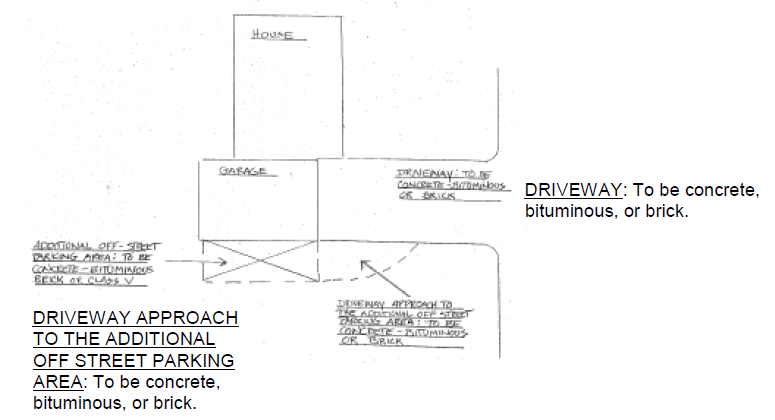
Parking in residential areas shall be limited to driveways only, except as provided in the articles of City Ordinance. Private passenger vehicles must be parked on a driveway or in a garage, or on an additional off-street parking area.
a.
Additional off-street parking shall be allowed on the side yard, behind the front setback, for the length of the principal structure provided the parking is located five (5) feet from any property line.
b.
The driveway on the property may have an approach to the additional off-street parking area.
(5)
Parking Accessory to a Residential Use. Off-Street parking on land within a residential district shall be utilized only for the following items:
a.
Currently licensed and operable passenger vehicles having a lawful capacity of nine (9) passengers or less;
b.
For the parking of one (1) commercial usage vehicle per dwelling unit, provided that it is parked in a garage or other lawfully constructed building;
c.
For the parking of one (1) public utility vehicle registered to a company that provides emergency repair services and is used by the occupant of the residence.
d.
Recreational Vehicles.
1.
You are allowed to park one (1) recreational or non-commercial vehicle outside on your lot in a residential district. That vehicle must be currently licensed and operable and must be parked a minimum of fifteen (15) feet from the back of the curb or roadway (See Subsection (a)(5)d.2. below).
2.
All recreational vehicles are to be parked behind their district's front setback line except that they are allowed in front of their district's front setback line for a period of forty-eight (48) hours for the purpose of loading and unloading.
EXCEPTIONS.
A.
Personal watercraft on their trailers, utility trailers, campers and camping buses, may be parked in front of their districts front setback line from May 1 to November 1.
B.
Snowmobiles on their trailers or utility trailers may be parked in front of their districts front setback line from November 1 to the following May 1.
C.
Above "exceptions" are to be parked a minimum fifteen (15) feet from the back of the curb or roadway.
3.
Recreational and non-commercial vehicles are allowed to be parked in your side and rear yard five (5) feet from any property line. On corner lots, both yards abutting a street shall be considered a front yard.
(6)
No more than four (4) motor vehicles per lawful dwelling unit may be parked or stored anywhere outside on residential zoned property; staff can authorize exceptions. This maximum number does not include vehicles of occasional guests.
(b)
Stall, Aisle, and Driveway Design.
(1)
Parking Dimensions. The following shall be the minimum parking space dimensions:
(2)
Within Structures. The off-street parking requirements may be furnished by providing spaces so designated within the principal building or structure attached thereto; however, unless provisions are made, no building permit shall be used to convert said parking structure into a dwelling unit or living area or other activity until adequate provisions are made to comply with the required off-street parking ordinances of this ordinance.
(3)
Circulation Between Bays. Except in the case of single, two-family, townhouse, triplex and quadraminium dwellings, parking areas shall be designed so that circulation between parking bays or aisles occur within the designated parking lot and does not depend upon a public street or alley. Except in the case of single, two-family, townhouse, triplex and quadraminium dwellings, parking area design which requires backing into the public street is prohibited.
(4)
Preserving Off-Site Parking. When required accessory off-street parking facilitie are provided elsewhere than on the lot in which the same ownership or control, either by deed or long-term lease, as the property occupied by such principal use, the owner of the principal use shall file a recordable document with the city requiring the owner and his or her heirs and assigns to maintain the required number of off-street spaces during the existence of said principal use.
(5)
Driveways Required. All off-street parking spaces shall have access from driveways and Not directly from the public street.
(6)
Distance from Intersection. No curb cut access shall be located less than forty (40) feet from the intersection of two (2) or more street rights-of-way. This distance shall be measured from the intersection of lot lines.
(7)
Curb Cut Width. No curb cut access shall exceed twenty-four (24) feet in width at the gutter elevation unless approved by the Public Works Director/City Engineer.
(8)
Distance Between Curb Cuts. Driveway access curb opening on a public street except for single, two-family, and townhouse buildings shall not be located less than forty (40) feet from one another.
(9)
Number of Curb Cuts. Each property shall be allowed one (1) curb cut access for each one hundred (100) feet of street frontage. All property shall be entitled to at least one (1) curb cut. Single-family uses shall be limited to one (1) curb cut access per property. These conditions shall apply unless otherwise granted approval by the City Council.
(10)
Grade. The grade elevation of any parking area shall not exceed five percent (5%).
(11)
Surfacing. All driveways to be utilized for parking in front of the front setback shall be surfaced with bituminous, concrete, or brick. Additional off-street parking areas to be surfaced with bituminous, concrete, brick, Class V, or other materials as approved by the city. Approaches from the driveway to the additional off-street parking area shall be surfaced with bituminous, concrete, or brick. Plans for surfacing and drainage of driveways and stalls shall be submitted to the Public Works Director/City Engineer for review and the final drainage plan shall be subject to written approval by the Public Works Director/City Engineer.
a.
When seventy-five percent (75%) or more of the homes on the block were constructed before 1984, the hard surfacing requirement does not apply.
b.
All homes built after 1984 are required to have a driveway and approach constructed of concrete, asphalt or brick.
(12)
Striping. Except for single, two-family, triplex, and quadraminiums, all parking stalls shall be marked with painted lines not less than four (4) inches wide.
(13)
Lighting. Any lighting used to illuminate an off- street parking area shall be so arranged as to reflect the light away from adjoining property, abutting residential uses and public right-of-ways and be in compliance with this ordinance.
(14)
Signs. No sign shall be so located as to restrict the sight lines and orderly operation and traffic movement within any parking lot. All signs shall conform to the Oakdale Sign Code.
(15)
Curbing and Landscaping. Except for single, two-family, triplex, and quadraminiums, all open off-street parking shall have a concrete curb according to the direction of the Public Works Director/City Engineer.
(16)
Grass, plantings or surfaced material shall be provided in all areas bordering the parking area:
Landscaping shall mean, at a minimum, the use of trees and a ground cover defined as grass, shrubs, or other material allowing water to seep through the ground. Berming can also be used effectively. Berm profile shall not exceed a slope of one (1) foot of elevation in three (3) horizontal feet unless approved methods of slope stabilization are utilized.
Side yard landscaping requirements for parking areas may be reduced if the developer Proposes to locate his parking area next to an existing or proposed parking lot on an adjacent parcel owned by others and the owners have a written agreement to allow joint parking and a common driveway. However, only the common boundary to be used for parking will qualify. In such cases, the sum of the parking area of the two (2) owners will determine the landscaping requirements within the total parking area.
(17)
Electric Vehicle Charging Station.
a.
Electric vehicle charging station infrastructure shall be installed in compliance with the state building and electrical codes.
b.
The installation of electric vehicle supply equipment shall not reduce the overall minimum parking space area dimensions below those required in Section 25-186(b)(1).
c.
Parking spaces equipped with electric vehicle charging infrastructure shall count toward meeting minimum parking space requirements.
d.
All electric vehicle charging station wayfinding and station signage shall conform to the standards in Chapter 25, Article 19 of the Oakdale Code of Ordinances.
e.
Individuals seeking to install electric vehicle charging infrastructure in residential and non-residential settings should refer to the recommendations in the City of Oakdale Electric Vehicle Charging Infrastructure Guidelines document.
(c)
Maintenance. It shall be the joint and several responsibility of the lessee and owner of the principal use, uses or building to maintain in a neat and adequate manner, the parking space, access ways, striping, landscaping, and required fences. Parking lots existing prior to the adoption of this ordinance shall not be exempt from the requirement.
(d)
Use of Required Area. Required accessory off-street parking spaces in any district shall not be utilized for open vehicles without a Special Use Permit.
(e)
Number of Spaces Required. The following minimum number of off-street parking spaces shall be provided and maintained by ownership, easement and/or lease for and during the life of the respective uses hereinafter set forth.
(1)
Single-family or Two-Family Dwellings. Two (2) off-street spaces per unit. Each twenty (20) linear feet of single-lane garage and/or driveway count as one (1) parking space.
(2)
Multiple-Family Structures. Off-street parking shall be provided according to the following schedule:
a.
Visitor parking must be provided in common bays. Such parking must be located no more than one hundred fifty (150) feet from the dwelling units it is meant to serve.
b.
If the housing has direct access only to a public or private street on which the City Council determines that parking is not allowed, at least one (1) off-street visitor space per unit must be provided. However, if double-car garages and double driveways are being used in such an instance, only 1/2 off-street visitor space per unit is required.
c.
Each twenty (20) linear feet of single-lane garage and/or driveway count as one (1) parking space up to a maximum of two (2) spaces.
(3)
Motels, Motor Hotels, Hotels. One (1) space per each rental unit, plus one (1) space for each ten (10) units and one (1) additional space for each employee on any shift, plus additional spaces as may be required herein for related uses contained within the principal structure.
(4)
Church, Theater, Auditorium. At least one (1) parking space for each four (4) seats based on the design capacity of the main assembly hall. Facilities as may be provided in conjunction with such buildings or uses shall be subject to additional requirements which are imposed by this ordinance.
(5)
Sanitariums, Convalescent Home, Rest Home, Nursing Home or Day Nurseries. Four (4) spaces plus one (1) for each three (3) beds for which accommodations are offered, plus visitors' parking.
(6)
Elderly (Senior Citizens) Housing. Reservation of area equal to one (1) parking space per unit. Initial development is, however, required of only 1/2 space per unit and said number of spaces can continue until such time as the City Council considers a need for additional parking spaces has been demonstrated.
(7)
Convenience Food Restaurants. At least one (1) parking space for each table.
(8)
Bowling Alley. At least five (5) parking spaces for each alley, plus additional spaces as may be required herein for related uses contained within the principal structure.
(9)
Motor Fuel Station. At least four (4) off-street parking spaces, plus two (2) off-street parking spaces for each service stall. Those facilities designed for sale of other items than strictly automotive products, parts or service shall be required to provide additional parking in compliance with other applicable sections of this ordinance.
(10)
Retail Stores and Service Establishment. At least one (1) off-street parking space for each two hundred (200) square feet of floor area.
(11)
Manufacturing. Fabricating or Processing of a Product or Material. One (1) space for each employee on the main shift, plus one (1) space for each company owned truck (if not stored inside principal building), plus visitors' parking.
(12)
Warehousing, Storage or Handling of Bulk Goods. That space which is solely used as office shall comply with the office use requirements and one (1) space per each one thousand (1,000) square feet of floor area, plus one (1) space for each employee on maximum shift, and one (1) space for each company owned truck (if not stored inside principal building), plus visitors' parking.
(13)
Research or Testing Facilities. One (1) space per employee on the major shift, plus one (1) space for each company owned truck, plus visitors' parking.
(14)
Car Wash. (In addition to required stacking space).
a.
Automatic Drive Through, Serviced. A maximum of ten (10) spaces, or one (1) space for each employee on the maximum shift, whichever is greater.
b.
Self-Service. A minimum of two (2) spaces per stall.
c.
Motor Fuel Station Car Wash. None in addition to that required for the station.
(15)
Private Racquetball, Handball, and Tennis Courts. Not less than three (3) spaces per each court.
(16)
Offices. (In addition to visitors' parking):
(17)
Medical and Dental Offices. Six (6) spaces for each doctor or dentist, plus one (1) per employee.
(18)
Restaurants, Taverns. One (1) space for each three (3) seats plus one (1) for each two (2) employees.
(19)
Furniture Stores. One (1) off-street parking space per four hundred (400) square feet plus one (1) space per eight hundred (800) square feet over six thousand (6,000) square feet.
(f)
Joint Use of Parking Facilities.
(1)
Up to eighty percent (80%) of the parking facilities required by this section for a church or for an auditorium incidental to a public or parochial school may be supplied by the off-street parking facilities by the following daytime uses: banks, business offices, retail stores, personal service shops, household equipment or furniture shops, clothing or shoe repair or service shops, manufacturing, wholesale and similar uses.
(2)
Conditions Required for Joint Use.
a.
The building or use for which application is being made to utilize the off-street parking facilities provided by another building or use shall be located within three hundred (300) feet of such parking facilities.
b.
The applicant shall show that there is no substantial conflict in the operating hours of two (2) buildings or uses for which joint use of off-street parking facilities is proposed.
c.
A properly drawn, legal instrument, executed by the parties concerned for joint use of off-street parking facilities, duly approved as to form and manner of execution by the City Attorney, shall be filed with the City Clerk and recorded with the Register of Deeds, Washington County.
(g)
Off-Site Parking.
(1)
Any off-site parking which is used to meet the requirements of this ordinance shall be a special use as regulated by this ordinance and shall be subject to the conditions listed below.
(2)
Off-site parking shall be developed and maintained in compliance with all requirements and standards of this ordinance.
(3)
Reasonable access from off-site parking facilities to the use being served shall be provided.
(4)
The site used for meeting the off-site parking requirements of this ordinance shall be under the same ownership as the principal use being served or under public ownership.
(5)
Off-site parking for multiple family dwellings shall not be located more than one hundred (100) feet from any normally used entrance of the principal use served.
(6)
Off-site parking for non-residential uses shall not be located more than three hundred (300) feet from the main entrance of the principal use being served. No more than one (1) main entrance shall be recognized for each principal building.
(7)
Any use which depends upon off-site parking to meet the requirements of this ordinance shall maintain ownership and parking utilization of the off-site location until such time as on-site parking is provided or a site in closer proximity to the principal use is acquired and developed for parking.
(h)
Installation of Asphalt Driveways and Parking Lots.
The following procedure and specifications shall be required for all asphalt driveway construction from streets to private garages, and for all parking lot construction.
Work conducted within the Right-of-Way shall follow the procedures of Chapter 20.
(1)
The driveway or parking lot shall be excavated to remove all organic or other unstable soils from the area to be surfaced.
(2)
The area to be surfaced shall be graded and compacted to the elevation that will permit the placement of the full pavement section.
(3)
Minimum pavement sections for driveways and parking lots shall be:
a.
Driveways for residential buildings with four (4) units or less per building: 2331 bituminous wearing course two (2) inches compacted Class V aggregate base - six (6) inches compacted.
b.
Parking lots and driveways for residential buildings with more than four (4) units per building, and commercial, industrial, and institutional areas: 2341 bituminous wearing course - two (2) inches compacted 2331 bituminous binder course - two (2) inches compacted Class V aggregate base, six (6) inches compacted unless alternates are approved, in writing, by the city. In all cases, alternate pavement sections shall be considered only if sufficient data to justify another pavement design, based on the current Minnesota Highway Department design procedure for flexible pavement is submitted as part of a formal alternate request. If, based on the plan that is presented, the Building Official determines that the proposed driveway or parking lot construction is not deemed adequate due to traffic volumes or types of traffic, additional construction materials may be required by the city, based on Minnesota Highway Department design criteria.
(4)
The performance of the work and the quality of materials shall be in accordance with the latest revision of the State of Minnesota, Department of Highways Standard specifications for Highway Construction.
(5)
The Building Official shall be granted access to the improvement area during all phases of construction. The contractor or owner shall arrange for inspections of the grading work, the aggregate base placement, and the bituminous course placement, by the Building Official prior to proceeding with the subsequent work phase. Any and all stability, compaction, gradation, or other material or placement tests that the Building Official may request shall be provided by the contractor or owner through a testing company acceptable to the city.
(6)
Driveways and parking lots shall be constructed so as to provide drainage from the garage to the street or storm sewer system, unless an alternative method is approved by the Building Official.
(7)
Installation of metal utility covers on curb boxes and clean-outs in paved areas is required.
(i)
Additional Requirements for Driveways Opening on State, County or U.S.Highway. Where a proposed driveway is to be constructed so that it opens onto any street designated as either a Minnesota State, Washington County or U.S. Trunk Highway, in addition to the requirements of this article, all specifications of the appropriate highway departments will apply, and the required permits shall be obtained from the appropriate department.
(Ord. 867, 2/09/21; Ord. 883, 5/10/22)
Sec. 25-321. - Off-Street Loading.
(a)
Location.
(1)
All required loading berths shall be off-street and located on the same lot as the building or use to be served.
(2)
Except for loading berths required for apartments, no loading berth shall be located closer than fifty (50) feet from a residential district unless within a structure.
(3)
Loading berths shall not occupy the front yard setbacks.
(4)
Loading berths located at the front or at the side of buildings on a corner lot shall observe the following requirements:
a.
Loading berths shall not conflict with pedestrians.
b.
Loading berths shall not obstruct the view of the public right-of-way from off-street parking access.
c.
Loading berths shall comply with all other requirements of this article.
(5)
Each loading berth shall be located with appropriate means of vehicular access to a street or public alley in a manner which will cause the least interference with traffic.
(b)
Screening. All loading areas shall be screened and landscaped from abutting and surrounding residential uses.
Sec. 25-322. - Farming Operations.
All farms in existence upon the effective date of this ordinance where the owner or operator can conduct a farming operation shall be considered a Permitted Use. However, upon a change of the farming operation which results in any part of the land area becoming more intensively used, thus rendering it more urban in character, the regulations contained herein shall apply back to that part of the subject property. In those instances, setback and other regulations shall apply just as they do to urban developments. The City Council, in its discretion, may require any farm operation to secure a Special Use Permit to continue said operations in the industrial-type use (i.e. compounding, processing, and packaging of products for wholesale or retail trade). Such operations may tend to become a permanent industrial type operation that cannot be terminated as can a normal farming operation and control of such operations will be maintained by means of a Special Use Permit.
Sec. 25-323. - Land Reclamation, Mining and Soil Processing.
Land reclamation, mining and soil processing, as defined herein, shall require the issuance of a Special Use Permit for each project, and the issuance of such a permit shall always require the prior consultation of the City Council with the Public Works Director/City Engineer. A performance bond, irrevocable letter of credit, or cash deposit shall be required to guarantee that proposed work is done satisfactorily.
(a)
Land Reclamation. The reclaiming of land by depositing of material so as to elevate the grade and the process of depositing more than one thousand (1,000) cubic yards on any lot or parcel of land shall be land reclamation. Any permit issued for land reclamation shall specify plans and programs for the finished grade which will not adversely affect the adjacent land, the type of fill permitted, rodent control, fire control and general maintenance of the site, vehicular ingress and egress, material disbursed by wind or by hauling of material to or from the site, surface water drainage, site restoration. Hours of operation shall be specified. The Council may also apply any other regulations it sees fit to protect the interest of the public. Such permit shall be granted for a specified period.
(b)
Excavation. The extraction of sand, gravel, or other material from the land in the amount of four hundred (400) cubic yards or more and removal thereof from the site without processing shall be considered to be excavation for the purposes of this ordinance.
(c)
Soil Processing. The processing of sand, gravel, sod, or other material mined from the land shall be considered soil processing for purposes of this ordinance. Any permit issued for soil processing shall include as a condition thereof a site plan where the processing is to be done, showing the location of the plant, disposal of water, and the route of trucks moving to and from the site in removing processed material from the site. Such permit shall be granted for a specified period.
Sec. 25-324. - Glare, Smoke, Dust, Odors, and Noise.
(a)
Any lighting used to illuminate an off-street parking area, sign or other structure, shall be arranged as to deflect light away from any adjoining residential zone or from the public streets. Direct or sky-reflecting glare, where from floodlights or from high temperature processes such as combustion or welding shall not be directed into any adjoining property. The source of lights shall be hooded or controlled in some manner so as not to light adjacent property. Bare incandescent light bulbs shall not be permitted in view of adjacent property or public right-of-way.
(b)
The emission of smoke, odor, or particulate matter by any use shall be in compliance with and regulated by the State of Minnesota Pollution Control Standards, Minnesota Pollution Control Agency Regulation APC 1-15, as amended.
(c)
Noises emanating from any use shall be in compliance with and regulated by the State of Minnesota Pollution Control Standards, Minnesota Regulations, as amended.
Sec. 25-325. - Bulk Storage (Liquid).
All uses associated with the bulk storage of all gasoline, oil, liquid fertilizer, chemical, flammable and similar liquids shall comply with requirements of the Minnesota State Fire Marshal and Minnesota Department of Agriculture Offices and have documents from those offices stating the use is in compliance.
Sec. 25-326. - Radiation and Electrical Emissions.
(a)
All activities that emit radioactivity shall comply with the minimum requirements of the Minnesota Pollution Control Agency.
(b)
All activities which create electrical emissions shall comply with the minimum requirements of the Federal Communications Commission.
Sec. 25-327. - Relocated Structures.
(a)
Dwellings and Other Structures.
(1)
No dwelling structure, single or multiple-family or other structure shall be permanently located on a dwelling site unless a permit therefore shall have first been obtained from the city.
(2)
Every applicant for such a permit shall be required to submit an application to the City Building Official containing the following information:
a.
Name and address of applicant;
b.
Description of structure (interior and exterior dimensions, type and exterior finish);
c.
Street address and legal description of proposed site;
d.
Name of fee owner of said site;
e.
Latest available assessed valuation of structure to be relocated;
f.
Present location of structure, giving street address;
g.
Name and address of moving contractor to be hired by applicant;
h.
Detailed description of all exterior changes, alterations or upgrading to be made to said structure immediately after relocation;
i.
The date by which all the work shall be completed.
(3)
Every such application shall be accompanied by:
a.
List from the Washington County Surveyor's Office showing names and addresses of the owners of all property owners within five hundred (500) feet of applicant's proposed site;
b.
Color photographs of structure to be relocated clearly showing views of front, back and all sides;
c.
A plot plan showing the proposed location of the relocated structure;
d.
Photographs of all other dwellings located on lots within five hundred (500) feet of proposed site.
(4)
The City Building Official shall inspect the structure before relocation and the proposed new location site for the purpose of determining:
a.
The suitability of the proposed new sites;
b.
Whether or not the building to be relocated would be likely to substantially detract from the existing buildings in the immediate vicinity within a radius of five hundred (500) feet;
c.
Structural or exterior work required, if any, to bring structure into compliance with City Building Code and Uniform Building Code.
(5)
The applicant shall pay to the city a fee to cover the cost of processing the application. This fee shall be in an amount as set out in City Council resolution.
(6)
The City Council shall set a public hearing on the application for relocation.
(7)
The City Building Department shall notify all owners of property situated within five hundred (500) feet of the proposed site and said notice shall contain the following information:
a.
The location of the proposed site;
b.
General description of the applicant's proposal;
c.
Date and time of Council hearing.
(b)
The requirements of this section do not apply to construction sheds or other similar temporary structures to be located on a lot for eighteen (18) months or less.
Sec. 25-328. - Corner Lots.
On corner lots in all districts, no structure or planting in excess of thirty (30) inches above the street center line grade shall be permitted within a triangular area defined as follows: beginning at the intersection of the projected property lines of two (2) intersecting streets, thence twenty (20) feet along one (1) property line, thence diagonally to a point twenty (20) feet from the point of beginning on the other property line, thence to the point of beginning.
Sec. 25-329. - Refuse and Weeds.
In all areas, all waste material or garbage shall be kept in an enclosed building or properly contained in a closed container designed for such purposes. The owner of all land shall be responsible for keeping such land free of refuse and weeds.
Passenger vehicles and trucks in an inoperative state shall not be parked outdoors in Residential Districts for a period of time exceeding seven (7) days. Inoperative shall mean incapable of movement under their own power and shall include vehicles incapable of legal operation on a public street. All exterior storage not allowed as an Accessory Use, Permitted Use, or Special Use shall be considered refuse.
Sec. 25-330. - Temporary Family Health Care Dwellings.
Pursuant to the authority granted by Minnesota Statutes Section 462.3593, Subdivision 9, the City of Oakdale opts out of the requirements of Minnesota Statutes Section 462.3593, which defines and regulates Temporary Family Health Care Dwellings.
(Ord. 813, 8/23/16)
Sec. 25-331. - Interim Conditional Use Permit.
(a)
Interim Use Defined. A temporary use of a property until a particular date, until the occurrence of a particular event or until the zoning regulations no longer permit it.
(b)
Limited Application. The interim conditional use permit procedures are not to be construed to, in any way, modify the provisions for the issuance of a Special Use Permit.
(c)
Permit. The City Council may grant an interim conditional use permit for the interim use of property if:
(1)
The use conforms to the zoning regulations;
(2)
The date or event that will terminated the use can be identified with certainty;
(3)
Permit of the use will not impose additional costs on the city if it is necessary for the city to take the property in the future; and
(4)
The permittee agrees in writing to any conditions that the city council deems appropriate for permission of the use.
(d)
Application Procedures, Exhibits and Criteria. The procedures for applying for an interim conditional use permit, the required exhibits and the criteria for granting an interim conditional use permit shall be the same as for Special use Permits, as contained in Section 25-15 of the City Code.
(e)
Permit Termination. An interim conditional use permit shall be terminated by:
(1)
A change in zoning regulations, which prohibits the use.
(2)
The date of event(s) stated in the permit.
(3)
Upon violation of the conditions under which the permit was issued.
(f)
Criteria for Termination. In establishing the date of event for the termination of the interim conditional use permit, the city council shall consider the advice and recommendations of the planning commission, the effect of the proposed use on the comprehensive plan and the health, safety and general welfare of the occupants of surrounding lands. The criteria for terminating the interim conditional user permit shall include, but are not limited to, the following:
(1)
The assessment of the subject property for sanitary sewer.
(2)
If the interim use becomes in conflict with the comprehensive plan.
(g)
Notice of Terminations. Upon the occurrence of the date or of the criteria for termination set forth in the interim conditional use permit, the city shall notify the permittee in writing that the interim conditional use permit shall terminate on the date specified in the notice.
(h)
Permit Review. An interim conditional use permit may be reviewed annually but may be reviewed at any time if the council is of the opinion that the terms and conditions of the permit have been violated or if one (1) of the criteria for termination has been met.
(i)
Permit Extension. The city council shall have the right to extend the termination date for such additional periods as are consistent with the terms and conditions of the original permit.
Sec. 25-332. - Design Standards.
(a)
Purpose and Intent. It is the intent of this section to promote high standards of new design and construction for the commercial, public, and industrial uses in the city. These standards are set forth in order to enhance the visual appearance of the commercial, public, and industrial area within the city, to increase the taxable value of the city, and to promote the community public health, safety, and welfare. This section is to ensure the high quality of development, redevelopment, and compatibility with evolving architectural or planning themes that contribute to a community image of quality.
(b)
Development Review Committee.
(1)
The Development Review Committee (DRC) shall consist of at least three (3) members of the City Staff, to be appointed by the City Administrator. The DRC shall determine technical conformance of proposed developments with the requirements of this section.
(2)
If the DRC determines that the plans comply with the intent and standards of this section, a building permit may be issued. All decisions of the DRC may be appealed to the City Council whose decision shall be final. The City Council shall refer such an appeal to the Planning Commission first for a recommendation.
(c)
Exterior Design Standards. Exterior surface materials of buildings shall be subject to the following:
(1)
Classes of materials. For the purpose of this subsection, materials shall be divided into Class I; Class II; and Class III categories as follows:
Class I
a.
Brick.
b.
Natural stone or architectural precast stone products.
c.
Glass.
d.
Copper panels, stainless steel, or similar superior metal.
e.
Other comparable or superior materials.
Class II
a.
Specialty concrete block such as textured, burnished block or rock faced block.
b.
Architecturally textured precast concrete panels (except raked finish).
c.
Masonry stucco/Exterior finish insulation systems (EFIS).
d.
Other comparable or superior materials.
Class III
a.
Opaque panels.
b.
Smooth scored concrete block.
c.
Ceramic finished concrete block.
d.
Glass block.
e.
Wood.
f.
Other comparable for superior materials.
(2)
Buildings shall incorporate classes of materials in the following matter:
a.
Office and commercial buildings must use at least three (3) Class I materials and must be composed of at least seventy percent (70%) Class I materials and not more than thirty percent (30%) Class II or Class III materials.
b.
Industrial and warehouse buildings must use at least two (2) different Class I or II materials and be composed of at least sixty percent (60%) Class I or Class II; not more than forty percent (40%) of Class III materials.
c.
Buildings in nonresidential zoning districts that are not office, commercial, industrial or warehouse uses shall conform to the exterior finish materials and proportions of office or commercial buildings unless otherwise approved by the City Council as meeting the purpose of this division.
d.
The use of Class II or III materials shall be distributed throughout the exterior of a building unless the city agrees that materials consolidated on more visible locations provides the most positive architectural appeal to the general public.
e.
A distinctively different color of brick may be considered as a second Class I material. However, minor blended color variations shall not be considered as a separate material.
f.
To be counted as a primary material, the product must comprise at least five percent (5%) of the exterior wall.
(3)
Buildings may be constructed primarily of one (1) specific Class I materials provided the design is obviously superior to the general intent of this division, provides variation in detailing, footprint of the structure or deviations in long wall sections to provide visual interest.
(4)
Garage doors, window trim, flashing accent items and the like, shall not constitute required materials that make up the exterior of a building.
(5)
Garish or bright accent colors (i.e. orange, bright yellow, or fluorescent colors) for such buildings as cloth or metal awnings, trim, banding, walls, entries or any portion of the building shall be minimized, but in no case shall such coloring exceed five percent (5%) of each wall area.
(6)
Brick or stone exteriors shall not be painted at any time.
(7)
Equipment used for mechanical, processing, bulk storage tanks, or equipment used for suppressing noise, odors, and the like that protrudes from a side of a building or is located on the ground adjacent to a building shall be screened from public view as much as practical with materials matching the design of the building. Where miscellaneous exterior equipment cannot be fully screened with matching building materials, landscaping may be used as additional screening.
(8)
Pre-engineered metal buildings of any kind are prohibited.
(d)
Accessory Structures. Garages and accessory structures shall be of the same material, quality and appearance as the principal structure. The height of the accessory structure shall not exceed that of the principal structure. Screen walls and exposed areas of retaining walls shall be constructed of a permanent material and finish and shall be of a color compatible with the principal structure.
(e)
Rooftop Utilities. The ground level view of all rooftop equipment including rooftop structures related to elevators and other mechanical utilities, shall be located at a length equal to 1/2 the height of the face of the building. All mechanical equipment located on the roof or around the perimeter shall be screened with materials that are comparable and compatible with that of the exterior building materials. If due to factors unique to the property or the project, it is physically impossible or impractical to screen these utilities, the Development Review Committee, after consultation with the Planning Commission, may approve alternative solutions that renders them aesthetically compatible with the principal structure.
(1)
A raised parapet or other architectural feature that is an integral part of the building is encouraged as a method of screening for rooftop mechanical equipment or to soften the rooftop view.
(2)
Screening for rooftop mechanical equipment shall incorporate similar architectural features of the building and/or be constructed of a material and color compatible with other elements of the building.
(f)
Screening of Loading and Service Areas. The screening requirements contained in this section shall be satisfied through the use of walls, earthen berms, hedges, and other landscape materials. If the topography, existing vegetation, permanent structure or other features create a barrier that meets the standards of this section, they may be substituted.
(1)
The perimeter views of all external loading and service areas and any areas of outdoor storage must be screened from residential uses and adjacent public streets and the public front and office sides of all commercial and industrial uses, except at access points. Such screening can be accomplished through:
a.
The placement of the building on the lot or the placement of a building on an adjacent lot.
b.
Through the use of berming and landscaping (eighty percent (80%) opaque at the time of maturity). Planting screens shall consist of healthy, hardy plant materials at least six (6) feet in height.
c.
If screen walls are proposed, the materials used shall be of similar type, quality, and appearance as that of the principal structure. Such screens shall be at least six (6) feet in height and provide a minimum opaqueness of eighty percent (80%).
d.
Screen walls that are in disrepair shall be repaired. Planting screens shall be maintained in a neat and healthful condition. Plantings that have died shall be promptly replaced.
(g)
Trash Handling. All trash, recycling and related handling equipment shall be stored within the principal structure within an attached structure accessible from within the principal structure, or within an unattached structure. Such attached storage area shall be separated from the principal structure by a firewall. Recycling areas shall also be provided. Trash, recycling, and rubbish receptacles shall be totally screened from eye level view from public streets and adjacent residential properties. Such structure shall be of the same material and architecturally harmonious with principal structure and shall be enclosed by a roof and readily served through a door or gate system properly designed and constructed for abusive use. In Industrial Zones, an attached two-sided structure, or an unattached three-sided structure, without an overhead door or roof, may be allowed for containers that must be truck lifted and not manually positioned.
(1)
Any changes to trash handling once the building is constructed shall comply with the above and meet with approval of the Design Standards Committee (i.e. new tenants).
(h)
Landscaping.
(1)
All areas of land other than that occupied by building and/improved surfaces (parking areas and driveways) shall be landscaped by a professional landscape architect. The surface shall include sod and/or mulch and/or rock material in planting beds. There shall be a minimum one (1) tree per eight hundred (800) square feet of the landscaped green area.
(2)
In addition, the minimum number of overstory trees along the boulevard shall be one (1) overstory tree per fifty (50) linear feet of lot frontage. If the preferred landscaping technique is to cluster the boulevard trees instead of one (1) tree per fifty (50) feet, it may be deemed allowable if it is determined workable by the Design Review Committee. Other understory trees, shrubs, flowers and ground covers needed to complete any landscape treatment shall be included in addition to the required minimum of overstory trees.
(3)
All trees used in site developments shall be indigenous to the appropriate hardiness zone and physical characteristics of the site. All deciduous trees proposed to satisfy the minimum requirements of this policy shall be long-lived hardwood species. It is the responsibility of the owner to ensure to the longevity and maintenance of all plantings. If any plantings were to die within a year of construction, the owner will need to replace such plantings to be in compliance with the Design Standards.
(4)
The complement of trees fulfilling the requirements of this policy shall be not less than twenty-five percent (25%) overstory deciduous and not less than twenty-five percent (25%) coniferous. Oaks to be twenty percent (20%) of required landscaping trees. For difficult soil conditions or unique sites, oak and evergreen trees can be reduced up to 1/4 of their specified percentage (i.e. oaks twenty percent (20%) reduced 1/4 to net fifteen percent (15%)). All trees selected for landscaping must specify a minimum of two variety's of each species.
(5)
All area not otherwise improved in accordance with approved site plans shall be sodded. Exceptions are as follows:
a.
Seeding of future expansion areas as shown on approved plans.
b.
Undisturbed areas containing existing viable natural vegetation that can be maintained free of foreign and noxious plant material.
c.
Areas designated as open space or future expansion areas properly planted and maintained with prairie grass.
d.
Use of mulch material such as rock or wood chips in support of shrubs and foundation plantings.
(6)
Slopes and Berms. Final slope grades steeper than the ratio of 3:1 will not be permitted without special landscaping treatments such as terracing, retaining walls, ground cover or engineered surface treatment. Berming used to provide screening of parking lots shall be three (3) feet in height and shall have a maximum slope ratio of 3:1.
(7)
Woodland Preservation Credit. Credit for the retention of existing trees meeting the species, size and location requirements of this ordinance may be used to satisfy the minimum number requirements set forth in this ordinance.
(8)
Parking Lot Requirements.
a.
Parking lots are required to landscape five percent (5%) of the parking lot surface area within the parking setback. The landscaped area could be in the form of landscape islands or as setback areas that are incorporated into the parking lot. Landscape islands shall be a minimum width of sixteen (16) feet and with a minimum surface area of two hundred sixty (260) square feet. The landscaped area must adhere to the size and material requirements of this ordinance.
b.
Parking lots shall be screened from the public right-of-way. Such screening shall be eighty percent (80%) opaque and a maximum height of three (3) feet. The screen may be:
1.
Plant materials.
2.
Wood, concrete, masonry or ornamental iron, or a combination of these materials.
c.
On a corner lot, and at entrances, nothing shall be placed or allowed to grow in such a manner as to impede vision between a height of 2-1/2 and ten (10) feet above the centerline grades of the intersecting streets within a triangular area thirty (30) feet from the intersecting street right-of-way lines.
(9)
Plant Size Requirements. Plant size requirements for landscaping areas shall be as follows:
a.
One and one-half inch (1 1/2) minimum size on all deciduous trees.
b.
Ornamental trees shall be a minimum of 1 1/2 inches in diameter.
c.
Evergreen trees must have a minimum height of six (6) feet.
d.
Potted shrubs shall be in a five (5) gallon pot or larger.
e.
Evergreen shrubs used for screening purposes shall be at least three (3) feet in height at planting. Evergreen shrubs will have a minimum spread of twenty-four (24) inches.
(10)
Landscape plans and screening plantings shall be completed within one (1) year from the date of building permit.
(i)
Site Lighting. All exterior lighting shall be designed and arranged to direct illumination away from adjacent properties. All exterior lighting shall be arranged and designed to illuminate directly below or inboard of the property lines of the property such that the point source of light is not directly discernable by pedestrian or vehicular traffic in the public right of way. Site lighting shall have a maximum height of thirty (30) feet to the illumination source. Site lighting for public recreational uses shall have a maximum height of seventy (70) feet to the illumination source. Lighting shall be designed such that there is a maximum 0.5 foot-candles at any property line. No offsite glare will be allowed. A photometric plan inclusive of all site lighting and specification sheets for each lighting fixture shall be submitted for review.
(j)
Technology Adaptable Buildings. If, in any case, the building were to change ownership and/or uses in an attempt to adapt to market shifts, the current project shall consider, and where feasible implement, future technological infrastructure and improvements so that the ability to convert and adapt to changes may be done in an efficient and effective manner.
Sec. 25-333. - Swimming Pools.
(a)
A building permit shall be required for the construction or installation of any swimming pool which shall have a capacity of three thousand (3,000) gallons or more.
(b)
An application for a building permit shall include the following information:
(1)
Type and size of pool.
(2)
Site plan to scale.
(3)
Location of pool.
(4)
Location of house, garage, fencing and other structures on the lot.
(5)
Location of structures on all adjacent lots.
(6)
Location of filter unit, pump, and wiring (indicating type of such equipment).
(7)
Location of back-flush and drainage outlet.
(8)
Grading plan, finished elevations, and final treatment (decking, landscaping, etc.) around the pool.
(9)
Location of existing overhead or underground wiring and utility easements.
(c)
In Single Family and Two-Family Areas.
(1)
Pools for which a building permit is required shall not be located within ten (10) feet of any side or rear lot line nor within six (6) feet of any principal structure or frost footing. Pools shall not be located within the front or side-yard setback area.
(2)
Pools shall not be located beneath overhead utility lines nor over underground utility lines of any type.
(3)
Pools shall not be located within any private or public utility, walkway, drainage, or other easement.
(4)
To the extent feasible, back-flush water or water from pool drainage shall be on the owners' property or into approved public drainage ways. Water shall not drain onto adjacent land.
(5)
Any mechanical or electrical equipment which produces noise, such as pumps or filters, shall be located at least thirty (30) feet from any dwelling on adjacent property and not closer than ten (10) feet to any lot line unless such equipment is enclosed in a sound-resistive enclosure. In all cases, noise shall not exceed minimum standards as set forth in Ordinance 234.
(6)
Lighting for the pool shall be directed into or onto the pool and shall not spill onto adjacent property. Any floodlights shall be shielded sufficiently to prevent the spillover of light onto adjacent properties.
(7)
Swimming Pools. For any pool of over eighteen (18) inches of water depth, a safety fence and/or poolside of a non-climbable type of at least four (4) feet in height shall completely enclose the pool, prior to filling of the pool. Temporary pools are exempt from this requirement. Temporary pools are defined as those that are removable and/or portable which are removed seasonably for winter.
(8)
Water in the pool shall be maintained at all times in a suitable manner to avoid health hazards of any type. Water shall be subject to periodic inspection by the city.
(9)
All wiring, lighting, installation of heating units, grading, installation of pipes, and all such other installations and construction shall be subject to inspection by the city for code compliance.
(10)
Above ground pools utilizing removable ladders for ingress and egress shall have the ladder removed when unattended. Above ground pools utilizing fixed stairs shall be affixed with a four (4) foot, non-climbable fence or gate to be locked when unattended.
(11)
Any proposed deviation from these standards and requirements shall require a variance in accordance with normal zoning procedures.
(d)
In Multiple-Family Areas and Non-residential Use Areas. Pools in multiple-family areas (residential structure containing three (3) or more dwelling units) shall conform to the standards set out in (c) above with the following added restrictions:
(1)
No part of the water surface of the swimming pool shall be closer than thirty (30) feet to any lot line.
(2)
No pump, filter, heating units, or other apparatus used in connection with or to service a swimming pool shall be located less than thirty (30) feet from any lot line.
(3)
All deck areas, patios, or other similar areas used in conjunction with a swimming pool shall be located not closer than thirty (30) feet to any adjacent residential district line. Adequate screening, including both fencing and landscape treatment, shall be placed between said areas and adjacent single-family and two-family lot lines.
(4)
All-season pool enclosures shall require site plan review by the Planning Commission and City Council.
(e)
In All Areas.
(1)
Required safety fencing shall be completely installed within three (3) weeks following installation of pool and prior to pool being filled.
(2)
Nuisances such as undue noise, lighting onto adjacent property, health and safety hazards and the like shall not be permitted.
(f)
Permit Fee. Prior to the issuance of a construction or installation permit, the applicant shall pay a permit fee based upon the estimated value of the proposed pool. The amount of the fee shall be determined by using the City of Oakdale table of Inspection Department Building Permit Fees. These fees shall apply to all pools requiring a building permit pursuant to Section 25-190(a) of this ordinance.
Sec. 25-334. - Garage Sales.
(a)
Garage sales are allowed in all residential zoning districts with the following restrictions:
(1)
There shall be not more than three (3) sales events in each calendar year per dwelling unit, including the annual citywide Oakdale garage sale.
(2)
Sale events are limited to any consecutive four (4) day period.
(3)
Garage and craft sale signs must comply with the sign ordinance including sections of the City Code.