
Oglesby City Zoning Code
CHAPTER 11
REVIEW AND APPROVAL PROCEDURES
Sections:
14.11.010 - General.
(A)
Summary of Procedures: The following table provides a summary of the review and approval procedures of this chapter. In the event of conflict between this summary table and the detailed procedures contained elsewhere in this chapter, the detailed procedures govern.
1.
Procedures Table:
Hearing = Public hearing required
Final action = Granting of permit, approval, or denial
(B)
Authority To File: Unless otherwise specifically stated in this chapter, applications may be filed by the owner of the subject property.
(C)
Application Contents:
1.
All applications required under this chapter must be submitted in a form and in such numbers as required by the official responsible for accepting the application. Application forms are available in the office of the official responsible for accepting the application.
2.
Officials responsible for accepting applications must maintain a list specifying the materials and information to be submitted with each application filed. The list must be made available to all applicants and to any other person who requests a copy.
(D)
Application Completeness:
1.
An application will be considered complete and ready for processing only if it is submitted in the required number and form, includes all required information and is accompanied by the required fee. The official responsible for accepting the application has authority to determine whether the application is complete.
2.
If an application is deemed incomplete, written notice explaining the deficiencies must be provided to the applicant.
3.
No further processing of incomplete applications will occur until the deficiencies are corrected. If the deficiencies are not corrected by the applicant within ninety days, the application will be considered withdrawn.
4.
An applicant shall be solely responsible for all information provided to the city and the city assumes no responsibility to verify or confirm information in an application.
(E)
Application Filing Fees: Applications must be accompanied by the fee amount that has been established by the city council. Fees are not required with applications initiated by the plan commission or city council. Application fees are nonrefundable.
(F)
Public Notice:
1.
Written Notice: When provisions of this chapter require that "written notice" be provided, such notice must be given as follows:
(a)
The city clerk, based upon information provided to the city clerk by the applicant or his agent, must provide written notice to the owners within one hundred feet of the property lines of the subject property and to all public elementary and high schools having jurisdiction over the subject property.
(b)
Written notice must be mailed at least seven days before the public hearing.
(c)
All required written notices must be sent by USPS mail.
(d)
Written notices must contain:
(1)
The date, time and location of any upcoming public hearings on the matter;
(2)
The address of the subject property;
(3)
A description of the nature and purpose of the application;
(4)
The name and address of the applicant; and
(5)
Contact information for additional information on the application.
(e)
The city clerk shall mail appropriate notices to the parties entitled to receive notice based upon the information provided to the city clerk by the applicant or his agent.
2.
Published Notice:
(a)
When provisions of this chapter require that "published notice" be provided, the city clerk shall be responsible for publishing notice in a newspaper of general circulation in the city.
(b)
The notice must be published at least once, at least fifteen days but not more than thirty days before the hearing.
(c)
Published notices must contain:
(1)
The date, time and location of any upcoming public hearings on the matter;
(2)
The address of the subject property;
(3)
A description of the nature and purpose of the application;
(4)
The name and address of the applicant; and
(5)
Contact information for additional information on the application.
3.
Posted Notice:
(a)
The petitioner shall post a sign on the property which is the subject of the requested action at least ten but not more than thirty days prior to the hearing. The city of will supply a sign upon payment by the applicant of a fifty dollar deposit. The sign shall be displayed in a prominent location on the property until the conclusion of the hearing. The city of reserves the right to specify the location on the property of the placement. The deposit shall be returned to the applicant upon return of the sign, in the same condition as when issued.
14.11.020 - Text amendments.

(A)
Authority To File: Amendments to the text of this title may be proposed by the city council or plan commission.
(B)
Public Hearing: The plan commission must hold a public hearing on each text amendment. Published notice must be provided according to the requirements of subsection 14.11.010(F)2 of this chapter.
(C)
Plan Commission Recommendation: The plan commission must review all proposed text amendments in a public hearing. Following the close of the public hearing, the plan commission must recommend that the city council approve the proposed amendment, approve the proposed amendment with modifications or disapprove the proposed amendment. The plan commission is also authorized to forward the amendment to city council with no recommendation. The plan commission's recommendation will be made by simple majority vote of the quorum present.
(D)
City Council Action: After due consideration of the plan commission's recommendation, the city council must take action on the proposed text amendment. The city council may approve or reject the plan commission's recommendation by simple majority vote.
14.11.030 - Zoning map amendments.
(A)
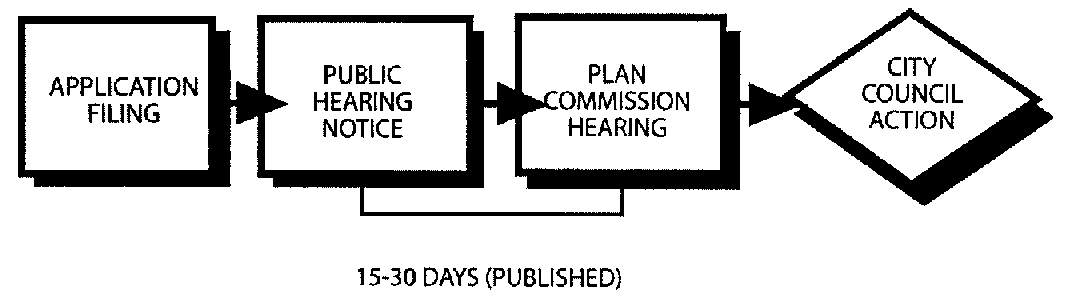
Authority to File: Zoning map amendments (rezonings) may be proposed by the city council, plan commission, or the owner of the property proposed to be changed.
(B)
Filing:
1.
Applications for zoning map amendments must be filed with the city clerk.
2.
Applications for all zoning map amendments must be accompanied by payment of a fee to the city of for the map amendment as per fees established by the city council.
(C)
Contents of Application: The following information must be included with all applications for zoning map amendments:
1.
A description of the lot or lots to be rezoned;
2.
Reasons in support of the proposed zoning map amendment, specifically addressing the review and approval criteria of subsections (G)1 through (G)6 of this section;
3.
A lot plan drawn on a scale of one inch equals one hundred feet, showing:
(a)
The area proposed to be rezoned;
(b)
The subject area's location and dimensions; and
(c)
The location, zoning and existing use of all properties within one hundred feet;
4.
Names and mailing addresses of owners of the subject property and all properties within one hundred feet of the area to be rezoned; and
5.
Any additional information required by the plan commission or city council.
(D)
Public Hearing: The plan commission must hold a public hearing on each zoning map amendment application within sixty days. Written notice and published notice must be provided according to the requirements of subsections 14.11.010(F)1 and (F)2 of this chapter.
(E)
Plan Commission Recommendation:
1.
The plan commission must review all proposed zoning map amendments in a public hearing. The plan commission must recommend that the city council approve the proposed zoning map amendment, approve the proposed amendment with modifications as recommended by the plan commission or disapprove the proposed amendment within fifteen days of the conclusion of the public hearing.
2.
The plan commission may recommend rezoning to an alternative zoning district (i.e., different from that requested by the applicant), provided that the alternative district is no more intensive than the district requested by the applicant.
(F)
City Council Action: After due consideration of the plan commission's recommendation, the city council must take action on the proposed zoning map amendment. The city council may approve or disapprove the plan commission's recommendation by simple majority vote. If a written protest against the proposed zoning map amendment is filed in accordance with the provisions of section 11-13-14 of the Illinois Municipal Code the amendment shall not be passed except by favorable vote of two-thirds of the mayor and commissioners of the city of Oglesby then holding office.
(G)
Review and Approval Criteria: In making their recommendations and decisions, the plan commission and city council must consider the following:
1.
The existing uses and zoning of nearby property;
2.
The extent to which property values are diminished;
3.
The extent to which destruction of property values, promotes the health, safety, morals or general welfare of the public;
4.
The relative gain to the public compared to the hardship imposed on individual property owners;
5.
Suitability of the property for the zoned purpose;
6.
The length of time the property has been vacant as zoned considered in the context of land development in the area.
7.
Evidence, or the lack of evidence, of community need for the proposed use.
8.
The extent to which the zoning request is in conformity with the comprehensive plan adopted by the city of Oglesby.
9.
The above review and approval criteria may or may not all be applicable in every application coming before the plan commission, but to the extent that the above referenced review and approval criteria are relevant to the application coming before the plan commission, these criteria should be considered by the plan commission.
State Law reference— 210 ILCS 115.
14.11.040 - Special uses.
Special uses require individual review by the plan commission and city council to ensure conformance with the intent of the Comprehensive Plan and to assess whether the proposed use is compatible with surrounding uses. The review and approval procedures are described in sections 14.11.050 and 14.11.060 of this chapter. Special uses fit into two basic categories:
(A)
Single Uses: Single uses or single aspects of permitted uses specifically identified in this chapter as requiring individual review under the special use procedure of section 14.11.050 of this chapter.
(B)
Planned Developments: Complex projects designed to take maximum advantage of unique site characteristics and use original design concepts are submitted for review under the planned development procedure of section 14.11.060 of this chapter.
1.
Purpose: The planned development regulations are intended to:
(a)
Encourage better development within the city by providing more flexibility in the application of the provisions of this title;
(b)
Allow smaller lots when permanent common open space is provided;
(c)
Allow more than one principal structure on a lot;
(d)
Allow development where lots do not abut a dedicated and improved street;
(e)
Permit diversity in the location of structures; and
(f)
Shorten the total time involved in the rezoning of property and subdivision of land.
2.
Types of Planned Developments: The following are specific types and purposes of planned developments:
(a)
Residential Planned Developments: Residential planned developments are intended to offer recreational opportunities close to home; enhance the appearance of neighborhoods by the conservation of streams and local spots of natural beauty; add to the sense of spaciousness through the preservation of natural green spaces; counteract the effects of urban monotony and congestion in the streets; encourage cooperative relationships between neighbors and participation by all age groups in the use and care of local open space tracts in new residential subdivisions; and promote harmonious architecture between adjacent dwellings or in sympathy with the natural characteristics of the site.
(b)
Shopping Center Planned Developments: Shopping center planned developments are intended to promote the cooperative development of shopping centers each with adequate off street parking; control access points on arterial and collector streets; separate pedestrian and automobile traffic; aid in stabilizing property values; develop shopping centers of size and location compatible with the market potential; buffer adjacent residential areas with landscaped green spaces; and encourage harmonious architecture between homes and commercial structures.
(c)
Manufacturing Planned Development: Manufacturing planned developments are intended to promote the establishment of planned industrial areas; permit groups of industrial buildings with integrated design and a coordinated physical plan; encourage recreational facilities within industrial areas; and buffer adjacent residential areas with landscaped green areas.
14.11.050 - Special use procedure.

(A)
Filing: Applications for special use permits must be filed with the zoning administrator.
(B)
Public Hearing: The plan commission must hold a public hearing on the special use permit application within sixty days of the receipt of the application. Written notice and published notice must be provided according to the requirements of subsections 14.11.010(F)1 and (F)2 of this chapter.
(C)
Plan Commission Recommendation: The plan commission must recommend approval, approval with modifications or disapproval of the application within fifteen days of the conclusion of the hearing. The plan commission is also authorized to forward the application to city council with no recommendation.
(D)
City Council Action: After due consideration of the plan commission's recommendation, the city council must take action on the proposed special use. If the city council approves the special use or approves the special use with modifications, the city council must issue written authorization to the zoning administrator to issue a building permit. This authorization must remain on permanent file with the application. The city council may attach special conditions to the approval to ensure conformance with the intent of the Comprehensive Plan.
(E)
Review and Approval Criteria: In making their recommendations and decisions, the plan commission and city council must consider whether the following are true of the proposed use:
1.
Complies with the applicable standards of this title;
2.
Is compatible with the character of the surrounding area in terms of site planning, scale and design;
3.
Is compatible with the character of the surrounding area in terms of operating characteristics such as hours of operation, outdoor lighting, noise and traffic generation; and
4.
Is in the interest of public convenience and will not have a significant adverse impact on the general welfare of the neighborhood or area.
5.
Is in accordance with any other specific provisions of the Land Development Code applicable to the special use permit.
(F)
Conditions of Approval: When the anticipated impacts of a special use are determined to have the potential for adverse impacts on surrounding property, the special use may be denied or conditions may be placed on the approval to ensure that any adverse impacts will be mitigated. The plan commission may impose such conditions upon the site planning, design, location and operation of a special use.
(G)
Lapse of Approval:
1.
Approval granted by the plan commission of a special use application is valid for twelve months from the date of approval unless a building permit is obtained or the use is commenced. If a building permit is not obtained or the use is not commenced within that time, the approval will lapse and become null and void.
2.
The city council may, at its discretion and upon adequate showing of good cause, extend the period of validity of special use approval for a period not to exceed thirty-six months. The plan commission must receive a written request from the applicant prior to the expiration of the special use approval stating the reasons for the proposed extension.
3.
If a special use is discontinued for a period of six months or longer, the special use will be considered abandoned and become null and void. Any reinstatement of the special use will require special use approval according to the procedures of this section.
14.11.060 - Planned development procedure.

(A)
Preapplication Conference: Prior to the filing of a preliminary plan, the developer may submit to the plan commission or city council a generalized conceptual plan for the proposed development as a means of soliciting informal input.
(B)
Preliminary Plan Filing: Ten copies of the preliminary plan and a PDF must be submitted to the zoning administrator at least ten days prior to the meeting of the plan commission at which it is to be considered.
(C)
Preliminary Plan Contents: The preliminary plan must include:
1.
A preliminary subdivision plat and legal description, meeting the requirements of this title with any requested or granted variances so noted;
2.
A site plan indicating the arrangement and tentative location of buildings, uses permitted, land to be preserved as permanent common open space, parking and loading spaces, and other special features of the development plan;
3.
A draft of the proposed protective covenants whereby the owner proposes to regulate land use and otherwise protect the proposed development;
4.
A draft of the proposed incorporation agreement and bylaws including coverage by liability insurance and maintenance of recreational and other common facilities with the city as a participant for:
(a)
A homeowners' association in a residential planned development;
(b)
A merchants' association in a shopping center planned development; or
(c)
An industrial association in a manufacturing planned development; and
5.
Data on the market potential necessary to support the location of site and the size of business uses in a shopping center planned development.
(D)
Public Hearing: The plan commission must hold a public hearing on the planned development application within sixty days of the receipt of the application. Written notice and published notice must be provided according to the requirements of subsections 14.11.010(F)1 and (F)2 of this chapter.
(E)
Plan Commission Recommendation: The plan commission must review the preliminary plan at a public hearing. Following the close of the public hearing, the plan commission must recommend that the city council approve the proposed planned development within fifteen days of the conclusion of the hearing, approve the planned development with modifications, or disapprove the planned development. The plan commission is also authorized to forward the planned development to the city council with no recommendation. The plan commission's recommendation will be made by simple majority vote of the quorum present.
(F)
City Council Action: After due consideration of the plan commission's recommendation and within thirty days of receipt of the preliminary plan and report of the plan commission, the city council must take action on the proposed preliminary plan.
(G)
Final Plan Filing:
1.
The final plan must conform substantially to the preliminary plan as approved.
2.
If desired by the developer, the final plan may constitute only a portion of the approved preliminary plan that he proposes to record and develop at the time, provided that the portion conforms to all requirements of this title.
(H)
Final Plan Contents: The final plan must include:
1.
The final subdivision plat;
2.
The location and dimensions of the building lots, common permanent open space, existing permanent buildings, easements, rights-of-way, legal description and uses permitted in specific parts of the planned development;
3.
Protective covenants; and
4.
An engineer's seal certifying that the plans are drawn in compliance with city ordinances.
(I)
Final Plan Approval:
1.
After the final plan is filed, the plan commission must forward its findings and recommendations to the city council within forty-five days.
2.
The city council must take action on the final plan within forty-five days of receipt of the final plan and report of the plan commission and notify the plan commission and developer of its decision.
(J)
Review and Approval Criteria: The plan commission in making its findings and recommendations, and the city council in its authorization of a planned development, must establish that the proposed planned development:
1.
Is consistent with the comprehensive plan; and
2.
Complies with the purpose, and all applicable regulations and conditions of this title.
(K)
Permanent Common Open Space:
1.
No plan for a planned development may be approved unless the plan provides for permanent common open space.
2.
For the purposes of this section, permanent common open space includes all areas other than dedicated public streets, parking areas, areas occupied by principal and accessory structures or buildings and stormwater management facilities unless designed in a natural manner with native vegetation with trails or other passive recreational amenities; schools and recreation buildings will be considered open space.
3.
Permanent common open space must be provided in the following amounts:
(a)
Forty percent of the total area in a single-family residential planned development;
(b)
Fifty percent of the total area in a multi-family residential planned development; and
(c)
Five percent in a shopping center or manufacturing planned development.
(L)
Recording of Final Plan: Upon approval of the city council, the applicant must record the subdivision plat (when required), protective covenants and easements with the LaSalle County Recorder of Deeds. Proof of recordation must be provided to the zoning administrator prior to the issuance of building permits.
(M)
Effect of Approval: All final plans filed will:
1.
Be binding upon the applicants, their successors and assigns;
2.
Control the issuance and validity of all building permits; and
3.
Limit the construction, location, use and operation of all land, land improvements and structures to be located on such plans.
14.11.070 - Site plan review.

(A)
Applicability: No building permit may be issued until required site plan approval has been granted and, where applicable, until approval by the Design Review Board pursuant to Chapter 2.88, Design Review Board, of Title 2, Administration and Personnel, of the city Code. Site plan review is required for new construction and exterior additions for the following:
1.
Multi-family development with three or more units;
2.
Nonresidential development; and
3.
Review by the design review board for those developments subject to the design review board pursuant to the provisions of Chapter C 2.88 Design Review Board, of Title 2, Administration and Personnel, of the city Code.
(B)
Filing: Applications for site plan review must be filed with the zoning administrator who will refer the site plan to the city engineer or, where applicable, to the design review board, for review and comment.
(C)
Scope: The scope of site plan review includes review of the location of principal and accessory structures, infrastructure, open space, landscaping, exterior lighting, traffic and circulation (both vehicular and pedestrian), number of parking spaces and design of parking lots. In reviewing site plans, the design review board must evaluate the relationship of the site plan to adopted land use policies and the goals and objectives of the Comprehensive Plan. In addition, the design review board will evaluate the following characteristics:
1.
The arrangement of the structures and buildings on the site with respect to how well it:
(a)
Allows for the efficient use of the land;
(b)
Is compatible with development on adjacent property;
(c)
Minimizes potential impacts on existing or planned municipal services, utilities, and infrastructure;
(d)
Protects the public health, safety and general welfare; and
(e)
Conforms to the requirements of this title and other applicable regulations.
2.
The arrangement of open space or natural features on the site with respect to how well it:
(a)
Creates a desirable and functional environment for patrons, pedestrians, and occupants;
(b)
Preserves unique natural resources;
(c)
Provides adequate measures to preserve existing healthy, mature trees and woodlands;
(d)
Designs drainage facilities to promote the use and preservation of natural watercourses and patterns of drainage; and
(e)
Avoids unnecessary or unreasonable alterations to existing topography.
3.
Circulation systems with respect to how well they:
(a)
Provide adequate and safe access to the site;
(b)
Minimize potentially dangerous traffic movements;
(c)
Separate pedestrian and auto circulation; and
(d)
Minimize curb cuts.
4.
Parking lots or garages with respect to how well they:
(a)
Are located, designed, and screened to minimize adverse visual impacts to adjacent properties;
(b)
Promote logical and safe parking and internal circulation;
(c)
Provide perimeter parking lot screening and internal landscaped islands;
(d)
Include site illumination that has been designed, located and installed to minimize adverse impacts to adjacent properties.
5.
Landscaping design with respect to how well it:
(a)
Creates a logical transition to adjoining lots and developments.
(b)
Screens incompatible uses.
(c)
Minimizes the visual impact of the development to adjacent sites and roadways.
(d)
Utilizes native plant materials selected to withstand the microclimate of the city and individual site microclimates.
(D)
Site Plan Review: The site plan will be reviewed by the zoning administrator. The zoning administrator shall consider the recommendations made by the city engineer and shall follow the recommendations made by the design review board. When the zoning administrator approves the site plan, a building permit may be issued provided that the requirements of all other applicable codes and ordinances are satisfied. If the zoning administrator does not approve the site plan, the applicant may revise it and submit it for further review in accordance with this section.
(E)
Denial and Appeals:
1.
If the zoning administrator does not approve the site plan, the applicant may appeal the decision to the zoning board of appeals. The applicant's failure to submit a revised site plan or to file an appeal will be considered a withdrawal of the application for a building permit.
2.
If the applicant chooses to appeal, the written notice of appeal must be filed with the zoning administrator no later than fifteen days after the date of the denial. The zoning board of appeals must act on the appeal no later than thirty days after the date of receipt of the written appeal. The zoning board of appeals will vote to sustain or deny the appeal. A majority vote is required to sustain the appeal. If the zoning board of appeals sustains the appeal, the building permit may be issued, provided that the requirements of all other applicable codes and ordinances are satisfied.
3.
An applicant can appeal an adverse decision of the zoning board of appeals to the city council. The city council may vote to either uphold or reject the appeal.
14.11.080 - Multi-family design review.
(A)
Applicability: All multi-family developments containing three or more dwelling units are subject to design review.
(B)
Filing: Applications for multi-family design review must be filed with the zoning administrator.
(C)
Procedure:
1.
Preliminary and final plats are required according to the planned development procedure.
2.
In areas already subdivided and served with streets and all required improvements, the plan commission may waive the preliminary plat. In this case, the approved final plat will replace the final plat recorded earlier at the time of subdivision.
3.
Site design and flexibility and originality are encouraged within the limitations of the use and dimensional standards cited for this district. Preliminary and final plat must conform to the standards for this district and comply with the comprehensive plan.
4.
The recorded final plat will provide continuing control over the completed development as specified in the planned development procedure.
14.11.090 - Variations.

(A)
Applicability; Authorized Variations: Variations from the use regulations of this title are prohibited. This section is intended to allow variations from the dimensional standards of this title, such as setbacks or building height; parking requirements; or landscape requirements.
(B)
Filing: Applications for variations must be filed with the city clerk.
(C)
Public Hearing: The zoning board of appeals must hold a public hearing on the proposed variation within sixty days. Written and published notice must be provided according to the requirements of subsections 14.11.010(F)1 and (F)2 of this chapter.
(D)
Approval Criteria and Review Factors:
1.
Evidence of Practical Difficulties or Particular Hardships: In order to approve a variation, the zoning board of appeals must find evidence that practical difficulties or particular hardships exist. The board must find evidence of all of the following:
(a)
The property in question cannot yield a reasonable return if permitted to be used only according to the requirements of this chapter;
(b)
The practical difficulties or particular hardships are due to unique circumstances and are not generally applicable to similarly situated property; and
(c)
The variation, if granted, will not alter the essential character of the neighborhood or area.
2.
Other Review Factors: In determining whether practical difficulties or particular hardships exist, the zoning board of appeals must also consider whether the evidence submitted supports the following:
(a)
The particular physical surroundings, shape or topographical conditions of the specific property involved would result in a particular hardship upon the owner as distinguished from a mere inconvenience if the regulations were strictly enforced;
(b)
The conditions upon which the petition for variation is based would not be applicable generally to other property within the same zoning classification;
(c)
The alleged practical difficulty or particular hardship has not been created by any person presently having an interest in the property;
(d)
The granting of the variation will not be detrimental to the public welfare or harmful to other property or improvements in the neighborhood or area; and
(e)
The proposed variation will not impair an adequate supply of light and air to adjacent property, or substantially increase the danger of fire, or endanger the public safety, or substantially diminish or impair property values within the neighborhood.
(E)
Conditions of Approval: The zoning board of appeals shall make a written recommendation to the city council on the proposed variation within fifteen days after the conclusion of the hearing. The zoning board of appeals may impose conditions and restrictions upon the subject property as part of its recommendation that are necessary to avoid or minimize any potentially harmful effects on other property in the neighborhood, and to carry out the purpose and intent of this title, as stated in section 14-01-060 of this title. The recommendation of the zoning board of appeals shall be submitted to the city council and the city council shall approve or reject the recommendation of the zoning board of appeals on the proposed variation.
(F)
Variations From Flood Protection Standards: Upon application and after fifteen days' notice of a public hearing, the city council may grant a variance of the standards in chapter 8, "Flood Damage Prevention," of this title, subject to compliance with the provisions of 44 CFR 60.6 of the Rules and Regulations of the National Flood Insurance Program and such other conditions as the city council deems necessary to comply with the intent of this chapter.
14.11.100 - Written interpretations.
(A)
Application Filing: Applications for written interpretations must be submitted to the zoning administrator.
(B)
Zoning Administrator's Review and Decision: Following receipt of a complete application for a written interpretation, the zoning administrator must: 1) review and evaluate the application for compliance with this title in consistency with the comprehensive plan and any other relevant documents; 2) consult with other city officials, including the city attorney and city engineer, as necessary; and 3) render a written opinion.
(C)
Form: The interpretation must be provided to the applicant in writing and be filed in the official record of interpretations.
(D)
Official Record of Interpretations: An official record of interpretations must be kept on file in the zoning administrator's office. The record of interpretations must be available for public inspection in the zoning administrator's office during normal business hours.
(E)
Appeals: Appeals of the zoning administrator's written interpretation may be taken to the zoning board of appeals in accordance with appeal procedures of section 14.11.110 of this chapter. If the appeal results in a change of interpretation, the new interpretation must be filed in the official record of interpretations.
14.11.110 - Appeals.

(A)
Authority To File: Appeals from the decisions of the zoning administrator concerning the interpretation, administration or enforcement of this title may be made by any person aggrieved or by any officer, department, board or bureau of the city.
(B)
Filing: A notice of appeal, specifying the grounds for appeal, must be filed with the zoning administrator and with the zoning board of appeals within forty-five days of the action being appealed.
(C)
Contents of Application: The following must be included with all appeals:
1.
The name and address of the appellant or applicant and all abutting and opposite property owners of record;
2.
A plat of survey prepared by a registered land surveyor showing the location, boundaries, dimensions, elevations, uses, and size of the following:
(a)
The subject site;
(b)
Existing and proposed structures;
(c)
Existing and proposed easements, streets, and other public ways;
(d)
Off street parking, loading areas and driveways;
(e)
Existing highway access restrictions;
(f)
Existing and proposed front, side, and rear yards; and
(g)
The location, elevation, and use of any abutting lands and their structures within forty feet of the subject site.
3.
Additional information required by the zoning board of appeals.
(D)
Public Hearing: The zoning board of appeals must hold a public hearing on the appeal. Written notice and published notice must be provided according to the requirements of subsections 14.11.010(F)1 and (F)2 of this chapter. The board must also notify the appellant and the zoning administrator of the public hearing.
(E)
Zoning Board of Appeals Action: Following the public hearing, the zoning board of appeals must make written recommendation to the city council regarding what action should be taken on the appeal. The city council will then make a final decision on the appeal after reviewing the written recommendations of the zoning board of appeals.
14.11.120 - Subdivision review and platting, generally.
(A)
Geographic Jurisdiction: No land within the city or any unincorporated area that is located entirely or in part within one and one-half miles of the city limits may be subdivided except in conformity with this chapter.
(B)
Plat Requirements: No lots may be sold or offered for sale until the approved final plat is recorded in accordance with subsection 14.11.150(F) of this chapter.
14.11.130 - Preliminary plat.

(A)
Preapplication Procedure:
1.
Preapplication Conference: Prior to the filing of an application for approval of the preliminary plat, the subdivider may submit to the plan commission plans and data as specified in this section. This step does not require formal application, fee or filing of the plat. The purpose of the preapplication conference is to give the subdivider an opportunity to receive the advice and assistance of the plan commission and to consult early and informally with the plan commission staff before preparation of the preliminary plat and before a formal application for its approval, in order to save time and money and to make the most of his opportunities.
2.
Recommended Preapplication Plans and Data:
(a)
The general subdivision information should describe or outline the existing conditions of the site and the proposed development as necessary to supplement the drawing listed below. This information may include data on existing covenants; land characteristics; available community facilities and utilities; and information describing the subdivision proposal such as number of residential lots, typical lot width and depth, price range, business areas, school, playground, park areas, other public areas, proposed protective covenants and proposed utilities and street improvements.
(b)
The sketch plan, on topographic survey, should show in simple sketch form the proposed layout of streets, lots, and other features in relation to existing conditions. The sketch plan may be a freehand pencil sketch made directly on a print of the topographic survey. The sketch plan should include the existing topographic data listed in subsection (C)1 of this section.
3.
Notification: Within thirty days the plan commission must inform the subdivider whether or not the plans and data as submitted or as modified meet the objectives of this title. When the plan commission finds the plans and data do not meet the objectives of this title, it must express in writing to the subdivider its reasons for its findings.
(B)
Filing: The subdivider must prepare a preliminary plat, together with improvement plans and other supplementary material as specified in this chapter. Four copies of the preliminary plat and supplementary material specified must be submitted to the secretary of the plan commission with a written application for conditional approval.
(C)
Preliminary Plat Contents:
1.
Existing Conditions: Topographic data required as a basis for the preliminary plat must include existing conditions as follows except when otherwise specified by the plan commission:
(a)
Boundary lines: Bearings and distances.
(b)
Easements: Location, width and purpose.
(c)
Streets on and adjacent to the tract: Name and right-of-way width and elevation of surfacing; and legally established centerline elevations; walks, curbs, gutters, culverts, etc.
(d)
Utilities on and adjacent to the tract: Location, size and invert elevation of sanitary, storm and combined sewers; location and size of water mains; location of gas lines, fire hydrants, electric and telephone lines and streetlights; of water mains and sewers which are not on or adjacent to the tract, indicate the direction and distance to, and size of nearest ones, showing invert elevation of sewers.
(e)
Ground elevations on the tract, based on the city datum plane: For land that slopes less than one-half percent show not less than one foot contours, show spot elevations at all breaks in grade, along all drainage channels or swales, and at selected points not more than one hundred feet apart in all directions, and for land that slopes more than two percent show not less than two foot contours.
(f)
Subsurface conditions on the tract, if required by the Plan Commission: Location and results of tests made to ascertain subsurface soil, rock and groundwater conditions; depth to groundwater unless test pits are dry at a depth of five feet; location and results of soil percolation tests if individual sewage disposal systems are proposed.
(g)
Other conditions on the tract: Watercourses, marshes, rock outcrop, wooded areas, isolated preservable trees one foot or more in diameter, houses, barns, shacks and other significant features.
(h)
Other conditions on adjacent land: Approximate direction and gradient of ground slope, including any embankments or retaining walls; character and location of buildings, railroads, power lines, towers, and other nearby nonresidential land uses or adverse influences; owners of adjacent unplatted land; for adjacent platted land refer to subdivision plat by name, recording date, and number, and show approximate percent built up, typical lot size, and dwelling type.
(i)
Zoning on and adjacent to the tract.
(j)
Proposed public improvements: Highways or other major improvements planned by public authorities for future construction on or near the tract.
(k)
Key plan showing location of the tract.
(l)
Title and certificates: Present tract designation according to official records in offices of the county recorder; title under which proposed subdivision is to be recorded, with names and addresses of owners, notation stating acreage, scale, north arrow.
2.
Preliminary Plat Data: The preliminary plat must be drawn to a scale of one inch equals one hundred feet. It must show all existing conditions required by this section, above, and must show all proposals including the following:
(a)
The proposed name of the subdivision.
(b)
Its location by section, township and range and as forming a part of some larger tract or parcel of land referred to in the indexes of the records of the county clerk.
(c)
Sufficient information to accurately locate the plat. (Reference to existing streets, plats, etc., may be used. If there are none within a reasonable distance of the proposed subdivision, a vicinity plat on a small scale should accompany the preliminary plat.)
(d)
The description and location of all survey monuments erected in the subdivision.
(e)
The names and addresses of the persons to whom the notice of the hearing should be sent (the subdivider, the designer of the subdivision, and the owners of the land immediately adjoining the land to be platted).
(f)
The names, locations, roadway widths, right-of-way widths, approximate gradients and other dimensions of streets, alleys, easements, parks and other open spaces.
(g)
Sites, if any, for multi-family dwellings, shopping centers, churches and industry.
(h)
All parcels of land intended to be dedicated for public use or reserved for the use of all property owners with the purpose indicated. The areas that are to be maintained by any proposed homeowners' association must be identified.
(i)
Location and size of utilities.
(j)
Block numbers and layout, numbers, dimensions and area of lots.
(k)
Setbacks, showing dimensions.
(l)
North arrow, scale and date of preparation.
3.
Covenants: A draft of protective covenants (if any), by which the subdivider proposes to regulate land use and otherwise protect the proposed development must be included. Upon approval, these would be enforced by a "homeowners' association," as defined by this title.
(D)
Plan Commission Conditional Approval:
1.
The plan commission must review the preliminary plat for compliance with the requirements of chapter 9 of this title. If the plan commission determines that the plat complies with all requirements of this title, the plan commission must recommend approval. If the plat does not comply, the plan commission must recommend disapproval of the preliminary plat and must state the reasons for disapproval. The plan commission must make its recommendations within thirty days.
2.
If the plan commission conditionally approves the preliminary plat, it must state the conditions of the approval; if it disapproves, it must state the reasons for disapproval.
3.
The action of the plan commission will be noted on three copies of the preliminary plat, referenced and attached to any conditions applied. One copy must be returned to the subdivider, one must be forwarded with a report to the city council, and the other must be retained by the plan commission.
(E)
City Council Action: The city council must conditionally approve or deny the preliminary plat upon motion and a majority vote.
(F)
Effect of Conditional Approval: Conditional approval of a preliminary plat does not constitute approval of the final plat. Rather it will be deemed an expression of approval of the layout submitted on the preliminary plat as a guide to the preparation of the final plat.
14.11.140 - Construction plans.
(A)
Before submitting the final plat, the subdivider must submit three copies of the final plans and specifications for public improvements to the plan commission. The following information, at a minimum, must be included:
1.
Detailed drawings of a grading plan, street improvements plan, sanitary sewer improvements plan, and water system improvement plan;
2.
Plans and profiles drawn at a scale not to exceed one inch equals one hundred feet horizontally and one inch equals ten feet vertically, indicating additional horizontal and vertical location of streets, sewers, and the existing grade; and
3.
Detailed material and construction specifications concerning the work to be performed including general conditions to the contract acceptable by the city; and
4.
All final plans must be submitted on twenty-two inch by thirty-four inch sheets and must bear the signature and seal of the Illinois registered professional engineer under whose direction they were prepared.
(B)
Upon receipt of these final plans, the plan commission must refer them to the city engineer for his comments and corrections. The city engineer must review these plans for compliance with the requirements of the city, and must return them with his recommendations to the plan commission. The city engineer may, at his discretion, confer with the developer's engineer concerning correction to the final plans prior to his final recommendations.
(C)
Upon the completion of all improvements within the subdivision the subdivider must call for a final inspection by the city engineer.
(D)
Prior to final approval of improvements, the subdivider must submit a twenty-two inch by thirty-four inch reproducible plans and a PDF showing the improvements as actually built.
(E)
The city engineer will inspect the improvements within the subdivision for compliance with the certified plans and specifications and the design standards and specifications of this title.
(F)
When the city engineer is satisfied that the required improvements within the subdivision comply with the approved plans and this title, the city engineer will recommend in writing to the city council that the improvements be accepted by the city.
(G)
No building permit will be issued until final inspection is approved in writing by the city engineer.
(H)
When the city engineer advises the plan commission chairman, the plan commission secretary, the city clerk and the mayor that the improvements have been constructed according to the approved plans and specifications; that all improvements have been installed or performance guarantees have been posted in accordance with section 14.09.030 of this title; and that all necessary data are shown on the final plat as required, then the certificate of approval of final plat will be properly endorsed by the plan commission chairman and secretary, the mayor and the city clerk and recorded by the developer.
14.11.150 - Final plat.

(A)
Relation to Preliminary Plat: The final plat must conform substantially to the preliminary plat as approved, and, if desired by the subdivider, it may constitute only that portion of the approved preliminary plat which he proposes to record and develop at the time, provided, however, that the portion conforms to all requirements of this title.
(B)
Submission to Plan Commission: Preliminary plat approval will lapse unless four copies of the final plat and other required exhibits are prepared as specified in subsection (C) of this section and are submitted to the plan commission within thirty-six months from the date of preliminary plat approval. Upon request of the applicant, the plan commission may grant extensions if the request is made prior to the expiration of the preliminary plat approval.
(C)
Final Plat Contents: The final plat must be drawn in ink on tracing cloth or other permanent plastic base on sheets not to exceed twenty-two inches wide by thirty-four inches long and must be at a scale of one inch equals one hundred feet and accompanied by a PDF copy. Where necessary, the plat may be on several sheets accompanied by an index sheet showing the entire subdivision. For large subdivisions the final plat may be submitted for approval progressively in contiguous sections satisfactory to the plan commission. The final plat must show the following:
1.
Name of the subdivision;
2.
Location by township, section, town and range, or by other legal description;
3.
Scale one inch equals one hundred feet (shown graphically);
4.
Date and north arrow;
5.
Boundary of plat, based on an accurate traverse, with angles and linear dimensions;
6.
Exact location, width and name of all streets within and adjoining the plat, and the exact location and widths of all crosswalks; streets that are obviously in alignment with others already existing and named must bear the names of the existing streets;
7.
True angles and distances to the nearest established street lines or official monuments (not less than three), which must be accurately described in the plat;
8.
Municipal, township, county or section lines accurately tied to the lines of the subdivision by distances and angles;
9.
Radii, internal angles, points and curvatures, tangent bearings and lengths of all arcs;
10.
Location, dimensions and purpose for all easements;
11.
All block and lot numbers and lines, with accurate dimensions in feet and hundredths;
12.
Location and description of permanent monuments or bench marks;
13.
Accurate outlines and legal descriptions of any areas to be dedicated or reserved for public use, with the purposes indicated thereon, and of any area to be reserved by deed covenant for common uses of all property owners. Areas that are to be maintained by any proposed homeowners' association must be clearly identified with that responsibility expressly stated on the plat;
14.
Setbacks, accurately shown by dimension;
15.
Protective covenants which meet with the approval of the plan commission must be lettered on the final plat or attached thereto;
16.
A summary on its face of all restrictions applicable to any part of such subdivision relating to building restrictions, use restrictions, setbacks or otherwise; and
17.
A blank certificate of approval as set out in this section.
(D)
Documents to Accompany Final Plat: The following documents must accompany the final plat:
1.
Certification by a registered surveyor in the form set out in section 14.11.160 of this chapter;
2.
Notarized certifications, by owner or owners, and by mortgagee or lienholder of record, acknowledging the plat and dedication of streets and other public areas;
3.
An agreement executed by the owner and subdivider to make and install the improvements provided for in this title according to the plans and specifications accompanying the final plat;
4.
A notice from the city council stating that the following related to installation of required public improvements have been filed with and approved by the council:
(a)
A certificate by the city engineer that all improvements and installations to the subdivision required for its approval have been made or installed in accordance with the specifications; or that a performance guarantee such as a surety bond, letter of credit, certificate of deposit, or another surety instrument acceptable to the city council in accordance with section 14.09.030 of this title has been provided that will:
(1)
Be in an amount and form determined by the city council to be sufficient to complete the improvements and installations in compliance with this title;
(2)
Be with surety by a company or financial institution entered and licensed to do business in the State of Illinois that guarantees to the city availability of an amount determined by the city council to be sufficient to complete the improvements and installations in compliance with this title;
(3)
In such form and substance as to be enforceable by the city against such institution for the purpose of completing the improvements in the event of default by the developer;
(4)
Specify the time for the completion of the improvements and installations;
(5)
Be held by the city until the final completion of all of the improvements to be constructed; and
(6)
Be canceled or refunded to the developer upon certification, in writing, of the city engineer that the improvements have been completed in full, and have been constructed according to the approved plans and specifications and all of the requirements of this title.
(b)
Evidence of a deposit of a maintenance bond, certificate of deposit or other surety instrument acceptable to the city council equal to fifteen percent of the estimated cost of improvements to be held by the city for a period of eighteen months after the final completion of the work as a guarantee against any defect in the material or workmanship furnished in connection with such improvement latent in character and not discernible at the time of the final approval of such improvement, and to guarantee against any damage to such improvements by reason of settling of the ground, base or foundation. After the termination of the eighteen month period, the deposit will be refunded to the depositor, if no defects have developed, or if defects have developed then the balance of such deposit after reimbursement of the city for any amounts expended by it in the curing of defects.
5.
A certificate from the proper collector hereof that he finds no delinquent general taxes and all special assessments constituting a lien on the whole or any part of the land to be subdivided have been paid.
(E)
Approval; Effect:
1.
Within thirty days after application for approval of the final plat, the plan commission must approve or disapprove it. The plan commission must set forth its approval or its disapproval and its reasons for disapproval on its own records and provide the applicant with a copy.
2.
Upon approval of the final plat by the plan commission, it must be submitted to the city council for action. Council approval will be by motion and majority vote and so recorded in the minutes.
3.
Final plat approval will lapse unless all required improvements have been installed and inspected by the city engineer or performance guarantees approved in accordance with this section and section 14.09.030 of this title have been provided, and the plat has been recorded with the county recorder of deeds within eighteen months of final plat approval. Upon request of the applicant, the plan commission may grant one six-month extension if the request is made prior to the expiration of the final plat approval. Any request for extension of the time period for installation of required public improvements may only be approved by the city council in accordance with section 14.09.030 of this title.
(F)
Certification and Recording:
1.
Upon certification, in writing, by the city engineer, that the improvements have been constructed in accordance with the approved construction plans and specifications, that all necessary data are shown on the final plat as required by this title, or a performance guarantee has been posted in accordance with this section to ensure installation of all public improvements, the plan commission and the city council will endorse such plat by their appropriate officers and the corporate seal of the city affixed thereto.
2.
When the final plat has been so certified, the developer must record the plat with the county recorder of deeds prior to lapse of final plat approval, as described in subsection (E) of this section. If not recorded prior to the lapse of final plat approval, the approval and certification will be null and void. Immediately after recording the original, a duly certified copy of the recorded plat must be filed with the city clerk.
14.11.160 - Certificates for recording of final plat.
(A)
The certificate on the final plat must be in the following form with the signatures of the president of the county board and the county clerk to be necessary where the plat covers land in the unincorporated one and one-half mile fringe area. Other certificates, affidavits, endorsements or dedications may be required by the plan commission or city council.
Under the authority provided by 65 ILCS 5/11-15-1, enacted by the State Legislature of the State of Illinois and an ordinance adopted by the city council of the city of Oglesby, Illinois, this plat was given approval by the city of Oglesby and MUST BE RECORDED WITHIN FOUR MONTHS OF THE DATE OF APPROVAL BY THE City Council; OTHERWISE IT IS NULL AND VOID.
Approved by the plan commission at a meeting held
Chairman
Secretary
Approved by the city council at a meeting held
Mayor
City clerk
Approved by the city engineer:
Approved by the County Board of LaSalle County, Illinois, at a meeting held
President
County clerk
(B)
Each final plat submitted to the city for approval must carry a certificate signed by an Illinois registered land surveyor in substantially the following form:
I, (Name), hereby certify that I am an Illinois Registered Land Surveyor in compliance with the laws of the State of Illinois and that this plat correctly represents a survey completed by me on (Date); that all monuments shown thereon actually exist, and material is accurately shown.
SEAL
Signature
Illinois Land Surveyor No.
(C)
Each final plat submitted to the city for approval must carry a deed of dedication in substantially the following form:
We, the undersigned, (Name), owners of the real estate shown and described herein, do hereby layoff, plat, and subdivide said real estate in accordance with the within plat. This subdivision will be known and designated as (Name). All streets and alleys and public open spaces shown, and not heretofore dedicated, are hereby dedicated to the public. Setbacks are hereby established as shown on this plat, between which lines and the property lines of the streets, there will be erected or maintained no building or structure. There are strips of ground, (Number) feet in width, as shown on this plat and marked 'Easement' reserved for the use of public utilities for the installation of water and sewer mains, ducts, lines, and wires, subject at all times to the proper authorities and to the easement herein reserved. No permanent or other structures are to be erected or maintained upon said strips of land, but owners of lots in this subdivision will take their titles subject to the rights of the public utilities, and to the rights of the owners of other lots in this subdivision. (Additional dedications and protective covenants, or private restrictions, would be inserted here upon the subdivider's initiative or the recommendation of the plan commission or city council; important provisions are those specifying the use to be made of the property and, in the case of residential use, the minimum habitable floor area.) The foregoing covenants (or restrictions) are to run with the land and will be binding on all parties and all persons claiming under them until January 1, 20 (twenty-five-year period is suggested); at which time, said covenants (or restrictions) will be automatically extended for successive periods of ten years unless indicated otherwise by negative vote of a majority of the then owners of the building sites covered by these covenants (or restrictions) in whole or in part, which said vote will be evidenced by a petition in writing signed by the owners and duly recorded. Invalidation of any one of the foregoing covenants (or restrictions) by judgment or court order will in no way affect any of the other various covenants or restrictions, which will remain in full force and effect. The right to enforce these provisions by injunction together with the right to cause the removal, by due process of law, of any structure or part thereof erected or maintained in violation thereof, is hereby dedicated to the public and reserved to the several owners of the several lots in this subdivision and to their heirs and assigns."
Witness our Hands and Seals this day of
State of Illinois
County of
Before me, the undersigned Notary Public, in and for the County and State, personally appeared (Name), (Name), (Name), and each separately and severally acknowledged the execution of the foregoing instrument as his or her voluntary act and deed, for the purposes therein expressed.
Witness my Hand and Notarial Seal this
day of
Notary Public
14.11.170 - Variations from subdivision requirements.
(A)
When the subdivider can show that a provision of this title, if strictly adhered to, would cause unnecessary hardship, and when in the opinion of the plan commission, because of topographical or other conditions peculiar to the site, a departure may be made without destroying the intent of such provisions, the plan commission may recommend a variance or modification to the city council. The subdivider must apply in writing for such variance or modification of the action. Any variance or modification thus authorized must be attached to and made a part of the final plat.
(B)
In any instance where the city has granted approval of a preliminary plat of subdivision prior to the effective date specified in section 14-01-020 of this title and where the subdivision design or subdivision improvements as shown on such preliminary plat are less restrictive than the requirements of this title, the subdivider may apply in writing to the city council for permission to proceed with subdivision as originally planned. The city council, upon review of the preliminary plat as originally submitted, may then grant such permission.
14.11.180 - Mobile home park permit.
(A)
Applicability: A mobile home park permit is required for all new mobile home parks and additions to existing mobile home parks.
(B)
Filing: Applications for mobile home park permits must be filed with the zoning administrator.
(C)
Contents of Application: Applications for mobile home park permits must include:
1.
The name and address of the applicant, and the present or last occupation of the applicant at the time of filing of the application;
2.
Location and legal description of the tract of land, certified on a plat of a survey by a registered land surveyor, drawn to scale of at least one inch equals one hundred feet;
3.
The proposed and existing facilities in the park for water supply, sewage, garbage and waste disposal, fire protection, and any community buildings;
4.
The proposed method of lighting the structures and outdoor areas;
5.
All corners and points of tangency are to be marked by galvanized or wrought iron pipe or iron or steel bars at least eighteen inches in length and not less than one-half inch in diameter. The top of the pipe or bar is to be set level with the established grade of the ground;
6.
The plot plans of the park drawn to scale including building plans and specifications for existing buildings and facilities, and the plans and specifications for new or altered buildings and facilities, all showing compliance with the provisions of this title. The plot plans must be drawn on a scale of one inch equals one hundred feet and must contain, the following:
(a)
The date on which such plot plans were prepared;
(b)
An arrow indicating north;
(c)
All mobile home sites, which must be numbered;
(d)
Complete information regarding storm sewers;
(e)
Stormwater runoff, shown on a separate plat;
(f)
Contour lines at one foot intervals, shown on a separate plat, using United States geological survey data; and
(g)
Grades of driveways and all ditches, shown on a separate plat.
7.
A performance bond or other security acceptable to the plan commission in a sum sufficient to cover a written estimate made by a qualified engineer or other qualified person of the cost of improvements. Such bond must be payable to the city of Oglesby and conditioned upon the completion of such construction in a reasonable time.
8.
An affidavit of the applicant as to the truth of the matters contained in the application.
(D)
Issuance of Mobile Home Park Permit:
1.
If the plans conform to the requirements of this title, the zoning administrator will recommend approval of the mobile home park permit to the city council and the city council shall either approve or deny a mobile home park permit.
2.
If the application for a permit is denied, the zoning administrator will give the reasons for denial in writing to the applicant. If the objections can be corrected, the applicant may amend the application and resubmit it for approval or the applicant may appeal the decision of the zoning administrator to the zoning board of appeals for recommendation to the city council and a final determination by the city council.
3.
If a mobile home park permit is issued, the zoning administrator will periodically make inspections during construction to verify compliance.
4.
No change in any sanitary facilities, water supply, sewer, drainage, garbage or waste disposal, or any element on the plot plan may be made without an application for a permit from the zoning administrator. Such a permit does not relieve the applicant from any other city ordinances or permit requirements.
5.
If the mobile home park is completed in compliance with the accepted application and the applicable fee has been paid, the zoning administrator will present findings to the city council, who may then issue a mobile home park permit.
14.11.190 - Building permits.
(A)
Applicability:
1.
No building or structure, identified by this section may be used, located, moved, constructed, reconstructed, extended, enlarged, or otherwise structurally altered without obtaining a building permit and without complying with all of the requirements of this title and all other applicable local, state and federal regulations. Buildings and structures that require a building permit are as follows:
(a)
Principal and accessory buildings including garages, sheds, gazebos, and greenhouses;
(b)
Porches, decks, and carports;
(c)
Driveways;
(d)
Swimming pools (with the exception of temporary inflatable swimming pools);
(e)
Repair or replacing roofing materials;
(f)
Changes to any bearing wall to a building or structure;
(g)
Any change to the roof-line or structural support of the roof of the building or structure.
2.
No building permit will be issued for the improvement of any lot in a subdivision until the plat of subdivision and the plans and specifications for the public improvements have been approved by the city council.
3.
No sidewalk on a public right-of-way or fence may be constructed or moved or altered without first obtaining a building permit.
(B)
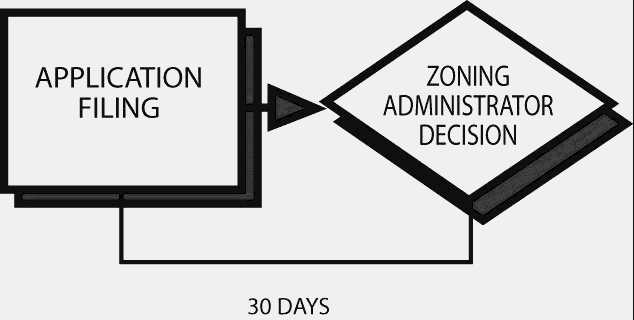
Filing: Two copies of a building permit application must be submitted to the zoning administrator.
(C)
Contents of Application: Building permit applications must include the following, where applicable:
1.
Names and addresses of the applicant, owner of the site, architect, professional engineer, and contractor;
2.
Description of the subject site by lot, block, and recorded subdivision;
3.
Address of the subject site;
4.
Type of structure;
5.
Existing and proposed operation or use of the structure or site;
6.
Number of employees;
7.
The zoning classification of the subject site;
8.
A plat of survey prepared by a registered land surveyor showing the location, boundaries, dimensions, elevations, uses, and size of the following:
(a)
The subject site;
(b)
Existing and proposed structures;
(c)
Existing and proposed easements, streets, and other public ways;
(d)
Off street parking, loading areas and driveways;
(e)
Existing highway access restrictions;
(f)
Existing and proposed front, side, and rear yards; and
(g)
The location, elevation, and use of any abutting lands and their structures within forty feet of the subject site.
(h)
The requirements of this subsection may be waived at the request of the applicant, but any building permit granted without information contained in this subsection shall be granted subject to a later challenge by the city of regarding the applicant's failure to comply with any of the provisions of this subsection;
9.
If municipal sewer service is not available, a proposed sewage disposal plan approved by the city engineer, who must certify in writing that satisfactory, adequate and safe sewage disposal is possible on the site as proposed by the plan, and that the plan complies with all applicable health regulations;
10.
If municipal water service is not available, a proposed water supply plan approved by the city engineer, who must certify in writing that an adequate and safe supply of water will be provided.
11.
A list of all contractors, including subcontractors, who are to perform the construction or improvement. No contractors shall be allowed to perform any work on any construction project for which a building permit is required until the contractor has applied for and received a license from the city of Oglesby. Every building permit shall designate one specific contractor, the general contractor, who shall be responsible to oversee the construction project and permit only licensed contractors to work on the project.
12.
Two sets of construction plans detailing the work to be performed. Upon the issuance of the building permit, one set of construction plans shall be returned to the applicant with the permit and the other set of plans shall be retained by the zoning administrator. The zoning administrator shall review the construction plans to determine whether the proposed construction or alteration plans will comply with all building codes adopted by the city of Oglesby.
(D)
Issuance of Building Permit:
1.
All applications for building permits for planned unit developments, multi-family dwellings, or commercial or industrial improvements must be reviewed and approved by the zoning administrator, city engineer, and/or licensed independent engineer or inspector retained by or approved by the city before the issuance of the building permit.
2.
The zoning administrator will grant or deny the building permit in writing within thirty days of application.
3.
Any building permit issued is subject to inspection by the zoning administrator to ensure compliance with the plans submitted to the city of Oglesby. For non-residential construction, the zoning administrator will notify the applicant as to when the zoning administrator will inspect the construction to ensure compliance with the building plans. No construction work may proceed to the next phase of construction until the zoning administrator approves the previous construction work. If an inspection disclosed deficiencies, the zoning administrator will notify the owner/general contractor of the deficiencies which must be corrected before further construction can proceed. In the case of non-residential construction, the inspections to be performed at the various stages on construction shall be set forth in the building permit. The number and timing of the inspections shall be determined by the zoning administrator taking into consideration the size and complexity of the construction project. In the case of residential construction, the building inspector shall conduct an inspection upon completion of the foundation, completion of the framing and a final inspection. In the case of residential construction, there shall be three plumbing inspections, upon completion of the foundation, completion of rough-in plumbing and a final inspection. For residential construction, there shall be three electrical inspections, an initial inspection upon the completion of the foundation, a rough-in inspection, and a final inspection. No contractor and/or owner shall proceed with project completion, backfill any foundation, and/or cover any electrical or plumbing work until the zoning administrator or his designee issues an approved inspection certificate or sign off for each of the foregoing inspections.
4.
An applicant's failure to notify the zoning administrator when construction progresses to the point of the required inspections shall result in a stop work notice and the imposition of inspection resumption fee in an amount of one hundred dollars payable to the city of prior to resuming construction and correcting any deficiencies. Separate fees will be asserted for each failure to notify or failure to comply with any inspection requirement.
5.
After construction is completed, the applicant must obtain a letter of occupancy in accordance with section 14.11.200 of this chapter prior to occupying the premises.
(E)
Special Requirements: In the case of all new building construction and any reconstruction of an existing building, which in the opinion of the zoning administrator should be monitored by the city given the scope of the reconstruction, the applicant shall obtain a "Project Inspection Status Report" from the zoning administrator. The report shall be posted securely in the front yard of the b building under construction in a location that can be observed and signed by city inspectors and utility superintendents. The reports shall be signed by the zoning administrator and any other inspectors when they inspect and approve the work in progress. No work which results in shielding or covering up work required to be inspected is permitted before inspection and approval. Failure to acquire the zoning administrators approval signature on the report before additional work is performed will result in undoing all improvements made which are necessary to be removed to make the required inspection.
(F)
Expiration of Building Permit: The building permit will expire within twelve months from the date it was issued unless construction is started and diligently pursued unto completion. The zoning administrator may renew the building permit before it expires at the applicant's request.
(G)
The property owner shall mark or have marked the location of the property owner's property lines and the location of any proposed fence and/or sidewalk prior to making an application for a building permit for the construction of said fence or sidewalk. The property owner shall maintain said markings through the completion of any approved construction of any such fence or sidewalk. No construction may commence without the property owner first obtaining the approval of the city's building inspector for the construction of any such fence or sidewalk.
(Ord. No. 1213-040323, §§ 2, 3, 4-3-2023)
14.11.200 - Letter of occupancy.
(A)
Applicability: No building may be occupied or reoccupied (if forced to be vacated during construction) before a letter of occupancy has been issued by the city.
(B)
Filing: Upon filing for a building permit, a property owner and/or his/her authorized agent will be informed that they will be required to provide a certificate from their contractor(s) that all work has been completed in accordance with the approved building permits, prior to issuance of a letter of occupancy by the city.
(C)
Issuance of Letter of Occupancy:
1.
Following completion of all improvements in accordance with the approved building permits, the applicant must request in writing that the zoning administrator issue a letter of occupancy. In the event that weather conditions prevent completion of all such improvements, a cash escrow payment equal to one and one-half times the estimated amount of all uncompleted improvements (based upon acceptable, legitimate estimates) must be paid to the city clerk to ensure that said improvements shall be completed by the next June 1 st . The deposit of this cash escrow along with a written guarantee of performance by the landowner by the next June 1 st shall allow for the issuance of a letter of occupancy.
2.
The zoning administrator will issue the letter of occupancy to the property owner, only upon receipt of a certificate or letter signed by the contractor(s) who conducted the work on the new building. This will serve as certification to the property owner and the city that the building is in compliance with applicable building and safety codes, all provisions of this title; and that the building including its location and design on the lot is consistent with the building permits issued by the city.
3.
Copies of the contractors' certification or letter of compliance and approved letter of occupancy will be kept on file by the zoning administrator.
(Ord. No. 1214-040323, § 2, 4-3-2023)

