
Oglesby City Zoning Code
CHAPTER 5
PARKING, LOADING AND ACCESS.
Sections:
14.05.010 - Applicability.
(A)
New Development: The requirements of this chapter apply to all new buildings constructed and all new uses established in all zoning districts.
(B)
Expansion of Nonresidential Development: The requirements of this chapter apply to all expansion of existing buildings or uses in all zoning districts. When additional parking and loading spaces are required for expansions of a building or use, the additional spaces are required for the expanded area only; parking requirements are not required to be recalculated for the entire building or use.
(C)
Expansion of Residential Development: The requirements of this chapter apply whenever additional dwelling units are added to an existing building or use.
(D)
Change of Use: The requirements of this chapter apply to a change in use of an existing building or lot when the number of parking or loading spaces for the new use exceeds the number required for the existing use.
(E)
Public Parking Areas: All public, city owned parking areas must comply with the requirements of this title.
14.05.020 - Off street parking requirements.
(A)
Spaces Required: Off street parking spaces are as specified in the table below:
(B)
Rules For Computing Requirements:
1.
Multiple Uses: Lots containing more than one use must provide parking equal to the total number of spaces required for all uses unless a shared parking plan is approved according to section 14.05.040 of this chapter.
2.
Fractions: When the calculation of required parking spaces results in a fraction, any fraction of one-half or more must be rounded to the next whole number and any fraction less than one-half may be rounded down to the preceding whole number.
3.
Area Measurements: All square footage based parking requirements are based on gross floor area.
4.
Occupancy or Capacity Based Standards: All occupancy or capacity based parking requirements are based on the largest number of individuals working on a single shift, the maximum enrollment, or the maximum occupancy based on the building code, whichever is applicable and whichever results in the greater number of spaces. For uses with benches or similar seating, one seat consists of twenty two linear inches of bench length.
5.
Uses Not Listed: In the case of structures or uses not mentioned in this section the zoning administrator must determine which standard is most appropriate. The zoning administrator may require the applicant to submit a parking study or other evidence to help determine the most appropriate parking standard for the proposed use.
(C)
Parking Area Location and Access:
1.
All required off street parking must be located on the same lot as the principal use, or within six hundred feet walking distance of the principal use.
2.
No parking spaces for business or manufacturing uses may be located in a residential zoning district except parking spaces required for nonresidential uses allowed in the district.
3.
No parking space or driveway may be closer than three feet to any property line.
4.
In RE, R1A and R1 districts, all parking spaces for nonresidential uses must be located behind the front building line.
5.
In R3 districts, at least one of the required parking spaces for each dwelling unit must be enclosed in a garage that is set back at least five feet from all property lines.
(D)
Parking Design and Construction Standards:
1.
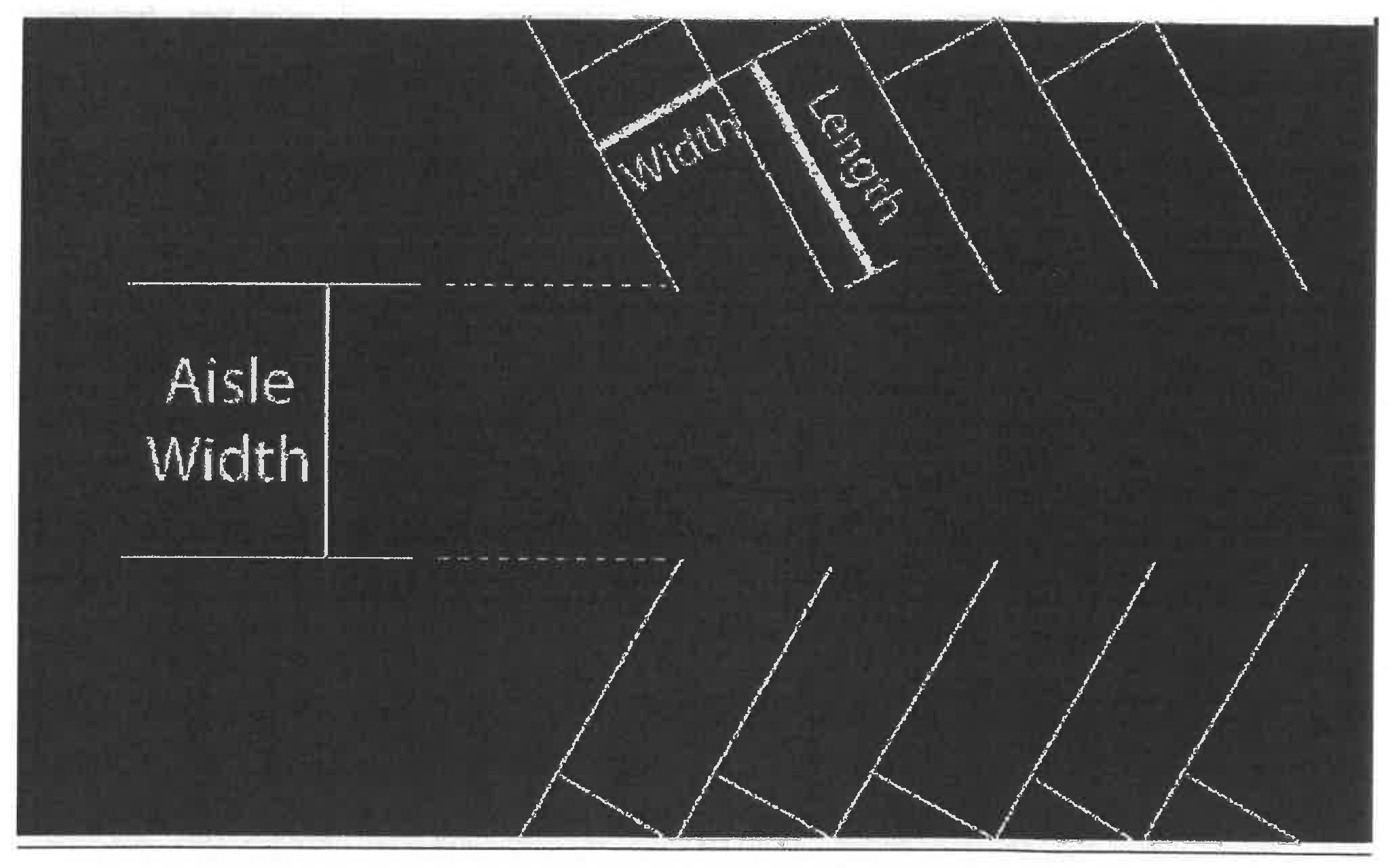
Dimensions: Off street parking areas must comply with the following standards:
2.
Surfacing:
(a)
All off street parking areas must be graded, paved, and properly drained. All parking areas except those for single-family dwellings must have the aisles and spaces clearly marked.
(b)
When adjacent to a gravel alley, parking spaces for single-family dwellings must be graded, properly drained, and may be either paved or surfaced with gravel.
3.
Parking Space Access: Each off street parking space must open directly onto an aisle that complies with the aisle width standards in subsection (D)1 of this section.
4.
Landscaping and Lighting: All off street parking areas except those for single-family and two-family dwellings must comply with the parking lot landscaping and lighting requirements of chapter 6 of this title.
5.
Wheel Stops: Any parking space located within five feet of a property line must have a masonry or steel wheel stop located at least five feet from the property line. This requirement does not apply to single-family or two-family dwellings.
6.
Driveways and Street Access:
(a)
All off street parking areas must be designed with vehicular access to a street or alley in a manner that will least interfere with traffic movements.
(b)
All driveways installed, altered, replaced, or extended after the effective date specified in section 14-01-020 of this title must comply with the following requirements:
(c)
The location, arrangement, and width of all driveways for multi-family residential and all nonresidential uses must be approved by the chief of the fire department. Driveway widths greater than the minimums may be required for emergency vehicle access.
7.
Access to Highways and Major Streets:
(a)
No direct access to the existing or proposed rights-of-way of expressways or controlled access arterial streets is permitted, unless permission is granted by the highway agency that has jurisdiction and the city council.
(b)
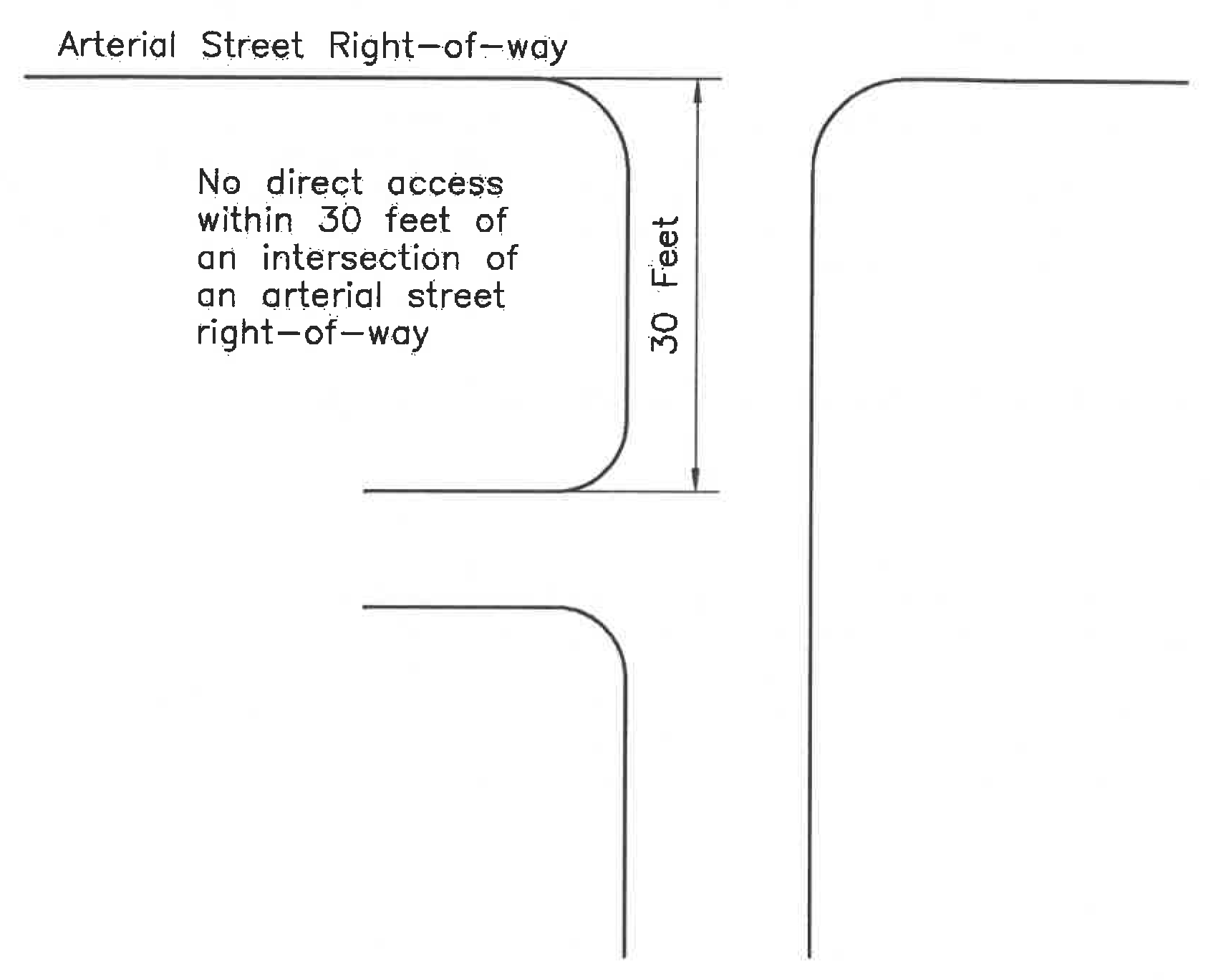
Direct access may not be taken within thirty feet of an intersection of an arterial street right-of-way in an urban area and direct access may not be taken within fifty feet of an intersection in a rural area.
(c)
The width of a driveway will be measured at right angles to the centerline of the driveway and will be exclusive of flares. The width of the driveway will be considered the edge to edge of the pavement, except where a monolithic curb combination and curb, gutter, or concrete curb is used, in which case the width will be measured from the face to face of the curbs.
(d)
Flares are defined as the area of the driveway surface outlined by the edge of the highway/street, the edge of the nominal width or through part of the driveway, and normally curved outer edge connecting the two. The edge of the flare is defined by a radius, a three-centered curve, or a straight edge.
(e)
The most recent Illinois Department of Transportation Functional Classification map promulgated by the Illinois Department of Transportation shall be used to determine which streets are arterial streets and which streets are collector streets.
(f)
Barriers such as curbing, fencing, ditches, landscaping, or other topographic barriers must be constructed to prevent vehicular access to the streets or highways specified in this subsection.
(g)
Temporary access to the rights-of-way specified in this subsection may be granted if recommended by the highway agencies having jurisdiction and approved by the city council. The temporary access permit must be temporary, revocable, subject to any conditions imposed by the city council, and may be issued for a maximum time period of twelve months.
14.05.030 - Accessible parking (for people with disabilities).
(A)
Applicability:
1.
The accessible parking standards of this section apply to all new parking lots and to changes, improvements and maintenance of existing parking lots, including, but not limited to, sealcoating, resurfacing, remarking, fencing, curbs, walks and landscaping.
2.
The requirements of this section apply to all nonresidential uses, multi-family dwellings containing ten or more units, or any other building, structure or site that is owned, leased, or financed by a governmental unit.
3.
In the event that this section and the Illinois Accessibility Code conflict, the stricter regulations apply.
(B)
Spaces Required:
1.
Residential Uses: When accessible parking spaces are required, they must be provided in the number specified in the table below:
2.
Nonresidential Uses: Accessible parking spaces are required for nonresidential uses as specified in the table below unless otherwise expressly stated:
3.
Medical Facilities:
(a)
Outpatient Facilities: A minimum of ten percent of the total number of parking spaces provided for outpatient medical facilities must be designated as accessible spaces.
(b)
Rehabilitation and Physical Therapy Facilities: A minimum of twenty percent of the total number of parking spaces provided for medical facilities specializing in rehabilitation or physical therapy must be designated as accessible spaces.
(c)
Layout and Design:
(1)
Location: Accessible parking spaces must be located on the shortest accessible route of travel between the parking area and an accessible building entrance. When more than one accessible entrance is served, accessible spaces must be dispersed and located on the shortest accessible route to each entrance. When parking facilities do not serve a particular building or use, the spaces should be located on the shortest accessible route between the parking area and an accessible pedestrian walkway.
(2)
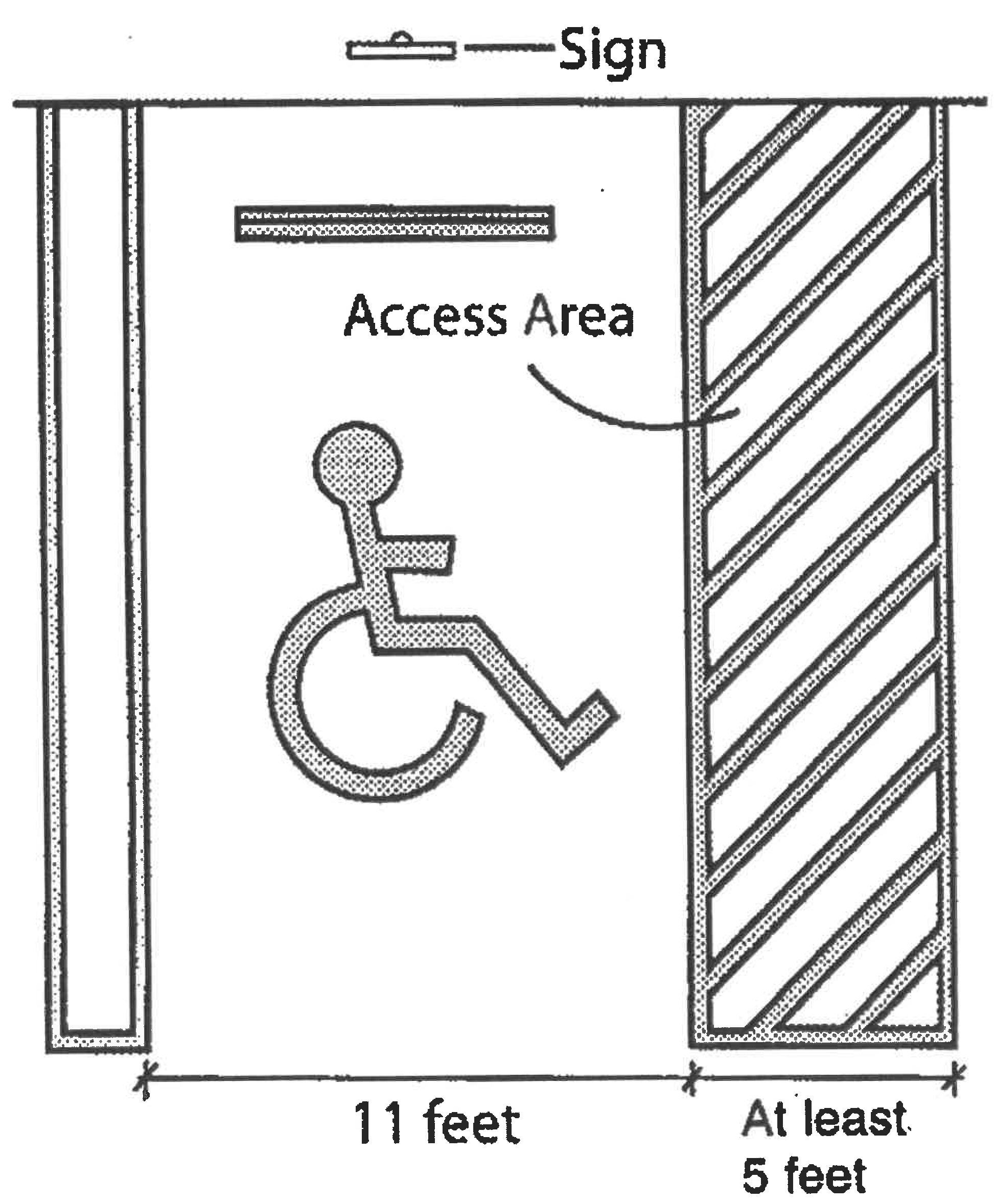
Minimum Space Size: Car and van parking spaces must be at least eleven feet wide.
(3)
Access Areas: Access areas must be included to provide space adjacent to vehicles for passenger loading and unloading. Access areas must:
A.
Be at least five feet wide;
B.
Be located on the passenger side of the parking space, based on the vehicle moving forward into the space, when serving diagonal parking spaces;
C.
Extend the full length of the parking space; and
D.
Be marked to indicate that parking in the access area is prohibited.
(4)
Slope: Parking spaces and access aisles may not have a slope greater than one to forty eight (1:48). Access aisles must be at the same level as the parking space.
(5)
Vertical Clearance: Accessible parking spaces must have a vertical clearance of at least eight feet two inches.
(6)
Signs and Identification: All accessible parking spaces required by this chapter must be identified by signs complying with U.S. Department of Transportation R7-8 standards, including the international symbol of accessibility and the amount of the fine imposed for illegally parking in an accessible space. The sign must be vertically mounted on a post or wall no more than five feet from the space and centered on the width of the space.
14.05.040 - Shared parking.
The zoning administrator may approve shared parking facilities for developments or uses with different operating hours or peak business periods, subject to the following requirements:
(A)
Location: The edge of the shared parking area must be within six hundred feet walking distance of the primary entrance of each use served.
(B)
Parking Study: Applicants wishing to use shared parking as a way to satisfy the parking requirements of this chapter must submit a parking study to the zoning administrator. The parking study must demonstrate the feasibility of the shared parking arrangement; and include the size and use of the proposed development, the anticipated parking demand for each use in the development, and the peak periods of parking demand for each use.
(C)
Shared Parking Covenant: A shared parking plan must be enforced by an irrevocable written covenant among all owners of record. A copy of the covenant must be submitted to the zoning administrator and recorded in county recorder's office before any building permits are issued for any use to be served by the shared parking area. A shared parking covenant may only be revoked if all off street parking required by this chapter is provided.
14.05.050 - Off street loading requirements.
(A)
No Use of Public Right-of-Way: At no time may goods be loaded or unloaded from the right-of-way of a collector or arterial street. No part of any vehicle may extend into the right-of-way of a collector or arterial street while being loaded or unloaded.
(B)
Loading Area Design and Construction Standards:
1.
Location:
(a)
Plans for location, design and layout of all loading spaces must be indicated on required site plans.
2.
Surfacing: All off street loading areas must be graded, paved, and properly drained.
3.
Screening: Loading spaces must be completely screened from view of residential zoning districts by the existing building, a fence, or an evergreen planting screen.

