
Oglesby City Zoning Code
CHAPTER 10
DECISION MAKING BODIES
Chapter 9 - PUBLIC IMPROVEMENTS
Sections:
Chapter 10 - DECISION MAKING BODIES
Sections:
14.09.010 - Improvements required.
(A)
Subdividers are responsible for the construction, installation and maintenance of the following improvements in accordance with the standards of this title in addition to any federal, state or local standards:
1.
All roads within the subdivision and improvements to existing roads required for safe and adequate access to the subdivision as may be required by this title;
2.
Water supply and wastewater systems;
3.
Stormwater management facilities;
4.
Electrical improvements;
5.
Any other improvements required by this chapter or required at the time of preliminary plat approval.
(B)
The requirements of this chapter also apply to nonsubdivision development when such improvements are required to serve the development, or as otherwise specifically stated in this title.
14.09.020 - Construction of subdivision improvements.
(A)
Compliance with Requirements: Before a final plat will be approved, the city engineer must certify that the improvements described in the subdivider's plans and specifications, together with agreements, meet the minimum requirements of all provisions of this title and that they comply with the following:
1.
Where not specified by this chapter, all construction work must comply with the provisions of the most recent version of the "Standard Specification For Road and Bridge Construction" adopted by the Illinois Department of Transportation, commonly referred to as the "Standard Specifications."
2.
Where not specified by this chapter, design standards must comply with the provisions of the most recent version of the "Highway Standards" manual as published by the Illinois Department of Transportation, commonly referred to as the "Highway Standards."
(B)
Deviation from Plans and Specifications: No substantial deviation from the plans and specifications as approved by the city engineer will be allowed without the written permission of the city council. Field changes will be allowed by the city engineer.
14.09.030 - Performance guarantees.
(A)
Forms and Conditions of Performance Guarantees: Performance guarantees must be made payable to the city in the form of a surety bond, letter of credit, certificate of deposit, or another surety instrument acceptable to the city council. The guarantee must be conditioned upon the performance of all work necessary to complete the specified improvements. Should the developer fail to properly install all improvements within the term of the guarantee, the city may draw on the funds to complete the improvements. Until official acceptance of the improvements by the city, the owner is responsible for all maintenance of the required improvements.
1.
Amount: The amount of the guarantee must be a minimum of one hundred percent of the estimate of the probable cost of the improvements, estimated by the owner and approved by the city council.
2.
Term: Guarantees must be posted for a minimum eighteen month period. Upon request by the property owner, the city council, for good cause and with the approval of the provider of the guarantee, may extend the term for up to one additional year. However, as a condition of extension of the guarantee the city council is authorized to request an updated cost estimate and increased guarantee for the remainder of the outstanding improvements, if it determines that the original guarantee may no longer be sufficient to cover the current cost of the outstanding improvements.
3.
Release of Guarantee: The performance guarantee will be released when:
(a)
All improvements are completed according to approved plans and the requirements of this title, and are certified by all appropriate agencies;
(b)
Four sets of approved as built plans for all improvements have been submitted to the city, including one PDF copy;
(c)
Final waiver of liens for all materials and labor necessary for the installation of improvements is submitted; and
(d)
Final acceptance has been made by the city council.
14.09.040 - Homeowners' association responsibilities.
Where required to be established, a homeowners' association as defined by this title is responsible for enforcement of private covenants and restrictions within a subdivision, condominium, or other specified development. The association must be established and approved as a condition of plat or development approval and is responsible for the cost and maintenance of all private streets, common open space, landscape areas (which may include those, around identification signs and within required transition yards), stormwater facilities, and other private facilities within a development that are not dedicated to the public.
14.09.050 - Monuments.
(A)
Two permanent monuments must be placed at exterior corners of each subdivision. Permanent monuments must be concrete, six inches in diameter with an iron bar or pipe at least five-eighths inch in diameter and thirty inches long at the center of the monument.
(B)
All lot corners, exterior corners, points of curvature, and points of tangency not marked by permanent monuments must be marked by iron pipes or bars at least one-half inch in diameter and thirty inches in length.
(C)
A minimum of one permanent elevated bench mark must be established for each subdivision. This monument must be constructed according to the requirements for permanent monuments as described in this section.
14.09.060 - Easements and dedications.
(A)
Access Easements (Private Streets): Private streets are not permitted, except that the plan commission may approve private streets that serve three or fewer lots. Private streets, if approved, must be constructed according to the standards for roads in this title, and means must be established for private maintenance. Private streets must be labeled on the final plat as follows: "This subdivision contains private streets that will not be maintained by the city or any other public agency. Property owners within the subdivision are responsible for all maintenance." A sign identifying the street as a private street must be placed at the street's entrance, according to city specifications. The maintenance of private streets will be the responsibility of the abutting property owners or established homeowners' association.
(B)
Utility Easements: Utility easements must be provided for any overhead or underground utility service and must be at least twelve feet wide. Easements must be located across lots or along rear or side property lines and must be designed to provide continuity of alignment from block to block and to adjoining unsubdivided areas.
(C)
Watercourse and Drainage Easements: Where a subdivision is traversed by a watercourse, drainageway, channel or stream, a stormwater easement or drainage right-of-way conforming substantially to the lines of the watercourse must be provided.
(D)
Land Dedications:
1.
Whenever the plan commission determines that a park, recreation area, school site, library or other public space should be located in whole or in part in the proposed subdivision, the plan commission will request the dedication of those sites or will require their reservation for a period of one year following the date of the final approval of the subdivision plat. If a governmental agency passes a resolution expressing its intent to acquire the reserved land within the reservation year, the reservation period will be extended for one additional year.
2.
Land to be dedicated to the public must be labeled on the final plat as follows: "Dedicated to the (public agency) for (intended use of dedicated land)."
3.
All lands offered to the city for use as streets, alleys, schools, parks, libraries and other public uses must be referred to the plan commission for review and recommendation before being accepted by the Council or by any other governing authority of the city.
14.09.070 - Blocks.
(A)
The lengths, widths and shapes of blocks must be determined with due consideration given to:
1.
Provision of adequate building sites suitable to the type of use contemplated;
2.
Zoning requirements as to lot sizes and dimensions;
3.
Needs for convenient access, circulation, control and safety of street traffic; and
4.
Limitations and opportunities of topography.
(B)
Blocks must be at least four hundred feet long but no longer than one thousand eight hundred feet. Crosswalk easements are required for blocks more than eight hundred feet long. Crosswalk easements must be at least twelve feet wide and located where deemed necessary by the plan commission. The plan commission may also require additional crosswalks to provide safe and convenient access to schools, parks, shopping areas or other destinations.
14.09.080 - Lots.
(A)
The lot size, dimensions, shape and orientation must be appropriate for the location of the subdivision and for the type of development and use contemplated.
(B)
Lot dimensions and areas must conform to the requirements of chapter 4 of this title.
(C)
All side property lines must be substantially at right angles to the street right-of-way, or radial to curved street right-of-way.
(D)
All residential lots must front directly on a public street or a permanent access easement to a public street that is at least twenty feet wide, as permitted by subsection 14.09.060(A) of this chapter.
(E)
Double frontage and reversed frontage lots are to be prohibited in residential districts except where necessary to provide separation of residential development from traffic arteries.
(F)
Lots abutting a watercourse, drainageway, channel or stream must have additional width or depth as required to provide an adequate building site and afford the minimum usable area required in chapter 4 of this title for front, rear and side setbacks.
(G)
Excessive depth in relation to width should be avoided. The depth of a lot should not exceed three times its average width.
14.09.090 - Streets.
(A)
General:
1.
The arrangement, character, extent, width, grade and location of all streets must be considered in their relation to existing and planned streets, topographical conditions, to public convenience and safety, and in their appropriate relation to the proposed uses of the land to be served by such streets.
2.
In the case of tentative plats for parts of tracts, where it appears necessary to the plan commission for the satisfactory overall development of an area, an owner may be required to prepare at least a street plan of his entire tract based upon proper topographic surveys before approval of any portion of such plan.
3.
Whenever an area is subdivided into lots of forty thousand square feet or more that may at a later date be resubdivided, consideration must be given to the street and lot arrangement of the original subdivision so that additional minor streets can be located to permit a logical arrangement of smaller lots.
4.
In the layout of all subdivisions, due regard must be given to the preservation of historical sites and natural features such as large trees, watercourses and scenic views.
(B)
Street Layout: The arrangement of streets in a subdivision must either:
1.
Provide for the continuation or appropriate projection of existing principal streets in surrounding area; or
2.
Meet a particular situation where topographical, drainage or other conditions make continuance or conformance to existing streets impracticable.
(C)
Frontage Roads:
1.
Where a subdivision abuts or contains an existing or proposed major highway or interstate highway, the plan commission may require:
(a)
Frontage roads;
(b)
Reverse frontage with screen planting contained in a nonaccess reservation along the rear property line;
(c)
Deep lots with rear service alleys;
(d)
Other treatments as necessary for protection of residential properties and to separate through and local traffic.
2.
Where a subdivision borders on or contains a railroad right-of-way or limited access highway right-of-way, the plan commission may require a street approximately parallel to and on each side of such right-of-way, at a distance suitable for the appropriate use of the intervening land, for park purposes in residential districts, or for commercial or industrial purposes in the appropriate districts. Such distances must be determined also with due regard for the requirements of approach grades and future grade separations.
(D)
Half Streets Prohibited: No building permit will be issued for the construction of a building on a lot that abuts a public right-of-way dedicated to one-half or less of its proposed width.
(E)
Street Dimensions: All streets must conform to the following requirements:
(F)
Intersections:
1.
Streets must intersect as nearly to right angles as possible, with no intersection less than sixty degrees.
2.
Street jogs with centerline offsets of less than one hundred twenty five feet are prohibited.
(G)
Cul-De-Sac Streets:
1.
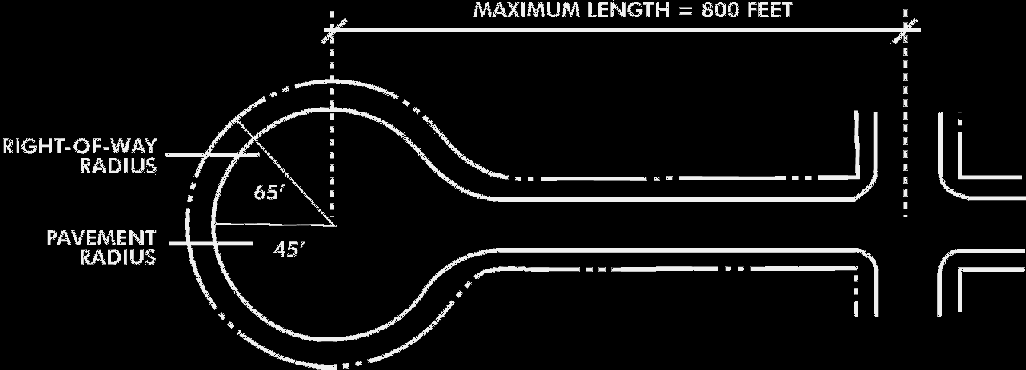
Permanent dead end streets may not be longer than eight hundred feet and must be provided with a cul-de-sac turnaround with a pavement radius of at least forty five feet and a right-of-way radius of at least sixty five feet. Other types of turnarounds are prohibited.
2.
Cul-de-sac islands are prohibited, due to the difficulty cul-de-sac islands create for snow removal and emergency services.
(H)
Stub Streets:
1.
Where an existing street terminates at the boundary line of a proposed subdivision, the street must be continued in the proposed subdivision unless natural conditions on the adjacent property preclude continuation of the street.
2.
When a proposed street terminates at the subdivision boundary, right-of-way lines and pavement must extend to the subdivision boundary if the adjacent property is undeveloped. The following notation must be placed on the final plat: "Future access connection for adjacent development."
(I)
Alleys:
1.
Alleys are prohibited in residential areas except where approved by the plan commission.
2.
Alleys may be required in commercial and industrial districts. The plan commission must refer any variations to the city council for waiving this requirement if provisions are made for service access such as off street loading, unloading and parking, consistent with and adequate for the uses proposed.
3.
Where provided, alleys must have a minimum right-of-way width of twenty feet.
4.
Alley intersections and sharp changes in alignment must be avoided where possible, but where necessary, corners must be cut off sufficiently to permit safe vehicular movement.
5.
Dead end alleys must be avoided where possible, but if unavoidable, must be provided with adequate turnaround facilities at the dead end, as determined by the plan commission.
(J)
Surfacing: The following types of street surfacing are minimum requirements:
1.
Local Residential Streets:
(a)
Three inch bituminous surface on an eight inch compacted aggregate base; or
(b)
Six inch concrete surface on a four inch compacted aggregate base.
2.
Arterial and Collector Streets: Four inch thick bituminous surface on a twelve inch compacted aggregate base. These streets must comply with Illinois Department of Transportation, Bureau of Local Roads Design Standards, if the Illinois Department of Transportation Standards are more stringent than those provided for herein.
(K)
Curbs and Gutters:
1.
Concrete curbs (type B-6.12 as specified in the most recent edition of the Highway Standards of the Illinois Department of Transportation) must be installed on all new streets, except in detached single-family subdivisions where a mountable curb of similar dimensions may be approved by the city engineer, the plan commission, and the city council.
2.
Where curb and gutter are not required, streets must be constructed with:
(a)
Shoulders consisting of the same material as the required aggregate base course, extending two feet beyond each edge of the street surface for local streets and extending six feet beyond the edge of the street surface for arterial and collector's streets.
(b)
Ditches a minimum of two feet deep with slopes no steeper than four to one.
(c)
Minimum twelve inch diameter pipe culverts for driveways and minimum fifteen inch diameter pipe culverts for crossroad culverts.
(L)
Street and Avenue Names: Names may not be similar to or duplicate the names of existing streets. New streets that are extensions of existing streets must bear the name of the existing street. All street names are subject to the approval of the plan commission.
(M)
Street Signs and Markers: The subdivider must purchase and install street name signs that conform to the standards of the city at one corner of each street intersection.
(N)
Streetlights: Streetlights must be installed at all intersections and at the end of all cul-de-sac and stub streets. Installation of lighting must meet all current city specifications. Payment must be made by the developer to the city for the installation of lighting standards, poles, brackets, luminaries, lamps and wiring meeting all current city specifications.
14.09.100 - Sidewalks.
(A)
Applicability:
1.
For properties being subdivided, sidewalks are required on both sides of the street in the following instances:
(a)
Streets in residential subdivisions consisting of lots with an average lot area of twenty thousand square feet or less;
(b)
In subdivisions near or containing schools or along arterial or collector streets where heavier traffic volumes may present safety problems for pedestrians, as required by the city council;
(c)
In all multi-family or attached single-family subdivisions; and
(d)
In all mixed use or nonresidential subdivisions.
2.
For properties being subdivided, sidewalks are required on one side of the street in residential subdivisions consisting of lots with an average lot area greater than twenty thousand square feet. This requirement may be waived if a system of paved trails or pedestrian walkways is provided.
3.
For properties being subdivided, the plan commission can recommend to the city council that the city council approve a subdivision without sidewalks and, if the city council concurs with the recommendation of the plan commission, the provisions of this section dealing with sidewalks can be eliminated or modified.
(B)
Dimensions and Locations:
1.
Sidewalks must be constructed a minimum of one foot from the property line.
2.
Sidewalks on collector and arterial streets and streets fronting on multi-family, commercial or industrial development must be at least five feet wide.
3.
Sidewalks for single-family development must be at least four feet wide.
4.
Sidewalks must be constructed of concrete and must be at least four inches thick. Sidewalk thickness must be at least six inches at driveways.
5.
Sidewalks must connect to existing adjacent sidewalk networks where practicable.
14.09.110 - Landscaping.
(A)
All improved areas within the dedicated street area or other public use areas and all yards must be graded and seeded.
(B)
One tree must be planted along street frontages between the building line and the front and corner property lines of each lot. Once planted, the maintenance of these trees is the responsibility of the property owner. Required street trees must be installed on an individual lot prior to issuance of a letter of occupancy for that lot in accordance with section 14.11.200 of this title.
14.09.120 - Water supply systems.
(A)
General:
1.
No subdivision may be approved without water supply systems that comply with this section, or the posting of surety bonds guaranteeing such improvements.
2.
All water supply systems must be designed and constructed according to all applicable rules, regulations and standards contained in ordinances of the city of Oglesby, the Illinois Environmental Protection Agency, and the "Standard Specifications For Water and Sewer Main Construction In Illinois." All water supply systems must be designed at a minimum of one inch in diameter or larger to provide adequate water pressure and flow for the intended use, including fire protection, and must be approved by the city engineer.
(B)
Public Water Systems: The facilities on the site must be designed and installed to connect to the public water system with approval by the city engineer, in accordance with the requirements of this section.
(C)
Water System Design and Construction:
1.
Water mains, fire hydrants and services must be provided to serve all lots and to provide for reasonable expansion of the system.
2.
Water mains must be designed using the criteria of the State of Illinois Department of Health and the Illinois Environmental Protection Agency in regard to the Ten State Standards. All water mains must be constructed of C-900 PVC pipe of at least two hundred pounds pressure. When possible, water mains must be interconnected so as to avoid "dead ends." All valves must be enclosed in valve boxes.
3.
Fire hydrants must be located within two hundred feet of all dwellings and must be of manufacture approved by the city with auxiliary valves and boxes. Hydrants must be spaced no more than four hundred feet apart.
4.
Water services must be type copper or poly SDR-9 with tracer wire at least one inch in diameter.
14.09.130 - Sewage disposal facilities.
(A)
General:
1.
No subdivision may be approved without sewage disposal facilities that comply with this section, or the posting of surety bonds guaranteeing such improvements.
2.
All sewage disposal facilities must be designed and constructed according to all applicable rules, regulations and standards contained in ordinances of the city of Oglesby, the Illinois Environmental Protection Agency, the "Standard Specifications For Water and Sewer Main Construction In Illinois," and all other applicable agencies. Plans, specifications, and construction must be approved by the Illinois Environmental Protection Agency, and the city engineer. Before recommending approval of a subdivision, the plan commission must consider the availability of sewage disposal facilities to the proposed subdivision. Regardless of the location or lot size, a subdivision will be disapproved if the city engineer finds that the drainage, soil conditions, disposal facilities or other conditions may create a hazard to public health.
(B)
Public Sewer Systems: The facilities on the site must be designed and installed to connect to the public sewer system with the approval of the city engineer according to the requirements of this section, unless an individual sewage collection and disposal system is permitted under subsection (C) of this section.
(C)
Individual Sewage Collection and Disposal Systems: The city requires that lots be serviced by public sewage collection and disposal systems. The city council will not consider approval of a preliminary plat or building permit for lots that are not proposed to be serviced by public sewage and disposal facilities unless no public sewer is available within two hundred feet to the nearest point of the closest lot of the proposed subdivision and written approval for construction of such facilities have been provided by the LaSalle County Health Department. Any request for individual sewage collection and disposal systems must be approved by the LaSalle County Health Department and Illinois Private Sewage Disposal Code which control their design. Where septic systems and individual wells are approved by the city and county, data regarding their location and construction specifications must be included on the final plat as required by this title.
(D)
Sewer System Design and Construction:
1.
Sanitary sewers and services of approved design and capacity with a minimum earth cover of three feet must be provided to serve all lots and to provide for reasonable expansions of the system.
2.
Sanitary sewers must be designed using the criteria of the State of Illinois Department of Public Health and the Illinois Environmental Protection Agency.
3.
Sanitary sewer manholes must be located at points that will minimize the possibility of submergence in storms.
14.09.140 - Stormwater management facilities.
(A)
Applicability: The regulations of this section apply to all development, as described herein.
(B)
Cost of Construction: A properly designed storm sewer system must be provided at the expense of the owner or developer of a subdivision or other tract of land as required by this section.
(C)
Permits:
1.
Storm Sewer Permits:
(a)
No connection to or extension of any storm sewer in the city may be made until a permit has been issued.
(b)
Storm sewer application permits must be accompanied by three sets of plans and specifications for review prepared by a registered professional engineer of Illinois.
(c)
When the plans and specifications are approved and a permit has been issued, the applicant must furnish the city with an additional three sets of plans and specifications.
(d)
The city must be given an advance notice of forty eight hours before any construction begins.
2.
Excavation Permits:
(a)
A permit is required for any excavation for constructing, repairing or replacing a storm sewer in any location.
(b)
A cash deposit for ground restoration in the amount set by the city council must be paid prior to issuance of an excavation permit. The ground must be restored to the city's standards. If the ground is not restored to the city's specifications, restoration may be completed at the city's expense with costs deducted from a required deposit amount, with the balance of the deposit returned after all restoration has been completed.
(D)
Certificate of Insurance:
1.
Any person, firm or corporation performing work under this section must take out and maintain during the construction of the project liability and property damage insurance that will protect him, the city and the city's representatives from claims from liability and property damages that may arise from construction of the work.
2.
The city must be furnished certificates of insurance issued by the companies carrying the risk, and the certificates must be in form and substance satisfactory to and approved by the city.
(E)
Design and Construction Standards: The design and construction of the storm sewer system and stormwater storage facilities within the jurisdiction of the city must conform to the most restrictive of the requirements contained in the latest edition of the following regulations, standards and specifications, which will be on file in the city clerk's office:
1.
"Standard Specifications For Water and Sewer Main Construction In Illinois."
2.
"Standard Specifications For Road and Bridge Construction," Illinois Department of Transportation.
3.
"Supplemental Specifications and Recurring Special Provisions," Illinois Department of Transportation.
4.
"Drainage Manual," Illinois Department of Transportation, except as modified by this chapter.
5.
"Highway Standards," Illinois Department of Transportation.
6.
"Bureau of Local Roads and Streets Manual," Illinois Department of Transportation.
(F)
Rainwater Drains: No rainwater drain may discharge onto any sidewalk or public way, and no drain may discharge onto any public street or alley at a height greater than eighteen inches above grade.
(G)
Storm Sewers For Impervious Areas:
1.
Storm sewers and catch basins must be provided for all impervious surface areas larger than seven thousand five hundred square feet when a public storm sewer is no more than one hundred feet from the property line measured along a public right-of-way or sewer system easement.
2.
One catch basin must be provided for the first thirty thousand square feet of impervious area and one additional catch basin must be provided for every additional ten thousand square feet of impervious area or fraction thereof.
3.
All other impervious areas must be designed to drain to a public street or an existing open watercourse. No drainage may be allowed to pass onto adjoining property or over public sidewalks unless at the point where a driveway intersects the sidewalk.
(H)
Subdivisions: No plat may be approved for a subdivision that is subject to periodic flooding or which contains poor drainage facilities and which would make adequate drainage of the lots and streets impossible. However, if the subdivider agrees to make improvements that will, in the opinion of the city engineer, make the area safe for residential occupancy and provide adequate lot and street drainage, the preliminary plat of the subdivision may be approved.
(I)
Connection of Sanitary Wastes to Storm Sewers or Watercourses: No sanitary sewage may discharge into any portion of the city storm drainage system or any watercourse.
(J)
Storm Sewer Capacity:
1.
Storm sewer capacities must be designed for a minimum ten-year storm frequency. Storm sewer capacities will be determined using the rational formula (Q = CiA, where Q = peak runoff rate in cubic feet/second, C = runoff coefficient, i = average intensity of rainfall in inches/hour, A = drainage area in acres).
2.
When stormwater storage is required, provision must be made to transport stormwater runoff from a one hundred-year storm frequency from the fully developed area of the site to the stormwater storage area. The additional stormwater runoff resulting from the design for a one hundred-year storm frequency may be transported to the stormwater storage area over streets, parking areas, parks, playgrounds or other open spaces, including utility easements.
3.
The storm sewer system must have adequate capacity to adequately drain all tributary drainage areas through the property, and there will be no compensation to the owner or developer by the city for the increased pipe sizes and construction costs, if any.
4.
In any subdivision, lot, or parcel of land where it is determined by the city engineer that the storm sewer would be larger than ninety six inches, based on a twenty-year storm frequency, then a ditch or drainage channel meeting the following standards may be used if the council so approves.
(a)
With grades from three-tenths of one percent to four percent, ditch may have earthen bottoms and sod banks.
(b)
With grades greater than four percent or flatter than three-tenths of one percent, ditches must be paved.
(c)
All ditches must have side slopes of not less than three to one.
(d)
Easements for all ditches must be dedicated to the city and there must be provided in addition to the necessary width required for the ditch, a strip of land on each side of the ditch of a width of fifteen feet, such distance to be measured perpendicular to trees, poles, structures and other obstructions. The slope of these side areas to the ditch may not exceed five percent. There may be no trees, bushes, or obstructions of any kind placed in this area.
(e)
Culverts or bridges must be provided at all street crossings and must be sized to eliminate flooding or ponding of water. Culverts must have a minimum cover of twelve inches. Culverts must be reinforced concrete or precast reinforced concrete pipes with necessary headwalls. Culverts must extend a minimum of five feet past each right-of-way line of the street and must extend far enough to provide a minimum slope of three to one from the right-of-way line down to the invert of the pipe.
(f)
All ditches, bridges and culverts must be located and designed in accordance with current applicable standards as amended from time to time and requirements of the city engineer.
(g)
All culverts or bridges must be provided with suitable railings and/or guardrails as required and approved by the city.
(K)
Manholes and Catch Basins: Manholes must be provided at all changes in direction and at intermediate points not exceeding three hundred fifty feet apart. Catch basins with curb inlets must be provided as required by the "Drainage Manual," Illinois Department of Transportation, except as modified by this chapter.
(L)
Stormwater Storage Facilities:
1.
Where Required:
(a)
Nonresidential Development: A properly designed stormwater storage facility must be provided by the developer of all nonresidential developments that contain an area greater than one acre or, if less than one acre, where fifty percent or more of the area is covered with impervious improvements, unless an approved facility exists for the property. This requirement does not apply to replacement of improvements on property in cases where the impervious coverage of the development is not increased.
(b)
Residential Development: Stormwater storage must be provided for all residential developments larger than two acres. This requirement does not apply to replacement of improvements on property in cases where the impervious coverage of the development is not increased.
2.
Basis of Design:
(a)
The necessary volume of stormwater storage will be calculated on the basis of a one hundred-year storm frequency using the criteria established by the Metropolitan Water Reclamation District of Greater Chicago.
(b)
No stormwater storage will be required for offsite upstream areas.
(c)
Flows from offsite tributary areas resulting from a ten-year storm frequency will be drained through the storm sewer system provided for the site. Off site flow in excess of the ten-year storm frequency must be bypassed through the site as overland flow and must be calculated using the one hundred-year storm frequency.
(M)
Allowable Release Rate: The allowable release rate of storm water runoff from the developed drainage areas of the site must not exceed the existing capacity of the downstream storm sewer system of drainage channel, but in no case, may the discharge for a one hundred-year storm exceed 0.25 cubic feet per second per acre. No outlet pipe may be of a diameter of less than eight inches and of a diameter so as not to restrict the designed allowable release rate from any storm water storage facility. Outlet control facilities other than pipes must be constructed of reinforced concrete. Outlet pipes from storage areas must be approved by the city. This limitation applies only to improvements constructed pursuant to building permits applied for after the effective date specified in section 14-01-020 of this title.
(N)
Bypass:
1.
The drainage system that is provided for the site must have adequate capacity to safely bypass through the development of the flow resulting from a one hundred-year storm frequency from all upstream areas assuming the land is in a fully developed state under present zoning or proposed zoning outlined in the comprehensive plan. The flow must be calculated using a runoff coeffecient of not less than 0.50. An allowance must be made for any upstream storm water storage that has actually been provided.
2.
The required bypass area for storm water in excess of the volume handled by the storm sewer system may consist of streets, parking areas, parks, playgrounds or other open spaces, including utility easements. There may be no habitable structures located within this bypass area that is used as a floodway, and this bypass area may not be reshaped or restricted in any way to reduce its effective capacity.
3.
The design of the bypass area must take into consideration the control of the storm water velocity to prevent erosion. The side slopes on any drainage swale may not be steeper than three to one.
(O)
Stormwater Storage Areas: The required volume of stormwater storage may be provided in paved parking areas and in reservoirs with either a wet or dry bottom. Alternate types of stormwater storage areas must be approved by the city engineer.
1.
Parking Areas: The stormwater storage areas must be designed so that the accumulation of water at any point in the parking lot during peak rainfall does not exceed eight inches. The parking lot must be sloped to drain at a minimum of one percent. The finished floor elevation of all buildings must be set so that no damage would occur if a storm in excess of the one hundred-year storm frequency occurs or if the drainage outlet becomes plugged.
2.
Dry Bottom Reservoirs:
(a)
A dry bottom type of reservoir may be designed to serve a secondary purpose for recreation, open space or other types of uses that will not be adversely affected by periodic flooding.
(b)
A paved ditch with a slope of not less than 0.50 percent will be required from the inlet pipe or structure to the outlet pipe or structure to prevent erosion of the bottom of the reservoir when the capacity of the inlet pipe exceeds five cfs or when the inlet pipe has a constant flow, even during dry weather. In certain cases, dry bottom reservoirs must have a pipe underdrain system as required by the city engineer. The paved ditch must meet the requirements for paved ditches contained in the "Highway Standards."
(c)
The grassed bottom of the reservoir must slope to drain to the outlet or paved ditch at a minimum of one percent slope. The side slopes on the earth berm around the reservoir must not be steeper than four to one and the earth berm at the top may not be less than ten feet wide.
(d)
The inlet and outlet pipes or structures from the reservoir must be self-operating and require very limited maintenance. An emergency overflow spillway must be provided from the reservoir in the event a storm in excess of the one hundred-year storm frequency occurs. The inlet and outlet pipes or structures must be provided with safety bars with maximum openings of six inches to provide for the safety of children.
3.
Wet Bottom Reservoirs:
(a)
Wet bottom storage reservoirs must be constructed to conform to the current applicable requirements. The minimum depth from the normal water level to the bottom of the side slope must be four feet. A minimum of twenty five percent of the pond area must be constructed to a minimum depth of ten feet to provide for fish.
(b)
Proper measures must be provided by the developer to prevent the water from becoming stagnant.
(c)
Where the soil in the bottom of the reservoir is too permeable to hold water, the bottom must be sealed by an accepted method approved by the city engineer.
(d)
The inlet and outlet pipes or structures from the reservoir must be self-operating and require very limited maintenance. An emergency overflow spillway must be provided from the reservoir in the event a storm in excess of the one hundred-year storm frequency occurs. The inlet and outlet pipes or structures must be provided with safety bars with maximum openings of six inches to provide for the safety of children.
(P)
Requirements During Construction: Construction operations must be conducted in such a manner as to minimize erosion potential on the site. Silting of off site downstream areas must be controlled through the appropriate use of sedimentation basins, including retention/detention facilities designed for that purpose, provided that such facilities will be restored to their prior design configuration upon completion of construction operations. The developer must indicate the methods and timing of construction to be used for the control of siltation during construction operations at the time that final engineering plans are submitted for approval.
(Q)
Approval: All work required to be done under this section must be periodically inspected by and approval obtained from the city superintendent in charge, or city engineer as the work progresses. When the work is completed, final approval must be obtained from the city superintendent in charge or city engineer. Before final approval can be obtained, the superintendent in charge or city engineer must inspect all work and see that it has been completed in accordance with the approved plans and specifications.
(R)
Stormwater Management Facility Maintenance:
1.
Routine Maintenance: The homeowners' association whose property or common area includes all or a portion of an open drainage swale, channel, detention basin or other stormwater management facilities will be held responsible for the mowing of grass, removal of debris or obstructions to the flow of water in or through such facilities, removal of silt, and maintenance and repair due to erosion.
2.
Nonroutine Maintenance:
(a)
Nonroutine maintenance, including maintenance activities that are expensive but infrequent, such as pond dredging or major repairs to stormwater structures, must be performed on an as needed basis based on information gathered during regular inspections.
(b)
A legally binding covenant specifying the parties responsible for proper maintenance of all stormwater management facilities must be provided by the developer and approved by the city prior to final plat approval, or for properties not subject to the plat approval process, prior to the issuance of site plan approval or building permits, whichever comes first.
(c)
The maintenance agreement must include a description of maintenance and repair procedures to be completed, including identification of components that need to be maintained and standards for maintenance.
3.
Inspections:
(a)
The persons or organizations responsible for maintenance must inspect stormwater management facilities on a regular basis, as outlined in the maintenance agreement.
(b)
Authorized representatives of the city of may enter at reasonable times upon any time to conduct on site inspections or routine maintenance.
14.10.010 - Plan commission and zoning board of appeals.
(A)
Establishment: The plan commission of the city of Oglesby shall consist of members appointed by the mayor of the city of Oglesby and approved by the city council. The zoning board of appeals shall consist of members appointed by the mayor and approved by the city council. The plan commission and zoning board of appeals previously appointed by the city council prior to the adoption of this title shall be deemed to be reappointed and shall be directed to act under the terms of this title.
(B)
Membership:
1.
The plan commission shall consist of the mayor and commissioner of accounts and finances plus nine members of the general public, who must be residents of the city of Oglesby, and who shall be appointed by the mayor and confirmed by the city council.
2.
The zoning board of appeals shall consist of seven members appointed by the mayor and confirmed by the city council.
3.
Plan Commission members and zoning board of appeals members shall serve staggered three year terms.
4.
The chairman of the plan commission and the chairman of the zoning board of appeals shall be designated by the mayor.
5.
Vacancies will be filled for an unexpired term in the same manner as appointments for a full term.
(C)
Meetings and Rules:
1.
The commission must organize and adopt rules of procedure for its own government according to the provisions of this title.
2.
Meetings will be held at the call of the chairman and at other times that the commission determines, and must be open to the public.
3.
Minutes of the proceedings and a record of all actions must be kept by the acting secretary of either the zoning board of appeals or the plan commission, showing the vote of each member upon each question, the reasons for the commission's determination, and its finding of facts. These records will be filed in the office of the city clerk and are a public record. The city attorney shall act as acting secretary for all meetings of the plan commission and zoning board of appeals.
4.
Decisions on all matters before the plan commission and zoning board of appeals require a majority vote of a quorum of commission members.
(D)
Plan Commission Powers and Duties: The plan commission has the following powers and duties:
1.
To hear and make recommendations regarding applications for text amendments, zoning map amendments, multi-family design review, special uses, preliminary plats and planned developments, according to the requirements of this title;
2.
To request assistance from other city officers, departments, commissions and boards;
3.
The chairman may administer oaths and compel the attendance of witnesses; and
4.
Along with the city council, to develop and update the Comprehensive Plan to provide planning policies to guide future land use and zoning decisions and to provide the basis for approval of all development under this title.
(E)
Zoning Board of Appeals Powers and Duties: The zoning board of appeals has the following powers and duties:
1.
To hear and decide appeals from any order, requirement, decision, or determination made by the zoning administrator, provided that a party appealing the decision of the zoning board of appeals may further appeal a decision of the zoning board of appeals to the city council and a final decision on any appeal shall be made by the city council.
2.
To hear and make recommendations to the city council regarding variations from the requirements of this Land Development Code, subject to the standards set out in this title.
3.
To request assistance from other city officers, departments, commissions and boards; and
4.
The chairman may administer oaths and compel the attendance of witnesses.
(Ord. No. 1197-060622, § 3, 6-6-2022)
14.10.020 - Zoning administrator.
(A)
Designation: The zoning administrator is designated by the mayor subject to the approval of the city council.
(B)
Powers and Duties: The zoning administrator has the following powers and duties:
1.
To have the initial responsibility and authority for the interpretation and enforcement of this title and all other applicable ordinances, regulations and codes;
2.
To enter and inspect any premises, as needed, in the performance of these duties;
3.
To attend all meetings of the plan commission and zoning board of appeals, if requested, for the purpose of providing technical assistance when requested by the commission/board;
4.
To review and issue building permits, sign permits, letters of occupancy;
5.
To hear and decide applications for interpretations of the use classifications, land development regulations of this title, and zoning district boundaries; and
6.
To serve as a member of and call meetings of the development review committee as needed.
14.10.030 - City council.
The city council has the following powers and duties, in addition to those established by other chapters of this code:
(A)
Along with the plan commission, the city council must develop and update the Comprehensive Plan to provide planning policies to guide future land use and zoning decisions and to provide the basis for approval of all development under this title;
(B)
To confirm the mayor's designation of the zoning administrator;
(C)
To confirm members of the plan commission and zoning board of appeals appointed by the mayor;
(D)
To publish a revised zoning map according to subsection 14-01-080(B) of this title;
(E)
To give final approval for freestanding wireless communication facilities;
(F)
To approve and accept subdivision improvements;
(G)
To give final approval for preliminary and final plats;
(H)
To propose and give final approval of text amendments to this chapter according to section 14.11.020 of this title;
(I)
To propose and give final approval of amendments of the zoning map according to section 14.11.030 of this title;
(J)
To give final approval for special uses and planned developments;
(K)
To propose and give final approval to any requests for variation from the requirements of this Land Development Code;
(L)
To give final approval on applications for design review;
(M)
To hear and grant variations from the floodplain protection standards; and
(N)
To give final approval for any other actions as required in this title.

