
Oglesby City Zoning Code
CHAPTER 4
DIMENSIONAL STANDARDS
Sections:
14.04.010 - Residential districts.
Notes:
1. Minimum lot width for individual townhouse (attached single-family) lots is 20
feet.
2. No interior side setback required for attached single-family units; see subsection 14.03.020(A) of this title for other rules governing attached single-family dwellings.
3. Certain public and civic buildings are permitted to exceed maximum height requirements
pursuant to subsection 14.04.030(L)3 of this chapter.
14.04.020 - Nonresidential districts.
(A)
Dimensional Standards:
Notes:
1. All buildings in the B1 district must comply with the building location standards
of subsection 14.02.020(E)1 of this title.
2. When a B zoned lot abuts a residentially zoned lot, special rules apply. See subsection
(B) of this section.
3. When an M zoned lot abuts or is across the street from a residentially zoned lot,
special rules apply. See subsection (C) of this section.
4. Certain public and civic buildings are permitted to exceed maximum height requirements.
See subsection 14.04.030(L)3 of this chapter.
(B)
B Zoned Lots Abutting R Zoned Lots:
1.
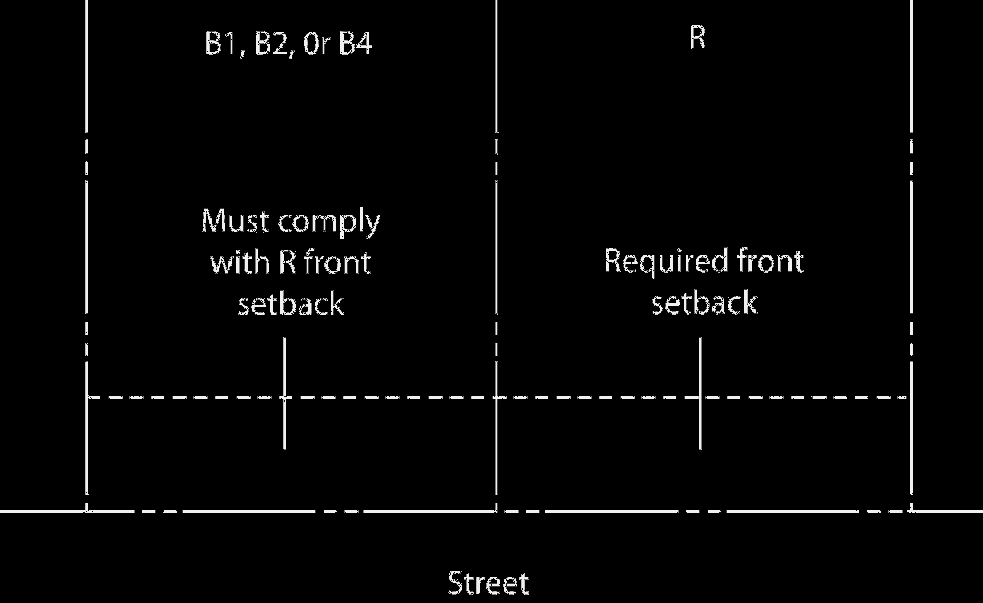
Front Setback: Where a B1, B2 or B4 zoned lot shares a side property line with an R zoned lot, the B1, B2 or B4 zoned lot must comply with the front setback standards of the R zoned lot.
2.
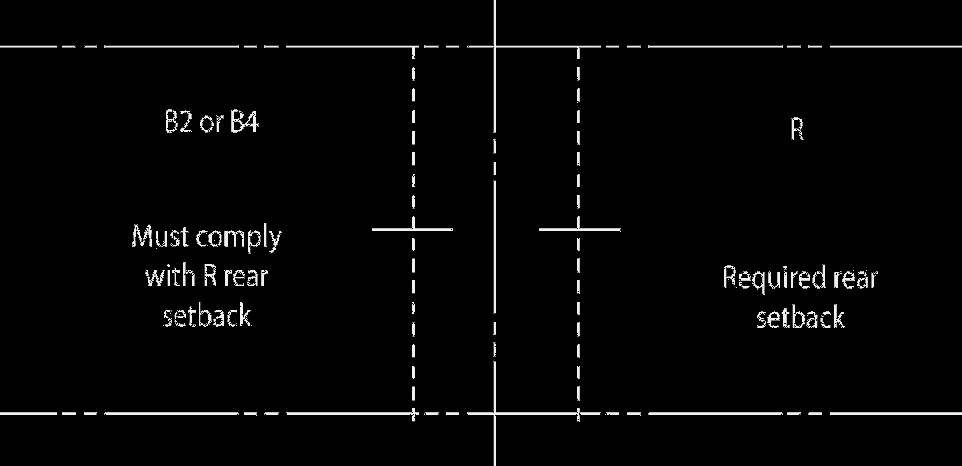
Rear Setback: Where a B2 or B4 zoned lot shares a rear property line with an R zoned lot, the B2 or B4 zoned lot must comply with the rear setback standards of the R zoned lot.
3.
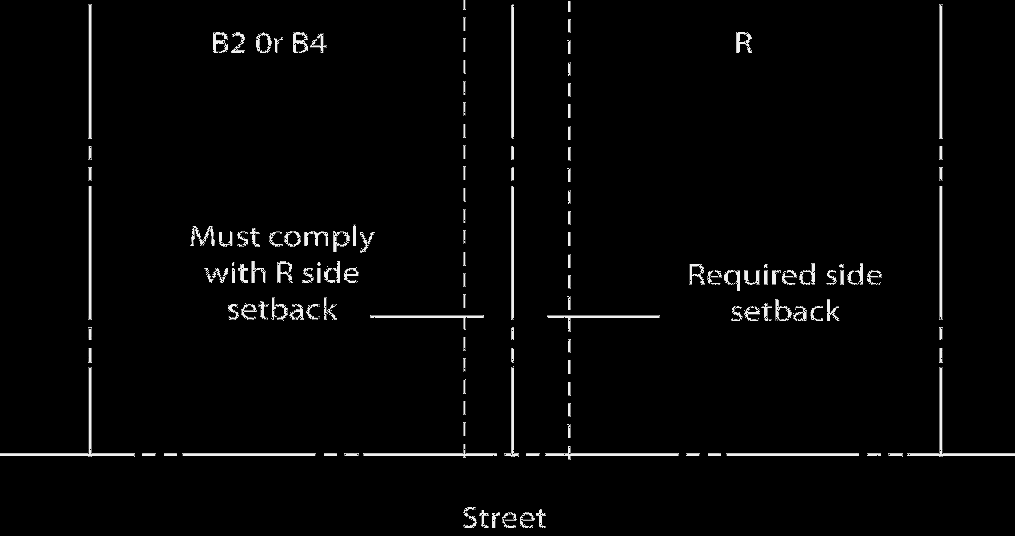
Interior Side Setback: Where a B2 or B4 zoned lot shares a side property line with an R zoned lot, the B2 or B4 zoned lot must comply with the side setback standards of the R zoned lot.
4.
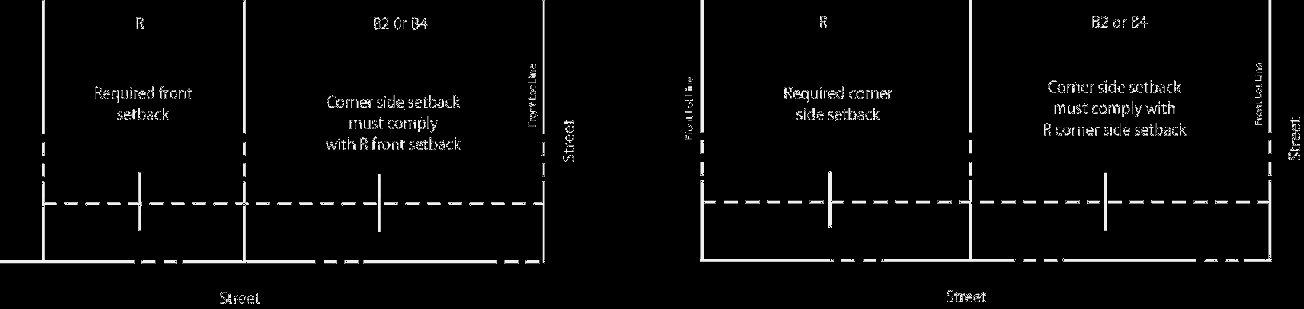
Corner Side Setback: Where a B2 or B4 zoned lot abuts a residentially zoned lot, the corner side setback of the lot zoned B2 or B4 must comply with the front or corner side setback of the abutting residential district.
(C)
M Zoned Lots Abutting R Zoned Lots:
1.
Front Setback: Where an M zoned lot shares a side property line with or is across a street from a residentially zoned lot, the minimum front setback of the M zoned lot is seventy feet.
2.
Rear Setback: Where an M zoned lot shares a rear property line with a residentially zoned lot, the minimum side setback on the M zoned lot is sixty feet.
3.
Interior Side Setback: Where an M zoned lot shares an interior side property line with a residentially zoned lot, the minimum side setback of the M zoned lot is thirty feet.
4.
Corner Side Setback:
(a)
Where an M1 zoned lot abuts a residentially zoned lot, the minimum corner side setback of the M1 zoned lot is thirty feet.
(b)
Where an M2 zoned lot abuts a residentially zoned lot, the minimum corner side setback of the M2 zoned lot is seventy feet.
14.04.030 - Measurements and exceptions.
(A)
Lot Area, Total:
1.
Measurement: Lot area includes the total land area contained within the property lines of a lot. No lot, yard, parking area, building area, or other space may be reduced in area or dimension so as not to meet the provisions of this code. No part of any lot, yard, parking area, or other space required for a structure or use may be used for any other structure or use on an adjoining lot.
2.
Exceptions for Nonconforming Lots of Record: There are reduced minimum lot area requirements for certain nonconforming lots of record. See section 14.12.060 of this title for rules regarding nonconforming lots of record.
3.
Exceptions for Lots Not Serviced by Public Sewers: On lots with on site sewage disposal systems, the minimum lot area may be required to be increased so that the lot size is sufficient to permit the use of an on site sewage disposal system designed in accordance with State of Illinois Department of Public Health requirements. The minimum lot area for an on site sewage disposal system is established by the criteria included in chapter 9 of this title.
(B)
Lot Area Per Dwelling Unit:
1.
Measurement: The lot area per dwelling unit refers to the minimum amount of lot area that is required for each dwelling unit on the property. For residential or mixed use development, dwelling unit density is controlled through a minimum lot area per dwelling unit standard.
2.
Rounding: When the number of dwelling units yielded by the density calculation results in a fraction, the fraction must be rounded down to the previous whole number. For example, if a minimum lot area per unit standard of six thousand square feet is applied to a fifteen thousand square foot lot, a maximum of two dwelling units would be allowed on the property.
(C)
Lot Width:
1.
Measurement: Lot width is measured between side property lines at the required front setback.
2.
Exceptions For Nonconforming Lots of Record: There are reduced minimum lot width requirements for certain nonconforming lots of record. See section 14.12.060 of this title for rules governing nonconforming lots of record.
(D)
Front Setback:
1.
Measurement: The front setback is to be measured from the front property line to the closest point of the structure on the subject lot, not including those projections and features allowed to project into the front setback pursuant to subsection (J) of this section. On a corner lot, the front setback is to be measured from the property line that abuts a street and is generally parallel to the front of the building. For the purposes of this subsection, the front of the building is the facade with the primary building entrance. Where the location of the primary building entrance is unclear or two or more entrances are present, the final determination will be made by the zoning administrator.
2.
Use: Required setbacks must be unobstructed and unoccupied from the ground to the sky except as expressly allowed in subsection (J) of this section.
3.
Exception For Lots that Utilize Average Front Setback: As an alternative to the front setback requirements of section 14.04.010 or 14.04.020 of this chapter, uses in all residential and B3 districts may determine the required front setback based on the average front setback pursuant to subsection (E) of this section.
(E)
Average Front Setback:
1.
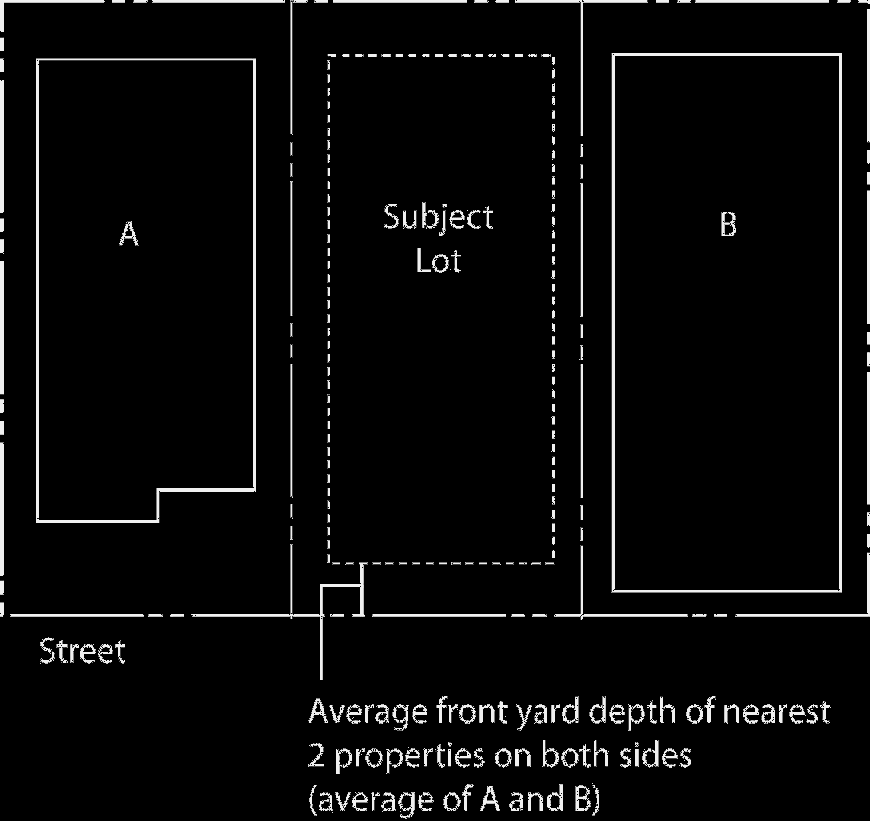
Alternative: In all residential and B3 districts, as an alternative to the front setback requirements of section 14.04.010 or 14.04.020 of this chapter, the front setback may be reduced to the average front setback whenever buildings exist on one or more adjoining lots.
2.
Measurement: The front setback, as measured on the subject lot and adjoining lots, is to be measured from the front property line to the closest point of the structure on the respective lot, not including those projections and features allowed to project into the front setback pursuant to subsection (J) of this section. On a corner lot, the front setback is to be measured from the property line that abuts a street and is generally parallel with the front of the building. For the purposes of this section, the front of the building is the facade with the primary building entrance.
(a)
When utilizing the average front setback, it must be at least as deep as the average of the front setbacks on the two lots on either side of the subject lot, in accordance with the following rules:
(b)
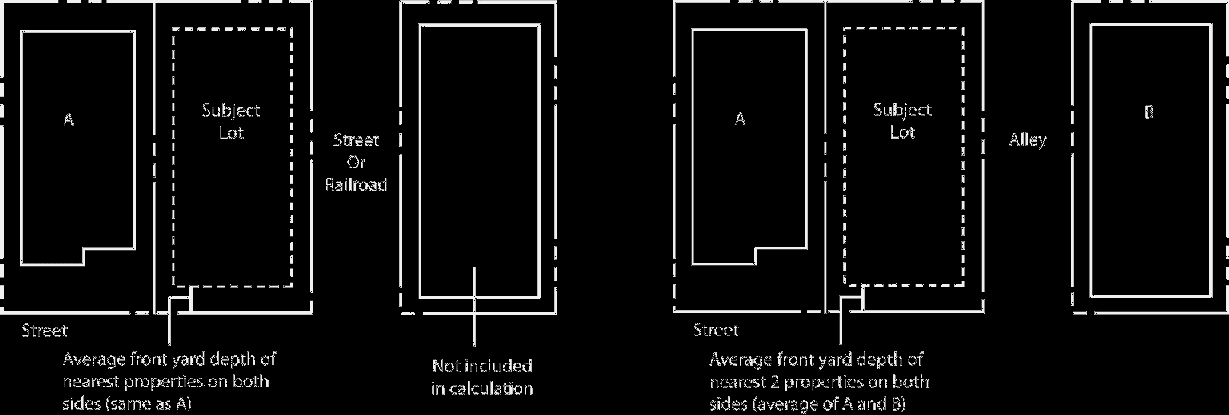
Lots that are separated from the subject lot by a street or railroad right-of-way cannot be used in computing the average. Lots that are separated from the subject lot by an alley can be used in computing the average.
(c)
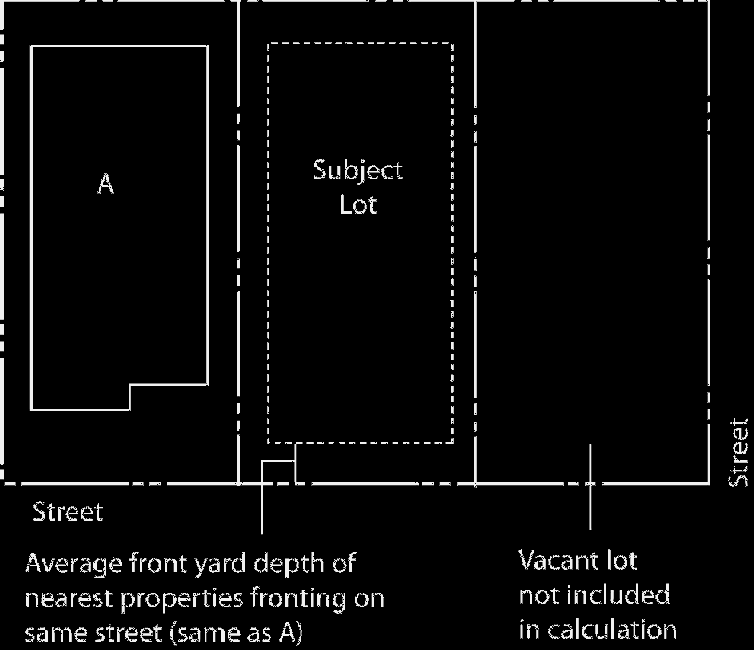
When the subject lot is a corner lot that adjoins only one developed lot, or an interior lot that adjoins one vacant lot and one developed lot, the average front setback may be computed on the basis of the one adjoining developed lot.
(d)
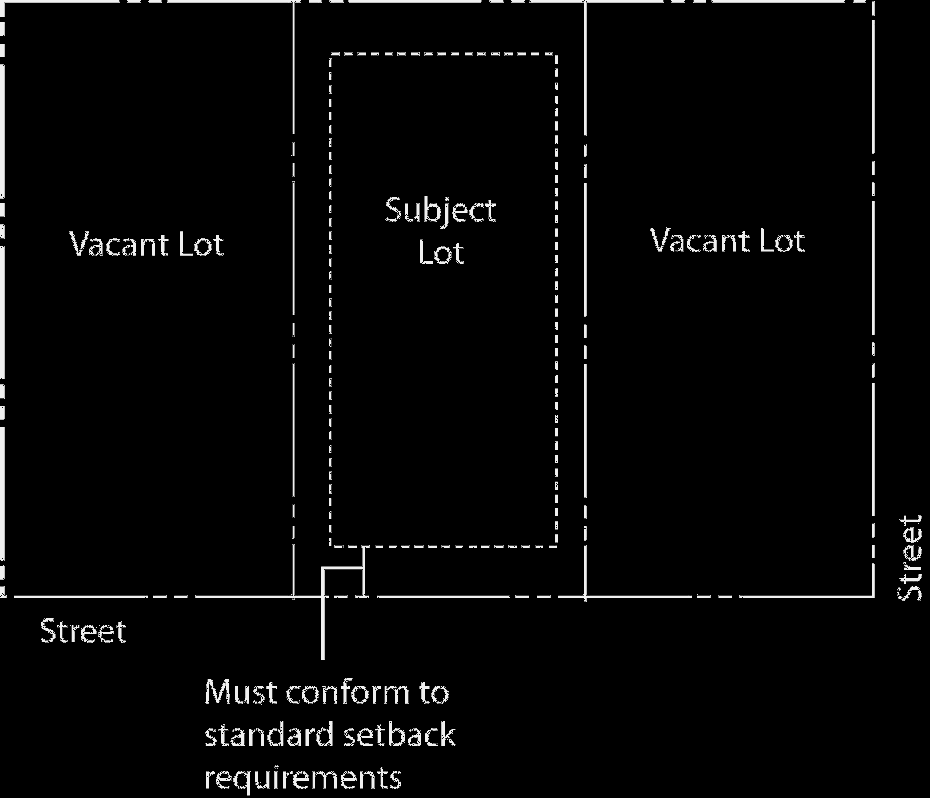
If the subject lot is a corner lot that only adjoins a vacant lot or an interior lot that adjoins two vacant lots, then the required front setback must be the front setback required by section 14.04.010 or 14.04.020 of this chapter.
3.
Use: Required setbacks must be unobstructed and unoccupied from the ground to the sky except as expressly allowed in subsection (J) of this section.
(F)
Rear Setback:
1.
Measurement: The rear setback is to be measured from the rear property line to the closest point of the structure on the subject lot, not including those projections and features allowed to project into the rear setback pursuant to subsection (J) of this section. On pie shaped or triangular lots with side property lines that come to a point at the rear, the rear setback is measured from a line segment that connects the side property lines and is a minimum of ten feet in length.
2.
Use: Required setbacks must be unobstructed and unoccupied from the ground to the sky except as expressly allowed in subsection (J) of this section.
(G)
Interior Side Setback:
1.
Measurement: The interior side setback is to be measured from the interior side property line to the closest point of the structure on the subject lot, not including those projections and features allowed to project into the interior side setback pursuant to subsection (J) of this section.
2.
Use: Required interior setbacks must be unobstructed and unoccupied from the ground to the sky except as expressly allowed in subsection (J) of this section.
(H)
Corner Side Setback:
1.
Measurement: The corner side setback is to be measured from the side property line that abuts a street to the closest point of the structure on the subject lot, not including those projections and features allowed to project into the corner side setback pursuant to subsection (J) of this section. The corner side setback is measured from the side property line that abuts a street, and is generally perpendicular to the front of the building. For the purposes of this subsection, the front of the building is the facade with the primary building entrance.
2.
Use: Required corner setbacks must be unobstructed and unoccupied from the ground to the sky except as expressly allowed in subsection (J) of this section.
(I)
Through Lot Setbacks: On through lots, the two property lines (opposing) that abut public right-of-way lines are considered front property lines and front setback requirements apply. Through lots with three property lines that abut public right-of-way lines will have two front property lines and one corner side property line where front and corner side setback requirements apply, respectively. Rear setback standards do not apply.
(J)
Exceptions from Minimum Setback Requirements: Required setbacks must be unobstructed and unoccupied from the ground to the sky except that certain building features and structures are allowed to project into required setbacks to the extent expressly indicated in the following table:
Note:
1. In the B1 downtown commercial district, these features are allowed to project into
the public right-of-way as far as they may project into required front and corner
side setbacks.
(K)
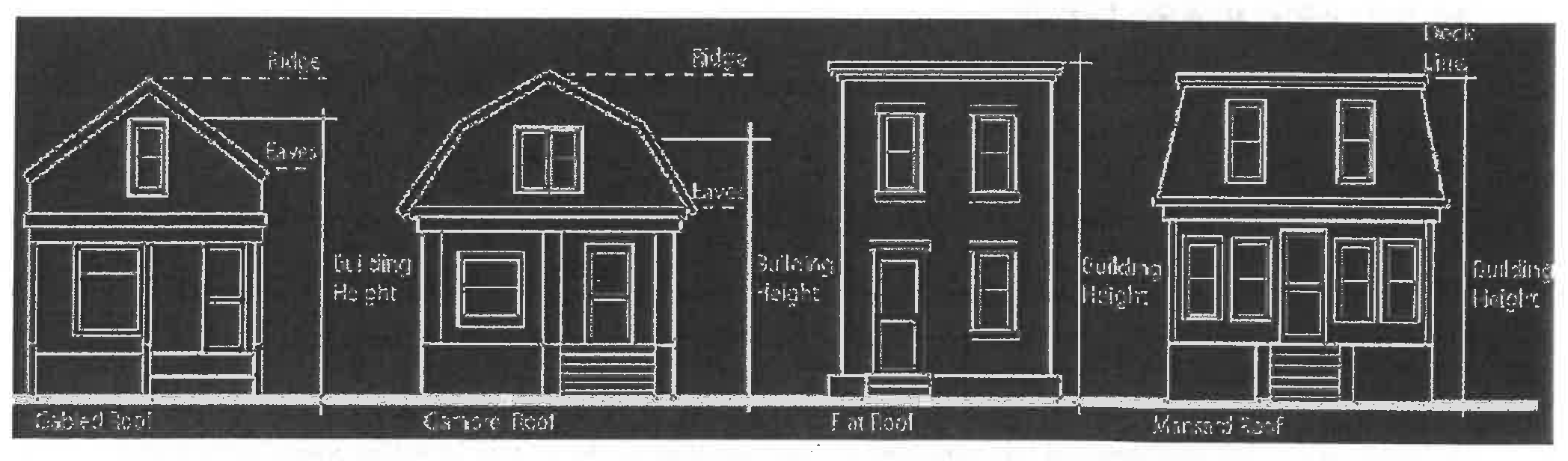
Building Height: Building height is to be measured from the average elevation of the finished grade adjoining the front building line to:
1.
The average height level between the eaves and ridge for gable, hip, and gambrel roofs.
2.
The highest point of the roof surface for a flat roof; and
3.
The deck line of a mansard roof.
(L)
Exceptions to Maximum Height Requirements: Certain structures and features may exceed the maximum permitted height requirements stipulated elsewhere in this chapter.
1.
The following are exempt from the height requirements of this chapter:
(a)
Architectural projections such as spires, belfries, parapet walls, cupolas, domes, flues and chimneys.
(b)
Structures such as elevator penthouses, gas tanks, grain elevators, radio and television reception towers and aerials (in nonresidential districts only), roof mounted mechanical equipment, cooling towers, fire towers, and smokestacks.
(c)
Structures related to utility services such as water towers, electric power and communication transmission lines, traffic signals and light poles.
2.
Radio transmission and reception antenna in residential districts may exceed the maximum permitted height, provided the height does not exceed three times its distance from the nearest property line.
3.
Public and civic uses, such as schools, religious institutions, hospitals, libraries, places of public assembly, governmental offices and stations, can be constructed to a height of seventy five feet, provided all required yards are increased not less than one foot for each two feet the structure exceeds the maximum height requirement for the applicable zoning district.
(M)
Building Coverage:
1.
Building coverage is to be measured as the percentage of lot area that is covered with principal and accessory buildings and above grade structures, including garages, sheds, gazebos, decks, porches, and swimming pools (except for temporary inflatable swimming pools). Projecting roof eaves on buildings are not counted in calculating building coverage. At grade accessory structures such as driveways, patios, walkways, and other paved surfaces on a lot are not included in the calculation of maximum building coverage.
2.
Detached garages and accessory buildings combined may not cover more than thirty percent of the combined area of rear and side yards.

