
Oglesby City Zoning Code
CHAPTER 3
USE REGULATIONS
Sections:
14.03.010 - Use table.
(A)
Use Groups: The use table classifies land uses into major groupings: residential, public and civic, commercial, industrial, agricultural and other. These are referred to as "use groups."
(B)
Use Categories: Each use group is further divided into "use categories." These categories classify land uses based on common characteristics, such as the type of products sold, site conditions, or the amount of activity on the site. Use categories are described in detail in section 14.14.010 of this title. Some use categories are further divided into specific use types, which are also described in section 14.14.010 of this title.
(C)
Determination of Land Use Category: When a land use cannot be classified into a use category or appears to fit into multiple categories, the zoning administrator is authorized to determine the most appropriate use category and to report to the city council the zoning administrator's determination for review and approval by the city council.
(D)
Permitted Uses: Uses identified with a "P" in the use table are permitted by right in the designated zoning districts, subject to compliance with all other applicable provisions of this chapter.
(E)
Special Uses: Uses identified with an "S" in the use table may be allowed in the designated zoning districts if approved in accordance with the special use approval procedure of section 14.11.050 of this title. Approved special uses are subject to compliance with all other applicable provisions of this chapter.
(F)
Prohibited Uses: Uses identified with a "-" in the use table are expressly prohibited. Uses not listed in the use table are also prohibited.
(G)
Use Standards: The "Use Standard" column in the use table provides a cross reference to additional standards that apply to some uses, whether or not they are allowed as a permitted use or special use.
Note:
1. Subject to the design review procedures of section 14.11.080 of this title.
(Ord. No. 1199-062022, § 2, 6-20-2022)
14.03.020 - Use specific standards.
(A)
Single-Family Dwelling, Attached: Attached single-family dwelling units must comply with the following requirements:
1.
Number of Units Per Building: No more than eight attached single-family dwelling units are permitted within a single building.
2.
Number of Buildings Per Lot: Multiple buildings containing attached single-family dwellings are permitted on a single lot.
3.
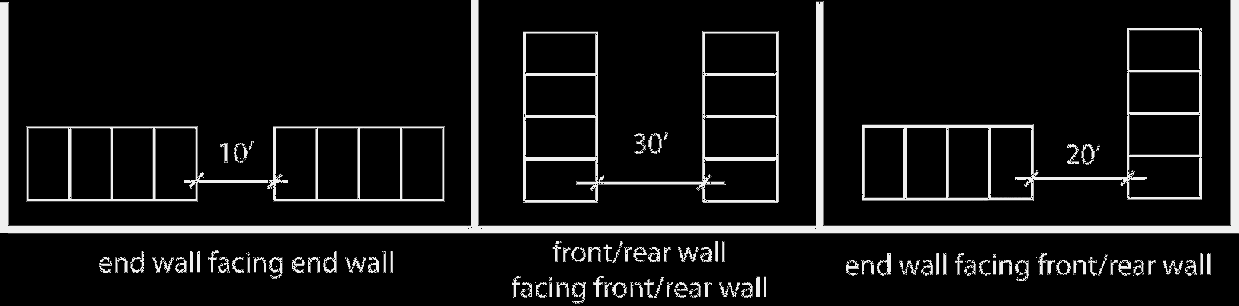
Building Separation: Attached dwellings must meet the requirements for permitted encroachments in subsection 14.04.030(J) of this title. Minimum separation between multiple buildings on a lot is required as follows:
4.
Building Design: Attached single-family dwellings must:
(a)
Be designed with windows and/or doors on all building facades that face a street to avoid the appearance of blank walls; and
(b)
Be designed with garage doors facing an alley, where there is an alley serving the site, or facing an interior driveway whenever possible. Where garages face a public street, they may not extend beyond the street facing facade.
5.
Driveway Access:
(a)
Attached single-family dwellings must be served by a common access drive, rather than separate driveway curb cuts where garages face a public street.
(b)
Driveways leading from a street to a garage must be of sufficient depth to ensure that parked vehicles do not overhang the sidewalk or public street. The distance between the sidewalk and the garage must be at least twenty feet.
6.
Private Yards:
(a)
Attached single-family dwellings must provide private yards a minimum of two hundred square feet in area for each attached single-family dwelling unit.
(b)
A private yard may be located next to a front wall, rear wall, or end wall, provided that it is immediately adjacent to the attached single-family dwelling unit it serves and is directly accessible from the unit by way of a door or steps.
(c)
Required private yards must be landscaped with turf, ground cover, shrubs, trees or other landscape improvements, such as walkways or patios.
(d)
Private yards may be enclosed with fences.
7.
Common Open Space:
(a)
In developments with thirty or more attached single-family dwelling units, one hundred fifty square feet of common open space must be provided per unit.
(b)
Common open space must be accessible to all attached single-family dwelling units and improved with landscaping, recreational facilities, and/or pedestrian walkways.
(c)
Common open space must be maintained by a homeowners' association.
(B)
Single-Family Dwellings Converted to Two-Family Dwellings:
1.
A single-family dwelling may be converted to a two-family dwelling subject to the following criteria:
(a)
Converted dwellings must maintain the appearance of single-family dwellings.
(b)
Converted dwellings must meet the parking requirements of chapter 5 of this title through existing garages and driveways.
(c)
Two separate entrances may be permitted when the dwelling is located on a
2.
Before any single-family dwelling can be converted to a two-family dwelling, the resulting two-family dwelling must meet the square footage requirements of section 14.04.010 and be properly zoned R3 under the provisions of subsection 14.02.010(B)3 of this title.
(C)
Adult Use:
1.
Locational Criteria: Adult uses cannot be located on any site that is:
(a)
Within five hundred feet of another existing adult use;
(b)
Within three thousand feet of the boundary of a residential zoning district or existing residential use; or
(c)
Within three thousand feet of any existing school or religious assembly use or cemetery.
2.
Measurement: For the purposes of this subsection, distances will be measured in a straight line, without regard to intervening structures or objects from the nearest point on the property line on the site on which the adult use exists or is proposed to the nearest point of any property line of a residential use, residential district, school, religious assembly establishment and/or any other adult use, as the case may be.
(D)
Bed and Breakfast: Bed and breakfast establishments must:
1.
Be owner occupied;
2.
Have a maximum of eight guestrooms;
3.
Only serve meals to overnight guests, unless the bed and breakfast is located on an arterial or collector street as defined by this title, then meals can be served to a maximum of twenty five people at any one time;
4.
Provide sufficient off street parking as required by chapter 5 of this title in a parking area located behind the front building line; and
5.
Not include retail or other sales on the premises.
(E)
Gas Station: Gas stations must:
1.
Have a minimum lot area of twenty thousand square feet;
2.
Limit open storage to no more than four vehicles stored for minor repairs bearing current license plates. Such storage may not exceed seventy two hours' duration and may not permit the storage of wrecked vehicles;
3.
Install lighting fixtures that are directed downward and shielded to prevent glare on adjoining properties and roadways;
4.
Install canopy lighting designed with recessed fixtures to prevent glare on adjoining properties and roadways;
5.
Locate and design curb cuts to ensure that they will not adversely affect the safety and efficiency of traffic and pedestrian circulation on adjoining streets. Curb cuts for new or expanded gas stations cannot be wider than thirty-six feet and must be a minimum of one hundred feet apart on each street frontage; and
6.
Only have accessory drive-through facilities subject to subsection 14.03.030(B) of this chapter.
(F)
Community Residences:
1.
Community residences must be located at least one thousand feet from any other community residence, large or small, unless the spacing requirement is waived in accordance with the special use procedure of section 14.11.050 of this title.
2.
When requested, waivers must be granted when the decision making body determines that the proposed community residence will not adversely affect or be incompatible with the residential character of the neighborhood.
(G)
Manufactured Home Parks: Manufactured home parks must comply with the following requirements:
1.
More Restrictive Requirements Apply: Each park to be constructed, altered, or expanded under the provisions of this chapter must provide facilities as required by the Mobile Home Park Act of the State of Illinois and all applicable rules of the Illinois Department of Public Health and other state agencies. Where the requirements of this subsection conflict with the requirements of the State of Illinois, the more restrictive requirements will control. This subsection applies only to construction, alteration, or expansion of manufactured home parks and does not determine state licensing or govern the operation of manufactured home parks.
2.
Single Ownership of Manufactured Home Parks: A manufactured home park must be entirely owned by an individual, firm, trust, partnership, public or private association or corporation. No lots may be individually sold.
3.
Applications and Licensing Requirements; Inspections:
(a)
No person may construct, alter, or expand a manufactured home park unless they hold a valid permit from the State of Illinois that authorizes the construction of a new, altered or expanded manufactured home park in accordance with the Mobile Home Park Act.
(b)
A mobile home park may not be constructed, altered or expanded without first obtaining a special use permit and a mobile home park permit, according to the requirements of chapter 11 of this title.
(c)
No person may operate a manufactured home park unless they hold a valid license issued by the city council upon completion of the park. The operator of the manufactured home park must also maintain a valid license from the State of Illinois.
(d)
The zoning administrator has the authority to conduct inspections of the manufactured home park during and after construction to ensure compliance with all requirements.
(e)
All state and local permits and licenses must be prominently displayed in the office of the manufactured home park for which the permits and licenses were issued.
4.
Permitted Manufactured Homes: After the effective date specified in section 14-01-020 of this title only manufactured homes that were constructed after June 30, 1976, in accordance with the federal "National Manufactured Housing Construction and Safety Standards Act of 1974" are permitted to locate in a new or existing manufactured home park.
5.
Minimum Park Size: Manufactured home parks must be at least five acres in size. Any expansion of an existing manufactured home park that is smaller than five acres must bring the total area of the park up to five acres.
6.
Dimensional Requirements:
(a)
All manufactured home parks must meet the following dimensional requirements:
(b)
In measuring the minimum separation between manufactured homes, measurements will be taken from the outermost projection of the manufactured home or from any attached accessory structure, such as decks, stairs, stoops, porches, attached carports, and any other structure that is not separated from the manufactured home by at least ten feet.
7.
Manufactured Home Stands:
(a)
Each manufactured home stand must consist of four inch reinforced concrete and be a minimum of fifteen feet wide by fifty five feet long.
(b)
Wheels and hitches must not be removed from manufactured home units.
(c)
All manufactured homes must be anchored in accordance with the Mobile Home Tiedown Act, 210 Illinois Compiled Statutes 120, and all applicable state requirements.
8.
Resident Storage:
(a)
In manufactured home parks constructed after the effective date specified in section 14-01-020 of this title, a minimum of eighty square feet/three hundred cubic feet of storage space must be provided by the owner or operator for each manufactured home within the park. This required storage space may be located within a central, community storage building, or in enclosed individual storage structures on each manufactured home site. On site storage structures must meet the setback and separation requirements for accessory structures and may not exceed eight feet in height. All accessory storage structures must be constructed of a fireproof material. Additional storage buildings are not permitted on manufactured home sites when the required storage space is provided either within a community building or on site storage structure.
(b)
In manufactured home parks constructed prior to the effective date specified in section 14-01-020 of this title, each manufactured home resident may construct his/her own storage space. Manufactured home spaces within parks that were not provided with the required storage space may construct one storage structure up to eighty square feet in area, three hundred cubic feet in volume, and eight feet in height. The structure must be completely detached from the manufactured home, portable, and only used for storage purposes. All other enclosed or unenclosed accessory storage structures are prohibited.
9.
Internal Street System:
(a)
General Requirements: All internal streets must be privately owned and maintained by the park owner. For the purposes of this section, all streets providing vehicular access within the park will be referred to as the "park street system."
(b)
Primary Entrance Road: The primary entrance road connecting the park street system with a public street must have a minimum pavement width of twenty seven feet.
(c)
Secondary Entrance Road: All parks of twenty or more acres in size and/or parks that can accommodate one hundred fifty or more manufactured homes must also have at least one secondary entrance road connecting the park street system with a public street. All secondary roads must have a minimum pavement width of twenty-four feet.
(d)
Separation Between Park Entrances: Where primary and secondary entrance roads connect to the same public street, they must be at least one hundred fifty feet apart.
(e)
Interior Streets: All interior streets in the park street system must have a minimum pavement width of twenty four feet if on street parking is prohibited on both sides and thirty six feet if on street parking is permitted. Cul-de-sacs may not exceed three hundred feet in length and must be designed at the closed end with a turnaround having an outside roadway diameter of at least fifty feet.
(f)
Street Construction and Design Standards:
(1)
Pavement Materials: All streets must be surfaced with seven inch reinforced concrete or asphalt mix three inches thick on top of eight inches of crushed stone or gravel.
(2)
Pavement Design: Primary and secondary entrance roads must be constructed in accordance with city construction specifications for public streets, including those for curb and gutter systems. The internal park street systems may be built to the city's construction standards for alleys.
(3)
Grade: The grades of all streets must be sufficient to ensure adequate surface drainage, but may not be more than eight percent. Short runs with a maximum grade of twelve percent may be permitted, provided traffic safety is assured by appropriate paving, adequate leveling areas and avoidance of lateral curves.
(4)
Intersections: Streets within the park street system must be at approximately right angles within one hundred feet of an intersection. Offset streets must be at least one hundred fifty feet apart. Intersections of more than two streets at one point should be avoided.
(5)
Other City Standards: All streets within the park street system must be designed and constructed in accordance with all other applicable city standards for sight distance and horizontal and vertical curve systems.
10.
Parking: A minimum of two off street parking spaces must be provided per manufactured home site. The size and paving of each parking space must comply with the requirements of chapter 5 of this title.
11.
Pedestrian Access:
(a)
General Requirements: All parks must provide a safe, convenient system of walkways that connect individual manufactured home spaces, the park street system and community facilities. In this section, all walkways that provide pedestrian access within the park will be referred to as the "park walkway system."
(b)
Common Walkways: Common walkways that generally follow the park street system and provide connections to recreation areas and community facilities must be provided in all parks. Common walkways must be a minimum of five feet wide. These walkways must connect to the public sidewalk system at park entrances (where there are public sidewalks). The city may only require common walkways on one side of the streets in the park street system.
(c)
Walkways Connecting Manufactured Home Spaces: All manufactured home spaces must be connected to the park walkway system by one or more walkways. Walkways that connect manufactured home spaces to common walkways within the park must have a minimum width of two feet.
(d)
Surface Materials: The park walkway system must be constructed of four inch concrete.
12.
Lighting: All parks must be constructed with sufficient electrical systems and lighting units that allow for the safe movement of pedestrians and vehicles at night. Lighting of streets and community buildings and facilities within the park must provide an average illumination level of at least 0.6 foot-candle and a minimum illumination level of 0.3 foot-candle. All exterior lighting within the manufactured home park must be installed and maintained by the operator of the park.
13.
Street Trees: Street trees must be planted within ten feet of the street pavement edge. They may be located either between a common walkway and the street or inside the common walkway where it abuts the street. Required street trees must be planted at a rate of at least one tree per manufactured home space. Trees must be a minimum two-inch caliper in size. Regardless of location, all street trees must be installed and maintained by the operator of the park, upon completion of the park street and walkway system.
14.
Recreation Areas: All parks must contain one or more recreation areas that are as centrally located as possible, free of traffic hazards, and easily accessible to all park residents. In larger manufactured home parks, some decentralization of recreation areas may be permitted. The size of the recreation areas is based upon a minimum of five hundred square feet for each manufactured home space in the park. Each park must provide a minimum of one acre of outdoor recreation area, regardless of the number of manufactured home spaces. Recreation areas may consist of the following:
(a)
Sufficient space for community buildings, facilities, playing fields, and open space for active and passive adult, senior citizen and child oriented recreational uses.
(b)
Suitable landscaping, fencing, and seating areas.
(c)
Pedestrian walkways that connect recreation areas to the park walkway system.
(d)
Swimming pools, provided they are fenced and secured when not in active use to prevent unauthorized entry. Fencing or other artificial enclosures must completely enclose the pool area.
(e)
Swimming pools must be constructed and maintained in accordance with the requirements of the State of Illinois Department of Public Health.
15.
Service Buildings and Community Facilities: Management offices, repair shops, common storage areas, laundry facilities, indoor recreation buildings, and commercial uses that provide essential goods and services exclusively to park residents are allowed as accessory uses and must be constructed to meet all applicable city building code requirements.
16.
Site Drainage and Stormwater Management: Every park to be constructed under the provisions of this chapter must meet the following standards:
(a)
Sites proposed to be utilized for manufactured home parks must be adequately protected against flooding. Manufactured homes in floodplain areas must be constructed in accordance with section 14.08.080 of this title.
(b)
The ground surface of every park must be graded and equipped to drain all surface water in a safe, efficient manner. Manufactured home parks are required to meet the stormwater management requirements of section 14.09.140 of this title.
(c)
Adequate provisions must be made for sewer facilities as specified in this section.
17.
Slope Protection: Adequate protective barriers must be provided and maintained where there is a slope in excess of forty-five degrees and a change in elevation of six feet or more. Such barriers may include, but are not limited to, continuous shrubs or fencing.
18.
Erosion Control:
(a)
Exposed ground surfaces in all parts of every park must be landscaped, paved, or covered with other solid material that is capable of preventing soil erosion and the emanation of dust during dry weather.
(b)
Where the topography has a slope of twenty five percent or more, a rip wall, cribbing, or other approved system of soil and slope stabilization must be installed and maintained.
19.
Landscaping and Screening: All manufactured home parks must be screened with a ten foot wide buffer strip along all property lines, except those abutting the public right-of-way. Where effective visual barriers do not already exist along property boundary lines, the required buffer strip must be furnished with screening that is at least six feet in height. Screening elements can consist of landscaping, berming, fences, and/or walls. Where a fence, wall, or berm is proposed, landscaping must be used to soften its appearance within the required buffer strip. Where only landscaping is utilized, it must consist of a dense planting of deciduous trees, evergreens, and shrubs that will provide year round screening at a minimum height of six feet. Fences or walls must not contain electrical charges, barbed wire, broken glass, or other material designed to inflict bodily harm.
20.
Water Supply:
(a)
General: All manufactured home parks must be served by public water supplies. All such public water supplies must be capable of providing a sufficient supply of potable water under adequate pressure, to facilities for manufactured homes, service buildings, fire hydrants, drinking fountains, and other accessory facilities required by the city. The public water supply system must be designed, constructed, and maintained in accordance with the requirements of the Illinois Department of Public Health, Illinois Environmental Protection Agency and all applicable city requirements.
(b)
Water Distribution System: The water distribution system must be constructed of piping, fixtures and other equipment of approved materials. The system must be designed and maintained to provide water pressure of not less than twenty pounds per square inch to each manufactured home, service building, and other locations requiring potable water supply.
(c)
Individual Water Connections:
(1)
Individual water service connections must be provided to each manufactured home space in the park. All water service connections must be watertight and located at a minimum distance of five feet from sanitary sewer connections underground. The minimum pipe size of connections is one inch. Outlets must be constructed to be free of possible contamination from surface drainage and damage during installation of a manufactured home. Outlets must be four inches above grade.
(2)
Adequate provisions must be made to prevent freezing of service lines, valves and riser pipe, and to protect risers from ground heaving and thawing actions during freezing weather.
(3)
Underground stop and waste cocks must not be installed on any connection.
(d)
Water Supply for Fire Protection: All parks must provide water supply facilities. Hydrants must be located within two hundred feet of any manufactured home, service building, and accessory structure and designed in accordance with city specifications.
21.
Sewage Disposal:
(a)
An adequate and safe sewage system must be provided in all manufactured home parks for the conveying, treatment, and disposal of sanitary sewage. The facilities on the site must be designed and installed to connect to the public sewer system with the approval of the city engineer. All sewage systems must be constructed in accordance with the requirements of the Illinois Department of Public Health, Illinois Pollution Control Board, and all other applicable state and city requirements.
(b)
Each manufactured home site must be provided with a sewer connection for the combined liquid waste outlet or outlets of each manufactured home. It is the duty of the owner or operator of the manufactured home park to provide an approved watertight and odor tight connection from the water drainage to the sewer connection of each manufactured home, to make such connection, and keep all occupied manufactured homes connected to the sewer while located in the park. Sewer connections on unoccupied manufactured home sites must be closed so that they will not emit odors or create a breeding place for flies. No water or waste is allowed to fall on the ground from a manufactured home.
22.
Electrical Distribution System: Electrical wiring systems in all parks must consist of approved wiring, fixtures and equipment that are installed and maintained in compliance with all applicable state and national electrical codes. All electrical wires must be located underground.
23.
Natural Gas System: Natural gas piping systems in all parks must be installed and maintained in accordance with accepted engineering practices and applicable requirements of the city of Oglesby.
24.
Fuel Oil Supply Systems: Fuel oil supply systems provided for manufactured homes, service buildings, and other structures must be installed and maintained in accordance with applicable requirements of the city of Oglesby. Underground fuel oil systems must be located a minimum of ten feet horizontally from water lines and at necessary crossings must be placed in pipe sleeves extending ten feet from each side of the water pipe.
25.
Modifications and Additions to Manufactured Homes:
(a)
General Requirements: All building, plumbing, heating, air conditioning and electrical connections, alterations or repairs in manufactured home parks and on individual manufactured homes must be conducted in accordance with the applicable requirements of the city of Oglesby.
(b)
Permanent Additions: Permanent building additions to a manufactured home unit are prohibited. Roofed patios are permitted, provided they are not physically attached to the manufactured home unit.
26.
Occupancy of Manufactured Homes: Occupancy of a manufactured home is limited to the design capacity of the manufactured home. This is established by the number of sleeping spaces provided in the manufactured home.
27.
Refuse Storage and Collection: The owner or operator of the park must provide adequate areas for refuse storage, collection, and disposal. The location of refuse storage areas and method of collection and disposal must be provided at the time special use approval is granted.
28.
Park Maintenance:
(a)
Pursuant to the regulations of this title, it is the responsibility of the owner or operator of the manufactured home park to maintain streets, curbing, pedestrian walkways and all community facilities.
(b)
It is to be the responsibility of the owner or operator of the manufactured home park to provide for and enforce the general cleanliness of the manufactured home park.
(c)
Abandoned vehicles must be removed from any manufactured home park, at the park owner's expense. An abandoned vehicle is an automobile or other vehicle that is unlicensed or inoperative.
29.
Enforcement: The zoning administrator is hereby granted the power and authority to enter upon the premises of each manufactured home park at any reasonable time for the purpose of enforcing this chapter. Failure to conform to the regulations of this title will be cause for revocation of the manufactured home park license and enforcement action in accordance with chapter 13 of this title.
(H)
Wireless Communication Facilities:
1.
General Standards:
(a)
All wireless communications facilities must meet or exceed current standards and regulations of the Federal Communications Commission (FCC), Federal Aviation Administration (FAA) and any other agency of the federal government authorized to regulate wireless communications facilities.
(b)
Wireless communications facilities must be designed so as not to cause interference with radio, TV, or other electrical appliances.
(c)
Wireless communications facilities must be designed, constructed and installed to minimize their aesthetic impact on adjoining properties. The design of wireless communications facilities must, to the maximum extent possible, use materials, colors, textures, screening and landscaping that will blend the tower and associated equipment with the surrounding area.
(d)
All wireless communications towers must be painted a neutral color to avoid visual obtrusiveness.
(e)
Towers and antennas may not be artificially lighted unless mandated by the FAA or other applicable authority.
(f)
No off premises signs are permitted on a wireless communications facility, except for collocated facilities attached to an existing and approved sign or its support structure. Wireless communications facilities may have safety or warning signs in appropriate locations.
2.
Preferred Sites: When a wireless provider is considering locations for wireless communications facilities, city owned sites are considered preferred sites. Prior to applying for a building permit or special use permit, the provider must contact the city to determine whether there is a city owned site or facility available that would meet its locational criteria.
3.
Collocation of Antenna on Existing Structures:
(a)
Antenna Design: The antenna and associated equipment of such a collocated facility must be of a neutral color that is identical to, or closely compatible with, the color of the supporting structure or building so as to make the antenna and associated equipment as visually unobtrusive as possible.
(b)
Collocation on an Existing Wireless Communication Facility: Installation of a wireless antenna and associated equipment on an existing wireless communication facility is a permitted use in all zoning districts.
(c)
Collocation by Attachment to an Existing Structure: This subsection addresses the installation of a tower or antenna on an existing structure, other than a wireless communication facility tower, including, but not limited to, buildings, light poles, water towers, commercial signs, church steeples, and any other freestanding structures. Installation of a wireless antenna and associated equipment on an existing structure, other than an existing wireless communication facility, is a permitted use in all zoning districts, subject to site plan review. Where the facility is proposed on a city owned structure, the development review committee has the authority to forward the site plan to the city council for review and approval. Such collocated facilities, including associated equipment and accessory structures, are subject to the following minimum standards:
(1)
R, B1 and B3 Districts: In the residential (R) districts and the B1 and B3 districts, such collocated facilities may not extend above the highest point of the existing structure by more than:
A.
Ten feet, if the structure is up to forty feet in height; or
B.
Fifteen feet, if the structure is more than forty feet in height.
(2)
Other B, M, and A Districts: In all business (B) districts other than those specified in subsection (H)3(c)(1) of this section; the manufacturing (M) districts; and the agricultural (A) district; such collocated facilities may not extend above the highest point of the existing structure by more than fifteen feet.
(3)
City Owned Sites: The height of collocated facilities on city owned sites or facilities may not extend above the highest point of the existing structure by more than fifteen feet.
4.
Freestanding Facilities: Freestanding facilities require special use approval. An application for a freestanding facility must include an affidavit of intent committing the site owner, his successors and assigns, the operator, and his successors and assigns to allow the shared use of the proposed tower and to offer at least one potential additional user reasonable terms and conditions for collocation. Failure to abide by such commitment constitutes a violation of this chapter and may result in revocation of the building permit associated with the facility.
(a)
Demonstration of Need: Special use approval may not be granted unless the applicant demonstrates to the reasonable satisfaction of the plan commission and city council that no existing facility or structure can accommodate the applicant's proposed facility. Evidence submitted to demonstrate that no existing facility or structure can accommodate the applicant's proposed facility may consist of any of the following:
(1)
No existing wireless communication facilities are located within the geographic area required to meet applicant's engineering requirements.
(2)
Existing wireless communication facilities are not of sufficient height to meet applicant's engineering requirements.
(3)
Existing wireless communication facilities do not have sufficient structural strength to support applicant's proposed antenna and associated equipment.
(4)
The applicant's proposed facility would cause electromagnetic interference with an antenna on the existing tower, or vice versa.
(5)
The fees, costs, or contractual provisions required by the owner in order to share an existing wireless communication facility, or to adapt an existing wireless communication facility for sharing, are unreasonable. Costs exceeding new facility development are presumed to be unreasonable.
(b)
Maximum Height: No freestanding facility may have a maximum height that is more than two hundred feet. Within the two hundred foot height limit, the facility must accommodate collocation of other facilities. Freestanding facilities located on city owned sites will have a height limit that is imposed by the city council.
(c)
Setbacks:
(1)
In business and agriculture districts, freestanding facilities must be set back a minimum of thirty feet from the rear property line and twenty feet from the front and side property lines. On a corner lot, the twenty foot setback requirement applies to both property lines fronting on the public right-of-way.
(2)
In manufacturing districts, freestanding facilities must be set back a minimum of thirty feet from a property line that serves as a common boundary line between an M and an R district, ten feet from side property lines, and twenty feet from any public right-of-way lines. On a corner lot, the twenty foot setback requirement applies to both property lines fronting on the public right-of-way.
(d)
Number of Towers Per Zoning Lot: There may be no more than one freestanding facility per zoning lot.
(e)
Tower Design: Towers must be of monopole construction (cylindrical, tapering steel tubes without guywires or lattice design). Towers must be constructed so that if a failure does occur, the tower will collapse into itself and will not fall onto structures near the site.
(f)
Security Fencing: Freestanding facilities must be enclosed by security fencing not less than six feet in height and must also be equipped with an appropriate anti-climbing device. The anti-climbing device may not include barbed wire, razor wire, or similar sharp barrier.
(g)
Landscaping:
(1)
Wireless communication facilities must be landscaped with a buffer of plant materials that effectively screens the view of the base of the tower and associated equipment from residential properties that are adjacent to or across the street from the site.
(2)
The standard buffer must consist of a landscape strip at least five feet wide outside the perimeter of the facility. In locations where the visual impact of the facility would be minimal, the landscaping requirement may be reduced or waived altogether.
(3)
Existing mature trees (more than three inches in diameter) and natural landforms on the site must be preserved to the maximum extent possible. If mature trees are removed, the same number of trees must be planted on the site within six months following completion of the tower. In some cases, such as towers sited on large, wooded lots, natural growth around the property perimeter may be a sufficient buffer.
(h)
Abandonment or Discontinuation of Use of Facilities:
(1)
At such time as the operator of a wireless communication facility plans to abandon or discontinue operation of the facility, the operator must notify the zoning administrator by certified mail of the proposed date of abandonment or discontinuation of operation. Such notice must be given no less than thirty days before abandonment or discontinuation of operation.
(2)
In the event that the operator fails to give such notice, the facility will be deemed abandoned upon such discontinuation of operation.
(3)
Upon such abandonment or discontinuation of use, the operator must physically remove the wireless communication facility within one hundred twenty days from the date of abandonment or discontinuation of use. "Physically remove" includes, but is not limited to:
A.
Removal of tower, antennas, mount, equipment shelters or platforms and security barriers from the subject property;
B.
Proper disposal of the waste materials from the site in accordance with applicable solid waste disposal regulations; and
C.
Restoration of the location of the wireless communication facility to its natural condition, except that any landscaping and grading must remain.
(4)
In the event that the operator fails to remove a wireless communication facility in accordance with the provisions of this subsection, upon the city's provision of thirty days' written notice to the operator, the city or its agents have the authority to enter the subject property and physically remove the facility. The operator of the facility, or the owner if different from the operator, is liable to the city for all costs associated with entry and removal. This liability will be collectible in the same manner as any other personal liability.
(i)
Review and Approval Procedures:
(1)
A building permit is required for each wireless communication facility installation.
(2)
When a wireless communication facility requires special use approval, such approval must be obtained before any building permit may be issued.
(3)
Each applicant requesting a permit for a wireless communication facility must submit with the application a scaled site plan and a scaled elevation view and other supporting drawings, calculations and other documentation, signed and sealed by appropriate licensed professionals, showing:
A.
The location and dimension of all improvements;
B.
Information concerning topography;
C.
Radio frequency coverage;
D.
Tower height requirements and setbacks;
E.
Drives, parking, fencing, landscaping, and adjacent uses; and
F.
Any other information deemed by the zoning administrator to be necessary to assess compliance with this title.
(4)
Approved wireless communication facilities may be transferred to successors and assigns of the approved party, subject to all of the conditions that apply to initial approval.
(j)
Waiver: In reviewing a special use request, the plan commission and city council may waive any of the nonfederal mandated requirements of this subsection pertaining to height limitations, setback requirements, and landscaping if it determines that the goals of this subsection are better served thereby.
(1)
The setback requirements may be modified if the applicant shows, to the satisfaction of the plan commission and city council, that such modification will result in a reduction of the visual impact of the wireless communication facility.
(2)
The height requirements may be modified if the applicant shows, to the satisfaction of the plan commission and city council, that additional height is necessary to enable the applicant to meet its service coverage requirements, and the facility will be constructed to safely and effectively accommodate collocation of one or more wireless communication facilities.
(3)
The landscaping requirements may be modified if the applicant shows, to the satisfaction of the plan commission and city council, that the required landscaping is unnecessary for screening purposes, due to the proposed location of the facility and lack of visibility from neighboring properties and/or public right-of-way.
(I)
Shooting Ranges:
1.
Shooting ranges must have the approval of the chief of police, the building inspector, the fire chief, the fire marshal, and the city engineer and further subject to the following criteria:
(a)
The gun range shall be for the sole purpose of discharging guns. There shall be no alcohol, no food and no drinks present on the property where the range is located. There shall be no alcohol present in any building where the range is located.
(b)
There shall be an annual license fee of one hundred dollars, issued by the chief of police, with a required thirty day notice before expiration of an intent to renew.
(c)
The gun range is subject to inspection by the chief of police along with anyone else he chooses to accompany him at any time. The chief of police shall review each application for renewal and shall inspect said premises each year.
(d)
The gun range must be constructed in a fashion that would allow it to comply with the noise standards set forth below and the walls, ceiling and floor must maintain their integrity without allowing rounds to escape. This is applicable no matter the kind, size, or caliber of gun that is shot, notwithstanding who owns the gun.
(e)
All ammunition that is discharged at the range must be purchased from the range operator unless the range operator physically inspects the ammunition and determines that the rounds are factory loads with no steel core.
(f)
The range may be open from eight o'clock a.m. to eight o'clock p.m., seven days a week.
(g)
There shall be no one present during shooting except one customer and, if necessary, an instructor per shooting stall and no more than a total of fifty people in the building or on the range at any time.
(h)
The range shall be maintained in a clean, safe and neat condition at all times.
(i)
The entire staff of the shooting range must be trained and certified by National Rifle Association (NRA) trainers and must meet NRA standards. The certification must be maintained.
(j)
The range shall comply with external noise criteria set forth in the EPA Title 35, Environmental Subtitle H: Noise Chapter I, Part 901 and with NRA standards for internal noise levels. Before an occupancy permit may be issued, the owner of the range shall supply to the city engineer a written report from an independent certified auditory engineer that states that the engineer has tested the range and that it complies with EPA Title 35 Environmental Subtitle H: Noise Chapter I, Part 901 and NRA standards. The exterior noise shall be measured no more than five feet from all the exterior walls of the range.
(k)
Written rules for shooter and spectators shall be provided by the owner of the range to all shooters and spectators. These rules shall be submitted to the chief of police annually for his review and approval and before an occupancy permit is issued. Alcohol, illicit drugs shall be prohibited. Shooter shall comply with FOID act and the best practices of NRA guidelines shall be complied with by coaches, supervisor and anyone inside range.
(l)
All shooters must wear protective gear that complies with NRA standards for their eyes and ears.
(m)
The contractor for heating, air conditioning and ventilation must construct these systems so they comply with noise standards set forth above and do not amplify the noise. If the range is built for a capacity of more than fifty people, a fire sprinkler system shall be required.
(n)
The range shall comply with all National Institute For Occupational Safety and Health standards of the U.S. Department of Health Education and Welfare including those relating to exhaust of lead particles and proper ventilation. The range shall comply with the Land Development Code and LaSalle County Health Department.
(o)
Every person licensed shall, at the time of the receiving of such license, present to the clerk evidence that he has a liability insurance policy in the amount of one million dollars in effect. Such policy shall name the city of Oglesby as a coinsured.
(p)
The range shall comply with all NRA safety material, and practices, including having a proper first aid kit on hand.
(q)
If the chief of police determines that the operation or constitution of the gun range violates this code provision or in any other fashion creates a danger to persons or property, the chief of police may close the facility on an emergency basis. The owner of the range has the right to request a hearing before the city council to consider the closure. The hearing shall occur within twenty one days of the demand.
(r)
In addition to the previous paragraph, any person, firm or corporation who violates, disobeys, omits, neglects or refuses to comply with or resists the enforcement of any of the provisions of this subsection (I) violation may be issued and the owner or operator or other violator shall be fined not less than fifty dollars or more than five hundred dollars for each offense. Each and every day that a violation of the license provisions is allowed to remain in effect shall constitute a complete and separate offense. In addition, the appropriate authorities of the city may take such other action as they deem proper to enforce the terms and conditions of the ordinance, including suspending or revoking the license to operate the range.
(s)
The range shall comply with the Americans with Disabilities Act.
(t)
All internal construction specifications shall comply with or exceed NRA standards.
(J)
Solar Energy Systems:
1.
Scope This subparagraph applies to all solar energy installations in the city of Oglesby.
2.
Definitions:
"Active solar energy system" means a solar energy system whose primary purpose is to harvest energy by transforming solar energy into another form of energy or transferring heat from a collector to another medium using mechanical, electrical, or chemical means.
"Building-integrated solar energy systems" means an active solar energy system that is an integral part of a principal or accessory building, rather than a separate mechanical device, replacing or substituting for an architectural or structural component of the building. Building-integrated systems include but are not limited to photovoltaic or hot water solar energy systems that are contained within roofing materials, windows, skylights, and awnings.
"Grid-intertie solar energy system" means a photovoltaic solar energy system that is connected to an electric circuit served by an electric utility company.
"Ground-mount" means a solar energy system mounted on a rack or pole that rests or is attached to the ground. Ground-mount systems can be either accessory or principal uses.
"Off-grid solar energy system" means a photovoltaic solar energy system in which the circuits energized by the solar energy system are not electrically connected in any way to electric circuits that are served by an electric utility company.
"Passive solar energy system" means a solar energy system that captures solar light or heat without transforming it to another form of energy or transferring the energy via a heat exchanger.
"Photovoltaic system" means an active solar energy system that converts solar energy directly into electricity.
"Renewable energy easement, solar energy easement" means an easement that limits the height or location, or both, of permissible development on the burdened land in terms of a structure or vegetation, or both, for the purpose of providing access for the benefited land to wind or sunlight passing over the burdened land.
"Renewable energy system" means a solar energy or wind energy system. Renewable energy systems do not include passive systems that serve a dual function, such as a greenhouse or window.
"Roof-mount" means a solar energy system mounted on a rack that is fastened to or ballasted on a building roof. Roof-mount systems are accessory to the principal use.
"Roof pitch" means the final exterior slope of a building roof calculated by the rise over the run, typically but not exclusively expressed in twelfths such as 3/12, 9/12, 12/12.
"Solar access" means unobstructed access to direct sunlight on a lot or building through the entire year, including access across adjacent parcel air rights, for the purpose of capturing direct sunlight to operate a solar energy system.
"Solar farm" means a commercial facility that converts sunlight into electricity, whether by photovoltaics (PV), concentrating solar thermal devices (CST), or other conversion technology, for the primary purpose of wholesale sales of generated electricity. A solar farm is the principal land use for the parcel on which it is located.
"Solar garden" means a commercial solar-electric (photovoltaic) array that provides retail electric power (or a financial proxy for retail power) to individual or multiple households or businesses residing or located either on-site or off-site from the location of the solar energy system. A community solar system may be either an accessory or a principal use.
"Solar resource" means a view of the sun from a specific point on a lot or building that is not obscured by any vegetation, building, or object for a minimum of four hours between the hours of nine o'clock a.m. and three o'clock p.m. Standard time on all days of the year.
"Solar collector" means a device, structure or a part of a device or structure for which the primary purpose is to transform solar radiant energy into thermal, mechanical, chemical, or electrical energy.
"Solar collector surface" means any part of a solar collector that absorbs solar energy for use in the collector's energy transformation process. Collector surface does not include frames, supports and mounting hardware.
"Solar daylighting" means a device specifically designed to capture and redirect the visible portion of the solar spectrum, while controlling the infrared portion, for use in illuminating interior building spaces in lieu of artificial lighting.
"Solar energy" means radiant energy received from the sun that can be collected in the form of heat or light by a solar collector.
"Solar energy system" means a device, array of devices, or structural design feature, the purpose of which is to provide for generation of electricity, the collection, storage and distribution of solar energy for space heating or cooling, daylight for interior lighting, or water heating.
"Solar heat exchanger" means a component of a solar energy device that is used to transfer heat from one substance to another, either liquid or gas.
"Solar hot air system" means an active solar energy system (also referred to as solar air heat or solar furnace) that includes a solar collector to provide direct supplemental space heating by heating and re-circulating conditioned building air. The most efficient performance typically uses a vertically mounted collector on a south-facing wall.
"Solar hot water system" means a system (also referred to as solar thermal) that includes a solar collector and a heat exchanger that heats or preheats water for building heating systems or other hot water needs, including residential domestic hot water and hot water for commercial processes.
"Solar mounting devices" means racking, frames, or other devices that allow the mounting of a solar collector onto a roof surface or the ground.
"Solar storage unit" means a component of a solar energy device that is used to store solar generated electricity or heat for later use.
3.
Permitted Accessory Special Use. Active solar energy systems shall be allowed as an accessory use in all zoning classifications where structures of any sort are allowed, subject to certain requirements as set forth below. Active solar energy systems that do not meet the visibility standards in C below will require a special use permit pursuant to Section 14.11.050 of the Oglesby Illinois Land Development Code.
A.
Height: Active solar energy systems must meet the following height requirements:
1.
Building or roof-mounted solar energy systems shall not exceed the maximum allowed height in any zoning district. For purposes of height measurement, solar energy systems other than building-integrated systems shall be given an equivalent exception to height standards as building-mounted mechanical devices or equipment.
2.
Ground or pole-mounted solar energy systems shall not exceed twenty feet in height when oriented at maximum tilt.
B.
Set-back: Active solar energy systems must meet the accessory structure setback for the zoning district and primary land use associated with the lot on which the system is located.
1.
Roof or Building-mounted Solar Energy Systems. In addition to the building setback, the collector surface and mounting devices for roof-mounted solar energy systems shall not extend beyond the exterior perimeter of the building on which the system is mounted or built, unless the collector and mounting system has been explicitly engineered to safely extend beyond the edge, and setback standards are not violated. Exterior piping for solar hot water systems shall be allowed to extend beyond the perimeter of the building on a side yard exposure. Solar collectors mounted on the sides of buildings and serving as awnings are considered to be building-integrated systems and are regulated as awnings.
2.
Ground-mounted Solar Energy Systems. Ground-mounted solar energy systems may not extend into the side-yard or rear setback when oriented at minimum design tilt, except as otherwise allowed for building mechanical systems.
C.
Visibility: Active solar energy systems shall be designed to blend into the architecture of the building or be screened from routine view from public right-of-ways other than alleys provide that screening shall not affect the operation of the system. The color of the solar collector is not required to be consistent with other roofing materials.
1.
Building Integrated Photovoltaic Systems. Building integrated photovoltaic solar energy systems shall be allowed regardless of whether the system is visible from the public right-of-way, provided the building component in which the system is integrated meets all required setback, land use or performance standards for the district in which the building is located.
2.
Solar Energy Systems with Mounting Devices. Solar energy systems using roof mounting devices or ground-mount solar energy systems shall not be restricted if the system is not visible from the closest edge of any public right-of-way other than an alley. Roof-mount systems that are visible from the nearest edge of the street frontage right-of-way shall not have a highest finished pitch steeper than the roof pitch on which the system is mounted, and shall be no higher than twelve inches above the roof.
3.
Reflectors. All solar energy systems using a reflector to enhance solar production shall minimize glare from the reflector affecting adjacent or nearby properties. Measures to minimize glare include selective placement of the system, screening on the north side of the solar array, modifying the orientation of the system, reducing use of the reflector system, or other remedies that limit glare.
D.
Coverage: Roof or building mounted solar energy systems, excluding building-integrated systems, shall allow for adequate roof access for fire-fighting purposes to the south-facing or flat roof upon which the panels are mounted. Ground-mount systems shall not exceed half the building footprint of the principal structure, and shall be exempt from impervious surface calculations if the soil under the collector is not compacted and maintained in vegetation. Foundations, gravel, or compacted soils are considered impervious.
E.
Historic Buildings: Solar energy systems on buildings within designated historic districts or on locally designated historic buildings (exclusive of state or federal historic designation) must receive approval of the community heritage preservation commission, consistent with the standards for solar energy systems on historically designated buildings published by the U.S. Department of Interior.
F.
Plan Approval Required: All solar energy systems shall require administrative plan approval by the city of Oglesby zoning administrator via the review of the application for a building permit.
1.
Plan Applications. Plan applications for solar energy systems shall be accompanied by to-scale horizontal and vertical (elevation) drawings. The drawings must show the location of the system on the building or on the property for a ground-mount system, including the property lines.
a.
Pitched Roof Mounted Solar Energy Systems. For all roof-mounted systems other than a flat roof the elevation must show the highest finished slope of the solar collector and the slope of the finished roof surface on which it is mounted.
b.
Flat Roof Mounted Solar Energy Systems. For flat roof applications a drawing shall be submitted showing the distance to the roof edge and any parapets on the building and shall identify the height of the building on the street frontage side, the shortest distance of the system from the street frontage edge of the building, and the highest finished height of the solar collector above the finished surface of the roof.
2.
Plan Approvals. Applications that meet the design requirements of this ordinance, and do not require an administrative variance, shall be granted administrative approval by the zoning administrator and shall not require planning commission review. Plan approval does not indicate compliance with Building Code or Electric Code.
G.
Approved Solar Components: Electric solar energy system components must have a UL listing or approved equivalent and solar hot water systems must have an SRCC rating.
H.
Compliance with Building Code: All active solar energy systems shall meet approval of local building code officials, consistent with the State of Illinois Building Code, and solar thermal systems shall comply with HVAC-related requirements of the Energy Code.
I.
Compliance with State and National Electric Codes: All photovoltaic systems shall comply with the National Electric Code and the Illinois State Electric Code.
J.
Compliance with State Plumbing Code: Solar thermal systems shall comply with applicable Illinois State Plumbing Code requirements.
K.
Utility Notification: All grid-intertie solar energy systems shall comply with the interconnection requirements of the electric utility. Off-grid systems are exempt from this requirement.
4.
Special Uses. The city of Oglesby encourages the development of commercial or utility scale solar energy systems as special uses in all Commercial Districts, all Industrial Districts, all Agricultural Districts and on Publicly-owned Property in any Residential District, subject to the property owner or operator obtaining a special use permit in accordance with section 14.11.050 of the Oglesby Illinois Land Development Code and subject to the additional provisions set forth in this paragraph.
A.
Solar gardens: City of Oglesby permits the development of community solar gardens, subject to the following standards and requirements:
1.
Rooftop Gardens Permitted. Rooftop community systems are permitted in all Commercial Districts, all Industrial Districts, and Publicly-owned Property in any Residential District where buildings are permitted.
2.
Ground-Mount Gardens Conditional. Ground-mount community solar energy systems must be less than five acres in total size, and are special uses in all Commercial Districts, all Industrial Districts, and on Publicly-owned Property in Residential Districts. Ground-mount solar developments covering more than five acres shall be considered solar farms.
3.
Interconnection. An interconnection agreement must be completed with the electric utility in whose service territory the system is located.
4.
Dimensional Standards. All structures must comply with setback, height, and coverage limitations for the district in which the system is located.
5.
Other Standards. Ground-mount systems must comply with all required standards for structures in the district in which the system is located.
6.
Nuisance/Aesthetic Standards. If any solar garden abuts other residential uses, the special use permit must take into consideration reflective glare, weed control and potential aesthetic screening so as to minimize the diverse impact upon surrounding residential uses.
B.
Solar farms: Ground-mount solar energy arrays that are the primary use on the lot, designed for providing energy to off-site uses or export to the wholesale market, are permitted under the following standards:
1.
Special Use Permit. Solar farms are special uses in all Industrial Districts, Agricultural Districts and on publicly-owned property in any district.
2.
Stormwater and NPDES. Solar farms are subject to city of Oglesby's stormwater management and erosion and sediment control provisions and NPDES permit requirements.
3.
Ground Cover and Buffer Areas. Top soils shall not be removed during development, unless part of a remediation effort. Soils shall be planted to and maintained in perennial vegetation to prevent erosion, manage run off and build soil. Seeds should include a mix of grasses and wildflowers native to the region of the project site. Plant material must not have been treated with systemic insecticides, particularly neonics.
4.
Foundations. A qualified engineer shall certify that the foundation and design of the solar panels racking and support is within accepted professional standards, given local soil and climate conditions.
5.
Other Standards and Codes. All solar farms shall be in compliance with all applicable local, state and federal regulatory codes, including the State of Illinois Uniform Building Code, as amended; and the National Electric Code, as amended.
6.
Power and Communication Lines. Power and communication lines running between banks of solar panels and to nearby electric substations or interconnections with buildings shall be buried underground. Exemptions may be granted by city of Oglesby in instances where shallow bedrock, water courses, or other elements of the natural landscape interfere with the ability to bury lines, or distance makes undergrounding infeasible, at the discretion of the zoning administrator.
7.
Site Plan Required. A detailed site plan for both existing and proposed conditions must be submitted, showing location of all solar arrays, other structures, property lines, rights-of-way, service roads, floodplains, wetlands and other protected natural resources, topography, electric equipment, and all other characteristics requested by city of Oglesby. The site plan should also show all zoning districts, and overlay districts.
8.
Aviation Protection. For solar farms located within five hundred feet of an airport or within approach zones of an airport, the applicant must complete and provide the results of the Solar Glare Hazard Analysis Tool (SGHAT) for the Airport Traffic Control Tower cab and final approach paths, consistent with the Interim Policy, FAA Review of Solar Energy Projects on Federally Obligated Airports, or most recent version adopted by the FAA.
9.
Agricultural Protection. Solar farms must comply with site assessment or soil identification standards that are intended to protect agricultural soils.
10.
Nuisance/Aesthetic Standards. If any solar garden abuts other residential uses, the special use permit must take into consideration reflective glare, weed control and potential aesthetic screening so as to minimize the adverse impact upon surrounding residential uses.
11.
Decommissioning. A decommissioning plan shall be required to ensure that facilities are properly removed after their useful life. Decommissioning of solar panels must occur in the event they are not in use for twelve consecutive months. The plan shall include provisions for removal of all structures and foundations, restoration of soil and vegetation and a plan ensuring financial resources will be available to fully decommission the site. Disposal of structures and/or foundations shall meet the provisions of the city of Oglesby Solid Waste Ordinance. City of Oglesby shall require the posting of a bond, letter of credit or the establishment of an escrow account to ensure proper decommissioning unless specifically waived by the Oglesby city council in the ordinance authorizing the issuance of the special use permit.
5.
Conditional Accessory Uses. City of Oglesby encourages the installation of productive solar energy systems and recognizes that a balance must be achieved between character and aesthetic considerations and the reasonable desire of building owners to harvest their renewable energy resources. Where the applicant demonstrates that the standards in Section 3. A., B., or C. cannot be met without diminishing, as defined below, the minimum reasonable performance of the solar energy system, the applicant may request and the city of Oglesby may grant a special use permit to the applicant as part of the permitting process. A special use permit may be granted, if the following standards are met.
A.
Minimum Performance, Defined: The following design thresholds are necessary for efficient operation of a solar energy system:
1.
Fixed-Mount Active Solar Energy Systems. Solar energy systems must be mounted to face within forty-five degrees of south (one hundred eighty degrees azimuth).
2.
Solar Electric (photovoltaic) Systems. Solar collectors must have a pitch of between twenty and sixty-five degrees.
3.
Solar Hot Water Systems. Solar collectors need to be mounted at a pitch between forty and sixty degrees.
4.
System Location. The system must be located where the lot or building has a solar resource, as defined in this ordinance.
B.
Standards for a Special Use Permit: A special use permit shall be granted if the applicant meets the following safety, performance and aesthetic conditions:
1.
Aesthetic Conditions. The solar energy system must be designed to blend into the architecture of the building or be screened from routine view from public right-of-ways other than alleys to the maximum extent possible while still allowing the system to be mounted for efficient performance.
2.
Safety Conditions. All applicable health and safety standards are met.
3.
Non-Tracking Ground-Mounted Systems. Pole-mounted or ground-mounted active solar energy systems must be set back from the property line by one foot.
6.
Restrictions on Solar Energy Systems Limited. Consistent with 765 ILCS 1 65/, no homeowners' agreement, covenant, common interest community, or other contract between multiple property owners within a subdivision of city of Oglesby shall prohibit or restrict homeowners from installing solar energy systems. No energy policy statement enacted by a common interest community shall be more restrictive than city of Oglesby's solar energy standards.
7.
Renewable Energy Condition for Certain Permits.
A.
Condition for Rezoning or Special Use Permit: The city of Oglesby may, in an area where the local electric distribution system was installed more than twenty years ago, or where the local electric utility has documented a near-term need for additional distribution substation or conductor capacity, require on-site renewable energy systems as a condition for a rezoning or a special use permit subject to the following conditions:
1.
The renewable energy condition may only be exercised for new construction or major reconstruction projects.
2.
The renewable energy condition may only be exercised for sites that have ninety percent unimpeded solar or wind energy access, and for which the renewable energy system can reasonably meet all performance standards and building code requirements.
B.
Condition for Planned Unit Development (PUD) Approval: City of Oglesby may require on-site renewable energy systems as a condition for approval of a PUD permit, in order to mitigate for:
1.
Risk to the performance of the local electric distribution system,
2.
Increased emissions of greenhouse gases otherwise resulting from the PUD,
3.
Other risks or effects inconsistent with city of Oglesby's Comprehensive Plan.
(K)
Small Wind Energy Systems. The provisions of this subsection (K) apply to electric generating wind devices hereinafter referred to as small wind energy systems. These small wind energy systems shall be special uses in all Commercial Districts, all Industrial Districts, all Agricultural Districts and in publicly-owned property located in Residential Districts. For the purpose of this title, a small wind energy system is defined as: one wind turbine generator, including the generator, tower and associated controls and/or conversion electronics, which converts wind energy into electricity, has a rated capacity of one hundred kilowatts or less and is intended to primarily reduce on-site consumption of utility power for onsite municipal, educational, business, commercial or industrial use. Wind energy systems with a rated capacity of more than one hundred kilowatts shall be governed by Section 14.03.020(L) of the Oglesby Illinois Land Development Code.
All small wind energy systems shall be in compliance with all applicable county, state and federal regulatory standards (including applicable building codes and electrical codes). No appurtenances shall be connected to any small wind energy system except in accordance with the Oglesby Illinois Land Development Code.
All small wind energy systems shall be mounted on a monopole tower specifically designed for the unit it supports. Guyed towers are not allowed. Applicants shall submit certificates from equipment manufacturers documenting that the proposed equipment has been manufactured in compliance with industry standards.
All applications for a building permit to construct a small wind energy system shall contain, as part of the application, the following information, whether on the application itself or as attachments thereto:
1.
Description of Project. This shall include a legal description for the location of the small wind energy system, the location of property lines of adjoining property owners (in the case of leased property, the location of property lines of property owners adjoining the landlord's property), the capacity of the proposed small wind energy system, height, type and color of proposed tower, the diameter of rotor and the direction in which it rotates. All small wind energy systems shall be new or manufacturer reconditioned and recertified equipment; no experimental or prototype homemade equipment shall be approved unless a Variation is granted by the Oglesby city council.
2.
Site Plan: The site plan shall detail the location of the project area boundaries and must detail compliance with the following:
(a)
Setback Requirements. All parts of a small wind energy system shall be subject to setback requirements and this section of the title:
(1)
Setbacks from all property lines of the parcel of land on which the small wind energy system is located and the right-of-way of all public roads shall be a minimum of 1.1 times the total height. Total height is defined as the distance above grade to the tip of the blade in its highest, twelve o'clock position.
(2)
Setbacks from dwellings shall be a minimum of 1.1 times the total height.
Distance shall be measured from the foundation at the base of the tower.
Applicant is responsible for ensuring that the project meets any and all setback requirements from utilities in the vicinity of the proposed small wind energy system, including, but not limited to gas lines and other utilities.
(3)
Small wind energy systems may be located as a special use in any Commercial District, any Industrial District, any Agricultural District and on publicly-owned property in any Residential District, subject to the provisions of this ordinance and the special use procedures pursuant to section 14.11.050 of the Oglesby Illinois Land Development Code.
(b)
Noise Standards. Noise levels shall be regulated by the Illinois Pollution Control Agency rules and regulations and applicant shall supply manufacturer certification that the proposed small wind energy system is in compliance with same.
(c)
Waste Management.
"Solid waste" means all solid waste, whether generated from supplies, equipment, parts, packaging, or operation or maintenance of the small wind energy system, including old parts and equipment, shall be removed from the site immediately and disposed of in an appropriate manner.
"Hazardous waste" means all hazardous waste generated by the operation and maintenance of the small wind energy system, including but not limited to lubricating materials, shall be removed from the site immediately and disposed of in a manner consistent with all local, state and federal rules and regulations.
(d)
Signage. No small wind energy system, building, or other structure associated with a small wind energy system shall be used to advertise or promote any product or service. No wording or graphic representation, other than appropriate warning signs, shall be placed on a small wind energy system so as to be visible from any public road.
(e)
Aesthetics. The following items are recommended standards to mitigate visual impact:
1.
Coatings and Coloring: Small wind energy systems shall be of a non-reflective, unobtrusive color that blends into the surrounding landscape to the greatest extent possible. Black is acceptable for mitigation of icing.
2.
Tower Height: For agricultural zoned property between one acre and three acres in size, the tower height shall be limited to fifty feet. For property sizes of three acres or more, the tower height shall be limited to eighty-five feet. The tower height is defined as the distance above grade of the fixed portion of the tower, excluding the turbine itself.
3.
Total Height: Total height is hereby defined as the distance above grade to the tip of the blade in its highest, twelve o'clock position. The maximum total height allowed for a small wind energy system shall be no more than one hundred forty-five feet.
4.
Rotor Size: The rotor diameter allowed for a small wind energy system shall be a maximum of sixty feet in diameter. In all cases, there shall be a minimum of twenty-five foot of ground clearance, which is defined as the distance above grade to the tip of the rotor blade in its lowest, six o'clock position.
5.
Lighting: Projects shall utilize minimal lighting. Small wind energy systems must comply with applicable FAA regulations, including any necessary approvals for installations close to airports. Required lighting must comply with FAA minimum requirements and, whenever possible, be the lowest intensity allowed using red lights at night. If more than one lighting alternative is available, the alternative that causes the least visual disturbance must be used. No tower lighting other than normal security lighting shall be permitted except as may be required by the FAA.
6.
Power Lines: All electrical wires and power lines associated with a small wind energy system shall be buried underground unless a variation is granted by the Oglesby city council.
(f)
Lot Size. No small wind energy system shall be allowed on a lot of less than one acre in size unless a variation is granted by the Oglesby city council.
(g)
Utility Notification. Applicant is responsible for applying for an interconnect agreement with their utility company notifying them of the customer's intent to install an interconnected customer-owned generator. Off-grid systems shall be exempt from this requirement. Said interconnect agreement is subject to verification at any time by the zoning administrator.
(h)
Interference. When applying for a building permit, the owner of a small wind energy system shall submit information from the manufacturer that certifies that the proposed system will not interfere with microwave transmissions, residential television or radio reception.
(i)
Violations. It shall be unlawful for any person to construct, install, maintain, modify or operate a small wind energy system that is not in compliance with this title or the building permit issued for a small wind energy system pursuant to this title.
(j)
Building Permits. All small wind energy systems require a building permit to be issued prior to the initiation of construction. Building permit applications for small wind energy systems shall be accompanied by a line drawing of the electrical components in sufficient detail to allow for a determination that the manner of installation conforms to the National Electrical Code. Building permit applications shall also be accompanied by standard drawings of the wind turbine structure, including the tower, base, and footings. This information is frequently supplied by the manufacturer. The property owner is responsible for ensuring that the foundation is installed according to the manufacturer's specifications and is in compliance with the Uniform Building Code.
(k)
Decommissioning Plan. Cost of decommissioning a small wind energy system shall be borne by the property owner of the land upon which said small wind energy system was constructed.
(l)
Abandonment. If a small wind energy system is inoperable for six consecutive months, the owner shall be notified that they must, within six months of receiving the notice, restore their system to operating condition. If the owner(s) fails to restore their system to operating condition within the six-month time frame, then the owner shall be required, at his expense, to remove the wind turbine from the tower for safety reasons. The tower would then be subject to the public nuisance provisions of the Oglesby Illinois Land Development Code. A tower without an operating turbine shall be considered a nuisance unless it is repurposed for a permitted use.
(L)
Adult-use cannabis.
1.
Purpose and Applicability: It is the intent and purpose of this section to provide regulations regarding the cultivation, processing and dispensing of adult-use cannabis occurring within the corporate limits of the city of Oglesby. Such facilities shall comply with all regulations provided in the Cannabis Regulation and Tax Act (P.A. 101-0027) ("Act"), as it may be amended from time-to-time, and regulations promulgated thereunder, and the regulations provided below. In the event that the Act is amended, the more restrictive of the state or local regulations shall apply.
2.
Special Use: Adult-use cannabis business establishment facilities, as defined herein, shall require approval as a special use in the respective districts in which they are allowed and shall be processed in accordance with section 14-11-4 and section 14-11-5 of the Oglesby Land Development Code as provided herein.
3.
Adult-Use Cannabis Facility Components: Section 14-3-2, Use Regulations, of Title 14, Land Development Code of the Oglesby City Code is hereby amended by adding Subsection 14-3-2(L) which shall read as follows:
3.1
Impact of the proposed facility on existing or planned uses located within the vicinity of the subject property.
3.2
Proposed structure in which the facility will be located, including co-tenancy (if in a multi-tenant building), total square footage, security installations/security plan and building code compliance.
3.3
Hours of operation and anticipated number or customers/employees.
3.4
Anticipated parking demand based on Section 14-5-1 et seq. and available private parking supply.
3.5
Anticipated traffic generation in the context of adjacent roadway capacity and access to such roadways.
3.6
Site design, including access points and internal site circulation.
3.7
Proposed signage plan.
3.8
Compliance with all requirements provided in Section 4 (Adult-Use Cannabis Craft Growers); Section 5 (Adult-Use Cannabis Cultivation Center); Section 6 (Adult-Use Cannabis Dispensing Organization); Section 7 (Adult-Use Cannabis Infuser Organization); Section 8 (Adult-Use Cannabis Processing Organization); or Section 9 (Adult-Use Cannabis Transporting Organization), as applicable.
3.9
Other criteria determined to be necessary to assess compliance with Section 14-11-14 (Special Uses) and Section 14-11-5 (Special Use Procedure) of this Title.
4.
Adult-Use Cannabis Craft Grower: In those zoning districts in which an adult-use cannabis craft grower may be located, the proposed facility must comply with the following:
4.1
Facility may not be located within one thousand five hundred feet of the property line of a pre-existing public or private nursery school, preschool, primary or secondary school, day care center, day care home or residential care home.
Learning centers and vocational/trade centers shall not be classified as a public or private school for purposes of this section.
4.2
Facility may not be located within one thousand five hundred feet of the property line of a pre-existing property zoned or used for residential purposes.
4.3
Facility may not conduct any sales or distribution of cannabis other than as authorized by the Act.
4.4
For purposes of determining required parking, adult-use cannabis craft grower shall be classified as an industrial use pursuant to the provisions of Section 14-5-2 of the Oglesby Illinois Land Development Code.
4.5
Petitioner shall file an affidavit with the city affirming compliance with all provisions of the Oglesby Land Development Code as provided herein and all other requirements under this Act.
5.
Adult-Use Cannabis Cultivation Center: In those zoning districts in which an adult-use cannabis cultivation center may be located, the proposed facility must comply with the following:
5.1
Facility may not be located within one thousand five hundred feet of the property line of a pre-existing public or private nursery school, preschool, primary or secondary school, day care center, day care home or residential care home. Learning centers and vocational/trade centers shall not be classified as a public or private school for purposes of this section.
5.2
Facility may not be located within one thousand five hundred feet of the property line of a pre-existing property zoned or used for residential purposes.
5.3
Facility may not conduct any sales or distribution of cannabis other than as authorized by the Act.
5.4
For purposes of determining required parking, adult-use cannabis cultivation centers shall be classified as an industrial use pursuant to the provisions of Section 14-5-2 of the Oglesby Illinois Land Development Code.
5.5
Petitioner shall file an affidavit with the city affirming compliance with all provisions of the Oglesby Land Development Code as provided herein and all other requirements under this Act.
6.
Adult-Use Cannabis Dispensing Organizations: In those zoning districts in which an adult-use cannabis dispensing organization may be located, the proposed facility must comply with the following:
6.1
Facility may not be located within one thousand five hundred feet of the property line of a pre-existing public or private nursery school, preschool, primary or secondary school, day care center, day care home or residential care home. Learning centers and vocational/trade centers shall not be classified as a public or private school for purposes of this section.
6.2
Facility may not be located in a dwelling unit or within two hundred fifty feet of the property line of a pre-existing property zoned or used for residential purposes. The restriction that a facility not be located within two hundred fifty feet of the property line of a property zoned or used for residential purposes may be waived by the Oglesby city council for any facility located in any commercially-zoned district located on Walnut Street or Columbia Avenue.
6.3
At least seventy-five percent of the floor area of any tenant space occupied by a dispensing organization shall be devoted to the activities of the dispensing organization as authorized by the Act, and no dispensing organization shall also sell food for consumption on the premises other than as authorized in Section 6.5 below in the same tenant space.
6.4
Facility may not conduct any sales or distribution of cannabis other than as authorized by the Act.
6.5
Facility may be issued a permit to host on-site consumption of cannabis if located in a freestanding structure occupied solely by the dispensing organization and smoke from the facility does not migrate into an enclosed area where smoking is prohibited. The security plan for the facility required by Section 10 (Additional Requirements) shall also reflect adequate provisions to respond to disruptive conduct and over-consumption. The on-site consumption permit shall be reviewed annually and may be suspended or revoked following notice and hearing by the city of Oglesby.
6.6
For purposes of determining required parking, said facilities shall be classified as commercial uses under Section 14-5-2 of the Oglesby Illinois Land Development Code.
6.7
Facility must provide documentation of measures which will be taken to control cannabis odor, so that cannabis odor does not emanate beyond the building housing the facility.
6.8
Petitioner shall file an affidavit with the city of Oglesby affirming compliance with all provisions of the Oglesby Illinois Land Development Code as provided herein and all other requirements under this Act.
7.
Adult-Use Cannabis Infuser Organization: In those zoning districts in which an adult-use cannabis infuser organization may be located, the proposed facility must be comply with the following:
7.1
Facility may not be located within one thousand five hundred feet of the property line of a pre-existing public or private nursery school, preschool, primary or secondary school, day care center, day care home or residential care home. Learning centers and vocational/trade centers shall not be classified as a public or private school for purposes of this section.
7.2
Facility may not be located in a dwelling unit or within two hundred fifty feet of the property line of a pre-existing property zoned or used for residential purposes. The restriction that a facility not be located within two hundred fifty feet of the property line of a property zoned or used for residential purposes may be waived by the Oglesby city council for any facility located in any commercially-zoned district located on Walnut Street or Columbia Avenue.
7.3
At least seventy-five percent of the floor area of any tenant space occupied by an infusing organization shall be devoted to the activities of the infusing organization as authorized by the Act. Facility may not conduct any sales or distribution of cannabis other than as authorized by the Act.
7.4
For purposes of determining required parking, said facilities shall be classified as a commercial use pursuant to Section 14-5-2 of the Oglesby Illinois Land Development Code.
7.5
Facility must provide documentation of measures which will be taken to control cannabis odor, so that cannabis odor does not emanate beyond the building housing the facility.
7.6
Petitioner shall file an affidavit with the city affirming compliance with all provisions of the Oglesby Land Development Code as provided herein and all other requirements under this Act.
8.
Adult-Use Cannabis Processing Organization: In those zoning districts in which an adult-use cannabis processing organization may be located, the proposed facility must comply with the following:
8.1
Facility may not be located within one thousand five hundred feet of the property line of a pre-existing public or private nursery school, preschool, primary or secondary school, day care center, day care home or residential care home. Learning centers and vocational/trade centers shall not be classified as a public or private school for purposes of this section.
8.2
Facility may not be located in a dwelling unit or within two hundred fifty feet of the property line of a pre-existing property zoned or used for residential purposes.
8.3
At least seventy-five percent of the floor area of any tenant space occupied by a processing organization shall be devoted to the activities of the processing organization as authorized by the Act. Facility may not conduct any sales or distribution of cannabis other than as authorized by the Act.
8.4
For purposes of determining required parking, said facilities shall be classified as industrial use pursuant to Section 14-5-2 of the Oglesby Illinois Land Development Code.
8.5
Petitioner shall file an affidavit with the city affirming compliance with all provisions of the Oglesby Land Development Code as provided herein and all other requirements under this Act.
9.
Adult-Use Cannabis Transporting Organization: In those zoning districts in which an adult-use cannabis transporting organization may be located, the proposed facility must comply with the following:
9.1
Facility may not be located within one thousand five hundred feet of the property line of a pre-existing public or private nursery school, preschool, primary or secondary school, day care center, day care home or residential care home. Learning centers and vocational/trade centers shall not be classified as a public or private school for purposes of this section.
9.2
Facility may not be located in a dwelling unit or within two hundred fifty feet of the property line of a pre-existing property zoned or used for residential purposes.
9.3
The transporting organization shall be the sole use of the tenant space in which it is located. Facility may not conduct any sales or distribution of cannabis other than as authorized by the Act.
9.4
For purposes of determining required parking, said facilities shall be classified as industrial use pursuant to Section 14-5-2 of the Oglesby Illinois Land Development Code.
9.5
Petitioner shall file an affidavit with the city affirming compliance with all provisions of the Oglesby Land Development Code as provided herein and all other requirements under this Act.
10.
Additional Requirements: Petitioner shall install building enhancements, such as security cameras, lighting or other improvements, as set forth in the conditional use permit, to ensure the safety of employees and customers of the adult-use cannabis business establishments, as well as its environs. Said improvements shall be determined based on the specific characteristics of the floor plan for an adult-use cannabis business establishment and the site on which it is located, consistent with the requirements of the Act.
11.
Co-Location of Cannabis Business Establishments. The city may approve the co-location of an adult-use cannabis dispensing organization with an adult-use cannabis infuser organization, or both, subject to the provisions of the Act and the special use criteria of Section 14-11-4 and Section 14-11-5 of the Oglesby Illinois Land Development Code. In a co-location, the floor space requirements of Section 14-3-2(L)(6.3) and Section 14-3-2(L)(7.3) shall not apply, but the co-located establishments shall be the sole use of the tenant space.
(Ord. No. 1106-021820, § 3, 2-18-2020)
State Law reference— 210 ILCS 115.
14.03.030 - Accessory uses and structures.
(A)
General:
1.
Unless otherwise expressly stated in this title, accessory uses and structures are permitted in conjunction with allowed principal uses.
2.
Accessory uses and structures are permitted only after the principal structure is present or under construction.
3.
Accessory uses and structures must be located on the same lot as the principal building or use; be subordinate to the principal use or structure in terms of area, extent and purpose; and contribute to the comfort, convenience or necessity of the principal use or structure. The zoning administrator is authorized to determine whether a use or structure meets the definition of accessory use or structure.
4.
No accessory use or structure may occupy more than sixty percent of any required rear and side setbacks. Garages may not cover more than thirty percent of the combined area of rear and side yards.
5.
Accessory structures must be set back at least five feet from all property lines.
6.
No accessory structure located in a required rear setback may exceed fifteen feet in height.
7.
Accessory structures must comply with all dimensional requirements of this chapter and chapter 4 of this title.
(B)
Drive-Through Facilities: Drive-through facilities are permitted as an accessory use in the districts indicated in the use table of section 14.03.010 of this chapter, subject to the following standards:
1.
Vehicle Stacking Areas: Each drive-through facility must provide a minimum of three vehicle stacking spaces, a minimum of twenty feet in length per vehicle, in advance of the order box or service window, where a separate order box is not present. Vehicle stacking areas may not interfere with parking areas or the onsite circulation of vehicles.
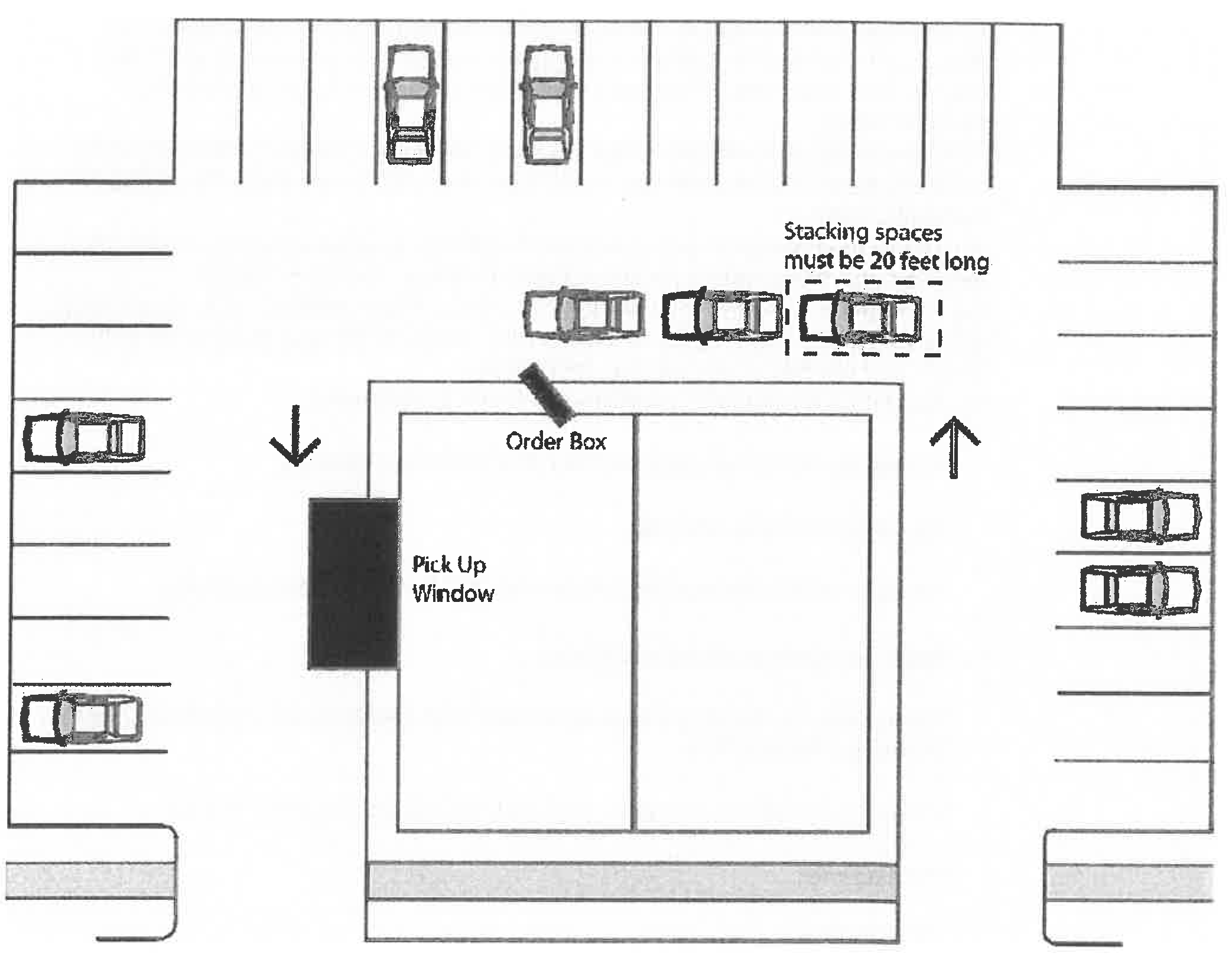
2.
Adjacent to Residential Districts:
(a)
Drive-through facilities, including stacking areas, must be separated from residentially zoned property by at least forty feet.
(b)
Speaker systems used in conjunction with drive-through facilities must be designed so that they are not audible at the property line abutting residentially zoned property.
(C)
Home Occupations:
1.
General: The following regulations are intended to ensure that businesses conducted as subordinate to residential uses are not detrimental to the surrounding neighborhood, and that the residential character of the dwelling is maintained.
2.
Requirements:
(a)
The home occupation must be secondary and subordinate to the use of the dwelling unit for residential purposes, and the residential character of the dwelling must be maintained.
(b)
No alteration is permitted that would change the residential character of the dwelling.
(c)
The activities conducted by the home occupation may not be visible from outside the dwelling.
(d)
No signs are permitted, except as allowed by chapter 7 of this title.
(e)
No commodities may be sold or services rendered that require receipt and delivery of merchandise, goods or equipment other than by a passenger motor vehicle, first class mail, or delivery services that commonly serve residential neighborhoods.
(f)
No more than one person other than one additional member of the immediate family of the owner and residing on the premises may be employed by the home occupation use.
(g)
The home operation and all realtered activities must be conducted within the dwelling unit. No accessory buildings may be used in whole or in part.
(h)
No home occupation may produce any noise, heat, vibration, dust, air pollution, electromagnetic interference, odors, or other hazards that are detrimental to the safety and comfort of neighboring residences.
(i)
The following uses are prohibited as home occupations:
Animal services, including kennels and veterinary services;
Any repair of motor vehicles;
Any use where commercial vehicles must be stored on the premises;
Body art services and tattoo parlors;
Construction or landscaping businesses where equipment or materials must be stored on the premises;
Funeral and interment services such as cremating or funeral homes;
Restaurants;
Warehousing.
14.03.040 - Temporary uses.
(A)
Temporary Use Permits:
1.
Permit Required: No temporary use may be established unless a temporary use permit has been issued by the zoning administrator, demonstrating the compliance with all of the temporary use requirements in this title.
2.
Application: Applications for temporary use permits must be submitted to the zoning administrator at least thirty days before the date of the event or start of the temporary use, unless this time frame is reduced by the zoning administrator. The application must be accompanied by:
(a)
Signed, written permission from the owner of or the agency having jurisdiction over the subject property; and
(b)
Any other information required by the zoning administrator to ensure compliance with the requirements of this title and to otherwise ensure that the proposed use will not have a significant adverse impact on the surrounding area.
3.
Approval and Revocation of Permit: All temporary use permits are subject to any conditions required by the zoning administrator, are revocable, and compliance with all other provisions of this chapter is required.
(B)
Outdoor Seasonal Sales: Outdoor seasonal sales of products such as pumpkins, Christmas trees, or produce are permitted subject to the following requirements:
1.
Outdoor seasonal sales may not operate more than a total of forty-five days per calendar year. The owner or operator is required to keep a record of days of operation, and make the record available upon request of the zoning administrator.
2.
The use may not involve the construction of a permanent structure.
3.
Signs may be provided, subject to the regulations of the zoning district in which the use is located.
4.
All parking and sales activities must be located outside of the public right-of-way.
(C)
Outdoor Events: Outdoor events may be conducted in any zoning district permitting public assembly uses, or on any lot occupied by a public or civic use, subject to the following requirements:
1.
Outdoor events are limited to seven days per parcel per calendar year. The owner or operator is required to keep a record of days of operation, and make the record available upon request of the zoning administrator.
2.
The use may not involve the construction of a permanent structure.
3.
Signs may be provided, subject to the regulations of the zoning district in which the use is located.
4.
All event related activities must be located outside of the public right-of-way.
(D)
Temporary Offices and Construction Equipment Storage: Real estate sales offices, contractors' offices and shelters for construction equipment and building materials are permitted during construction projects, provided that they are located on the same lot as the building under construction, sleeping or cooking facilities are not provided, and the offices or shelters are removed within fourteen days of the completion of the construction project.

