
Oglesby City Zoning Code
CHAPTER 7
SIGNS
Sections:
14.07.010 - Purpose and applicability.
(A)
Purpose: The purpose of this chapter is to achieve balance among the following differing, and at times, competing goals:
1.
To encourage the effective use of signs as a means of communication for businesses, organizations and individuals in the city of Oglesby;
2.
To provide a means of wayfinding in the community, thus reducing traffic confusion and congestion;
3.
To provide for adequate business identification, advertising, and communication;
4.
To prohibit signs of such excessive size and number that they obscure one another to the detriment of the economic and social well being of the city of Oglesby;
5.
To protect the safety and welfare of the public by minimizing hazards to pedestrian and vehicular traffic;
6.
To preserve property values by preventing unsightly and chaotic development which has a blighting influence upon the community;
7.
To differentiate among those signs that, because of their location, may distract drivers on public streets and those that may provide information to them while they remain in their cars but out of active traffic;
8.
To minimize the possible adverse effects of signs on nearby public and private property; and
9.
Adopt more context appropriate signage regulations for businesses; consider regulating signage by use and by zone;
10.
Promote convenient access and signage to parking in all commercial areas.
(B)
Signs Exempt From Regulation: The following signs are exempt from regulation under this chapter:
1.
Any public notice or warning required by a valid and applicable federal, state, or local law, regulation, or ordinance, or by order of a court of competent jurisdiction;
2.
Any sign inside a building, not attached to a window or door that is not legible from a distance of more than three feet beyond the property line of the development site or parcel on which the sign is located; and
3.
Traffic control signs on private property, such as "Stop," "Yield," and similar signs, the faces of which meet standards set forth in the "Illinois Manual On Uniform Traffic Control Devices" and which contain no commercial message of any sort.
(C)
Signs Allowed in all Zoning Districts Without a Permit:
1.
Signs Not Subject To Other Regulations: The following signs are allowed without a sign permit and are not subject to any other regulations under this chapter:
(a)
Temporary signs required by a valid and applicable federal, state, or local law, regulation, or ordinance; or posted by a public agency, acting in accordance with an adopted law or ordinance. Such signs must be removed when they no longer serve the purpose for which they were posted;
(b)
Signs not requiring a building permit or electrical permit and not legible from a distance of more than three feet beyond the property line of the development site or parcel on which the sign is located; and
(c)
Memorial signs containing no commercial message and not larger than four square feet.
2.
Signs Subject to Other Regulations: The following signs will be allowed without a sign permit but are subject to more detailed regulations set forth elsewhere in this chapter:
(a)
Temporary free speech signs conforming with the regulations for temporary signs in the district in which they are located;
(b)
Temporary real estate signs conforming with the regulations for temporary signs in the district in which they are located;
(c)
Other temporary signs smaller than six square feet in size and less than four feet of height, conforming with the regulations for temporary signs in the district in which they are located.
(d)
Flags and flagpoles conforming with subsections 14.07.040(C)6 and 14.07.050(B)10 of this chapter;
(e)
Incidental signs conforming with the regulations for incidental signs in the district in which they are located; and
(f)
On site signs for traffic and parking control, provided that such signs conform to the "Manual On Uniform Traffic Control Devices" and contain no commercial messages.
(D)
Prohibited Signs:
1.
General: The following signs are expressly prohibited in all zoning districts:
(a)
Animated signs;
(b)
Windblown signs including nonpermanent advertising signs affixed to buildings, fences or other structures (except temporary banners, windblown signs advertising special events for not for profit, religious, or municipal organizations which must be removed within forty eight hours after the end of the event);
(c)
Portable signs (except sandwich board signs);
(d)
For purposes of this section, a vehicle containing a commercial message and regularly parked on the street side of any business will be considered a portable sign and thus prohibited unless the vehicle is regularly and customarily used in the business;
(e)
Signs on benches;
(f)
Signs on trees;
(g)
Signs on utility poles, other than signs installed by the utility and related to the utility facility;
(h)
Signs blocking required means of egress from any building;
(i)
Roof sign; and
(j)
Signs within the public right-of-way or on public property, except signs posted in accordance with section 14.07.030 of this chapter or projecting signs in accordance with subsection 14.07.050(B)2 of this chapter.
2.
List Not Exclusive: The list of prohibited sign types set out in this section is illustrative only. Any sign that is not exempt from this chapter under subsection (B) of this section, not established as a lawful nonconforming sign in accordance with section 14.12.070 of this title, or not expressly allowed under another section of this chapter, is a prohibited sign.
(E)
Applicability: No display sign or outdoor advertising device may be placed, erected, altered, rebuilt, enlarged, extended or relocated except in conformity with the provisions of this chapter. The repainting, changing of parts, and preventative maintenance of signs are not considered alterations.
14.07.020 - General.
(A)
Sign Measurement and Interpretation:
1.
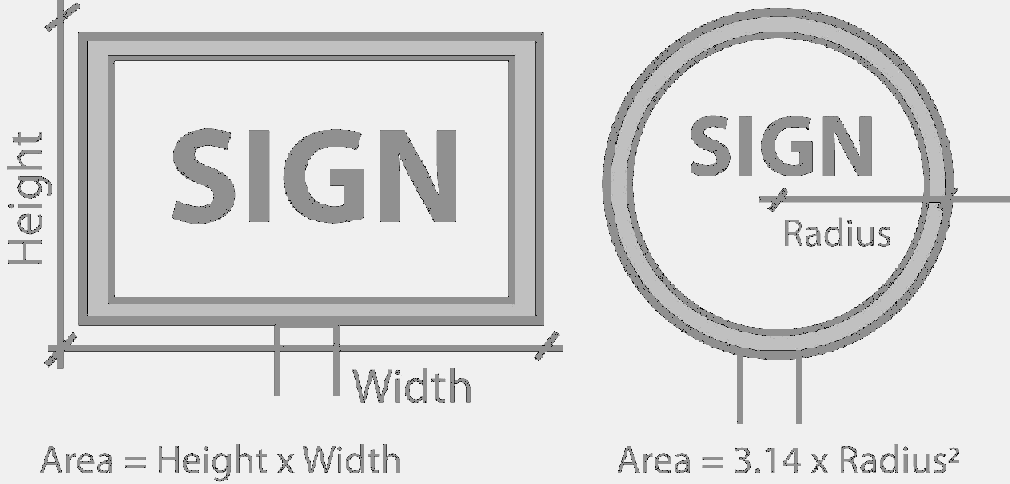
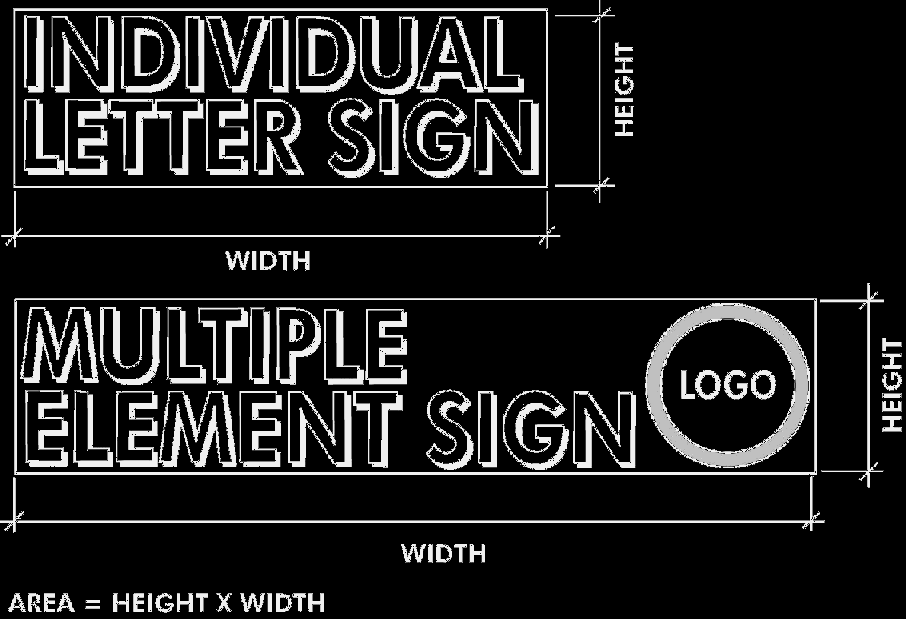
Measurement of Copy Area of Individual Signs: The copy area of a sign face will be computed by means of the smallest square, circle, rectangle, triangle or combination thereof that will encompass the extreme limits of the writing, representation, emblem, or other display, together with any material or color forming an integral part of the background of the display or used to differentiate the sign from the backdrop or structure against which it is placed. The copy area of a sign face does not include any supporting framework, bracing or decorative fence or wall when the fence or wall otherwise meets the regulations of this chapter and is clearly incidental to the display itself.
2.
Measurement of Area of Multifaced Signs: Where the sign faces of a double faced sign are parallel and the distance between the faces is three feet or less, only one display face will be measured in computing sign area. If the two faces of a double faced sign are of unequal area, the area of the sign will be the area of the larger sign. In all other cases, the areas of all faces of a multifaced sign will be added together to compute the area of the sign.
3.
Sign Height Measurement: The height of a sign will be computed as the distance from the highest point of the sign structure to the elevation of the centerline of the adjacent public street or highway.
4.
Determination of Visibility or Legibility:
(a)
Where this chapter requires a determination of "visibility" or "legibility," the standard will be based on the eyesight of an adult eligible to receive an Illinois driver's license (wearing any corrective lenses required by the license). Where the height of the person is material to the determination, the person will be presumed to be more than five feet and less than six feet tall.
(b)
In determining visibility of a sign from a residential property, it will be assumed that a two-story residence will occupy the property with second story windows facing toward the sign.
(B)
Wind Pressure: Any sign, other advertising structure, marquee, canopy or awning as defined in this title must be designed and constructed to withstand a wind pressure of not less than thirty pounds per square foot of net surface area; and must be constructed to receive dead loads as required in the building code and/or other ordinances of the city of Oglesby.
(C)
Substitution of Messages: The sign regulations of this chapter are not intended to favor commercial speech over constitutionally protected political or noncommercial speech. A sign containing a noncommercial message may be substituted for any sign containing a commercial message that is allowed by the regulations of this chapter.
1.
Any sign allowed under this title may contain, in lieu of any other message or copy, any lawful noncommercial message that does not direct attention to a business operated for profit, or to a product, commodity or service for sale or lease, or to any other commercial interest or activity, so long as the sign complies with the size, height, area and other requirements of this chapter.
2.
At any time, in lieu of any permitted temporary real estate sign, a sign expressing views on candidates or issues of public interest may be erected, regardless of whether the property is at that time for sale or lease. The number, height and size of the sign will be the same as the real estate sign that would otherwise be permitted. It is not the intent of this paragraph to allow additional signage on the property; but rather to clarify that, in accordance with the policy set forth in this section, a sign expressing opinions may be substituted for any other sign allowed under this chapter.
14.07.030 - Signs in the public right-of-way and on public property.
(A)
Signs Permitted: Only the following signs are permitted in the public right-of-way and on public property:
1.
Signs installed by any of the following and directly related to the use of the right-of-way or of public property, including the control and direction of traffic:
(a)
The city of Oglesby;
(b)
LaSalle County;
(c)
State of Illinois;
(d)
Any transit company authorized to provide service to or through;
(e)
Any public utility with a franchise or other agreement with the city of Oglesby; or
(f)
Any other government entity or person expressly authorized by Illinois law to install a sign in the right-of-way.
2.
"Adopt-a-highway" signs acknowledging voluntary efforts to provide landscaping, litter control, or other maintenance, when the signs are installed pursuant to a written policy of the city of Oglesby or the State of Illinois.
(B)
Other Signs: Any other sign installed or placed in the public right-of-way will be deemed an unlawful sign and an abandoned sign and will be subject to immediate removal and disposal by the city, without compensation to the owner. The owner or other person placing the sign will, nevertheless, be subject to the penalty provisions of chapter 13 of this title.
14.07.040 - Signs allowed in residential districts.
(A)
Single-Family and Two-Family Districts: In the RE, R1A, R1 and R2 districts, the following classes of signs are permitted in accordance with regulations of this subsection:
1.
Dimensions and Number of Signs: The numbers and dimensions of signs in these districts will be controlled by the following table:
(B)
Multi-Family District: In the R3 district, the following classes of signs are permitted in accordance with regulations of this subsection:
1.
Dimensions and Numbers of Signs: The numbers and dimensions of signs in these districts will be controlled by the following table:
(C)
Supplemental Rules:
1.
Permanent Signs: Permanent signs in residential districts must bear no commercial message other than one directly related to a business or occupation conducted on the premises lawfully and in full compliance with this title.
2.
Incidental Signs: Incidental signs are generally intended to provide warnings or information, such as "no parking," "no trespassing," "dangerous dog," and similar information. Incidental signs may not bear any commercial message.
3.
Temporary Signs:
(a)
Residents or owners of units in the RE, R1A, R1 and R2 districts are entitled to a total of three temporary signs per dwelling unit at any one time, only one of which may bear a commercial message.
(b)
Residents or owners of property in R3 district are entitled to a total of three temporary signs per dwelling unit or three temporary signs per driveway, whichever is less.
(c)
The only commercial messages allowed on temporary signs in these districts are the following:
(1)
A message directly related to a permitted nonresidential use on the premises, conducted lawfully and in full compliance with this title, not including home occupations;
(2)
A message pertaining to the sale or lease of the premises; or
(3)
A message related to an occasional sale (such as a garage or yard sale), held lawfully and in compliance with applicable ordinances of the city.
(d)
Temporary signs may be used to express the opinion of the owner or occupant on any matter deemed by the person to be of public interest but may not bear commercial messages.
(e)
A temporary real estate sign must be removed within ten days after the transfer of title or change of occupancy of the property. A temporary free speech sign that relates to an election or other event must be removed within ten days following the conclusion of the election or other event. A temporary sign pertaining to an occasional sale must be removed within one business day following the end of the sale.
4.
Illumination:
(a)
Single-Family Districts: A temporary or permanent sign in RE, R1A, R1 or R2 districts must not be separately illuminated. This paragraph is not intended to prohibit the installation of such a sign near a porch light or yard light, which may incidentally illuminate the sign.
(b)
Multi-Family Districts: A permanent sign in the R3 district may be separately illuminated by direct, white light that does not flash or move, and which will not result in glare or spillover exceeding 0.50 foot-candle at the nearest property line. Temporary signs in these districts may not be separately illuminated.
5.
Institutional Signs: Any educational institution, religious institution or other institutional use permitted in the residential zoning districts will be permitted the following signs in place of the permanent signs otherwise allowed in these districts:
(a)
One freestanding sign not more than thirty two square feet in area and not more than six feet in height; up to fifty percent of the area may be changeable copy area;
(b)
One wall sign for each public entrance to the institution; each sign may be no more than four square feet in area;
(c)
Any institutional sign may be separately illuminated by direct, white light that does not flash or move, and which will result in glare or spillover not exceeding 0.50 foot-candle at the nearest property line.
6.
Flags: The display of flags in residential districts will be subject to the following limitations:
(a)
A flag may not bear commercial messages;
(b)
There may be no more than two flags per pole;
(c)
No flag may be larger than five feet by eight feet;
(d)
A flagpole must have a setback of at least five feet from any property line;
(e)
No rooftop flagpoles are permitted in any district;
(f)
There may be no more than one flagpole on a building lot; and
(g)
No flagpole may have a height of greater than twenty feet, measured by the same methods used to measure the height of signs.
14.07.050 - Signs allowed in nonresidential districts.
In all business districts, the following signs are permitted, subject to the requirements set forth in this chapter:
(A)
Additional Regulations for Advertising Signs:
1.
Location: An advertising sign is subject to the following locational standards:
(a)
It must be located entirely within the property line of the zoning lot on which it is located;
(b)
It must not be between any front building line and the street;
(c)
It must not be located within two hundred feet of another advertising sign; and
(d)
It must not be located within two hundred feet of a residential zoning district if the sign will be visible from the residential district.
2.
Signs Near Parks: No advertising sign may be erected within five hundred feet of any public park of more than five acres in area if the sign will be legible from any part of the park.
3.
Signs Near Freeways or Expressways: No advertising sign, the informative contents of which are to be visible from a park or expressway, may be erected within five hundred feet of any public park of more than five acres in area, or any freeways, expressways and toll roads designated as such in the records of the governing authorities.
4.
Illumination: Advertising signs may be separately illuminated by direct, white light that does not flash or move, and which will not result in glare or spillover at the nearest property line.
(B)
Additional Regulations for Business Signs:
1.
Freestanding Signs:
(a)
Signs, clocks or other devices erected on standards, poles, or separate supports must be placed so as to be entirely within the property lines of the premises upon which they are located.
(b)
Signs located in the B2 district within seven hundred fifty feet of an exit ramp of an interstate highway may be increased to a height to three hundred twenty feet above the elevation of the nearest point on the freeway, but not more than seventy feet in total height.
2.
Projecting Signs: Projecting signs are allowed only in the B1 district subject to the following standards:
(a)
Projecting signs may project no more than four and one-half feet from the building wall and no more than eighteen inches above the roof or parapet;
(b)
Projecting signs must be no closer than two feet horizontally from the curb or edge of the sidewalk, and no closer than nine feet vertically to the walkway below; and
(c)
All projecting signs must be installed or erected in such a manner that minimizes visibility of support structures such as angle irons or braces.
3.
Marquee Signs:
(a)
Any sign located on a marquee or canopy must be affixed flat to the surface of the marquee or canopy;
(b)
Marquee signs may not extend vertically or horizontally beyond the limits of the marquee or canopy, except that individual, freestanding letters may project to a height not exceeding twelve inches above same;
(c)
They must be supported only by attachment to a building and may not extend more than six feet beyond the building. No posts may be used for support;
(d)
Vertical clearance above the sidewalk must be at least nine feet; and
(e)
Marquees or canopies thicker than eighteen inches must be beveled horizontally at a forty five degree angle to permit an unobstructed view of adjacent property.
4.
Awning Signs: Awning signs are subject to the following restrictions:
(a)
No awning sign may cover more than fifty percent of the surface of the awning;
(b)
Lettering height on awning signs may not be greater than sixteen inches;
(c)
Letters that are eight inches or less in height will not be considered part of the total sign area permitted for the property but will be subject to the other provisions of this subsection;
(d)
Any sign located on an awning must be affixed flat to the surface of the awning;
(e)
The awning may not be internally illuminated or backlit;
(f)
The awning must be supported only by attachment to a building and may not extend more than six feet beyond the building. No posts may be used for support; and
(g)
Vertical clearance above the sidewalk must be at least nine feet, except that retractable awnings may have a clearance of not less than eight feet.
5.
Sandwich Board Signs:
(a)
Sandwich board signs may only be displayed in the B1 and B2 districts during business hours, may not block required means of egress from any building.
(b)
Sandwich board signs may not be illuminated.
6.
Shopping Center Signs:
(a)
For an integrated planned business development in single ownership and management, or under unified control, one additional sign may be erected, not exceeding four hundred square feet in area.
(b)
This sign may advertise only the name, location, and special events of the integrated shopping center and the names of the tenants therein.
(c)
The sign must be placed so as to be entirely within the property lines of the premises upon which it is located.
(d)
When the sign is mounted on a pole, the bottom edge of the sign must be at least nine feet above the grade of the adjacent street. The overall height of the sign may not exceed twenty five feet above grade of the adjacent street or above the adjoining ground level if the ground level is above the street level.
7.
Wall Signs: Wall signs are permitted in all business districts, subject to the following standards:
(a)
Wall signs are not permitted on the side of any building facing and located within one hundred feet of a residential zoning district;
(b)
Projecting and marquee signs will be considered wall signs for purposes of computing the permitted sign area;
(c)
A wall sign, other than a projecting sign (where permitted) may not extend more than sixteen inches from the surface of the wall; and
(d)
A wall sign may not project more than twelve inches above the top of a structural wall of the building. Wall signs may not be installed on fences or on architectural projections serving no purpose other than as signboards.
(e)
No sign may be placed on any wall, fence or standard facing the side of any adjoining lot located in a residential district.
8.
Changeable Copy: Up to twenty five percent of the permitted sign face area of any freestanding sign in the B2, B3 and B4 districts may be used for changeable copy, subject to the illumination limitations set out in the next subsection.
9.
Illumination:
(a)
Limits when Adjoining Residential Property: Illumination on business signs must be shielded so that the glare or spillover is no more than one foot-candle at the property line adjoining any residential zoning district.
(b)
Illumination in the b3 District: Signs in the B3 district may not be internally illuminated.
(c)
Flashing Lights: Flashing lights, intermittent type illumination, rotating beams, beacons or illumination resembling an emergency light are prohibited.
(d)
Changing Signs: Electronic changes of copy are permitted on signs in the B2 and B4 districts.
10.
Flags: The display of flags in nonresidential districts will be subject to the following limitations:
(a)
A flag may not bear commercial messages;
(b)
There may be no more than two flags per pole;
(c)
No flag may be larger than five feet by eight feet;
(d)
A flagpole must have a setback of at least five feet from any property line;
(e)
No rooftop flagpoles are permitted in any district;
(f)
There may be no more than three flagpoles per principal building on any development site;
(g)
No flagpole may have a height of greater than thirty feet, measured by the same methods used to measure the height of signs; and
(h)
Each flagpole must be within thirty feet of the principal entrance to the building to which it is oriented.
14.07.060 - Temporary signs.
Temporary cloth signs and temporary banners will be permitted for up to a total of thirty days in any calendar year, which may be divided into as many as three separate periods, upon the issuance of a temporary sign permit. The following additional limitations apply:
(A)
The total area of temporary promotional signs on one zoning lot at one time may not exceed two hundred square feet; and
(B)
Detached temporary signs will be subject to the height and location limits applicable to a freestanding or ground sign on the property.
14.07.070 - Sign permits.
Signs regulated by this chapter but not exempted by the provisions of subsection 14.07.010(C) of this chapter may be erected only after issuance of a permit by the zoning administrator. A permit will be issued only according to the following requirements and procedures:
(A)
Application: An application for construction, creation or installation of a new sign or for modification of an existing sign must be accompanied by detailed drawing to show the dimensions, design, structure, and location of each particular sign. One application and permit may include multiple signs on the same lot.
(B)
Procedures: The following procedures will govern the application for and issuance of all sign permits under this chapter:
1.
All applications for sign permits must be submitted to the zoning administrator on an application form provided by the zoning administrator or according to application specifications published by the zoning administrator.
2.
Each application for a sign permit must be accompanied by the applicable fees, as established by the city council from time to time by resolution.
3.
Within five business days of receiving an application for a sign permit, the zoning administrator must review it for completeness. If the zoning administrator finds that it is complete, the application will then be processed. If the zoning administrator finds that it is incomplete, the zoning administrator will, within the same five day period, send to the applicant a notice of the specific ways in which the application is deficient, with references to the applicable sections of this title.
4.
Within seven days of the submission of a complete application for a sign permit, the zoning administrator will either:
(a)
Issue the sign permit, if the proposed sign conforms in every respect with the requirements of this title and other provisions of the city ordinances; or
(b)
Deny the sign permit if the proposed sign fails in any way to conform to the requirements of this title or other provisions of the city ordinances. In case of a denial, the zoning administrator must specify in the denial the section of this title or other applicable ordinance with which the sign is inconsistent.
(C)
Lapse of Sign Permit on Vacated or Unoccupied Property: A sign permit will lapse automatically if the business license for the premises lapses, is revoked, or is not renewed. A sign permit will also lapse if the business activity on the premises is discontinued for a period of one hundred eighty days or more and is not renewed within thirty days of a notice to the last permittee, sent to the premises, that the sign permit will lapse if the activity is not renewed.
(D)
Permits for Temporary Signs: Temporary signs on private property are allowed only in accordance with the provisions of section 14.07.060 of this chapter:
1.
A temporary sign permit will allow the use of temporary signage for a specified period subject to all of the requirements for temporary signs in this chapter; and
2.
A temporary sign will become an illegal sign if not removed upon the expiration of the period covered by the permit.
14.07.080 - Unsafe, obsolete or nonconforming signs.
(A)
Unsafe Signs:
1.
If the zoning administrator finds that any sign is unsafe or insecure, or is a menace to the public, he must give written notice to the person to whom the building permit has been issued.
2.
If the owner fails to remove or alter the sign to bring it into compliance with this title within ten days after the notice, the zoning administrator may remove or alter the sign to comply at the expense of the sign permit issuee or owner of the property upon which it is located.
3.
The zoning administrator may cause any sign that is an immediate peril to persons or property to be removed summarily and without notice.
4.
The zoning administrator is responsible for the inspection of the condition of signs and to investigate complaints issued regarding signs.
(B)
Obsolete Signs:
1.
Any obsolete sign that does not advertise a bona fide business conducted or a product sold, must be taken down and removed by the owner, agent, or person using the structure upon which the sign is located.
2.
Removal must occur within ten days after written notification from the zoning administrator. Upon failure to comply with the notice within the time specified in the notice, the zoning administrator may cause removal of the sign. Any expenses related to removal must be paid by the property owner where the sign is located.
3.
At the time of termination of a business or commercial or industrial enterprise, all signs pertaining to the use must be removed from public view.
(C)
Nonconforming Signs: All signs not in conformance with this chapter must be removed, altered, or converted to conform to the provisions of this chapter not more than five years after the effective date specified in section 14-01-020 of this title, except for windblown signs as defined in section 14.14.020 of this title which must be removed, altered, or converted to conform to the provisions of this chapter not more than ninety days after the effective date as specified in section 14-01-020 of this title.
14.07.090 - Maintenance.
(A)
All signs must be adequately maintained to keep them in a state of good appearance and repair. Painted signs will be considered in need of refinishing if:
1.
Twenty percent or more of the surface is missing or shows evidence of peeling, checking, cracking, or blistering of the paint.
2.
Twenty percent or more of the surface shows evidence of mildew.
3.
The colors used have faded appreciably and the surface sheen is gone.
(B)
All sign framing and support structures must be adequately maintained to keep them in a state of good appearance and repair.
(C)
Illuminated signs will be considered in need of repair if twenty percent or more of the light bulbs are not fully illuminated, or if twenty percent or more of the surface area of an internally illuminated sign is not illuminated.

