
Oklahoma City City Zoning Code
ARTICLE X
- OFF-STREET PARKING, LOADING AND ACCESS
§ 59-10100.- Purpose.
These regulations provide that adequate parking, loading and maneuvering facilities will be a part of all land uses within the City. They establish standards and review procedures intended to assure that the demand created by each land use will be satisfied by facilities that are functionally adequate and aesthetically pleasing.
§ 59-10150. - General requirements for off-street parking areas.
10150.1. Off-Street Parking and Loading Required. Permanent off-street parking and loading areas for each use shall be provided in the amount specified by this article at the time of the erection of any building, or at the time any principal building is enlarged or increased, and in the amount required for the enlargement or increase in capacity by adding dwelling units, guestrooms, seats or floor area, or before conversion from one type of use or occupancy to another.
10150.2. Use of Public Right-of-Way Prohibited. No portion of any required off-street space shall occupy or use any public street, right-of-way, alley or other public property. Parking spaces that use any street or public right-of-way as a direct means of access, without the intermediate use of service aisles and entrances of at least the minimum standards specified by this article, shall be prohibited. A public alley shall be the only right-of-way area permitted for maneuvering space to reach a required parking stall.
10150.3. Minimum Standards and Property Owner Responsibility. The standards contained herein represent minimum requirements. It shall be the responsibility of the property owner to certify that, at the time he/she applies for a building permit, that his/her plan is sufficient to provide parking spaces and facilities necessary to assure that no activity will take place on public streets or property not under his/her control. Any use developed after the effective date of this chapter, which fails to provide for its off-street parking, loading and access needs, according to this provision, shall be in violation of this chapter. Upon determination by the Planning Director that a property owner has not provided adequate parking or loading spaces to serve his/her operation, said property owner shall be required to either develop additional parking or loading spaces, or reduce the size of the operation to fit the space available.
10150.4. Ownership or Control. The land on which the off-street parking or loading facility is located shall be owned or controlled by the same entity which owns or controls the land on which the principal use is located, unless the property owner has a legal shared parking agreement.
10150.5. Previously-Issued Building Permits. Where a building permit has been issued prior to the effective date of this chapter, and construction has begun within one year of such issuance and diligently pursued thereafter, parking and loading facilities may be provided in the amounts required by this chapter at the time of issuance of the building permit, regardless of any different amounts required by this chapter.
10150.6. Additional Parking and Loading Facilities. Nothing in this chapter shall be deemed to prevent the voluntary establishment of off-street parking beyond the requirements of this article, provided such parking or loading facilities meet all regulations of this chapter governing the location, design and operation of such facilities.
§ 59-10200. - Approval procedure for off-street parking, loading and access.
10200.1. New Construction or Remodeling. No building permit shall be approved until a plan has been reviewed and approved by the Public Works Director. Furthermore, no certificate of occupancy shall be issued until all off-street parking and loading facilities have been constructed in accordance with the approved building permit.
10200.2. Plan and Information Required. The applicant for a building permit for new construction, expansion or remodeling shall submit a plan showing the number, location and size of parking spaces. The applicant shall submit information regarding the projected number of dwelling units, number of employees, seating capacity, gross floor area, gross leasable area, and any other appropriate data necessary to verify compliance with these regulations.
Plans for surfacing of all off-street parking areas, aisles and access driveways, including detailed drainage plans, shall be reviewed and approved by the Public Works Director for compliance with City specifications.
10200.3. Interpretation and Appeal. If questions of interpretation or application of these requirements to particular uses or structures arise, the Planning Director shall, based on findings of fact, make a determination of the off-street parking, loading or access requirements. Any aggrieved property owner may appeal such determination under the administrative appeal procedure specified in Section 59-4250.9 (Appeals).
10200.4. Citations for Illegal Parking.
A.
Issuance. Whenever any vehicle without a driver is found parked or stopped in violation of any of the restrictions imposed by this article, the inspector finding the vehicle shall take its registration number and may take any other information displayed on the vehicle which may identify its user, and shall conspicuously affix to the vehicle a citation in writing, on a form provided by the City, for the owner of the vehicle to answer to the charge against him/her within ten days at the time and place specified in the citation. The inspector shall deliver copies of the citation to the Traffic Division of the Municipal Courts.
B.
Failure to Comply with Citation. If the owner of the vehicle does not respond in obedience to a citation affixed to the vehicle within a period of ten days, the citation shall be deemed to be delinquent.
C.
Presumption in Reference to Illegal Parking.
(1)
In any prosecution charging a violation of this article, proof that the vehicle described in the citation was parked in violation, together with proof that the defendant named in the citation was, at the time the citation was issued, the registered owner of the vehicle, shall constitute in evidence a prima facie presumption that the registered owner of the vehicle was the person who parked or placed the vehicle at the point where, and for the time during which, the violation occurred.
(2)
The provisions of Paragraph A above shall apply only when the procedure prescribed in this article has been followed.
(Ord. No. 24174, § 2, 11-2-10)
§ 59-10250. - Parking area construction standards.
10250.1. Parking Stall Design Standards.
A.
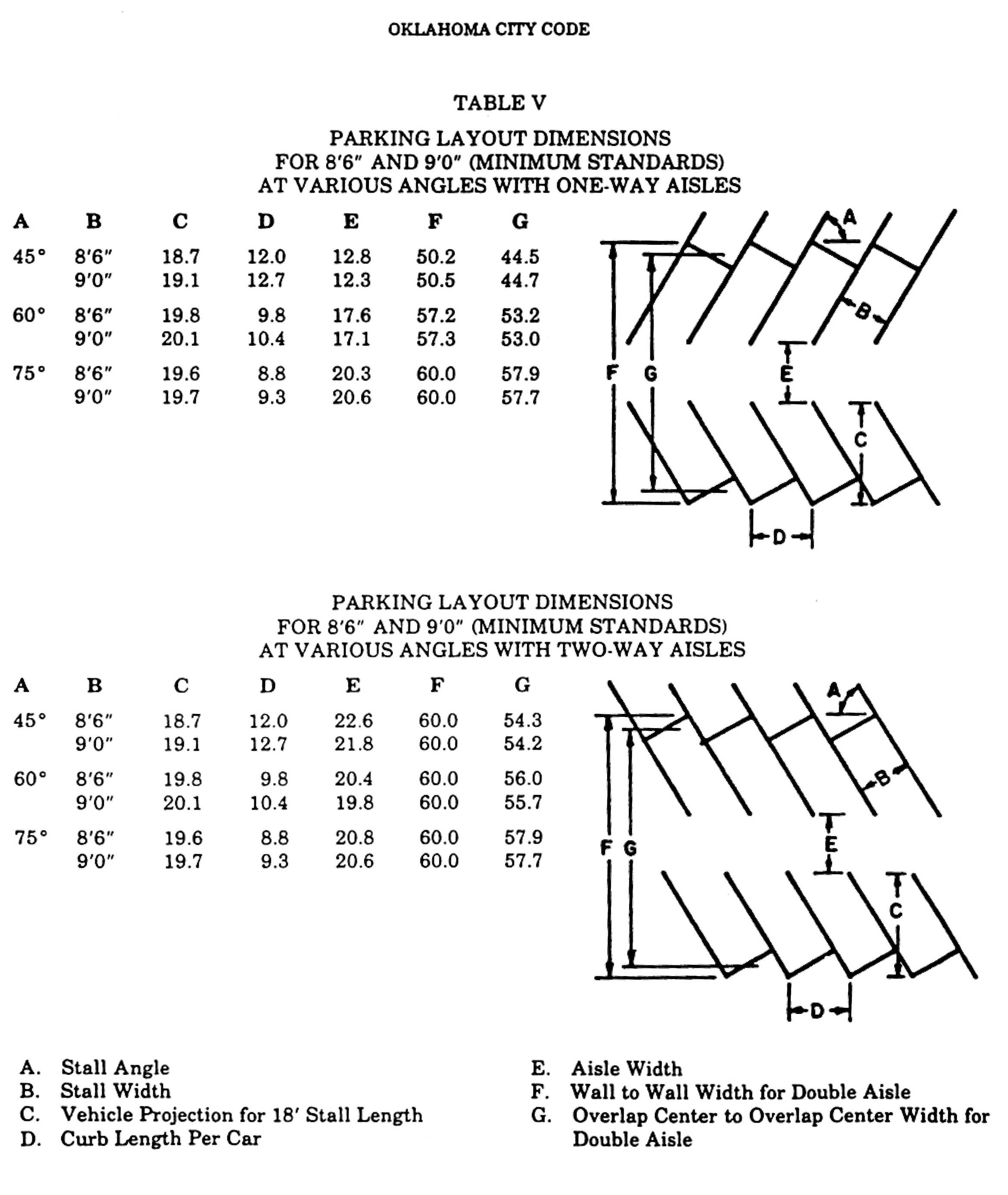
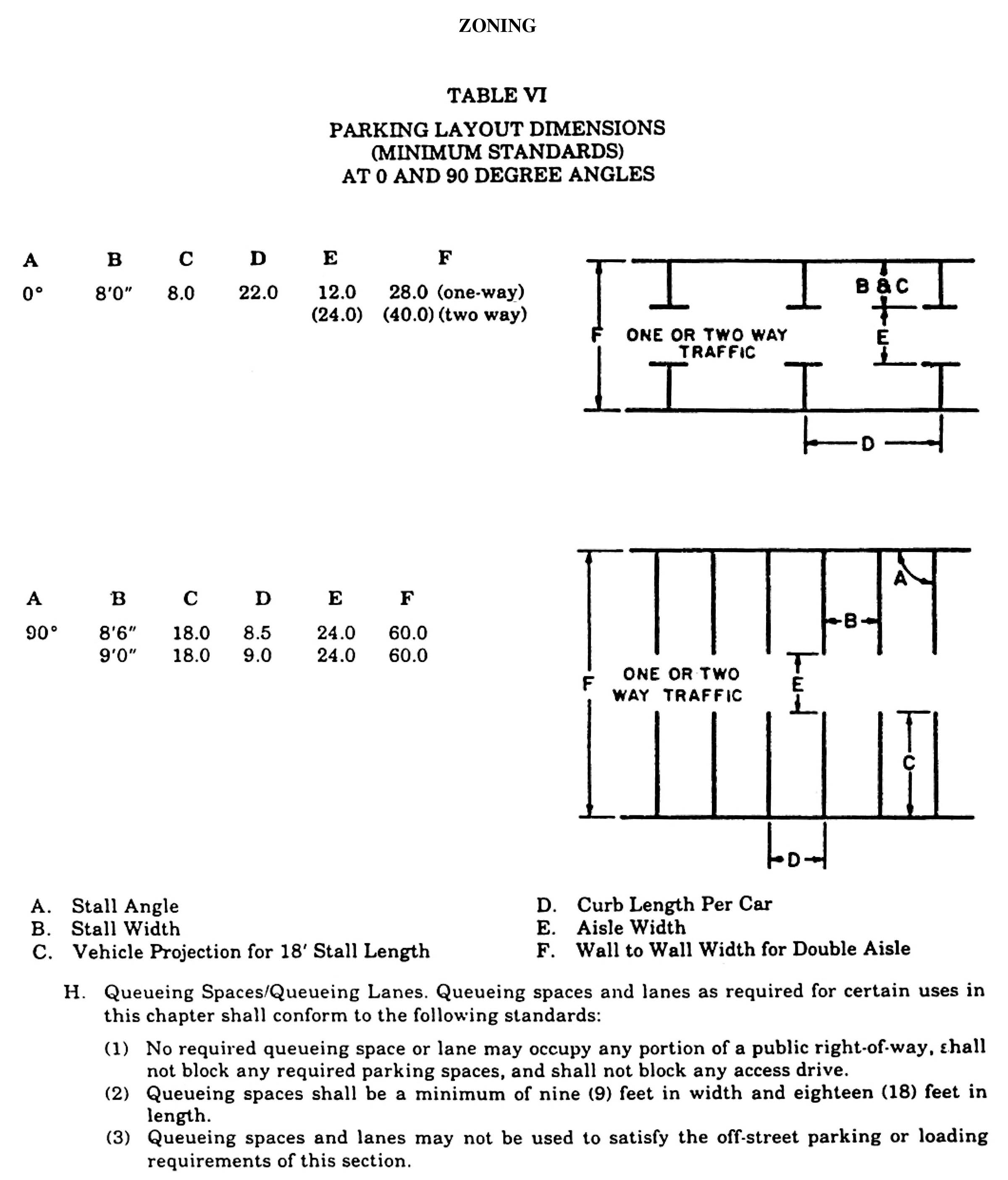
Basic Design Standards. The basic parking stall shall be eight and one-half feet in width and 18 feet in length. The following tables and diagrams establish minimum design standards for parking areas utilizing this minimum requirement, as well as dimensions to be followed if the optional parking stall size of nine feet in width and 18 feet in length is used. Nothing in these standards shall prohibit an owner/applicant from providing larger aisle widths or stall dimensions in excess of these minimum standards in order to better suit his/her development requirements.
B.
Alternate Design Standard. While tables provide design standards for angles of zero degrees, 45 degrees, 60 degrees, 75 degrees and 90 degrees, the Public Works Director shall be permitted to approve an alternate design using different angles, provided the property owner submits such a design with calculations for stalls and aisles based upon the standards contained herein.
C.
Small Car Parking Design Standard. Where a parking lot is required to contain 20 or more spaces, the Public Works Director shall be permitted to approve an alternate design for spaces to specifically accommodate compact automobiles. Said design shall conform to the following minimum basic standards.
(1)
Up to 15 percent of the required spaces may be allocated for compact cars.
(2)
Dimensions for a compact car space shall be seven and one-half feet in width and 15 feet in length.
(3)
Compact car spaces should be designed and striped at 90-degree angles or an equivalent, which will eliminate access and use by large cars.
10250.2. Paving. All off-street parking areas, aisles and access driveways and driveway approaches shall be permanently paved with hard-surfaced pavement. The requirement for a hard-surfaced driveway approach may be waived by the Director in areas not designated for urban development and in other areas if it is determined that the public convenience, health or safety is not affected. However, all portions of a driveway approach on public rights-of-way, connected to paved streets for which the grade has been established, must be permanently paved with hard-surfaced pavement and comply with all Oklahoma City Codes relating to driveway construction. Permanent hard-surfaced pavement shall mean a surface covering over earth, gravel or other natural or artificial base or foundation, which shall meet or exceed the following minimum standards:
A.
Two inches of hot asphaltic concrete on a four-inch base of stabilized aggregate or the equivalent thereto, which has been approved by the Director.
B.
Four inches of Portland cement concrete on a two-inch sand cushion base or the equivalent thereto, which has been approved by the Director.
C.
All portions of access driveways on public right-of-way require six inches of Portland cement concrete on a two-inch sand cushion or the equivalent thereto, which has been approved by the Director.
D.
Alternate pervious surface shall be allowed for the storage and maneuvering of vehicles, equipment and inventory, located within designated storage areas, accessory to the following use units: Horticulture (59-8150.7), Heavy Public Protection and Utility (59-8250.9), Automotive and Equipment: Sales and Rental, Farm and Heavy Equipment (59-8300.19), Construction Sales and Services (59-8300.31), Hazardous Industrial (59-8350.4), Industrial, Heavy (59-8350.6), Industrial, Moderate (59-8350.7), Industrial, Light (59-8350.8) and Wholesaling, Storage and Distribution: General (59-8350.15) provided:
(1)
Such alternate surface meets the following standards:
(a)
Traffic bound surface course by the Oklahoma Department of Transportation Standard Specifications Section 403 or;
(b)
Eight inches of cement kiln dust overlain with five inches of dust-free asphalt millings or;
(c)
Three to four inches of crusher run over one and one-half to two inches of gravel or;
(d)
Equivalent standard as approved by the Director,
(2)
Sub-base preparation is required in accordance with Oklahoma City Paving Construction Standards.
(3)
All pervious surface areas shall have a six-inch thick, 12-inch wide concrete border to keep the material in place.
(4)
The access driveway that extends into the site past the property line and all required parking shall be permanently paved with hard surfaced pavement provided for in Section 59-10250.2 (Paving).
(5)
All pervious surface fire lanes must be approved by the Fire Marshal's Office.
10250.3. Striping.
A.
Off-street parking areas shall be designed to provide systematic and orderly circulation, traffic separation devices, and parking spaces in accordance with this article, and with sound traffic engineering practices.
B.
All off-street parking spaces and means of ingress and egress shall be laid out on the parking surface with paint or plastic striping, which will provide a permanent delineation between spaces, aisles and surrounding structures and land.
C.
No striping shall be required for lots of single-family, two-family, three-family or four-family residential structures.
10250.4. Separation from Public Right-of-Way. All off-street parking areas, aisles and access driveways that abut public street rights-of-way shall be separated by a six-inch Portland cement concrete header curb, bumper or landscape timbers, except in the HL and HP Districts where landscape timbers are not allowed. Such curb, bumper or landscape timbers shall be designed so that vehicles do not overhang public rights-of-way or adjacent property.
10250.5. Lighting. All lighting equipment used in illumination of off-street parking areas shall not create a nuisance or hazard for streets or adjoining properties. Additional parking lot lighting regulations are found in Section 59-12350 (Site Lighting Requirements).
10250.6. Clearance.
A.
There shall be a minimum vertical clearance free of all obstructions to a height of eight feet for all portions of any off-street parking space, except when off-street parking spaces are provided in a parking structure, a residential garage or carport. No obstruction shall project into this minimum clearance.
B.
There shall be no obstruction within or near the bounds of any required off-street parking space that would interfere with the normal availability and use thereof.
10250.7. Aisle Standards.
A.
Aisles providing access, but not immediately adjacent or providing direct access, to an off-street parking space, shall be at least 22 feet in width if designed for two-way traffic and at least 12 feet in width if designed for one-way traffic.
B.
Aisles located immediately adjacent to buildings or structures shall be separated by a planted or landscaped strip, or a sidewalk of not less than three feet in width protected by a six-inch concrete curb, or, in lieu thereof, a bumper guard of a height not less than two feet above the finished grade.
C.
Parking may be located immediately adjacent to buildings or structures without a planted or landscaped strip, or a sidewalk, however, a bumper guard shall be located adjacent to such buildings or structures as specified in Paragraph B above.
D.
A drive-in window shall not project more than one foot into an aisle.
10250.8. Residential Parking Design and Regulation.
A.
Single-family, two-family, three-family and four-family residential structures located on one lot may use a paved driveway to fulfill the minimum parking requirements of this article. The space for each automobile on the paved area shall be a minimum of eight and one-half feet in width and 18 feet in length, and shall not be located within five feet of the street pavement. The residential driveway shall conform to the driveway design requirements as specified in this section.
B.
On lots less than one acre in size in the R-1, R-1ZL, R-2, R-3 and R-MH-1 Districts, and portions of PUD Districts with single-family, two-family, three-family or four-family residential uses, and on lots less than one acre in size with single-family, two-family, three-family or four-family residential uses located in non-residential zoning districts, vehicles shall be parked in the following manner:
(1)
Vehicles shall be parked on a permanently hard-surfaced (paved) driveway or parking area, meeting the design requirements specified in this section. A minimum of 25 percent of the lot shall be maintained as open space with no buildings or parking.
(2)
For residences with no access to the side or rear of their homes, vehicles may be parked on a gravel pad added to enlarge an existing single-lane paved driveway. The combined width of the gravel pad and the paved driveway shall be no more than 20 feet. The gravel shall be at least two inches in depth, and shall have a border of wood, brick, stone, concrete or similar material to keep the gravel in place. In addition, the gravel driveway shall be perpendicular to the street right-of-way, or parallel to the existing paved driveway; provided, that such enlargement made from and after the effective date of this ordinance shall meet the design requirements specified in this section.
(3)
However, any driveway that, as of October 1, 1988, did not meet the design requirements as specified in this section shall be deemed to be legally nonconforming for the purposes of this section. Vehicles may be parked on legally nonconforming driveways. The width of such driveways shall be determined by the width of the driveway throat at the property line, to a maximum of 12 feet. The legally nonconforming driveway shall be rectangular in shape and perpendicular to the property line.
(4)
This section addresses the proper parking of vehicles to protect neighborhood quality. It does not provide for the use of gravel driveways for new construction. For new construction, the standards as specified in this section shall be followed.
(5)
The requirements contained in this section do not supersede those contained in the special regulations in the Urban Conservation Districts.
10250.9. Mobile Home/Manufactured Home Sales, Display and/or Storage Lot Requirements.
A.
Gravel, defined as traffic bound surface course by the Oklahoma Department of Transportation Standard Specifications Section 403, is allowed for the storage or display of mobile homes/manufactured homes.
B.
Sub-base preparation is required in accordance with Oklahoma City Paving Construction Standards, as approved by the Public Works Director.
C.
All gravel areas shall have a border of wood, brick, stone, concrete or similar material to keep the gravel in place.
D.
The access driveway that extends into the site past the property line and all required customer parking shall be permanently paved with hard surfaced pavement provided for in Section 59-10250.2 (Paving).
(Ord. No. 24009, § 8, 2-2-10; Ord. No. 24726, § 7, 8-13-13)
§ 59-10300. - Joint and shared parking.
10300.1. Joint Parking. The required parking space for any number of separate uses may be combined in a joint parking facility under the following conditions.
A.
Multiple Ownerships or Structures. Where there are multiple ownerships or structures, each owner shall provide evidence of a permanent legal instrument, which has been filed on record with the County Clerk and guarantees permanent right to use of the parking facility.
B.
Churches. One-half of the required parking spaces for churches may be included in the total of required parking spaces for other uses that do not operate after 6:00 p.m. or on Sundays, provided that the nearest property line of said parking area is located within 300 feet of the church property line.
C.
Specific Uses in Shopping or Office Complexes. The required parking spaces for the use units specifically listed below in Paragraphs (1) and (2) shall be permitted to be reduced by one-half, provided they are part of a shopping or office complex of one or more buildings totaling 48,000 square feet or more of gross leasable area that share joint access and parking facilities as described above. In addition, the gross leasable area of all of these uses listed below in the building or complex shall not exceed 20 percent of the total gross leasable area of the building or complex. Any gross leasable area in excess of said 20 percent shall require parking spaces to be provided according to the regular standards contained herein.
The use units subject to this provision are:
(1)
Eating Establishments: Sitdown, Alcohol Not Permitted (59-8300.37)
(2)
Spectator Sports and Entertainment: Restricted (59-8300.69)
D.
Cumulative Effect. Where more than one facility shows evidence of joint use agreements for common access and a cross parking arrangement resulting in reduced street access points, parking requirements will be based upon the cumulative gross floor area of all structures.
10300.2. Shared Parking. A percentage of the number of spaces required for one use can be supplied by the parking area of another use, provided that one is not normally operated or used during the time of the other's operation or use. Up to 50 percent of the off-street parking spaces required by this article for a theater, bowling alley, dance hall, restaurant, tavern, bar or other similar establishments, may be supplied by off-street parking spaces provided by financial institutions, offices, retail establishments, personal service establishments, consumer appliance stores, industrial establishments and other similar uses when not normally open, used or operated during the principal operating hours of the aforesaid uses.
§ 59-10350. - Queuing space requirements for drive-through facilities.
Automatic teller machines and any building utilizing a drive-up service window shall provide an unencumbered queuing lane that is at least 110 feet in length, in accordance with provisions outlined in this article. All existing facilities made nonconforming by this requirement shall be considered legally nonconforming. Queuing spaces and lanes required for certain uses in this chapter shall conform to the following standards:
A.
No required queuing space or lane shall occupy any portion of a public right-of-way, and shall not block any required parking spaces and or any access drive.
B.
Queuing spaces shall be a minimum of nine feet in width and 18 feet in length.
C.
Queuing spaces and lanes may not be used to satisfy the off-street parking or loading requirements of this article.
D.
Queuing spaces may be provided in the primary access aisle leading to a drive-in or drive-through facility.
E.
Where a minimum queue length has been established for a queuing lane, the minimum length shall be computed from the center of each drive-up window beginning at a point six feet from and 90 degrees to the exterior of the window and measured backwards to the direction of approach. For restaurants utilizing two or more drive-up windows, the minimum queuing length shall be computed from the designated food service window.
§ 59-10400. - Recreational vehicle, watercraft on trailer, and trailer parking.
Recreational vehicle, watercraft on trailer and trailer parking is permitted in the RA, R-1, R-1ZL, R-2, R-3, R-3M, R-4, R-4M and R-MH-1 Districts, as well as residential uses in the NC District, any portion of a PUD specifically allowing for residential use, and all permitted residential uses in non-residential districts, subject to the following conditions and requirements:
A.
Indoor parking is permitted.
B.
Outside parking on a hard surface and screened from view by sight-proof screening in the side yard is permitted.
C.
Outside parking on a hard surface and screened from view by sight-proof screening in the rear yard is permitted.
D.
Outside parking in the front yard is permitted, provided:
(1)
Space is not available in, nor is there reasonable access to, either the side yard or rear yard. A corner lot is always deemed to have reasonable access to the rear yard. This applies to all recreational vehicles, including watercraft on trailers, and excludes self-propelled multi-purpose vehicles.
(2)
The unit is parked on a hard-surfaced area.
(3)
The unit is parked perpendicular to the front curb, unless parked on a circular drive.
(4)
The body of the recreational vehicle, including the bumper and tongue of the recreational vehicles or watercraft trailer, is at least 11 feet from the face of the curb.
(5)
The public sidewalk shall not be obstructed.
(6)
The sight triangle required by this chapter shall not be obstructed.
(7)
All trailers are prohibited from parking in the front yard including watercraft trailers devoid of watercraft.
(8)
Pickup truck campers or camper shells not attached to a vehicle are prohibited from being placed or stored in the front yard.
(9)
For the purposes of this section, front yard shall include the area either side of a residential attached garage that extends forward of the living area of the dwelling.
(10)
All trailers are prohibited from parking on a City Street.
E.
Parking in residential districts is permitted only if the unit, while parked in this zone, is:
(1)
Not used for dwelling purposes, except one recreational vehicle may be used by the owner or tenant of the premises, friends, relatives or guests for dwelling purposes for a maximum of 14 days in any calendar year on any given lot, provided that said recreational vehicle shall not be connected to any utility, other than temporary electrical hookups, and provided further that the host person shall receive no compensation for such occupancy or use. Cooking is not permitted in the recreational vehicle at any time, and no such recreational vehicle shall discharge any litter, sewage, effluent or other matter, except into sanitary facilities designed to dispose of such material.
(2)
Not permanently connected to sewer lines, water lines or electricity. The recreational vehicle may only be connected to electricity temporarily for charging batteries. Other hookup facilities shall comply with applicable State law and the Oklahoma City Electrical Code.
(3)
Not used for storage of goods, materials or equipment, other than those items considered to be a part of the unit or essential for its immediate use.
F.
Notwithstanding the provisions of Paragraphs above, a unit may be parked anywhere on the premises during active loading or unloading, and use of electricity or propane fuel is permitted when necessary to prepare a recreational vehicle for use. A period not to exceed 48 hours shall be a reasonable period for active loading and unloading.
(Ord. No. 23755, § 7, 12-2-08; Ord. No. 23822, § 1, 3-24-09; Ord. No. 24729, § 2, 8-27-13)
§ 59-10450. - Commercial vehicles, trucks, semi-trailers and buses.
Commercial vehicles, trucks and semi-trailers shall not be parked or stored in residential zoning districts, except when being actively loaded or unloaded. Buses shall not be parked or stored in residential zoning districts except at those locations where they are accessory to the operation of civic uses permitted in residential zoning districts. This regulation shall not apply to the AA District.
(Ord. No. 24729, § 2, 8-27-13)
§ 59-10500. - Special event overflow parking.
Special events, such as festivals, parades and block parties, which have received the appropriate approval from the City, may be permitted a limited amount of unpaved parking. For a period not to exceed 72 hours during such special events, an unpaved, parcel which does not meet all of the construction standards provided in this article, may be used as a parking area when the special event has been authorized under the appropriate permit issued by the City.
§ 59-10550. - Computation of required parking spaces.
10550.1. Basis for Computation. The total number of required parking spaces shall be based upon the parking requirement stated for the principal use of the zoning lot in question, except that where residential uses and non-residential uses occupy the same zoning lot, the number of parking spaces for the residential uses shall be calculated separately from, and in addition to, the parking requirements for non-residential uses.
10550.2. Fractional Spaces. When determination of the number of required parking spaces results in the requirement of a fractional space, any fraction shall require one additional parking space.
10550.3. Bench Seating. In places of assembly in which patrons or spectators occupy benches, pews or other similar types of seating facilities, each 22 inches of such seating facility shall be counted as one seat for the purpose of determining the requirement for off-street parking facilities in this chapter, except that when the structure has no design capacity, the maximum number present at any one time shall govern.
§ 59-10600. - Off-street parking requirements.
10600.1. List of Specific Standards. Most use units in this chapter have a minimum number of off-street parking spaces that the developer must provide to ensure adequate parking for that use. For use units that do not have a standard identified under this code, the Public Works Director shall make a determination of need after review of the site plan. Table 10600.1 below lists each use unit and shows the parking requirements for that use or if the use is subject to determination by the Public Works Director. Certain use units are subject to a parking requirement that varies according to the gross area of the proposed use. These standards are covered in Table 10600.2.
A.
For mixed-uses containing any combination of retail, office, manufacturing, and industrial or warehousing activity, parking requirements shall be tabulated separately for each use within the development. Mixed-uses regulated under separate parking requirements shall not be combined to achieve a larger square footage total that would result in a reduced parking requirement. Where any part of a mixed-use is converted to another use category, the parking requirements shall be recalculated based on the new square footage figure.
B.
Where a manufacturing and industrial use has more than one working shift of employees, parking facilities shall be adequate to accommodate overlap requirements during transition periods.
C.
Where a multi-purpose retail or industrial building is proposed to be occupied by a use which can be demonstrated by the occupant to require less parking than the standards contained herein, the Public Works Director may permit paving of a smaller parking area to meet the estimated need. However, that the balance of the land required by these regulations shall be held in reserve as an unpaved area to meet future needs generated by an expansion of the business or a change in land use.
10600.2. Queuing Space Requirements. Automatic teller machines and any building utilizing a drive-up service window shall provide an unencumbered queuing lane in accordance with regulations outlined in Section 59-10350 (Queuing Space Requirements for Drive-Through Facilities).
10600.3. Off-Street Parking Exemptions: The erection, expansion or use of any principal building or secondary structure located in the following districts shall not be required to provide minimum off-street parking:
A.
Fringe Parking Overlay District.
B.
NB Neighborhood Business District.
C.
DBD Downtown Business District.
D.
DTD-1 Downtown Transitional District Limited.
E.
DTD-2 Downtown Transitional District General.
F.
C-CBD Central Business District.
G.
NC Neighborhood Conservation District, Tract 5, as defined in Appendix A of this chapter.
H.
UD Urban Design Overlay, except west of North Classen Boulevard and in the Lincoln Boulevard Corridor Subdistrict.
I.
BC Bricktown Core.
J.
The Farmers Market District of the Scenic River Overlay Design District (SRODD).
1 GLA = Gross Leasable Area; GFA = Gross Floor Area.
(Ord. No. 24009, § 8, 2-2-10; Ord. No. 24726, § 7, 8-13-13)
10600.4 Parking Lot Design.
A.
Internal Pedestrian Access.
(1)
The purpose of establishing internal pedestrian access is to provide visual breaks in large parking areas and provide safe pedestrian connections between parking areas, building entrances, any outparcels, and the public right-of-way.
(2)
Internal pedestrian access ways shall be required for parking lots consisting of 200 or more parking spaces where the distance from the main structure to the public right-of-way is greater than 140 feet, as follows:
(a)
An internal pedestrian access way shall be located within 150 feet of each parking space.
(b)
Internal pedestrian access ways shall be a minimum of five feet in width and free from obstructions, including bumper overhang.
(c)
Surfacing materials for internal pedestrian access ways shall meet American with Disabilities Act requirements and be safe and conducive for navigation by strollers, wheelchairs, walkers and carts.
(d)
Internal pedestrian access ways shall be clearly demarcated by methods such as contrasting colored paving material, painted markings, or other American with Disabilities Act compliant materials.
(e)
Where any internal pedestrian access way is adjacent to a parking space, the internal pedestrian access way shall be protected by Parking Lot Islands, Peninsulas, and/or continuous landscaped strips, as set forth in Article XI. § 59-11250.E of this Chapter.
(f)
Internal pedestrian access ways shall have lighting as required in Article XII. § 59-12350 of this Chapter.
10600.5 Parking Reductions.
A.
The number of required parking spaces may be reduced by utilizing any of the following methods, provided the total reduction does not exceed 25 percent of the minimum parking requirement. These reductions in no way relieve the property owner from compliance with § 59-10150.3 of this Chapter regarding the requirement to provide and maintain adequate parking for the proposed use.
(1)
Bicycle Parking. The number of required parking spaces may be reduced by one space for every two bicycle parking spaces installed, provided:
(a)
Bicycle parking is located no farther than the closest vehicle parking space and is located proximate to a pedestrian connection to the main building;
(b)
Each space is constructed on or over a paved surface and includes a durable, securely anchored device that supports the frame of the bicycle in a minimum of one place and accommodates a U-shaped lock or cable lock to secure the frame and at least one wheel;
(c)
Individual bicycle parking stalls shall be a minimum of three feet wide, six feet long, with a minimum overhead clearance of seven feet, and a minimum of five feet clearance on one side of the rack to maneuver.
(2)
Motorcycle and Scooter Parking. The number of required parking spaces may be reduced by one space for every two motorcycle or scooter parking spaces installed, provided the minimum size of each individual space is four feet by seven feet.
(3)
On-Street Parking. The number of required parking spaces may be reduced by one space for every one delineated on-street parking space immediately abutting the site, provided:
(a)
The on-street parking space is located within 200 feet of the building; and
(b)
Pedestrian access is provided from the on-street parking to the building.
(4)
Tree Preservation. The number of required parking spaces may be
reduced by one space for every one existing Significant Tree (as defined in Article XI, § 59-11400.), provided:
(a)
The existing Significant Tree is within the parking lot or within ten feet of the parking lot perimeter;
(b)
The area beneath the drip line of the tree (an imaginary line perpendicular from the edge of the tree's canopy to the ground) is protected during construction, and is preserved as a landscaped area.
(5)
Landscaping. The number of required parking spaces may be reduced by one space for every additional 12 points of Parking Lot Plantings.
(6)
Administrative Adjustment. If the maximum parking reduction of 25 percent has been met by the options above, the Development Services Director may approve an additional reduction of up to five percent in the number of required parking spaces for a particular site, so long as it clearly can be determined that the reduced number of parking spaces can accommodate the anticipated parking demand of the site, and there will be no adverse impact to the abutting streets or other uses in the vicinity.
(Ord. No. 24174, § 2, 11-2-10; Ord. No. 24291, § 5, 6-21-11; Ord. No. 26033, § 1, 10-9-18)
§ 59-10650. - Accessible parking space requirements.
10650.1. Accessible Parking Required.
A.
Parking spaces for vehicles with handicapped drivers shall be provided in accordance with Table 10650.1 below and the Building Code as adopted by The City of Oklahoma City. Said spaces shall be included in the computation of required spaces as specified by this section.
B.
The design, layout and marking of accessible parking spaces, and accessible loading if provided, shall be in compliance with the Building Code as adopted by The City of Oklahoma City.
C.
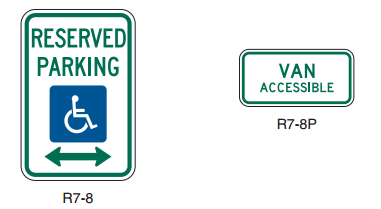
Each accessible space shall display sign R7-8, as provided in the latest edition of the Manual on Uniform Traffic Control Devices published by the Federal Highway Administration of the United States Department of Transportation, which includes the words "RESERVED PARKING" and the blue and white international symbol of access. Van-accessible physically disabled reserved parking spaces shall also display sign R7-8P immediately below sign R7-8. Signs shall be placed a minimum of five and a maximum of eight feet above ground level to the bottom of the sign so as not to be obscured by parked vehicles. Provided however, the blue and white international symbol of access, accompanied by the appropriate language including, but not limited to "Handicapped Parking", "Reserved for Handicapped" and "Permit Required-Towing Enforced" may be used in lieu of sign R7-8 if the sign was erected prior to January 1, 2010.
D.
All parking spaces required to be accessible by this Code shall comply with the ADAAG universal design. An 11-foot space with a five-foot aisle may be shared with another 11-foot space.
(Ord. No. 23755, § 7, 12-2-08; Ord. No. 24009, § 8, 2-2-10; Ord. No. 24726, § 7, 8-13-13)
§ 59-10700. - Off-street loading requirements.
10700.1. Off-Street Loading Space Required. Every industrial, commercial and civic building hereafter erected or expanded shall provide space, as indicated herein, for loading and unloading of vehicles. The number of off-street loading spaces required by this article shall be considered the absolute minimum, and the owner/applicant shall evaluate his/her own needs to determine if they are greater than the minimum specified by this article.
10700.2. Size of Off-Street Loading Spaces. All off-street loading spaces shall have the minimum dimensions of 12 feet by 60 feet, and 15 feet overhead clearance. In no case shall required off-street loading spaces encroach upon any required off-street parking space or into the public right-of-way. No maneuvering shall be permitted in the public right-of-way.
10700.3. Design of Loading Spaces. Off-street loading spaces shall be designed so that vehicles shall maneuver entirely within the property lines of the premises and not in the public right-of-way. Unenclosed off-street loading areas shall be permanently paved with hard-surfaced pavement. A six-inch header curb must also be constructed to separate a loading area from a public right-of-way.
10700.4. Time Requirements. Where the Traffic and Transportation Commission approves an on-street loading zone, that zone cannot be used between 7:00 a.m. and 9:00 a.m., and 4:00 p.m. and 7:00 p.m. each weekday. Semi-tractor trailer trucks cannot use a designated on-street loading zone between 7:00 a.m. and 7:00 p.m. Monday through Friday.
10700.5. Loading Violations. Violators of this article will be subject to the enforcement of procedures listed in Section 32-310, "Negligent Parking," of the Oklahoma City Municipal Code.
10700.6. Exemptions to Off-Street Loading Requirements.
A.
An applicant with less than two loading spaces, as required in this article, may utilize the public street for maneuvering space if the maneuvering is performed on either a local or collector street segment. Said street segment shall exist entirely within an industrial zoned area and shall not connect with other segments of the same street or other streets that traverse through non-industrial zoned areas. Any applicant may appeal the loading space requirements in this article to the Public Works Director if he can verify that those requirements are excessive due to other factors such as railroad access, air freight storage next to airports, waterway access, etc.
B.
In the DBD, DTD-1 and DTD-2 Districts, no off-street loading is required. However, that within these districts, the applicant may apply to the Traffic and Transportation Commission for a street loading zone that does not impede a moving lane of traffic.
10700.7. Screening of Off-Street Loading. Requirements for the screening of off-street loading areas are found in Article XI, Landscaping and Screening Regulations.
§ 59-10750. - Specific off-street loading requirements.
The Table 10750.1 below illustrates the number of required loading spaces required by use category according to floor area:
§ 59-10800. - Access.
10800.1. Purpose. The purpose of this article is to provide access to private and public property in a safe, efficient and orderly manner that is compatible with the public transportation system, and to ensure orderly designs and proper locations of driveways to have a positive effect on traffic operations. Furthermore, this article provides means for enhancing transportation movement and safety within the City, including generally improved traffic capacity, maintaining uniform traffic speeds and reducing accidents.
10800.2. Access to Lots. Notwithstanding the provisions of this article, each lot of record that was in existence on November 21, 1980 shall be entitled to access to a public street.
10800.3. Access to Residential Dwelling Unit. In no case shall a residential structure with four or less units be allowed access onto an arterial street if access is available onto either a collector or local residential street. Residential structures with more than four units shall be required to follow the access provisions as stated in this chapter.
10800.4. Curb Cut Permit. No person shall cut or remove curbing or construct a driveway on an approved public street without securing a permit from the Public Works Director for such cut, removal or driveway construction. All costs to construct or remove curbs and driveway shall be the responsibility of the applicant. Any roadway improvement that is designed to provide access to a lot also shall be the responsibility of the applicant.
10800.5. Curb Cut Removal Requirements.
A.
Curb and Base Requirements. After curbing has been removed for driveways or other purposes, the base shall be left in standard condition, and the end of the curbing at the sides of the driveway shall be left in a finished and sightly condition.
B.
Site Requirements. Old or broken curbing, and all other residue, shall be removed from the site and properly discarded, with the premises remaining in a neat, sightly and clean condition.
C.
Curb and Gutter Requirements. Where the curbing to be removed is part of a standard curb-and-gutter, the gutter also shall be completed in accordance with the requirements of the Public Works Director.
10800.6. Variance to Access Provisions in this Chapter. A variance may be granted by the Board of Adjustment for access requirements of this chapter where:
A.
The literal application does not permit proper access to serve the land.
B.
The variance does not harm the public health, safety and welfare, and does not adversely affect the intent of this chapter.
C.
The problem of access relates to existing conditions of the lot and not to proposed plans.
D.
The improvements in this chapter would increase hazards associated with driveway/roadway conflicts.
10800.7. Access to Public Streets. Two driveways, each no wider than 30 feet, shall be allowed per street frontage. Where a property has extensive frontage, or where center medians or traffic channelization are desirable, the Public Works Director may approve additional driveways or greater widths.
10800.8. Corner Clearance for Driveways. Driveways shall be separated from street intersections by the distance defined in the Table 10800.1. These distances, shown as "A" in Figure 10800.1 shall be measured from the centerline of streets and the curb line of driveways, excluding radii:
FIGURE 10800.1: DRIVEWAY SEPARATION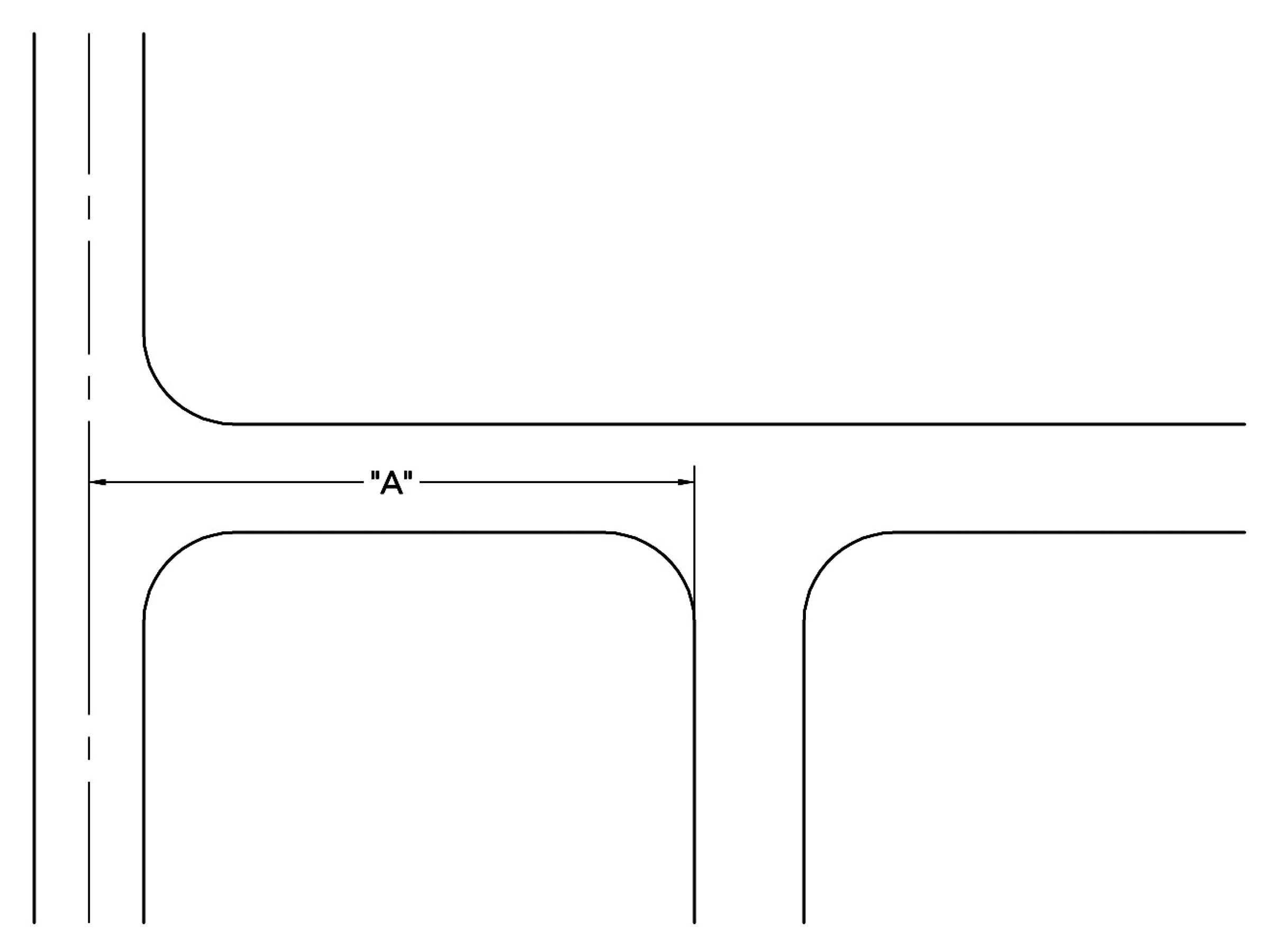
10800.9. Platted Limits of No Access. Where platted limits of no access exist which require more restrictive access, said platted limits of no access shall control and shall be enforced.
10800.10. Design of Intersection Between a Driveway and Arterial, Collector or Local Street.
A.
The intersection of a two-way driveway shall be designed to intersect the arterial at a 90-degree angle. The corner radius of a 90-degree driveway shall be no less than ten feet, provided that residential driveways on local or collector streets shall have a minimum radius of five feet. One-way egress driveways of less than 90-degree may be required by the Public Works Director where it is determined that it is in the interest of the public health, safety and welfare.
B.
A minimum sight distance of 400 feet for vehicles egressing a driveway to an arterial shall be required for each intersection. The sight distance shall be measured from a point on a driveway at least 15 feet from the edge of a major road pavement and measured from eye height of three and three-quarters feet on the driveway to object height of four and one-half feet on the major road. One-way egress driveways shall conform to the sight distance requirements that are stated for two-way driveways.
C.
All driveways and access facilities shall be designed to meet the grade, alignment, pavement and channelization standards and other specifications prescribed by the Public Works Director. These design standards and specifications shall be published and made available to the public.
10800.11. Access Considerations: Rezoning Property to Commercial or Industrial. The Planning Commission shall review all applications for rezoning property to a commercial or industrial designation for potential impact of non-residential access driveways on surrounding residential areas.
A.
The findings of the Planning Commission shall be reported to the City Council prior to public hearing on the application for rezoning. Such review shall be conducted in conformance with the following criteria:
(1)
The potential hazard to the health, safety and welfare of the inhabitants of the surrounding residential area caused by allowing access into such areas.
(2)
The degree to which the carrying capacity of a collector or arterial street would be reduced, and traffic hazards thereon increased, in the event access onto adjacent residential streets be limited or denied.
(3)
Whether detrimental effects upon the surrounding residential areas are substantially outweighed by the detrimental effect upon carrying capacity and traffic safety of collector or arterial streets resulting from denial or limitation of access onto adjacent residential streets.
B.
If the City Council finds, in accordance with the standards set out herein, that limiting access from a commercially or industrially zoned tract onto a local residential street would protect the health, safety and welfare of the residents in an area, then the City Council may direct that no curb cuts be placed on that portion of the local residential street adjacent to the commercially or industrially zoned tract. The terms used to define the types of streets found herein shall be the same as those definitions found in the Oklahoma City Subdivision Regulations.

