
Oklahoma City City Zoning Code
ARTICLE XII
SITE DEVELOPMENT STANDARDS
§ 59-12100.- Lot area, yards and setbacks.
12100.1. Lot Regulations.
A.
Limitation of Structures Per Lot.
(1)
There shall be no more than one structure per lot for a single-family, two-family, three-family and four-family dwellings, except as may be permitted in the planned unit development, or special exception provisions of this chapter.
(2)
There may be groups of commercial buildings or more than one multiple-family residential structures on the same lot, subject to the development regulations of the applicable zoning district.
(3)
A freestanding dwelling unit shall not be located on the same lot with any other principal use, except as an accessory use or an accessory service use as permitted in this chapter.
B.
Previously Approved Lot Width. Where a lot has less width than required in a zoning district, and said lot was created by a plat or deed previously approved by the Planning Commission and recorded, the minimum lot width provision of the district shall not apply.
C.
Maintenance of Minimum Lot Size. No portion of the required area of any lot or building site shall be used, or considered to be part of the required area, for any other lot or building site. No existing lot or building site that has an area less than the minimum required lot size shall be reduced in area, except when such reduction results from a court decree or other action of governmental authority.
D.
Permitted Lot Reduction. Where a lot has been reduced below the minimum required area through condemnation or by acquisition of a portion thereof for public purpose by any government agency, the Planning Department Staff may authorize its development if said reduction is no greater than 15 percent of the minimum lot size required, provided, however, that this provision shall not apply where an easement has been dedicated for street widening purposes as a part of the approval process of a subdivision of land or a zoning district change.
E.
Limitation on Subdivision of a Lot. A lot which does not meet the minimum development regulations of a zoning district shall not be subdivided to create more lots.
12100.2. Use and Structure Regulations.
A.
Building Location Restrictions.
(1)
Primary Access. No building shall be erected on any lot, nor shall a building permit be issued therefore, unless the street giving access to the lot upon which such building is proposed to be placed meets one of the following:
(a)
The street shall have been accepted or opened as, or shall otherwise have received the legal status of, a public street prior to that time.
(b)
Such street corresponds with: 1) a street shown on the Official Master Plan; 2) a street on a subdivision plat approved by the Planning Commission; or 3) a street accepted by the City Council after the submission to the Planning Commission, as herein required.
(c)
Such street is a private street or roadway, as herein defined, and has been approved and authorized under the terms of the Oklahoma City Subdivisions Regulations.
(d)
Access is provided from a private access drive, as herein defined, and has been approved and authorized under the terms of the Oklahoma City Subdivision Regulations.
(2)
Secondary Access. An alley shall serve only as a secondary means of access to a property. No building permit or certificate of occupancy shall be issued for a structure located on an alley unless access is also available as required in Paragraph (1) above, provided, that all residentially zoned lots abutting a public street shall be deemed to have legal access to such street, unless specifically prohibited by platted limits of no access. The alley providing access shall be open and accessible from the property.
(3)
Bricktown Canal Exception. Notwithstanding the provisions of Paragraphs (1) and (2) above, with respect to property and lots within the BC District, adjacent to the public canal, alley access is hereby deemed to be approved primary access and such alley access shall fully satisfy requirements of such Paragraphs (1) and (2) above for all purposes, including the issuance of building permits and certificates of occupancy.
B.
Control Over Bulk. All buildings and structures erected after the effective date of this chapter shall meet the requirements for the zoning district in which the structure or building is located. No existing building shall be enlarged, altered, reconstructed or relocated in such a manner that conflicts with the requirements of the zoning district in which the building or structure is located.
C.
Prohibited Use of Land and Buildings. No building, structure or land shall be used for any use other than one that is allowed in the zoning district in which such building, structure or land is located, unless authorized under Article XV, Nonconformities. However, buildings, structures or land may be used for a temporary use or accessory use, as specified in this chapter, provided that such building, structure or use complies with all other requirements of this chapter.
D.
Regulations for Conversion of Structures.
(1)
General. The purpose of this section is to set forth provisions that regulate structures or properties that are being converted to a more intense use to assure the transition of land uses provides a maximum protection of property values and contributes to the general upgrading of the area. These regulations shall apply to all uses of land and structures that are proposed for such conversion.
(2)
Requirements for Conversion or Modification of Structure or Property to a More Intense Use.
(a)
Building Permit and Required Site Plan. A building permit shall be required for all proposed conversions of structures or properties to a more intense use. The application for the building permit shall be accompanied by a site plan that is completed in accordance with the requirements established in Article IV, Administrative Procedures, of this chapter.
(b)
Code Compliance. All structures and properties to be converted to a more intense use shall be brought into conformity with all applicable City Codes and ordinances, including parking requirements, prior to occupancy, provided that the following requirements below shall also be met:
1.
The structure shall be located a minimum of five feet from all property lines or a minimum of ten feet from any adjacent structure.
2.
Access shall be provided from the public right-of-way to the required parking area, either by means of ownership, easement, right-of-way or a joint use agreement, which has been filed of public record.
3.
There may be vehicle parking in the front yard setback area, provided that all parking and maneuvering of the vehicles shall be provided for off of the public right-of-way and in a manner that will permit the vehicles to enter the thoroughfare from the property in a forward movement, rather than backing out into traffic.
(3)
Restriction of Use of Residential Structure for Commercial or Industrial Purposes.
(a)
No structure designed, intended, or previously or presently used for residential purposes shall be used for or occupied by any commercial or industrial use except under the following conditions. These provisions shall not apply to industrial uses in an I-2 or I-3 District.
(b)
An existing residential structure may be converted to allow for a permitted commercial or industrial use in a more intense zoning district, provided the following conditions are met.
1.
If the existing residential structure is located in a non-residential district prior to July 9, 2002, the following conditions shall apply:
i.
All parking shall be located behind the rear wall of the main structure.
ii.
No portion of the front yard, other than the access drive to the parking area, shall be paved for parking or vehicle maneuvering.
iii.
The access drive leading to the parking area may be reduced to a minimum of eight feet.
iv.
The required number of on-site parking spaces may be reduced by 50 percent.
v.
Adequate area must be provided in the parking area for vehicles to turn and egress from the site fronting onto the abutting street.
vi.
The building and all accessory structures shall be brought into full compliance with all other applicable codes of the City prior to occupancy.
2.
If the existing residential structure is located in a non-residential district after July 9, 2002, the following conditions shall apply:
i.
The property, when converted, shall conform to all development regulations of the zoning district in which it is located.
ii.
Parking, loading and access facilities shall be installed in accordance with the requirements of this chapter.
iii.
The building and all accessory structures shall be brought into full compliance with all applicable codes and ordinances of the City prior to occupancy.
E.
Required Distance Between Buildings.
(1)
Required Distance Between Main Buildings. No main building two stories or less in height shall be closer than ten feet to any other main building to which it is not attached on the same lot or building site. No main building exceeding two stories in height shall be closer than 15 feet to any other main building to which it is not attached on the same lot or building site.
(2)
Required Distance Between Detached Accessory Buildings and Main Buildings. No detached accessory building walls shall be closer than six feet to any building walls or other accessory building walls on the same lot or building site. No detached accessory building eaves shall be closer than five feet to any main building or other accessory building eaves on the same lot or building site.
F.
Architectural Regulations. Buildings, including accessory buildings, with walls constructed with exposed exterior metal finish shall not be permitted in the O-1, O-2, C-1, C-2, C-3 and C-CBD Districts, or on nonresidential uses in residential zoning districts. This section shall not prohibit the use of metal for roofing material, mechanical enclosures, fascias and soffits, signs, awnings and similar appurtenances. Fabricated metal panels may only be used as accent material.
G.
Sidewalks Required. Fee in Lieu of Sidewalks.
(1)
Sidewalks. Sidewalks shall be installed for all new construction and/or at the time of conversion of a residential use to a more intense use, on all lots having frontage on public streets classified as a major or minor arterial; provided, unless required by a final plat, no sidewalks shall be required on single-family residential lots one acre and larger used for residential purposes having frontage on public streets classified as major or minor arterial streets. Provided further, unless required by a final plat, no sidewalk shall be required on single-family and two-family residential lots in a final plat accepted by City Council prior to March 6, 2007, where any of the lots that have frontage on the arterial were developed prior to March 6, 2007.
(a)
All sidewalks shall be constructed in accordance with City specifications.
(b)
All sidewalks shall be designed and constructed in accordance with the Subchapter II of the American With Disabilities Act, 42 U.S.C. § 12131, et seq., as amended, and the regulations promulgated there under ("ADA").
(c)
Sidewalks shall be required at the time of building permit and completed before a certificate of occupancy is issued.
(d)
Existing sidewalks shall not be removed except for the purpose of replacement.
(2)
Fee in lieu of sidewalk improvements.
(a)
For new construction and/or conversion of a residential use to a more intense use immediately adjacent to streets classified as major or minor arterials which right-of-way is subject to programmed capital improvements, which would make the installation of sidewalks impractical, the developer shall pay a fee in lieu of sidewalks construction.
1.
The fee in lieu of shall be accompanied by such engineering data as may be required by the City Engineer in order to determine whether or not construction of required sidewalk improvements are practical at the proposed location.
2.
The fee in lieu of sidewalk improvements shall be in an amount established in Chapter 60, the General Schedule of Fees.
3.
The fee in lieu of sidewalks shall be submitted prior to the issuance of the building permit.
4.
Fees accepted shall be deposited in a separate account; fees shall be utilized for the costs and expenses incurred for the construction of the sidewalks at the time of the capital improvements are constructed.
5.
As used in this section, the fees tendered hereunder shall be deemed accepted when the funds required are received by the City Treasurer.
(b)
The developer may install sidewalks in addition to the required fee-in-lieu with approval of the City Engineer.
12100.3. Yard Regulations.
A.
Front Yard Regulations.
(1)
Through Lots.
(a)
Where both front and rear yards abut a street, the minimum front yard requirement of the zoning district shall apply to any frontage that has access to a street. The frontage which has no access permitted shall be subject to the rear yard requirements of the district.
(b)
A privacy fence or wall may be approved by the Planning Department Staff in the rear and side yard areas of lots designed with double frontage, provided that any such fence or wall shall not obstruct the view of traffic from an intersecting street.
(c)
Accessory uses shall also be permitted in the rear and side yards of lots designed with double frontage, but only in accordance with the provisions of Paragraph (a) above, provided that they do not obstruct the view of traffic from an intersecting street.
(2)
Animal Yard Utilization. No animal enclosure shall be permitted in the required front yard of any zoning district.
(3)
Handicapped Ramps.
(a)
Ramps necessary to provide handicapped access may extend into the required front yard of a residential use, provided such ramps shall be set back at least ten feet from the street right-of-way and shall not extend into more than one-half of the required front yard.
(b)
In the event that the property is so situated that such ramps cannot feasibly be constructed in conformance with Paragraph (a) above, said ramps maybe allowed if (1) the ramps extend into the required front yard only to the minimum extent reasonably required to conform to handicapped access standards, and (2) any extension into a public right-of-way must obtain a revocable permit from the City Engineer.
B.
Side Yard Regulations. If a continuous row of lots is to be developed by the construction of a series of dwellings not more than 35 feet in height, a side yard of two and one-half feet may be permitted on one side of the building where a driveway is to be constructed on the other side, provided that open space of not less than ten feet is maintained between all such dwellings.
C.
Rear Yard Regulations. Regardless of any other building setback requirements, except as provided for accessory buildings, structures and uses (Section 59-12200), there shall be a ten-foot area at the rear of all lots where no structure shall be permitted in order to provide for utilities, provided that this restriction shall not apply where there is an existing alley or where the Planning Department Staff determines that there is no utility need present.
D.
General Yard Regulations.
(1)
Platted Building Lines.
(a)
Where a platted building line exists which requires a greater setback than the zoning district in which it is located, the platted building line shall be enforced. However, platted building lines shall not be enforced for signs, fences and those structures which are allowed to extend into the required front yard area by Section 59-12250 (Permitted Encroachments).
(b)
Site plans submitted with building permit applications shall show all platted building lines and conformance of all structures with these regulations.
(2)
Yard Requirements for Open Land. If a lot is occupied by a permitted use without structures, such as open storage, then the minimum yard that is required for such a lot under the applicable zoning district regulations shall be provided and maintained, unless some other provision of this chapter requires or permits a different minimum yard. However, front, side and rear yards shall not be required on lots used for off-street parking, agricultural purposes, open public areas or open space, but in no event shall structures associated with such open land uses be located in the required minimum yards.
(3)
Yard Regulations for Lots with Area in Floodplains. Notwithstanding any other provisions of this chapter, no structure shall be located within an established floodplain without the improvements specified in the Flood Control Ordinance of Oklahoma City.
12100.4. Special Setback Regulations. Notwithstanding the setback standards within each of the zoning districts, the following special setbacks provisions shall apply.
A.
Special Building Lines Established. Special building lines are hereby established along certain streets as defined below. No building or structure shall be erected closer to the street than the distance specified. Special building lines herein established shall be as follows:
(1)
North May Avenue, from Tenth Street to 23rd Street: 55 feet from centerline.
(2)
North May Avenue, from 23rd Street to 40th Street: 65 feet from centerline.
(3)
Linwood Boulevard, from Klein Avenue to Virginia Avenue: 55 feet from centerline.
(4)
Virginia Avenue, from Seventh Street to Park Place: 65 feet from centerline.
(5)
Classen Boulevard, from Main Street to 25th Street: 65 feet from centerline.
(6)
23rd Street, from Eastern Avenue to May Avenue: 60 feet from centerline.
(7)
Reno Avenue, West, from the west line of May Avenue West to County Line Road: 125 feet from centerline.
(8)
Pennsylvania Avenue, South, from the South line of Reno Avenue, South to Southwest 44th Street: 65 feet from centerline.
B.
Method of Calculating Street Centerline. The centerline shall be a line equidistant from the established street right-of-way lines. However, land dedicated for, or easements granted for, widening of streets in new subdivisions shall not be counted in calculating the location of a street centerline.
C.
Use of Setback Area. Private property that is required to remain undeveloped for setback purposes may be used for off-street parking, unless specifically restricted by this chapter.
(Ord. No. 23588, § 1, 4-15-08; Ord. No. 23839, § 1, 4-14-09)
§ 59-12150. - Subdivision requirement.
For the purpose of providing a proper arrangement of streets and assuring the adequacy of space for traffic circulation, utilities and access of emergency vehicles, and to establish the number of lots allowed for residential developments in the RA2 and RA zoning districts, a subdivision requirement is established as follows: for any land which was rezoned upon public initiation or application of a private party, no building permit or certificate of occupancy shall be issued until that portion of the tract, for which the permit is sought, has been approved in accordance with the Oklahoma City Subdivision Regulations.
Plats for property zoned RA2 or RA shall contain notes setting forth the maximum number of dwelling units permitted under the density regulations of the applicable zoning district and prohibiting the splitting of lots so as to permit housing lots in excess of the maximum number of units allowed. The plat shall also contain notes prohibiting development of designated open space areas and shall describe easements, covenants, or other legal instruments related to the development and maintenance of designated open space areas.
(Ord. No. 24009, § 10, 2-2-10)
§ 59-12200. - Standards for accessory buildings, structures and uses.
12200.1. Permitted Accessory Structures and Uses.Accessory structures and uses, including swimming pools, which are customarily associated with, and incidental and subordinate to a principal use, shall be permitted, subject to applicable City codes and the regulations of this chapter. Table 12200.1 indicates which accessory uses are permitted within each district, as indicated by an "X", subject to the regulations of this article.
TABLE 12200.1: PERMITTED ACCESSORY STRUCTURES AND USES
FOOTNOTES: TABLE 12200.1
1 For permitted residential.
2 See Section 59-12200.4 for additional standards.
12200.2. Standards for Accessory Buildings.
A.
Accessory buildings shall be governed by the intensity of use provisions for the district in which they are located.
B.
No accessory buildings or structures shall be located within a required front, side or rear yard area unless otherwise permitted by this chapter. However, if an existing accessory building was legally constructed prior to December 9, 1947 with less side yard and/or less rear yard setback than is now required, a reconstruction or renovation of such accessory building shall be permitted, provided that such reconstruction or renovation takes place in the original location of the accessory building. Any addition to such accessory building, which constitutes an extension of the side wall, shall be permitted, provided that such addition shall not encroach upon the rear yard as herein required.
C.
In the RA2, RA, R-1, R-1ZL, R-2, R-3, R-3M, R-4M, R-4, R-MH-1, and R-MH-2 Districts, and Tracts 1, 2 and 3 of NC District, detached accessory buildings shall meet the following criteria.
(1)
Lots Less than One-Half Acre.
(a)
The maximum lot coverage of all detached accessory buildings shall not exceed 1,000 square feet.
(b)
No detached accessory building shall exceed the height of the primary structure on the same lot.
(c)
Detached accessory buildings with walls constructed of exterior metal finish shall not exceed ten feet in height as measured to the top of the side wall fascia.
(d)
Detached accessory buildings with walls constructed of exterior metal finish shall have wall panels and trim items finished with a baked-on paint finish.
(e)
All detached accessory buildings in excess of ten feet, measured from grade to the highest point of the structure, shall have a hip or gable roof with a minimum 4:12 pitch, and a minimum one foot overhang finished with soffit material except for buildings with a gambrel roof.
(f)
All detached accessory buildings shall be located behind the rear wall of the main structure on the property.
(g)
The maximum overhead door height shall not exceed nine feet, measured from grade to the top of the door opening.
(2)
Lots One-Half Acre and Greater, but Less than One and One-Half Acres. Detached accessory buildings shall meet the regulations in Paragraph (1) above except:
(a)
The maximum lot coverage of all detached accessory buildings shall not exceed 1,250 square feet, or two and one-half percent of the size of the lot, whichever is greater.
(b)
All detached accessory buildings on one acre or greater shall observe a 25 foot side and rear yard building setback.
(c)
Detached accessory buildings with walls constructed of exterior metal finish shall not exceed 12 feet in height, measured to the top of the side wall fascia.
(d)
No detached accessory building shall exceed the height of the primary structure on the same lot.
(e)
Detached accessory buildings with walls constructed of exterior metal finish shall have wall panels and trim items finished with a baked on paint finish.
(f)
All detached accessory buildings in excess of ten feet, measured from grade to the highest point of the structure, shall have a hip or gable roof with a minimum 4:12 pitch, and guttering or trim material at the eave except for buildings with a gambrel roof.
(g)
All detached accessory buildings shall be located behind the rear wall of the main structure on the property.
(3)
Lots One and One-Half Acre and Greater, but Less than Three Acres. Detached accessory buildings shall meet the regulations of Paragraph (1) above except:
(a)
The maximum lot coverage of all detached accessory buildings shall not exceed two and one-half percent of the size of the lot.
(b)
Detached accessory buildings with walls constructed of exterior metal finish shall not exceed 14 feet in height measured to the top of the side wall fascia.
(c)
Detached accessory buildings with walls constructed of exterior metal finish shall have wall panels and trim items finished with a baked-on paint finish.
(d)
All detached accessory buildings in excess of ten feet, measured from grade to the highest point of the structure, shall have a hip or gable roof with a minimum 4:12 pitch, and guttering or trim material at the eave.
(e)
All detached accessory buildings shall be located behind the rear wall of the main structure on the property.
(f)
All detached accessory buildings in excess of ten feet, measured from grade to the highest point of the structure, shall have a hip or gable roof with a minimum 4:12 pitch, and guttering or trim material at the eave except for buildings with a gambrel roof.
(4)
Lots Three Acres and Greater.
(a)
The maximum lot coverage of all detached accessory buildings shall not exceed five percent of the size of the lot.
(b)
All detached accessory buildings shall observe a 25-foot side and rear yard building setback.
D.
No accessory building shall be constructed upon a lot until the construction of the main building has actually commenced.
E.
No accessory building or structure shall be used unless the main building on the lot is also in use.
F.
In the R-1, R-1ZL, R-2, R-3, R-3M, R-4M, R-4, and R-MH-1 Districts, and Tracts 1, 2 and 3 of the NC District, accessory buildings not on a permanent foundation may extend into the required rear and side yard, but shall be located at least three feet from any side or rear property line.
12200.3. Standards for Accessory Structures and Uses. Accessory use and structure regulations for the RA2, RA, R-1, R-1ZL, R-2, R-3, R-3M, R-4, R-4M and R-MH-1 Districts, as well as residential uses in the NC District, any portion of a PUD specifically allowing for residential use, and all permitted residential uses in non-residential districts are as follows.
A.
Carports. Carports are permitted to be added to an existing residential structure in the above specified districts subject to the following conditions and requirements:
(1)
Any person erecting or constructing a carport, in whole or in part, shall obtain a building permit. Application for a permit shall be made by the owner or lessee of the subject property, or agent of either, or by a licensed contractor employed in connection with the proposed work.
(2)
A carport may be permitted: 1) on the side property line on an interior lot; 2) on a side property line on a corner lot line abutting a street; and 3) in subdivisions permitting zero lot line development, a carport may be permitted on the side property line.
(a)
On the side property line on an interior lot;
(3)
All carports shall be located only over an existing paved driveway.
(4)
All carports shall be kept in an attractive state, in good repair, and in a safe and sanitary condition.
(5)
All carports shall be constructed, erected or installed to conform with the structural requirements of Chapter 12, Buildings and Building Regulations, as amended, and shall have an architectural design and appearance compatible with the primary building on the property.
(6)
No carport used in conjunction with a single-family or two-family dwelling shall exceed 12 feet in width for a single garage and/or driveway, and shall not exceed 24 feet in width for a double garage and/or driveway. Under no circumstance, shall any carport used in conjunction with a single-family or two-family dwelling exceed 24 feet in width. All width measurements shall be made from eave line to eave line. No more than one carport shall be permitted for each dwelling unit.
(7)
All carports shall be permanently open on two sides from grade surface to eave line. All carports that extend into the required front yard setback shall be permanently open on three sides from grade surface to eave line.
(8)
All carports shall comply with the front yard setback requirements of this chapter, provided carports used in conjunction with a single-family or two-family dwelling shall be permitted to extend into the required front yard setback area. No carport shall be permitted closer than five feet from the front property line. No carport shall violate the sight distance requirements of this chapter.
B.
Fences. Fences shall be permitted subject to the permit requirements of the Oklahoma City Municipal Code.
(1)
Front Yard Fence. A front yard fence shall be defined as a fence located within the required front yard setback area for all structures or in front of the front wall of the main building on the site. It shall be considered a structure and shall be subject to the regulation of structures in this chapter and Chapter 12, Buildings and Building Regulations. It shall be permitted subject to the following conditions and requirements:
(a)
A permit fee in the amount established by ordinance shall be required.
(b)
Regardless of the fence regulations contained herein, the property owner is advised that there may be more restrictive privately enforced regulations in the form of plat restrictions, declarations of covenants and restrictions relating to architectural controls, deed restrictions or platted setback lines that may further limit the construction of a fence on a parcel.
(c)
The Staff shall review an application for a front yard fence and ensure that the conditions and requirements contained therein are satisfied before granting approval of said application. Prior to such approval, the Fire Department shall review and comment on the fence, if appropriate.
(d)
The front yard fence shall be a decorative-type open fence that does not exceed four feet in height. Only chain-link, decorative ornamental metal, picket and split rail fencing shall be permitted.
1.
For wood picket fencing, the maximum width of the pickets shall be three and one-half inches and the minimum separation of the pickets shall be three and one-half inches.
2.
Decorative metal fences shall be made of ornamental metal pickets, galvanized steel, aluminum, or similar material having the appearance of decorative wrought iron and shall comply with the following:
i.
Minimum separation of pickets shall not be less than two and one-half inches.
ii.
Maximum picket width shall not exceed one inch square.
iii.
Spiked caps or spears may not be used.
(e)
Site plans and elevations of the fence shall be submitted for permit review. The proposed fence shall not pose a safety or visibility hazard.
(f)
Barbed, hog or chicken wire, or single-strand fencing shall not be used, except in the agricultural or industrial zoning districts.
(g)
Staff may approve a retaining wall to address drainage or topographical problems.
(h)
A front yard fence greater than 50 feet from a residence or structure shall be equipped with a gateway having at least 16 feet of clear width. The Fire Department must approve any gate and all locking devices installed in the gateway.
(i)
No front yard fence shall be erected within 25 feet of the intersection of the right-of-way lines of any public or private street.
(j)
A front yard fence, or a front yard fence with a hedge or similar natural vegetation, shall not cause a view obstruction for any private driveway and shall not in any case be erected within 12 feet of the intersection of any private driveway and the pavement edge or maintained portion of a public or private street.
(k)
A front yard fence shall be kept in an attractive state, in good repair, and in a safe and sanitary condition at all times by the property owner.
(l)
A front yard fence shall not obstruct any public walkway even if said public walkway is on private property.
(m)
The fence shall be constructed with all braces and supports on the interior of the fence, except when both sides are of the same design and appearance.
(n)
Exception:
Front yard fences on lots one acre and larger, developed for agricultural and/or residential use, shall meet all requirements for a front yard fence as provided in Section 12200.3.B(1) except as follows:
1.
The maximum height of the fence shall not exceed six feet.
2.
Decorative columns constructed of brick, rock or masonry, or similar material approved by the Director, shall be permitted not to exceed two and one-half feet in width and six and one-half feet in height. Said columns shall be separated a minimum of eight feet.
3.
Decorative entryways constructed of brick, rock or masonry, or similar material approved by the Director, shall be permitted. Said decorative entryway shall be located each side of the driveway and shall not exceed two and one-half feet in width, eight feet in height and 16 feet in length each. Gates associated with a decorative entryway shall not exceed eight feet in height.
4.
Arches and similar decorative elements that span across a driveway shall have a clearance above the ground of not less than 14 feet and an overall height of not more than 25 feet. The minimum parcel size for arches and similar decorative elements that span across a driveway shall be two acres.
(2)
Side and Rear Yard Fence. A side and rear yard fence shall be defined as a fence located within the side and rear yard as defined in Section 59-2150, "Yard, Rear" and "Yard, Side" and as shown in Figure 2000.7.
(a)
No such fence shall exceed eight feet in height in the Agricultural, Residential, Office and Commercial zoning districts or exceed ten feet in height in the Industrial zoning districts.
(b)
No such fence shall be constructed of metal, plastic or plywood sheets. However, ribbed steel panel fencing may be used provided such fencing material meets the following minimum property standards:
1.
Ribbed steel panels shall have the following dimensions: Rib depth of one to one and one-half inches by a width of two and one-half to three and one-half inches, with six to 12 inches between rib centers.
2.
Ribbed steel panels must be properly primed and coated with a factory thermal set silicone polyester base finish.
3.
The fence shall be kept in an attractive state, in good repair, and in safe and sanitary condition at all times by the property owner.
4.
Ribbed steel panel fences shall not be permitted in the DBD, DTD-1, HP, or HP Districts.
(c)
Barbed, hog or chicken wire, or single-strand fences shall not be used, except in the agricultural or industrial zoning districts.
(3)
Subdivision Fence and/or Entryway Fence. A subdivision fence and/or entryway fence shall be defined as a fence placed around the perimeter and/or entrance(s) of a residential subdivision, or any portion thereof. A subdivision fence and/or entryway fence shall comply with the following:
(a)
No such fence shall exceed eight feet in height, provided, however, that there shall be no height limit on the entryway.
(b)
The fence shall be permitted to be placed upon a property line but shall not extend into the public right-of-way unless approved with a revocable permit.
(c)
The fence shall not obstruct any public or private walkway.
(d)
The fence shall not be erected within 25 feet of the intersection of the right-of-way lines of any public or private street.
(e)
The fence shall not cause a view obstruction for any private driveway and shall not, in any case, be erected within 12 feet of the intersection of any private driveway and the pavement edge or a maintained portion of a public or private street.
(f)
The subdivision name, street name or any other identification necessary for the subdivision may be placed upon the fence but must be in accordance with the regulations established for subdivision signs in Chapter 59, Article XVI of the Oklahoma City Municipal Code.
(g)
No such fence shall be constructed of sheet metal or plywood sheets, and the fence shall be kept in an attractive state and in good repair.
(h)
The fence shall be constructed with all braces and supports on the interior of the fence, except when both sides are of the same design and appearance.
(i)
No fence permit shall be issued for any subdivision fence and/or entryway fence prior to the approval of a preliminary plat from the Planning Commission.
(4)
BC District Standards. Subject to the provisions of § 59-7150.1.E.(8) (Bricktown Core Development District) of this chapter.
(5)
SYD District Standards. Subject to the provisions of Section 59-7350.1D(2)(a) (Stockyards City Development District) of this chapter.
(6)
DBD, DTD-1, DTD-2 District Standards. Subject to the provisions of Section 59-7200.1F(8), Fencing (Downtown Design Districts) of this chapter.
C.
Home Occupations. Home occupations shall be permitted, subject to the following conditions:
(1)
It shall be the home occupation or professional office of a person who lives in the main building.
(2)
No person shall be employed who is not a member of the immediate family living on the premises.
(3)
No signs for home occupations are allowed.
(4)
The home shall not be altered to attract business.
(5)
No additional curb cuts shall be permitted, and no front yard area, other than the driveway providing access to a garage, shall be paved or otherwise altered or used for parking of vehicles.
(6)
No business shall be conducted upon the premises where chattel, goods, wares or merchandise are created, stored, exchanged or sold, such as a shop or store.
(7)
No material or equipment shall be stored outside the confines of the home.
(8)
No mechanical equipment which creates a disturbance, such as noise, dust, odor or electrical disturbance, shall be used.
(9)
Artist Studio as Home Occupation in NC District.
(a)
An artist studio is the working place of a painter, sculptor, photographer, graphic artist, architect, landscape architect or fiber artist, with incidental sales of artwork.
(b)
An artist studio shall be permitted as a home occupation in a residential district so long as:
1.
It shall be the studio of the person who lives on the premises.
2.
No more than two persons who are not members of the immediate family shall be employed on the premises.
3.
Signs shall be limited to one non-illuminated wood or metal plaque, no more than one square foot in size, attached to the wall of the building.
4.
No additional curb cuts shall be permitted, and no front yard area, other than the driveway providing access to a garage, shall be paved or otherwise altered or used for parking of vehicles.
5.
No artwork or other material or equipment shall be stored outside the confines of the home or accessory building.
D.
Satellite Dish Antennas. The appearance of satellite dishes and other satellite receiving antennas can create a blight on residential areas, reducing the value and desirability of surrounding property, inhibiting development by creating a negative visual image of the neighborhood, and generally damaging the aesthetic quality of life for the citizens of the City.
It is the intent of these regulations to mitigate the negative aesthetic impact of satellite dishes and other satellite-receiving antennas on residential areas, while not preventing reception of satellite-delivered signals by receive-only antennas and not imposing costs on users of such antennas that are excessive in light of the purchase and installation cost of the equipment.
Satellite-receiving antennas and dishes shall be permitted in the districts listed in Table 12200.1: Permitted Accessory Structures and Uses on lots of less than five acres, subject to the following conditions and requirements. In this section, the term "antenna" or "antennas" shall be deemed to include all electronic, assembly, mounting and supporting apparatus, except where reference is made to antenna diameter. "Satellite Dishes" do not include telecommunications facilities, which are regulated in the "Communication Services" portion of Article IX, Use Standards.
(1)
Such antennas shall be considered structures and shall be subject to the regulation of structures in this chapter and Chapter 12, Buildings and Building Regulations.
(2)
Such antennas shall be located completely behind the front building wall of the main structure on the lot, and completely behind any side building wall that faces toward a street.
(3)
Such antennas shall be mounted from the ground or placed on the roof, and the height of the antenna shall in no case exceed the height standard of the district.
(4)
Such antennas that are ground-mounted shall not exceed 15 feet in height measured from ground level, except that such antennas whose support pole is attached directly to, and extends no farther than one foot from, a rear building wall or eaves of the main structure on the lot may extend to a height not exceeding the height standard of the district, provided that no portion of the pole or mounting structure shall be visible from any portion of a street in front of the lot.
(5)
Such antennas that are mounted on the roof of any structure, except a multiple-family structure having five or more dwelling units, shall not be visible from any portion of a street in front of the lot.
(6)
Such antennas shall not exceed 12 feet in diameter.
(7)
Except where the support pole is attached to a rear building wall in the manner described above, a ground-mounted antenna shall not be placed closer to any lot line than its height or the required setback in the district, whichever is greater.
E.
Private Wind Energy Conversion System. All Private Wind Energy Conversion System (PWECS) towers shall be subject to the following conditions:
(1)
All structural elements shall meet or exceed a designed wind load for a wind velocity of 120 miles per hour.
(2)
The PWECS tower shall be so situated on the lot that the distance from all property lines shall be no less than the height of the tower. All guys and anchors shall meet the yard requirements of the district in which the tower is located.
(3)
Access to the system by climbing shall be limited by either: 1) a fenced yard with a locking portal; 2) a fence six feet tall with a locking portal a distance of three feet from the base of the PWECS tower; 3) limiting climbing apparatus to no more than 12 feet from the ground; or 4) an anti-climbing device 12 feet from the ground.
(4)
PWECS towers may be installed only upon the issuance of a building permit.
(5)
Noise levels, measured at the property line, shall not exceed those allowable under the City Code. Upon citation for excessive noise, the owner of the PWECS tower will comply with Chapter 34 of the Oklahoma City Municipal Code, 2020, as amended, or remove the tower within 30 days.
(6)
At least one sign shall be posted at the base of the PWECS tower warning of the hazard of electrical shock, and describing or illustrating shutdown procedures.
(7)
The height of a PWECS tower shall be measured from grade to the center of the hub. Towers located in the AA District shall not be limited in height. The height of towers located in all other districts shall be governed by the provisions of this chapter.
(8)
No PWECS tower shall be permitted on any property located in the HL or HP Districts without the grant of a Certificate of Appropriateness by the Historic Preservation Commission. Grant of a certificate by the Historic Preservation Commission may be conditioned by any design, height, landscaping or maintenance requirement the Commission deems necessary to protect the historic nature of the property or area, and may be denied by the Commission solely on the basis that the presence of the structure would detract from the historic qualities of the property or area.
(9)
No PWECS tower located in a residential district, or on property developed for residential purposes, shall be erected, constructed or maintained upon the roof of a structure.
(10)
All PWECS towers shall be located to the rear of the principal structure.
Any PWECS tower found to cause interference with microwave transmissions or residential television or radio reception must be modified to alleviate the problem or removed within 30 days.
12200.4. Additional District Standards for Accessory Uses.
A.
Regulations for AA Agricultural District. Regulations for the AA District shall be the same as the regulations for the districts in this § 59-12200, subject to the following additional provisions:
(1)
General. In the absence of a main structure or dwelling, accessory type buildings, such as barns or others agriculturally related structures, may be built on property used only for agricultural purposes. Accessory buildings and swimming pools, which are not a part of the main building, shall be built in accordance with the development regulations of the AA District.
However, where a lot has less than one acre and is otherwise eligible for deed approval under the Oklahoma City Subdivision Regulations, and is within 600 feet of a fire hydrant, accessory structures not attached to the main building on the property may be built in accordance with R-1 District setback regulations. If the subject property is separated by more than 600 feet from a fire hydrant, then those accessory structures not attached to the main building on the property may develop in accordance with the R-1 District development regulations, provided that said accessory structures must be separated from the main building or accessory building on the property and the main building or accessory buildings on adjacent properties by a minimum of 50 feet. Swimming pools and underground fallout shelters shall be exempt from this 50-foot spacing requirement.
(2)
Roadside Stands. Operation of a single roadside stand for the display and sale of products produced on the premises, or on other property owned or leased by the vendor, is permitted, provided the stand does not exceed 200 square feet in area. A roadside stand shall not be located nearer than 15 feet to any street or highway right-of-way.
(3)
Accessory Dwellings. On properties containing a minimum of 160 acres, one dwelling, in addition to the primary dwelling, shall be permitted for occupancy by a tenant or employee in the operation and maintenance of agricultural uses. Such building shall meet all setback requirements.
B.
Regulations for R-MH-2 Manufactured (Mobile) Home Park District. Regulations for the R-MH-2 District shall be the same as the regulations for residential districts in this § 59-12200, subject to the following additional provision: accessory buildings of permanent construction necessary for the operation and maintenance of a manufactured (mobile) home park shall be permitted. However, this shall not permit any retail sales or professional office uses within the above accessory buildings.
C.
Regulations for O-1, O-2, C-1, C-2, C-3, C-4, C-CBD, DBD, DTD-1, DTD-2, C-HC, BC, UD, SYD, and SYT Districts.
(1)
Accessory equipment appurtenant to the principal building including, but not limited to, air conditioning/refrigeration equipment, well houses, guard houses and other similar elements, may be located in required rear or side yard setback areas.
(2)
Where residential uses are permitted, the accessory use regulations of this § 59-12200 shall apply to all residences.
(3)
Front, side, and rear yard fences shall be permitted in accordance with the regulations in this Article or the sight-proof screening provisions in Article XI, Landscaping and Screening Regulations.
(a)
For commercial uses, chain link fencing shall not be permitted along street frontages within the DBD, DTD-1, and DTD-2 Districts.
(b)
Exposed electronically charged fences shall be prohibited.
(4)
Commercial Waste Collection Receptacles within the DBD, DTD-1 and DTD-2 Districts
(a)
Dumpsters and other commercial waste collection receptacles shall be visually screened from view on all sides of the dumpsters. A building, fence, vegetation or other form of screening in accordance with Article XI, Landscaping and Screening Regulations shall satisfy this requirement.
(b)
A receptacle and its required screening may only be located in the public right-of-way upon the issuance of a revocable permit for both the receptacle and the installation of the screening. Any immobile screening fence shall require a fence permit.
(c)
Dumpsters and receptacles shall be so screened and maintained by the property owner so that they do not generate trash, litter, debris or odor beyond the screened facility.
D.
Regulations for I-1, I-2 and I-3 Districts.
(1)
Accessory equipment appurtenant to the principal building including, but not limited to, air conditioning/refrigeration equipment, well houses, guard houses and other similar elements, may be located in required rear or side yard setback areas. A guard house shall also be permitted in the required front yard setback area, provided that proper sight triangles are maintained at all street and driveway intersections.
(2)
Although no buildings are permitted to be occupied for residential purposes, dwelling quarters may be established in connection with any industrial facility for watchmen and caretakers employed on the premises.
(3)
Accessory signs shall be permitted subject to sign regulations.
(4)
Front yard fences shall be permitted in accordance with the regulations in regulations in this article or the sight-proof screening provision in Article XI, Landscaping and Screening Regulations.
(5)
Accessory buildings not a part of the main building(s) may be built in a side or rear yard as follows:
(a)
Accessory structures shall conform to the required setback areas for the district.
(b)
No accessory building shall be constructed on a lot until the construction of the main building has actually commenced.
(c)
No accessory building shall be used unless the main building on the lot is also in use.
(6)
In the I-3 Heavy Industrial District and the I-2 Moderate Industrial District, property used for the outside storage of used materials, not actively offered for sale, and where there is no other primary use on the property, shall be subject to the following conditions:
(a)
Sight-proof screening, in accordance with Section Article XI, Landscaping and Screening Regulations, of this chapter, shall be provided on all sides of the property abutting or visible from a public street, excluding gates. All gates that are not sight-proof must be equipped with screening slats to reduce visibility into the site from the abutting street.
(b)
Any use in existence as of the effective date of this Ordinance (October 5, 2004), which is in violation of this section, shall be deemed nonconforming. Such nonconforming uses shall not in any manner be enlarged, extended, altered or rebuilt, except so as to comply with the provisions of this section.
(c)
All uses deemed nonconforming pursuant to the provisions of this section, shall, within one year of the effective date of this Ordinance (October 5, 2004), terminate or come into compliance with the provisions of this section.
E.
Limitations on Dumpsters, All Districts. Roll-off containers, front-end loader containers, rear-end loader containers, dumpsters and similar trash receptacles with a cumulative volume of two cubic yards or more (hereafter "dumpsters") shall be located behind the front wall of the primary structure, and shall be subject to the following restrictions:
1.
If a structure is under construction or being demolished, and has a current building permit, trash receptacles may be located to the front of the primary structure, provided all dumpsters so located are removed at the completion of construction or demolition.
2.
All dumpsters shall be screened from view from the right-of-way of any public or private street, and from any adjacent residential zone or use.
3.
Dumpsters shall be screened to a height sufficient to shield dumpster from sight on three sides by using a single opaque material wall or fence, or by using a combination of opaque materials, berming, and/or evergreen landscaping that provides the required screening effect and on the fourth side screened by a solid gate of height sufficient to shield dumpster from sight. The gate shall remain closed except when trash pick-ups occur. Dumpsters may also be screened by the wall(s) of a principal or accessory structure. Chain-link fencing with woven slats of opaque material is not acceptable for screening dumpsters.
4.
All dumpster enclosures shall be located a minimum of 25 feet from a property line adjacent to any residential zone or use.
5.
Screening of a dumpster shall not be required in the I-3 District, unless the dumpster is located within 100 feet of an existing residential land use.
(Ord. No. 23755, § 9, 12-2-08; Ord. No. 24009, § 10, 2-2-10; Ord. No. 24128, § 5, 8-31-10; Ord. No. 24609, § 7, 2-19-13; Ord. No. 24726, § 9, 8-13-13; Ord. No. 25370, § 1, 4-19-16; Ord. No. 25434, § 6, 8-16-16; Ord. No. 27526, § 8, 2-13-24, eff. 3-15-24)
§ 59-12250. - Permitted encroachments.
12250.1. Extension into Yard Areas. The following features, and no others, may extend into required minimum yard areas. These restrictions shall apply to buildings, structures or projections located in yards, or portions thereof, that are required by the setback regulations of this chapter.
A.
Open or lattice-enclosed fire escapes.
B.
Fireproof outside stairways.
C.
Balconies opening into fire towers projecting into a yard not more than five feet.
D.
The ordinary projection of chimneys and flues.
E.
Projecting roof structural lines or eaves extending into a yard not more than two feet.
F.
Canopies or marquees may extend from the front of a building no more than six feet into the required front yard or over a public sidewalk.
G.
Porches open on three sides may extend into the required front yard of a residential use for not more than six feet.
H.
A carport, designed and built as an architectural element of a residence at the time of original construction, which is open on at least two sides, shall be permitted to extend into a required front yard by no more than five feet.
I.
Accessory buildings not on a permanent foundation, as provided for in Section 12200.2 (Standards for Accessory Buildings).
12250.2. Open Yard Requirements. Every part of a required yard shall be open to the sky without obstruction except for the following:
A.
Accessory buildings in rear yards as provided for in Section 12200.2 (Standards for Accessory Buildings).
B.
The ordinary projections of skylights, sills, belt courses, cornices and ornamental features, if such projections do not exceed 24 inches.
C.
Underground fallout, bomb or tornado shelters, which may be constructed in front or rear yards, if construction is in accordance with specifications and standards approved by City Codes.
§ 59-12300. - Sight distance triangle requirements.
A.
No wall, fence, sign, or other structure or plant growth that obstructs vision shall be placed or maintained on a permanent or temporary basis within the sight triangle. The sight triangle area shall not be obstructed by any sign, wall, fence, hedge, shrubbery or other object which exceeds two feet in height. In the event that the grade of a lot is higher than the street grade, the height of the wall, fence, hedge or shrubbery shall be reduced so that the visual clearance is not obstructed two feet over the grade of the street. The sight distance triangle is illustrated in Figure 12300.1 below.
FIGURE 12300.1 SIGHT DISTANCE TRIANGLE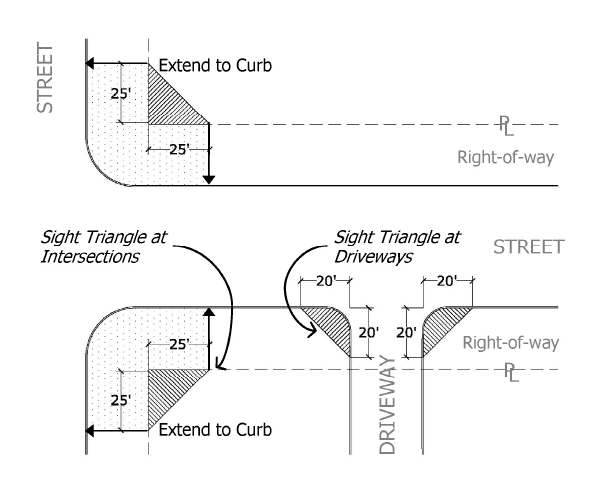
(1)
Exceptions. Where the Public Works Director determines the encroachment will not create a traffic hazard, Bricktown Core Development District (BC), Downtown Business District (DBD), Downtown Transitional District, Limited (DTD-1), Downtown Transitional District, General (DTD-2), Stockyards City Development District (SYD), and Urban Design Overlay District (UD) are exempt from the Sight Distance Triangle Requirements.
(Ord. No. 23755, § 9, 12-2-08; Ord. No. 24009, § 10, 2-2-10)
§ 59-12350. - Site lighting requirements.
A.
Purpose and Intent.
(1)
The purpose of these site lighting requirements is to provide for reasonable uses of outdoor lighting including night-time safety, security, utility, productivity, enjoyment, aesthetics, and commerce. The intent is to provide appropriate lighting levels that efficiently and effectively light areas used by the general public and are less distractive to the viewer.
(2)
Light trespass, light pollution/sky glow, and glare associated with outdoor lighting should be reduced by the proper implementation and enforcement of these requirements.
B.
Applicability.
(1)
Site lighting in all zoning districts for all uses except Manufactured (Mobile) Home Residential, Single-Family Residential, and Two-Family Residential.
C.
Exemptions.
(1)
Lighting for public roadways.
(2)
Lighting for emergency conditions.
(3)
Airport lighting used for navigational purposes.
(4)
Temporary lighting equipment and seasonal lighting equipment provided that individual lamps are smaller than 10 watts or 150 lumens, whichever is less.
(5)
Temporary lighting equipment for theatrical, television, performance areas and construction sites.
(6)
Architectural lighting.
(7)
Landscape lighting.
(8)
Lighting equipment in swimming pools, fountains, or other water features.
12350.1 Lighting Standards.
A.
Outdoor lighting shall meet the following lighting levels for the specified locations on sites as follows:
FOOTNOTES: TABLE 12350.1
1. Accounts for lamp lumen depreciation.
2. Businesses that do not operate during evening hours (½ hour after sunset) are not required to maintain these minimum illuminance levels.
B.
Spill light onto adjacent properties measured at-grade shall not exceed the following footcandles at any location on the adjacent property:
(1)
0.2 footcandles when adjacent to residential uses or districts; and 0.1 footcandles beginning at 11:00 pm or 30 minutes after closing, whichever is later, until dawn.
(2)
3 footcandles when adjacent to non-residential uses or districts.
C.
All outdoor lighting shall be arranged and installed to minimize glare on adjacent properties and streets. Glare shall be minimized by any combination of techniques and technologies including:
(1)
fully shielded fixtures,
(2)
directional control,
(3)
fixture location,
(4)
fixture height, or
(5)
fixture aim.
(Ord. No. 24174, § 4, 11-2-10)
§ 59-12400. - Environmental performance standards.
All uses shall comply with the performance standards established in this section unless any federal, state, county or local law, ordinance or regulation establishes a more restrictive standard, in which case the more restrictive standard shall apply.
A.
Noise. It shall be unlawful for any person to make, continue, or cause to be made or continued any excessive, unnecessary or unusual noise disturbance or any noise which either annoys, disturbs, injures or endangers the comfort, repose, health, peace or safety of others, within the limits of the City. All uses shall comply with the Chapter 34, Noise, of the Oklahoma City Municipal Code.
B.
Glare and Heat. Any activity or operation of any use producing glare or heat shall be conducted so that no glare or heat from the activities or operations shall be detectable at any point off the lot on which the use is located. Flickering or intense sources of light shall be controlled or shielded so as not to cause a nuisance across lot lines.
C.
Vibration. No earthborne vibration from any operation of any use shall be detectable at any point off the lot on which the use is located.
D.
Air Pollution. No person shall permit or cause an air contaminant to be emitted
from any source or premises under his/her jurisdiction or control in sufficient amounts as to exceed those permissible under Chapter 4, Air Pollution, of the Oklahoma City Municipal Code. All uses shall also comply with Oklahoma Department of Environmental Quality requirements, and any additional federal, state and local laws.
E.
Discharge and Disposal of Radioactive and Hazardous Waste. The discharge of fluid and the disposal of solid radioactive and hazardous waste materials shall comply with applicable local, state and federal laws and regulations governing such materials or waste. Radioactive and hazardous material waste shall be transported, stored and used in conformance with all applicable Oklahoma Department of Environmental Quality requirements, and federal, state and local laws.
F.
Electromagnetic Interference. Electromagnetic interference from any operation of any use in any district shall not adversely affect the operation of any equipment located off the lot on which such interference originates.
G.
Odors. The release of materials intrinsically odorous, or capable of being odorous, by either bacterial decomposition or chemical reaction, which renders it perceptible from beyond the lot and constitutes a public nuisance, shall be prohibited.
H.
Toxic Substances. The storage, handling or transport of toxic substances shall comply with Oklahoma Department of Environmental Quality requirements, and federal, state and local laws.
I.
Water Pollution. All uses shall comply with the Chapter 57, Water Resources, of the Oklahoma City Municipal Code, and Oklahoma Department of Environmental Quality, federal, state and local requirements.
J.
Fire Hazards. Materials that present potential fire and explosion hazards shall be transported, stored and used only in conformance with Chapter 20, Fire Prevention and Protection, of the Oklahoma City Municipal Code and all additional federal, state and local requirements.
§ 59-12450. - Public service facilities excepted.
Nothing in this article shall affect or pertain in any way to telephone exchange buildings, electric substations and lines, or gas distribution regulator stations.
However, a vacant lot held for future development for telephone exchange building use, electric substation use, or gas distribution regulator station use shall be physically posted with an informational sign, with a display area of four square feet, that states "Future Site of *".
(Ord. No. 23578, § 1, 4-8-08)
§ 59-12500. - Special public health and safety regulations.
12500.1. Purpose.
A.
The special public health and safety regulations are intended to promote the health, safety, economic and general welfare of the public. These regulations establish measures related directly to health, as affected by the condition of natural features, such as aquifers, alluvial plains and watershed areas.
B.
This section establishes regulations intended to protect the Garber-Wellington Aquifer. Said aquifer serves as a source of water for numerous individual property owners, as well as many central Oklahoma communities.
12500.2. Soil Analysis Information for Building Permit Applications.
A.
Permit applications for on-site construction and structures transported to a site in the environmental conservation district shall be accompanied by soil core tests and soil percolation tests if the tract involved has an area of five acres or less, or if the permit is for a non-residential use. The site, in either case, must be located in an area that has no urban sewer service. A location without urban sewer services shall be defined as any parcel which does not have reasonable access to an existing sanitary sewer main.
B.
Said soil core test shall include soil information to a minimum depth of eight feet and shall be conducted by a qualified person approved by the City-County Health Department. The test data shall include a map indicating the date and site location of the actual test.
C.
A minimum of one soil test shall be required for each dwelling unit or other structure with plumbing facilities. Permits for larger and/or more intensive use structures shall be accompanied by one soil test for each 1,000 square feet of sewage absorption area, which would have been required by soil percolation tests alone.
D.
The percolation and core test results shall be reviewed by the City-County Health Department concerning suitability for septic tank or alternate sewage disposal systems.
E.
Soil core tests are considered to be a required part of the above-mentioned permit applications, as are soil percolation tests. Said applications shall not be accepted unless this information is submitted in the application.

