
Oklahoma City City Zoning Code
ARTICLE II
DEFINITIONS
§ 59-2100.- General rules of construction.
The language set forth in the text of this article shall be interpreted in accordance with the following rules of construction:
2100.1. Tense and Form. Words used or defined in one tense or form shall include other tenses or derivative forms.
2100.2. Number. Words in the singular shall include the plural, and words in the plural shall include the singular.
2100.3. Gender. The masculine gender shall include the feminine and neuter. The feminine gender shall include the masculine and neuter. The neuter gender shall include the masculine and feminine.
2100.4. Person. The word "person" includes individuals, firms, partnerships, joint ventures, trusts, trustees, estates, corporations, associations and any other similar entities.
2100.5. Building. The word "building" includes the word "structure," and shall be construed as if followed by the words "or a part thereof."
2100.6. Used or Occupied. The words "used" or "occupied," as applied to any land or building, include the words "intended, arranged or designed to be used or occupied."
2100.7. Shall and May. The words "shall," "must" and "will" are mandatory in nature and establish an obligation or duty to comply with the particular provision. The word "may" is permissive.
2100.8. Herein and Chapter. The word "herein" means "in this chapter," and the word "chapter" means "this chapter."
2100.9. Undefined Terms. Any words not defined in this article or in this chapter shall conform to standard American-English usage and Oklahoma law.
2100.10. Examples and Lists. Examples and lists shall not be considered to be all-inclusive unless the content clearly states to the contrary.
(Ord. No. 25264, § 1, 10-27-15)
§ 59-2150. - Definitions.
2150.1. Use Unit Classifications. Definitions for use unit classifications are included in Article VIII (Use Unit Classifications).
2150.2. General Definitions.
A
Abut: Having a common border with, or being separated from such common border by an alley or easement. This term implies a closer proximity than the term "Adjacent."
Accent building material: Material covering 20 percent or less of the wall elevation.
Access: A means of vehicular or pedestrian approach, entry to, or exit from property. See "Egress" and "Ingress."
Accessory Building: A subordinate building or a portion of the main building, the use of which is located on the same lot and is incidental to the dominant use of the main building or premises.
Accessory Dwelling: A dwelling unit that is accessory to a Principal Dwelling on the same parcel. This includes a building or part of a building that provides complete independent living facilities for one or more people, including permanent provisions for living, sleeping, eating, cooking, and sanitation.
Addition or Expansion: An increase in floor area of a building, or a modification to the roof line of a building, such as the construction of a dormer, that increases the amount of floor space devoted to human use or occupancy.
Adjacent: Lying near or close to, sometimes contiguous or neighboring. Adjacent implies that the two objects are not widely separated, though they may not actually touch. See "Abut."
Adult Entertainment Use: "Adult Entertainment Use" includes the following:
A.
Adult Amusement or Entertainment: Amusement or entertainment which is distinguished or characterized by an emphasis on acts or material depicting, describing or relating to "Sexual Conduct" or "Specified Anatomical Areas," as defined herein, including, but not limited to, topless or bottomless dancers, exotic dancers, strippers, male or female impersonators, or similar entertainment.
B.
Adult Bookstore: An establishment having as a significant portion of its stock in trade books, film, magazines and other periodicals, which are distinguished or characterized by an emphasis on depicting or describing "Sexual Conduct" or "Specified Anatomical Areas."
C.
Adult Mini-Motion Picture Theater: An enclosed building with a capacity of less than 50 persons used for presenting material distinguished or characterized by an emphasis on depicting or describing "Sexual Conduct" or "Specified Anatomical Areas."
D.
Adult Motel: A motel wherein material is presented, as part of the motel services, via closed circuit TV or otherwise, which is distinguished or characterized by an emphasis on depicting or describing "Sexual Conduct" or "Specified Anatomical Areas."
E.
Adult Motion Picture Arcade: Any place at which slug-operated or electronically, electrically or mechanically controlled, still or motion picture machines, projectors or other image-producing devices are maintained to show images to five or fewer persons per machine at any one time, and where the images so displayed are distinguished or characterized by an emphasis on depicting or describing "Sexual Conduct" or "Specified Anatomical Areas."
F.
Adult Motion Picture Theater: An enclosed building with a capacity of 50 or more persons used for presenting material distinguished or characterized by an emphasis on depicting or describing "Sexual Conduct" or "Specified Anatomical Areas."
G.
Massage Parlor: Any place where, for any form of consideration or gratuity, massage, alcohol rub, administration of fomentations, electric or magnetic treatments, or any other treatment or manipulation of the human body occurs, as part of, or in connection with, "Sexual Conduct," or where any person providing such treatment, manipulation or service related thereto exposes "Specified Anatomical Areas," except that this provision shall not be construed to apply to any clinic operated by a licensed chiropractor or certified massage therapist.
H.
Sexual Conduct: "Sexual Conduct" includes the following:
(1)
The fondling, or other touching, of human genitals, pubic region, buttocks or female breasts.
(2)
Ultimate sex acts, normal or perverted, actual or simulated, including intercourse, oral copulation and sodomy.
(3)
Masturbation.
(4)
Excretory functions as part of, or in connection with, any of the activities set forth in (1) through (3) above.
I.
Sexual Encounter Center: Any building or structure that contains, or is used for, commercial entertainment where the patron, directly or indirectly, is charged a fee to engage in personal contact with, or to allow personal contact by, employees, devices or equipment, or by personnel provided by the establishment, which appeals to the prurient interest of the patron, to include, but not to be limited to, bathhouses, massage parlors, and related or similar activities.
J.
Specified Anatomical Areas: "Specified Anatomical Areas" includes the following:
(1)
Human genitals, pubic region, buttocks, and female breasts below a point immediately above the top of the areola.
(2)
Human male genitals in a discernibly turgid state, even if completely, and opaquely, covered.
Aggrieved: The term "aggrieved" shall have the meaning given to such term under Oklahoma law. An aggrieved person is a person who has the right under Oklahoma law to appeal an action, decision, ruling, judgment, or order.
Agricultural Product: Any plant, crop, or animal commodity that is grown or processed for food or fiber, intended for human or animal consumption.
Airport: A place where aircraft can land and take off, usually equipped with hangars, facilities for refueling and repair, and various accommodations for passengers.
Airport Elevation: The established elevation of the highest point on the usable landing area in feet above mean sea level (MSL). Based on this definition, the airport elevation shall be 1,302 feet above MSL for Wiley Post Airport, 1,296 feet above MSL for Will Rogers World Airport, 1,353 feet above MSL for Clarence E. Page Airport, and 1,291 feet above MSL for Tinker Air Force Base.
Airport Environs Zone 1 (AE-1): An area established on an Official Airport Zoning Map, which is exposed to a projected annual average noise level in excess of 65 decibels, as measured by weighted day-night sound level (LDN) methodology.
Airport Environs Zone 2 (AE-2): An area established on an Official Airport Zoning Map, which is exposed to a projected annual average noise level in excess of 60 decibels, as measured by weighted day-night sound level (LDN) methodology.
Airport Hazard: Any structure, object, tree or use of land obstructing the flight of aircraft in landing or takeoff at airports.
Alley: A public right-of-way that normally affords a secondary means of access to abutting property.
Alley-Loaded Garage: A residential garage that is detached from the home and is accessed from a mid-block alley.
Alteration: Any change in size, shape, character, occupancy or use of a building or structure.
Amenity: Aesthetic, or other characteristic, of a development that increases its desirability to a community, or its marketability to the public.
Animal: An organism of the Kingdom Animalia, except a human being, including, but not limited to, mammals, birds and reptiles.
Apartment House: See "Dwelling, Multi-Family."
Approach Surface: In the Airport Environs Zone, a surface longitudinally centered on the extended runway centerline, extending outward and upward from the end of the primary surface and at the same slope as the approach zone height limitation slope set forth in Section 59-13150 (Oklahoma City Airport Zoning). The boundaries of the approach surface coincide with the boundaries of the approach zone.
Aquaponics/Hydroponics: The growing of plants and/or aquatic animals using a mechanical system designed to circulate water or mineral nutrient solutions, with limited use of growing media. Often these systems are designed to use the plants to filter water and convert waste materials into plant nutrients.
Aquifer: A geological formation that contains a usable supply of water.
Architectural Lighting: Exterior lighting which primarily has an aesthetic purpose to illuminate architectural features of a building.
Architectural Metals: Metal panel systems, either coated or anodized, metal sheets with expressed seams, metal framing systems, or cut, stamped or case ornamental metal panels. Not included in this definition are ribbed or corrugated metal panel systems.
Archeological Resources: Areas or locations occupied as residences or utilized by humans (historic or prehistoric) for a sufficient length of time to construct features or deposit artifacts, which may remain in greater or lesser degrees of preservation and order, and which may lend to the increase of man's knowledge about his own development.
Architectural Resources: Districts, structures, buildings, monuments, sites and landscaping that possess significant local interest or significant artistic merit, or which are particularly representative of their class or period, or represent significant achievements in architecture, engineering technology, design, or scientific research and development.
Artistic Graphics: Visual depictions that have historical, architectural or cultural significance for the State of Oklahoma, the City or the specific area or neighborhood in which they are located. Such depictions may include a sponsor's identification area within the depictions; provided, such area shall not exceed ten percent of the total size of the depiction. Notwithstanding the sponsor's identification area, artistic graphics shall not be considered non-accessory signs within the meaning of this chapter or Chapter 3 of the City Code. Typical uses include, but are not limited to, murals, attached paintings, wall paintings, frescoes or other similar visual depictions with historical, architectural or cultural significance for the State of Oklahoma, the City or the specific area or neighborhood in which they are located.
Attached Single-Family Residential: A type of dwelling in which individual dwelling units are attached by one or more party walls, with the habitable spaces of different dwelling units arranged on a side-by-side rather than a stacked configuration. Each individual unit has its own front and rear access to the outside. Includes duplexes, triplexes, and townhomes.
Awning: A fixed shelter of any material, and of any length, not supported by a column or posts from the ground and attached to a building.
B
Back of Curb: That portion of the back side of a street curb, typically located six inches from the face of the curb and where the sidewalk or tree lawn begins. The face of the curb is the point where the curb meets the street gutter line.
Balcony: A platform that projects from the exterior wall of a building above the ground floor, which is exposed to the open air, has direct access to the interior of the building, and is not supported by posts or columns extending to the ground.
Base Flood: The flood having a one percent chance of being equaled or exceeded in any given year.
Basement: That portion of a building having more than one-half of its height below grade. A basement shall be considered a story for the purpose of height regulations, only if more than one-half of its height is above grade or if the level of the first floor is more than eight feet above the established grade at any point. See Figure 2000.1.
FIGURE 2000.1: BASEMENT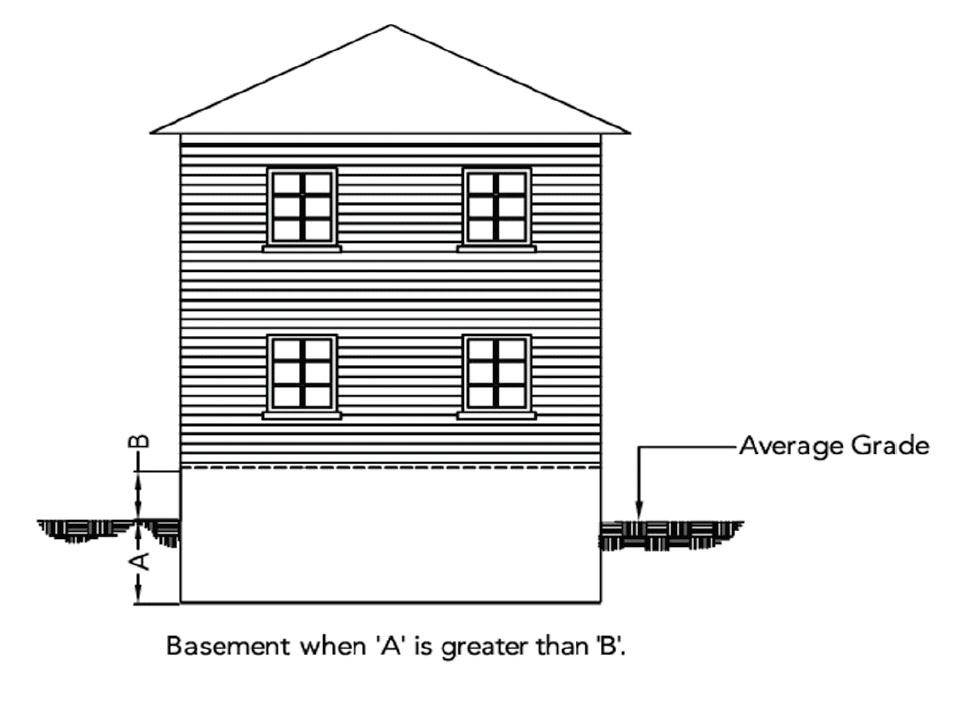
Bed and Breakfast Establishment: An owner-occupied single-family residence which offers temporary lodging to paying guests in a room(s) without cooking facilities, and which may offer breakfast or other meals to these guests.
Berm: An earthen mound designed to provide visual interest, screen undesirable views and/or decrease noise.
Block: A tract of land bounded by streets, or by a combination of one or more streets and public parks, cemeteries, railroad rights-of-way, corporate boundary lines or watercourse.
Blockface: The properties abutting each other on one side of the street, and lying between the two nearest intersecting or intercepting streets, or nearest intersecting or intercepting street and railroad right-of-way, public parks, cemeteries, corporate boundary line or watercourse.
Board: The Board of Adjustment, as duly appointed by the Mayor, pursuant to Section 59-3200 (Board of Adjustment).
Boardinghouse: A building or premises, other than a hotel, where meals or lodging and meals are provided for three or more persons, but not exceeding ten persons, by prearrangement for definite periods for compensation.
Boat, Permitted: A vehicle for traveling in, or on, water, which may be parked on a residential lot under certain conditions contained in this chapter. For purposes of these regulations, height includes the trailer, if the boat is mounted on a trailer.
Boulevard or Parkway: A broad, often landscaped, thoroughfare.
Brewery: A brewery is any establishment that produces beer and is licensed pursuant to State law.
Buffer: A strip of land with a fence, wall, landscaping, open spaces, berms or any combination thereof, used to physically separate or screen one use or property from another so as to visually shield or block noise, lights, buildings, other nuisances, or provide privacy. See "Transition Zone."
Build-To Line: A line established herein, generally parallel with the street line, along which a building must be built. Front porches and handicap ramps shall be exempt from build-to line requirements, but must be located behind the property line.
Buildable Area: The area of a lot remaining after the minimum yard and open space requirements of this chapter have been met.
Buildable Width: The width of that part of a lot that is not included within the minimum yard and open space requirements of this chapter.
Building: A structure entirely separated from any other structure by space or by walls in which there are no communicating doors or windows, or similar openings, and having a roof supported by walls or columns for the shelter, support, or enclosure of persons, animals, chattel or movable property of any kind.
Building, Accessory: A building that is located on the same lot as, and of a nature customarily incidental and subordinate to, another building or structure, and the use of which is clearly incidental and subordinate to that of the other building or structure. See Figure 2000.2.
FIGURE 2000.2: ACCESSORY AND PRINCIPAL BUILDINGS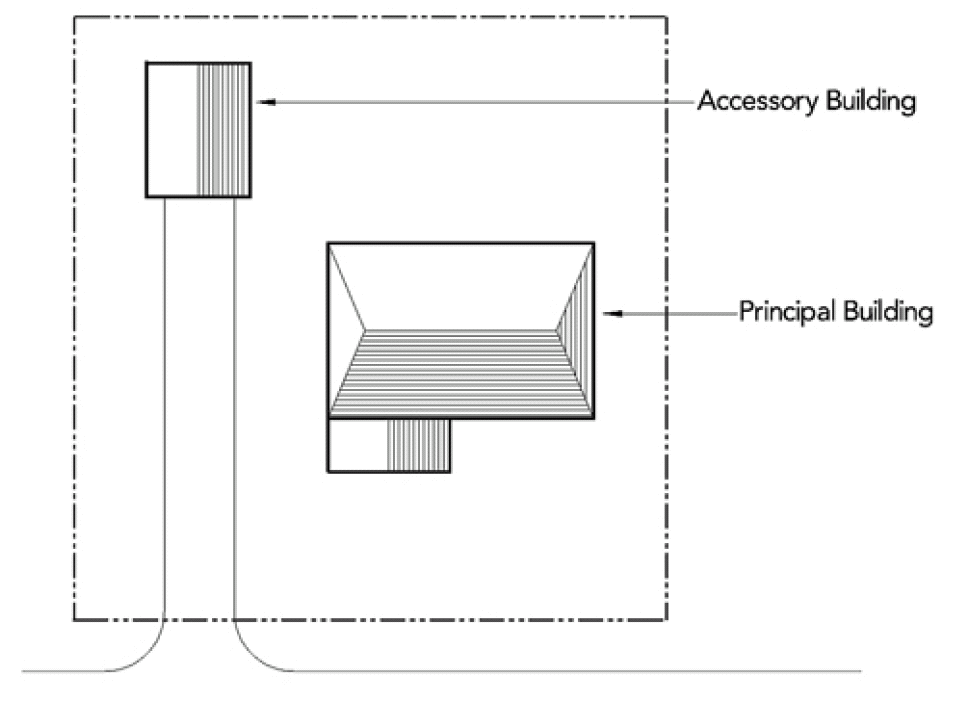
Building Coverage: A percentage figure referring to that proportion of a lot or site covered, or permitted to be covered, by principal and accessory buildings or structures.
Building Façade: The exterior elevation of a building, extending from grade to the top of the eaves, wall or parapet, extending the entire length of the building and fronting on public or private streets (not including alleys).
Building Height: The vertical distance from grade to the highest point of coping of a flat roof or to the deck line of a mansard roof, or to the average height of the highest gable of a pitch or hip roof. When a building faces on more than one street, the height shall be measured from the average of the grades at the center of each street front. See Figure 2000.3.
FIGURE 2000.3: BUILDING HEIGHT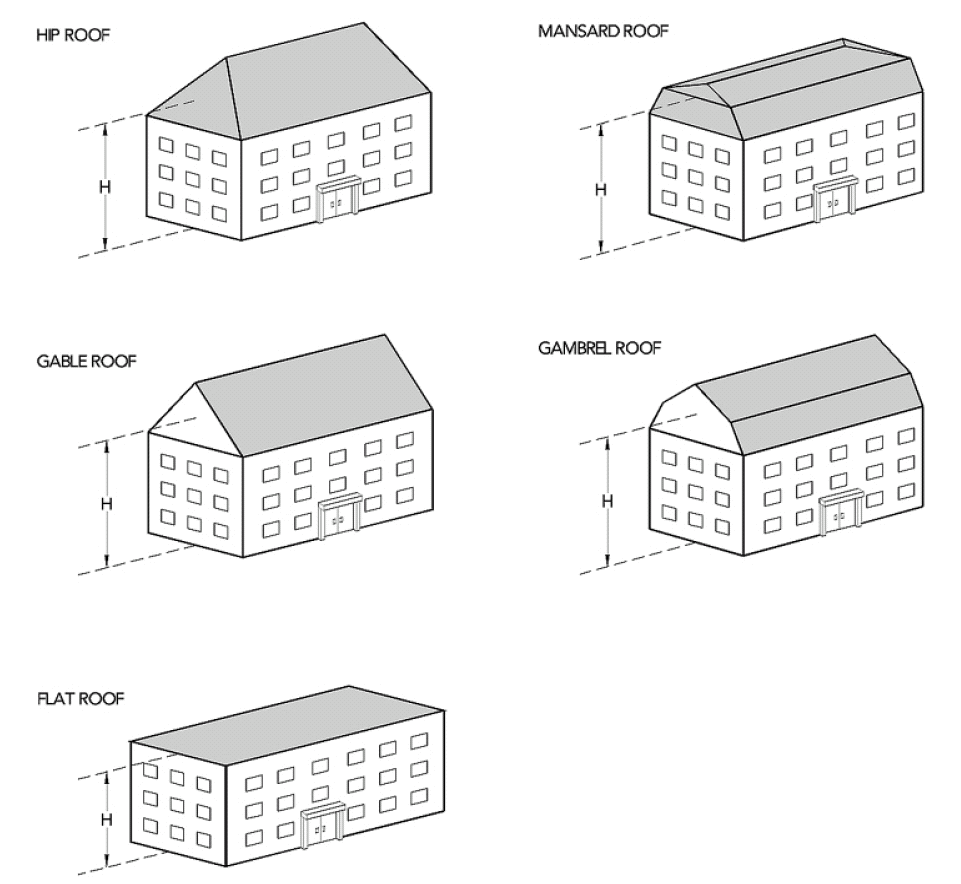
Building Line: A line, established herein, generally parallel with the street line, beyond which a building cannot extend under the terms of this chapter. See "Yard."
Building Mass: The three-dimensional bulk of a building: height, width, and depth.
Building Materials: The physical characteristics that create the aesthetic and structural appearance of the building including, but not limited to, the texture and style of the components and their combinations, such as glass, brick, stone, steel, metal, concrete or stucco.
Building, Principal: A non-accessory building where the principal use of the lot, on which the building is located, is conducted. See Figure 2000.2
Building Scale: The size and proportion of a building relative to surrounding buildings and environs, adjacent streets, and pedestrians.
Building, Temporary: Any building not designed to be permanently located, placed or affixed in the place where it is or where it is intended to be placed.
Bulk: The term used to indicate the size and setbacks of buildings or structures, and the location of the same with respect to one another, and includes the following:
A.
Size and height of buildings.
B.
Location of exterior walls at all levels in relation to lot lines, streets or to other buildings.
C.
Gross floor area of buildings in relation to lot area (floor area ratio).
D.
All open spaces allocated to buildings.
E.
Amount of lot area provided per dwelling unit.
Bus: A motor vehicle which exceeds 19 feet six inches in length and/or seven feet in height, which is designed to carry passengers and includes, but is not limited to, school buses, mass-transit buses and charter buses.
Business: An occupation, employment or enterprise that occupies time, labor and materials, or where merchandise is exhibited or sold, or services offered.
C
Caliper: Diameter of a tree trunk. Caliper is used for trees less than 12 inches in diameter. For trees less than four inches in diameter, it is measured six inches from the ground. For trees between four inches and 12 inches in diameter, it is measured 12 inches from the ground.
Canopy: Any structure, other than an awning, made of cloth, metal or other materials with a frame either attached to, or projecting from, a building, and carried by a frame supported by the ground or sidewalk.
Carport: A permanent roofed structure, open on at least two sides, designed for or occupied by private passenger vehicles.
Certificate of Appropriateness: The official document issued by the Historic Preservation Commission approving any application for permission to construct, erect, demolish, relocate, reconstruct, restore or alter any structure designated by the authority of this chapter.
Certificate of Approval: The official document issued by the Design Commissions approving any application for permission to construct, erect, demolish, relocate, reconstruct, restore or alter any structure designated by the authority of this chapter.
Certificate of Occupancy: Official certification that permits the use of a building in accordance with the approved plans and specifications, and certifies compliance with the provisions of law for the use and occupancy of the building in its several parts, together with any special stipulations or conditions of the building permit and Building Code.
Character: Attributes, qualities and features that make up and distinguish a particular building, place, development, or district and give such place a sense of definition, purpose and uniqueness.
City Council: The governing or legislative authority of The City of Oklahoma City.
City Department: Any and all departments of The City of Oklahoma City.
Clear Zone: The portion of the Pedestrian Zone that should be free of all obstacles that would impede walking or universal accessibility. Sidewalks do not necessarily have to accommodate the entire width of the Clear Zone. The Clear Zone can combine Sidewalk, Streetscape, and/or Storefront Zones so long as the clearance is unobstructed.
Cluster Development: A development pattern in which the uses are grouped or bunched together, through a density transfer, to provide for community green or open space, shared parking and access, or other amenities.
Commercial: Retail, office, restaurants, hotels, and any other use classified under the Commercial Use Units Classifications of this chapter.
Commercial Vehicle: A commercial vehicle for the purpose of this chapter is any vehicle with more than two axles; or any vehicle with a cab height greater than 82 inches; or any vehicle with any part or attachment to the vehicle exceeding the height of 90 inches; or any vehicle with a gross vehicle weight rating greater than 12,000 pounds; or any vehicle with an overall length of more than 25 feet. Commercial vehicle shall mean all vehicles meeting this definition, including all dump trucks, buses and tow trucks.
Communication Services: For the purpose of the regulations regarding communication services, the following words and phrases shall be defined as follows:
A.
Antenna Array: A structure attached to a telecommunication tower that supports antenna for receiving and/or transmitting electronic data or telephone communications. This definition excludes lightning rods and whip antennas not exceeding five inches in diameter.
B.
Cell Site: A tract or parcel of land that contains the wireless tower, its support accessory building(s) and parking, and may include other uses associated with and ancillary to wireless communications transmission.
C.
Co-Location: Locating wireless communications equipment from more than one provider on a single site.
D.
Dish Antenna: A dish-like antenna used to link communication sites together by wireless transmission of voice or data. Also called "Microwave Antenna" or microwave dish antenna.
E.
Guyed Tower: A tower that is supported, in part or in whole, by guy wires and ground anchors used to support telecommunications equipment.
F.
Lattice Tower: A self-supporting three or four side, open, steel frame structure used to support telecommunications equipment.
G.
Microwave: Electronic radiation with frequencies higher than 1,000 megahertz; highly directional signal used to transmit radio frequencies from point to point at a relatively low power level.
H.
Microwave Antenna: A dish-like antenna, manufactured in many sizes and shapes, used to link communication sites together by wireless transmission of voice or data.
I.
Monopole: A communication tower consisting of a single pole, with no guy wire support or exposed ground anchors, tapering from base to top, more than 35 feet in height and designed to support telecommunications equipment. Also known as a self-supporting tower.
J.
Non-Whip Antenna: Any antenna which is not a whip antenna, such as a dish antenna, panel antenna, etc.
K.
Panel Antenna: An antenna that transmits signals in specific directions and are typically square or rectangular in shape. Also known as a sector antenna.
L.
Roof- and/or Building-Mount Facility: A low power wireless telecommunications facility in which antennas are mounted to an existing structure on the roof, including rooftop appurtenances or building face.
M.
Telecommunications: The transmission between or among points specified by the user, of information of the user's choosing, without change in the form or content of the information as sent and received.
N.
Telecommunications Antenna: An antenna used to provide a telecommunications service.
O.
Telecommunications Service: The offering of telecommunications for a fee directly to the public, or to such classes of users as to be effectively available directly to the public, regardless of the facilities used.
P.
Tower: Any structure that is designed and constructed primarily for the purpose of supporting one or more antennas, including "Lattice Towers," "Guyed Towers" and "Monopoles." This term includes radio and television transmission towers, microwave towers, common-carrier towers, wireless telephone towers, alternative tower structures, and the like.
Q.
Whip Antenna: An omni-directional dipole antenna of cylindrical shape no more than six inches in diameter.
Compatibility: The characteristics of different uses or activities that permit them to be located near each other in harmony and without conflict.
Compost: A collected mass of decomposing organic matter for use in agricultural and other growing practices usually consisting of materials such as grass, leaves, yard waste, wood chips, saw dust, worms, raw/uncooked kitchen food wastes, and manure from livestock but specifically excluding bones, meat, fat, grease, oil, pet or human feces, and dairy products.
Conforming Building or Structure: Any building or structure that:
A.
Complies with all the regulations of this chapter, and any amendment thereto, governing bulk for the district in which such building or structure is located.
B.
Is designed or intended for a conforming use.
Conical Surface: A surface extending outward and upward from the periphery of the horizontal surface at a slope of twenty-to-one (20:1), to a distance of 4,000 feet. The perimeter of the conical surface coincides with the perimeter of the conical zone.
Context: Specific conditions and placement of a project as it relates to conditions and placement of existing neighboring land uses, structures and open spaces.
Contiguous: Adjoining.
Conversion: Changing the original purpose of a building to a different use.
Covenant: A restriction on the use of land contained in the deed to the property, or otherwise formally recorded.
Cul-De-Sac: A local street with only one outlet and having a terminal of sufficient width for the reversal of traffic movement.
D
Diameter at Breast Height (DBH): DBH is used for trees with a diameter greater than 12 inches and is measured four and one-half feet above the ground.
Deciduous: A plant with foliage that is shed annually.
Deed: A legal document that conveys real property.
Deed Restriction: A form of covenant contained in a deed of conveyance. See "Covenant."
Department: The Development Services Department, Planning Department or the Public Works Department, as the context dictates.
Density: The average number of housing units per parcel of land, generally expressed as dwelling units per acre.
Density, Gross: The total land area to be developed for residential uses divided by the number of dwelling units.
Density Transfer: The reallocation of permitted dwelling units from one parcel, or area of a parcel, to another in exchange for permanent development restrictions on the parcel from which the reallocation was made.
Design Criteria (Downtown Design Districts): Statements and graphics intended to direct the planning and development of the built environment in a particular manner or style, so that the end result contributes positively to the overall development.
Design Guidelines: Statements that are intended to be advisory in nature and serve as a reference for all parties involved in the design review process. Guidelines are indicated by statements containing the words "should", "may", "recommended", or "encouraged".
Design Review Commissions: Downtown Design Commission, Historic Preservation Commission, or the Urban Design Commission.
Detached Single-Family Residential: A single-family dwelling that is not attached to any other dwelling by any other means.
Developed Area: The area of a lot disturbed for the purpose of developing structures, parking facilities, loading or storage areas, paved access to off-street parking or loading areas, or other areas paved with an all-weather material, or landscaped areas. It may be submitted for calculating landscape points as the legal description of the property, or as a scaled, dimensioned and well-defined area of development referenced on the site plan.
Developer: The legal or beneficial owner of a lot or parcel, or any land proposed for development and/or inclusion in a development, including the owner of an option, contract to purchase or lease.
Development: Development and/or redevelopment and shall include any action requiring a building permit for any vacant parcel or any parcel partially or wholly cleared for redevelopment.
Development Guidelines: Advisory recommendations. Guidelines are indicated by statements containing the words "should", "may", "recommended", or "encouraged".
Development Regulations: Mandatory standards. Regulations are indicated by the use of the terms "shall" or "must."
Directly Visible: Allowing direct line-of-sight to the light source or lamp
Director: The Development Services Director, Planning Director or Public Works Director, as context dictates.
District: See "Zoning District."
Driveway: A private roadway providing access to a street or highway. Any impervious, semi-impervious or compacted gravel surface providing direct ingress/egress to a parking space.
Duplex: See "Dwelling, Two-Family."
Dwelling: Any building, or portion thereof, which is designed for use for residential purposes, including manufactured homes, modular homes, and mobile homes, but not including, travel trailers.
Dwelling, Attached: A dwelling having any portion of one or more walls in common with adjoining dwellings.
Dwelling, Detached: A dwelling with open space on all sides.
Dwelling, Multiple-Family: A building designed for occupancy by three or more families.
Dwelling, Single-Family: A building designed for occupancy by one family.
Dwelling, Townhouse or Row House: Three or more dwelling units, attached at the side or sides, each of which has a separate outdoor entrance, and is designed to be occupied, and may be owned, by one family.
Dwelling, Two-Family: A building designed for occupancy by two families living independently of each other.
Dwelling Unit:
A.
A single unit providing complete, independent living facilities for a family, including permanent provisions for living, sleeping, eating, cooking and sanitation.
B.
In quarters such as a dormitory, every three persons shall be counted as a dwelling unit.
E
Easement: Authorization by a property owner granting access, or other rights, to a designated part of his/her property for a special purpose.
Eave: The projecting lower edges of a roof, overhanging the wall of a building.
Egress: A place or means of exit. See "Access."
Evergreen: A plant with foliage that persists and remains green year-round.
Expressway: A divided facility that augments the freeway system by giving preference to through traffic with partial access control, ranging from limited median and at-grade crossings to grade separations at major intersections.
F
Family: One or more persons related by blood or marriage, including adopted children, or a group of, not to exceed, five unrelated persons (not related by blood or marriage), occupying the premises and living as a single non-profit housekeeping unit, as distinguished from a group occupying a boardinghouse, lodging house or hotel.
Farmstand: A structure or vehicle used in the sale of agricultural produce, in season, which is grown by the seller.
Fence: An artificially constructed barrier of any material, or combination of materials, erected to enclose, screen or separate areas.
Filling Station (Gas Station, Service Station): A building or premises used for the sale of gasoline and oil products, including the servicing of motor vehicles and the retail sale and installation of tires, replacement parts and accessories in, and upon, such vehicles. This does not include paint, body and frame repair, or rebuilding of motor, transmission or differential.
Fixture: The assembly that holds the lamp (bulb) in a lighting system. It includes elements designed to give light output control, such as a reflector (mirror) or refractor (lens), the ballast, housing, and the attachment parts.
Floodprone Areas: A land area adjoining a river, stream, watercourse or lake, which is likely to be flooded; any land area susceptible to being inundated by water from any source.
Floodway: The channel of a river, or other watercourse, and the adjacent land areas, required to carry and discharge a flood of a given magnitude.
Floodway, Regulatory: The channel of a river, or other watercourse, and the adjacent land areas, which must be reserved in order to discharge the base flood without cumulatively increasing the water surface elevation more than one foot above the base flood.
Floor Area, Gross: The total area of all floors of a building, as measured to the outside surfaces of exterior walls, or the centerline of walls separating buildings, and including halls, stairways, elevator shafts, attached garages, porches and balconies.
Footcandle (fc): A measurement of light at an illuminated object. One lumen per square foot. Unit of illuminance. The luminous flux per unit area in Imperial units.
Footcandle: The unit of illumination where the foot is the unit of length.
Freeway: A continuous system designed to give preference to through traffic by providing grade-separated connections with selected arterials only, and by prohibiting crossings at-grade or direct private driveway connections.
Fresh Fruits and Vegetables: Fruits and vegetables not processed or frozen.
Fresh Meat: Meat not frozen, cooked, or dehydrated.
Front-Loaded Garage: A garage that is attached to the front façade of a home and is accessed from the adjacent public street.
Front Yard: An area measured from the street right-of-way to the front façade of the building.
Frontage: Property on one side of a street or place, measured along the line of the street or place.
G
Garage Apartment: A dwelling unit erected above a garage for not more than one family.
Garage, Private: An accessory building designed, or used, for the storage of motor-driven vehicles owned and used by the occupants of the building to which it is accessory.
Garage, Public: A building, or portion thereof, other than a private or storage garage, designed or used for servicing, repairing, equipping, hiring, selling or storing motor-driven vehicles.
Gateway: Applied within the Scenic River Overlay Design District, the intersection of any north/south or east/west street and the SRODD boundary.
Glare: The sensation produced by a light source within the visual field that is sufficiently brighter than the level to which the eyes are adapted to cause annoyance, discomfort, or loss in visual performance and visibility; blinding light. The magnitude of glare depends on such factors as the size, position, brightness of the source, and on the brightness level to which the eyes are adapted. Glare is frequently associated with lamps that are directly visible to the eye. The Illumination Engineering Society defines glare associated with a specific luminaire as that light emitted from between 80 and 90 degrees from vertical.
Grade: A reference plane representing the average of finished ground level, adjoining the building at all exterior walls.
Green Building Materials: Materials that reduce demand for virgin materials that have a reduced impact on the building's occupants that incorporate recycled content, or are assembled from rapidly renewable resources, as defined by the National Homebuilders Association.
Groundcover: An evergreen or deciduous planting less than 24 inches in height at maturity. Turf grass is excluded.
H
Half-Story: A space under a sloping roof which has the line of intersection of roof decking and wall face not more than three feet above the top floor level, and in which space not more than two-thirds of the floor area is finished off for use. A half-story containing independent apartments or living quarters shall be counted as a full story.
Height, Airport Environs Zone: For the purpose of determining the height limits in an Airport Environs Zone, as shown on the Official Airport Zoning Map, the height shall be the datum at mean sea level (MSL) elevation, unless otherwise specified.
Height Regulations: Regulations that limit the height of buildings within particular districts. Such regulations may establish both a basic maximum height of a structure and a maximum height based on the relationship of a structure to surrounding properties.
Health Department: The Oklahoma City-County Health Department.
Historic: Important in history. Distinguished from "historical" which conveys a sense of things or events related to the past, while "historic" conveys a sense of importance.
Historic District: A definable geographic area that contains a number of related historic structures, features or objects united by past events or aesthetically by plan or physical development, and that have been declared an HP Historic Preservation or HL Historic Landmark District by The City of Oklahoma City. These historic districts may or may not have been designated on a state level or included in the National Register of Historic Places.
Historic Resources: Sites, districts, structures, buildings or monuments that represent important facets of history in the locality, State or nation; places where significant or historic events occurred; places associated with a significant personality or group important to the past.
Historical: Of, pertaining to, or characteristic of history or the past. Distinguished from "historic" which conveys a sense of importance, while "historical" conveys a sense of things or events related to the past.
Home Occupation: Any occupation or profession carried on by a member of a family residing on the premises, subject to the regulations of this chapter.
Horizontal Surface, Airport Environs Zone: A horizontal plane, 150 feet above the established airport elevation, the perimeter of which coincides with the perimeter of the zone.
Hospice: A health care facility, or a system of professional home visits and supervision, for supportive care of the terminally ill.
Hotel: A building or group of buildings, under single ownership, containing ten or more sleeping rooms intended to be occupied as temporary lodging for compensation, with or without meals.
I
Illuminance: The amount of light falling onto a unit area of surface (luminous flux per unit area) - measured in lumens per square meter (lux) or lumens per square foot (footcandles).
Individual Sewage Disposal System: A septic tank, seepage tile sewage disposal system or any other sewage treatment device approved by health authorities.
Infill Development: New construction, or the move of existing structures, on vacant lots or replacement of blighted or thoroughly deteriorated structures within existing neighborhoods or developments.
Ingress: A place or means of entrance or access. See "Access."
Initial Lumen Output/Level: The lumen rating of a lamp when the lamp is new and has not depreciated in light output, i.e. the rated lamp lumens; occurs when the lamp lumen depreciation equals 1.0.
Institution: A building or parcel occupied by an established non-profit corporation or non-profit society for public or quasi-public use.
Intensity: The degree to which land is used, referring to levels of concentration or activity in uses, expressed in lot coverage, dwelling units per acre or other measurement used within this chapter.
Intent Statement: A broad statement explaining the design intent for the regulations of a Design District. An intent statement or statements may be used to help interpret the application of a standard in a specific situation. In cases in which special conditions exist that are not specifically addressed by the regulations or guidelines, the intent statement may serve as a basis for determining the appropriateness of the proposed design.
Irrigation System: A permanent underground piping and sprinkler head system designed using industry standard methods to provide uniform irrigation coverage over a landscaped area.
J
K
L
Lamp: A generic term for a source of light, also referred to as a bulb or tube.
Lamp Lumen Depreciation: A condition in which a lamp produces less light as it ages. Typically expressed as a ratio of current or predicted lumen output to initial lumen output.
Landing Area, Airport Environs Zone: That area of the airport used for the landing, take-off or taxiing of aircraft, including apron areas.
Landmark: An individual structure, building, site or monument which contributes to the historical, architectural or archeological heritage of the City.
Landscape Architect: A "Landscape Architect," as defined in Section 46.3.J. of the Oklahoma State Architectural Act (59 O.S. SS 46.1 et seq.), is a person registered to practice Landscape Architecture as provided in the State Architectural Act.
Landscape Architecture: The performance of professional services such as planning, design, preparation of construction drawings and specifications, including the design and layout of roadways, service areas, parking areas, walkways, steps, ramps, pools, the location of buildings and other structures, and the grading of land, surface and subsoil drainage, erosion control, planting reforestation, and the preservation of the natural landscape, in accordance with accepted professional standards.
Landscape Buffer: A combination of living vegetation, such as trees, shrubs, grasses, perennials, or groundcover material, planted to achieve the same point values as Residential Buffers.
Landscape Designer: Any person submitting a landscape plan who is not a licensed landscape architect, architect or engineer, as defined in Section 46.28.6 in the Oklahoma State Architectural Act (59 O.S. SS 46.1 et seq.), "limited to consultation and preparation of plans and specification with respect to choosing types of plants and planning the location thereof."
Landscape Lighting: Exterior lighting which primarily has an aesthetic purpose to illuminate landscaping; these fixtures have lamps with an initial lumen output of 10,000 lumens or less.
Landscape Plan: The preparation of graphic and written criteria, specifications, and detailed plans to arrange and modify the effects of natural and manmade features such as plantings, ground and water forms, circulation, walks, structures, and other features to comply with the provisions of this ordinance.
Landscaped Area: Any area that contains landscaping required by Article XI: Landscaping and Screening.
Larger Than Utility Runway, Airport Environs Zone: A runway that is constructed for, or intended to be used by, propeller-driven aircraft of greater than 12,500 pounds maximum gross weight, and jet-powered aircraft.
Laundry, Self-Service: A business providing washing, drying and ironing machines for hire to be used by customers on the premises.
Leasable Area, Gross: The total floor area designed for occupancy and exclusive use, including basements, mezzanines, upper floors, and internal hallways, bathrooms and stairwells. The area of tenant occupancy is measured from the centerlines of joint partitions to the outside of the tenant walls. In multi-tenant buildings, this area shall include all areas for which tenants pay rent, including sales and integral stock rooms, but shall exclude common stairwells, hallways, elevator shafts, mechanical rooms, space devoted to the operation and maintenance of the building, and lobbies and bathrooms located for common or public use, rather than individual tenant or internal use.
Light Pollution: The effect of artificial light that is scattered into the atmosphere.
Light Spillage: See "Spill Light."
Light Trespass: Light falling onto an area where it is unwanted or unneeded, typically across property boundaries.
Lodginghouse: A building, or portion thereof, where only lodging is provided for compensation to three or more, but not exceeding ten, persons, in contra-distinction to hotels open to transients.
Logo: A business trademark or symbol.
Lot: A measured parcel of land having fixed boundaries and designated on a plat, or by a metes and bounds description, and of sufficient size to meet minimum use regulations and development standards, as are required by this chapter.
Lot Area: The area of a horizontal plane bounded by the front, rear, side and corner lot lines.
Lot, Corner: A lot abutting upon two or more streets at their intersection.
Lot Coverage: The proportion of a lot or site covered or permitted to be covered by principal and accessory building(s) or structure(s).
Lot Depth: The average horizontal distance between the front and rear lot lines, measured within lot boundaries. See Figure 2000.5.
Lot, Through: A lot having a frontage on two non-intersecting streets, as distinguished from a "Corner Lot."
Lot, Interior: A lot bounded on a street on only one side; any lot other than a through or corner lot.
Lot Line: A line dividing one lot from another, or from a street or place.
Lot of Record: A lot which is created by an approved deed or which is a part of a subdivision, the map of which has been recorded in the Office of the County Clerk.
Lot Width: The mean horizontal distance between the side lot lines of a lot along the front building line. See Figure 2000.5.
FIGURE 2000.5: LOT DEPTH AND WIDTH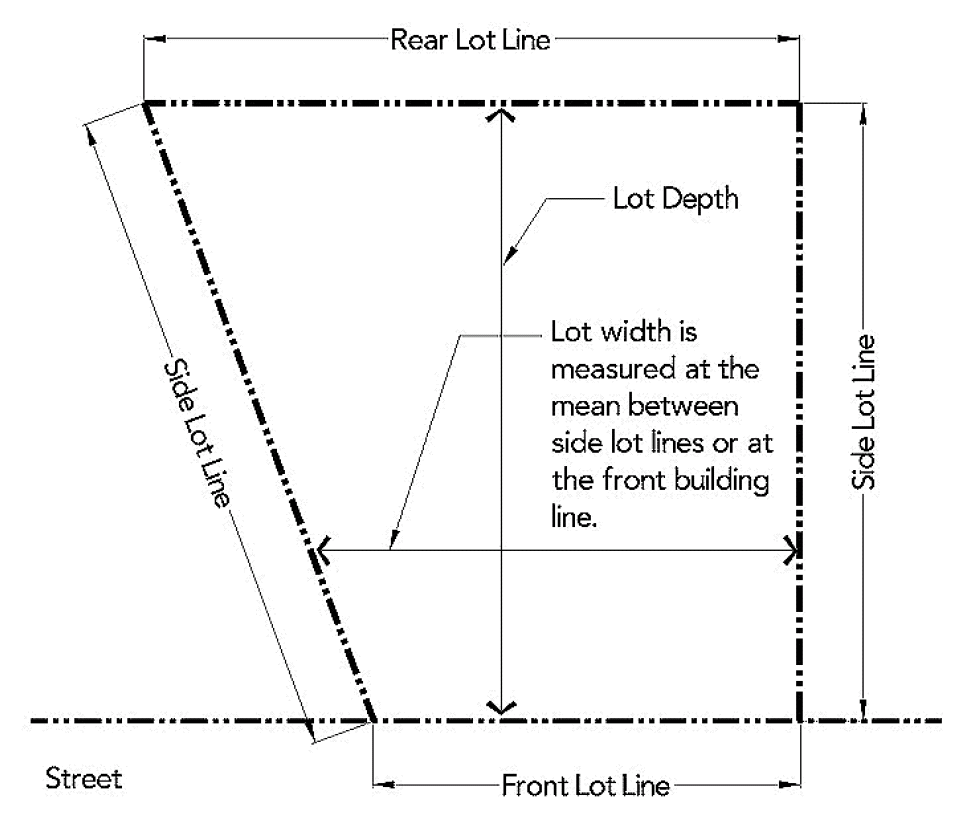
Lot, Zoning: A lot which is a single tract of land located within a single block, which is designated by its owner or developer as a tract to be used, developed or built upon as a unit, under single ownership or control. Therefore, a "Zoning Lot" may or may not coincide with a lot of record.
Lumen (lm): unit of luminous flux; used to measure the amount of light emitted by lamps.
Luminaire: the complete lighting unit, including the lamp (bulb), fixture, and other parts.
Lux: A measure of Illuminance per square meter.
M
Maintained Average Footcandle: Illuminance of fixtures adjusted for a lamp lumen depreciation and dirt build-up.
Maintenance: Conformance of a building, and its facilities, to the code under which the building was constructed or to another applicable maintenance code.
Manufactured Home: A dwelling unit built in compliance with 42 U.S.C. Sec. 5401, the National Manufactured Housing Construction and Safety Standards Act, and subject to the applicable district requirements for single-family detached dwellings.
Masonry Materials: Stone, brick, clay units, terra cotta, architectural pre-cast concrete, cast stone, prefabricated brick panels, cast-in-place concrete with cladding, split face concrete masonry block (units), and stucco. Masonry Materials do not include unclad concrete masonry block (CMU units), and EIFS (Exterior Insulated Finish System).
Massage Therapist, Certified: Any place where, for any form of consideration or gratuity, massage, alcohol rub, administration of fomentations, electric or magnetic treatments, or any other treatment or manipulation of the human body occurs, under the supervision of a Certified Massage Therapist.
Maximum Extent Feasible: No feasible and prudent alternative exists, and all possible efforts to comply with the regulation or minimize potential harm or adverse impacts have been undertaken. Economic considerations may be taken into account, but shall not be the overriding factor in determining "maximum extent feasible."
Maximum Extent Practicable: Under the circumstances, reasonable efforts have been undertaken to comply with the regulation or requirement, that the costs of compliance clearly outweigh the potential benefits to the public or would unreasonably burden the proposed project, and reasonable steps have been undertaken to minimize any potential harm or adverse impacts resulting from the noncompliance.
Metes and Bounds: A system of describing and identifying land by measures (metes) and direction (bounds) from an identifiable point of reference, such as a monument or other marker, the corner of intersecting streets or, in rural areas, a tree or other permanent fixture.
Mezzanine: An intermediate or fractional story between the floor and ceiling of a main story, used for a purpose accessory to the principal use. A mezzanine is usually just above the ground or main floor, and extends over only part of the main floor.
Mixed-Use: The incorporation of more than one principal land use type within a single structure (i.e., a building with retail uses on the ground floor, and offices or residential on the upper floors), or a similar set of uses organized in close proximity and planned as a unified complimentary whole on a single site (horizontal mixed use).
Mobile Home: See Chapter 31 of the City Code for all definitions related to "Mobile Homes" and "Mobile Home Parks."
Model Home: A dwelling unit used initially for display purposes, which typifies the type of units that will be constructed in the subdivision.
Modular Home: A dwelling unit constructed in accordance with the City Building Code and composed of components substantially assembled in a manufacturing plant and transported to the building site for final assembly on a permanent foundation. "Modular Homes" are subject to the applicable district requirements for single-family detached dwellings.
Mulch: An organic material, such as seed hulls, pine needles or tree bark, used to control weed growth, and to reduce soil erosion and water loss.
Multi-Family Residential: A building containing three or more dwelling units, in which individual dwelling units are attached by one or more party walls, with the habitable spaces of different dwelling units arranged in a stacked configuration rather than a side-by-side configuration. Each individual unit is accessed by an interior hallway entered via a shared entrance. Includes apartments, condominiums, and lofts.
Murals: Visual depictions and/or works of art including mosaics, painting or graphic art technique applied, painted, implanted or placed directly onto the exterior of any wall of a building. Such depictions shall not contain words, logos, emblems, trademarks or other similar devices which identify or advertise any product, service or business, provided however, such depictions may include a signature or sponsor's identification area within the depiction so long as such area does not exceed ten percent of the total size of the depiction or two and one-half percent of the surface area of the wall onto which it is attached or painted whichever is less. "Building" for purposes of this section only, shall mean any structure built for the support, shelter or enclosure of persons, animals, chattels or movable property of any kind.
N
Noncomplying Structures: Structures that do not conform to, or are prohibited under, the terms of this chapter. The term "noncomplying" refers to structures that may violate the area requirements (setbacks, height, etc.) or to structures used less intensively than permitted by the chapter, such as single-family residences in exclusively commercial and industrial districts.
Noncomplying Use, Airport Environs Zone: A preexisting structure or use of land in an Airport Environs Zone, as shown on the Official Airport Zoning Map, lawfully in existence at the date of this chapter's enactment. The regulations contained within this chapter pertaining to noncomplying low-intensity residential uses shall be followed in order to implement any changes or modification, alteration or improvement to such use or structure, in addition to sound attenuation and avigation easement requirements.
Nonconforming Use, Airport Environs Zone: Any preexisting structure, or use of land or object of natural growth, which is inconsistent with the airport height restriction zones of this chapter, or any amendment hereto, but was lawfully in existence at the time of the adoption of regulation, or at the time an amendment thereto becomes effective.
Nonconformity: Lots, structures, uses of land and structures, and characteristics of uses, which are prohibited under the current terms of this chapter. Nonconformities are considered "legally nonconforming" if they were lawfully established prior to adoption of this chapter and not otherwise classified as noncomplying. Nonconformities are considered "illegal" if they were not lawfully established prior to adoption of this chapter, and shall not become lawful by virtue of its enactment.
Non-Instrument (Visual) Runway, Airport Environs Zone: A runway intended solely for the operation of aircraft using visual approach procedures.
Non-Precision Instrument Runway, Airport Environs Zone: A runway having an existing instrument approach procedure utilizing air navigation facilities with only horizontal guidance, or area type navigation equipment, for which a straight-in non-precision instrument approach procedure has been approved or planned.
Non-Residential Development: All retail, restaurant, service, hotels, and similar businesses, including office uses.
O
Obstruction, Airport Environs Zone: Any structure, growth or object, including a mobile object, which exceeds a limiting height set forth in Section 59-13150 (Oklahoma City Airport Zoning) and shown on height zoning maps.
Off-Site: Any premises not located within the area of the property to be subdivided or developed, whether or not in the same ownership of the applicant for subdivision approval or a building permit.
Open Space, Usable: Area intended for common use by occupants or residents of a development, either privately-owned and maintained, or dedicated to a public agency, normally including swimming pools, recreation courts, patios, open landscaped areas and green belts, with pedestrian walkways and equestrian and bicycle trails.
Ordinary Maintenance and Repair: Any work meant to remedy damage or deterioration of site elements or a structure or its appurtenances that involves no change in materials, dimensions, design, configuration, texture, surface coating, or visual appearance.
Orient: To bring in relation to, or adjust to, the surroundings, situation, or environment; to place with the most important parts (e.g., the primary building entrance and the designated "front" of a building) facing in certain directions; or to set or arrange in a determinate position, as in "to orient a building".
Outdoor Storage: The keeping of any goods, material, merchandise or vehicles outside of an enclosed building.
Outdoor Storage and Service Area: Areas typically associated with nonresidential uses that may include loading docks, trash compactors, garbage/recycling collection areas, and or storage of trailers, equipment, containers, crates, pallets, merchandise, materials, forklifts, trash, recyclables, etc.
Overlay Zone: A special zoning district containing a set of zoning requirements described in the text of this chapter and designated on the Official Zoning Districts Map, and which carry a set of zoning regulations that are imposed either as additions to those of the underlying district or which modify the existing regulations.
Owner: A titleholder of record, or if title is held in trust, the beneficiary of the trust.
P
Parcel: A lot, or contiguous group of lots in single ownership or under single control, usually considered a unit for purpose of development or rezoning.
Parking Lot: Any off-street, unenclosed, ground-level facility used for the purpose of temporary storage of motor vehicles, which cannot exceed seven days. Enclosed parking facilities, such as multi-story garages or parking facilities constructed within the confines of a larger building or structure, or parking facilities associated with single-family and two-family residential developments are not included within this definition.
Parking Lot Island: A planting area used to fulfill parking lot landscaping requirements that is contained completely within the confines of a parking lot. Parking Lot Perimeter. The area within ten feet of the boundary of a parking lot.
Parking Lot Planting: In ground plantings consisting of hardy trees, shrubs, perennials, and/or groundcover required to be planted within the parking lot and/or the perimeter of the parking lot area, excluding parking garages, decks and covered parking due to the construction of impervious surface parking.
Parking Peninsula: A planting area used to fulfill parking lot landscaping requirements, which extends out into the parking area and is bounded on at least one side by the outer edge of the paving or a building.
Parking Space: A permanently surfaced area, enclosed or unenclosed, sufficient in size to store one automobile, together with a driveway connecting the parking space with a street or alley and permitting ingress and egress of an automobile.
Particulate Matter: Dust, smoke or any other form of airborne pollution in the form of minute separate particles.
Party Wall: A wall that is common to, but divides, contiguous buildings. Such a wall contains no openings and extends from its footing below finished ground grade to the height of the exterior surface of the roof. See Figure 2000.6.
FIGURE 2000.6: PARTY WALL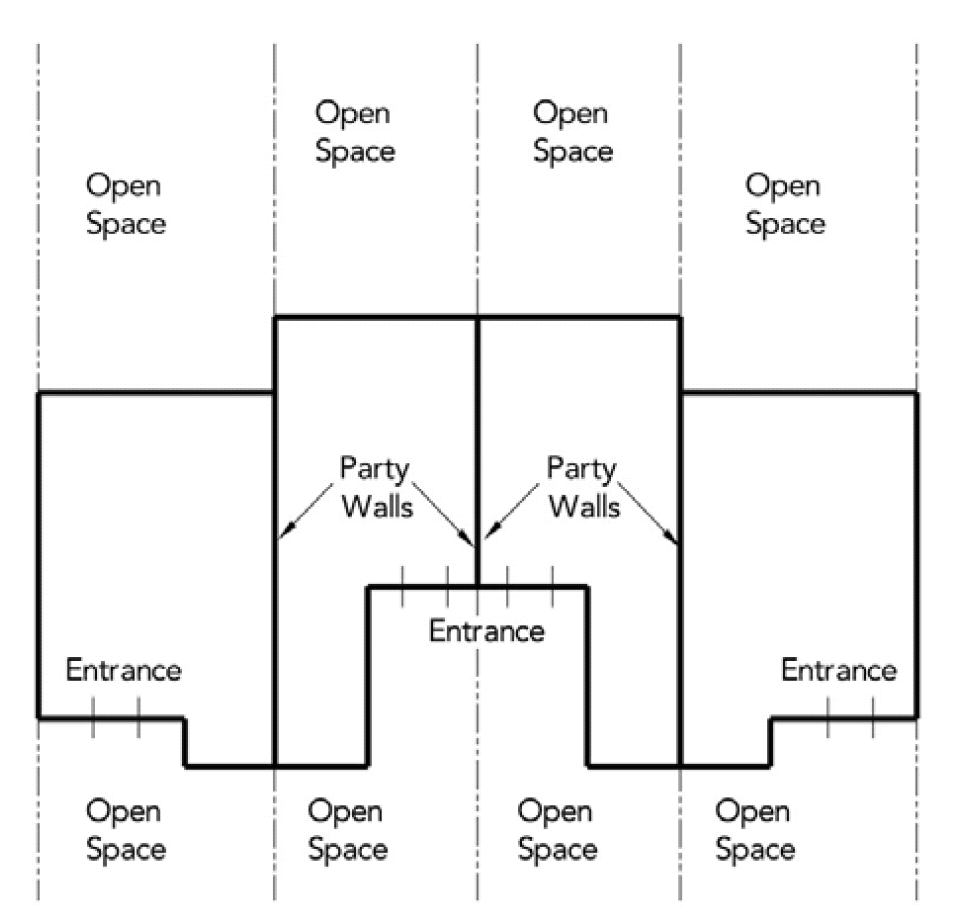
Patio: An impervious surface no higher than one foot above the ground, designed and intended for recreational use by people, and not as a parking space.
Pedestrian-Oriented: Development that is designed with a primary emphasis on the street, sidewalk, and/or connecting walkway access to the site and building rather than on auto access and parking lots. This type of development typically warrants buildings being placed relatively close to the street with the main entrance oriented towards the street sidewalk or a walkway. Parking areas are provided for but are not emphasized in the design of the site.
Pedestrian Zone: The area between the curb and the building, comprised of the Streetscape Zone, the Sidewalk Zone, and may include a Storefront Zone.
Perennial: Any plant that persists for several years and lives over from one growing season to another. Perennials characteristically die down to the ground each year with new vegetative growth emerging each season from a part that survives over winter.
Performance Standard: A criterion established to control noise, odor, smoke, toxic or noxious matter, vibration, fire and explosive hazards, or glare or heat generated by, or inherent in, uses of land or buildings.
Planned Unit Development (PUD): The Planned Unit Development (PUD) is a special zoning district category that provides an alternative approach to conventional land use controls. The PUD may be used for particular tracts or parcels of land that are under common ownership and are to be developed as one unit according to a Design Statement and a Master Development Plan Map. The PUD has no limitations on minimum or maximum size; however, the PUD typically includes multiple tracts that can be regulated under different base zoning districts and includes significant modifications to conventional zoning and land use regulations. The PUD requires complex analysis and is subject to special review procedures and, once approved by the City Council, becomes a special zoning classification for the property it represents.
Planting Plan: The preparation of graphic and written criteria of plant placement, plant specification of type, size and spacing, and other features to comply with the provisions of this ordinance.
Planting Season: The most favorable time to plant trees in Oklahoma City is established as the months including, and between, October and April.
Porch: A covered or uncovered platform that projects from the exterior wall of a building, has direct access to the street level of the building, and has no roof supporting walls on three sides, and which may be supported by posts.
Precision Instrument Runway, Airport Environs Zone: A runway having an existing instrument approach procedure utilizing an instrument landing system (ILS) or a precision approach radar (PAR). It also means a runway for which a precision approach system is planned and is so indicated on an approved airport layout plan or any other planning document.
Preservation: The adaptive use, conservation, protection, reconstruction, restoration, rehabilitation or stabilization of sites, buildings, districts, structures or monuments significant to the heritage of the people of Oklahoma City. The following definitions shall apply:
A.
Adaptive Use: The restrained alteration of an historical or architectural resource to accommodate uses for which the resource was not originally constructed, but in such a way so as to maintain the general historical and architectural character.
B.
Conservation: In terms of historical preservation, the sustained use and appearance of a structure or area, maintained essentially in its existing state.
C.
Protection: In terms of historic preservation, the security of a resource as it exists through the establishment of the mechanisms of this chapter.
D.
Reconstruction: In terms of historic preservation, the act or process of duplicating the original structure, building form and materials by means of new construction based on documentation of the historic condition.
E.
Rehabilitation: See "Rehabilitation".
F.
Restoration: The process of accurately recovering all, or part of, the form and detail of a resource and its setting, as it appeared at a particular period of time, by means of the removal of later work and the replacement of missing earlier work.
G.
Stabilization: The process of applying measures designated to halt deterioration and to establish the structural stability of an unsafe or deteriorated resource while maintaining the essential form as it presently exists without noticeably changing the exterior appearance of the resource.
Preservation Guidelines: The Preservation Guidelines for Oklahoma City Historic Districts.
Primary Building Material: Material covering 80 percent or more of the wall elevation.
Primary Surface, Airport Environs Zone: A surface longitudinally centered on a runway. When the runway has a specially prepared hard surface, the primary surface extends 200 feet beyond each end of that runway. When the runway has no specially prepared hard surface, or planned hard surface, the primary surface ends at each end of that runway. The width of the primary surface is set forth in Section 59-13150 (Oklahoma City Airport Zoning). The elevation of any point on the primary surface is the same as the elevation of the nearest point on the runway centerline.
Primary Use: The predominant use in terms of total land area or square footage occupied within any defined development area, such as a particular Design District.
Private Access Drive: A lane for traffic maneuver that provides access to lots in a subdivision having a limited number of lots; that extends directly from and connects to an approved street; that may be substandard in certain design respects to a street; and that is privately owned and maintained by the property owners association for the subdivision.
Private Street or Roadway: Property in either platted or unplatted areas, which has been approved under the terms of the Subdivision Regulations of Oklahoma City, used and open for private and public vehicular traffic, but not dedicated, owned or maintained by the City.
Private Wind Energy Conversion System (PWECS): Any device, such as a wind charger, windmill or wind turbine, which converts wind energy to a form of usable energy.
Professional Engineer: An engineer properly licensed and registered in the State of Oklahoma.
Project: Any undertaking, development, redevelopment or plan requiring the review or issuance of a building permit.
Property Lines: The lines bounding a zoning lot.
Property Owners Association: An incorporated organization operating under recorded land agreements, which represent each homeowner or unit of ownership in a planned unit development or other described land area, and charges each lot and/or property owner for a proportionate share of the organization's activities.
Public Improvement: Any drainage ditch, roadway, parkway, sidewalk, pedestrian way, tree, lawn, off-street parking area, lot improvement or other facility for which the local government may ultimately assume the responsibility for maintenance and operation, or which may affect an improvement for which local government responsibility is established.
Public Use: Any area, building or structure held, used or controlled exclusively for public purposes by any department or branch of any government, without reference to the ownership of the building or structure or of the realty upon which it is situated.
Public Use, Quasi: Any use which is essentially public, as in services rendered, although it is under private ownership or control.
Public Utility: A business or service, having an appropriate franchise from the State and engaged in regularly supplying the public with some commodity or service, which is of public consequence and need, such as electricity, gas, water, transportation or communications.
Public Way: Any street, waterway, viaduct, subway, bridge, waterfront, parkway, playground, square, park, aviation field, and other public ground and open space.
Q
R
Rafter: Any of the parallel beams that support a roof.
Reclassification: See "Rezoning."
Recreational Vehicle, Permitted: A vehicular unit which may be parked on a residentially zoned lot under certain conditions contained in this chapter. Said unit is primarily designed as a temporary living quarters for recreational, camping or travel use. It either has its own motive power or is designed to be mounted on, or drawn by, an automotive vehicle. The terms fifth-wheeler, motor home, truck camper, travel trailer, and camping trailer shall be considered to be the same as a "Recreational Vehicle." See also definitions related to travel trailer and travel trailer parks in Chapter 31 of the City Code.
Redevelopment (SRODD District): Development on a tract of land with existing structures where all or most of the existing structure(s) would be razed and a new structure or structures built. Redevelopment shall also include the expansion of an existing structure or expansion/alteration of an existing developed or partially developed site.
Refuse: All waste products resulting from human habitation or the conduct of business or industry, except sewage.
Registered Land Surveyor: A land surveyor properly licensed and registered in the State of Oklahoma.
Rehabilitation: The act or process of making possible a compatible use for a property through repair, alterations and additions, while preserving those portions or features which convey its historic, cultural or architectural values.
Rehabilitation (SRODD District): Any interior renovation or restoration that requires a building permit and does not change the use or expand the existing square footage or footprint of an existing structure. Alterations to the existing exterior façade would be defined as Development or Redevelopment unless qualifying as ordinary maintenance and repair.
Restrictive Covenant: See "Covenant."
Rezoning: The process of changing the designation of a parcel to a different zoning district category.
Rhythm: A regular pattern of shapes including, but not limited to, windows, doors, projections, and heights, within a building, structure or monument, or a group of the same.
Right-of-Way: A strip of land occupied, or intended to be occupied, by a street, crosswalk, railroad, road, electric transmission line, oil or gas pipeline, water main, sanitary or storm sewer main, or for another special use. The usage of the term "Right-of-Way" for platting purposes shall mean that every right-of-way hereafter established, and shown on a final plat, is to be separate and distinct from the lots or parcels adjoining such right-of-way and not included within the dimensions or areas of such lots or parcels.
Right-of-Way Line: A dividing line between a lot, tract or parcel of land, and a contiguous right-of-way.
River (SRODD District): The North Canadian River, a portion of which has been renamed the Oklahoma River.
Roadway: That portion of a street which has been designed and improved for the accommodation of vehicular traffic.
Roof Purlin: A horizontal member in a roof supporting the rafters.
Rolled Roofing: Roofing material used for the external layer of roof covering that comes in a roll.
Runway: A defined area on an airport prepared for landing and takeoff of aircraft along its length.
S
Satellite Dish Antenna: A parabolic or dish shaped antenna designed for the purpose of receiving radio waves.
Scale: The harmonious proportion of parts of a building, structure or monument to one another and to the human figure.
Secondary Uses: Uses that are secondary to the primary uses within any defined development area in terms of total land area or square footage occupied, such as a particular Design District.
Semi-Trailer and Semi-Trailer Tractor: A semi-trailer tractor is a truck with a short chassis and no body, commonly used in combination with semi-trailers in the hauling of freight. A semi-trailer is a trailer or a tanker, at least 20 feet in length, which, when attached, is supported at its forward end by the semi-trailer truck tractor.
Service Station: See "Filling Station."
Setback: The required distance between every structure and the lot line of the lot on which it is located. See "Yard," "Yard, Corner Side," "Yard, Front," "Yard, Rear" and "Yard, Side."
Shrub: A living, self-supporting woody deciduous or evergreen species no less than eight inches in height, and no greater than 15 feet in height, which remains full and attractive throughout the year.
Side-Loaded Garage: Garages oriented such that the garage doors are perpendicular to the street and are accessed from the side rather than the front.
Sidewalk: A surfaced pedestrian walkway located adjacent to the vehicular portion of a street right-of-way or public tree lawn.
Sidewalk Zone: That portion of the Pedestrian Zone located within the area from the back of the curb to the property line or the existing or newly constructed building, whichever is less.
Sight-Proof Fence: A solid opaque fence or wall that is a minimum of six feet, but no more than eight feet, in height, made of wood, masonry, decorative metal or other suitable material in compliance with the Building Code.
Sight-Proof Landscaping: Evergreen plant materials or earthen berms at least six feet in height and spaced in a manner to provide an impervious visual barrier sufficient to screen from view the property or structure sought to be screened from the abutting properties.
Sight-Proof Screening: Elements that form an opaque screen, which may include sight-proof fencing, sight-proof landscaping, and, in some cases, a building, that are strategically placed to restrict view of items, properties or structures sought to be screened.
Sign: Any structure or part thereof or any device, permanently or temporarily attached to, painted on, supported by, or represented on a building, fence, post or other structure which is used or intended to be used to attract attention. "Sign" shall not include a flag, pennant or insignia of any nation, association of nations, State, City or other political unit.
Sign, Awning: A sign painted on an awning.
Sign, Non-Accessory: A sign or advertising device which directs attention to an activity, service or product sold or offered elsewhere than on the premises where the sign is located.
Sign, Window: Any accessory sign located on the interior or exterior of a display window, or visible to the street through a display window.
Significant Characteristics of Archeological Resources: The artifacts present, the information to be gathered, or the potential for revealing hitherto unknown or unclear details of a culture, period or structure.
Significant Characteristics of Historical or Architectural Resources: Those characteristics that are important to, or expressive of, the historical, architectural or cultural quality and integrity of the resource and its setting, and includes, but is not limited to, building material, detail, height, mass, proportion, rhythm, scale, setback, setting, shape, street accessories and workmanship. The following definitions shall apply:
A.
Building Materials: The physical characteristics which create the aesthetic and structural appearance of the resource including, but not limited to, a consideration of the texture and style of the components and their combinations, such as brick, stone, shingle, wood, concrete or stucco.
B.
Detail: Architectural aspects which, due to particular treatment, draw attention to certain parts or features of a structure.
C.
Height: The vertical distance from the average grade level to the average level of the roof.
D.
Proportion: The dimensional relationship between one part of a structure or appurtenance and another.
E.
Rhythm: See "Rhythm".
F.
Scale: The harmonious proportion of parts of a building, structure or monument to one another and to the human figure.
G.
Setting: The surrounding buildings, structures or monuments, or landscaping which provides visual aesthetic or auditory quality to historic or architectural resources.
H.
Shape: The physical configuration of structures of buildings or monuments, and their component parts including, but not limited to, roofs, doors, windows and façades.
I.
Street Accessories: Those sidewalks or street fixtures that provide cleanliness, comfort, direction or safety, and are compatible in design to their surroundings, and include, but are not limited to, trash receptacles, benches, signs, lights, hydrants and landscaping including, but not limited to, trees, shrubbery and planters.
Significant Tree: Any existing tree with a caliper of six inches or greater, determined to be in good health by a qualified professional (i.e. Urban Forester, Certified Arborist) following guidelines established by the International Society of Arboriculture.
Simplified Planned Unit Development (SPUD): The Simplified Planned Unit Development (SPUD) is a special zoning district category that provides an alternative approach to conventional land use controls. The SPUD may be used for particular tracts or parcels of land five acres or less in size that are under common ownership and are to be developed as one unit according to a Design Statement and Master Development Plan Map. The SPUD contains no more than two development tracts that can be regulated under different base zoning districts, and limits the number and complexity of modifications to conventional zoning and land use regulations. Based on the complexity of the project, the Planned Unit Development (PUD) may be a more appropriate specialized zoning district regardless of meeting the SPUD standards for parcel size and number of tracts. The SPUD is subject to special review procedures and, once approved by the City Council, becomes a special zoning classification for the property it represents.
Small-Box Discount Store: A store with the primary purpose of retail sales of a combination of sundry goods, products for personal grooming or personal health, and food or beverages for off-premise consumption, and which has a floor area of less than 12,000 square feet and a majority of items in inventory for sale at a price of less than $10.00 per item.
Solid Waste: Unwanted or discarded waste material in a solid or semi-solid state including, but not limited to, garbage, ashes, street refuse, rubbish, dead animals, animal and agricultural wastes, yard wastes, industrial wastes, and demolition and construction wastes.
Special District: An overlay zone established to accommodate a narrow or special set of uses or for special purposes.
Special Exception: A use eligible to be permitted in a zoning district upon review and approval by the Board of Adjustment.
Special Permit: A use eligible to be permitted in a zoning district upon approval by the City Council.
Spill Light: Light falling outside the intended area.
Staff: The Development Services Department staff, Planning Department staff or the Public Works Department staff, as the context dictates.
Stoop: An exterior floor typically, but not necessarily, constructed of concrete and/or masonry, with a finished floor elevation at least six inches higher than the adjacent ground level, and utilized primarily as an access platform to a building.
Storefront Zone: That portion of the Pedestrian Zone located between the Sidewalk Zone and the building.
Story: That portion of a building, other than a basement, included between the surface of any floor and the surface of the floor next above it or, if there is not a floor above it, then the space between the floor and the ceiling next above it.
Story, Half-Story: See "Half-Story."
Street: All property dedicated or intended for public or private street purposes, or subject to public easements.
Street, Collector: Streets which provide access and service to land, circulate traffic between land uses, and collect and distribute traffic between the arterial street system and the local street system.
Street Level: The story of a building that has its floor at the closest level to the street, with direct pedestrian access to that story from the outside.
Street, Local: Streets which penetrate neighborhoods to provide the highest level of access to residents, business or other abutting property. Through movement is deliberately discouraged.
Street, Major Arterial: A continuous street system which provides for the safe movement of through traffic on at-grade intersection facilities by application of good geometric design and traffic control measures. The system should not penetrate identifiable neighborhoods and provides a minimum of direct access to abutting property.
Street, Minor Arterial: Streets which augment the major arterial system in those more densely developed areas requiring a closer spacing of arterial facilities. Minor arterials should not penetrate identifiable neighborhoods, but may provide slightly greater direct access to abutting property than a major arterial.
Street Trees: Trees planted at regular intervals (ranging from 20—50 feet on center, depending on the tree's spread at maturity) within the Streetscape Zone.
Street Width: The shortest distance between the lines delineating the right-of-way of a street.
Streetscape: Elements placed within the Streetscape Zone, typically including landscaping, tree lawns, signage, transit stops, and street light standards, designed to provide a pedestrian buffer from street traffic and aid in establishing the character of the community.
Streetscape Zone: That portion of the Pedestrian Zone located between the back of the curb and the Sidewalk Zone.
Strip Zoning: Designation of a ribbon pattern of zoning, generally commercial, which fronts one, or both, sides of a roadway in a narrow band.
Structural Alterations: Any change, other than incidental repairs, in the supporting members of a building, such as bearing walls, partitions, columns, beams or girders, or any substantial change in the roof or in the exterior walls.
Structure: Anything constructed or erected, the use of which requires permanent location on the ground or which is attached to something having a permanent location on the ground. This includes, but is not limited to, main and accessory buildings, advertising signs, billboards, poster panels, fences, walls, driveways, sidewalks and parking areas.
Structure, Airport Environs Zone: Any object, including a mobile object, constructed or installed by man including, but not limited to, buildings, towers, cranes, smokestacks, earth formation and overhead transmission lines.
Structure or Use, Accessory: A structure or use which:
A.
Is subordinate to and serves a principal structure or principal use.
B.
Is subordinate in area, extent or purpose to the principal structure or principal use served.
C.
Contributes to the comfort, convenience or necessity of occupants of the principal structure or principal use served.
D.
Is located on the same zoning lot as the principal structure or principal use served, with the single exception of such accessory off-street parking facilities as are permitted to locate elsewhere than on the same zoning lot with the building or use served.
Superblock: The consolidation of two or more City blocks through the vacation of public streets for the purposes of creating a larger development site.
T
Taproom: An area that is ancillary to the production of beer at a brewery, where the public can purchase and/or consume only product allowed under the rights bestowed to a brewer under State Law.
Temporary Construction Staging Areas, Off-site: The temporary, open storage of construction equipment and materials not located within the area of actual construction. This shall not include parking for employees or construction personnel.
Toxic Matter or Materials: Those materials which are capable of causing injury to living organisms by chemical means when present in relatively small amounts.
Trailer: A vehicle without motor power, designed so that it can be drawn by a motor vehicle for the conveyance of cargo or property. This shall include but is not limited to utility trailers, cargo trailers, enclosed trailers, stock trailers, equipment trailers, car haulers and watercraft trailers devoid of watercraft. See also definitions related to travel trailers and travel trailer parks in Chapter 31 of the City Code.
Transition Zone: A buffer established to protect one type of land use from the adverse effects of another incompatible use. Typically used between two or more zoning districts or incompatible uses.
Transitional Surfaces: These surfaces extend outward at 90 degree angles to the runway centerline, and the runway centerline extended at a slope of seven feet horizontally for each one foot vertically from the sides of the primary and approach surfaces to where they intersect the horizontal and conical surfaces. "Transitional Surfaces" for those portions of the precision approach surfaces, which project through and beyond the limits of the conical surface, extend a distance of 5,000 feet measured horizontally from the edge of the approach surface and at 90 degree angles to the extended runway centerline.
Transitional Uses and Structures: Uses or structures permitted under this chapter, which, by their nature or level and scale of activity, act as a transition or buffer between two or more incompatible uses.
Tree: A living self-supporting woody or evergreen plant that normally grows to a minimum height of 15 feet, which has one, or several, self-supporting stems or trunks, and numerous branches.
Tree Classification Terms: The terms "Small Tree," "Medium Tree," and "Large Tree," which refer to the size of a tree at the time it is installed or retained (as outlined in Article XI), regardless of its species.
Tree Lawn: That portion of the public right-of-way dedicated to landscape plant material such as sod, trees, or other vegetation, typically located between the curb line and the sidewalk or property line.
Turf Grass: Existing or installed grass that has been sodded, sprigged, seeded or hydro mulched. Turf grass eligible for point credits must be located within the property line of a development. The maximum credit for turf is 25 percent of the total landscape points required for any site. All turf credited for points shall completely cover all exposed areas of soil after one full growing season.
U
Uplight: Light emitted in the hemisphere at or above the horizontal plane.
Utility Runway, Airport Environs Zone: A runway that is constructed for, and intended to, be used by propeller-driven aircraft to 12,500 pounds maximum gross weight and less.
V
Vehicle: Any device in, upon or by which any person or property is or may be transported or drawn. "Vehicle" shall include, but is not limited to, automobiles, trucks, aircraft and watercraft.
W
Water Bodies and Watercourses: Every spring, pond, stream, ditch, water-bearing sand, or other channel or course of any kind.
Watercraft: Any vehicle in, upon or by which any person or property is or may be transported or drawn in, under, or on the surface of water. "Watercraft" shall include but is not limited to, jet skis, canoes, skiffs, or boats of any kind.
X
Xeriscape: A method of landscaping that emphasizes water conservation, accomplished by following sound horticultural and landscaping practices, such as planning and design, soil improvement, limited turf areas, use of mulches, use of low-water demand plants, efficient irrigation practices and appropriate maintenance.
Y
Yard: An open space at grade, other than a court or plaza, between a structure and the adjacent lot lines, unoccupied and unobstructed by any portion of a structure from the ground upward, except where otherwise specifically provided in this chapter. In measuring a yard for the purpose of determining the depth of the front yard, rear yard, or side yard, the minimum horizontal depth between the lot line and a building or structure shall be used.
Yard, Corner Side: A side yard on a corner lot which abuts a street. See Figure 2000.7.
Yard, Front:
A.
An open area facing and abutting a street and extending across the front of the lot between the side lot lines and having a minimum horizontal depth measured from the street equal to the depth of the minimum front yard specified for the district in which the lot is located. The required front yard line represents the line in front of which no building or structure may be erected, other than steps, unenclosed porches, canopies, marquees and carports as may be permitted in this chapter. See Figure 2000.7.
B.
In commercial or industrial uses, the front yard shall always be adjacent to an expressway or arterial if the lot abuts such a facility.
C.
In developments that are platted; or, where a platted lot takes access from a platted access easement or platted common area (both serving as private access drives constructed in accordance with the Subdivision Regulations), building setbacks shall be determined by the building lines depicted on said plat. If no platted building lines are depicted on said plat, building setback shall be determined by the underlying zoning district, with the private access drive serving as the front of a lot (lots with more than one side abutting a private access shall only be required one front yard setback).
Yard, Rear: An open area that extends across the rear of the lot between side lot lines and which has a minimum depth measured from the rear lot line as specified for the zoning district in which the lot is located. Steps, unenclosed porches and unenclosed balconies may extend into the rear yard as may be permitted in this chapter. On both corner lots and interior lots, the rear yard shall, in all cases, be at the opposite end of the lot from the front yard. See Figure 2000.7.
Yard, Side: An open area which extends between the required front yard and the required rear yard, and has a minimum width measured from the side lot line as specified for the zoning district in which the lot is located. Steps may extend into a side yard as may be permitted in this chapter. See Figure 2000.7.
FIGURE 2000.7: YARDS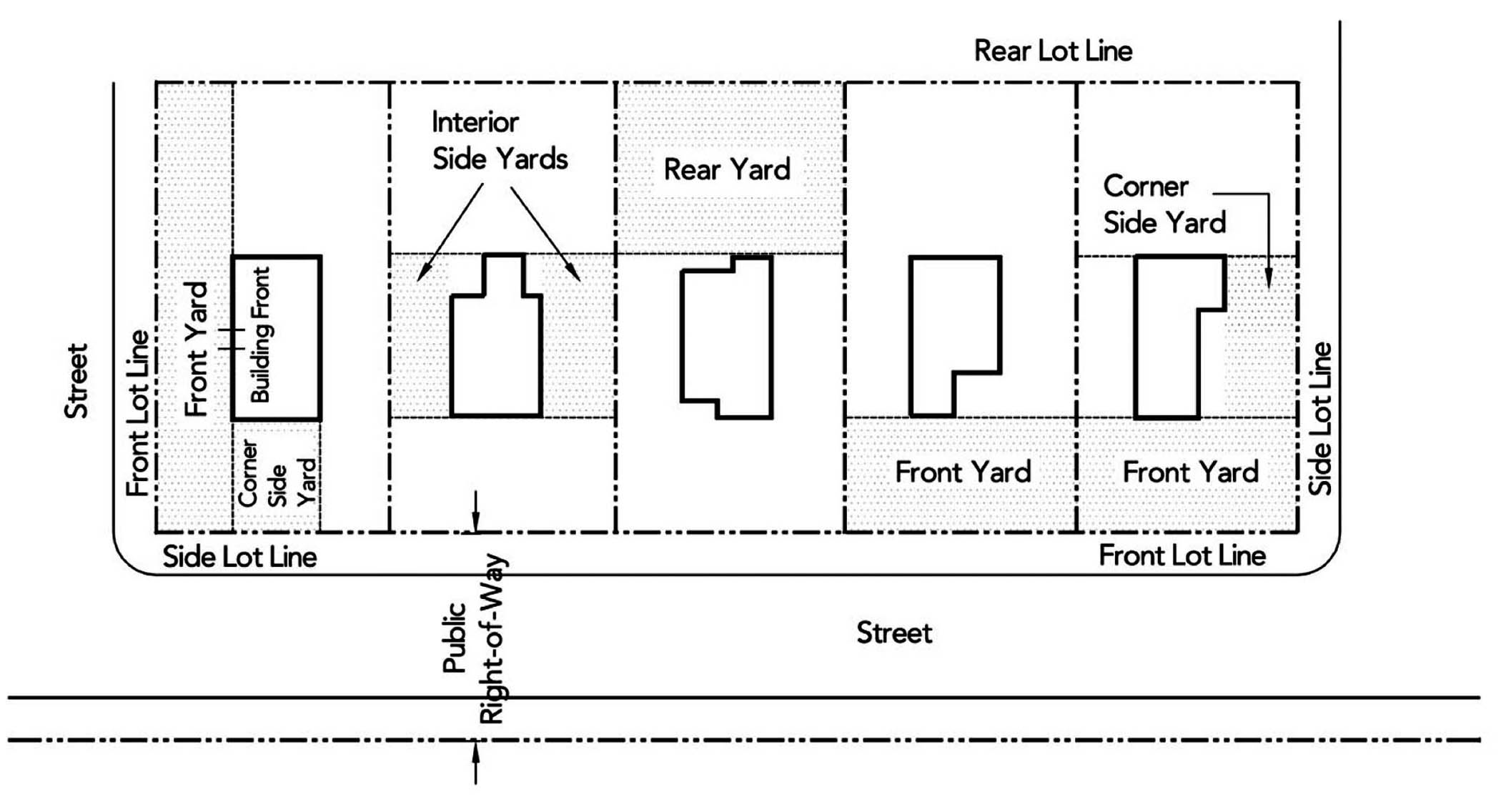
Z
Zoning District: A section of the City designated in the text of this chapter and delineated on the Official Zoning Districts Map, for which land use requirements, and building and development standards are prescribed.
Zoning Districts Map: The official map, adopted as a part of this chapter, which graphically identifies the zoning district classification of all property within the corporate boundaries.
(Ord. No. 23755, § 1, 12-2-08; Ord. No. 24009, § 1, 2-2-10; Ord. No. 24128, § 1, 8-31-10; Ord. No. 24174, § 1, 11-2-10; Ord. No. 24485, § 1, 7-3-12; Ord. No. 24609, § 1, 2-19-13; Ord. No. 24726, § 1, 8-13-13; Ord. No. 24729, § 1, 8-27-13; Ord. No. 24790, § 1, 12-17-13; Ord. No. 24804, § 1, 12-31-13; Ord. No. 25264, § 1, 10-27-15; Ord. No. 25434, § 1, 8-16-16; Ord. No. 25972, § 1, 7-31-18; Ord. No. 26348, § 1, 1-7-20; Ord. No. 26790, § 1, 7-6-21; Ord. No. 27658, § 1, 7-30-24; Ord. No. 27847, § 1, 5-20-25)

