
Oklahoma City City Zoning Code
ARTICLE VII
SPECIAL PURPOSE DISTRICTS
§ 59-7100.- General provisions.
This Article establishes specific regulations and guidelines of limited application within the City that assure additional consideration for areas of special interest or value.
A.
Purpose and Intent. The purpose of this article is to:
(1)
Provide a framework for enabling legislation to aid in the creation of special regulations.
(2)
Provide a categorization of all special regulations, which may be adopted as a result of the enabling legislation.
(3)
Provide guidelines for the application of all special regulations created to assure conformity with the objectives of good planning and zoning practice.
B.
Application. Special regulations may be adopted within this article and applied to designated areas of the City when the Planning Commission and City Council find conditions or purposes within said areas merit special consideration in order to protect the health, safety and general welfare.
C.
Special Regulations Established. The following special regulations are hereby established. Any special district adopted as a result of authorization by way of these regulations shall be codified.
D.
Modification to Special Regulations. Modifications or changes to the special regulations shall be subject to the provisions of the amendment procedure for this chapter contained in Article IV, Administrative Procedures.
(Ord. No. 25264, § 3, 10-27-15)
§ 59-7150. - Bricktown Core Development District.
7150.1. BC Bricktown Core Development District.
A.
General Description. This mixed-use district allows for a wide range of commercial, residential, office, warehouse and limited industrial uses. It is intended to facilitate the adaptation of a warehouse district to a more vibrant mixture of uses, and encourage compatible new development while preserving the distinct visual architectural character and historic significance of the District as a whole and the individual structures within it. The Bricktown Core Development District is divided into two sub-districts to acknowledge the distinct differences between these defined areas, West Bricktown and East Bricktown. The boundary between West Bricktown and East Bricktown is Russell M Perry Avenue/Joe Carter Avenue.
West Bricktown is considered to be the historical core of Bricktown where the existing collection of red brick warehouse buildings with distinct architectural characteristics set the tone for mass, bulk, height, window patterns, and proportion in the design and development of new structures in this area. New structures in this area should be designed to utilize brick as a primary exterior building material and to maintain a strong architectural identity with the existing building stock in this core area of the District.
East Bricktown includes larger parcels of land undergoing a transition from low-rise industrial structures to a variety of new uses that support and complement uses in West Bricktown. East Bricktown is characterized by newer and generally larger structures. New structures in this area should exhibit some similarities and connection to the architectural heritage of the historical core by implementing similar design themes and proportions and by using brick as an associative building material but also integrating more modern design elements and more contemporary building materials and exterior treatments.
B.
Purpose and Intent. Development Regulations and Guidelines in this District are intended to:
(1)
Promote the development and redevelopment of the Bricktown Core Development District in a manner that is in keeping with its status as a premier entertainment destination that is family-friendly, safe, and attractive;
(2)
Preserve and reinforce historic resources and circulation patterns within the District;
(3)
Ensure that new structures and renovations to existing structures are designed to enliven and invigorate the street scene with active uses oriented to the primary streets and the canal; and to ensure that architectural styles and treatments acknowledge the character of the District while allowing for contemporary accents, features, and elements;
(4)
Recognize the importance of the District's distinctive collection of red brick warehouse structures in West Bricktown as the essential foundation of the core of the District and support the continued rehabilitation, restoration, and creative reuse of these structures; and to ensure that new development in West Bricktown respects the scale, proportion, and fundamental design characteristics of these characteristic structures;
(5)
Promote improved walkability within the District and encourage enhanced pedestrian connectivity from Bricktown to adjoining areas and attractions.
C.
Certificate of Approval Required. A Certificate of Approval shall be required in the following instances prior to the commencement of work on any project, public or private, located within the Bricktown Core (BC) Development District. The design review process for the BC District can be found in Section 59-4250.3 Downtown Design Review.
(1)
Commission Approval. The Downtown Design Commission shall review and issue Certificates of Approval for the following, unless administrative approval by staff is permitted, as referenced in this Section:
(a)
New construction, additions, or exterior modification of an existing structure and associated site where the proposed modifications impact more than ten percent of the site or structure.
(b)
Revisions to submittals previously approved by the Bricktown Urban Design Committee where the proposed revisions impact more than 20 percent of the site or structure.
(c)
Signage, including any sign exceeding 100 square feet or any Electronic Message Display (EMD) sign or Projection Image Sign exceeding 25 square feet in total area.
(d)
Parking lots with more than ten parking stalls.
(e)
Demolition of a structure except structures declared dilapidated and approved for demolition by City Council.
(f)
Public or private streetscape improvements.
(g)
Painting of the exterior of any previously painted structure that is not consistent with the color specifications provided in Section 7150.1.F.(2)(j)3.
(h)
Proposed plans for the removal of historically significant public improvements. These include, but are not limited to portions of brick streets and railroad lines or rails within the District.
(i)
Murals (Use Unit Classification 8250.16).
(2)
Administrative Approval. Staff may review and issue Certificates of Approval for the following:
(a)
Modifications to a structure or site where the proposed improvements impact ten percent or less of the site or structure being modified.
(b)
Revisions to Certificates of Approval previously approved by the Bricktown Urban Design Committee or the Downtown Design Commission where the proposed revisions impact 20 percent or less of the site or structure.
(c)
Painting of the exterior of any previously painted structure that is consistent with the color specifications provided in Section 7150.1.F.(2)(j)3.
(d)
Signage, including:
1.
Any Electronic Message Display (EMD) sign less than or equal to 25 square feet in total area;
2.
All other signs less than or equal to 100 square feet in total area;
3.
Any Projection Image sign less than or equal to 25 square feet in total area; and
4.
Temporary Signs - Large Display Banners and Supergraphics.
(e)
Parking lots of ten or fewer parking stalls.
(f)
Removal or addition of awnings, canopies, and lighting.
(g)
Removal or addition of fencing.
(h)
Screening of mechanical equipment and waste receptacles.
(i)
Minor public and private improvements including but not limited to sidewalks, kiosks, landscaping, bus stop shelters, benches, driveways, bike racks, waste receptacles, retaining walls, ornamental lighting, and small wireless facilities, as defined by State law.
A Certificate of Approval shall be required for the replacement of public and private improvements.
(j)
Temporary Construction Staging Areas, Off-Site.
(3)
Staff may forward applications that qualify for administrative approval to the Committee for consideration as deemed necessary.
(4)
Exemptions.
(a)
A Certificate of Approval shall not be required for Ordinary Maintenance and Repair that involves no change in materials, dimensions, design, configuration, color, texture, surface coating, or visual appearance for work meant to remedy damage or deterioration of site elements, structures, or their appurtenances.
(b)
A Certificate of Approval shall not be required for the installation of additional equipment on existing poles if the equipment is at least eight feet above the sidewalk.
(5)
Revisions to Certificates of Approval.
(a)
Staff may approve revisions to an unexpired Certificate of Approval, with the appropriate fee, for revisions that impact 20 percent or less of the site or building, provided that the proposed revisions maintain conformance with the applicable regulations and guidelines in place at the time of the original submittal and any conditions associated with the original approval.
(b)
Staff may approve minor revisions to an unexpired Certificate of Approval, without additional fees, provided that the following conditions are satisfied:
1.
No more than five percent of the site or building is modified from the original Certificate of Approval;
2.
Revisions are consistent with any conditions associated with the original Certificate of Approval;
3.
Revisions do not significantly alter the work previously approved; and
4.
Revisions are in conformance with regulations and meet the intent of the guidelines.
D.
Use Regulations.
(1)
Uses permitted in the BC District can be found in Table 7150.2. Unless allowed conditionally as annotated in Table 7150.2, the owner/operator of any property who wishes to serve or sell alcoholic beverages, as defined by State law and subject to State licensing requirements, for on-premises consumption as an accessory function of the primary use of the property, may apply for a Special Permit providing that the primary use is permitted within the zoning district, and providing that the facility in which the alcoholic beverages are served or sold complies with the City's building code requirements.
(2)
Accessory Uses and Structures. The following accessory uses and structures are permitted subject to the regulations in Section 59-12200, (Standards for Accessory Buildings, Structures, and Uses) of this chapter and the other applicable regulations and guidelines of this section:
(a)
General accessory buildings.
(b)
Fences.
(c)
Home Occupations.
(d)
Swimming Pools.
E.
Development Regulations. Table 7150.1 establishes the Bulk and Yard Regulations for the Bricktown Core Development District. Table 7150.2 establishes the Use Regulations for the Bricktown Core Development District. Special standards for specific uses identified in Table 7150.2 as Special Exception (SE) are found in Section 59-9350, Standards for Specific Uses.
1 - West Bricktown is defined as that portion of the BC District west of S Joe Carter Ave/Russell M Perry Ave.
2 - East Bricktown is defined as that portion of the BC District east of S Joe Carter Ave/Russell M Perry Ave.
3 - Section 7150.1.F. includes a guideline that suggests a height limit of 80 feet but allows up to the maximum of 140 feet.
4 - Streets designated for Commercial or Mixed-Use Frontages are defined in Section 59-7150.1.E.(1).
;sz=8q; FOOTNOTES: TABLE 7150.2
1 The owner/operator of any property who wishes to serve or sell alcoholic beverages, as defined by State law and subject to State licensing requirements, for on-premises consumption as an accessory function of the primary use of the property, shall meet the condition below. If the condition cannot be met, then said property owner/operator may apply for a Special Permit. The facility in which the alcoholic beverages are served or sold must comply with the City's building code requirements.
• The area allocated to the sale and consumption of alcoholic beverages shall not exceed 15,000 square feet.
2 Any Planned Unit Development or Simplified Planned Unit Development adopted prior to the effective date of this ordinance that permitted the 8300.37 Eating Establishment: Sitdown, Alcohol Not Permitted use unit shall be permitted to develop according to the 8300.38 Eating Establishment: Sitdown, Alcohol Permitted or 8300.39 Eating Establishment: Sitdown, Limited Alcohol Permitted uses provided they meet the applicable conditions, unless the PUD/SPUD specifically prohibited said uses.
(1)
Exceptions.
(a)
Height.
1.
Accessory buildings located behind the front plane of the existing primary structure, or located behind the Setback/Build-To Line where a primary use does not warrant a primary structure and no such structure exists.
(b)
Setbacks and/or Build-To Lines.
1.
Accessory buildings and secondary buildings where an existing primary structure occupies the street frontage(s), or located behind the Setback/Build-To Line where a primary use does not warrant a primary structure and no such structure exists.
(2)
Building Frontage Designations. Streets in the BC District are designated as either Commercial Frontage streets or Mixed-Use Frontage streets based on the primary use and function of the corridor, as defined by the Downtown Development Framework, maintained online or in the office of the City Clerk. Development is subject to the design and yard standards provided in Table 7150.1.
(3)
Parking and Landscape Requirements.
(a)
Off-Street Parking. For the purpose of this section, off-street parking shall mean any stand-alone surface parking lot (Use Unit 8300.13 - Automotive: Parking Lots, as a Principle Use) and any surface parking lot associated with a development.
1.
The Bricktown Core Development District is exempt from providing minimum off-street parking per Section 59-10600.3.I., however, when parking is provided, all off-street parking shall be subject to the following sections of Chapter 59 of the Zoning and Planning Code:
a.
Section 59-11250.E., Automotive Parking Lot Landscape Requirements;
b.
Section 59-11350, Landscape Irrigation Requirements; and
c.
Article X, Off-Street Parking, Loading and Access.
2.
Off-street parking shall not be located:
a.
Within 50 feet of the corner of intersecting public streets, as measured from the abutting property lines along each street; nor
b.
Within 75 feet of the nearest edge of the Bricktown Canal.
3.
Where off-street parking abuts a street frontage, one or both of the following screening elements shall be installed and maintained so as to create a continuous visual barrier designed to minimize views of parked vehicles. Such screening elements shall not encroach upon the public right-of-way:
a.
A minimum three-foot high wall or fence.
i.
In cases where a fence height more than three feet tall is desired, the fence panel areas over three feet tall must provide for visual transparency and shall not be solid panels.
ii.
When the fencing material proposed is open and does not provide a continuous screen, the landscaped strip required in Section b. below, must be provided.
iii.
When the fence or wall proposed provides a continuous visual screen, any landscaped strip provided in front of the wall or fence does not need to be a continuous screen.
b.
A minimum five-foot wide irrigated landscaped strip.
i.
Landscape plantings shall be planted with species that will create a continuous visual screen of at least three feet in height at maturity.
ii.
Landscaped areas shall be designed to discourage damage to the vegetation due to pedestrian through-traffic.
4.
Any modification to an existing parking lot that results in an increase in square footage of more than 500 square feet for the purpose of providing additional parking stalls shall be required to bring the entire parking lot into compliance with all applicable provisions of this chapter.
a.
Exceptions:
i.
Any off-street parking stalls that exist within 50 feet of the corner of a public street, as measured from the abutting property line along each street, or within 75 feet of the nearest edge of the Bricktown Canal at the time of such proposed parking lot modification may remain in place, but shall otherwise come into compliance with this chapter.
ii.
Modifications to existing parking lots shall not mean activities associated with the repair of existing parking lots, such as resurfacing, patching, or restriping.
(b)
Parking Garages. All parking garages (Use Unit 8300.12 - Automotive: Parking Garages) shall be designed to screen views of parked vehicles at every level of the parking garage from all canal and street level views. Such screening for parking garages shall be provided through the use of visually appealing architectural materials or through architectural methods that disguise the garage to look like a building.
(4)
Irrigation. All landscaping shall be irrigated by one of the methods specified in Section 59-11350.
(5)
Sidewalks. Sidewalks shall be provided as part of all projects as follows:
(a)
All sidewalks and sidewalk treatments shall be subject to all permitting requirements of the Public Works Department.
(b)
In conjunction with all new development and with the renovation of existing structures where no sidewalks exist, sidewalks shall be extended within the public right-of-way along the entire property frontage to the adjacent side lot lines. In the case of corner lots, sidewalks shall be extended to the adjacent lot along each street frontage.
(c)
The required sidewalk shall be a minimum of five feet wide. All required sidewalks shall be maintained free of any obstructions to allow for the passage of pedestrians. The sidewalk shall not be shared with the Amenity or Storefront Zones, unless otherwise provided for herein.
1.
Exceptions:
a.
Where necessary to address specific pedestrian access needs, match adjacent sidewalk segments, or enhance existing sidewalk conditions, sidewalks may be wider than five feet with the minimum width being determined by staff based on the surrounding conditions.
b.
In instances where there is not sufficient right-of-way to provide the minimum five-foot wide sidewalk, all available space between the back of the curb and the building line shall be improved as sidewalk.
c.
The Bricktown Urban Design Committee or staff, upon consideration of a specific land use such as residential, may approve a reduced sidewalk width provided that a landscaped area is located between the back of the curb and the sidewalk and between the building facade or building element and the sidewalk.
(6)
Building Materials. Vinyl, aluminum, sheet metal siding, and concrete tilt-up walls shall be prohibited.
(7)
Signs. Signs within the Bricktown Core (BC) Development District shall comply with sign regulations as referenced in Chapter 59, Article XVI of the Code.
(8)
Dumpsters and Other Commercial Waste Collection Receptacles.
(a)
Dumpsters and other commercial waste collection receptacles shall be sight-proof screened from view on all sides of the dumpsters or receptacles. A building, fence, wall, vegetation or other form of screening, built in accordance with Sections 59-11250.F.(3) and (4), (Sight-Proof Screening and Security Fences) and 12200.4.E(2) and (3), (Limitations on Dumpsters), shall be provided to satisfy this requirement. Building materials for sight-proof screening in the BC District shall be as follows:
1.
Walls or fences for the screening of dumpsters shall be constructed of brick or masonry covered with brick or brick veneer.
2.
Gates for the trash enclosure shall be made of solid metal.
3.
Wood fencing and chain-link fencing with insertions/ weaving shall not be permitted for screening of dumpsters.
(b)
A dumpster or receptacle and its required screening may only be located in the public right-of-way upon the issuance of a Revocable Permit for both the receptacle and the installation of the screening. Any immobile screening fence or wall shall require a fence permit.
(9)
Fences and Walls. Where fences or walls are proposed for purposes other than required sight-proof screening pursuant to Section 59-7150.1.E.(7), such fences shall result in a structure which is durable, attractive, and compatible with any adjacent structures.
(a)
Materials.
1.
Permitted materials for fences and walls are brick, masonry, wrought iron, anodized aluminum, and wood.
2.
If the fence material is wood, the surface shall be painted or stained in a uniform color that matches or complements the colors of the nearest building.
3.
Chain-link fencing and cable fencing shall be prohibited.
(b)
Front Yard Fences and Walls. Front yard fences and walls, other than those that enclose outdoor dining areas that face the public right-of-way, or those required to screen parking lots pursuant to Section 59-7150.1.E.(2), shall be prohibited.
F.
Design Guidelines. These design guidelines are intended to encourage a high degree of continuity and compatibility in the construction of new buildings and in the rehabilitation of, or addition to, existing structures in the Bricktown Core Development District. Development proposals should be designed with a focus on respecting the form, scale, materials, detail, and methods of construction common to the "warehouse" architectural style represented by the original buildings found in and around the core of the District.
(1)
Development Pattern.
(a)
Site Design Considerations. Site plans should be designed and oriented to complement the surrounding built environment and to address the following considerations:
1.
Minimize the impact to the existing inventory of on-street parking stalls and avoid impeding or otherwise impacting on-street vehicular circulation. Limiting the number of driveways per site is strongly encouraged.
2.
Maintain, enhance, or extend the alley network in Bricktown.
3.
Provide or preserve points of vehicular or pedestrian access through the block.
4.
Blocks with over 400 feet of street frontage should be divided by pedestrian or vehicular passages with a minimum width of 20 feet.
5.
Surface parking lots should not be located abutting or facing a street and should be positioned to the rear behind existing or proposed buildings whenever possible.
6.
With the regulatory Building Frontage Standards set forth in Table 7150.1, the guidelines provided below also apply to the siting of buildings in the BC District:
a.
While the maximum allowable building setback for sites on designated Commercial Frontages and Mixed-Use Frontages is ten feet, buildings should preferably be located within five feet of the front property line.
b.
The front yard setback, or front and side yard setbacks for corner lots, should be within the range of setbacks of the existing buildings on the same side of the street on the same block.
(b)
Building Orientation - New buildings and additions should be sited and designed to maintain building mass and height at the right-of-way line on all interior and corner lots that front a public street or the canal. New buildings and additions to buildings on corner lots should treat both street frontages in the same manner with comparable architectural detailing.
(c)
Building Scale - In general, the bulk and mass of new buildings should be compatible with surrounding buildings in scale and proportion. Additionally, the following guidelines should also be utilized in the design of buildings in the BC District:
1.
New construction should be designed to provide a graduated transition between existing buildings of differing scales. Extreme differences in mass and scale between adjacent structures should be avoided.
2.
New buildings and additions to existing buildings should be designed to incorporate the approximate scale and proportion of the existing building and/or the surrounding buildings, provided such buildings meet current development standards.
3.
Building mass and height should be concentrated at key intersections and along major pedestrian corridors.
4.
Buildings that are three or more stories taller than adjacent buildings should be recessed on upper floors to provide a graduated transition in height.
(d)
Building Height - While the maximum allowable building height is 140 feet, new construction is encouraged to maintain a maximum height limit of 80 feet or less unless a greater height is compatible with existing buildings located on the same block on either side of the street.
(2)
Building Design, Treatments, and Materials. Building design within the Bricktown Core Development District should promote continuity and compatibility with the existing architectural character of the District while encouraging designs that incorporate elements of architectural diversity and innovation. Modern interpretations of the prevalent traditional architectural elements common to the District are encouraged. Architectural treatments should reinforce the overall character of the immediate surroundings, create a strong building-to-pedestrian relationship, and support a strong urban environment.
(a)
Architectural Continuity.
1.
New buildings should incorporate design treatments that assure architectural compatibility and continuity with adjacent structures and the character of the District, such as the alignment of features including belt courses, cornices, and windows.
2.
While continuity is encouraged, efforts should be made to avoid simple repetition which can result in architectural monotony. The architectural design of each individual building should have its own distinctive character and appearance while maintaining a strong degree of compatibility with the District through the use of common and complementary building materials and similar scale, massing, and proportion.
(b)
Contemporary Design Elements.
1.
For new structures, contemporary design elements may be employed to provide a modern interpretation of Bricktown warehouse architecture or as a means to accent a building entry or other significant structural element, provided that the contemporary elements are designed to complement the established architectural style of the District. Such designs should exhibit some degree of continuity with adjacent or nearby structures and the architectural character of Bricktown at the interface of adjoining buildings.
2.
For existing structures, contemporary design elements may be introduced in proposed renovations provided that the architectural integrity of the primary street-oriented elevation(s) is largely preserved. Elevations that do not face primary streets (such as interior lot line facades or alley facades) may present an opportunity for more extensive use of contemporary design elements, such as modern storefront glass, concrete, or architectural metals, provided they are carefully integrated with the building's traditional architectural features.
(c)
Front Setback Treatments.
1.
For the front setback, or front and side setbacks at corner lots, buildings should be within the range of building setbacks established by the existing buildings on the same side of the street on the same block.
2.
Buildings are encouraged to be positioned as close to the property line as possible provided that there is adequate space provided for the Pedestrian Zone. The front setback may be increased for the purpose of creating a recess to accommodate outdoor dining areas.
(d)
Street and Canal Frontages. The architectural detailing of building elevations fronting public streets and the canal should focus on creating a strong and inviting building-to-pedestrian relationship between those facades and any adjacent pedestrian pathways, public plazas, or sidewalks. Measures that should be used to enhance pedestrian-friendly building facades include, but are not limited to:
1.
The ground floor should be distinguished and delineated from upper floors through design treatments, building materials, awnings, canopies, floor height, window height, or some combination thereof.
2.
Awnings, canopies, galleries, and similar features are encouraged to articulate commercial street level uses, protect pedestrians, and add visual interest.
3.
Service, delivery, and trash room entries should not be located on street or canal frontages.
4.
Building lobbies should take up as little street frontage as possible in order to preserve frontage for commercial space.
5.
At the first and second floors, incorporate an ample amount of transparent windows and doors in proportion with the scale, shape, and size of the front façade.
6.
Utilize high-quality architectural detailing and materials at the ground level to enhance human scale and orientation.
7.
Minimize intrusions into the Sidewalk Zone to ensure a clear, defined, and safe pedestrian pathway.
8.
No wall facing a street or canal should have any continuous segment of blank wall space (no windows or doors) that exceeds 15 lineal feet.
9.
When the plane of a wall at the ground level exceeds 25 lateral feet, the adjacent wall plane(s) should be offset (inward or outward) by at least two feet.
10.
Include vertical breaks or articulation using columns or pilasters at a minimum of every 20 feet at the ground floor.
11.
Special design prominence and definition should be applied to the design of buildings that face the corners of major intersections.
(e)
Awnings and Canopies.
1.
Whenever awnings or canopies are used, they should be installed so that the valance is at least eight feet above the sidewalk.
2.
Awnings and canopies that extend into the public right-of-way should terminate no less than 18 inches from the back of the curb and should not extend into the Streetscape Zone.
(f)
Entrances.
1.
All building entrances should be accentuated and defined by design elements such as lintels, pediments, pilasters, columns, porticos, porches, awnings, or canopies.
2.
Elements such as lighting, distinct building materials, and changes in massing should be used to accentuate the location of all public entrances.
3.
Open-air external stairwells used as primary entrances to buildings, floors, or units are strongly discouraged (not inclusive of fire escapes).
(g)
Base and Cap Detail. New structures should reflect the historical architectural styles common to Bricktown, and incorporate features such as clearly defined horizontal elements (including cornice bands along the top and at the bottom of the building).
(h)
Roofs. Buildings should have the appearance of a flat roof from the ground, and sloped roofs should be hidden by parapets. Roofs with other appearances are discouraged but may be considered if they are appropriate to the architecture of the structure and the surrounding context.
(i)
Windows. The amount, sizing and spacing of windows is an important characteristic in the architectural design of significant buildings that define the District. Building elevations that face public streets and/or the canal should be designed to address the following guidelines:
1.
Window alignment, design, and types for new buildings should be compatible with adjacent buildings.
2.
Installation of new windows or window systems on existing buildings should respect the pattern, sizing, and spacing of the existing windows on the building.
3.
Window openings should be accented and highlighted with architectural detailing such as surrounds, sills, or lintels. Cast stone accents should be considered where appropriate.
4.
Window and door openings should generally be arranged in a symmetrical pattern and be vertically and horizontally aligned.
5.
Use of contemporary storefront or glass elements with minimal framing should be limited to the first and second floors on street-oriented elevations and may be employed on upper floors on elevations that do not face streets.
(j)
Building Materials. The predominant use of red brick as the primary exterior building material is critical to maintain continued architectural continuity with this defining characteristic of the District. Therefore, the primary building material used in the BC District should be red brick. However, other complementary materials may be integrated into facades primarily composed of brick as described by the guidelines provided in Section 2, below.
1.
Use of Brick.
a.
For new construction, exterior building elevations should incorporate at least 60% of exterior wall area in brick of varying shades of red in West Bricktown. In East Bricktown, exterior building elevations should incorporate at least 40% of the exterior wall area in red brick.
b.
Contrasting colors of brick may be utilized to accentuate certain features or elements of the primary elevations subject to approval by the Bricktown Urban Design Committee.
c.
Brick and masonry surfaces on new structures should not be painted.
2.
Use of Other Materials. In Bricktown, the authenticity of exposed exterior materials is a key component to the appearance and appeal of structures in the District. Where materials other than brick are used, it is important to ensure that such materials are genuine, compatible with brick textures and colors, and used in a restrained manner as follows:
a.
Cast stone is a material that is highly compatible with brick and consistent with the established design context of the District. This material should be integrated into the design of new structures for use as sign plates, cornice bands, sills, lintels, wainscoting, corbels, and pilaster or column bases.
b.
Creative use of other materials, such as glass, smooth concrete, and architectural metals is encouraged provided that these materials are used in limited quantities and sensitively integrated with the established material palette of red brick and cast stone. The use of such materials should be limited and only used as a means to highlight or accent certain defined architectural features or façade elements of the structure.
c.
The use of stucco or synthetic stucco materials, such as Exterior Insulation and Finish Systems (EIFS), should be limited to a maximum of the exterior building material, not including the windows, as follows:
i.
First three floors facing a street: 25%
ii.
Above third floor facing a street: 40%
iii.
First three floors not facing a street: 50%
iv.
Above third floor not facing a street: 80%
d.
Architectural cast-in-place concrete may be approved through the design review process, provided that finish specifications indicate that the finished surface will be of high quality.
e.
Concrete masonry units (CMU), including decorative, glazed, split face, burnished and scored units may be appropriate for exposed exterior applications in East Bricktown. Exposed faces of plain smooth CMU should be avoided.
f.
Wood board siding may be appropriate provided product specifications indicate that the proposed material and the exterior finished surface is durable and of high quality.
g.
Additional cladding and accent materials may be allowed on a case-by-case basis provided that product warranties and specifications guarantee that the proposed material is comparable in quality and durability to any of the permitted materials specified in this section.
h.
The use of mirrored glass and metal siding (excepting architectural metals), is strongly discouraged.
3.
Paint.
a.
Painting of Unpainted Structures. Existing unpainted brick surfaces should not be covered with paint. In instances where the existing unpainted surface is composed of brick that is not one of the varying shades of red brick common to the District, such surfaces may painted in order to make the building color more compatible with surrounding structures.
b.
Painting of Painted Structures. Existing brick structures that have been painted may be repainted. The proposed paint colors should complement the red brick character of the District.
i.
Suggested paint colors include off-white or medium to dark shades of red or brown.
ii.
Trim and hardware may use the above colors plus shades of black or grey.
c.
Removal of Paint. For the removal of paint from brick and masonry, the use of methods known to be damaging should be avoided, including but not limited to:
i.
Mechanical equipment;
ii.
High-pressure abrasive cleaning methods including but not limited to, blasting with soda, peanut or walnut shells, sand, or water; or
iii.
Acidic chemical cleaners.
d.
Historical Painted SignageRestoration, preservation, and repainting of existing historical painted signage, also known as ghost signs, is strongly encouraged. Such signage should be integrated into the design of any proposed remodeling or restoration effort. The colors used should be the same or similar to the original colors.
(3)
Pedestrian Circulation and Amenities. Streetscapes are established within the BC District to create an attractive and animated sidewalk environment and to foster safe and efficient pedestrian movement.
(a)
Safe and accessible pedestrian routes should be provided to establish direct visual and physical access along all street and canal frontages and establish convenient connections within a site and to the primary entrance(s) of each building.
(b)
Pedestrian circulation should be enhanced and promoted by providing ample space at the front of the building, minimizing intrusions that disrupt pedestrian access, and considering the inclusion of street furniture (such as benches or other seating options), landscaping, and appropriate lighting. Wherever possible, site plan designs should improve pedestrian connectivity within the District and to adjoining Districts by creating new pedestrian linkages or connecting to other existing pedestrian linkages.
(c)
Pedestrian Zone Designations. For purposes of clarifying the applicability of certain design guidelines that are tied to specific Pedestrian Zone classifications, the Downtown Development Framework, as maintained online or in the office of the City Clerk, designates streets within the BC District as Storefront Pedestrian Zone, High-Intensity Pedestrian Zone, or Boulevard Pedestrian Zone.
(d)
Pedestrian Zone Design.
* Variations in the minimum dimensions defined above may be necessary to address physical constraints present at individual sites.
(e)
Landscaping and Amenities. Landscaping and amenities are typically considered to include elements such as, but not limited to, planting strips, raised planters, decorative planter boxes, potted plants, light standards, small wireless facilities, signage, transit stops, public art, bike racks, security bollards, seating for outdoor dining, benches, trash receptacles, and street trees. The placement and design of such elements should observe the following guidelines:
1.
Landscaping and amenities should only be located within the Streetscape Zone or the Storefront Zone.
2.
All groundcover landscaping used in the Streetscape Zone may be planted up to the back of the curb.
3.
Trees should be placed a minimum of 18 inches from the back of the curb.
4.
None of these materials shall be placed within the sight-distance triangle as specified in Section 59-12300.
5.
Landscape plantings and pedestrian amenities should not obstruct any sidewalk or pedestrian access.
6.
Street tree species are a component of Bricktown Urban Design Review and all tree species should be selected to:
i.
Be adaptable to the conditions of a dense urban environment;
ii.
Be consistent with the species, spacing, and size recommendations set forth in the Street Tree palette in "Trees and Plants for Oklahoma City", and any amendments thereto, maintained online or in the Office of the City Clerk; and
iii.
Trees in wells or raised planters should be planted in a minimum volume of soil or structural soil of five feet by five feet by three and one-half feet deep. All tree wells should be covered by tree grates (with a minimum size of diameter of five feet by five feet), or topped with brick or stone, or maintained with landscape treatments.
7.
Where parking is provided along the abutting curb, landscaping and amenities should be spaced so that they do not impede passengers from exiting parked vehicles. At locations of angled parking, landscaping and amenities should be located so that they do not impede vehicle overhangs.
8.
Amenities should match the material, finish, and color of other amenities located within the same block.
9.
Poles should match the color of other poles located within the same block.
10.
Amenities should be installed so that the bottom edge of any suspended component is at least eight feet above the sidewalk.
(4)
Existing Buildings and Historic Resources. In addition to other Design Guidelines of this Section, the following guidelines should apply to the renovation of existing buildings and Historic Resources:
(a)
Historic site elements such as walkways, plazas, pedestrian amenities, and hardscape features should be retained and rehabilitated.
(b)
Existing character-defining architectural elements, such as flat roofs, the order and placement of doors and windows, and crafted architectural details (e.g. cornices, pilasters, columns, awnings, lighting fixtures, canopies, etc.) should be retained, refurbished, and remain in the original locations. If replacement is necessary, replacement should match the appearance of the element(s) being replaced.
(c)
Existing brick surfaces should not be covered with other materials.
(d)
Closed Window/Door Openings
1.
Existing window, door, and freight bay door openings should not be infilled. Retention of the existing form, quantity, and volume of glazed areas is critical to maintaining architectural character and authenticity in the District.
2.
Original window, door, and freight bay door openings that have been infilled with wood, brick, or other materials, should be reestablished during renovations. The reestablished openings do not necessarily need to be functional openings but should resemble or closely emulate the character of the original features.
(e)
Architectural Detailing. New architectural details should be appropriate to a building's historical design theme and the surrounding context. Building restorations or renovations should utilize details that respect the original architecture, such as decorative cornices, window moldings and surrounds, dentils, and corbelling, based upon the existing building composition or historical documentation such as photos or drawings.
(f)
Materials Used in Additions and Renovations. Where existing structures are expanded or otherwise modified on the exterior, the materials used to construct exterior walls should coordinate with and complement the materials used in the existing structure.
(5)
Parking and Vehicular Access.
(a)
Access Drives.
1.
Vehicular access to parking lots should be kept to a minimum in both number and in width to preserve on-street parking, and to promote pedestrian safety and activity. Whenever feasible, existing alleyways should be utilized to provide vehicular access to parking lots and parking garages.
2.
The provision of new on-street parking and preservation of existing on-street parking should be a priority in the design and location of new access drives on streets where on-street parking is provided.
3.
Curb cuts should not be allowed on primary streets when secondary access from a side street or an alley is sufficient to provide vehicular access. All developments are encouraged to eliminate existing curb cuts on primary streets.
(b)
Parking Garages. Parking Garages (Use Unit 8300.12 - Automotive: Parking Garages) should comply with the following guidelines:
1.
The ground floors of parking garages that face street and canal levels are strongly encouraged to incorporate active uses such as retail shops, cultural uses, or restaurants.
2.
Wherever possible, vehicular drive access points should be designed to provide such access from adjacent alleys instead of from streets.
3.
The location(s) and number of vehicular drive access points should be carefully selected to minimize the disruption to pedestrian flow and activity.
4.
The size (width) of vehicular drive access points should be limited to the minimum necessary to provide for adequate traffic flow in and out of the facility while minimizing the disruption to pedestrian flow and activity.
5.
Internal ramping and the sloped interior floors of parking garages should not be visible from any vantage point along any street or canal frontage.
6.
Stairwells should be located at the exterior corners of parking garages and constructed so that at least one wall of the stairwell would be visually open to the outdoors.
7.
Pedestrian and vehicular access points for parking garages should be clearly marked through the use of materials, architectural features, lighting, signage, etc. to ensure visibility and promote pedestrian safety.
8.
Where appropriate given the design of existing or proposed adjacent structures, parking garages should be designed with materials, openings and proportions that will result in an aesthetic and architectural integration between the parking garage and the adjoining structures.
(6)
Fences. Fences should be constructed of materials that are the same, similar to, or aesthetically complement, the materials used to construct any adjacent building(s).
(7)
Trash Rooms.
(a)
In the development of new structures, trash rooms should be integrated into the project design and recessed into the building floor plan so that freestanding trash enclosures will not be necessary.
(b)
In the renovation of existing structures, the inclusion of recessed trash rooms is strongly encouraged.
(c)
Doors providing access to the trash rooms should be oriented to the adjacent alley whenever a site has alley access. Where no alley access is available, access doors to trash rooms shall be oriented toward streets other than Reno, Sheridan or Main.
(8)
Signs. All proposed signs should be designed, positioned, and attached or installed in a manner consistent with the "Sign Design Guidelines for Bricktown" maintained online or in the office of the City Clerk.
(9)
Demolition.
(a)
Purpose and Intent. Buildings and structures form the framework of special districts. The placement height, and materials of buildings and structures, as well as their history, form the character of a district; therefore, it is appropriate to evaluate the impact of the proposed demolition of a structure on the district as a whole. In some cases, demolition or removal of an existing structure may have an adverse affect on the quality and character of the district. However, in other cases, demolition or removal of an existing structure may be appropriate to provide for the continued growth and vitality of the district, and may facilitate economic development or otherwise improve a district's appearance or viability.
(b)
Guidelines for Demolition. In considering a Certificate of Approval for the demolition or removal of a structure, the Bricktown Urban Design Committee (or staff, if applicable) may consider any of the following factors:
1.
Design, Form, or Urban Character
i.
Staff shall make a recommendation (or determination, if applicable) regarding whether removal of the structure will have an adverse impact on the design, form, or urban character of the district. For purposes of this section, the terms design, form, and urban character shall mean:
a.
Design refers to the use of architectural components, building materials, or other distinct elements of structures that create a cohesive theme and standard of quality within the urban environment.
b.
Form refers to the physical layout and design of the built environment, taking into consideration building height, density and floor-area ratio, mass and scale, and the configuration and relationships formed between adjacent buildings, streets, pedestrian areas, and open spaces.
c.
Urban character refers to the general atmosphere and experience created by an environment exhibiting heavy concentrations of entertainment, civic, residential, office, commercial, and cultural uses. Urban character may be physically expressed through:
i.
Buildings defining corners and blocks and forming a sense of enclosure through a continuous street wall;
ii.
Landscaping within public rights-of-way, defining public spaces, and the pedestrian realm; and
iii.
A well-connected, accessible network of sidewalks, streets, and public spaces.
2.
Significance.
i.
Staff shall make a recommendation (or determination, if applicable) regarding whether the structure is a Historic Resource or Architectural Resource, using information that may include, but not be limited to, the following:
a.
Research, investigations, and historical or architectural surveys;
b.
Archival information from newspapers and libraries, which may include photographs, a review of Sanborn Fire Insurance Maps, and historic city directories such as Polk or Criss-Cross; or
c.
Documentation verifying that the structure is listed in the National Register of Historic Places or has an official Determination of Eligibility from the National Park Service for the National Register.
ii.
Burden of Proof. In support of the application, the applicant may (but is not required to) submit information as described in this section regarding whether the structure is a Historic Resource or Architectural Resource.
3.
Structural Integrity.
i.
The structure, which has not otherwise been declared a public nuisance by the City Council, poses an imminent threat to public health or safety and the demolition of said structure is required to alleviate said threat.
ii.
Burden of Proof. In support of the application, the applicant may (but is not required to) submit:
a.
A signed, stamped analysis from a licensed professional engineer describing any structural deficiencies in the building or structure proposed for demolition.
b.
The scope of work that would be necessary to repair or remedy such deficiencies.
4.
Economic Feasibility.
i.
There is no viable economic use of the structure. For purpose of this paragraph, the term "no viable economic use" shall mean:
a.
The existing structure is incapable of earning a reasonable economic return.
b.
The structure cannot reasonably be adapted or rehabilitated for any other use which would result in a reasonable economic return.
c.
The owner or developer, using due diligence, has been unable to find a financier, purchaser or tenant that would enable the owner or developer to realize a reasonable economic return.
ii.
Standard. For purposes of evaluating a reasonable economic return, the applicable standard is what an owner or developer, in its good faith judgment, would consider to be a reasonable economic return for such a structure, as determined in a manner that is consistent with commonly accepted practices and expectations of persons who buy, sell, develop or invest in similar types of property in the community.
iii.
Burden of Proof. In support of the application, the applicant may (but is not required to) submit: a cost analysis and supporting documents, including the cost of demolition and financial information regarding stabilization, repair, rehabilitation, and/or re-use of the building or structure, which may include appraisals, profit and loss statements, itemized expenses, listings of the property for sale, current fair market value, records depicting the current conditions of the property and other relevant documentation.
iv.
Economic Review Board.
a.
If the applicant requests issuance of a Certificate of Approval for demolition based upon "no viable economic use" of the property, the Bricktown Urban Design Committee (or staff, if applicable) shall either (i) approve the application, or (ii) immediately refer the application to the Economic Review Board, which shall consist of three independent experts appointed by the City Manager. Economic Review Board members shall be knowledgeable in the economics of real estate, renovation and redevelopment. "Independent" as used in this paragraph means that the expert has no financial interest in the property, its renovation or redevelopment; is not an employee of the property owner, is not a City employee, is not a member of the Bricktown Urban Design Committee, and is not compensated for serving on the Economic Review Board.
b.
The Economic Review Board shall have 60 days to hold a public hearing, review the submitted documentation (which may include appraisals, profit and loss statements, itemized expenses, listings of the property for sale, current fair market value, records depicting the current condition of the property and other relevant documentation, including the cost of demolition and financial information regarding stabilization, repair, rehabilitation, and/or re-use of the building or structure), consider all options for renovation, adaptive reuse and redevelopment, and forward a non-binding recommendation to the Bricktown Urban Design Committee.
c.
After the Economic Review Board has made a written recommendation, the application shall be deemed complete and the Bricktown Urban Design Committee shall hold a public hearing within 65 days of receiving said recommendation for the purpose of considering the Certificate of Approval for demolition or removal. The Bricktown Urban Design Committee shall either approve or deny the application unless the applicant agrees to a continuance.
5.
Demolition with Accompanying Proposal for Replacement.
i.
If demolition of an existing structure is requested and a new development is being proposed to replace the existing structure, the applicant is encouraged to submit information demonstrating that the proposed new development's contribution to the design, form, and urban character of the district would outweigh that of the building or structure proposed for demolition. Such information may include (but not be limited to) the following:
a.
Information showing that the new development would conform with adopted plans, such as the City's comprehensive plan and special use plans. If such information is submitted, staff may review applicable plans and make a recommendation concerning the level of conformance that the proposed development demonstrates.
b.
Information showing that the height, massing, architecture, and placement of the new development would complement the urban form and character of the district.
c.
Information showing that the overall contribution of the new development would outweigh the loss of any building or structure that is determined to be a Historic Resource or an Architectural Resource.
6.
Burden of Proof. The applicant has the burden of proof to establish, by a preponderance of evidence, the necessary facts to warrant demolition.
(Ord. No. 24009, § 5, 2-2-10; Ord. No. 24094, § 1, 7-6-10; Ord. No. 24128, § 3, 8-31-10; Ord. No. 24291, § 3, 6-21-11; Ord. No. 24574, § 2, 12-4-12; Ord. No. 25264, § 4, 10-27-15; Ord. No. 25434, § 4, 8-16-16; Ord. No. 25972, § 4, 7-31-18; Ord. No. 26081, § 3, 1-15-19; Ord. No. 26280, § 1, 10-22-19; Ord. No. 27526, § 4, 2-13-24, eff. 3-15-24; Ord. No. 27649, § 1, 7-30-24; Ord. No. 27658, § 4, 7-30-24)
§ 59-7200. - Downtown Design Districts.
7200.1. Downtown Design Districts (DBD, DTD-1, DTD-2).
A.
Purpose and Intent. This commercial district is intended to support diverse forms of business and residential activity, including mixed-uses in a single building, within the central area of the City. Development regulations and guidelines in this district are intended to:
(1)
promote the development and redevelopment of the downtown area in a manner consistent with the unique and diverse design elements and urban character of the downtown districts;
(2)
ensure that a proposed use is compatible with the commercial, cultural, historic, and governmental significance of the downtown districts;
(3)
promote the downtown area as a vital mixed-use area;
(4)
create a network of pleasant, safe, and connected public spaces and pedestrian amenities in the downtown area;
(5)
enhance existing structures and circulation patterns;
(6)
encourage preservation and restoration of the Historic Resources and Architectural Resources of the Downtown districts; and
(7)
encourage appropriate and complementary transitions between each of the downtown districts and between those districts and the surrounding zoning districts.
B.
Qualifier. Except for the provisions specifically contained in this section, all other provisions of this chapter shall apply to and have full force upon the properties contained in the Downtown Design Districts.
C.
Certificate of Approval Required.
(1)
A Certificate of Approval is required for all projects, public and private, located in the DBD, DTD-1, and DTD-2 Districts.
(a)
Exceptions.
1.
A Certificate of Approval shall not be required for Ordinary Maintenance and Repair that involves no change in materials, dimensions, design, configuration, texture, surface coating, or visual appearance for work meant to remedy damage or deterioration of site elements, structures, or their appurtenances.
2.
A Certificate of Approval shall not be required for A-frame, sandwich or springer signs.
3.
A Certificate of Approval shall not be required for the installation of additional equipment on existing poles if the equipment is at least eight feet above the sidewalk.
(2)
The Downtown Design Commission shall review and issue Certificates of Approval for the following unless administrative approval is permitted as referenced in this section:
(a)
New construction, additions, or exterior modifications to an existing structure and the associated sites.
(b)
Demolition of a structure or site and site elements except structures declared dilapidated and approved for demolition by City Council.
(c)
Signage, including Electronic Message Display (EMD) signs greater than 25 square feet.
(d)
City projects and public improvements, excluding:
1.
Installation of traffic control signs and transit related signs,
2.
Installation of underground utilities such as water, wastewater and electrical mains,
3.
Standard roadway improvements from curb to curb, and
4.
Drainage or drainage easement improvement projects.
(e)
The application of paint to a previously unpainted brick or masonry exterior surface.
(3)
Staff may review and issue Certificates of Approval for the following:
(a)
New construction, expansion, and exterior modifications of structures less than 20,000 square feet and the associated sites.
(b)
New parking lots and expansions of existing parking lots.
(c)
Demolition of site elements or of a structure less than 20,000 gross square feet, except structures declared dilapidated and approved for demolition by City Council.
(d)
Signage, including:
1.
Electronic Message Display Signs 25 square feet or less;
2.
Temporary Signs - Large Display Banners and Supergraphics 100 square feet or greater; and
3.
All other signs less than 100 square feet.
(e)
Expansions and exterior modifications to structures and their associated sites over 20,000 square feet impacting less than 20 percent of the structure or site.
(f)
Minor City projects and private improvements including, but not limited to installation of streetscape elements, fencing, dumpster enclosures, monuments, landmarks, or small wireless facilities, as defined by State law, associated with sites less than 20,000 square feet.
A Certificate of Approval shall be required for the replacement of public and private improvements.
(g)
Submittals for extensions to unexpired Certificates of Approval.
(h)
Temporary Construction Staging Areas - Off-Site.
(i)
The application of paint to a previously unpainted brick or masonry exterior surface of a structure under 20,000 square feet.
(j)
Murals (Use Unit Classification 8250.16).
(4)
Revisions to Certificates of Approval.
(a)
Staff may approve plans previously approved by staff or the Downtown Design Commission which require minor revisions that impact less than 20 percent of the site or building, provided that the revisions maintain conformance with Regulations and meet the intent of the Criteria and any conditions associated with the approval.
(b)
Staff may approve minor revisions to an unexpired Certificate of Approval without additional fee provided the following conditions are satisfied:
1.
No more than five percent of the site or building is modified from the original Certificate of Approval;
2.
Revisions do not significantly alter the work previously approved;
3
Revisions are in conformance with regulations and meet the intent of the guidelines; and
4.
Revisions are consistent with any conditions associated with the original Certificate of Approval.
(5)
Expirations for Certificates of Approval. Any Certificate of Approval granted by the Downtown Design Commission or Staff shall expire two years from date of issuance.
(a)
Exceptions:
1.
Temporary Signs—Large Display Banners and Supergraphics shall expire six weeks from the date of issuance or one week following the end of the special event referenced by the signage.
2.
Projection Image Signs shall expire six weeks from date of issuance or one week following the end of an event related to the signage.
3.
Temporary Construction Staging Areas, Off-Site shall expire one week after completion of the construction project related to the Certificate of Approval.
D.
Pedestrian Zone Designation. The area between the curb and the building shall be designated as the Pedestrian Zone and shall be comprised of the Streetscape Zone, the Sidewalk Zone, and may include a Storefront Zone.
(1)
Streetscape Zone. That portion of the Pedestrian Zone located between the back of the curb and the Sidewalk Zone.
(2)
Sidewalk Zone. That portion of the Pedestrian Zone located within the area from the back of the curb to the property line or the existing or newly constructed building, whichever is less.
(3)
Storefront Zone. That portion of the Pedestrian Zone located between the Sidewalk Zone and the building.
E.
Use Regulations.
(1)
Table 7200.1 lists the uses allowed in the Downtown Design Districts. Unless allowed conditionally as annotated in Table 7200.1, the owner/operator of any property who wishes to serve or sell alcoholic beverages, as defined by State law and subject to State licensing requirements, for on-premises consumption as an accessory function of the primary use of the property, may apply for a Special Permit providing that the primary use is permitted within the zoning district, and providing that the facility in which the alcoholic beverages are served or sold complies with the City's building code requirements.
(2)
Accessory Uses. Refer to Table 12200.1: Permitted Accessory Structures and Uses.
F.
Development Regulations. Table 7200.2 establishes yard and bulk regulations for the Downtown Design Districts.
(1)
Exceptions.
(a)
Height.
1.
Expansions to existing structures.
2.
The following use units are exempt from the minimum height regulations: Automotive and Equipment: Automobile Dealerships and Malls (59-8300.18), Food or Beverage Retail Sales (59-8300.41), or Gasoline Sales, Small: Restricted (59-8300.46).
3.
Accessory buildings located behind the front plane of the existing primary structure, or located behind the Setback/Build-To Line where a primary use does not warrant a primary structure and no such structure exists.
4.
Canopies, awnings, pergolas, and kiosks.
(b)
Setbacks and/or Build-To Lines.
1.
Automotive and Equipment: Automobile Dealerships and Malls (59-8300.18).
2.
Gasoline Sales, Small: Restricted (59-8300.46).
3.
Food and Beverage Sales (59-8300.41) and Retail Sales and Services: General (59-8300.63).
i.
Where on-site surface parking to the side or rear is being provided for buildings at least 30,000 square feet or larger, the building line may be set back to accommodate a drop-off/pickup lane no wider than 22 feet along the street frontage between the property line and the building face provided that sufficient pedestrian access is also provided.
4.
In the DTD-1 and DTD-2 Districts, the front yard setback, or front and side yard setbacks for corner lots of new Single Family Residential (59-8200.14) and Two Family Residential (59-8200.16) construction shall be a maximum of 20 feet.
5.
Expansions to existing buildings.
6.
Accessory buildings and secondary buildings where an existing primary structure occupies the street frontage(s), or where the primary use does not warrant a primary structure and no such structure exists.
7.
Canopies, awnings, pergolas, and kiosks.
(2)
Irrigation. All in-ground landscaping shall be irrigated by one of the irrigation methods contained in Section 59-11350 of this chapter.
(3)
Sidewalks. Sidewalks shall be provided as part of all projects as follows:
(a)
All sidewalks and sidewalk treatments shall be subject to all permitting requirements of the Department.
(b)
Sidewalks shall be extended along the entire property line to the adjacent lot lines. In cases of corner lots, sidewalks shall be extended to the adjacent lot along each street frontage.
(c)
The sidewalk shall be at least 60 inches wide, and shall be maintained free of any obstructions to allow for the passage of pedestrians. The sidewalk shall not be shared with the Streetscape or Storefront Zones, unless provided for herein.
1.
In instances where there is not sufficient right-of-way to provide the minimum 60-inch sidewalk, the available space between the back of the curb and the building line shall be used for a Sidewalk Zone only.
2.
The Downtown Design Review Committee or Staff, upon consideration of land use such as residential, may approve a reduced sidewalk width if a landscaped area is located between the back of the curb and the sidewalk and between the building façade or building element and the sidewalk.
(4)
Parking. Parking is not required. However, if provided, off-street parking areas shall meet all design standards defined within Article X, and shall meet the Parking Lot Landscaping requirements within Article XI.
(5)
Service Area, Utility Screening. All outdoor storage yards, loading docks, service areas, and mechanical equipment or vents larger than eight inches in diameter visible from ground level shall be concealed by screens at least as high as the equipment they hide and of a color and material matching or compatible with the colors and material found on the façade of the primary building.
(a)
Chain link, with or without slats shall not be used to satisfy this screening requirement.
(b)
Service areas and loading docks accessed from and located within an alleyway shall be exempt.
(c)
Dumpsters shall be screened in accordance with § 59-12200.4C.(5)
1.
Where landscaping is used as screening, a landscaped buffer shall be installed no less than six feet in width, planted with a series of evergreen plantings at least six feet in height and spaced in a manner to provide an impervious visual barrier.
(6)
Signage. Signage within the Downtown Design District shall comply with sign regulations as referenced in Chapter 59, Article XVI of the Municipal Code and shall be subject to Development Regulations and Guidelines as defined in this chapter.
(a)
A-frame, sandwich and springer signs shall not require a Certificate of Approval, and shall be subject to the following conditions:
1.
The display area of each side shall not exceed eight square feet;
2.
The height shall not extend more than four feet eight inches above grade;
3.
A minimum of eight feet of right-of-way shall exist from back of curb to building face when located in the right-of-way;
4.
A five-foot minimum unobstructed walkway shall be maintained at all times within the Sidewalk Zone;
5.
Signs shall be located within the Streetscape Zone, and shall require a revocable permit;
6.
Signs shall be weighted to ensure that they are not readily displaced;
7.
Signs shall be in place only during any period between dawn and dusk;
8.
Sign frames shall be constructed of hard plastic or metal;
9.
Sign faces shall be chalk board or printed material;
10.
Signs shall only be located over paved surfaces;
11.
Signs shall be located so that adequate vehicle sightlines are maintained;
12.
Signs shall be located in a manner that does not obstruct pedestrian patterns or accessible routes
13.
Quantity of signs shall be limited to one sign per street level tenant at building frontage; and
14.
Signs shall be designed such that they typically remain stationary and are not in motion. Signs shall be removed from display when the face swings more than 20 degrees from vertical.
(b)
Projection Image Signs.
1.
Signs larger than eight square feet shall be limited to one week in duration per location per 30-day period when displayed on surfaces other than sidewalk;
2.
Signs shall not be projected within 200 feet of, or onto a residential use (excluding Use Classifications 59-8200.2 and 59-8200.4) unless the location and orientation of the projected graphics ensures that light from the images will not infringe on the residential use; and
3.
Signs shall not be projected onto the surface of the public street.
(c)
Temporary Signs. Large Display Banners and Supergraphics (Wall Scapes/Building Wraps) shall be subject to the following conditions:
1.
Signs shall maintain a minimum clearance of 14 feet from grade;
2.
Signs shall be properly secured to the wall;
3.
Signs shall not damage the structure while in place or during installation and removal;
4.
Certificates of Approval for this use shall be limited to a maximum of four approvals per location per year;
5.
Signs shall be constructed of a durable material in a matte finish, equivalent to or better than a billboard-grade vinyl mesh material;
6.
Signs shall not cover or attach to significant architectural features of historical significance;
7.
Sign area shall not exceed 80 percent of a building face and 50 percent of the total exterior of the building;
8.
Signs shall be appropriate to the character of the surrounding area; and
9.
Signs shall be compatible with surrounding uses.
(d)
Signs on the sidewalk surface shall be subject to the following conditions, but do not require a Certificate of Approval:
1.
Signs shall remain in place for a period not to exceed 14 days per permit issued;
2.
Signs shall be removed completely by the time of expiration in a manner that leaves no visible evidence or residue on the surface of the sidewalk;
3.
Signs shall not damage the sidewalk while in place or during installation and removal;
4.
Sign surface shall be non-slip;
5.
Signs shall be removed immediately if loosened or damaged during time of permitted use;
6.
Signs shall only be applied to unsealed outdoor surfaces (unsealed asphalt, unsealed concrete, paving bricks);
7.
Signs in the right-of-way may require a revocable permit. If a revocable permit is required, the permission of the adjacent property owner(s) shall be obtained prior to receipt of the permit; and
(e)
In order to respect the dignity of the Oklahoma City National Memorial, Off-Premise Signs/Billboards, Electronic Message Display (EMD) signs, Supergraphics (Wallscapes/Building Wraps/Large Display Banners), Projection Image Signs, Murals, and Temporary Signs in Certain Public Rights-of-Way (see 59-16113) shall not be permitted in an area of the DBD district located between Dean A McGee Avenue, NW 7th Street, North Broadway Avenue and North Hudson Avenue.
(7)
Building materials. Vinyl, aluminum, and sheet metal siding shall not be permitted except as cladding for structures accessory to Single- and Two-Family residences and that are not visible from the street.
(8)
Fencing. Fences shall comply with the requirements listed below:
(a)
Prohibited Fences;
1.
Chain link for street frontages;
2.
Ribbed steel, vinyl, aluminum, or plywood panels; and
3.
Electrified, barbed, hog, or chicken wire; or single-strand wire fencing over two and one-half feet in height.
(b)
Front yard fences. A front yard fence shall be defined as a fence located within the front yard area between the primary street frontage property line and the front wall of all structures or in front of the front wall of the main building on the site.
1.
The height of all front yard fences shall not exceed four feet with the exception of ornamental metal picket fencing which shall be permitted up to six feet in height for non-residential uses.
(c)
Side and Rear Yard Fences. A side and rear yard fence shall be a fence located within the side and rear yard as defined in § 59-2150, Yard, Rear; Yard, Side; and illustrated in Figure 2000.7.
1.
No such fence shall exceed eight feet in height.
G.
Development Guidelines. These guidelines are intended to promote the development and redevelopment of the downtown area in a manner that is consistent and compatible with existing unique and diverse design elements of downtown Oklahoma City and that also encourages economic development and commerce. These guidelines are also intended to promote downtown as a vibrant, active destination with a variety of land uses, designed in context with the area in which they are located. The Downtown Design Review Committee and staff shall consider these guidelines as appropriate to the specific site and district, taking into account the character and context of the urban environment, and providing flexibility to incorporate new technology and techniques.
(1)
Existing Buildings; Architectural Resources or Historic Resources. In order to preserve the legacy of our past, developers are encouraged to rehabilitate structures and sites within the Downtown districts that are Architectural Resources or Historic Resources so that as much of the original fabric as is reasonably possible remains intact.
(a)
Existing buildings and character-defining architectural features such as building mass, roofs, exterior walls, doors, windows, and architectural detailing should be retained, refurbished and remain in the original locations.
(b)
Site elements such as walkways, pedestrian amenities, and hardscape features should be retained and rehabilitated.
(2)
Building Materials.
(a)
Exterior cladding of buildings should consist of glass, steel, architectural metals, and/or masonry materials such as brick, stone, or cement stucco.
(b)
Material modules, other than glazing systems, should not exceed wither five feet horizontally and three feet vertically without the clear expression of a joint.
(c)
Synthetic stucco materials, such as Exterior Insulation and Finish Systems (EIFS), should be limited to a maximum of 20 percent of the total of exterior building materials, not including windows, on a building's first three floors. Above the third floor, materials such as synthetic stucco should be limited to 50 percent of the total of exterior building materials, not including windows.
(d)
For non-residential uses, composite materials such as fiber cement panels, boards, planks, and shingles may be allowed but should be limited to 30 percent of the total of exterior building materials of any façade, not including windows and doors.
(e)
Exceptions.
1.
Architectural cast-in-place concrete may be approved through the design review process, provided specific review of finish specifications indicates high quality of the finished surface.
2.
Ribbed or corrugated metal panel roofing systems may be approved through the design review process, provided specific review of finish specifications indicates high quality of the finished surface.
3.
In single and two-family residential uses, the use of wood siding or cementitious planked siding may be approved through the design review process, provided the finished surface of the product is durable and of high quality.
4.
Additions to an existing building totaling less than 40 percent of that existing building may be clad with materials consistent with existing materials and exterior finishes of the original structure.
5.
Additional cladding and accent materials may be allowed on a case-by-case basis provided that product warranties and specifications submitted guarantee that the proposed material is equivalent to any of the materials noted in this section.
(3)
Building Design. Building design within DBD, DTD-1, and DTD-2 Districts should promote architectural diversity while encouraging design that relates to and reinforces the overall character of the immediate surroundings, creating a strong building-to-pedestrian relationship and supporting a strong urban environment. Building design should be applied as follows:
(a)
Vertical Character. Ground floor building façades of non-residential uses, and including mixed uses and multi-family housing should create vertical breaks at regular intervals by spacing architectural features no less than every 20 feet and no greater than every 40 feet.
(b)
Horizontal Character. For non-residential uses, a clear visual division between the second floor line and upper level floors should be established using cornice lines, windows, or similar architectural elements. The horizontal line established through the use of such architectural elements should not vary in elevation by more than 24 inches from one building to the next.
(c)
Ground Floor Façade.
1.
When the ground floor use of a building has a non-residential use and abuts a public street, at least 50 percent of the storefront/building wall should consist of clear or tinted windows and/or doors, and/or display windows set into the building wall.
2.
Any sign or graphic displayed on or affixed to windows within a single structure along street frontage(s) should not exceed 20 percent of the total of transparent areas at street level.
3.
Pedestrian entries should be oriented toward the street and recessed, covered, or otherwise clearly identifiable.
(4)
Development Pattern.
(a)
New development should incorporate the approximate scale and proportions of the traditional block pattern, concentrating mass and height at key intersections and along major pedestrian corridors.
(b)
Streetwalls formed by existing buildings along arterials and massing of buildings at corners should be maintained.
(c)
New development occurring adjacent to existing and stable residential neighborhoods should provide appropriate transitions that respect the scale, character, and architectural detailing of the adjacent uses.
(d)
Awnings/Canopies.
1.
Awnings, when used, should be installed so that the bottom edge of the valance is at least eight feet above the sidewalk.
2.
Awnings and canopies extending into the street right-of-way should terminate no less than 18 inches from the back of the curb and should not extend into the Streetscape Zone.
(5)
Pedestrian Circulation and Amenities. Streetscapes are established within the DBD, DTD-1, and DTD-2 Districts to create an attractive and animated sidewalk environment and to foster safe and efficient pedestrian movement.
(a)
A Streetscape Zone and Sidewalk Zone should be provided whenever sufficient right-of-way exists between the curb and the property line.
(b)
A safe and accessible route should be provided to establish direct visual and physical access along all street frontages and connections within a site to and between the primary entrance or entrances to each building.
(c)
Unless the applicant demonstrates that such walkways are necessary to establish safe and accessible pedestrian access, overhead pedestrian walkways should not attach to structures considered Historic Resources.
(d)
Landscaping and pedestrian amenities should be located within the Streetscape Zone and/or Storefront Zone.
1.
These elements, with the exception of some plant material, should be placed at least 18 inches from the back of the curb and may be subject to Revocable Permit requirements.
2.
These amenities may include but are not limited to planting strips, raised planters, light standards, signage, transit stops, public art, bike racks, security bollards, Café seating, small wireless facilities, and Street Trees and furnishings.
3.
Street tree species are a component of the Downtown Design Review and should comply with the following:
i.
be adaptable to the conditions of a dense urban environment,
ii.
follow the species recommendations as referenced in "Trees and Plants for Oklahoma City",
iii.
meet accepted urban tree planting standards as referenced in the Downtown Streetscape Master Plan,
iv.
have a minimum caliper of two inches, be installed within the Streetscape Zone, and be spaced at a minimum of 20 feet,
v.
trees in wells or raised planters should be planted in a minimum volume of soil or structural soil of five feet by five feet by three and one-half feet deep. All tree wells should be covered by tree grates with a minimum size or diameter of five feet by five feet, or topped with brick or stone, or maintained with landscape treatments.
4.
Where parking is provided along the abutting curb, landscaping and pedestrian amenities should be spaced so that they do not impede passengers from exiting parked vehicles. At locations of angled parking, landscaping and amenities should be located so that they do not impede vehicle overhangs.
5.
The Downtown Design Review Committee or staff may modify these guidelines, recognizing that not all streets or block faces may be appropriate for Street Trees due to the lack of sunlight or other limitations such as utility locations. The Committee or Staff may allow alternative elements, such as above-ground planters, street furniture, or public art, which may be located within the Storefront Zone.
6.
Existing healthy street trees should not be removed unless replaced with appropriate Street Trees of equal or better height and caliper.
7.
Amenities should match the material, finish, and color of other amenities located within the same block.
8.
Poles should match the color of other poles located within the same block.
9.
Amenities should be installed so that the bottom edge of any suspended component is at least eight feet above the sidewalk.
(6)
Parking and Loading. Parking and loading guidelines are established to help manage the supply of off-street parking, improve mobility, promote the use of alternative modes of transportation, support existing and new economic development, maintain air quality and enhance the urban environment.
(a)
Automotive: Parking Lot (59-8300.13).
1.
Where a parking lot abuts a street frontage, in order to create a clear separation between the sidewalk and parking lot, either a decorative three-foot high wall or fence, constructed of building materials as defined in this section, or a two-foot wide irrigated landscaped area should be installed and maintained so as not to encroach upon the public rights-of-way.
2.
Parking lots should not be adjacent to a street corner, rather, located on the interior of the block in order to allow space for a building or structure to be located on the corner lot, therefore keeping building mass intact on corner lots.
(b)
Automotive: Parking Garage (59-8300.12).
1.
Ramped and sloping interior floors should not be visible from the street.
2.
Stairwells should be built and located on the exterior corners of parking garages and should be so constructed that at least one wall of the stairwell be visually open to the outdoors.
3.
Parking garage entries and exits, for both pedestrians and vehicles, should be clearly marked by materials, lighting, signage, etc. to ensure visibility and promote pedestrian safety.
(7)
Parks and Open Areas.
(a)
Intent. Parks and open areas should:
1.
Support the Design Districts goals for providing a network of destinations for active and passive public spaces within the community;
2.
Enhance the quality of urban life for residents within the districts by integrating easily accessible parks and open space;
3.
Integrate diversity into the districts urban development patterns in the form of comfortablepublic gathering spaces with the flexibility of design to accommodate a variety of outdoor public events;
4.
Establish an integrated pedestrian circulation network that provides linkages within and between the parks, open spaces, activity centers, and other features in the surrounding areas.
(8)
Signage.
(a)
Intent. Signage is an essential element used to convey a sense of the excitement and public vitality of the downtown areas. It should, however, balance the need to promote events with the objective of minimizing visual clutter and enhancing the quality and character of the pedestrian environment. It is also equally accepted that signs should be designed, dimensioned and positioned to avoid an impact which may be out of proportion, excessively dominant, or which would detract from the historical or architectural coherence of the district.
Each district reflects a distinct scale and character of street and activity. The concentration of building mass and increased building heights in the DBD creates the need for different standards for signage in order to be visible to pedestrians and motorists. While it is appropriate for signage in the district to address vehicular orientation, it should also respect the pedestrian experience. Those signs scaled to attract the attention of motorists should be orientated towards highways and/or major vehicular corridors approaching the downtown core.
(b)
Character. All signs should be:
1.
Compatible with and contribute to the character of the surrounding uses, adjacent architecture, and the district;
2.
Compatible with and not diminish the architectural characteristics of the buildings on which they appear; and
3.
Appropriate to and expressive of the business, use, and/or activity for which they are displayed.
(c)
Materials.
1.
Signs should be constructed of a high quality gauge and of durable materials appropriate to the physical demands of the setting;
2.
Signs other than freestanding signs should attach to the structure in such as way as to avoid permanent damage to the structure to which affixed;
3.
Attached signs, including projecting blade signs, should be mounted using materials designed as a decorative or complementary element of the sign; and
4.
Freestanding signs should be compatible with the materials of the primary structure.
(d)
Illumination. Interior and Exterior Illuminated signs should:
1.
Be shielded to minimize glare;
2.
Have electrical power components concealed as much as possible; and
3.
Provide a level of light intensity appropriate to the specific location and adjacent uses.
(e)
Design. All signs should be designed:
1.
To be visually engaging to pedestrian and indicative of the product/location being advertised;
2.
To be in proportion and scale with the building;
3.
To be compatible with the building's materials; and
4.
To have human scale where the entire sign is located entirely within the pedestrian viewscape of 14 feet or less above grade.
(f)
Historic Resources.
1.
Existing signs deemed to be Historic Resources should be retained, and where appropriate, restored; and
2.
New signs should not detract from or be placed over existing "ghost" signs considered to be Historic Resources.
FOOTNOTES: TABLE 7200.1
1 There are specific areas of the DTD-1, as defined in Section 59-7200.3.B(1)(a) and (b), where the uses noted are not permitted. See Table 7200.3.
2 The owner/operator of any property who wishes to serve or sell alcoholic beverages, as defined by State law and subject to State licensing requirements, for on-premises consumption as an accessory function of the primary use of the property, shall meet the condition below. If the condition cannot be met, then said property owner/operator may apply for a Special Permit. The facility in which the alcoholic beverages are served or sold must comply with the City's building code requirements.
• The area allocated to the sale and consumption of alcoholic beverages shall not exceed 15,000 square feet.
3 Any Planned Unit Development or Simplified Planned Unit Development adopted prior to the effective date of this ordinance that permitted the 8300.37 Eating Establishment: Sitdown, Alcohol Not Permitted use unit shall be permitted to develop according to the 8300.38 Eating Establishment: Sitdown, Alcohol Permitted or 8300.39 Eating Establishment: Sitdown, Limited Alcohol Permitted uses provided they meet the applicable conditions, unless the PUD/SPUD specifically prohibited said uses.
;sz=8q; FOOTNOTES: TABLE 7200.2
1 There are specific locations within the DTD-1 District, found in Section 59-7200.3.C(1)(a), and within the DTD-2 District, found in Section 59-7200.4.C(1)(a), where exceptions to the maximum height apply.
2 Applies within the specific area of the DTD-1, known as the "Cottage District", as defined in Section 59-7200.3.B(1)(a).
3 Exceptions to setback / build-to lines within the Downtown Design Districts are found in Section 59-7200.1.F(1)(b) and in Section 59-7200.3.C. (2) for the area known as the "Cottage District".
4 Exceptions to minimum height within the Downtown Design Districts are found in Section 59-7200.1.F(1)(a).
5 Where a platted building line exists that requires a greater setback than the DBD, DTD-1 or DTD-2 Districts, the setback/build-to regulations of the zoning district shall be enforced. Enforcement of this regulation does not remove the platted setback from the plat, but allows for the issuance of a building permit with an encroachment on the platted setback.
6 Chimneys, cooling towers, elevator shafts, bulkheads, broadcasting or receiving antennas, towers, fire towers, tanks, water towers, ornamental towers and spires, wireless towers, and necessary mechanical appurtenances shall be excluded from the measured height of a building. These accessory features may be erected to a height not exceeding 15 feet above the applicable permitted maximum height for that building and shall not be considered a building story.
7 The maximum building height along both sides of Broadway Avenue, extending to the north/south alley ways running on both sides of Broadway Ave, and from the north side of NW 6 th St to the south side of W Park Place shall be 80 ft. The maximum building height along both sides of Broadway Avenue, extending to the north/south alley ways running on both sides of Broadway Ave, and from the north side of NW 4 th St to the south side of NW 6 th St shall be 140 ft.
(9)
Demolition.
(a)
General Provisions.
1.
A Certificate of Approval shall be required for the demolition or removal of any structure within any DBD, DTD-1, or DTD-2 District. Applications for demolition permits shall not be issued unless accompanied by a Certificate of Approval.
2.
A Certificate of Approval shall not be required for the demolition or removal by the City of a structure that has been declared dilapidated by the City Council.
3.
Burden of Proof. The applicant has the burden of proof to establish, by a preponderance of evidence, the necessary facts to warrant demolition.
(b)
Purpose and Intent. Buildings and structures form the framework of special districts. The placement height, and materials of buildings and structures, as well as their history, form the character of a district; therefore, it is appropriate to evaluate the impact of the proposed demolition of a structure on the district as a whole. In some cases, demolition or removal of an existing structure may have an adverse affect on the quality and character of the district. However, in other cases, demolition or removal of an existing structure may be appropriate to provide for the continued growth and vitality of the district, and may facilitate economic development or otherwise improve a district's appearance or viability.
(c)
Guidelines for Demolition. In considering a Certificate of Approval for the demolition or removal of a structure, the Downtown Design Review Committee (or staff, if applicable) may consider any of the following factors:
1.
Design, Form, or Urban Character.
i.
Staff shall make a recommendation (or determination, if applicable) regarding whether removal of the structure will have an adverse impact on the design, form, or urban character of the district. For purposes of this section, the terms design, form, and urban character shall mean:
a.
Design refers to the use of architectural components, building materials, or other distinct elements of structures that create a cohesive theme and standard of quality within the urban environment.
b.
Form refers to the physical layout and design of the built environment, taking into consideration building height, density and floor-area ratio, mass and scale, and the configuration and relationships formed between adjacent buildings, streets, pedestrian areas, and open spaces.
c.
Urban character refers to the general atmosphere and experience created by an environment exhibiting heavy concentrations of entertainment, civic, residential, office, commercial, and cultural uses. Urban character may be physically expressed through:
i.
Buildings defining corners and blocks and forming a sense of enclosure through a continuous street wall:
ii.
Landscaping within public rights-of-way, defining public spaces, and the pedestrian realm; and
iii.
A well-connected, accessible network of sidewalks, streets, and public spaces.
2.
Significance.
i.
Staff shall make a recommendation (or determination, if applicable) regarding whether the structure is a Historic Resource or Architectural Resource, using information that may include, but not be limited to, the following.
a.
Research, investigations, and historical or architectural surveys;
b.
Archival information from newspapers and libraries, which may include photographs, a review of Sanborn Fire Insurance Maps, and historic city directories such as Polk or Criss-Cross; or
c.
Documentation verifying that the structure is listed in the National Register of Historic Places or has an official Determination of Eligibility from the National Park Service for the National Register.
ii.
Burden of Proof. In support of the application, the applicant may (but is not required to) submit information as described in this Section regarding whether the structure is a Historic Resource or Architectural Resource.
3.
Structural Integrity.
i.
The structure, which has not otherwise been declared a public nuisance by the City Council, poses an imminent threat to public health or safety and the demolition of said structure is required to alleviate said threat.
ii.
Burden of Proof. In support of the application, the applicant may (but is not required to) submit:
a.
A signed, stamped analysis from a licensed professional engineer describing any structural deficiencies in the building or structure proposed for demolition.
b.
The scope of work that would be necessary to repair or remedy such deficiencies.
4.
Economic Feasibility.
i.
There is no viable economic use of the structure. For purpose of this paragraph, the term "no viable economic use" shall mean:
a.
The existing structure is incapable of earning a reasonable economic return.
b.
The structure cannot reasonably be adapted or rehabilitated for any other use which would result in a reasonable economic return.
c.
The owner or developer, using due diligence, has been unable to find a financier, purchaser or tenant that would enable the owner or developer to realize a reasonable economic return.
ii.
Standard. For purposes of evaluating a reasonable economic return, the applicable standard is what an owner or developer, in its good faith judgment, would consider to be a reasonable economic return for such a structure, as determined in a manner that is consistent with commonly accepted practices and expectations of persons who buy, sell, develop or invest in similar types of property in the community.
iii.
Burden of Proof. In support of the application, the applicant may (but is not required to) submit: a cost analysis and supporting documents, including the cost of demolition and financial information regarding stabilization, repair, rehabilitation, and/or re-use of the building or structure, which may include appraisals, profit and loss statements, itemized expenses, listings of the property for sale, current fair market value, records depicting the current conditions of the property and other relevant documentation.
iv.
Economic Review Board
a.
If the applicant requests issuance of a Certificate of Approval for demolition based upon "no viable economic use" of the property, the Downtown Design Review Committee (or staff, if applicable) shall either (i) approve the application, or (ii) immediately refer the application to the Economic Review Board, which shall consist of three independent experts appointed by the City Manager. Economic Review Board members shall be knowledgeable in the economics of real estate, renovation and redevelopment. "Independent" as used in this Paragraph means that the expert has no financial interest in the property, its renovation or redevelopment; is not an employee of the property owner; is not a City employee; is not a member of the Downtown Design Review Committee, and is not compensated for serving on the Economic Review Board.
b.
The Economic Review Board shall have 60 days to hold a public hearing, review the submitted documentation (which may include appraisals, profit and loss statements, itemized expenses, listings of the property for sale, current fair market value, records depicting the current condition of the property and other relevant documentation, including the cost of demolition and financial information regarding stabilization, repair, rehabilitation, and/or re-use of the building or structure), consider all options for renovation, adaptive reuse and redevelopment, and forward a non-binding recommendation to the Downtown Design Review Committee.
c.
After the Economic Review Board has made a written recommendation, the application shall be deemed complete and the Downtown Design Review Committee shall hold a public hearing within 65 days of receiving said recommendation for the purpose of considering the Certificate of Approval for demolition or removal. The Downtown Design Review Committee shall either approve or deny the application unless the applicant agrees to a continuance.
5.
Demolition with Accompanying Proposal for Replacement.
i.
If demolition of an existing structure is requested and a new development is being proposed to replace the existing structure, the applicant is encouraged to submit information demonstrating that the proposed new development's contribution to the design, form, and urban character of the district would outweigh that of the building or structure proposed for demolition. Such information may include (but not be limited to) the following:
a.
Information showing that the new development would conform with adopted plans, such as the City's comprehensive plan and special use plans. If such information is submitted, staff may review applicable plans and make a recommendation concerning the level of conformance that the proposed development demonstrates.
b.
Information showing that the height, massing, architecture, and placement of the new development would complement the urban form and character of the district.
c.
Information showing that the overall contribution of the new development would outweigh the loss of any building or structure that is determined to be a Historic Resource or an Architectural Resource.
(10)
Fencing. Fences should comply with the guidelines listed below:
(a)
Front yard fences.
1.
The front yard fence should be a decorative-type open fence of wood picket, split-rail wood fencing, or ornamental metal pickets (including ornamental iron, galvanized steel, aluminum, or similar material having the appearance of traditional wrought iron).
2.
Picket width and separation should comply with the following:
a.
For ornamental metal picket fencing four feet or less in height, the maximum picket width should not be less than one inch and the minimum separation of pickets should not be less than two and one-half inches. Spiked caps or spears should not be used.
b.
On ornamental metal picket fences in excess of four feet in height, minimum separation of pickets should not be less than six inches above the first four feet in height of the fence.
c.
For wood picket fencing the maximum picket width should be three and one-half inches and the minimum separations of the pickets should be three and one-half inches.
3.
Support posts for ornamental metal fencing should be metal or masonry columns and shall be spaced so that visibility is not obstructed so as to present a hazard to pedestrians or vehicular traffic.
(b)
Side and Rear Yard Fences.
1.
Fencing materials should consist of open ornamental metal pickets, slatted wood panels, wood pickets, or masonry.
2.
Ornamental metal fences may be allowed to include masonry columns as referenced for Front Yard Fences.
3.
Sizes and spacing for pickets on ornamental metal and wood picket fencing should comply with guidelines for Front Yard Fences.
7200.2. Downtown Business District (DBD).
A.
Purpose and Intent. The DBD District is intended to support diverse forms of business and residential activity, including mixed-uses in a single building, within the central area of the City. Development regulations and guidelines in this district are intended to promote the development and redevelopment of the downtown area in a manner consistent with the unique and diverse design elements and urban character of the downtown district; ensure that uses are compatible with the commercial, cultural, historical and governmental significance of downtown, promote the downtown as a vital mixed-use area; create a network of pleasant, safe, and connected public spaces and pedestrian amenities; enhance existing structures and circulation patterns; and encourage preservation and restoration of historic features.
B.
Use Regulations. Table 7200.1 lists the uses allowed in the Downtown Business District.
C.
Development Regulations. Table 7200.2 establishes yard and bulk regulations for the Downtown Business District.
7200.3. Downtown Transitional District, Limited (DTD-1).
A.
Purpose and Intent. The DTD-1 District is intended to promote a high quality mix of commercial, office, and residential uses, including mixed-uses in a single building, for areas adjacent to the DBD District. Development regulations are intended to promote the development and redevelopment of areas adjacent to the DBD District in a manner consistent with the unique and diverse design elements of the area, ensure compatible commercial and residential uses, create a network of pleasant public spaces and pedestrian amenities, enhance existing structures and circulation patterns, encourage preservation and restoration of historic features, encourage preservation of the cultural significance of the central city, and promote the areas adjacent to the downtown business district as dense, urban and mixed-use neighborhoods.
B.
Use Regulations. Table 7200.1 lists the general uses allowed in the DTD-1 District, and Table 7200.3 lists the limited uses allowed within specific areas of the DTD-1 District.
(1)
Permitted Uses for Specific Areas. In order to ensure compatible development with existing traditional mixed residential uses, there are two specific areas within the DTD-1 District where only a limited number of uses are permitted.
(a)
Area 1, known as the "Cottage District", is defined as: Beginning at a point of intersection between the centerlines of NW 8th Street and North Dewey Avenue; thence west to the centerline of North Lee Avenue; thence north a distance of 190 feet to the centerline of the platted east-west alley between NW 8th and 9th Streets; thence west along said alley to the centerline of North Shartel Avenue; thence north to a point of intersect with the extended centerline of the east-west alley, located in Block 6, Northwest Addition; thence west along the centerlines of said Block 6 and Block 5, Northwest Addition, to a point of intersection with the extended west line of Lot 10, said Block 5, according to the recorded plat, thereof; thence south along said west line to a point of intersection between the extended west line of Lot 23 and the centerline of the platted east-west alley, located in Block 8, Northwest Addition; thence east to the centerline of North Francis Avenue; thence south to NW 7th Street; thence west to a point of intersection with the extended west line of Lot 27, Block 11, Northwest Addition; thence south along said west line to a point of intersection with the centerline of the platted alley located in said Block 11; thence east to the centerline of North Francis Avenue; thence south to the centerline of NW 6th Street; thence east to the centerline of North Shartel Avenue; thence north to the centerline of NW 7th Street; thence east to the centerline of North Lee Avenue; thence south to the centerline of the platted alley, located between NW 5th and 6th Streets; thence east to the centerline of North Dewey Avenue; thence north and along the centerline of Dewey Ave. to the point of beginning.
1.
The "Cultural Exhibits" use unit (8250.5) is not allowed in Area 1.
(b)
Area 2 is defined as: all property on the north side of NW 13th Street from the east right-of-way line of Classen Boulevard, to a point 100 feet east of the east right-of-way line of Hudson Avenue.
C.
Development Regulations. Table 7200.2 establishes yard and bulk regulations for the DTD-1 District with the following exceptions:
(1)
Maximum Height.
(a)
When abutting or within 300 feet of R-1, R-1ZL, R-2, R-3, R-3M, R-4, R-4M, or HP, building height shall be limited within a bulk plane.
When abutting said districts:
1.
Within 100 feet shall not exceed two stories or 35 feet;
2.
When over 100 feet and within 300 feet shall not exceed four stories or 65 feet.
(2)
Setbacks.
(a)
Within the area known as the "Cottage District"
1.
For new construction, the front yard setback, or front and side yard setbacks for corner lots, shall be within the range of existing building setbacks on the same side of the street on the same block. The setbacks shall be measured from the plane of any structural element closest to the right-of-way, including enclosed entries and covered porches of either of the first two levels of the building(s).
2.
Where less than two structures are located on that same side of the street on the same block, the front yard setback, or front and side yard setbacks for corner lots shall be a maximum of 20 feet from the street frontage property line.
(3)
Signage Regulations. Signage within the Downtown Transitional District, Limited (DTD-1) shall comply with Chapter 59, Article XVI of the Municipal Code and with the regulations and guidelines of this design district as referenced in Sections 59-7200.1.F. and 59-7200.1.G.
D.
Development Guidelines. The following additional guidelines are applicable to the area known as the "Cottage District," as defined in Section 59-7200.3.B(1)(a).
(1)
The following permitted uses: Single-Family Residential (59-8200.14); Two-Family Residential (59-8200.16); Three- and Four-Family Residential (59-8200.15); and Multiple-Family Residential (59-8200.12), are subject to:
(a)
Garages. Where alleys are accessible, front-facing garages should not be permitted, rather access should be provided from the alley. In instances of detached garages, access should be behind the rear wall of the house.
;sz=8q; FOOTNOTES: TABLE 7200.3
1 The "Cultural Exhibits" use is not permitted within the "Cottage District" area, as defined in Section 59-7200.3.B(1)(a).
7200.4. Downtown Transitional District, General (DTD-2).
A.
Purpose and Intent. The DTD-2 District is intended to promote a high quality mix of commercial, office, residential, and industrial uses, including mixed-uses in a single building, for areas adjacent the DBD District. Development regulations in this district are intended to promote the development and redevelopment of areas adjacent to the DBD District in a manner consistent with the unique and diverse design elements of the area, ensure that areas adjacent to the DBD District contain land uses compatible with commercial, residential, and cultural significance of the central City, create a network of pleasant public spaces and pedestrian amenities, enhance existing structures and circulation patterns, encourage preservation and restoration of historic features, encourage preservation of the cultural significance of the central city, and promote the areas adjacent to the downtown business district as dense, urban and mixed-use neighborhoods.
B.
Use Regulations. Table 7200.1 lists the uses allowed in the DTD-2 District.
(1)
Signage Regulations: Signage within the Downtown Transitional District, General (DTD-2) shall comply with 59, Article XVI of the Municipal Code and with the regulations and criteria of this design district as referenced in Section 59-7200.1.F.
C.
Development Regulations. Table 7200.2 establishes yard and bulk regulations for the DTD-2 District.
(1)
Exceptions to Maximum Height.
(a)
When abutting or within 300 feet of R-1, R-1ZL, R-2, R-3, R-3M, R-4, R-4M or HP, building height shall be limited within a bulk plane: When abutting said zoning districts,
1.
Within 100 feet shall not exceed two stories or 35 feet;
2.
When over 100 feet and within 300 feet, shall not exceed four stories or 65 feet.
(Ord. No. 23755, § 4, 12-2-08; Ord. No. 24009, § 5, 2-2-10; Ord. No. 24128, § 3, 8-31-10; Ord. No. 24291, § 3, 6-21-11; Ord. No. 24609, § 4, 2-19-13; Ord. No. 24726, § 4, 8-13-13; Ord. No. 24901, § 3, 6-10-14; Ord. No. 25264, § 5, 10-27-15; Ord. No. 25972, § 4, 7-31-18); Ord. No. 26081, § 3, 1-15-19; Ord. No. 26085, § 2, 2-12-19; Ord. No. 26280, § 1, 10-22-19; Ord. No. 27526, § 4, 2-13-24; Ord. No. 27629, § 1, 7-2-24, eff. 3-15-24; Ord. No. 27649, § 2, 7-30-24; Ord. No. 27658, § 4, 7-30-24)
§ 59-7250. - Historic Preservation Regulations.
7250.1. Purpose. The City hereby declares that the historical, architectural, cultural and aesthetic features of the City represent some of the finest and most valuable resources of the City. Such resources are the embodiment of the heritage of the people of Oklahoma City, therefore, it is hereby declared that the purpose of this section, to be known as the "Historic Preservation Ordinance," shall be as follows:
A.
To promote the creation of historic districts for the educational, cultural, economic and general welfare of the public through the preservation, protection, and regulation of buildings, sites, monuments, structures, and areas of historical interest or importance within the City.
B.
To safeguard the heritage of the City by preserving and regulating historic landmarks and districts that reflect elements of its cultural, social, political and architectural history.
C.
To preserve and enhance the environmental quality of neighborhoods.
D.
To strengthen the City's economic base by the stimulation of conservation and reuse.
E.
To establish and preserve property values.
F.
To foster economic development.
G.
To insure the harmonious, orderly and efficient growth and development of the municipality.
H.
To promote the use of historic landmarks and districts for the culture, prosperity, education and welfare of the people of the City and visitors to the City.
I.
To establish a preservation plan to accomplish the goals of this section.
7250.2 Historic District Designation.
A.
Historic District Designation Process.
(1)
The City may designate tracts and sites for inclusion within the Historic Landmark Overlay District (HL Overlay District) and/or the Historic Preservation District (HP District) in the same manner prescribed for the designation of other zoning districts by this chapter and subject to compliance with this section. All designations of tracts and sites for inclusion within the Historic Landmark District shall be reviewed and considered by the Historic Preservation Commission. The Historic Preservation Commission shall forward its recommendation regarding a proposed district designation to the Planning Commission and City Council.
(2)
Notice of consideration of a district designation by the Historic Preservation Commission shall be the same as is required for consideration of the adoption or amendment of zoning district boundaries by the Planning Commission as such is prescribed in Article IV, Administrative Procedures. As a part of such notice, the Planning Department staff shall notify the owner or owners of record of affected properties by regular mail of the proposed designation, including a copy of the proposed designation ordinance, a letter outlining the basis for the designation, and the obligations and restrictions which result from such designation.
(3)
The initiation of a proposal for designation may be made by the Historic Preservation Commission, City Council or Planning Commission, or by the application of more than 50 percent of the owners of the parcel to be designated, or their agents, authorized in writing to make such an application, which may include neighborhood associations. Any application shall be made upon forms or pursuant to standards set by the Historic Preservation Commission for this purpose. Within 90 days of the initiation of a proposal for designation, the Historic Preservation Commission shall consider and provide a recommendation on the proposal. Upon request by the Historic Preservation Commission or the Planning Commission, the City Council may at any time during the designation process refer a proposal for designation to the requesting Commission for evaluation or additional evaluation.
(4)
The Historic Preservation Commission may solicit and present expert testimony or documentary evidence regarding the historical, architectural, archeological or cultural importance of the property proposed for designation.
(5)
As part of every such designation, or amendment of a designation, the Historic Preservation Commission shall state in written form the attributes of the area or site designated as such attributes relate to, and comply with, the review criteria for district designation as provided in this section. In addition, the Historic Preservation Commission shall state in writing whether or not, in its review, a designation is in compliance with prior actions of the City Council approving plans, programs or authorizations for public trusts, agencies or authorities of the City. It shall be the duty of the Planning Department staff to report to the Historic Preservation Commission as to the existence of such plans, programs or authorizations which might have application to the property proposed for designation, and further to offer a professional opinion as to whether or not the proposed designation is in accordance with such plans, programs or authorization.
(6)
The Planning Department staff shall officially notify the Historic Preservation Commission of all approvals or disapprovals of designation ordinances at the next regular meeting of the Historic Preservation Commission following City Council action.
(7)
The Historic Preservation Commission shall have the authority to effect the amendment or repeal of any designation of a site, structure, building, district or monument in the same manner, and according to the same procedure, as provided herein for the original designation.
(8)
Upon the notice by the Planning Department staff that the initiation of a designation has occurred, no building or demolition permit to alter or demolish any property within the proposed district shall be issued, and no work requiring a Certificate of Appropriateness shall be performed, until final action upon said proposal of designation by the City Council, or for 180 days, whichever is shorter. Provided however, if the Planning Department staff determines that in its opinion facts exist that indicate there is an imminent threat to life or property, then a permit may be issued. In the event an applicant desires to perform work requiring a Certificate of Appropriateness pending said designation process, said applicant may apply for a pre-designation Certificate of Appropriateness before the Historic Preservation Commission. In considering an application for a pre-designation Certificate of Appropriateness, the Historic Preservation Commission shall use the same criteria for review as set forth in this Article.
(9)
In the event that the Historic Preservation Commission or the Planning Commission initiates an application for designation and such initiation does not include evidence of support from more than 50 percent of the owners of the parcel to be designated, or their agents, authorized in writing to make such an application, which may include neighborhood associations, then the City Manager shall place on the agenda of the next regular City Council meeting, a resolution to apply the provisions of Paragraph 8 of this subsection to the parcel. If a motion to approve such resolution does not receive at least a majority of affirmative votes of the seated members of the City Council, the provisions of Paragraph 8 of this subsection shall not apply during the designation process. If for any reason the resolution does not receive the required affirmative vote of the City Council as provided for in this paragraph within 20 business days after the initiation of a designation, the provisions of Paragraph 8 of this subsection shall not apply during the designation process. If a motion to approve such resolution does receive at least a majority of votes of the seated members of the City Council, the provisions of Paragraph 8 of this subsection shall apply during the designation process. In any case, the provisions of Paragraph 8 of this subsection shall apply to the parcel until such time the Council acts as provided for in this paragraph, or until the 20 business days have passed as provided for in this paragraph, whichever comes first.
(10)
A proposal for designation of a property or district shall not be initiated for at least one year after final action has been taken on a previous proposal for the same property or district, except that a proposal for an individual property may be initiated if said property previously was considered as part of a district.
B.
Historic District Designation Criteria. A site, structure, building, district or monument may be designated for preservation as a landmark or historic district, and thus may be included within the Historic Preservation District or the Historic Landmark Overlay District, to preserve places and areas of historical, cultural, architectural, engineering or archaeological significance if such possesses one or more of the following attributes within the categories below:
(1)
Historical, Cultural Category.
(a)
Such has significant character, interest or value as part of the development, heritage or cultural characteristics of the locality, state or nation, or it is associated with the life of a personality significant to the past.
(b)
Such has the site of a historic event with a significant effect upon the development, heritage or cultural characteristics of the locality, state or nation.
(c)
Such exemplifies the cultural, political, economic, social or historic heritage of the community.
(2)
Architectural, Engineering Category.
(a)
Such portrays the environment in an era of history characterized by a distinctive architectural style.
(b)
Such embodies those distinguishing characteristics of an architectural type or engineering specimen.
(c)
Such is the work of a designer, architect or contractor whose individual work has influenced the development of the community or of this nation.
(d)
Such contains elements of a design, detail, materials or craftsmanship which represents a style unique to the past.
(e)
Such is a part of, or related to, a square, park or other distinctive area, and should be developed and preserved according to a plan based on a historical, cultural or architectural motif.
(f)
Such represents an established and familiar visual feature of the neighborhood, community or skyline owing to its unique location or singular physical characteristics.
(3)
Archeological Category.
(a)
Such has yielded, based upon physical evidence, or is likely to yield, information important to history or pre-history.
(b)
Such is part of or related to a distinctive geographical area, which should be developed or preserved according to a plan based on historical, cultural, or architectural motif.
7250.3. General Provisions.
A.
Minimum Maintenance. Designated landmarks, or structures, buildings or monuments within historic districts, shall be maintained to meet the minimum requirements of codes and ordinances governing the public health, safety and welfare. The Historic Preservation Commission, on its own initiative, may file a resolution with the appropriate officer(s) requesting said officer(s) to proceed under the appropriate codes to require correction of defects or initiation of repairs. All persons in charge of a landmark, or a structure, building or monument within a historic district, shall keep, in good repair, all of the exterior portions of such resources, including appropriate landscaping, windows and doors.
B.
Historic Preservation Commission Review. All matters regarding property or sites situated within the Historic Preservation District or the Historic Landmark Overlay District shall be reviewed and considered by the Historic Preservation Commission prior to final action by the Planning Commission, Traffic Commission, Board of Adjustment or City Council.
C.
Preservation Review Committees. The Historic Preservation Commission shall be empowered to appoint Preservation Review Committees to assist applicants appearing before the Historic Preservation Commission. The Historic Preservation Commission shall be further empowered to establish the procedures for appointment of review committees and to establish rules for their operation. Review committees shall be comprised of non-Historic Preservation Commission members whose purpose it shall be to provide technical support to property owners regarding their renovation and rehabilitation projects, and to make non-binding recommendations to the Historic Preservation Commission regarding applications for Certificates of Appropriateness.
D.
Taxes. Nothing in this section shall be construed as reason for an increased valuation of property for purposes of ad valorem taxation because of HP or HL designations.
E.
Property Owned by Public Agencies. The requirements, provisions and purposes of this section shall apply to all property owned by the City or any other public agency. However, designation, pursuant to this section, shall not affect the validity of prior actions of the City Council approving plans, programs or authorizations for public trusts, agencies or authorities of the City without an express amendment of such plan, program or authority.
7250.4 HP Historic Preservation District. All property within the City previously designated as Historic Preservation District (HP District) as of October 21, 1980, and all property subsequently included within this District, shall be subject to and comply with the regulations and restrictions of this section. The HP District is intended as a basic zoning district and is not intended as an overlay zoning district.
A.
District Identification. Sites designated by the City Council as being within the HP District shall be identified on the Official Zoning Districts Map of the City, and in other official writings, by the suffix "HP."
B.
Qualifier. Except for the provisions specifically contained in this section, all other provisions of this chapter shall apply to and have full force upon the properties contained in the HP District.
C.
Certificate of Appropriateness Required. A Certificate of Appropriateness shall be required in the following instances prior to the commencement of work upon any structure or site located within the Historic Preservation District. Standards for Certificates of Appropriateness are set forth in § 59-4250.D.
(1)
Whenever such work requires a building, sign, or fence permit issued by the City.
(2)
Whenever such work includes the application of paint to a previously unpainted brick or masonry exterior surface.
(3)
Whenever such work includes the removal of paint from any brick or masonry exterior surface.
(4)
Whenever such work includes the construction or enlargement of a driveway or parking area.
(5)
Whenever such work includes the erection, moving, demolition, reconstruction, restoration or alteration of the exterior of any structure or site, except when such work satisfies all the requirements for ordinary maintenance and repair as defined in this section, or except when such work meets the following criteria:
(a)
Landscape elements as described in Section 2.5.3 of the Preservation Standards and Guidelines.
(b)
Plants and plantings as defined in Section 2.7 of the Preservation Standards and Guidelines.
(c)
Pre-fabricated buildings meeting the requirements of Section 3.9.5 and Section 4.5.1 of the Preservation Standards and Guidelines.
(d)
Exterior paint color for wood or stucco surfaces as described in Section 3.2 of the Preservation Standards and Guidelines.
(e)
Painting of garage doors.
(f)
Installation and use of garage door openers at new overhead garage doors.
(6)
Whenever such work involves the replacement of more than one half of a feature or material on any one surface of any one face of a building, including the roof, as described in Sections 3.1.11—3.1.13 of the Preservation Standards and Guidelines.
D.
Development Regulations. Unless otherwise specifically provided in this section, the following regulations shall be applicable to the HP District:
(1)
All structures and grounds shall be maintained in good condition in keeping with the historical nature of the designated site.
(2)
All driveways shall have hard surface pavement.
(3)
Outside storage of materials or supplies on a permanent basis is prohibited.
(4)
All external signs and advertising displays shall be limited to one sign per building, per street frontage. However, if a building houses multiple tenants, and if one or more of the tenants occupies a section of the building with distinct and direct access from the exterior of the building, then one sign shall be allowed for each access way, but no tenant shall have advertising on more than one sign. Total display surface shall be limited to ten percent of the wall area, including windows, of the street frontage to which the sign relates or attaches.
(5)
Residential identification nameplates shall be placed flat against the front exterior wall and limited to four square feet.
(6)
One temporary sign, not exceeding six square feet offering a property for sale or lease is permitted.
(7)
One temporary sign stating a contractor or subcontractor's name is permitted for a period of construction, provided the sign is removed within ten days following completion of the work, with a total period not to exceed 180 days.
(8)
Neighborhood sponsored or sanctioned special event signs are permitted for 30 days prior to an event and 14 days after an event, with a total time limit not to exceed 45 days. All existing signs or displays not in conformance with the provisions of this article shall be removed.
(9)
Parking and/or operation of all vehicles, boats, trailers or the like shall be allowed only on hard surface pavement in driveways and except for periods of loading and unloading, not to exceed 72 hours. All boats, commercial vehicles of more than two axles, recreational vehicles and trailers shall be parked completely to the rear of the front building line of the main building located on the subject property and, in the case of a corner lot, any such vehicle shall be screened from view from the side street abutting the subject property.
E.
Ordinary Maintenance or Repair. Nothing in this section shall be construed to prevent ordinary maintenance or repair of any structure as defined in Sections 3.1.11—3.1.13 of the Preservation Standards and Guidelines; however, a Certificate of Appropriateness may be required as outlined in Chapter 59-7250.4.C.
F.
Use Regulations.
(1)
Permitted Uses. Table 7250.1 lists the uses allowed in the HP District.
(2)
Additional Accessory Uses Permitted.
(a)
Directional and information signs, subject to the provisions of Chapter 59, Article XVI of the Oklahoma City Municipal Code.
(b)
Private garages.
FOOTNOTES: TABLE 7250.1
1 Excluding recreation facilities or services furnished on payment of a fee or admission charge.
2 No more than one single-family dwelling per lot.
(Ord. No. 24009, § 5, 2-2-10; Ord. No. 24498, § 2, 7-31-12; Ord. No. 24902, § 3, 6-10-14; Ord. No. 26081, § 3, 1-15-19; Ord. No. 26282, § 1, 10-22-19; Ord. No. 27526, § 4, 2-13-24, eff. 3-15-24)
§ 59-7300. - Neighborhood Conservation District.
7300.1. NC Neighborhood Conservation District.
A.
General Description. The purpose of this district is to encourage, promote and facilitate the conservation and/or revitalization of older areas.
B.
Legal Description and Map. The legal description and map of the NC District and the corresponding tracts are found in Appendix A.
C.
Qualifier. Except for the provisions specifically contained in this section, all other provisions of this chapter shall apply to and have full force upon the properties contained in the NC District.
7300.2 General Regulations for Tracts 1—5 of the Neighborhood Conservation District.
A.
Parking of Vehicles. It shall be unlawful and an offense for any person, firm or corporation to park or store any vehicle on private residential property unless such vehicle is parked on a permanently hard-surfaced area or driveway, or such vehicle is parked completely to the rear of the front building line of the main structure located on said property. In the case of a corner lot, a vehicle in the rear yard, on unpaved surface, shall be screened from view from the side street on which the property abuts. The provisions shall be enforced in accordance with Article X. Off-Street Parking, Loading and Access of this chapter.
B.
Landscaping and Screening.
(1)
All property shall be landscaped and screened according to Article XI Landscaping and Screening, provided however, that Tract 5 shall be governed by the parking lot screening regulations of Section 59-7300.8.
(2)
Sight-Proof Fencing. Required sight-proof fencing shall be made of wood or masonry. Metallic or plastic fences shall not be permitted for sight-proof screening.
C.
Accessory Structures and Uses. Carports shall be located behind the front building line of the main structure on the lot. All other accessory storage structures shall be located in the rear yard.
D.
Storage of Trash Receptacles. Except for Tract 5, cans or receptacles containing garbage and rubbish shall be stored behind the rear building line of the main structure, except on the days of scheduled garbage pickup, and shall be screened from view from the street.
E.
Outside Storage of Materials or Supplies. Outside storage of materials or supplies is prohibited, except for furniture used for outdoor dining at restaurants in Tract 5.
F.
Lawn or Porch Furniture. Lawn or porch furniture made of metal, wood or vinyl/plastic shall be the only type of furniture allowed on a porch or in yards.
G.
Unless allowed conditionally as annotated in Table 7300.1, the owner/operator of any property who wishes to serve or sell alcoholic beverages, as defined by State law and subject to State licensing requirements, for on-premises consumption as an accessory function of the primary use of the property, may apply for a Special Permit, subject to the following conditions, providing that the primary use is permitted within the zoning district, and providing that the facility in which the alcoholic beverages are served or sold complies with the City's building code requirements.
If food or beverages are consumed in an outdoor seating/activity area between the hours of 11:00 p.m. and 8:00 a.m., the outdoor seating/activity area shall be separated by a distance of at least 100 feet from the nearest abutting property line of a residential use. Distances shall be measured from the closest edge of the outdoor seating/activity area to the nearest abutting property line of the residential use.
7300.3. Architectural Controls for Neighborhood Conservation Tracts 1 through 4.
A.
Design Review. Modifications to properties within the Neighborhood Conservation District with either a Historic Landmark or Urban Design Overlay shall be subject to the design review process and requirements of those districts, which may include the requirement for a Certificate of Appropriateness or Certificate of Approval, whichever is applicable.
B.
Rolled Roofing. Rolled roofing shall not be permitted on pitched roofs.
C.
Retaining Architectural Elements. The following architectural elements shall be retained: brackets, knee braces, exposed rafter tails, and roof purlins and eaves. Roof details shall be repaired as necessary and if they have to be removed they shall be replaced with duplicates. In addition, porch columns, railings, and wood, brick or concrete steps for houses shall be retained, consistent with the original design of the structure.
D.
Maintenance of Brick. Brick on structures shall not be painted or stuccoed, or cleansed by sandblasting or high pressure water cleaning methods. High pressure water cleaning shall be that for which pressure is in excess of 100 pounds of pressure per square inch. Chimneys shall be retained.
E.
Replacement of Windows and Doors. All windows casements or sash, except for latches, locks, hinges, panes, and similar equipment and elements, shall be of wood. Replacing deteriorating windows shall be done with matching replacements and the window opening shall not be decreased in size. All windows in a structure shall be of the same style and materials. Storm windows which are placed outside an ordinary window do not have to be made of wood. Slab doors shall not be permitted, regardless of the type of materials of which they are composed.
F.
Replacement of Siding. Wood siding shall be replaced with wood siding. Aluminum or vinyl siding shall not be permitted.
G.
Filling-In of Windows and Doors. No windows or doors shall be filled in. This shall not include vacant structures that have been secured through the covering of windows or doors.
H.
Enclosure of Porches. Front porches shall only be enclosed with wood frames and screens. Glass shall not be permitted.
I.
Location of Mechanical Systems. Window air conditioners shall not be permitted on the front of the primary structure. In addition, heating and air conditioning equipment and solar panels shall not be located on the front wall of the primary structure, or located on the roof so that they are visible from the street.
7300.4. Neighborhood Conservation District Tract 1 Regulations.
A.
Use Regulations. Uses permitted in NC Tract 1 can be found in Table 7300.1.
B.
Development Regulations.
(1)
Bulk Standards. Bulk standards for NC Tract 1 can be found in Table 7300.2.
(2)
Paving. No more than 30 percent of the front yard shall be paved, and the maximum width of driveways shall be 12 feet.
7300.5. Neighborhood Conservation District Tract 2 Regulations.
A.
Use Regulations. Uses permitted in NC Tract 2 can be found in Table 7300.1.
B.
Development Regulations.
(1)
Bulk Standards. Bulk standards for NC Tract 2 can be found in Table 7300.2.
(2)
Landscaping and Screening. All property shall be landscaped in accordance with Article XI. However, sight-proof fencing and sight-proof landscaping may be reduced to a height of four feet.
(3)
Paving. No more than 50 percent of the front yard shall be paved.
7300.6. Neighborhood Conservation District Tract 3 Regulations.
A.
Use Regulations. Uses permitted in NC Tract 3 can be found in Table 7300.1.
B.
Development Regulations.
(1)
Bulk Standards. Bulk standards for NC Tract 3 can be found in Table 7300.2.
(2)
Landscaping and Screening Requirement. All property shall be landscaped in accordance with Article XI. However, sight-proof fencing and sight-proof landscaping may be reduced to a height of four feet.
(3)
Paving. No more than 50 percent of the front yard shall be paved.
7300.7. Neighborhood Conservation District Tract 4 Regulations.
A.
Required Off-Street Parking for NC Tract 4. Off-street parking required for a use in NC Tract 4 does not have to be located on the same site as the use, so long as:
(1)
The parking is located within 150 feet of the site.
(2)
The parking and the site are not separated by an arterial street.
(3)
There is hard-surfaced access between the parking and the site.
(4)
The parking is not located in NC Tract 1 or in Sub-Tracts 4A or 4B.
B.
Regulations for Tracts 4A, 4B, 4C, 4D, 4E and 4F.
(1)
Except as provided for otherwise in subsequent sections, Sub-Tracts 4A through 4F shall be governed under the use and development regulations of the particular zoning district designated for each Sub-Tract and shown in the map included in the following map.
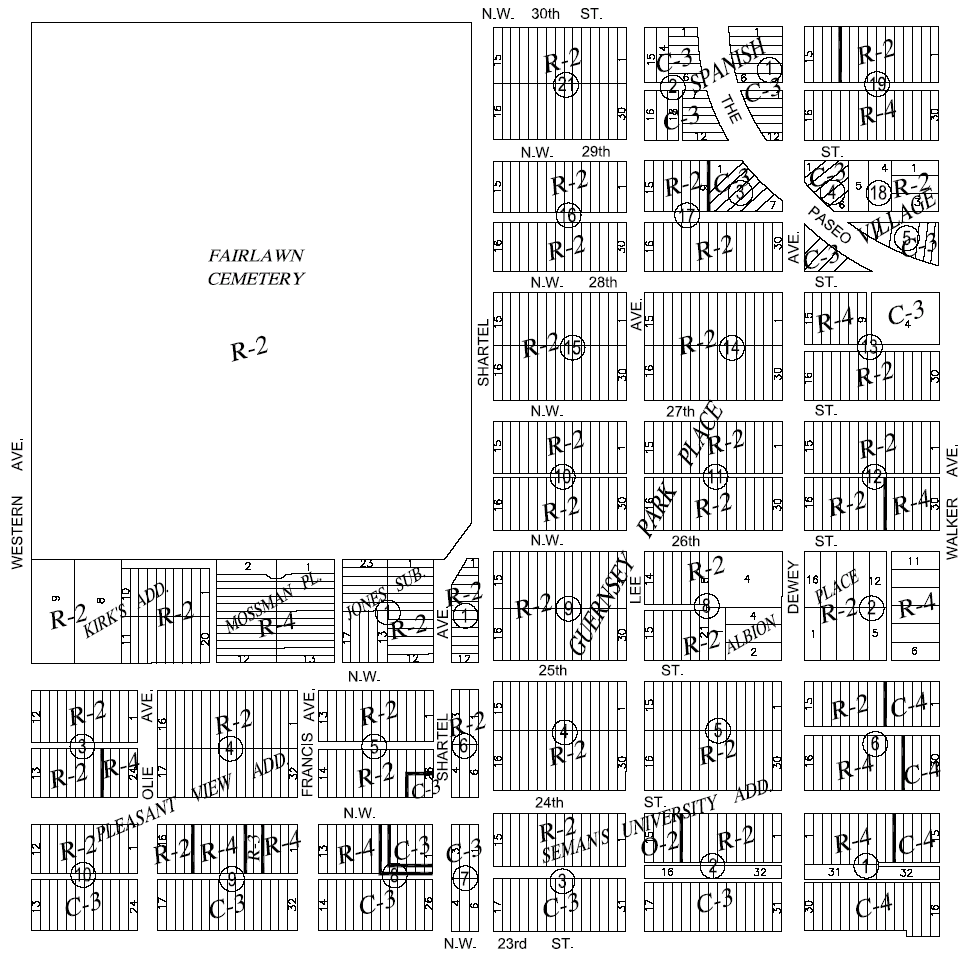
(2)
Parcels of land in Sub-Tracts 4A, 4B, 4C, 4D, 4E and 4F, may be developed in accordance with the use and development regulations of Sub-Tract 4G if:
(a)
A site plan is prepared clearly demonstrating compliance with the following, and development and use of the site is in accordance with the site plan:
1.
The orientation of the building is towards Walker Avenue or Northwest 23rd Street.
2.
No more than 50 percent of the front yard area for any site abutting Walker Avenue is paved for parking.
3.
The lot width of any parcel abutting Walker Avenue or Northwest 24th is at least 120 feet. Additionally, there is only one driveway intersection with Walker Avenue for the parcels abutting Walker. There shall be no driveway intersection with Northwest 24th.
4.
Parking lots abutting Northwest 24th Street shall have berms, shrubs or a brick wall at least two feet in height along the Northwest 24th Street abutment.
5.
No access is taken from Northwest 24th Street.
(b)
The site plan is submitted to the Director for review and the plan is approved.
(c)
The use and development of the parcel are in accordance with the site plan.
C.
Use Regulations for NC Tract 4G.
(1)
Uses permitted in NC Tract 4G can be found in Table 7300.1.
(2)
All permitted uses shall take place within a completely enclosed building.
D.
Development Regulations for NC Tract 4G. Bulk standards for NC Tract 4G can be found in Table 7300.2.
7300.8 Neighborhood Conservation District Tract 5 Regulations. In case of a conflict, the regulations established in Section 59-7300 of this article, which are applicable to Tract 5, would supersede those regulations established in Section 59-13700 Urban Design District.
A.
Use Regulations.
(1)
Permitted Uses. Uses permitted in NC Tract 5 can be found in Table 7300.1.
(2)
All permitted uses shall take place within a completely enclosed building, except for the following:
(a)
Outdoor Sellers, as defined in Chapter 39, Article III, of this Code, shall be subject to the following regulations:
1.
All outdoor sellers shall comply with regulations for outdoor sellers as set forth in Chapter 39, Article III, of this Code, entitled "Outdoor Sellers."
2.
No outdoor seller may operate in one location for more than 14 consecutive days.
(b)
Outdoor art festivals and cultural events utilizing the public streets, public ways, other public grounds, shall be subject to the following regulations:
1.
The sponsor of an art festival or event utilizing the public streets, public ways, or other public grounds shall first obtain a revocable permit from the City Council for such purpose.
2.
All other necessary permits required by the City or the State of Oklahoma shall be obtained for a festival or event utilizing the public streets, public ways, or other public grounds pursuant to a revocable permit from the City Council; provided, no outdoor sellers permits shall be required for areas located within the public streets, public ways, or other public grounds encompassed by the revocable permit.
3.
Participants in the festival or event shall comply with all applicable provisions of this Code designed for protection of the public health and safety.
4.
No outdoor seller, exhibit, display, or other structure shall set up or occupy any portion of the public streets, public ways, or other public grounds subject to the revocable permit except with the written permission of either (1) the sponsor of the festival or event to whom the revocable permit was granted or (2) the landowner abutting the portion of a street, way, and ground where the set up or occupation will occur and then (3) only in full compliance with the provisions of the revocable permit.
5.
Exhibits, displays, and structures erected on any portion of the public streets, public ways, or other public grounds subject to the revocable permit shall be temporary and shall be removed by 12:00 pm the day following the close of the festival or event.
6.
Such festivals or events shall be exempt from the development and sign regulations specified in this section.
7.
The time period for a festival or event shall not exceed seven consecutive days, with the specific time period for the festival or event to be specified in the revocable permit.
(c)
Automobile Service Stations.
B.
Development Regulations.
(1)
Bulk Standards. Bulk standards for NC Tract 5 can be found in Table 7300.2
(2)
Design Review by the Urban Design Commission.
(a)
Justification. Because of its historic role as one of the City's earliest commercial districts, and because its architectural type and elements represent a style unique to the past, a design review process is established to aid in the preservation of NC Tract 5.
(b)
Requirement for Certificate of Approval. A Certificate of Approval shall be required in the following instances before the commencement of work upon any structure or site within NC Tract 5:
1.
Permit Required. Whenever such work requires a revocable permit or building permit for changes to the building exterior, or a sidewalk, driveway or fence permit issued by the City.
2.
Changing Building Exterior. Whenever such work includes the erection, moving, demolition, reconstruction, restoration or alteration of the exterior of any building.
3.
Painting Unpainted Brick or Masonry. Whenever such work includes the application of paint to a previously unpainted brick or masonry exterior surface of a building.
4.
Changing Building Material. Whenever such work includes the changing of the material on the exterior surface of a building.
5.
Attaching Mechanical or Electrical Equipment. Whenever such work includes the attachment of any type of mechanical or electrical equipment to the exterior surface of a building's front façade.
6.
Changing Awning or Canopy. Whenever such work involves the addition or alteration of an awning or canopy.
7.
Murals. Whenever such work involves the creation or alteration of a mural on the exterior surface of a building.
(c)
Certificate of Approval to be Issued by Urban Design Commission prior to Issuance of Permits.
1.
Permit Review. No building, fence, sidewalk, driveway or demolition permit shall be issued by the Director for any structure or site located, wholly or partially, within NC Tract 5 until an application for a Certificate of Approval has been reviewed by the Urban Design Commission and has been granted.
2.
Appeal. Any person aggrieved by a decision of the Urban Design Commission may appeal such decision to the Board of Adjustment. The appeal shall be filed in accordance with the provisions of Section 59-4250.10 (Appeals).
(d)
Design Guidelines for NC Tract 5. The Urban Design Commission shall use the following guidelines in their review of applications for Certificates of Approval for NC Tract 5. All work proposed within the district shall also be reviewed using the guidelines referenced in 13700.8, Legacy Resources.
1.
General Characteristics. This district lines a curvilinear street. The Spanish Revival Style is apparent, with use of tile roofs and stucco façades. Suggestions of Spanish adobe-type buildings also exist in stucco, with simple lines and parapet roofs. Some of the newer buildings do not follow either of the architectural styles. Remodeling of a few of the older buildings has hidden major elements of the original architectural style. The buildings are no more than two stories in height. Uniform building setback contributes to visual continuity of the district. Most of the parking is either on the street or in the rear of the structures.
2.
Rehabilitation/Remodeling Buildings in the Spanish Revival Style.
a.
Retain façades.
b.
Retain existing windows.
c.
Retain tile roofs.
d.
Retain architectural features, such as enriched cornice window heads and enriched corbels.
3.
Rehabilitation/Remodeling All Other Buildings.
a.
All remodeling or rehabilitation of exteriors shall ensure the integrity of the building, but should not conflict with the overall architectural character of the district.
b.
Spanish Revival façades that have been hidden since original construction shall be restored if a building permit is required for any façade rehabilitation work.
c.
Accessory buildings shall incorporate at least one of the architectural elements of the other buildings on The Paseo street, such as parapets, clay tile roof, stucco façade.
4.
New Construction.
a.
Building designs shall incorporate some of the major elements of the Spanish Revival Style or architecture. Stucco buildings with clay tile and/or parapet roof treatments are encouraged.
b.
The demolition of existing Spanish Revival buildings, or elements thereof, is discouraged.
c.
New construction should maintain setbacks consistent with existing buildings to retain the visual continuity of the district.
5.
Amenities. Amenities shall be coordinated in terms of style and color.
a.
Poles should match the color of other poles located within the same block.
b.
Amenities should be installed so that the bottom edge of any suspended component is at least eight feet above the sidewalk.
c.
Where parking is provided along the abutting curb, landscaping and amenities should be spaced so that they do not impede passengers from exiting parked vehicles. At locations of angled parking, landscaping and amenities should be located so that they do not impede vehicle overhangs.
6.
Awnings and Canopies. The style and color of awnings and canopies shall be coordinated with the architectural style and character of the area.
7.
Sidewalks. All segments of sidewalks shall be repaired with the same materials and in the same style as adjacent segments of sidewalk.
8.
Mechanical and Electrical Equipment and Satellite Dishes. Mechanical and electrical equipment and satellite dishes on roofs shall be hidden from street level.
(3)
Building Materials.
(a)
Roofing with Clay Tiles. Clay tile roofs on existing buildings shall be retained.
(b)
Stucco for Building Exterior. Stucco on the exterior of the walls of existing buildings shall be retained.
(c)
Light reflective or tinted-glass windows. Light reflective or tinted-glass windows for buildings shall not be allowed.
(d)
Cloth Awnings. Awnings shall be made of cloth.
(4)
Parking Lot Screening.
(a)
A stucco wall, shrubbery or landscaped earthen berm at least two feet and no more than three feet in height, shall be placed around all sides of the parking lots abutting a street.
(b)
Stucco walls or earthen berms shall not be placed on the right-of-way.
(c)
Proper sight triangles shall be maintained on all street and driveway intersections, in accordance with this chapter.
(5)
Dumpster Locations. On a lot abutting The Paseo street, dumpsters shall be located behind the primary building on the lot and shall be at least 25 feet from a property line adjacent to any property zoned for residential development.
(6)
Signs.
(a)
Allowed Signs for Buildings.
1.
Window, Awning or Attached Signs. Window, awnings or attached signs are permitted.
a.
Number. Only one sign shall be allowed per building, per street frontage. However, if a building houses multiple tenants, and if one or more of the tenants occupies a section of the building with distinct and direct access from the exterior of the building, then one sign shall be allowed for each access way, but no tenant shall have advertising on more than one sign.
b.
Maximum Display Surface for Each Sign.
Window Signs: Twenty-five (25) percent of the window area
Awning Signs: Twelve (12) square feet
Attached Signs: Ten (10) percent of the area of the wall of the building to which the sign is attached to.
2.
"Open" and "Closed" Signs Inside Buildings. Signs with the message "open" or "closed" are allowed in addition to a window or awning sign provided said signs shall be no larger than four square feet.
(b)
Allowed Signs for Parking Lots. One freestanding sign for a parking lot is allowed so long as the maximum display surface is 20 square feet and the maximum height is six feet above the grade level of the ground surface adjacent to the structural support.
(c)
Prohibited Signs.
(1)
Flashing signs. Flashing signs are prohibited.
(2)
Neon signs. Neon signs, larger than four square feet or located on the exterior of the building are prohibited.
(3)
Fluorescent luminaries with plastic faces.
(7)
Murals. Murals (Use Unit 8250.16) are regulated under Chapter 59, Article XVI of this chapter. Murals require the approval of both the Arts Commission, or Arts Commission staff, as applicable, and Urban Design Commission, or Urban Design Commission staff, as applicable.
(8)
Banners. Banners may be placed on public light posts on Paseo Street. The placement of the banners shall be in accordance with Chapter 59, Section 16113.B.
C.
Reserved.
D.
Reserved.
E.
Reserved.
F.
Reserved.
G.
Maintenance.
(1)
All buildings shall be maintained in accordance with City codes.
(2)
All unused brackets and other types of hardware and appurtenances shall be removed from the exterior of buildings.
(3)
All segments of sidewalks shall be repaired with the same materials and in the same style as adjacent segments of sidewalk.
FOOTNOTES: TABLE 7300.1
1 Pawnshops are not permitted. In addition, convenience stores are not permitted; these are small grocery stores serving a market area larger than the immediate neighborhood, normally generating a high level of quick turnover traffic and open after 10:00 p.m. in the evening.
2 The owner/operator of any property who wishes to serve or sell alcoholic beverages, as defined by State law and subject to State licensing requirements, for on-premises consumption as an accessory function of the primary use of the property, shall meet the conditions below. If the conditions cannot be met, then said property owner/operator may apply for a Special Permit. The facility in which the alcoholic beverages are served or sold must comply with the City's building code requirements.
• If food or beverages are consumed in an outdoor seating/activity area between the hours of 11:00 p.m. and 8:00 a.m., the outdoor seating/activity area shall be separated by a distance of at least 100 feet from the nearest abutting property line of a residential use. Distances shall be measured from the closest edge of the outdoor seating/activity area to the nearest abutting property line of the residential use.
• The area allocated to the sale and consumption of alcoholic beverages shall not exceed 15,000 square feet.
3 Any Planned Unit Development or Simplified Planned Unit Development adopted prior to the effective date of this ordinance that permitted the 8300.37 Eating Establishment: Sitdown, Alcohol Not Permitted use unit shall be permitted to develop according to the 8300.38 Eating Establishment: Sitdown, Alcohol Permitted or 8300.39 Eating Establishment: Sitdown, Limited Alcohol Permitted uses provided they meet the applicable conditions, unless the PUD/SPUD specifically prohibited said uses.
FOOTNOTES: TABLE 7300.2
1 In the NC Tract 5, along the Paseo Street from the south side of Northwest 30th to the half block north of Northwest 28th, there shall be no required yard setback from the right-of-way line at the Paseo Street.
2 A 20-foot front yard shall be permitted in new residential areas where there is no existing platted 25-foot building line, or where there is no greater setback established by existing construction in the same block frontage. In a residential development where lots are platted with a 25-foot front yard setback, the front yard of a corner lot may be platted with a reduced depth of 20 feet.
(Ord. No. 23993, §§ 1, 2, 12-8-09; Ord. No. 24009, § 5, 2-2-10; Ord. No. 24128, § 3, 8-31-10; Ord. No. 24660, § 1, 4-30-13; Ord. No. 24726, § 4, 8-13-13; Ord. No. 25972, § 4, 7-31-18; Ord. No. 26081, § 3, 1-15-19; Ord. No. 26085, § 2, 2-12-19; Ord. No. 26280, § 1, 10-22-19; Ord. No. 27526, § 4, 2-13-24, eff. 3-15-24; Ord. No. 27743, § 3, 12-17-24; Ord. No. 27847, § 3, 5-20-25)
§ 59-7350. - Stockyards City Development District.
7350.1. General Description. The Stockyards City Development District (SYD District) is a mixed-use commercial district intended for the conduct of commercial, office and limited industrial uses, while conserving the exterior architectural quality of an area of historic significance. The business activity is of a retail and commercial service nature that serves a larger trade area than the immediate surrounding residential neighborhoods.
7350.2. Certificate of Approval Required. A Certificate of Approval (CA) shall be required prior to the commencement of any development, redevelopment or expansion within the Stockyards City Development District as follows:
A.
The Urban Design Commission shall review and issue Certificate of Approval for the following, unless administrative approval is permitted, as referenced in this section:
(1)
New construction, expansion, or modification to the exterior of existing structures and associated sites.
(2)
Signage, including:
(a)
Any Electronic Message Display (EMD) sign greater than 25 square feet in area.
(3)
Demolition of a structure, except structures declared dilapidated and approved for demolition by City Council.
(4)
Public or private streetscape improvements.
B.
Staff may review and issue Certificates of Approval for the following:
(1)
Exterior modifications or expansions impacting less than 20 percent of a site or structure.
(2)
Revisions to submittals previously approved by the Stockyards City Urban Design Committee or Urban Design Commission in which the changes impact less than 20 percent of the project.
(3)
Minor public and private improvements including but not limited to sidewalks, kiosks, landscaping, bus stop shelters, benches, ornamental lighting, and small wireless facilities, as defined by State law.
A Certificate of Approval shall be required for the replacement of public and private improvements.
(4)
Parking and expansions to existing parking lots not exceeding a total of 50 spaces.
(5)
Signage, including:
(a)
Any Electronic Message Display (EMD) sign 25 square feet or less;
(b)
All other signage less than 100 square feet, and
(c)
Any Projection Image Sign.
(6)
Accessory structures such as garages, storage buildings and mechanical equipment.
(7)
Awnings, canopies, and lighting.
(8)
Fencing.
(9)
Screening of mechanical equipment and waste receptacle enclosures.
(10)
Submittals for extensions to unexpired Certificates of Approval.
(11)
Murals (Use Unit Classification 8250.16).
C.
Staff may forward administrative cases to the Commission for consideration as deemed necessary.
D.
A Certificate of Approval shall not be required for Ordinary Maintenance and Repair that involves no change in materials, dimensions, design, configuration, texture, surface coating, or visual appearance for work meant to remedy damage or deterioration of site elements, structures, or their appurtenances.
A Certificate of Approval shall not be required for the installation of additional equipment on existing poles if the equipment is at least eight feet above the sidewalk.
E.
Staff may approve minor revisions and adjustments to an active Certificate of Approval without additional fee provided the following conditions are satisfied:
(1)
No more than five percent of the site or building is modified from the original Certificate of Approval;
(2)
Revisions do not significantly alter the work previously approved;
(3)
Revisions are in conformance with regulations and meet the intent of the guidelines; and
(4)
Revisions are consistent with any conditions associated with the original Certificate of Approval.
7350.3. Use Regulations.
A.
Uses permitted in the SYD District can be found in Table 7350.1.
B.
The district shall be considered a commercial zoning district for the purposes of allowing ABC Overlay Districts.
C.
Condition for Approval of Bingo Parlors (59-8300.22)
On-site parking shall be provided in the amount of one parking space per 50 square feet of gross floor area.
7350.4. Development Regulations.
A.
Bulk Standards.
(1)
Maximum building height in the SYD District shall be 45 feet.
(2)
Front, rear and side yards shall be as specified by an approved Certificate of Approval.
B.
Off-Street Parking. No off-street parking is required, unless required for conditional uses.
C.
Parking Lot Landscaping.
(1)
Parking lots shall be landscaped in accordance with either Paragraphs (a) or (b) below:
(a)
In accordance with Article XI, Landscaping and Screening Regulations.
(b)
In accordance with a Certificate of Approval issued by the Urban Design Commission. Such landscaping shall consist of a wall or fence not to exceed three feet in height and/or trees, shrubs or other vegetation, or some combination thereof, approved by the Urban Design Commission. The design of the required landscaping shall address traffic circulation, the visual impact of the vehicles, building setback along the block, and personal security of the patrons.
(2)
The painting of previously unpainted brick, stone or cast stone on the exterior of any structure shall be prohibited, unless approved by the Urban Design Commission.
(3)
Opaque materials shall not be used for bars covering windows or doors.
D.
The painting of previously unpainted brick, stone or cast stone on the exterior of any structure shall be prohibited, unless approved by the Urban Design Commission.
E.
Opaque materials shall not be used for security bars covering windows or doors.
7350.5. Accessory Uses. The following are permitted subject to the regulations in Section 59-12200 (Standards for Accessory Buildings, Structures and Uses) of this chapter:
A.
General accessory structures.
(1)
Accessory uses with specific regulations:.
(a)
Fence. Stockade fencing, chain-link fencing with materials inserted/woven between the fence material that is not see-through, and sight-proof metal fencing are not permitted.
(b)
Signs within this design district shall be subject to Chapter 59, Article XVI unless modified within this chapter.
1.
Freestanding signs and Temporary Signs - Large Display Banners and Supergraphics, are not permitted.
2.
Wind signs shall be permitted only as temporary signs for up to six weeks per year as a part of a special promotion or in celebration of holidays. A wind sign shall mean one or more banners, flags, pennants, ribbons, spinners, streamers or captive balloons, or other objects or material fastened in such a manner so as to move upon being subjected to pressure by wind or breeze. This section shall not apply to City approved public information banners on street light standards in the public right-of-way.
3.
The maximum display surface area for attached signage shall be no more than ten percent of the area of the wall of the building to which the sign is attached. Any sign displayed in a window shall be considered an attached sign and shall be calculated as part of the maximum display surface area of the building.
4.
A-frame, sandwich and springer signs shall not require a Certificate of Approval and shall be subject to the following conditions:
i.
The display area of each side shall not exceed eight square feet;
ii.
The height shall not extend more than four feet eight inches above grade;
iii.
A minimum of eight feet of right-of-way shall exist from back of curb to building face when located in the right-of-way;
iv.
A five-foot minimum unobstructed walkway shall be maintained at all times within the sidewalk zone;
v.
Signs shall be weighted to ensure that they are not readily displaced;
vi.
Signs shall be in place only during any period between dawn and dusk;
vii.
Sign frames shall be constructed of hard plastic or metal;
viii.
Sign faces shall be chalk board or printed material;
ix.
Quantity of signs shall be limited to one sign per street level tenant at building frontage;
x.
Signs shall only be located over paved surfaces;
xi.
Signs shall be located so that adequate vehicle sightlines are maintained;
xii.
Signs shall be located in a manner that does not obstruct pedestrian patterns or accessible routes;
xiii.
Revocable permits shall be required if located in the street right-of-way; and
xiv.
Signs shall be designed such that they typically remain stationary and are not in motion. Signs shall be removed from display when the face swings more than 20 degrees from vertical.
5.
Projection Image Signs.
i.
Signs larger than eight square feet shall be limited to one week in duration per location per 30-day period when displayed on surfaces other than sidewalk;
ii.
Signs shall not be projected within 200 feet of, or onto, a residential use (excluding Use Classifications 59-8200.2 and 59-8200.4) unless the location and orientation of the projected graphics ensures that light from the images will not infringe on the residential use; and
iii.
Signs shall not be projected onto the surface of the public street.
(c)
Temporary displays. No outside storage of equipment or materials is permitted except as follows:
1.
Special sales merchandise may be temporarily displayed outdoors for up to four times per year and for no longer than seven consecutive calendar days.
2.
Temporary special merchant promotions, authorized by City regulations, may display on the public sidewalk for up to four times per year and for no longer than seven consecutive calendar days.
7350.6. Design Review Process. The design review process for the SYD District can be found in Section 59-4250.5 (Urban Design Review).
7350.7. Design Guidelines for Certificates of Approval in the Stockyards City Development District. The following design guidelines are advisory and serve as a reference for all parties involved in the design review process. They do not constitute regulations. The Urban Design Commission shall be guided by these guidelines in reviewing applications for Certificates of Approval:
A.
The setbacks for new buildings and additions to buildings shall be consistent with the setbacks of existing buildings in the same block.
B.
New and renovated façades shall be of red or buff brick, or a material of similar appearance.
C.
Buildings shall have the appearance of a flat roof from the ground.
D.
Where it is practically feasible, original window and door openings that have been blocked in should be reestablished during renovations on a story-by-story basis for those stories included within a building permit application. New windows and doors shall not be blocked in.
E.
Brick façades should not be covered with paint or stucco or other similar covering, unless it is required to maintain the structural integrity of the bricks.
F.
The removal of paint from a façade should utilize a method which is known not to damage masonry. The use of mechanical equipment; high-pressure abrasive cleaning methods, including, but not limited to, blasting with soda, peanut or walnut shells, sand, or water; or acidic chemical cleaners for the removal of paint from masonry is discouraged. Paint removal from masonry should use alkaline or organic based chemical strippers. Low-pressure abrasive cleaning methods may be appropriate.
G.
Building façades should be designed or renovated in a manner that is compatible with the architectural style prevalent in the district. That style, sometimes called "Plains Commercial," is of commercial buildings of red or buff brick, with parapets, and characterized by human scale.
H.
Historic building ornamentation should not be removed or covered, unless it is necessary to insure the structural integrity of the building.
I.
Demolition.
(1)
Purpose and Intent. The demolition or removal of a historic structure constitutes an irreplaceable loss to the quality and character of the Stockyards City Development District. A building on the National Register of Historic Places, or which has an official Determination of Eligibility from the National Park Service for the National Register, or which is an Architectural Resource or an Historic Resource should not be demolished.
(2)
Guidelines for Demolition. In considering a Certificate of Approval for the demolition or removal of a structure, the Urban Design Commission may approve the application for demolition if it finds any of the following:
(a)
The structure is noncontributing to the historic district and the demolition will not adversely affect the historic character of the property or district.
1.
Staff shall make a recommendation regarding whether the structure is a Historic Resource or Architectural Resource, using information that may include, but not be limited to, the following.
i.
Research, investigations, and historical or architectural surveys;
ii.
Archival information from newspapers and libraries, which may include photographs, a review of Sanborn Fire Insurance Maps, and historic city directories such as Polk or Criss-Cross; or
iii.
Documentation verifying that the structure is listed in the National Register of Historic Places or has an official Determination of Eligibility from the National Park Service for the National Register.
2.
Burden of Proof. In support of the application, the applicant may (but is not required to) submit information as described in this Section regarding whether the structure is a Historic Resource or Architectural Resource.
(b)
The structure, which has not otherwise been declared a public nuisance by the City Council, poses an imminent threat to public health or safety and the demolition of said structure is required to alleviate said threat.
1.
Burden of Proof. In support of the application, the applicant may (but is not required to) submit:
i.
A signed, stamped analysis from a licensed professional engineer describing any structural deficiencies in the building or structure proposed for demolition.
ii.
The scope of work that would be necessary to repair or remedy such deficiencies.
J.
Signage.
(1)
Intent. Signage is an essential element used to convey a sense of the excitement and public vitality of the district. It should, however, balance the need to promote events with the objective of minimizing visual clutter and enhancing the quality and character of the district. While it is appropriate for signage in the district to address vehicular orientation, it should also respect the pedestrian experience. Those signs scaled to attract the attention of motorists should be orientated towards highways and/or major vehicular corridors approaching the district core.
(2)
Character. All signs should be:
(a)
Compatible with and contribute to the character of the surrounding uses, adjacent architecture, and the district;
(b)
Compatible with and not diminish the architectural characteristics of the buildings on which they appear; and
(c)
Appropriate to and expressive of the business, use, and/or activity for which they are displayed.
(3)
Materials.
(a)
Signs should be constructed of high quality, durable materials appropriate to the physical demands of the setting;
(b)
Signs other than freestanding signs should attach to the structure in such as way as to avoid permanent damage to the structure to which affixed;
(c)
Attached signs, including projecting blade signs, should be mounted using materials designed as a decorative or complementary element of the sign; and
(d)
Freestanding signs should be compatible with the materials of the primary structure.
(4)
Illumination. Interior and Exterior Illuminated signs should:
(a)
Be shielded to minimize glare;
(b)
Have electrical power components concealed as much as possible; and
(c)
Provide a level of light intensity appropriate to the specific location and adjacent uses.
(5)
Design. All signs should be designed:
(a)
To be visually engaging to pedestrian and indicative of the product/location being advertised;
(b)
To be in proportion and scale with the building;
(c)
To be compatible with the building's materials; and
(d)
To have human scale where the entire sign is located entirely within the pedestrian viewscape of 14 feet or less above grade.
K.
Pedestrian Circulation and Amenities. Streetscapes are established within the SYD District to create an attractive and animated sidewalk environment and to foster safe and efficient pedestrian movement.
1.
A safe and accessible pedestrian route should be provided to establish direct visual and physical access between all abutting street frontages and the primary entrance(s) to each building.
2.
Landscaping and pedestrian amenities. Landscaping and pedestrian amenities may include but are not limited to planting strips, raised planters, decorative planter boxes, potted plants, street trees, light standards, small wireless facilities, signage, transit stops, public art, bike racks, security bollards, seating for outdoor dining, benches, and trash receptacles. The placement and design of such elements should observe the following guidelines:
(a)
Groundcover landscaping may be planted up to the back of the curb.
(b)
Landscaping and pedestrian amenities should not obstruct any sidewalk or pedestrian access.
(c)
Street trees should be placed a minimum of 18 inches from the back of the curb.
(d)
Street tree species are a component of Stockyards City Development District design review and all tree species should be selected to:
1.
Be adaptable to the conditions of a dense urban environment;
2.
Be consistent with the species, spacing, and size recommendations set forth in the Street Tree palette in "Trees and Plants for Oklahoma City", and any amendments thereto, maintained online or in the Office of the City Clerk; and
3.
Trees in wells or raised planters should be planted in a minimum volume of soil or structural soil of five feet by five feet by three and one-half feet deep. All tree wells should be covered by tree grates or topped with brick or stone or maintained with landscape treatments.
(e)
Where parking is provided along the abutting curb, landscaping and amenities should be spaced so that they do not impede passengers from exiting parked vehicles. At locations of angled parking, landscaping and amenities should be located so that they do not impede vehicle overhangs.
(f)
Amenities should match the material, finish, and color of other amenities located within the same block.
(g)
Poles should match the color of other poles located within the same block.
(h)
Amenities should be installed so that the bottom edge of any suspended component is at least eight feet above the sidewalk.
(Ord. No. 24009, § 5, 2-2-10; Ord. No. 24128, § 3, 8-31-10; Ord. No. 24291, § 3, 6-21-11; Ord. No. 25264, § 6, 10-27-15; Ord. No. 26280, § 1, 10-22-19; Ord. No. 27526, § 4, 2-13-24, eff. 3-15-24; Ord. No. 27649, § 3, 7-30-24; Ord. No. 27658, § 4, 7-30-24)
§ 59-7400. - Oklahoma Capitol-medical center improvement district.
7400.1 General Description and Recognition of District. The City of Oklahoma City hereby recognizes the Oklahoma Capitol-Medical Center Improvement District, as described at Oklahoma Statutes, title 73, section 83.
7400.2 Zoning Regulations Adopted. For the purposes of enforcing those zoning regulations adopted by the Capitol-Medical Center Improvement and Zoning Commission and as authorized by Oklahoma Statutes, title 73, section 83.3(b), the Zoning Regulations for Capitol-Medical Center Improvement and Zoning District are duly adopted by the City Council of the City of Oklahoma City, three copies of which have been and now are filed in the office of the City Clerk, and same is hereby adopted and incorporated and considered as a part of this Code.
7400.3 Summary of Regulations. Pursuant to the authority granted by Section 26, Article II of the Charter of The City of Oklahoma City, the title and brief gist or summary of the provisions of the Zoning Regulations for Capitol-Medical Center Improvement and Zoning District are hereby ordered published in conformance with the provisions of said Section 26, Article II of the Charter, and for the purpose of such publication a summary of the provisions of said Code is hereby given as follows:
Table Inset:
7400.4 Penalty. Any person violating any provision of the Zoning Regulations for Capitol-Medical Center Improvement and Zoning District shall, upon conviction, be guilty of a Class "a" offense. Any person convicted of such violation shall be punished by a fine in a sum not to exceed $75.00 inclusive of costs. Each violation shall constitute a separate and distinct offense. The City shall receive $1.00 as costs and one-half of the fine. The remaining one-half of the fine shall be paid to the State Treasurer in accordance with Oklahoma Statutes, title 73, section 83.14(A).
(Ord. No. 25460, § 1, 10-11-16)

