
Ottumwa City Zoning Code
ARTICLE XXXI
SIGNS
Sec. 38-962.- Purpose.
The purpose of this article is to promote the growth of the city in an orderly, efficient, and attractive manner and to provide minimum standards to safeguard life, health, property, and public welfare by regulating and controlling the design, quality of materials, construction, illumination, location, and maintenance of all signs and sign structures.
(Code 1970, § 38-176; Ord. No. 3088, § 2(exh. A), 12-1-2015)
Sec. 38-963. - Definitions.
The following words, terms and phrases, when used in this article, shall have the meanings ascribed to them in this section, except where the context clearly indicates a different meaning:
Abandoned sign means a sign which is damaged, in disrepair, or vandalized and not repaired within 60 days of the date of the damaging event.
Animation means the movement or the optical illusion of movement of any part of the sign structure, design, or pictorial segment, including the movement of any illumination or the flashing or varying of light intensity, the automatic changing of all or any part of the facing of a sign, and the movement of a sign set in motion by the atmosphere. Time and temperature devices and banners and flags shall be exempted from this definition.
Attached sign means any sign-attached parallel to any face of a building or to any face of a canopy. Attached sign includes the term "building sign."
Automated teller machine directional sign means a traffic directional sign which is used to direct pedestrian or vehicular traffic on a parcel to the location of an automated teller machine.
Automated teller machine sign means any sign located on or architecturally associated with the exterior face of an automated teller machine.
Awning sign means a sign painted, stamped, perforated, stitched, or otherwise applied on the awning.
Backlighted sign means any sign which is attached to the face of a building, canopy or wall and which is lighted by means of an external source illuminating the building, canopy face or wall containing the sign.
Banner means a fabric sheet of rectangular shape which is attached or suspended at two ends or continuously across the long side. Attachment or suspension may be from buildings and/or poles.
Banner, decorative, means a banner which contains no text.
Banner, public information, means a banner which displays graphics and limited text regarding a special event.
Building frontage means those building elevations which face upon a public street or parking area between such building and said street where access to the building is provided from said frontage. If a building is curved or triangular, the building frontage shall be the shortest distance between the points on the outside extremity of the building elevation measured parallel to the public street or parking area upon which said building fronts.
Building sign means any sign attached parallel to any exterior wall face of a building.
Billboard means any outdoor off-premises sign that identifies or communicates a commercial or noncommercial message related to an activity conducted, a service rendered, or a commodity sold at a location, other than where the sign is located.
Bulletin board sign means a sign used to post or display announcements.
Canopy means, with reference to structures, a roof like cover, including an awning that projects from the wall of a building over a door, entrance, or window, or a freestanding or projecting cover above an outdoor service area, such as a gasoline service station. A marquee is not a canopy.
Construction sign means a temporary sign erected on the premises on which construction is taking place, during the period of such construction, indicating the names of the architects, engineers, landscape architects, contractors, or similar artisans, and the owners, financial supporters, sponsors, and similar individuals or firms having a role or interest with respect to the structure or project.
Directional sign means a sign limited to directional messages, principally for pedestrian or vehicular traffic, such as "one-way," "entrance," and "exit."
Double-faced sign means an outdoor advertising sign where both sign faces are parallel and the faces are not more than 24 inches apart in the case of freestanding signs.
Facade. See Wall sign.
Face means the area or display surface used for the message.
Flashing sign means any sign, which by method or manner of illumination, flashes on or off, winks, or blinks with varying light intensity, shows motion, or creates the illusion of motion or revolves in a manner to create the illusion of being on or off.
Freestanding sign means a sign permanently supported by one or more uprights, braces, poles or other similar structural components when utilizing earth, rock, the ground, or any foundation set in the ground as a primary holding base and not attached to or enclosed by any building.
Governmental sign means a sign erected and maintained pursuant to and in discharge of any governmental functions, or required by law, ordinance, or other governmental regulation.
Ground sign means a detached on-premises sign built on a freestanding frame, mast, or pole with a clearance no greater than three feet.
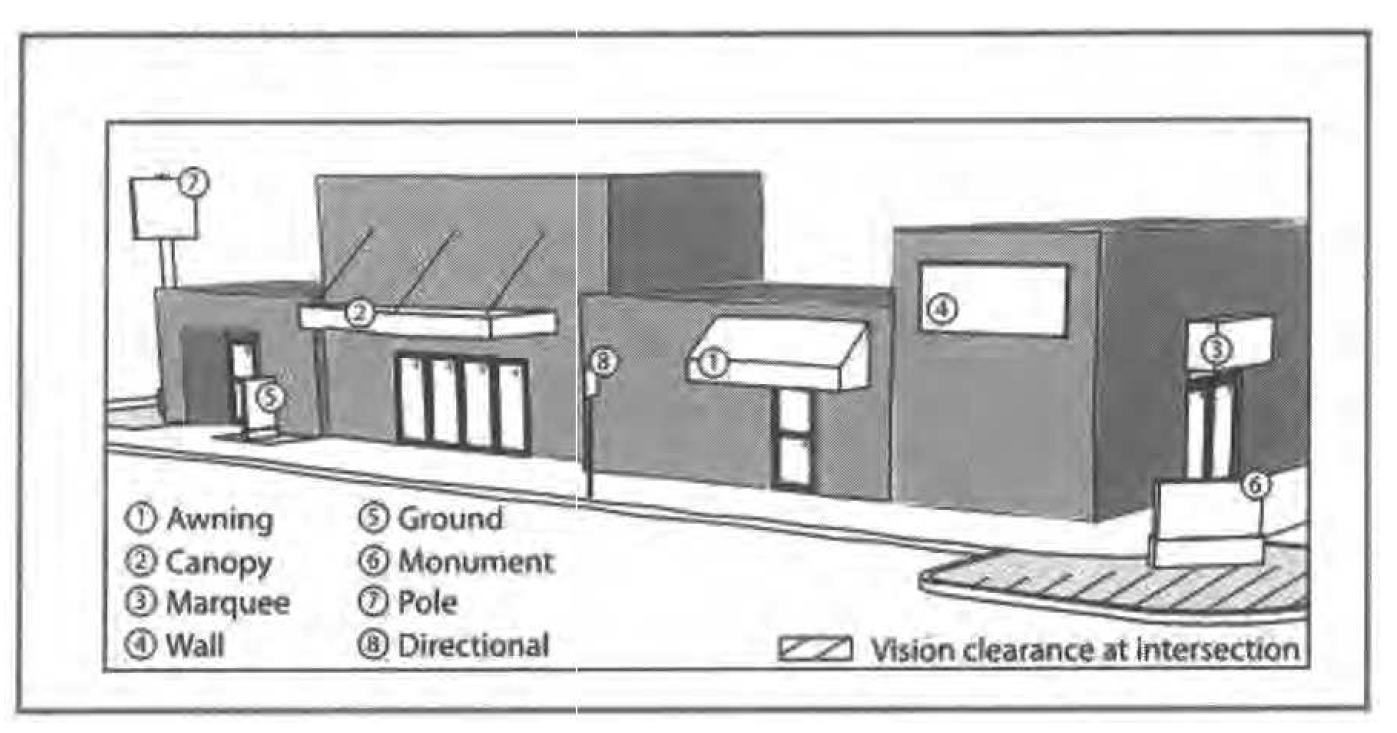
Height of a sign means the distance from the lowest horizontal surface grade immediately within five feet of the base of the sign to the top of its highest element, including any structural element.
Illuminated sign means a sign illuminated in any manner by an artificial source.
Illuminated sign, direct means a sign with illumination which is arranged so that the light is directed into the eyes of the viewer from the light source.
Illuminated sign, indirect means a sign with illumination arranged so that the light is reflected from the sign to the eyes of the viewer.
Marquee means a permanent roof-like structure extending from part of the wall of a building but not supported by the ground and constructed of a durable material such as metal or glass.
Monument sign means a sign placed upon a foundation, or a slab, or placed upon or attached to an ornamental wall and not supported by uprights, braces, poles, or other similar structural components.
Municipal recognition sign means a sign that welcomes approaching travelers to a community, county, or school district, or display a similar public-spirited message. Municipal recognition signs may include church or service club signs when erected on a common structure.
Nonconforming sign means a sign which had been issued a valid permit at the time it was erected but is not in accord with, or compliance with, the requirements of this article and was made nonconforming by annexation, rezoning, or ordinance amendment.
Off-premises sign means a sign which displays general advertising about products or services available at location other than at the sign site.
On-premises sign means a sign which advertises the principal product sold or activity conducted on the property where the sign is located. They may concern the sale or lease of the property on which the sign is located.
Outdoor advertising sign means any sign painted on or affixed to any structure, or erected as a freestanding sign, which advertises a person, product, or service not located on the same parcel of record as the sign. This definition shall also include such terms as "off-site sign."
Pole sign means an on-premises sign built on a freestanding frame, mast, or pole with a clearance greater than three feet.
Political sign means a temporary sign announcing or supporting political candidates or issues in connection with any national, state, or local election.
Portable, movable, or temporary sign means any sign for which a building permit has not been issued and which is not permanently affixed or erected in accordance with the provisions of the building regulations of the city, or any sign which is intended to be movable or capable of being moved from place to place, whether or not wheels or other special supports are provided.
Private sale or event sign means a temporary sign advertising private sales of personal property such as "house sales," "garage sales," "rummage sales," and the like, or private, not-for-profit events such as picnics, carnivals, bazaars, game nights, art fairs, craft shows, and Christmas tree sales.
Projecting sign means any sign, other than a wall sign, attached to, and projecting more than 12 inches from the wall or face of a building or structure. Arcade/marquee signs are included in this definition.
Public service sign means a sign directing the public to public service institutions such as hospitals, schools, public buildings or facilities, public transportation, neighborhood watch area, historic district, or central business district.
Real estate sign means a sign pertaining to the sale or lease of the premises, or a portion of the premises, on which the sign is located.
Roof sign means a sign that is mounted on the roof of a building or which is wholly dependent upon a building for support and which projects above the point of a building with a flat roof, the eave linen of a building with a gambrel, gable or hip roof, or the deck line of a building with a mansard roof.
Sales, lease, and rent signs means temporary signs which indicate that a premise, building, or vacant lot is currently for sale, lease, or rent.
Sandwich board sign means an advertising or business ground sign constructed in such a manner as to form an "A" or a tent-like shape, hinged or not hinged at the top, each angular face held at the appropriate distance by a supporting member.
Sign area means the entire face of a sign within a continuous perimeter, enclosing the extreme limits of sign display, but not including the supporting structure. Curved, spherical, or any other shaped sign face shall be computed on the basis of actual surface area. The copy of signs composed of individual letters, numerals, or other devices shall be the sum of the area of the smallest rectangle or other geometric figure encompassing each of said letter or devices. The calculation for a double-faced sign shall be the area of one face only. Double-faced signs shall be so constructed that the perimeter of both faces coincide and are parallel and not more than 24 inches apart.
Sign, construction, means a temporary sign erected on the premises on which construction is taking place, during the period of such construction, indicating the names of the architects, engineers, landscape architects, contractors, or similar artisans, and the owners, financial supporters, sponsors, and similar individuals or firms having a role or interest with respect to the structure or project.
Sign, facade. See Wall sign.
Sign, face, means the area or display surface used for the message.
Street frontage means the linear frontage of a parcel of property abutting a public street.
Special event means a promotional event such as, but not limited to, bazaars, street fairs, shows, exhibitions, sporting events, runs, bicycling events, and block parties. This does not include sidewalk sales occurring on private property where merchandise is normally sold indoors, and is transferred from indoors to outdoors for sale.
Temporary sign means a display, informational sign, banner, or other advertising device constructed of cloth, canvas, fabric, wood, plastic, vinyl, or other temporary material, with or without a structural frame, and intended for a limited period of display, including decorative displays for holidays or public demonstrations.
Wall sign means a sign fastened to or painted on the wall of a building or structure in such a manner that the wall becomes the supporting structure for, or forms the background surface of the sign, and which does not project more than 12 inches from such building or structure.
Window sign means any poster, cut-out letters, painted text or graphics, or other text or visual presentation affixed to or placed behind a window pane which is placed to be read from the exterior of a building.
(Code 1970, § 38-177; Ord. No. 3088, § 2(exh. A), 12-1-2015; Ord. No. 3189, § 1, 1-18-2022)
Sec. 38-964. - Permit requirements.
(a)
No sign shall be painted, placed, posted, printed, tacked, fastened, constructed, erected, maintained or otherwise permitted except as provided by this article.
(b)
No sign shall be erected, constructed, painted, or printed without a sign permit.
(c)
Permit—Required. It is unlawful for any person to erect, alter, or relocate or cause same to be done within the city any sign or other advertising structure as defined in this section, without first obtaining a sign permit and holding the city harmless from any liability incurred as a result of the installation of the sign or advertising structure. Illuminated signs shall be subject to the provisions of the electrical code and the permit fees required thereunder. A double permit fee may be assessed for noncompliance with this section.
(d)
Same—Application. Application for sign permit shall be obtained from the city's planning and development department.
(e)
Same—Fees. Every applicant, before being granted on sign permit, shall pay to the city the fee as established by resolution by the city council.
(f)
Exemptions.
(1)
The provisions and regulations of this section shall not apply to the following signs; provided, however, the signs shall be subject to the provisions provided by this article.
(2)
Permit exempt.
a.
Real estate signs which advertise the sale, rental, or lease of the premises upon which they are located; real estate signs not exceeding 12 square feet in area. Such signs shall be set back a minimum of ten feet from the street and 20 feet from intersecting street.
b.
Sign denoting the architect, engineer, contractor, lending institution, or future occupant, or any one or more of them, placed upon work under construction.
c.
Memorial signs or tablets, names of buildings, and date of erection when cut into any masonry surface or when constructed of bronze materials.
d.
Traffic or other municipal signs, legal notices, railroad crossing signs, danger, and temporary, emergency or non-advertising signs as may be approved by the city council. Such signs may be displayed on public right-of-way.
e.
Signs or notices required to be displayed, maintained, or posted, by law, or by any court or governmental order, rule, or regulations. Such signs may be displayed on public right-of-way.
f.
Official flags or emblems, limit to one each, of a nation, state, or city are not to be considered as signs. On a lot on which one or more official flags are displayed, one private flag displaying the name and/or logo of the business or organization located on that lot may also be displayed provided that its height, location, and area do not exceed those of any official flag, or 15 square feet, whichever is smaller.
g.
Signs located within a building.
h.
Signs applied directly onto the body of a car, bus, truck, trailer, or other vehicle, if such vehicle is operated in the normal course of a business and not used primarily to display such sign.
i.
Signs on the business premises indicating the desired pedestrian or vehicular traffic flow such as "Enter," "Exit," "Park," etc., providing such signs shall not exceed six square feet in area each and may identify the business by name or recognized emblem or insignia, provided the name, emblems, or signs may not include advertising copy. The maximum number of such signs is limited to two per driveway or approach leading to the property from the public right-of-way. The signage square footage shall not be included in the total allowable signage area as permitted for the zone within which it is located.
j.
Signs announcing or supporting political candidates or issues placed on a ballot in connection with any national, state or local election, in accordance with I.C.A. § 68A.406. Political signs are not permitted on public property or property under corporate ownership.
k.
Holiday lights and decorations, not to include promotional signs.
l.
Yard sale signs. No person shall display such sign on the property of another person without having first obtained the consent of the owner of such property. Signs shall not be placed on public utility poles or in the public right-of-way.
m.
Home occupation signs which are not illuminated and measure not more than two square feet in area and mounted flat against the wall of the principal building. Only one such sign shall be permitted per property.
n.
Temporary signs pertaining to drives or events of civic, philanthropic, educational, or religious organizations, provided that such signs are displayed only during said event and not more than 30 days before said event, and are removed not more than three days after said event. A maximum of two signs per property.
o.
Special event signs.
p.
State department of transportation logo business signs. Blazer signs, as part of IDOT logo business advertising program shall not exceed 12 inches in height and 24 inches in length, unless prior approval is granted by the zoning administrator.
(Code 1970, § 38-178; Ord. No. 3088, § 2(exh. A), 12-1-2015; Ord. No. 3092, § 1, 4-5-2016; Ord. No. 3108-2017, § 3, 2-7-2017)
Sec. 38-965. - General requirements all zones.
(a)
Sign lighting. All permanent signs may be illuminated by internal, internal indirect, or by indirect lighting unless otherwise specified in this article.
(b)
Sign faces. All signs may be multi-faced (i.e., having more than one side).
(c)
Sign placement.
(1)
No sign shall be placed in a manner which interferes with vehicular traffic in any way, or to confuse said vehicular traffic, or to project a traffic hazard.
(2)
All freestanding signs shall be parallel or perpendicular to the street, except signs on corner lots. Said signs may be placed on a diagonal only when the sign does not protrude into the public right-of-way or obstruct vision. Applicable setbacks are required within each zoning district.
(d)
Calculating area. For purposes of measurement of sign area, such as is permitted by this article, such area shall include the entire surface area within a single continuous perimeter enclosing the extreme limits of a sign. However, such perimeter shall not include any structural elements lying outside the limits of such sign and not forming an integral part of the display. Any sign constructed or displayed in such a manner as to display two surfaces will be considered as one sign when the backs of such signs are parallel and when the distance between the signs is 24 inches or fewer. Any sign constructed or displayed in such a manner as to deviate from the above standards shall be considered a multiple sign and each sign face shall be measured separately.
(e)
Canopy, marquee, and non-retractable awnings.
(1)
Where limitations are imposed by this section on the projection of a sign from the face of any building or structure, such limitations shall not apply to an identification sign affixed to a canopy, marquee, or non-retractable awning, including a translucent canopy that contains letters or logos on a lighted background, provided that any identification sign located on a canopy, marquee, or non-retractable awning shall be affixed flat to the face thereof.
(2)
A vertical clearance of not less than eight feet above ground surface grade shall be maintained. No such projection shall be closer to a curb line than two feet. To erect a canopy, marquee, or non-retractable awning which projects over public right-of-way, the owner of the property on which such sign is to be located shall indemnify the city from liability caused by the canopy, marquee, or non-retractable awning.
(f)
Awning signs.
(1)
Signs painted or sewn on retractable awnings shall be exempt from the limitations on the projection of signs from the face of the wall of any building or structure, provided that any sign located on the awning shall be affixed flat to the surface thereof, and provided that no such sign shall extend vertically or horizontally beyond the limits of the awnings.
(2)
All awning signs shall maintain a vertical clearance of not less than eight feet above grade. Awning signs are permitted to project over the public right-of-way. No awning sign shall project closer to a curb line than two feet.
(3)
The signage square footage on the valance of the awning shall not be included in the total allowable sign area permitted.
(g)
Unsafe and unlawful signs.
(1)
All signs regulated under this section which shall be determined to be unsafe, insecure, nuisance, or constructed, erected, or maintained, including appearance and legibility, in violation of this section or any city ordinance, shall cause written notice thereof to be given to the property owner and/or sign installer.
(2)
Such notice shall include a statement explaining the alleged violations and deficiencies, an order to repair or remove said sign, and explanation of the consequences of failure to comply with said order, and a time period for compliance. Failure to comply with said order may cause removal of said sign at the expense of the property owner, in addition to other remedial actions prescribed herein.
(3)
The owner may appeal, upon receipt thereof, to the planning and development department, if the order concerns the safety, security, or physical construction of the sign. Requests for variances and appeals for specific orders regarding size, location, or area computation, etc., shall be made to the zoning board of adjustment. The appeal effectively extends the order pending the board's decision.
(h)
Nonconforming signs.
(1)
Nonconforming signs, otherwise lawful on the effective date of the ordinance from which this section derives, may be continued within the conditions provided in this section.
(2)
No person may engage in activity that causes an increase in the extent of nonconformity of a nonconforming sign. Without limiting the generality of the foregoing, no nonconforming sign may be enlarged or altered in such a manner as to aggravate the nonconforming condition. No illumination may be added to any nonconforming sign.
(3)
A nonconforming sign may not be moved, except to bring the sign into complete conformity with this section.
(4)
If the size or configuration of a lot or building is changed, signs on the resulting property or properties shall be required to comply with the sign regulations applicable to the modified or newly-created property or properties.
(5)
The message of a nonconforming sign may be changed so long as this does not create any new non-conformities.
(6)
Subject to the other provisions of this section, nonconforming signs may be repaired and renovated so long as the cost of such work does not exceed, within any 12-month period, 50 percent of the replacement value of such sign.
(7)
Alterations or additions, other than permitted above, to any signage on property containing nonconforming signs shall be prohibited until complete compliance with all the provisions of this article is obtained.
(i)
Traffic hazard obstructions; illumination.
(1)
No sign shall be erected in such a manner as to obstruct free and clear vision, or at any location where, by reason of position, shape, or color, it may interfere with, obstruct the view of, or be confused with any authorized traffic sign, signal, or device.
(2)
Whenever any sign is illuminated, the light or lights shall be shaded or concealed so that they will not interfere with the vision of motor vehicle operators or shine directly on adjoining property.
(j)
Portable signs. Portable signs are prohibited except as allowed for under temporary signs.
(k)
Design requirements. All signs shall be designed and constructed to withstand wind pressure and dead loads per the adopted building code.
(l)
Obsolete signs. All sign faces must be removed within 60 days of the closure of the business on that site.
(m)
Variance. Requests for variances from the requirements of this section are to be filed with the zoning board of adjustment.
(n)
Violation. Any violation of the provisions set forth in this section or any part thereof shall be considered a municipal infraction and may be prosecuted through use of the municipal infraction citation process.
(Code 1970, § 38-179; Ord. No. 3088, § 2(exh. A), 12-1-2015)
Sec. 38-966. - Specific zone regulations.
(a)
Residential zones. The following signage is permitted in R-1, R-2, R-3, R-4, and R-5:
(1)
One temporary freestanding, non-illuminating, double-sided sign of not more than 12 square feet of sign area advertising the sale, lease, or rental of premises or buildings on which sign is located. Said signs, including structural support elements, shall not exceed six feet in height.
(2)
Signs not more than one square foot in area identifying the property, owner, or tenant, prohibiting trespassing or solicitation, and sign of a similar nature.
(3)
In any residence district or C-1 district, announcement signs or bulletin boards are permitted, provided such signs or boards do not exceed 24 square feet in area and are erected upon the premises of a charitable, religious, or public institution for its own use. Said signs shall be a minimum of 20 feet from the front property line. The sign placement, subject to administrative approval, may be contiguous to the existing building line if the building is closer than the minimum setback.
(4)
Temporary freestanding sign for advertising a subdivision and the sale of land and buildings therein.
(5)
Apartment building with three or more dwelling units and boardinghouses or lodginghouses in any R-3, R-4, R-5, or C-1 district may have one unlighted or indirect lighted sign identifying the multiple-family residential property. The sign shall not exceed 20 square feet in area. Said signs shall be a minimum of 20 feet from the front property line. The sign placement, subject to administrative approval, may be contiguous to the existing building line if the building is closer than the minimum setback.
(6)
Permitted and conditional uses, other than family residential uses, and home occupations, shall be permitted one non-illuminated identification sign per establishment with a surface area not exceeding ten square feet, denoting only the name and address of the premises, and the name of the management.
(7)
Church, school, other institution and public buildings shall be permitted one bulletin board displaying its name, activities, and services. Such bulletin boards shall not exceed 24 square feet in area, shall be located on the same lot as the building, and may be illuminated. The sign placement for a new institution will be subject to the conditional use permit review and approval. Sign placement for existing facilities, subject to administrative approval, will observe a setback of a minimum of 20 feet from the property line or contiguous to the existing building line if the building is closer than the minimum setback.
(8)
School buildings shall be permitted one bulletin board sign displaying its name and activities. The sign area of such bulletin boards shall not exceed 60 square feet. The bulletin board shall be located on the same lot as the building, and may be illuminated.
(9)
Subdivisions containing five or more lots shall be permitted one permanent identification sign, with a surface area not exceeding ten square feet, displaying only the name of the subdivision, and may be illuminated. Area of structural supports, decorative uprights, etc., shall not exceed 14 square feet per surface with a maximum of two such supports and/or decorative uprights.
(b)
Signs in C-1 neighborhood commercial zones shall be permitted the following signage:
(1)
All signs permitted in subsections (a) and (b) of this section.
(2)
The aggregate sign area shall not exceed one-half square foot for each lineal foot of frontage of parcel frontage on a public street or one square foot of sign area for each lineal foot of building frontage. In no event shall any establishment be permitted less than 48 square feet or greater than 200 square feet of aggregate sign area.
(3)
Off-premises signs are not permitted.
(4)
All signs shall be a distance of at least 20 feet from the street lot line, except sign shall be permitted within five feet of the property line provided that such signs shall be a minimum of 12 feet above grade level. One freestanding or post sign referring only to a use or uses conducted on the premises may be erected provided, however, that the following conditions are adhered to:
a.
Freestanding signs shall not exceed 26 feet in height.
b.
Such sign does not have a surface area in excess of 100 square feet on any one side and not more than two sides of said sign shall be used for advertising purposes.
c.
The bottom of the surface area of such sign shall not be less than 12 feet above the ground surface upon which it is erected, unless said sign is set back at least 20 feet from the street right-of-way line. The zoning administrator may permit the location of a ground sign, in lieu of a post sign, or a post sign less than 12 feet above the ground surface provided that the size and location of said sign will not obstruct or impair the visibility of pedestrians or motorists.
d.
No part of a post sign shall project closer than five feet of the right-of-way line.
e.
Directional signs shall not exceed four square feet in area and be limited to two per driveway.
f.
No sign shall project over any street line.
(5)
Signs may be illuminated but not be of an intermittent flashing type, time/weather/message board signs are not intermittent flashing signs.
(c)
Signs in C-2 commercial district zones subject to renewal restrictions shall be permitted the following signage:
(1)
All signs permitted in subsections (a), (b) and (c) of this section. This section may be superseded by special provisions or requirements contained within an urban renewal or revitalization area.
(2)
The total surface area of all signs shall not exceed two square feet for each lineal foot of building frontage, or one square foot for each lineal foot of lot frontage, whichever results in the larger surface area. However, the maximum total surface area of all permitted signs shall not exceed 225 square feet.
(3)
There shall not be more than one off-premises sign per lot or parcel and shall not exceed 32 square feet. An off-premises sign shall be counted towards the aggregate sign area permitted under subsection (b)(2) of this section.
(4)
One freestanding or post sign referring only to a use or uses conducted on the premises may be erected-provided, however, that the following conditions are adhered to:
a.
Freestanding signs shall not exceed 26 feet in height.
b.
Such sign does not have a surface area in excess of 200 square feet and no more than two sides of said sign are used for advertising purposes.
c.
The bottom of the surface area of such sign is not less than eight feet above the ground surface upon which it is erected, unless said sign is set back at least 20 feet from the street right-of-way line. The zoning administrator may permit the location of a ground sign in lieu of a post sign, or a post sign less than 12 feet above ground surface within 20 feet of the street right-of-way line, provided that the size and location of said sign will not obstruct or impair the visibility of pedestrians or motorists.
d.
No part of a post sign shall be located on or project over the right-of-way line of any street.
e.
Sign may be illuminated sign or indirect illumination only.
(d)
Signs in C-3 commercial mixed-use district for uses other than dwelling must meet the following requirements:
(1)
Signs permitted in section 38-966(a).
(2)
Signs for uses other than dwelling (residential) must meet the following requirements:
a.
Shall be only for the establishment on said lot.
b.
May be illuminated, but shall not be of an intermittent flashing type.
c.
Shall be a minimum of 20 feet from the front lot line, a minimum of 25 feet from the rear lot line, and a minimum of four feet from the side lot line.
d.
The aggregate display surface of the sign shall not exceed a maximum of 120 square feet and for each individual sign face shall not exceed a maximum of 24 square feet with a maximum height of 20 feet for any sign. The zoning administrator may permit the location of a ground sign, in lieu of a post sign, up to five feet from the street right-of-way provided that the size and location of said sign will not obstruct or impair the visibility of pedestrians or motorists.
(e)
Signs in C-4 Downtown Mixed-Use District shall conform with the following downtown design standards:
(1)
Signs must be positioned so as not to obscure existing architectural details.
a.
Signs must be placed to fit within decorative bands, brickwork, or panels, if they are indented or otherwise offset from a building facade.
b.
Building names or dates of construction that are raised or otherwise denoted from a building facade and are of historical significance shall be saved and free from obstruction or damage from new sign installation.
(2)
Signs shall be in alignment with others on the same block if at all feasible.
a.
Consistent sign alignment should be in order given universal continuity along block length.
b.
If alignment consistency is not possible given a building architectural layout or facade design, other particular features should be used in designation of sign placement that seek the greatest measure of intent with block continuity.
(3)
All signs shall be located below the second floor window level of a building, unless historical evidence shows signage in a different location for any particular structure.
(4)
Signs on a building or facade:
a.
Shall have a maximum of three inches of thickness, if they are parallel in orientation.
b.
Shall have a maximum width of four feet and maximum thickness of three inches, if they are perpendicular in orientation.
c.
Shall have a minimum clearance above sidewalk or street level of eight feet.
(5)
Window signs must be in individual letters with a contrasting outline if possible and should cover no more than 30 percent of glass surface.
(6)
Street numbers, individually applied or painted, should be placed above the primary entrance.
(7)
General illumination standards:
a.
Flashing, blinking, revolving, or rotating lights are prohibited.
b.
Illuminated signs shall not interfere with signage intent and be well integrated into the building facade and neighborhood character.
(8)
Indirect illumination or signage without illumination are recommended, however, indirect lighting sources must be shielded to prevent glare on the sidewalk or street and unobtrusive fittings and cabling are required.
(9)
Signage material and masonry application:
a.
Signs should be constructed of traditional materials, such as wood or flat finish metal, and can be constructed of materials similar in appearance regarding the visual characteristics of traditional materials when painted, such as urethane millwork (fypon) or resin.
b.
New painted signage is prohibited on bare masonry.
c.
Historic murals/artwork or existing signage on bare masonry can be repainted using the same colors, design, and proportions, as approved by the zoning administrator.
d.
All signage and hanging brackets must be anchored such that later removal or maintenance will not harm existing historic materials or markings.
(10)
General standards for sign types; design guidelines:
a.
Signage color formats, materials, and lighting should be restrained and harmonious with building architecture.
b.
Signs should be comparable with adjacent and district existing signage and not consumer competitive regarding excessively bright color formatting or disproportionate lettering.
c.
Channel lettering may be flush-mounted to buildings.
d.
Limited trademark or logo use may be used if compliant to applicable design guidelines and in conjunction with a business name.
(11)
General standards for sign types; size:
a.
Overall height of store front lettering or sign should generally not exceed 18:" in height when utilizing capital letters.
b.
Wall signage is encouraged to remain within five percent of tenant space square footage, allowing flexibility for additional business identification, such as awnings or blade signs and other signage elements.
c.
The total signage per building shall not exceed 150 square feet, unless approval is granted from the zoning administrator for an administrative exception, if applicable, or approval is granted for a conditional use permit by the zoning board of adjustment.
(12)
Wall signs:
a.
Flat wall signs must be applied to fit within the sign board area of a facade.
b.
Applied letters and logos can be attached directly to the sign board area of a facade and can be also applied to additional areas of a building if historic evidence indicates previous signage existed in the proposed area of application and proposed signage is in conformance with all other signage standards that apply.
c.
Pin-mounted letterforms should be unobtrusive and shall not project more than 12 inches from building storefronts. Backgrounds for pin mounted signage should be no more than four inches or less than the depth of lettering, with background mountings and pin-letters being of contrasting and complimentary color formats.
(13)
Projecting/blade signs:
a.
Blade signs should be oriented toward pedestrian traffic along the sidewalks of a building.
b.
All mounting hardware must be an integral component of signage.
c.
Blade signs must be integrated with facade architectural elements, must have two consistently finished sides, and must be consistent with downtown wall sign design guidelines.
d.
Blade signs must be mounted perpendicular to the building storefront.
e.
Blades signs shall not extend above the parapet wall of the building storefront.
f.
The minimum clearance of a blade sign must be at least eight feet between the base or bottom of the sign and the sidewalk.
(14)
Window applications and displays:
a.
Window graphics should use high quality and durable materials and if painted should be placed on the inside surface of a door or window so as to prevent weathering.
b.
Window graphics should cover no more than 75 percent of the glass surface, including logos and text, and should be centered vertically and horizontally on the exposed glass surface.
(15)
Ground signs:
a.
Ground signs are only allowed within the C-4 district when other alternative types of signage have been found inadequate for business identification, the scale and location of a ground sign complements adjacent properties, and integration of a potential ground sign can be seen to be appropriate to the building site and creates no visual obstruction or navigational impediment to traffic or pedestrians.
b.
Ground signs must provide 12 feet of unobstructed horizontal clearance between the sign and the building.
(16)
Other signs:
a.
Marquee signs are permitted and must be in general conformance with the C-4 district sign regulations.
b.
Plaque signs are permitted and must be of a case or engraved bronze, brass, urethane millwork, resin, wood, or stone material.
c.
Flags and banners are permitted, but may not obstruct vehicular or pedestrian visibility or movement and must be in general conformance with the C-4 district sign regulations.
d.
Murals/artwork are permitted through a conditional use permit issued by the zoning board of adjustments.
e.
Printed menus must be mounted neatly in a wood (weather-proofed) or metal frame and covered by glass.
f.
Detached signage existing on the date of the adoption of these standards, may only be replaced with a conditional use permit issued by the zoning board of adjustment.
(17)
Sandwich board signs are permitted to be placed on the public sidewalk in the C-4 downtown mixed-use district and the area known as "Five Corners," as measured from the south end of Market Street Bridge to the intersection of Richmond Avenue, Willard Street, West Vine Street, Chester Avenue, and Church Street, only, provided the following requirements are met:
a.
The sandwich board sign is placed in the frontage of the business it advertises. Off-premises advertising on sandwich board signs is not permitted.
b.
The placement of the sign does not endanger public safety; the installation meets building code requirements; and minimum ADA passage requirements of 48 inches are maintained.
c.
A sign permit is obtained for the sign.
(f)
The following signage is permitted in I-1 and I-2 Light Industrial and General Industrial zones:
(1)
All signage permitted in subsections (a) through (f) of this section.
(2)
Billboards and signs that advertise items or products or services not available on the property.
a.
Billboards shall be limited in sign area of no more than 200 square feet and shall be set back a minimum of 25 feet from all right-of-way lines.
b.
Billboards shall not exceed 25 feet in height above grade.
c.
Billboards shall not be located closer than one-half mile from any entrance to the city.
d.
There shall be at least 300 feet between billboards.
e.
Billboards shall be at least 100 feet from any residential zone.
f.
Billboards shall not be allowed on the roofs of buildings.
g.
There shall not be more than one billboard per lot or parcel.
(g)
Public service signs. Public service signs may be place on public right-of-way, and shall bear only the name of the institution, buildings, or facilities and a directional arrow or pointer. All such signs shall be subject to city engineer's approval.
(h)
Temporary signs shall be allowed in C-1, C-2, C-3, C-4, I-1, and I-2 zones by administrative conditional use permit, in excess of the maximum aggregate sign area provided that:
(1)
The total aggregate sign area of the temporary sign shall not exceed 50 percent of the permitted maximum aggregate sign area for the parcel or building.
(2)
Temporary signs shall be permitted for a maximum of 45 calendar days only. Said signs may be renewed, by administrative permit, only after a period of time equal to that permitted by the previous conditional use permit elapsed.
(3)
Portable signs.
a.
Portable signs shall not exceed 32 square feet in area.
b.
Such signs shall be displayed no more than 45 days during any single calendar year.
c.
There shall be no more than one portable sign per parcel of property or business, whichever is lesser, permitted at any one time.
d.
Electrification of all portable signs shall be in compliance with the National Electrical Code as adopted by the state.
e.
A portable sign shall not be established or placed prior to obtaining a sign permit. No portable sign shall be placed in the public right-of-way or on the public sidewalk without a street use permit.
(i)
Protruding signs shall be restricted to buildings with a zero lot line setback and shall not extent farther than six feet into any public right-of-way, except where said extension would place any portion of said sign above any portion of a public street, road, alley, or highway. Such signs shall not impede free and complete use of the sidewalk for pedestrians.
(j)
Political signs.
(1)
Political signs will be allowed in all zones except on public property or in any public right-of-way, or on property under corporate ownership.
(2)
It shall be unlawful to place political signs on private property without the permission of the owner or person in charge of the property.
(3)
Political signs cannot be placed in any location where it may, because of its size, location, content, or coloring, constitute a traffic hazard or a detriment.
(Code 1970, § 38-180; Ord. No. 3088, § 2(exh. A), 12-1-2015; Ord. No. 3108, § 4, 2-7-2017; Ord. No. 3189, § 2, 1-18-2022)

