
Pacifica City Zoning Code
ARTICLE 25
- Height Limits2
Editor's note— Ord. No. 902-C.S., § 6(Exh. A, §§ 15, 16), effective September 24, 2025, repealed art. 25, §§ 9-4.2501—9-4.203 and enacted a new art. 25 as set out herein. Former art. 25 pertained to similar subject matter and derived from §§ 7.01—7.03, Ord. 363; § III, Ord. 440-85, effective March 1, 1985; §§ 1, 2, Ord. 463; § IX(A, B), Ord. 491-C.S., effective October 28, 1987; §§ 5 and 6, Ord. 538-C.S., effective December 27, 1989; § 2, Ord. 560-C.S., effective November 7, 1990; and Ord. No. 769-C.S., § 1, effective December 23, 2009.
Sec. 9-4.2501.- Height of buildings.
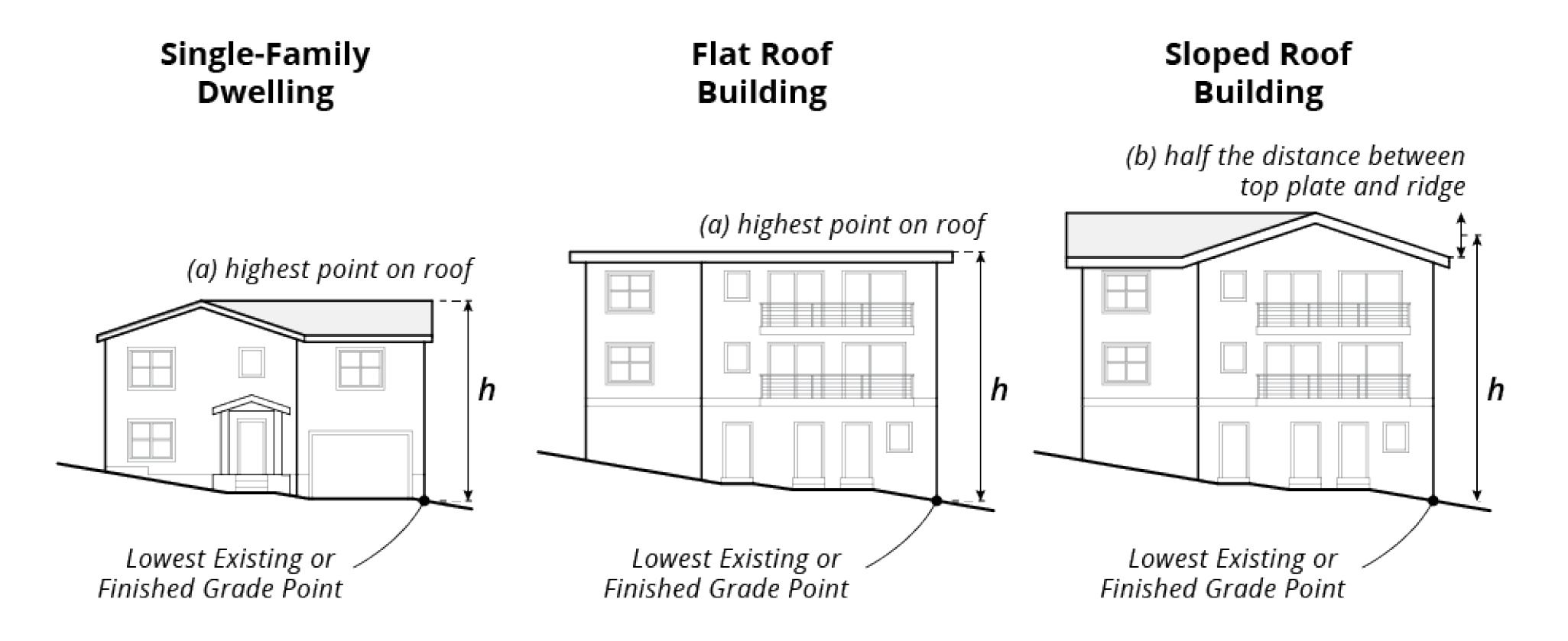
Building height is measured as follows:
(a)
Building height is measured from the existing or finished grade point, whichever is lower, of that portion of the lot covered by each building to the highest point on the roof of that building, except as provided below.
(b)
The Building height of a building, excluding single family dwellings, with a sloped, hipped, gabled, mansard, or gambrel roof is measured to a point that is half the distance between the highest point on the ridge and where the eave meets the plate.
(§ 6(Exh. A, § 15), Ord. No. 902-C.S., eff. September 24, 2025)
Sec. 9-4.2502. - Rooftop projections.
(a)
Cupolas, flagpoles, monuments, church steeples, and similar structures, and mechanical appurtenances may be permitted to exceed the height limits for the district in which they are located provided a site development permit is first obtained, as set forth in Article 32 of this chapter, in each case.
(b)
Chimneys may project up to four (4) feet or the minimum required by the Building Code, whichever is less, above the height limit for the district in which they are located.
(c)
Water tanks, heating and air conditioning equipment, vents, pipes and necessary mechanical roof appurtenances may project up to four (4) feet above the height limit for the district in which they are located, provided they are setback a minimum of five (5) feet from any roof edge and screened to the extent practical.
(d)
Parapet walls may project up to five (5) feet above the height limit for the district in which they are located.
(e)
Elevator penthouses or shafts, stair enclosures, and equipment or mechanical penthouses may project up to twelve (12) feet above height limits for the district in which they are located, provided all of the following standards are met:
(1)
The combined area of all such rooftop features shall not exceed fifteen (15) percent of the average floor area of all stories of the building; and
(2)
All such features shall be setback a minimum of ten (10) feet from any roof edge; and
(3)
These structures shall not be used as habitable space or for any commercial purpose, other than the mechanical needs of the building.
(§ 6(Exh. A, § 15), Ord. No. 902-C.S., eff. September 24, 2025)
Sec. 9-4.2503. - Fences, hedges, walls, and plantings.
(a)
No fence, hedge, wall, or screen planting of any kind shall be constructed or grown to exceed six (6′) feet in height (unless otherwise required by law) within any required side yard to the rear of the required front yard of any dwelling or within any required rear yard; nor exceed three (3′) feet in height within the required front yard of any dwelling, or, for corner lots, within twenty-five (25′) feet of a street corner measured at the property line. Fences or walls limited to three (3′) feet in height may be vertically extended up to four (4′) feet with open work fence material, as defined in subsection (b) of this section, subject to approval of the Planning Director, who shall consider the compatibility of the fence design with its site and surrounding uses. Commercial fences may not exceed six (6′) feet in height, unless additional height is allowed with a site development permit.
(b)
When there is a difference in the ground level on opposite sides of a retaining wall, height shall be measured from the lower ground level. When there is a difference in the ground level on opposite sides of a fence, height should be measured from the higher ground level. However, any portion of a fence above the maximum allowable height as measured from the lower ground level may be required by the Planning Administrator to be an open work fence. An "open work fence" means a fence in which the component solid portions are evenly distributed and constitute not more than sixty (60%) percent of the total surface area of the fence. In addition, the height of fences or walls which are located within the front setback, parallel to the front property line, or within twenty-five (25′) feet of a street corner, shall be limited to three (3′) feet in height as measured from the side of the fence facing the street.
(c)
This section shall not be construed to limit terracing of retaining walls. Terraced walls shall be offset at least three feet (3') from each other by a planting area.
(§ 6(Exh. A, § 15), Ord. No. 902-C.S., eff. September 24, 2025)
Sec. 9-4.2504. - Television and radio antennas, masts, and towers.
The purpose of this section is to provide standards to regulate the placement and height of aerials, as defined in Section 9-4.203 of Article 2 of this chapter. Such regulation is necessary to protect the public health and safety, and to ensure that placement of aerials is not detrimental to the aesthetics of the neighborhood. The following standards shall apply:
(a)
Receiving television and radio aerials shall not exceed a height of forty-nine (49′) feet, and transmitting aerials shall not exceed a height of fifty-five (55′) feet above the ground level.
(b)
An antenna consisting of a single vertical element not more than two (2″) inches in diameter, in lieu of a horizontal arrangement, shall be excepted from the height restriction set forth in subsection (a) of this section.
(c)
The section of masts and towers more than thirty (30′) feet above the ground shall have a cross-section which can be fitted within a square with a side of twelve (12″) inches.
(d)
Not more than one aerial tower, as defined in Section 9-4.203 of Article 2 of this chapter, shall be erected on a lot with an area of less than twenty thousand (20,000) square feet. Two (2) aerial towers shall be permitted on a lot with an area of twenty thousand (20,000) square feet, and one additional aerial tower shall be permitted for each additional ten thousand (10,000) square feet over twenty thousand (20,000) square feet. Wood towers shall not be erected.
(e)
Masts and/or towers shall be located at least ten (10′) feet to the rear of the required front yard setback line and shall not be closer than six (6′) feet to any property boundary.
(f)
Antennae and/or guy wires shall not overlap adjoining property and shall not encroach upon an easement without the written consent of the owner of such easement, which consent shall be attached to the application for a building permit.
(g)
Where the need for greater height or other modifications can be demonstrated to the satisfaction of the Commission, and where such greater height can be permitted without detriment to the neighborhood, a use-permit for such purpose may be granted by the Commission, subject to the requirements of Article 33 of this chapter.
(h)
Any aerial based on the ground and extending to a height of more than thirty-four (34′) feet, and any aerial based on a building and extending to a height of more than twenty-four (24′) feet above its base, shall require a building permit. Any aerial based on the ground and extending to a height of less than thirty-four (34′) feet, and any aerial based on a building and extending to a height of less than twenty-four (24′) feet above its base, shall not require a building permit provided the following shall be found to be true:
(1)
The tower, mast, and aerial shall be installed on the building site so that no part of the tower, mast, or aerial would fall across a property line;
(2)
The tower, mast, and attached antenna shall be no closer than six (6′) feet to a high-voltage overhead conductor, as provided in Section 385 of the Penal Code of the State;
(3)
The tower, mast, and attached antenna shall be no closer than two (2′) feet to any television cable transmission line or telephone transmission line; and
(4)
The tower, mast, and attached antenna shall be no closer than two (2′) feet to any electrical service drop serving any building on any property.
(i)
All installed antennae shall be maintained in a safe and workmanlike manner with all towers, masts, and vertical antennae in a vertical position and all guy wires properly attached.
(j)
Regulation of satellite receiving antennas.
(1)
Aesthetic objectives. Due to their size, bulk, and design, satellite television receiving or "dish" antennas, as defined in Section 9-4.203 of Article 2 of this chapter, have a greater visual impact than other types of antennas. Improper placement of dish antennas can provide a jarring contrast to the design of an individual structure and be detrimental to the overall design character of a neighborhood. The concern for the visual impact of dish antennas is supported by the City's adopted Design Guidelines, which state, in part, that additions to existing structures should be consistent with the positive architectural features of the original structure, that compatibility of materials is an essential ingredient in design quality, and that all exposed mechanical and electrical equipment must be screened from public view. The purpose of the ordinance codified in this section is to implement these aesthetic objectives in a manner which does not impose unreasonable limitations and which is consistent with the right to receive satellite signals.
(2)
Specific placement standards. Dish antennas may be administratively approved by the Planning Administrator and shall be permitted to be constructed and placed subject to the following conditions:
(i)
Dish antennas for residential uses shall be located in the rear yard, shall not be closer than six (6′) feet to any side rear lot line, and shall be viewable from a public street.
(ii)
Dish antennas for commercial uses shall not be viewable from a public street unless a use permit is issued.
(3)
Conditional uses. Dish antennas may only be permitted in other locations or if viewable from a public street upon issuance of a use permit by the Planning Commission. Issuance of the use permit shall be governed by the procedures of Article 33 of Chapter 4 of Title 9 of this Code; however, the Commission, in deciding whether to grant or deny such permit, shall apply the following standards:
(i)
Dish antennas shall not be permitted in locations other than the rear yard unless reasonable satellite signal reception cannot be received in the rear yard;
(ii)
The dish antenna shall be placed in a manner that, to the maximum extent practicable, blends in with the architectural features of the structure;
(iii)
The dish antenna structure shall be as compatible as possible in color and material with the supporting structure;
(iv)
If feasible, the dish antenna shall be screened from public view and the color and material of the screen shall be compatible with the structure;
(v)
The height of the dish shall not exceed the maximum height of the district in which the dish is located;
(vi)
The foregoing standards shall be applied in a manner so as to permit reasonable reception of satellite signals and so as not to impose costs on antenna users which are excessive in light of the purchase and installation costs of the antenna equipment.
Dish antennas may be permitted in other locations subject to the issuance of a use permit. The height of roof-mounted dish antennas shall not exceed the maximum permitted height of the district.
(§ 6(Exh. A, § 16), Ord. No. 902-C.S., eff. September 24, 2025)

