
Pacifica City Zoning Code
ARTICLE 26
- Public Utilities/Residential and Commercial Antennas3
Editor's note— Ord. 802 C.S., § 2, effective April 8, 2015, amended Art. 26 in its entirety to read as set out herein. Former Art. 26, §§ 9-4.2602—9-4.2618, pertained to similar subject matter and derived from Ord. 652 C.S., § 1, effective April 23, 1997.
Sec. 9-4.2602. - Purpose.
The purpose of this article is to provide locational, design and screening criteria to minimize the potential health, safety and aesthetic impacts of wireless communications facilities. The criteria establish standards and permit requirements to facilitate the installation of wireless communications systems while remaining consistent with the scenic character of the City. This article seeks to minimize any adverse visual impact created by wireless communications facilities while providing adequate service to the citizens of the City and to accommodate the need for a connection of such services to wireless facilities in adjacent and surrounding communities.
(§ 2, Ord. 802 C.S., eff. April 8, 2015)
Sec. 9-4.2604. - Definitions.
For the purpose of this article, certain words and terms are hereby defined. Words used in the singular number shall include the plural and the plural the singular; unless more specifically defined the word "building" is interchangeable with the word "structure," the word "shall" is mandatory and not discretionary. All equipment not specifically described herein shall be regulated in conformity with the type of equipment described herein which most closely resembles such equipment. Reference to "facility" is interchangeable with "wireless communications facility" unless otherwise noted.
(a)
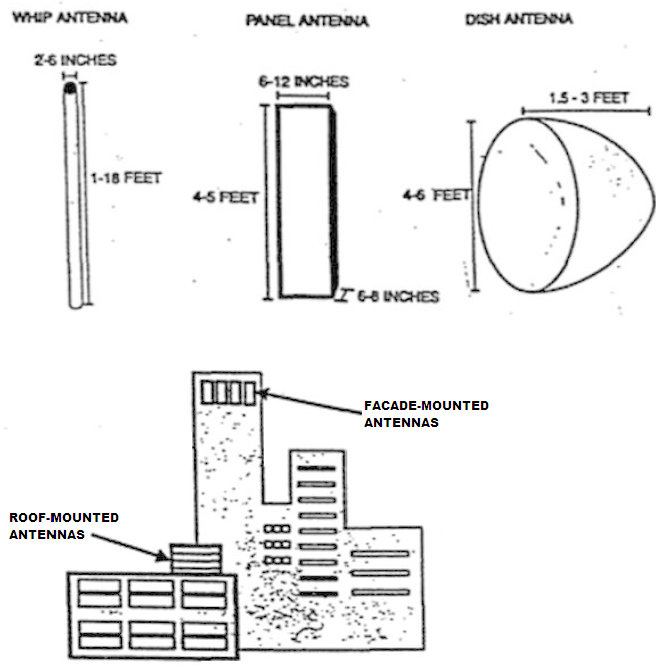
"Antenna" shall mean a device used in wireless communications which transmits or receives radio or any other sort of electronic type of signal, which may include electromagnetic waves (see omni-directional, panel, parabolic and ancillary antennas).
(b)
"Building profile" shall mean that area between the outermost extent of the foundation on the left and right sides of a building, and extending directly to the private or public right-of-way center line at the front of the parcel. For through-lots, the area shall also extend to the private or public right-of-way center line at the rear of the parcel. For corner lots, the building profile shall also include that area between the front and rear foundations of a building, and extending directly to the private or public right-of-way center line at the side of the parcel. For all purposes in this article, the term "right-of-way" shall include, without limitation, public access easements fronting residential parcels. In the case of an unusual parcel, private or public right-of-way, or building configuration, the Planning Administrator shall determine the building profile.
(c)
"Co-location" shall mean locating wireless communications equipment from more than one provider on a single site.
(d)
"Equipment facility" shall mean a cabinet or structure used to house equipment associated with wireless communication antennas.
(e)
"Facade-mounted antennas" shall mean any type of wireless communications facility in which antennas are mounted on the wall of a structure.
(f)
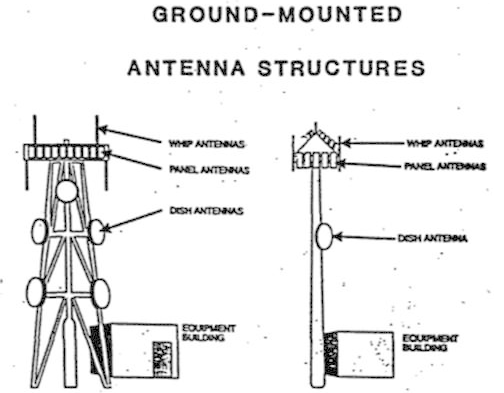
"Ground-mounted antenna structure" shall mean wireless communications facility that typically consists of a support structure with attached antennas. Antennas attached to a support structure cannot be considered "facade mounted" or "roof mounted" as defined in this subsection.
(g)
"Major antenna" shall mean any antenna or group of antennas exceeding the size of a minor antenna.
(h)
"Microwave antenna" shall mean a bowl-shaped antenna used to link communication sites together by wireless transmission of voice or data in a specific directional pattern.
(i)
"Minor antenna" shall mean an antenna, typically cylindrical in shape, three (3″) inches or less in diameter and not exceeding eight (8′) feet in height, or a cumulative site total of eight (8) square feet or less.
(j)
"Public utilities" shall mean distribution equipment related to any business entity which owns or operates any plant, equipment, property, franchise or license for the transmission of communications, transportation of goods, or the production, transmission, sale, delivery or furnishing of electricity, water and the like.
(k)
"Radiofrequency radiation (RFR)" shall mean, for purposes of this article, electromagnetic radiation in the portion of the spectrum from three (3) kHz (Kilohertz) to three hundred (300) GHz (gigahertz).
(l)
"Roof mounted" shall mean any type of facility in which antennas are mounted on the roof, parapet or similar feature of a structure and extends past the roofline of the building.
(m)
"Support structure" shall mean a ground-mounted vertical structure to which antennas and other necessary equipment are mounted. Support structures typically consist of a single structure anchored to the ground and providing support for a wireless communications facility. Typical support structures include, but are not limited to, a lattice tower, monopole, utility pole, street light pole, traffic signal pole, or any similar structure composed of a single spire or other vertical support.
(n)
"Wireless communications facilities" shall mean commercial transmitting, relaying and receiving antennas, antenna support structures and ancillary facilities, including equipment facilities and overhead and underground service/transmission lines used for the purpose of transmitting, relaying and receiving data, voice and paging services. Wireless communications facilities include those intended to be operated for a limited time such as facilities mounted on a mobile vehicle or trailer. For purposes of this article, wireless communications facilities do not include those facilities protected pursuant to Section 207 of the Telecommunications Act of 1996.
Examples of common types of wireless communications facilities:
(§ 2, Ord. 802 C.S., eff. April 8, 2015)
Sec. 9-4.2606. - Applicability.
The purpose of these regulations is to provide a basis for meeting the present and future utilities and communications needs of the City of Pacifica while minimizing the land use, aesthetic and environmental impacts of technology developed to meet those needs. Where conflict occurs within this article between the provisions of this article and any other City codes, ordinances, resolutions, guidelines or regulations, the more restrictive provision shall control unless otherwise specified.
Facilities existing prior to the adoption of this article and constructed or installed in accordance with codes that were applicable at the time of construction or installation may remain in place. Any such facilities that would not be allowed under this article shall be deemed nonconforming. Any facility that was constructed or installed in violation of any prior code shall either be removed or an application for a use permit shall be filed within thirty (30) days after the effective date of this article.
Facilities not meeting the standards set forth in this article may apply for a variance as indicated in Article 34 of this chapter.
Facilities may be required to obtain additional permits pursuant to the Pacifica Municipal Code, in addition to permits required pursuant to this article.
(a)
Exemptions. The following are exempted from the provisions of this section:
(1)
Wireless communications facilities related to public safety and/or emergency services.
(2)
Modifications to wireless communications facilities previously approved by the City through a discretionary review process (including facilities in the public right-of-way), and involving co-location, removal, or replacement of transmission equipment that does not substantially change the physical dimensions of such facilities, as provided in Federal Communications Commission (FCC) Report and Order No. 14-153, published in the Federal Register on January 8, 2015, or a successor order. Applications subject to the exemption provided in this subsection shall remain subject to Sections 9-4.2608 and 9-4.2610.
(3)
Wireless communications facilities for which any federal or state statute or regulation exempts the facility from the imposition of the permit requirements of this section.
(b)
Administrative permit. The following uses are subject to an administrative permit and associated review, provided that the wireless communication facilities comply with the regulations set forth by this section and the underlying zoning district:
(1)
Facade-mounted major antennas and associated equipment facilities in all zoning districts other than R, A, O-S, B overlay, and HPD overlay districts;
(2)
Antenna(s) and associated equipment facilities, other than those described in subsection (a), proposed to co-locate on a previously approved facility meeting all zoning standards and provided an increase in overall height or width is not necessary. This does not include co-location of different facilities on the same developed site, parcel or lot;
(3)
Facade-mounted minor antennas in all zoning districts, except O-S District;
(4)
At the Planning Administrator's discretion, an application for an administrative use permit may be brought to the Planning Commission for review pursuant to Section 9-4.3802 of the Pacifica Municipal Code.
(c)
Conditional uses. The following uses require the issuance of a use permit:
(1)
Ground-mounted and roof-mounted major and minor antenna structures and associated equipment facilities in all zoning districts;
(2)
Wireless communications facilities intended to be operated for a limited time, such as facilities mounted on a mobile vehicle or trailer, not including mobile facilities providing public information coverage of news events;
(3)
Facade-mounted major antennas in all R, A, B overlay, and HPD overlay districts;
(4)
All antennas in O-S zoning districts;
(5)
All antennas in a private or public right-of-way. This subsection shall include antennas within a public utilities easement situated between a residential parcel and a private or public right-of-way.
(6)
Wireless communications facilities located on sites and/or buildings identified as historically significant in the Pacifica General Plan and the Pacifica Municipal Code;
(7)
Any wireless communication facility located in an area designated by the City for undergrounding of utilities.
(8)
Any wireless communications facility not exempted under subsection (a) or subject to an administrative permit under subsection (b).
(§ 2, Ord. 802 C.S., eff. April 8, 2015)
Sec. 9-4.2608. - Site development standards.
(a)
General criteria.
(1)
All wireless communications facilities must satisfy the minimum zoning district setback requirements, except those within a private or public right-of-way which shall be subject to the standards of subsection (e). The standards of subsection (e) shall also apply to wireless communications facilities within a public utilities easement situated between a residential parcel and a private or public right-of-way.
(2)
Equipment facilities shall be limited to the housing of radio, electronic and related power equipment necessary to that site, and not used for general storage of unused equipment. Equipment facilities shall conform to the following:
(i)
Shall be compatible with the design of surrounding areas by using appropriate materials, colors and detailing, or shall be screened from view to the fullest extent possible;
(ii)
An equipment facility shall be located within the building in which its associated wireless communications facility is constructed or located underground if site conditions permit. Otherwise, the equipment facility shall be screened from view by a compatible wall, fence, or landscaping.
(3)
In the event that the Planning Administrator needs assistance in understanding the technical aspects of a particular proposal, he or she may retain the services of a communications consultant (such as a radio engineer) acceptable to the City to determine the engineering and locational requirements of a specific wireless network. This service will be at the applicant's expense.
(4)
The proposal for any antenna facility must comply with all standards related to radio frequency electromagnetic fields as required by the Federal Communications Commission (FCC).
(5)
The applicant shall ensure that the wireless communications facility will not cause localized interference with the reception of area television or radio broadcasts. If the City finds that the facility interferes with such reception, and if such interference is not cured within sixty (60) days, the City may revoke or modify any required discretionary permits or require discretionary review if none is required pursuant to this article.
(6)
All wireless communications facilities shall be unlit; manually operated or motion-detector controlled lights on the site shall be kept off except when personnel are present at night.
(7)
All wireless communications facility operators shall, every two (2) years from the date of the final building permit inspection for each facility in the City, submit to the Planning Administrator a written certification stating whether the facility (i) is still in operation; (ii) complies with all conditions of approval imposed on the facility, if any; and (iii) is maintained in a way that does not pose a hazard to public safety. For sites not in operation, facility operators shall specify the date operation of the facility ceased, the reason operation of the facility ceased, and an estimated date the site will resume operation, if at all. Facility operators with multiple facilities within the City may coordinate a single biennial certification date for all facilities upon approval of the Planning Administrator. The wireless communication facility operator shall remit a fee to the City, pursuant to the City's master fee schedule, when the operator submits its biennial certification submission.
(b)
Design-related standards.
(1)
All wireless communication facilities shall, to the maximum extent practicable, incorporate best practices to achieve concealment and stealth of antennas, equipment, and support structures. Further, all wireless communications facilities shall be screened to the fullest extent possible and located to minimize visibility from surrounding areas and private or public rights-of-way. In addition to the requirements of this subsection, wireless communications facilities within a private or public right-of-way shall conform to the standards of subsection (e).
(2)
The use of colors and facility designs shall be compatible with surrounding buildings and/or uses in the area or those likely to exist in the area and shall prevent the facility from dominating the surrounding area.
(3)
If fencing or walls are used to screen a facility, they should be architecturally compatible with its surroundings. If used, chain-link fencing must be coated with a nonreflective material.
(4)
Methods of facility screening shall include use of landscaping. A conceptual landscape plan shall be submitted for review with the initial application; the final landscape plan shall be subject to approval by the Planning Administrator prior to the issuance of a building permit.
(c)
Facade-mounted antennas.
(1)
All facade-mounted major antennas shall be mounted on the facade and shall not extend above the roofline or parapet of the building. All facade-mounted antennas shall be painted and textured to match the existing building.
(2)
Minor antennas mounted on a building, whether facade-mounted or roof-mounted, shall not extend more than seven (7′) feet above the highest point of the building.
(d)
Ground-mounted antenna structures, except in private or public rights-of-way.
(1)
Support structures, such as monopoles or lattice towers, must be ground mounted, not roof mounted.
(2)
The height of a ground-mounted antenna structure shall not exceed thirty-five (35′) feet, or the height at which hazard lights are required by Federal Aviation Administration (FAA), FCC, or California Highway Patrol (CHP), whichever is less.
(3)
Ground-mounted antenna structures shall be set back from abutting residentially zoned property and/or residential land use a distance equal to the height of the tower or fifty (50′) feet, whichever is greater.
(4)
Ground-mounted antenna structures shall be set back from any property line or private or public right-of-way by a minimum of twenty-five (25′) feet.
(e)
Ground-mounted antenna structures in private or public rights-of-way
(1)
All antennas attached to existing utility, streetlight, or traffic signal poles (including, without limitation, Pacific Gas & Electric and telecommunication provider poles) within private or public rights-of-way, shall not extend more than two (2′) feet above the top of the support structure, and shall not extend horizontally more than two (2′) feet from the point of attachment to the support structure, unless necessary to comply with regulatory requirements or for health and safety reasons.
(2)
Support structures to be installed, such as monopoles or lattice towers, must be ground mounted, not roof mounted.
(3)
For new installations of ground-mounted antenna structures, the height shall not exceed thirty-five (35′) feet, or the height at which hazard lights are required by FAA, FCC, or CHP, whichever is less. New installations shall also be installed the maximum practicable distance from residential zones and/or uses, and located outside of the building profile of the nearest adjacent residential structures. Notwithstanding the provisions of this subsection, the Planning Commission may authorize a new installation within the building profile of a residential structure if it makes a specific finding that the installation will result in a facility that is most harmonious with neighborhood aesthetics and is the least visually obtrusive design alternative; or such an installation is necessary to comply with federal or state law.
(4)
No wireless communications facility shall be installed (i) on an existing support structure located within the building profile of an existing residential structure; or, (ii) within twenty-five (25′) feet of another wireless communications facility, support structure, or utility, streetlight, or traffic signal pole with or without an attached facility. Notwithstanding the provisions of this subsection, the Planning Commission may authorize a new installation within the building profile of a residential structure if it makes a specific finding that the installation will result in a facility that is most harmonious with neighborhood aesthetics and is the least visually obtrusive design alternative; or such an installation is necessary to comply with federal or state law.
(5)
Support structures and equipment facilities, including associated walls, fences, or landscaping, shall be at least eighteen (18″) inches from the front of the curb. In areas without curbs, support structures and equipment facilities shall be at least eighteen (18″) inches from the nearest travel lane.
(6)
Equipment facilities shall be located so as not to cause (i) any physical or visual obstruction to pedestrian or vehicular traffic, (ii) inconvenience to the public's use of the right-of-way, including for persons with disabilities, or (iii) safety hazards to pedestrians, bicyclists or motorists.
(7)
All wireless communications facilities installed within the public right-of-way shall be subject to issuance of an encroachment permit and any siting restrictions imposed by the City Engineer for safety or technical reasons, in addition to any required discretionary permit.
(f)
Permit requirements.
(1)
Wireless communications facilities shall be maintained in strict compliance with the approved plans. The applicant shall describe on plans submitted, scheduled maintenance needs, including frequency of service, personnel needs, equipment needs and any traffic, noise or safety impacts of such maintenance, including maintenance of landscaping, building finishes, architectural elements and changes necessary to the facility due to building remodel.
(2)
If it is found that wireless communications facilities as defined in this section will be detrimental to the health, safety and welfare of persons working or residing near the vicinity of said facilities, then the wireless communications provider shall be solely responsible for the removal, adjustment or replacement of the facilities. In no case shall the facility remain in operation if it is found to create a hazard to health, safety and welfare. A facility shall not be found to create a hazard to health, safety and welfare as a result of radiofrequency emission from that facility so long as that facility meets all applicable standards established by the Federal Communications Commission.
(3)
The carrier of the wireless communications facility shall and does, upon approval of any City permit, agree to indemnify, protect, defend and hold harmless the City, its Council members, Planning Commission members, officers, employees, agents and representatives, from and against any and all liabilities, losses, damages, demands, claims and costs, including court costs and attorney's fees (collectively, "liabilities") incurred by the City, its officers, employees and agents, which arise directly or indirectly from:
(i)
City's approval and issuance of any permit or action, whether discretionary or nondiscretionary, in connection with the use contemplated herein; and
(ii)
Applicant's installation and operation of the facility permitted hereby, including, without limitation, any and all liabilities arising from the emission by the facility of electromagnetic fields or other energy waves or emissions. The permittee/operator compliance with this section is an express condition of any City permit and this provision shall be binding on any and all of the permittee/operator's successors and assigns.
Only those liabilities that arise due to the sole negligence of the City shall be excluded from the scope of the carrier's obligation under this subsection.
(§ 2, Ord. 802 C.S., eff. April 8, 2015)
Sec. 9-4.2610. - Abandonment.
All obsolete or unused facilities must be removed within six (6) months of cessation of operation at the site, and the site must be restored to its original state.
All facilities must meet or exceed current standards and regulations of the FAA, the FCC, and any other agency of the federal government with the authority to regulate such facilities. If such standards and regulations are changed, then the property owner or responsible party shall bring such facilities into compliance with such revised standards and regulations within six (6) months of the effective date of such standards and regulations, unless a more stringent compliance schedule is mandated by the controlling federal agency. Any violation of this article is hereby deemed to be a public nuisance. Failure to maintain or bring facilities into compliance with this article and such revised standards and regulations shall constitute grounds for revocation of any permits granted under this article pursuant to Title 9, Chapter 4, Article 33, Use Permits. Such failure is also deemed a public nuisance and subject to abatement and removal of the facility by the City at the property owner's expense pursuant to Title 5, Chapter 25, Property Maintenance and Nuisance Abatement.
(§ 2, Ord. 802 C.S., eff. April 8, 2015)
Sec. 9-4.2612. - Administrative permits.
The provisions of this section shall apply to cases where the Planning Administrator determines that an administrative permit is appropriate because the proposed facility meets the standards of this article. The applicant shall submit the standard materials required with a City application for a use permit, including supplemental materials indicated in Section 9-4.2614.
(a)
Public notice. Notice of applications approved by the Planning Administrator shall be mailed to all abutting property owners, who shall have the right to appeal.
(b)
Action. The Planning Administrator may deny, approve, or conditionally approve an administrative permit and shall use the procedure and make the findings required by the provisions of Section 9-4.2614 prior to granting an administrative permit; however, a public hearing shall not be required.
(c)
Appeals. Appeals from decisions of the Planning Administrator may be made to the Commission within ten (10) days after the action of the Planning Administrator. Such appeals shall be in writing and shall be filed with the Planning Administrator. Upon the receipt thereof, the Planning Administrator shall forward the appeal, together with the record on the matter, to the Planning Commission. The Planning Commission shall give notice of such hearing as set forth in Section 9-4.3302 of Article 33 of this chapter.
(d)
Amendments. Amendments to an administrative permit may be approved by the Planning Administrator. However, if any amendment would, in the opinion of the Director, change the nature of the project so that it no longer satisfies the criteria established in this section, then the application shall thereafter be treated in the manner established in Section 9-4.2614, Use Permits.
(e)
Effect of administrative permits. No administrative permit shall have any force or effect until the applicant therefor actually received such permit designating the conditions of its issuance thereon and signed by the Planning Administrator and applicant. No such permit shall be issued until the time for filing an appeal of the administrative decision has expired or, in the event of such appeal, until after the expiration of the appeal period after the final determination thereof by the Commission.
(§ 2, Ord. 802 C.S., eff. April 8, 2015)
Sec. 9-4.2614. - Use permits.
(a)
Supplemental application materials. In addition to all standard information required as part of the use permit and/or variance application, the following material shall also be submitted:
(1)
A study produced by the applicant indicating that the selected site is required in order to provide adequate signal coverage, including a map showing the desired search ring and relationship to other facilities;
(2)
An inventory of its existing facilities that are either within the jurisdiction of the governing authority or within one-quarter (¼) mile of the border thereof, including specific information about the location, height, and design of each facility;
(3)
A photographic projection or mock-ups, displaying the proposed facility as seen from adjacent private or public rights-of-way and, if applicable, residential properties;
(4)
License information from the Federal Communications Commission indicating compliance with American National Standards Institute (ANSI) standards regarding level of non-ionizing electromagnetic radiation (NIER) exposure of proposed antennas;
(5)
Information regarding the site selection process, including information about other sites that were considered and reasons for their rejection. Information may include, at the Planning Administrator's discretion, a photographic projection or other graphic demonstration to determine potential visual impact of alternate sites.
(6)
A deposit for legal, staff, and peer review based on an estimate provided by the Planning Administrator. The Planning Administrator may employ, on behalf of the City, an independent technical expert to review any technical materials submitted, including, but not limited to, those required under this section and in those cases where a technical demonstration of unavoidable need or unavailability of alternatives is required. The applicant shall pay all the costs of said review, including any administrative costs incurred by the City. Any proprietary information disclosed to the City or the expert hired shall remain confidential and shall not be disclosed to any third party.
(b)
Use permit—findings. In addition to the standard findings as enumerated in Section 9-4.3303 of the Pacifica Municipal Code, the Commission may deny, approve or conditionally approve a use permit for wireless communications facilities as defined in this article upon making all of the following supplementary findings:
(1)
That the project will not cause localized interference with reception of area television or radio broadcasts or other signal transmission or reception;
(2)
That the information submitted proves that a feasible alternate site that would result in fewer visual impacts does not provide reasonable signal coverage;
(3)
That the application meets all applicable requirements of Section 9-4.2608 of the Pacifica Municipal Code.
(§ 2, Ord. 802 C.S., eff. April 8, 2015)
Sec. 9-4.2616. - Variances.
Installers of wireless communications facilities may be granted deviations from the requirements of this article. In addition to complying with requirements and findings pursuant to Article 34, Chapter 4, Title 9 of the Pacifica Municipal Code, the following findings must be met as determined by the Planning Commission:
(a)
That the strict application of the ordinance prevents or imposes unreasonable limitations on the provision of wireless communication services;
(b)
That the standards as set forth in this article have been met to the maximum extent feasible.
(§ 2, Ord. 802 C.S., eff. April 8, 2015)
Sec. 9-4.2618. - Severability.
If any action, subsection, sentence, clause or phrase of this article is, for any reason, held by a court of competent jurisdiction to be invalid or unconstitutional, such decision shall not affect the validity of the remaining portions of this article.
(§ 2, Ord. 802 C.S., eff. April 8, 2015)
Table 9-4.26
WIRELESS COMMUNICATION FACILITIES PERMITS
REQUIRED ACCORDING TO ZONING DISTRICT
* If planned development is primarily residential in nature, then residential standards apply. Likewise, if planned development is primarily commercial in nature, then commercial standards apply.
KEY:
A = Administrative Permit
UP = Use Permit
(§ 2, Ord. 802 C.S., eff. April 8, 2015)

