
Pacifica City Zoning Code
ARTICLE 28
- Off-Street Parking and Loading*
* Sections 9-4.2801 through 9-4.2826, codified from Ordinance No. 363, as amended by Ordinance Nos. 419, 13-C.S., effective April 16, 1971, 37-C.S., effective November 25, 1971, 66-C.S., effective October 25, 1972, 73-C.S., effective May 9, 1973, 218-C.S., effective December 28, 1977, 219-C.S., effective January 11, 1978, 224-C.S., effective April 12, 1978, 227-C.S., effective May 10, 1978, and 453-85, effective September 23, 1985, repealed by Ordinance No. 497-C.S., effective February 10, 1988.
Sec. 9-4.2801.- Purpose.
The purpose of this article is to alleviate or prevent the congestion of the public streets and thus promote the safety and welfare of the public by establishing minimum requirements for the off-street parking, loading, and unloading of motor vehicles in accordance with the use to which property is put.
(§ 2, Ord. 497-C.S., eff. February 10, 1988)
Sec. 9-4.2802. - Definitions.
For the purposes of this article, unless otherwise apparent from the context, certain words and phrases used in this article are defined as follows:
(a)
"Bus" shall mean a motor vehicle, other than a truck or tractor, designed for carrying more than ten (10) persons, including the driver, and used or maintained for the transportation of passengers.
(b)
"Camper" shall mean a motor vehicle upon which a camper shell has been mounted.
(c)
"Camper shell" shall mean a structure designed to be mounted upon a motor vehicle and to provide facilities for human habitation or camping purposes.
(d)
"Commercial vehicle" shall mean a vehicle used or maintained for the transportation of persons for hire, compensation, or profit or designed, used, or maintained primarily for the transportation of property.
(e)
"Electric vehicle charger" shall mean off-board charging equipment used to charge an electric vehicle.
(f)
"Electric vehicle charging space" ("EV Space") shall mean a space intended for installation of EV charging equipment and charging of electric vehicles.
(g)
"Electric vehicle charging station" shall mean one or more electric vehicle charging space served by electric vehicle charger(s) or other charging equipment allowing charging of electric vehicles. Electric vehicle charging stations are categorized by the following levels:
Level 1 is considered slow charging and operates on a fifteen (15) to twenty (20) amp breaker on a one hundred twenty (120) volt AC circuit.
Level 2 is considered medium charging and operated on a forty (40) to one hundred (100) amp breaker on a two hundred eight (208) or two hundred forty (240) volt AC circuit.
Level 3 is considered fast or rapid charging and operated on a sixty (60) amp or higher breaker on a four hundred eighty (480) volt or higher three-phase circuit with special grounding equipment. Level 3 stations can also be referred to as rapid charging stations that are typically characterized by industrial grade electrical outlets that allow for faster recharging of electric vehicles.
(h)
"Electric vehicle supply equipment" shall mean the conductors, including the underground, grounded and equipment-grounding conductors and the electric vehicle connectors, attachment plugs, and all other fittings, devices, power outlets, or apparatus installed specifically for the purpose of transferring energy between the premises wiring and the electric vehicle.
(i)
"House car", also known as "motor home", shall mean a motor vehicle originally designed, or permanently altered, and equipped for human habitation, or to which a camper shell has been permanently attached.
(j)
"Major alteration" shall mean an alteration and addition where significant upgrades to structure and mechanical, electrical, and/or plumbing systems are proposed where areas of such construction for the building or associated parking facilities cumulatively are twenty thousand (20,000) gross square feet or more.
(k)
"Motor vehicle" shall mean a vehicle which is self-propelled.
(l)
"Motorcycle" shall mean a motor vehicle, other than a tractor, having a seat or saddle for the use of the rider and designed to travel on not more than three (3) wheels in contact with the ground and weighing less than one thousand five hundred (1,500) pounds, except that four (4) wheels may be in contact with the ground when two (2) of the wheels are a functional part of a side car.
(m)
"Semi-trailer" shall mean a vehicle designed for carrying persons or property, used in conjunction with a motor vehicle, and so constructed that some part of its weight and that of its load rests upon, or is carried by, another vehicle.
(n)
"Trailer" shall mean a vehicle designed for carrying persons or property on its own structure and for being drawn by a motor vehicle and so constructed that no part of its weight rests upon any other vehicle.
(o)
"Trailer coach" shall mean a vehicle designed for human habitation, or human occupancy for industrial, professional, or commercial purposes, for carrying property on its own structure, and for being drawn by a motor vehicle.
(p)
"Truck" shall mean a motor vehicle designed, used, or maintained primarily for the transportation of property.
(q)
"Truck tractor" shall mean a motor vehicle designed and used primarily for drawing other vehicles and not so constructed as to carry a load other than a part of the weight of the vehicle and load so drawn.
(§ 2, Ord. 497-C.S., eff. February 10, 1988, as amended by § 2, Ord. 823-C.S., eff. October 11, 2017)
Sec. 9-4.2803. - Scope.
The off-street parking and loading provisions of this article shall apply as follows:
(a)
For all buildings and structures erected, and all uses of land established after February 10, 1988, acces-sory parking and loading facilities shall be provided as set forth in this article.
(b)
When the intensity of use of any building, structure, or premises is increased through the addition of dwelling units, gross floor area, seating capacity, or other units of measurement set forth in this article for required parking or loading facilities, parking and loading facilities as set forth in this article shall be provided for the existing use and such increase in intensity.
(c)
Whenever the existing use of a building or structure is changed to a use with increased parking requirements, parking or loading facilities shall be provided for such new use.
(§ 2, Ord. 497-C.S., eff. February 10, 1988)
Sec. 9-4.2804. - Facilities for existing buildings.
Accessory off-street parking or loading facilities which are located on the same site as the building or use served shall not be reduced below, or, if already less than, shall not be further reduced below, the requirements of this article for a similar new building or use. The off-street parking facilities for a primary dwelling unit may be reduced or eliminated as provided in Article 4.5 of this chapter for construction of an accessory dwelling unit.
(§ 2, Ord. 497-C.S., eff. February 10, 1988, as amended by § 14, Ord. 825-C.S., eff. November 8, 2017)
Sec. 9-4.2805. - Facilities for reconstructed or repaired buildings.
For any conforming building or use which was in existence on February 10, 1988, which building is subsequently damaged or destroyed, and for any lawfully nonconforming use which is not lost by reason of such damage, and which building is reconstructed, reestablished, or repaired as provided for in Article 30 of this chapter, off-street parking or loading facilities need not be provided; however, parking or loading facilities equivalent to any maintained at the time of such damage or destruction shall be restored or continued in operation.
(§ 2, Ord. 497-C.S., eff. February 10, 1988)
Sec. 9-4.2806. - Computation of fractional spaces.
When the determination of the number of required off-street parking and loading spaces results in the requirement of a fractional space, any fraction under one-half (½) shall be disregarded, and fractions including and over one-half (½) shall require one off-street parking or off-street loading space.
(§ 2, Ord. 497-C.S., eff. February 10, 1988)
Sec. 9-4.2807. - Use of parking and garage facilities.
(a)
Covered parking facilities, required and/or accessory to single-family residential uses, shall have no use which interferes with the primary use of the parking and storage of motor vehicles, automobiles, campers, house cars, trailer coaches, trailers, or similar type vehicles belonging to the occupants of the residence.
(b)
Off-street parking and garage facilities, required and/or accessory to multiple-family residential uses, shall be used for the parking or storage of automobiles, trucks, campers, and motorcycles and shall not be used for the parking or storage of inoperable vehicles, camper shells, house cars, trailer coaches, trailers, boats, or similar type vehicles.
(c)
Under no circumstance shall required parking and garage facilities accessory to any residential structure be used for the parking or storage of commercial vehicles, unless such vehicles are the primary transportation of the resident.
(§ 2, Ord. 497-C.S., eff. February 10, 1988)
Sec. 9-4.2808. - Parking in required yards.
(a)
In any residential district, no required yard space, except as provided in this section, shall be used for the parking and storage of the following:
(1)
Motor vehicles, automobiles, house cars, buses, campers, camper shells, trailer coaches, trailers, semitrailers, trucks, truck tractors, tractors, motorcycles, or boats; or
(2)
Inoperable vehicles.
(b)
Automobiles, campers, trucks, motorcycles, and one house car may be parked on any garage apron or driveway, subject to the following conditions:
(1)
The vehicle shall not overhang or otherwise protrude into the public right-of-way.
(2)
The vehicle shall not obstruct, obscure, or otherwise restrict sight distance from any intersection in a manner which adversely impacts public safety.
(3)
The vehicle shall be operable and be fully licensed as stipulated in the Vehicle Code of the State.
(4)
The vehicle shall not be used for living, sleeping, or housekeeping purposes, and utility services shall not be connected thereto.
(5)
The vehicle shall belong to the occupant of the property or a guest visiting the occupant.
(c)
One unoccupied automobile, house car, camper, camper shell, trailer coach, trailer, truck, motorcycle, or boat may be parked or stored behind the front setback line provided such automobile, house car, camper, camper shell, trailer coach, trailer, truck, motorcycle, or boat is not used for living, sleeping, or housekeeping purposes and utility services are not connected thereto; and provided, further, if such parked or stored vehicle is within the side yard, a minimum clearance of three (3′) feet shall be maintained around the vehicle at all times. All vehicles so parked shall be screened by a sight-obscuring fence six (6′) feet in height.
(d)
Nothing in this section shall prohibit the temporary parking of vehicles on the garage apron or driveway for loading and unloading purposes provided such temporary parking time does not exceed seventy-two (72) hours within any seven (7) day period.
(§ 2, Ord. 497-C.S., eff. February 10, 1988)
Sec. 9-4.2809. - Parking vehicles and construction equipment.
(a)
In any residential district it shall be unlawful to park, store, or cause to be maintained on any street, lot, plot, or parcel of land so zoned any commercial vehicle or special construction equipment, as defined in the Vehicle Code of the State, with a gross vehicle weight rating of 10,000 pounds or more.
(b)
No person shall park any motor vehicle, automobile, house car, bus camper shell, trailer coach, trailer, semitrailer, truck, truck tractor, tractor, motorcycle, or boat on a vacant lot or parcel, unless such use is authorized by a use permit, as set forth in Article 33 of this chapter, and such lot or parcel used for such purpose is surfaced and maintained in accordance with the requirements of such use permit. The Planning Administrator may permit the temporary use, not to exceed sixty (60) days, of any unimproved lot or parcel for the parking of vehicles in connection with a special event provided the site is posted to the specifications of the City at least seven (7) calendar days prior to Planning Administrator approval.
(c)
The temporary use of vacant lots or parcels for the parking of house cars or trailer coaches as construction offices, for the storage of equipment or materials, for twenty-four (24) hour security purposes, or as temporary commercial offices during the construction of permanent facilities may be permitted by the Planning Administrator provided the parking is in conjunction with construction on the same lot or building site and meets the following conditions:
(1)
Building plans for new construction shall be submitted and a building permit issued before the placement or occupancy of the motor home or trailer coach.
(2)
The occupancy shall not exceed twelve (12) months after the issuance of a building permit, unless otherwise extended by the Commission.
(3)
The temporary use of house cars or trailer coaches during the construction of individual single-family dwellings may only be permitted as described in this subsection if the project is constructed by an owner/builder.
(d)
The Planning Administrator may permit the temporary use, not to exceed six (6) months, of any unimproved lot or parcel for the parking of construction vehicles and equipment in connection with off-site construction activity provided the site is posted to the specifications of the City at least seven (7) calendar days prior to Planning Administrator approval.
(e)
No person shall park, stand, or store any motor vehicle, automobile, house car, bus, camper, camper shell, trailer coach, trailer, semitrailer, truck, truck tractor, tractor, motorcycle, or boat upon private property in any commercial district, unless such vehicle is parked, stored, or standing in conjunction with a business located on the property and with the permission of the property owner.
(f)
No lot or parcel, or portion thereof, in a commercial district designated and surfaced for off-street parking shall be used for the parking or storage of motor vehicles, automobiles, house cars, buses, campers, camper shells, trailer coaches, trailers, semitrailers, trucks, truck tractors, tractors, motorcycles, or boats, unless such vehicles are parked or stored in conjunction with a business located on the property and with the permission of the property owner.
(g)
No person shall park a motor vehicle, automobile, house car, bus, camper, camper shell, trailer coach, trailer, semitrailer, truck, truck tractor, tractor, motorcycle, or boat upon private property in any commercial district for the principal purpose of displaying such vehicle for sale, unless the business located on the property is authorized for vehicle sales.
(§ 2, Ord. 497-C.S., eff. February 10, 1988)
Sec. 9-4.2810. - Parking in conjunction with vehicle repairs.
(a)
Parking on vacant lots or parcels in conjunction with vehicle repairs. No person shall repair or modify any vehicle or install any part or accessory on any vehicle while such vehicle is on any vacant lot or parcel, unless such use is authorized by a use permit, as set forth in Article 33 of this chapter.
(b)
Parking on public rights-of-way in conjunction with vehicle repairs. No person shall repair or modify any vehicle or install any part or accessory on any vehicle while such vehicle is on any public highway, street, or alley, unless the mechanical condition of such vehicle is such that it cannot be moved from the public highway, street, or alley without such emergency repairs. All such emergency repairs shall be completed within twenty-four (24) hours after the breakdown or parking of such vehicle, whichever first shall occur.
(c)
Parking on driveways in conjunction with vehicle repairs. No person shall repair or modify any vehicle or install any part or accessory on any vehicle while such vehicle is on a residential garage apron or driveway, unless such vehicle is owned by the occupant of the residence to which such garage apron or driveway is associated.
(§ 2, Ord. 497-C.S., eff. February 10, 1988)
Sec. 9-4.2811. - Joint parking facilities.
Off-street parking facilities for different buildings, structures, or uses may be provided collectively provided the total number of spaces so located together shall not be less than the sum of the separate requirement for each use and provided, further, that the right for the continued use of such parking facilities is established to the satisfaction of the City Attorney.
(§ 2, Ord. 497-C.S., eff. February 10, 1988)
Sec. 9-4.2812. - Location of parking facilities.
The location of off-street parking and garage spaces in relation to the use served shall be as set forth in this section. All distances set forth in this section shall be the walking distance between such parking spaces and a main entrance to the use served.
(a)
Residential districts. Parking and garage spaces accessory to dwellings shall be located on the same zoning plot as the use served in residential districts. Spaces accessory to uses other than dwellings (such as churches) may be located on a plot adjacent to, or directly across the street or alley from, the plot occupied by the use served but in no event at a distance in excess of 100 feet from such use.
(b)
Commercial and manufacturing districts. All required spaces shall be located on the same zoning plot as the use served in commercial and manufacturing districts. Upon securing a use permit, required parking spaces may be provided up to 400 feet from the use; provided, however, no parking space accessory to a commercial district use shall be located in a residential district, unless approved by the Commission.
(§ 2, Ord. 497-C.S., eff. February 10, 1988)
Sec. 9-4.2813. - Access to parking facilities.
(a)
All required off-street parking spaces shall be non-tandem except:
(1)
Tandem spaces may be provided for parking that serves the same dwelling unit.
(2)
As provided for accessory dwelling units in Article 4.5 of this chapter.
(b)
All off-street parking spaces for residential uses shall open directly upon an aisle or driveway of such width and design as to provide safe and efficient means of vehicular access to such parking spaces.
(c)
All off-street parking facilities shall be designed in a manner which will least interfere with traffic movements.
(d)
For multiple-family projects, driveway access from the street to the parking spaces shall be limited to fifty (50) percent of the total lot frontage, but in no event shall such access be greater than fifty (50) feet.
(e)
Residential driveways and access roadways shall provide a permanent, unobstructed passageway constructed to the following standards:
(1)
When any portion of an exterior wall of the first story of a structure is located more than one hundred fifty (150) feet from Fire Department vehicle access, the driveway shall be considered the Fire Department access roadway and shall conform to the applicable provisions of the California Fire Code.
(2)
A driveway serving one (1) dwelling unit shall be a minimum of ten (10′) feet in width. For purposes of this subsection, a site containing an accessory dwelling unit shall be subject to the standards for a driveway serving one (1) dwelling unit.
(3)
Driveways serving two (2) or more units shall be a minimum of ten (10′) feet in width for one-way traffic and twenty (20′) feet in width for two-way traffic.
(4)
Except as otherwise provided in this section, the maximum width for residential driveways shall be twelve (12′) feet for single driveways and twenty (20′) feet for double driveways.
(f)
With the agreement of participating owners, a common driveway may be utilized to provide access to parking facilities on adjacent properties. Such common driveways shall be a minimum width of twenty (20′) feet. Easements for the common use of such driveways shall be recorded in the office of the County Recorder.
(g)
No residential driveway shall be located closer than five (5′) feet from the curb return on corner lots.
(h)
Residential driveways for lots with forty (40′) feet of lot frontage or more shall be designed to provide at least one on-street parking space. For lots with less than forty (40′) feet of lot frontage, driveways shall be designed to provide at least one on-street parking space whenever feasible. Off-street parking in the form of parking bays may be substituted in lieu of such on-street requirements.
(i)
Single-family residential driveways on lots with more than fifty (50′) foot frontages may exceed the maximum driveway width requirement if the purpose of the driveway is to create more off-street parking or conform to the requirement of "swing" type parking, as permitted by applicable provisions of this Code. In no event shall the driveway access exceed more than fifty (50%) percent of the total lot frontage or forty (40′) feet, whichever is less. Driveways shall be designed to provide at least one on-street parking space for each lot.
(j)
The maximum width of any commercial driveway shall be thirty-five (35′) feet at the face of the curb. Where more than one driveway is to serve a given property frontage, the total width of all driveways shall not exceed seventy (70%) percent of the frontage where such frontage is one hundred (100) feet or less. Where the frontage is more than one hundred (100) feet, the total driveway width shall not exceed sixty (60%) percent of the frontage width. No commercial driveway shall be located closer than ten (10′) feet from the curb return on corner lots.
(§ 2, Ord. 497-C.S., eff. February 10, 1988, as amended by § 14, Ord. 825-C.S., eff. November 8, 2017; § 6(Exh. A, § 17), Ord. No. 902-C.S., eff. September 24, 2025)
Sec. 9-4.2814. - Surfacing of parking areas.
All open off-street parking areas shall be surfaced with plant mix asphalt, concrete, or other surfacing so as to provide a durable, dust-free, all-weather surface which shall meet the requirements of all applicable laws and the approval of the City Engineer.
(§ 2, Ord. 497-C.S., eff. February 10, 1988)
Sec. 9-4.2815. - Screening of parking areas.
All open automobile parking areas for more than ten (10) parking spaces shall be effectively screened on each side adjoining or fronting on any property situated in a residential district by a wall, fence, or densely-planted, compact hedge not less than three (3′) feet nor more than six (6′) feet in height which shall be maintained in good condition.
(§ 2, Ord. 497-C.S., eff. February 10, 1988)
Sec. 9-4.2816. - Lighting of parking areas.
Any lighting used to illuminate off-street parking areas shall be directed away from residential properties in such a way as not to create a nuisance.
(§ 2, Ord. 497-C.S., eff. February 10, 1988)
Sec. 9-4.2817. - Design standards for parking areas.
(a)
All required covered off-street parking spaces shall have a minimum usable area of not less than 171 square feet, exclusive of access drives or aisles, and shall be of usable shape, location, and condition. The minimum dimensions of covered parking spaces shall be nine (9′) feet in width by nineteen (19′) feet in length. The vertical clearance shall be not less than seven (7′) feet over the entire area.
(b)
In any parking area with fifty (50) or less required off-street parking spaces, twenty (20%) percent of the total required spaces may be compact spaces. In any parking area with over fifty (50) required off-street parking spaces, thirty (30%) percent of the total required spaces may be compact spaces. All required covered spaces shall be full size.
(c)
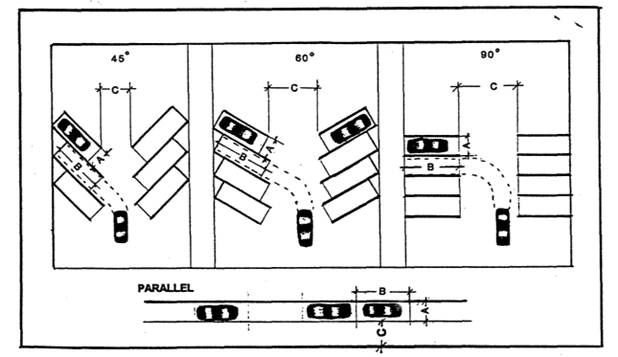
The standards for the design of uncovered off-street parking areas shall be as follows:
ANGLE
* Letters correspond to illustration below
** Individual spaces shall be 14 ft. wide and lined to provide a 9 ft. parking space and a 5 ft. wide and lined to provide a 9 ft. parking space and a 5 ft. loading area. Two spaces shall be 23 ft. wide to provide two 9 ft. wide spaces and one shared 5 ft. loading space.
*** The length of the end stall in a row of parallel spaces may be reduced to twenty (20) feet.
(d)
Wheel stops or other barriers acceptable to the City Engineer shall be provided for all uncovered off-street parking spaces and may be included within the required minimum parking dimensions of such spaces. Wheel stops or other such barriers shall be located to allow a minimum overhang of three (3′) feet.
(e)
Automobiles may overhang plantings in areas where the median between parking stalls is a minimum of six (6′) feet in width and a six (6″) inch curb is provided. The parking space length may be reduced two (2′) feet, and no wheel stop need be provided in such cases. Plantings shall be designed to not be damaged by the overhang of parked automobiles.
(f)
Where posts, columns, or other architectural appenditures, other than wheel stops, are located within parking areas, such posts, columns, or other appenditures shall not be permitted to be calculated within the required minimum parking dimensions of spaces, or driveways serving such spaces, as required by the standards set forth in subsection (c) of this section. Further, such posts, columns, or other appenditures shall not be so located as to obstruct the facilitation of vehicular movement and the parking or the opening of vehicular doors.
(§ 2, Ord. 497-C.S., eff. February 10, 1988)
Sec. 9-4.2818. - Number of parking spaces required.
(a)
The number of off-street parking spaces required for the uses set forth in this section shall be as follows:
(b)
Electric vehicles (EV) charging stations are required as follows:
(1)
New construction or major alteration of commercial or municipal facilities shall include an EV Space with adequate electric vehicle supply equipment in place that is capable of supporting the future installation of a Level 2 or Level 3 electric vehicle charging station or include installation of a Level 2 or Level 3 electric vehicle charging station.
(i)
An EV Space and electric vehicle charging stations shall be incorporated according to the following schedule:
* Actual parking shall be the number of parking spaces provided for the facility and not the number of parking spaces required per subsections (a) through (h) of this section.
(ii)
Additional EV Spaces or electric vehicle charging stations beyond the requirements of the schedule above are encouraged.
(iii)
Electric vehicle charging station requirements for major alterations shall be proportional to the area of impact.
(2)
An electric vehicle charging station shall be an allowed accessory use within any zoning district subject to all applicable city code requirements in addition to the following:
(i)
The electric vehicle charging station shall be protected as necessary to prevent damage by automobiles.
(ii)
Any electric vehicle charger shall be Listed and Labeled by an Approved testing agency.
(iii)
The electric vehicle charging station shall have complete instructions and appropriate warnings posted in an unobstructed location next to each electric vehicle charging station.
(3)
An electric vehicle charging station for public use shall be subject to the following requirements:
(i)
The electric vehicle charging station shall be located in a manner that will be easily seen by the public for informational and security purposes and shall be illuminated during evening business hours.
(ii)
Be located in desirable and convenient parking locations that will serve as an incentive for the use of electric vehicles.
(iii)
One standard non-illuminated sign, not to exceed four (4) square feet in area and ten (10) feet in height, may be posted for the purpose of identifying the location of each cluster of electric vehicle charging stations.
(iv)
The electric vehicle charging station may be on a timer that limits the use of the station to the normal business hours of the use(s) that it serves to preclude unauthorized use after business hours.
(4)
The following information shall be posted at a public electric vehicle charging station:
(i)
Voltage and amperage levels.
(ii)
Hour of operations if time limits or tow-away provisions are to be enforced by the property owner.
(iii)
Usage fees.
(iv)
Safety information.
(v)
Contact information for reporting when the equipment is not operating or other problems.
(5)
An electric vehicle charging station for private use shall:
(i)
Be located in a manner that will not allow public access to the charging station.
(ii)
Electric vehicle charging equipment and electric vehicle charger shall be located in reasonably inconspicuous location from public view when not in use.
(6)
Where Accessible parking requirements are applicable, at least one EV space or electric vehicle charging station shall meet current van accessible dimensions, as defined by the California Building Code, and be connected to a barrier-free accessible route of travel to the building. No accessible markings shall be made on the EV space or electric vehicle charging station with van accessible dimensions. The EV space with van accessible dimensions shall be the first electric vehicle charging station established on the property.
(§ 2, Ord. 497-C.S., eff. February 10, 1988, as amended by § 2, Ord. 823-C.S., eff. October 11, 2017; § 14, Ord. 825-C.S., eff. November 8, 2017; § 2, Ord. 844-C.S., eff. June 12, 2019; § 5, Ord. 846-C.S., eff. September 11, 2019; § 4J, Ord. No. 894-C.S., eff. January 10, 2024; Ord. No. 902-C.S., § 6(Exh. A, § 18), eff. September 24, 2025)
Sec. 9-4.2819. - Required loading spaces.
(a)
Off-street loading spaces. The off-street loading spaces required by the provisions of this section shall only be required where there is a public alley or driveway easement or where access can be provided from an adjacent off-street parking area. Where only street access is available, loading spaces shall not be required.
(b)
Number of non mall-type loading spaces required. There shall be provided and maintained in all districts on the same zoning plot with every building, or portion thereof, having a gross floor area of 5,000 square feet or more, which building is to be occupied for the manufacturing, display, storage, or warehousing of goods, for retail sales, or as a hotel, hospital, mortuary, laundry, dry cleaning establishment, or for other uses similarly requiring the receipt or distribution by vehicles of materials or merchandise, at least one off-street loading space, plus one additional off-street space for each 20,000 square feet of floor area in the building.
(c)
Number of mall-type loading spaces required. Off-street loading spaces for mall-type commercial or industrial developments shall be provided as required by the Commission; provided, however, in no event shall the requirement be less than one loading space for every building having a gross floor area of 5,000 square feet or more. One additional off-street loading space for each 20,000 square feet of gross floor area in the building may be required.
(d)
Number of unspecified loading spaces required. Loading spaces adequate in number and size shall be provided as required by the Commission for uses not otherwise provided for in this article.
(e)
Location and screening of loading facilities. All loading spaces shall be provided on the same zoning plot as the use served. Loading shall take place on the side or in the rear of the building. No loading or unloading shall be permitted in front of the premises. In districts abutting residential districts, all loading and unloading facilities shall be screened by a six (6′) foot high sight-obscuring fence or hedge.
(f)
Size of loading spaces. Unless otherwise specified, loading spaces shall measure ten (10′) feet in width and twenty-five (25′) feet in length, exclusive of aisles and maneuvering space, and shall have a vertical clearance of fourteen (14′) feet.
(g)
Surfacing of loading spaces. All open off-street loading spaces shall be surfaced with plant mix asphalt, concrete, or other surfacing so as to provide a durable, dust-free, all-weather surface which shall meet the requirements of all applicable laws and the approval of the City Engineer.
(h)
Use of loading spaces for parking. Spaces allocated to any off-street loading and unloading space, while so allocated, shall not be used to satisfy the space requirements for any off-street parking facility or portion thereof.
(i)
Use of parking spaces for loading. Required loading spaces shall be used for loading purposes. Driveways and required parking spaces shall not be used for loading purposes.
(§ 2, Ord. 497-C.S., eff. February 10, 1988)
Sec. 9-4.2820. - Beach access parking.
The location, design, and orientation of beach access parking facilities and the number of parking spaces provided therein shall be consistent with applicable sections of the City's Local Coastal Program Land Use Plan and Local Coastal Implementation Plan or, where specific guidelines are not provided, as determined by the Commission.
(§ 2, Ord. 497-C.S., eff. February 10, 1988)
Sec. 9-4.2821. - Parking for disabled persons.
Parking spaces specifically designed, located, and reserved for vehicles licensed by the State for use by disabled persons shall be provided in all parking facilities (excluding residential uses) according to the following schedule:
(§ 2, Ord. 497-C.S., eff. February 10, 1988)
Sec. 9-4.2822. - Bicycle parking.
(a)
Bicycle parking spaces shall be provided equal to ten (10%) percent of the required parking in all developments (excluding residential uses), with a minimum of two (2) spaces required.
(b)
Bicycle parking facilities shall be conveniently located and adjacent to on-site bicycle circulation and pedestrian routes and shall be of the following three (3) types as determined by the Commission or Planning Administrator, as appropriate:
(1)
A rack which secures the frame and both wheels; or
(2)
An enclosed bicycle locker; or
(3)
A fenced, covered, locked, or guarded bicycle storage area.
(c)
The spacing of bicycle units shall be figured on a width of three (3′) feet, height of three and one-half (3½′) feet, and length of six (6′) feet.
(§ 2, Ord. 497-C.S., eff. February 10, 1988)
Sec. 9-4.2823. - Motorcycle parking.
(a)
Where motorcycle parking spaces are provided for commercial or industrial uses, parking spaces otherwise required pursuant to this article may be omitted in accordance with the following provisions and subject to the following limitations:
(1)
One parking space may be omitted for each two (2) motorcycle parking spaces provided.
(2)
In no instance shall credit for motorcycle parking exceed five (5%) percent of the total required parking spaces.
(b)
Motorcycle parking spaces shall be clearly marked for motorcycle parking only and shall be a minimum of three and one-half (3½′) feet in width and seven (7′) feet in length.
(§ 2, Ord. 497-C.S., eff. February 10, 1988)
Sec. 9-4.2824. - Exceptions.
(a)
Applications: Issuance. In the event of practical difficulties and unusual hardship, the Commission may grant exceptions to the provisions of this article. Applications for exceptions shall be filed with the Planning Administrator on a form provided by the City. No public hearing need be held thereon, and the findings of the Commission need include only that the establishment, maintenance, and/or conducting of the off-street parking facilities as proposed are as nearly in compliance with the requirements set forth in this article as are reasonably possible.
(b)
Parking assessment districts. The off-street parking requirements set forth in this article may be reduced or eliminated by the Commission or Planning Administrator, as appropriate, for any building or use located in a parking district established by the Council in connection with which land has been acquired for public parking purposes if the Commission finds that the parking needs for the particular structure or use are substantially met by the parking spaces provided in the district.
(§ 2, Ord. 497-C.S., eff. February 10, 1988)

