
Pacifica City Zoning Code
ARTICLE 27
- Projections into Yards
Sec. 9-4.2701.- Scope.
The provisions of this article shall be in addition to, and shall not constitute a waiver of, any other provision of this chapter.
(§ 9.09, Ord. 363)
Sec. 9-4.2702. - Cornices, eaves, canopies, and similar architectural features.
Architectural features, such as cornices, eaves, canopies, fireplaces, bay windows, and similar architectural structures, may not be constructed closer than thirty (30″) inches to any side lot line nor project more than six (6′) feet into any required front or rear yard.
(§ 9.01, Ord. 363, as amended by § XI (A), Ord. 491-C.S., eff. October 28, 1987)
Sec. 9-4.2703. - Porches, landings, and outside stairways.
Open porches, landings, and outside stairways may project not closer than four (4′) feet to any side lot line and not exceeding six (6′) feet into any front or rear setback; provided, that the area is unenclosed (a roof and partial walls may be allowed within the front setback). On-grade stairways are permitted closer to the property line to provide a necessary connection between the street and a structure. Decks and other projections less than thirty (30″) inches above grade are permitted within required setbacks.
(§ 9.02, Ord. 363, as amended by § XI (B), Ord. 491-C.S., eff. October 28, 1987, § 2, Ord. 585-C.S., eff. February 12, 1992, § VII (A), Ord. 613-C.S., eff. April 13, 1994, and § IX, Ord. 641-C.S., eff. May 8, 1996)
Sec. 9-4.2704. - Accessory buildings.
(a)
In the event an accessory building is attached to the main building, such accessory building shall be made structurally a part of the main building, and comply in all respects with the requirements of this chapter applicable to the main building. Unless so attached, the following regulations shall apply to accessory buildings in all residential districts:
(1)
All portions of the accessory building shall be located at least five (5′) feet from any building existing or under construction on the same lot; a building is considered attached to another building when there is a common wall, common roof or a horizontal connection thirty (30″) inches above grade such as a deck. Retaining walls and/or decking between buildings that are less than thirty (30″) inches above grade are not considered a connection.
(2)
No accessory building shall be located within any required front or side setback except as permitted below, nor within five (5′) feet of any alley;
(3)
An accessory building may be located within the rear setback provided that:
(i)
Only nondwelling uses (i.e., garage, storage) are proposed,
(ii)
At least a one-and-one-half (1½) foot setback is provided from the side and/or rear lot line,
(iii)
At least fifty (50%) percent of the structure is located within the rear setback,
(iv)
If building coverage is thirty-five (35%) percent or more, any driveway leading to a garage shall be surfaced with alternative paving (i.e. turfblock or landscaped strips between paving) subject to approval by the City Engineer and Fire Marshal,
(v)
In the case of corner lots, the accessory building may not project beyond the front setback required or existing on the adjacent lot, and
(vi)
Building height shall not exceed twelve (12′) feet;
(4)
Except for a detached garage, every accessory building shall be located behind the main structure;
(5)
No accessory building shall be constructed until a main building is constructed on the site;
(6)
The total area covered by detached nondwelling accessory structures located in the rear setback of a lot may not exceed 600 square feet.
(7)
An accessory dwelling unit constructed in accordance with Article 4.5 of this chapter shall not be considered an "accessory building" for purposes of this section.
(b)
Where the slope of the front half of any residential lot is greater than one foot rise or fall in a horizontal distance of four (4′) feet from the established street elevation of the lot at the front street line (twenty-five (25%) percent), or where the elevation of the lot at the front street line is six (6′) feet above or below the established street elevation, a private garage or carport, attached or detached, may be built to within ten (10′) feet of the front lot line if such reduction will not interfere with existing or proposed public utilities or established setback lines; provided, however, such garage or carport shall maintain the side yard setbacks required for the main building. An additional reduction in the front yard setback may be permitted if the property is located on an improved public road where a curb has been constructed or an official street improvement plan has been established. The additional reduction in the front yard setback which may be permitted shall be one foot for each two (2′) feet from the property line to the face of the curb. The maximum permitted reduction shall be four (4′) feet. Such reduction shall not be permitted if it will interfere with any established plan line for road improvements or widening.
(§ 9.05, Ord. 363, as amended by § 1, Ord. 404, § 15, Ord. 538-C.S., eff. December 27, 1989, § 1, Ord. 586-C.S., eff. February 12, 1992, § VII (B), Ord. 613-C.S., eff. April 13, 1994, and § II, Ord. 641-C.S., eff. May 8, 1996; Ord. No. 769-C.S., § 4, eff. December 23, 2009; § 13, Ord. 825-C.S., eff. November 8, 2017)
Sec. 9-4.2705. - Yard and inner court requirements.
(a)
Where forty (40%) percent or more of the lots in a block have been improved with buildings, the minimum required front yard shall be the average of the improved lots if less than the requirements of this chapter.
(b)
On any parcel of land which qualifies as a building site, the width of each side yard may be reduced to ten (10%) percent of the width of such parcel but in no case to less than three (3′) feet.
(§§ 9.06, 9.07, and 9.08, Ord. 363, as amended by § 1, Ord. 65-C.S., eff. October 25, 1972, and § XI (C), Ord. 491-C.S., eff. October 29, 1987)
Sec. 9-4.2706. - Replacement of yard requirements by building lines.
(§ 9.10, Ord. 363; repealed by § XI (D), Ord. 491-C.S., eff. October 28, 1987)
Sec. 9-4.2707. - Encroachment of yards on official plan lines.
Whenever an official plan line has been established for any street, the required yards shall be measured from such line, and in no event shall the provisions of this chapter be construed as permitting any encroachment upon any official plan line.
(§ 9.03, Ord. 363)
Sec. 9-4.2708. - Encroachment of swimming pools and decks or other structures.
Swimming pools and decks or other structures less than thirty (30″) inches above the grade may be permitted in required yards.
(§ XI (E), Ord. 491-C.S., eff. October 28, 1987)
Sec. 9-4.2709. - Reduction of front yard setbacks.
(a)
Scope and purpose. The provisions of this section shall apply to front yard setback reductions for garages based upon improved parking areas in Single-Family Residential District (R-1). The purpose of this section is to encourage varied front yard setbacks in the Single- Family Residential District (R-1) while providing for necessary parking areas.
(b)
Site development permits required. A site development permit shall be required for each application for the reduction of a front setback for a garage as provided in this section. The Commission, as a condition of the site development permit, may require landscape planting, or fencing, or that other conditions be met in order to assure the satisfaction intent of this section.
(c)
Standards.
(1)
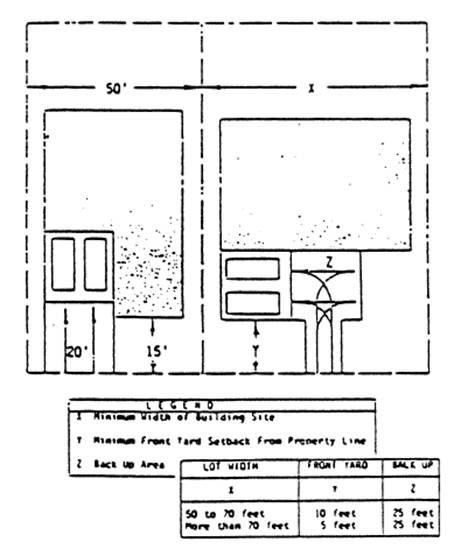
"Swing" type parking access may be employed as denoted in the following schematic drawing:
Setback Reduction Based upon Improved Parking Area in the Single-Family Residential District (R-1)
Minimum Standard Lot
(2)
The front yard setback reductions which may be permitted shall be as follows:
(3)
When "swing" type parking is employed, a fifteen (15′) foot setback to the side of the garage may be permitted administratively.
(d)
Conversion of garages to living areas. No living area shall be located closer than fifteen (15′) feet to the front property line.
(e)
Interpretation. The provisions of this section shall not be construed to preclude the Commission granting setback variations as provided in Article 34 of this chapter.
(f)
Delegation. The Commission may authorize the Planning Administrator to approve site development permits pursuant to this section.
(§ XI (F), Ord. 491-C.S., eff. October 28, 1987)
Sec. 9-4.2710. - Outdoor cultivation of cannabis in residential areas.
Subject to the standards contained in Article 48 of this chapter, including without limitation any setback requirements or limitations on the number of plants which may be cultivated.
(§ 15, Ord. 819-C.S., eff. November 7, 2017; § 2, Ord. 844-C.S., eff. June 12, 2019)

