
Pacifica City Zoning Code
ARTICLE 30
- Nonconforming Lots, Structures, and Uses*
* Article 30, consisting of Sections 9-4.3001 through 9-4.3007, codified from Ordinance No. 363, amended in its entirety by Ordinance No. 184-C.S., effective November 11, 1976. Article 30 entitled "Nonconforming Buildings and Uses", consisting of Sections 9-4.3001 and 9-4.3002, as added by said Ordinance No. 184-C.S., as amended by Ordinance No. 207-C.S., effective July 13, 1977, repealed by Section I, Ordinance No. 351-C.S., effective November 10, 1982.
Sec. 9-4.3001.- Intent and applicability.
(a)
Intent. The purpose of this article is to provide for lots, uses, buildings, and structures which are, or become, nonconforming with the standards of this Code, to specify the conditions under which nonconformities may continue, and to regulate the expansion of nonconformities.
(b)
Applicability. The provisions of this article shall apply to all lots, uses, and structures which do not meet the standards of the current zoning regulations and, as such, are nonconforming. The lawful use of a building, structure, or land refers to any use conforming to the zoning ordinance under which it was commenced.
(c)
Buildings and uses in violation of other zoning laws. The provisions of this article shall not be applicable to any use, building, or structure established in violation of any zoning law previously in effect, whether in the City, County, or other governmental agency having the jurisdiction to enact and enforce zoning laws.
(§ II, Ord. 351-C.S., eff. November 10, 1982)
Sec. 9-4.3002. - Continuance of nonconformities.
The lawful use of a building or of land which existed at the time of the adoption of this chapter or any amendment thereto, although such use does not conform to the regulations specified for the district in which the use is located, may be continued subject to the following provisions:
(a)
Nonconforming lots. All lots which do not meet the minimum lot area or dimensional standards of the district in which they are located are hereby deemed nonconforming lots. Undeveloped, nonconforming lots may be considered legal building sites and have a structure or building erected upon them provided any new structure or building meets all applicable development standards, except that mergers of lots or parcels which come into common ownership on or after July 1, 1984, shall be accomplished pursuant to the merger procedures set forth in Article 12 of Chapter 1 of Title 10 of the Code. In addition, all regular building sites which contain three thousand nine hundred ninety-nine (3,999) square feet or less and are located in any residential district shall be used solely for one single-family residence, and may also include an accessory dwelling unit. Any structure for which a building permit is required and which is to be constructed on a nonconforming building site as described in this section shall require a site development permit, except an accessory dwelling unit or junior accessory dwelling unit which is constructed in accordance with all standards of Article 4.5 of this chapter, which shall be governed by the standards of Article 4.5 of this chapter, and except a new structure or modification to an existing structure other than an accessory dwelling unit or junior accessory dwelling unit, located in the R-1, Single-Family Residential District that meets the development standards for lot coverage and landscaping and additional standards listed below:
(1)
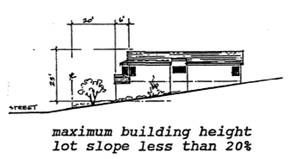
For uphill lots with an average cross slope of less than twenty (20%) percent, the following standards shall apply:
(i)
The maximum floor area to lot area ratio (FAR) shall be fifty (50%) percent.
(ii)
Maximum building height, measured as the maximum vertical distance between the lowest point on the site covered by any portion of a building to the topmost point of the roof, shall be twenty-five (25′) feet.
(iii)
Minimum front and garage setback shall be twenty (20′) feet.
(iv)
Minimum setback to upper floor livable area shall be twenty-six (26′) feet from the front property line.
(v)
Minimum rear setback shall be twenty (20′) feet from the rear property line.
(vi)
Minimum side setbacks shall be ten (10%) percent of the lot width but in no case less than three (3′) feet from the side property line.
(vii)
Bay windows, and projections including floor area, may encroach into required upper floor front setbacks provided the horizontal area of the feature does not exceed fifty (50%) percent of the setback depth nor exceed fifty (50%) percent of the building width.
(2)
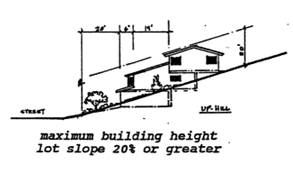
For uphill lots with an average cross slope of twenty (20%) percent or greater, the following standards shall apply:
(i)
The maximum floor area to lot area ratio (FAR) shall be fifty-five (55%) percent.
(ii)
Maximum building height, measured as a plane parallel to the site's natural grade shall not exceed twenty (20′) feet. Natural grade shall be measured from the intersection of building walls and the natural grade.
(iii)
Minimum front and garage setback shall be twenty (20′) feet from the front property line.
(iv)
Minimum second floor setback to livable area shall be twenty-six (26′) feet from the front property line.
(v)
Minimum third-floor setback to livable area shall be forty-five (45′) feet from the front property line.
(vi)
Minimum rear setback shall be twenty (20′) feet from the rear property line.
(vii)
Minimum side setbacks shall be ten (10%) percent of the lot width but in no case less than three (3′) feet from the side property line.
(viii)
Bay windows, and projections including floor area, may encroach into required upper floor front setbacks provided the depth and horizontal area of the feature does not exceed fifty (50%) percent of the setback depth nor exceed fifty (50%) percent of the building width.
(3)
Parking, for lots with frontage widths less than thirty (30′) feet, shall be designed as follows:
(i)
One garage space shall be provided and one additional space shall be provided within a carport.
(ii)
Maximum curb cut shall be fourteen (14′) feet.
(iii)
Maximum garage area shall be 300 square feet.
(iv)
If the improved street width is less than twenty-eight (28′) feet, one parking turnout shall be provided.
(4)
Parking, for lots with frontage widths thirty (30′) feet or greater, shall be designed as follows:
(i)
Two garage spaces shall be provided.
(ii)
Maximum curb cut shall be fourteen (14′) feet.
(iii)
Maximum garage area shall be 465 square feet.
(iv)
Maximum internal garage width shall not exceed eighteen (18′) feet.
(5)
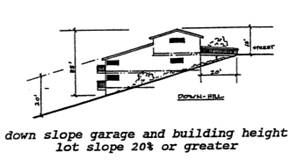
Downslope lots shall be subject to all standards set forth for upslope lots except as follows:
(i)
Garage height shall not exceed fifteen (15′) feet measured from the intersection of the natural grade and the front property line.
(ii)
Second- and third-floor setbacks need not apply; however, side and rear setbacks shall be the same as those for upslope lots.
(6)
One, fifteen (15) gallon, drought-resistant tree shall be planted within the property's front setback.
(7)
On nonconforming lots on which a building presently exists, such building may be increased or altered; provided, that:
(i)
If a site development permit was previously approved by the Planning Commission, any significant alterations or modifications, excluding greenhouses, decks and minor exterior alterations, shall be approved by the Planning Commission.
(ii)
If no site development permit was previously approved, all required development standards must be met. For homes in R-1, Single-Family Residential Districts these standards shall include those described in subsections (a) (1) through (6) of this section. In all zones, except R-1, Single-Family Residential Districts, the addition or alteration may in no way result in a greater degree of nonconformity to the lot as determined in the plan-check process, and, if the lot has an area of 3,999 square feet or less, a site development permit shall be required if an expansion of floor area, excluding the garage, of twenty-five (25%) percent or more, or a third-story addition is requested.
(b)
Nonconforming uses. All uses which are not listed as permitted in the district in which such use is being conducted, and all uses which, if presently initiated, would require a use permit but which do not have a use permit in force, shall be deemed nonconforming uses. Such uses shall be deemed lawful nonconforming uses if they comply with all the laws in existence at the time the use commenced.
The following provisions shall apply to nonconforming uses of land, nonconforming uses of conforming buildings, and nonconforming uses of nonconforming buildings, except that the use of buildings which do not meet the safety standards of the Building Code shall be regulated by subsection (1) of subsection (c) of this section:
(1)
No nonconforming use shall be expanded or moved in whole or in part to any portion of the lot or parcel or to another building on the lot other than that occupied by such use at the time of the adoption of this chapter; nor may a nonconforming use be extended to occupy a greater area within any building than the area currently occupied, except as otherwise permitted with an approved use permit pursuant to subsection (5) of this subsection (b).
(2)
No nonconforming use may be changed to a different nonconforming use, except as otherwise provided in this section. However, nonconforming uses may be changed to a use of a similar or more conforming nature provided a use permit is obtained.
(3)
If a nonconforming use is discontinued for a period of twelve (12) months, such nonconforming use shall not be reestablished. However, if the cessation of the use is caused by circumstances over which the owner has no fault or control, the time limits of this section may be extended by the Commission. Applications for such extensions shall be made in writing before the expiration of the twelve (12) month period. The subsequent use of buildings shall conform with the zoning regulations and General Plan designations for the district in which such use is located.
(4)
Lawful nonconforming uses may be continued. Neither a General Plan nor a zoning amendment shall be required for the continuance of the nonconforming use if such use is sold or the lease transferred.
(5)
Uses which are or become lawful and nonconforming following the date of the adoption of the zoning district maps of this chapter may be deemed conforming by the Commission or Council pursuant to this subsection and the issuance of a conditional use permit and site development permit, coastal permit, or both. Written applications for conforming use status may be made with the Commission in accordance with the provisions of this chapter.
(i)
In order to approve any application for conforming use status, the Commission shall adopt findings as required for the applicable permits; provided, however, the Commission shall deny any such application unless each of the following specific findings can be made:
(aa)
Adequate parking facilities are, or will be, provided pursuant to the provisions of this Code; except that where inadequate on-site parking exists, and, in the opinion of the Commission, the parking requirements cannot be fully achieved, the Commission finds that:
(1.1)
Such parking as will be provided for uses in the Coastal Zone will not conflict with Local Coastal Land Use Plan policies regarding the maintenance of, and provision for, access to coastal resources by visitors to the surrounding area; and
(1.2)
Such parking will not impair the viability of adjacent business or have an adverse effect on residential areas in the vicinity of any proposed conforming use;
(ab)
The subject proposed conforming use does not or will not adversely affect traffic on surrounding streets to a greater extent than would uses allowed in the district and on the site on which the use is located, taking into account existing and potential surrounding land uses and traffic circulation patterns;
(ac)
The subject proposed conforming use is or will be conducted, improved, expanded, or modified in a manner which encourages the development, improvement, and continued maintenance of adjacent properties in the neighborhood, including consideration of factors which may have an effect on visitor-serving commercial uses in the Coastal Zone;
(ad)
The building within which such use is located conforms or will be improved in accordance with the applicable regulations of the Uniform Building Code or the Commission finds that additional improvement is not feasible or necessary based on the circumstances of the application;
(ae)
The proposed subject conforming use is located in a building which is nonconforming by virtue of its inconsistency with zoning district coverage or other development regulations of the district within which the use is located, and the Commission finds that either:
(1.1)
Such nonconformity will be corrected through improvements to the site which, in the opinion of the Commission, approximate standards of the district within which the nonconforming use is located to the maximum extent possible given the circumstances of the particular case; or
(1.2)
Correction of such nonconformity is not feasible due to circumstances applicable to the subject property involving size, shape, topography, location, or surroundings; however, continuance of the nonconformity will not be detrimental to the development potential or viability of adjacent businesses or residential areas based on factors including, but not limited to, appearance, noise, hours of operation, odors, fumes, amount and type of traffic generation, and the like; and
(af)
The applicant has satisfactorily demonstrated that improvements either proposed or required by the Commission will be accomplished in a diligent and timely manner.
(ii)
The Commission may approve, deny, or conditionally approve any request for conforming use status. The Commission may impose such conditions as it deems necessary to secure the purpose of this subsection and may impose such requirements and conditions with respect to location, construction, maintenance and operation, site planning, and traffic control as the Commission deems necessary for the protection of adjacent properties, the public interest, and the implementation of the General Plan and Coastal Land Use Plan. The Commission may require tangible guarantees or evidence that such conditions are being, or will be, complied with.
(iii)
The findings and determinations made by the Commission in accordance with the provisions of this subsection shall be based on and bear a reasoned relation to substantial evidence contained in the record and submitted by the applicant as part of the application for conforming use status, including, but not limited to, plans, maps, studies, testimony, or any other information the Commission deems necessary to make the determination required by this subsection.
(iv)
Decisions of the Commission for any request for conforming use status may be appealed to the Council within ten (10) days after the date of any Commission action.
(v)
The provisions of this section shall not be construed to limit the City's ability to require compliance with other provisions of this article, including the treatment of:
(aa)
Nonconforming uses which existed on November 10, 1982, and which are not, or have not been determined to be, consistent with the provisions of this section;
(ab)
Nonconforming lots;
(ac)
Nonconforming uses of nonconforming structures;
(ad)
Nonconforming structures which existed on November 10, 1982, and which are not, or have not been determined to be, consistent with the provisions of this section; and
(ae)
Nonconforming uses which have been given conforming use status where:
(1.1)
The conditions of such Commission or Council action have not been fulfilled; or
(1.2)
Where assurances made by an applicant have not been implemented in accordance with such action.
(vi)
The effect of failure by an applicant to implement or maintain any part of an application approved pursuant to this section shall cause conferred conforming use status to be removed in the manner set forth in the City's revocation procedures.
(c)
Nonconforming buildings and structures.
(1)
Nonconforming uses of nonconforming buildings. Buildings which do not meet the safety standards of the Building and Mechanical Codes shall be deemed nonconforming buildings, and the following provisions shall apply:
(i)
The lawful nonconforming use of a nonconforming building may be continued, although the building does not conform to the regulations set forth in this chapter, unless the use is found by the Building Official to be hazardous based on life and fire risk, as defined in the appropriate section of the latest edition of the Uniform Building Code.
(ii)
The lawful nonconforming use of a nonconforming building may be changed to a use of the same or more restrictive nature provided a use permit shall be first obtained for each such use and that the use is found by the Commission, based on testimony by the Building Official, to be no more hazardous than that use which exists based on life and fire risk, as defined in the appropriate section of the Uniform Building Code.
(iii)
The lawful nonconforming use of a portion of a nonconforming building may not be extended throughout the building; provided, however, the use may be expanded with an approved use permit as provided in subsection (5) of subsection (b) of this section and provided the expansion of the use is found by the Commission to be no more hazardous than that use which exists based on life and fire risk.
(iv)
Notwithstanding the provisions of subsections (ii) and (iii) of this subsection, if a nonconforming use of a nonconforming building ceases for a continuous period of twelve (12) months, such use shall be considered abandoned, and the building shall be used thereafter only in accordance with the Uniform Building Code, zoning, and General Plan regulations.
(2)
Modifications to nonconforming structures. All structures, including, but not limited to, main buildings, accessory buildings, walls, and fences, which do not meet the development regulations for the district within which the structure is located and any residential building in a commercial district shall be deemed nonconforming but lawful, and the following provisions shall apply:
(i)
No physical change, enlargement, extension, or remodeling which increases the extent of nonconformity shall be made without first securing a use permit.
(ii)
A physical change, enlargement, extension, or remodeling which does not increase the nonconformity may be made, as with a conforming structure, by securing the required building permits. The decision that the alteration will or will not increase the extent of the nonconformity shall be made by the Planning Administrator or designee. Decisions may be appealed to the Commission within fourteen (14) days after such action.
(iii)
Notwithstanding the provisions of this subsection (2), existing nonconformities shall be removed or corrected as part of the proposed change, enlargement, extension, or remodeling to enhance the public safety where deemed feasible in writing by the Planning Administrator. Decisions may be appealed to the Commission within fourteen (14) days after such action.
(iv)
A nonconforming building or structure damaged by fire, explosion, flood, earthquake, or other event to an extent of more than fifty (50%) percent of the market value, as determined by a certified appraiser hired by the property owners, may be restored only if made to conform to all the applicable regulations of the district in which such structure is located; provided, however, a nonconforming structure or building so damaged may be restored upon the approval of a use permit and site development permit and adherence to any applicable performance standards deemed appropriate by the Commission or Council pursuant to subsection (5) of subsection (b) of this section.
(v)
Where the damage, as described in subsection (iv) of this subsection, to a nonconforming structure or building does not exceed fifty (50%) percent, such building may be restored to a total floor area not exceeding that of the former structure.
(vi)
On a residential lot or parcel where the required number of covered off-street parking spaces has not been provided, additional covered off-street parking spaces shall be required when the addition increases the number of bedrooms of the existing building. Such additional required parking shall meet the requirements of this chapter to the maximum extent feasible as determined by the Planning Administrator or designee.
(vii)
The provisions of subsections (i) and (ii) of this subsection requiring a use permit for any increase in the extent of nonconformity shall not apply to nonconforming structures which have been, or will be, improved in accordance with performance standards in the manner set forth in subsection (5) of subsection (b) of this section. Such increases in nonconformity shall be considered as an amendment to permits.
(§ II, Ord. 351-C.S., eff. November 10, 1982, as amended by § 1, Ord. 430-C.S. eff. November 21, 1984, § 2, Ord. 456-85, eff. December 25, 1985, § XII (A), Ord. 491-C.S., eff. October 28, 1987, § 2, Ord 554-C.S., eff. June 13, 1990, § III (A)—(I), Ord. 613-C.S., eff. April 13, 1994 and § X, Ord. 641-C.S., eff. May 8, 1996; § 15, Ord. 825-C.S., eff. November 8, 2017; § 10, Ord. 854-C.S., eff. February 26, 2020)

